Knife Collecting

Knife collecting is an extremely rewarding experience for knife enthusiasts. There truly is a knife for everyone. Many increase or hold their value throughout the years, making collecting knives something to pass on to the next generation of knife collectors.

Knife Store Of The Day I

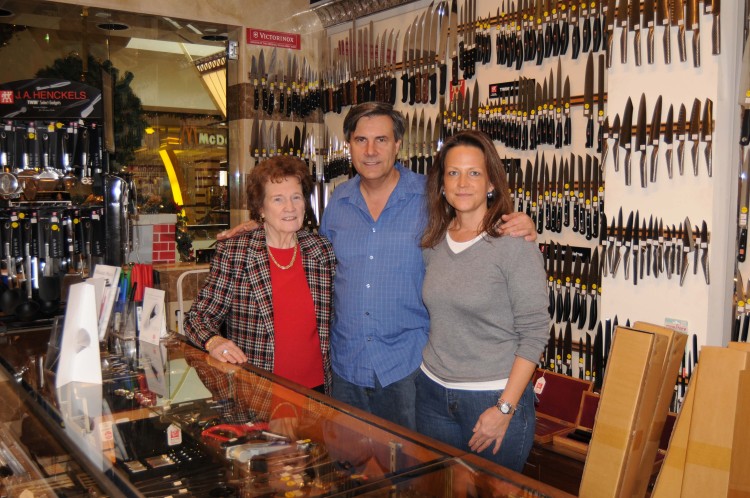
(From left) Lois, Dan and Pam Delavan of Plaza Cutlery in the South Coast Plaza Mall in Costa Mesa, California.

     You’ve seen our “Knife Of The Day” entries. Now it’s time for a new feature: our “Knife Store Of The Day.”

     The first installment is Plaza Cutlery of Costa Mesa, California.

     Located in the South Coast Plaza Mall, Plaza Cutlery is owned and operated by Dan and Pam Delavan and features a wide selection of custom and factory knives. The son of former Case salesman I.A. Delavan, Dan is one of the most knowledgeable people in the business of both custom and factory knives. In addition to selling knives, swords, sharpeners, knife books and much more in store, Plaza also has a comprehensive website (www.plazacutlery.com), carries factory exclusives such as its Chris Reeve Large and Small Sebenza “Doggy Knives,” conducts a biennial knife show that draws some of the world’s top custom knifemakers, and even does special events such as “Meet The Knifemaker” days at the Plaza Cutlery store.

     For more on the latest in the hottest knives, knifemakers, knife shows, knife trends and much more, subscribe to BLADE® Magazine. For subscription information, click on http://www.shopblade.com/product/blade-magazine-one-year-subscription-us/?r+ssfb121311#BL1SU

Vacation Knives: CRKT Guppie

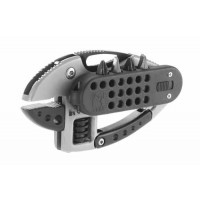
Tom Stokes and Launce Barber designed the Guppie as part of Columbia River Knife & Tool (CRKT)’s I.D. Works line of tools. It’s a hard-working carabiner tool with dozens of uses.

The adjustable wrench jaw opens to a half-inch so you can use it for all kinds of light repair and assembly jobs. Thanks to the carabiner gate, the Guppie is easy to carry on a belt loop, D-ring, pack or rope. It’s not a weight-bearing tool, though (sorry, mountain climbers).

The high-carbon, stainless steel 2″ blade with a Razor-Sharp edge can be worked with one hand using the blade slot.

The removable bit carrier is also a high-intensity LED light. Two magnets hold it securely to the Guppie’s left side. The stainless steel clip will hold the Guppie in your pocket or on gear. This adds another layer of versatility.

The Guppie makes a great little money clip, too, for those who prefer it over a thin wallet.

If that weren’t enough, the Guppie carabiner detent will open bottle caps and metal jar lids.

For more info click on http://www.shopblade.com/guppie-9070/?lid=blssbl080912

How to Sharpen a Serrated Knife

2
How to sharpen a serrated knife
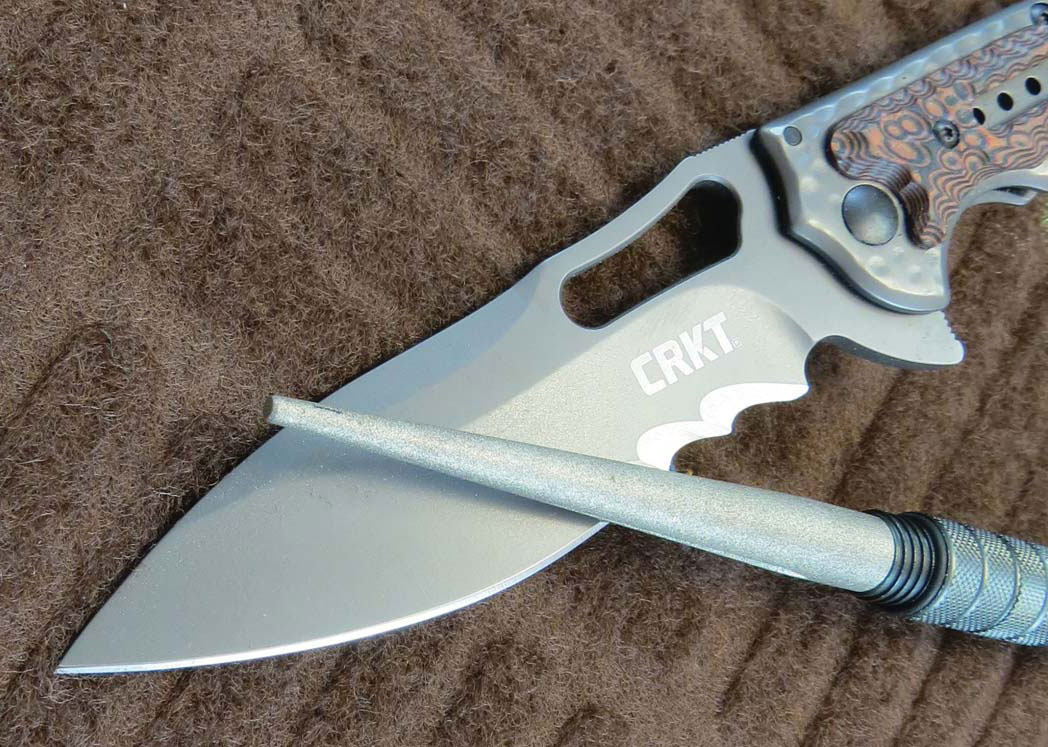
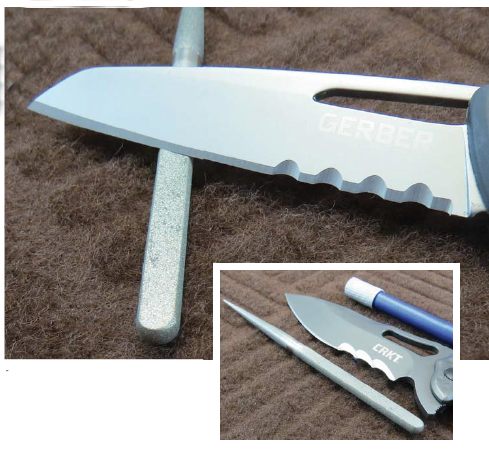
The broad cone of the GATCO Scepter 2.0 comes in handy when working on the wide serrations of the CRKT Fossil.

How to Sharpen a Serrated Knife: Quick Tips

  • Use a small sharpening rod
  • Lock the rod into a “gullet,” the groove of the serration
  • Work the rod with slow, smooth motions away from the knife, applying light pressure
  • Work the rod in one direction; don’t rub it back and forth
  • Don’t sharpen wider than the serration

Sharpening Rods are Musts for Sharpening Serrated Knives

No matter what edge style of knife you carry, it must be sharpened. In the case of serrated blades, you need specialized tools, called sharpening rods.

Some rods, like the ones you’ll typically find in a kitchen, are large. Those won’t be helpful for working with small serrations. You need to find a small rod that will lock into place inside the serration. Don’t worry about sizing, though. Most small sharpening rods are tapered so that you’ll have the right fit no matter what.

Practice Makes Perfect

Learning how to sharpen serrated knives is like any other technique—you need practice to get good at it. I recommend buying some cheap knives and practicing before you move on to your $200 Spyderco. Also, remember that not all diamond sharpeners are created equal. Diamonds are manufactured and certain diamonds are more durable than others—then again, that’s a topic for a different time.

Know Your Geometry

There are a couple of key points about geometry for learning how to sharpen a knife with serrations.

As with a plain edge, you are polishing a surface. In the case of serrated blades, there are two geometries to work.

One is the gullet. The gullet is the internal section that normally has a curved shape between the points of a serrated edge. Since sharp gullets are necessary, many people mistakenly focus too much on the gullets and not enough on the teeth of the pattern. The teeth do the initial entry into the material and begin the cut.

Hence, when sharpening serrated blades you not only polish the gullet of the serration but also re-point the teeth at the same time. Much like sharpening a saw, you reform the teeth and restore the geometry of the teeth along with the geometry of the gullet.

Four Sharpeners for Sharpening Serrated Rods

How to sharpen serrated knives
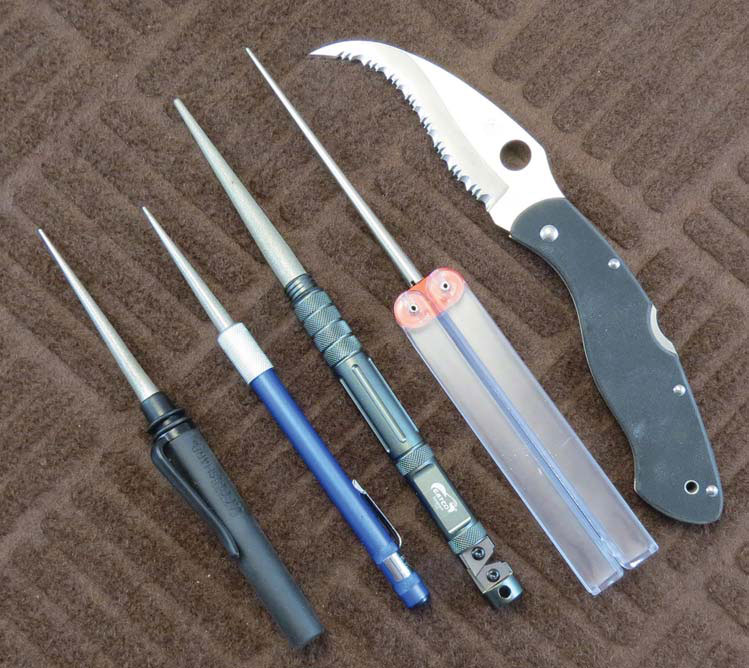
From left, with manufacturer’s suggested retail prices in parentheses: Accusharp Diamond Compact Sharpener ($11.99); Smith’s Diamond Retractable Sharpener ($7.99); GATCO Scepter 2.0 ($25.95); and DMT Diafold Serrated Sharpener ($32.99). The knife is the author’s Spyderco Civilian.
Serrated knife sharpeners
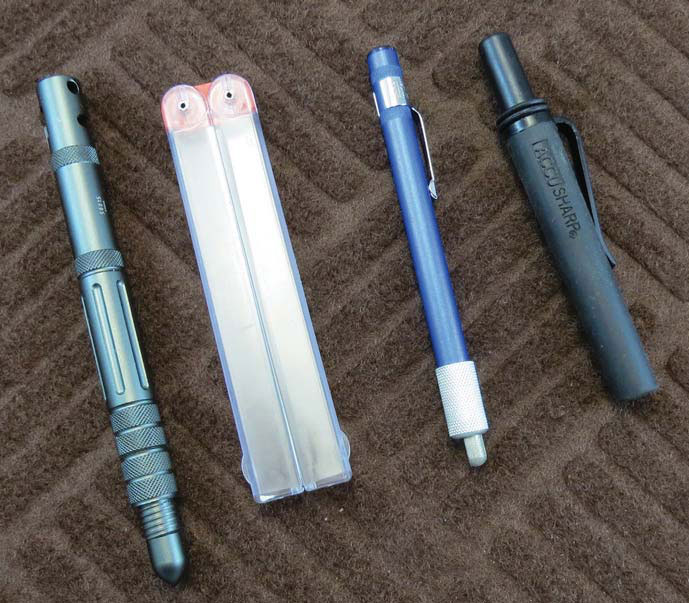
The foursome in the closed position, from left: GATCO Scepter 2.0, DMT Diafold Serrated Sharpener, Smith’s Diamond
Retractable Sharpener and Accusharp Diamond Compact Sharpener.

Here’s a good place to start. Our lineup of four sharpeners consists of the GATCO Scepter 2.0, Smith’s Diamond Retractable Sharpener, DMT Diafold serrated sharpener and Accusharp Diamond Compact Sharpener.

GATCO Scepter 2.0

Serrated knife sharpening tips
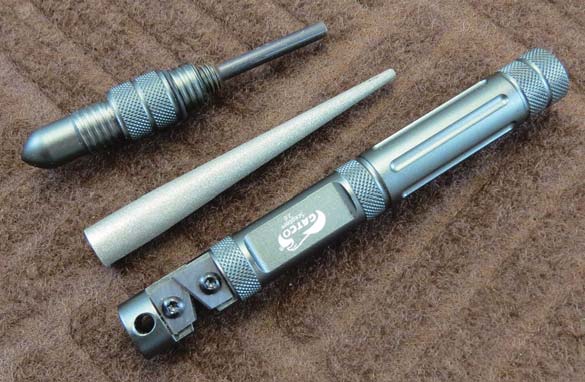
The GATCO is a bit of a multi-tool with, from
right, a carbide sharpener, diamond cone and a ferrocerium rod all in one.

Of the four, the GATCO Scepter 2.0 is more multi-tool than sharpener only.

If you are into gadgets that serve more than one purpose, the Scepter 2.0 is for you. It has two tungsten-carbide blades for sharpening, a ferrocerium rod and a diamond cone sharpener. All are in a compact package that resembles a tactical pen. The diamond rod has a groove for sharpening fishhooks.

The cone has a medium-grade texture and a broad taper. The cone is 3.75 inches long and tapers from .113 to .392 of an inch in diameter. Why does the taper matter? If the taper is steep, during sharpening you will have a shorter cut as the cone will get too wide too quickly for some smaller serrations. Overall length: 6.125 inches.

If you’re looking for a sharpener as an everyday carry tool, the Scepter 2.0 is a good choice. The cone is a bit chunky but works fine for all but the smallest serrations. I am not a big fan of carbide sharpening blades because they hog off a lot of metal, though I don’t mind them on rough cutting tools. I haven’t had the Scepter long enough to testify to the durability of the diamond cone but so far it is holding up well.

Smith’s Diamond Retractable Sharpener

Sharpen a serrated knife
The Smith’s rod has three surfaces—flat, conical and round (inset)—to tackle any number of sharpening jobs. The flat surface in combination with the diamond cone makes it easy to sharpen combo-edge blades.

Smith’s Diamond Retractable Sharpener is the trimmest of the group and looks like a pen when collapsed. It is possible to use the cone shape to sharpen a plain edge, but with the Smith’s model the diamond coated sharpener has two ends.

One end has a flat section and the other is tapered for serrated edges. Of the group the Smith’s hone has the most aggressive grit. The body of the holder is aluminum and has a pen clip. (The GATCO Scepter could use a pen clip to complete it.) Closed length: 5.187 inches.

Again, I could see this tool in someone’s EDC kit, a tackle box or camping gear. At the tip the cone measures .06 inch and at the widest point .256 inch in diameter. With such a fine tip expanding in size over its 2.375-inch length, the Smith’s hone sharpens a wide range of serration styles. At a manufacturer’s suggested retail price of $7.99, it does not have to last a lifetime to pay for itself.

DMT Diafold

Serrated knife sharpening tips
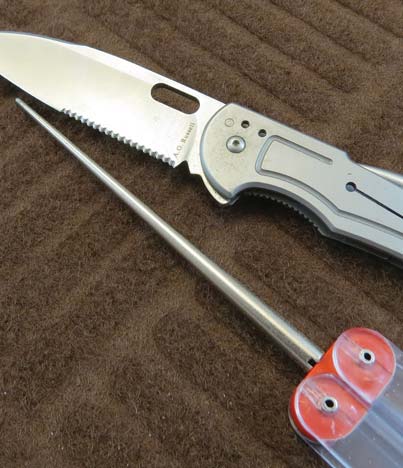
A sharpener with a fine tip like the DMT Diafold is needed to get small serration patterns back to sharp again.

The DMT Diafold serrated sharpener comes in three color-coded grits: coarse (blue) 325 mesh or 45 micron, fine (red) 600 mesh or 25 micron, and X fine (green) 1200 mesh or 9 micron. I used the red.

Of the quartet it was the longest, finest-grit tapered cone. Overall length: 4.5 inches. It tapers in diameter from .62 inch at the tip to .25 inch at the base.

To store the sharpening cone DMT uses a folding handle system similar to a butterfly knife. The handle is a clear polycarbonate. At 5 inches closed and as with the others the Diafold is compact enough to be EDC’d.

I’ve had a number of DMT Diafolds over the years and they are still in working order. You have to use some of the diamond sharpeners a lot before they will wear out. I will say when open, the very appearance of the Diafold can send shivers down your spine as it resembles an icepick. It works well and if you like something with a fuller handle to it, a Diafold might be your shtick.

Accusharp Diamond Compact Sharpener

Accusharp serrated knife sharpener
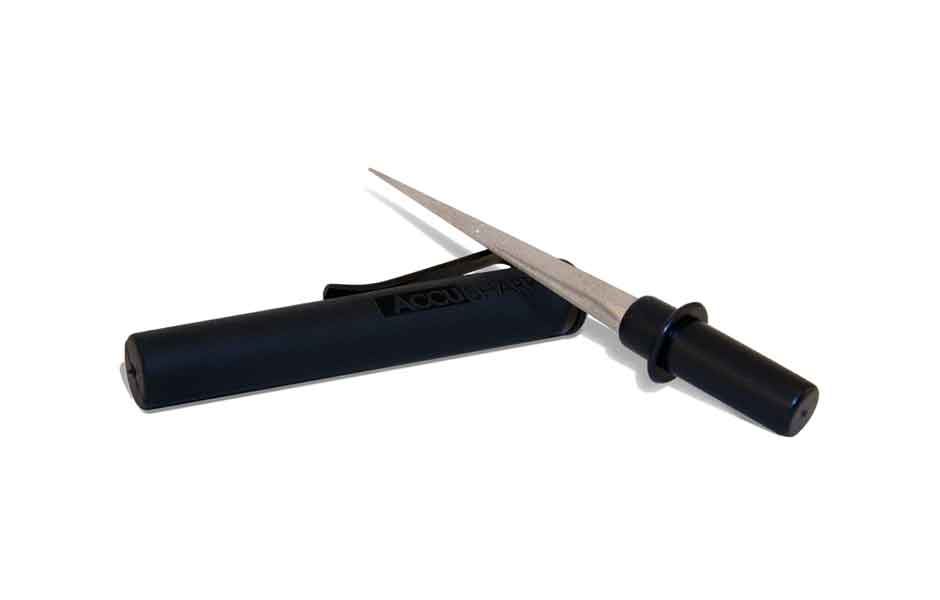
Accusharp uses a friction fit to hold the Diamond Compact Sharpener open and closed.

The Accusharp Diamond Compact Sharpener is 3.125 inches long with inch diameters of .06 at the tip and .305 at the base. A plastic body with a rubberized coating houses the unit—definitely low tech and follows the K.I.S.S. principle. A friction fit holds the sharpener open and closed. The fit is tight and you don’t have to worry about the two sides separating accidentally. An integral pen clip is on the main body’s housing. The clip doesn’t seem robust and I can see it eventually snapping off.

The sharpener has a medium-grit diamond coating and functioned well during testing. Accusharp includes a hook groove I find rather large. Maybe it’s for big fish. The closed length is the shortest of the group: 4.75 inches.

I like the design because as with the Smith’s sharpener it appears to be a standard pen as opposed to the GATCO model’s large-tactical-pen look. If you want to carry a sharpener and not let anyone know you have one so you aren’t constantly loaning it out, the Smith’s might be the ticket. As far as feel, the handle diameter is nice and comfortable.


What’s Hot In Knife Mechanisms

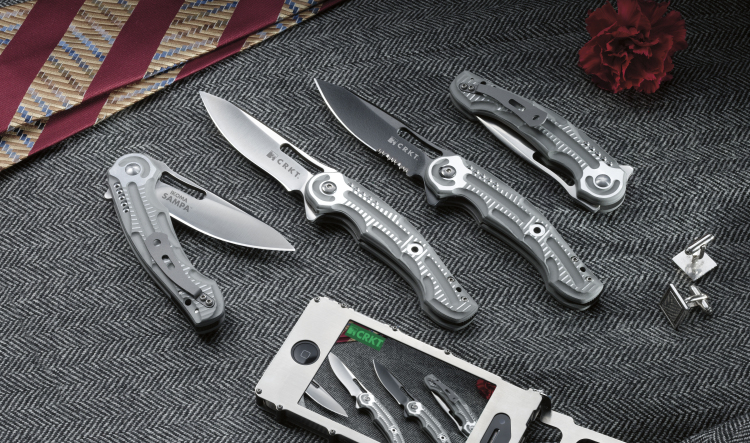
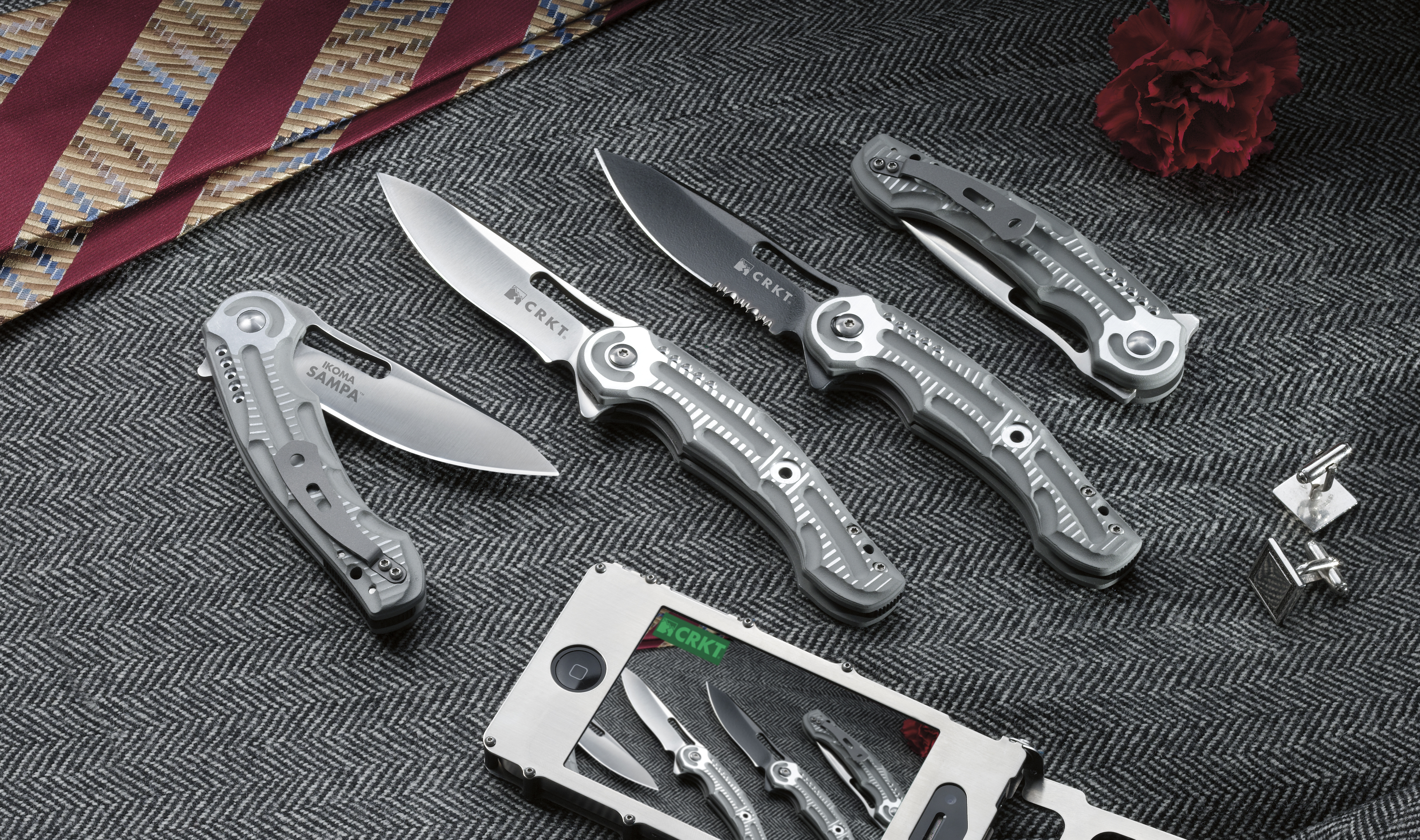
Designed by Flavio Ikoma and using the IKBS (Ikoma Korth Bearing System) Flavio helped create, Columbia River Knife & Tool’s Sampa line is an example of the non-assisted-opening flipper folder purveyor Duane Weikum said seems very popular at the moment. (CRKT photo)

User needs and refined design/construction rule the hottest knife mechanisms

By Dave Rhea


Mechanisms are everywhere on the knife market. There are so many different ways to open, shut and lock a knife it seems there could never be anything new under the sun. Invariably, though, advanced, creative minds push the boundaries of what is out there. Sure enough, along comes something that revolutionizes the cutlery culture.

     So what is going on in the sphere of knife mechanisms? Owner of New Graham Knives retail knife store, Michael Dye said it is difficult to have a really fresh, new idea, and pointed to a visit he had with Blade Magazine Cutlery Hall-Of-Fame© member Ken Warner a few years ago.

     “He showed me drawings in a bound notebook that were dated back to the ’70s,” Dye recalled. “Ken said, ‘Recognize these?’ and they looked the same as the handles that are on [a line of leading field knives now].” Dye was not alluding to any sort of theft or malicious intent, but to the fact so many people have so many ideas, and over the years the ideas start to overlap.

     Which is a roundabout way of saying what is hot today in knife mechanisms is not necessarily new but a combination of consumer preference and a refinement of existing mechanisms.


Get Your Tweak On

“I think you’re seeing a lot of refining, where the changes are in movement improvements and [modifying] existing mechanisms,” he said. “The devil is often in the details. Also, like putting mechanisms such as the IKBS [Ikoma Korth Bearing System] in affordable production knives.”

     He used the Taylor Cutlery/Smith & Wesson knives as an example of the benefits of tweaking a design. “Their third-generation flippers really hit the mark,” Dye explained. “When people put that little knife in their hand, they really are impressed with how the assisted opening works. Refining and tweaking of the geometry to make flippers open more easily—that’s what I have been seeing more than anything in the last year.”

     Owner of EDC Knives, purveyor Duane Weikum cited the venerable non-assisted-opening flipper folder popularized by Kit Carson as probably the most-sought-after mechanism this year. “A flipper tab on the knife, along with a strong detent and a smooth pivot, makes for an impressive-opening knife,” he said. “I prefer a straight flipper to an assisted knife myself—fewer chances of it opening in my pocket.”

     Weikum is also a big fan of Flavio Ikoma and the IKBS bearing pivot system (page 50, June BLADE®). “There are other bearing systems coming online, people tweaking things so they can call it something other than IKBS,” he opined, “but Ikoma and Korth were putting it into practice long before these other systems came along. Some guys were even using IKBS before they knocked it off—sad but true.”

     He added that Columbia River Knife & Tool (CRKT) has licensed the IKBS for Ikoma’s and Cutlery Hall-Of-Famer Ken Onion’s CRKT designs (the Sampa and Ripple, respectively), which he said speaks well for the mechanism’s performance.

     Another hot existing mechanism Dye singled out is the one on the Blade Magazine 2010 Overall Knife Of The Year®, the Chris Reeve Knives Ti-Lock. “You definitely have some people who are pushing the envelope, like Gavin and Grant Hawk with the Ti-Lock,” Dye pointed out. “That is, without a doubt, a very unusual locking mechanism.”

     The Ti-Lock lock bar is mounted along the back of the blade toward the pivot. When the blade is opened, the handle edge of the lock bar, which has a cross bar with thumb-stud-like grips, is forced down into a slot through spring pressure, locking the knife securely open.

     The Ti-Lock folder by Chris Reeve Knives is a collaboration between the father-and-son Hawk team and Chris Reeve. According to Dye, it is a design that, initially, was almost complete but shy of actual fruition. “I think Gavin and Grant got it about 90 percent figured out,” Dye noted. From there, he said Reeve took the lock and made it economically feasible to build on the larger manufacturing scale of Chris Reeve Knives. “It works very well and it adds a different look to the knife, to say the least, with the [lock’s] anodized titanium bars,” Dye observed.

     Another hot mechanism is Benchmade’s Paul Axial system, according to Trevor Darby, owner of BladeOps LLC. “I think the [Benchmade version of the] Paul Axial system that has just been hitting the market is very interesting,” he said. “It’s a smooth-opening one-handed mechanism that seems to be generating quite a bit of buzz, as well as demand.”

     Developed by Paul Poehlmann in the 1970s (page 50, November BLADE), the Paul Lock has a spring-loaded interlock key that can be depressed and rotated. It is simple and strong. “Along the same lines,” Darby added, “even though it is a mechanism that has been around for a while, the Tri-Ad lock that Cold Steel makes is always in huge demand.” Darby also points to the Spyderco Ball Bearing Lock (page 24, February BLADE) as something that has been gaining interest with his customers.


Hard To Put Down

Sometimes it is the mechanism itself that pushes a buyer into purchasing a knife. The “gadget factor” has a strong allure, and, when someone puts a knife in his hand and starts toying with it and it is hard to put it down, that is an almost certain sale. For many of BladeOps’ clientele, Darby said there is often a specific mechanism that drives them to buy.

     “We have a lot of customers who have seen something somewhere and want that particular mechanism,” he related. “I would say there’s about a 50/50 split between buyers looking for a specific mechanism and those looking more along a size, brand and price range.”

     A great example of a company that excels in the marketing of interesting mechanisms is CRKT. It has led the way by offering an incredible array of opening and locking mechanisms to the point that, each year, this writer cannot wait to see what is in its new catalog.

     “Things like what Ed Van Hoy did with the Snap Fire with the anodized wheels and stuff,” Dye pointed out. “We have a lot of people who come in and really get mesmerized by the glitzy opening systems that you see in some designs.” (Editor’s note: Though CRKT offers at least one other Van Hoy design, the Snap Fire has been discontinued.)

     Dye mused that sometimes the mechanism itself outweighs the knife’s actual usefulness. “In such cases, the knife is not utilitarian by any means,” he said. “But what sells the knife to every customer that puts it in his hand is the way it opens and closes. It becomes a gizmo at that point—it just happens to have a sharp blade on it.”

For more on the latest knives, knife legislation, knifemaking instruction, knife trends, knifemakers, what knives to buy and where and much more, subscribe to BLADE® Magazine, the World’s No. 1 Knife Publication. For subscription information click on http://www.shopblade.com/product/blade-magazine-one-year-subscripti…?r+ssfb020512#BL1SU


22nd Annual East Coast Custom Knife Show

0

More contact information:


Stephen D’Lack

Dept. BL5, POB 313

Turners, MO 65765

417-866-6688

fax 417-866-6693

[email protected].

50 Years Ago In BLADE: Buster Warenski

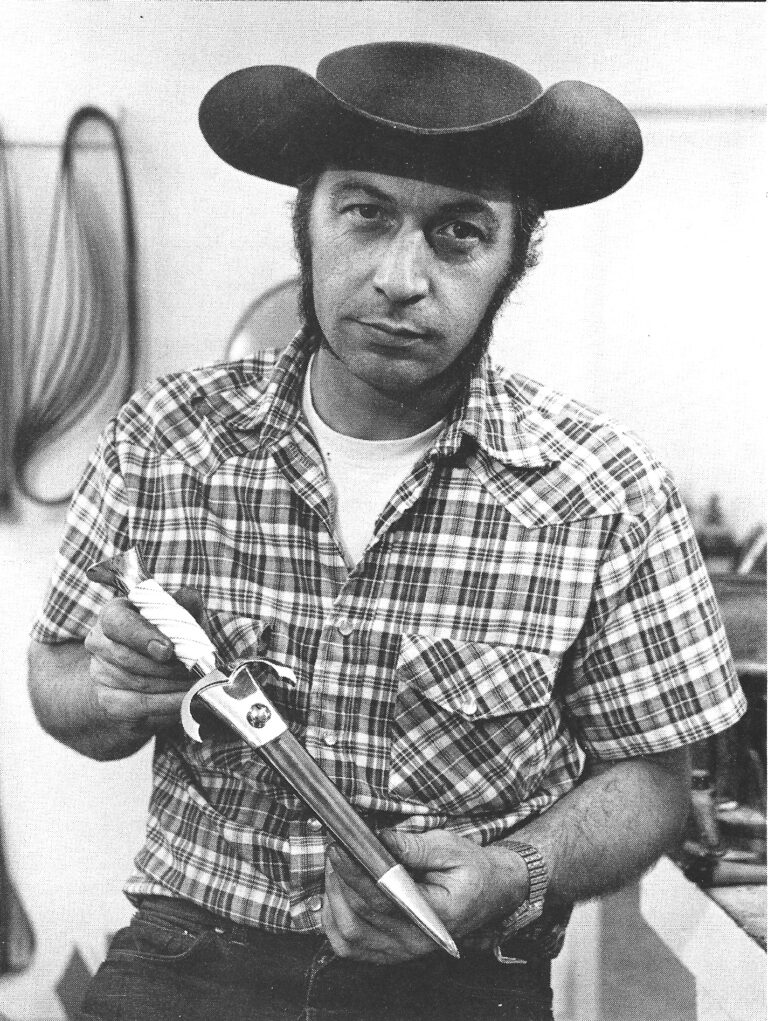
BLADE Magazine Cutlery Hall-of-Fame® member Buster Warenski was the subject of an extensive six-page profile a half century ago in the January/February 1976 issue of The American Blade. He was larger than life then and would get even larger in the years to come.

Unmistakable in the low-crowned Stetson and mutton-chop sideburns he wore back then, Buster was interviewed in his new Richfield, Utah, knife shop by then editor L.V. Baker. Richard Barney, co-author with Cutlery Hall-of-Famer Bob Loveless of the landmark How To Make Knives book, was along to take photos. The lead image of Buster holding one of his latest knives at the time is about as iconic as it gets.

Done about half a decade before Buster would go on to make his reproduction of the King Tut Dagger, the story and spread reflect how consequential Buster was to the handmade knife movement of the 1970s. It covers from his early influences, including Harvey Draper and Cutlery Hall-of-Famers Gil Hibben and Bo Randall, the first two knives Warenski ever sold, some invaluable magazine publicity from Cutlery Hall-of-Famer B. R. Hughes, Buster’s first Guild Show in 1973 and his position on the Guild Board of Directors at the time of the interview.

One of Buster’s best quotes: “I think the industry is going to get bigger and better, just as our customers and collectors are going to become better educated about the knives they buy and are going to demand a better product.”

Buster was right, of course—and would be among the vanguard of makers to supply the knives for which he predicted there would one day be such great demand.

More Knife History:

Celebrate The Gunny’s B-Day With His SOG Co-Design

Co-designed by R. Lee “The Gunny” Ermey, the Gunny Folder (top) from SOG sports a 4-inch blade of VG-10 stainless steel and a cocobolo handle with The Gunny’s image inset in a nickel-plated coin. (Above) The Gunny and SOG CEO Spencer Frazer at last year’s BLADE Show (www.bladeshow.com). (Point Seven image)

Celebrate R. Lee “The Gunny” Ermey’s birthday today, March 24, with his Gunny Folder from SOG Specialty Knives & Tools. It comes with a leather pouch for easy carry. The cocobolo handle includes rayskin inlay. Limited to 1,000 pieces.

    For more info click on www.sogknives.com.

For more on the latest knives, knife legislation, knifemaking instruction, knife trends, knifemakers, what knives to buy and where and much more, subscribe to BLADE Magazine, the World’s No. 1 Knife Publication. For subscription information click on http://www.shopblade.com/product/blade-magazine-one-year-subscripti…?r+ssfb032412#BL1SU.

Advertisement

Must Read Articles

Read this before you make a knife

Knifemaking 101 – Read This Before You Make a Knife

  by Wayne Goddard My experience has taught me that there's nothing like digging in and getting started. I've often said the hardest part of the...
how to forge damascus steel

How to Forge Damascus

Advertisement
Advertisement