
Knife Collecting

Knife collecting is an extremely rewarding experience for knife enthusiasts. There truly is a knife for everyone. Many increase or hold their value throughout the years, making collecting knives something to pass on to the next generation of knife collectors.

New Knives From Ruger/CRKT

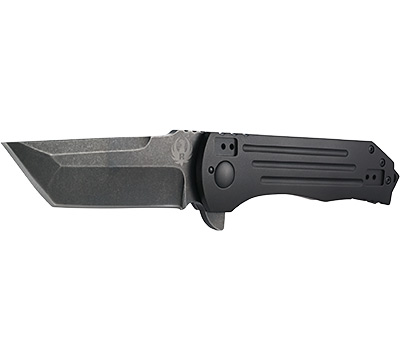
The tactical folder in the line is the 2-Stage, a Robert Carter design with a tanto blade.
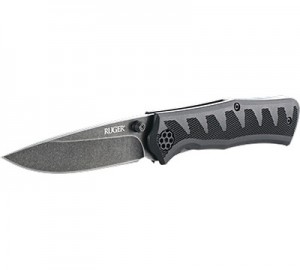
Steigerwalt Crack Shot Compact.
Ken Steigerwalt’s new Ruger/CRKT design is the Crack Shot: Compact.

Sturm, Ruger & Co. and CRKT announce new knives designed by a selection of award-winning custom knifemakers.

The designers include Ken Steigerwalt, Ryan Johnson of RMJ Tactical, Bill Harsey, Matthew Lerch and Robert Carter.

CRKT has the knives produced under license from Ruger. They include a selection of EDC, tactical, hunting and utility patterns in an assortment of sizes and materials.

Of the five designers, Harsey designed the most knives: three. His are the “Go-N-Heavy” folder highlighted by a hard-anodized, sure-grip handle and a 3.5-inch blade, the “All-Cylinders” folder with a black, stonewashed 4-inch blade and a “revolver cylinder-style” pivot, and the “Accurate,” a fixed-blade hunter with a reinforced nylon-fabric sheath. The folders have drop-point blades with a choice of plain edge or Veff serrations. The Go-N-Heavy stores in a nylon-fabric sheath.
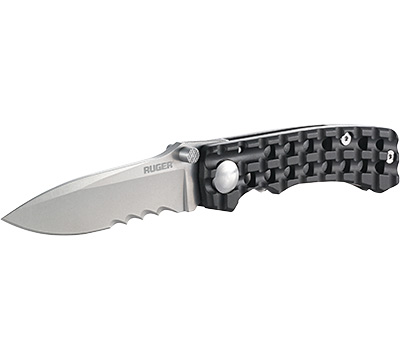
Go-N-Heavy Harsey
Bill Harsey’s Go-N-Heavy is highlighted by a hard-anodized sure-rip handle.

Johnson’s designs are the “Cordite: Compact” straight knife sporting a 2.5-inch drop-point blade and a paracord-wrapped handle with a “revolver cylinder style” bead, and the “Powder-Keg” fixed-blade survival knife featuring a 4.75-inch blade and rubber overmold full-tang handle with an inset Ruger medallion. The former has a glass-reinforced nylon sheath, the latter a leather sheath.
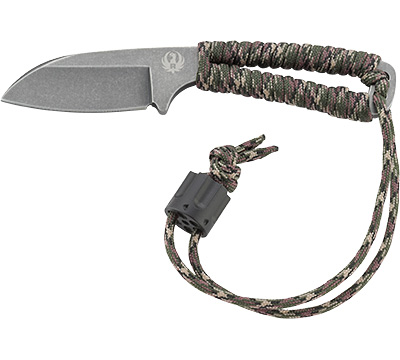
Cordite: Compact
The Cordite: Compact has a 2.5-inch drop-point blade and paracord-wrapped handle.

Lerch’s design is the “Follow-Through” flipper folder with a Ruger-inspired, diamond-checkered, glass-reinforced nylon handle.

The locking liner knife has a 3.75-inch drop-point blade and a two-position pocket clip. Steigerwalt’s design is the “Crack Shot: Compact” assisted opener with a 3.5-inch drop-point blade and a Ruger American Rifle-inspired, glass-reinforced nylon grip with pocket clip.

The blade is stonewashed and available in a plain or serrated edge. Carter’s design is two sizes of the “2-Stage,” a tactical flipper folder with a choice of a 4- or 3.58-inch (the “2-Stage: Compact”) tanto blade in a plain edge or with Veff serrations. Each knife has a machined/hard-anodized aluminum and stainless steel handle, and four-position pocket clip.
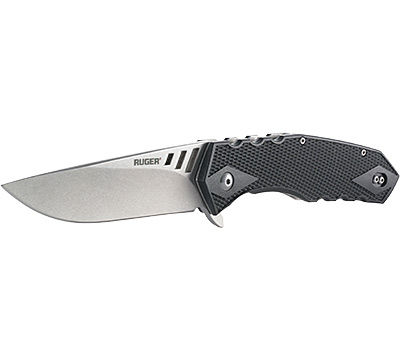
Follow-Through Ruger/CRKT
Matthew Lerch’s Follow-Through flipper folder includes a Ruger-inspired, diamond-checkered glass-reinforced nylon handle.

For more information visit Ruger.com/micros/crkt.
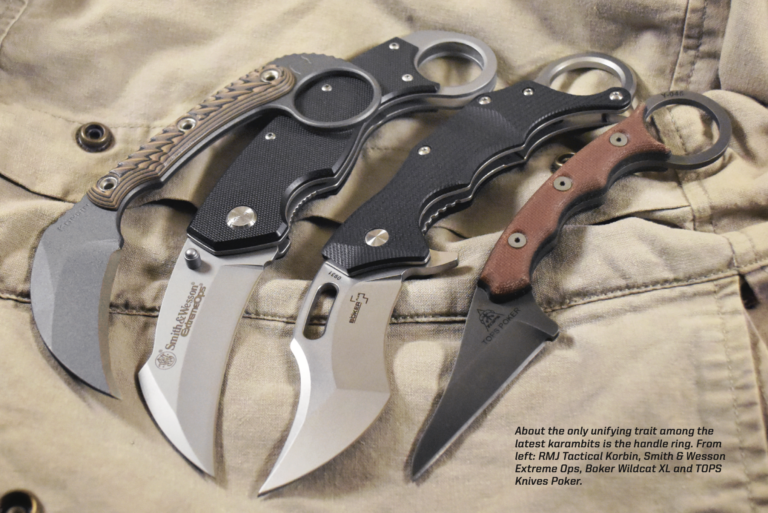
4 New Karambits That Are Very Different

WELCOME TO THE BRAVE NEW WORLD OF THE KARAMBIT.

The latest karambits come in an assortment of sizes, shapes, blade patterns, materials, fixed blades and folders, and price ranges. Whether for utility, self-defense or what have you, today’s karambits are ahead of the curve. In fact, some have even eschewed the traditional curved blade cent of that of a Japanese kiridashi, and is for a variety of patterns.

In other words, today’s versions of the knives with the ring in the handle butt have that unfamiliar ring to them.

The karambit traces its roots to Indonesia, where it was first used in agricultural chores such as cutting rice. The original was much larger, but it began to be scaled down as its prowess in self-defense became more prominent. Most, though not all, karambits have the familiar safety ring at the base. They come in both fixed-blade and folder options and, to many users, are just as much for EDC as self-defense.

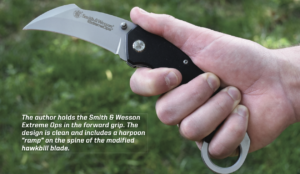
Karambits typically have a hawkbill blade, but you can’t tell by looking at our featured foursome. Manufacturers have diversified the knives’ blade shapes recently, thus offering something different in order to gain an edge over the competition. My team tested the four blades for cutting performance and tactile characteristics using the two main karambit grips: reverse, which is the main one for combat, and forward, which is more utilitarian.

It should be noted that karambits can be hazardous if you try spinning them as is often portrayed in YouTube videos. I spoke with two prominent edged-weapons combat trainers about spinning the knife. They both affirmed that the practice is useless in combat and is primarily used to perform tricks. Whatever the case, if you use a karambit for self-defense, it’s highly recommended that you seek professional instruction and start off with plastic or rubber training iterations of the knife.

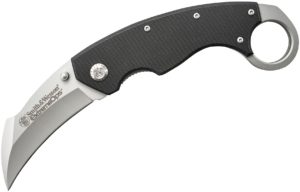
NO LIGHTWEIGHT: The Smith & Wesson Extreme Ops

Image from KnifeCenter.com

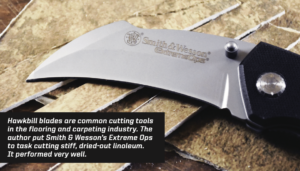
At $24.99, the Smith & Wesson Extreme Ops is by far the most affordable knife of the group. The design is clean and includes a harpoon modification on the spine of the hawkbill blade. At 7.875 inches overall it’s a large folder and also the heaviest (6.1 ounces) of the quartet. The liners are stainless steel. The safety ring is centered at the base. The blade angle is moderately aggressive, allowing the tip to lead when making cuts in the reverse grip. There’s a lot of handle to hold.

Uses for hawkbill blades include cutting carpet and linoleum, and pruning. I took the Extreme Ops to task on straight slices through some stiff, dried-out linoleum and it did an admirable job. Though it took three or four slices using a triangle as a guide, none of the test models made it through the material any quicker.

Due to its size, the Extreme Ops isnot for those with small hands, and it’s a heavy carry in the pocket. The only design flaw I found was in the safety ring, which is actually two thin rings that come off the steel liners. These can cut into the fingers with extended use. I’d like to see a solid spacer fill the gap between the rings. Manufacturer’s suggested retail price (MSRP): $24.99.

Smith & Wesson Extreme Ops Specs
KNIFE TYPE: Folder
BLADE LENGTH: 3 inches
BLADE STEEL: 400 stainless
BLADE PATTERN: Modified hawkbill
HANDLE MATERIAL: Black G-10
LOCK: Linerlock
KNIFE TO KNOW: Offset safety ring
CARRY: Pocket clip, tip up
WEIGHT: 6.1 ounces
OPEN LENGTH: 7.875 inches
CLOSED LENGTH: 4.875 inches
COUNTRY OF ORIGIN: China
MSRP: $24.99

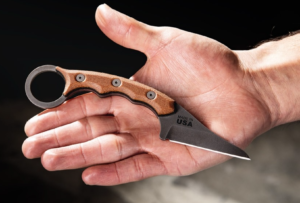
MIXED BREED: The TOPS Knives Poker

Image from TOPS Knives

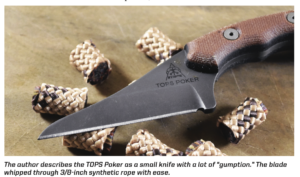
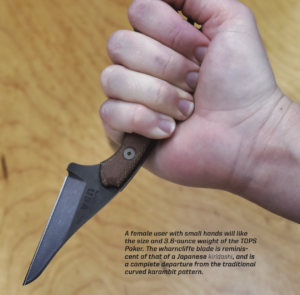
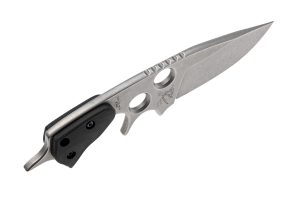
The Poker from TOPS Knives is a mixed-breed karambit. Designed by the company’s marketing director, Craig Powell, the Poker combines a karambit handle with a straight-edge, double- ground-blade hybrid. Reminiscent of that of a Japanese kiridashi, the blade sports TOPS’ Acid Rain finish. The sculpted handle scales terminate at a centered safety ring and the sheath is multi-positional.

A small fixed blade, the Poker is ideal for everyday carry as a neck or belt knife. There’s no angle to the wharncliffe blade—it comes straight off the handle— so, for self-defense using the knife, you’d want to train specifically with a wharncliffe pattern. Wharncliffes are great, all-around workhorse blades that excel at stripping wire, carving wood and making straight cuts.

The Poker is small, easy to conceal* and ideal for those with smaller hands. It did a good job removing strips of corrugated board, and even surprised me a bit because of its ability to cut easily through 3/8-inch synthetic rope. The blade has a lot of gumption! MSRP: $95.

TOPS Knives Poker Specs
KNIFE TYPE: Fixed blade
BLADE LENGTH: 2.5 inches
BLADE STEEL: 1095 carbon
BLADE PATTERN: Wharncliffe
HANDLE MATERIAL: Tan or black canvas Micarta®
WEIGHT: 3.6 ounces
OVERALL LENGTH: 6.88 inches
KNIFE TO KNOW: The blade is somewhat reminiscent of that of a Japanese kiridashi
CARRY: Black Kydex w/belt loop
COUNTRY OF ORIGIN: USA
MSRP: $120

LEAN & UPSCALE: The RMJ Tactical Korbin

Image from RMJ Tactical

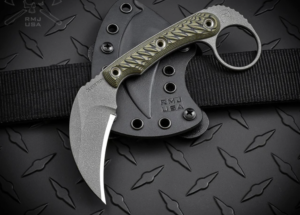
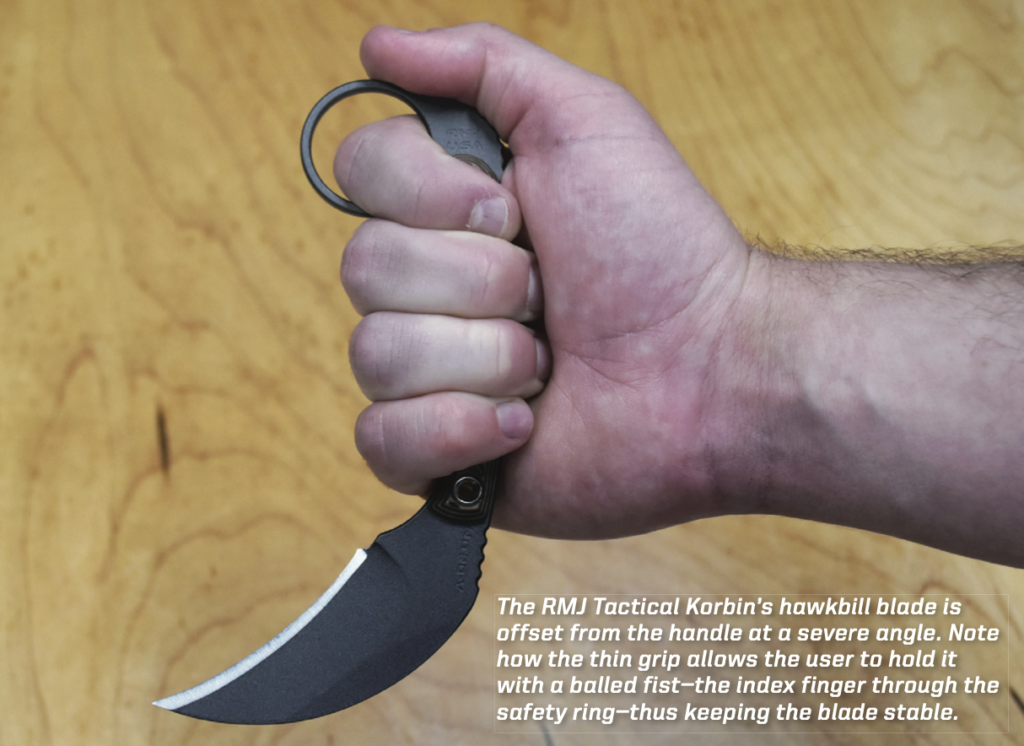
The Korbin fixed blade from RMJ Tactical is easily the most upscale of the test group. The knife has an imposing look thanks to its deep, forward-canted hawkbill blade. Gimping at the blade’s base enhances purchase. The scales have an attractive grooved pattern, and the safety ring is radically offset toward the front of the handle. The sheath includes soft loops.

The knife is a medium-sized karambit with a thin handle. Some prefer a slim profile because gripping it is more like balling a fist, with the index finger keeping the blade stable. I have medium- sized hands, so I found it comfortable and to my liking.

I cut linoleum with the tip and 3-inch rope with the curved edge. I found the Nitro-V stainless blade steel exceptional. I even did a little pruning—a hawkbill favorite. All in all, the knife lived up to its higher price tag. MSRP: $190.

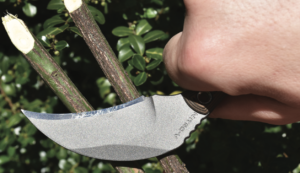
The RMJ Tactical Korbin performs all the functions you’d expect from a hawkbill blade, including pruning shrubs. “If you don’t mind spending a bit more,” the author wrote, “it is well worth the price.”

RMJ Tactical Korbin Specs
KNIFE TYPE: Fixed blade
BLADE LENGTH: 2.875 inches
BLADE STEEL: Nitro-V stainless
BLADE FINISH: Cerakote®
BLADE PATTERN: Hawkbill
HANDLE MATERIAL: G-10
HANDLE LENGTH: 4.25 inches
KNIFE TO KNOW: Offset safety ring
WEIGHT: 2.9 ounces
OVERALL LENGTH: 6.125 inches
CARRY: Kydex 2-way belt sheath
COUNTRY OF ORIGIN: USA
MSRP: $190

CORVETTE OF CUT? The Boker Wildcat XL

Image from Boker USA

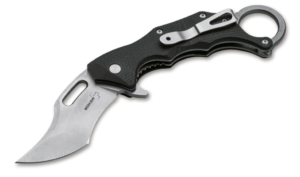
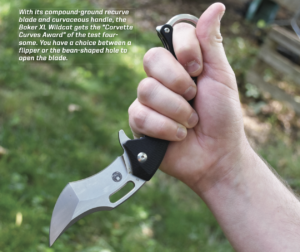
The Boker Wildcat XL Karambit Flipper is the longest (8.5 inches open) in the review stable and has a flipper opener. A Boris Manasherov design, the knife has curves all over—from the handle to the recurve blade—that would make a Corvette blush!

Stainless liners contain a linerlock and the scales flow into a centered safety ring. You can deploy the blade via an elongated, bean-shaped slot on the ricasso. The handle curves make for a very comfortable grip. Since the XL is huge, some might prefer the standard, 7.4-inch Wildcat model. The blade is atypical, though again, it’s not uncommon to find a wide range of blades among the latest karambits.

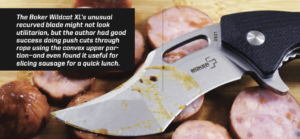
The Wildcat did a great job cutting rope—surprisingly so in push cuts using the blade’s curved front section. I also found it great at slicing grilled sausage Use your imagination with this blade— it’s definitely different. MSRP: $149.95.

Boker Wildcat XL
KNIFE TYPE: Flipper folder
BLADE LENGTH: 3.375 inches
BLADE MATERIAL: D2 tool steel
BLADE PATTERN: Recurve
HANDLE MATERIAL: Black G-10
LOCK: Linerlock
CARRY: Pocket clip, tip down
WEIGHT: 5 ounces
OPEN LENGTH: 8.5 inches
CLOSED LENGTH: 5.125 inches
COUNTRY OF ORIGIN: China
MSRP: $149.95

WIDE SELECTION

There are a couple of prime factors to consider when buying a karambit. First, get one compatible with your hand size. If it’s too large or too small, it won’t serve you well. Second, choose a blade that suits your purposes in both style and angle. Some are better at EDC, while others are meant for self-defense. Whichever your choice, given the competitiveness in the market, you’ll encounter no trouble with selection.

*Be sure to check and conform to laws concerning concealed carry that apply to the areas in which you carry your knife.

Paul Ehlers Sets Record Straight

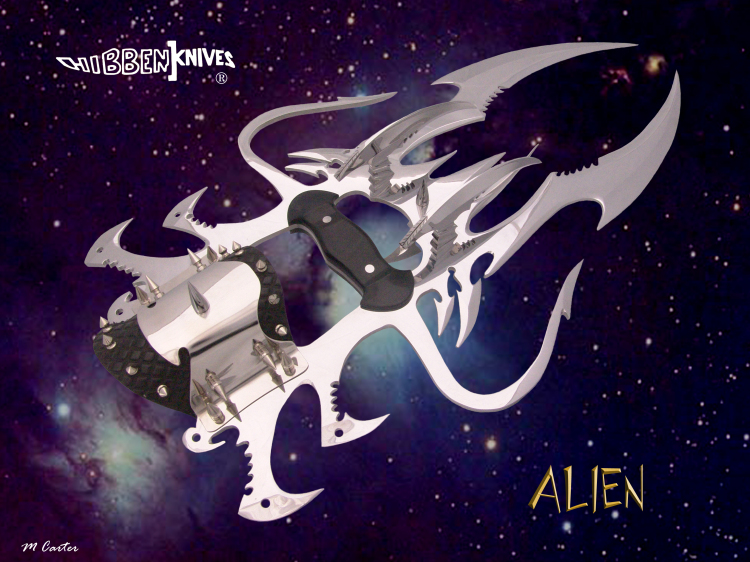
Editor’s note: Long-time knife designer Paul Ehlers wrote the following letter to BLADE® concerning our oversight of Mr. Ehlers’ copious design contributions to the works of Paul Fox and Blade Magazine Cutlery Hall-Of-Fame© member Gil Hibben, one of which by the latter, the Alien, is reproduced above via the photography of Mike Carter. We reprint Mr. Ehlers’ letter here in its entirety.


      My name is Paul Ehlers. I am a knife designer; I believe you know my work. I have been a reader of BLADE® since 1983. It was that year I forged a creative alliance and friendship with Blade Magazine Cutlery Hall-Of-Fame© member Gil Hibben, and later with knifemaker Paul Fox. Our knife journeys have been both challenging and artistically rewarding, and we always have endeavored to push the envelope. Often the envelope would push back, but we never let that stop us!

      Looking back, the majority of Gil’s one-of-a-kind custom fantasy knives were of my design, from our beginnings in ’83 with our “Dragonfly” up until the present day. In fact, we have done over 50 collaborations. That is a lot of grinding! It is no wonder Gil has often said “Paul’s dreams are my nightmares!”

      The first fantasy knife I designed for Paul Fox we named the “Soulseeker.” It went on to win the coveted W.W. Cronk Award at the 1986 Knifemakers’ Guild Show. That was a great honor. Of the many knives I have designed over 25 years, it is one of our best achievements.

      But alas, my name is nowhere to be seen in “Raise A Glass To The W.W. Cronk Award” on page 78 of the April 2009 BLADE. The ’85 winners are listed as collaborators, so I am sure you will take this opportunity to correct this piece of our knife family history. I, and posterity, will be eternally grateful!

Paul W. Ehlers

P.S.: I can recall at the first shows I attended, the “Father of American Knife Photographers,” Cutlery Hall-Of-Famer Jim Weyer, would take me around to the tables and introduce me as “the next Bud Cronk.” This was 1983. The only thing was, I had never met Mr. Cronk and had not seen any  of his work until Jim published his first Knives: Points of Interest book. When I asked about Cronk, Jim said, “Don’t worry kid, you’re in good company!” I never forgot that. Of course, over time I came to know what a true genius Cronk was and is. This is one of many reasons why this award means so much to me.

To read more stories like the above, subscribe to BLADE. For more information on how to subscribe, click on http://www.shopblade.com/product/blade-magazine-one-year-subscription-us/?r+ssfb231111#BL1SU

Hunter’s Edge: 2 Sharpeners and Sharpening eBook

    Keep your hunting knife sharp and ready to perform in the field with two great sharpeners and a sharpening eBook from ShopBlade.

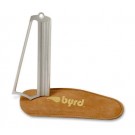
    One of the more unusual and ingenious sharpeners is the Spyderco Duckfoot diamond sharpening system. Sporting various shapes for sharpening different edges, the Duckfoot includes:

    •A 1”x 5” flat diamond stone;

    •A surface with a large radius for sharpening plain edges and a small radius for serrations;

    •Three grooves, including a wide radius channel for de-burring and a narrow radius channel for honing fish hooks, etc.;

    •Includes a suede leather carry case and an instructional DVD.

    ShopBlade’s price: $43.96, a 20 percent savings. For more info click on http://www.shopblade.com/duckfoot-diamond-sharpening-system-w8563?lid=blss092412. (You had better hurry on this one because Spyderco has discontinued the Duckfoot.)

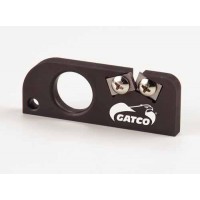
    A great pocket sharpener for field touch-ups of plain-edge blades is GATCO’s Military Compact Sharpener (MCS). All it takes is a few strokes on the compact sharpener’s replaceable tungsten carbide blades set for a 40-degree angle and your knife is ready to cut. Size: 2.75” x 1.06” x .30”. Weight: 1.5 ounces.

    ShopBlade’s price: $12, a 20 percent savings. For more info click on http://www.shopblade.com/gatco-mcs-military-compact-sharpener-40006?lid=blss092412.

    If you need help on how to sharpen, check out our eBook,  “Sharpen A Knife & Care For A Collection.” The digital guide outlines:

    •Sharpening stones;

    •Freehand sharpening;

    •Sharpening systems;

    •Sharpening oils/lubricants and other sharpening accessories;

    •How to choose the right sharpener for your knife, and more.

    ShopBlade’s price: $4.19. For more info click on http://www.shopblade.com/sharpen-a-knife-care-for-collection-download?lid=blss092412

D2 Tool Steel Just Keeps Cutting

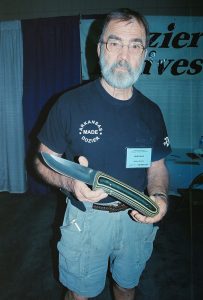
Dr. D2, Bob Dozier
Aka “Dr. D2,” Bob Dozier long has been a proponent of D2 tool steel. Here he holds one of his specially made “over-sized” folders at a past BLADE Show.

D2 tool steel just keeps cutting. It’s been around a long time and enjoys a solid reputation among custom and factory knifemakers and knife users. As with many high-performance steels, it experiences a range of highs and lows in popularity, and at the moment seems to be enjoying a high.

A favorite steel of such long-time knifemakers as BLADE Magazine Cutlery Hall-Of-Fame© member Wayne Goddard and Bob Dozier—the latter has been called “Dr. D2” on more than one occasion—D2 is considered a “borderline stainless steel” because it contains 11.5 percent chromium. To be classified as stainless, a steel must have at least 12 percent chromium. (Note: stainless simply means a steel resists corrosion. It does not mean it is stain proof.) According to Scott Devanna of SB Specialty Metals, D2 also has a very high carbon content—1.5 percent—which lowers corrosion resistance because the carbon “grabs” a lot of D2’s chromium to form chromium carbides. The chromium carbides are good for improving wear resistance—improved wear resistance enhances edge holding—but they tie up chromium so it is not as “free,” and thus reduce corrosion resistance. Free chromium forms a chromium oxide layer at the surface, and the layer makes a steel corrosion resistant. This helps explain why D2 is not stainless.

While D2 may not be stainless, it remains a top performer due in no small part to its high wear resistance/edge-holding ability. “It will hold an edge for a very long time before it will go dull,” says Paul Tsujimoto, director of engineering at Ontario Knife Co.  Combined with its relatively inexpensive price, this makes D2 a favorite of manufacturers and custom makers alike. “For us, it’s the perfect combination of performance and an affordable price,” notes Dietmar Pohl of Pohl Force Knives. Agrees Devanna, “It’s the best bang for the buck because it’s priced reasonably and works well.”

D2 on Hornet
Pohl Force Knives uses D2 blade steel for the Hornet, a Spencer Reiter design.

On the down side, D2’s ample wear resistance also means it is difficult to sharpen. However, a diamond abrasive sharpener should do the trick. Also, the steel’s impact toughness suffers in comparison to some other steels, so D2 is not the best choice for a blade used for chopping and other impact-type cutting chores. And, since it’s not a true stainless, you should wipe it down after use to help keep corrosion to a minimum.

Nonetheless, D2 is an outstanding choice for a hard-use knife and remains popular among custom knifemakers and manufacturers, and knife users as well.

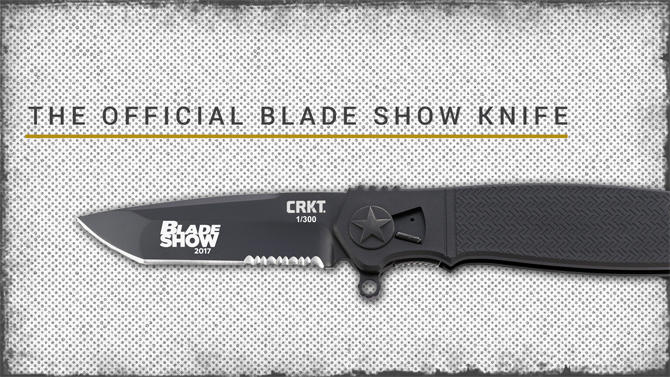
Do You Have Your Official 2017 BLADE Show Knife?

Distinguishing Elephant from Ancient Ivory

Elephant vs. ancient ivories
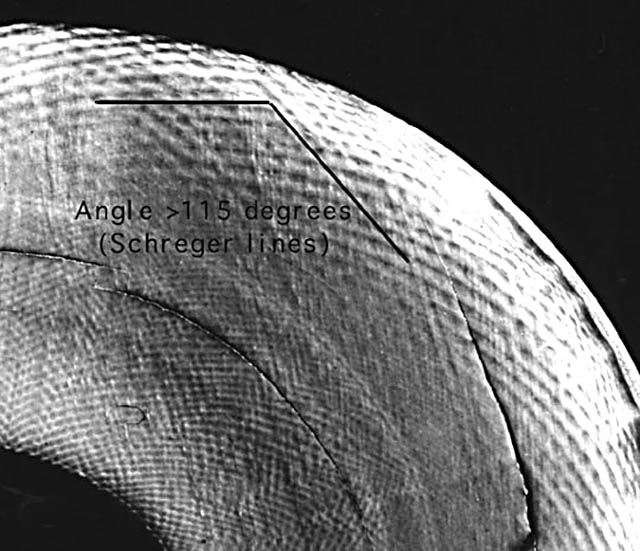
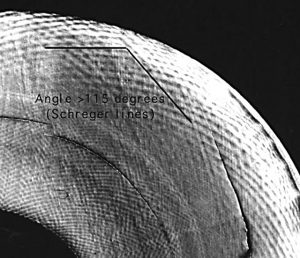
Distinguishing elephant from ancient ivory can be done by the correct reading of the Schreger lines on the surface of the ivory.

Distinguishing elephant from ancient ivory is challenging and becoming more and more important for the owners of knives with handles of ancient ivory. However, there are two reliable keys to make the determination easier.

Polished cross sections of elephant and mastodon/mammoth ivories display stacked chevrons of cross-hatched lines called Schreger lines or Lines of Retzius—incremental lines of rhythmic deposition of successive layers of enamel/dentine matrix during development. The Schreger lines closest to the outer bark of the tusks are the most visible—and the ones to measure—though there are also inner Schreger lines that are less discernible around the nerve cavity. The intersection of Schreger lines form angles, and this is the key—if the average angle is greater than 115 degrees, then it’s elephant ivory; if the average angle is less than 90 degrees, it’s mastodon or mammoth. Variations in the angles can occur in individual tusks, particularly as the patterns tighten more toward the center. Plus, the visible cross section must be cut square to the axis of the tusk—otherwise the chevrons’ angles will be distorted.

Specimens from both extinct and existing animals can show angles between 90 and 115 degrees in the outer Schreger lines, so the differentiation should never be based solely on a single angle measurement when the angles fall in this range. When averages are used, a clear separation between the ivory of existing elephants and extinct mammoths/mastodons exists. Elephant ivory averages above 100 degrees and mammoth/mastodon ivory averages below 100 degrees.

Another I.D. key, though more involved, can also distinguish mammoth or mastodon ivory from elephant. These ancient ivories can often have blue-green or brownish blemishes on the surface produced by an oxidized iron phosphate called vivianite. Even if the discoloration is barely visible, ultra-violet light will make it stand out with a dramatic velvety-purple appearance. Even if elephant ivory were similarly discolored—though in its natural state, elephant ivory will not display the same discoloration—it would not exhibit the characteristic fluoresence of vivianite.

With recent ivory laws handed down by Fish and Wildlife greying the lines between elephant and ancient ivories, it is possible the laws may give federal agents the right to seize knives and materials that cannot be proven as outright ivory but simply have the ivory look. As a result, if you own knives with ancient ivory handles, having an at least a general knowledge of how to differentiate elephant from ancient ivory could save you from having your knives confiscated, from being fined or both.

Hot Knife Deals at ShopBlade.com

Black Friday knife deals

Buck Collectors Observe 25th Anniversary

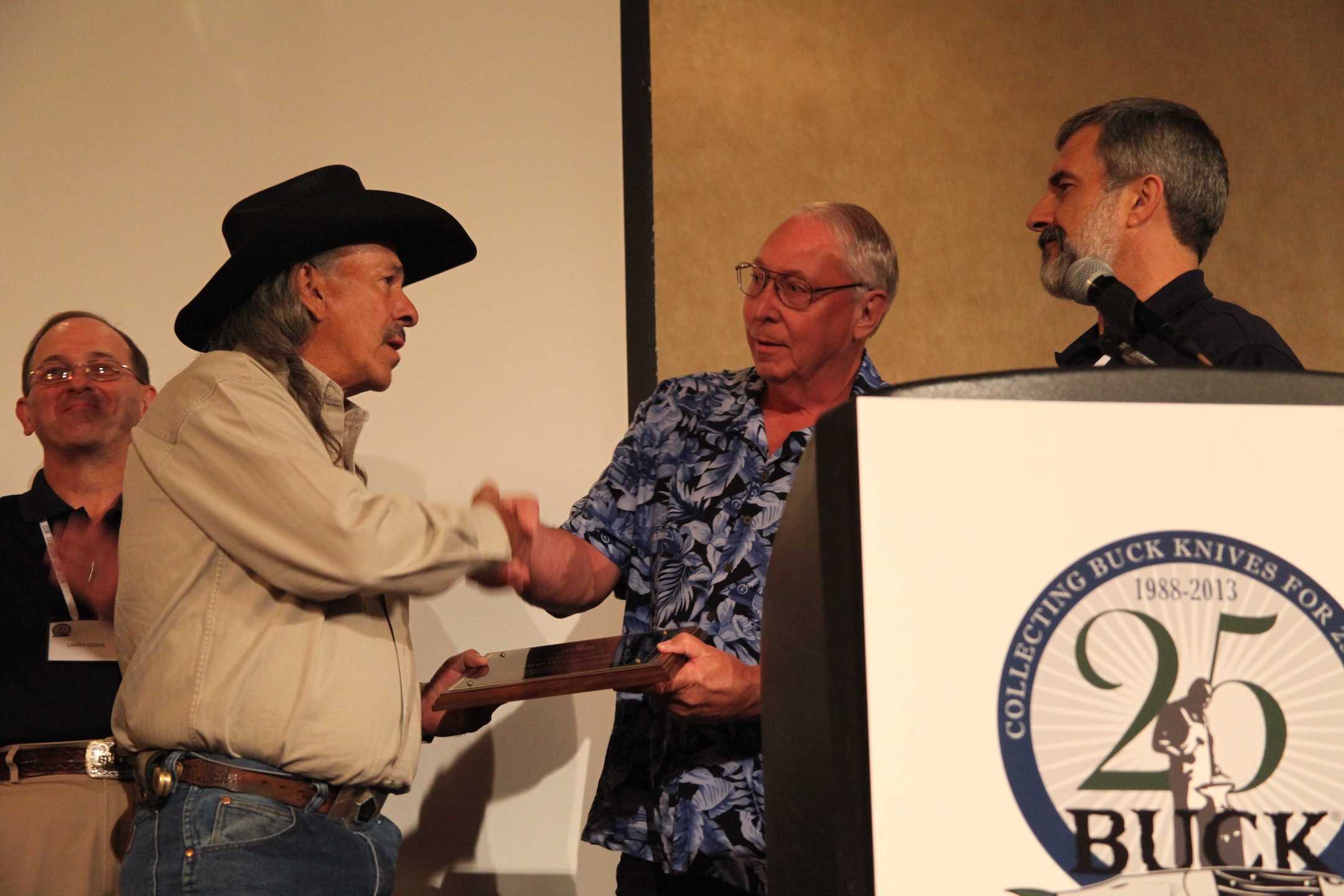
David Yellowhorse enters the Buck Collectors Club during the Buck Collectors Silver Anniversary gala. From left: Larry Oden, David Yellowhorse, Gene Merritt and John Foresman.
During the Buck Collectors Silver Anniversary, David Yellowhorse is inducted into the Buck Collectors Club Hall Of Fame. From left: Larry Oden, David Yellowhorse, Gene Merritt and John Foresman.


Hundreds of Buck knife collectors converged on Spokane, Washington, and Post Falls, Idaho, last week for the Buck Collectors Club International’s 25th Anniversary Gala.


A celebration of Buck knives, seminars on Buck knives, tours of the Buck manufacturing plant just across the border in Post Falls, and much more highlighted the event, which drew collectors from all over the country.


Such Buck VIPs as Blade Magazine Cutlery Hall-Of-Fame© member Chuck Buck, Lori Buck, CJ Buck, David Yellowhorse, Wilde Bill Cody, Leroy Remer, Mike Prater, Fred Wilson and many others mingled with Buck collectors throughout the festivities.


The event kicked off with a banquet Tuesday night, and included the induction of four into the BCCI Hall Of Fame: knifemaker Jerry Bodner, Jane Davie and the aforementioned Mssrs. Yellowhorse and Wilson. BLADE® (www.blademag.com) Magazine Editor Steve Shackleford served as the banquet keynote speaker and was presented with a special plaque in recognition of his work with the BLADE Show (www.bladeshow.com) and support of the BCCI over the years.


Wednesday included a complete slate of seminars and factory tours. The seminars included one on Buck Yellowhorse knives by award-winning Buck Yellowhorse collector Gene Merritt. The day was capped by a sunset dinner cruise on the nearby Lake Coeur d’Alene. Thursday featured seminars by CJ Buck on what’s on the horizon at Buck Knives and on Buck Customs by John Foresman, Leroy Remer and Wilde Bill Cody, among others. A “Knife Swap Plus” was held Thursday evening and included Russ Donoghue signing his new BCCI History Book, raffles, auctions, artist demos and more. The event concluded with more seminars Friday, including one on the Buckmaster/M-9 and Buck Tactical Knives by Rich Neyman, and a Buck Knife Survival Seminar by Karen Hood. A picnic at the home of Chuck and Lori Buck was a fitting end to the extravaganza.


For more information on the BCCI, visit www.buckcollectorsclub.org.


For the latest knife news, stay honed to www.blademag.com.


Advertisement

Must Read Articles

Read this before you make a knife

Knifemaking 101 – Read This Before You Make a Knife

  by Wayne Goddard My experience has taught me that there's nothing like digging in and getting started. I've often said the hardest part of the...
how to forge damascus steel

How to Forge Damascus

Advertisement
Advertisement