Knife Collecting

Knife collecting is an extremely rewarding experience for knife enthusiasts. There truly is a knife for everyone. Many increase or hold their value throughout the years, making collecting knives something to pass on to the next generation of knife collectors.

Knives Of Summer: Keep Those Puppies Sharp!

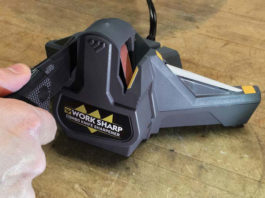
When you use one of our “Knives Of Summer,” you will need to sharpen that puppy. In fact, a little edge maintenance after each use—when feasible—is the best way to keep your knife sharp for the next time you need it.

    GATCO’s Natural Arkansas Sharpening Kit is a great way to keep your edges keen at all times. Designed for sporting, kitchen and other knives, it features a novaculite stone mined from Arkansas. The kit includes a block-mounted 5-inch stone for sharpening, a 3-inch stone for final touch-ups, honing oil and a storage case.

For more info click on http://www.shopblade.com/gatco-natural-arkansas-sharpening-kit-80005/?r+ssfb070912.

Nothing Says Thanksgiving Like A Carving Knife

Happy Thanksgiving! And what better way to say it than with a carving knife for that roast turkey? Messermeister’s Meridian Elite 8-inch carving knife is one way to do it. It features an 8-inch blade of X50 CrMoV15 stainless steel with a hand-polished edge and a triple-rivet handle.

For more information contact Messermeister at www.messermeister.com.

To get the latest information on the newest knives, knifemakers, how to make knives, what to collect and much more, subscribe to BLADE® by clicking on http://www.shopblade.com/product/blade-magazine-one-year-subscription-us/?r+ssfb241111#BL1SU

And HAPPY THANKSGIVING from the staff of www.blademag.com, BLADE®, the BLADE Show and everyone at Krause Publications and F+W Media.

Grace Horne: And Now For Something Completely Different

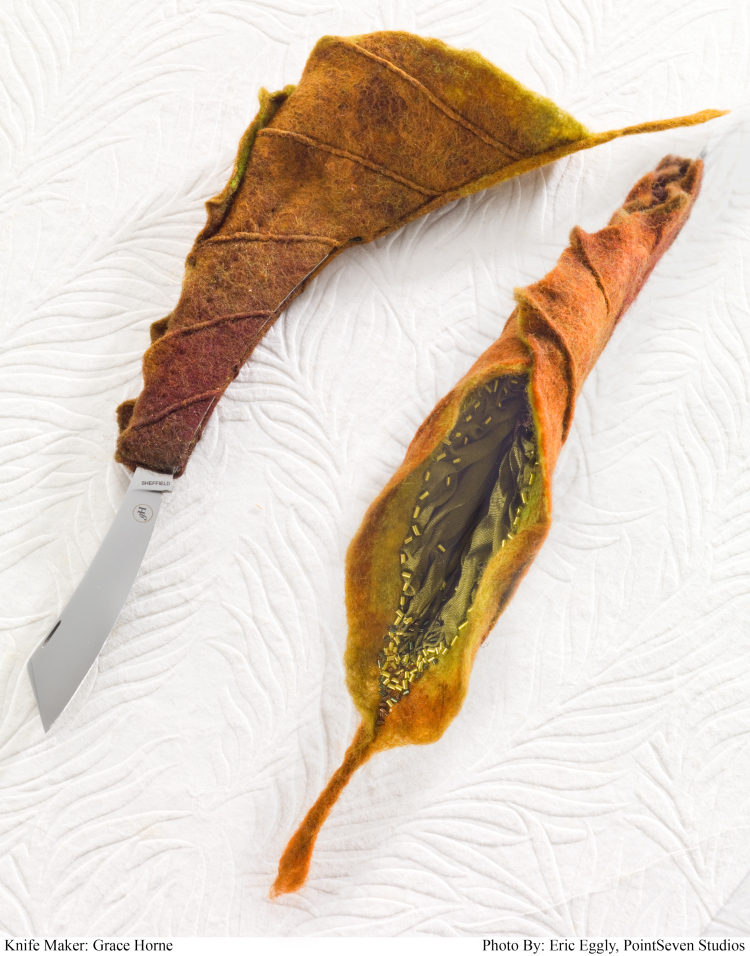
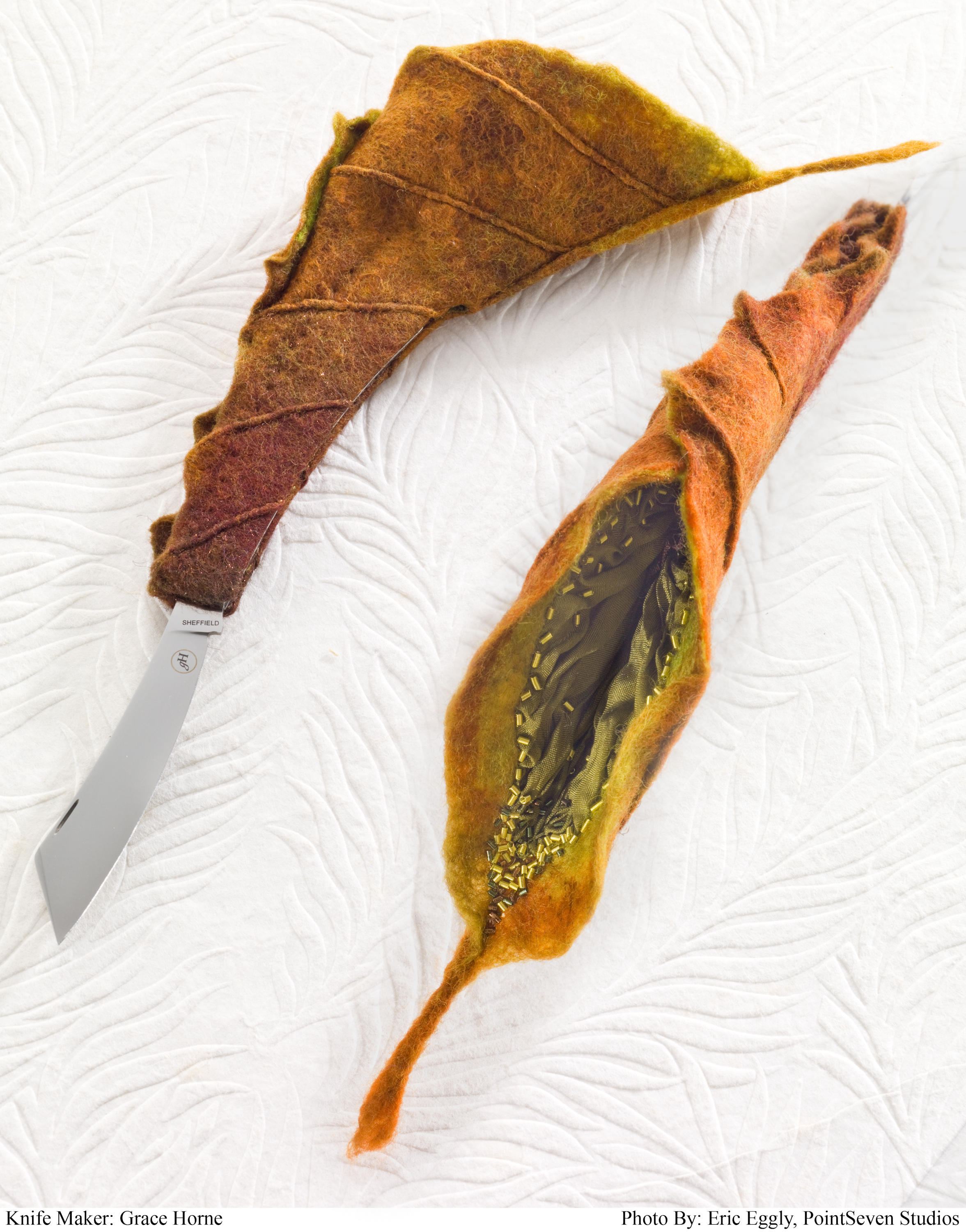
Grace Horne’s “Cocoon #2” incorporates felt, wool, silk and aluminum for the cocoon handle. The 2.9-inch blade is RWL-34 stainless. (Point Seven photo)


     Grace Horne is an artist, embracing the basic elements of her subject and then allowing them to take flight in her imagination. For two decades, she has plied her craft in the cradle of knifemaking, Sheffield, England.

     Completing her college degree in design, craft and technology required a project, and she ambitiously chose a set of three slip joints with damascus blades, making the steel with artist and blacksmith Richard Quinnell at his forge in the Fire and Iron Gallery in Surrey. By 1994, Horne had relocated to Sheffield to seek an apprenticeship in knifemaking with Stan Shaw, perhaps the last of the legendary “Little Mesters,” the independent Sheffield knifemakers who helped establish the city’s storied reputation for quality cutlery through those many years. (See “Stan Shaw: Little Mester of Sheffield, March 1994 BLADE®.)

     Though Shaw was unable to hire an apprentice, he gave Horne a box of old blades to work with, some having been forged a century before. “I decided to take a more academic approach,” she recalled, “completing both a knife-related masters degree and Ph.D. at Sheffield Hallam University. My work was workshop based, and the material I ended up working with was layers of carbon steel separated by 99.99 percent pure silver foil. Visually, I like steel and silver together. It is a combination I have often come back to over the years. But if the two main research questions were ‘Can it be done?’ and ‘Was it worth the effort?’ then the answer would have to be ‘Yes.’”

     Horne produces only about 10 to 12 knives each year and does not accept custom orders. She does not sell through purveyors but maintains a list of people to notify when a knife is available or when her online portfolio is updated. She describes her work as material-and-concept driven yet deeply embedded with the historical Sheffield knifemaking tradition. While knives are one of her loves, another is textiles, and a recent foray combined the two.

     “A couple of years ago,” she recalled, “while my new workshop was being converted from an old Victorian public toilet, I didn’t have knifemaking space but my textile studio was still accessible. This led to my first pieces that cross the boundaries between knives and textiles. These modified Spyderco knives were the result of a project to visually represent the value of knives as everyday tools. During a three-week period I collected everything that I cut with the knife, and at the end of each week I made all the bits into new scales for that knife and then went on to the next one.”

     The modified knives actually incorporate pieces of items such as corrugated board, duct tape, envelopes, and packaging mesh into the handles, and the effort has been followed by a series of “fluffy” knives. Since knife laws are restrictive in Britain and the sight of a pocketknife can elicit comments, Horne covered the Spyderco UKPK that she often carries with woolen felt.

     “I love felt making,” she said. “It is versatile and the final product can be very hard wearing. My complete knife just gets washed when it’s dirty, and how can anyone be scared of a woolly knife?”

     From a woolly knife, the innovative artist progressed to “cocoon knives” that she characterized as soft, warm and visually non-threatening. “Most of the foundation work is a woolen felt,” she commented. “I use a combination of wet, needle and nuno felting to create the desired effect, incorporating silk, cotton and other meshes into the structure of the felt. The surfaces are then stitched, reworked, embroidered and embellished.

     “Folding knives fascinate me because they are all about change—open and closed, dangerous and safe, big and small. A cocoon holds a similar fascination; it is full of potential to be something completely different.”

     When she completed her academic studies, Horne said she recognized her education had been not only about the production of metal, but also about the creative process. This led to the keeping of extensive notes and sketches.

     “I rarely take on commissions but, if I do, then part of the creative dialogue is often conducted through photos of drawings from my sketchbook, and then photographs as the work progresses,” she related. “The story of each knife is important—why I made it, the inspiration behind it, what makes it different from the other knives I have made. Because of this, each knife has its own little book containing vital statistics, life story, background information and pictures.”

     Every knife Horne makes is one of a kind, like the creative energy she channels into her work. “Much of my work develops like a series of slightly misheard whispers,” she smiled. “The title of a picture or a written description of an event will create an image in my head that often is very different from the one that would have developed from a visual input. A physical event becomes a written or spoken distillation and is then reinvented as a new object. Very often, when I track back, I am surprised at how far my creative process has taken me from the original source.”

     Though she never makes the same knife twice, Horne does see recurring themes in her work, and she revisits basic forms from time to time. She does not operate a forge in her shop but does enjoy making her own pattern-welded steel. Award-winning damascus makers Daryl Meier, Hank Knickmeyer and Ed Schempp work with her in steel making after some “gentle coaxing and tuition” on Horne’s part. She also likes to use RWL-34 and other Swedish stainless steels for knife blades.

     Most of the work she does is by hand or with a small surface grinder, and she has plans to have a belt grinder up and running soon. A visit to her shop reveals a number of hand tools used by jewelers, cutlers and watchmakers through the generations. An old Sheffield knifemaker would probably feel right at home there.

     Annual trips to the BLADE Show are vital in maintaining contact with other knifemakers and supplement her use of social media such as Facebook. When she comes to the USA, she has knives photographed by Point Seven and catches up with others in the global knifemaking community. She also attends the KnivesUK show and the SICAC show in Paris.

     “I’m not entirely sure what my knives will look like next year,” Horne laughed. “I’ve started playing with glove leathers, and I fancy incorporating some visual elements from the corsets that I make. One thing I am certain about is that, yet again, they will be completely different from the stuff I’m working on at the moment!”—by Mike Haskew


To read similar stories and all about the latest knives, knife trends, knifemakers and much more, subscribe to BLADE® Magazine. For information on how to subscribe, click on http://www.shopblade.com/product/blade-magazine-one-year-subscription-us/?r+ssfb211211#BL1SU


 

First-Rate Fliers: Best Throwing Knives Tested

5

Fun to fling, today’s throwing knives fly like the wind.

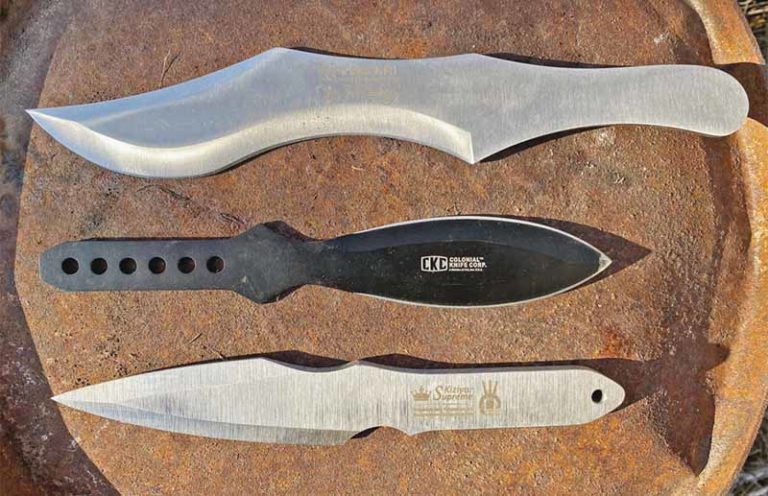
The Throwing Knives Tested:

We used a variety of throws to fully test the knives: handhold, blade hold, overhand, underhand, no-spin from three-to-five paces, half-spin from five to seven paces, and full-spin from seven to ten paces. Throwing at longer distances than this is, for me, frivolous and fruitless. Our targets were the sawn end of a pine stump on its side and a pine tree we are planning to take down. The stump was from a cut last year when we were clearing an area. It had seasoned somewhat and was a tougher target than the standing tree, so penetration was deeper in the standing tree.

Boker Magnum Mini Bo-Kri

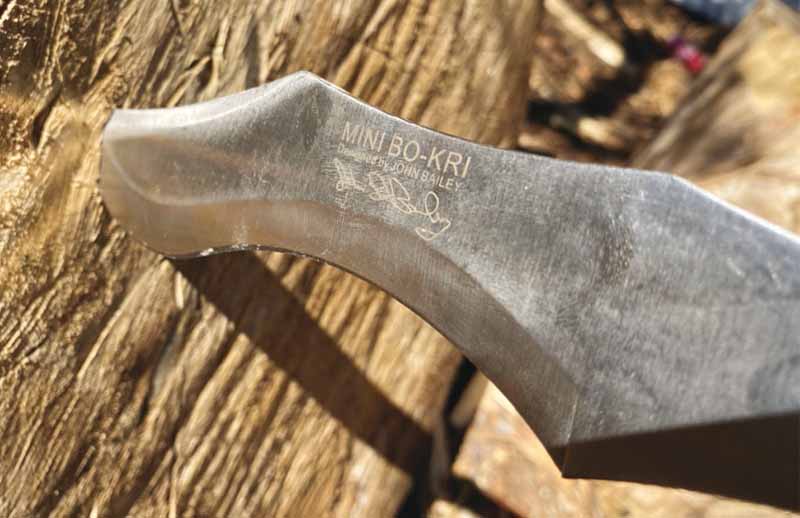
Designed by veteran knife thrower John Bailey, the Boker Magnum Mini Bo-Kri is the kind of throwing knife a performer would choose to use on stage.

It has a flashy, fierce-looking recurve blade and you know at first glance it’s a throwing knife. The largest and heftiest of the three review knives, the Bo-Kri is well balanced and flew true with each throw, handle hold or blade hold. Its weight aided penetration in both stump and standing tree. Its design is best for handle throws—it just feels better that way.

CAUTION: A thing to keep in mind is that with the Bo-Kri’s recurve blade there’s a good deal of spinning edge, which means that not only the point is sharp. You should ensure your target area is clear of people when throwing any knife, but in this case a deflection would send a long edge spinning wildly. A nice leather sheath is included.

Boker Magnum Mini Bo-Kri Specs
Blade Length: 5.71”
Blade Steel: 420J2 stainless
Blade Thicknes: .25”
Blade Pattern: Drop point
Blade Grind: Sabre, recurve
Blade Finish: Brushed
Edge Type: Plain
Weight: 8.1 ozs.
Overall Length: 10.71”
Continent Of Origin: Asia
MSRP: $34.95


Kizlyar Supreme Strij

I have the strong impression that Russians are serious about throwing knives and actually use them in the field. The Strij by Kizlyar Supreme would be my choice if I were going to hunt rabbits with a throwing knife like that 10-year-old kid—which I would not. Now I know enough to use the knife to make a throwing stick, spear, bow, etc. Nonetheless, the Strij appears to have been designed with field use in mind. Kizlyar’s information says the knife was designed by Russian “Throwing Knife Instructor Grandmaster” V.S. Kovrov. I think it’s amazing there is such a thing as a Throwing Knife Grandmaster, and it illustrates just how serious Russians are about this skill.

The Strij is balanced precisely in the middle, which facilitates both handle and blade throws, as well as spin and no-spin throws. Kizlyar’s promotional material also says that “the Strij definitely requires a master’s touch to be accurate.” I disagree. My son, Justin, stuck it deep in the center of the target with his first throw. This one is a keeper.

Kizlyar Supreme Strij
Blade Length: 5.25”
Blade Steel: Stainless
Rockwell Hardness: 42 (spine) and 45 (edge) HRC
Blade Style: Modified dagger
Blade Grind: Sabre
Blade Finish: Brushed
Edge Type: Plain
Weight: 6.7 ozs.
Overall Length: 8.5”
Country Of Origin: Russia
MSRP: $42


Colonial Throwing Knife

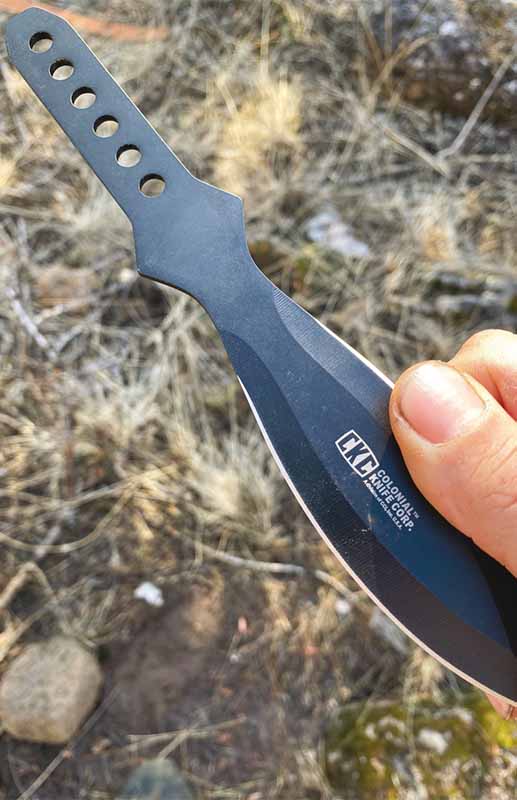
My impression of Colonial’s throwing entries? They look like ninja knives—black, radically curved, lightweight, perfect for a ninja. Colonial promotes these as “sport” or “pastime” knives to be used like darts. I get that. They’re balanced like darts, weight forward, which makes accurate handle-hold, no-spin throws easy. Even so, we also threw them with a blade hold and a spin, which worked fine. I can see a group of folks with a handful of these knives and a dartboard-like target. I can also imagine a ninja slinging a handful of these at pursuing samurai. (I have an active imagination.)

If you’re going for penetration with these knives, velocity is the thing. With little mass and weight, velocity is what will give them the power to penetrate. Whipping your arm—not your wrist—adds velocity. These little guys are fun to throw. Well-made nylon sheaths house each of the two Colonial throwers (they come in a set) until needed.

Colonial Throwing Knife
Blade Length: 4.5”
Blade Steel: 440A stainless
Blade Thickness: .08”
Rockwell Hardness: 57 HRC
Blade Style: Dagger
Blade Grind: Sabre
Blade Finish: Brushed
Edge Type: Plain
Weight: 3.2 ozs.
Overall Length: 8.5”
Country Of Origin: China
MSRP: $29.99 (set of two; includes a nylon carry case and sheaths)


Tips On Throwing Knives

The Bo-Kri and the Colonial knives are clearly designed as dedicated throwing knives, not all-around tools. The Kizlyar Strij, though also designed as a throwing knife, is quite usable as a general-purpose knife. None of the test knives came with paper-cutting sharp edges, as is proper for throwing knives. They can, however, be sharpened. They are also tempered fairly soft, as is proper so they won’t break if a powerful throw misses the target and the knife hits something hard. This means they won’t hold an edge long if used much. That’s OK. Edge holding is much overrated. If you want these knives to have a sharp edge, a few strokes on a good stone will do it. So, too, when they go dull—a few strokes will re-sharpen them.

If you want to throw knives, here’s a couple of tips: keep your wrist stiff when releasing the knife. Do not snap your wrist. Let the power come from your body, as when throwing a football, baseball, or javelin. Throw at a big, soft target and make sure there’s a large, safe backstop for when you miss—as you will at first if you’re new to the game. Even veterans miss on occasion. As you progress you can move on to smaller targets and moving targets. Have patience and, most of all, have fun.

Also Read:

A Knife for Sgt. Dakota Meyer, Medal of Honor Recipient

0


Editor’s Note: This is excerpted from a larger feature appearing in the special military December 2012 issue of BLADE, on newsstands now. BLADE thanks all past and present military service members and their families for their sacrifices.

by Mike Carter

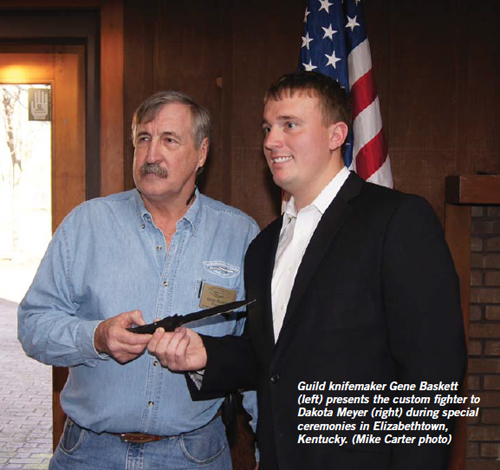
In recognition of his military actions in Afghanistan on behalf of his fellow servicemen and his country that resulted in his receiving the Medal of Honor, U.S. Marine Corps Sgt. Dakota Meyer recently was presented with a custom knife made by Gene Baskett, a custom AR-15 rifle, and honorary membership in the Knifemakers’ Guild.

During a special ceremony this past December in Elizabethtown, Kentucky, Baskett, formerly of Elizabethtown and now of Eastview, Kentucky, presented Sgt. Meyer with a Baskett knife, a custom fi ghter with a black Moly-Coated CPM-154 stainless blade and a black linen Micarta® handle. The knife is engraved “MOH, Sgt. Dakota Meyer, USMC” on the mark side and “8 September 2009, Kunar Province Afghanistan” on the flip side. The engraving is by Patrick Clark of Clark Jewelers, also of Elizabethtown. Richardson Gunsmithing did the Moly Coating.

About Sgt. Dakota Meyer

According to Dakota Meyer’s citation for the Medal of Honor, he was recognized for “conspicuous gallantry and intrepidity at the repeated risk of his life above and beyond the call of duty as a member of Marine Embedded Training Team 2-8, Regional Corps Advisory Command 3-7, in Kunar Province, Afghanistan, on 8 September 2009.

“When the forward element of his combat team began to be hit by intense fire from roughly 50 Taliban insurgents dug in and concealed on the slopes above Ganjgal village, [then] Corporal Meyer mounted a gun-truck, enlisted a fellow Marine to drive, and raced to attack the ambushers and aid the trapped Marines and Afghan soldiers. During a six-hour firefight, Corporal Meyer single-handedly turned the tide of the battle, saved 36 Marines and soldiers and recovered the bodies of his fallen brothers.

“Four separate times he fought the kilometer up into the heart of a deadly U-shaped ambush. During the fight he killed at least eight Taliban, personally evacuated 12 friendly wounded, and provided cover for another 24 Marines and soldiers to escape likely death at the hands of a numerically superior and determined foe.

“On his first foray his lone vehicle drew machine gun, mortar, rocket grenade and small arms fire while he rescued five wounded soldiers. His second attack disrupted the enemy’s ambush and he evacuated four more wounded Marines. Switching to another gun-truck because his was too damaged, they again sped in for a third time, and as turret gunner he killed several Taliban attackers at point blank range and suppressed enemy fire so 24 Marines and soldiers could break out.

“Despite being wounded, he made a fourth attack with three others to search for missing team members. Nearly surrounded and under heavy fire, he dismounted the vehicle and searched house-to-house to recover the bodies of his fallen team members. By his extraordinary heroism, presence of mind amidst chaos and death, and unselfish devotion to his comrades in the face of great danger, Corporal Meyer refl cted great credit upon himself and upheld the highest traditions of the Marine Corps and the United States Naval Service.”

More About Commemorative Knives

Knives are a popular way to celebrate a person or event. Recognize those significant in your life by making your own blades. Start with the helpful instructions and photos in BLADE’s Guide to Making Knives, 2nd Edition. Family and friends will be honored by the personal touch your knives offer.

Click here to order BLADE’s Guide to Making Knives, 2nd Edition.

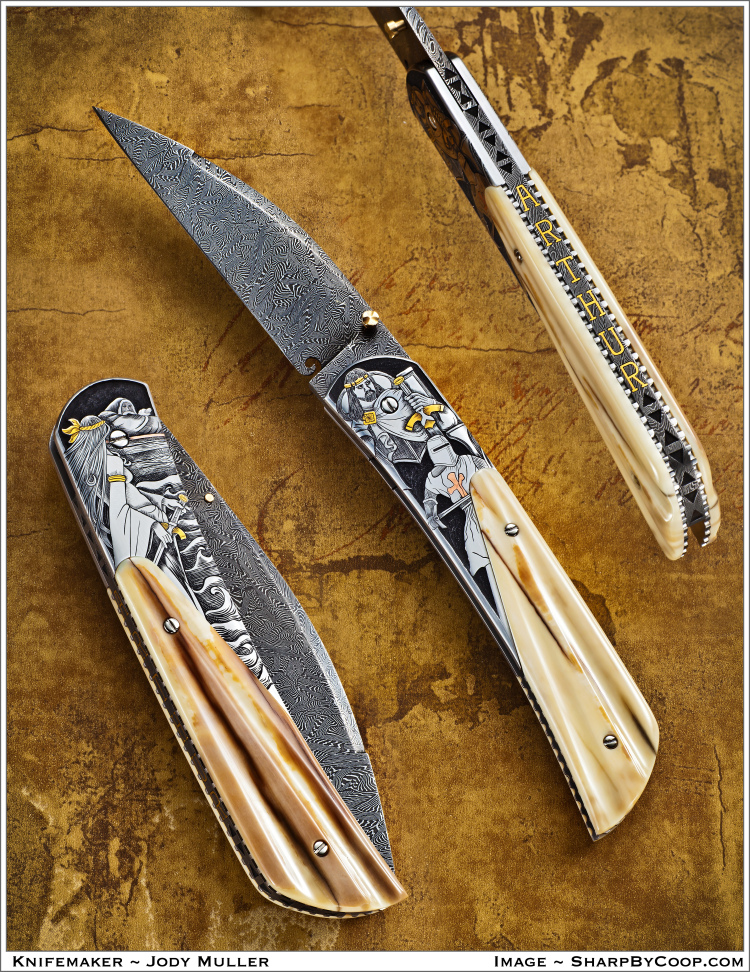
Knife Of The Day XXV: Jody Muller’s “King Arthur”

As Mel Brooks says in The History Of The World, Part I, “It’s good to be the king.” And Jody Muller’s “King Arthur” dress locking folder, the 25th installment in our “Knife Of The Day” series, resembles Brooks’s remark.

    Boasting damascus forged by Jody, a handle of carved ancient walrus ivory, and 24k-gold and copper inlays, the knife gives Camelot a whole new dose of cool.

    For more information on the knife, click on www.mullerforge.com.

For more on the latest knives, knife legislation, knifemaking instruction, knife trends, knifemakers, what knives to buy and where and much more, subscribe to BLADE® Magazine, the World’s No. 1 Knife Publication. Click on http://www.shopblade.com/blade-magazine-one-year-subscription-us for more information.

Urban Survival Knife Tools

What has happened in NYC post Sandy can happen to many. In such an instance, you need tools not only that can cut but also can work as pliers, screwdrivers, can openers and much more. Enter the multi-tool.

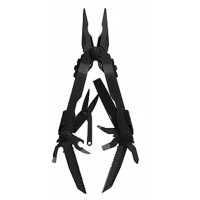
Gerber survival toolGerber Diesel Multi-Tool

Features pliers, wire cutter, wire crimper, partially serrated knife blade and more. Click here for more on the Gerber Diesel Multi-Tool.


Columbia River Knife & Tool Zilla-ToolCRKT Zilla-Tool

This Columbia River Knife & Tool item sports pliers, screwdriver w/hex bits, 3-inch flipper knife blade, can opener and more. Click here for a full breakdown on the CRKT Zilla-Tool.


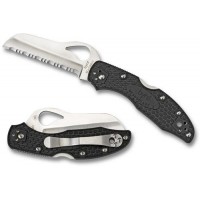
Byrd Knives Meadowlark2 SpyderEdge Rescue KnifeByrd Knives Meadowlark2 SpyderEdge Rescue Knife

The key to the Meadowlark2 is that it lacks a tip. This helps minimize damage to whomever or whatever needs to be freed from binding materials. Click here for more specs on the Meadowlark2 SpyderEdge Rescue Knife.

Advertisement

Must Read Articles

Read this before you make a knife

Knifemaking 101 – Read This Before You Make a Knife

  by Wayne Goddard My experience has taught me that there's nothing like digging in and getting started. I've often said the hardest part of the...
how to forge damascus steel

How to Forge Damascus

Advertisement
Advertisement