Knife collecting is an extremely rewarding experience for knife enthusiasts. There truly is a knife for everyone. Many increase or hold their value throughout the years, making collecting knives something to pass on to the next generation of knife collectors.
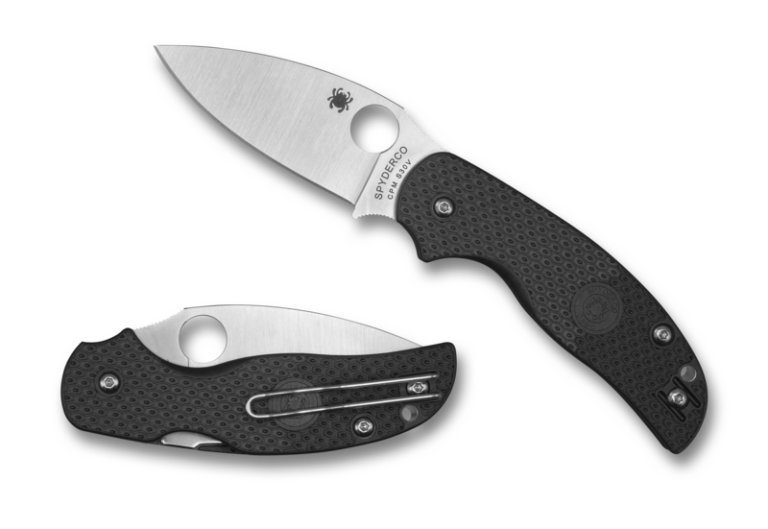
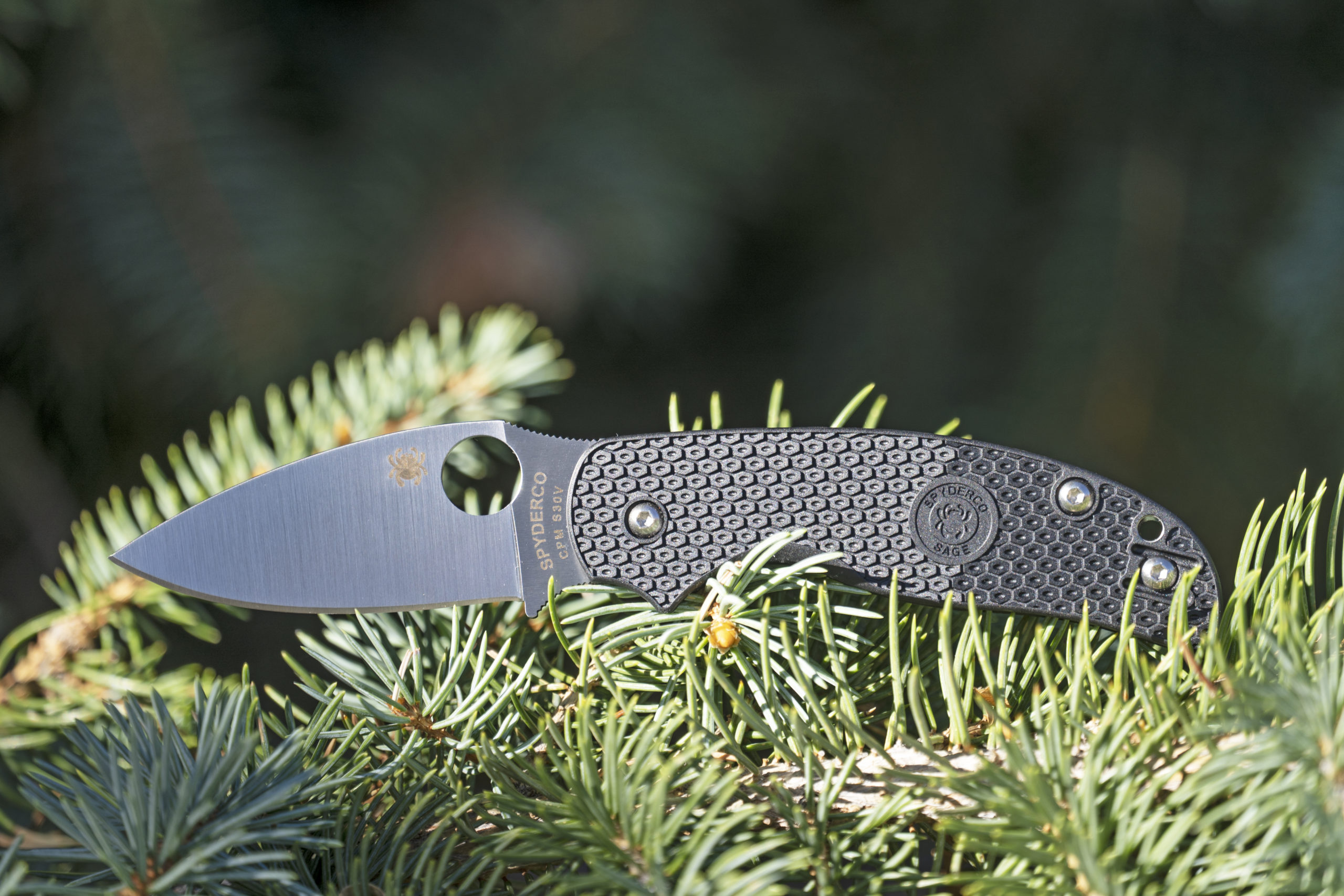
Spyderco’s Sage 5 Lightweight is a detour from their original Sage project in the best kind of way. Originally created as a platform to showcase unique locking mechanisms and their creators, the Sage series has helped to deliver incredible innovation into the mainstream.
In this spirit, the Sage 5 Lightweight maintains the Compression Lock™ mechanism highlighted in the original Sage 5, but pairs it with injection-molded, fiberglass-reinforced-nylon (FRN) handle scales to reduce its weight by 13 percent.
The handle’s Bi-Directional Texture™ pattern provides a secure grip. Nested, skeletonized stainless steel liners provide structural strength and a foundation for the knife’s lock mechanism.
For serious end users, the result is a lightweight, high-performance knife that offers an ultra-secure grip at a more affordable price than the original version of this design.
To ensure an ultra-smooth action, the Sage 5 Lightweight’s full-flat-ground CPM® S30V® stainless steel blade rides on a special low-friction bushing that allows for precise pivot tensioning. A reversible deep-pocket wire clip provides discreet, ambidextrous, tip-up carry, while keeping the knife readily accessible.
As is tradition with all of Spyderco’s Sage models, a portion of the sales of these knives will be donated to the National Alzheimer’s Association.
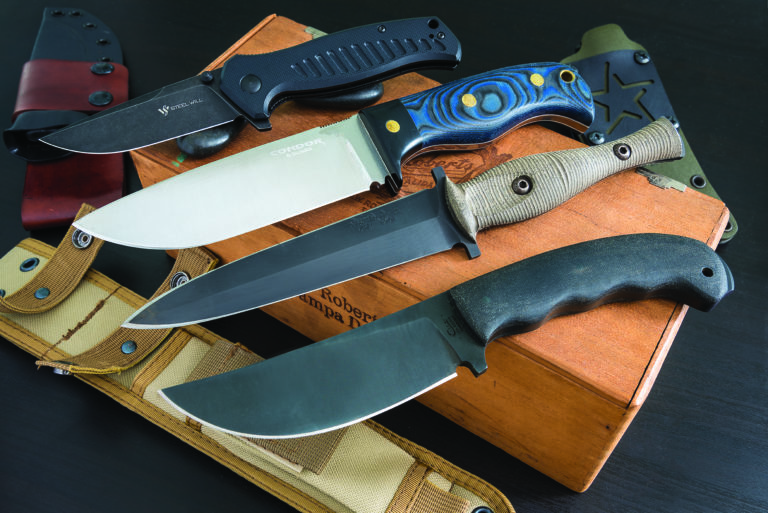
Carbon steel knives continue to be among the top factory performers.
High-performance stainless steels—CPM S30V, S35VN, S90V and 20CV, along with CPM 154, M390 and CTS 204P, to name some— rule in many corners of today’s knife market. While such steels exhibit astonishing edge-holding power and the ability to go the distance without much maintenance, the tradeoff is they can be difficult to sharpen. With the ascendance of such “super steels” you might think carbon steels would be gone for good.
Nothing could be further from the truth. While carbon steels may not attract the attention they once did, that doesn’t mean they’re no less a viable option for hunting, camping and even tactical knives. Many still prefer carbon steels over the high-performance stainless ones, and the primary reason is ease of sharpening, especially in the field. While carbon steels require a bit more maintenance, such as a light coat of oil to prevent corrosion and staining, they can give premium stainless steels a run for the money. Another factor is the all-important lower cost of carbon steels.
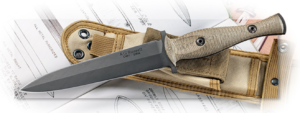
SANDBOX STEEL: A.G. Russell Knives Sandbox Dagger
Photo from agrussell.com
The inspiration for the Sandbox Dagger from A.G. Russell Knives comes straight from the old Camillus Marine Raider Stiletto and legendary Fairbairn-Sykes dagger, both of World War II fame. BLADE Magazine Cutlery Hall-Of-Fame® member A.G. Russell’s intent was to recreate the effectiveness of the venerable dagger designs while boosting the durability of the blade, as the tapered, relatively thin blades were prone to break. Carefully studying the old combat knives, A.G. devised the Sandbox Dagger.
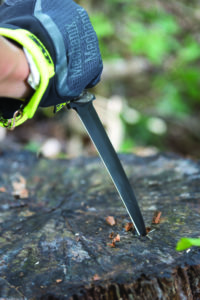
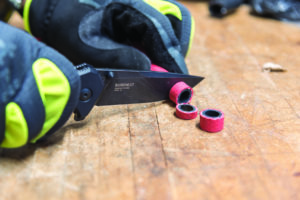
Most daggers fail with broken tips. The A.G. Russell Sandbox Dagger in DM1 carbon steel is redesigned to allow for more blade tip thickness. The knife survived this sideways snap-out treatment with no damage whatsoever.
Beginning with a wider blade that takes longer to taper, thus giving it more body, he discovered new ways of grinding that allowed more stock thickness to remain, enhancing lateral strength. Traditionally a weak spot for daggers, the point thickness is more considerable as well. Another A.G. idea was to offer a “varied edge angle.” Most of the blade would be sharpened at A.G.’s preferred angle of 15 degrees, but toward the tip it changes to a more obtuse angle to bolster point strength. Phil Gibbs, company design engineer, was in charge of torture testing prototypes. One of the tests he successfully performed was driving the dagger through an AK-47 magazine, with absolutely no damage to the tip, and the edge remaining very sharp.
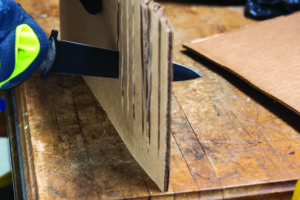
The Sandbox Dagger from A.G. Russell is a highly functional cutting tool. It sliced up cardboard just as well as any single-edge knife would. It is razor sharp out of the box.
The 6-inch blade is DM1 steel, named in honor of bladesmith/metallurgist Dan Maragni, who assisted in its development and heat treatment for A.G. Russell Knives. It is a modified version of the 0170-6C carbon steel the old Camillus used when it made the Becker Knife & Tool line. (Today, KA-BAR makes all BK&T knives.) DM1 can sustain hard use without edge deformation or chipping, yet remains easy to resharpen.
The ergonomic handle is green, rib-textured Rucarta. The rounded handle expands toward the tang to better fit your hand. Indentations on either side give your thumb a non-slip resting place for grip retention, as well as a reference point for blade indexing. The blade is razor sharp out of the box. Manufacturer’s suggested retail price (MSRP): $375.
A-R-RMY, SIR! Case Hambone
Photo source: knifecenter.com
Knifemaker Daniel Winkler and U.S. Army veteran Clint Romesha (page ??) designed the Case Hambone to be a “do-all” field knife for field dressing, batonning wood, preparing food and more. Hambone was the nickname of the legendary U.S. Army pack mule Hamilton T. Bone. Hambone was based at Fort Carson, Colorado, as part of the pack mule program and served from 1943-56, including two combat missions during World War II—the same base Romesha operated from during his military career.
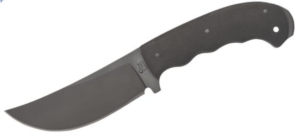
Is it tactical or outdoor? How about both? The Case Hambone is a heavy-duty fixed blade of 80CrV2 carbon steel that will serve either function very well. The flat-ground blade slices easily.
Hambone the knife embodies the hardworking spirit of Hambone the pack mule. The 80CrV2 carbon steel is tough and holds an edge. The trailing point/skinner blade is 4.75 inches with a full flat grind and generous belly that facilitate chores like slicing and chopping/batonning. Handle material options are black canvas Micarta®, curly maple and black textured rubber. The finger-grooved handle with a bird’s-beak butt and integral guard ensures a secure grip in most conditions.
The eight stars engraved on the handle spine memorialize Romesha’s eight teammates who gave their lives during the Battle of Kamdesh in Afghanistan (page ??). The exposed blade tang can be employed as a hammer or glass breaker. The felt-lined Kydex sheath promotes sure knife retention and easy deployment equally well. Rather than having a typical fold-over or sandwich construction, the sheath uses a Micarta spacer to separate its Kydex halves. The OD green Kydex features black overlay with a star laser cut into it to symbolize the Army’s colors and logo.
The eight stars on the blade spine of the Case/Winkler Hambone memorialize the eight men who were part ofArmy Staff Sgt. Clint Romesha’s Cavalry unit who perished during a 2009 battle with Afghan rebels. Along with Daniel Winkler, Romesha designed the Hambone.
The Hambone’s deep blade belly is great for cutting meats and vegetables. The blade is fairly thick up to the tip, which makes it strong for heavy use and abuse. The handle is quite comfortable, providing ample blade control at all times, even with wet hands. The Micarta material is an excellent choice for an all-around user.
The only downside might be the weight. Some may find the knife too heavy on a belt, but, then again, the weight is one of the contributing factors to its cutting power. MSRPs: $325.99 (black canvas Micarta), $333.99 (curly maple) and $342.99 (textured rubber).
TACTICAL CLASSIC: Steel Will Barghest
The Steel Will Barghest has all the hallmarks of a great tactical folder. The test model’s modified clip-point blade of 3.5 inches is full-flat ground from D2 tool steel, a favorite among production companies and custom makers for its toughness and ease of sharpening. The blade opens via a flipper or ambidextrous thumb studs, and the swedge grind adds a bit of attitude. The action is quick, smooth and precise, with the blade riding on a pair of phosphor bronze washers.
The Barghest and its D2 tool steel blade is the latest tactical folder from Steel Will. It comes in two sizes and two blade finishes, and features flipper opening as well as dual thumb studs. It’s a rugged EDC folder at a great MSRP ($84.99 and $89.99)
The handle is a study in the perfect tactical folder design well suited for prolonged use regardless of the elements. The integral guard prevents your hand from slipping forward, and the handle gracefully curves and expands slightly at the midsection to fill your palm nicely without feeling too unwieldy. The blade secures via a linerlock, and dual steel liners provide rigidity. Black G-10 scales feature a series of machined grooves that enhance your grip with or without gloves. A pronounced chamfer on the edges of the scales makes the Barghest feel very comfortable, eliminating any hot spots. A fold-over steel pocket clip carries the knife deep in a pocket. Steel Will also offers a second clip for lefties—just switch clips. The G-10 handle spacer sports large traction notches, and is slightly oversized to make the notches stand out.
The Steel Will Barghest and its D2 blade packs the punch to get tough cutting jobs accomplished and still hold an edge very well.
The Barghest offers what I like in a tactical folder. The blade shape and size is ideal for many cutting tasks, not too small nor too large, and has plenty of bite to power through a variety of tough materials. D2 is a time-proven steel that withstands abuse yet is easy to maintain.
The only negative I see is the pocket clip. Yes, it is a positive as well, but not everyone likes the deep-carry feature, as no part of the handle sticks above the pocket to grab onto. Hence, you must fish around a bit to grab the knife. Hey, you can’t please everyone! MSRPs: $84.99 (3.5-inch blade) and $89.99 (4-inch blade).
STOUT as it is SOLID: Condor Tool & Knife Blue Havoc
condortk.com
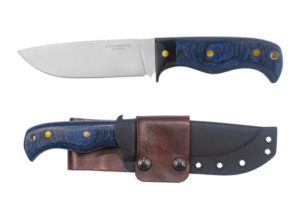
The Condor Tool & Knife Blue Havoc features a 5.5-inch drop-point blade of 1075 carbon steel mated to two-tone black-and-blue paper Micarta scales and a black phenolic bolster. The knife is a handful, a beast that can tackle any cutting task at camp or, in a pinch, use for combat. It is stout as it is solid. The satin-finished blade’s full flat grind is aces in cutting efficiency. A series of traction notches filed into the blade spine provide optimal positioning for applying downward pressure for tougher cutting tasks.
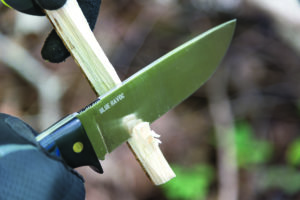
The Condor Tool & Knife Blue Havoc and its beastly blade of 1075 carbon steel can tackle most any camp cutting task.
The handle sports a generous palm swell that fills your grip comfortably, is non-slip and offers precise blade control. Micarta is an excellent choice for using knives because it is strong yet lightweight. It is impervious to most fluids and isn’t affected by weather changes, humidity, heat or most any external factor that would cause integrity issues. Plus, it comes in a myriad of hues to please the pickiest knife enthusiast. The dual-color Micarta® layers show through, adding an exciting visual texture, more so than any solid color Micarta can offer. Integral front and rear guards prevent unwanted hand movement in either direction, and the front guard enables you to choke up to exercise control for precise cutting. As big as the knife is, it’s important that it be able to tackle finer cutting as well, especially in a camp or survival scenario.
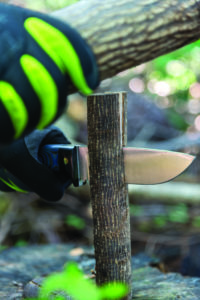
The Condor Tool & Knife Havoc is an edged tool to take on your next camping trip. Its droppoint blade and ergonomic handle are ideal for a variety of cutting tasks.
The Blue Havoc’s sheath materials are an unusual mix: molded Kydex and a leather belt loop. Most Kydex sheaths usually have either a Kydex belt loop or some sort of quick-release attachment, such as a Blade-Tech Tek-Lok. The reason Condor went with the leather belt loop on a Kydex sheath is to allow you to remount the belt loop in the event the sheath orientation must be reversed to accommodate left-hand/side-body carry. Simply remove/replace two screws to dismount/remount the loop. Also, the leather allows the entire sheath to move on your belt to a degree to prevent the knife from being caught up in bushes, branches, etc.
Condor’s catalog states the Blue Havoc can be used in either a tactical or outdoor setting, though due to its appearance, the knife is probably better suited for outdoor use. Moreover, the drop-point blade shape makes it a great camp utility knife for food prep or field dressing/skinning tasks. The 1075 carbon steel resharpens very well, which helps at the campsite. MSRP: $134.98.
STILL RELEVANT
Carbon steel is alive and well at a time when super steels are all the rage. It remains the steel of choice of many hardcore knife users, not only for the lower cost but primarily for the ease of sharpening. It may require a bit more maintenance than stainless, but carbon steel is still relevant and here to stay.
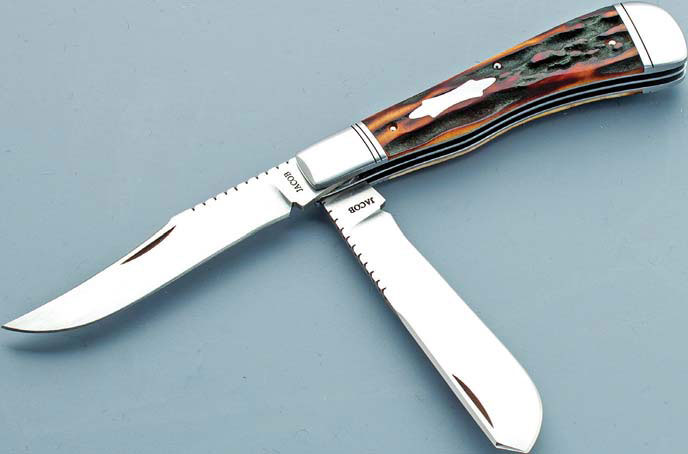
Phil Jacob took home the Best New Maker award from BLADE Show 2017, which is as good as it gets for someone getting started in knifemaking. The achievement is also good news for knife collectors looking for a guiding light for their collections. “Best New Maker” translates to “best new opportunity” for ROIs on investment.
Jacob, who calls Kansas home, specializes in slip joint folders. The addition of exotic handle materials and attention to detail offset any cliches about this traditional style. Just take a look at the double-bladed trapper that made waves at BLADE Show.
Specs:
Blade lengths: 3.125”
Blade steel: CPM 154 stainless
Handle: Stag dyed amber
Folding mechanism: Slip joint
Weight: 5.1 oz
Closed length: 4.5”
Maker’s list price for a similar knife: $875 to $1,100
Jacob maintains a healthy social media presence, which is another benefit to collectors interested in a commission or a resale. His Facebook page is full of status updates and photos.
Hard cases, rolls, soft sides and more … here are some of the Best Knife Cases around.
Safely stowing away one knife is easy. Doing the same for a cornucopia of knives is a challenge.
Given you’ve laid down cold, hard cash on your dream blades, you need a better place than your junk draw to keep them safe. This is where a solid knife case enters the picture … kind of.
It could be a time-tested knife roll or a display case you show off your treasures when not in use. However you cut it, you need somewhere to keep your knives in pristine order.
We’re is here to help. We’ve gathered 9 of the best knife cases and other knife storage solutions to make your hunt easier. By no means is this exhaustive, but gives you a solid start on what you need to stow away your blades.
But before we get to that, you may be asking ….
Why Do I Need A Knife Case?
Good question.
Many casual owners might not need to make the investment. The top of the chest of drawers is a good enough place for a knife when the day is done.
In all likelihood, these are one or two knife owners who pick up whatever works down at the bait shop, hardware store or mega-mart. When you have $20 or $30 wrapped up in a work knife there’s not much call for kid gloves.
Things change when you drop three, four or even five figures on a top-end factory or custom blade. Heck, you might even have a burgeoning knifemaking business and want to take care of your wares. So here are some reasons why you might want to invest in a knife case, roll or other storage/transport system.
Protection: A good knife case needs to protect your knives. They’re investments. They’re tools. They’re a part of you. Making sure they are protected whether you’re traveling or just in the shop is paramount. A case that doesn’t adequately protect your blades isn’t worth the money or the time.
Transportation: Do you really want to trust the luggage throwers at the airport? Or is skimping really worth banging around your beauties? Near or far, if you travel with more than one knife you should really consider a solution above and beyond chucking your knife in a checked bag.
Organization: The best knife cases have beauty in their organization. There’s something incredibly satisfying about opening a case and seeing all your knives cozily tucked exactly where you last left them.
Security: You wouldn’t toss your knives in a shopping bag and leave them outside your door, would you? A quality case provides the necessary security needed to keep your knives safe. Some even have a low-profile appearance so people don’t know what you have under your arm.
What’s The Best Case For You?
The cliche, but true answer, is it depends. If you’re a serious knife collector who crisscrosses the country going to shows, you’re going to want a case that not only locks but is also TSA-compliant so you can fly with as check luggage.
If you’re the type of person who wants something to show off your few prized knives, a display case would be your best bet. It keeps your knives safe while allowing you to be proud of them.
And if you’re someone who regularly stops by the local knife shop to see what new models are available and maybe buy one or two a year, a study roll might be all you’ll need.
What Makes A Good Case?
More than anything, a good knife case is one that’s well made. Kind of obvious, right? But it’s the truth. Here are some of the basic aspects you want your investment to include.
Durable: You want to spend your money on knives, not replacing a knife case. Buy something built for the long haul.
Protective: Hey, this is one of the main reasons you’re buying a knife case. One that doesn’t protect your investment isn’t worth your money.
Convenient: This depends on you, buy the case needs to match your needs. A large hardcase might not prove ideal if you have a small collection. A knife roll might come up short if you fly cross country to shows on a regular basis.
Best Knife Case Options
Spyderco Spyderpac Large
Spyderco Spyderpac Large
Large is an understatement. Spyderco‘s pocketknife case holds 30 folders, each secured in a pouch with a clear plastic window. This is a nice touch, allowing you to find a particular knife at a glance. Constructed of black polyester Cordura, the roll is definitely built to last. And the 24- by nearly 8-inch tri-fold is easy to get in and out of thanks to its Velcro fastener. An added bonus is a handy strap for carrying ease or hanging up your collection for easy access. MSRP: $66.
Pelican V100 Vault Knife Case
Pelican V100 Vault Knife Case
There’s nothing as durable and rugged as a Nalpak Pelican case. Used to keep fragile camera equipment safe on movie sets, it’s up to the task of knife transportation. A crushproof high-impact polymer exterior makes the knife case nearly bulletproof to all but the most extreme abuse. A full O-ring seal around the lid keeps the interior impervious to water and dust, while a purge value ensures the internal environment is ideal. Multiple layer foam dividers keep your knives in place–there’s room for 19 of them–and protects them from typical jostling damage. And twin stainless-steel lock hasps let’s you lock them away and stay TSA compliant. MSRP: $99.99
Hersent Pocket Knife Display Case
Hersent Pocket Knife Display Case
The budget model on our list of pocket knife cases, Hersent’s display case is no-frills done right. Less than eight inches long, the Display Case has slots for 14 folding knives. Each knife is kept in place by a fabric elastic band. The downside, it is a tight squeeze with seven on each hemisphere, and there aren’t individual pockets. Rougher environments these deficits could potentially could lead to damage. However, with this in mind, the knife case is more than adequate for short excursions where rough and tumble isn’t the norm or if case funds are tight. MSRP: $17.88
Vault Case Secure
Vault Case Secure
Vault’s case is modular and TSA compliant if you need to travel with your knives. Boasting an ample 11- by 6.5-inch interior and utilizing removable foam pannels with a Velco loop system. You get six in all, including one buffer pannel perfect for squirlling away patches (if your into that sort of thing). The advantage of the knife case, it’s extremely flexible, giving you the power to configure it to your needs. And it’s secure, with a TSA-approved combo lock with resetable code on its zipper entry. The one negative, the carbon fiber exterior isn’t actually carbon fiber. Still it looks nice. MSRP: $64.96
Bradley Mountain Field Roll
Bradley Mountain Field Roll
A touch of outdoorsman class, the Field Roll from Bradley Mountain is stylish and functional. Room enough to transport up to seven knives and a sharpening stone the waterproof duck canvas is a classic. At 18 ounces, it’s also little trouble to tote along. Traditional knife roll function, the field roll is simple to access, secured by a stylish leather strap. As for storage, it’s 3.5-inch deep pockets are perfect for to keep your folders, whether a one-of-a-kind slipjoint or the latest tactical flipper. MSRP: $48
Messermeister Preservation Chef Backpack
Messermeister Preservation Chef Backpack1
The ultimate in portability, security, and style, this backpack from Messermeister might be the perfect solution for the mobile chef. It features three multipurpose compartments to orgainze everything from a full-sized chef’s knife to a meat thermometer. Plus, a small front pocket can fit your daily items such as a phone, wallet, and a notebook. It has 12 individual pockets for your cutlery and other tools along with a mesh pocket for anything too wide to fit into the main dozen pockets. The last pocket, closet to the back straps, is a standard backpack pocket, great to tote along whatever you need to bring with you. MSRP: $149.95
Castlecreek Collector’s Cabinet Display Case
Castlecreek Collector’s Cabinet Display Case
Part knife case, part furniture, the Castlecreek Collector’s Cabinet Display Case is an elegant way to show off your knives. This case is a big boy, weighing it at almost 16 pounds, but that’s what you get with a wood and brass construction. Each of the seven draws has a green, felt-lined finish and is completely removable. The top shelf is under glass so your prized knife, or any other possession for that matter, can be seen by all. All of the draws are removable and gold-toned brass hardware. The draws are deep enough to store numerous folders or a good amount of fixed blade knives. At 20 inches long, it’s deep enough to store a large chef’s knife or a Bowie knife or sizable recurve. MSRP: $129.99
QCWN Knife Bag
QCWN Knife Bag
Knife rolls are generally geared toward folders, but QCWN‘s Knife Bag gives fixed-blade fan someplace to look. Primaraly intended for on-the-go culinary types, the roll is versitile enough to handle a wild array of other knives–a long as they don’t exceed 17-inches in length. Made from a thick, waxed canvas, the bag is water resistant and nearly impervious to punctures and cuts. A canvas strap secures the bag into a tidy roll when in route and it’s classic look give the sachale timeless appeal. MSRP: $17.49
Shun 8-Slot Knife Roll
Shun 8-Slot Knife Roll
Shun makes great knives, and they also make great knife cases. The Knife Roll can hold eight knives in individual elasticized pockets, and there’s a zippered internal net pocket to hold other tools and accessories. The closures are fully zippered and feature Velcro as well, and the padded handle makes for easy travel. Made from 600D polyester, this option also holds up against rough use. As with many of Shun’s knives and other products, there are no fancy bells and whistles on this knife case. It’s just a high-quality utilitarian product that can be used for years. MSRP: $50
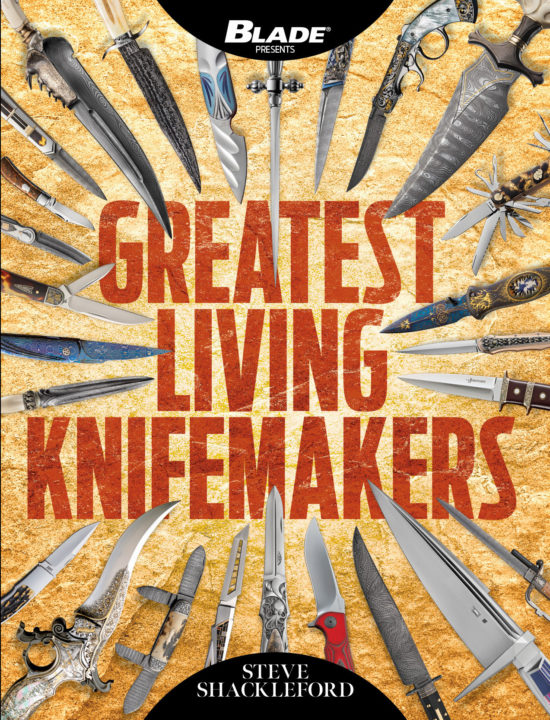
A new book from the publishers of BLADE magazine, Greatest Living Knifemakers, celebrates today’s legends who make knives in ways that most can only dream about. They make knives that can easily fetch tens of thousands of dollars, and even more.
Given all that talent, how does a book like this come together? Who gets to decide who is counting among the “Greatest Living Knifemakers” anyway? If you’re someone looking to collect or make knives, you’ll enjoy this interview with the editor of the book, Steve Shackleford, who is also a member of the BLADE Magazine Cutlery Hall of Fame®.
Many talented people make knives of outstanding quality. How did you go about choosing who should appear in this book?
Steve Shackleford
The hardest part was choosing who NOT to include. I’ve been covering the knife industry for BLADE®, the world’s No. 1 knife publication, since 1985, so I’ve had the privilege of seeing and handling some of the world’s greatest knives, and meeting some of the world’s greatest knifemakers.
As a result, some of the makers I picked peaked years ago and don’t even make that many knives anymore. On the other hand, some are peaking now. However, at some point in their careers each has made knives that are among the world’s best.
In addition, each has either made knives and/or introduced designs, techniques, folding mechanisms, damascus or other steels and other materials, etc., that in turn have set a standard or inspired other makers in the way they make knives.
And, of course, to qualify as per the book’s title, each must be living, though Tony Bose passed away after the book was finished. We decided to include him as a tribute to his fantastic slip joints and the overall impact he had on the knife industry, which was and remains monumental.
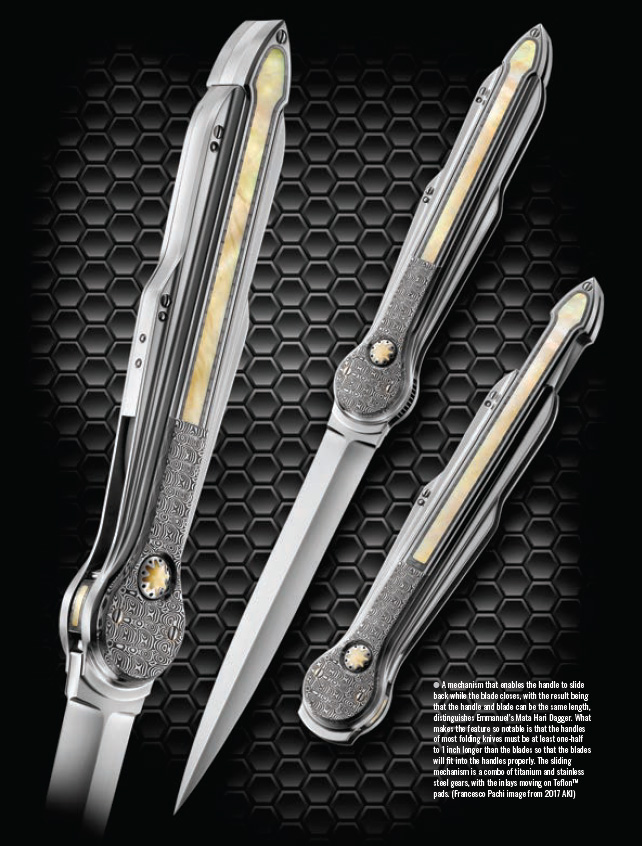
A mechanism that enables the handle to slide back while the blade closes, with the result being that the handle and blade can be the same length, distinguishes Emmanuel’s Mata Hari Dagger. What makes the feature so notable is that the handles of most folding knives must be at least one-half to 1 inch longer than the blades so that the blades will fit into the handles properly. The sliding mechanism is a combo of titanium and stainless steel gears, with the inlays moving on Teflon™ pads. (Francesco Pachi image from 2017 AKI)
What makes a knifemaker “great”?
Some of that is covered in my first answer above but there are other things as well. They must have a lifelong dedication to making knives, which all of those profiled have exhibited, as well as a passion to make knives for much more than just the money.
It’s kind of hard to explain unless you’ve followed knives for a long time, but, in a nutshell, most great knifemakers make knives because they sweat the load, they agonize over the details, and they don’t provide just a “product”—they produce a knife that almost always acts, looks and feels like it’s the best knife that maker makes. There’s much more but that’s part of it.
Are there any names that couldn’t make it into the book due to space limitations?
As noted above, yes, many make knives worthy of inclusion. However, I won’t name names here in case we decide to do a second volume of the book.
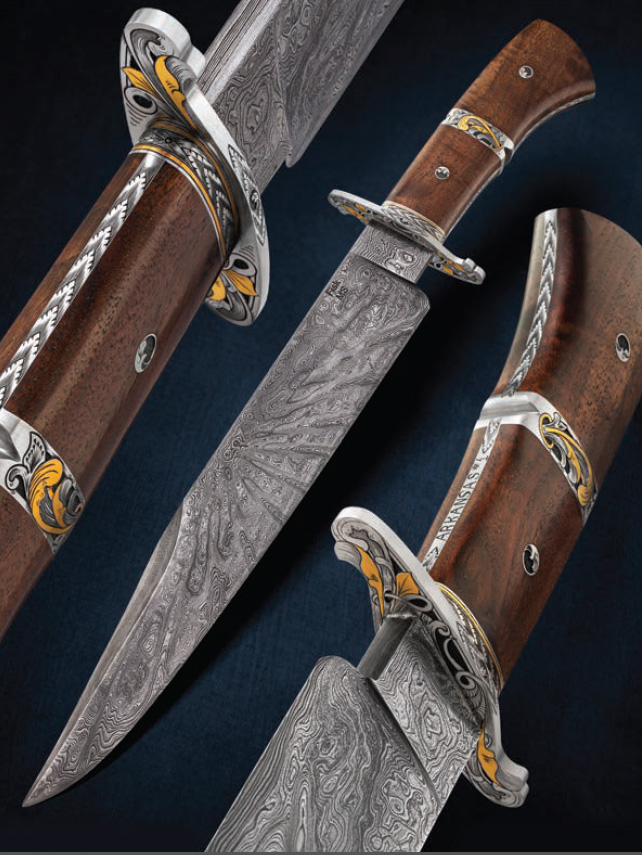
The Razorback State is the theme for Jerry Fisk’s Arkansas #1. The 11-inch blade has a Dog Star-pattern damascus with 1836 layers to represent the year Arkansas became a state. The blade also has steel welded into it from the Statue of Liberty. The walnut handle is from the official James Black walnut from the cemetery where Black is buried in Historic Washington Arkansas. Some believe Black made a bowie knife for James Bowie. The mountings are fully engraved and carved, including deep relief scrollwork and 24k-gold inlay—all by Jerry. (Whetstone Studio image)
Are the names ranked or is this just a collection of noteworthy knifemakers?
Since they are all great and, as John Wayne’s character once said of two great gunfighters in the movie Rio Bravo, “I’d hate to have to live on the difference,” I decided to list them all in alphabetical order—with the exception of R.J. Martin.
His profile appears first in the book because it is the only profile written by the maker himself. I did not ask him to write it, he volunteered to do it. I was so taken by the quality of his writing and the information he provided on what being a great knifemaker is really like that it was a no-brainer to include it.
In my opinion, it’s one of the best ways for the reader to truly appreciate what it’s like to be a great knifemaker—done from a great knifemaker’s point of view. I think it’s the best profile in the book, hands down.
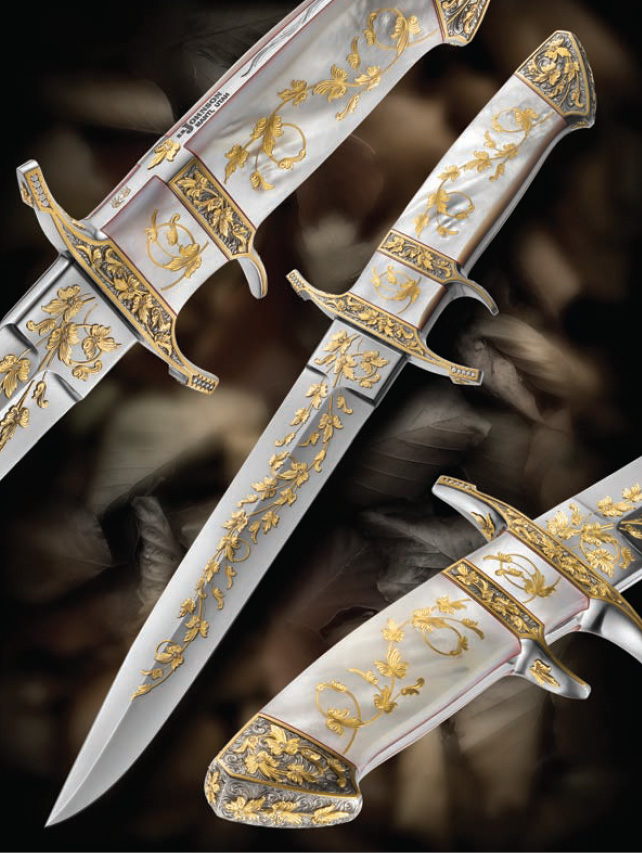
Steve Johnson’s spectacular repro of a Loveless Big Bear sub-hilt fighter is highlighted by Barry Lee Hands engraving that includes 24k-gold inlays and overlays set with diamonds and gilded mother-of-pearl. The knife is made from one block of 5/8-inch thick, 4-inch-wide and 16-inch long CPM 154 stainless steel. The blade is a quarter-inch thick and 8.5 inches long. Overall length: 14 inches. Steve made it for the 2015 Art Knife Invitational. (Francesco Pachi image)
Do great knifemakers have a peak or a golden era within their careers, or are they great throughout their careers?
As with most all great talents, they do indeed seem to peak at certain times. Some peak for longer periods than others and some even seem to have more than one peak. Some may burn out early and then something happens to help them regain their mojo.
However, in most cases the great ones maintain varying levels of greatness throughout their careers, and I think that’s the case with all of those featured in the book.
Is there a list of the knifemakers featured in this book posted somewhere for people to check out?
A knife listed as a J. English & Huber “Sheffield Works” bowie will be among those put up for bid by Rock Island Auction Co. Dec. 6-8.
In addition to the knife, other knives, swords and firearms will be sold at the auction.
Some have suggested that James Bowie carried a Huber bowie. The Bowie Knife by Norm Flayderman includes parts of a dissertation by Dr. Tom Stapleton that suggests Huber made the knife that James and Rezin Bowie bought when they visited Philadelphia in the early 1830s. Those who read BLADE® know that BLADE field editor/ABS master smith Ed Fowler is a huge fan of vintage Huber bowies.
According to The Bowie Knife, examples of the J. English Huber are among the first and best looking of the American bowie style that originated in the early 1800s. Based in Philadelphia, the company that made the knives was in business circa 1831-36. The “Sheffield Works” in this instance was located in Philadelphia, not Sheffield, England. This has caused confusion among bowie authorities over the years. Sheffield Works was owned by Joseph English with Henry and Frederick A. Huber.
Also according to The Bowie Knife, bowies made by English could be in the running as the first to employ the “familiar ‘curved and hollowed’ clip point” seen on many antique examples.
The knife auction site lists the condition of the knife as “fine overall,” with the blade showing evidence of machine sharpening/polishing, with a few tiny chips on the tip and leading edge. The collar and pommel “are both very good, with some minor handling marks.” An inscription panel is missing from the right side of the grip, which also exhibits some age cracking and “a highly attractive grain and color.”
The site lists the estimated price for the knife at a low of $8,500 and a high of $13,000.
For the latest knives, knife news, trends and more, stay tuned to www.blademag.com.
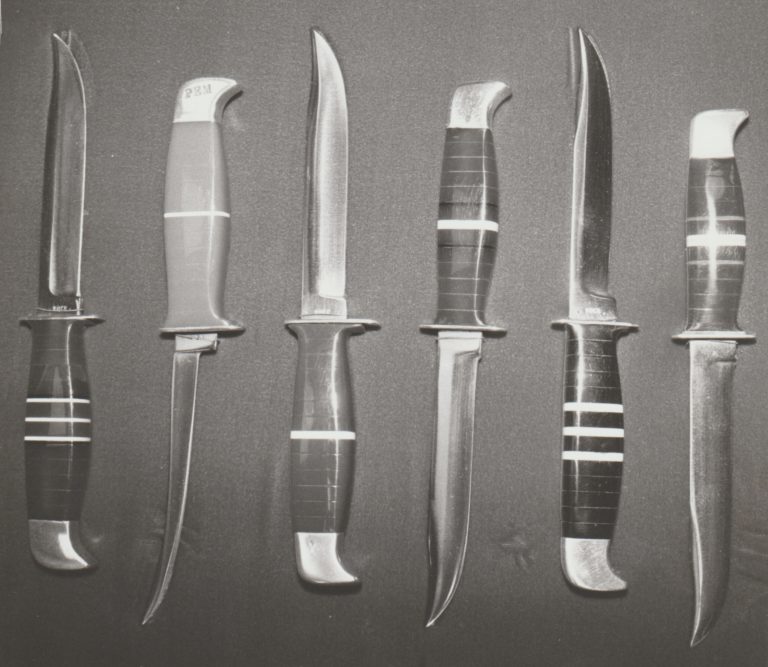
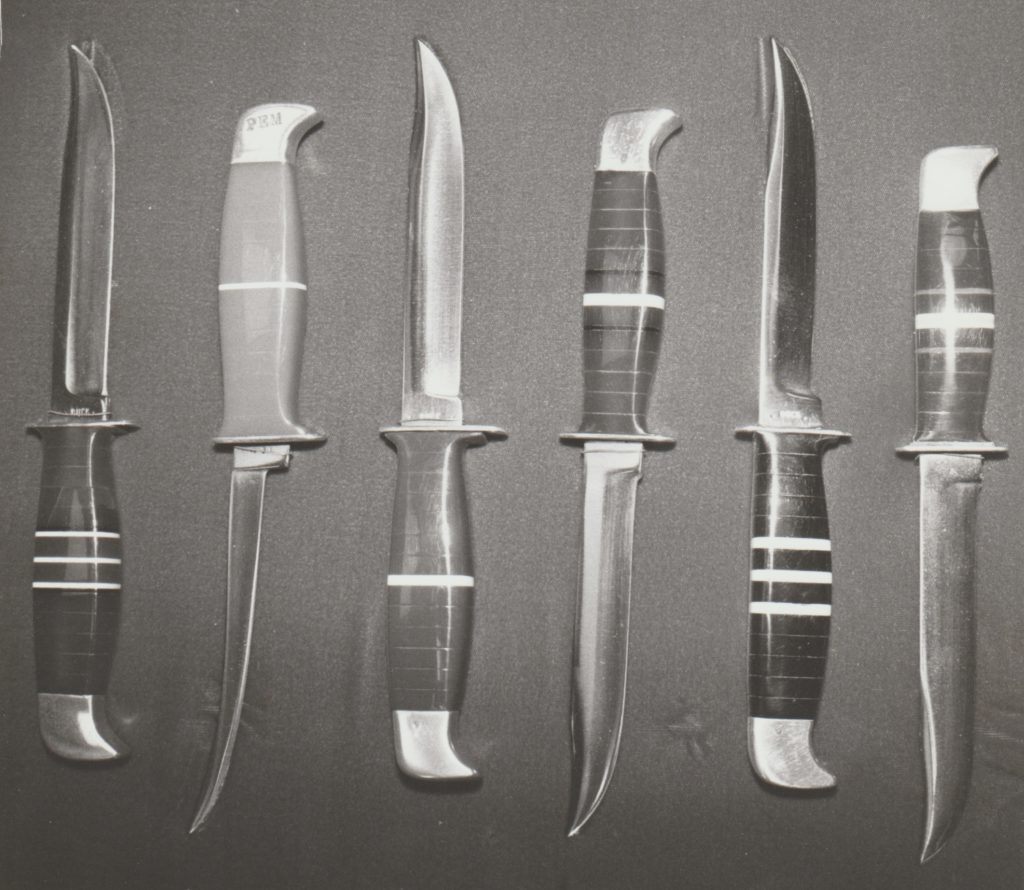
These pre-1950 Buck knives handmade by Buck patriarch Hoyt Buck are classic examples of the Buck legacy.
CJ Buck was the most recent member of the First Family of Knives to be inducted into the BLADE Magazine Cutlery Hall Of Fame, entering the hall in 2016.
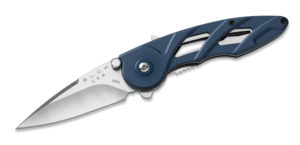
One of several of Buck’s assisted-opening folding knives is the Rush.
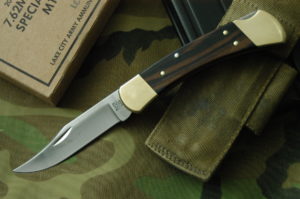
First produced in 1964, the Buck 110 remains one of the most famous modern production knives ever.
If there’s such a thing as the First Family of Knives, the Buck family is it.
Buck Knives has been run by a member of the Buck family—Hoyt, Al, Chuck or CJ—since “H.H. Buck and Son” set up shop in 1945. Since that time, the name Buck has become synonymous with fine hunting, sporting and other knives, and Al, Chuck and CJ help comprise the only family with three members to be inducted into the BLADE Magazine Cutlery Hall Of Fame*.
According to The Story of Buck Knives … A Family Business by Tom Ables, in 1946 “Buck’s knives were all created from used metal files that had been discarded by Consolidated Vultee, the huge aircraft manufacturing plant that later became Convair. These worn-out files, with their heavy carbon content, were perfect for the toughness and edge-holding qualities that Hoyt Buck required in his knives.”
Al joined his father full time in 1947. “[Al] learned how to laminate the thin strips of Lucite plastic used on the handles,” The Story of Buck Knives noted. “He learned how to separate and drill the handles themselves. Later, he learned how to temper the blades so painstakingly sharpened by his dad.”
Sadly, Hoyt learned he had cancer in 1948 and the dreaded disease claimed his life a short year later. He was only 59. Al assumed the company reins and guided it successfully through the 1950s and into the “modern age” of the 1960s. Buck incorporated in 1961, with a young Chuck Buck on the board of directors. The company began making the iconic Buck 110 Folding Hunter on a full production basis in September 1964. The knife’s sales jumped in 1965, increased 63 percent in 1966 and vaulted another 60 percent in 1967.
The knife industry would never be the same again.
Buck flourished under the direction of Al in the 1970s and ’80s, offering the latest in knife designs, materials and more. Along with the legendary Jimmy Lile, Howard Cole and William R. Williamson, Al was inducted into the Cutlery Hall Of Fame at the 1984 BLADE Show.
In 1984, Al Buck became the initial member of the First Family of Knives to join the Cutlery Hall Of Fame.
As the September/October 1984 issue of BLADE® noted in reference to Al and the 110. “Buck didn’t invent the lockback, but he certainly popularized it, and despite a flood of other lockbacks, the Buck knife still leads the way. If you are carrying a lockback today, you can thank Al Buck for his enduring promotional efforts. You have a safer knife for it.”
Chuck was next in line to be inducted into the Cutlery Hall Of Fame, being inducted along with Blackie Collins in 1996. Chuck was a part of the Buck family business from childhood. By 1970 he was corporate vice president for manufacturing, involved in all aspects of the process, from purchasing to personnel to packaging. In 1979 he became company president. Through Chuck’s leadership, the company completed a modern new plant and corporate headquarters in 1980 with 4.5 acres under one roof.
Under his direction the company grew and prospered, winning several BLADE Magazine Knife-Of-The-Year® Awards. By 2004 he was Buck Knives chairman and helped oversee the company’s historic move to Post Falls, Idaho, from El Cajon, California, in 2005.
Chuck Buck was the second Cutlery Hall Of Fame inductee from the First Family of Knives in 1996.
CJ was inducted into the Hall in 2016 following a career that saw him begin by working on the Buck production line in 1978. For 21 years he handled numerous company promotions and responsibilities. In 1999 he was named president of Buck Knives and, in 2001, CEO. In 2015 he was named Buck chairman of the board. He is a co-founder of the American Knife & Tool Institute (AKTI), serving multiple terms as AKTI president, and is the AKTI’s current CEO. He played a pivotal role in the AKTI’s historic defeat of an attempt by U.S. Customs to classify all one-hand-opening knives as switchblades in 2009. Ironically, today, thanks to the efforts of such organizations as AKTI and Knife Rights, switchblades—better known now as automatics—are being legalized in more and more states, and there’s even an effort under way to repeal the archaic Federal Switchblade Act of 1958. In addition, under CJ’s leadership, Buck has an entire line of automatics, including one of its latest—a version of the iconic 110 in full auto mode, no less.
The only family with three members in the Cutlery Hall Of Fame, the Bucks can legitimately lay claim to being the First Family of Knives. Their contributions speak for themselves.
•Uncle Henry and Al Baer of the original Imperial Schrade and A.G. and Goldie Russell are the only brothers and husband and wife, respectively, to be inducted into the Cutlery Hall Of Fame.