Knife collecting is an extremely rewarding experience for knife enthusiasts. There truly is a knife for everyone. Many increase or hold their value throughout the years, making collecting knives something to pass on to the next generation of knife collectors.
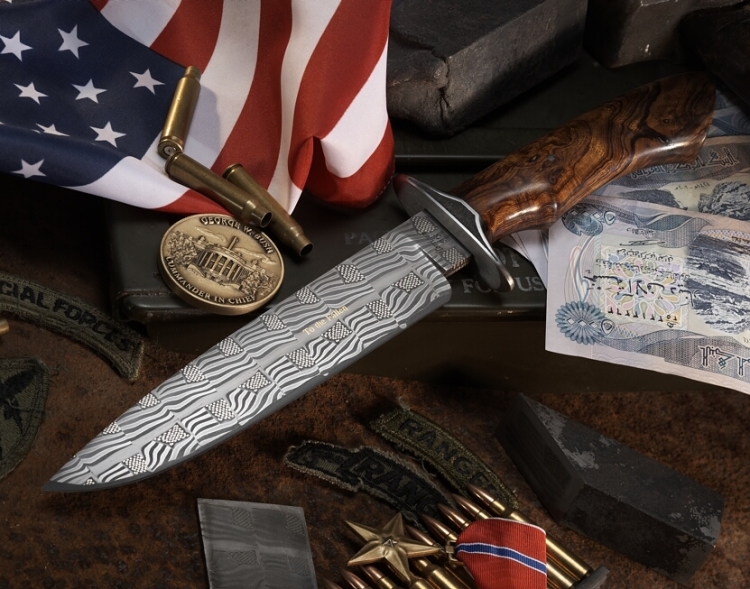
On this Presidents Day, we are honored to show you a knife American Bladesmith Society master smith John Horrigan made for and presented to President George W. Bush on Dec. 4, 2009.
John’s twin brother Robert, also a knifemaker and a member of the U.S. Army 7th Special Forces Group, was killed in action in Iraq on June 17, 2005. John met with President Bush a week after Robert’s death, and it was then he promised the knife to Mr. Bush.
A spectacular bowie with a mosaic damascus blade forged with images of Old Glory and engraved with the words “To the Fallen,” the knife remains a reminder of Robert Horrigan and others who have made the ultimate sacrifice for their country.
For more on the latest knives, knife legislation, knifemaking instruction, knife trends, knifemakers, what knives to buy and where and much more, subscribe to BLADE® Magazine, the World’s No. 1 Knife Publication. For subscription information click on http://www.shopblade.com/product/blade-magazine-one-year-subscripti…?r+ssfb022012#BL1SU
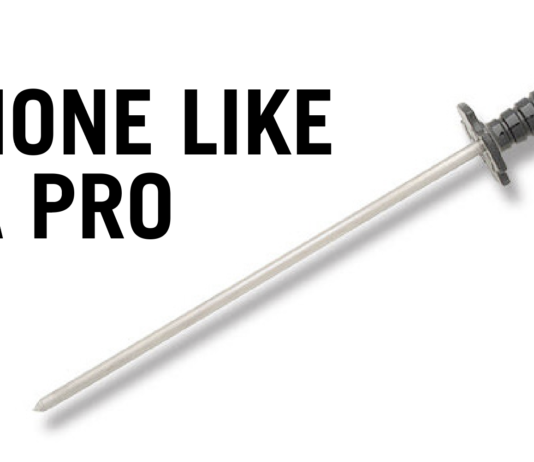
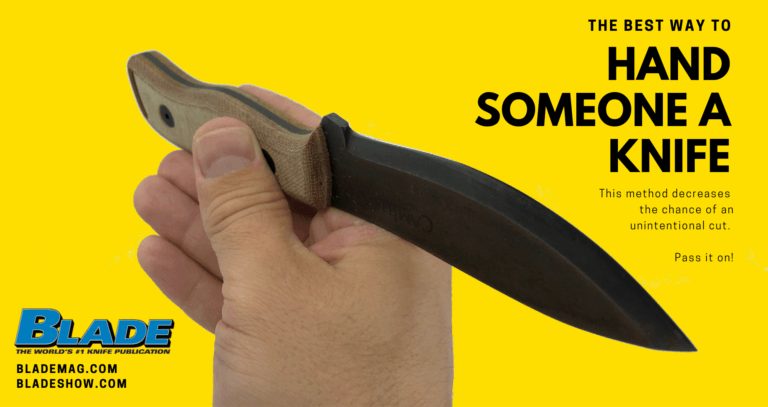
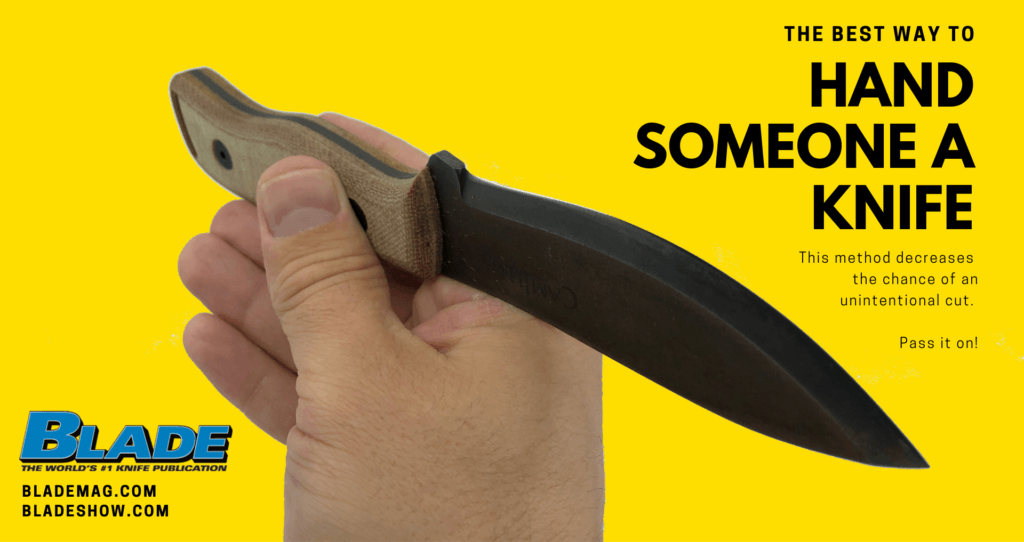
Feel free to to download and share this image. It could prevent an unintended cut. (Please keep the BLADE logo and URLs, though, OK?)
Knife etiquette often overlaps with knife safety, and this is a prime example. The best way to hand someone a knife is also the politest, as nothing is quite as rude as unintentionally cutting open a person’s skin.
The Technique: Make It Muscle Memory
It’s simple: while holding the handle with your fingers, cradle the spine of the blade in the web of your hand between the thumb and index finger.
This allows the recipient to safely grasp the handle. If the blade slides across the giver’s hand, the skin will come in contact with the spine, not the edge. It also forces the recipient into choosing the safest method to release the knife from the giver’s hand, avoiding any meandering edges.
None other than Ray Mears demonstrates what a successful hand off looks like using this technique here:
The dance of two people using any other technique is as awkward as it is unsafe. Committing this technique to muscle memory so it’s second nature will save time and stitches. Plus, you’ll look like a pro.
The Second Best Technique: Setting the Knife Down
The only other technique that’s as safe is setting the knife down for the recipient to then pick up. That’s not always possible, but it’s still better than someone unintentionally shaking hands with an edge.
Placing fingers on the blade to pass or grab a knife is not only not recommended, it’s not how the knife was designed in the first place. The handle is there for a reason.
The Only Exception: Securing the Blade Inside the Handle
If the knife design allows for the blade to be secured inside the handle (folders, autos, etc.), it’s obviously acceptable to secure the blade first before handing the knife off.
In the quick back-and-forths at knife shows, like the BLADE Show, that’s not always convenient. That’s why it’s worth committing the technique in the above picture to muscle memory.
Pass It On!
Don’t keep this information to yourself. Share the image at the top of the page on your social media, blog, website and with anyone who might need it. Feel free to link to this article, too.
BLADE wants you to be safe! Enjoy your knives. Treat them right, and they’ll treat you right, too.
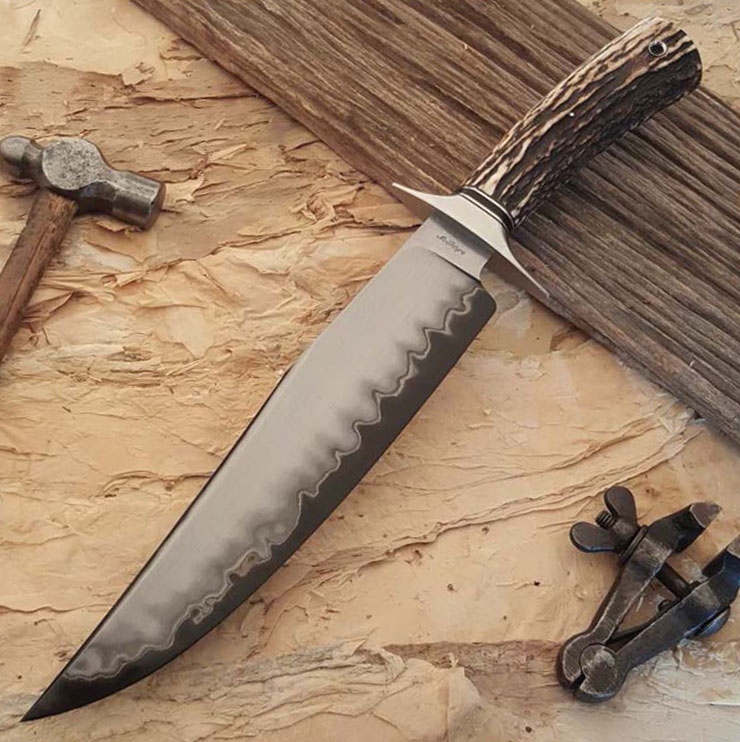
The author stated that Australian ABS master smith Shawn McIntyre “has created his following by offering exceptional quality at a value price.” McIntyre’s “San Mai Bowie” features a 10-inch blade in a san-mai construction, a sambar stag handle and a leather sheath. The author’s price: $1,575. (Shawn McIntyre image)
Editor’s note: This article is from the knifemaker’s point of view, but it could also be used by collectors to better understand price.
Make the Equation
Most manufactured products, whether factory or custom made, have similarities. For those of you unfamiliar with cost accounting, one of the similarities is basically what the costs for building a particular item are.
In the case of custom knives, such costs include those for the machines, belts, drill bits, saw blades, propane, tongs, hammers, etc.—in other words, anything in the shop used to produce the knife.
Other items not necessarily taken into account are those such as the cost of electricity, machine wear and tear, etc. Obviously, materials are easy to account for.
Then there is the amount of money you want—want being the operative word—to make selling your knives, followed by the amount of profit you want to make. The resulting equation is:
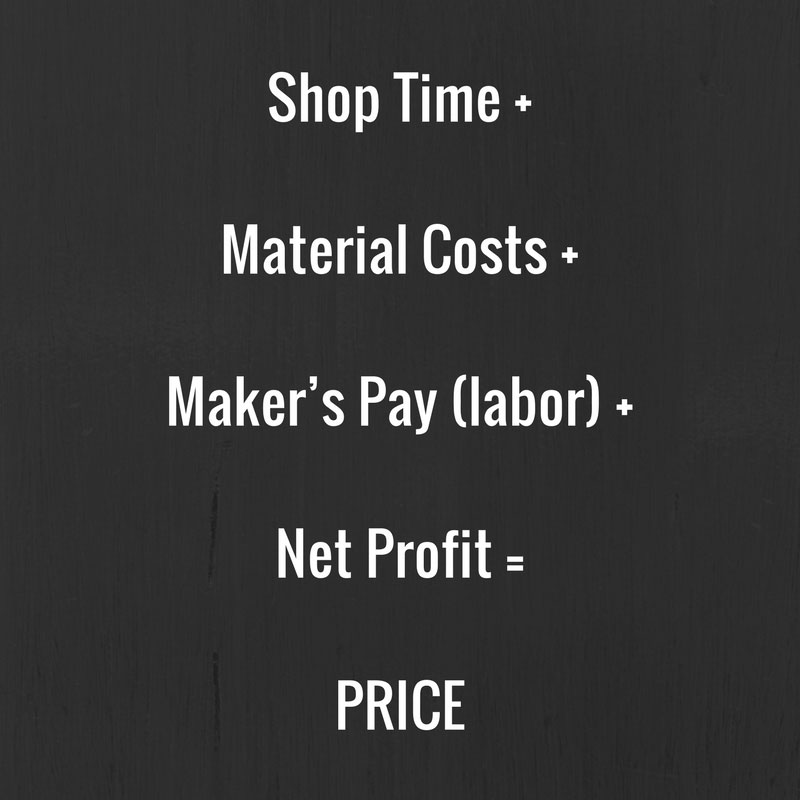
Shop time + material costs + maker’s pay (labor) + net profit = the actual cost (or price) of the knife
(Editor’s note: for collectors, the wiggle room on negotiation could be found in the net profit part of that equation.)
When the Price is Too High
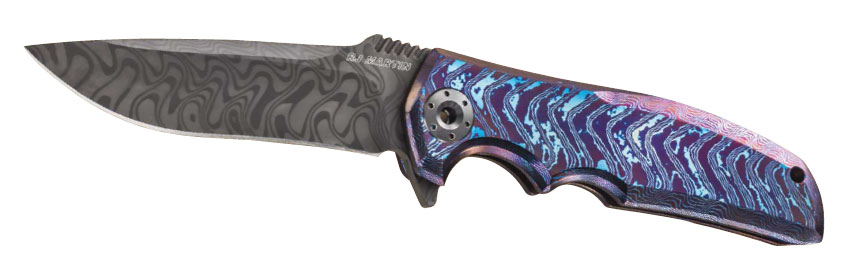
Of RJ Martin the author noted, he “has secured his position as one of the best and most sought after tactical folder makers in the world, due in part to the value pricing he has utilized over the last 30 years.” Martin’s Illudium boasts a 4-inch blade of Chad Nichols Boomerang stainless damascus and a handle of Nichols’ Moku-Ti. The tip-up clip is zirconium. Approximate closed length: 5 inches. The author’s price: $6,000. (Sharp By Coop image)
Again, you’re a knifemaker. Are your knives too expensive? The short answer is “probably.” Over the past 32 years of asking knifemakers the question, the two most prevalent answers I get are:
1) My knives are priced on the advice of another knifemaker;
2) My knives are priced based on what others are asking for similar knives.
While makers who incorporate such pricing strategies can justify them, both approaches incorporate what I call lazy pricing. While you may not realize it, other knifemakers are your competitors.
While they may mean well, their advice for your knives is misplaced. First and foremost they are knifemakers, not knife buyers. What they know are their knives, their market and their clients. This may or may not have any impact on your knives, or, more importantly, the selling of your knives.
In some cases other makers may understand that you are a competitor and suggest you raise your prices, giving their knives more perceived value.
While attending the 1989 Knifemakers’ Guild Show, I was standing at the table of a very well-known knifemaker and checking out his knives. A new maker approached the veteran maker and asked him to critique his knives. The veteran maker asked him how long he had been making knives and for his price for one of them.
The new maker replied, “I have been making knives for two years and this knife is $250.”
The veteran maker said, “You are doing good work. I would raise the price of this knife to $325!”
As you can imagine the new maker thanked the veteran maker, smiled and returned to his table.
In the next few minutes a potential buyer was questioning the veteran maker about the $375 price tag on a particular knife. The veteran maker was quick to point down the aisle, saying, “See that maker right there? He has only been making knives for two years and is asking $325 for one of his knives. Quite frankly, my price is a bargain.”
Whose interest did the veteran maker have in mind while recommending pricing to a fellow maker who sought his advice? To date I have never had a maker using this strategy tell me the veteran maker suggested that the maker lower his or her prices. I found this to be a real eye opener, and it changed the way I looked at custom knife pricing.
When the Price is Too Low
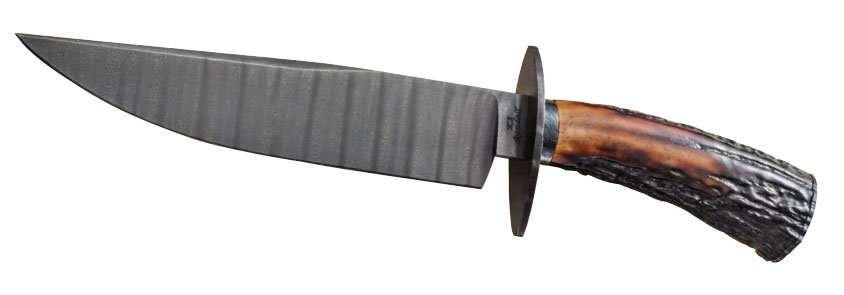
ABS master smith Steve Randall outfits his straight knife in a 7.5-inch blade of ladder-pattern damascus and an amber stag handle. The author’s list price: $1,650. “Steve’s work continues to impress,” the author observed. “Since the inception of his making custom knives, he has always incorporated value pricing into them.” (Sharp By Coop image)
If you are a knifemaker, remember that, early on, people are paying for you to learn your knifemaking skills—a sort of scholarship program, if you will. The object of the exercise is to get as many of your knives into the hands of buyers as possible. You can do this by utilizing value pricing. Your market position will indicate to you what the price should be.
As your knifemaking skills and following develop, your pricing, because of your rising position in the market, will continue to increase. At this point your pricing will be determined not by a friend or another maker’s similar work, but through your understanding of your position in the market and how you got there.
Ask the Author More About Pricing at BLADE Show 2018
Conducted the day before and the Friday and Saturday of the BLADE Show June 1-3 at the Cobb Galleria Centre in Atlanta, BLADE University is the most comprehensive array of classes on the subject of knives and knifemaking of any knife show.
From 9:45 to 10:45 a.m. on Saturday, June 2, Robertson will conduct the class “Knife Collecting for Beginners” and discuss what you need to know before you start buying custom knives.
For more information on these classes and others in BLADE U., visit bladeshow.com.
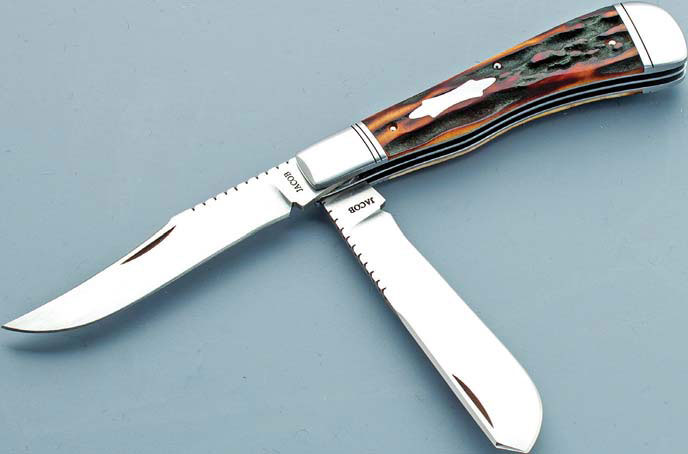
Phil Jacob took home the Best New Maker award from BLADE Show 2017, which is as good as it gets for someone getting started in knifemaking. The achievement is also good news for knife collectors looking for a guiding light for their collections. “Best New Maker” translates to “best new opportunity” for ROIs on investment.
Jacob, who calls Kansas home, specializes in slip joint folders. The addition of exotic handle materials and attention to detail offset any cliches about this traditional style. Just take a look at the double-bladed trapper that made waves at BLADE Show.
Specs:
Blade lengths: 3.125”
Blade steel: CPM 154 stainless
Handle: Stag dyed amber
Folding mechanism: Slip joint
Weight: 5.1 oz
Closed length: 4.5”
Maker’s list price for a similar knife: $875 to $1,100
Jacob maintains a healthy social media presence, which is another benefit to collectors interested in a commission or a resale. His Facebook page is full of status updates and photos.
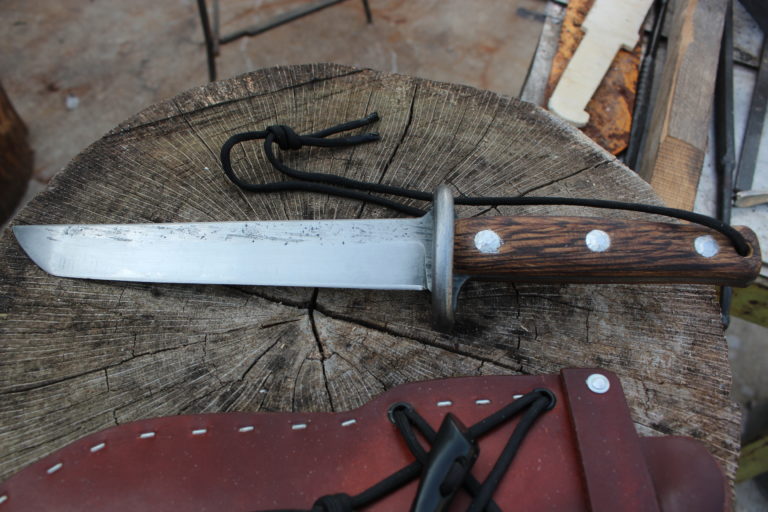
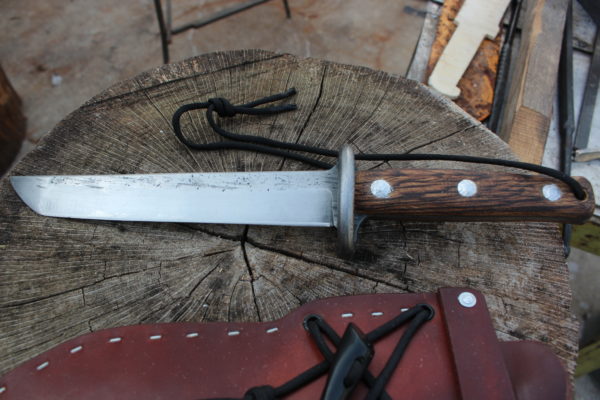
Survival instructor and host of The Weather Channel’s new series “SOS, How To Survive,” Creek Stewart is releasing a new addition to his line of Whiskey Knives. The 7.75-inch-bladed tanto in A36 carbon steel is designed by Hank Gevedon of Reptile Toolworks with continual input from Creek.
Creek Stewart of “Fat Guys In The Woods” fame is hosting a new Weather Channel series: SOS, How To Survive. He is also adding The Rising Sun to his line of Whiskey Knives.
Creek runs Willow Haven Outdoor in Anderson, Indiana, where he teaches survival skills, provides some survival supplies and especially enjoys partnering with American artisans to offer items of high quality craftsmanship at affordable prices. His Apocabox is a subscription-based collection of survival items that arrives at your door every two months. He also offers a monthly survival skill program. Creek was the star of “Fat Men In the Woods,” and is again working with The Weather Channel on the new series. He is the author of an young adult survivalist romance titled “Rugosa.” A follow-up to that is also in the works.
In “SOS, How To Survive,” Creek and other survival experts analyze a series of real-life survival situations. They discuss what happened, what was done correctly by the survivors or what went wrong. The show started Sunday, August 20 and is ongoing. Throughout Creek offers tips that can be used in survival situations.
Creek Stewart Hosts The Weather Channel’s New SOS Series
Meanwhile back in Mount Vernon, Kentucky, Hank and his crew are gearing up to roll small batches of The Rising Sun into production by early 2018. Like all Whiskey Knives, The Rising Sun marries the early American frontier spirit and looks with the precision of Asia’s strong cutlery tradition. All of the knives are asymmetrically ground (so remember to only sharpen one side and just strop the other). The A36 carbon steel allows for a hard outer edge that is sharp and holds an edge with a tough inner core that is flexible and stands up to the rigors of hard outdoor use.
The Rising Sun from Whiskey Knives has a “ghost” guard that rides up the sheath, creating a striking visual when carried.
The handles are made from upcycled white oak whiskey barrel staves, which have already gone through a processing and aging. Fitting rivets are aluminum, and Whiskey Knives come with a 9-ounce belly leather sheath, stapled and dipped in paraffin wax. The Rising Sun’s sheath slides up through the knife’s ghost guard for an attractive-looking carry. MSRP: $189.
Contact Creek Stewart, Willow Haven Outdoor, 2867 N. 200 E., Anderson, IN 46012, www.creekstewart.com/whiskey-knives, on Facebook at Creek Stewart and on Instagram at @creekstewart.
A Digital Subscription To BLADE Is The Answer
You can read your digital issues of BLADE Magazine anywhere you have your phone, tablet or computer, and there’s no need to find storage for all your old issues.
If piling-up issues of magazines seems like a waste to you… If you feel like you don’t have time to read a magazine… If you like the stories we offer in BLADE, but want a more economical option, then a digital subscription is the answer. An annual subscription to BLADE is $17.98, $4 off the print price.
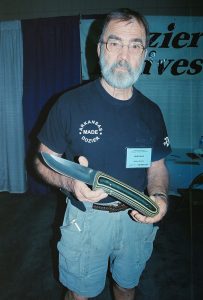
Aka “Dr. D2,” Bob Dozier long has been a proponent of D2 tool steel. Here he holds one of his specially made “over-sized” folders at a past BLADE Show.
D2 tool steel just keeps cutting. It’s been around a long time and enjoys a solid reputation among custom and factory knifemakers and knife users. As with many high-performance steels, it experiences a range of highs and lows in popularity, and at the moment seems to be enjoying a high.
While D2 may not be stainless, it remains a top performer due in no small part to its high wear resistance/edge-holding ability. “It will hold an edge for a very long time before it will go dull,” says Paul Tsujimoto, director of engineering at Ontario Knife Co. Combined with its relatively inexpensive price, this makes D2 a favorite of manufacturers and custom makers alike. “For us, it’s the perfect combination of performance and an affordable price,” notes Dietmar Pohl of Pohl Force Knives. Agrees Devanna, “It’s the best bang for the buck because it’s priced reasonably and works well.”
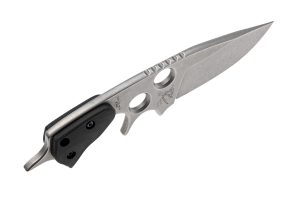
Pohl Force Knives uses D2 blade steel for the Hornet, a Spencer Reiter design.
On the down side, D2’s ample wear resistance also means it is difficult to sharpen. However, a diamond abrasive sharpener should do the trick. Also, the steel’s impact toughness suffers in comparison to some other steels, so D2 is not the best choice for a blade used for chopping and other impact-type cutting chores. And, since it’s not a true stainless, you should wipe it down after use to help keep corrosion to a minimum.
Nonetheless, D2 is an outstanding choice for a hard-use knife and remains popular among custom knifemakers and manufacturers, and knife users as well.
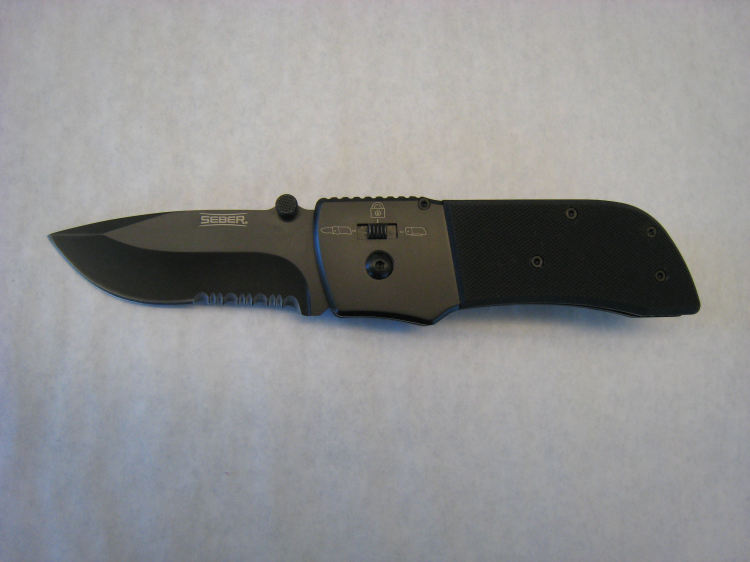
Our “Knife Of The Day” for Feb. 8 is the Seber Drop Point Model RK1150CP.
Featuring a 3-inch serrated blade of 8Cr13MoV stainless steel and a G-10 handle, the knife offers up the Rotation-Loc, a ratcheting-type mechanism that enables the blade to lock open at a variety of different angles. There’s really nothing else quite like the mechanism among folding knives.
Weight: 7 ounces. Closed length: 4.5 inches. Your price at ShopBlade: $39.99.