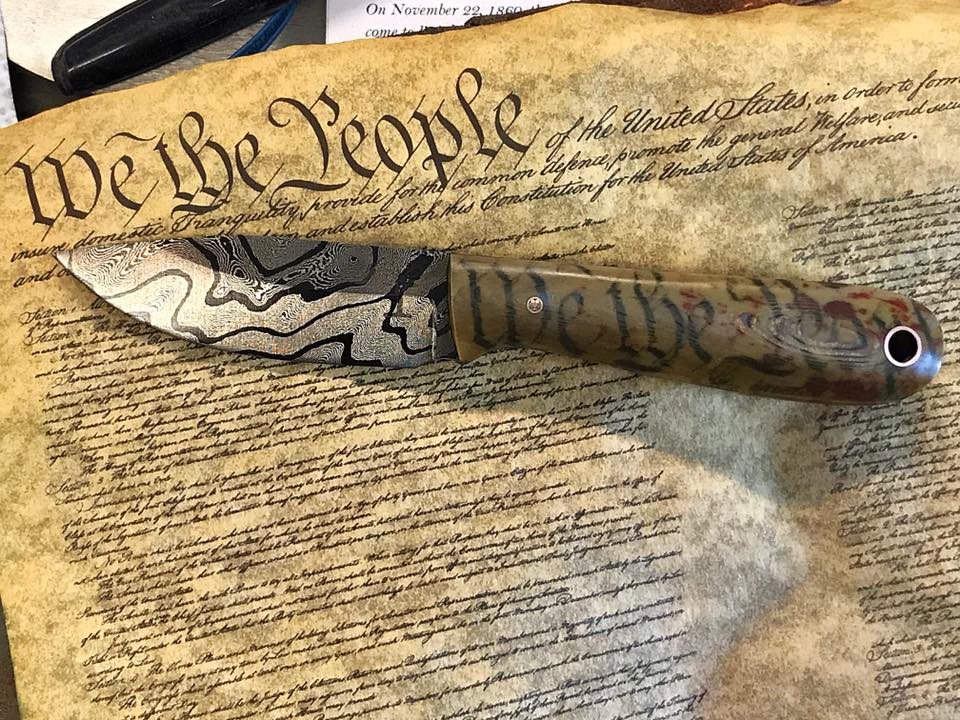
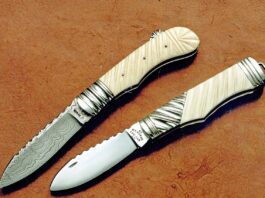
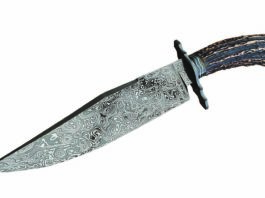
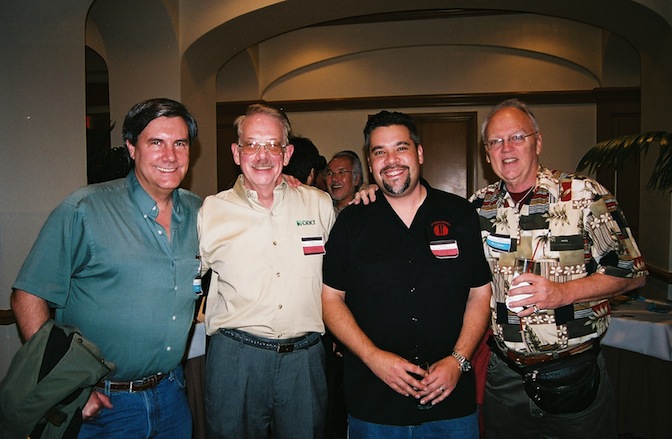
Knife collecting is an extremely rewarding experience for knife enthusiasts. There truly is a knife for everyone. Many increase or hold their value throughout the years, making collecting knives something to pass on to the next generation of knife collectors.
Nearly 20 years later and with my original bolo in disrepair, I thought it time to replace it with an updated and more technologically sophisticated design. My goal was to find a knifemaker from my home state of Kentucky who would be capable and willing to collaborate on the project. It was not long before several members of the Knifemakers’ Guild recommended Gene Baskett. A Guild member since 1981, Gene has proved to be one of Kentucky’s finest custom knifemakers and has earned the respect of his peers for the quality work he produces.
He and I based the knife’s design on the old bolo I had used when I served in the SEALs. Our decision was to go with CPM-154 stainless steel, and Gene made several blade adjustments. We experimented with a rubber handle made from extremely durable horse matting material—a perfect Bluegrass State touch, and a substance also favored by a number of makers and contestants in the cutting competitions. The resulting grip is firm yet shock absorbing. The handle can also be securely grasped when wet. My concerns were simple: durability and performance. I wanted a knife that would withstand a heavy amount of punishment and still perform well.
Both Gene and I agree that the knife has exceeded our expectations. Its cutting ability is just plain scary. Without honing the original edge applied by Gene, I put the knife to the test. He already had whacked through 1-inch saplings, and still the blade was gliding through blades of grass and straw. My test consisted of saplings, 1-inch tree branches and wild grape vines. All were easily severed with one clean hit.
After 20-to-30 strikes on branches and vines, I moved on to a grass mat wrap 4 inches in diameter. The grass mat was wrapped tightly around a 1-inch piece of dried bamboo. One diagonal strike went completely through. I finished the test with a piece of quarter-inch tanned cowhide. With only slight pressure, the bolo sank through the hide from tip to handle. Drawing the blade out and away left a clean, effortless cut through 8 inches of hide. The blade was still quite sharp afterward.—BY STEVE WATKINS, retired Navy SEAL
For the complete story on the author’s super bolo, you can get the digital version of the December BLADE® by clicking on http://www.shopblade.com/blade-dec-2012-digital-issue?lid=SSfbbl101612
PICTURE CAPTIONS, FROM TOP
TOP: At top is the author’s old bolo and leather sheath and below it is Gene Baskett’s Super Bolo and Kydex® sheath. (photo courtesy of Steve Watkins)
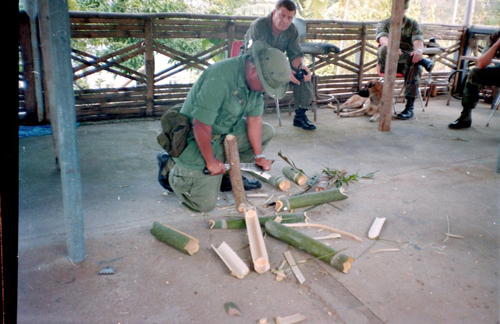
MIDDLE: One of the instructors near the author’s duty station in the Philippines circa 1990 splits wood with the author’s old bolo. (photo courtesy of Steve Watkins)
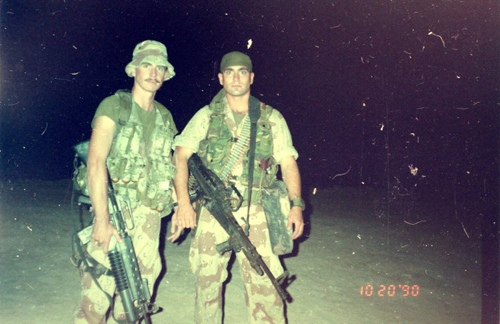
BOTTOM: The author (right) and his friend, Brad O’Neill, on patrol circa 1990. The author is shown holding an M-60 (7.62mm) and his friend an M-16 with an M-203 (a 40mm grenade launcher). (photo courtesy of Steve Watkins)
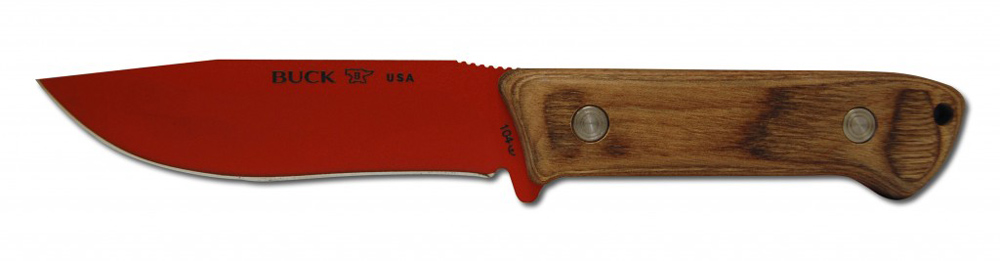
Buck’s new outdoor series features a hot red powdercoat finish.
Buck Knives’ new Compadre series in a hot red finish will debut Aug. 6-9 at the Outdoor Retailer Summer Market Tradeshow in Salt Lake City, Utah.
Just in time for those preparing for the upcoming hunting season, Buck Knives will debut its new Compadre Series of knives and edged tools in a hot red finish at the Outdoor Retailer Summer Market Tradeshow Aug. 6-9.
Consisting of a camp knife, hatchet and chopping froe, the series is highlighted by a red powdercoat finish on the 5160 carbon steel blade of each piece. WIth MSRPs in the $80 to $160 range, each tool is affordable for the serious hunter. The blade selection also is attractive in that the set addresses most of the cutting, kindling needs and brush-clearing tasks associated with hunting and camping.
For instance, the model 104 Camp Knife’s 9.5-inch overall length makes it the choice for certain game care chores as well as all-around cutting duties. With its forward weighting, the 1 pound, 7.7 ounce Compadre Hatchet is tailored for chopping and also game prepping and other hunting and camping chores. And, at an overall length of 16.75 inches and weighing in at just under 2 pounds, the heavy-duty Compadre Chopping Froe can handle any number of brush clearing, heavy chopping, splitting and baton duties
The handles on each piece are made of Heritage walnut Dymondwood®, and both the 104 and Compadre Hatchet include black leather sheaths.
Held at the Salt Palace Convention Center in Salt Lake City, Utah, the Outdoor Retailer Summer Market Tradeshow, like its name implies, is targeted to those who have a passion for the outdoors. Thousands of retailers will be on hand to see the latest in outdoor products, and the new Buck series will be just one of many.
If the Buck series is something you think you’d like, check with your local retailer and see if he’s attending the show to get more information on it. If he’s not attending, see if he’s aware of the new series for possible stocking in his store.
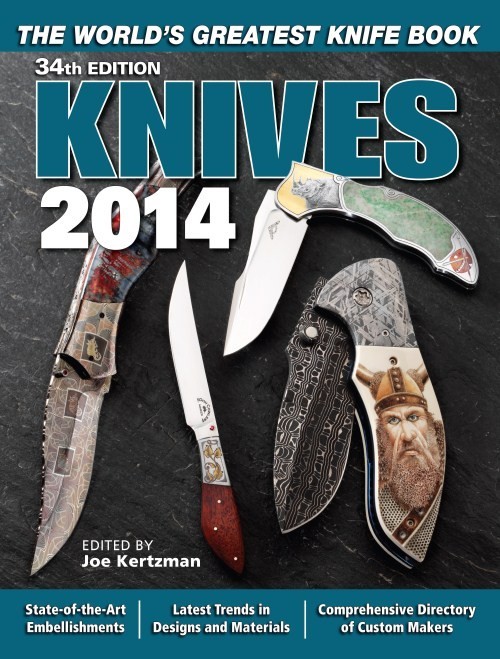
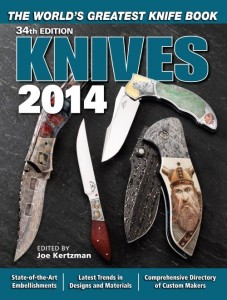
Knives 2014 provides the types of knives they make, technical information, and embellishments like engraving, scrimshaw, jewel inlay, wire inlay, carving, sculpting and etching.
BLADE Magazine Cutlery Hall-Of-Fame® member Pete Gerber knew he was onto something with the FS1, a knife he remembers as “dandy” and one of three in the Folding Sportsman line that debuted with Gerber Legendary Blades beginning sometime around 1980.
“It was just a little heavy,” Pete recalled. “Blackie Collins was working with us on some projects then, and I asked him for help with it. I said, ‘Blackie, this is a nice knife. How can we take some weight out of it and put some pizzazz into it?’”
The knife engineers at Gerber Legendary Blades had been working with Micarta handle slabs, rather labor intensive at the time since the plastic laminate had to be machined to the appropriate shape.
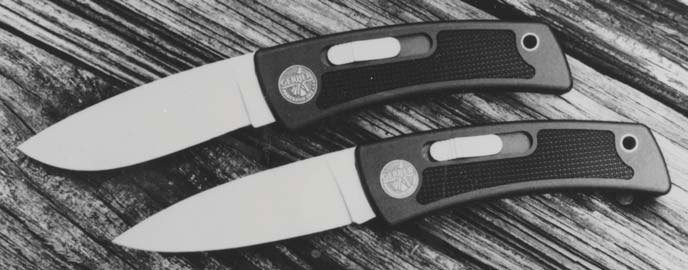
The Bolt Action folders were among the Blackie Collins designs for Gerber that predated the LST. The original Bolt Action is at bottom and the newer Bolt Action hunter is at top.
“We had to mill it out and used brass washers with rivets to attach the slabs,” Pete said. “The original LST was the FS1 in-house design, and Blackie was first given the assignment to put moxie into it using the existing parts. He worked on the design and then put an injection-molded handle on it with nice checkering. Those were his contributions.”
As fine as it was, as long as the slab handles were involved the LST had trouble fully living up to the attributes that provided its name, “Light, Smooth, and Tough.” Collins already had contributed some well-known designs to Gerber, including the Bolt Action folder and the Touché belt buckle knife, and the wheels began to turn in his head.
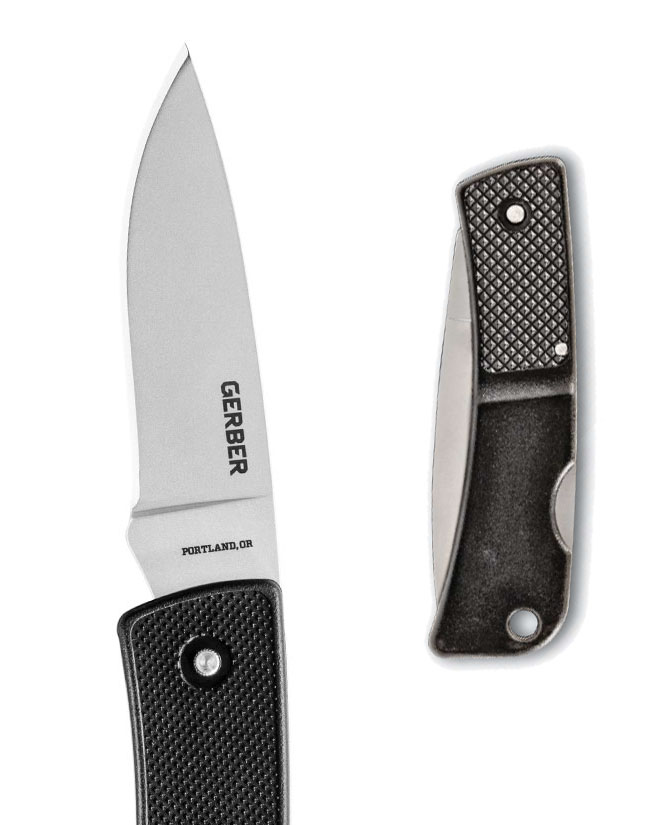
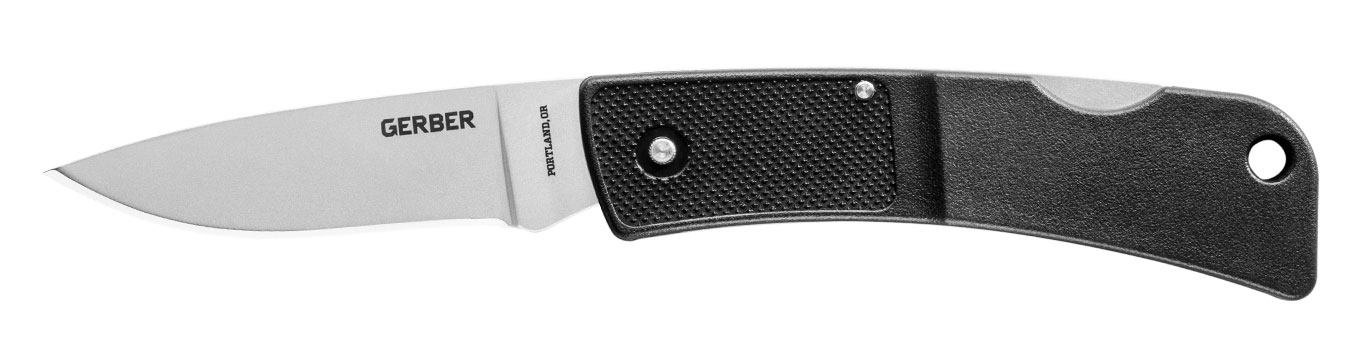
The LST, as offered today on Gerber’s website. (Gerber image)
Blackie had a friend in Gastonia, North Carolina, just outside Charlotte, and that friend ran an injection-molding business. Instead of using riveted slabs as handle material, why not try a one-piece injection-molded handle to reduce both the weight and production cost of a knife design that was already selling pretty well? Just to add to the incentive, injection molding would open up the spectrum of handle colors as well.
After some experimentation, the production LST was manufactured with the glass-filled, nylon-reinforced Zytel as the handle material.
“It was the first time a folding knife was made with a one-piece handle, and it worked,” Pete remembered. “The action was so smooth because we went through an operation called ‘match catch,’ where the blade and the catch were kept together until they were assembled and until they were just perfect. When the knife closed, the blade referenced the catch, and it was as smooth as it could be.”
A New Car for a New Knife
Blackie Collins loved fast cars and motorcycles. When it came time for Pete Gerber to compensate him for his input on the LST, Blackie decided he wanted a Corvette—and Pete made it happen. (Meyerco image)
Almost as sweet as the story behind the LST, which has sold in the millions since the early 1980s, is the back-story of Blackie’s compensation for his input that led to the dynamic little knife’s eventual success. Pete asked Blackie what he wanted in the way of payment for services rendered.
“I didn’t think it could be a royalty knife since it was a modified in-house design,” Gerber explained. “I asked what he wanted for payment, and I suggested that maybe a new car would be something he would like.”
The story goes that the new car turned out to be a Corvette and that Pete’s check for $29,000 made it happen.
Blackie, a Cutlery Hall Of Famer who tragically lost his life in a motorcycle accident in 2011, loved cars and motorcycles and just about anything mechanical, and the idea of new wheels appealed to him. His wife, Jane, remembers well the search for just the right vehicle.
“We went from South Carolina to Jacksonville, Florida, to look at Avanti cars,” she recalled. “He didn’t like the way the new ones handled, so we looked at Corvettes, bought one that was two-tone gold, and drove it home. He owned that car for a few years and then traded it in.”
Pete remembers Collins driving around his hometown in South Carolina in that Corvette with a license plate that simply read, “Blackie.”
Offering items other than money for consulting seemed to work well for Pete, who also once paid Cutlery Hall-Of-Famer Bob Loveless with an airplane.
While Blackie burned up the roads in the Corvette, the Gerber-Collins partnership took the knife market by storm with the LST.
“Blackie used to say that the LST revolutionized the knife industry,” Jane recalled. “He did a lot of work for Gerber, and he really reduced the number of parts on that knife and put the plastic handle on it to make it lighter.”
Taking the World By Storm
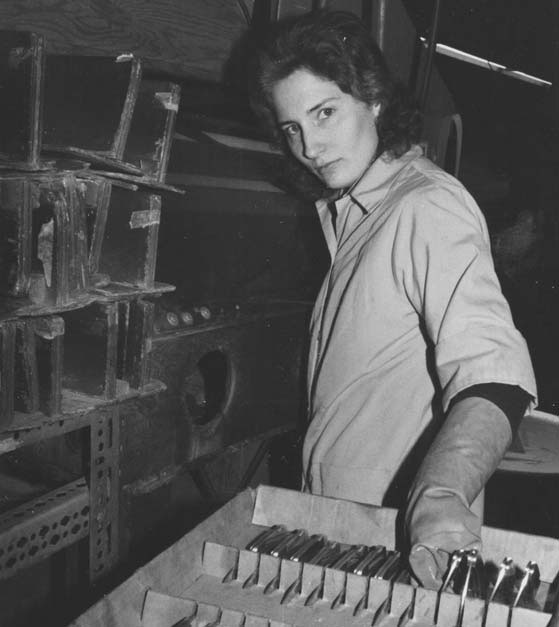
A box of lockback folders in the Gerber factory in the early 1980s shows the thick nature of the handles. The LST not only was lightweight, it was thin, too, adding even more to its ease of carry.
The new lightweight knife was a sensation, and soon other knife companies were taking notice, working on something similar. It was pure gold in itself—with a grand total of six parts to the whole enterprise. Buyers wanted the light, smooth-action, durable and reasonably priced LST, and competitors scrambled to keep pace with Gerber’s trendsetter.
Soon enough, there were similar offerings rolling off assembly lines and onto store shelves. The introduction of LST energized knife manufacturers in a manner seldom seen.
The LST developed its own legacy among the knives that changed knife history, and it is still being manufactured in Portland, Oregon, and sold under the Gerber banner today.
“It was the first true ultralight knife,” explained Dan Delavan of Plaza Cutlery in Costa Mesa, California, “and Gerber had a high-quality blade in that light handle at a good price. You could throw it in the pocket of your swim trunks and go! Lightweight became attractive, and the LST was thin, too. It didn’t bulge in a suit pocket and the checkering gave it a nice grip, just like an extension of the finger. It was the knife that introduced the ultralight, and we sold a lot of them back in the day.”
Lightweight vs. Airweight
Contemporary to the introduction of the LST, Cutlery Hall-Of-Famer A.G. Russell was producing ultralight knives of his own in the Airweight series. Like other knife manufacturers and designers, Russell also worked with Blackie.
He remembers the concept of the ultralight as the shape of things to come in the 1970s.
“I wanted strength but little weight in a knife, too,” Russell noted, “and my Airweight was using a Micarta handle. Blackie had that great idea of molding the handle instead of shaping it, which would have suited an operation like Gerber perfectly. The LST was extremely lightweight and it sold in the millions.”
LST Materials
Pete Gerber recalls using 440A stainless blade steel in the early LST, and says the knife had a good, husky blade that he never saw break—and it was complemented with a nicely polished tang.
“Many other companies were copying it, trying to figure out what we did and how the LST worked so well,” Pete said. “Many of those companies made knives that were quite similar to the LST long after ours was successful. I don’t believe we had a patent on it at all; I don’t think we could get one. The patent area was out of my expertise, but I told our folks to get one whenever we could.”
An Enduring Legacy
Peter Gerber was the headman at Gerber when the LST debuted in 1981. “It was the first time a folding knife was made with a one-piece handle,” he said, “and it worked.”
After almost 40 years, the staying power of the LST is undisputed, and its place as a milestone in the progressive development of knife design is secure. Along with other innovations attributed to Blackie, it stands out among its peers with a timeless depiction of design sense and simple user friendliness.
During the past four decades, the LST has been manufactured in several variants.
DuPont recently celebrated the 50th anniversary of its nylon plastic with a commemorative run of LSTs handled in the company’s Delrin material.
Not long ago, Pete was in a company store in Lincoln City, Oregon, and one of the clerks showed him a Mini LST with a bright green handle.
“I had never seen that bright green before,” Gerber laughed. “It just goes to show you that things can develop that you don’t even know about.”
When the LST hit the market in 1981, the time was right. Since then, it has given Gerber and the knife industry a continuing boost.
“It has sold in the seven figures,” Pete reflected, “and I think it gave us a hell of a shot in the arm.”
Gerber LST Specs
The standard LST sells today on the Gerber company website for a modest $23. The knife weighs a remarkable 1.2 ounces with a drop-point 420HC stainless steel blade of 2.63 inches and a closed length of 3.61 inches. The handle is described as tactile, textured and made of lightweight, synthetic glass-filled nylon.
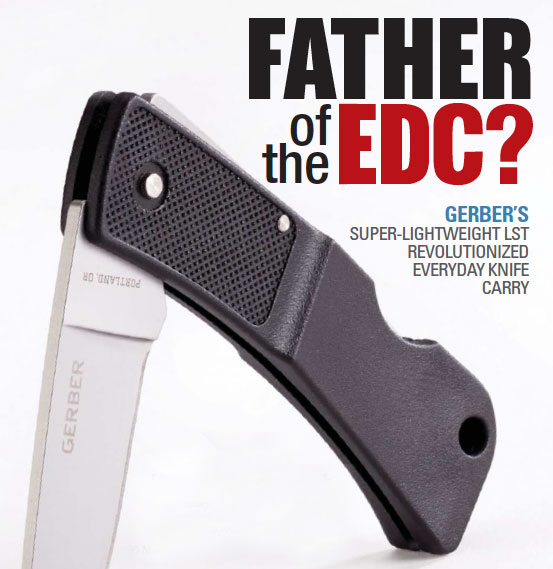
Light, smooth, and tough, Gerber’s LST has earned its place among the elite products of the modern knife industry.
What Other Knives Changed the World? Find Out With This Download
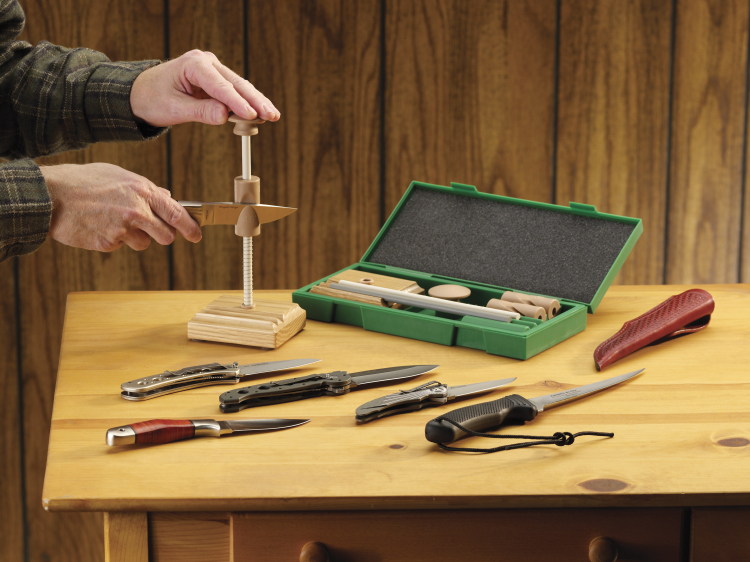
Brainstormed by former BLADE® Ad Manager Steve McCowen, who developed it in concert with knifemaker Charles Kain, the Slide Sharp by Columbia River Knife & Tool is an ingenious angle-guide sharpener.
To sharpen, pull the blade through a sharpening guide slot, pressing down lightly with a circular “locomotion” action. Repeat the same action as needed in the opposite slot. Two sharpening guides are included. One has a slight angle for putting an edge on sport, work, tactical and kitchen knives. The second has a steeper angle for heavier tools such as choppers and machetes.
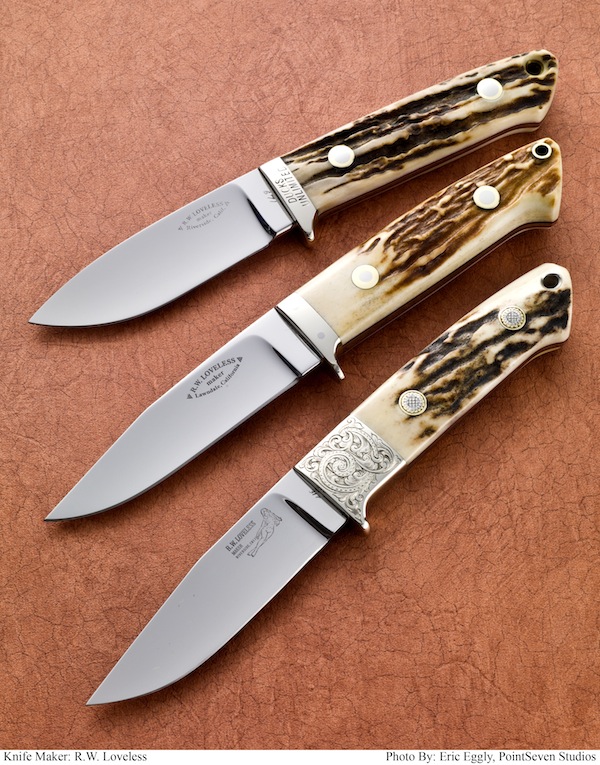
Knife terminology can change with the times. Known by many as the drop point, the knife at top by Bob Loveless originally was called the dropped hunter by Loveless himself. (PointSeven image)
Do you know your knife terminology? Yes, I agree that it probably doesn’t matter much if you do or not as long as you’re into knives and love to use them, collect them and otherwise celebrate your favorite sharp tool. On the other hand, there’s a certain satisfaction in knowing your knife terminology. In other words, it’s nice to be secure in the knowledge that your understanding of knife speak is current and that you can hold your own in conversation with knife aficionados.
Of course gentical is a newer entry in knife speak. There are others, some of which go back years, even decades.
For instance, Cutlery Hall-Of-Famer Bob Loveless is famous for a hunting knife that many call a drop-point hunter or simply a drop point. However, drop point is a misnomer—at least it is in regard to the name Loveless originally gave the design, which was dropped hunter. Both drop point and dropped refer to the point of the blade in the design, which drops or rests below the midpoint of the blade’s plane. Somewhere along the line someone called it a drop point instead of a dropped hunter and the name stuck. In my opinion, drop point is more descriptive of the blade design than dropped—besides, dropped hunter sounds like a knife you dropped and/or lost in the woods somewhere. But I digress.
Then there’s finger choil. Finger guard is another one. The word finger in either is superfluous—in other words, it’s not needed. It’s a guard or it’s a choil, period. Fingergroove or grooves is correct, but not finger guard or finger choil.
The guard is the cross/double guard with two quillons and/or single guard with one quillon—quillon is another entry in knife speak covered below—at the juncture of blade and handle that keeps your fingers/hand from sliding forward onto the blade from the grip.
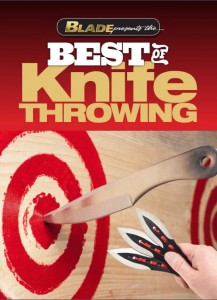
New from BLADE! Check out the best articles on knife throwing, from the pages of BLADE magazine.
A choil is a small cutout at the base of the edge of the blade. Cutlery Hall-Of-Famer A.G. Russell once said the choil’s original purpose was to indicate where to stop the stroke with the sharpener on the blade during the sharpening process. Some knives have larger cutouts at that juncture for placement of a finger for more detailed-type cuts. However, even then the cutouts are still choils, not finger choils. In addition, some companies and makers put a single groove in the handle just before the guard. Though they may call it a finger choil, it is really nothing more than a finger groove.
Now, for the quillon. According to Websters, a quillon is “either of two transverse projecting members forming the cross guard of the sword.” In other words, a cross or double guard consists of two quillons and a single guard consists of one quillon. The cutlery community uses the term for knife guards as well.
Moreover, you will often hear quillon incorrectly pronounced quill-yun. How the word obtained that pronunciation I do not know, though I suspect it came from someone who saw the word, did not know how to pronounce it, and simply did what many do in such circumstances—took a “stab” (forgive the pun) at saying it and arrived at quill-yun. The correct pronunciation is key-yun (or a reasonable facsimilie. Hey, I’m a writer, not a pronunciation expert). However, many, including a large number in the bladesmithing community, continue to refer to it as a quill-yun. Hence, if you hear that pronunciation, you’ll know what it means. (By the way, I don’t recommend trying to correct bladesmiths on their pronunciation of quill-yun. Trust me on this one.)
There are many knife terminology concepts you might want to know. I will cover them sometime in the future here at blademag.com.
Rebooting collections works wonders. OK, so not everyone does it, but many who have done it one or more times seem to enjoy their collecting more.
Chris Nolen has successfully rebooted his knife collection several times since he started collecting. He began in his pre-teens, fueling his cutlery appetite by mowing lawns, and he even wrote a term paper on hunting knives.
Rebooting collections has paid dividends for Chris Nolen, here with wife Linda and their bowie knife collection.
“I was married at 24 and started collecting handmade hunting knives. Most were stag drop points or skinners,” Chris recalls. “I met a great local maker named Jerry Berry of Natchitoches, Louisiana, who got me interested in not just the handles, but the steel in the blades. Of course, I would buy BLADE® and other knife magazines, and I would always find myself looking for big bowies.
“One day I was sitting at my desk and drew out a large, sort of re-curved, stag-handled bowie. I mailed it to Jerry and realized it was time to reboot my collection of maybe 40 knives. And reboot I did! I sold most of the old hunters to make money for my new passion for large bowies.” Nolen is an avid collector of fine bowies to this day and is as enthusiastic as ever.
J.T. Oldham is a long-time folder collector of the modern tactical type and has rebooted his collection on occasion.
“I was a regular customer of the House of Blades in Fort Worth, Texas, where I found many great knives, and also bought up all of the back issues of BLADE I could lay my hands on,” Oldham states. “Production knives were just a way to whet my appetite, as I soon realized that what I wanted to collect was custom knives—and those knives had to have damascus steel.”
As a result, J.T. rebooted and started collecting upscale custom folders—and does to this day.
“At the ICCE [International Custom Cutlery Exposition] show in Kansas City last year, I bought a knife from my No. 1 knife hero, Ralph Turnbull. He was the knifemaker who really started it all for me. I remember looking on his website and in the pages of BLADE Magazine and thinking, ‘If I could only someday own one of Ralph’s knives I would really be a true collector.’”
Since retiring, however, Oldham has tempered his budget a bit. “I no longer have the disposable liquid capital I once enjoyed, so my purchases are now somewhat limited,” he lamented. “However, I follow the custom knife industry with the same interest that I focus on my retirement investments.”
Conversely, rebooting collections is something Kevin Jones has never tried.
“My preference for knives hasn’t changed over the 15 years I’ve been collecting,” Kevin relates. “I started out collecting American Bladesmith Society hunting knives and bowies, and that’s still what interests me. I consider myself a custom knife collector and investor. I’ve found to be successful on the investor side it helps to limit your area of interest so as to become very knowledgeable on both the knives—and the particular knife market—for the knives you collect.”
To REBOOT or NOT to REBOOT?
Why should you consider the concept of rebooting collections?
“Many collectors end up rebooting collections early on as a result of buying their first knives on impulse prior to them acquiring the knowledge and exposure to determine what type and style of knives are going to hold their interest long term,” Jones observes.
Before rebooting, you need to answer questions concerning not only your preferences and current status, but outside realities as well.
Rebooting collections is not for everyone. Kevin Jones has collected ABS hunting knives and bowies and nothing but for 15 years, and has no plans to reboot anytime soon.
“I guess one of the first things to consider is, are you really ready and willing to reboot your collection and take it in an entirely new direction? Has your perspective or your interest changed? Is this an artistic response or a reaction to market trends? For me, a complete reboot means to liquidate your current collection and re-invest in another direction,” Oldham notes. “Are you no longer happy with your knives? Has there been a downturn which has you concerned your collection has lost value? Are you eager to participate in the latest trend?”
Rebooting collections also raises questions as to whether you should sell your current knife collection to finance a new one.
“I feel that’s up to the individual collector,” Jones opines. “However, many need to sell knives in their current collection to help finance them rebooting. I always recommend that while selling an entire collection through a purveyor or auction may be quicker, selling or liquidating piecemeal via a variety of methods will result in a better return.”
Nolen offers a word of caution he discovered after selling off his first collection to reboot.
“Back then I put ads on internet boards and in the newspaper,” he recalls. “I see some knives on eBay that go for hundreds of dollars now that I only paid six to 12 dollars for back in the ’60s and ’70s. I wish now I had most of those back!”
BEST WAYS to LIQUIDATE
What is the best way to liquidate knives if you do decide to sell off your current collection to finance your new one?
“I feel it’s best to use a variety of methods in selling custom knives,” Jones advises, “including contacting other collectors who are interested in the type knives you are selling, selling some on the better knife purveyor sites, and I’ve been very successful selling knives on my ‘collector website.’ It’s very important to have good photos of your knives listed on the internet. You are basically putting your knives out there for the world to see.”
Rebooting collections began for J.T. Oldham when he bought a folder from his hero, custom knifemaker Ralph Turnbull, maker of this damascus linerlock.
“I, for one, would never consider using eBay. Not for my collection,” Oldham states. “And there are just too many trolls on the knife forums! I know that there are decent knife forums, but I simply would not regard that as the right place to offer my knives. I would work one-on-one with certain interested parties—and those individuals may be found on forums. This is all said from my perspective and the knowledge I have of certain individuals with whom I have dealt with in the past. I have a rather large and reliable network of purveyors and collectors whom I trust. A good resource for purveyors is BLADE and the KNIVES annual for a comprehensive listing of those who are associated with the knife community.”
Studying and researching the professionals who deal in knife sales, and then determining who among them are the most knowledgeable and reliable for advice is a must.
“Your purveyor of choice is your best ally in determining what would be in your best interest,” Oldham continues. “If this reboot is purely for financial or investment purposes, no one knows the value of knives better than those who actually determine the value of knives on a day-to-day basis. While they may be able to provide a rough ballpark estimate for your collection, values are subject to change. Be prepared to be presented with values which may be far less than you expected or you’re willing to accept. Be willing to make compromises in order to achieve your goal and obtain what you are truly after, as in any business deal.”
Also keep in mind that when selling to purveyors it is important to remember they are in the business to make money, so they must have a profit margin built into the knives they buy.
IS IT TIME?
As you can see from the comments of our seasoned aficionados, collectors are a distinctly different lot—but that’s what makes the whole avocation of cutlery collecting interesting. As human beings we all have a level of curiosity to see what’s on the other side of the door. Once we have opened it we can either leave or explore. Keep in mind a reboot does not have to be an overnight decision. You can always wade into another genre or style without a full commitment. Whether you wish to upgrade your collection, totally switch gears or seek an investment, there are fresh new knives out there to satisfy any desire.
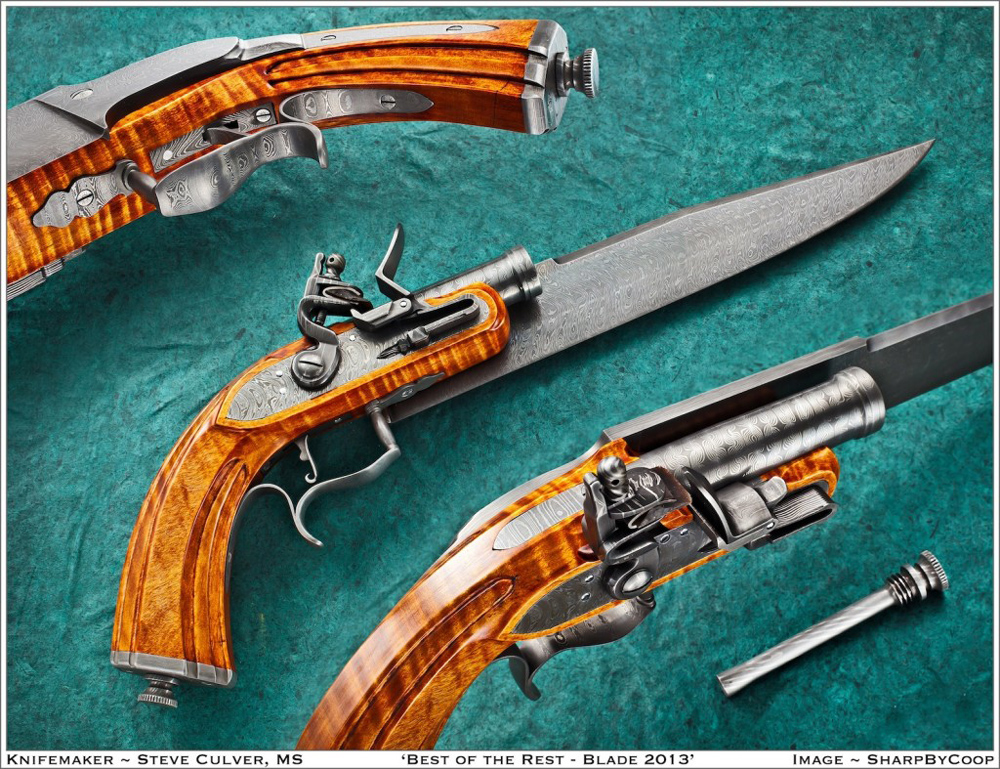
Steve Culver’s cut ‘n shoot would make a great collaboration with Browning. (SharpByCoop image)
Which knife collaborations would you like to see between today’s custom knifemakers and knife and/or gun companies?
There have been many great knife collaborations over the years—from such early ones as those between Smith & Wesson Knives and Blackie Collins and Bob Loveless and Schrade, to those between Spyderco and Bob Terzuola, CRKT and Kit Carson, Benchmade and Mel Pardue and many more—all of which got us to thinking: What great collaborations that never happened would you like to have seen?
Or, perhaps better yet, which ones would you like to see among today’s companies and knifemakers?
Here are a few, first of the former:
•Bob Loveless and Marble’s: Hey, the man behind the dropped hunter and one of the leading hunting knife companies of a bygone era. Seems like a natural collaboration;
•Bill Moran and Busse Combat Knife Co.: Moran made those big, sweeping fixed blades and Busse does, too;
•Bob Lum and Cold Steel: OK, so it probably never would have happened, but the possibilities for a special American tanto collaboration would have been intriguing.
And now for the latter:
•Wolfgang Loerchner and William Henry Knives: Two great makers of fine knives would make an awesome pairing in anybody’s knife book;
•Joe Keeslar and Spartan Blades: Joe’s a retired Marine and Mark Carey and Curtis Iovito of Spartan Blades are retired Special Forces. I bet they could put their heads together and come up with a really cool combat knife collaboration;
•Steve Culver and Browning: Culver’s cut ‘n shoot is a tour de force of the genre and a collaboration with Browning would be a real breakthrough in terms of a special limited-edition crossover between the knife and gun industries. Browning has experience working with the knife industry—for example, Russ Kommer and Jim Crowell are two makers who have collaborated with Browning on knife projects—so Browning would not have to break new ground.
How about it? What knife collaborations would you like to see/have seen?