Knife Collecting

Knife collecting is an extremely rewarding experience for knife enthusiasts. There truly is a knife for everyone. Many increase or hold their value throughout the years, making collecting knives something to pass on to the next generation of knife collectors.

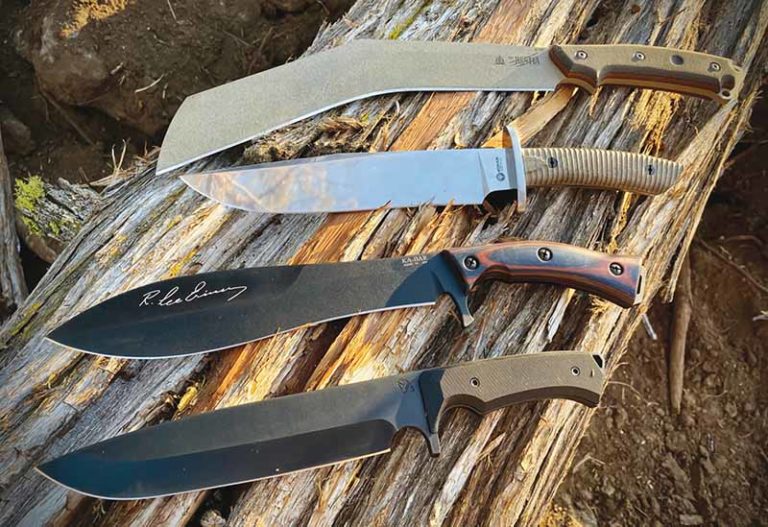
Best Big Knives: Four Behemoths That Are A Cut Above The Rest

Looking for a blade that can handle jobs and and small? These four giants are some of the best big knives out there.

What Are The Big Knives:

Little knives are convenient to carry but, if you have a lot of work to do, big knives are it. I’ve lived and worked with indigenous peoples in Latin America and Southeast Asia and found that wherever folks live close to the earth, they use big knives—machetes, parangs, goloks, bolos and the like. They use them for everything from rough work such as cutting poles and opening coconuts, to dressing out pigs and game, to delicate work such as slicing mangoes.

The advantage of the big blade was illustrated to me one day when I was working alongside a villager who, with his bolo and its 14-inch blade, cut wood for a fire, bamboo poles for a cooking rack, and lopped off a banana leaf on which he filleted two large fish and sliced them thin as a sushi chef—all in the time it took me to bring down a few stalks of bamboo with my hair-shaving-sharp Randall Model 1.

We reviewed the test knives with that standard in mind. We chopped and split wood and sliced meat and tomatoes. We also, just because, cut hanging rubber hose and slashed through water-filled plastic bottles.
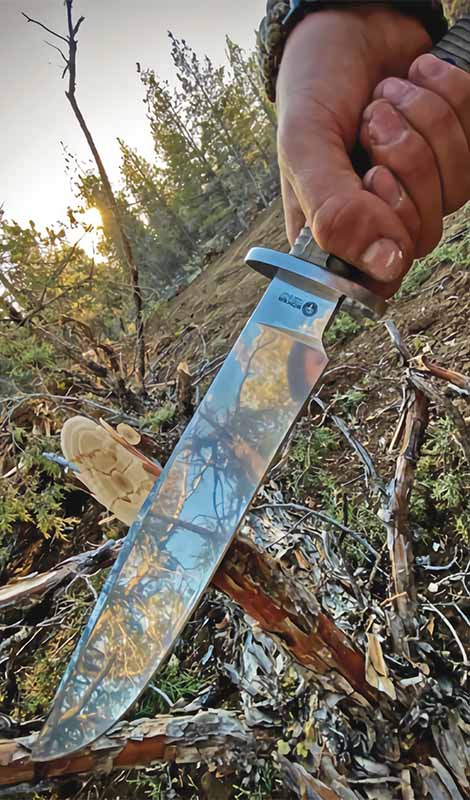
A tree branch succumbs to the reflective blade of the Boker Arbolito El Gigante. It cleaved 2-inch pine saplings in one stroke

Boker Arbolito El Gigante

The Boker Arbolito El Gigante is a handsome classic bowie with a stonewashed blade, comfortable handle and nice leather sheath. Balance is excellent, all very much in the bowie tradition. Construction is top quality; so is performance. It cleaved 2-inch pine saplings with one stroke. The quarter-inch-thick spine was brought down to a well-supported edge fine enough to slice tomatoes thin enough to see light through the slices. We slashed rubber hose and the water bottles with ease.

Like all well-designed and crafted bowies, this is a versatile all-around knife.

BOKER ARBOLITO EL GIGANTE
BLADE LENGTH: 9.25”
BLADE STEEL: Bohler N695 stainless
BLADE THICKNESS: .24”
BLADE GRIND: Flat
BLADE FINISH: Stonewash
HANDLE THICKNESS: .94”
HANDLE MATERIAL: Green Micarta®
WEIGHT: 15.75 ozs.
OVERALL LENGTH: 14.75”
SHEATH: Leather
COUNTRY OF ORIGIN: Argentina
MSRP: $229
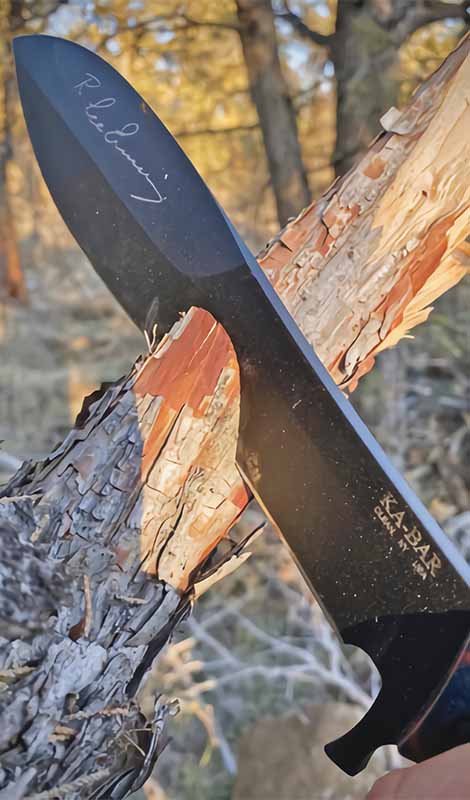

The KA-BAR Gunny chomps into dry pine. Its forward weight and blade design promote effi cient chopping

KA-BAR Gunny

The KA-BAR Gunny is a hybrid design that resembles a bolo. I suspect R. Lee Ermey, the unforgettable Gunny who serves as the knife’s namesake, spent some time in jungles because this combination chopper/slicer’s performance is on par with village-forged bolos I’ve used in Southeast Asia, and that’s a high compliment. Its forward weight and terrific blade design promote efficient chopping. We cut through 3-to-4-inch-thick saplings with two strokes. We took down a tree with a 6-inch-thick truck just because we could. After the chopping, the blade was still sharp enough for camp kitchen work. The belly, good balance and fine edge combined to make slicing meat and vegetables a pleasure. Slashing hanging rubber hose and the water bottle were a piece of cake. The comfortable handle lends itself both to heavy chopping and fine meat cutting, which is unusual.

The Gunny is an excellent all-around bush knife. The sheath has a pocket for a sharpening stone, which was not included with the review model.

KA-BAR GUNNY
DESIGNER: R. Lee “Gunny” Ermey
BLADE LENGTH: 9.75”
BLADE MATERIAL: 1095 Cro-Van carbon steel
BLADE WIDTH: 2”
BLADE THICKNESS: .2”
BLADE GRIND: Flat
HANDLE WIDTH: 1.5”
HANDLE THICKNESS: .94”
HANDLE MATERIAL: Wood
WEIGHT: 15.29 ozs.
OVERALL LENGTH: 15.5”
SHEATH: Leather
COUNTRY OF ORIGIN: USA
MSRP: $292
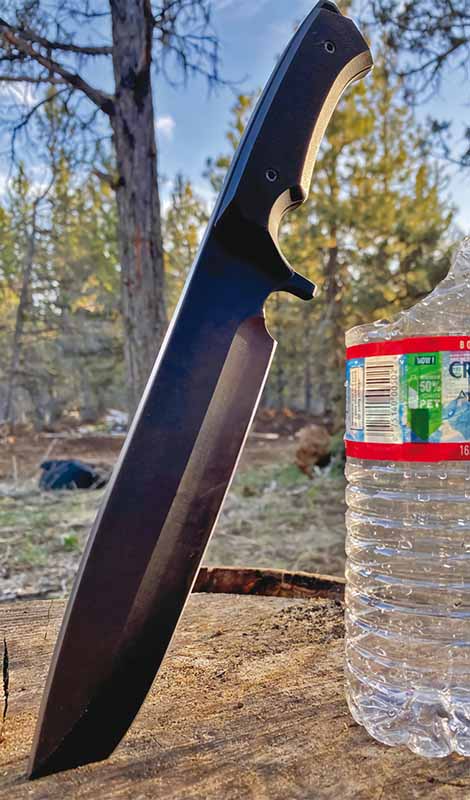

The Medford Knife & Tool Bonfire slashed through water-filled plastic bottles with more consistency than the other review blades

Medford Knife & Tool Bonfire

The Medford Knife & Tool Bonfire came from the maker absolutely razor sharp! The blade design is interesting in that we do not often see a contemporary styled drop point and hollow grind on such a big blade. I don’t know its Rockwell hardness, but the steel is hard and tough.

It was just as razor sharp after we put it through its paces as when we started. The fine edge made for a very good slicer and slasher and lopped off thin branches with one cut. The hollow grind tended to bind when chopping wood, though that’s to be expected—hollow grinds aren’t chopping designs. It’s better to think of this knife as a well-designed and crafted big knife rather than a bush tool such as a panga or kukri. It sliced rubber hose with a snap of the wrist and slashed through water bottles with more consistency than the other review blades, and cut meat just fine. You probably could dress out a bear with it. Use it as a big knife on soft materials and you won’t be disappointed. It comes

MEDFORD KNIFE & TOOL BONFIRE
BLADE LENGTH: 8.25”
BLADE MATERIAL: CPM 3V carbon steel
BLADE THICKNESS: .24”
BLADE GRIND: Hollow
HANDLE THICKNESS: .64”
HANDLE MATERIAL: G-10
WEIGHT: 19.16 ozs.
OVERALL LENGTH: 13”
SHEATH: Nylon
COUNTRY OF ORIGIN: USA
MSRP: $450


TOPS Bestia
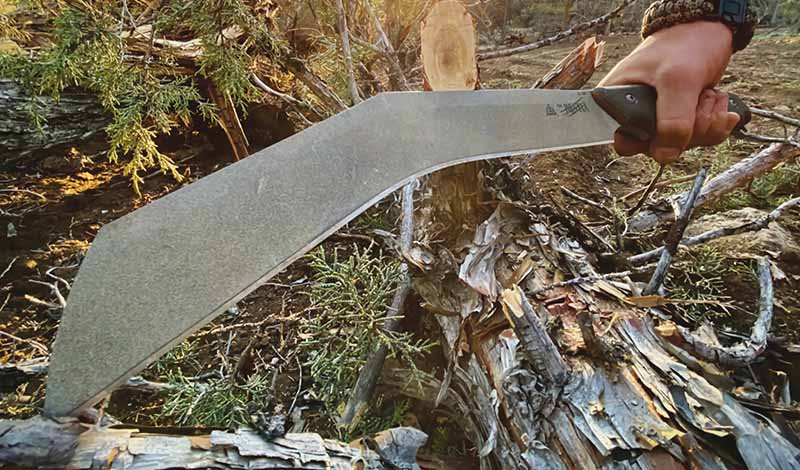
The TOPS Knives Bestia’s kukri-styled 13-inch blade and hefty weight made it the blade of choice for serious chopping or, as the author puts it, “zombie cleaving.”

The TOPS Bestia is just a beast. A kukri-styled 13-inch blade and hefty weight make it the blade of choice for serious chopping or zombie cleaving. We hacked through a 3-inch sapling with one stroke, and used it to clear a stand of saplings and brush. The handle remained comfortable during an hour or so of work. Heavy as a small hatchet, it is more versatile and safer in use, especially in thick brush.

During many survival classes, I’ve seen more injuries from hatchets than from big blades with their longer cutting edges. Given its heft, blade design and chopping ability, the Bestia is surprisingly usable in the camp kitchen. We found it could slice meat quite well, allowing for adjustments in maneuverability due to its blade length.

TOPS KNIVES BESTIA
DESIGNER: Leo Espinoza
BLADE LENGTH: 13”
BLADE MATERIAL: 1095 carbon steel
ROCKWELL HARDNESS: 56-58 HRC
BLADE WIDTH: 2.25”
BLADE THICKNESS: .25”
BLADE GRIND: Flat
HANDLE WIDTH: 2.125”
HANDLE THICKNESS: .97”
HANDLE MATERIAL: Green Micarta®
FRAME/LINER: Micarta
WEIGHT: 1 lb., 13.18 ozs.
OVERALL LENGTH: 19.5”
SHEATH: Kydex
COUNTRY OF ORIGIN: USA
MSRP: $300

VERSATILE BUSH TOOLS

If you haven’t spent much time with a big blade, try one. Work with it for a while. Direct close attention to your work and you’ll find a good big blade to be a terrific, versatile bush tool.

Also Read:

4 Knives That Demonstrate the Genius of Bill Moran

0

[wonderplugin_slider id=”4″]


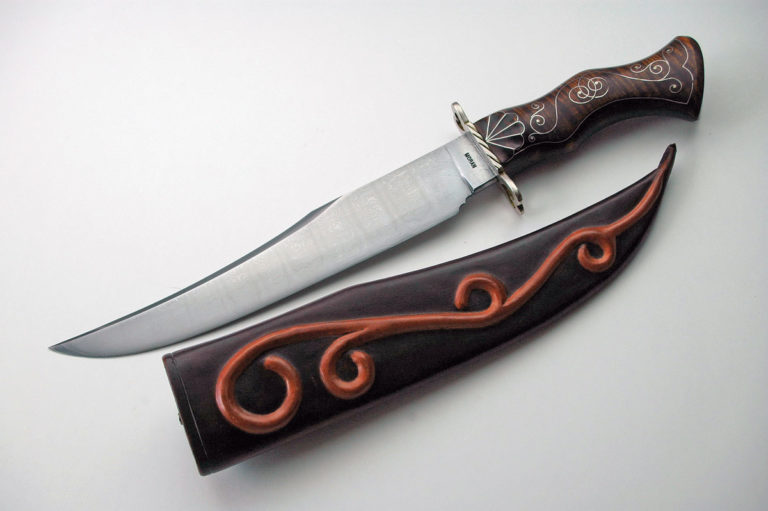
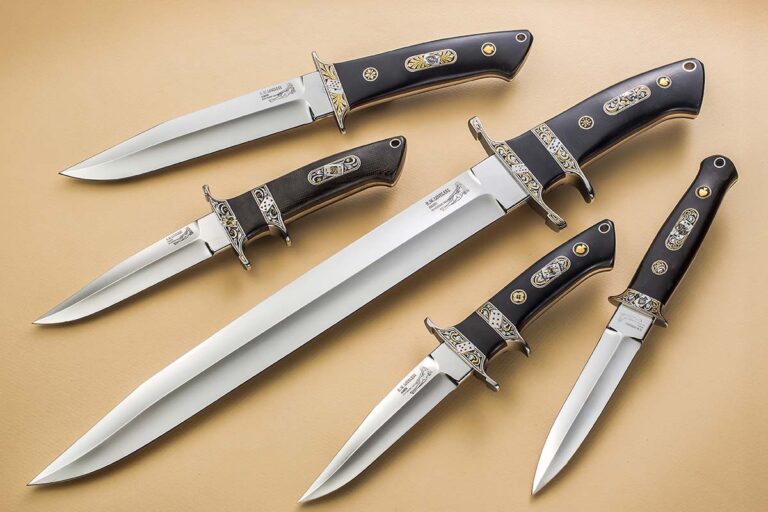
Bill Moran is one of the godfathers of modern knifemaking. Above are four knives that demonstrate his iconic style and show why he continues to inspire generations of knifemakers.

Here is the master at work:

Learn Knifemaking from a True Legend

Bob Loveless is another legendary knifemaker. He wrote a guide to turning out knives like a pro, and BLADE‘s online store is one of the few places carrying it. Get your copy of How to Make Knives here from ShopBlade.com.

How to Collect Knives: 7 Knife Collecting Tips

1

Purveyors help knife buyers and collectors with what they need to know

Working with a reputable purveyor/dealer enhances the knife acquisition experience. The buyer/collector develops a sense of trust, with time and money well spent as the dealer provides advice and access to certain knives that otherwise may be hard to find.

Talking with a dealer offers an educational opportunity, but often enough the experience falls short of realizing its full potential.  What questions should buyers and/or collectors be asking? Going to the source of the answer is a good place to start.

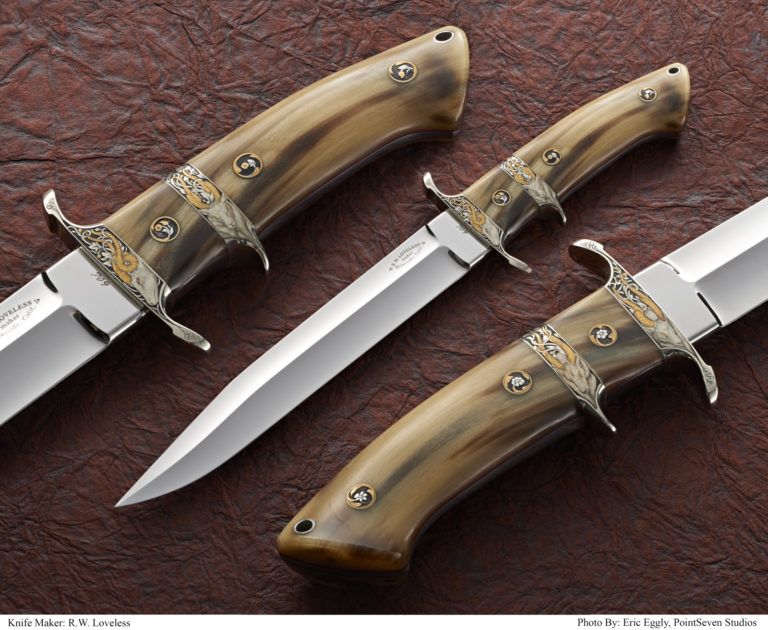
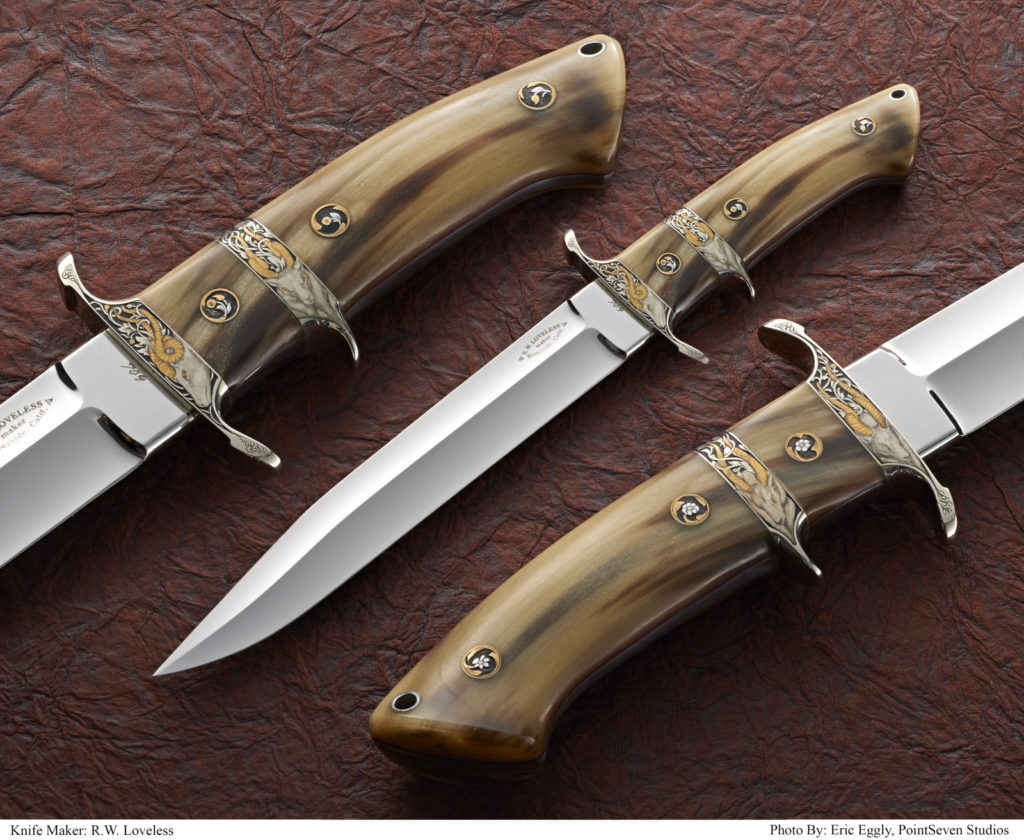
Bob Loveless knives are amongst some of the most sought-after knives in the collecting world. Photographed above is a Loveless Big Bear in sheep horn and Dan Wilkerson engraving (PointSeven knife image)

1. Know the Knife Collecting Trends

Loveless knife specialist John Denton says that staying informed is important.

“This has got to be through the old way of human contact,” Denton observed, “sort of like the lunchroom in school. You hang out, listen, see what is moving, what dealers are buying and, of course, now with the ‘inter-web,’ we have so much more information within seconds, while in the ’70s or ’80s we had to wait for BLADE® Magazine or the gun magazines to run stories on Loveless. Shows are still important to attend, but nowhere like they were years ago. Face to face is still part of the knife world.”

2. Maker Charisma 

Gauging which knives and makers are hot is an integral byproduct of the dealer’s intuition and experience. How does the dealer determine what makes a knife or knifemaker hot? A lot depends on whether the maker has the kind of personality that appeals to the knife enthusiast.

At BladeGallery, Daniel O’Malley specializes in one-of-a-kind custom knives. The answer includes multiple factors. “There are a lot of things that go into making a knifemaker’s knives ‘hot,’” he reasoned. “Part of it is the personality of the maker. When a collector meets a maker for the first time, the collector often has a picture in his head of what the maker will be like. If the maker falls short [of the collector’s expectations], it can be quite disillusioning.”

3. Customer Service

“[The maker] being willing to repair knives when there is a problem is also very important,” O’Malley continued. “It can easily make the difference in a collector continuing to purchase a maker’s work. It can even be the difference in whether a person continues to collect the maker’s knives over time. After all, if a collector has spent a large sum of money on their collection, it can be very nerve wracking to find that it’s hard to get a damaged knife repaired. Similarly, it can be comforting if a problem can be relatively painlessly solved.”

Daniel O’Malley of BladeGallery.com said the maker’s willingness to repair a knife when there is a problem is very important.

4. Do Your Homework

Les Robertson of Robertson’s Custom Cutlery offers custom fixed blade and folding knives, including tacticals and presentation pieces, as well as some exclusives. His take on the delicate topic of a maker’s reliability and the quality of the maker’s work is sage advice for knife enthusiasts in any price range or level of experience.

“I give my client the very best information I have at the time,” Robertson asserted. “This includes issues with a maker or the quality of their work. Often, a maker’s skill level, quality, customer service, and/or delivery issues are overlooked because the knife can be sold immediately for a profit. Given the prices of many of the custom knives today, I highly recommend that collectors do their homework before purchasing a knife. I realize this takes away from the thrill of instant gratification and removes some of the fun out of the hobby. Long term, though, you will feel great about every knife you have bought, and your wallet will thank you.”

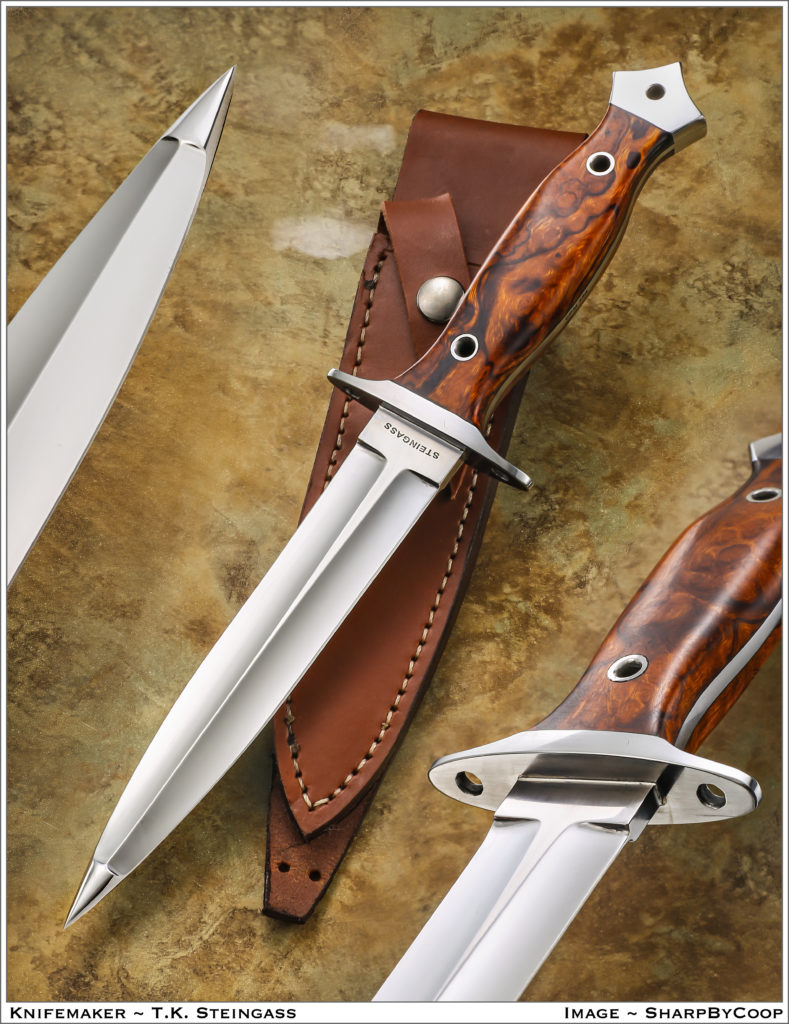
Les Robertson said many buyers/collectors make the mistake of overlooking a maker’s skill level, quality, customer service, and/or delivery issues because the knife can be sold immediately for a profit. The presentation Bastion Dagger by Tim Steingass features an armor-piercing tip. (SharpByCoop knife image)


5. Set An Allowance

Everyone, it seems, has spending limits. The role of the dealer often involves assisting clients in determining how much to spend. Recognition of the amount of disposable income available keeps a buyer/collector in the game.

6. Collect with a Purpose

Denton advises customers to acquire some knowledge on prices and to assess their real purpose for buying custom knives in the first place. “First of all, you want collectors to be educated,” he commented, “and not to be buying just to make money. That is the most risky way to approach collecting. But then if they buy what they like and in three years can’t get 10 cents on the dollar, it will cut their knife buying down and drive them out of the market.”

Dealer Dave Ellis of Exquisiteknives.com notes that the investment perspective differs greatly from that of the collector who wants to enjoy, build and retain knives for years to come. “When I chat with newbies,” he remarked, “a lot of them get into knives from an investment standpoint. They have read in the Wall Street Journal that investing in knives is a good idea, or heard about a knife that was purchased for $800 and then sold for $8,000. I tell them to buy what they like first and to worry about resale later because if it doesn’t pan out, then they won’t have to hold onto something they don’t like.”

Taking a measured approach is key to successful, price-sensitive acquisitions. “I tell the collector to pace themselves,” Denton said. “Get into a knife that will be easy to turn if you get tired of it down the road. I’ve had several people ask me to build them a $300,000 collection, and I tell them I don’t do that because they will get mad if they don’t make 14 percent growth per year—and they don’t know why they’re buying the knife. The true collector has studied the knives and the market, and he will realize what knives are worth and what he can resell them for.”

Those who are new to the custom knife market can tap a great resource in a top dealer. Advice on the market, prevailing prices and hot makers is only part of the relationship. High-end folders by BLADE Magazine Cutlery Hall-Of-Fame© member Ron Lake, Warren Osborne and Jim Martin, along with Loveless fixed blades are among Ellis’s offerings, and when he talks with a new buyer/collector he asks a few basic questions.

“There are more heavy hitters getting in the game with lots of money,” he said, “but that doesn’t mean they are buying the right things. What have their interests been up to now? Did they grow up with knives? Do they carry and use a knife? What is their reason for buying now? Use it? Collect it? Give it to a nephew for college graduation? I don’t want to offer a $7,000 Loveless hunter when a $150 skinner by any smith will do.”

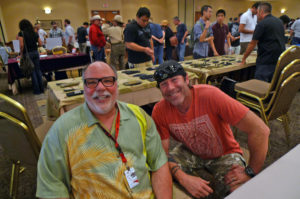
Above: Purveyor Dave Ellis—seated at left with Mick Strider at a past California Custom Knife Show—says to always buy what you like first and worry about resale later. The fixed-blade art knife is by E.C. Loerchner. (Dave Ellis images)

7. Attend Knife Shows that Fit

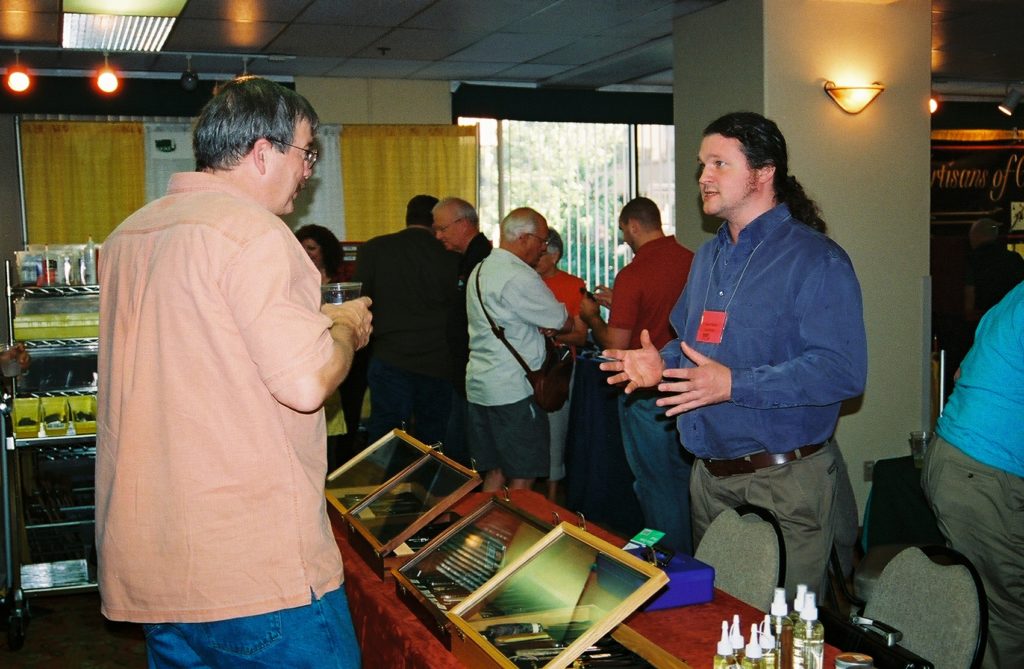
Though knife shows may be one of many ways to gain information and see what is out there, the individual contact with dealers, makers and other knife enthusiasts is invaluable. Attending shows that mean the most to the individual buyer’s needs and wants helps in the education process and in finding the people and knives that enhance the experience.

Robertson attends the BLADE Show due directly to its diversity of custom knives for sale. He says that the Arkansas Custom Knife Show is also one of the premier forged blade shows and features apprentice, journeyman and master smiths in the American Bladesmith Society.

“The New York Custom Knife Show offers a variety of knives from very well-known custom knifemakers,” Robertson added. “This show in recent years has had more of a tactical knife flavor. The USN Show offers the widest variety of tactical folders you will see at any show in the world.” These are just a few of Robertson’s picks. Other shows are out there, and many of them are quite beneficial to knife enthusiasts looking for certain styles of knives and/or makers.

DEVELOP a DIALOGUE

The questions are endless. The enjoyment of knife collecting can be boundless. Develop a dialogue with a dealer. Ask the questions herein and others that come to mind, and feel the positive energy of a well-executed knife purchase.

Sub-Hilt Knives: Aesthetics And Aggression In Harmony

The sub-hilt is at once belligerent and beautiful, adding a strange allure to the knives that sport it.

There is no consensus as to the origin of the sub-hilt knife, though most agree the sub-hilt fighter was popularized by BLADE Magazine Cutlery Hall-of-Fame® member Bob Loveless in the 1970s, if not earlier. Some believe the sub-hilt design was for hunting, and that the main purpose for the added hilt was for greater leverage when a surer grip was needed. A few have even postulated the additional hilt was for use as a brace in pulling the knife out after being stabbed into bone or another hard material, a use that it would no doubt accommodate most effectively.

Gary Langley: Gentleman’s Fixed Blade

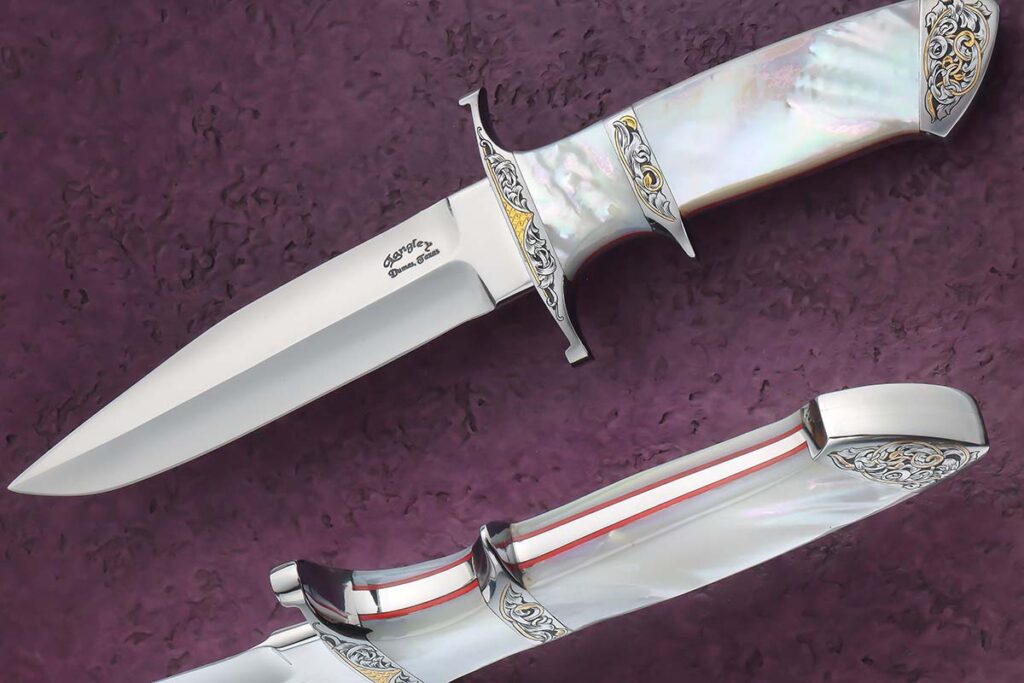
Custom maker Gary Langley’s sub-hilt fighter may be small at 9 inches overall but makes up for its size in sleek blade grinds, exquisite mother-of-pearl scales and gold inlay. Blade and overall lengths: 4.5 and 9 inches. Alice Carter did the engraving. (SharpByCoop knife image)

Many knife enthusiasts think of a sub-hilt fighter as being a heavier-edged companion—and in many cases it is—but custom knifemaker Gary Langley’s iteration is a little gem of a knife.

“The small Loveless-style sub-hilt fighter is 3/16-inch CPM 154 steel with a double hollow grind on a 3-inch wheel,” the Dumas, Texas, maker notes. “The heat treatment is by [Cutlery Hall-of-Famer] Paul Bos. I originally designed the knife without the rear bolster. I added it when I couldn’t source the mother-of-pearl scales long enough—and I believe it turned out even better.”

It has what might be called a 19th-century Michael Price San Francisco knife look that makes it a prime candidate for a true gentleman’s fixed blade.

Andrew Blomfield: Sub-Hilt Bowie

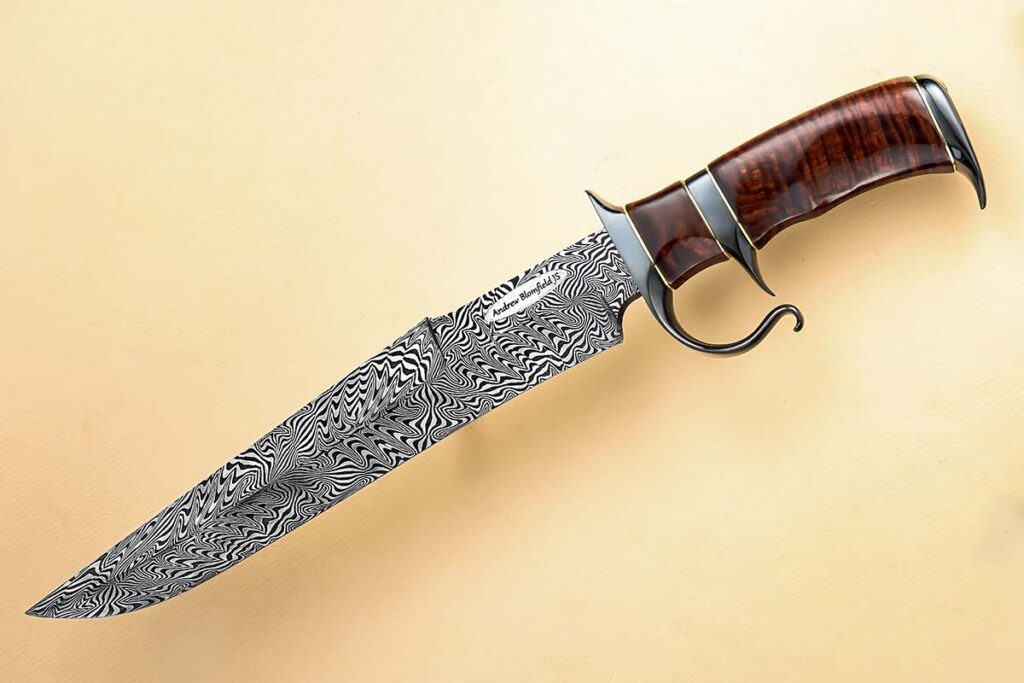
ABS master smith Andrew Blomfield’s sub-hilt bowie is a tour de force of explosive mosaic damascus, salt-blackened steel, brass spacers, and exquisite Australian ringed gidgee wood. Blade and overall lengths: 11 and 16 inches. (SharpByCoop knife image)

An ABS master smith from New South Wales, Australia, Andrew Blomfield enjoys building large knives such as bowies and daggers. “The bigger the knife the better,” he states. An example is his sub-hilt bowie.

“I feel that this knife has great flow and balance,” he begins. “The blade is an explosion mosaic pattern damascus hardened to 59 HRC. The guards and pommel are salt-blackened steel with brass spacers and the handle is a beautiful piece of Australian ringed gidgee.”

The guard’s bottom quillon curves back toward the sub-hilt to partially enclose the user’s hand a la a D-guard, but also has hints of both a C- and an S-guard to it. Very unusual!

Andrew Meers: Rose of Sharon

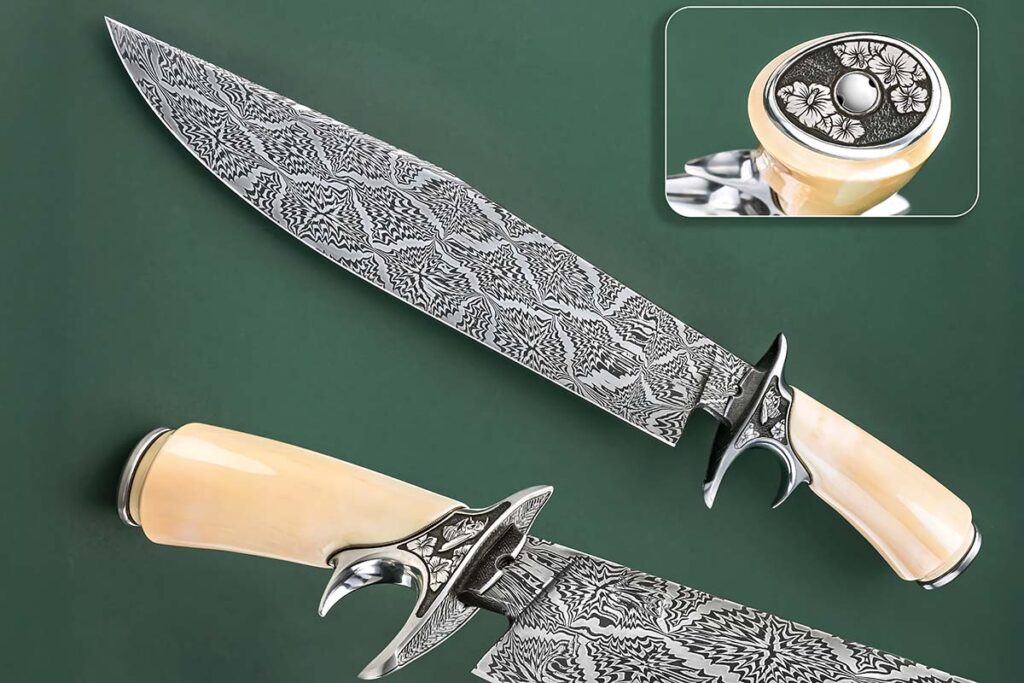
ABS master smith Andrew Meers calls his 16.5-inch sub-hilt fighter Bees and Flowers, due in no small part to the Rose of Sharon and bees engraving. The 12-inch blade is a damascus of 1084 carbon and 15N20 nickel-alloy steels in a mosaic pattern. Guard and furniture are 416 stainless steel. Overall length: 16.5 inches. (SharpByCoop knife image)

ABS master smith Andrew Meers of Raleigh, North Carolina, says, “I started with the sub-hilt in mind, which is a departure for me.” To say his deviation from the norm worked out well is an understatement.

“I like to incorporate Japanese influences wherever I can, and I wound up adding an integral habaki into the guard design as well,” he explains. “I wanted a blade that was able to feature a mosaic pattern, so I chose a broader shape that expands towards the point rather than tapers. The handle is a simple design to contrast the visual complexity of the guard.”

The engraving theme is of the Rose of Sharon and bees.

“The client had requested a floral theme, and we worked on the rest of the design and layout from there,” Andrew says. “The engraving was meant to complement the layout of the guard and furniture.”

Justin Harrington: A-Team

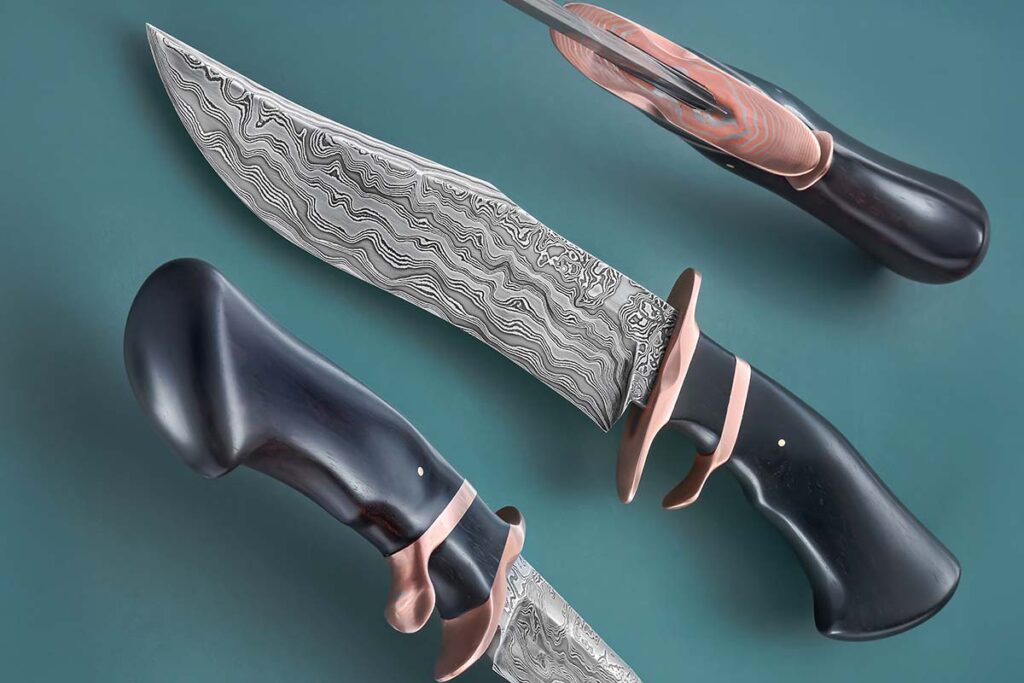
Built for an Army buddy, Justin Harrington’s superb sub-hilt fighter incorporates a masterful balance of random pattern damascus, mokumé gané and African blackwood. Blade and overall lengths: 8.5 and 13.5 inches. (SharpByCoop knife image)

Justin Harrington of Clemmons, North Carolina, began smithing 18 years ago and is the owner of Cyclops Forge. Of the sub-hilt he says, “It’s the racecar of fighting knives—weight, balance, curvature, tip control and placement all are important variables to be employed to reach a harmony which is felt right away when correctly done.

“This knife started its life as a phone call from an Army A-team member who wanted a special combat retirement gift for his buddy. The three of us got together and forged a damascus billet for the knife over three days in my shop. The 8-inch recurve blade is a random-pattern damascus of 1084 and 15N20 carbon steels. The guard and sub-hilt are made from a copper-and-nickel mokumé gané I make in my shop. The handle is around 5 inches of sculpted African blackwood with a bronze pin.”

The sub-hilt has a forward lean and spoon-cupped quillon that slants toward the guard to capture the user’s index finger. The result is a handle that seems to want to grab your hand.

Cool & Sexy

Whether fighter, bowie or what have you, the sub-hilt-knife genre may be more recognizably custom than any other. From the classic Loveless Big Bear fighter to the wide array of today’s renditions, top sub-hilts are cool, sexy and in harmony with the best custom knives extant.

Read More:

Hot Knife Grips—But Not Too Hot To Handle

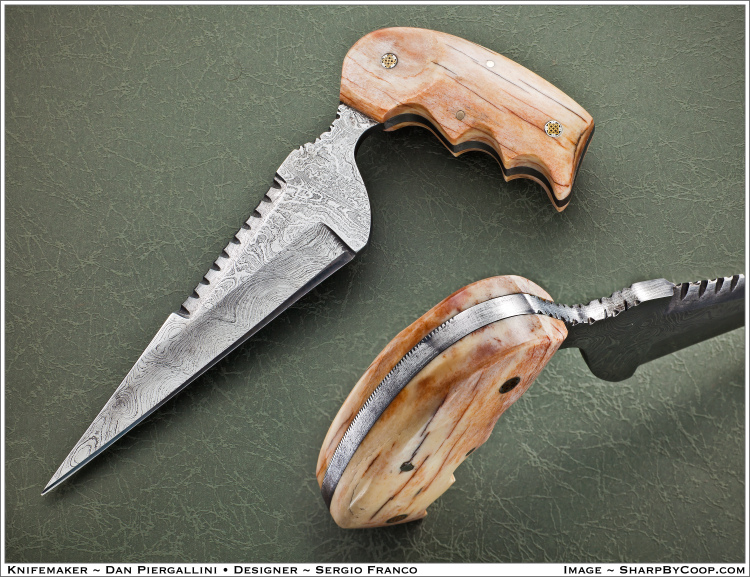
Sandy McClure of Giraffebone.com says giraffe bone remains hot because it is available, can be dyed several rich colors and can look like ancient ivory, as here on Dan Piergallini’s push dagger. (SharpByCoop.com photo)

Preference, use, and supply and demand help determine the most popular grip materials

by Stephen Garger

Getting a clear idea of what is hot in materials for knife handles can be difficult. Aside from obvious factors such as personal taste or intended use, there are considerations of supply and demand and national/international economics.

    “Typically, in our business, whatever is ‘hottest’ has more than one answer,” observes Kristi Culpepper of Culpepper & Co. “People may be looking for what’s hardest to get and consider that material hot because of its rarity.” Shannon Edgington of Knife & Gun Finishing Supplies (K&G) has a similar take.

    “Stabilized woods are hot and look great, with box elder burl the most successful dyeing wood,” she says. Aside from the woods, Edgington noted that water buffalo “is being jigged to look like impala and stag.” Meanwhile, giraffe bone continues to get heavy use as a handle material.

    “It’s pretty hot because it’s available, and you can get it in natural dyed colors, and it can also look like ivory,” says Sandy McClure of Giraffebone.com, which deals primarily in African materials. “There is plenty of giraffe bone because lions are still killing giraffes through a [natural] culling process,” she notes.

    A different perspective accompanies trends in synthetic handles. Chris Hartman, co-president of Masecraft Supply Co., says G10 laminates and canvas paper and linen Micarta® remain hot. “The materials are impact resistant, waterproof and highly suitable for individual makers and manufacturing without worry of warping, twisting, shrinking or cracking,” he notes. “In addition, the substances are readily available and cost effective, thus far better suited than natural materials for the high-tolerance needs of today’s manufacturers.” Mike Sheffield of Sheffield Knifemakers Supply shares Hartman’s assessment.

    “Working/tactical knifemakers and manufacturers are buying Micartas and G10s because they are easier to machine, get in sheets and cut out handles,” he says. “Micarta and G10 also tend to hold up better than natural products.” 

    Hartman indicates the Masecraft line of paua, abalone and awabi shell and acrylic laminated veneer sheets is finally beginning to take off. “These are great new products as they look genuine, use a combination of actual shell and acrylic, and are less than a third of the cost of solid-shell-laminated sheets. It’s like working with acrylic with all the natural beauty of real shell,” he notes. “Two years ago we started to develop some of these materials. It always seems to take about two years from prototype to actually showing up on production knives.”

    Sheffield says his company has been applying CNC machining to grips. “I’ve been making handles for a couple of manufacturers and producing an end product out of Micarta or G10 to their specifications,” he states. “I scan their template/design and produce a handle for them on a short-run basis.” For example, using a regular blank Sheffield has been selling for years, he can produce a pattern you would expect to see on bone, a process that accounts for the jigged-bone appearance seen on some Micarta and G10 handles. 

    According to Hartman, composites also have grown in popularity.  “[The supply of composites is] steadier than that of natural products, and the materials themselves are more stable and cost effective for individual makers and manufacturers,” he says. “In addition, some of the best composite materials are made in the USA, and are far better suited for today’s high-tolerance manufacturing needs, with good durability.” 


New Resources

The natural material side of the handle market is also dynamic, with suppliers always on the lookout for new and interesting resources.

    “We currently have a supply of bison bone and jaws [dating back to] the Pleistocene Era that have been underground and exposed to ground minerals, so they have the coloring and look of mammoth ivory,” Culpepper reports. “We also have a stock of whale bone that should be coming into the custom market on some knives, some traditional jigged patterns in hot new colors for 2012 like Sunset and Bamboo, and several new jigged patterns.” She points out that a number of companies that specialize in tactical knives are updating their more traditional lines with limited-edition dyed and jigged bone, mother-of-pearl inlays and other natural materials. Meanwhile, Edgington says K&G’s resin wood shows promise for handles. “It has gone through a lot of testing and has been found to be similar to Micarta, and is used in various patterns for kitchen knives and cutting boards,” she notes.  

    Hartman says red carbon fiber did not make the cut. “It was simply too expensive to produce with not enough demand to support the cost,” he says. “We developed a new product which uses black carbon fiber with red G10 layering, creating a hybrid available in several colors including blue, yellow and soon a carbon fiber with a green layer.” The material has the advantage of being “about a third less expensive than the old red carbon fiber,” Hartman notes.  Sheffield also has a material that is a red-and-black carbon fiber alternating with G10.


Scarcity and Shortages

I asked whether sambar stag, ironwood and mother-of-pearl remain scarce, and if there will be any shortages in other natural materials.

    “Natural materials have such a demand all over the world that the U.S. is no longer first on the list when it comes to purchasing them,” Culpepper says. “Mother-of-pearl and stag both are commodities in China because of uses in all their industries, from furniture and jewelry [mother-of-pearl] to medicine [stag].”  Hartman concurs, opining that eventually sambar stag and ironwood either will disappear or the price will become so outrageous that only a few will be able to afford them—though for now both are available in pretty good supply.

    “Actually, I believe it will be the cost of bone, horn and exotic woods you will see continuously rise over the next several years,” Hartman notes. “Eventually, these supplies will be wiped out or the labor force that’s willing to cut and supply them will have moved on to better jobs. Sources of these products in China are already gone due to economics, and prices from India are on the rise with supplies decreasing.” Though these things are happening now, it is difficult to provide an accurate time frame in which the changes will be felt in a meaningful way.

    “Business has been very slow related to the economy since knifemakers are not buying unless they’re selling something,” McClure observes. “They’re not stockpiling anything but are using what they have.” Sheffield notes there is a lot more competition and Edgington says she does not carry the stock as in years past. “We don’t want to come across as price gouging and will absorb a lot to keep the prices down for the customer,” she sighs, “but the price to us keeps going up on the nice stuff.” Hartman agrees, concluding on a positive note, “The knife and gun industries seems to be much more stable than other similar markets in this economy.”

For more on the latest knives, knife legislation, knifemaking instruction, knife trends, knifemakers, what knives to buy and where and much more, subscribe to BLADE® Magazine, the World’s No. 1 Knife Publication. For subscription information click on http://www.shopblade.com/product/blade-magazine-one-year-subscripti…?r+ssfb021112#BL1SU

The New York Custom Knife Show

This is a 3-day knife event. This year the show has been moved to New Jersey.

Advertisement

Must Read Articles

Read this before you make a knife

Knifemaking 101 – Read This Before You Make a Knife

  by Wayne Goddard My experience has taught me that there's nothing like digging in and getting started. I've often said the hardest part of the...
how to forge damascus steel

How to Forge Damascus

Advertisement
Advertisement