

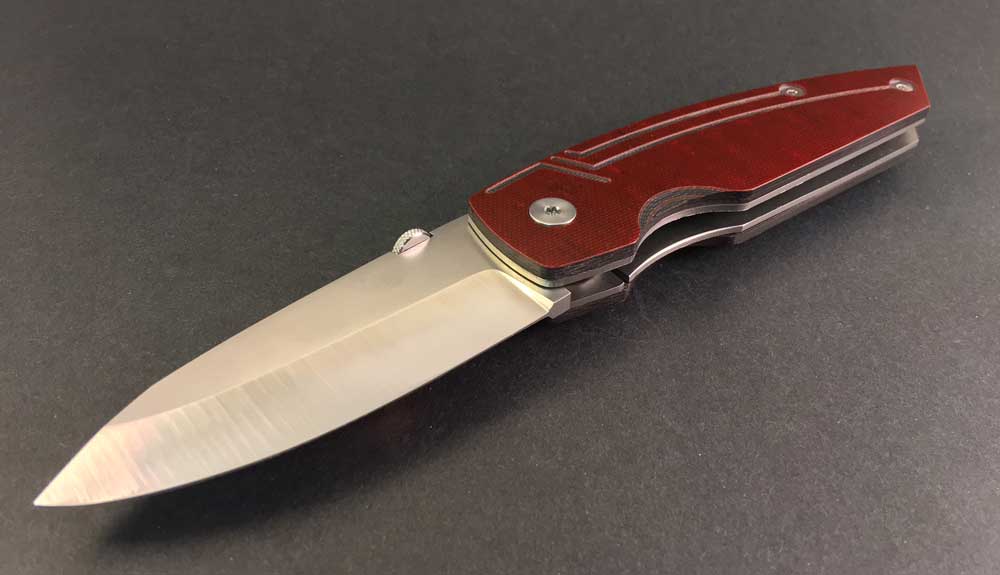
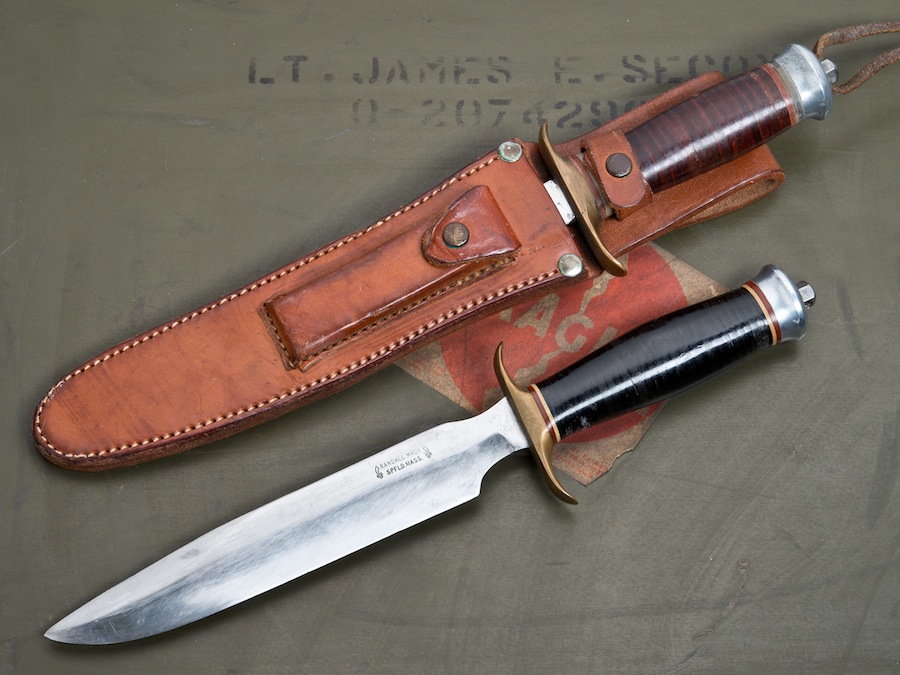
Sal showing a bullseye Grip Frame Lock that he just completed.
Hunter’s Edge: Gerber Metolius
Get twice the cutting versatility in skinning and dressing game for the upcoming fall hunting season with the Gerber Metolius.
The folder has drop-point and skinning blades, the latter with a safety ball for the tip to prevent accidental puncturing of the organs of the animal while cutting inside it. The drop point works on a lockback mechanism, the skinning blade via a push button. Each blade is 3.2 inches long.
The knife sports a Gerber Softgrip overmold handle for enhanced purchase. Overall weight: 4.8 ounces. Length open: 7.9 inches.
An easy-carry ballistic nylon sheath is included.
ShopBlade’s price to you: $44.99.
For more info click on http://www.shopblade.com/gerber-metolius-2-blade-folding-knife-y6983/?lid=blss082212
Which Knife Collaborations Would You Arrange?
Which knife collaborations would you like to see between today’s custom knifemakers and knife and/or gun companies?
There have been many great knife collaborations over the years—from such early ones as those between Smith & Wesson Knives and Blackie Collins and Bob Loveless and Schrade, to those between Spyderco and Bob Terzuola, CRKT and Kit Carson, Benchmade and Mel Pardue and many more—all of which got us to thinking: What great collaborations that never happened would you like to have seen?
Or, perhaps better yet, which ones would you like to see among today’s companies and knifemakers?
Here are a few, first of the former:
•Bob Loveless and Marble’s: Hey, the man behind the dropped hunter and one of the leading hunting knife companies of a bygone era. Seems like a natural collaboration;
•Bill Moran and Busse Combat Knife Co.: Moran made those big, sweeping fixed blades and Busse does, too;
•Bob Lum and Cold Steel: OK, so it probably never would have happened, but the possibilities for a special American tanto collaboration would have been intriguing.
And now for the latter:
•Wolfgang Loerchner and William Henry Knives: Two great makers of fine knives would make an awesome pairing in anybody’s knife book;
•Joe Keeslar and Spartan Blades: Joe’s a retired Marine and Mark Carey and Curtis Iovito of Spartan Blades are retired Special Forces. I bet they could put their heads together and come up with a really cool combat knife collaboration;
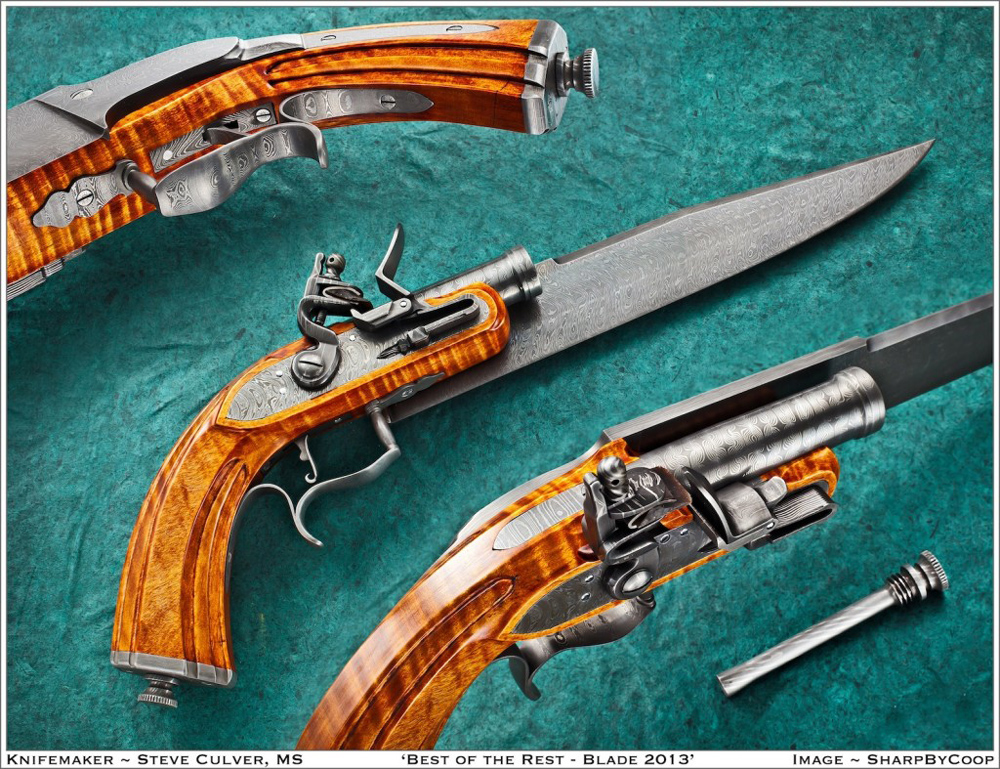
•Steve Culver and Browning: Culver’s cut ‘n shoot is a tour de force of the genre and a collaboration with Browning would be a real breakthrough in terms of a special limited-edition crossover between the knife and gun industries. Browning has experience working with the knife industry—for example, Russ Kommer and Jim Crowell are two makers who have collaborated with Browning on knife projects—so Browning would not have to break new ground.
How about it? What knife collaborations would you like to see/have seen?
ICCE Changes Knife Show Dates
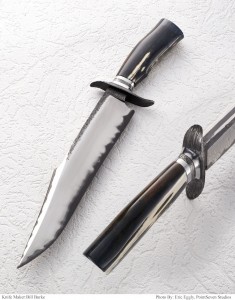
Due to unforeseen circumstances, the 2nd Annual International Custom Cutlery Exposition (ICCE) has had to change the dates for its 2016 knife show from early to late September, show officials announced.
Originally slated for Sept. 9-11, the new dates are Sept. 23-25.
The show will be held in the same venue—the Downtown Marriott in Kansas City, Missouri.
According to ICCE officials, the event-hosting hotel, the Downtown Marriott, notified the ICCE’s organizers, the Knifemakers’ Guild and the American Bladesmith Society (ABS), that there would be several events scheduled for the original show dates. Due to the events scheduled in downtown Kansas City, some streets will be blocked, parking will be a hassle, and the downtown will be overcrowded the weekend of Sept. 9-11. The hotel management had other available dates that would make the show far more enjoyable for those who will attend, thus the change to Sept. 23-25.
Held for the first time this past September at the Downtown Marriott in Kansas City, the initial ICCE represented the first-ever knife show held in cooperation between and coordinated by both the Guild and the ABS, the world’s oldest and most important groups of custom knifemakers. Adding to the historical significance of the cooperative effort is that the show was held in the same room as the 1973 Guild Show where BLADE Magazine Cutlery Hall-Of-Fame© member Bill Moran introduced his knives with damascus steel blades. It was the first time modern damascus steel knives were exhibited at a knife show and it caused quite a stir, and eventually sparked the creation of the ABS in 1976. Most of the knifemakers and bladesmiths from both organizations who exhibited at the 2015 ICCE appeared very pleased with it, and a number of them and other industry observers seem optimistic about the show’s future potential for success.
For more information visit knifemakersguild.com/show, facebook.com/events and/or facebook.com/knifemakers.guild.
SGT. DAKOTA MEYER’S KNIFE
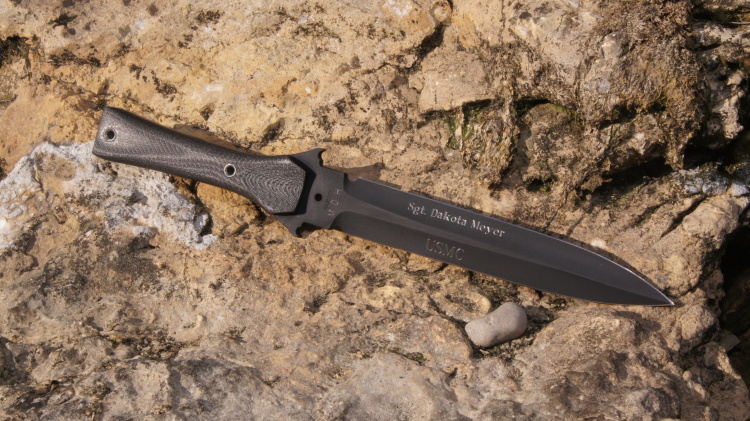
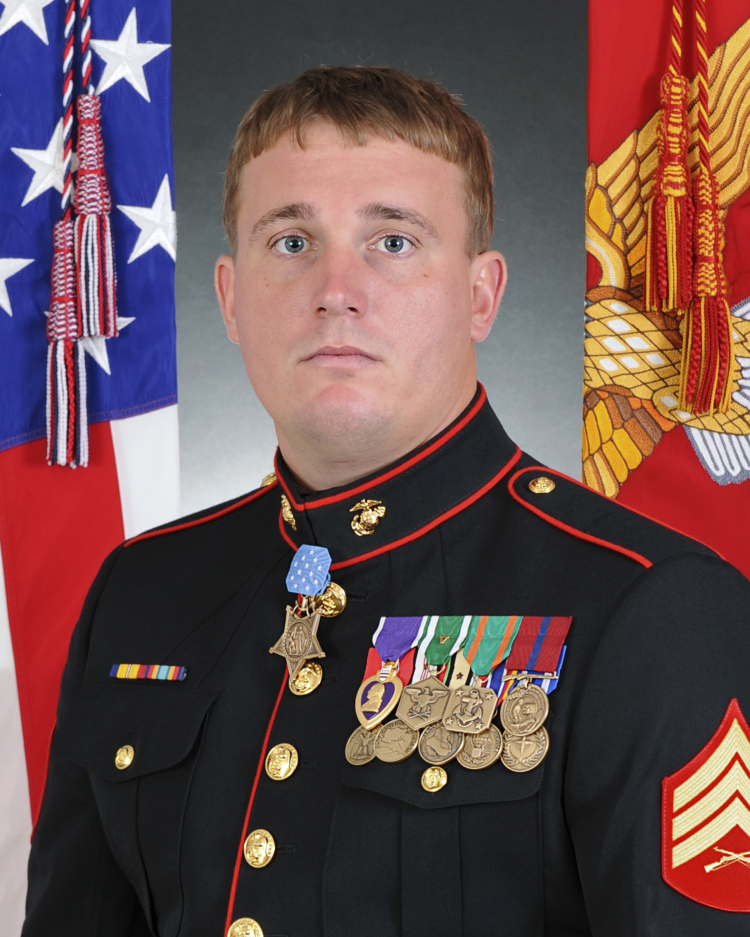 In recognition of his military actions in Afghanistan on behalf of his fellow servicemen and his country that resulted in his receiving the Congressional Medal of Honor, U.S. Army Sgt. Dakota Meyer was presented with a custom knife made by Gene Baskett, a custom AR-15 rifle, and honorary membership in the Knifemakers’ Guild.
During a special ceremony this past December in Elizabethtown, Kentucky, Baskett, formerly of Elizabethtown and now of Eastview, Kentucky, presented Sgt. Meyer with a Baskett handmade knife, a custom fighter with a black Moly-Coated CPM-154 stainless blade and a black linen Micarta® handle. The knife is engraved “MOH, Sgt. Dakota Meyer, USMC” on the mark side and “8 September 2009, Kunar Province Afghanistan” on the flip side. The engraving is by Patrick Clark of Clark Jewelers, also of Elizabethtown. Richardson Gunsmithing did the Moly Coating.
In all, Baskett said he got to spend about three hours with Sgt. Meyer the day of the presentations. “He really loved the knife,” Baskett observed. “He was really appreciative and seemed very humbled by it all.”
J.J. Akins and Steve Sprowls of Elizabethtown’s Sporter Express gun shop presented Sgt. Meyer with the custom-engraved rifle. The gun is engraved “Rifle presented by the citizens of Hardin County, KY. Sergeant Dakota Meyer, USMC. 8 September 2009. Kunar Province Afghanistan. Congressional Medal of Honor,” and was donated by Sporter Express.
A member of the Guild’s board of directors, Baskett also presented Sgt. Meyer with a custom Guild honorary membership badge that includes the worlds “Medal of Honor Recipient” and the Marine Corps emblem.
ACTS OF HEROISM
Sgt. Meyer was born and raised in Columbia, Kentucky. He entered the Marine Corps after high school in 2006. On Sept. 8, 2009, Sgt. Meyer, then a corporal, was credited with numerous acts of heroism and saving the lives of several Marines in a battle near the village of Ganjgal in Afghanistan (see sidebar, page ???). As a result, Meyer was awarded the Medal of Honor in a ceremony at the White House on Sept. 15, 2011.
Sgt. Meyer spoke to a small crowd and the media during the ceremony in Elizabethtown, saying he does not consider himself a hero and that the Medal of Honor and what it represents is much bigger than him. His actions on “the worst day of my life” may have saved several fellow Marines, though he said he could not save four of his close friends in his unit. He wears a bracelet bearing their names.
The Americans who died in the ambush were: 1st Lt. Michael Johnson, 25, Virginia Beach, Virginia; Staff Sgt. Aaron Kenefick, 30, Roswell, Georgia; Hospital Corpsman Third Class James R. Layton, 22, Riverbank, California; and Gunnery Sergeant Edwin Wayne Johnson Jr., 31, Columbus, Georgia. A fifth soldier, Army Sgt. 1st Class Kenneth W. Westbrook, 41, Shiprock, New Mexico, later died from his wounds.
Sgt. Meyer received the Medal of Honor in a ceremony at the White House on Sept. 15, 2011. When a White House staffer contacted him to arrange the ceremony, Sgt. Meyer famously asked to “have a beer with the President.” Sgt. Meyer received an invitation to the White House the afternoon before the ceremony (see sidebar, page ???). He also requested that when he was honored, simultaneous services should be held at other applicable locations to honor the memory of his fellow service members who died or were mortally wounded during the ambush and his rescue attempts.
Sgt. Meyer is the third living recipient of the Medal of Honor since the Vietnam War, and the first living Marine in 38 years to be so honored. In addition to the Medal of Honor, he also received the Purple Heart, Navy Commendation Medal w/Combat V, the Navy Achievement Medal and the Combat Action Ribbon during his years of service from 2006-2010.
MILLION DOLLAR CHALLENGE
Sgt. Meyer uses his fame to raise money to provide college scholarships to the childen of those soldiers who did not survive the war. His goal is to raise $1 million for his “Million Dollar Challenge” (see sidebar, page ???). During the presentation ceremony, Sporter Express presented a check for $750 toward that goal.—BY MIKE CARTER
For more information on the Million Dollar Challenge, visit www.dakotameyer.com. For more on Gene Baskett knives, contact Gene Baskett, Dept. BL12, 427 Sutzer Ck. Rd., Eastview, KY 42732 270-862-5019 www.baskettknives.com.
To stay abreast of the latest in knives and knife information, subscribe to BLADE® at http://www.shopblade.com/blade-magazine-one-year-subscription-us?lid=SSfbbl101212
Keeping Up With Dakota Meyer
It is not often a living U.S. Marine receives the Congressional Medal of Honor, and Sgt. Dakota Meyer is the first one to do so in 38 years. Neither is he one to rest on his laurels.
For instance, he has partnered with the Marine Corps Scholarship Foundation (MCSF) to raise money so the children of Marines can attend college. Sgt. Meyer said he realizes the importance of education and believes in the MCSF motto, “Honoring Marines by Educating Their Children.” The Dakota Meyer Scholarship Initiative was established and Sgt. Meyer committed to personally raising a million dollars to fund the effort. In fact, during the MCSF’s 50th anniversary celebration this past spring, it was announced that he had successfully reached his goal of raising a million dollars. The Challenge to America to match the million dollars Sgt. Meyer raised is ongoing. To learn more about it and to make a donation visit www.dakotameyer.com
He indicated he was honored President Obama accepted his invitation to have a beer the afternoon before the Medal of Honor ceremony. (As a side note, Sgt. Meyer said the White House brews its own beer, a honey ale, which he said both he and the president enjoyed.) He added he appreciated the opportunity to speak with and ask advice from the president. The president emphasized the importance of education, a priority Sgt. Meyer shares. In fact, Sgt. Meyer said he hopes to continue his education when his travel schedule slows down.
Meanwhile, he spends much of his time on the road, traveling all over America to share the story of his fallen brothers. He also advocates for veterans and has recently partnered with the U.S. Chamber of Commerce and Toyota on the Hiring Our Heroes campaign, which provides jobs fairs for veterans nationwide, as well as training veterans to successfully make the transition from military to civilian employment. At press time, Sgt. Meyer’s book Into the Fire was slated to be published this September.
Above and Beyond The Call
According to Dakota Meyer’s citation for the Medal of Honor, he was recognized, “For conspicuous gallantry and intrepidity at the repeated risk of his life above and beyond the call of duty as a member of Marine Embedded Training Team 2-8, Regional Corps Advisory Command 3-7, in Kunar Province, Afghanistan, on 8 September 2009.
“When the forward element of his combat team began to be hit by intense fire from roughly 50 Taliban insurgents dug in and concealed on the slopes above Ganjgal village, [then] Corporal Meyer mounted a gun-truck, enlisted a fellow Marine to drive, and raced to attack the ambushers and aid the trapped Marines and Afghan soldiers. During a six-hour firefight, Corporal Meyer single-handedly turned the tide of the battle, saved 36 Marines and soldiers and recovered the bodies of his fallen brothers.
“Four separate times he fought the kilometer up into the heart of a deadly U-shaped ambush. During the fight he killed at least eight Taliban, personally evacuated 12 friendly wounded, and provided cover for another 24 Marines and soldiers to escape likely death at the hands of a numerically superior and determined foe.
“On his first foray his lone vehicle drew machine gun, mortar, rocket grenade and small arms fire while he rescued five wounded soldiers. His second attack disrupted the enemy’s ambush and he evacuated four more wounded Marines. Switching to another gun-truck because his was too damaged, they again sped in for a third time, and as turret gunner he killed several Taliban attackers at point blank range and suppressed enemy fire so 24 Marines and soldiers could break out.
“Despite being wounded, he made a fourth attack with three others to search for missing team members. Nearly surrounded and under heavy fire, he dismounted the vehicle and searched house-to-house to recover the bodies of his fallen team members. By his extraordinary heroism, presence of mind amidst chaos and death, and unselfish devotion to his comrades in the face of great danger, Corporal Meyer reflected great credit upon himself and upheld the highest traditions of the Marine Corps and the United States Naval Service.”
TOP PHOTO AND SECOND PHOTO FROM TOP
Congressional Medal-of-Honor recipient Sgt. Dakota L. Meyer recently was presented with a Gene Baskett handmade knife. The custom fighter has a black Moly-Coated CPM-154 stainless blade and a black linen Micarta® handle. The knife is engraved “MOH, Sgt. Dakota Meyer, USMC” on the mark side. The engraving is by Patrick Clark. Richardson Gunsmithing did the Moly Coat. (photo of Sgt. Meyer courtesy of the United States Marine Corps; knife photo by Mike Carter)
Cool Customs: Blount’s War Club Dusts Off Mohican Memories

Josh Blount reproduces Chingachgook’s gunstock war club.
ABS apprentice smith Josh Blount recently rewatched the 1992 version of The Last of the Mohicans, and the gunstock war club of the character of Chingachgook in the film inspired him to make his own stunning version.
Josh patterned his reproduction after the movie piece* but with his own spin, including a low-layer-twist damascus blade and curly maple stock decorated with silver wire inlay in assorted mountain images: a daytime scene with hawks circling the sun, a nighthawk nighttime scene amid moon and stars, etc. “My background is wildlife biology, so I live birds and chasing wildlife,” he noted. “So, I put a little bit of that in there.”
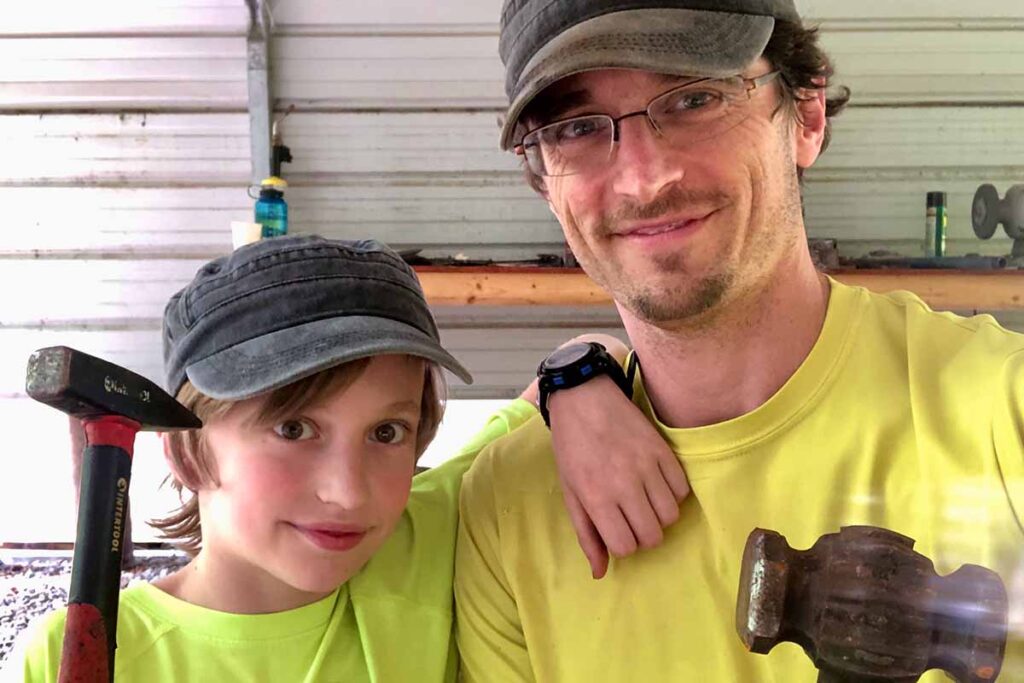
Josh’s mentors include the late Ron Claiborne and Larry Harley, and, of course, ABS master smith Daniel Winkler, who made some of the knives and tomahawks for Mohicans (February 1993 BLADE®). In fact, Josh visited the Winkler shop just over 20 years ago. Josh was bladesmithing then too, but life happened and he went to college. Now he’s back to hammering hot steel in Franklin, West Virginia, and hopes to test for ABS journeyman smith in the near future.
Gunstock War Club Specs
Maker: Josh Blount
Blade length: 6.5”
Blade material: 80CrV2 carbon and 15N20 nickel-alloy steels
Handle/stock: Curly maple from Dunlap Woodcraft, w/pewter pins and deerskin wrap from Crazy Crow Trading Post
Overall length: 40”
Maker’s price for a similar piece: $800
*The gunstock war club in The Last of the Mohicans was made by the movie’s prop department.
Check Out More Cool Custom Knives:
Best of the Weed Whackers


A big pot plant (top) requires a big knife such as the KA-BAR Kukri Machete. The 11.5-inch, hollow-ground blade is 1085 carbon steel with a Rockwell hardness of 52-54 HRC—the lower hardness providing the malleability needed for chopping—and the handle is black Kraton G. MSRP: $75.63. (Above) A U.S. Immigration and Customs Enforcement agent uses an ESEE light machete to eradicate a field of marijuana plants somewhere in South America. (photo courtesy of ESEE Knives)
The big blades have revolutionized the way drug enforcement eradicates marijuana plants
By Pat Covert
Sometimes only a big knife will do. Other times only a really big knife will do! Such is the case when eradicating plants that supply illegal drugs such as marijuana and cocaine.
You have seen news stories about busts of illegal pot fields and the controlled burns in their aftermath. BLADE® takes this opportunity to fill you in on drug raids and eradication and, in the process, give you some insight into the best in “weed whackers.” We consulted a panel of experts, including an active special agent for U.S. Immigration and Customs Enforcement (ICE) who has participated in eradications all over the USA and other countries. In addition, we talked to factory officials who shared information on the dope cutters they offer.
Marijuana is by far the most actively used controlled substance in the USA, comprising about 80 percent of all illicit drugs combined. In 2010, over 23,500 outdoor growth sites of the illegal weed were eradicated, and almost 5,000 indoor growing facilities were eliminated. Marijuana plants average between 5-to-10 feet high and even taller in the right climes.
Cocaine is processed from coca leaves. The coca plant, which averages 7-to-10 feet high, can be found throughout most of Latin America but is most prominent in Bolivia, Columbia and Peru. It is estimated that the USA consumes half the world’s processed cocaine. Since most of the cultivation is in South America, that’s where most eradication efforts, including those by U.S. enforcement agents, take place. It is a big job for law enforcement officials, and big knives play an important role.
The Takedown
The ICE special agent said he preferred not to get into the specifics of how illegal growing fields are located and monitored by the authorities, but he did comment on where such fields tend to be situated.
“A typical marijuana ‘grow’ [a.k.a. garden] is located in a remote section of the local wilderness accessible to a water source,” he begins. When raiding a field, he says the element of surprise is essential. “The takedown is similar to a military patrol and assault,” he explains. “The grow has to be surrounded to keep the growers from escaping the perimeters. Officers must be prepared to make multiple arrests and manage those arrests under pressure and confusion. Air support is also essential in providing cover, keeping the growers’ movements limited.”
Once arrests have been made and the field secured, the hard job of eradication begins. “Taking the plants out of the ground is hard work,” the ICE agent says. “All the plants have to be removed. Some are taken by the roots, while others are cut at the base. The intricate watering systems also have to be dismantled and removed. The harvested plants are destroyed by being burned.” Once the plants are cut and stacked, the agents use helicopters to sling load the plants out in large nets. “The grows usually net between 5,000 to 20,000 plants, depending on the location,” he adds.
Long Blade, Flared Tip
There is no shortage of knives that can be used to take down illegal crops. Typically, a good dope chopper will have a long blade with a flared tip to add extra weight—and power—to the main area of contact. An ample handle is also preferred to give comfort to the hand over extended use. Owner and founder of ESEE Knives, Jeff Randall has been with agents on eradication assignments where his knives have seen action. “Most of the agents we deal with love our product, especially the agents dealing with coca and marijuana crops in South America, but they are used domestically as well,” he observes. “The ESEE Lite Machete and Junglas models do the best, depending on the particular plant.”
KA-BAR senior designer and engineer Paul Tsujimoto says his company has a number of knives used for drug eradication. “The KA-BAR Heavy Cutting Tools line, which includes the Large Heavy Bowie, Grass Machete, Cutlass Machete and Kukri Machete, is almost entirely suited for heavy jungle-vegetation clearing duty,” he notes. “Our relatively new Big Brother [a large 14.2-inch version of the original USMC fighting/utility knife] has also proven itself in jungle environments.”
Tsujimoto cited some recent additions to KA-BAR’s lineup that have proved their worth in the battle against drugs as well. “We also have a new line, Zombie Knives, that has a [Pestilence] Chopper and [War] Sword that have proven excellent at clearing and leveling plants, and our Johnson Adventure Blades line has a model called the Potbelly that is an excellent chopper. All of these knives have seen service in the drug eradication service, both domestic and overseas.”
In knife circles, Becker Knife & Tool founder and chief designer Ethan Becker is perhaps best known for his Machax model, a machete/ax hybrid.
“Most of the feedback I have gotten over the years has involved the Machax,” he notes.” “I know the Kentucky State Police special ops team used the Machax for years with great success. In addition to the Machax, our most suited blades for the job are the BK9 Combat Bowie and the BK6 Patrol Machete.”
Becker related an incident most instructive involving the Machax.
“I made a cold sales call on a surplus store near Ashland, Oregon, some years ago,” he says. “The owner took one look at the Machax and said, ‘I’ll sell a bunch of these.’” When Becker asked the storeowner who the customers were he had in mind, the man replied, “Growers and the cops chasing ’em!”
Choppers In Action
The ICE special agent and his fellow agents had a chance to test a group of knives to evaluate their performance in cutting down the illicit drug plants.
“The ESEE Junglas was the first tool we tested on the first grow of the season. The Micarta® handle was very ergonomic and easy to grip. Compared to a typical machete it has a shorter blade, but is much thicker and more robust,” he notes. “The blade performed very well cutting through the base of the marijuana plants. The Junglas was probably the highest quality knife/tool we used and definitely did the job.”
However, for removing plants, the agent says he found the ESEE Lite Machete to be a better performer. “The Lite Machete changed the way we removed plants from the grows. Although the blade was much longer and not as thick as the Junglas, we were able to stand upright and cut the plants,” he explains.
The agents also ran several KA-BAR knives through the wringer. “KA-BAR sent the Grass Machete, Cutlass Machete, Kukri Machete and Wart Hog. We had several of each style and they were handed out to task force officers to be tested. I discussed with the officers how [the knives] performed, and the Grass Machete had the best fit and style for cutting the marijuana plants,” the agent says. Cold Steel also sent knives to be tested and, according to the agent, one particular model came out on top. “Cold Steel’s version of a light machete is called the Latin Machete,” he notes. “I would rate the Latin Machete 4.5 out of a possible 5.”
Of all the knives tested, the agents’ favorites were the light machetes. “All the officers that used the blades came to a consensus that the Cold Steel Latin Machete and ESEE Lite Machete were the best for working in the grows to remove the plants. This [took] into consideration the weight of the knife, ease of carry, performance in removing plants, and ability to hold an edge after use,” the agent relates. “We noticed a change in the way the grows were being taken down. What previously took several hours to remove was now taking less than or close to an hour.”
While BLADE recommends leaving illegal plant eradication to the professionals, if you have to clear land of brush and small trees, the information herein should prove quite helpful. I have used a kukri to clear underbrush for many years but plan on trying several of the light machetes used by the ICE agents.
For more on the latest knives, knife legislation, knifemaking instruction, knife trends, knifemakers, what knives to buy and where and much more, subscribe to BLADE Magazine, the World’s No. 1 Knife Publication. For subscription information click on http://www.shopblade.com/product/blade-magazine-one-year-subscripti…?r+ssfb031112#BL1SU
Must Read Articles

Knifemaking 101 – Read This Before You Make a Knife
by Wayne Goddard
My experience has taught me that there's nothing like digging in and getting started. I've often said the hardest part of the...




