For the first time since the 9/11 terrorist attacks, passengers on U.S. airline flights will be allowed to have some small carry-on pocketknives by the U.S. Transportation Security Administration (TSA).
The change reportedly will go into effect April 25.
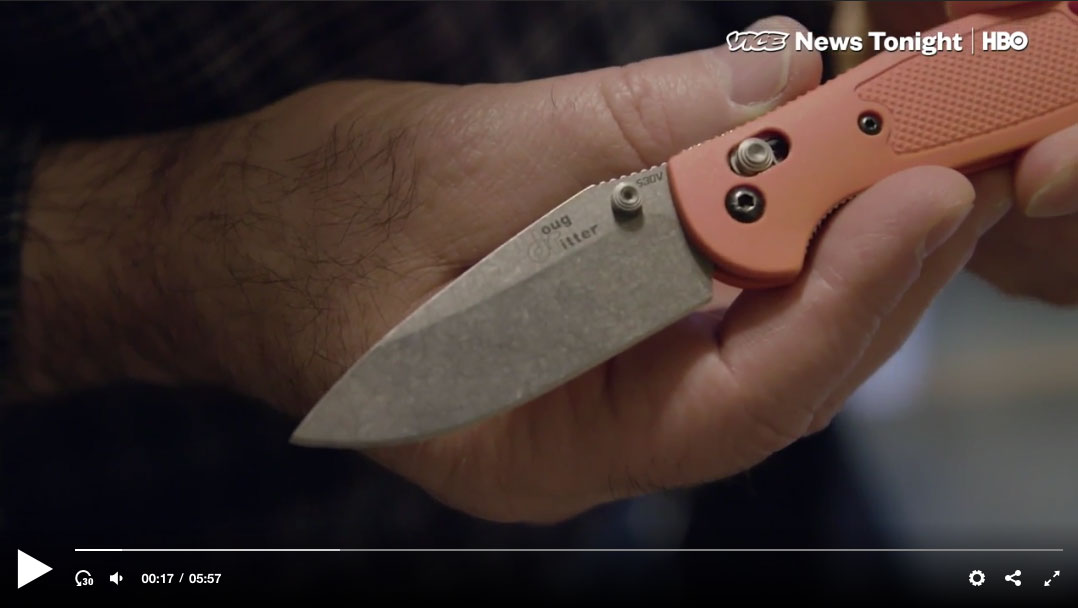
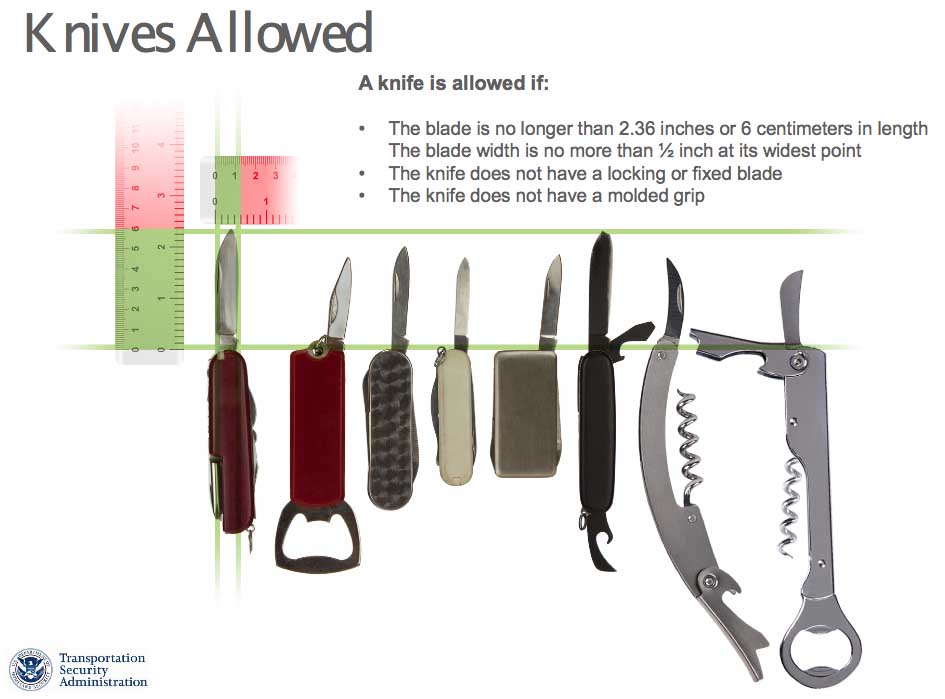
Knives with “retractable blades” under 2.36 inches and narrower than 1/2 inch at the widest point will be allowed, TSA Administrator John Pistole said. However, some knives will remain prohibited, including those with “locking blades” and/or molded handles. Exactly what “molded handles” pertained to in terms of knives is unclear at this time, though handles with finger grooves and otherwise contoured for an enhanced grip appear to be targeted. Box cutters and razor blades will continue to be banned.
As a result of the knives that remain prohibited, it appears that “small pocketknives” would be those within the aforementioned blade and lock constraints with uncontoured handles such as traditional Swiss Army knives, keychain knives, utility/scout pocketknives with can openers, screwdriver blades, etc., and “champagne patterns”—wine/bottle-opening knives with corkscrews. However, it is difficult to find a utility/scout pocketknife with a blade that is less than 2.36 inches long and 1/2-inch wide. As a result, it would appear that only such knives as the Victorinox Swiss Army Classic and other similar pieces will pass muster.
Meanwhile, overseas passengers will not have to check their applicable knives when traveling through the USA.
For the latest on knives, stay on www.blademag.com.
Read our full report on what the Buderus closure means for knifemakers, Damascus production, and company inventory.
Once when he was ill, Mark Twain famously quipped that “rumors of my death have been greatly exaggerated.” October 2025 brought troubling rumors to the knife industry regarding the potential closing of a major steel mill owned by Buderus Edelstahl.
Based in Wetzlar, Germany, Buderus is a major producer of 10xx series steels, including 1075, 1084, 1095 and 15N20, that are purchased through various suppliers. The company was founded in March 1731 and began steel production in April 1920. It has changed ownership several times, including being purchased from Bohler-Uddeholm by Voestalpine. Voestalpine sold the company to the German investment company Mutares in 2025.
BLADE® reached out to knife industry steel authorities for comment.
Dr. Larrin Thomas reported that he had spoken directly to two different Buderus employees.
“We have been hearing conflicting reports about whether the [Buderus] hot and cold mills are being shut down,” he wrote in an e-mail. “Regardless, things are a bit too murky right now to say much definitively.”
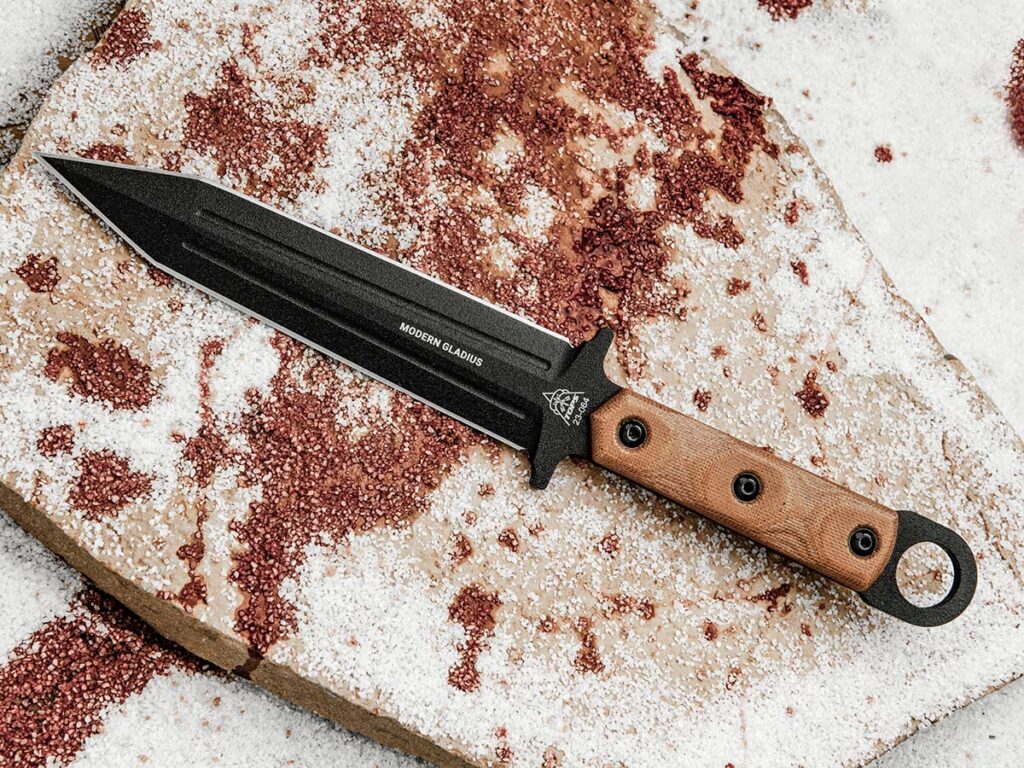
Carbon steel 1095 is the material of choice for the 6.5-inch blade of the Modern Gladius by TOPS knives.
If the rumors inside the Buderus workplace match the ones inside most large workplaces, there’s a good chance that conflicting perspectives and speculation are flying around everywhere. It could be difficult to get to the actual facts, even directly from mill employees. However, Larrin remained hopeful.
An email obtained from steel supplier New Jersey Steel Baron (NJSB) was less hopeful. This past October, NJSB officials notified their intermediaries that the Buderus mill was closing at the end of the month. The email stated, “We are writing to inform you that as of October 31, 2025, Buderus Edelstahl, one of our primary vendors, will be ceasing its rolling operations. This marks the end of a fifteen-year partnership for NJ Steel Baron, and we anticipate it will significantly impact the bladesmithing, blacksmithing, and cutlery industries. We have already begun to pivot our production to new vendors and source new alloys to ensure our inventory remains robust.”
A story on n-tv.de, an online news platform based in Germany, carried the headline “Buderus Edelstahl steel is broken up—hundreds of jobs affected.” The story reported that, “The company’s steel mill … is to be closed by the end of October, Mutares announced.”
NJSB’s Peter Bruno took the news hard, saying “I’m going to have to spend some time in the woods thinking about it.”
In the NJSB press release he stated, “This has been more than a vendor relationship; it’s been a cornerstone of our steel program. Buderus has consistently delivered high-performance German steel that’s fueled makers, machinists, manufacturers, and craftsmen throughout the world. Losing this supply chain is a hard hit, not just for us, but for the entire industry.”
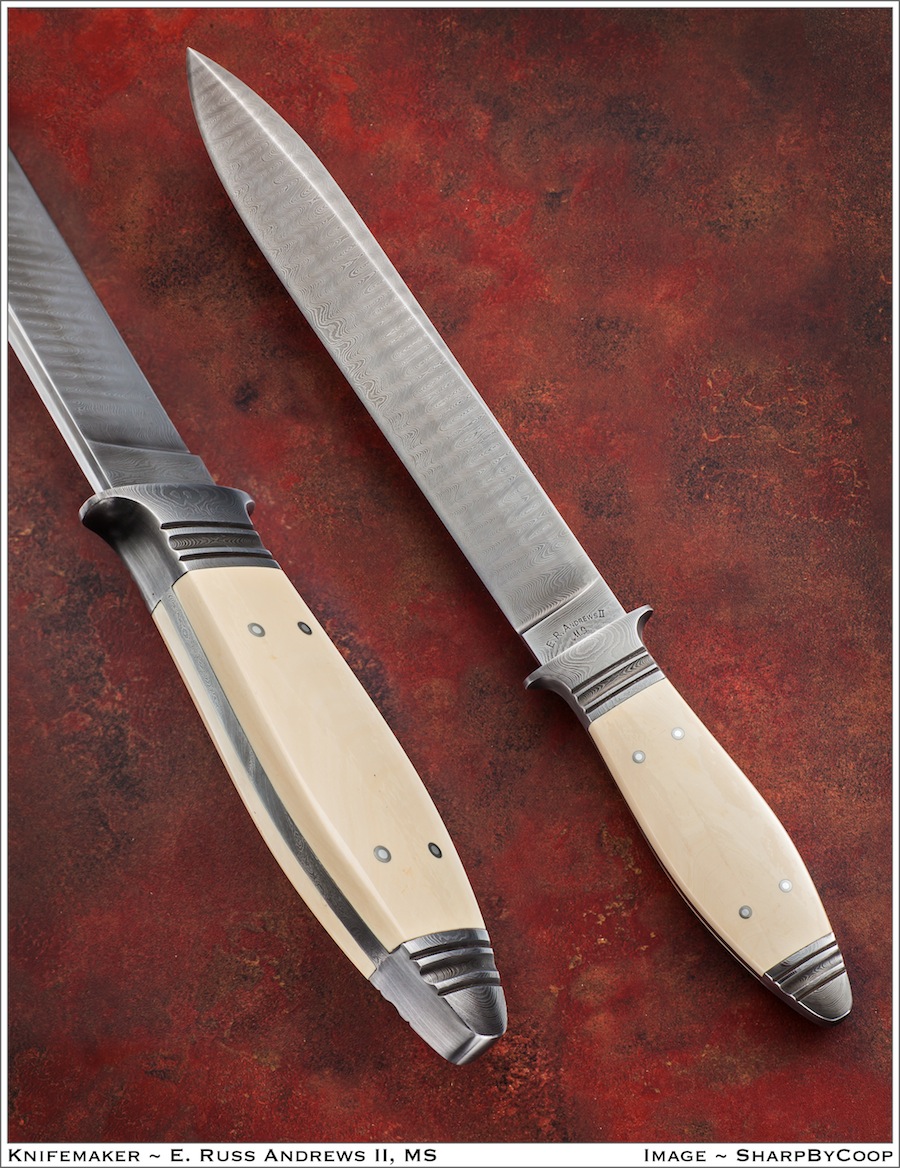
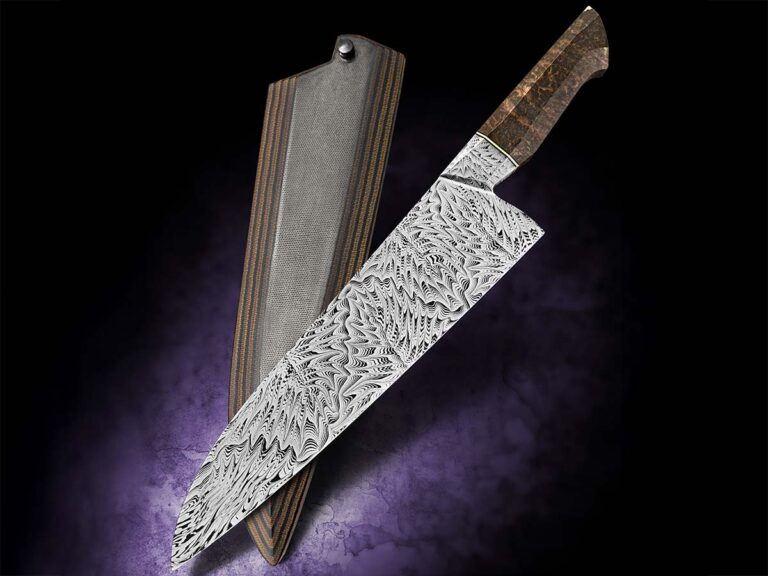
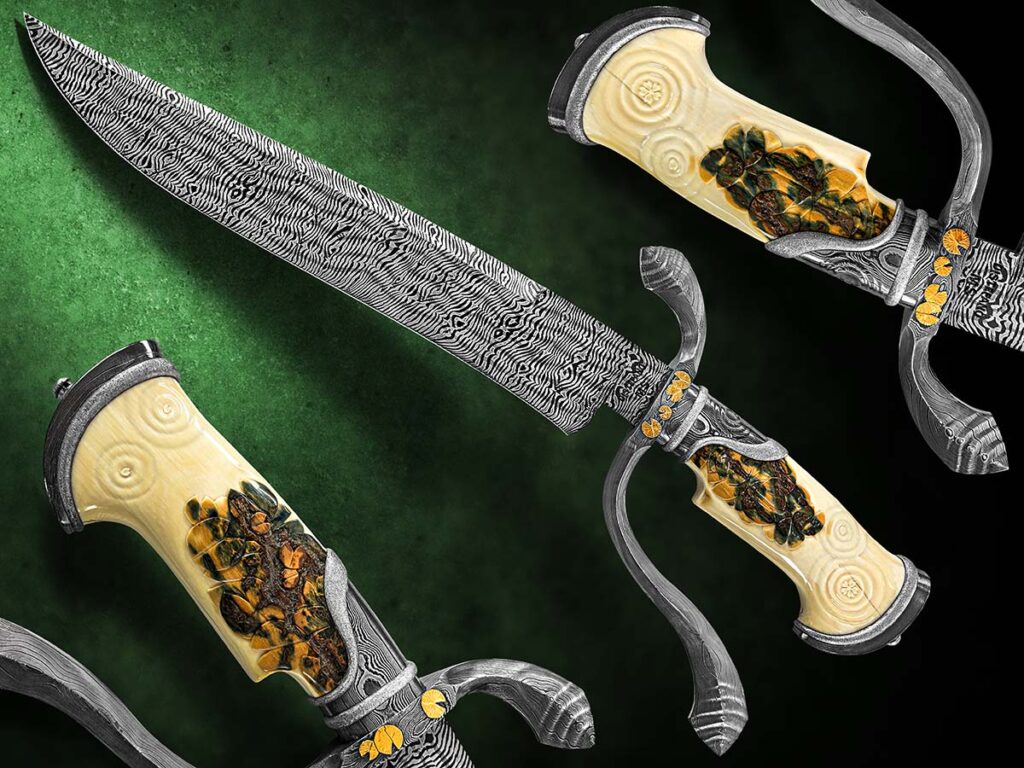
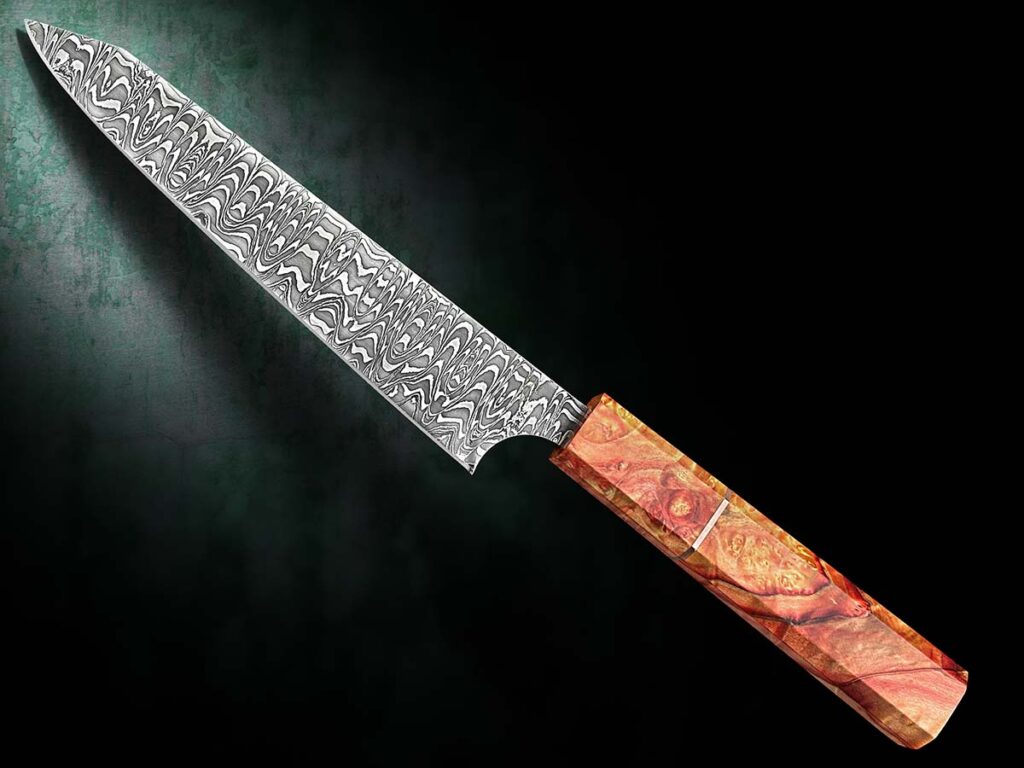
Paul DiStefano opts for 1084 carbon and 15N20 nickel-alloy blade steels for the damascus pattern configured to appear as what an animal might see if looking at a stalking tiger through a bamboo forest. Overall length: 19 inches. (pauldistefanoknives.com) (Jocelyn Frasier image)
Beyond the pure shock of losing its main supplier, NJSB is developing a plan. It has a good amount of steel on hand and is buying all the remaining Buderus stock it can. NJSB also has reached out to its customers and is selling steel by the pallet to ensure customers have at least short-term reliable access to the steel they need for ongoing orders.
“While we’re actively working to develop new sources and mill partnerships, the shift won’t be immediate, and some grades may remain out of reach for a while. Some alloys may not return anytime soon, if at all,” Bruno noted. “Once supplies run out, that may be the end of the line in some cases.”
Company Responses
The 10xx series steels are used by several knife manufacturers and importers for their hunting, outdoor, tactical and other utility-type knives. Some of those companies include Condor Tool & Knife, ESEE, KA-BAR, Utica, the previously mentioned TOPS and White River Knife & Tool. Some of the foregoing deal with Buderus and some do not. The 10xx series steels are also widely used by custom knifemakers for damascus and straight carbon knives.
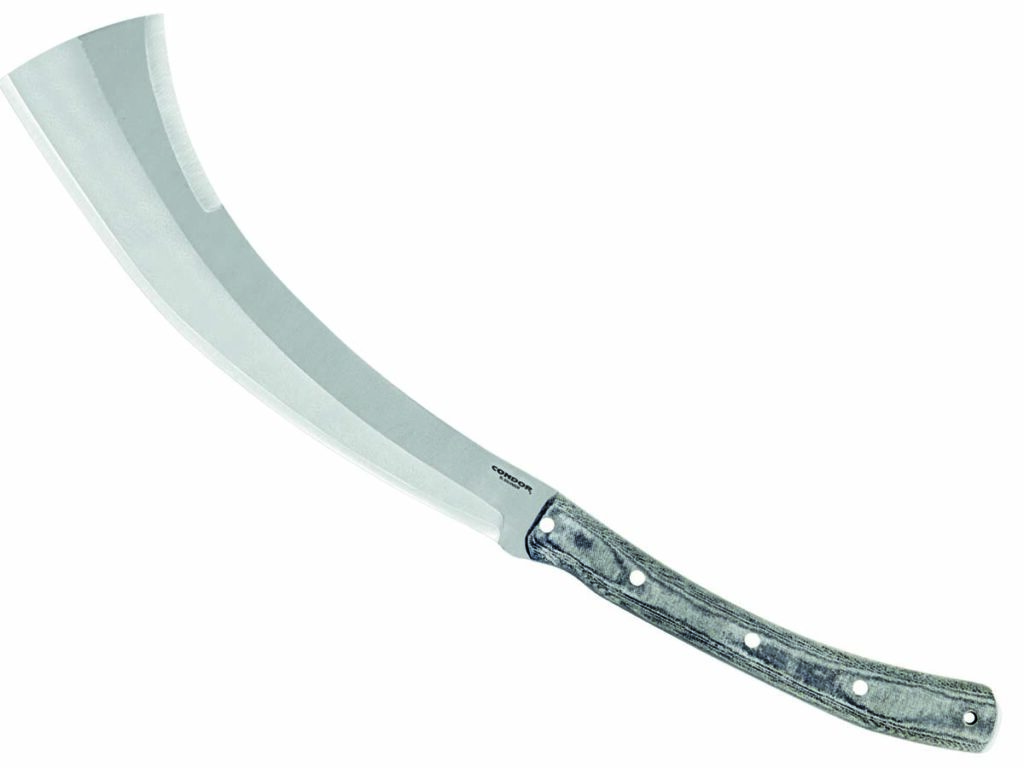
The K-Night Panabas from Condor Tool & Knife boasts a 14.29-inch blade of convex-ground 1075 carbon steel.
Mike Olen, director of sales at Condor Tool & Knife, said Condor was not sourcing any steel through Buderus.
“For the 1075 and 1095 steels, we get them from a variety of vendors, mostly Europe and Asia based,” he noted. “I’m not sure exactly, but I know a lot of our steels have been coming from German and South Korean companies lately. We do the heat treatment in house, so it opens up more options for us when sourcing the raw materials.”
“KA-BAR has had a long relationship with Buderus,” wrote KA-BAR’s director of sales and marketing, Joe Bradley, though he added any potential closure of the Buderus steelworks would not affect KA-BAR immediately.
Powell said TOPS gets its steel from a leading distributor, though it was unclear at press time whether that distributor used Buderus as a source or not. At press time, he said TOPS was fine in terms of its supply of 10xx series steels, though the company likely will start stockpiling the steels in case of any shortages.
Suppy Alternative
Jantz Supply is a leading source of 10xx series steels for custom knifemakers and others. Jantz’s Shanna Kemp indicated her company maintains various sources of the steels and as a result does not expect supply delays.
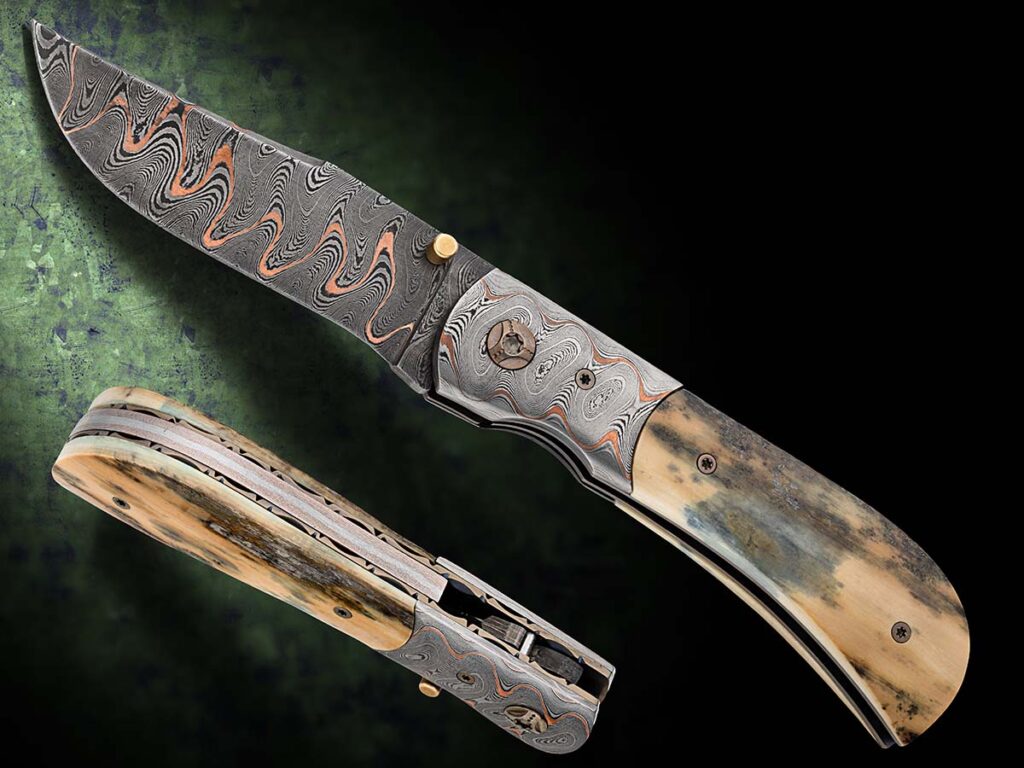
A damascus of 1084, 15N20 and copper forged by Baker Forge & Tool comprises the 3.25-inch blade of Stephen Roney’s linerlock folder. ([email protected]) (Jocelyn Frasier image)
“We don’t expect any disruption from the Buderus mill closure,” Shanna wrote. “Jantz has strong relationships with multiple mills, so makers can count on us for steady access to the high-carbon steels they rely on. Our commitment to providing reliable, high-quality materials for knifemakers will not change.
“We have long-standing relationships with multiple steel mills and distributors worldwide. The majority of our 10xx series high-carbon steels come from reputable suppliers in the United States and Germany. This diversified supply chain ensures consistent quality and availability for our customers.”
In fact, Shanna said Buderus is but one of a number of producers of 10xx series steels.
“I don’t know the exact quantity of 10xx series steels the Buderus mill produced. However, they were one of several manufacturers worldwide,” she noted. “The 10xx series is a widely produced grade family, and multiple mills continue to make these steels. While the Buderus mill was a respected supplier, their closure does not significantly impact global availability.
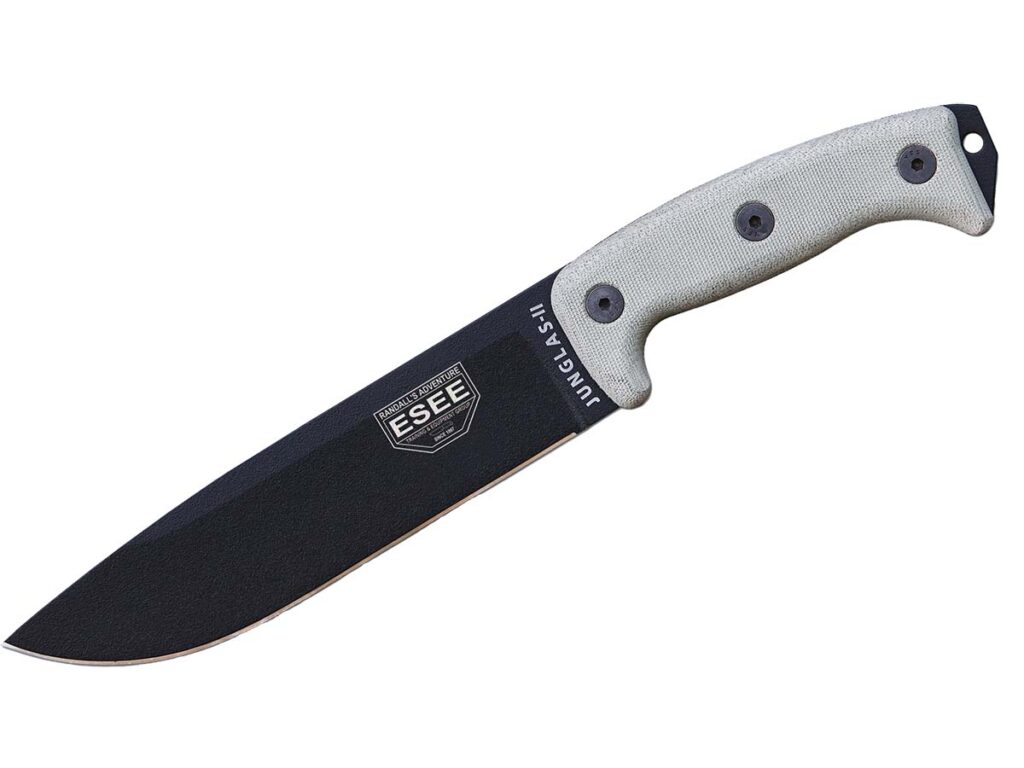
The Junglas ESEE checks in with an 8.38-inch blade of 1095 in a textured powder-coat finish.
“Several mills and processors around the world continue to produce 10xx series steels. While the Buderus mill was a respected manufacturer, these grades are not unique to any single producer. The market has ample capacity to absorb the change, and we don’t anticipate any long-term supply issues.”
Past Is Prologue
If all this sounds a bit familiar, Crucible Steel went through a similar process of bankruptcy and acquisition at the beginning of this year. Owners of the familiar CPM (Crucible Particle Metallurgy) trademarks for MagnaCut and others, Crucible was a major force in the knife industry. Eventually it restructured and cut its research and development division. Ultimately even the restructured company failed and was sold in parts to Erasteel of Europe and an American company, Lauter. Erasteel continues to produce steel of the same compositions with the same names, as it purchased Crucible’s intellectual property. Lauter owns the former Crucible factory and has begun hiring for its specialty business of manufacturing screws and fasteners.
The Crucible situation had some impact on the knife steel business. Dr. Larrin Thomas sat down with Bob Shabala of Niagara Specialty Metals in May for a conversation about the transition. Niagara is the primary rolling mill that served the knife industry in taking Crucible steels from 3,000-pound billets down to workable sizes. Bob explained that Crucible was one of Niagara’s biggest customers, but that it also was up front with its struggles. Consequently, Niagara was well stocked in CPM steels by the time Crucible folded.
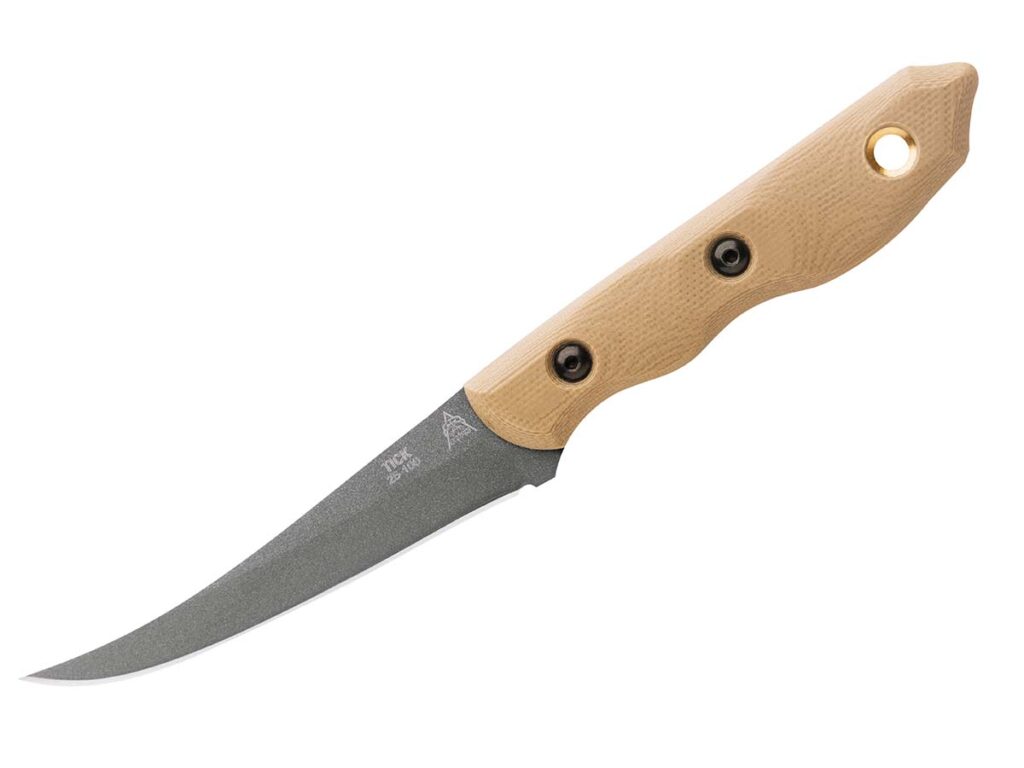
The Tick from TOPS Knives sports a 3-inch blade in 1095 carbon steel with a Tungsten Cerakote® finish.
Niagara also works with Erasteel and Carpenter, both of whom have the technology to produce steels of the same composition. Steel from Erasteel will retain the CPM trademarked names. Other versions of the same alloys rolled by Niagara will have new names for the steels the industry has used for years. Niagara officials predicted some disruptions because of panic buying as Crucible closed, but they also think business will return to “full speed ahead” for production of the knife steels in the former CPM formulations. Larrin indicated that Magna-Cut will survive and continue to be produced without disruption.
What’s Next
The steel industry has been challenged for many years, with more bankruptcies than start-up companies. To complicate things further, the steel the knife industry uses and needs is only a very small and specialized portion of a global steel industry that includes structural steel, automotive and more. With insatiable demand worldwide, the knife industry’s little corner of the market doesn’t get much attention. On top of that, steel production takes an enormous amount of energy, and with all the green and climate change talk of recent years, no one seems to be lining up to build anything but AI data centers at the moment.
Chad Jefferson chose 1080 and 15N20 to forge into a ladder W’s pattern for the 7-inch blade of his gyuto. ([email protected]) (Jocelyn Frasier image)
Like the transition away from Crucible, the probable transition away from Buderus will no doubt cause some industry disruptions. For now, knifemakers can hope that rumors of the death of the Buderus mill remain greatly exaggerated—or at least, as with Crucible, its reincarnation is on the horizon. Will some other company buy the Buderus mill? Will, like Niagara, some other supplier step in the gap left by the closure? Will someone in the market feel the void and fill it? Time will tell, but for now, the best advice seems to be for knife companies and makers to buy the 10xx series steels while they can.
Editor’s Note:Blade Magazine Staff contributed to this report.
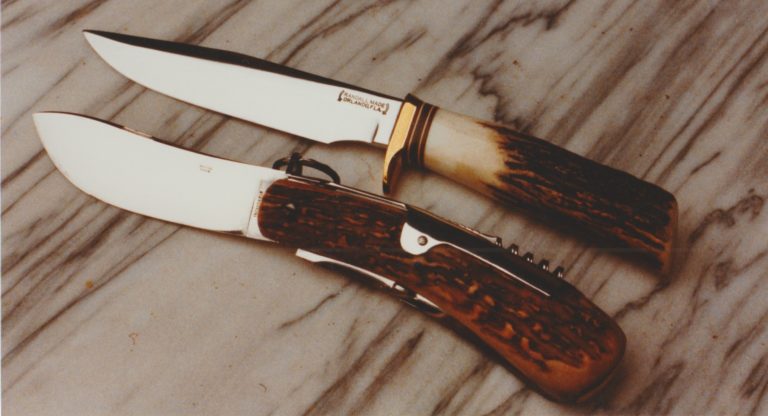
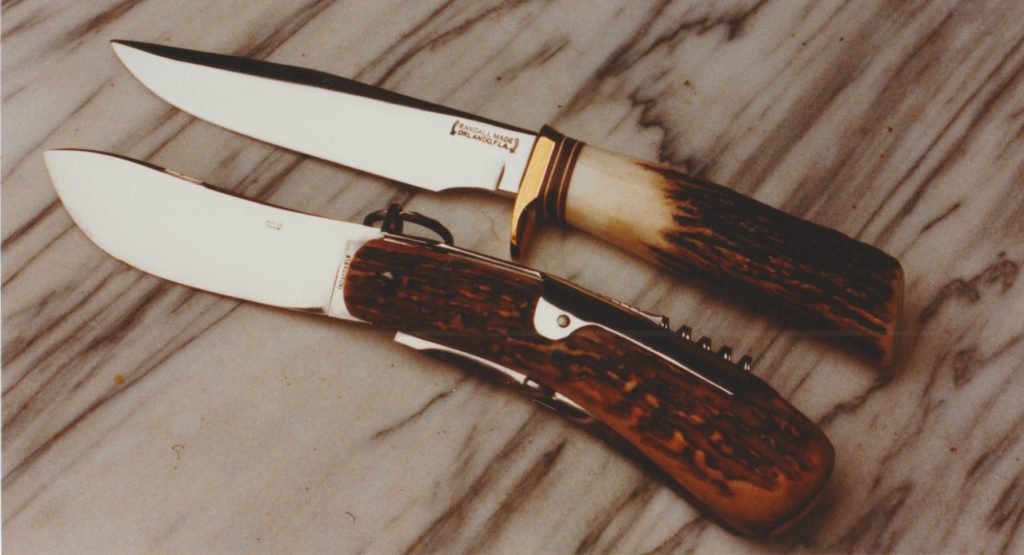
Two of Shelley’s early favorite knives: the Hermes folder (right) and a Randall.
While there have been many celebrities in and out of show business embraced by the custom knife community, none embraced it in return and then some as did cutlery’s comic, Shelley Berman. Actor, comedian, writer, poet, professor and knife collector, Berman passed away quietly on Sept. 1 at the age of 92, but not before decades of touching the custom knife community like no one else.
Known worldwide beginning in the late 1950s as a top comedian, Berman recorded six comedy albums, including 1959’s Inside
Shelley Berman, the first non-musical recording to win a Grammy Award. Three of his comedy albums went gold and he was the first non-musical comedian to appear in Carnegie Hall. According to an Associated Press story, Berman was “a pioneer of a new brand of comedy that could evoke laughter from such matters as air travel discomforts and small children who answer the telephone. He helped pave the way for Bob Newhart, Woody Allen, Jerry Seinfeld and other standup comedians who fashioned their routines around the follies and frustrations of modern living.”
Shelley also starred on stage and in musicals on Broadway, had several film roles and continued acting into his mid-80s, appearing as Larry David’s dad on TV’s Curb Your Enthusiasm, and also on Boston Legal and Grey’s Anatomy, among others. He retired in his 80s after 20 years of teaching humor writing in the Master of Professional Writing program at the University of Southern California.
Shelley Berman was known worldwide for his comedy in the 1950s and won the first ever Grammy Award for a non-musical album—of comedy, naturally enough—in 1959.
of custom knives. All that changed when he was working in Las Vegas in the late 1970s.
It was there he saw his first custom knife at a knife show in the old Sahara hotel and casino. He wasn’t sure custom knives were for him until he subscribed to the American Blade magazine—now BLADE® Magazine. “When I saw [the stories in the magazine] I realized, my God, I’m not crazy, I’m a collector!” he said in an interview with Dave Harvey in the December 2009 BLADE. “I had all these knives in my drawer, so I ‘came out of the drawer.'”
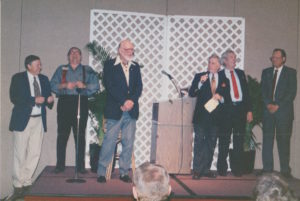
But it was more than just the knives that attracted both Shelley and Sarah—it was the makers themselves. The Bermans admired the work of such cutlers as Cutlery Hall-Of-Famer Buster Warenski, Warren Osborne and Larry Fuegen, to name a few. The Bermans also came to know the wives of the makers as well, such as Dorothy and Jim Ence, Betty and Ted Dowell and many more. The Bermans were regular visitors to the Art Knife Invitational, the California Custom Knife Show, the Solvang Custom Knife Show and other knife events. Each April during the Solvang Show there would be a barbecue, and for many years Shelley emceed the post-dinner awards ceremony. In 1996 he did a comedy routine to headline the banquet for the 25th anniversary Knifemakers’ Guild Show—now the International Custom Cutlery Convention (ICCE)—at the Marriott Hotel in Orlando, sparing no one from a comedic jab or two, including Cutlery Hall-Of-Famers Bob Loveless, A.G. Russell, Frank Centofante, D’ Holder and Dan Dennehy, Ted Dowell and others in the jam-packed ballroom.
Shelley and his wife for 70 years, Sarah, and their knives in the Berman home—including the photo of the Virtue knife signed by all the participating makers at top right.
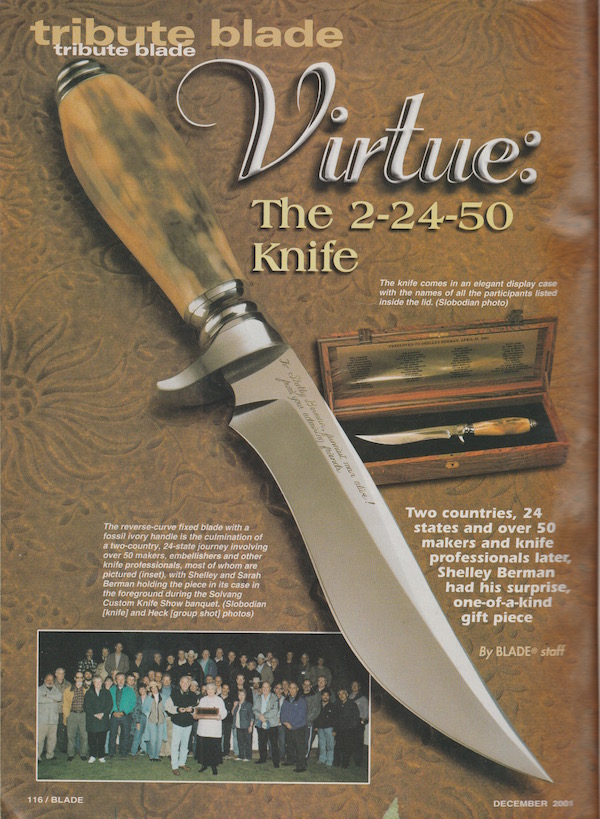
During the 2000 Solvang Show, many of the show’s custom makers the Bermans had befriended over the years huddled and decided to make a special surprise knife that they would deliver unbeknownst to the Bermans at the following year’s Solvang Show. A work schedule was planned so the knife would spend the least amount of time possible in the mail between destinations. One of the biggest obstacles was getting the knife in and out of over 50 workshops in less than 10 months. Work began in July 2000 and the completed masterpiece arrived in Solvang just three weeks prior to the 2001 Solvang Show. The project began in Arizona and from there went to Nevada; Idaho; Washington; Oregon; California; Hawaii; back to Arizona; Utah; Colorado; New Mexico; Texas; Arkansas; Kentucky; Tennessee; South Carolina; North Carolina; Virginia; West Virginia; Maryland; Pennsylvania; New Hampshire; Quebec, Canada; Ohio; Minnesota; and Wisconsin.
The worry was that the knife, christened “Virtue: The 2-24-50 Knife,” would look as if 50 different makers had made it, which, of course, would not be the desired result. However, just the opposite occurred and the knife came out beautifully. Nothing quite like it has been attempted before or since.
As Dave Harvey, Solvang Show producer and owner of Nordic Knives, noted, one concern was that word of the knife would leak to Shelley before it was finished. However, the secret was kept and Shelley’s reaction made it abundantly clear that he was genuinely surprised and thrilled when the knife was presented to him and Sarah at the 2001 Solvang Show.
Shelley holds two of his favorite knives, the favorite being the Hermes folder. He was featured with it in the second installment of BLADE‘s “My Favorite Knife,” the forerunner to the magazine’s popular “The Knife I Carry” feature, in the October 1991 issue.
Shelley also wrote for BLADE on occasion, and even appeared in the second-ever installment of the magazine’s popular department, “The Knife I Carry,” which originally was known as “My Favorite Knife.” The knife was a Hermes folder and Shelley is pictured holding it on page 94 of the October 1991 BLADE.
With the permission of Cutlery Hall-Of-Famer Jim Weyer, the March 1996 BLADE reprinted Shelley’s story “Symbiosis” from Weyer’s Points Of Interest Book IV. In the story about knife collectors and what makes them tick, Shelley nailed it perfectly when he wrote, “Since only the Good Lord knows what makes a collector a collector, it follows that only the Good Lord knows why a collector is after only a certain kind of knife on a given day. Even then, if one should ask the collector what kind of knife he has in mind, the collector may answer, ‘I’ll know it when I see it.'”
Likewise, the members of the knife community know a great collector and friend when they see one, and along with his wife Sarah, Shelley will forever fit the mold.
Over 50 makers working on the knife in shops in 24 states resulted in the Virtue knife for Shelley and Sarah Berman.
Veteran knifemaker Joe Kious, popularizer of the “Pocket Locket” style of high-end art folder and long-time Knifemakers’ Guild member, passed away Dec. 5 as a result of injuries suffered in a vehicle accident.
A resident of Kerrville, Texas, Kious was a full-time knifemaker who sold his first knife in 1969. He specialized in investment-quality interframes and bolstered folders, some bringing up to as high as $10,000 apiece.
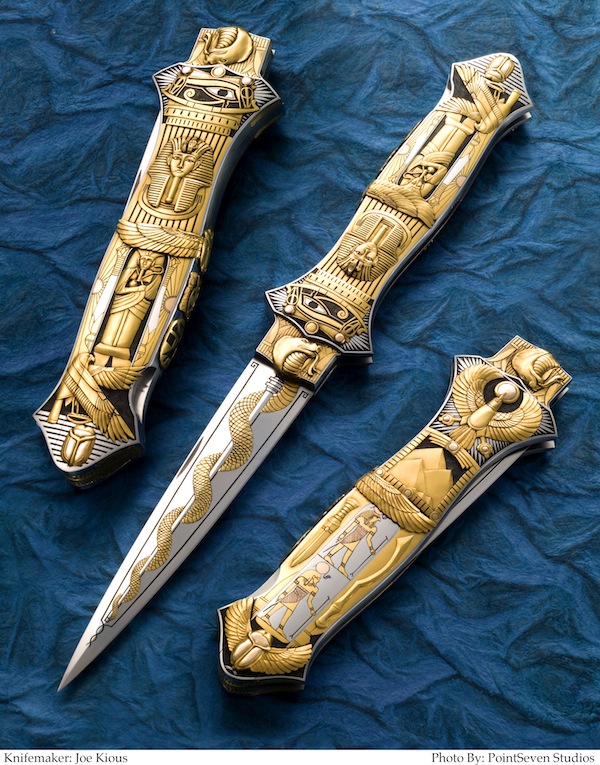
However, it is his Pocket-Locket models for which he may be best remembered. Featuring elaborate engraving, the folding knives include a small compartment in the handle with a sliding panel that slides back to reveal another engraved scene inside.
“Joe was a staunch supporter of the Knifemakers’ Guild and believed in handmade knives,” said knifemaker and fellow Guild member Edmund Davidson. “Joe had a wonderful personality, was very easy to speak with and would tell you anything you wanted to know. He held nothing back and had no secrets. His knives reflected a great deal of thought, craftsmanship and artistry. He was a true master and genuine person. He will be sorely missed. When we lose a man of his caliber, we are all diminished.”
“Joe was a gentleman who loved his family, friends, enjoyed shooting, fine scotch and making knives,” noted Michael Donato of KnifePurveyor.com. “Please keep his family in your thoughts and prayers.”
A member of a close-knit group of Texas-based Guild knifemakers that includes Warren Osborne, Tom Overeynder and others, the stately Kious was liked and respected by most everyone who knew him in the industry. A lean, handsome man with a full head of grey-white hair, he was soft-spoken but never at a loss for words or a well-thought-out opinion.
Though he did not make BLADE® Magazine’s 40th anniversary list of top knifemakers—he received enough votes to make honorable mention—his Pocket Locket was chosen No. 6 among the most important custom knives of the period from 2001-2012 in the magazine’s 40th anniversary list of top custom knives.
“Joe’s Pocket Locket is important because it is the most flexible engraving platform ever offered,” noted custom knife purveyor Paul Shindler of KnifeLegends. “It includes many models and styles but offers pretty much endless possibilities for the imagination of any collector. The Pocket Locket may be the most important engravable knife ever conceived.”
Added Donato, the Pocket Locket “has a very high ‘cool factor’ to it and has served as a canvas for many of the best engravers to work their magic. Joe’s Pocket Lockets are featured in many books, magazines and great collections worldwide.”
Joe Kious, popularizer of the “Pocket Locket” art folder, was killed in a vehicle accident Dec. 5. His “two-door Pocket Locket” in a King Tut theme with Ron Skaggs engraving won Best Knife Collaboration at the 2007 BLADE Show and served as the cover knife for the December 2007 BLADE®.
Jerry Ahern, novelist, author of nonfiction books and many magazine articles, passed away Tuesday, July 24. He was well known internationally for his extremely popular “Survivalist” series of novels. Mr. Ahern was a fan of the Detonics line of handguns, so much so that he acted as president of the company, then named Detonics USA, from 2004 to 2007, while it was located in Pendergrass, Georgia.
Mr. Ahern was 66. Survivors include his wife, Sharon, children, grandchildren and a nephew. Arrangements were made through Evans Funeral Home, Jefferson, Georgia. 706-367-5467, http://evansfuneralhomeinc.com.
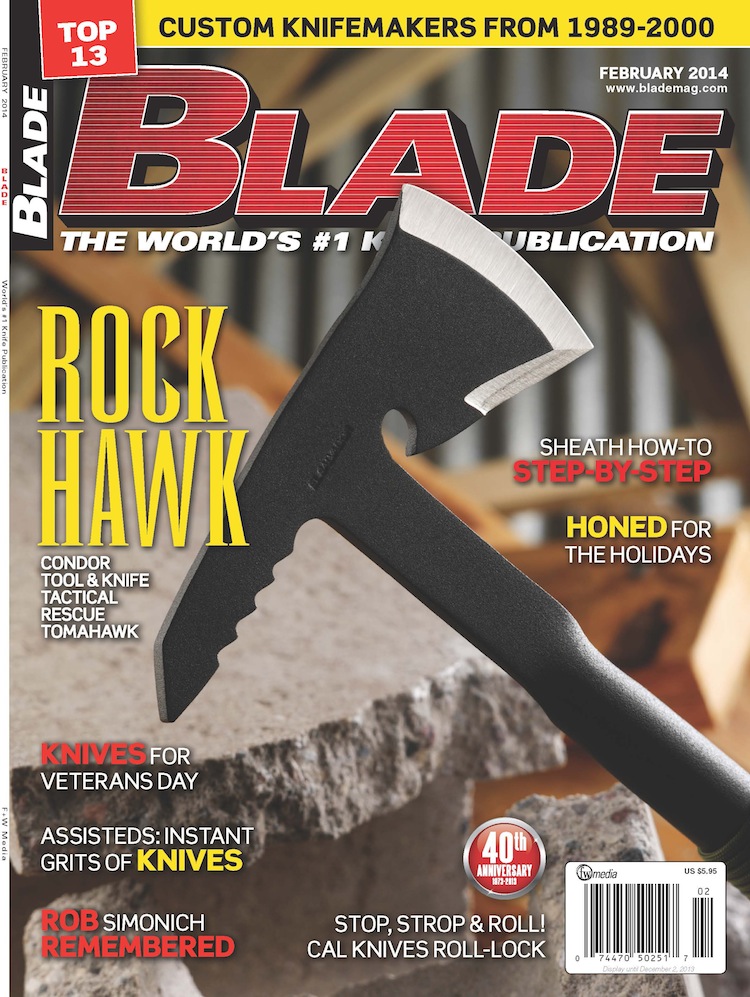
The new BLADE® is on newsstands now! Get the latest on knives for Veterans Day, the coolest factory assisted-opening knives, knife tests, knifemaker profiles and much more with newest edition of the World’s No. 1 Knife Publication.
Sporting the Condor Tool & Knife (CTK) Tactical Rescue Tomahawk (TRT) on the cover—the first time ever that an edged tool from CTK has appeared on the cover of BLADE®—the latest issue includes the TRT among four hawks tested by writer James Ayres.
It was almost 10 years ago this month that knifemaker Rob Simonich was killed in a vehicle accident. Join Dexter Ewing as he interviews those who knew and loved Rob—including Mrs. Christine Simonich, knifemaker Jerry Hossom, Mike Fuller of TOPS Knives, knifemaker Tom Mayo and others. Those who remember Rob will relish the story, and those who don’t get the chance to acquaint themselves with a man who touched the lives of many—and continues to to this day.
We often get letters from readers who want more on sheaths, and this issue ABS master smith Ed Fowler begins a multi-part story on how he makes the sheaths for his knives. Known far and wide for his sheep-handle knives with 52100 blades, Ed also makes one of the best pouch sheaths going. He shows you how he does it in part one of “Sheath How-To Step-By-Step.”
Part two of the story on the top makers in the 40 years of BLADE® focuses on the cream of the cutlery crop from 1989-2000. It was yet another golden age of knifemaking. Check out the top makers over that span as identified by our panel of edged experts. Tell us who we left out—because it’s impossible to do such a list and not leave someone out.
There’s much more in the issue—but the best way we know to tell you about it is to tell you to go get the latest issue on newsstands. Or, if you want it faster, subscribe to BLADE® digitally by visiting http://www.shopblade.com/blade-1-yr-digital-subscription
Kirpan: When Knife Restrictions Collide with Religious Freedom
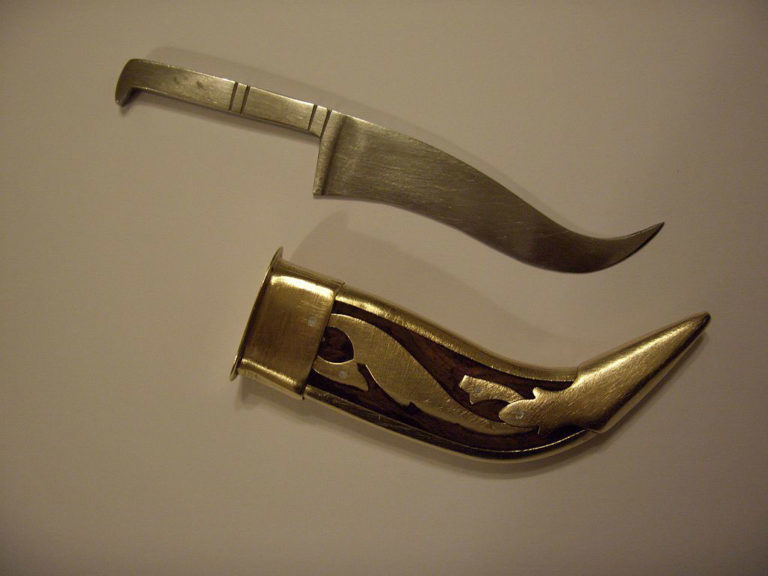
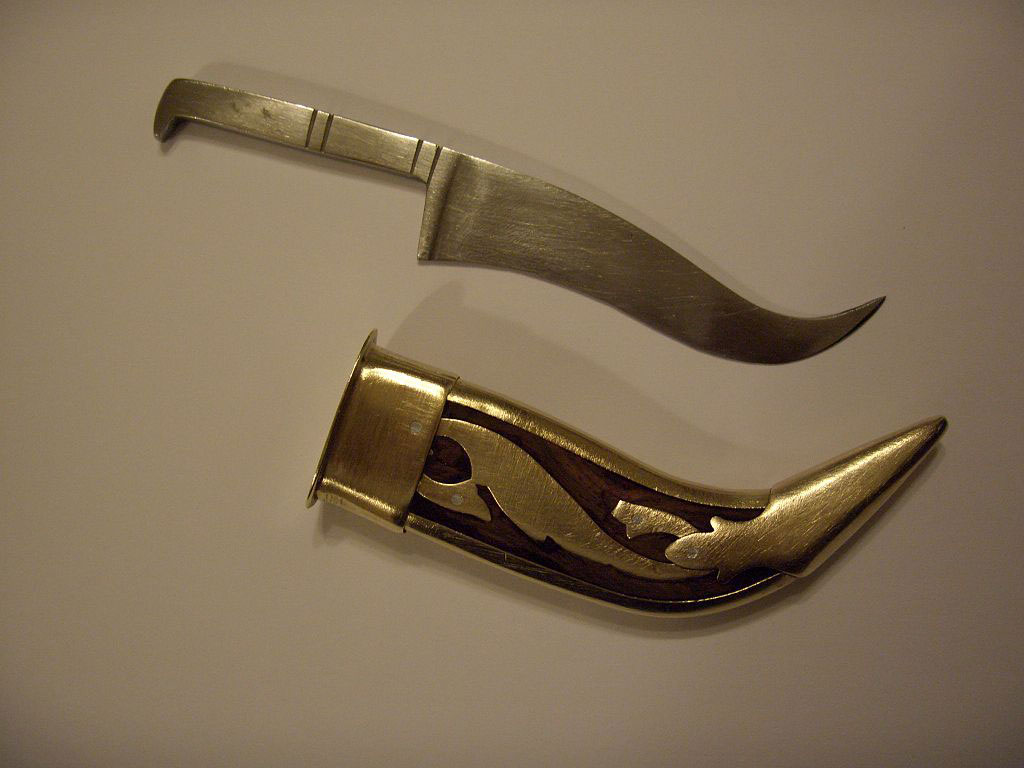
A kirpan and sheath. (By Harisingh at the English language Wikipedia, CC BY-SA 3.0, https://commons.wikimedia.org/w/index.php?curid=4525719)
As part of the Five Ks, the kirpan is a dagger that is central to the Sikh faith. Sikhs carry the dagger on their person, and that can conflict with knife restrictions. Simply put, Sikhs can find themselves forced to choose between adhering to their faith and breaking the law.
New Zealand, which restricts the public carry of daggers such as the kirpan, is one such place where this scenario plays out frequently. It’s home to 19,000 Sikhs, which is why that status could change in the future.
National Party MP Kanwaljit Singh Bakshi wants the law changed to make it legal for Sikhs to carry ceremonial daggers.
It’s one of five articles of Sikh faith, that baptised Sikhs must carry the small, curved knives known as kirpan.
Bakshi said Kiwi Sikhs were “criminalised” by not being granted an exemption under the Crimes Act to practice their faith and wear the kirpan.
So what’s the hold up? It comes down to the challenge of separating “good” daggers from “bad” daggers.
“It requires an exception to the law carrying what could be classed as a weapon and it has implications for going onto aircraft, that sort of thing, you just have to really careful.”
That “careful” approach may be small comfort for the 19,000 Sikhs living in New Zealand, as indicated by similar attempts around the world to balance public safety and religious expression. Denmark, for example, ruled kirpans as illegal items in 2006. In Sweden, a kirpan must be dull in order to be carried in public. In the United Kingdom, where public knife possession could result in years in prison, kirpans are generally accepted as being lawful, although it may take a trip to court to prove it.
Knife Companies Play April Fool’s Day Pranks
Not one to miss out on a holiday built around jokes (the knife puns write themselves!), the knife community sharpened its wits for April Fool’s Day. Here are two great examples.
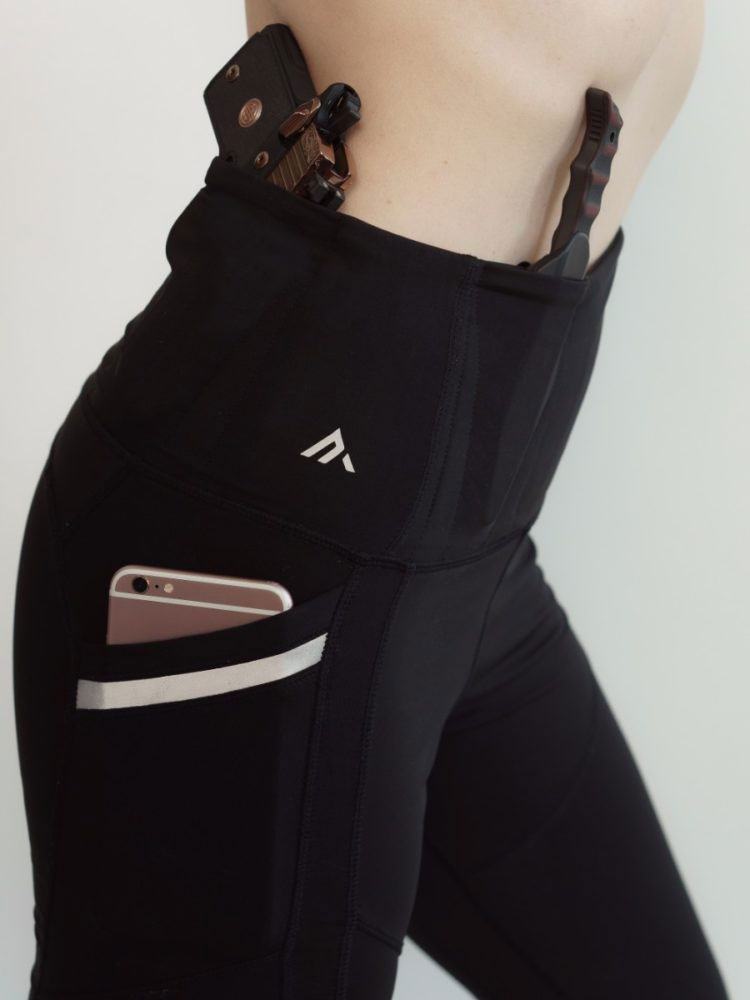
If you ever thought to yourself, “What this yoga session needs is a knife strapped against my pelvis,” you’re in luck. Alexo Athletica recently debuted yoga pants with room for a sheathed knife, as well as any other items to round out your tactical-inspired athleisure ensemble.
With nine pockets, these versatile high-rise quality leggings were designed to hold all your essentials that make you carry with confidence.
With yoga pants becoming ubiquitous outside of exercise rooms, it only makes sense that a company would design products for the concealed carry crowd. The Signature Pant, pictured above, was sold out at press time.






 (photo of Jerry Ahern courtesy of JerryAhern.com)