

Master Smith Daniel Warren demonstrates handle pin peening techniques on a Woodhead Bowie knife handle. For more information on bladesmithing techniques plea…
Knifemaking is the building of a knife, which includes the blade, handle and other accouterments. Blades are made by either removing metal from a steel blank via a grinder – known as stock removal – and the forging to shape of hot steel into a blade in the process known as bladesmithing. Other parts, including bolsters, guards, pommels, etc., are needed to complete the finished knife.
| Featured Knives – | – Knife Collecting – | – Tactical Knives – | – Survival Knives |



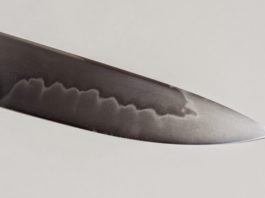
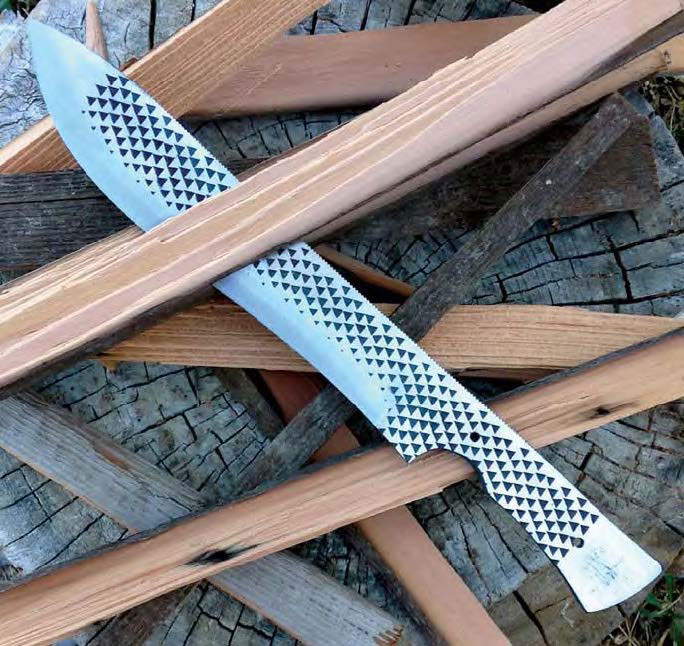
Master Smith Daniel Warren demonstrates handle pin peening techniques on a Woodhead Bowie knife handle. For more information on bladesmithing techniques plea…
In this video ABS Master Smith Ray Kirk shows how to forge integral knives with jigs.
To learn more about forging, click here to check out the new BLADE’s Guide to Making Knives, 2nd Edition book.
Murray Carter demonstrates his three-finger test for edge sharpness. How do you test your knives for sharpness? Leave a comment below.
Learn more tips and techniques in Bladesmithing with Murray Carter, published by BLADE.
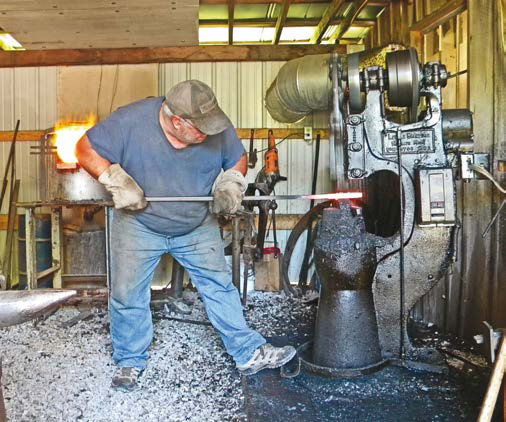
Like most forgers, I try to build a stockpile of damascus and different sized blades in the winter months when the temperature is below 50 degrees F. Sometimes, because of where you live, it might not drop below 70 degrees F. Hot is hot no matter where you forge, and there will be a time when you have to forge no matter how high the temperature is.
Here are some helpful hints to get you through the hot times.
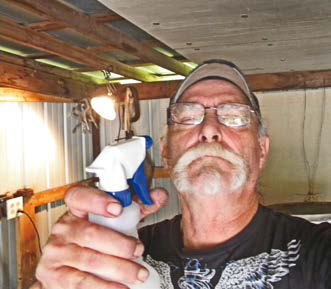
“Pre-hydrate” the day before you are going to forge. Also, drink plenty of water during forging and afterward. I use a squirt bottle to spray myself during forging to add extra cooling. Staying hydrated should keep those nasty headaches away.
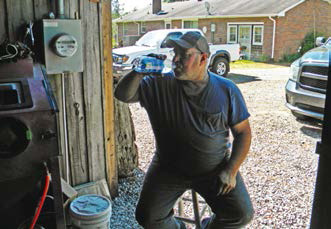
If you are lucky enough to have a second person that knows how to forge helping you, take turns doing the work. This limits the amount of time one person has to stand by the hot forge. After your turn, get away from the heat and drink fluids.
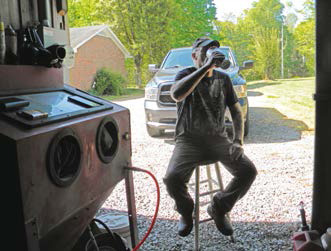
Usually I’ll pull a chair close to the door to catch any breeze that might be blowing. I place a fan to blow across the cooling chair if the temperature’s above 90 degrees F. Some have a gas forge that can be moved outside, which is better for the radiating heat, though a strong wind can mess with the fire.
The main point here is to limit the time you are exposed to the forge heat.
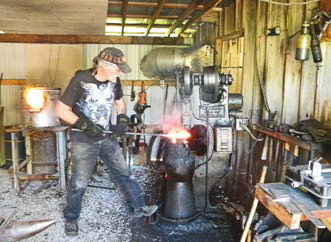
I do away with such coverings as aprons, arm covers and/or long sleeves. I haven’t gone to shorts because there would be a piece of hot something rolling down my leg and into my work boots. No amount of stomping around gets it out. I stick with jeans.
A towel or rag that helps keep the sweat from getting in your eyes is a good idea. Your shirt will be soaking wet after a few minutes, so don’t count on it as a sweat sponge.
When welding damascus on very hot days, one day I do just the first weld to seal the billet. Then the next day, I stretch the billet. The following day, I cut and restack the billet for layer count.
I follow this pattern till I have the billet the way I want it. This takes a lot longer but it doesn’t wear you out at the end of the day.
Then again, sometimes I just work through the heat and sit in my truck with the air conditioning on high. An extra shirt also helps to keep sweat off your vehicle seat.
So remember: Drink fluids, limit your time being by the hot forge, stay as cool as possible—and keep forging!
It’s not too early to pre-order the KNIVES 2016 book, which hits bookstores, newsstands and online in late August/early September. And staying true to form, KNIVES 2016 showcases nearly 800 of the newest, finest handmade, custom knives in the world in “Trends” and “State Of The Art” categories, as well as in-depth, truly fascinating feature articles on a variety of knife subjects, a “Factory Trends” section and, of course, the coveted Custom Knifemakers Directory.
 The Custom Knifemakers Directory lists the names of 2,000-plus handmade knifemakers, their complete contact information, including addresses, phone numbers , emails and websites, their specialties, patterns, technical information, remarks, tang stamps and price ranges.
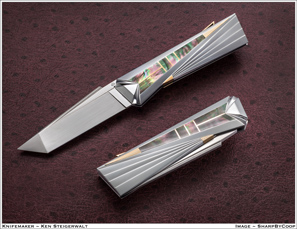
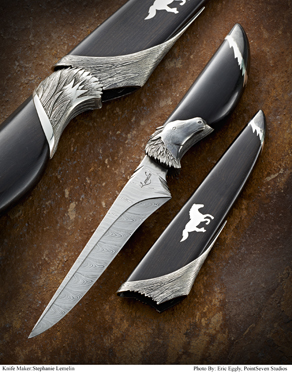
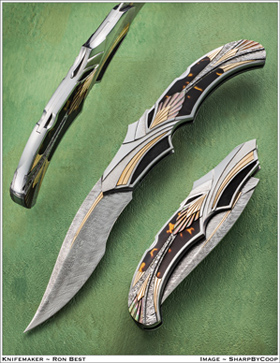
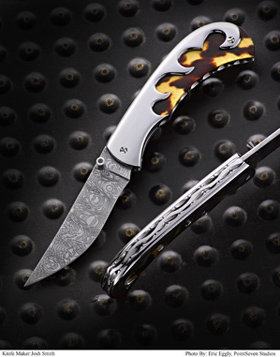
Within the “State Of The Art” section is a chapter titled “Sculpted Bods” that really speaks for itself, and here are a few of the incredible knives that parade their sculpted bods before an appreciative audience.
Don’t forget to pre-order your KNIVES 2016 book today! And enjoy all the annual book has to offer.
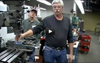
This demonstration on the selection and use of milling vises is by Dale Schafer, Machine/Tool Technology Instructor at the Washburn Institute of Technology. This was one of the demonstrations at the 3rd Heartland Hammer-In in Topeka, Kansas sponsored by the American Bladesmith Society and hosted by the Kansas Custom Knife Makers Association.
 For more about knifemaking, be sure to pick up a copy of BLADE’s Guide to Making Knives. This second edition shows step-by-step the tools and techniques for making a knife.
Calling all bladesmiths and knifemakers: the Guilford Art Center in Guildford, Connecticut, announces “Contemporary Knife Smithing: A Juried and Invitational Exhibition,” and is calling for submissions.
Bladesmithing is a thousands-year-old craft practiced in diverse cultures across the world. It has survived as an art form despite modern industrialization, with artisans dedicated to preserving and expanding traditional techniques. This exhibit will explore and highlight the artistry of the contemporary hand-crafted knife, as an object with both functional and aesthetic value.
Exhibit Dates: July 10-August 18, 2013
Juror: An ABS journeyman smith, Mace Vitale practices blacksmithing and is a copper smith. He has a background in architectural pre-cast concrete, is owner of Laurel Rock Forge in Guilford, and is an instructor at the Guilford Art Center.
Eligibility: This exhibition is open to knives made by U.S. residents.
Entries: Each artist may submit up to three (3) works. Each work may be represented by two separate images: one full view and one detail view. Work must be submitted in high-resolution digital format. For each entry please note dimensions of knife, and a maker’s list price (retail price), or not-for-sale/insurance value. Email entries to: [email protected].
Entry Fee for Applicants: $20. Includes up to three (3) submissions. Make check payable to Guilford Art Center and mail to 411 Church St., Guilford, CT 06437. Or call the Center with credit card number 203-453-5947. Payment must be received for entries to be eligible.
Entry Deadline: June 10, 2013. Digital images and entry fee must be received by this date.
Conditions: All accepted works must arrive with a display case that closes for safety purposes during exhibition. All entries must be original and must be completed within the last 3 years. The Center reserves the right to reject entries that do not meet these requirements or is deemed unstable. Shipped work that differs from submitted images will not be accepted. Work damaged in shipping will regretfully not be presented. All accepted work must have proper identification. No accepted work may be picked up before the closing of the exhibition. Work may be available for sale or must be identified as NFS. The retail price or insurance value provided on the entry form will be used; no changes may be made after the work is shipped.
Shipping: Shipping costs are the responsibility of the artist. A check for return shipping, including the cost of insurance, must accompany delivered work, payable to Guilford Art Center. Work damaged in shipping will not be presented. Detailed packing/handling instructions must accompany all works.
Hand Delivery: Please call the Center to make an appointment for hand delivery/pickup at 203-453-5947, Ext. 12, or email [email protected].
Receiving Deadline: All work must be received no later than these dates.
Sales/Insurance: A 40% commission on all sales will be retained by the Center. Artists must indicate sale price and insurance value or, if NFS, just insurance value. Submission of work to this exhibit is done so at the artist’s risk and implies an agreement on the part of the artist to all the conditions of this Call for Submission. GAC will not be responsible for loss or damage to work in transit, however, work will be insured while in the Guilford Art Center facility.
Publicity: Guilford Art Center reserves the right to photograph entries for the purposes of documentation, education and publicity. Accepted artists are encouraged to send to the Center a resume, artist statement, brochures, and additional photographic materials of the accepted work for publicity purposes.
Show Schedule:
Application due: June 10, 2013
Artist Notification: June 14, 2013
Receiving: June 24-28, 2013 (10am-4pm) (Shipped/by appointment)
Opening reception: July 10, 2013 (5-7pm)
Closing: August 18, 2013
Deinstallation: August 19-23, 2013 (10am-4pm) (Shipped/by appointment)
For more information please contact Guilford Art Center at 203-453-5947, or visit www.guilfordartcenter.org.


