BLADE Show is home to countless knives and just as many exclusive deals. Here are some outstanding highlights from our sponsors you don’t won’t want to miss.
Smoky Mountain Knife Works
WE Knife
Work Sharp
Big Daddy Unlimited
Wicked Edge
W.R. Case & Sons Cutlery
Hogue Knives
Kizer Cutlery
Microtech Knives
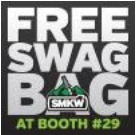
Smoky Mountain Knife Works Get Your Free Swag Bag at Booth 29
Stop by SMKW’s Booth (29) at BLADE Show, and we’ll give you an awesome free swag bag (while supplies last). Don’t wait!
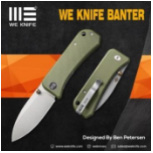
WE Knife WE KNIFE BANTER at Booth 725
See more of our new knives at Booth 725.
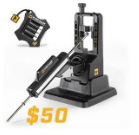
Work Sharp Precision Adjust Special $50 (Only 300 Available) – Booth 312
All orders over $50 include a FREE Micro Sharpener. Precision Adjust on sale for $50 while supplies last.
Big Daddy Unlimited We’ve SLASHED the price on our Big Daddy Unlimited annual membership!
Take a STAB at these savings ($79.41) & Sign up NOW! Click here.
Wicked Edge 10% Off – Booth 42
Come see us and our newest arrivals in Booth 42 and pick up your BLADE Show 2021 coupon for 10% off your favorite tool.
W.R. Case & Sons Cutlery FREE “Made in Bradford” Stickers from Case Knives! – Booth 109
Get a free “Made in Bradford” sticker when you stop by Booth 109 to check out the all-new Marilla™ and Kinzua™ EDC knives from Case!
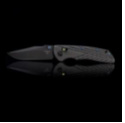
CPM 20CV stainless steel blade with a Glow Rhino Tritium infused ABLE Lock® carbon fiber frame and blue titanium hardware. Exclusively available at BLADE Show at Booth 52.
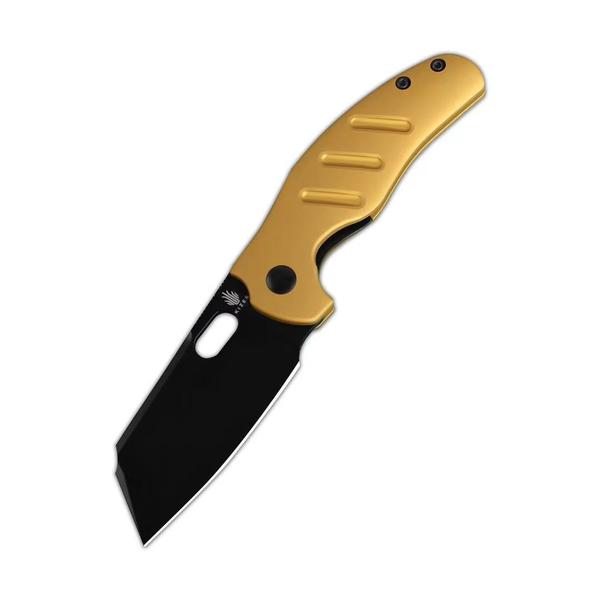
Kizer Cutlery 2021 BLADE Show knife – Kizer Sheepdog Mini C01c, 40th Anniversary Special edition
This special edition of the Sheepdog mini C01c is equipped with 154CM steel and champagne handles, only 300 available with a serial number. Get it here.
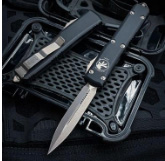
Microtech Knives Ultratech D/E for Only $160 – Booth 324
This year’s BLADE Show Special from Microtech Knives is the Ultratech D/E. Price is $160. Cash only. Limit one per person. Available at Booth 324.
OK, it’s been two years since the last BLADE Show as of this writing in 2021, so, in case you’ve forgotten authorized BLADE Show protocols, here’s your official “How To BLADE Show Manual.” This is to supplement the knife show courtesy guidelines here.
Walk, Don’t Run
Walk, don’t run, when you first enter the BLADE Show. I know, the temptation will be to sprint into the exhibition hall to get to your favorite maker’s table or booth. However, please don’t. For one thing, you might run me over. On the other hand, I understand your excitement, so if you do happen to flatten yours truly, please don’t wipe your feet on me.
Acceptable Whooping
To all ABS members who, if and when you first learn early Friday morning of the show that you’ve earned your master or journeyman smith stamp: Please feel free to let out your best war whoop (not that you need our permission, of course). We would, too, if it were us.
Winning Awards
The same (see previous) goes for those who win BLADE Magazine Knife Of the Year® or Custom Knife Judging Competition honors. Celebrating in such a manner releases endorphins and puts you on an emotional sugar-type high, which is something we all need after waiting 730-or-so days for it.
Spread the Word
If you see or find a maker you think has tremendous promise or could well be the next great one, make note of it and tell all your friends. Some of today’s best makers got their start at, or were inspired by, the BLADE Show. That is a tradition we cherish and want to sustain, because it is another thing that makes our show so splendiferous.
Say Hi
When you see a BLADE Show legend or BLADE Magazine Cutlery Hall-Of-Fame® member (for one of the latter, look for the new Hall-Of-Fame badge each of them will be wearing), smile, nod, and say hi. They will appreciate it. Make them feel welcome.
They are fountains of knowledge and most if not all of them not only want to share that knowledge, but feel a need to for both the present and future good of the knife community.
Be Mindful
If you see people in wheelchairs and/or with oxygen tanks, make room for them and even offer to assist them if they need it. Such people obviously love the BLADE Show more than most. Why else would they to so much effort to attend?
Listen Up
I’m hoping the PA system in the show hall will be somewhat easier to understand this year but, just in case it isn’t, if someone claims to have a device that automatically translates the system’s Charlie-Brown’s-teacher-ese into English, let me know. I want one.
No Amateurs After Hours
Choose wisely in the Pit after show hours. There are no doubt going to be some amateurs who go coo-coo for crazy puffs and imbibe a liquid refreshment or two too many.
Hey, after two years of no BLADE Show, that will be quite understandable, even for the old pros. My advice: nurse your beverage responsibly. The better you do that, the less likely you will be to suffer the “show hall shimmy” the following day.
Take Note
Finally, keep track of the youngest and oldest knife enthusiasts you see. They are all reminders of how we both were and, hopefully, some day will be when it comes to experiencing all things sharp. In a nutshell, they really are much of what the BLADE Show is really all about.
Find more information about the BLADE Show on bladeshow.com.
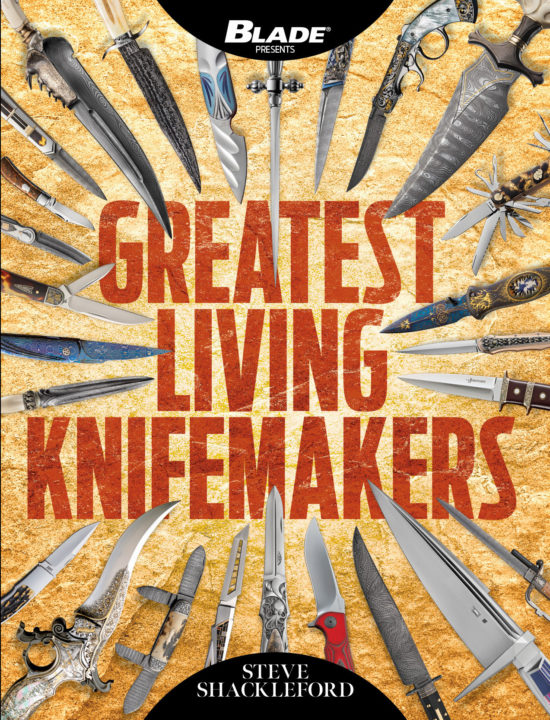
A new book from the publishers of BLADE magazine, Greatest Living Knifemakers, celebrates today’s legends who make knives in ways that most can only dream about. They make knives that can easily fetch tens of thousands of dollars, and even more.
Given all that talent, how does a book like this come together? Who gets to decide who is counting among the “Greatest Living Knifemakers” anyway? If you’re someone looking to collect or make knives, you’ll enjoy this interview with the editor of the book, Steve Shackleford, who is also a member of the BLADE Magazine Cutlery Hall of Fame®.
Many talented people make knives of outstanding quality. How did you go about choosing who should appear in this book?
Steve Shackleford
The hardest part was choosing who NOT to include. I’ve been covering the knife industry for BLADE®, the world’s No. 1 knife publication, since 1985, so I’ve had the privilege of seeing and handling some of the world’s greatest knives, and meeting some of the world’s greatest knifemakers.
As a result, some of the makers I picked peaked years ago and don’t even make that many knives anymore. On the other hand, some are peaking now. However, at some point in their careers each has made knives that are among the world’s best.
In addition, each has either made knives and/or introduced designs, techniques, folding mechanisms, damascus or other steels and other materials, etc., that in turn have set a standard or inspired other makers in the way they make knives.
And, of course, to qualify as per the book’s title, each must be living, though Tony Bose passed away after the book was finished. We decided to include him as a tribute to his fantastic slip joints and the overall impact he had on the knife industry, which was and remains monumental.
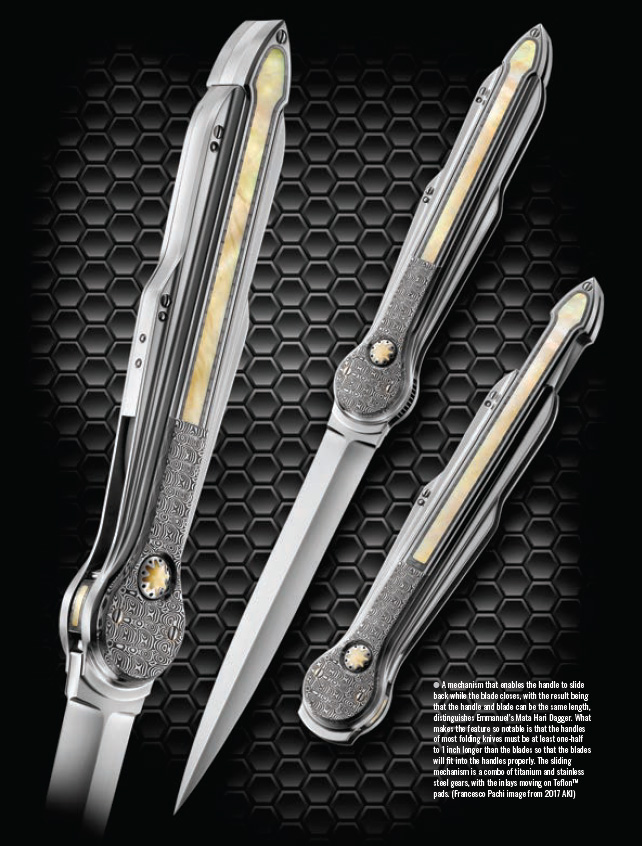
A mechanism that enables the handle to slide back while the blade closes, with the result being that the handle and blade can be the same length, distinguishes Emmanuel’s Mata Hari Dagger. What makes the feature so notable is that the handles of most folding knives must be at least one-half to 1 inch longer than the blades so that the blades will fit into the handles properly. The sliding mechanism is a combo of titanium and stainless steel gears, with the inlays moving on Teflon™ pads. (Francesco Pachi image from 2017 AKI)
What makes a knifemaker “great”?
Some of that is covered in my first answer above but there are other things as well. They must have a lifelong dedication to making knives, which all of those profiled have exhibited, as well as a passion to make knives for much more than just the money.
It’s kind of hard to explain unless you’ve followed knives for a long time, but, in a nutshell, most great knifemakers make knives because they sweat the load, they agonize over the details, and they don’t provide just a “product”—they produce a knife that almost always acts, looks and feels like it’s the best knife that maker makes. There’s much more but that’s part of it.
Are there any names that couldn’t make it into the book due to space limitations?
As noted above, yes, many make knives worthy of inclusion. However, I won’t name names here in case we decide to do a second volume of the book.
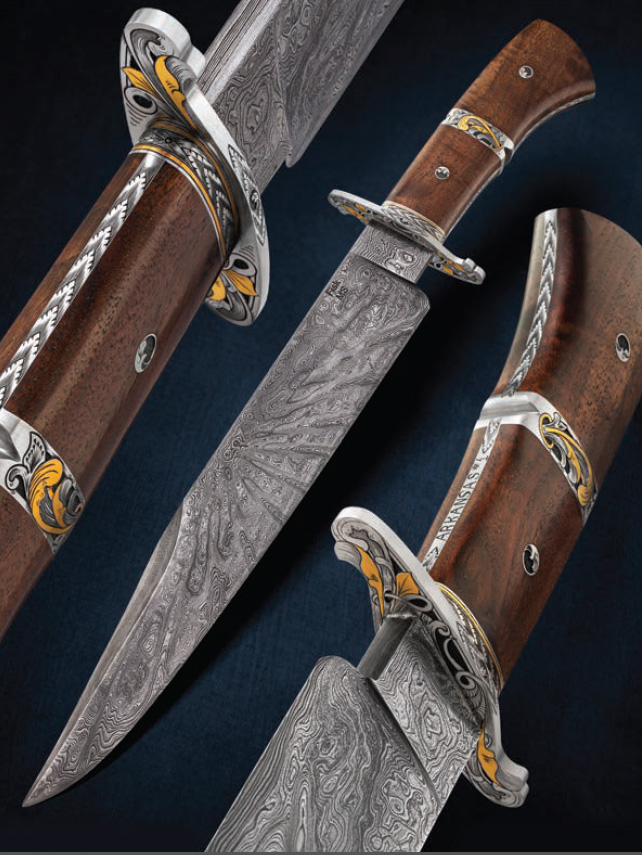
The Razorback State is the theme for Jerry Fisk’s Arkansas #1. The 11-inch blade has a Dog Star-pattern damascus with 1836 layers to represent the year Arkansas became a state. The blade also has steel welded into it from the Statue of Liberty. The walnut handle is from the official James Black walnut from the cemetery where Black is buried in Historic Washington Arkansas. Some believe Black made a bowie knife for James Bowie. The mountings are fully engraved and carved, including deep relief scrollwork and 24k-gold inlay—all by Jerry. (Whetstone Studio image)
Are the names ranked or is this just a collection of noteworthy knifemakers?
Since they are all great and, as John Wayne’s character once said of two great gunfighters in the movie Rio Bravo, “I’d hate to have to live on the difference,” I decided to list them all in alphabetical order—with the exception of R.J. Martin.
His profile appears first in the book because it is the only profile written by the maker himself. I did not ask him to write it, he volunteered to do it. I was so taken by the quality of his writing and the information he provided on what being a great knifemaker is really like that it was a no-brainer to include it.
In my opinion, it’s one of the best ways for the reader to truly appreciate what it’s like to be a great knifemaker—done from a great knifemaker’s point of view. I think it’s the best profile in the book, hands down.
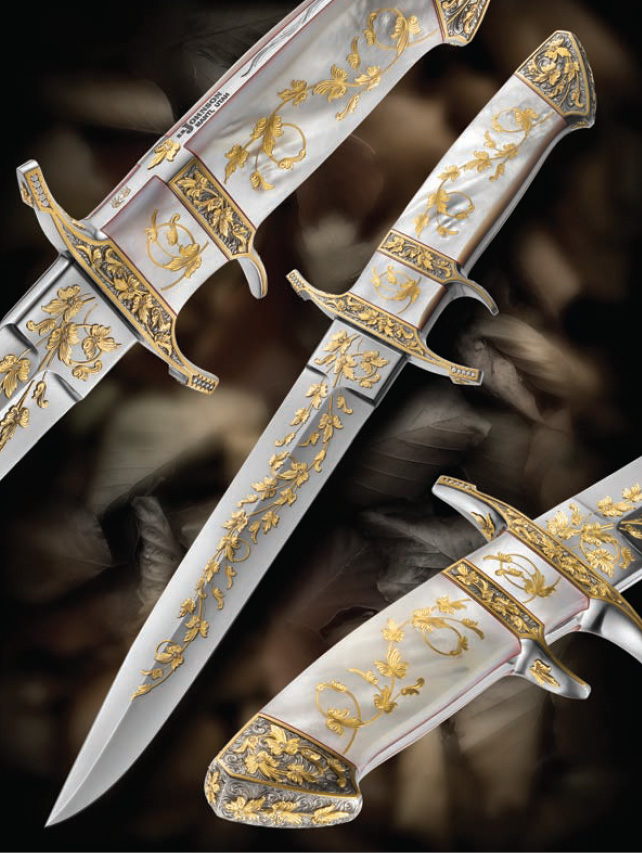
Steve Johnson’s spectacular repro of a Loveless Big Bear sub-hilt fighter is highlighted by Barry Lee Hands engraving that includes 24k-gold inlays and overlays set with diamonds and gilded mother-of-pearl. The knife is made from one block of 5/8-inch thick, 4-inch-wide and 16-inch long CPM 154 stainless steel. The blade is a quarter-inch thick and 8.5 inches long. Overall length: 14 inches. Steve made it for the 2015 Art Knife Invitational. (Francesco Pachi image)
Do great knifemakers have a peak or a golden era within their careers, or are they great throughout their careers?
As with most all great talents, they do indeed seem to peak at certain times. Some peak for longer periods than others and some even seem to have more than one peak. Some may burn out early and then something happens to help them regain their mojo.
However, in most cases the great ones maintain varying levels of greatness throughout their careers, and I think that’s the case with all of those featured in the book.
Is there a list of the knifemakers featured in this book posted somewhere for people to check out?
Maybe it’s a bit of a contradiction, but both elegance and simplicity are elements of African blackwood, a handle material with a rapidly rising profile in the custom knife industry.
The color of the material combined with properties that make it a pleasure to work with has resulted in an explosion of interest. Ranging in luster from a reddish to a deep black hue, the wood is the product of a flowering tree also known as granadilla or mpingo. A relatively small tree, it grows primarily in the forests of Senegal east to the horn of Africa and in some parts of South Africa. Long used in musical instruments and high-end furniture, African blackwood is protected in order to prevent overharvesting.
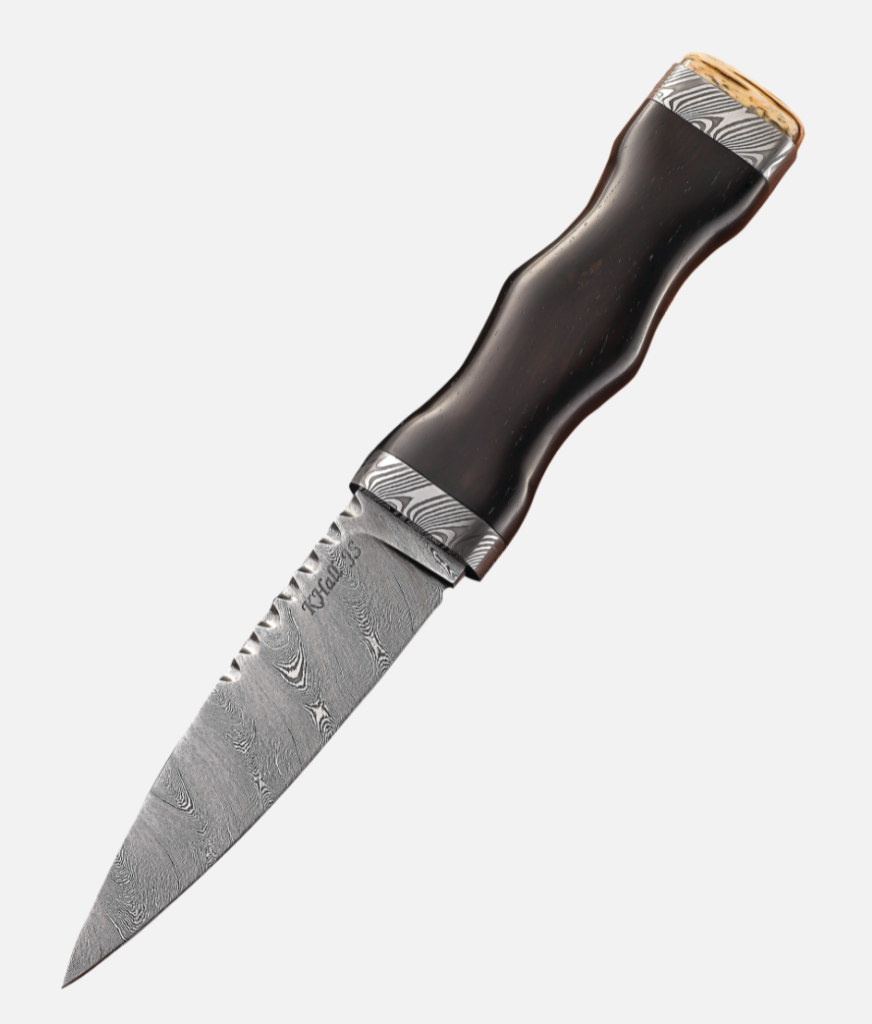
Ken Hall’s sgian dubh features a 4.25-inch blade of twist damascus in a blend of 1075 spring and 15N20 nickel alloy steels. The pommel is formed from stone and giraffe bone. The African blackwood handle not only is ideal for its carvability but also in keeping with the sgian dubh’s name, which is Scottish for black knife.
When the material finds its way to a knife handle, something dazzling happens, and the makers who use it sing its praises. “I’ve always loved black-handled knives, especially with brass,” related Abel Price of Fayetteville, Arkansas, a part-time maker who is completely self-taught. “The black and gold combo just pops and gives it a beautifully elegant Art Deco feel.”
In the mountains of western North Carolina, ABS master smith Andrew Meers finds African blackwood a pleasure to work with. “It’s a dense and stable wood with a consistent grain structure that is excellent for handle material. It is workable and carves well,” he noted. “It has a rich, dark color and finishes out beautifully when sanded, and I haven’t noticed any cracking, shrinking or expanding, especially compared to the cracking I’ve noticed at times in similar looking wood such as ebony. I think these qualities contribute to its growing popularity among makers.”
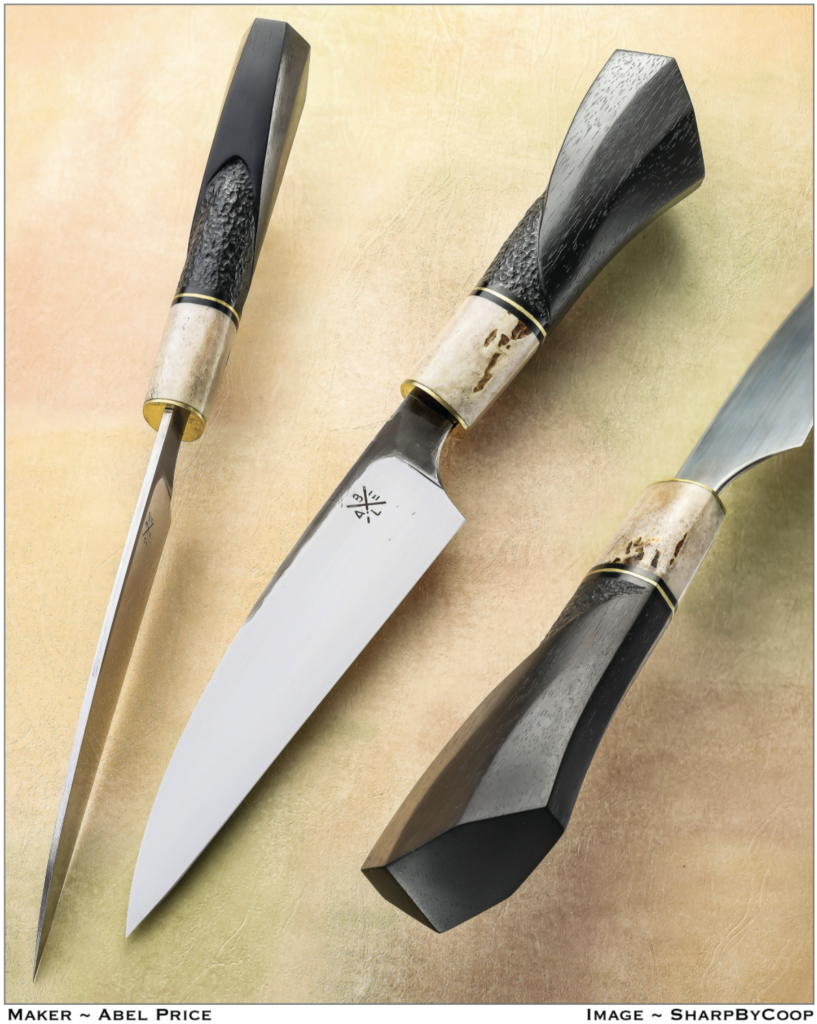
Abel Price used African blackwood for the handle of his Deco Petty kitchen knife. He said the handle “was sculpted to contain design elements of the Art Deco era while hitting several notes of contrast: smooth and stippled, round and flat, black and white, and straight and sweeping lines.”
Andrew uses rasps and files for shaping, a flex shaft for carving, and prefers to sand and buff to finish his handles of the material. Last of all, he applies a coat of Danish oil. So, the finished product is just what the maker wants, and getting there is most often a pleasurable journey rather than an arduous trek. African blackwood exhibits excellent stability and takes a shine quite well. Custom makers agree that the material is ideal for carving, though whether it carves easily or not is open to the interpretation of the individual maker.
“I think the main reason for its carving ability is that it is hard,” commented Pekka Tuominen, a 17-year maker from Keitele, Finland. “Wood has to be hard if you wish to carve it with sharp and tight curves, and also polish those curves. Let’s say it’s not easy to carve, but when wood is hard you can get a good finish. Of course, it’s popular, too,” he observed. “Everybody knows that if some famous knifemaker uses a material, then the rest of the makers at least want to test it.”
MORE ATTRIBUTES
Waynesville, North Carolina-based ABS journeyman smith Ken Hall appreciates additional attributes of African blackwood. “I like using it because it’s a very dense wood, doesn’t require stabilizing, is hard and does not crack easily,” he stated. “It has a tight grain structure, so you don’t have to fill voids, and it can be carved or shaped without difficulty and provides a dark contrast to a steel blade.”
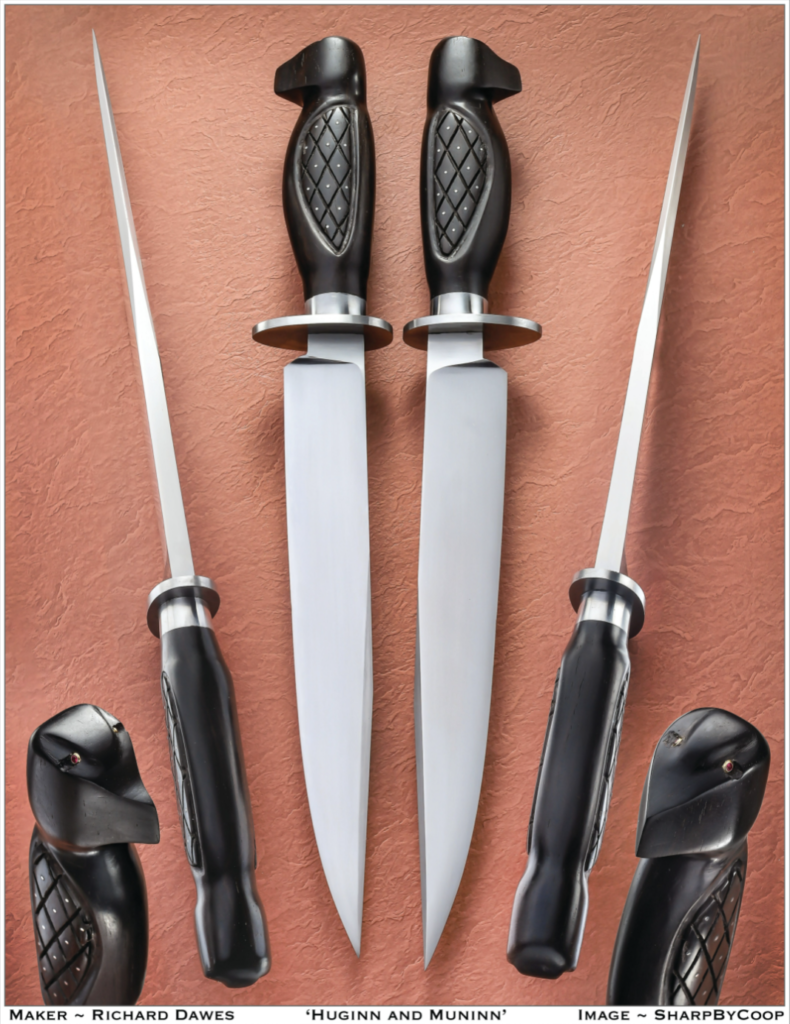
Huginn and Muninn are the names for two bowies by Richard Dawes. Huginn and Muninn are two mythical ravens that attend Odin. Dawes carved the African blackwood handles in a bird’s-head motif based on the style of bladesmith Bill Bagwell, one of the founders of the American Bladesmith Society.
Securing the handle to the blade most often involves a quality epoxy and a combination of pins, depending on the type of knife under construction. “I use rivets, pins and epoxy,” Pekka said, “but I don’t use African blackwood for full tangs. With hidden tangs sometimes just epoxy will keep the tang solid inside the handle.”
When Price went to work on his Deco Petty, a kitchen knife creation with a 6.5-inch blade of AEB-L stainless steel, overall length of 12 inches, and a handle of African blackwood, deer antler and a copper spacer, he knew just what he wanted to achieve. “The goal was to hit form and function,” he commented. “The ultra-thin cutting edge flexes with lateral pressure, and a Rockwell hardness of 61 [HRC] makes for a laser sharp tool in the kitchen. The handle was sculpted to contain design elements of the Art Deco era while hitting several notes of contrast: smooth and stippled, round and flat, black and white, and straight and sweeping lines. African blackwood does everything you want it to do with a perfect finish.”
Hall fashioned his sgian dubh as an interpretation of a historical Scottish knife. “African blackwood is the ideal wood for the sgian dubh because it can be carved and shaped to the hourglass design of the traditional sgian dubh handle,” he noted, “and provide an eye-catching contrast to the stainless steel bolster and pommel.” He added that blackwood is his preferred wood for a handle with a keyhole design because it can take the force applied to pressing the wood into the keyhole.
AESTHETICS & FUNCTION
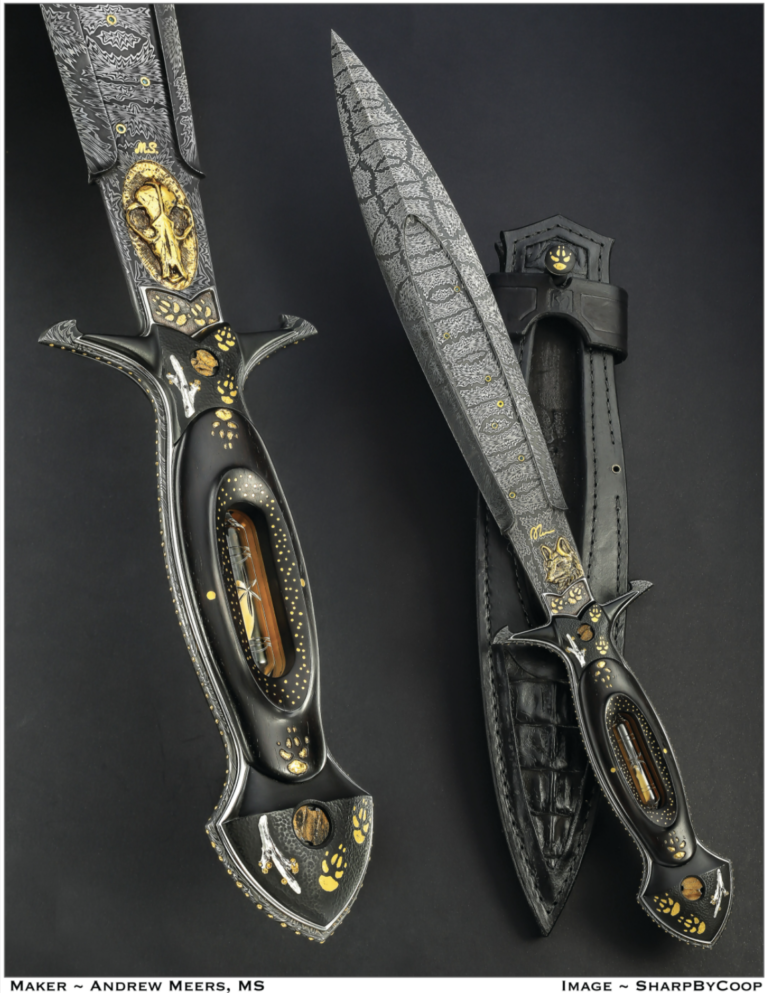
Meers made the striking Vulpecula with a 12-inch damascus blade of 1084 carbon and 15N20 nickel alloy steels. Meanwhile, something of a surprise is embedded in the African blackwood handle.
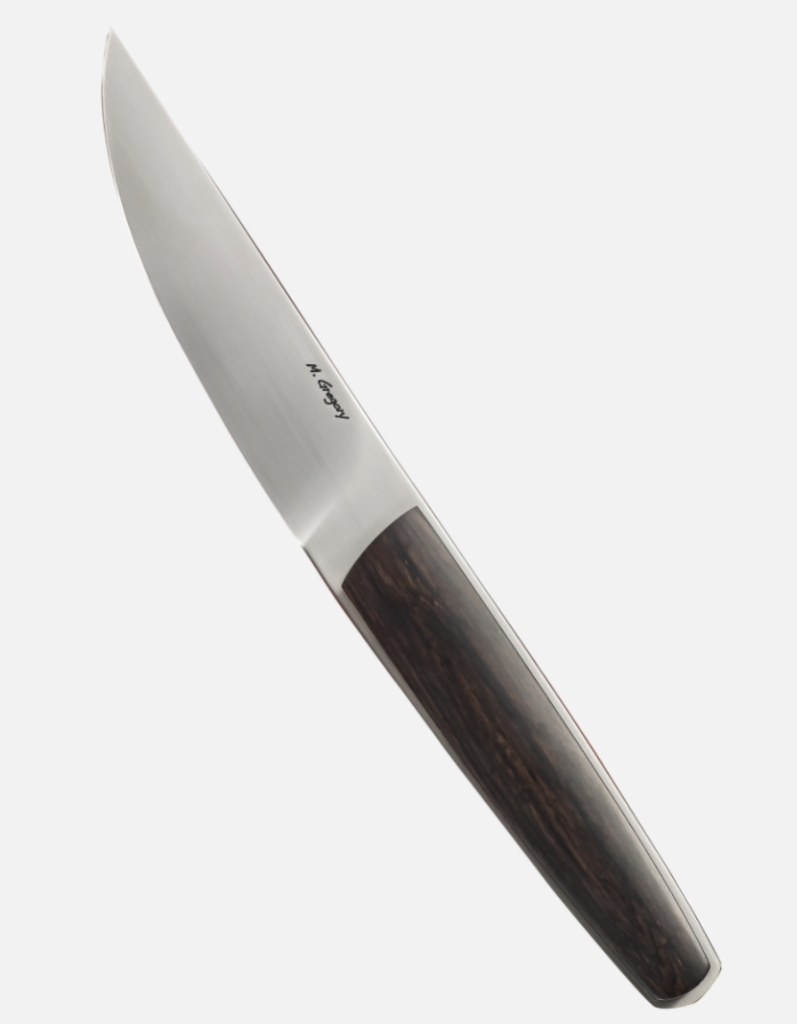
Matt Gregory’s LWT (Lum-Walton Tanto) is based on a design by Mike Walton inspired by the late Bob Lum. The African blackwood handle is polished to a mirror shine and tapers slightly in reverse of the tang, and has a delicate bulge in the center to provide for a subtle yet improved grip. The sheath (not shown) is by Jill Gregory.
“Vulpecula is a reliquary dagger,” Andrew explained. “It is inspired by the tradition of keeping objects, often hair or remains, in an embellished vessel. I found a fox tooth and had it sealed in a glass vial by a friend. I then built this dagger to house the vial as a reliquary.
“The blade fittings and handle are adorned with 24-karat gold inlay depicting a large fox, its skull and paw prints. The hardware is torch-cut steel plated with gold that is brushed back. Vulpecula, the ‘Little Fox’ constellation, is set into the blade with blue diamonds.
“It was a combination of aesthetic and functional choices that made me choose blackwood for this piece,” he concluded. “The wood machines and carves well, so for this handle it was the ideal choice. The blackwood’s depth serves as a rich contrast to the bright gold used in small inlays to represent a starry sky and the fox prints as well.”
Tuominen built his Protector, or Suojaleijee, dagger with a 5-inch welded damascus blade of 1080 and 80CrV2 carbon and 15N20 nickel-alloy steels, a guard of Nicorros (a copper/nickel alloy), African blackwood handle, and a handmade leather sheath with stainless clip. The blade is 7 inches and overall length is 12 inches. “It’s a custom order for an American collector,” he noted. “I used African blackwood because it’s black and more stable than other black-colored woods.”
SOURCES
While African blackwood remains protected, it can be found through various sources. However, Abel has a warning.
“I stocked up at a Rockler store a few years ago,” he remarked. “I’m not looking forward to finding another supplier. I believe the demand is outpacing the supply, and as conservation efforts increase, as they should, so will the price.”
Kelly Vermeer Vella em- ploys African blackwood and sterling silver for the handle of her dagger. The blade is a damascus of 1075 spring and 15N20 nickel-alloy steel.
Hall searches eBay for African blackwood and makes his selection based on what is available. Pricing, he says, runs $20 to $30 for a handle block or set of scales. While Pekka often sources his African blackwood from European knife shows, he also checks the internet for block-size pieces. Meers has had success with retail suppliers and finds a broad range of dimensions.
The custom knifemaker and the consumer alike have taken a new interest in African blackwood, and that fascination is not likely to fade in the near future.
Whether for bushcraft, carving, or just straight woodworking, drawknives are handy tools that range quite a bit in size, function, and style. There are large drawknives to peel bark or hew small logs, as well as models for specialty purposes such as coopering or making chair seats. There even used to be specialty drawknives for shaping round handles small in diameter for brooms, rakes, and other implements.
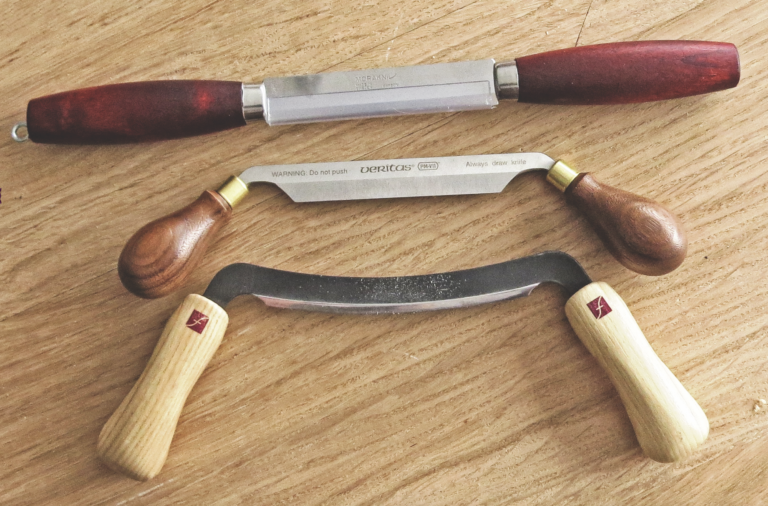
Three small drawknives for carving and crafting are the focus this time: the MoraKniv Classic wood splitting knife, Flexcut Drawknife, and Veritas Drawknife. They are great because they are relatively compact and portable, and help comprise part of what you could call a portable rustic tool kit.
DUAL BEVEL
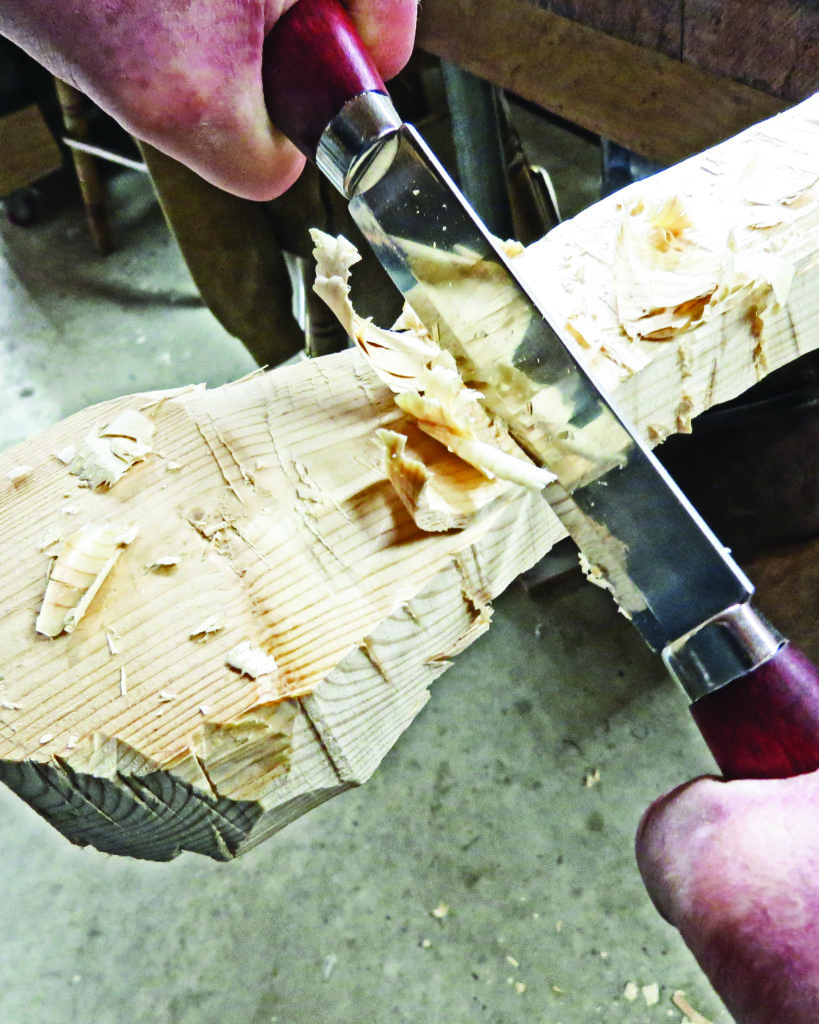
I know, right off the bat the MoraKniv Classic is called a wood splitting knife and not a drawknife. I thought this model would be interesting to test because it departs from the regular one-bevel blade geometry. The handle positioning is straight, giving the tool a compact configuration for transporting. It also comes with a sheath.
The author uses the MoraKniv Classic wood splitting knife in a push-cut motion to perform a stop cut while contouring the grip on a paddle.
Over the years, I’ve seen many a bushcrafter try and find a way for a standard knife to act as a drawknife. You can do many bushcraft chores with the MoraKniv Classic, from spoon work to shaping a tenon on a stool leg. You can do some of the same things with a regular knife, but with a drawknife it can be easier.
The 4.5-inch carbon steel blade has a dual bevel. An advantage of such a bevel is it makes the knife more versatile. A disadvantage is you don’t have depth control on a cut like you do with a single bevel. Single-bevel blades provide control similar to using a woodworking plane or a chisel. You shear through the levels you need to and, once you establish your depth of cut, you can remove material without bogging down by using a bit of depth control. Given that the dual bevel is a Scandi grind, it makes control easier than, say, a grind with a micro and major bevels on both sides. Control is most certainly easier than, for instance, with a convex grind. In the end, it is no big deal. Having to control a blade only becomes a problem when its design is not conducive to the job at hand.
Having in-line handles and a dual bevel, the Mora allows use like a sheath knife. It adds to the tool’s versatility and saves time, as you don’t have to put one knife down and pick up the other.
For the most part, control affects how much energy you put into making the blade do exactly what you want. In the case of a convex-ground blade, if you want to make a long, straight cut at the same depth, you will expend more energy than you should trying to keep the blade from “porpoising” (that is, front to rear bouncing of the blade). The alternative is simply getting used to making shorter controlled cuts more frequently.
The Classic cuts extremely well. Due to the straight handles and dual-bevel blade, you can switch and use it like a sheath knife in a split second.
WESTERN TRADITIONAL
Flexcut has a variety of tools covering chip, relief, and decoy carving, just to name three. The company also has a couple of drawknife styles. The Flexcut Drawknife is more of a traditional Western version. The 5-inch blade is 1095 carbon steel with the bevel brought to a mirror shine.
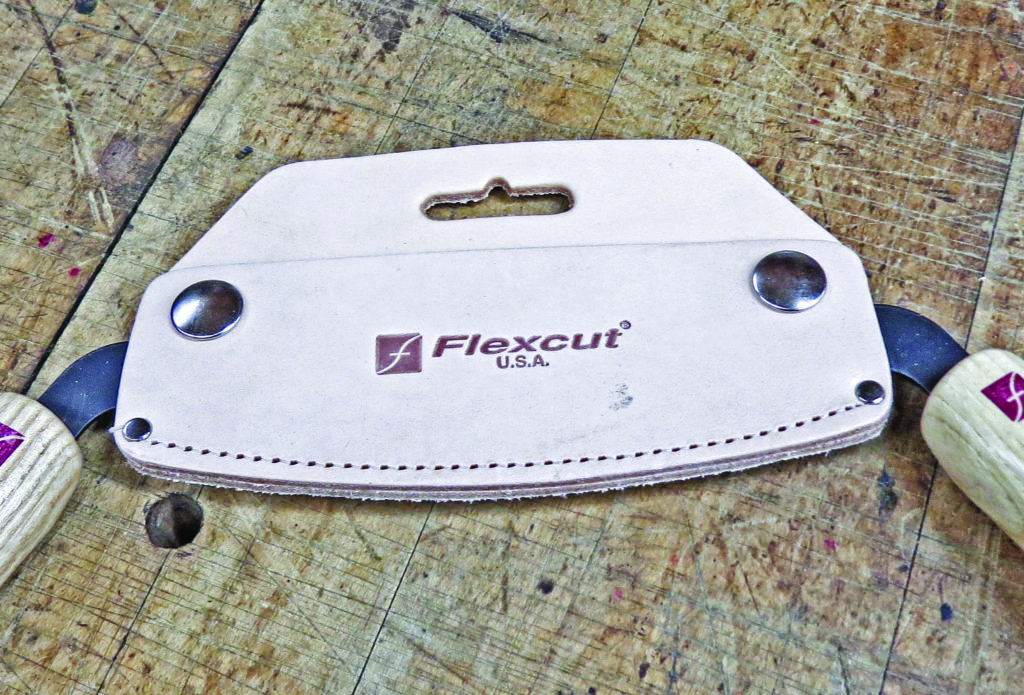
The Flexcut comes with a well-made sheath. It is always nice to have something protecting the edge—if not for safety’s sake, for that of preserving the edge from accidental harm.
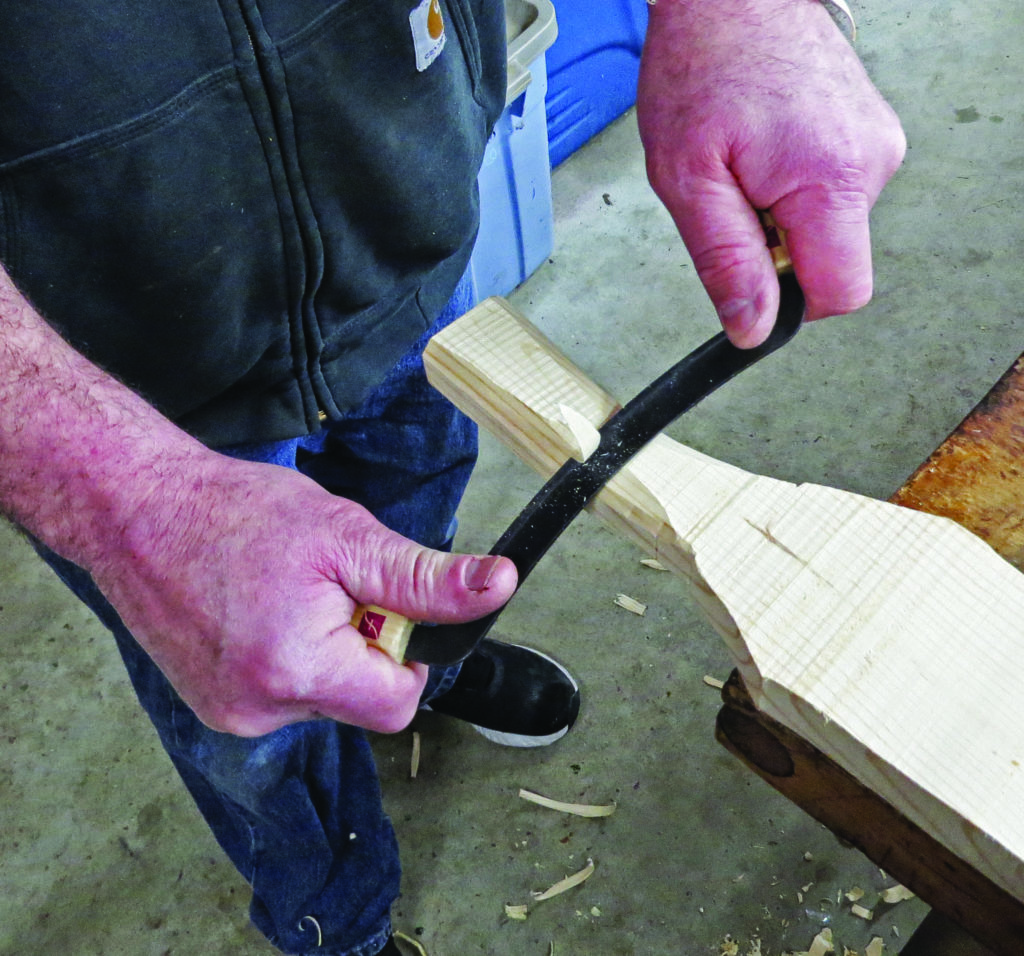
Right out of the box, this thing is wicked sharp. It comes in a leather case with a peg-hole loop. It has a curved blade, which gives it a natural tendency to skew in a leading edge cut. If you haul the spine up a bit on your cuts, it will make more of a scraping action for a hollowing effect. It is a thin blade and not suited for hogging off large amounts of wood at one time. It is great for detailed jobs like the subtle contours you might find in a canoe yoke.
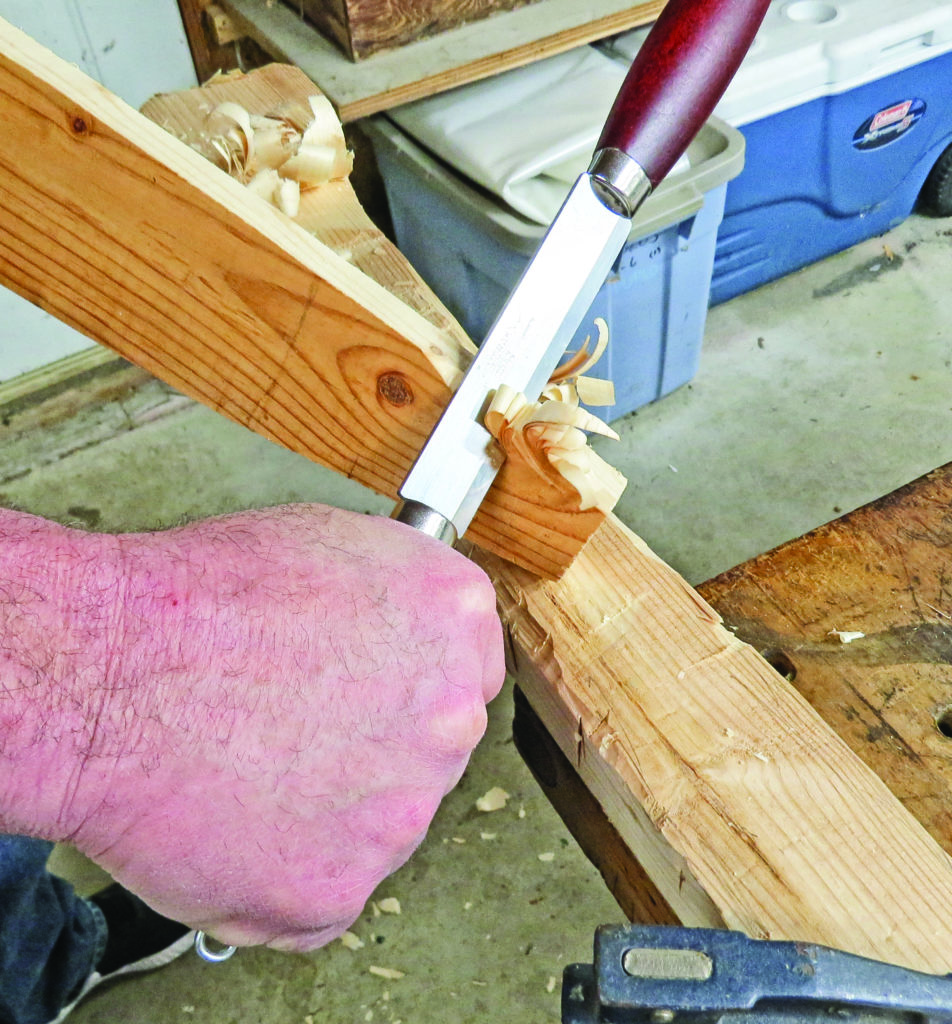
Using the Flexcut Drawknife, the author shapes the handle for a flat-board atlatl. The efficiency you gain using a drawknife is hard to beat for control and energy.
Such a small drawknife is a good tool not only to create art but to make utilitarian items. Given its Western-style handles, it doesn’t make a streamlined package for carrying in a pack like the Mora does, but it still has very little bulk and weight. The arched blade can be sharpened with a flat stone, though I find sharpening it with a small handheld stone and using a dynamic sharpening method easier. The Flexcut Drawknife is the kind of tool that suits the creative mind.
HOB-KNOBBER
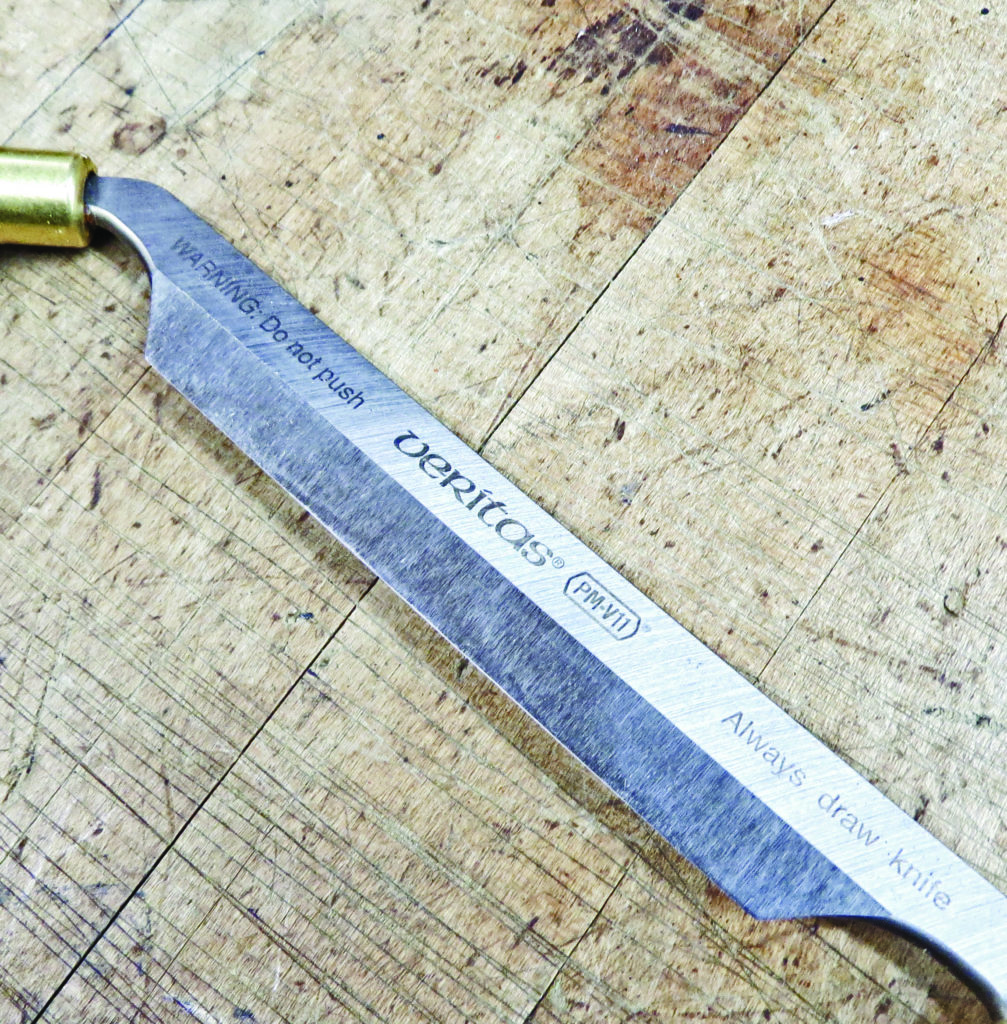
The Veritas tool company manufactures the last of the test drawknives in Ottawa, Canada. Sporting a 4-inch blade, it is a small carving-style model. Steel is PMV-11, a stainless with a Rockwell hardness of 61-63 HRC. Veritas made the switch from traditional tool steels like O1 and A2 to up cutting performance and edge retention. A case for the knife sells separately.
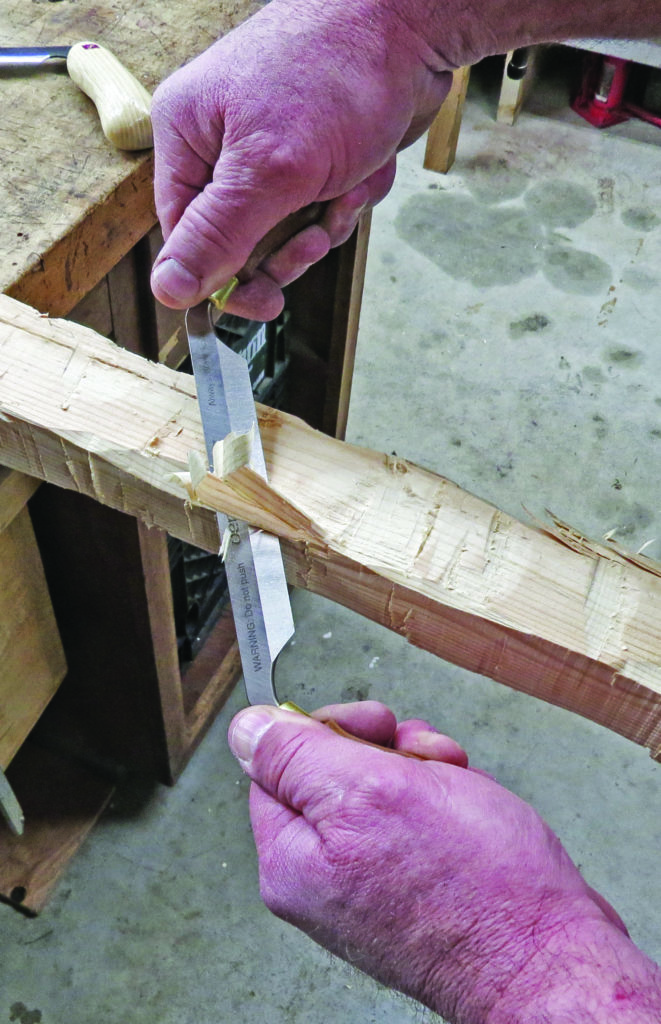
The Veritas Drawknife’s 20-degree angle cuts aggressively and you have complete control with the well-shaped handles. Here the knife is skewed compared to its cutting path. Skewing the knife provides a leading edge to the cut, reducing resistance
The company’s technical information says the bevel is ground at 20 degrees. To sharpen the Veritas, be sure the sharpener is of a flat design. Given the knife’s size, you can sharpen it in either a dynamic or a static style*. To cover/sharpen the entire bevel, you will need a flat surface. There is no micro bevel on the Veritas, though that’s not to say you can’t apply one. However, if you want to keep it original, you will need to cover the bevel.
The angling of the handles is a traditional Western style, though they have more of an elongated knob shape to them. The shape helps reduce fatigue. Because of the handle angling the Veritas does not offer as compact of a carry as the Mora, but the .125-inch-thick blade makes it a bit sturdier user than the
Flexcut. Handle material is torrefied maple. Due to the kilning process, the material has a greater stability to it without the use of chemicals. At the top of each handle is a brass ferrule.
The author stated he has been known to push a drawknife to make a quick cut. The Veritas Drawknife clearly warns not to do that. At a 20-degree bevel, you take a chance of damaging the edge if you were to catch and roll it.
It is a good-looking product and out of the box is ready to work. It is the most expensive of the review knives, yet is not so much more that you wind up scratching your head. A drawknife like this can be put to work doing a number of things limited only by your imagination. Veritas promotes it more as a carving tool and actually shows it making a decoy in the company’s marketing media.
Staying within the bounds of this tool, I can’t think why you couldn’t get chores done or entertain yourself by making pieces of art with it. Keeping you busy in the woods and not necessarily only during a survival situation promotes better mental health. It is a great little package and a good tool—I just think the company could include the sheath. When you hold the knife you see where the extra cost is as the precision work shows in the fit and finish.
EXPLORING OPTIONS
Once you leave the big city behind, in order to thrive you must know how to make what you need. Many of the tools you carry will depend on what you plan on doing. If you’re building up a getaway spot, you might need to build items for the camp. When planning to build a more substantial base, you will need more tools. Again, it all depends on what you plan on doing. A good drawknife can greatly increase your cutting and carving options—not to mention that being able to use two hands greatly reduces fatigue. If you haven’t tried a drawknife yet, I highly recommend doing so.
*Static sharpening is when the stone is stationary, and dynamic is when the stone is moving.
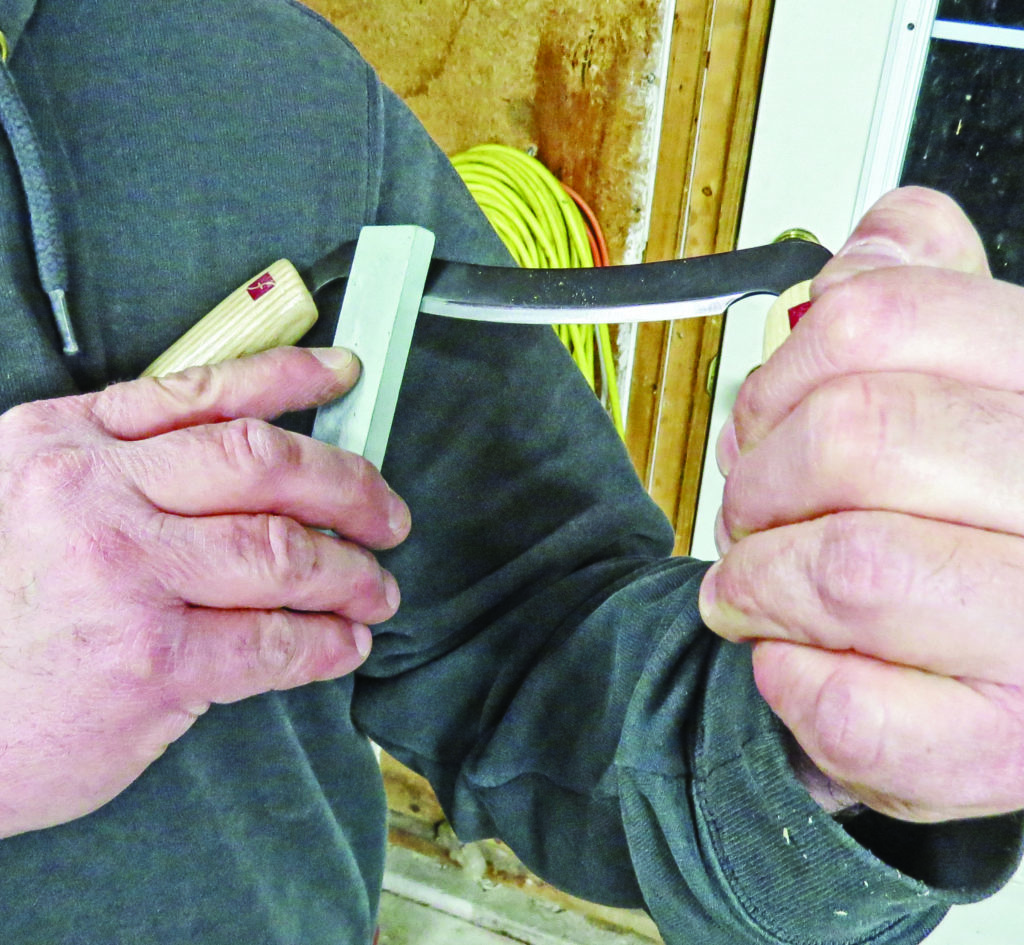
A trick to sharpening drawknives both in the shop and field is to brace one handle against your armpit or chest. After bracing the knife, simply use a dynamic sharpening method with a small stone running parallel to the edge.
Jay Hendrickson and the husband-and-wife team of Billy and Beverly Mace Imel are the 2021 inductees into the BLADE Magazine Cutlery Hall Of Fame®.
Nominated by, and then elected in a vote of, sitting members of the Cutlery Hall Of Fame, the three comprise the 63rd, 64th and 65th members of the world’s only shrine recognizing all segments of the knife industry.
The Imels are the first-ever husband-and-wife team—or any pair, for that matter—to join the Hall simultaneously. A.G. and Goldie Russell are Hall-Of-Fame members but were inducted in separate years.
Along with the 2020 inductees, Joe Keeslar and Jim Sornberger, the 2021 inductees will be formally enshrined the Saturday of the BLADE Show, June 5, in Atlanta. Joe and Jim could not be formally enshrined last year because the BLADE Show was canceled due to the pandemic.
Jay Hendrickson
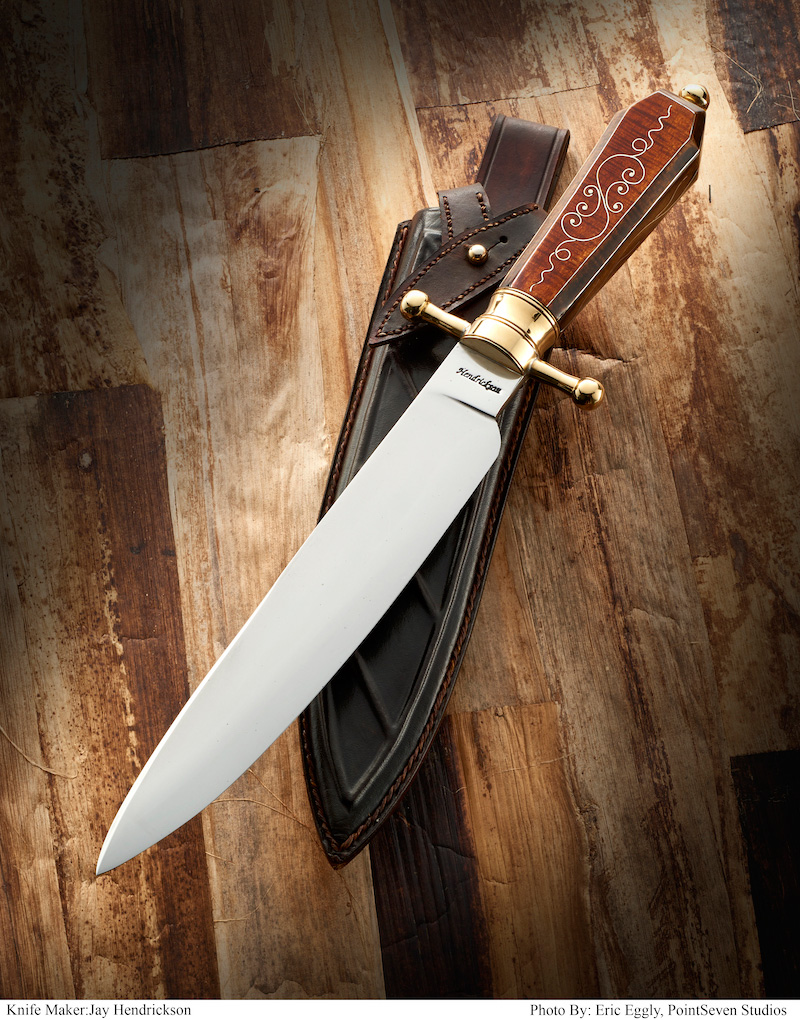
Impeccable fixed blades in the Moran style with matching sheaths are a Jay Hendrickson staple. (Eric Eggly/PointSeven image)Jay Hendrickson
Jay is an American Bladesmith Society (ABS) master smith who succeeded Cutlery Hall-Of-Fame member Bill Moran as ABS president in 1991—as a nominator noted, “a trying task to be sure, and Jay succeeded Bill very well.” The nominator went on to write Jay is a good bladesmithing teacher who has taught at many venues in the USA and France, and also served as director of the Moran Foundation for 10 years, helping to preserve Bill’s legacy.
Early on, Jay and Bill conducted a forging demonstration that was one of the longest running of all BLADE Show demos. The first installment was in 1987 on the sidewalk outside the show’s former Holiday Inn & Convention Center site in Knoxville, Tennessee, and continued at each succeeding BLADE Show in Knoxville and then at the Cobb Galleria in Atlanta until Bill passed away in 2006. Not only was it one of the BLADE Show’s longest running demos, it was also one of the most popular.
In 1995, Jay was presented with the ABS’s highest honor, the Don Hastings Award. The annual honor goes to an individual “who has performed outstanding service on behalf of the forged blade in the tradition of Don Hastings,” one of the founders of the ABS. In 2004, Jay won the William Wales Scagel Award, presented by the ABS to a bladesmith “for longtime service to promote the forged blade.” Another Cutlery Hall Of Famer, Scagel is considered the grandfather of custom knifemaking.
Jay was voted into the ABS Hall Of Fame in 2006 and a year later wrote the how-to guide, Introduction to Bladesmithing, with tips on how to forge various blade styles “exhibiting balance and aesthetic appeal,” how to understand the basic metallurgy of popular blade steels and more. Concluded the nominator, “Jay is a fine bladesmith, a fine teacher helping to preserve the art of bladesmithing, and a splendid ambassador of knives and knifemakers.”
Last but certainly not least, Jay forges magnificent fixed blades in the classic Moran style, including expertly ground bowies, camp knives, fighters, hunters and more, often in curly maple handles with intricate silver wire inlay, all accompanied by superb leather sheaths.
Beverly and Billy Mace Imel
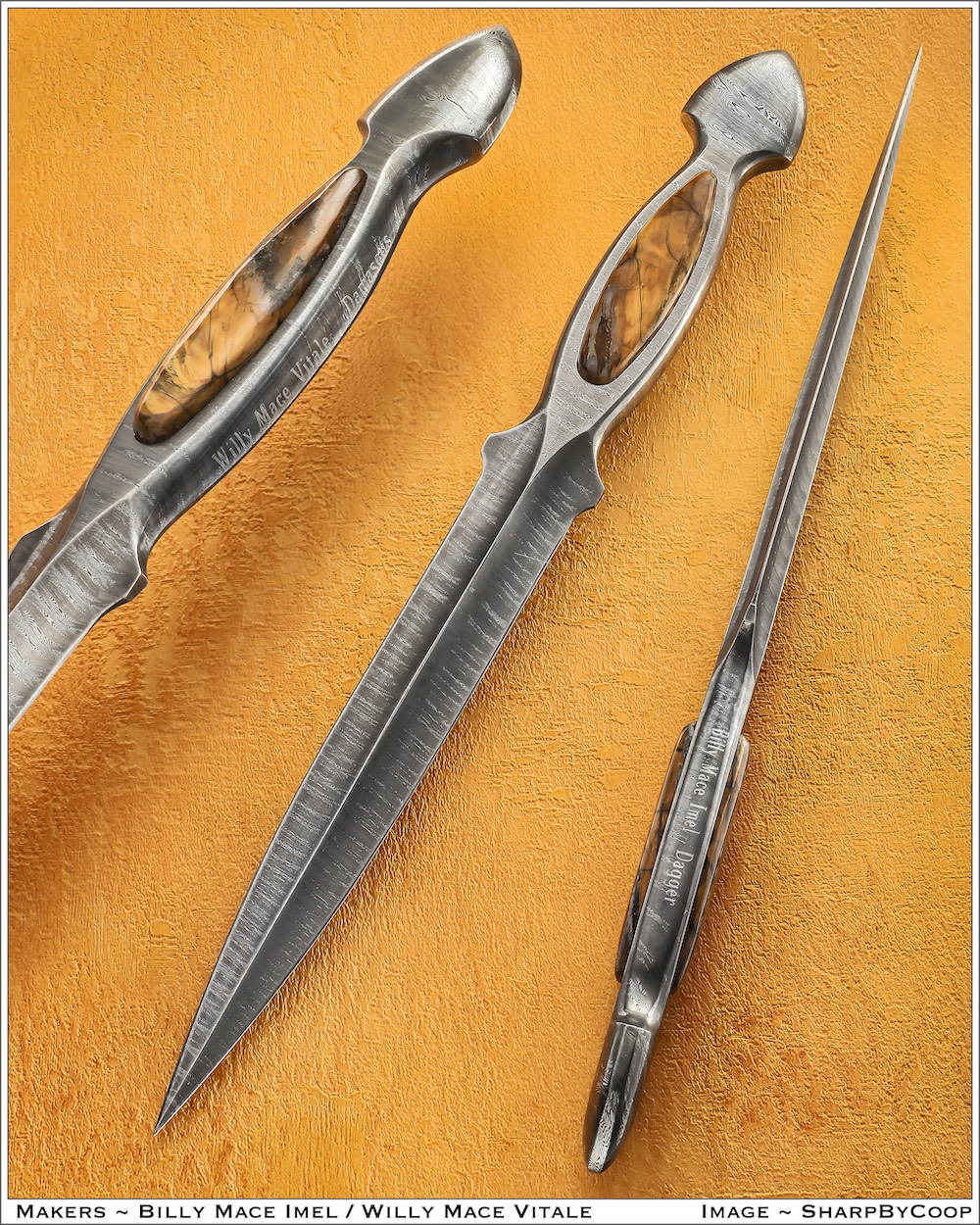
An example of Billy’s premier dagger work is this collaboration with Mace Vitale. (SharpByCoop image)Beverly and Billy Mace Imel
Beverly and Billy Mace are the first pair of Cutlery Hall-Of-Famers ever to be inducted simultaneously. They also join A.G. and Goldie Russell as the only husband-and-wife team in the Hall.
Billy makes fantastic fixed blades yet is perhaps best known for his sleek daggers with stainless steel blades in clean, crisp grinds and slender handles in a variety of gorgeous materials. To augment that knifemaking talent is his many hours of service to The Knifemakers’ Guild.
“What can you say about those who have worked so many hours and years to help so many?” wrote a nominator. “Billy was the secretary of the Guild during a huge building phase of the longtime maker association. Every year many new applicants had to be processed. Those of us who sat on the Guild’s board of directors during many of those years can testify to the energy and effort Billy put forth. The heavy load of accounting, stopping his own work to help discuss an issue—and those issues were many—and still be able to arrive at the Guild Show venues two days early with his own knives and to help set up each show’s exhibition room was a remarkable achievement. I think Billy is a gold standard for the Cutlery Hall Of Fame in terms of working hard for others.”
Beverly, meanwhile, served with distinction for many years on the Guild board as the organization’s secretary-treasurer.
“You can’t mention Billy’s name without mentioning Beverly’s,” the nominator continued. “The Guild board of directors was a large wheel, with every director a spoke in that wheel, but it was Beverly who kept the wheel’s hub lubricated and in motion. She maintained the Guild’s records in perfect order, and if there was a question about something from the past, she either looked it up or could recall it from memory—often smack dab in the middle of a Guild business meeting.”
Beverly’s familiarity with and recollection of Guild bylaws was legendary. Indeed, anytime a Guild president was asked a question he didn’t know the answer to during a Guild business meeting, he would often turn from the microphone and say, “Beverly, do you know?” Invariably she did and more than a few members in attendance would smile and wink at each other as a result.
The nominator went on to state that he wanted the Cutlery Hall of Fame to step out of the mold and do something different in considering Billy and Beverly for enshrinement. “It would be honorable for us to induct both of the Imels as one,” he wrote. Enough sitting Hall Of Famers agreed and the Imels are now members of their august group.
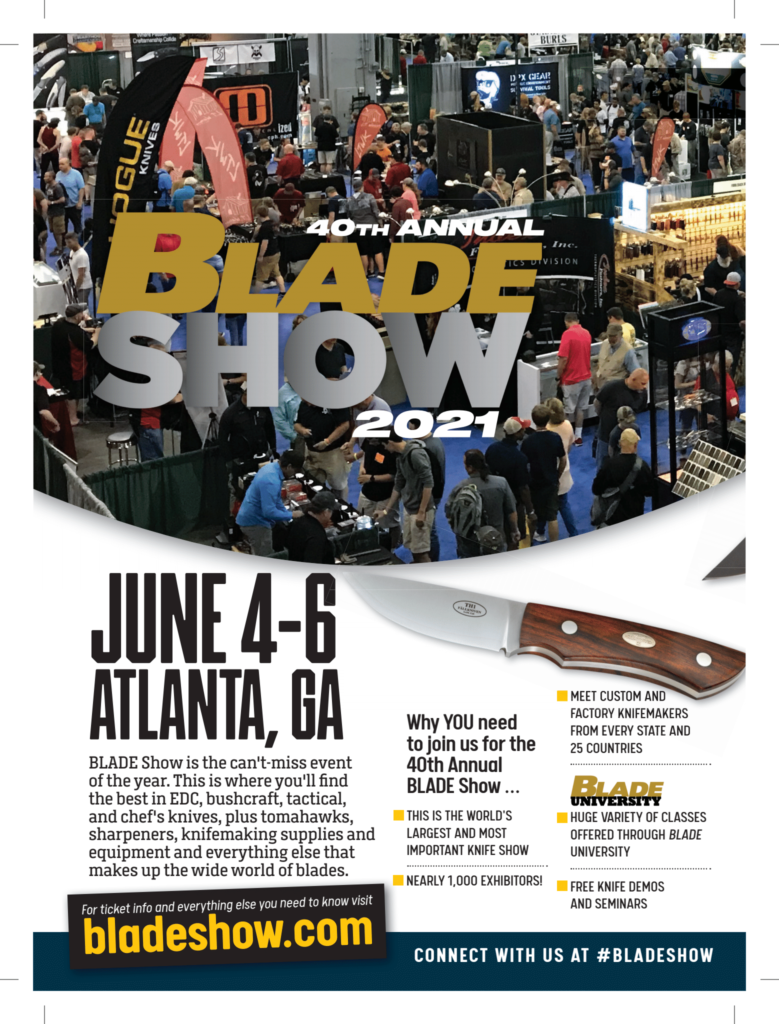
BLADE Show is the can’t-miss event of the year. This is where you’ll find the best in EDC, bushcraft, tactical, and chef’s knives, plus tomahawks, sharpeners, knifemaking supplies and equipment and everything else that makes up the wide world of blades. Learn more and purchase tickets at BladeShow.com.


 Smoky Mountain Knife Works
 WE Knife
 Work Sharp
 Big Daddy Unlimited
 Wicked Edge
 W.R. Case & Sons Cutlery
 Hogue Knives
 Kizer Cutlery
 Microtech Knives