Editor’s note: “Micarta” has become the Kleenex of knife handles. It’s used so generically that it’s easy to lose sight of the fact that the word refers to something specific.
That’s why BLADE is bringing you this quick rundown of Micarta® from Kevin Brainard, a business development manager and 45-year veteran of Norplex, the company that owns Micarta® (the real deal). You may have caught the company at BLADE Show, where it runs the UltreX booth.
The goal of this piece is for knifemakers and knife collectors to become more aware of what is and isn’t actually Micarta®.
Hint: If it didn’t come from Norplex, it’s not genuine Micarta®!
by Kevin Brainard
1 – Micarta® is a Registered Trademark of Norplex/Micarta
We own several registrations for our Micarta® mark around the world, including U.S. Trademark Registration Nos. 0096374 (issued in 1914), 0320374 (issued in 1934), and 0324365 (issued in 1935), covering our high-quality industrial laminates.
These laminates have been offered by Norplex-Micarta and our predecessors since at least as early as 1912. As a result of the significant sales, promotion, and widespread use of Micarta® brand laminates, our mark is widely recognized around the world as a designation of the source of our products, which are used in a variety of applications ranging from electrical insulation to gun and knife handles.
In addition to our common law rights in the Micarta® mark, our incontestable federal trademark registrations constitute conclusive evidence of the validity of the mark, the registration thereof, and of our ownership and exclusive right to use Micarta® in connection with these products.
2 – Micarta® is Made in the USA
Available in several different colors, combinations, and surface treatments, UltreX™
paper and cotton phenolic materials use the original production methods of Westinghouse,
updated with today’s process and environmental controls.
And unlike some of the other “micarta” available in the market, UltreX™ Micarta® is produced in the USA in Postville, Iowa.
3 – G-10 is Not Micarta®
The Spyderco Persistence sports G-10 handles.
Micarta® is made with a cloth or paper substrate and coated with phenolic or melamine resin. G-10 is woven fiberglass and coated with epoxy resin.
The processes to make both materials are very similar in the fact that both are consolidated under heat and pressure to make the final laminate. There is a chemical reaction that is called polymerization that bonds the layers together into a high-pressure thermoset laminate.
According to the trademarks, G-10 is not Micarta®.
4 – “Micarta” Refers to a Specific Product
Like so many other trade names, Micarta® name is used like Kleenex is for facial tissue. Instead of calling it a “thermoset laminate” it is easier to call it Micarta®. This is true in the knife scales, handles and gun grip markets. We have similar issues with the Micarta® name in our other markets.
5 – Micarta® Goes Back to 1912
It was originally designed to be used as electrical insulation back in 1912 by George Westinghouse using a phenolic resin developed by Leo Baekeland called Bakelite.
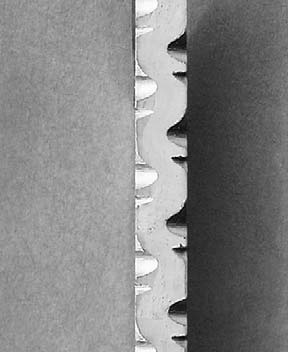
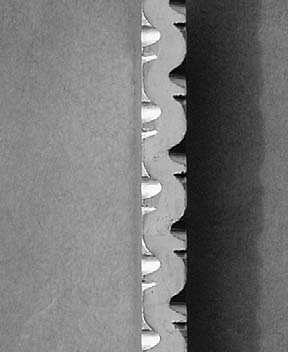
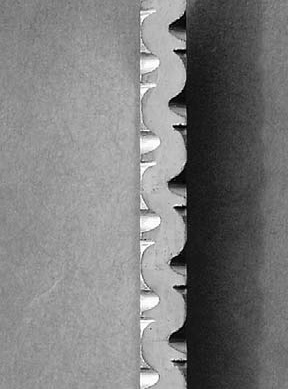
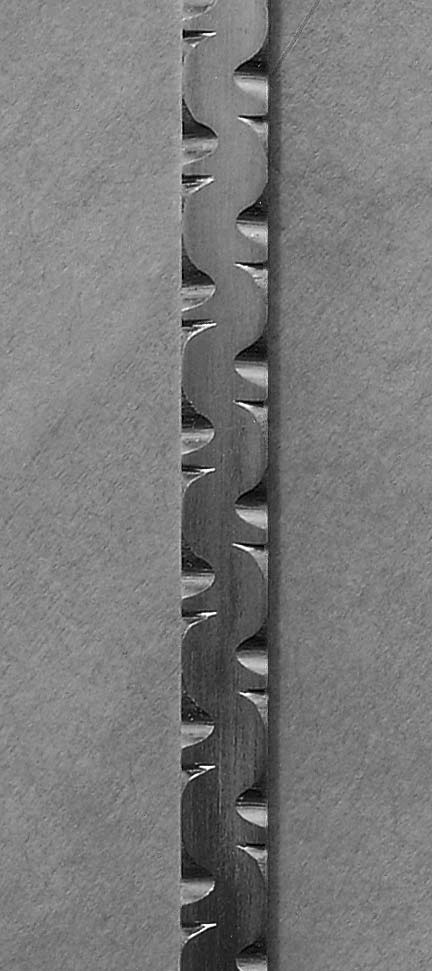
Vine filework is my favorite style of filework. If you break it down into baby steps, it is quite easy to do.
The materials you will need are a Sharpie® marker, a vise, and a 5/32-inch round file and a small triangle file. You can use a bigger round file on thick blade material or a smaller round file when engraving liners or thin blades.
The triangle file is ground safe (sanded) on two sides to produce one corner that is sharper than the other two corners. This provides a left and right safe side for opening up your vine file cuts, and for giving them sharp points as well.
STEP 1
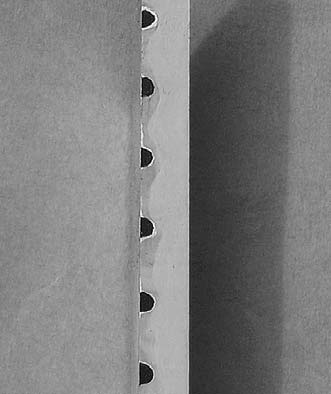
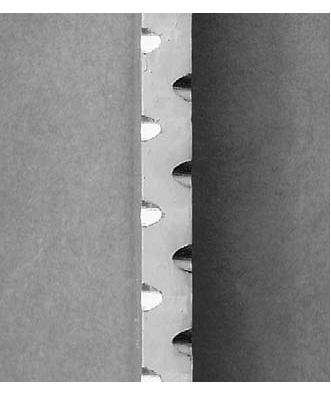
Using your Sharpie® marker, lay out half-round marks approximately 5/16 inch apart down one side of the blade spine. (Though not shown here, be sure to secure the blade in a vise.) (Hayes photo)
Step 2
File the marked side with the round file at a 45-degree angle. File into the spine, stopping just short of the middle of the blade. (Hayes photo)
Step 3
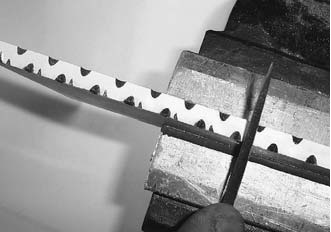
Using the marker, put marks down the other side of the blade spine in-between the notches. (Hayes photo)
Step 4
File in another row of half-round notches on the “new” side. Remember to keep the file at approximately a 45-degree angle and stop filing just short of the center of the blade. (Hayes photo)
Step 5
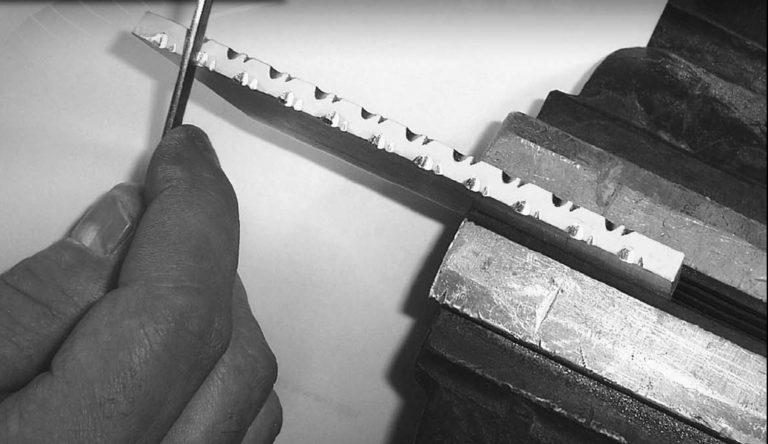
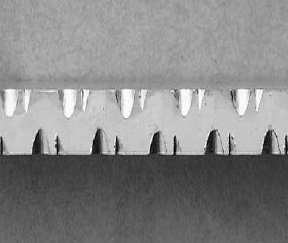
Next, take your triangle file and place it beside one of the notches. I leave about a sixteenth of an inch between the half-round notch and the triangle I am going to cut.
Before you cut, make sure you have a safe (sanded) side of your file closest to the notch you are cutting beside. Tilt the file so the cut closest to the notch is perpendicular (90 degrees to the blade). This gives you a straight line into your cut and an angle coming back out of the cut.
In other words, you want this “V” notch to be straight on one side and angled on the other. (Hayes photo)
Step 6
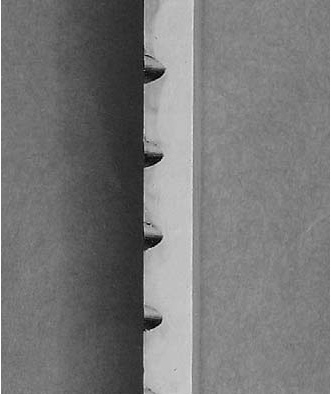
Turn the blade around in the vise and cut “V” notches in front of the other half-round notches. (Hayes photo)
Step 7
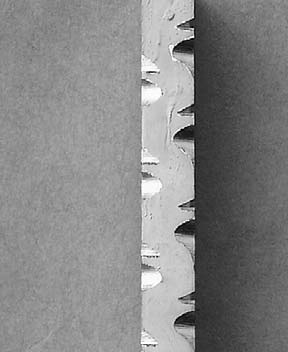
Take the triangle file and file the corner of each half-round notch, producing a gentle curve opening up one side of the half-round notch. (Hayes photo)
Step 8
Open up the other sides of the half-round notches. In both cases, they are in front of the “V” notches. This is how I remember so I do not get mixed up. (Hayes photo)
Step 9
Now let’s move on to the “V” notches. Open up one side of the blade spine first. File the “V” notch to produce an even arc to the edge of the blade spine. If you do not twist the file in your hand as you file, you will get a flat spot. GO SLOW AND EASY. (Hayes photo)
Step 10
Turn the blade around and open up the “V” notches on the other side of the spine. Remember the “V” notch is opened on one side only, behind the halfround notch. The safe 90-degree side is not touched. (Hayes photo)
Step 11
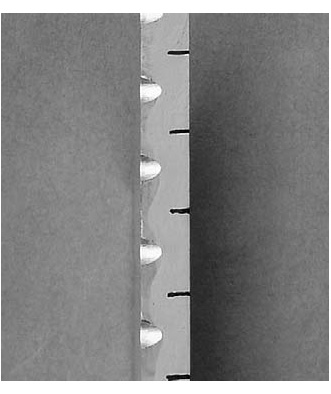
Take the sharp safe-sided angle of the triangle file and file into each point of the “V” notch. File it to a sharp, crisp point. (Hayes photo)
Step 12 (Final)
For the 12th and final step, go over the entire fileworked area with fine sandpaper. Increase 3-inch strips of 320-grit sandpaper and put the paper over the round file and triangle file to back up the paper. Do not push too hard and tilt the wrap away from the safe sides so you do not round safe (square) the corners of the filework.
Despite or perhaps because of its requirement for tight tolerances, the lockback has a substantial lineage.
According to Bill Claussen, co-author of Sheffield Exhibition Knives, the lockback has been around in various forms since 15th-century Spain. Other European cutlers—including the French, Italians and English—have produced lockback variants during the past 500 years or so.
The Buck 110: A Gamechanger
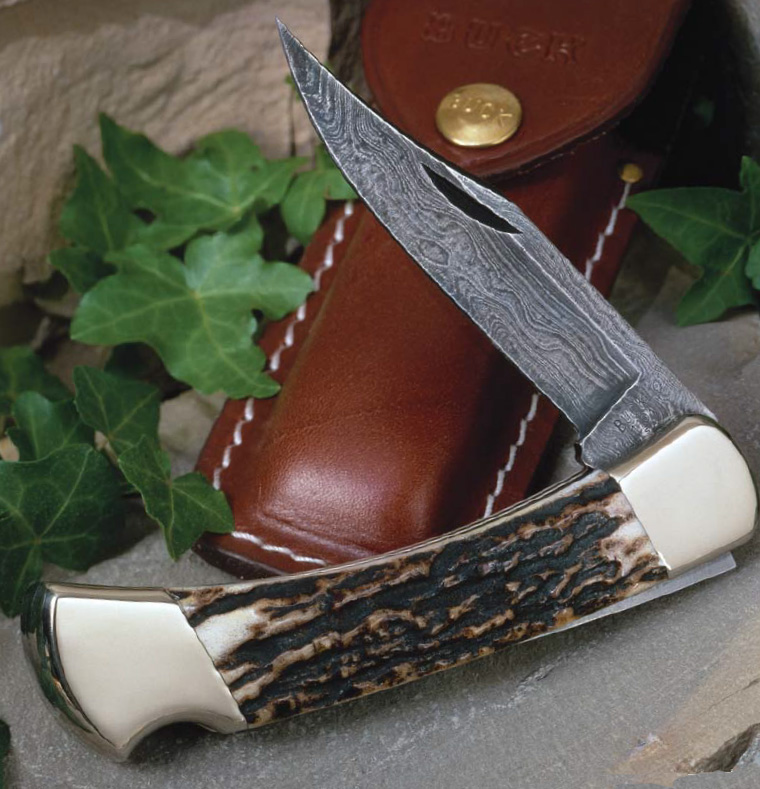
In the modern era, Claussen cites the Buck 110, which hit the market in 1964, as an industry icon.
“It changed the face of modern pocketknives,” he commented. “Although lockbacks had been introduced to the U.S. for more than 200 years, they were not made affordable and convenient in mass production until Al Buck introduced his knife. This knife was quickly adopted by sportsmen, tradesmen, truckers and other workmen as an ideal, all-around, heavy-duty work knife. Vintage 110s are hard to find today, and one in mint condition will cost a small fortune if you can find one.”
Production Challenges
Chairman of the board at Buck Knives, Cutlery Hall-Of-Famer Chuck Buck recognizes the pivotal role the 110 has played in modern lockback development, and acknowledges the challenges that surrounded the original premise of a practical production lockback.
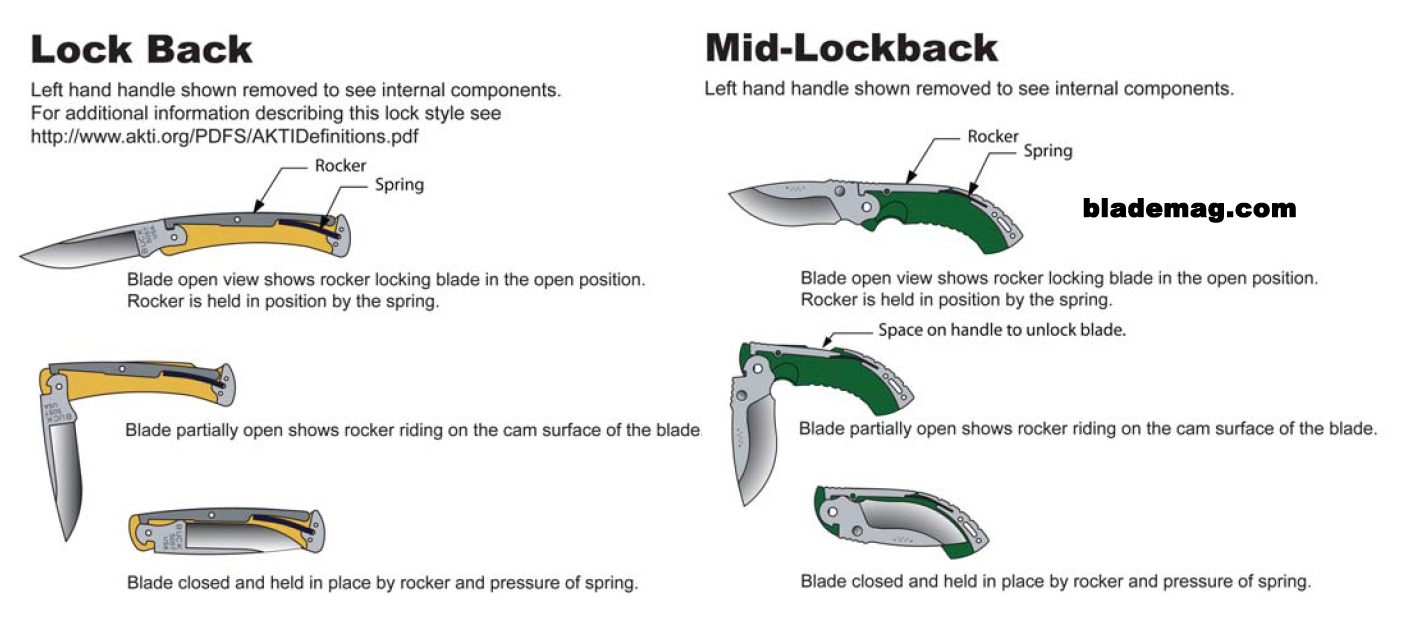
“The lockback actually is a bar that goes across the back of the blade with the spring under it, and when you push down on the bar it rocks on a stainless rivet,” he said. “So, that was always hard to get exact because you did not want it to be loose and it needed to fit perfectly.
“You need to do fine blanking of the blades to achieve that and for years components had been machined, but with fine blanking you can get that done. We worked with the design for quite a few months, and it was all new to us. That was in 1963. The first knives on the market totaled about 250 in 1964, and then in 1965 we ended up making about 10,000 of them. It just grew from there. The 110 continues to be one of our most popular knives, and we are producing them now at a rate of over 1,000 per day. We have a whole crew that just makes the 110 folding hunter. To Buck, it has been something that has sold every year, and it just keeps getting better.”
Over the years, there have been a few tweaks to the lockback design of the Buck 110. For example, during the 1970s it was discovered users were placing a great deal of pressure on the blade, and the brass rivet in the mechanism itself was shearing. The brass rivet was replaced with a stainless steel component, and the 110 continues to sell well around the world.
From large retailers to mom-and-pop hardware stores, from Main Street to Moscow, the Buck 110 is a knife user’s mainstay.
It’s Human Nature
Claussen asserts another aspect of the popularity of folding knives and of lockbacks in particular has to do with human nature.
“It’s their mystique,” he related. “People seem to have a fascination for complicated things, plain and simple. Th is is generally true in life and very specifically in the collecting field. Watches, clocks and other collectibles are favored because of their complication. The general rule, with all things being equal, is that the more complications, the more desirability, hence greater value. To have a locking feature with a knife definitely adds mystique, aura and increased value.”
“This has got to be through the old way of human contact,” Bob Loveless knife specialist John Denton observed, “sort of like the lunchroom in school. You hang out, listen, see what is moving, what dealers are buying and, of course, now with the ‘inter-web,’ we have so much more information within seconds, while in the ’70s or ’80s we had to wait for BLADE® Magazine or the gun magazines to run stories on Loveless.
“Shows are still important to attend, but nowhere like they were years ago. Face to face is still part of the knife world.”
2) Maker Charisma
A lot depends on whether the maker has the kind of personality that appeals to the knife enthusiast. At BladeGallery, Daniel O’Malley specializes in one-of-a-kind custom knives. The answer includes multiple factors.
“There are a lot of things that go into making a knifemaker’s knives ‘hot,’” he reasoned. “Part of it is the personality of the maker. When a collector meets a maker for the first time, the collector often has a picture in his head of what the maker will be like. If the maker falls short [of the collector’s expectations], it can be quite disillusioning.”
3) Customer Service
“[The maker] being willing to repair knives when there is a problem is also very important,” O’Malley continued. “It can easily make the difference in a collector continuing to purchase a maker’s work. It can even be the difference in whether a person continues to collect the maker’s knives over time.
“After all, if a collector has spent a large sum of money on their collection, it can be very nerve wracking to find that it’s hard to get a damaged knife repaired. Similarly, it can be comforting if a problem can be relatively painlessly solved.”
4) Do Your Homework
Les Robertson of Robertson’s Custom Cutlery offers custom fixed blade and folding knives, including tacticals and presentation pieces, as well as some exclusives. His take on the delicate topic of a maker’s reliability and the quality of the maker’s work is sage advice for knife enthusiasts in any price range or level of experience.
“I give my client the very best information I have at the time,” Robertson asserted. “This includes issues with a maker or the quality of their work. Often, a maker’s skill level, quality, customer service, and/or delivery issues are overlooked because the knife can be sold immediately for a profit.
“Given the prices of many of the custom knives today, I highly recommend that collectors do their homework before purchasing a knife.
“I realize this takes away from the thrill of instant gratification and removes some of the fun out of the hobby. Long term, though, you will feel great about every knife you have bought, and your wallet will thank you.”
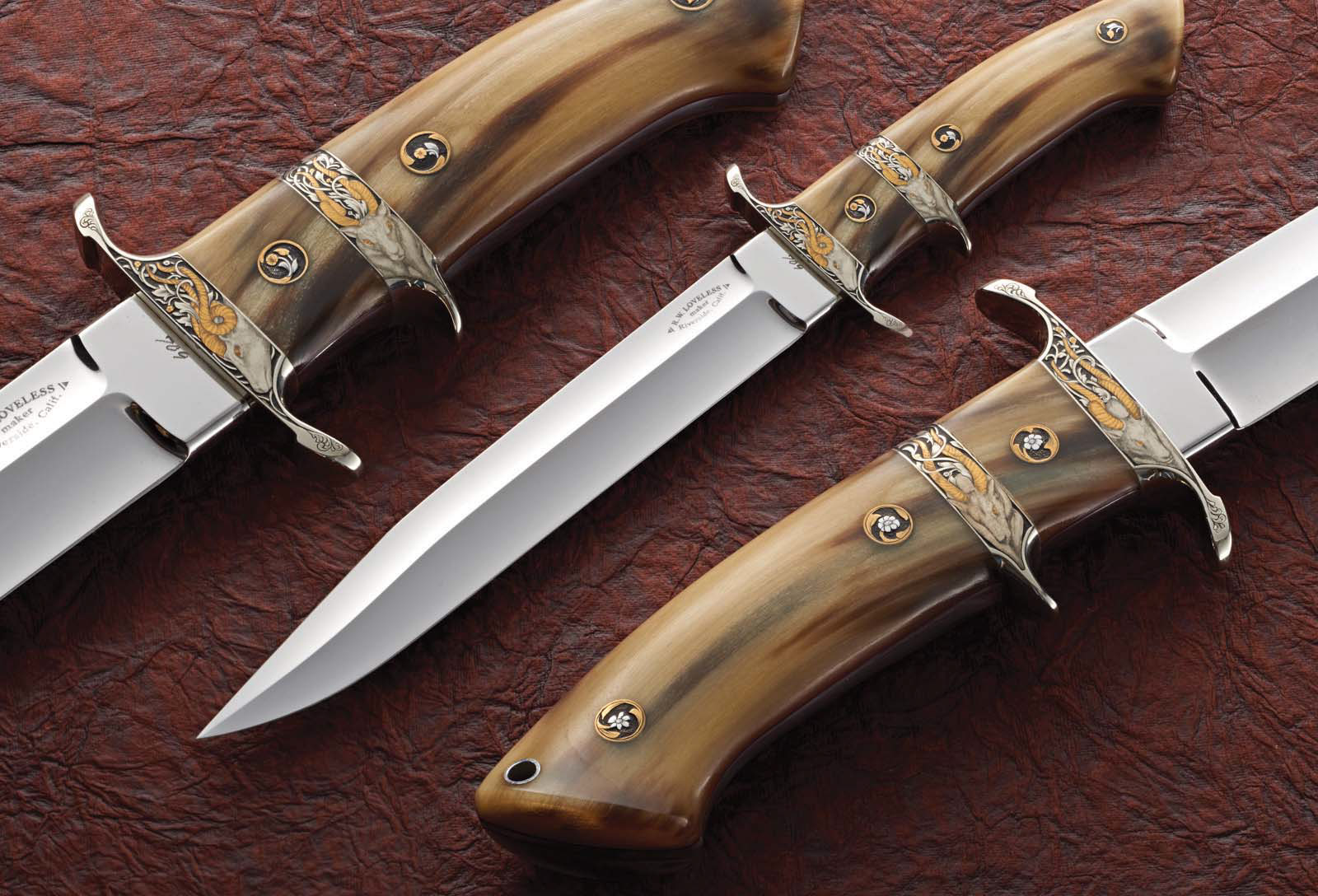
Purveyor John Denton said he turned down $60,000 at the 2014 BLADE Show for this Big Bear in sheep horn and Dan Wilkerson engraving. (PointSeven knife image)
5) Set An Allowance
Everyone, it seems, has spending limits. The role of the dealer often involves assisting clients in determining how much to spend. Recognition of the amount of disposable income available keeps a buyer/collector in the game.
6) Collect With A Purpose
Denton advises customers to acquire some knowledge on prices and to assess their real purpose for buying custom knives in the first place.
“First of all, you want collectors to be educated,” he commented, “and not to be buying just to make money. That is the most risky way to approach collecting. But then if they buy what they like and in three years can’t get 10 cents on the dollar, it will cut their knife buying down and drive them out of the market.”
Dealer Dave Ellis of Exquisiteknives.com notes that the investment perspective differs greatly from that of the collector who wants to enjoy, build and retain knives for years to come.
“When I chat with newbies,” he remarked, “a lot of them get into knives from an investment standpoint. They have read in the Wall Street Journal that investing in knives is a good idea, or heard about a knife that was purchased for $800 and then sold for $8,000. I tell them to buy what they like first and to worry about resale later because if it doesn’t pan out, then they won’t have to hold onto something they don’t like.”
Taking a measured approach is key to successful, price-sensitive acquisitions.
“I tell the collector to pace themselves,” Denton said. “Get into a knife that will be easy to turn if you get tired of it down the road. I’ve had several people ask me to build them a $300,000 collection, and I tell them I don’t do that because they will get mad if they don’t make 14 percent growth per year—and they don’t know why they’re buying the knife.
“The true collector has studied the knives and the market, and he will realize what knives are worth and what he can resell them for.”
Those who are new to the custom knife market can tap a great resource in a top dealer. Advice on the market, prevailing prices and hot makers is only part of the relationship. High-end folders by BLADE Magazine Cutlery Hall-Of-Fame® member Ron Lake, Warren Osborne and Jim Martin, along with Loveless fixed blades, are among Ellis’s offerings.
When Dave talks with a new buyer/collector, he asks a few basic questions.
“There are more heavy hitters getting in the game with lots of money,” he said, “but that doesn’t mean they are buying the right things. What have their interests been up to now? Did they grow up with knives? Do they carry and use a knife? What is their reason for buying now? Use it? Collect it? Give it to a nephew for college graduation? I don’t want to offer a $7,000 Loveless hunter when a $150 skinner by any smith will do.”
7) Attend Shows That Fit
Though knife shows may be one of many ways to gain information and see what is out there, the individual contact with dealers, makers and other knife enthusiasts is invaluable. Attending shows that mean the most to the individual buyer’s needs and wants helps in the education process and in finding the people and knives that enhance the experience.
Robertson attends the BLADE Show due directly to its diversity of custom knives for sale. He says that the Arkansas Custom Knife Show is also one of the premier forged blade shows and features apprentice, journeyman and master smiths in the American Bladesmith Society.
“The New York Custom Knife Show offers a variety of knives from very well-known custom knifemakers,” Robertson added. “This show in recent years has had more of a tactical knife flavor. The USN Show offers the widest variety of tactical folders you will see at any show in the world.”
These are just a few of Robertson’s picks. Other shows are out there, and many of them are quite beneficial to knife enthusiasts looking for certain styles of knives and/or makers.
The short answer: A handle design favored by custom knifemakers that resembles a bird’s head with a short beak at the butt of the handle.
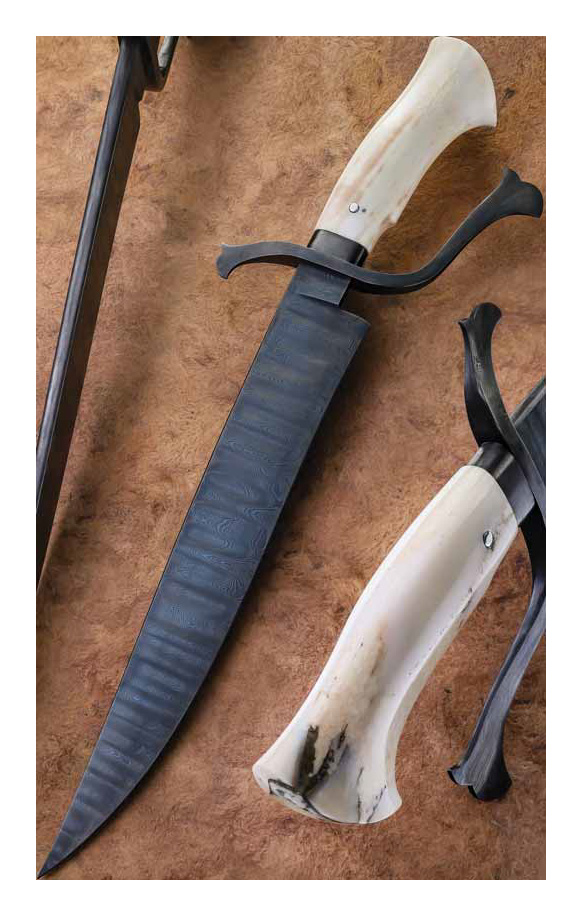
Given the practicality and curves of the bird’s-beak handle, it is small wonder that it is quite the popular grip among today’s knifemakers. In fact, the design resembling a bird’s head with a short beak at the butt of the handle has appeared in many cultures over many centuries.
Tad Lynch indicated that crafting a good bird’s-beak design requires practice and the courage to push things. His Irish Traveler Fighter features a handle of koa, a 9-inch blade of W2 tool steel with hamon and is 14 inches overall. His list price for a similar knife starts at $1,100. (SharpByCoop knife image)
“You see it in different variations on Persian daggers and swords,” said North Carolina knifemaker Ken Hall. “Also, some kukris have the ‘hook’ in the handle. In American knives you see it in some of the Buck knife designs.”
When the ABS journeyman smith with 11 years of experience is not forging in the Smoky Mountains, he raises honeybees, hikes and teaches others the craft. He made a bowie in January in preparation for an ABS master smith test that had to be pushed back because of a bicycle accident.
While many makers make a bird’s-beak handle with a dense hardwood, Paul DiStefano took a risk on a material that has a reputation of being temperamental: ancient walrus ivory. Blade length and material: 12 inches and 500 layers of 1095 carbon and 15N20 nickel alloy steels. His list price for a similar knife: $1,800. (SharpByCoop knife image)
He picked the bird’s-beak handle design because it pairs well with large knives, especially those with recurve or clip-point blades. A big block of wood large enough to develop the butt’s shape is one of the best material sizes for the design, Hall explained.
“The bird’s beak provides a more controlled grip for the hand,” he noted. “The contour snugs around the little finger, keeping the knife from slipping forward while in use.”
The result, combined with a balanced knife, is a tool that feels like an extension of the hand.
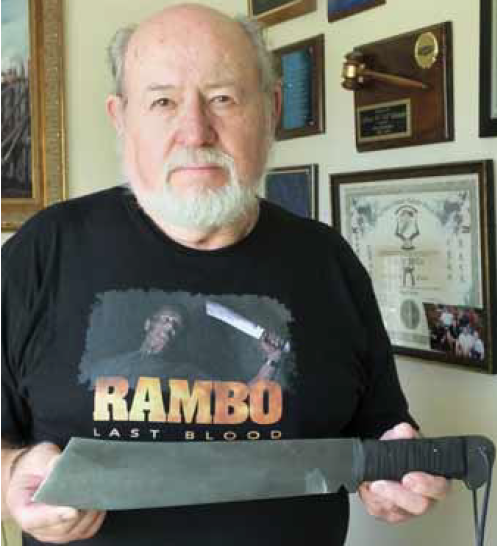
With the Hibben Machete in Rambo’s latest sequel, Last Blood, BLADE Magazine Cutlery Hall-Of-Fame® member Gil Hibben now holds two records: 1) having knives in the most Rambo movies—the trio of Rambo III (1988), Rambo (2008) and now Last Blood, and; 2) being the only maker to have the same custom knife model in more than one Rambo film: in this case, the Hibben Machete in Rambo and Last Blood.
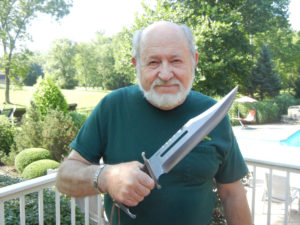
Before Last Blood, Hibben was tied with Cutlery Hall-Of-Famer Jimmy Lile for having knives in the most Rambo movies at two. Lile, of course, made the original First Blood Rambo knife for First Blood (1982) and also the Mission knife for Rambo: First Blood Part II (1985).
In the 35th anniversary year of Rambo, Gil Hibben holds the Rambo III, one of if not his most popular knives ever. (File photo)
In addition to the Hibben Machete for the fourth and fifth Rambo films, Hibben made the fixed blade for Rambo III. It’s interesting to note that if not for the decision to omit the Mission knife from a scene in Rambo, Lile would have knives in three different Rambo movies as well. However, according to celebrated collector of all things Rambo, Randy Rousseau, the scene with the Mission knife did not make it off the cutting room floor of the fourth Rambo film.
“The Lile Mission knife does make an appearance in the outtakes of Rambo when it’s used to cut gas cans and then is thrown into the fire on the pirates’ boat,” Randy noted, “but the entire scene didn’t make it into the theatrical release.”
Including the Hibben Machete, Mrs. Linda ZeTur Hibben wrote that Sylvester Stallone contacted Gil to make four different knives for Last Blood. The other knives Gil made for Stallone and, ostensibly, for the fifth Rambo movie include a gut hook that Linda said was dropped in the early stages of Last Blood’s creation.
“Sly also had Gil make a bowie and a very pretty dagger/letter opener that Rambo was going to make on screen,” Linda observed. “Gil even provided handmade blade blanks for the bowie and dagger so it would appear Rambo was making the knives.”
However, other than the Hibben Machete, none of the additional Hibben knives made it into Last Blood. Meanwhile, since the fifth Rambo film is reputedly the final one in the series, neither the four aforementioned Hibben knives for it nor any other of the Rambo knives, including the new ones designed by Dietmar Pohl, will appear in another Rambo film, either.
On the other hand, one thing we’ve learned with Rambo is to never say never.
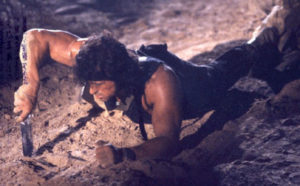
When the First Blood movie debuted in 1982 and Sylvester Stallone made film and knife history with his survival knife by BLADE Magazine Cutlery Hall-Of-Fame® member Jimmy Lile, hardly anyone could have imagined that after 36 years and three sequels, John Rambo would return to combat.
However, in the fifth installment of the franchise, Last Blood, Rambo returns not to fight an overpowering military opponent but to save a young woman dear to him from a Mexican sex trafficking cartel.
The Knives of Last Blood
As with each Rambo flick, a new knife is an integral part of the star’s equipment, and this time it’s two new knives.
After Lile for the first two Rambo films and Cutlery Hall-Of-Famer Gil Hibben for the latter two, Stallone left the design work for the new knives for Last Blood to Germany’s Dietmar Pohl.
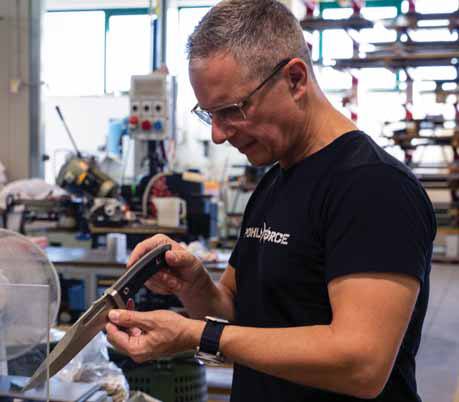
Dietmar Pohl is a veteran of over 25 years in the knife industry and a developer of countless knife designs. His designs include the Boker Speedlock/Toplock, the Kalashnikov series and his Pohl Force Alpha models. In 2007 he founded Pohl Force to concentrate even more on combat knives. (Pohl Force Knives image)
A veteran of over 25 years in the cutlery industry and a designer of many knives, he also has written four books on combat and tactical knives. His designs include the Boker Speedlock/Toplock, the Kalashnikov series and his Pohl Force Alpha models. In 2007 he founded Pohl Force to concentrate even more on combat knives.
In addition to providing tactical knives for special forces, Dietmar also has become a leading contact for the film industry.
From First Blood to Last Blood
In January 1983, First Blood debuted in Germany. The film and its iconic knife knife made such a strong impression on Dietmar that he knew he wanted to develop his own knives.
Now, nearly, four decades later, the circle closes and the dream has become reality. The man who at 16 was so strongly influenced by Stallone and his embodiment of Rambo was allowed to develop knives for “Sly” and the final part of the Rambo saga—Last Blood.
Pohl Meets Stallone
Pohl and Stallone first met when Dietmar visited the set of Expendables 3 and talked with Sly about his film knives, from Rambo and Cobra through to the Expendables series. In memory of the meeting Dietmar handed Stallone a Pohl Force Foxtrot One survival knife with a special engraving. The knife was to become the Pohl-Stallone link.
During the shooting of Escape Plan 3, Sly asked the movie’s props team to get the Pohl Force knife for use in the film. The movie’s weapons expert, Rock Galotti, a member of Stallone’s inner circle, was so impressed by the knife that he kept in touch with Dietmar after the shoot. When it came to choosing the knife for Last Blood, Sly relied on Rock’s expert advice.
Going in a Different Direction for Last Blood
From the first go it became clear Stallone wanted to go in a different direction than with the last two Rambo sequels.
The knives were to be much more tactically natured and adopt some of the technical aspects of the first Rambo models. Stallone also attached particular importance to size with blade lengths between 8 and 9 inches. Ergo, the actor sent pictures of himself with knives of a comparable size in his hand. The overall proportions simply had to be right.
“When I had all this information on the table, I knew Sly and I had the same ideas about the knives,” Dietmar recounted.
Stallone had also been involved with Dietmar’s earlier work and had expressed ideas about the movie’s bowie knife.
With a time window of only a few days, Dietmar designed both the tactical subhilt fighter (MK-9, aka “Movie Knife 9”) for the film’s final fight scene and the bowie (MK-8) Rambo uses at the movie’s outset. After the first drafts it was clear Dietmar was on the right track.
To make the proportions clearer for Stallone, Pohl sent pictures of his hand holding paper prototypes. The star’s comment, “Dietmar, we’re almost there … make the blade of the bowie a bit slimmer so that it comes across even deadlier,” signaled that the design of the MK-8 had been decided.
Design Features of the Last Blood Knives
As a special feature, Stallone asked for a red-stag handle. For a knife of this type, with a relatively large handle, this was already a challenge. To find stag in a reasonable quality and in such dimensions is not easy, but again Pohl endeavored to present a stag variant of the MK-8 on schedule.
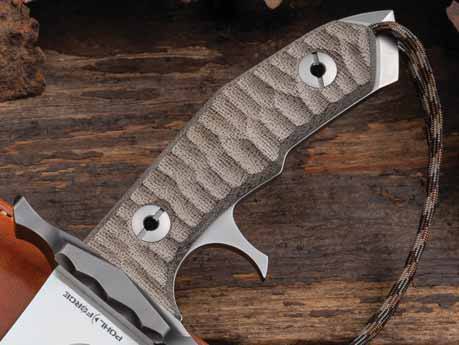
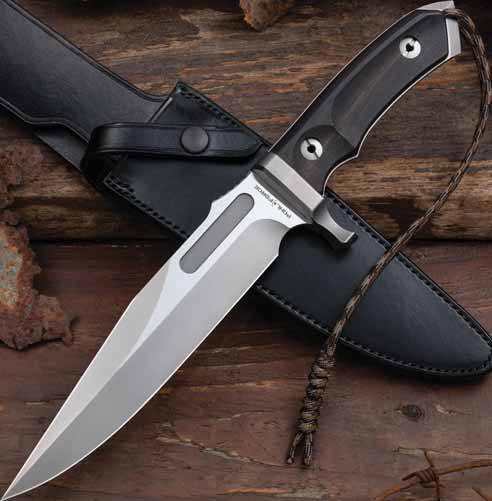
The MK-9, which Sly nicknamed the “Heartstopper,” is an uncompromising tactical blade one would expect from Dietmar. The distinct design is reminiscent of the Pohl Force Alpha One, for example. In addition to the typical Pohl Force CNC-milled handle, the screws with the hole and slot for tightening set a technical accent.
The screws have become the hallmark of the German knife company. With the exception of some all-steel-construction models, there is actually no Pohl Force design without the screws.
The handle screws with the hole and slot for tightening on the MK-9 are a staple of Pohl Force Knives. (Pohl Force Knives image)
Another notable design feature is the skull-crusher handle. In both models, the skull crusher protrudes from the handle butt and gives the knife an additional combat function.
The handle butt contains yet another Pohl specialty, a concealed lanyard hole. While on most knives the lanyard hole is drilled through the handle end and reinforced by a tube, both knives have the hole hidden under the scales.
Stallone gave Dietmar free reign for choosing the knives’ other materials and surfaces as long as they were non-glare.
The handle butt of the MK-8 contains yet another Pohl specialty: a concealed lanyard hole. While on most knives the lanyard hole is drilled through the handle end and reinforced by a tube, both the MK-8 and MK-9 have the hole hidden under the scales. (Pohl Force Knives image)
Another Stallone requirement was leather sheaths. Just as Jimmy Lile was far ahead of his time with the First Blood Survival Knife in 1982 and used elaborately milled screwdrivers on the guard and matte/sandblasted surfaces, Dietmar did not shy from using high-tech materials such as titanium. Titanium is 40 percent lighter than steel and the sandblasting gives it an unusual anthracite appearance.
For the MK-9’s handle material OD green canvas Micarta® was the choice. It is another link between the knives from First Blood and Last Blood. Matte surfaces and a green handle, though as a cord wrap instead of Micarta, also characterize Lile’s First Blood knife. A brown leather sheath completes the package.
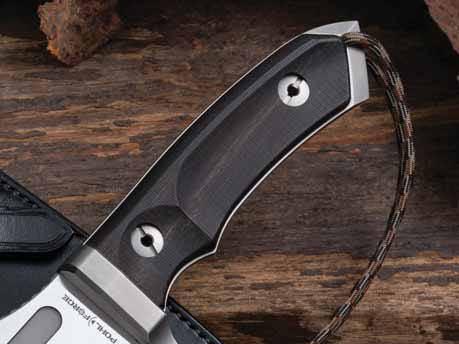
Just in case, Dietmar also worked up a prototype with black G-10 scales. However, only the OD green canvas Micarta gave the Heartstopper the right tactical charisma.
The MK-8 provided the option of the stag and G-10, as well as “noble” ebony. Sly approved the project and the next challenge presented itself: prototype construction.
A 14-Day Deadline?
Both knives had to be finished in different versions, as well as pure prop knives with cut-off blades, all within 14 working days. Only prototype construction with a high CNC component was considered. CAD drawings from Dietmar’s hand sketches of the knives, clamping fixtures for the CNC systems, etc., all had to be designed and/or created.
The award-winning Lionsteel of Maniago, Italy, was Dietmar’s choice for the manufacturer. Gianni Pauletta, Dietmar’s long-time friend and business partner, immediately offered his support. Even so, the project remained a race against time. In the final week of prototype construction, Dietmar and his assistant, yours truly, joined the Lionsteel team to discuss final details on site.
Thanks to the invaluable help of Lionsteel, Dietmar and I completed the project and traveled to the Last Blood set in Sofia, Bulgaria, to present the knives to Sly and the prop team.
Presenting the Knives to Stallone
Dietmar Pohl (left) designed and made the two knives used for the Rambo 5 movie, starring Sylvester Stallone (right). (Photo via MovieKnife.com)
Stallone invited the Pohl Force team and the film’s prop master to his motorhome. The protective hard case with the prototypes and prop knives was opened. Sly clearly liked what he was seeing, reacting with a, “Boy—German engineering!”
He was particularly interested in the titanium for the guards and the CNC-milled structures of the MK-9 handle. It was clear these were not just two new knife designs, but represented an unbroken link to the Rambo bloodline.
Stallone was obviously pleased.
“Dietmar,” he began, “I like all of your prototypes. Decide which one to use in the movie.”
As you might guess, Dietmar was speechless. “Wow! What an honor!” the German maker recalled of his initial reaction. “I could hardly believe what I was hearing. I had to ask if he really meant it.”
Meant it Stallone did—and it was time to choose. It was clear that the Heartstopper must have the OD green canvas Micarta handle and brown leather sheath. When it came to the MK-8, however, the choice was not so obvious.
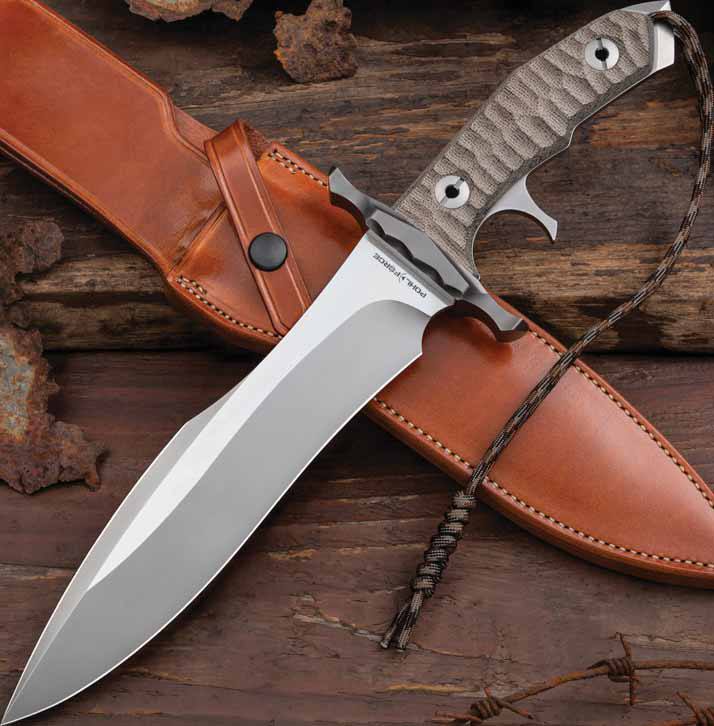
The Pohl Force MK-8 bowie features an 8-inch blade of Niolox stainless steel with fuller and a “noble” ebony handle fronted by a single guard. MSRP: $830 (based on approximate exchange rates at press time). (Pohl Force Knives image)
Black G-10 fit the knife’s tactical character and stag enhanced the unusual optics, but the final choice was the noble ebony. Though a brown leather sheath would be a good match for the wooden formwork, the prop master suggested the black sheath to go with Rambo’s attire at the film’s outset.
Choices finalized, Dietmar, Sly and the new Rambo knives were photographed in front of the motorhome.
Getting the Knives Ready for the Camera
From there, the knives and prop knives had to be modified for filming, which started the following day. All had received sharp blades for the presentation, blades that needed to be reworked.
In addition, some knives had to be equipped with the proper scales. Dietmar and I reworked the edges while the prop shop made the rubber prop knives, which are always used when fast action scenes occur and there is a risk of accidents. Authentically painted, it’s hard to tell the difference between them and the real knives, even close up.
When Sly circulated the first photos of the knives a few days later, the phones at Pohl Force headquarters rang non-stop.
A few weeks after the start of filming, the movie crew moved to Tenerife on the Canary Islands. The Spanish islands are often used in major Hollywood productions, and in this case moviegoers were to believe they were seeing Mexico.
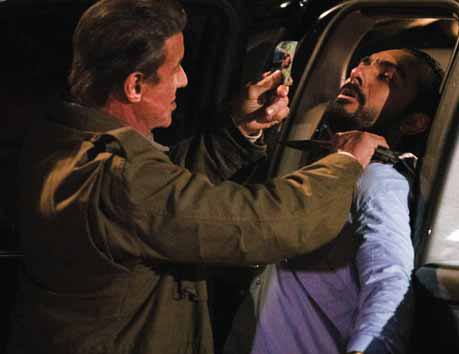
With the help of the Heartstopper, Rambo has the undivided attention of a bad guy in Last Blood. (Photo by R. Ovtcharoff, Millennium Media Inc.)
The Pohl Force Team was there to provide on-location consultation. On the set during the second day of filming, a paparazzo from the British newspaper Daily Mail photographed Dietmar presenting a Pohl Knives Force One folder to Stallone.
In May, Last Blood was re-shot in Sofia and the Pohl Force Team was there. Among other perks, Dietmar and I were allowed to take photos and videos on the sets. Sly also showed Dietmar some film shots in which the knives are used.
As a special gift Dietmar presented Sly with the first handmade Heartstopper prototype. It’s likely the knife also was used on the film set.
For the Fans: Collectibles
British knifemaker Andy Wood received the order from Pohl to produce a custom knife version in addition to the CNC-manufactured version from Lionsteel.
Andy will build 100 handmade knives per model for Pohl Force. Based on approximate exchange rates at press time, the respective list prices for the custom MK-8 and MK-9 are $1,943 and $2,197.
For every 300 pieces per model, the CNC-manufactured version is available for the collector. The CNC-manufactured version has the standard Pohl Force Logo laser engraved on the front side and the serial number 001 of 300 to 300 of 300 on the obverse side of the blade. The custom version has only POHL deep engraved on the front side and a number above the logo. Both designs have official registered patents in Europe and are patent pending in the USA.
Galco Gunleather supplies the sheaths for the two knives. Galco also supplied Lile Knives with the leather sheaths for the second Rambo film.
The Dream is a Reality
After over 36 years, the circle has closed. The first day after seeing First Blood at the cinema, a 16-year-old Dietmar had taken a round file to his KA-BAR combat knife to give it a Lile-like sawback, and set the dream in motion.


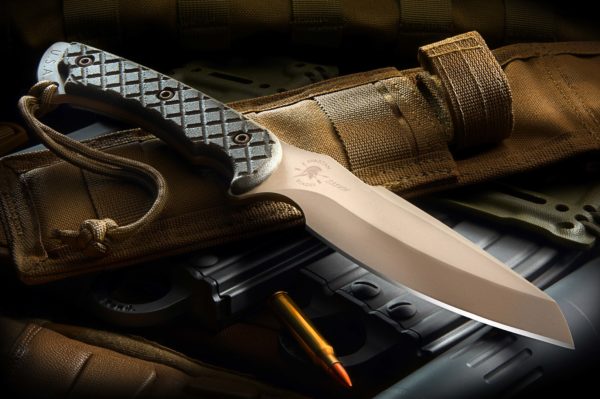
 These laminates have been offered by Norplex-Micarta and our predecessors since at least as early as 1912. As a result of the significant sales, promotion, and widespread use of Micarta® brand laminates, our mark is widely recognized around the world as a designation of the source of our products, which are used in a variety of applications ranging from electrical insulation to gun and knife handles.