Home Blog Page 244

Branton Will Throw Knives in BLADE Show Seminar

Long-time knifemaker and knife-thrower Bobby Branton will demonstrate how to throw knives at the 2013 BLADE Show May 31-June 2 at the Cobb Galleria Centre in Atlanta.

As he has done at the BLADE Show for many years, Branton will bring his knife-throwing target and assortment of his custom Pro-Flyte throwing knives. He also has thrown tomahawks on occasion in his seminars. Word is he might be throwing some new factory hawks at this year’s BLADE Show, too.

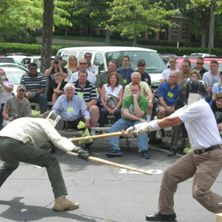
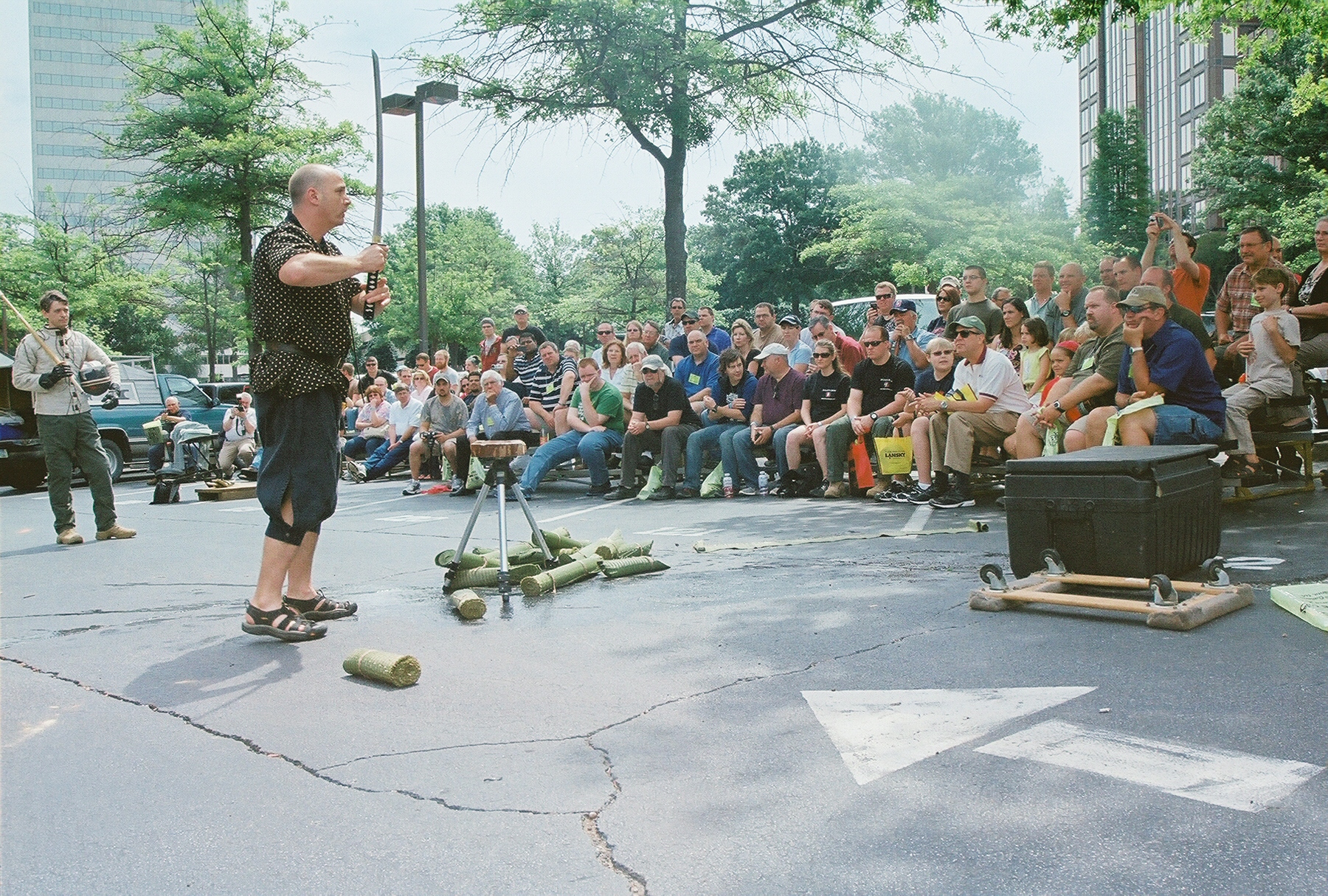
Bobby Branton talks throwing knives during his 2012 BLADE Show seminar.
Bobby Branton (left) discusses knife throwing with patrons during his seminar at the 2012 BLADE Show.

Branton’s seminars are always casual and impromptu. He chats informally with his audience and encourages questions, comments and other open dialogue. It’s a seminar suitable for the entire family.

A member of the American Bladesmith Society, Branton offers a complete line of utility and mid-tech knives. Many know him as one of the country’s leading knife-throwing knifemakers. He follows in the footsteps of Blade Magazine Cutlery Hall-Of-Fame© member Dan Dennehy, who handled the BLADE Show’s knife-throwing seminars before Branton took over. It was just a few years ago when Mr. Dennehy was inducted into the Cutlery Hall Of Fame that he visited Branton during one of the latter’s knife-throwing seminars. Dennehy entertained questions from the audience and otherwise added to what was a most memorable get together of knife-throwing legends.

In fact, you never can tell who might show up for one of Bobby’s seminars. Past special guests have included Ernest Emerson, among others.

Branton has been active administrating the American Knife Throwers Alliance over the years, and has hosted many knife-throwing events near his shop in Awendaw, South Carolina.

Branton will throw his knives during his seminar the Saturday of the BLADE Show at 10 a.m. in “The Courtyard”—otherwise known as the parking lot of the host hotel, the Renaissance Waverly. Admission is free to all BLADE Show ticket holders.

For more information click on http://www.bladeshow.com/ehome/index.php?eventid=55860&

New BLADE On Most Newsstands TODAY!

Spartan Blades gets its first BLADE® cover with the June BLADE, on most newsstands TODAY!

Designed by BLADE field editor and retired 5th Special Forces master sergeant Kim Breed, the cover knife is the Spartan-Breed fighter/dagger—and it is just one of the latest knives from the 2013 SHOT Show and many other knives highlighted in the June issue.

•On the custom collector front, Mike Haskew examines the exploding phenomenon of Chinese and Taiwanese collectors hoarding custom handforged knives in “Asian Damascus Invasion.”

The June BLADE hits most newsstands TODAY!
Spartan Blades gets its first BLADE® cover with the Spartan-Breed fighter/dagger.

•BLADE field editor Ed Fowler continues his lavishly illustrated sheep-horn handle how-to in part IV of “Breaking Sheepish.”

•Spring is here and so is fishing season. Fillet your favorite catch with the latest in fillet blades in Tom Carpenter’s “Fish Knives Combine Form & Function.”

•Former New Hampshire state representative Jenn Coffey wants your help in getting car dealers and manufacturers to consider including the CRKT Exitool seat-belt cutter as standard issue in cars in an effort to avoid such tragic deaths as the baby in Los Angeles who was killed when no one had a tool to extricate the infant from a burning automobile.

•The SHOT Show was in Las Vegas and, in terms of knives, what happened there didn’t stay there. Steve Shackleford tells you about some of the factory industry’s hottest new knives from the show.

•In “How Thick Should Your Blade Be,” ABS master smith/BLADE field editor Joe Szilaski tells you which blade thicknesses for which knives.

•Clyde Fischer was a knifemaking legend from the 1960s until his death in 2001. His son Sammy Fischer is carrying on the family tradition, and Blade Magazine Cutlery Hall-Of-Fame© member B.R. Hughes gives you the inside story in “Dad’s Footsteps, Not His Coattails.”

•In part two of a three-part series, a panel of knife industry authorities select the top custom knives from 1989-2000 in “A Decade Of Excellence.”

There’s much more. To subscribe to BLADE print issues click on www.shopblade.com/blade-magazine-one-year-subscription-us/?lid=blss032613 and to subscribe to the new digital editions of BLADE, click on https://ssl.palmcoastd.com/07614/apps/ORDOPTION1LANDING?ikey=I**B47&et_mid=608607&rid=3579379?lid=blss032613


Pro-Knife Laws Need Your Help!

Three states are considering pro-knife laws that need your help, Knife Rights reports.

Pending measures in Kansas, Tennessee and Texas have been approved in lower legislative bodies and are moving on for further approval. If you act now, you still have time to help ensure these pro-knife laws will be enacted.

The one in Kansas (HB2033) would enact Knife Law Preemption and repeal the ban on switchblades, dirks, daggers and stilettos. Legislators helping the cause there include Rep. Jim Howell and Rep. Richard Carlson.

Tennessee’s progressive pro-knife law (Senate Bill SB1015) would also enact Knife Law Preemption, repeal the state’s antiquated switchblade ban and repeal the state’s 4-inch blade-length limitation. Sen. Mike Bell has been most helpful in the fight to save the knife rights of those in the great state of Tennessee.

Finally, the Texas law (HB1299) would enact Knife Law Preemption and repeal the state switchblade ban (HB1862). Rep. Harold V. Dutton, Jr., has led the fight in the Lone Star State.

Knife Law Preemption eliminates conflicting knife laws from county to county, city to city and town to town within a state, laws that act as “knife traps” to unjustly snare law-abiding knife users and build tax coffers in the applicable jurisdictions. Blade Magazine Cutlery Hall-Of-Fame© member Bill Adams likes to call the practice “tax farming,” and the term applies in spades in this instance.

According to Knife Rights, Knife Law Preemption has been enacted in Arizona, Utah, New Hampshire and Georgia.

For more information on how you can help visit www.KnifeRights.org.

Three states' pro-knife laws need your help. www.shopblade.com/embassy-aluminum-w-black-g-10-inlay-black-blade-combinationedge-w8498?lid=ssfbbl032213
Three states are considering pro-knife laws that need your help. www.shopblade.com/embassy-aluminum-w-black-g-10-inlay-black-blade-combinationedge-w8498?lid=ssfbbl032213

10 Tips for Proper Knife Show Etiquette

Ask Permission

Always ask an exhibitor’s permission before picking up a knife from his table. Nothing’s worse than some ya-hoo barging up, grabbing a knife and launching into a spiel on how much he knows about knives. Treat the exhibitor like you would any decent human being and ask permission to pick up the knife first.

Considerations for Folders

If it’s a folding knife, after asking the exhibitor if you can pick it up, if it’s closed and you want to open it, ask if you can do so (though most every folder maker will expect you to open it, check the action, etc). And if it’s a multi-blade, NEVER open more than one blade at a time. It puts too much pressure on the backsprings and can cause undue wear and tear. If you’ve bought the knife, then open all the blades you want (though it will still cause undue wear on the backsprings). And if you open the blade(s), close it/them before handing the knife back to the maker.

Hand Someone a Knife Safely

how to give someone a knife

Mind Your Edges & Tips

Your blades are your responsibility! Mind those edges and tips. Nothing is ruder than gouging someone on your 6 because you’re strolling around with a sword under your armpit like some 18th-century field marshal.

Say It, Don’t Spray It

Be careful when you are examining an exhibitor’s knife not to spray spittle on the knife. Some people tend to “spray it instead of say it,” and spittle, if not wiped off, can cause “spit pits,” or tiny rust spots.

Wait Your Turn

Never interrupt an ongoing conversation at an exhibitor’s table. The exhibitor might be in the process of selling a knife and if you barge in and start blabbing away, it may chase the buying customer off. Besides that, it’s rude.

Make Way for Business

If you’re talking to an exhibitor and have no intention of buying a knife and see someone next to you who obviously is intent on buying a knife from the exhibitor, politely bow out and give way to the potential buyer.

Leave “I’ll Be Back” to Arnold

Before leaving his/her table, unless you are really going to do it, never tell the exhibitor, “I’ll be back.” Don’t be labeled an “I’ll Be Backer”! 😉

Haggling

Don’t haggle over price with custom knifemakers. They know how much time, effort and materials they put into a knife. If you don’t like the price, move on.

Getting in Close

Using a loupe to examine an antique knife is one thing but don’t use one to examine the custom maker’s knife at the maker’s table. It’s just not very good form. Now, if it’s a custom knife sold by a purveyor, that’s different. After all, if you have a question about the knife’s authenticity, it is possible that the purveyor made a mistake in buying the knife. We all err at times, right?

These are a few of the rules of knife show etiquette. There are others. Practice proper knife show etiquette and your entire show experience will benefit as a result.

Change The Types Of Knives You Collect?

Read this before deciding whether to change the types of knives you collect. (Written by Mike Haskew and excerpted from the March 2013 issue of BLADE®).

You may face a crossroads, a time of decision involving the realization that interests, tastes and possibly buying power change. In such situations, you may decide to begin collecting a different genre of knives, departing from what you have collected. If and when that time comes, evaluating your situation and making informed decisions is crucial.Hale_120608

Well-made vintage knives by legendary makers can be very attractive to collect. Lloyd Hale does the honors here in a chute knife sporting an ironwood handle with pearl and abalone inlay. (SharpByCoop.com photo)

Some basic questions loom large, from deciding what to collect to getting the best education on what is available, selling or retaining an existing collection, and, if the choice is to sell, then maximizing the revenue generated.

First, the decision to make a change deserves due consideration. “You should have a very good reason for it,” remarked Peter Gill, who has been collecting knives for 15 years, “no whims.”

While some are into knife collecting for profit, it is always prudent to collect what you like. After all, you may own it for a lifetime. 08BL0313

“I believe a collector who is going to start collecting another type of knife should buy and collect what he’s attracted to,” reasoned Ken Potolicchio, who bought his first handmade tactical folder, a large Tighe Pan by Brian Tighe, in the fall of 2001. “In other words, buy something you would like to own, handle or even use. Research the new type of knife to be collected and be comfortable with the effort and costs to start a new or additional collection.

“If you’re going to start collecting another type of knife, buy and collect what you’re attracted to,” reasoned Ken Potolicchio, who bought his first handmade tactical folder, a large Tighe Pan (above) by Brian Tighe, in the fall of 2001. “In other words, buy something you would like to own, handle or even use.” (Brian Tighe photo) 

“Ask yourself why you want to collect the new type of knife,” Ken continued. “Is it simply to make money, to carry and use the new knives, or is it in the pursuit of desirable knives of a new type? What if you change your mind? You need to be very sure, especially if the sale of your current collection is a factor.

“As to resources, I would recommend reading the magazines and contacting purveyors you may have dealt with, trust and have a relationship with, or that deal in the type of knives you’re planning to collect. Direct contact with the makers of the knives to be collected is a good idea. I’ve found that most are willing to talk about all aspects of their knives.”

Though you may be financially capable of retaining your current collection, you may have to liquidate your existing holdings to be able to afford to collect something new. Opinions vary on the best way to sell, and some experts tend to think that holding on to what you have already collected is the best of all options.ed's dad's wwII Ek

“Don’t buy knives that are damaged or of poor condition unless they are very old and rare, such as [antique] bowies, Civil-War-era knives, and rare military knives,” Marvin Clyncke commented. Ed Fowler’s dad carried this World War II-era Ek Model 3 during World War II. (Fowler photo)  

“If you decide to shift gears and like another kind of knife, you might consider the following,” advised Pete Cohan, a serious collector since the early 1960s. “Trade the knives you have for those you now wish you had, but be sure you know who you are trading with and be firm when it comes down to the final details. You could try to sell your old collection to somebody you know, but don’t let anyone talk you out of a few pieces. You may be left with the rest and can’t hardly give them away.”

If you are an informed collector, you have a solid sense of what your collection is worth and what you will take for it. Unless such a solid base is in place, the hazards of selling or trading are substantial. Tactics also will vary depending on your motivation—simply to recover your initial investment or to make as much profit as possible to plow into the acquisition of your newfound favorite knives.

Though selling your knives as a collection may move the transition process forward more rapidly than selling in ones or twos, there is a trade-off. Marvin Clyncke’s father worked for Western Cutlery in the late 1930s, and Marvin has been a collector for more than half a century.

“If you want to sell your existing collection, you should sell on eBay, as you reach the whole world there,” he recommended. “Selling as a collection is not a good idea unless you have a specific buyer who is willing to pay a good price. Selling as a collection, you are essentially eliminating a lot of folks who may have some of the same knives and don’t want to buy a whole collection just to get a few that they need. Also, the price of the whole collection could eliminate many buyers, especially if the collection is large. Selling individually definitely would realize top dollar for each piece.”

Cardinal Rules

• Collect what you like or even use;

• Chasing trends is a fool’s errand;

• Collecting knives that are hot now means paying top dollar now as well;

• Know which knives are collectible in specific geographic locations of the country;

• Inexpensive, low-end knives will never appreciate to any degree;

• Well-made, fine-condition knives should not lose you any money;

• Don’t buy damaged/poor condition knives unless they are very old and collectible, such as antique bowies and rare military knives.

A FOOL’S ERRAND

In the continuing debate of present vs. future value, collectors heading down a new road are regularly challenged with a values proposition. Collecting what is hot today by no means ensures an appreciation in price down the road, while collecting something that is under the radar now provides no assurances on an increase either.

“A collector should only collect what pleases him or her,” reiterated Gill. “Chasing trends is a fool’s errand.”

Cohan advised, “What is hot now and what will be hot in the future is the classic question asked by every stock market trader. The question and its answer in the case of pocketknives or knives in general is further complicated by such things as the geographic location of the collector. What is hot on the West Coast and what is hot in the South are often very different. This can provide opportunity as well as risk for the collector who is starting in another direction. It is still, in my opinion, better to collect knives that you like for whatever reason. The collectibility of knives and their ‘rarity’ at some future date remains an elusive projection.”IMG_1207 Pic 19

Potolicchio leans toward the long view and collecting for the future rather than some notion of today’s “hot” commodity. He provides an illustration of future value with a firearm that he bought some years ago. “I gave my son a Ruger 10/22 rifle that currently [fetches] about $275, and I have the original receipt for the rifle when I bought it new for $38.50,” he laughed.

What’s hot in the West and South are often very different, Pete Cohan observed. This can provide opportunity as well as risk if you’re starting over. For instance, at the G4 Show in Las Vegas, tactical folders such as those by Jeremy Marsh (including the one at top just above photographed by Mike Searson) turned heads. In the South, antique pocketknives such as those by New York Knife Co. (immediately above) remain collectible. 

According to Clyncke, collecting knives that are hot now means paying top dollar now as well. Whether such knives will even hold their value or simply become yesterday’s fad is anybody’s guess. He does, however, see the thrill and allure of collecting something reasonably priced today that may in fact appreciate in the days to come.

“It is a guessing game,” Marvin warns, “but quality is everything. Cheap-made, low-end knives will never appreciate to any degree. Well-made, fine-condition knives will surely not lose you any money. Again, research is a big help.”

Sources To Use

• Read knife publications and websites you trust;

• Contact purveyors with whom you have dealt, trust and deal in the types of knives in question;

• Have direct contact with the makers of the knives in question;

• Let as many people as possible know what new collectible you want;

• Ask your friends to be on the lookout for examples.

Knives2013

One of the best ways to research what is best to collect is to read publications you trust, such as the new KNIVES 2013

Experienced collectors may already have a feel for the do’s and don’ts of collecting a new style of knife. However, it pays to remember lessons learned and to benefit from the experiences of others.

“Don’t buy knives that are damaged or of poor condition unless they are very old and rare, such as [antique] bowies, Civil-War-era knives, and rare military knives,” Clyncke commented. “Junkers are a dime a dozen and will sell for a dime a dozen in 10 years. I would let as many folks know as possible what you’re looking for. Never tell them what you will pay, just what type of knives you want. If you tell them what you will pay and they’re surprised at the price, they may just keep the knives as an investment. Some good ones may pop up right away. It never hurts to have friends looking for you.”

Potolicchio added that research is a key element before the final decision to switch the type of knife being collected. Without investing enough time to understand the market for the new type of knife, you may never find your comfort zone, particularly if you have liquidated your existing collection in the process.

For Cohan, the collecting transition should be something of a soul-searching process. He advises considering several aspects of embarking on a new frontier in collecting.

“How available are the knives that you now fancy, and are they of recent vintage?” he asks. “Are they still in production or are they a ‘short run,’ which may or may not permit a wide distribution of the knives, directly affecting their collectibility? If the knives are antique, where will they be found and can they be found without undue cost? What are the prices typically asked for these knives in collectible condition? Are you going to collect only the mint or near mint/excellent examples, and can you afford to pay premium prices for this type of knife?”

Questions YOU NEED ANSWERED

• Do you have a very good reason for starting over?

• Are you comfortable with the effort and costs it will take to build a new collection?

• Do you want to make money or collect, carry or use the knives?

• What knives should you collect, and how do you best research them?

• How available are they and are they of recent vintage?

• Are they still in production or limited in distribution, both of which influence collectibility?

• If antiques, where can they be found and can they be found without undue cost?

• What are the prices typically asked for the knives in collectible condition?

• Are you going to collect only mint or near-mint examples, and can you afford to pay premium prices for them?

HAVE/EXECUTE A PLAN

Early in the collecting transition process, there may actually be more questions than answers. Nonetheless, if you plan appropriately and execute the plan, you continue to find your passion for knives rewarding, whatever type you seek.

KEEPING Your Knife Sharp

KEEPING your knife sharp entails more than knowing how to sharpen it. If you maintain the knife’s edge on a regular basis, it will eliminate having to re-establish the edge each time the knife goes dull.

Maintaining the edge is easy. The hard part is getting in the habit of doing it. However, once you get tired of re-establishing the edge every time your knife goes dull, you will appreciate how important the habit is.

Fine tune your edge with a GATCO TRI-SEPS.
Edge touch-ups are a breeze on the GATCO TRI-SEPS.

First, get one of the easy to use pull-through or similarly easy to use sharpeners and store it by wherever you put your knife at the end of the day. When you go to put your knife up, simply grab the sharpener and pull the blade edge through it five or six times. This should be enough to fine tune the edge and get it back to a working sharpness for the following day.

Such sharpeners as the GATCO TRI-SEPS are ideal for the job because they are easy to use and store or even carry. The TRI-SEPS, for instance, includes a chain for keyring carry. It sharpens both plain and serrated edges.

For more information on the GATCO TRI-SEPS—ideal for end-of-day edge touch-ups—click here.

Guilford Art Center Holds Juried Knife Exhibit

Calling all bladesmiths and knifemakers: the Guilford Art Center in Guildford, Connecticut, announces “Contemporary Knife Smithing: A Juried and Invitational Exhibition,” and is calling for submissions.

Bladesmithing is a thousands-year-old craft practiced in diverse cultures across the world. It has survived as an art form despite modern industrialization, with artisans dedicated to preserving and expanding traditional techniques. This exhibit will explore and highlight the artistry of the contemporary hand-crafted knife, as an object with both functional and aesthetic value.

Exhibit Dates: July 10-August 18, 2013 

Juror: An ABS journeyman smith, Mace Vitale practices blacksmithing and is a copper smith. He has a background in architectural pre-cast concrete, is owner of Laurel Rock Forge in Guilford, and is an instructor at the Guilford Art Center.Vitale_120608

Eligibility: This exhibition is open to knives made by U.S. residents.

Entries: Each artist may submit up to three (3) works. Each work may be represented by two separate images: one full view and one detail view. Work must be submitted in high-resolution digital format. For each entry please note dimensions of knife, and a maker’s list price (retail price), or not-for-sale/insurance value. Email entries to: [email protected].

Entry Fee for Applicants: $20. Includes up to three (3) submissions. Make check payable to Guilford Art Center and mail to 411 Church St., Guilford, CT 06437. Or call the Center with credit card number 203-453-5947. Payment must be received for entries to be eligible.

Entry Deadline: June 10, 2013. Digital images and entry fee must be received by this date.

Conditions:  All accepted works must arrive with a display case that closes for safety purposes during exhibition. All entries must be original and must be completed within the last 3 years. The Center reserves the right to reject entries that do not meet these requirements or is deemed unstable. Shipped work that differs from submitted images will not be accepted. Work damaged in shipping will regretfully not be presented. All accepted work must have proper identification. No accepted work may be picked up before the closing of the exhibition.  Work may be available for sale or must be identified as NFS. The retail price or insurance value provided on the entry form will be used; no changes may be made after the work is shipped.

Shipping: Shipping costs are the responsibility of the artist. A check for return shipping, including the cost of insurance, must accompany delivered work, payable to Guilford Art Center. Work damaged in shipping will not be presented. Detailed packing/handling instructions must accompany all works.

Hand Delivery: Please call the Center to make an appointment for hand delivery/pickup at 203-453-5947, Ext. 12, or email [email protected].

Receiving Deadline: All work must be received no later than these dates.

Sales/Insurance: A 40% commission on all sales will be retained by the Center. Artists must indicate sale price and insurance value or, if NFS, just insurance value. Submission of work to this exhibit is done so at the artist’s risk and implies an agreement on the part of the artist to all the conditions of this Call for Submission. GAC will not be responsible for loss or damage to work in transit, however, work will be insured while in the Guilford Art Center facility.

Publicity: Guilford Art Center reserves the right to photograph entries for the purposes of documentation, education and publicity. Accepted artists are encouraged to send to the Center a resume, artist statement, brochures, and additional photographic materials of the accepted work for publicity purposes.


Show Schedule:

Application due: June 10, 2013    

Artist Notification: June 14, 2013   

Receiving: June 24-28, 2013  (10am-4pm)  (Shipped/by appointment) 

Opening reception: July 10, 2013 (5-7pm) 

Closing:  August 18, 2013   

 Deinstallation: August 19-23, 2013 (10am-4pm) (Shipped/by appointment) 

For more information please contact Guilford Art Center at 203-453-5947, or visit www.guilfordartcenter.org.

Advertisement

Must Read Articles

Read this before you make a knife

Knifemaking 101 – Read This Before You Make a Knife

  by Wayne Goddard My experience has taught me that there's nothing like digging in and getting started. I've often said the hardest part of the...
how to forge damascus steel

How to Forge Damascus

Advertisement
Advertisement