Home Blog Page 32

2025 BLADE Show Knife Debuts: What’s Coming Out!

Knife companies will debut their latest at BLADE Show 2025.

Knives and plenty of them, the BLADE Show is the Mecca for anything that cuts, hack or chops. It’s also a launching pad.

Many companies wait for the big dance in Atlanta’s Cobb County Convention center to release their latest and greatest, making the June 6-8 shindig the perfect place to pick up a brand-new, nobody-else-has design. While we’re certain there some makers have some rabbits they’ll pull out of their hats at the show, we’ve got a sneak peek of a few factory blades set to go on sale at the show.

So, without further adieu here are a bevvy of 2025 BLADE Show knife debuts you should keep an eye out for at gathering!

Don’t Wait! Get Your BLADE Show Tickets Now!


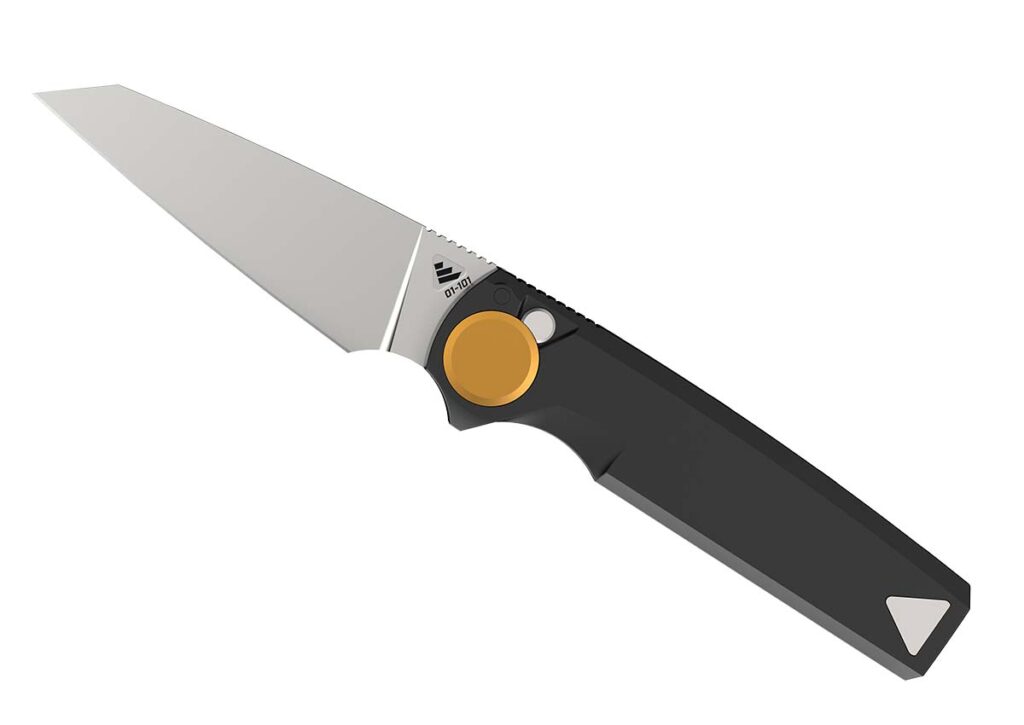
Work Sharp RMX
Work Sharp Variant
Work Sharp Variant

Work Sharp throws its hat into the knife ring with its first-ever knife: the RMX EDC folder. The 3.2-inch reverse tanto blade of full-flat-ground CPM 3V carbon steel button locks both open and closed. Comes with both a manual and auto pivot to allow you to switch between whichever mode of operation suits your needs. The magnesium handle has a reversible, tip-up, deep carry clip.
Weight: 2.4 ounces
Closed length: 4.3 inches
Country of origin: Designed, assembled and quality checked in Ashland, Oregon, using foreign parts
MSRP: $139.95
Available: BLADE Show 2025


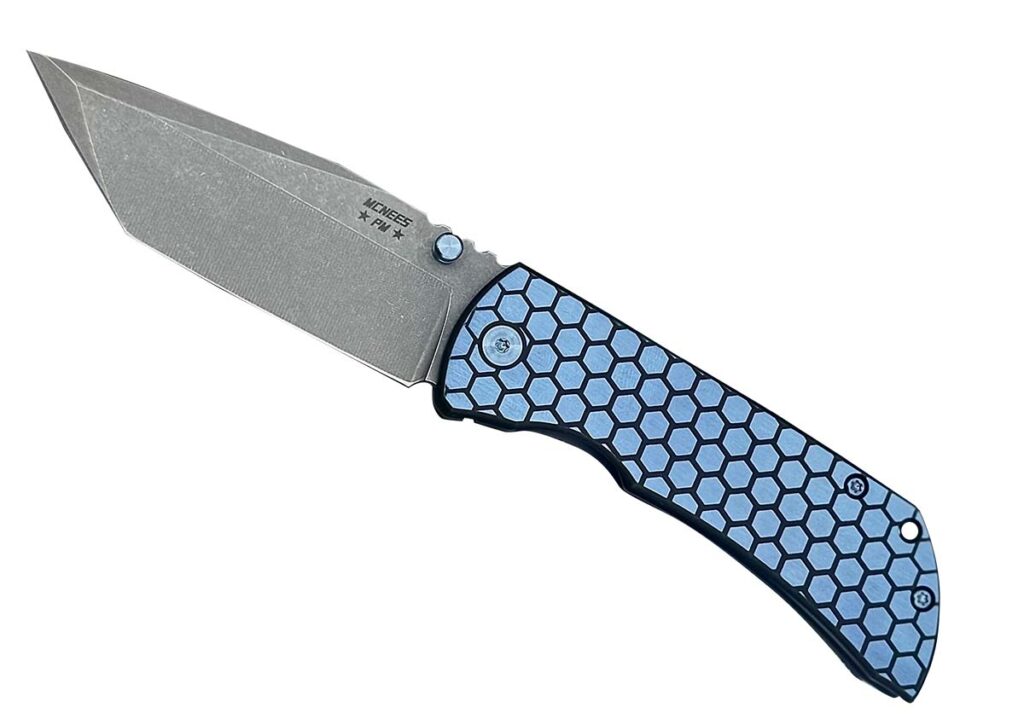
McNees Knives MAC2 3.5
McNees Knives MAC2 3.5

Titanium scales with a honeycomb look and a 3.5-inch tanto blade of hollow-ground CPM MagnaCut stainless distinguish the MAC2 3.5 tactical folder by McNees Knives.
Blade opener: thumb stud.
Lock: Reeve Integral Lock (aka framelock)
Clip: bent titanium
Weight: 26 ounces
Closed length: 4.25 inches
Country of origin: USA
MSRP: $625
Available: BLADE Show 2025


Condor Tool & Knife K-Night Panabas
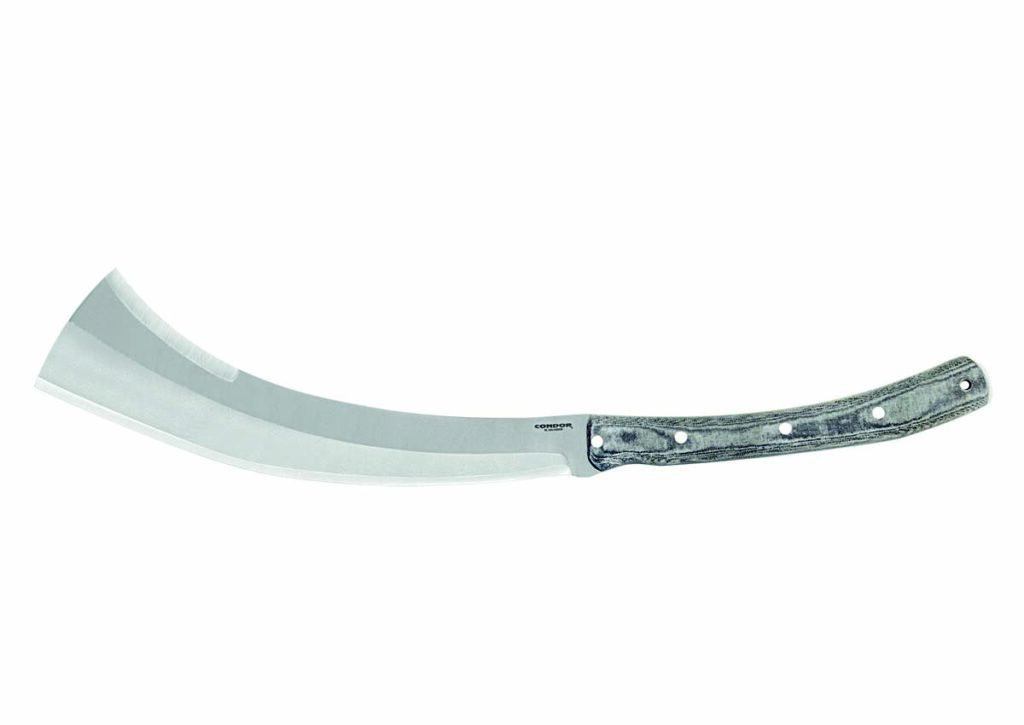
Condor Tool & Knife K-Night Panabas

The K-Night Panabas from Condor Tool & Knife boasts a 14.29-inch blade of convex-ground 1075 carbon steel and Micarta® scales.
Weight: 32.98 ounces
Overall length: 25.35 inches
Sheath (not shown): Kydex with leather belt loop
Country of origin: El Salvador
MSRP: $174.98
Available: NOW


Rick Hinderer Knives Bowie
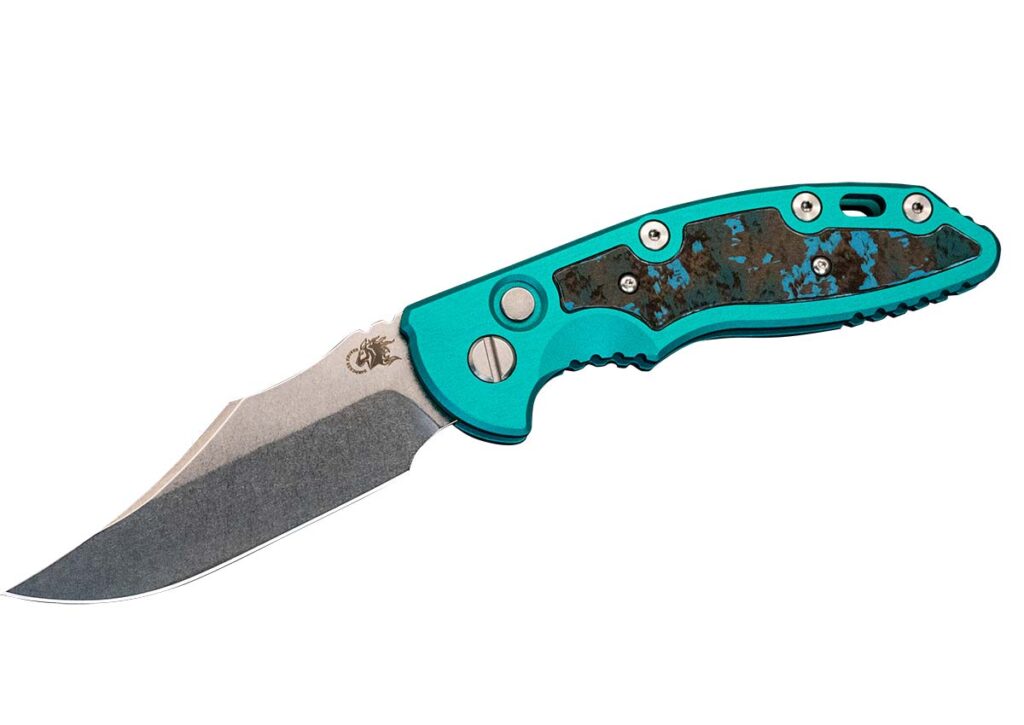
Rick Hinderer Knives Bowie

The Aluminum Automatic XM-18 3.5-inch Bowie from Rick Hinderer Knives features a 3.5-inch blade of CPM S45VN stainless steel. The aluminum handle with titanium half liners is anodized turquoise and inlaid in Arctic Storm FCF.
Lock: button lock
Clip: Chaos Horsehead model in stonewashed titanium
Weight: 5.12 ounces
Closed length: 4.75 inches
Country of origin: USA
MSRP: $495
Available: Late 2025


Fox Knives Pacifico EDC
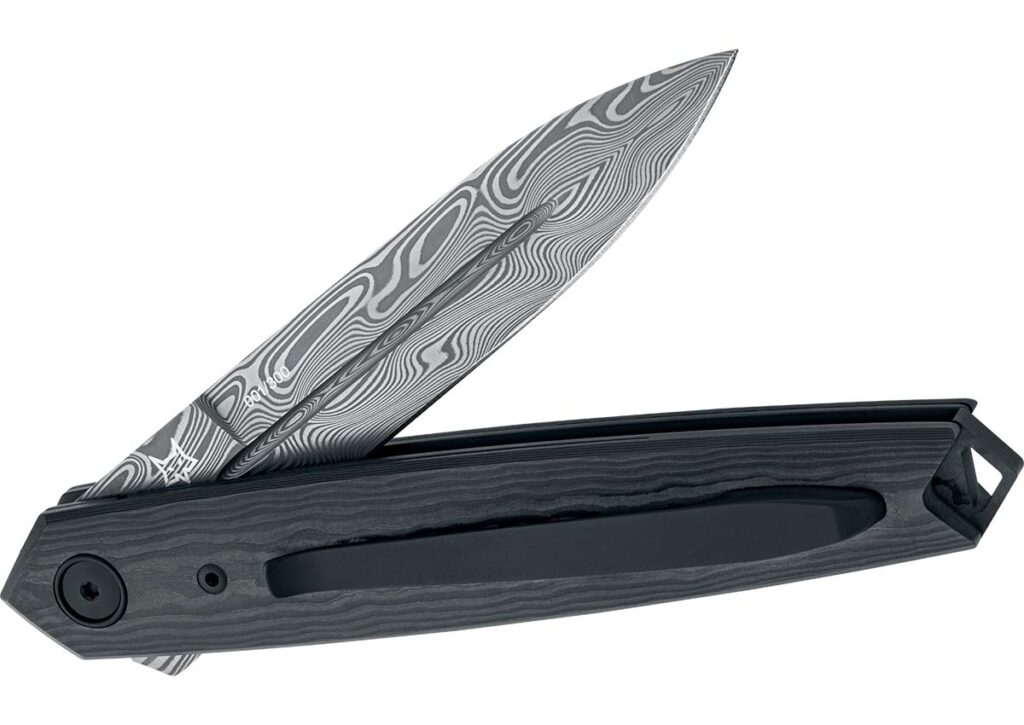
Fox Knives Pacifico EDC

Designed by BLADE Magazine Cutlery Hall-of-Fame® member Bob Terzuola, the Pacifico EDC flipper folder by Fox has a 3.74-inch blade of Thor pattern damascus by Damasteel. The handle is black camo carbon fiber by FatCarbon®.
Clip: titanium PVD-coated black
Lock: linerlock
Weight: 3.88 ounces
Closed length: 5.31 inches
Country of origin: Italy
MSRP: $583
Available: July


Big Idea Design Signal
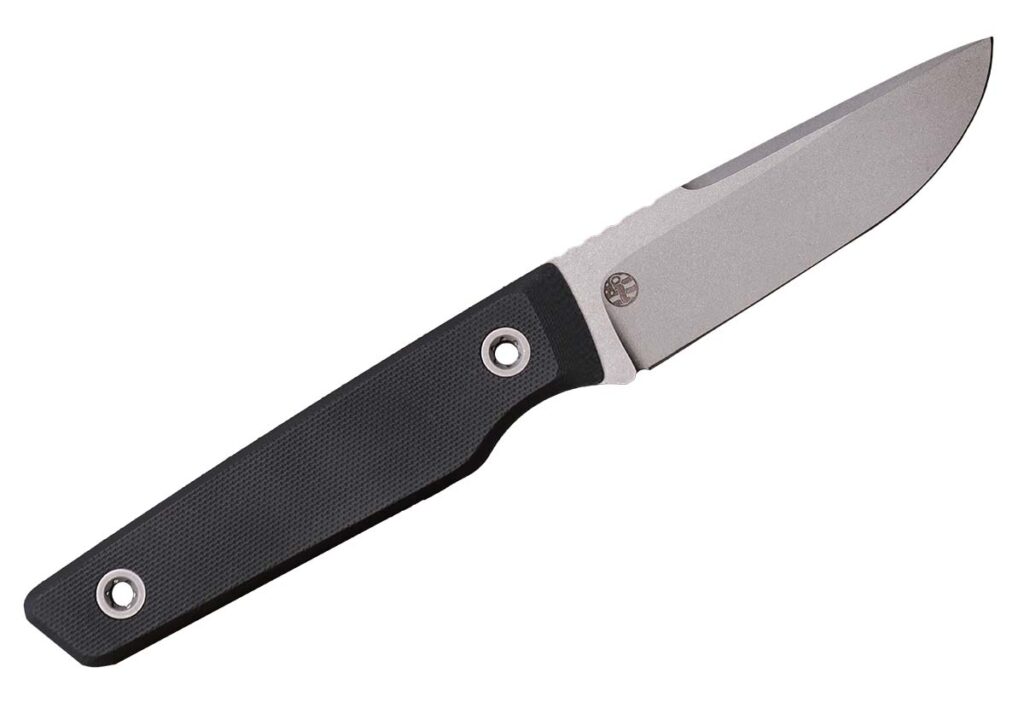
Big Idea Design Signal

Designed by ABS journeyman smith Mak Kelsay, the Signal utility from Big Idea Design has a 3.5-inch blade of flat-ground Nitro-V stainless steel and G-10 scales with custom pass-through titanium hardware.
Weight: 3.4 ounces
Overall length: 7.67 inches
Sheath (not shown): taco-style Kydex w/titanium pocket clip
Country of origin: USA
MSRP: $275
Available: May/June


Queen/Smoky Mountain Knife Works Mountain Man Trapper
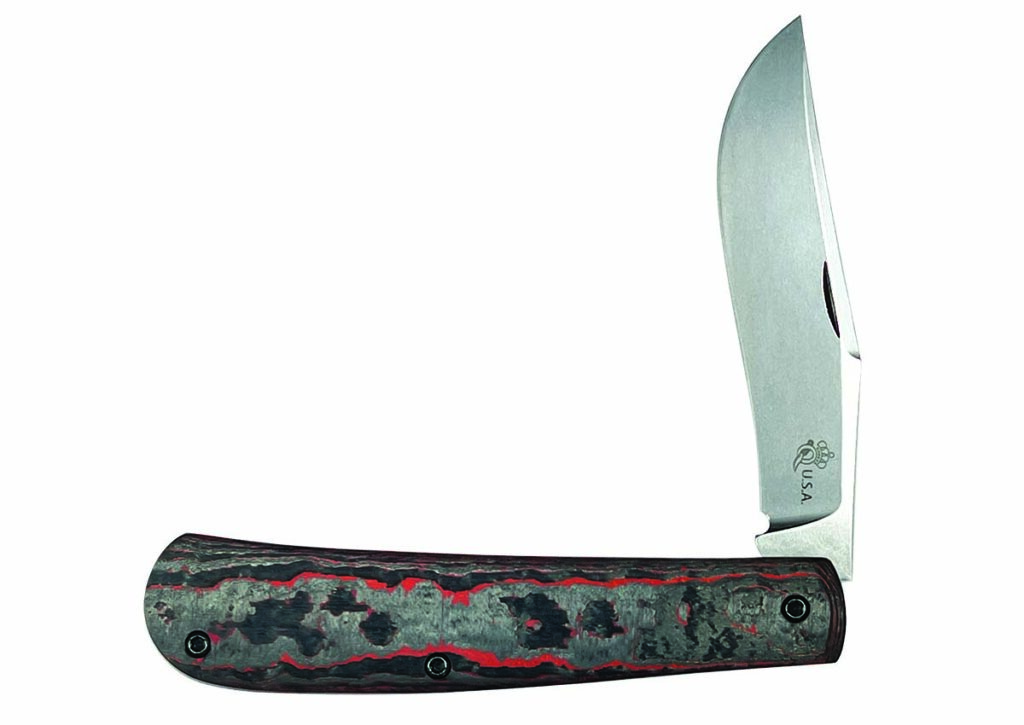
Queen/Smoky Mountain Knife Works Mountain Man Trapper

The Mountain Man Trapper from Queen/Smoky Mountain Knife Works sports a 3 3/8-inch blade of CPM MagnaCut stainless steel and Lava Flow FatCarbon® scales.
Blade pattern: Clip
Action: slipjoint
Weight: 2.93 ounces
Closed length: 4 1/8 inches
Country of origin: USA
MSRP: $299.99
Available: July


GiantMouse GMP13
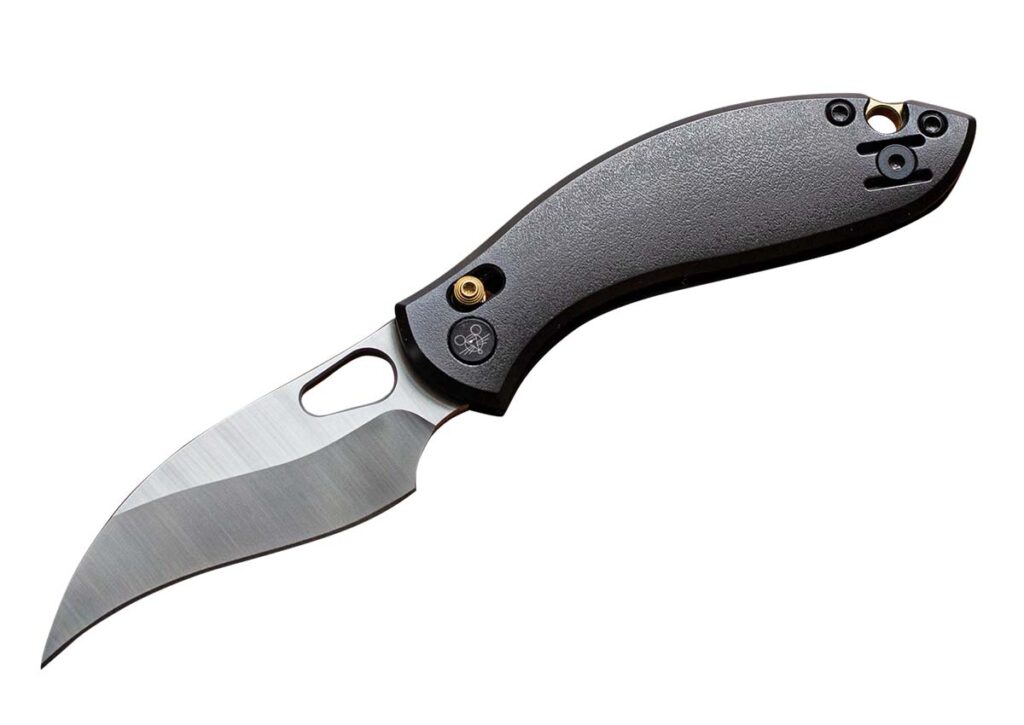
GiantMouse GMP13
GiantMouse GMP13

A 2.4-inch blade in a distinctive modified hawkbill pattern of flat-ground CPM S90V stainless and zirconium scales highlight the GiantMouse GMP13 “defense folder.”
Lock: crossbar
Clip: ambidextrous
Weight: 3.7 ounces
Closed length: 3.67 inches
Country of origin: China
MSRP: $435
Available: NOW


Lionsteel ACHA
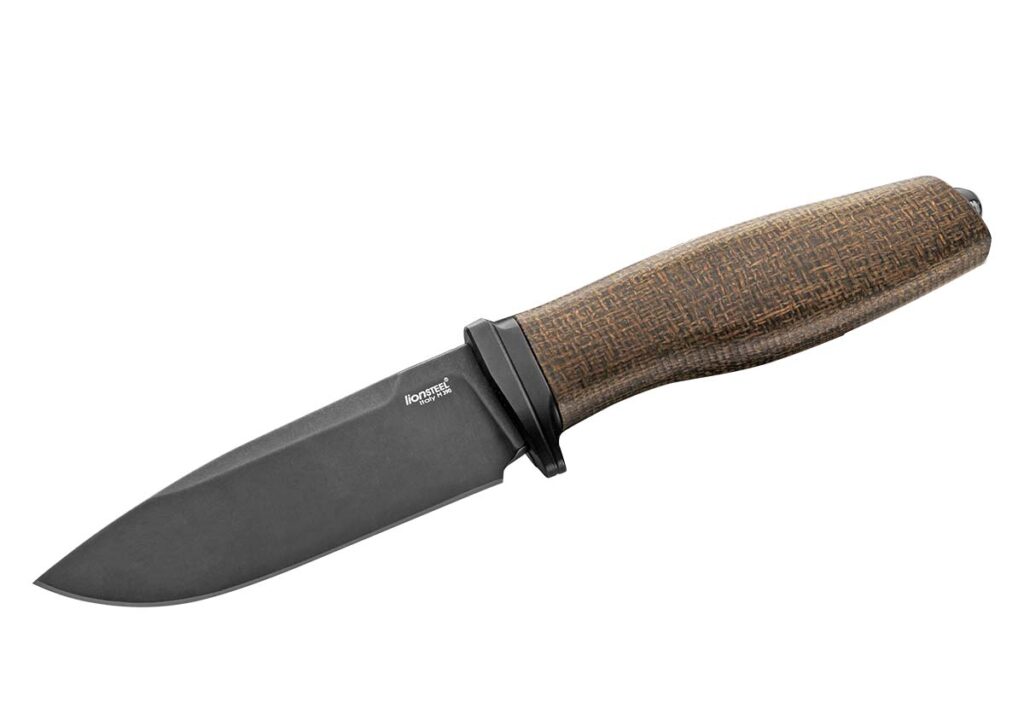
Lionsteel ACHA
Lionsteel ACHA

A contrasting combo of a 4.21-inch blade of M390 sintered steel in an “old black” finish and a burlap Micarta® handle in an integral construction set the Lionsteel ACHA outdoor knife apart.
Blade grind: V flat
Guard: titanium
Sheath (not shown): Leather
Weight: 6.24 ounces
Overall length: 9.17 inches
Country of origin: Italy
MSRP: $252 at press-time exchange rate
Available: NOW


Spyderco Chaparral
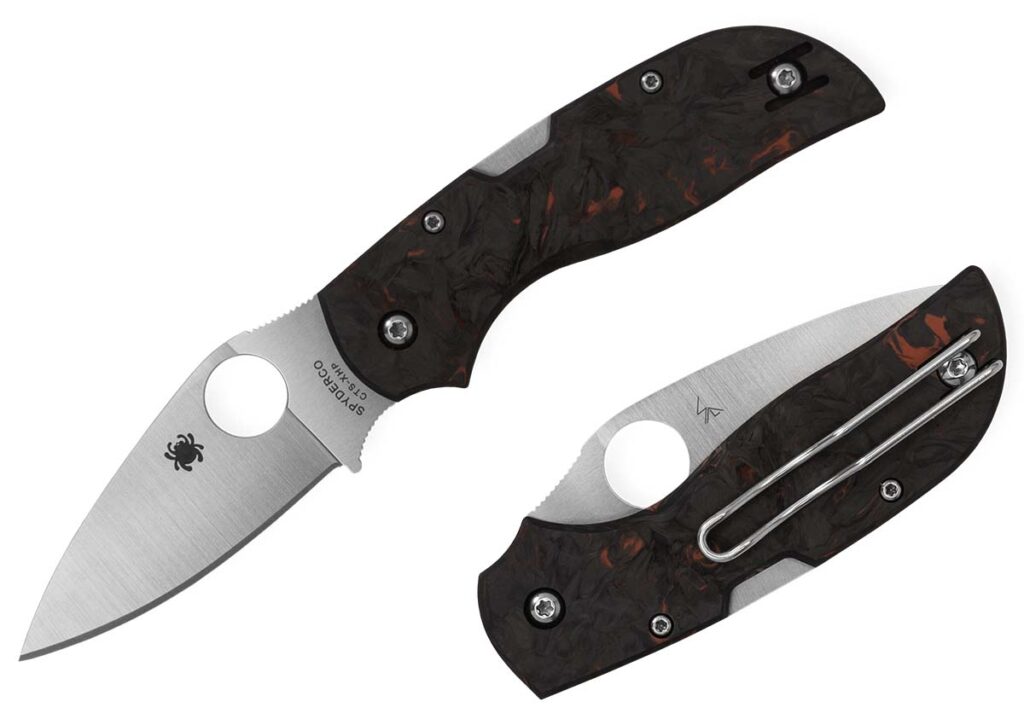
Spyderco Chaparral
Spyderco Chaparral

Dark Matter Red FatCarbon® scales and a 2.77-inch blade of full-flat-ground CTS-XHP stainless steel highlight the latest iteration of the Spyderco Chaparral back-lock folder.
Clip: wire
Weight: 2.2 ounces
Closed length: 3.6 inches
Country of origin: Taiwan
MSRP: To be determined
Available: To be determined


Ocaso Lucent Automatic
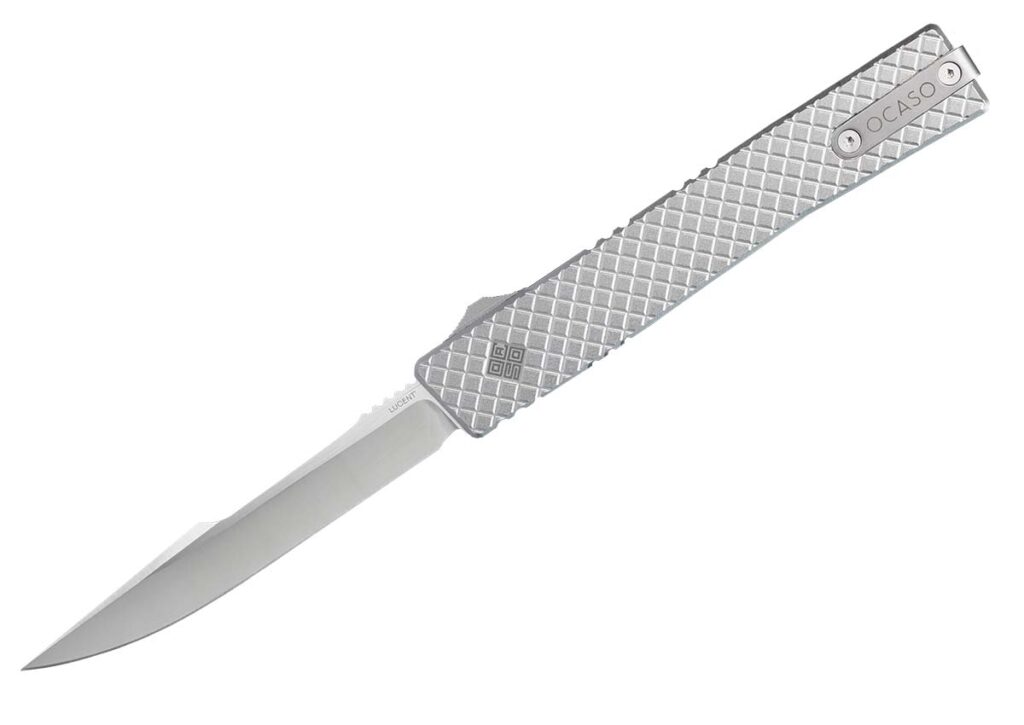
Ocaso Lucent Automatic

The Ocaso Lucent Automatic is a dual-action out-the-front with a 3.5-inch blade of flat-ground Bohler M390 stainless and a 6061-T6 aluminum handle with an ambidextrous deep-carry pocket clip.
Weight: 2.2 ounces
Closed length: 4.4 ounces
Country of origin: China
MSRP: $274.99
Available: July


Halfbreed Blades SOFMAK
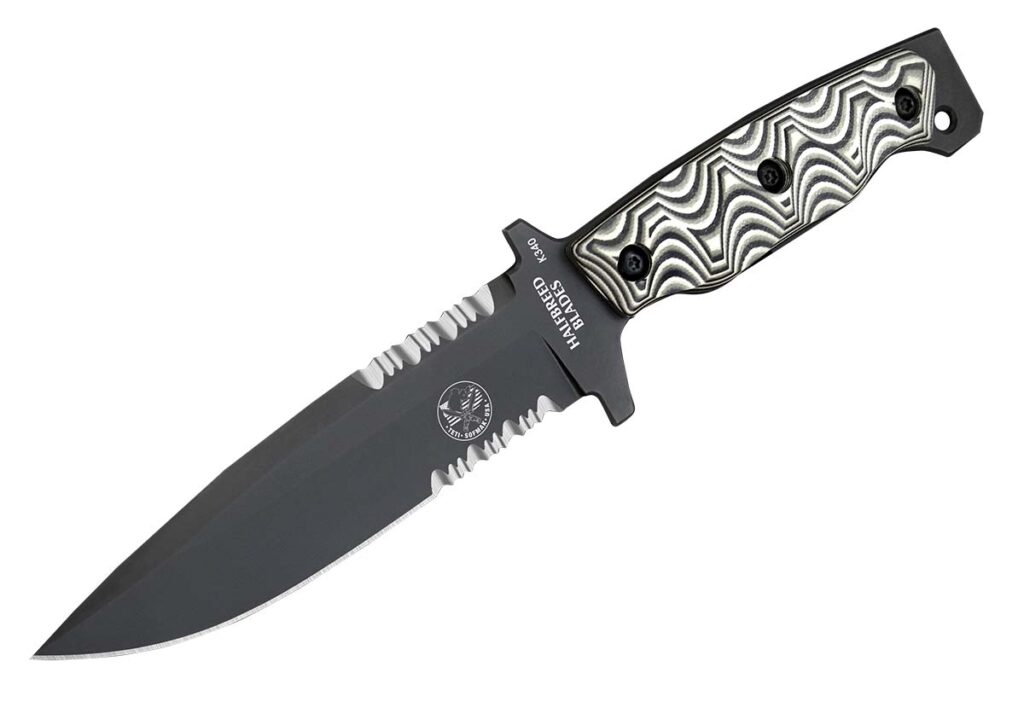
Halfbreed Blades SOFMAK

Scales of an electric G-10 and partially double-serrated blade of PVD-coated K340 ISODUR tool steel stand out on the MIK-04 SOFMAK from Halfbreed Blades.
Blade length: 5.31 inches
Weight: 11.14 ounces
Overall length: 10.31 inches
Designer: Jonathan Loftes in collaboration with Joseph Teti
Sheath (not shown): Belt and PALS/MOLLE
Country of origin: Comprises Australian and Taiwanese make
MSRP: $275
Available: NOW


CobraTec CNC OTF Pen Knife Generation 2
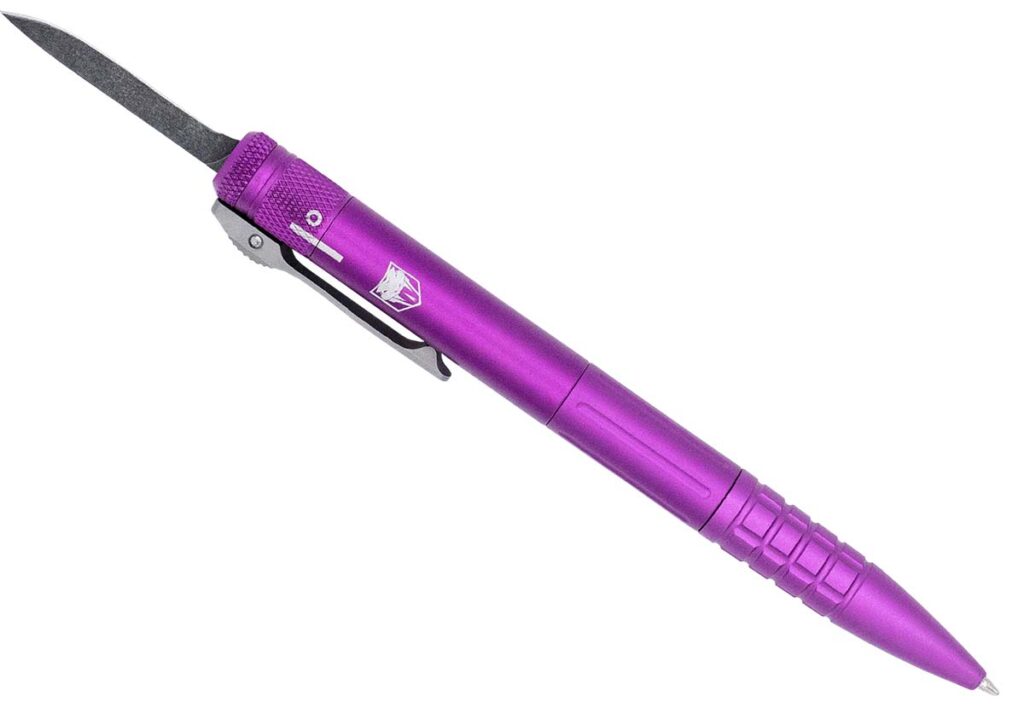
CobraTec CNC OTF Pen Knife Generation 2

The CNC OTF Pen Knife Generation 2 from CobraTec sports a 1.75-inch blade of stonewashed stainless steel. The dual-action out-the-front has a handle of 6061 T6 aluminum with a titanium pocket clip/switch and a safety lock. Includes a replaceable black ink cartridge.
Weight: 1.4 ounces
Closed length: 5.875 inches
Country of origin: China
MSRP: $89.99
Available: NOW


Emerson Knives, Inc. Tanto A-100
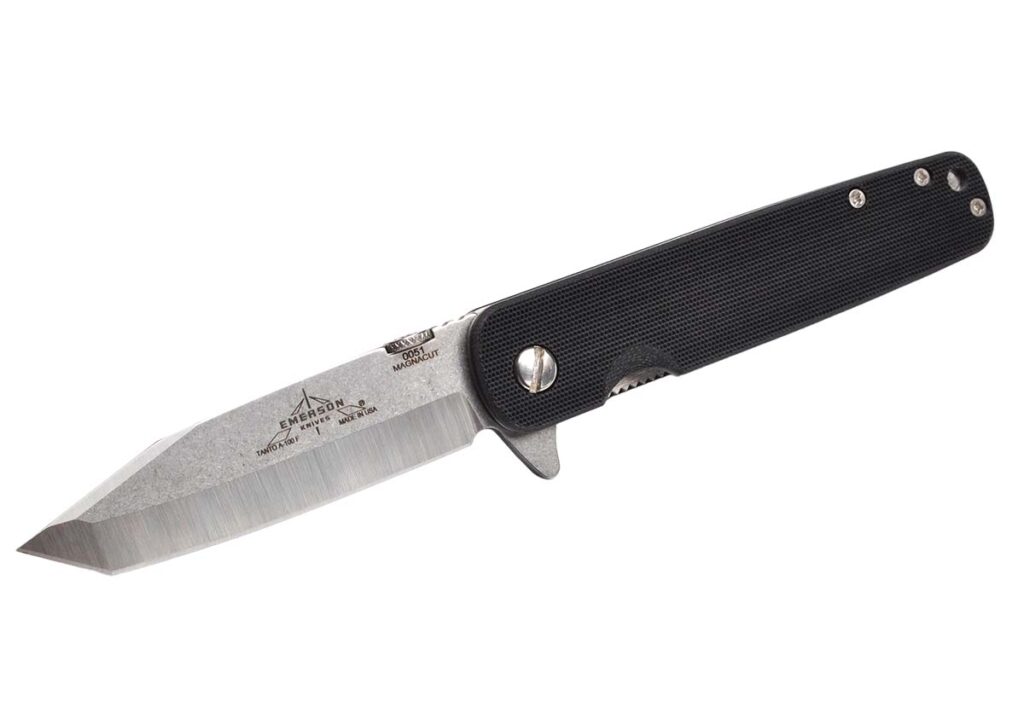
Emerson Knives, Inc. Tanto A-100

The Tanto A-100 Flipper by Emerson Knives, Inc., cuts with a 3.6-inch blade of CPM MagnaCut stainless in a conventional “V” grind. Handle: G-10 with a hole for a lanyard.
Lock: linerlock
Closed length: 4.8 inches
Additional blade opening option: thumb disc
Country of origin: USA
MSRP: $295
Available: NOW


Benchmade Mini Crooked River
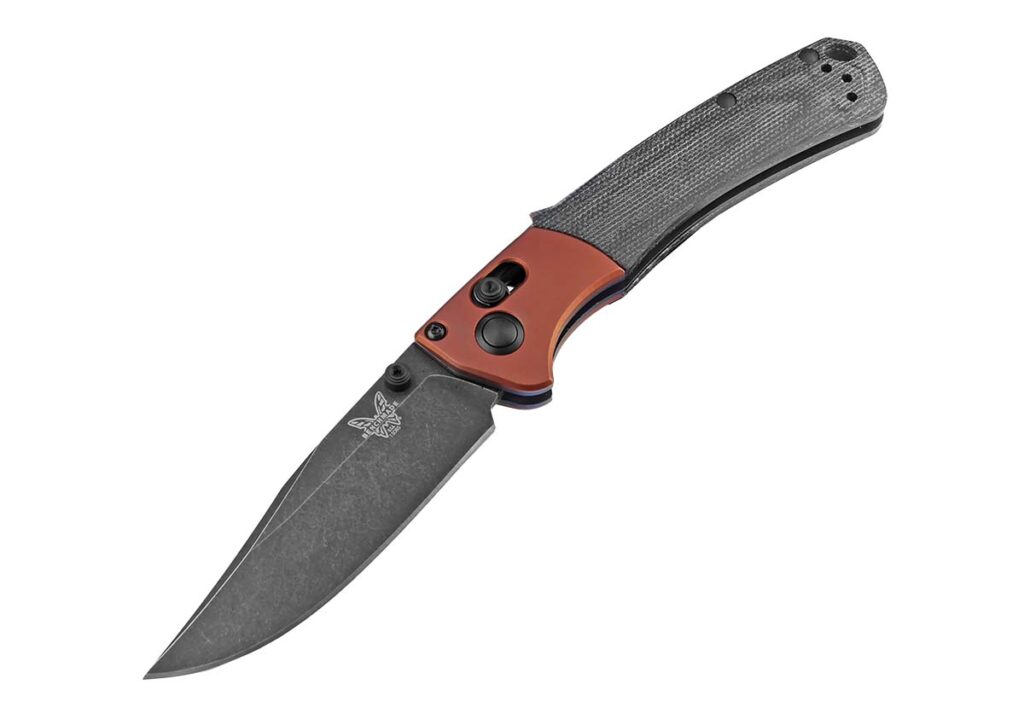
Benchmade Mini Crooked River

Benchmade’s Mini Crooked River folder sports a 3.4-inch clip-point blade of CPM MagnaCut stainless in a Battlewash finish. The handle is black canvas Micarta® with aluminum bolsters anodized a burnt copper.
Lock: AXIS
Weight: 3.2 ounces
Closed length: 4.5 inches
Country of origin: USA
MSRP: $320
Available: July


QSP Hyena
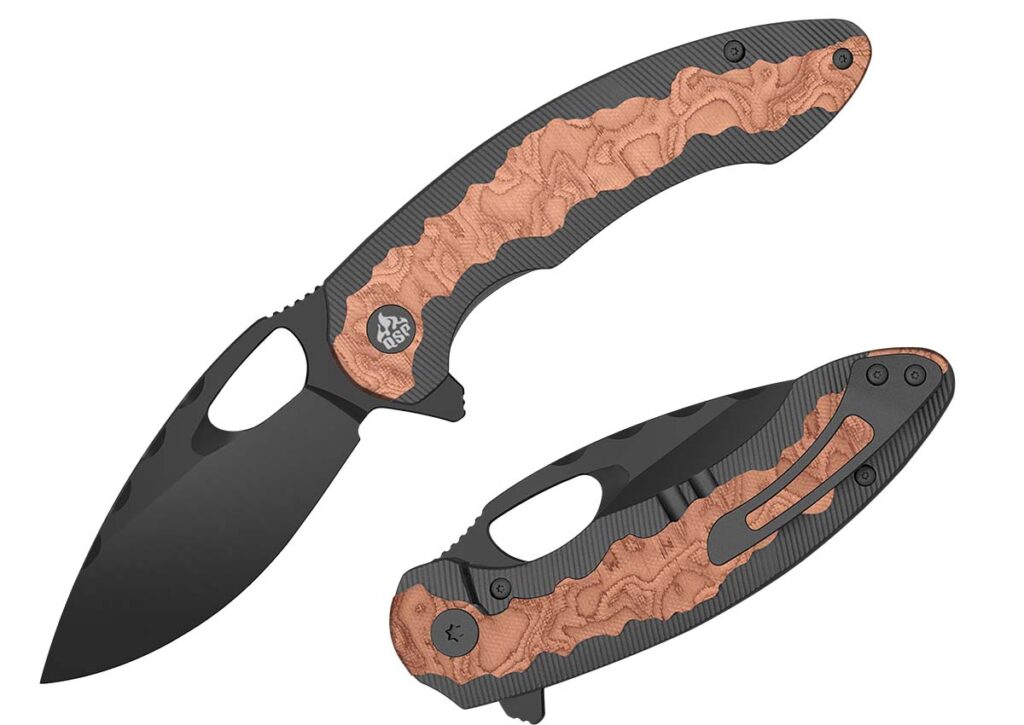
QSP Hyena
QSP Hyena

The Hyena flipper folder from QSP has a striking grip of anodized aluminum and copper-foil G-10 inlay and a 3.25-inch blade of flat-ground Bohler N690 stainless that pivots on ceramic ball bearings.
Clip: Titanium, tip up.
Closed length: 4.53 inches.
Country of origin: China.
MSRP: Contact maker for pricing.
Available: September.


Maserin Pulse
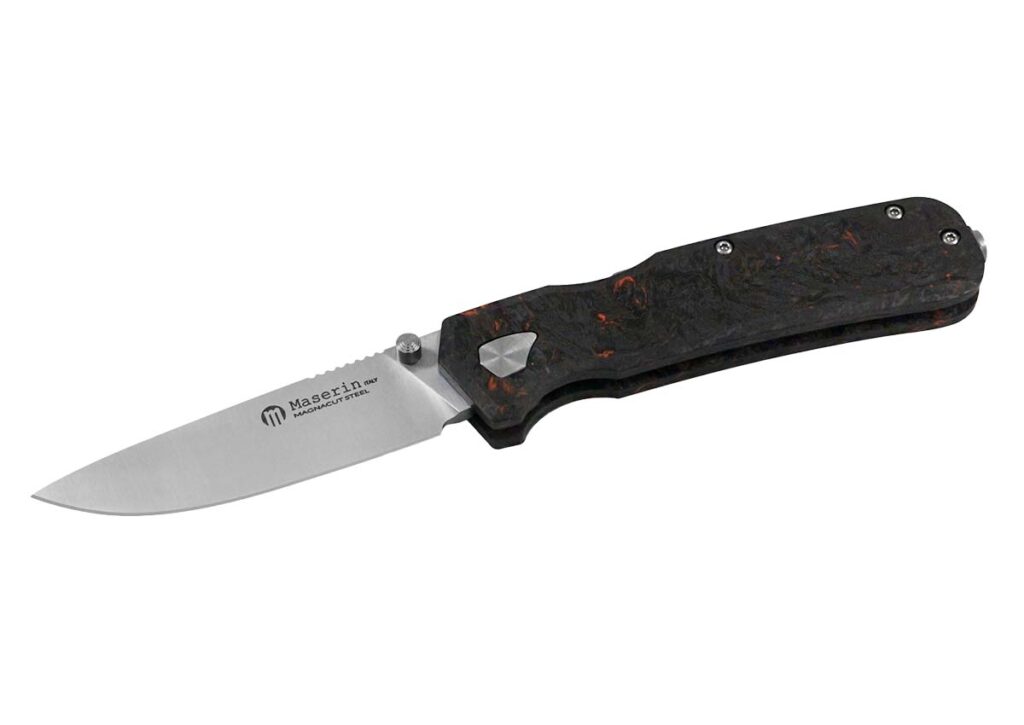
Maserin Pulse
Maserin Pulse

Black/orange FatCarbon® scales serve as the steering wheel for the 3.149-inch blade of flat-ground CPM MagnaCut stainless on the Maserin Pulse.
Blade finish: stonewashed.
Lock: W-Lock
Clip: Stainless, reversible
Weight: 3 ounces
Closed length: 4.5 inches
Country of origin: Italy
MSRP: $219 at press-time exchange rate
Available: NOW


Reate PL-7
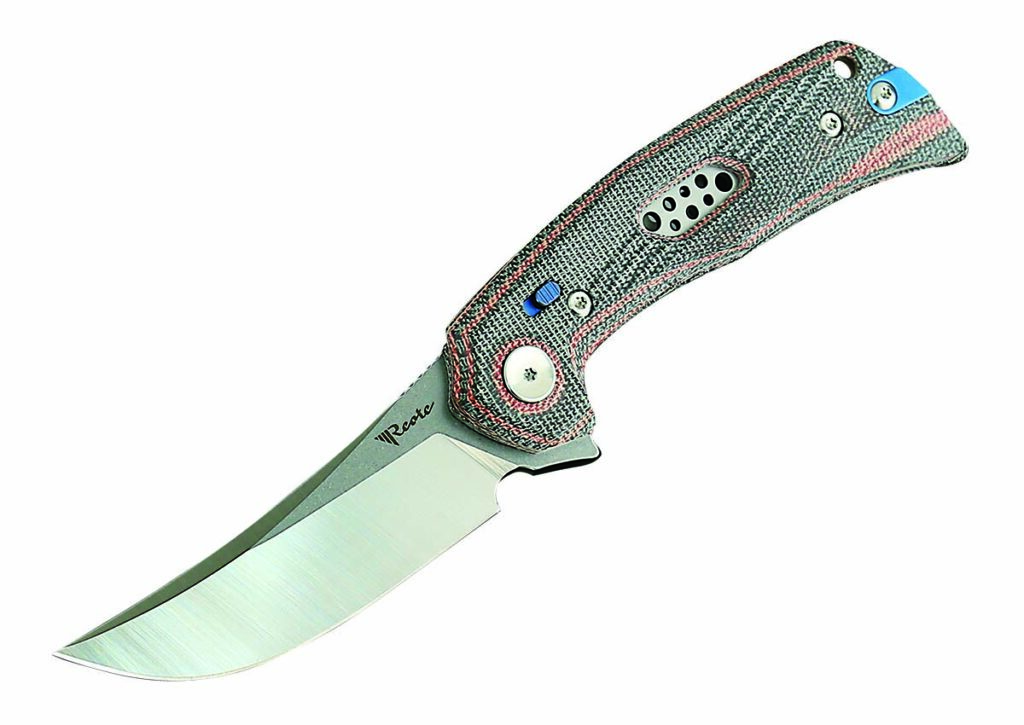
Reate PL-7
Reate PL-7

A 3.5-inch upswept blade of Nitro-V stainless in a belt-satin finish and a Micarta® handle top off the PL-7 from Reate.
Weight: 4.5 ounces
Closed length: 4.5 inches
Country of origin: China
Knife to know: The PL stands for Pivot Lock
MSRP: Pending
Available: Pending


CRKT Padawan
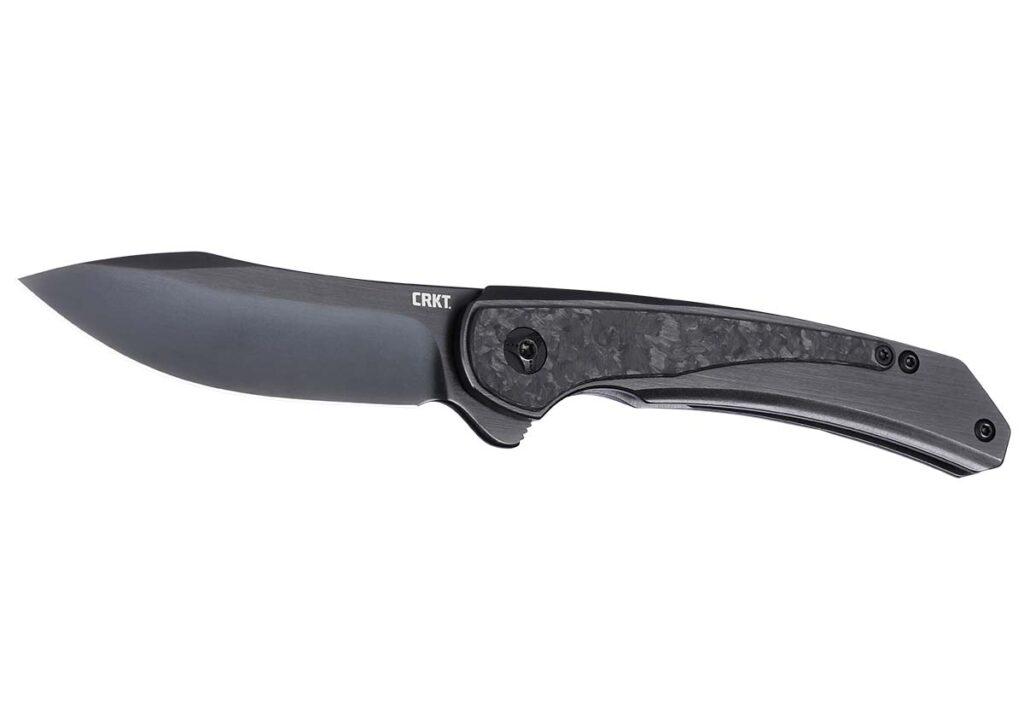
CRKT Padawan
CRKT Padawan

An EDC flipper/framelock folder, the CRKT Padawan has a 3.01-inch drop-point blade of hollow-ground 14C28N stainless.
Blade finish: nitride coated
Pivot: Ikoma Korth Bearing System
Handle: stainless steel with carbon-fiber overlay
Pocket clip: low profile, stainless
Weight: 3.1 ounces
Closed length: 4.14 inches
Country of origin: China
MSRP: $100
Available: NOW


APOC/CAS Iberia Wallace Smatchet
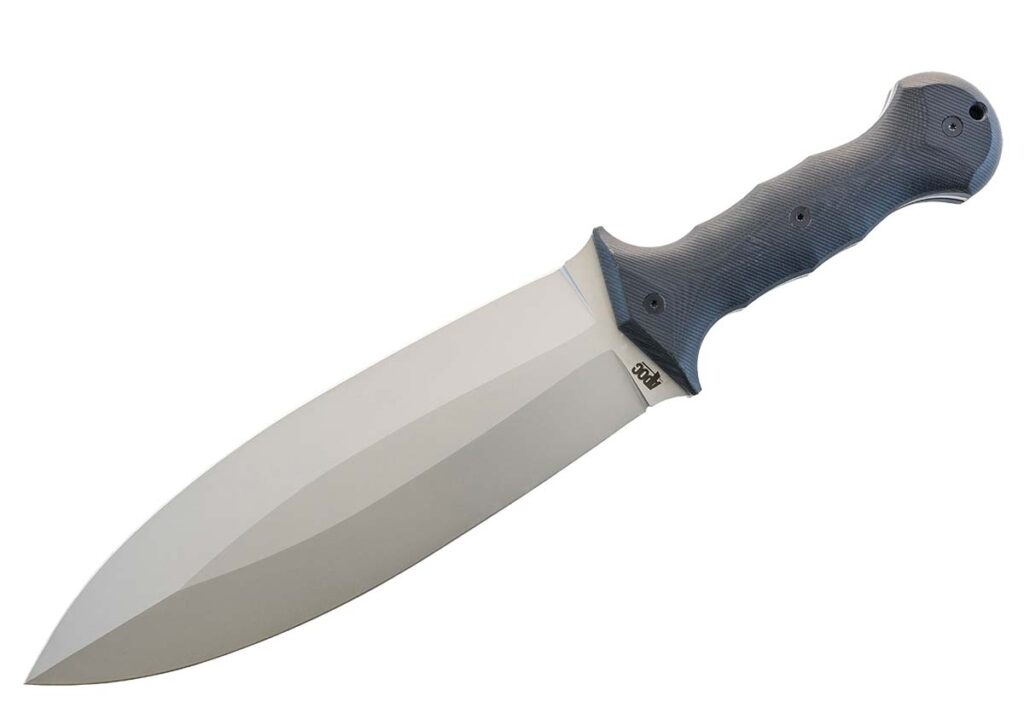
APOC/CAS Iberia Wallace Smatchet

Designed by Mike Wallace, the Wallace Smatchet from APOC/CAS Iberia is a “historically inspired bushcraft” knife based on the classic World War II combat model. The 9 5/8-inch blade is flat-ground D2 tool steel in a titanium coat.
Scales: G-10
Weight: 1 pound, 10 ounces
Overall length: 15.5 inches
Sheath: Kydex with drain hole
Country of origin: China
MSRP: $175. Available: NOW
More On The Blade Shows:

Reflecting On Attending 40 BLADE Shows

BLADE Show ’25 is the author’s 40th BLADE Show—and counting

In the spring of 1985, my fellow U.S. Army lieutenant and knife collector Fletcher Crews told me about the BLADE Show. Having never heard of it, I asked him what it was.  His response: “It’s like a gun show but with knives.”

Later in May of that year we took our wives on a road trip from Clarksville, Tennessee, to the Holiday Inn and Convention Center in Knoxville, Tennessee, the show’s former time of year and venue. We allowed ourselves four hours to cover the show. (Don’t get ahead of me; we didn’t know what we were in for.) You have undoubtedly seen TV commercials telling you about someplace in Florida that is the “happiest place on earth.” Those who say this have never been to the BLADE Show!

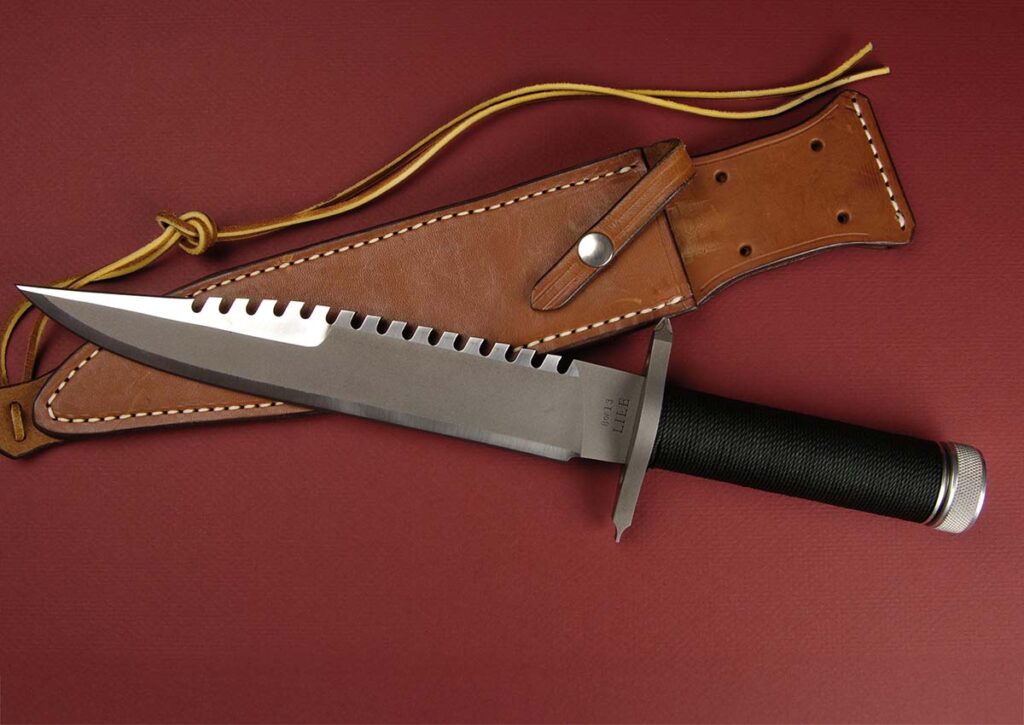
The highlight of the show for me was meeting BLADE Magazine Cutlery Hall-of-Fame® member Jimmy Lile and seeing and handling the Sly II knife he made for the original Rambo movie, First Blood. For those of you who were not fortunate enough to meet Jimmy, he was everything you hear. He was outgoing and friendly, making you feel like he had known you for years. He only made being able to see the knife in person that much better. After all, this is the knife that started me on a path I am still on today.

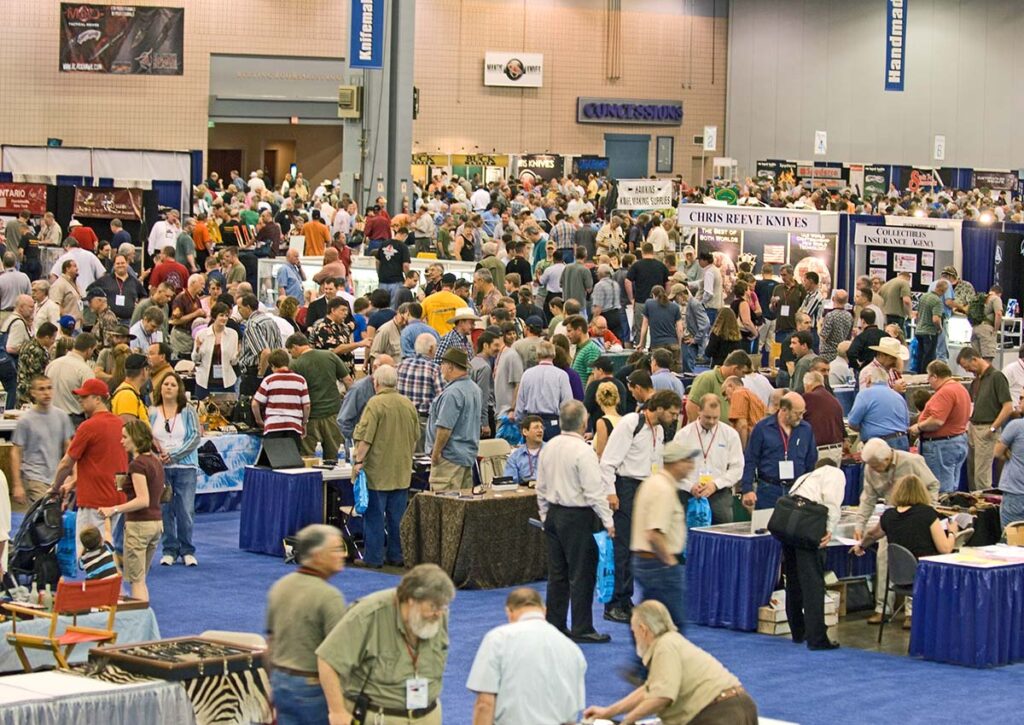
The BLADE Show has been the Happiest Place on Earth for decades—including here in 2007—and will be this coming June 6-8, too. (Eric Eggly/PointSeven image)

Heading back to Clarksville, I realized that planning had already started for the 1986 BLADE Show. As it turned out, I would make a life-altering decision shortly after returning home. Several weeks later, my wife Kathy and I were having dinner with Fletcher and his wife Karla. 

Karla said, “If you did this as a business, you could go to more shows and write off your expenses.” Jerry Seinfeld famously said on his TV show, “You don’t even know what a write-off is.” That was true of me then but I still liked the sound of it.  The following week, I went to a CPA and filled out the paperwork to form Robertson’s Custom Cutlery. I realized I had made a tactical error by only allowing four hours for the show. In 1986, I corrected that. I was, in fact, third in line to get in. 

The doors opened and hundreds of people rushed into the room, all taking different paths to the hundreds of tables. I went to the first table closest to me and within 15 minutes was out of money. It was at this show that I learned my next vital lesson. As I walked among the rest of the tables and booths, I realized I had set a land speed record for buyer’s remorse. The essential lesson I learned was to have a plan.

Armed with my recently acquired KNIVES ’86, the plan began to take shape. The book has photos and an equally important index of makers’ contact information in the back. It started me on my path to creating what would become my Robertson’s Maker Market Matrix. In the early days, I used the Matrix exclusively to figure out what specific knives I wanted to buy. 

The Sly II, aka the original Jimmy Lile First Blood knife, is the knife that got the author started on his career of buying and selling custom knives 41 years ago. The 9-inch sawtooth blade is bead-blasted D2 tool steel. The hollow handle is cord wrapped with an aircraft-grade aluminum buttcap. Overall length: 14 inches. The leather sheath is custom made. The author’s collector value for one of the originals: $4,000-$6,000.

Using KNIVES ’86 and the information within helped me identify what I wanted and implement my purchase plan. Early in 1987, I started to contact knifemakers, asking them what they were bringing to the show or if they could deliver the particular knife I wanted there. The plan was in place and it was implemented to perfection. I received all five knives I had ordered. With the pressure off, I was allowed to move through the Holiday Inn and Convention Center show hall and really enjoy everything the BLADE Show had to offer.

Gil And Bruce

The 1987 show was memorable for more than just the five knives I bought. I was introduced to legendary Cutlery Hall-of-Famer Gil Hibben, who invited me and others to dinner. He was a gracious host with fascinating stories to tell. At that same show, fellow custom knife purveyor Bob Neal (miss you, buddy) introduced me to Cutlery Hall-of-Famer Bruce Voyles, who owned both the BLADE Show and BLADE, and edited the magazine, too. Bruce couldn’t have been nicer. What impressed me most was his encyclopedic knowledge of older factory slipjoints, multi-blade folders and antique bowies. 

In 1992, Bruce gave me another of my favorite memories of the BLADE Show—he asked me to judge the custom knife competition. I’ve judged at more shows than I can remember, but there is nothing like seeing all those knives from some of the best makers in the world all in one room. Bruce introduced me to current BLADE editor, Cutlery Hall-of-Famer Steve Shackleford, who, during a conversation at the 2006 BLADE Show, asked me if I would like to write an article for BLADE. Nineteen years later he continues to ask me to write for BLADE. Bruce and Steve were also instrumental in having me—sometimes with Bob Neal—conduct seminars for both custom knife collectors and makers at several BLADE shows.

At the 1988 BLADE Show, I set up for the first time. With the exception of the show in 1990, I had a table at each BLADE Show until 2011. Having a table at the BLADE Show was an incredible learning experience. It taught me that there is always more to learn about custom knives. Also at the show, custom knifemaker Dave Broadwell and I collaborated and came up with the final design for the MLR Sub-Hilt Fighter. Since then, Dave has made well over 100 MLRs for me in different configurations.

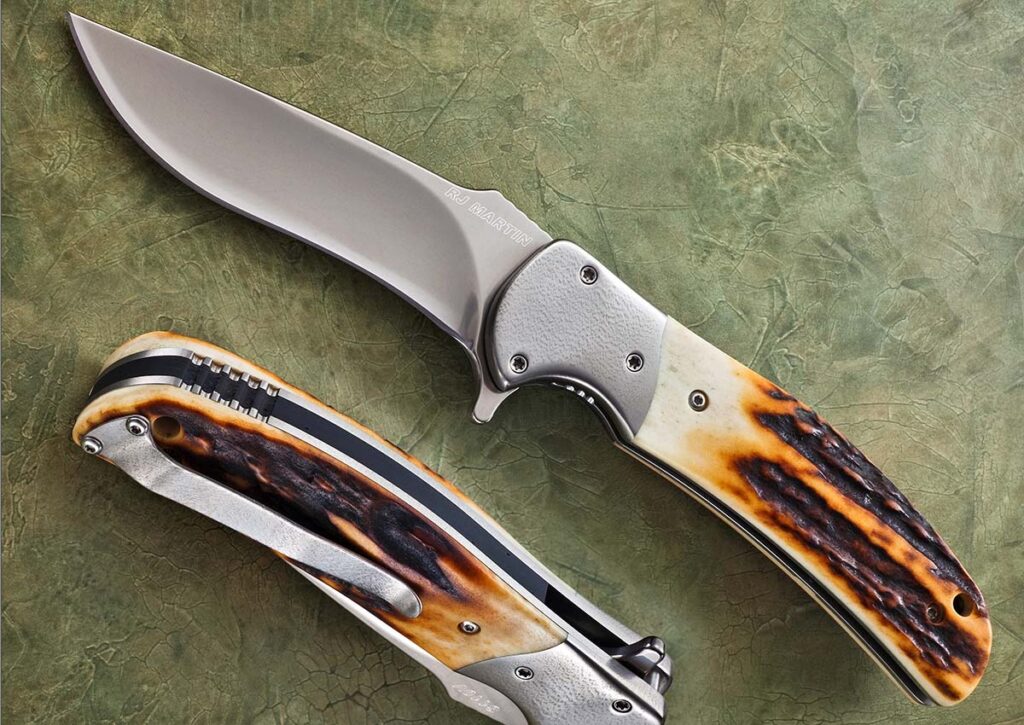
At the 1997 BLADE Show, the author talked to RJ Martin about making a few folders for him. RJ went home and came up with a knife he called the Q30. He later modified it and the result would become his signature model, the Q36, an iteration of which appears here. He went on to win the Best Tactical Folder award at the BLADE Show four years in a row. Today, RJ’s order books are closed. (SharpByCoop image)

At a mid-’90s Knifemakers’ Guild Show, I met a talented maker who at the time was making what I considered the finest Japanese tacticals in the world. However, at the 1997 BLADE Show we talked about him making me a few folders. He went home and came up with a knife he called the Q30. He later modified it and the result would become his signature model, the Q36. He went on to win the Best Tactical Folder award at the BLADE Show four years in a row. His name: RJ Martin.

At the 2015 BLADE Show I met Steve Randall and his wife, Alison. Steve reminded me a lot of the exceptional maker John White. Steve’s knives were clean, incredibly well made and fairly priced. Today, table 3R is always my first stop to check out his knives.

For me, there are many people I talk to throughout the year but I only get to see them once a year at the BLADE Show, and that makes the show even more special to me. Two of those fellow knife nuts are Jack Alsop and Alan Snow.

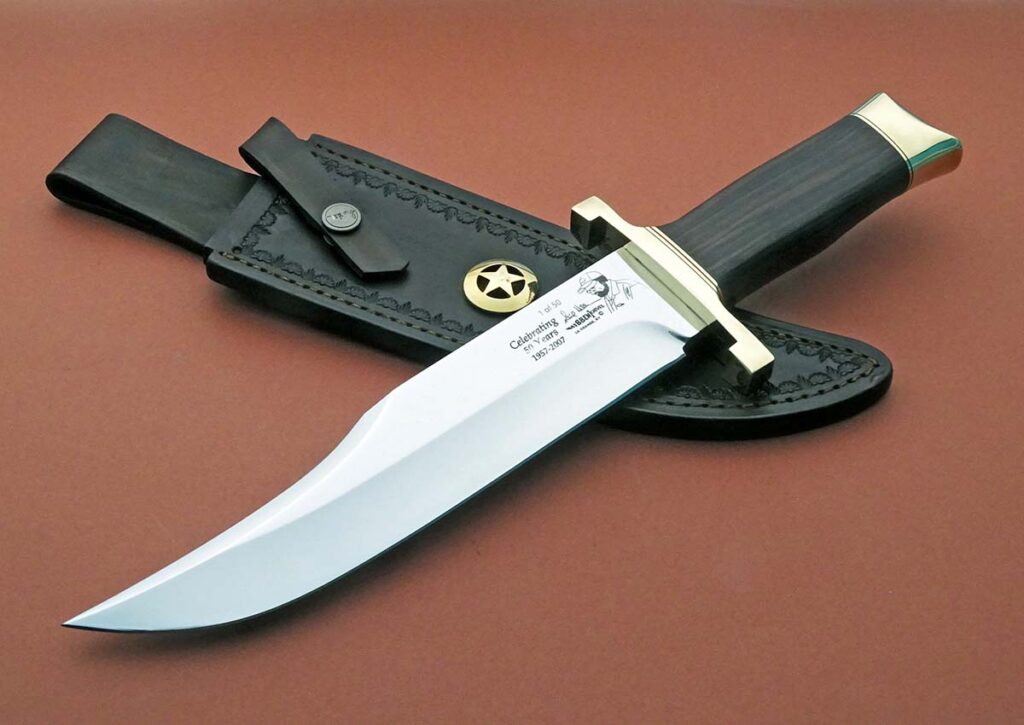
At the 1987 BLADE Show the author met Gil Hibben, who promptly invited the author and others to dinner. Hibben’s 50th Anniversary Bowie features mirror-polished 440C stainless steel and macassar ebony. The guard and pommel are brass. Blade and overall lengths: 9.5 and 14.25 inches. Hibben’s price for a similar knife: $1,900. (Robertson’s Custom Cutlery image)

What I appreciate most about the BLADE Show, aside from the knives, is the camaraderie of the people there. They are literally from all over the world. They are willing to share their knowledge that, for many, has taken a lifetime to acquire. Like I said previously, forget that place in Florida. The BLADE Show is the happiest place on earth. See you there!

More On The Blade Shows:

Knife Handle: Why Handle Ergonomics Should Be Your Focus

How you exert control determines knife handle design.

After 19 years as an autoworker, 30 years as a traditional woodworker and what seems an entire life of being a knife nut, I have come to appreciate a properly formed tool handle. During any workday at the auto plant, I picked up and used tools over 500 times—to be precise, once every 43 seconds. After a while, I started to take notice and favor tools shaped in an ergonomic fashion that allow efficient, accurate manipulation.

How useful is your knife if you can’t hold it and can’t control the edge? Just look to the “Riddle of Steel” from the original Conan the Barbarian movie. Steel is nothing compared to the hand that wields it. Perhaps that is where I find my largest bane. I constantly hear custom makers and users alike talking about a “super steel” and how they would use no other steel or find those to be the best, yet the fact that the knife is a system gets left by the wayside. A knife should be considered a tool and, as such, a tool that is easy to use. That’s if you plan to use it. “Gucci knives” are exempt. The blade and handle working together and a properly heat-treated steel is part of that, so let’s get started with how to hold a knife.

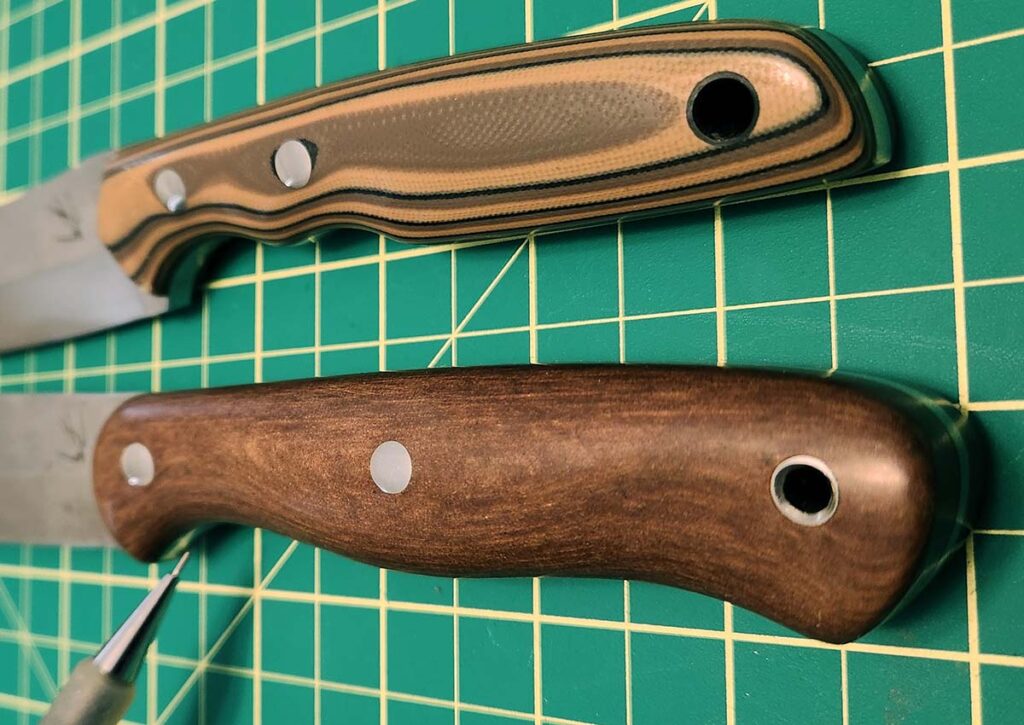
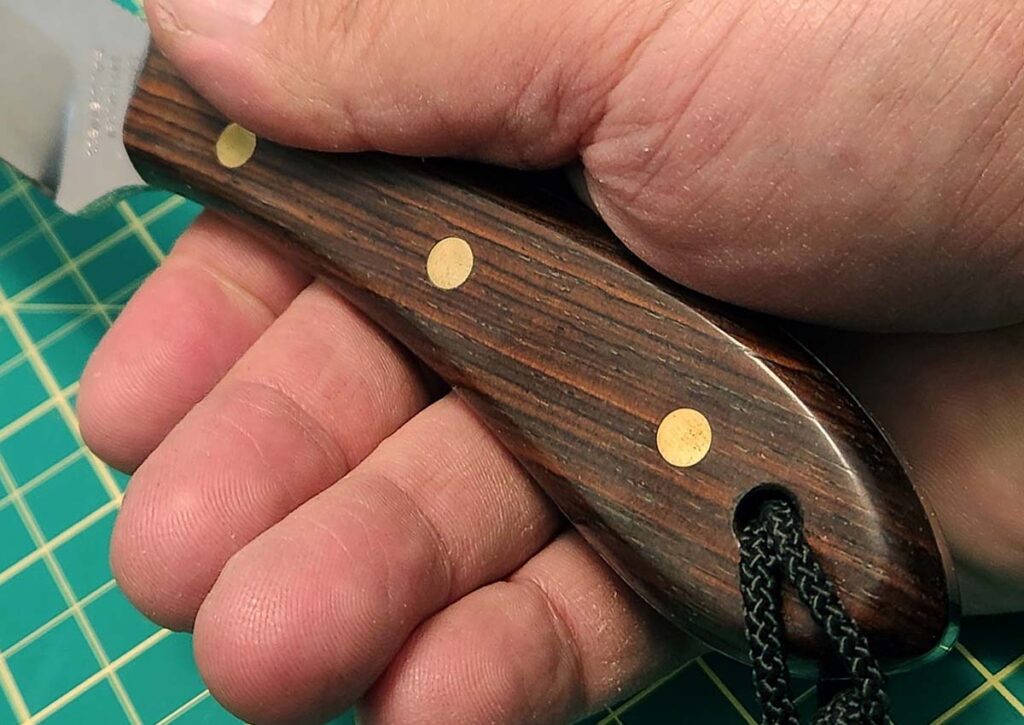
Two Diving Sparrow Knives prototypes. Follow the layering lines built into the material and you can see the flowing contours. The contours not only provide a place to grip but the subtle grooves give your fingers platforms to manipulate the knife in your hand

First off, I am not a human kinetics major so let me indulge myself and develop my own vocabulary for this section, along with some proper terms. The grip consists not only of just your hand but extends back farther through your wrist, forearm, elbow and all the way to the shoulder. Your arm works as a system and how your hand grasps an object will affect the positioning and strength exerted by your wrist and so on up the line.

3 Grip Functions

Starting with your hand, there are three functions of the grip I call selection, reaction and manipulation. Selection is when the hand selects or picks something up, often via the index finger and thumb. Usually, the intent of selection is to seek control over the object until it is firmly held within your grasp, resulting in a solid purchase. The group of muscles and body parts, that is, your index finger and thumb, are also the same group that normally exerts finite control for most people. Writing with pencil and paper is an example how over time humans have developed the index finger and thumb pinch for finer control. Watch any surgeon or chef use a cutting tool; specific direction is guided by the two main leaders of the band, the thumb and index finger.

The Grohmann knives survival model uses a flared teardrop handle, narrow at the front and wide at the back, to prevent the knife from slipping from your grip.

Reaction is best reflected in the act of catching an item, be it a ball or what have you. Your hand is prepared to catch and instantaneously selects the process of gripping the item based on how it enters your hand and what parts of your hand it touches first. A good example is when something small touches the center of your hand; your fingers surround it because it is already in the middle of your grip. If the item is touched to the outside, say just on your fingertips, your hand tries to react by drawing the item to the center and then closing the fingers.

How reaction works in the use of tools can be expressed as “for every action there is an equal and opposite reaction.” Without getting into a huge physics argument over string theory and the purity of the law as it applies to using a knife, it is a simple expression of how your body works. As the cut is made, your body exerts force. In turn, the item being cut provides resistance. To maintain control, your body must adjust your grip; in that that way you can manipulate the tool to continue cutting. Simply speaking, your reflexes kick in, something your mind has been honing all your life and now operates on a subconscious level.

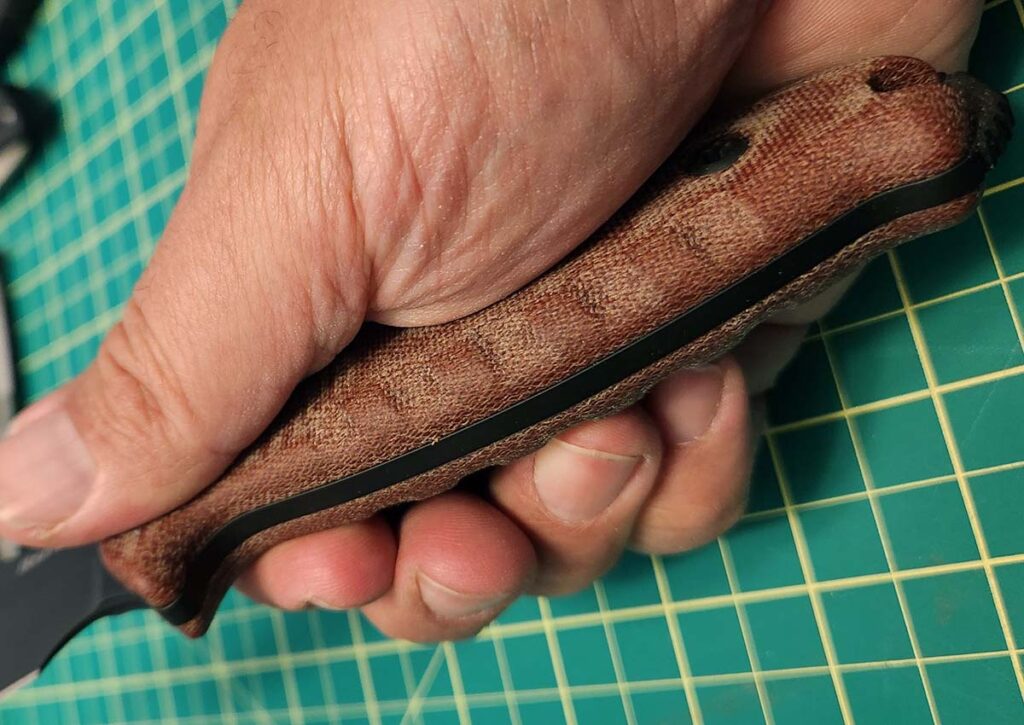
The Cold Steel Republic uses texture on the handle belly to prevent slipping.

Manipulation is what I call a blend of selection and reaction. During your effort to control a tool while using it, you try to coordinate selection and reaction to manipulate it. Remember: how your hand works is mostly subconscious. The process seems inherently simple while using tools; you decide what you want to do. Therefore, the next step is to direct the tool. Your hand goes into a selection mode with the intent of gripping and directing the tool. As you use the tool, different forces often change and your grip must adjust. Taken altogether, I refer to this manipulation as the process of exerting force with a tool and reacting while trying to accomplish the task/directing the tool.

Knife Handle Shape

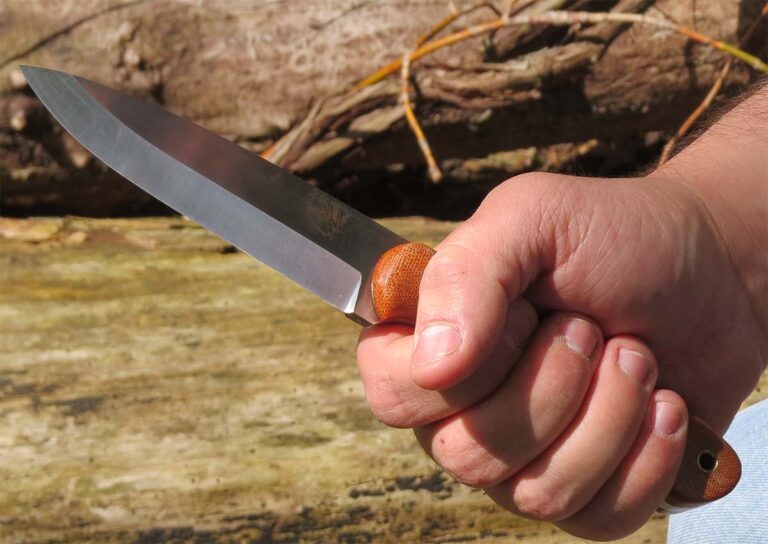
Ideally, a knife handle should be large enough to fill your hand yet small enough for your hand to grasp it. Given that you’re provided just enough volume to fill your grip, you might figure you could solve the shape issue by grabbing a ball of clay and mimicking the resulting shape. Alternatively, you could keep it simple and use the broom handle approach.

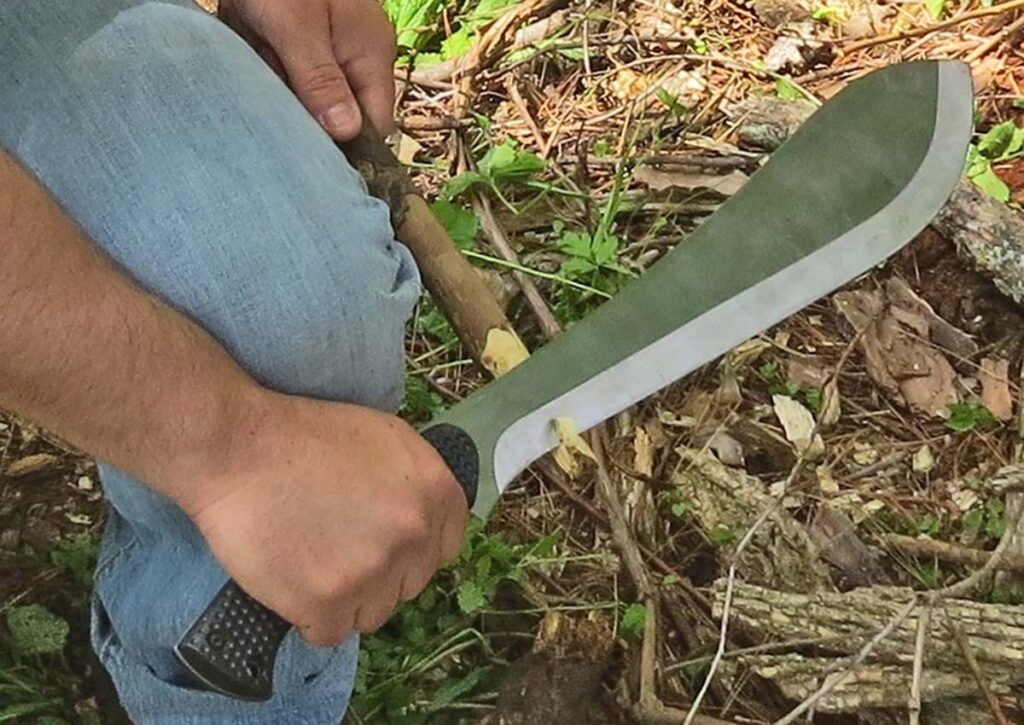
Fox uses a curved handle on its bolo-style machete to allow your hand some movement up and down the grip. “I tend not to like such a grip on smaller knives as it crams the fingers into a small area during use,” the author opined. “The flared back end prevents the hand from slipping off during a swing.

To optimize a handle, I use what I call the absence and presence method. Take, for example, a box-end wrench. The hole in the end of the box-end wrench fits around the nut. At the same time, the wrench has platforms designed to exert force on the flats of the nut to turn it. As the box-end wrench is to a nut, the hand is to a handle. A handle should be shaped to allow the hand to be able to grasp it, yet there should be enough handle to provide various platforms for the hand to exert pressure on to manipulate the knife itself. To achieve this, consider the knife’s purpose.

In shaping the handle, keep in mind first and foremost it must fit the hand. Secondly, it must have platforms/contours that provide places to push off from to control the edge, all the while being mindful not to create hot spots that might abrade the skin either via sharp surfaces or by simply rubbing against the handle.

Knife Handle Materials

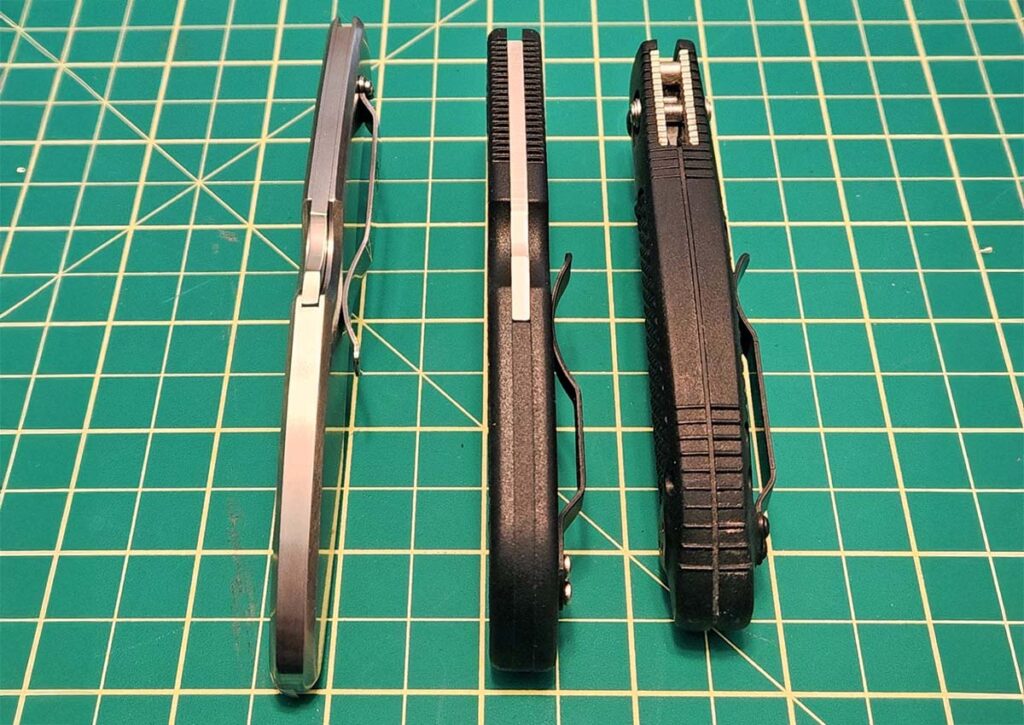
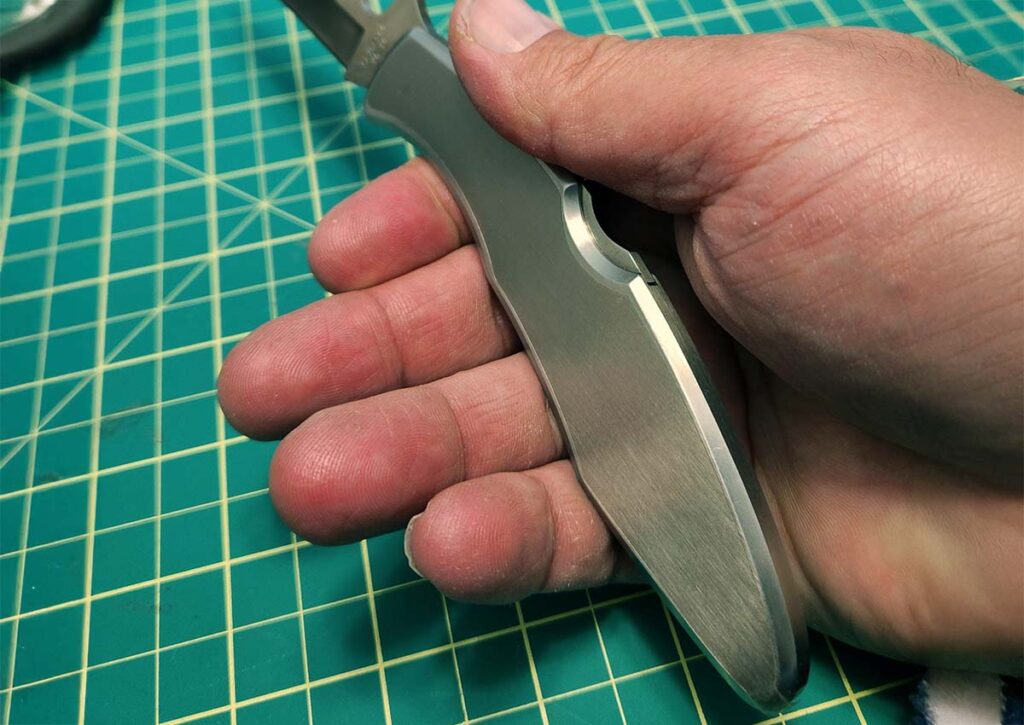
The trim profile of the Spyderco Police (left) allows manipulation for draw cuts, point use and especially lateral force. The Spyderco Endura (center) is a good midway thickness for an EDC. The Benchmade Griptilian (right) has a thicker handle and, like the Endura, scale texture. When using the Griptilian you will find lateral rolling in your hand a bit smoother because of the handle’s fullness.

There is a staggering array of available handle materials, including wood, G-10, carbon fiber, Kirinite and many more. Custom makers even employ rubber barn mats used for horses for cutting competition/chopper handles. Materials chosen correctly can enhance your grip or even overcome some shortfalls of certain handle designs. The use of materials is a large enough topic on its own; I cannot do it justice here. Let it be said, though, that a lot of it is influenced by design and structure.

A handle occupies a three-dimensional space, so forming it should take a three-dimensional approach that addresses the grip’s length, width and thickness. Fine points in design depend on the knife’s use. For instance, a chopper should have a natural stop at the handle butt to prevent your hand from sliding off while swinging, though the stop should not jam or create a rub point to irritate your hand.

The trim handle of the Police enables it to sit nicely over the joints and in-between the pads of your fingers. The trim grip also enhances lateral knife control.

There are many fine points to look over in a handle but the major thing for me is that those finer points should get more consideration. For example, consider again a chopper. Too often I’ve seen chopper handles be too narrow. When a chopper strikes something solid, the energy from the impact travels through the chopper to your hand. A wider handle would distribute the force more evenly, preventing shock to your hand. If the handle is too narrow, the force will be concentrated on a small area. A wider handle will disperse the energy over a broader area, lessening the effect of the impact. In the end there is a fine balance because you do not want the handle to be so large that it’s difficult to hold. That’s why handle design tends to be a sticking point for me when not enough attention is paid to doing it properly.

There is way more information to cover about handles than I can cover in such a short article. I have only grazed the surface here. Creating a well-formed handle and covering common mistakes would take a chapter of a book. I could burn up a whole article on handle nomenclature alone. Hopefully, this will get you thinking more about the handle on your knife than just the latest super steel for the blade.

More On Knife Handles:

Penny For A Knife: Unraveling The History Of This Tradition

2

The fascinating origins of the “penny for a knife” custom, from ancient Rome to Sheffield. Learn why a coin was exchanged saved friendships.

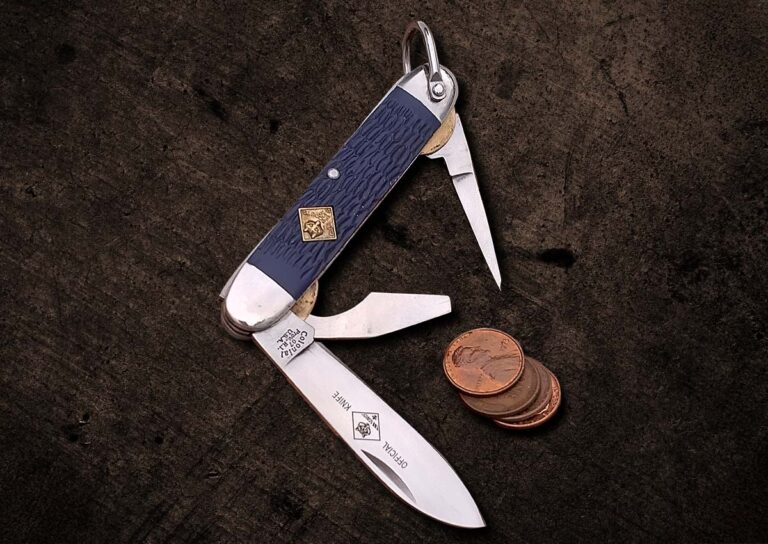
Not all that long ago, the tradition of a penny for a knife was a common practice. Today the custom appears to be barely clinging to relevance, though as traditions go there is the possibility that it may linger and even gain new traction. That, however, remains to be seen.

The old story goes that when someone gives a knife to someone else, the recipient is obliged to present the giver with a penny as a token of appreciation or even as an insurance policy. The origins of the old custom are shrouded in mystery and have become more obscure with the passage of time. Nonetheless, there is a larger aspect to the tradition, and that is its questionable staying power in the modern milieu that is the world of knives.

Is the old practice virtually clinging to life? Apparently so. A few folks contacted for the story were frank in their assessment. Phil Gibbs of A.G. Russell Knives in Rogers, Arkansas, went to the buying public and then conferred with his boss, BLADE Magazine Cutlery Hall-of-Fame® member Goldie Russell, both longtime participants in all things knife.

If somebody gave you a knife and you didn’t give him a penny in return, Cutlery Hall-of-Famer Dan Dennehy noted, “it would cut your friendship.” Dan is also a member of the International Knife Throwers Hall of Fame.If somebody gave you a knife and you didn’t give him a penny in return, Cutlery Hall-of-Famer Dan Dennehy noted, “it would cut your friendship.” Dan is also a member of the International Knife Throwers Hall of Fame.
If somebody gave you a knife and you didn’t give him a penny in return, Cutlery Hall-of-Famer Dan Dennehy noted, “it would cut your friendship.” Dan is also a member of the International Knife Throwers Hall of Fame.

“I’ve polled customers in our store since we first discussed this, and zero people were aware of the old custom,” Phil remarked. “Goldie and I agree that it was once quite prevalent but now is long gone and forgotten.”

The late Cutlery Hall-of-Famer A.G. Russell knew the custom well but sometimes found himself having to explain it a bit.

“Sometimes people look at me funny,” he said years ago of the times he gave a knife to someone and asked for a penny in return, “especially when they are younger. The younger they are, the funnier they look at me. I just think it’s a matter of their not knowing about it.

“As I was growing up, I saw it being done, not just once but many times. I still do it myself. I insist on compensation. It may end up being a quarter if they don’t have a penny, nickel or dime. I knew a man years ago who liked to give knives away, and he would give the knife away with a penny and then make you give the penny back.”

Veteran knife dealer Bill Claussen of Northwest Knives in Salem, Oregon, is another source who definitely would be in the know regarding the tradition, and his assessment was a straight-up, “I really don’t have anything to offer on this one. This is really not ‘old knife’ country out here, and I never even heard of this until a few years ago,” he noted, “and then I never heard it discussed.”

Cutlery Hall-of-Famer A.G. Russell (at far left) waits on a customer in the retail knife store inside A.G. Russell Knives.
Cutlery Hall-of-Famer A.G. Russell waits on a customer in the retail knife store inside A.G. Russell Knives.

The tradition may well be on life support. While it is likely fading or the sun has quite possibly set on it altogether, there are related memories. Matter of fact, this writer put together a BLADE® story on the topic some 26 years ago. Coincidentally, I had just experienced the tradition in action. When I handed a nice folder to a close friend, his wife piped up, “Now you have to give Mike a penny. My mother and father never gave one another anything with an edge without receiving a penny in return.” Even then, my friend’s wife had no idea where the practice had originated.

Penny For A Knife Origins

In that BLADE story 26 years ago, Cutlery Hall-of-Famer Bruce Voyles related that he believed the custom originated in ancient Rome.

“The general theory was that you would ask for the lowest coin of the realm when you were given a knife,” he said. “Back then, when you were dealing with an absolute monarch and the king or queen handed you a knife of their own, you were expected to kill yourself with it. But, if the king demanded a coin from you, then he was giving you the knife.”

Well-known knife dealer Jim Taylor, who grew up in Sheffield, England, remembered the penny for a knife custom as it was practiced in his family. “When I was a little boy,” he recalled years ago, “I had to give my mom a penny before she would give me a pocketknife she had bought for me. It might have been a particular Sheffield custom that became popular.

“I’ve always expected to be given a coin, whatever it might be, any coin at all. In England you don’t have to explain it, but in the United States sometimes the custom is not held so tightly. If I were to take someone a gift of a pocketknife in England, they would without question give me a coin. They think, ‘You must buy this because otherwise it might cut our friendship.’ I’ve seen knives from time to time with an old English farthing or half penny built into them.”

That was then.

Bill Claussen with Sheffield Exhibition Knives, the book he authored in 1999 along with Brad Watts and Pete McMickle.

Even Queen Elizabeth II participated in the tradition. The Sheffield Star newspaper dutifully reported in its Dec. 12, 1986, edition that the Queen visited the city and was presented with a platinum penknife and responded by handing the presenter a six-pence coin in a case. Thirty-five years earlier, the monarch had visited Sheffield and handed a cased half penny to the giver in exchange for a gold penknife.

In fact, the practice was so widespread at one time that according to Cutlery Hall-of-Famer Bernard Levine, one of the foremost knife writers and folklorists, Gerber knives were often sold in the 1940s with an accompanying card that explained the penny for a knife tradition. The card even had a penny glued to the top along with the declaration of “invoice” and then space for a name along with the instruction, “debtor to” and then “1 box of Gerber Blades … 1 cent.”

Levine said the Gerber card explained the legend a bit further. “There is a superstition, or something, about giving away cutlery … etc., so I trust you will honor this bill,” the card stated. “Besides, I need the money.”

FRIENDSHIP CUTTER
Years ago, Cutlery Hall-of-Famer Dan Dennehy indicated that he had grown up with the tradition.

“If someone in our family gave you a pocketknife, they got a coin,” he recalled. “The value didn’t matter just as long as it was legal tender. If somebody gave you a knife, a letter opener, anything with a sharp edge, or even a butter knife, you always gave a coin in return because if you didn’t collect a payment it would cut your friendship.”

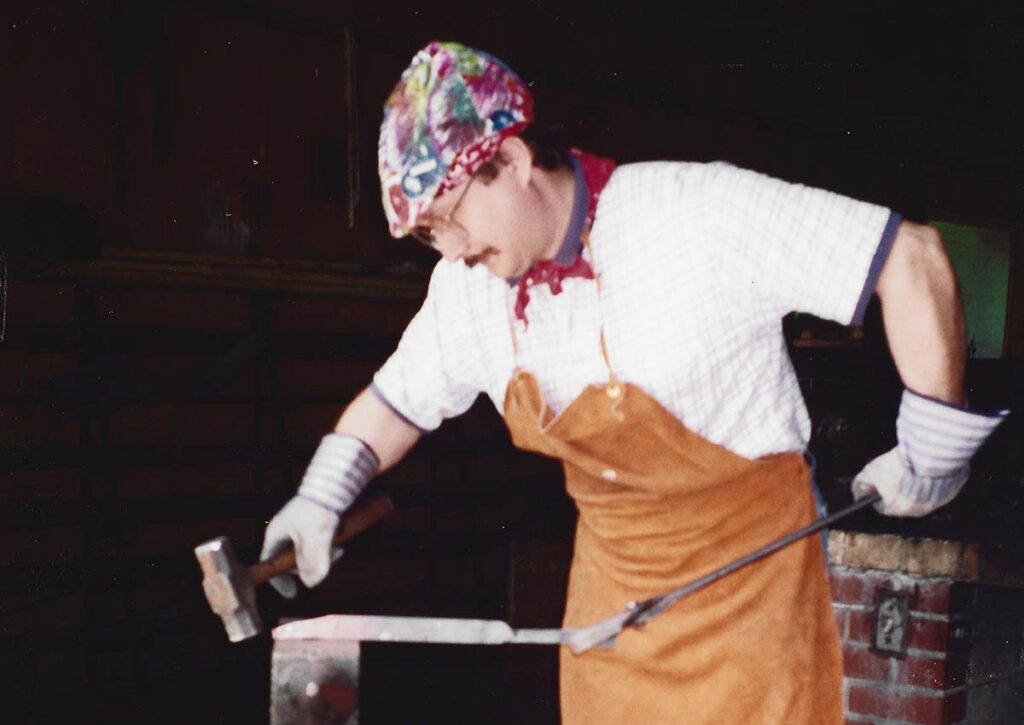
Cutlery Hall-of-Famer Bruce Voyles hammers hot steel during a basic bladesmithing course in 1994 at the Bill Moran School of Bladesmithing. (B. R. Hughes image)

Those who remembered the old practice seemed convinced a quarter century ago that fear of “cutting the friendship” was their prime motivation. Knifemaker John Dennehy, Dan’s son, remembers his close association with it.

“I’ve thought about this and don’t have any firm history about it,” John reflected. “I do remember my dad spoke about it a lot. Giving a knife as a gift can sever the friendship, so he always asked me for a quarter or something when I was a kid and a dollar as an adult. He often told the story about being on the radio with G. Gordon Liddy [talk show host, attorney and FBI agent involved in the Watergate scandal of the 1970s] and presenting him a knife. Gordon was prepared and had a silver dollar ready to give Dan. Being first-generation Irish in the U.S., he claimed it was an old Irish tradition. In the books and TV show Outlander, Jamie Fraser, the Scottish highlander, gifts his wife a custom knife. He asks her for a little something in return—says it’s an old Scottish tradition. That’s not much, but I did grow up with the tradition and carried it forward.”

In doing some research sometime back, it became apparent that the tradition has been a cross-cultural phenomenon. In Scandinavia, for example, it’s seriously bad luck to outright give someone a knife. A knife that was gifted but not meant to be a “killing knife” had a coin accompanying it with the initials of the maker. That would ensure the knife’s good use. Along with the knife an old saying, “A man without a knife is a man without a life,” added to the Scandinavian sincerity of the event.

Despite the fact that the tradition may be fading or has already slipped into history, some way or somehow it may experience a revival. Levine and many others seemed to love it. Some still do. After all, it adds to the quaintness and charm that surrounds the exchange of a knife with a friend or family member.

Tradition is a common thread that just makes the giving more memorable and enriches the experience for everyone. In these days of inflation, it’s cheap, too. It only costs a penny.

Pocketknife Info:

BLADE Show Beer: Brew That Taps Into Blades

0

Gabe Fletcher/knifemaker ale collaborations lead to the official BLADE Show Beer.

It’s a winning combination, no doubt—a blend of brews and blades.

Three years ago, Gabe Fletcher began making knives. Then, somewhere along the way he had a brilliant idea. The dynamic combination of his finest craft beers with the custom knives that could be developed in collaboration with friends who appreciate both, just as he does, was too tempting not to try.

Fletcher had been in the brewing business since 1988, and the joint venture of beverage and blade just seemed to fit. “I ran another brewery here in Anchorage for 13 years,” he recalled, “and decided to start my own brewery after so many years. I’m coming up on 27 years of professional brewing, and I started when I was 21.”

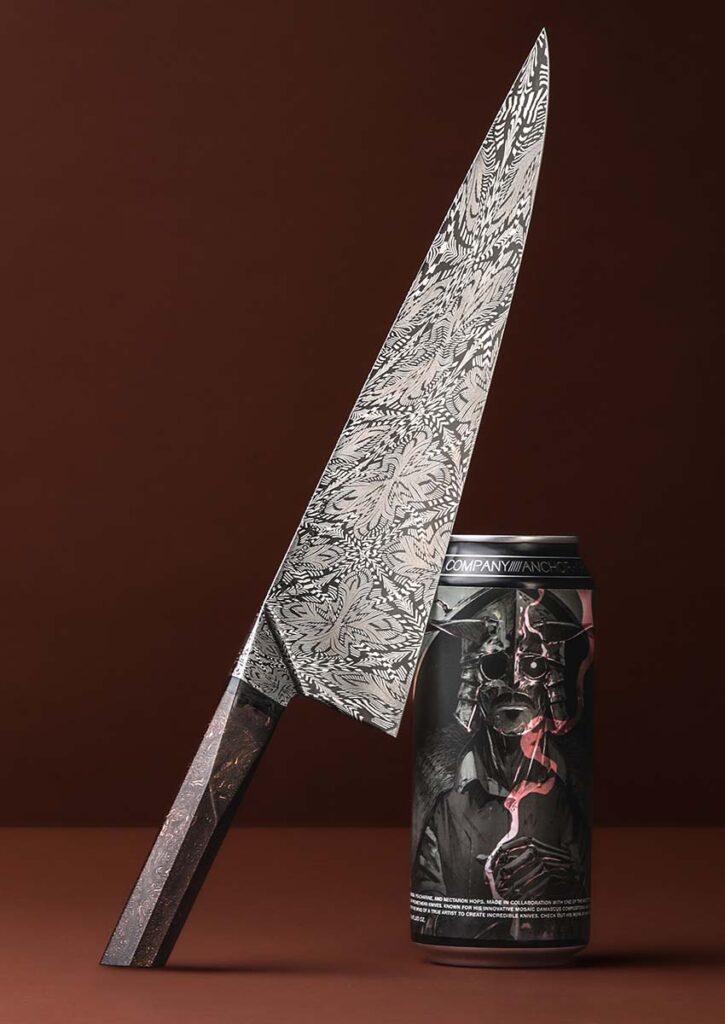
Gabe Fletcher (above at his Anchorage Brewing Company) and Salem Straub collaborated on a chef’s knife (facing page) in mosaic damascus and carbon fiber paired with a “niche” beer—a bold, crisp IPA with a low alcohol content.

Gabe knew that the collaboration opportunity was alive and well in the brewing industry, and it just seemed a natural progression. “I do many collaborations with other breweries and I’m pretty well known in the beer world,” he observed of his Anchorage Brewing Company*. “I thought in the beginning that it would be a fun way to get my name out there as a knifemaker. The first collaboration was with award-winning bladesmith Neil Kamimura. He was the person that got me into knifemaking.”

Seeing the knives in Neil’s shop a few years ago provided inspiration for Gabe to give it a try at the forge. At first, he did only beer collaborations as he refined his own knifemaking skills.

“Eventually, I started to get good enough to start actually making knives with these makers. I owe a lot to Mareko Maumasi [page 16]. I would consider him my mentor, and I’ve learned so much from him,” Fletcher reflected. “Working with him so much has really propelled my skills much faster than if I was learning on my own. Now Anchorage Forge and Anchorage Brewing are very connected, and I use it as a way to have fun, collaborate and excel in my knifemaking journey.”

Gabe Fletcher/knifemaker ale collaborations lead to the official BLADE Show Beer

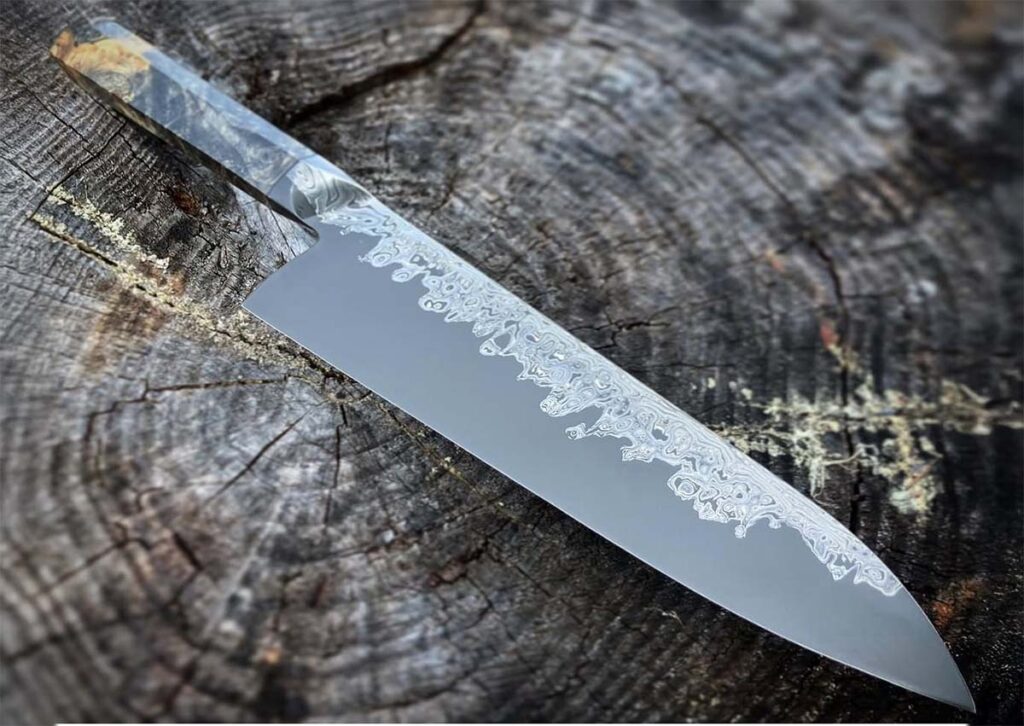
To date, Gabe has completed at least nine knife/beer combos, and there are more to come. Naturally, he gravitated toward one with Mareko. The resulting knife was a dazzling chef’s tool with damascus blade, handle of white oak from the barrel in which the accompanying beer was aged, carbon fiber and G-10 spacers. Respective blade and overall lengths: 10 3/8 and 14.8 inches. Mareko’s price for a similar knife: $3,000.

“Gabe posed the challenge to me to see if I could design a steel that looked like a devil’s skull,” Maumasi explained. “I already had a design for a pattern that looked like a skull, which I hadn’t made yet but had sketched out in a notebook. At that point, all I had to do was figure out how to add horns to the skull. The devil skull came together nicely with the detailed elements for the teeth, cheekbones, eyes and horns. A lot of people who see it assume that it’s a canister damascus steel, but it’s actually a combination of several pattern-welded elements that started out as plate steel. For the forged design, we added a crushed ‘W’s’ flame along the edge of the blade.”

The damascus chef’s knife paired nicely with the latest in Fletcher and Maumasi beer offerings. The pair have actually done more than one brew, and the most recent is a synthesis of tropical flavors to honor Mareko’s Samoan heritage. The first was a Maumasi oak-aged imperial stout, which had a base aged eight months in Buffalo Trace bourbon barrels. It was then transferred to freshly emptied Woodford Reserve Double Oaked bourbon barrels for six months before moving to emptied Buffalo Trace bourbon barrels for four months, and was finished with toasted coconut and coffee from the Olympia Coffee Company in Mareko’s hometown. The second is the Maelstrom IPA, a smooth and light beverage with grapefruit, passion fruit, papaya and lechee hints.

GABE’S GREAT IDEA

Another example of Gabe’s great idea translated into a chef’s knife collaboration with Salem Straub. It includes a 10.5-inch mosaic damascus blade with a handle of copper/coral carbon fiber that features carbon fiber and G-10 spacers. Overall length: 14.9 inches. The knife sold for $5,850 through Eating Tools.

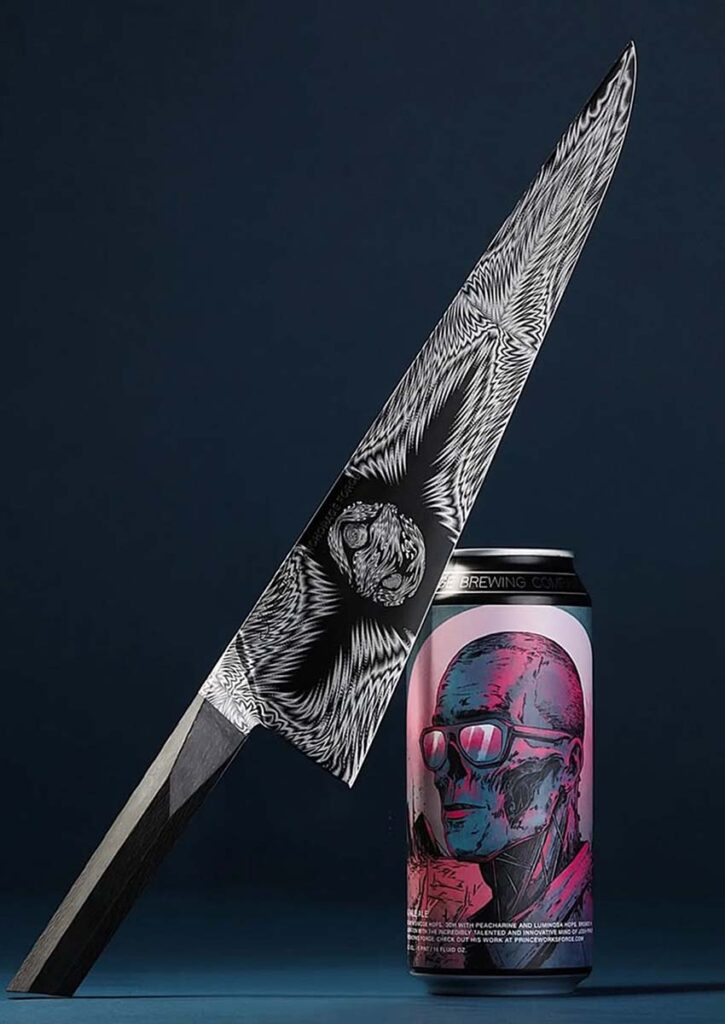
Plant Eater, a hefty chef’s knife with an 11.1-inch carbon steel blade, carbon-fiber handle with G-10 spacers, and 15.8-inch overall length, is a Gabe Fletcher/Josh Prince collaboration. The beer that accompanies it is a “dank, strongly fragranced IPA.”

“I forged a bold mosaic pattern of ‘distorted finger-type layup’—that’s Steve Filicietti pattern language—and sent Gabe a big chunk sawed from a loaf of that,” Straub related. “He worked his magic and forged a big sleek integral chef’s knife in an angular Western profile from it, and finished it up with some of his signature-style faceting applied to a hidden-tang handle of crazy carbon fiber. The steels in the blade are 15N20 and 1080.”

Salem has been making knives for 22 years and expressed real gratitude for Gabe’s initiative. “He always kills it at what he does, and this was no exception,” Salem observed. “I’ve had a lot of fun sharing his brew with family and friends.”

The Anchorage Brewing product Fletcher and Straub created found a niche among beer lovers. “Our idea was to come up with a bold, crisp IPA with a low alcohol content,” Salem said. “It’s what I would term a ‘performance IPA’ since you can have one or two and still get stuff done. It’s a real challenge apparently to make a beer to these specs, but Gabe is quite a talented and skilled brewer, as well as knifemaker.”

A hefty chef’s knife with an 11.1-inch carbon steel blade, handle of carbon fiber with G-10 spacers, and overall length of 15.8 inches was the result of Fletcher’s collaboration with Josh Prince. The knife sold for $5,850 on Eating Tools.

“I knew Gabe from interacting over Instagram and a few phone calls to talk about pattern and material processes around knives both carbon steel and stainless,” Josh noted. “Slowly, we developed the idea of working together on a knife/beer release. We worked on a chef’s knife in carbon steel in Gabe’s design with a plug-welded element. I provided the damascus plug element and Gabe did the rest. We dubbed it ‘Planet Eater’ after the classic Star Trek episode “Doomsday Machine,” where a mechanical entity consumes entire solar systems.”

In addition to running the internationally known Anchorage Brewing Company in Anchorage, Alaska, Gabe Fletcher is also an ABS apprentice smith.

Based in Rhode Island and making knives since 2016, Prince commented, “It’s just inspiring to work with another maker of such a high caliber and level of motivation and creativity.”

That motivation led to a discussion that brought back a pleasant memory for Josh. “I talked to Gabe about another beer that he made with Ben Kamon of Austria and how much the aroma reminded me of cannabis,” Prince remarked. “Oddly enough, Gabe told me that the hop and cannabis plants are very closely related and could even be grafted together! I asked for a dank, strongly fragranced IPA, and Gabe delivered.”

BLADE SHOW BEER

Adventures in knives and beers with Fletcher and friends doesn’t stop there. Recently, Gabe engaged with representatives of the BLADE Show to craft a unique brew just for the greatest show in knives.

Gabe Fletcher’s chef’s knife/beer collaboration with Austrian knifemaker Ben Kamon resulted in a striking combo.

“It’s an IPA that will be lighter at around 4.5 percent alcohol by volume—very floral and smooth drinking—and the BLADE Show beer will be available at the show in the Cobb Galleria of Atlanta at every bar on the floor and also on the main hotel floor, i.e., in The Pit!” Fletcher advised of the iconic sunken bar in the lobby of the show’s host hotel, the Renaissance Atlanta Waverly.

“We will also have some of the beer available online through one of my distribution partners, Tavour, where a person can have the beer mailed directly to their home in 23 states in the USA. I went to my first BLADE Show last year and ended up having dinner with some friends and a few people I hadn’t met yet. Henry Wu from the BLADE Show was sitting next to me. We got to talking, and later that year I had the idea of having a beer made just for the show. I pitched it to Henry and he was all about it.”

With his fine pairings of blades and brews already offered and more coming in the future, Gabe melds his two great passions, connects and collaborates with friends, and presents the resulting creations to the world. His love of both brewing and knives shines through in every aspect of the ongoing project.

Mareko Maumasi’s gyuto chef’s knife in a san-mai construction serves as the model for the knife second from right at top in the artwork for the BLADE Show Beer.

“The beer is sold through my distribution network and is mainly free advertising for the maker,” he said. “Also, it’s just a fun thing to do. I mean, who wouldn’t want a beer brewed in honor of them? As far as the knives are concerned, most of them are sold through Eating Tools. Abe Shaw and his crew over there do an amazing job of taking beautiful pictures and telling the story of the knife and beer as a whole.”

It’s a powerful, flavorful and altogether refreshing combination of brewer and bladesmith. Raise a glass. Slice and dice. And feel the fine craftsmanship in both.

*In 2024, Gabe Fletcher’s Anchorage Brewing Company was ranked among the country’s elite beer makers. According to Untapped, an app that allows drinkers to rate their beers, his company was ranked No. 6 nationwide in terms of producing the highest number of brews at a state or national level. The ratings are by nearly 11 million beer lovers covering over 26,000 of the world’s top-rated beers, as reported in Forbes.

More On The Blade Shows:

Tariffs & Knife Prices In 2025

Cutting Through the Costs: How Tariffs Are Reshaping the Global Knife Industry.

Tariffs. The simple mention of the word makes some folks tear their hair out. That’s not a problem for me because the word doesn’t upset me that much. Besides, most of my hair has already fallen out anyway.

As you know, a significant portion of American knife companies depend on China to manufacture some, most or all of their knives. As you also no doubt know, President Trump is addressing America’s tariff imbalance with other countries—including China—in no small part to help erase some of America’s $36 trillion debt. And, at press time, he was threatening to impose higher tariffs on China than any other country.

How will the President’s tariffs affect the knife industry? I asked one industry insider and he told me of a recent trip he made to China to talk business with those who make many of the knives for the company he represents.

He said the last time he went there was 2018 and he was amazed at all the changes in the interim. There wasn’t a bridge from Hong Kong to China seven years ago. Now there is one and they drove on it to the Chinese mainland. There are new superhighways all over with no cars on them.

“It’s crazy the money they’re spending on infrastructure,” he wrote. When he went to one city in 2018 there wasn’t a traffic light in sight. Now it’s a city of 2.6 million people with high rises everywhere.

“Maybe it was my imagination but the vibe wasn’t great,” he observed of the reception he received earlier this year. “A couple of factories seemed to blow me off. I used to get the golden carpet treatment. One of our guys who speaks Chinese said he was having a hard time getting answers from some of them. I think the tariffs have them scared.”

I wondered out loud if the Chinese manufacturers thought they’d gotten most all they could out of the company my friend works for and are looking at other revenue avenues.

“I don’t think so,” he wrote. “The other markets are small in comparison to the USA. The Chinese knife factories are so specialized that making knives is really all they know.”

He added that the big Chinese manufacturers are building factories in Vietnam to avoid the tariffs, though he predicted the President would close the Vietnam loophole soon if he hadn’t already by the time this story hits print. I asked if that would make it more economically feasible for those American companies who have knives made in China to have them made domestically, and he hit me with the cold, hard facts.

“Rough numbers: cost to make a folder in the USA, $100; cost to make the comparable folder in China, $25. Double the cost with tariffs and Chinese-made knives are still half priced,” he emphasized. “Knives are such a niche market and relatively low volume that even with automation it would be tough to match the price of knives made in China. Marketing, design and innovation can overcome that cost gap. Look at Benchmade. They are killing it.”

Concerning my earlier question of whether the Chinese manufacturers might be looking at other sources of revenue, he returned with a qualifier.

“I did see two factories that are now making manicure stuff like nail clippers. Ten years ago you would not have seen that. A knife factory was a knife factory. One factory was making Nite Ize® products, so I guess they are diversifying,” he wrote.

“One more thing,” he added. “I went to a big-name [Chinese] factory and the owner did not appear to be worried about tariffs. He is focused on making the best knife he can, so I think you could say the higher-end manufacturers aren’t as worried about tariffs.”

My insider friend, however, disagrees with that rationale.

“I think when the market goes bad even the billionaires slow down on impulse buys,” he opined.

On the domestic side, at least one U.S. company official says costs are increasing for steel and other knife materials even though the steel and materials are U.S. made. Meanwhile, by the time you read this, here’s hoping the President has been able to work out, or is well on his way to working out, deals with most if not all of the countries on which he imposed tariffs. Either way, as my insider friend summarized,

“The tariffs are going to have a big impact on our little industry!”

More On Knifemaking:

Hults Bruk Spika Review: Backwoods Beast

Sweden’s Hult Bruks Spika is a great all-purpose camping axe.

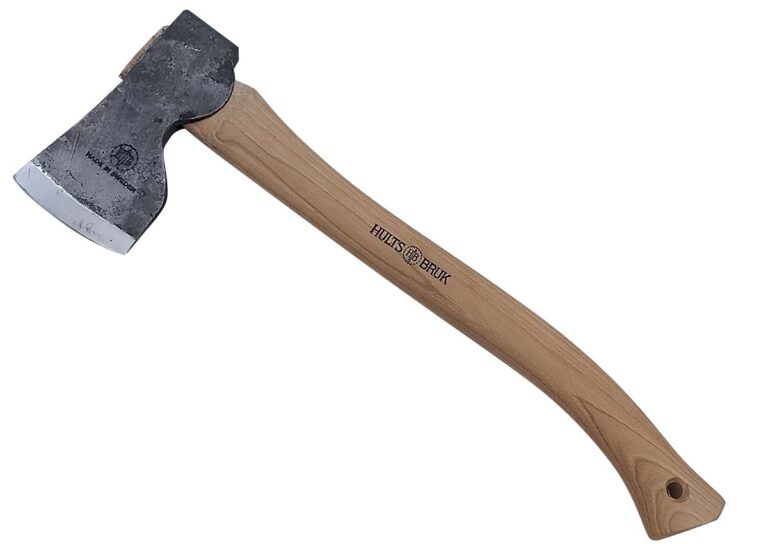
Most outdoorsmen use axes and hatchets—axes for chopping trees and splitting firewood, hatchets for lighter work. Axes were normally too big to carry backpacking, so we always settled on using a hatchet and made do. Some of us would cut the handle down of an axe to make it more manageable. Now, with the help of the internet, we’re able to see what other outdoorsmen use. The Spika from Hults Bruk of Sweden is the perfect size to handle most all axe chores and still be manageable to carry.

Spika Specs

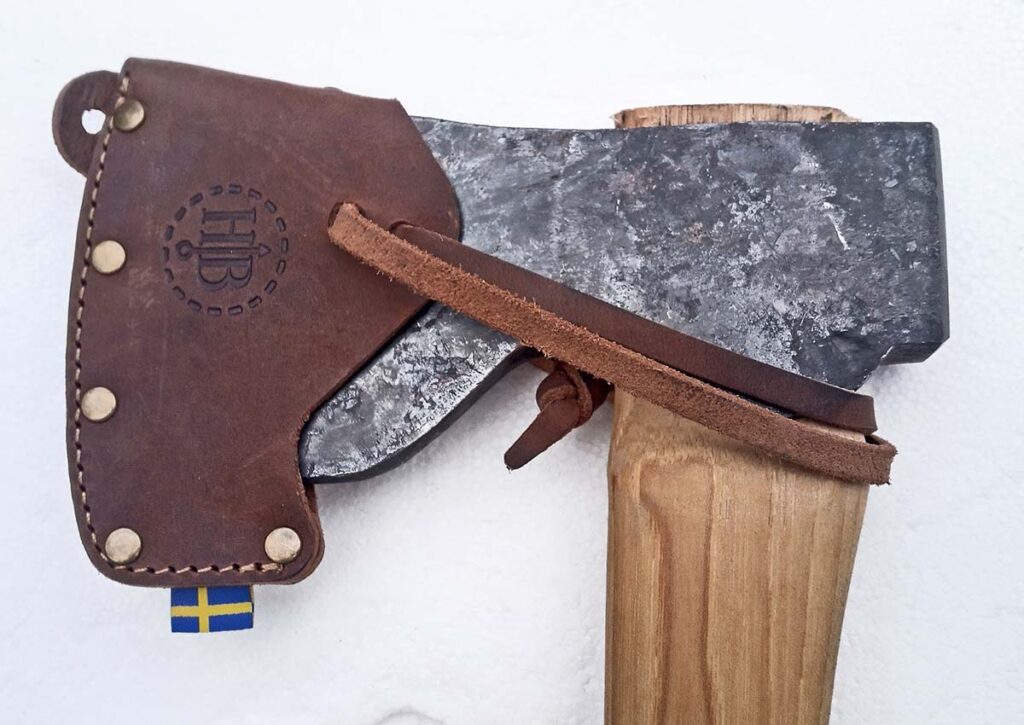
The leather edge cover is a strap-on model.

Pros

  • Perfect Mid-Size for Versatility
  • Razor-Sharp Edge
  • Forged Finger Notch for Control

Cons

  • Uncomfortable Ridge at the Choil
  • Price May Be High for Casual Users

Model: Spika all-purpose axe
Company: Hults Bruk
Edge length: 3”
Head & edge material: Forged carbon steel
Handle: Hickory
Overall weight: 2 lbs. 5/32 oz.
Overall length: 17.5”
Sheath: Leather edge cover w/strap-on thong
Country of origin: Sweden
MSRP: $206

Light-Duty Cutting

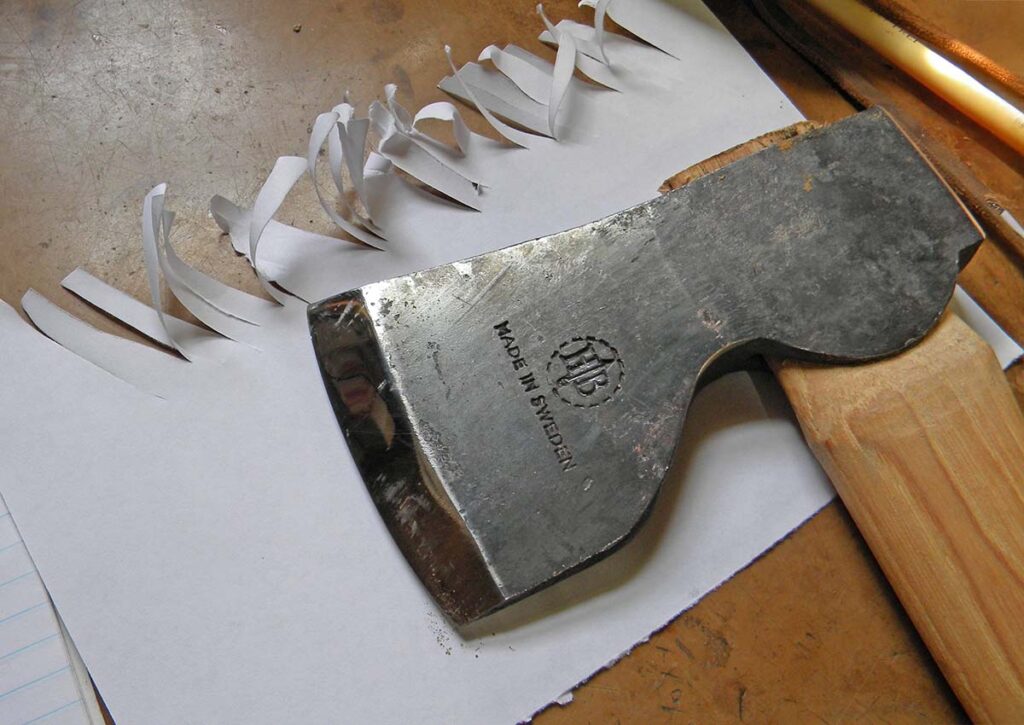
The Spika sliced the 20-pound bond paper like a champ.

I just had to do a paper slice because the Spika felt wicked sharp. It was challenging to get started but the Spika sliced the 20-pound bond paper like a champ. I choked up on the head and used push cuts. The first slice included a piece of my fingernail. Wow, this is a sharp axe! It was loud while slicing, that is, the sound of paper being cut.

Single-walled cardboard slicing was next. It was easier than the paper to hold and move my fingers out of the way. The Spika was surprisingly easy to control as there is a forged-out finger notch to aid in choking up on the head for finer work. The axe made the cardboard curl up, which makes great fire starter. Again, I used the push cut. I was slowly getting used to this mid-sized axe. I still had to account for the longer handle.

Medium-Duty Cutting

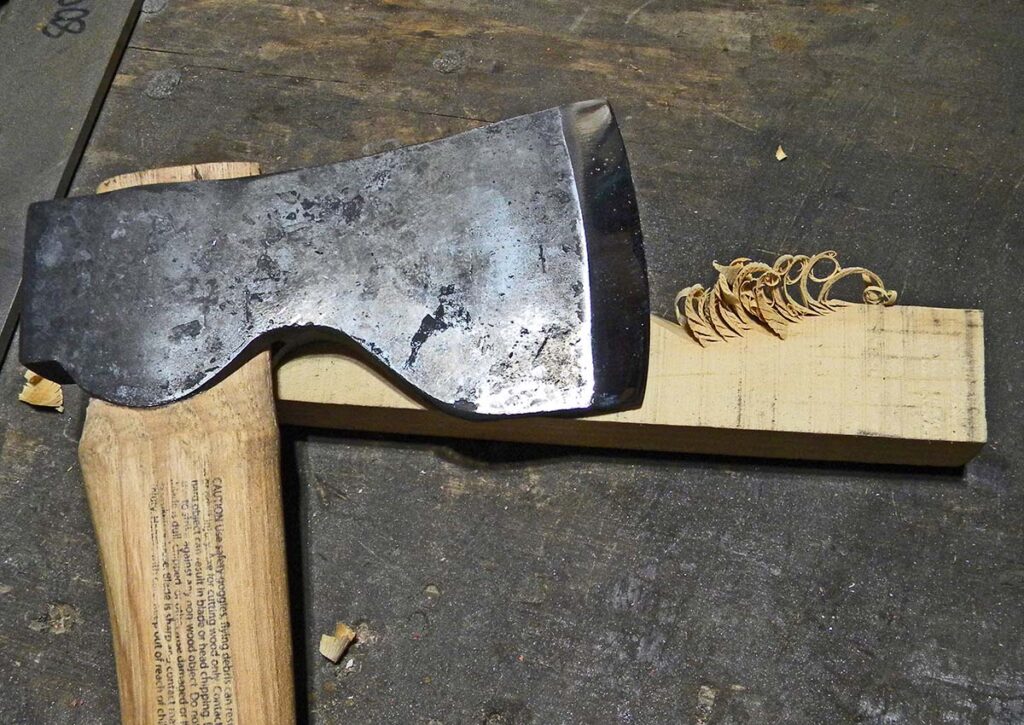
The super sharp edge rendered some very nice, smooth curlicues.

It was time to do some whittling on pine. The Spika was very controllable on the depth of the cut. The super sharp edge rendered some very nice, smooth curlicues. I did notice a sharp ridge on the choil area that needed to be softened if you are using bare hands. A few passes on a Kraton wheel made it easier on my index finger.

Chopping

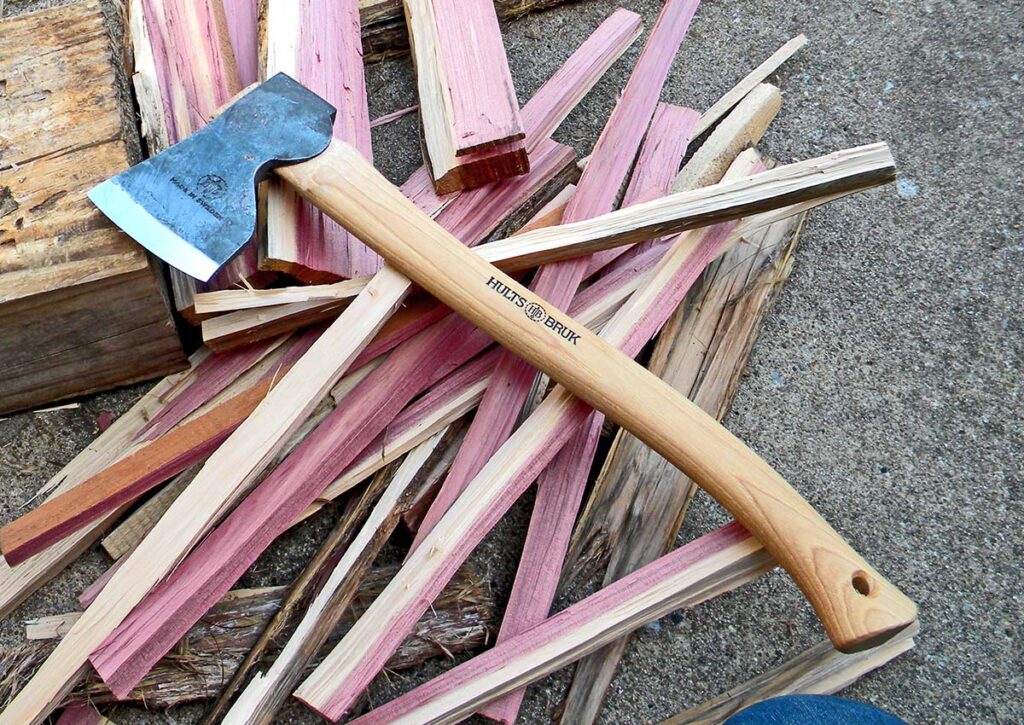
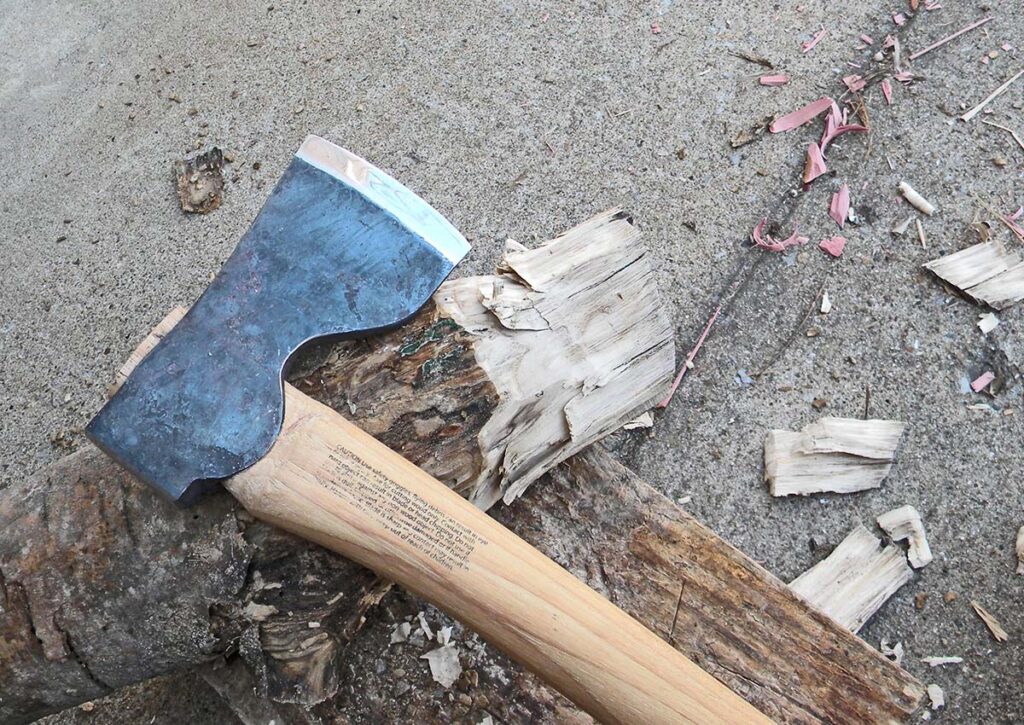
The Spika split one red cedar slab in one chop. The author kept on splitting till he had a nice pile of kindling.

With camping season kicking off, I had some red cedar slabs that needed splitting. The Spika split one in one chop. I kept on splitting till I had a nice pile of kindling. I did a few more firesticks to add to the pile. This is a handy axe for sure. You just have to find the sweet spot on the handle for splitting and keep your fingers out of the way.

Near the bottom of the woodpile, I saw some seasoned hackberry chunks. It was time to try a little chopping—deep whacks for the Spika. It was accurate on the placement of the chops. (I really wanted to go after a standing tree but the neighbor didn’t go for that idea.)

Sharpness Test

 It was time to try a little chopping on some hackberry chunks—deep whacks for the Spika. It was accurate on the placement of the chops.
It was time to try a little chopping on some hackberry chunks—deep whacks for the Spika. It was accurate on the placement of the chops.

I went back to 20-pound bond paper for slicing and the Spika didn’t disappoint, slicing the paper cleanly. That’s very impressive for an axe.

The Spika has a polished cutting edge, a smaller hammer head, and a leather sheath on the base model. Hults Bruk offers belts, an axe holder and sharpening stones. The company carries all things axe related—a very complete lineup.

Final Cut

The Spika needs softening where your finger rides when you choke up on the axe head. The SPIKA is a must have for backwoods camping. Its size makes it easy to carry. It’s top of the line in terms of axes, without a doubt.

More Knife Reviews:

Advertisement

Must Read Articles

Read this before you make a knife

Knifemaking 101 – Read This Before You Make a Knife

  by Wayne Goddard My experience has taught me that there's nothing like digging in and getting started. I've often said the hardest part of the...
how to forge damascus steel

How to Forge Damascus

Advertisement
Advertisement