Consider handy custom knives ideal for outdoor & indoor use.
Eyes always peeled, we’re on the look out for the latest and the greatest. We think we’ve found a bevvy of them this April. So, with out further adieu, here’s our latest round of new knives.
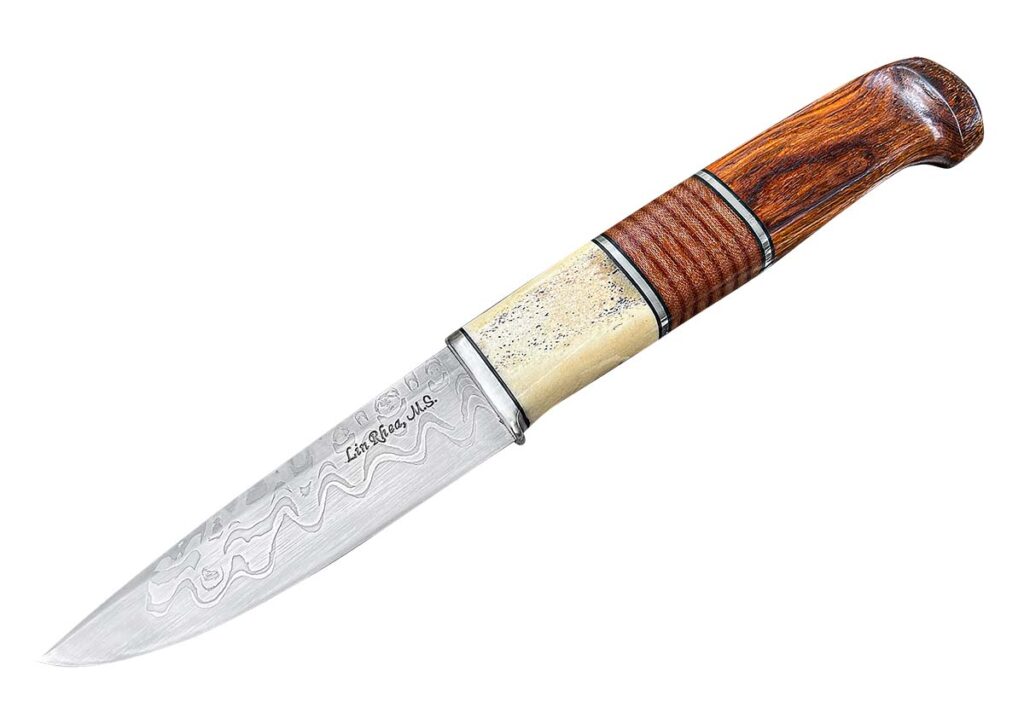
Lin Rhea Puukko
Knife type: Fixed blade Blade length: 4.5” Blade material: Damascus Blade grind: Chisel Scales: Desert ironwood, stacked Micarta®, antler Overall Length: 9.5” Sheath (not shown): By Joshua Rhea (Instagram, @rheas_leather), a Finnish traditional leather pouch model w/carry loop Knife to know: Lin Rhea is an ABS master smith Maker’s price for a similar knife and sheath: $1,200 Maker: Lin Rhea, rheaknives.com (Jocelyn Frasier image)
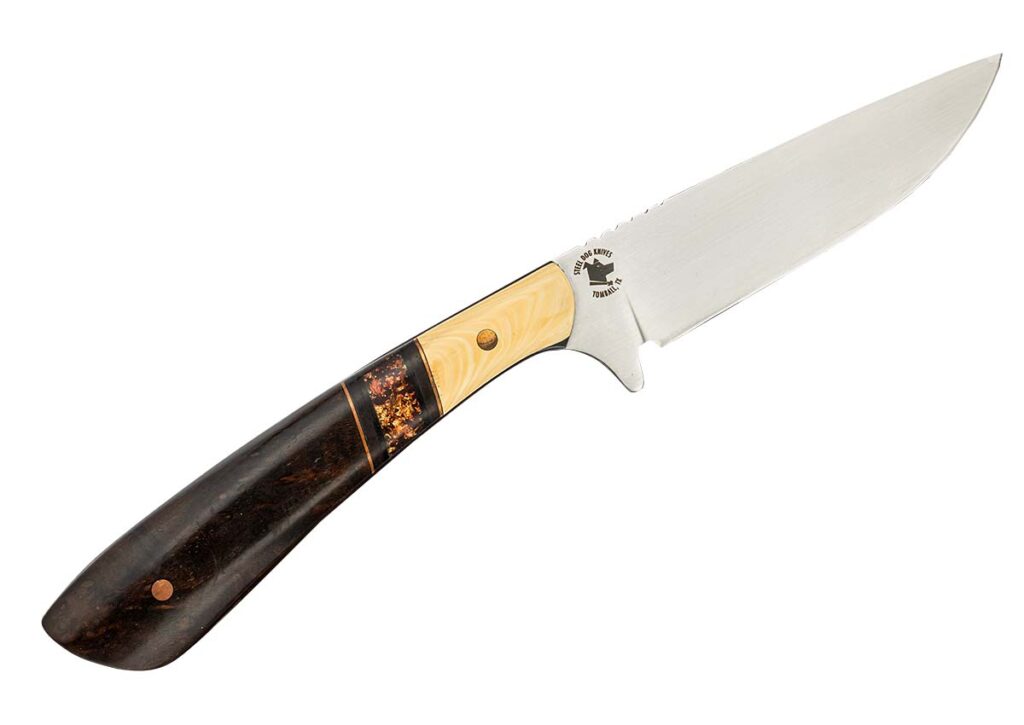
Chris Jones Vizsla EDC
Knife type: Fixed-blade EDC Blade: 3” Blade steel: Nitro V stainless Blade grind: Flat Scales: TruStone, copper resin, Turkish walnut Liners: G-10 Overall length: 7.25” Sheath (not shown): Leather pouch Knife to know: Integral single guard Maker’s price for a similar knife and sheath: $400 Maker: Chris Jones, steeldogknives.com (Jocelyn Frasier image)
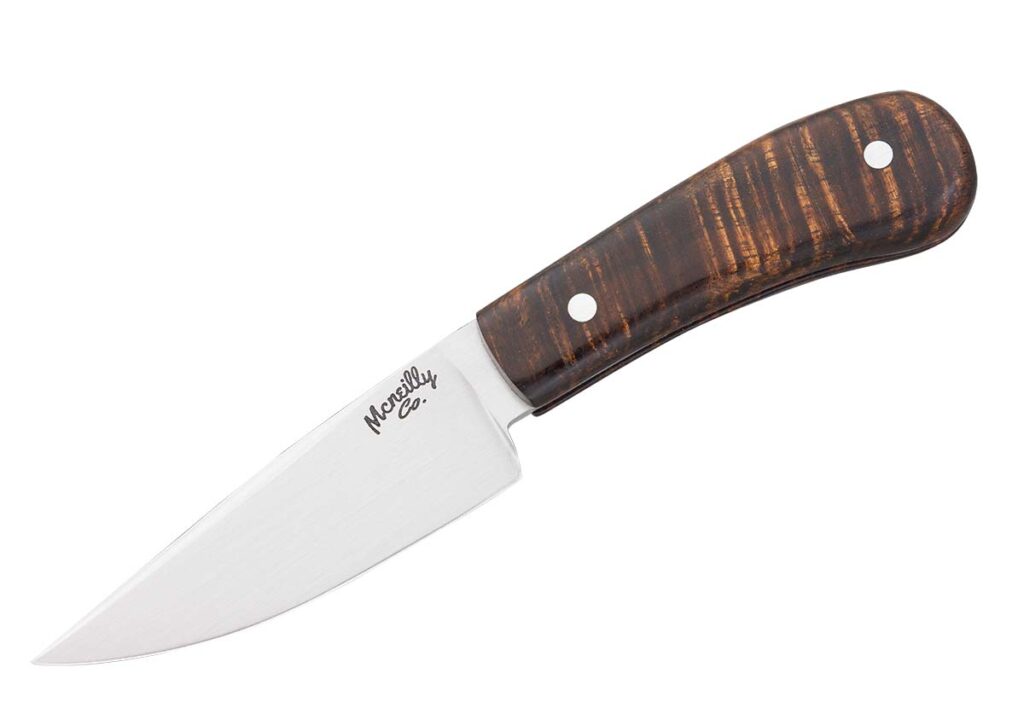
Kieren McNeilly Bird & Trout
Knife type: Fixed blade Blade length: 3.5” Blade material: W2 tool steel Blade grind: Flat/convex Blade finish: 600-grit satin Blade thickness @ricasso: .157” Blade pattern: Clip point Scales: Blackwood w/416 stainless pins Overall length: 7” Sheath (not shown): Leather belt model Knife to know: Heirloom-fit handle; tapered tang; high-polished clip point, choil and spine; Kieren McNeilly is a probationary member of the Australian Knifemakers Guild Maker’s price for a similar knife: $300 Maker: Kieren McNeilly, (Rod Hoare image)
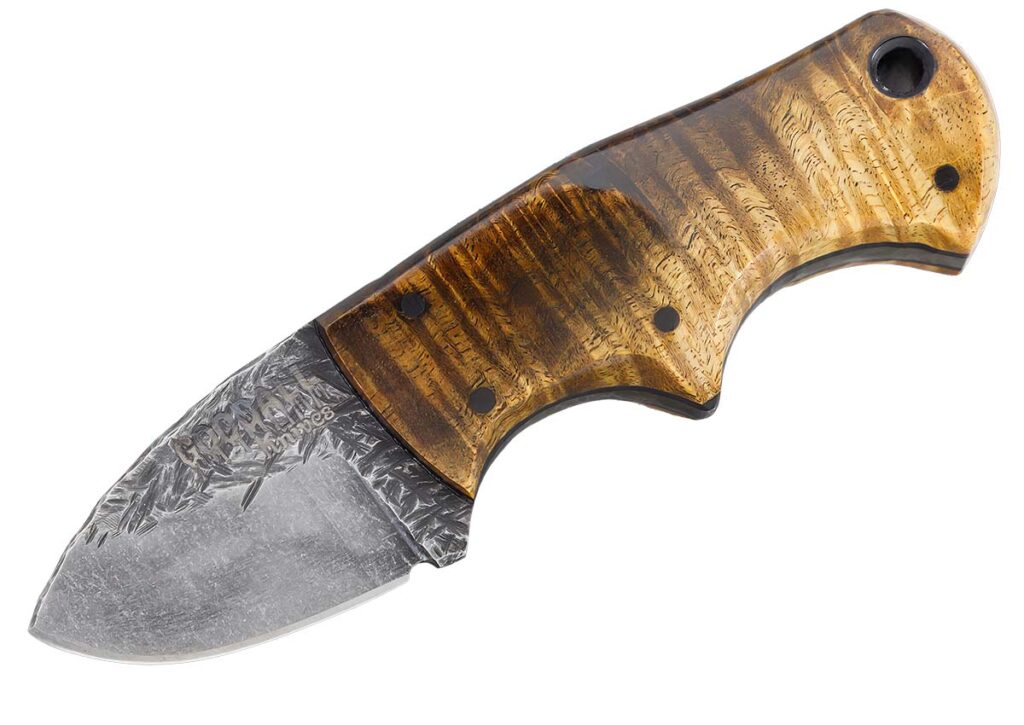
Gooball Knives Wombat
Knife type: Fixed blade Blade length: 1” Blade material: 1084 carbon steel Blade grind: Flat Blade thickness @ricasso: .118” Scales: Ringed gidgee Overall length: 3” Maker’s price for a similar knife: Contact maker for pricing Maker: Giuseppe “Joe” Brunetta, Gooball Knives, (Rod Hoare image)
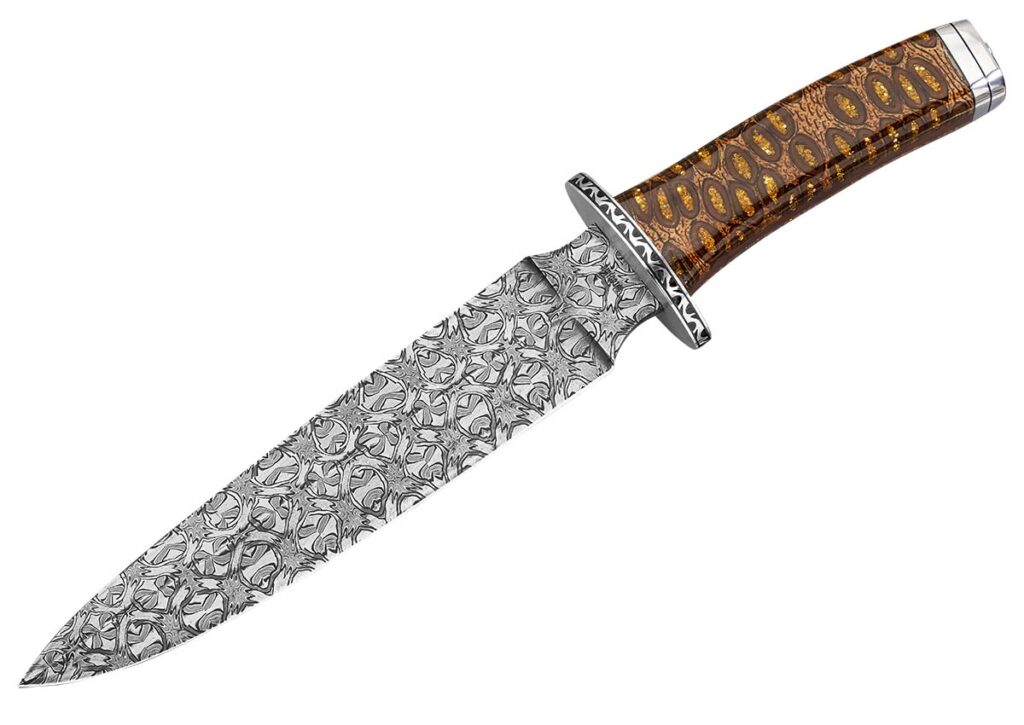
D.P. Brodziak Custom Knives Fighter
Blade length: 8.5” Blade material: Mosaic damascus of 80CrV2 carbon and 15N20 nickel alloy steels forged by Mark Doyle Blade grind: Double hollow Blade thickness @ricasso: .197” Guard material: 416 stainless steel Scales: Banksia nut and gold fleck in resin Overall length: 13.5” Maker’s price for a similar knife: $1,600 at press-time exchange rate Maker: David Brodziak, D.P. Brodziak Custom Knives, brodziakcustomknives.com (Rod Hoare image)
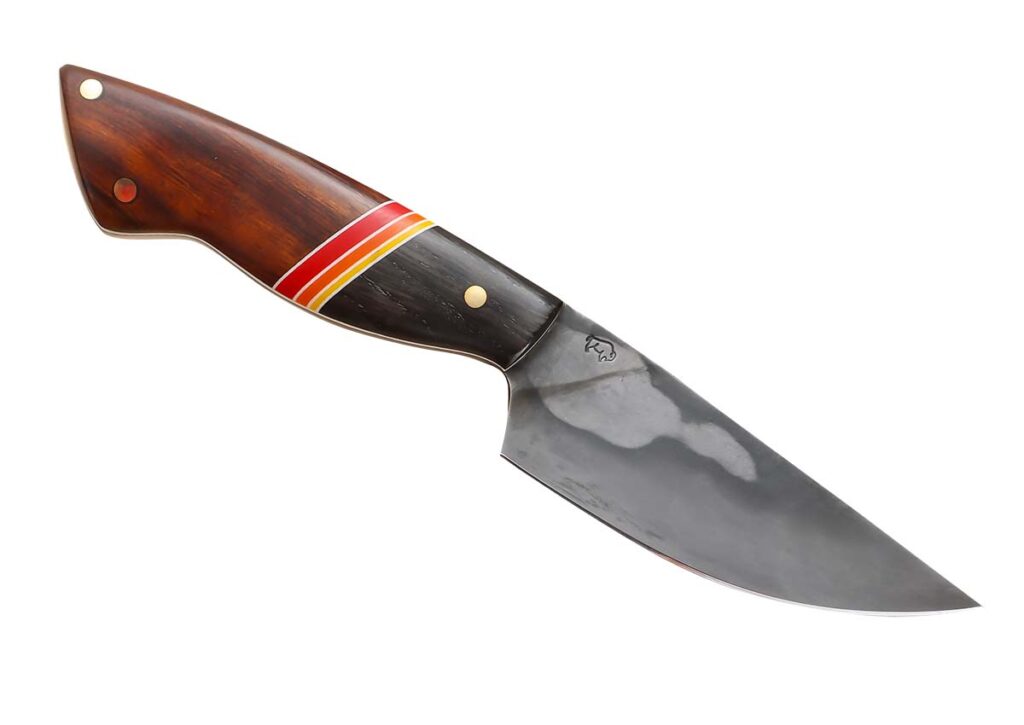
Bison Blades Tatanka
Knife type: Fixed blade Blade length: 3.5” Blade material: W2 tool steel w/hamon Blade grind: Flat Scales: Ironwood, bog oak and G-10 accents Liners: G-10 Overall length: 7.75” Sheath (not shown): By Letney Head, a leather pouch model w/color artwork Knife to know: Named Troup 36 Scout Favorite at the 2024 Texas Select Custom Cutlery Event Maker’s price for a similar knife: Contact maker for pricing Maker: Eric Gubser, Bison Blades, bison-blades.com (SharpByCoop image)
Shawn Shropshire Neck Knife
Knife type: Fixed blade Blade length: 3.5” Blade material: 1084 carbon steel Blade grind: Full flat Scales: Ancient walrus ivory artifact and opal Guard: Bronze Overall length: 8” Sheath (not shown): Elaborate frontier period style of leather w/beads, tassels, etc. Knife to know: The blade is hand finished Maker’s price for a similar knife and sheath: $1,000-$1,300, depending on pricing of the ancient walrus ivory artifact Maker: Shawn Shropshire, sdsknifeworks.com (SharpByCoop image)
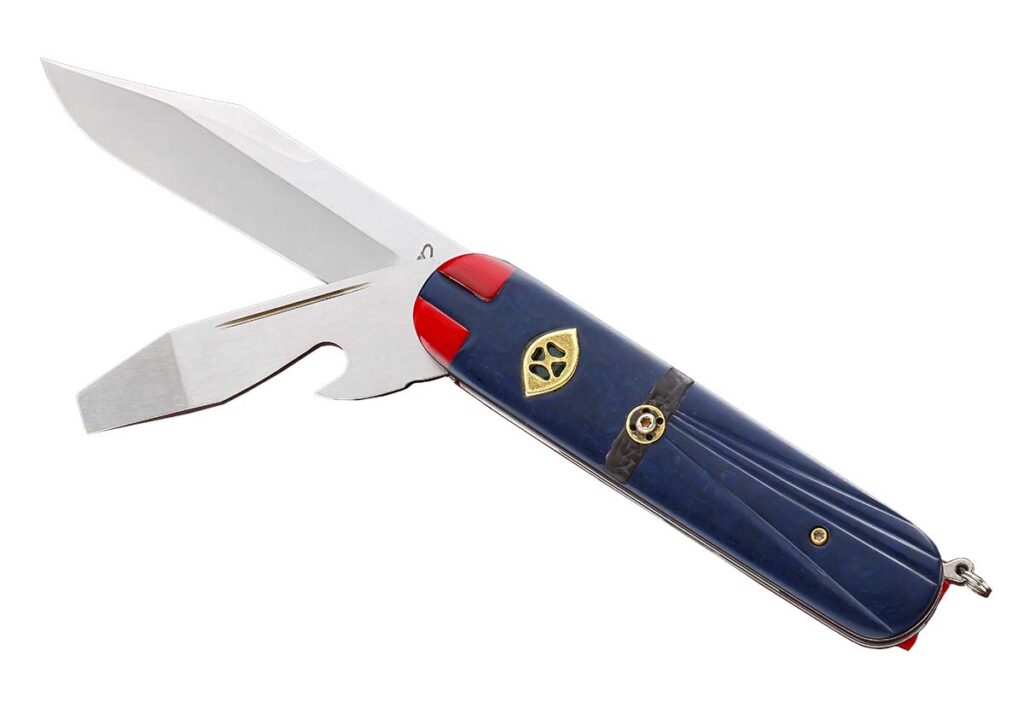
Charles “Chuck” Gedraitis Dr. Strange
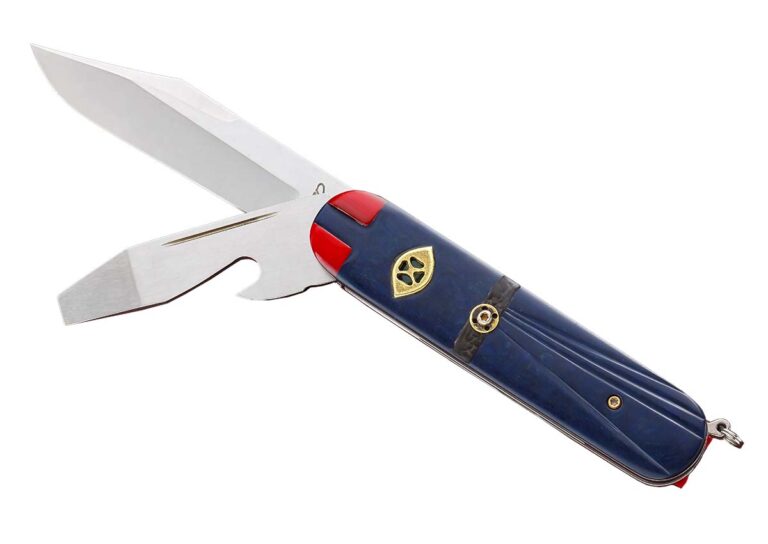
Model: Swiss-Army-knife-type automatic Blade lengths: 3.25” and 2” Blade steel: CPM 154 stainless Blade patterns: Clip main and screwdriver/can opener Lock: Linerlock Knife to know: The knife is the maker’s tribute to Dr. Stephen Strange, the Marvel Comics fictional superhero; the main blade opens automatically by depressing the smaller tool blade; a tweezers and toothpick insert into slots in the handle butt a la SAK types; has lanyard w/key ring Scales: Combo blue (represents Dr. Strange’s clothing) and red (his “magic cape”) G-10 w/leather (his belt) and brass (belt buckle) accents; the brass ellipse holds an emerald, which represents the “Time stone,” one of the “six infinity stones” in the Dr. Strange saga Maker’s price for a similar knife: $2,500 Maker: Charles “Chuck” Gedraitis, (SharpByCoop image)
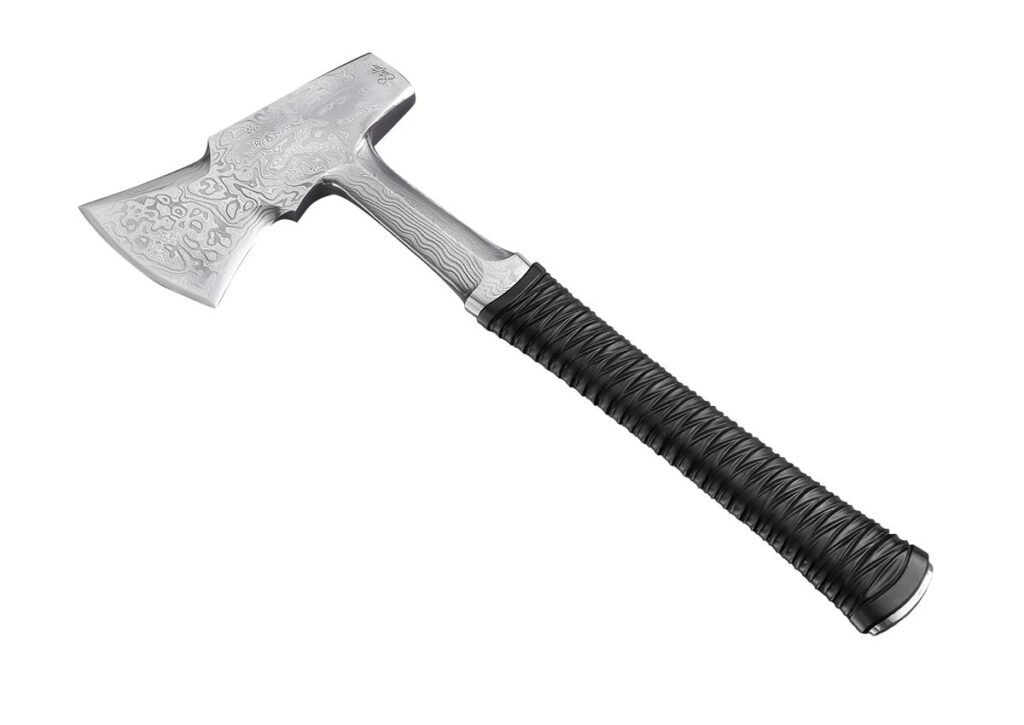
Will Stelter Hand Axe
Axe type: Poll Blade/head material: Damascus Blade steels: 1080 carbon and 15N20 nickel alloy Haft: Carved African blackwood Pommel: Damascus Knife to know: Will Stelter is an ABS journeyman smith Maker: Will Stelter, willstelterbladesmith.com (SharpByCoop image)
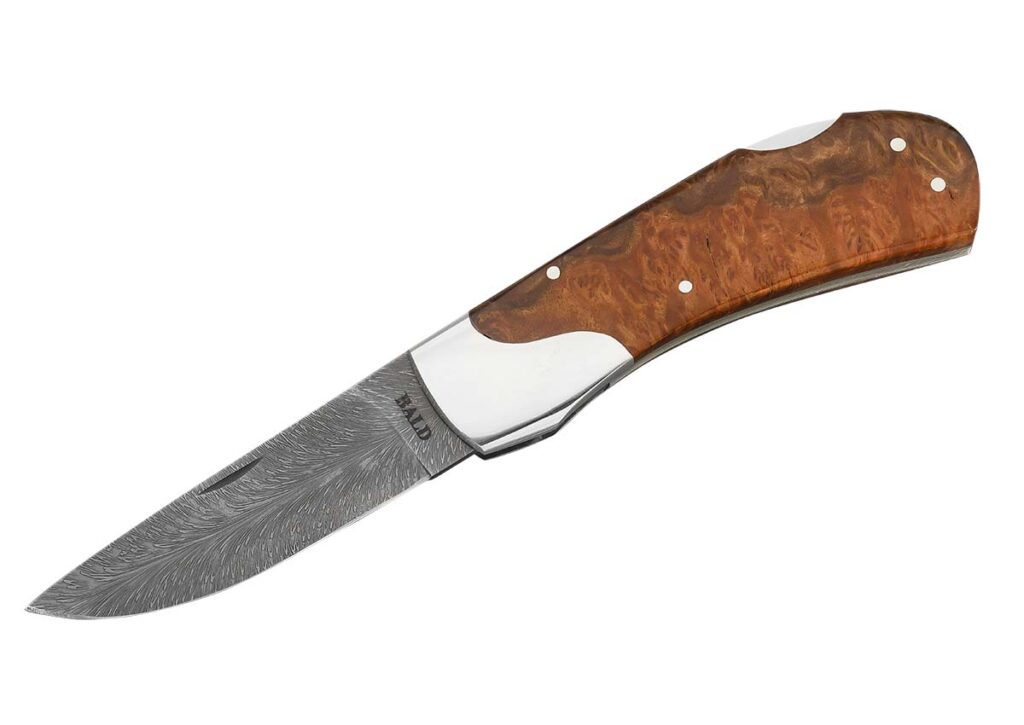
Peter Bald Lockback Folder
Knife type: Lockback folder Blade length: 3.15” Blade material: Feather damascus forged by Rian Doodle under the supervision of ABS master smith Bill Burke Blade grind: Flat Blade thickness @ricasso: .098” Blade @widest: .748” Scales: Stabilized red mallee wood Frame: Nickel silver Bolster/liners/guard: Nickel silver Closed length: 4.25” Maker’s price for a similar knife: $630 at press-time exchange rate Maker: Peter Bald, (Rod Hoare image)
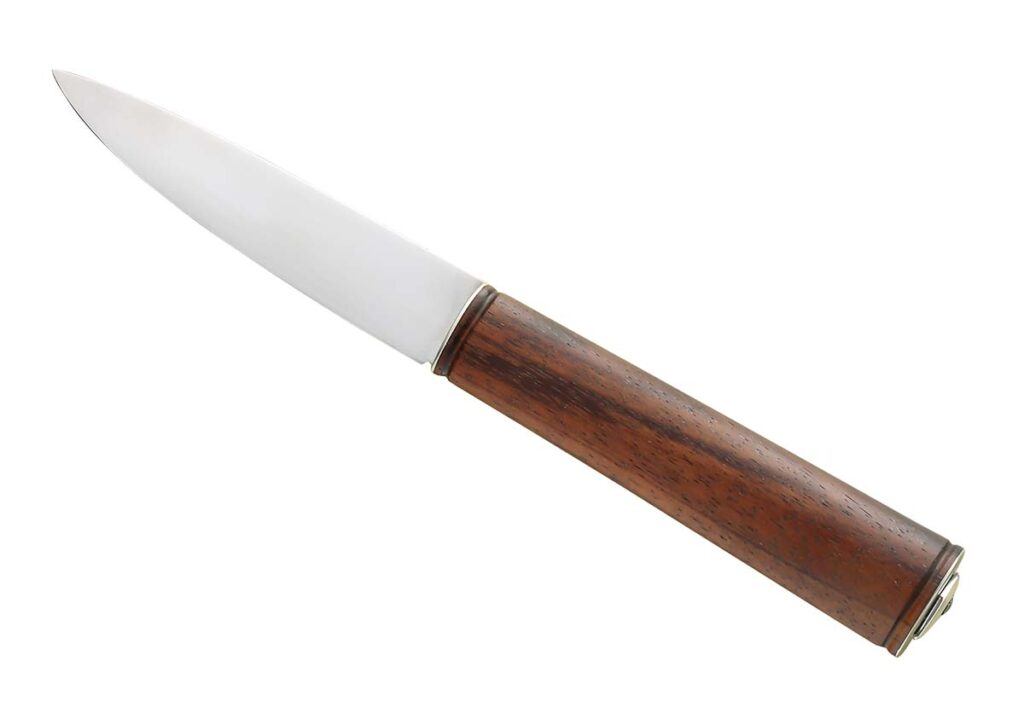
Matthew Parkinson Medieval Knife
Knife type: Fixed blade Blade length: 4” Blade material: 1084 carbon steel Blade grind: Full flat Scales: Stabilized koa Bolster/pommel material: Sterling silver Overall length: 8.5” Maker’s price for a similar knife: $850 Knife to know: Matthew Parkinson is an ABS journeyman smith Maker: Matthew Parkinson, (SharpByCoop image)
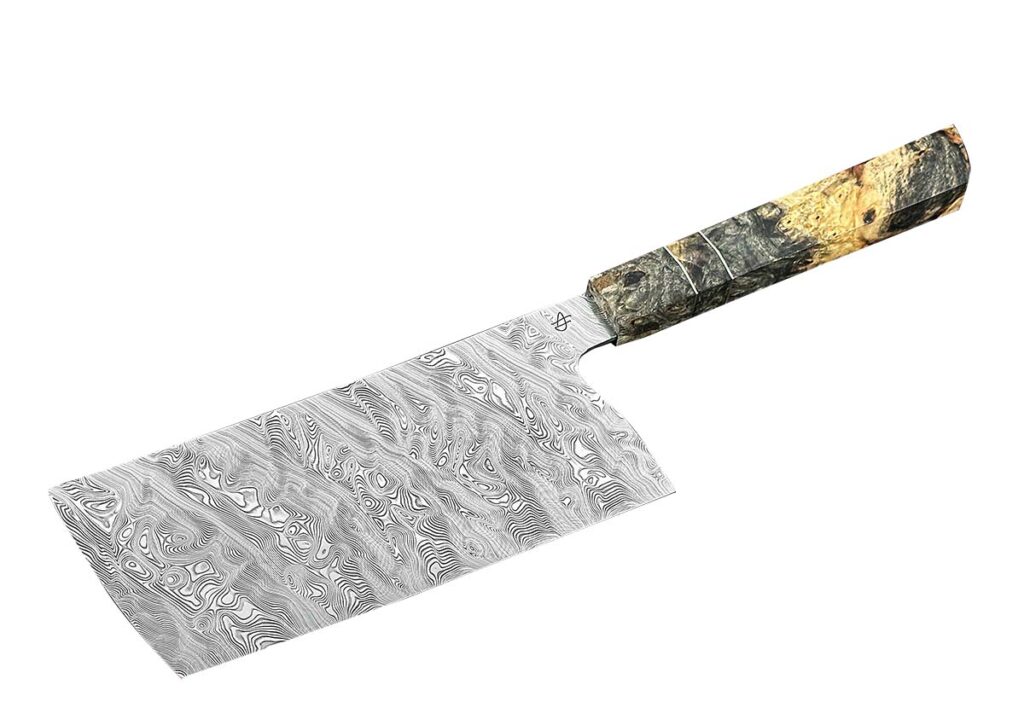
Alfred Faccipieri Big Mama Chef
Knife type: Cleaver Blade length: 6.7” Blade material: Damasteel Bjorkman twist damascus Handle Material: Buckeye Overall length: 13.5” Maker’s price for a similar knife: $1,400-$1,600 Maker: Alfred Faccipieri, faccipieri.com (Jocelyn Frasier image)
The father of modern sporting knives was busy making them a half century ago.
Editor’s Note: BLADE Magazine is celebrating more than 50 years of bringing the knife community sharp coverage of the knife world at large. Given a more comprehensive picture of where the industry comes from—thus, where it’s going—we’re running a series of vignettes on important articles marking milestones in the knife design, knife making and knifemakers from 50 years ago.
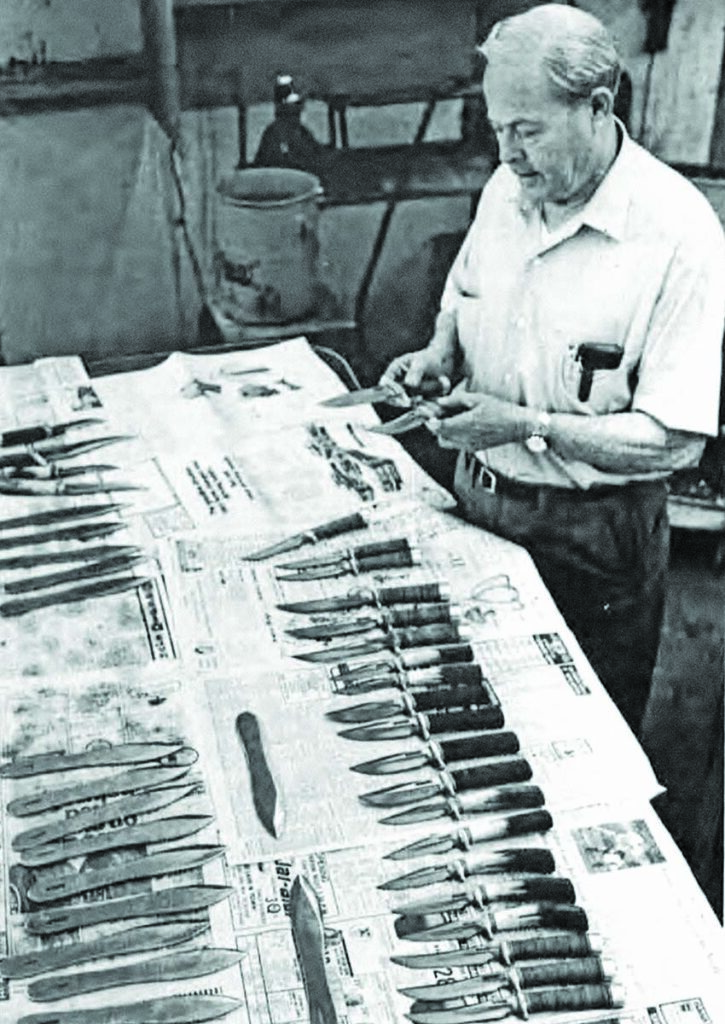
A pioneering writer and photographer, Sid Latham chronicled his visit to the Orlando, Florida, shop of Randall Made Knives in the May-June 1975 issue of The American Blade to detail how Bo Randall and his staff made knives.
As Latham noted, Bo believed in the Cutlery Hall-of-Famer William Scagel theory that every blade shape should have a purpose and be practical—and the Randall utility, hunting, combat and survival patterns reflected the Scagel approach. The most popular Randall knife in ’75 was the Model 3 hunter. It was a Model 3 that pilot Francis Gary Powers was carrying when his U-2 spy plane was famously shot down over Russia in 1960.
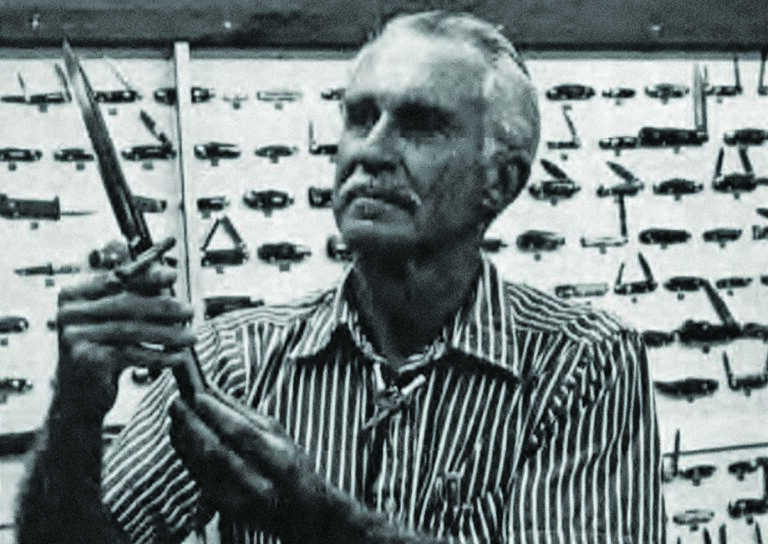
Bill Platts was closing out his career as Randall shop foreman.
Latham wrote of what Bo considered his proudest achievement of specially designing knives for the astronauts of the Project Mercury NASA space mission. The final design was worked out by Major Gordon Cooper, who took one along on his 22-orbit flight. The knife was subsequently offered as the Model 17.
Latham also covered most of the Randall staff, including shop foreman Bill Platts, who was in the process of retiring and being replaced by Pete Hamilton, to Bo’s son Gary and more. Bo Randall had already been making knives for 37 years at the time—and Randall Made Knives (randallknives.com) continues turning them out to this day.
Editor’s note: Beginning with this issue, “50 Years Ago in BLADE®” journeys back in time to recall what was happening in the early days of BLADE—formerly The American Blade—and the world of knives. This time: BLADE Magazine Cutlery Hall-of-Fame® member Bo Randall and Randall Made Knives.
Largest class as HOF honors living and deceased legends.
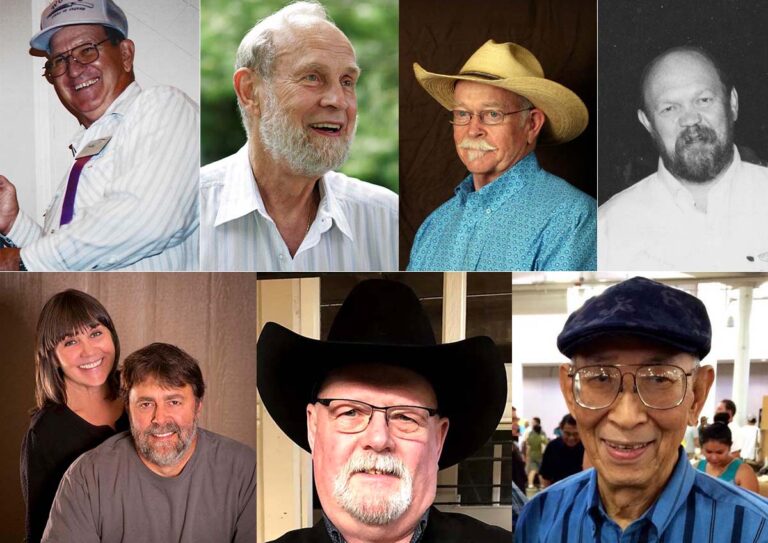
The BLADE Magazine Cutlery Hall of Fame® is proud to announce its new inductees for 2025: Harvey Dean, Stanley Fujisaka, Rick Dunkerley, Dr. James Lucie, Alfred Pendray, James Schmidt, and Daniel Winkler and Karen Shook.
In a procedural change new for this year, the Hall of Fame has expanded the number of annual inductees from three to seven, the latter including four living and four deceased individuals. (The team of Winkler and Shook is count as one inductee.) They, along with Dean and Dunkerley, are this year’s living inductees, with the balance being the deceased ones.
The new Hall of Famers will be formally inducted, including the posthumous inductions of the deceased members, during BLADE Show 2025 June 6-8 at the Cobb Galleria Centre in Atlanta. The induction ceremony will commence the Saturday morning of the show, June 7, at 8 a.m., and will include a breakfast in the Kennesaw Room of the show’s host hotel, the Renaissance Atlanta Waverly. Tickets are required in advance and are limited. For ticket information email [email protected].
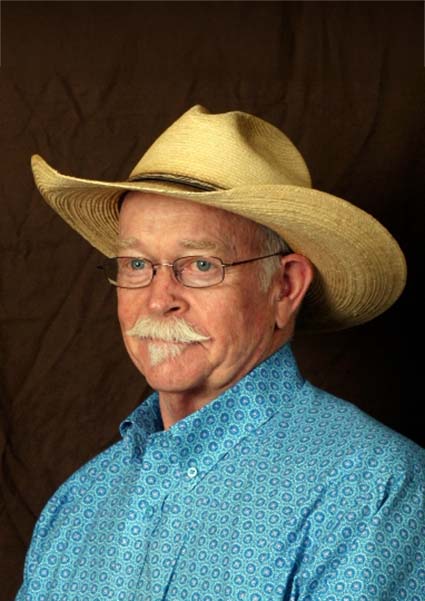
Harvey Dean
Harvey Dean
According to a nominator, “Harvey Dean earned his American Bladesmith Society master smith rating in 1992 and since then has taught an impressive number of students the art of bladesmithing. He became a member of the ABS Board of Directors in 2004 and served four years with distinction as ABS president from 2015-19. He continues to serve on the ABS board today. He was inducted into the ABS Hall of Fame in 2016. He has won an impressive number of judging awards for his knives, including at BLADE Show Texas, multiple times at the BLADE Show, from the Antique Bowie Knife Association and others. His knives have earned him membership in the prestigious Art Knife Invitational, limited to 25 of the world’s top knifemakers by a vote of the member makers.
He is a marvelous bladesmithing teacher, a master leader, a master administrator, and a master ambassador for the forged blade.” Along with award-winning knifemaker Johnny Stout, Harvey coordinated two annual knifemaking seminars in New Braunfels, Texas, for a number of years. He has also passed the knifemaking torch to his son Dillon, who creates utility fixed blades of his own. Concluded the nominator, “Harvey is among those named in the book Greatest Living Knifemakers written by Cutlery Hall-Of-Famer Steve Shackleford. I know of no one man deserving of being named to the Cutlery Hall Of Fame more than Harvey.”
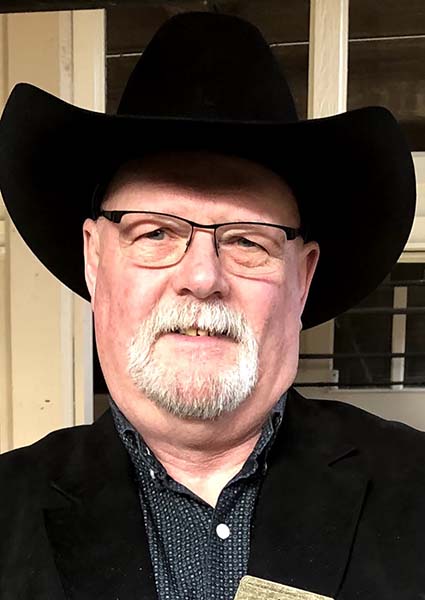
Rick Dunkerley
Rick Dunkerley
Rick Dunkerley began making knives in 1983 and started forging them in 1992. He specializes in mosaic damascus folders, winning judging awards for a number of them, as well as an occasional fixed blade. Among others, he’s won judging awards for his knives at the Oregon Knife Collectors Association Show, Montana Knifemakers Association Show, BLADE Show and BLADE Show Texas. His knives have earned him membership in the prestigious Art Knife Invitational, limited to 25 of the world’s top knifemakers by a vote of the member makers. He held many hammer-ins during the ’90s and brought in the best instructors of the time.
Rick has always been generous with information and is an excellent teacher. He’s taught at such venues as the Texarkana College/Bill Moran School of Bladesmithing, the Batson Bladesmithing Symposium, the Massachusetts College of Art, Saskatchewan Western Development Museum, Northern Minnesota Blacksmith’s Association, Northern Rockies Blacksmith’s Association and Western Canada Knifemakers’ Symposium. One of his students, Josh Smith, was the youngest ever to achieve both ABS journeyman and master smith status, and today runs the Montana Knife Co., a factory knife production operation with 80 employees. According to a nominator, “Rick has been on the board of the ABS and does the top shows worldwide. He has paid his dues, is a hell of a guy, always willing to share his knowledge, and makes world-class knives.”
Stanley Fujisaka
Stanley Fujisaka
Stanley “Stan” Fujisaka went full-time making knives in 1984 and was a prolific builder of award-winning folders and fixed blades. He was a beloved mentor in his Kaneohe, Hawaii, knife shop to a number of Hawaiian and other makers, including Scott Matsuoka, Les George, Cutlery Hall-Of-Famer Ken Onion and many more. Stan played a key role in encouraging Onion to patent his famous SpeedSafe assisted-opening mechanism. As a result and as Cutlery Hall-Of-Famer Dan Delavan wrote, “Ken went on to become the savior of Kershaw Knives.”
Stan also generously assisted knifemakers who fell victim to floods, shop fires, medical issues and more. He was a regular exhibitor at knife shows, donating many knives for door prizes. He collected custom knives and promoted them and the custom industry in general by supporting the Bay Area Knife Collectors Association Show, The Knifemakers’ Guild Show and other knife events. Together with his good friend, Cutlery Hall-Of-Famer Jim Sornberger, Stan co-hosted dinners for knife collectors, area celebrities and others, all of which helped promote custom knives. Finally, when it came to being a goodwill ambassador to the custom knife industry, few if any could rival Stan for his many gifts—including flowers, Hawaiian coffee and boxes of chocolate-macadamia nuts—that he doled out to friends, customers and other patrons at the shows where he exhibited.
Dr. James R. Lucie
Dr. James R. Lucie
According to a nominator, “Dr. James R. ‘Jim’ Lucie was Cutlery Hall-Of-Famer William Scagel’s physician and signed Scagel’s death certificate in 1963. This was the beginning of Dr. Lucie’s Scagel knife-collecting avocation. Scagel is considered by many the father of the modern custom knife. Dr. Lucie discovered his passion for knifemaking in 1990 when he took a class on bladesmithing from Cutlery Hall-of-Famer Bill Moran. Jim was a very talented maker and received several awards for his contributions to the knifemaking community. He assisted other makers often. In 2001, the ABS created the Dr. Jim Lucie Award, which it bestowed on Jim as its inaugural recipient. The award was ‘presented for the unselfish contribution to the preservation of the forged blade. The person receiving this award has gone far beyond the call … and exemplifies the type of person needed to keep … bladesmithing alive.’
Jim also received an ABS Special Service Award in 2002 ‘in recognition of his meritorious and unselfish services on behalf of … the forged blade.’ He also received the ABS Chairman’s Award for Outstanding Service more than once. He was a talented bladesmith, hand-forging mostly Scagel recreations of the highest quality. He improved on Scagel’s designs when it would enhance the knife. Jim dedicated three decades to researching Scagel’s life and collecting his works. Jim’s efforts culminated in Scagel Handmade, a massive hardbound book detailing Scagel’s life, with photos of over 200 knives and other Scagel items. Dr. Lucie hosted a hammer-in in 2001, with over 500 people in attendance. He shared his knowledge of Scagel’s techniques by giving speeches at many bladesmithing events. Late in life, Jim donated his blacksmithing, grinding and finishing equipment valued at $62,700 to the ABS. His actions consistently exhibited honesty, compassion for others and a dedication to the bladesmithing community.”
Alfred Pendray
Alfred Pendray
Alfred “Al” Pendray was a rock to the many bladesmiths he taught and influenced over the decades. “I learned so much from him,” noted ABS master smith Charley Ochs, “not only about knives and metallurgy but also about life and social interaction as a person.” Softspoken but never at a loss for words on the subjects that mattered to him, Alfred possessed an intricate knowledge of many things, including wootz steel, bladesmithing/knifemaking and knife history in general. He had a solid work ethic and led as much or more by example than the spoken word. He knew when to express his views and when not to, a trait sadly lacking in much of today’s discourse. Alfred is co-author—along with Dr. John Verhoeven, a former metallurgical engineering professor at Iowa State University—of articles appearing in eight scientific journals, four bladesmith publications and BLADE on the nature of “genuine damascus,” or wootz steel.
Pendray was granted patent number 5,185,044 on a “method of making damascus blades.” He was a speaker at the Symposium on Damascus Steel at New York University in 1984. He also spoke at the International Conference on Damascus Steel in Germany in 1985 and the same conference in 1992. He lectured at the Imperial College in London, England, in 1992. He joined The Knifemakers’ Guild in 1982 and was awarded his master smith rating by the ABS in 1983. He received the ABS award for the Bill Moran Knife of The Year in 1991 and was elected to the Guild board of directors in 1992. He received the ABS W.W. Scagel Award in 1998 and is a past recipient of the Guild’s Red Watson Award. He served as Guild president from 1998-2004. In September 2001, he was featured on the nationally syndicated Paul Harvey radio show. In 2003, he was inducted into the ABS Hall of Fame.
James Schmidt
James Schmidt
According to a nominator, James “Jim” Schmidt was instrumental in raising the level of knifemaking to compete with the finest crafts ever made. Most importantly, he elevated the pursuit to an art but never forgot the meticulous details of the craft. His knives are immediately recognizable and he influenced so many who came after him in meaningful ways. A spectacular book by BLADE® field editor Mike Haskew memorialized the man and his knives: JAMES A. SCHMIDT, The Great Master. A few passages from the book: “As a custom knifemaker he knew few peers. As a mentor and teacher, he was without equal”; “A man of few words, he allowed the results of his skill, precision, and limitless creativity to speak for him. In silent, stunning beauty, they thundered”; and “He welcomed those who were earnestly interested in improving their bladesmithing and knifemaking skills into his shop … and shared with them the light of precious knowledge that he realized should be readily and freely given rather than hidden.”
In the 1970s, along with Jimmy Fikes and Don Fogg, Jim formed the New England Bladesmith Society to promulgate the skills and techniques of knifemaking. Before long the groundbreaking Ashokan Bladesmithing Seminar was born. Jim was a principal organizer, lecturer and demonstrator. He was one of the earliest members of the ABS and one of the earliest ABS master smiths, and a member of the ABS Hall of Fame. He was a constant member of the Art Knife Invitational, a winner of the Red Watson Award from the Knifemakers’ Guild, the Beretta Award for Outstanding Achievement, and many other honors from a number of custom knife shows. In time Jim decided to let someone else win an occasional award and became a judge at many shows. His approach was to be meticulously but fairly critical and always encouraging. He was indeed the ultimate teacher, his profession for most of his life.
Daniel Winkler And Karen Shook
Daniel Winkler And Karen Shook
ABS master smith Daniel Winkler and Karen Shook first made their mark in the world of knives with custom reproductions of historical knives and tomahawks. Daniel made the knives and hawks and Karen made the accompanying authentic period sheaths, and the two became internationally known for their work. Daniel and Karen taught for the ABS for many years and Daniel was in the vanguard of the Society’s early cutting competitions. The two were at the forefront of early American historical arms and their period pieces were among those featured in the 1992 feature film, Last of the Mohicans. In 1994 a Navy SEAL Special Warfare operator asked Daniel to make a tomahawk because there was nothing on the market that worked for the SEALs at the time. According to a nominator, “Karen designed a sheath the SEALs liked and over the years she and Daniel did more special projects for the SEALs, ultimately inspiring the two to form Winkler Knives II.” Added another nominator, Daniel and Karen’s operation “soon became the cutlery armorer of many top Special Ops teams, from the SEALs to Delta Force, and to those of other nations as well.
For many years Daniel and Karen quietly made the knives, axes and sheaths without seeking glory or publicity for their work. In fact, they insisted that their generosity and unselfishness remain a secret among those who discovered it. It was only upon mention of their work in the book No Easy Day, in which the SEAL Team member on the Bin Laden take-down mentioned he was carrying a Winkler knife, that Daniel and Karen’s work became known to the general public. With such demand, they have expanded into a mid-tech operation and from there into that of a cutlery producer.” Today, Winkler Knives has a 35,000-square-foot facility employing one part-time and 28 full-time workers. “Few have transitioned into the changing markets as well as Daniel and Karen,” the nominator noted, “and none have done so with such humility and class.”
Top makers explain how they collaborate with knife companies.
The old cliché of the win-win holds a real grain of truth. Any successful partnership must be mutually beneficial, and in the knife industry the phenomenon of the collaboration has come to exemplify the upside of working together.
Years ago, a veteran custom knifemaker described his relationship with a major manufacturer as serving as the company’s research and development department. Such a description is accurate in that the manufacturer often relies on the custom maker for new design inspiration, from good looks to materials and mechanics. The collaboration has emerged in the last 35 years or so as an outstanding means of bringing innovation to the public and putting first-rate knives in the hands of the mass market.
The ins and outs, nuts and bolts, and give and take of the collaboration process raise questions for makers interested in striking deals of their own. A few comments from makers who have achieved great success on the collaboration frontier offer helpful insights.
“It goes both ways,” observed BLADE Magazine Cutlery Hall-of-Fame® member Bob Terzuola, who indicated he completed his firstfactory collaboration with fellow Cutlery Hall-of-Famer Sal Glesser and the design team at Spyderco in 1989. “You can go to the company or the company can come to you depending on your notoriety. If you are just starting out, you probably have to go to the company.”
On the business side of the ledger, Suzi Terzuola takes the lead and has demonstrated proficiency in making the deal work for everyone involved. Her flair for negotiation and finding the right blend of maker-manufacturer cooperation has been demonstrated through the years as Bob has worked not only with Spyderco but also the old Camillus, Boker, Fox, Pro-Tech, Tactile Knife Co. and others.
BLADE Magazine Cutlery Hall-of-Fame® member Bob Terzuola has done collaborations with many companies, including the Bob Terzuola ATCF Auto Ultimate from Pro-Tech, the BLADE Magazine 2022 Investor/Collector Knife Of The Year®. (Eric Eggly/PointSeven knife image)
“I was raised by parents with their own successful businesses,” Suzi observed, “and I saw Bob receiving passive income from Spyderco and Camillus, and of course passive income is how you survive after having only so many years to make knives. I began looking at the knife designs Bob had and tried to match the design to the company. Bob has patents lining the walls, and when he lends his name to a knife he should receive a signing bonus and a bonus against the royalties.”
In return for his design skill and the use of his name in promotions, Bob has certainly established himself as a leader among successful custom collaborators. His contribution to a company’s success has enhanced his reputation of excellence across the industry, while Suzi has forged a business posture that results in security for the future.
Knife Collaboration Contracts
The contract is the key component of a collaborative deal, and depending on the circumstances everything is negotiable. Although early agreements made among friends were sometimes done on a handshake, it has become a “best practice” to hammer out the terms of the collaboration on paper, invest in an attorney’s review, and formally memorialize the discussions. Standard royalties run roughly 5 percent of the price at which the company sells the knife.
The Terzuolas include a period of time in which the company is allowed to produce the knife; the period may be extended at maturity with the agreement of both parties. Further, there may be a requirement that the company produces a certain number of knives in a given time period, also renewable. Restrictions on wholesale pricing or discounts that affect royalties may also be negotiated.
For those considering a foray into collaborations, Bob and Suzi offer some advice: “If you’re a new maker, you shouldn’t just walk up to [the company’s] booth at a show. Make an appointment to see them because they are at the show to deal with customers. Approach a company with one or more finished designs. They want a package presented to them, a prototype or existing model, something they can hold in their hands, and in the case of a prototype it’s good to have as many innovations and design creations as you can—anything that will set the knife apart from other potential deals out there.”
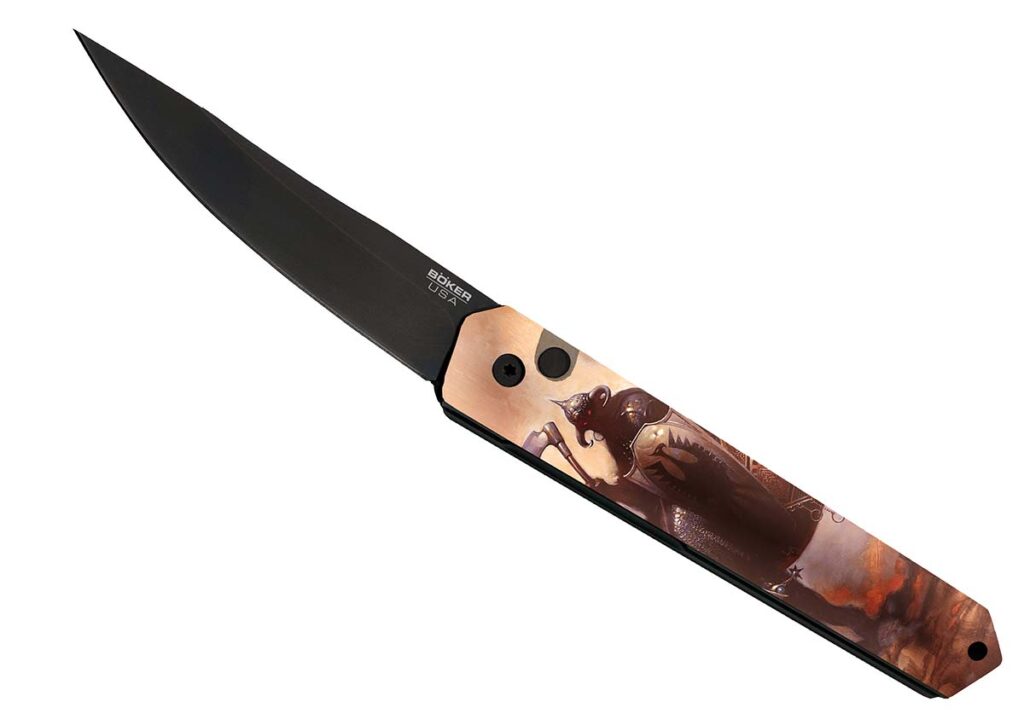
Lucas Burnley has designed several iterations of his Kwaiken for Boker, including the Kwaiken Auto Frazetta.
Suzi added that a higher profile in the industry can drive success.
“We are the R&D for a knife company,” she noted, “and when you approach them for a collaboration your social media resumé is very important.”
Making custom knives since 1994, Darriel Caston has concluded collaborations with numerous companies, including CRKT, Spyderco, Boker, V Nives, Kansept Knives and more.
“I’m prolific when it comes to designs,” he affirmed. “There are probably about 300 that I will never get to making. I’m an engineer by trade and my 3D drawings are almost ready for production, and that helps with the deals. They ask for STEP files [standardized 3D model data files for CAD and 3D printing] that can go right into machining. Sometimes we work with a prototype, and sometimes we work with a knife that I have been doing for quite a while.”
According to Darriel, one significant element of the collaboration is the retention of the rights to the design.
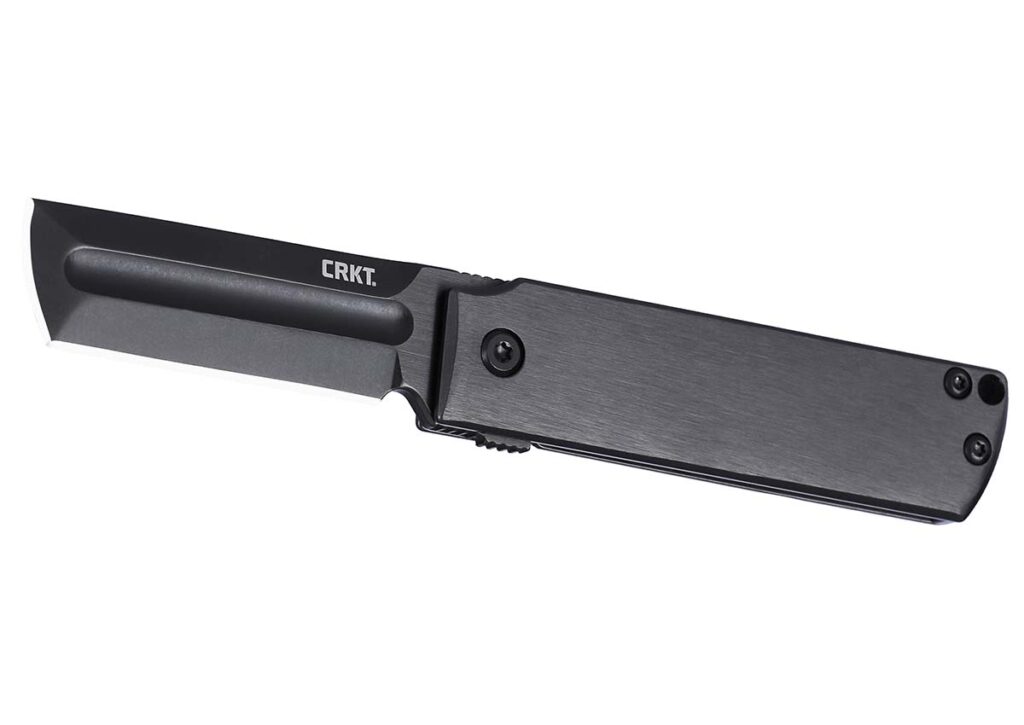
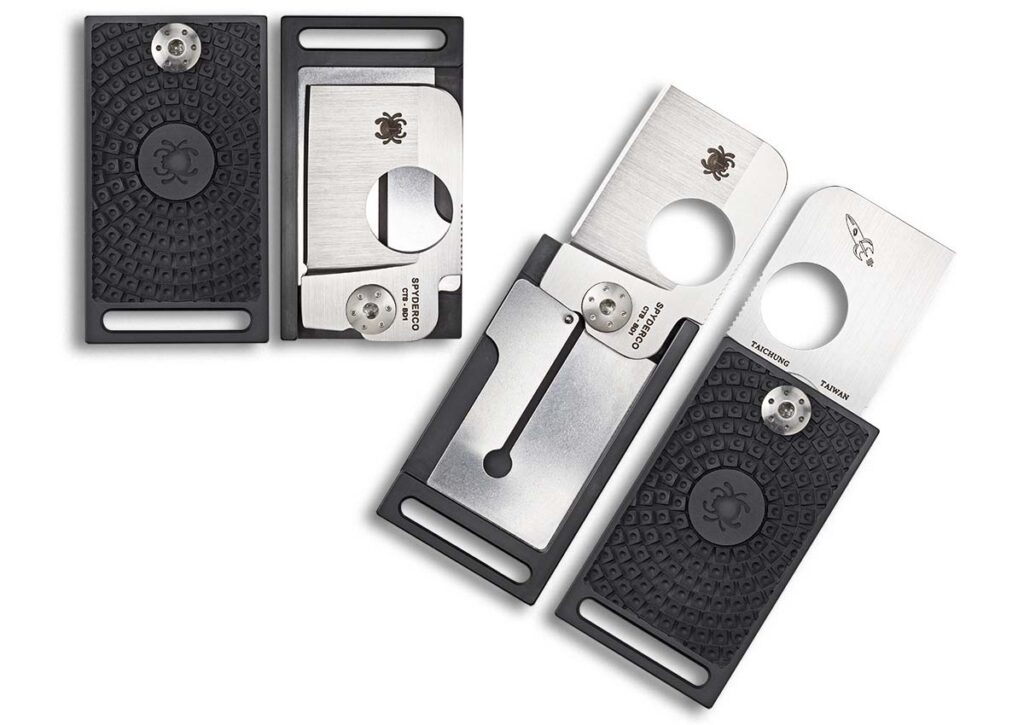
“Anybody who wants to do a collaboration must put footprints in the sand, get their work out there and show a story,” custom knifemaker Darriel Caston observed. One of his latest designs for CRKT is the blacked-out MinimalX framelock folder, an evolution of a knife originally made for SpaceX to commemorate a rocket launch.
“You never want to give up your design,” he warned. “I would license the design to the company usually up to four or five years, and the average is three years. After that, you can discuss if you want to continue if the relationship has been good for both parties. License the design and never sell it. If a company buys the design, then they own it forever. If it became their best seller, I could never make the knife again, and I would have to stay away from anything that looks like it.”
For Caston, every deal starts with a friendly conversation. As progress is made, attorneys draw up the contract. He sees the process as straightforward, whether dealing with an American manufacturer or a company headquartered in a foreign country.
“I find the knife community for the most part to be very honorable,” he commented. “I haven’t run into any bad juju. When you want to do a collaboration, I tell people they need to have a name and a track record of good designs with people following them on social media and stuff.”
Since his first collaboration—with Spyderco in 2015—Darriel can speak with confidence regarding the potential for success.
“It would be rare for someone to take a design to a company without a history or a footprint there. They look for your story,” he noted. “Anybody who wants to do a collaboration must put footprints in the sand, get their work out there and show a story. Then it becomes easier.”
Getting A Collab Off The Ground
Darriel Caston has concluded collaborations with several companies. “I’m prolific when it comes to designs,” he affirmed. “There are probably about 300 that I will never get to making.” Now discontinued, the Squarehead was one of his early collaborations with Spyderco.
Custom maker/U.S. Marine Corps veteran Les George found early collaboration success at the SHOT Show some years back. He approached Pro-Tech a decade ago, and the association has continued since then.
“I had just finished my first batch of VECP [Value Engineering Change Proposal] mid-tech knives,” he remembered, “and I thought it would be cool to see Pro-Tech make the knife in an automatic. So, I did the CAD work to change the knife to an automatic and walked up to their booth at the SHOT Show. I asked to speak to the owner, and Dave Wattenberg came over and shook my hand. I drew a big breath and told him, ‘My name is Les George and I am a knifemaker and I have a design I think would be a great knife for you to make as an auto and I already have the CAD done would you like to see it?’ I said that all as one sentence in one breath!”
Still, a pragmatic view of the collaboration landscape demands preparation and planning. A so-called “cold call” may not meet with success.
“It depends on the company whether a direct approach will work or not,” George conceded. “Don’t walk up to a company at the BLADE Show and tell them you’re a hot maker and they should pay you to make one of your designs. Instead, walk up, introduce yourself, and show them with CAD pictures, a 3D printed model, or a real knife, and tell them why you think it would be awesome to work with them on a production project.”
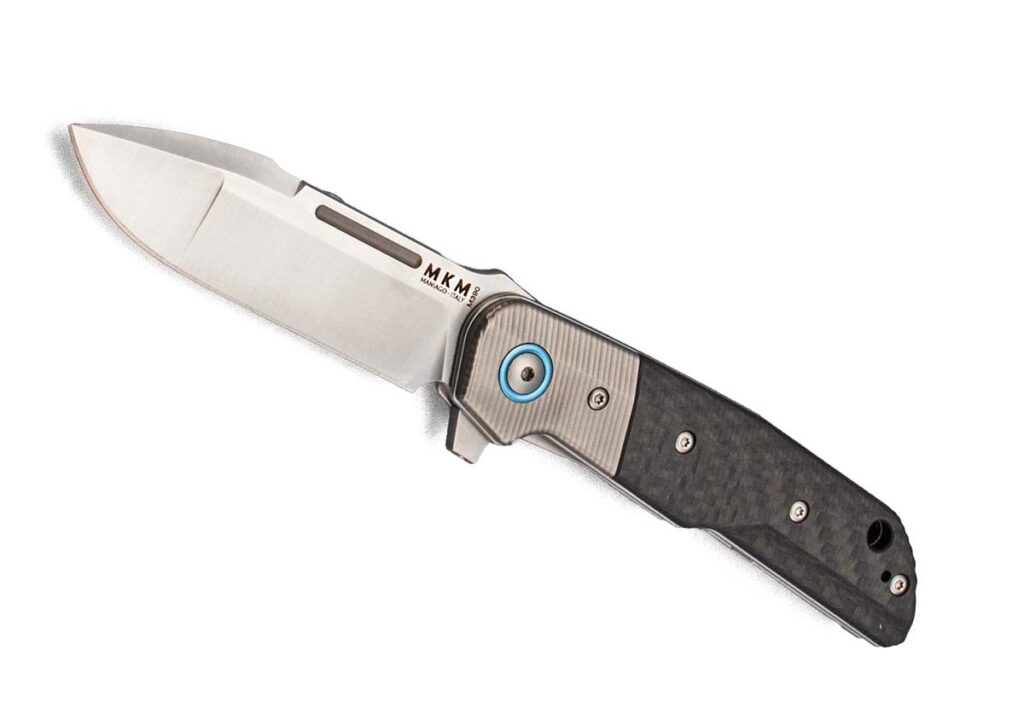
When it comes to her husband Bob’s collaborations, Suzi Terzuola takes the lead and has demonstrated proficiency in making the deal work for everyone involved. An example of several overseas Terzuola collaborations is the Clap from Italy’s Maniago Knife Makers.
Les sees the components of a particular collaboration deal varying. Of course, some of the structure depends on the negotiating skills of the parties. Commonly, the compensation may revolve around a percentage of dealer or distributor pricing on each unit, and particular deals may extend as long as each party is pleased with the progress.
“Collaborations should run as long as they are profitable,” Les remarked. “Companies don’t generally kill a successful project unless there is a capacity constraint issue or something else outside hindering it. Both parties can end the deal at any time with some allowances for production to finish with the things they have in progress already. Every contract I have ever seen gives one company the rights to exclusively make a particular model. My contracts have a provision that I can make as many customs of my models as I want. In the end, it would be counterproductive to license the same model to multiple companies. The maker would be competing with himself at that point, and it’s not helping the companies.”
Priming The Pump
Award-winning maker Lucas Burnley appreciates the help of friends in establishing a firm footing for collaboration.
“In general, I’m a big fan of pulling on my network,” he said. “If you have someone you can reach out to for an introduction, that’s always a strong move. If you don’t have someone to make an introduction, you might be able to ask around and at least figure out who you need to talk to. Regardless of how you get your foot in the door, I highly recommend going to a knife show and trying to set up a meeting in person.
“A design is only one part of a collaboration,” he continued, “so bring your ‘A’ game and think about what other value you can provide for the company. I was introduced to Boker by Jens Anso and Jesper Voxnaes, and Ken Onion put in a good word for me with Columbia River Knife & Tool. I’ll be forever grateful for those introductions and the relationships behind them. I’ve been able to pay it forward a few times, and hopefully I’ll be able to do it many more times in the years to come.”
Les George’s V14 dagger design for Spartan Blades was the BLADE Magazine 2014 Investor/Collector Knife Of The Year®.
In Burnley’s experience, contracts provide compensation most often in the form of monthly or quarterly royalties based on a percentage of sales. One-time lump sum payments are also seen; however, the income generated depends on the goals of the two parties involved.
“I want my designs to run until my grandkids are old enough to thank me for my good decisions,” he laughed. “If a model is selling, I want it to keep selling. On the flip side, I will routinely ask what models we can kill if they aren’t pulling their weight.
“One caveat here is that if a design is still in production, I want to get paid for it,” he concluded. “Some companies will offer a contract for a set period of time but have the option of continuing to produce the model. I view this as somewhat akin to a one-time payout. If it works for you great; just make sure you are paying attention.”
George specifically limits the number of companies he works with in order to give the relationships the priority he believes they deserve. Consistency, he says, is huge. Real, solid collaborations are not “get-rich-quick schemes.” He remembers getting his first collaboration check in 2014 totaling a whopping $6.
“A design is only one part of a collaboration,” Lucas Burnley observed, “so bring your ‘A’ game and think about what other value you can provide for the company.” His Tuna Compact framelock design for CRKT is one of his latest collaborations. “A design is only one part of a collaboration,” Lucas Burnley observed, “so bring your ‘A’ game and think about what other value you can provide for the company.” His Tuna Compact framelock design for CRKT is one of his latest collaborations.
Times change—and checks change with good business practices, commitment, follow through, and most of all a process from contract to design and product that proves profitable for everyone.
Elevate your survival skills with these bushcraft tips!
A good bushcraft knife is characterized by its manageable size and weight, allowing for comfortable handling and easy resharpening.
Typically, a knife designed for bushcraft and carving tasks lacks spine gimping for the thumb. The cutting edge should have a continuous curvature that extends the entire length of the blade. A general-purpose bushcraft knife should have a blade that matches the width of your palm, with the tip aligned closely to the handle’s centerline. The handle and blade spines should remain on the same line.
The handle should feature an oval cross-section made from such materials as wood, Micarta® or plastic. It should not include finger cutouts that limit your grip, as such restrictions can lead to blisters. The handle length should fit comfortably in your palm. While Scandinavian blade grinds are standard for bushcraft knives, other blade grinds are also acceptable.
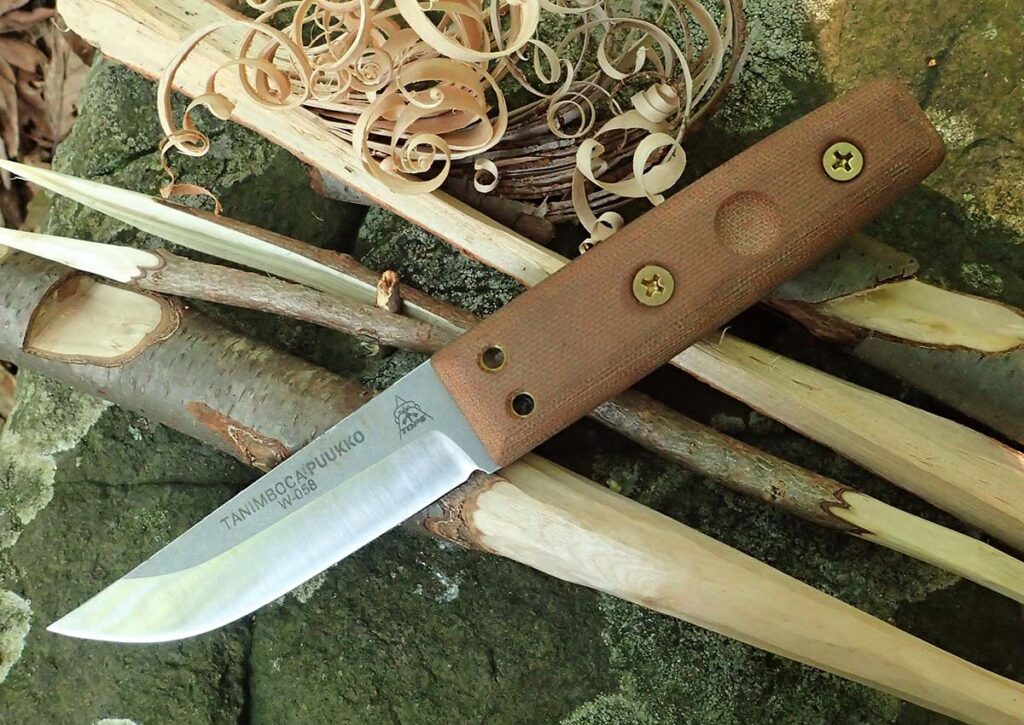
The Tanimboca Puukko from TOPS Knives made stakes, pot holders, fuzz sticks, bush forks, skewers, roasting sticks and traps. According to the author, it’s the perfect size for a bushcraft knife. Note the bow drill divot/socket on the handle for fire starting.
To quote Mors Kochanski, Canadian bushcraft and wilderness survival instructor and author of Bushcraft: Outdoor Skills and Wilderness Survival, “The knife is the smallest and most portable of all the cutting tools. Light and unobtrusive, the knife is readily available for hundreds of everyday tasks in bush living.”
Knife Safety
Always start with a safety briefing when working with tools, especially those that can cause serious injury. Books and teachings have provided several tips and procedures for knife use and safety. One key concept is the blood circle.
Stretch out your arm with the knife in hand and ensure you can make a complete circle without hitting anyone or anything, including tarps, backpacks, tents and water containers. The blood or death triangle is crucial when sitting and carving. Never use your leg as a backstop or cutting board. When removing large amounts of wood, cut to the side of your body on your dominant knife-hand side or lean forward, resting your forearms and elbows on your knees, keeping your work project and knife out of your blood triangle. Remember the blood circle. Some cuts, like a pull-cut, allow you to cut toward yourself in a controlled, slow manner, but generally cut away from yourself.
Bushcraft Grips And Cuts
Use an icepick grip to split small pieces of wood for a one-stick fire. Strike the knife and wood against a hard surface together, then twist slightly to split the wood.
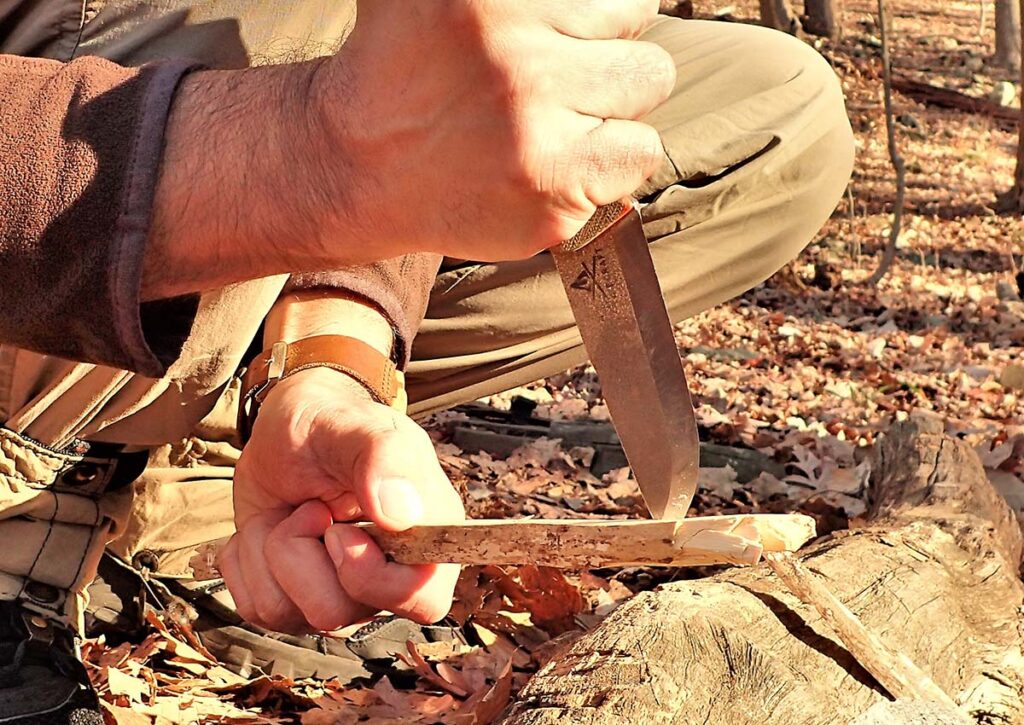
Forehand (Fist) Grip: The forehand grip is the most basic and natural way to hold objects securely. This grip is ideal for power cutting, allowing you to roughly remove a significant amount of material to shape the wood. To use this grip, curl all your fingers around the handle, creating a fist. Avoid placing your thumb on the knife’s spine, an everyday habit. Hold the wood off to the side, with the blade tip pointing slightly upward, and slice from the base of the blade to the tip. Lock your wrist and elbow and use your shoulder to push down as if punching through the floor. The motion resembles shrugging your shoulder. Alternatively, you can adapt this technique by pulling the wood back against the knife using your work hand. Pro Tip: This is not a jarring-of-the-elbow motion.
Thumb-Assisted Push Cut: This is commonly called a scissor grip cut. When viewed from above, the arrangement of the wood and the knife resembles the operation of scissors. It involves a thumb-assisted push cut, where the non-dominant hand’s thumb helps cut. The blade and wood pivot together like scissors, while the thumb on the non-knife hand presses the back of the knife into the wood. This technique features a short-cutting reach, applies soft-to-medium force, and offers a high degree of control. It is a more refined and detailed version of the chest-lever grip with a thumb-assisted push cut.
Chest-Lever Grip: The chest-lever grip is a powerful and controlled cutting technique commonly used in bushcrafting, characterized by a typical palm-up grip. To execute this cut, engage your lat muscles and leverage your body for power. Start by turning the knife blade outward to your right (if you’re right-handed) with your palm facing up. Grip the knife firmly, placing your thumb on the handle or side of the blade while your other hand holds the workpiece. Once the blade contacts the area you want to cut, rotate your shoulders forward and pull your hands apart as your shoulders open up, leveraging against your torso. Keep your hands connected to your ribs throughout the process. This technique and the forehand grip allow you to make powerful cuts for removing significant amounts of wood.
Peel Grip: Also known as a draw grip, apple peeling grip or paring grip, the peel grip facilitates more detailed, finishing cuts rather than powerful ones. Use it to finish the ends of a spoon handle, shape the top of the spoon bowl, chamfer a tent stake or trim wood to achieve a flat surface. To execute the peel grip, hold the knife in a reverse position with the blade facing you. Place your fingers on the back of the knife handle, positioning your thumb on the back end of the workpiece while your other hand clasps the work. Keep your knife-hand thumb out of the blade’s path as you close your hand into a loose fist, allowing for a slow, controlled cut. Author’s note: This grip is helpful for precise carving and finishing the edges of items.
Bushcraft Techniques
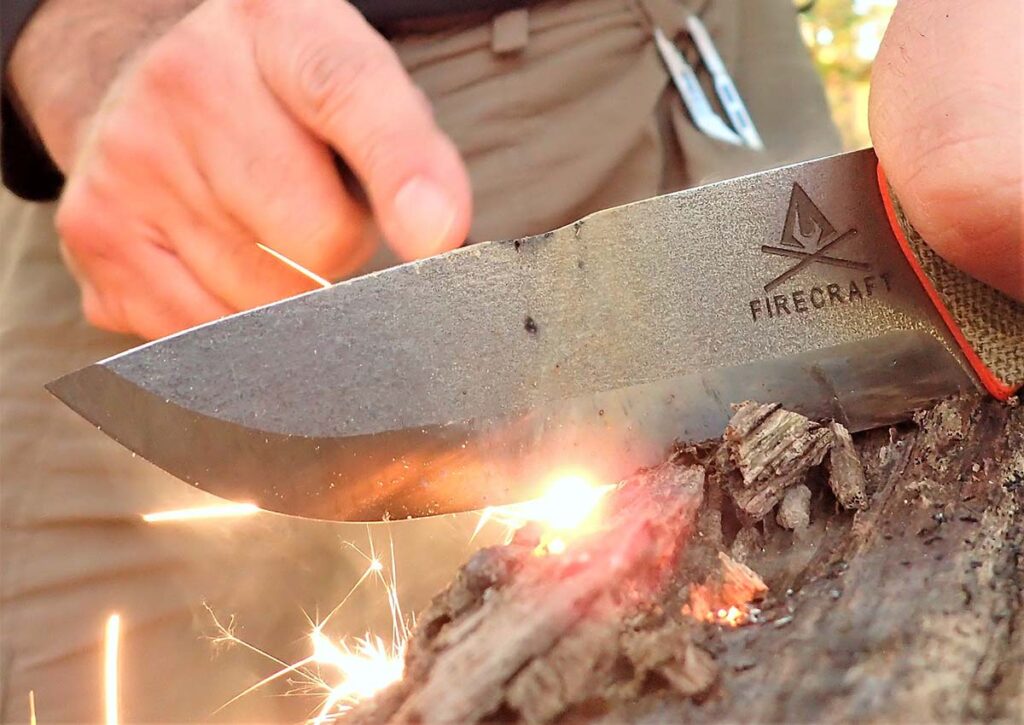
The author strikes the supplied ferro rod against the fire notch to ignite the tinder.
After addressing the basic grips, it’s time to learn a few helpful knife techniques commonly employed in bushcraft. Practice them at a comfortable pace and avoid rushing.
Bushcraft Batonning: A knife alone often lacks the weight needed for effective chopping. However, striking the blade’s spine with a heavy object can produce strong cuts. A sturdy, comfortably held stick serves as a baton to help cut down and limb small trees, making various cutting tasks much more straightforward. You can quickly cut through branches and small saplings using a knife and a baton. Bushcraft batonning describes using a baton for controlled cross-grain cuts, creating V-notches and splitting wood no wider than your wrist. Using a baton for limbing branches generally proves faster and safer than using an axe.
Beaver Chew: To cut a green or dry branch to the desired size, use the beaver chew technique, which leaves a somewhat rounded end for pounding into the ground. Make a series of cuts (nicks) around the stick. Thicker sticks require more time, so repeat this process several times, cutting deeper with each pass. Once the cut is halfway or two-thirds through the stick, you can break it off and trim the end.
Tension Cutting Saplings: To take down small green trees up to wrist size in thickness, first apply tension by bending the tree while holding it firmly with one hand. Start your cut at a 45-degree angle at the bend point, where the stress is most significant. There’s no need for a sawing motion; instead, use a gentle rocking back and forth with the blade to slice through the fibers under tension. Be careful during the crucial last part of the cut, as you need to restrain the tree from falling prematurely, which would require extra work to finish the cut. If done correctly, this process should take no more than 10 seconds.
To section long saplings, step on the top to hold it and bend it over your thigh or hip. Cut the bend to ensure avoid cutting yourself during the follow-through.
Pro Feather Sticks
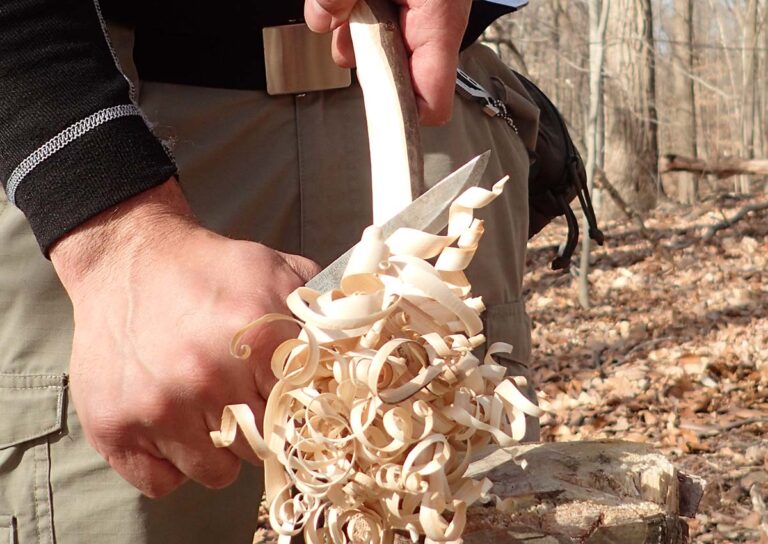
Creating tinder by shaving very thin pieces and kindling from deadwood is known as making a feather or fuzz stick. You can use various techniques but here’s the most basic approach.
Start with a forehand grip and resist the urge to place your thumb on the spine of your knife. Using gimping or a gimping grip applies uneven pressure, which often causes feathers to detach from the stick. When you reduce green wood for carving projects, think ahead and keep the shavings for fire making, regardless of their thickness. Thinly shaved greenwood dries quickly. Try to make them as thin as possible or save larger shavings to use as kindling. Emphasizing multi-use and maximizing the utility of everything you work on and cut truly embodies bushcrafting!
Try Stick It!
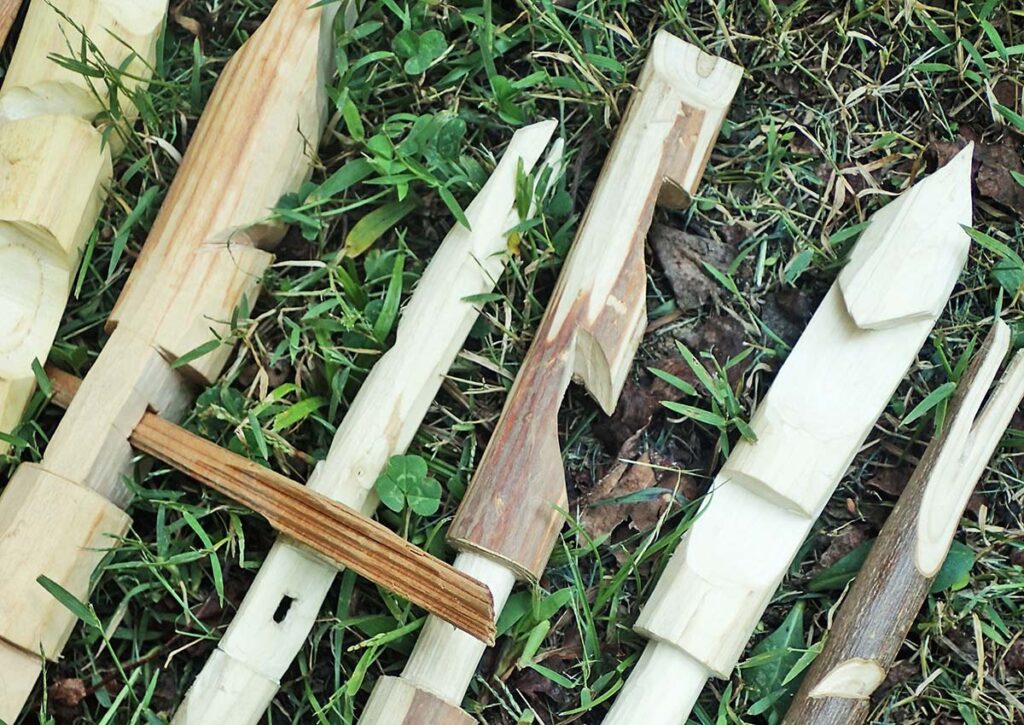
The author carved various try sticks with essential notches and additional features.
The Try Stick, made famous by wilderness educator, survival instructor and author Mors Kochanski, is a tool designed for practicing and showcasing knife skills in wood carving. While some notches are functional and often used to create items such as tent pegs, pot hangers and digging sticks, many notches on a Try Stick are more decorative and less commonly utilized. You can incorporate around 17 different types of notches on a Try Stick, but including as many as possible is typical. There’s no required number of notches to create; a Try Stick focuses on knife handling and safe practice.
Try Stick Notch types include:
Round Notch
Pot Hook
Saddle Notch
Square Notch
Mitred Lapped Notch
Jogged and Wedge Splice
Dovetail Pin and Socket
Dovetail Notch
“V” Notch
Spear Notch
Knife Tip Mortice
Diameter Reduction
Knife Edge
Split
Bow Notch
Latch Notch
Bark Stripping
Whistle Project
Check Out More Outdoor Knives:
NESSMUK KNIFE: OPTIONS IN THE ALL-AMERICAN OUTDOOR KNIFE
BEST TOMAHAWKS: OUR TOP HAWKS FOR BACKWOODS TO BATTLEFIELDS
Hone your cutlery acumen at the 12th Annual BLADE University
How to make and design knives, how to determine which steel for which knife, what to look for in proper damascus patterns and how to enhance their appearance and other incisive knife subjects will highlight the class schedule of the 12th Annual BLADE University. Held in conjunction with the 44th Annual BLADE Show June 6-8 at the Cobb Galleria Centre in Atlanta, BLADE University will be sponsored by Work Sharp. Classes begin the Thursday before the show, June 5, and will run through Friday, June 6, and Saturday, June 7. All courses will be taught in the Cobb Galleria except one—Fundamentals of Grinding—which will convene under the tent in The Courtyard, aka the parking lot of the show’s host hotel, the Renaissance Atlanta Waverly.
BLADE University assembles some of the world’s best knifemakers, bladesmiths and other cutlery and steel professionals to teach a wide range of subjects for the knife user, knifemaker, knife hobbyist, knife entrepreneur, knife designer, and knife aficionado and novice alike. If you love knives or are just beginning to, BLADE University has a topic for you. The complete course schedule, with subjects, teachers, times and venues:
Thursday, June 5
In “Level Up Using Lasers, Ninjas and Other Cool Tools,” ABS master smith Neels van den Berg dives into how tools like laser engravers, digital design, and jigs and process design can streamline your workflow and enhance your work.
Material Conservation for the Forging Smith, Mareko Maumasi, 4 to 5 p.m., Room 104—Award-winning bladesmith Mareko Maumasi shares techniques and approaches he uses to reduce guesswork and material waste in the workshop. His approaches not only help the knifemaker’s material go further but also save time and money.
Friday, June 6
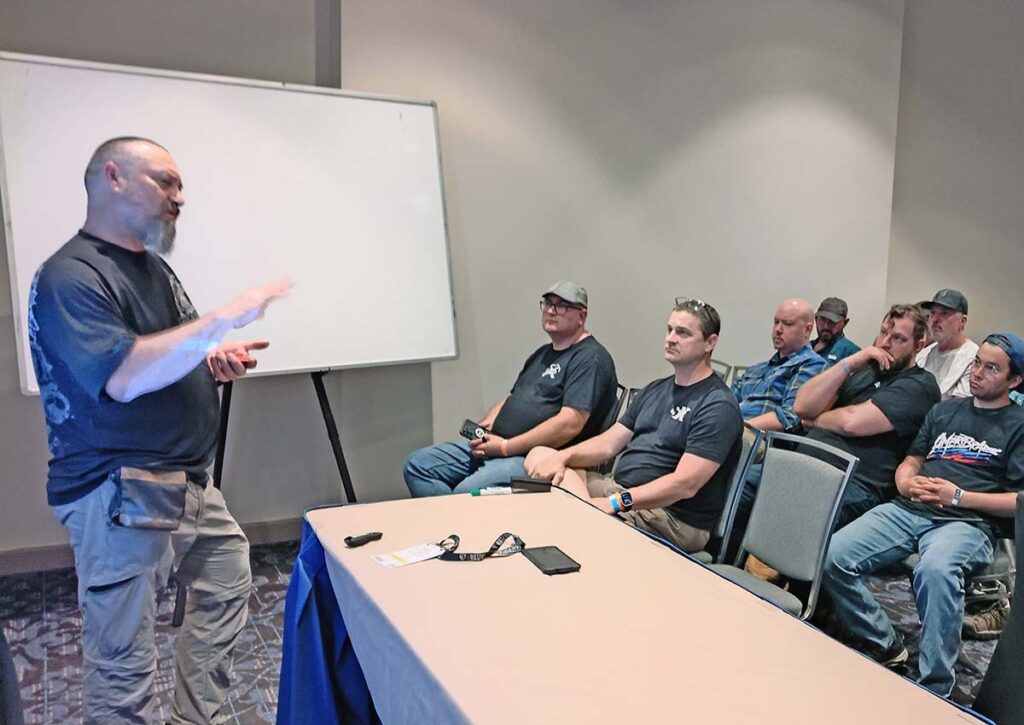
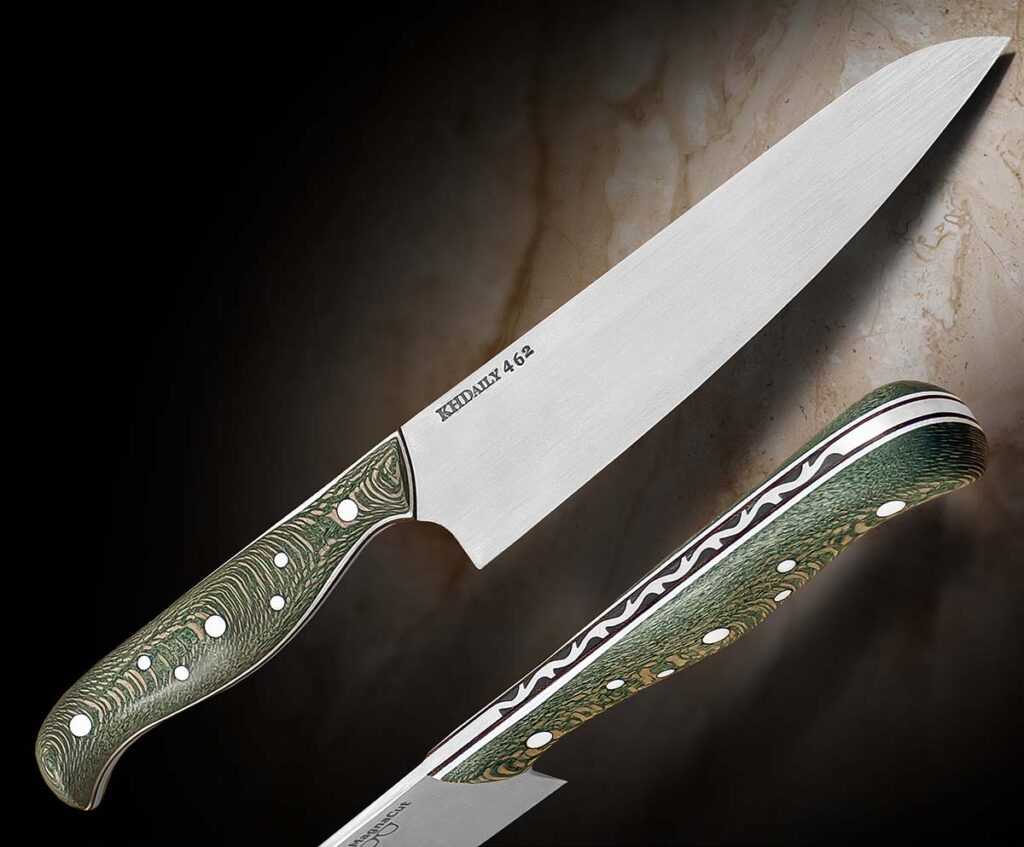
In “Elevating Your Handle Appearance: Spine Filework, Handle Shapes and Pin Placement,” knifemaker Kyle Daily shares his preferred files and specialized equipment for crafting his five most popular filework patterns, ensuring your knife not only looks exceptional but also feels comfortable and functional. (Jocelyn Frasier knife image)
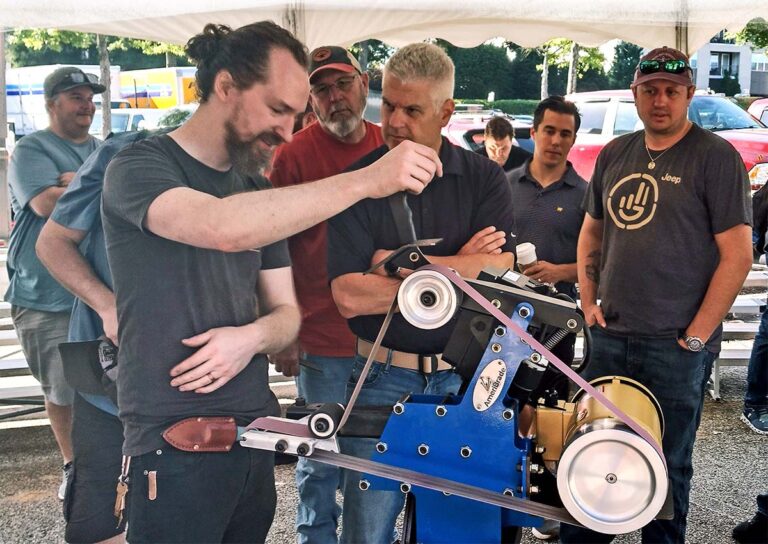
Fundamentals of Grinding, AmeriBrade and guest grinders, 8 to 9:30 a.m., The Courtyard—AmeriBrade and guest makers provide a general overview on grinds, techniques and different equipment. The class is interactive and the team answers questions and demonstrates suggestions for common issues.
Deep Dive into Culinary Knives, Mareko Maumasi, 10 to 11:30 a.m., Room 103—Mareko Maumasi returns to help collectors and makers better understand the nuances of high-performance culinary knives. The class covers design aspects from blade tip to pommel, aiding collectors in making more informed knife-buying decisions, and makers in creating higher-quality and higher-performing culinary knives.
The Tom Brown Tracker Experience, Mathew Williams, 1 to 2 p.m., Room 107—Experienced woodsman and tracker Mathew Williams discusses the iconic Tom Brown Tracker knife, including the blade’s notable features, how the knife’s function can be of benefit to the user and more. Mathew even dispels some Hollywood myths concerning the TBT. This one’s for old-time fans and newcomers alike.
Take Damascus Etching to the Next Level, Baker Forge, 1:30 to 2:30 p.m., Room 103—Greyson Weltyk of Grey Blades and Jordon Berthelot of JB Blades teach step-by-step processes on how to enhance intricate patterns in damascus with Gator Piss etchant, including in-person demos with damascus knives. Subjects include proper cleaning prep, temperatures, stacking oxide techniques, sealing oxides and more. Receive in-depth looks at new product offerings from Gator Piss for etching stainless damascus and properly sealing damascus with nano-ceramic technology. Have the opportunity for Q&A with authorities about damascus etching.
Hands on Sharpening, Work Sharp, 3:30 to 4:30 p.m., Room 113—What happens when a knife goes dull? How do you know when to sharpen it? Bring your own knife or borrow a demo model and learn the progression of shaping a bevel, sharpening and edge maintenance from the team at Work Sharp. You get hands-on practice and experience sharpening your blade using a variety of sharpeners and abrasives, from whetstones to belts. (See under Saturday’s classes for an encore presentation.)
Leather Sheath Making Tips, Tricks & Tools, John Dennehy, 4:30 to 5:30 p.m., Room 107—Classes on sheath making are conducted at knife shows, social media and elsewhere. Unfortunately, some of the online demos are by those giving the wrong advice. John Dennehy shares the sheath-making tips he’s learned after working leather for almost 50 years, including leather selection, the tools he uses and why he uses them. He also covers the construction details he employs that experienced leather workers recognize immediately as the ones needed to produce a professional sheath.
Saturday, June 7
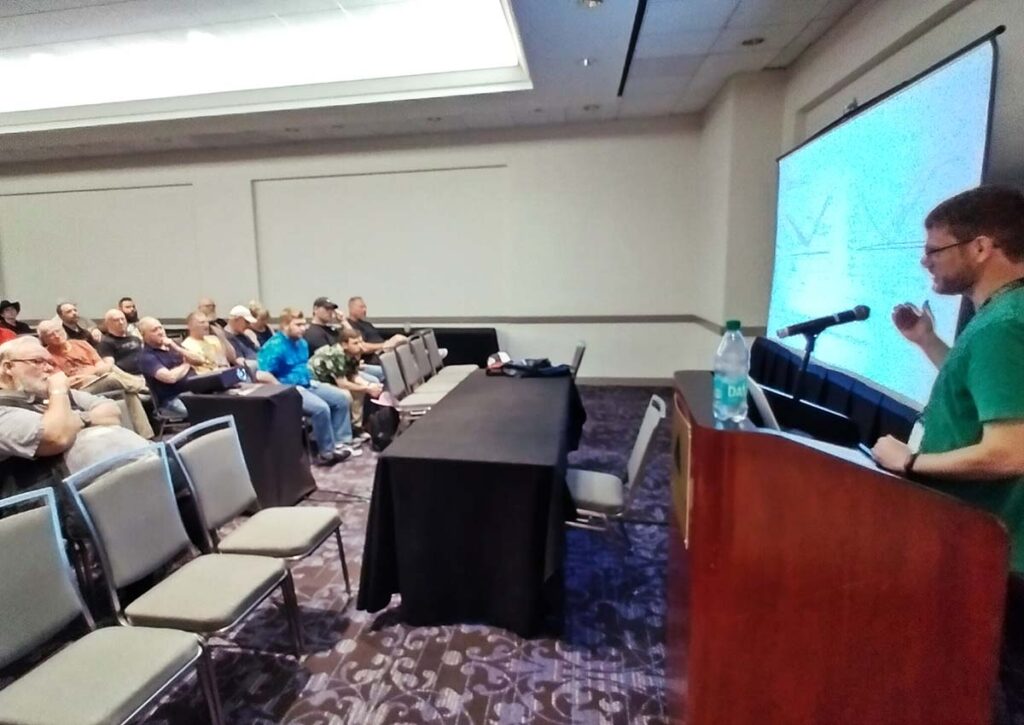
In “How to Select the Best Steel for Every Knife,” steel metallurgist Dr. Larrin Thomas talks about the factors that are important for different types of knives, such as cost, toughness, edge retention, sharpenability and corrosion resistance.
Elevating Your Handle Appearance: Spine Filework, Handle Shapes and Pin Placement, Kyle Daily, 8:30 to 9:30 a.m., Room 113—Enhance the appearance of your knife with distinctive features that go far beyond standard production models. Knifemaker Kyle Daily from KHDaily Knives guides you through the intricate art of filework on the spine, while also sharing insights into handle design and pin placement on the handle. Discover Kyle’s preferred files and specialized equipment for crafting his five most popular filework patterns, ensuring your knife not only looks exceptional but also feels comfortable and functional. From laying out your pattern to a step-by-step tutorial, this class provides the essential knowledge to achieve a professional and eye-catching finish. A Q&A session at the end ensures you leave with the skills and knowledge to take your knifemaking to the next level.
Demystifying Damascus, Mareko Maumasi, 9:30 to 11 a.m., Room 104—Mareko Maumasi completes his third straight day of teaching BLADE University classes with a most challenging one. He breaks the subject down in a way to help collectors gain a better appreciation for the knowledge and skill required to make unique damascus patterns, and to deepen the makers’ understanding of pattern design and composition.
The Cutting Edge, Nick Italiano, 9:45 to 10:45 a.m., Room 107—Nick Italiano, seasoned outdoorsman and host of the Raise The Flag Podcast, discusses the nuances of various blade grinds. From common everyday uses to survival situations, Nick covers several common grinds and their real-world function.
Level Up Using Lasers, Ninjas and Other Cool Tools, Neels van den Berg, 12:30 to 1:30 p.m., Room 113—Step up your knifemaking game with cutting-edge technology, unconventional techniques and insider secrets from ABS master smith Neels van den Berg. In this high-energy session dive into how laser engravers, digital design, and jigs and process design can streamline your workflow and improve your work. Plus, explore the mindset and discipline—the “ninja skills”—that separate good makers from great ones. Packed with real-world examples, practical insights and a touch of humor, this is a must-attend for makers looking to work smarter, not harder.
Designing Knives: Philosophy, Tools and Inspiration, Jens Anso, 2:15 to 3:15 p.m., Room 104—Award-winning knifemaker Jens Anso shares his approach to knife design, including how he thinks about form and function, the tools he uses and where he finds inspiration. With decades of experience in the industry, he’s developed a clear design philosophy that balances aesthetics, ergonomics and real-world usability. He explains his workflow, from sketching and CAD modeling, to prototyping and refining details. His goal is to provide insight into the design process and share practical takeaways for makers and enthusiasts who want to push their work further.
Hands on Sharpening, Work Sharp, 2:15 to 3:15 p.m., Room 113—What happens when a knife goes dull? How do you know when to sharpen it? Bring your own knife or borrow a demo model and learn the progression of shaping a bevel, sharpening and edge maintenance in this encore presentation from the team at Work Sharp. You get hands-on practice and experience sharpening your blade using a variety of sharpeners and abrasives, from whetstones to belts.
How to Select the Best Steel for Every Knife, Larrin Thomas, 4 to 5 p.m., Room 104—Both the makers and buyers of knives have many options for steels, but how do they know which ones to choose? Steel metallurgist Dr. Larrin Thomas talks about the factors that are important for different types of knives, such as cost, toughness, edge retention, sharpenability and corrosion resistance. Which steels are more optimal for a large chopper, a kitchen knife or a folder? For makers, the topics of forgeability, grindability, polishability and ease of heat treating are covered to choose steels that perform well and fit the knifemaking setup.
More classes were being determined at press time. For more information on them and on how to enroll in one or more of BLADE University’s classes, see our course offerings. There will be additional information on BLADE University in the June BLADE® and also in the BLADE Show Program, copies of which will be distributed for free at the BLADE Show.
Latest assisteds have all you need in swift, sharp folders.
The assisted opener appeals to many who are mechanism oriented and like to fidget with their knives. There’s something satisfying about tapping a flipper tab or nudging a thumb stud and then having spring force kick in and propel the blade open crisply and quickly. It’s sort of like an automatic but it’s not. In fact, in most areas its legality is no different than a standard one-hand folder* because you initiate the opening by manually pressing the flipper or thumb stud as opposed to releasing the blade under spring tension via a push button as done with an auto.
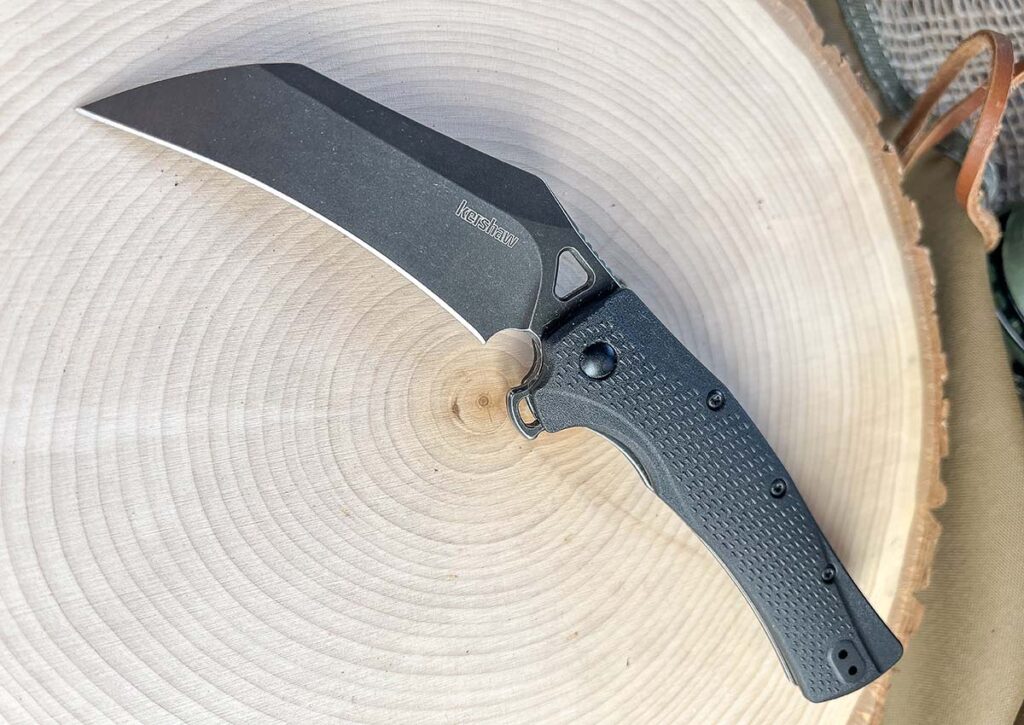
Kershaw Dawnstar
The flipper tab of the Kershaw Dawnstar is highly effective at deploying the blade. The large semi-circular choil is sort of unusual and adds to the knife’s distinct appearance
Kershaw was one of the first manufacturers to go all-in with assisted openers in the mid-to-late 1990s. It teamed with BLADE Magazine Cutlery Hall-of-Fame® member Ken Onion to make a line of collaboration knives that incorporated Onion’s SpeedSafe assisted-opening mechanism. The knives not only were great sellers for the company, but, more importantly, helped start the assisted-opening revolution in the knife industry. Soon after, other manufacturers began producing versions of folders with mechanisms that closely mirrored the SpeedSafe for both tactical and EDC purposes.
The Dawnstar is Kershaw’s latest entry in the genre. Sporting a hawkbill blade paired with a true tactical handle offering deep, tip-up carry, it is one of the company’s more radical configurations. The hawkbill isn’t seen too widely in tactical folders, so it stands out both visually and functionally. The 3.5-inch blade is 8Cr13MoV stainless steel.
The main grind is hollow with a swedge, making the blade look a bit aggressive and also following through in use. A flipper tab deploys the blade quickly and is the only opening method. The handle is molded glass reinforced nylon (GRN) with dual skeletonized steel liners for strength. Strategically placed cutouts reduce weight. The handle is textured for a comfortable, nonslip grip.
The knife cuts best in a pulling motion, allowing the hawkbill to gather the material being cut into the blade’s curvature, not unlike pulling a zipper. The hawkbill is an aggressive pattern and goes through a variety of materials with ease. This is where the hollow grind really makes a difference. Cardboard, foam, even wire stripping—the assisted opener sails through it all. If you cut a lot of cardboard or make long, straight-line cuts in any material, the Dawnstar is for you. The handle is easy to hold onto. The large finger recess helps seat your hand.
Approximate closed length: 4.4 inches. Country of origin: China. MSRP: $54.99.
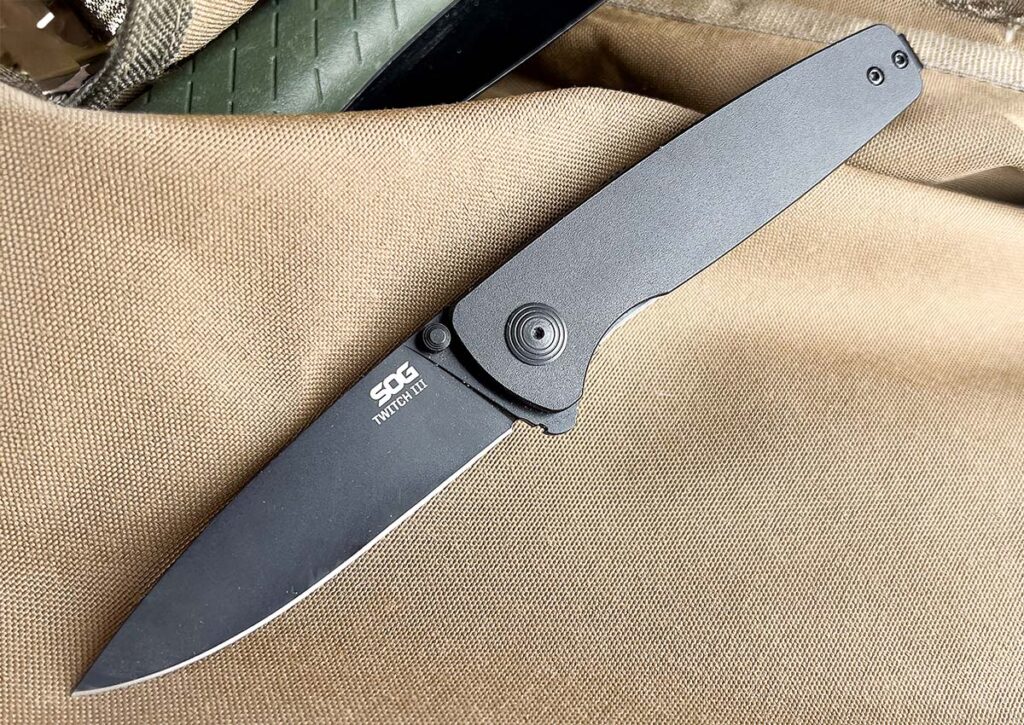
SOG Twitch III
The Twitch III is ultra-light, ultra-slim and elegant in appearance. A simple design with high function, it goes well with dress or casual clothes.
The Twitch III is the third installment in a highly successful series of assisted openers from SOG. It is a slim, stylish EDC capable of tackling a wide variety of cutting chores. It features a 3.1-inch spearpoint blade fully flat ground from 154CM stainless steel with ambidextrous thumb studs and a low-profile flipper tab for an additional opening option. A light press on the flipper and the blade pops out with authority.
The handle is lightweight yet strong aluminum, with dual steel liners providing the backbone. A subtle finger recess forms a bit of an integral guard to prevent your hand from sliding forward. A deep-carry, bayonet-style clip is affixed to the butt and positions the folder as low as possible in the pocket for ultimate concealment. The handle profile is flat and slender, making it extremely comfortable for daily pocket carry. The knife is equally at home in dress or casual clothes.
For a slim knife the Twitch III performs very well. The blade glides through various materials with surprising ease. The 154CM offers more mileage for edge retention than lesser steels such as D2, 8Cr13MoV and AUS-8. It is the type knife you can carry for a range of varied-use scenarios, from slicing steak to more mundane things such as opening mail, packages, etc.
It excels at cutting open blister packs due to its pointy tip and flat- ground blade. Performance is great and the folder carries exceptionally well, so what’s not to like? However, I would caution against prolonged use due to the slender, flat profile and slick aluminum scales. If your hand is wet or sweaty, grip retention might be an issue.
The Twitch III comes in three varieties: all-black blade and handle, natural finished aluminum with satin blade and gold TiN coated hardware, and gray aluminum handle with black blade and hardware anodized a light blue. All are great-looking EDCs and a welcome addition to your collection.
Closed length: 3.9 inches. Country of origin: China. MSRP: $79.95 for any of the three variants.
Benchmade PSK 593BK-01
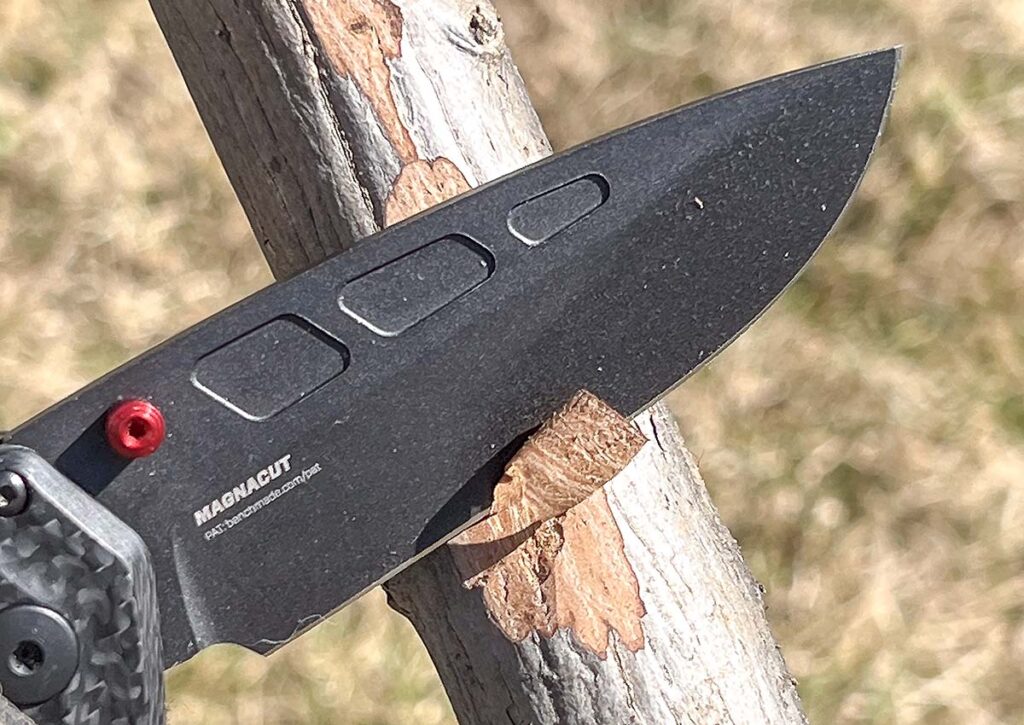
Benchmade’s PSK is a high-end outdoor folder using CPM MagnaCut stainless blade steel. MagnaCut holds an edge extremely well in addition to having excellent corrosion resistance—pretty much the perfect outdoor blade material.
The brawny Benchmade PSK 593BK-01 is a rugged assisted opener engineered for survival use. It exhibits all the hallmarks of what makes applicable Benchmade knives standards in the industry: the AXIS crossbar lock mechanism and advanced materials for the handle and blade, including carbon fiber, G-10 and CPM MagnaCut stainless steel. The 3.4-inch modified drop-point blade has excellent edge retention and superior corrosion resistance—a perfect steel for a knife to carry while hiking, camping, hunting, etc.
An exposed flat area below the thumb stud that resembles a choil serves as a spot to use a ferrocerium rod for fire starting. It’s such a thoughtful touch on the PSK. The ergonomic handle incorporates forward and rear integral guards to prevent slipping and seats your hand well. Black carbon fiber bolsters are mated with black G-10 scales, with the blade DLC coated for additional corrosion resistance and a low-profile appearance—in other words, the knife is “murdered out” in mostly all black.
The ambidextrous thumb studs are anodized red for an interesting splash of color. A deep carry pocket clip positions the PSK tip up and switches to the opposite side to accommodate lefties. The AXIS Lock Assist is rock solid while remaining easy to disengage by pulling back on the studs, then rotating the blade closed. A sliding switch safety in the handle spine locks the blade closed to help prevent the knife from accidentally flying open in your pocket or during inside waistband carry.
The PSK looks great and performs even better. Grip quality is excellent; the 3D machined grooves in the handle and bolster work great at keeping your hand in place without feeling overly aggressive, and they displace water as well. The blade rockets out via the assisted opener very quick and sure, almost like an automatic.
The robust build and ergonomic grip instill user confidence in any climate. The PSK handles anything you throw at it, from slicing meat to whittling. The flat grind leaves enough cross-sectional steel on the blade to give it structural integrity, yet thins the edge down to where it has bite.
Approximate closed length: 4.6 inches. Country of origin: USA. MSRP: $450.
Editor’s note: For that matter, in the many states and jurisdictions where bans against automatics have been lifted, neither is an assisted opener’s legality any different than an auto.






![Assisted Open Knives Buyer’s Guide [Tested]](https://blademag.com/wp-content/uploads/Flipper-Group-H-768x544.jpg "Assisted Open Knives Buyer’s Guide [Tested]")