Home Blog Page 35

Best Daggers: Top Options That Get To The Point [Tested]

Modern takes on a Stone Age standard come in a spectrum of styles.
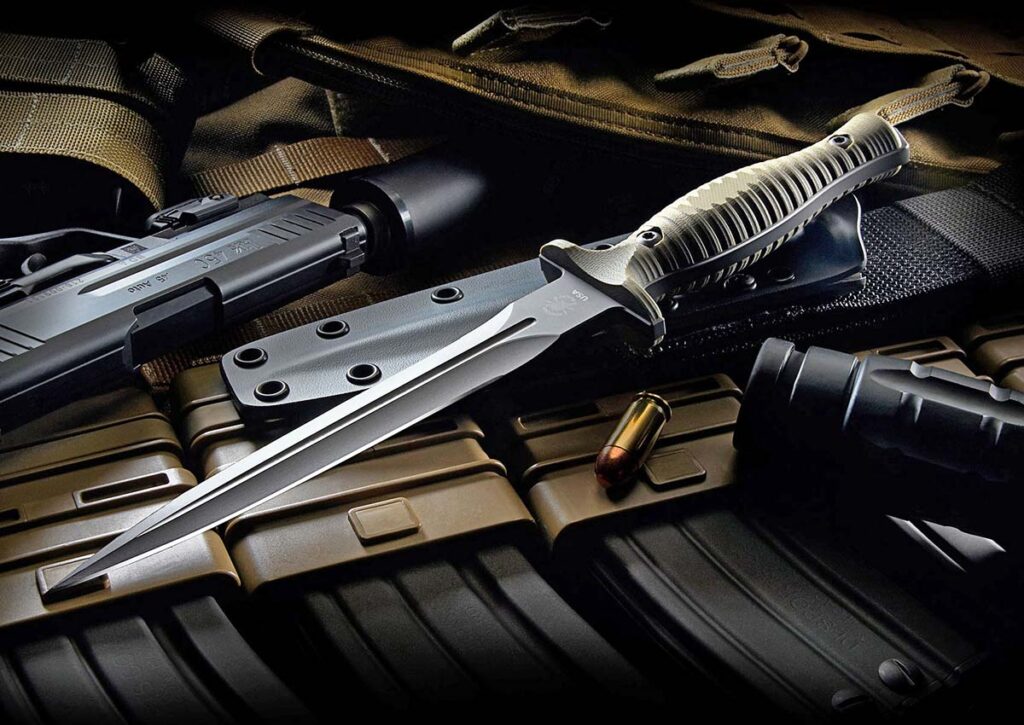
Daggers have been a favorite go-to blade of humans for many millennia. Before the advent of metals, symmetrical blade styles such as daggers and spear points, as well as projectile points, were the earliest formal cutting edges of Stone Age peoples. It was only natural these forms carried over into the Bronze Age and, indeed, through to today.

The knife with the decidedly pointed tip and double edge* played a prominent role in both World Wars and continues to be a prime choice of many operatives. Some prefer one for self-protection in the home or as an EDC, and many cutlery enthusiasts collect them for sheer sentimental value. As an everyday working knife there are better-focused blade options, but in a pinch the dagger can perform basic functions. Where it shines, however, is when used for stabbing and slicing. Let’s look at several factory options and put them through their paces.

KA-BAR Ek Commando Presentation Knife

The Ek performed equally well in quick pull-throughs on the pork tenderloin and in piercing/splitting the apple.

KA-BAR Ek Commando Presentation Knife Specs
Blade length: 6.625”
Blade steel: 440C stainless
Handle material: Walnut
Weight: 8.8 ozs.
Overall length: 12.625”
Sheath: Brown leather belt model
Country of origin: USA
MSRP: $351.64

Pros

  • Historic Design
  • High-Quality Materials
  • Secure Grip

Cons

  • Weight Toward Tip
  • Expensive

The Ek Commando Presentation Knife is a high-grade commemorative in KA-BAR’s historic John Ek Knife Co. series. It features a double-ground, slightly waisted spear point blade in a mirror finish. The blade has a long, flat ricasso etched with the Ek Commando Knife Co. shield logo plus KA-BAR Olean, NY above the guard. The handle is lacquered walnut and the guard and lugs are brass with copper-washed accents.

Ka-Bar John Ek 13 Commando Presentation Knife Fixed Blade Walnut

Ka-Bar John Ek 13 Commando Presentation Knife Fixed Blade Walnut

$224.95
Prices accurate at time of publishing. Affiliate disclosure.

Fox Knives Tactical Elementum Dagger

The Fox Tactical Elementum Dagger’s serrations provide an added level of utility. The knife dispatched 2-inch-wide seatbelt webbing with gusto. The dagger blade may not be as effective as other, more utilitarian styles but it can still cut well when needed.

Elementum Dagger Specs
Blade length: 3.94”
Blade steel: Bohler N690 stainless
Handle material: Black polypropylene and Thermorubber (PP and TPE)
Weight: 3.53 ozs.
Overall length: 8.11”
Special feature: One side plain, one side serrated
Sheath: Kydex w/dual MOLLE mounts
Country of origin: Italy
MSRP: $123.40 at press-time exchange rate

Pros

  • Durable Finish
  • Ergonomic Handle
  • Compact

Cons

  • Niche Utility

Italian knife manufacturer Fox Knives originally designed the Tactical Elementum Dagger for flight crews of French combat helicopters. The knife boasts hidden-tang construction and a short blade in a matte black Idroglider finish. The two blade grinds meet in the middle at a small ricasso marked with the Fox logo, company location and blade steel. The handle has a ribbed double-guard at the top and six beefy diagonal ribs on the lower half terminating with a lanyard hole in the base.

Spartan-George Raider

The author tested the Spartan-George’s slim, trim blade for slice ability on pork tenderloin. Using quick, single pull-through strokes he cut off medallions of the tenderloin with ease.

Spartan-George Raider Specs
Designer: Les George
Blade length: 7”
Blade material: SK5 carbon steel
Handle material: Black thermoplastic
Weight: 7.1 ozs.
Overall length: 12”
Knife to know: Tribute to U.S. Marine Corps Raider stiletto of World War II
Sheath: Black injection molded
Country of origin: Taiwan
MSRP: $150

Pros

  • Great Edge
  • Comfortable Handle
  • Durable Finish

Cons

  • Narrow Blade

Knifemaker/United States Marine Corps veteran Les George designed the Spartan-George Raider as a tribute to the U.S. Marine Corps Raider stiletto of World War II. The sleek dagger sports a double-ground, black-powder-coated blade. The opposing blade grinds meet in the middle, leaving a small ricasso at the base upon which a small Spartan and George logo are tastefully imprinted. The handle incorporates a double guard and a large ovate checkered section on each side of the grip for enhanced purchase. The sheath includes a 1.5-inch-wide black nylon hanger.

Spartan Blades George Raider Dagger

Spartan Blades George Raider Dagger

$150.00 $113.99
Prices accurate at time of publishing. Affiliate disclosure.

SOG Pentagon FX Covert

The SOG nailed one of the functions daggers do best—stabbing.

Pentagon FX Covert Specs
Blade length: 3.41”
Blade steel: Crucible Cryo S35VN stainless
Handle material: G-10, flat dark earth
Weight: 3.9 ozs.
Overall length: 7.52”
Special feature: Customizable grip
Sheath: GRN (Glass Reinforced Nylon) thermoplastic, SOG Universal Mount
Country of origin: Taiwan
MSRP: $189.95

Pros

  • Removable Scales
  • Full-Tang Construction
  • Enhanced Grip

Cons

  • Specialized Design

The FX makeover of the SOG Pentagon is both innovative in its cosmetics and versatility. The blade is black titanium nitride coated. The grinds meet in the middle and there is a section above the short ricasso grooved two-thirds of the way up. The name of the knife is finely imprinted on the top front grind and the steel type and country of origin on the back. The blade and full-tang handle are fully exposed around the perimeter of the scales with gimping below the guard and on the base. The scales can be removed by a single lug on the base, allowing them to be swapped out, or the skeletonized steel frame can be used without them.

Sog Pentagon FX Covert Fixed Blade Knife

Sog Pentagon FX Covert Fixed Blade Knife

$189.95
Prices accurate at time of publishing. Affiliate disclosure.

Testing The Daggers

I tested the Ek and Spartan-George Raider for stabbing prowess by plunging them down through the core of fresh apples. The Ek took no prisoners, not only piercing through top to bottom but laying the fruit out in two neatly cleaved halves. The Spartan-George provided similar results, penetrating the apple but not quite splitting it in half due to the narrower blade width and thinner blade steel—though wicked nonetheless.

Pork tenderloin was the slicing medium. Using rapid, single strokes, I took the Spartan-George to task. The dagger is extremely sharp on both edges, so I took turns on each side of the blade doing pull-throughs on the hapless tenderloin. The knife sliced off perfect pork medallions at will, passing the slice test with flying colors.

The SOG Pentagon FX Covert (bottom) and Fox Tactical Elementum (top) proved useful when cutting paracord and rappelling rope. The shorter blades are very much in the scale to what many knife users are accustomed. The author indicated the test group’s two smaller daggers are easier to use than the larger ones “when getting down to the nitty gritty” is required.

After cooking the tenderloin, I tested the Ek in similar fashion and got similar results. The waisted blade profile shifts with more weight toward the tip and gives it excellent grab similar to a recurve. Like the Raider, the Ek performed quick pull-throughs with ease.

What the two smaller test knives, the Fox and the SOG, lack in size they make up for in ease of concealment. Both have EDC potential for a high degree of self-protection with a modicum of utility.

I tested the Fox’s serrated edge slicing standard 2-inch nylon seatbelt webbing and achieved excellent results. Likewise, the plain edges on both knives handled paracord in one pull stroke, and 3/8-inch rappelling rope laid flat on a wood surface in two strokes. Both daggers passed the pork tenderloin stab test with aplomb. Because they’re smaller, it’s easier to do detail and utility work with blades in their size range than with blades twice their length.

Dagger Sheaths

The Spartan-George Raider sheath (top) is more durable and versatile, while the Ek Commando’s commemorative leather sheath captures the period as it was intended.

The Fox has a MOLLE-compatible sheath with two simple DOTS gates that can be modified with a myriad of readily available aftermarket attachments. The SOG uses a proprietary setup—the SOG Universal Mounting System—developed for a group of the company’s fixed blades. Both of the smaller daggers can double as boot knives as well.

The sheaths of the Fox (left) and SOG (right) are radically different. The Fox has a simple MOLLE sheath with two simple DOTS gates, enabling you to modify it with a variety of attachments. The SOG uses a proprietary setup—the SOG Universal Mounting System.

The Raider’s black injection-molded unit is durable and versatile, while the Ek captures the period as it was intended. The Raider sheath lends itself to converting to a concealed inside-the-jacket shoulder rig as well.

Going Large Or Small

Daggers come in many shapes and sizes but all are primarily geared for self-defense, with any utility abilities a bonus. The first question you need to answer is whether a large or small dagger suits you best. Large daggers like the Ek and Spartan-George excel at sheer combat because they reach out and touch someone, aka an assailant, more easily. If ease of carry, especially concealed, is a top priority, both the SOG and Fox will serve you well. Choices abound in the world of the dagger.

*Despite recent advances in pro-knife legislation, check your local and state ordinances for laws concerning knives with double-edged blades. The same goes for concealed-carry knives.

Read More Knife Reviews:

Relentless Knives Curved Fillet Knife Review [Tested]

A fillet knife that sharpens while you cut? That’s the bold promise Relentless Knives make with its Curved Fillet Knife.

In its pursuit of the elusive long-lasting edge, Relentless Knives called on titanium, carbide, crushed diamonds and nature. Using beaver teeth as a model, the company promotes blades that “sharpen as they cut.”

A “Power Strip” consisting of ultra-hard carbide and crushed diamonds is permanently bonded to one side of the titanium edge. The basic concept is that as you use the knife, the softer back side of the blade wears away, exposing more of the hard edge. The need for constant resharpening is eliminated, ergo Perpetual Edge Technology.

According to Relentless, you need not worry about your blade rusting or discoloring, even in saltwater, a dream for commercial operations or the fisherman who forgets to wipe his knife off after use. The base line is that the knife—in this case the Relentless 6-inch Fillet Fixed Blade—must cut. Let’s see if it does.

Relentless Knives Curved Fillet Knife Specs

A “Power Strip” consisting of ultra-hard carbide and crushed diamonds is permanently bonded to one side of the titanium edge. The basic concept is that as you use the knife, the softer back side of the blade wears away, exposing more of the hard edge.

Company: Relentless Knives
Blade length: 6”
Blade material: Grade 5 titanium
Power Strip: Carbide/crushed diamond
Blade grind: Flat
Blade flex: Medium to stiff
Handle material: True Grit glass-reinforced ABS
Weight: 6 ozs.
Overall length: 12”
Sheath: Leather w/snap strap
Country of origin: USA
MSRP: $150

Pros

  • Innovative Perpetual Edge Technology
  • Rust and Corrosion Resistance
  • Exceptional Cutting Performance

Cons

  • Initial Roughness
  • Expensive

Curved Fillet Knife Cutting Tests

The paper slice is a quick way to check any edge. The fillet knife sliced strips of 20-pound copy paper without pressure, and I could feel the Power Strip grab the paper. Sharp, coarse cuts, the slices were not difficult to control and the handle felt comfortable.

The fillet knife crunched forcefully to 200 cuts very quickly. The author stated it cut great but it was weird feeling the flex. It seemed to slice smoother toward the last 50 cuts.

Single-walled cardboard was next. The first couple of slices were rough cuts, then it seemed to smooth out a bit making for faster slicing. The True Grit handle material really keeps the knife locked in your grip.

I started cutting scrap 8-ounce leather. At first the edge was still grippy while slicing, then seemed to find its groove and got smoother. The cutting action was very aggressive—I could hear every cut. Using the other end of the leather strip, I did some skiving. The slices were thin and I still heard every cut. Using a choke-up grip, control was very easy.

The knife produced nice curlicues. Note: use the edge close to the guard for stability. The Power Strip wanted to dig deeper into the scrap pine, so the author had to control cutting depth.

It was scrap-pine whittling time. The knife produced some nice curlicues. Note: use the edge close to the guard for stability. The Power Strip wanted to dig deeper into the wood, so I had to control cutting depth. It’s fun to try but watch out for your fingers!

It was on to half-inch sisal rope. The fillet knife crunched aggressively to 200 cuts very quickly. The challenge on my part was to watch for the blade flexing. It cut great but it was weird feeling the flex. It seemed to slice smoother toward the last 50 cuts. I was probably knocking the newness off the Power Strip.

Curved Fillet Knife Processing Game

Hunting season was in full swing where I live at press time, and I like cooking fresh venison backstrap. The fillet knife zipped through the meat quite smoothly and cleanly. With the temperature at 22°F, the handle stayed tight in my cold hand.

The knife zipped through the venison quite smoothly and cleanly. With the temperature at 22°F, the handle stayed tight in the author’s cold hand.

I found some whole tilapia to fillet. After thawing, it was ready for action. The knife excelled at preparing the fish. It glided along the bones in short order. Dang, I needed this blade when I was younger working for a commercial fish house in Wisconsin! I went back in to thaw out my fingers and fry some fish.

The final test was back to slicing the copy paper. What a difference from the first test. The edge was smooth slicing and a lot cleaner in the cuts. The more you use the knife the better it gets. Perpetual Edge all the way!

Final Cut

I’m impressed with the Relentless blade’s ability to stay sharp by itself. It’s very well suited for saltwater and freshwater use. Hats off to the Relentless crew. I would have to do a lot more testing to come up with any changes. I’m waiting for a Relentless hunting-style knife to come out soon. Stay tuned to the Relentless website (see below) for more details.

More Outdoors Knife Reviews:

Cool Custom: Matt Aaron’s Blacksmith’s Automatic Folder

0

With a hybrid lock system and a unique aesthetic, Aaron’s Blacksmith Automatic Folder cuts a distinctive profile.

Matt Aaron got the idea for his Blacksmith’s Automatic Folder when he took a friction folder class taught by ABS master smith Nick Rossi.

Matt’s original intent was how to get a more complicated knife with a similar number of parts as a friction folder. He mulled it over with Rossi and others for two or three years and, inspired by Nick and his taco-style friction folder construction approach, arrived at the Blacksmith’s Auto.

The lock is a hybridization of a lockback auto mixed with a little bit of bolster release auto and some of Matt’s own design. The brass lever operates the opening, closing and locking mechanism. The knob at the pivot is not a push button but simply the pivot.

Matt Aaron
Matt Aaron

Matt forged, folded and cut the lock spring and launch spring out of the initial single, eighth-inch flat piece of mild steel that served as the base for the Rossi taco construction style. The latest batch Aaron’s doing is commercially pure titanium.

Blacksmith’s Automatic Folder Specs
Maker: Matt Aaron
Blade length: 3”
Blade material: 52100 carbon steel
Handle: Forged mild steel w/brass lever
Pocket clip: Tapered scroll in a blacksmithing ironwork style
Closed length: 4”
Maker’s price for a similar knife: $500

See More Custom Knives:

Best Steel For Knives: How To Choose

Intended cutting use and blade style help determine the ideal alloy for you and your knives.

Knives Annual
This article is an excerpt from the KNIVES 2025 annual, available at GunDigestStore.com.

Three critical aspects of creating or choosing a quality blade are steel selection, heat treatment and geometry. This feature focuses on the first of these, and the first any aspiring knifemaker or enthusiast will be tasked with—choosing the right blade steel for you and your knives.

To the casual observer, the steel selection process wouldn’t seem like such a big deal, but as in-depth as this article is, it barely scratches the surface of the topic.

Not all steels are created equal. Each varies as much as knife style and is designed for a specific application. So, matching the correct steel to the specific blade, intended use, and maker or user can be critical in creating a quality tool. Choosing the best alloy for your purpose can mean the difference between achieving the highest performance by effortlessly allowing the steel to do what it does best and struggling to pound a square peg into a round hole by forcing it to do something it was never designed to accomplish.

From my observations after a lifetime of providing metallurgical consulting services for various industrial clients and countless knifemakers, the latter rarely select steel with the same analytical vigor as the former. Rather than independent research to match steel chemistry to a process and product, knifemakers often choose whatever alloy everybody else is using.

American Bladesmith Society Journeyman Smith John Schultz chose well with 1075 steel for its natural toughness on his recurved chopper.

Be it a ubiquitous old favorite or the newest rage in the “steel of the month club,” no single alloy is the best fit for every knife, use or maker. On the other hand, the one area where knifemakers often exceed my industrial clients is letting frugality make the choice. The number of knifemakers who have told me they use a specific type of steel because of their access to a cheap or free supply is unfortunate.

The trouble with these approaches is needlessly steepening the learning curve for many a new maker or knife user. I can’t count the number of times I have heard a frustrated knifemaker state that an alloy they have tried is a bad steel. But there is no such thing as bad steel. Industry wouldn’t bother wasting time, effort or money on steel that wasn’t optimum for its intended purpose. There are poor application choices and bad heat treatments. Any fault lies with the knifemakers or bladesmiths and not the steel.

A36 is an excellent steel choice for use in buildings and bridges, but it is a bad reflection on knifemakers if they insist on making a blade with it. The steel properties of A36 are not conducive to knife blades. Alloys like 1095 or O-1 can make good hunting knife blades, but if the steels are heat treated like 5160, they won’t measure up in edge performance. I can’t tell you how often I’ve bitten my tongue when shown a blade fashioned from steel with barely enough carbon for adequate strength or an abrasion-resistant edge.

If knifemakers have to deviate from standard heat treatment practices with unorthodox extra steps, it is most likely the result of a steel choice that does not match their application or methods. You can under-soak or over-temper a 1% carbon steel sword or use an alloy better suited for such a blade. You can add several steps to heat-treating richly alloyed steel in your forge or choose a steel that readily responds to that heat source.

Intended Knife Use

Rather than using hard and soft layers for damascus, the author, Kevin Cashen, has always combined toughness with abrasion resistance, as in this O1/L6 skinner.

The problem is that we often proceed from the wrong direction. Whatever the reason, many knifemakers have already settled on their steel before determining what knife they will fashion, but how can you make the right choice in a material before you even know its intended use?

A better model for success is letting the primary tasks a knife is meant to perform determine needs and goals. Develop a plan to achieve those goals by designing a hand tool that will perform a specific task or even multiple tasks, keeping in mind that the intended uses of a single knife can be much more varied than people think. With the desired tasks for the edged tool in mind, choose the material based on the desired properties inherent to each steel’s specific chemistry. Equally important is recognizing the limits of a maker’s abilities to work with a given chemistry.

To explain how to choose the correct steel for you and your knives, the myriad of blade designs is distilled down to two primary categories. The first group—fine-cutting knives—is designed to perform keen slicing or aggressive slashing. They are most often used in a draw-type cut that is optimized like a saw at the microscopic level. Think of scalpels, skinning and hunting knives, and many kitchen knives. Their edges are thin, flat or hollow ground for cutting various soft, fibrous materials.

This group has a subcategory of blades, including some kitchen knives and razors, that will be identical in many design features and desired properties, but they are used more in a push cut. Regardless, impact toughness is not nearly as crucial as abrasion resistance for knives like this.

The effects of carbon content in a simple steel can be seen on the Iron-Carbon phase diagram.

In contrast, the second group—choppers—is used in straight-on, push-type motions, cleaving, or cutting that often involves impact. These knives cut more like a chisel than a blade drawn into a cut like a saw. Camp knives, some bowies, and many swords fall into this category. They benefit from polished, beefier, convex edge grinds that don’t require abrasion resistance as much as impact toughness.

By definition, a knife is a cutting tool. If we should ever find ourselves detracting from a blade’s ability to cut in any part of our plan or execution thereof, we may need to consider whether making a knife or another tool is the better option.

Thus, all the properties discussed herein are relevant to cutting. A fundamental condition for a blade to slice through material is that it must be stronger than the cutting medium. There is tremendous load pressure at the microscopic level, where the cut is initiated. So, almost by definition, strength must be a top priority in any knife edge.

For this article, strength is the ability to resist deformation under load. Opposing this prized quality of strength is ductility, or the ability to easily deform without edge or blade failure. Knifemakers heat treat steel to replace ductility with strength. For millennia, it was the job of the blade maker to find the most acceptable compromise between strength and ductility for their blades to cut while avoiding brittle failure.

Steel Strength

The graph shows the total hardness from proper solution in steels soaked for 1 minute and 10 minutes, respectively, illustrating the effects alloying can have on heating requirements.

There are many types of strength in steel. Examples are compressive strength and tensile strength. These and shear strength are not as apparent in general knife use, so knifemakers more easily conceptualize them as hardness.

The other quality prized in a blade is toughness, which should be viewed as the steel’s ability to withstand shock from sudden loads rather than bending in a ductile manner under gradual load. These are two entirely different behaviors, with one being more relevant to a blade used in chopping. Rather than the Faustian bargain of trading strength for ductility, the Holy Grail of blade making is maintaining high strength with impact toughness. In chopping-type blades, impact toughness is almost as valuable as strength.

The next property to consider in a knife blade is abrasion resistance. Microscopically, the knife edge is subjected to tremendous wear, even when cutting seemingly soft materials. It is this wear that results in the tool dulling when used. Abrasion resistance is the steel’s ability to withstand such friction effects. While this property does increase with overall hardness, steel’s unique makeup gives it abrasion resistance above and beyond hardness and even independently from it. Within the steel, there might also be carbide particles with a hardness that far exceeds the overall Rockwell measurement numbers of the blade. Fine cutting and slicing blades benefit more from abrasion resistance than impact toughness.

Although the possible steel choices for modern knifemakers are endless, for simplicity’s sake, this discussion is limited to non-stainless alloys commonly used by forgers and grinders alike. Although many knifemakers have become dependent on AISI (American Iron and Steel Institute) or SAE (Society of Automotive Engineers) steel names, such titles as 1084, W-2 or 80CrV2 lack specificity and meaning compared to studying the individual steel’s chemistry in determining its potential properties.

The more alloying helps us in gentler quenches, the more attention must be paid to proper heating, making some steels a better match for a forge and others a digital oven.

I strongly encourage knifemakers to study the chemistry of any potential steel choices to decide which one to use and how to work it. A supplier that provides the chemistry for your steel understands this and is well worth doing business with rather than a source that omits the alloy’s makeup.

Carbon content is the first consideration within a steel’s chemistry and perhaps the most important. Carbon is the main element responsible for strength in steel. The more carbon a steel has, the greater strength can be achieved in hardening. However, this is only true to a certain point; maximum hardness in carbon steel is achieved at around .80% carbon, and beyond this, not much more is gained in that area. Putting more carbon than .80% into the solution during the hardening process can harm a bladesmith’s goals. However, carbon beyond this optimum level will add abrasion resistance if allowed to stay in carbide form.

This sweet spot in carbon levels around .80% is known as the eutectoid. It is the most efficient use of carbon in steel, with no leftover iron (ferrite) or any leftover carbide (cementite). Steels with less than .80% carbon content are inherently tougher and less brittle, while steels with more can have much greater abrasion resistance with a tendency to be less tough. This is important to consider when choosing steel for your intended blade purpose. Does a machete need abrasion resistance? Does a skinning knife need to be tough? Choosing 1075 for one or 1095 for the other could make all the difference in having a steel that will work for you or against you in creating that blade.

In centuries past, bladesmiths had no choice but to compromise between strength and ductility when working with simple iron-carbon material. But then, starting in the early 19th century, alloying changed everything. Finally, with the intentional addition of other elements to steel, bladesmiths could have their cake and eat it, too.

Steel Alloys

Combining it in one chart helps select the correct steel based on knife use and a knifemaker’s heat-treating equipment.

A sword in the 13th century that had to be kept in the low hardness ranges could now be just as tough at much higher hardness levels. Fine slicing cutters could have an abrasion-resistant carbide boost far exceeding simple cementite abilities. But with these gains in performance came greater demands for more precise controls in heat treating, atmosphere, and more refined blade quenches. Today, even the most basic carbon steels have enough alloys to radically differentiate them from the old steel. Anybody who thought they would water quench 1084, just like traditional tamahagane steel, can attest to this fact.

For this reason, another critical factor must be considered in proper steel selection beyond the type of knife being made. It is why the premise of this article is choosing the right steel for you and your knife. Our modern steel alchemists may have created the perfect high-tech steel for a knifemaker’s application. But if they’re learning the ropes, or all they own is a humble forge, it could still be a terrible choice for their knife.

If your shop is equipped with a digitally controlled oven, all the many modern alloy options are available if you learn the rules each steel choice requires. The same chemistry that makes one steel harden in almost any oil or air makes it much more finicky when heated before being quenched. An alloy steel may have the potential to outperform a simple carbon steel, but not if you lack the equipment necessary to unlock that potential.

Figure 1 shows the as-quenched hardness results of a series of tests involving simple heating versus a standard 10-minute soak on commonly used steels. Here, the effect of increased alloying is plain to see when looking at each steel’s time and temperature requirements, which many open-flame heat sources or forges may struggle to meet. Unless armed with an excellent understanding of the metallurgy, a smith desiring to stick with more traditional tools would be better served by more traditional steels. Simple carbon steels such as “W” or 10XX series are like what forges were initially made for and will allow the traditional smith to produce a fine blade effortlessly.

Knowing what each of the additional alloying elements brings to the table is valuable in knowing what to seek in steel. If you’re looking for impact toughness, consider chemistries that include nickel or silicon. These additions affect the iron’s atomic lattice, which acts like a shock absorber. For a knife needing abrasion resistance, a boost from the more powerful carbide formers can give you longer wear than simple cementite, with two of the most common examples being vanadium (above .25% of overall elements) or tungsten. Chromium will also help in this area to a lesser extent.

If you wish to achieve a fully hardened blade with minimal effort, manganese over 1% or relatively modest additions of chromium are just the ticket for leaving behind your stressful days of the water quench. And, of course, for applications where simple carbon steels would rust too quickly, chromium over 11% will also help resist corrosion.
The chart in Figure 2 brings together all these considerations. On a final note, it must be conceded that a skilled bladesmith with a solid knowledge of heat treatment could push several of these alloys into adjacent categories. Still, here, we’ve focused on the path of least resistance.

By capitalizing on the characteristics of an alloy’s chemistry, a maker can spend less time getting it to behave in the desired manner and more time maximizing its performance.

More On Knife Steel:

2024 Knife World In Review

See what the highlights, low lights and everything in between were for the knife world in the past year.

Like most years, 2024 had more than its share of ups, downs and continuations of the same. From the promising developments in American-made factory knives to the harmful effects of Hurricanes Milton and Helene on knifemakers and at least one knife show, there were the goods, the bads, gains, losses, victories, debuts, swan songs and more. Among them:

Spartan Blades Clandestina blade
Spartan Blades Clandestina
  • Newer and older knife companies alike, such as Montana Knife Co., Emerson Knives, Inc., Hawk Knife Design, Tactile Knife Co., White River Knife & Tool and others, lead a surge in quality American-made knives;
  • Original portions of the hull, deck and other parts of The Battleship Texas are distributed to artisans around the country, including bladesmiths and knifemakers such as Harvey Dean, Jason Fry, J. Neilsen, Jack Stottlemire, Greg Coker and many others, to make items they specialize in and donate them to raise money to restore the pre-World War I dreadnought (https://battleshiptxartisans.com/catalog/);
  • A boom in the number of international countries (35) with exhibitors at the BLADE Show, led by France (21 exhibitors), South Africa (18), Italy (14) and Brazil (13), reflect the continuing recovery from the devastating effect of the worldwide pandemic;
  • Spartan Blades headlines the BLADE Magazine Knife-of-the-Year® awards at the BLADE Show with the company’s first Overall Knife of the Year, the Bill Harsey designed Clandestina. It was company’s first ever win in the prestigious category;
  • Speaking of Harsey, he, along with Ted Dowell and Don Fogg, become the 72nd, 73rd and 74th members of the BLADE Magazine Cutlery Hall of Fame®;
  • In what promises to be the first of several, Cutlery Hall-of-Famer Bill Ruple and Case debut their inaugural collaboration, the Bill Ruple X Case Axe Handle;
  • CPM MagnaCut stainless continues its run as the No. 1 blade steel among factory knives;
  • After almost 30 years with Spyderco, including stints in customer service and as marketing manager and coordinator of all things public relations, past BLADE Magazine Publisher’s Award winner Joyce Laituri calls it a career;
  • ABS master smith Kevin Cashen is named new chairman of the American Bladesmith Society, succeeding ABS master smith Steve Dunn, who passed away unexpectedly May 21;
  • After its original lawsuit was dismissed in June on “absurd standing grounds,” Knife Rights files a new federal lawsuit in September challenging the constitutionality of portions of the Federal Switchblade Act;
  • Hurricanes play havoc not only with the Southeast USA but knife industry members in the affected areas, with Milton postponing the Louisiana Knife Show and Helene flooding and/or temporarily shutting down at least two North Carolina knifemaking operations, including Winkler Knives and Dogwood Custom Knives, and no doubt others elsewhere;
  • Companies/knives celebrating anniversaries include: Boker (155th); Tru-Bal Knives, aka Tru-Balance Knife Co., (75th); Kershaw (50th); Fallkniven (40th); and the Emerson Knives, Inc. CQC-7 (25th);
  • Finally, a number of friends of the knife community pass away, including: scrimshander Gary “Garbo” Williams; bladesmith/mokume gane guru Phillip “Phil” Baldwin; knifemaker/past National Knife Collectors Association president Bob Cargill; ABS master smiths Steve Dunn and Hanford Miller; long-time custom knife collector Walter Hoffman; veteran knifemaker Dave Ricke; Mrs. Lori Buck (wife of Cutlery Hall-of-Famer Chuck Buck); Mrs. Sallie Bos (wife of Cutlery Hall-of-Famer Paul Bos ); Mrs. Betty Dowell (wife of Cutlery Hall-of-Famer Ted Dowell); Cutlery Hall-of-Famer B. R. Hughes; and past BLADE art director Jim Sasse. God rest their souls—and please forgive me if I’ve omitted anyone.

New Knives December 2024

0

What the best way to bid adieu to the old year and ring in the new? New knife drops, of course!

The year is almost over, but knife debuts are just heating up. We found a slew of production and custom knives dropped to finish 2024 or slated for release in early 2025. Any way you cut it, these blades are more than enough to get you drooling!


Leigh Aitken Button Lock Folder

Leigh Aitken Button Lock Folder

Model: Button lock folder
Blade length: 2.8”
Blade material: 52100 carbon steel
Blade thickness @ricasso: .087”
Blade grind: Flat
Handle material: Macassar ebony w/brass inserts
Approximate closed length: 4.2”
Maker’s price for a similar knife: Contact maker for pricing
Maker: Leigh Aitken, twigandbot.com.au (Jocelyn Frasier image)


Matt Davis EDC Fixed Blade

Matt Davis EDC Fixed Blade

Model: EDC fixed blade
Blade length: 3”
Blade steel: 440C stainless
Rockwell hardness: 59 HRC
Blade grind: The “Davis Grind” by the maker
Handle material: Black Micarta® w/black and white Micarta spacers
Handle pins: 1/16” 440C
Overall length: 7”
Sheath: Pouch type of tooled leather and rattlesnake inlay
Maker’s price for a similar knife and sheath: $400
Knife to know: Matt Davis is an ABS journeyman smith
Maker: Matt Davis, daviswacoknives.com (Jocelyn Frasier image)


Adam Gray Micro Bushcrafter

Adam Gray Micro Bushcrafter

Model: Micro Bushcrafter
Blade length: 2.5”
Blade steel: CPM 154 stainless
Blade grind: Convex saber, what Adam Gray calls sabervex
Handle material: Wenge w/yellow G-10 liners
Overall length: 5.5”
Sheath: By Badgerclaw Outfitters
Maker’s price for a similar knife and sheath: $305
Maker: Adam Gray, aaforge.com (Jocelyn Frasier image)


Bear & Son Cutlery D2 Rancher Sideliner

Bear & Son Cutlery D2 Rancher Sideliner

Model name: D2 Rancher Sideliner
Knife type: Flipper folder
Blade length: 3 3/8”
Blade material: D2 tool steel
Blade grind: Flat
Handle material: India Stag Bone (also in G-10, cocobolo or titanium)
Lock: Linerlock
Pocket clip: Deep carry
Weight: 3 ozs.
Closed length: 4.25”
Knife to know: Torx screw construction
Country of origin: USA
MSRP: $95.99-$125.49
Company: Bear & Son Cutlery, bearandsoncutlery.com


RMJ Tactical BUB (Back Up Blade)

RMJ Tactical BUB (Back Up Blade)

Model name: BUB (Back Up Blade)
Knife type: EDC push dagger
Blade length: 2.5”
Blade steel: Nitro-V stainless
Rockwell hardness: 58-60 HRC
Blade @thickest: .135”
Blade finish: Tungsten Cerakote®
Handle: G-10 (in three color options) w/Grade 5 titanium fasteners
Weight: 3.1 ozs.
Overall length: 4 13/16”
Sheath: Kydex w/1.5” belt clip
Knife to know: The scales remove to expose a skeletal handle
Country of origin: USA
MSRP: $185
Company: RMJ Tactical, Dept. BL1, rmjtactical.com


James Ingram Linerlock Folder

James Ingram Linerlock Folder

Knife type: Linerlock folder
Blade length: 3”
Blade steel: Feather damascus
Blade grind: Flat
Blade pattern: Harpoon
Handle: Mammoth ivory w/titanium liners
Frame: Engraved stainless steel
Bolster: Stainless
Closed length: 4 5/16”
Maker’s price for a similar knife: In the $1,500 range
Maker: James Ingram


Bobby House Swell-End ack

Bobby House Swell-End Jack

Pattern: Swell-end jack
Knife type: Slipjoint
Blade length: 2 5/8”
Blade material: Ladder pattern damascus
Blade grind: Hollow
Blade pattern: Spear point w/long-pull nail nick
Backspring material: CPM 154 stainless steel
Handle material: Cracked mammoth ivory w/polished acorn shield
Bolster: 416 stainless steel
Liners: 410 stainless, jewel relieved and soda blasted
Approximate closed length: 3 5/8”
Maker’s price for a similar knife: $1,650
Maker: Bobby House


Andy Isaacks Exodus

Andy Isaacks Exodus

Model name: Exodus
Knife type: Flipper folder
Blade length: 2.75”
Blade steel: CPM 154 stainless
Blade grind: Hollow
Blade finish: Satin
Blade lock: Linerlock
Handle material: Blue G-10 w/titanium liners
Closed length: 4.1”
Maker: Andy Isaacks (Jocelyn Frasier image)


Will Stelter/Lucas Gumbiner Bromen

Will Stelter/Lucas Gumbiner Bromen

Knife name: Bromen
Knife type: Flipper folder
Blade length: 3.13”
Blade material: Mosaic damascus of 1080 carbon and 15N20 nickel-alloy steels
Blade grind: Flat
Handle material: Emerald paper Micarta®
Pocket clip: Yes
Closed length: 4.39”
Maker’s price for a similar knife: $3,500
Knife to know: The knife is also available in a more subdued mosaic damascus blade and a butterscotch paper Micarta® handle by Lucas Gumbiner
Maker’s contact information: Will Stelter/Lucas Gumbiner, willstelterbladesmith.com (SharpByCoop image)


Bob Merz Lockback Folder

Bob Merz Lockback Folder

Knife type: Lockback folder
Blade length: 2.5”
Blade steel: CPM 154 stainless
Blade grind: Flat
Handle material: Mother-of-pearl
Bolsters: 416 stainless w/24k-gold-inlaid scroll engraving by Wes Griffin
Closed length: 3.5”
Maker’s price for a similar knife: $2,300
Maker: Bob Merz, bobmerzknives.com (Jocelyn Fraiser image)


Brian Milinski Folder

Brian Milinski Folder

Knife type: Folder
Blade length: 2.75”
Blade material: Damascus of Swedish and German stainless steels
Handle material: Mammoth tusk w/anodized and jeweled titanium liners
Bolster: Stainless steel scroll engraved by Tyler Poor
Thumbstud: Damascus w/mammoth inlay
Maker’s price for a similar knife: Contact maker for pricing
Knife to know: Brian Milinski is an ABS apprentice smith
Maker: Brian Milinski, mrknives.com (Jocelyn Frasier image)


CRKT Q

CRKT Q

Knife name: Q
Knife type: Flipper folder
Designer: Richard Rogers
Blade length: 3.31”
Blade steel: CPM MagnaCut stainless
Blade @thickest: .13”
Blade finish: Bead blast
Blade action: Ikoma Korth Bearing System (IKBS)
Handle: Titanium w/carbon fiber inlay
Lock: Framelock
Pocket clip: Yes
Weight: 3.2 ozs.
Closed length: 4.58”
Country of origin: Italy
MSRP: $225
Company: CRKT, crkt.com


Check Out Knife Drops:

Fantastic Voyage Of Gil Hibben and Paul Ehlers Collaborations

0

The collaborations of Gil Hibben and Paul Ehlers speak volumes without using words.

When the great design prowess of Paul Ehlers and the incomparable shop skills of BLADE Magazine Cutlery Hall-of-Fame® member Gil Hibben merged some 40 years ago, they produced a synergy seldom seen, elevating the knife industry to a new plane of creativity in the realm of the fantasy piece.

Following a trail blazed early by the likes of W.W. “Bud” Cronk, the pair brought vision and glimpses of other worlds from the realm of theory and the ephemeral to tangible, captivating and thoroughly gripping. During a custom knifemaking career that has spanned nearly seven decades, Hibben has been recognized as the author of extraordinary work, designing the first Browning hunting knives in 1968, earning a rightful place in the Cutlery Hall of Fame, and creating legendary knives for famed actor Sylvester Stallone in the Rambo film franchise, as well as the American Kenpo Knife for Gil’s martial arts sensei, Ed Parker.

Paul’s drawing of it and Gil wearing the gauntleted piece at an early ’90s Knifemakers’ Guild Show in Orlando. (Drawing courtesy of Paul Ehlers)

Ehlers is well known for his work in film, writing, voice, design and illustration. He was hired to produce a poster illustration for the 1981 cult classic film Madman and found himself cast as the title character, delivering an amazing performance. Versatility has been his hallmark through the years, expressing his artistic talent through a variety of media. His interests are literally boundless and his talents have been displayed across a broad spectrum of the arts.

It was Ehlers’ wide range of interests that led to a fortuitous conversation and brought about the most renowned collaboration in fantasy knife history—and one of the greatest industry wide in custom knives. “It arose from creativity on both parts,” attested Linda Hibben, Gil’s wife and a key individual through the years of the joint effort. “It was intended to create things that were never seen before in the knife industry, taking up the challenge to be true artists.”

Linda Hibben said Alien was the biggest Gil Hibben-Paul Ehlers showstopper and it’s easy to see why. (Image of Alien by Mike Carter)

Paul remembered, “Gil Hibben’s knives were featured in every martial arts magazine that I read. I was familiar with the Parker knife and wanted badly to buy one of Gil’s knives. So, by the mid-1980s I had saved enough money and placed an order with him.” Hibben produced a custom survival bowie with a 10-inch blade, characteristic sawteeth reminiscent of his Rambo knives, and a handle in the style of the Parker knife. Pleased with the finished product, Paul told Gil that he was a designer and illustrator with a particular love for fantasy characters. He commented that he had always wanted to see his characters with stylized knives and swords to complement their presentation.

Gil responded enthusiastically to Paul’s offer of sending an illustration for his review. “Love to see one!” was the reply. Game on.

Ehlers calls the initial brush with collaboration a “chance meeting of kindred souls.” The illustration led Gil to the shop with the goal of producing a knife named the Shark. A short time later, the designer asked about the maker’s progress. Hibben’s response was electrifying: “I already made it and sold it!”

Paul Ehlers conceived the Dragonfly, drew it on paper and mailed it to Gil Hibben, who took care of the rest. They exhibited the knife at the 1983 Knifemakers’ Guild Show, where it sold for $3,000—an unheard-of price in those days. (Eric Eggly/PointSeven image)

In a short time, the creative tandem gained momentum. Interestingly, their success may be linked to the fact that Paul does not make knives. “I admire, collect, use and draw them,” he commented. “But Gil Hibben makes knives.” By the time Gil and Paul brought their Dragonfly creation to the 1983 Knifemakers’ Guild Show, there was excitement but also some trepidation. “We were concerned about how to price it, whether it would sell and how it might be received,” Paul recalled. “Gil suggested that we put a price of $3,000 on it, and such a premium was almost unheard of in those days. But it sold!”

Ehlers had conceived the Dragonfly, drawn it on paper, rolled it up, and placed it in a mailing tube addressed to Hibben. When it reached him, Gil pursued the project with gusto even though the effort in itself was unprecedented. “Nothing like this had ever been made,” Paul advised. “But that didn’t stop him. He huffed and he puffed, he ground and he buffed and emerged from his shop holding the new Dragonfly.”

Unseen Realms

Gil Hibben made the Elf Dirk in 1984. The image for it sprang from Paul Ehlers’ fascination with gnomes, elves, giants and other mythical creatures. A spider dangles from its web, carefully crafted in a crevice of the handle. (Eric Eggly/PointSeven image)

Through the years the Hibben-Ehlers team flourished, one teammate with ideas and the other with the astonishing ability to grind steel and finish creations that brought visions of light, darkness, other worlds, and realms unseen as the tangible, real and dazzling works that are known the world over. Paul’s imagination effectively pushed Gil to new heights of creativity. The designer’s mind had remained fortuitously free to imagine the fantastic and the elements of the outer limits of innovation

“My mind was left open to create,” Paul explained. “If I knew then what I know now it is possible my concepts may have been restricted by the ‘impossible’ factor. I know now what other makers mean when they ask Gil, ‘How the hell did you make that?’”

Naja was completed in 1993. Norman Leigh’s sculpted bronze cast of a cobra rises above the grip, gazing with inset cat’s eye jewels for eyes and baring fangs. Paul Ehlers stated he considers Naja perhaps the finest art knife he and Gil Hibben have ever brought to life. (Eric Eggly/PointSeven image)

Hibben, on the other hand, has stood up to the challenge and then some, delivering time after time. As the collaboration aged like fine wine to more than 30 years, it had produced more than 40 pieces—knives that came to life, from the mist of imagination to the gleam of steel, sculpture and artistry. According to Linda, Gil once said, “I loved the challenges and making these pieces, each and every one of them. They made my creativity and skills set on fire! Paul’s dreams are my nightmares!”

Looking back, a turning point for the Hibben-Ehlers collaboration occurred in the 1990s when a representative of the Sultan of Brunei contacted Paul with the shocking pronouncement that his employer wished to purchase many knives produced by the pair, with the added kicker that “money is no object.” It was a compliment of the highest order and led to some remarkable achievements.

If it doesn’t have the signatures of both collaborators, it’s not a Hibben-Ehlers knife. Here’s how their signatures appear on Naja.

Throughout the collaborative years, Linda has been a tremendous contributor to the success of the enterprise. Gil is approaching his 90th birthday and suffered a stroke in the spring of 2016. However, he has been resilient and remains in touch with the custom knife community while Linda assists with his communications. Gil has stayed active in the shop and keeps up to date on the happenings in the knife community. “He still goes to his shop and even oversees knifemaking classes to this day,” Linda noted. “The only lingering effect from the stroke is he has trouble with words and numbers once in a while. He has no major lingering side effects other than that.” Ehlers, meanwhile, is quite busy with numerous endeavors, his creative energy as effervescent as ever.

St. George’s Axe is 22 inches long and features lost wax carvings by Richard Englers.

Linda captured the spirit of the great team’s aspirations, commenting, “They wanted knives to be taken to another level of art and imagination—to create and make sharpened shapes in steel that had not been done or seen before, and show that thinking ‘outside the box’ and making those creations into tangible works of edged art took a tremendous amount of skill. Just look at some of the grind lines Gil was able to accomplish.”

Showstoppers

Through the lens of knifemaking history and the gleaming facet of fantasy, those who see and admire the vision of Gil and Paul will continue to gaze with wide-eyed wonder at their works, including some of the most famous. The Alien, for example, was created in 1986 from a single piece of 440C stainless steel. “It burst from my mind in 1986,” Paul recalled. “There are a myriad of extra blades, spikes and projections Gil calls ‘long horns,’ plus hooks and a leather arm gauntlet.”

St. George’s Axe is 22 inches long and features lost wax carvings by Richard Englers. Gil Hibben and Paul Ehlers (inset) exhibit their collaboration at the 1986 New York Custom Knife Show. (St. George’s Axe image by Eric Eggly/PointSeven; image of Hibben and Ehlers courtesy of Linda Hibben)
Gil Hibben and Paul Ehlers Exhibit their collaboration at the 1986 New York Custom Knife Show. (St. George’s Axe image by Eric Eggly/PointSeven; image of Hibben and Ehlers courtesy of Linda Hibben)

Linda noted, “The Alien was our biggest showstopper. This one got more attention at knife shows than any other. We allowed people to reach their arm into it and ‘wear’ the Alien, and in every instance the person’s entire demeanor changed. It was like they became powerful, and the smiles on their faces when posing for photos was and is priceless. Gil made a total of five of these Aliens, each one a bit different. Number five rests in our private collection, and to this day when people come over and actually hold or ‘wear’ it, the magic is still there. They become a ‘Master of the Universe’ for those few minutes.”

An early classic, the Elf Dirk was produced in 1984, and the image sprang from Ehlers’ fascination with gnomes, elves, giants and other mythical creatures. Hibben wrought its sleek lines in 440C with a reconstituted coral handle, 14-karat gold and garnets. A spider dangles from its web, carefully crafted in a crevice of the handle. Naja, completed in 1993, remains a favorite. The undulations of the cobra are almost physically felt as Norman Leigh’s sculpted bronze cast of the serpent rises above the grip, gazing with inset cat’s eye jewels for eyes and baring fangs. Gil’s expertise is on full display in this tour de force, and Paul considers Naja perhaps the finest art knife the two have ever brought to life.

Artists, innovators, visionaries and friends, Gil and Paul have created a body of work that speaks volumes without words, just towering interpretation and storytelling in thought and grind, idea and finish. Those who contemplate their many completed projects are often left speechless as well, awed by the intricacy, the timeless, tantalizing and touching renderings of their complementary experience.

More On Custom Knives:

Advertisement

Must Read Articles

Read this before you make a knife

Knifemaking 101 – Read This Before You Make a Knife

  by Wayne Goddard My experience has taught me that there's nothing like digging in and getting started. I've often said the hardest part of the...
how to forge damascus steel

How to Forge Damascus

Advertisement
Advertisement