Home Blog Page 36

Bushcraft Tips and Tricks

0

Elevate your survival skills with these bushcraft tips!

A good bushcraft knife is characterized by its manageable size and weight, allowing for comfortable handling and easy resharpening.

Typically, a knife designed for bushcraft and carving tasks lacks spine gimping for the thumb. The cutting edge should have a continuous curvature that extends the entire length of the blade. A general-purpose bushcraft knife should have a blade that matches the width of your palm, with the tip aligned closely to the handle’s centerline. The handle and blade spines should remain on the same line.

The handle should feature an oval cross-section made from such materials as wood, Micarta® or plastic. It should not include finger cutouts that limit your grip, as such restrictions can lead to blisters. The handle length should fit comfortably in your palm. While Scandinavian blade grinds are standard for bushcraft knives, other blade grinds are also acceptable.
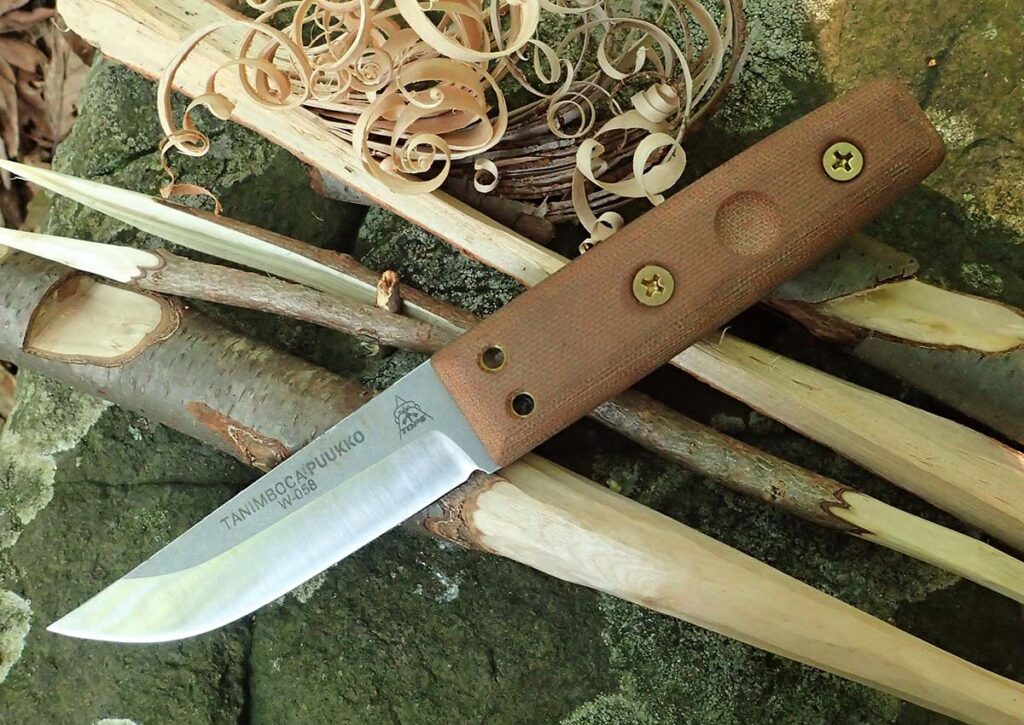
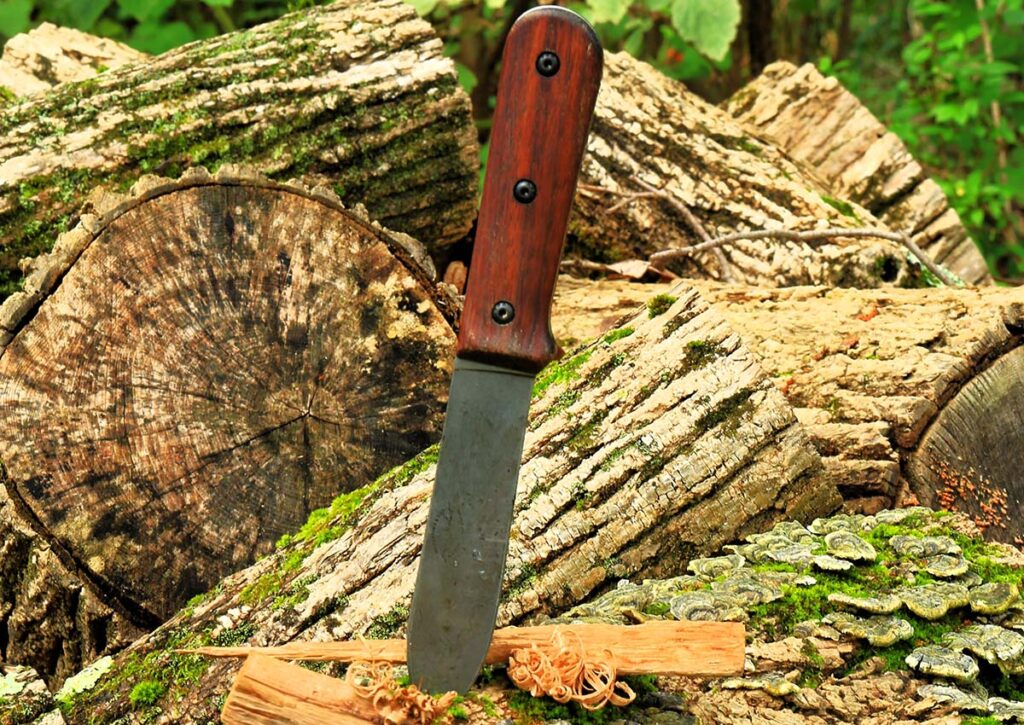
The Tanimboca Puukko from TOPS Knives made stakes, pot holders, fuzz sticks, bush forks, skewers, roasting sticks and traps. According to the author, it’s the perfect size for a bushcraft knife. Note the bow drill divot/socket on the handle for fire starting.

To quote Mors Kochanski, Canadian bushcraft and wilderness survival instructor and author of Bushcraft: Outdoor Skills and Wilderness Survival, “The knife is the smallest and most portable of all the cutting tools. Light and unobtrusive, the knife is readily available for hundreds of everyday tasks in bush living.”

Knife Safety

Always start with a safety briefing when working with tools, especially those that can cause serious injury. Books and teachings have provided several tips and procedures for knife use and safety. One key concept is the blood circle.

Stretch out your arm with the knife in hand and ensure you can make a complete circle without hitting anyone or anything, including tarps, backpacks, tents and water containers. The blood or death triangle is crucial when sitting and carving. Never use your leg as a backstop or cutting board. When removing large amounts of wood, cut to the side of your body on your dominant knife-hand side or lean forward, resting your forearms and elbows on your knees, keeping your work project and knife out of your blood triangle. Remember the blood circle. Some cuts, like a pull-cut, allow you to cut toward yourself in a controlled, slow manner, but generally cut away from yourself.

Bushcraft Grips And Cuts
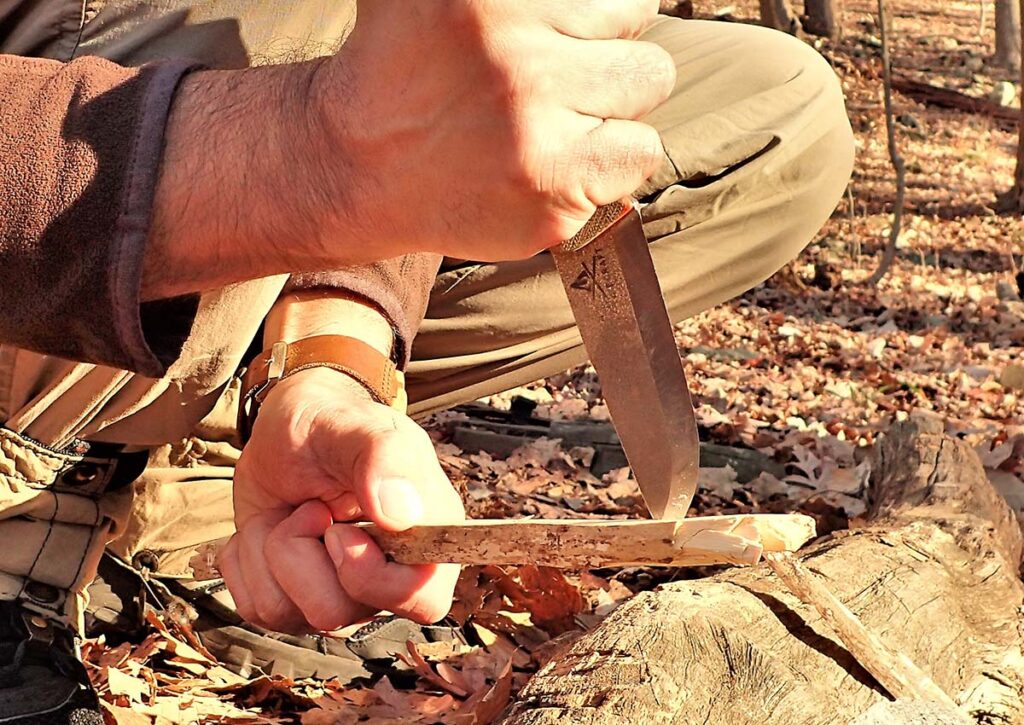
Use an icepick grip to split small pieces of wood for a one-stick fire. Strike the knife and wood against a hard surface together, then twist slightly to split the wood.
  • Forehand (Fist) Grip: The forehand grip is the most basic and natural way to hold objects securely. This grip is ideal for power cutting, allowing you to roughly remove a significant amount of material to shape the wood. To use this grip, curl all your fingers around the handle, creating a fist. Avoid placing your thumb on the knife’s spine, an everyday habit. Hold the wood off to the side, with the blade tip pointing slightly upward, and slice from the base of the blade to the tip. Lock your wrist and elbow and use your shoulder to push down as if punching through the floor. The motion resembles shrugging your shoulder. Alternatively, you can adapt this technique by pulling the wood back against the knife using your work hand.
    Pro Tip: This is not a jarring-of-the-elbow motion.
  • Thumb-Assisted Push Cut: This is commonly called a scissor grip cut. When viewed from above, the arrangement of the wood and the knife resembles the operation of scissors. It involves a thumb-assisted push cut, where the non-dominant hand’s thumb helps cut. The blade and wood pivot together like scissors, while the thumb on the non-knife hand presses the back of the knife into the wood. This technique features a short-cutting reach, applies soft-to-medium force, and offers a high degree of control. It is a more refined and detailed version of the chest-lever grip with a thumb-assisted push cut.
  • Chest-Lever Grip: The chest-lever grip is a powerful and controlled cutting technique commonly used in bushcrafting, characterized by a typical palm-up grip. To execute this cut, engage your lat muscles and leverage your body for power. Start by turning the knife blade outward to your right (if you’re right-handed) with your palm facing up. Grip the knife firmly, placing your thumb on the handle or side of the blade while your other hand holds the workpiece. Once the blade contacts the area you want to cut, rotate your shoulders forward and pull your hands apart as your shoulders open up, leveraging against your torso. Keep your hands connected to your ribs throughout the process. This technique and the forehand grip allow you to make powerful cuts for removing significant amounts of wood.
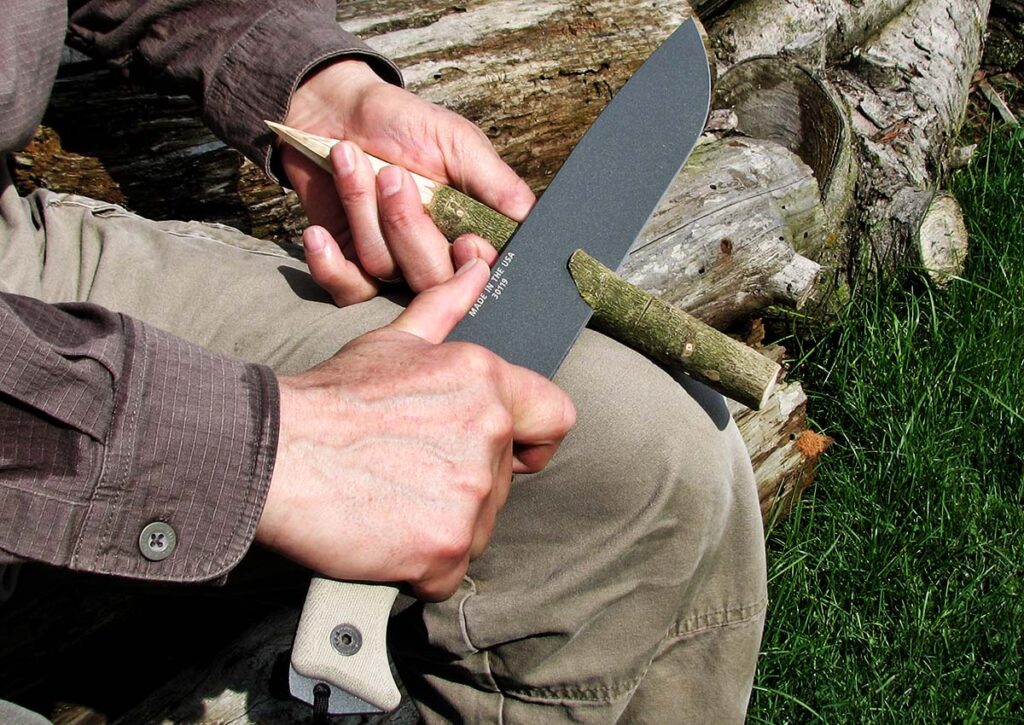
  • Peel Grip: Also known as a draw grip, apple peeling grip or paring grip, the peel grip facilitates more detailed, finishing cuts rather than powerful ones. Use it to finish the ends of a spoon handle, shape the top of the spoon bowl, chamfer a tent stake or trim wood to achieve a flat surface. To execute the peel grip, hold the knife in a reverse position with the blade facing you. Place your fingers on the back of the knife handle, positioning your thumb on the back end of the workpiece while your other hand clasps the work. Keep your knife-hand thumb out of the blade’s path as you close your hand into a loose fist, allowing for a slow, controlled cut. Author’s note: This grip is helpful for precise carving and finishing the edges of items.

Bushcraft Techniques
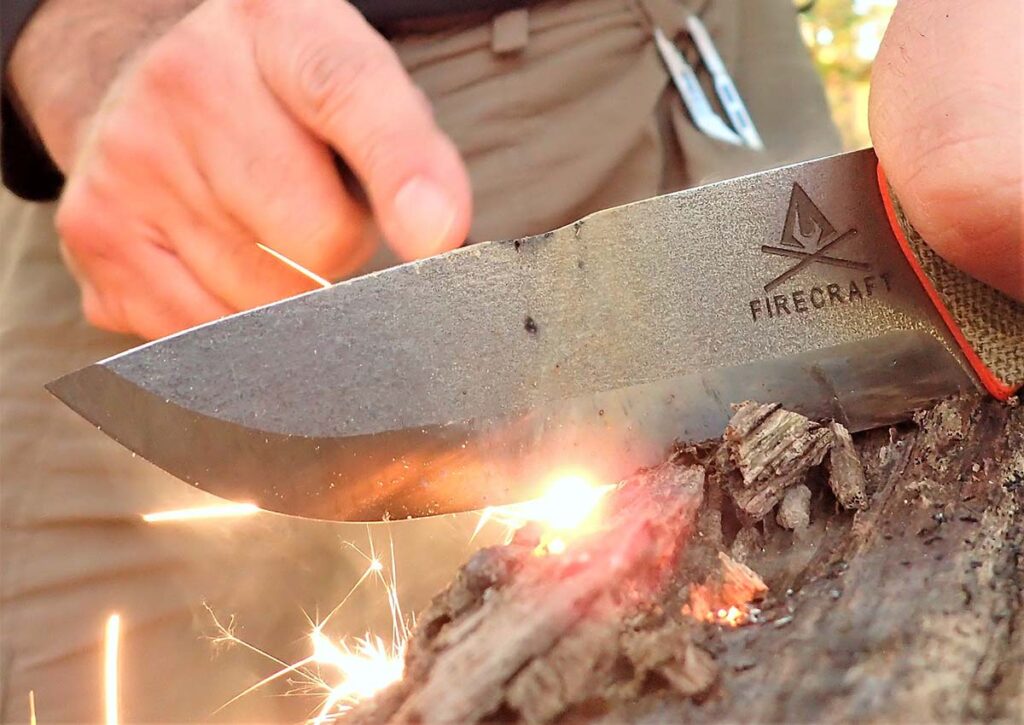
The author strikes the supplied ferro rod against the fire notch to ignite the tinder.

After addressing the basic grips, it’s time to learn a few helpful knife techniques commonly employed in bushcraft. Practice them at a comfortable pace and avoid rushing.

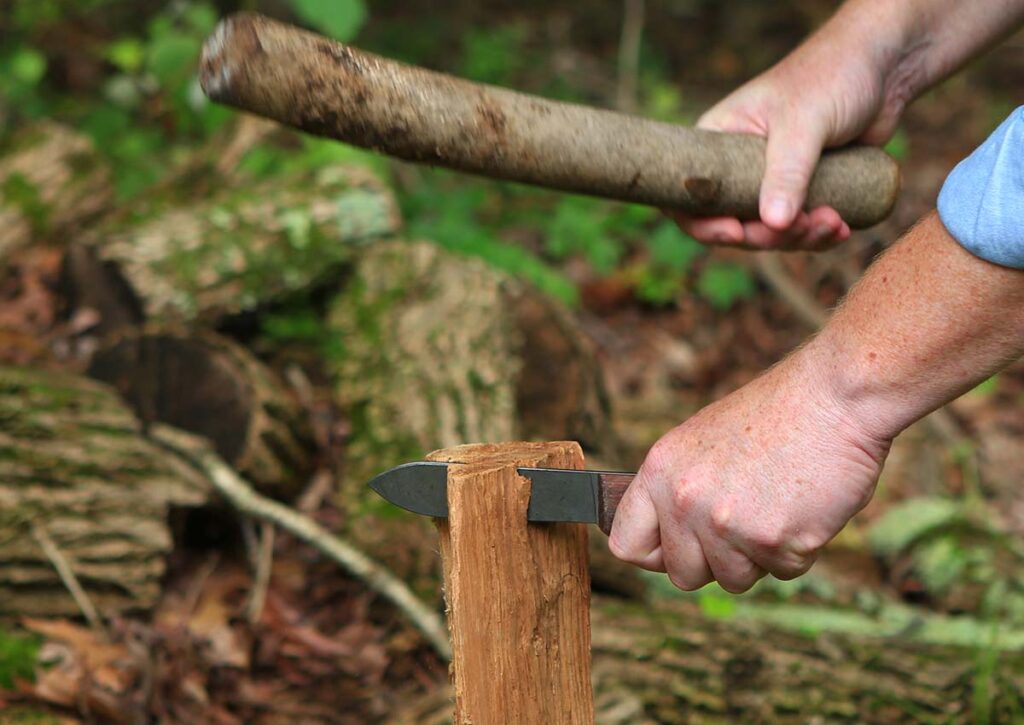
  • Bushcraft Batonning: A knife alone often lacks the weight needed for effective chopping. However, striking the blade’s spine with a heavy object can produce strong cuts. A sturdy, comfortably held stick serves as a baton to help cut down and limb small trees, making various cutting tasks much more straightforward. You can quickly cut through branches and small saplings using a knife and a baton. Bushcraft batonning describes using a baton for controlled cross-grain cuts, creating V-notches and splitting wood no wider than your wrist. Using a baton for limbing branches generally proves faster and safer than using an axe.
  • Beaver Chew: To cut a green or dry branch to the desired size, use the beaver chew technique, which leaves a somewhat rounded end for pounding into the ground. Make a series of cuts (nicks) around the stick. Thicker sticks require more time, so repeat this process several times, cutting deeper with each pass. Once the cut is halfway or two-thirds through the stick, you can break it off and trim the end.
  • Tension Cutting Saplings: To take down small green trees up to wrist size in thickness, first apply tension by bending the tree while holding it firmly with one hand. Start your cut at a 45-degree angle at the bend point, where the stress is most significant. There’s no need for a sawing motion; instead, use a gentle rocking back and forth with the blade to slice through the fibers under tension. Be careful during the crucial last part of the cut, as you need to restrain the tree from falling prematurely, which would require extra work to finish the cut. If done correctly, this process should take no more than 10 seconds.

To section long saplings, step on the top to hold it and bend it over your thigh or hip. Cut the bend to ensure avoid cutting yourself during the follow-through.

Pro Feather Sticks

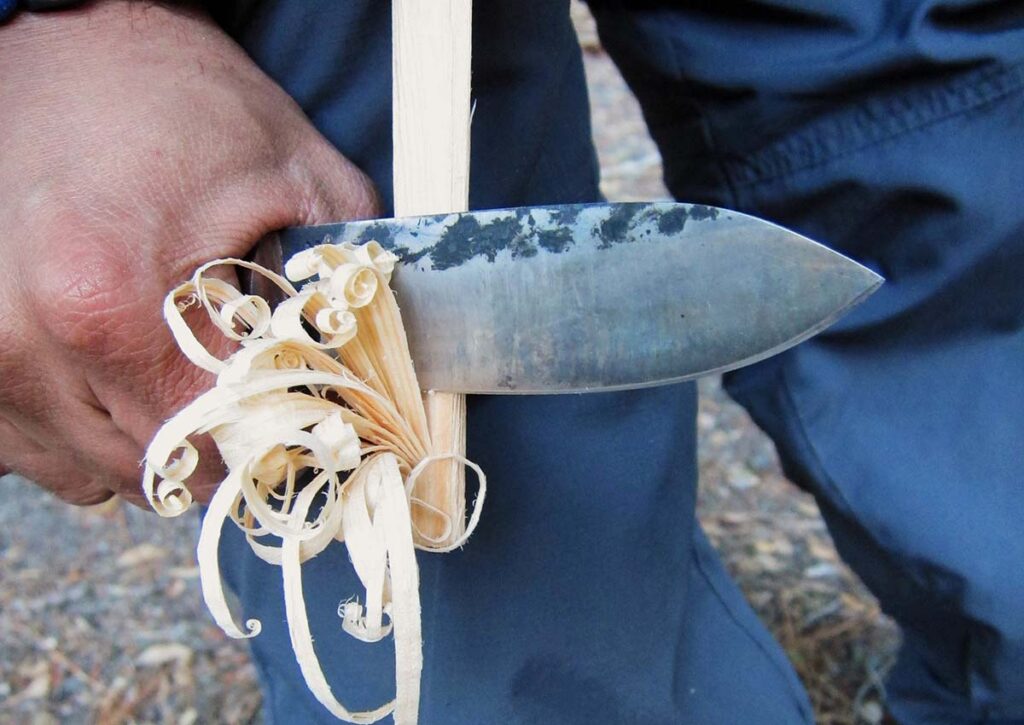
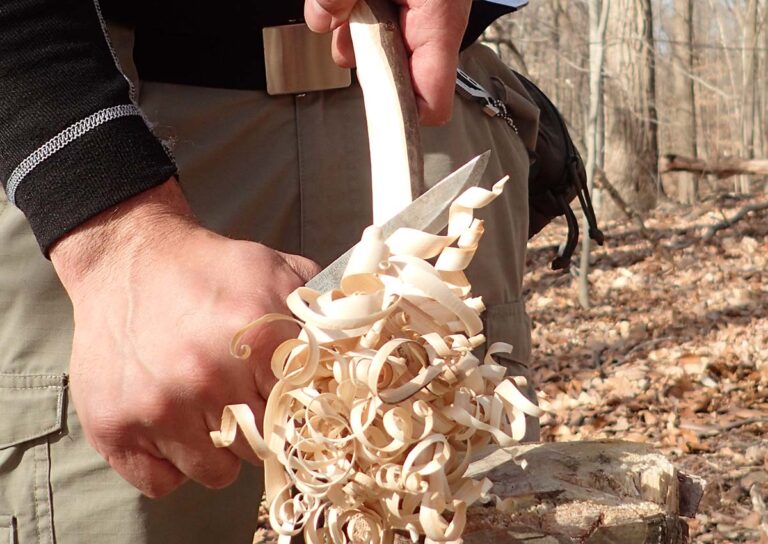
Creating tinder by shaving very thin pieces and kindling from deadwood is known as making a feather or fuzz stick. You can use various techniques but here’s the most basic approach.

Start with a forehand grip and resist the urge to place your thumb on the spine of your knife. Using gimping or a gimping grip applies uneven pressure, which often causes feathers to detach from the stick. When you reduce green wood for carving projects, think ahead and keep the shavings for fire making, regardless of their thickness. Thinly shaved greenwood dries quickly. Try to make them as thin as possible or save larger shavings to use as kindling. Emphasizing multi-use and maximizing the utility of everything you work on and cut truly embodies bushcrafting!

Try Stick It!
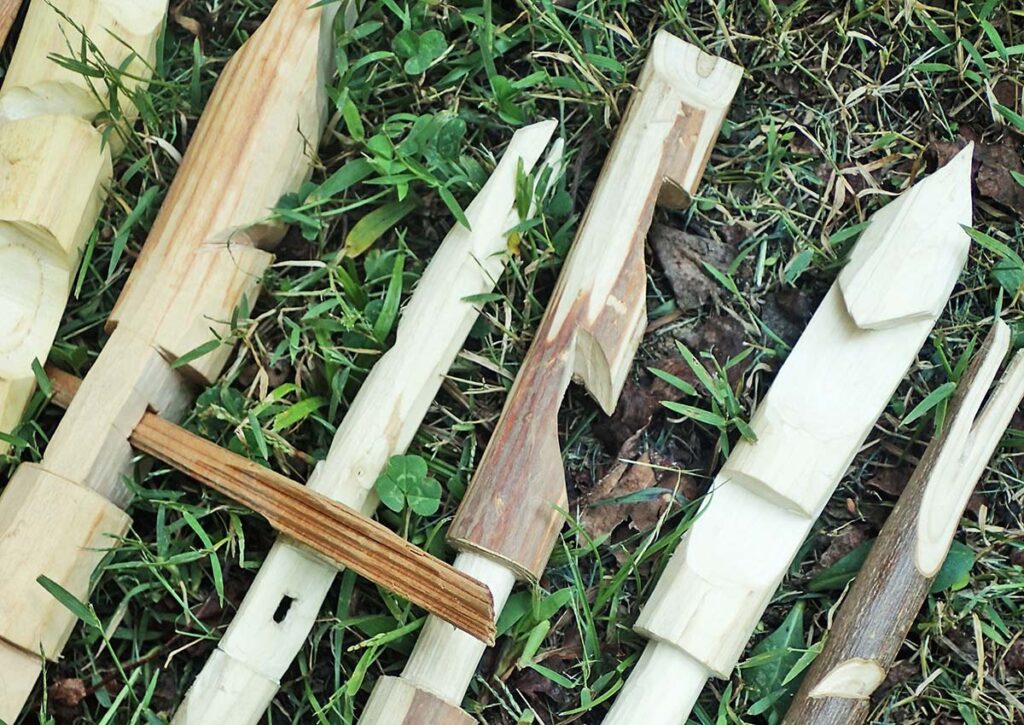
The author carved various try sticks with essential notches and additional features.

The Try Stick, made famous by wilderness educator, survival instructor and author Mors Kochanski, is a tool designed for practicing and showcasing knife skills in wood carving. While some notches are functional and often used to create items such as tent pegs, pot hangers and digging sticks, many notches on a Try Stick are more decorative and less commonly utilized. You can incorporate around 17 different types of notches on a Try Stick, but including as many as possible is typical. There’s no required number of notches to create; a Try Stick focuses on knife handling and safe practice.

Try Stick Notch types include:

  1. Round Notch
  2. Pot Hook
  3. Saddle Notch
  4. Square Notch
  5. Mitred Lapped Notch
  6. Jogged and Wedge Splice
  7. Dovetail Pin and Socket
  8. Dovetail Notch
  9. “V” Notch
  10. Spear Notch
  11. Knife Tip Mortice
  12. Diameter Reduction
  13. Knife Edge
  14. Split
  15. Bow Notch
  16. Latch Notch
  17. Bark Stripping
  18. Whistle Project

Check Out More Outdoor Knives:

12th Annual BLADE University Classes

Hone your cutlery acumen at the 12th Annual BLADE University

How to make and design knives, how to determine which steel for which knife, what to look for in proper damascus patterns and how to enhance their appearance and other incisive knife subjects will highlight the class schedule of the 12th Annual BLADE University.
Held in conjunction with the 44th Annual BLADE Show June 6-8 at the Cobb Galleria Centre in Atlanta, BLADE University will be sponsored by Work Sharp. Classes begin the Thursday before the show, June 5, and will run through Friday, June 6, and Saturday, June 7. All courses will be taught in the Cobb Galleria except one—Fundamentals of Grinding—which will convene under the tent in The Courtyard, aka the parking lot of the show’s host hotel, the Renaissance Atlanta Waverly.

BLADE University assembles some of the world’s best knifemakers, bladesmiths and other cutlery and steel professionals to teach a wide range of subjects for the knife user, knifemaker, knife hobbyist, knife entrepreneur, knife designer, and knife aficionado and novice alike. If you love knives or are just beginning to, BLADE University has a topic for you. The complete course schedule, with subjects, teachers, times and venues:

Thursday, June 5

In “Level Up Using Lasers, Ninjas and Other Cool Tools,” ABS master smith Neels van den Berg dives into how tools like laser engravers, digital design, and jigs and process design can streamline your workflow and enhance your work.
  • Material Conservation for the Forging Smith, Mareko Maumasi, 4 to 5 p.m., Room 104—Award-winning bladesmith Mareko Maumasi shares techniques and approaches he uses to reduce guesswork and material waste in the workshop. His approaches not only help the knifemaker’s material go further but also save time and money.

Friday, June 6

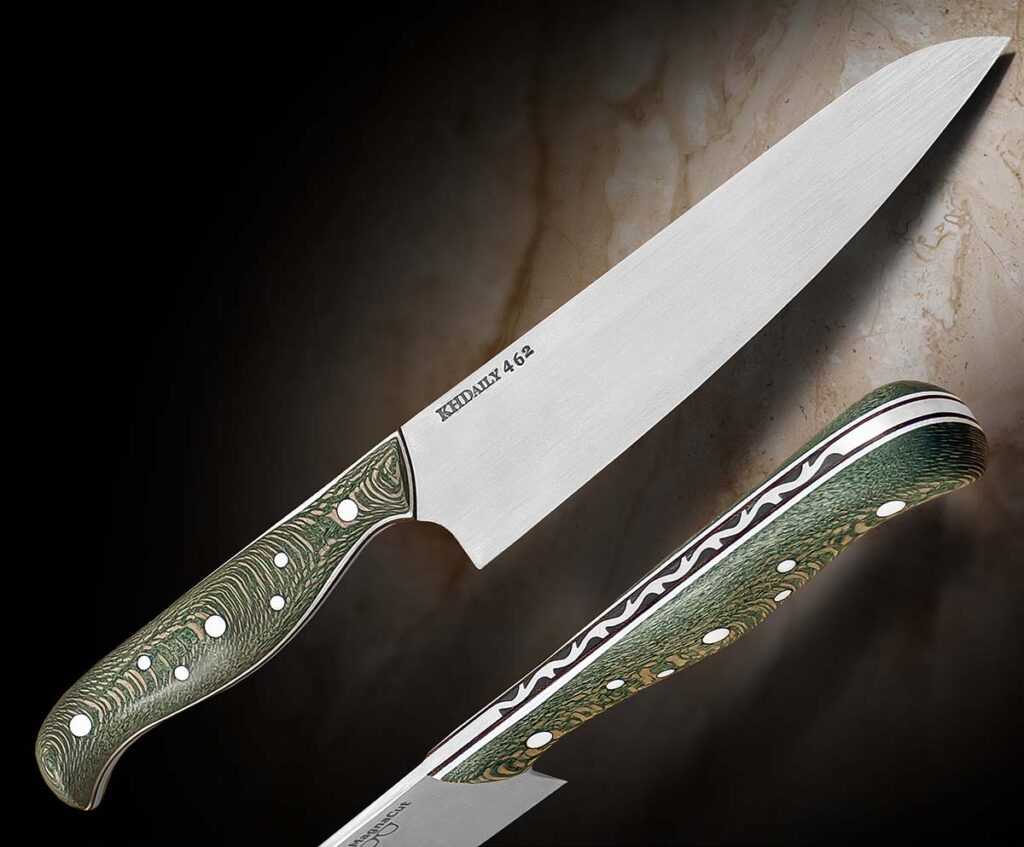
In “Elevating Your Handle Appearance: Spine Filework, Handle Shapes and Pin Placement,” knifemaker Kyle Daily shares his preferred files and specialized equipment for crafting his five most popular filework patterns, ensuring your knife not only looks exceptional but also feels comfortable and functional. (Jocelyn Frasier knife image)
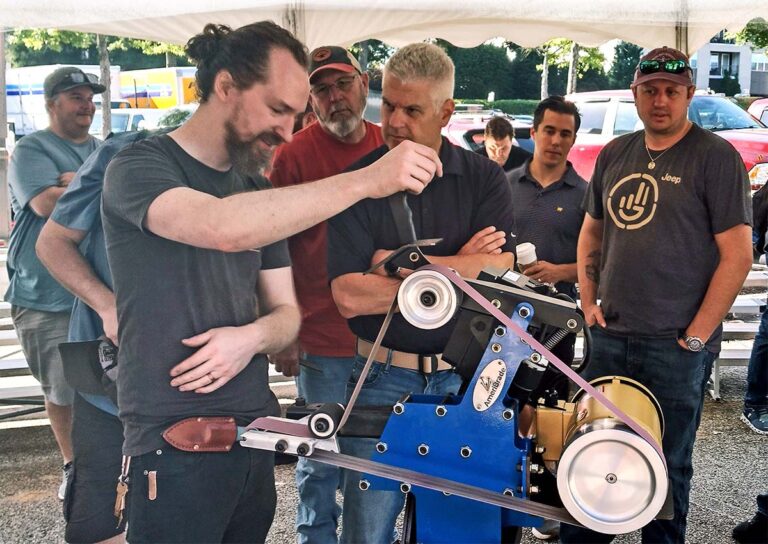
  • Fundamentals of Grinding, AmeriBrade and guest grinders, 8 to 9:30 a.m., The Courtyard—AmeriBrade and guest makers provide a general overview on grinds, techniques and different equipment. The class is interactive and the team answers questions and demonstrates suggestions for common issues.
  • Deep Dive into Culinary Knives, Mareko Maumasi, 10 to 11:30 a.m., Room 103—Mareko Maumasi returns to help collectors and makers better understand the nuances of high-performance culinary knives. The class covers design aspects from blade tip to pommel, aiding collectors in making more informed knife-buying decisions, and makers in creating higher-quality and higher-performing culinary knives.
  • The Tom Brown Tracker Experience, Mathew Williams, 1 to 2 p.m., Room 107—Experienced woodsman and tracker Mathew Williams discusses the iconic Tom Brown Tracker knife, including the blade’s notable features, how the knife’s function can be of benefit to the user and more. Mathew even dispels some Hollywood myths concerning the TBT. This one’s for old-time fans and newcomers alike.
  • Take Damascus Etching to the Next Level, Baker Forge, 1:30 to 2:30 p.m., Room 103—Greyson Weltyk of Grey Blades and Jordon Berthelot of JB Blades teach step-by-step processes on how to enhance intricate patterns in damascus with Gator Piss etchant, including in-person demos with damascus knives. Subjects include proper cleaning prep, temperatures, stacking oxide techniques, sealing oxides and more. Receive in-depth looks at new product offerings from Gator Piss for etching stainless damascus and properly sealing damascus with nano-ceramic technology. Have the opportunity for Q&A with authorities about damascus etching.
  • Hands on Sharpening, Work Sharp, 3:30 to 4:30 p.m., Room 113—What happens when a knife goes dull? How do you know when to sharpen it? Bring your own knife or borrow a demo model and learn the progression of shaping a bevel, sharpening and edge maintenance from the team at Work Sharp. You get hands-on practice and experience sharpening your blade using a variety of sharpeners and abrasives, from whetstones to belts. (See under Saturday’s classes for an encore presentation.)
  • Leather Sheath Making Tips, Tricks & Tools, John Dennehy, 4:30 to 5:30 p.m., Room 107—Classes on sheath making are conducted at knife shows, social media and elsewhere. Unfortunately, some of the online demos are by those giving the wrong advice. John Dennehy shares the sheath-making tips he’s learned after working leather for almost 50 years, including leather selection, the tools he uses and why he uses them. He also covers the construction details he employs that experienced leather workers recognize immediately as the ones needed to produce a professional sheath.

Saturday, June 7

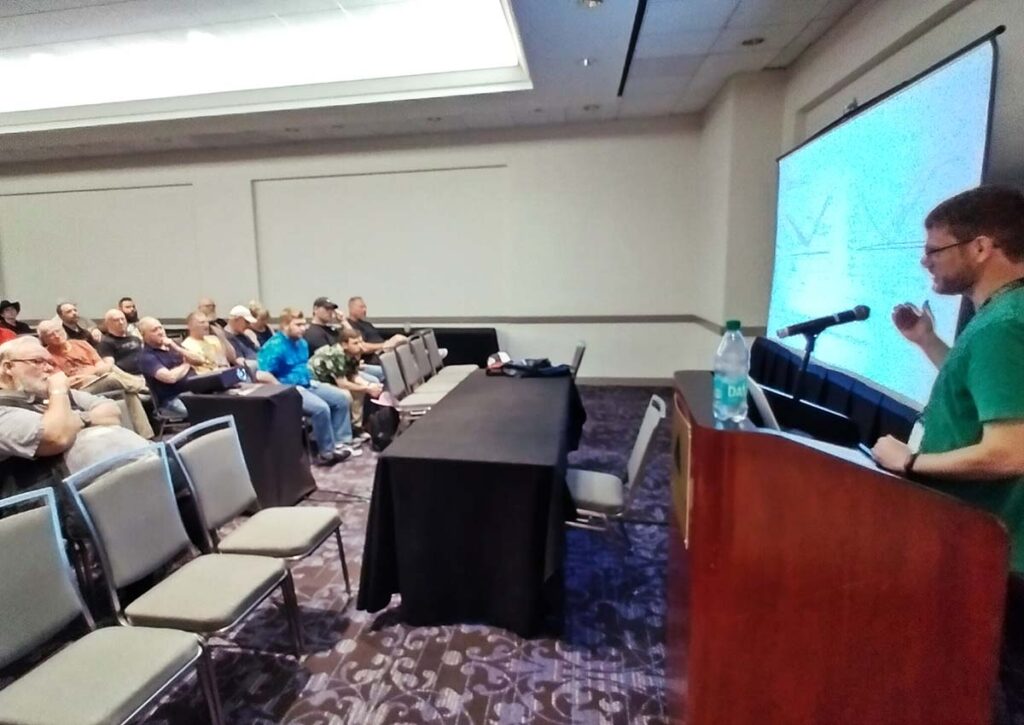
In “How to Select the Best Steel for Every Knife,” steel metallurgist Dr. Larrin Thomas talks about the factors that are important for different types of knives, such as cost, toughness, edge retention, sharpenability and corrosion resistance.
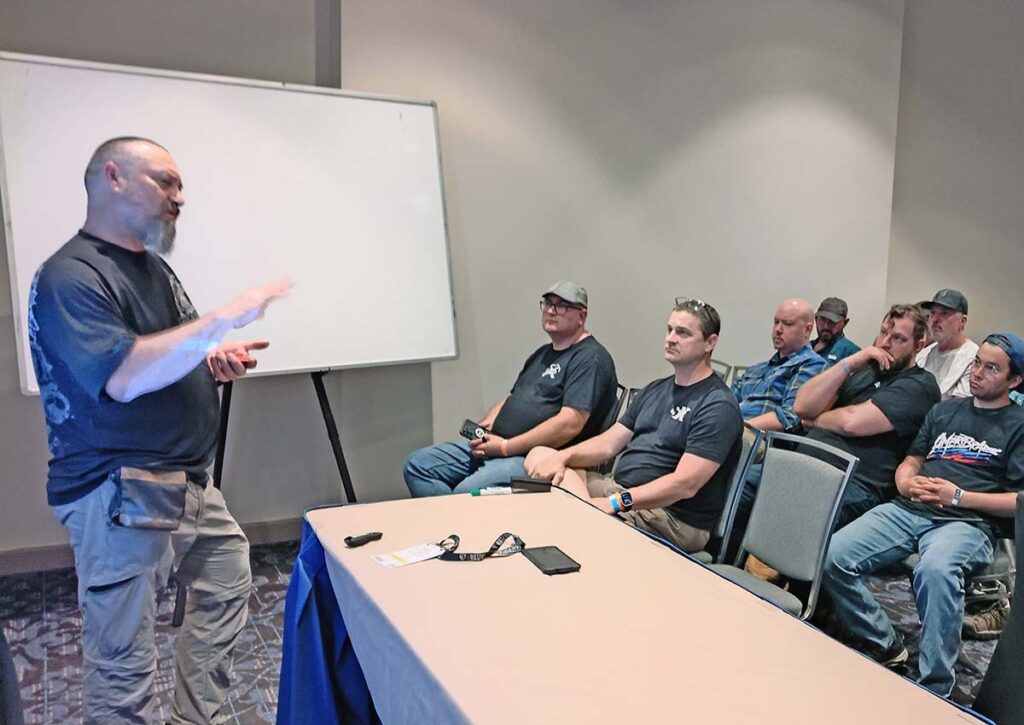
  • Elevating Your Handle Appearance: Spine Filework, Handle Shapes and Pin Placement, Kyle Daily, 8:30 to 9:30 a.m., Room 113—Enhance the appearance of your knife with distinctive features that go far beyond standard production models. Knifemaker Kyle Daily from KHDaily Knives guides you through the intricate art of filework on the spine, while also sharing insights into handle design and pin placement on the handle. Discover Kyle’s preferred files and specialized equipment for crafting his five most popular filework patterns, ensuring your knife not only looks exceptional but also feels comfortable and functional. From laying out your pattern to a step-by-step tutorial, this class provides the essential knowledge to achieve a professional and eye-catching finish. A Q&A session at the end ensures you leave with the skills and knowledge to take your knifemaking to the next level.
  • Demystifying Damascus, Mareko Maumasi, 9:30 to 11 a.m., Room 104—Mareko Maumasi completes his third straight day of teaching BLADE University classes with a most challenging one. He breaks the subject down in a way to help collectors gain a better appreciation for the knowledge and skill required to make unique damascus patterns, and to deepen the makers’ understanding of pattern design and composition.
  • The Cutting Edge, Nick Italiano, 9:45 to 10:45 a.m., Room 107—Nick Italiano, seasoned outdoorsman and host of the Raise The Flag Podcast, discusses the nuances of various blade grinds. From common everyday uses to survival situations, Nick covers several common grinds and their real-world function.
  • Level Up Using Lasers, Ninjas and Other Cool Tools, Neels van den Berg, 12:30 to 1:30 p.m., Room 113—Step up your knifemaking game with cutting-edge technology, unconventional techniques and insider secrets from ABS master smith Neels van den Berg. In this high-energy session dive into how laser engravers, digital design, and jigs and process design can streamline your workflow and improve your work. Plus, explore the mindset and discipline—the “ninja skills”—that separate good makers from great ones. Packed with real-world examples, practical insights and a touch of humor, this is a must-attend for makers looking to work smarter, not harder.
  • Designing Knives: Philosophy, Tools and Inspiration, Jens Anso, 2:15 to 3:15 p.m., Room 104—Award-winning knifemaker Jens Anso shares his approach to knife design, including how he thinks about form and function, the tools he uses and where he finds inspiration. With decades of experience in the industry, he’s developed a clear design philosophy that balances aesthetics, ergonomics and real-world usability. He explains his workflow, from sketching and CAD modeling, to prototyping and refining details. His goal is to provide insight into the design process and share practical takeaways for makers and enthusiasts who want to push their work further.
  • Hands on Sharpening, Work Sharp, 2:15 to 3:15 p.m., Room 113—What happens when a knife goes dull? How do you know when to sharpen it? Bring your own knife or borrow a demo model and learn the progression of shaping a bevel, sharpening and edge maintenance in this encore presentation from the team at Work Sharp. You get hands-on practice and experience sharpening your blade using a variety of sharpeners and abrasives, from whetstones to belts.
  • How to Select the Best Steel for Every Knife, Larrin Thomas, 4 to 5 p.m., Room 104—Both the makers and buyers of knives have many options for steels, but how do they know which ones to choose? Steel metallurgist Dr. Larrin Thomas talks about the factors that are important for different types of knives, such as cost, toughness, edge retention, sharpenability and corrosion resistance. Which steels are more optimal for a large chopper, a kitchen knife or a folder? For makers, the topics of forgeability, grindability, polishability and ease of heat treating are covered to choose steels that perform well and fit the knifemaking setup.

More classes were being determined at press time. For more information on them and on how to enroll in one or more of BLADE University’s classes, see our course offerings. There will be additional information on BLADE University in the June BLADE® and also in the BLADE Show Program, copies of which will be distributed for free at the BLADE Show.

More BLADE Show Information:

Assisted Open Knives Buyer’s Guide [Tested]

Latest assisteds have all you need in swift, sharp folders.

The assisted opener appeals to many who are mechanism oriented and like to fidget with their knives. There’s something satisfying about tapping a flipper tab or nudging a thumb stud and then having spring force kick in and propel the blade open crisply and quickly. It’s sort of like an automatic but it’s not. In fact, in most areas its legality is no different than a standard one-hand folder* because you initiate the opening by manually pressing the flipper or thumb stud as opposed to releasing the blade under spring tension via a push button as done with an auto.

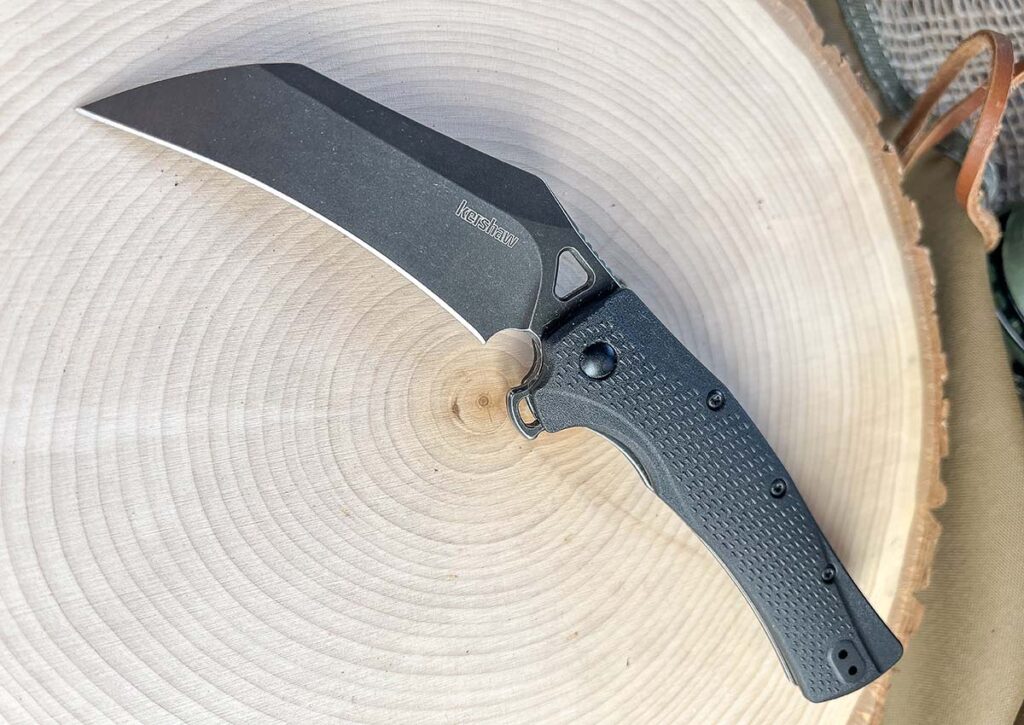
Kershaw Dawnstar

The flipper tab of the Kershaw Dawnstar is highly effective at deploying the blade. The large semi-circular choil is sort of unusual and adds to the knife’s distinct appearance

Kershaw was one of the first manufacturers to go all-in with assisted openers in the mid-to-late 1990s. It teamed with BLADE Magazine Cutlery Hall-of-Fame® member Ken Onion to make a line of collaboration knives that incorporated Onion’s SpeedSafe assisted-opening mechanism. The knives not only were great sellers for the company, but, more importantly, helped start the assisted-opening revolution in the knife industry. Soon after, other manufacturers began producing versions of folders with mechanisms that closely mirrored the SpeedSafe for both tactical and EDC purposes.

The Dawnstar is Kershaw’s latest entry in the genre. Sporting a hawkbill blade paired with a true tactical handle offering deep, tip-up carry, it is one of the company’s more radical configurations. The hawkbill isn’t seen too widely in tactical folders, so it stands out both visually and functionally. The 3.5-inch blade is 8Cr13MoV stainless steel. 

The main grind is hollow with a swedge, making the blade look a bit aggressive and also following through in use. A flipper tab deploys the blade quickly and is the only opening method. The handle is molded glass reinforced nylon (GRN) with dual skeletonized steel liners for strength. Strategically placed cutouts reduce weight. The handle is textured for a comfortable, nonslip grip.

The knife cuts best in a pulling motion, allowing the hawkbill to gather the material being cut into the blade’s curvature, not unlike pulling a zipper. The hawkbill is an aggressive pattern and goes through a variety of materials with ease. This is where the hollow grind really makes a difference. Cardboard, foam, even wire stripping—the assisted opener sails through it all. If you cut a lot of cardboard or make long, straight-line cuts in any material, the Dawnstar is for you. The handle is easy to hold onto. The large finger recess helps seat your hand. 

Approximate closed length: 4.4 inches.
Country of origin: China.
MSRP: $54.99.

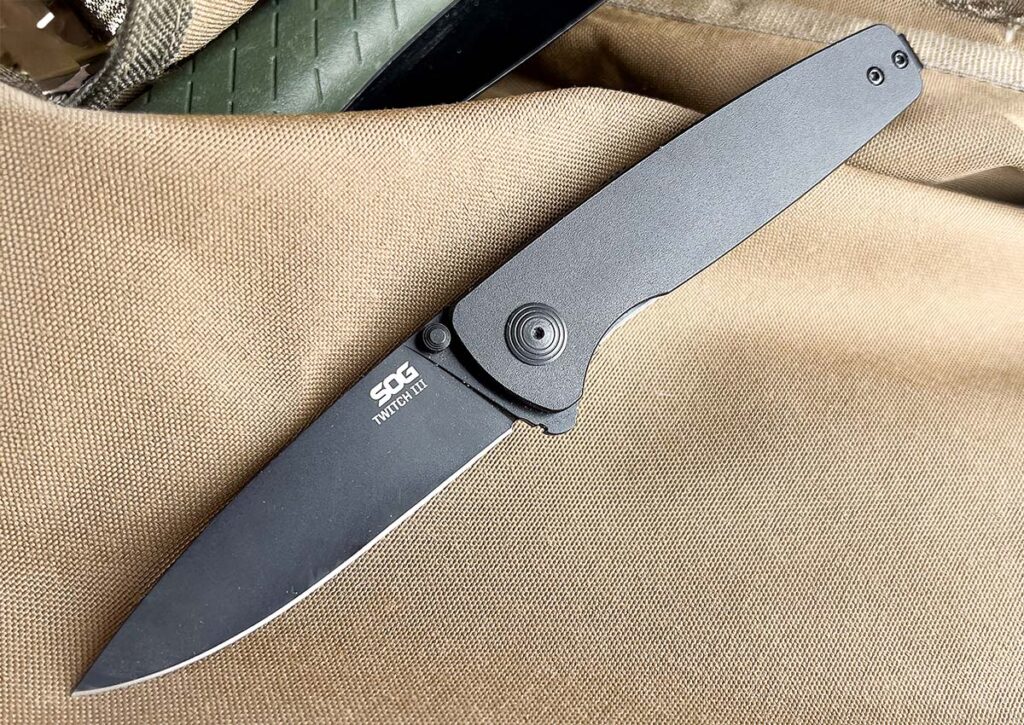
SOG Twitch III

The Twitch III is ultra-light, ultra-slim and elegant in appearance. A simple design with high function, it goes well with dress or casual clothes.

The Twitch III is the third installment in a highly successful series of assisted openers from SOG. It is a slim, stylish EDC capable of tackling a wide variety of cutting chores. It features a 3.1-inch spearpoint blade fully flat ground from 154CM stainless steel with ambidextrous thumb studs and a low-profile flipper tab for an additional opening option. A light press on the flipper and the blade pops out with authority.

The handle is lightweight yet strong aluminum, with dual steel liners providing the backbone. A subtle finger recess forms a bit of an integral guard to prevent your hand from sliding forward. A deep-carry, bayonet-style clip is affixed to the butt and positions the folder as low as possible in the pocket for ultimate concealment. The handle profile is flat and slender, making it extremely comfortable for daily pocket carry. The knife is equally at home in dress or casual clothes.  

For a slim knife the Twitch III performs very well. The blade glides through various materials with surprising ease. The 154CM offers more mileage for edge retention than lesser steels such as D2, 8Cr13MoV and AUS-8. It is the type knife you can carry for a range of varied-use scenarios, from slicing steak to more mundane things such as opening mail, packages, etc.

It excels at cutting open blister packs due to its pointy tip and flat- ground blade. Performance is great and the folder carries exceptionally well, so what’s not to like? However, I would caution against prolonged use due to the slender, flat profile and slick aluminum scales. If your hand is wet or sweaty, grip retention might be an issue.

The Twitch III comes in three varieties: all-black blade and handle, natural finished aluminum with satin blade and gold TiN coated hardware, and gray aluminum handle with black blade and hardware anodized a light blue. All are great-looking EDCs and a welcome addition to your collection. 

Closed length: 3.9 inches.
Country of origin: China.
MSRP: $79.95 for any of the three variants.  

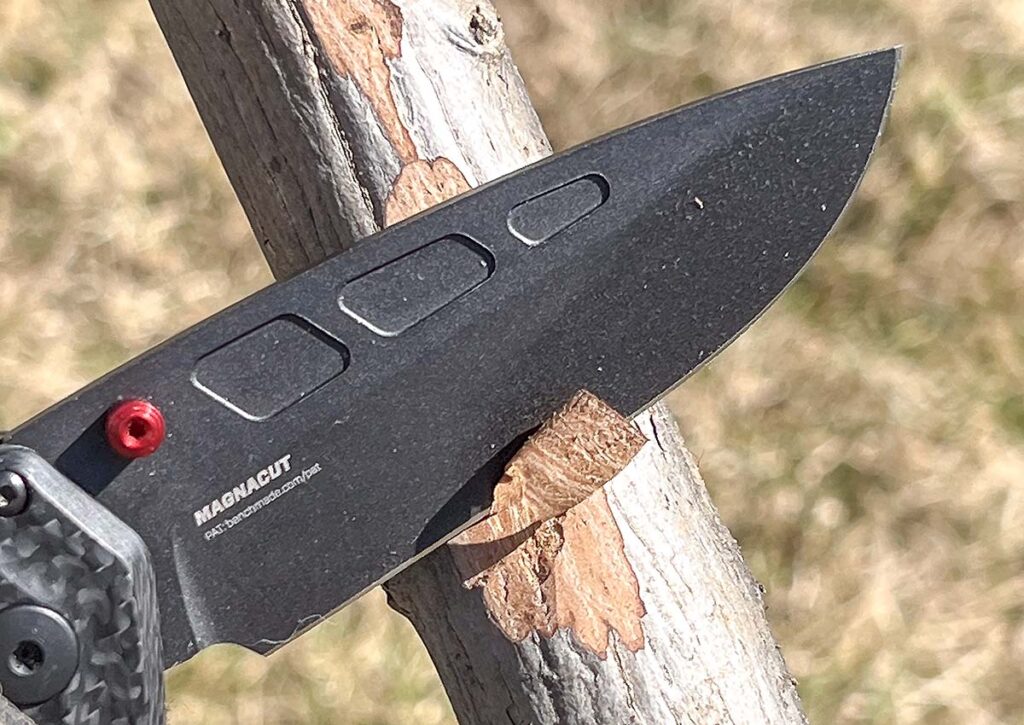
Benchmade PSK 593BK-01

Benchmade’s PSK is a high-end outdoor folder using CPM MagnaCut stainless blade steel. MagnaCut holds an edge extremely well in addition to having excellent corrosion resistance—pretty much the perfect outdoor blade material. 

The brawny Benchmade PSK 593BK-01 is a rugged assisted opener engineered for survival use. It exhibits all the hallmarks of what makes applicable Benchmade knives standards in the industry: the AXIS crossbar lock mechanism and advanced materials for the handle and blade, including carbon fiber, G-10 and CPM MagnaCut stainless steel. The 3.4-inch modified drop-point blade has excellent edge retention and superior corrosion resistance—a perfect steel for a knife to carry while hiking, camping, hunting, etc.

An exposed flat area below the thumb stud that resembles a choil serves as a spot to use a ferrocerium rod for fire starting. It’s such a thoughtful touch on the PSK. The ergonomic handle incorporates forward and rear integral guards to prevent slipping and seats your hand well. Black carbon fiber bolsters are mated with black G-10 scales, with the blade DLC coated for additional corrosion resistance and a low-profile appearance—in other words, the knife is “murdered out” in mostly all black. 

The ambidextrous thumb studs are anodized red for an interesting splash of color. A deep carry pocket clip positions the PSK tip up and switches to the opposite side to accommodate lefties. The AXIS Lock Assist is rock solid while remaining easy to disengage by pulling back on the studs, then rotating the blade closed. A sliding switch safety in the handle spine locks the blade closed to help prevent the knife from accidentally flying open in your pocket or during inside waistband carry.

The PSK looks great and performs even better. Grip quality is excellent; the 3D machined grooves in the handle and bolster work great at keeping your hand in place without feeling overly aggressive, and they displace water as well. The blade rockets out via the assisted opener very quick and sure, almost like an automatic. 

The robust build and ergonomic grip instill user confidence in any climate. The PSK handles anything you throw at it, from slicing meat to whittling. The flat grind leaves enough cross-sectional steel on the blade to give it structural integrity, yet thins the edge down to where it has bite. 

Approximate closed length: 4.6 inches.
Country of origin: USA.
MSRP: $450.

Editor’s note: For that matter, in the many states and jurisdictions where bans against automatics have been lifted, neither is an assisted opener’s legality any different than an auto.

More Pocketknife Info:

Custom Knives: Reproductions Of Ancient Knife Designs

The great ancient knife designs aren’t history as they top-notch reproductions prove.

The ancient history of knife design is long, storied and colorful. From Bronze Age daggers to 19th-century dress bowies alone, vintage configurations capture the imagination like a gladiator’s net from the early days of the Roman Coliseum. Tour the classics with these remarkable reproductions.


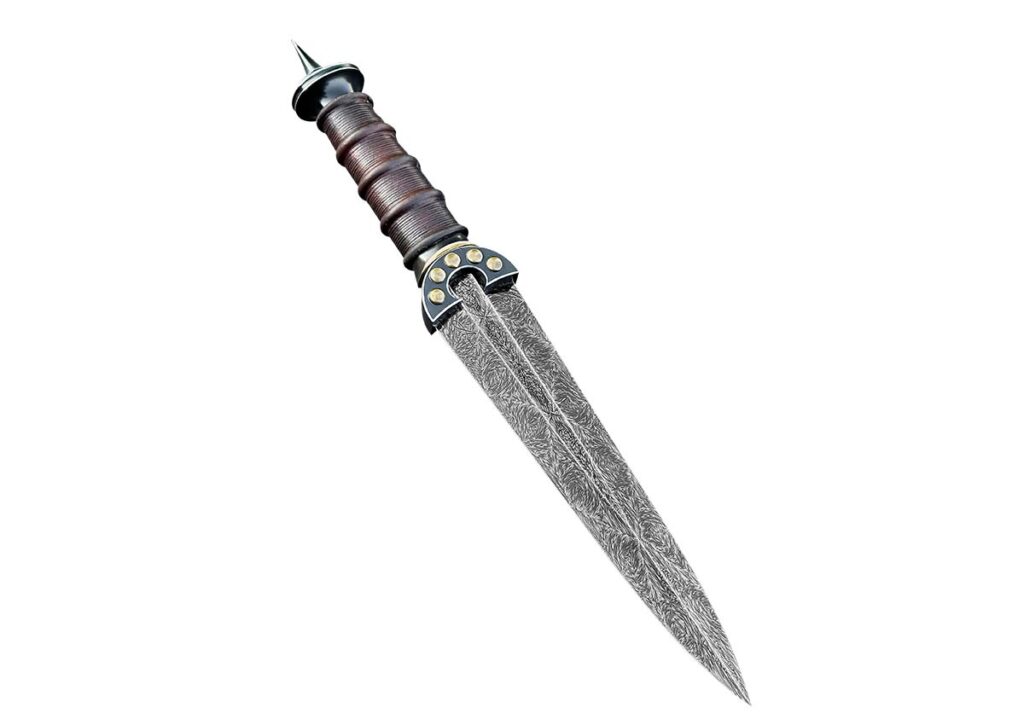
Colton Arias Scylla

Colton Arias Scylla

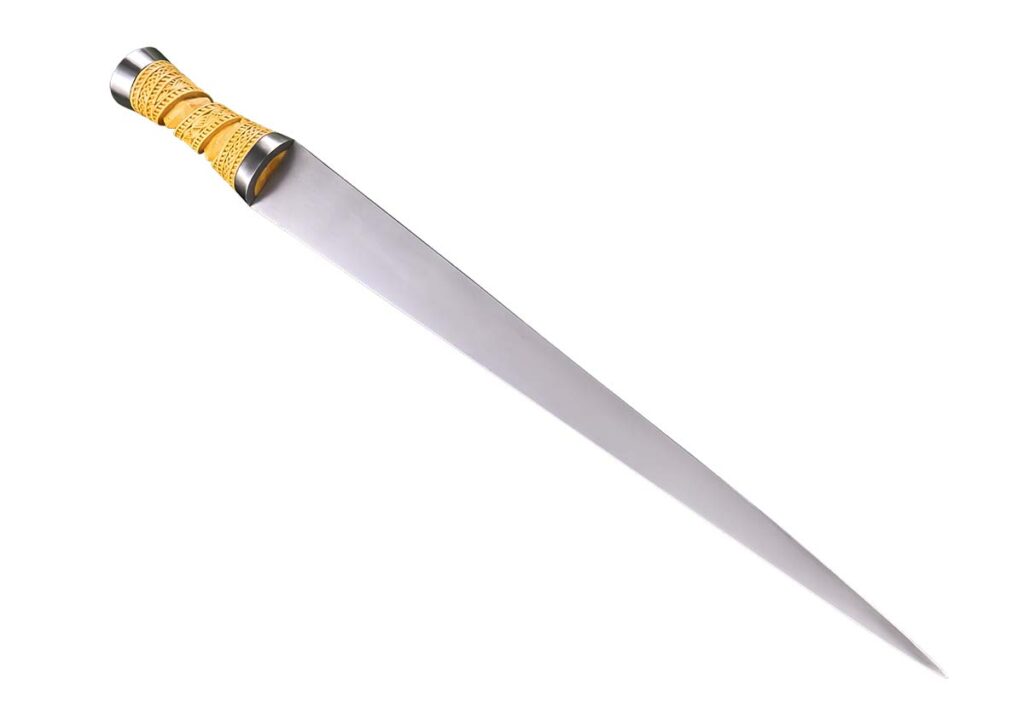
Named after an Etruscan-era mythological monster, Scylla is a repro of an Etruscan Bronze Age dagger by Colton Arias. The 7-inch blade with tapering fuller is a triple feather mosaic damascus of 1084 carbon and 15N20 nickel alloy steels. The spiked-pommel handle is a goat leather wrap and the bolster is mild steel with brass accents. Overall length: 12 inches. (Jocelyn Frasier image)


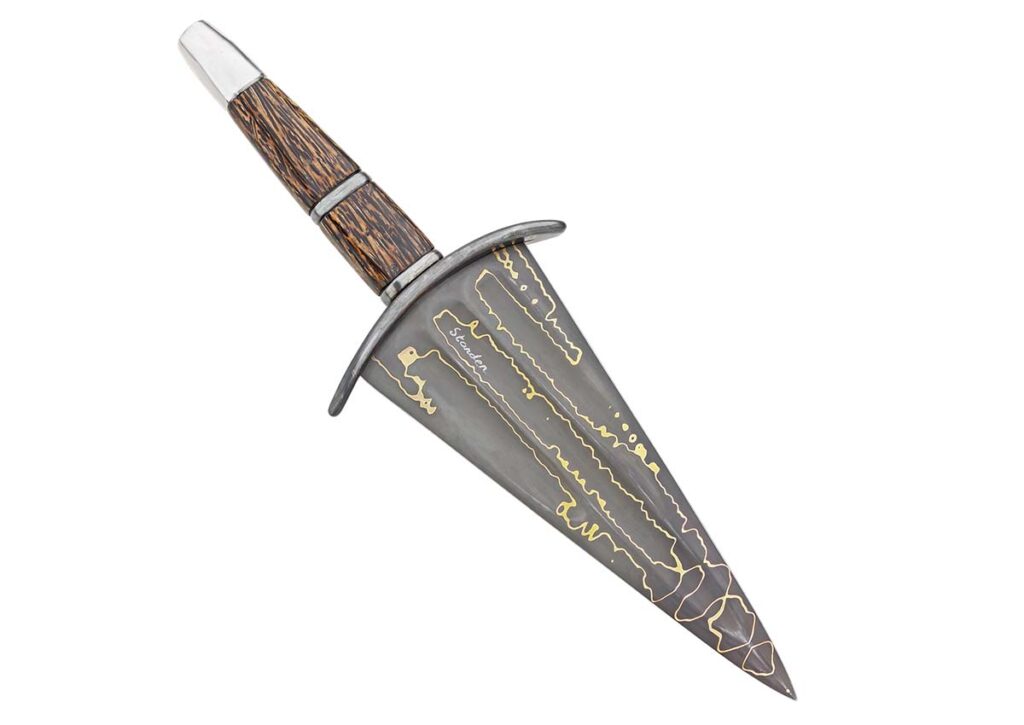
Dane Standen Cinquedea

Dane Standen Cinquedea

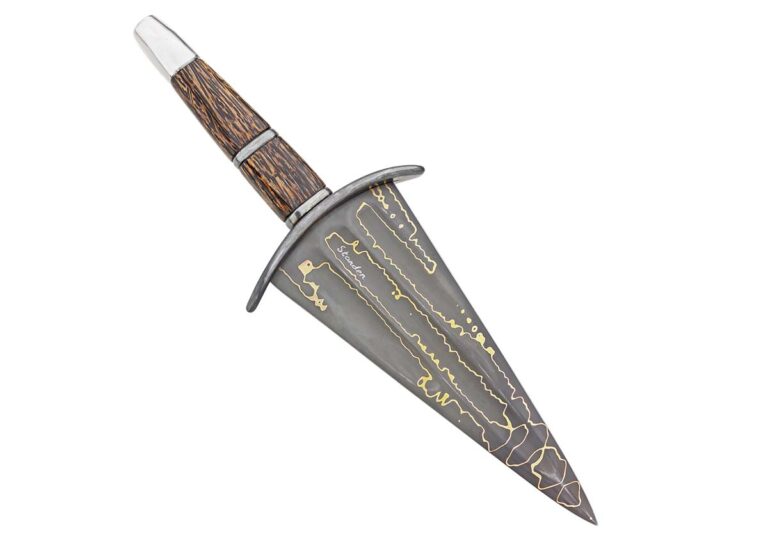
Dane Standen outfits his modified cinquedea with a three-fullered blade in multiple welds of 1084, cu-mai, 1084, cu-mai and 1084 carbon steels. Blade length: 8.27 inches. The handle of a takedown construction is stabilized black palm and the fittings are mild steel, copper and nickel damascus. Overall length of the centuries-old Italian design: 14 inches. (Rod Hoare image)


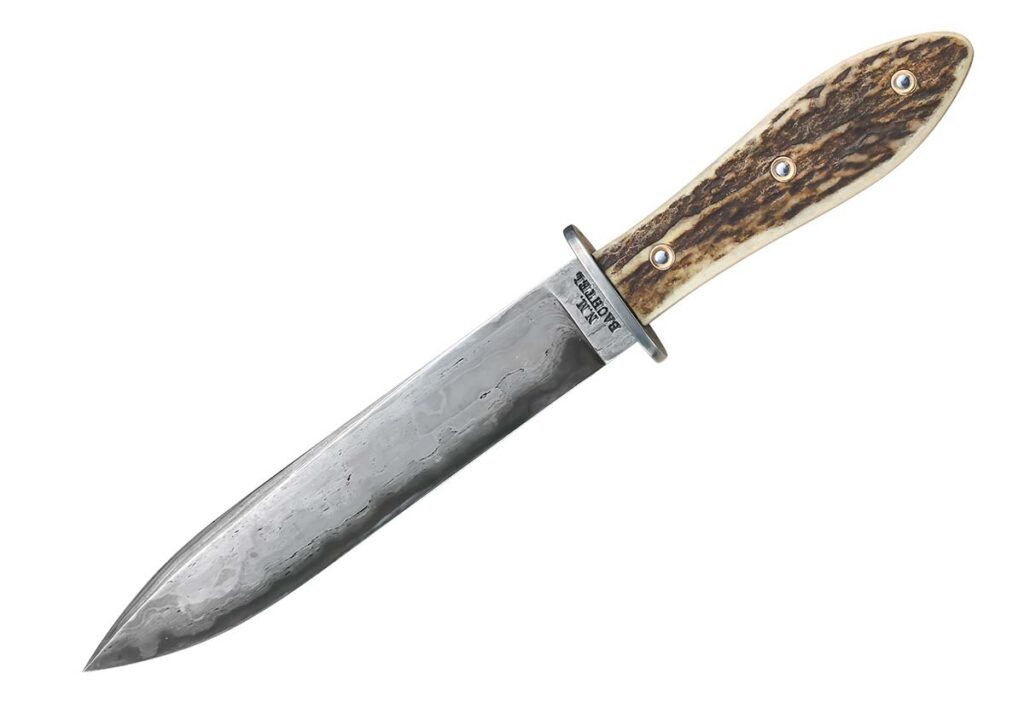
Nick Bachtel Dress Bowie

Nick Bachtel Dress Bowie

A 7-inch blade of wrought-iron in a san-mai construction and a handle of elk antler and curly ash highlight a repro of a 19th-century dress bowie by Nick Bachtel. Overall length: 12 inches. The guard is steel and bronze and the knife comes with a traditional bronze sheath (not shown). (SharpByCoop image)


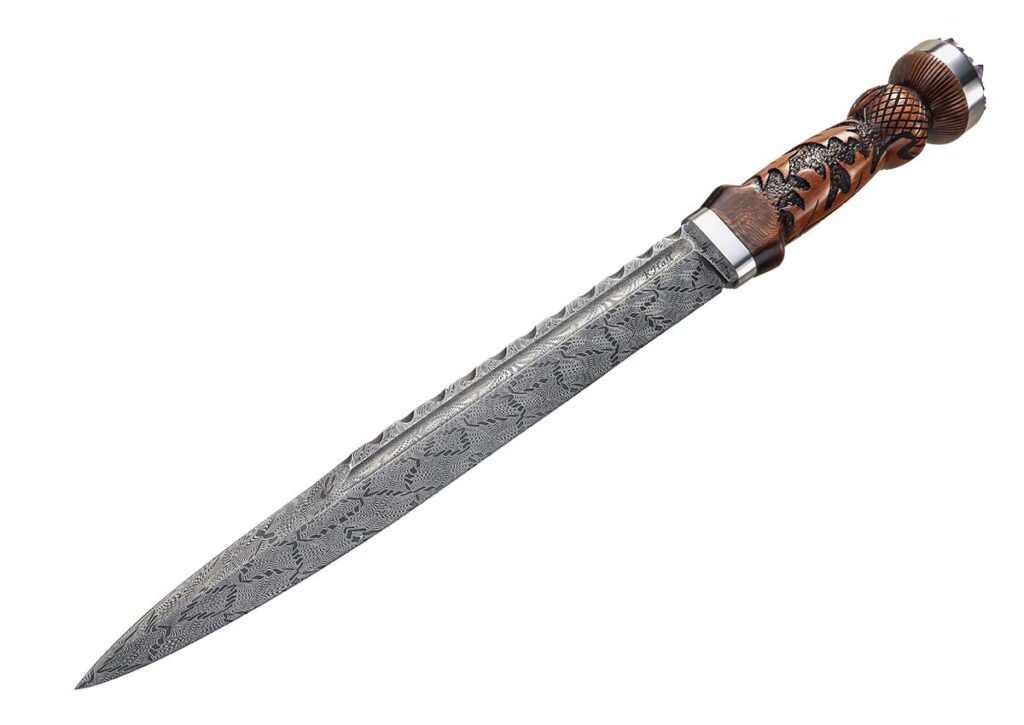
Ken Hall Scottish Dirk

Ken Hall Scottish Dirk

A 12-inch fullered/fileworked blade of an absorbing mosaic damascus and a handle of stained stabilized cherry carved to symbolize a thistle distinguish a stunning Scottish dirk by ABS journeyman smith Ken Hall. Pommel stone: amethyst crystals. Overall length: 17.5 inches. Sheath (not shown): tooled leather. (SharpByCoop image)


Matthew Berry Edinburgh Skean

Matthew Berry Edinburgh Skean

The Edinburgh Skean by Matthew Berry is a reproduction of a knife by the same name from 1677. The originals were combat knives of Ireland. The blade is 1075 carbon steel and the intricately carved handle is boxwood. Blade and overall lengths: 15.25 and 19 inches. The form-fitting sheath (not shown) is highly detailed leather with a wrap strap. (SharpByCoop image)


J.J. Simon Samuel Bell Dirk

J.J. Simon Samuel Bell Dirk

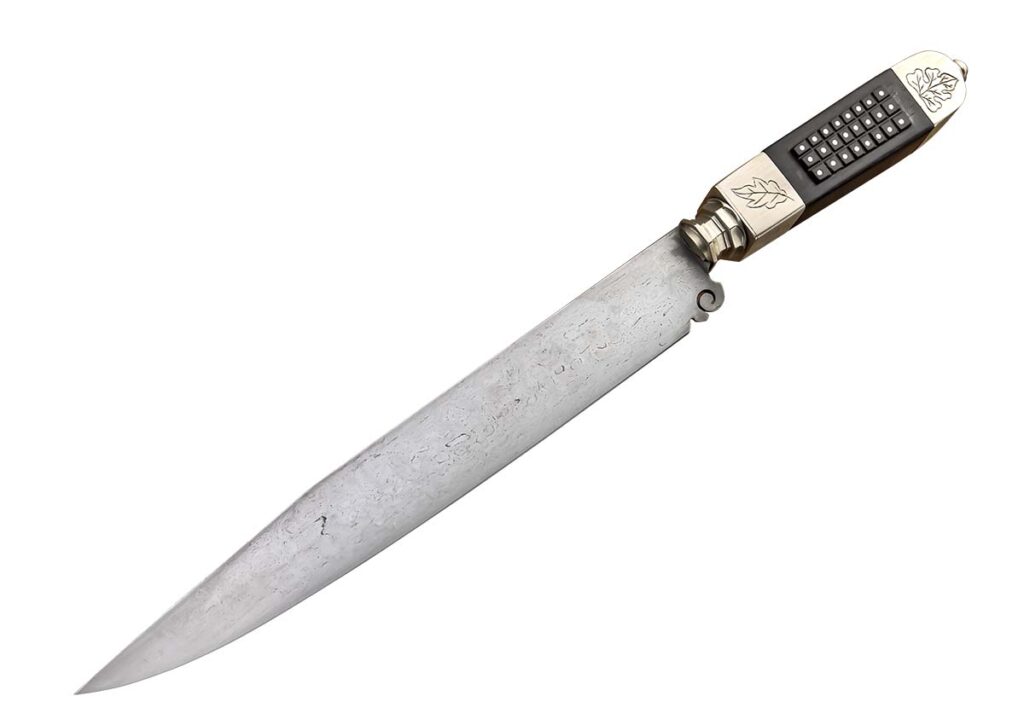
ABS journeyman smith J.J. Simon forged the 12-inch flat-ground blade with Spanish notch for his repro of a 19th-century Samuel Bell dirk from bloomery steel. The handle is blackwood with silver pins and the fittings are nickel silver. Overall length: 17 inches. (SharpByCoop image)


Vincent Soriano Mainz-Pattern Gladius

Vincent Soriano Mainz-Pattern Gladius

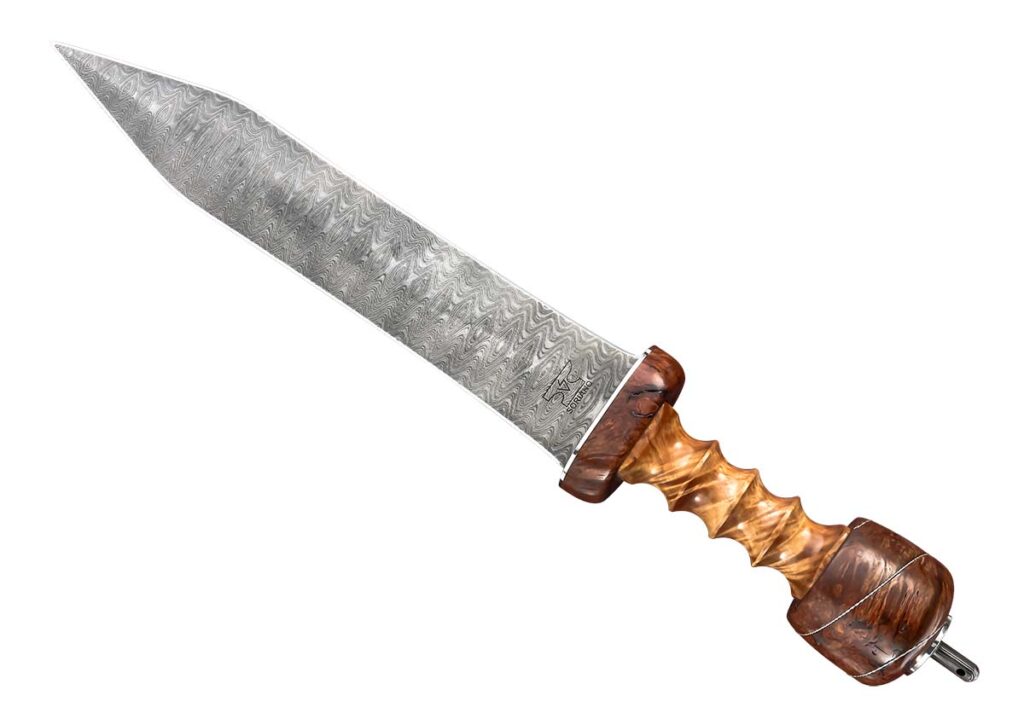
ABS apprentice smith Vincent Soriano goes full Roman with his Mainz-pattern gladius. Called the Proeliator, it boasts a 14-inch damascus blade of 1075 carbon and 15N20 nickel alloy steels and pure nickel. The handle is curly maple and the guard and pommel are eucalyptus. Overall length: 22.5 inches. Sheath (not shown): leather. (SharpByCoop image)


More On Knife Collecting:

Kephart Knife: Options In The Outdoors Do-All

Four repros emulate the knife Horace Kephart made famous.

Before Rambo provoked people to rush to their local sporting goods stores searching for a hollow-handle, saw-back survival knife and long before Ray Mears popularized the quest for the perfect Scandi-ground knife, a timeless classic woods knife endured the test of time—the Kephart.

Who Was Horace Kephart

Horace Kephart (1862-1931) was a prominent figure known for his contributions as an author, librarian and outdoorsman. His extensive exploration of the Southern mountains led him to conduct valuable research on the region and its inhabitants.

Among his many books, he is best known for Our Southern Highlanders and Camping and Woodcraft, with the latter serving as an enduring guide for outdoor living. Both works are still widely available and highly regarded. In the 1920s, Kephart was pivotal in advocating for establishing the Great Smoky Mountains National Park.

What Is a Kephart Knife?

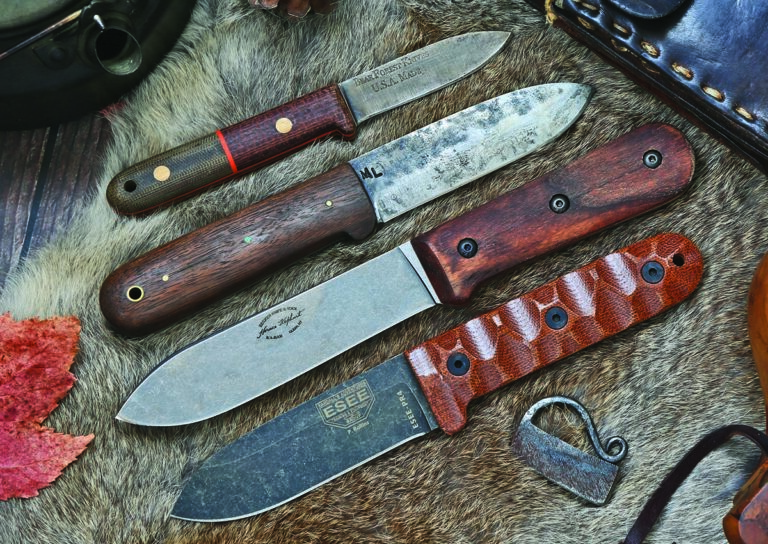
The Kephart-style knife features a spear-point blade and an oval cross-section handle. The blade is typically 4-to-5 inches long, 1095 carbon steel, and forged using techniques reminiscent of 18th-to-19th-century bladesmithing. The blade is typically an eighth inch at the thickest, supporting a sturdy and durable structure. A distinctive feature is the asymmetrical spear point with a full-length edge enhancing its utility in various cutting tasks. The scales are often walnut or maple. The overall design aims for simplicity, with attention to detail to ensure comfort and usability.

In the words of Horace Kephart, “A camper has use for a common-sense sheath-knife, sometimes for dressing big game, but oftener for such homely work as cutting sticks, slicing bacon, and frying ‘spuds.’ For such purpose, a rather thin, broad-pointed blade is required … It is tempered hard enough to cut green hardwood sticks, but soft enough so that when it strikes a knot or bone it will, if anything, turn rather than nick.”

ML Knives Kephart

The author stated he prefers to make feather sticks freehand, without a solid base, to feel the edge better and have more control. The technique is best practiced before it’s needed and the ML Kephart convex edge excelled at the task.

Kephart Specs
Blade Length: 4”
Blade Material: 1095 carbon steel
Blade Grind: Convex
Blade @Thickest: .125”
Blade Finish: Forged
Handle Material: Tiger maple
Overall Length: 8.25”
Sheath: Leather
Country of Origin: USA
MSRP: $295

I received my first Kephart-style knife from Matt Lesniewski of ML Knives back in 2007, and it instantly became my favorite. The craftsmanship of the piece is truly remarkable, as Matt employed early 18th-to-19th-century bladesmithing techniques, using 1095 carbon steel and handforging each blade. The handcrafted sheaths are also stunning works of art that truly stand out.

My ML Kephart features a 4-inch blade and a 4.25-inch handle, with scales of beautiful tiger maple. The handle’s oval cross-section provides a comfortable grip, with just the right amount of rounding to prevent discomfort during use. The spear-point blade and eighth-inch thickness, along with the full convex edge and visible forge marks, give the knife a rustic yet simple charm.

A spear point is a versatile blade pattern and tough as woodpecker lips. The ML Kephart drilled with authority and split/pried wood for kindling.

Naturally, after reading Horace Kephart and Nessmuk, I made many backcountry trips and always had a stout, reliable fixed blade. When traveling afoot, as the old timey adventurers would say, I had minimal kit and seldom took a large axe or saw. I used a light tomahawk, as Kephart spoke of, and a jackknife in the form of a Swiss Army knife. I had to do more with the fixed blade, and I did. The ML Kephart excelled at woodcraft as the convex edge was ultrasharp and robust.

I always test every cutting tool by shaving arm hair*, whether it’s an axe, long blade or anything with an edge. The next task is always shaving wood, as a fire is ultra important when camping or woodcrafting. The ML excelled at the task—but could it drill? I broke a few old seasoned planks apart by drilling through and twisting them for kindling. The handle seemed comfy, and the natural maple gave me enough traction to keep a solid grip during any task. The flat primary grind with a convex edge is the best of both worlds. And no camp food or sandwich was safe from the ML Kephart.

KA-BAR/Becker Knife & Tool BK62 Kephart

The Becker Kephart held its own in both carving and piercing work.

BK62 Specs
Blade Length: 5.125”
Blade Material: 1095 Cro-Van carbon steel
Blade Grind: Flat
Blade @Thickest: .158”
Blade Finish: Satin
Handle Material: Walnut
Overall Length: 9.625”
Sheath: Leather
Country of Origin: USA
MSRP: $232.29

The KA-BAR/Becker Knife & Tool BK62 Kephart is a modern tribute to the classic American bushcraft knife based on the version of renowned author, outdoorsman and gear designer Ethan Becker. “Many copies of the Kephart are based on the one at Western North Carolina University because it was the only one anybody knew about,” Ethan said. He added that his design is based on the only known example, which was virtually pristine, outside a museum. That’s why Ethan said the BK62 is the closest anyone can get to the original Kephart.

Precision crafted, the BK62 features a 5.125-inch blade of 1095 Cro-Van carbon steel, known for its durability and edge retention. Overall length: 9.62 inches. The blade’s full flat grind and spear-point design make it versatile for wood carving and food preparation. The handle is walnut, providing a comfortable grip and a timeless aesthetic. The BK62 is a functional tool and a piece of history, as it closely replicates the original Kephart knife, which played a significant role in the early 1900s wilderness culture. Each Becker Kephart comes with a leather sheath.

The KA-BAR/Becker BK62 split the seasoned oak. Completing the task simply yet effectively says a lot about a woods knife.

The BK62 arrived when I was about to do a little cooking, so I quickly put it into service cutting roast and chicken breast. The flat-ground blade sliced meat like a champ. It performed like a kitchen knife and felt natural in the hand. The BK62 did its share of slicing potatoes, carrots and beef for a pot roast. Thoroughly convinced of its ability to handle food, I moved on to the woods test.

I performed two tasks with the BK62. The first was batonning practical pieces of wood approximately the width of a pencil. The blade’s .158-inch thickness allowed it to glide into the wood, and a twist of the wrist made the seasoned oak split. However, it didn’t perform as well as a saber grind for the latter chore. The next task was feathering hard oak, and this is where the blade’s thinness shone. The feathers were thin and curly, perfect for tinder with a ferro rod or coarse kindling.

ESEE Knives PR4

One of the ESEE PR4’s earliest tests was to create a pot hanger for boiling water. The task involved cross-grain batonning and carving, and the knife did very well at both.

PR4 Specs
Designer: Patrick Rollins
Blade Length: 4.19”
Blade Material: 1095 carbon steel
Blade Grind: Saber
Blade @Thickest: .125”
Blade Finish: Tumbled black oxide
Handle Material: Sculpted Micarta®
Overall Length: 8.9”
Sheath: Leather
Country of Origin: USA
MSRP: $190.64

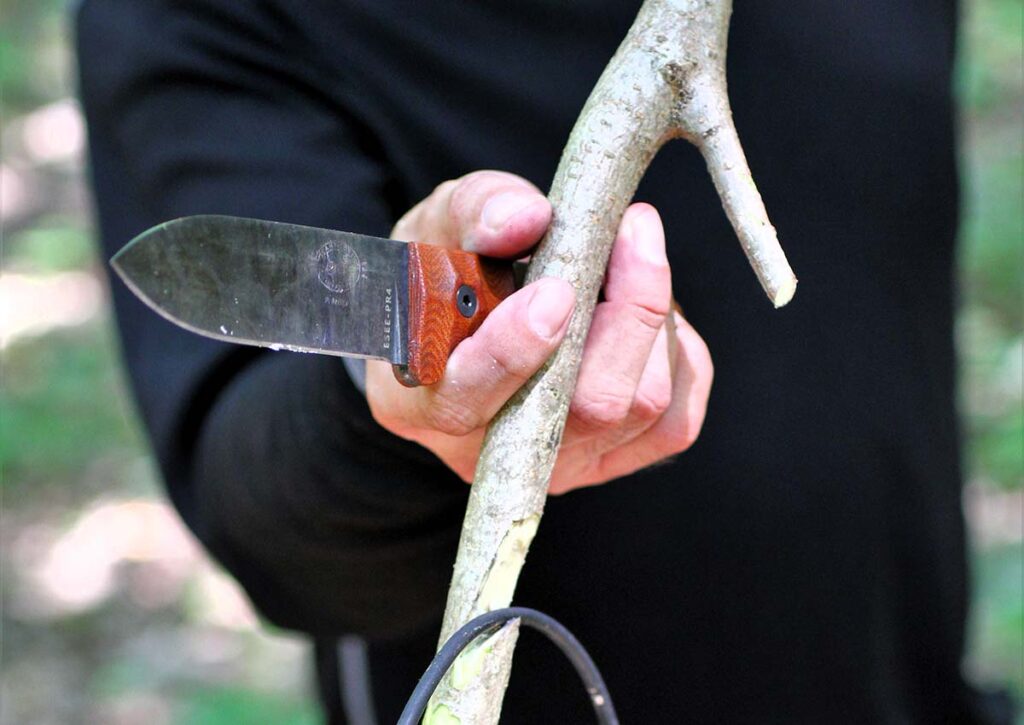
The PR4 is part of the Camp-Lore series from ESEE Knives and is named after the initials of its designer, Patrick Rollins, lead instructor for Randall’s Adventure & Training.** The knife features a 4-inch 1095 carbon steel blade with a high saber grind. It pays homage to the timeless Kephart design while incorporating Patrick’s modifications. The approximately 4.5-inch handle is suitable for large hands or use with work or winter gloves. The knife has a black oxide tumble finish resembling a patina but not a coating. The handle is fitted with textured brown Micarta® scales for a distinct look and comfortable grip. The knife comes with a plain tan leather sheath made by Wickett and Craig, one of the oldest tanneries in the USA.

I used the PR4 extensively in the Eastern Woodlands for various camp tasks. The knife proved versatile and was particularly effective for making camp implements and starting fires. It excelled in splitting small sticks and igniting the ferro rod to create a fire. Its sharp spine was practical without being overly flashy.

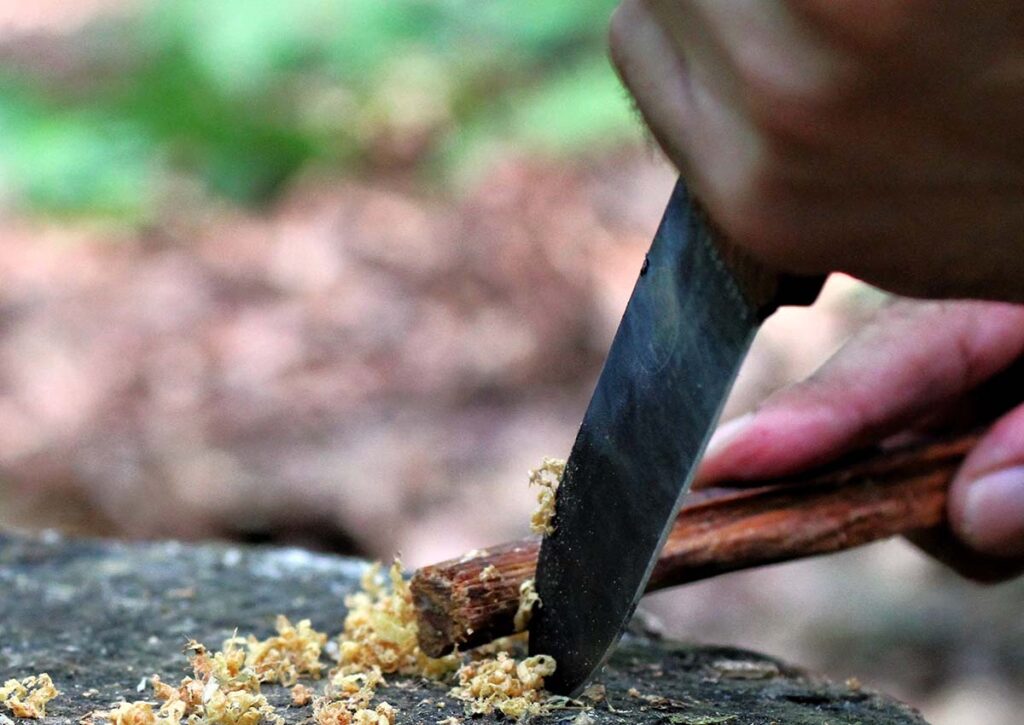
Scraping fatwood with the blade spine was easy using the PR4. It boasts the sharpest spine in ESEE’s Camp-Lore series and rapidly created a pile of fatwood.

While I don’t typically baton wood when a chopper is available, I found the PR4 excellent for cross-grain baton work, making precise stop cuts on trap parts, stakes and pot hooks. I also used the PR4 to carve a chisel point on a thick piece of maple for a digging stick and found that it easily sliced dry maple. The knife remained effective despite exposure to various weather conditions.

After establishing a fire, the PR4 proved equally adept at culinary tasks, precisely slicing onions, peppers, potatoes, mushrooms, garlic and sausages for a stew. The thin grind made kitchen tasks a breeze, especially achieving paper-thin garlic slices. The knife performed exceptionally well in all tasks, including prepping tinder from fatwood and dry, split poplar. The high saber grind and sharp spine made the PR4 ideal for camp and woodcraft chores.

Bear Forest Knives GT-3

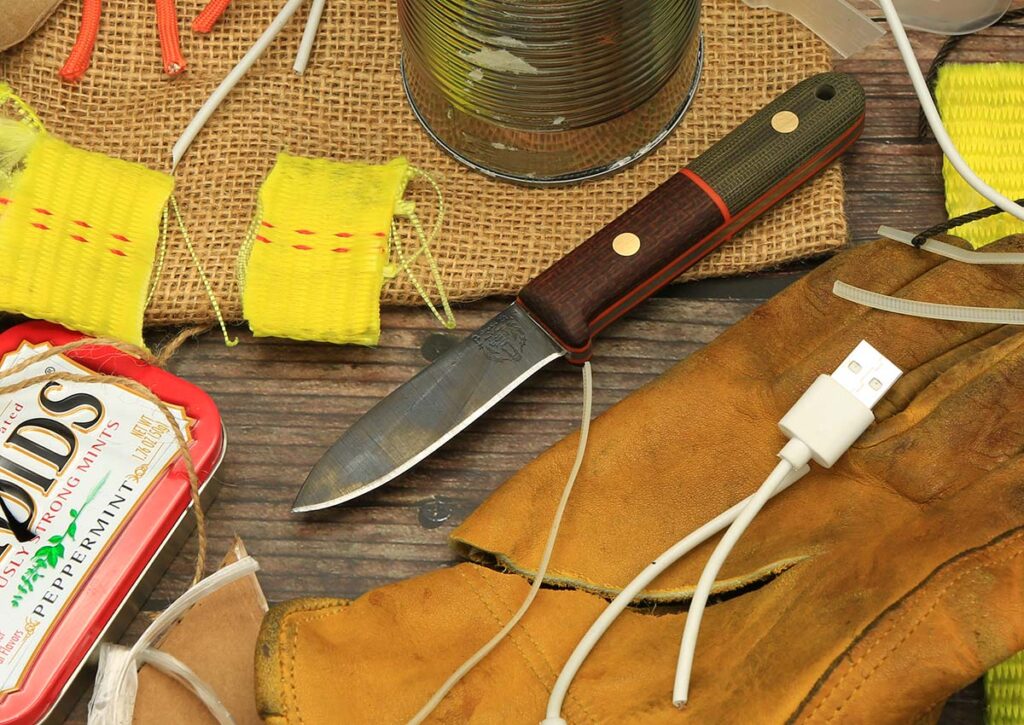
As an EDC/utility knife, the GT-3 cut assorted materials, including tin cans, leather, cordage, zip ties, toe strapping and more.

GT-3 Specs
Blade Length: 3”
Blade Material: 80CrV2 carbon steel
Blade Grind: Flat
Blade @Thickest: .125”
Blade Finish: Rock tumbled acid wash
Handle Material: Micarta®/G-10
Overall Length: 7.25”
Sheath: Black kydex (.08”) w/nylon cross-draw/Scout belt loop
Country of Origin: USA
MSRP: $149.99

Garrett Tremblay of Bear Forest Knives based the company’s GT-3 on his favorite bushcraft knife, the ESEE PR4. After discussing it with the knife’s designer, Patrick Rollins, and receiving approval, Garrett developed the Bear Forest entry.

The knife boasts a striking design, featuring a full-flat-ground, 80CrV2 carbon steel blade with a black oxide finish. The handle showcases an exceptional blend of burgundy and green burlap Micarta scales complemented by vibrant orange G-10 liners, all held together by Corby bolts. The difference in cutting performance between the full-flat-ground edge and the PR4’s saber grind was instantly noticeable. The GT-3 is equally at home as an everyday carry tool, a useful household companion or a reliable camping partner.

The knife is perfect for making notches for tarp stakes and trimming the ends to a chisel point to pound into the ground. The 90-degree spine is ideal for scraping poplar tinder and striking ferro rods. The 3-inch blade is just the right complement for a campsite that includes a bow saw and tomahawk/hatchet.

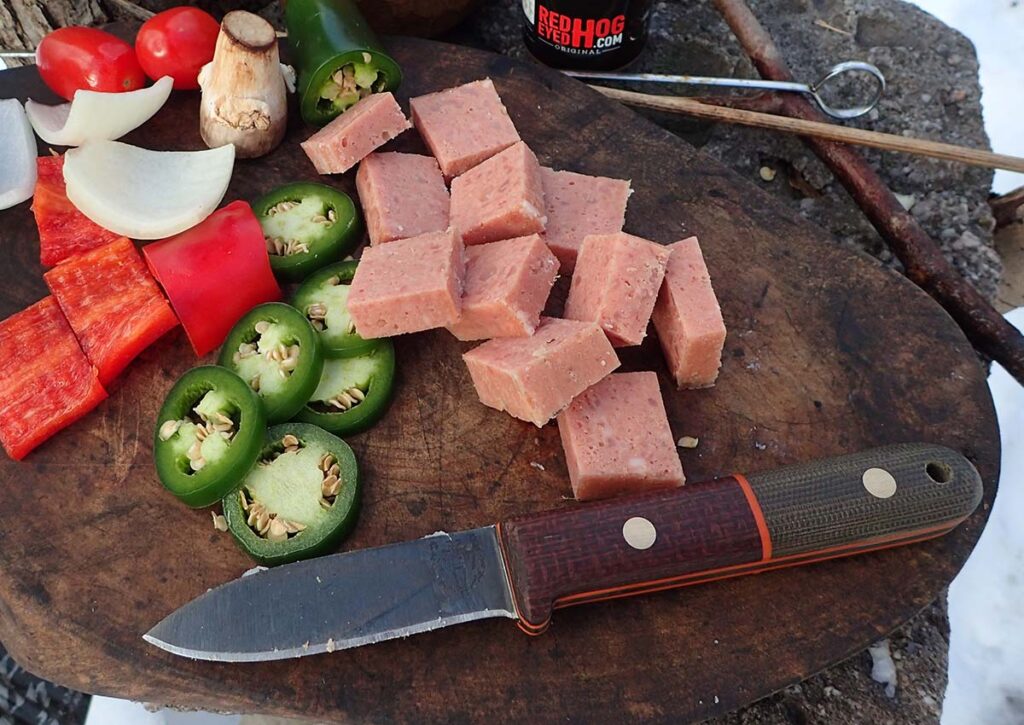
While camping, the author relied on kabobs for meals. The Bear Forest Knives GT-3 handled all the prep work, including slicing vegetables and starting the fire.

As Horace Kephart mentioned, a sheath knife is always “get-at-able” for quick tasks, which saves the jackknife from the messier work. This perfectly describes the GT-3. The handle is consistently comfortable. I keep a charred coffee can full of wood shavings—tinder and kindling—in camp. I whittle poplar and maple until the can is full. This is the last but most important task of the night, as it prepares for the next morning’s fire. The GT-3 is always up for the task.

*BLADE does not recommend shaving arm hair as a test of edge sharpness as it can cause injury.

**Both ESEE Knives and Randall’s Adventure Training (RAT) are owned by Jeff Randall and Mike Perrin under the parent corporation of TransEquatorial Solutions, Inc.

Check Out More Outdoor Knives:

Knife World Mainstays Hughes, Klotzli and Rexroat Pass

Great friends to the knife community, Hughes, Klotzli and Rexroat leave a hole publishing, sales and knifemaking.

The knife community lost three great friends with the recent passing of Carolyn Ann Hughes, H.P. Klotzli and Kirk Rexroat, all three of whom were extremely well liked and well respected within the knife fraternity.

Widow of BLADE Magazine Cutlery Hall-of-Fame® member B. R. Hughes, Carolyn served as editor of The ABS Journal, the official publication of the American Bladesmith Society, for many years. She won several ABS honors, including the Margaret Moran Silver Slipper Award. Inseparable at various ABS and other knife events, Carolyn and B. R. helped lead the Society for almost 60 years, as B. R. was one of the four original ABS founding members. He passed away September 17 and Carolyn joined him on February 22. She was 86.

For many years H.P. Klotzli was the headman of Klotzli Messerschmiede of Switzerland, a wholesaler/distributor of Spyderco, CRKT, M-Tech and Fallkniven knives, as well as hi-tech knives made in Switzerland, scissors and more. He took over the business from his parents in 1972 and ran it until 2019. He was among the first to use carbon fiber for factory knife handles, including on a linerlock folder based on a design by Cutlery Hall-of-Famer Michael Walker. H.P. worked on several other custom and factory collaborations as well.

An ABS master smith, Kirk E. Rexroat forged fixed blades and folders part time out of his shop in Banner, Wyoming. He made his first knife in 1981 and did his own engraving. His stag-handle/damascus Rendezvous Bowie was the cover knife for the May 1999 BLADE®. He also designed and built knife prototypes for Al Mar Knives, one of which, the Havana Clipper, was the BLADE Magazine 1998 Most Innovative Imported Design. He passed away February 27 at the age of 67.

More About Custom Knives:

Best Big Bushcraft Knives: Huge Backwoods Hackers [Tested]

Part big knife/part small machete, 4 fixed blades do both well.

All-terrain has been used to describe the cross between a small machete and a large knife. It’s a tool that doubles as a machete for brush clearing, but, unlike a machete, can do fine cutting and, unlike even a large hunting knife, can build a shelter. It’s less than a kukri, bolo, parang or machete but more than “just” a big knife.

My team and I compared four such crossover hard-use knives, each with blades roughly 10 inches long. All use 1095, 1095 Cro-Van or 1075 carbon blade steels—in other words, alloys that are survival oriented and field-sharpening friendly. All have some standard knife features such as integral guards and bowie-type blades, and some standard machete traits like serviceable blade bellies and large handles. Some have simple, subdued features while others are more aggressive and exaggerated. All are compromises between a big hunting knife and a small machete.

To test the knives as objectively as possible, we did some common BladeSports International (BSI) trials, which have their origins with some of the American Bladesmith Society tests for journeyman and master smith ratings. Among other abilities, the knives of BSI contestants must cut through a 1-inch free-hanging rope and chop clean through a 2-by-4 board.

All test materials (hemp rope, 2-by-4s, 4-by-4 posts, paper tubes and water-filled plastic bottles) were consistent from knife to knife, and we made all feathersticks and tent pegs from the same branches. Yes, we treated backwoods knives like competition choppers to objectively find their real strengths and weaknesses.

The knives were tested right out of the box, with the factory edge and with only a 600-grit stone sharpening before all the stages were repeated to get the average results. All tests were done with bare hands—if there were hot spots during hard work or precise use, we wanted to find them. Four knife enthusiasts with different hand sizes did some of the evaluations.

ESEE Junglas

The author initially wondered if a choil would be needed for precise cutting, but got along surprisingly well without one making notched tent pegs and feathersticks with the ESEE Junglas.

Junglas Specs
Designer: Jeff Randall
Blade Length: 10.4″
Blade Steel: 1095
Cutting Edge Length: 9.8″
Maximum Blade Width: 2.0″
Blade @ Thickest: 0.188″
Blade Pattern: Drop Point
Blade Grind: Full Flat
Blade Finish: Powder Coat
Handle Length: 6.1″
Handle Material: Micarta
Pommel: hammer
Lanyard Hole: one
Weight: 23.0 ozs.
Overall Length: 16.5″
Sheath Material: Kydex, MOLLE
Country of Origin: USA
MSRP: $309

Like most ESEE knives, the Junglas (pronounced “HOON-glas”) is based on the lessons learned from jungle operations, in this instance after ESEE co-owner Jeff Randall spent time with the Colombian Jungla Special Operations Forces. Thus the name of the Junglas, designed to have the strength and rigidity of a fixed blade and the cutting efficiency of a machete. 

The 1095 of the Junglas is the go-to steel for many military, survival, hunting, camping, tactical and bushcraft blades. Compared to all carbon, tool, high speed and stainless steels, 1095 is on the low end for edge retention but in the middle for toughness. What makes it a favorite choice for survival/bushcraft knives is its toughness and very high overall rating for ease of field sharpening with small, simple hand tools. As a carbon steel it has a very low rating for corrosion resistance, which is why nearly all 1095 blades, like with the Junglas, have a protective coating. 

During our tests, we found the Junglas to have excellent balance. The Micarta® scales have the right amount of texture, and their shape allowed full control and orientation of the blade and point. We initially wondered if a choil would be needed for precise cutting, but got along surprisingly well making notched tent pegs and feathersticks.

The Junglas has a Cordura®-backed sheath with snap retaining strap and full pommel cover. The sheath has an adjustable blade tension, which doubles as a knife lock. Like all ESEE knives, the Junglas is no-frills simple and totally functional. It performed extremely well in every test and in the subjective cutting impressions review. It really is a knife, ax and machete all in one.

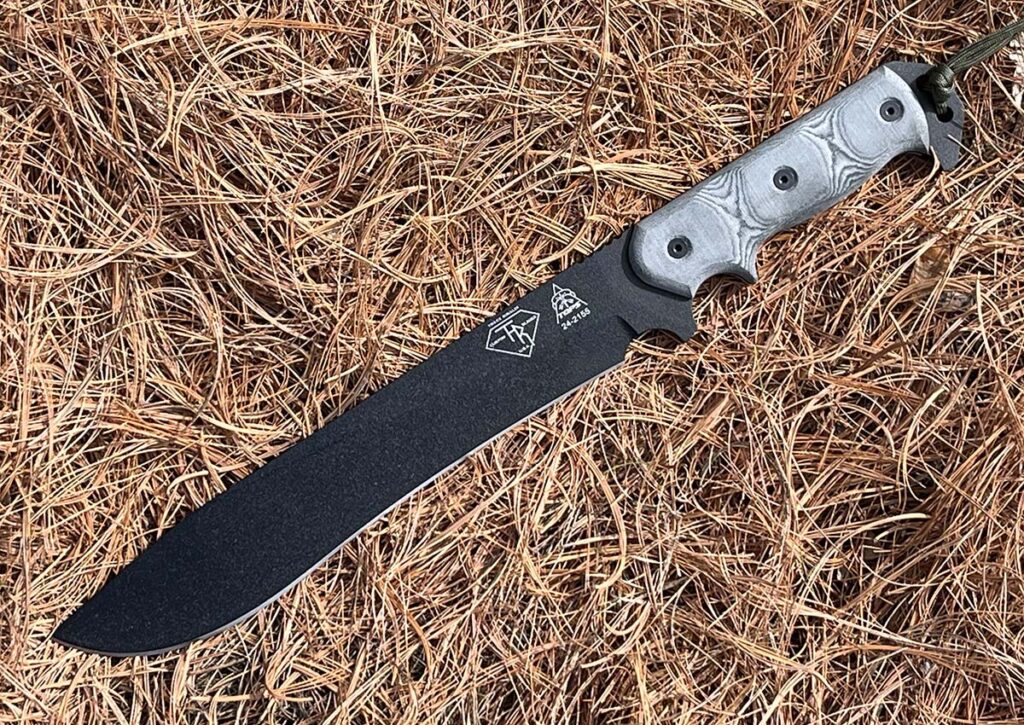
TOPS Armageddon

The drop-point blade of the TOPS Armageddon has a slight bolo recurve, which signals what the big knife was really good at during testing. The back-to-back choil and finger cutouts provide options in cutting techniques. Don’t be put off by the relatively short distance from the finger cutout to the bird’s-beak pommel. Choke back for chopping and choke up for precision work.

Armageddon Specs
Designer: Trace Rinaldi
Blade Length: 10.6″
Blade Steel: 1095
Cutting Edge Length: 10.0″
Maximum Blade Width: 1.9″
Blade @ Thickest: 0.25″
Blade Pattern: Drop Point, Recurve
Blade Grind: Partial Flat
Blade Finish: Powder Coat
Handle Length: 5.9″
Handle Material: Micarta
Pommel: Hammer
Lanyard Hole: Two
Weight: 24.0 ozs.
Overall Length: 16.6″
Sheath Material: Ball. Nylon, MOLLE
Country of Origin: USA
MSRP: $350

All four review knives chopped, cut, batonned and carved nearly the same. Blade steel and edge geometry are very similar. The big differences are in the handles and the most distinctive grip belongs to the TOPS Armageddon. Consider Forged in Fire’s Doug Marcaida and his emphasis on the handle. You must be able to “feel” where the point and edge are, and the handle must not have hot spots. That said, the Armageddon grip gives some good handling options.

If you choke all the way back for chopping on this bushcraft knife, and your hand is large or larger, your little finger will be up against the bird’s-beak pommel, a definite hot spot. The obvious solution is to put your forefinger in the finger cutout. This makes the grip extremely secure when chopping, and there is plenty of room for the other three fingers. That is how we held the Armageddon during the 2-by-4 chop and 1-inch rope cut, when the big TOPS knife exhibited plenty of power.

In fine cutting, we used the choil cutout and spine gimping for precise blade control. With this grip, the finger cutout fit between the middle and ring fingers. If this grip is not completely comfortable, three minutes of radiusing and rounding with a Dremel® tool will customize the choil and finger cutouts and bird’s-beak pommel to your hand.

Blade steel is 1095. The Micarta scales are a clear solution for heavy use, offering the right amount of texture for bare hands under wet conditions. The exposed full tang can easily be hammered, and we found the twin lanyard holes helpful.

We selected or excluded knives for this roundup partially based on the sheaths. The Armageddon comes with a ballistic nylon model over a rigid plastic insert. It has two fabric-fastener handle straps and can be belt worn. The twin accessory pouches can hold a sharpening stone, fire kits, mini med kits, multi-tool and/or flashlight.

The tests showed just how effective the big TOPS knife can be. At a quarter-inch thick, it has the stoutest blade of the test bunch, which helped chop and baton. The flat grind kept the thick blade competitive during slicing tests. The choil/finger-cutout handle offers cutting technique options not found on any of the other test knives.

KA-BAR/Becker Knife & Tool BK9 Combat Bowie

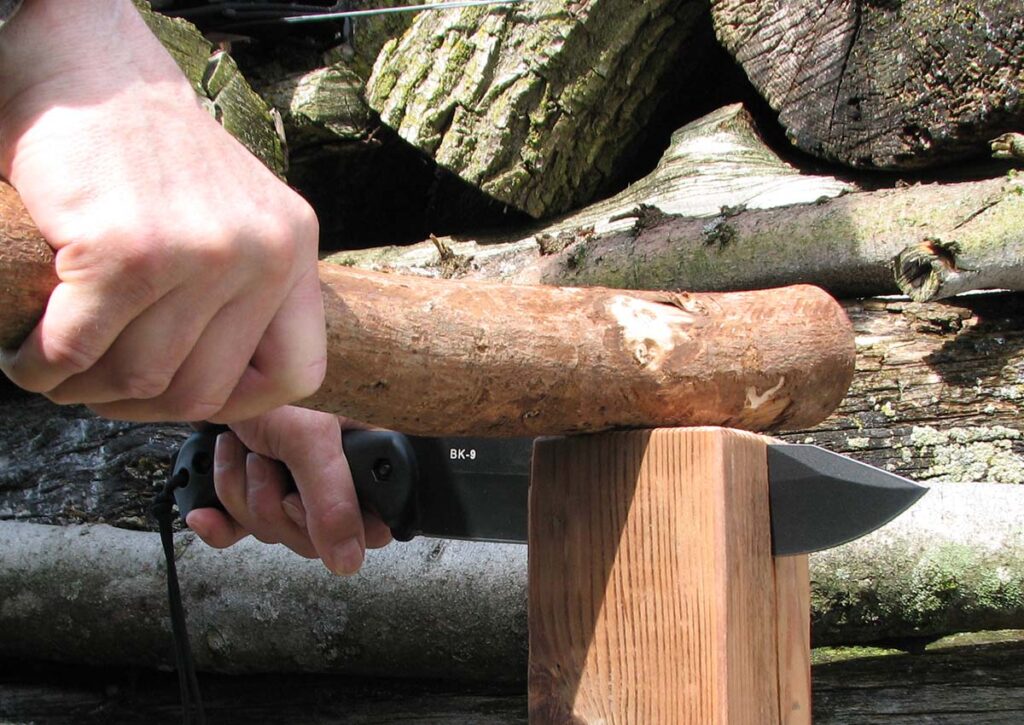
 The lightest knife of the test group, the KA-BAR/Becker BK9 Combat Bowie easily split the 4-by-4 posts with no handle shock or grip slip. 
The lightest knife of the test group, the KA-BAR/Becker BK9 Combat Bowie easily split the 4-by-4 posts with no handle shock or grip slip. 

BK9 Combat Bowie Specs
Designer: Ethan Becker
Blade Length: 9.3″
Blade Steel: 1095 Cro-Van
Cutting Edge Length: 9.3″
Maximum Blade Width: 1.9″
Blade @ Thickest: 0.188″
Blade Pattern: Clip Point
Blade Grind: Partial Flat
Blade Finish: Powder Coat
Handle Length: 5.5″
Handle Material: Ultramid® Nylon
Pommel: Hammer
Lanyard Hole: One
Weight: 16.8 ozs.
Overall Length: 14.8″
Sheath Material: Ball. Nylon, MOLLE
Country of Origin: USA
MSRP: $195

The KA-BAR/Becker Knife & Tool BK9 Combat Bowie is a large, low-profile bushcraft knife. During the tests, it did everything we expected a big bowie to do. It chopped, hacked and batonned with gusto, and cut, sliced and slashed quite well, especially considering it is by far the lightest and nearly the shortest of the review knives. 

Used by KA-BAR on assorted of the company’s knives, 1095 Cro-Van is essentially 1095 with the addition of several elements. Arguably, 1095 Cro-Van is an incremental improvement in edge retention and toughness over 1095. While the chemistry is there, we didn’t notice any big differences in testing. 

The knife has smooth, rounded nylon scales. We decided to use from-the-factory models in the testing, even if factory parts were available to improve performance. Indeed, high-texture Micarta scales are available from KA-BAR. Somewhat surprisingly, the smooth scales with palm swell proved perfectly acceptable during testing, even the hard chopping. Since one of the tests involved cutting water-filled plastic bottles, our hands got wet. However, there was no noticeable hand slipping and the handle was comfortable in hard use.

The BK9 comes with a ballistic nylon sheath over a rigid plastic insert, and one snap retention strap. If you order Micarta replacement scales from KA-BAR, consider getting the Becker Remora skeleton knife, which fits in the BK9’s sheath pouch. 

The lighter, shorter Becker excelled at smaller carving and whittling jobs. In close work, it did the precise cutting easily. We like the gimped thumb rise and used it for precision work. Overall, this is a very versatile bush blade. The big Becker punched way above its weight class in every test.

Condor Tool & Knife Plan A Bowie

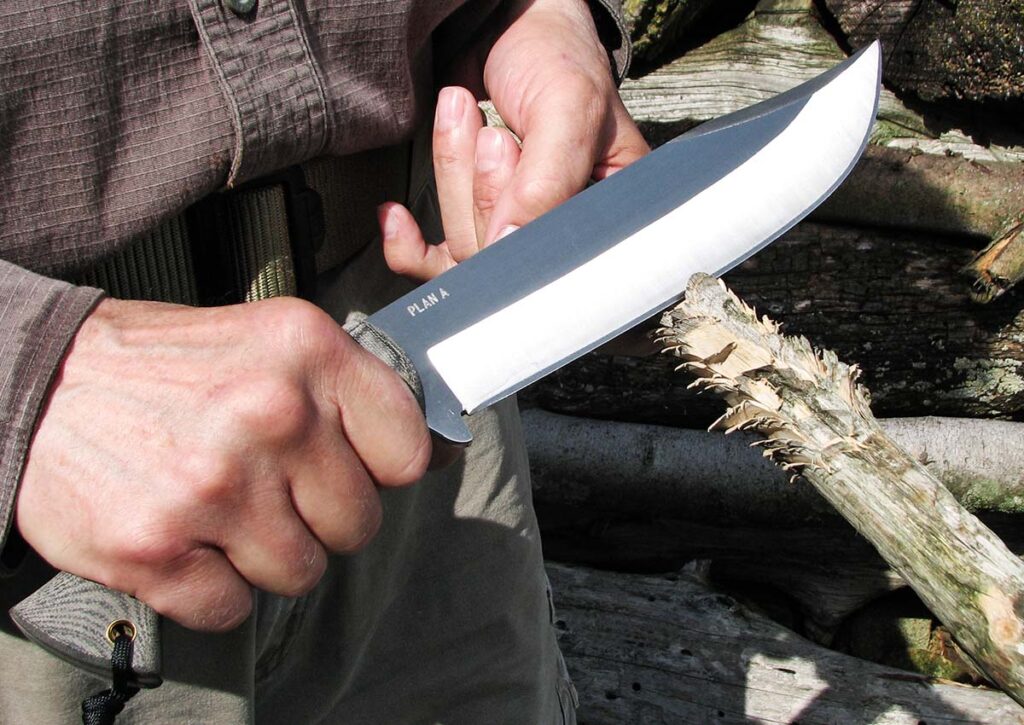
Making a featherstick tests blade sharpness, edge geometry and edge retention. It also gauges whether the knife enables the user to choke up enough for precise work. The Condor Plan A passed muster on all fronts.

Plan A Bowie Specs
Designer: Julio Diez
Blade Length:
9.0″
Blade Steel:
1075
Cutting Edge Length:
8.8″
Maximum Blade Width:
2.0″
Blade @ Thickest:
0.188″
Blade Pattern:
Clip Point
Blade Grind:
Partial Flat
Blade Finish:
Polished
Handle Length:
6.5″
Handle Material:
Micarta®
Pommel:
Covered tang
Lanyard Hole:
One
Weight:
18.0 ozs.
Overall Length:
14.5″
Sheath Material:
Kydex®
Country of Origin:
El Salvador
MSRP:
$168

The Plan A Bowie from Condor Tool & Knife is very much a big bushcraft knife, complete with an upswept, false edge, clip-point blade. It has the shortest blade of the test knives and the shortest overall length. However, the blade’s partial flat grind and longest handle of the review models kept the weight up a bit. As a result, it held its own in heavy chopping, the difficult slicing and precise carving.

The 1075 blade steel is very similar to 1095. Each alloy has slight advantages. The 1095 is harder and known for better edge retention, while 1075 is known for enhanced toughness, making it ideal for chopping.

The knife sports sculpted palm-swell scales and a pronounced kukri-type pommel swell. We found the handle comfortable and secure during testing and the subjective evaluations. The kukri swell is sharp cornered but we didn’t find it to be a hot spot.

The Condor is the only review knife with the scales covering the full tang, and an exposed tang to hammer with is sometimes helpful in the field. There is a hole for a lanyard. The full sheath has a molded retention feature and a thick leather belt loop.

The knife handled like the big bowie that it is. It performed as confidently during chopping as during slicing. It took the hanging rope, water bottles and 2-by-4 in stride. There is something special about a big, aggressive bowie and the Plan A has that something.

Cross-Over Success

Each knife was able to cross over into virtually all areas of bushcraft. Perhaps a bit more chopping to make a tent peg than carving in some cases, but the end result was still a usable tent peg. Each passed such standards as slicing through the hanging 1-inch rope and chopping through a 2-by-4. Each is a little different from the other, a little better in some areas than others. Overall, however, they are more alike in performance than different in appearance.

Check Out More Outdoor Knives:

Advertisement

Must Read Articles

Read this before you make a knife

Knifemaking 101 – Read This Before You Make a Knife

  by Wayne Goddard My experience has taught me that there's nothing like digging in and getting started. I've often said the hardest part of the...
how to forge damascus steel

How to Forge Damascus

Advertisement
Advertisement