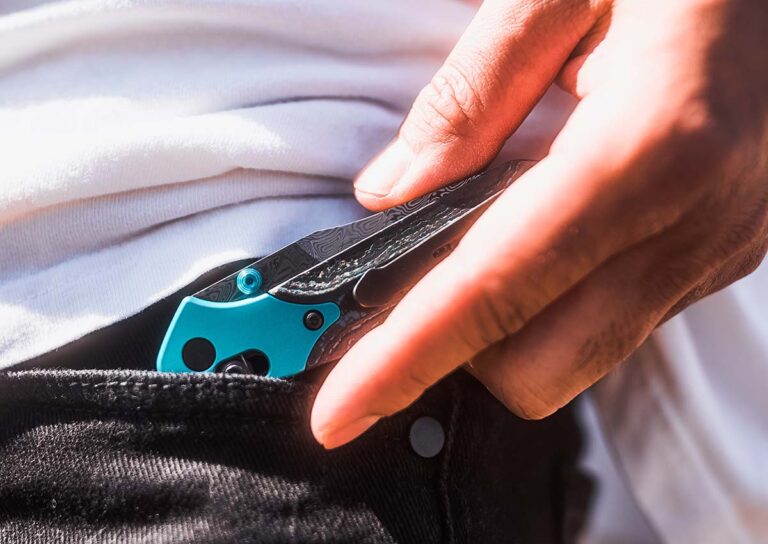
Vagueness of bill could have potentially banned the carry of all but a few knives.
Hawaii Knife Ban bill SB 433, which would have banned all carry of most knives and all knives in many public places in Hawaii, has been stopped. The stoppage occurred because the bill failed to receive a hearing by the stated deadline.
According to Knife Rights, one of the worst aspects of the bill was its vagueness. The bill added “bladed weapons” to the state’s sweeping firearms bans, which would have been expanded in SB 433.
“As written, nobody, not a resident, not a police officer, not a prosecutor, could possibly look at the proposed statute and know for sure what a ‘bladed weapon’ is that is being banned,” KR reported. “This is fundamentally unconstitutional and leaves the law open for law enforcement and prosecutorial abuse. Terms that capture everyday tools carried daily by the public for perfectly lawful uses should be defined crisply and clearly to provide fair notice as required by longstanding law.”
The bill banned all undefined “bladed weapons” everywhere in Hawaii except for switchblades and butterfly knives.
“So,” KR noted, “a not at all unreasonable interpretation of [‘bladed weapons’] would have banned carry of a common pocketknife in Hawaii, except for [switchblades and butterfly knives]! Who decides whether it’s a ‘bladed weapon’? Certainly not the average resident or visitor.”
In other examples, fillet knives used for recreational, subsistence and commercial fishing and hunting knives used for boar hunting—a popular means of reducing feral hog populations on the islands and a popular tourist business—could have been banned, as could a box cutter carried to work by a warehouse worker.
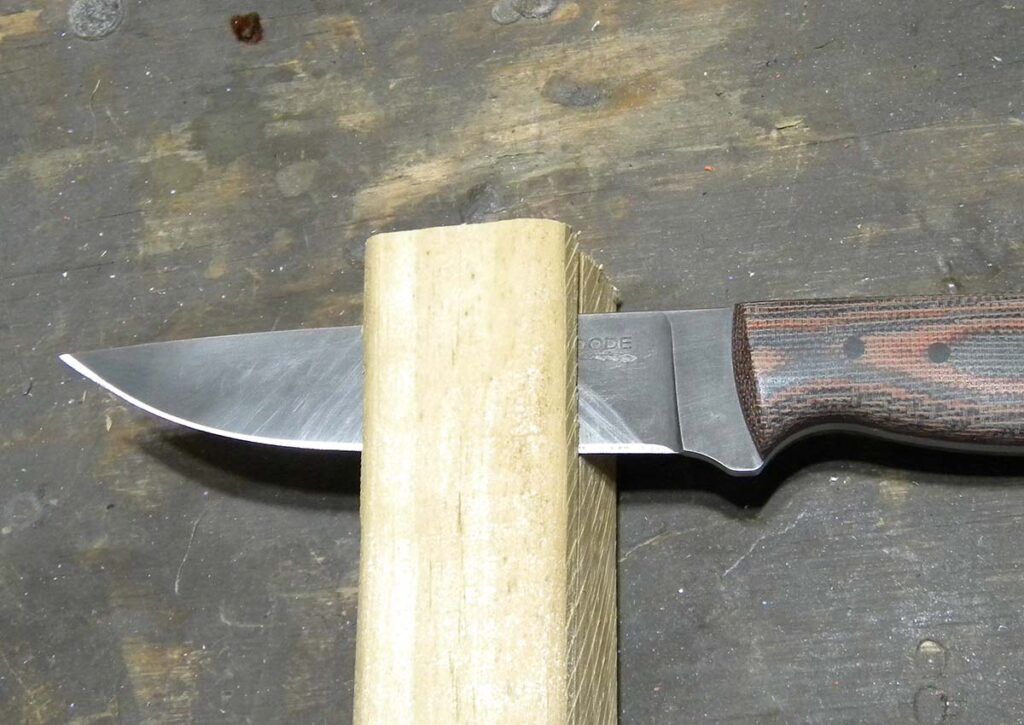
B. Goode H.U.T. 4 high steps its way through the author’s test drills
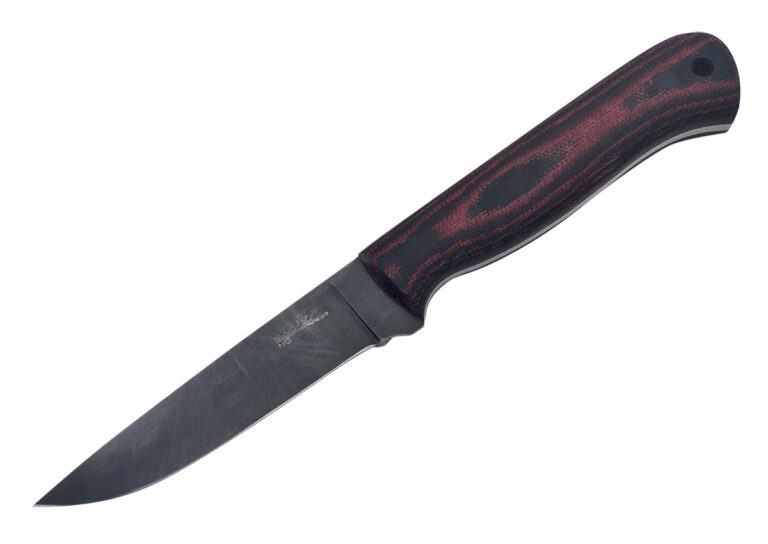
The H.U.T. 4 by Brian Goode of B. Goode Knives reminds me of my military days—it just needs the “2, 3” before the “4.” The acronym and number stand for Hunter, Utility, Trail, 4 inch. An all-around edged tool that can be used for multiple tasks, it’s the one knife you always grab for when cutting needs to be done. How well it cut I’ll let you know.
Light Duty Cutting
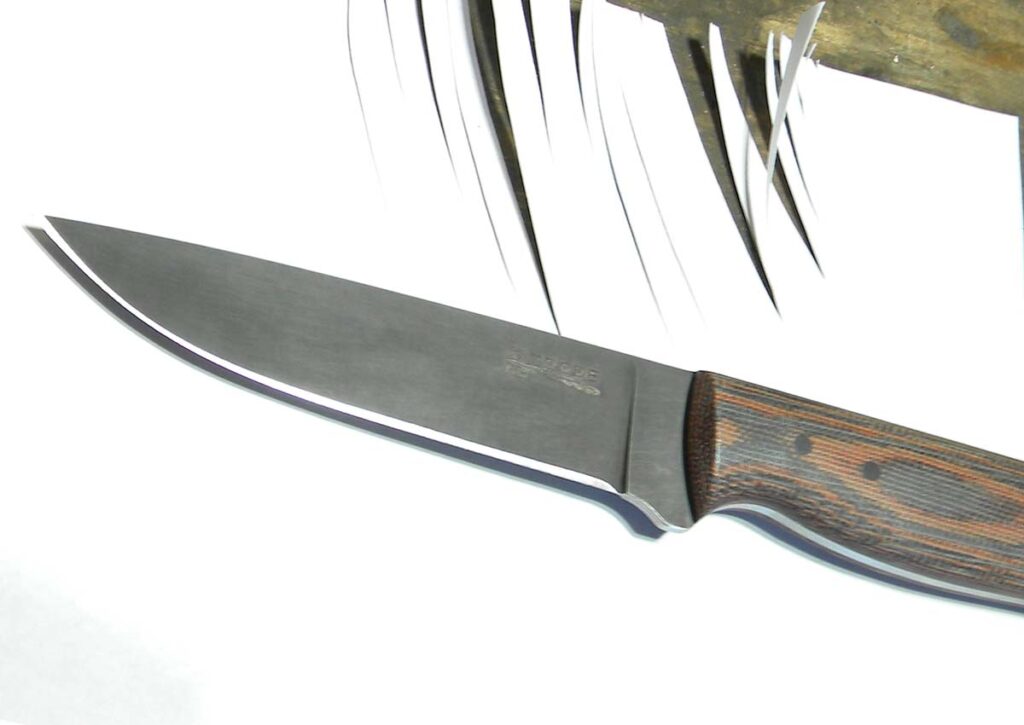
There was no difference between the first paper cut test and the last one. The H.U.T. 4 stayed sharp.
I began with a simple yet effective test—the paper slice. I grabbed the H.U.T. 4 with my thumb and index finger and slid the edge into the paper. It kept slicing for the entire blade length. I could hear each slice, so it’s very aggressive in the 20-pound bond paper. You really have to watch closely so you don’t skin a flap from your finger.
Single-walled cardboard was next. I used a push cut and the knife didn’t fail. I felt no resistance while cutting. The H.U.T. 4 zipped through quickly. The blade did get some wipe marks on the acid finish.
Medium Duty Cutting
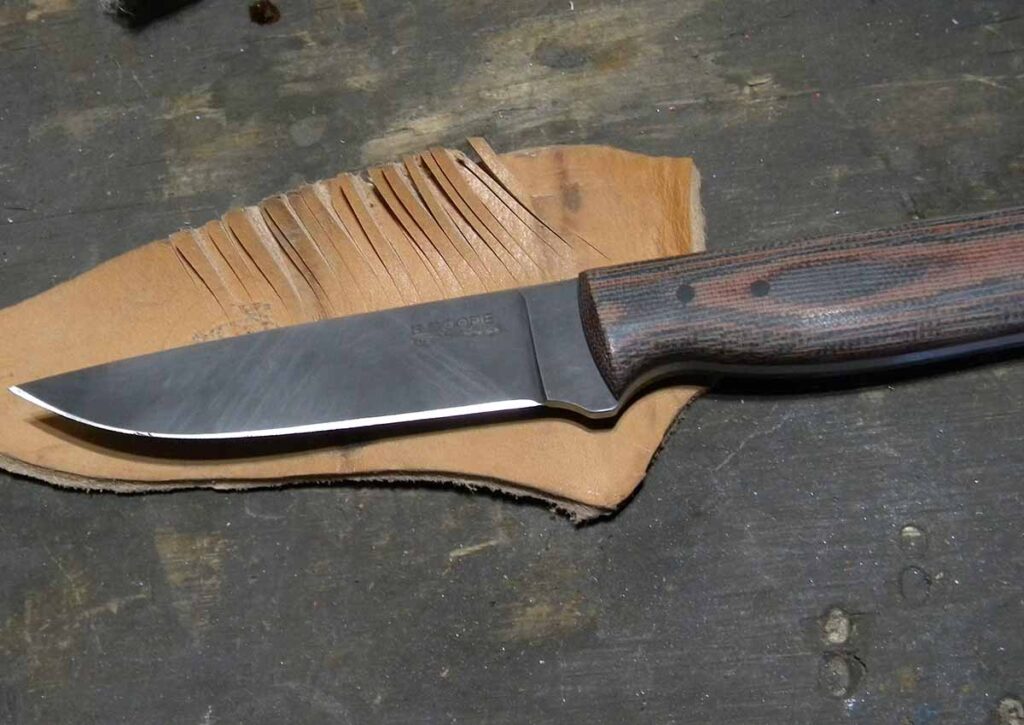
The knife sliced the 8-ounce leather quite forcefully. Each time the edge hit leather, the author heard it slice.
Grabbing some scrap 8-ounce leather, I did some skiving and slicing. The knife sliced quite forcefully once more. Each time the edge hit the leather, you could hear it cut. This is a very cool test to do. Brian’s knife is light and fast, so you must be quick and get your fingers out of harm’s way.
Heavy Duty Cutting
The H.U.T. 4 was a whittling beast on a ¾-inch dowel rod, providing extremely smooth cuts with nice curlicues at the end. The handle is very comfortable with no hot spots. I went from fine cuts to deep cuts with a slight movement of my wrist. The knife is easy to control.
Using a chunk of wood railing as a baton, the author beat the H.U.T. 4 into another piece of railing. The wood split very fast and no shock carried up the author’s arm.
Even though the knife has only a 4-inch blade, it can handle larger trail chores like splitting wood. Using a chunk of wood railing as a baton, I beat the H.U.T. 4 into another piece of railing. The wood split very fast and no shock carried up my arm. I split both with the grain and across the grain with no difference. The edge was still perfect and I gave it some wood smears for character. It is a fun knife to use.
It was on to my favorite medium: sisal rope using push cuts. The H.U.T. 4 didn’t let me down. Two-hundred sweet crunching cuts happened very quickly. This is one smooth slicing, sharp knife. As fast as I could move the knife it was cutting. The handle is contoured for control and comfort.
In what could be construed as abuse, I gave the fixed blade 30 whacks into a deer antler. After scattering antler chips all over the workbench, the knife passed with flying colors—no damage and still very sharp. Excellent heat treat!
It was back to the 20-pound bond paper for the final cut. There was no difference between the first paper cut and the last one. The H.U.T. 4 stayed sharp.
Bottom Line
This is a great knife to have on you all the time—not too big, not too small and extremely sharp. Any changes? Maybe some thumb notches.
H.U.T. 4 Specs Maker: Brian Goode, B. Goode Knives Blade length: 4” Blade material: 8670 carbon steel on the test knife; other steels available Blade grind: Full flat Blade @thickest: .125” Blade finish: Acid dipped Scales: Red and black canvas Micarta® Handle pins: G-10 Weight: 4.5 ozs. Overall length: 8.5” Sheath: Leather pouch/belt model Weight w/sheath: 6 ozs. Maker’s price for a similar knife and sheath: $350
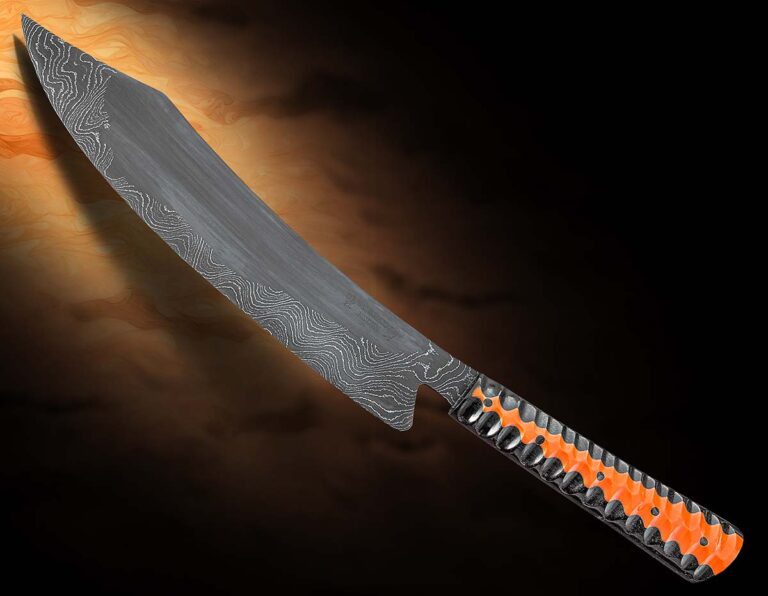
The Jose Santiago-Cummings BBQ Knife will rock your brisket.
Among Jose Santiago-Cummings’ growing ranks of customers are those he describes as “foodies,” and he built his second BBQ Knife expressly for them.
Not unlike a pirate boarding cutlass in appearance, the long, curved blade is designed for the rocking slices needed to cut meat and brisket. It’s similar to how a slicer is used as opposed to, for example, a nakiri for chop cuts.
Jose Santiago-Cummings
Jose, 62, used a cylindrical drum-sander-like attachment on a Ram tool to carve the grooves in the long, upswept handle. Jimmy Floyd forged the clip-point blade of damascus clad in wrought iron.
BBQ Knife Specs Maker: Jose Santiago-Cummings Blade length: 8.5” Blade steel: Damascus of 1084 carbon and 15N20 nickel-alloy steels clad in wrought iron Blade grind: Flat Handle: Black and orange G-10 resin Overall length: 13.25” Maker’s price for a similar knife: $450-$475
Today’s pocketknives come in assorted locks, no locks, blades, handles and more.
Eyes always peeled, we’re on the look out for the latest and the greatest. We think we’ve found a bevvy of them this March. So, with out further adieu, here’s our latest round of new knives.
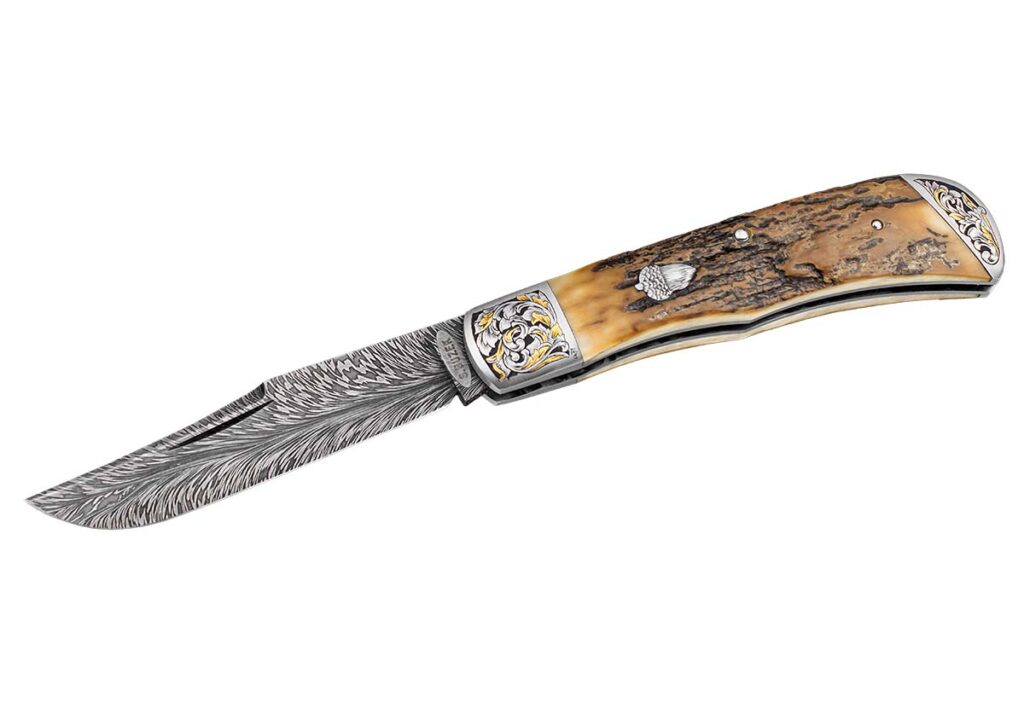
Stanley Buzek Single-Blade Slipjoint
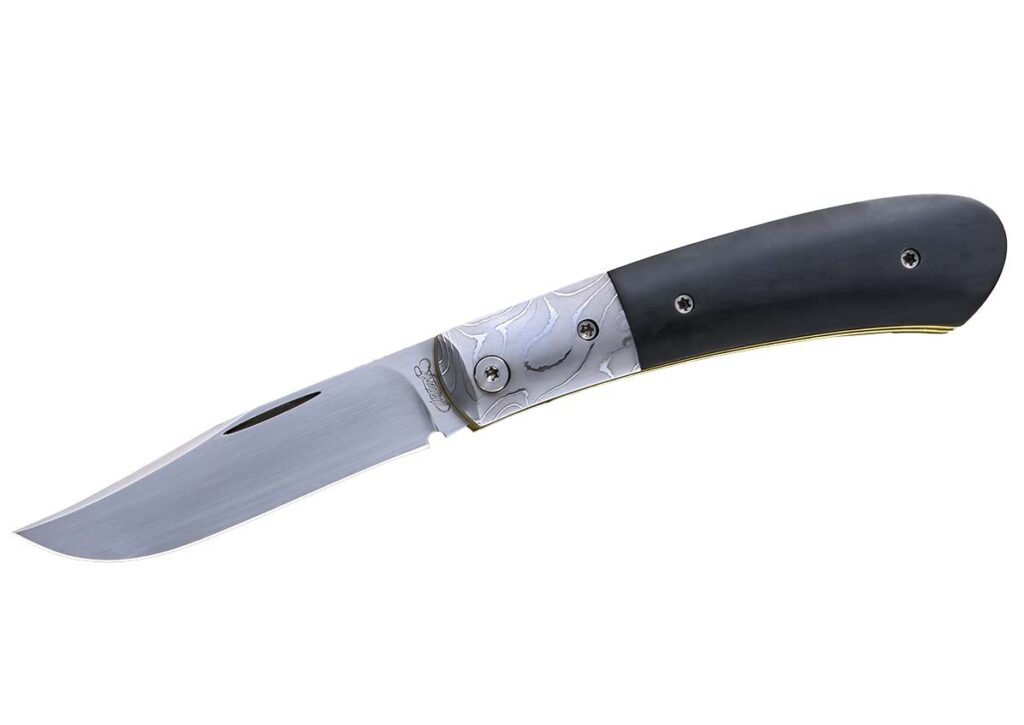
Blade length: 3 3/8” Blade steel: Feather damascus forged by ABS journeyman smith Mike Tyre Blade grind: Hollow Blade pattern: Clip point Blade opener: Nail pull Scales: Mammoth ivory Liners/bolsters: 416 stainless in an integral construction Engraving: Alice Carter, including 24k-gold inlay Knife to know: Fileworked liners and acorn shield Closed length: 4.25” Maker’s price for a similar knife: $2,800 Maker: Stanley Buzek, sbuzekknives.com (Jocelyn Frasier image)
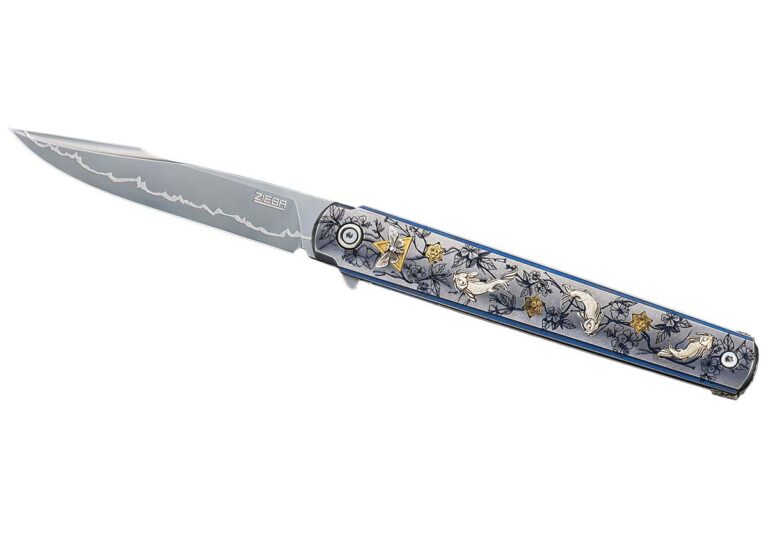
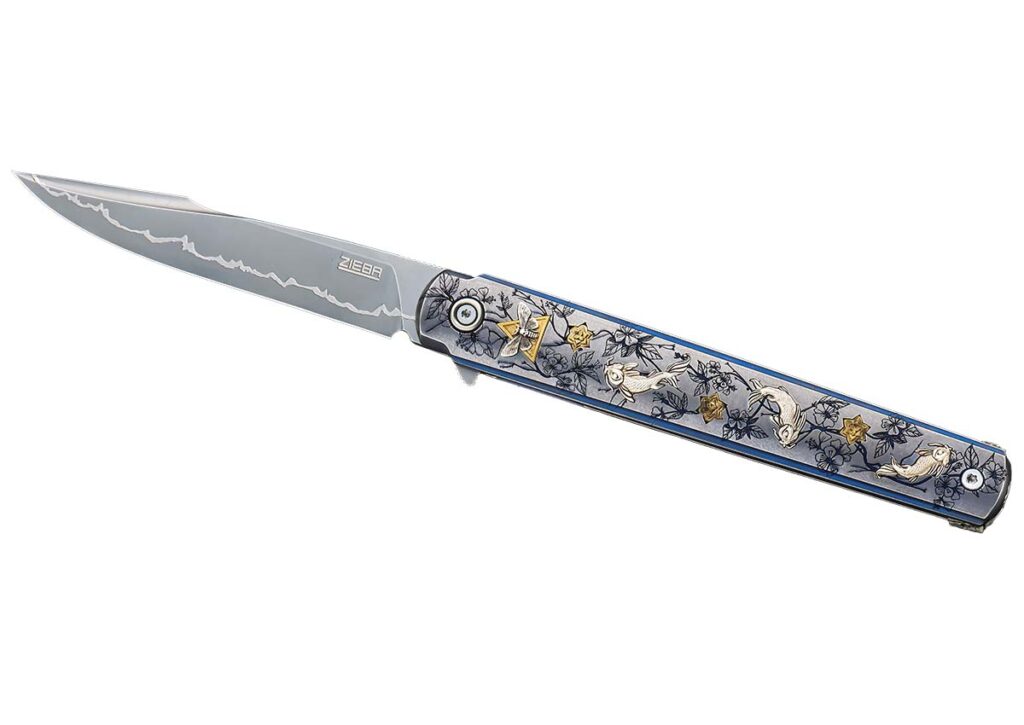
Michael Zieba Nine Silver Kois
Knife type: Side flipper Blade length: 4.126” Blade steel: CPM MagnaCut stainless Rockwell hardness: 62-63 HRC Blade grind: Flat Blade @thickest: .159” Pivot: Ceramic ball bearing washers Handle & pocket clip: Titanium w/24k-gold koi, lotus and moth inlay Weight: 5.07 ozs. Closed length: 5.5” Knife to know: Air pockets for weight reduction; ceramic detent; white brass skull spacer Maker’s price for a similar knife: $3,300 Maker: Michael Zieba, (SharpByCoop image)
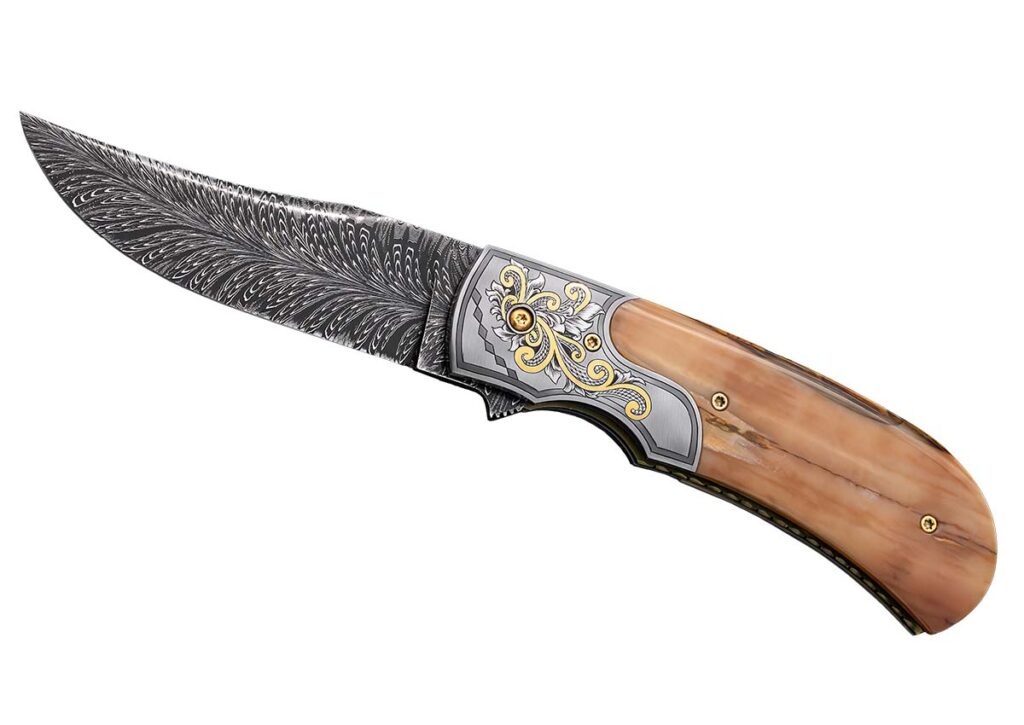
Curt Zimmerman Flipper Folder
Blade length: 3” Blade steel: Feather damascus Blade grind: Flat Blade pattern: Clip point Lock: Linerlock Scales: Ancient walrus ivory Bolster: Stainless steel engraved by Alice Carter w/24k-gold inlay Liners: Titanium; fileworked and anodized Screws: 24k-gold plated Closed length: 3 15/16” Maker’s price for a similar knife: $2,500 Maker: Curt Zimmerman (Jocelyn Frasier image)
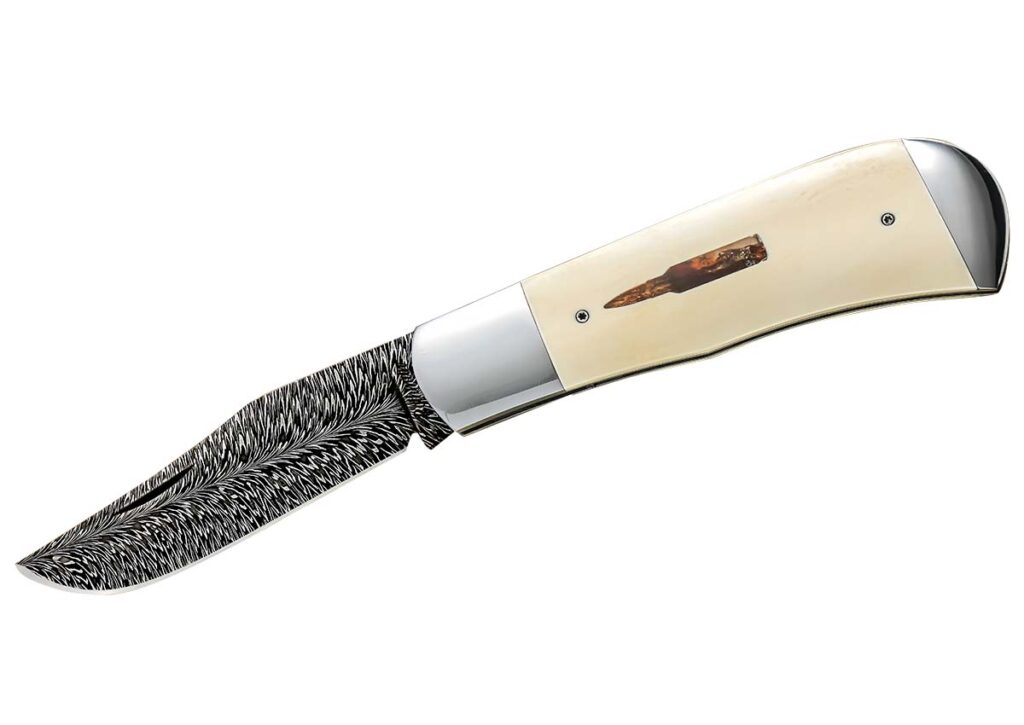
Rothman Knives Backpocket
Knife type: Dress slipjoint Blade length: 3.25” Blade steel: Feather damascus forged by Adam Deville Blade grind: 14” hollow Blade pattern: Clip point Scales: Interior mammoth Bullet shield: Dark mammoth Frame: 416 stainless in an integral construction Closed length: 4.75” Knife to know: Fileworked liners and embellished backspring; Michael Rothman is a member of the Knifemakers’ Guild Maker’s price for a similar knife: $1,500 Maker: Rothman Knives, rothmanknives.com (SharpByCoop image)
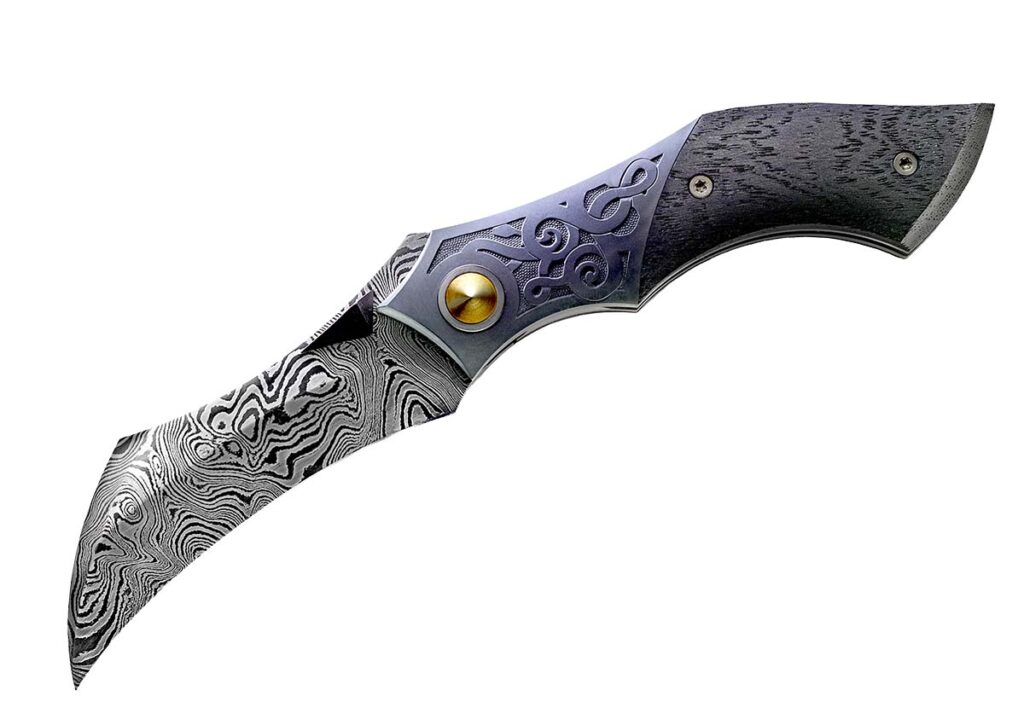
Jeremy Marsh Mini Assassin
Knife to know: A collaboration between Jeremy Marsh and Jonathan Quill Blade length: 3.5” Blade steel: Damascus of 1084 carbon and 15N20 nickel-alloy steels forged by Quill and finished by Marsh w/a dark, deep etch and “a great deal of hand finishing” Scales: 10,000-year-old bog oak from Ireland w/a coarse-grained, oily look Liners: Feature a distressed rock finish along the edges applied by Marsh and traditional vine filework applied by Quill Bolsters, thumbstuds and hardware: Zirconium toned lightly bronze and burnished for highlights Embellishment: Quill engraved the bolsters and pocket clip in a Celtic/Norse theme Closed length: 4.5” Make’s price for a similar knife: $8,000 Maker: Jeremy Marsh (Mitchell Cohen image)
Maverik Knives Dress Slipjoint
Blade length: 3” Blade steel: CPM 154 stainless Blade grind: High flat Blade pattern: Clip point Scales: Black paper Micarta® Frame: Brass Bolster: Straight twist damascus Hardware: Titanium Closed length: 4” Knife to know: Maverik Murdock is an ABS apprentice smith Maker’s price for a similar knife: $750 Maker: Maverik Knives, maverikknives.com (SharpByCoop image)
WE Knife High-Fin XL
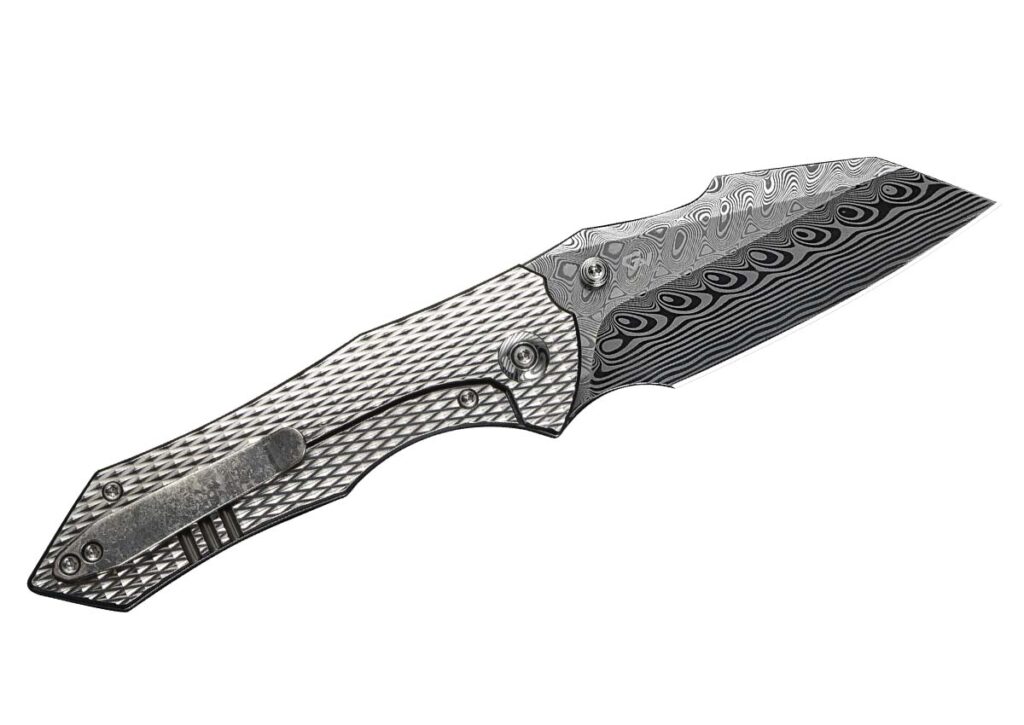
Designer: Gavko Knives Blade length: 3.48” Blade steel: Hakkapella damascus by Damasteel Rockwell hardness: 59-61 HRC Blade grind: Hollow Blade pattern: Reverse tanto Pivot: Caged ceramic ball bearings Handle: Satin-polished 6Al4V titanium in a diamond-pattern texture Pocket clip: Crystallized gray 6Al4V titanium; blade tip up, right-handed Lock: Framelock Weight: 4.03 ozs. Closed length: 4.67” Country of origin: China MSRP: $740 Company: WE Knife, weknife.com
David Kulis Spectre XL
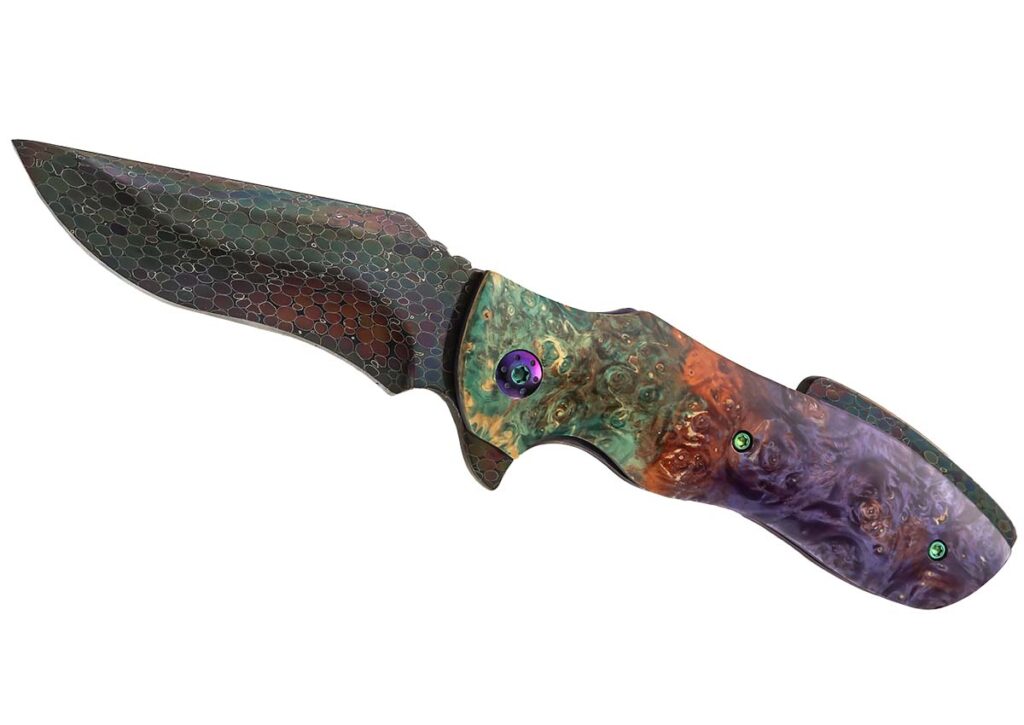
Knife type: Dress tactical flipper folder Blade length: 3.5” Blade steel: Dragonskin damascus forged by Bertie Rietveld Blade grind: 8” hollow Blade shape: Recurve Handle: Purple/orange/green burl Liners: Titanium Knife to know: All titanium hardware anodized to match the Timascus pocket clip Closed length: 5.25” Maker’s price for a similar knife: $1,500 Maker: David Kulis (SharpByCoop image)
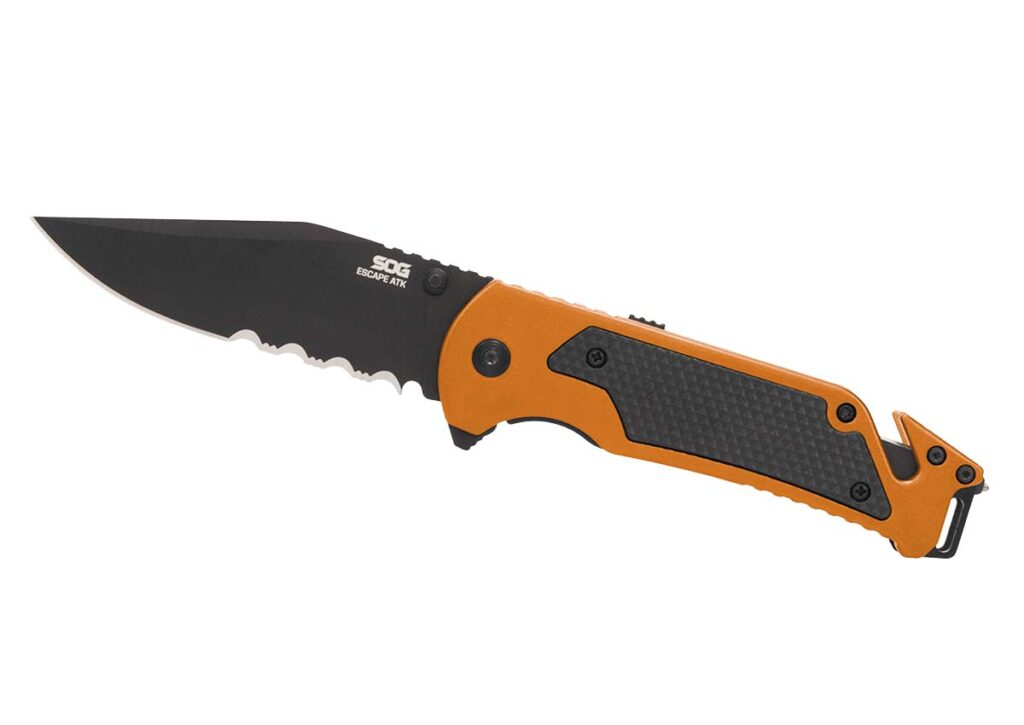
Knife type: Rescue folder Blade length: 3.4” Blade steel: AUS-8 stainless Blade mechanism: Assisted opening Handle: 6061 aluminum Lock: Linerlock Pocket clip: Low carry Weight: 4.4 ozs. Closed length: 4.6” Knife to know: Belt cutter and glassbreaker in the butt; spare blade for the belt cutter stores in the handle Country of origin: China MSRP: $54.95 Company: SOG Knives, www.sogknives.com
Jerry Fisk Saddlehorn-Style Slipjoint
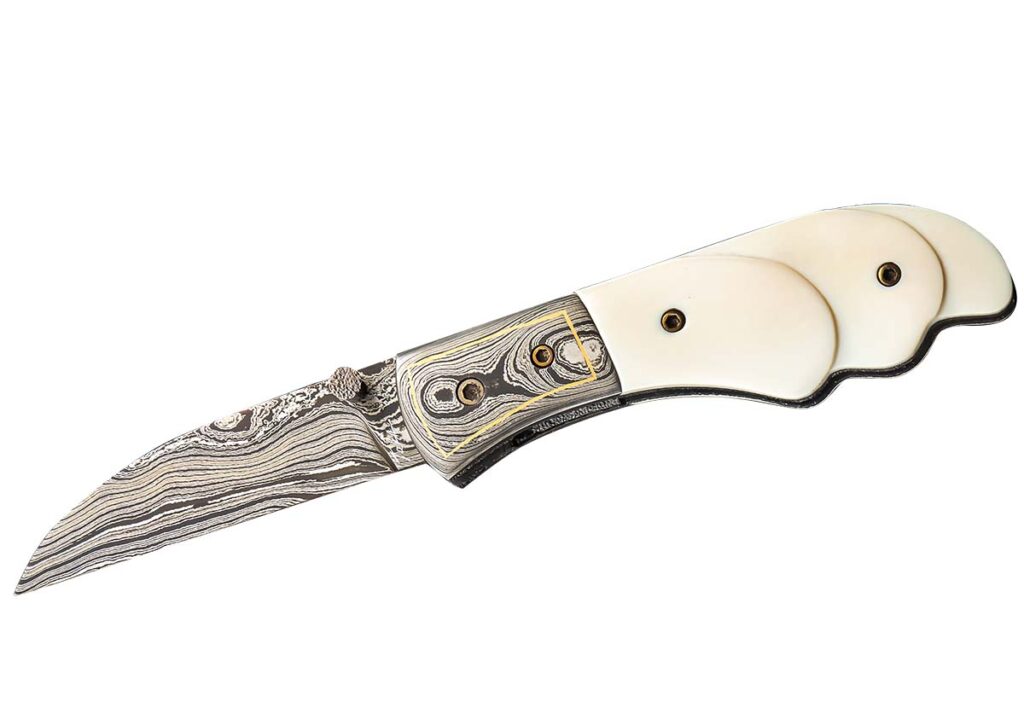
Blade length: 3.33” Blade material: Damascus Blade pattern: Clip point Blade opener: Nail pull Scales: Wood from one of the last walnut trees planted by President George Washington Bolster: Spring steel engraved by Jerry Fisk Maker’s price for a similar knife: $5,900 (includes a bottle of whiskey from George Washington’s Distillery) Knife to know: In 1999, Jerry Fisk was named a National Living Treasure by the Museum of World Cultures at the University of North Carolina at Wilmington Maker: Jerry Fisk (Jocelyn Frasier image)
Chris Richardson Lockback Folder
Blade length: 3.25” Blade steel: CPM 154 stainless Blade grind: Flat Blade pattern: Modified wharncliffe Handle inlay: Mammoth ivory Thumbstud inlay: Angelskin coral Bolster: 416 stainless in an integral construction Closed length: 4.75” Maker’s price for a similar knife: $850 Maker: Chris Richardson (Jocelyn Frasier image)
Recognition, catchiness and marketability are but three keys to knife names.
What’s in a name? A knife by any other name will still cut, hopefully. Many people don’t realize what hangs on a name. Is it good enough to be memorable, catchy as it were? A catchy name will make a knife more or less marketable.
If you’ve read my stories long enough, you’ve seen me comment on a knife’s name, especially if it is a long, drawn-out one. To me, it is important for the name to have a short form. For example, salespeople can’t sell a knife by word of mouth if they have to say the company name followed by Omega Kilroy Uber Cutter, Men In Black Forever Ever Sharp Cutting Commando, etc. When I was having knives licensed, the licensing companies would check to see if there were other knives on the market with the same name to avoid any copyright or other legal problems. They no doubt still do that.
I think now more than ever naming a knife would be even more difficult than designing one. After all, you can have numerous drop points but when you go to name your knife you don’t want it drowning in a sea of cutlery. With so many new knife companies out there, knife production is at an all-time high. How on earth do they make their knives stand out from the rest? One way is with the name. Following are some lighthearted ones.
RMJ Tactical Stabby Guy
The large finger loop in the handle butt of the Stabby Guy provides a great platform to support the knife in your hand and keep it from slipping during thrusting motions. The fuller helps maintain blade strength and reduces weight.
Stabby Guy Specs Overall Length: 7.25″ Handle length: 3.5″ Blade Length: 3.75″ Blade Steel: CPM 3V carbon Handle material: Black G-10, Dirty Olive Hyena Brown Sheath: Kydex MSRP: $240 Country Of Origin: U.S.A.
RMJ Tactical chose a name short and sweet for its Stabby Guy. I prefer—no, actually love—names like this. If you find yourself wandering off into multi-syllable diatribes for a name, you’ve lost me. Not only is Stabby Guy brief, it’s to the point, pun totally intended. It is what it says it is. I would call it a self-defense blade. It is slender in design and has an American-style-tanto tip. It is built solid, with the body of the knife having no primary edge.
A fuller runs full length on one side of the blade. The fuller allows the knife to keep its strength and still not weigh a ton. After all, this knife technically is equivalent to a tactical sewing needle. Save the fancy moves for Hollywood and put the machine on surge with the Stabby Guy. It has a simple, ergonomic, basically straight handle. A finger loop at the butt serves to anchor your grip and substitutes for the lack of a guard. A guard stops your hand from slipping forward while thrusting with the knife; the finger loop serves the same purpose.
Though there’s not a lot of edge, the knife need not be dead weight all day while you’re waiting for a prison riot to break out. The small but sharp edge can do a ton of minor chores. However, don’t expect to carve a chess set with it. It has a Kydex sheath equipped with a belt loop. I carried mine in my back pocket and forgot it was there. It’s a cool concept of a knife with a name that doesn’t leave you guessing.
Condor Tool & Knife Rude Boy Machete
The overall profile of the Rude Boy shows the sweet spot of the blade is a few inches back from the tip. The farther out the sweet spot, the more force it has during a swing.
Stabby Guy Specs Overall Length: 7.25″ Handle length: 3.5″ Blade Length: 3.75″ Blade Steel: CPM 3V carbon Handle material: Black G-10, Dirty Olive Hyena Brown Sheath: Kydex MSRP: $240 Country Of Origin: U.S.A.
Condor Tool & Knife’s aptly named Rude Boy Machete is made for light vegetation like that in a rain forest. Some machetes, on the other hand, are geared toward North American vegetation, such as hardwood or softer trees.
People often view a machete as a survival or bushcraft tool. Actually, it is more of a hiking tool with such primary uses as clearing walking trails through the jungle. For these endeavors the knives are often not razor sharp like many in North America believe. Maintaining a high level of sharpness would be next to impossible in such conditions and at best too time consuming. For that reason, a powerful swing with a thin, dull machete works well in dispatching vegetation. The Rude Boy is not only thin but lightweight, making it possible to swing for long periods. The well-constructed leather sheath has a pivoting belt loop to help avoid hanging up easily on vegetation.
The only thing I take issue with is the blade profile. The blade’s lengthy defined tip leaves the belly swell farther back from the end. My preference would be to have the widest part of the blade farthest out to get the most out of the swing. Don’t get me wrong, the Rude Boy worked well, but a long day of swinging makes you want to optimize a blade’s performance. Then again, you do want some variety in appearance.
The best feature is the handle. In profile it is pretty much the American military style, though there are some excellent ergonomics added to the design. The plastic handle is overmolded to create a hidden tang. Instead of being blocky the contours are smoothed out for a comfortable grip you can use for long periods. I like the Rude Boy and I can see me beating the snot out of it once yardwork season arrives.
Toor Knives Jank Shank S
The sharp point and clean grind lines of the Jank Shank S make it easy to see how the author was able to use it to clean 50 muskrats with minimal effort.
Jank Shank S Specs Overall Length: 7″ Handle length: 3″ Blade Length: 4″ Blade Steel: CPM M4 carbon Handle material: G-10 Sheath: Kydex MSRP: $250 Country Of Origin: U.S.A.
Out of the creatively named test models, I probably gave the Jank Shank S from Toor Knives the longest going over. I used it as an EDC but the bigger workout was when I took it to my sportsman’s club. Many in the tactical crowd promote rings in the handle butt for changing positions during combat, but I like them for the advantage they give while cleaning game. That’s right, cleaning game.
When cleaning animals I often find I want to free my hands to work with the carcass. Instead of putting the knife down, I let it dangle from my pinky. I do what needs to be done and then just move the knife into my grip. There’s no fiddling around; it’s quick, simple and no searching for where I put it down.
My club has an annual muskrat dinner, and depending on ticket sales we clean up to 400 muskrats. I cleaned 50 of the varmints with the Jank Shank S, including splitting open the chest and neckbone. Not once did I sharpen it. When done I cleaned it off, gave it a touch up and bam!—it was crazy sharp again. The textured G-10 scales made it easy to grip despite my hands being covered in blood. It worked so well the muskrats didn’t even complain. I liked it so much you won’t hear me grumble about the blade’s fur-catcher choil. Oh, and did those muskrats ever look good with fries and a side of deluxe baked beans! The sheath fits well with no break-in, period. I will add an UltiClip to the sheath and it will be an instant EDC. The Jank Shank S will make it into my game kit any time. Muskrats beware!
Name-Gamers
A name can add to the appeal of a knife by being entertaining. It is also important to have a good name to make the design stand out and be memorable. In the end you don’t want the name associated with a piece of junk, so it is always best to put the most effort into a great design. Our three name-gamers fill that bill.
A knifemaking trio with little to no ego keeps Suprlativ super.
If you’re going to carry a knife every day, then it should be functional and stylish, a joy to use and look at. Otherwise, what’s the point? That’s Enrique Peña’s design philosophy. In addition to owning Peña Knives, along with Jared Oeser and Javi Garcia he is one of three founding members of Suprlativ Knives. Suprlativ (pronounced like superlative) offers limited-edition folders in eye-catching designs, constructed with modern materials, artistic colorways and a machinist’s attention to mechanics—all at an affordable price.
How do three creatives run a knife company without conflict? Easy—no one’s ego is so tied to an idea that he can’t incorporate suggestions from the others. All three maintain their own companies, their homes for signature work, so when they come together to design for Suprlativ they can push boundaries. The diversification means there’s no stress when they work on collaborative projects.
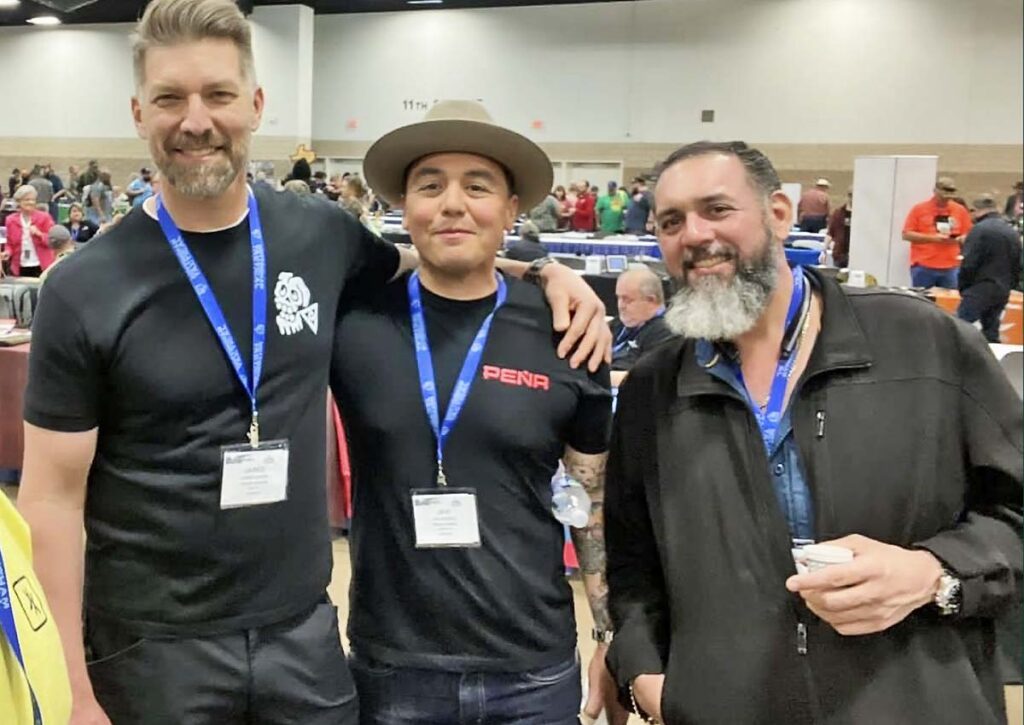
Suprlativ’s 3 Musketeers, from left: Jared Oeser, Javi Garcia and Enrique Peña.
As Garcia explained it, the mindset shifts to, “What can we make that would nurture the community?”
Enrique Peña
Peña is an associate of the South Texas Slipjoint Cartel. For the uninitiated, the cartel is a group of knifemakers that got together to honor BLADE Magazine Cutlery Hall-of-Fame® member Bill Ruple, each making a knife in the Ruple style. Bill, in turn, began sharing his knowledge with them, inviting them to his shop and answering questions by phone and email. He has been making knives since 1988 and is a master at multiblade slipjoints.
He sat on the board of the Texas Knifemakers and Collectors Association, the predecessor of the Texas Knifemakers Guild. Other Cartel members—all serious about preserving traditional knifemaking—include Bruce Barnett; Tanner Couch; Tommy “Bubba” Crouch; Burt Flanagan; Jeff Hawkins; Tobin “Toby” Hill; Bobby House; Matt Humphries; Phil Jacob; Tom Ploppert; Tim Robertson; Kendall Schorsch; Tyler Turner; Trae Gaenzel; Roan West; Rusty Preston; and Luke Swenson.
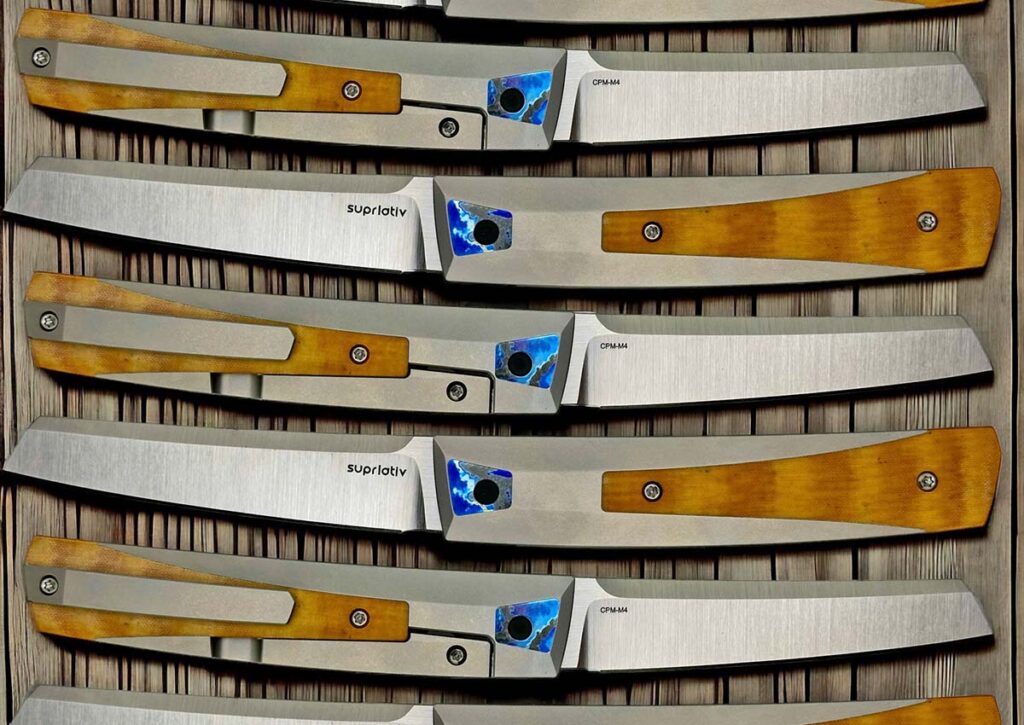
A swayback look complemented by a modified sheepsfoot blade highlights the Tirant. Blade length and material: 3 inches and CPM M4 carbon steel. Blade opener: Front flipper. Blade grind: Flat. Pivot: Ceramic caged bearings and detent. Frame: 6Al-4V Grade 5 titanium. Handle: Linen Micarta®. Weight: 3.4 ounces. Closed length: 4 3/8 inches. Country of origin: China. MSRP: $298.
In 2008, Peña was laid off from his job as a diesel mechanic and turned his knifemaking hobby into a full-time endeavor. He simply drove to Ruple’s house, knocked on the door and asked to learn knifemaking. Bill began mentoring Peña and credits him with being a quick learner. Ruple shared more than his craft; he guided Peña with business wisdom as well, which ensured the success of Peña Knives.
Peña’s X-Series offers the design and mechanical excellence of his custom knives in a more affordable production knife. Whether traditional or tactical, Peña’s fit and finish displays a respected exactitude. He maintains that clean, crisp, simple designs are harder to master because you can’t hide mistakes with bells and whistles. For example, to the experienced eye, grinder marks, or the lack of them, reveals something about the maker. Hand rubs take time. Peña, if you couldn’t tell, is a traditionalist.
Jared Oeser
Around three years after Peña took to knifemaking full time, Jared Oeser, owner of Oeser Knives, did the same. A building developer by trade and with little to do during the 2008 recession, he looked to his knifemaking hobby as a potential moneymaker. He said his wife can attest to the fact that his stress level plummeted during this time. Making knives provided an outlet for a creativity he had possessed since boyhood but couldn’t concentrate on as a profession except through designing houses.
Suprlativ’s 3 Musketeers, from left: Jared Oeser, Javi Garcia and Enrique Peña.
He asked his friend, fellow Salt Lake City resident and longtime knifemaker Dave Lang, to help him make knives. Lang swapped knifemaking ideas with the likes of Bob Loveless, Buster and Julie Warenski (now Warenski-Erickson) and Earl Black (Loveless and Buster are Cutlery Hall of Famers). Oeser’s father always carried a knife and brought his son up hunting, fishing and camping, traditions that Oeser passes on to his children.
Oeser’s first knives were bushcrafters. He couldn’t find exactly what he wanted—a bushcrafting knife that was both functional and good looking—so he made one. He and Peña communicated now and again, exchanging ideas and figuring out problems together. Now, though Oeser’s custom knives normally sell for around $1,000, some can go for over $10,000. In other words, he found his creative outlet and realized that the knife-art market still exists.
Prior to Suprlativ, he held a three-year contract with Benchmade, designing its Tengu and Tengu tool, so his design abilities have received praise from both collectors and industry giants.
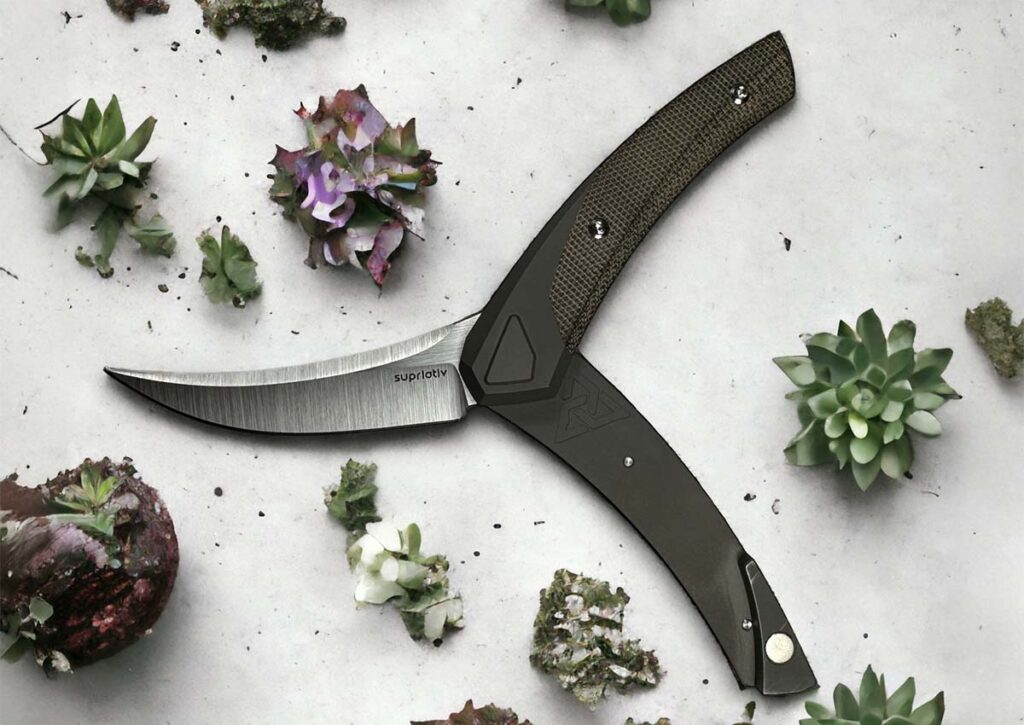
The fully serrated blade of the Piranha deploys via a Rare Earth Magnet Lock. Blade material: CPM M4 carbon steel. Pivot: Bronze washers. Frame: 6Al-4V Grade 5 titanium. Handle: Brown canvas Micarta®. Weight: 2.1 ounces. Closed length: 3.76 inches. MSRP: $284.
Though Peña lives in Laredo, Texas, and Oeser in Lehi just outside Salt Lake City, and Peña is a staunch traditionalist and Oeser blurs the lines between traditional mechanisms and modern frames and furniture, the two had a working relationship that grew into a friendship.
Javi Garcia
Enter Javi Garcia. Formerly of South Texas and now living in central Texas, Javi first was a Peña customer, then a potential hire, then a friend and mentee. The two socialized together with their families, compatible in their shared Mexican heritage. Even though Garcia’s design approach is decidedly modern, Peña could appreciate his style.
Javi knew that Enrique was a master of knife mechanics, taking Garcia’s ideas and showing how they could be brought to fruition. Garcia began to share ideas with Oeser, too. He found himself going between the two veteran makers and telling each how the other approached a design idea or challenge. During these exchanges, the idea developed that the three of them start a separate company. Peña credits Garcia with bringing the three together to form Suprlativ.
How Suprlative Operates
Javi Garcia’s last-minute decision to enter the Canibl Phantom Lock resulted in Suprlative taking home Best Custom Knife Collaboration at BLADE Show 2024. The 3 1/8-inch blade is hollow-ground CPM MagnaCut stainless steel. Closed length: 4 inches. (Jocelyn Frasier image)
The men knew they could bring knives to the market that got the job done expertly and looked really good doing it, knives of high quality, high tech and high precision. Garcia and Oeser are extremely creative, and Peña’s hands-on skillset is, well, superlative. Garcia says Peña is more creative than he thinks he is. And that’s the way it is with these three.
They are endlessly encouraging and positive with each other. In a situation where three chiefs and no Indians could seem problematic, Garcia explained that the collaboration works because they relate to each other with positivity, respect and warmth. They reserve their individual knifemaking styles for their independent work and let loose with ideas for Suprlativ.
Part of the contentedness and success is that Suprlativ designs come from all three knifemakers, including Peña. It’s an equal contribution of creativity. “The designs never start in the same place,” Garcia said. It’s fluid. Once the design is finalized, Peña initiates contact with what’s considered the fourth member of the group: Reate.
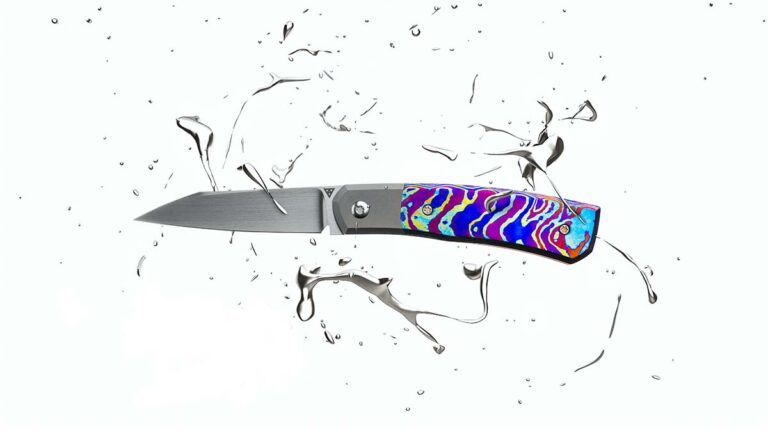
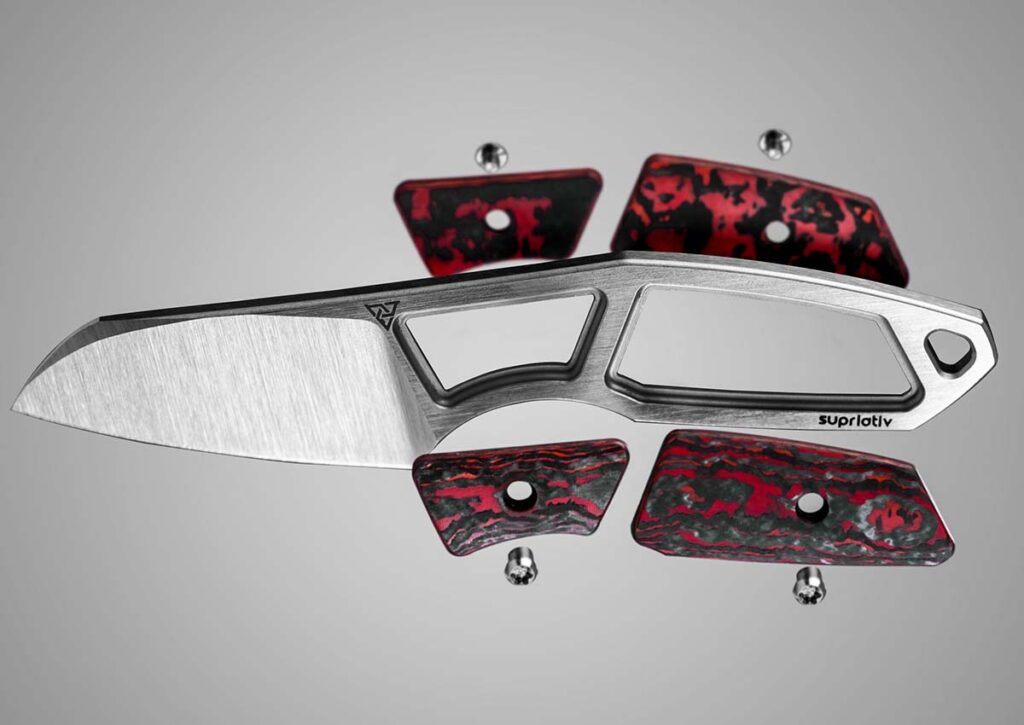
The home-page image for Suprlativ’s website, an exploded view of the Hella showcases one of its various inlay options—carbon fiber—and a 2.07-inch blade of flat-ground Böhler M390 Microclean stainless steel. Weight: 1.2 ounces. Frame: 6Al-4V Grade 5 titanium. Closed length: 2.88 inches. Sheath: Premium vegetable leather. Country of origin: China. MSRP: $194.
Peña already had a relationship with Reate Knives, the high-end Chinese original equipment manufacturing (OEM) operation that makes knives for other companies. Peña said that Reate offers the highest quality production and is also more costly, but not exorbitantly so. Plus, Reate officials never seem to say no, he noted. For its part, Reate considers any deviation from the norm as a way to learn how to incorporate new production procedures. The company reportedly considers Suprlativ’s vision to be unique.
Steel choices depend on what Reate can get in stock, but M390 and CPM 154 stainless and CPM M4 carbon steels all have been used in prior releases. The most recent order will be in CPM MagnaCut. Handle materials include a mixture of titanium, carbon fibers and Micarta® with shield inlays—a nod to tradition—and come in an artistic array of color patterns. Each run is different, never just a colorway change. Peña, Oeser and Garcia determined early not to chase steel or frame material fads since it can take upward of a year to receive an order.
At the last minute during BLADE Show 2024, Garcia decided to enter the Suprlativ Canibl Phantom Lock in the custom knife competition. Once the three determined the design, Oeser cut the parts, did the precision grinding, fit the locks—every type of lock is on the table at Suprlativ—did the surface grinding and ensured the knife was functional.
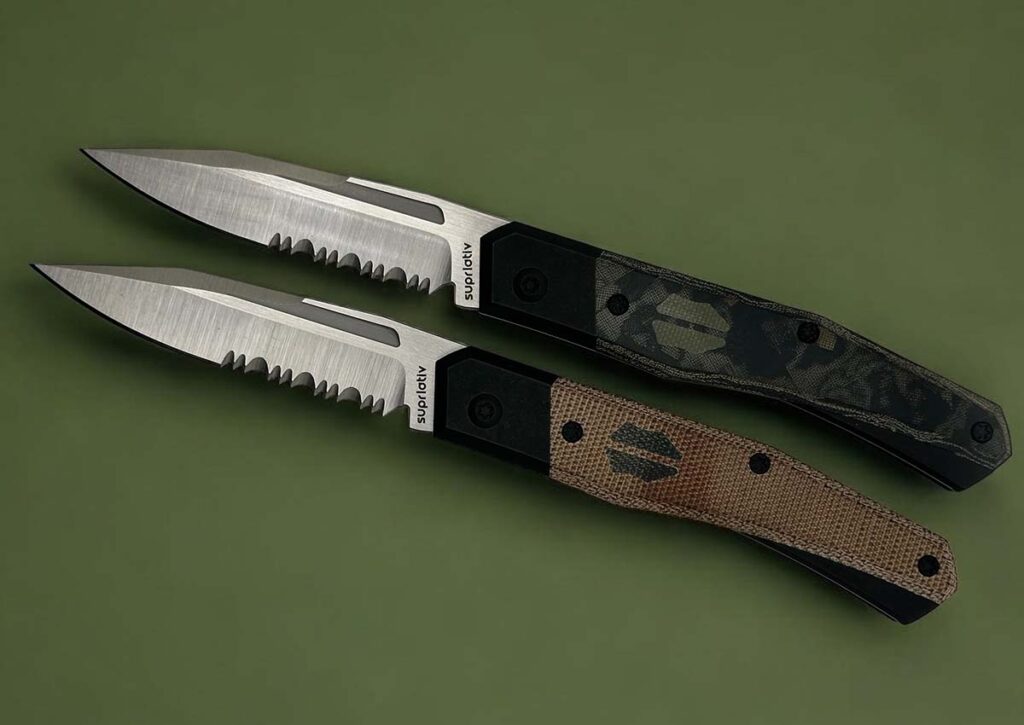
The Cruzador slipjoint has a 3.224-inch semi-serrated/nail-nick-fullered blade of flat-ground CPM M4 carbon steel and a 6Al-4V Grade 5 titanium frame. It also comes in a plain edge. Blade pattern: Clip point. Handle material: Jungle Wear Fatcarbon® ($274 (top) and brown canvas Micarta® (bottom). Weight: 3.3 ounces. Closed length: 4.25 inches. Country of origin: China. MSRPs: $274 each.
Garcia did the blade grinding; he’s the youngest and is humble enough to take on the difficult and time-consuming part of the job, which is just one more example of the goodwill dynamic between the three. Then the knife went to Peña for hand-rub finishing, shield inlay and blade edging. It was an equally shared labor of love.
The effort paid off. The Canibl Phantom Lock won Best Knife Collaboration. The men each expressed surprise, excitement and a sense of validation that what they set out to accomplish resonated within the community. Their collaboration, peaceable interactions and professionalism obviously generated increased creativity for them, loyalty from customers and now well-deserved notice and approval from knifemaking standard-bearers.
How the iconic custom maker transformed pocketknives and the knife industry.
The story of the knife is one of evolution, with thousands upon thousands of steps along the way. When you boil it down, however, it’s really just the passing of knowledge gained from one individual to the next. One who earned an immortal slot in that incredibly long span of time is BLADE Magazine Cutlery Hall-of-Fame® member Tony “Old Dog” Bose.
Born of humble beginnings, Tony suffered the loss of an eye at an early age—a setback for anyone, though especially a craftsman—and grew up in Indiana far from any cutlery center. Nonetheless, what he did have was a job repairing knives, and that was all the springboard he needed to launch him into becoming a highly revered custom knifemaker.
Tony produced his first custom knife in 1975 and by 1990 was going full steam—this while the Gulf War was inspiring the modern tactical knife movement. But he had his own plans and continued to gain popularity with the traditional slipjoint crowd, a popularity that surged throughout his knifemaking career. He had a huge impact in his day, not only for the sheer quality of his work and innovative styling, but for his lasting contributions to both the custom and factory knife industries.
Tony Bose As Mentor
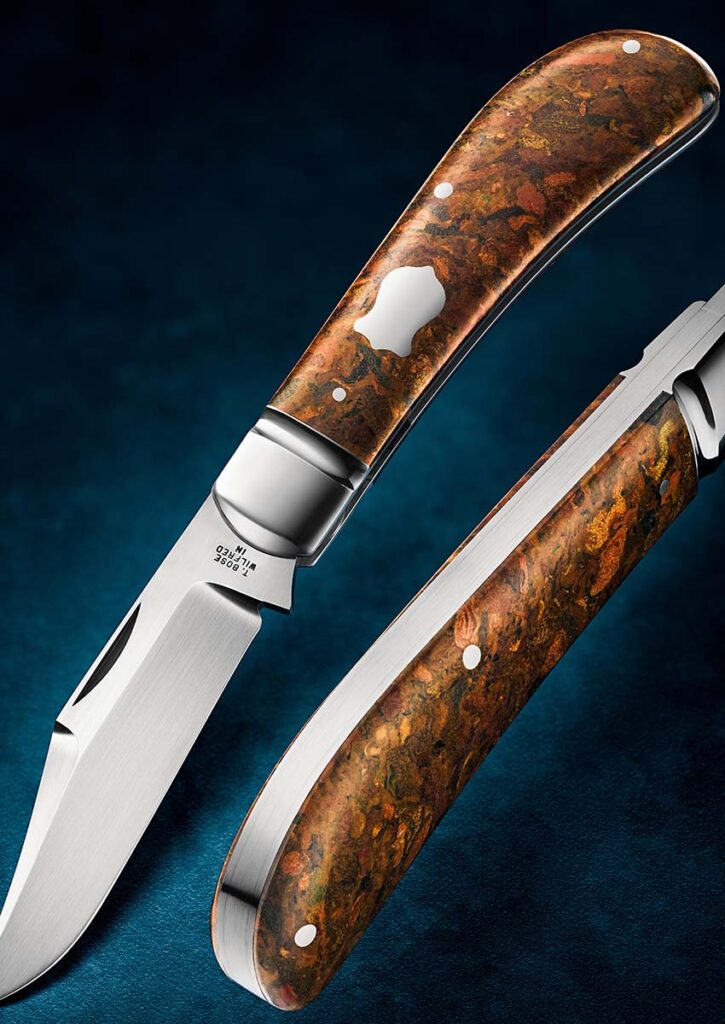
Another of Tony’s slipjoint standards is the Lanny’s Clip. “In 1989 I met a good ol’ boy named Lanny Shell,” Tony wrote. “He asked me to make him a knife between 3¾ and 4 inches closed for heavy work with a clip blade in it. I didn’t know what to call it, so I called it Lanny’s Clip.” (Caleb Royer image)
One way to judge a master craftsman is by the people he taught.
“I first met Tony at the Guild Show in Florida,” notes Cutlery Hall-of-Famer Bill Ruple, a knife legend in his own right. “I had just begun making knives and when I saw what he had on his table I was blown away! Before that I was making folders and a few fixed-blade knives. After seeing his work I focused on multi-blades. As time went on, we became great friends. One of my biggest regrets was not taking time to go and visit him. He invited me many times.
“Any time I had a problem, Tony was there to talk me through it. I’d always pick what I considered to be my best knife and have him critique it at the BLADE Show. He set the standard for all of us multi-blade makers. Reese [Tony’s eldest son] is continuing to set that standard today. I was just one of many who benefited from Tony’s generosity to share his knowledge.”
ABS master smith Harvey Dean, who makes top-notch slipjoints in addition to his award-winning fixed blades, has fond memories of Tony’s mentoring and friendship.
“I met him around 1993 at the New York Custom Knife Show,” Harvey recounts. “He had quite a few slipjoints for sale, and if I recall they did not last long [before they sold out]. I remember most of the people that bought them had memories of carrying his type of knives many years ago. Tony brought them back into popularity.
“Tony’s influence, I think, was his approach to making slipjoints. His grinds, swedges and the function of the knife were all spot on. His handle material was always exceptional. For me, Tony’s generosity in sharing his knowledge was the most important thing. I could call Tony anytime for help and he always helped me out. I still have, I think, three patterns Tony made for me, mailed them to me, and would not take any payment for them.”
Tony did the same for Ruple and ABS master smith Steve Dunn. “Tony sent me many patterns over the years and never charged me a penny,” related Dunn, who passed away last year. “He will go down in the books as the best slipjoint maker ever.”
At a BLADE Show circa 2010, Ruple told Tony his favorite knife ever was the Bose saddlehorn trapper.
“After the show I received a package from Tony,” Bill writes. “Inside were two different-sized saddlehorn trapper patterns. He had hand ground them! That’s the kind of guy Tony was. He was a kind, generous gentleman, always willing to share his vast knowledge of knives.”
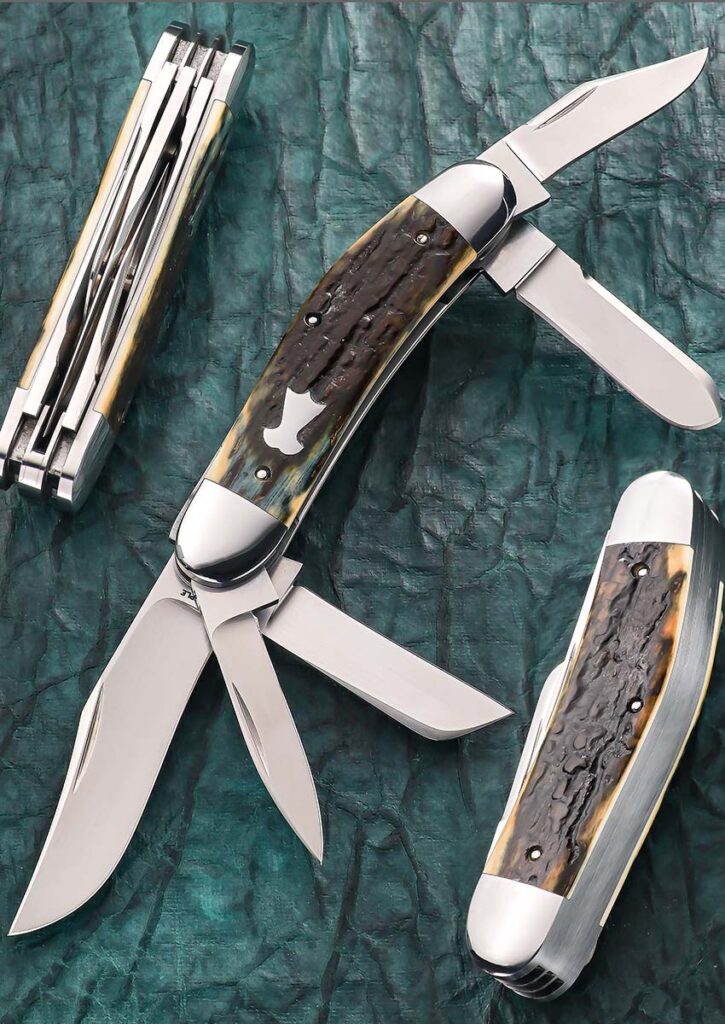
One look at Tony’s knives at a Knifemakers’ Guild Show and Cutlery Hall-of-Famer Bill Ruple started focusing on making multi-blades. The rest is history, including Bill’s five-blade sowbelly. (SharpByCoop knife image; image of Ruple by Chris Wellhausen)
One of Tony’s greatest achievements, in his own words, was teaching his son Reese to make folding knives. Tony commented on mentoring him in about as strong a statement as it gets.
“I have helped a lot of guys figure out how to make pocketknives,” he noted, “but Reese is the only one I have taught.” Today, Tony’s son is considered one of the world’s best slipjoint makers.
Reese has fond memories of his father.
“When I’m asked about Tony, a few things come to mind: generosity, influence and impact,” Reese says. “Tony’s generosity with his time and knowledge were truly something special. I can’t even begin to count the number of phone calls we had over the years. I do remember one of our first conversations when Tony told me, ‘Boy, you are gonna have to learn swedge work.’ He was always ready to give advice about knifemaking and even the day-to-day of running a knife business.
“Many makers went in and out of his doors with no money ever exchanging hands. It was this time spent sharing advice, knife patterns, and even loaning out vintage knives that illustrated the influence Tony will continue to have in the knifemaking world.”
Tony Bose & Case Knives
The knife collaborations Tony did with W.R. Case & Sons increased the awareness of and interest in the company to much higher levels, even during times when the cutlery world was consumed with tactical fare. His was also a constant presence at assorted Case collector events for knife enthusiasts of all ages, giving seminars, meeting and greeting all in attendance, etc.
His contributions were such that on July 14, 2023, he became the first person in over 20 years to be honored with a Wall-Of-Fame induction ceremony at the W.R. Case & Sons facility in Bradford, Pennsylvania. The induction included a plaque of Tony installed on the Wall Of Fame in the Zippo/Case Museum. Tony’s son Reese, Bill Ruple and others were on hand for the event.
Fred Feightner, Case director of marketing communications, remembers the early years in 1999 when Case hired Tony as a designer to elevate the company’s folding knives to a greater level of quality and relevance.
One of Tony’s greatest achievements, in his own words, was teaching his son Reese to make slipjoints. “I have helped a lot of guys figure out how to make pocketknives,” Tony noted, “but Reese is the only one I have taught.” From the looks of his son’s five-blade congress pattern, Tony taught Reese well. (Eric Eggly/PointSeven image)
“My first one-on-one interactions with Tony came nearly 20 years ago as a result of an assignment I was given by Tom Arrowsmith, our company president at the time,” Fred recalls. “I had only been with the company a couple of years, so I was pretty new to the knife industry with very little exposure to the world of custom knives. The assignment was to produce an eight-to-10-minute video about Tony to support the introduction of the swayback pattern, our latest online edition of our Case-Bose series.
“Naturally, I was excited to be traveling to meet this famous knifemaker. So, with stars in my eyes, off I went to Tony’s shop in Indiana. The address I was given took me to Tony’s house. Once there, I was surprised to learn this superstar was making his impeccable knives from inside his attached garage. Tony came out to meet me and took me inside, showed me around the shop a bit, and introduced me to his son Reese, who was situated in a far corner. Then Tony offered me a cup of ‘cowboy coffee,’ which turned out to be coffee boiled in a camp pot and kept warm over a hot plate that was within easy reach from his desk all day.
“Over the next two days I would be treated to the most in-depth knifemaking tutorial series one could only imagine,” Feightner exclaims. “Being an eyewitness to the painstaking care that Tony took in preparing even a single knife for one of his customers was truly awe inspiring. I still recall watching him hunched in his shop chair, sanding down knife parts by hand for hours until they fit to perform perfectly when assembled. He was such a patient teacher! It was never a problem for him to answer questions while he was working away. That visit really provided me with the foundation I needed to do my job better as a Case marketing communicator.”
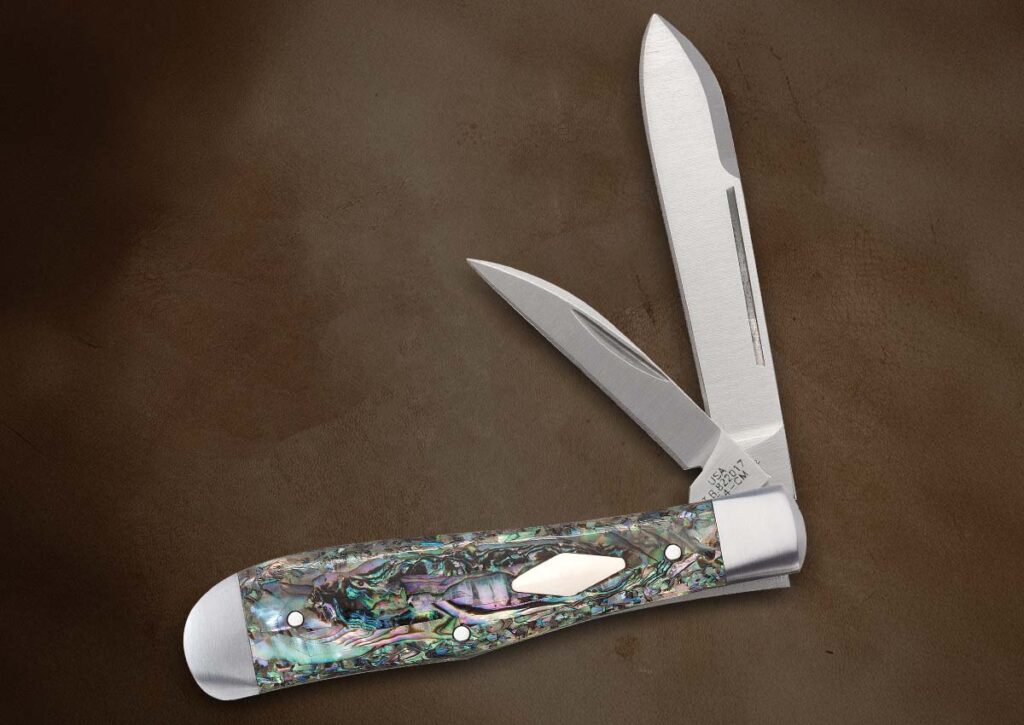
Tony collaborated on knives with Case for two decades, including this Eureka jack in abalone and 154CM stainless steel in 2017. (Case image)
Tony’s collaborations with Case worked like magic. His upscale Case XX limited editions, delivered in signed brown leather zipper pouches, are some of the finest pocketknives ever produced by the company—or any company for that matter—and his Bose-branded boxed knives are highly collectible.
His signature Lanny’s Clip, designed for a friend, has become legend among both custom folder makers and Case collectors alike. Tony passed away in 2020, only one year after being inducted into the Cutlery Hall of Fame, but his imprint on the cutlery industry will last as long as his knives walk and talk—which will be a long, long time.