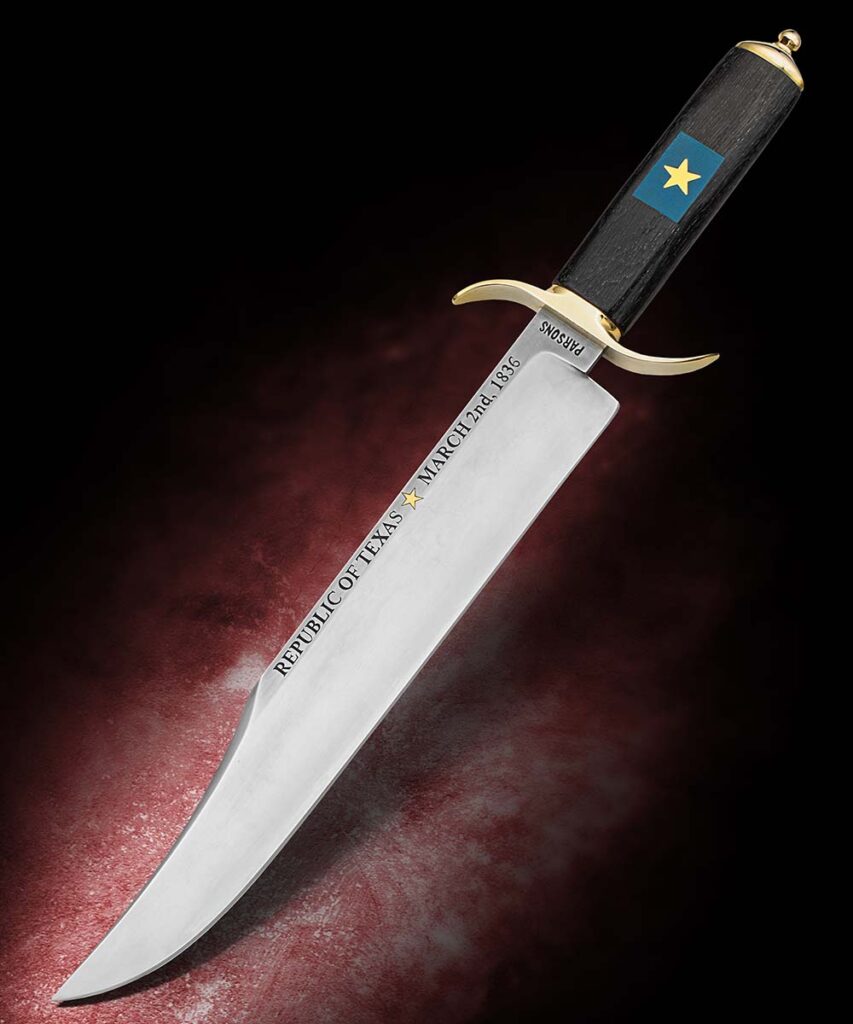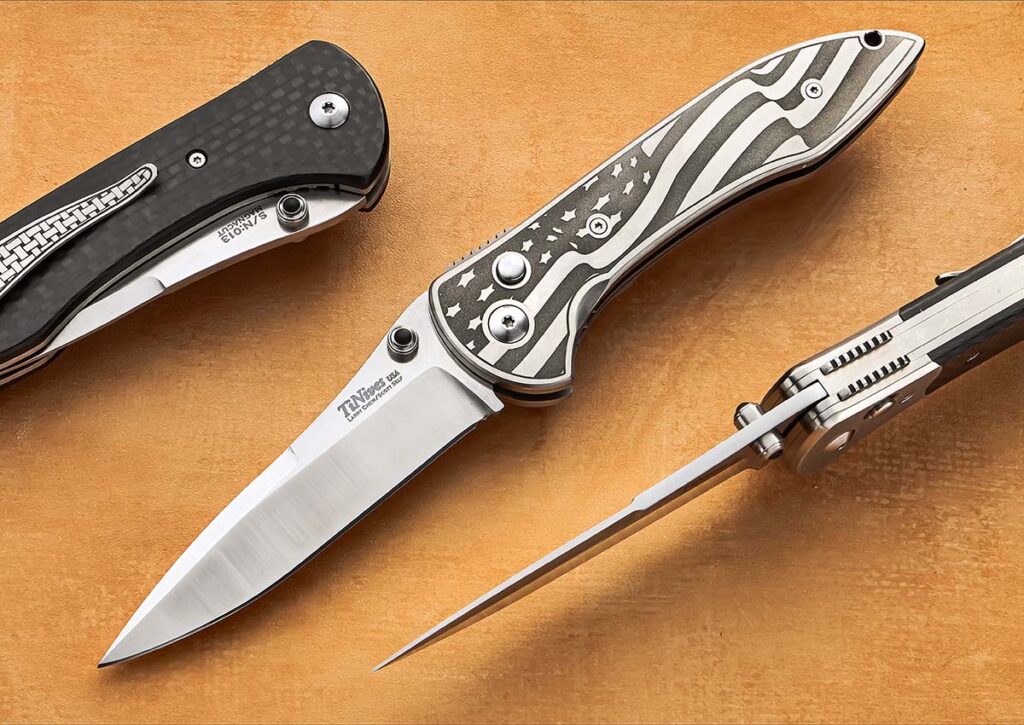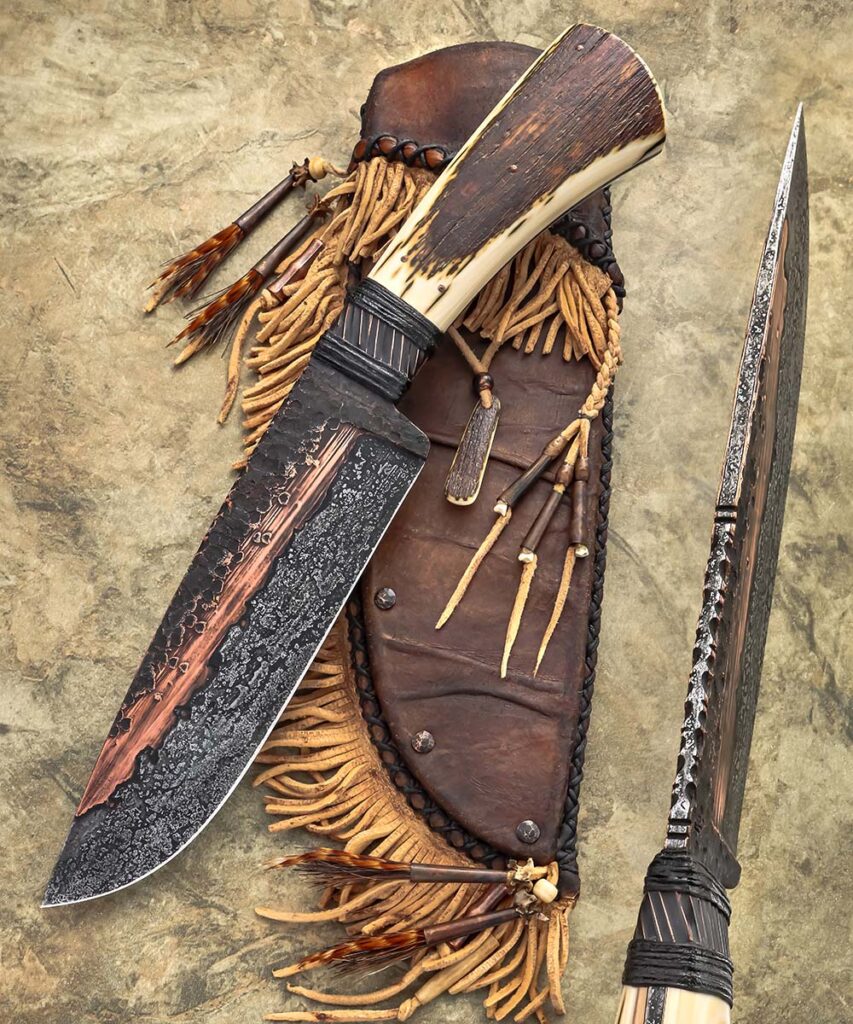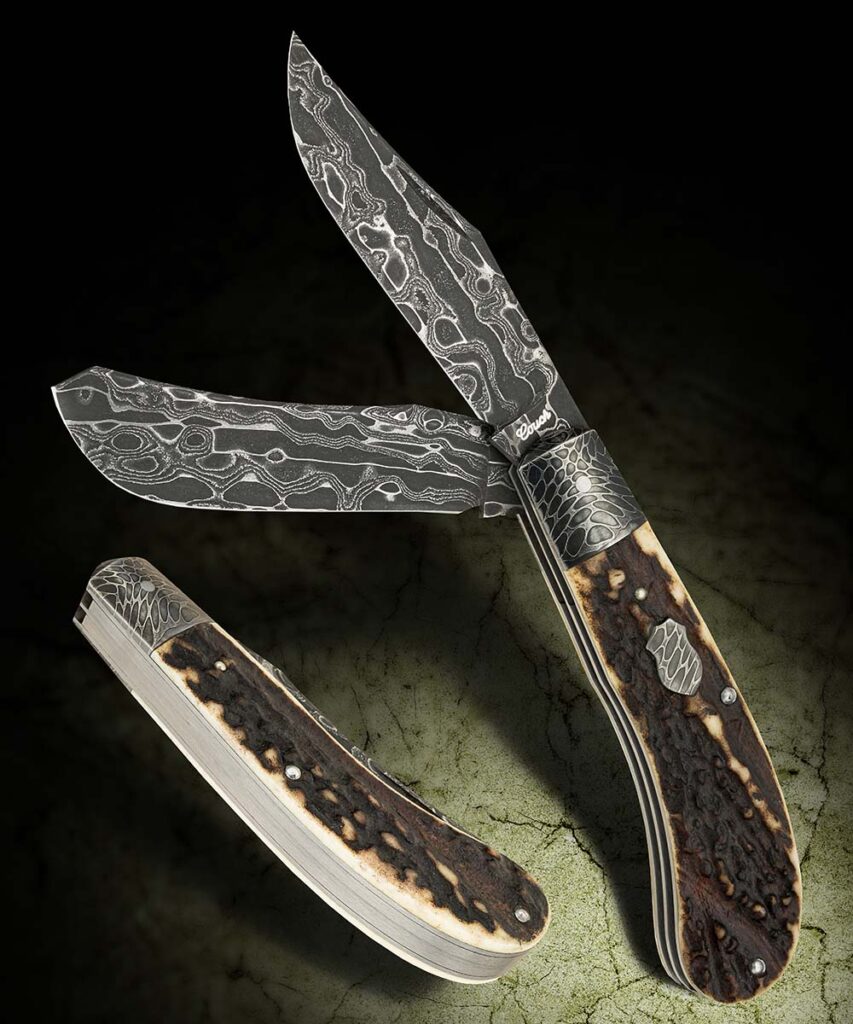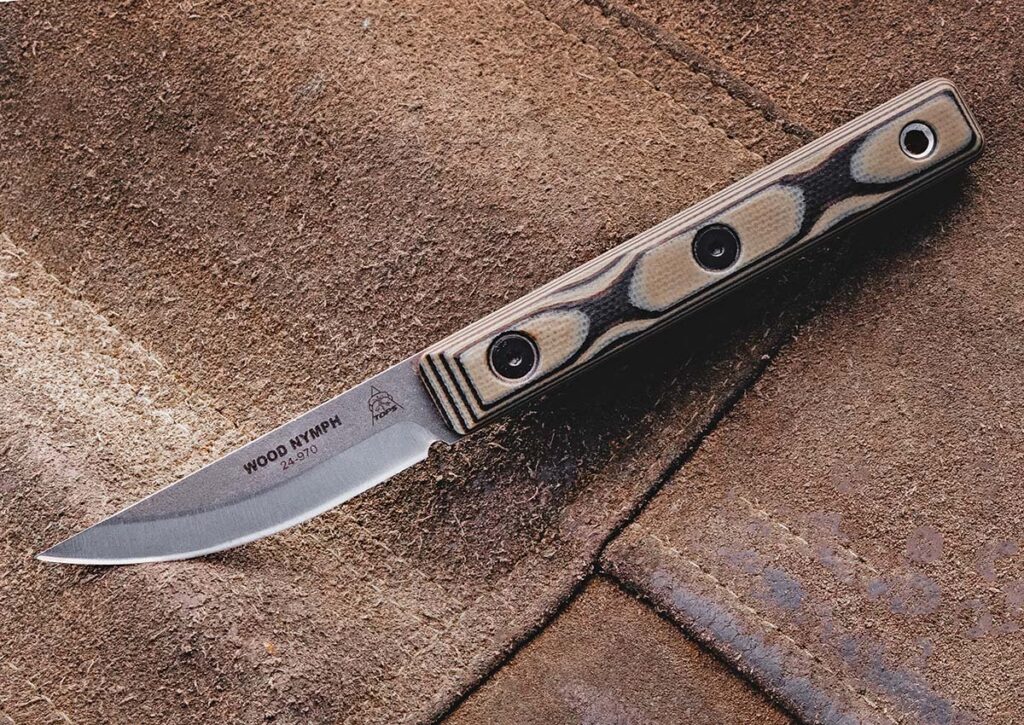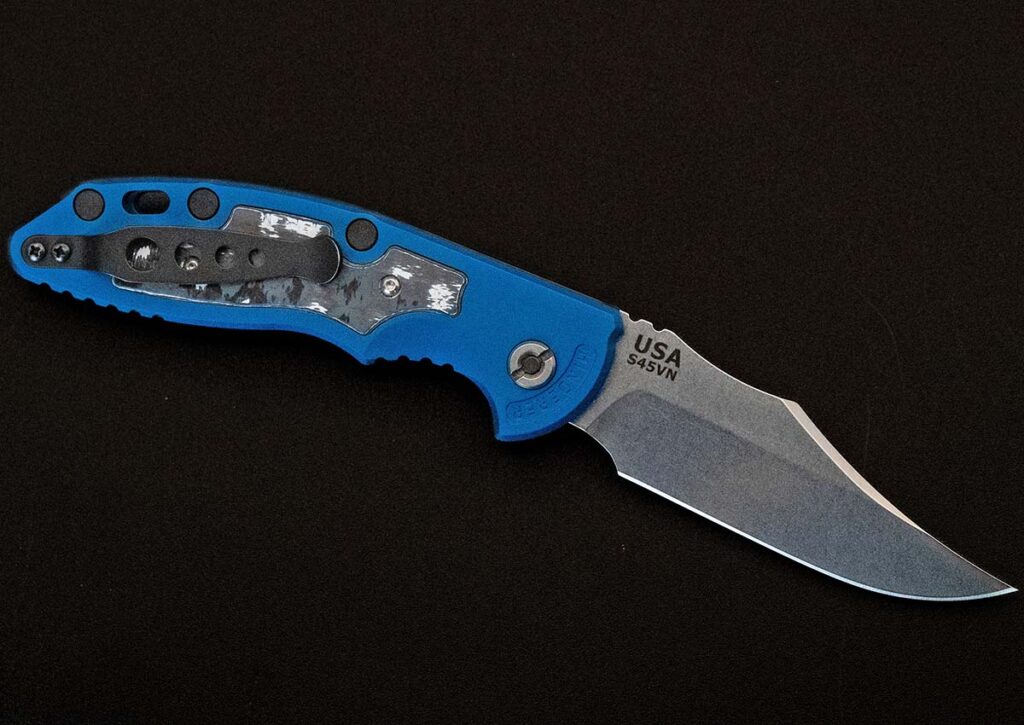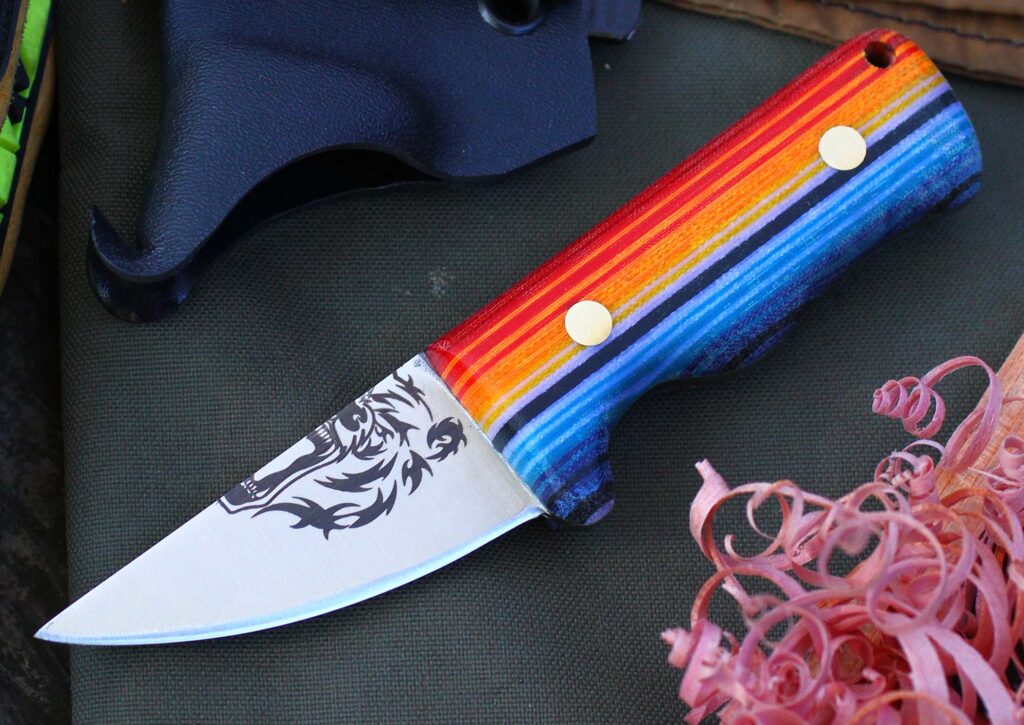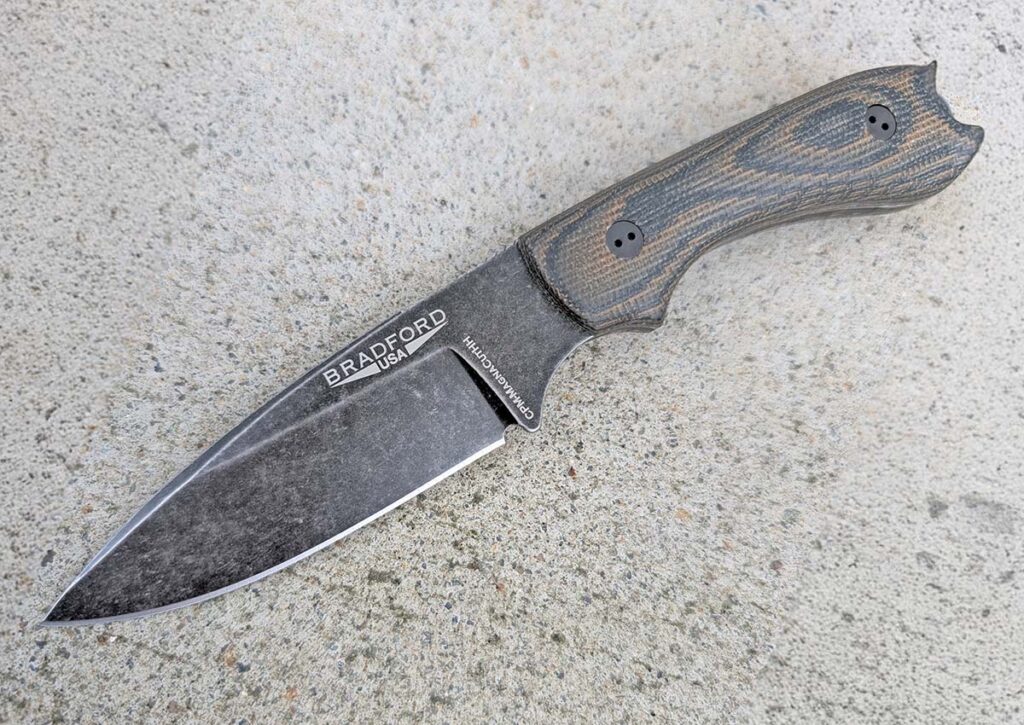
What’s on the menu this month? A bevy of new kitchen knives–both factory and custom.
With the big holidays ahead, we’re heading into the thick of eating season. In turn, it might be time to up the game of your kitchen tools. We have selected a bevy of new custom and factory kitchen knives to show off this month, which only leaves the question—what’s on your menu?
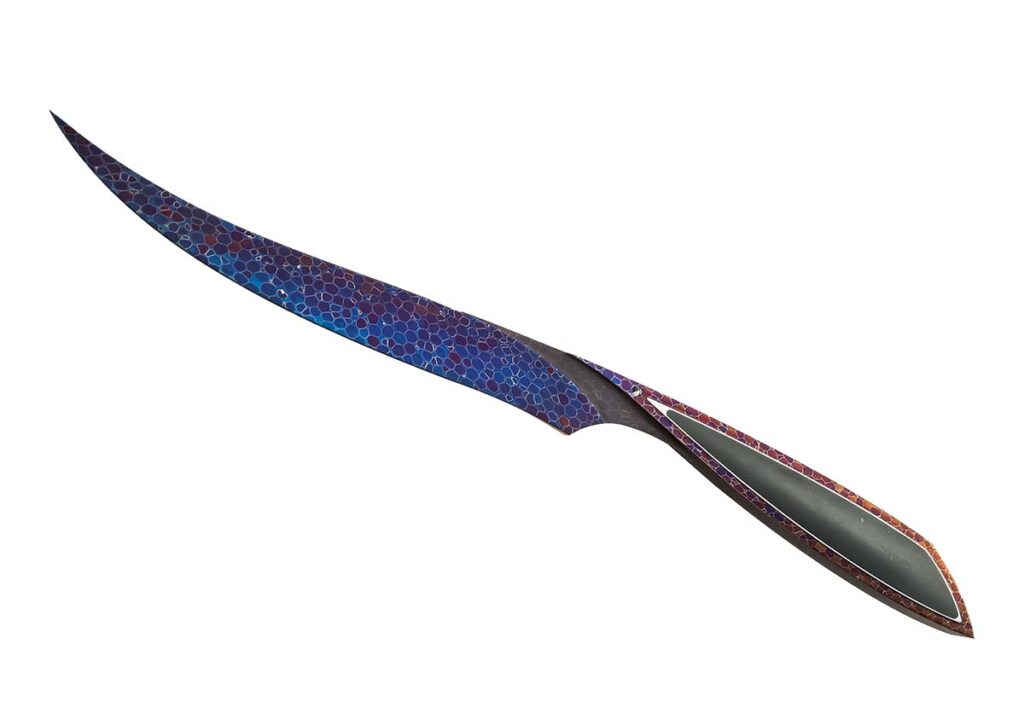
Gabe Fletcher and Don Nguyen Slicer
KNIFE TYPE: Slicer BLADE LENGTH: 17.25” BLADE MATERIAL: Damascus of 1080 carbon and 15N20 nickel-alloy steels BLADE GRIND: Convex w/a fuller HANDLE MATERIAL: Carbon fiber and G-10 OVERALL LENGTH: 23.25” MAKERS’ PRICE FOR A SIMILAR KNIFE: $8,000 KNIFE TO KNOW: The knife is a collaboration between Gabe Fletcher and Don Nguyen; Gabe forged the damascus and the blade, and Don finish ground it and made the handle; Gabe also made a special beer called Nguyen for the collaboration through his Anchorage Brewing Co.; Gabe is an ABS apprentice smith MAKERS: Gabe Fletcher and Don Nguyen, (Jocelyn Frasier image)
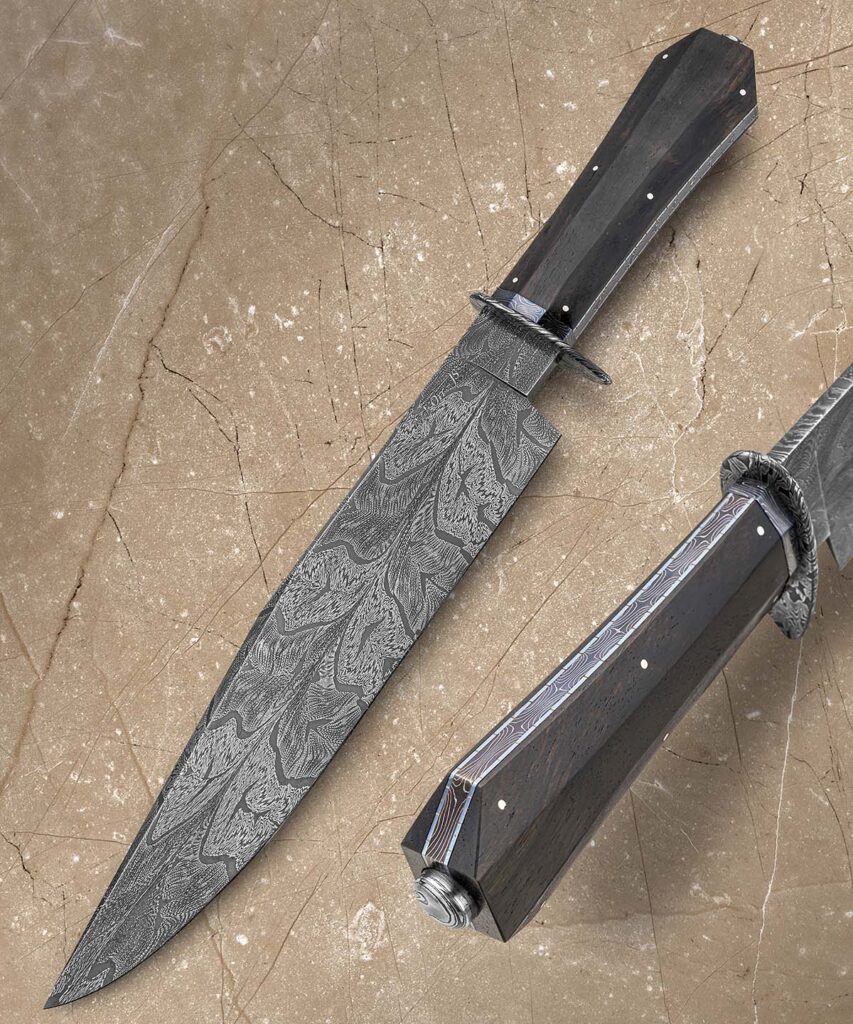
DP Custom Knives Chef’s Knife
PATTERN: Chef’s knife MODEL NAME: Honyaki gyuto BLADE LENGTH: 9.45” BLADE MATERIAL: W2 tool steel BLADE GRIND: “S” type BLADE FINISH: Hand-sanded satin HANDLE MATERIAL: Ukrainian bog oak BOLSTER MATERIAL: Antique Westinghouse Micarta® and copper OVERALL LENGTH: 15.95” KNIFE TO KNOW: The maker’s Honyaki Gyuto won Best Chef’s Knife at the 2024 Sydney Knife Show MAKER’S PRICE FOR A SIMILAR KNIFE: $1,546 at press-time exchange rate MAKER: Dmitriy Popov, DP Custom Knives, dpcustomknives.com.au, (Rod Hoare image)
Jonas Blade & Metalworks Senshi
KNIFE NAME: Senshi PATTERN: Chef’s knife BLADE LENGTH: 9.25” BLADE MATERIAL: Damascus of 1084 carbon and 15N20 nickel-alloy steels DAMASCUS PATTERN: River of Fire + twist BLADE GRIND: Flat w/a convex edge HANDLE MATERIAL: Black stabilized amboyna BOLSTER: Micarta® and brass OVERALL LENGTH: 14” KNIFE TO KNOW: The maker is an ABS master smith MAKER’S PRICE FOR A SIMILAR KNIFE: $4,600 MAKER: Zack Jonas, Jonas Blade & Metalworks, (SharpByCoop image)
Brent Stubblefield Chef’s Knife
PATTERN: Chef’s knife BLADE LENGTH: 12” BLADE MATERIAL: Mosaic damascus BLADE GRIND: “S” type HANDLE MATERIAL: Desert ironwood BOLSTER: Fine silver OVERALL LENGTH: 17.5” MAKER’S PRICE FOR A SIMILAR KNIFE: $2,400 MAKER: Brent Stubblefield, joinordieknives.com, (SharpByCoop image)
Alexandre Chaves Chef’s Knife
PATTERN: Chef’s knife BLADE LENGTH: 9.75” BLADE MATERIAL: A damascus of 1084 carbon and 15N20 nickel-alloy steels ROCKWELL HARDNESS: 60 HRC BLADE GRIND: Convex BLADE FINISH: Contrast etched w/Gator Piss etching solution HANDLE MATERIAL: Elforyn synthetic ivory; filework inlaid w/crushed natural Shattuckite and contrasted w/gold resin BOLSTER MATERIAL: 9,000-year-old bog oak w/purple maple spacer OVERALL LENGTH: 14” MAKER’S PRICE FOR A SIMILAR KNIFE: $3,000 KNIFE TO KNOW: The blade features a K-tip, aka kiritsuke tip, designed for precision and versatility in fine slicing, dicing and scoring, as well as more delicate work such as preparing fish and fine cuts of meat; the knife is a wedding present for the maker’s little sister MAKER: Alexandre Chaves, (Jocelyn Frasier image)
Modern Cooking UG Chef’s Knife
PATTERN: Chef’s knife BLADE LENGTH: 9.25” BLADE MATERIAL: Damasteel DS93x dense twist pattern stainless steel BLADE GRIND: Convex BOLSTER: Integral forged HANDLE MATERIAL: Redwood lace burl and copper OVERALL LENGTH: 10.4” SHEATH: Redwood lace burl and copper MAKERS’ PRICE FOR A SIMILAR KNIFE: $2,775 at press-time exchange rate KNIFE TO KNOW: The knife is a collaboration between Naohito Myojin of Japan and European Jonas Johnsson; Johnsson did the forging, profiling, handle and saya (scabbard), and Myojin ground the blade; Modern Cooking organized the collaboration in partnership with Bonsai Boys Trading MAKERS: Naohito Myojin and Jonas Johnsson, Modern Cooking UG, moderncooking.com, (SharpByCoop image)
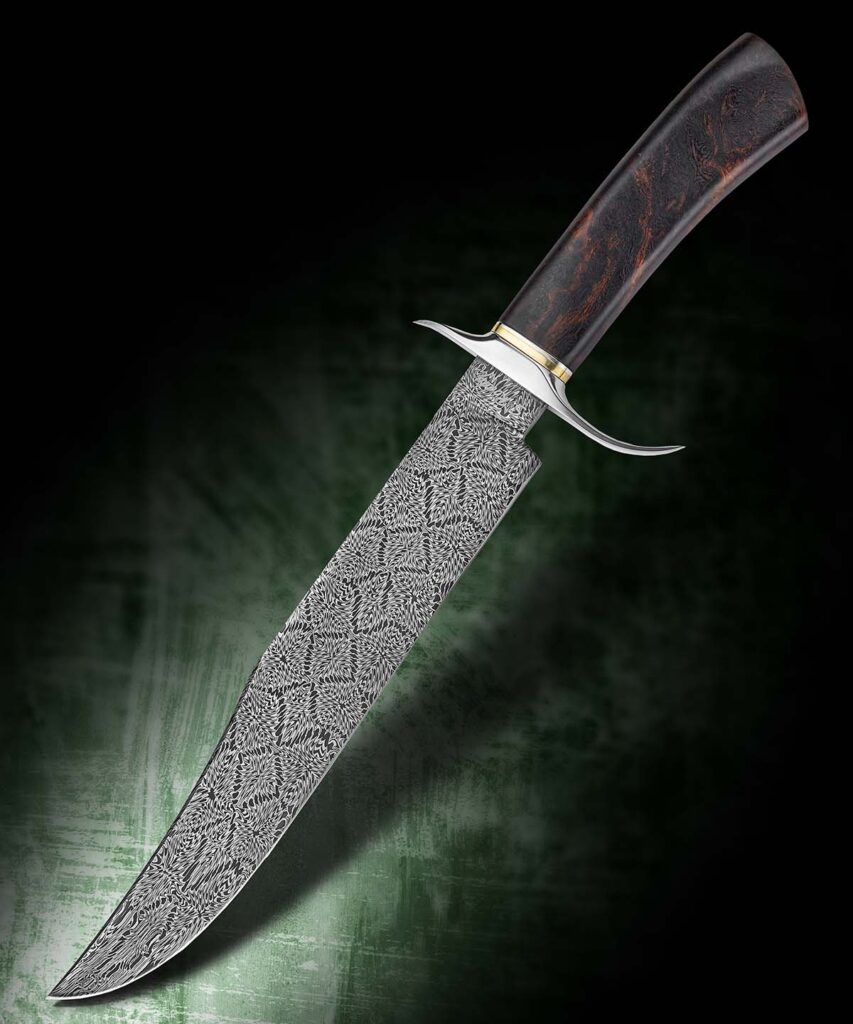
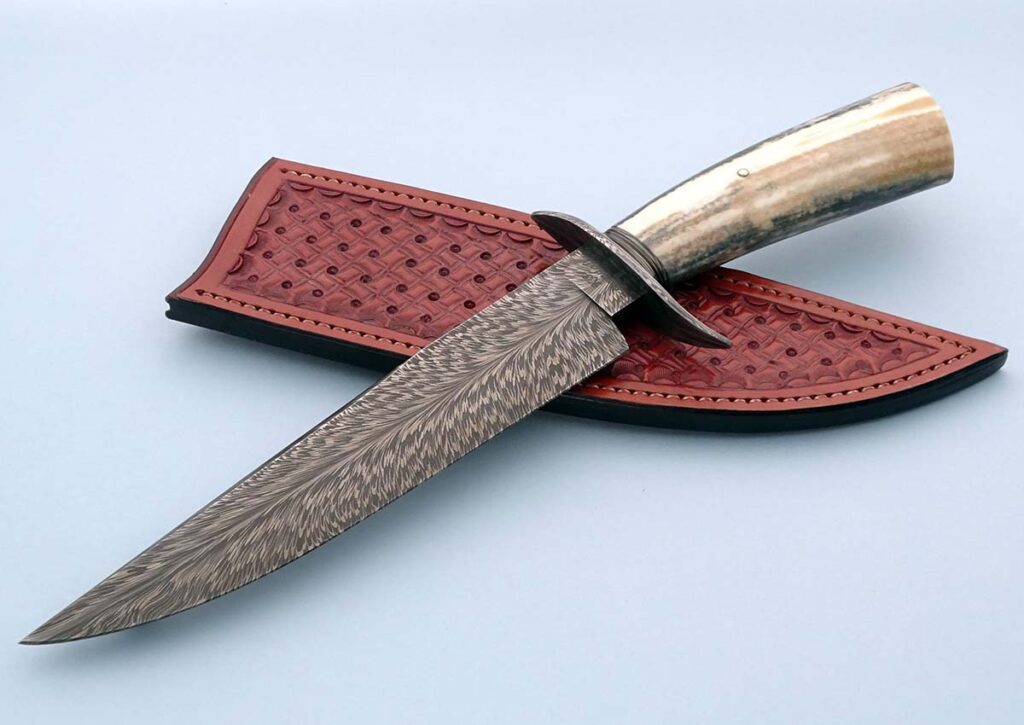
Andrea Lisch Chef’s Knife
PATTERN: Chef’s knife BLADE LENGTH: 6.5” BLADE MATERIAL: Feather pattern damascus BLADE GRIND: Custom convex BOLSTER: Damascus HANDLE MATERIAL: Black walnut CONSTRUCTION: Forged integral OVERALL LENGTH: 11.25” MAKER’S PRICE FOR A SIMILAR KNIFE: $1,300 KNIFE TO KNOW: The maker is a journeyman smith in the American Bladesmith Society MAKER: Andrea Lisch, (SharpByCoop image)
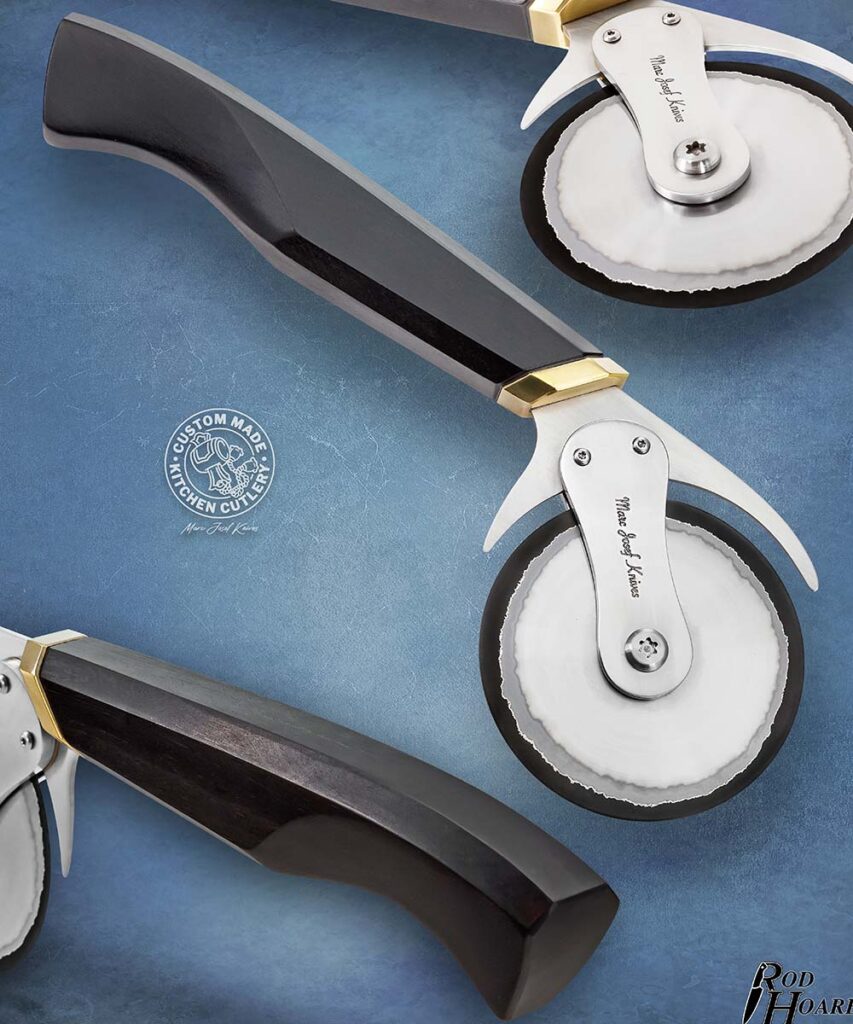
Ceilidh Dalton Veggie Chopper
KNIFE NAME: Yellowjacket KNIFE TYPE: Veggie Chopper BLADE LENGTH: 3.94” BLADE MATERIAL: Damascus of 1075 carbon and 15N20 nickel-alloy steels BLADE GRIND: Flat DAMASCUS PATTERN: Feather forged by Mathew McVicker HANDLE MATERIAL: Spalted tamarind BOLSTER: Ebony OVERALL LENGTH: 8.27” KNIFE TO KNOW: The maker is a probationary member of the Australian Knifemakers Guild MAKER: Ceilidh Dalton, (Rod Hoare image)
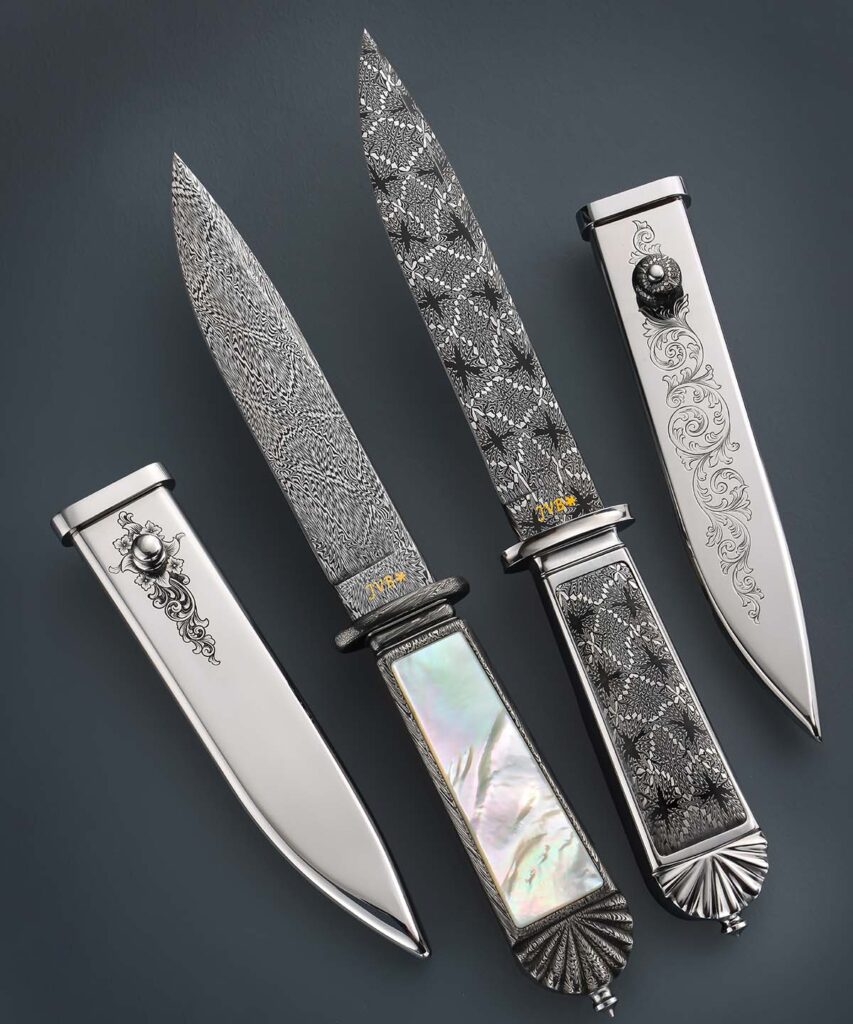
Jose Santiago-Cummings Steak Knife Set
PATTERN: Steak knife set BLADE LENGTHS: 5” BLADE STEEL: Damasteel stainless damascus in a Thor pattern BLADE GRIND: Full flat HANDLE: Mastodon ivory, red spacer, ironwood BUTTCAPS: Mokume gane and red-dyed coral OVERALL LENGTHS: 9” MAKER’S PRICE: $1,500 for the set, including stand; $300 per knife MAKER: Jose Santiago-Cummings, santiagoknives.com, (Jocelyn Frasier image)
Geoffrey Baze Chef’s Knife
PATTERN: Chef’s knife BLADE LENGTH: 9” BLADE MATERIAL: W2 tool steel BLADE GRIND: Flat HANDLE: Tasmanian blackwood w/bird’s-beak butt HANDLE PINS: Black Micarta® OVERALL LENGTH: 14” KNIFE TO KNOW: The maker is an ABS apprentice smith MAKER: Geoffrey Baze, (Jocelyn Frasier image)
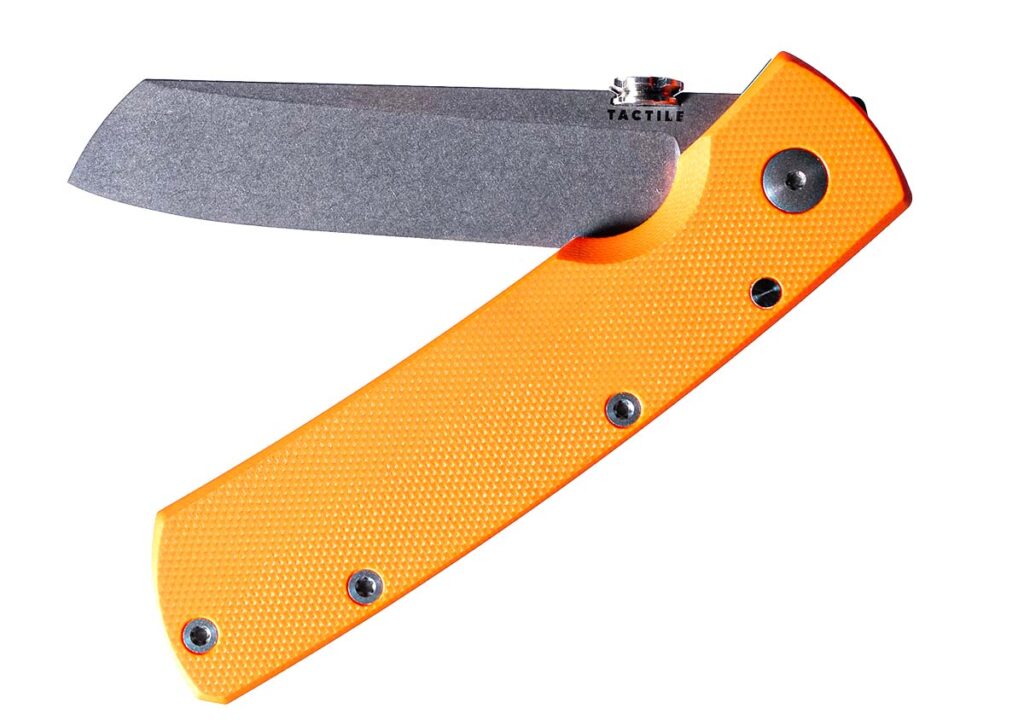
Coast Contra
KNIFE NAME: Contra MODEL TYPE: EDC pocketknife BLADE LENGTH: 2.5” BLADE STEEL: 7Cr17 stainless BLADE PATTERN: Wharncliffe BLADE FINISH: Flat black titanium nitride coating BLADE OPENER: Blade hole HANDLE MATERIAL: stainless steel w/hole for a lanyard POCKET CLIP: One position LOCK: Framelock CLOSED LENGTH: 3.75” CONTINENT OF ORIGIN: Asia MSRP: $29.99 COMPANY: Coast, coastportland.com
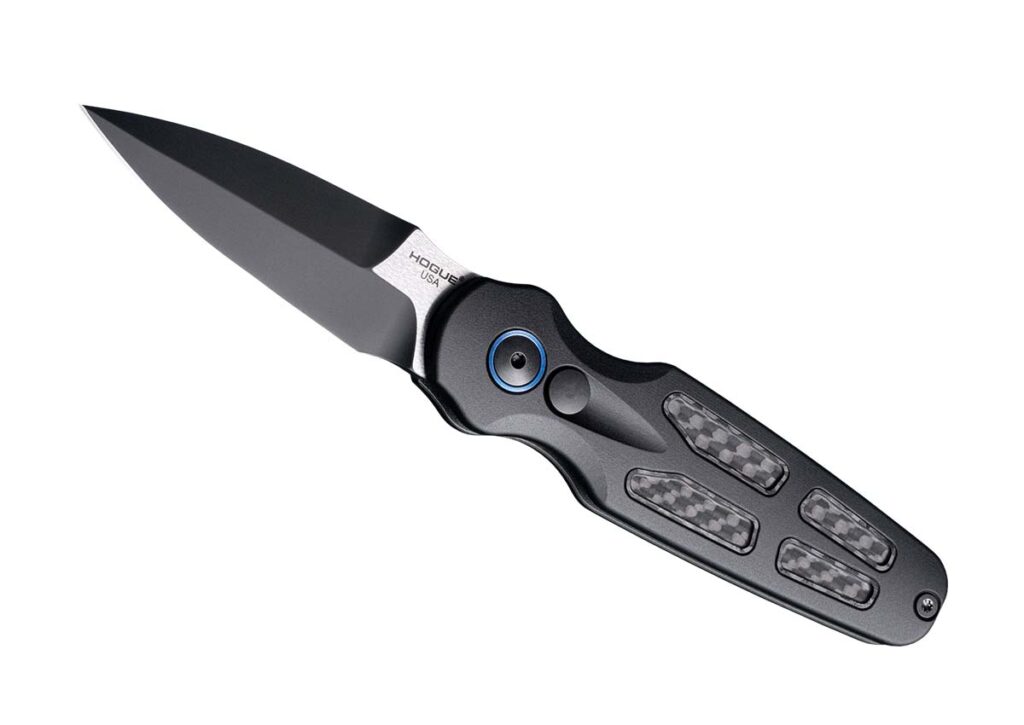
SOG Knives Bulwark
KNIFE NAME: Bulwark DESIGNER: Mikkel Willumsen KNIFE TYPE: Flipper folder BLADE LENGTH: 3” BLADE MATERIAL: D2 tool steel BLADE PATTERN: Drop point BLADE @THICKEST: .14” BLADE FINISH: Black PVD coating BLADE OPENERS: Blade hole and flipper tab HANDLE MATERIAL: Micarta® in green (shown) or blue color options POCKET CLIP: Reversible, low carry LOCK: Framelock WEIGHT: 3 ozs. CLOSED LENGTH: 4” CONTINENT OF ORIGIN: Asia MSRP: $124.95 COMPANY: SOG Knives, sogknives.com
The Japanese take on Western chef’s knives are mighty mealmakers. Here are some top-notch options.
A gyuto is a versatile, multi-purpose kitchen knife perfect for professional chefs and home cooks. It typically features a thinner, lighter blade than traditional chef’s knives, sharpened at a steeper angle for extremely precise and clean cuts. It often has a flatter profile toward the heel and a more gradual curve near the tip, making it versatile for various cutting techniques. The handle is often lighter and more agile, reflecting the Japanese emphasis on nimble and efficient movements in the kitchen.
Fox Knives Gyuto 2C 504 0L
The Fox gyuto effortlessly prepared chicken thighs for delicious teriyaki chicken and yakitori, trimming excess fat and skin.
FOX Knives Gyuto 2C 504 OL Blade Length: 6.69” Blade Steel: 4119 nitro-B stainless Blade Grind: Flat Blade @Thickest: .08” Blade Finish: Satin Handle Material: Olive wood Overall Length: 11.81” Country of Origin: Italy MSRP: $75.70
Pros
Durable 4119 Nitro-B Stainless Steel Blade
Exceptional Balance and Lightweight Design
Comfortable Olivewood Handle
Cons
Limited Grip for Large Hands
The Fox Knives Gyuto 2C 504 0L is a representative example of the genre. Crafted with precision and passion, it features a razor-sharp blade that is durable and holds an edge. The elegant handle offers a comfortable grip and a smidge of rustic charm.
At just 5.11 ounces, this featherweight beauty is a breeze to manipulate and perfectly balanced for effortless slicing, dicing and chopping. The 4119 nitro-B stainless steel blade’s Rockwell hardness of 55-57 HRC guarantees superior resilience, while the satin finish adds a touch of sophistication. Equipped with sturdy stainless-steel rivets, this gyuto is a culinary companion you can trust, not just a kitchen tool.
When in Japan, I love ordering yakitori—skewered, grilled chicken with a savory, slightly sweet flavor and smoky aroma. Making the dish was a team effort using specific knives for deboning and slicing the chicken into proper portions for the skewers. The key is to use a slow rocking/chopping motion to make clean, decisive slices rather than sawing through the meat, resulting in “chainsaw chicken.”
The Fox sliced potatoes, onions, garlic and carrots for pot roast. The thin edge and super comfortable handle were unmatched.
Since the gyuto is the Japanese version of the archetypal Western chef’s knife, I made a Western dish—beef pot roast—and did the vegetable prep with the Fox. Slicing vegetables, potatoes, carrots and onions was a breeze with this slicing machine. I keep it simple, using rock chops, cross chops and pull cuts 90 percent of the time. Push cuts with the heel of the blade work well for hard veggies. Meanwhile, the olivewood handle remained comfy with no hot spots and grippy even when wet or covered with chicken fat. Leave it to the Italians to utilize this stunningly underused wood. Regarding plating, the Fox sliced the most elegant roast beef that ever graced a dish.
Fox Knives
$78
BladeHQ
$35
Condor Tool & Knife Shefu Kitchen Gyuto
The Condor Shefu deboned multiple chicken thighs using a roll-cutting method for yakitori skewers and teriyaki chicken.
Shefu Kitchen Gyuto Specs Blade Length: 7.83” Blade Steel: 440C stainless Blade Grind: Full flat w/second bevel Blade @Thickest: .12” Blade Finish: Blasted satin Handle Material: Epoxy resin and hickory Overall Length: 12.92” Sheath: Welted leather Country of Origin: El Salvador MSRP: $154.98
Pros
Versatile Outdoor and Culinary Tool
Comfortable and Ergonomic Handle
Full Flat Grind with Second Bevel
Cons
Bit hefty
The Shefu Kitchen Gyuto from Condor Tool & Knife is a multi-use knife designed for bushcraft enthusiasts who want to prepare delicious meals while enjoying the great outdoors. Crafted with precision in mind, the Shefu is perfect for slicing vegetables and expertly preparing meat and fish. It is a versatile tool ready to tackle any culinary challenge.
The Condor gyuto is hardy and beautiful. The full flat grind with a second bevel ensures optimal slicing performance, while the handle provides a comfortable, secure grip. The knife strikes the perfect balance between heft and maneuverability. The leather sheath provides safe storage and easy transport.
I pushed the Shefu into service sectioning beef roast and deboning and trimming six chicken thighs. The knife tackled the tasks with ease. Slicing 3.5-pound roast required a sharp yet hefty slicer like a cleaver. The Shefu fit the bill and delivered. Bottom round roast is tough as woodpecker lips, and a thin, flexible blade need not apply here. At 9.88 ounces, the Condor’s robust blade strikes the perfect balance between heft and finesse.
The Condor has the only sheath of the test bunch, of a beautifully handcrafted welted leather for safe storage and easy transport.
The handle has a colorful, comfortable oval shape that nestles in the hand. Hot spots and fatigue are nearly impossible with this grip. The full tang offers strength and security while keeping balance and weight at the forefront. The Shefu is an essential for any cooking enthusiast, whether at home or in the wild.
Condor
$155
SMKW
$132
Spyderco Itamae Gyuto
The author prepared the chicken yakisoba using the Spyderco. The knife sliced and diced carrots, onions, peppers, shiitake mushrooms, chicken and green onions for garnish.
Itamae Gyuto Specs Designer: Murray Carter Blade Length: 10.06” Blade Steel: Super Blue/SUS410 Blade Grind: Full flat Blade @Thickest: .094” Blade Finish: Satin Handle Material: Burl G-10 in the octagonal wa style Overall Length: 15.35” Country of Origin: Japan MSRP: $334
Pros
Exceptional Blade Construction
High-Quality, Ergonomic Handle
Beautiful Design and Craftsmanship
Cons
Higher Price Point
The Itamae Gyuto is part of the Spyderco Murray Carter Collection Itamae Series. The elite cutlery series is designed for highly skilled sushi chefs and showcases uncompromising craftsmanship and premium materials.
The Itamae Gyuto features a blade expertly crafted from laminated steel—an Aogami Super Blue core clad between layers of high-quality stainless. The three-layer construction ensures exceptional durability and sharpness, with Carter’s signature “Carter Elbow*” adding strength to the blade’s tip.
Paired with a traditional wa-style octagonal handle of stunning burl G-10 and highlighted with a black G-10 ferrule, the Itamae Gyuto embodies the spirit of Carter’s coveted custom kitchen knives. Tipping the scales at 7.4 ounces, it sets an impressive standard in high-performance household cutlery.
The Itamae Gyuto is a sushi knife and I’m a fan. Part of my time in Japan was seeking out various types of sushi. The second most rewarding part was watching the chefs work precisely as if it were the most critical game of Operation ever played—they are pros!
I used the test model to prepare carrots, onions, shiitake mushrooms, peppers, green onions and chicken for the famed yakisoba dish: fried street food noodles choked full of veggies, savory sauce and protein. Simple ingredients still require various knife techniques.
I used push-cuts on the tough carrots to square them to a safe position to stabilize them and make thin slices. From there, I stacked the slices for some rock-chopping to julienne a pile of carrots—in this instance, to make matchstick-sized carrot sticks. The secret to stir-fry cooking is preparation and cutting relatively equal-sized pieces of food to ensure equal cooking time.
To create julienne slices, the author employed the rock-chopping method with the Spyderco, again utilizing a chef’s pinch-grip and a claw grip with the offhand to support the food.
I used rock chopping and pull cuts—two techniques in which the Itamae excels—to slice the red peppers. To pull cut them, I placed the knife tip down on the board and sliced backward. By this time, the laminated steel had formed a nice patina from avocado, peppers, onions and chicken on the bevel, giving it a nice used look. Crafted in Japan, the Itamae Gyuto is an ultimate favorite among professional chefs and passionate cooking enthusiasts.
*Editor’s note: Through the Carter Elbow, Murray Carter combines the best features of a traditional Japanese wabocho kitchen knife with his Wharncliffe Brute neck knife. The design feature allows more steel to reinforce the forward tip of the blade compared to standard gyuto or French-style chef’s knife profiles.
Find out why the Spartan Blades Clandestina took home Blade Knife of the Year, thanks to its standout tactical design, top-tier materials, and unbeatable performance.
A deadly beauty, Spartan Blades’ Clandestina packages the best of both worlds. Yup, it’s a looker, but dang if it isn’t engineered to inflict damage.
The dueling personalities of the BLADE Knife of the Year aren’t surprising, given who cooked up this wicked fixed blade. Bill Harsey has built his reputation on designing robust outdoor and tactical knives.
Photos by Marty Stanfield, Marty Stanfield Photography
A favorite of Army Special Forces and figures such as Col. Rex Applegate, Harsey work also has a certain lethal aesthetic to it as well. But even with operators enamored with his work, Harsey’s Spartan project has an appeal beyond serving in foreign conflicts.
Spartan Clandestina Specs
Knife Type: Fixed Blade Type: Spear Point Blade length: 5.5 Blade steel: CPM MagnaCut Blade grind: Flat ground Handle material: Canvas Micarta Black and Camo Blade Hardness: 61-63 HRC Overall length: 10 3/16” Sheath type and material: MOLLE and Kydex options Special features: Available in Black and FDE PVD Coating, Double Deep Cryogenic Treatment MSRP:
Pros
Superior Ergonomics
Premium Blade Material
Sheath Options
Cons
Large For Everyday Carry
High Price Point
Niche Design
Spartan Clandestina Handle
Oddly enough for a knife review, I’m going to start at the handle. There’s a method in this madness, given this feature is what gives the Clandestina its edge.
The canvas Micarta handle is slim in profile, even understated, yet sports big-league features.
Photos by Marty Stanfield, Marty Stanfield Photography
Boasting two-finger grooves leverage the use of the middle finger to help stabilize the knife in the user’s grip and help lock it in for security. The double guard is somewhat subtle but does its job very well.
The entire handle is rounded and therefore, extremely comfortable to hold. No hot spots or harsh angles to get in the way. Overall outstanding ergonomics make the knife one with the hand. In brief, it’s pure Harsey all the way.
Micarta itself was an excellent choice for the tactical fixed blade—it’s lightweight yet strong. Comprised of fabric saturated in phenolic resin, it is also impact-resistant and fluid-resistant.
These attributes were engineered in the Clandestina with combat in adverse conditions in mind. Yet, the everyday user benefits, given it’s a robust system that should last a lifetime. Not to mention, the Micarta is available in a multitude of colors, besides my black and camo.
Spartan Clandestina Blade
From the understated to the obvious—the knife’s nefarious.
At 5.5 inches long and sporting a spear-point profile, the Clandestina was designed for more than opening boxes. A testament to this was Spartan opting for premium CPM Magnacut stainless steel.
Photos by Marty Stanfield, Marty Stanfield Photography
Know for its capability of long-term edge retention, the metal makes the ready to slash or perforate with ease. Again, this material also has superior corrosion resistance, adding to the overall hardiness of the knife.
The blade is flat ground and the factory edge right out of the box is outstanding. I found nothing needed to be done to improve the edge, I just took it out of the box and put it right to work!
While larger than most folks’ carry option, the blade length isn’t over the top. I found it nearly perfect for belt carry, hitting an elusive sweet spot many fixed-blades miss.
Spartan Clandestina Sheath
Sheath-wise, there are two options – form-fitting Kydex or a tried and true ballistic nylon. The sample knife shipped to me with the latter.
Photos by Marty Stanfield, Marty Stanfield Photography
I found the sheath is very well made, with double sewn edges and a button snap retention strap to hold the e knife in. A large belt loop allows the use of various widths of belts to be used.
Should you opt for Kydex, the sheath is of a riveted construction with a belt loop attachment. The form-fitting sheath locks up around the integral guard of the handle. There are two MOLLE straps that also double as belt loops.
Testing The Spartan Clandestina
Putting the Clandestina to work is nothing short of an excellent experience.
All of Harsey’s tactical fixed blade design expertise comes into play here, and you quickly realize you have a piece of serious bladeware in your possession. It makes slicing cuts with brash confidence thanks to the excellent factory edge coupled with the flat grind.
Photos by Marty Stanfield, Marty Stanfield Photography
The blade thickness tapers down progressively to the tip, allowing it to have the ability to do some serious piercing without being too thin where accidental breakage can occur. The overall blade profile is somewhat dagger-like, as you will notice.
The handle is downright comfortable. It allows the user to obtain a secure grip at all times, instilling and promoting user confidence. Thanks to the dual finger grooves, these allow the slender handle to have such a great grip quality. Locking your grip on the handle, it feels very stable and unlikely to rotate.
Furthermore, when you grip the handle and allow your thumb to rest on the blade spine, you can feel how secure this choke grip is and the knife is very controllable in this grip. Whittling and wire stripping are two such tasks that this grip facilitates. Simply put, the Spartan HARSEY Clandestina is built for use.
Short Cut
It’s definitely not a toy! Use it with confidence and use it hard. Spartan Blades’ craftsmanship skills are highly rated consistently, with each knife they turn out. You cannot go wrong with choosing the Clandestine.
Ethan Becker and Dan Eastland collaborate on a sharp tool for the kitchen.
Long-time knife designer Ethan Becker and Dan Eastland of Dogwood Custom Knives have collaborated on a chef’s knife that combines each of the principals’ vision of exactly what such a knife should be.
Introduced at BLADE Show 2024, the Joy of Cooking 8-inch K-tip chef’s knife is a mix of Japanese and Western styles and premium stainless steel and synthetic handle materials.
It also has the iconic Joy of Cookinglogo on the blade, Joy of Cooking the internationally renowned cookbook originally written by Becker’s mother, Irma Rombauer, and edited in some subsequent editions by Ethan. He handed those duties off and today the book is co-edited most ably by his son, John, and Megan Scott.
The heel of the blade curves toward the rear and sits flat on the surface for controlled cutting.
With extensive experience as both a knifemaker and a cook, Eastland brings the kind of know-how to the project that gives it edged gravitas.
“Dan is pretty much the perfect person to do this because he’s been in a commercial kitchen and knows his way around that,” Ethan said.
Dan also spent a number of years as an apprentice maker to Georgia Knife Makers Guild member Andy Roy of Fiddleback Forge in North Georgia, and now builds knives at Dogwood Custom Knives in Greenville, South Carolina.
Handle materials come in a choice of natural (shown here; note the texture and grain) and black Micarta® and blue, red or black G-10.
As for the Joy of Cooking knife and its features, Dan approaches it all from the maker/cook perspective.
“The blade has a Japanese influence. I always liked Japanese blade geometry and balance, but I didn’t like their handles. Ethan and I both like a little palm swell,” he noted, “so we wanted more of a Western-style handle.”
In Joy of Cooking, Ethan writes about a grip for home cooks that’s comfortable, Dan said, so the handle has rounded corners to eliminate hot spots and an overall design that helps promote a pinch grip. The blade is weighted toward the front for balance and has the K tip for precise tip work.
The K tip gives the knife a piercing feature lacking in such Japanese designs as the santoku.
Ethan said he’s a big fan of the santoku style and has designed santokus and used them in the kitchen almost exclusively for 20 years.
“The one problem with the santoku is it really doesn’t have a good piercer,” he noted. “You can get by without a piercer if you keep the knife really sharp but guess what—most people don’t keep their knives sharp enough. But for such jobs as taking off the top of a tomato, for instance, the K tip works pretty good.”
Dan lauded the utility of the K tip for other tasks as well, adding, “My grandmother opened all the packaging with the tip of a kitchen knife. No matter what knife you gave her, she sliced the top of the package open with the tip and went to work.” The K tip is tailor made for such chores, as well as others.
The collaborators prefer a Western-style handle and gave the Joy of Cooking Knife grip a palm swell as a result.
The edge has a nice curvature for rock chopping and push cutting meats and vegetables. The heel of the blade also curves toward the rear and sits flat on the surface for controlled cutting.
“The neat thing is when the blade comes down [at the heel during a rocking cut or chop], it stops,” Ethan explained. “It’s also good for a push cut,” Dan added, “so it’s good for both a rock chop and push cut. And having that heel down a little bit it will bottom out, so you cut all the way through something and don’t wind up with little partially cut bits at the end.”
Joy Of Cooking Knife Details
The 8-inch blade is CPM S35VN stainless steel. The Rockwell hardness is 60 HRC and the blade is 3/32-inch thick at the thickest. Along with the contoured handle the knife weighs in at a scant 5.5 ounces.
A hard plastic cover with plastic snaps contains and protects the knife.
“I’m of the opinion the Greeks told us everything we need to know about a double-inclined plane—the longer the plane and the lower the angle, the more efficient it is,” Dan said. “A knife blade is a double-inclined plane, and I wanted to make this knife as light as possible.”
He returned to his grandmother’s experience.
“And again, my grandmother used to complain that Henckels and Wusthof, she loved the knives, but they weighed almost as much as she did. By using the S35VN we’ve been able to thin it out and get a mechanically better cutting blade, but also a lighter blade.”
Ethan agreed that most kitchen knives are too heavy.
From left at BLADE Show 2024: John Becker, co-editor of Joy of Cooking, Dan Eastland of Dogwood Custom Knives and long-time knife designer Ethan Becker.
“The wrist gets tired easy and to be able to not have very much weight that you’re working with, hey, what’s wrong with that?” he observed. “Most traditional kitchen blades were thick because they were forged before they were ground … The cutlers in Europe were very, very concerned that the housewives would use the blades for things they weren’t supposed to, so they used soft steel so it wouldn’t nick and if they opened bottles with it it wouldn’t hurt it. The result was blades that didn’t hold an edge worth a damn and were not terribly efficient.”
Dan said the S35VN has good corrosion resistance and the edge retention is phenomenal.
“We tested the knife extensively in an industrial kitchen to ensure edge retention and durability, and I like S35VN because it’s a good balance of durability and edge retention. And we can get that 60 Rockwell so it can take a nice, keen edge and we don’t have to worry about it chipping out.”
As noted, Dan and Ethan wanted a Western-style handle with a palm swell and offer it in a choice of G-10 and Micarta®. The Micarta is available in black and natural versions, both with texture and grain for purchase. The G-10 comes in red, black and blue.
“Those colors will always be the same over time as we introduce other knives in the lineup, so you can buy a knife that will match whichever color knife you previously bought,” Dan said. The intent is for there to be a complete set of Joy of Cooking knives, though nothing was set in stone in that regard at press time.
Pros
Collaborative Expertise
Versatile Blade Design
Premium Blade Material
Cons
Higher Price Point
Plastic Snap Cover
Joy Of Cooking 8” Chef’s Knife Specs Designers: Ethan Becker and Dan Eastland Company: Dogwood Custom Knives Blade Length: 8” Blade Steel: CPM S35VN stainless Rockwell Hardness: 60 HRC Blade @Thickest: 3/32” Handle: Black and natural Micarta® and blue, red and black G-10 options Overall Length: 13” Carry: Plastic snap cover Knife to Know: K tip blade; lightweight design; hidden handle pins Country of Origin: USA MSRP: $200
Know how the pros keep their knives and sheaths in tip-top working order.
Tricks of the trade, the go-to products, and the techniques that stand the test of time and use are beneficial for those of us who put our knives to work around the house, at the office, on the farm and in the field. Keeping the knife in top-notch working order eliminates frustration and failure when it’s time to get a job done.
Fighting Corrosion
Fighting the battle against rust is ongoing with carbon steel. Long-time custom knifemaker Bob Dozier said, “Wipe the blade off. I’ve carried a folder since 2014 and use it every day. A lot of it depends on how the maker heat treats the blade.
“I established my reputation with D2 steel,” Bob continued, “and there are a lot of steels that hold an edge a little better, some that are more corrosion resistant, and some that are tougher, but just keep it clean and it won’t rust—the chrome on the outside is a few atoms thick. D2 is bright at first but will take a little bit of a dull look. Don’t worry about that in a using knife.”
BLADE Magazine Cutlery Hall-of-Fame® member Bill Harsey says oil the blade as well as part of routine knife maintenance.
“The one oil I use on folding knives is Kano Aerokroil,” he noted. “It’s a true oil and does not evaporate. Clean the knife and put it away dry after using it.”
As Bob Dozier noted, he established his reputation with D2 steel. “Keep it clean and it won’t rust—the chrome on the outside is a few atoms thick,” he explained. “D2 is bright at first but will take a little bit of a dull look. Don’t worry about that in a using knife.” The blade of Bob’s Sisu has a D2 core laminated with sides of 410 stainless steel.
If that troublesome tinge of rust does show up, Bill Claussen of Northwest Knives and Collectibles reaches for a polishing cloth and paste. In more extreme situations, steel wool or wet/dry sandpaper can get the job done.
“We use Case’s Paste Metal Polish or Flitz Polish as a metal paste and corrosion protectant,” he remarked.
Other techniques and favorite products to prevent or remove rust include the careful use of steel wool when necessary, a preventive application of 3-in-One Multi-Purpose Oil, the combination of oil and Renaissance Wax, Wicked Wax, and even regrinding and repolishing in an extreme situation when pitting is present.
“I like 3M pads to remove rust on our malnourished edges out in the bush,” related bushcraft pro/knife designer Joe Flowers, “along with rust erasers for those fine knives some clients bring out with them. Ballistol makes good stuff including multipurpose oil in small single use packages that can be handy during hunting season when I also have firearms.”
Screw And Bolts
Loosening a bolt or screw that has frozen is a frustrating situation, but there are a few products that ease the task and a trick or two to employ when necessary. Cutlery Hall-of-Famer Dan Delavan of Plaza Cutlery offered, “I use WD-40 and chase it with an oil if needed, such as Formula 23 knife oil.”
Cutlery Hall-of-Famer Steve Schwarzer added a proviso.
Keeping folder pivots operating smoothly is just one application of 3-in-One Multi-Purpose Oil during knife maintenance. Applied to the blade and other steel parts, it also serves as a rust preventative.
“Normally that would mean using a penetrating oil, but the other thing you can do is set up a carbide drill fixture a little smaller than the diameter of the stuck screw and drill out the screw,” he wrote. “You can also use an induction heater and stick the knife in there to help spit the screw out. Heat will break down epoxy but don’t get it over 300 degrees. Unless you’re skilled I wouldn’t advise it, but it beats pressing the handle off and can save the material if you’re careful.”
For loosening blades or screws that have seized up, other noteworthy products include AutoBright, Kroil Penetrant, CRC Electrical Silicone lubricant and Marble Oil. “The Marble Oil is [inexpensive],” ABS master smith Harvey Dean observed.
“It works well to get something unfrozen and I used it on a pocketknife a while back. Anyway, if you put a drop of oil on the blade or joint once in a while it sure does help.”
Harsey has a great tip for loosening troublesome screws or bolts.
“I go right to the Kano Aerokroil to start the rehabilitation,” he commented. “A lot of people take folders apart when they don’t have to do that. Get a box of cotton swabs with paper stems and hammer their cotton heads flat to fit inside the small spaces of a folding knife. You can do that to oil the knife up or to clear gunk out of it. The cotton swab will show you what you’ve got without disassembly.”
Edge Maintenance
Keeping a working edge sharp is a never-ending knife maintenance job, and Harsey has spent years making knives, designing them for many prominent companies, and putting them to work in the field.
“I like to use an EZE-Lap stick diamond sharpener or honing stone with a plastic handle,” he advised. “Hold the knife still in one hand and scrub on the blade with a good angle on the sharpening bevel, then turn it over and do the other side. The result is a remarkable working edge that will do in the field.”
Regrinding and repolishing may be required in extreme knife maintenance when pitting is present. Bob Dozier does the honors here.
Harsey also likes the Norton fine India sharpening stone.
“When we go out in the field, I have never traveled without one,” he commented. “I use a rubber drawer liner mat that I can unroll and put the stone on so it won’t slide around on a truck tailgate. That becomes my workbench, and I’m the sharpener for half a dozen guys out there. At other times, I might finish with some stropping with a little WD-40 and cream buffing compound in the leather.”
Sheath Maintenance
Schwarzer is a big fan of hot wax in both knives and sheaths.
“I hot wax everything,” he said. “I have posted it online a bunch. Paraffin wax in a turkey roaster is best, and when I make my knives I put them all in there and then wipe off the excess. It also turns any leather sheath into a form of Kydex. Put it in there for a couple of minutes at 300 degrees, wipe off the excess and form the sheath with your hand. It won’t scratch your blade like Kydex will.”
Dozier has a simple approach to sheath maintenance.
Renaissance Wax works not only for polishing blades and handle materials but also for helping prevent rust and protecting leather. It’s good to have in your knife maintenance kit.
“Wipe off the sheath,” he noted, “and then put a tiny little bit of WD-40 on a cloth and wipe it down. You can also use neatsfoot oil. A little bit on a cloth will keep the dirt off. You can spray a little bit of WD-40 into a bottle cap and leave it on a shelf for four to five months and you have nothing more than cosmoline or grease that works for protection, too.”
Dean likes to protect his sheaths as well.
“I always put some kind of coating with wax or a spray aerosol finish on them,” he remarked. “I don’t recommend storing a knife in the sheath. I use American tanned leather, but some of the other leathers out there use salt in the tanning process, and that can cause problems with a blade.”
Harsey follows steps to make a leather sheath “knife friendly” so that one does no harm to the other. “When I hand build a leather sheath, the leather is always 10-ounce and tanned in vegetable oil,” he said. “It’s a straight, clean piece of heavy leather, and the preservative is either neatsfoot oil or a combination of one-third neatsfoot oil, one-third bees wax and one-third paraffin. That’s heated to 150 degrees, and I’m darn sure not to go any hotter or you could wreck your sheath. I preheat the mixture, paint some on, and put it back in the oven and repeat several times. Then wipe it off and let it dry. If I’m in the field and it takes more than just wiping the sheath off, something has gone wrong.”
Climate Control
Natural handle materials are always in need of some protection. Climate can cause expansion and contraction, while extreme heat and cold are detrimental, too.
“If it’s a wood handle, keep it dry and clean,” Dozier offered. “Don’t throw it in a bucket of water. Ivory needs to be dry too, and a little Navy oil or mineral oil or even a little oil off the end of your nose will help keep it from drying out too much.”
Dean adds a little advice for the owner/user who wants to maximize the longevity of their knives.
Bill Claussen of Northwest Knives and Collectibles uses Case’s Paste Metal Polish or Flitz Polish as a metal paste and corrosion protectant during his routine knife maintenance.
“People a lot of times just don’t take care of their knives,” he said. “I got a good damascus hunting knife back from a guy who said he had forgotten about it. He left it on the floor of his Jeep and never cleaned it. The thing was basically ruined. I made him a new knife, charged him, of course, and kept that other one myself. I had to regrind and rework it, but it wasn’t the knife it used to be.
“The main thing,” Harvey concluded, “is to take a little time with them.
Wash a knife off in hot water, the blade anyway, and don’t put them in the dishwasher! A lot of times, people take knives on hunting trips and leave them in the sheath or on the dashboard of their truck all day with the sun shining on them. Don’t do that! It’s bad. Natural handles can shrink and crack, and a windshield is like a magnifying glass.”
Try these tips. Test these products. And see for yourself how the pros actually make the best of owning and maintaining a knife in tip-top condition through the years.
For the knife and sheath maintenance items in the story, contact any of the knife suppliers who advertise in BLADE®. If that doesn’t work, enter the name of each applicable product in your internet search engine—all or almost all are offered by a wide variety of outlets.
No matter how you slice it, three top tomato knives turn the trick.
Nothing beats homegrown tomatoes and tomato sandwiches, or just simply enjoying them as they are, sliced up with all their juicy goodness. Who doesn’t love a ripe and ready tomato?
Cutting tomatoes requires a very sharp knife. Besides writing for this fine publication, I also have another side hustle of running a sharpening service. I get asked all the time, “How do I know when it is time to have my kitchen knives sharpened?” I always answer with the tomato test. If your knife cannot slice a tomato cleanly without squashing it, then it is time for a sharpening.
Tomatoes have a firm exterior and a squishy/liquid interior. A sharp knife is mandatory to break through the firm exterior. If your knife is dull, it won’t bite right into the exterior but instead will squash it, thus squeezing out the juice and ruining a good slice of succulent tomato.
Sure, any sharp kitchen knife will slice tomatoes and do a fine job of it. But there are specially designed tomato knives that take the work out of perfect slicing. If you do a lot of meal prep involving tomatoes, then you might want to procure one of the following tomato-slicing knives for the occasion.
Case Tomato Slicer
The Case works effortlessly due to the thinness of the blade coupled with the serrations.
Case Tomato Slicer Blade Length: 5.5″ Overall Length: 9.25″ Blade Material: Tru-Sharp Stainless Handle Material: Walnut Country of Origin: USA MSRP: $39
Pros
Hightly effective for tomatoes
Durable and attractive Construction
Effortless cutting
Cons
Limited to specific tasks
The 5½-inch Tomato Slicer from Case is a highly effective tomato knife. It is specifically designed to make quick work of processing tomatoes without damaging them. The 5½-inch blade is slender and has a trailing-point shape. It is hollow ground, fully serrated and Tru-Sharp stainless steel (420 HC stainless). The handle is walnut and features triple-rivet construction for strength and durability. It is a nice-looking knife and part of a larger household cutlery family Case offers with the same blade and handle materials.
Performance wise the knife excels. The serrations cut smoothly but have an aggressive bite that help break cleanly through the tomato’s firm skin. The hollow grind and slender blade aid in sailing through the fruit without collapsing it. The knife is quite effortless in action. Due to the slender, almost minimalist blade width I would limit use of the knife to tomatoes and other similar fruits like grapes and kiwi. It is sort of a specific-use knife and not one you generally grab when you need to cut something in the kitchen. It is more like a hybrid knife. It has a serrated edge but cuts clean and smooth similar to a plain edge knife. MSRP: $38.99. Country of origin: USA.
Amazon
$34
Knife Center
$47
Lemans
$35
Kershaw Utility Knife
The thin blade stock gives the Kershaw Utility Knife great bite and slices very easily. The contoured handle adds a high degree of comfort and control.
Kershaw Utility Knife Specs Blade Length: 6″ Overall Length: 10.6″ Blade Material: DIN 1.4116 Handle Material: Polypropylene Country of Origin: China MSRP: $21
Pros
Versatile for light-to-medium tasks
Comfortable and Secure Grip
Affordable
Cons
Not made for tough tasks
Very basic design
The Kershaw 6-inch Utility Knife is designed to be a “do-it-all” knife in the kitchen for light-to-medium-duty food prep tasks, and can handle meats, fruits and vegetables with no problem. One look at this knife and the word “basic” comes to mind. It is just a no-frills kitchen knife and I say that not in a negative light but rather a positive one. Sometimes simple is the way to go; it is the most direct way.
The 6-inch blade is DIN 1.4116 stainless steel in a nice brushed-satin finish. The handle has an expanded front section that not only acts as a finger stop but also is shaped in a way that promotes using the pinch grip for more precise control for detail cutting. The handle profile is rounded so it sits in your grip nicely and comfortably with no hot spots to speak of. The material is molded polypropylene and sports a slight texturing to aid in grip retention. As an added bonus, the knife comes with a molded plastic slip sheath to protect the blade when not in use. Because of this, the knife can be stored in a backpack for a camping trip, a drawer of your RV or a kitchen drawer, all without worry of edge damage or accidental cuts.
Due to the very thin blade stock (.057 inch at the thickest), the Kershaw slices tomatoes with surgical precision. The edge bites into the skin and glides right through with very little resistance. The blade is somewhat flexible but not as much as, say, a fillet knife. You are still able to flex the blade a bit, so I would not tackle any tough cutting with it and certainly not torque the handle. The blade shape is adaptable to all sorts of food prep tasks, from meats to vegetables to fruits.
The size is perfect to accompany a larger chef’s knife, for those tasks for which an 8-inch chef’s knife is too big and a paring knife is too small. The major selling points are the basic design, thin blade stock, rounded handle and price. MSRP: $20.99. Country of origin: China.
Amazon
$21
Knife Center
$21
Kershaw
$21
Gerber ComplEATUtility Knife
The Gerber ComplEAT Utility Knife has more aggressive serrations than the Case Tomato Slicer, slices tomatoes well and doubles as a bread knife.
Gerber ComplEAT Specs Blade Length: 6″ Overall Length: 10″ Blade Material: 4116 German stainless stee Handle Material: Glass-filled polypropylene Country of Origin: China MSRP: $35
Pros
Multi-use versatility
Serrated blade stays sharp
Ergonomics are great
Cons
Constructed of basic materials
The serrated Gerber ComplEAT 6-inch Utility Knife will handle meats, produce and bread. It’s the perfect complement to the other two models—chef’s and paring knives—in the company’s ComplEAT series.
The 6-inch blade is German 4116 stainless steel for affordability and stain resistance. Commonly used in pocketknives, the sheepsfoot blade is utility friendly. The full flat grind thins the serrations down well without being fragile and gives the edge its bite. A stonewash finish seals the micro pores in the steel to prevent rust from forming easily.
The handle is dual molded, with a hard plastic outer frame and inlays of a softer, grippier rubber-like material. The inlays are inset some to provide an innovative finger groove of sorts that allows you to obtain good handle traction, as your fingers and thumb can rest inside it, helping you to control the knife at all times. Additionally, there is a forward pinch grip/recessed area on both sides of the handle for exact control. The handle perimeter features multifaceted chamfers that not only reduce hot spots but also make the handle feel slimmer by removing bulk. An oblong hole accepts a lanyard or simply serves to hang the knife on a peg, nail or hook when not in use.
The handle color is interesting. Gerber calls it Baltic Haze and is a matte light green with dark green rubber inlays. It is more appealing than standard black and fits in well with the outdoor theme. A matching plastic slip sheath protects the blade and is safe to carry in a backpack.
The ComplEAT handles tomatoes similarly to the Case Tomato Slicer. The serrations allow the blade to immediately bite into the tomato skin and help the edge to remain sharp over time. Unlike the Case, the ComplEAT can be used for other foods, too—cucumbers, onions, chicken, pork, beef and even as a bread knife, including bagels, baguettes and such. It is a true multi-use performer. If you need one knife to tackle a variety of food for camping, it might be the one as the evenly spaced serrations cut smoothly. If you prefer infrequent sharpening, the serrations are for you. Why? The serrations’ scallops are sharp and are protected by the teeth.
Knife buying–particularly custom–can prove daunting. We gathered industry pros to give the top mistakes to avoid.
When it comes to acquiring knives, the informed buyer is most often the satisfied buyer when the transaction is complete. So in the spirit of friendly advice, BLADE® has enlisted the help of several knife industry pros to offer a few words on making the most of the knife-buying experience—or to put it another way, 11 mistakes to avoid when buying a knife.
Don’t Deal With Questionable Sellers
“A lot of it revolves around reputation,” said custom knife purveyor and collector Paul Farina of Farina Fine Arts. “Human beings can be different, but 80 to 90 percent of the people you meet out there are great. In the knife world, many of them will give you a refund if you aren’t happy.”
Dave Harvey of Nordic Knives echoed that sentiment. “Honest sellers are not hard to find, thankfully,” he said. “Look for those with years of experience. Generally speaking, dishonest sellers will not be in the business very long.”
Along the same lines, Daniel O’Malley of bladegallery.com cautions folks interested in buying online. “If purchasing online, make sure you are buying from a company that has been around a while,” he offered. “There are a lot of fraudulent websites out there these days—often ones that are trying to appear to be a well-known website. One dead giveaway that you may be on a fake purveyor website is if the prices are too good to be true. Unfortunately, you are unlikely to find a legitimate site selling knives for half the price of other legitimate sites.”
Don’t Buy Knives On Pictures Alone
“In most cases today, knives will be purchased online, and therefore you may have to judge the knife by photographs and listed descriptions,” O’Malley advised. “Since the value of the knife is greatly affected by small scuffs and scratches, it is important that the photos are clear enough that any imperfections will be noticeable.”
Along the same track, Harvey noted, “Pictures are great, but they never fully substitute for being able to see and hold a knife in person. Make sure you buy from someone or a dealer with a 100-percent-return guarantee. If you are not satisfied with your purchase, you should be able to return it in a reasonable period of time.”
Don’t Buy Knives On Steel Only
Daniel O’Malley advised that each year new miracle steels appear but often lose popularity after a year or two because they may not pan out. Conversely, tried and tested steels like CPM S35VN, Takefu SG2, 52100 and more are great benchmarks to test against. Jacob Gaetz forged the 4-inch blade of his fancy hunter from 52100. (Jocelyn Frasier image)
“I never talk to people too much about a particular blade steel,” commented Dave Ellis of Exquisite Knives. “I usually discuss with clients how the complete knife was made, how it was fashioned, and that is more important, I think. Someone may be enamored with a certain type of steel, but that is rare with my clientele and only a consideration in talking about the whole knife.”
Harvey reckons that few knife buyers take the “blade-steel-first” approach. “At least I would hope not,” he asserted. Farina added, “There are a few exotic blade steels out there right now, and these may be sought after just because they’re exotic. Also, some steels have been discontinued and knives with those steels may be selling because of the rarity.”
Taking the entire knife into account is the best way to reinforce a purchasing decision, according to O’Malley. “Knowing the stats on the knife is important,” he reasoned. “We want to know where it was made, who made it, in what country it was made, and what materials they used. That said, judging a knife by just the blade materials used ignores fit and finish as well as heat treatment quality. In some cases the identical steel at the identical Rockwell hardness can still have tremendously different edge holding. In fact, over the years I have found that the quality of heat treatment is perhaps even more important than the steel used.”
Don’t Buy Knives On The Handle Comfort
Daniel O’Malley said that even if it’s the best knife in the world, if you don’t like the way it feels it isn’t the best knife for you. Lee Lerman, a custom knife judge at BLADE Show 2024, checks the handle of one of the knives entered. In the background are observer Henry Wu (right) of the BLADE Show and judge Rodrigo Sfreddo (center).
“Getting a knife in hand and seeing what it feels like is ideal, though sometimes not possible if you are purchasing from far away,” O’Malley related. “I often advise potential buyers that even if they are holding the best knife in the world, if they don’t like the way it feels it isn’t the best knife for them. That said, some buyers feel a knife is comfortable just because it is familiar—similar to their last knife. They may have gotten used to the last knife and like the way it feels, but a different feel might actually be better, that is, a more ergonomic handle or lighter design. Sometimes it takes using the knife for a while before you know how you really feel about it.”
Don’t Adopt A Herd Mentality
“There are trends out there, but because I’m older and been around the art knife world so long, I’ve thought about the places to put my money,” Farina commented. “If you’re looking at an up-and-comer in knifemaking, check their quality, find out who taught them. That is how I get introduced to them. If they have been taught by an experienced maker, you can tell the quality, and the price may reflect in less money with younger guys.”
From the perspective of “hot styles,” Harvey remarked, “I don’t object to those who want to buy the ‘hot’ knives as long as they are styles and makers that they enjoy and collect. Buyers should always beware of ‘hot’ knife prices and not fall for overpricing.”
“What’s currently ‘hot’ isn’t always best,” O’Malley commented. “The knife industry develops relatively slowly and though each year we see new miracle steels come out, they often lose popularity after a year or two because they may not have panned out. Tried and tested steels like S35VN, Takefu SG2, 52100 and more are great benchmarks to test against.”
Don’t Overlook Makers By Name
Dave Ellis said that instead of buying 10 knives you can afford, save up and buy one made by Bob Loveless. A Loveless hideout model in stag and with the iconic Naked Lady logo would be a good place to start. (Exquisiteknives.com image)
Ellis looks long-term and sees intrinsic value in the known commodities. “I recommend the blue-chip makers,” he declared. “Instead of buying 10 knives you can afford, save up and buy that one Loveless. This year I’ve sold 14 Lovelesses and the pricing has not gone crazy. So, an entry level $5,000 knife is not so ‘out there’ for someone.”
According to Harvey, most big-name makers have an established collector following, which typically relates to a lasting market for their knives down the road. However, O’Malley points out the benefits of considering numerous makers.
“The knife industry is full of tiny workshops that are doing the best work in the industry,” he noted. “While there are also some great big-name makers, these smaller shops are more likely to provide more bang for your buck. Additionally, in many cases, small workshops may be putting more attention toward quality of heat treatment, which can result in much higher performance.”
Don’t Overrate The Investment Factor
“Buying for investment is something I love because of the fact I can make money on knives,” Farina explained, “but this is not a blue-chip investment stock. So do it for the passion and love of the product. However, if the goal is only for investment, then be very structured. Listen to an adviser. I had a customer come to me after spending a lot of money in four years. He wanted to sell and make 20 percent profit on all the knives [he had bought]. Maybe that would happen on some stuff, but it is a bit unrealistic.”
O’Malley added, “Knives can be a great investment. Over the years, I have seen many knives increase dramatically in price, though certainly there are some that hold their price and even some that go down. Picking the right knives for investment does take a time commitment. You need to research and know the maker and their work. How does the knife fit in the range of knives that maker creates? Will the materials hold up over time? Where is the maker in his or her career? Taking all this into account, it is possible to collect knives as a great investment, though keep in mind that even with the best research not every investment will work out.”
For Harvey, the investment path requires some preparation. “Smart buyers can and do successfully invest in certain knives,” he said. “This does require a lot of knowledge and patience, as you generally won’t see significant increases in value in the short term. For most buyers, I suggest buying what you like and enjoy for your collection, not expecting a large return for it upon sale.”
Don’t Exceed Your Knife Buying Budget
Dave Ellis recommended setting a price limit at auctions and don’t exceed it or you will find yourself paying a lot more than necessary. “I remember a particular Jurgen Steinau fixed-blade knife a few years ago when an overseas bidder and a guy from the Bay Area were in there. The knife went for $110,000,” Dave noted. “People were in there butting heads and then it became an ego thing.” Steinau’s unique style is reflected here in his Folding Knife LBS. (Eric Eggly/PointSeven image)
Ellis provides sound wisdom on auction bidding. “Set a price at the auction and don’t go over the limit and find yourself suddenly paying a lot more than you wanted to pay. I remember a particular Jurgen Steinau fixed-blade knife a few years ago when an overseas bidder and a guy from the Bay Area were in there. The knife went for $110,000,” he noted. “People were in there butting heads and then it became an ego thing. Also, don’t buy with an eye toward flipping the knife. Avoid bid ups like the plague.”
“Auction sites tend to have horrible photos, making it impossible to ascertain what a knife is really like—and what it is worth. Since fit and finish as well as condition are so important to value, figuring out what to bid can be near impossible. Additionally,” O’Malley opined, “auctions can be a way to end up paying much higher than a direct-from-maker price.”
Don’t Discount Second Opinions
“Second opinions are nice and not too hard to get on many knives,” Harvey pointed out. “There are online forums and other social media outlets where collectors share information on many makers and knives.” Take advantage, then, of the availability of information but consider the source always.
“Knives are pretty personal,” O’Malley observed. “What works for you might not work for your buddy. It’s always fun to walk around a show with someone so that you can bounce ideas off each other, but at the end of the day, buying what you like is probably most important.”
Don’t Buy Knives Under Duress
Never feel pressured to make a knife purchase. Don’t always accept the line that the knife you are considering could be gone in the next few minutes. Take a deep breath and make the most informed decision possible in the current environment. If you don’t feel totally positive, walk away.
“Many knives are literally one in the world,” O’Malley said. “This means that if you don’t buy it, there is a chance that it will be gone. Over the years, I’ve found a good way to evaluate is to ask yourself, ‘If this knife sells to someone else, in three to five weeks will I be frustrated and still want to purchase it?’ If the answer is no, you probably didn’t need to purchase the knife. There will always be others. There are, however, a few knives that I didn’t buy that even years later I wish I had purchased. Figuring out if this is one of those knives lets you know to buy it before someone else does. Any big collector has had a few knives they didn’t purchase quickly enough that they still regret not purchasing today.”
Don’t Always Discount Deposits
Over the years of buying and selling knives, Daniel O’Malley said he found that the quality of heat treatment is perhaps even more important than the steel used.
“If a maker requires a deposit, he or she must be a good accountant,” Farina related. “Some are not businessmen. They are artists and machinists. So, it’s about reputation and feeling good about the maker you are working with.”
Trust is a big factor across the board. “Paying for a knife before it is completed can be complicated,” O’Malley maintained. “A well-regarded maker once summed up the problem: ‘It’s very hard to work on a knife that’s already paid for.’ That said, collectors often commit to a purchase, have a knife made, and don’t complete the purchase or just ghost [stop communicating with] the seller. For this reason, I feel it is reasonable to pay a relatively minimal deposit, 10 to 20 percent of the cost of the knife, when purchasing directly from the maker. If working through a purveyor and having a knife made, it isn’t unusual to have to pay the full amount up front since the purveyor is committing to the purchase for you.”
Stay Informed
Advice is free, for sure, but it comes from the voices of experience. When buying a knife, it pays to listen to those already engaging in the process. Of course, every situation is a bit different. There are always additional considerations. The bottom line is to approach a knife purchase on an informed basis. That translates into a confident buy!