Home Blog Page 47

Cool Customs: Barret Chrisman Takes The Ol’ Bullet Hi-Tech

Barret Chrisman puts a modern spin on a vintage Remington design.

Barret Chrisman’s contemporary take on the classic Remington 1306 Bullet lockback combines tradition and hi-tech in one handsome custom pocketknife.

Barret outfitted his repro with all cutting-edge materials, including a blade of Loki pattern damascus by Damasteel, a handle of checkered titanium that resembles jigging and a titanium bullet shield. “I’ve seen people jig titanium before but I wanted to try checkering, so I made up a custom pantograph template and tried it out,” he said. He anodized the handle a purplish bronze.

Barret Chrisman
Barret Chrisman

“It’s a modern take on an old school knife everybody likes,” Barret noted, “and I’ll probably be doing the same kind of thing in the future.”

Remington 1306 Bullet Modern Reproduction Specs
Maker: Barret Chrisman
Blade length: 4”
Blade material: Loki pattern damascus by Damasteel
Blade grind: Full flat
Handle frame: Titanium
Handle scales: Checkered titanium w/inlaid titanium bullet shield
Lock: Lockback
Closed length: 47/8”
Maker’s price for a similar knife: $1,500

Check Out More Cool Custom Knives:

Peltonen M07 Ranger Review: The Perfect Puukko?

Peltonen M07 Ranger Puukko makes the author’s all-time-best test list.

When I received the M07 Ranger Puukko from Peltonen Knives, I was really surprised to find that the Finnish company was using my favorite carbon steel, 80CRV2, my go-to blade material for the knives I make. It has suburb edge retention and a toughness equal to 5160 carbon steel. The TPV handle is firm but provides a great non-slip grip. However, the knife still has to come together as a comfortable cutter. Let’s get to the fun stuff.

M07 Ranger Sharpness

As I do with my blades to check for sharpness, the hair on my arm has to pop off. The M07 did not disappoint. It was hair popping from the start. For those who prefer the paper-slice sharpness test, using the weight of the knife only, I found the M07 very aggressive slicing the medium. You could hear every slice. The handle gave me great control.

Medium-Duty Cutting Tests

M07 slices leather
The author really had to control the cut of the 8-ounce leather with just a quick touch; any pushing and the knife was clear through the material.

I grabbed some heavy double-walled cardboard and continued slicing. The M07 parted the material quickly with no snagging. I could feel it biting into the cardboard. I had to be careful not to nick my finger. The knife is that scary sharp.

When I started skiving 8-ounce leather, the M07 sliced all the way through as soon as I laid the edge on the medium. I really had to control the cut with just a quick touch; any pushing and the knife was clear through the leather.

M07 cutting rope
Seventy crunching cuts of the 1-inch manila rope and there was no sign of slowing down. The knife is perfectly formed for heavy cutting chores.

I had enough half-inch sisal rope for the M07 to crunch to 200 cuts with no problem. So, I grabbed my last piece of 1-inch manila rope. It was no challenge for the M07. Seventy crunching cuts later and there was no sign of slowing down. The knife is perfectly formed for heavy cutting chores.

Heavy-Duty Cutting Tests

M07 produced nice curlicues
It did not matter if it took a small bite or a deeper one, the M07 produced nice curlicues.

It did not matter if it took a small bite or a deeper one, the M07 produced nice curlicues. I could hear the knife cut the wood. The soft handle made controlling the sharp blade easy. Again, the cutting was quite aggressive.

It was time to hack some seasoned hackberry. Using a dead blow hammer, I pounded the M07 through the log. The handle absorbed all the shock from the blows, making the baton job a comfortable experience. The blade bit deep with each blow. In less than 30 seconds I had the log quartered. There were wood smears on the blade and some of the coating at the top of the grind showed a little wear. The edge was still extremely sharp. Great job, Peltonen.

The M07 made short baton work of the hackberry log.

It was back to the paper slice for the final test. There were two snags due to catching my thumbnail with the edge. The knife zipped through the rest of it.

Final Cut

The only change I’d make is to bring the grind line up closer to the blade spine. Otherwise, the M07 has to be in the top 1 percent of the sharpest knives I’ve tested in the past 30 years, and also the most comfortable handle. You could use this knife all day long and not get a sore spot. And the heat treating is excellent.

Peltonen Knives M07 Specs
Blade length: 4.68”
Blade material: 80CrV2 carbon steel
Rockwell hardness: 59 HRC
Blade grind: Saber
Blade @ thickest: .167”
Blade pattern: Drop point
Blade finish: PTFE Teflon (uncoated and Cerakote® finish also available)
Handle: TPV plastic blend
Weight: 3.75 ozs.
Overall length: 9.56”
Sheath: Plastic composite w/EasyLock locking mechanism; ambidextrous; MOLLE/PALS-webbing compatible (leather and Kydex versions also available)
Sheath weight: 1.75 ozs. (plastic composite)
MSRP: $68.43 at press-time exchange rate

Read More Knife Reviews:

New Knives July 2024

Fixed, Folders and Axes… Oh My!

As always, a slew of new knives are hitting the custom and factory markets. We scoured both to bring you some of the latest and greatest handmade and production gems. Keep your eyes peeled for these fantastic options hitting dealers’ shelves soon.

Collin Maguire Alien Vest Bowie

Collin Maguire Alien Vest Bowie

KNIFE TYPE: Fixed blade
BLADE LENGTH: 4 1/8” from tip to plunge cut
BLADE MATERIAL: 4-bar Turkish twist damascus
BLADE GRIND: Flat
BLADE PATTERN: Harpoon/trailing point
HANDLE MATERIAL: Timascus™
OVERALL LENGTH: 8.25”
CONSTRUCTION: Integral
MAKER’S PRICE FOR A SIMILAR KNIFE: $1,200
MAKER: Collin Maguire, Dept., (SharpByCoop image)


Eliot Maldonado Diamond Keyhole

Eliot Maldonado Diamond Keyhole

BLADE LENGTH: 2.75”
BLADE MATERIAL: A damascus pattern of 1084 carbon and 15N20 nickel alloy steels
HANDLE: Amber jigged bone
LINERS: Titanium
BOLSTER: 416 stainless steel engraved by Dale Bass
CLOSED LENGTH: 3.25”
MAKER: Eliot Maldonado, (Jocelyn Frasier image)


Kevin Cross Yanagiba

Kevin Cross Yanagiba

KNIFE TYPE: Sushi/sashimi knife
BLADE LENGTH: 10.6”
BLADE STEEL: Damascus forged by Damasteel
BLADE GRIND: Single bevel on dominant hand side, concave on the other, aka urasuki
HANDLE MATERIAL: Mammoth ivory
BOLSTER: Honduran rosewood
OVERALL LENGTH: 17”
SAYA (sheath): Wood
MAKER’S PRICE FOR A SIMILAR KNIFE AND SHEATH: $1,800
MAKER: Kevin Cross, kevincrossknives.net (SharpByCoop image)


Aiden De Fazio Gyuto Chef’s Knife

Aiden De Fazio Gyuto Chef’s Knife

BLADE LENGTH: 8.27”
BLADE MATERIAL: W2 tool steel
BLADE GRIND: Slightly convex
BLADE THICKNESS @ RICASSO: .138”
BLADE @ WIDEST: 2.05”
HANDLE MATERIAL: Ringed gidgee
SPACERS: San-mai damascus
OVERALL LENGTH: 14.17”
MAKER’S PRICE FOR A SIMILAR KNIFE: $470 at press-time exchange rate
MAKER: Aiden De Fazio, (Rod Hoare image)


The Farmers Forge The Zebra

The Farmers Forge The Zebra

MODEL TYPE: Axe/hatchet
BLADE LENGTH: 3.35”
BLADE MATERIAL: Damascus of 1084 carbon and 15N20 nickel alloy steels
BLADE GRIND: Convex
HANDLE: Wedge is piened stainless steel
FRAME MATERIAL: Australian cudgee
OVERALL LENGTH: 14.2”
MAKER’S PRICE FOR A SIMILAR PIECE: $1,000 at press-time exchange rate
MAKER: The Farmers Forge, thefarmersforge.com.au (Rod Hoare image)


18 Cutlery Co. Great White

18 Cutlery Co. Great White

KNIFE TYPE: Tactical bowie
BLADE LENGTH: 7.5”
BLADE STEEL: CPM S30V stainless
BLADE GRIND: Flat w/fuller
BLADE THICKNESS @ RICASSO: .25”
BLADE @ WIDEST: 1.97”
HANDLE MATERIAL: G-10
OVERALL LENGTH: 13”
MAKER: 18 Cutlery Co., 18cutleryao.com (Rod Hoare image)


Eric Hemker Paring Knife

Eric Hemker Paring Knife

BLADE LENGTH: 3.75”
BLADE MATERIAL: A 351-layer random pattern damascus of 1084 carbon and 15N20 nickel alloy steels
HANDLE: Natural buckeye burl
HANDLE SPACERS: Green G-10 and stainless steel
OVERALL LENGTH: 8.37”
KNIFE TO KNOW: Eric Hemker is an apprentice smith in the American Bladesmith Society
MAKER: Eric Hemker, Armada, Michigan, hemkerblacksmithing.com (Jocelyn Frasier image)


Kellam Knives Worldwide Harriet 70

Kellam Knives Worldwide Harriet 70

KNIFE TYPE: Puukko
BLADE LENGTH: 3”
BLADE STEEL: Polished stainless
BLADE GRIND: Scandi
HANDLE: Dark-dyed Arctic curly birch
BOLSTERS: Tri-layered nickel silver
CONSTRUCTION: Full-tapered tang
OVERALL LENGTH: 7.5”
SHEATH TYPE/MATERIAL: Swinger style/dark-stained ox hide leather w/stainless band
KNIFE TO KNOW: The knife is named for Harriet Mars-Kellokoski, wife of company headman Jouni Kellokoski; Harriet has worked with the company for many years, was involved in the knife’s design and her signature appears on the blade; the first 70 editions are numbered
MSRP: $179.98
COMPANY: Kellam Knives Worldwide, kellamknives.com


Bradford USA Guardian 4.2 

Bradford USA Guardian 4.2 

KNIFE TYPE: Fixed blade 
BLADE LENGTH: 4.825” 
BLADE STEEL: CPM MagnaCut stainless
BLADE GRIND: Sabre and full height 
HANDLE MATERIAL: Choice of G-10, Micarta® and carbon fiber 
WEIGHT: 6.7 ozs.
OVERALL LENGTH: 9.375” 
SHEATH TYPE/MATERIAL: Vertical bridle/leather
COUNTRY OF ORIGIN: USA 
MSRP: $269
COMPANY: Bradford USA, [email protected]


Real Avid RAV Series

Real Avid RAV Series

KNIFE TYPE: Folder
BLADE LENGTHS: Depending on the choice of drop point, tanto or modified clip point, 3.25 or 3.4”
BLADE STEELS: A choice of 4Cr14 and 8Cr13MoV stainless
BLADE FINISHES: Black oxide or titanium
HANDLE MATERIAL: Choice of nylon, aluminum, aluminum/stainless steel, glass-filled nylon, aluminum/carbon fiber and G-10
POCKET CLIP: Yes
LOCKS: Spring-assisted linerlock or AXIS lock
KNIFE TO KNOW: The RAV series includes a variety of knives named RAV-1 through RAV-7
COUNTRY OF ORIGIN: Engineered in the USA, manufactured in China
MSRPs: Range from $24.99 to $49.99
COMPANY: Real Avid, realavid.com


W. R. Case Longhouse

W. R. Case Longhouse

KNIFE TYPE: Slipjoint
BLADE LENGTH: 2.75”
BLADE STEEL: CPM 20CV stainless
BLADE PATTERN: Modified wharncliffe
BLADE FINISH: Stonewash satin
HANDLE MATERIAL: Choice of black burlap and OD green Micarta® and rosewood
BOLSTER: Pinched and fluted
POCKET CLIP: Deep carry
CONSTRUCTION: Screw design
WEIGHT: 3.3 ozs.
CLOSED LENGTH: 4”
COUNTRY OF ORIGIN: USA
MSRP: $189.99
COMPANY: W. R. Case, www.wrcase.com


RMJ Tactical Orlando Special

RMJ Tactical Orlando Special

BLADE LENGTH: 4.5”
BLADE STEEL: Nitro V stainless
ROCKWELL HARDNESS: 59-60 HRC
BLADE @ THICKEST: 1/8”
BLADE FINISH: Tungsten gray Cerakote®
BLADE STYLE: Clovis
HANDLE MATERIAL: Choice of black G-10, dirty olive and hyena brown
HANDLE FASTENERS: Torx Grade 5 titanium anodized bronze
WEIGHT: 4.6 ozs.
OVERALL LENGTH: 8 7/8”
SHEATH: Kydex w/1.5” belt clip
COUNTRY OF ORIGIN: USA
MSRP: $295
MAKER: RMJ Tactical, www.rmjtactical.com


Check Out More Knife Drops:

Puukko Perfection: Hot Scandi-Ground Options For Sportsmen

See how well four hot Scandi-ground puukkos cut and handle.

A multifunction knife, the puukko is integral to Nordic life, revered by scouts and symbolizing adulthood in Finland. The design—a palm-sized blade with a single edge and flat back—facilitates various tasks. It is ideal for carving and cleaning but lacks a guard because it’s crafted for slicing, not stabbing, with some models featuring finger grooves for wet conditions.

While men’s and women’s puukkos differ slightly in size and are ornately sheathed, both are equally esteemed. The puukko’s deep-carry sheath, easily attached to a belt or around the neck, makes it a practical tool for everyday use.

Puukko Grinds

Assorted grinds
Assorted grinds, from left: flat, convex, Scandi and hollow. (from the BLADE® files)

Scandinavian knives are renowned for the unique grind that sets them apart from other knives with flat, hollow, saber and other grinds. Most knives have primary and secondary bevels that meet at the cutting edge. However, Scandinavian or Scandi grinds feature just one bevel that starts near the blade center and tapers to the edge. The design creates an acute angle that produces a razor-sharp edge, making it incredibly easy to slice through even the most rigid materials. Additionally, sharpening Scandi knives is a breeze, as you don’t have to worry about getting the correct angle. Simply lay the blade on the stone with the edge against the honing surface, and voila!—you automatically get the perfect angle.

Marttiini Arctic Bush Knife

Fine-tuning a wooden wedge using the chest-lever grip with the Marttiini Arctic Bush Knife.
Fine-tuning a wooden wedge using the chest-lever grip with the Marttiini Arctic Bush Knife (ABK) is effortless for precise and challenging cutting tasks.

Marttiini knives are Nordic puukkos crafted in the Arctic Circle using generations of craftsmanship and modern technology. Founded in 1928 by blacksmith Janne Marttiini, the company produces high-quality utility knives made of natural materials like leather, curly birch and reindeer antlers, along with ultra-sharp blades of carbon steel. The knives are designed for use in harsh conditions.

Also known as Kiehinen in Finland, the Marttiini Arctic Bush Knife (ABK) is a beautiful, traditional stick-tang-style knife with a 3.5-inch blade. Made of stunningly grained curly birch, the handle is handsome and incredibly comfortable, a characteristic common to all top puukkos.

The ABK is an excellent choice for those who prefer a blade under 4 inches and have other tools for chopping or sawing. It is easy to use in winter conditions, even when wearing wool mittens or leather work gloves. The deep pocket carry sheath ensures the knife is easy to grip and deploy. Overall, it is an excellent choice for anyone looking for a traditional yet functional knife that offers both comfort and aesthetics.

Puukko Marttiini and Wood Jewel.
Finland is known for crafting high-quality puukkos that can withstand harsh conditions. It is the world’s largest producer of puukkos. Two of the most popular brands are Marttiini (top) and Wood Jewel (bottom).

This past winter I had to carve hardwood wedges for splitting logs in camp. While axes (page 48) are the traditional tools for the task, I decided to use the ABK instead. It features an oval, tapered grip designed to provide a secure hold during challenging cutting tasks. The Scandi edge sliced through the dry maple with ease, even when encountering knots.

I was pleasantly surprised at how comfortable the knife was in a chest-lever grip for fine carving. I wanted to tackle the task while the knife was still sharp before moving to more knife-suitable camp craft such as making stakes out of beech and maple. In addition to carving wedges, I usually try to turn out about six good fuzz sticks before leaving camp for the next fire—sort of an early set-up. The ABK excels at the task as much as any Scandi blade would, making it a valuable addition to my gear.

Morakniv Classic

Classic No. 1/0
The Classic No. 1/0 has a 3-inch blade designed for carving feather sticks and whittling, making it great for fire preparation.

Morakniv knives are made exclusively in Mora, Sweden, where the company has been for centuries. Combining the benefits of handforged blades with industrial manufacturing, Morakniv is known for quality, consistent, sharp knives. They are recognized as a national symbol of Sweden and have been granted a Royal Warrant of Appointment by the King*.

The Morakniv Classic knives are a popular choice among outdoor enthusiasts and professionals alike. The blades are carbon steel and the distinct barrel-shaped handles are red-stained birch. The Classic knives have been around for nearly a century, and while some changes have been made over the years, the basic design has remained essentially unchanged.

In 2020, Morakniv updated the Classic series. The edge angles and blade shapes remain the same but all the knives have rattail tangs. The new polymer sheath is sleek and polished and features the Swedish Coat of Arms. The belt strap is Swedish vegetable-tanned leather designed to last generations.

The Morakniv Classic No. 1/0 has been renamed and upgraded from the Classic No. 2/0, with slight differences in handle width and blade thickness. The blade is .078 inch at the thickest. I like the trim blade. It is a hair longer than the 2/0 at 3 inches.

The Morakniv Classic No. 1/0 has a thin .078-inch blade useful for slicing onions, peppers, mushrooms and tomatoes.

I carried the bite-sized knife on a small carabiner hooked to my belt loop. I used it on dry poplar, hickory and maple to make feather sticks. It performed precisely as a Morakniv Classic should, slicing and curling wood with every stroke. Sitting by the fire, whittling and filling up my tinder/kindling coffee can with shavings was my nighttime routine with the 1/0.

The small, very able cutter regularly sliced peppers, onions and mushrooms for camp kabobs or morning omelets. Due to its kitchen knife-like thinness, the blade sliced food exceptionally well for a Scandi grind.

Bear Forest Knives Simple 3

Bear Forest Knives Simple 3
The author used the Bear Forest Knives Simple 3 to carve a seven-notch try stick from semi-dry wood. The sharp zero grind excels on green and dry wood.

Based in the USA, Bear Forest Knives is keeping the puukko knife alive and thriving. The company recently released its latest addition to the Simple series, the Simple 3.

The full-tang Finnish puukko-style knife packs a compact and convenient 3-inch blade of 8670 carbon steel. Its straight-back 90-degree spine and zero Scandi grind ensure remarkable control and precision, making it ideal for intricate tasks. The Simple 3 features an exposed pommel perfect for light hammering tasks, which wasn’t an option on previous knives in the series. The 8670 is typically found in large circular saw blades, much like old-timey puukkos made in Scandinavia. The Simple 3’s compact size makes it highly versatile for various woods tasks.

Simple 3 Puukko
The Simple 3 is a versatile puukko for camping, bushcrafting or hunting. The 3-inch 8670 carbon steel blade has a straight back, 90-degree spine and zero Scandi grind for control and precision.

Using the knife, I created a mini try stick and enjoyed some woodcarving. The handle was comfortable and filling, while the zero Scandi was perfect for removing a lot of material. I used semi-dry wood, which the Scandi grind works better on than a flat or saber grind. I continued crafting tent stakes and making fuzz sticks, which a puukko excels at most. Additionally, the super sharp spine was exceptionally helpful, as it helped me to ignite the nicely feathered shavings for fire using my ferro rod.

Reiff Knives F4 Scandi Bushcraft

Reiff F4 Scandi Bushcraft
The Reiff F4 Scandi Bushcraft made feathering wood a breeze. The large handle helped ease the blade through hard oak to make thin, curly feathers.

The F4 Scandi Bushcraft is the latest homage to the puukko from Reiff Knives. The company keeps the contemporary rendition of the famed knife alive with modern craftsmanship and materials in a full-tang construction.

A knife with a Scandi-ground blade is a must-have for bushcraft enthusiasts. The F4 blade is CPM 3V carbon steel 5/32 inch thick at the thickest with a steep grind angle of 12.5 degrees per side. Its ability to effortlessly slice through wood, animal hides and food is remarkable. The textured canvas Micarta® scales are available in four colors.

F4 Scandi
The F4 Scandi is a new breed of knife that, thanks to the tough CPM 3V carbon blade steel, had no problem batonning through frozen wood in the winter.

The robust F4 Scandi helped split several chunks of maple, oak and poplar with a baton for my winter cookouts. It also kept an Uberleben wood stove and one cold hiker well-fed. The Scandi edge was not damaged when used on frozen wood in freezing weather. After heavy splitting—not usually recommended for a Scandi blade—it was time for tinder shavings. I made several fuzz sticks and marveled at how comfortably the 5-inch handle navigated the edge, elegantly feathering the wood. Reiff has it going on!

*Royal warrants of appointment have been issued for centuries by royal families of assorted European countries to tradespeople who supply goods or services to a royal court or certain royal personages. The royal warrant enables the suppliers to advertise the fact that they supply to the issuer of the royal warrant, thus lending prestige to the suppliers.

Check Out More Outdoor Knives:

What Makes A Good Hamon?

Know the visual tells of whether a hamon is done properly or not.

For centuries, the hamon has served as a mark of excellence in the forging of blades.

Conspicuous by its picturesque line generally dissecting the midsection of a differentially heat-treated blade, it demonstrates a skill set highly valued among top bladesmiths and swordsmiths. Moreover, the difference between a good hamon and one that doesn’t hit the mark can help the maker, owner and user in understanding the prospective performance of the blade itself.

Basically, think of a hamon as the equator between the hard and softer or more malleable areas of the blade. Everything above the hamon is softer, which translates as making the back of the blade malleable and thus tougher. In other words, the blade will bend but not break. Meanwhile, everything below the hamon is harder, which is better for holding an edge.

Francesco Piccinin and Denis Mura provide hamon on their bowie collaboration.
Emiliano Carrillo indicated a hamon should be continuous, with no areas falling off the edge of the blade. Francesco Piccinin and Denis Mura provide such a hamon on their bowie collaboration. Blade material is C130 carbon steel, according to Eurotechni (eurotechni.com) a grade that makes it possible to obtain “pretty hamons.” Overall length: 13 inches. (Jocelyn Frasier image)

“There are several things that make the edge pattern successful,” explained bladesmith Emiliano Carrillo of Sun and Stars Forge. “The first two are practical.

The hamon should be continuous; there should be no areas of it that fall off the edge of the blade. It should be high enough that the knife can support a lifetime of sharpening and removal of edge material without biting into soft material. For kitchen knives this can be somewhat low to the edge, as the geometry will have to be adjusted if a large amount of edge material is removed.

“The rest are my own opinion and are purely subjective. I’m a bladesmith who works in the historical tradition and therefore my work draws on traditional Japanese metalwork when it comes to hamon aesthetic and technique.

“I think a good hamon should be active and rippling, showcasing your imagination and artistic vision,” Emiliano continued. “It should have good undulations and look like it’s been drawn on the blade with an ink brush. There should be ashi [legs], which are areas of hardening within the hamon that drip down towards the edge. Sometimes a repeating motif, like sanbonsugi [three cedars] or choji [clove] can be utilized to guide the way you want to design the hamon.”

ABS master smith Mike Quesenberry agrees that there are hallmarks to a good hamon that are readily discernable.

“First and foremost, a good hamon will not come down to the cutting edge,” he remarked. “That is a no-no because it is bringing down soft steel where you want hard steel. I want a bigger transition area, and you can credit the Japanese for starting it. As the technology evolved over hundreds of years, they found bits and pieces coming down from the hamon, giving strength to the edge.”

ABS master smith Brion Tomberlin adds that the proper hamon is visible to the eye even when the maker is finishing the grinding process at 120 grit.

“The Japanese have many terms for effects you see and want to see in a nice hamon,” he commented. “And you can spend years studying these. For our purposes, you want it to be very visible and make a very visible demarcation from the hardened area to the softer area. Additional effects such as ashi, which are wispy cloud-like formations hanging down from the main line, are nice and show control.”

Steel Selection

Brion Tomberlin stated that low-alloy carbon steels such as W2, W1, 1095 and 1075 yield the greatest success in producing good hamons.
Brion Tomberlin stated that low-alloy carbon steels such as W2, W1, 1095 and 1075 yield the greatest success in producing good hamons. ABS apprentice smith Jesse Hu forged the 8.5-inch blade of his classic integral chef’s knife from W1. Overall length: 14 inches. (Jocelyn Frasier image)

Success or frustration in the hamon process begins with the proper steel, and BLADE Magazine Cutlery Hall-of-Fame® member/ABS master smith Steve Schwarzer emphasizes that point.

“Steel selection is critical,” he observed. “You want a simple carbon steel with .70 to 1 percent carbon, and guys are doing ‘gee whiz’ work using a formula with W2 steel, which is a very simple steel. The time-temperature-transformation curve is important, and alloy widens the curve. Too much alloy in the steel won’t transform fast enough to achieve the hamon pattern you want.”

Tomberlin added that low-alloy carbon steels yield the greatest success, and these include W2, W1, 1095 and 1075.

“The maker should look at the certifications for the steel to see the composition,” he recommended. “You want a steel low in manganese, as manganese promotes deep hardening instead of shallow hardening, which we want. We want the transformation of austenite to martensite to be fast upon quenching in order to achieve a hamon, and shallow hardening steels are what is needed. Can you achieve hamons with other steels? Yes, in some cases where the manganese is lower, but they usually do not have the activity or effects you would like to see. My go-to steel is W2.”

Creating A Hamon

Eliott Robinson provides ashi in ample supply on the 5-inch blade of his fighter.
Ashi, which Brion Tomberlin describes as “wispy cloud-like formations hanging down from the main line [of the hamon], are nice and show control.” Eliott Robinson provides ashi in ample supply on the 5-inch blade of his fighter. Blade material: U10A carbon steel. (SharpByCoop image)

After the heat treating and hardening process develops the desired hamon, bringing out the robust visual aesthetic is a process in itself that, according to Carrillo, varies from bladesmith to bladesmith.

“All makers have different ways of polishing out their hamon, and these methods evolve over time or to suit a particular project or aesthetic need,” he observed. “My technique has evolved over time but works for 90 percent of the work I do, and is a good way to practice bringing out all the activity you want to see in the steel.”

For his technique, Carrillo grinds the blade to 220 grit; polishes it to 800 grit using a hard backer for the sandpaper; cleans the blade completely using acetone, dish soap or rottenstone while making sure water does not bead up on it; etches it in ferric chloride; removes oxides completely using fine grit sandpaper; assembles; and then oils.

Quesenberry follows a similar protocol.

“I have a blade in front of me and I’m going to a hammer-in this weekend. I will take it up to 800-grit finish and dip it in ferric chloride,” he said, “and then I’ll wait until it turns black depending on the strength of the ferric. Once it’s black I neutralize it with Windex and then pull with a gray 3M polishing cloth in nice, even and straight lines, removing the black to get the white for the ashi to pop.”

Faux Hamons

Emiliano Carrillo outfitted the blade of his K-Tip Gyuto with a clayed hamon.
Emiliano Carrillo outfitted the blade of his K-Tip Gyuto with a clayed hamon. The handle is bird’s-eye maple, as is the saya (sheath), which includes a black walnut liner and a bamboo menugi (ornament) to keep the blade in place. (SharpByCoop image)

To dispel one common question, bladesmiths confirm that all knives do not have hamons. As Carrillo says, “There may be areas of decarb on the blade that may be mistaken for a hamon, but it is only surface level.”

At the same time, some factory-produced blades may have a fake hamon etched onto the blade to make the piece more attractive to the potential buyer.

“If a hamon has been etched on, a perfectly clean line is generally seen,” he added. “It doesn’t have any of the cloudiness or desired fuzziness seen in the line on a real hamon. The fake ones are generally very white and too regular to be a metallurgical effect.”

Kyle Hanson demonstrates a hamon here on his no-nonsense hunting knife.
The blades even of smaller knives such as folders and hunters provide a solid canvas for a hamon, as Kyle Hanson demonstrates here on his no-nonsense hunting knife. (SharpByCoop image)

Tomberlin has seen a false hamon from time to time and says the technique to achieve one is quite different from the genuine article.

“This is usually done by selective etching or different polishing techniques,” he advised. “It is hard to explain how to tell, but if you see one versus a true hamon it stands out immediately, usually as too regular with no effects at all. Also, there is usually a very sharp demarcation line from highly polished to etched, and this is especially prevalent in some pieces from overseas.”

What Makes A Good And Bad Hamon

Separating the good hamon from the bad hamon may require practice. In some cases the differences are obvious but in others, they are more subtle. The professionals have seen it all.

“The biggest issues of a poorly done hamon are things like fading away in some areas or, yes, going off the edge of the blade,” Tomberlin related. “If the hamon fades off the edge that means your edge is not hard in that area, which is not good. The main causes of this are clay coating being too thick and improper heating of the blade when bringing it up to quench temperature. The main issue I have seen is the hamon going off the edge. As long as you have the edge hard you have a hamon.

Will Newham achieved a hamon on his Best Chef’s Knife winner from the 2023 Sydney Knife Show.
According to Emiliano Carrillo, a hamon should be high enough that the knife can support a lifetime of sharpening and removal of edge material without biting into the soft material above it. Will Newham achieved such a hamon on his Best Chef’s Knife winner from the 2023 Sydney Knife Show. (SharpByCoop image)

“Poorly done polishing will show up also. A well done hamon takes time both before and after quenching. Trying to cut corners on polishing will definitely show. As for a lack of activity in the hamon, such as being straight instead of having hills and valleys, someone told me a number of years ago that one of the hardest things to do well is a simple straight hamon called a suguha.”

Schwarzer sees crispness in the boundaries of a good hamon and acknowledges that heat treating and polishing techniques are critical in bringing that out.

“In the early ABS [American Bladesmith Society] we used an edge quench to get a hamon, and that is the mainstay of the ABS today,” he said. “In testing now you rarely see a hamon because you don’t see as much polishing as necessary to get you through the test. You can’t bring it out with a buffer. It’s almost like a metallurgical polish so you can see the grain in the steel.”

The well done hamon represents an art form in itself, and Quesenberry is impressed with the current wave of artistic impression.

ABS apprentice smith Aidan Garrity outfits the hamon of the 10.5-inch blade of his V-44 repro with hints of ashi
ABS apprentice smith Aidan Garrity outfits the hamon of the 10.5-inch blade of his V-44 repro with hints of ashi. Blade material: W2 tool steel. Handle: carbon fiber. Overall length: 15.5 inches. (SharpByCoop image)

“People have ‘Americanized’ it I guess you could say, and I can do a decent hamon. But some guys out there have absolutely nailed it,” he smiled. “They can paint pictures with theirs using the clay and the heat treating process. You have to be careful not to over-refine the steel grain structure, especially in W2 shallow hardening steel, or you won’t get good results. There is a dance to it.”

The perfection of the hamon process, start to finish, steel and clay, temperature to quench and harden, has fascinated the bladesmith and the admirer of the finished product for centuries. Looking down the road, the possibilities are infinite.

Yet being aware of the good versus the inferior product adds even further to real appreciation of the process.

More On Hamons:

How To Sharpen Recurve Knives

0

We outline how to put an edge back on a recurve knife, both by manual and automated systems.

Editor’s note: In addition to holding down a full-time job, being a BLADE® field editor for many years and conducting several sharpening seminars and BLADE University classes on the subject, the author also runs a sharpening service. All the sharpeners illustrated in the story are in his collection.

Face it—recurve blades are just plain sexy. The way the cutting edge adopts a sinewy figure is unlike most any other blade pattern and definitely catches the eye. 

A fun fact about recurve blades: the cutting edge is always longer than a standard blade of the exact same size. How? If you were to take the recurve edge and straighten it out and compare it with a more conventional blade of the same length, the recurve cutting edge would always be longer. Why? The curves pack in more steel real estate in the same overall blade length. Recurves are practical as well, as the curved part presents itself at an angle to whatever is being cut and therefore slices it more efficiently.
  
While recurves are attractive and functional, some folks tend to steer clear of them because they assume the edges must be difficult to sharpen. It’s the curvature that throws them off. I’m here to tell you that recurves are not hard to sharpen at all if you have the right sharpener. Once you have the right sharpener, the steps you follow are exactly the same as if you were sharpening a standard blade.   

Type Of Recurve Sharpeners

Sharpeners with rounded profiles
These manual sharpeners with rounded profiles not only are good for serrations but are for recurve blades as well. From top: DMT FSKC Diafold Serrations Sharpener Coarse Grit, Coast SP245 and GATCO Scepter 2.0.

What sharpener do you use for recurve blades? There are actually quite a few sharpeners that are best suited. Some you may already have and didn’t know they would do the job. The appropriate sharpener has a round profile, as the round part always makes contact with the cutting edge regardless of how recurved the blade gets. I recommend that the sharpener be diamond coated since diamond works exceptionally well with the harder, more wear-resistant steels popular today such as—though not limited to—the CPMs of S30V, 20CV, S35VN, S45VN and MagnaCut.

The “V” approach of the Spyderco Tri-Angle Sharpmaker is another effective way to sharpen recurves manually.

In this article, I first show you how to properly sharpen recurve knives using a manual sharpener. The technique is the same regardless of which sharpener you use. Then I demonstrate how I sharpen recurve blades using a powered method. As the editor was so kind to point out, I run a sharpening service on the side as well, and I have years of experience sharpening all sorts of blades. My way is reserved for more advanced and more accomplished sharpening skills only.

How To Sharpen Recurve Knives

Manual Sharpening

Using a black permanent marker, preferably with a chisel tip, color in the entire length of the cutting edge on both sides of the blade.

Manual Step 1: Using a black permanent marker, preferably with a chisel tip, color in the entire length of the cutting edge on both sides of the blade.

Manual Step 2: Take a round profile sharpener—the author uses the EZE-Lap folding diamond sharpener—and, holding the blade to it at approximately a 20-degree angle, start at the tang and move your way down to the tip in one fluid motion.

A round profile sharpener
Evaluating the blade

Manual Step 3: Stop after a few strokes and look to see where the marker ink remains. This is an indicator of the need to adjust your angle more or adjust it less. And that, my friends, is pretty much how to sharpen recurves. Simple, safe and effective. This is a failproof method.

Automated Sharpening

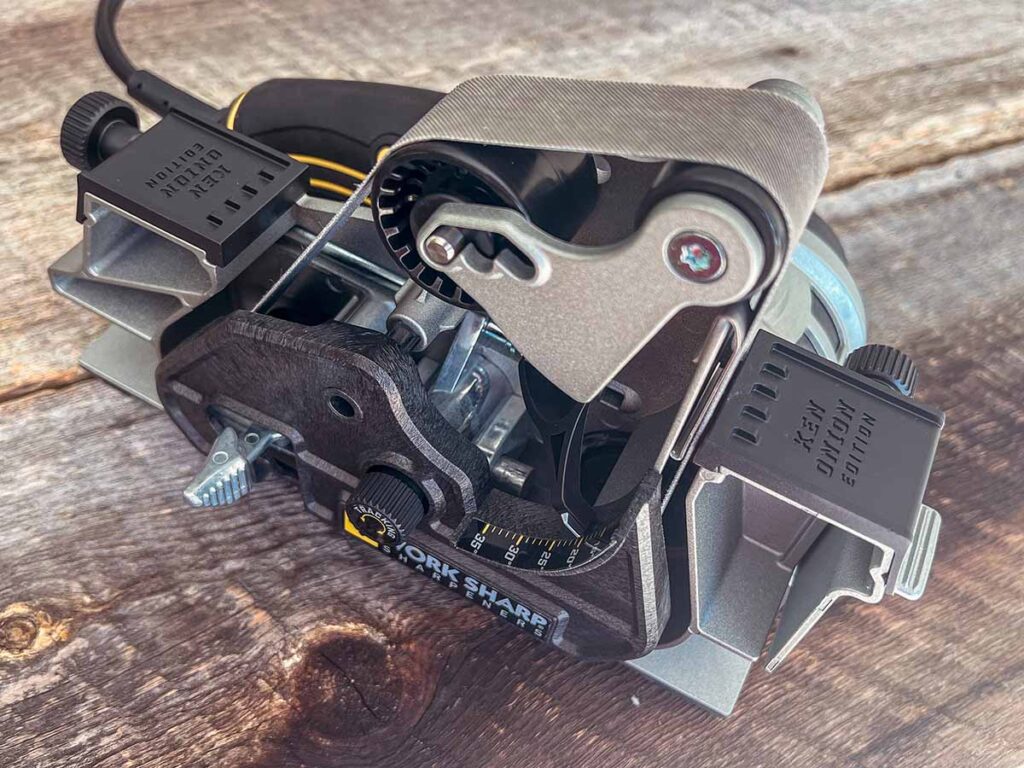
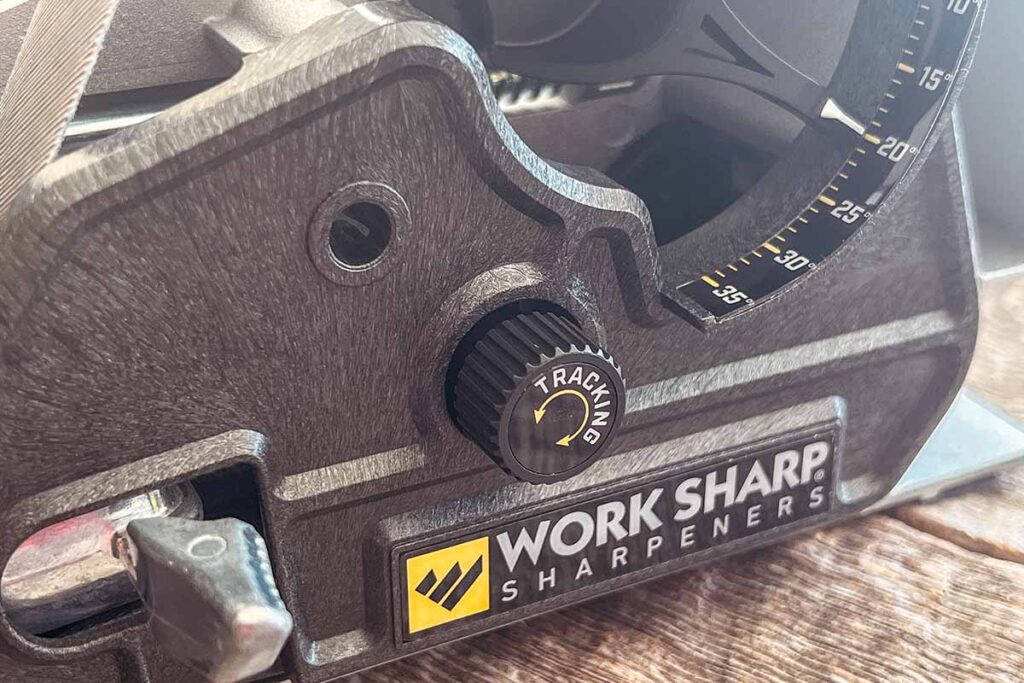
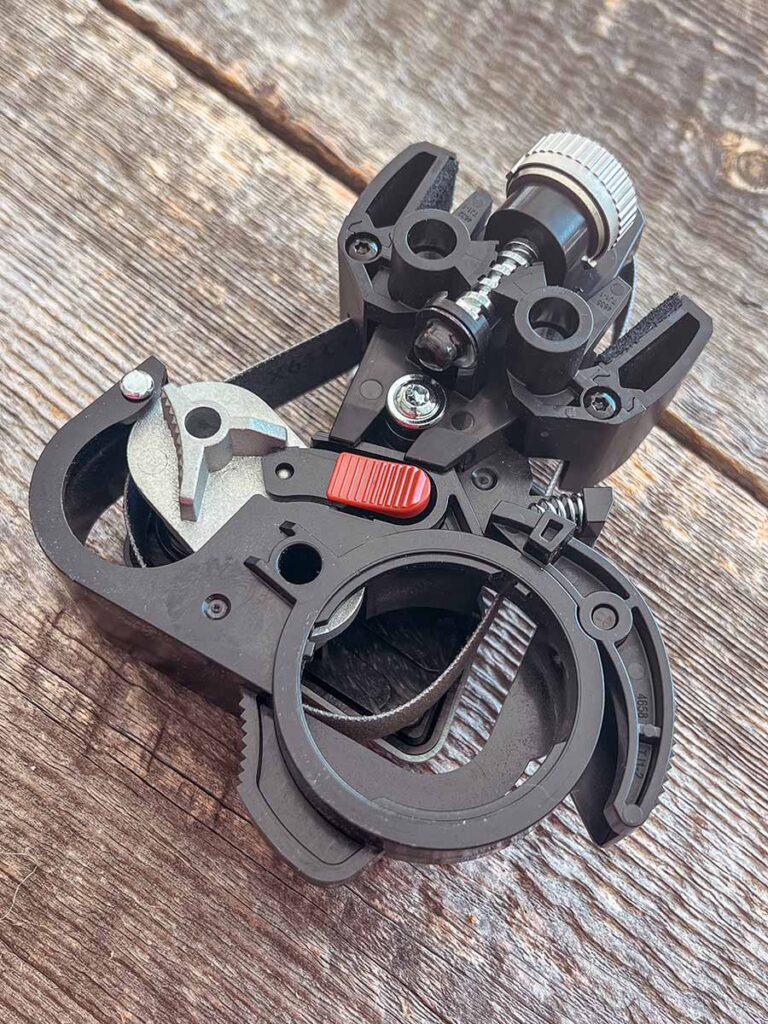
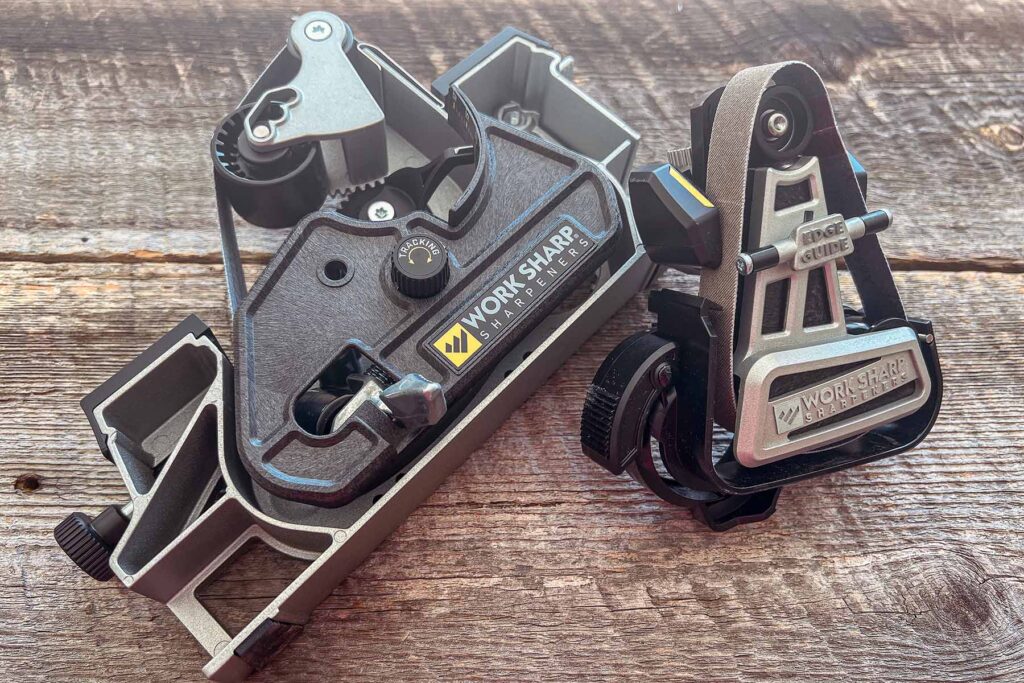
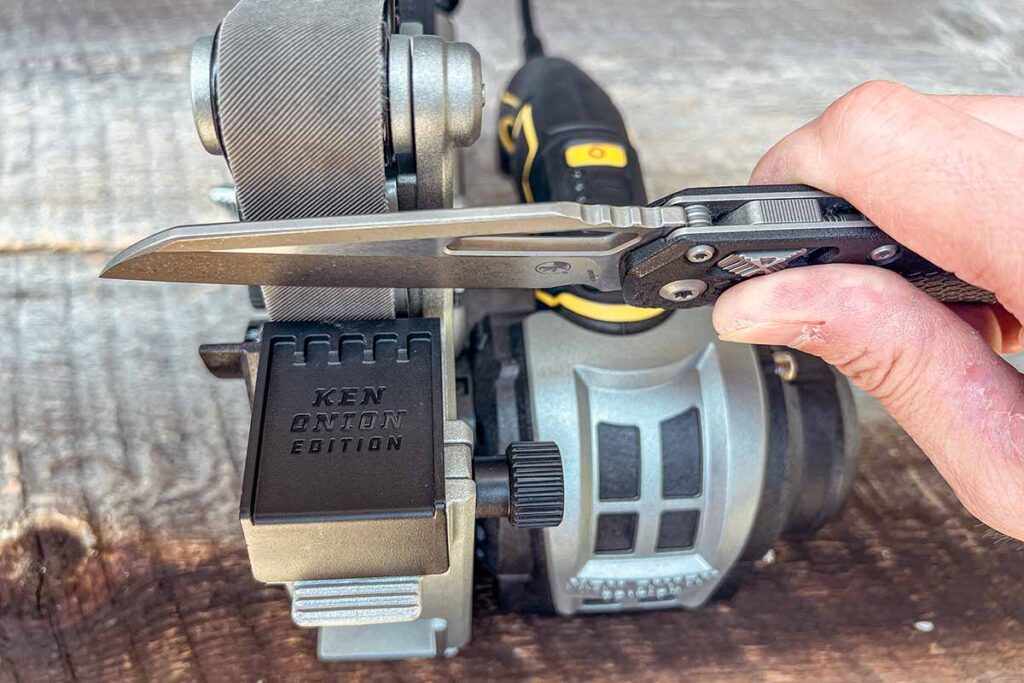
Automated Step 1: The author uses his Ken Onion Elite Sharpener from Work Sharp with the blade grinding attachment to sharpen recurves. The illustrated belt deflection helps the belt to conform to the cutting edge as it curves.

The author uses his Ken Onion Elite Sharpener from Work Sharp
Sharpening the recurve knife on a machine

Automated Step 2: The author sharpens the recurve blade as he would any standard blade by pulling it across the belt from choil to tip on both sides. Use the same motion when sharpening a recurve on a manual sharpener.

Automated Step 3: After sharpening, the author strops the edge using a leather strop to wipe off any micro burrs that form.

stroping the edge
Giving the recurve a few swipes on knife steel

Automated Step 4: After stropping, the author gives the recurve a few swipes on a hanging kitchen knife steel to give the edge extra bite.  

More Sharpening Articles:

Recurve Knives: Top Options In These Curvy Carvers

The sexy shape of three U.S.-made recurve blades addresses both performance and aesthetics.

As blade patterns go, the recurve is right up there in the “flair department.”

Just as the curves of a Ferrari add irresistible styling to the classic sports car’s appearance*, so does the curvature of a blade’s edge add to that of the look of the knife. It also changes the geometry of a blade—sometimes radically—in some ways better and other ways not so much. That’s the beauty of blade design and why there are so many different styles from which to choose.

How much length does a recurve add to the edge of a blade? This chart compares the length of the ’Squatch blade to the length of the actual sharpened edge. The curved top edge blade of a straight blade might add 2-to-3 inches to the edge. The Sasquatch’s recurved edge stretches the increase to 4.75 inches.

The waisted recurve design shifts the weight of the blade toward the tip, which while excellent for chopping also reduces the blade’s effective chopping length. The recessed area on the lower part of the recurved blade adds the benefit of being able to trap or gather in its subject when performing chores like debarking and taking slivers from wood, but it also makes sharpening more difficult with flat-surfaced media such as whetstones.

Sharpening A Recurve

Like any blade design, there are trade-offs. To get an idea of how radically the recurve lengthens the edge of a blade, see the accompanying chart of the Case Sasquatch bowie. The height of the sharpened portion of the blade is 7.5 inches, but when the length of the curvature is factored in the number swells to 12.25 inches!

Recurve blades require a rounded or ovate sharpening medium to properly hone the curvaceous edge. Hand-held sharpeners similar to those used by chefs or the common V-sharpeners work well on curved edges, as do stones with curved edges such as the Spyderco Golden Stone ceramic.

When sharpening these blades the concave lower curve does not conform to a flat plane, so an ovate or rounded surface grit is required for sharpening. Fortunately, there are plenty of these to choose from, such as handheld sharpeners similar to those used by chefs or the common V-sharpeners that use alternating rods set at opposing angles in a base. The Spyderco Golden Stone and/or Webfoot works as well. Now, on to the recurves!

Bear Forest Knives Custom Recurve

The Bear Forest Knives Custom Recurve is a small fixed blade built like a tank, owing much to the 3/16-inch thickness of its acid-dipped 52100 carbon steel blade. At 7.75 inches overall, the knife is geared toward light-to-medium camp chores and could conceivably be used as an EDC. The full-tang handle boasts colorful scales of a wavy sandwich of black, orange and natural cross-cut canvas Micarta®. Weight is a hefty-for-its-size 5 ounces. Bear Forest provides a black Kydex sheath with a nifty black coated 2.25-inch spring steel belt clip.

Bear Forest Knives Custom Recurve Specs
Blade length: 3.25”
Blade material: 52100 carbon steel
Handle material: Crosscut canvas Micarta®
Gripping feature: Tri-color Micarta handle material
Sheath: Black Kydex w/belt clip
Weight: 5 ozs.
Overall length: 7.75”
Country of origin: USA
MSRP: $249

Recurves shine when performing shaving tasks. Both the TOPS (left) and Case (right) did a nice job rendering cedar curls for fire starter.

Case Laramy Miller Sasquatch Bowie

The Case Laramy Miller Sasquatch Bowie is a study in understated good taste. The large 13-inch Jim Bowie namesake flows from stem to stern, from the break in its flat-ground 1095 carbon steel blade to its rounded combo lanyard hole and pommel. The matte-black Caswell finish gives the bowie a rustic look. The bag-style handle is topped with natural canvas Micarta scales affixed with 5/16-inch brass pins. Case provides a double-stitched natural leather belt sheath that matches the knife in clean styling.

Case Laramy Miller Sasquatch Bowie Specs
Blade length: 7.75”
Blade material: 1095 carbon steel
Handle material: Natural canvas Micarta®
Cutter keys: Clip-point blade, Caswell finish
Sheath: Natural leather belt model
Weight: 14.5 ozs.
Overall length: 13”
Country of origin: USA
MSRP: $219.99

TOPS Longhorn Bowie

The TOPS Longhorn Bowie is a thoroughly modern recurve with such classic touches as its upswept clip-point blade—always welcome on a bowie. The flat-ground 1095 blade is coated in dark sniper gray Cerakote®, matching the gray/black layered linen Micarta scales nicely. The black nylon MOLLE-compatible sheath carries on a belt or a pack and other gear. It includes a front pouch for stowing a sharpener or fire-starting accessories.

TOPS Longhorn Bowie/Sniper Gray Specs
Blade length: 6.75”
Blade material: 1095 carbon steel
Handle material: Canvas Micarta®
Cutter keys: Trailing-point blade, sniper gray Cerakote® finish
Sheath: Black nylon, MOLLE compatible w/pouch
Weight: 18.1 ozs.
Overall length: 13”
Country of origin: USA
MSRP: $305

Testing The Recurve Knives

The TOPS Longhorn and Case Sasquatch bowies begged to be reviewed together because they are exactly the same length and share the same 1095 blade steel, yet are two very different knives. The TOPS blade has a more casual recurve while the Case is full tilt. The handles couldn’t be more different as well, with the Case opting for a clean, traditional bag-style grip while TOPS chose a modern tactical design a full inch longer than its counterpart, resulting in a slightly shorter blade. Let the fun begin!

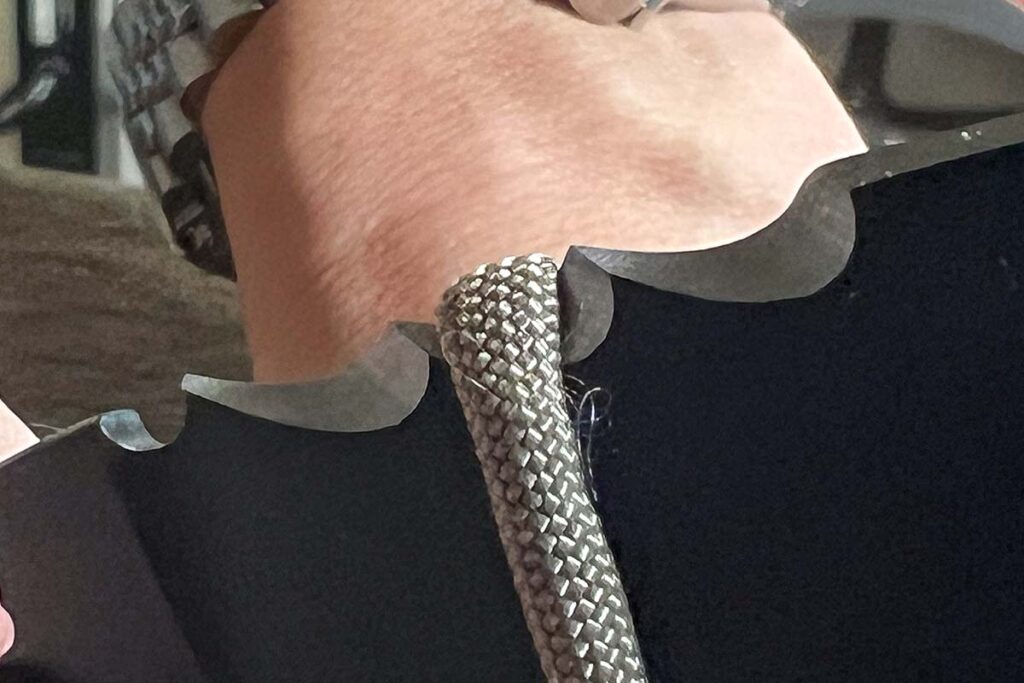
The Bear Forest Custom Recurve is small compared to the two larger test knives, though the same blade geometry applies. Note how the upper curve of the edge ensnares the rappelling rope as it slices through it.

I started with some basic chopping on a 5-inch diameter oak log. The Sasquatch brought the hammer down with its weighted fore-end but the Longhorn had the advantage of more working area on the blade for chopping. Both manufacturers chose 1095 and have loads of experience at maximizing the steel’s benefits. I found both knives excelled in the pure blade bite and performed well chopping. The Sasquatch weighted front end is an advantage for sheer power but the Longhorn is 3.6 ounces heavier, so it closes the gap significantly.

I did some shaving doing push cuts on 1×3 cedar planks. As expected, the concave edge of the Case excelled at trapping the wood through the straight cuts. Advantage Sasquatch. However, the TOPS has a grip a full 1-inch longer than the ’Squatch and is textured as well, offering superb purchase. Advantage TOPS. Bottom line, both recurve bowies performed very well. The choice is yours.

It's a trap! The lower concave area of the Case blade traps the rappelling rope during a pull-through. The deeper the concave curve, the better it performs this function.
It’s a trap! The lower concave area of the Case blade traps the rappelling rope during a pull-through. The deeper the concave curve, the better it performs this function.

The sheaths for both are well done. The Case belt model is natural leather designed in a simple, tasteful manner. The TOPS is unabashedly rock ’em, sock ’em tactical all the way.

The Bear Forest Custom Recurve punches up in its size class thanks to thick 3/16-inch blade steel and a healthy handle length, a trait often missing on smaller fixed blades. I tested the blade for its ability to capture 3/8-inch rappelling rope in its concave maw. Thanks to its overbuilt steel, the blade never wavered while producing slice after slice. It also took off nice, healthy curls of cedar just like the big boys. The curves of the cross-cut canvas Micarta scales made for excellent purchase and are attractive to boot. I also did some bark skinning on seasoned oak, took slices off other kinds of rope, and batonned fatwood pine fire starter.

Bear Forest provides a nifty Kydex sheath. It has a 1.5-inch spring clip on the back that not only mounts on the belt for vertical and cross-draw carry/deployment, but doubles as a pocket clip on either side, something seen more and more from the fixed-blade EDC crowd lately. All in all, I was impressed with the whole package.

Final Cut

The recurve isn’t just for whacking stuff. It requires a little more finesse and is typical of blades that don’t walk the straight and narrow. However, the benefits of recurves will reward you dearly when kept in their lane. All three of the test candidates performed admirably and are well worth your consideration.

*Editor’s note: Long-time custom knife purveyor J. W. Denton, who was a champion racecar driver in his younger days, was fond of comparing the knives of Steve Johnson, BLADE Magazine Cutlery Hall-of-Fame member Bob Loveless and others to curvaceous sports cars. J. W.’s comparison, however, was largely between the handle butts of the knives and the rear ends of the cars. However, both comparisons are accurate.

  1. Bear Forest Knives Custom Recurve
    Blade length: 3.25”
    Blade material: 52100 carbon steel
    Handle material: Crosscut canvas Micarta®
    Gripping feature: Tri-color Micarta handle material
    Sheath: Black Kydex w/belt clip
    Weight: 5 ozs.
    Overall length: 7.75”
    Country of origin: USA
    MSRP: $249

Check Out More Outdoor Knives:

Advertisement

Must Read Articles

Read this before you make a knife

Knifemaking 101 – Read This Before You Make a Knife

  by Wayne Goddard My experience has taught me that there's nothing like digging in and getting started. I've often said the hardest part of the...
how to forge damascus steel

How to Forge Damascus

Advertisement
Advertisement