Home Blog Page 57

Best Buck Knife: What Are The Company’s All-Time Classics

Buck Knives is among the most historic manufacturers in the county. We attempt to pick the best knives it has ever created.

The famous 110 Folding Hunter was introduced to the market in 1964. This was a significant point for Buck Knives, and a significant point for the knife industry as a whole. 

Buck did not start in spirit in 1964, it began much earlier at the turn of the century, and was the culmination of over half a century of Hoyt Buck’s knifemaking experience. Several generations of the Buck family worked to build the company, and the result was nothing short of extraordinary. Buck Knives are one of the most recognizable brands in the country, and they have a well-earned reputation for quality. It is currently in its fourth generation of family ownership, an amazing feat in today’s fast-paced corporate environment. 

Buck knives are exceptionally well-made and will hold up for a lifetime if properly maintained. The knives also carry one of the best warranties in the industry which guarantees their products against any defects for life. This whole segment has nothing from him about how Hoyt formally started and built the company.

History Of Buck Knives

The Buck 119 Special is one of the company’s many fixed blades.

While it was not technically a company, Hoyt buck began making knives around 1900 and developed a way to temper steel that he deemed to be superior to what was being done at the time. It may seem a bit uppity of an apprentice blacksmith to take on something that had not been done in all of the history of man’s knife-making, but Hoyt Buck was not to be deterred. 

Sure enough, his methods became well-known and he made knives one at a time for decades afterward. His knives had superior edge retention as a result of his tempering process and to this day Buck knives are well-known for their ability to hold an edge.

While the seeds of Buck Knives were planted thanks to Hoyt and his skill on the anvil, the company’s journey is so much more than that. Hoyt had six children, and his oldest son Al would eventually play a key role in the company’s growth. 

By 1941 Hoyt and his wife were now living in Idaho, and he was a church pastor. However, the attack on Pearl Harbor roused his patriotism. As a way to help the war effort, he opened a small blacksmith shop in the basement of his church and began making knives once again. His knives became extremely popular on the military bases on the Pacific Coast and soldiers would come from all over to get one of his blades.

By the time the war ended in 1945 Hoyt and his wife Daisy decided to move south to San Diego and live near Al. In 1946 Hoyt opened his first manufacturing plant, really just a small lean-to attached to Al’s house, with his son. It was then that Buck Knives was officially born. 

Al took over the company when his father passed, and today the company remains in the family as CJ Buck is the fourth-generation CEO and Chairman of Buck Knives.

Hoyt’s Tempering Process

Hoyt Buck was 13 years old and an apprentice blacksmith in 1902. According to the company’s own history, Hoyt was dissatisfied with the edge hardness on common farming implements. Farmers seemed to be bringing in their tools far more often than he liked to see and thought of some solutions to make the edges stronger and able to hold their sharpness longer. He began experimenting with these tools and eventually figured out a quenching method to achieve his desired result.

Essentially, the secret Buck discovered was quenching the entire blade when it was all precisely the same temperature. Not an easy task, especially in the day and age he came up with the process. However, overcoming the technological challenges reaped impressive benefits. The uniformity of the tempering process ensured the metal had no soft spots–weakness that could eventually lead to damage. Furthermore, the even tempering–when applied to knives–resulted in blades that were extremely hard and were capable of retaining an edge.  

How To Date A Buck Knife

Buck 375
The Buck 375 shows off the company’s continued commitment to detail.

Unlike many knives across the industry, Buck knives are marked in certain ways to identify them based on the year they were made. The original Buck knives from 1961 to 1967 or simply stamped with ‘BUCK’. 

From 1967 to 1972, the knives featured the mark ‘BUCK, USA’. The 1972 to 1986 period had the knives labeled with ‘BUCK 110, USA’ with additional model information. From 1986 onwards, each year of manufacture has a unique symbol that is added to the blade. You can very quickly and easily identify this and match it to the model year on the Buck website. 

Buck knife collectors tend to have some of their own methods for identifying early knives. While it comes down to a degree of pseudoscience, there is demand for Buck knives that retain their original packaging, and even original receipts that can prove the age of the knife. Typically, the older the knife, the more it is worth. 

Vintage Buck knives do not tend to sell for all that much by comparison to other knives, but there is a healthy following all across the country. Most people do not sell their Buck knives at all, and they are passed down generationally.

Best Buck Knives

Whether it’s a contemporary knife or a classic, these 10 knives from Buck continue to be top sellers and beloved by knife aficionados around the world.

110 FOLDING HUNTER KNIFE 

Buck Knives 110 FOLDING HUNTER KNIFE 2

This is the one that started it all. The 110 Folding Hunter needs no introduction here. It is one of the most storied and respected knives in American history. What is remarkable is that the price is relatively low, even for Buck’s lineup.  The price of this knife sets it apart because it is well-known for its durability and sharpness. At under $70, you can easily buy this knife without breaking the bank.

MSRP: $65

124 FRONTIERSMAN KNIFE 

Buck Knives 124 FRONTIERSMAN KNIFE 2

This knife harkens back to the old days in appearance but is all modern in terms of execution. The Frontiersmen knife is just about the perfect size if you prefer to carry a fixed blade. The design of the knife is completely functional and you should be able to accomplish just about anything you need to accomplish out in the woods or around the farm.

MSRP: $185

055 ‘THE 55’ KNIFE 

Buck Knives 055 ‘THE 55’ KNIFE 2

The 55 gets its name for being half the size of the famous 110. It is a popular and common pocket knife that is just as strong as its big brother. While it lacks many of the features of modern assisted-open knives or other types of more complicated designs, it makes up for it by being exceptionally durable and easy to use. Much like the larger 110, this is a knife that you will keep for life and pass down to your kids.

MSRP: $70

120 GENERAL KNIFE 

120 GENERAL KNIFE 2

There are very few knives that are as recognizable as the 120 General Knife. This Buck design is a classic, reminiscent of the military Ka-Bar. It is a bigger knife than what most people use for their everyday chores. The General Knife will be a companion for hunting, skinning, and preparing wood near the campfire.

MSRP: $130

103 SKINNER PRO KNIFE 

103 SKINNER PRO KNIFE 2

Back in the old days, a skinning knife was part of a larger set that you would take into the field. This knife profile saw its heyday during the decimation of the buffalo herds. Buck has an excellent skinning knife in the form of the 103 Skinner Pro. It is a fine tool and is exceptionally attractive in appearance. If you like to have separate tools for your various hunting chores, you would do yourself well to equip this knife alongside the larger 120 General Knife.

MSRP: $170

102 BUCK WOODSMAN KNIFE 

102 BUCK WOODSMAN KNIFE

For many young men, the Woodsman was the first serious knife they ever received. This is a classic design and is among the most popular and well-recognized American fixed-blade knives ever made. It is not the largest knife Buck has made, but this medium-sized Bowie profile blade has seen more use than most knife models could ever hope to achieve. 

This is an excellent knife for the aspiring outdoorsman. It can be used in just about any setting that requires medium lifting. It is a bit too thin to be used for wood splitting but can be used easily for making kindling by scraping. It is also an excellent small game knife and can be used for all sorts of camp chores. If you think about the knife that you would have in the Scouts, this would likely be as close to that knife as you can get.  

MSRP: $75

BUCK ZIPPER KNIFE 

The Buck Zipper is one of the many knives sold by the company today.

The Buck Zipper knife is arguably one of the most popular gut hook knives in the country, and it is fair to say that it is in more deer hunters’ hands than it’s not. As far as traditional designs go, the Zipper knife is not just well-made, it is also a symbol of the trade for many hunters that take to the field every fall. Gut hook knives do have other utility, they can be used in fishing settings for cutting line and for gutting as well. For a general-use hunting knife, you really can’t go wrong here.

MSRP: $129.99

863 SELKIRK KNIFE w. FIRE STARTER 

buck knives 863 SELKIRK KNIFE W. FIRE STARTER

Bushcraft knives are all the rage these days. There are a plethora of TV shows dedicated to the topic, and it seems that every knife company out there is making something that fits the bill. The Selkirk knife is a nicely priced addition to the Buckline. The knife is well equipped and comes with a durable micarta handle and a sheath-mounted fire steel. The kit you get is able to function right out of the box. You can pretty easily get started with practicing right in your yard. MSRP $80

The knife does have a couple of downsides, though, from a Bushcraft perspective, it is relatively thin. A blade really needs to have some meat to it to be able to make it through the tanning for kindling You’ll never really get much life out of a thin blade if you snap it off in use. Even though Buck has a good warranty, you should take care to not treat a thin blade like this as a dedicated tool for splitting. The knife can, however, be used for making tinder out of smaller pieces of wood, and it should have no problem getting them to light.

MSRP: $80

841 SPRINT PRO KNIFE BURLAP MICARTA 

841 SPRINT PRO KNIFE BURLAP MICARTA life

Another modern design, the Sprint Pro is a sleek looking folder that also has some classic lines. The knife is available in a couple of forms, most interesting is the burlap micarta model. Burlap micarta is made through an interesting process that suspends fabric in a resin base material. The result is a unique, very durable, and highly functional grip material that looks as good as it performs. This is a flipper-style knife and can be operated easily with one hand. The locking mechanism is a standard liner lock. Overall, it is a well-reviewed and well-designed knife that, while not the most visually striking, will give years of use.

MSRP: $155

417 BUDGIE KNIFE 

841 SPRINT PRO KNIFE BURLAP MICARTA life

The Budgie is a very compact EDC knife that can go just about anywhere. The tiny design is minimalistic yet functional. It is a frame-like design that is available in a couple of colors, most notably natural green G10. This is a new design that does not necessarily have much in common cosmetically with the classic Buck lineup. That said, it is just about all the knife the average person needs for their daily life, and it can be kept on the person quite easily. While it is a bit more costly than the average mini pocket knife, the Budgie is backed by the same warranty extended to all Buck products and is going to last you for quite some time performing light and medium-duty tasks.

MSRP: $100

Read More

CRKT Provoke Review: A Different Cut Of Knife

A mechanical wonder with practical functionality, the CRKT Provoke incites wonder.

Karambits are unique knives, originating in southeast Asia as an agricultural tool and later adapted as a weapon. Its signature claw-shaped blade allows effective slashing, and given its cutting edge is always oriented to the target at an angle, it also delivers wicked slices from point to hilt.

Just think about how a cat grabs, holds, punctures and cuts its prey and you have a pretty solid idea about how a karambit operates. The age-old design still inspires and intimidates, and some manufacturers have even figured out how to put a new spin on the longstanding design.

CRKT Provoke
The Provoke offers a wicked chisle grind for maximum slicing, cutting and punturing ability.

Take the CRKT Provoke, for instance.

Knifemaker Joe Caswell took the concept of a folding karambit and made it a bit different. Instead of the blade simply folding into the handle, the Provoke’s steel lunges out and back in with a simple flick of the thumb. In the ancient art of knifemaking it’s difficult to come up with something unique, but Caswell did.

The Provoke not only incites wonder in collectors but also elicits excitement in serious users.

Provoke Blade

The blade of the Provoke (MSRP $200) is 2.4-inches long and is made from D2 steel for superior edge retention. To work properly with the deployment mechanism, the blade is chisel ground. The flat side is faces in toward the handle, laying flush against the frame when closed. This is mainly a safety precaution, protecting the user from cuts or torn clothing when the blade isn’t in use.

Provoke Action

Opening the CRKT Provoke
The mechanical action of the Provoke is one of a kind.

The Provoke’s signature action is what Caswell dubbed “kinematic”. It works thusly, the blade is attached to a pair of movable arms anchored into the handle. To deploy the blade, it is held in reverse grip and the thumb presses on the exposed end of the blade. The arms pivot and the blade leaps forward. Closing is equally as effortless. Just press down on the exposed locking tab just below the finger ring, then the blade is retracted backward until it rests fully against the handle frame. 

Nicely, given it doesn’t take much force to open or close, the blade locks in the open position. Honestly, it’s a really neat, mechanical motion. Fairly self-evident, the movement of the Provoke is unlike anything else available on the market today and has the ability to capture even a jaded knife aficionado’s attention.

Getting Clipped

Provoke clip
As unique as the action is the Provoke’s pocket clip, which lays flat until needed.

Another intriguing aspect of the CRKT offering is its pocket clip. Often used, rarely discussed and poured over, the clip is one of those unsung if not massively simple aspects of the knife. Even here the Provoke takes a different twist in design.

The clip is spring-loaded and rests against the finger ring completely. To open, you simply push down on a notched portion of the clip and it rises up. Some might complain it’s overly complex, but it does fit nicely in a knife defined by its mechanical ingenuity.  Not to mention, in hand, you do not feel the clip at all—a break from nearly every other option with in a standard configuration.

Provoke Variations

Provoke Compact

Provoke Compact and Provoke Grivory
Provoke Compact (top) and Provoke Grivory (bottom) offer two lightweight EDC options.

In addition to the full-size Provoke, there is a scaled-down version in the form of the Provoke Compact (MSRP $150). Essentially, it’s the same knife but with a blade length of 2.2 inches. Where this petite Provoke earns its stripes is ease of carry, as it is much less cumbersome in the pocket than its big brother. And, from my perspective, this smaller version’s action is a bit crisper than the full-sized, perhaps due to the smaller blade.

Provoke Grivory

Again, aiming at EDC, CRKT also offers the lightweight Provoke Grivory (MSRP $100). You guessed it, the handle is made from injection-molded Grivory—a very stiff but lightweight glass-reinforced thermoplastic. Here you have a host of choices in handle colors, including fluorescent green, red, blue, and orange—adding some pop to an already exciting knife. Regardless of the color, the blade’s arms are always black Grivory, providing a nice contrast to the frame and matching the blade’s black stonewash finish. 

It’s also worth noting that the Grivory arms are reinforced with steel to provide strength and rigidity to the material for superb blade action. The lightweight version weighs 4.7 ounces; for comparison, the full-size Provoke weighs 6.1 ounces.  So there is considerable weight savings. 

As for the action on the Grivory, it feels a bit different than the aluminum handle versions—in a good way. For me, it felt a bit lighter and faster in deployment.

Provoke First Responder

For the save and serve professionals, CRKT offers the Provoke First Responder (MSRP $225)—the full-size knife with a 2.4-inch blade. However, it does have some value adds life-saving professionals should appreciate, such as a ceramic glass breaker point inserted into the end of the handle frame.

The Provoke’s curved blade is especially suited for rescue work, particularly cleaving through seatbelts with a single, swift pulling motion. In addition to the standard integrated pocket clip that all Provoke models feature, the First Responder also includes a molded sheath with multiple carry options to offer carry flexibility if desired. 

Provoke EDC

CRKT Provoke EDC
The EDC (bottom) next to the Compact (top). The EDC may prove more practical for some users.

The Provoke EDC (MSRP $175) features a 2.5-inch long drop point blade of D2. This iteration replaces the knife’s standard talon-shaped blade with a blade shape that is more friendly to daily cutting tasks. Honestly, it’s perhaps my favorite out of the entire Provoke family. 

The action is very quick on this one, though once open you have to reorient your grip from a reverse to a forward grip. The blade’s lock release on the EDC version has been reoriented from the position of the other Provoke models, to make one-handed closing of the blade possible.  You can deploy the Provoke EDC one-handed as well as close it one-handed. It does require some practice to close one-handed but once you get it down, you will be able to do that easily.

Provoke Trainer

Provoke Trainer
No need to upgrade your health insurance when practicing with the Provoke Trainer.

For those who might be serious about employing the Provoke for self-defense, or simply like to fiddle with the knife’s action as a fidget toy, CRKT offers a trainer model (MSRP $100). Built exactly like the live-bladed lightweight Provoke, it sports a dulled and blunted blade. In short, there’s no danger of accidental cuts or stabs while working with the knife.

Furthermore, a series of holes drilled into the blade blank subtracts weight so it is the same as the live-bladed version. The trainer is only available in an all-blue handle, signifying its purpose. 

Using The Provoke

When using the regular Provoke, you’re limited to a pulling motion for cutting, though it has a defined blade tip for precise cutting and scoring. If you intend to carry one on an EDC basis then the Provoke EDC is a better candidate because of its double ground drop point blade, which is more conducive to general utility use. 

Due to the more common blade shape along with the short length, this model allows you to get into places where a larger knife blade cannot. This means using the Provoke EDC to open mail, packages, strip wire, cut cardboard, and other general working tasks that a knife of this size would be called upon to do. The D2 steel does an excellent job at holding an edge yet when it comes time to resharpen, it’s still a great steel.

Final Cut

If you like knives that are a step away from ordinary—not to mention are conversation starters—the Provoke series is for you. If you like mechanical things…the Provoke has your name on it. However, I would pick the Provoke EDC as the best of this bunch if you are just going to carry one for daily cutting purposes.

Each model is made with excellent fit, finish, and sharp ess right out of the box, however. I think this design is perhaps one of the most inimitable knives out there right now. It may not be for everybody, though. But if your knife tastes venture into the unique and different, then the CRKT Provoke series has your name on it.  

More On CRKT:

Tactical P.A.S.S. Com: Condor Knows When To Fold ‘Em

0

Fixed-blade focused Condor continues to branch out Tactical P.A.S.S. Com folder.

Condor Knife & Tool came heavy into SHOT Show 2024 with a bevy of new blades and variations. The company’s fans should be excited about the coming year. That said, one particular knife jumped — the Tactical P.A.S.S. Com.

Those who follow Condor know its bread and butter are fixed blades, usually the type fit to slice through the El Salvadorian jungle—home base for the company. But the manufacturer continued to branch out with the Tactical P.A.S.S. Com, a folder (not its first, mind you) that makes for an interesting break in Condor’s same old, same old. Trust me, you might be able to tuck it away in your pocket, but it’s every bit up to the company’s rugged standards.

Tactical P.A.S.S. Com open

Designed by Jason Breeden, who has conjured up a bevy of designs for Condor, the Tactical P.A.S.S. Com is modeled after an icon—Bob Loveless’ Chute knife. As an aside, Mike Haskew did a phenomenal piece on the development of this classic in his article on the original Chute knife. Breeden appears to have an affinity for the design, having created a more true-to-form fixed-blade rendition of it previously. The folder marks the continued expansion of Condor’s popular Mountain P.A.S.S. (Plain And Simple Survival) line, which has grown significantly in the past year.

In brief, the knife looks to have the chops for tough outdoor use, as is the typical theme at Condor. Tactical P.A.S.S. Com boasts a 4.96-inch, drop-point blade constructed from 14C28N stainless steel. This is a budget stainless, but one not without its charms, particularly its respectable edge retention and toughness. And at .12 inches in thickness, Condor gives you plenty of material to work with on the flat-ground blade, particularly if called into play on more demanding tasks, such as batoning. I’ll say, the false edge is a nice touch, giving the blade an overall clean, yet rugged look tapering back into the hammer finish around the thumb studs.

As for the handle, it’s a tan Micarta with some milling down the midline and a single-finger groove to provide a comfortable yet firm grip. The liner lock’s stainless screws give the handle strong, if understated aesthetics, not to mention easy access if you need to crack baby open to clean.

Tactical P.A.S.S. Com closed

While Condor pulls off a strong showing with the Tactical P.A.S.S. Com, I do have one nit to pick. The company opted for a spine-side, extended clip, which from my standpoint isn’t the most practical configuration. But with everything else the knife brings to the table, it’s far from a deal breaker for those who prefer a more traditional clip arrangement.

As for costs, Condor as usual keeps its edge but puts the Tactical P.A.S.S. Com within reach of most knife consumers. The company lists its MSPR at $150 at its site and has it on sale for less. Overall, the folder is a nice addition to a catalog of fixed blades and certainly seems on par with Condor’s ready-and-rugged standards.

Tactical P.A.S.S. Com Specs
BLADE LENGTH: 4.96 in
OAL: 9.66 in
BLADE THICKNESS: 0.12 in
WEIGHT: 7.27 oz
BLADE MATERIAL: 14C28N Stainless Steel
FINISH: Condor® Classic
GRIND: Flat Grind w/ Second Bevel
TYPE: Folding Knife
HANDLE MATERIAL: Micarta®
MSRP: $150

Check Out Our Knife Reviews:

Best Crossbar Lock Knives: Blades & Actions That Holdfast (2024)

The crossbar lock continues to dominate.

One of today’s most popular blade-locking mechanisms for folding knives is the crossbar lock. It’s the most advanced blade lock there is—for now.

The crossbar lock consists of a spring-loaded, hardened-steel bar in the handle that makes constant contact with the tang and springs forward into place once the blade is opened. It wedges itself between the tang and the liner, preventing the blade from rotating shut until it is released manually. The lockbar is ambidextrous. The lock is all smooth action, tight lockup and ease of release. It is safe because it does not require your fingers to be in the path of the closing blade the way a linerlock or framelock does, thereby almost eliminating accidental cuts.

Crossbar Lock Origins

The crossbar lock first appeared in 1999 with Benchmade’s 710 Axis Lock folder, which has since been discontinued. The knife and lock mechanism were designed by knifemakers Bill McHenry and Jason Williams. “Bill McHenry was the primary driver of the mechanism,” says Vance Colver, Benchmade director of product line management. 

Crossbar Lock Inventors
Custom knifemakers Bill McHenry (left) and Jason Williams, designers of the Axis Lock. (Lisa McHenry image)

McHenry was a man of many interests. At one time he was a goldsmith, a watch enthusiast who rebuilt and repaired watches, and he loved restoring vintage Indian motorcycles. “The love for the mechanical gave him a unique perspective to knife lock solutions and led to the Axis Lock,” Colver added.

On June 10, 2003, the patent for the Axis Lock was issued to McHenry and Williams, patent no. US 6,574,689. In addition to the aforementioned features, Colver said the Axis Lock has smooth blade rotation; is reliable with minimal moving parts—just the lockbar moves, and it does so only slightly; and strength, with the Axis Lock outperforming the linerlock in closed failure force.

After the Axis Lock debuted, new Benchmade models with the lock appeared, including the Griptilian designed by BLADE Magazine Cutlery Hall-Of-Fame® member Mel Pardue, the Warren Osborne 940 Axis Lock and the Presidio Axis Lock automatic. The Axis Lock patent expired in 2016, allowing other knife companies to introduce their version and thus broadly open the “new” crossbar lock category.  Today you will see variants across several prominent brands, including the Axis Lock itself.

Top Picks Crossbar Lock Knives

Benchmade Axis Lock

Benchmade crossbar lock
The lock that started it all, the Axis Lock, the original Benchmade McHenry/Williams 710 Axis Lock and Benchmade’s Model 535 Bugout and Mini Adamas. The latter two knives are in production while the 710 has been discontinued.

Benchmade’s Bugout is classic EDC because of its slender form factor, extremely lightweight, and use of premium blade steel. The full-size Model 535 Bugout has a drop point blade of flat ground CPM S30V stainless steel. The 3.2-inch blade is long enough for most cutting tasks but short enough to be compact and carry well. Handle material for the base model is molded Grivory for light weight and strength. Carbon fiber/CPM S90V stainless and machined aluminum/M390 stainless are respective handle/blade material combos available in the high-end models. The manufacturer’s suggested retail price (MSRP) for the Bugout starts at $180 and increases depending on handle and blade material options.

The Benchmade Mini Adamas 273-03 Axis Lock is a scaled-down version of the full-size Adamas tactical folder. Designed by knifemaker Shane Sibert, the Mini Adamas has a 3.25-inch drop point blade and closed length of about 4.35 inches. The blade features a milled-in fuller and CPM MagnaCut stainless steel. The regular production versions have CPM CRUWEAR tool steel blades.

The handle is angular and boxy in very good ways. A slight swelling in the middle helps fill your palm. The special edition has marble carbon fiber scales. The standard Mini Adamas offers a choice of black or OD (olive drab) green G-10 handles. The knife’s Axis Lock works beautifully, with a rock-solid lockup and ultra-smooth blade rotation. MSRP: $375. Country of origin for the featured Benchmades: USA.

Microtech Ram Lok

Microtech crossbar lock
Microtech’s RAM LOK takes the crossbar lock to the next level with a rectangular-shaped lockbar that places more mass on the blade tang as opposed to the standard round profile lockbar of other crossbar locks. The RAM LOK is available on several select Microtech models, including the MSI (top) and Amphibian (bottom) folders.

Microtech christened its crossbar lock Ram Lok, and it’s a variation on the theme. Most if not all other crossbar locks employ a round-profile locking bar. The Ram Lok has a rectangular shape, providing more surface space and bulk to the lock, thereby providing more inherent strength. The center post that passes through the rectangular lock has a coil spring that provides the lock’s resistance and is the key to the lockup’s integrity. The Ram Lok follows the contours of the tang and, once the blade rotates fully open, springs forward into place, wedging into the tang, thus preventing the blade from rotating closed. The release buttons are multi-faceted, stepped “X” designs on either side of the handle.

The MSI (Microtech Standard Issue) and Amphibian Ram Lok are but two Microtech manual folders with the Ram Lok. Winner of Best American Made Knife at BLADE Show West 2023 (January BLADE®, page 16), the MSI features a 3.8-inch sheepsfoot blade of Bohler M390MK high-performance stainless. M390MK is manufactured exclusively for Microtech and is similar to M390 though enhanced a bit for added edge holding.

The straight-line cutting edge permits easy sharpening as well as high utility, excelling at pull cuts especially. MSRP: $365.  A black-polymer-molded-handle version lowers the price considerably to $177. It’s the most affordable U.S.-made Microtech folder available.

The Amphibian is the resurrection of an older Microtech tactical design. It sports a recurve clip-point blade in 4 inches of M390MK and a highly ergonomic handle. The signature stepped teardrop-shaped thumb stud is ambidextrous and allows for easy one-hand opening. The handle is available in G-10 or aluminum, with G-10 colors of black, FDE (flat dark earth) or OD green. The aluminum handle is available in black only, though that may change by the time you read this. MSRP: $300. Country of origin for the featured Microtechs; USA.

Hogue ABLE Lock

Hogue crossbar lock
The Hogue Knives Deka has the company’s ABLE Lock. ABLE is an acronym for Advanced Bar Lock Enhanced. The Deka is an EDC friendly folder that comes in clip-point (top) and wharncliffe (bottom) blade shapes and is designed by custom knifemaker Allen Elishewitz.

Hogue Knives calls its crossbar lock the ABLE (Ambidextrous Bar Lock Enhanced) Lock. The Deka is one of the company’s folders that sports the ABLE. Designed by knifemaker Allen Elishewitz, the Deka is stylish, well-configured and slender, great for EDC and makes an awesome work knife. The 3.9-inch blade comes in standard clip point or modified wharncliffe patterns. At press time, Hogue was switching the blade steel to CPM MagnaCut from CPM 20CV.

The handle is offered in standard black and multicolored Gmascus in red, camo, green and blue. The Gmascus replicates a damascus look but in a lightweight phenolic-based resin. As each color alternates with black, the resulting visual is eye catching. The ambidextrous pocket clip carries the knife tip up. MSRP: $194.95. A version with a lightweight, lower-cost polymer handle in a choice of black, blue and FDE and a MagnaCut blade has an MSRP of $159.95. Country of origin: USA.

Gerber Pivot Lock

Gerber Pivot Lock
Gerber’s Sedulo (top) and Assert (bottom) offer the company’s version of the crossbar lock called the Pivot Lock. The Pivot Lock secures solidly and the blade action is ultra-smooth. Dual steel liners reinforce the lock’s strength.

In recent years Gerber has shifted production to the USA, a good lead-in to its new folders with crossbar locks. Among them are the Sedulo and Assert, each of which uses Gerber’s Pivot Lock. The Sedulo’s 3.4-inch drop point blade is fully flat ground CPM S30V stainless. Dual thumb studs provide ambidextrous opening. A stonewashed finish helps seal micro pores in the steel as well as hides most scratches easily.

The handle is gray FRN (fiberglass-reinforced nylon)—black is also available—with chamfering throughout for a secure, comfortable grip. The Pivot Lock locks up very tight and the blade action is ultra-smooth. Dual steel liners reinforce lock strength. Closed length: 4.7 inches. MSRP: $124.99.

Though not as brawny as the Sedulo, the Assert carries easier and more comfortably. The modified clip point blade is 2.9 inches of CPM S30V. Closed length: 4 inches. The oblong blade slot provides attachment points for the adjustable thumb stud, which you can move/position anywhere along the slot. The stud can be removed altogether and the slot used to open the blade instead.

I love how the two standoffs at the handle butt, the lock release buttons and the thumb studs are orange, contrasting nicely with the gray and adding an exciting pop of color. An ambidextrous fold-over clip carries the knife deep in the pocket. The Pivot Lock ensures smooth blade action and rock-solid lockup.

The flat-ground blade slices evenly and cleanly. Out of the box the edge was very sharp and ready to work. It carries well, cuts well and is great looking. MSRP: $174.99. It’s available in three colors: all black with black blade and hardware, gray handle with orange hardware, and green handle with blue hardware. Country of origin for the featured Gerbers: USA.

Kershaw Duralock

Kershaw crossbar lock
The Iridium (top) and Heist (bottom) are two of Kershaw’s newest folders featuring the company’s version of the crossbar lock—the Duralock. It provides a strong, solid lock-up.

Kershaw’s crossbar lock is the Duralock and is offered on a few new models in the company lineup. One is the Iridium, a slender folder designed to carry easily. Packing a 3.4-inch spear point blade of D2 tool steel, the Iridium is made for hard use. The handle is gray-anodized aluminum for light weight and high tensile strength. Mounted on the handle’s reverse side, the clip carries the Iridium deep and tip up. A copper-colored handle spacer adds just the right amount of contrast. The Duralock engages crispy with zero blade play. The Iridium is also available in an all-black-coated handle and blade. MSRP for the standard Iridium is $99.99 and the Iridium Black is $104.99.  

The Heist is another new Kershaw design with the Duralock. Featuring a 3.2-inch clip point blade of D2 tool steel, the Heist has an ergonomic handle with a slim profile for effortless carry. The 3-D grip texturing helps keep your hand in place during extended use. Molded FRN scales conserve on weight. The clip is a fold-over deep-carry style affixed to the handle butt. The Heist is a straightforward working knife for military and law enforcement. The pivot works on a bronze washer. The Duralock locks up strong and solid. The MSRP of $84.99 is very reasonable for a working folder with above average blade steel. Country of origin for both knives: China.

Tactile Knife Co. Tight Lock

Tactile Tight Lock
The Maverick by Tactile Knife Co. pairs the company’s crossbar lock with a knife design by custom maker Richard Rogers. Richard designed the Maverick’s crossbar lock, too. The folder won Best EDC at BLADE Show Texas 2023.

Tactile Knife Co. is a relatively new U.S. knife manufacturer and the Maverick, a collaboration with custom knifemaker Richard Rogers and winner of Best EDC at BLADE Show Texas 2023, features the company’s version of the crossbar lock. The Maverick is a slender folder on the larger side, with a 3.5-inch blade and 4.7-inch closed length. It may be on the longer side but it has a slim profile that carries very well in jeans or a suit. The MagnaCut blade has a flat front with a bit of a swedge. Dual thumb studs promote easy opening with either hand.

The titanium handle’s 3D texture has many ridges to enhance traction. The crossbar lock provides a smooth opening and is very secure. The handle shape is simple but works very well, with an integral single guard to keep your hand in place. 

The clip is an interesting design. Two standoffs attach to the butt end to carry the knife tip up, with the clip affixed atop the standoffs. It’s more involved than a standard or even a milled titanium clip. It looks upscale and different in a very good way. It shows the attention to detail throughout the Maverick, which includes an anodized, triangular-shaped titanium pivot bolt. The folder is also available in black Richlite Micarta®, providing a slightly lower price point ($249 MSRP) and lighter weight. MSRP for the titanium version: $349.

Check Out More Knife Buyer’s Guides:

Montana Knife Co.’s Marshall Review: Big Sky Bush Blade

Josh Smith’s new knife company tackles the wild with bushcrafter Marshall Knife.

I was surprised at the thickness of the Marshall—.17 inch. Great design makes the blade wider, which adds weight for chopping, yet still keeps the knife lightweight enough to wear all day long without discomfort. The addition of a finger cutout just before the choil is perfect for control during smaller tasks. It is a nice knife on first glance. However, it has to cut and be comfortable to pass muster.

Light-Duty Cutting

To test the edge I sliced 20-pound bond copy paper. Supported by a full flat grind, the edge cut the paper effortlessly. The wide blade made indexing the slices very safe and smooth on each pass. It should be a cutter for sure, I figured.

Knife Cutting Cardboard
The knife zipped quickly through the double-walled cardboard. The slices were straight with no distortion of the cut pieces.

On to double-walled cardboard. I thought the blade would drag some with the deeper cuts but the Marshall zipped through quickly. The slices were straight with no distortion of the cut pieces. I enjoyed slicing the cardboard with the bigger blade.

I grabbed a piece of plastic board to dispatch while choking up via the finger cutout. This really helped in controlling the finer slices. The Marshall passed through the material quickly. I really like the finger cutout. It balances the knife in use.

Marshall Medium-Duty Chores

On to my favorite medium, half-inch sisal rope. As I used a push cut, the Marshall started crunching. After 200 clean crunching cuts, I wanted more out of the larger blade, so I switched to 1-inch manila rope. It took 35 crunching cuts to slow the Marshall down. The handle was comfortable throughout. Excellent work from Montana Knife Co.

Cutting leather with
Crunch, crunch; the Marshall cut nice and aggressive in skiving the 8-ounce leather.

I almost forgot to skive some 8-ounce leather. Crunch, crunch; the Marshall was nice and aggressive cutting the material. The knife provided great control, again using the finger cutout.

Heavy-Duty Cutting

It was time to whittle a firestick. The knife rendered large curly-cues. I tended to push the knife too far and cut the curly-cue off the stick. Don’t you hate it when that happens? The Marshall was controllable during whittling but the blade wanted to take bigger bites. Still, it did a nice job.

Montana Knife Co. Bushcraft knife chopping
The blade bit deep into the 2×8 every swing and soon the author had wood chips scattered over the driveway. The handle was comfortable and transferred no shock up the author’s arm. It was easy to free the blade from the wood for each subsequent chop.

After rearranging the storage area, I found a piece of 2×8 that would work great for chopping. The blade bit deep every swing and soon I had wood chips scattered over the driveway. The slightly blade-forward balance really shines with chopping. The handle was comfortable and didn’t transfer any shock up my arm. It was easy to free the blade from the wood for each subsequent chop.

I split some seasoned hackberry using my trusty dead blow hammer as a baton. I split a 3.5-inch piece four ways for kindling. The Marshall penetrated deep with each blow of the hammer, averaging 3.5 whacks per split. The results were outstanding!

Splitting logs with the Marshall.
The author split some seasoned hackberry with the help of his dead blow hammer. He split a 3.5-inch piece four ways for kindling. The Marshall penetrated deeply with each blow of the hammer, averaging 3.5 whacks per split. The results were outstanding!

It was time for the whitetail antler chop to check for edge toughness. Thirty hard wrist snaps into the antler didn’t damage the edge at all, a sure sign of spot-on heat treatment. Wow!

The last is first—back to the 20-pound bond paper. The Marshall still sliced cleanly. It incurred a snag in the paper but I don’t know if it was because of a mistake on my part or the knife.

Final Cut

The Marshall is an excellent bushcraft knife with a large blade that’s not too heavy. I might make the handle a tad thicker for my personal use.

Marshall Specs
Knife style: Bushcraft
Blade length: 7”
Blade material: 52100 carbon steel
Blade grind: Full flat
Blade thickness: .17”
Blade finish: Parkerized
Handle: G-10
Weight: 9.8 ozs.
Overall length: 125/8”
Sheath: Kydex
MSRP: $350

Read More Knife Reviews:

Custom Dagger: Double-Edged Gems That Get To The Point

These classic custom daggers dare the steal the show.

The custom dagger is enjoying a renaissance, in no small part because it is a style that takes so much talent to do properly. Double grinds, fluted handles and a high level of fit and finish are just three of the things a maker likely will have to do well at one time or another in making a dagger. And if he or she nails the dagger build, it’s a crucial step on the way to the next level.


Camille Sennegon: Wenge Wood Handle

Camille Sennegon: Wenge Wood Handle dagger

A masterfully sculpted wenge wood handle and a 9-inch blade of 1095 carbon steel sandwich the stainless steel crossguard of a custom dagger by ABS journeyman smith Camille Sennegon. Overall length: 15 inches. (Jocelyn Frasier image)


James Bishop: Death Watch Dagger

James Bishop: Death Watch Dagger

A dramatically upswept guard and 11.5-inch blade, both of twist damascus, and a handle of “damascus pattern” G-10 carry the load for the Death Watch Dagger by James Bishop of Sausage Man Forge. Grind: Flat double edge. Overall length: 19.2 inches. (Rod Hoare image)


Mike Tyre: Quillon Dagger

Mike Tyre: Quillon Dagger

ABS journeyman smith Mike Tyre’s quillon dagger boasts a 10.5-inch blade of double-flat-ground damascus in O1 and L6 tool steels, and a fluted musk ox handle with 12k-gold wire inlays. The knife features takedown construction and a guard of gun-blued mild steel. Overall length: 15.5 inches. Mike’s price for a similar knife: $4,800. (SharpByCoop image)


Andrea Lisch: Blackwood Handle

Andrea Lisch:  Blackwood Handle

A 7.5-inch blade of 5160 carbon steel, a blackwood handle with stippled stainless steel spacers, and an O1 tool steel guard complete a dagger by Andrea Lisch. It is one of five test knives that earned her the rank of ABS journeyman smith during BLADE Show 2023. (Jocelyn Frasier image)


Roger Green: Will & Finck-Style Push Dagger

Roger Green: Will & Finck-Style Push Dagger

Based on a 19th-century Will & Finck-style push dagger, Roger Green’s repro has a 6.75-inch blade of hollow-ground 440C stainless steel and an ivorite handle. The sheath (not shown) is nickel silver with a Will & Finck 1872 patented belt clasp. Roger’s price for a similar knife and sheath: $3,500. (SharpByCoop image)


John Horrigan: Art Dagger

John Horrigan: Art Dagger

A 10-inch blade in hollow-ground quilt-pattern damascus, a 416 stainless steel handle with petersite inlay, and a guard of hot-blued 1045 carbon steel top off ABS master smith John Horrigan’s art dagger. Overall length: 14.5 inches. John’s price for a similar knife: $10,200. (SharpByCoop image)


Tony Docherty: Skeleton-Style Dagger

Tony Docherty: Skeleton-Style Dagger

Tony Docherty’s skeleton-style custom dagger sports a 9.25-inch damascus blade, a damascus handle and a brass guard and pommel. Blade grind: Double bevel. Overall length: 14.7 inches. (Rod Hoare image)


Check Out More Cool Custom Knives:

First Look: GiantMouse Upsizes With The ACE Biblio XL

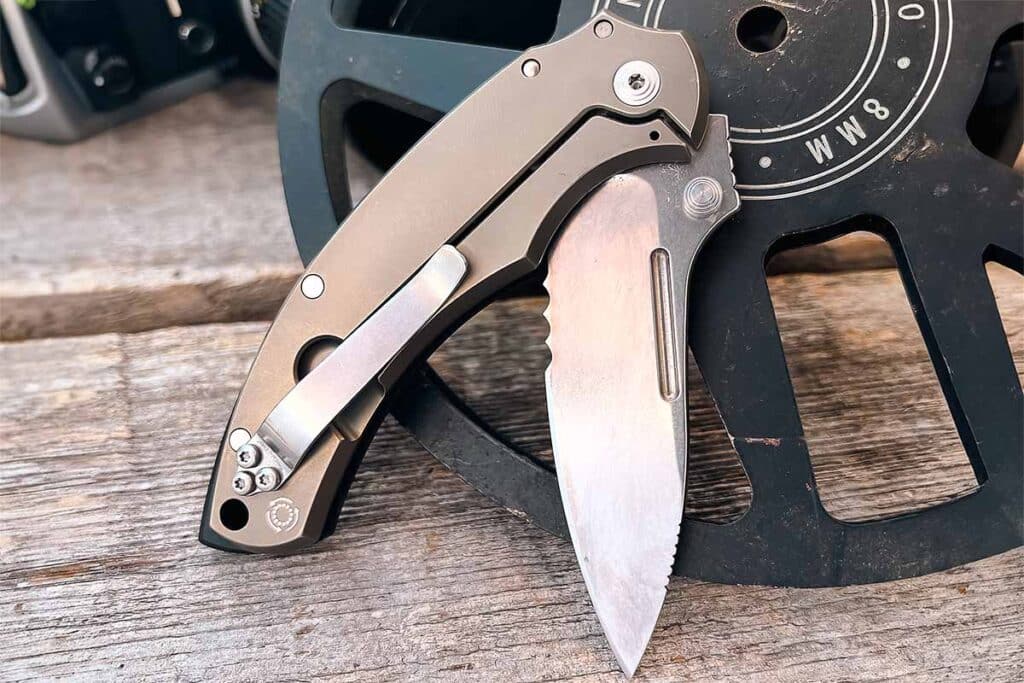
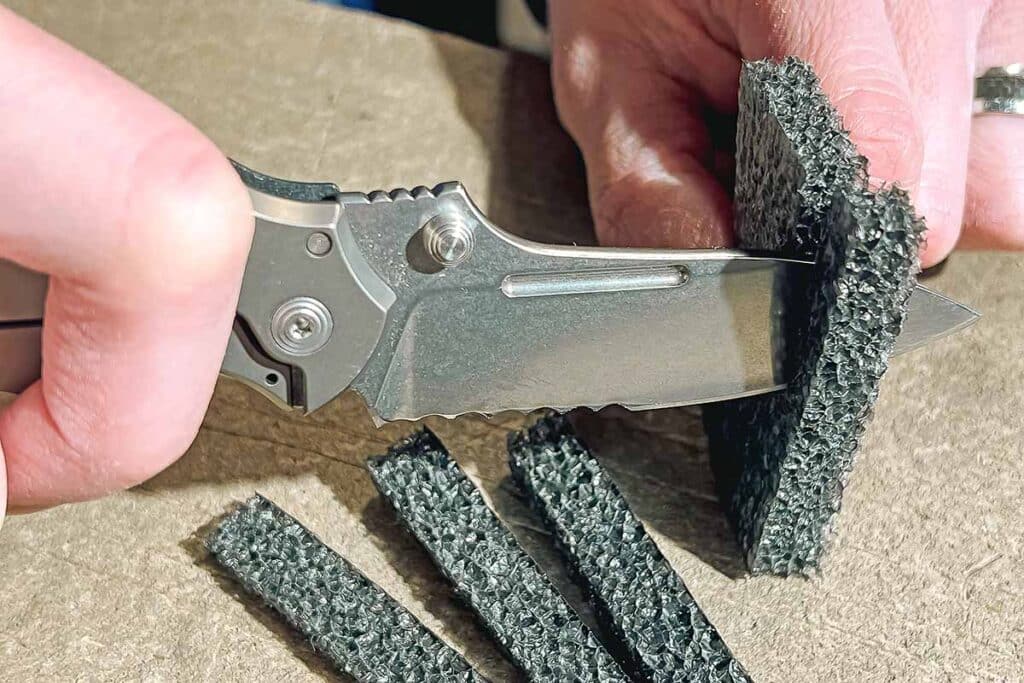
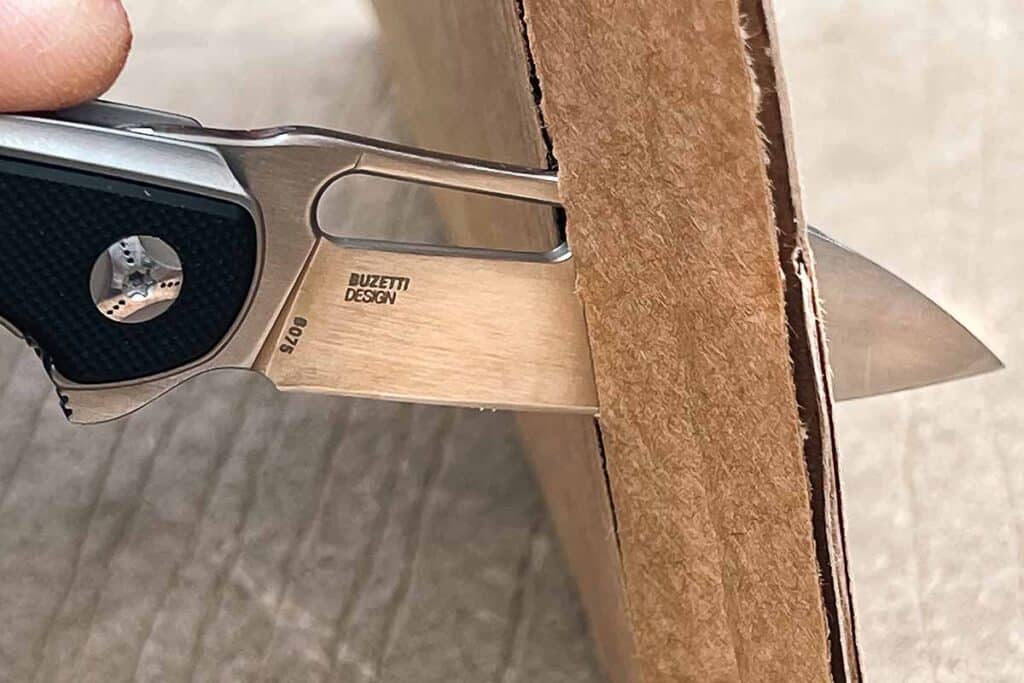
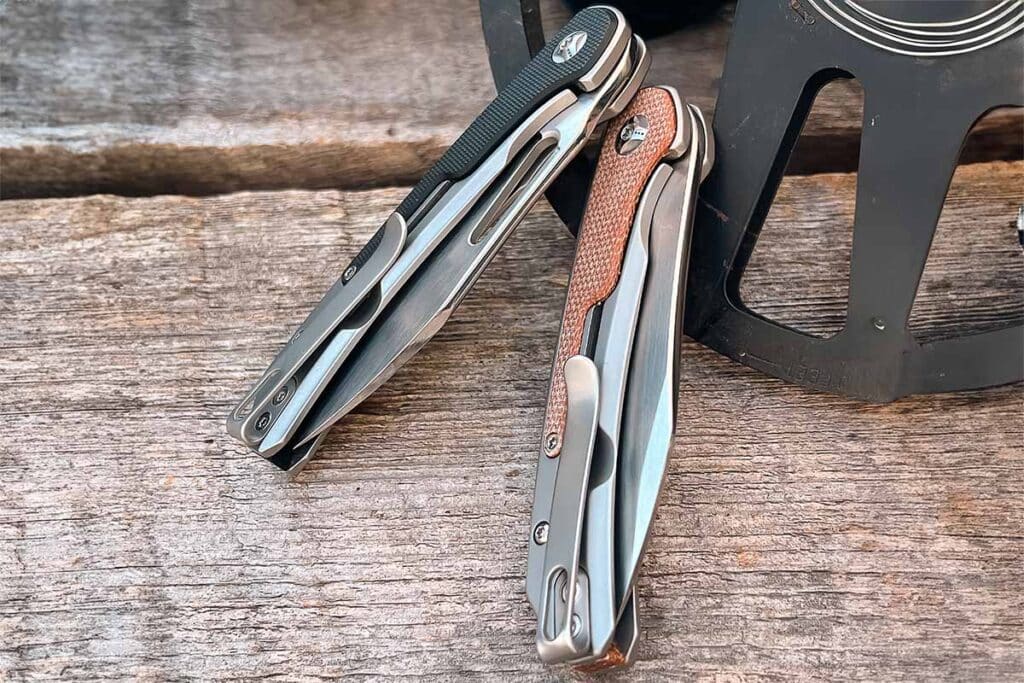
Is bigger better? GiantMouse is betting so with its first release of 2024. As it’s easy to surmise, the ACE Biblio XL is the big brother of the ACE Bibilio the company released a few years back, but not enlarged to asinine proportions.

My gander at the knife, it certainly hasn’t been up-proportioned to the point it isn’t a viable EDC option—especially for those who appreciate a larger blade. Yet, the modified Wharncliff’s larger dimensions have the potential to provide more utility for certain users. In my mind, the Biblio XL has a bit more advantage over the smaller original as a work knife or even in outdoor applications.

BiblioXL-GreenMicarta-Half Open

So exactly, how much bigger is the new variation than the original Biblio? Not much—a mere fraction of an inch. But the nearly half-inch GiantMouse has added gives the XL a blade length of 3.2 inches, plenty of cutting edge to tackle a fair range of jobs. As for the overall tale of the tape on the knife, its overall length is 7.6-inches open, 4.4-inches closed and 3.9 ounces in weight. As mentioned, definitely not an option that will weigh you down, nor feel like you’re toting a rock in your pocket.

The blade of the Italian-made knife comes in two steel options. On the Micarta-handed version, Elmax is the order of the day. On the titanium-handled model, Vanadis 4 is used. Both are high chromium-molybdenum-vanadium alloys, with good attributes for top-shelf EDC knives. As to the profile, the Wharncliffe has a bell to it, giving it better-slicing abilities than a knife that stuck to the traditional formula of this style of blade. Adding to this capability is a full flat grind.

BiblioXL-Titanium Open

Interestingly, GiantMouse integrates a fairly substantial choil into the Bibilio XL’s design, enough to use it as a leverage point on finer work. Additionally, the is understated jimping on the spin—just before the thumbhole—perhaps just enough to add more purchase when utilized, but not so much as to catch on clothing coming out of your pocket. As for action, a ball bearings pivot mechanism deploys the Bibilio’s blade quickly and very smoothly. Aiding in the opening are both a nicely textured kicker, as well as a thumb hold near the spine.

Finally the handle. As mentioned, there are two options—micarta and titanium—both well textured and proportioned to the hand. GiantMouse includes a wire pocket clip, situated for tip-up carry, but reversible making it friendly for righties and lefties. As for cost, the Micarta ACE Biblio comes in at $225, while the titanium model demands a premium of $285.

Read More On GiantMouse:

Advertisement

Must Read Articles

Read this before you make a knife

Knifemaking 101 – Read This Before You Make a Knife

  by Wayne Goddard My experience has taught me that there's nothing like digging in and getting started. I've often said the hardest part of the...
how to forge damascus steel

How to Forge Damascus

Advertisement
Advertisement