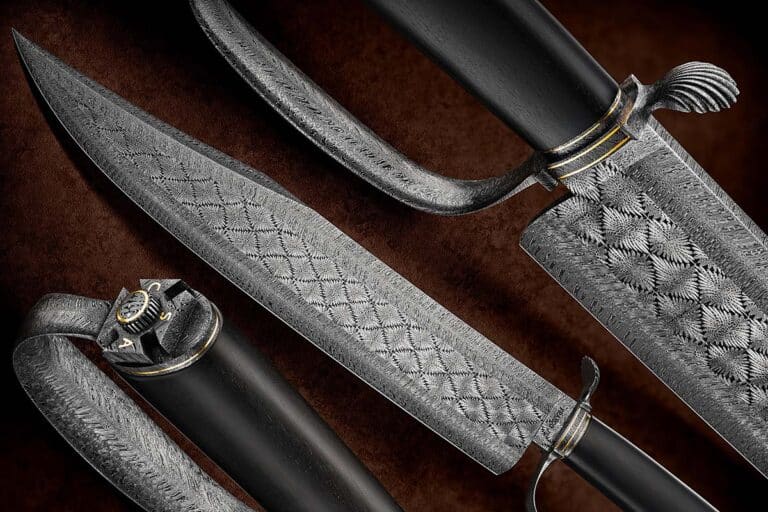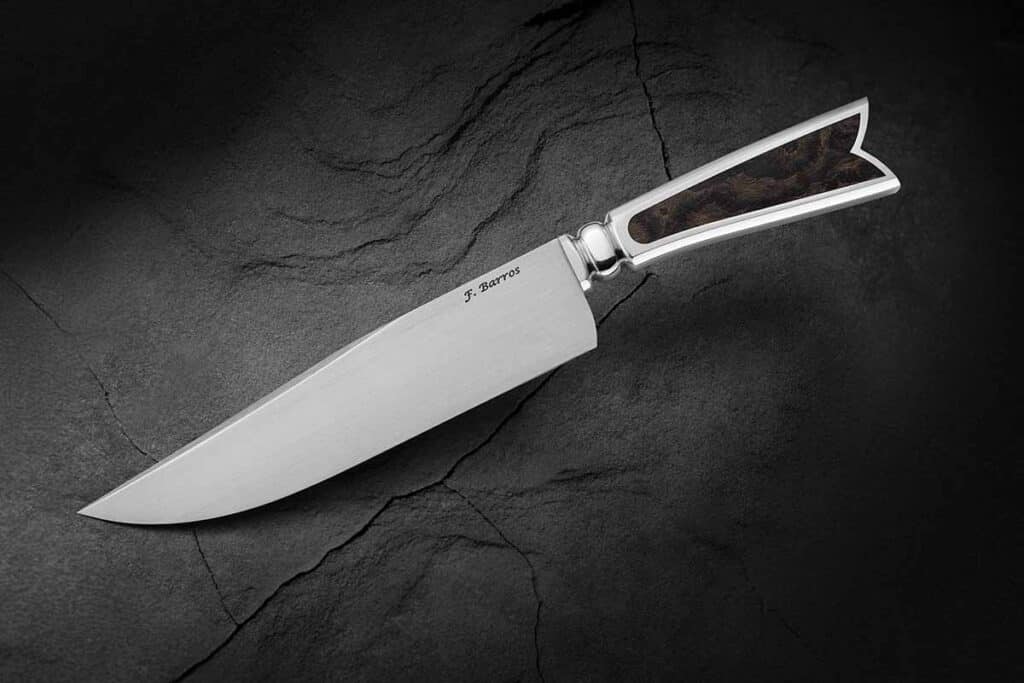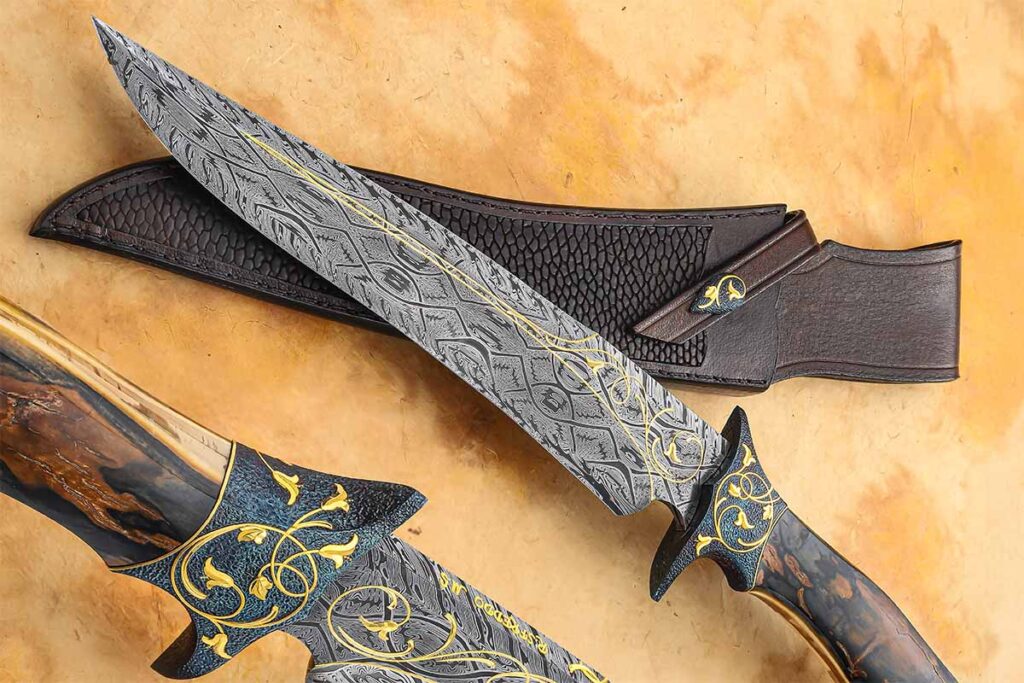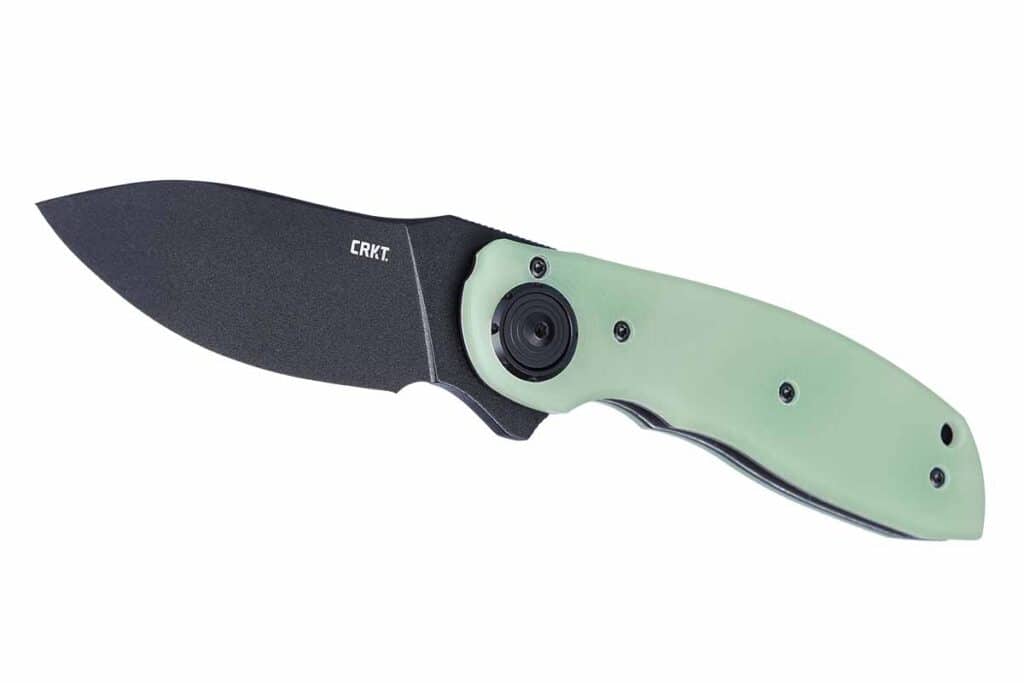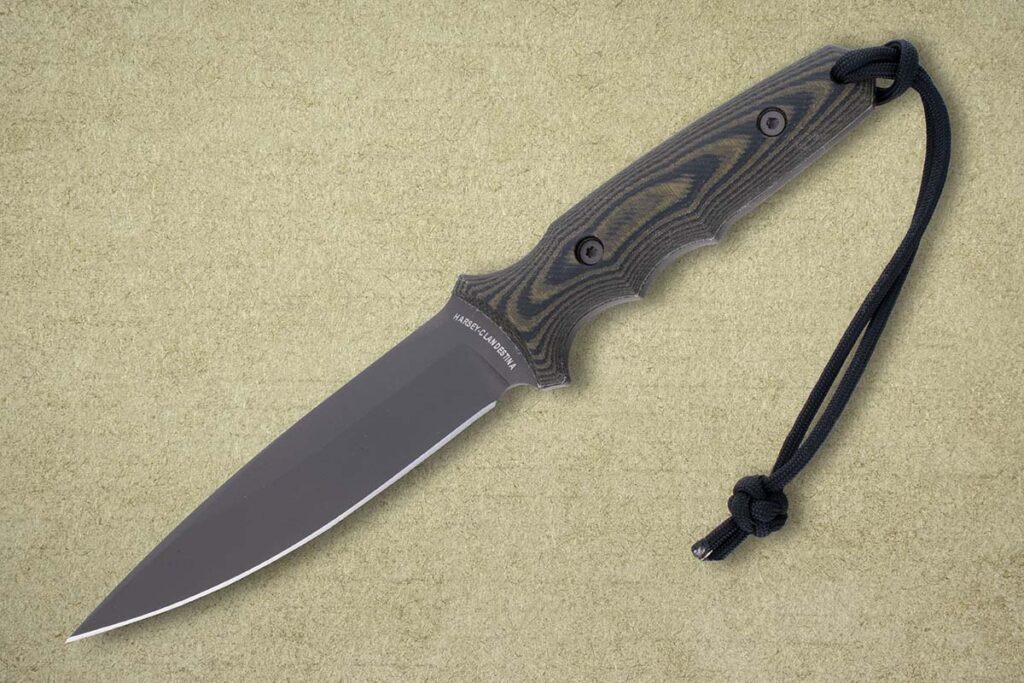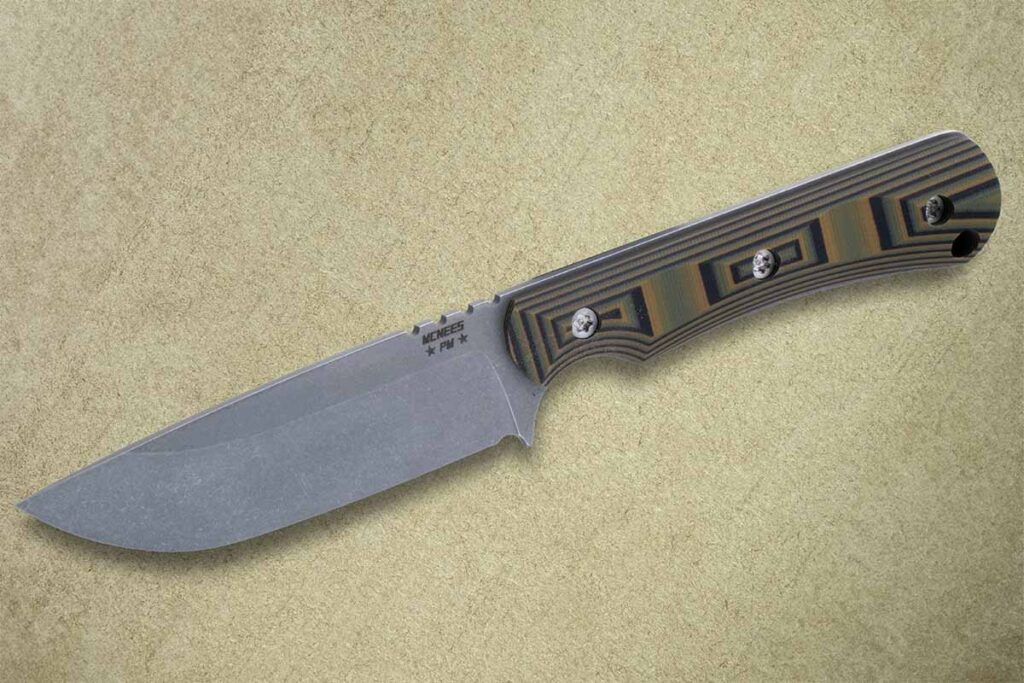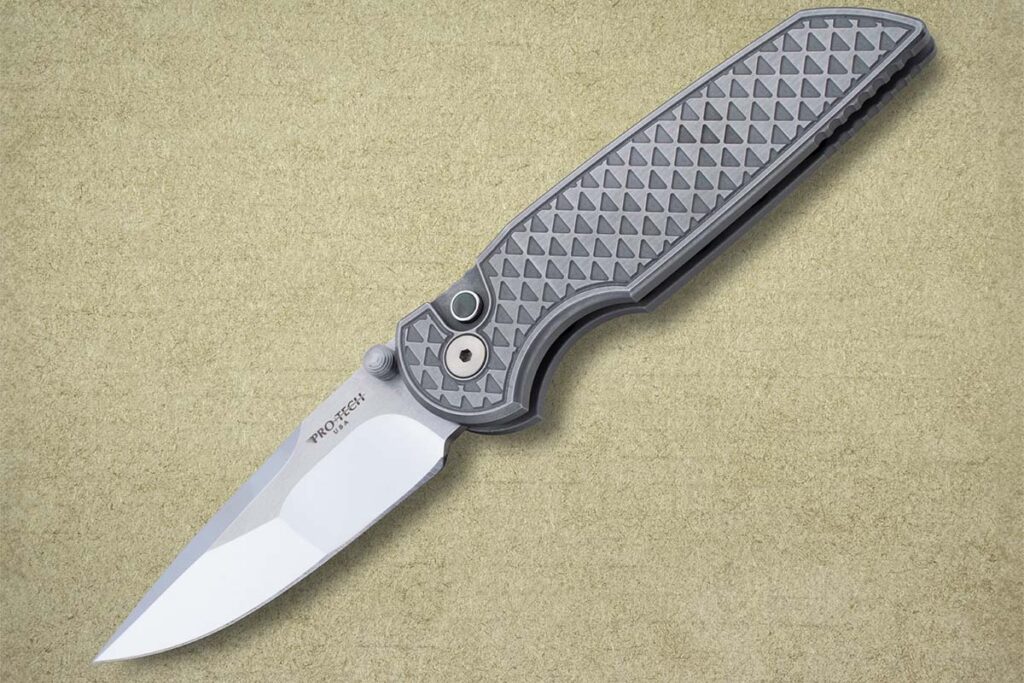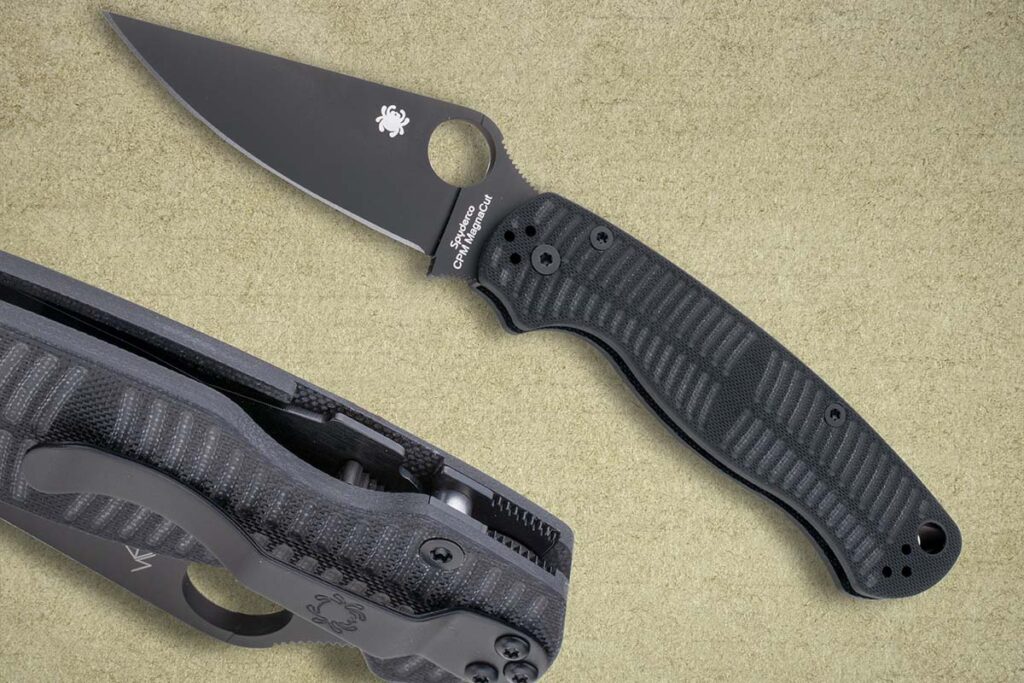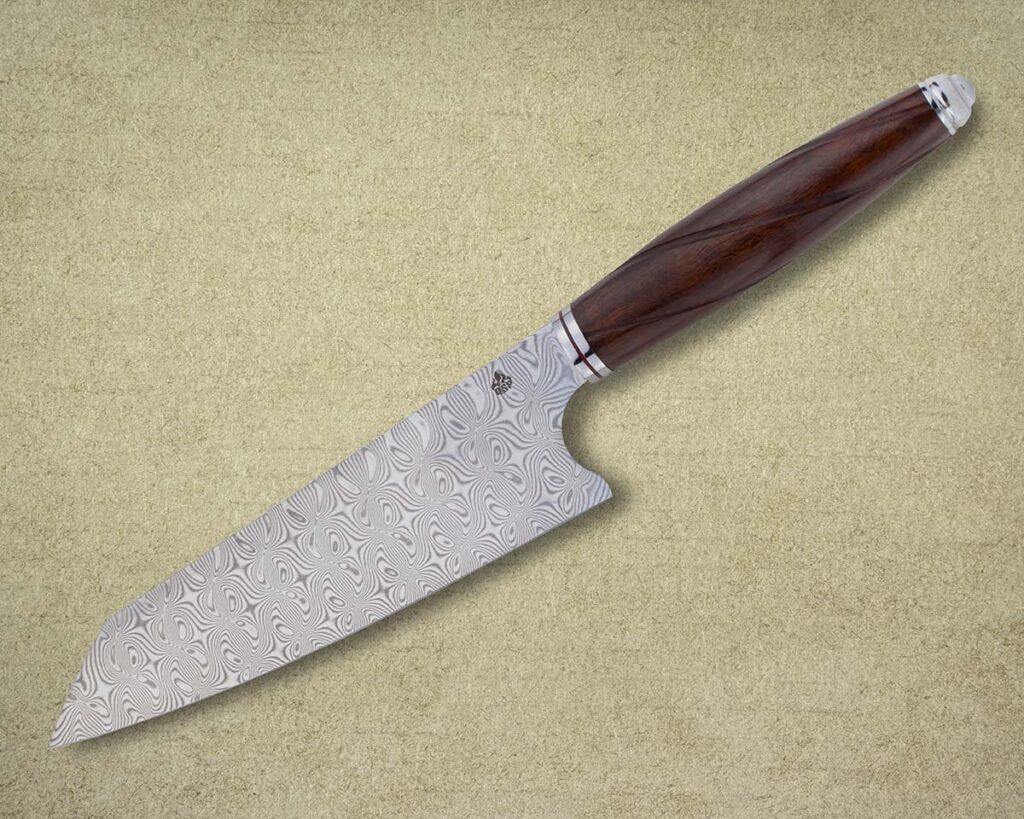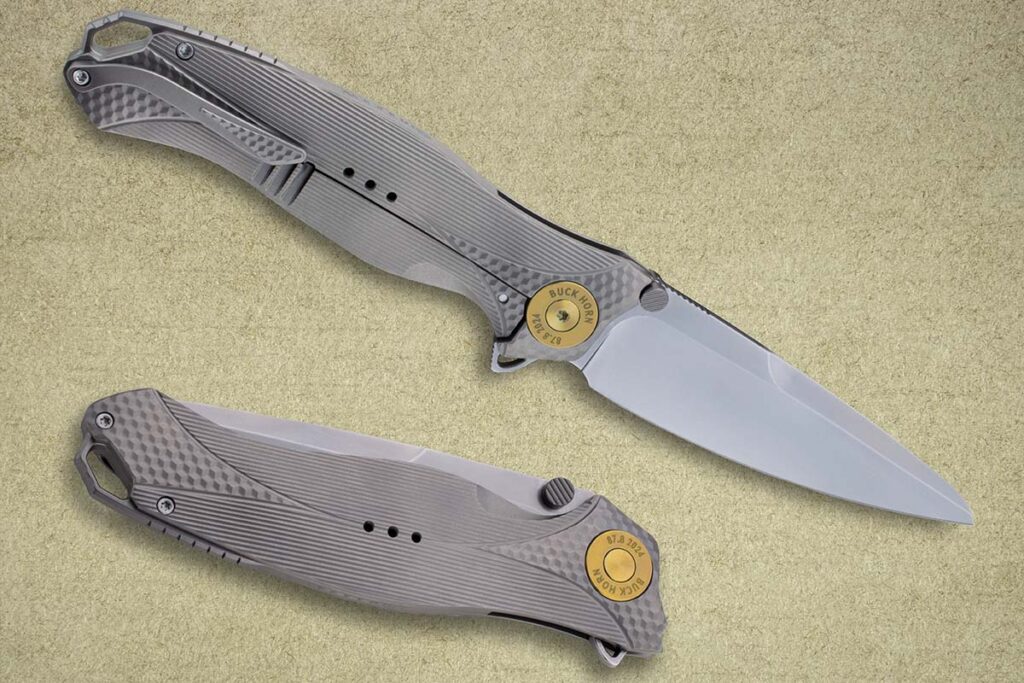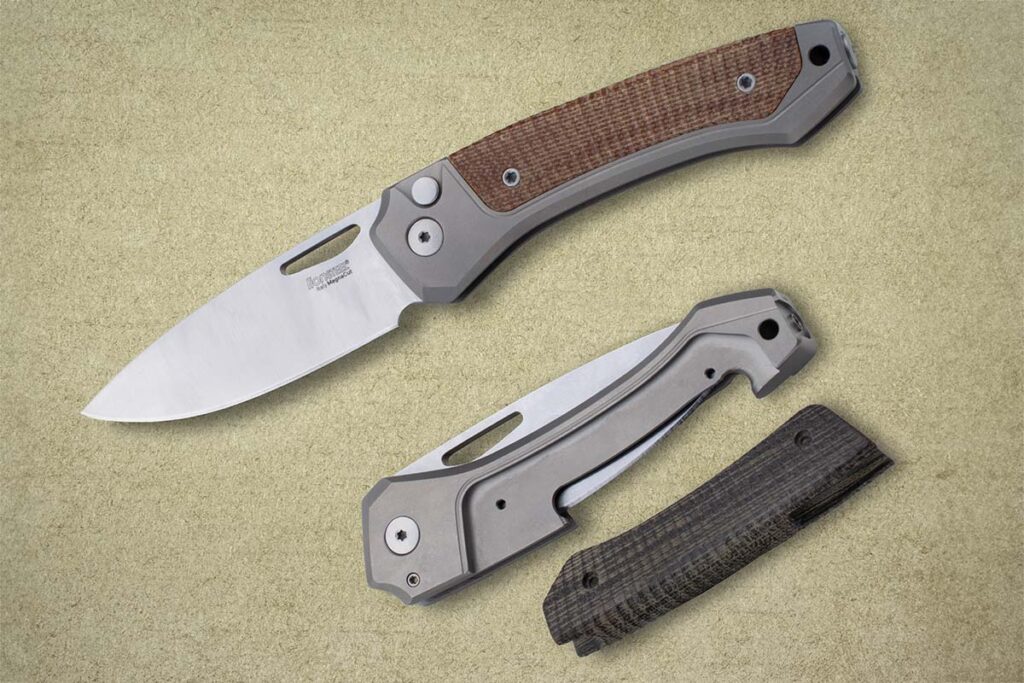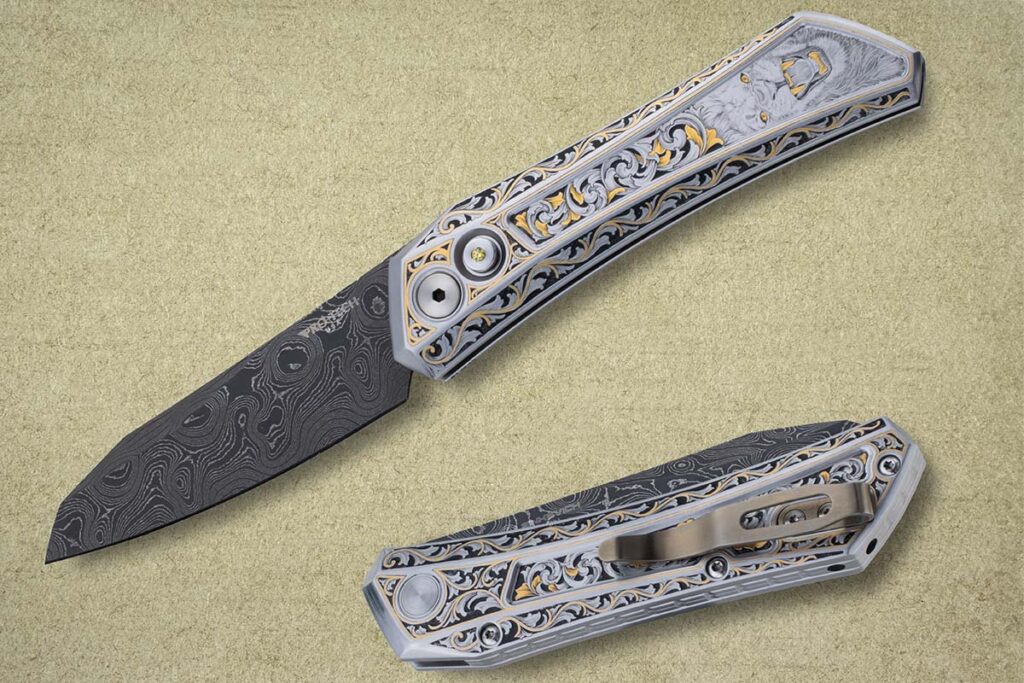
Jantz is a crucial source for many who fashion knives.
For 58 years Jantz Knife Supply has met the needs of cutlery craftsmen of all stripes, from green behind the ears to on up in years, with everything needed to make knives. This includes specialty steels, handle components, sheath materials, hand tools and sanding supplies, as well as the heavy equipment for knifemaking.
What started as a small mom-and-pop gun supply outfit founded by Ken and Venice Jantz in 1966 is no less than a U.S.-based juggernaut in today’s cutlery industry. The Jantzes haven’t left their humble beginnings behind, though, so no customer job is too small for the venerable knifemaking supply company in the heartland of America, Davis, Oklahoma.
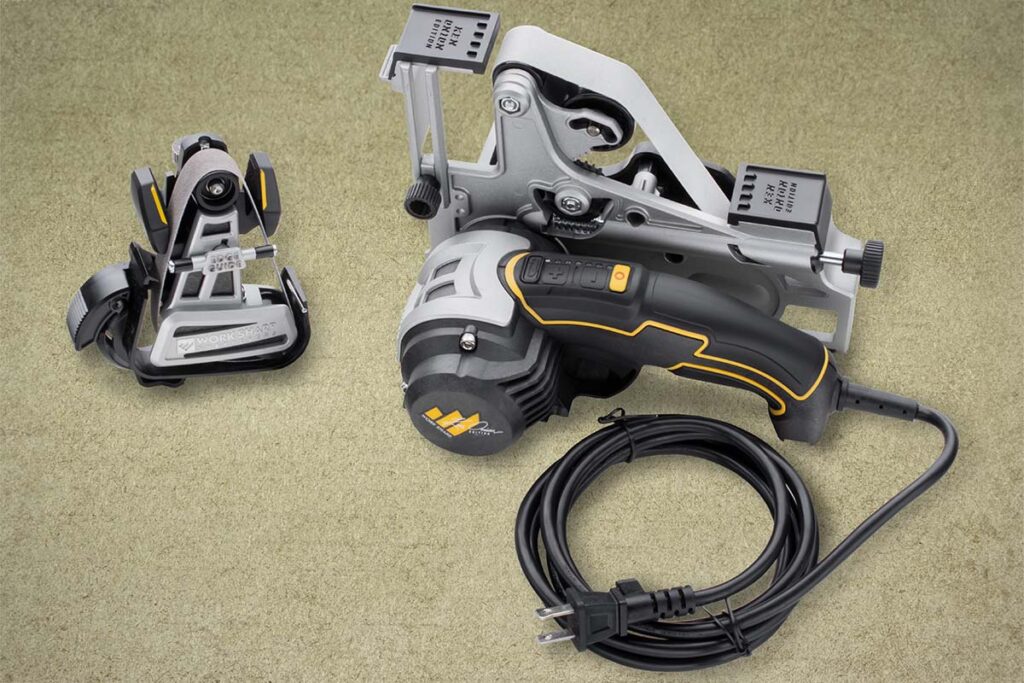
Company co-founder Ken Jantz works on a prototype for a new hollow-grinding fixture at the company facility.
Shanna Kemp oversees the marketing, financial and human resources for Jantz. She probably knows as well as anyone about the many specialty and other items available to the company’s legion of customers. “Our goal is to provide everything knifemakers could need for their project,” she begins, “whether you’re a beginner looking for a new hobby or a custom knifemaker stocking your shop to get ready for the BLADE Show. One thing we really love is creating fixtures and tools to make knifemaking more accessible for every skill level.”
One of the company’s most popular new fixtures is the PDJ Knife Vise. “It’s handy for all levels of knifemakers as it allows you to drill perfectly perpendicular holes through your handle material” regardless of the material’s texture or unevenness, Shanna explains. Jantz stocks an abundance of parts for assembling and enhancing knives of all types. “Our most popular products are our Corby rivets, Loveless bolts and metal round and bar stock,” Shanna enumerates. “Our customers love the quality of our materials as we source directly from reputable mills with consistent quality and do our cutting and machining in house. One of our other popular products is our handcrafted mosaic pins. Each pin design is meticulously hand assembled right here in Davis, Oklahoma.”
Jantz Steel Stock
Jantz offers a range of knifemaking equipment. An example is the JS750 perpendicular vise with drill press.
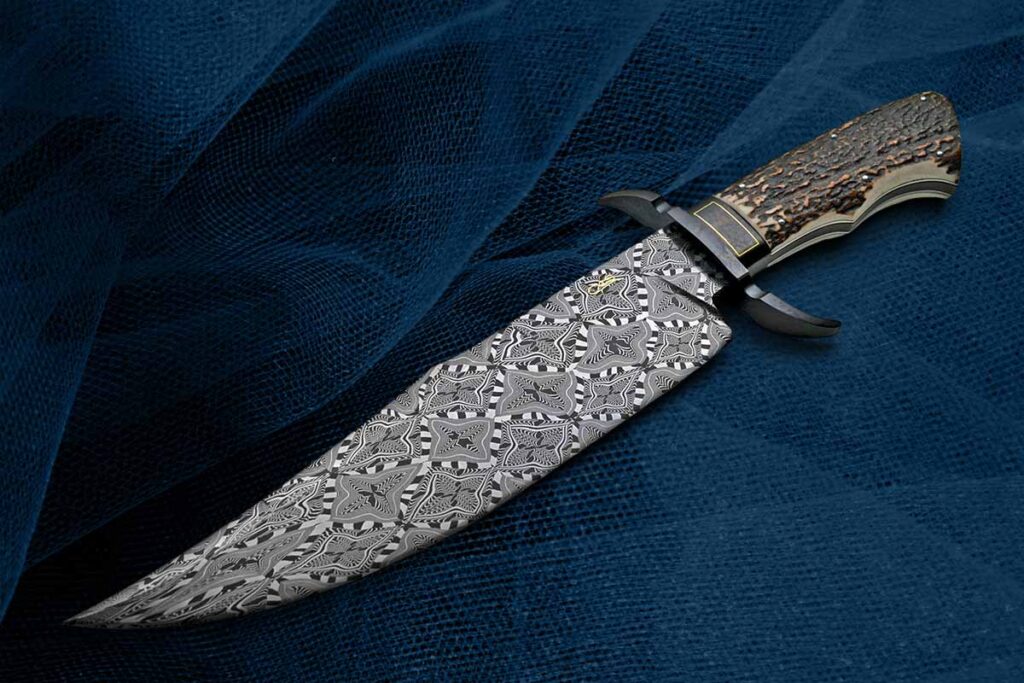
An outstanding blade is the heart of any knife and Jantz offers all kinds of stainless and high carbon steels. “We carry a variety of knifemaking steels to suit both forging and stock removal,” she states. “1095 and 80CrV2 are very popular carbon steels and CPM 154 is our most popular stainless steel.” She added that the damascus forged by Brad Vice’s Alabama Damascus is very popular because of the quality and solid price point for the company’s patterned-welded steel.
“For Jantz, steel and other metals have always had a long lead time since we source from a variety of mills in the U.S., Germany, Sweden, Brazil and others,” Shanna observes. “We have strong relationships with our suppliers, and they have worked with us to keep material moving forward even when lead times began to exceed a year.”
No matter the material, component or tool for knifemaking, Jantz probably has it somewhere in one of its well-stocked aisles.
Fixed blades will never go out of style, Shanna opines, and the Jantz business model caters to the mindset that drives the knives’ popularity. “We find that fixed-blade makers tend to use both stock removal and forging in their blade design and development,” she states. “The television series Forged in Fire certainly increased the popularity of forging, but we still see about the same divide between stock removal and forging. Fixed blades designed for hunting and survival are top sellers for our custom knifemakers as well as our hobbyists. There’s something special about using a knife in the field during hunting season that you made yourself that really resonates with the knifemaking crowd.”
When it comes to heat-treating ovens, Jantz recommends Paragon kilns above all others. “Not only do they make a quality oven,” Shanna assesses, “but they have a variety of ovens designed for beginners to pros. Their customer service is top notch and Burt Flanagan, who represents Paragon’s knifemaking ovens, is a custom knifemaker, so he truly understands what knifemakers need.”
Jantz-Made Blades
Knife assembly kits such as the Caballero are a great way to learn the ins-and-outs of folding knives. Jantz offers over a dozen knife genres, from traditional slip joints to modern tactical fare.
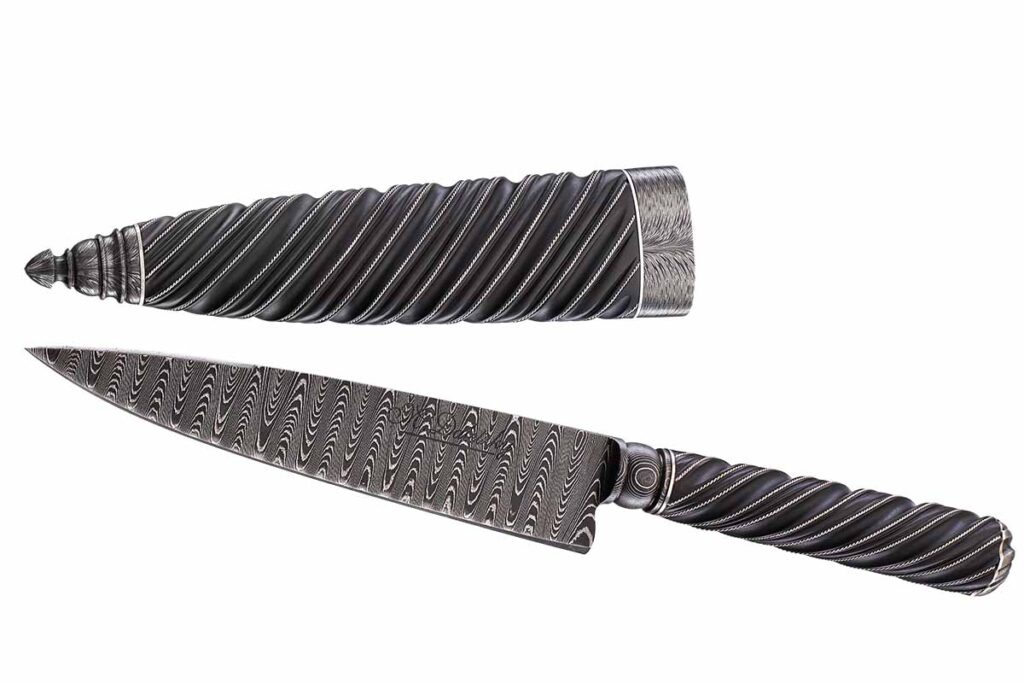
For those wanting to get their feet wet in the cutlery world, Jantz offers a cornucopia of pre-made blades for virtually any niche of the market, including household cutlery. According to Shanna, many custom makers order beautiful stainless damascus in various patterns from Damasteel for their kitchen knives. “Our Jantz-made line of household cutlery is especially popular with customers,” she adds. “Our santoku, cook’s and paring blades are favorites of makers using pre-shaped blades for project knifemaking. All the Jantz-made blades are manufactured in our facility.”
Jantz offers an abundance of both knife blades and knife kits. These are designed not only for the novice and hobbyist, but for those who want to tailor special knives for sale. The Jantz website offers links aplenty to a wide range of genres in both folders and fixed blades. Need a fixed-blade hunter in damascus? No problem. Like a kit to learn the ins-and-outs of folding knives? There are over a dozen styles available, from traditional slip joints to modern tactical fare.
Providing fixtures such as the JS500 for slip joints that make knifemaking more accessible to hobbyists and makers of all levels is a specialty at Jantz Supply.
If there is an innovation on the horizon, Jantz Supply will be on top of it. “One of the many things we love about the knifemaking community is how open and sharing makers are with each other,” Shanna observes. “Want to learn something [another knifemaker] is doing? Just ask. You will rarely find someone not willing to share.”
That spirit and willingness to help is what has made Jantz an important part of the cutlery industry for going on six decades now.
Case Knives is celebrating its 135th year with some top-notch new knives.
Creeping up on a century and a half of knifemaking, Case seems to feel its oats still. Or, that’s the way it seemed from the prolific 135-year-old Pennsylvania manufacturer’s recent releases at the 2024 SHOT Show, held in January in Las Vegas. The company had a full-court press of drops at the gun and outdoor gear hoedown, with a bevy of new lines, releases, collabs and model iterations. This should prove sweet music to the army of the brand’s collectors.
There isn’t space enough to cover every whipstitch of what Case is bringing to the table in 2024, but we’ll take a gander at some of the company’s weightier introductions for the coming year. There’s a little bit of everything for case fans out there, from classic patterns with new twists to brand-new knives that strike original ground.
Bridgeline Series
Not wandering too far off the beaten path, Case’s newest series of knives offers some nice updates for users seeking a modern knife. At the vanguard of the line are the Highbanks and Longhouse, both of which should prove excellent everyday carry options with the chops to handle most tasks thrown in front of them. Each features aluminum frames and bolsters, screw construction, ball bearing pivots, deep-carry pocket clips and CPM-20CV steel blades.
Case isn’t shying from the use of powdered steel for its blades, and the choice in these knives offers up a premium option used in a number of higher-end production knives. It’s similar to D2 and other tool steels—respectable toughnesss and edge retention—but with the added benefit of improved corrosion resistance.
Highbanks
Certainly a break from the tried and true, the Highbanks veers to the more traditional in the Bridgeline Series. Namely, because the knife is a non-locking folder bosting a nail nick and a Wharncliffe blade. Still, with the high-performance blade steel and the choice of Micartia or hardwood grips, this certainly isn’t your granddad’s jackknife. I particularly like the handle ergonomics of the Highbanks, tapering nicely to the blade and fitting the hand just right. Spoiler… so does the Longhouse.
Longhouse
Here we see Case move its design a bit more forward with the flipper Longhouse. The liner lock boasts plenty of blade, a clip-point profile with a beef spine that should help the knife stand up to any job put in front of it. However, the hand mimics the Highbanks, giving the knife a timeless look I’d wager many Case fans will appreciate.
Chris Taylor Hunters
Teaming up with renowned custom knifemaker Chris Taylor, Case has cooked up an intriguing hunting-knife collection. This year, the partnership unveils three unique fixed blades, each a fairly unique take on the must-have outdoor implement.
CT1
Crafted to exude rugged dependability, the CT1 showcases a top-tier Nitro V steel Clip-point blade. Known for its outstanding edge retention, corrosion resistance, and easy maintenance, Nitro V steel ensures that your knife remains ready and reliable whenever and wherever you require it. Case gives the knife an OD green burlap Micara handle, a plus for a hard-use knife that will likely be used in inclement weather. The CT1 also boasts aggressive jimping on its spine, so you have a solid contact point on more forceful cuts.
CT2
Cutting a much sleeker profile, the CT2 has the most modern feel among the CT hunters. Built around a resilient S35VN steel drop point blade, the knife doesn’t offer as much belly as the others in the line. But with a defined point, should prove at pro at perforation. The carbon-fiber handle is a nice touch, adding to the CT2’s modern looks, and proves very ergonomic and nimble in the hand.
CT3
Tailored for the wilderness, the CT3 has more of a traditional hunter profile. Constructed from premium 1095 carbon steel, its specialized coated skinner blade boasts razor-sharpness, facilitating precision cuts and providing a sharpening advantage compared to many other steels. Outfitted with a hunter orange handle, the nice part about the CT3 is it will be difficult to lose in the woods.
Razor
Case is commemorating its 135-year legacy by dusting off a real classic eye-catcher—the Razor. Reintroduced from the Case XX Vault, the knife is available in two patterns: a single-bladed version featuring a broad Clip blade with a distinctively curved tip, and a two-bladed variant with an additional Pen blade. Available in over a dozen handle styles, such as Smooth Abalone, Micarta, Smooth Brown Maple Burl Wood, and Sawcut Jig Caribbean Blue Bone, the Razor is a great Case throwback and a fantastic knife for the company to pay homage to its rich history.
Everything at BLADE Show Texas just keeps getting bigger
More exhibitors—a whopping 100 more, north of 400 in all, plus an additional 28,000 square feet of space over last year—displaying the finest knives, knife accessories and all that cuts promise to make the burgeoning BLADE Show Texas the best rendition yet.
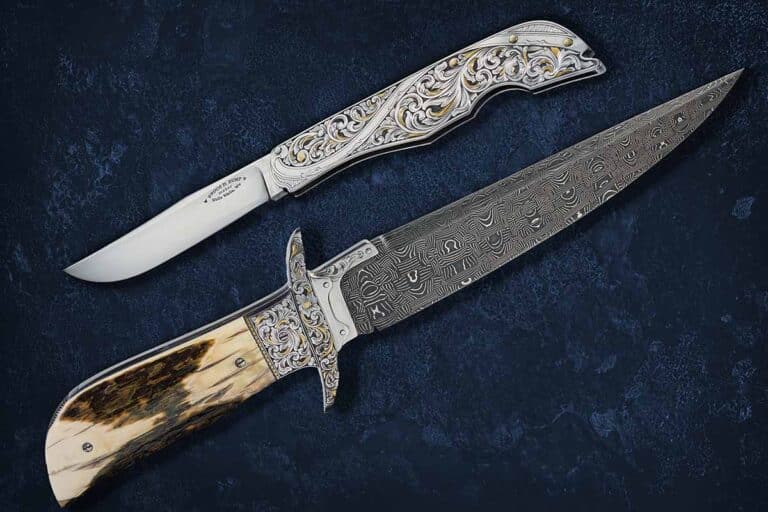
Mike Quesenberry takedown dogbone bowie features a 10-inch blade of a Turkish twist damascus and an ancient walrus ivory handle with 18k-gold buttons and escutcheon plates. (SharpByCoop knife image)
Set for Feb. 23-24 at the Fort Worth Convention Center in Fort Worth, Texas, the show will host exhibitors from around the world, including those from Australia, Brazil, China, Italy, Russia, Sweden and elsewhere. Exhibitors will include top American custom knifemakers, ABS master smiths, returning winners of BLADE Show Texas ’23 custom knife judging awards and BLADE Magazine Cutlery Hall-Of-Fame® members, and some of the world’s leading factory knife companies, including many current and past winners of BLADE Magazine Knife-Of-The-Year® Awards and returning winners of BLADE Show Texas ’23 factory knife judging honors.
BLADE Show Texas will be the first of three BLADE Show sponsored events for 2024, the other two being the grandaddy of them all, the 43rd Annual BLADE Show June 7-9 at the Cobb Galleria Centre in Atlanta, and BLADE Show West 2024 at the Salt Palace Convention Center Oct. 4-5 in Salt Lake City, Utah.
But first things first in Fort Worth, where knife enthusiasts will enjoy the complete gamut of custom and factory knives and accessories, including art, utility, bowies, EDC, slip joints, automatics, balisongs, kukris, daggers, tactical, tomahawks, swords, sharpeners and more, from low end to high end, stock removal to forged, fixed blade to folder. And if the exhibiting makers don’t have what you’re looking for, the exhibiting custom knife purveyors and factory retailers probably will—and if they don’t, they can put you in touch with someone who does.
For knife hobbyists and novice and veteran makers alike, the show’s diverse selection of knifemaking supplies and suppliers will have the materials, tools and equipment you need to make the knife of your dreams. From the latest steels, handle materials, hardware, sheath materials to most every knife part extant, the show’s suppliers should have it.
BLADE SHOW TEXAS AWARDS
TOPS Knives will display its extensive array of outdoor knives, including the Camp Creek Fire Edition in CPM S35VN stainless steel and a comfortably contoured handle of red/black G-10. Country of origin: USA. MSRP: $280.
There will be some changes in both the show’s custom and factory knife judging.
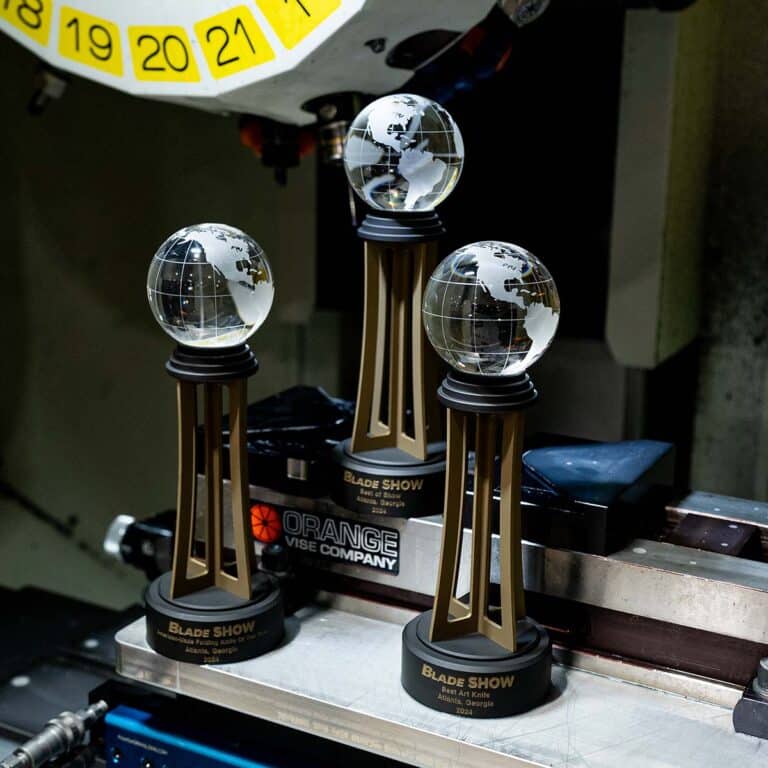
The change in the custom segment is small with the simple addition of a Best of the Rest category to provide an avenue for tomahawks, swords, innovative designs and other “specialty pieces” to win an award. Best of the Rest joins the existing stable of custom awards that also includes Best Art, Best Bowie, Best Damascus, Best EDC, Best Fighter, Best Folding Knife, Best Hunting Knife, Best Kitchen Knife, Best Slip Joint, Best M.A.C.K. (Machine Assisted Custom Knife) and Best in Show.
Returning to defend their custom knife award winning titles from last year’s show will be ABS master smiths (from left, with awards in parentheses): Josh Fisher (Best Bowie), Karis Fisher (Best Hunting Knife and Best Fighter), and John Horrigan (Best Damascus).
The shakeup in the factory categories includes eliminating Best Tactical and adding Best American Made, Best Imported and Best of the Rest. The addition of the former two addresses the top knives made both domestically and offshore, while the latter does the same for the factory segment that it does for the custom one.
The custom and factory knife judging is reserved exclusively for show exhibitors, all of whom received packets with complete details on category descriptions, judging rules and more prior to checking into the show.
Final Cut
BLADE Show Texas seems to be growing exponentially, as are the show’s exhibitors and fans. Go exponential your own self and join the party in February!
The author takes his Battle Blade to the next test level and up.
Ever since I started writing for BLADE® in 1990, I generally stick to similar cutting media to check the performance of the knives I test in “Spec Sheet.” That way it gives me a baseline as to how the different blades and their steels should perform. However, as a writer, I find it sometimes gets old doing the same testing. So why not beat the heck out of one of the test knives?
Well, first off, the knives are owned by someone else. They might be scheduled to be sold. You can see why I only push Spec Sheet test knives to a certain point. Unfortunately, the craving to give a test knife a brutal workout keeps coming, only to be done during my own testing using my knives.
Here’s a crazy idea—I’ll test one of the knives I make! So, after pleading my case to the BLADE management, it was OK’d. Now it’s time to get down and dirty with my Battle Blade that has been my truck knife for the past year. Let the whacking begin.
Battle Blade Vs Normal Media
Serious whacking aside, I still executed a 20-pound-bond paper slice to show initial edge sharpness. The Battle Blade zipped quickly through the paper even with rust spots on the blade and edge. It was very smooth and aggressive during slicing.
To test initial sharpness, the author executed a 20-pound-bond paper slice. The Battle Blade zipped quickly through the paper even with rust spots on the blade and edge.
On to a nice 2×8 pine board locked in my shop leg vise. After 20 whacks I had a deep “V” chopped into the wood. The exercise didn’t bother the edge at all; it took a three-quarter-to-1 inch bite on each chop. The handle was comfortable but slightly smooth. (I should have put a thong cord on it.)
Since the whitetail antler I normally use in stories for edge whacking was all whacked up, it was time to replace it. As a result, I chopped it up into 1-inch pieces. The Battle Blade removed all the tines with nice, clean chops. The edge was still very sharp with no damage. Now I have chunks of deer antler all around my forge!
Battle Blade Vs Abnormal Media
For the first “abnormal medium” I went with 3/8-inch-diameter twisted copper wire. I used the Battle Blade as a draw knife to flatten the 2×8 for a surface on which to chop the copper braid. Six hard whacks and the edge still didn’t make it through all eight wires. It seems the Battle Blade drove the last two wires into the 2×8. Note to self: use a hardwood next time. The copper braid only put a few streaks on the blade. There was no damage to the edge.
For the first “abnormal medium” the author used 3/8-inch-diameter twisted copper wire. Six hard whacks and the edge still didn’t make it through all eight wires. The copper braid only put a few streaks on the blade. There was no damage to the edge.
Next up: the acetone can stab. The Battle Blade fully penetrated both sides of the can repeatedly. I was worried about stabbing the leg vise more than any damage to the blade from the can. There were some nice scratches on the finish but the edge held up perfectly, as well as the tip.
It was time to get some steel involved: an older patio chair headed to the scrapyard, and its steel tubing. Bingo! So I dragged the chair into my forging area and prepared to trash my Battle Blade. Swinging as hard as I could, I chopped down into the arm of the chair. A loud clang let me know it was a solid hit. The Battle Blade bit a half-inch deep, through the top and bottom corners of the chair, along with the sidewall. I saw a little glint from the blade’s edge. Oh well! I gave the chair arm seven more very hard whacks. The edge had two little glints of rolls and three very small nicks.
After 20 whacks the Battle Blade had a deep “V” chopped into the 2×8 pine board. The edge took a three-quarter-to-1 inch bite on each chop and emerged unscathed.
The edge still felt sharp, so I returned to the 20-pound-bond paper slice. The edge sliced the paper, though not as smooth as at the start. I’ll take that anytime.
Final Cut
I’m very happy with the performance and feel of the Battle Blade. Normally I use a better gripping handle material for this model but this one’s mine. It had to be bold. The only change I’ll make, thread some cord through the thong hole for a more secure grip.
Battle Blade Specs Maker: Breed Custom Knives Blade length: 75/8” Blade material: 80CrV2 carbon steel Blade grind: Full flat Blade @ thickest: 3/16” Blade finish: Bead blasted Heat treatment: Differential Handle material: Swirl by J. Hue Customs Weight: 15 ozs. Overall length: 13 1/8” Sheath: Kydex w/Ulticlip Weight w/sheath: 1.25 lbs. Maker’s price for a similar knife & sheath: $450
Push daggers are experiencing something of a renaissance in the knife world these days, as more and more people are coming to realize their value as a self-defense tool. More and more makers are releasing push daggers, and I for one couldn’t be happier.
To celebrate this resurgence of the push dagger, and as a bit of an aficionado of the genre, I thought this was as good a time as any to take a look at the push dagger in depth.
We’re going to start with some background on the push dagger, including its history, how to use it, why to use (and perhaps why not), some legal issues surrounding them, and finally we’re going to take a look at the best push daggers on the market today.
The push dagger, at least as we know it, originated in the early 1800s in the United States. At a time when small pocket pistols like the derringer weren’t yet reliably available, many people wanted a discrete, concealable weapon with which to defend themselves.
The push dagger arose to fill that niche, along with other concealable force multipliers like brass knuckles. They became especially popular with gamblers and other folks in places like New Orleans, Savannah, and other busy ports.
It also became popular with politicians and others who wanted to stay armed, without openly carrying a weapon. In turn, push daggers weren’t an uncommon thing to carry in various state houses, particularly throughout the South.
In New Orleans in particular, the “gimlet knife,” as the local version of the push dagger was known, became so popular and was used in so many different riots, brawls, and back-alley muggings, it eventually was banned in the city in 1879.
This version of the knife would live on and become the most popular variation of the push dagger. Its simply a T-handle gripped with a closed fist, featuring a tang that extends between the middle and ring fingers to form a short blade, usually 2-3 inches in length at most.
Abroad, sailors and other travelers brought the push knife to Germany, where local cutlers immediately took to it, and the faustmesser or “fist-knife” began to spread to other European countries, particularly England, France, and Spain.
Wartime Use
By the time of World War I, push-daggers of many different designs became a backup weapon for soldiers fighting in trenches on both sides as pistols were often in short supply. Everything—from straightened and braided wire to bent nails—was used to improvise punch dagger-style knives. Manufactured options were available as well.
Throughout World War II, the push-dagger became the domain of the special forces, particularly the British SAS and SOE infiltration forces who needed a very effective and concealable defensive tool (or assassination weapon).
It was also employed by French resistance forces who were not allowed weapons by occupying German forces.
Later, push daggers saw another surge in popularity during the 1980s when several US manufacturers started producing them again as tactical or self-defense weapons. That’s a trend continuing to this day.
Using a Push Dagger Correctly (and Safely)
A push dagger is fairly easy to use, though a bit limiting in some ways compared to other more traditional knives. It only has one practical use (defense) so we’ll look at it in that context. This is not the style of knife to pick up for, say, bushcrafting or folk art carving.
It can open packages, which is all most of us use our knives for anyway, but beyond that, this is a tool that’s always been designed to keep the wielder safe.
Towards that end, using it is relatively instinctive. Simply wrap your fingers around the (usually) T-shaped grip, and close your hand with the tang of the blade extending between your middle and ring fingers.
From here, you can punch more or less as you normally would, albeit with an immense amount of additional damage-dealing potential.
Off-Hand Comments
One thing not so intuitive is you will typically put the knife on your non-dominant hand. This is typically going to be your more forward hand in a fighting stance and will save your dominant hand for grabbing your opponent’s body or interacting with your environment.
Most people naturally want to wield the knife in their dominant hand, but that’s less than optimal if you ever have to use it in a true self-defense situation.
Your non-dominant hand isn’t going to be as strong or dexterous as your dominant one, but you’re not writing a letter or opening a jar…you’re throwing a punch. And while an off-hand jab isn’t the most powerful blow, when you have a knife extending over your knuckles, it doesn’t need to be.
Pros and Cons of the Push Dagger
These days, push daggers are still used as a very concealable self-defense tool. They’re fairly intuitive because most everyone has a basic idea of how to throw a punch. Those with any martial arts experience are likely to find them comfortable and familiar to use instinctively.
The predominant variety these days is the New Orleans-style version with the T-shaped handle, but some others do exist. Whichever variety you go with, know you aren’t going to be doing a whole lot of slashing.
These are tools meant for piercing and stabbing, so some traditional knife fighting techniques aren’t going to translate here. Experienced Kali/Escrima practitioners will likely not have any problems at the end of the day, but the knife just isn’t optimized for cutting blows.
Legality of the Push Dagger: Perhaps the Biggest Con
First, let me say none of this is legal advice. I’m not a lawyer, I’m just some guy on the internet who likes knives. Everything here is just what I’ve come to understand from my own research and is subject to be wrong.
Do your research about where you live and plan to own or carry a push knife and ask a licensed attorney.
Bans and Restrictions on Push Daggers
Now, while push knives aren’t outright banned in most states, several do have restrictions on “daggers” and knives designed to cause harm to another person without an obvious other purpose like a hunting knife.
Most push knives have a blade length of less than 3 inches, and many are single-edged so they don’t meet the “dagger” definition in states where this is part of the definition of a dagger. Also, many states have laws about carrying a knife with “intent to harm,” but that applies to any knife.
The things to look out for are the differences in what your state allows you to own versus what you can carry. If you just want to own a push knife as a collector piece, you’re going to have a much easier time than if you want to carry one.
That said, many states have weapons carry licenses/concealed carry permits that not only allow you to carry a firearm, but also a knife, such as a push dagger.
In general, all we can say is to check your state and local laws and make sure you’re not going to violate them by owning or carrying a push knife. Few states flat out say they’re illegal to own, but many have limits on carrying them, especially concealed.
When to Take Special Care
I would advise special caution to anyone living in the following states: California, Connecticut, Hawaii, Iowa, Kentucky, Maine, Maryland, Massachusetts, Michigan, Mississippi, Montana, Nevada, New Jersey, New York, North Dakota, Oklahoma, Pennsylvania, Rhode Island, Virginia, Washington, and West Virginia.
All of these states have some restrictions on what knives you can carry, some have restrictions on ownership in general, and many mention “daggers” without really defining what they consider a dagger.
As always, do your research and cover your backside. Don’t rely on anyone else to do it for you. Other states may have laws I don’t know about or didn’t find information on, and your local city government may have ordinances as well.
Best Push Daggers on the Market Today
Today, we have a huge number of great push daggers on the market, which is both a good and bad thing. On the one hand, we have more choices than ever, which means there’s something out there to fit every need
On the other hand…we have more choices than ever, which can make it hard to choose.
Let’s take a look at the best options on the market today, and narrow the field a bit while also highlighting the best of the best in the world of push knives.
Right off the bat I must say I like the blade of the Tactical P.A.S.S. from Condor Tool & Knife because it departs from the traditional symmetrical dagger design. It pays often enough to try something different, and here it works. The hammer-finished look along with the clip point and false grind give it a rustic appearance. Condor also offers a fixed blade called the Tactical P.A.S.S. with the exact same blade pattern.
Now to talk about a practical bonus of the design. In some states double-edged blades are illegal. Condor’s false edge would allow you to carry the push dagger in such states and stay on the safe side of the law.
The handle size seems just right for my large, meaty hand. In most knives I look for that contoured fit. Due to the fact I want any resistance encountered by this blade absorbed by my palm and wrist, I want the handle to have a broad radius. The P.A.S.S. is in that Goldilocks position.
If I had to give any negative feedback, and I do when I find something wrong, it would be the leather sheath. Oddly enough, it is constructed very well. There are minor issues with the fit and finish but overall it is a sturdy, good-looking build.
My issue is with the design. Condor includes a full belt loop but I find that gets in the way when trying to make a smooth, full, fast purchase. For knives used for self-defense that is what you want—a solid grip and you want it fast. A horizontal and vertical carry patch is on the sheath’s back but will accommodate MOLLE-sized straps only. I know it might seem picky but keep in mind this is a push dagger, and the same rules apply for it as a pistol draw. I think the set-up would be taken to another level if the carrying system was mounted to the back of the sheath only and was large enough to accommodate regular-size belts. Such a change would leave the handle free and open to a quick, secure grasp.
Does the sheath make the knife a bad value? No, most people are either satisfied with the sheath or they aren’t. As a result, your decision to buy a P.A.S.S. might factor in an aftermarket sheath. The knife is still spot on.
Heretic Knives Sleight
The Sleight from Heretic Knives is a sleek little design. Of the test group it’s the most compact and concealable. The blade is part of an aluminum body with a thin CPM 20CV layer mechanically fastened with screws to it to produce an edge. Such a design gives you the cutting power of a heavier metal while reducing weight. The aluminum body has an asymmetrical, CNC-textured handle. Heretic uses more of a pistol-grip design, enabling you to palm it quickly and have accurate control over the tip.
The Sleight is a great-looking piece of kit. Heretic even gets creative with the sheath, carrying through on the theme of decorative but lightweight. It has a Blade-Tech belt clip on the back for vertical carry.
The small design makes it easier to use for certain cutting chores without drawing too much attention. On the other hand, smaller knives lack the effectiveness of larger ones in self-defense situations.
One thing that bothered me is how difficult it is to draw the knife from the sheath. The first time I did it I thought I was going to have to follow up with a visit to my chiropractor. (OK, an exaggeration, but I must have at least one overstatement per story.) It was and still is difficult to draw and definitely not on the smooth side. Moreover, if you’re trying to pull it out of the sheath in a stealthy manner there is a loud click upon drawing. Perhaps over time it will break in as I sit fidgeting with it while watch Kung Fu reruns.
The Sleight is well made and well designed. It will make a good EDC blade once the sheath is broken in.
TOPS Knives I Stick
Of the test push daggers, the I Stick by TOPS Knives has to be the largest. According to TOPS, the I Stick weighs 12.6 ounces. When using a knife such as this, size can count—especially in the blade length. At this weight, though, you’d better be prepared for a long day. On its own the weight might not be that much, but when you start adding on your other everyday carry gear it gets burdensome. I am not normally one to point out the weight of a knife, but when they get this heavy you start to notice.
The blade is .38 inch at the thickest. You won’t have to worry about this knife breaking. Scales are black and green Micarta®. I do find the handle a bit big for my hand. The size does allow for a quick, solid grip, though. TOPS structures the handle to be asymmetrical so you can get a full thumb wrap around it. Being able to completely close your fist around the handle makes a world of difference in grip strength. The molded Kydex sheath has belt loops for vertical carry. Before carrying the I Stick, I recommend you practice drawing it from the sheath, as the sheath needs breaking in.
Overall, it is a good knife and has a respectable edge out of the box. Seeing as how it’s on the large side, the decision to purchase it would be something you would need to think over. A knife of this nature is no good if you don’t have program compliance and carry it. If you are not used to carrying a lot of weight, before buying it try carrying around something of comparable size and weight. As far as value, the I Stick is built like a tank. I am sure it will outlast us all and be handed down to future generations.
TOPS Knives Grim Ripper
If you want a slightly more utility-focused knife, the TOPS Knives Grim Ripper might be up your alley. It features a shorter two-finger grip that is shaped to lock into your hand. It feels just as secure when wielding, but is less likely to dig into your side or what have you when carrying it.
It features a single-edge blade designed with some wavy semi-serrations ahead of the sharpening choil designed to quickly slice through webbing or ropes in the event of an emergency.
The handle is a very nice gray micarta that won’t get slick if held with wet hands. I felt very secure wielding the Grim Ripper in a variety of light camp tasks and it was easy to slice boxes as well, thanks to the well-designed handle.
The blade is a 3.75-inch long tanto-shaped affair made out of 1095 high-carbon steel for great edge retention and sharpness.
Esee Izula Tertiary
The Esee Izula is a wildly-popular small fixed blade that’s good for everything from opening a reluctant Amazon box to whittling by the fire. But the Tertiary version is geared strongly towards defense with its T-shaped handle and perpendicular blade.
“Izula” is the local Peruvian word for the bullet ant, one of the fiercest insects on the planet and the one with the most painful sting. I’d say Esee named its knife appropriately.
It is very compact and concealable, but easy to draw quickly when you need it. The grip allows for you to easily hold the stem between your first and second or second and third fingers, depending on your preferences, and is comfortable and secure in the hand.
The 2.625-inch blade is made out of 1095 steel and features a clip point so it is more acceptable in those places that might take issue with someone concealing a double-edged blade.
Cold Steel Safemaker II
The Cold Steel Safemaker is, in my opinion, one of the knives that’s most true to the origins of the push dagger or push knife. It’s cheap, easy to conceal, and it’ll put a hole in an attacker. For those looking for an affordable and discrete means of protection, it’s difficult to argue against it.
Is the AUS-A8 steel the best? No. Does it have the best handle? No. Does it do what you need it to and will it hold up well in a self-defense situation? Absolutely.
Remember, this isn’t meant to be your EDC knife you blunt the edge on by opening boxes and slicing through tape all day…its meant for self-defense. To that end, if you do ever use it, it probably only really needs to be sharp once.
I’m all about lowering the barrier of entry to self-defense. I think too much emphasis is sometimes put on high-speed, low-drag designs made with the highest-quality materials out there and sometimes that distracts from the fact you don’t need any of those features most of the time.
I say that as someone who carries a $400 knife as my main EDC. I get it. But I also recognize the fact knives can be expensive for folks who have other priorities and other things they need to spend money on. That shouldn’t keep them from being able to defend themselves though.
The last I’ll say about it is a little anecdote that has stuck with me.
I had a friend tell me a story about a fellow Marine who chuckled during a briefing at the idea of facing a likely enemy armed with decades-old AKs. The unfortunate Marine’s Sergeant then sharply reminded him “Cain got the job done with a rock.”
That’s something I like to keep in mind when talking about weapons. Sometimes, you don’t need the best materials. Sometimes, you just need something to get the job done. And the Safemaker and the smaller Safemaker II will get the job done.
The Safemaker II has a 3.5-inch blade made out of very budget-friendly AUS-A8 steel.
CRKT Tecpatl
The Tecpatl by CRKT is a modern take on the push dagger designed by Army Special Forces veteran Michael R. Rodrigues as part of CRKT’s high-end Forged By War line of knives designed by or in collaboration with combat veterans.
Mr. Rodrigues is a bladesmith himself, and brought years of front-line experience to his version of the push dagger. It features an upswept Warncliffe profile making it fairly effective at utility tasks in a pinch, but it’s clear this is a knife meant to do damage to an attacker.
The handle is ergonomically shaped to give you a few different grip options depending on your preferences and what you’re doing with the knife, and I found it to be very comfortable and secure no matter what I was doing with it.
The 3.375-inch hollow-ground blade is made of Japanese SK5 carbon steel.
GTI Push Knife
Gingrich Tactical Innovations has (somewhat predictably, if you know anything about Justin Gingrich and his style) turned their attention to the push knife. Equally predictably they’ve given us something excellent.
GTI’s take on the push knife features a full tang design incorporating a generous handle to give you a secure grip in difficult conditions, like say, when you’re desperately defending yourself. Always nice to see the practicalities of being in a knife fight take precedence in a defensive knife design.
It also comes with a nice Kydex sheath that, on the one I handled, was one of the better examples of a push knife sheathe I’d seen. It covers everything but the oversized handle to protect the steel from moisture, but still allows the knife to slip free easily when you need it.
That big chunky handle is covered in excellent non-slip Micarta scales and tapers down to a sensible 2.6-inch blade made out of D2 steel.
WE Knives Typhoeus
Lastly, we have the most unique knife on this list. The WE Knives Typhoeus, which is essentially a push knife that transforms into a more standard fixed-blade knife. But it’s not a fixed blade and it’s not a folder either… it’s confusing, I have to admit.
Even WE Knives seems unsure how to classify the Typhoeus because of the way it works. At its default, holstered state, it’s a fairly standard push knife, with an asymmetrical T-shaped handle that is very comfortable to grip.
But you can then push the knife blade up and have it snap forward parallel to the handle, giving you a more traditionally shaped knife you can use for everyday knife tasks.
It is available in three different finishes and uses an excellent CPM-20CV steel in the 2.27-inch blade.
Editor’s Note: Matt Collins and Abe Elias contributed to this article.
Sourced from Geronimo country Rybar’s Prospector dagger and bolo combo prove pure gold.
The Prospector by Ray Rybar is a push dagger/bolo combo that bespeaks not only his talent as an ABS master smith but also the array of beautiful, valuable ore in and around his home in Camp Verde, Arizona.
Ray lives in the middle of an Apache reservation where he owns three or four gold mine claims. Camp Verde was the headquarters of U.S. Army Gen. George Crook during the Army’s pursuit and eventual defeat of Geronimo and his Chiricahua Apache band in 1886. Navajos live in the area as well.
Also from near one of his claims, the rock for the inlay has a naturally occurring “stringer” of gold down the center. A local Apache weaved the beautiful leather bolo strap, and Ray forged the shovel and pick of carbon steel and heat colored them. (Eric Eggly/PointSeven images)
Ray teaches various forging and other classes. On occasion he takes his students out to forage for blade and other materials in and around his claims. There they find not only gold every so often but also iron/nickel meteorite, samples of Fe3 and Fe4 iron, ore that can be developed into copper, silver and more. He teaches his students how to convert the iron ore into high-carbon steel. He saves up the leftover steel forged by his students and also rocks he finds and slices with a slab saw for his knives and sheaths. The results can be spectacular—of which The Prospector is a most representative example.
Prospector Specs Knife name: The Prospector Maker: ABS master smith Ray Rybar Knife type: Push dagger/bolo Blade length: 4” Blade material: Damascus forged from iron ore converted to high carbon steel and also iron/nickel meteorite Handle: Ancient walrus ivory w/silver pins and backing Handle inlay: Prospector is solid silver and his tray contains real gold nuggets Sheath: Silver front and back and ebony center w/silver pins; decorated with various marks/designs made with stamps Ray cut from carbon steel and based on those used by the local Apaches and Navajos Sheath inlay: Rock containing quartz, feldspar and a stringer of gold Bolo strap: Leather weaved by a local Apache Maker’s price for a similar push dagger/bolo: $6,500
Hunting and outdoor endeavors, these blades are a cut above the rest.
Looking to kit up for the next hunting season? Need to start thinking about filleting this summer’s catch? Or maybe you just require a little summer to make camp life a little easier. We’ve got you covered! From stunning custom creations to workhorse production models, we’ve gathered up top-not hunting knives, camp knives and about every other blade to tackle your outdoor adventures.
Paul DiStefano: Hunter
BLADE LENGTH: 5” BLADE STEEL: Mosaic damascus BLADE GRIND: Flat HANDLE: Ivory Micarta® carved w/Japanese maple leaves and birds native to Japan; bird’s-beak butt design HANDLE CARVED BY: Paul DiStefano GUARD: Mosaic damascus OVERALL LENGTH: 9.5” MAKER’S PRICE FOR A SIMILAR KNIFE: $2,200 KNIFE TO KNOW: Paul DiStefano is an American Bladesmith Society journeyman smith MAKER: Paul DiStefano
Jacob Gaetz: Hunter
BLADE LENGTH: 4.5” BLADE MATERIAL: Mosaic damascus of 1084 carbon and 15N20 nickel-alloy steels ROCKWELL HARDNESS: 61 HRC BLADE GRIND: Full flat, .01”-thick BTE (behind the edge) HANDLE: Stabilized redwood burl HANDLE PIN: Argentium silver SPACER: Heat-colored damascus GUARD STEEL: Heat-colored 416 stainless OVERALL LENGTH: 9 5/8” MAKER’S PRICE FOR A SIMILAR KNIFE: $2,000 KNIFE TO KNOW: Jacob Gaetz is an American Bladesmith Society journeyman smith MAKER: Jacob Gaetz (Jocelyn Frasier image)
Tanner Couch: Rabbit Skinner
BLADE LENGTH: 3” BLADE STEEL: CPM 154 stainless BLADE GRIND: Hollow HANDLE FRAME: 410 stainless steel HANDLE MATERIAL: Ivory BOLSTER: 416 stainless CLOSED LENGTH: 37/8” MAKER’S PRICE FOR A SIMILAR KNIFE: $1,600 KNIFE TO KNOW: Tanner Couch is a card-carrying member of the South Texas Slipjoint Cartel MAKER: Tanner Couch (SharpByCoop image)
Chris Hamelin: Saratoga Hunter
BLADE LENGTH: 4” BLADE STEEL: 440C stainless BLADE GRIND: Flat HANDLE: Maple Valley Richlite w/copper pin and lanyard tube, natural Micarta® BOLSTER: Copper; engraved by Wolfgang Loerchner OVERALL LENGTH: 8.5” SHEATH (not shown): Belt model w/snap closure of leather and alligator skin inlay by Buffalo Bones MAKER’S PRICE FOR A SIMILAR KNIFE: $1,300 MAKER: Chris Hamelin (Jocelyn Frasier image edit)
Charlie Lloyd: Crushed W’s hunter
BLADE LENGTH: 5” BLADE MATERIAL: Crushed W’s damascus of 1080 carbon and 15N20 nickel-alloy steels BLADE GRIND: Flat GUARD: Damascus OVERALL LENGTH: 10” MAKER’S PRICE FOR A SIMILAR KNIFE: $1,200 KNIFE TO KNOW: Charlie Lloyd is a journeyman smith in the American Bladesmith Society MAKER: Charlie Lloyd (SharpByCoop image)
CAS Iberia: Modern Tanto
BLADE LENGTH: 10.5” BLADE MATERIAL: 1566 carbon steel w/hamon BLADE THICKNESS @ GUARD: .21” BLADE THICKNESS @ TIP: .157” TSUKA (handle): G-10 HABAKI (collar): Copper MENUKI (handle ornaments): Silver shi shi (lion dogs) SAYA (scabbard; not shown): Textured black WEIGHT: 15 ozs. OVERALL LENGTH: 16” MSRP: $259 COUNTRY OF ORIGIN: China COMPANY: CAS Iberia
Russell Roosevelt: Hunter
BLADE LENGTH: 5.5” BLADE MATERIAL: Ladder-pattern damascus of 1084 carbon and 15N20 nickel-alloy steels BLADE GRIND: Flat HANDLE: Amboyna burl GUARD: 416 stainless steel w/spacers OVERALL LENGTH: 10.75” KNIFE TO KNOW: Russell Roosevelt is a journeyman smith in the American Bladesmith Society MAKER: Russell Roosevelt (SharpByCoop image)
Josh Hults: Skinner/camp knife
BLADE LENGTH: 3.5” BLADE MATERIAL: Twisted ‘W’s’ damascus of 1084 carbon and 15N20 nickel-alloy steels BLADE GRIND: Flat HANDLE: Stabilized black ash HANDLE SPACERS: Copper and G-10 OVERALL LENGTH: 9.5” MAKER’S PRICE FOR A SIMILAR KNIFE: $800 KNIFE TO KNOW: Josh Hults is a journeyman smith in the American Bladesmith Society MAKER: Josh Hults (Jocelyn Frasier image edit)
Outdoor Edge: Razor VX 4
BLADE LENGTH: 3” BLADE STEEL: 420J2 stainless BLADE FINISH: Black oxide coated HANDLE MATERIAL: Forged carbon fiber LOCK: Linerlock LINERS: Vented stainless steel PIVOT: Ceramic ball bearing CLOSED LENGTH: 4.25” KNIFE TO KNOW: The Razor VX 4 is a replaceable-blade model; also available in handle materials of green Micarta® ($54.99) and Black G-10 w/spring assist $44.95) COUNTRY OF ORIGIN: China MSRP: $69.99 COMPANY: Outdoor Edge
Spyderco: Spyder Thrower, Small
DESIGNER: Harald Moeller BLADE LENGTH: 5.3” BLADE STEEL: 8Cr13MoV stainless BLADE GRIND: Dagger BLADE @ THICKEST: .217” BLADE FINISH: Two-tone black oxide and satin finish WEIGHT: 7 ozs. OVERALL LENGTH: 9” SHEATH: Leather KNIFE TO KNOW: Comes in a set of three w/three-tiered leather sheath and a copy of the instructional booklet, Knife Throwing: The Knives and Throwing Technique of Harald Moeller; designed to be thrown by either the blade tip or handle butt COUNTRY OF ORIGIN: China MSRP: $144 for the set Company: Spyderco
BLADE LENGTH: 7” BLADE STEEL: 400 series stainless BLADE FINISH: Corrosion-resistant coating HANDLE: Thermoplastic elastomer (TPE) w/non-slip soft grips and hole for a lanyard SHEATH (not shown): Breathable TPE KNIFE TO KNOW: Designed for cleaning small-to-medium-size fish like speckled trout or yellowtail snapper COUNTRY OF ORIGIN: China MSRP: $12.99 COMPANY: Smith’s Consumer Products Inc.
GiantMouse: ACE Iona V2
BLADE LENGTH: 3” BLADE STEEL: CPM MagnaCut stainless BLADE @ THICKEST: .115” BLADE FINISH: Stonewash HANDLE MATERIAL: Green canvas Micarta® POCKET CLIP: Wire, reversible PIVOT: Washer LOCK: Linerlock WEIGHT: 3.4 ozs. CLOSED LENGTH: 4.34” COUNTRY OF ORIGIN: Italy MSRP: $195 KNIFE TO KNOW: The knife is named after the Iona Bar, “a beloved establishment” in the Williamsburg neighborhood of Brooklyn, New York COMPANY: GiantMouse