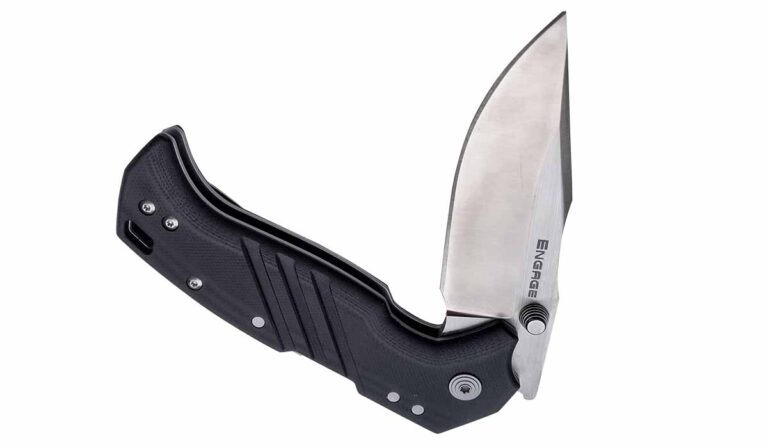
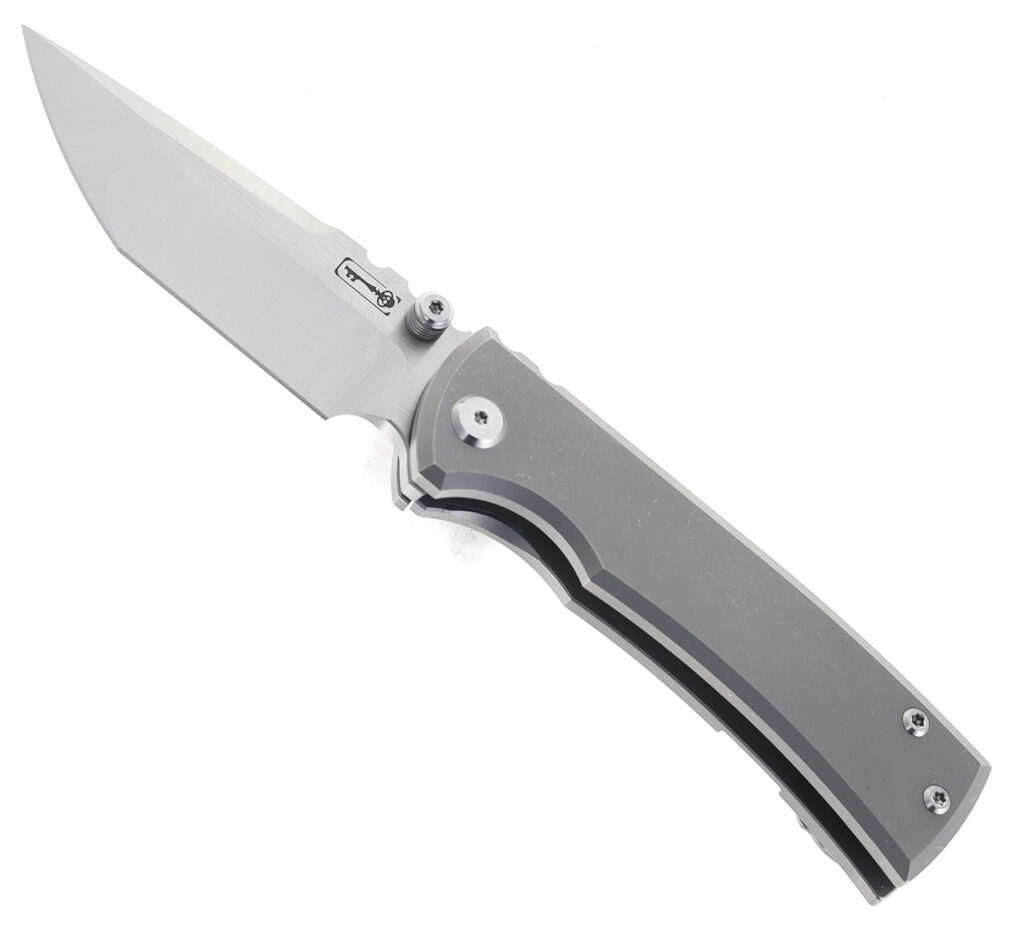
If you need a heavy-duty folder, the Cold Steel Engage can accommodate.
I have always liked Cold Steel knives. They’re made tough and I’ve never had a problem with edge retention on one. The Cold Steel Engage keeps this tradition going. The overall feel of the locking folder is on the larger size but this comes in handy when using pressure on cuts.
Cold Steel Engage Light Cutting
I went with single-walled cardboard for the first slicing test. The Engage quickly shredded the material into nice strips. It was smooth slicing and very controllable. The large frame provides a positive grip.
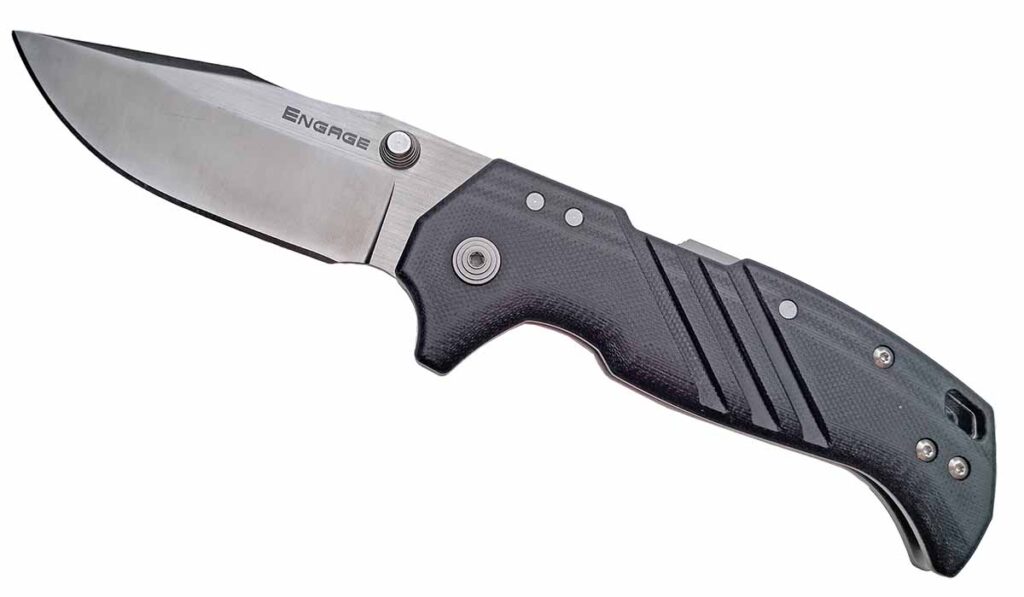
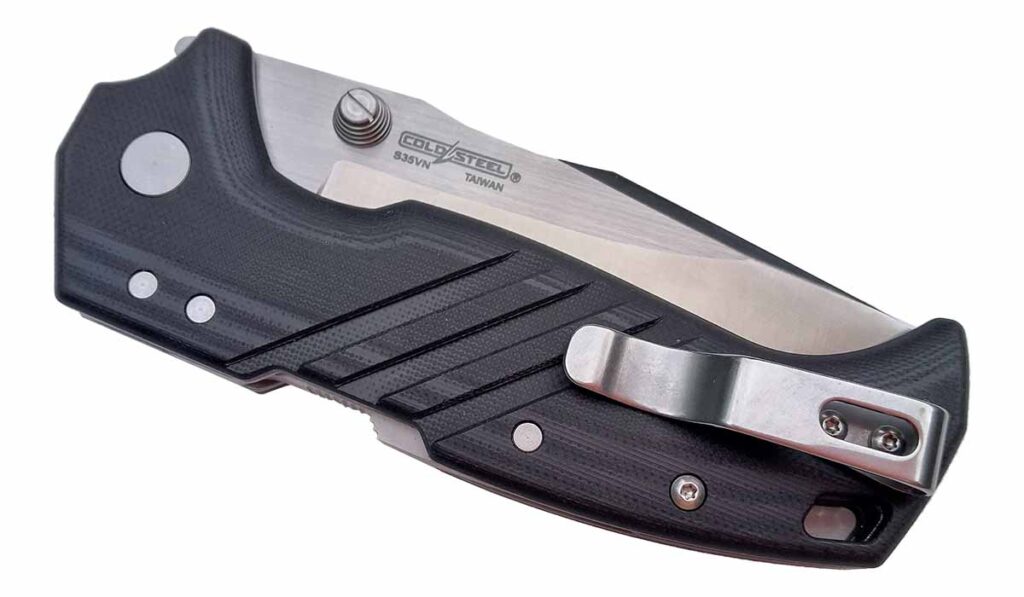
The handle’s integral single guard, single finger groove and bird’s-beak butt combine for a sound, secure grip.
Second on the list was plastic board. Again, the knife sliced very quickly and easily. The hollow-ground blade curled the plastic board a bit but that is to be expected. The handle made it easy to control each cut.
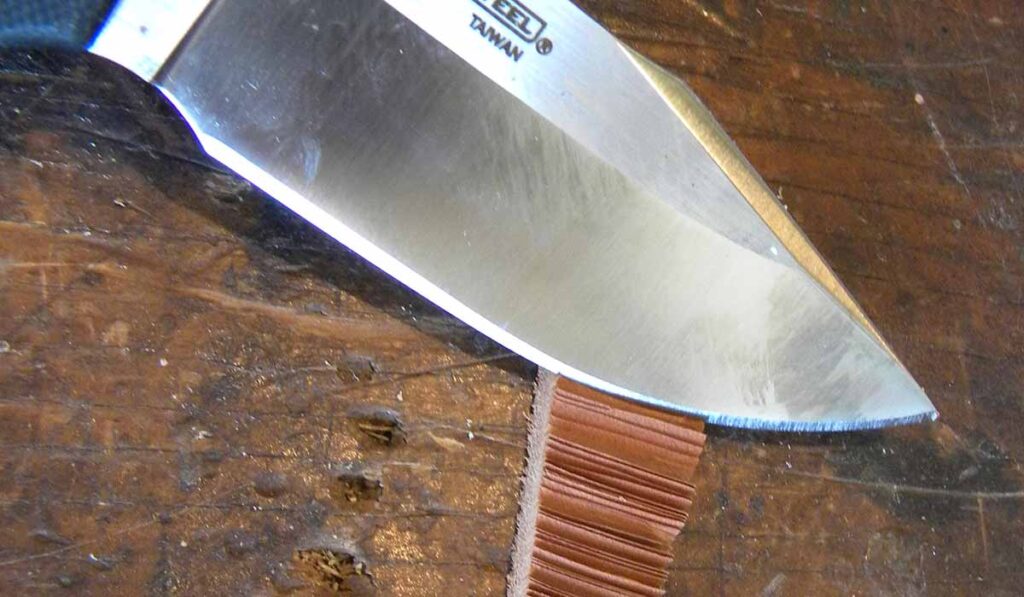
The locking folder made the skiving of 8-ounce leather fast and easy to control the cuts.
For finer work I picked out a strip of 8-ounce leather to skive. The Engage made the skiving fast and easy to control the cuts. I was just slower than the knife could skive. A nice crunching sound resonated with each cut. The Engage is very aggressive cutting leather.
Cold Steel Engage Heavy-Duty Tasks
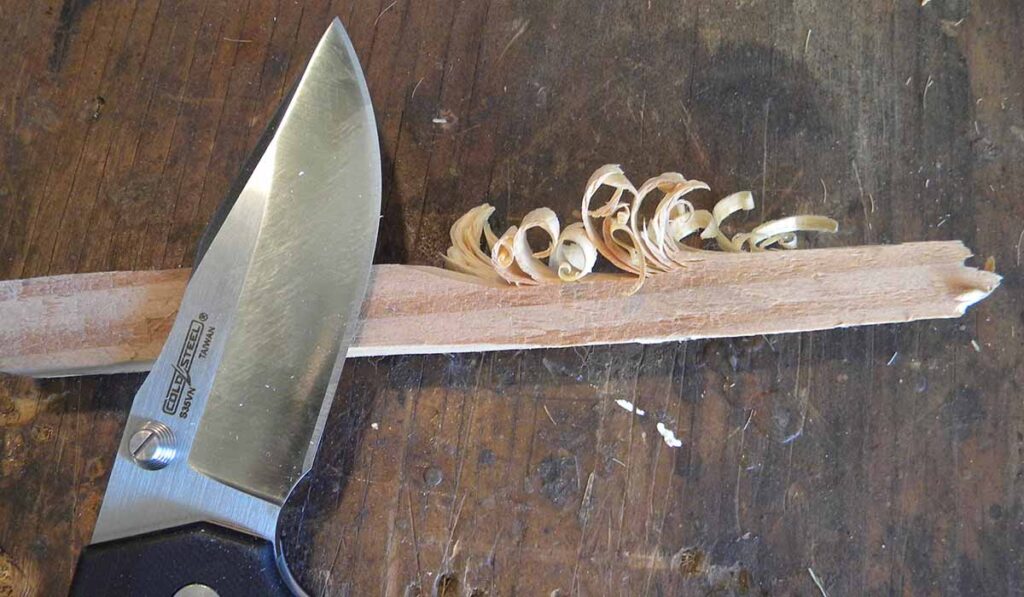
It was time to whittle. The Engage made impressive curlicues in the pine. Making firesticks was a breeze. Whether deep or shallow cuts, the curlicues kept curling along. (It’s a lot of fun to make firesticks.)
Making firesticks was a breeze.
Taking a seasoned branch, I whacked the Engage into it with a dead-blow hammer. Since the branch was all twisted and knotted, I had to whack the blade’s spine hard repeatedly. Finally, I got the wood split into quarters. The folder’s Atlas Lock was still 100 percent secure—tough stuff!
Edge Toughness
It was time for my favorite cutting medium: half-inch sisal rope. I’m getting sluggish at getting my fingers out of the way and had two nicks on my fingernail within the first 20 cuts. I had to slow down! The Engage, on the other hand, crunched 225 times and showed no signs of slowing down. This is one sharp blade for sure.
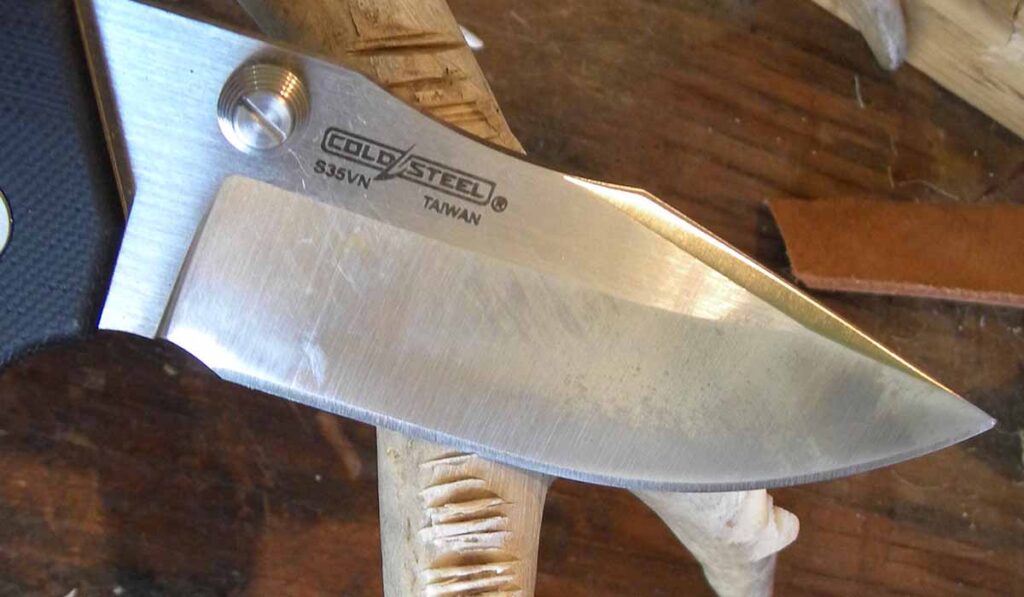
After whacking the whitetail deer antler 30 times, the author found no edge damage. The heat treatment is spot on.
To take the Engage one step further, I pulled out an old whitetail deer antler. After whacking the horn 30 times, I looked for any edge damage. There was none to be found. The heat treatment is spot on. Excellent job!
Edge Retention
For a final test I turned to the paper slice. The 20-pound bond copier paper parted quickly with no snagging. Man, this knife holds an edge! It zipped through the paper like it was nothing.
The knife has a short stainless steel pocket clip. Note the ridges on the slide of the Atlas Lock for enhanced purchase.
Overall Take
This is one very sharp folder. If you like them full-sized, the Engage is a match.
Possible Improvements
Some thumb notches on the blade spine would aid in finer cutting tasks.
Cold Steel Engage Specs: Knife Type: Utility locking folder Blade Length: 3.5” Blade Steel: CPM S30VN stainless Blade Grind: Hollow Blade Pattern: Clip point Blade Openers: Dual thumb studs Lock: Atlas Lock Handle: G-10 Handle Design: Integral single guard w/single finger groove and bird’s-beak butt Lanyard Hole: Yes Pocket Clip: Short stainless steel design Liners: Stainless steel Closed Length: 45/6” Weight: 7 ozs. Country of Origin: Taiwan MSRP: $169.95
There are many names elevating custom knifemaking to the heights it enjoys today, but none loom larger than A.G. Russell, Bill Moran and Bob Loveless.
Nobody would question the straight-up fact that A.G. Russell, Bill Moran, and Bob Loveless contributed mightily to making the knife industry in the United States, and indeed worldwide, what it is today.
Their contributions to the growth and prosperity of knife manufacturers and their partners in the custom knifemaking world are well known to many, but during BLADE®’s 50th year a moment to recognize their achievements and their contributions is appropriate.
Of course, there are others whose involvement and support have had a positive impact through the decades, but Russell, Moran and Loveless—all long-time members of the BLADE Magazine Cutlery Hall Of Fame®—are the core triumvirate that ushered the modern knife industry into its golden age.
Bill Moran
Bill Moran
“Moran gets credit at the top of the list because of the founding of the ABS [American Bladesmith Society],” related Cutlery Hall-Of-Famer Bruce Voyles, past publisher of BLADE and, along with Cutlery Hall-Of-Famer Jim Parker, co-founder of the BLADE Show. “That was followed by the development of the hammer-ins and the [Bill Moran School of Bladesmithing].” As he noted, the ABS was a team effort that included Cutlery Hall-Of-Famer B.R. Hughes, who was an educator.
“Bill was a renaissance man if there ever was one,” Voyles continued, “but he had the best publicist in the knife business in the form of B.R. Hughes. So, as a team they absolutely rank at the top. B.R. had the good sense to know that Bill Moran was the person to represent the ABS, and Bill was a leader in his own right, but without B.R. there may not have been a bladesmithing school.”
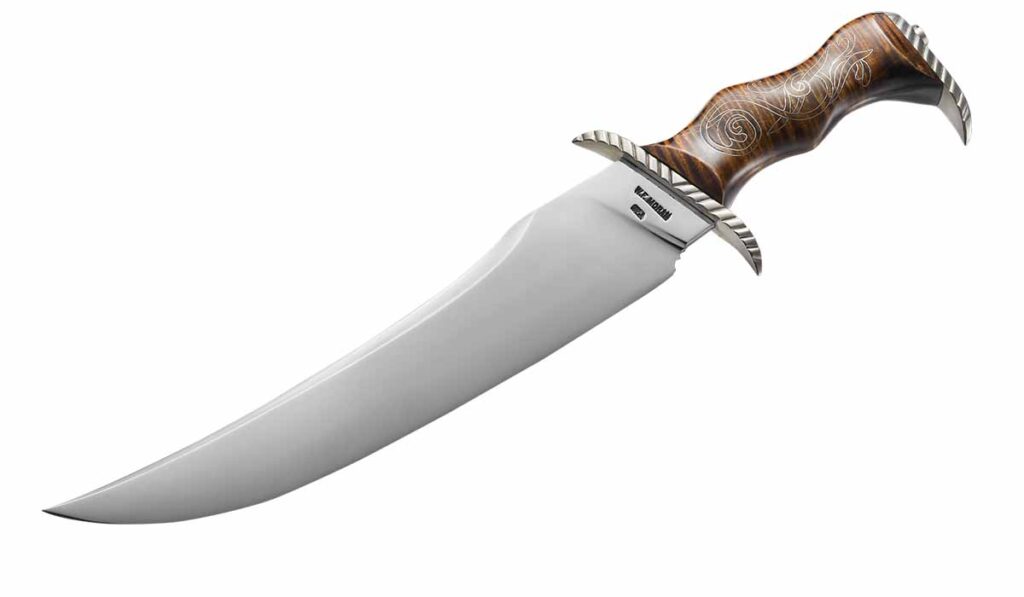
The ST-23 is one of if not the most coveted of Bill Moran knives. (Francesco Pachi image)
Hughes, now 91 and the elder statesman of knife writers, remembers his work with Moran and gives credit to Moran’s foresight at the forge as well. “Bill Moran saved bladesmithing with his reintroduction of damascus in Kansas City in 1973,” Hughes observed. “And when we formed the ABS in 1976, the only goal was to preserve the art of the forged blade. There were three people making damascus [in America] then: Moran, Bill Bagwell and Don Hastings. They met in Bagwell’s backyard and shop after the Guild met in Dallas. That’s how the ABS got started. There were four active members, including me named as a director. So, it started with four, and now there are 3,000 members. I’m still on the board, and now the main thing for me is not to go to sleep during the meetings!”
Bob Loveless:
Bob Loveless
Loveless stands out as a custom knifemaker and designer, as well as a pioneer in the organization of custom knifemakers into a cohesive group, setting standards, discussing issues, and assisting the growth and prosperity of many in later years. Loveless stands apart in his work, organizational input and one-of-a-kind personality.
Hughes recalls his introduction to Loveless courtesy of knife industry titan A.G. Russell. The men sat down at a diner, ate a meal together and Loveless spread some knives on the table. From there, Hughes authored an article about the California custom maker that appeared in GUNsport Magazine.
“Bob and I stayed in contact,” Hughes remembered, “and around that time Bo Randall was probably the most copied [of] knifemakers. Then, when Loveless [redesigned and repopularized] the tapered tang, he became the most copied knifemaker in America. He made that a standard and was very popular.” B.R. added that Loveless was also a good salesman and promoter, and his knives were selling for what were high prices even then.
Voyles said he appreciates the pure genius of Loveless to this day. “He was a phenomenally intelligent person,” he opined. “With Bob, they used to say that you loved him or you hated him. The thing about Bob was that what brought him into prominence was that he was the first person with an art background to make knives. He had gone to design school and made a handsome knife that was aesthetically pleasing, and noted that the knife’s top line should always fit a French curve.
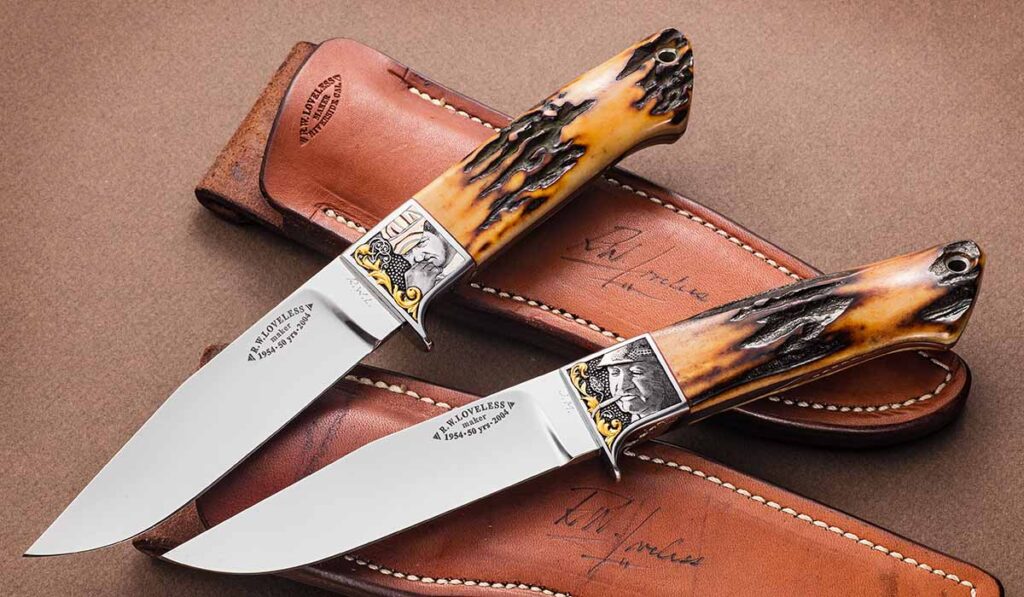
Bob Loveless helped celebrate 50 years of knifemaking in 2004 with this hunter set complete with engraving by C.J. Cai and a couple of autographed Loveless sheaths. (SharpByCoop image)
“Loveless made a good knife and a distinctive knife. Everybody started copying that, and the whole design of knives changed. Bob was also able to sum up a complex subject in one sentence. He was infinitely quotable, which meant outdoor writers loved him.”
According to Cutlery Hall-Of-Famer Dan Delavan, Loveless was a unique character in the knife world. “Loveless was a genius in the whole industry,” Dan related, “and underrated. Because of his antics, some people didn’t think that much of him at times, but Bob was super smart. He knew things would happen before they happened. His drop point was modernized and refined, and he helped a lot of people get started. A lot of them emulated his style.”
A.G. Russell
A.G. Russell
Universally, the contribution that A.G. Russell made to the knife industry is acknowledged as tremendous. He brought people together, tried to build consensus, established the liaison between custom makers and factories that produced magnificent collaborations, developed a robust catalog mail order business that remains the envy of any businessperson, and is recalled as a true gentleman—whew!
Hughes remembers Russell not only for his introduction to Loveless, but also for another moment that proved to be a highlight. “A.G. told me there was a bladesmith in Maryland named Bill Moran and said I needed to get in touch with him,” B.R. smiled. “I kept in touch with Bill. He was always laid back and reserved and shunned a lot of publicity. I wrote a book about him in 1995 called Master of the Forge. We spent several days with Bill and Margaret that fall, Bill and I in the back seat of the car talking and Margaret and Carolyn in the front seat talking. Carolyn has been with me through all these years. I married her in 1957, and she has been the editor of American Bladesmith Magazine now for 20 years.”
Voyles remembers Russell as “the one that lit the fuse and promoted the Knifemakers’ Guild for many years and almost singlehandedly created an aftermarket for handmade knives.” Imagine the foresight, power of persuasion and business acumen that could exert such influence in the knife industry as a whole. It’s safe to say that A.G. was the catalyst for so much of the positive interaction that has taken place in the knife world over the past 50-plus years. He bought tables at gun shows for knifemakers to display their wares back when there were no knife shows to attend. He supported knifemakers with his heart, head and pocketbook.
“Knives were his passion,” Cutlery Hall-Of-Famer Goldie Russell said in remembering her husband’s dedication. “He was determined to know everything there was to know about knives.”
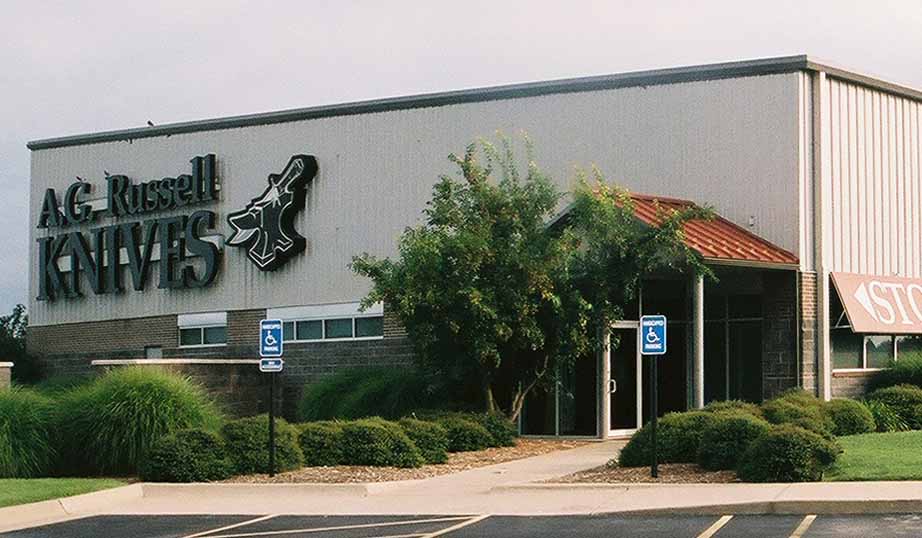
A.G. Russell Knives not only is a landmark in the knife industry, it is in its hometown of Rogers, Arkansas, as well.
Goldie recalls her husband’s hard work that made things happen. “By June 1970, A.G. had reserved a block of tables at the Wanenmacher Gun Show in Tulsa and invited the makers he knew to exhibit and sell their knives,” she commented. “I believe it was at this show that he introduced the idea of the Knifemakers’ Guild. A.G. told me that two knifemakers that were on board from the beginning were [Cutlery Hall Of Famer] Dan Dennehy and Bob Loveless. At that show they decided to form the Guild, and there were 11 founding members.”
A.G. secured more tables at the Houston gun show in 1971, and more knifemakers joined the Guild. The following year, the first annual Guild Show and meeting were held in Kansas City, and the membership grew steadily.
In addition to his leadership in the formation of the Guild, A.G. was a visionary business owner. He created the first mail-order company that focused strictly on knives. Until that time, consumers could leaf through the pages of the Sears & Roebuck or Montgomery Ward catalogs and hope they found something. But Russell changed the game in 1964 when he started A.G. Russell Knives with the sale of Arkansas whetstones.
Goldie remembers another seismic achievement that her late husband was directly involved in—the establishment of the first high-profile knife collaboration. “He arranged for Bob Loveless to meet with Schrade Cutlery to produce a modern fixed-blade knife,” she commented, “and the result was the Schrade Loveless Hunter. I recently read something that said [Cutlery Hall-Of-Famer] Uncle Henry Baer facilitated that collaboration. I’m not sure how involved Henry Baer was, but if you look at what was happening, it was obvious that it was A.G. Russell who had direct involvement with Schrade and Bob Loveless.”
A.G. is also known for his innovative work with Schrade to incorporate the Knife Collectors Club, the first organization of its kind. “This was A.G.’s concept,” Goldie observed. “His idea was to create serial-numbered commemorative folders, which would be offered to club members. A.G. would select the knife, develop the project and sell the knives. Schrade would make the knives.”
Goldie personally witnessed her husband’s investment of time and treasure to promote knives from every angle. He supplied Cutlery Hall-Of-Famer Blackie Collins with his mailing list in the early 1970s so that the earliest issues of American Blade, which would eventually become BLADE, had somewhere to go. He supported new manufacturing brands during the 1980s. And he was willing to provide a frank and honest assessment of a knifemaker’s work when asked to do so.
A.G.’s wisdom came shining through when he discussed with Arkansas knifemaker/Cutlery Hall-Of-Famer Jimmy Lile why the two had not become closer friends. Goldie noted that Lile said, “A.G., when I could not do better, you told someone that my knives were not very good.” She added, “A.G. said that as soon as Jimmy expressed that, he realized what he had said. After that Jimmy and A.G. were friends.”
A.G. offered his advice when asked. Goldie remembers a meeting with Stuart Leatherman and his brother, Cutlery Hall-Of-Famer Tim Leatherman, regarding the direction of the composition of the Leatherman multi-tool. “I was in that meeting,” she related. “A.G.’s advice was to upgrade the blade steel and make handles of titanium. His other advice was to find a way to make the handles easier on the hand when using the pliers. The Leatherman Charge and Charge Ti quickly followed that meeting.”
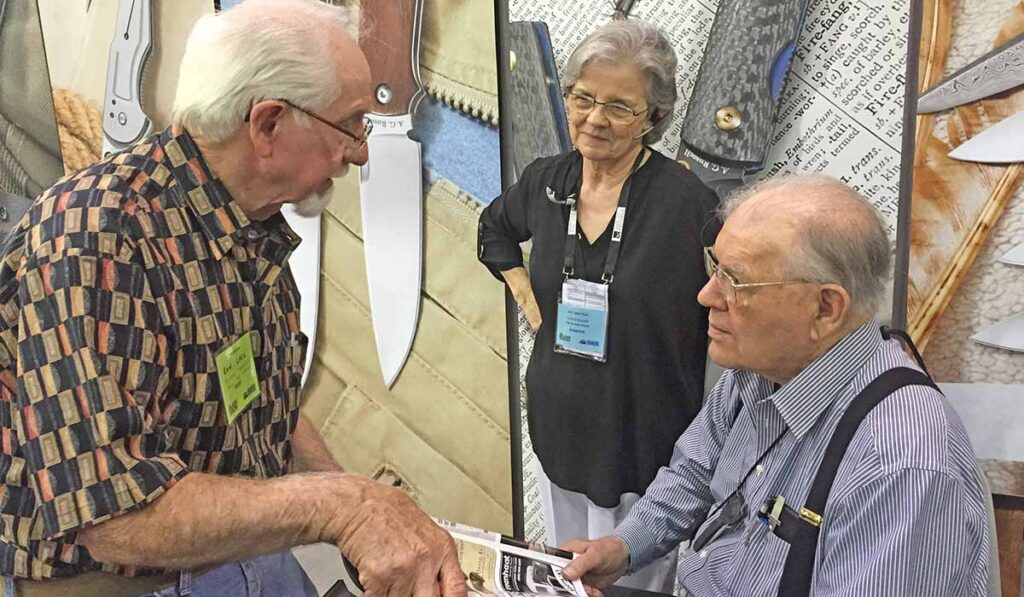
BLADE Magazine Cutlery Hall-Of-Fame® members (from left) Ron Lake, Goldie Russell and A.G. Russell share thoughts at the A.G. Russell Knives booth during a past BLADE Show. (A.G. Russell Knives image)
Among other contributions that Goldie and also Phil Gibbs, knife designer at A.G. Russell Knives, remember regarding A.G. are his design innovations, particularly as the first to create folders with handle materials other than metal that did not include metal liners, and in the human element, his willingness to take time with everyone. For example, one day a couple stopped by the A.G. Russell Knives retail store in Rogers, Arkansas. Goldie was asked to step over to meet them. They were unaware of A.G.’s passing until they had seen his portrait in the entryway, and they wanted to express their sympathy.
“They said they had often come into the store and spent time with A.G. talking about knives and knife history,” Goldie noted. “With tears in his eyes, the gentleman said, ‘Mrs. Russell, we are nobody, but he treated us like we were somebody.’”
Delavan, co-owner of the old Plaza Cutlery retail knife store in Costa Mesa, California, and now of plazacutlery.com, put A.G.’s impact into perspective from a professional standpoint. “We both had businesses and a lot in common,” he reflected. “A.G. was a wealth of knowledge. He seemed to know everyone and everything, and I looked up to him.”
No doubt, there are many other individuals whose contributions to the growth, expansion, and thriving entity that the knife industry is today are worthy of praise and recognition. These three—Russell, Moran and Loveless—are, however, more than just a good start. They are giants among other giants, and their accomplishments will continue to resonate across the decades.
Nothing cuts as wicked a profile as a tanto knife.
The tanto is one of the most iconic and recognizable knife designs to ever forged, and today you can find it being made all over the world. From pocket folders to heavy fixed blades, there are a lot of Tantos to choose from.
Today, we’re going to go over everything you need to know about the tanto, from its history and modern usage to the best modern examples you can add to your collection.
Let’s dive right in.
Tanto Knives: Rich, Battlefield-Proven History
Japan has gifted the world with some excellent things: sushi, Godzilla, anime, the Honda Civic… list goes on. Perhaps some of the most iconic pieces of Japanese culture to spread around the world though are its blade designs.
The katana is probably the most famous in terms of combat-focused designs, but a close second is the beloved tanto. A very core idea of many sword-based Japanese martial arts is the idea of daishō, which translates to “big-little”.
Daishō essentially just means having one long sword, and one short sword or long knife to accompany it. Traditionally, the larger sword would often be left outside when entering a palace or other government building, or a temple, and the shorter weapon would be carried inside, tucked through a sash.
The Sidearm of Choice Before Pistols
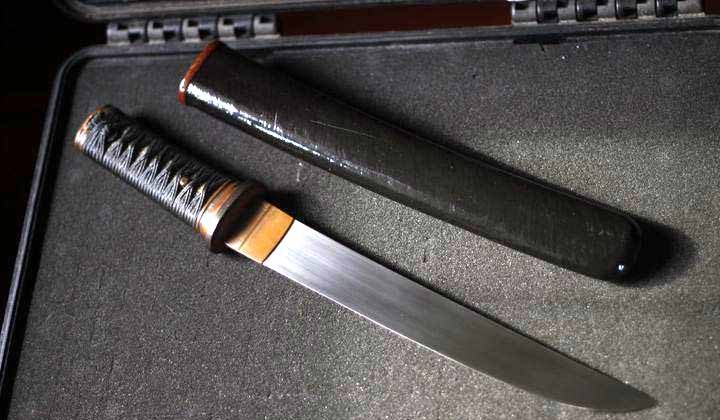
Originally conceived as a sidearm to be paired with a long sword, the tanto was first carried primarily by Samurai alongside a tachi, the precursor to the katana most of us are familiar with from modern popular culture.
Over time, the tanto become more widespread, and a smaller version known as a kaikenbecame popular as a self-defense tool for women. Over several hundred years, the tanto became shorter and thicker, and closer to the blade we know today.
Photo: Wikipedia
Though eventually replaced in serious warfare by the wakizashi (functionally just a shorter katana, though with some design differences) the tanto remained popular for ceremonial usage and became a matter of pride and expression to wear or own in later years.
The tanto then saw a resurgence in the years leading up to WWII, as they were viewed as more traditional by the Imperial Court. Following Japan’s defeat, limits on sword forging caused a decline in all traditional Japanese sword-making.
In the 1960s, American and European obsession with Japanese martial arts (spurred on by excellent films such as 7 Samurai, Yojimbo, and others) lead to a resurgence of the tanto, particularly as a combat-focused knife shape.
Today, the iconic tanto tip is found on traditional full-length fixed blades, as well as more modern folding pocket knives designed for tactical/defensive use. Plenty of manufacturers make tanto-tipped knives, as well as smiths making excellent traditional tantos. (We’re going to cover both in our reviews, don’t worry).
What makes a Tanto, a Tanto?
Today, the definition of a tanto has shifted far beyond the traditional knife of 10th-century Japan, but we’re going to start there and then we’ll talk about the more modern incarnation where we see tanto tips added to a variety of EDC and tactical knives.
Traditional Tanto Blades
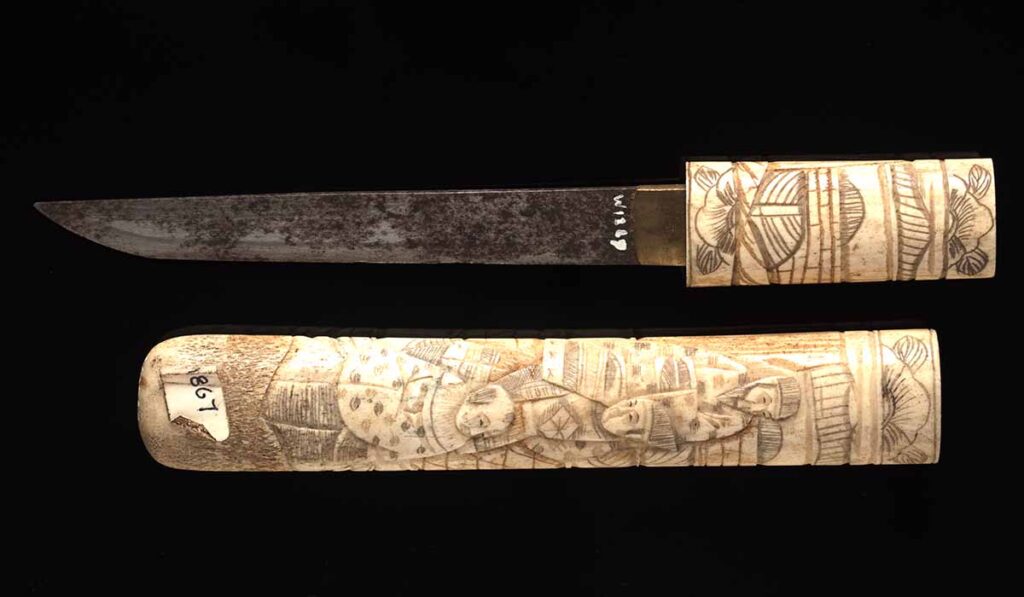
Originally, the tanto was more what we would call a short sword, or perhaps a long dagger, and was worn by samurai. It was very much a weapon to begin with, but become a more ornate and ceremonial piece over the years as weapon designs evolved.
The traditional tanto was a single or double-edged dagger with a length of around 6-12 inches and was designed primarily for stabbing. It was forged with very flat sides, and some were left short with an extra thick cross-section to aid in piercing armor.
Modern Tanto Blades
The more modern interpretation of the tanto is heavily influenced by American tactical knife designs and proves more common outside of Japan. Traditional blades are still made (and beautiful) but less practical for the modern world.
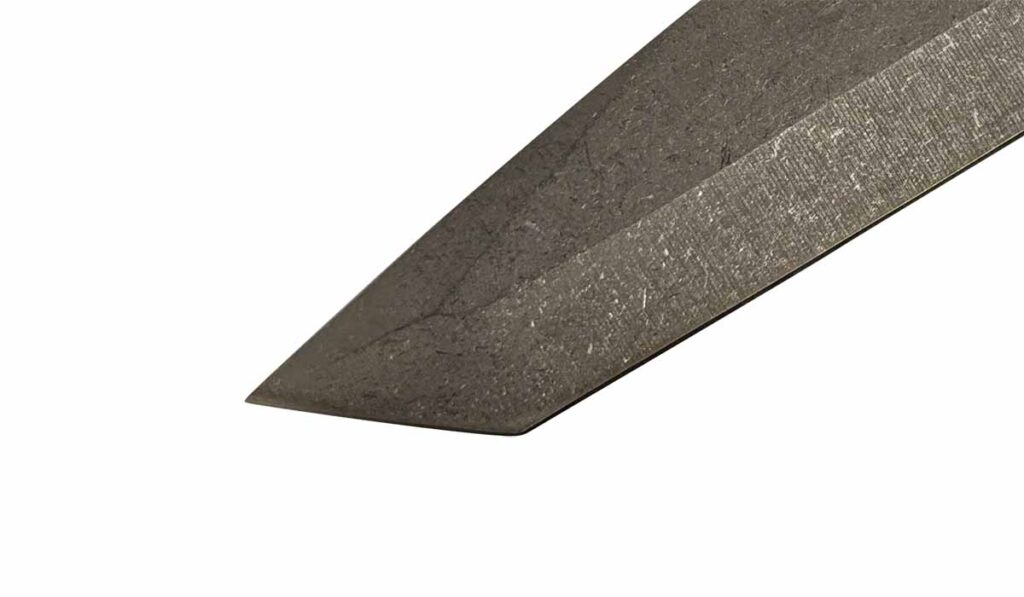
A variety of American and European knife makers now produce tanto-inspired knives with a very angular tip with the iconic sharply-upswept blade tip, essentially leaving you with two cutting planes—one parallel to the spine of the knife, and one at a 45-degree(ish) angle to the spine angling up towards the tip.
Most of these modern “American tanto” designs are folding knives, and while many are for “tactical” or defensive use, the tanto blade shape has become increasingly popular for EDC knives as well.
Pros of the Tanto Design
Piercing: Piercing, piercing, piercing. The shape of the tanto is optimized for stabbing and piercing, and it excels in those contexts.
Whether you’re a pre-Edo period Samurai trying to slip a blade between (or through) segments of your opponent’s armor, or a frustrated office worker attempting to poke your way into some plastic clamshell packaging, the tanto is ideal for putting a hole in something.
We see similar knives used for leather work around the world, and with good reason. The tanto is great for putting a hole in tough material.
Draw Cuts: Modern American tantos are also great for draw cuts and slices, particularly when you’re working with something on a flat surface like a cutting board. The dual edge geometry makes short work of many slicing tasks.
You can also (carefully) use that second point where the two edges meet like a chisel for shaving wood, scraping a sticker, etc. This makes for a very handy EDC.
Defense: Lastly, as a defensive tool, tantos excel because of their narrow, piercing point. This point easily defeats heavy clothing and makes for an effective means of defense in skilled hands.
Many knife-based martial arts focus on stabbing strikes as the most effective fight-enders, and the tanto fits that training paradigm very well, while still being perfectly capable of slashing.
Cons of the Tanto Design
Cutting Edge: The tanto’s main drawback, besides additional time and care needed when sharpening, is the fact that you lose some usable blade edge by having essentially two edges, one parallel to the spine and one swept forward and upwards.
In practical use, this means you have less effective blade length for certain tasks, around 20% less than you’d have with an equivalent-length drop or clip-point blade. To compensate, tanto blades intended for EDC are usually a bit longer than a similar knife with a different point.
All of this can be adjusted for, and as long as you aren’t doing something like spoon carving, you probably won’t notice a difference in real-world use.
At the end of the day, “real-world use” for most of us is opening boxes and packaging, and slicing apart those god-awful packing straps used to hold children’s toys in display boxes. And the tanto excels at all those tasks.
How The Hell Do You Sharpen a Tanto?
Sharpening a tanto may look a bit scary, but once you break the process down, it’s quite simple. All you’re doing is sharpening two edges that meet at a point. The only real pitfall is that it’s easy to round over the point where the forward edge and the edge parallel to the spine meet.
To avoid this, be mindful of that meeting point, and stop your sharpening stroke on or before it. Then, when sharpening the forward edge, rotate the blade and sharpen it in much the same way you would a chisel.
Just be careful not to pull through the point where the two edges meet so you don’t round over that point and you’ll be good to go. Beyond that, it’s just like sharpening any other knife.
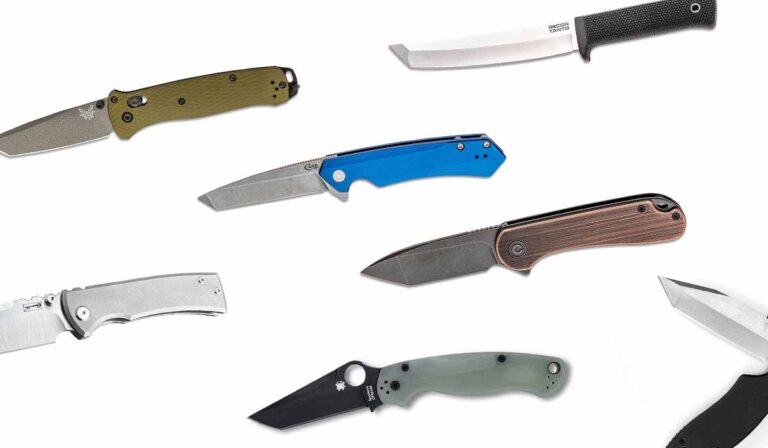
10 Ten Knives with Tanto Blades: EDC, Fixed Blades, and Folders
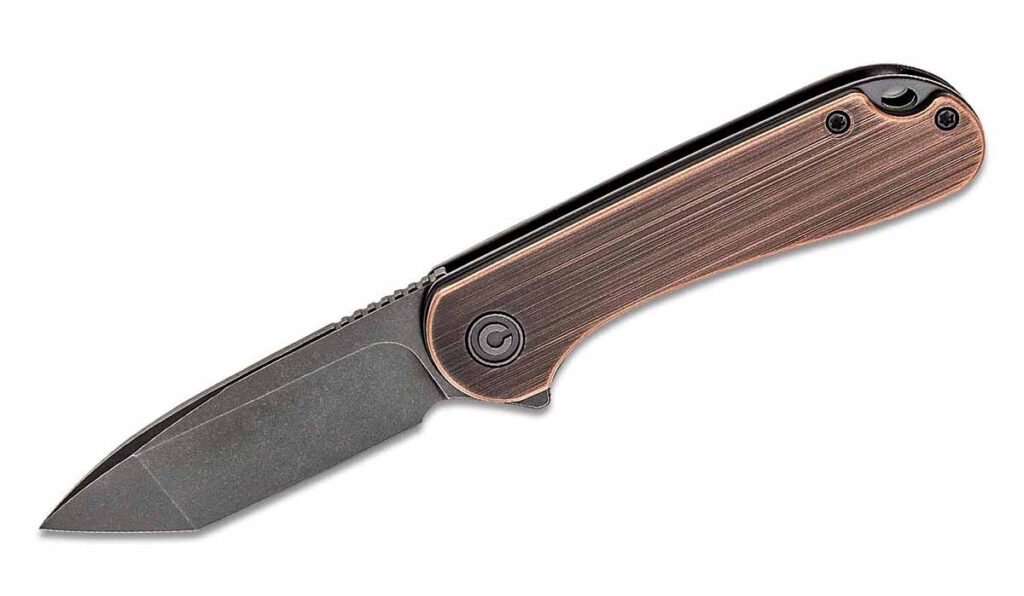
CIVIVI Elementum Tanto
The CIVIVI Elementum has become something of a modern classic in the EDC knife world. Since its release a few years ago has gone on to become one of the most popular pocket knives around.
There is a nearly limitless amount of blade and handle combinations out there now, but we’re going to focus on this excellent tanto blade with a copper handle.
At its core, this is still the same Elementum knife aficionados are already familiar with (a simple, dependable liner-lock flipper folder) but outfitted with a tanto blade that makes piercing tasks a cinch, without compromising on slicing performance.
Basically, it’s everything you need in an EDC knife for regular daily tasks, and it comes with a gussied-up stonewashed tanto blade and a lovely hand-polished copper handle that adds a touch of class and elegance to this very affordable knife.
The Elementum tanto is also available in a button lock version and features a 2.96-inch blade made of D2 steel.
MSRP: $80
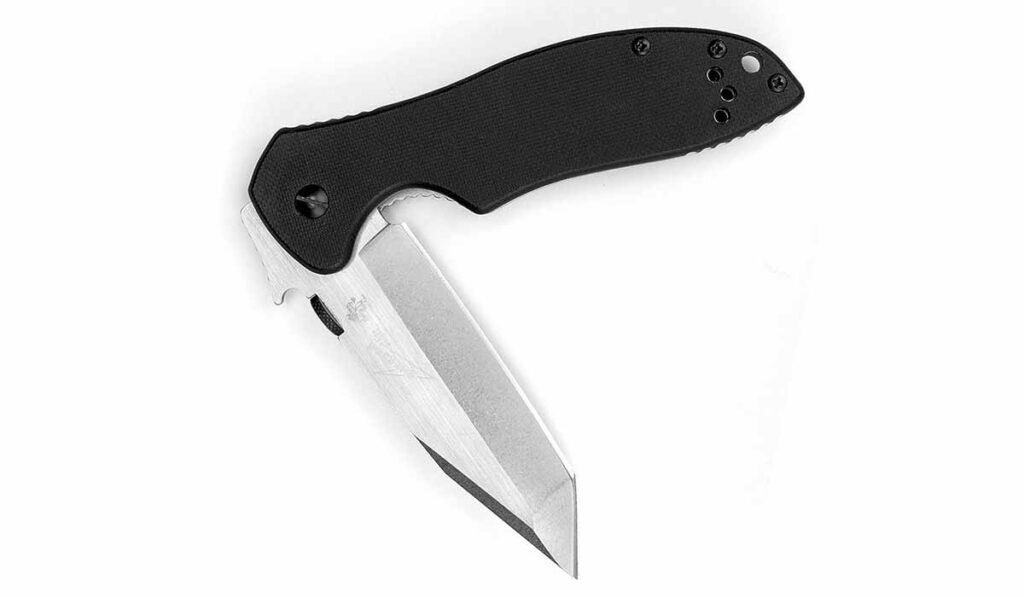
Kershaw Emerson CQC-7K
Ernest Emerson has brought much success to Kershaw with his designs. Back in 2014 he hit it out of the park again with the Emerson CQC-7k, which won that year’s Best Buy award at BLADE Show for sheer value. In the almost ten years since it’s held its own as one of the best EDC options out there.
It features the iconic Emerson Wave that facilitates blade deployment by simply pulling it from the pocket and hooking the “Wave-Shaped Feature” on the pocket on the way out (sort of an inverted kicker).
It also features an ambidextrous thumb disk that doubles as a comfortable place to press your thumb when doing fiddly work. The scales are nicely-textured G10, and the handle features a stainless frame lock that is one of the more secure we’ve tested (read: beat the hell out of).
The one thing to look out for is the blade steel. I would suggest spending an extra few bucks on the D2 stainless version and avoiding the 8cr14Mov version. There’s no reason to spend more than $40 on a knife with bottom-tier blade steel like that in this day and age.
You can get five gas station knives for that price and be better off.
The Emerson CQC-7K has a D2 blade that is 3.25-inches long.
MSRP: Starting at $74
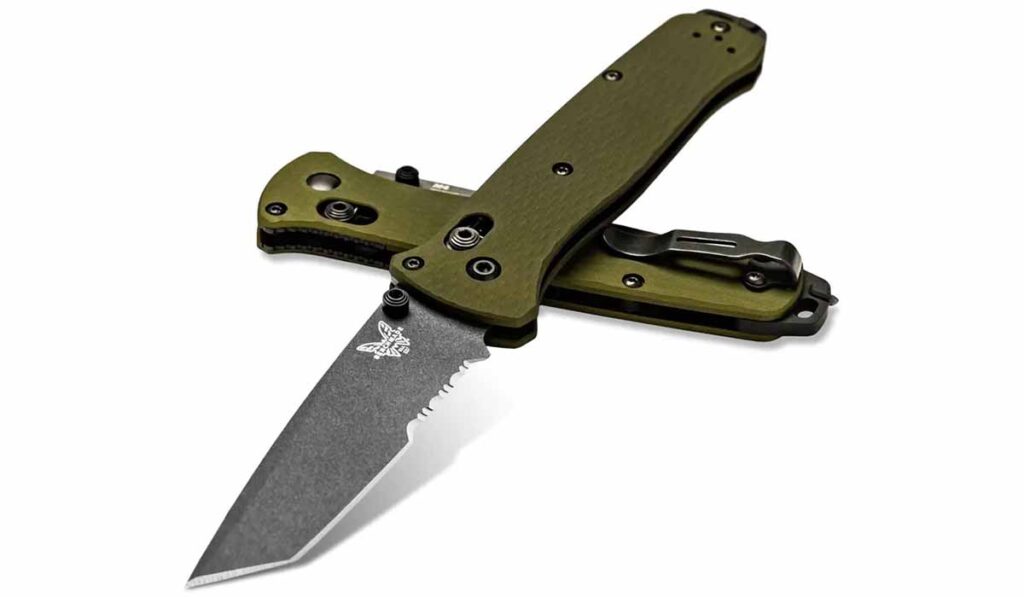
Benchmade Bailout
You’ve heard of the Bugout, surely. Now meet its newer, slightly-tacticooler cousin, the Bailout (one of my favorite knives of the past several years).
As you can surely imagine, the Bailout is a bit of a riff on the Bugout most of us knife fans know and love, but with some notable changes. Our favorite version is the CPM-M4 model which features woodland green anodized aluminum handles.
CPM-M4 is a great steel, which you would expect from Benchmade, and the knife itself is the perfect length to straddle the line between EDC knife and tactical folder. It also features a lanyard loop if you’re one of those people who like lanyard loops, and more interestingly a micro glass breaker.
How often do you need to break a car window in an emergency? Probably not very often, but it is nice to have it if you’re leaning toward a more tactical-style knife. You can also get a version that doesn’t have the glass breaker or the aluminum handles if you want to save a bit.
The Bailout features a 3.4-inches, CPM-M4 blade.
MSRP: $129
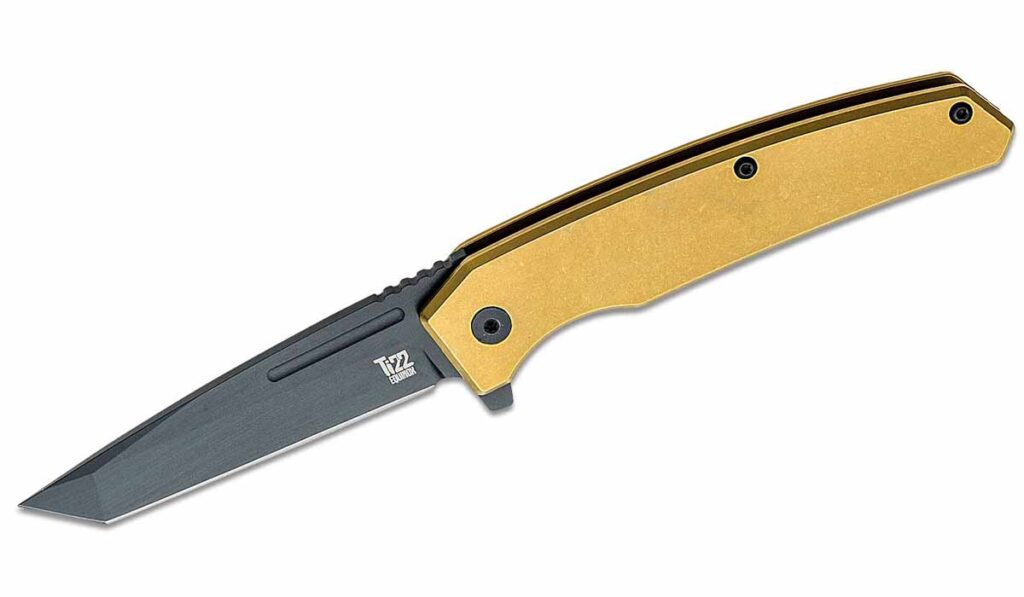
Ontario Ti-22 Equinox
Ontario Knife Co. is one of the most criminally underrated makers out there. Everything in its catalog is smartly designed and intended to excel in real-world conditions. That includes the Ti-22 Equinox.
It features, as the name suggests, a full titanium handle and an S35VN blade coated black to inhibit rust and corrosion in difficult environments. S35VN is a premium steel that holds an edge incredibly well, and the lightweight titanium handle is as robust as you could ever want.
The action is flippy and fidget-friendly, and the handle feels comfortable during extended use. The blade slices paper right out of the box, and comes to a sharp angle where the forward edge meets the primary cutting edge, giving you plenty of piercing power.
Draw cuts, slicing, and even some camp kitchen prep were easy and straightforward, and the knife handled being carried on a sailboat for a week without showing any signs of rust. All in all, a great EDC that again toes the line towards the more tactical/defensive side of things.
The Ti-22 has an S35VN blade that is 3.03-inches long.
MSRP: $138
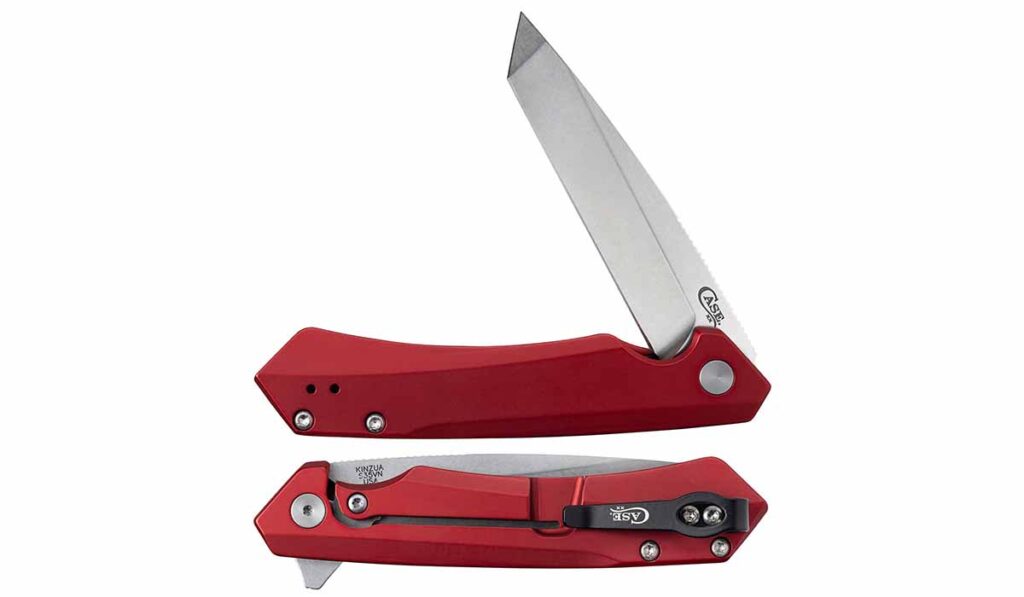
Case Kinzua
Case Knives made a flipper! Several actually, with the Kinzua being part of the first line of Modern Everyday Carry Knives to come from this iconic brand.
This isn’t your grandad’s Case knife, though we love some of those old three-blade traditional babies as much as anyone. These are incredibly modern designs for a modern audience that expects things like one-handed opening, a frame lock, and a deep-carry pocket clip.
In addition to all that, the Kinzua (named for a scenic forestry area in Allegheny County, PA) features an S35VN blade and faceted anodized aluminum handles that are a joy to hold. The flipper tab is nicely contoured, and the knife opens and closes smoothly.
The tip is a now-familiar American tanto and is great for piercing pesky packages, or anything else you might need to poke a hole into during your daily life.
MSRP: $179
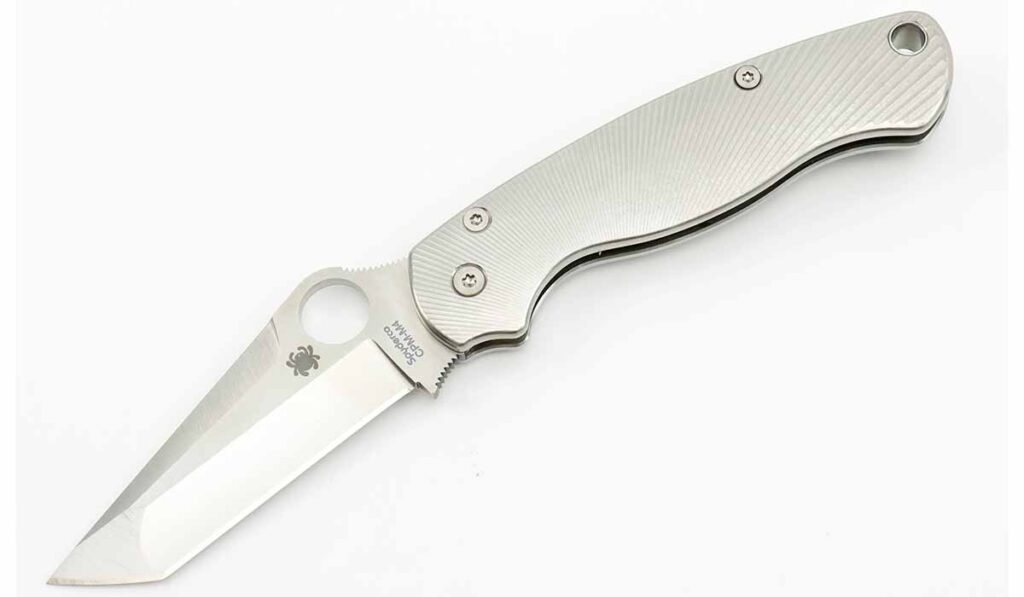
Spyderco Paramilitary 2 Tanto
The Spyderco Paramilitary 2 (or PM2) is beloved in the EDC community, and it’s not hard to figure out why.
It features a polished washer pivot system that is very smooth to open and close, features Spyderco’s iconic compression lock, and now, for the first time, comes with a tanto blade.
That blade is made of CPM-S30V steel, one of the best you can get in a pocket knife at this price range. Sharpening isn’t too difficult, and the edge will last you a very long time, even with aggressive daily use battering away as you slice open Amazon boxes (or whatever).
The PM2 has fine-textured G-10 handle scales out of the box, but you and your trusty screwdriver can pop those off and replace them with any one of roughly ten bazillion aftermarket options. Companies like Flytanium keep PM2 owners well-supplied with choices.
MSRP: $246
The Spyderco PM2 Tanto features a 3.44-inch blade made of CPM-S30V steel.
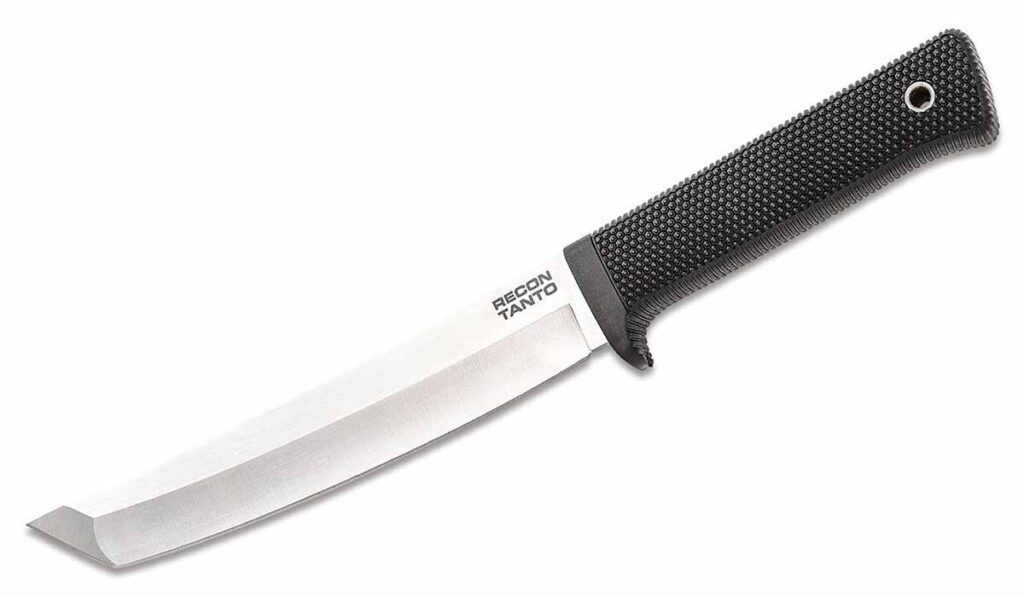
Cold Steel Recon Tanto
Of course, we can’t have a list of modern tanto knives without bringing out something from Cold Steel, the progenitors of the modern “American tanto” that is the most accurate description of most of the knives on this list.
Their Recon Tanto is our first fixed blade on this list and is positioned as a tactical/rescue blade. The incredibly robust SK5 steel used in the blade is a common for hard-use tools like machetes and survival knives, particularly military ones.
The grip is made with Kray-Ex, which is designed to maintain good friction in the hand at all times, even if your hands are wet or you’re wearing gloves. It also doesn’t shred your paws like some rougher materials.
If you’re looking for a more tactical tanto that can handle everything from camp tasks to self-defense, this is a great option that is a bit heavy, but bomb-proof and reliable.
The Recon Tanto has a 7-inch SK5 high-carbon steel blade.
MSRP: Starting at $70
Chaves Redención Street Tanto
Ramon Chaves is a custom knife maker that has made a name for himself as one of the premier designers of tough, hard-wearing, but still stylish blades. His Redención tanto is…very expensive, and worth every penny, exactly the way a custom knife should be.
If you’ve got the cash and you like the look of it, especially if you enjoy the artisan nature of a custom knife, go buy that.
For those of us with slightly less to spend, Reate has put out a production version of the Redención that comes with a slightly more obtainable street price and is considerably easier to find in stock.
Ramon works hard, but it’s always going to take longer to produce a custom knife than a production knife coming from a factory with purpose-built tooling. The Redención Street is a great way to get your hands on the design, without waiting months for the custom version.
The Street Tanto is an incredibly well-built framelock folder with an aggressive piercing tip. Despite a 3.63-inch blade length, the whole thing weighs in at just over 6oz thanks to the titanium handle design (which you can get in about two dozen different colors).
The blade is made from the fabulous Bohler M390 steel, one of the best you’ll find in a pocket knife.
MSRP: $300
Siam Blades Traditional Black Copper Hira Tanto
Lastly, I’m throwing in a little treat for the two or three of you reading this who came here looking for traditional, no-fooling, tantos made the old way. Siam Blades is a traditional blacksmith shop located in Thailand, but they have Japanese-trained smiths that create blades using traditional methods.
For most people, this is going to be a good balance of value and authenticity. A traditional tanto made in Japan will probably run you about three times what this one does. The Black Copper Hira tanto is made to a similar standard, in the same traditional way, and is as beautiful as it is functional.
Best of all, they have stock ready to ship, so you don’t have to wait 18 months for your tanto to be finished and shipped. I’ve chosen the Black Copper version here, but there is a large variety available depending on what aesthetic you’re going after.
The blade itself is made of extremely durable high-carbon SK5 steel (very common in machetes, and battle-ready sword reproductions) and is 9.5-inches long.
MSRP: $820
Final Thoughts on Tanto Knives
The tanto is an iconic design, whether we’re talking about the traditional Japanese original or the modern American remix. This knife shape has stuck around for a thousand years for a reason.
Today, most production tantos are more in the American style at least as far as the tip goes, but this battle-tested design has its roots going back much farther. I hope you’ve enjoyed this brief look into that long history, and you’ve got a better idea of what your options are for picking up a tanto of your very own.
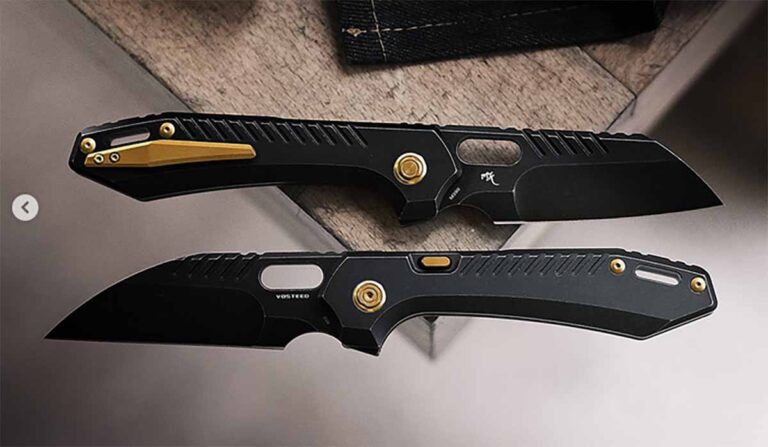
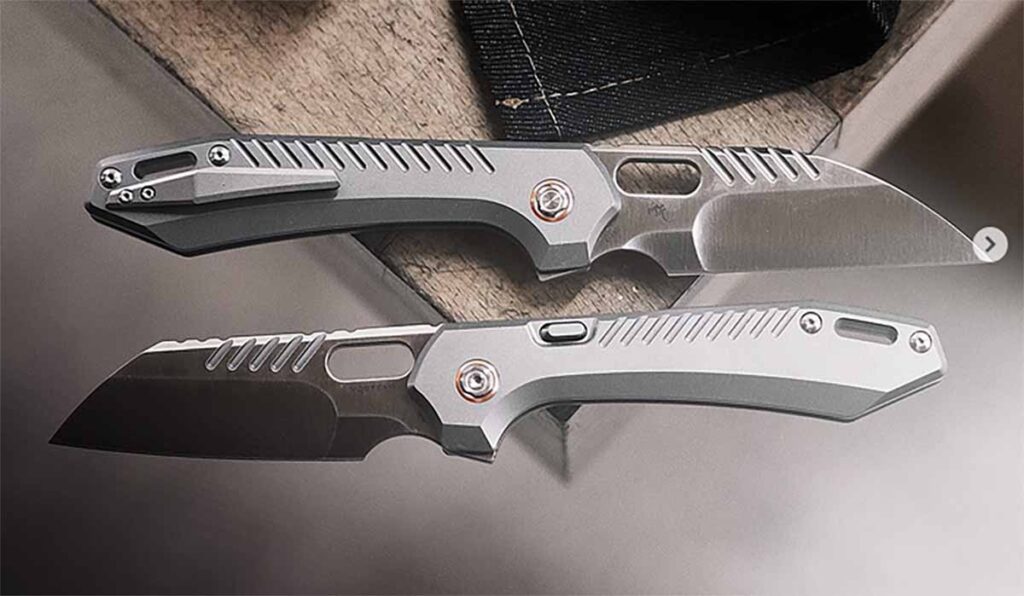
A top-end offering, the Vosteed Mayhem takes a run at proven, yet challenging locking mechanism.
Prolific in its offerings, they must not sleep much over at Vosteed Knives. Yet, the company’s productivity has generally been knife buyer’s gain—at least those attracted to mid-priced fidgety options that by and large have fairly decent lines. Though, one of its latest releases should turn heads if only to see if Vosteed indeed has been able to pull off what few other companies have dared.
Christened the Mayhem (a prototype was showcased at their table at the 2023 BLADE Show), the collaboration with Rob Saniscalchi of R.S. Knifeworks boasts what the firm defines as a hybrid frame/compression lock. Some might recognize the latter aspect of the system as the same mechanism developed and used to great effect by Spyderco. The Colorado company’s patent on the mechanism ran out a few years ago, making it fair game and clone fodder. But given the tight tolerance required for the lock to operate properly, few companies have given it a run.
The Sypderco system is operated by a leaf spring wedging laterally between a ramp on the tang and a stop pin. The system was smooth and easy to operate, as well as strong as the dickens—given pressure is exerted directly down on the spring’s vertical surface, preventing potential bowing. Vosteed appears to operate almost identically, though a bit of the geometry on the blade’s lock elements differ. At arm’s length, Vosteed’s attempt appears on track, but only time and plenty of fiddling by owners will prove if the company truly got it right.
Photo: Instagram
As to its operation, the lock is actuated by a push button on the spine. The system allows for wrist opening, but as has been Vosteed’s OM for some time, it outfitted the Mayhem with multiple deployment options. In this case, both a thumb hole and a kicker; a pair of caged ceramic ball bearings aid in a smooth and fast deployment.
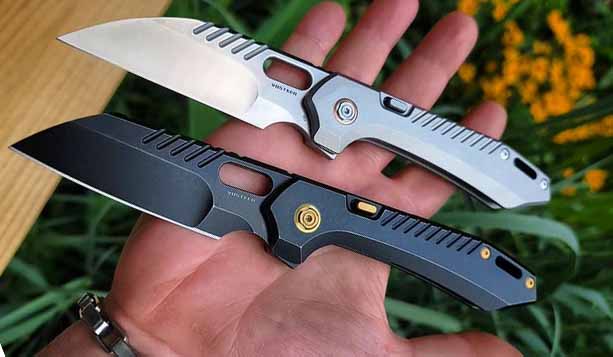
Vosteed offers the Mayhem with a couple of different options. Perhaps the imperative one is the choice between a Wharncliff or sheepsfoot blade, each coming in a 3.3-inch in length and constructed from the highly desirable M390 steel. Each blade has a compound grind, but this appears a play at aesthetics, given the thicker rear grind seems too small for practicality. The blades also feature a choil, so you can choke up, even though the titanium scale is ample enough to land all five fingers of a large hand. The scale itself is clean, with a closed rear and texturing across its back, not to mention a nice taper up to the blade to allow for a firm grip.
The other choice buyers have to make on the Mayhem is finish, with a stonewashed black PVD coating and gray satin options on the menu. The gray version is gray from top to bottom—outside a gold pivot collar—accentuating the knife’s tidy design, while the black iteration is a bit more boisterous boasting gold hardware. Note, the knife offers tip-up carry with a non-reversible titanium clip.
Photo: Instagram
The Vosteed Mayhem is a break from what most have come to expect from the company, which has made its bones at the affordable end of the market. The new knife—no matter options—runs $250. However, if it proves well executed, most likely will find this money well spent.
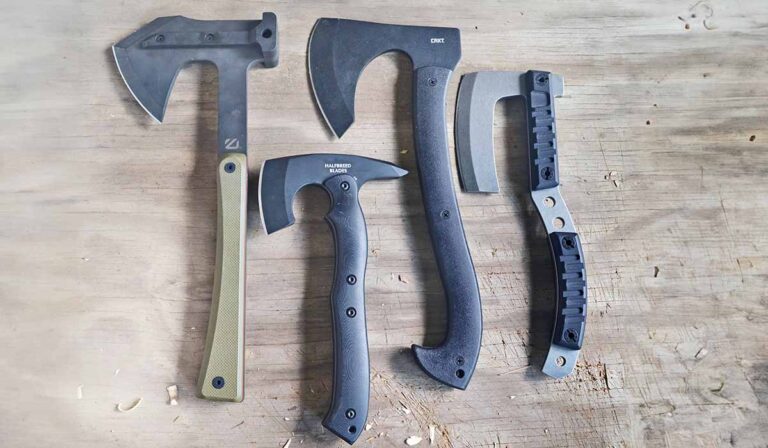
All axe heads have an edge, of course, but did you know some can give you an edge over others? The bearded axe chops just like any axe, but its beard can serve field duty beyond the norm.
The bearded axe was first used by the Scandinavian Norse people (Norsemen) in the Middle Ages and was called a skeggox—skegg for beard and ox for axe. Its distinctive shape allows you to grasp the handle at the base of the head and use the edge for woodworking chores.
It’s sometimes called a carving axe for its propensity for de-barking, shaving and notching wood, and other chores like slicing cord and rope—even serving as an ulu to prepare food. Not all bearded axes are made specifically for carving wood, however, as you’re about to find out.
CRKT James Williams Skeggox
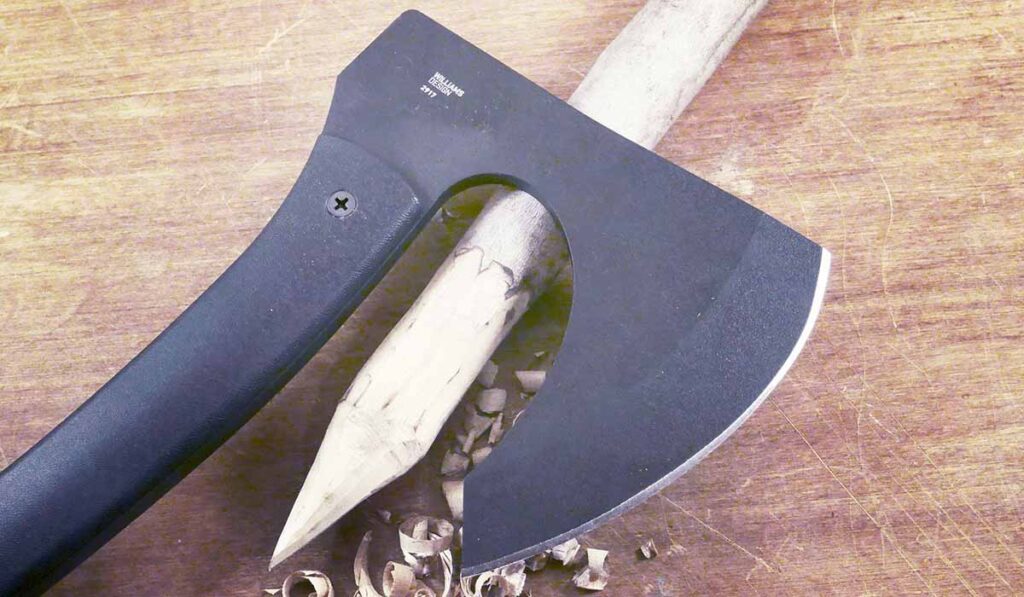
The CRKT Skeggox shaved bark and rendered nice shavings while debarking and pointing the tip of a hardwood stake. The SK5 carbon steel bit into the hardwood quite well and the handle scales offered a comfortable grip.
Columbia River Knife & Tool and martial artist/Japanese sword guru James Williams dipped back in time and chose the original Norse namesake for his design. The CRKT Skeggox is one of the larger two test axes.
The drop in the beard from the top of the inner curve to the bottom edge is 3.25 inches. The 11-inch handle has a lanyard loop at the base. The sheath features a black nylon keeper strap with a thermoplastic buckle to prevent slippage from the sheath. CRKT includes additional hardware for belt or MOLLE carry.
The SK5 carbon steel of the axe head has been compared to U.S.-produced 1084 and 1095 carbon steels, which typically fare well-working wood in the wild. I tested it for carving and immediately liked the deep drop and the “50 miles of elbow room” between the handle and the rear of the beard. I de-barked and pointed a fat hardwood tent peg, and the more I used the bearded blade the better my control got for taking off long shavings. This was in part due to the low profile of the quarter-inch steel and the nice bite of the high carbon alloy.
The Skeggox is also a good all-around chopper for firewood and clearing small trees. The sheath is economical and the option of belt or MOLLE carry is welcome. Better yet, it is the most affordable of the review axes and money well spent.
James Williams Skeggox Specs Head Width: 4.874” Blade Edge: 5” Blade Material: SK-5 carbon steel (Japan) Blade Thickness: .25” Blade Finish: Black powder coat Handle Material: Black FRN polymer Weight: 26 ozs. Overall Length: 13” Sheath: Black thermoplastic Country of Origin: Taiwan MSRP: $113
Doublestar/Outlier Kodiak Camp Axe
The author removed the splitter attachment from the Outlier Kodiak Camp Axe to clear the way for using the blade for debarking and shaving wood. He used the longer, lower portion of the double-edged blade and was impressed with the performance of the 52100 carbon steel.
The Outlier (formerly Doublestar) Kodiak Camp Axe is the second of the larger test axes and comes with a twist. The axe head has a removable steel splitter attachment installed, specifically made for cleaving wood. It is also notable in that the blade edge has two grinds.
The beard drop is 2.5 inches. The handle scales are sumptuous at a half-inch thick each. The sheath covers the axe head and splitter until it reaches the widened rear of the splitter used for hammering. The front has a nylon belly strap with a thermoplastic buckle to secure the axe head.
The splitter increases weight, blocks access to the beard for slicing and shaving, and is too unwieldy for my tastes for finesse work. I removed it, reducing axe weight by 8 ounces and making the Kodiak much easier to manipulate. I thought the two angles of edge might make a difference in cutting surface—and I’m sure they would—but the longer, lower edge turned out to be all I needed for de-barking and shaving long slivers. The 52100 carbon steel cut like a house afire, slicing wood and ¾-inch rappelling rope with ease.
It was a different axe altogether without the splitter and more in line with the other text axes. The only recommendation I’d have is that Outlier offer the same axe with a full, single-edged head to increase the coverage of the edge. Other than that, it’s a beast.
Kodiak Camp Axe Specs Head Width: 5.25” Blade Edge: Varied Blade Material: 52100 carbon steel Blade Thickness: .25” Blade Finish: Parkerized black Handle Material: Green G-10 composite w/orange liners Special Features: Splitter attachment Weight: 40 ozs. (including splitter) Overall Length: 13.125” Sheath: Black thermoplastic Country of Origin: U.S.A. MSRP: $319
Halfbreed Compact Rescue Axe
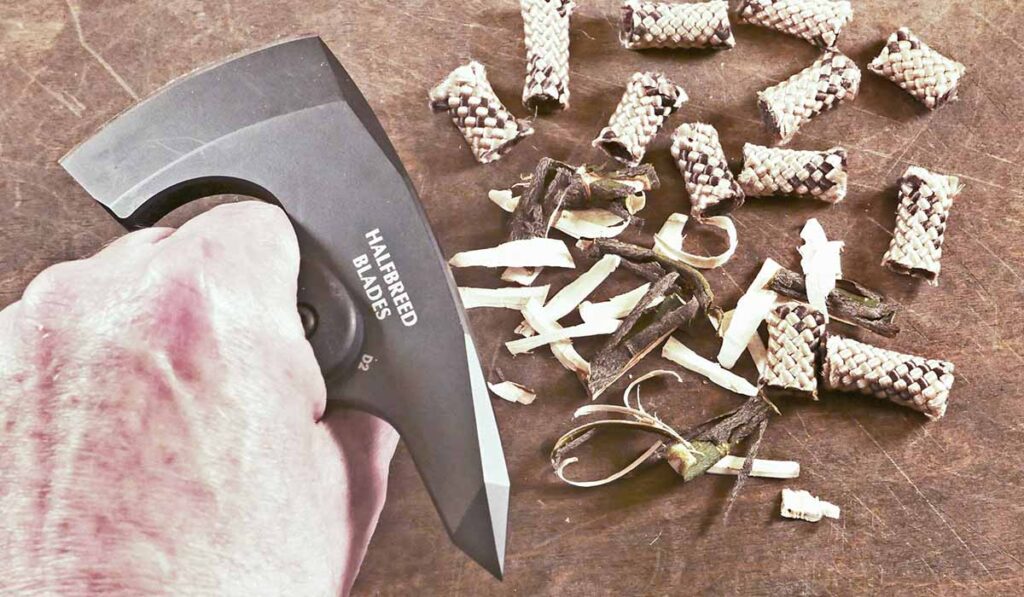
The Halfbreed Compact Rescue Axe shaved wood and sliced rappelling rope with flying colors. The axe head steel is the thickest of the test group.
The Halfbreed Compact Rescue Axe is the smallest of our bearded array yet is also the most overbuilt. It makes up for its smaller size with the thick axe head steel. There’s a nice palm swell at the lower grip area and a big finger groove at the top of the handle.
It has a beard drop of 1.5 inches. Out back is a 2-inch spike. The rear spine has gimping to enhance grip. The sheath offers full coverage and a keeper loop rolls under the bit to further secure the axe head. It has a mounted MOLLE-compatible plate, or you can swap it out with an optional DOTS Tek-Lok style attachment for belt carry.
While testing the Halfbreed I had to remind myself it is indeed a compact rescue axe. While all the other review subjects are geared for outdoor use, this small overbuilt wonder is more for city work. That said, the large finger groove at the top of the handle is custom-made for carving and slicing just as bearded axes were intended. I tested the little axe and it shaved bark, took off shavings, and sliced rappelling rope just fine, but its thick steel and superior weight-for-size ratio really shine when hacking and bashing. I have no doubt it would earn its stars as a close-quarters hawk.
I gave the spike a run on a pane of 3/16-inch door glass and it obliged, shattering it with gusto. The ample grip, with its added gimping, makes for excellent purchase, and the sheath—overbuilt like the axe—is the most comprehensive of the lot. In a nutshell, the Halfbreed is a handy axe—and a bulldog at that!
Compact Rescue Axe Specs Head Width: 4.5” Blade Edge: 2.55” Blade Material: Bohler K110 (D2) tool steel Blade Thickness: .31” Blade Finish: Black Teflon coating Handle Material: Black G-10 composite Special Features: Faceted spike, gimping Weight: 25.07 ozs. Overall Length: 9.52” Sheath: Black Kydex, MOLLE compatible Country of Origin: Australia MSRP: $310
Maserin Knives Mantis
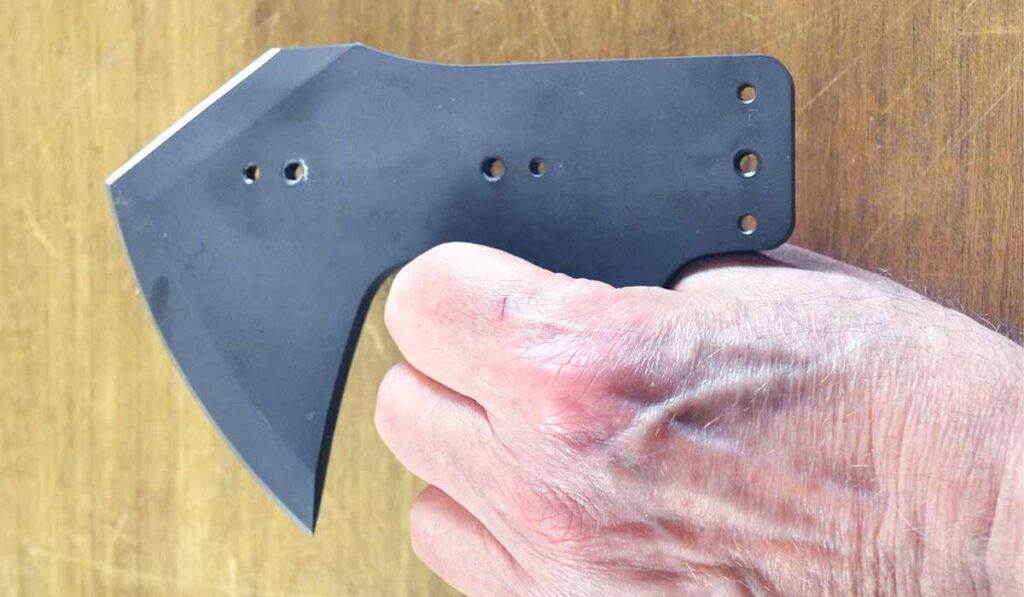
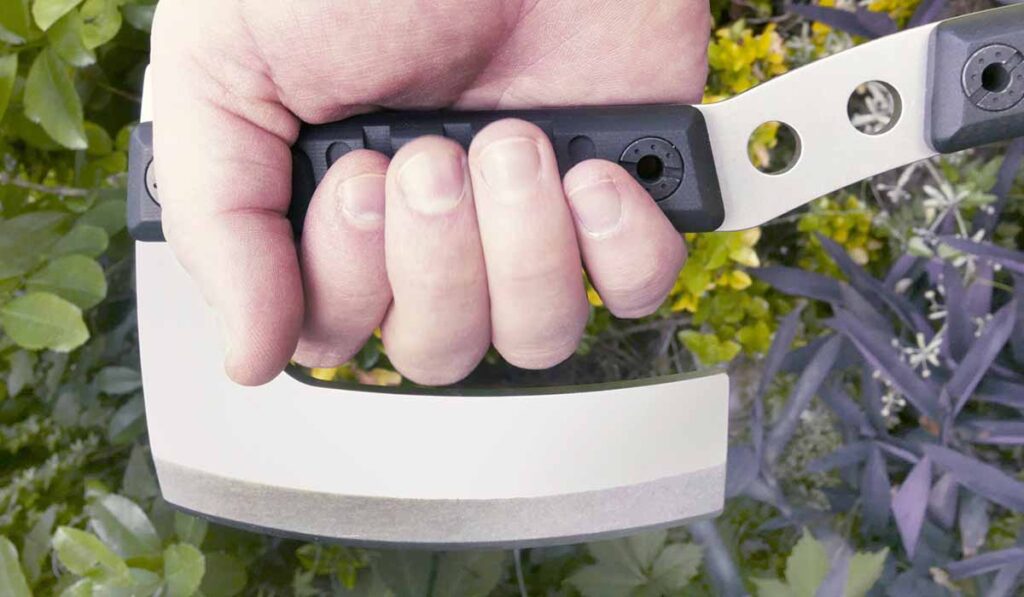
The unusual axe head of the Maserin Mantis offers full knuckle protection and then some. Note that the Mantis has a pair of upper scales just for the purpose of using the axe for shaving and slicing.
Maserin Knives may be giving us a glimpse into the future with its new, strikingly stylish Mantis. It is a small axe and you’ll notice the steep tool steel blade is quite lengthy for its size. In fact, the blade exceeds the width of the axe head—a bit unusual in a working axe.
“But wait, there’s more!” as the TV guy says. The Mantis has four (two sets) of scales: one at the top for carving comfort and the other on the lower portion of the handle for grip. At the base of the straight top scale the direction of the handle switches to an outward curve, and the exposed part on the handle has three lightening holes—plus there’s a lanyard hole and a spike on the base. The sheath fits the axe head only and butts against the top scale, and there’s a belt loop stitched to the back. It’s minimalism at its finest.
The Mantis has the longest beard drop of all the test axes at 3.75 inches and is the only one that offers full hand protection. The blade curve stands apart in that it is virtually symmetrical from end to end. It’s shape and full knuckle protection begged me to try it as an ulu for slicing, so I laid down some 3/8-inch rappelling rope and went at it. The Mantis sliced just like an ulu, taking off clean sections of rope. It performed even better when I reversed the grip with the handle facing away from me so it didn’t hit me in the belly. Voila! Instant ulu.
The Mantis shaved bark and carved off curls quite well and the full finger protection was welcome. It’s the lightest of the axes reviewed, which could put it at a disadvantage to the others when weight is a factor. You won’t be batonning this axe either because the top scales would block it from going past the front portion of the head. That said, there’s plenty to like about the Mantis’s utility value and its forward-thinking styling!
Mantis Specs Head Width: 3.75” Blade Edge: 4.527” Blade Material: D2 tool steel Blade Finish: Stonewashed Blade Thickness: .326” Handle Material: Black G-10 composite Special Feature: Futuristic design Weight: 20.23 ozs. Overall Length: 11.02” Sheath: Black Kydex Country of Origin: Italy MSRP: $216
Delve into the art of honing perfect cutting edges with our comprehensive guide on some of the best sharpening stones available today.
Even the most expensive, well-made knife is only as good as its edge. You can have a blade made from an alloy of adamantium, vibranium, and uru (aka, the stuff in Wolverine’s claws, Captain America’s shield, and Thor’s hammer respectively) and it still won’t matter if it isn’t sharp.
And while a hardware store pull-through sharpener can get the job done in a pinch, especially if you don’t particularly care about the longevity of your knife, the best way to sharpen any blade is with a proper sharpening stone.
Which is what we’re going to talk about today.
We’re going to go over everything you need to know about sharpening stones, including all the different varieties (oil, water, diamond, and ceramic/glass), as well as how to choose based on your sharpening experience, and what type of knife or other sharp things you’re trying to make sharper.
We’ll also discuss things like grit size, and then we’ll dive into some reviews of the best sharpening stones on the market right now. Let’s start with the basics.
Types of Sharpening Stone
Oil Stones
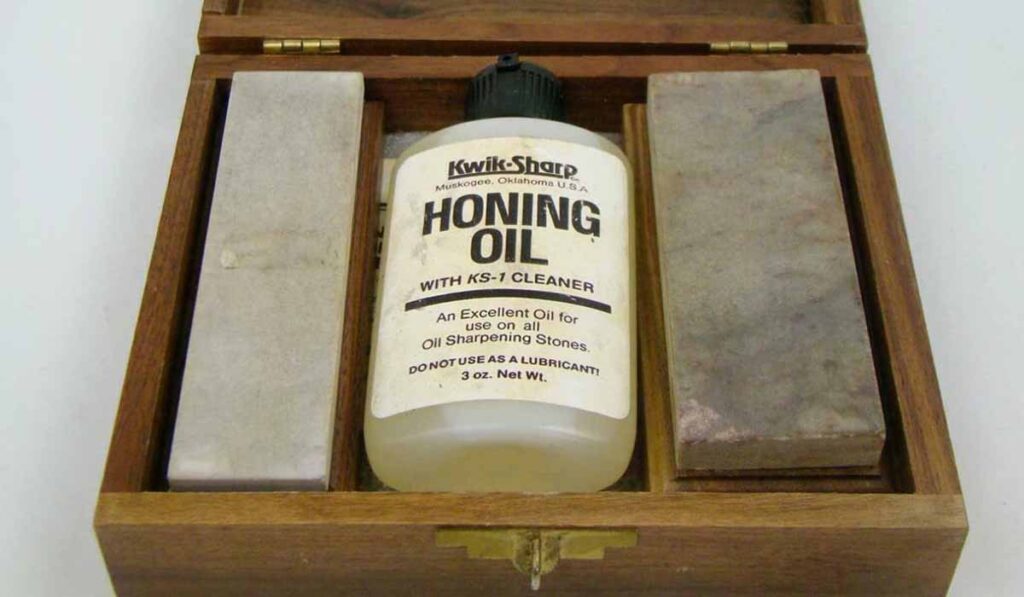
Oil stones are some of the cheapest sharpening stones out there, and they do alright for softer steels, particularly for lower-end EDC knives, multi-tool blades, and other similar blades. They’re called oil stones because, as you probably guessed, you use oil with them.
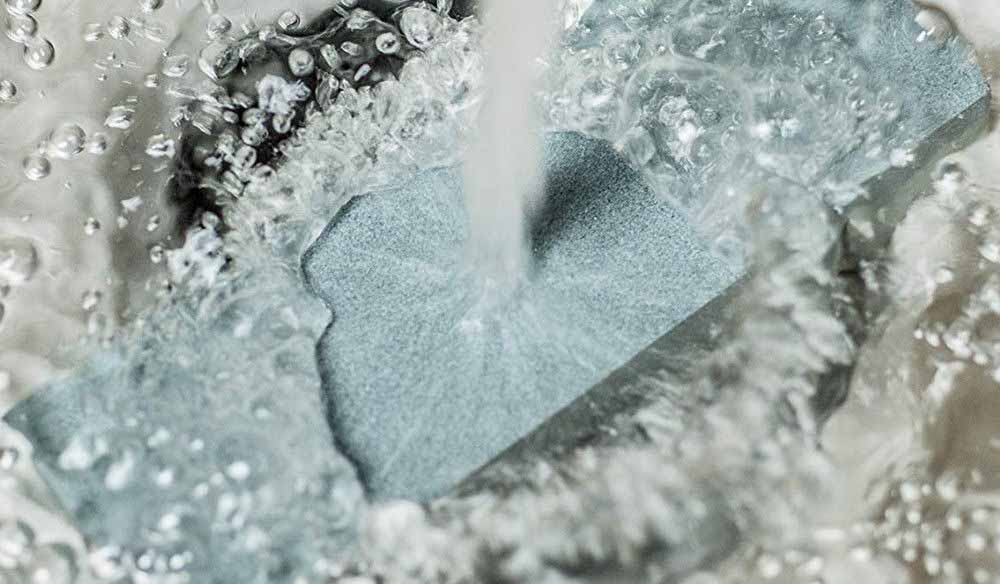
This keeps the blade from catching on anything as you sharpen and helps keep the removed bits of nearly-microscopic metal from clogging too badly on the stone as you move the blade across it.
Available grits are a little limited with oil stones and tend to be a bit more coarse because the stones are made from aluminum oxide or silicon carbide. This means they aren’t great for knives with a highly polished finish, or for very tough knives made of modern “super steels”.
Water Stones
Water stones are another popular option that many people turn to to get a great edge on a blade, particularly kitchen knives, hunting/butcher knives, and other hard-use knives that require a sharp edge.
They’re called water stones because, as you probably guessed, they need to be wet in order to sharpen properly.
There are both natural and synthetic options available, with most natural water stones coming from central Europe or Japan, with the latter commanding a fairly high price due to its scarcity. These natural stones come in a range of grits, so there’s one for basically every need.
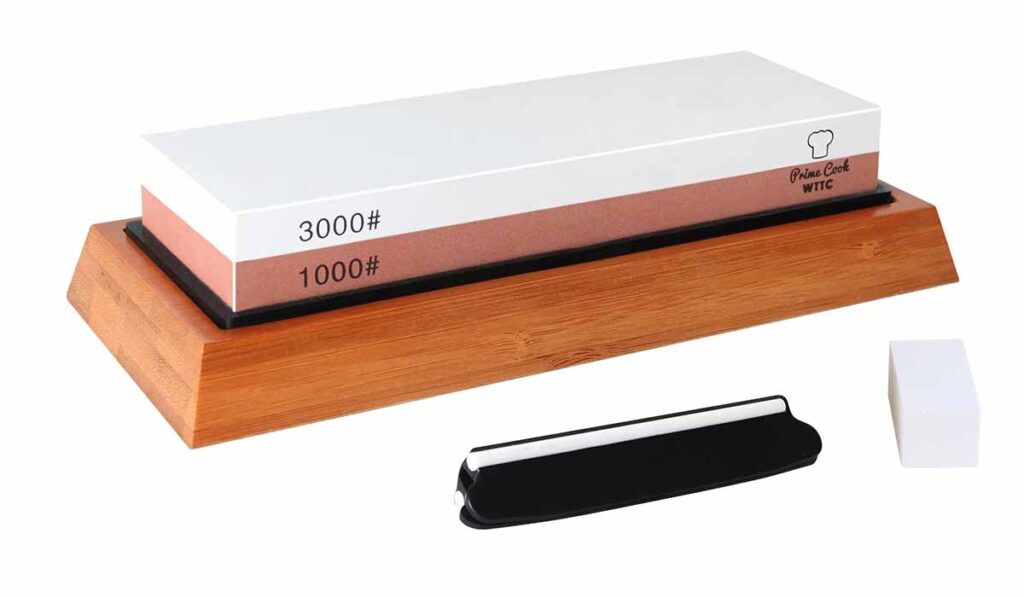
Synthetic water stones are more common (and less expensive) than their natural counterparts and are what you’ll find in most budget-friendly sets. Many of these stones will be dual-grit, with a coarse and fine side to make them a little more versatile.
Synthetic stones are generally very quick to use compared to their natural counterparts, but will occasionally need to be flattened with a special lapping plate in order to maintain a level top surface. This isn’t a difficult undertaking by any means, but it is worth keeping in mind.
Diamond Plates
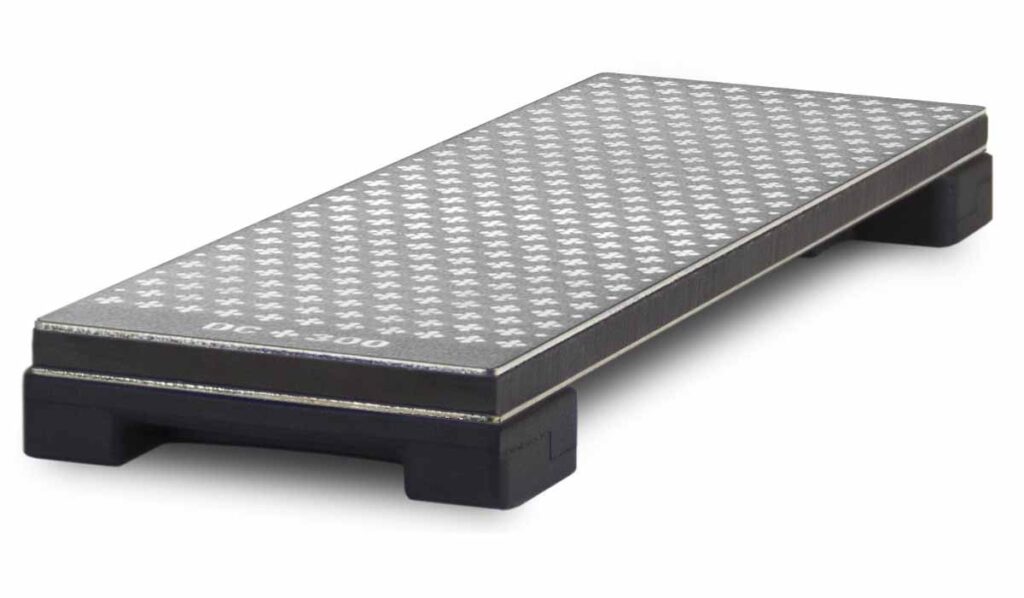
Diamond sharpeners, also known as diamond plates or diamond stones, are fast becoming one of the more popular options for sharpening among blade-wielding professionals and anyone who demands a high-quality edge without a lot of fussing with a sharpening stone.
Diamond plates utilize a conductive nickel base with synthetic diamonds electroplated onto the surface. This leaves us with an incredibly durable sharpening surface that is unlikely to wear out in anything other than daily professional use.
If you’re a butcher, you might wear out a couple of these plates in your lifetime.
This durability is matched by their effectiveness, as most diamond plates work very quickly, can sharpen everything from very tough high-carbon steels to cheap stainless, and will even work well on tungsten and ceramic blades.
They’re relatively affordable given how long they last, with most high-quality options coming in under $75.
Arkansas Stones
Lastly, Arkansas stones are worth mentioning because they’re often listed separately on many websites and they have some specific terms to know if you’re in the market for a sharpening stone.
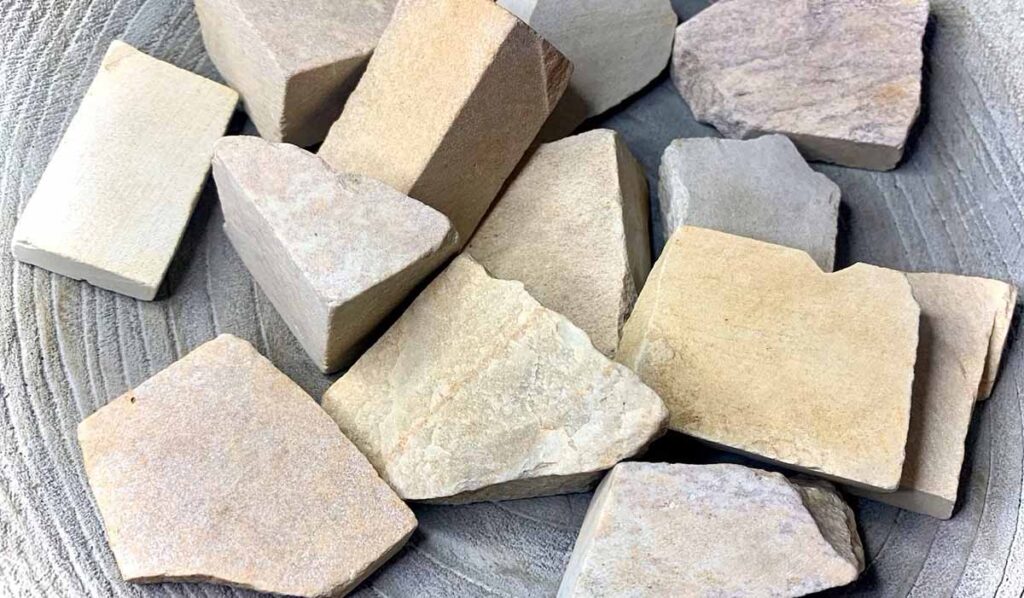
As you might expect, Arkansas stones are a natural whetstone that is quarried in Arkansas (as well as Texas and Oklahoma) in the United States. This natural stone has been used since at least the 1800s as a sharpening stone and is also known as Novaculite, which comes from the Latin word for sharp knife or dagger.
Novaculite has also been quarried in Syria, Lebanon, Israel, and Japan, though these stones have a slightly different makeup and aren’t produced in great quantities anymore.
Many native peoples used the stone for arrowheads and other tools because of its hardness and density, and today it is a popular choice for natural whetstones. It has a long history in the US, and the first usage of the word “whetstone” was actually in reference to an Arkansas stone.
All that having been said, Arkansas stones are a great option but are really just a natural type of stone that can be used with oil or water.
Ceramic Sharpening Stones
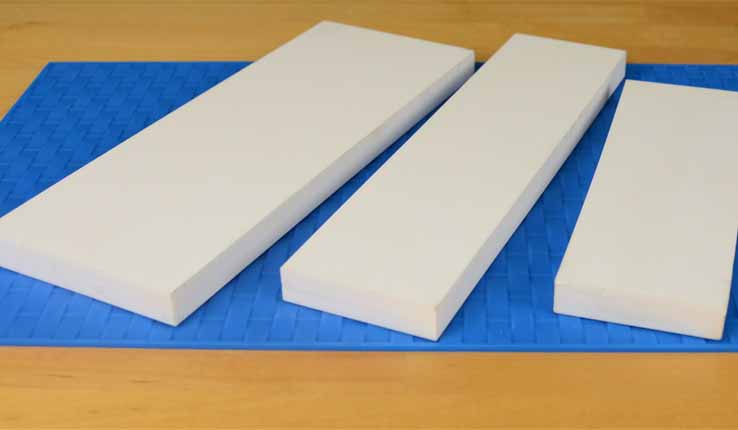
Ceramic sharpening stones are synthetic stones made of very accurately-sized grit particles bonded together to create one contiguous block. These stones, being man-made, are incredibly precise and durable, almost on par with diamond stones, but tend to be more expensive than natural stones.
Usually, these stones are made with corundum, which is an aluminum oxide that is commonly used in sandpaper, emery boards, and industrial abrasive applications. This makes the surface very hard indeed (a 9 on the Mohs scale, where a diamond is a 10) and thus great for sharpening.
Many ultra-fine grit stones will be some kind of ceramic-based product.
Grit Size: Bigger Really Isn’t Always Better
The first consideration, after you’ve chosen the type of sharpening stone (and we’re including diamond plates and synthetic ceramics in that) is going to be grit size.
The basic thing to remember is the lower the number associated with grit size the coarser the stone. We’re going to be using the JIS standard as that is what most folks in the US and Asia will be used to (sorry for our European readers, you may have to do some conversions).
The numbering system in the JIS system comes from the number of grit particles that will fit in a certain size square, so the smaller the number, the larger the individual grit particles will be.
These grits are then organized into ranges, typically Coarse, Medium, Fine, and Extra Fine or Finishing/Polishing stones.
Coarse is anything under 1000 grit
Medium is 1000 to 3000 grit
Fine is 3000 to 5000
Extra Fine is anything above 5000
This is just a general way to look at things though, and will vary from manufacturer to manufacturer. Some may call a 4,000-grit stone fine, and some may call it an extra fine, etc.
What you need to keep in mind is that the lower the grit, the more material you remove, so if you have a chip, rolled edge, or broken tip, then a grit of 1000 or below is appropriate. If you really need to restore an edge, pick up a coarse stone. Be careful though, as it’s easy to overdo it with these.
Most people find that a 1000- to 3000-grit stone (or dual-sided 1000 and 3000-grit combo stone) is a perfect option for keeping an edge on a pocket knife or other general sharpening tasks.
For the kitchen, I personally find that a 5000 grit is great for cleavers and butcher knives, and a 6000-8000 is great for knives with duties such as thinly slicing soft vegetables. I have a 1000/6000 grit combo stone that I find very useful for quickly restoring an edge and getting it back to where I want it.
For my woodworking chisels, I typically go from 4000 to 8000, but for finer work, I can definitely see the need to go to 10,000 and beyond for a truly polished edge, especially if you’re a better woodworker than I am (which is a low bar).
Make Sure Your Sharpening Stone is Big Enough
Most sharpening stones are standardized at around 7-inches long, and 3-inches wide which is perfect for most kitchen knives and pocket knives, but make sure you check the face dimensions so you know what you’re getting.
If you’re going to be sharpening something like a carving knife, machete, or sword, a lot of times you’ll want something a bit larger just so you can get more of the edge at once.
Well-Dressed Stones Last Longer
No, we’re not talking about putting your whetstones in a little suit. Dressing a stone refers to flattening the top surface out so that it makes even contact with the edge that you’re sharpening. Sharpening stones wear more towards the middle part of the face, which is known as “dishing”.
To correct this, stones need to be “dressed” or flattened so that they have a nice, even surface for sharpening. This is especially an issue if you use your stones a lot, or use them on lots of fairly short knives.
To fix this, a dressing plate is used to correct the issue and resurface the top of the stone. This can help your stone last much longer, and give you much more even results.
Buyer’s Guide: Best Sharpening Stones on the Market Today
Sharp Pebble Premium Whetstone
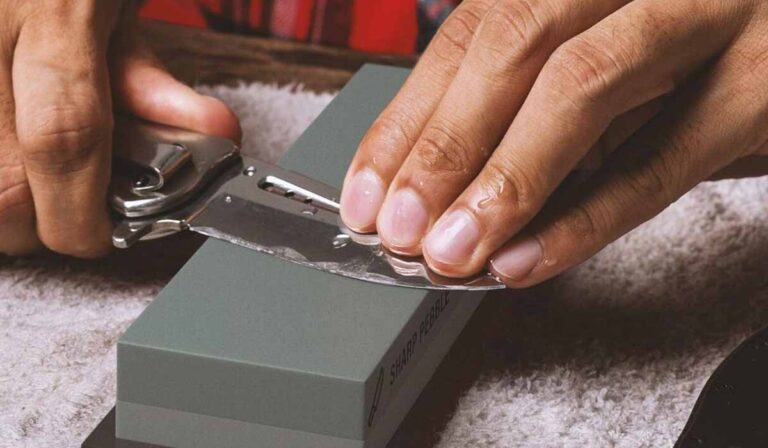
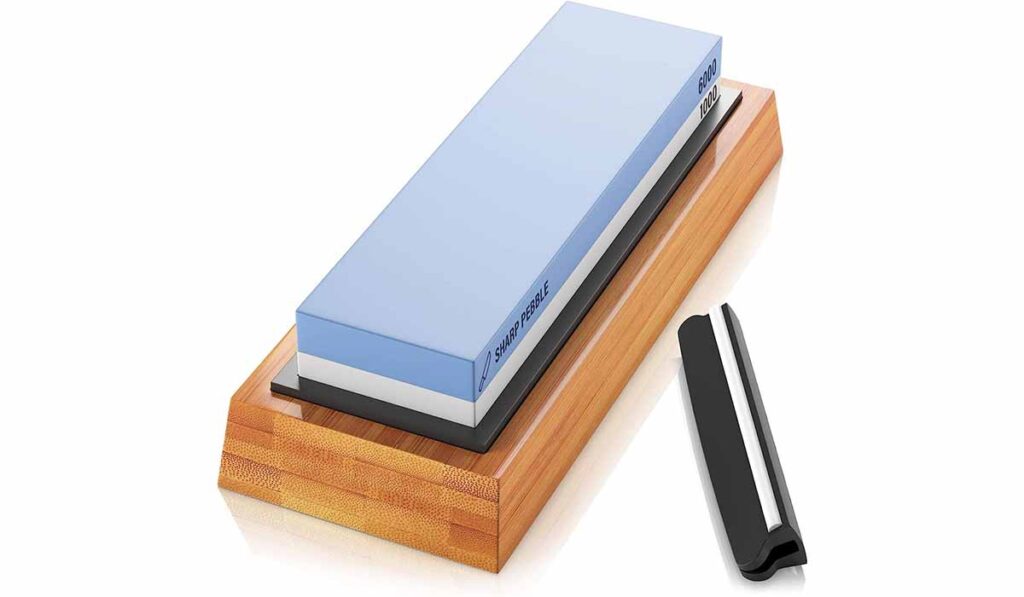
First up, we have one of my go-to sharpening stones, the Sharp Pebble Premium Whetstone, in particular this 1000/6000 combo stone. Sharp Pebble does a great job sourcing all its stones, and if you’re just looking to keep your kitchen knives in the right condition, this is where I’d start.
This is an aluminum oxide-based stone that offers a course and fine edge so you can quickly get a decent edge back, then polish up the edge to get something that can easily handle everything from butchering a deer to shaving depending on how much time you spend with the 6000 grit side.
It comes with a bamboo base with a non-slip bottom and a silicone—gasket? holder? grippy thing?—for the stone that keeps it from sliding around or messing up the nice bamboo base. It also includes a 20-degree angle guide to help you get the angle right.
The fact that you get two very useful grits in one stone, plus the base and angle guide makes this a great option for anyone who is making the jump to sharpening with a whetstone instead of a pull-through sharpener. If you’re looking to learn, this is a great place to start.
This, plus a strop could easily be all you ever really need if you’re just looking to keep a good edge on your EDC or home kitchen knives.
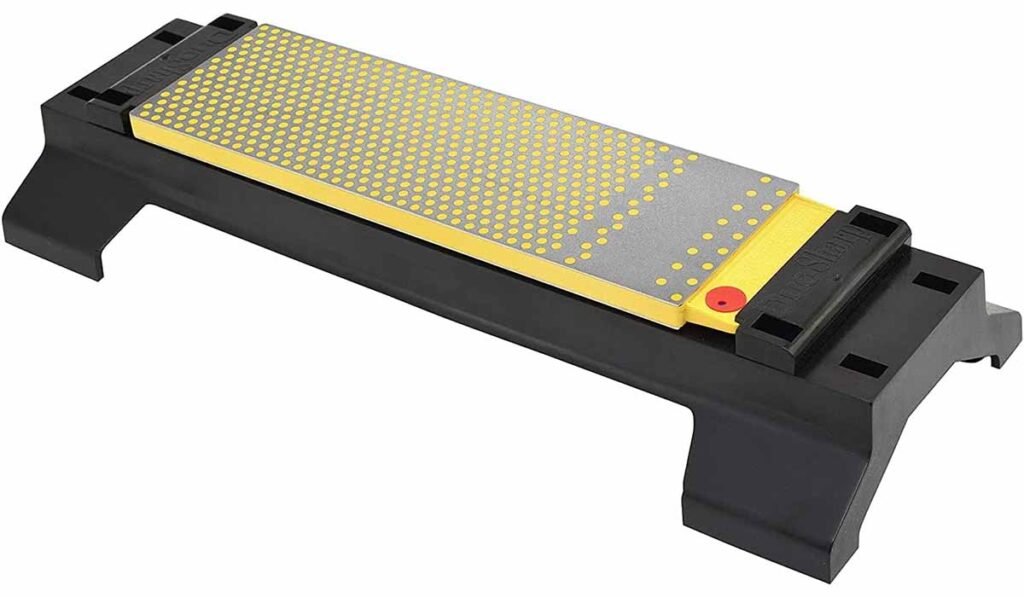
Diamond Machining Technology 8-inch DuoSharp
Stepping up a little bit, we have the DMT DuoSharp, which is a large, dual-grit diamond plate that is great for everything from pocket knives to chisels, and will likely last through a decade or more of regular use.
Because this is a diamond surface, it won’t wear away towards the middle or “dish” like an actual stone will, and it will work well without oil, allowing you to sharpen dry or with water if you prefer.
The size makes it a great option for a workshop bench, and I’ve personally used mine on everything from a rusty machete left in the bottom of a sailboat, to my chisels and other woodworking tools that required a touched up.
You can definitely use this for kitchen and pocket knives as well, and the coarse/fine stone will work well for most people. If you’re restoring old tools or putting an edge on a splitting maul or something, the extra coarse/coarse stone might be a better option for removing lots of material quickly.
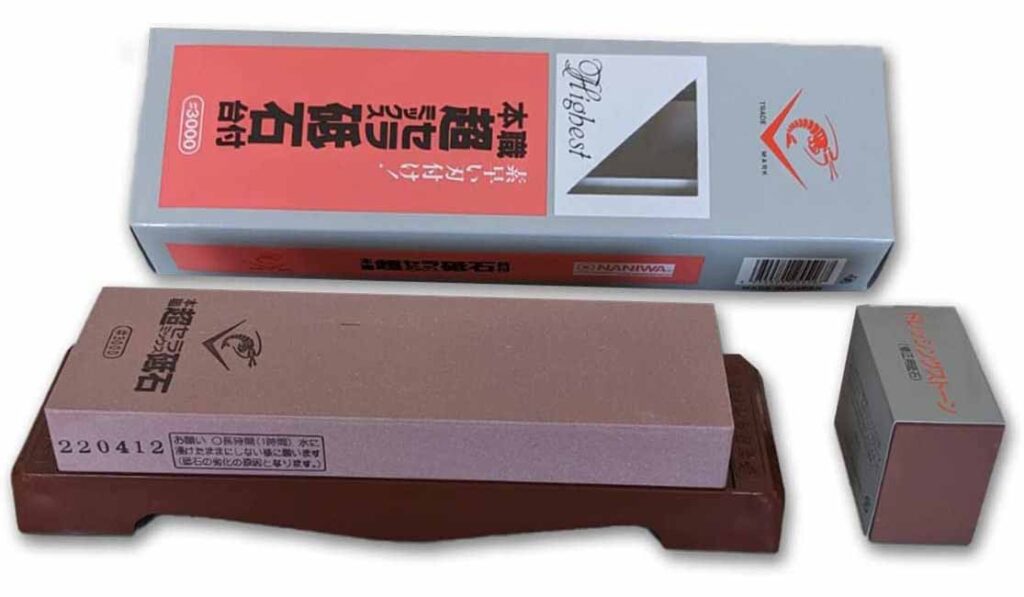
Naniwa Abrasive 3,000 Grit Stone
Now we step into the world of natural sharpening stones with a Japanese stone that is a little on the expensive side, but worth every penny if you want a long-lasting stone that will be easy to use and put a great edge on any blade.
Naniwa Abrasive is a major name in natural sharpening stones, and their standard 3,000 grit stone is a great starting point for anyone looking to upgrade their sharpening game a little bit. I got one of these years ago when I wanted a good medium grit stone for my kitchen knives, and it has been a great performer.
If you’re like me and don’t really let your knives get super dull to the point where you need a 1000-grit stone, and also don’t often spend hours sharpening to a mirror finish, this is a great option for a usable, functional edge on most any knife, especially one that you actually plan to use.
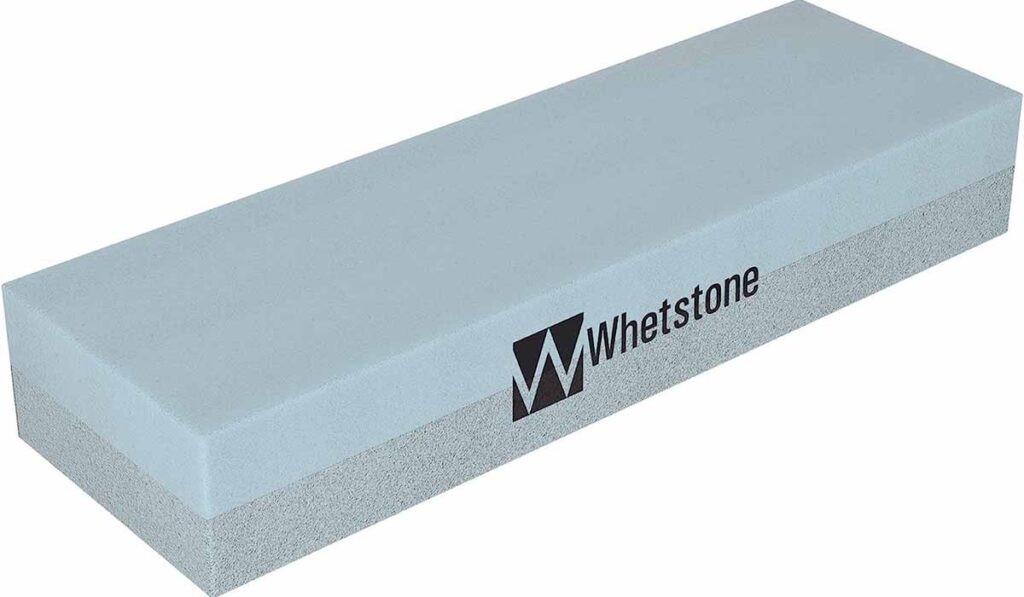
Whetstone Cutlery 400/1000 Wet Block
If the blade you’re sharpening is less “master-forged Nippon steel katana” and more “machete that’s been sitting out in the woods” then you’re probably going to want a very coarse stone to get it back to a decent starting point.
For that, we like this very simple and affordable 400/1000 stone from Whetstone Cutlery. It’s cheap and cheerful, and more than capable of getting an edge back on even the dullest of knives.
The 400-grit side will remove rust and take out nicks and chips in an edge, and then the 1000-grit side will help you bring it back to something resembling a real blade edge before you start working on it with higher grits.
Unless you’re restoring old tools, you might not ever need such an aggressive stone, but having one on hand for getting that rusty plane back in working order isn’t a bad idea. And it’s cheap enough that even if you only break it out a couple of times a year, you’ll get your money’s worth.
I really enjoy restoring old Case and Victorinox knives that have been used and abused for years, and this is the perfect stone for repairing those flea market finds, even if someone has snapped the tip of the blade off while trying to use it as a screwdriver or something.
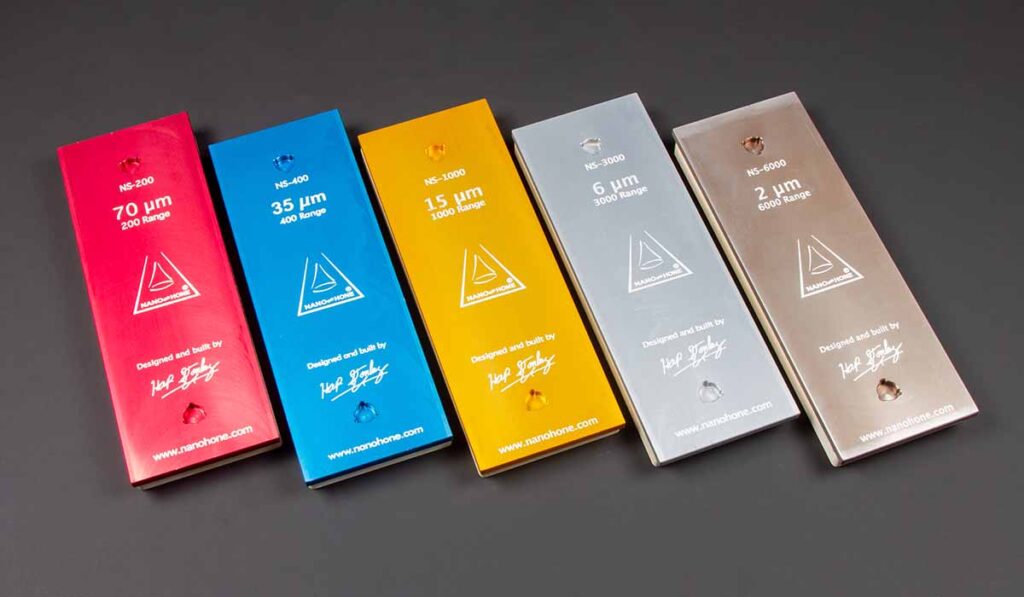
Nanohone Superbite Whetstones
Nanohone’s Superbite “Splash and Go” stones are incredibly high-quality, non-porous ceramic sharpening stones that are simple and quick to use.
They’re also incredibly expensive for a whole set of seven, with individual stones costing around $70.
Still, if you’re looking for a high-end sharpening stone set that will work on everything from your beat-up old pocket knife to your fancy Japanese kitchen knives, this is a great option. The stones themselves come in every grit from 70 microns (200 grit) to 1 micron (10,000 grit) so there’s something for every sharpening and polishing need here.
The stage and sharpening ponds are sold separately, so you can mix and match stones and get exactly what you need without spending too much money. If you enjoy sharpening itself as a hobby and want a kit that can grow as you grow your skills, this is a great option.
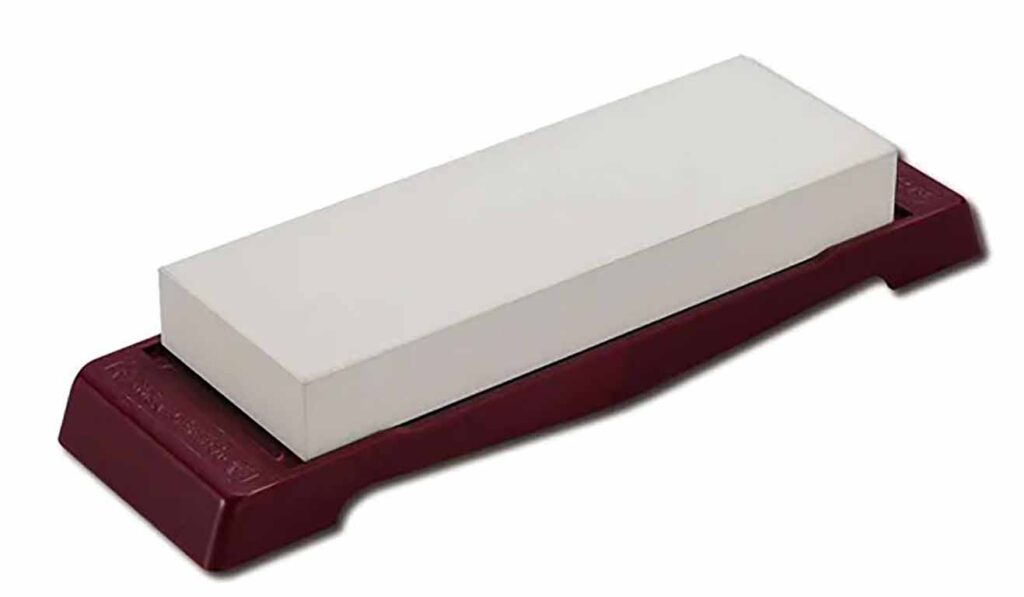
Tojiro Pro Finishing Whetstone
Lastly, we have this high-grit ceramic stone from the Japanese maker Tojiro. These are laser-sintered ceramic, which is great for any ultra-fine applications where you need to get a razor edge.
If you treat sharpening as part of your craft and need professional-grade tools, this is a great option whether you’re a chef, barber, woodworker, or you’re just passionate about having incredibly sharp knives.
Tojiro is primarily a maker of incredibly nice kitchen knives, so you’d probably expect them to know what they’re doing when it comes to sharpening. Their Pro line was originally made for their in-house artisans, and now they’ve made them available to the public as well.
If you want to get a great edge on any knife, particularly high-end, super steel knives, then this is a great option if you have the money to spend.
Final Thoughts on Sharpening Stones
A knife truly is only as good as its ability to cut, which makes a good quality sharpening stone (or stones) a key tool in any blade aficionado’s arsenal. Whether you carry a simple pocket knife, are passionate about cooking, or work with edged tools like chisels, planes, and axes, you need a way to achieve a good edge.
With these sharpening stones, you can get the performance out of your EDC knife you’ve always wanted, get those paper-thin slices of tomato when you’re in the kitchen, and get just the right edge on those tools at work.
Just remember to go slowly, especially at first, choose the right stone with the right grit, and you’ll have razor-sharp edges in no time.
Rosecraft Blades expands its catalog with three new flipper-folders.
As the Rosecraft Blade crew was excited to herald during June’s BLADE Show, it has big things in store for this year. What the Tennessee designer was angling at became apparent this past month, with an interesting expansion of its catalog.
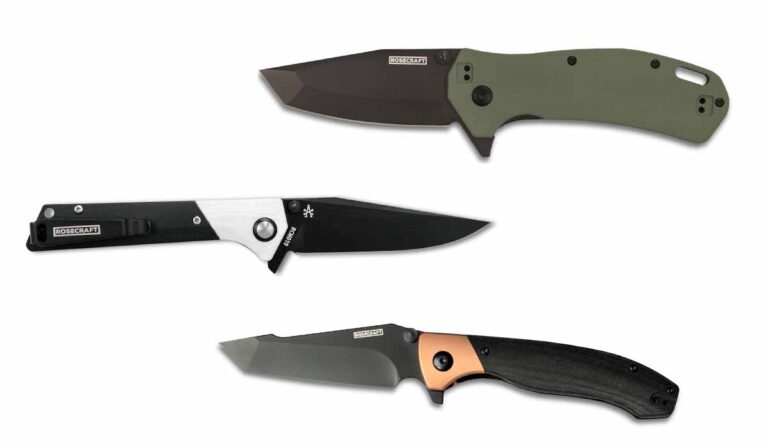
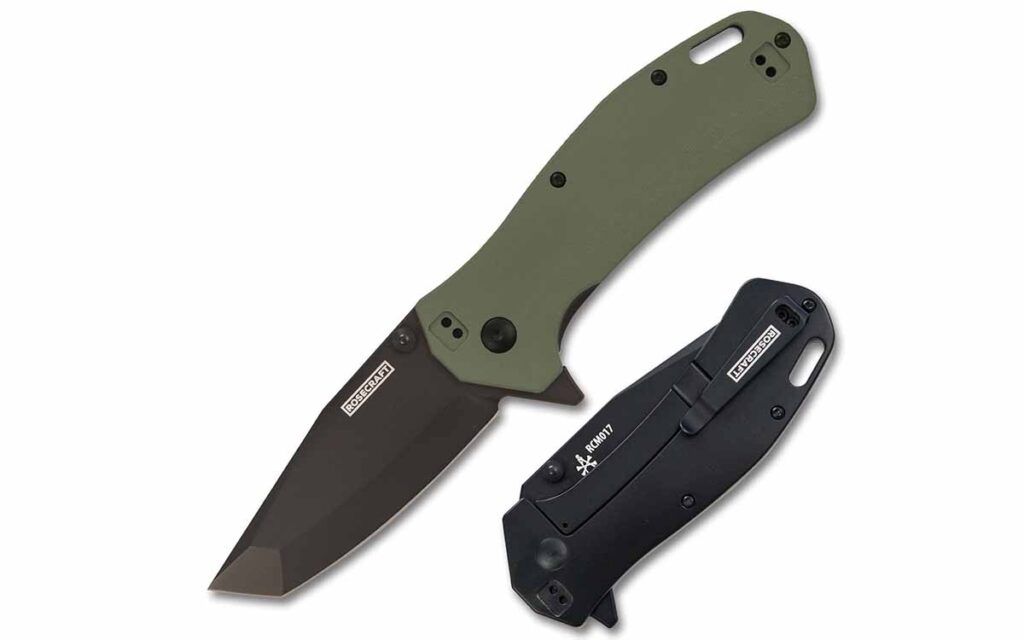
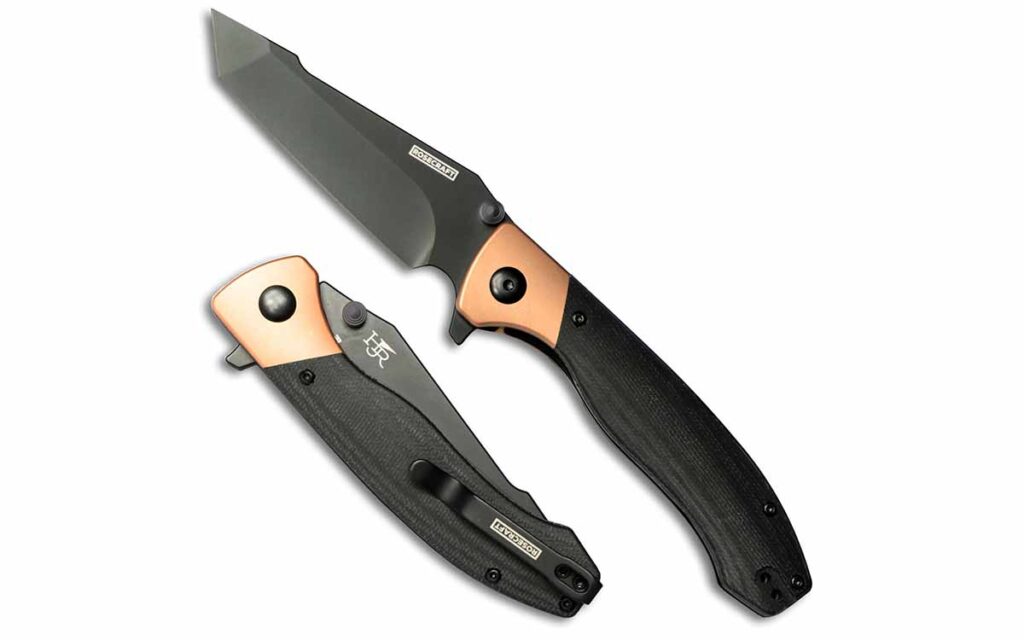
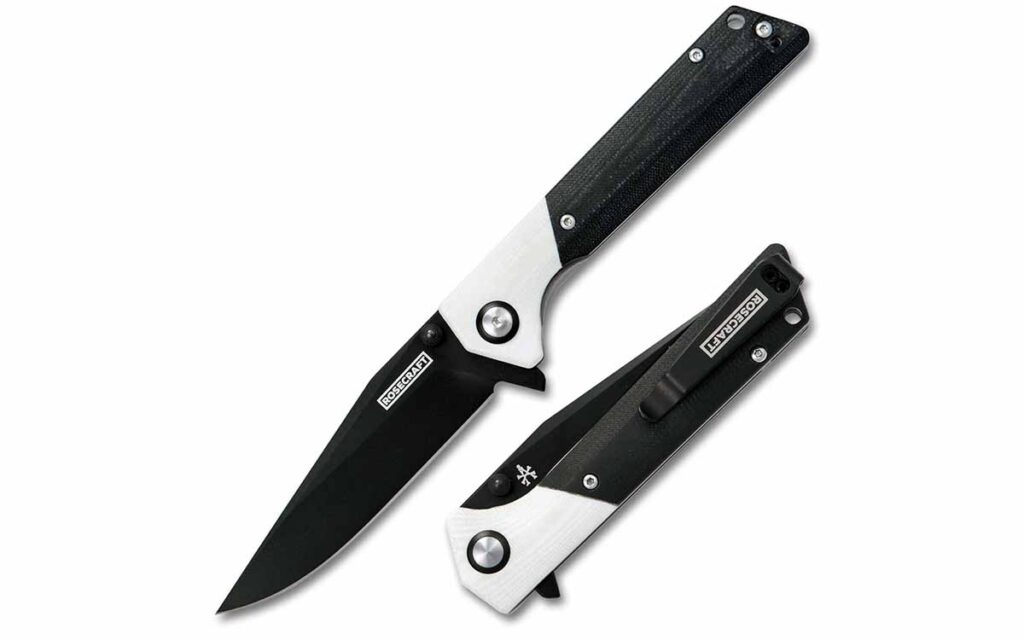
Rosecraft dropped three new knives in July, offering options in the mid to large range, all of them flipper folders. Here’s the breakdown of each.
MA-11
One of two new designs from Andy Armstrong, the MA-11 is a robust tanto flipper with a tactical look, with Rosecraft stating it’s angled at military, law enforcement and first responders. However, it’s not so geeked to preclude it from EDC in milder environments. Catching the eye right off is the bulldogged nose of the 3.9-inch RPM9-steel blade, a much steeper angle than seen on a majority of factory tantos recently. The method to the madness here appears to be creating an ample prying surface, a task the relatively thick blade should prove adept at.
The MA-11 has a stainless steel handle with G10 front cover, nicely textured to give a bit more grip to the knife. The kicker and thumb stud on the frame lock is ample, but not so aggressive as to get in the way or initiate a premature deployment. However, when the blade is required it comes out in a snap, thanks to a ceramic ball-bearing pivot. Other notables include an ambidextrous tip-up/tip-down carry pocket clip and a lanyard loop. MSRP: $77
Aeris Rex
An offering by designer Hawkins Rose, an early run of the Aeris Rex proved among the best sellers at BLADE Show, according to Rosecraft. It’s easy to see why, the harpoon tanto is darkly handsome, set off with copper bolsters. Fairly sizable, with an overall length of 8 inches and 5 ounces in weight, the knife nevertheless has clean lines and looks that should make it comfortable in any setting.
Offering supreme control, the Aeris Rex—Latin for “King of the Air” or “Air King”— boasts a fairly sizable handle and the choice of Micarta or carbon fiber handles. Both options are attractive, but the latter material tacks nearly $20 on the MSRP. Again, Rosecraft outfits the knife with both a kicker and thumbstud for deployment and utilizes a ceramic ball-bearing pivot. This liner lock also has a hidden lanyard hole and is ambidextrous, with a configurable tip-up/tip-down pocket clip. MSRP: $86 Micarta handle; $107 carbon fiber handle
Waya
Cherokee for wolf, the Waya is perhaps the most dapper of the three new releases—yet another creation of Armstrong. The clip point presents very clean lines and a striking dark appearance, complimented by a split G10 handle—black and an off-white in the above case. Overall a classy package that cuts an executive knife’s figure.
The smallest of the releases, the Waya sports a 3.4-inch RPM9-steel blade, topped off with a black PVD coating. Again, the knife is outfitted with a flipper and thumbstud, as well as a ceramic ball-bearing pivot for fast and easy opening. The G10 handle should provide a solid purchase on the knife and comes with an ambidextrous, deep-carry, tip-up pocket clip that helps the Waya disappear into a hip pocket. There is also an OD green handle option that comes with a stonewashed blade finish. MSRP: $74