Bill Adams: Cutlery Hall-of-Famer And Entrepreneur Passes

William “Bill” Adams was a revered knife entrepreneur, author and Cutlery Hall-of-Fame member. Learn about his immense impact on the knife community.

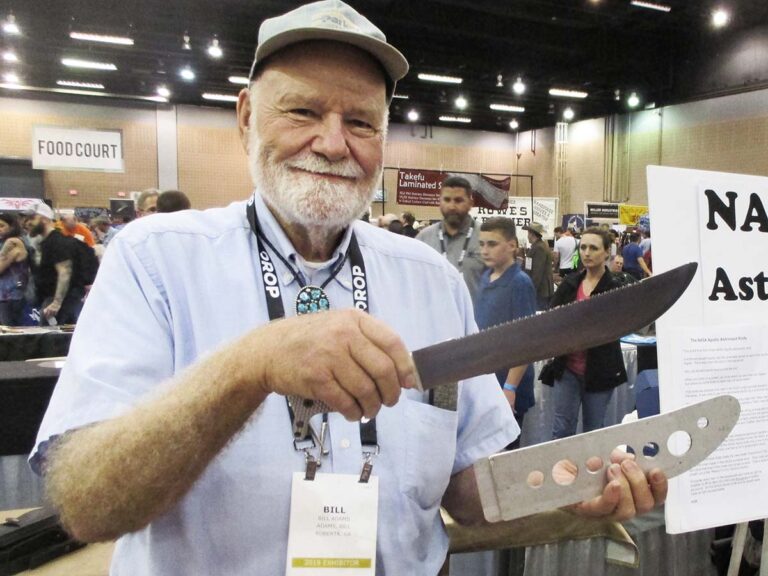
William Calhoun “Bill” Adams, knife entrepreneur, defender of all things knife, BLADE Magazine Cutlery Hall-of-Fame® member and invaluable friend of the knife community, passed away August 10. He was 87.

Known for his easy smile, snow white beard and amiable North Georgia drawl, Bill was liked and admired by many in the industry. He founded Atlanta Cutlery and, with Hank Reinhardt, co-founded Museum Replicas, both in Conyers, Georgia. Bill’s retail operations required him to travel the globe in search of the finest knives, swords and accouterments, including England, Ireland, Africa, India, parts of Central and South America, and all over the USA.

He served as president of the Antique Bowie Knife Association and helped found the Military Equipment and Weapons Collectors Association. He also helped found the Cutlery Collectors Legislative Committee, aka the CCLC, forerunner to today’s two leading pro-knife-legislation groups, Knife Rights and the American Knife & Tool Institute. In 1995, Bill was inducted into the Cutlery Hall of Fame.

He was a knowledgeable, gifted author, editing Sheffield Exhibition Knives and co-writing The Antique Bowie Knife Book, both of which are go-to guides for fans and aficionados of vintage Sheffield-made and antique bowies, respectively. He also was a dedicated knife collector, winning several awards for his wide-ranging collections at the BLADE Show. He retired to Roberta, Georgia, to live along the Flint River, where he enjoyed a quiet, peaceful and happy life.

He is survived by his sister-in-law Dee Anne Adams, his nephew David A. Adams and wife Cheryl, and dear friend and travel partner Elaine Barnes. The family wishes to express its thanks to Bill’s Roberta, Georgia, friends, especially Charles and Kate Rice, who cared for and treated him like family.

Remembering Others The Knife Industry Has Lost:

Damascus Steel Quiz: Test Your Knowledge of the Legendary Blade Material

0

Test your knowledge of damascus steel with this 25-question quiz from BLADE Magazine. From ancient origins to modern master smiths, see how deep your damascus expertise runs.

Think you know your damascus steel? From ancient Persia to modern-day master smiths, the history of damascus is layered—just like the blades themselves. This quiz digs deep into the facts, myths, and makers behind one of the most iconic steels in knife history. Whether you’re a seasoned collector, a curious forger, or just a damascus fanboy, it’s time to put your knowledge to the test. Ready to slice through 25 questions on the steel for the ages? Let’s see what you’ve got.

Answers at the bottom of the page.

1) Canned steel/canister steel is a method for the making of:
a) maidenhair damascus
b) stainless damascus
c) mosaic damascus

2) The first recorded use of canned steel was in the making of high carbon steel from:
a) blister steel
b) wrought iron
c) shear steel

3) BLADE Magazine Cutlery Hall-of-Fame® member Steve Schwarzer made his first powder-metal mosaic damascus in 1990 with the help of:
a) Cutlery Hall-of-Famer Alfred Pendray
b) Joe Hytovick
c) Daryl Meier

4) When Cutlery Hall-of-Famer Bill Moran introduced the modern American custom knife industry to damascus steel blades at the 1973 Knifemakers’ Guild Show, how many damascus knives did he display on his table?:
a) seven
b) 11
c) eight

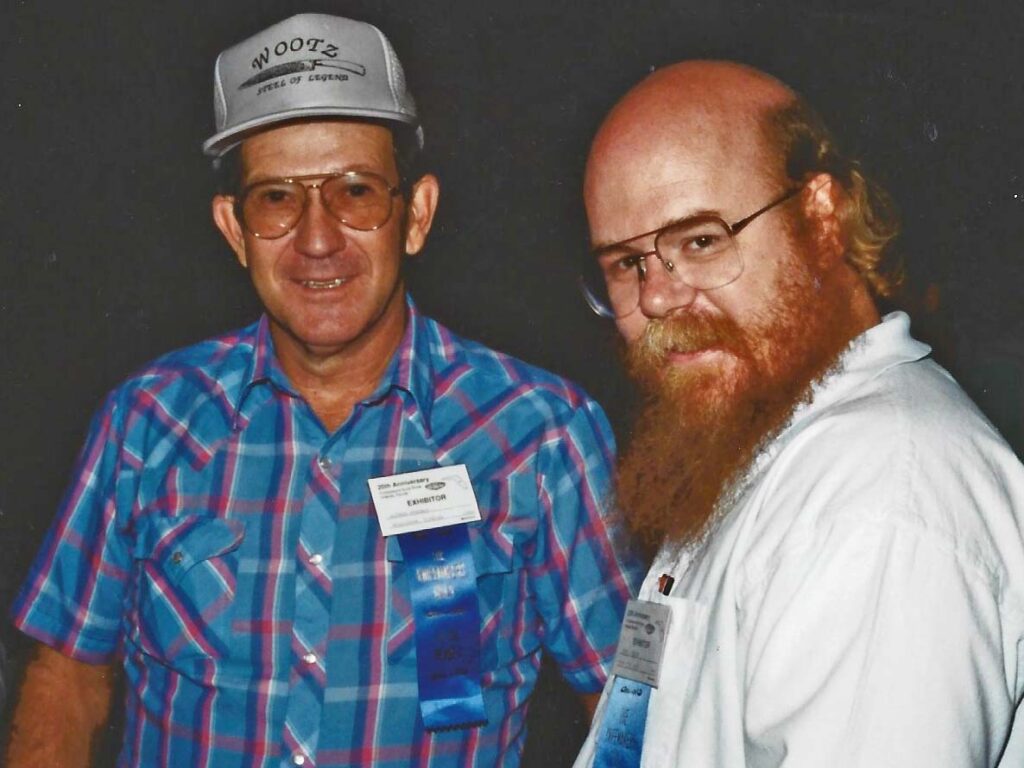
Al “The Wizard of Wootz” Pendray (left) and knifemaker John Salley at an early ’90s Guild Show.

5) Another name for damascus steel is:
a) Samarkind steel
b) pattern-welded steel
c) wood-grain steel

6) The art of forging damascus had developed into a highly developed industry in Damascus, Syria, by circa:
a) 1000 A.D.
b) 1200 A.D.
c) 1400 A.D.

7) According to Bill Moran, the first pattern-welded or damascus blades were made by the Merovingian Franks and Vikings at least as early as the:
a) 2nd century A.D.
b) 4th century A.D.
c) 8th century A.D

8) Damascus steel was named after Damascus, Syria, because:
a) the steel was forged there
b) the city was one of the most important centers of commerce for the steel
c) the name sounded a lot more romantic than calling it pattern-welded steel

9) In areas of Asia, damascus steel was called:
a) fulat
b) bulat
c) both a and b

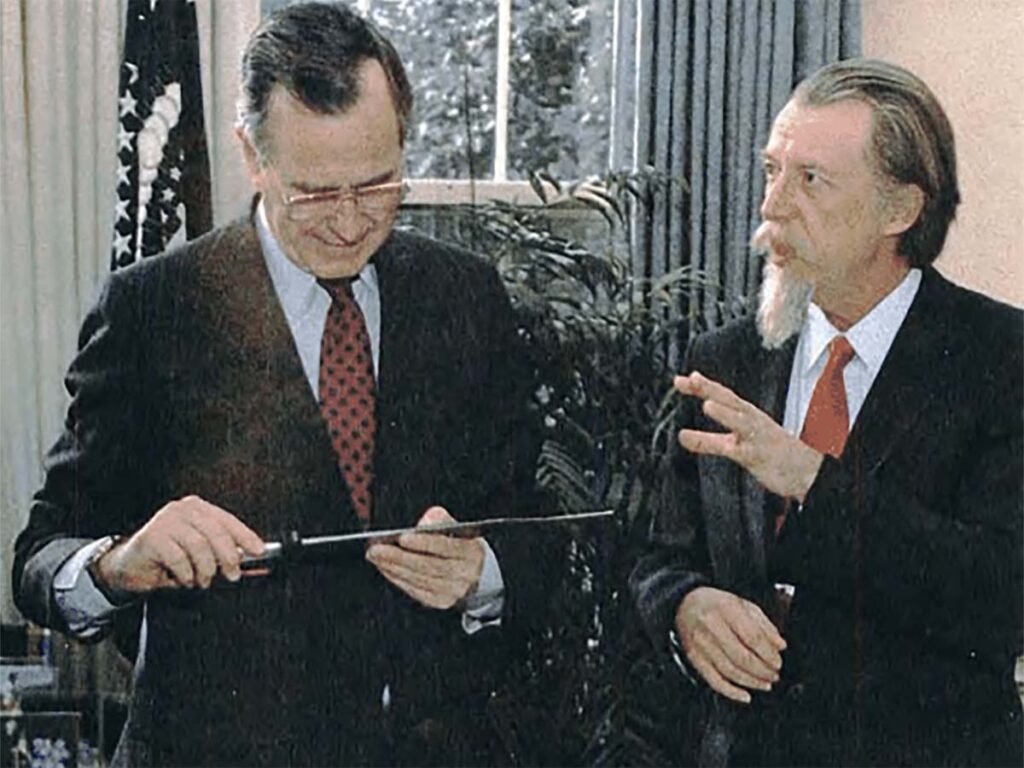
Daryl Meier’s American Flag Knife featured images of 13 flags, each with 50 stars, running the length of the blade. Meier (right) presented the knife to President George H.W. Bush (left) in the White House Oval Office in 1991.

10) The Arab word damas means:
a) sharp
b) aqueous, water, flowing
c) super steel.

11) What resident of Essen, Germany, forged blades of damascus prior to World War II?:
a) Hans Gruber
b) Erwin Mueller
c) Fritz Schwigat

12) Also known as the master smith of the Third Reich, who made hunting knives and entire sets of cutlery with damascus blades for his friends and others—including members of the Nazi Party?:
a) Max Schultz
b) Paul Muller
c) Herman Rommel

13) Toward the end of the 1960s, what German maker/steel researcher forged a number of bowie knives of damascus steel?:
a) Manfred Sachse
b) Erich Von Stupp
c) Heinrich Boker.

14) ABS master smith/Cutlery Hall-of-Famer Wayne Goddard popularized blades of cable damascus in the mid-1980s. According to Wayne, up to that time knives of forge-welded wire cable had been made in Oregon for at least how long?:
a) 40 years
b) 60 years
c) 80 years.

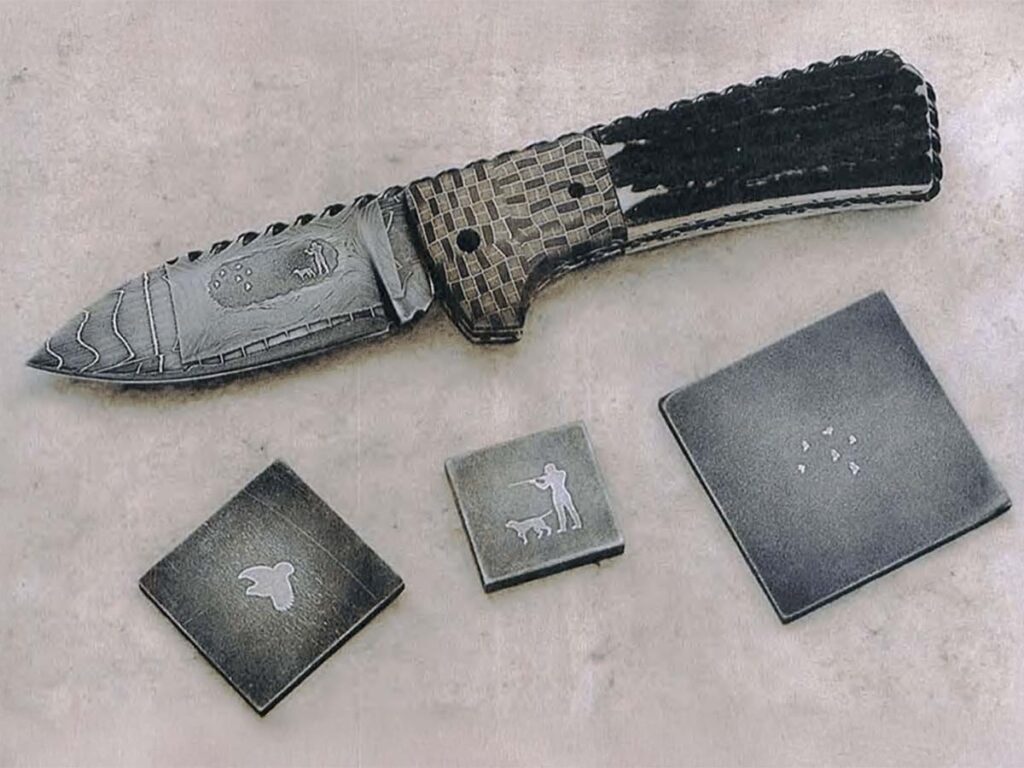
Steve Schwarzer’s pioneering mosaic damascus knife, “The Hunter’s Dream.”

15) According to On Damascus Steel by Dr. Leo S. Figiel, steel made by a crucible process—that is, wootz steel—was made as early as:
a) 200 B.C.
b) 100 B.C.
c) 100 A.D

16) Also according to On Damascus Steel, the first damascus steel was made as early as:
a) the second century B.C.
b) the first century B.C.
c) the first century A.D

17) Western Europeans experienced the effectiveness of damascus swords used by defenders of the Muslim faith during the Crusades of the 11th, 12th and 13th centuries. The Westerners referred to the long blade used by their opponents as the:
a) Sword of Islam
b) Sword of Death
c) Sword of Destiny

18) Bill Moran once wrote the best and most beautiful damascus blades consisted of how many layers of steel?:
a) 256
b) 512
c) 1,024

19) With whom did Cutlery Hall-of-Famer Jim Parker collaborate to produce a series of factory damascus knives in the mid-1980s?:
a) Daryl Meier
b) Don Fogg
c) Fain Edwards.

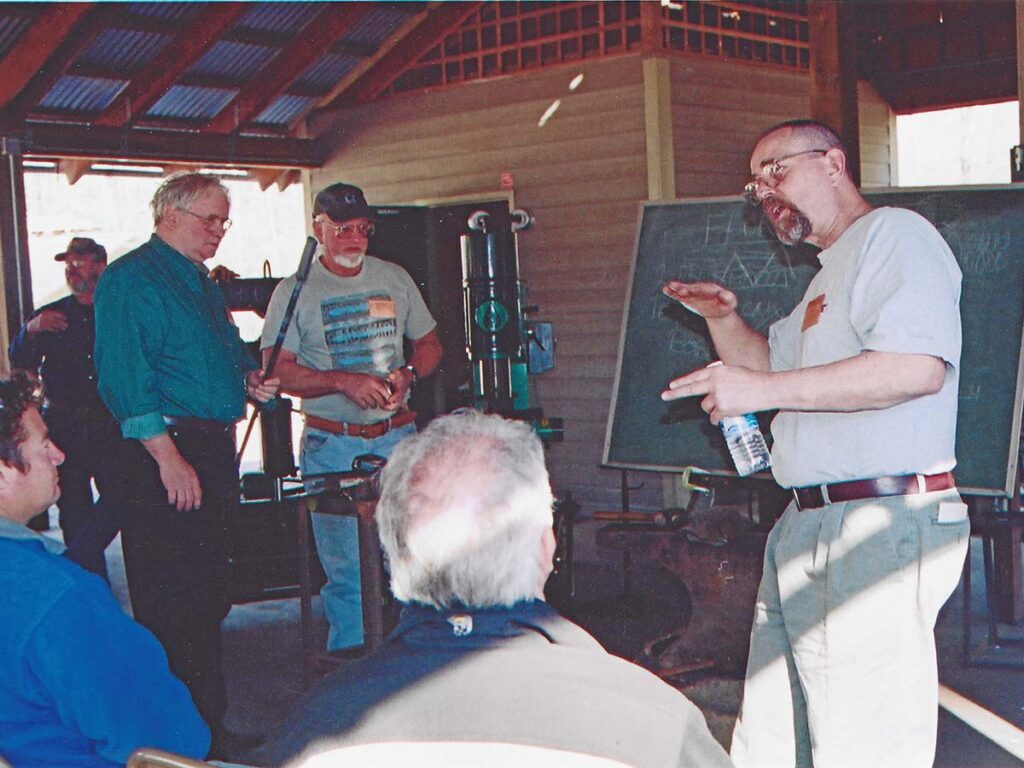
Standing, from right: Don Fogg, Steve Schwarzer and Jim Batson during a class at a past Batson’s Bladesmithing Symposium.

20) One of the landmark damascus knives Bill Moran exhibited at the 1973 Knifemakers’ Guild Show was this European quillon dagger. Who bought it at that historic show?:
a) Peter Semon
b) Rita and Cutlery Hall-of-Famer Butch Winter
c) Paul Lansingh.

21) In his groundbreaking The Hunter’s Dream mosaic knife, Steve Schwarzer adapted some of the techniques of what process to avoid the distortions seen in most mosaic patterns up to that point in time?:
a) glass blowing
b) Venetian glass working
c) glass inversion

22) In the early ’90s, an ABS master smith forged a damascus pattern with images that looked like flames ascending from the edge toward the spine. Not surprisingly, he called it flame edge. His name:
a) Robbin Hudson
b) Larry Fuegen
c) Don Fogg

23) In ancient Persia, the pattern called Kirk Narduban is the pattern known today as:
a) random
b) mosaic
c) ladder

24) Al Dippold created a mosaic damascus method that included his surname appearing 11 times on each side of the blade. Al called the method:
a) Accordion
b) Jigsaw
c) What’s My Name?

25) According to Daryl Meier, letters or words first started appearing on pattern welds between the:
a) 5th and 8th centuries
b) 11th and 13th centuries
c) 15th and 16th centuries

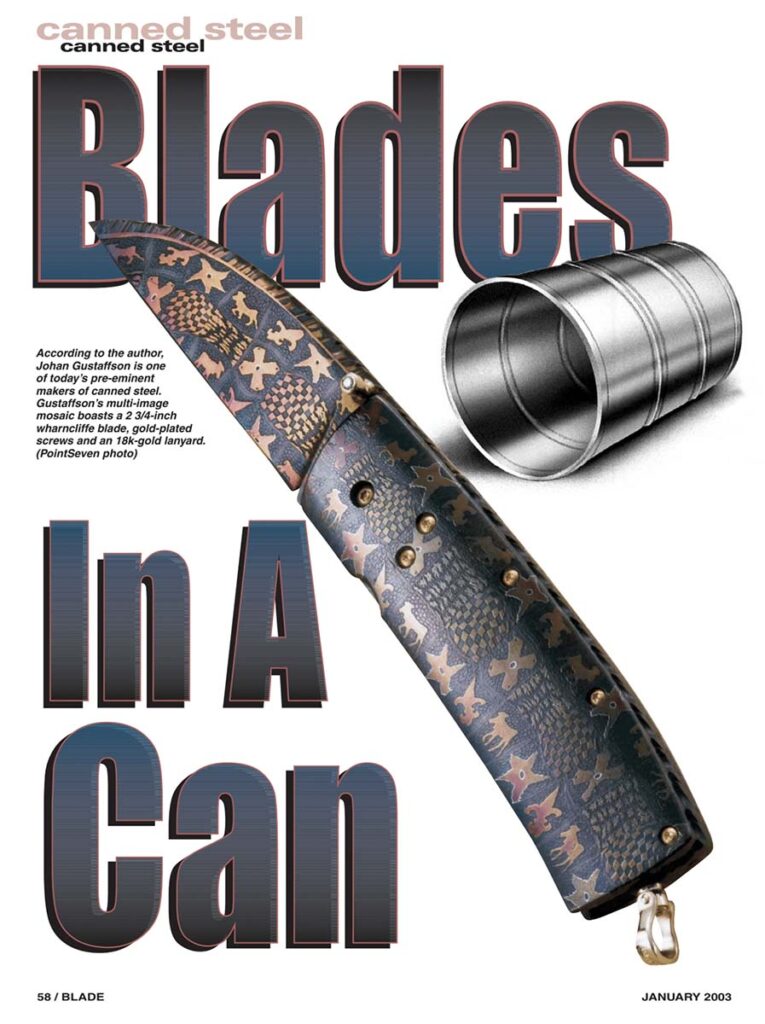
Steve Schwarzer was among the first to outline canned steel in detail and did so most astutely in his story in the January 2003 BLADE®.

Answers

1) c; 2) b; 3) b; 4) a; 5) b; 6) c; 7) a;
8) b; 9) c; 10) b; 11) c; 12) b; 13) a; 14) c; 15) a; 16) b; 17) a; 18) b; 19) c; 20) b; 21) b; 22) a;
23) c; 24) a; 25) a.

More On Damascus:

Damascus Steel: Experts Forecast Growth In The Knife Industry

From copper-infused patterns to stainless steel sheets, discover the innovations driving the red-hot market for production damascus.

Are we seeing a bit of “global warming” in the knife industry, where red-hot damascus steel is getting even hotter? BLADE® spoke with some industry leaders, and 2025 and beyond looks good to them when it comes to production damascus in both carbon and stainless steels.

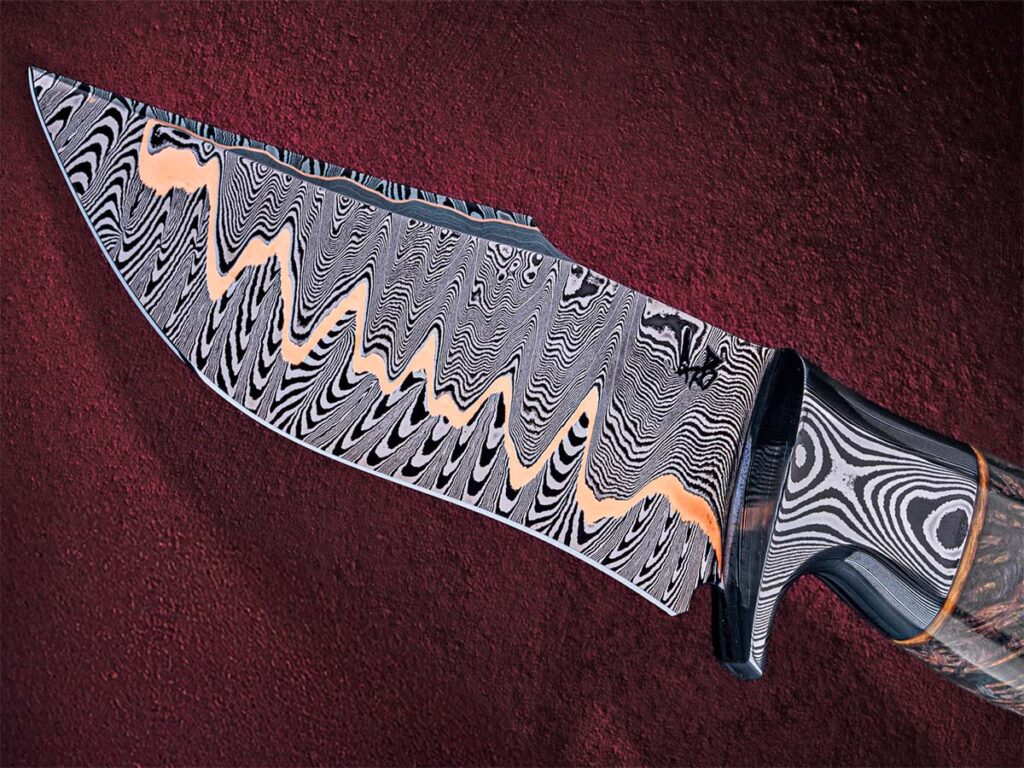
There are many individual makers who make high-quality damascus in simple and complex patterns in their home shops, backyards or shared maker spaces. This article focuses instead on production damascus forged by specialized outfits such as Baker Forge & Tool, Damasteel, Chad Nichols Damascus and Vegas Forge. At a level beyond “regular” damascus makers, these companies make steel for the masses, for production companies, and specialize in innovative new materials that are sure to delight the industry.

BLADE readers will be familiar with Baker Forge & Tool, a prolific producer of innovative damascus patterns that include copper, such as CopperMai, TigerMai, GoMai and others.

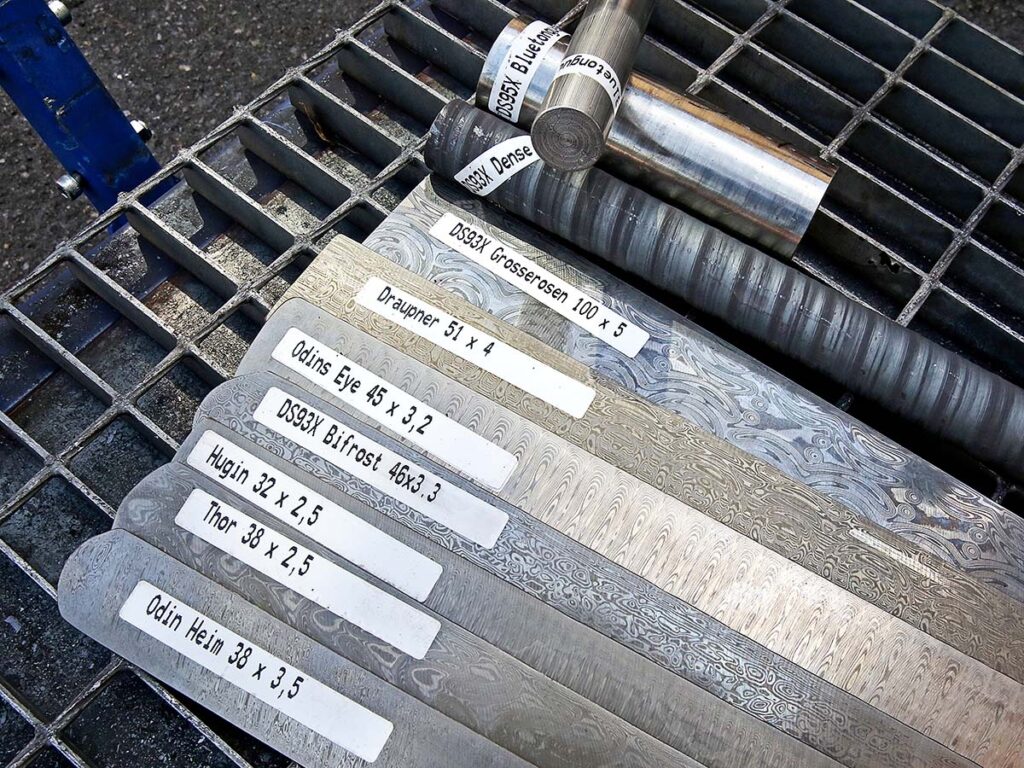
DS93X steel—fourth from bottom in bar form—is Damasteel’s standard mix, “combining good performance with good looks.” “For us it’s more about expanding the patterns than about trying new steel combos,” noted Per Jarbelius. The other patterns in bar form are representative examples of what you can expect from the Swedish steel maker.

“We make carbon steel damascus patterns with copper, and they’ve been hot. We expect them to stay hot through 2025,” Coy Baker said. When it comes to steel selection, the company most often sticks with the gold standard combination of 1084 carbon and 15N20 nickel-alloy steels.

Baker also has been experimenting with Apex Ultra as a core steel for its copper san-mai. For those unfamiliar, Apex Ultra is a tungsten steel alloy, kind of a super-52100 carbon steel. It’s made in small batches and is hard to get in the USA, but Baker has found that the material makes a great damascus core.

“Demand for our Apex core billets far outpaces supply,” Coy noted.

Baker has also been experimenting with stainless and copper damascus and san-mai, using 154CM and AEB-L stainless steels. This writer also makes knives and that combo sounds quite challenging to forge. Baker confirmed that it was very challenging and wouldn’t reveal any secrets, other than the 154CM etches light and the AEB-L etches darker.

Growth In The ‘Sip

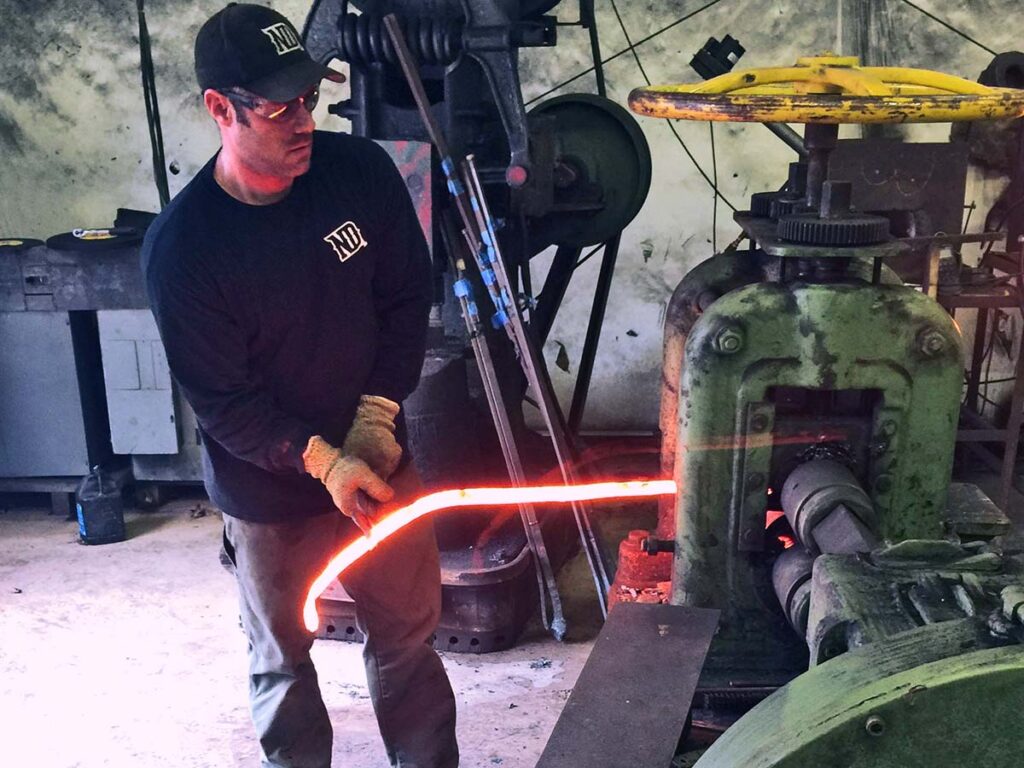
Down in beautiful Bush Springs, Mississippi, Chad Nichols makes traditional carbon steel damascus at a production level.

Vegas Forge has always been innovative and 2025 will be no exception. “We’ve figured out how to do copper in with the damascus pattern manipulation, not just as a line between san-mai,” Jesse Harber noted. (Vegasforge.com image)

“I stick mostly to carbon steel 1075 or 1095 plus 15N20 with occasionally a little bit of 3V,” Nichols explained. “I’ve got my process down and these steels go together well.” He makes a variety of mosaic patterns, most of which go to a single manufacturer. “The carbon steels are so much more organic,” Nichols said. “You can do so much more with them in a cost-effective way.”

Nichols’ goal for 2025 is to increase his production of mosaic patterns.

“There just aren’t many people doing production mosaics,” he said. “It’s a great opportunity for growth.”

Another area he’d like to see grow in 2025 is the use of exotic and historical materials. He’s made a run of steel for Boker with steel from a German Tiger tank, and has a run coming for William Henry with some leaf springs sourced by WH.

Collab Designs

Damascus isn’t just a U.S. product. Damasteel produces high-quality stainless steel damascus in Sweden.

Chad Nichols (above) stated the goal at Chad Nichols Damascus for 2025 is to increase the production of mosaic patterns.

“Our DS93X steel is our standard mix, combining good performance with good looks,” Damasteel’s Per Jarbelius remarked. “For us it’s more about expanding the patterns than about trying new steel combos.”

DS93X is described as a “patented powder metallurgy product” that includes “two different hardenable steel grades.” “We use only stainless steel,” Jarbelius explained, ‘because it doesn’t rust and has the same or better performance.”

Damasteel historically produces a new pattern each year. For 2025 it also has begun a special project to collaboratively design patterns. Benchmade collaborated with Damasteel to make a steel pattern called “Monarch” exclusively for the Benchmade Gold Class Necron balisong. Jarbelius is excited for the potential to expand the collaborative effort with other companies who want proprietary patterns.

In another innovation, Damasteel has developed the capability to produce stainless damascus in sheets, not just bars. This will come in handy for small-batch and mid-tech production. The sheet steel pattern is called “Drakkar,” which is the old Norse word for the dragon-shaped Viking longboats.

Copper In The Pattern

What happens in Vegas may stay in Vegas, but that’s not the slogan for Vegas Forge, whose damascus is well known worldwide. It is a consistent producer of high-quality carbon and stainless damascus in complex patterns.

Baker Forge & Tool has been experimenting with Apex Ultra as a core steel for copper san-mai. This integral fighter by Greyson Weltyk features Baker copper damascus for its recurve harpoon blade. (Bakerforge.com image)

“One of our most popular patterns is ‘Reptilian,’ which has three alloys included: O1, 1075 and nickel,” observed the company’s Jesse Harber.

Vegas Forge has always been innovative and 2025 will be no exception.

“We’ve figured out how to do copper in with the damascus pattern manipulation, not just as a line between san-mai,” Jesse noted. “We can take our Reptilian pattern with copper in it, and then clad that billet over an O1 or 1095 core.”

As far as stainless goes, Vegas Forge continues to push the complexity of its patterns. Its most popular pattern, “Virus,” begins with a single stack of 1200 pieces! The company uses 154CM cores for most of its stainless san-mai, along with CTS XHP when available.

Ultimate Hotness

What kind of knives do the manufacturers predict for ultimate hotness in 2025?

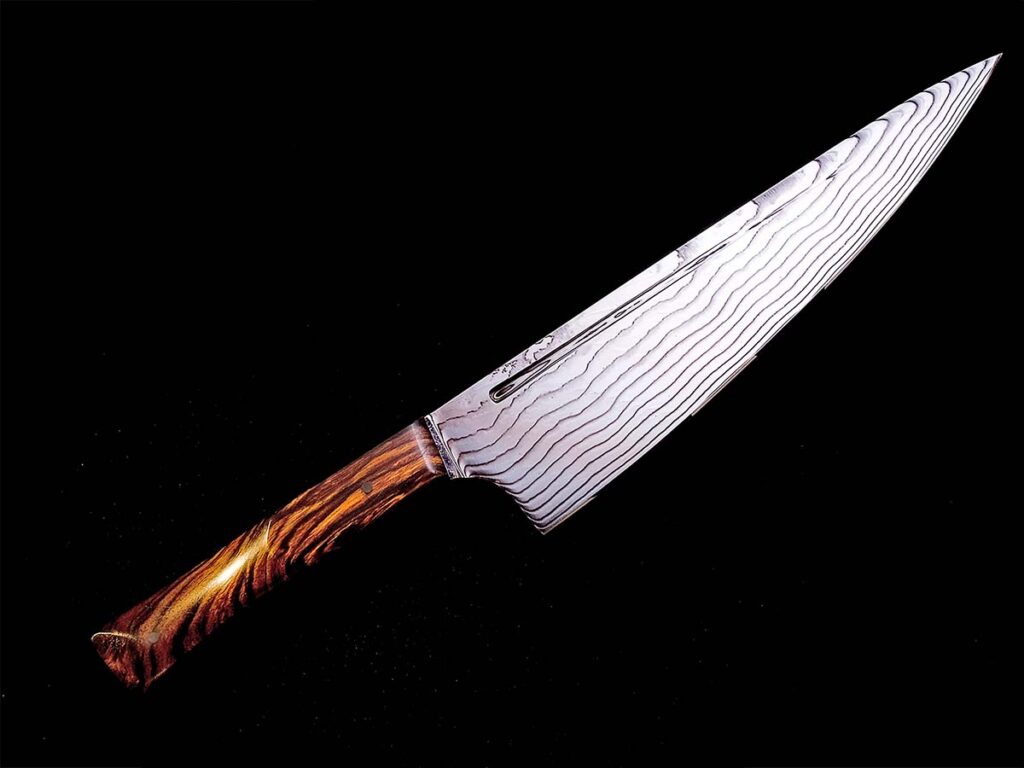
Damasteel has developed the capability to produce stainless damascus in sheets, not just bars. The sheet steel pattern is called “Drakkar,” the old Norse word for the dragon-shaped Viking longboats, and is used here on a chef’s knife by a local Swedish cutler.

Both Baker and Jarbelius indicated culinary knives will stay hot, especially in stainless. Baker pointed out that stainless steel handles kitchen abuse better, and this writer agrees. Per said Damasteel’s Damacore and DC18N nitrogen steels are top of the line, and the company has a culinary knife coming in partnership with BLADE Magazine Cutlery Hall-of-Fame® member Ken Onion and CRKT. Both Damasteel officials and Chad Nichols agree that complex patterns are expected to do well for the pocketknife and one-off makers.

Jarbelius “expects growth in the complex pattern market” even as Damasteel’s basic traditional rose, ladder and twist damascus patterns remain best sellers. Nichols states that the mosaic niche he addresses will continue to grow.

All four steel makers expect growth in the production side of the market. Even in a slower economy, the big knife manufacturing companies are still producing limited runs of high-quality damascus knives. Baker looks for growth in his damascus-core san-mai steels.

“They’re easier to get a consistent etch on than the mono-steel cores,” he explained.

Chad Nichols stated that he expects growth in the use of mosaic damascus steels by factory knife companies in 2025.

Manufacturing is all about consistency and efficient processes. Damasteel achieves consistency by using the same steel combo for all its patterns. Nichols gets there by batch building for specific manufacturers so that each run is internally consistent. Harber mentioned that he was approached at BLADE Show West* by multiple production companies looking to order steel for 100-to-200-piece runs. He indicated he expects the mid-range sub-$800 production folders to stay hot.

Gonna Be Intersting

The new year is going to be an interesting one for the economy and politics, both of which are inextricably entwined. Fortunately, thanks to the work of those in the damascus industry, it’ll also be an interesting year in the world of knives. If nothing else, knife enthusiasts will have plenty of beautiful damascus production knives coming off the assembly lines to keep them entertained.

More On Steel:

Coffee With An Edge: Well-Known Knifemakers Forging Coffee Brands

Knife companies offer their own brands of hot Joe and perk up consumers in the process.

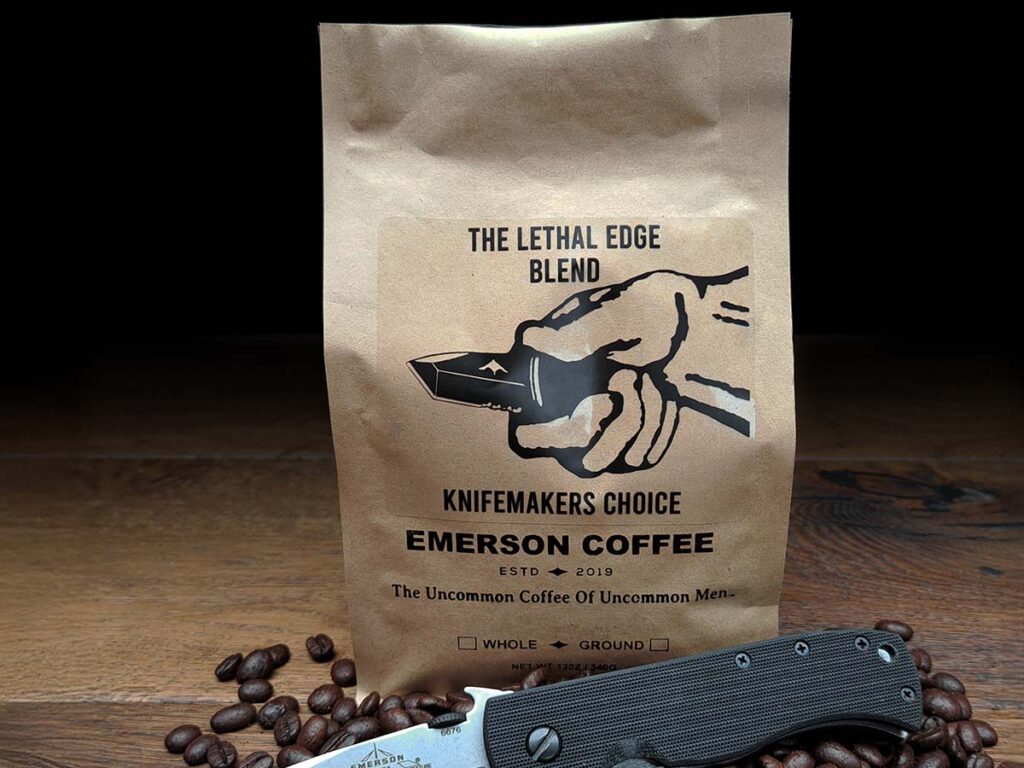
For Ernest Emerson, it’s as strong as… well, a cup of dark roast. He’s a firm believer in the expansion of his marquis knife manufacturing company into other lines of business. The idea behind that expansion is the diversity of different sources of revenue while complementing the Emerson core business.

“We’ve owned our own coffee company since 2019,” Ernest related. “I’m friends with Evan Hafer, the founder of Black Rifle Coffee, and our conversations probably go back to 2016 when we were first to co-brand with Black Rifle. Evan carried our CQC-7 on his military deployments, and he knew who we were. We worked it out with him to package coffee and do labeling. That worked for a while, and then my wife [Mary] and I talked it over and decided we wanted to have our own brand of coffee.”

For Emerson, taking the coffee plunge complemented the other activities that go hand in hand with offering top quality knives. Barriers to entry were few.

“I talked to Evan, and he said there was plenty of room,” Ernest explained. “We started Emerson Coffee Roasters Company, and I know we were first and started that trend, just like the trend in knife company whiskeys that is going on now.

“We get coffee from a source in South America and have it roasted and package everything under our own ownership,” he added. “Some other companies do collaborations and have their coffee packaged up, but we do everything from start to finish. The way I look at it, everything is a backup for a backup for a backup. What if somebody in Washington can make knives illegal with the stroke of a pen? All our other companies are there as a family-run group of businesses from coffee to apparel, whiskey, fighting systems and others. We’ve built those companies so the family will have support, and then we are at the helm and decide what roasts we want and everything.”

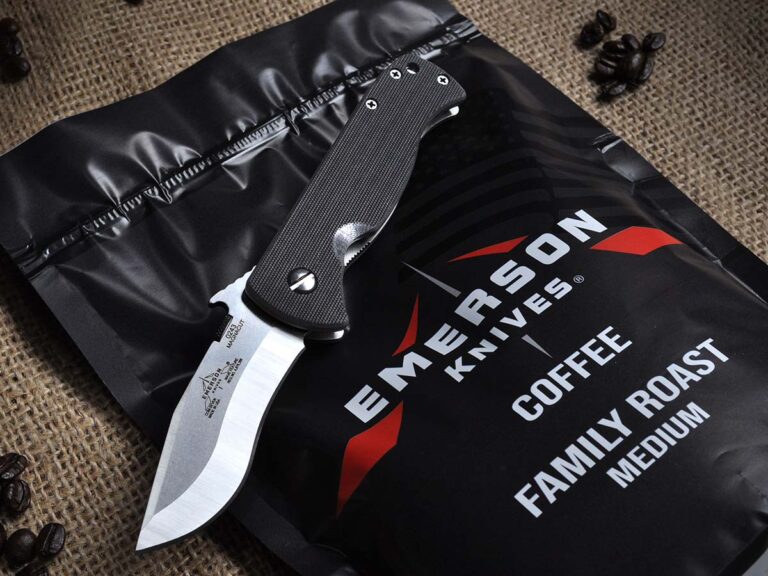
Emerson Coffee has three blends: Renegade Roast, which is the Emerson family’s favorite. Family Roast is the medium blend and Lethal Edge is the dark offering. The knife is the Emerson CQC-7BL-SF.

The future for Emerson and coffee may include some bundles of brew and whiskey or special flavorings for the coffee itself. Ernest sees flexibility and responsiveness always in the mix—a bourbon-flavored coffee when the time is right or a Christmas blend for the holiday season. Right now, the idea is simplicity with three blends: Renegade Roast is the Emerson family’s choice, Farmer’s Roast is the medium and Lethal Edge is the dark offering.

“It’s been a great thing to expand into coffee,” Ernest observed. “Our coffee is delicious, and people say they can’t drink any other coffee after trying it. Besides, we are a lifestyle brand and other than water more coffee is consumed around the world than any other beverage. I would bet that everybody who has ever bought a knife from us drinks coffee. So, if you buy or use knives, chances are you would drink our coffee and whiskey and wear our clothing.”

So, Ernest Emerson, the savvy businessman, finds another niche with coffee, one that complements the tried-and-true knife business and broadens the appeal of his entire spectrum of products. Seeing the big picture is expected to pay big dividends. Ernest points to recent history to back up his market perspective.

“No other knife entity on earth had a show in Las Vegas that revolved 100 percent around its brand like Emerson Knives,” Ernest concluded. “And the Usual Suspects Network was started for Emerson Knives. People tattoo our name on their body, and we say, ‘Show us your ink!’

Forbes Magazine said that there is only one other brand that loyal people tattoo on their bodies, and that is Harley-Davidson. The Forbes people actually told me that. We don’t know all the reasons for it, but again it is partly because people identify with who we are—American made by American workers with American grit and self-reliance. If people buy a $300 or $400 knife from us, then they buy other stuff that the company represents. Emerson truly is a lifestyle brand.”

And what says lifestyle better than a fine cup of brew?

Spartan Blades Tactical Beans

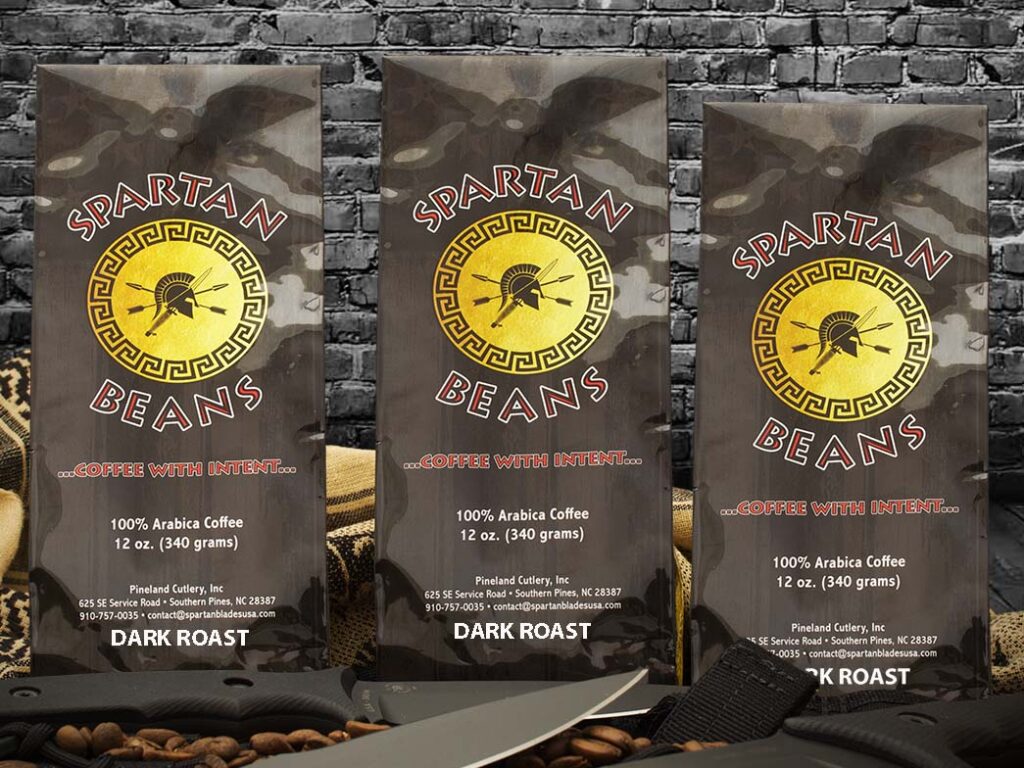
Spartan Beans is sold in 100 percent Arabica regular roast and dark roast, single or three pack. There is also a sturdy mug available to top off the experience.

At Spartan Blades, company co-founder Curtis Iovito says offering a special coffee collaboration with Black Rifle is just fun. Fresh-roasted Spartan Beans fuels the consumption of a couple of gallons of brew per day around the office. The concept started when Curtis was chatting with a good friend who owns a roaster and has evolved into offerings consisting of 100 percent Arabica beans.

“Spartan Beans has been around for about three years now,” Curtis remarked, “and it has gone surprisingly well. Sometimes we will throw in some of our coffee when we ship a knife order to a dealer. The roaster is right up the street, so the coffee is about as fresh as you can get. We may look at doing an auto-ship program as demand increases, too!”

Spartan Beans is offered in 100 percent Arabica regular roast and dark roast, single or three pack, and there is also a sturdy mug available to top off the entire experience.

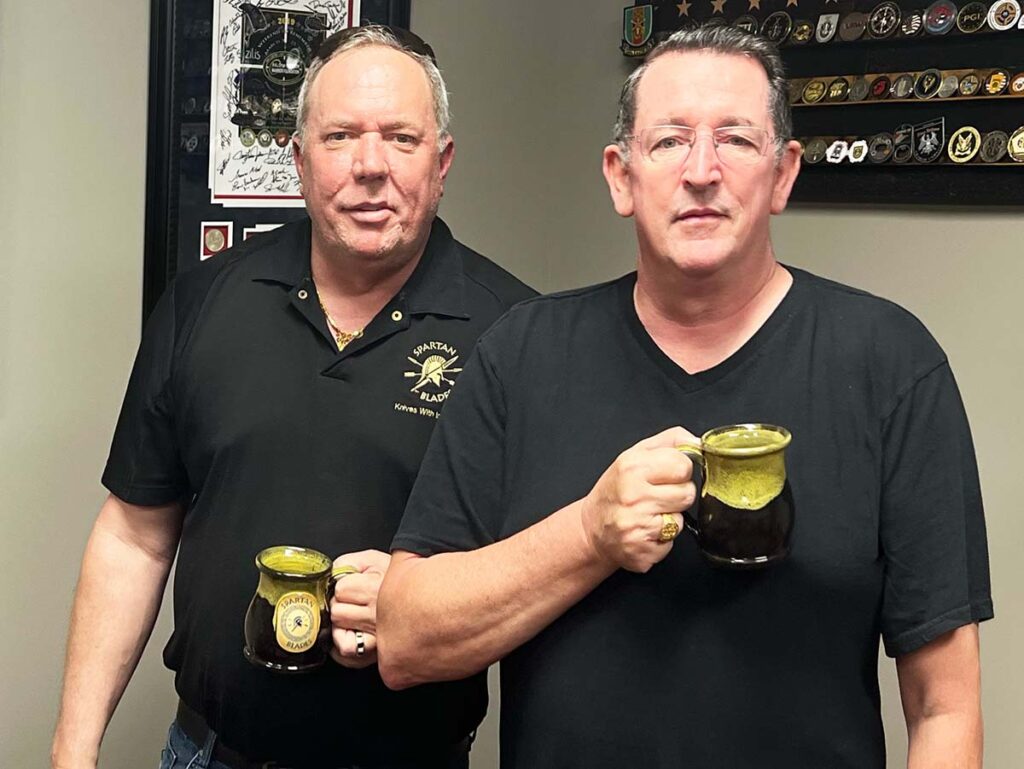
Spartan Blades co-founders Mark Carey (left) and Curtis Iovito (right) have traveled the globe for years, teaching counterterrorism and assisting with operations related to the use of knives in the field. When time permits, they search for the finest coffee from exotic locations for their Spartan Beans blends.

Through the years Curtis and fellow company co-founder Mark Carey have spent years traveling around the globe, teaching counter-terrorism and assisting with operations related to the use of knives in the field. And when time has permitted, they have searched for the finest cup of java available, whether in Malaysia or some other exotic location. The Spartan Beans blend includes the best from Colombia, Costa Rica, Africa and Sumatra.

“It’s like the United Nations of coffee, just more fun,” laughed Curtis.

Montana Knife Co. Backcountry Brew

Noted Josh Smith of Montana Knife Co., “Hot, steaming coffee while freezing on a hunt tastes so good!” Montana offers its MKC X Black Rifle Coffee Signature Dark Roast in whole bean and ground 12-ounce bags.

A more recent entry into the coffee arena, Montana Knife Co. (MKC) entered into a partnership with Black Rifle in the fall of 2024. The packaging tells customers, “Fresh from the forge, this dark roast offers notes of dark chocolate with an aroma of spice topped off with a smoky finish. American brewed and crafted to perfection.”

Josh Smith, founder, president and ABS master smith at MKC, has found the kinship between knives and coffee to be compelling.

“Over the years, I became friendly with the owners of Black Rifle Coffee Co.,” he said. “We share many of the same beliefs around love of our country and support of our active-duty soldiers and veterans. For the past few years, we have worked with them on some marketing-related promotions, but this was our first launch of coffee with Black Rifle.

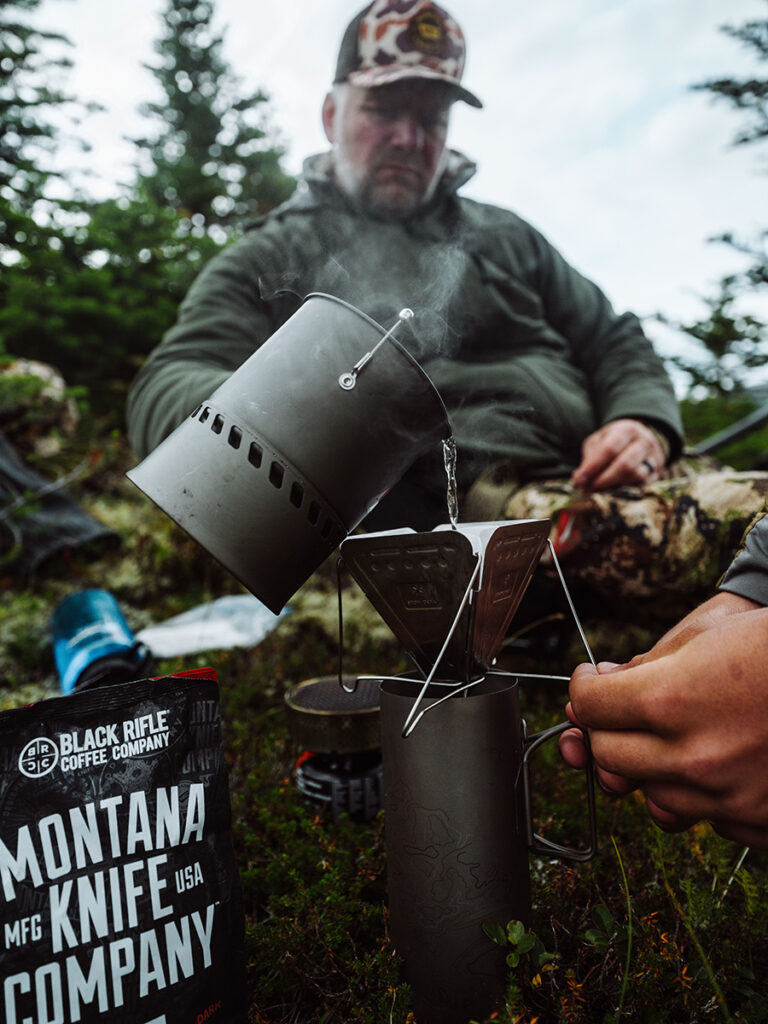
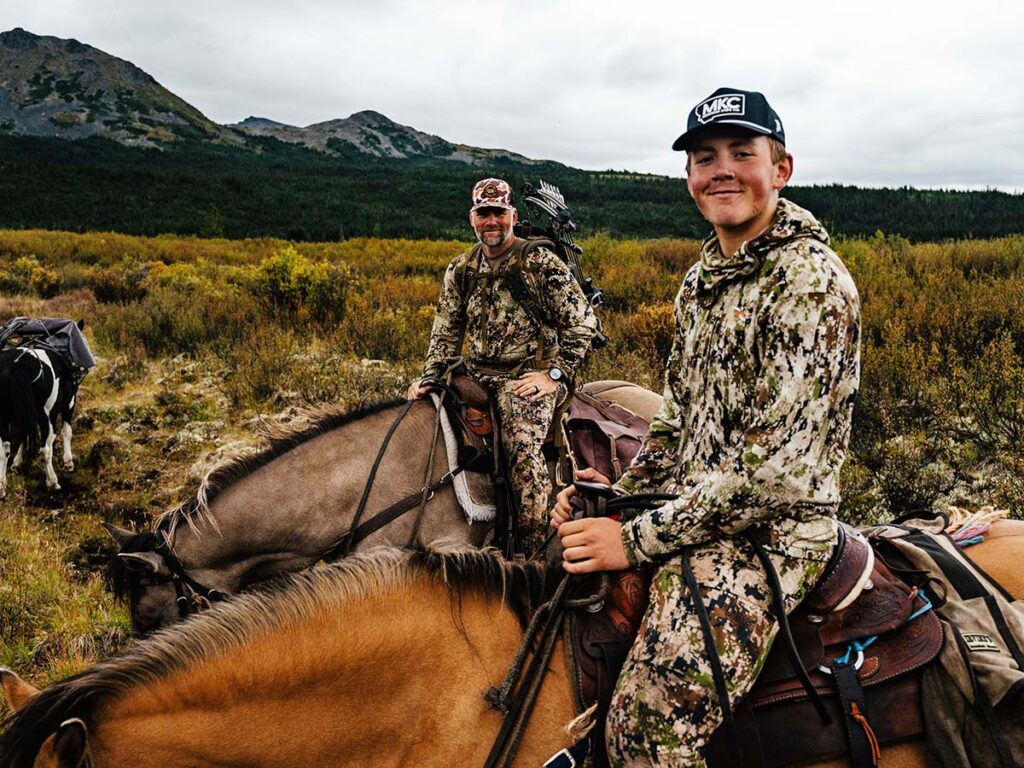
“Personally, I love coffee,” Josh emphasized. “For me, coffee and knives seem to be loved by so many blue-collar workers. Clearly, white-collar people drink coffee too. But I think back to my grandpa or my dad, and they always started the day with a cup of coffee before going off to work the ranch or in a backhoe. That same guy always had a knife in his pocket. The best place I’ve had Montana Knife Co. coffee is in northern British Columbia on a horseback moose hunt with my son [Hank]. For 10 days, it was rainy and cold. But each time we sat down to rest we made coffee with our jet boil. Hot, steaming coffee while freezing on a hunt tastes so good!”

Josh Smith (left) said the best place he’s had MKC coffee is in northern British Columbia on a horseback moose hunt with his son Hank (right). “For 10 days, it was rainy and cold,” he recalled. “But each time we sat down to rest we made coffee with our jet boil.”

Montana Knife Company offers its MKC X Black Rifle Coffee Signature Dark Roast in whole bean and ground 12-ounce bags.

For many consumers, the blend of the knife and the good cup of coffee just comes natural. Now, it’s easier than ever. Exploring the best in cutlery and coffee simply enriches the experience with both.

More On Knife Business:

PVK: The Uncut Story – From Vegas Strip to New England Homecoming

Sponsored Content

Jeremiah Burbank shares PVK’s trek around the knife world and a return to where it all started.

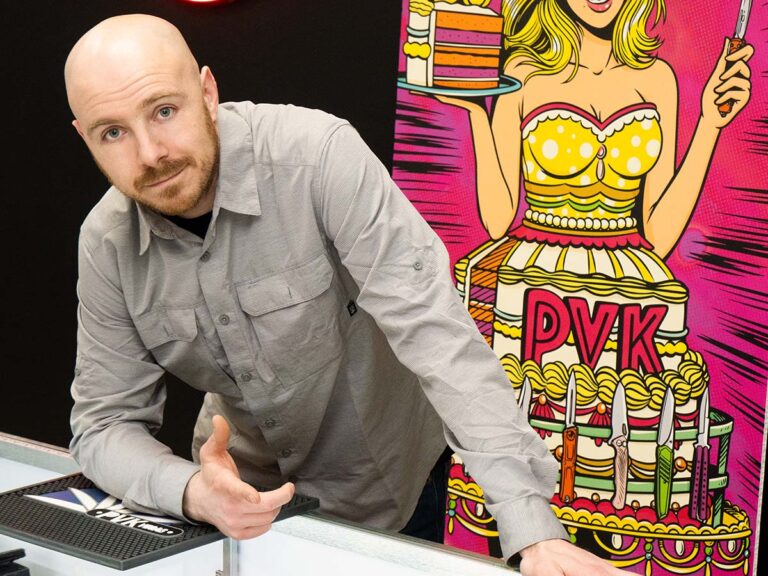
From a New England gentleman’s gift shop to a legendary—if not notorious—knife outlet on the Las Vegas Strip and online edge tool maven, PVK and PVK.com has carved a unique path in the knife world. We caught up with Jeremiah Burbank, the man behind the radical retail brand, and got a behind-the-scenes look at the company’s growth, cross-country moves and PVK starting a new chapter in its story. Buckle up as he surveys the ever-changing knife landscape, shares online sales insights and his enduring passion for knives.


BLADE: Give PVK’s origin story—how did the store come together and how did it end up in Vegas?

Jeremiah: My brother, Joshua, started with a storefront in 1994 in Amherst, Mass., with Pioneer Valley Knife & Tool. It focused on gentleman’s gifts—Maglites, Leatherman, a real eclectic mix. Over that first year, he shifted to pocketknives because he sold a ton of them. He eventually dropped “Tool” from the name and exclusively focused on knives.

By 1999, he had two storefronts in Amherst, and by 2000, he moved completely online with PVK. I came on in 2001 and joined the team, helping Josh with videos of knives, doing over-the-shoulder videos while Josh talked about the knives.

A lot changed in 2013, when some friends of ours went to the USN Gathering in Las Vegas and said we had to check it out. My brother went the next year and said that it was the future of knife sales. By the next year, we had a store by McCarran International Airport, and by 2017, we moved to the Strip—Las Vegas Boulevard—and became PVKVegas. We got to sell knives to the world.

All good things come to an end. Josh passed away unexpectedly in 2021, and shortly after, our landlord informed us they were tearing down our building for the Formula One race. Now PVK is back in New Hampshire—Hudson—and we just opened our showroom last year.

There’s never been a pause with the store.


BLADE: PVK started as a gentleman’s store but ended up a knife retailer—were you and your brother knife guys to begin with?

Jeremiah: Josh was a knife guy through and through—our mother would definitely tell you he had a knife on him throughout his life and took it where he probably shouldn’t have. Josh was into balisongs and read The Advanced Balisong Manual by Jeff Imada. And PVK carried knives we all know today—Benchmade, ProTech, Microtech (we were their second or third dealer)—way before it was cool.

I was always into knives, too. There was some age difference between Josh and me, so one of my earliest memories was hanging out at the store when I wasn’t in school. Also, I think I might have brought a Master of Defense Lady Hawk to school once—I was really into that knife.


BLADE: For those who never had the chance to visit, tell us about the Vegas store—how was it set up?

Jeremiah: Excellent question because it was notorious on the Strip.

Honestly, the frontage was very small—we had 10 cases, maybe 4 1/2 feet long each… call it a 60-square-foot showroom. We had a red carpet, so it really fit into Vegas. We replaced it each month; it got so dirty. Above the cases, we had TVs showing all kinds of knife videos.

As for what we had to sell, we sold everything from $5 knives to $5,000 knives—we couldn’t just cater to knife people. And we had a 10-watt laser to engrave a knife on the spot if someone wanted to put their name or their spouse’s name on the knife.

There was a center section to the store—the VIP room—you accessed from behind the register. We actually had to move the register to get back there. It was differently lit, had a beautiful coffee table and Eames lounge chairs and ottomans. It was a very private and nice experience.

Back there, everything in the cases were customs, short-run knives and one-offs. There was an exclusivity to it. If a guy showed up in a robe and slippers but had a Rolex on his wrist or he said the right things, we’d invite him back to the VIP room. It was a thing of legend.

In the very back was inventory; it was pretty tight because we had 25 safes.

Out front of the store, I’d hang out with the guys and flip knives to get people in the store. You’d see the world in tourists walk by.


BLADE: Vegas is crazy. I imagine you had everybody from celebrities to guys who hit big at roulette come through your doors. What’s your most memorable stories from your time there?

Jeremiah: First and foremost, since I get asked about this a lot, my favorite thing about selling knives is the people—it doesn’t matter if it’s a celebrity or Joe Schmo. Either way, I love to talk about knives.

But we had a number of well-known people who came to our store. Aerosmith had a residency in Las Vegas, and they’d come in. And Post Malone came in unexpectedly with his security detail, hung out in the VIP room and bought a bunch of knives. Tim Burton, Johnny Depp, a whole range of people.

The thing is celebrities are like anyone else when they came into PVKVegas—they’re just a bunch of kids in a knife store. Steven Tyler devolved when he came in, wanting to see each knife and just having a great time.

We were Post’s first stop in the knife world—he’s big into them now. When he came in, you know what the first knife he headed for? The Swiss Champ—the Swiss Army Knife with some 70 functions. He said, “Ah man, you’ve got this?” and had us box it up.

Celebrities are cool, but it’s cooler seeing them geek out on knives. We’re all collectors.


BLADE: You guys were legendary in Vegas, beyond the knife community—was it tough to say goodbye?

Jeremiah: It was heartbreaking, and it was a hard time for me as a person, knife dealer and brother. I had high stree through it all, especially having to break ties with people around the Vegas community who were close with me—with PVK. Honestly, it really didn’t hit me until USN ‘22. Everyone from USN had something to say about the shop. Being back was a strange ripple in reality. Did that all really happen [with the shop in Vegas]? Or did I just dream it?

Closing the shop on the Strip was a flashback for me—in reverse—of when we came out West. Then it was packing up a Penske truck and driving across the country, and I was doing the same but heading for New Hampshire. Life can be very strange, very cyclical.


BLADE: PVK is now back where it started or close to it, does it feel like coming home?

Jeremiah: I love being back. I’m from New England, and the region has always been near to my heart. I love the cold weather and the passing seasons. Plus, my family is an hour away. Plus,  I’m offering something not offered anywhere else around here. I’ll also say, it’s great to sell to people face to face again.


BLADE: New Hampshire is a good place to set up shop, compared with some of the other New England states. 

Jeremiah: It is the “Live Free or Die” state. New Hampshire was the first state to repeal its ban on switchblades back in 2010, and now we’re seeing it nationwide.


BLADE: You mentioned selling face to face again; that just came about recently. What’s your new shop like in Hudson?

Jeremiah: It’s very different than Vegas, but in a good way. There is no pressure, very calm atmosphere and no VIP room… yet. We’re a 10 a.m.-5 p.m., Monday through Friday operation, which is very different than Vegas, where we were open to 2 a.m.

We opened on Black Friday last year, and it was great to see the excitement it generated. We had folks drive up from Massachusetts when we opened our doors. 

Part of what I did when I moved back was contact Nick Chuprin of NCC Knives, who was based in Brooklyn, N.Y., and offered him space. He moved his operation up here, and he has an entire machining cell in the back of the house.

It’s not a standard store; it’s multifaceted. It’s like a knife clubhouse. What other store can you come and get your knife sharpened by a custom knifemaker? And if you want to make, maintain or modify a knife, you bet your daisies I can get it done.


BLADE: Even with the new storefront, online knife sales remain PVK’s lifeblood. But it’s always been that way, correct?

Jeremiah: My brother was an early tech adopter; he had PVKnife.com online in 1997. Even before that, he was on list servers—Wreck.Knife—talking to people about knives. At first, online sales were a trickle, then in three or four years from going online, it became overwhelming. Josh went from having our parents help us ship to outgrowing their house.

He was clever. He used print media—we still do today with BLADE Magazine—to get the word out. And he mailed fliers letting customers know they could order online and have a knife delivered right to their door.


BLADE: Going from the 1990s, when there were a handful of online knife dealers, to today, when there seems to be a new store going online each week, how much more competitive is it now?

Jeremiah: I’ve been doing this a while and will say all competition is good competition. I am good with the free market; it makes us better.

The knife market has seen incredible growth and so have we. Around 2009 is when PVK saw the online market take off, and from then to 2015, our business doubled. By 2018, it tripled, and in 2019, it quadrupled. Then the pandemic hit, and everybody cared about knives.

The bad part about this is it brought a lot of part-time guys into the market who didn’t take it seriously. For better or worse, there aren’t a ton of regulations in the knife world, so there are some who take advantage of the community. That’s not good for anyone.

One of the things I always tell buyers is to make sure whoever they deal with online has a phone number on the website. If they don’t, don’t buy from them. We’ve always accepted all calls from customers and engaged with them.


BLADE: It seems, from your brother’s days on list servers and videos to your work on social media and your Bladeology podcast, PVK has also found it important to engage and build a community online. What motivates your focus on engaging with and building an online community?

Jeremiah: We’re in a disconnected world, and this is a way to make a connection with people. That’s why I find the online community so crucial. With the podcast, it’s friends talking about knives—me, Nick and Chuck Gedraitis—answering knife questions.

I also love recording history, especially with the knives we bring through the shop. You take the Marfione Dragon Slayer 1, it’s gone, it’s in someone’s collection, never to be seen again. So, I find it important to record knives so someday when someone wants to see them, there’s a video or a picture of the knife.

Same goes for the podcast but with the people in the industry. I had Mike Crenshaw of Knife Rights on six months ago, and he passed recently. But a little piece of him gets to live on.


BLADE: Let’s wrap up with something lighter. You have the choice of some pretty cherry knives to carry or fidget with. Do you have a go-to EDC choice?

Jeremy: That might be my biggest problem—my EDC tray overfloweth. But there are two knives that I go to usually. My first is a Microtech Scarab Executive. I was a huge early carrier of the Executive; there’s just something about it. The second, an exclusive Pro-Tech 3V Malibu. Love that button lock, and Dave Wattenberg makes it in an exclusive 3V. I’ve laughed with him about it before; he has been making autos for 25 years, and his best seller is a flipper. But those are my EDCs for real.


BLADE: Thank you for taking the time to speak with us.

Jeremiah: Thank you.

Read Up On Knife Buying:

Fighter Jet Micarta and Brotherhood: The Surprise Slipjoint For A War Pilot

Rusty Preston gets an unforgettable slipjoint from good friends.

As a founding member of the South Texas Slipjoint Cartel, Rusty Preston made lots of traditional pocketknives over the years, but never did he have one made for him like the trapper recently built by fellow Cartel member Phil Jacob and Ben Champagne.

It all started when a friend sent Ben some green Micarta® bearing some unusual part and serial numbers. They traced it back to a Vietnam-era F4 Phantom fighter jet. The Micarta was part of a chafing block used on F4s as a support to keep hydraulic-activated metal rods used throughout the plane from rubbing or chafing against each other. Ben and Phil knew Rusty was an Air Force pilot during the Vietnam War and when they learned he flew an F4, they decided to use the Micarta in making a surprise knife for him.

The knife had to be a slipjoint, of course, and the two decided on a one-blade trapper pattern. Phil made the blade and springs and Ben made the handle. For a shield they figured a silhouette of an F4 would be appropriate. They got a photograph of an F4 to use as a guide and made the shield of 416 stainless steel to inlay into the Micarta. However, the shield was an inch-and-a-half long.

“It was so long it wouldn’t fit from the center pin to the pivot pin,” Phil said.

Rusty Preston
Rusty Preston

The solution? The knife would have to be a shadow pattern, which has no bolsters and provides a bigger canvas for a shield. Phil added some Roman knot filework—which Rusty taught him how to do—to the backspring, and the result is a really cool pocketknife.

Once the trapper was done, they had to settle on a place where they could all meet, including many members of the Cartel, and Rusty would be there, too. BLADE Show Texas would be the place and Rusty was about to get a surprise for the ages.

Parting Gift

Rusty and his wife Sally had visited with BLADE Magazine Cutlery Hall-of-Fame® member Bill Ruple and the rest of the Cartel members during the show at the Fort Worth Convention Center and were preparing to leave on show Saturday.

“We were just saying our goodbyes and somebody hollered at me—Bill, I think—‘Hey Rusty, come over here,’ and I realized he was at the end of the aisle and he had a group of guys there,” Rusty recalled “Everybody there was a friend of mine, and I thought, ‘Oh, what’s gonna happen here?,’ and sure enough Sally and I walked up—Sally knew about it but I had not a clue—and they started in on me.”

It was all Rusty could do to keep from breaking down—which is about what he did.

“I’ve had this birth defect I’ve had all my life,” he said. “I can squall like a baby at an ice-skating contest at something like that, so it was pretty hard on me but in a good way—you know how that is. So they told me they wanted to present me with something and I saw what it was and I couldn’t believe it. It came as a total, absolute surprise to me. I was dumfounded at what they had done, and why they saw fit to honor me in that fashion is a marvel to me.

“It was just an honor to look around and see the approval on every one of those guys’ faces for what was happening.”

Rusty called the work on the knife “stunning.”

Ben Champagne (left) and Phil Jacob (right) present Rusty Preston (center) with his special surprise knife at BLADE Show Texas 2025 (page 56).

“It’s got both Ben and Phil’s names on the blade and it’s just absolutely outstanding detail work on the inlay and the silhouette of the F4,” he observed. “That took a lot of effort. I don’t know how they managed to get ahold of all that but they did. It’s beautiful, it’s perfect.”

But what about that Micarta? How in the heck was Ben able to obtain material meant for an F4 Phantom jet fighter? Some things are just better left unsaid.

“The fact that the handle material is what it is and where it came from, how in the world Ben ever got ahold of F4 parts I don’t know. And I’m scared to ask him,” Rusty grinned, “because he’d probably tell me.”

Read About Custom Knives:

New Knives May 2025

Have the yen to build our your collection? Just need a sharp new blade? Check out these new knives for May and build out your wish list.

Eyes always peeled, we’re on the look out for the latest and the greatest. We think we’ve found a bevvy of them this May. So, with out further adieu, here’s our latest round of new knives to add to your wish list.


Pearce Richardson Silver Swan

Pearce Richardson Silver Swan

Model type: Chef’s knife
Blade length: 8”
Blade material: Mosaic damascus of 1084 carbon and 15N20 nickel alloy steels
Blade grind: Flat
Scales: Turkish olive wood root burl
Bolster: Mild steel
Overall length: 13.25”
Maker’s price for a similar knife: $6,500
Knife to know: The maker’s mark on the blade is brass inlaid; Pearce Richardson is an apprentice smith in the American Bladesmith Society
Maker: Pearce Richardson, icarusforge.com (SharpByCoop image)


Daniel Keown Big City Fighter

Daniel Keown Big City Fighter

Knife type: Slipjoint
Blade length: 3.5”
Blade steel: AEB-L stainless
Blade grind: Hollow dagger
Handle frame: 416 stainless
Scales: Mammoth ivory
Bolsters: 416 stainless
Liners: Integral
Closed length: 3.5”
Maker’s price for a similar knife: $1,800
Maker: Daniel Keown, (SharpByCoop image)


Josh Hults Camp Knife

Josh Hults Camp Knife

Blade length: 4.5”
Blade material: 1085H carbon steel
Blade grind: Flat-ground integral
Scales: G-carta
Bolster: Forged integral
Overall length: 9.5”
Maker’s price for a similar knife: $500
Knife to know: Josh Hults is a journeyman smith in the American Bladesmith Society
Maker: Josh Hults, southern-forge.com (Jocelyn Frasier image)


Josh Wisor Dress Slipjoint

Josh Wisor Dress Slipjoint

Blade length: 3”
Blade material: Feather damascus
Blade grind: Flat
Handle frame: Stainless steel
Scales: Mammoth ivory
Maker’s price for a similar knife: $1,300
Knife to know: Josh Wisor is a journeyman smith in the American Bladesmith Society
Maker: Josh Wisor, wisorforge.com (SharpByCoop image)


Erik Greiner Hunter

Erik Greiner Hunter

Blade length: 4.25”
Blade material: 80CrV2 carbon steel w/hamon
Blade grind: Flat w/secondary edge bevel
Scales: Dolf wood
Spacers: Oryx horn and warthog tusk liners
Guard: Antiqued brass
Overall length: 8.5”
Maker’s price for a similar knife: $450
Knife to know: Erik Greiner is a journeyman smith in the American Bladesmith Society
Maker: Erik Greiner, greinerblades.com (Jocelyn Frasier image)


Rudy Dean Fighter

Rudy Dean Fighter

Blade length: 11.75”
Blade material: 136 layers of colored damascus
Blade grind: Full flat
Scales: Stag
Guard material: Nickel silver
Spacer: Nickel silver
Overall length: 17”
Maker’s price for a similar knife: $1,750
Knife to know: Rudy Dean is a journeyman smith in the American Bladesmith Society
Maker: Rudy Dean, rudydeancustomknives.com (Jocelyn Frasier image)


Honoré Vilain No. 7 Slipjoint

Honoré Vilain No. 7 Slipjoint

Blade length: 3”
Blade steel: RWL-34 stainless by Damasteel
Blade pattern: Clip point
Handle frame: Z40 stainless
Scales: Vintage rag Micarta®
Liners: G-10
Bolsters: Integral
Closed length: 4.5”
Maker’s price for a similar knife: Contact maker for pricing
Maker: Honoré Vilain (SharpByCoop image)


Jason Coy Clip-Point Hunter

Jason Coy Clip-Point Hunter

Blade length: 4.5”
Blade material: 80CrV2 carbon steel
Blade grind: Flat
Scales: Walnut
Handle pin: Bronze, domed
Guard material: Bronze
Spacers: Black fiber and copper
Overall length: 9.25”
Maker’s price for a similar knife: $500
Maker: Jason Coy, jasoncoyknives.com (Jocelyn Frasier image)


Gary Langley Subhilt Fighter

Gary Langley Subhilt Fighter

Blade length: 6.25”
Blade steel: CPM 154 stainless
Scales: Mammoth ivory
Guard & subhilt: 416 stainless
Overall length: 11.5”
Maker’s price for a similar knife: Contact maker for pricing
Knife to know: Gary Langley is a voting member of The Knifemakers’ Guild
Maker: Gary Langley, gllangley.com (Jocelyn Frasier image)


Bubba Crouch Trapper Skinner

Bubba Crouch Trapper Skinner

Knife pattern: Trapper skinner
Blade length: 3.5”
Blade material: Copper san-mai by Baker Forge
Blade grind: Hollow
Scales: Barky mammoth ivory
Bolster: Integral
Liners: 416 stainless steel
Backspring: Heat-colored CPM 154 stainless
Closed length: 4.25”

Maker’s price for a similar knife: $2,200
Maker: Bubba Crouch (Jocelyn Frasier image)


Eliot Maldonado Folding Fighter

Eliot Maldonado Folding Fighter

Blade length: 3”
Blade material: Mosaic damascus by Curt Zimmerman and Kelly Vermeer Vella
Blade grind: Hollow
Blade pattern: Clip point
Blade opener: Flipper
Bolster material: Same as blade
Bolster design: Double keyhole
Scales: Koa
Handle hardware: Titanium
Lock: Linerlock
Closed length: 4”
Maker’s price for a similar knife: $2,200
Maker: Eliot Maldonado (Jocelyn Frasier image)


William Zermeno Folder

William Zermeno Folder

Blade length: 3.5”
Blade steel: CPM 154 stainless
Blade @thickest: 3/16”
Blade grind: Hollow
Handle frame: 160 titanium milled out
Scales: FatCarbon®
Handle screws: Titanium
Lock: Framelock
Lock stabilizer: Titanium
Pocket clip: Titanium
Closed length: 5.25”
Maker’s price for a similar knife: $550
Maker: William Zermeno, wdzknives.com (Jocelyn Frasier image)


Check Out Knife Drops:

Advertisement

Must Read Articles

Read this before you make a knife

Knifemaking 101 – Read This Before You Make a Knife

  by Wayne Goddard My experience has taught me that there's nothing like digging in and getting started. I've often said the hardest part of the...
how to forge damascus steel

How to Forge Damascus

Advertisement
Advertisement