Rusty Preston gets an unforgettable slipjoint from good friends.
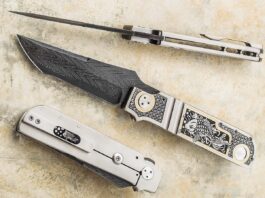
As a founding member of the South Texas Slipjoint Cartel, Rusty Preston made lots of traditional pocketknives over the years, but never did he have one made for him like the trapper recently built by fellow Cartel member Phil Jacob and Ben Champagne.
It all started when a friend sent Ben some green Micarta® bearing some unusual part and serial numbers. They traced it back to a Vietnam-era F4 Phantom fighter jet. The Micarta was part of a chafing block used on F4s as a support to keep hydraulic-activated metal rods used throughout the plane from rubbing or chafing against each other. Ben and Phil knew Rusty was an Air Force pilot during the Vietnam War and when they learned he flew an F4, they decided to use the Micarta in making a surprise knife for him.
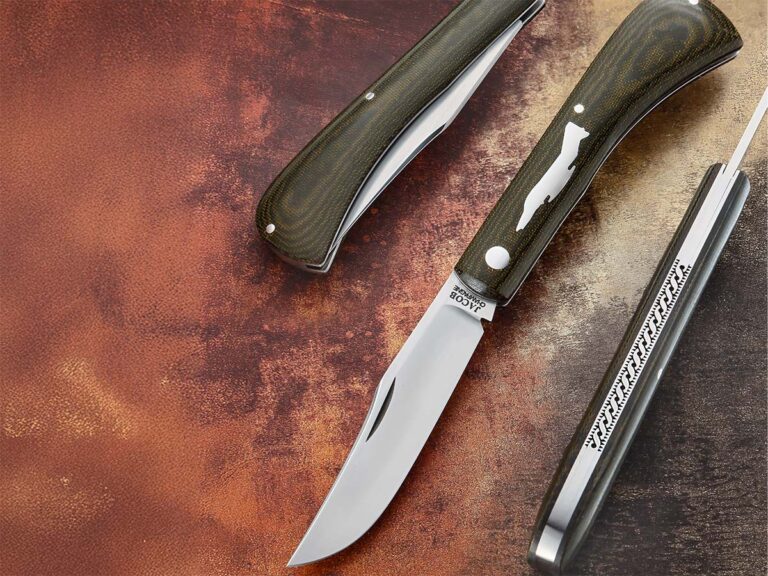
The knife had to be a slipjoint, of course, and the two decided on a one-blade trapper pattern. Phil made the blade and springs and Ben made the handle. For a shield they figured a silhouette of an F4 would be appropriate. They got a photograph of an F4 to use as a guide and made the shield of 416 stainless steel to inlay into the Micarta. However, the shield was an inch-and-a-half long.
“It was so long it wouldn’t fit from the center pin to the pivot pin,” Phil said.
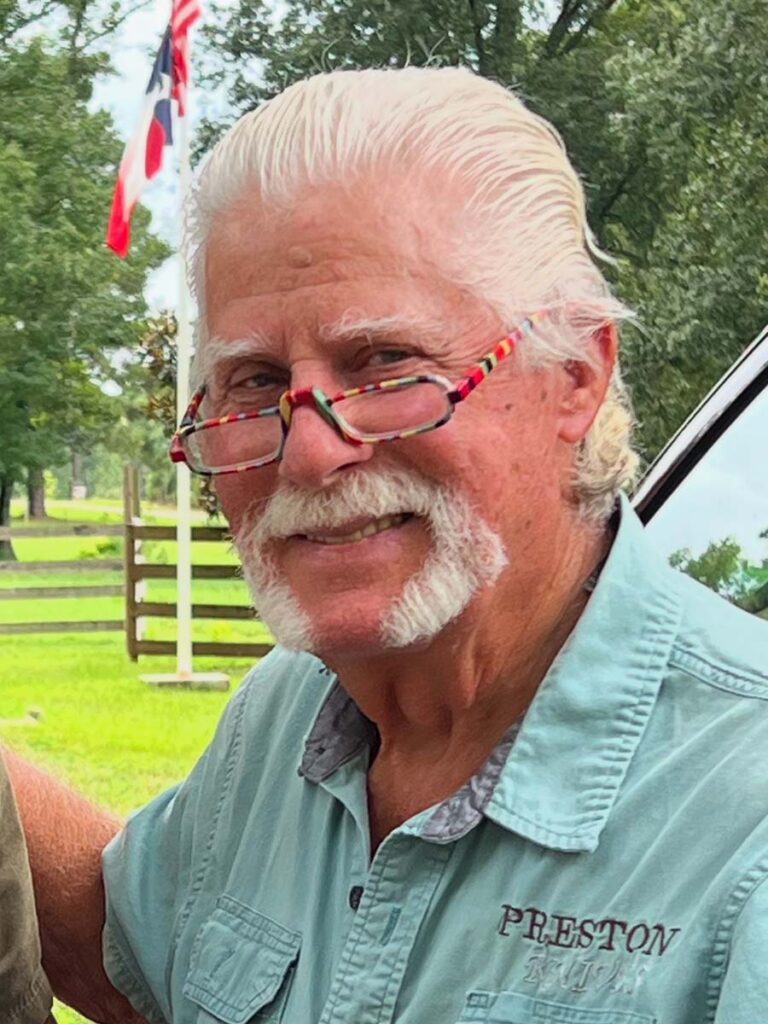
Rusty Preston
The solution? The knife would have to be a shadow pattern, which has no bolsters and provides a bigger canvas for a shield. Phil added some Roman knot filework—which Rusty taught him how to do—to the backspring, and the result is a really cool pocketknife.
Once the trapper was done, they had to settle on a place where they could all meet, including many members of the Cartel, and Rusty would be there, too. BLADE Show Texas would be the place and Rusty was about to get a surprise for the ages.
Parting Gift
Rusty and his wife Sally had visited with BLADE Magazine Cutlery Hall-of-Fame® member Bill Ruple and the rest of the Cartel members during the show at the Fort Worth Convention Center and were preparing to leave on show Saturday.
“We were just saying our goodbyes and somebody hollered at me—Bill, I think—‘Hey Rusty, come over here,’ and I realized he was at the end of the aisle and he had a group of guys there,” Rusty recalled “Everybody there was a friend of mine, and I thought, ‘Oh, what’s gonna happen here?,’ and sure enough Sally and I walked up—Sally knew about it but I had not a clue—and they started in on me.”
It was all Rusty could do to keep from breaking down—which is about what he did.
“I’ve had this birth defect I’ve had all my life,” he said. “I can squall like a baby at an ice-skating contest at something like that, so it was pretty hard on me but in a good way—you know how that is. So they told me they wanted to present me with something and I saw what it was and I couldn’t believe it. It came as a total, absolute surprise to me. I was dumfounded at what they had done, and why they saw fit to honor me in that fashion is a marvel to me.
“It was just an honor to look around and see the approval on every one of those guys’ faces for what was happening.”
Rusty called the work on the knife “stunning.”
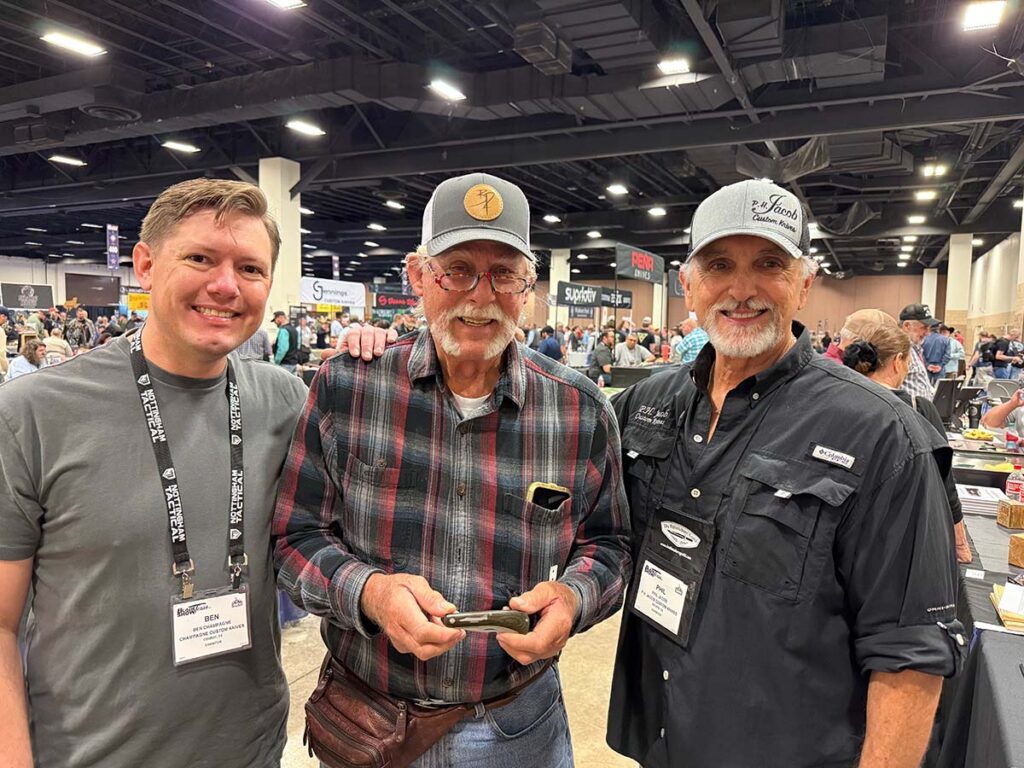
Ben Champagne (left) and Phil Jacob (right) present Rusty Preston (center) with his special surprise knife at BLADE Show Texas 2025 (page 56).
“It’s got both Ben and Phil’s names on the blade and it’s just absolutely outstanding detail work on the inlay and the silhouette of the F4,” he observed. “That took a lot of effort. I don’t know how they managed to get ahold of all that but they did. It’s beautiful, it’s perfect.”
But what about that Micarta? How in the heck was Ben able to obtain material meant for an F4 Phantom jet fighter? Some things are just better left unsaid.
“The fact that the handle material is what it is and where it came from, how in the world Ben ever got ahold of F4 parts I don’t know. And I’m scared to ask him,” Rusty grinned, “because he’d probably tell me.”
Have the yen to build our your collection? Just need a sharp new blade? Check out these new knives for May and build out your wish list.
Eyes always peeled, we’re on the look out for the latest and the greatest. We think we’ve found a bevvy of them this May. So, with out further adieu, here’s our latest round of new knives to add to your wish list.
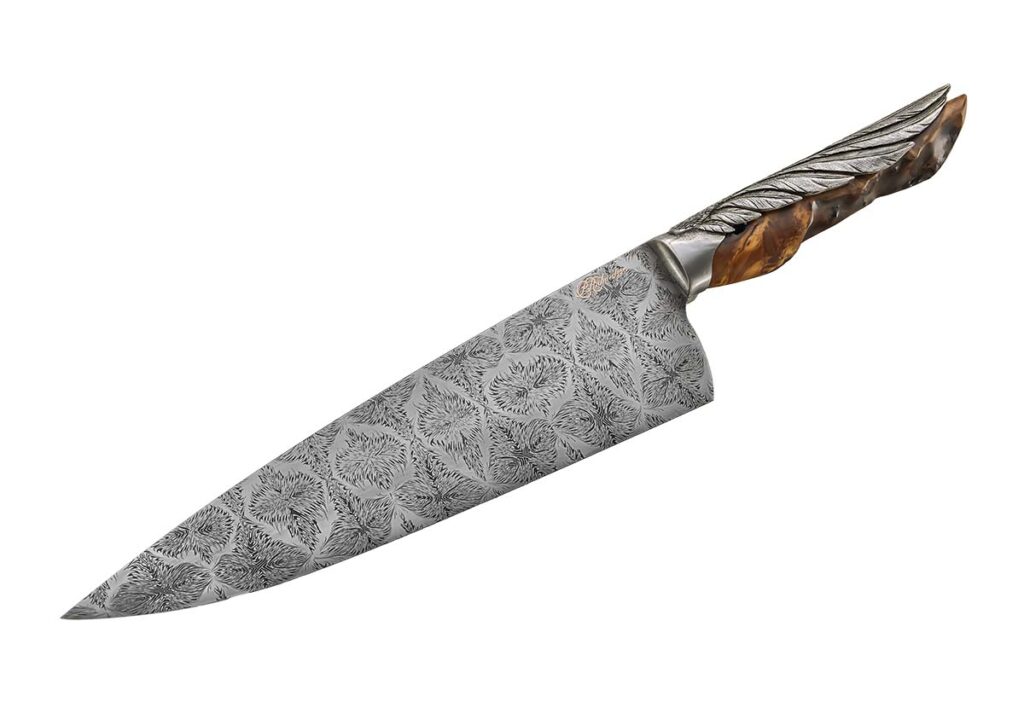
Pearce Richardson Silver Swan
Model type: Chef’s knife Blade length: 8” Blade material: Mosaic damascus of 1084 carbon and 15N20 nickel alloy steels Blade grind: Flat Scales: Turkish olive wood root burl Bolster: Mild steel Overall length: 13.25” Maker’s price for a similar knife: $6,500 Knife to know: The maker’s mark on the blade is brass inlaid; Pearce Richardson is an apprentice smith in the American Bladesmith Society Maker: Pearce Richardson, icarusforge.com (SharpByCoop image)
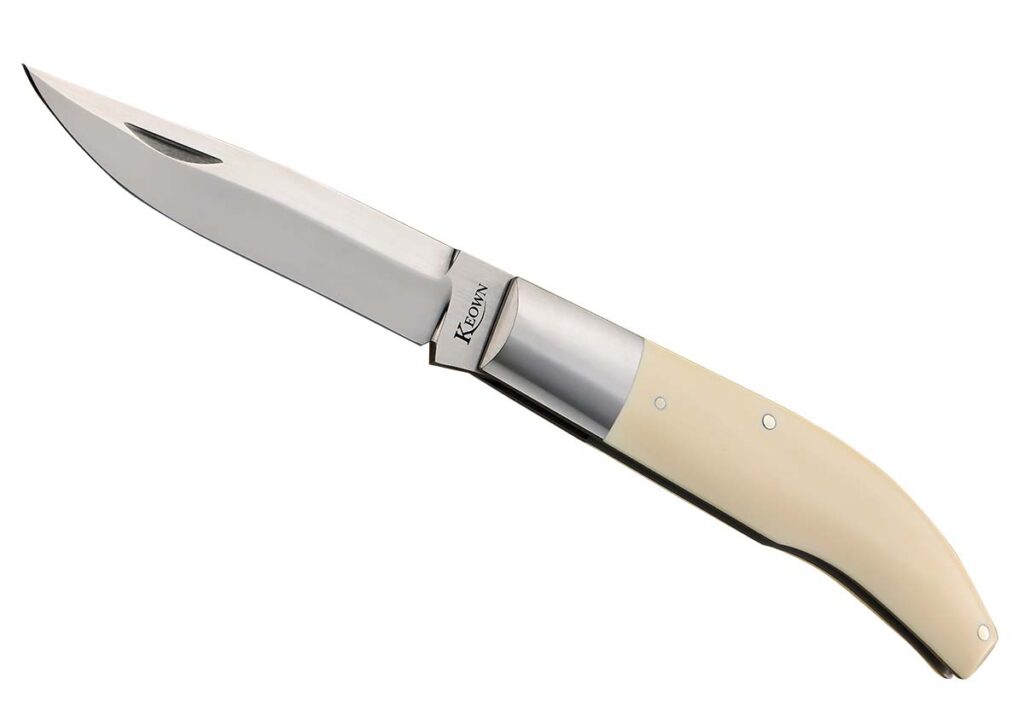
Daniel Keown Big City Fighter
Knife type: Slipjoint Blade length: 3.5” Blade steel: AEB-L stainless Blade grind: Hollow dagger Handle frame: 416 stainless Scales: Mammoth ivory Bolsters: 416 stainless Liners: Integral Closed length: 3.5” Maker’s price for a similar knife: $1,800 Maker: Daniel Keown, (SharpByCoop image)
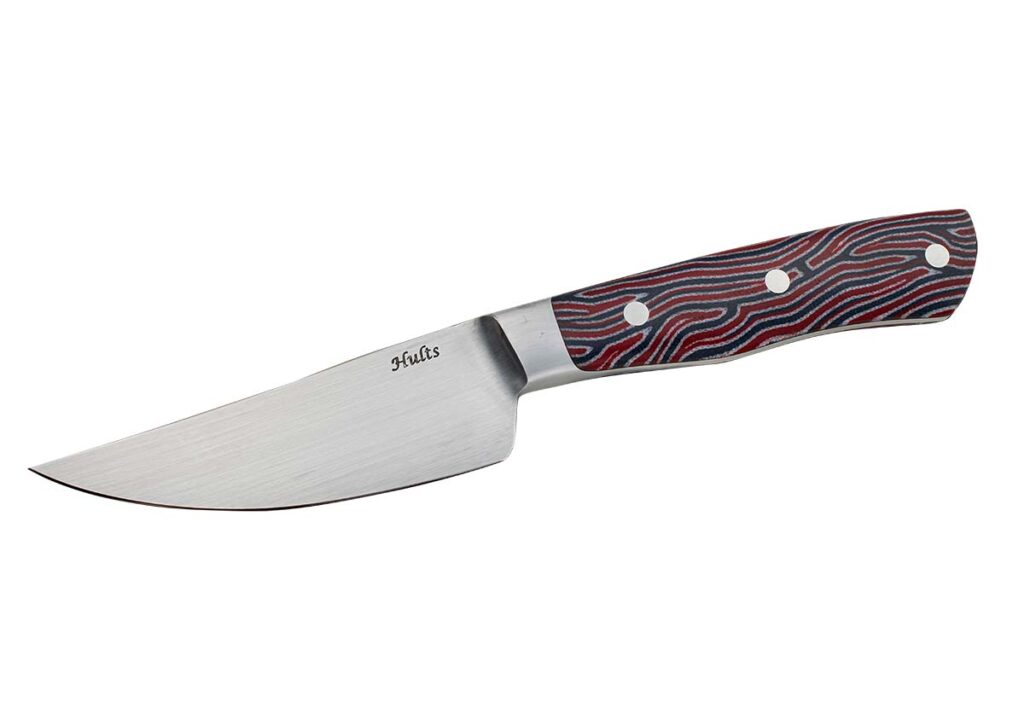
Josh Hults Camp Knife
Blade length: 4.5” Blade material: 1085H carbon steel Blade grind: Flat-ground integral Scales: G-carta Bolster: Forged integral Overall length: 9.5” Maker’s price for a similar knife: $500 Knife to know: Josh Hults is a journeyman smith in the American Bladesmith Society Maker: Josh Hults, southern-forge.com (Jocelyn Frasier image)
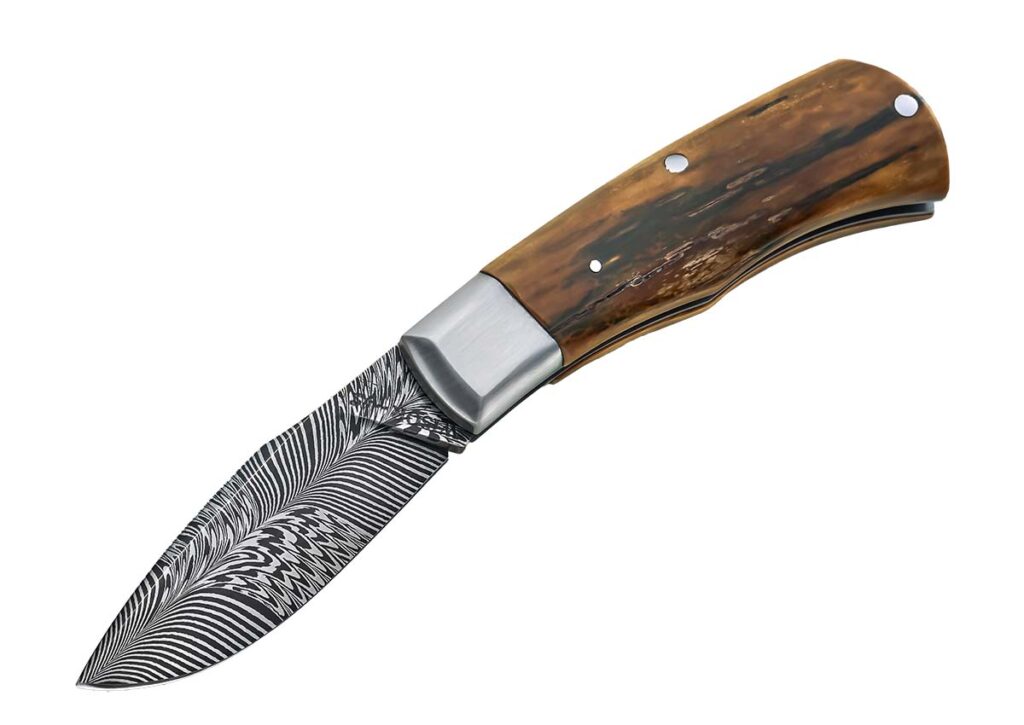
Josh Wisor Dress Slipjoint
Blade length: 3” Blade material: Feather damascus Blade grind: Flat Handle frame: Stainless steel Scales: Mammoth ivory Maker’s price for a similar knife: $1,300 Knife to know: Josh Wisor is a journeyman smith in the American Bladesmith Society Maker: Josh Wisor, wisorforge.com (SharpByCoop image)
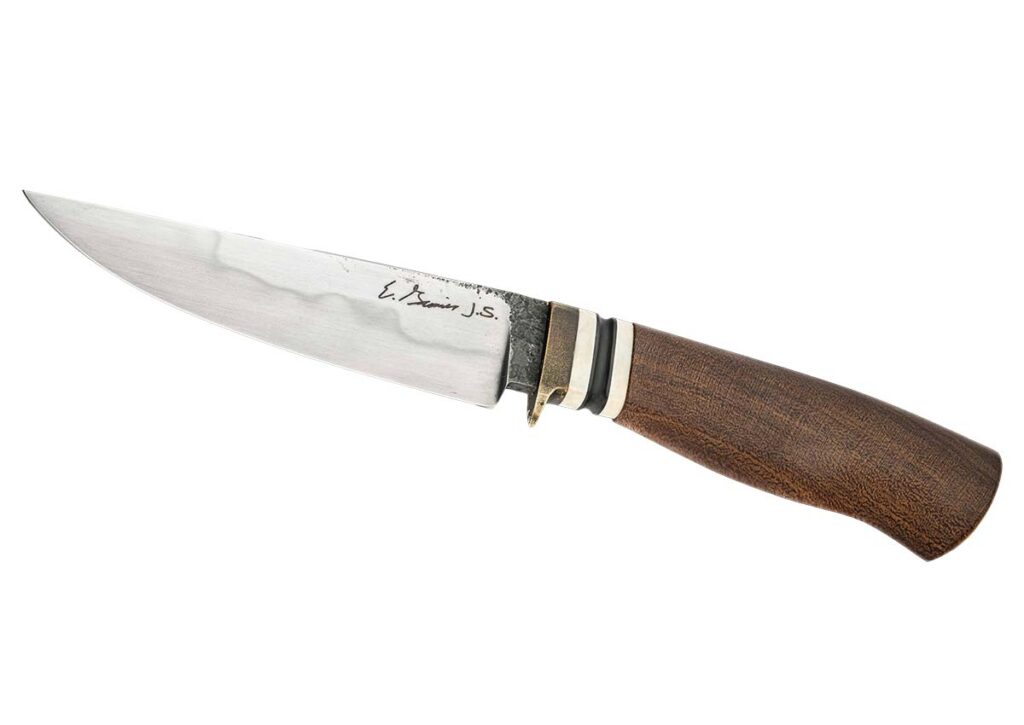
Erik Greiner Hunter
Blade length: 4.25” Blade material: 80CrV2 carbon steel w/hamon Blade grind: Flat w/secondary edge bevel Scales: Dolf wood Spacers: Oryx horn and warthog tusk liners Guard: Antiqued brass Overall length: 8.5” Maker’s price for a similar knife: $450 Knife to know: Erik Greiner is a journeyman smith in the American Bladesmith Society Maker: Erik Greiner, greinerblades.com (Jocelyn Frasier image)
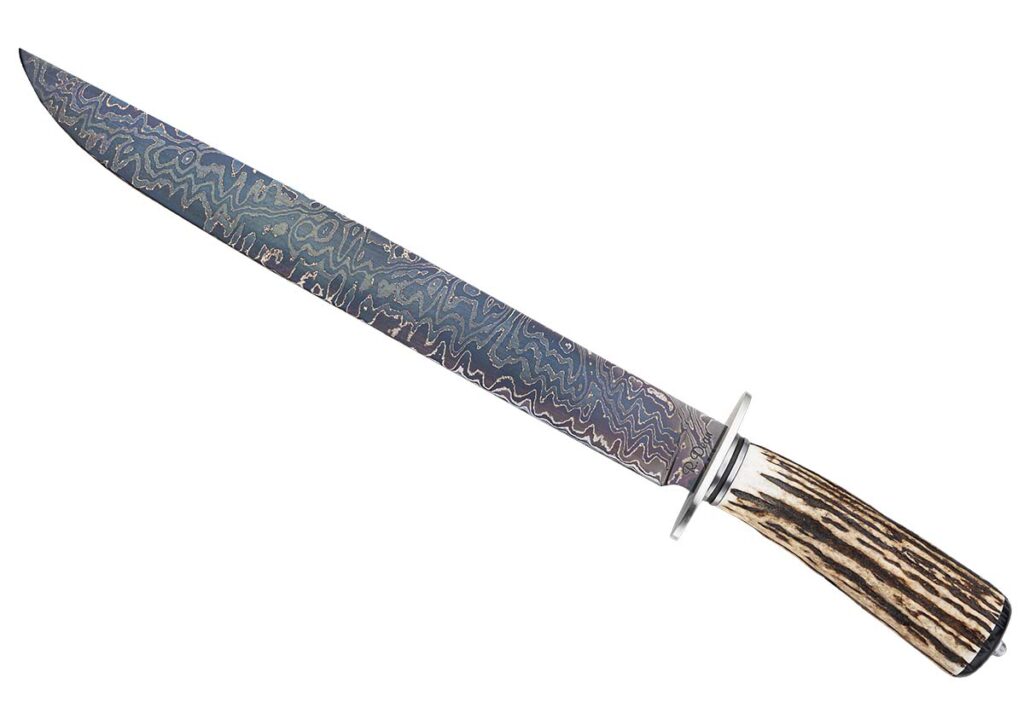
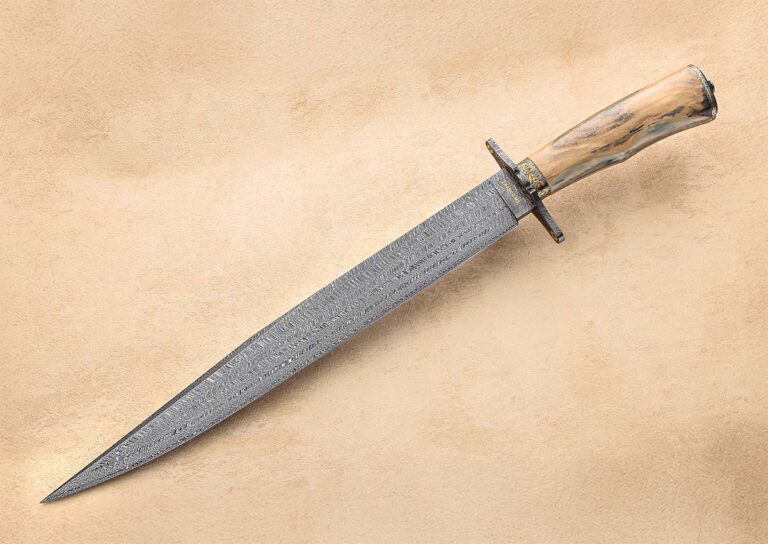
Rudy Dean Fighter
Blade length: 11.75” Blade material: 136 layers of colored damascus Blade grind: Full flat Scales: Stag Guard material: Nickel silver Spacer: Nickel silver Overall length: 17” Maker’s price for a similar knife: $1,750 Knife to know: Rudy Dean is a journeyman smith in the American Bladesmith Society Maker: Rudy Dean, rudydeancustomknives.com (Jocelyn Frasier image)
Honoré Vilain No. 7 Slipjoint
Blade length: 3” Blade steel: RWL-34 stainless by Damasteel Blade pattern: Clip point Handle frame: Z40 stainless Scales: Vintage rag Micarta® Liners: G-10 Bolsters: Integral Closed length: 4.5” Maker’s price for a similar knife: Contact maker for pricing Maker: Honoré Vilain (SharpByCoop image)
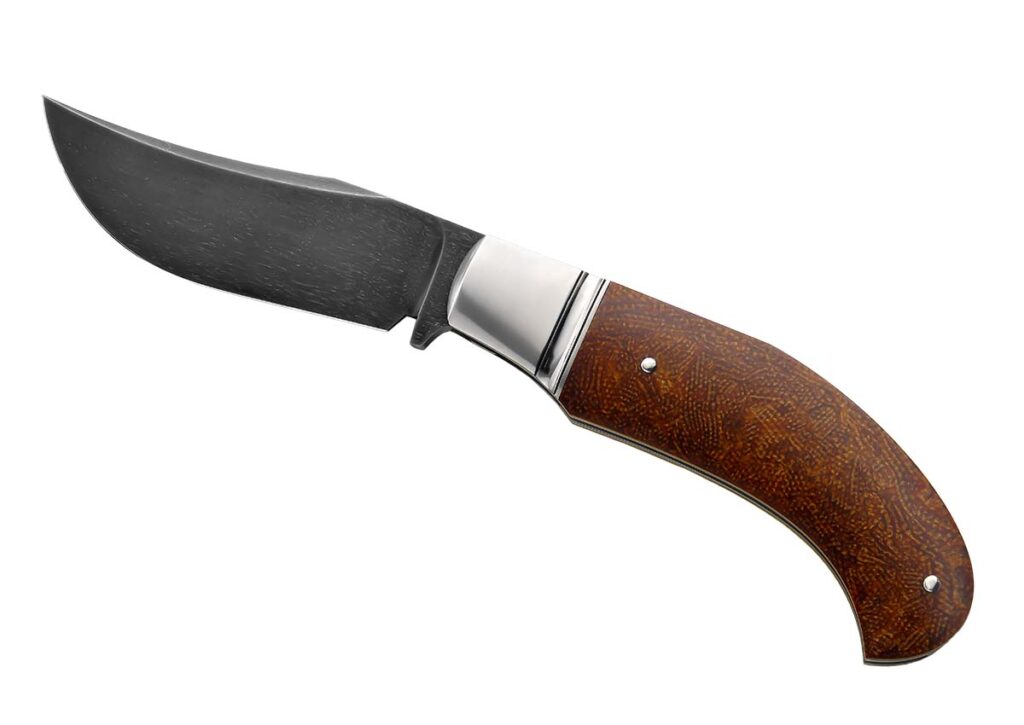
Jason Coy Clip-Point Hunter
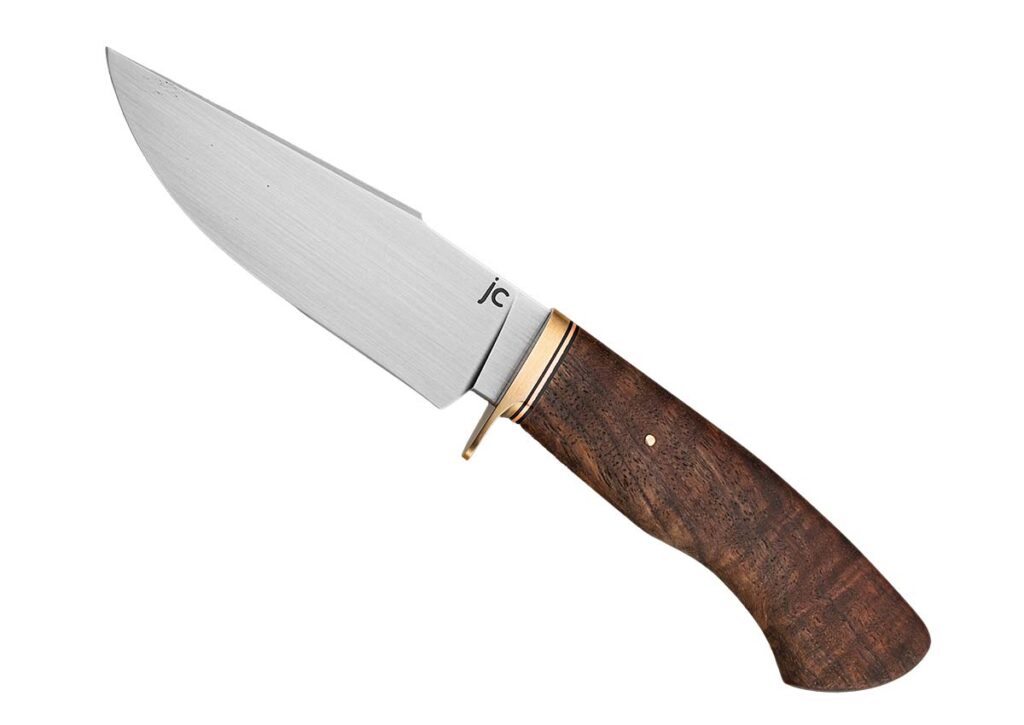
Blade length: 4.5” Blade material: 80CrV2 carbon steel Blade grind: Flat Scales: Walnut Handle pin: Bronze, domed Guard material: Bronze Spacers: Black fiber and copper Overall length: 9.25” Maker’s price for a similar knife: $500 Maker: Jason Coy, jasoncoyknives.com (Jocelyn Frasier image)
Gary Langley Subhilt Fighter
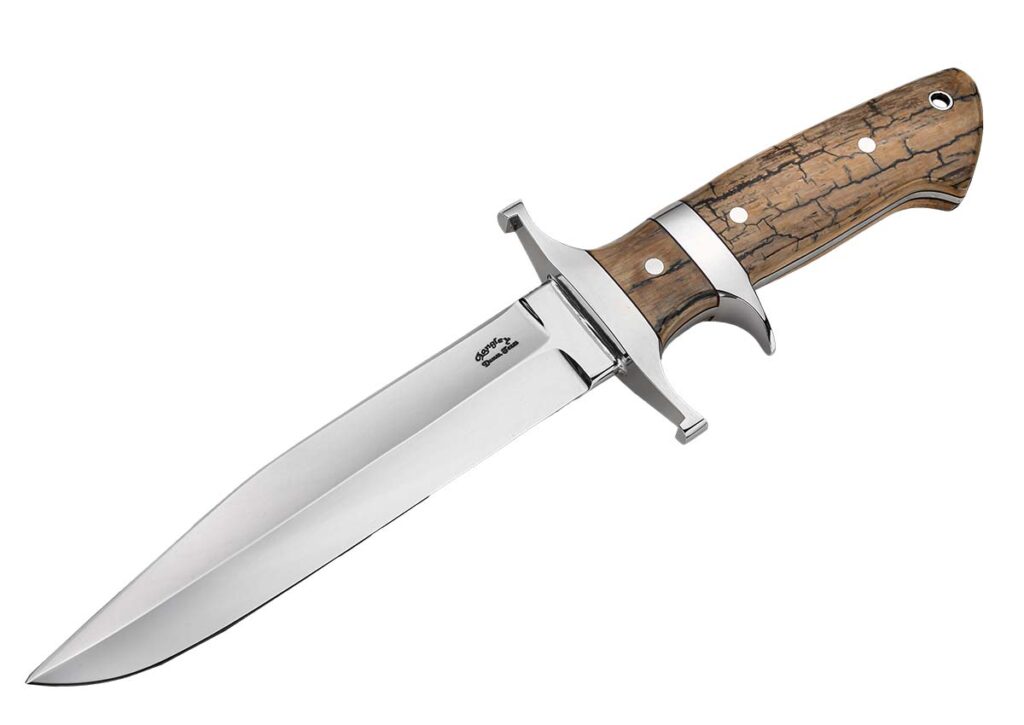
Blade length: 6.25” Blade steel: CPM 154 stainless Scales: Mammoth ivory Guard & subhilt: 416 stainless Overall length: 11.5” Maker’s price for a similar knife: Contact maker for pricing Knife to know: Gary Langley is a voting member of The Knifemakers’ Guild Maker: Gary Langley, gllangley.com (Jocelyn Frasier image)
Bubba Crouch Trapper Skinner
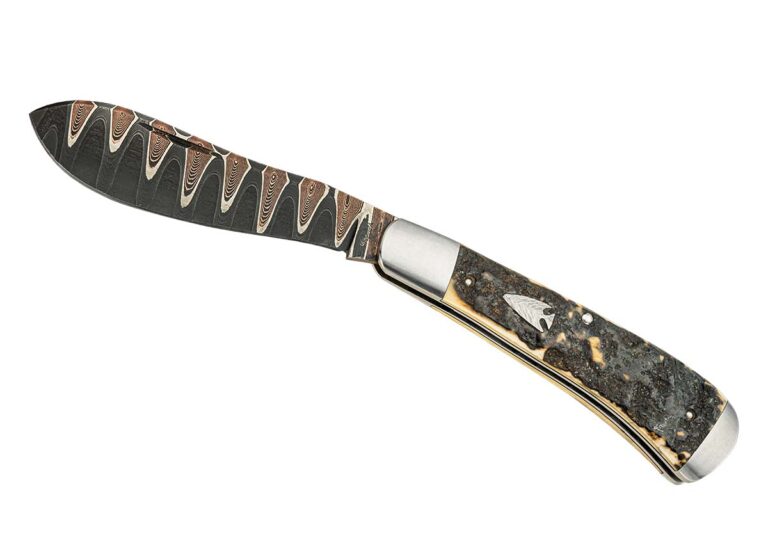
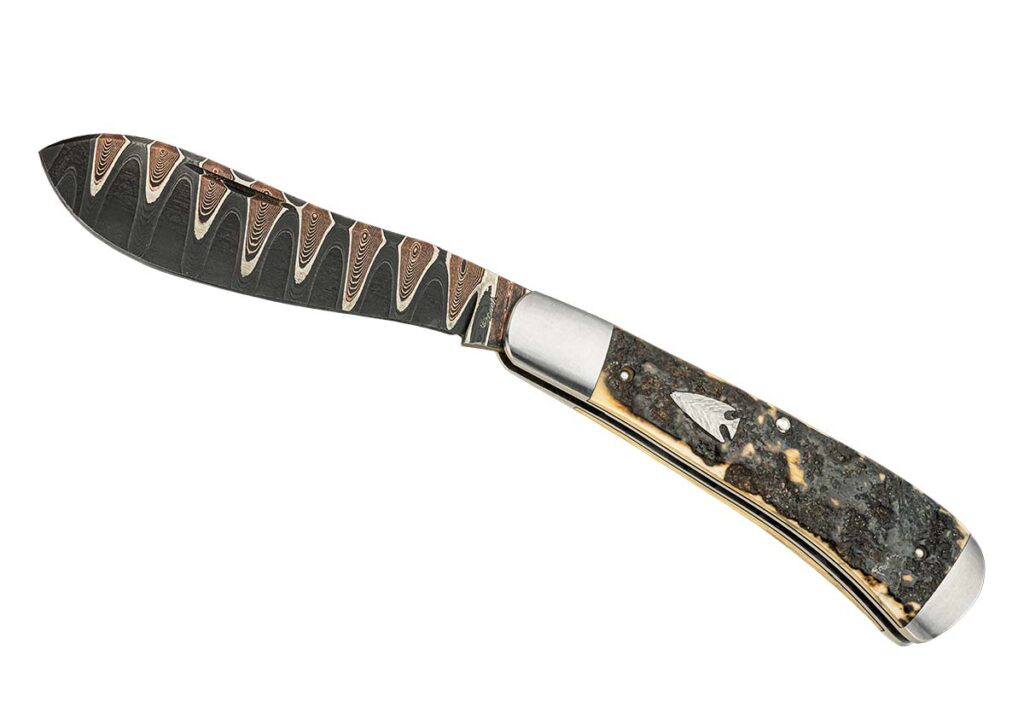
Knife pattern: Trapper skinner Blade length: 3.5” Blade material: Copper san-mai by Baker Forge Blade grind: Hollow Scales: Barky mammoth ivory Bolster: Integral Liners: 416 stainless steel Backspring: Heat-colored CPM 154 stainless Closed length: 4.25” Maker’s price for a similar knife: $2,200 Maker: Bubba Crouch (Jocelyn Frasier image)
Eliot Maldonado Folding Fighter
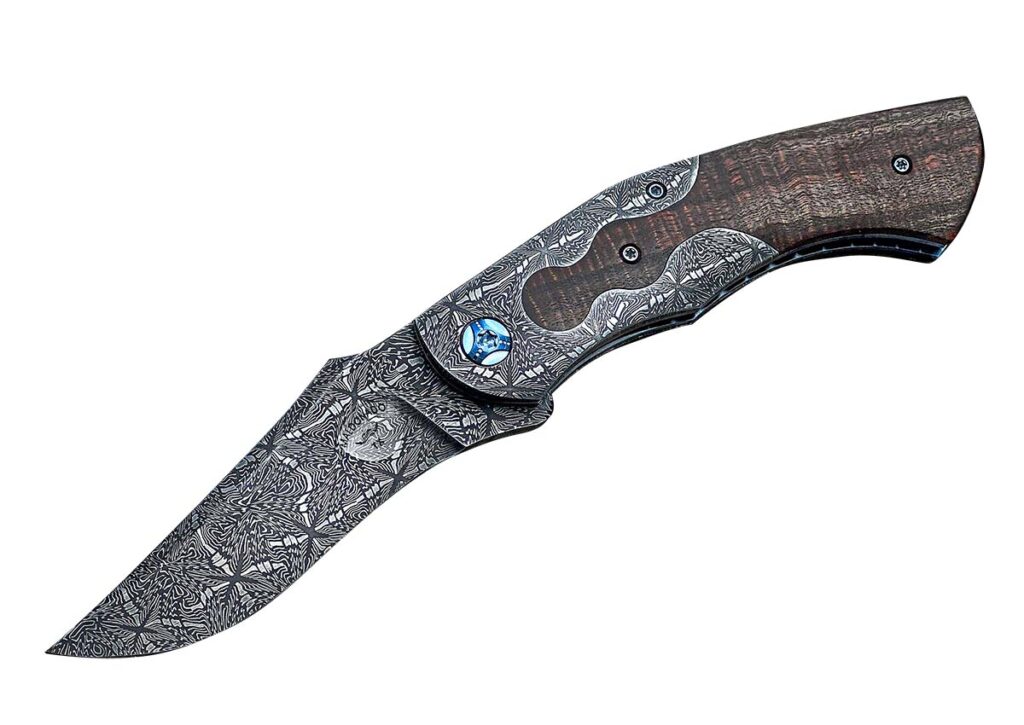
Blade length: 3” Blade material: Mosaic damascus by Curt Zimmerman and Kelly Vermeer Vella Blade grind: Hollow Blade pattern: Clip point Blade opener: Flipper Bolster material: Same as blade Bolster design: Double keyhole Scales: Koa Handle hardware: Titanium Lock: Linerlock Closed length: 4” Maker’s price for a similar knife: $2,200 Maker: Eliot Maldonado (Jocelyn Frasier image)
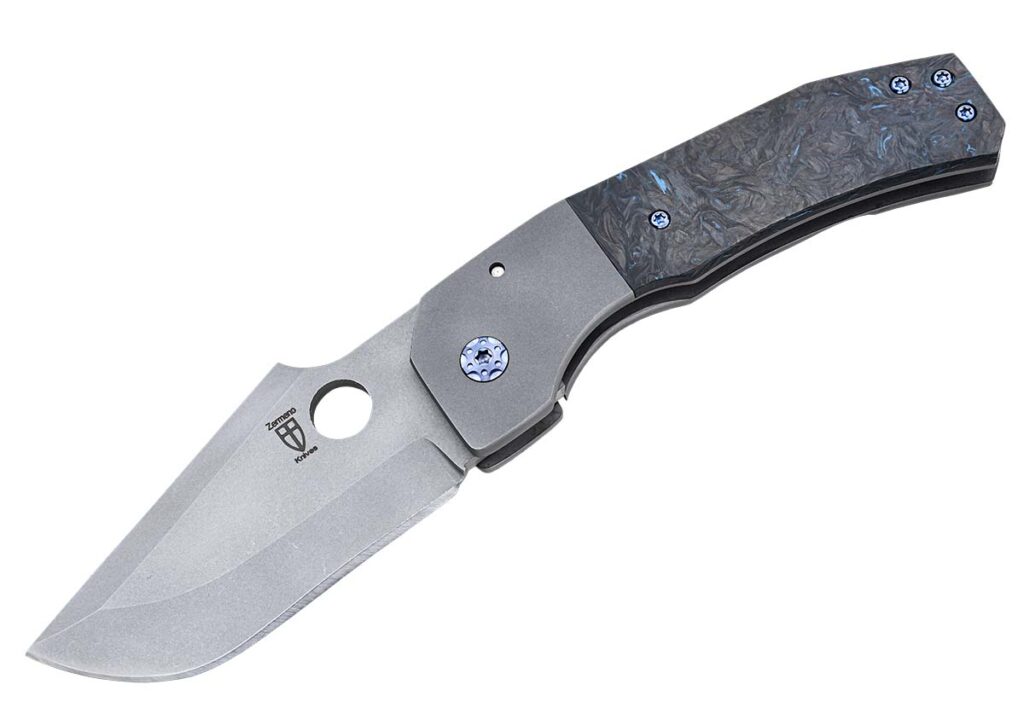
William Zermeno Folder
Blade length: 3.5” Blade steel: CPM 154 stainless Blade @thickest: 3/16” Blade grind: Hollow Handle frame: 160 titanium milled out Scales: FatCarbon® Handle screws: Titanium Lock: Framelock Lock stabilizer: Titanium Pocket clip: Titanium Closed length: 5.25” Maker’s price for a similar knife: $550 Maker: William Zermeno, wdzknives.com (Jocelyn Frasier image)
Blade-o-philes from far and wide converged to cut in Fort Worth.
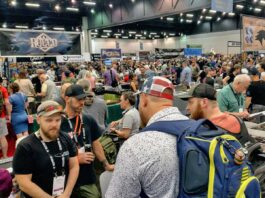
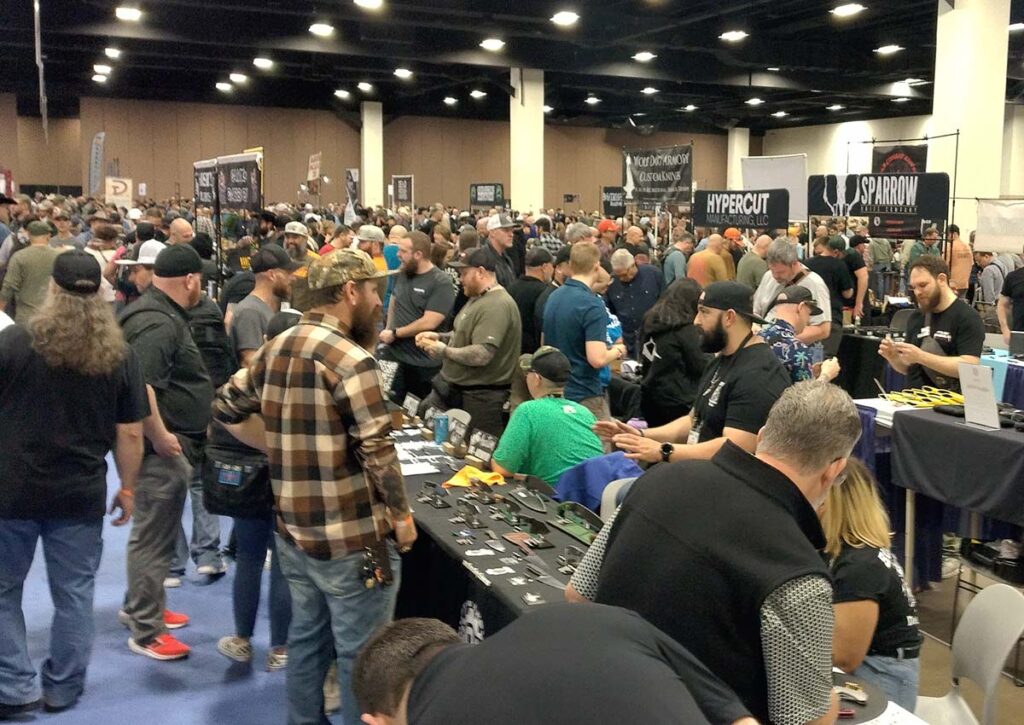
Knives and knifemakers with a worldly flair, a strong contingent of domestic cutlers, and makers and knife enthusiasts with a nod toward a promising future helped make BLADE Show Texas another entertaining way to start off the new knife show year.
Sweden’s Anders Hogstrom, South Africa’s Bertie Rietveld and Brazil’s Franco de Souza were among the overseas headliners, and BLADE Magazine Cutlery Hall-of-Fame® member Bill Ruple, Harvey Dean and Evan Nicolaides led the American charge, while 10-year-old Adam Storts of Duncan, Oklahoma, brought his special kind of fixed blades to the Fort Worth Convention Center March 6-8.
Knife fans and knives go wall-to-wall at BLADE Show Texas.
Adding to the youthful mix was knifemaker Tom Overeynder—not because he’s young but because he gave a knife to a happy 10-year-old knife enthusiast. (No word on whether the youngster gave Tom a penny in return; check out this story to learn more about the penny for a knife tradition). Meanwhile, the factory section was a beehive of activity throughout the show, drawing patrons of all ages.
Knife sales, the barometer of any show, were a mixed bag. Most of those who didn’t sell as well as they would have liked attributed much of it to an economy that was still in the throes of a downturn caused by inflation and lingering high prices for standard consumer goods and services. As a result of the economic uncertainty, many folks were understandably cautious about making large purchases. Exhibitors who did sell well, though, were upbeat.
FACTORY BEST IN SHOW/BEST IMPORTED The Poikilo Blade VK-Zen framelock folder has a 3.25-inch blade of Bohler M398 stainless steel with a “V” grind. Handle and pocket clip: titanium. Designer: Vulpex Knives. Closed length: 4.25 inches. Country of origin: China. It comes in four different configurations with MSRPs ranging from $380 to $700.
“I had a great show,” noted Jared Oeser. “I brought eight custom knives along with some productions and sold them all.” Business also seemed good for members of the South Texas Slipjoint Cartel, with Phil Jacobs selling 10 of the 14 knives he brought and Toby Hill selling eight of nine.
It was the first BLADE Show Texas for David Lisch and he liked what he saw. “It’s a great location and the size was good.” He brought 13 knives and sold 11, though only two to collectors. “The rest went to purveyors,” he noted, adding with a wink, “I was glad to have them there.” So was Paul DiStefano. “I brought eight knives and sold seven,” he wrote, “all of them to dealers and not individual collectors. I’m definitely not complaining about that.” Overeynder brought seven knives, selling four of his handmades and three out of his collection. “I also sold one a few days after the show to a guy who couldn’t be there,” he stated.
BLADE Show Texas Attendance
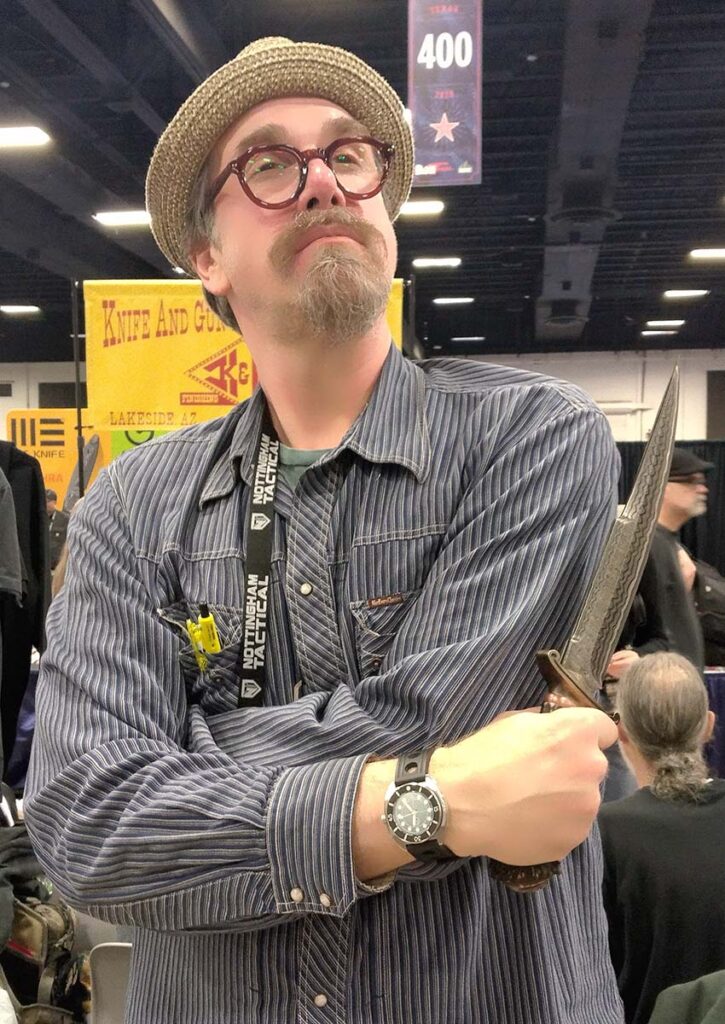
Sweden’s Anders Hogstrom appears pointedly pensive.
Show attendance graded out very well overall. “I think Saturday had more people than Friday. It seems like the local attendance in Texas is good,” Oeser observed. “I did meet new customers and friends, which was really great.” Overeynder indicated there was a “pretty constant flow of people,” agreeing with Oeser that Saturday had the most traffic, though noting it seemed to slow after 2 p.m. Considering the high number of exhibitors, Lisch said attendance was “just OK.” Added Andy Wang of Poikilo Blade, “Friday was moderately busy for us but Saturday we were packed almost the entire day.”
Josh Taylor brought seven pieces and sold two, including his award-winning sword cane and a fluted dagger. “I love BLADE Show Texas,” he wrote. “It was the first show I did in the BLADE Show world and I have been back four years in a row. Attendance seemed pretty solid considering the cold and the rain. My table was covered up with people for both days.”
“The attendance was all right. It seemed to be the same at what most shows are at, which from when I started going to shows seven years ago is slightly less,” DiStefano observed. Nonetheless, he indicated he enjoyed himself. “I thought the show was run extremely well and everyone involved was incredible! I for sure plan on coming back every single year. It was a great time.”
BLADE Show Texas Awards
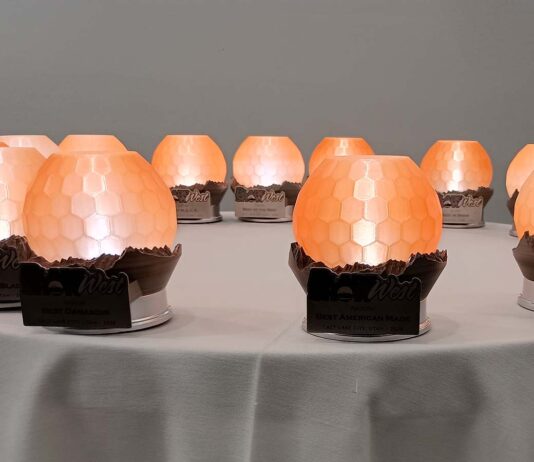
The custom and factory knife judging competitions recognized an array of outstanding work. The custom knife judges were Michael Vagnino, Lin Rhea and Bill Burke, while the factory judges were Tom Krein, David Carver and Clayton Ensigner.
The custom winners were: Best in Show and Best Fighter: Franco de Souza; Best Folder and Best in Show Contender: Tom Overeynder; Best Art Knife: Paul DiStefano; Best Bowie: David Lisch; Best Damascus: Pedro Fornari; Best EDC: Evan Nicolaides; Best Hunter: Josh Fisher; Best Kitchen Knife: Luke Dellmyer and Richard Patterson; Best Slipjoint: Evan Nicolaides; Best M.A.C.K.: Jared Oeser; and Best of the Rest: Josh Taylor.
CUSTOM BEST ART KNIFE Paul DiStefano won for Megachiroptera with an 11.5-inch blade in a “mosaic damascus of with leaves,” a theme that carries over to the African blackwood handle carved as a eucalyptus tree abundant with eucalyptus leaves. Overall length: 17.5 inches.
The factory winners: Best in Show and Best Imported Knife: Poikilo Blade VK-Zen; Best American Made Knife: Dauntless Manufacturing Clifft; Best EDC: Dauntless Manufacturing Moss; Best Fixed Blade: QSP Viper; Best Folder: Pro-Tech/Vero Engineering Synapse Auto; and Best of the Rest: Vero Engineering Vortex TI Maintenance Kit.
How you exert control determines knife handle design.
After 19 years as an autoworker, 30 years as a traditional woodworker and what seems an entire life of being a knife nut, I have come to appreciate a properly formed tool handle. During any workday at the auto plant, I picked up and used tools over 500 times—to be precise, once every 43 seconds. After a while, I started to take notice and favor tools shaped in an ergonomic fashion that allow efficient, accurate manipulation.
How useful is your knife if you can’t hold it and can’t control the edge? Just look to the “Riddle of Steel” from the original Conan the Barbarian movie. Steel is nothing compared to the hand that wields it. Perhaps that is where I find my largest bane. I constantly hear custom makers and users alike talking about a “super steel” and how they would use no other steel or find those to be the best, yet the fact that the knife is a system gets left by the wayside. A knife should be considered a tool and, as such, a tool that is easy to use. That’s if you plan to use it. “Gucci knives” are exempt. The blade and handle working together and a properly heat-treated steel is part of that, so let’s get started with how to hold a knife.
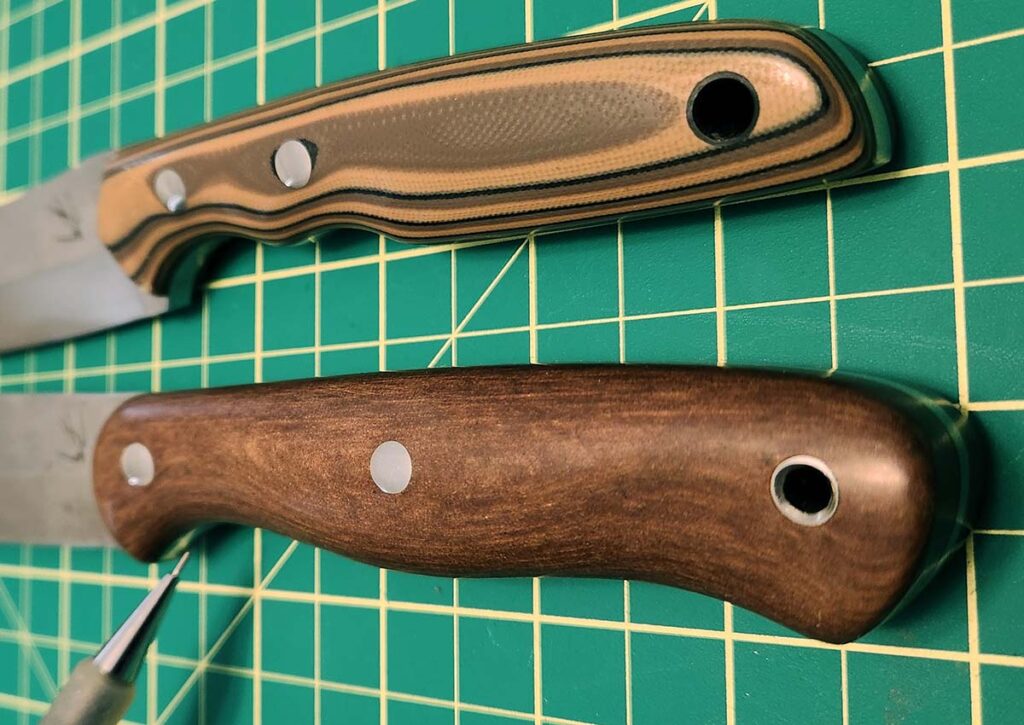
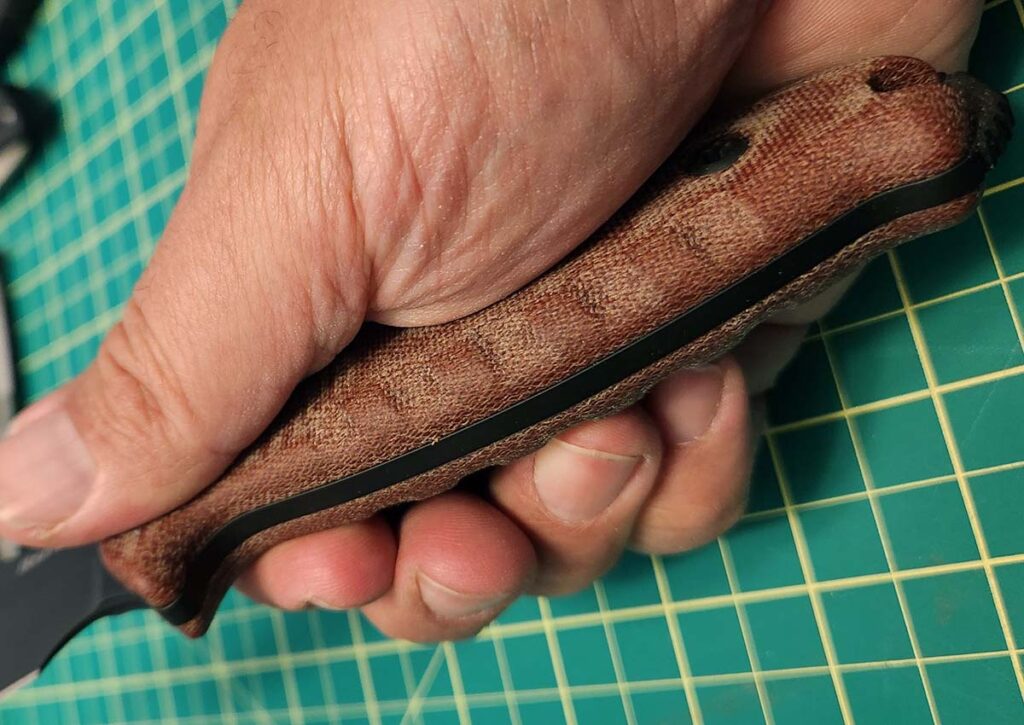
Two Diving Sparrow Knives prototypes. Follow the layering lines built into the material and you can see the flowing contours. The contours not only provide a place to grip but the subtle grooves give your fingers platforms to manipulate the knife in your hand
First off, I am not a human kinetics major so let me indulge myself and develop my own vocabulary for this section, along with some proper terms. The grip consists not only of just your hand but extends back farther through your wrist, forearm, elbow and all the way to the shoulder. Your arm works as a system and how your hand grasps an object will affect the positioning and strength exerted by your wrist and so on up the line.
3 Grip Functions
Starting with your hand, there are three functions of the grip I call selection, reaction and manipulation. Selection is when the hand selects or picks something up, often via the index finger and thumb. Usually, the intent of selection is to seek control over the object until it is firmly held within your grasp, resulting in a solid purchase. The group of muscles and body parts, that is, your index finger and thumb, are also the same group that normally exerts finite control for most people. Writing with pencil and paper is an example how over time humans have developed the index finger and thumb pinch for finer control. Watch any surgeon or chef use a cutting tool; specific direction is guided by the two main leaders of the band, the thumb and index finger.
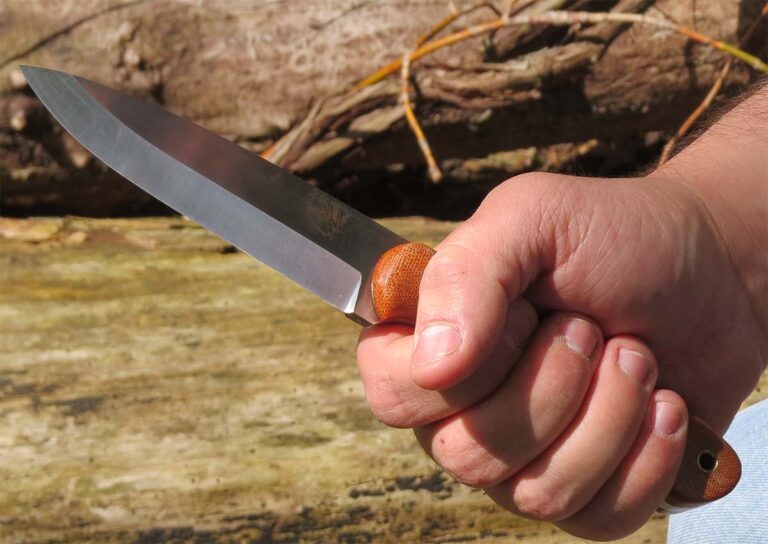
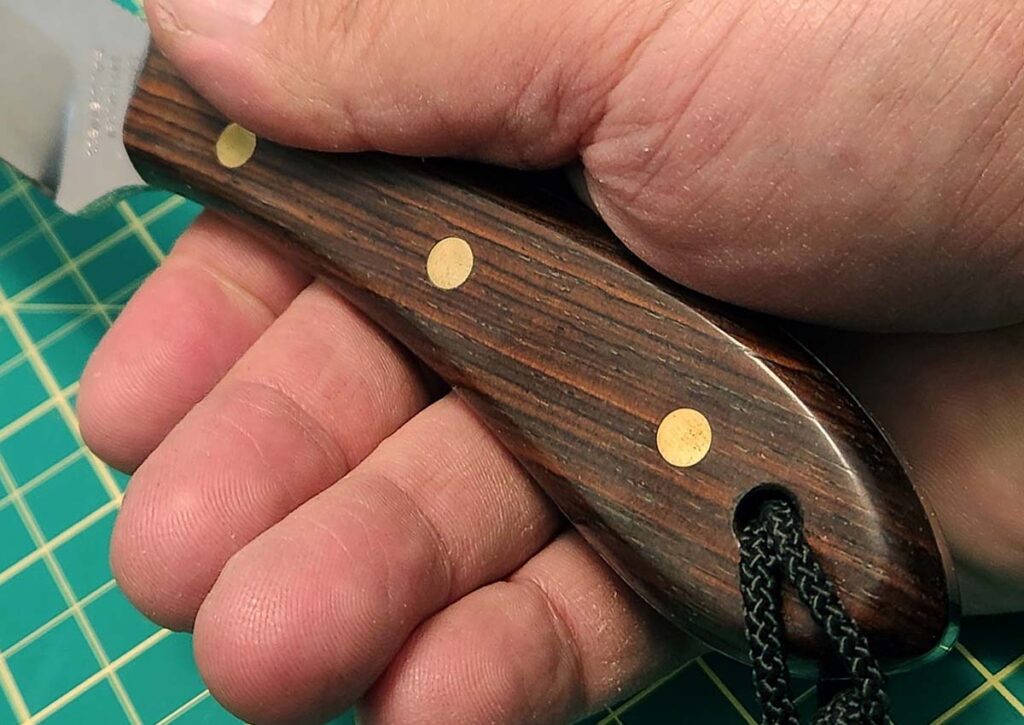
The Grohmann knives survival model uses a flared teardrop handle, narrow at the front and wide at the back, to prevent the knife from slipping from your grip.
Reaction is best reflected in the act of catching an item, be it a ball or what have you. Your hand is prepared to catch and instantaneously selects the process of gripping the item based on how it enters your hand and what parts of your hand it touches first. A good example is when something small touches the center of your hand; your fingers surround it because it is already in the middle of your grip. If the item is touched to the outside, say just on your fingertips, your hand tries to react by drawing the item to the center and then closing the fingers.
How reaction works in the use of tools can be expressed as “for every action there is an equal and opposite reaction.” Without getting into a huge physics argument over string theory and the purity of the law as it applies to using a knife, it is a simple expression of how your body works. As the cut is made, your body exerts force. In turn, the item being cut provides resistance. To maintain control, your body must adjust your grip; in that that way you can manipulate the tool to continue cutting. Simply speaking, your reflexes kick in, something your mind has been honing all your life and now operates on a subconscious level.
The Cold Steel Republic uses texture on the handle belly to prevent slipping.
Manipulation is what I call a blend of selection and reaction. During your effort to control a tool while using it, you try to coordinate selection and reaction to manipulate it. Remember: how your hand works is mostly subconscious. The process seems inherently simple while using tools; you decide what you want to do. Therefore, the next step is to direct the tool. Your hand goes into a selection mode with the intent of gripping and directing the tool. As you use the tool, different forces often change and your grip must adjust. Taken altogether, I refer to this manipulation as the process of exerting force with a tool and reacting while trying to accomplish the task/directing the tool.
Knife Handle Shape
Ideally, a knife handle should be large enough to fill your hand yet small enough for your hand to grasp it. Given that you’re provided just enough volume to fill your grip, you might figure you could solve the shape issue by grabbing a ball of clay and mimicking the resulting shape. Alternatively, you could keep it simple and use the broom handle approach.
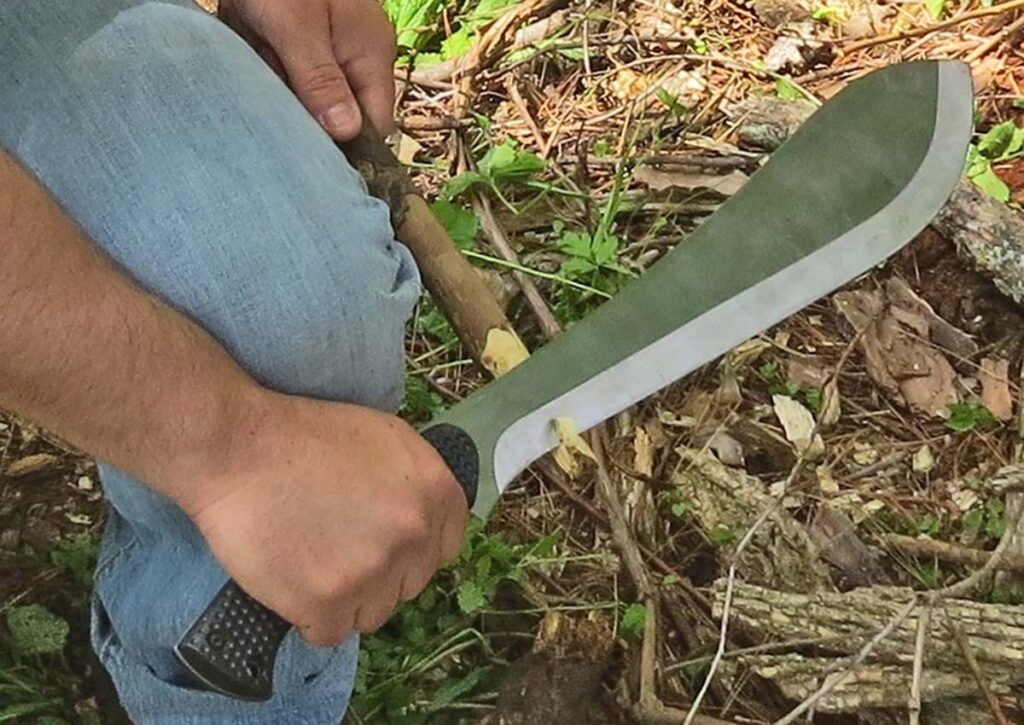
Fox uses a curved handle on its bolo-style machete to allow your hand some movement up and down the grip. “I tend not to like such a grip on smaller knives as it crams the fingers into a small area during use,” the author opined. “The flared back end prevents the hand from slipping off during a swing.
To optimize a handle, I use what I call the absence and presence method. Take, for example, a box-end wrench. The hole in the end of the box-end wrench fits around the nut. At the same time, the wrench has platforms designed to exert force on the flats of the nut to turn it. As the box-end wrench is to a nut, the hand is to a handle. A handle should be shaped to allow the hand to be able to grasp it, yet there should be enough handle to provide various platforms for the hand to exert pressure on to manipulate the knife itself. To achieve this, consider the knife’s purpose.
In shaping the handle, keep in mind first and foremost it must fit the hand. Secondly, it must have platforms/contours that provide places to push off from to control the edge, all the while being mindful not to create hot spots that might abrade the skin either via sharp surfaces or by simply rubbing against the handle.
Knife Handle Materials
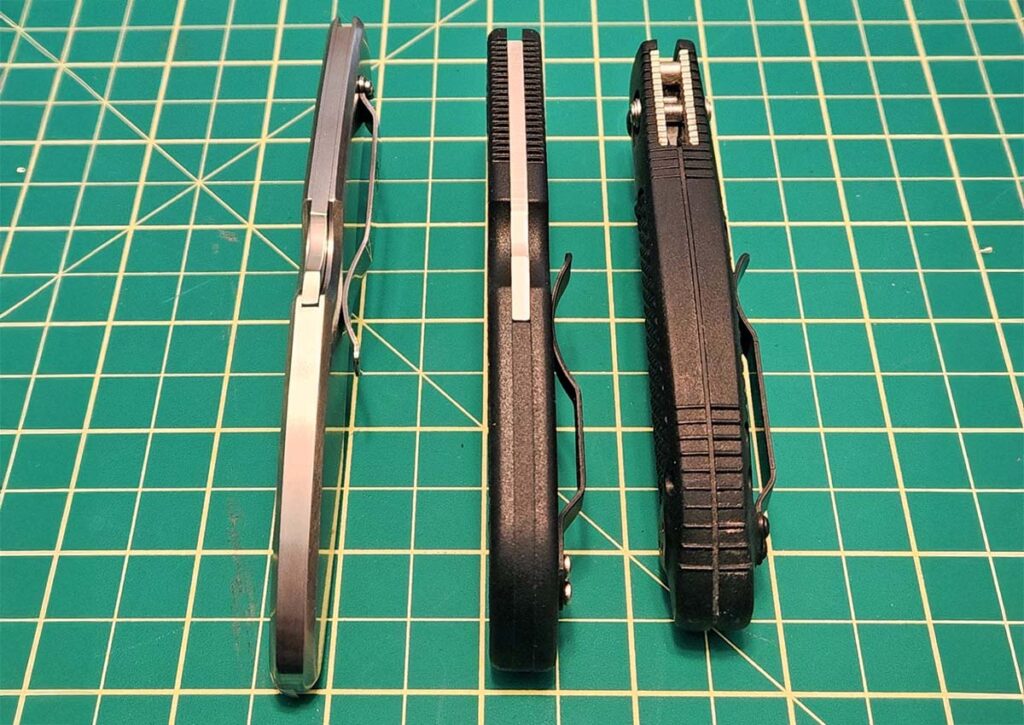
The trim profile of the Spyderco Police (left) allows manipulation for draw cuts, point use and especially lateral force. The Spyderco Endura (center) is a good midway thickness for an EDC. The Benchmade Griptilian (right) has a thicker handle and, like the Endura, scale texture. When using the Griptilian you will find lateral rolling in your hand a bit smoother because of the handle’s fullness.
There is a staggering array of available handle materials, including wood, G-10, carbon fiber, Kirinite and many more. Custom makers even employ rubber barn mats used for horses for cutting competition/chopper handles. Materials chosen correctly can enhance your grip or even overcome some shortfalls of certain handle designs. The use of materials is a large enough topic on its own; I cannot do it justice here. Let it be said, though, that a lot of it is influenced by design and structure.
A handle occupies a three-dimensional space, so forming it should take a three-dimensional approach that addresses the grip’s length, width and thickness. Fine points in design depend on the knife’s use. For instance, a chopper should have a natural stop at the handle butt to prevent your hand from sliding off while swinging, though the stop should not jam or create a rub point to irritate your hand.
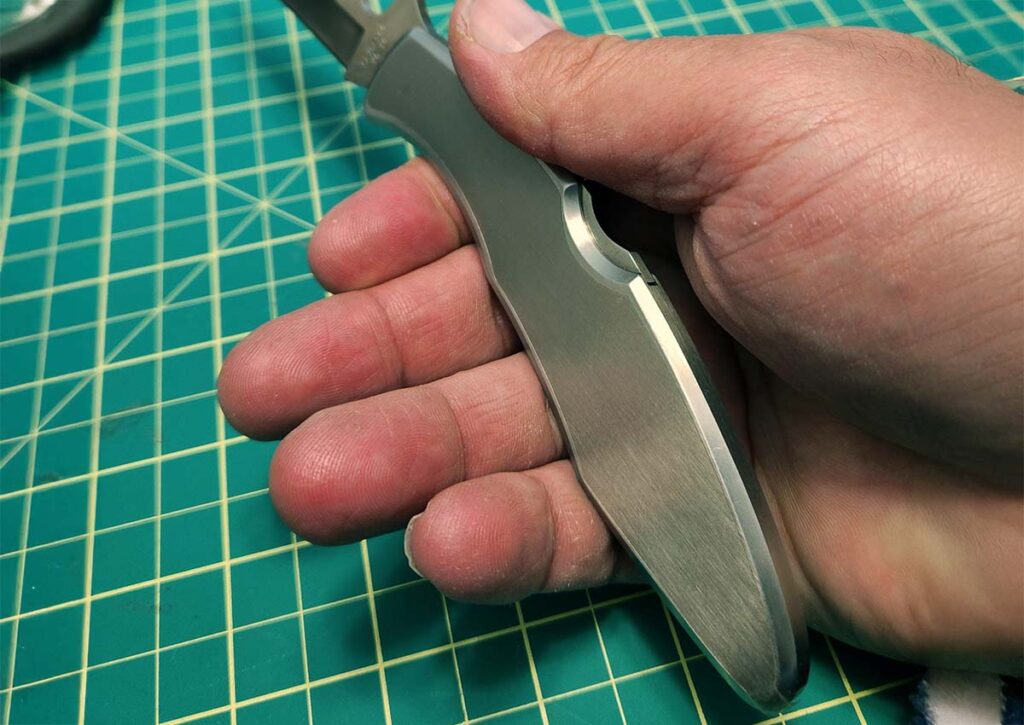
The trim handle of the Police enables it to sit nicely over the joints and in-between the pads of your fingers. The trim grip also enhances lateral knife control.
There are many fine points to look over in a handle but the major thing for me is that those finer points should get more consideration. For example, consider again a chopper. Too often I’ve seen chopper handles be too narrow. When a chopper strikes something solid, the energy from the impact travels through the chopper to your hand. A wider handle would distribute the force more evenly, preventing shock to your hand. If the handle is too narrow, the force will be concentrated on a small area. A wider handle will disperse the energy over a broader area, lessening the effect of the impact. In the end there is a fine balance because you do not want the handle to be so large that it’s difficult to hold. That’s why handle design tends to be a sticking point for me when not enough attention is paid to doing it properly.
There is way more information to cover about handles than I can cover in such a short article. I have only grazed the surface here. Creating a well-formed handle and covering common mistakes would take a chapter of a book. I could burn up a whole article on handle nomenclature alone. Hopefully, this will get you thinking more about the handle on your knife than just the latest super steel for the blade.
Cutting Through the Costs: How Tariffs Are Reshaping the Global Knife Industry.
Tariffs. The simple mention of the word makes some folks tear their hair out. That’s not a problem for me because the word doesn’t upset me that much. Besides, most of my hair has already fallen out anyway.
As you know, a significant portion of American knife companies depend on China to manufacture some, most or all of their knives. As you also no doubt know, President Trump is addressing America’s tariff imbalance with other countries—including China—in no small part to help erase some of America’s $36 trillion debt. And, at press time, he was threatening to impose higher tariffs on China than any other country.
How will the President’s tariffs affect the knife industry? I asked one industry insider and he told me of a recent trip he made to China to talk business with those who make many of the knives for the company he represents.
He said the last time he went there was 2018 and he was amazed at all the changes in the interim. There wasn’t a bridge from Hong Kong to China seven years ago. Now there is one and they drove on it to the Chinese mainland. There are new superhighways all over with no cars on them.
“It’s crazy the money they’re spending on infrastructure,” he wrote. When he went to one city in 2018 there wasn’t a traffic light in sight. Now it’s a city of 2.6 million people with high rises everywhere.
“Maybe it was my imagination but the vibe wasn’t great,” he observed of the reception he received earlier this year. “A couple of factories seemed to blow me off. I used to get the golden carpet treatment. One of our guys who speaks Chinese said he was having a hard time getting answers from some of them. I think the tariffs have them scared.”
I wondered out loud if the Chinese manufacturers thought they’d gotten most all they could out of the company my friend works for and are looking at other revenue avenues.
“I don’t think so,” he wrote. “The other markets are small in comparison to the USA. The Chinese knife factories are so specialized that making knives is really all they know.”
He added that the big Chinese manufacturers are building factories in Vietnam to avoid the tariffs, though he predicted the President would close the Vietnam loophole soon if he hadn’t already by the time this story hits print. I asked if that would make it more economically feasible for those American companies who have knives made in China to have them made domestically, and he hit me with the cold, hard facts.
“Rough numbers: cost to make a folder in the USA, $100; cost to make the comparable folder in China, $25. Double the cost with tariffs and Chinese-made knives are still half priced,” he emphasized. “Knives are such a niche market and relatively low volume that even with automation it would be tough to match the price of knives made in China. Marketing, design and innovation can overcome that cost gap. Look at Benchmade. They are killing it.”
Concerning my earlier question of whether the Chinese manufacturers might be looking at other sources of revenue, he returned with a qualifier.
“I did see two factories that are now making manicure stuff like nail clippers. Ten years ago you would not have seen that. A knife factory was a knife factory. One factory was making Nite Ize® products, so I guess they are diversifying,” he wrote.
“One more thing,” he added. “I went to a big-name [Chinese] factory and the owner did not appear to be worried about tariffs. He is focused on making the best knife he can, so I think you could say the higher-end manufacturers aren’t as worried about tariffs.”
My insider friend, however, disagrees with that rationale.
“I think when the market goes bad even the billionaires slow down on impulse buys,” he opined.
On the domestic side, at least one U.S. company official says costs are increasing for steel and other knife materials even though the steel and materials are U.S. made. Meanwhile, by the time you read this, here’s hoping the President has been able to work out, or is well on his way to working out, deals with most if not all of the countries on which he imposed tariffs. Either way, as my insider friend summarized,
“The tariffs are going to have a big impact on our little industry!”
Top makers explain how they collaborate with knife companies.
The old cliché of the win-win holds a real grain of truth. Any successful partnership must be mutually beneficial, and in the knife industry the phenomenon of the collaboration has come to exemplify the upside of working together.
Years ago, a veteran custom knifemaker described his relationship with a major manufacturer as serving as the company’s research and development department. Such a description is accurate in that the manufacturer often relies on the custom maker for new design inspiration, from good looks to materials and mechanics. The collaboration has emerged in the last 35 years or so as an outstanding means of bringing innovation to the public and putting first-rate knives in the hands of the mass market.
The ins and outs, nuts and bolts, and give and take of the collaboration process raise questions for makers interested in striking deals of their own. A few comments from makers who have achieved great success on the collaboration frontier offer helpful insights.
“It goes both ways,” observed BLADE Magazine Cutlery Hall-of-Fame® member Bob Terzuola, who indicated he completed his firstfactory collaboration with fellow Cutlery Hall-of-Famer Sal Glesser and the design team at Spyderco in 1989. “You can go to the company or the company can come to you depending on your notoriety. If you are just starting out, you probably have to go to the company.”
On the business side of the ledger, Suzi Terzuola takes the lead and has demonstrated proficiency in making the deal work for everyone involved. Her flair for negotiation and finding the right blend of maker-manufacturer cooperation has been demonstrated through the years as Bob has worked not only with Spyderco but also the old Camillus, Boker, Fox, Pro-Tech, Tactile Knife Co. and others.
BLADE Magazine Cutlery Hall-of-Fame® member Bob Terzuola has done collaborations with many companies, including the Bob Terzuola ATCF Auto Ultimate from Pro-Tech, the BLADE Magazine 2022 Investor/Collector Knife Of The Year®. (Eric Eggly/PointSeven knife image)
“I was raised by parents with their own successful businesses,” Suzi observed, “and I saw Bob receiving passive income from Spyderco and Camillus, and of course passive income is how you survive after having only so many years to make knives. I began looking at the knife designs Bob had and tried to match the design to the company. Bob has patents lining the walls, and when he lends his name to a knife he should receive a signing bonus and a bonus against the royalties.”
In return for his design skill and the use of his name in promotions, Bob has certainly established himself as a leader among successful custom collaborators. His contribution to a company’s success has enhanced his reputation of excellence across the industry, while Suzi has forged a business posture that results in security for the future.
Knife Collaboration Contracts
The contract is the key component of a collaborative deal, and depending on the circumstances everything is negotiable. Although early agreements made among friends were sometimes done on a handshake, it has become a “best practice” to hammer out the terms of the collaboration on paper, invest in an attorney’s review, and formally memorialize the discussions. Standard royalties run roughly 5 percent of the price at which the company sells the knife.
The Terzuolas include a period of time in which the company is allowed to produce the knife; the period may be extended at maturity with the agreement of both parties. Further, there may be a requirement that the company produces a certain number of knives in a given time period, also renewable. Restrictions on wholesale pricing or discounts that affect royalties may also be negotiated.
For those considering a foray into collaborations, Bob and Suzi offer some advice: “If you’re a new maker, you shouldn’t just walk up to [the company’s] booth at a show. Make an appointment to see them because they are at the show to deal with customers. Approach a company with one or more finished designs. They want a package presented to them, a prototype or existing model, something they can hold in their hands, and in the case of a prototype it’s good to have as many innovations and design creations as you can—anything that will set the knife apart from other potential deals out there.”
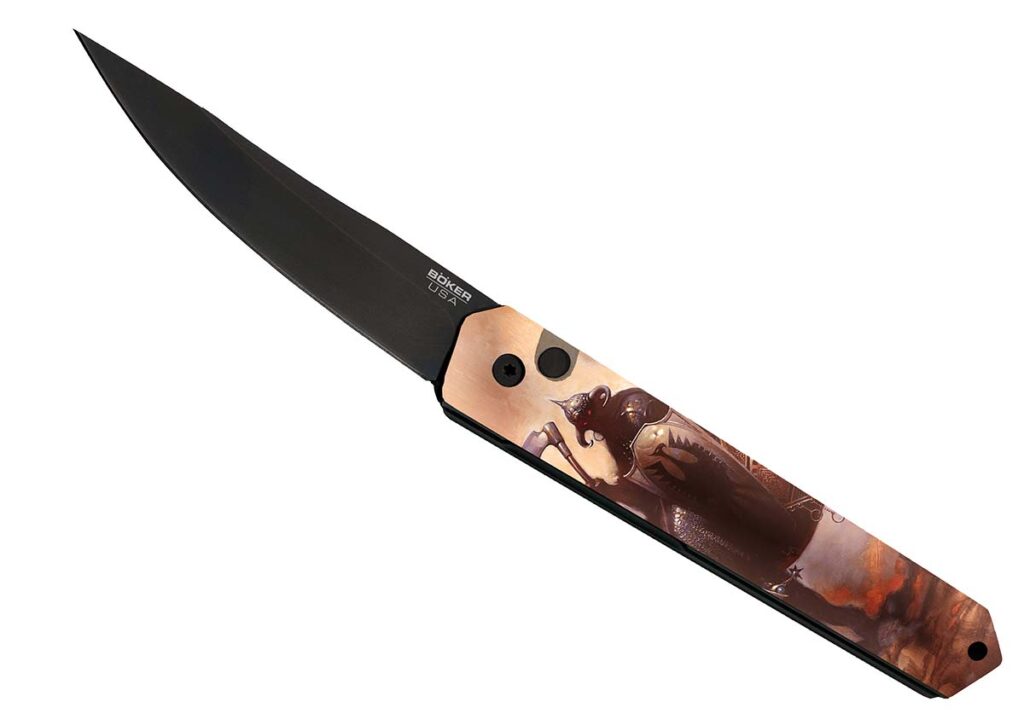
Lucas Burnley has designed several iterations of his Kwaiken for Boker, including the Kwaiken Auto Frazetta.
Suzi added that a higher profile in the industry can drive success.
“We are the R&D for a knife company,” she noted, “and when you approach them for a collaboration your social media resumé is very important.”
Making custom knives since 1994, Darriel Caston has concluded collaborations with numerous companies, including CRKT, Spyderco, Boker, V Nives, Kansept Knives and more.
“I’m prolific when it comes to designs,” he affirmed. “There are probably about 300 that I will never get to making. I’m an engineer by trade and my 3D drawings are almost ready for production, and that helps with the deals. They ask for STEP files [standardized 3D model data files for CAD and 3D printing] that can go right into machining. Sometimes we work with a prototype, and sometimes we work with a knife that I have been doing for quite a while.”
According to Darriel, one significant element of the collaboration is the retention of the rights to the design.
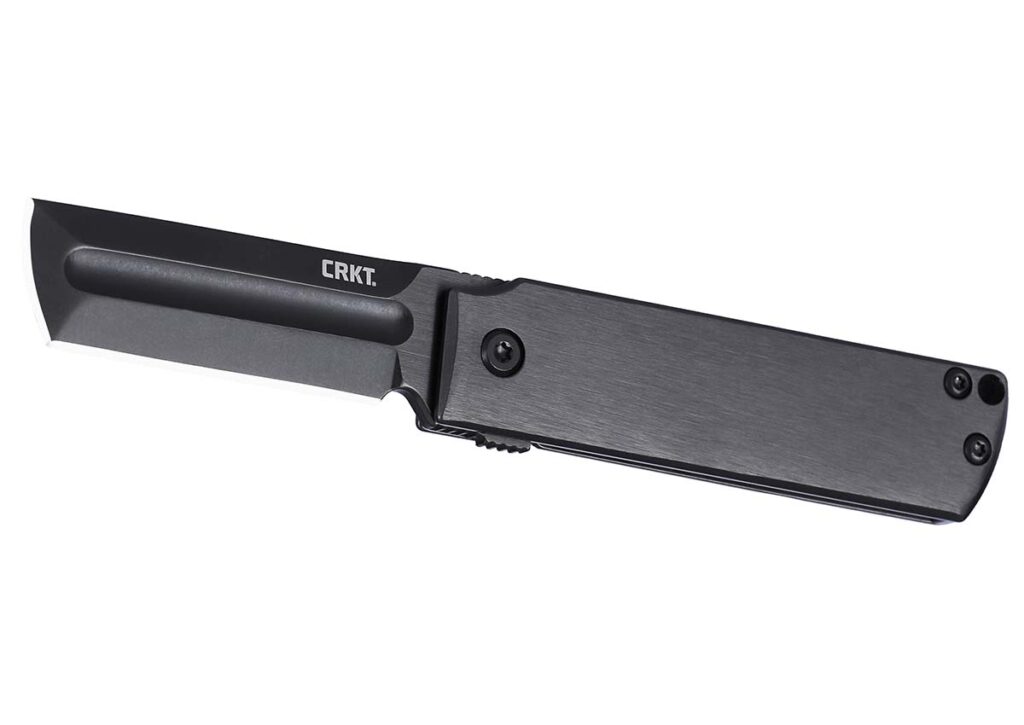
“Anybody who wants to do a collaboration must put footprints in the sand, get their work out there and show a story,” custom knifemaker Darriel Caston observed. One of his latest designs for CRKT is the blacked-out MinimalX framelock folder, an evolution of a knife originally made for SpaceX to commemorate a rocket launch.
“You never want to give up your design,” he warned. “I would license the design to the company usually up to four or five years, and the average is three years. After that, you can discuss if you want to continue if the relationship has been good for both parties. License the design and never sell it. If a company buys the design, then they own it forever. If it became their best seller, I could never make the knife again, and I would have to stay away from anything that looks like it.”
For Caston, every deal starts with a friendly conversation. As progress is made, attorneys draw up the contract. He sees the process as straightforward, whether dealing with an American manufacturer or a company headquartered in a foreign country.
“I find the knife community for the most part to be very honorable,” he commented. “I haven’t run into any bad juju. When you want to do a collaboration, I tell people they need to have a name and a track record of good designs with people following them on social media and stuff.”
Since his first collaboration—with Spyderco in 2015—Darriel can speak with confidence regarding the potential for success.
“It would be rare for someone to take a design to a company without a history or a footprint there. They look for your story,” he noted. “Anybody who wants to do a collaboration must put footprints in the sand, get their work out there and show a story. Then it becomes easier.”
Getting A Collab Off The Ground
Darriel Caston has concluded collaborations with several companies. “I’m prolific when it comes to designs,” he affirmed. “There are probably about 300 that I will never get to making.” Now discontinued, the Squarehead was one of his early collaborations with Spyderco.
Custom maker/U.S. Marine Corps veteran Les George found early collaboration success at the SHOT Show some years back. He approached Pro-Tech a decade ago, and the association has continued since then.
“I had just finished my first batch of VECP [Value Engineering Change Proposal] mid-tech knives,” he remembered, “and I thought it would be cool to see Pro-Tech make the knife in an automatic. So, I did the CAD work to change the knife to an automatic and walked up to their booth at the SHOT Show. I asked to speak to the owner, and Dave Wattenberg came over and shook my hand. I drew a big breath and told him, ‘My name is Les George and I am a knifemaker and I have a design I think would be a great knife for you to make as an auto and I already have the CAD done would you like to see it?’ I said that all as one sentence in one breath!”
Still, a pragmatic view of the collaboration landscape demands preparation and planning. A so-called “cold call” may not meet with success.
“It depends on the company whether a direct approach will work or not,” George conceded. “Don’t walk up to a company at the BLADE Show and tell them you’re a hot maker and they should pay you to make one of your designs. Instead, walk up, introduce yourself, and show them with CAD pictures, a 3D printed model, or a real knife, and tell them why you think it would be awesome to work with them on a production project.”
When it comes to her husband Bob’s collaborations, Suzi Terzuola takes the lead and has demonstrated proficiency in making the deal work for everyone involved. An example of several overseas Terzuola collaborations is the Clap from Italy’s Maniago Knife Makers.
Les sees the components of a particular collaboration deal varying. Of course, some of the structure depends on the negotiating skills of the parties. Commonly, the compensation may revolve around a percentage of dealer or distributor pricing on each unit, and particular deals may extend as long as each party is pleased with the progress.
“Collaborations should run as long as they are profitable,” Les remarked. “Companies don’t generally kill a successful project unless there is a capacity constraint issue or something else outside hindering it. Both parties can end the deal at any time with some allowances for production to finish with the things they have in progress already. Every contract I have ever seen gives one company the rights to exclusively make a particular model. My contracts have a provision that I can make as many customs of my models as I want. In the end, it would be counterproductive to license the same model to multiple companies. The maker would be competing with himself at that point, and it’s not helping the companies.”
Priming The Pump
Award-winning maker Lucas Burnley appreciates the help of friends in establishing a firm footing for collaboration.
“In general, I’m a big fan of pulling on my network,” he said. “If you have someone you can reach out to for an introduction, that’s always a strong move. If you don’t have someone to make an introduction, you might be able to ask around and at least figure out who you need to talk to. Regardless of how you get your foot in the door, I highly recommend going to a knife show and trying to set up a meeting in person.
“A design is only one part of a collaboration,” he continued, “so bring your ‘A’ game and think about what other value you can provide for the company. I was introduced to Boker by Jens Anso and Jesper Voxnaes, and Ken Onion put in a good word for me with Columbia River Knife & Tool. I’ll be forever grateful for those introductions and the relationships behind them. I’ve been able to pay it forward a few times, and hopefully I’ll be able to do it many more times in the years to come.”
Les George’s V14 dagger design for Spartan Blades was the BLADE Magazine 2014 Investor/Collector Knife Of The Year®.
In Burnley’s experience, contracts provide compensation most often in the form of monthly or quarterly royalties based on a percentage of sales. One-time lump sum payments are also seen; however, the income generated depends on the goals of the two parties involved.
“I want my designs to run until my grandkids are old enough to thank me for my good decisions,” he laughed. “If a model is selling, I want it to keep selling. On the flip side, I will routinely ask what models we can kill if they aren’t pulling their weight.
“One caveat here is that if a design is still in production, I want to get paid for it,” he concluded. “Some companies will offer a contract for a set period of time but have the option of continuing to produce the model. I view this as somewhat akin to a one-time payout. If it works for you great; just make sure you are paying attention.”
George specifically limits the number of companies he works with in order to give the relationships the priority he believes they deserve. Consistency, he says, is huge. Real, solid collaborations are not “get-rich-quick schemes.” He remembers getting his first collaboration check in 2014 totaling a whopping $6.
“A design is only one part of a collaboration,” Lucas Burnley observed, “so bring your ‘A’ game and think about what other value you can provide for the company.” His Tuna Compact framelock design for CRKT is one of his latest collaborations. “A design is only one part of a collaboration,” Lucas Burnley observed, “so bring your ‘A’ game and think about what other value you can provide for the company.” His Tuna Compact framelock design for CRKT is one of his latest collaborations.
Times change—and checks change with good business practices, commitment, follow through, and most of all a process from contract to design and product that proves profitable for everyone.
Hone your cutlery acumen at the 12th Annual BLADE University
How to make and design knives, how to determine which steel for which knife, what to look for in proper damascus patterns and how to enhance their appearance and other incisive knife subjects will highlight the class schedule of the 12th Annual BLADE University. Held in conjunction with the 44th Annual BLADE Show June 6-8 at the Cobb Galleria Centre in Atlanta, BLADE University will be sponsored by Work Sharp. Classes begin the Thursday before the show, June 5, and will run through Friday, June 6, and Saturday, June 7. All courses will be taught in the Cobb Galleria except one—Fundamentals of Grinding—which will convene under the tent in The Courtyard, aka the parking lot of the show’s host hotel, the Renaissance Atlanta Waverly.
BLADE University assembles some of the world’s best knifemakers, bladesmiths and other cutlery and steel professionals to teach a wide range of subjects for the knife user, knifemaker, knife hobbyist, knife entrepreneur, knife designer, and knife aficionado and novice alike. If you love knives or are just beginning to, BLADE University has a topic for you. The complete course schedule, with subjects, teachers, times and venues:
Thursday, June 5
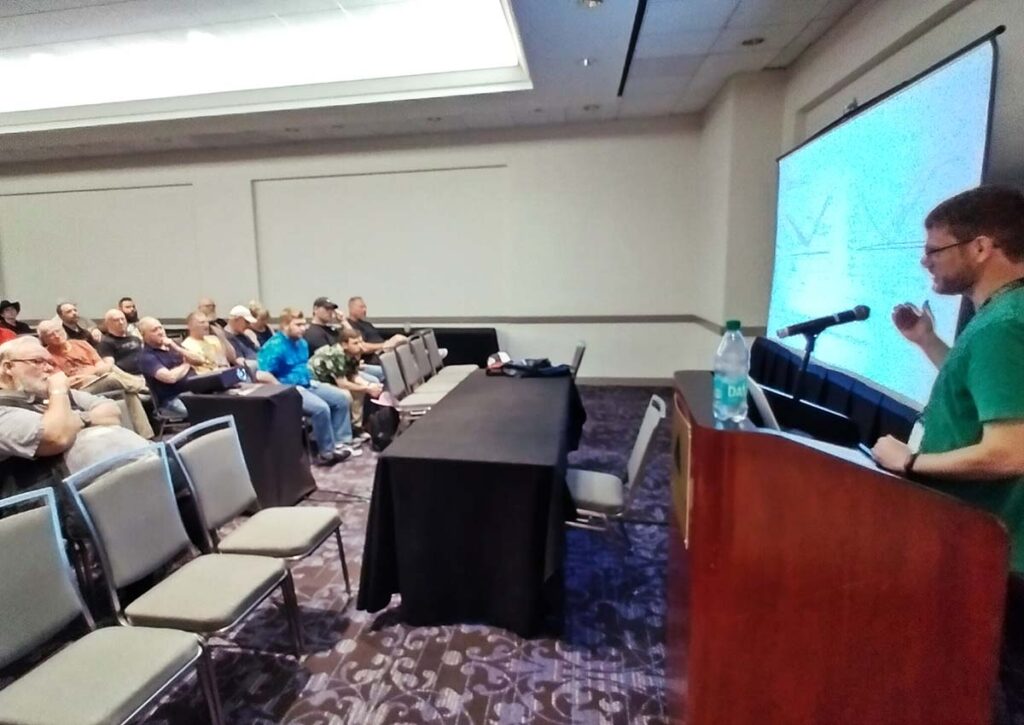
In “Level Up Using Lasers, Ninjas and Other Cool Tools,” ABS master smith Neels van den Berg dives into how tools like laser engravers, digital design, and jigs and process design can streamline your workflow and enhance your work.
Material Conservation for the Forging Smith, Mareko Maumasi, 4 to 5 p.m., Room 104—Award-winning bladesmith Mareko Maumasi shares techniques and approaches he uses to reduce guesswork and material waste in the workshop. His approaches not only help the knifemaker’s material go further but also save time and money.
Friday, June 6
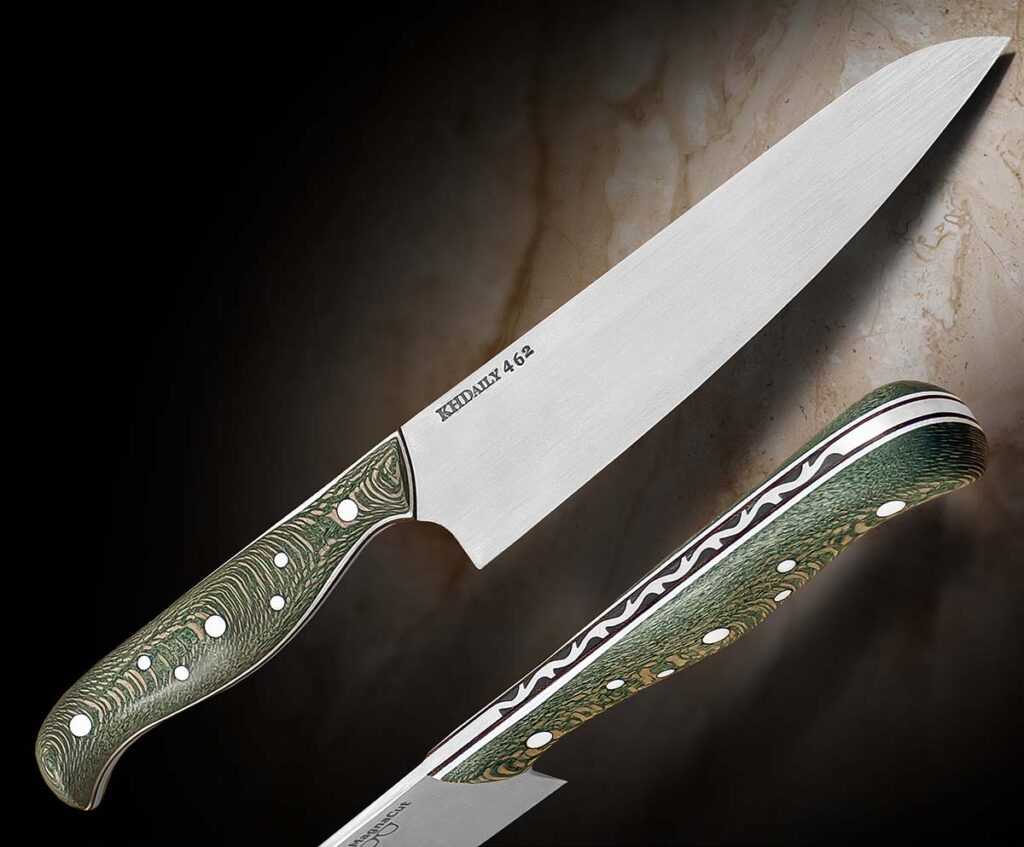
In “Elevating Your Handle Appearance: Spine Filework, Handle Shapes and Pin Placement,” knifemaker Kyle Daily shares his preferred files and specialized equipment for crafting his five most popular filework patterns, ensuring your knife not only looks exceptional but also feels comfortable and functional. (Jocelyn Frasier knife image)
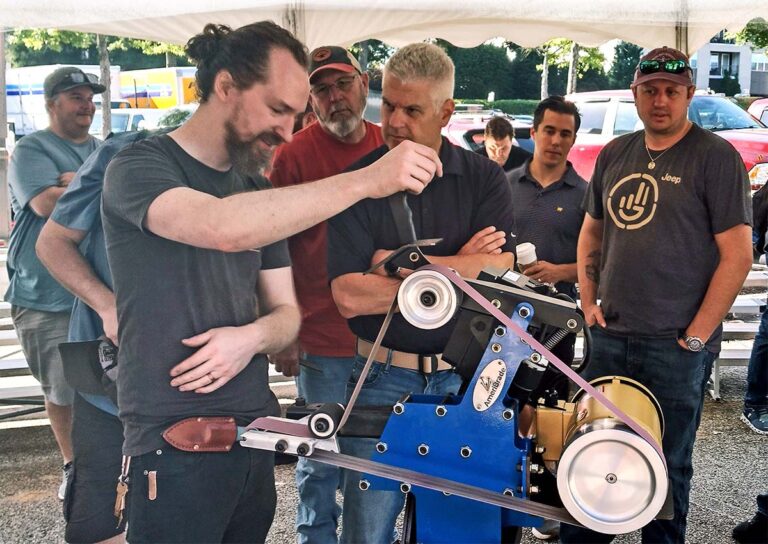
Fundamentals of Grinding, AmeriBrade and guest grinders, 8 to 9:30 a.m., The Courtyard—AmeriBrade and guest makers provide a general overview on grinds, techniques and different equipment. The class is interactive and the team answers questions and demonstrates suggestions for common issues.
Deep Dive into Culinary Knives, Mareko Maumasi, 10 to 11:30 a.m., Room 103—Mareko Maumasi returns to help collectors and makers better understand the nuances of high-performance culinary knives. The class covers design aspects from blade tip to pommel, aiding collectors in making more informed knife-buying decisions, and makers in creating higher-quality and higher-performing culinary knives.
The Tom Brown Tracker Experience, Mathew Williams, 1 to 2 p.m., Room 107—Experienced woodsman and tracker Mathew Williams discusses the iconic Tom Brown Tracker knife, including the blade’s notable features, how the knife’s function can be of benefit to the user and more. Mathew even dispels some Hollywood myths concerning the TBT. This one’s for old-time fans and newcomers alike.
Take Damascus Etching to the Next Level, Baker Forge, 1:30 to 2:30 p.m., Room 103—Greyson Weltyk of Grey Blades and Jordon Berthelot of JB Blades teach step-by-step processes on how to enhance intricate patterns in damascus with Gator Piss etchant, including in-person demos with damascus knives. Subjects include proper cleaning prep, temperatures, stacking oxide techniques, sealing oxides and more. Receive in-depth looks at new product offerings from Gator Piss for etching stainless damascus and properly sealing damascus with nano-ceramic technology. Have the opportunity for Q&A with authorities about damascus etching.
Hands on Sharpening, Work Sharp, 3:30 to 4:30 p.m., Room 113—What happens when a knife goes dull? How do you know when to sharpen it? Bring your own knife or borrow a demo model and learn the progression of shaping a bevel, sharpening and edge maintenance from the team at Work Sharp. You get hands-on practice and experience sharpening your blade using a variety of sharpeners and abrasives, from whetstones to belts. (See under Saturday’s classes for an encore presentation.)
Leather Sheath Making Tips, Tricks & Tools, John Dennehy, 4:30 to 5:30 p.m., Room 107—Classes on sheath making are conducted at knife shows, social media and elsewhere. Unfortunately, some of the online demos are by those giving the wrong advice. John Dennehy shares the sheath-making tips he’s learned after working leather for almost 50 years, including leather selection, the tools he uses and why he uses them. He also covers the construction details he employs that experienced leather workers recognize immediately as the ones needed to produce a professional sheath.
Saturday, June 7
In “How to Select the Best Steel for Every Knife,” steel metallurgist Dr. Larrin Thomas talks about the factors that are important for different types of knives, such as cost, toughness, edge retention, sharpenability and corrosion resistance.
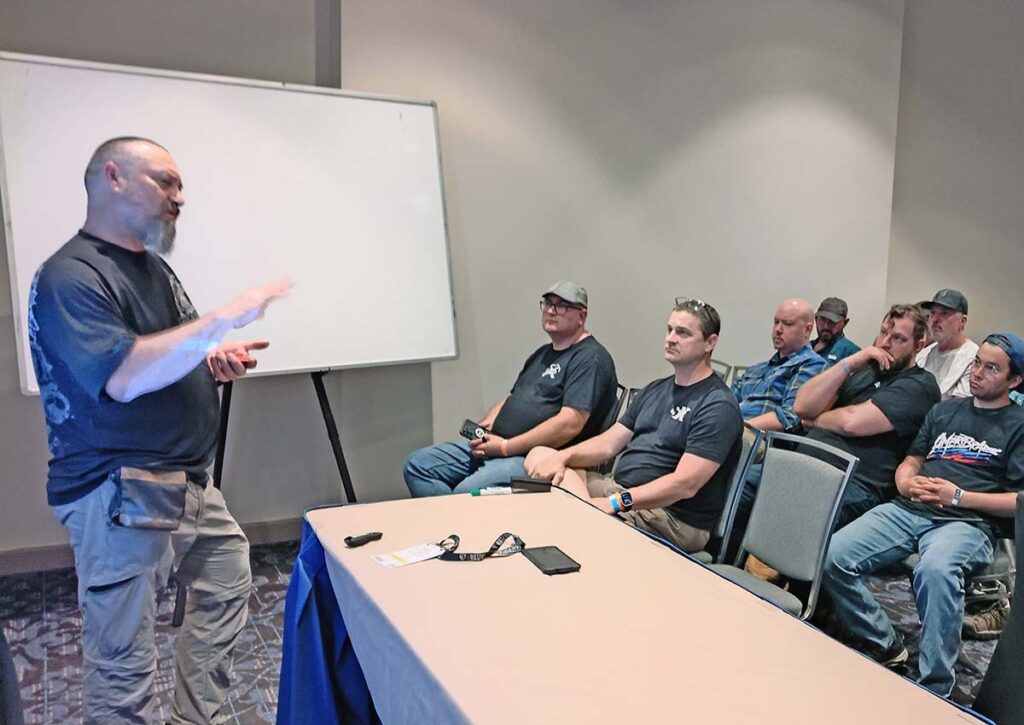
Elevating Your Handle Appearance: Spine Filework, Handle Shapes and Pin Placement, Kyle Daily, 8:30 to 9:30 a.m., Room 113—Enhance the appearance of your knife with distinctive features that go far beyond standard production models. Knifemaker Kyle Daily from KHDaily Knives guides you through the intricate art of filework on the spine, while also sharing insights into handle design and pin placement on the handle. Discover Kyle’s preferred files and specialized equipment for crafting his five most popular filework patterns, ensuring your knife not only looks exceptional but also feels comfortable and functional. From laying out your pattern to a step-by-step tutorial, this class provides the essential knowledge to achieve a professional and eye-catching finish. A Q&A session at the end ensures you leave with the skills and knowledge to take your knifemaking to the next level.
Demystifying Damascus, Mareko Maumasi, 9:30 to 11 a.m., Room 104—Mareko Maumasi completes his third straight day of teaching BLADE University classes with a most challenging one. He breaks the subject down in a way to help collectors gain a better appreciation for the knowledge and skill required to make unique damascus patterns, and to deepen the makers’ understanding of pattern design and composition.
The Cutting Edge, Nick Italiano, 9:45 to 10:45 a.m., Room 107—Nick Italiano, seasoned outdoorsman and host of the Raise The Flag Podcast, discusses the nuances of various blade grinds. From common everyday uses to survival situations, Nick covers several common grinds and their real-world function.
Level Up Using Lasers, Ninjas and Other Cool Tools, Neels van den Berg, 12:30 to 1:30 p.m., Room 113—Step up your knifemaking game with cutting-edge technology, unconventional techniques and insider secrets from ABS master smith Neels van den Berg. In this high-energy session dive into how laser engravers, digital design, and jigs and process design can streamline your workflow and improve your work. Plus, explore the mindset and discipline—the “ninja skills”—that separate good makers from great ones. Packed with real-world examples, practical insights and a touch of humor, this is a must-attend for makers looking to work smarter, not harder.
Designing Knives: Philosophy, Tools and Inspiration, Jens Anso, 2:15 to 3:15 p.m., Room 104—Award-winning knifemaker Jens Anso shares his approach to knife design, including how he thinks about form and function, the tools he uses and where he finds inspiration. With decades of experience in the industry, he’s developed a clear design philosophy that balances aesthetics, ergonomics and real-world usability. He explains his workflow, from sketching and CAD modeling, to prototyping and refining details. His goal is to provide insight into the design process and share practical takeaways for makers and enthusiasts who want to push their work further.
Hands on Sharpening, Work Sharp, 2:15 to 3:15 p.m., Room 113—What happens when a knife goes dull? How do you know when to sharpen it? Bring your own knife or borrow a demo model and learn the progression of shaping a bevel, sharpening and edge maintenance in this encore presentation from the team at Work Sharp. You get hands-on practice and experience sharpening your blade using a variety of sharpeners and abrasives, from whetstones to belts.
How to Select the Best Steel for Every Knife, Larrin Thomas, 4 to 5 p.m., Room 104—Both the makers and buyers of knives have many options for steels, but how do they know which ones to choose? Steel metallurgist Dr. Larrin Thomas talks about the factors that are important for different types of knives, such as cost, toughness, edge retention, sharpenability and corrosion resistance. Which steels are more optimal for a large chopper, a kitchen knife or a folder? For makers, the topics of forgeability, grindability, polishability and ease of heat treating are covered to choose steels that perform well and fit the knifemaking setup.
More classes were being determined at press time. For more information on them and on how to enroll in one or more of BLADE University’s classes, see our course offerings. There will be additional information on BLADE University in the June BLADE® and also in the BLADE Show Program, copies of which will be distributed for free at the BLADE Show.