Betty Dowell was the juggernaut that made Ted Dowell’s knifemaking business move.
Elizabeth “Betty” Ann Dowell, the driving force behind BLADE Magazine Cutlery Hall-of-Fame® member Ted Dowell, teacher, mother, grandmother and friend of the knife community for over half a century, passed away July 2. She was 93.
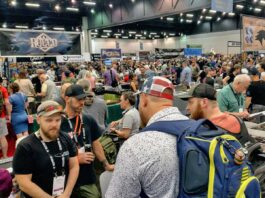
Most fittingly, she lived long enough to watch on Zoom as Ted was inducted into the Cutlery Hall of Fame June 5 at BLADE Show 2024.
Betty and Ted were married in 1953 and moved to Madras, Oregon, in 1954, where Betty was a part-time substitute teacher and homemaker raising three children: Scott, Lynn and Jeff. The family moved to Bend, Oregon, in 1964, where Betty became an accomplished substitute teacher in the Bend Public School System.
Ted, meanwhile, accepted a professorship at Central Oregon Community College, where he was dean of the mathematics department. He sold his first knife in 1967 and helped found the Knifemakers’ Guild in 1970, along with Cutlery Hall-of-Famer Bob Loveless writing the organization’s bylaws in the process. Ted also later served as Guild president.
Betty and Ted at the 2009 Knifemakers’ Guild Show in Louisville, Kentucky, the last of their 40 consecutive Guild Show appearances as an exhibiting team. Ted passed away in 2012.
Ted went full time making knives in 1974 and started TMD Knives in 1975. That same year the Dowells suffered the tragic loss of their son Scott, 19, in a car accident. Betty took the lead role in getting her family through such a trying time, as well as maintaining the knifemaking business.
As Jeff noted when he inducted his father at the Hall-of-Fame ceremony this past June, “My mom was galvanized and determined to have a family to take care of and a household to run, and she ran every bit of the business. [Dad made the knives] but everything else she did. She attended to every detail of the business. She had two kids to take care of and she had a grieving husband and a knifemaker and a business to support, and she did so for another 40 years.”
In fact, until the Dowells closed their knifemaking operation in 2010, Betty was the rock of TMD Knives, handling all of the purchasing, inventory management, accounting, correspondence, promotions, and travel logistics for the company. Her attention to detail and level of documentation of the business was as comprehensive and complete as possible.
Betty’s work accomplishments at TMD Knives and the Dowells’ ground-breaking efforts in getting the Guild established early on earned her the Guild’s coveted Nate Posner Award in 2015 for support “above and beyond” of the Guild and the custom knifemaking industry.
Ponder three markedly diverse examples of the quickest manual flippers.
When BLADE Magazine Cutlery Hall-of-Fame® member Kit Carson’s CRKT M16 design hit the shelves in 1999, it was a crapshoot in a rapidly growing field of modern tactical folders. To say the least, the M16 caught on like gangbusters and, well, here we are a quarter century later featuring the genre in BLADE®. Kit is no longer with us but his legacy is cemented in cutlery history as the popularizer of the modern-day flipper folder.
Bladerunners Systems (BRS) Khopesh
Not the fastest blade in the test stable due to its sheer weight, the Khopesh makes up for it by tackling larger chores such as lopping off quarter-inch slices of 2-inch-diameter summer sausage.
Bladerunners Systems KhopeshSpecs Blade length: 4” Blade steel: Bohler M390 stainless Blade pattern: Drop point Pivot: Ball bearing Handle material: Titanium, black G-10 Carry: Pocket clip Weight: 6 ozs. Closed length: 5” Country of origin: China MSRP: $196.95
Pros
Versatile Utility
Smooth Deployment
Ergonomic and Secure Grip
Cons
Heavy Weight
Slower Blade Deployment
At 9 inches open and 6.07 ounces, the Bladerunners Systems (BRS) Khopesh is the big bad wolf of the test bunch. The large stonewashed blade rolls out with ease thanks to a smooth ball bearing pivot. The flipper is the main mode of transportation for the blade, though it is pinch-able via three diagonal blade grooves to assist. The handle has V-shaped, bead-blasted titanium bolsters with silky rails housing a linerlock. A machined, reversible titanium pocket clip completes the package.
The Khopesh is a handful of knife. The flipper tab is easily accessed and plenty big for the fingertip to do its thing. The wide handle offers excellent grip for the remaining fingers and thumb. Even the inner pad of the palm offers support to purchase when flipping.
The Khopesh is over twice the heft of the two lightest review folders and, considering the weight, I didn’t expect the blade to fly out of the handle when using the flipper. However, I was delightfully surprised at how well the pivot added to the speed of deployment. With a bit of practice you can get quite proficient at it, and its size works to its advantage as the large handle aids in getting a good grip. The BRS entry won’t set any speed records for blade rollout but it’s fast enough for most applications.
A knife as large as the Khopesh also offers more utility advantages than a smaller one. The flipper folder is game for a lot of uses, whether cutting rope or preparing a meal on the go. I tested the blade on a chub of summer sausage and lopped off quarter-inch slices like a walk in the park.
Zero Tolerance 0990
The 0990 is small but don’t tell its 3.25-inch blade. It made quick work of slicing through paracord and 3/8-inch rappelling rope. Check out the clean, surgical cuts. That’s some mighty fine slicing!
Zero Tolerance 0990 Specs Blade length: 3.25” Blade steel: CPM 20CV stainless Blade pattern: Drop point Handle material: Carbon fiber, steel overlay Carry: Pocket clip Weight: 2.9 ozs. Closed length: 4.4” Special feature: Floating Bridge skeletonized frame Country of origin: USA MSRP: $330
Pros
Eye-Catching Design
Smooth and Fast Deployment
High-Quality Blade Material
Cons
Small Flipper Tab
Grip Comfort
Zero Tolerance pushes the design envelope with the 0990, a spinoff of its limited edition 0999. The 0990 is highly skeletonized to the point that even the blade stop—aka a floating bridge—is exposed. The 4.4-inch handle features a steel frame with black carbon fiber onlays. The blade secures open via a linerlock hidden by the carbon fiber on the front frame rail. The tip-up pocket clip can be reversed to the front. The blade operates on a KVT ball bearing pivot and can be flipper-activated or pinched open by its oblong cutout.
The ZT has a small tab that once fired flips the blade out in the blink of an eye. Practice makes perfect when using a flipper folder with a small tab or slim handle.
The 0990 is the most distinctive member of the test trio both design- and flipper-wise. When the blade is closed the flipper tab extends out under the floating bridge. When flipped, the blade tang revolves and snicks into place on the bridge, holding the blade rigid. It’s what blades normally do—you just get to see it happen. The flipper tab is small, so it helps to practice flipping it to become totally familiar with its location and action. Practice makes perfect. Once activated, the KVT ball-bearing does a great job of flinging the blade out post haste, and the whole system is tight as a drum.
The ZT flipper folder is a mid-sized EDC capable of small-to-medium tasks—from opening mail and packages, preparing snacks, even cutting paracord and 3/8-inch rappelling rope—and in a pinch will offer a welcome level of protection. I tested the blade on some rope and paracord and the CPM 20CV blade cut extremely well. Plus, the 0990 will definitely wow your friends on work breaks.
CobraTec Ghost
The CobraTec Ghost gets a boost in the utility department from its modified wharncliffe damascus blade. Note the clean slicing job it performed on skived leather.
CobraTec Ghost Frame Lock Specs Blade length: 3.75” Blade steel: Damascus Blade pattern: Modified wharncliffe Pivot: Ball bearing Handle material: Titanium Carry: Pocket clip Weight: 2.4 ozs. Closed length: 5” Special feature: Glass breaker Country of origin: USA MSRP: $199.99
Pros
Stylish Design
Lightweight and Compact
Surprising Versatility
Cons
Grip Challenges
CobraTec’s streamlined Ghost flipper folder has all the style and grace of a stiletto on steroids, eschewing a symmetrical dagger blade for a wicked modified wharncliffe with linerlock. The knife adds to its mystique with a damascus blade and skeletonized handle etched in a pattern complementing the blade steel. That’s a lot to digest but, all in all, it works. The blade engages exclusively by the flipper tab—even the latter is skeletonized—and swings out effortlessly on a ball-bearing pivot. Out back is a bead-blasted, tip-up pocket clip and there’s a lanyard hole and glass breaker in the butt.
Thanks in no small part to its ultra-slim profile and light weight, the knife is a speed demon. With little drag on its ball-bearing pivot, the blade literally flies out when flipped. I found the flipper tab easily accessible and the exposed framelock makes it easy to reload. The slim profile makes it harder to grip than a wider model but, as with any knife, practice and familiarity makes perfect. You can’t knock its looks, either. There’s something about damascus that just warms the soul.
Most knives this slender typically excel at jobs like self-defense and melon testing. That said, the tip extends the blade’s slicing ability beyond the standard symmetrical stiletto. I tested the blade by taking off strips of suede and was surprised at how well it performed for such a narrow pattern. I also gauged its penetrating prowess on a cantaloupe and it easily sank to the integral guard with every stab. The Ghost is not a working knife per se but its utility may surprise you.
What better knife to carry daily than one explicitly designed to save lives?
Why rescue knives as EDC? It’s more like “why not?” Life presents situations you don’t expect—an accident happens and there you are, right in the middle of it. It is therefore very important to be and stay prepared. Having a rescue knife within close reach can help when you need it most.
But who really carries a rescue knife daily? If you are a fireman, EMT or in law enforcement, it’s an easy answer. Remember the be and stay prepared motto. Even if not in a save-and-serve profession, you can have a rescue knife with you for times you need it most.
Victorinox Rescue Tool
It probably is no surprise that Victorinox makes a rescue knife. The company is well known for fashioning super handy pocketknives with all sorts of onboard tools that make work, play and life easier and more convenient—and in this case, safer, too.
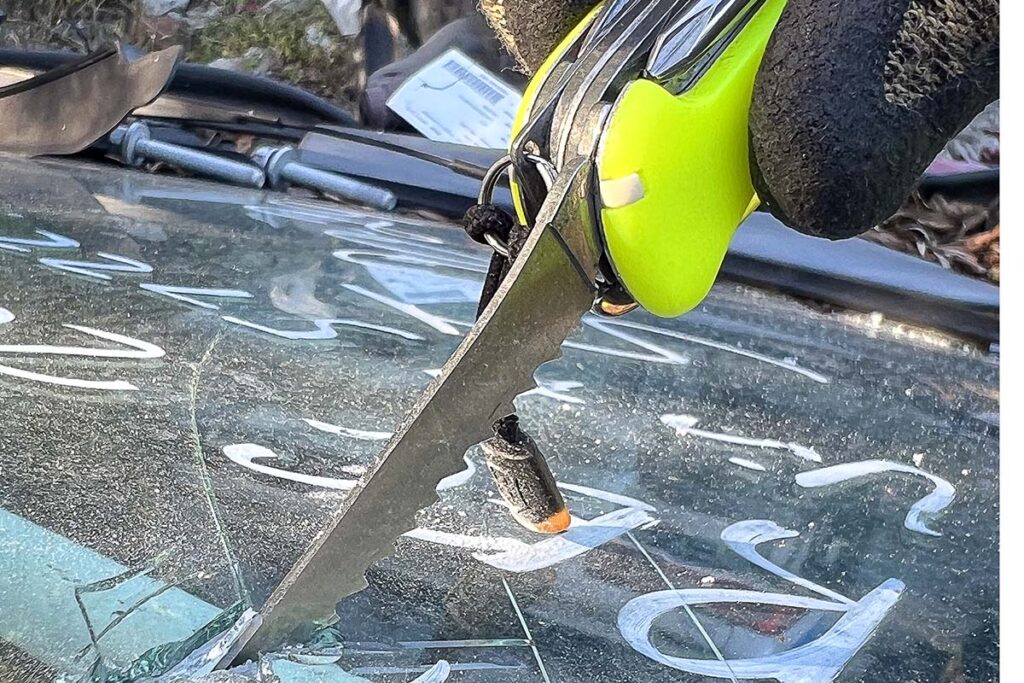
The Victorinox Rescue Tool comes with a special saw that will cut through laminated vehicle glass such as the kind used for windshields. The author said the saw grabbed on the pull stroke. “The saw possibly would have better results if the windshield were shattered first,” he noted, “but I couldn’t locate any shattered windshields on any of the test vehicles.”
At about 4.4 inches closed, the Victorinox Rescue Tool has a frame based on the largest knife the company makes. This is definitely not a pocketknife! It comes with a high quality sewn and riveted nylon sheath (more on it later).
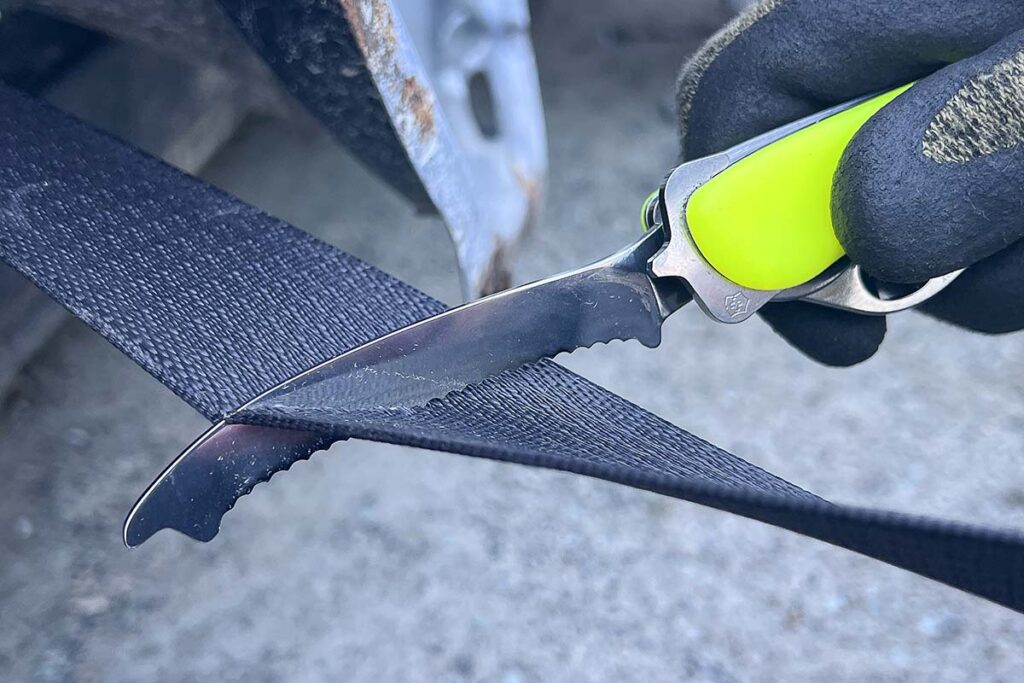
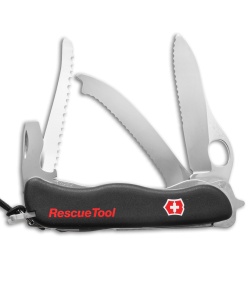
As with most Swiss Army knives, the Rescue Tool sports a variety of on-board tools: a partially serrated 3⅛-inch main blade with hole opener; bottle opener; flathead and Phillips screwdrivers; a combination can opener and small flathead screwdriver; a 3.25-inch semi-curved, fully serrated blade for cutting seatbelts; a specially designed 3.25-inch pull saw for cutting shatterproof glass; and a glass breaker. The latter two are removable. The polyamide scales come in high-visibility yellow for easy location in low light conditions, and the scales glow in the dark after being charged up by sunlight or artificial light. Fit and finish on the Rescue Tool is standard for Victorinox—perfect out of the box. The blades and tools are finished nicely in a full polish except for the saw blade, which is satin finished. Opening and closing action is smooth. The main partially serrated blade locks open via a linerlock as well.
The seatbelt cutter is extremely effective. The rounded, dull blade tip extends slightly beyond the handle butt so you can deploy the blade with or without gloves. Work the blade under the seatbelt and, with one swift motion, pull and the blade slices clean through. The serration pattern is similar to one you might see on a steak knife, with evenly spaced teeth—simple yet very effective and extremely sharp out of the box.
The fully serrated blunt tipped seatbelt cutter blade of the Victorinox works exceptionally well. It has plenty of aggressive bite to cleave through seatbelts in a hurry.
The partially serrated main blade is easy to deploy via the hole opener. The blade is unlike most if not all other partially serrated non-Victorinox patterns. The front 70 percent of the edge is serrated and the balance closest to the tang is plain for finer cutting. The serrations are more rounded at the tips than on the seatbelt cutter, presumably to allow the blade to cut evenly like a plain edge. I tested it on food, cardboard and manila rope, and it cut smoothly and aggressively.
Now for the disappointing part—the glass breaker. It was not effective at all. I could not get a side car window to shatter no matter how hard I hit it. I presume the failure is due to the breaker point being too big. In my experience, the most effective glass breakers are the ones that come to a point and are made of carbide, as with the balance of the review knives. The glass saw is effective, though it grabs a bit too much on the pull stroke. However, when I adjusted the pressure it worked. Country of origin: Switzerland. MSRP: $115.
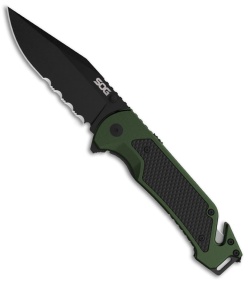
The SOG Escape 2.0 ATK is the updated version of the original SOG Escape, a multipurpose rescue folder targeted at the serve and save pros. It features a 3.4-inch blade of AUS-8 stainless steel PVD coated black, a partially serrated edge, anodized aluminum handle, integrated/replaceable seatbelt/line cutter, and glass breaker. The blade sports ambidextrous thumb studs and a flipper for one-hand opening. The edge is serrated to tackle a plethora of cutting chores. The clip point shape is adaptable to a wide range of tasks and the defined point is great for scoring. The serrations provide extra slicing power when the going gets tough.
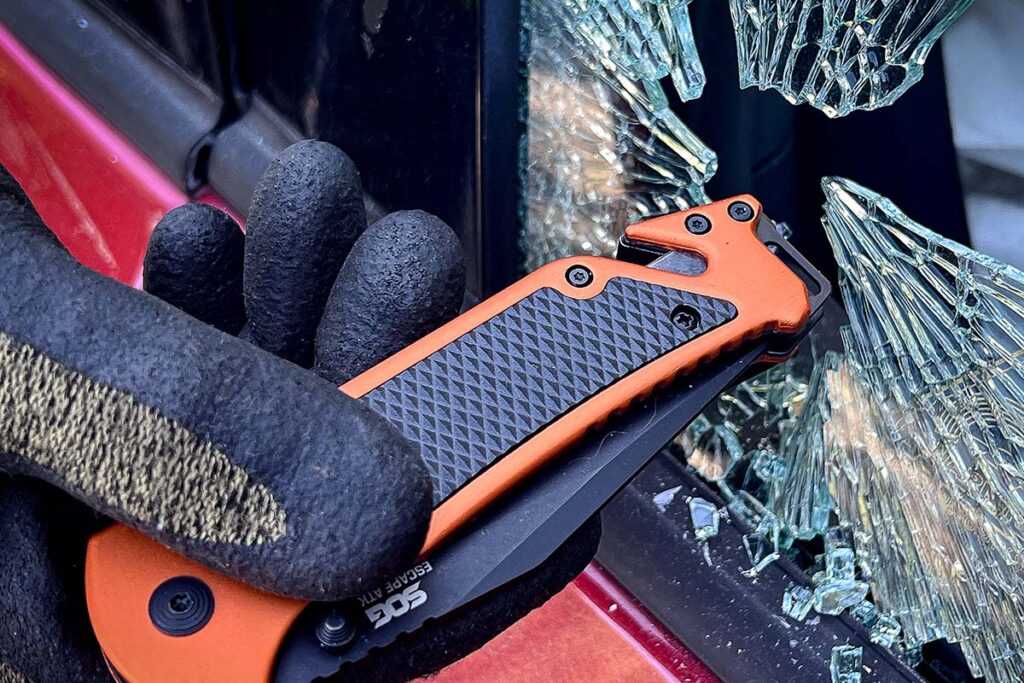
The author uses the SOG Escape 2.0 ATK to shatter a car window, both prior to (inset) and after the fact. Inset into the handle spacer, the glass breaker quickly shattered the side glass with a concentrated pop to the window’s lower corner.
The handle is cast aluminum with stainless steel liners. It comes in two colors: high visibility orange and OD green. The integrated slot at the butt houses a blade for cutting seatbelts, line and string without opening the knife. A glass breaker in the handle spacer quickly shatters side car windows. The breaker works very well. It quickly shattered the side glass with a concentrated pop to the lower corner of the window. The pocket clip is a fold-over, deep carry model. A spare seatbelt/line cutter blade stows safely beneath the textured panel handle inlay. Back out the two small Phillips screws securing the cover and you will see the blade underneath—it is simple to swap out. Country of origin: China. MSRP: $54.95.
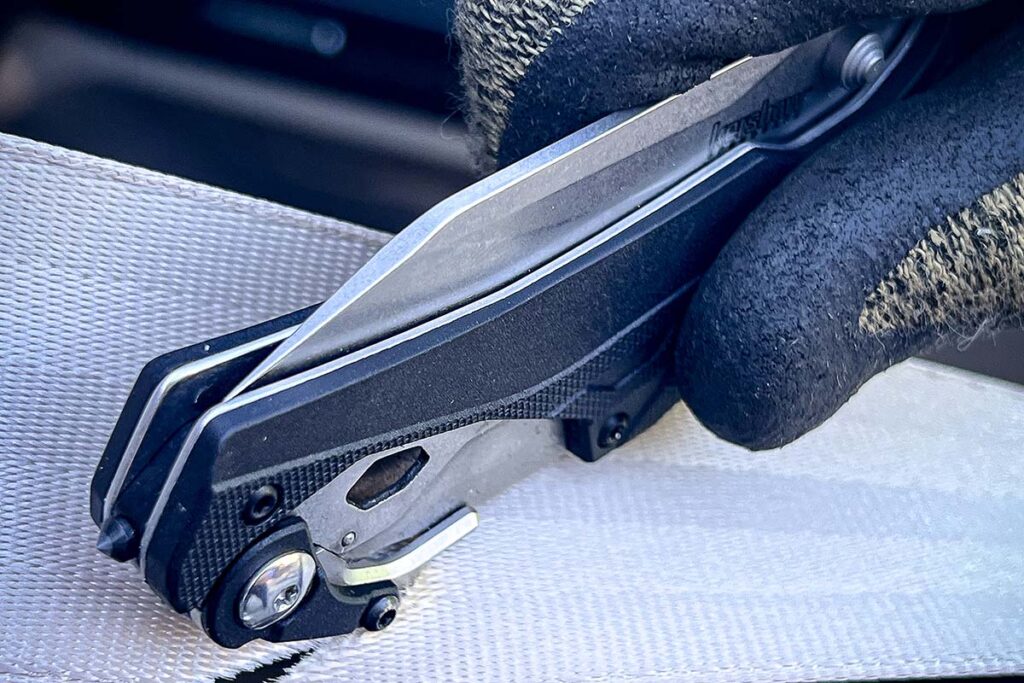
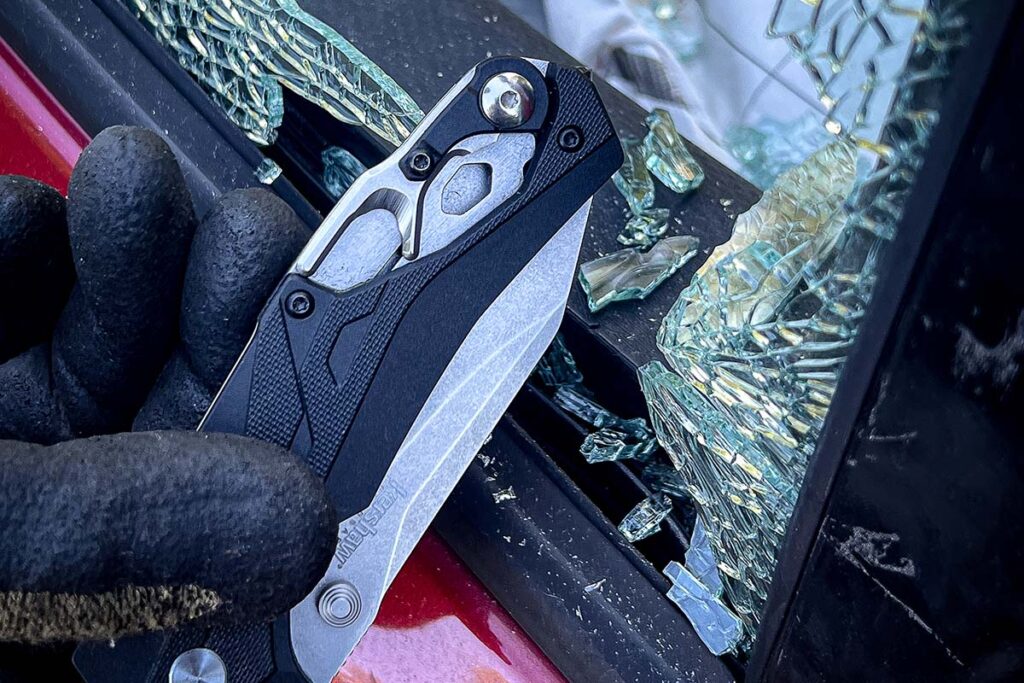
Kershaw’s Drivetrain rescue knife looks like any standard EDC linerlock folder. It has a stylish handle coupled with a very utility friendly blade—but that’s where the similarity ends. The presentation side of the handle butt boasts an integrated seatbelt cutter that folds out. A glass breaker is inserted into the end of the handle spacer. The 3.2-inch clip point blade has ambidextrous thumb studs and a flipper for one-hand opening enhanced by the company’s SpeedSafe assist mechanism. The blade is D2 tool steel for augmented edge holding and wear resistance, especially for the price point. The stonewash finish is attractive and hides scratches.
The author indicated the fold-out locking seatbelt cutter of the Kershaw Drivetrain is the best of the test bunch. It’s a wide hook with a blunt tip leading edge for safety. Rest the handle spine on the seatbelt and pull. The handle guides the cutter to the belt and it cleaves very easily.
The handle is molded glass reinforced nylon with double stainless steel liners. The scales are textured and contoured for a nonslip, comfortable grip with no hot spots. The seatbelt cutter easily deploys with one hand and a separate linerlock holds it in place. When closed, the cutter is concealed within the lines of the handle profile and doesn’t get in the way. A steel pocket clip carries the closed knife blade tip up.
The blade is very utility friendly, from opening boxes and mail to cutting cardboard and plastic sheeting. Once locked open, it is extremely secure with no play.
The Kershaw glass breaker works very well. Situated at the end of the handle, a quick strike with it to the lower corner of the vehicle side window did the job.
The seatbelt cutter works well. The hook tip is dull and rounded so you can work it under the seatbelt without inadvertently cutting yourself or the accident victim. The blade is ground on both sides to enhance sharpness. For best results, make your pull cut at an angle in relation to the seatbelt. Also, resting the handle spine on the seatbelt is a great way to “aim” the cutter. It bites in better that way and, when you feel it engage, give the handle a quick tug and it cleaves through effortlessly. It is a surprisingly effective seatbelt cutter! The glass breaker works very well, too. Country of origin: U.S. design, prototype and quality control, Chinese manufacture. MSRP: $69.59.
Utica’s Honor Rescue Knife
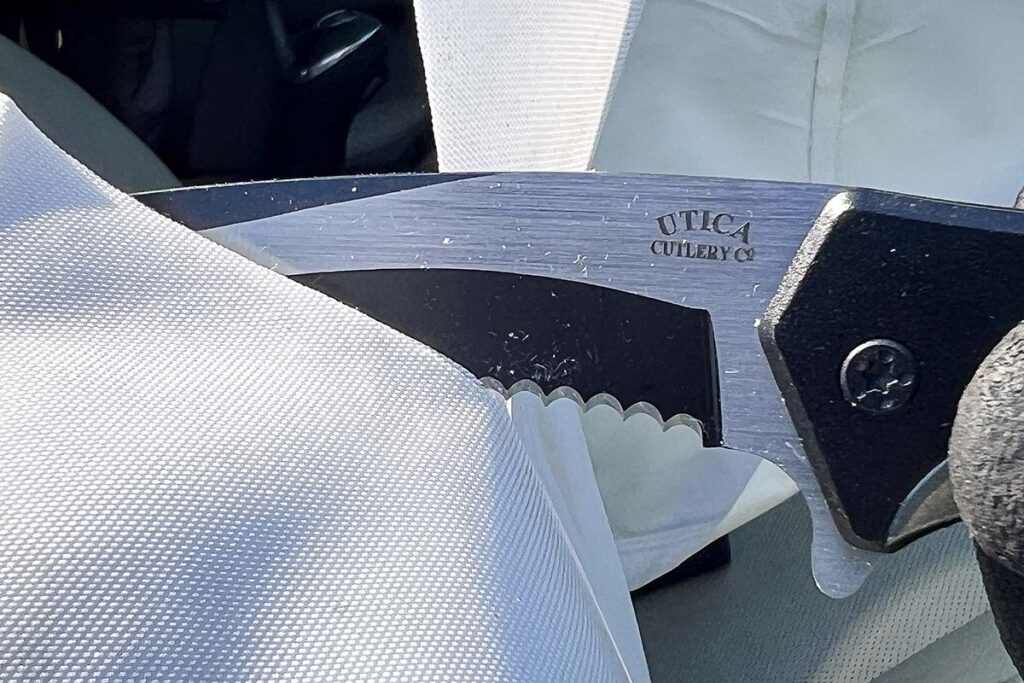
Utica’s Honor Rescue Knife is the least expensive of the test group. It packs a few features normally found on rescue knives, such as the integrated seatbelt cutter, glass breaker and a partially serrated, modified tanto blade. The 3-inch stainless steel blade’s partial serrations help rip through thicker materials. A two-tone finish adds character, with the bevels and spine black oxide coated and the flats satin finished. A flipper tab provides ambidextrous opening, and the blade rides effortlessly on bearings for ultra smooth action. The handle is aluminum with double stainless steel liners providing the backbone. A linerlock holds the blade open securely. A seatbelt cutter slot in the handle butt has two sharpened blades held in the scissor position to cleave seatbelts with a firm pull. The steel back spacer has an extended portion that tapers to a point, which serves as the glass breaker.
The Utica tanto blade’s partial serrations help rip through thicker materials.
Like with the Victorinox Rescue Tool, the glass breaker on the Utica test model was ineffective. The point rounded off due to multiple hits to a side window and did not shatter it. The breaker needs a carbide point. A deep carry clip positions the closed knife blade tip down. Cost and feature wise, the Honor Rescue Knife is a great option without breaking the bank. Country of origin: China. MSRP: $32.97.
Final Cut
A final thought: Some prefer having a rescue knife for emergencies only as opposed to having one for both work and emergencies. You can get away with a relatively inexpensive rescue knife if you preserve it for emergency use exclusively. (Some high-end rescue knives cost as much as regular tactical folders, that is, several hundred dollars.) There’s nothing wrong with an inexpensive rescue knife as long as the manufacturing quality is there, the blade lock holds and the blade is sharp. If you are adept at doing so, sharpen the blade first before stowing it away; this way you know the blade is very sharp. And since you won’t be using it as an EDC, the sharp edge will be preserved. This works well if you have multiple vehicles in your family that you wish to outfit with rescue knives.
Where To Keep Your Rescue Knife
Keeping a rescue knife in your vehicle is a great idea as it can help free you and others should you have an accident or happen upon one. However, give careful thought to where you stow the knife.
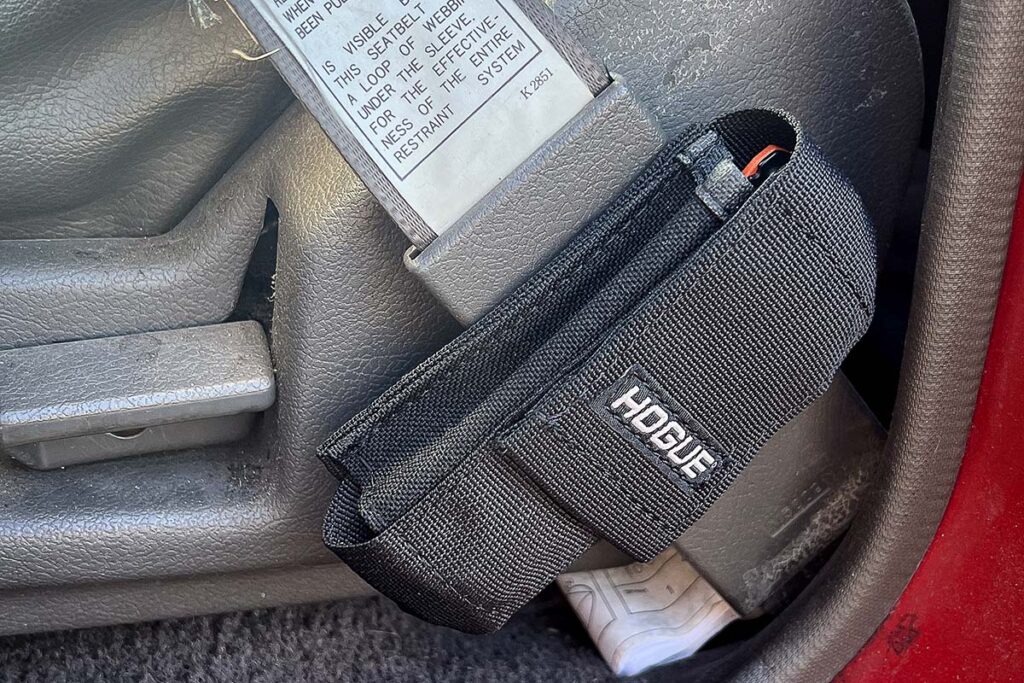
The author keeps his Hogue Trauma rescue folder in the sheath wrapped around the lower portion of the seatbelt anchor in between the seat and door of his truck.
Most assume a glovebox is a safe place and while not a wrong choice, it is a poor one. Why? For one, in an accident your seatbelt may not release because of the tension; in essence, you’re strapped to the driver’s seat and cannot lean over to access the glovebox. Worse, the vehicle could be upside down or on its side. In other words, have the knife placed securely within arm’s length.
I keep a Benchmade Auto Triage inside the sunglass holder in the roof of my car, just above the inside rearview mirror. It is secured shut with a latch so it won’t pop open on impact. I can easily reach it and remove it from the holder with my right hand. In my truck I keep a Hogue Trauma rescue folder in the sheath wrapped around the lower portion of the seatbelt anchor in between the seat and the door. It’s just enough room for me to access the knife with the door shut, and the knife is secured in that position and won’t move.
The worst place to keep the knife is in the center console cupholder. While it’s convenient to access, if you get rear ended or t-boned, the knife will go airborne and land way out of reach. Some vehicles may have a center console storage/armrest in the middle. Yeah, mine in each vehicle is a clutter catchall for receipts and other junk, but it’s another ideal location because the armrest lid latches shut and is within arm’s reach.
Folks chase blades for all sorts of reasons. As a knife collector, what motivates you?
Have you ever taken one of those personality tests online or at work, like a Myers-Briggs, StrengthsFinder or Enneagram? You end up with a description of your personality tendencies, and invariably some of them are exactly how you see yourself.
While I have the nerd skills to put together a knife collector personality test like that, I don’t think it would be that useful. Instead, I’ll skip straight to the results and describe a few varieties of the “knife collector personality.” Maybe something in one of these descriptions will resonate with you.
Accidental Knife Collector
Collectors in this category are buying and accumulating knives because those knives do certain tasks well. They’re not afraid to buy a knife for one specific purpose and may find themselves in possession of more knives than they realized they had.
I got my first knife at around age 7; a small Case folder. This knife, like many others I’ve owned, was used and then lost. Fast forward 34 years, and I still use a knife. I started making knives because I didn’t have enough sharp knives to accommodate the tasks I was engaged in at the time. I hunt and use a knife to process my deer and other game animals. I use knives in the kitchen. I skin fish, slice vegetables and open packages. I carry a small Swiss army knife with me on my keychain. Am I a knife collector?
Just for kicks while pondering this question, I took a quick inventory. I have three custom and two quality production knives in my kitchen. I have five customs in my hunting pack, not counting the ones my sons have. I’ve got three or four spare keychain knives. I started a minor collection on purpose once and acquired 10 or 12 trapper pattern slipjoints and a few vintage folding knives in other patterns before I decided I wasn’t a collector, but I still have the knives.
In addition, I’ve got various junk knives stashed around in cars, trucks, shops and drawers, including the usual assortment of junk kitchen knives from big box marts, plus all the decent ones that I forgot where I put them. By quick count, I’ve got about a dozen customs and another 75 production knives.
Am I a knife collector? In my mind I am not a “knife collector,” but I figure I might be after all. You might be an Accidental Collector, too, and not even know it.
Investor
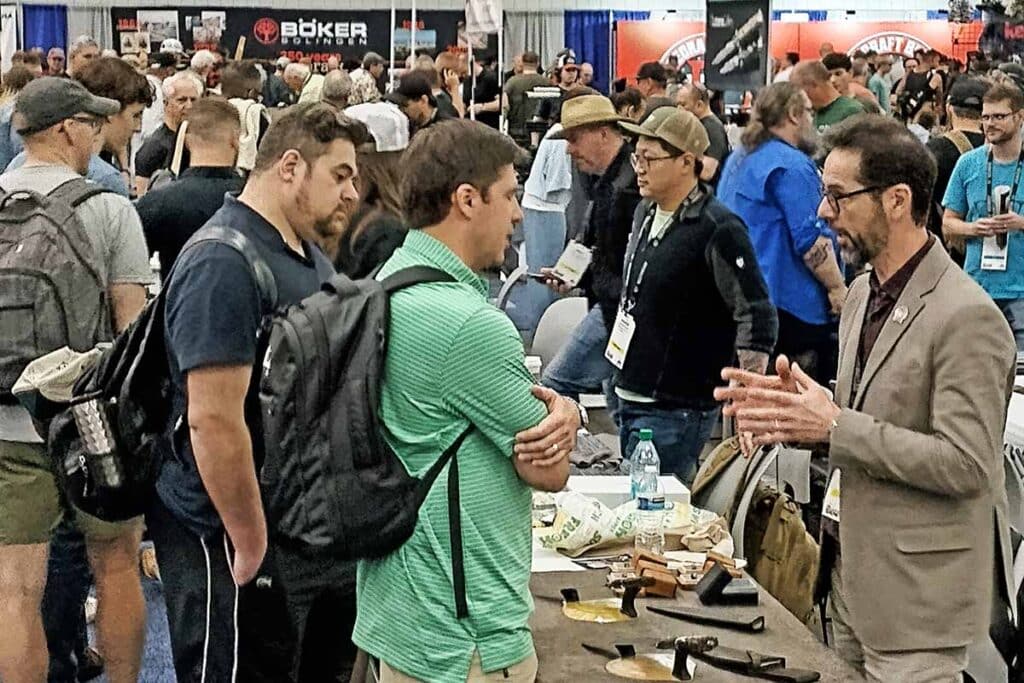
What motivates you to brave the crows at knife shows to collect?
Collectors of this type always have an eye on the bottom line. They’re familiar with the primary and secondary markets, and can instantly spot a good deal. They are always looking for the “next big thing,” the knife that is not hot yet but will be soon. They know the value of “buy low, sell high,” but they also watch which makers and knives appreciate over time.
Some folks invest in stocks or real estate, while others apply their knife knowledge as part of an investment strategy.
I think of my friend Jimmy McMahon as an example of this category. I remember back in 2010 when he invited me to my very first knife show. At the time, he was proud of a knife he had just purchased from Kyle Royer, then a 19-year-old journeyman smith. Given Kyle’s continued improvement and his current status in the industry, I’d say Jimmy made a good investment. If Jimmy were to sell that knife today, he’d make a handsome profit.
Philanthropist/Helper
Have you ever met a person who was a real people-person and just wanted to help everyone? When a person like this collects knives, they continue with that approach.
Some collectors buy from makers they know and have a relationship with. Some buy from makers whose story they know, makers for whom the buyer knows that every single sale makes a difference. These collectors may be biased toward purchasing from makers who are newer, younger or less well-established.
One fairly well-known example is knifemaker Lloyd Hale. Lloyd disappeared from the knifemaking scene in the early 1980s, only to reappear 20 years later. Lloyd tucked away for all that time in his shop working for his patron, Owsley Brown Frazier. Lloyd created over 300 knives, daggers and swords for Owsley, who just happened to be one of the country’s premier gun and arms collectors. Many of these knives along with a great number of historical pieces are on display in the Frazier Museum in Louisville, Kentucky.
Another good example is my friend, David Smith. He loves to talk, to share what he has and a good knife. Over the years as I developed in the craft, he has purchased 6 or 8 pieces from me. He’s given some as gifts, but all have been put to use.
One story stands out as a great illustration of David’s character and the Philanthropist/Helper.
One of my first forged knives was made from the tooth of a drag harrow that came from my grandfather’s farm. I’d held onto the tooth for many years until my forging skills were up to the task. The knife also included wrought iron and some figured red oak milled in 1955 that was recovered during a remodel from the floor of my house at the time.
Even though this knife was tied to me in many ways, with two small kids at home I found myself in an economic pinch, so I had to put the knife out for sale. I priced it at what was for me a high price at the time, and David snatched it right up. He also promised to give me the knife back when he passed away.
About four years later, I was able to travel across country and again visit David at his hunting camp where we used to hang out 15 years prior. True to his word, David gave me back the knife, saying that he didn’t want his wife to have to figure out where to send all the stuff he’d promised folks after he died. He’s almost died four or five times in the last 20 years, but as of this writing is still alive and well. I’ve since adopted that knife as one of my primary using knives, and it’s a treasure I’ll never part with.
Art Appreciator
Sure the canvas is different, but there’s no denying Andy Isaacks’ knife and Alice Carter’s engraving are works of art in their own right.
These people love art for art’s sake, who take the time to stop and admire the roses, who simply enjoy having beautiful things around them. That there would be people like this who gravitate toward knives-as-art is no real surprise. Just like those who collect paintings, sculptures or any other kind of art, these people buy knives simply to appreciate their beauty and the skillful craftsmanship that went into their creation.
I never met David Darom, but with some familiarity with his books, I assume he was an Art Appreciator. His books feature the best knives in the world from a variety of genres, from top makers both stateside and international. If you’re not familiar with his work, The Great Collections is a good place to start.
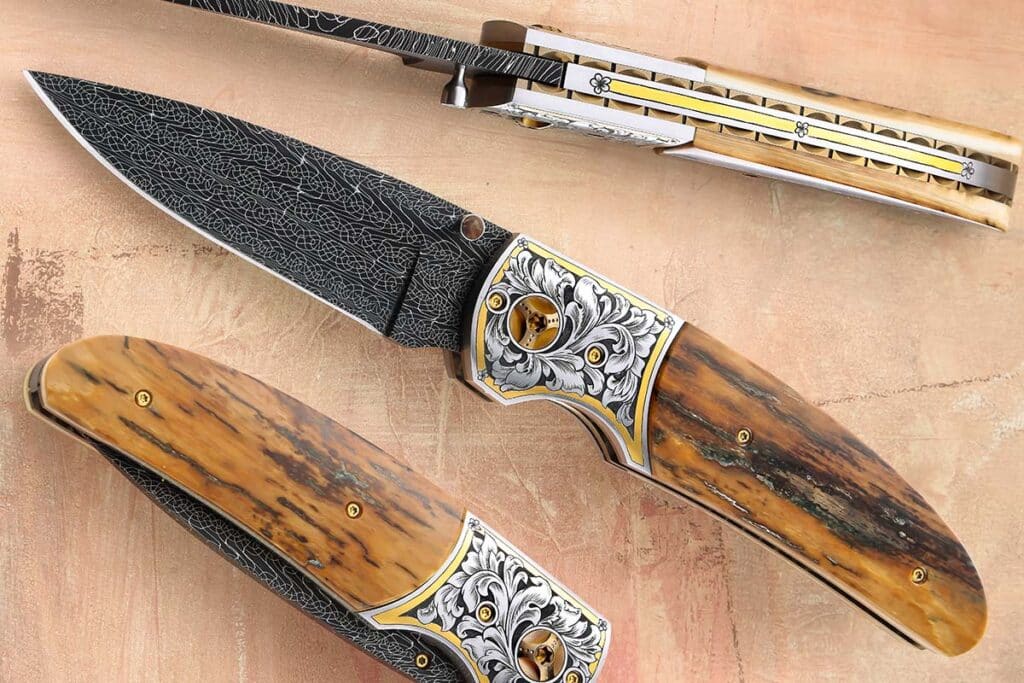
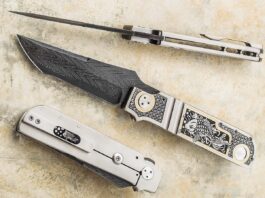
I remember as an incoming probationary member at the Guild Show in 2013 hearing a buzz in the room when a $30,000 knife was sold by Warren Osborne. As a young guy in the back row, I had no idea what kind of knife would bring that kind of price, nor what kind of customer would buy one. I later saw the knife, with gold and fine engraving on a damascus interframe folder. My guess is that it was purchased by an Art Appreciator.
There are a few fine examples of this kind of knife in the center photo section.
“Squirrel!” Collector
Some readers will recognize the “Squirrel!” reference from the Disney movie Up. It’s a great illustration of the ADHD/impulsivity that goes along with some personality types, mine included. This type of collector simply buys knives that they like at the moment. Rather than a systematic approach, it’s more like “here a knife, there a knife, everywhere a knife knife!”
While some might argue that this isn’t a “real” collecting strategy, I believe that if it’s enjoyable to the collector, then it’s a legitimate pursuit. Even so, these stories don’t always turn out well.
My fishing buddy, Cliff, is a good example. He asked me once to sharpen his knives prior to an elk hunting trip. What he brought me was an imported Buck folder, a decent Benchmade fixed blade and two no-name folding knives from Bass Pro. Each one sharpened differently, and each was designed for a different purpose. None of them were well suited to skinning an elk. Cliff was happy to share them with me and glad for me to sharpen them, but no elk were harmed on his hunting adventure.
Historical/Sentimental Knife Collector
Some collectors specialize in history of one kind or another. Maybe they collect only Case “tested” knives like their grandpa or father carried. Maybe they have a collection of knives directly from their ancestors, or connected to a specific historical event (e.g. Civil War), a specific era (e.g. the American West) or an international genre that connects with their heritage. For these collectors, part of the value of the knife is the connection that it makes with something both personal and historical.
Master smith Jerry Fisk targets this kind of collector with his high-end bowies that include historical materials. He’s made knives from World Trade Center steel. He’s used wood from trees planted by George Washington. He’s made damascus with one layer for every person in the United States.Elements from Thomas Jefferson, Dr. Mudd, the Liberty Bell, the Alamo and Pearl Harbor have been worked into Fisk knives over the years. When a collector buys these knives, they’re buying a connection to a story, not just a knife.
My friend, David Patterson, of League City, Texas, fits this category. He’s been collecting knives for many years and has a great collection of the work of knifemakers from the 60s and 70s like Merle Seguine, Clyde Fischer, Gordon and Ruffin Johnson, Randall and Moreseth. He also has a long-standing collection of a knife from every single master smith in Arkansas.
Grail Seeker
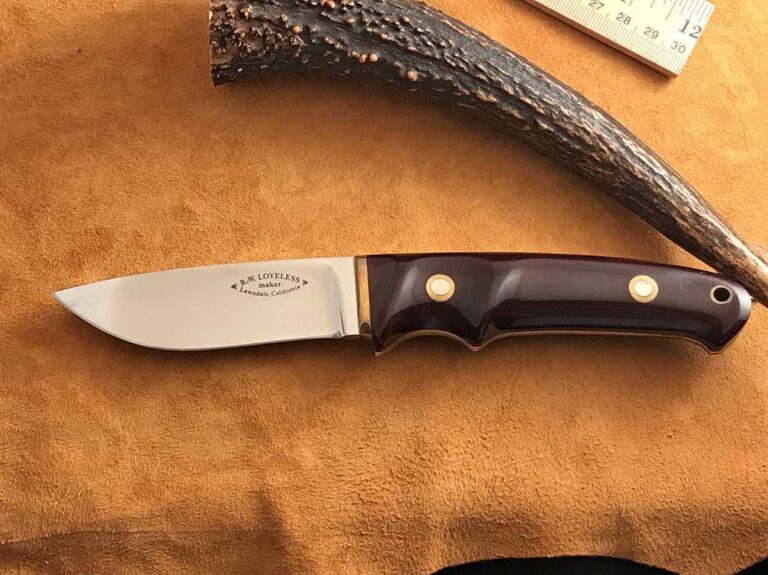
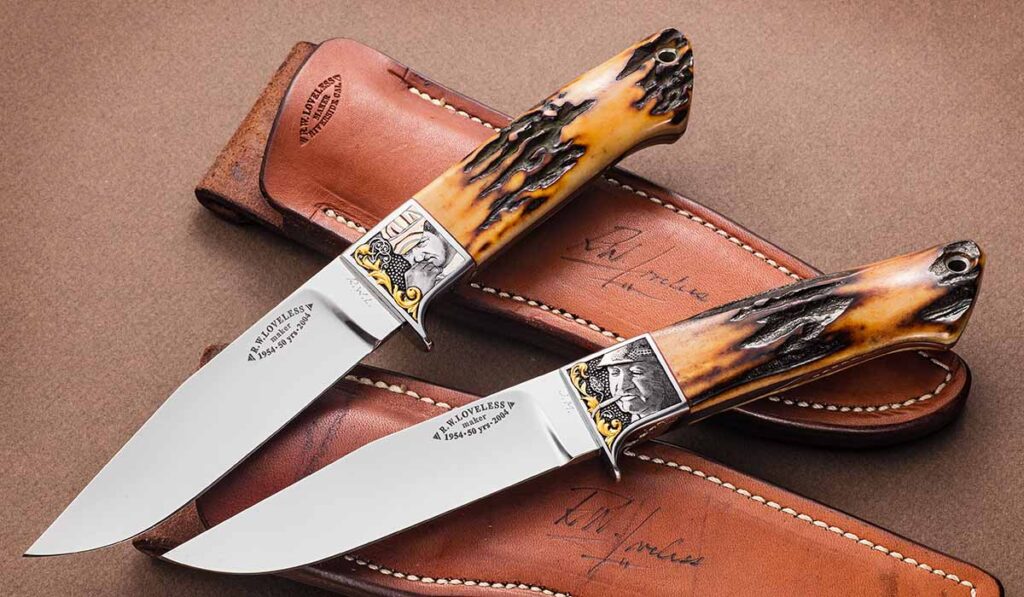
Engraved by C.J. Cai, it’s safe to say this Bob Loveless hunting knife set would qualify as a Holy Grail to many knife collectors. (SharpByCoop image)
There’s a personality type that loves the thrill of the hunt, for whom the journey is as important as the destination. These folks love to get the hottest new thing, or pursue the rarest or most sought-after knives. If you follow the trends and buy at the peak, you may be this kind of collector.
The market depends somewhat on people willing to play this role. The thrill of the acquisition can be as important as the knife itself. These folks developed the term “grail” knife, that knife for which you’d forsake all others, the knife at the top of the pinnacle.
All About The Knives
Whatever your personal reasons for collecting, and whatever personality traits encourage you down the path you’ve chosen, we all share one thing in common: the love of the knife.
Hinderer’s XM-18 out the side autos each pack a punch.
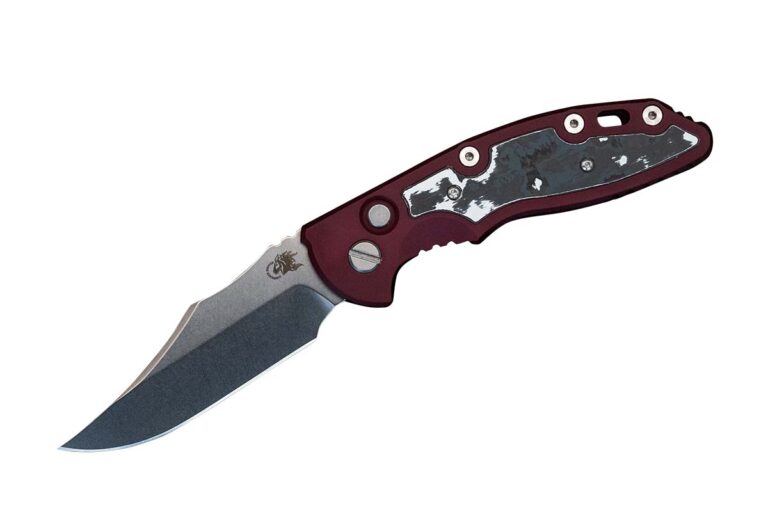
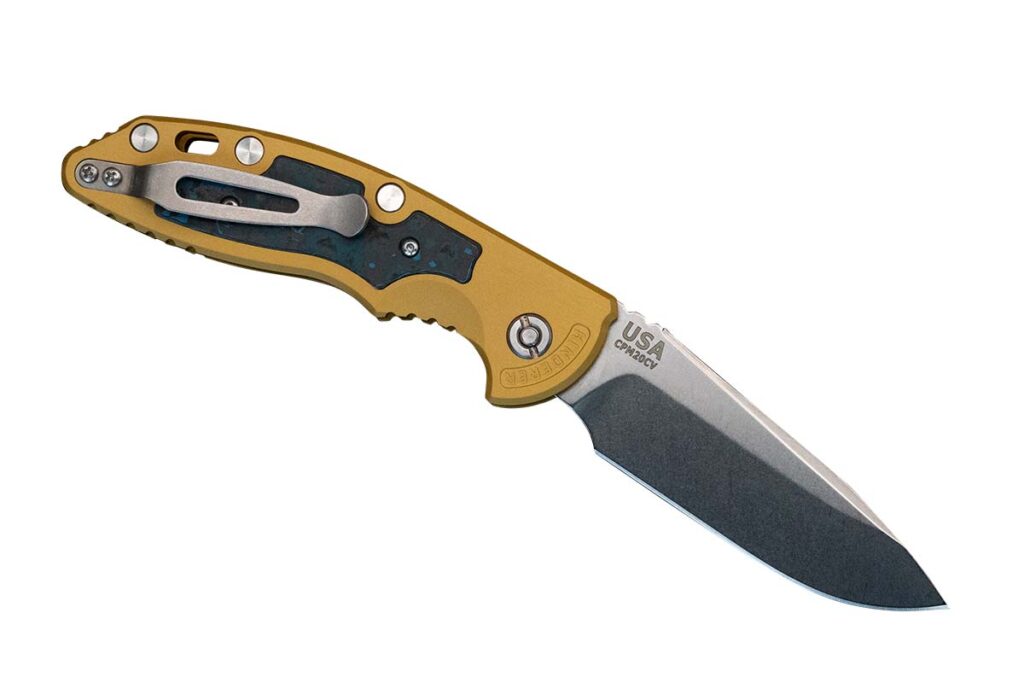
Rick Hinderer Knives offers two of its latest iterations of what industry observers say will continue to be a hot knife style for the foreseeable future—the automatic—in the XM-18 3.5 Bowie Auto and XM-18 3.5 Spearpoint Auto.
The knives come in different handle colors and inlays and are basically the same design with the same dependable out-the-side automatic opening mechanism, but each offers its own different blade pattern and material.
XM-18 3.5 Spearpoint Auto
The 3.5 Bowie has a clip-point bowie blade of CPM S45VN stainless steel, while the 3.5 Spearpoint sports a spear-point blade of CPM 20CV stainless. In addition to each knife being a style to continue to watch in 2025, the steels bear serious eyeballing in the coming year as well as each makes the list of steels that will thrive in 2025 (see page 74).
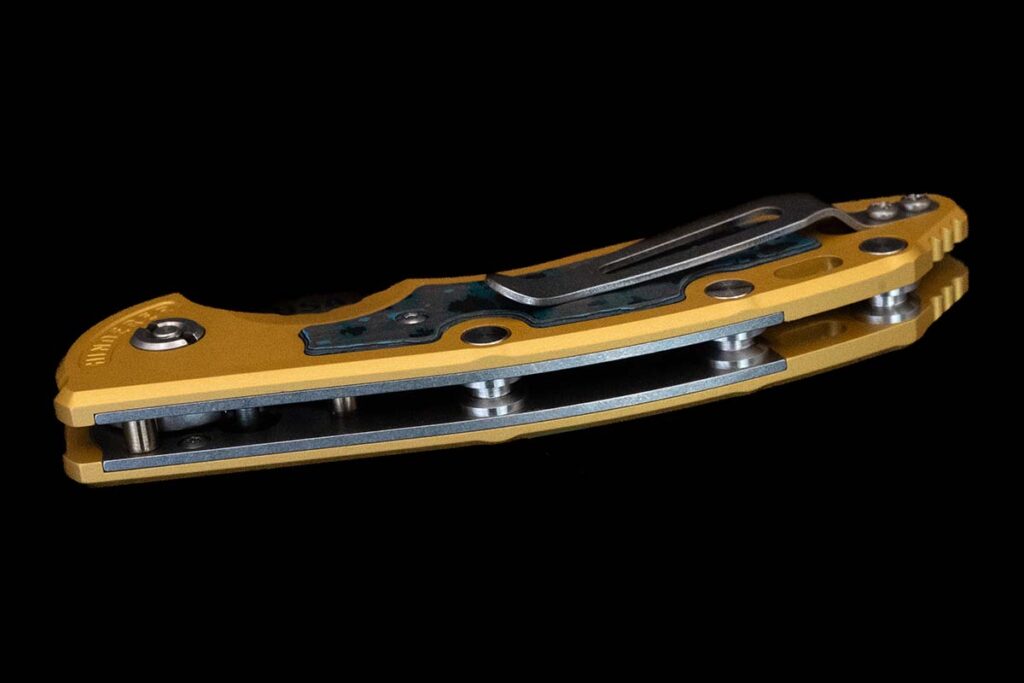
Each knife features Hinderer’s patent-pending titanium half liners, with the XM-18 3.5 Spearpoint Auto doing the honors here.
Each knife features traction ridges on the base of the blade spine and handles with single, traction-ridged finger grooves, ridges on the bottom of the handle toward the butt, an integral guard and a hole for a lanyard. Each also has Hinderer’s patent-pending titanium half liners reinforcing the aluminum handles.
BLADE Show West hasn’t only grown to become one of the largest knife shows in the West, it’s also become a prime venue for late-season knife drops. With a bevy of new designs, CRKT has a bevy of new blades it plans to unveil to the public in Salt Lake City.
In all, the Oregon-based company will release five knives at the Salt Palace Convention Center, fittingly coming from a premiere Western knifemaker. Richard Roger’s prime gig New Mexico cattleman, but over the years has become a well-known custom maker whose designs perfectly combine clean lines, practicality, as well as eye-catching use of materials. The folder specialist’s knives are meant for use, but dang, if they aren’t pretty enough to show off.
Here’s a gander of what Rogers and CRKT have cooked up for BLADE Show West.
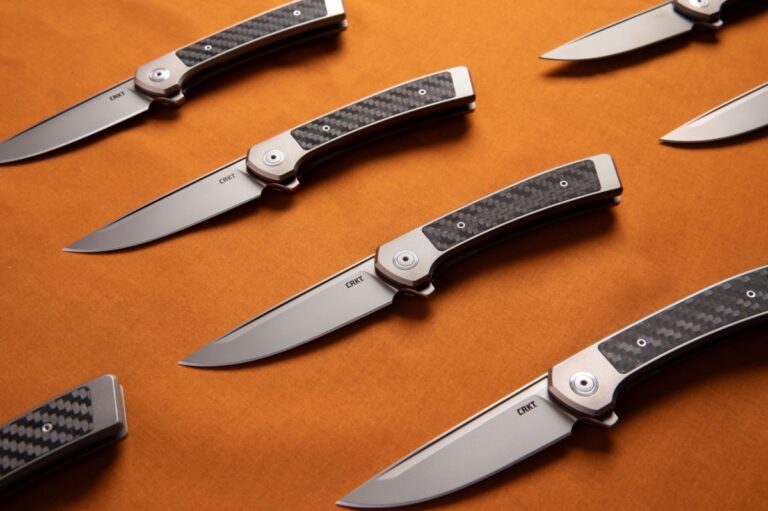
CRKT Q
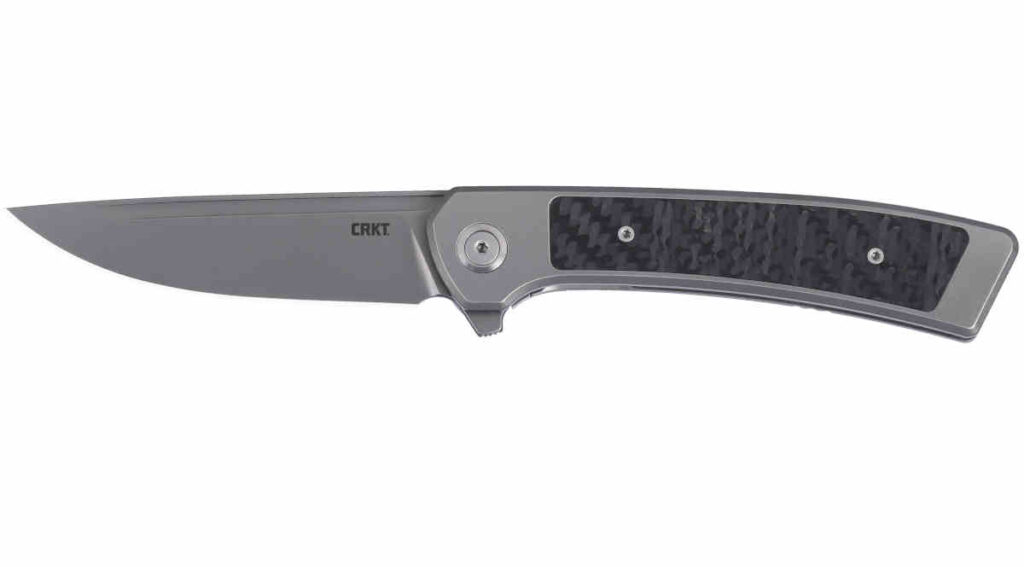
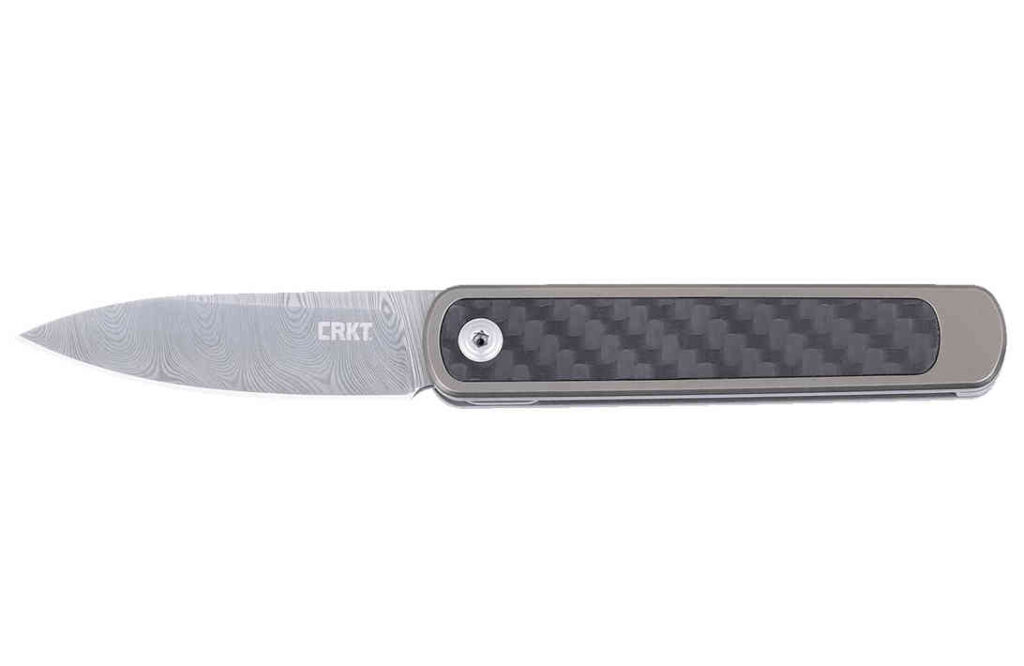
The limited-edition Q—based on Roger’s custom knife of the same name—has everything you want in a small-batch knife—chief among them, top-notch materials. The frame lock marries a titanium handle with carbon fiber inlay with a 3.31-inch MagnaCut steel blade. The lines on the drop-point knife are positively dialed in, with the point of the blade directly aligning with the pocket clip when deployed. The blade is put into action via a kicker. Topping off the Q is a floating backspacer that adds a splash of detail and hints at the knife’s premium nature, but otherwise, the Q remains perfectly understated. MSRP: $225.
CRKT Q Compact
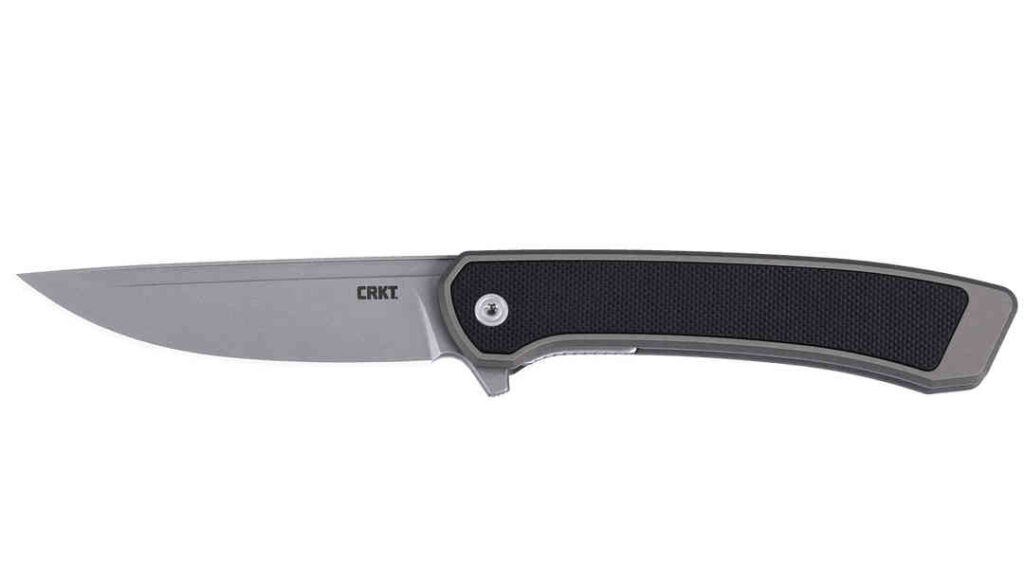
Dang near identical to the Q, the compact model is simply scaled down for easier EDC carry. At 4 inches closed and only 2 ounces in weight, it fits the bill as an easy-to-tote option. The materials are different from the full-sized model, with an S35VN blade and a lightweight aluminum handle with G10 inlay. As well as, the small fry is also a liner lock. MSRP: $195.
CRKT Persian
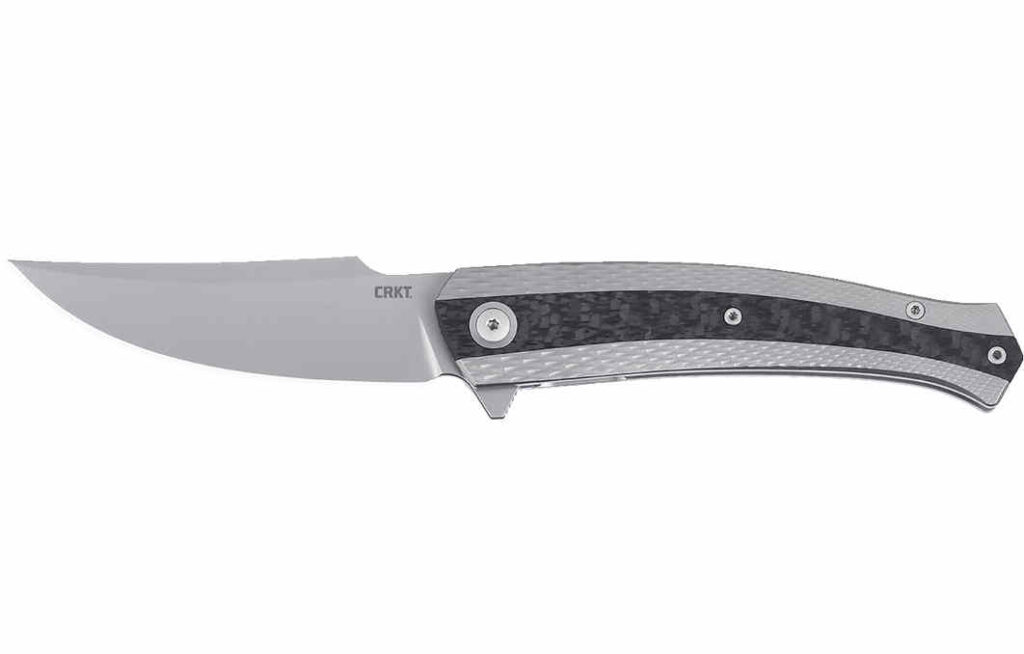
Building on a fan-favorite Rogers classic, the upgraded Persian takes all the great features of the original and cranks them up a notch. The blade’s new “harpoon Persian” shape is eye-catching, and it’s crafted from tough MagnaCut steel, known for its superior strength, wear resistance, and corrosion protection. The titanium handle is lightweight, with a cool milled pattern inspired by Richard’s custom design. Made in Italy by Lionsteel Knives, this limited-edition folding knife is a must-have for collectors. MSRP: $275.
CRKT Pup
After the success of his CEO folding knife, Richard Rogers is back with the Pup, a compact everyday carry with smooth, rounded edges that slip easily into a pocket or purse. Built for modern life, it’s unobtrusive but ready to perform. The Pup comes in two models: a flipper with IKBS™ bearings, an AUS 10 steel blade, and a glass-reinforced nylon handle, or an Italian-made slip joint with a Super Dense Twist™ Damasteel® blade and a titanium handle with carbon fiber inlay for strength and style. MSRP: $70 and $275 respectively.
The Poros by Spartan Blades is a great feeling folder. The flipper design is spot-on for hand placement.
Company co-founders Curtis Iovito and Mark Carey are excellent to work with and built Spartan from scratch. Both are retired from Special Forces and have a lot of pride in workmanship. The Poros is their field-grade-version linerlock. It might not have the fancy material and looks but the performance is top shelf.
Poros Light Cutting Duties
Initial slicing of 20-pound copy paper was excellent. The Poros was very smooth and aggressive. The blade shape really helped slicing paper, especially when I employed a roll cut. The flat-ground blade sliced straight with no curling of the paper.
The 154CM stainless steel blade was exceptionally aggressive in the 8-ounce leather slice.
The Poros easily devoured single-walled cardboard. As with the copy paper, the blade sliced it both forcefully and effortlessly, resulting in nice, straight cuts. The slices were extremely quick with no resistance felt.
The folder was quite aggressive again in the 8-ounce leather slice. It was very easy to control the thickness of the skiving—I just needed to move my fingers faster. I had two fingernail nicks after the skiving. The edge remained sharp.
Poros Medium Cutting Duties
It was time to do a fire stick. The flat grind produced excellent curlicues. It sliced the wood incredibly fast and I had to slow down for more control to keep the curlicues on the stick. The handle was comfortable while making the deeper cuts. It was awfully simple to whittle with the knife.
The flat grind produced excellent curlicues. It sliced the wood awfully fast and the author had to slow down for more control to keep the curlicues on the stick.
For the next exercise I used 1-inch manila rope. The Poros crunched to 197 cuts before I ran out of rope. The edge was still good. The handle was very comfortable during heavy use. There were no issues with the blade lock. Nicely done, Spartan.
Poros Heavy Cutting Duties
I split kindling into smaller pieces to check lockup by doing baton work. There continued to be no issues with lockup or edge retention. The knife can handle a beating for sure. It’s not that I recommend baton work with a folder but if you have to it can be done with the Poros.
The author split kindling into smaller pieces to check lockup via some baton work. There were no issues with lockup or edge retention.
To push the knife a bit further, I grabbed my trusty whitetail deer antler. After 30 hard whacks on it, the edge was still sharp with no rolling or chips, indicating spot-on heat treatment.
The last test was back to the copy paper slice. The Poros continued cutting smoothly and my arm was tired. Outstanding job, guys!
Final Cut
The Poros folder is worthy of riding in anyone’s pocket. It’s well designed, sharp and easy on—and comfortable in—the hand. I really don’t know what I’d change on this one, though I would love to see an A-2 tool steel version.
Poros Specs Maker: Spartan Blades Knife type: Flipper folder Blade length: 3 7/8” Blade steel: 154CM stainless Rockwell hardness: 58-60 HRC Blade finish: Black PVD Handle: Carbon-fiber-patterned G-10 Lock: Linerlock Closed length: 5 1/8” Country of origin: USA MSRP: $190