
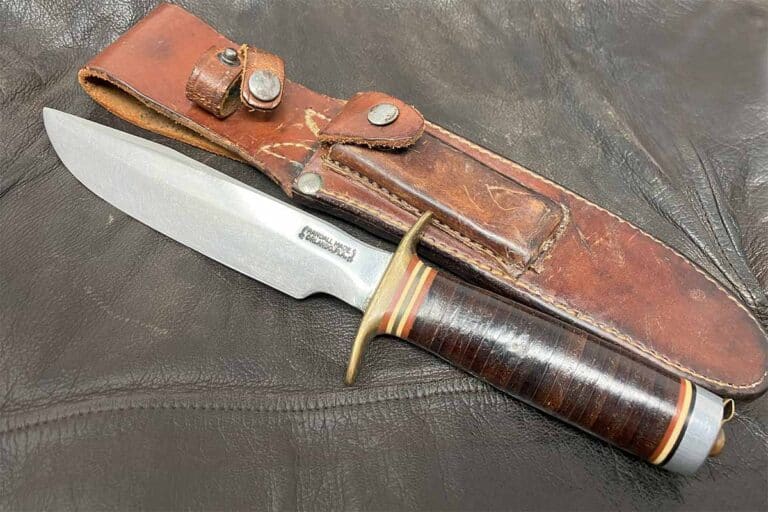
Randall Knives Of The 422nd Night Fighters Squadron

Handmade knives from the Florida maker see action over the skies of the European Theater of World War II.

Editor’s note: This year marks the 80th anniversary of D-Day, the Battle of the Bulge and other pivotal events of World War II. The Green Bats of the 422nd Night Fighter Squadron flew fighter support for Allied troops after D-Day and played a crucial role doing the same during the Battle of the Bulge. They also loved their Randall knives. This is the story of some of those men and their Randalls.

The Green Bats of the 422nd Night Fighter Squadron carried Randall knives into battle from Normandy through V-E Day, in the process achieving more aerial victories than any other American night fighter squadron during World War II.

Founded by BLADE Magazine Cutlery Hall-of-Fame® member W. D. “Bo” Randall in Orlando, Florida, in 1938, Randall Made Knives gained prominence after the United States entered the Second World War, as many American servicemen carried Randall knives into battle.

A newspaper story from November 1942 highlighted the growing number of Randalls carried by members of the U.S. military, including Frank O. Hunter, who commanded the 23rd Composite Group of the U.S. Army Air Corps at Orlando Air Base in 1941. Many airmen based in Orlando over the following few years also bought Randalls, including the Green Bats of the 422nd Night Fighter Squadron (NFS).

Need For Night Fighters
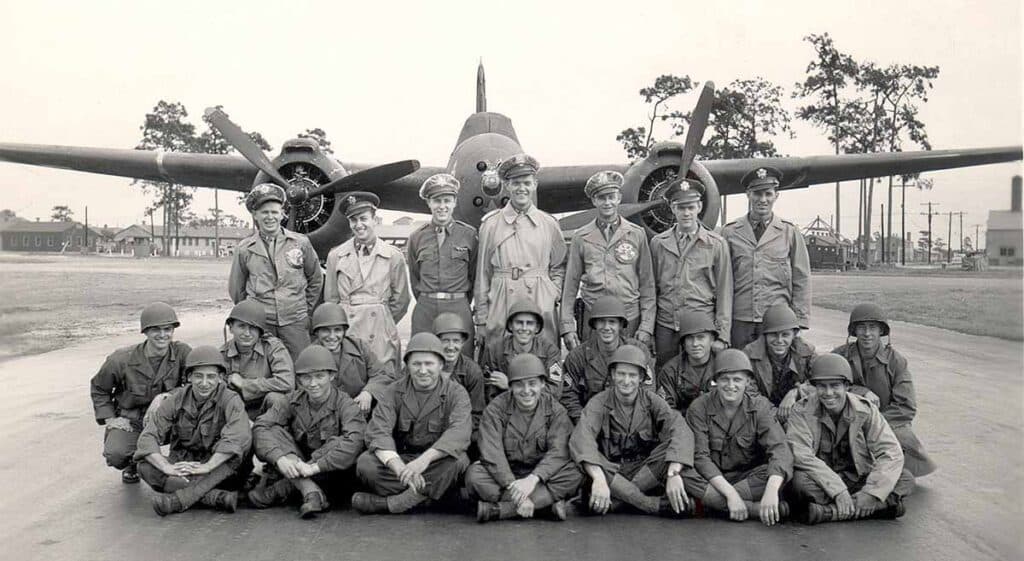
Pilot Al Gordon’s “A” flight at the Orlando Air Base. Behind the crew is a P-61 Black Widow
Pilot Al Gordon’s “A” flight at the Orlando Air Base. Behind the crew is a P-61 Black Widow twin-engine aircraft complete with heavy armament and airborne radar.

During the first two years of the conflict, the United States transitioned its economy to a war footing and began to develop the new fighting capabilities it would need to combat the Axis powers. Among many priorities was the pressing need for American airmen to develop a night fighting capability.

From the experience of the Royal Air Force during the Battle of Britain, American observers concluded that effective interception of enemy aircraft in night operations would require an entirely new aircraft that was designed to carry the most advanced airborne radar then available. It was further recognized that night fighter aircrews would require special qualifications and training that emphasized instrument flying, blind landings, night gunnery, and other expertise that was scarce in the Air Corps at the beginning of the war.

The new aircraft was the P-61 Black Widow, a high-performance, stable, twin-engine plane with heavy armament and the SCR-720 airborne radar. The Black Widow’s original design called for a crew of three—pilot, radar operator and gunner—but the planes of the 422nd NFS flew with only a pilot and a radar operator. As the first Black Widows rolled off the assembly line in the autumn of 1943, the rigorously selected NFS aircrews obtained their specialized training at Orlando Air Base and two nearby airfields in Kissimmee and Dunnellon.
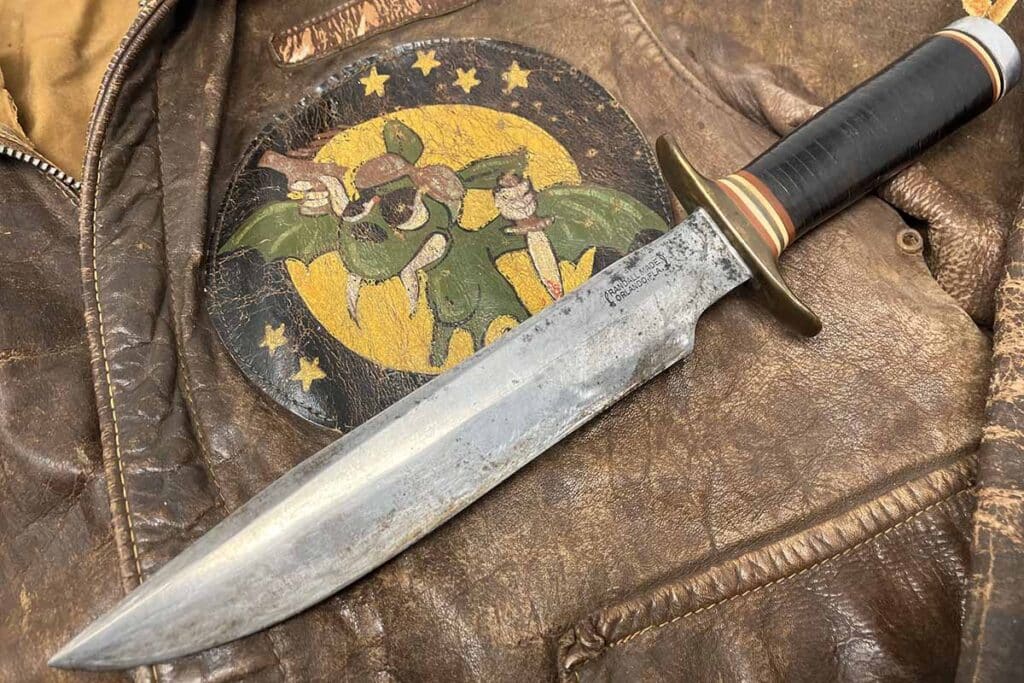
Louis L. Bost's, a radar operator in the 422nd NFS, Randall Model 1.
Louis L. Bost’s, a radar operator in the 422nd NFS, Randall Model 1. In the background is his original flight jacket, displaying the Green Bat insignia of the 422nd NFS. His World War II medals include the Distinguished Flying Cross and Air Medal with eight oak leaf clusters.

The first squadron to complete training with the Black Widow and fly it into battle was the 422nd NFS. The 422nd was activated in Orlando on Aug. 1, 1943, but squadron members did not receive their first Black Widows until Nov. 20, 1943. While eagerly awaiting their planes, squadron members devoted considerable time to organizational duties and field training, and many of the officers and men qualified with pistol and carbine.

3 Model 1s

During this time, many pilots and radar operators of the 422nd also obtained Randall knives. Among the known surviving Randalls of the 422nd are three Model 1’s that belonged to radar operators Louis L. Bost and James W. Mogan, and pilot Lewis Albert “Al” Gordon. The knives were ordered in the latter months of 1943, perhaps into early 1944, while the squadron was training in the vicinity of the Randall shop.

Gary Clinton, an authorized dealer for Randall Made Knives and noted Randall collector, stated that “Every Randall is one-of-a-kind, since they are all handmade.” This is especially true for the Randalls of World War II, which was a time of experimentation and development. Randall Made Knives had a hard time acquiring some of the necessary materials to make the knives because of wartime constraints. As a result, there are many variations in Randalls from World War II, and you see can see some of the variations in the NFS group.
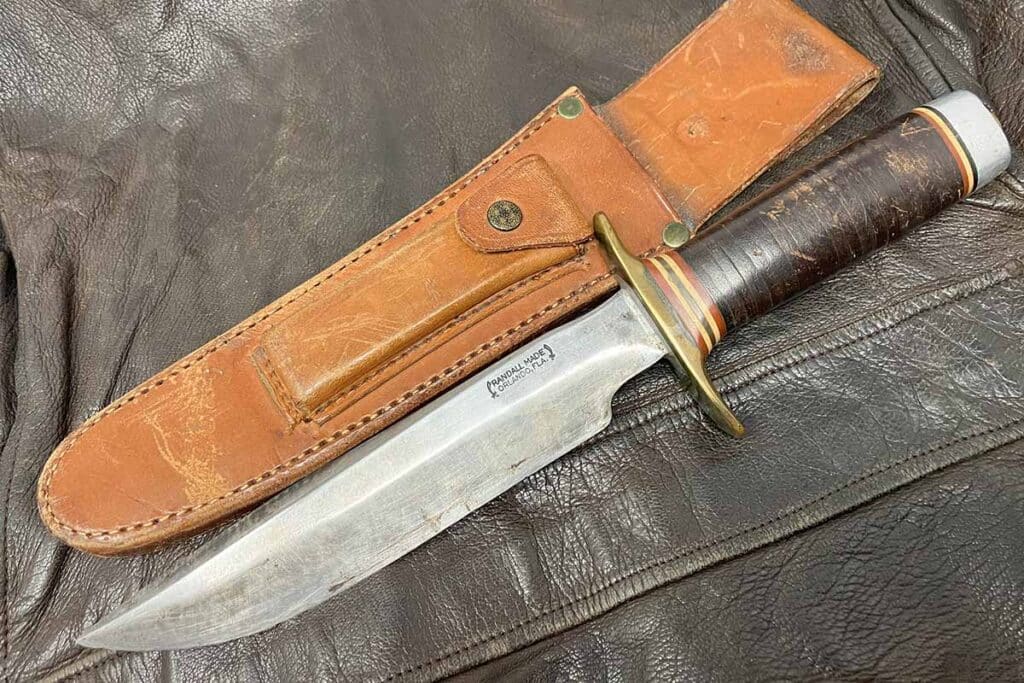
The Randall Model 1 of radar operator James W. Mogan
The Randall Model 1 of radar operator James W. Mogan, a radar operator in the 422nd NFS. He was in on two aerial victories during the Battle of the Bulge and the destruction of a V-1 Buzz Bomb in July 1943. Mogan flew 72 combat missions and received the Distinguished Flying Cross and Air Medal with 10 leaf oak clusters.

The monel wrist thong link on James Mogan’s knife is an example. Leather washers of different thickness in the handles, the shapes of the handle, and other variations are also products of material availability and evolution of design.

Chris Stanaback, an authorized dealer for Randall Made Knives and founder of the Randall Knife Collectors Club, agreed that the three Randalls are “prime examples of World War II fighters” and also noted that the left-side carry sheaths are typical of the vintage. Clinton concluded, “World War II Randall knives are rare in their own right, but the provenance associated with these knives is extremely rare. It is almost unheard of to have such a fine collection that can be attributed to a small group of airmen from this era.”

First Victories

With Randall knives in hand, the 422nd NFS departed Orlando in mid-February 1944 and arrived in the United Kingdom in early March 1944. After a frustrating wait for their Black Widows, members of the 422nd entered combat on July 3, 1944, when squadron commanding officer Oris B. Johnson flew the first P-61 combat mission in the European theater.
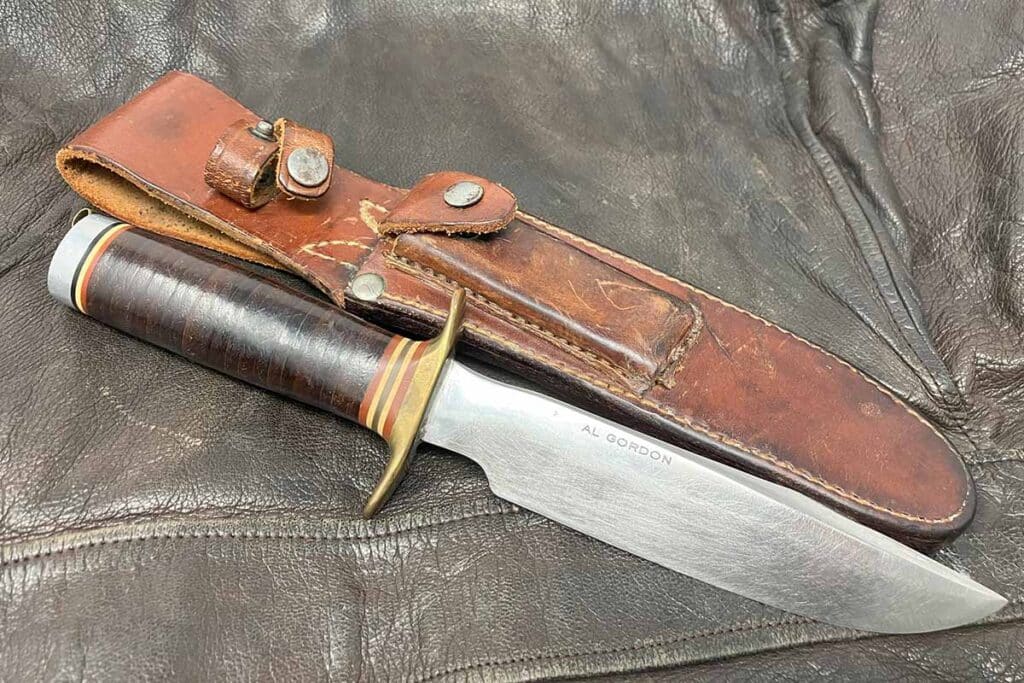
Etched with his name, the blade of Al Gordon’s Randall Model 1
Etched with his name, the blade of Al Gordon’s Randall Model 1 is just under 6 inches. Gordon received the Distinguished Flying Cross and Air Medal with 11 oak leaf clusters during World War II.

The squadron’s first victories came against Germany’s V-1 “Buzz Bomb,” an early jet-powered cruise missile initially used against London in June 1944. Because the Black Widow in level flight could not match the 400-mph speed of the V-1, P-61 pilots on night patrol had to locate the Buzz Bombs and then attack them in a power dive. Though this was no easy initiation to combat, the aircrews of the 422nd were up to the task, destroying five Buzz Bombs in late July, including one by Lt. Mogan and his pilot, Lt. John W. Anderson*. By early August 1944, the squadron had relocated to Cherbourg, France, defending the Allied forces in Normandy fighting to liberate Europe.

Soon after beginning combat against the pilots of the German Luftwaffe in Normandy, the 422nd achieved the first American victory with the Black Widow in Europe. There were three enemy planes confirmed destroyed, four probably destroyed, and one possibly destroyed in August 1944.

These included one confirmed destroyed by Lt. Bost and his pilot, Lt. Leonard F. Koehler, and one probable and one possible by Lt. Gordon and his radar operator, Lt. Creel Morrison. By the end of the war in Europe, the squadron had attained a remarkable combat record, with 1,480 sorties, 78 enemy aircraft sighted and 43 confirmed victories—plus five probables and five possibles—destroying more than half the enemy planes they encountered.
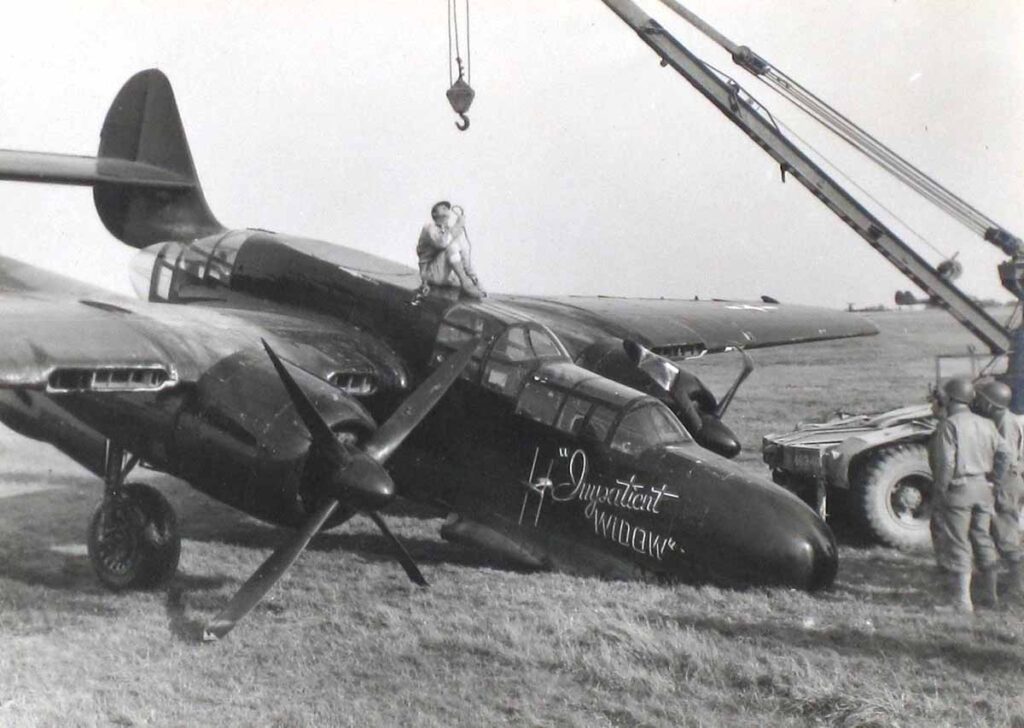
Gordon’s P-61, Impatient Widow, gets attention after some battle damage.

In addition, the squadron excelled in ground attack missions, which were essential to prevent enemy troop and supply movements at night. In the process they destroyed or damaged nearly 1,000 locomotives, railroad cars and motorized transports, along with many factories and storage sites. The 422nd was the first American night fighter squadron to produce an ace pilot, and six of the nine total American night fighter aces were in the 422nd.

The Bulge

Perhaps the squadron’s finest hour was the Battle of the Bulge, when the Germans launched a fierce counter-offensive during the harsh winter of December 1944.

At night and in extremely adverse weather, the Black Widows at times were the only planes able to fly in support of the 101st Airborne during the siege of Bastogne, and their performance was simply magnificent. The 422nd shot down five enemy planes on the night of December 16-17 and again on December 26-27.
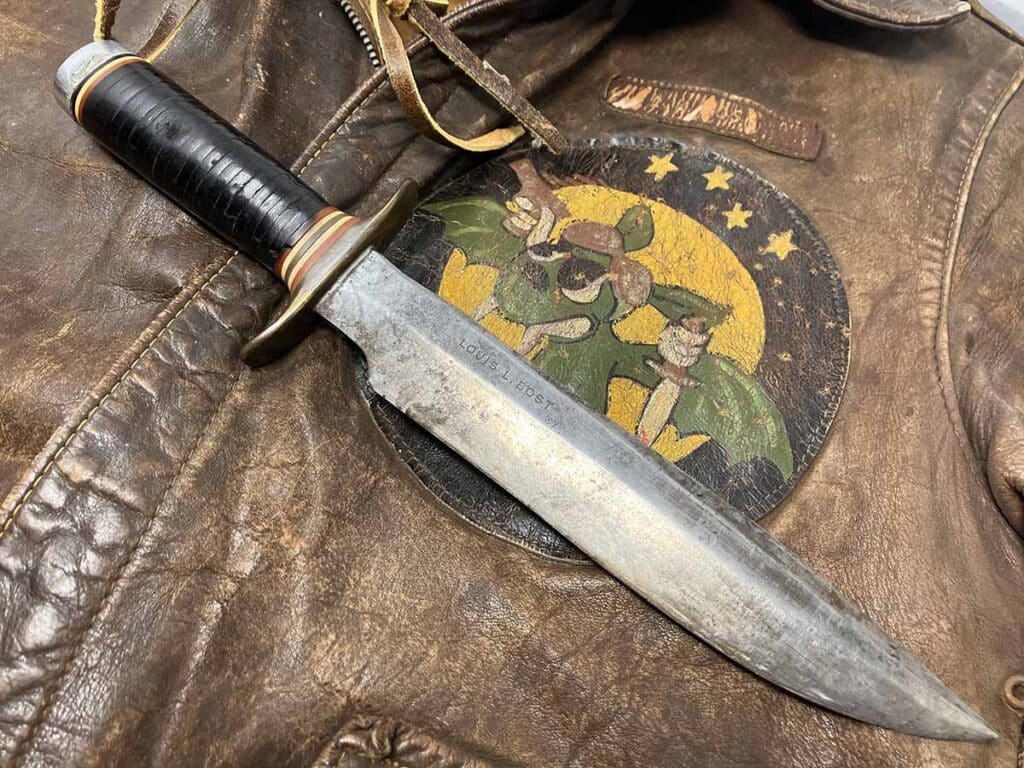
The non-stamp side of radar operator Louis L. Bost’s Randall 8-inch Model 1
The non-stamp side of radar operator Louis L. Bost’s Randall 8-inch Model 1 blade bears his name. The brass wrist thong link and the cigar-shaped leather handle are characteristic of Randalls produced in the latter half of 1943. As a radar operator in the 422nd NFS, he was in on two aerial victories in August 1944 and March 1945. He retired as a major in the Air Force in 1963.

The squadron achieved a total of 18 confirmed victories in December 1944, compared to 10 total in the preceding four months. Stars and Stripes reporter Pat Mitchell accompanied Lt. Mogan and his pilot on a Christmas Eve patrol, and Mitchell’s front-page story described in dramatic detail the Black Widow’s victory over the German plane after a pinwheeling, 20-minute dogfight from 5,000 feet down to 500 feet.

Mogan and Anderson received the Distinguished Flying Cross for their courage, skill and determination during the Ardennes offensive. Bost and Gordon also received Distinguished Flying Crosses for valor and skill in aerial combat over Europe. The commanding general of the 101st Airborne Division gratefully acknowledged the squadron for their air protection during the Battle of the Bulge, noting that they repeatedly broke up German night fighter attacks on his troops and prevented the Germans from moving under cover of darkness.

A subsequent report on the battle showed that the 18 victories of the 422nd nearly matched the combined total of 20 achieved by six squadrons of Royal Air Force night fighters that December—truly remarkable considering that the RAF fielded 10 times as many operational aircraft, and that the 422nd had only four operational planes for much of the battle. In recognition of their heroism and pioneering efforts in night air combat, the 422nd was awarded the Distinguished Unit Citation (later renamed the Presidential Unit Citation) and the Fourragère of the Belgian Croix de Guerre.

The handle butt’s monel alloy wrist thong link
The handle butt’s monel alloy wrist thong link, which was used from December 1943 into the first few months of 1944, suggests that Mogan’s Randall Model 1 was produced a month or two later than Bost’s. The reverse side of Mogan’s knife shows original name etching on the 7-inch blade. In the background is Bost’s original flight jacket, with artwork from squadron pilot Robert O. Elmore of two victory flags and a Black Widow.

Bost, Gordon, Mogan and the others in the 422nd Night Fighter Squadron deserve recognition for their essential contributions to the Allied victory in Europe, and the association between Randall knives and American military men such as these is an important part of the enduring legacy of Bo Randall and his finely crafted blades.

Sources: Queen of the Midnight Skies, by Garry B. Pape and Ronald C. Harrison; Conquering the Night, by Stephen Lee McFarland; Into the Night, by John W. Anderson and Martyne Anderson Kostka; 422nd Night Fighter Squadron: A History, by Charles McEwen, Jr.; “Black Widow Prowls Front, Stings JU88 in Sky Duel,” by Pat Mitchell, Stars and Stripes, Dec. 26, 1944; and Randall Made Knives: The History of the Man and the Blades, by Robert L. Gaddis

*Lt. John W. Anderson is the same Lt. John W. Anderson who supplied the vintage World War II images for this story.

More On Military Knives:

BLADE Show Do’s & Don’ts

Follow these simple rules and you’re sure to have a great show.

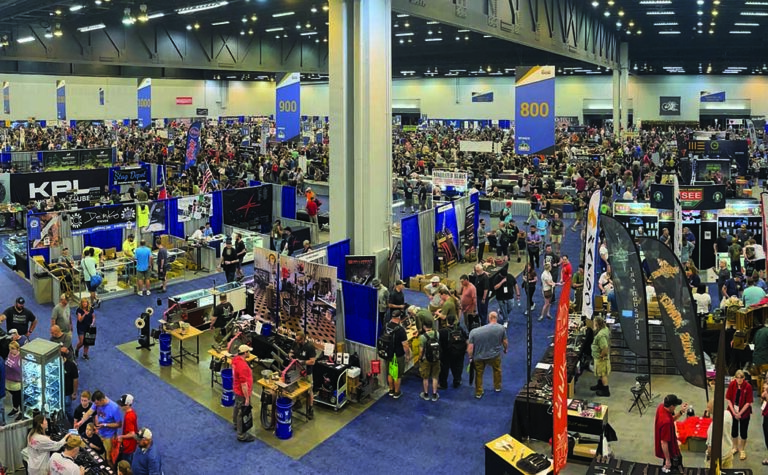
If you’re among the throng of thousands going to the BLADE Show June 7-9 at the Cobb Galleria Centre in Atlanta, here are a few tips on how to make the world’s largest, most important knife event work for you:

What To Wear

If in doubt “go dark”—any one or more of black shirt, blue jeans or black hat. While tactical doesn’t rule the way it once did, black remains the color of choice among many knife fans. Whatever color you choose, wear loose-fitting, comfortable clothes. If you want to overdo it, clip a knife to every pocket.

Comfortable shoes that provide full support against walking on concrete all weekend are an absolute must. Some bring two pair of such shoes. Bring a small backpack for snacks, a small plastic water bottle, etc. If you go outside for the BLADE University classes or free seminars, a ballcap helps protect against a June Georgia sun that has fried thousands of BLADE Show patron scalps over the years.

Party Proof Yourself

If you join the revelry and revel too much in The Pit (page 24), the lobby bar of the host Renaissance Atlanta Waverly Hotel, take some kind of headache relief before bedtime to reduce the dreaded post-Pit hangover. And, if you stay in the Waverly, bring some earplugs. The Pit can get raucous even into the wee hours and the noise can carry up to the hotel rooms, including the top floor.

Show Etiquette

  • Try to avoid walking fast and making sudden stops and U-turns in the exhibitor halls. Thousands of knife fans like you are moving, too, often closer to each other than they should. Any abrupt moves can result in collisions, so take it slow and easy. You’ll see more knives that way, too.
  • Never ask a maker how long it took him/her to make a specific knife. It’s natural to be amazed at some of the fabulous works of art and to be curious about how long it took to make one, but many makers bristle at the question. It’s not as important to know why they resent the query so much as the fact that they do, so don’t ask.
  • Don’t interrupt a maker/customer conversation. Patiently wait your turn or come back later when the maker is free to talk.
  • Ask the maker before you pick up a knife. If it’s a folder, it doesn’t hurt to ask permission to open it. The maker may want to open it for you. If a multi-blade folder, don’t open it so two or more blades are open at once. This puts undue pressure on one or more of the backsprings. It’s also a good way to cut yourself if you’re not careful. If you’re wanting to see what kind of clearance there is between opening/closing blades, ask the maker to demonstrate it for you. And when you finish examining the knife, return it the way it was handed to you—carefully, whether open or closed.
  • While it may seem courteous to wipe the blades off before returning knives to the makers, don’t. Let the makers do it instead. They are fully equipped to do so and are going to check the knife for any spots you may miss anyhow. That doesn’t mean you shouldn’t bring a chamois for your own purposes. However, if there’s any wiping down of their knives to be done, let the makers do it.
  • Don’t use a loupe/magnifying glass to examine a custom knife. It’s a good way to make the maker mad. There are going to be imperfections on custom knives—if not, they’re probably not custom—so some minute imperfections are to be expected.
  • After you finish talking to the maker and are ready to leave, even if you intend to return to his/her table, don’t say, “I’ll be back.” Chances are you won’t. It also implies you’ll be back to buy a knife when you may have no intention whatsoever of doing so. Don’t be an “I’ll Be Backer!”
  • One thing to be sure to do: have fun. If you’re going, see you there!

Check Out BLADE Custom Award Winners:

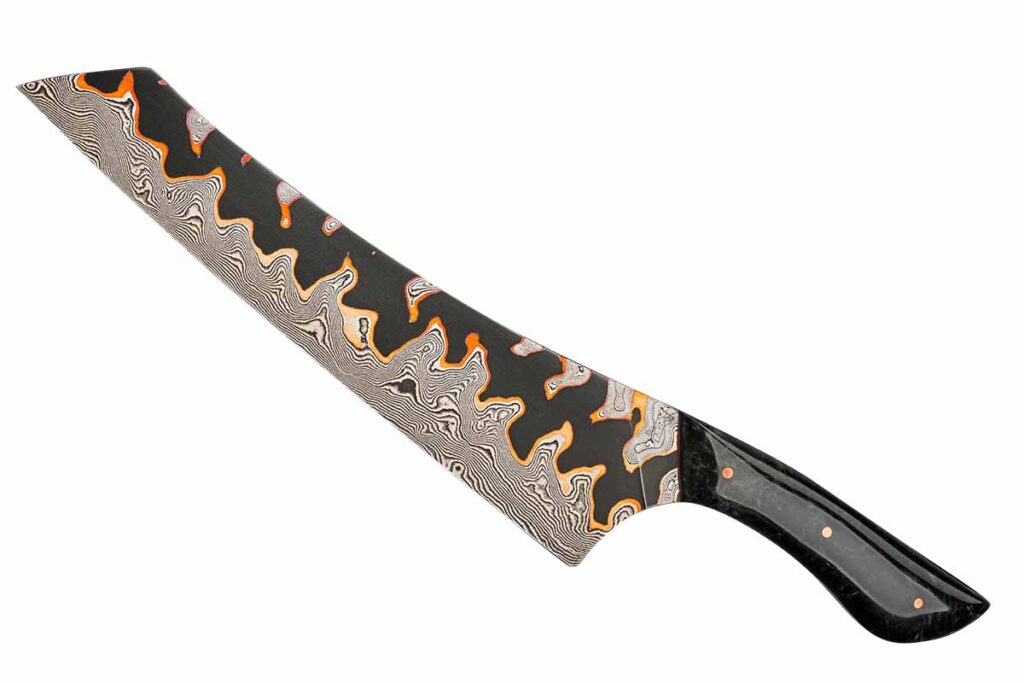
Daniel O’Connor Goes With The Flow On His Black Widow

A sushi knife that developed a taste for Texas brisket.

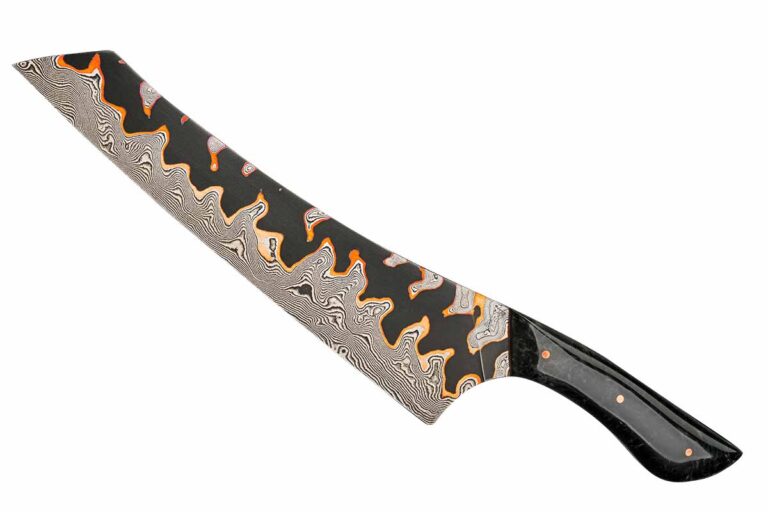
You might say Daniel O’Connor’s Black Widow leads a double life. It started as a sushi knife but when one of Daniel’s Texas pals said it looked like it would make a great brisket knife, O’Connor went with the flow, telling
his friend, “It’s about whatever you want it to be.”

OConnor Mug

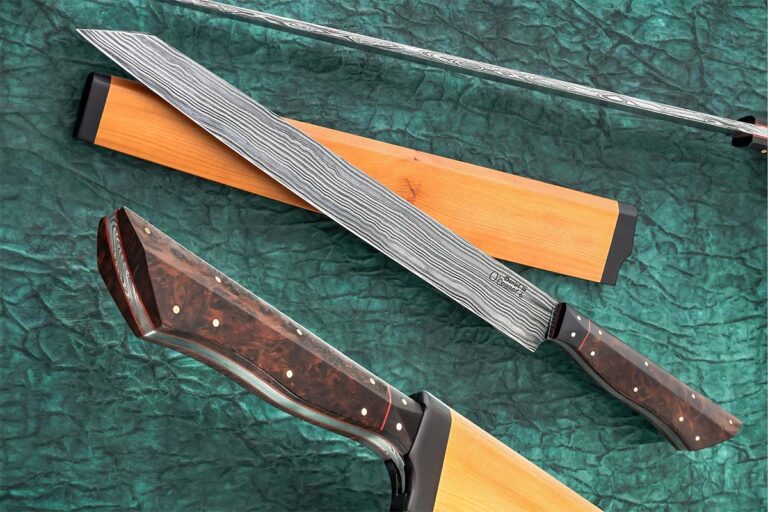
Based on a kiritsuke yanagi-ba sushi knife, Black Widow features a damascus of 150 layers of 1084 carbon and 15N20 nickel-alloy steels. Daniel forged the steels in a square and then forged them flat, perpendicular to the original stack. This resulted in the edges of the layers showing up in more or less straight lines, what Japanese swordsmiths call masame hada.

The accompanying image of the knife’s butt shows how the layers distorted when forged on edge. Daniel indicated he will use the pattern in the future.

Black Widow Specs
Blade length: 12”
Blade grind: A double urashi—double bevel w/a slight hollow on each side
Handle: Bocote burl w/red fiber liners
Bolster: Bog oak
Overall length: 17”
Sheath: Irish yew and bog oak
Maker’s price for a similar knife and sheath: $1,500

Check Out More Cool Custom Knives:

Boker And Condor’s Back To Basics Bushcraft Knives

We put the Boker Plus Vigtig vs. Wild and Condor Tool & Knife head to head to see which come out on top in the backwoods.

A couple of decades ago, attention started turning to the category of bushcraft knives. As usual, custom knifemakers were the ones filling the demand and leading the way. I was proud to be among them, along with such makers as Scott Gossman and others. There were those* before us but the push back then seemed more on survival knives with a tactical leaning.

After the push started, many smelled the opportunity to make money and the genre was flooded with assorted marketing schemes and people seeking their 15 minutes of fame. In all the confusion of people wanting to become famous and cash in, the true meaning of bushcraft was lost.

Boker Vigtig vs. Condor Wild
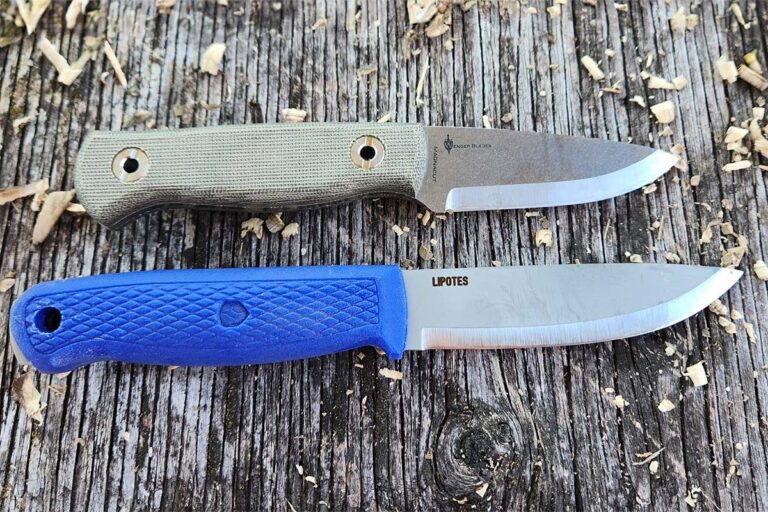
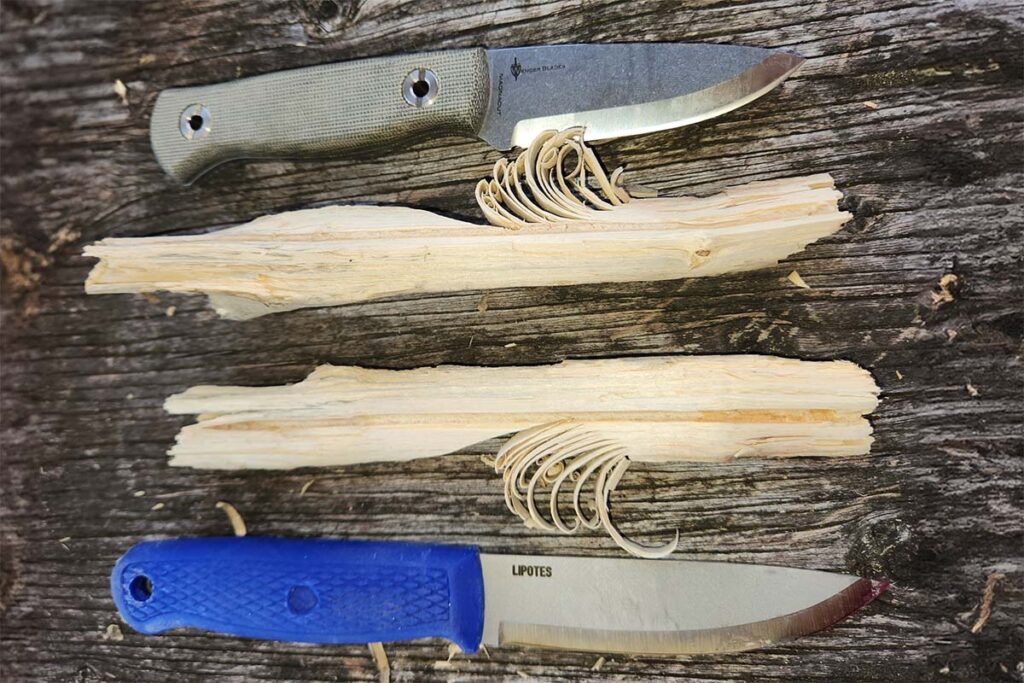
The thinner steel thickness on the Condor Tool & Knife Lipotes enables it to make finer curlicues than the Boker Vigtig vs. Wild. Designed by Dave Wenger and made in Germany, the Boker has an MSRP of $194.95. Joe Flowers designed the Lipotes, which is made in El Salvador. MSRP: $64.98.

A bushcraft knife is not something meant to be indestructible at all costs. It instead has always been a tool of creation. Now I see most marketing or testing related to whether the knife can be pounded through a log, a log that most likely would be unavailable if not for a chainsaw. No, the bushcraft knife started out as a tool, nimble in hand, keen in cutting and used to fabricate things in the bush, things not just to accommodate survival but to help a person thrive. In that reasonable light and practical expectation of the genre, let’s see how the Boker Plus Vigtig vs. Wild and Condor Tool & Knife Lipotes are suited to help you thrive in nature.

Boker Plus Vigtig

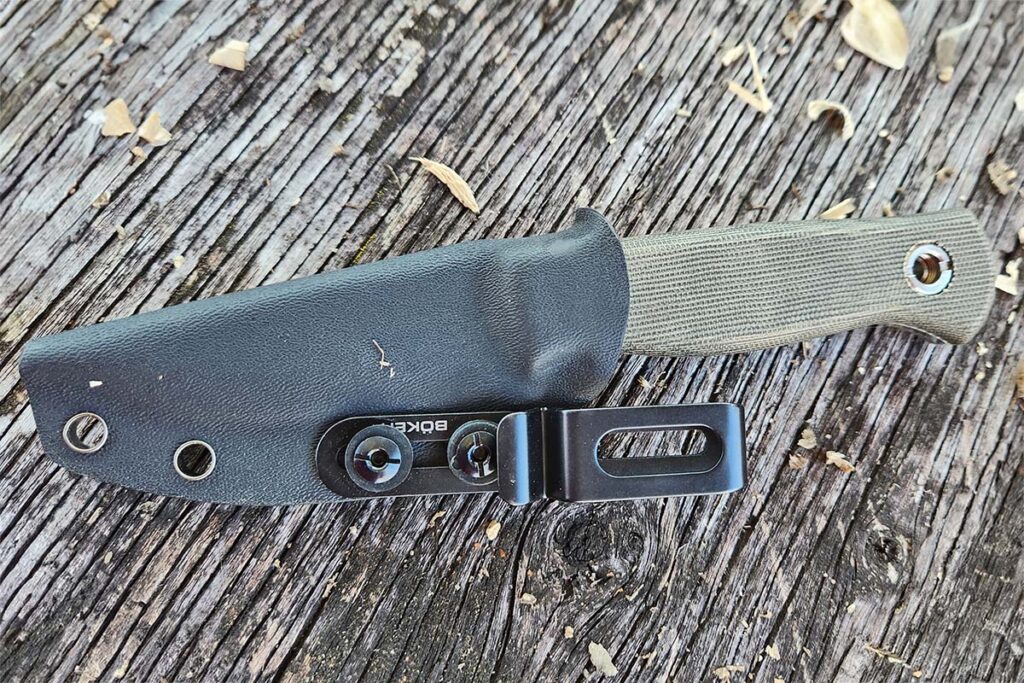
Boker sports a molded Kydex sheath
The Boker sports a molded Kydex sheath with an ambidextrous belt clip. The sheath holds the knife secure while still allowing for an easy draw when using a thumb push off.

The Boker’s 3.35-inch blade features a Scandinavian, aka Scandi, grind, a grind in which the major bevel is the only bevel and goes straight to zero. Executed correctly, the grind should take up at least a third of the blade’s width. If the grind is any shallower it will be too steep. Some variation on the height of the grind is due to the thickness of material. Being too steep will decrease the effectiveness of the blade to cut because the angle of the edge will plow into the work material—and when I cut with the Boker, it did just that. It is not that it won’t cut with a steep angle, it just tries to take heavier cuts as it dives. Therefore, you don’t get the thin controlled cuts as easy as a properly executed grind.

Scandi grinds are popular in bushcraft because of their amazing effectiveness carving wood. In the game area they work fine but you will often find that bone wreaks havoc on a Scandi edge. In addition, the cross profile of the blade is not optimized for processing meat. Full flat grinds process soft, malleable materials such as meat best since there is no shoulder on the blade to bind as the meat flows along the cross-section profile. On flat grinds you also have a secondary bevel, or micro bevel as some call it, and it takes hitting bone better.
The Boker is a full-tang knife with a blade .16 inch thick at the thickest, somewhat thick for a bushcraft knife. A clever feature is how the spine is finished. To strike a ferro rod off the blade spine you need a crisp edge. Sharp spines are more effective at generating sparks but are not very comfortable if you need to use a pinch grip or a thumb extension on a power grip. To address the issue, the Boker has a sharp spine toward the tip and a crisp spine section near the handle.

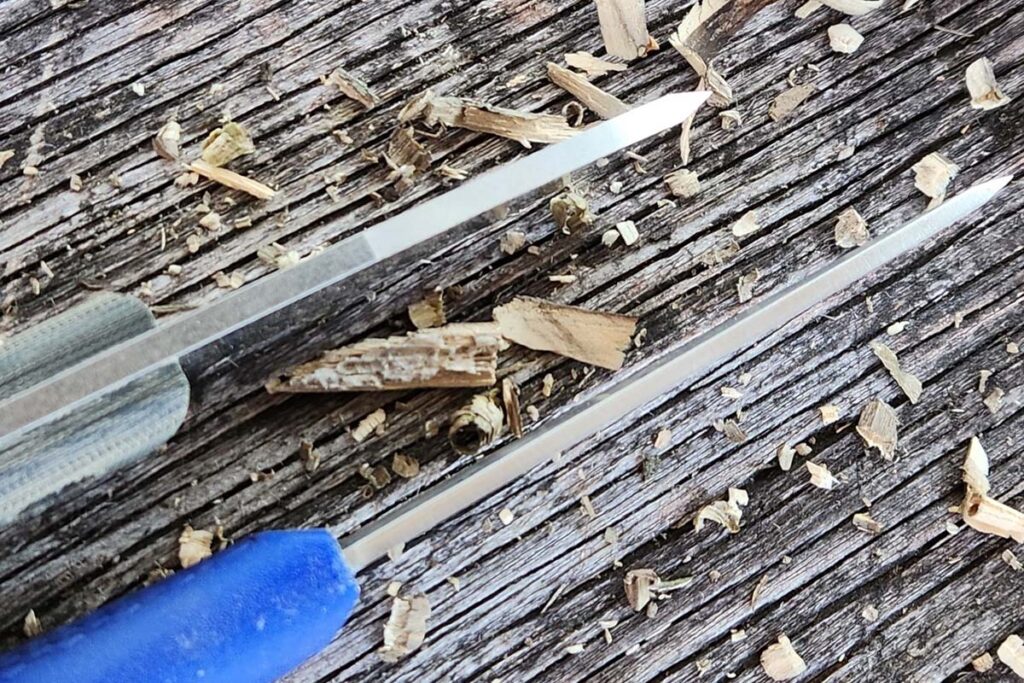
Blade thickness comparision
Note how much thicker (.16 inch at the thickest) the Boker blade is than that of the Lipotes (.13 inch at the thickest).

The handle is green linen Micarta® with beefy mechanical fasteners that double as lanyard holes. For those who prefer a full grip it has good profile contouring and leaves a blocky handle from side to side. There are no hot spots while still providing control.
The blade is CPM MagnaCut stainless steel and is wide for its size. With its thicker blade it batons well through small branches to make small kindling. You trade some agility for durability with a beefier blade material.

The molded Kydex sheath rides high and boasts a metal belt clip that screws on for right- or left-hand carry. The knife locks securely into the sheath yet not so much you can’t easily withdraw it.

I think the Boker has its good points. I do prefer my bushcraft knife to be more of a nimble cutting tool. Overall, if the edge were ground higher this knife would up its game substantially.

Wild and Condor Tool & Knife Lipotes

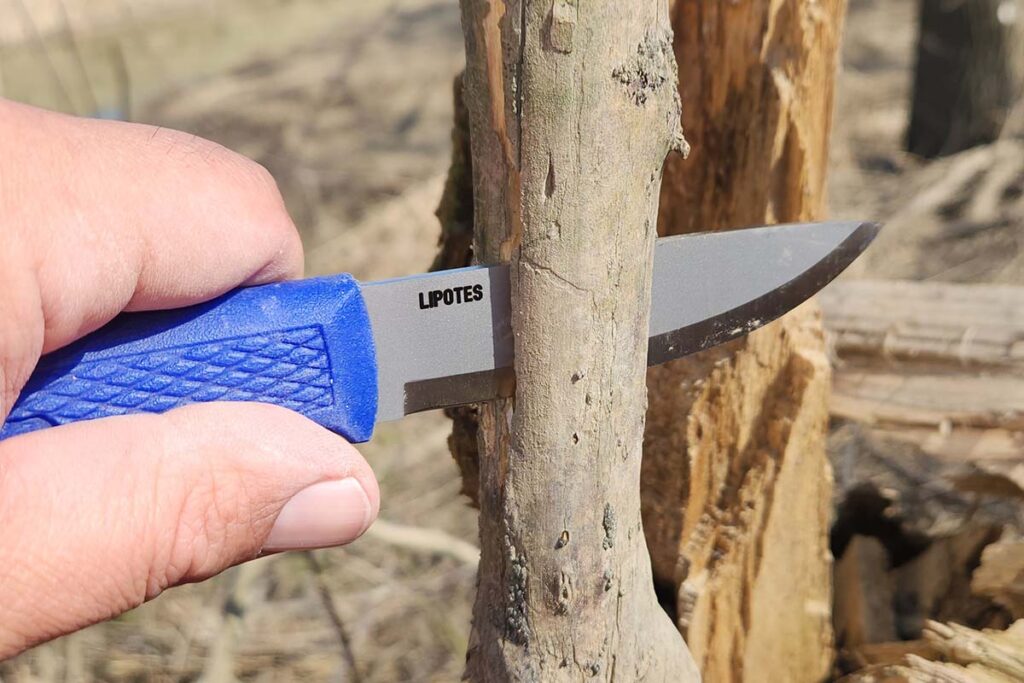
Lipotes batoning
For ease of baton work, the general rule is the cutting medium should be no wider than one-third the length of the blade. The Lipotes has a 4.15-inch blade of 14C28N stainless steel.

Let’s start with the handle on the Lipotes (among others, a lipotes is an endangered species of dolphin). It is an extended hidden tang and not a full tang—that’s right, not a full tang. Some time ago a well-known knife company introduced an extended-hidden-tang version of a knife and called it a full tang, and all the marketers and social media influencers decided to rename a feature so everyone could fall in line. If you can’t see the tang all around the knife’s handle, it isn’t a full tang.

Along with rat-tail tangs, hidden tangs have the distinct advantage of being some of the most comfortable knives in use. The steel element is totally encapsulated in the handle, allowing the maker to have full control in contouring the scales. In other words, you basically have a tang that will not interrupt how the material is shaped.

The Lipotes handle is very comfortable and the texture in the molded material provides a secure grip. As for the hidden tang extension, it can be used as a small hammering device or even a scraper.

Except for the grind, I like the overall proportions of the knife. As with the Boker, the grind doesn’t go high enough. It will still cut but the cutting would be greatly optimized if the grind were half its height taller. It performed well in its cutting tasks with power cuts, feathering and the like. However, it still missed the ease of cut and control of a higher grind. If I could, I would love to get my hands on a bunch of these blades and regrind them.

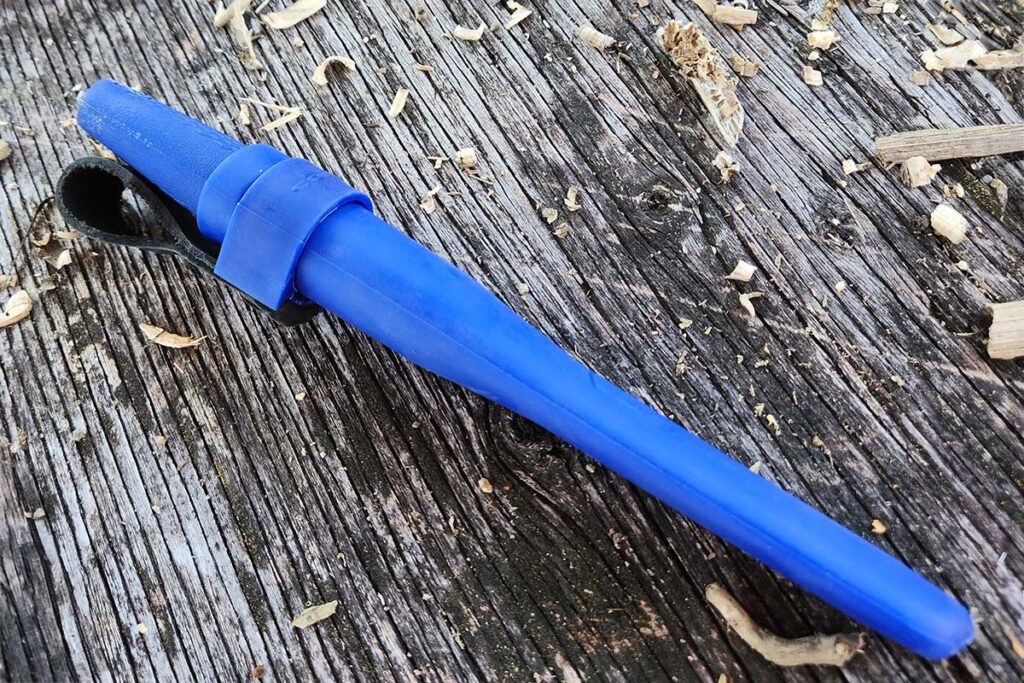
Lipotes sheath
The Lipotes has a quality sheath that holds the knife nice and tight when you ramble through the woods. The leather belt loop riveted to the back won’t accommodate a wide belt.

I really like the sheath. It has a nice, deep carry. It is a molded plastic with a good friction fit. It is a bit mysterious to me as to why the belt loop is so small. Only a dress belt would fit through it. You could still run a cord through it for neck carry or a baldric. The Joe Flowers design checks off so many of the boxes for a good tool. I would have been singing its praises more with a higher grind. Instead, I am pretty much humming.

More Than Survival

To repeat, a bushcraft knife isn’t just for survival, it is a tool of creation. Often the real goal of an issue gets lost in the minutiae that results from personal gain and egos. Over the years, marketing and self-promotion have polluted bushcraft until we have lost it in a sea of books and an ocean of social media. A look at a simple tool such as a knife can really remind us of what bushcraft is about. It is about man’s will to do more than just survive. Man strives to prosper.

I will leave you with one of my favorite quotes about tools by Thomas Carlyle: “Man is a tool-using animal. Without tools he is nothing, with tools he is all.”

*Author’s note: The origins of the discussions of bushcraft can be attributed to such enthusiasts as Mors Kochanski, Larry Dean Olsen, Lofty Wiseman, Ray Mears and others.

Check Out More Outdoor Knives:

New Knives: Must-Have Production And Custom Blades

From kitchen to camp and beyond, these puppies will perform.

Christmas may have passed and all your presents have been unwrapped, but that doesn’t mean you can’t start building out your wish list for the coming year. We’re here to help with a slew of new knives—and non-knives—that are certain to tantalize and tempt. From production options full of pomp and customs cutting one-of-a-kind profiles, there’s something for knife lover.

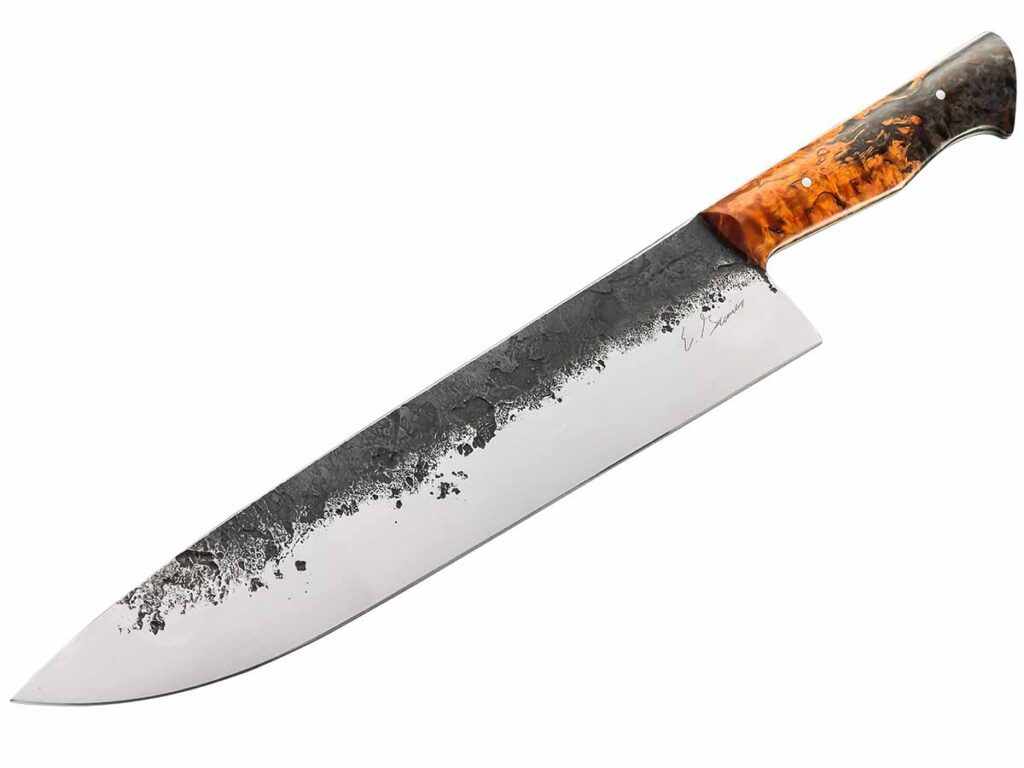
Greiner Chef’s Knife

Greiner Chef's Knife

Blade length: 10”
Blade material: 80CrV2 carbon steel w/forged finish
Blade grind: Flat
Handle material: Double-stabilized karelian birch
Overall length: 14.5”
Maker’s price for a similar knife: $600
Maker: Erik Greiner, greinerblades.com (SharpByCoop image)


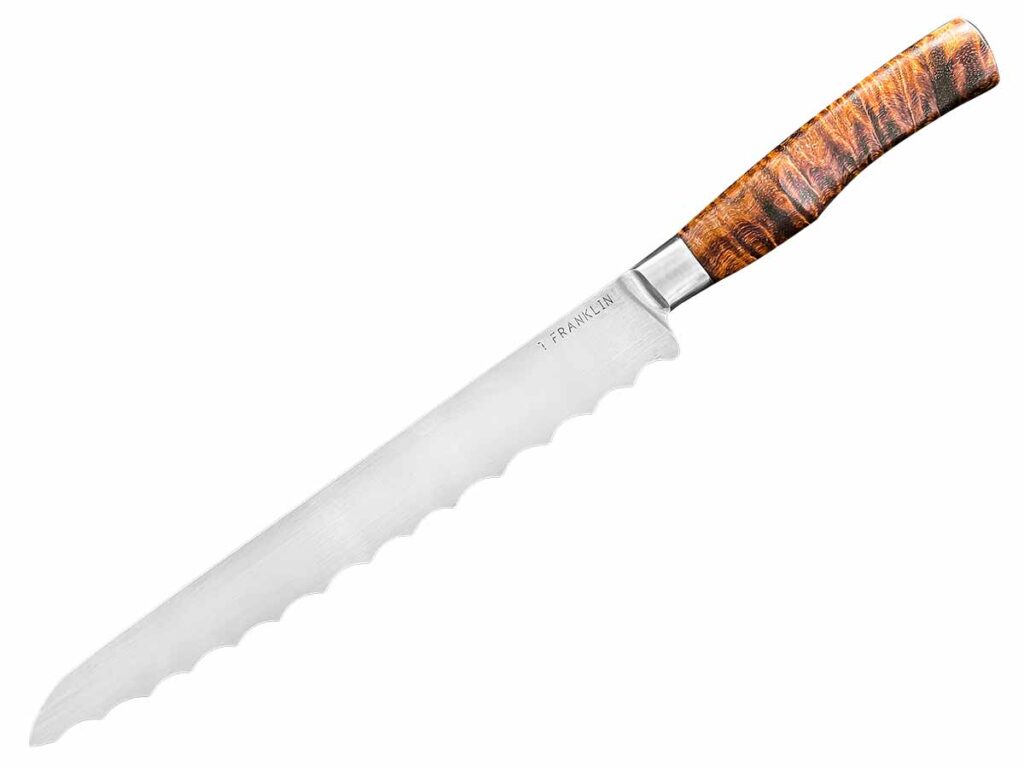
Franklin Bread Knife

Franklin Bread Knife

Blade length: 9.25”
Blade material: 52100 carbon steel
Handle material: Hawaiian koa
Overall length: 14”
Maker’s price for a similar knife: $575
Knife to know: Also comes in a set of three that includes chef’s and paring knives w/a price of $1,750 for the entire set; Thomas Franklin is an ABS apprentice smith
Maker: Thomas Franklin (Jfrasierphotography.com)


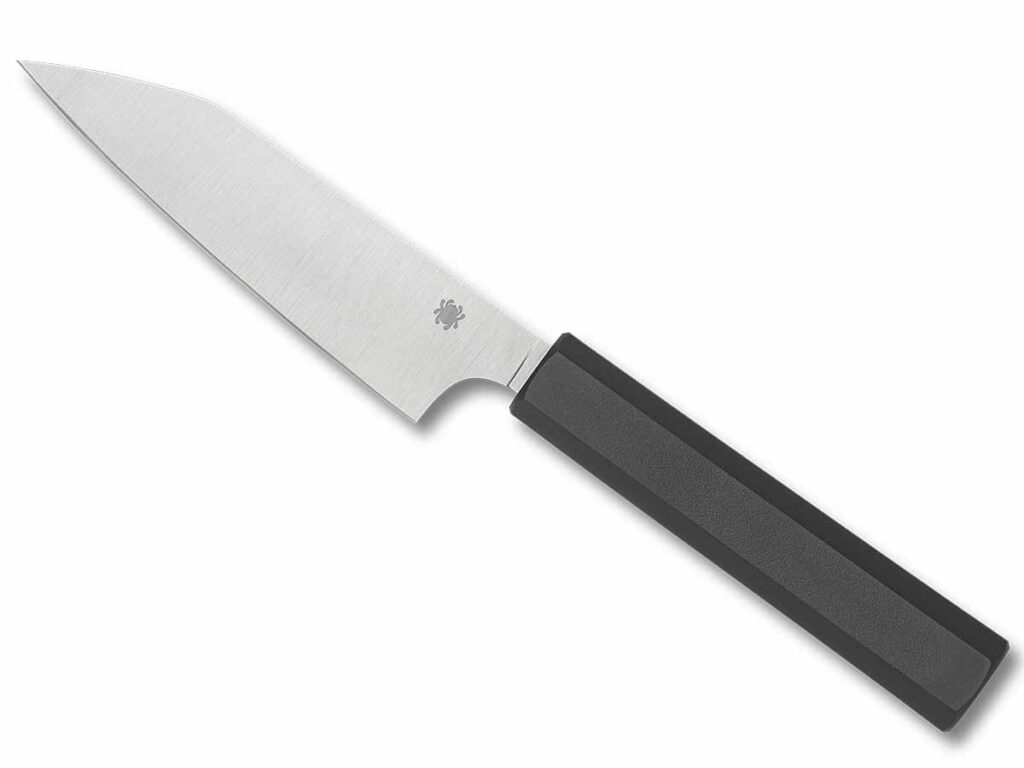
Spyderco Petty

Spyderco Petty

Designer: ABS master smith Murray Carter
Blade length: 4.64”
Blade steel: CTS BD1N stainless
Blade grind: Full-flat
Blade @ thickest: .068”
Handle design: Wa style (octagonal)
Handle material: Black polypropylene
Weight: 1.8 ozs.
Overall length: 8.87”
Knife to know: The Petty is part of Spyderco’s Minarai Series; meaning “to look and learn,” minarai is the Japanese way of describing the role of an apprentice
Country of origin: Japan
Company: Spyderco, spyderco.com


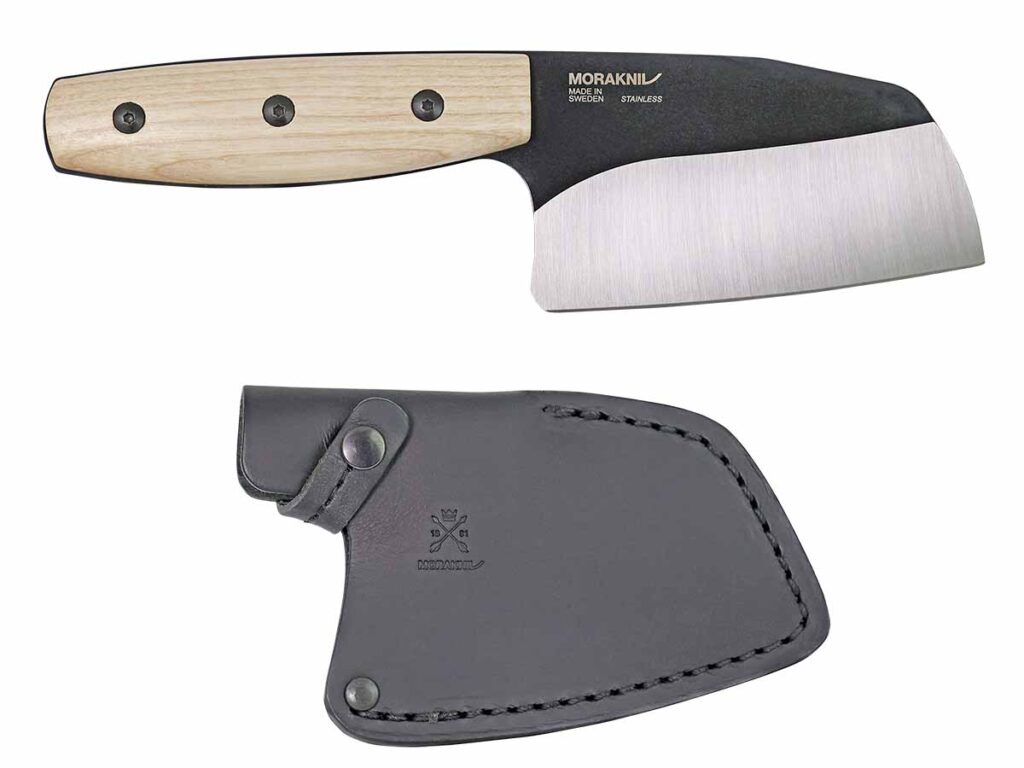
Morakniv Rombo

Morakniv Rombo

Model: Camp chef’s knife
Blade length: 3.86”
Blade steel: Swedish stainless
Blade grind: Flat
Blade @ thickest: .09”
Blade finish: Two-tone
Handle material: Wood
Weight: 5.5 ozs.
Overall length: 8”
Country of origin: Sweden
Knife to know: Designed for right-hand use
MSRP: $230 (at press time rate of exchange)
Company: Morakniv, industrialrev.com


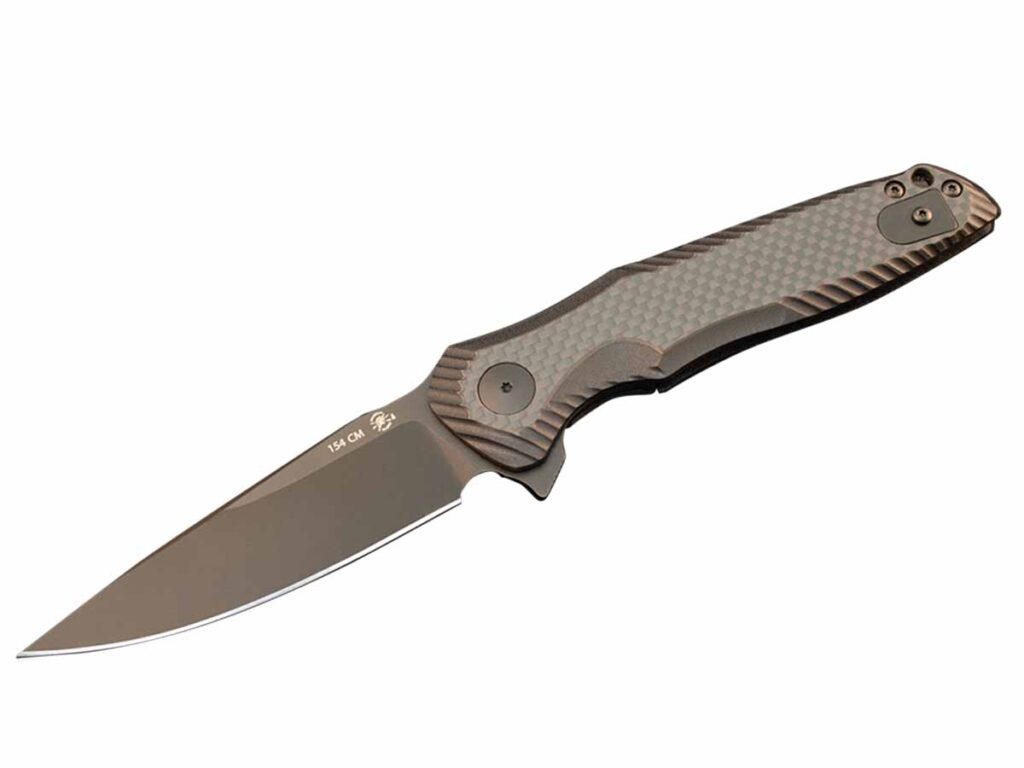
Spartan Blades Poros

Spartan Blades Poros

Designer: Curtis Iovito
Knife type: Flipper folder
Blade length: 3.75”
Blade steel: 154CM stainless
Rockwell hardness: 58-60 HRC
Blade grind: Flat
Blade @ thickest: .125”
Blade finish: Black titanium nitride coating
Blade pattern: Drop point
Pivot action: Ikoma Korth Bearing System (IKBS)
Handle material: Carbon fiber/G-10 composite
Lock: Linerlock
Pocket clip: Deep carry
Hardware & liner: Stainless steel w/black electro-deposit powder coating
Weight: 5.3 ozs.
Closed length: 4.25”
Country of origin: USA
MSRP: $190
Company: Spartan Blades, spartanbladesusa.com


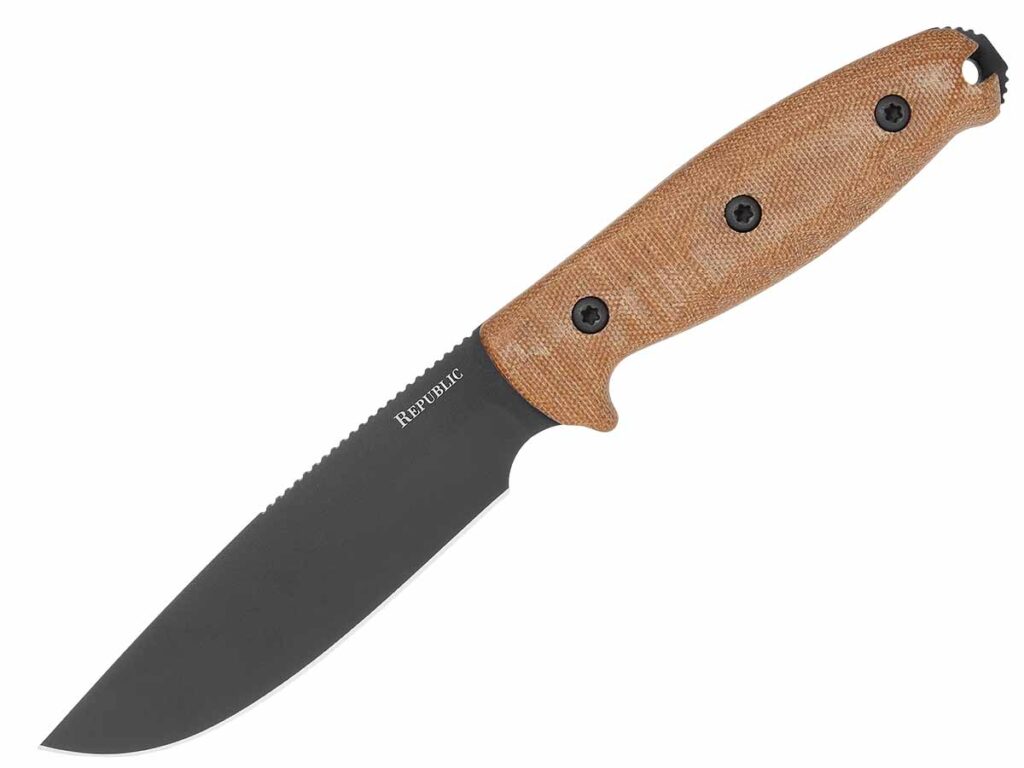
Cold Steel The Republic

Cold Steel The Republic

Knife type: Bushcraft fixed blade
Blade length: 5”
Blade steel: CPM S35VN stainless
Rockwell hardness: 58-60 HRC
Blade @ thickest: .1535”
Blade finish: Corrosion resistant/no-glare Ionbond
Blade pattern: Drop point
Handle material: Micarta® w/single integral guard and lanyard hole
Knife to know: Handle is removable for customization based on situation/undertaking; spine gimping for extra control
Weight: 8.4 ozs.
Overall length: 10”
Sheath: Leather pouch
MSRP: $269.99
Country of origin: USA
Company: Cold Steel, coldsteel.com


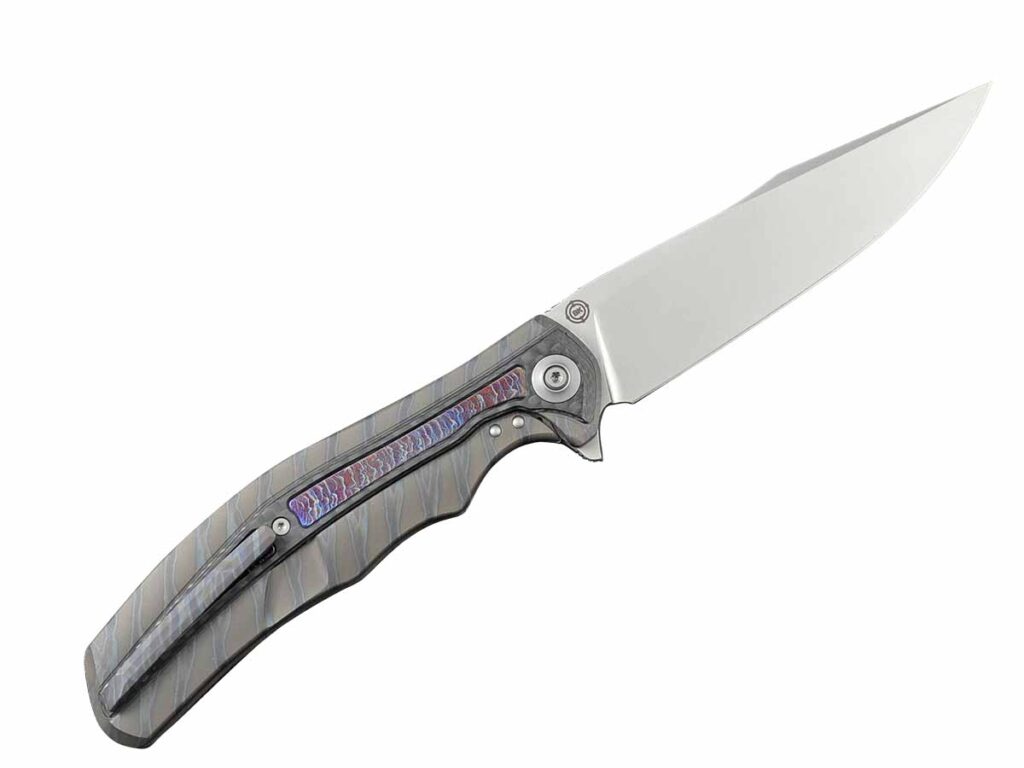
WE Knife Zonda

WE Knife Zonda

Pattern: Flipper folder
Blade length: 4.04”
Blade steel: CPM 20CV stainless
Blade finish: Stonewashed
Blade @ thickest: .13”
Handle material: Black titanium w/flamed titanium inlay
Pocket clip: Right-hand, blade-tip-up carry
Lock: Framelock
Closed length: 4.85”
Country of origin: China
MSRP: $480
Company: WE Knife, weknife.com


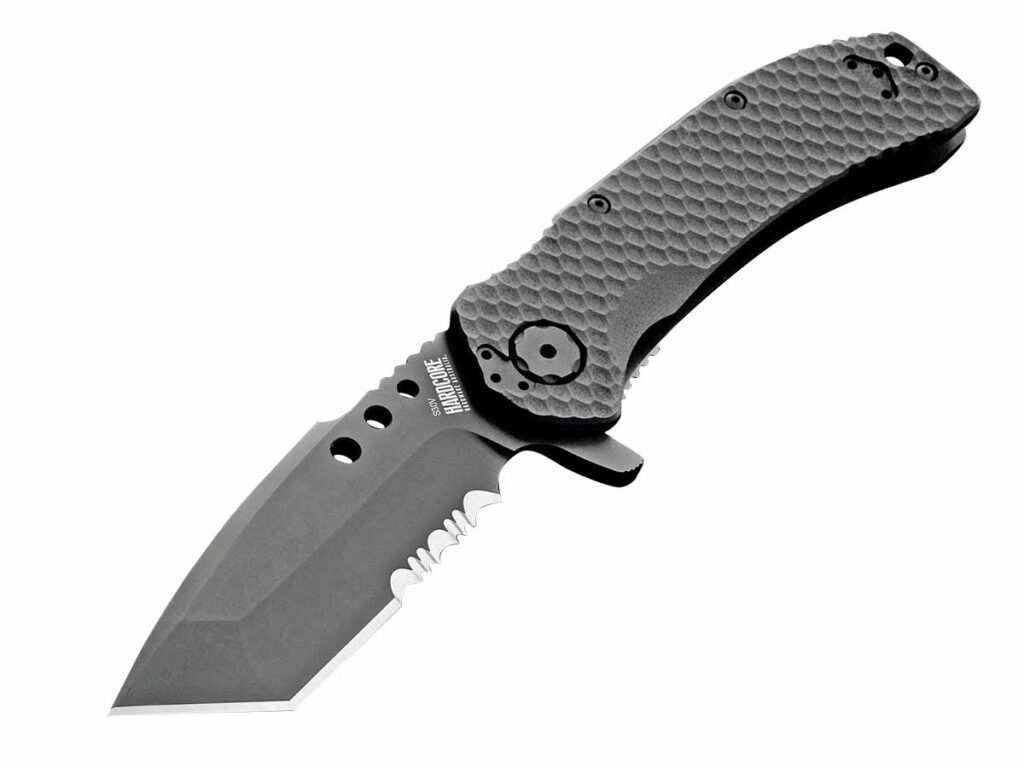
Halfbreed Blades MILF-03PS

HHA MILF

Blade length: 3.54”
Blade steel: CPM S30V stainless
Rockwell hardness: 59-60 HRC
Blade grind: Hollow
Blade @ thickest: .19”
Blade finish: PVD coat
Blade pattern: Tanto
Handle material: G-10
Washers: Phosphor bronze
Weight: 7.34 ozs.
Closed length: 5.51”
Handle @ thickest: .59”
Country of origin: Australian and Taiwanese make
MSRP: $280
Company: Halfbreed Blades, halfbreedblades.com.au


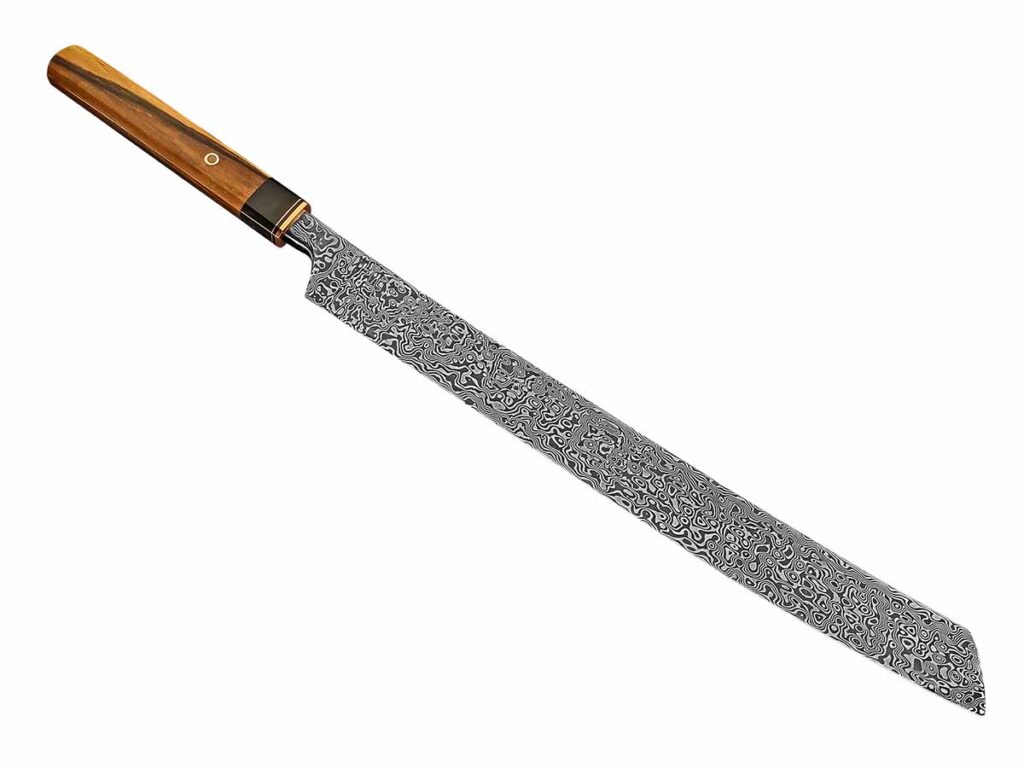
Schubert Knives Large Damascus Slicer

Schubert Knives Large Damascus Slicer

Blade length: 19.3”
Blade material: 90-layer raindrop-pattern damascus of 1084 carbon and 15N20 nickel-alloy steels
Blade grind: Flat
Blade @ widest: 1.77”
Bolster/guard material: Copper and buffalo horn w/soldered joint
Handle material: Stabilized blackheart sassafras
Handle pins: Turned whale tooth and bamboo
Overall length: 26.4”
Scabbard (not shown): Glass lacquered wood inlaid w/black heart sassafras, buffalo horn, copper and whale tooth
Maker: Bruce Schubert (Rod Hoare image)


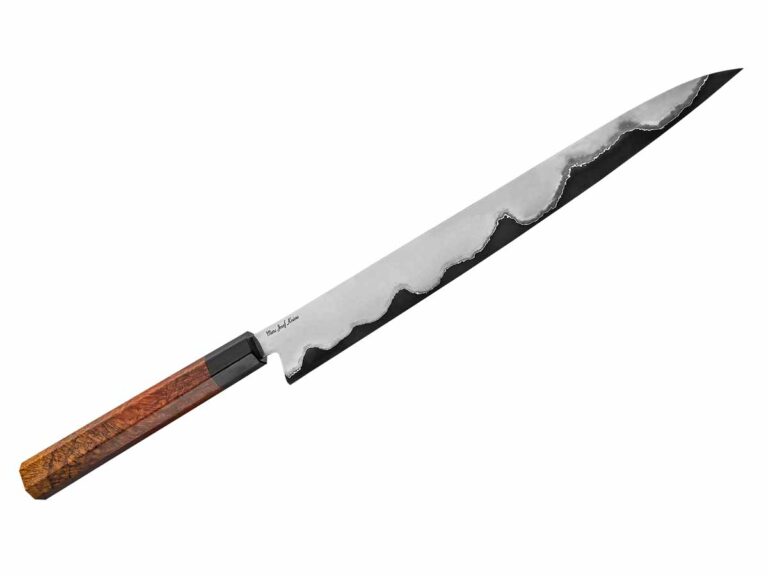
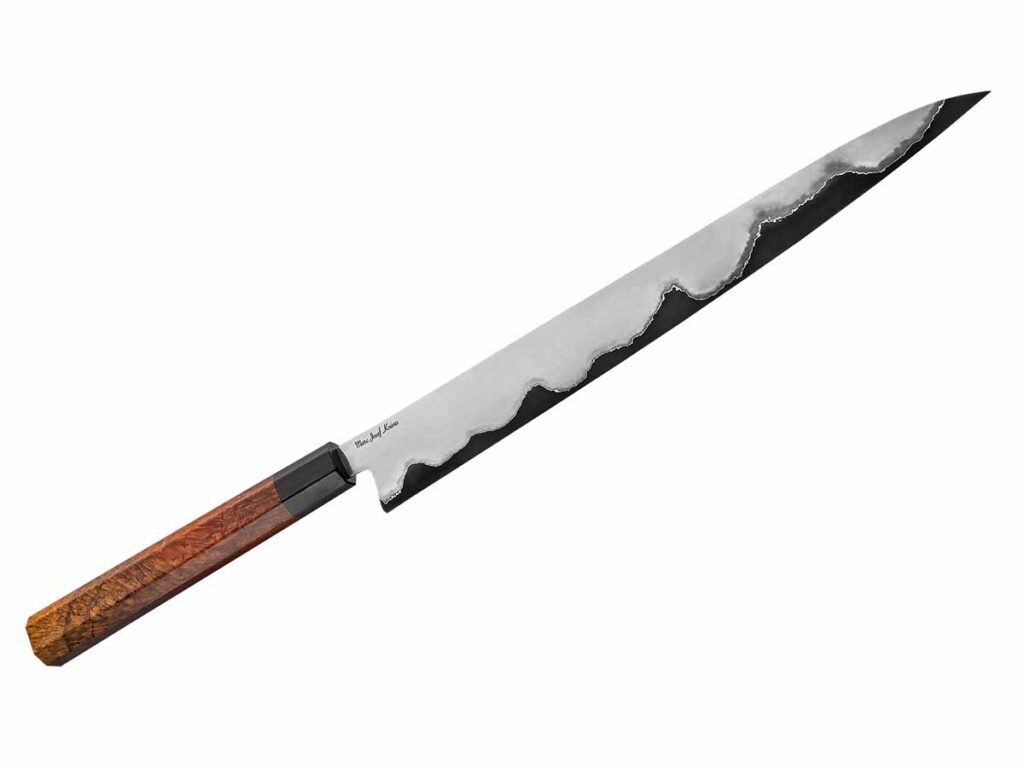
Mark Josef Knives Sujihiki

Mark Josef Knives Sujihiki

Pattern: Slicer
Blade length: 11.8”
Blade material: San-mai construction of 410 stainless steel, nickel and 52100 carbon steel forged by Brook Turner
Rockwell hardness: 62 HRC
Blade grind: Flat/convex
Blade thickness @ ricasso: .118”
Blade @ widest: 1.496”
Handle material: Coolabah burl
Bolster/guard: African blackwood
Overall length: 18.5”
Maker: Marc Stewart, Mark Josef Knives, marcjosefknives.com.au (Rod Hoare image)


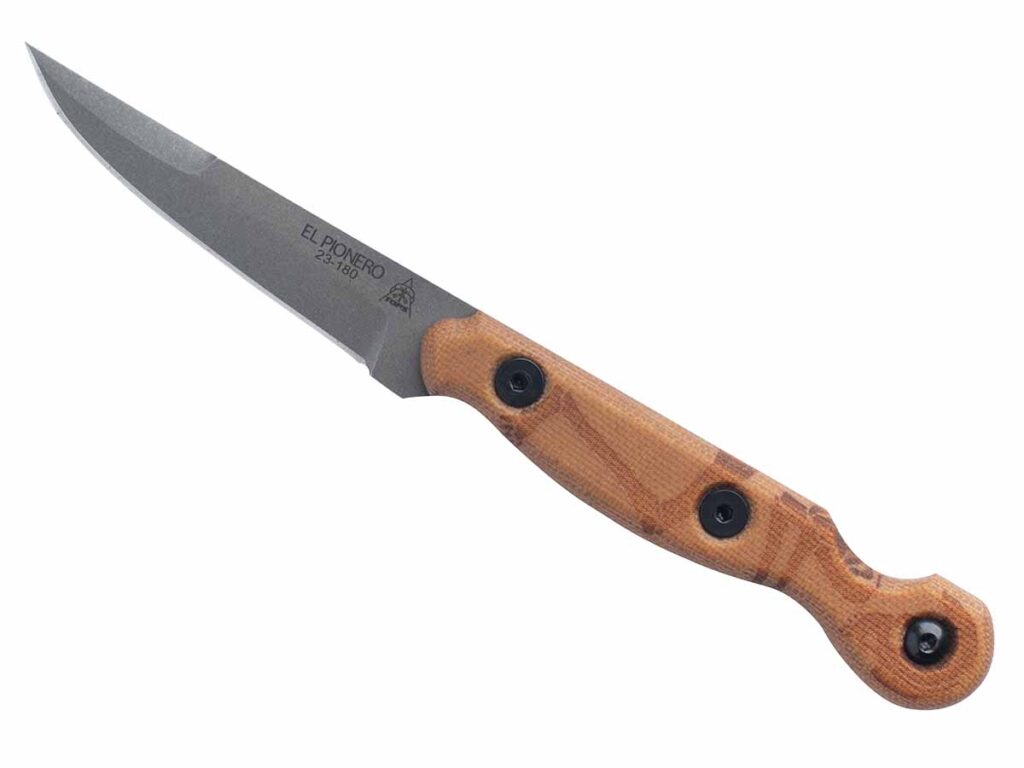
TOPS Knives El Pionero

TOPS Knives El Pionero

Designer: Ed Calderon
Blade length: 3.38”
Blade material: 1095 carbon steel
Blade @ thickest: .09”
Blade finish: Tumble
Handle material: Tan canvas Micarta® w/finger divot that aids in blade orientation, etc.
Weight: 2.9 ozs.
Overall length: 7.63”
Sheath: Black Kydex
Weight w/sheath: 4.1 ozs.
Knife to know: The El Pionero is a “paring knife-esque design”; Ed Calderon (edsmanifesto.com) worked as a counter-narcotics officer in Mexico and more recently as a trainer and “guru in the tactical space”
Country of origin: USA
MSRP: $220
Company: TOPS Knives, topsknives.com


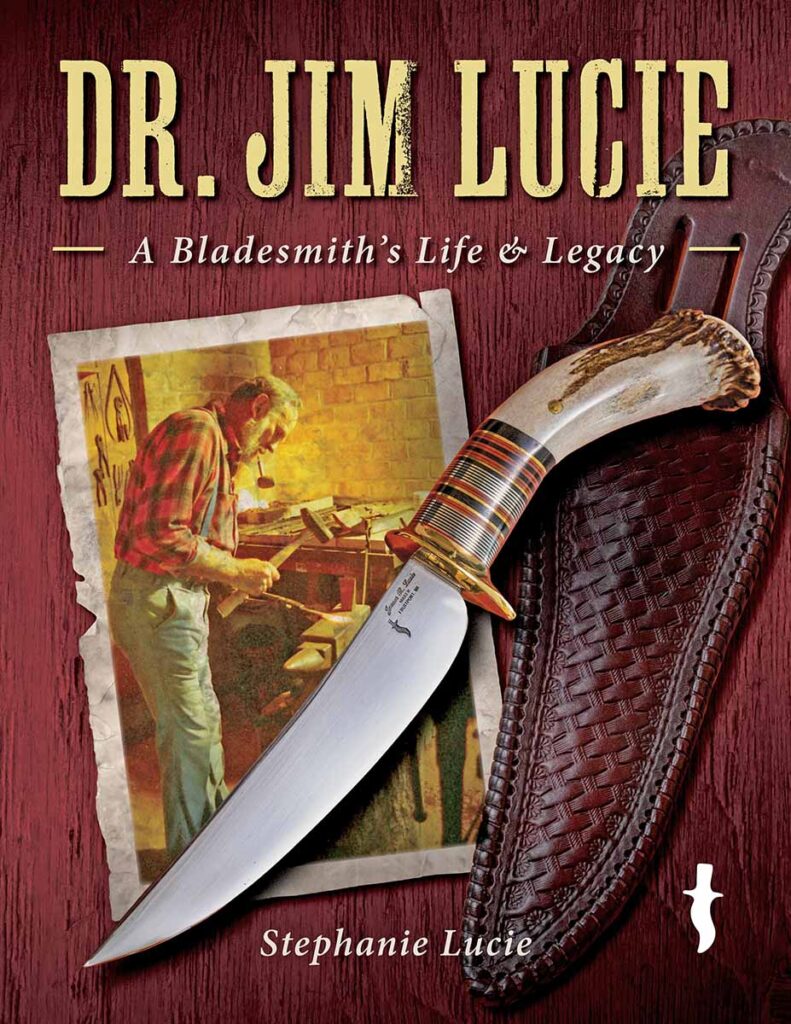
Dr. Jim Lucie: A Bladesmith’s Life & Legacy

Dr. Jim Lucie: A Bladesmith’s Life & Legacy

What it’s about: ABS journeyman smith Dr. Jim Lucie had a unique background: he served as the personal physician for, and learned about knifemaking from, the man recognized as the grandfather of custom knives—BLADE Magazine Cutlery Hall-Of-Fame® member William Scagel. The author, Stephanie Lucie, is Lucie’s youngest of four daughters. She paints a picture of her father like no other, from childhood to adulthood, his bladesmithing mentors and friends, the many stories written about him and much more.
Format: 9.25 x 12.5-inch hardback, limited to 1,500 copies in the first edition, over 300 color photos, including more than 200 knives Lucie made, and over 100 pictures of his life and accomplishments.
MSRP: $120
Contact: jimluciebook.com

Check Out More Knife Drops:

What’s New: Top Knives—Damascus, Stainless Steel And More

0

Damascus, high-performance stainless and straight carbon steel standouts.

Always on the lookout for the new and exciting when it comes to edged gems, Blademag.com has collected a bevy of beautiful new knives hitting the market. This includes both custom and factory knives with a particular eye towards damascus, high-performance stainless and straight carbon steel standouts in this round.

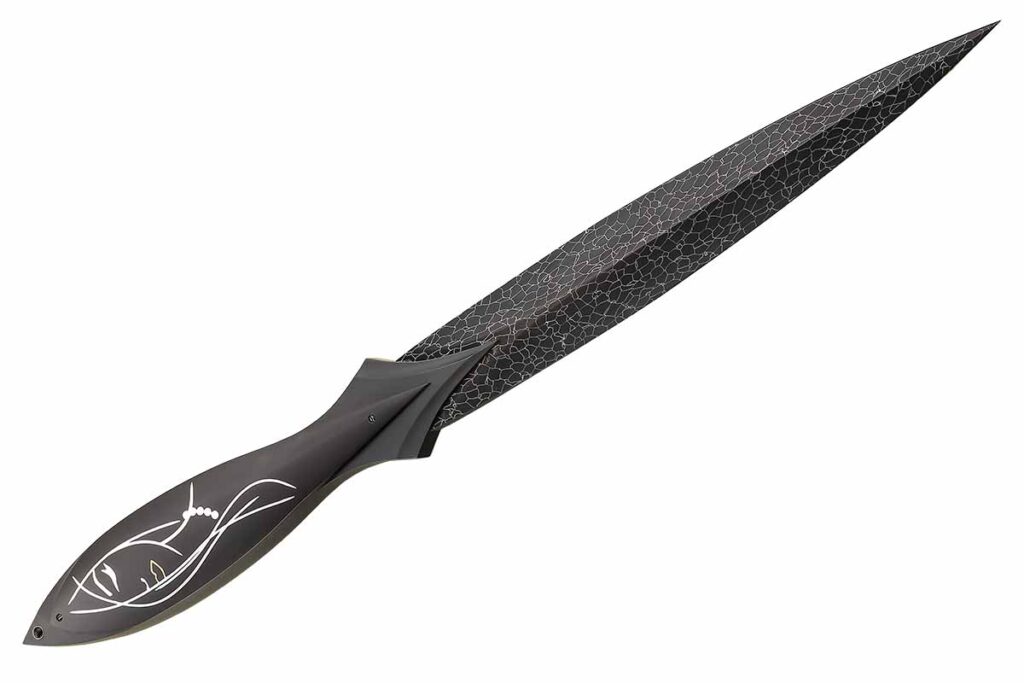
Bertie Rietveld: Flirt

Rietveld Knives Flirt

BLADE LENGTH: 7”
BLADE MATERIAL: Nebula damascus
BLADE GRIND: Hollow
FRAME MATERIAL: Zirconium
BOLSTER: Zirconium
ENGRAVING: Of fine silver by Bertie Rietveld
KNIFE TO KNOW: Stanhope lens in butt of handle
OVERALL LENGTH: 12”
MAKER’S PRICE FOR A SIMILAR KNIFE: $6,000
MAKER: Bertie Rietveld, rietveldknives.com (SharpByCoop image)


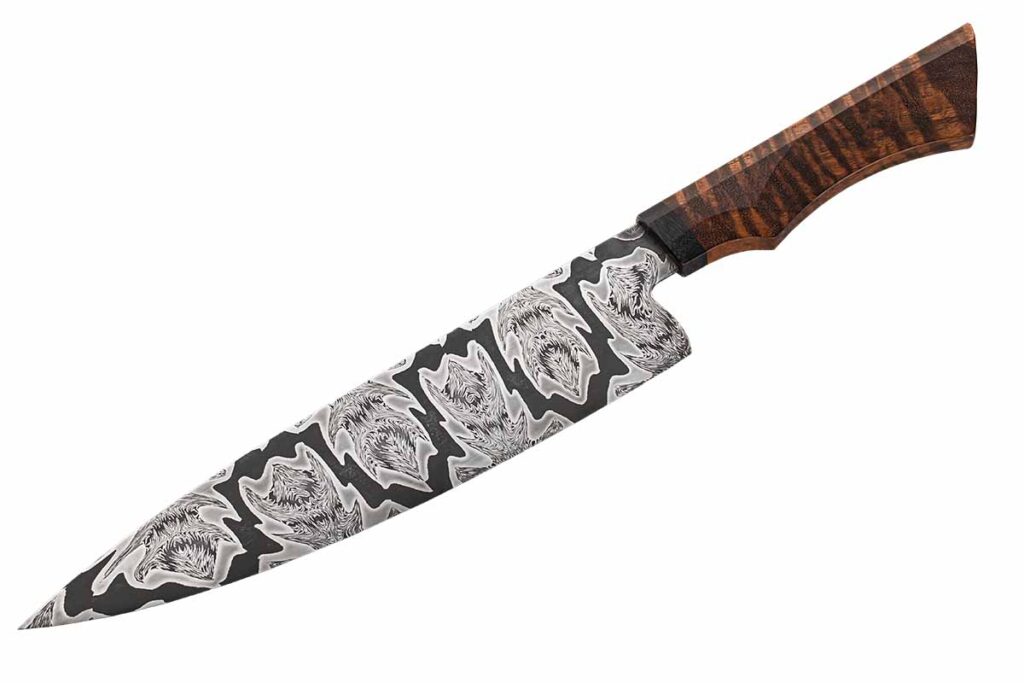
Keith Barthelmes: Serpent Chef’s Knife

Keith Barthelmes Serpent Chef

BLADE LENGTH: 9.5”
BLADE GRIND: Flat that tapers to a convex edge
BLADE MATERIAL: Serpent damascus of 1084 carbon and 15N20 nickel steels
HANDLE MATERIAL: Curly koa
BOLSTER: Black canvas Micarta®
OVERALL LENGTH: 15”
MAKER’S PRICE FOR A SIMILAR KNIFE: $1,600
KNIFE TO KNOW: Keith is an ABS apprentice smith and hopes to take his ABS journeyman smith test in two years
MAKER: Keith Barthelmes (Jocelyn Frasier image)


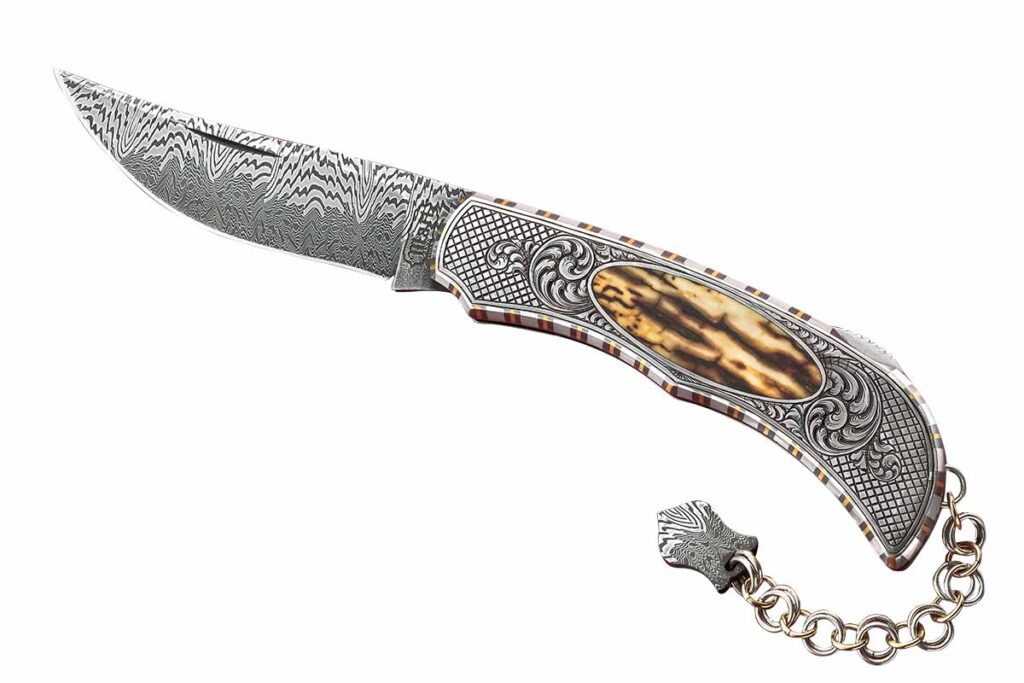
Matt Humphreys: Lockback Folder

Matt Humphreys Lockback Folder

BLADE LENGTH: 3.5”
BLADE MATERIAL: Damascus forged by Jim Poor
BLADE GRIND: Hollow
HANDLE MATERIAL: Ancient ivory inlay, 24k-gold and fine silver inlay, 14k-gold and sterling silver chain
FRAME MATERIAL: 4130 carbon steel
ENGRAVING: By Matt Humphreys
CLOSED LENGTH: 4.5”
MAKER’S PRICE FOR A SIMILAR KNIFE: $5,500
MAKER: Matt Humphreys, outlawwaterjetdesign.com (SharpByCoop image)


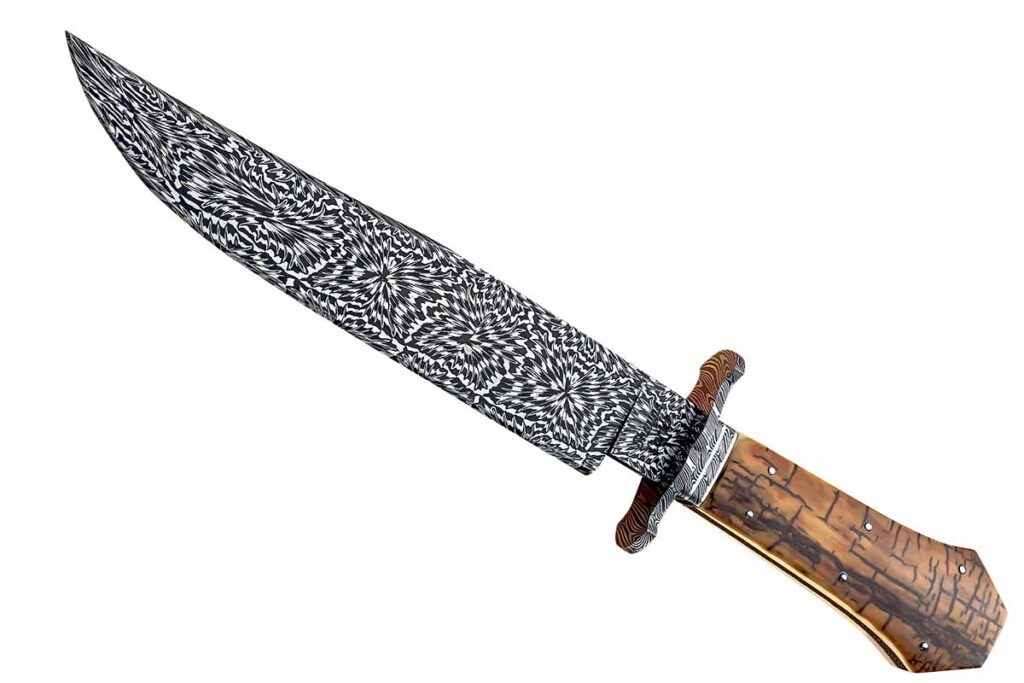
Shayne Carter: Coffin-handle Bowie

Shayne Carter Coffin-handle Bowie

BLADE LENGTH: 8.25”
BLADE MATERIAL: A mosaic explosion damascus pattern of 1084 carbon and 15N20 nickel-alloy steels
BLADE GRIND: Flat
HANDLE MATERIAL: Mammoth ivory
FRAME MATERIAL: Damascus
OVERALL LENGTH: 13.25”
MAKER’S PRICE FOR A SIMILAR KNIFE: $3,200
KNIFE TO KNOW: Shayne Carter is a master smith in the American Bladesmith Society (ABS)
MAKER: Shayne Carter, (SharpByCoop image)


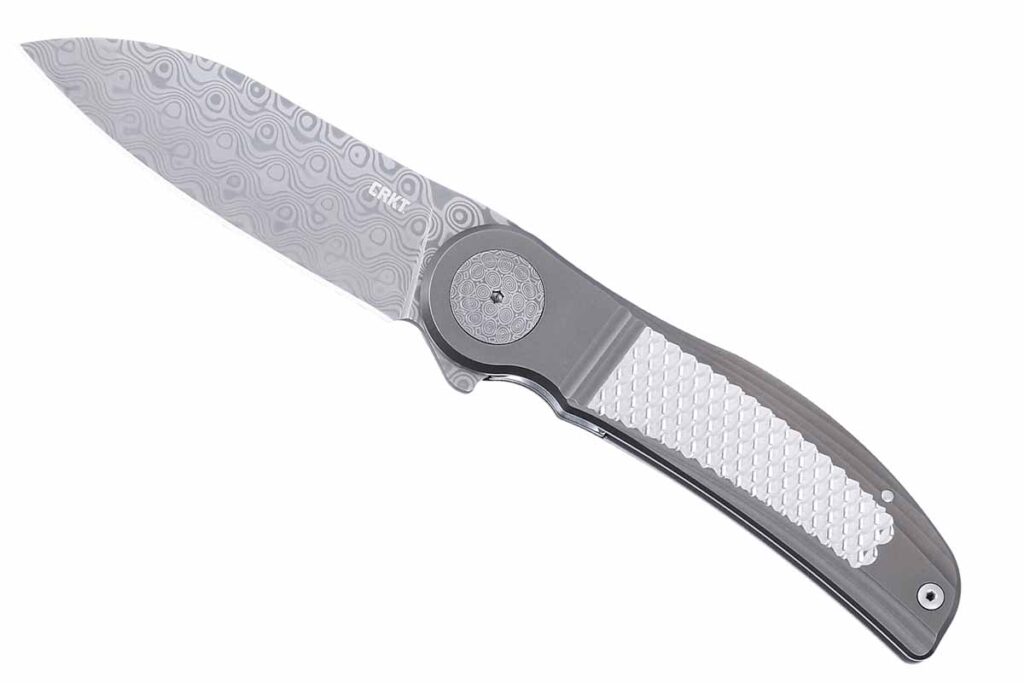
CRKT: Monument 4001

CRKT Monument 4001

DESIGNER: BLADE Magazine Cutlery Hall-Of-Fame® member Michael Walker
BLADE LENGTH: 3.07”
BLADE MATERIAL: Rose damascus by Damasteel
BLADE GRIND: Flat
BLADE PATTERN: Modified sheepsfoot
HANDLE: Titanium w/white dragon scale inlay
PIVOT: Damascus in a Bluetongue pattern by Damasteel
ACTION: IKBS ball bearings
LOCK: Linerlock
POCKET CLIP: Deep-carry design
WEIGHT: 3.9 ozs.
CLOSED LENGTH: 4.17”
COUNTRY OF ORIGIN: Italy
MSRP: $500
COMPANY: CRKT, crkt.com


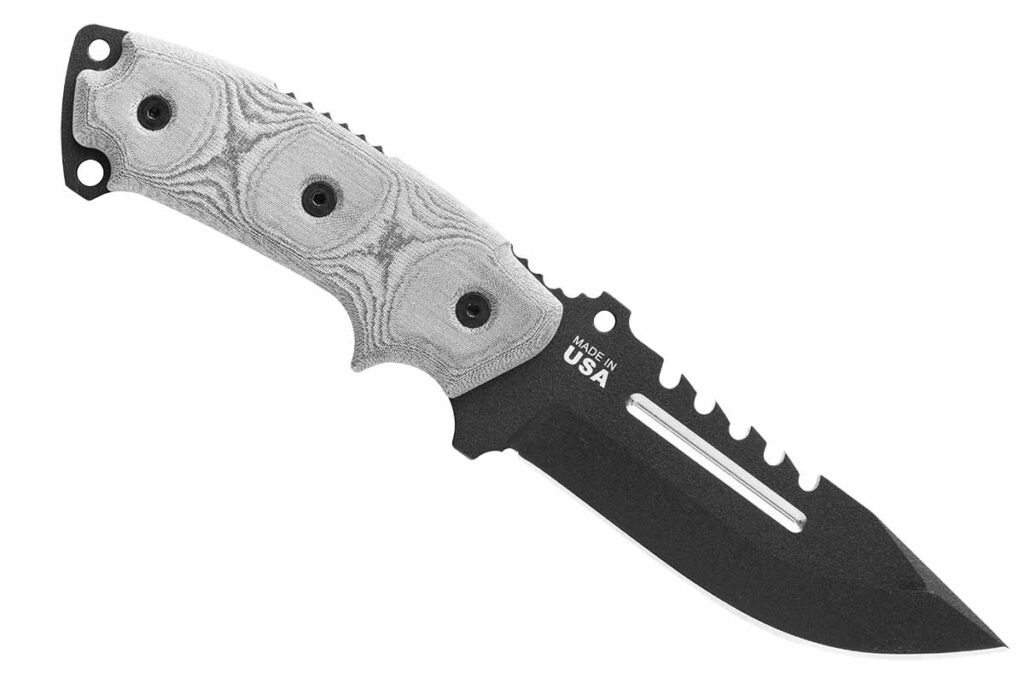
TOPS Knives: Steel Eagle 105C

TOPS Steel Eagle 105C

BLADE LENGTH: 5.13”
BLADE MATERIAL: 1095 carbon steel
BLADE THICKNESS: .25”
BLADE FINISH: Black Traction Coating
HANDLE MATERIAL: Black linen Micarta®
WEIGHT: 15.3 ozs.
OVERALL LENGTH: 10.5”
SHEATH: Black Kydex w/rotating spring clip
WEIGHT W/SHEATH: 18.6 ozs.
MSRP: $240
KNIFE TO KNOW: Sawteeth, full-tang construction
COUNTRY OF ORIGIN: U.S.A.
COMPANY: TOPS Knives, topsknives.com


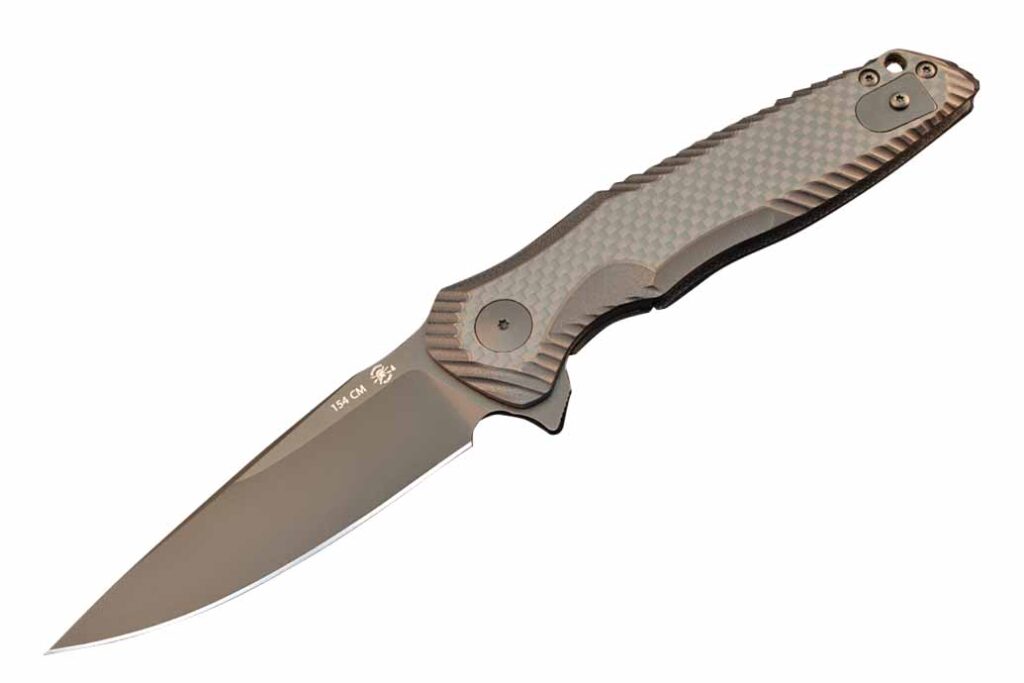
Spartan Blades: Poros

Spartan Blades Poros

DESIGNER: Curtis Iovito
KNIFE PATTERN: Flipper folder
BLADE LENGTH: 3.75”
BLADE Steel: 154CM stainless
BLADE GRIND: Flat
BLADE FINISH: Black titanium nitride coating
BLADE PATTERN: Drop point
PIVOT: Ikoma Korth Bearing System (IKBS)
HANDLE MATERIAL: Scalloped black G-10
LOCK: Linerlock
HARDWARE & LINER: Stainless steel w/electro-deposit powder coating
POCKET CLIP: Deep carry
WEIGHT: 5.28 ozs.
CLOSED LENGTH: 5.25”
MSRP: $180
COUNTRY OF ORIGIN: U.S.A.
MAKER: Spartan Blades, spartanbladesusa.com


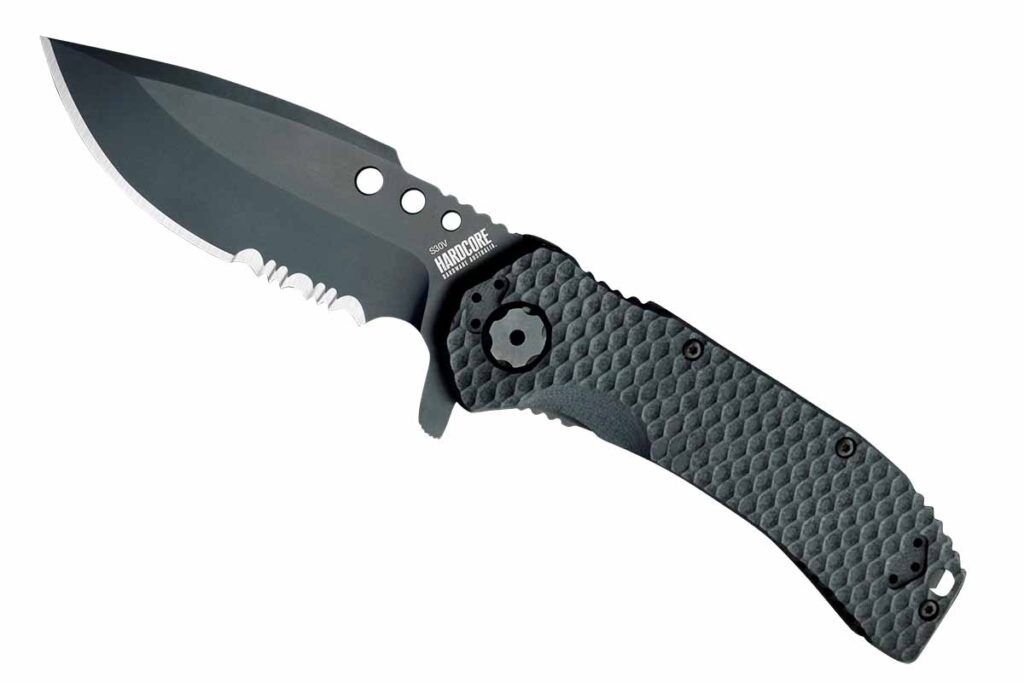
Hardcore Hardware: MILF-02PS

Hardcore Hardware MILF-02PS

KNIFE TYPE: Tactical flipper folder
BLADE LENGTH: 3.54”
BLADE STEEL: CPM S30V stainless
BLADE @ WIDEST: 1.18”
BLADE GRIND: Hollow
BLADE FINISH: PVD coated
WASHERS: Phosphor bronze
HANDLE MATERIAL: G-10
FRAME & LINER: 420J2 stainless
LOCK: Framelock
POCKET CLIP: Reversible tip up or down, ambidextrous
WEIGHT: 7.34 ozs.
CLOSED LENGTH: 5.51”
MSRP: $280
COUNTRY OF ORIGIN: Australia and Taiwan
COMPANY: Hardcore Hardware Australia, hardcorehardware.com.au


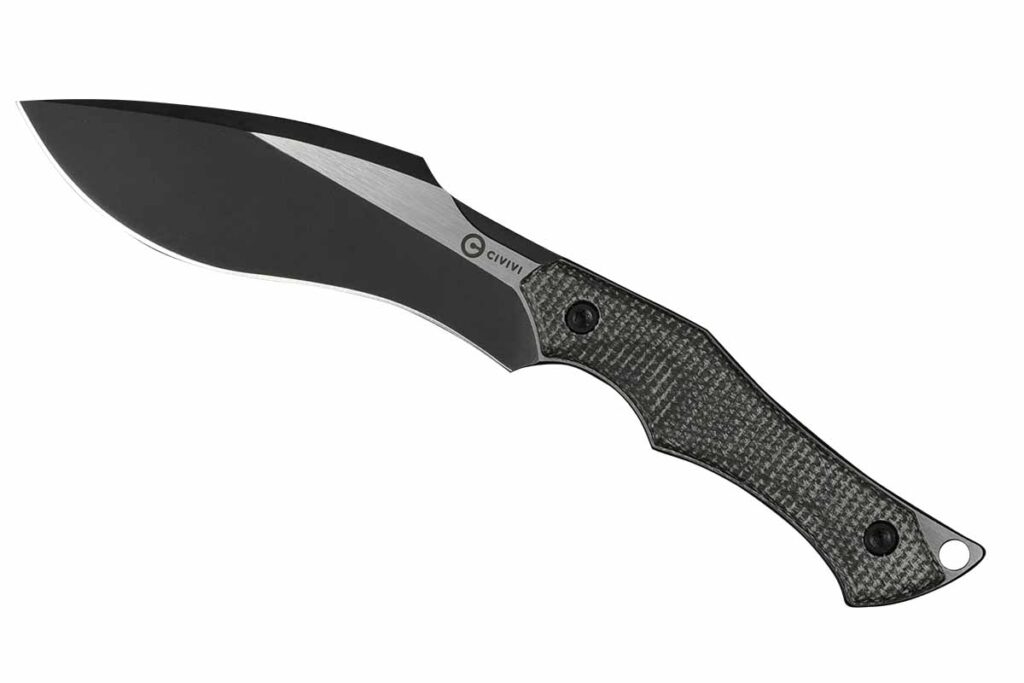
Civivi: Vaquita II

Civivi Vaquita II

DESIGNER: Nate Matlack
KNIFE TYPE: Fixed blade
BLADE LENGTH: 3.2”
BLADE Steel: Nitro-V stainless
BLADE GRIND: Flat
BLADE PATTERN: Kukri
BLADE FINISH: Black stonewash
HANDLE MATERIAL: Dark green canvas Micarta®
WEIGHT: 1.28 ozs.
OVERALL LENGTH: 6.23”
SHEATH: Black Kydex
COUNTRY OF ORIGIN: China
MSRP: $69.40
COMPANY: Civivi, civivi.com


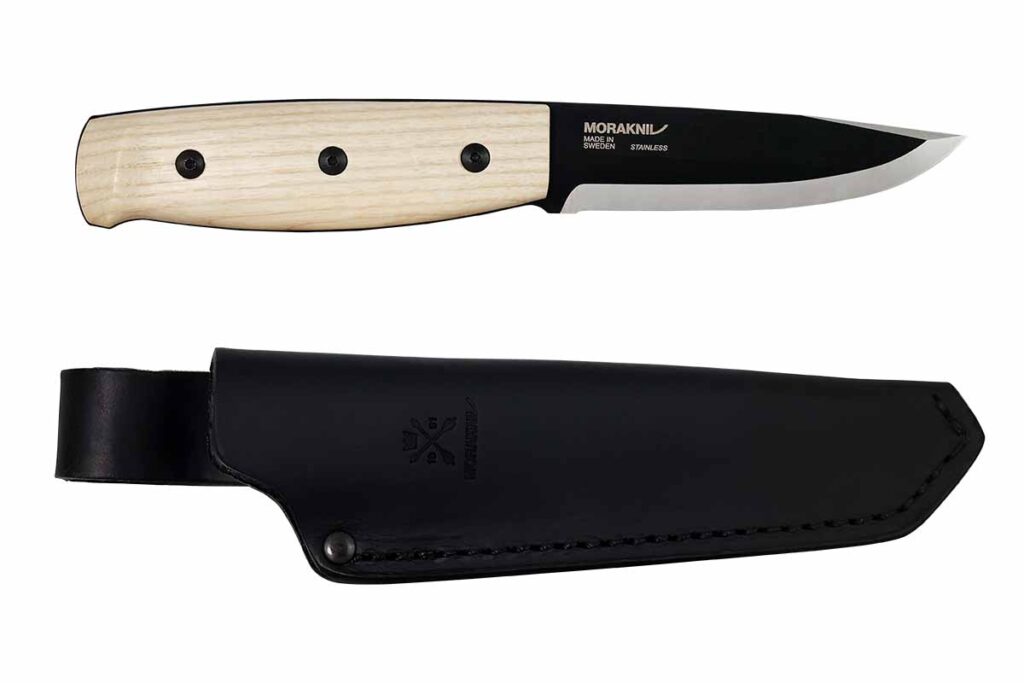
Morakniv: Bushcraft Knife

Morakniv Bushcraft

BLADE LENGTH: 4.05”
BLADE STEEL: Recycled Swedish stainless
BLADE THICKNESS: .098”
BLADE PATTERN: Drop point
HANDLE MATERIAL: Bright ash wood
CONSTRUCTION: Full tang
WEIGHT: 6.8 ozs.
OVERALL LENGTH: 8.38”
SHEATH: Vegetable-tanned leather w/belt loop; compatible with the Morakniv Dangler 10 w/button
KNIFE TO KNOW: Blade spine compatible w/a fire starter
MSRP: $240.07 (at press time rate of exchange)
COUNTRY OF ORIGIN: Sweden
COMPANY: Morakniv, industrialrev.com


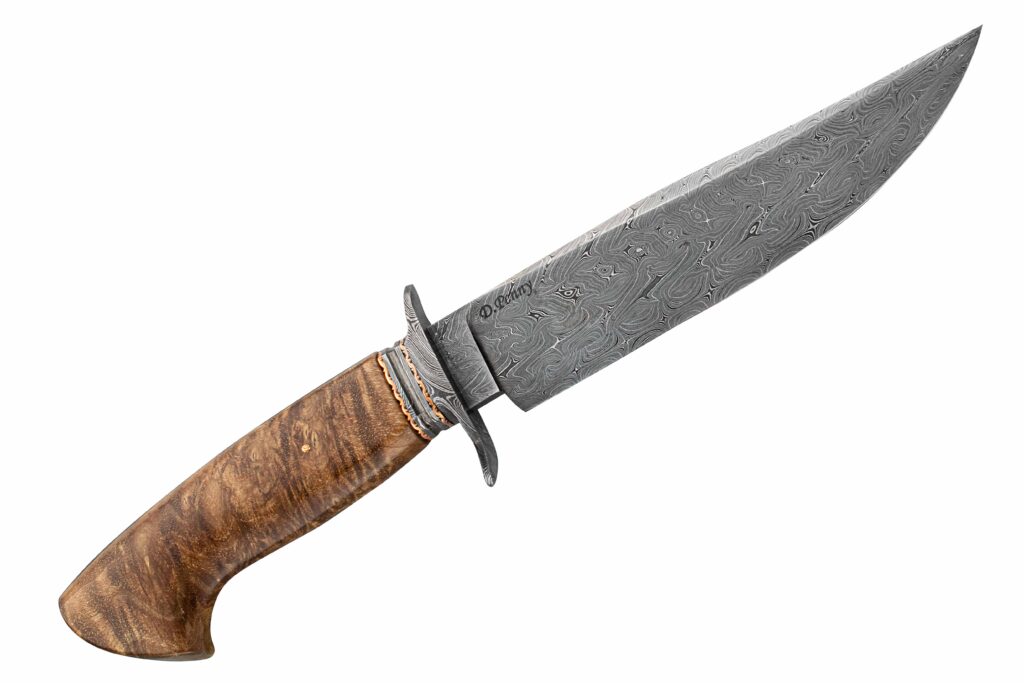
DP Custom Creations & Zero Down Forge: Fighter

DP Custom Fighter

BLADE LENGTH: 7.5”
BLADE STEEL: 300-layer, 4-bar, alternating twist damascu
BLADE GRIND: Flat
HANDLE: Blond claro walnut, thorn and vine accent copper spacers, and copper pin
FITTINGS: Twisted damascus guard and center spacer
OVERALL LENGTH: 12.5”
MAKER’S PRICE FOR A SIMILAR KNIFE: $1,100
KNIFE TO KNOW: Don Penny is an ABS apprentice smith
MAKER: DP Custom Creations & Zero Down Forge, (Jocelyn Frasier image)


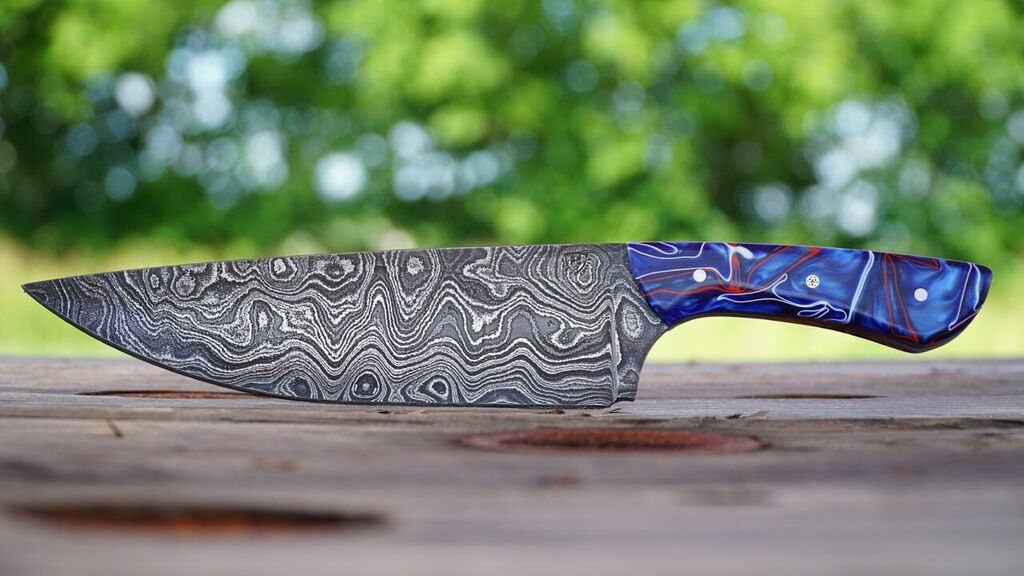
Tony Cetani: Chef’s Knife

Tony Cetani Chef's Knife

BLADE LENGTH: 9”
BLADE STEEL: RipTide damascus by Baker Forge & Tool
BLADE GRIND: Flat
HANDLE MATERIAL: Amboyna burl w/copper pins and liners
OVERALL LENGTH: 14.25”
MAKER: Tony Cetani, HourGlass Knives, [email protected] (Baker Forge Studios image)


Check Out More Knife Drops:

Advertisement

Must Read Articles

Read this before you make a knife

Knifemaking 101 – Read This Before You Make a Knife

  by Wayne Goddard My experience has taught me that there's nothing like digging in and getting started. I've often said the hardest part of the...
how to forge damascus steel

How to Forge Damascus

Advertisement
Advertisement