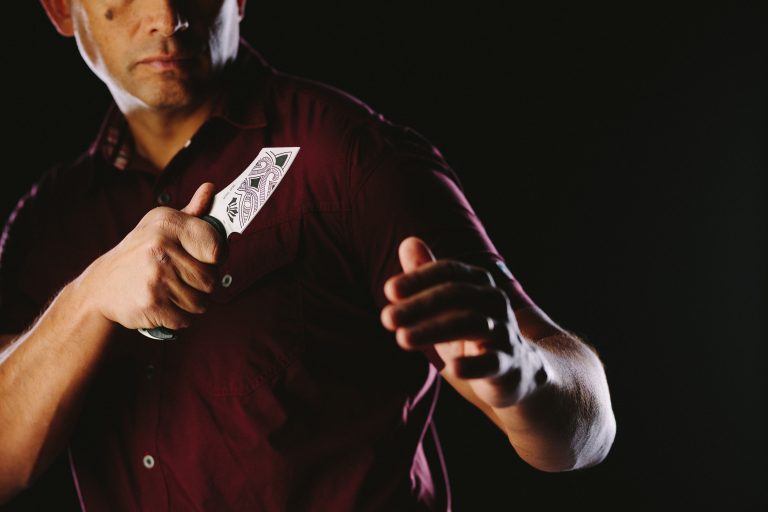
Browning’s line of Jared Wihongi Signature knives is as fierce as its SWAT operator namesake.
Jared Wihongi is a native New Zealander who began training in martial arts at an early age. As a young man he had the chance to live in the Philippines and study an edged-weapon style of fighting called Pekiti Tirsia Kali. Jared has spent 14 years as a law-enforcement special weapons and tactics operator. He also instructs other SWAT team members as well as elite military operatives in edge-weapon skills. He has advised Browning on its Black Label tactical family of knives and now has his own signature line, strikingly designed with Maori-inspired blade etchings. Be sure to subscribe to BLADE magazine to read about the Jared Wihongi Signature line of combat knives in the August issue, on sale May 16, 2017. To learn more about Jared Wihongi’s upbringing and training, read “Browning Launches Wihongi Line of Maori-Inspired Knives.”
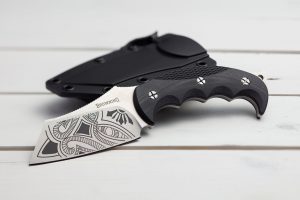
The Jared Wihongi Signature Fixed has a canoe-shaped handle that is ergonomically correct in both a forward and overhand grip. The etchings are borrowed from Maori tattoo patterns.
To meet Jared Wihongi and hear him discuss his style and philosophy of knife fighting, here are some well-done videos by Funker Tactical. In the first, Jared discusses how the foot movements used in Filipino knife fighting can aid in an empty-hand or firearm scenario. In the second, Jared addresses how the skills developed through the practice of Pekiti Tirsia Kali are relevant to the reality on today’s street or battlefield. And in the last video, Jared talks about why you should train wearing what you wear in your work or your everyday life. Law enforcement and military especially need to practice wearing their equipment so they understand how their range of motion, breathing and other functions are affected by the added weight.
In “Fighting Folders” Michael D. Janich instructs viewers on the myths surrounding folding knives and how to employ them in a self-defense situation.
Micheal D. Janich covers how to use empty-hand skills, quick one-hand deployment techniques and knife-fighting tactics so you can lean on your folder as part of your self-defense kit. This DVD is well worth the $39.95 when you consider you can watch it repeatedly in the comfort of your home, practicing its demonstrated skills until you’re ready to take your training to the next level.
“I was born a tinkerer,” Dwayne Horvath of Aku-Strike Knives of Pittstown, New Jersey, related. He was always taking things apart, from his father’s reel-to-reel video recorder to his car. By his own admission he was not great at school, but it was during those moments looking out the window, daydreaming, when ideas came to him—lots of ideas. It carried over into his car-racing days, his career as a successful fix-it man and now in retirement as a full-time inventor who daydreamed a trainer knife.
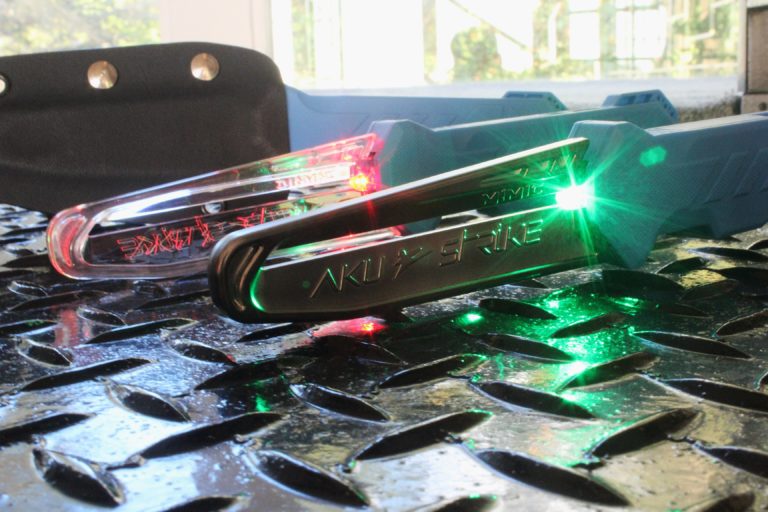
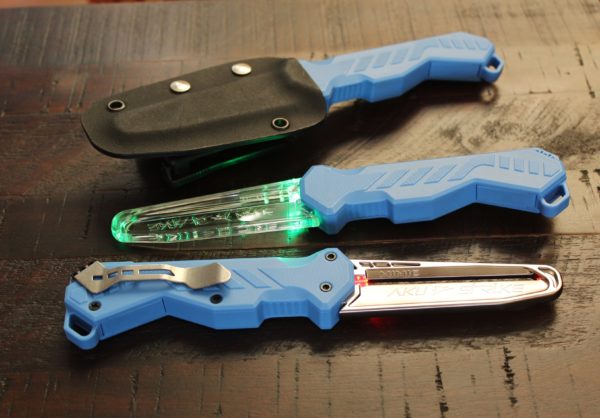
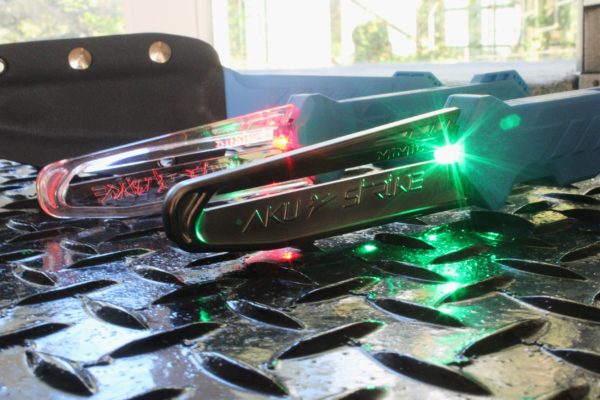
The Aku-Strike Mimic T-16 confirms contact with a red or green LED light and different tones for daytime use when lights are not as visible. Available in nickel or clear. MSRP: $41.95-$43.95. Contacts for Aku-Strike Knives appear at the bottom of this article.
The Aku-Strike Mimic T-16 came to Dwayne in a vision driving home one night from a training session at Alex Wilkie’s Martial Arts Academy in Bridgewater, New Jersey. “It was not a thought before it was a vision. The vision was possibly stirred by an emotion or feeling from training that night,” Dwayne explained.
Dwayne knew about the Shocknife, which is indeed useful for inducing fear in combatives training, but it’s is not something you want to learn on or use every day. Chalking the edges of training knives indeed leaves a mark to inform you and your training partner of a strike, but it’s messy and may not fully wash out of some shirts. There was a real need for another alternative.
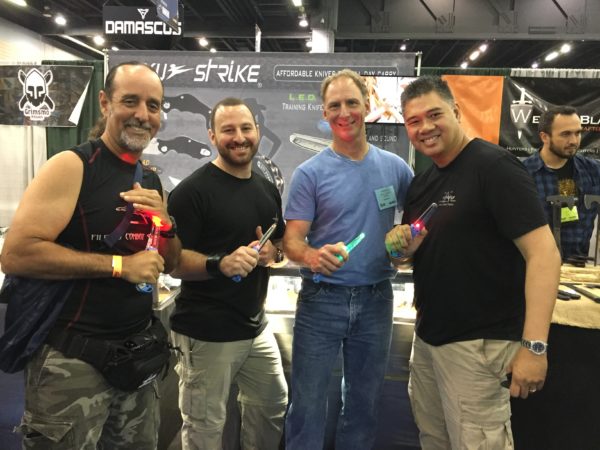
Carlos Pipo Lopez and Samuel Yaron Brill, on the left, and Ray Dionaldo, on the right, all of FCS (Filippino Combat Systems) Kali, give Dwayne Horvath’s (second from right) Aku-Strike Mimic 16-T, an LED training knife with tones, resounding thumbs-up.
“I noticed some students going through the motions of training with the knife and wondered if they realize how deadly a knife can be. I then asked myself, ‘How could I be more aware of being cut and the danger of the blade and also convey to my partner that he is in danger or is being cut? We need something to alert us when contact is made, or what I coin, ‘confirmation of contact,’ while training,” Dwayne explained.
When you take away shock and chalk, you have light or sound left. “Now how do I make this work?” Dwayne asked himself. He had some knowledge of patents. He knew that if he designed something simple, he could get a broad patent. That would in turn mean he would need to minimize parts and keep the construction of the training knife simple. That is a challenge with all the patents out there. He knew he needed at least one switch to turn it on. Any more and he might be infringing on someone else’s design.
Then Dwayne asked himself, “What would be the best way to make the blade send a signal to the electronics? I started drawing and one hour later I figured out the basics. Of course, there were many thoughts and designs in between,” he added.
With the Aku-Strike in the sheath, the battery tray angle also serves to register your fingers to hook the handle for a quick draw. This is one feature that attracted Ray Dionaldo, of FCS Kali, as the feel was similar to his quick-draw knife. The knife also has a secure feel when your hands sweat. Contacts for Aku-Strike Knives are listed at the bottom of this article.
Dwayne was on his last chance with the U.S. Patent and Trademark Office. After reading many patents and going through a few attorneys, he got the patent worded appropriately. He then contacted an attorney who secured a patent. Two months later, Dwayne received the kind of broad patent he had hoped for. Then he got an additional patent.
The Aku-Strike Mimic T-16 has received endorsements from law enforcement agencies whose members must be thoroughly trained for whatever they might find on their beats, including an aggressor with a knife. Martial artists like Ray Dionaldo of FCS (Filipino Combat Systems) Kali, Doug Marcaida of “Forged in Fire” fame and Funker Tactical, the home of all kinds of fighting videos, have all given the Aku-Strike their nod of approval. Even, Setcan, the company that invented the Shocknife, has endorsed the Aku-Strike. The two training knives are not really competitors since one can be used on a more regular basis, while the other can be used periodically to maximize the intensity of a particular training session.
Dwayne had originally envisioned an aluminum blade. “I took it to an Airsoft range. Kids were swinging for the fences. OK, not safe with aluminum for teens, plus you know it hurts—that’s a given,” Dwayne commented. He moved on to polycarbonite. “The polycarbonite had limitations with flex and strength, but overall it was a win, and much more forgiving,” he emphasized. “As a matter of fact, it hurt much less than many rubber trainers and, of course, aluminum.”
Dwayne’s goal was to appeal to a wider, younger demographic that was just starting out with their combatives training to hardcore adult players of Airsoft and paintball. He also wanted to reach law enforcement and martial arts professionals. He finds the inventing to be easier than the marketing. But without that creativity, there would be nothing to market. Dwayne received the kind of encouragement and validation he needed throughout his life, later when his business was a success, but also earlier around the race tracks of New Jersey.
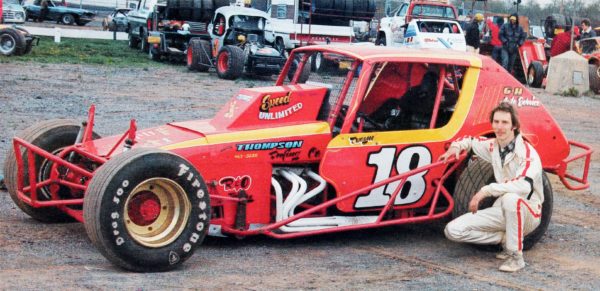
Dwayne Horvath of Aku-Strike Knives spent his formative years on the dirt-track speedways of New Jersey. He was given the encouragement and leeway to tinker, to daydream and now in his retirement he has invented a training knife that gives instantaneous pressure-based feedback through LED light and tone during combatives training. (Photo by Bob Snyder)
“At an early age, I loved racing and would go to Flemington Speedway, a local dirt track…It was a family event every weekend, consisting of fast cars sliding around the dirt track and a bucket of fried chicken,” Dwayne recalled.
“One night my favorite driver crashed real bad, destroying the starter’s stand,” Dwayne felt terrible and wanted to help. He got his father’s permission, and Howie Cronce took Dwayne to his house and let him help. “After school I would ride my bike about 10 miles to his shop, work to the wee hours.” Dwayne would eventually fall asleep and Howie would wake him, put his bike in the back of his pickup and take him home.
“In high school I wasn’t the sharpest tool in the shed. I usually wanted to look out the window and daydream, but I did rebuild a teacher’s engine on his Studebaker and built go-carts from scratch.
“In my racing days, I had what some would call some crazy ideas (probably from daydreaming) about the workings of a car suspension,” he explained. He needed to learn more, but from where? In those days, access to the Internet wasn’t readily available. He decided to sneak into the library at a technical college and hit the books and microfiche to research the effects of tire-slip angles and G-force on race cars.
“I then saved money to buy a G-meter to put in our dirt car, which had never been done before. When uploaded to a laptop, this would show all the forces of breaking, acceleration and cornering in real time so we could see what and when things were happening.” Then adjustments could be made to the shocks, springs and geometry on the car. “I was invited to the Penski shop to study the new shocks we used and got to know Ray Evernham before he teamed up with Jeff Gordon and Hendrick Motorsports.”
And it’s been like that ever since. If grades were given out in daydreaming, Wayne would score an A-plus.
You can read your digital issues of BLADE Magazine anywhere you have your phone, tablet or computer, and there’s no need to find storage for all your old issues.
If piling-up issues of magazines seems like a waste to you… If you feel like you don’t have time to read a magazine… If you like the stories we offer in BLADE, but want a more economical option, then a digital subscription is the answer. An annual subscription to BLADE is $17.98, $4 off the print price.
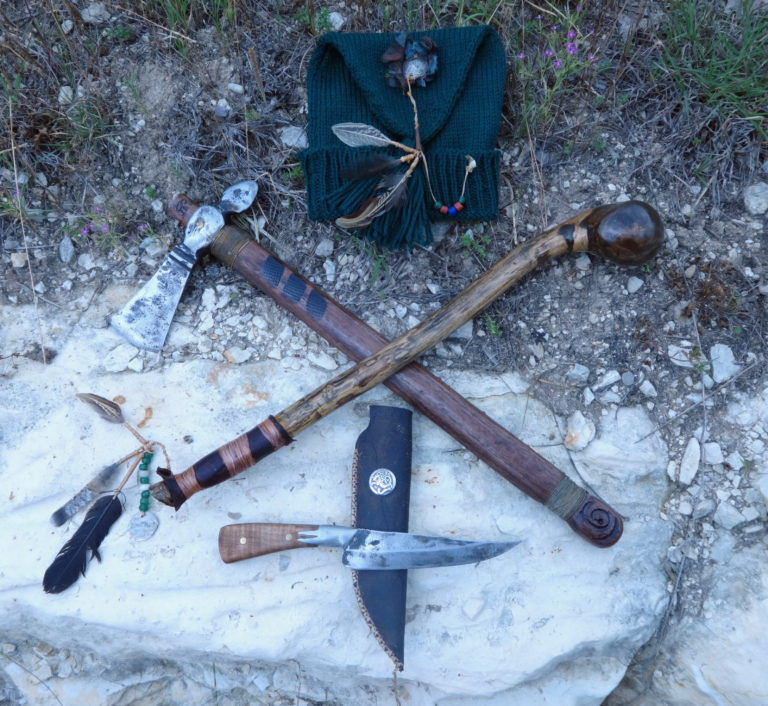
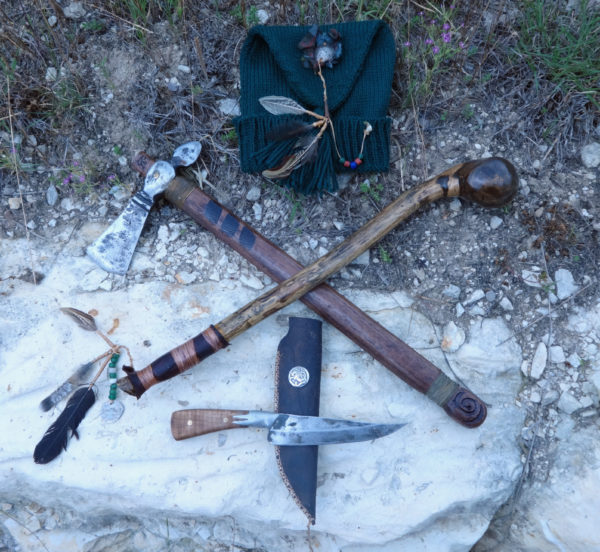
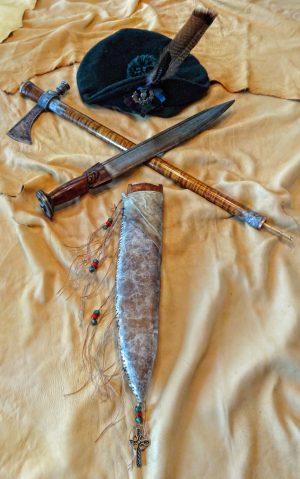
Custom knifemaker Don Shipman’s edged-weapon set is on auction until June 30, 2017 to benefit the Green Beret Foundation. In addition to a Rogers’ Rangers bonnet, a knife and sheath, and a tomahawk, the set also includes a war club. These are all items a Ranger during the French and Indian War might have carried.
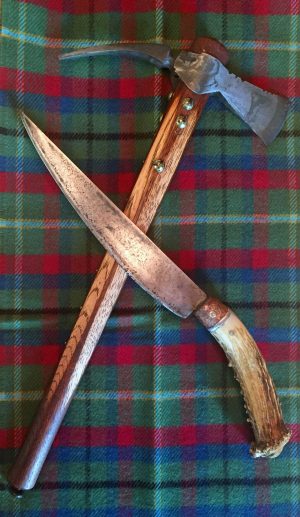
Don Shipman of Shipman Knife & Hawk and Longfear Forge in Waco, Texas, has made a Rogers’ Rangers III edged-weapon set for auction to benefit the Green Beret Foundation, which helps Special Forces members and their families. This new set includes items that the precursor to today’s U.S. Army Ranger would have carried with him in the eastern woodlands of North America during the French and Indian War, 1754-1763. The kit includes a knife and sheath, a tomahawk, a Rogers’ Ranger bonnet and an item stirring interest: a war club. If you would like to bid on this hand-crafted and meticulously researched collection, you only have until Jun 30 to do so. As of this writing, the highest bid is $1310. You can read about Don’s decision-making process for this set in detail in the October issue of BLADE magazine. Be sure to subscribe.
Don is nothing if not thorough. Whether in love, service to country or researching and assembling his edged-weapon Heritage Sets, he strives to honor the spirit of the warrior, the frontiersman and the gentleman.
This Rogers Rangers II set by Shipman Knife & Hawk included items a young Ranger serving under Major Robert Rogers might have carried in 1755 during the French and Indian War: a Scottish bonnet, pipe hawk and a dirk and sheath.
Take, for example, the name of his forge. In Irish Gaelic, “long” means “ship” and “fear” means “man.” But The Ship Man, as his Special Forces friends sometimes refer to him, doesn’t stop there. “I use the analogy that ‘long’ gets its meaning from the Norse ‘longships,’ which raided medieval Ireland,” Don explains. “‘Man,’ especially ‘strange men,’ is frequently associated with ‘danger’ in languages. So, ‘man’ equals ‘danger’ equals ‘fear.’ Thus, Longfear forge equals Shipman Forge. All of the above works especially well with my Norse and Irish ancestry,” he concludes.
So, on his blades, you will find the crossed-arrow Shipman logo, and if Don forged the item, you’ll also see the Longfear stamp. “The stamp is…wait for it…a Viking longship prow! Totally badass!” And that’s what it’s like talking with Don. You’re going to get an education, and you’re going to enjoy the lesson because he makes it entertaining.
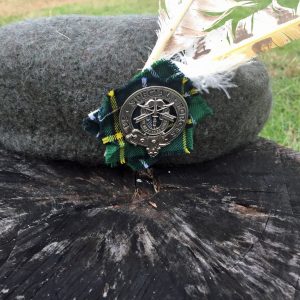
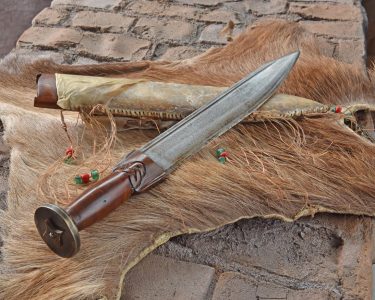
This kit included a pipe hawk, a Joe De La Ronde-designed spike hawk, a roach-belly blade with sheath, the family tartan, and an caubeen, or Irish beret, with three badges.
Don makes edged weapons that could have been used or made by the common man on the American frontier, no matter where that frontier may have been at that point in history. Sets can include a knife and a tomahawk, or more than one of each, along with usually a bonnet, blanket or piece of clothing. He’s working on one now that may include a gun. Each item in the set is researched thoroughly, from handle woods to clan tartans used in the headgear cockade—think rosette on a prize-winning ribbon.
First, if you don’t already know your family’s origins, Don will research your family’s heritage using Ancestry.com, the online genealogical site that assists in tracing your family tree. He establishes where your family came from and where your family settled or migrated to when they arrived in America. The frontier may have been upstate New York at the time, or Ohio, or Kentucky as westward expansion continued. If you’re of Irish or Scottish descent, for example, he’ll determine, to the best of present-day knowledge, to which clan your family belonged. Similarly, if you think you may descend from Vikings, he’ll investigate your Nordic heritage.
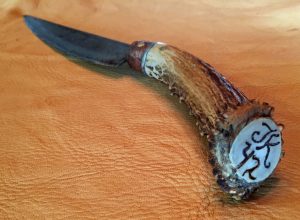
This roach-belly blade was forged out of 1095 steel by Longfear Forge. The ferrule is comprised of beaten copper and poured pewter. The handle is whitetail antler and “JK42” is engraved into the pommel using Colonial (Allegheny) font in recognition of the client’s service in Special Forces Operational Detachment (ODA) 542.
Next, he’ll research available materials in the region where your family lived once they arrived in the New World. Was that variety of maple tree growing in the area where and when your family settled? Yes. Then Don may use that wood to fashion a knife handle. What styles of knives or tomahawks were being used in that region and for what purpose? For instance, there’s the tomahawk that has a bowl in one end used for smoking tobacco and passing around, what we would think of as a peace pipe. There’s the ’hawk with the spike opposite the cutting edge, which our ancestors used in times of combat for striking their opponents. And, hawks with nubs on the back were often used as a mallet or hammer, making the weapon double as a utility tool.
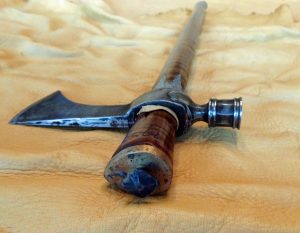
The tomahawk in the Rogers’ Rangers II set has a 22-inch curly maple shaft with a pewter inlay. The copper butt cap has a 2-inch brass mouthpiece. The head is an R.E. Davis blade in 4140 steel. Patina added to all metals.
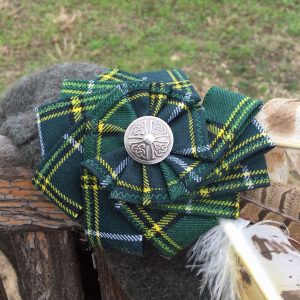
Every facet of the collection is thus researched. If Don wants to use a turkey feather, for example, to adorn a bonnet, he first confirms if turkeys were plentiful where your family lived and at that time. The woolen bonnets are supplied by reenactment companies such as Jas. Townsend & Sons out of Pierceton, Indiana. In Scottish versions, the headgear is larger and of thicker material, but the Irish renditions are precursors to the berets used by U.S. Special Forces. And like our elite warriors wear what’s called a flash—think a shield-shaped patch adorned with symbols from their unit—on their berets, Colonial-era warriors would wear a cockade made with their clan’s tartan, say, or other emblem representative of their heritage.
A tattered Forrester tartan cockade was one of three cockades for this bonnet.This bonnet came with tattered, bow and rosette cockades in the client’s Forrester tartan. Due to the client’s service in elite forces the red-tailed hawk, wild turkey, ring-neck pheasant and mallard feathers are prominently displayed, his family hailing from an area where the species were prevalent.
Don will educate his clients on the proper time and place to wear certain emblems. For instance, your set may include one bonnet with multiple cockades or other adornments. There may be a tattered cockade appropriate for everyday wear, or one that should only be worn at formal occasions. The headgear may include a feather, which, Don explains, would only be appropriate for a chief of a Native American tribe to wear. However, he acknowledges that his clientele may correctly believe they have earned the honor and they will wear the feathers to military galas, for example.
Don knows more than a little something about warriors of many nations and their weaponry. He ended up serving 30 years in the U.S. Army. “All I wanted to do was not embarrass my father and be a good soldier,” Don said. His father was an Army sergeant major, and Don was born and raised in Wurzburg, West Germany (at the time) until he was 13 years old. His dad’s final duty station was at Ft. Hood, Texas, where his parents went through the process of naturalizing Don. At the time, Germany had compulsory military service. This entailed sacrificing his dual citizenship, but saved him from possible conscription into the German army.
When his father retired, the family moved back to the home state of both his parents: West Virginia. So, Don was a high-school kid in a very foreign world. How foreign? “This kid got on the school bus and he had a fat bottom lip. I’m thinking, ‘It isn’t even 9 o’clock yet and this kid’s already been in a fight.’” Thus was young Don’s introduction to chewing tobacco. On the very same day on the very same bus, a few stops along the route, three redheaded sisters get on the bus. “My eyes immediately go to the tallest one, ’cause that’s how I roll,” Don said. “She had wire-rimmed glasses, and I thought, I’m cool with that.”
The sheath for this 18-inch Scottish dirk has a 14-inch basswood shell wrapped in rawhide with a sinew running stitch. It is adorned with sinew fringe and green and red padre beads and a 2-inch Celtic cross.
Fortunately, through an old-timey bus driver who lined the students up by sex and height, eventually the tall girl and older boy ended up sitting beside each other. Don barely said a word. Unbeknownst to him, however, the future Mrs. Shipman, Diane, or Annie as Don calls her, took matters into her own hands, putting the word out that the seat beside her was always reserved for Don. She knew right from the get-go that he was “the one.”
Don was dating his best friend’s sister, and although he got to the point where he could talk to Diane—a lot—and wanted more than anything to be with her, he couldn’t figure out a way to break it off with his friend’s sister without hurting her. “Next thing I knew, I was in basic training,” Don says, laughing. The other attachment dissolved naturally during the separation. In another example of his thoughtfulness, when Diane wanted to skip the hassle of a wedding, he told her he understood and that she could scale the event back, but that a wedding was bigger than both of them. “I told her I couldn’t do that to my parents, and that if she thought about it, I didn’t think she could do it to her parents either.” The Shipmans have now been married 37 years. They have a son, Isaac, born when Don became a Green Beret, and a daughter, Samantha, whom Don delivered.
Don’s favorite picture of him and Annie was taken on Oahu in 2000 with Diamond Head in the background.
Following a long family tradition, Don joined the U.S. Army in 1977 as an armored reconnaissance specialist, completing basic and advanced training at Ft. Knox, Kentucky. Although he hadn’t intended to stay, he did well and acted on the guidance of superiors, continually accumulating the schooling and assignments that allowed him to advance. When he wanted to join Special Forces, he was advised to take drill sergeant school. He did, and soon got accepted to qualify for Special Forces. The only problem was, he would have to wait for a slot in his preferred specialty: engineer, “because, yeah, I wanted to blow things up.” Or, he could go in immediately as a physician’s assistant, and have a marketable skill when he transitioned back to civilian life.
Qualifying on both the physical level and being required to “drink from a fire hose” medically speaking, Don made it through. “I was never afraid of the academics.” Because medics are limited in number and a Special Forces unit cannot deploy without one, Don deployed frequently. Honduras, twice; Somalia, pre-involvement; Kenya, four times; Tanzania; Djibouti; Egypt; Pakistan and Afghanistan, pre-involvement; Bosnia-Kosovo; Saudi Arabia; Kuwait; Iraq…in other words, he was exposed to the warrior tradition of many cultures.
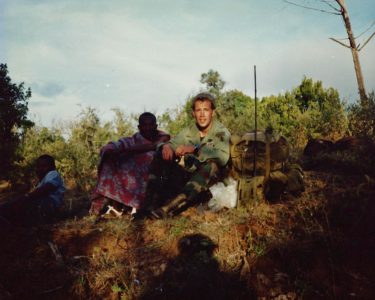
In November of 1989 Don Shipman was a sergeant first class with 5th Special Forces Group on guerilla operations in Kenya.
But it was when he was face-down in the sand during Desert Storm, yelling at the next closest man, who was yelling back because neither could hear the other that Don began bargaining with God to get him and his brothers out of this. “God, family, country. I’d done a lot for my country. It was time for more God and family.”
Stateside, Don accepted a research position with a special operations medic from the Vietnam era who would encourage him to accept the Army’s offer to get his doctorate. Don finished out his career teaching at Ft. Sam Houston in San Antonio, Texas. In the course of his medical training he was made an officer and retired as a major.
In all those years, aside from an occasional fishing trip, Don had never had a hobby. Now with time and resources he could indulge his creative side. About seven years ago he was on the Military Times Hall of Valor website where you enter your surname and up pops a database of recipients of the Silver Star up to and including the Medal of Honor. There were more Shipmans than Don could count. He’s a firm believer in the line that Rudyard Kipling made famous in his poem “Recessional”: “Lest we forget—lest we forget!” No soldier truly dies unless he is forgotten.
Don wasn’t even drawn to knifemaking, not right away anyway. But in feeding the home fires, it began to bother him that hardwoods like black walnut were being burned. “It’s practically a sin,” he said. So, he fashioned a hawk handle out of one piece and enjoyed the process. He gave it away. Then representatives from the Ranger Lead The Way Fund asked Don if he would make something for them to auction off at their 2013 gala. He made Rogers’ Rangers I, a set including a bonnet with a Roger’s Ranger badge, a 23-inch tomahawk and an 18-inch Scottish dirk with sheath. In 2016, he was asked to make Rogers’ Rangers II for a Green Beret Foundation auction. He had found the perfect outlet for his love of history, his brethren and the various streams of humanity that forged our country’s beginnings.
Don’s pieces look old and homespun, in keeping with both the available technology of the era and the skill level of the common men who fashioned them. If he doesn’t forge the blade himself, he uses The R.E. Davis Company in Woodville, Ohio, which specializes in weapon reproductions. Pieces from Shipman Hawk and Knife are pitted, worn and sometimes slightly warped, because that’s what a centuries-old edged weapon should look and feel like.
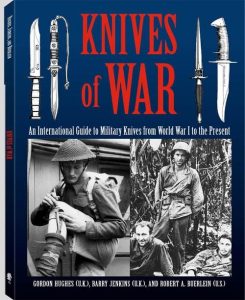
‘Knives of War’ Reveals Elite Forces Use of Knives in Combat
“Knives of War” is the “International Guide to Military Knives from World War I to the Present,” and costs $25.
Compiled by two British and one American author, “Knives of War” is a guide to edged-weapon use from World War I to the present. Of particular interest is behind-the-scenes information on the use of the Marine Raiders Gung Ho Knife, the Gerber Mark II Combat Knife as well as the most famous fighting knife of all time, the Fairbairn-Sykes. This is a must-have for any knife lover’s library.
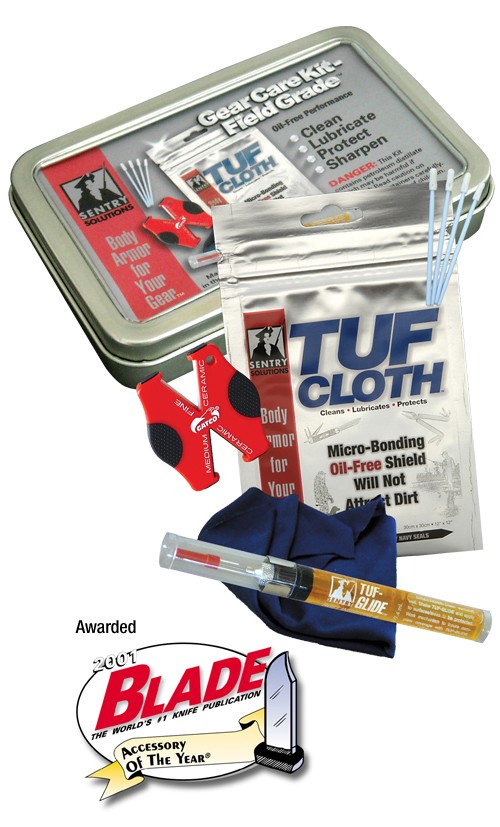
Bear & Son Cutlery, Inc., has purchased the sharpener division of GATCO.
Bear & Son Cutlery, Inc. announced Nov. 14 that it has acquired the sharpener division of GATCO. Ken Griffey, president of the Jacksonville, Alabama, manufacturing company, said he’s been in the knife industry for 39 years, and for 28 or 29 of those years Bear & Son has worked trade shows and other events side by side with the Great American Tool Company, Inc., or GATCO, as it was better known. Griffey expressed confidence that Bear & Son can now truly be a one-stop shop for knife enthusiasts. “It’s a natural fit,” he said.
Sharpener production at GATCO ceased in June or July, Griffey explained, so the number one order of business is to get merchants restocked. For the immediate future, GATCO sharpeners will continue to be made in both the USA and China. In short order, Bear & Son executives will assess whether some manufacturing can be moved back to the United States.
All GATCO sharpeners will continue to be made with the possible exception of one or two models. In place of those, Bear & Son will debut two new sharpeners to complement its knife lines. Griffey said he saw 3D models of these new sharpeners but wants to see the real thing before he approves production and sets price. Decisions will be made in time for any new products to make their first appearance at the SHOT Show, Jan. 17-20, in Las Vegas, Nevada.
GATCO celebrated its 25th anniversary in 2014. Founded by John Anthon and originally based in Getzville, New York, its specialty was offering a wide range of sharpeners. Angle guide, pull-through, stone, diamond abrasive, ceramic, carbide—GATCO had a model. The company’s Tri-Seps sharpener was the BLADE Magazine 1999 Accessory Of The Year.
Griffey said the purchase of GATCO makes Bear & Son Cutlery a full one-stop shop for knife enthusiasts. Always strong on the outdoor and hunting side of the knife market, the company also offers its Bear Ops line that focuses on law enforcement, military and self-defense knives. A new line, the affordable Bear Edge, will offer knives with some components made in China but assembled in the USA.
Steve Shackleford, BLADE® editor, contributed to this article.
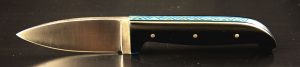
Smyth Knives’ Flat-Grind Utility Knife is made using O1 tool steel, black G10 scales, and blue liners. The blade is 3 inches, and the knife is 7.5 inches overall.
Irishman Paddy Smyth of Smyth Knives in County Roscommon, Ireland, sells 90 percent of his knives through his website to customers in the USA. The other 10 percent are purchased through The Quiet Cailin Studios in Cong, County Mayo, where “The Quiet Man,” starring John Wayne and Maureen O’Hara, was filmed. Some even incorporate ancient bog oak.
Irish Eyes Will Smile Over Smyth Knives
But it was another movie that sparked a love of knives in Paddy growing up. He watched wide-eyed as the work of Gil Hibben’s was deftly wielded in “Rambo III.” It is “my favorite knife of all time, so I have huge respect for [Hibben’s] work,” Paddy commented. He had a week-long visit last year from Jeff Knox, who trained with Hibben in the US. “He has been a great help to me also with advice and sourcing materials as its hugely difficult to get materials in Ireland,” Paddy added.
Paddy Smyth lives in County Roscommon in Ireland and undoubtedly with a name like Smyth has knifemaking in his blood.
He also mentioned that Walter Sorrells’ YouTube channel has been helpful and inspirational.
However, Paddy is a self-taught knifemaker and much of his learning has been by trial and error over the years. “I continue to learn,” he noted. He was trained as a chef and butcher and always had a keen interest in hunting, so he was intrigued by what made a high-quality knife. “So, I basically decided to have a go at knifemaking and caught the knifemaking bug,” he said.
Paddy concentrates on compact pocket and neck knives, bushcrafting and hunting/skinning knives. He makes specialty chef knives to order to client specifications. His favorite steels are O1 an Niolox stainless. He appreciates the consistent finish and heat treat he gets using these steels.
He likes three grinds: Scandi for his bushcrafting blades because it’s easy to maintain an edge; and flat and hollow, according to customer preference, because they both work well for his hunting and skinning blades. For bushcrafters, he chops and batons wood to test for toughness, and then fine-carves paper to verify sharpness. Cutting heavy cardboard with its abrasive quality helps him get a feel for how long his blades will stay sharp. He does ensure his flat- and hollow-ground blades can handle the detailed work of skinning and boning.
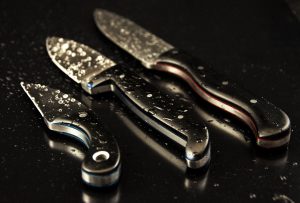
The Claw by Smyth Knives, left, is 5.25 inches long, with a 2.2-inch cutting blade. It’s perfect for close skinning/boning/gutting with complete one-finger control.
“My favorite handle material is ancient Irish bog oak, which can be up to 10,000 years old. It finishes really well and has beautiful character and history,” Paddy explained. “It’s very difficult to work with as it’s so hard it’s almost fossilized. And it’s becoming harder to find good pieces. It’s very hard on machinery and tools, but the work is worth the finished product.”
There are no knife shows currently in Ireland, so Paddy sells his work online at www.smythknives.com. Prices range from 90 to 500 Euros plus shipping with discounts for repeat customers. Also, check out the boutique artisan gallery in County Mayo where Smyth Knives are also sold on Facebook. Smyth Knives on Facebook and @smythknives on Instagram are chock full of additional photos and videos. You can call Paddy at 00353 87 6281252.
All Smyth Knives are completely handmade and heat-treated in house. Leatherwork is specific to each knife, so no two creations are the same. Paddy is a retail manager for an oil company based in the west of Ireland. He lives in Roscommontown with his wife, Edel, and their three boys, Shane, Darragh and Cian.
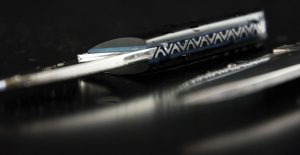
The ornate file work on the spine of this knife by Paddy Smyth in County Roscommon, Ireland, is reminiscent of a Celtic pattern.
“When I started making knives, I realized I had found something incredibly natural to me, as if I was meant to do this or was maybe in my blood, as my family name is Smyth,” Paddy noted. “I’m completely at peace when I’m in the workshop.”
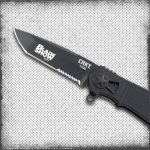
The CRKT Homefront is the 2017 BLADE Show knife. Be sure to get yours now.
CRKT and Ken Onion took home the Most Innovative Imported Design award at the 2016 BLADE Show for the groundbreaking Homefront. Now the Homefront is the official knife of the 2017 BLADE Show. This is a limited run of 300, so hurry! And at $70 you’ll be saving almost 30 percent.
In the second of BLADE’s Midweek Makers series we continue with our armed forces active-duty members and veterans. This week: Midweek Makers Military-Style: Chris Rowley of Nomad Customs.
Chris Rowley was a farrier for 12 years or more before he joined the Army at age 34. During his seven years of service he deployed six times to Afghanistan with 2nd Battalion, 75 Ranger Regiment, winding up his service this year as a weapons squad leader with the rank of staff sergeant.
He always loved blacksmithing and found time after work and on weekends to keep his hand in it by making knives. “Pretty soon half of 2nd battalion had one of my knives,” he said.
When Chris entered blacksmithing competitions, his horseshoes were hammer-finished, essentially going from the forge to horse. He tries to carry those shaping skills over to his knives, completing as much work in the forge as possible. Although not applicable with all steels or designs, many of his knives maintain a richly textured hammered finish.
Chris lives with his wife in Rainier, Washington.
Best-selling knife patterns: small everyday carry knives and 4- to 10-inch bowie-fighters
Favorite blade steels: 1084, 1075 and 15N20 for ease in forge-welding and the contrast with 1084 and 15N20; also W2
Blade grinds: hollow and flat
How he tests his knives: cardboard and random materials for everyday carry knives; chopping kindling and prepping game for camp-oriented knives
Favorite handle materials: resin-and-burl-wood combinations by Voodoo Resins and J Hue Customs. “Both finish really well,” he added.
Price range: $275 and up
Forums he participate in: BladeForums.com
The diamond hole you see in Nomad Custom knives is representative of the U.S. Army unit in which knifemaker Chris Rowley served, 2nd Battalion, 75th Ranger Regiment.
This knife has a 9-inch flat-ground forge-welded blade of 1084 and 15N20 steels. The handle is made of redwood burl with Voodoo Resins spacers and G10 liners. His maker’s mark is a diamond cutout to represent the Ranger Battalion emblem. Maker’s list price: $500 with sheath.
Watch Chris Rowley Cut Out His Maker’s Mark
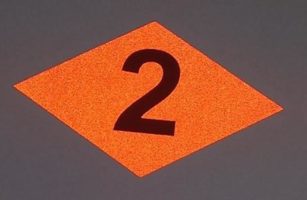
The diamond-shaped insignia is used to represent the battalion within the Ranger Regiment. Often in comments, you will see it typed as < 2 > for 2nd Battalion, for example.
This sticker, offered by Scroll Factory, shows what the 2nd Battalion, 75th Ranger Regiment diamond looks like that bladesmith Chris Rowley of Nomad Custom Knives & Tools cuts out of his blades as his maker’s mark.
An annual U.S. subscription to BLADE is $21.98. You can get your 13 issues sent to Canada for $39.98 and internationally for $49.98. Or go green and get your issues sent digitally for $17.98.
A one year’s subscription to BLADE will ensure you’re the first to read all six Knifemaker Showcase stories. You’ll also get the latest knife news, knifemaking how-tos, knife reviews, plus knife history and articles that tap into the knowledge of both the legends and the up-and-comers. Don’t miss out. Subscribe.
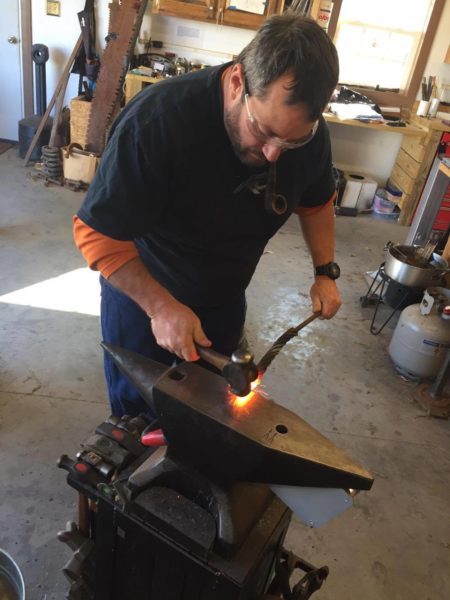
Tyrell Johnson has always been interested in knives and firearms, and two-plus years ago he decided to take a knifemaking class at Montgomery Community College in North Carolina. “As my wife can attest, I’ve had many hobbies in my life, but knifemaking immediately struck a chord with me,” he commented. “I knew right away that this was what I was meant to do, and I’ve been making knives ever since. I eat, drink and sleep knives.” Travis Daniels, of TED Knives, has been a helpful mentor to him. Tyrell does both stock removal and forging, and especially enjoys forging brut de forges.
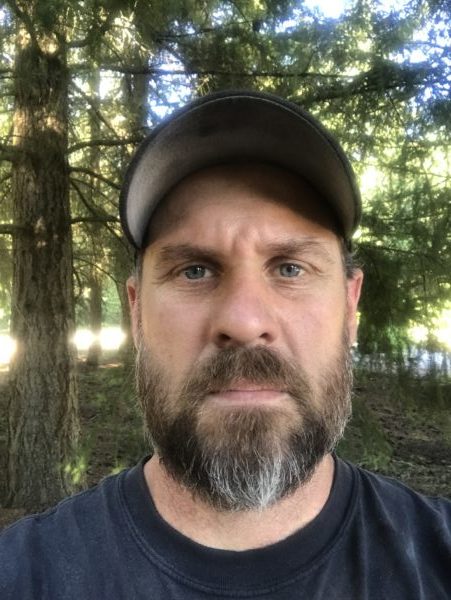
Tyrell Johnson is a relative newcomer to knifemaking, but he loves both forging and stock removal. His 5-year plan is to retire and devote himself full-time to knifemaking.
Tyrell currently works full time as a waste treatment plant operator, but in five years he expect to retire and focus fully on knifemaking.
• Best-selling knife patterns: drop-point hunters, kitchen and filet knives
• Preferred blade steels: W2, 1084, 1095. “I love carbon steel. It has a great history and the keeness of the edge is hard to beat,” Tyrell noted.
• Blade grinds: hollow for slicing, flat for durability
• How he tests his knives: cutting paper, shaving hair, chopping wood
• Favorite handle materials: Micarta, exotic woods, burl wood, resins—“I love working with the scales produced by J Hue Customs by Tim Kipps,” Tyrell added.
• Price range: $150-$350
• Knife shows he attends: BLADE Show
• Member of: North Carolina Custom Knifemakers Guild, American Bladesmith Society
Tyrell hand-makes all his sheaths from premium 8-ounce leather or Kydex.
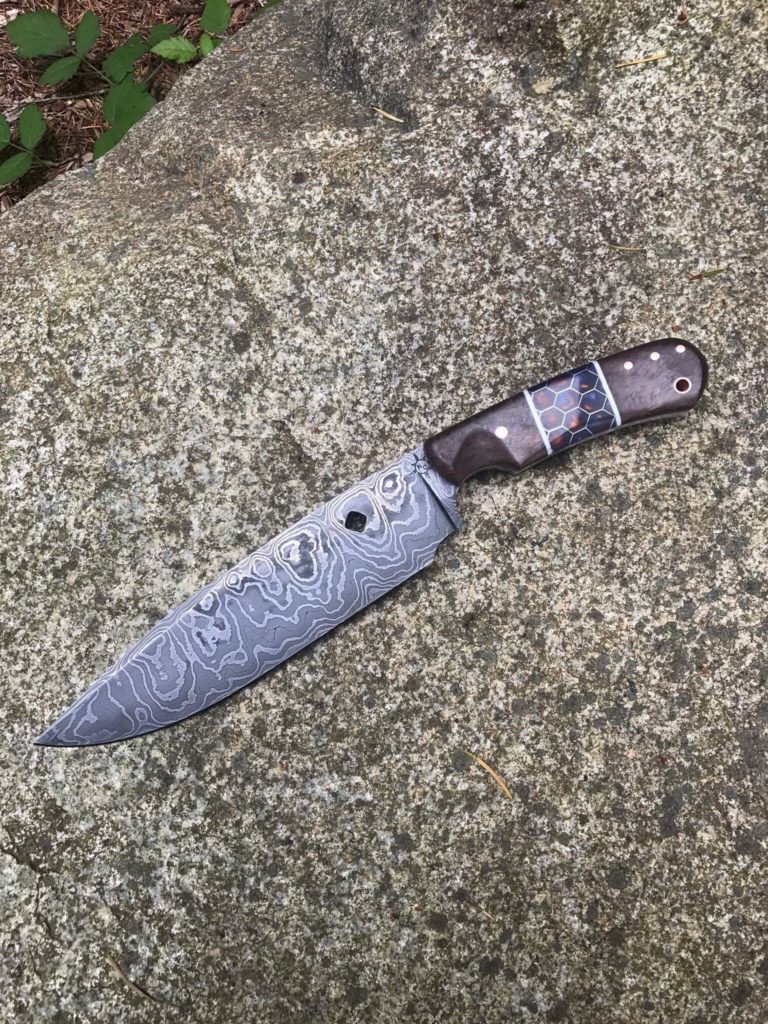
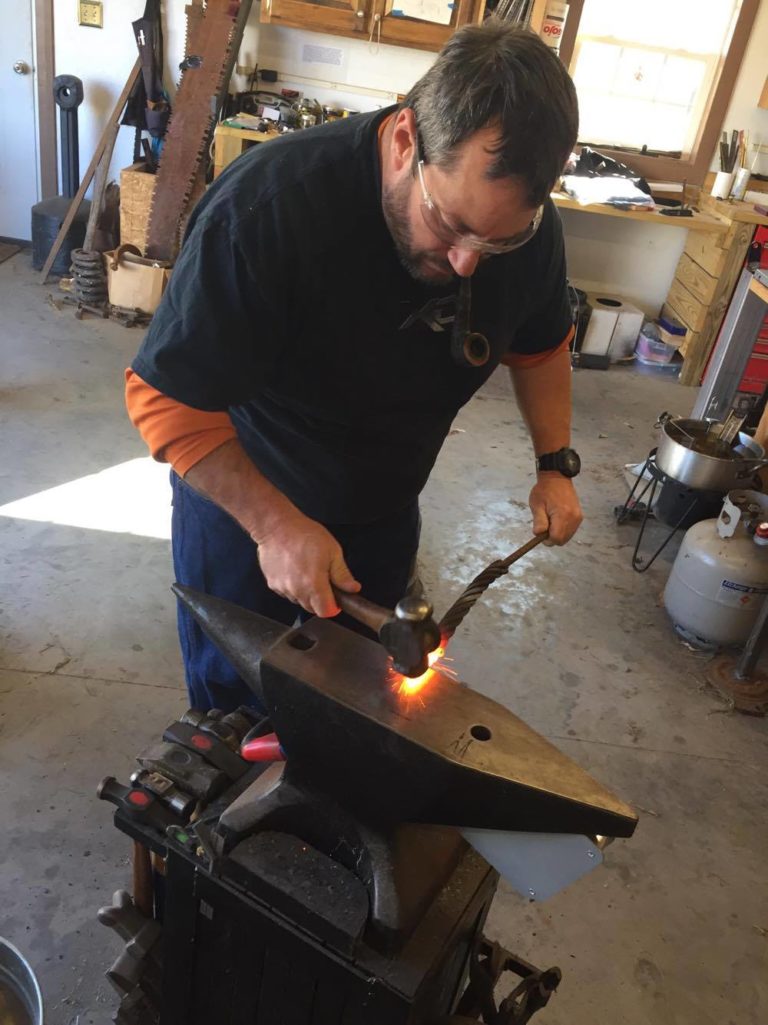
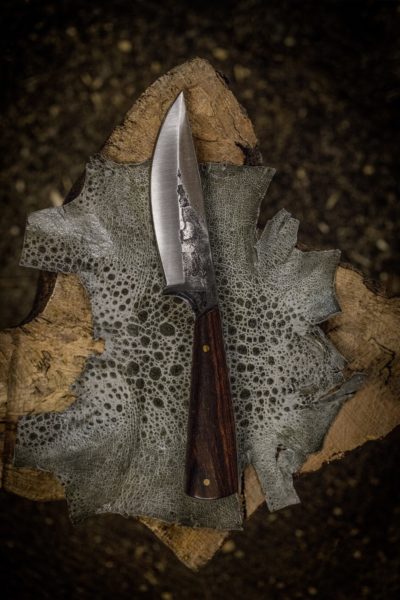
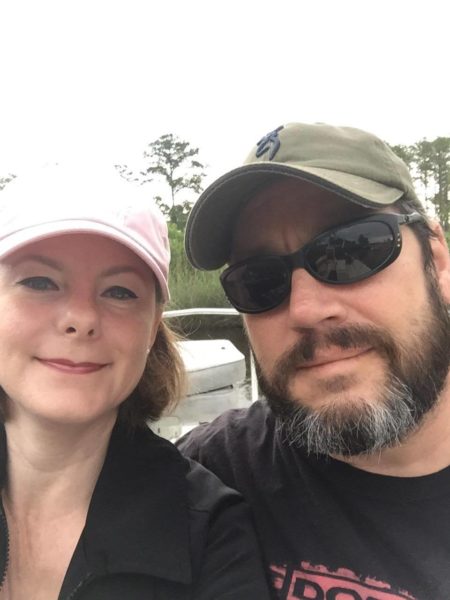
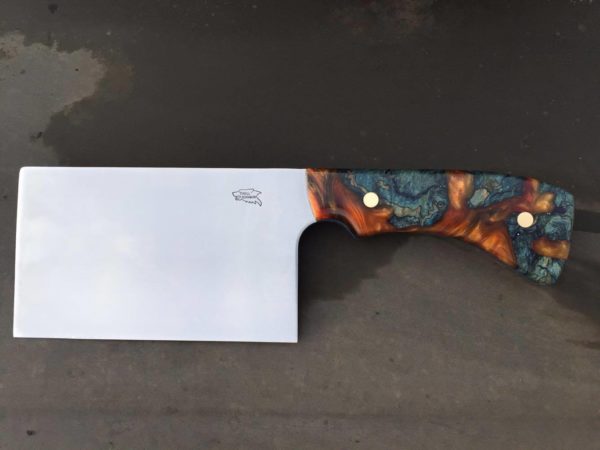
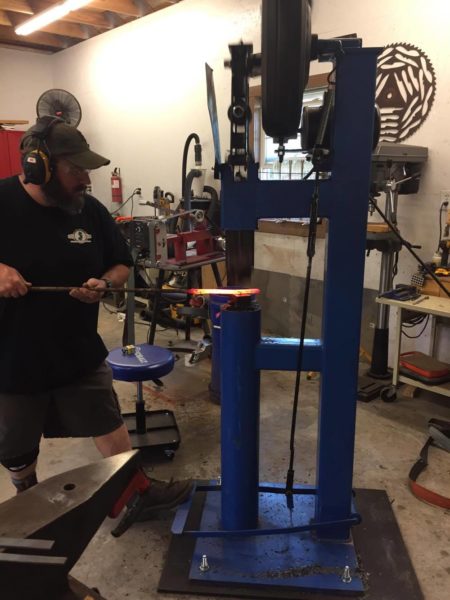
This brut de forge has a 4.25-inch hollow-ground blade forged out of 1084 carbon steel. The scales are fashioned from desert ironwood. The overall length is 8.5 inches. Maker’s list price: $275 with leather sheath. Contacts listed at the bottom of this article.Tyrell Johnson and his wife, Lisa, sneak away for some trout fishing.Tyrell Johnson’s cleaver has a 6-inch edge on a 3-inch wide 1095 carbon steel blade. The resin-breech wood scales were made by J. Hue Customs. The cleaver is 10.5 inches overall. Maker’s list price: $225-$250. Contacts listed at the bottom of this article.Tyrell made some san mai steel, sandwiching 1084 with mild steel. He wanted to try out his new tire hammer.Tyrell Johnson forge-welds some cable-pattern steel in his North Carolina shop.
Tyrell made a combat knife for the North Carolina Custom Knifemakers Guild’s cutting competition last spring. The knife could not be longer than 15.5 inches overall with a maximum blade length of 10 inches. At least one visible pin had to pass through the handle, a tang was required and the knife had to have a lanyard hole with wrist lanyard and be accompanied by a sheath and zippered pouch.
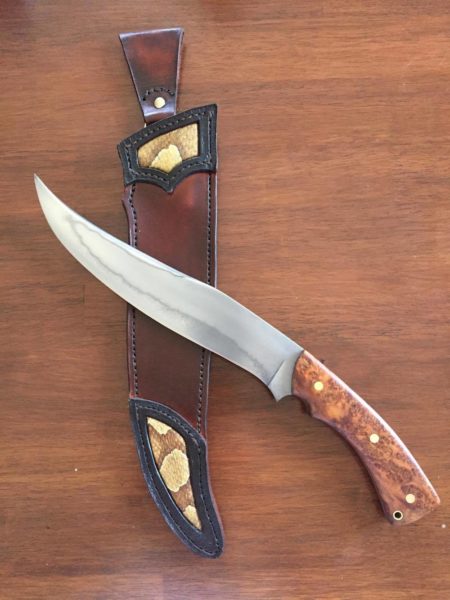
This Tyrell Johnson Knives’ Fighter was made using 1084 steel. The knife was 15 inches overall with a 9.75-inch blade. Tyrell used ambrosia maple burl for the handle. The sheath was 8-ounce premium leather with eastern North Carolina copperhead skin inset. “I personally harvested and processed” the snakeskin, Tyrell explained. Travis Daniels taught Tyrell how to make his own sheaths.
Contact Tyrell Johnson, 252-341-4791, [email protected], on Facebook at Tyrell Johnson and on Instagram @Tyrell_Johnson_Knives
A Digital Subscription to BLADE Is The Answer
You can read your digital issues of BLADE Magazine anywhere you have your phone, tablet or computer, and there’s no need to find storage for all your old issues.
If piling-up issues of magazines seems like a waste to you… If you feel like you don’t have time to read a magazine… If you like the stories we offer in BLADE, but want a more economical option, then a digital subscription is the answer. An annual subscription to BLADE is $17.98, $4 off the print price.