The BLADE Blogs

The blogs of the BLADE editors, Steve Shackleford and Erin Healy.

Metallic Clunking Echoed Between Houses

ABS master smith Kirk Rexroat made the Gillette (Wyoming) News Record over the summer, in a well-written newspaper feature describing his otherwise quiet Wright, Wyoming, neighborhood that has become accustomed to hearing his hammer hit the anvil on a typical afternoon. 


To excerpt a few paragraphs: 

The mechanical whacking could be a little unsettling if the neighbors didn’t know what it was, but it is just something that they expect to hear once in a while along the otherwise quiet street.

After a few more thumps, another pause, and a man wearing soiled leather gloves and mirrored sunglasses walked into the sunny yard next to the hut. His mountain man white beard gave way to a wide grin and a warm hello.

A forge roared behind him, heating steel that will be painstakingly massaged and ground into some of the highest quality knives in the world on the two 100-year-old trip hammers.

The 53-year-old man is Kirk Rexroat.

Just because he has reached the status of Master smith in the knife-making world doesn’t mean that Rexroat has stopped learning.

The mine welder and metal fabrication specialist has been shaping custom knives for about 30 years, but it isn’t a lack of innovation that has made him world renowned.

“He made his first knife with sandpaper in our living room out of an old truck leaf spring,” said Rexroat’s wife, Holly, while shooting him a glance. “Your knives have come a long way since then.”


To read the entire article, go to: http://www.deseretnews.com/article/700146156/Wyo-knife-makers-craft-still-has-edge.html


Knife Of The Day: Bartlow Award Winner

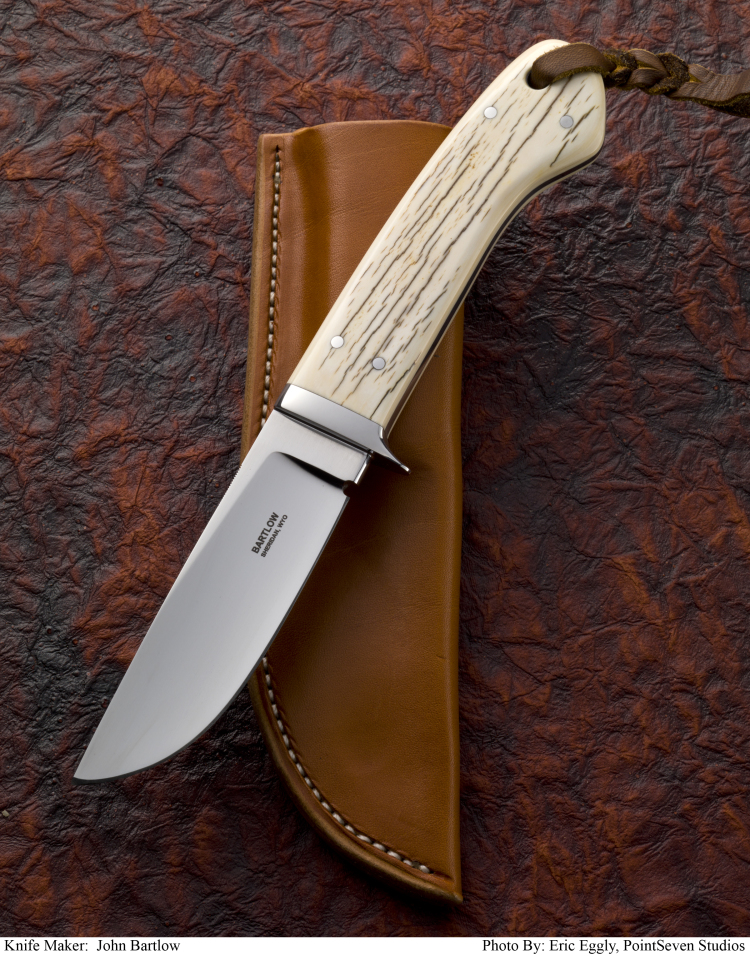
Our Knife Of The Day for Feb. 22 is John Bartlow’s utility hunter in a 4-inch blade of ATS-34 stainless steel and a handle of bark elephant ivory.

    Winner of “Judge’s Choice, Hunting/Utility Knife” at last year’s Professional Knifemakers Association Show in Denver, the knife is 8 5/8 inches overall and boasts Bartlow’s trademark line cutter/choil where the edge of the blade begins.

    For more information e-mail John at [email protected].

For more on the latest knives, knife legislation, knifemaking instruction, knife trends, knifemakers, what knives to buy and where and much more, subscribe to BLADE® Magazine, the World’s No. 1 Knife Publication. For subscription information click on http://www.shopblade.com/product/blade-magazine-one-year-subscripti…?r+ssfb022212#BL1SU

There May Be No Time Like Now to Buy a Bill Moran Knife

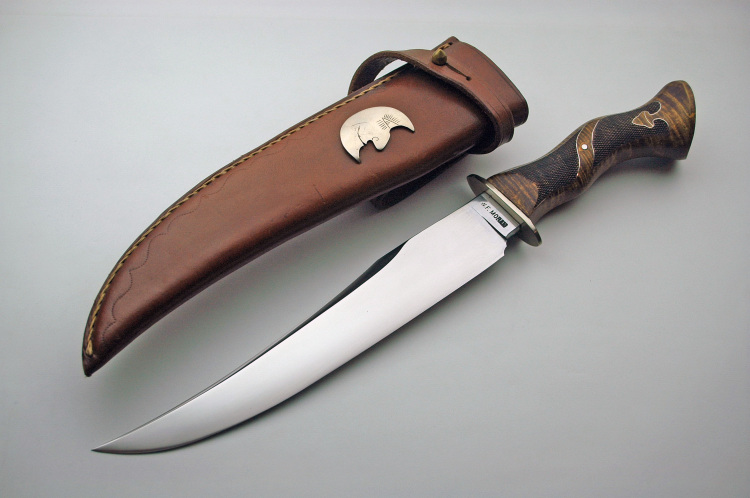
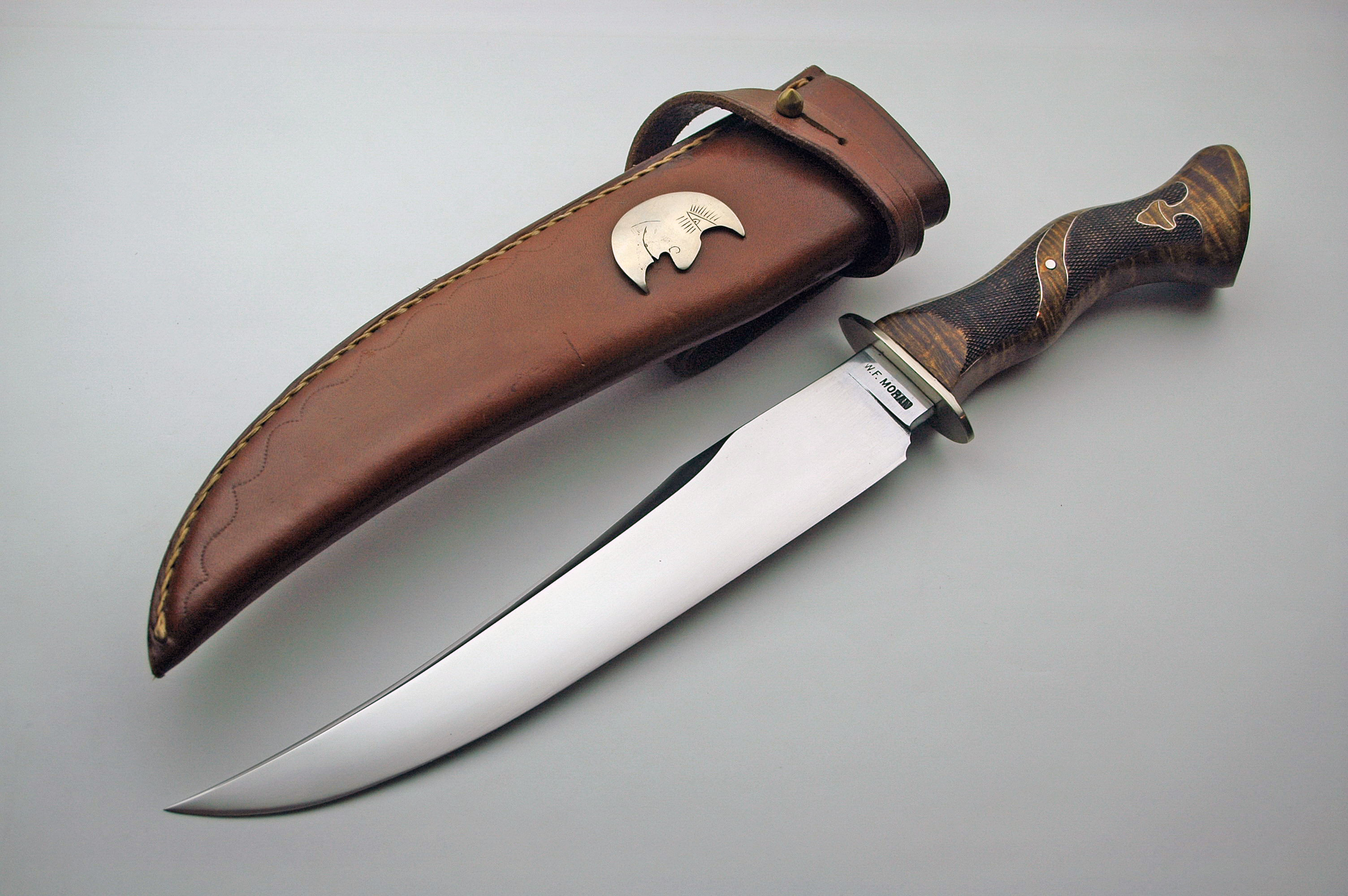
A coveted ST-24 by Blade Magazine Cutlery Hall-Of-Fame© member Bill Moran in wire inlay and checkering comes with a classic silver-half-moon leather sheath. Moran used the “W.F. Moran” stamp starting in 1980, typically on larger knives. It is not seen much anymore. (Dave Ellis photo)


By Dave Ellis


I still see Blade Magazine Cutlery Hall-Of-Fame© member Bill Moran each time I hold one of my many Moran knives. I miss visiting with Bill at the BLADE Show and the Art Knife Invitational. I miss showing him my latest Moran acquisition and watching his eyes light up as he explained how the knife came about.

    I have collected a wide variety of Moran knives over the past 30 years. The one I have found the easiest to resell because of their collectibility and historical importance, in no particular order, are the ST-24, cinquedea, Southwestern bowies, 50-year anniversary editions, his damascus pieces, folders—he made fewer than 50—and quillon daggers, especially those in damascus.

    In general, the more contemporary the Moran knife, the greater its value and collectibility. However, the cinquedea is an important exclusion to this rule. Bill made only about seven of them and most or all have Lime Kiln stamps, which indicates the knives were made sometime between the mid-1950s and 1973. I have sold a Moran cinquedea for over $30,000.


Value Enhancers

Some of the features that increase Moran knife values are wire-inlaid handles and sheaths, accompanying display boxes made by Bill, the knives that appear in the book written by Cutlery Hall-Of-Famers B.R. Hughes and Houston Price, Master of the Forge, the 50-yrs. stamping, and the newer raised-leather-style sheaths.

    Since Bill’s passing in 2006, his knives have had a slight increase in value, though nowhere near the jump that will occur down the road. Many of his pieces are finding their way to China, Russia and other countries. Bill was never a prolific maker, so with the limited number of knives he made, those that hit the market are coveted by collectors and dealers alike.

    Damascus Moran knives are in a class of their own. Bill is recognized as the father of modern damascus and his pattern-welded blades are highly prized, and can range from a low of $7,000 to upwards of $60,000! His damascus fighters and bowies seem to be the most desirable, followed by daggers and hunters.

    Curly maple is a common Moran handle material, so when you can buy one in stag or other materials, it typically costs a premium.

    The knives from the 1990s are probably among the finest to leave the Moran shop. They are lighter and quicker in the hand than Lime Kiln models and usually come with the newer-style sheaths. If you are lucky enough to find one with the 50 yrs. marking, you will see that it demands a premium.

    The future looks very bright for those collecting Moran knives. You can still pick up a great example at a reasonable price and rest assured that it will increase in value down the road.

    Bill made his knives one at a time by hand, no apprentices, no newfangled tools. His forge, anvil and hammer should reside in the Smithsonian!


    For more information on Moran knives and their values, contact the author at 760-945-7177 or visit his website, exquisiteknives.com.


For more on the latest knives, knife legislation, knifemaking instruction, knife trends, knifemakers, what knives to buy and where and much more, subscribe to BLADE® Magazine, the World’s No. 1 Knife Publication. For subscription information click on http://www.shopblade.com/product/blade-magazine-one-year-subscripti…?r+ssfb022312#BL1SU


Moran Knife Values


Carbon steel hunters $4,000-$10,000

Carbon steel fighters (ST-23 and ST-24) $10,000-$25,000

Carbon steel bowies (Southwestern bowies can bring the upper range, $6,000-$35,000

especially with composite stag handles)

Carbon steel folders $15,000-$25,000+

Damascus hunters $7,000-$20,000

Damascus fighters $18,000-$70,000

Damascus bowies $18,000-$40,000

Damascus folders (extremely rare) $20,000-“to way up there”


*All values are the author’s. Features such as matched sets, gold wire inlay—which is especially rare—special stampings and logos, handle materials and blade materials can have an impact on value.


Moran Tang Stamps


Most of Bill Moran’s knives can be valued based on their tang stamps. The rule of thumb is that newer Moran knives bring higher values. The author values each stamp using a star system, with five stars being the most valuable, four stars the next most valuable, etc.

•Damascus—Bill started using this stamp in 1973 and discontinued it around 1979. It was always used along with the MORAN stamp: 4-5 Stars

•50 yrs.—Starting in 1989, Bill began his 50-years knife project. The stamp appears only on 50 knives celebrating his 50th anniversary of knifemaking: 4-5 Stars

•WFM—Bill’s first stamp used in the late 1940s: 4 Stars

•MORAN—He started using this stamp in 1973 and still uses it today: 3-4 Stars

•M.S.—Denotes a master smith with the American Bladesmith Society, first used by Bill in 1981: 3-4 Stars

•W.F. Moran—Bill used this stamp starting in 1980, typically on larger knives. It is not seen much anymore: 3-4 Stars

•Moran (small print)—Bill used it on his miniature knives: 3 Stars

•By W.F. Moran, Lime Kiln MD—This is a common stamping first used in the mid-1950s and continued until 1973: 2-3 Stars


Moran Sheaths


Depending on materials used and how they are made, the sheaths can add significant value to a Bill Moran knife. The author values each sheath using a star system, with five stars being the most valuable, four stars the next most valuable, etc.

•Wooden sheath with silver wire inlay: 5 Stars

•New style wood-lined leather sheath with raised leather design: 4-5 Stars

•Wood-lined leather sheath with throat and tip (steel or ivory is better than brass for fittings): 4 Stars

•Wood-lined leather sheath: 3-4 Stars (rating varies depending on the quality of the half moon and other accouterments)

•Leather sheath with a silver half moon: 3 Stars

•Wooden sheath: 3 Stars

•Plain leather sheath: 1-2 Stars

 

Fox News Analyst Knows Knives And Uses Them, Too

Fox News analyst S.E. Cupp (at right in accompanying photo), who will appear on the Don Imus Show tomorrow morning on the Fox Business Channel, is a huge supporter of veterans and wounded veterans. She recently attended a hunting trip for wounded veterans coordinated by Blade Magazine Cutlery Hall-Of-Fame© member Ken Onion (left in accompanying photo) and others. In the process, Cupp got elbow deep dressing out a bear and also learned how to throw knives made by Bobby Branton.

“I donated a set of throwing knives to Ken Onion to keep them busy between hunts,” Branton stated. “Ken said that they threw them 15 hours a day for three days. He sent a picture of S.E. Cupp throwing and he has video, too. He said she caught on quick and turned out to be a good thrower. I’m proud everyone enjoyed my knives.”

Thanks to Onion, Branton and others, the wounded vets had a great time, and Cupp was exposed to the world of custom knives—good news on all fronts.

Where To Keep Knives In Easy Reach

Though not this particular model, Dan Delavan keeps a Gerber Mark II under his mattress “just in case.” (Gerber photo)

Accessibility depends on use, circumstances and, most importantly, the person’s imagination

By Stephen Garger


    The idea of our car crashing into the water and sinking truly scares my wife. She fears the possibility similarly to the way a person afraid of flying worries the plane will crash. I had known of her concerns for some time but, when I saw her white knuckling the steering wheel while driving on a bridge across a lake in Northern Idaho, it finally occurred to me to do something to ease her anxiety.

    I keep a small hand ax under the car front seat and a Spyderco Assist I rescue knife in the glove compartment, but, since I have plenty more knives, I thought one of them might hold a possible solution to her fear. As I thought about it, I realized should the car flip or an injury occur, it would be nearly impossible or require a great deal of luck to locate the ax. Likewise, the glove compartment could jam shut or fly open and spew its contents, and access to the rescue knife would be lost. 

    After thinking about such things as the position in which the car could end up, potential injuries, water everywhere and the overall impact of the crash, I found the solution in knifemaker Bud Nealy’s MCS II. MCS is short for Multi-Carry System, and the MCS II was part of the package I received when, sometime previously, I bought Nealy’s small, 3.5-inch, reinforced-point Pesh Kabz fixed blade after it was featured on page 117 of the April 2005 BLADE®. Part of the MCS II is a strong adhesive material and a sort of super fabric fastener, which can be used to firmly attach the Kydex® sheath just about anywhere and in any position. 

    I went through the vehicle and finally found a spot on the lower plastic part of the front driver’s seat where I could reach the knife easily with either hand. The location also was situated so the knife could not be seen from the outside with the driver’s door open during a rest or gasoline stop. Together, the small ax, glove compartment’s rescue tool, and the sheathed and attached MCS II largely alleviated my wife’s fears.

    I was relating how we had addressed my wife’s water-crash fears to Dan Delavan of the Plaza Cutlery retail knife store in Costa Mesa, California, and he agreed Nealy’s MCS II lends itself to that sort of thing.

    “It’s also not unusual for people to keep a knife somewhere on their bikes, wherever they can put it so they can reach if it they’re knocked down,” he said. “For bikes, they tend to use knives like those from Columbia River Knife & Tool (CRKT) and Kershaw with it in mind that the odds are they’re never going to use it, but it’s there if they need it.” Delevan had no suggestions as to how the knives are attached, but did mention that people he knows mount a knife under their car dashboard. “Any knife with a Kydex sheath is a good one to mount that way,” he noted. Though he did not say if he kept a knife in his vehicle, he did indicate he keeps an “old original Gerber Mark II under the mattress.”


House Knives

Jeff Hall of Nemesis Knives approached the idea of knives in unusual and easy reach from the point-of-view of where the knife replaces a firearm for home defense.

    “Anywhere people would hide a gun they may hide a knife instead,” Hall began. “Nobody’s breaking any laws, and people uncomfortable with guns will have knives around the house—even the anti-gunners will have a knife.” Nemesis is in California, which has some of the strictest gun laws in the United States and gives perspective to Hall’s view. “People keep knives in their refrigerator, in the bathroom behind the toilet, and hanging from the door knob or above the front door frame, since you don’t always know who’s at the door,” Hall said. “I’ve also heard of knives between the bed linens, attached behind the TV, as well as between the cushions of the couch.”

    Hall did not have many particular examples of what types or models of knives people use in such instances. “Everybody has different tastes,” he responded. “Size may relate to the spot. If it’s a small door frame, then our little Hellion neck knife will work fine.” Hall also mentioned another small Nemesis fixed blade, the 2-Zero, and its titanium pocket clip. “[The titanium pocket clip] reduces the weight and allows you to carry a fixed blade in a shirt pocket, giving it the convenience factor of a pen,” he explained. The idea appeals to me, given how I tend to leave the desk in my study unexpectedly and end up in a room where I need a knife.

    “We have a knife we did for a police department that is mounted underneath the brim of a hat,” observed Mike Fuller of TOPS Knives. It is the TOPS Thumb Nail and can be bought attached to a TOPS cap, which provides pretty handy access while fishing. “A lot of people in the inner cities take our Cockpit Commander and wrap it so it hangs over the steering column and can’t be seen from the window,” Fuller continued. “It’s an excellent tool and you can place just about any neck knife in that location.” TOPS also provides knives with magnetic sheaths which allow for numerous concealment opportunities and several ALRT models, which range in length from 3.5 to 5 3/8 inches and lend themselves to assorted ways to stow the blade, including inside the belt, hanging from a shower curtain ring, or just about any place you may conceive a knife may be needed and in easy reach.

    Brian Huegel of Country Knives retail knife store in Intercourse, Pennsylvania, has a slightly different take on keeping knives in unexpected places with convenient access. There are many seat-belt cutters available for emergency purposes “which provide a marginal amount of success in a crisis,” he opined. Huegel mentioned CRKT as offering a wide range of knife options for any purpose. “[Spyderco’s] idea of a pocket clip makes a folding knife easily accessible,” offered Huegel.  “Lots of people who come into the store want to know how to defend themselves, but you want to be careful not to be construed as providing people ways to hide things for possible criminal purposes.”

    A knife is first and foremost a tool. Like any tool, it must be readily available when needed. Factoring in current knife and carry systems offered, accessibility will likely be determined by the intended use, circumstances and, most importantly, the person’s imagination.


    Editor’s note: Please be sure you are not in violation of your local and state laws when you store knives in out-of-the-way places. Also, be sure the places are such that small children cannot access the knives.

    For more on the latest knives, knife legislation, knifemaking instruction, knife trends, knifemakers, what knives to buy and where and much more, subscribe to BLADE Magazine, the World’s No. 1 Knife Publication. For subscription information click on http://www.shopblade.com/product/blade-magazine-one-year-subscripti…?r+ssfb040112#BL1SU.


17th Annual Arkansas Custom Knife Show This Weekend

ABS master smith Jerry Fisk will be one of several makers exhibiting at this weekend’s Arkansas Custom Knife Show. Fisk’s “Sendero” hunter features the maker’s dog-star-pattern damascus blade steel and a mammoth ivory handle. The engraving is by the maker. (Chuck Ward photo)

    Some of the world’s top bladesmiths and knifemakers will descend on Little Rock, Arkansas, this Saturday and Sunday for the 17th Annual Arkansas Custom Knife Show.

    The show will be held in the Robinson Center Exhibit Hall at Markham & Broadway in downtown Little Rock. There will be 150 tables, of which 102 will have various styles and sizes of custom knives. The balance of tables will have knifemaking supplies, leather products, and knife-related books.

    Among makers slated to exhibit are Russ Andrews, Jim Batson, Tim Britton, Bruce Bump, Joel Chamblin, Jim Crowell, Jerry Fisk, Don Hanson III, Jerry Lairson, Shawn McIntyre, Ron Newton, Cliff Parker, Lin Rhea, Kyle Royer, Brian Thie, Brion Tomberlin, Jim Walker, John White, Mike Williams and many more.

    Show hours are 10 a.m. to 5 p.m. Saturday and 10 a.m. to 3 p.m. Sunday. Admission is $5, which is good for both days.

For more on the latest knives, knife legislation, knifemaking instruction, knife trends, knifemakers, what knives to buy and where and much more, subscribe to BLADE® Magazine, the World’s No. 1 Knife Publication. For subscription information click on http://www.shopblade.com/product/blade-magazine-one-year-subscripti…?r+ssfb021612#BL1SU

Knives Shown in a Positive Light in the New York Times?

Under the Headline “The Knife Rack Goes High-End,” the New York Times ran a feature article in the June 14, 2011 edition about a new line of J.A. Henckels high-end, high-carbon-steel chef’s knives that are designed by Olympia, Washington, knifemaker and shop owner Bob Kramer.


According to the Times, hundreds of the knives, priced as high as $349.95 for a 10-inch chef’s knife, were purchased by cookware chain Sur la Table, and 20 percent of the inventory sold in 10 days. 


For more on Kramer, see his website: http://www.kramerknives.com/home.htm.


To read the New York Times feature, see: http://www.nytimes.com/2011/06/15/dining/the-knife-rack-goes-high-end.html?_r=1&ref=knives


Advertisement

Must Read Articles

Read this before you make a knife

Knifemaking 101 – Read This Before You Make a Knife

  by Wayne Goddard My experience has taught me that there's nothing like digging in and getting started. I've often said the hardest part of the...
how to forge damascus steel

How to Forge Damascus

Advertisement
Advertisement