Buyer's Guides

You’re looking for a new knife in a certain style – we’ve got recommendations on the best blades for every price point.

Puukko Perfection: Hot Scandi-Ground Options For Sportsmen
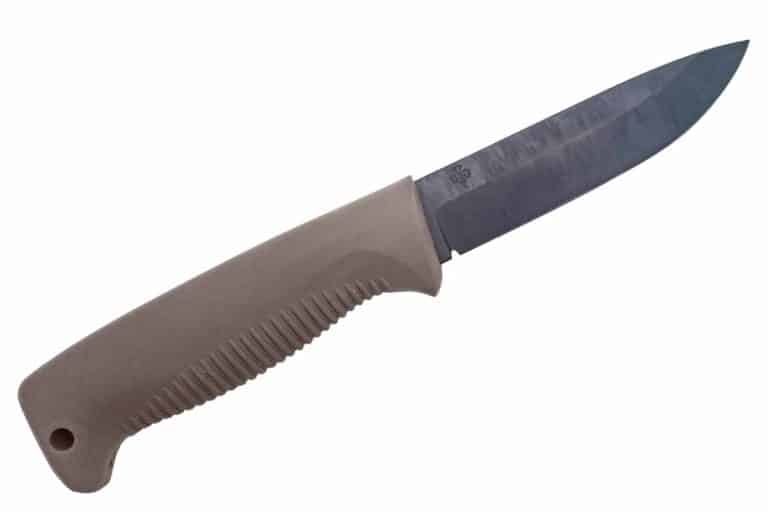
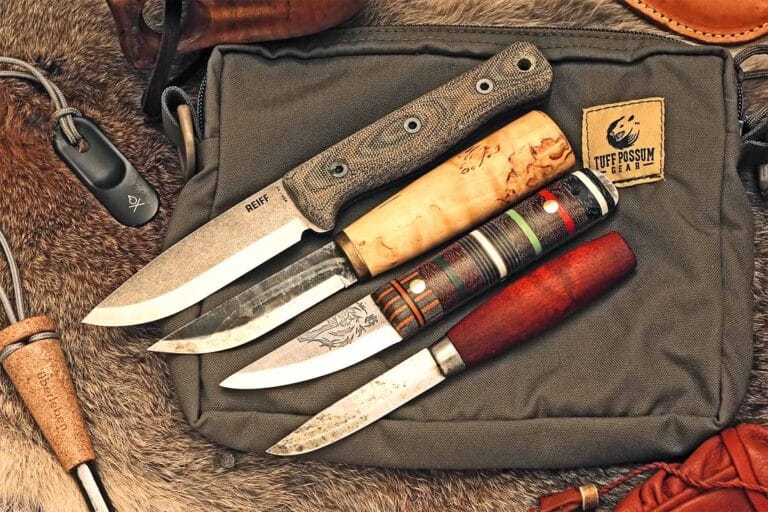
See how well four hot Scandi-ground puukkos cut and handle.

A multifunction knife, the puukko is integral to Nordic life, revered by scouts and symbolizing adulthood in Finland. The design—a palm-sized blade with a single edge and flat back—facilitates various tasks. It is ideal for carving and cleaning but lacks a guard because it’s crafted for slicing, not stabbing, with some models featuring finger grooves for wet conditions.

While men’s and women’s puukkos differ slightly in size and are ornately sheathed, both are equally esteemed. The puukko’s deep-carry sheath, easily attached to a belt or around the neck, makes it a practical tool for everyday use.

Puukko Grinds

Assorted grinds
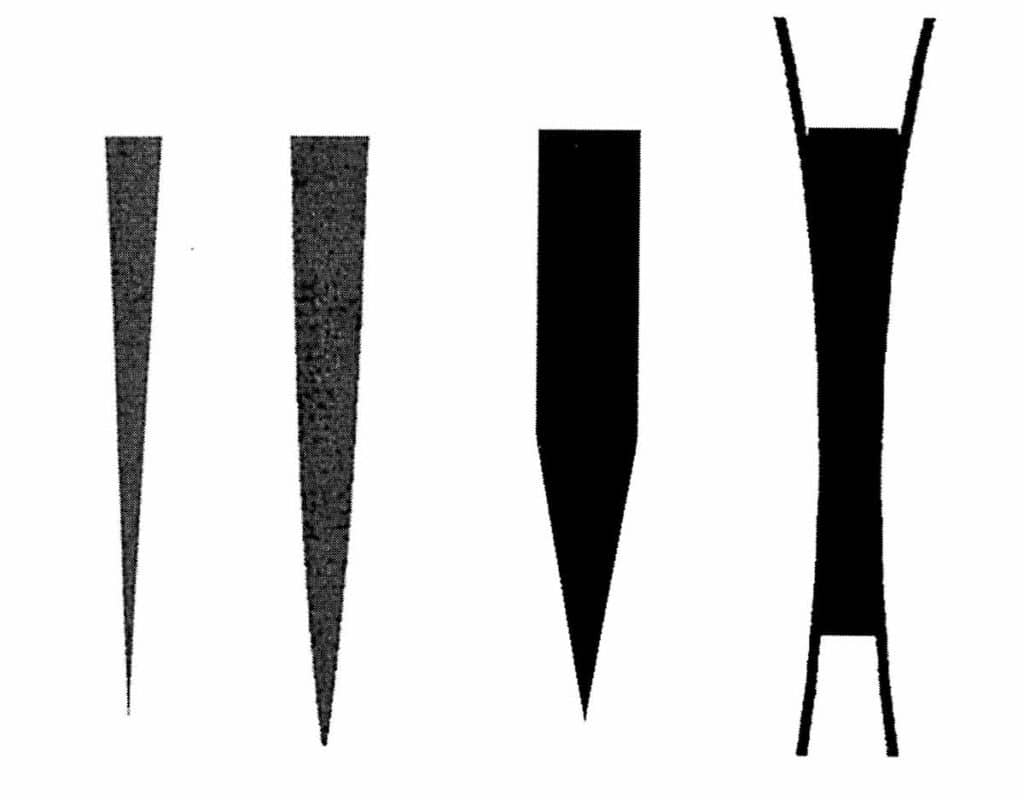
Assorted grinds, from left: flat, convex, Scandi and hollow. (from the BLADE® files)

Scandinavian knives are renowned for the unique grind that sets them apart from other knives with flat, hollow, saber and other grinds. Most knives have primary and secondary bevels that meet at the cutting edge. However, Scandinavian or Scandi grinds feature just one bevel that starts near the blade center and tapers to the edge. The design creates an acute angle that produces a razor-sharp edge, making it incredibly easy to slice through even the most rigid materials. Additionally, sharpening Scandi knives is a breeze, as you don’t have to worry about getting the correct angle. Simply lay the blade on the stone with the edge against the honing surface, and voila!—you automatically get the perfect angle.

Marttiini Arctic Bush Knife

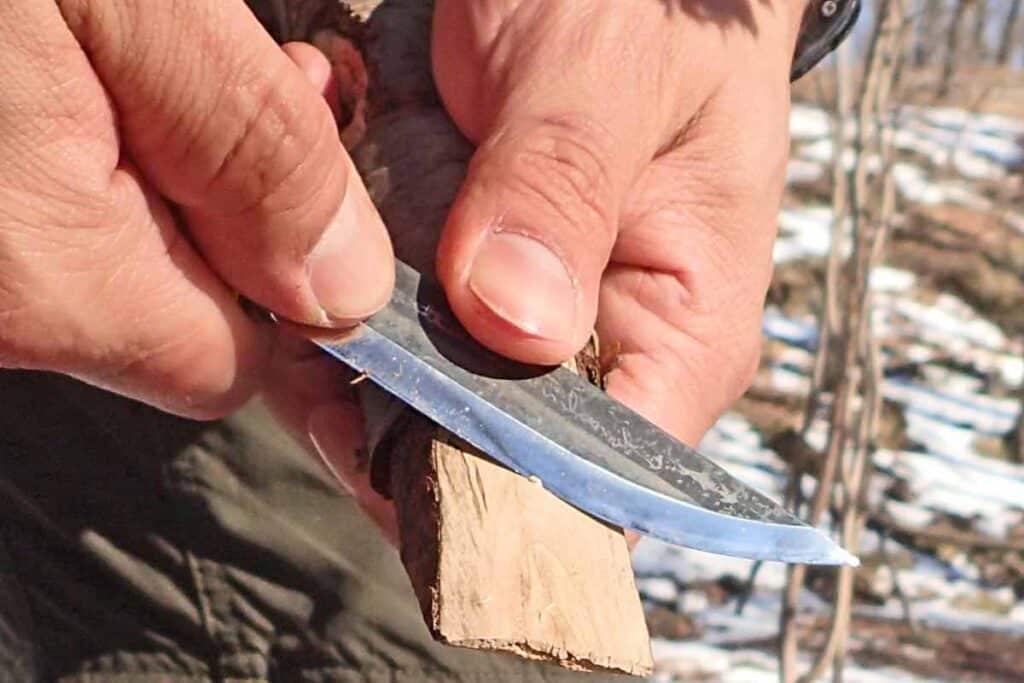
Fine-tuning a wooden wedge using the chest-lever grip with the Marttiini Arctic Bush Knife.
Fine-tuning a wooden wedge using the chest-lever grip with the Marttiini Arctic Bush Knife (ABK) is effortless for precise and challenging cutting tasks.

Marttiini knives are Nordic puukkos crafted in the Arctic Circle using generations of craftsmanship and modern technology. Founded in 1928 by blacksmith Janne Marttiini, the company produces high-quality utility knives made of natural materials like leather, curly birch and reindeer antlers, along with ultra-sharp blades of carbon steel. The knives are designed for use in harsh conditions.

Also known as Kiehinen in Finland, the Marttiini Arctic Bush Knife (ABK) is a beautiful, traditional stick-tang-style knife with a 3.5-inch blade. Made of stunningly grained curly birch, the handle is handsome and incredibly comfortable, a characteristic common to all top puukkos.

The ABK is an excellent choice for those who prefer a blade under 4 inches and have other tools for chopping or sawing. It is easy to use in winter conditions, even when wearing wool mittens or leather work gloves. The deep pocket carry sheath ensures the knife is easy to grip and deploy. Overall, it is an excellent choice for anyone looking for a traditional yet functional knife that offers both comfort and aesthetics.

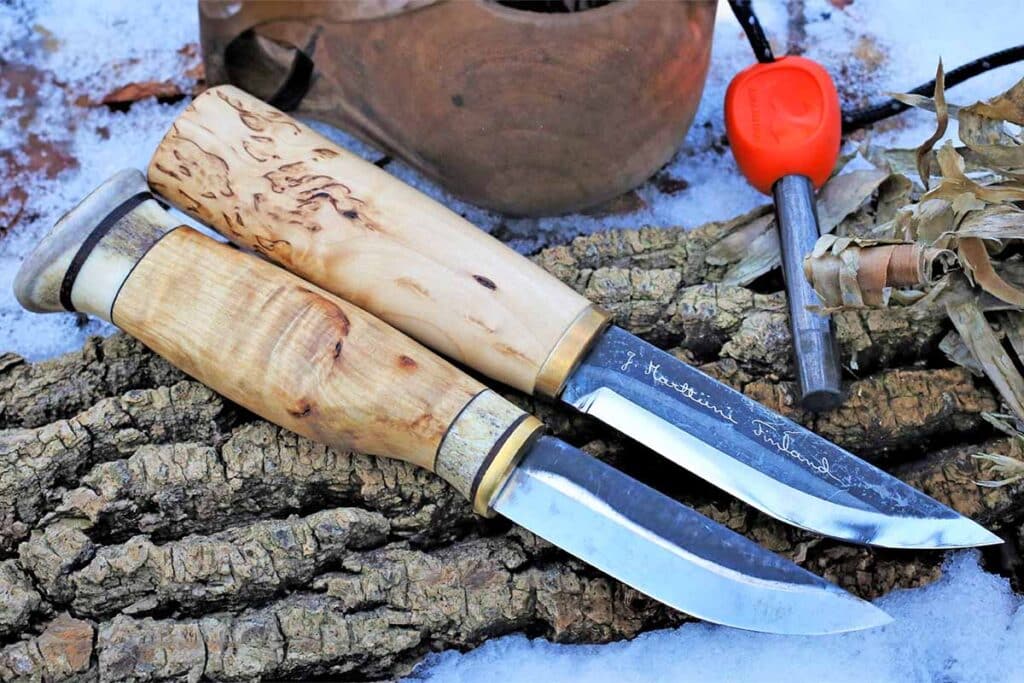
Puukko Marttiini and Wood Jewel.
Finland is known for crafting high-quality puukkos that can withstand harsh conditions. It is the world’s largest producer of puukkos. Two of the most popular brands are Marttiini (top) and Wood Jewel (bottom).

This past winter I had to carve hardwood wedges for splitting logs in camp. While axes (page 48) are the traditional tools for the task, I decided to use the ABK instead. It features an oval, tapered grip designed to provide a secure hold during challenging cutting tasks. The Scandi edge sliced through the dry maple with ease, even when encountering knots.

I was pleasantly surprised at how comfortable the knife was in a chest-lever grip for fine carving. I wanted to tackle the task while the knife was still sharp before moving to more knife-suitable camp craft such as making stakes out of beech and maple. In addition to carving wedges, I usually try to turn out about six good fuzz sticks before leaving camp for the next fire—sort of an early set-up. The ABK excels at the task as much as any Scandi blade would, making it a valuable addition to my gear.

Morakniv Classic

Classic No. 1/0
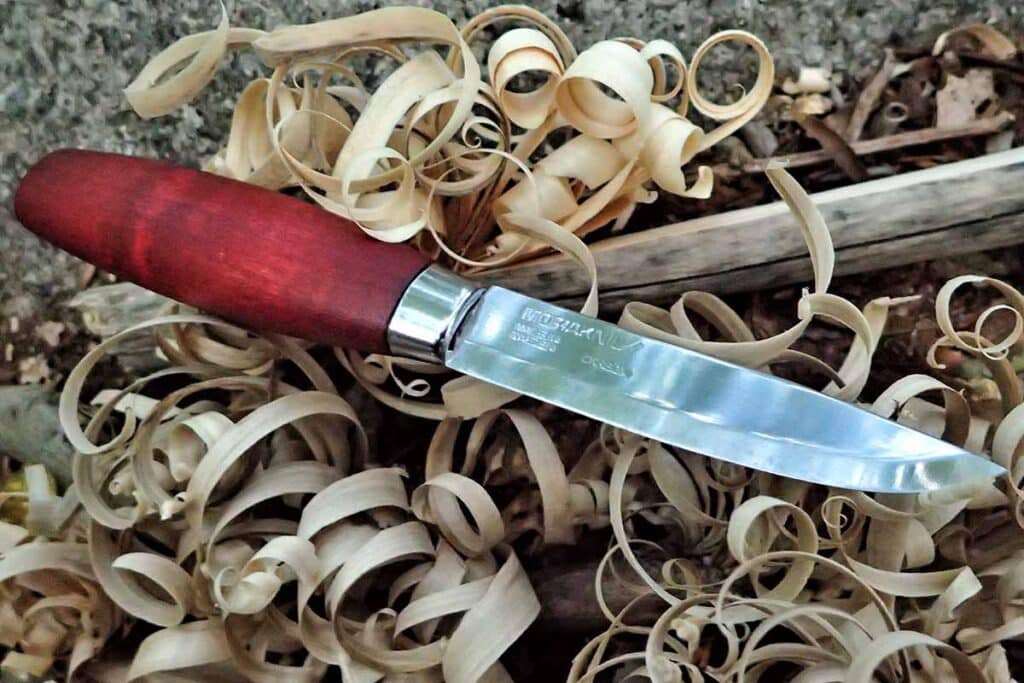
The Classic No. 1/0 has a 3-inch blade designed for carving feather sticks and whittling, making it great for fire preparation.

Morakniv knives are made exclusively in Mora, Sweden, where the company has been for centuries. Combining the benefits of handforged blades with industrial manufacturing, Morakniv is known for quality, consistent, sharp knives. They are recognized as a national symbol of Sweden and have been granted a Royal Warrant of Appointment by the King*.

The Morakniv Classic knives are a popular choice among outdoor enthusiasts and professionals alike. The blades are carbon steel and the distinct barrel-shaped handles are red-stained birch. The Classic knives have been around for nearly a century, and while some changes have been made over the years, the basic design has remained essentially unchanged.

In 2020, Morakniv updated the Classic series. The edge angles and blade shapes remain the same but all the knives have rattail tangs. The new polymer sheath is sleek and polished and features the Swedish Coat of Arms. The belt strap is Swedish vegetable-tanned leather designed to last generations.

The Morakniv Classic No. 1/0 has been renamed and upgraded from the Classic No. 2/0, with slight differences in handle width and blade thickness. The blade is .078 inch at the thickest. I like the trim blade. It is a hair longer than the 2/0 at 3 inches.

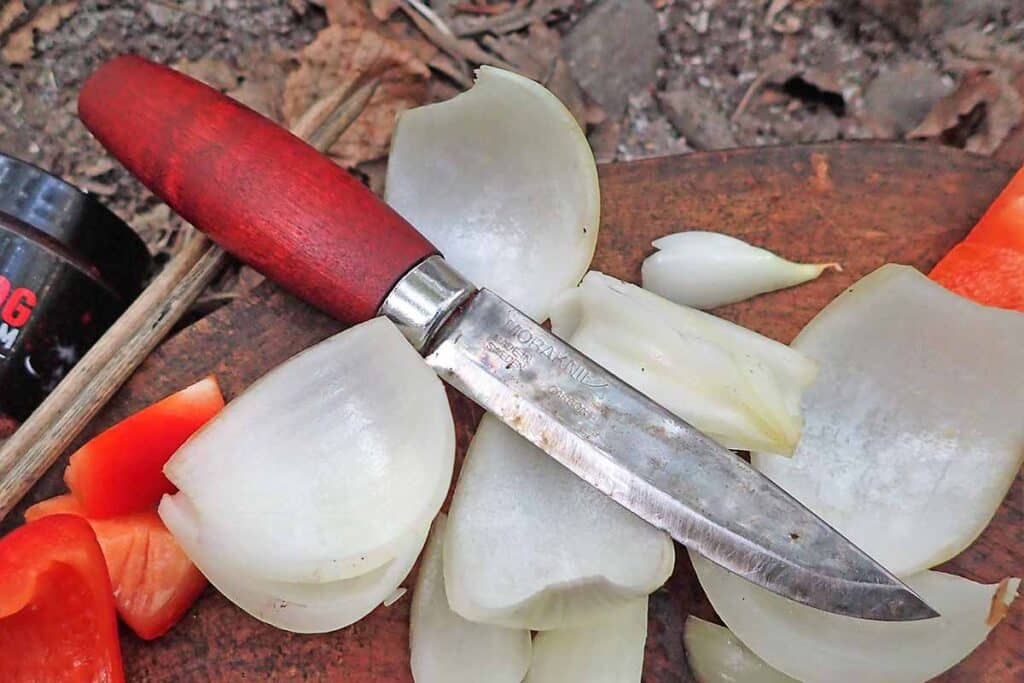
The Morakniv Classic No. 1/0 has a thin .078-inch blade useful for slicing onions, peppers, mushrooms and tomatoes.

I carried the bite-sized knife on a small carabiner hooked to my belt loop. I used it on dry poplar, hickory and maple to make feather sticks. It performed precisely as a Morakniv Classic should, slicing and curling wood with every stroke. Sitting by the fire, whittling and filling up my tinder/kindling coffee can with shavings was my nighttime routine with the 1/0.

The small, very able cutter regularly sliced peppers, onions and mushrooms for camp kabobs or morning omelets. Due to its kitchen knife-like thinness, the blade sliced food exceptionally well for a Scandi grind.

Bear Forest Knives Simple 3

Bear Forest Knives Simple 3
The author used the Bear Forest Knives Simple 3 to carve a seven-notch try stick from semi-dry wood. The sharp zero grind excels on green and dry wood.

Based in the USA, Bear Forest Knives is keeping the puukko knife alive and thriving. The company recently released its latest addition to the Simple series, the Simple 3.

The full-tang Finnish puukko-style knife packs a compact and convenient 3-inch blade of 8670 carbon steel. Its straight-back 90-degree spine and zero Scandi grind ensure remarkable control and precision, making it ideal for intricate tasks. The Simple 3 features an exposed pommel perfect for light hammering tasks, which wasn’t an option on previous knives in the series. The 8670 is typically found in large circular saw blades, much like old-timey puukkos made in Scandinavia. The Simple 3’s compact size makes it highly versatile for various woods tasks.

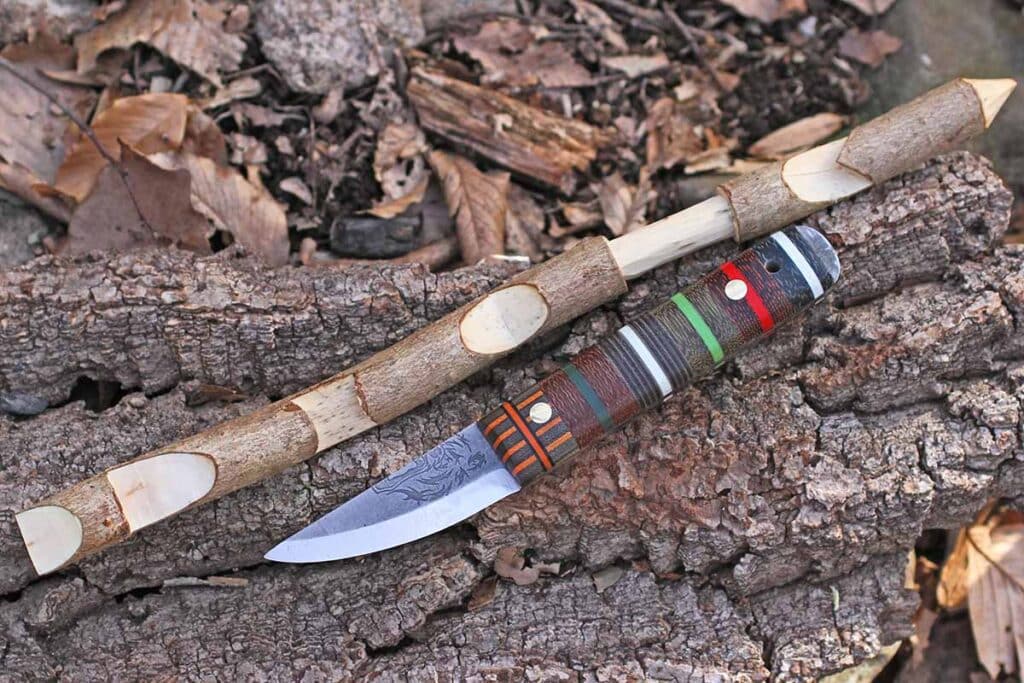
Simple 3 Puukko
The Simple 3 is a versatile puukko for camping, bushcrafting or hunting. The 3-inch 8670 carbon steel blade has a straight back, 90-degree spine and zero Scandi grind for control and precision.

Using the knife, I created a mini try stick and enjoyed some woodcarving. The handle was comfortable and filling, while the zero Scandi was perfect for removing a lot of material. I used semi-dry wood, which the Scandi grind works better on than a flat or saber grind. I continued crafting tent stakes and making fuzz sticks, which a puukko excels at most. Additionally, the super sharp spine was exceptionally helpful, as it helped me to ignite the nicely feathered shavings for fire using my ferro rod.

Reiff Knives F4 Scandi Bushcraft

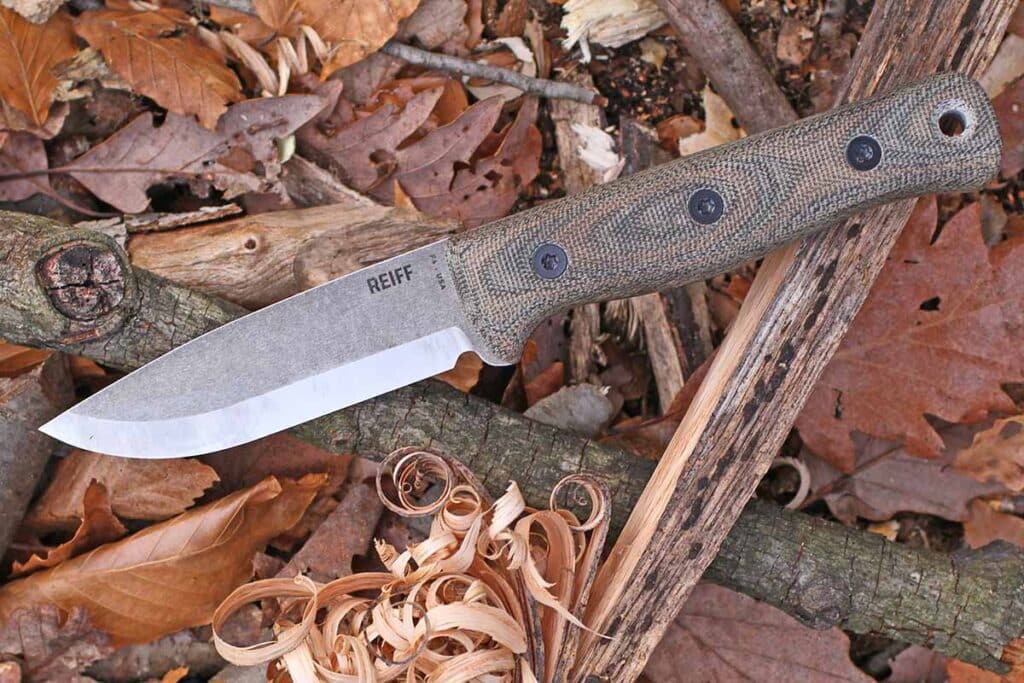
Reiff F4 Scandi Bushcraft
The Reiff F4 Scandi Bushcraft made feathering wood a breeze. The large handle helped ease the blade through hard oak to make thin, curly feathers.

The F4 Scandi Bushcraft is the latest homage to the puukko from Reiff Knives. The company keeps the contemporary rendition of the famed knife alive with modern craftsmanship and materials in a full-tang construction.

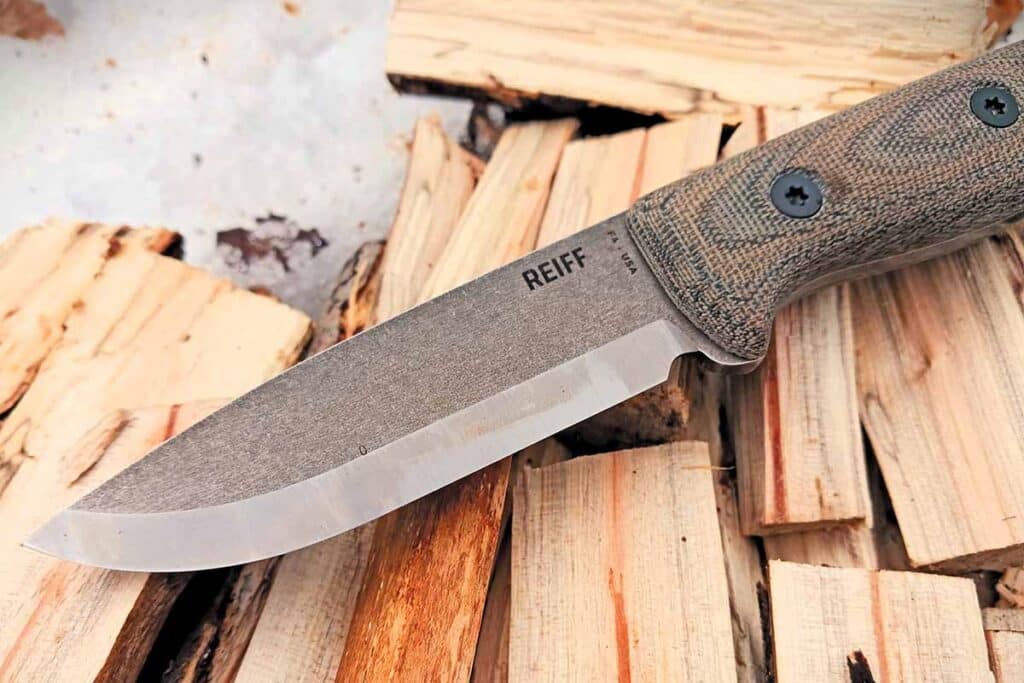
A knife with a Scandi-ground blade is a must-have for bushcraft enthusiasts. The F4 blade is CPM 3V carbon steel 5/32 inch thick at the thickest with a steep grind angle of 12.5 degrees per side. Its ability to effortlessly slice through wood, animal hides and food is remarkable. The textured canvas Micarta® scales are available in four colors.

F4 Scandi
The F4 Scandi is a new breed of knife that, thanks to the tough CPM 3V carbon blade steel, had no problem batonning through frozen wood in the winter.

The robust F4 Scandi helped split several chunks of maple, oak and poplar with a baton for my winter cookouts. It also kept an Uberleben wood stove and one cold hiker well-fed. The Scandi edge was not damaged when used on frozen wood in freezing weather. After heavy splitting—not usually recommended for a Scandi blade—it was time for tinder shavings. I made several fuzz sticks and marveled at how comfortably the 5-inch handle navigated the edge, elegantly feathering the wood. Reiff has it going on!

*Royal warrants of appointment have been issued for centuries by royal families of assorted European countries to tradespeople who supply goods or services to a royal court or certain royal personages. The royal warrant enables the suppliers to advertise the fact that they supply to the issuer of the royal warrant, thus lending prestige to the suppliers.

Check Out More Outdoor Knives:

Recurve Knives: Top Options In These Curvy Carvers
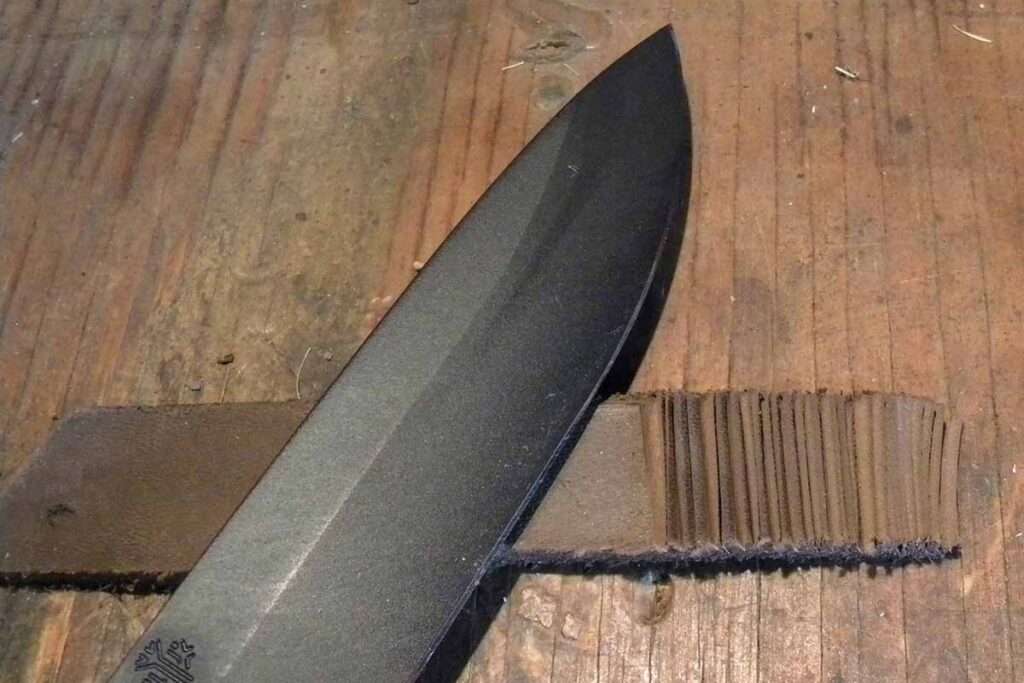
The sexy shape of three U.S.-made recurve blades addresses both performance and aesthetics.

As blade patterns go, the recurve is right up there in the “flair department.”

Just as the curves of a Ferrari add irresistible styling to the classic sports car’s appearance*, so does the curvature of a blade’s edge add to that of the look of the knife. It also changes the geometry of a blade—sometimes radically—in some ways better and other ways not so much. That’s the beauty of blade design and why there are so many different styles from which to choose.

How much length does a recurve add to the edge of a blade? This chart compares the length of the ’Squatch blade to the length of the actual sharpened edge. The curved top edge blade of a straight blade might add 2-to-3 inches to the edge. The Sasquatch’s recurved edge stretches the increase to 4.75 inches.

The waisted recurve design shifts the weight of the blade toward the tip, which while excellent for chopping also reduces the blade’s effective chopping length. The recessed area on the lower part of the recurved blade adds the benefit of being able to trap or gather in its subject when performing chores like debarking and taking slivers from wood, but it also makes sharpening more difficult with flat-surfaced media such as whetstones.

Sharpening A Recurve

Like any blade design, there are trade-offs. To get an idea of how radically the recurve lengthens the edge of a blade, see the accompanying chart of the Case Sasquatch bowie. The height of the sharpened portion of the blade is 7.5 inches, but when the length of the curvature is factored in the number swells to 12.25 inches!

Recurve blades require a rounded or ovate sharpening medium to properly hone the curvaceous edge. Hand-held sharpeners similar to those used by chefs or the common V-sharpeners work well on curved edges, as do stones with curved edges such as the Spyderco Golden Stone ceramic.

When sharpening these blades the concave lower curve does not conform to a flat plane, so an ovate or rounded surface grit is required for sharpening. Fortunately, there are plenty of these to choose from, such as handheld sharpeners similar to those used by chefs or the common V-sharpeners that use alternating rods set at opposing angles in a base. The Spyderco Golden Stone and/or Webfoot works as well. Now, on to the recurves!

Bear Forest Knives Custom Recurve

The Bear Forest Knives Custom Recurve is a small fixed blade built like a tank, owing much to the 3/16-inch thickness of its acid-dipped 52100 carbon steel blade. At 7.75 inches overall, the knife is geared toward light-to-medium camp chores and could conceivably be used as an EDC. The full-tang handle boasts colorful scales of a wavy sandwich of black, orange and natural cross-cut canvas Micarta®. Weight is a hefty-for-its-size 5 ounces. Bear Forest provides a black Kydex sheath with a nifty black coated 2.25-inch spring steel belt clip.

Bear Forest Knives Custom Recurve Specs
Blade length: 3.25”
Blade material: 52100 carbon steel
Handle material: Crosscut canvas Micarta®
Gripping feature: Tri-color Micarta handle material
Sheath: Black Kydex w/belt clip
Weight: 5 ozs.
Overall length: 7.75”
Country of origin: USA
MSRP: $249

Recurves shine when performing shaving tasks. Both the TOPS (left) and Case (right) did a nice job rendering cedar curls for fire starter.

Case Laramy Miller Sasquatch Bowie

The Case Laramy Miller Sasquatch Bowie is a study in understated good taste. The large 13-inch Jim Bowie namesake flows from stem to stern, from the break in its flat-ground 1095 carbon steel blade to its rounded combo lanyard hole and pommel. The matte-black Caswell finish gives the bowie a rustic look. The bag-style handle is topped with natural canvas Micarta scales affixed with 5/16-inch brass pins. Case provides a double-stitched natural leather belt sheath that matches the knife in clean styling.

Case Laramy Miller Sasquatch Bowie Specs
Blade length: 7.75”
Blade material: 1095 carbon steel
Handle material: Natural canvas Micarta®
Cutter keys: Clip-point blade, Caswell finish
Sheath: Natural leather belt model
Weight: 14.5 ozs.
Overall length: 13”
Country of origin: USA
MSRP: $219.99

TOPS Longhorn Bowie

The TOPS Longhorn Bowie is a thoroughly modern recurve with such classic touches as its upswept clip-point blade—always welcome on a bowie. The flat-ground 1095 blade is coated in dark sniper gray Cerakote®, matching the gray/black layered linen Micarta scales nicely. The black nylon MOLLE-compatible sheath carries on a belt or a pack and other gear. It includes a front pouch for stowing a sharpener or fire-starting accessories.

TOPS Longhorn Bowie/Sniper Gray Specs
Blade length: 6.75”
Blade material: 1095 carbon steel
Handle material: Canvas Micarta®
Cutter keys: Trailing-point blade, sniper gray Cerakote® finish
Sheath: Black nylon, MOLLE compatible w/pouch
Weight: 18.1 ozs.
Overall length: 13”
Country of origin: USA
MSRP: $305

Testing The Recurve Knives

The TOPS Longhorn and Case Sasquatch bowies begged to be reviewed together because they are exactly the same length and share the same 1095 blade steel, yet are two very different knives. The TOPS blade has a more casual recurve while the Case is full tilt. The handles couldn’t be more different as well, with the Case opting for a clean, traditional bag-style grip while TOPS chose a modern tactical design a full inch longer than its counterpart, resulting in a slightly shorter blade. Let the fun begin!

The Bear Forest Custom Recurve is small compared to the two larger test knives, though the same blade geometry applies. Note how the upper curve of the edge ensnares the rappelling rope as it slices through it.

I started with some basic chopping on a 5-inch diameter oak log. The Sasquatch brought the hammer down with its weighted fore-end but the Longhorn had the advantage of more working area on the blade for chopping. Both manufacturers chose 1095 and have loads of experience at maximizing the steel’s benefits. I found both knives excelled in the pure blade bite and performed well chopping. The Sasquatch weighted front end is an advantage for sheer power but the Longhorn is 3.6 ounces heavier, so it closes the gap significantly.

I did some shaving doing push cuts on 1×3 cedar planks. As expected, the concave edge of the Case excelled at trapping the wood through the straight cuts. Advantage Sasquatch. However, the TOPS has a grip a full 1-inch longer than the ’Squatch and is textured as well, offering superb purchase. Advantage TOPS. Bottom line, both recurve bowies performed very well. The choice is yours.

It's a trap! The lower concave area of the Case blade traps the rappelling rope during a pull-through. The deeper the concave curve, the better it performs this function.
It’s a trap! The lower concave area of the Case blade traps the rappelling rope during a pull-through. The deeper the concave curve, the better it performs this function.

The sheaths for both are well done. The Case belt model is natural leather designed in a simple, tasteful manner. The TOPS is unabashedly rock ’em, sock ’em tactical all the way.

The Bear Forest Custom Recurve punches up in its size class thanks to thick 3/16-inch blade steel and a healthy handle length, a trait often missing on smaller fixed blades. I tested the blade for its ability to capture 3/8-inch rappelling rope in its concave maw. Thanks to its overbuilt steel, the blade never wavered while producing slice after slice. It also took off nice, healthy curls of cedar just like the big boys. The curves of the cross-cut canvas Micarta scales made for excellent purchase and are attractive to boot. I also did some bark skinning on seasoned oak, took slices off other kinds of rope, and batonned fatwood pine fire starter.

Bear Forest provides a nifty Kydex sheath. It has a 1.5-inch spring clip on the back that not only mounts on the belt for vertical and cross-draw carry/deployment, but doubles as a pocket clip on either side, something seen more and more from the fixed-blade EDC crowd lately. All in all, I was impressed with the whole package.

Final Cut

The recurve isn’t just for whacking stuff. It requires a little more finesse and is typical of blades that don’t walk the straight and narrow. However, the benefits of recurves will reward you dearly when kept in their lane. All three of the test candidates performed admirably and are well worth your consideration.

*Editor’s note: Long-time custom knife purveyor J. W. Denton, who was a champion racecar driver in his younger days, was fond of comparing the knives of Steve Johnson, BLADE Magazine Cutlery Hall-of-Fame member Bob Loveless and others to curvaceous sports cars. J. W.’s comparison, however, was largely between the handle butts of the knives and the rear ends of the cars. However, both comparisons are accurate.

  1. Bear Forest Knives Custom Recurve
    Blade length: 3.25”
    Blade material: 52100 carbon steel
    Handle material: Crosscut canvas Micarta®
    Gripping feature: Tri-color Micarta handle material
    Sheath: Black Kydex w/belt clip
    Weight: 5 ozs.
    Overall length: 7.75”
    Country of origin: USA
    MSRP: $249

Check Out More Outdoor Knives:

Throwing Axes: Sharp New Airborne Hackers

Consider three hot new throwers for an ancient sport gone international.

Once considered a lost pastime, axe throwing has grown in popularity worldwide. With the founding of such organizations as the International Axe Throwing Federation (IATF), the World Axe Throwing League (WATL) and others, and the pursuit’s establishment as a pub sport in the USA, Canada, Belgium, Poland and elsewhere, more people are interested in this thrilling activity. It’s no longer just a lumberjack’s hobby but an exciting sport most anyone can enjoy.

Condor Tool & Knife Cantina Axe

The Condor Tool & Knife Cantina penetrated deeply due to its edge geometry and head weight.
To get a perfect toe-first stick, adjust your distance by taking a step forward or back. The Condor Tool & Knife Cantina penetrated deeply due to its edge geometry and head weight.

Accompanying axe throwing’s growth in popularity is the demand for high-quality axes. The Cantina Axe from Condor Tool & Knife is an excellent all-purpose tool with features catering to professional axe throwers and seasoned axe users alike. The Cantina is versatile enough for both competition axe throwing and outdoor tasks, making it a valuable addition to any edged-tool array.

Crafted from 1060 high carbon steel, the axe head features a natural darkened finish that adds to its rugged appeal. The 18-inch burnt American hickory handle provides an excellent grip. The 4-inch blade bit weighs about 35 ounces, making it stout enough for outdoor splitting and chopping chores. The design promotes maximum performance, making it an excellent choice for anyone looking for a reliable multi-purpose axe.

Condor Tool & Knife Cantina Axe Specs
Blade Length: 4”
Blade Grind: Convex
Blade Material: 1060 carbon steel
Handle Material: Burnt American hickory
Weight: 35 ozs.
Overall Length: 18”
Sheath: Rubber blade cover
Country of Origin: El Salvador
MSRP: $87.34

Cantina’s convex edge made thin curlicues with minimal effort
The Cantina’s convex edge made thin curlicues with minimal effort. The edge helps enable the axe to perform as both a throwing and camping tool.

FIELD TEST: The Cantina looks and feels like a small camp axe. The test model came with a good convex edge that stuck in a dead tree target and was camp-use capable out of the box. The head geometry is between a conventional and throwing axe profile. Despite the Cantina being the heaviest of the test bunch, it wasn’t a chore to throw. In fact, the weight helped it stick since the bit isn’t flat like many throwing axes with a pronounced heel and toe.

The handle is straight and burly, with a little more meat at the throat of the axe. It came well-seated and solid. However, after several throws it had a bit of play, though it never came visibly loose. I’m sure a boiled linseed oil bath would remedy this. The straight handle helped propel the axe and elegantly send it into flight.

The Cantina’s distinctive feature is its head shape combined with the convex edge. This makes it a jack of many tasks, easily doubling its duty as a camp axe. I like this aspect the most. The edge shaved fine feathers and chopped and split like a regular axe, with more head weight for its size. If you want to grab one axe and head out covering camp and leisurely axe throwing, the Cantina’s it.

Boker Plus Mohican Throwing Axe

Mohican set features all-3Cr13-stainless-steel construction
The Mohican set features all-3Cr13-stainless-steel construction and a black coating. Each piece is 10.94 inches overall.

If you’re looking for a reliable and stylish throwing axe outfit, the Boker Plus Mohican Throwing Axe 3-Piece set is worth considering. It is designed for both novice and experienced throwers, offering precision and comfort. Each axe features a 10.94-inch overall length and all-3Cr13-stainless-steel construction, with a black coating that makes it durable and visually appealing.

The design is based on the silhouette of traditional tomahawks of North American indigenous people, with an additional, shorter 2.36-inch cutting-edge blade on the axe head. The paracord-wrapped handle ensures a secure and comfortable grip and precision throwing. A blade recess ensures balance with even rotation for better accuracy. The set has a matching black nylon sheath and printed target overlay, making it perfect for home use. Each axe weighs approximately 8 ounces, making it easy to handle.

Boker Plus Mohican Throwing Axe 3-Piece Specs
Blade Length: 2.36”
Blade Grind: Hollow
Blade Steel: 3Cr13 stainless
Handle Material: Black cord
Weight: 8.18 ozs. (each)
Overall Length: 10.94”
Sheath: Nylon
Origin of Make: Asia
MSRP: $84.95

Boker Mohican perfectly perforating the target
This is a perfect stick, with the top of the toe of the Boker Mohican perfectly perforating the target.

FIELD TEST: The Boker Mohican axes look and handle more like tomahawks than axes. The set is designed for fun rather than competition, so you will get more sticks with these bad boys. The feel of throwing a Mohican is not unlike flinging a knife.

There are two places the hawk can stick—the main bit and the spike, the latter which seems to stick during an overthrow. To fix overthrowing, take a step forward or enjoy making it stick regardless. The edges are sharp and flared to enhance sticking ability.

The Mohicans are lightweight, so they require some getting used to if you’re accustomed to larger throwing axes. The handle is straight with cord wrapping, making the hand adhere to it too well for optimum throwing. However, an easy fix is to remove the wrap or open the hand drastically when throwing the hawk.

The Mohican’s notable features are the double options for sticking the target and the forward-protruding sharp toe. The edge looks cool and improves target penetration. Another outstanding feature is the nylon sheath, which adds safety and value to the overall package. It has fabric fasteners, keeping each hawk individually secure.
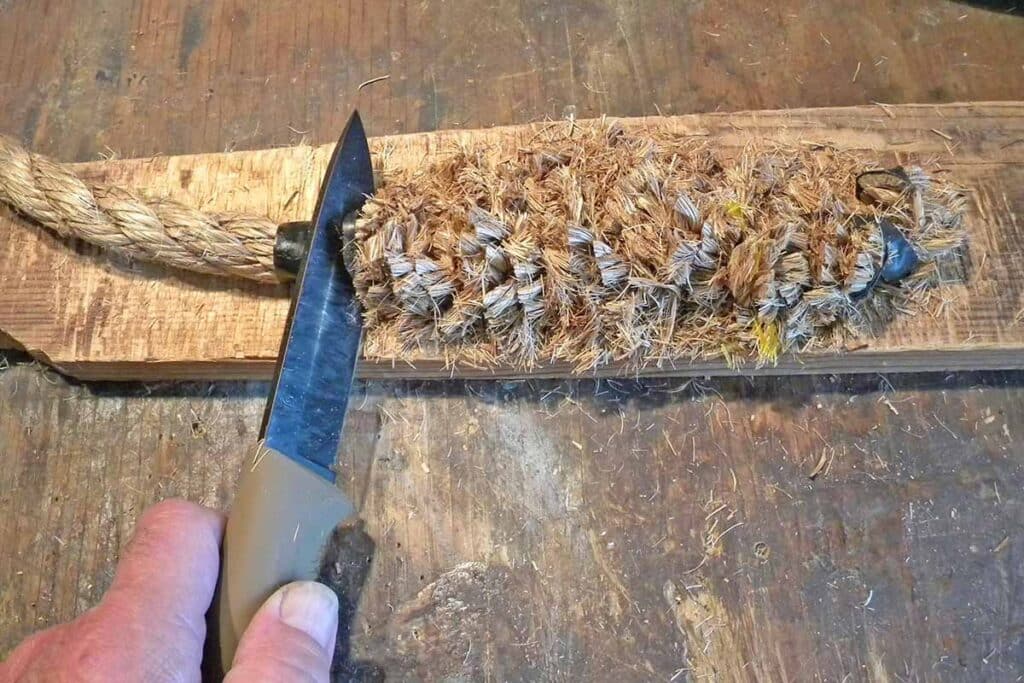
The three Bokers get my vote for the most fun of the axes/hawks. They combine the feel of tomahawk and knife throwing. The little gems can also handle light utility work for a day camp or cooking near a small wood stove, as they can shave wood and split light kindling.

Cold Steel Professional Throwing Axe

Cold Steel performed flawlessly
The Cold Steel performed flawlessly. It was light and flew like a hawk, eagerly seeking its target.

Experienced axe throwers will appreciate the Cold Steel Professional Throwing Axe, an upgraded version of the company’s Competition Throwing Hatchet. It boasts a 4-inch blade of 1055 carbon steel and meets official axe-throwing tournament requirements. The 16-inch American hickory handle provides excellent balance during target practice or competition, while the axe head weight of 22 ounces and overall axe weight of 31 ounces makes it easy to handle.

What sets this axe apart is its patent-pending locking mechanism that enables you to change a worn or damaged handle in under two minutes. Simply loosen two bolts, remove the handle and replace it with a new one. With this axe you can focus on your aim and technique without worrying about lengthy handle replacements.

Cold Steel Professional Throwing Axe Specs
Blade Length: 4”
Blade Material: 1055 carbon steel
Blade Grind: Chisel
Handle Material: American hickory
Weight: 31 ozs.
Overall Length: 16”
Sheath: Rubber blade cover
Country of Origin: Taiwan
MSRP: $59.99

Cold Steel Professional Throwing Axe has a patent-pending locking mechanism
The Cold Steel Professional Throwing Axe has a patent-pending locking mechanism that lets you change a worn handle in under two minutes.

FIELD TEST: The Cold Steel had the best bit of the test bunch for sticking in the target, with a straight edge and slightly flared heel and toe. The blade geometry is thin and narrow as a throwing axe should be. The edge isn’t super sharp for an axe standard but it did well on my target, an old, rotting tree. The overall design definitely presents as a pro thrower.

Weight is a happy medium between a light throwing axe and a heavier one. Unlike conventional axes/hatchets of similar size, the weight is nestled solely in the head, which helps in propulsion.

The hickory handle has a nice grain and stayed robust despite a few blundering throws on my part. The classic straight handle helps the axe release without getting hung up on any design flare in the butt, etc. Besides, it’s not a chopping axe. The ingenious design allows for easy replacement of handles without loosening during testing. In my opinion, this axe is the most unusual of the three.

Instead of a sheath, the axe has a rubber blade guard that feels secure for transport and stays in the included pack while hiking. I like the compact, lightweight Cold Steel, and the MSRP, at $59.99, makes it the best buy of the test group.

More Axes, Hatchets And Tomahawks:

  • Bearded Axe: Best Bashers From Here To Valhalla
  • Best Tomahawks: Our Top Hawks For Backwoods To Battlefields
  • Wicked Breacher: Ben Seward’s SWAT Axe
  • Awesome Axes for Chopping Wood Like a True Lumberjack

Bear Valley BV-Tac 8 Multitool: Multi-Purpose Whacker

The BV-Tac 8 is a versatile performer and does so comfortably.

The BV-Tac 8 “multitool” from Bear Valley Tactical is designed for firefighters, first responders, hunters, campers and other action seekers. It features plenty of uses for the average person that makes it a handy tool to have.

It features hydrant and spanner wrenches, hammer, axe blade, pry bar, 7/16- and 5/16-inch wrenches, gas turnoff, and 15 feet of paracord in the handle. The axe blade and hammer are very useful.

Bear Valley also offers attachments such as a shovel, pick with a hoe, bow saw and sand anchor (coming soon). The BV-Tac 8 is made in the USA.

Axe Test

The weight was perfect to split the wood for kindling.
The weight was perfect to split the wood for kindling. The only thing the author worried about was the prybar. As a right-hander and with the prybar angled toward the right, he had to be sure it did not hit his forearm.

To test the axe head, I split some pine. The multitool was very controllable. The weight was perfect to split the wood for kindling. The paracord handle prevented any shock to my hand. The only thing I worried about was the prybar when using the axe. I’m a right-hander and with the prybar angled toward the right, I had to be sure it did not hit my forearm.

I had a seasoned hackberry chunk I needed to split. The BV-Tac 8 was up to the task. It bit deep and within a few whacks the log was quartered. You can really get some power behind your chops with this puppy. Again, the paracord handle absorbed any shock to my arm.

Tool Test

The bolts fit tight into the prybar slots
The bolts fit tight into the prybar slots but you are limited by space around a bolt for use. There’s plenty of leverage if you can get to the bolt.

I found a few bolts that fit into the slot of the pry bar. They fit tight into the respective slots but you are limited by space around a bolt for use. The BV-Tac 8 has plenty of leverage if you can get to the bolt.

Grasping the hammer, I drove finishing and roofing nails into a 2×4. The hammer has great balance and hits where you aim. There is enough weight to drive the nails deeply on each blow. The handle is extremely comfortable and doesn’t roll during hammering. It is very well done.

I used the pry bar to pull the nails I had hammered into the 2×4. After prying them up about a quarter inch, I was able to slide the nail head into the prybar’s “V.” I lifted the nails out easily. This thing is—you guessed it—handy.

Hard-Use Test

used the hammer to drive finishing and roofing nails
The author used the hammer to drive finishing and roofing nails into a 2×4. There is enough weight to drive the nails deeply on each blow. The handle is extremely comfortable and doesn’t roll during hammering.

I had to push the limits of the hammer and axe. An old steel screen chair had one more use: whack attack! The hammer easily busted the screen out from the welded channel. Seven or eight hard blows and all I did was mark up the Cerakote® finish.

On to the axe head, same drill—seven or eight hard blows to the screen. Most of the blows penetrated around halfway through the screen. The edge maintained its sharpness but I sure can mess up a great Cerakote finish. It’s “seasoned” now.

Final Cut

I might add a tip guard for the prybar. The BV-Tac 8 is an extremely versatile tool to have in your vehicle or strapped to your rucksack.

BV-Tac 8 Specs
Edge Length: 4.75”
Head/Edge Material: S7 tool steel
Head Finish: Coyote brown Cerakote®
Handle: Paracord wrapped
Special Features: Several built-in tools (see copy)
Weight: 3 lbs.
Overall Length: 17”
Blade Cover: Synthetic
Country of Origin: USA
MSRP: $199.99

More Axes, Hatchets And Tomahawks:

  • Bearded Axe: Best Bashers From Here To Valhalla
  • Best Tomahawks: Our Top Hawks For Backwoods To Battlefields
  • Wicked Breacher: Ben Seward’s SWAT Axe
  • Awesome Axes for Chopping Wood Like a True Lumberjack

New Knives: Host Of Current Factory And Custom Blades

Folder or fixed blade, EDC or kitchen and more, one of these will fill the bill.

In the wake of BLADE Show 2024 there is a slew of new knives hitting the custom and factory markets. We scoured both to bring you some of the latest and greatest handmade and production gems. Keep your eyes peeled for these fantastic options hitting dealers’ shelves soon.
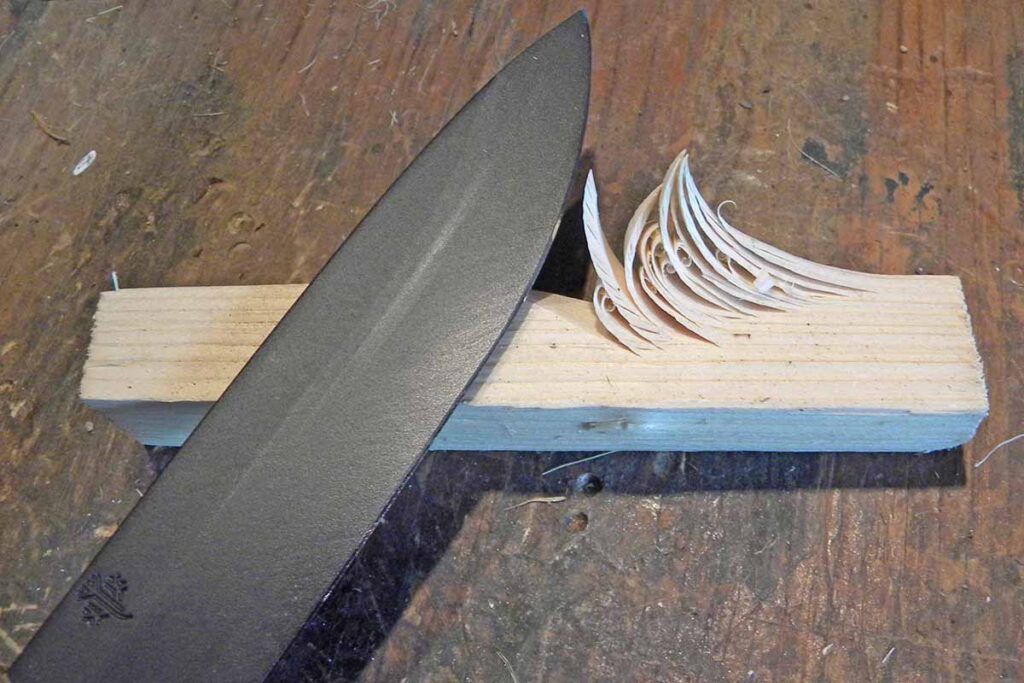

Triple C Knives Model #3

Triple C Knives Model #3

Knife pattern: Fixed-blade hunter
Blade length: 4”
Blade material: Damascus of 5160 carbon and 15N20 nickel-alloy steels
Blade grind: Hollow
Handle: Mammoth ivory
Bolster: Stainless steel
Overall length: 7.75”
Maker’s price for a similar knife: $1,000
Maker: Triple C Knives (SharpByCoop image)


Bubba Crouch Trapper

Bubba Crouch Trapper

Knife type: Slipjoint
Blade length: 3 7/8”
Blade steel: Damascus forged by ABS master smith Rick Dunkerley
Blade grind: Hollow
Handle material: African goat horn
Handle frame: 416 stainless steel in an integral construction
Bolster: 416 stainless
Knife to know: The CPM 154 stainless backspring features filework; the arrowhead shield is damascus
Closed length: 4”
Maker’s price for a similar knife: $2,500
Maker: Bubba Crouch (SharpByCoop image)


Erik Fritz Petty Chef’s Knife

Erik Fritz Petty Chef’s Knife

Blade length: 6.5”
Blade material: Triple-quenched 52100 carbon steel
Blade grind: Flat w/convex edge
Handle: Buckeye burl
Bolster: 416 stainless steel
Overall length: 11”
Maker’s price for a similar knife: $400
Knife to know: Erik Fritz is an ABS journeyman smith
Maker: Erik Fritz (Jocelyn Frasier image edit)


Ben Akin Bowie

Ben Akin Bowie

Blade length: 83/8”
Blade material: W2 tool steel w/hamon
Blade grind: Flat
Handle: Box elder burl w/carbon fiber and red G-10 spacers and a mosaic pin
Guard: Wrought iron
Overall length: 135/8”
Knife to know: Ben Akin is an ABS apprentice smith
Maker’s price for a similar knife: $800
Maker: Ben Akin (Jocelyn Frasier image edit)


Egginton Presentation George Wostenholm I*XL barlow

Egginton Presentation George Wostenholm I*XL barlow

Knife type: Slipjoint
Blade length: 2.16”
Blade steel: 420S45 stainless
Blade pattern: Clip point
Blade finish: Crocus polished
Scales: Stabilized birch burl in Cutlers Company green
Bolster: Nickel silver marked w/400-year anniversary emblem
Knife to know: Commemorates the 400th year of The Company of Cutlers in Hallamshire, UK; The Company of Cutlers was formed by an act of Parliament in 1624 to “protect and promote the cutler and steel products made” in Sheffield, England; made in a limited edition of 2024 in recognition of the company’s 400th anniversary year; each knife is serial numbered
Weight: 2.18 ozs.
Closed length: 3.16”
Country of origin: United Kingdom
MSRP: $185 at press-time exchange rate
Company: Egginton


Boker Plus Gust Copper

Boker Plus Gust Copper

Knife type: Manual one-hand folder
Designer: Serge Panchenko
Blade length: 2.87”
Blade material: D2 tool steel
Blade @ thickest: .14”
Blade pattern: Drop point
Blade finish: Stonewashed
Blade opener: Thumb hole
Handle material: Copper w/hole for a lanyard
Lock: Framelock
Pocket clip: Tip up, right-handed
Weight: 4.44 ozs.
Closed length: 3.7”
Carry: Nylon pouch
Country of origin: China
MSRP: $119.95
Company: Boker Plus


Valhalla Blades Surtr

Valhalla Blades Surtr

Pattern: Bowie
Blade length: 11”
Blade material: 1084 carbon steel
Blade grind: Flat
Handle material: Dyed, stabilized maple burl
Guard: Brass
Overall length: 16”
Maker’s price for a similar knife: $250 at press-time exchange rate
Maker: Valhalla Blades (Rod Hoare image)


TOPS Knives Shadow Hunter

TOPS Knives Shadow Hunter

Knife type: Fixed blade
Blade length: 4.5”
Blade material: 1095 carbon steel
Rockwell hardness: 56-58 HRC
Blade @ thickest: .19”
Blade finish: Tungsten Cerakote®
Handle material: Black canvas and tan canvas Micarta®
Weight: 10.1 ozs.
Overall length: 9.25”
Sheath: Tan Kydex
Weight w/sheath: 12.8 ozs.
Knife to know: While the original was a favorite of company founder Mike Fuller, the new iteration is fine-tuned for enhanced performance, including a more ergonomic handle, slightly extended blade and modernized finishes
Country of origin: USA
MSRP: $250
Company: TOPS Knives


Montana Knife Co. MKC Whitetail

Montana Knife Co. MKC Whitetail

Pattern: Hunting knife
Blade length: 4”
Blade @ thickest: .135”
Blade steel: MagnaCut stainless
Blade pattern: Drop point
Handle material: G-10
Construction: Full tang
Overall weight: 4.3 ozs.
Overall length: 8 5/8”
Sheath: Kydex, open carry, reversible quick-attachment belt clip, vertical handle down or horizontal carry, built-in retention screw to customize blade tension
Knife to know: Also available in buck skin, black, green and black, tan and black, and grey handle colors; integral guard; gimping on blade spine
Country of origin: USA
MSRP: $315
Company: Montana Knife Co.


The Australian Cutlery Fixed-Blade Hunter

The Australian Cutlery Fixed-Blade Hunter

Blade length: 4”
Blade steel: CPM S35VN stainless
Blade grind: Hollow sabre
Blade thickness @ ricasso: 1/8”
Blade @ widest: 1”
Blade finish: Bead blast
Handle material: Hunter orange G-10 w/bead blast finish and custom Australian cutler mosaic pin
Overall length: 8.5”
Sheath: Matching hunter orange Kydex model made by Adam Grosskopf
Maker’s price for a similar knife and sheath: $230 at press-time exchange rate
Maker: The Australian Cutlery (Rod Hoare image)


Spyderco Manix 2 MagnaCut Lightweight Salt Knife Yellow Polymer

Spyderco Manix 2 MagnaCut Lightweight Salt Knife Yellow Polymer

Knife type: Manual one-hand folder
Blade length: 3.375”
Blade steel: MagnaCut stainless
Blade grind: Flat
Blade @ thickest: .13”
Blade pattern: Drop point
Blade finish: Satin
Blade opener: Thumb hole
Handle material: Yellow polymer over stainless steel liners
Lock: Ball-bearing lock
Pocket clip: Reversible, tip up
Weight: 3 ozs.
Closed length: 4.625”
Country of origin: USA
MSRP: $232.99
Company: Spyderco


Cold Steel Espada XL

Cold Steel Espada XL

Knife type: Folder
Blade length: 7.5”
Blade steel: AUS-10A stainless
Blade @ thickest: .137”
Blade grind: Hollow
Blade pattern: Clip point
Blade finish: Black PVD
Handle material: Ruby red G-10
Lock: Tri-Ad Lock
Pocket clip: Blade tip up
Weight: 14.8 ozs.
Closed length: 9.25”
Knife to know: The knife is inspired by the classic Spanish navaja folder and is a collaboration between Lynn Thompson and custom knifemaker Andrew Demko
Country of origin: Taiwan
MSRP: $299.99
Company: Cold Steel


Check Out More Knife Drops:

Framelock Folders: Top Picks Built For Hard Use

Today’s framelock folders are built tough, stylish and sharp.

Framelocks are popular with folks who put folding knives to rough use. They are built more robust than linerlocks simply because the lockbar is cut out and bent from the steel or titanium frame of the handle. The lockbar is the exact width of the handle scale, whatever thickness that may be. Consequently, compared to the spring of a standard linerlock, there is significantly more material locking the blade open and, thus, greater lock strength.

Hinderer Knives Halftrack

titanium lockbar of the Hinderer Halftrack
At the end of the titanium lockbar of the Hinderer Halftrack is a bolted-in steel block that contacts the tang and reduces wear on, and thus adds longevity to, the lockbar. 

Named for the specialized military vehicle with a tracked propulsion drive system, the Hinderer Knives Halftrack framelock folder is, like its namesake, practically unstoppable. Despite the knife’s compact size, it has the horsepower to muscle through tasks big and small.

Hinderer Knives is known for high-end folding and fixed-blade knives aimed at the tactical market. The Halftrack is a bulldog of a tactical folder and one of Hinderer’s biggest sellers. A scaled-down tactical folder, it’s easy to carry. One thing’s for sure, the Halftrack is stout, with a handle that’s a little over a half-inch thick. The 2.75-inch blade is high-octane CPM S45VN stainless steel. The classic bowie shape has a defined tip for precise cutting. Other blade pattern options are a Spanto—Hinderer’s in-house design of blade grind that results in a very stout spear point—a tanto, wharncliffe and drop point.
The boxy handle frame is stonewashed titanium and the framelock is one of the strongest on the market. At the end of the titanium lockbar is a bolted-in steel block that contacts the tang and reduces wear on, and thus adds longevity to, the lockbar. Not all knife companies incorporate such a feature on their framelocks. A sturdy titanium pocket clip carries the closed knife blade tip up in the pocket. G-10 inlay in several color options on the presentation side sports a nice 3D milling pattern that aids in traction. At 3.85 inches closed, the Halftrack is robustly built without being too bulky.  
The Halftrack blade has an excellent edge
The Halftrack blade has an excellent edge out of the box and is ready to work. The CPM S45VN stainless steel has staying power and holds an edge exceptionally well. As the author noted, it’s a material that can go the distance. 

The blade has an excellent edge out of the box and is ready to work. The S45VN has staying power and holds an edge exceptionally well. It’s a steel that can go the distance. The handle doesn’t seem that comfortable at first but once you work with it you’ll understand the purpose behind the design. The large finger recess forms an integral lower guard that seats your index finger and prevents forward hand movement, while the angled handle butt fits perfectly in the palm of your hand. The boxy shape helps prevent it from being “lost” in your grip while wearing work gloves, too. 

Expect top notch performance all around. The blade sails through just about anything—cardboard, hose, wire, meat and a lot more. It does it all easily. The MSRP of $425 may be somewhat steep but the knife is well worth every dollar. It’s a tough folder that will take abuse and last for years. Country of origin: USA.

Kershaw Helitack

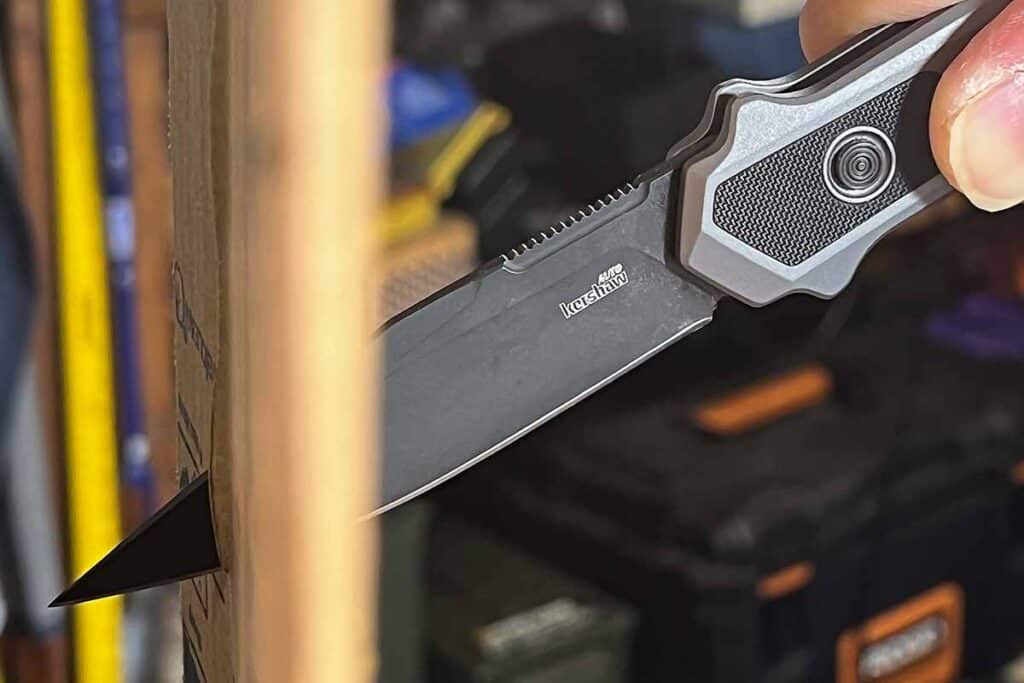
The 3.25-inch clip-point blade of the Helitack is built to excel at utility tasks
The 3.25-inch clip-point blade of the Helitack is built to excel at utility tasks. Such a pattern not only slices very well but also has a defined tip for precise cutting and scoring. 

Named for the U.S. Forest Service helicopter borne firefighters who are flown to combat remote wildfires, the Helitack from Kershaw exhibits the same toughness and resolve that the special breed of firefighters possesses. Like firefighter gear, the Helitack is built tough and carries easily. The 3.26-inch modified clip-point blade of 8Cr13MoV stainless is razor sharp out of the box. (The 8Cr13MoV is the Chinese equivalent of Japanese AUS-8.) The blade deploys via a flipper tab and SpeedSafe assisted opener, and rides on a pair of caged bearings for the ultimate smoothness in opening and closing.

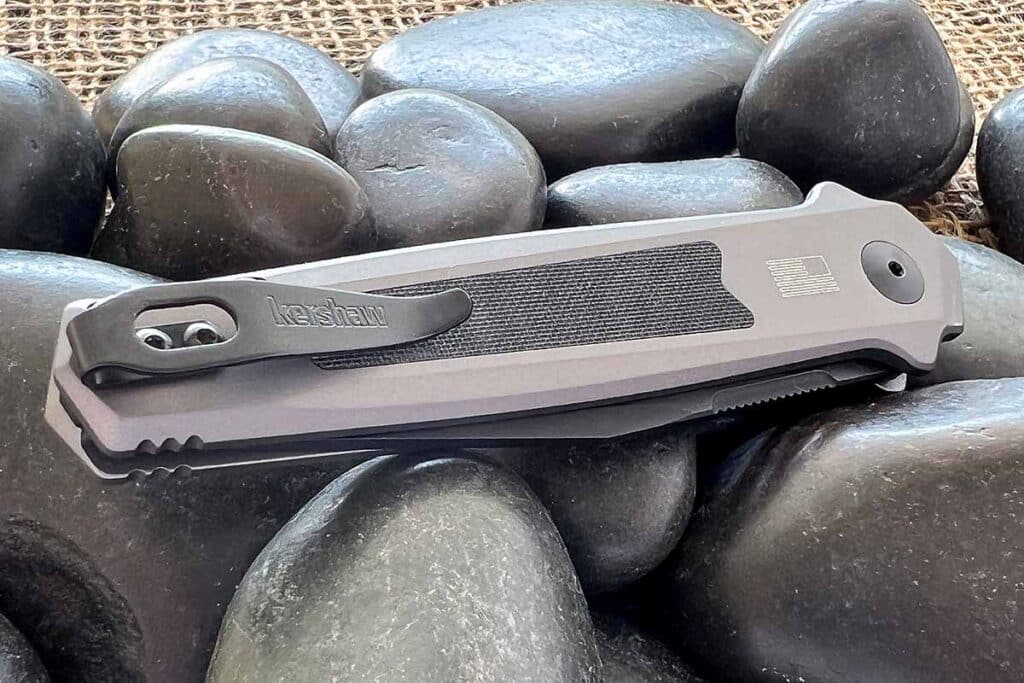
The handle is a stainless steel framelock and sports a chamfer around the edges to soften the grip and make it more comfortable. A reversible clip carries the knife deep in the pocket. The clip easily reverses to the opposite side using a standard T6 Torx driver. A steel lockbar stabilizer is integrated into the pivot on the lock side of the handle. It prevents the lockbar from traveling too far and thus losing tension when locking the blade open. The handle’s slender nature adds to the comfortable carry experience. The lock engages securely with zero play. The blade and handle sport a gray titanium nitride coating that’s handsome and low glare. The hardware is a contrasting black for an overall eye-catching look.  

Kershaw Helitack’s stainless steel framelock
The Kershaw Helitack’s stainless steel framelock sports a chamfer around the edges to soften the grip and make it more comfortable. A reversible clip carries the knife deep in the pocket. 

The 3.25-inch clip-point blade is built to excel at utility tasks. Such a pattern not only slices very well but also has a defined tip for precise cutting and scoring. The hollow grind allows the blade to be thinned out somewhat, giving the edge great bite without compromising strength. The Helitack tackles tougher materials with ease, something an EDC work knife must do.

The handle seems very comfortable and has no hot spots, though there were times I wished it were a bit wider to help me power through a cut. As slim as the handle is it carries very well. The lock held firmly. At an MSRP of $64.99, the knife is a great value. Country of origin: China.

Bastinelli Knives Bastien Coves

BBR2’s titanium lock side is anodized a bronze color
The BBR2’s titanium lock side is anodized a bronze color. The blade spine thumb rest is at the most forward point of the grip and has traction notches. The pocket clip carries the closed knife blade tip up and is non-reversible.

The knife designs of Bastien Coves of Bastinelli Knives are very progressive and geared toward tactical with an emphasis on high utility. Ergonomics are a priority with Bastinelli’s designs and they are some of the most comfortable tacticals around.
The BBR2 framelock folder showcases Bastien’s fine design talent. Made in Italy by Lionsteel, the knife has a 3.1-inch drop-point blade of D2 tool steel in a stonewash finish for a good visual contrast. The blade is rather interesting as it is a “dropped” design in relation to the handle. This permits Bastinelli to make full use of the ergonomic handle and allows the blade to be used to its full potential by lowering the cutting edge below the handle, reducing interference from the user’s hand and making the blade more useful in various cutting tasks. D2 was chosen for its high performance for the money. Dual thumb studs provide ease of one-hand opening, and the pivot’s Ikoma Korth Bearing System (IKBS) ensures ultra-smooth blade rotation. A fuller milled into the blade reduces weight and provides a nice visual and an aggressive presence.

If you follow Bastinelli’s work, you know the BBR2 is available in a plain edge blade. Starting in 2024, Bastinelli will begin offering the BBR2 in a partly serrated blade as well, and provided an early sample of the semi-serrated iteration to road test for the article.  

A partly serrated blade on the Bastinelli BBR2
A partly serrated blade on the Bastinelli BBR2 is new for 2024.

The handle is a half-and-half construction, with a milled G-10 presentation side and a titanium lock side anodized bronze. The curved handle with prominent index finger groove is one of the best things about the BBR2. It is super comfortable. The handle edges are chamfered as is the grip to remove some material to fit your hand better. The blade spine thumb rest is at the most forward point of the grip and has traction notches. An aluminum spacer protrudes stylistically at the handle butt to form a skull cracker point. The pocket clip carries the closed knife blade tip up and is non-reversible. (Sorry, southpaws.) I also like the rounded G-10, which helps the knife sit better in your hand. At first it did feel a bit weird with the rounded G-10 and the flat titanium lock side, but after working with the knife for a while you get used to it. MSRP: $250.  

CRKT Padawan

For using, the author’s favorite of the two blade patterns of the CRKT Padawan is the wharncliffe.
For using, the author’s favorite of the two blade patterns of the CRKT Padawan is the wharncliffe. The full flat grind gradually tapers down to the edge and makes it an absolute slicer. 

CRKT’s newest folder design, the Padawan is designed by Brazilian knifemaker Pedro Buzetti of Presidential Prudente, Brazil. Buzetti is the protege of Flavio Ikoma (page 36), the Ikoma of the Ikoma Korth Bearing System (IKBS) and a well-known Brazilian knifemaker who also has several collaborations with CRKT. The Padawan is Buzetti’s first collaboration with the company and is a stylish EDC folder. Pretty much a scaled-down tactical folder, the Padawan features a steel handle and framelock construction. It comes in two blade styles—an upswept semi-skinner and a wharncliffe, both 3 inches long. Blade steel is Sandvik 14C28N stainless, comparable to AUS-8.

There are two choices of handle overlays: textured black G-10 for the wharncliffe and brown canvas Micarta® for the semi-skinner. The overlays not only provide enhanced grip and visual styling but also act as a lockbar stabilizer. At 4.1 inches closed, the Padawan rides very well in the pocket, thanks in part to a blade-tip-up, deep-carry clip. Unfortunately, the clip is not reversible. Both knives feature flipper opening and the IKBS to provide easy, fast blade deployment.  

For using, my favorite of the two blade patterns is the wharncliffe. The full flat grind gradually tapers down to the edge and makes it an absolute slicer. The wharncliffe has a more defined tip than the semi-skinner’s drop point. The Sandvik 14C28N steel holds an edge well for the money and is fairly easy to resharpen.

CRKT Padawan offers two choices of handle overlays
The CRKT Padawan offers two choices of handle overlays: textured black G-10 for the wharncliffe and brown canvas Micarta® for the semi-skinner. The overlays not only provide enhanced grip and visual styling but also act as a lockbar stabilizer.

The Padawan is a breeze to carry. It just disappears in your pocket. The handle is slender and comfortable, with the primary finger groove helping your index finger seat itself, with the rest of the fingers falling into place naturally. Chamfers in the grip make the handle feel slimmer than it actually is. Attention to detail is not lost at all, from the stylized tri-wing pivot screws to the mirror-polished, crowned blade spine. Such little touches make a good knife even better and add value. The Padawan is a great EDC framelock built stout that carries well without feeling bulky. MSRP for either version is a very reasonable $99.99. Country of origin: China.

Check Out More Buyer’s Guides:

Searching For TSA-Safe EDCs

Though always open to TSA interpretation, these tools just might pass muster.

It’s the job of Transportation Security Administration (TSA) agents to help ensure the safety of all commercial flights, which includes confiscating anything and everything from passenger carry-on that might jeopardize such safety. With the summer vacation season and the plane travel that accompanies it beckoning, the focus of this story is to avail you of some EDCs that might pass TSA muster.

Before continuing, there is always going to be that one TSA agent who will find something wrong with a carry-on EDC, no matter what it is, so be prepared for that eventuality. For the most part I read through the TSA’s rules and there appears to be some openings for such EDCs—not many, mind you, but some.

From left: the Leatherman Raptor, Big Idea Design TPT Slide and Gerber Prybrid-X.

One is the TPT Slide from Big Idea Design. Lets dive right in to why I think the TSA would OK the TPT for carry-on. First, simply because, in my experience, the TSA has. Back in my trade show days I carried several knives that were structured like the TPT. It is a utility knife with a removable blade. I would throw the knife in my carry-on minus the blade. Since I was working trade shows, I would simply leave some utility blades in the booth for when I got there. If you don’t have a setup like that it is easy enough to just buy a pack of blades in a store at your destination. When you depart to come home, leave them as an extra tip to the chambermaid.

The TPT takes utility blades, the single trapezoid style. You need no tools to remove the blade. In other knives of this style I have seen many different ways to remove the blade. The TPT’s method isn’t difficult but it isn’t a cakewalk like some others, either. Once you get the hang of it, though, you will have an easier time.

A flat-head screwdriver/pry bar is incorporated into the handle butt. There’s also a socket that takes quarter-inch bits. It is a trim package and has a pocket clip for carry or sleek leather pouch that also holds an extra blade. The pocket clip is tight—tight enough that when you get it, give it a good stretch to open it up. Included are two faux blades. They look exactly like utility blades but have no edge. They would be great for chores like breaking tape on packages, though I would not advise attempting to take them through security. You might be pushing your luck.

scissors of the Leatherman Raptor
The author found the scissors of the Leatherman Raptor very useful. He carries a pair in his service bag. Good scissors can cut a variety of materials, from paper to cord and zip ties.

The TPT is a nice piece of kit and gives you a compact tool for EDC, though I can’t see why you couldn’t carry on any utility knife without the blades as long as it fits the guidelines. I do like it enough that it will see duty in my EDC rotation. Country of origin: USA. MSRP: $80.

Sound Substitue

The Leatherman Raptor is basically a set of EMT shears with a few tricks up its sleeve. If you read through the TSA guidelines, they exclude any scissors or shears with blades longer than 3 inches from the pivot point. The Raptor’s blades are only 1.9 inches. As well, I would figure the fact the blade tips are not sharp/pointed wouldn’t raise any alarms either. Keep in mind, I have not carried a Raptor on a plane. Unlike utility knives, I have no firsthand experience with shears to fall back on.

To carry the Raptor you have two choices: a plastic molded belt sheath and a belt clip. You can use the belt clip only when the scissors are folded. They fold up for a nice stowaway package. Other scissors features are an oxygen tank wrench, ring cutter, strap-cutter and a glassbreaker. The sheath will accommodate up to a 1.5-inch-wide belt. I know a number of firefighters who carry a Raptor on a belt daily. I carried one for years on my ankle first-aid kit.

TPT Slide’s faux blade cutting open packages
Use the tip of the TPT Slide’s faux blade to cut open packages and such. The faux blade is great in areas with knife restrictions.

It is a versatile tool with tons of cutting power. The one blade is shaped like a sheepsfoot and, if you use the point, can be manipulated to score or cut things. The Raptor might not be as quick to use as a knife but it does have uses a knife doesn’t. Best of all, it doesn’t incorporate a bottle opener. (As you may or may not know, I hate having bottle openers on everything. At the current rate, pretty soon humans will be born with bottle-opening appendages.) If I were limited to what I could carry for an EDC, the Raptor would be a good practical alternative to a knife. Country of origin: USA. MSRP: $79.95.

Light L’il Bro

The Gerber Prybrid-X might look familiar as it has a big bro, the Prybrid. The Prybrid-X appears to fall under the TSA’s removal-blade category, but instead of a utility blade it takes a #11 crafting blade. The latter might not be as widely available as a utility blade, though by no means is it like shopping for hen’s teeth, either.

To deploy the blade, depress a button and push the blade out the front. The Prybrid-X comes with a pry bar, wire stripper, bottle opener and two flat-head screwdrivers formed out to the tips of the pry bar. It is a design that takes up very little real estate in your pocket. It does have a clip but the paracord lanyard makes it easy to find at the bottom of a pocket.

small, sharp blade of the Prybrid-X.
Sometimes a blade’s ease of access is more important than its size. You can do a lot of chores with the small, sharp blade of the Prybrid-X.

It is a light-duty tool for opening packages, stripping Romex® wire, digging out splinters, etc. If working in non-knife-friendly places like some retail stores, it is a great tool due to its low profile. For the size and weight, I can see it in, say, a tactical pocket pouch or just as that extra blade crazy knife guys like to carry. Country of origin: USA. MSRP: $28.

The Challenge

Carrying an EDC can be challenging at times for many reasons, including regulations and workplace rules. I have a friend whose workplace banned knives. Hence, he couldn’t carry a Swiss Army knife to work but could carry a multi-tool because it was “not technically a knife.”

TPT is easily carried in the belt line
A trim piece such as the TPT is easily carried in the belt line. The author likes carrying it in a belt loop. It saves space in a pocket and promotes easy access.

Fortunately, the knife community is constantly innovating and finding ways to address situations where a “TSA safe” tool is needed, though such tools are few and far between. And that is the challenge. I would like to know if there are more such implements out there. Instead of utility knives, you just remove the blades from, list the more creative stuff in the comments below, the things that make you sit up and take notice.

Check Out More Knife Drops:

Advertisement

Must Read Articles

Read this before you make a knife

Knifemaking 101 – Read This Before You Make a Knife

  by Wayne Goddard My experience has taught me that there's nothing like digging in and getting started. I've often said the hardest part of the...
how to forge damascus steel

How to Forge Damascus

Advertisement
Advertisement