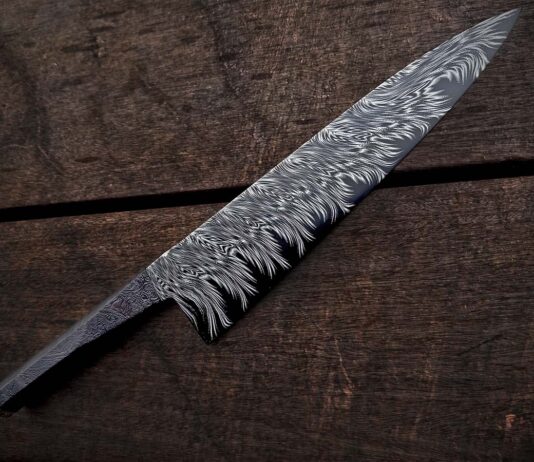
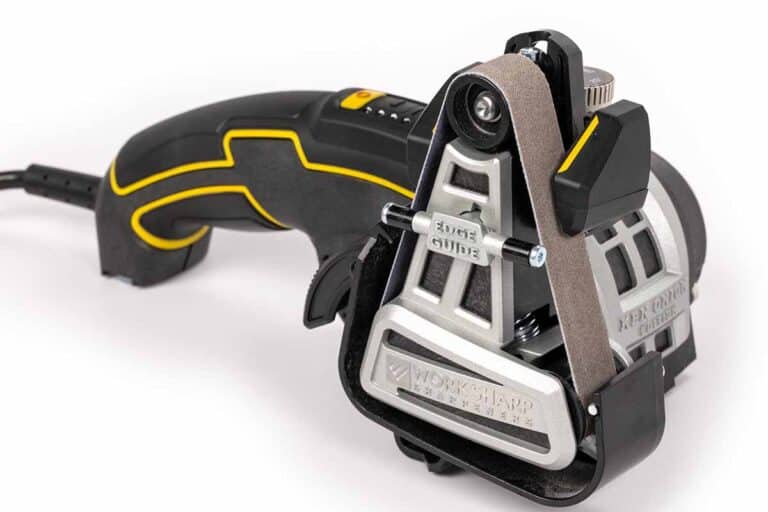
Work Sharp’s Ken Onion Knife & Tool Sharpener has been keeping knife enthusiasts’ edges sharp for a decade. A good run, by anyone’s measure. But the device’s time is up as the company welcomes the dawning of a new era—the Ken Onion Knife & Tool Sharpener MK.2. I’m sure some of you saw that coming.
Thankfully, Work Sharp hasn’t reinvented the wheel with the refresh of this time-tested multitool. Instead, the unit maintains many of the features that made it popular in the first place but offer a few notable enhancements that sharpeners and makers should find welcome, including a MK.2 Elite model with grinding functions.
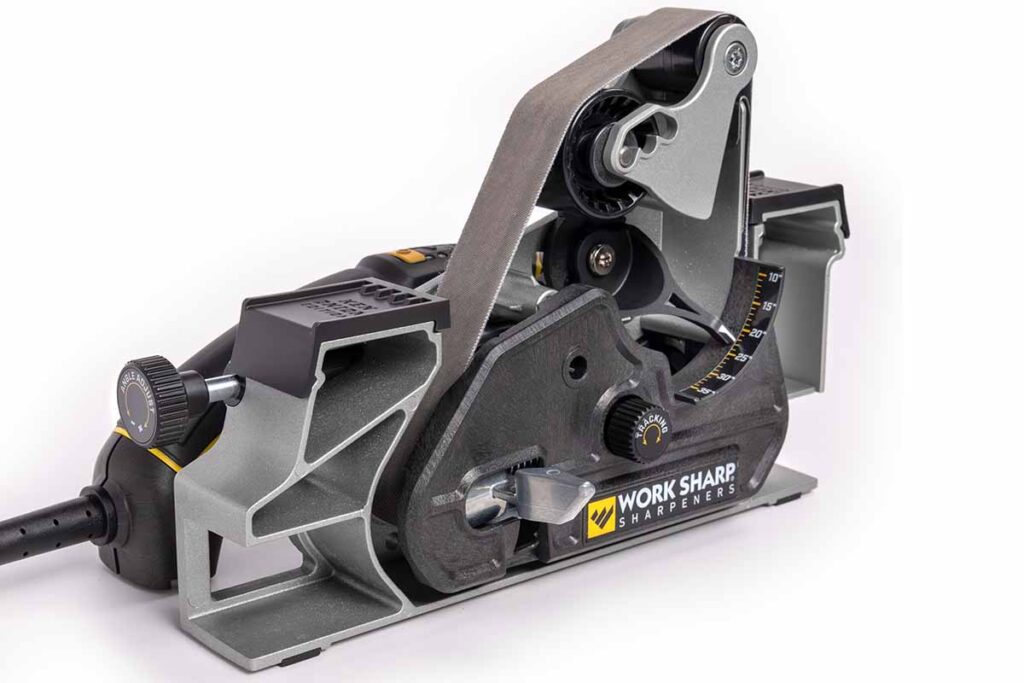
Chief among the enhancements is the MK.2’s speed control, now offering seven preset speed settings to provide consistent and repeatable results. A new torque control delivers consistent power, even under load. To make the sharpener easier to dial in, Work Sharp has included a very clear amber LED indicator light for the belt speed selection for quick and precise adjustment. Furthermore, a scope click adjustment knob on the sharpening guide, with detent clicks, allows users to adjust in half-degree increments by touch. Incidentally, the guide is adjustable from 15 degrees at the low end to 30 degrees at the high, hitting nearly every angle for both knives and tools.
The MK.2 also comes with leather-lined angle guides that offer protection for knives during sharpening. Users will also note a lockout belt tensioner on the sharpening cassette that helps make changing abrasive belts fast and simple. The Ken Onion MK.2 will come with five grits to accommodate the full spectrum of sharpening from repair to ultra-fine polishing.
As for the grinding, the Ken Onion MK.2 Elite model has some interesting aspects too. The redesigned grinder attachment quickly and easily mounts to the power base without tools or calibration. Once attached, the grinder boasts on-the-fly motor speed control and continuous run time. Additionally, an adjustable, three-position convex pulley system allows users to customize their grind profile depending on personal preference or the type of knives being sharpened.
The Ken Onion Knife & Tool Sharpener MK.2 boasts a $200 MSRP for the base model and $300 MSRP for the Elite. While the original sharpener has been a standby for a long time, the new addition to the Work Sharp lineup should prove sharp.
Swords with a Scottish pedigree get two impressive reproductions.
People tend to look at the past quite romantically, and, in no uncertain terms, seem to have a love for those who died while living passionately, even if it meant the end of their way of life. This type of Shakespearean melodrama played out across the world over the centuries, especially when one industrialized nation defeated and subjugated people with a decentralized clan system. The scenario transpired time and again in Europe, America, the Orient and more. The idea of what might have been in a traditional, seemingly carefree society is something many cling to today as progress inevitably marches on toward an unknown, uncharted destination.
For the traditional Scottish clans, the quest for self-determination ended on April 16, 1746, in the Battle of Culloden. A significant reason for their defeat came not just from their tactics but also the weapons that were used. Meanwhile, along with their defeat went their widespread ownership of swords and guns.
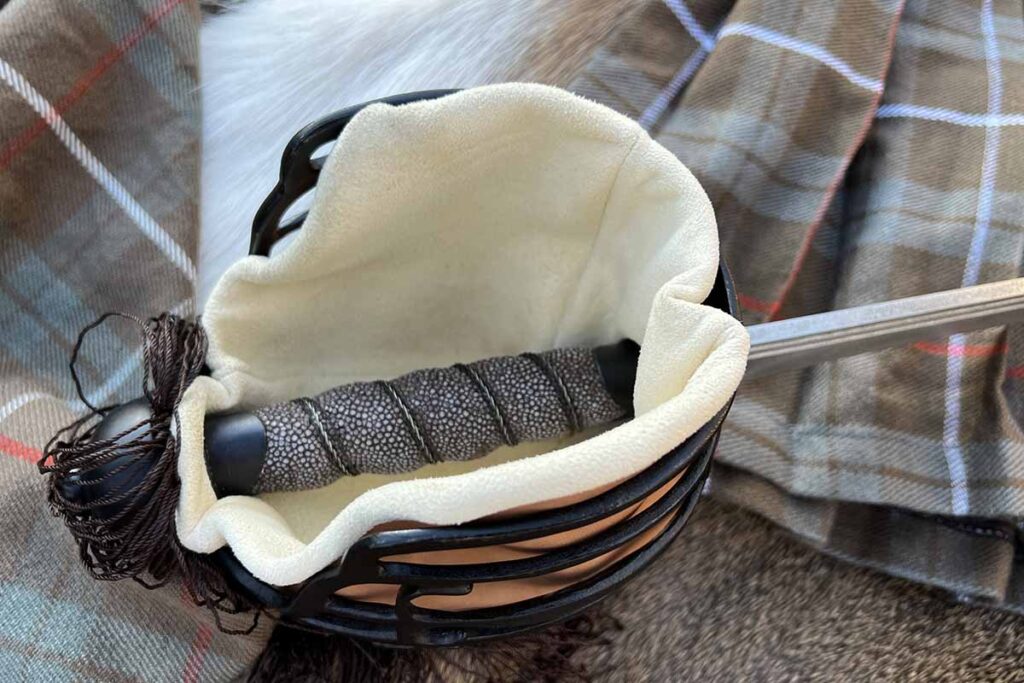
According to the author, the CAS Iberia sword has an incredibly comfortable grip assembly.
The Scots, especially the Highlanders, were tartan-clad savages capable of easily overwhelming and annihilating the British by use of ambush at extremely close range. In particular, the Highlanders were adept at destroying British formations using a tactic called the Highland Charge. The tactic involved what is essentially a human wave attack with sword and shield wherein the Highlanders charged at full sprint directly into the enemy, often before the latter could fire a shot. When attacked with such speed, the British soldiers were at best able to get one, maybe two shots out of their muskets before they were completely overcome and cut down. Knowing this, the British commander, the Duke of Cumberland, trained his soldiers to repel this devastating attack.
Traditionally, the Scottish warrior carried a sword and a targe. A small shield held in the weak hand, the targe was used to deflect bayonets and swords while the Highlander brought his blade down on his enemy’s exposed neck and head. This was an incredibly effective tactic; it rendered the musket nearly useless and prevented the British soldier from being able to fight by simple bayonet thrust. The British commander instructed his men to not fight the Highlander directly in front of them, as they would surely be cut down in a heartbeat. Instead, he had each British soldier focus on one Highlander over; when the Highlander raised his targe to deflect a bayonet, the soldier would stab the Highlander’s exposed under arm. The simple change in tactics resulted in a devastating loss for the Highlanders, who, for decades, had fought proudly with their bold method. The resulting battle would see thousands of clansmen dead and a complete British victory.
Scottish EDC
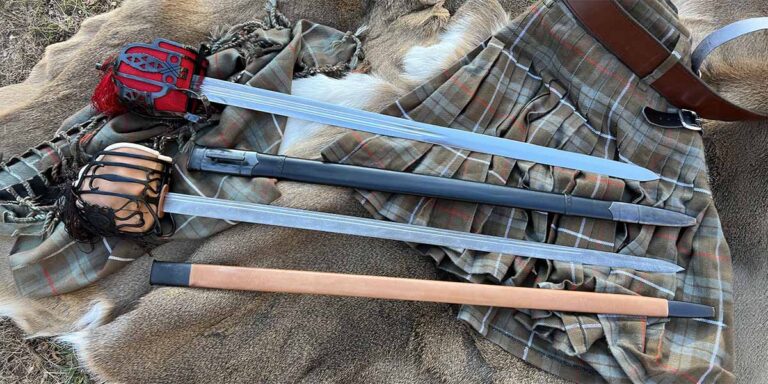
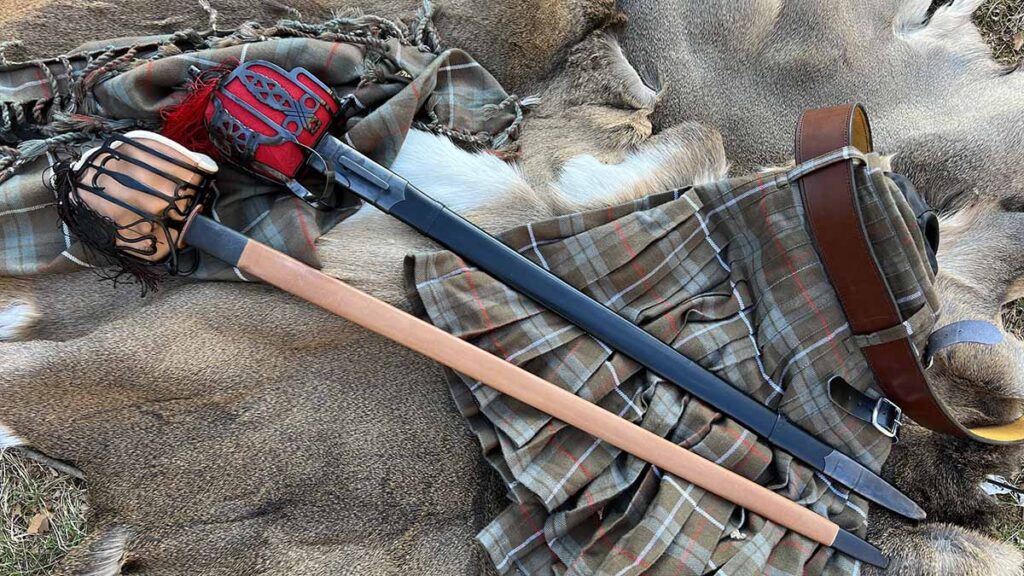
The two blades sport different finishes: the Cold Steel (on bottom) has a mirror polished surface while the CAS Iberia (on top) has an etched, antiqued finish. The author indicated the latter is a bit less functional in that it has a slightly rough texture. On the other hand, some may prefer the low-glare look.
The Scots revered the steel and often swore their oath on it. Like many traditional cultures, the Scottish clans held their swords as sacred and a substantial majority of men carried them every day. Unlike the Japanese and their feudal system, where only samurai could carry swords, the average Scot could carry one if he could afford it. It was not a small purchase, and to have a sword was a display of wealth. The swords were often passed down, though it should be noted that at the time of the Battle of Culloden, there was a significant number of in-fashion designs that existed among the Highlanders, meaning that new blades were being purchased regularly.
Among these was the backsword, a fashionable sword that featured a triangular cross-section with a single-edge blade. This type of blade was common throughout Europe and saw favor among the Highlanders, as it was a weight reduction over the double-edge broadsword. The double-edge broadsword could accomplish virtually all its tasks with its tip and lower edge; its upper edge was something of an accessory in that it was not typically used for reverse cuts. The broadsword’s hilt was completely engulfed by a protective basket. Upward swings with this type of sword are awkward and do not lend themselves to significant leverage. The backsword remedied this by shaving over a pound off the sword’s weight while reducing none of its function on the battlefield.
Culloden Types
The author stated he’d like to see the baskethilt of the Cold Steel slightly lighter in construction and the grip a half to 3/4 of an inch shorter.
The two featured reproductions of Scottish swords, one from Cold Steel and the other from CAS Iberia, are exceptionally well-constructed, functional swords made of modern materials and blade steels. There are, of course, custom swords out there, but expect to pay well into the thousands to get one from a top maker. They are not easy swords to make, and the fact the two companies sell them for the stated price points is a great deal—if nothing else, a steal.
The two are variations of swords that would have been present at Culloden. Cold Steel’s is reminiscent of the traditional double-edge Scottish broadsword. The CAS Iberia repro is of a single-edge backsword, something quite common for the time, and arguably the last evolution of the combat sword before guns took over. These are functional repros; they arrive sharp and the blades are very capable of delivering cuts and slashes. As with any real sword, they aren’t meant for chopping lumber or taking down brush. They are fine conversation pieces and, at worst, attractive wall hangers.
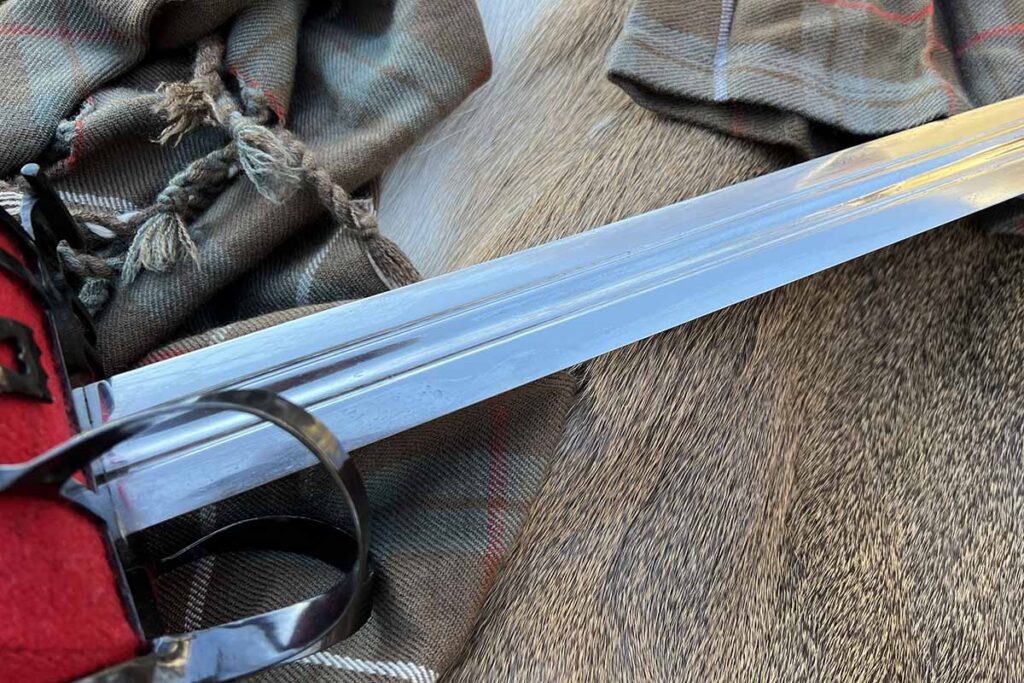
The Cold Steel blade features a triple fuller that helps reduce weight.
Being versed in some swordplay, I put the swords through their paces. For cutting ability, the Cold Steel version is an absolute beast. The blade is tough and can chop and stab through cloth, leather and even light metal. A wide range of objects were cut, from heavy cardboard tubes to deer carcasses. The Cold Steel showed no edge deformation and the finish was hardly scuffed. The only downside is that the hilt and basket area are very large, and I have large hands at that. Ideally, a baskethilt will contain the hand while not allowing a great degree of front-to-back play; this heavy-bladed piece wants to pull out of the hand on hard strokes. I’d like to see the basket be slightly lighter in construction and the grip a half to 3/4 of an inch shorter.
The CAS Iberia backsword has an antiqued etched finish and, at least for my purposes, just about the most perfect grip size possible. The Cold Steel sword is impressive and powerful but lacks some refinement. The CAS Iberia sword is elegant, light and supremely easy to wield. It’s not as sharp or heavy as the Cold Steel but capable of lightning-fast slashes and deep stabs. The top of the tip has a false edge that could easily be sharpened, and the narrow, diamond-shaped cross-section allows for effortless punctures through most materials. It is hard to even feel it go through most materials, from fabric to flesh. The downside is the blade finish. While it is interesting and adds character, it is also a trap for moisture and needs to be kept well-oiled.
Both swords come with very nice leather scabbards. They match the swords’ fixtures and should be compatible with a wide range of hangers or sword belts.
Both swords come with very nice leather scabbards. They match the swords’ fixtures and should be compatible with a wide range of hangers or sword belts. The scabbards are also very close to how the originals were made, though like most things today there are some liberties taken with internal construction.
Duly Impressed
Overall, I’m extremely impressed with the featured swords. If it were up to me, I’d take the blade from the Cold Steel and fit it to the basket and grip of the CAS Iberia, making a sword fit to my hand that can deal hard, deep strokes.
For what it’s worth, you can’t really go wrong with either sword. They are cool and should make conversation starters at your next viewing of Rob Roy, Outlander or any other applicable Scottish-themed flick.
SCOTTISH BASKETHILT SWORDSPECS STYLE: 18th-century Scottish baskethilt broadsword COMPANY: Cold Steel BLADE LENGTH: 30.5” BLADE MATERIAL: 1055 carbon steel HANDLE MATERIAL: Blued-steel baskethilt; handle is wood wrapped in rayskin and wire. WEIGHT: 53 ozs. OVERALL LENGTH: 37.75” SCABBARD: Black leather w/blued fittings COUNTRY OF ORIGIN: India MSRP: $299.99 AUTHOR’S NOTES: An authentic, functional replica; a bit heavy overall, but solid and well-constructed
SCOTTISH BASKETHILT BACKSWORDSPECS STYLE: 18th-century Scottish baskethilt backsword COMPANY: CAS Iberia BLADE LENGTH: 33” BLADE MATERIAL: 65Mn carbon spring steel BLADE FINISH: Antique HANDLE MATERIAL: Blackened steel baskethilt with “beastie” plaques; handle wrapped in rayskin and wire WEIGHT: 50 ozs. OVERALL LENGTH: 39.5” SCABBARD: Tan leather w/blackened steel fittings COUNTRY OF ORIGIN: China MSRP: $565 AUTHOR’S NOTES: Period correct to the Battle of Culloden and based on a sword in the United Kingdom’s Royal Armouries. While more costly than the featured Cold Steel repro, it has the feel of a more balanced and elegant sword.
The gun maintenance equipment company tackles knives.
Any of you who tinker around with guns should be familiar with the name Real Avid. The company offers up some fairly innovative gun maintenance gear at a pretty decent price. But now the Minnesota concern is dipping its toe into the knife world with the release of what it calls its RAV series.
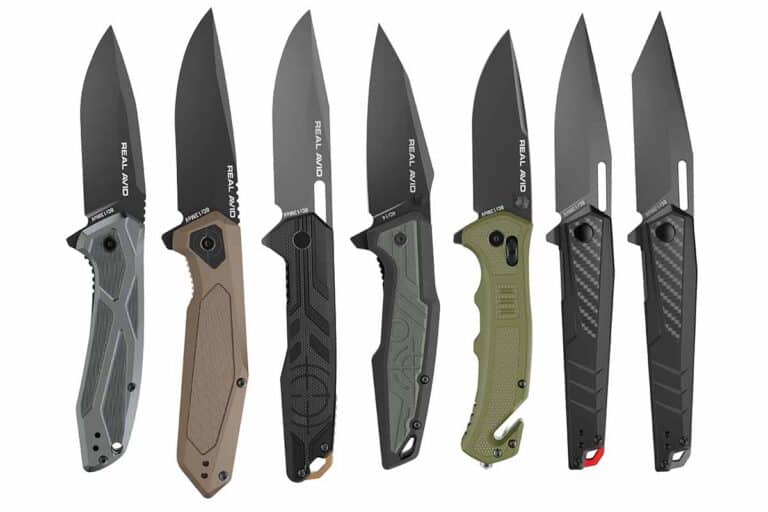
In all, the line folders comprise seven knives—all of them well falling into the budget end of the market. The offerings range from $29.99 to $49.99, making them ready for rough use and if need be worry-free replacement if your chores prove too taxing. Nearly across the board Real Avid 8Cr13MoV for the blade steel, except for the RAV-1—the most budget-conscious model—which has a 4cr14 blade. Overall, the steels sharpen well, but you’ll likely have to hone their edges plenty as retention in these stainless steels is marginal.
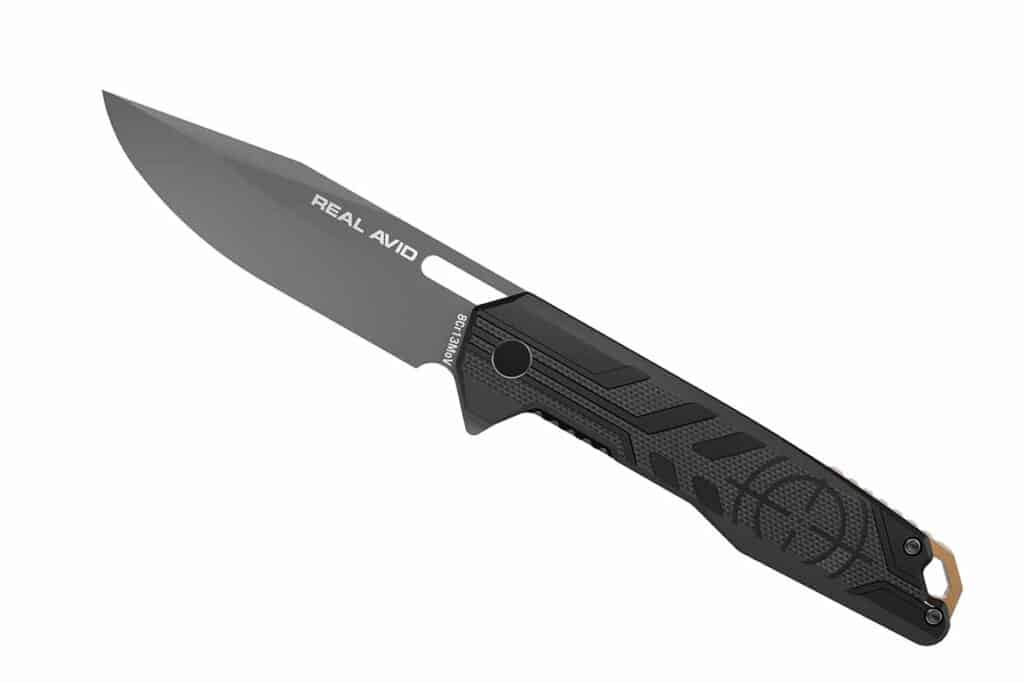
Real Avid RAV 7 with the bullseye pattern in it’s G-10 handle.
Almost every one of the RAVs has a drop or clip point of some style, except the 6, which stands as the lone tanto in the bunch. As for the handles, nylon, aluminum and stainless steel are pretty much the order of the day. However, the tonier RAV-7 does boast a G-10 handle with some nice texturing and a bullseye pattern in the middle. All of them are flippers, though a few models have been outfitted with thumbholes to offer multiple deployment options.
For the most part, these knives fit into Real Avid’s MO as a gun accessories company. Certainly, the blades aren’t going to knock the socks off your blade-aficionado friends. But for something to carry in a range bag, pry out stuck cartridges, unseal a can of ammo, or any other such thing, they’re right in line.
Does the flow of new knives ever cease? Lord, I hope not.
Midspring is as good a time as any for knife companies to drop new models, variations and what have you. And with this round, we have five new blades from three manufacturers worth a gander.
These knives range across the board, from a very collectible outdoor option to a bevy of affordable pocket pals. Even if they don’t exactly tickle your fancy, these blades are worthwhile window-shopping fodder.
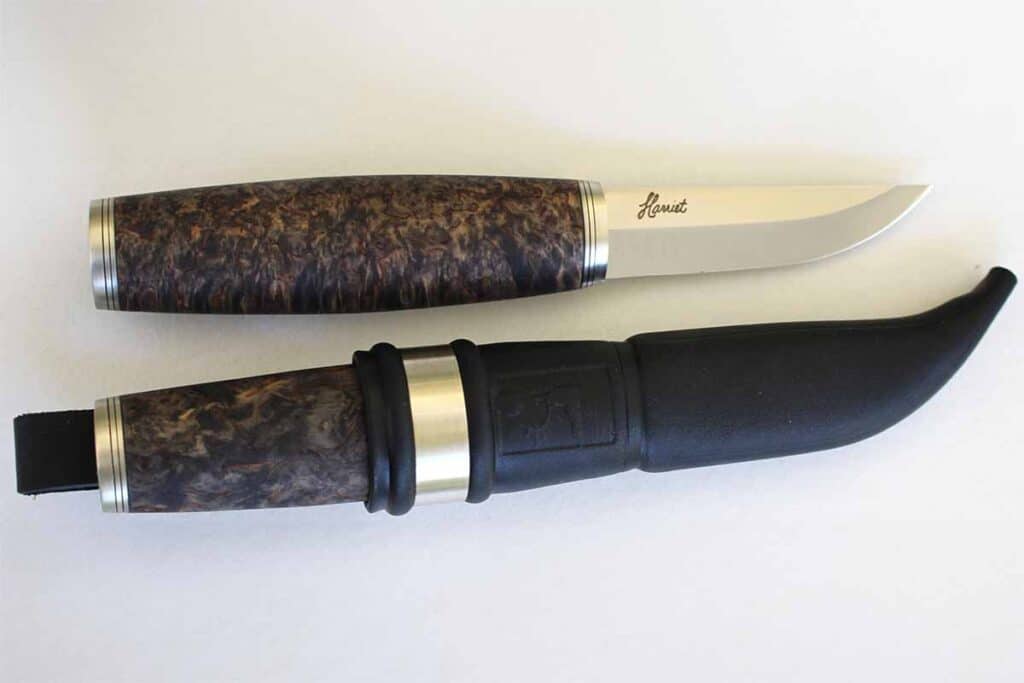
Kellam Knives Harriet70
Puukos are bread and butter at Kellam but its most recent introduction of this style of belt knife might prove better on the mantlepiece than on the hip.
Dubbed the Harriet70, the classic design is a tribute to Harriet Kellokoski, the wife of Kellam’s headman Jouni Kellokoski, for her 70th birthday.
There are a lot of nice points on this limited-edition knife, but what jumped out for me immediately was the handle—more exactly its wood. In this case, it’s arctic curly birch, darkly dyed and lightly oiled for the finish.
The curl pops and plays a beautiful counter to the nickel silver bolster and polished stainless-steel blade.
With 3-inches of wicked-sharp steel to play around with it’d make a solid hunting or fishing option, one dripping with class.
CRKT BOT Deadbolt
I can never complain about a design that puts fast deployment at the forefront of its engineering. Hence the BOT Deadbolt hits a sweet spot for me.
Assisted open with IKBS bearings, the action of this flipper doesn’t disappoint with the drop-point blade winking out in the blink of an eye.
Designed by Flavio Ikoma, the knife also features the Brazilian’s innovative lock—the Deadbolt—which relies on two lugs for extremely strong lockup.
This a much larger knife than what the Deadbolt is usually found on, intentionally so, since Ikoma was aiming for an overall robust system from tip to pocket clip.
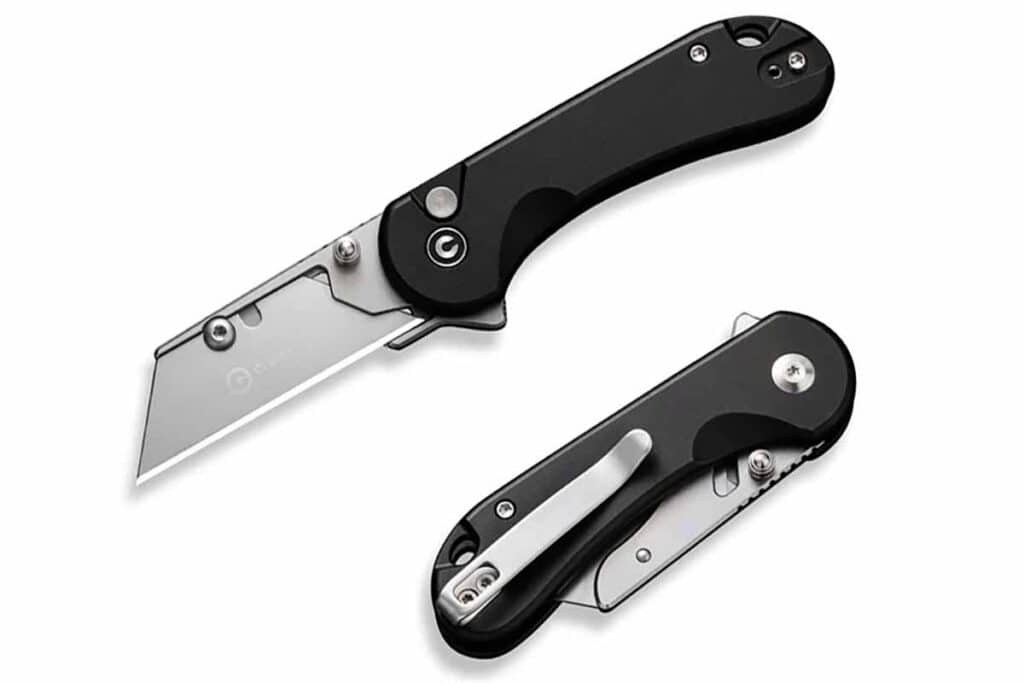
CIVIVI Elementum Utility
Quietly, there’s a utility knife war brew in the knife world. I, for one, say it’s about dang time.
An oft-overlooked corner of the blade world is getting some much-needed attention with the latest enhancement coming from juggernaut CIVVI.
Essentially a flipper/folder utility knife, the Elementum Utility offers perhaps the most important aspect of this class of knives—single-hand deployment. And it delivers it not in one, but three ways via kicker, thumb stud and button lock—if you like flicking out your blade.
CIVVI also delivers a bit of panache with the line, offering the replaceable-blade knife in a slew of colorways on its aluminum handle.
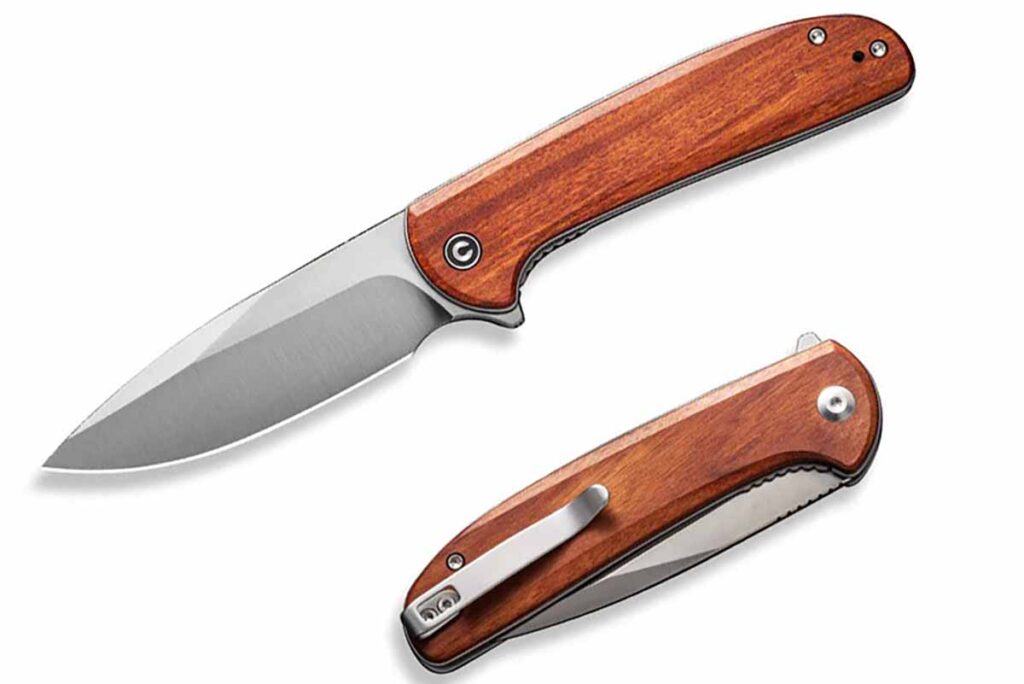
CIVIVI Primitrox
Even without looking at the branding, I think most knife aficionados would have sussed out this is a CIVIVI… or WE or Sencut. It just has the look, design points and action of the tirade’s knives and is close to several other options that already exist in the company’s catalog.
The one that comes to my mind is the WE Saakshi.
However, the Primitrox comes in a bit bigger thanks to a larger 3.89-inch drop-point blade.
The extra steel works to the knife’s advantage giving it not only a more robust design but more mass that flings the blade forward when opening.
I have to say, the handle options on the knife are nice as well, particularly the Guibourtia wood scale option, which gives the Primitrox a dignified look.
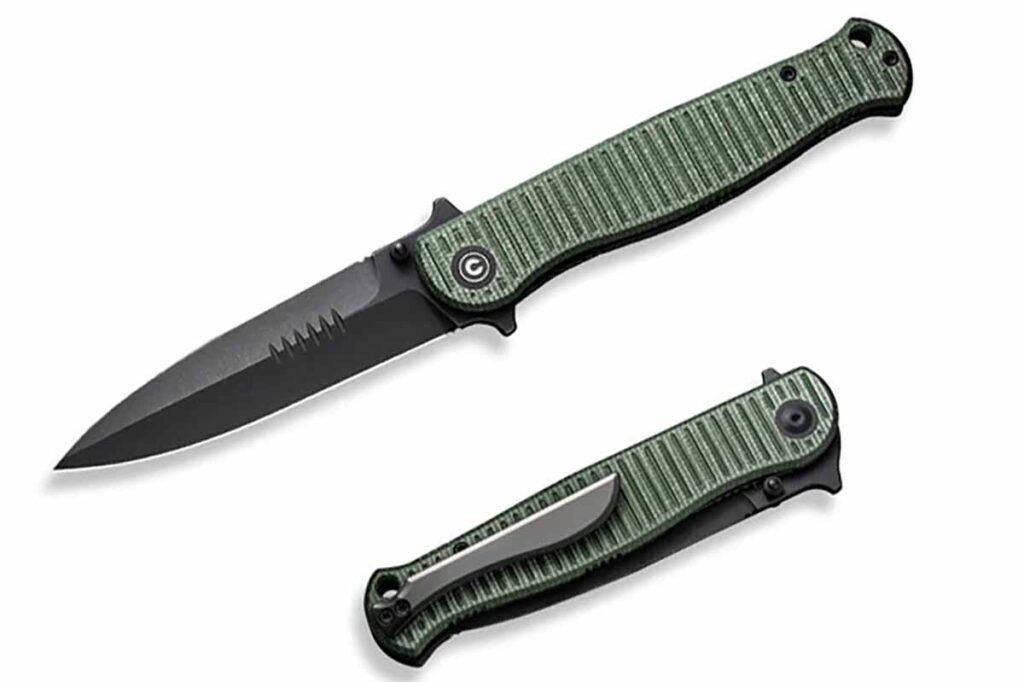
CIVIVI RS71
I have to confess this knife intrigues me. Of course, you’d have to have a heart of stone not to get geeked up over a dagger—or dagger-style—blade.
A Rob Saniscalchi design, the RS71 takes the deadly-looking blade style and tames it down for EDC with plenty of style. But plan on having plenty of pocket space to tote it around, because the CIVIVI borders on behemoth with a full 4-inch blade and 9.31-inch deployment length.
The knife fills the hand, yet the contoured handle makes it very manageable.
I also like the grooving on the scale, which gives it more purchase in the palm and a downright distinctive look.
The EDC fixed blade proves itself more than just a pretty face.
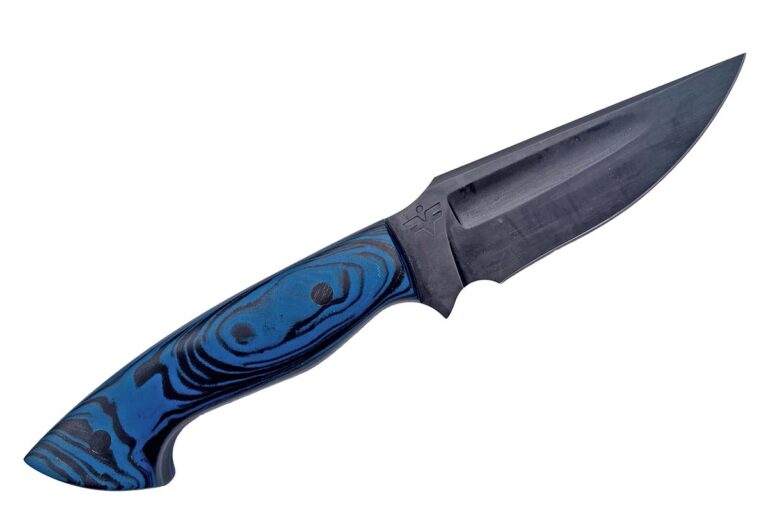
After finding First Degree Forge’s website, I reached out to Joshua Brown about testing one of his knives for “Spec Sheet.” He agreed and sent me his EDC Fighter. The shape really caught my eye, along with the blue-and-black handle. The grinds are symmetrical from side to side. I checked the handle for any epoxy gaps and found none, though I did find a few areas that might cause a hot spot or two while cutting.
Light Cutting Tests
I went straight to the 20-pound bond copy paper for the initial sharpness check. The EDC Fighter zipped through the material quickly and repeatedly. I had to really concentrate on moving my fingers quickly so I didn’t leave any DNA on the paper or the knife. Joshua’s blade is very sharp indeed.
I had an extra box to pull a slicing piece from. The cardboard parted quickly. I could feel some friction as I finished the cuts. It was the medium dragging on the thick blade spine, giving the cardboard a slight curl. However, there was no slowdown in cutting.
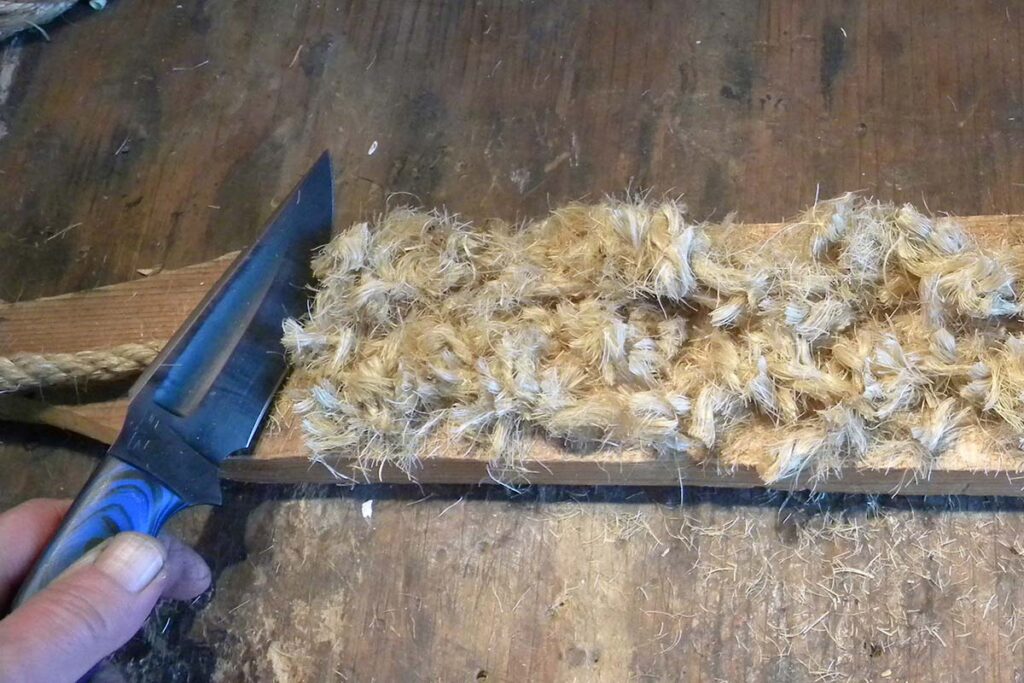
The EDC Fighter crunched its way through 190 cuts in the sisal rope.
A piece of 8-ounce leather was next. The EDC Fighter sliced it smoothly and aggressively. I could hear every crunching slice, a sound that brings a smile to my face. The handle was comfortable but felt a tad thick for my hand.
I rolled right into some skiving with the same leather. The edge crunched into the material cleanly. Overall, the EDC Fighter was quite controllable at keeping the spacing between slices even. The flat-ground blade indexed perfectly off my finger.
Heavy Cutting Tests
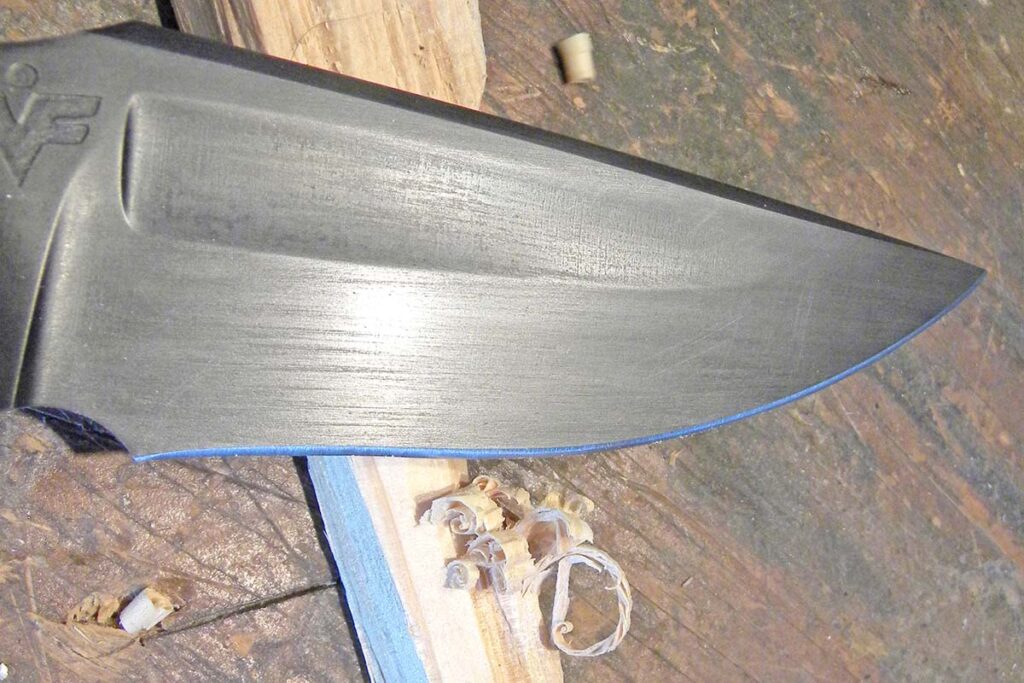
Whittling time! The edge produced some thick curly-cues and wanted to bite deep into the wood (there was some possible wood grain deflection). The handle made for a secure cutting grip but the steel near the choil was sharp on my skin. A little sandpaper would remove the unwanted sharpness.
Next on the menu was some baton work on a knotted pine 2×4. The large handle was comfortable and stopped any shock from transferring to my hand. The blade drove smoothly through the wood with little damage—only a little smear on the finish.
The edge produced some thick curly-cues and wanted to bite deep into the wood. The handle made for a secure cutting grip but the steel area by the choil was unnecessarily sharp on the author’s skin. A little sandpaper would remove the unwanted edge.
The sharpness test on sisal rope awaited. The EDC Fighter crunched its way through 190 cuts. I found that the thumb rest also had a sharp edge to it—again, an easy fix with sandpaper. The handle was comfy and the palm swells worked great.
The final paper slice was barely different from the first. What little problem there was mostly was caused by the paper picking up some dampness in the air. The edge remained very sharp.
Last of all was my regular semi-destructive test—whacking the edge into a whitetail deer antler. I gave the knife 30 good antler chops and didn’t hurt the edge at all. Heat-treatment grade: great!
Botton Line
The EDC Fighter is a very nice knife, comfortable to hold and an outstanding performer.
Changes
Soften the previously mentioned non-blade sharp edges where fingers or thumb meet steel.
Sate your cutting needs with the world’s latest factory knives and sharpeners.
Have an itch that only a new knife will scratch? Look no further as we’ve gathered up a slew of new factory blades fresh on the market and ready to please. There is a load of pocket and EDC options in this haul, but there are a few outdoor-angled knives and knife accessories thrown in for good measure.
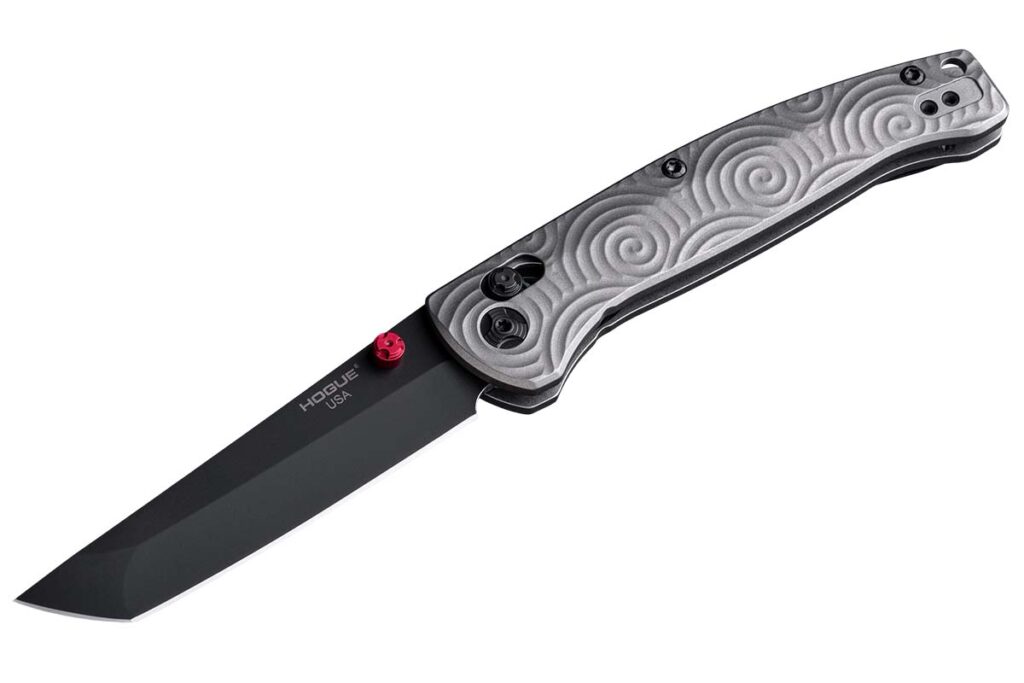
Hogue Knives Mysto
KNIFE PATTERN: EDC DESIGNER: Jim Bruhns BLADE LENGTH: 3.4” BLADE STEEL: CPM MagnaCut stainless BLADE GRIND: Compound hollow BLADE OPENER: Thumb studs HANDLE MATERIAL: 6Al-4V titanium LOCK: ABLE Lock® POCKET CLIP: Ambidextrous, blade tip up WEIGHT: 3.5 ozs. CLOSED LENGTH: 4.4” SPECIAL FEATURES: Thumb studs and backspacers anodized red COUNTRY OF ORIGIN: USA MSRP: $329.95-$349.95 AVAILABLE: Now hogueinc.com/knives
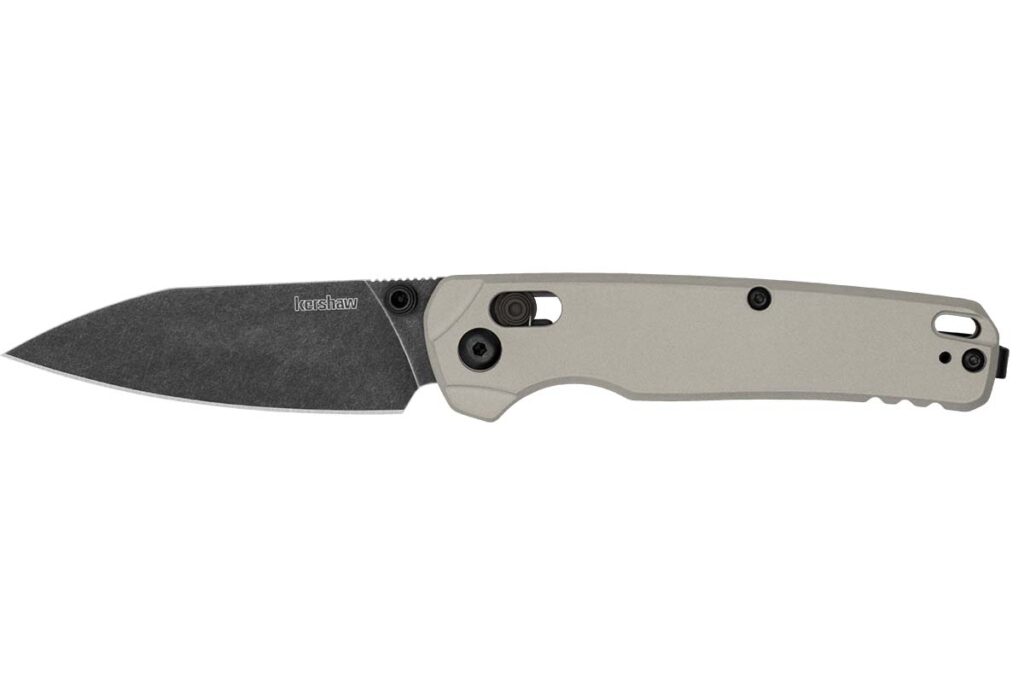
Kershaw Bel Air
KNIFE PATTERN: EDC BLADE LENGTH: 3” BLADE STEEL: CPM MagnaCut stainless ROCKWELL HARDNESS: 62-64 HRC BLADE GRIND: Flat HANDLE MATERIAL: 6061-T6 aluminum BLADE OPENER: Thumb stud LOCK: DuraLock POCKET CLIP: Right/left deep carry, blade tip up WEIGHT: 2.9 ozs. CLOSED LENGTH: 4.2” COUNTRY OF ORIGIN: USA MSRP: $249.99 AVAILABLE: Now kershaw.kaiusa.com
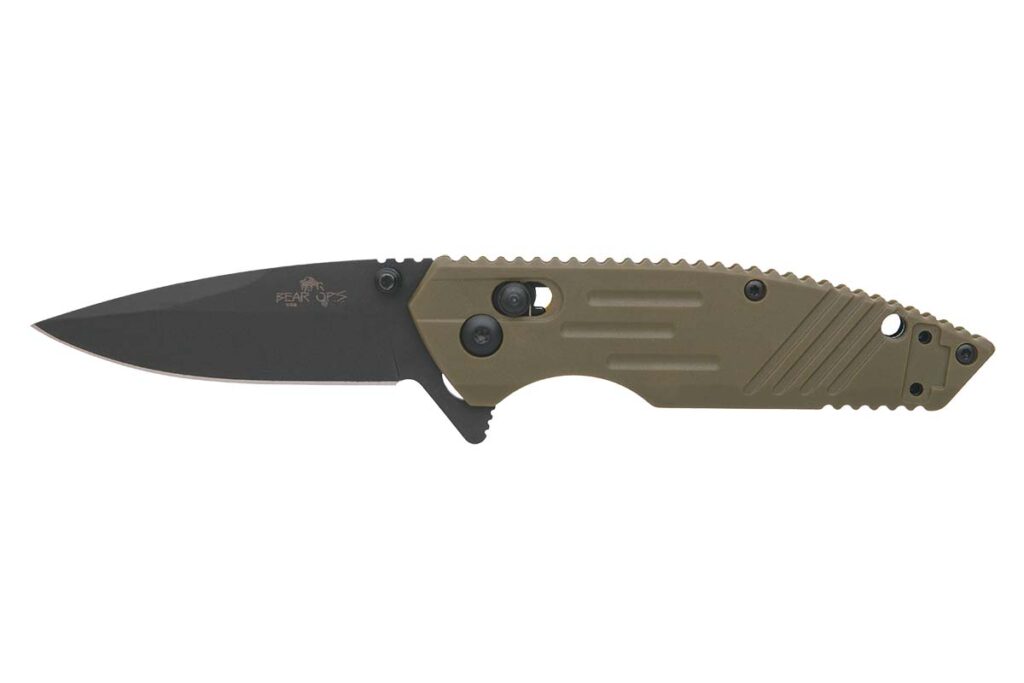
Bear OPS Rancor IX
KNIFE PATTERN: EDC BLADE LENGTH: 2.75” BLADE MATERIAL: D2 tool steel BLADE GRIND: Taper HANDLE MATERIAL: Zytel BLADE OPENER: Flipper and/or thumb studs LOCK: Slidelock POCKET CLIP: Reversible, blade tip-up carry WEIGHT: 2.6 ozs. CLOSED LENGTH: 4 3/8” COUNTRY OF ORIGIN: USA MSRP: $100.99 AVAILABLE FOR SALE: Now bearandsoncutlery.com
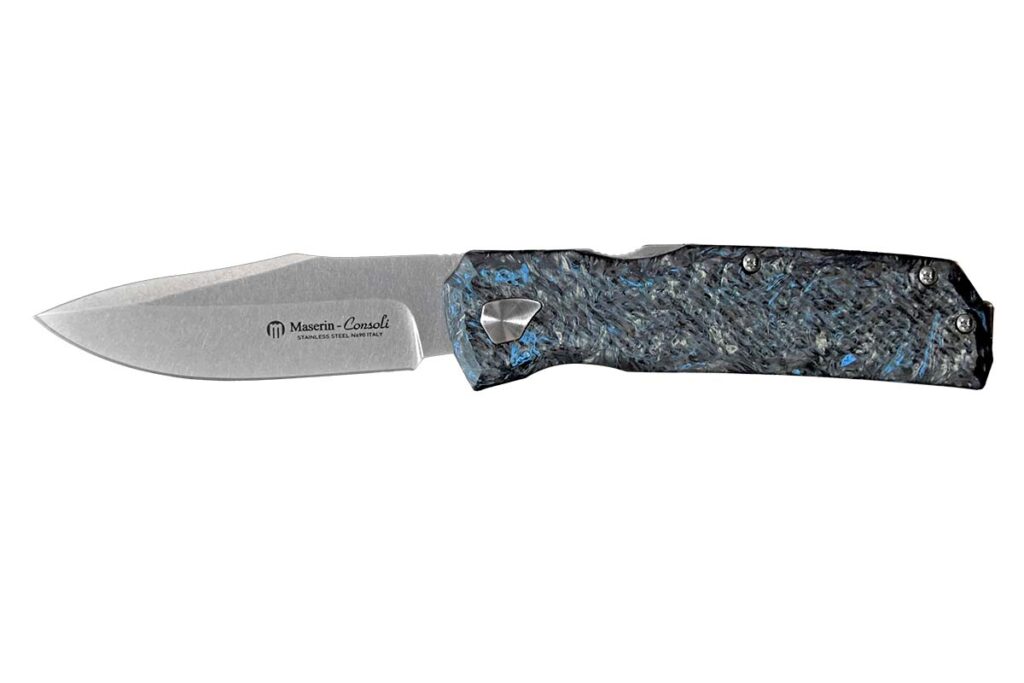
Maserin Power
KNIFE PATTERN: EDC DESIGNER: Sergio Consoli BLADE LENGTH: 3.149” BLADE STEEL: N690 stainless BLADE GRIND: Flat HANDLE MATERIAL: Fat Carbon LOCK: W-Lock POCKET CLIP: Yes WEIGHT: 3.174 ozs. CLOSED LENGTH: 4.33” COUNTRY OF ORIGIN: Italy MSRP: $197 AVAILABLE: April maserin.com
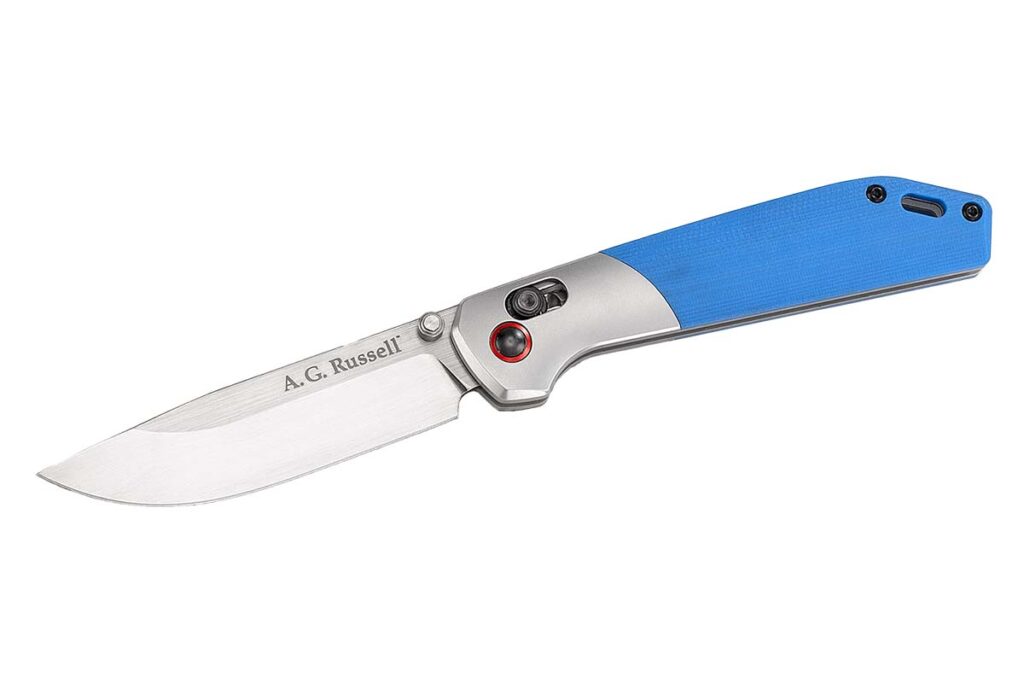
A.G. Russell Knives Power Ball 4
KNIFE PATTERN: EDC DESIGNER: BLADE Magazine Cutlery Hall-Of-Fame® member A.G. Russell BLADE LENGTH: 3.25” BLADE MATERIAL: D2 tool steel ROCKWELL HARDNESS: 60-61 HRC BLADE GRIND: Flat sabre HANDLE MATERIAL: Blue (shown) or green G-10 BLADE OPENER: Thumb stud BLADE FINISH: Handrubbed LOCK: Design inspired by Cutlery Hall-Of-Famer Blackie Collins POCKET CLIP: Deep pocket left or right hand, blade tip up WEIGHT: 3.7 ozs. CLOSED LENGTH: 4.25” SPECIAL FEATURES: Bold G-10 colors COUNTRY OF ORIGIN: China MSRP: $135 AVAILABLE: Now agrussell.com
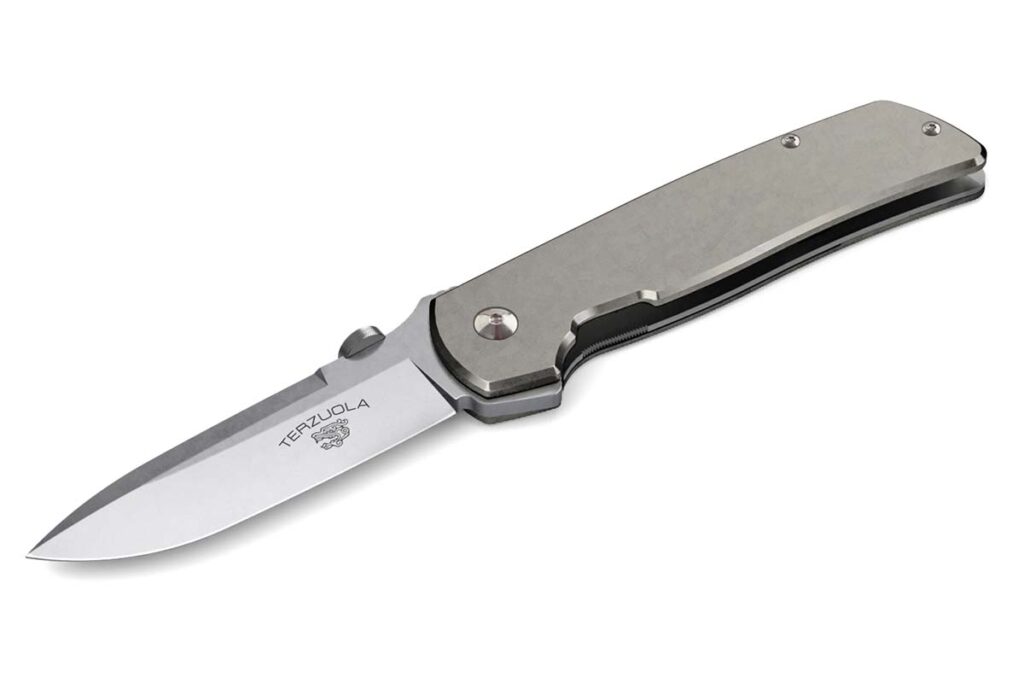
Fox Cutlery ATCF Original Gangster
KNIFE PATTERN: EDC DESIGNER: BLADE Magazine Cutlery Hall-Of-Fame® member Bob Terzuola BLADE LENGTH: 3.54” BLADE STEEL: CPM MagnaCut stainless BLADE GRIND: Flat BLADE FINISH: Stonewashed HANDLE MATERIAL: Coarse stonewashed titanium BLADE OPENER: Thumb disc LOCK: Linerlock POCKET CLIP: One-side titanium WEIGHT: 6.34 ozs. CLOSED LENGTH: 5.04” SHEATH: Nylon pouch COUNTRY OF ORIGIN: Italy AVAILABLE: May foxknives.com
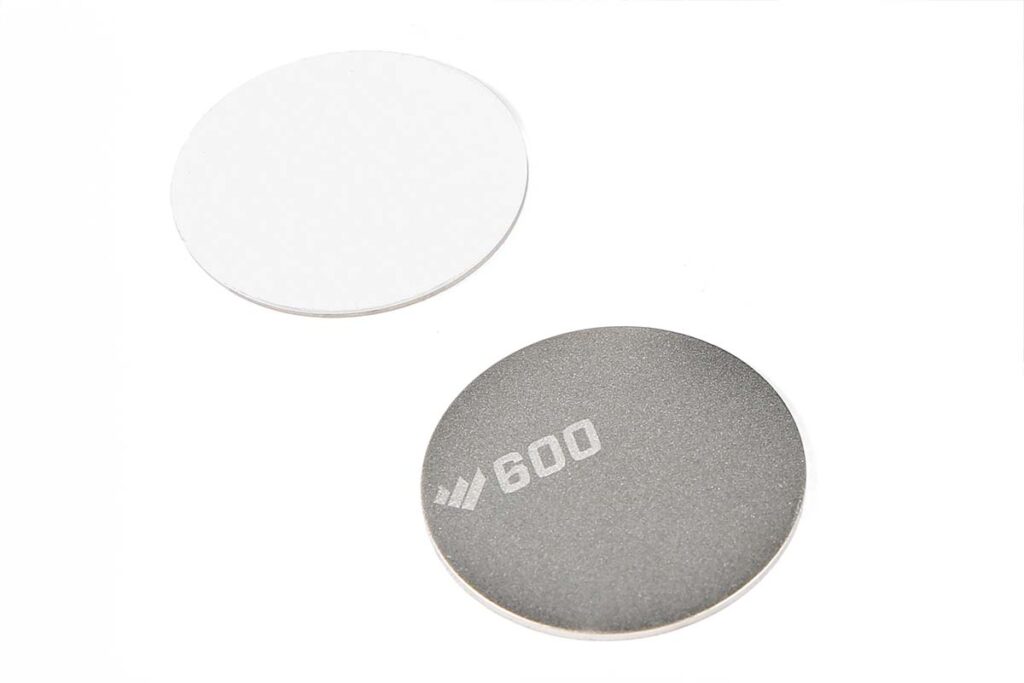
Work Sharp Rolling Knife Sharpener
ABRASIVES: Discs in coarse diamond, fine diamond and ceramic GRITS: 320, 600, ceramic ANGLE GUIDE: Magnetic angle block provides four options: 15, 17, 20 and 25 degrees DIMENSIONS: 3.75” L x 2.6” W x 2.6” H BODY MATERIAL: Metal, soft touch rubber, plastic WEIGHT: 1.9 lbs. KNIFE TYPES SHARPENED: Large, small and kitchen knives and pocketknives EDGE TYPES SHARPENED: Plain SPECIAL FEATURES: Tri-axle drive system follows blade length smoothly, and Soft Touch grip adds comfort and safety COUNTRY OF ORIGIN: Designed, calibrated and quality checked in Ashland, Oregon, using foreign components MSRP: $150 AVAILABLE: Now worksharptools.com
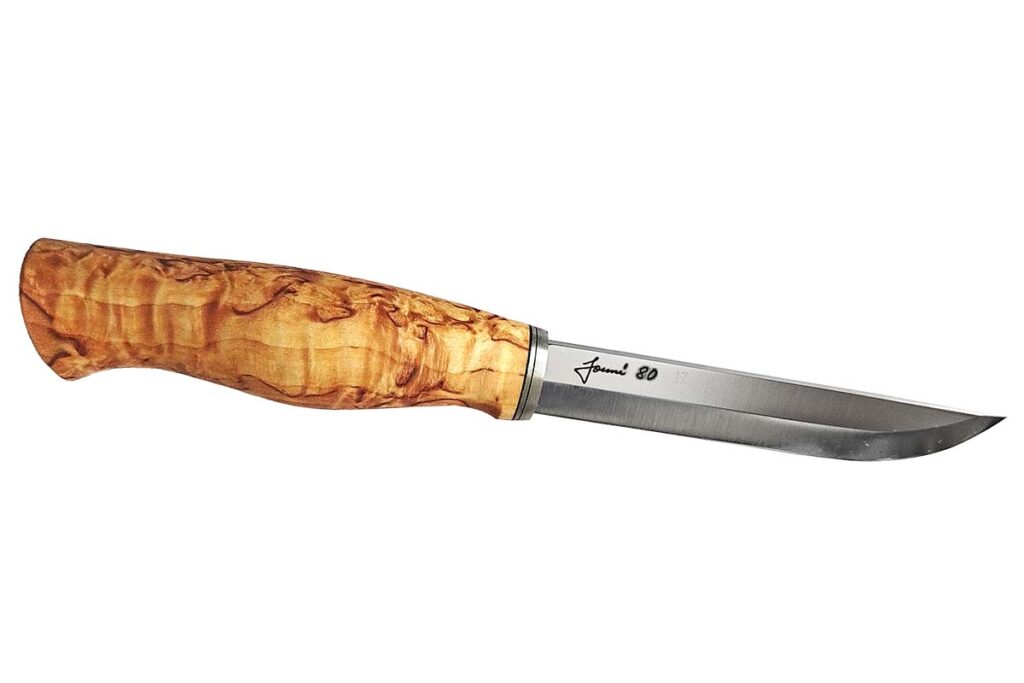
Kellam Knives Worldwide Jouni 80
KNIFE PATTERN: Puukko DESIGNER: Jouni Kellokoski BLADE LENGTH: 4 7/8” BLADE STEEL: Stainless BLADE GRIND: Scandi HANDLE MATERIAL: Arctic curly birch WEIGHT: 3.8 ozs. OVERALL LENGTH: 9.5” SPECIAL FEATURES: First 100 are numbered SHEATH: Leather dangler COUNTRY OF ORIGIN: Finland MSRP: $169.98 AVAILABLE: Now KNIFE TO KNOW: The knife commemorates the 80th birthday of its designer and company headman, Jouni Kellokoski. kellamknives.com
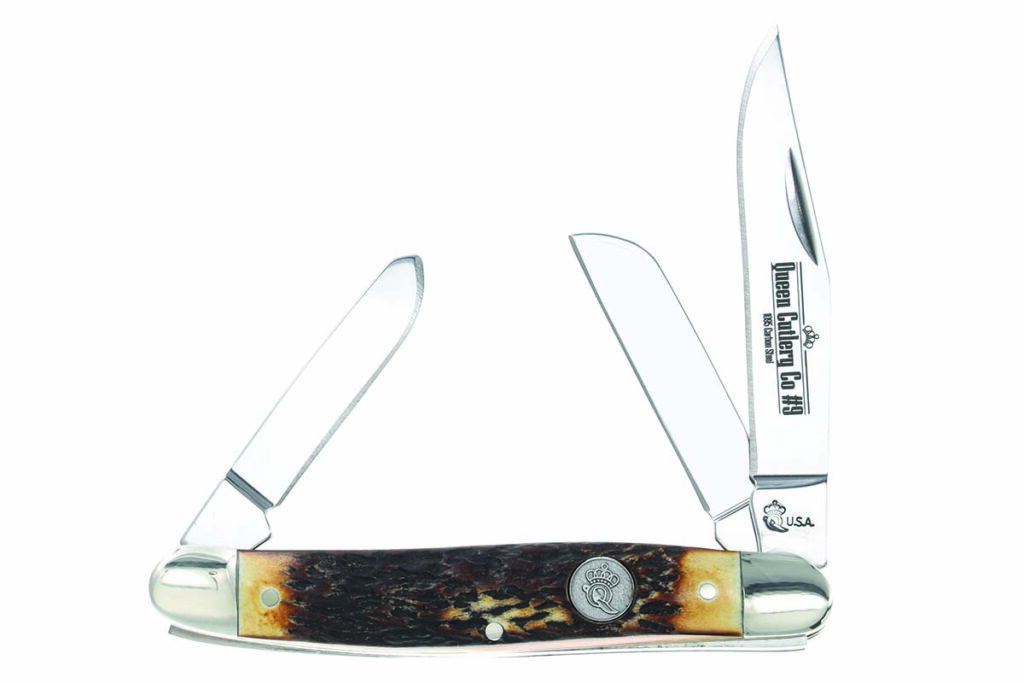
Queen Cutlery Slipjoint Pocketknife
BLADE LENGTHS: Clip 2 5/16”, spey 2 5/64” and sheepsfoot 2” BLADE MATERIAL: 1095 carbon steel BLADE GRIND: Flat HANDLE MATERIAL: Stag PINS, SHIELD & BOLSTER: Nickel silver WEIGHT: 2.8 ozs. COUNTRY OF ORIGIN: USA MSRP: $93.99 AVAILABLE: Now queencutleryhistory.com
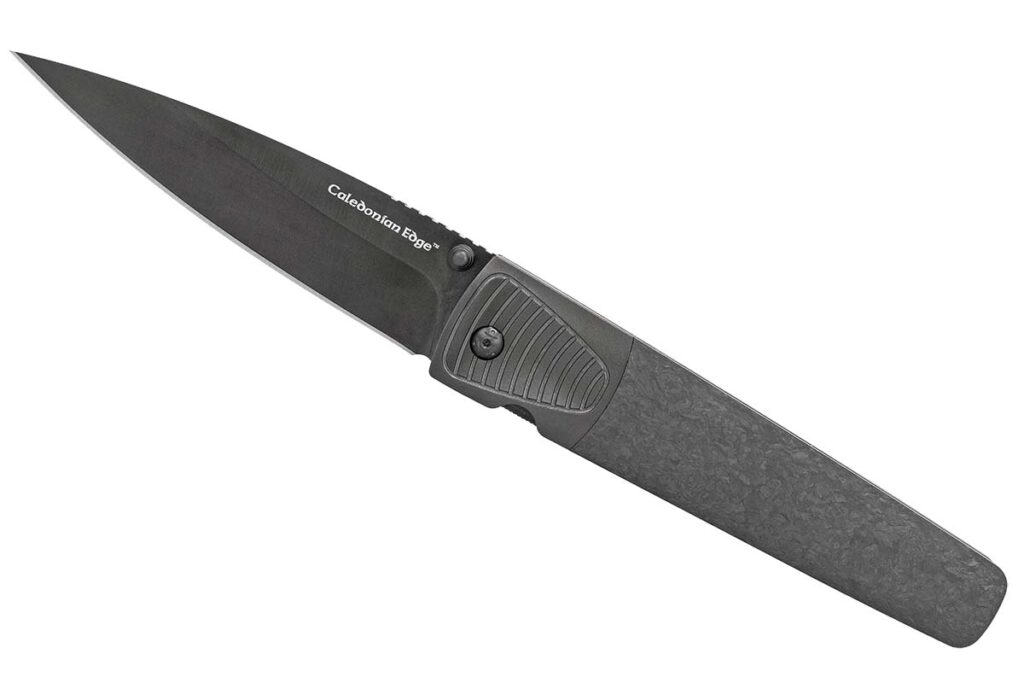
Cold Steel Caledonian
KNIFE PATTERN: EDC BLADE LENGTH: 4.25” BLADE STEEL: CPM 20CV stainless BLADE GRIND: Hollow HANDLE MATERIAL: Forged carbon fiber BLADE OPENER: Stud LOCK: Linerlock POCKET CLIP: Deep carry, blade tip up WEIGHT: 5.4 ozs. CLOSED LENGTH: 5 1/8” SPECIAL FEATURES: All titanium frame and liners COUNTRY OF ORIGIN: Taiwan MSRP: $499.99 AVAILABLE: May coldsteel.com
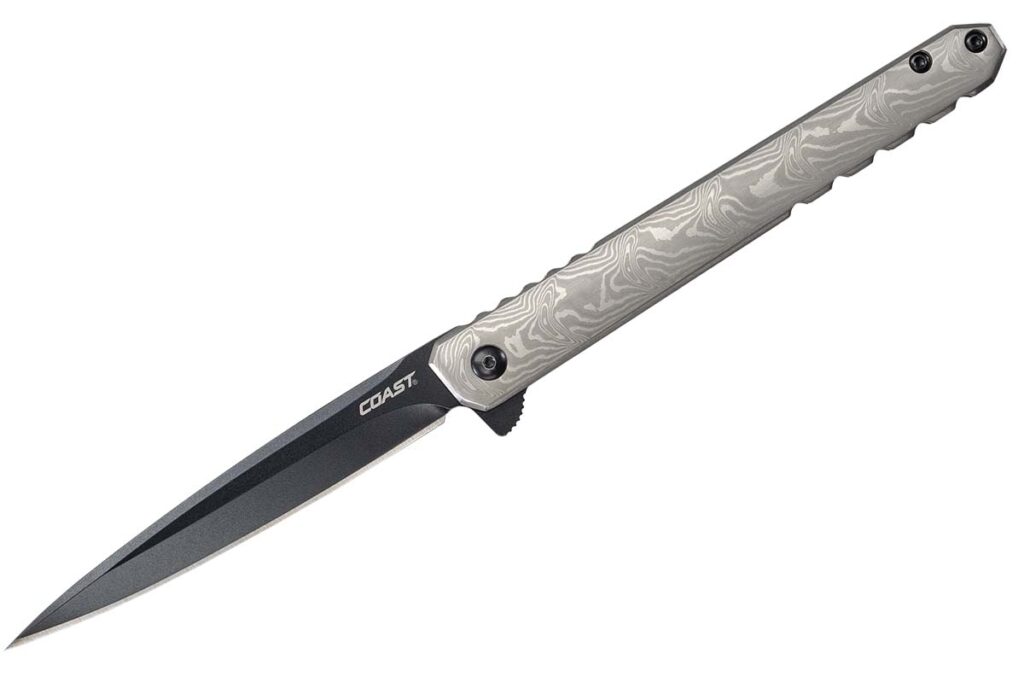
Coast Founder’s Series Origin
KNIFE PATTERN: EDC DESIGNER: Doug Hutchens BLADE LENGTH: 3.35” BLADE STEEL: 9Cr18MoV stainless BLADE GRIND: Flat BLADE FINISH: Black titanium nitride BLADE OPENER: Flipper tab HANDLE MATERIAL: Stainless steel damascus LOCK: Framelock POCKET CLIP: Stainless steel, blade tip down WEIGHT: 2.4 ozs. CLOSED LENGTH: 4.5” COUNTRY OF ORIGIN: China MSRP: $99.99 AVAILABLE: Now coastportland.com
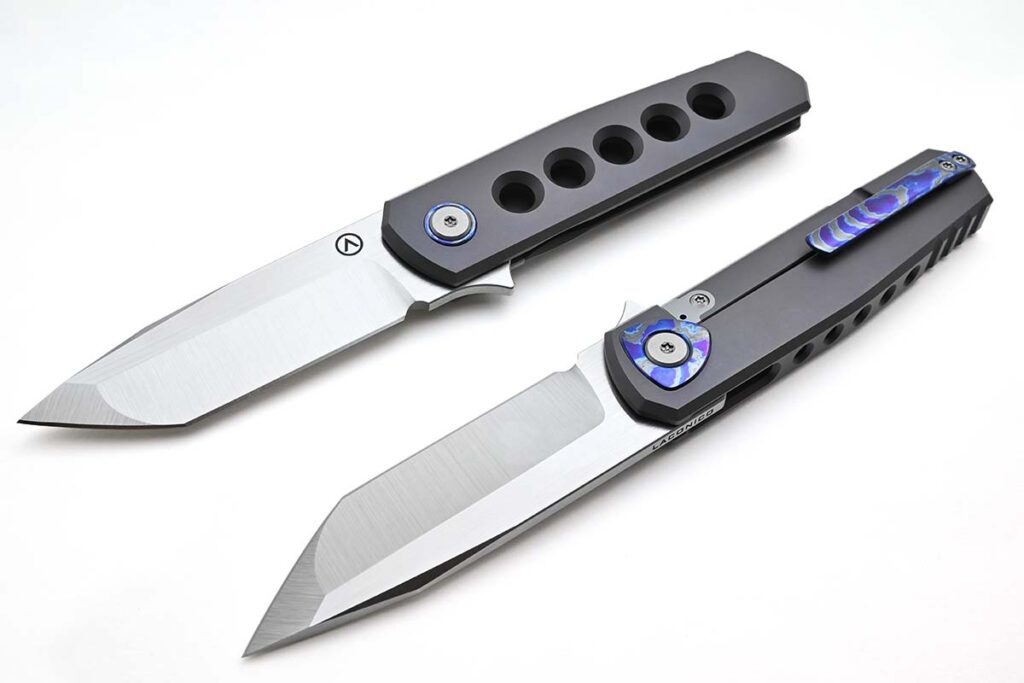
Alliance Designs EZE 2.0
KNIFE PATTERN: EDC flipper folder DESIGNER: Ray Laconico BLADE LENGTH: 3.15” BLADE STEEL: Elmax stainless BLADE GEOMETRY: Laconico’s “Angry Grind” BLADE PATTERN: Tanto HANDLE MATERIAL: Titanium integral BLADE OPENER: Flipper tab LOCK: Framelock POCKET CLIP: Blade tip up WEIGHT: 4.69 ozs. CLOSED LENGTH: 4.5” SPECIAL FEATURES: Chad Nichols Dark Ti accents COUNTRY OF ORIGIN: China MSRP: $495 AVAILABLE: Now KNIFE TO KNOW: Clever grooves at the base of the handle provide a secure grip; the integral handle design is milled from a solid block of titanium; re-engineered flipper tab with gimping. alliance-designs.com
Blackbird Products Dominator
KNIFE PATTERN: EDC DESIGNER: David McHan BLADE LENGTH: 4” BLADE MATERIAL: D2 tool steel BLADE GRIND: Hollow HANDLE MATERIAL: G-10 PIVOT: Ball bearings LOCK: PLX Bar Lock CLOSED LENGTH: 4.5” COUNTRY OF ORIGIN: Assembled in USA, globally sourced components MSRP: $74.99 AVAILABLE: June blackbirdproducts.com
Bradford USA Guardian 4.2
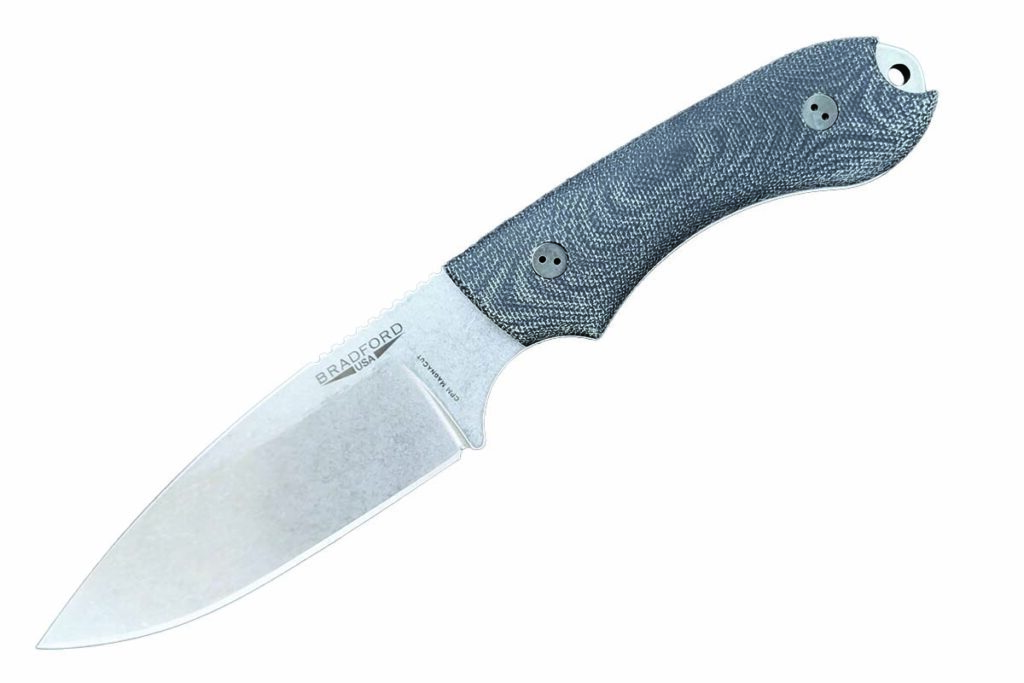
KNIFE TYPE: Fixed blade BLADE LENGTH: 4.825” BLADE STEEL: CPM MagnaCut stainless BLADE GEOMETRY: Sabre and full-height grinds HANDLE MATERIAL: G-10, Micarta® or carbon fiber WEIGHT: 6.7 ozs. OVERALL LENGTH: 9.375” SHEATH TYPE/MATERIAL: Vertical bridle; leather COUNTRY OF ORIGIN: USA MSRP: $269 AVAILABLE: Now bradfordknives.com
Reate PL-XT
KNIFE PATTERN: EDC BLADE LENGTH: 3” BLADE STEEL: Nitro-V stainless BLADE FINISH: Stonewashed or black PVD HANDLE MATERIAL: Micarta® or G-10 BLADE OPENER: Thumb studs LOCK: Pivot Lock WEIGHT: 4.4 ozs. CLOSED LENGTH: 3.9” COUNTRY OF ORIGIN: China MSRPs: $112 (stonewashed) and $117 (black PVD) AVAILABLE: Now reateknives.com
Halfbreed Blades Compact Clearance Knife XL
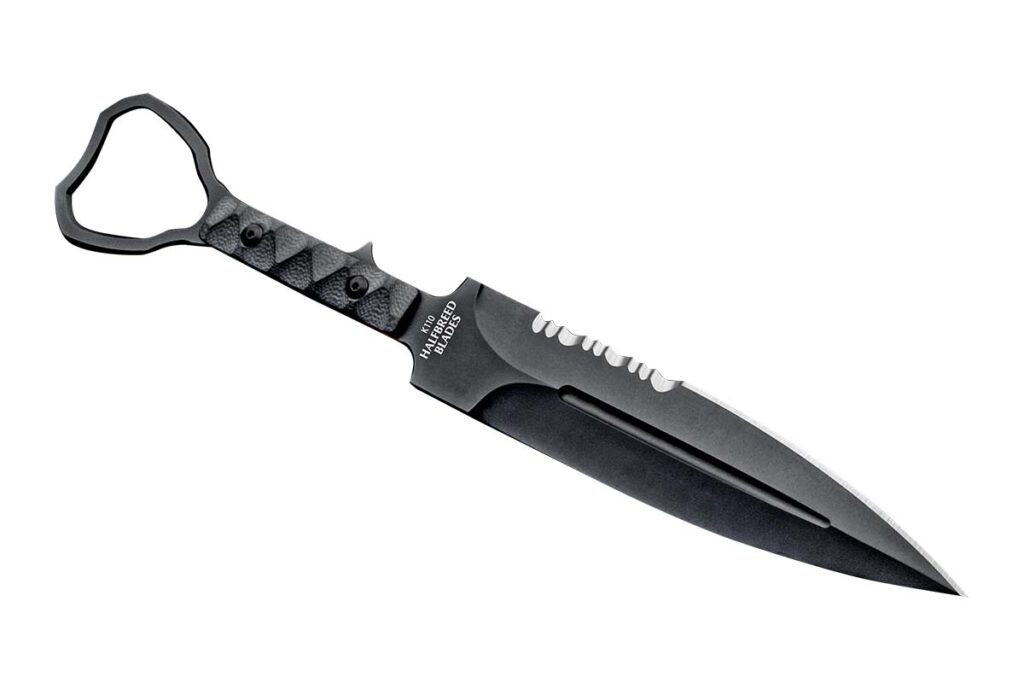
KNIFE PATTERN: Fixed blade BLADE LENGTH: 5.11” BLADE MATERIAL: Bohler K110 D2 tool steel ROCKWELL HARDNESS: 59-60 HRC BLADE PATTERN: Spear point BLADE FINISH: Teflon coated HANDLE MATERIAL: G-10 WEIGHT: 2.32 ozs. OVERALL LENGTH: 9.29” SHEATH: Injection-molded plastic COUNTRY OF ORIGIN: Comprises Australian and Taiwanese make MSRP: $245 AVAILABLE: Now halfbreedblades.com
Smith’s Eclesis Model 51394
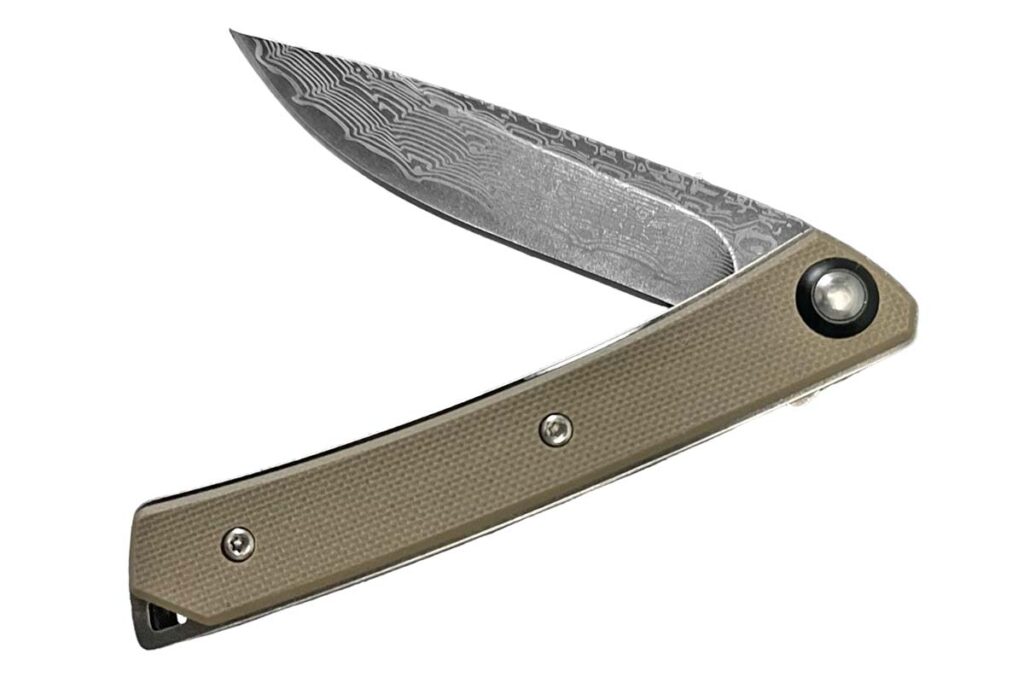
KNIFE PATTERN: EDC flipper folder BLADE LENGTH: 3” BLADE STEEL: 3Cr13 stainless faux damascus ROCKWELL HARDNESS: 59-60 HRC BLADE PATTERN: Drop point HANDLE MATERIAL: G-10 LOCK: Framelock POCKET CLIP: Blade tip up COUNTRY OF ORIGIN: Offshore MSRP: $32.99 AVAILABLE: Now smithsproducts.com
Puma SGB Hunter’s Pal
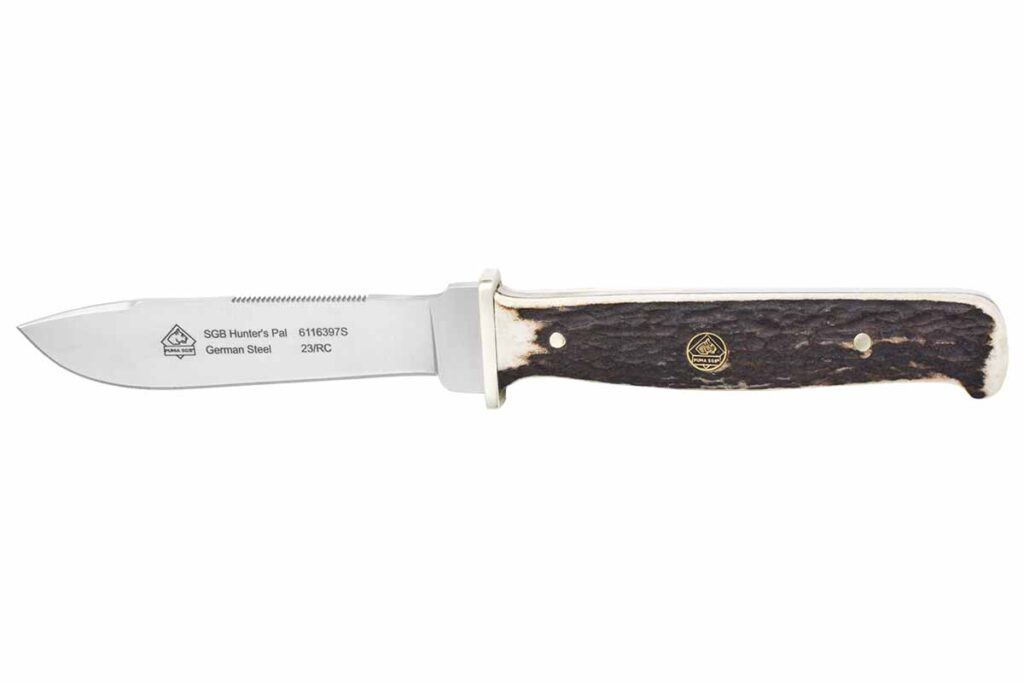
KNIFE PATTERN: Fixed-blade hunter BLADE LENGTH: 4” BLADE STEEL: 1.4116 German cutlery stainless ROCKWELL HARDNESS: 55-57 HRC, proofmarked BLADE GRIND: Flat HANDLE MATERIAL: Choice of black or white G-10, jacaranda wood, olive wood, Commando Stag, stag WEIGHT: 4.69 ozs. OVERALL LENGTH: 8” SHEATH: .1” vegetable tanned leather COUNTRY OF ORIGIN: China MSRP: $197.99 (stag) AVAILABLE: Now KNIFE TO KNOW: The knife is the Puma SGB version of, and a tribute to, the decades-old Puma GmbH Hunter’s Pal 116397. pumaknifecompanyusa.com
Ocaso The Delos
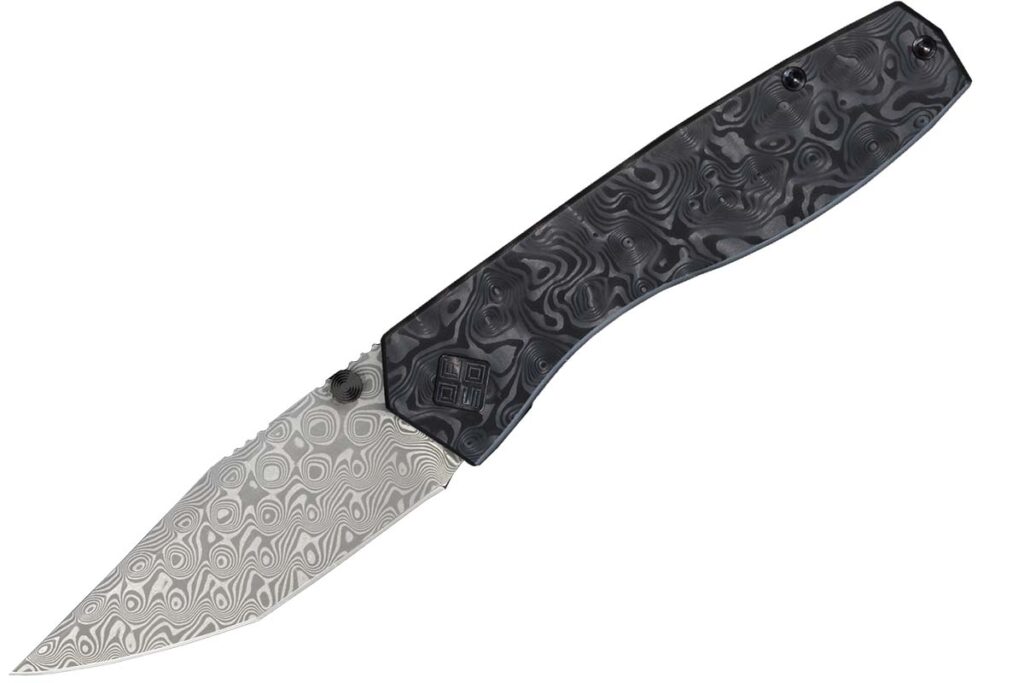
KNIFE TYPE: Gentleman’s folder DESIGNER: Kurt Merriken BLADE LENGTH: 3” BLADE STEEL: 120-layer German damascus ROCKWELL HARDNESS: HRC 60-61 BLADE GRIND: Hollow BLADE @ THICKEST: .12” BLADE PATTERN: Modified tanto BLADE FINISH: Rose pattern damascus HANDLE MATERIAL: Titanium and Fat Carbon Black Dunes or Dark Matter Blue LOCK: Framelock BLADE OPENER: Thumb stud PIVOT MATERIALS: Stainless steel caged bearings POCKET CLIP: Contoured titanium WEIGHT: 3 ozs. CLOSED LENGTH: 4” COUNTRY OF ORIGIN: Italy MSRP: $524.99-$549.99 AVAILABLE: Spring ocasoknives.com
Coast SP425
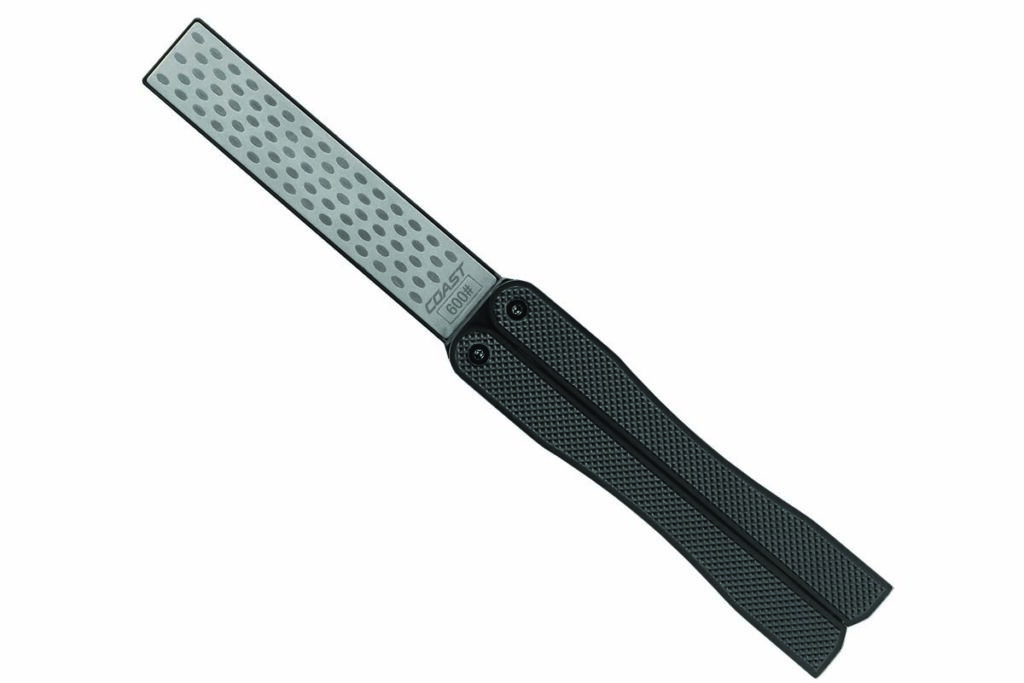
SHARPENER TYPE: Diamond whetstone DESIGNER: Doug Hutchens ABRASIVE: Diamond plated onto fiberglass/nylon substrate GRITS: 400 and 600 DIMENSIONS: 9” long BODY MATERIAL: Nylon w/fiberglass fill WEIGHT: 2.1 ozs. KNIFE TYPES SHARPENED: All plain-edge models SPECIAL FEATURE: Folding sharpener COUNTRY OF ORIGIN: China MSRP: $19.99 AVAILABLE: Now coastportland.com
We put the Boker Plus Vigtig vs. Wild and Condor Tool & Knife head to head to see which come out on top in the backwoods.
A couple of decades ago, attention started turning to the category of bushcraft knives. As usual, custom knifemakers were the ones filling the demand and leading the way. I was proud to be among them, along with such makers as Scott Gossman and others. There were those* before us but the push back then seemed more on survival knives with a tactical leaning.
After the push started, many smelled the opportunity to make money and the genre was flooded with assorted marketing schemes and people seeking their 15 minutes of fame. In all the confusion of people wanting to become famous and cash in, the true meaning of bushcraft was lost.
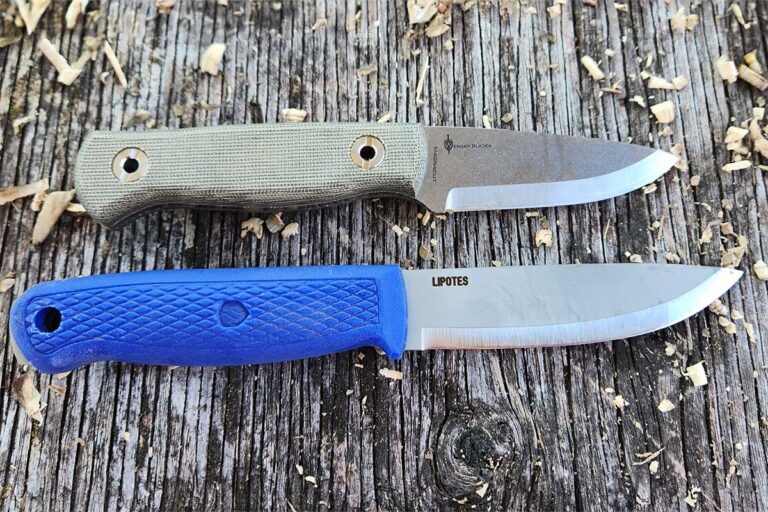
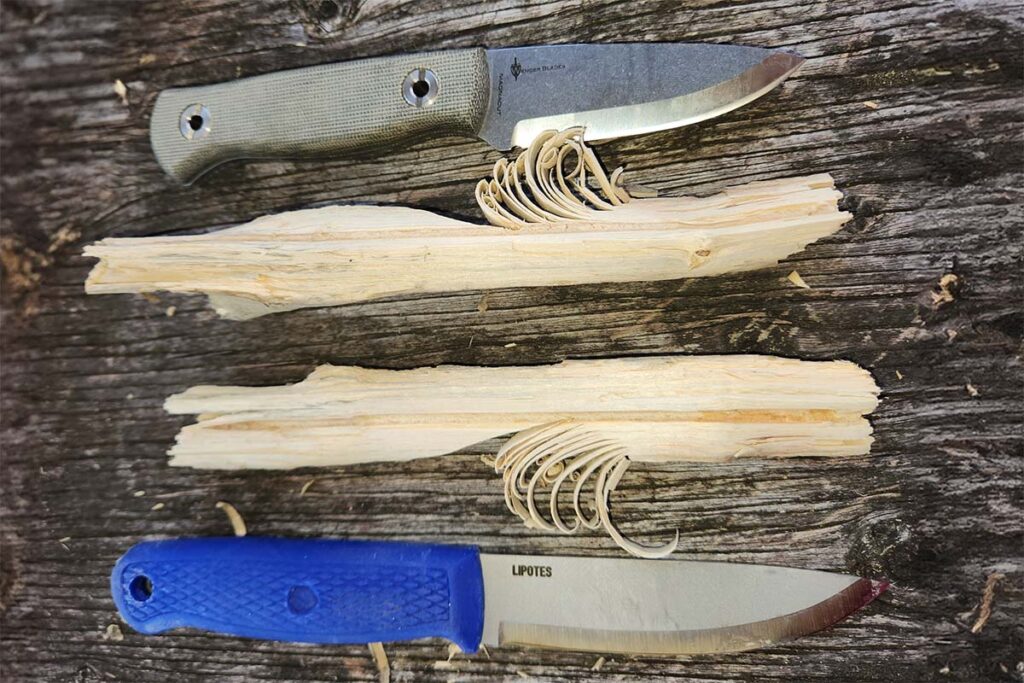
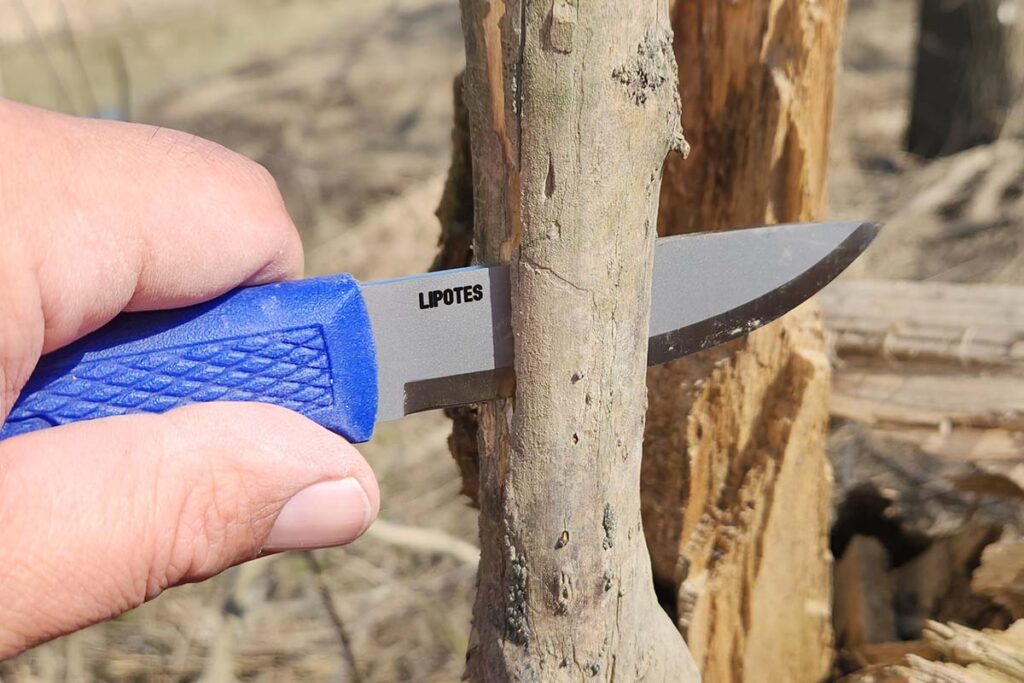
The thinner steel thickness on the Condor Tool & Knife Lipotes enables it to make finer curlicues than the Boker Vigtig vs. Wild. Designed by Dave Wenger and made in Germany, the Boker has an MSRP of $194.95. Joe Flowers designed the Lipotes, which is made in El Salvador. MSRP: $64.98.
A bushcraft knife is not something meant to be indestructible at all costs. It instead has always been a tool of creation. Now I see most marketing or testing related to whether the knife can be pounded through a log, a log that most likely would be unavailable if not for a chainsaw. No, the bushcraft knife started out as a tool, nimble in hand, keen in cutting and used to fabricate things in the bush, things not just to accommodate survival but to help a person thrive. In that reasonable light and practical expectation of the genre, let’s see how the Boker Plus Vigtig vs. Wild and Condor Tool & Knife Lipotes are suited to help you thrive in nature.
Boker Plus Vigtig
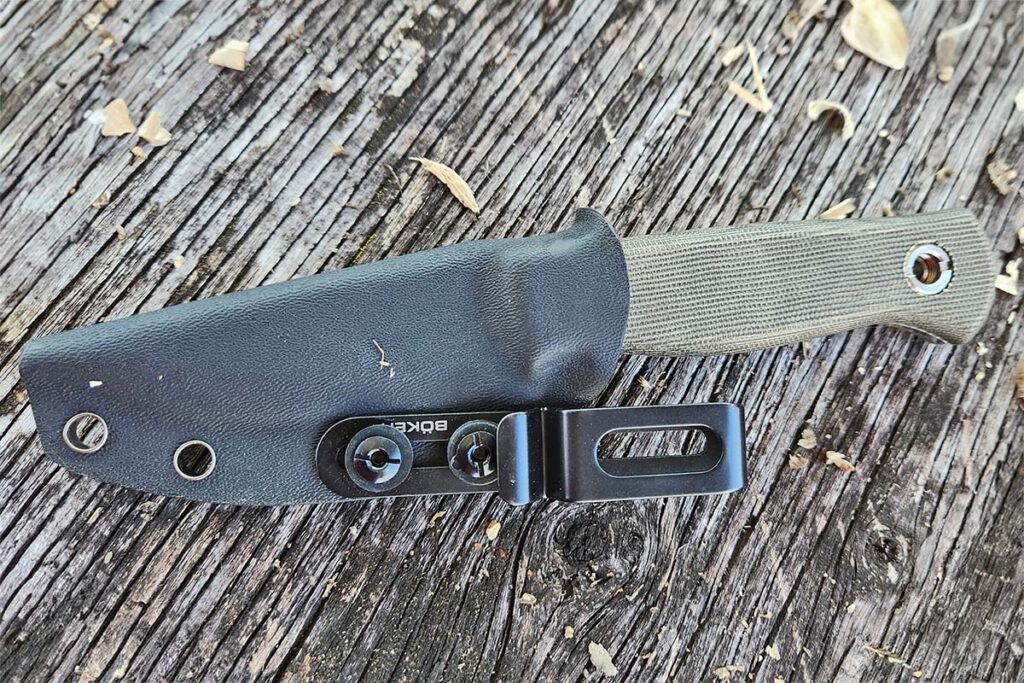
The Boker sports a molded Kydex sheath with an ambidextrous belt clip. The sheath holds the knife secure while still allowing for an easy draw when using a thumb push off.
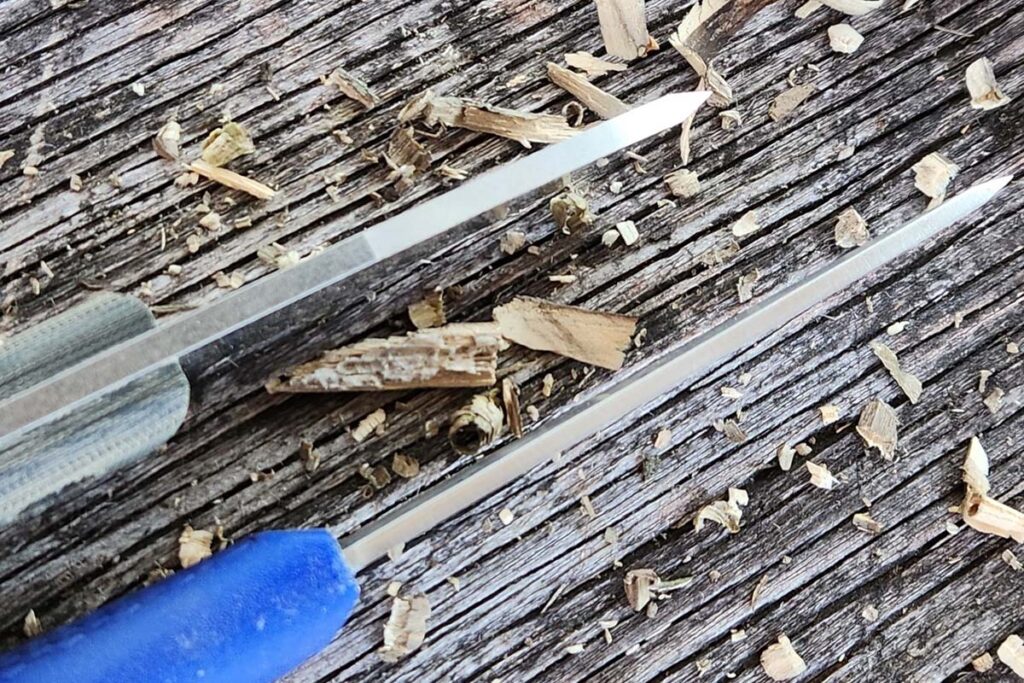
The Boker’s 3.35-inch blade features a Scandinavian, aka Scandi, grind, a grind in which the major bevel is the only bevel and goes straight to zero. Executed correctly, the grind should take up at least a third of the blade’s width. If the grind is any shallower it will be too steep. Some variation on the height of the grind is due to the thickness of material. Being too steep will decrease the effectiveness of the blade to cut because the angle of the edge will plow into the work material—and when I cut with the Boker, it did just that. It is not that it won’t cut with a steep angle, it just tries to take heavier cuts as it dives. Therefore, you don’t get the thin controlled cuts as easy as a properly executed grind.
Scandi grinds are popular in bushcraft because of their amazing effectiveness carving wood. In the game area they work fine but you will often find that bone wreaks havoc on a Scandi edge. In addition, the cross profile of the blade is not optimized for processing meat. Full flat grinds process soft, malleable materials such as meat best since there is no shoulder on the blade to bind as the meat flows along the cross-section profile. On flat grinds you also have a secondary bevel, or micro bevel as some call it, and it takes hitting bone better. The Boker is a full-tang knife with a blade .16 inch thick at the thickest, somewhat thick for a bushcraft knife. A clever feature is how the spine is finished. To strike a ferro rod off the blade spine you need a crisp edge. Sharp spines are more effective at generating sparks but are not very comfortable if you need to use a pinch grip or a thumb extension on a power grip. To address the issue, the Boker has a sharp spine toward the tip and a crisp spine section near the handle.
Note how much thicker (.16 inch at the thickest) the Boker blade is than that of the Lipotes (.13 inch at the thickest).
The handle is green linen Micarta® with beefy mechanical fasteners that double as lanyard holes. For those who prefer a full grip it has good profile contouring and leaves a blocky handle from side to side. There are no hot spots while still providing control. The blade is CPM MagnaCut stainless steel and is wide for its size. With its thicker blade it batons well through small branches to make small kindling. You trade some agility for durability with a beefier blade material.
The molded Kydex sheath rides high and boasts a metal belt clip that screws on for right- or left-hand carry. The knife locks securely into the sheath yet not so much you can’t easily withdraw it.
I think the Boker has its good points. I do prefer my bushcraft knife to be more of a nimble cutting tool. Overall, if the edge were ground higher this knife would up its game substantially.
Wild and Condor Tool & Knife Lipotes
For ease of baton work, the general rule is the cutting medium should be no wider than one-third the length of the blade. The Lipotes has a 4.15-inch blade of 14C28N stainless steel.
Let’s start with the handle on the Lipotes (among others, a lipotes is an endangered species of dolphin). It is an extended hidden tang and not a full tang—that’s right, not a full tang. Some time ago a well-known knife company introduced an extended-hidden-tang version of a knife and called it a full tang, and all the marketers and social media influencers decided to rename a feature so everyone could fall in line. If you can’t see the tang all around the knife’s handle, it isn’t a full tang.
Along with rat-tail tangs, hidden tangs have the distinct advantage of being some of the most comfortable knives in use. The steel element is totally encapsulated in the handle, allowing the maker to have full control in contouring the scales. In other words, you basically have a tang that will not interrupt how the material is shaped.
The Lipotes handle is very comfortable and the texture in the molded material provides a secure grip. As for the hidden tang extension, it can be used as a small hammering device or even a scraper.
Except for the grind, I like the overall proportions of the knife. As with the Boker, the grind doesn’t go high enough. It will still cut but the cutting would be greatly optimized if the grind were half its height taller. It performed well in its cutting tasks with power cuts, feathering and the like. However, it still missed the ease of cut and control of a higher grind. If I could, I would love to get my hands on a bunch of these blades and regrind them.
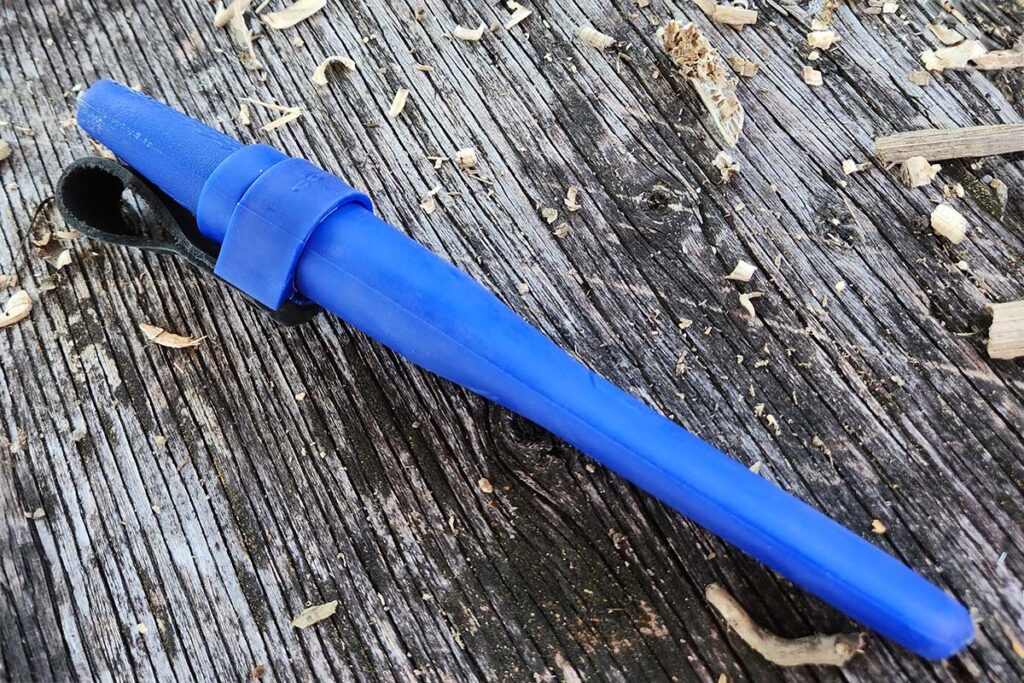
The Lipotes has a quality sheath that holds the knife nice and tight when you ramble through the woods. The leather belt loop riveted to the back won’t accommodate a wide belt.
I really like the sheath. It has a nice, deep carry. It is a molded plastic with a good friction fit. It is a bit mysterious to me as to why the belt loop is so small. Only a dress belt would fit through it. You could still run a cord through it for neck carry or a baldric. The Joe Flowers design checks off so many of the boxes for a good tool. I would have been singing its praises more with a higher grind. Instead, I am pretty much humming.
More Than Survival
To repeat, a bushcraft knife isn’t just for survival, it is a tool of creation. Often the real goal of an issue gets lost in the minutiae that results from personal gain and egos. Over the years, marketing and self-promotion have polluted bushcraft until we have lost it in a sea of books and an ocean of social media. A look at a simple tool such as a knife can really remind us of what bushcraft is about. It is about man’s will to do more than just survive. Man strives to prosper.
I will leave you with one of my favorite quotes about tools by Thomas Carlyle: “Man is a tool-using animal. Without tools he is nothing, with tools he is all.”
*Author’s note: The origins of the discussions of bushcraft can be attributed to such enthusiasts as Mors Kochanski, Larry Dean Olsen, Lofty Wiseman, Ray Mears and others.
Check Out More Outdoor Knives:
NESSMUK KNIFE: OPTIONS IN THE ALL-AMERICAN OUTDOOR KNIFE
BEST TOMAHAWKS: OUR TOP HAWKS FOR BACKWOODS TO BATTLEFIELDS