
Buyer's Guides

You’re looking for a new knife in a certain style – we’ve got recommendations on the best blades for every price point.

Best Karambits: Top Ferocious Southeast Asian Fighters (2023)

The Karambit Is A Historic Utility and Combat Knife From Asia That Has Grown In Popularity Around The World In Recent Decades.

The karambit looks unlike any other knife. The short, swooping curve of the blade dates back nearly a millennium in Indonesia and throughout Southeast Asia. First used mainly as a tool for farming and planting rice, the karambit evolved over time into a combat knife. The curve became more pronounced and became a main weapon in pencak silat, an indigenous Indonesian martial art, and Filipino martial arts.

Legend goes that as the knife became more combat-oriented, its shape was inspired by a tiger’s claw. The knife’s tight curve and finger ring allow it to stay securely in the hand in close-quarters combat.

Why Should I Use A Karambit?

The karambit today is very much a self-defense tool. Yes, it can still be used for outdoor tasks, but there are more practical blades available for such purposes. The karambit is a strong, durable combat knife used by law enforcement and militaries around the world. 

If you’re looking for a high-quality knife to keep on your person as protection, you can’t get much better than the karambit. The finger ring provides a natural, secure traditional grip or reverse grip to generate more power with each swing. 

The folks at Emerson Knives, Inc., have made a great video showing how to use a karambit.

Do I Need A Karambit?

Simply put: no. A karambit is a refined self-defense tool. If you live a life where life-and-death close-quarters combat is an extremely minute possibility then you can probably pass on a karambit.

Additionally, the sharp curve of the blade means it can be difficult to handle without experience or training, even with the finger ring. If it’s uncomfortable to use then don’t use it.

Best Karambits

Emerson Combat Karambit
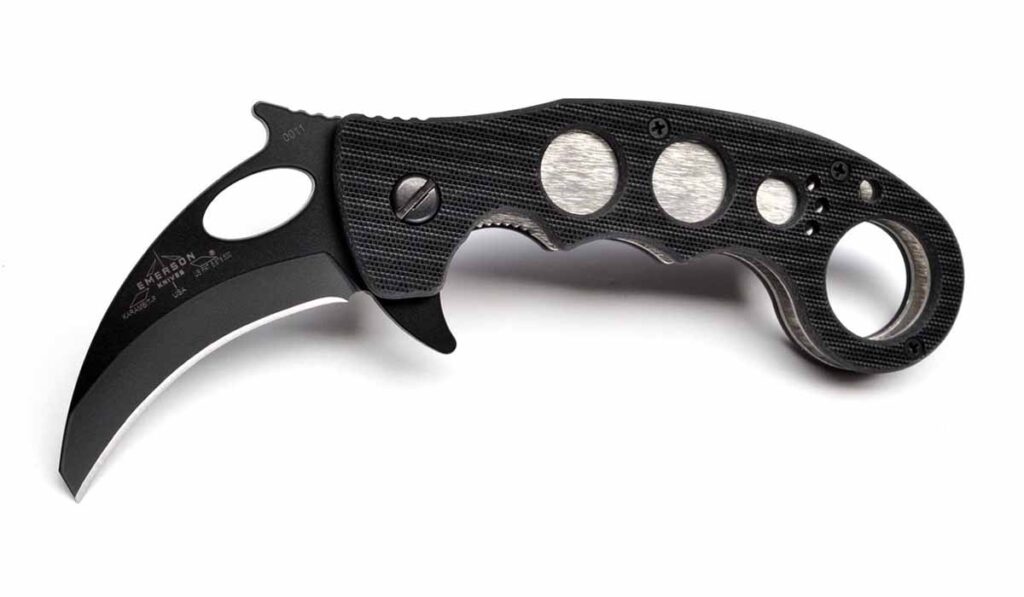
Karambit Emerson

The Combat Karambit folder by Emerson Knives, Inc., was very well received when introduced years ago. It subsequently spawned a larger version called the Super Karambit. It shares the same award-winning features of its forerunner but in a larger, more impressive format. The 3-inch blade is 154CM stainless steel and opens by either the patented Emerson Wave or an oval blade hole. Handle material is G-10 reinforced by dual titanium liners for rigidity. The handle flows seamlessly into the finger ring in the butt. There are a lot of graceful curves on this knife. It’s a feast to behold. 

The handle fits my hand extremely well, instilling a high sense of security and user confidence. The Super Karambit carries nicely in a pocket though its presence is a constant reminder of just how big it is. A reverse grip feels exactly as secure as a forward one. Your hand isn’t moving once it’s wrapped around this handle!

To deploy the blade using the Wave remote pocket opener, hook your finger through the finger ring, pull the handle from your pocket and let the Wave hook engage the seam of your pants pocket. Keep pulling and as the handle comes free from the pocket, the hook grabs the seam and deploys the blade open and locked. To my knowledge, this results in faster blade deployment than any other karambit.

One thing I don’t care for is the overly aggressive texturing of the G-10. I like grippy texture but this one is downright abrasive on pants fabric. It might be a good idea to take a small piece of cardboard and rub it over the handle texture to smooth it out somewhat. The knife is offered exclusively in a stonewashed blade finish and a black G-10 handle. Country of origin: USA. Closed length: 5 inches.

MSRP: $325  

TOPS Devil’s Claw 2
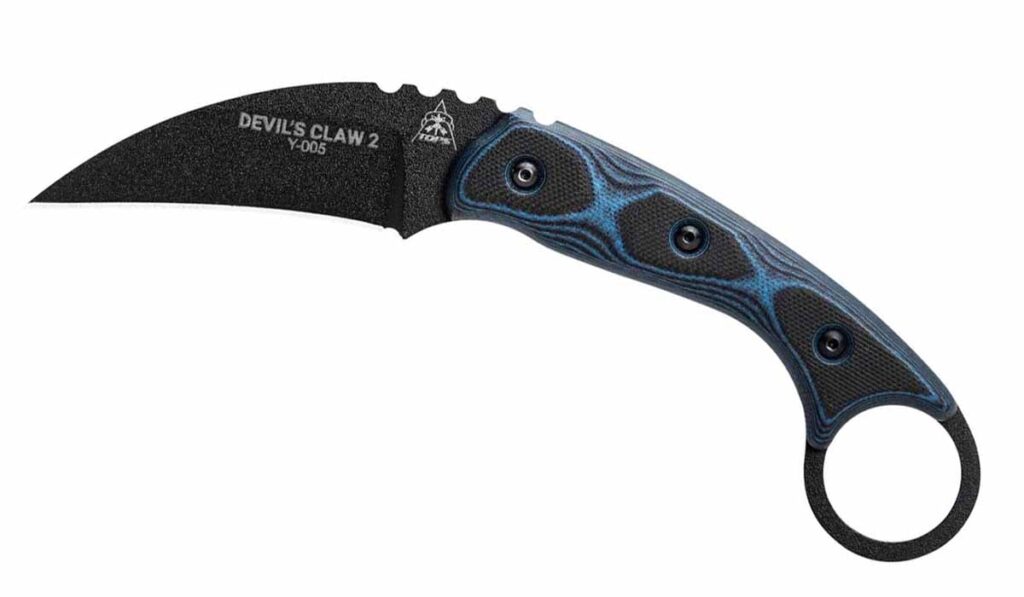
TOPS Devil’s Claw 2

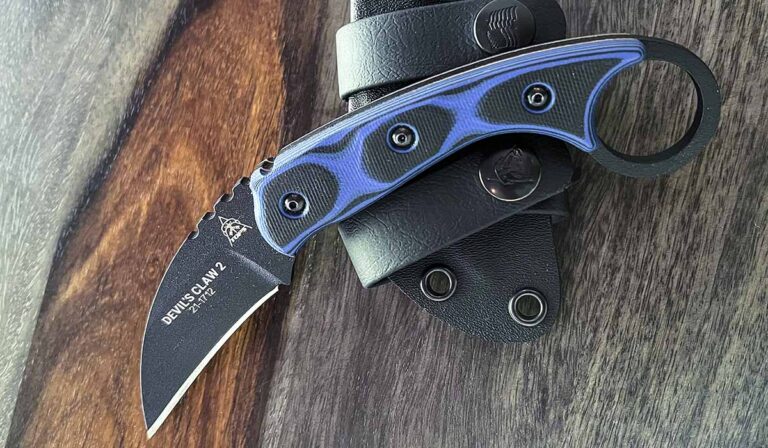
The Devil’s Claw 2 by TOPS Knives is a mid-sized fixed blade designed for personal protection. It’s built on the same platform as the company’s original Devil’s Claw but with an extended handle to accommodate a full grip as well as the traditional ring at the end. The 3-inch hawkbill blade is 1095 carbon steel in the company’s Black Traction Coating to help protect against corrosion, as well as provide a low profile. Overall length: 5.75 inches. Five large traction notches machined into the rest portion of the blade spine provide a non-slip grip for the thumb. The handle is blue and black G-10 with red fiber spacers at the tang—very eye catching! The sheath is molded Kydex with loops to carry horizontally on a belt. 

The DC2 is also a well-disguised utility knife. It feels agile and capable in hand. If you have jobs that require long, straight cuts, the DC2 is the answer. The angle of the blade makes it easy to use the tip to cut and score, while hiding the knife in a forward grip. The finger ring helps seat your hand during such tasks. The traction notches on the thumb rest aid with precise tasks such as wire stripping, whittling or any task that requires downward pressure on the blade. 

MSRP: $165

CRKT Du Hoc
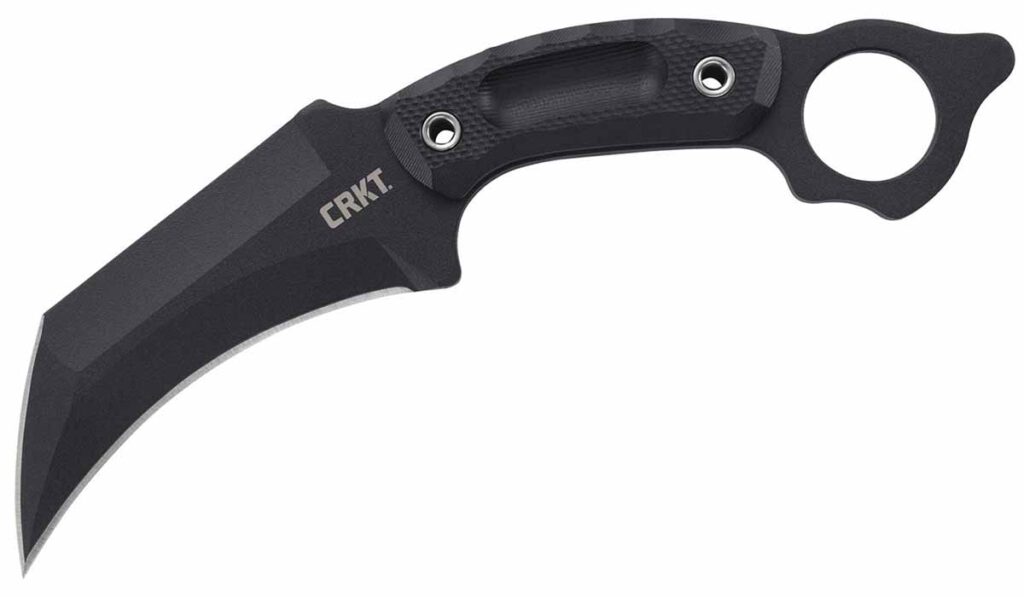
CRKT Du Hoc

Sometimes bigger really is better, and that might be the case with the CRKT Du Hoc. This fixed blade designed by Austin McGlaun is a whopping 9.63 inches in length and 9.3 ounces in weight. McGlaun designed the knife to honor his late uncle who earned a Silver Star at Point Du Hoc.

The 5.1-inch blade is made from powder-coated SK-5 carbon steel. The G-10 handle provides an excellent grip, and the included thermoplastic sheath comes with mounting options and makes for easy transport. 

MSRP: $113

Fox Knives 479 
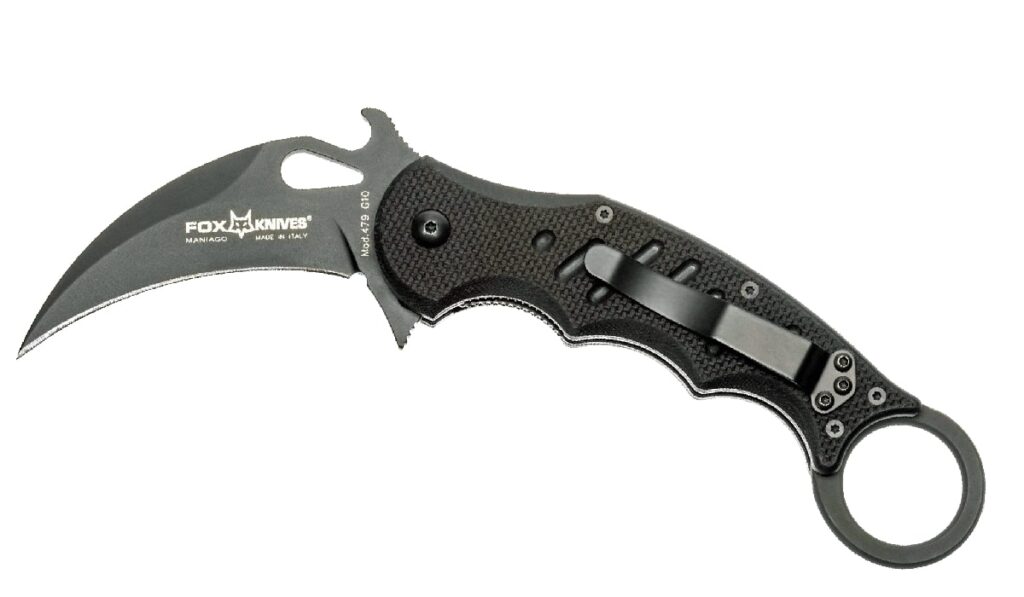
Fox Knives 479 

We return to folders with this piece from Fox Knives. The 479 is a large flipper that can handle whatever you throw at it. The 2.95-inch blade is made from N690Co stainless with a black Idroglider coating and a G-10 handle. The blade has been treated to 58-60 HRC, making it the hardest blade on our list. 

When opened, the knife is 7.48 inches long, and it weighs 4.58 ounces. The finger ring is made from aircraft aluminum to keep weight down without sacrificing toughness. The reversible pocket clip makes for easy carry no matter where you go.

MSRP: $156

Boker Magnum Spike
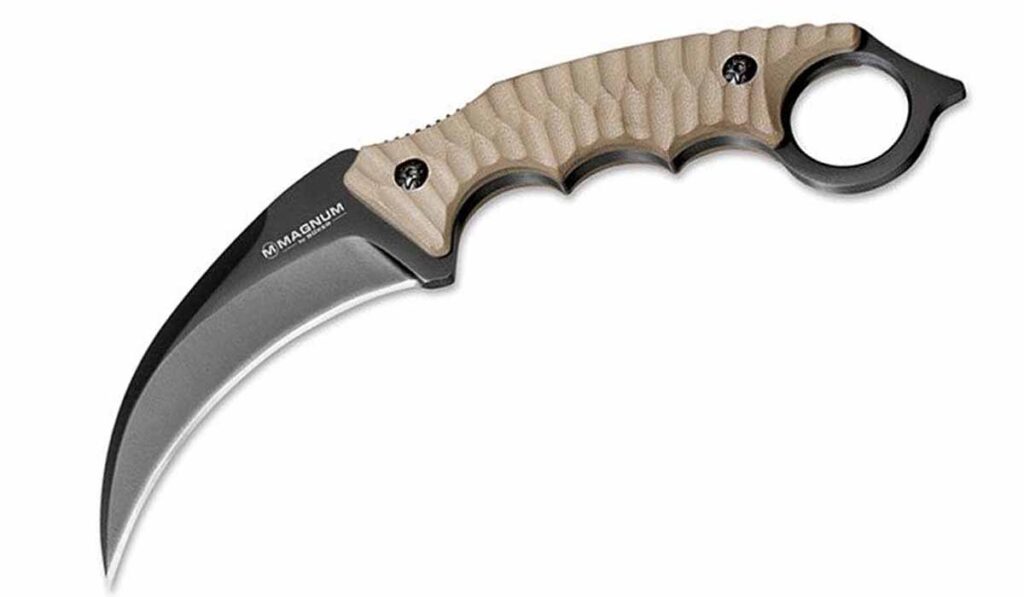
Boker Magnum Spike

At 8.25 inches overall, the Boker Magnum Spike Karambit is a full-size fixed blade. Visually, this one is quite striking! The 4-inch talon-shaped blade is 440A stainless steel coated black for corrosion protection and a low profile. A full-length swedge adds attitude.

The handle is very well executed. Multiple finger grooves aid in seating your hand comfortably. There’s a groove on the handle spine with traction notches to securely seat your thumb and help index your grip. The tan G-10 handle features a 3D texturing pattern for an excellent non-slip grip. The edges of the G-10 are chamfered properly, further enhancing grip comfort. The finger ring has an integral spike at the end for a blunt strike option if needed. When held in the reverse grip, the spike helps form a comfortable thumb rest. A molded Kydex sheath with belt adapter promotes easy carry
.  
Due to its large size, the Spike isn’t as agile in-hand as the smaller test karambits. If you tend to manipulate a karambit, this one isn’t for you. Due to the swedge, the blade is somewhat thin and while sharp and able to penetrate like crazy, it might be prone to bending or breaking if used for rough cutting. A smaller version with a 3-inch blade that is more hawkbill than talon, flat ground and without the spike on the ring could be more agile and more EDC friendly. Still, at an

MSRP: $73

Spartan Blades Ronin Shoto
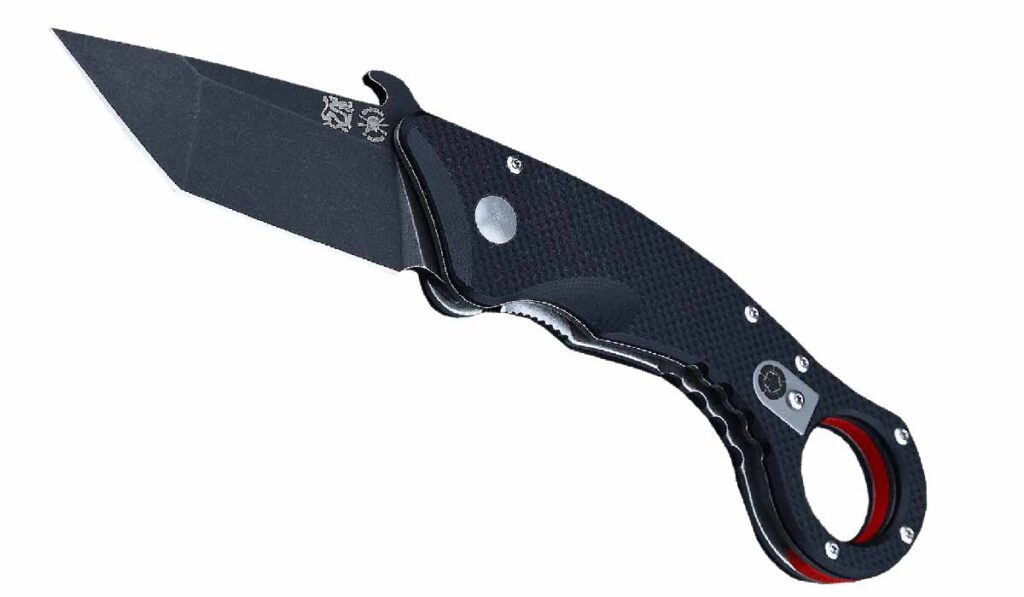
Spartan Blades Ronin Shoto

Spartan Blades teamed up with Tu Lam of Ronin Tactics to design the Ronin Shoto, a folding karambit that is part of the company’s Field Grade line of tactical knives. The Ronin Shoto design leverages the knowledge of Lam along with Spartan Blades co-owners Curtis Iovito and Mark Carey—all three saw action together in the Special Forces—and their experiences serving the USA overseas in Asia. The trio developed a fascination with the karambit during that time and it wasn’t until years later that their fascination manifested itself with the Ronin Shoto. 

The knife adopts 2.5 inches of a tanto blade, rarely seen in karambits. For blade steel, CTS XHP premium stainless provides edge longevity and durability. There’s also the Emerson Wave, the only opening method the Ronin Shoto has. The blade rides on Spartan’s OIBBS (oil-infused bronze bushing system). The bronze washers are permanently impregnated with lubricant to ensure glassy smooth blade operation at all times. Textured G-10 slabs conceal dual stainless liners. A linerlock secures the blade in the open position. A deep carry pocket clip carries the knife comfortably. A contrasting red G-10 handle spacer adds a tasteful pop of color. 
 
The Ronin Shoto sports a very impressive, heavy-duty build. Like the Emerson Super Karambit, the pocket presence is something you will notice, though it’s not uncomfortable. Opening the blade is very similar to the Super Karambit—index finger through the finger hole, pull and the blade opens as the knife exits the pocket, all in one continuous motion. If you prefer the reverse grip, re-orient the clip to the left side of the handle and you can still make use of the Wave.

Whereas the curved blades of standard karambits are limited in use, the short tanto of the Ronin Shoto is more utility friendly. It tackles general cutting tasks and the CTS XHP stainless steel ensures edge quality will go the distance. I wish the folder had an alternate way of deploying the blade other than just the Wave, though it is possible to place your thumb on the Wave and push on it to open the blade as you would any one-hand knife. Closed length: 5.2 inches.

MSRP: $155

Lionsteel/Emerson LE One
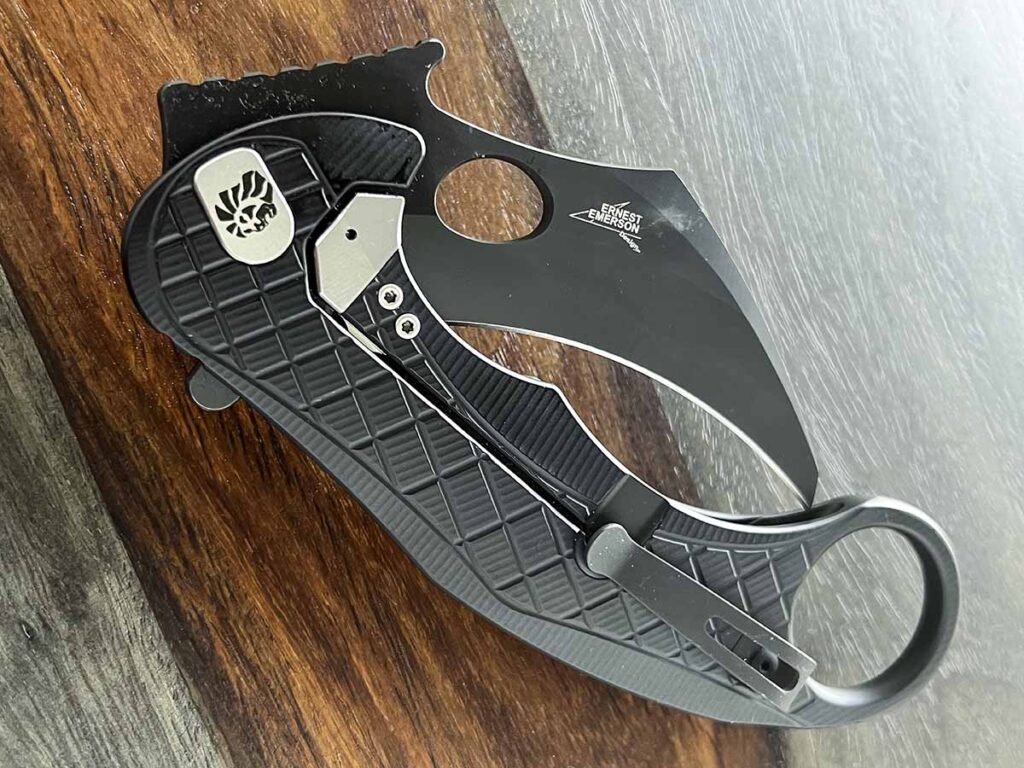
Lionsteel/Emerson LE One

The Lionsteel/Emerson LE One is a collaboration between Ernest Emerson and Lionsteel. It quite possibly is the most advanced folding karambit on today’s market due to several notable features. The 3.23-inch blade is CPM MagnaCut stainless, the latest in high-performance “super steel.” It’s the most advanced steel in terms of edge holding, stain resistance and toughness. The blade opens via one of three methods—blade hole, Emerson Wave and a flipper. If you want to remove the flipper, you can do so using a T6 Torx® wrench. The removable flipper is the REF (removable flipper) system, exclusive to Lionsteel.

The framelock handle showcases another feature seldom seen on factory knives: no assembly screws because it’s machined from one billet of aluminum. The lockbar, semi-open backspacer and finger ring are all one piece of aluminum. The handle boasts a machined crosshatch pattern with milled striations. A stainless steel wear pad screwed to the end of the lockbar results in steel-on-steel lock integrity. A deep-carry pocket clip is reversible for ambidextrous use. Handle color options are black, green, red and brown. Blade finish options are stonewashed and black coated.  

A fraction over 5 inches closed, the LE One is one of the larger folding karambits. However, it’s so lightweight and carries so well that its sheer size doesn’t even factor in. I like how your hand is seated comfortably when in the forward grip—it definitely feels secure. All edges and corners are rounded and chamfered properly, making the handle melt in your hand. Even the finger ring is rounded both inside and out. The thumb ramp and blade spine are crowned—I totally dig this. These areas have a rounded appearance, not flat like most other blade spines. Crowning demonstrates that a company is willing to go the extra mile to pay attention to such a minor detail. Lionsteel has detail locked down for sure!

Sharp out of the box, the blade cuts very efficiently and the flat grind pull cuts easily. The framelock engages tight, with zero blade movement in any direction. The blade tip looks different from other karambits. It appears to be dull but is not. Emerson’s design eliminates the very pointy tip, which is prone to break during heavy use, by squaring it off slightly. This creates a strong tip. The Emerson Super Karambit has the same feature as well.

MSRP: $268

Kershaw Knives Outlier
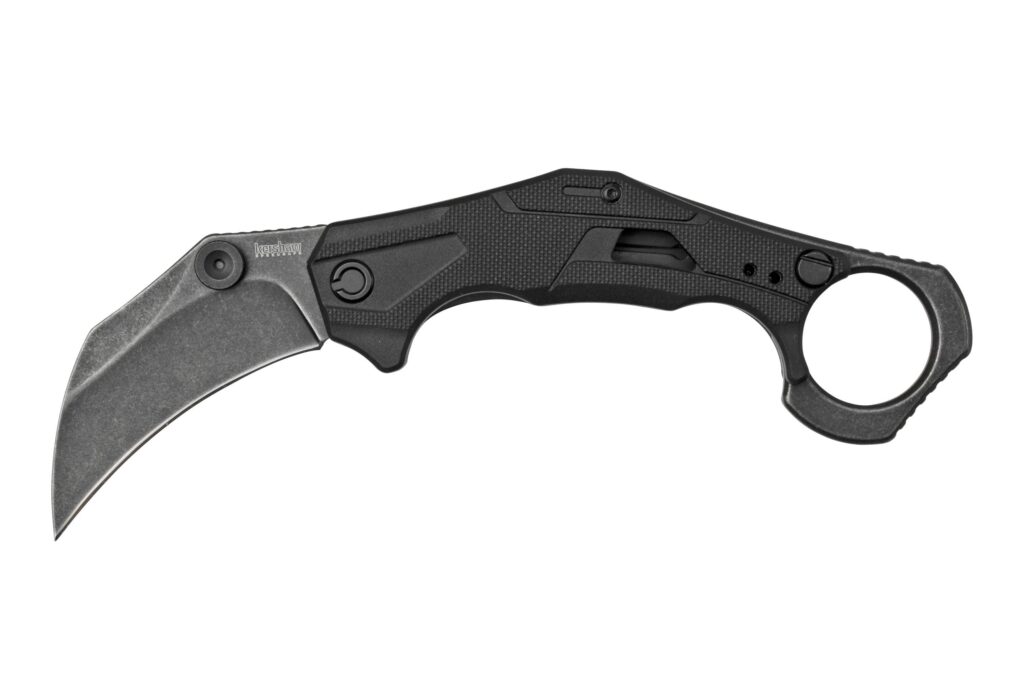
Kershaw Knives Outlier

Anchoring the value end of the spectrum is the Kershaw Knives Outlier. In a somewhat angular handle design, the Outlier’s finger ring is integral with the handle spacer. The only karambit from Kershaw, it features a 2.6-inch blade of 8Cr13MoV stainless steel. The blade opens via Kershaw’s SpeedSafe assisted-opening mechanism designed by BLADE Magazine Cutlery Hall-Of-Fame® member Ken Onion. The opening starts via a choice of an oversized thumb stud and a flipper. The handle is a glass-filled nylon polymer outfitted with a deep-carry pocket clip and a linerlock.  

The Outlier feels very secure and comfortable in hand. Your grip is locked in via the large forward finger recess and finger recess at the butt just outside the finger ring. Fit and finish is top notch and an all-black tactical finish presents a subdued appearance. The 8Cr13MoV is a good middle-of-the-road steel, very comparable to AUS-8, which is popular in entry-level-to-mid-range knives. The curved blade is easy to sharpen with a rod-type sharpener and holds a decent edge. 

MSRP: $72

Editor’s Note: Dexter Ewing and Mike Ableson contributed to this article.

Read More

The Cutlass: From The Sea To The Screen

The Cutlass Is A Short Sword Used For Centuries. Today, It Is Mostly A Ceremonial Blade, But One That Continues To Inspire

A sword can be more than just a weapon of war, the cutlass is an excellent example. For centuries, the cutlass was used by fighting forces throughout Europe as a short, one-handed stabbing and slashing weapon. 

For many, the cutlass is best known as the sword of the pirates in the Atlantic Ocean during the 17th and 18th centuries. In a lesser-known role, it also was regularly used in agriculture throughout the Caribbean like the machete is today. In English-speaking Caribbean countries, the word “cutlass” is used to mean a machete. 

In the modern era, the cutlass has left behind its fighting phase and is almost used exclusively as a ceremonial sword by several navies. However, its popularity endures among collectors and history buffs alike, thanks to its extensive use during the pirate era and the Age of The Sail.

What Is A Cutlass?

A cutlass drill on the HMS Wolverine , 1882 (Public Domain)

The cutlass is a one-handed, single-edged sword used for close-quarters fighting that was the evolution of naval sabers into a more compact, nimble short sword. While the edge does come to a fine point, the cutlass was designed for slashing and swinging at your enemies when fighting hand-to-hand. 

This is why the sword was a popular seafaring weapon. With a slightly-curved blade, usually between 28-32 inches, the cutlass is adept in the close confines of a ship. The straight handle and clipped guards of most cutlasses protected your hand when in battle. Additionally, the cutlass was robust enough to tackle general maritime tasks like slicing through heavy rope or thick fabric like canvas or even wood. And its size made it the perfect weapon for the type of in-your-face fighting that would happen on the high seas.

On land, the cutlass wasn’t as dashing, mostly used to chop sugarcane and clear tracts of land in the rainforest in the New World. Though, the same qualities that made it a great fighting implement made it adept on the farm. The short, swooping blade allowed a great deal of force to transfer from the arm to the material with every swing. 

Who Uses The Cutlass Today?

Today, the cutlass is used almost exclusively as a ceremonial sword. While it was at its most popular centuries ago, the cutlass was still a standard issue sword until around World War 2 before it became wholly ceremonial.

The British transitioned the sword to ceremonial duty in 1936, and the United States followed suit in 1949. Both countries incorporate the sword into military ceremonies today. The Brits issue cutlasses to naval chief petty officers. The United States also offers chief petty officers the ability to wear a cutlass with their formal dress for ceremonies and the like.

Can I Buy A Cutlass?

Absolutely. There are many companies making cutlasses today. While they may not be as pristine as the ones issued by the military, there are numerous companies making these types of blades. 

Factory Cutlass Options

Cutlasses are still made today, but, in general, they aren’t built to the same combat standard as in centuries past. The vast majority of these swords are showpieces meant to be hung on the wall and start conversations. However, if you are a true lover of the Age of Sail, these swords more than fit the bill.

Windlass English Cutlass

This 30.5-inch sword from Windlass is an elegant modern Cutlass, and, for a fee, can be sharpened into a real, proper sword. As is, the high-carbon steel blade is hand forged and mated to a solid brass guard. You’ll really feel like Blackbeard with it in your hand.

The sword comes with a leather scabbard adorned with a brass tip and throat to up the visual appeal of the piece. All told, this is a high-quality replica of the cutlass that will get people talking at your next party and look great in your office or hanging on the wall.

MSRP: $190

Condor Naval Cutlass

The Naval Cutlass from Condor Tool & Knife is a more modern take on the classic blade. The first thing you notice about it is the black epoxy powder finish to the blade. We’re pretty sure pirates of the 18th century didn’t have powder-coating technology, but would have loved to have had the extra corrosion resistance on the high seas.

The blade checks in at 24 inches in length and is made from 1075 steel ground to a razor’s edge. Yes, this sword comes sharpened right out of the box for no extra fees. The smooth hardwood handle is triple riveted, and a powder-coated guard keeps your hand protected when holding the sword. A black welted leather scabbard fits snugly around the blade and keeps everything protected even if dropped.

While it certainly doesn’t look like a sword from the movies, it’s designed to be a true, proper modern cutlass.

MSRP: $148.49

Kult Of Athena Pirate Sword

Complete with a skull and crossbones etched into the scabbard’s throat, the Pirate Sword from Kult of Athena looks like it could have been taken from the set of any swashbuckling movie set.

The 22-inch blade is made from stainless steel and comes, according to KoA, moderately sharp out of the box. That means it might need a more refined sharpening at home if you’re looking for a razor’s edge. However, the blade itself is .16 inches thick, thin enough to slice well but thick enough to hold up to some wear if used for more robust cutting tasks. But be aware, the sword is classed as “decorative”, or for display only, so keep that in mind before playing out your high seas fantasies. 

The cast metal handle is surrounded by a bronze-plated cup guard which features a pirate ship design. The black leather scabbard has a cast tip and throat to complete the look.

MSRP: $49

Kingston Arms Atrim Cutlass

The Kingston Arms Atrim Cutlass shows that not all collectible blades need to be centuries old. Made in the style of a naval cutlass, the Atrim utilizes modern materials and methods to make a truly remarkable sword.

The 9260 spring field falchion-style blade is hand forged and comes in a satin finish. At 25.75 inches it’s a bit smaller than some other cutlasses, letting it move more fluidly in your hand and taking up a smaller display space. The full-tang construction terminated with a stainless steel guard and pommel around a brown leather handle that provides a strong grip.

This is the most expensive sword of all the cutlasses showcased in this piece, and it’s worth every penny for the discerning, high-end collector.

MSRP: $432.95

Cold Steel 1917 Cutlass Sword

When it comes to collector pieces outside of auctions, Cold Steel’s 1917 Cutlass Sword is a prime example of what’s being made today. While it is designed for display and collection, the 1055 steel blade does come with a serviceable edge out of the box. 

In terms of size, it’s exactly what you’d expect a cutlass to be. At just under 30 inches long and 37.6 ounces, it’s a nimble sword that will feel good to hold and wield when showing off all of its intricacies. The wood handle and blued steel hand guard complete the look, and the included leather scabbard keeps the sword looking classy even when put away.

MSRP: $289.99

APOC Survival Cutlass

This option is rated for proper use rather than display. That’s abundantly clear considering it comes with a MOLLE-compatible Kydex scabbard. That doesn’t come with swords meant to be hung on the wall.

The APOC is a tactical sword that has a 21.5-inch black oxide blade made from 9260 spring steel. The black G-10 handles complete the monochromatic look and provide excellent grip in myriad conditions.

At just under 2 pounds, this is a lightweight cutlass meant to be used as a survival tool out on the trail or in more intense outdoor situations. The blade is meant to slice, of course, and the edge comes to a fine point, making this a puncturing tool as well. Versatility is the name of the game in survival equipment, and, while a machete or shorter knife might be a better option, the APOC cutlass is built for the outdoors and to handle the elements.

MSRP: $169.95

Custom Cutlass Options

There are numerous people making custom cutlasses and other swords. Whether it is for the private use and display of an individual or to be used as props in movies, at renaissance fairs, or in other forms of entertainment, there are makers and smiths crafting modern versions of the centuries-old blade.

Even the popular YouTube Series Man At Arms: Reforged did an episode about the cutlass and showed multiple ways to craft them.

Tony Swatton

Swatton runs Sword & Stone in Burbank, CA and makes arms and armor for film and television. He, and his shop, were the star of the original Man at Arms series nearly a decade ago. He’s self-educated and has been making armor since he was 17.

The first movie his work appeared in was Hook in 1991, and since then his weapons have been seen on screen in more than 300 movies including massively popular films such as Pirates of the Caribbean, Batman, and Thor. He also designed the cutlass used in Assassin’s Creed 4.
David Lisch

Lisch makes custom knives and swords exclusively from damascus steel. His 26 years of experience in the field are seen in the intricacy of his mosaic patterns and one-of-a-kind blade designs. He’s made landscapes and sunrise designs on his blades.


An example of David Lisch’s damascus work.

His knives have won awards and he teaches classes in blacksmithing and knifemaking with his wife Andrea at their school in Yelm, Washington, about an hour south of Seattle.

Collecting Cutlasses

The cutlass is collected by all sorts: sword lovers, pirate aficionados and history buffs. Specialty dealers help these collectors find the pieces they are looking for, and it helps keep the cutlass alive and in public consciousness.

Additionally, cutlasses have made it to auction houses around the world, sometimes fetching as much as $10,000 before the hammer falls at auction houses like Morphy’s, Sotheby’s, and Rock Island. 

In late 2022, the 1860 naval cutlass belonging to John H. Ferrell, a Congressional Medal of Honor recipient, went to auction at Morphy’s and sold for $14,760. The sale showed how, even today, the popularity of the cutlass continues to endure in a big way.

Read More

Bevy Of Drool-Inducing New Blades

0

We round up a dozen dazzlers that are certain to make your wish list grow.

One thing nobody has ever said: “I have enough knives.” In that sprite, we’ve gathered up a ton of new knives that have hit the market in recent months, each one sharp as a razor in looks and function.

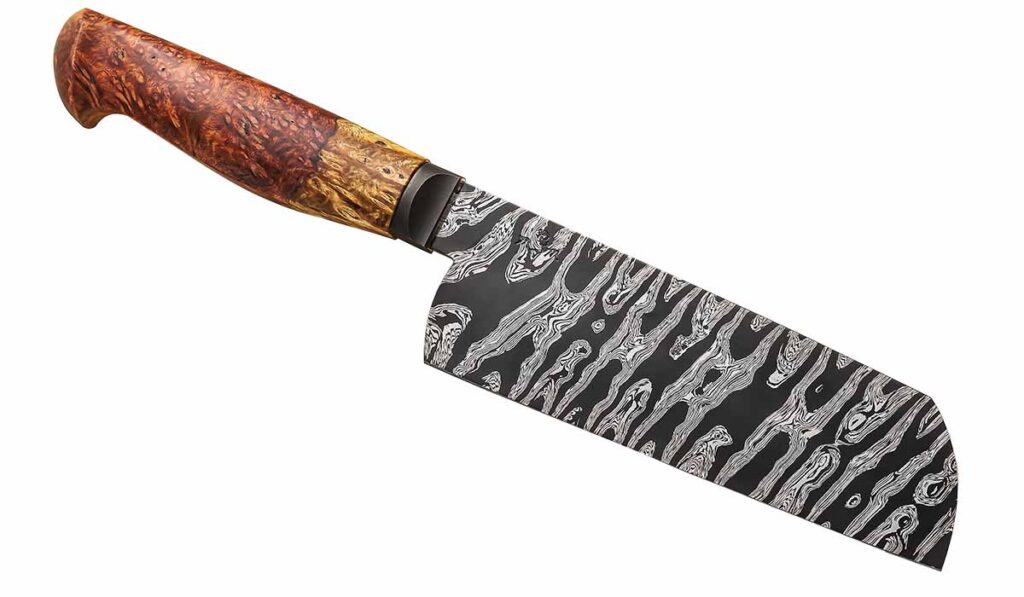
Maverick Knives Cleaver

Maverik Knives Cleaver

KNIFE TYPE: Cleaver
BLADE LENGTH: 6.5”
BLADE MATERIAL: 1084 carbon and 15N20 nickel-alloy steels in a zebra-twist damascus pattern
BLADE GRIND: Flat w/convex edge
BLADE AT THICKEST: .135”
HANDLE MATERIAL: Amboyna burl
BOLSTER: Antiqued bronze
OVERALL LENGTH: 12”
KNIFE TO KNOW: Maverik Murdock is an ABS apprentice smith
MAKER’S PRICE FOR A SIMILAR KNIFE: $1,400
MAKER: Maverik Knives (SharpByCoop image)


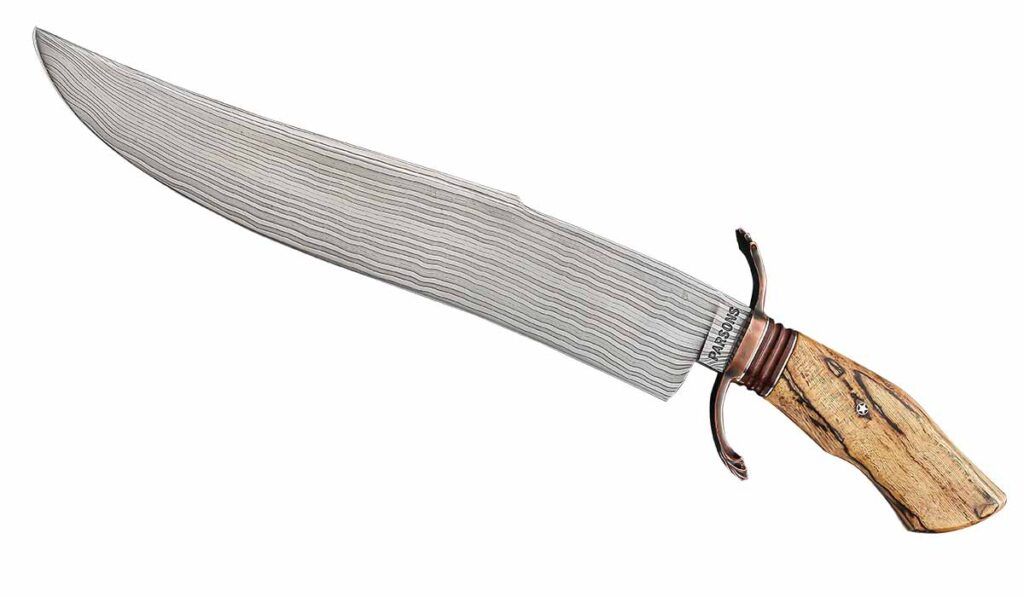
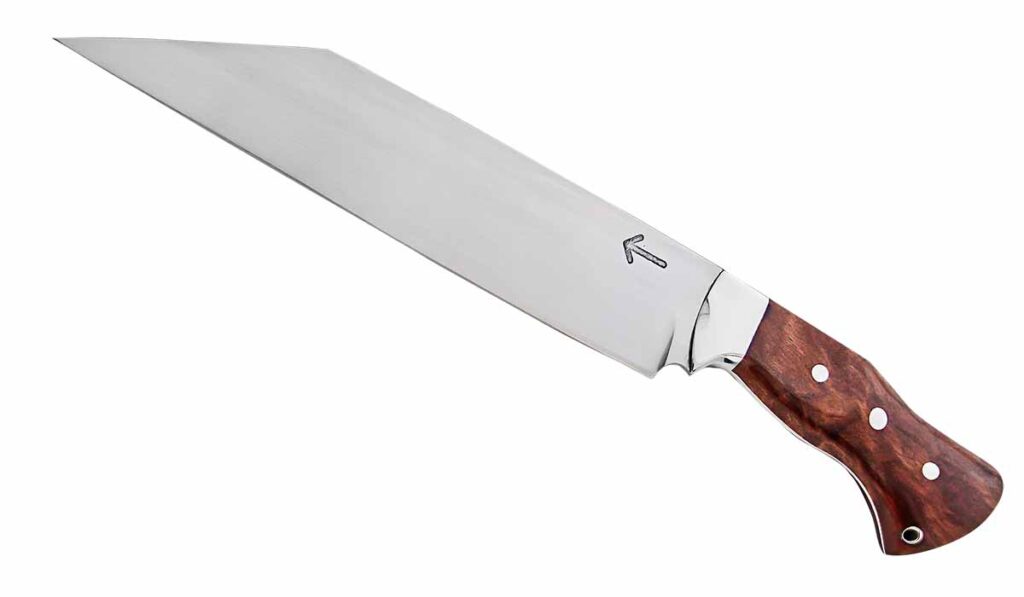
S.K.MO Knives Fi

S.K.MO Knives Fi

KNIFE TYPE: Fixed blade
BLADE LENGTH: 13.25”
BLADE MATERIAL: Canister damascus of 1095 powder and nails
BLADE PATTERN: Harpoon
HANDLE MATERIAL: Black palm and water buffalo horn w/nickel spacers and star pin
GUARD/BOLSTER: Stainless steel
OVERALL LENGTH: 17.75”
KNIFE TO KNOW: S-guard and dropped-handle designs
MAKER: S.K.MO Knives (SharpByCoop image)


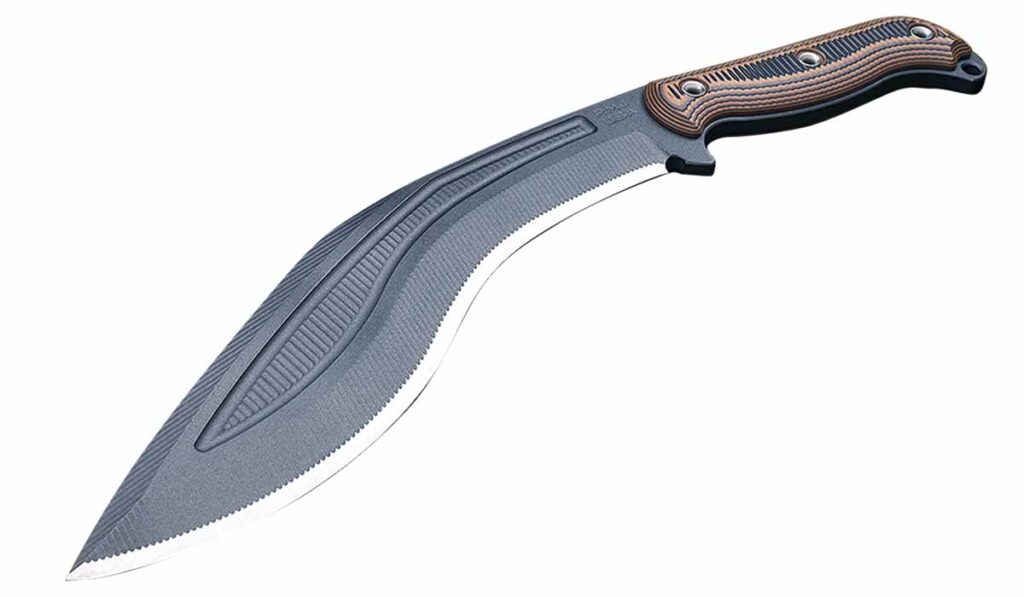
RMJ Tactical Kukri

RMJ Tactical Kukri

KNIFE TYPE: Kukri
BLADE LENGTH: 10.5”
BLADE MATERIAL: 80CrV2 carbon steel
ROCKWELL HARDNESS: 57-58 HRC
BLADE AT THICKEST: .27”
BLADE FINISH: Tungsten Cerakote®
HANDLE MATERIAL: 3D-machined G-10
CONSTRUCTION: Full tang
WEIGHT: 24 ozs.
OVERALL LENGTH: 15.5”
SHEATH: Molded Kydex w/low-ride M.O.C. straps
COUNTRY OF ORIGIN: U.S.A.
MSRP: $550
COMPANY: RMJ Tactical


Francois Mazieres Viking/Nordic Seax

Francois Mazieres Viking/Nordic Seax

KNIFE NAME: Viking/Nordic seax
KNIFE TYPE: Fixed blade
BLADE LENGTH: 9.33”
BLADE MATERIAL: Sup9 by Jake Mantel/Firepants Fabrication, w/proximal and distal tapers
BLADE GRIND: Flat; secondary bevel w/convex edge
BLADE AT THICKEST: .177”
HANDLE MATERIAL: Stabilized, Northern-Territory-grown, figured coolabah wood
OVERALL LENGTH: 14.96”
MAKER’S PRICE FOR A SIMILAR KNIFE: $500
KNIFE TO KNOW: Francois Mazieres is an ABS apprentice smith and a member of both the Australian Knifemakers Guild and The Knifemakers’ Guild
MAKER: Yandiwa (Rod Hoare image)


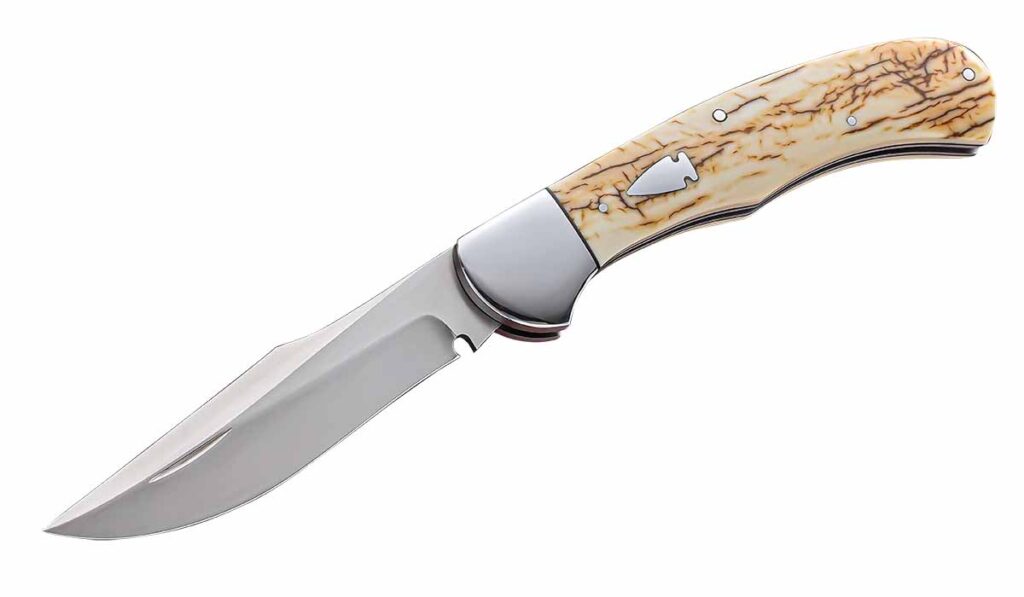
Tobin Hill Comanche

Tobin Hill Comanche

KNIFE NAME: Comanche
KNIFE TYPE: Folder
BLADE LENGTH: 3.75”
BLADE STEEL: CPM 154 stainless
BLADE GRIND: Hollow
HANDLE MATERIAL: Ancient mammoth ivory
GUARD/BOLSTER: 410 stainless
CLOSED LENGTH: 4.75”
KNIFE TO KNOW: The knife is a collaboration between Tobin Hill and ABS master smith Jason Knight
MAKERS’ PRICE FOR A SIMILAR KNIFE: $3,500
CONTACT: Tobin Hill (SharpByCoop image)


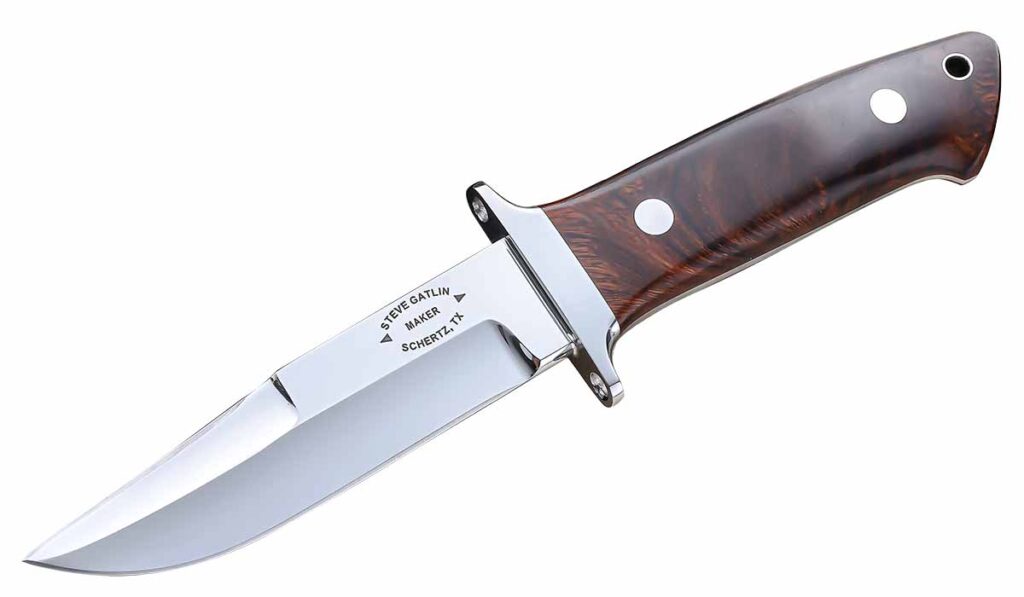
Steve Gatlin Chute

Steve Gatlin Chute

KNIFE NAME: Chute
KNIFE TYPE: Fixed blade
BLADE LENGTH: 4.5”
BLADE STEEL: CPM 154 stainless
BLADE GRIND: Hollow
BLADE FINISH: Mirror polish
HANDLE MATERIAL: Desert ironwood w/red liners
GUARD/BOLSTER: 416 stainless
OVERALL LENGTH: 9.125”
SHEATH: Custom made of leather
MAKER’S PRICE FOR A SIMILAR KNIFE: $1,400
MAKER: Steve Gatlin, (SharpByCoop image)


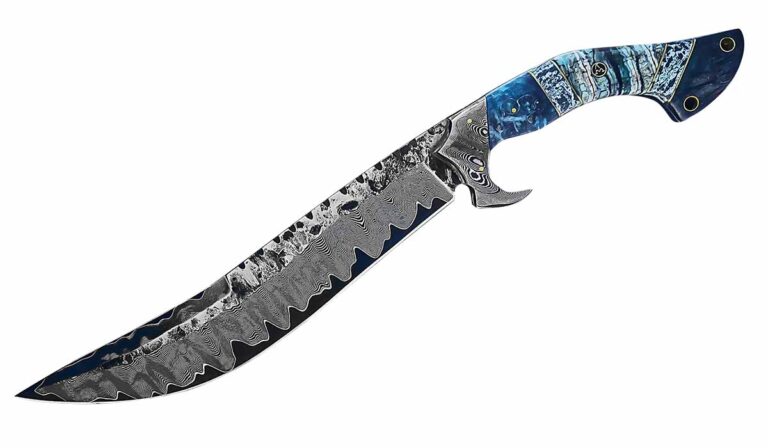
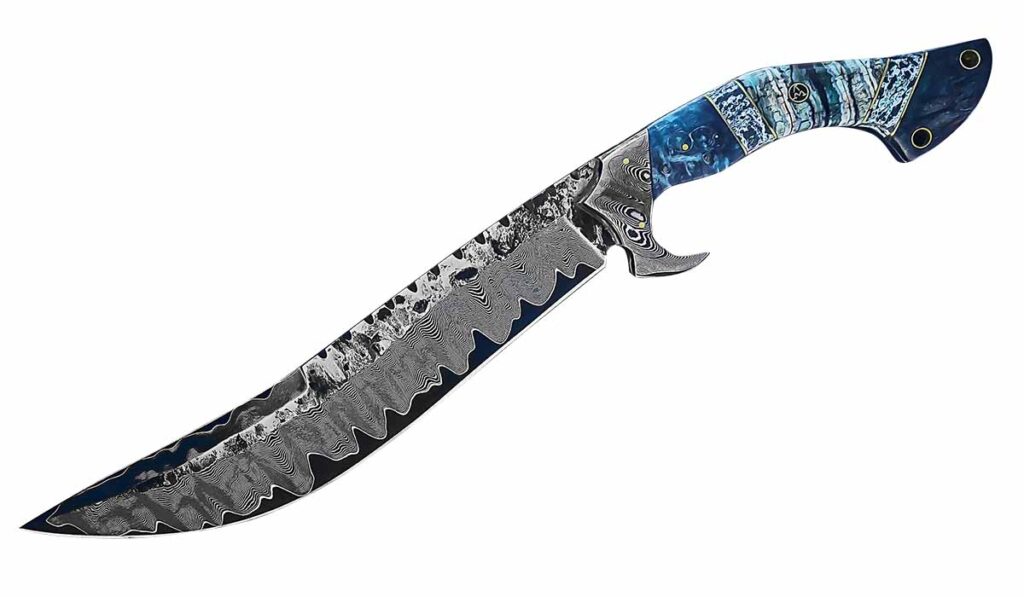
Allen Matthew Custom Knives Bushman's Knife

Allen Matthew Custom Knives Bushman’s Knife

MODEL NAME: Bushman’s Knife
KNIFE TYPE: Fixed blade
BLADE LENGTH: 12”
BLADE MATERIAL: 1095 carbon and 15N20 nickel-alloy steels in a damascus-clad san-mai construction
HANDLE MATERIAL: Ancient mammoth molar tooth w/stabilized and dyed amboyna burl and yoskizaki; Starmascus glow in the dark spacers & brass highlights
GUARD/BOLSTER: Damascus
OVERALL LENGTH: 19”
KNIFE TO KNOW: Bulldog Damascus forged the blade material
MAKER’S PRICE FOR A SIMILAR KNIFE: $2,300
MAKER: Allen Matthew Custom Knives (Rod Hoare image)


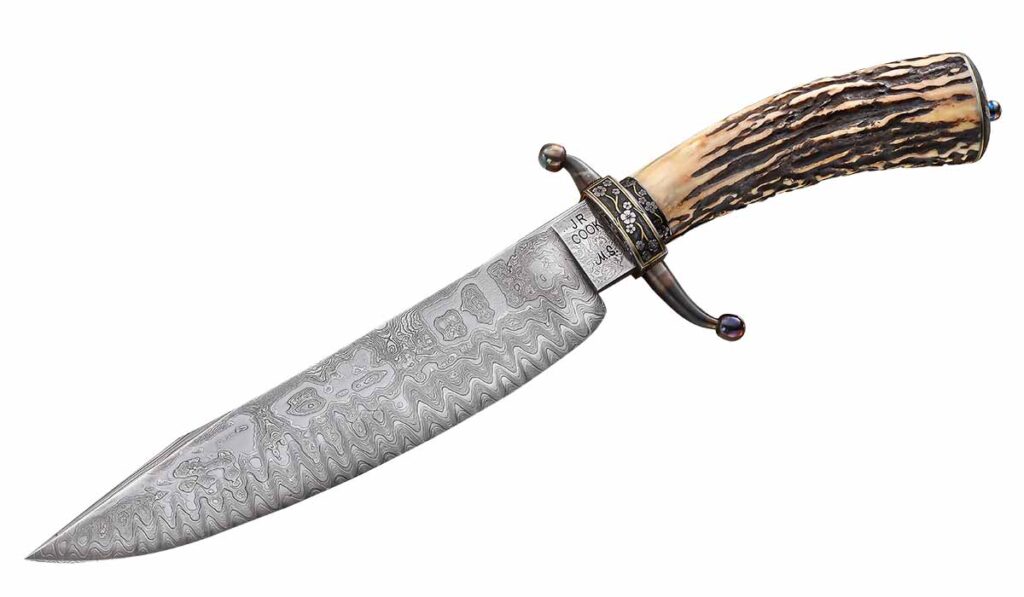
J.R. Cook Vaquero

J.R. Cook Vaquero

KNIFE NAME: Vaquero
BLADE LENGTH: 8”
BLADE MATERIAL: Damascus steel in a wolf-tooth pattern
HANDLE MATERIAL: Stag
FITTINGS: 416 stainless steel engraved in 24k gold by J.R. Cook
OVERALL LENGTH: 10.25”
SHEATH: Custom-fitted, tooled-leather belt model
KNIFE TO KNOW: The knife is sole authored; J.R. Cook is an ABS master smith and a past Arkansas Living Treasure
MAKER’S PRICE FOR A SIMILAR KNIFE: $6,200
MAKER: J.R. Cook (SharpByCoop image)


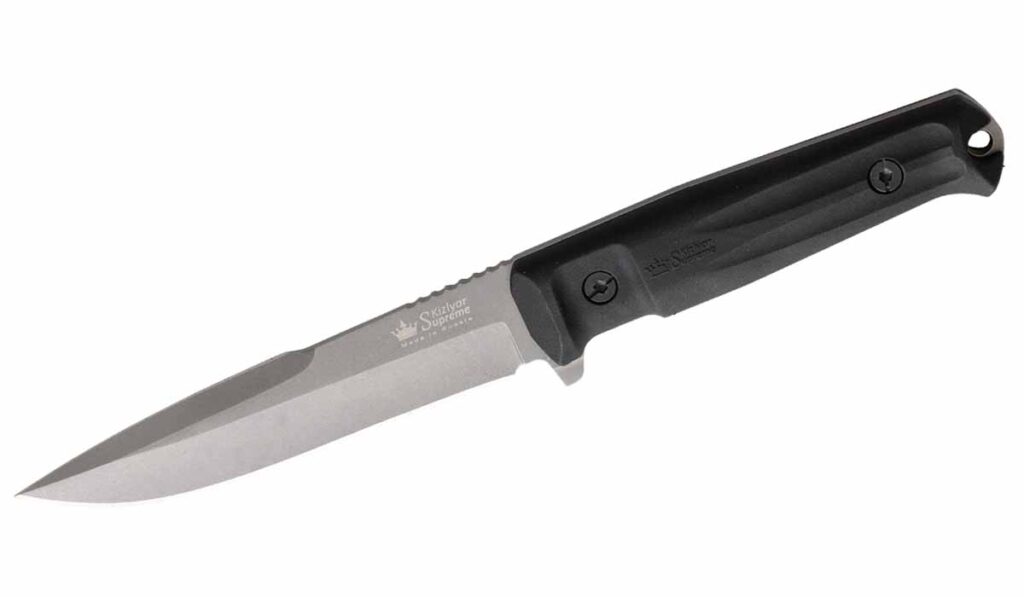
Kizlyar Supreme Delta AUS8 Black Titanium

Kizlyar Supreme Delta AUS8 Black Titanium

KNIFE NAME: Delta AUS8 Black Titanium
KNIFE TYPE: Tactical fixed blade
BLADE LENGTH: 6”
BLADE MATERIAL: AUS8 stainless steel
BLADE GRIND: Hollow
BLADE THICKNESS At GUARD: .185”
BLADE PATTERN: Harpoon
HANDLE MATERIAL: Contoured black Kraton/ABS synthetic w/lanyard hole
CONSTRUCTION: Full tang
OVERALL LENGTH: 11.1”
SHEATH: MOLLE compatible w/three-point locking system
KNIFE TO KNOW: Integral single guard, finger traction ridges on blade spine
COUNTRY OF ORIGIN: Russia
MSRP: $149
COMPANY: Kizlyar Supreme


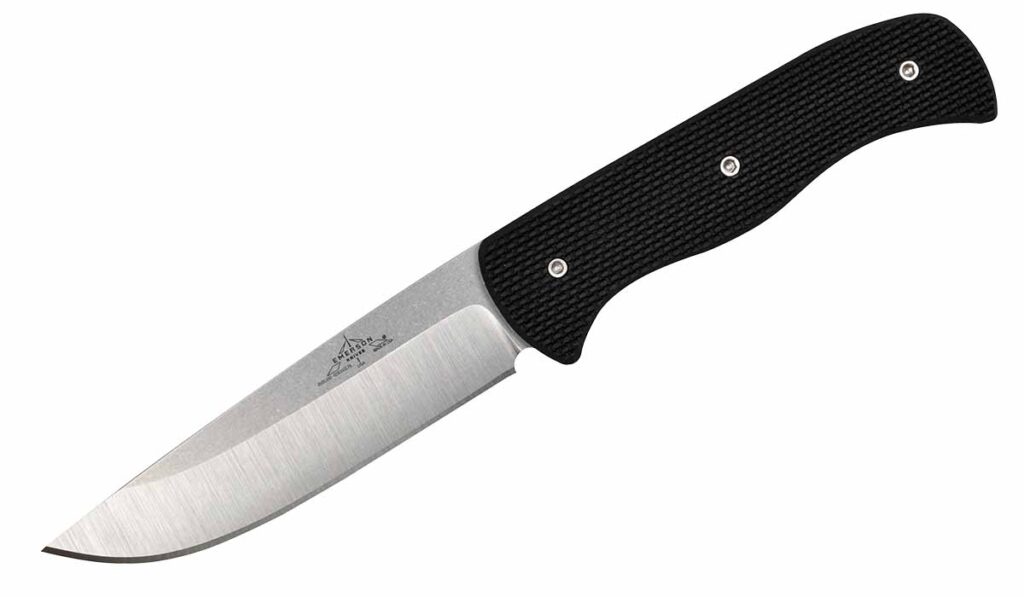
Emerson Knives Overland Renegade

Emerson Knives Overland Renegade

KNIFE NAME: Overland Renegade
KNIFE TYPE: Fixed blade
BLADE LENGTH: 4.3”
BLADE STEEL: 154CM stainless
ROCKWELL HARDNESS: 57-59 HRC
BLADE GRIND: Conventional “V”
BLADE AT THICKEST: .125”
BLADE FINISH: Stonewashed
HANDLE MATERIAL: Black G-10 (also in Richlite)
OVERALL LENGTH: 9”
KNIFE TO KNOW: The Renegade is also available in a folding configuration
COUNTRY OF ORIGIN: U.S.A.
MSRP: $262.95
COMPANY: Emerson Knives


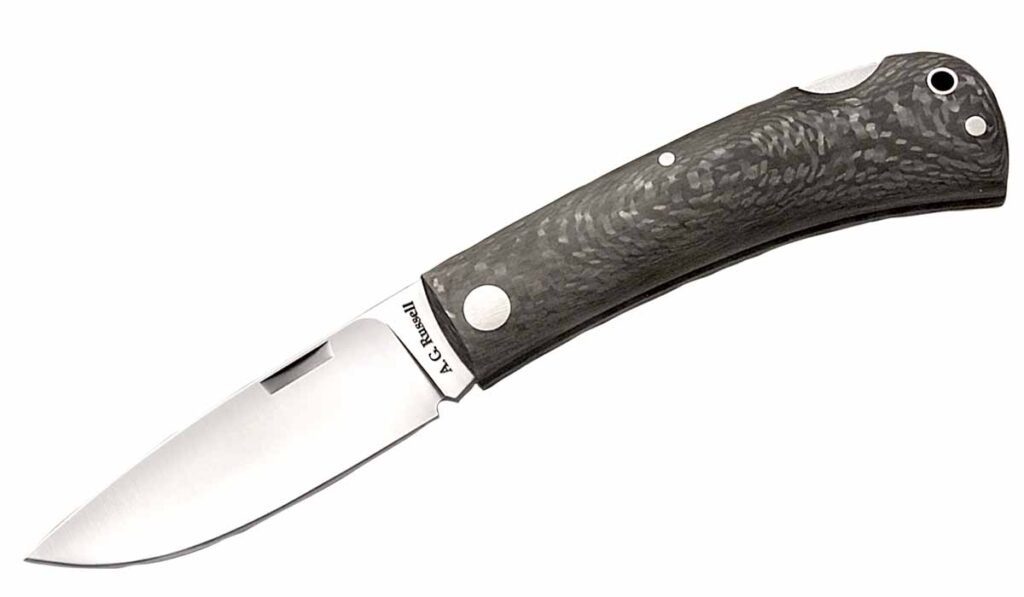
A.G. Russell Knives Skinny Brute

A.G. Russell Knives Skinny Brute

KNIFE NAME: Skinny Brute
KNIFE TYPE: Utility folder
BLADE LENGTH: 3.25”
BLADE STEEL: CPM S35VN stainless
BLADE GRIND: Flat
BLADE PATTERN: Drop point
BLADE FINISH: Satin
HANDLE MATERIAL: Carbon fiber (also comes in green G-10)
POCKET CLIP: None
LOCK: Lockback
CLOSED LENGTH: 41/8”
KNIFE TO KNOW: The knife is an update from the original released in the 1970s; the handle is a “skinny” linerless design that is just over .5” thick at the center swell
COUNTRY OF ORIGIN: China
MSRP: $135 ($99 in green G-10)
COMPANY: A.G. Russell Knives


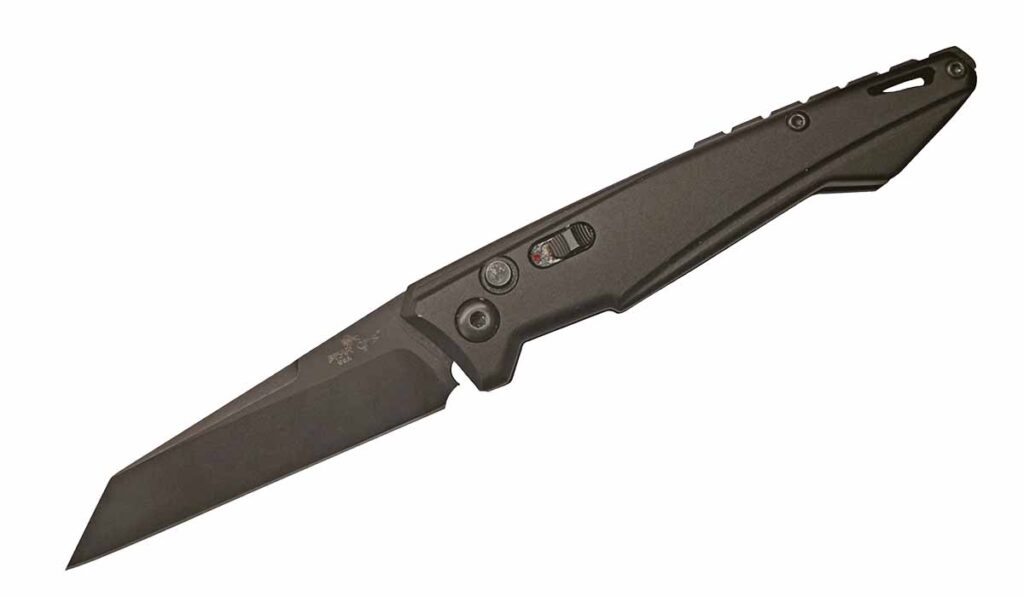
Bear & Son Cutlery Auto Bold Action XV

Bear & Son Cutlery Auto Bold Action XV

KNIFE NAME: Auto Bold Action XV
KNIFE TYPE: Automatic folder
BLADE LENGTH: 31/8”
BLADE STEEL: Sandvik 14C28N stainless
ROCKWELL HARDNESS: 58-60 HRC
BLADE GRIND: Hollow
BLADE PATTERN: Reverse tanto
BLADE FINISH: Black
HANDLE MATERIAL: Black aluminum
POCKET CLIP: Carries blade tip up
LOCK: Lock safety
WEIGHT: 2.6 ozs.
CLOSED LENGTH: 4.5”
KNIFE TO KNOW: Ball-bearing pivot; safety lock switch just below the push button opener
COUNTRY OF ORIGIN: U.S.A.
MSRP: $179.99
COMPANY: Bear & Son Cutlery

Check Out More Cool Custom Knives:

OKNIFE Beagle Review: Nice Doggy

The OKNIFE Beagle emerges from testing as one well-bred blade.

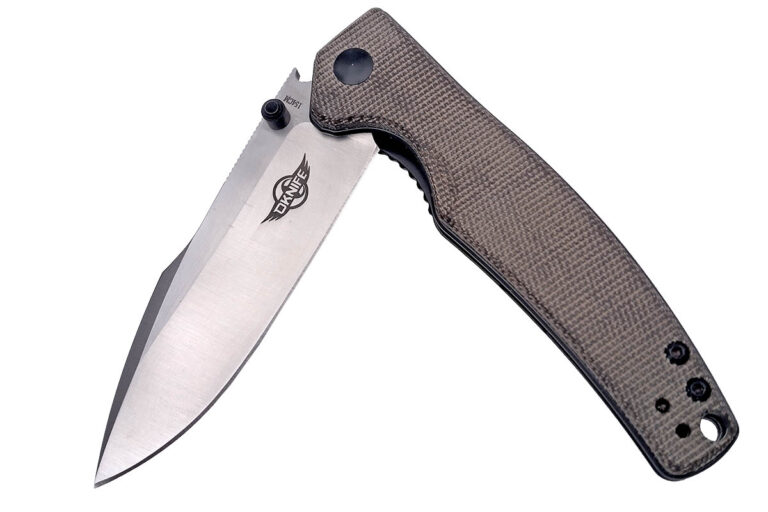
The Beagle by OKNIFE is a mid-sized folder that rides great in a pocket—big enough to handle most cutting chores but small enough to be comfortable to carry every day. As a heavy knife user, I always carry. It has to ride comfortable and perform or I won’t consider it. The Beagle was on my side for 30 days with no carry issues. Check the first block. Now for the performance side.

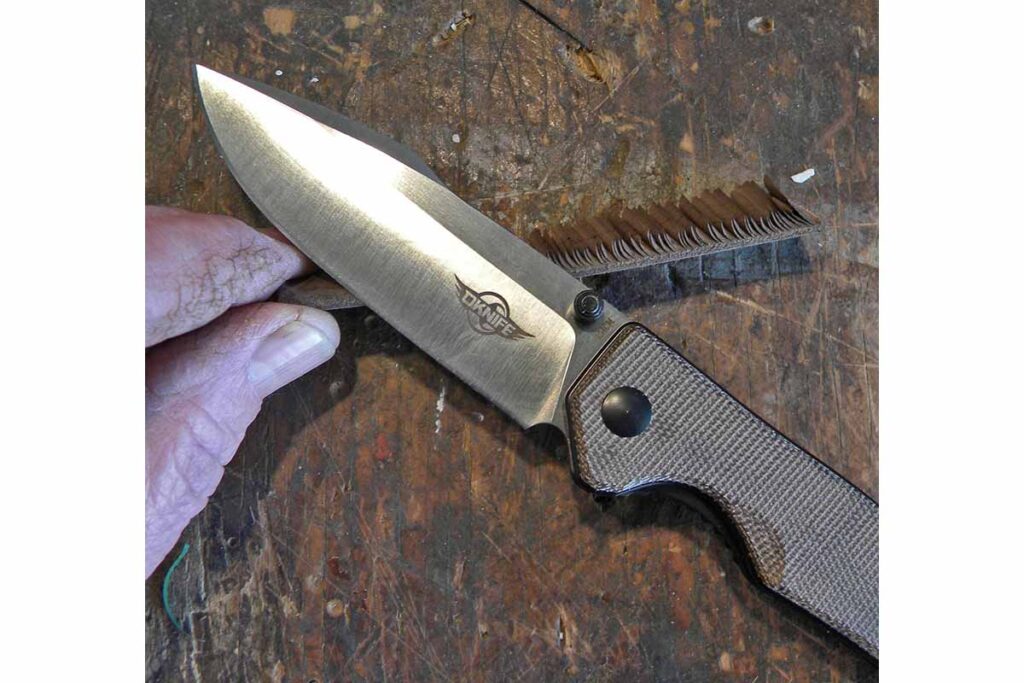
The Beagle was very sharp out of the box. A quick paper slice with 20-pound bond copy paper proved it. Via a push cut it sliced quite smoothly with no snags or tears. The handle shape made for easy control of the width of slices.

Next up: single-walled cardboard. The Beagle made zipping noises during the push cuts. Again, it was very controllable on the slice widths, nice and aggressive on every pass, with no snags or tears.

A scrap piece of 8-ounce leather was next. I sliced it similarly to the cardboard to see if I could get the same zipping noises. The Beagle didn’t disappoint. It zipped and crunched during every cut. I really liked the forcefulness in the leather cutting.

The knife made thin, even slices in the 8-ounce leather. The handle shape aided in controlling the thickness of each cut.

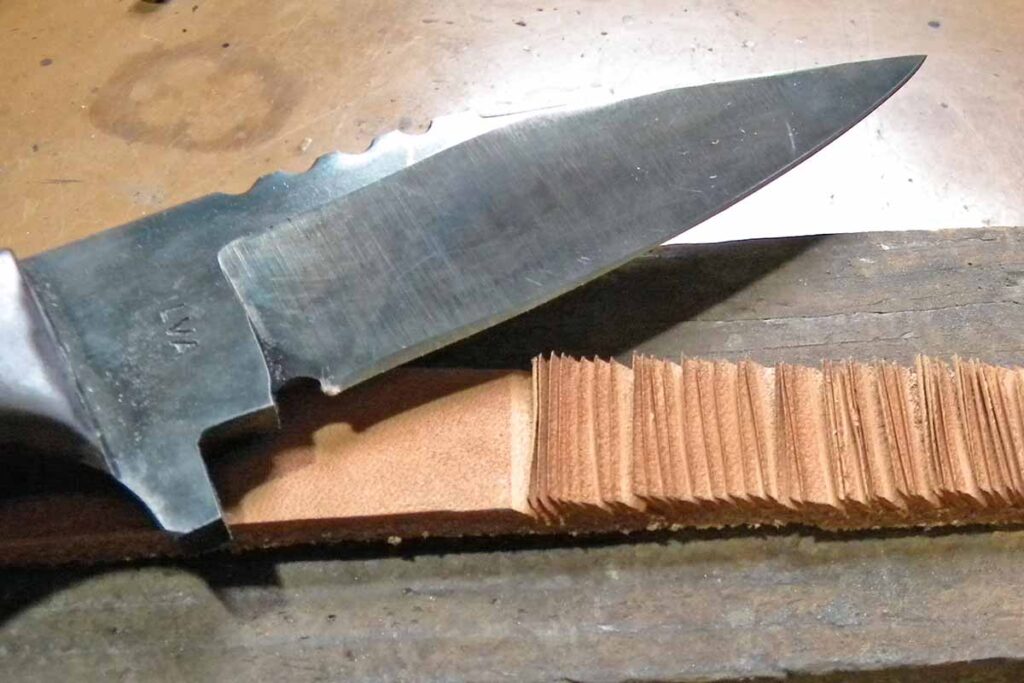
Using another piece of leather, I did some skiving. The knife made thin, even cuts. As noted, the shape of the handle really aids in controlling the thickness of the cuts. The blade was smooth and uncompromising on each slice.

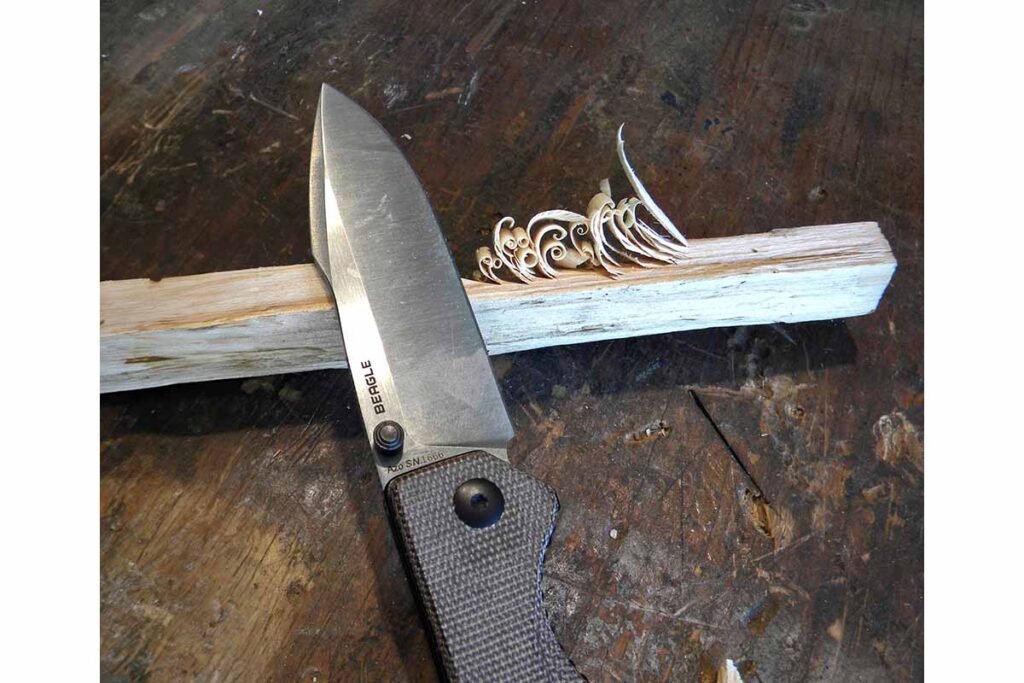
I grabbed some scrap pine and whittled a bit. The Beagle produced excellent curlicues, taking deep bites. The notches on the blade spine are just grabby enough to keep your thumb in place without abrading it. There were no hot spots on the handle.

The Beagle took deep bites in producing excellent curlicues. The notches on the blade spine are just grabby enough to keep your thumb in place without abrading it.

STRENGTH TEST

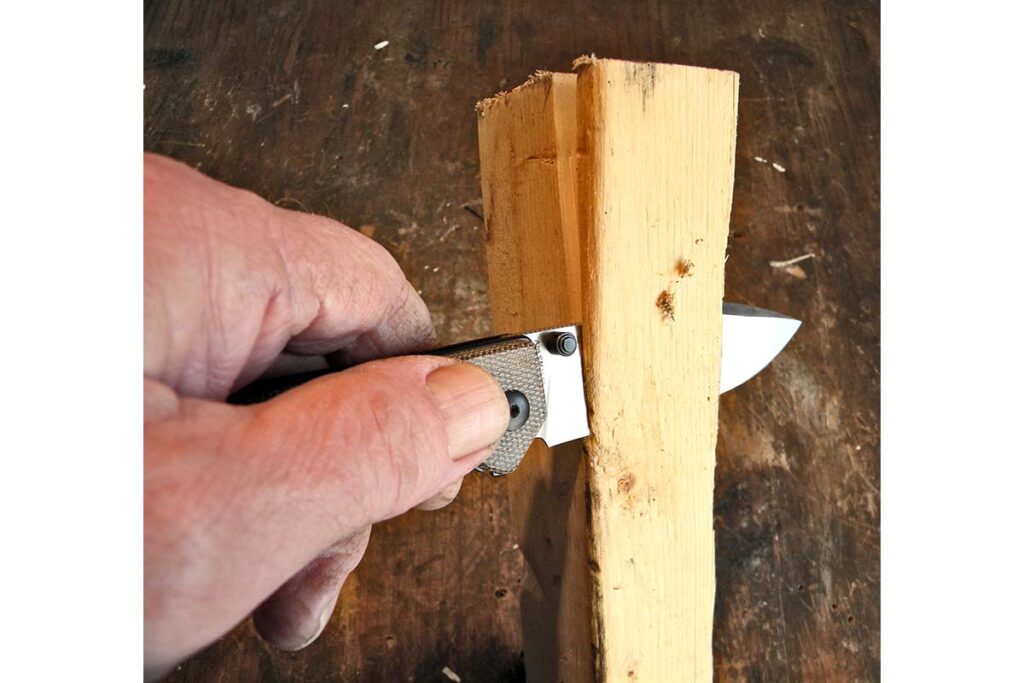
Baton cutting with a linerlock folder is not recommended but I did it anyway. On the other hand, it is a serious strength test for the lockup and liner. After several whacks there were pine pieces all over the work bench. The lockup stayed at 100 percent on every whack. The handle was comfortable throughout.

Baton cutting with a linerlock folder is not recommended but the author did it anyway. On the other hand, it is a serious strength test for the lockup and liner. After several whacks the lockup stayed at 100 percent, though the spring does appear to engage the tang too far to the right (inset). Upon later examination, however, the spring had returned more toward the left, possibly due to repeated opening/closing of the knife.

It was time to break out the half-inch sisal. The Beagle made 192 crunching cuts in the rope. I was surprised at how comfortable the handle was during cutting—not a single hot spot, warm spot or liner pinch. I’m very pleased OKNIFE paid attention to this detail. Job well done!

The Beagle made 192 crunching cuts in the half-inch sisal rope. The handle was comfortable throughout—not a single hot spot, warm spot or liner pinch.

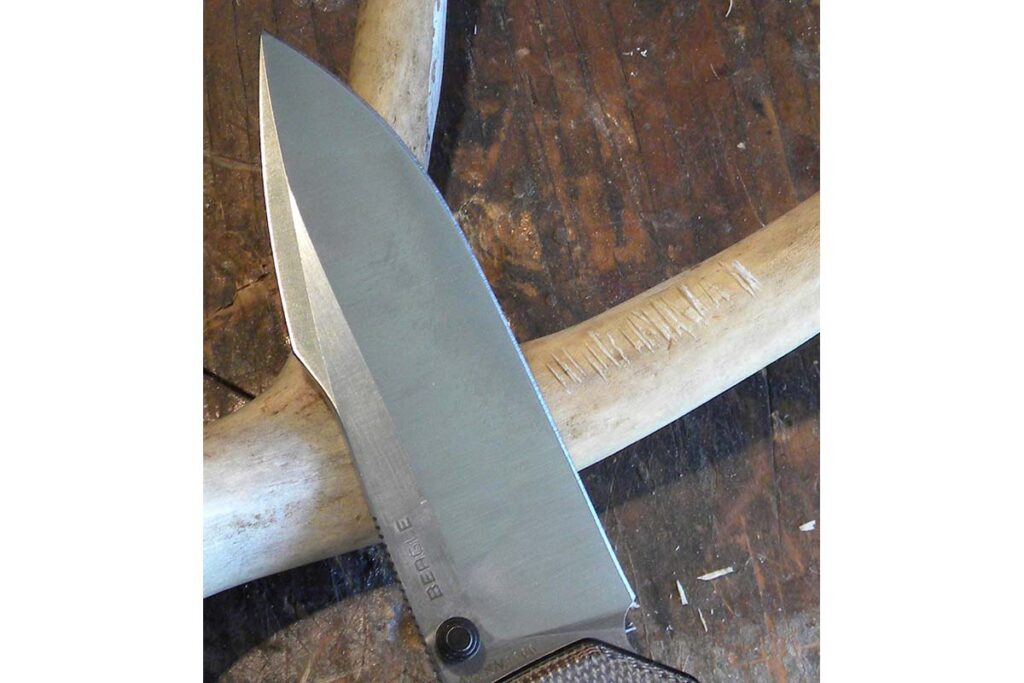
The last test for the edge and lock was chopping into a whitetail deer antler. Thirty hard whacks later and the edge had no damage. The lock was just as tight as when I started—100 percent.

In the final test, the Beagle chopped the antler 30 times with no edge damage. Verdict: heat treat spot on!

CHANGES

Maybe a few grooves in the handle for added grip?

BLADE GRADE

With its comfortable handle and sharp blade, the Beagle is a great folder for everyday carry.

OKNIFE BEAGLE Specs

Blade length: 33/8”
Blade steel: 154cm stainless
Blade grind: Flat
Blade finish: Satin
Blade pattern: Harpoon
Blade opener: Thumb stud
Handle: Green canvas Micarta®
Lock: Linerlock
Liners: Stainless
Pocket clip: Yes
Weight: 4 oz.
Closed length: 4.25”
Country of origin: China
MSRP: $79.95

More Knife Reviews:

Iron Sapper Forge Carver Review: Small But Mighty

Vincent Silva’s Carver packs healthy cutting power in a compact package.

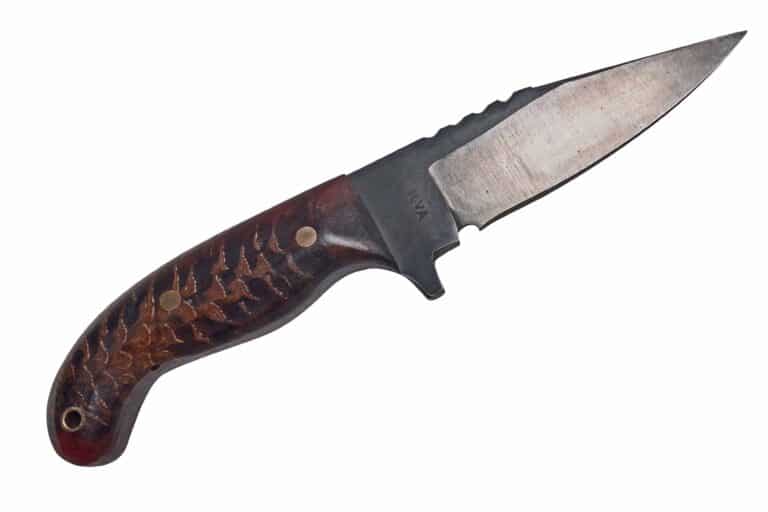
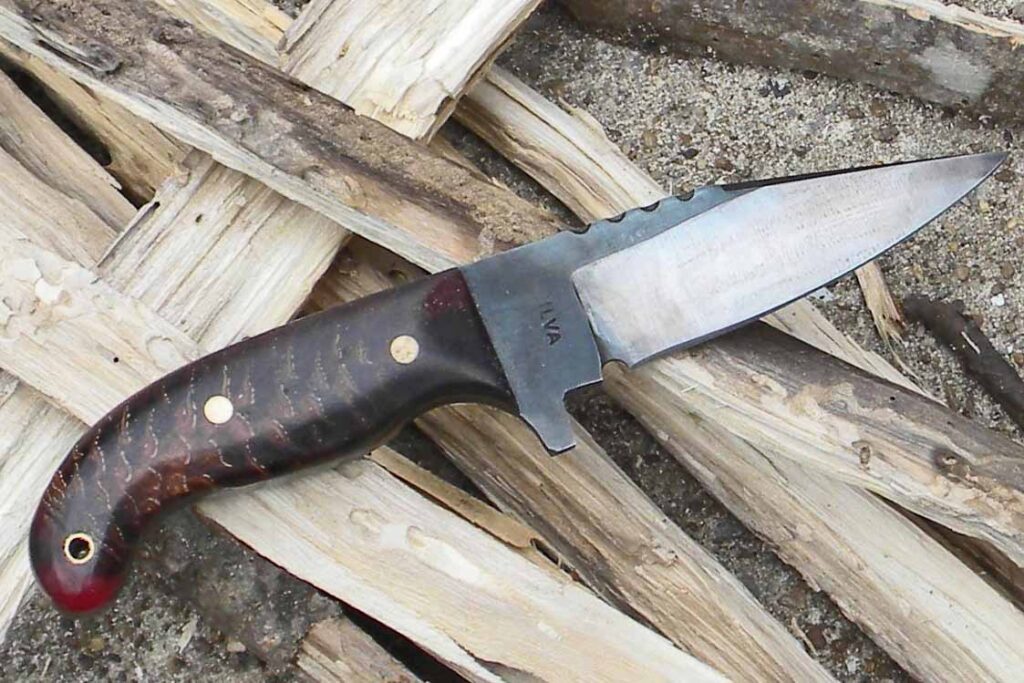
After Vincent Silva retired from the military, he came across HealingFlamesForge.org, a Tennessee-based non-profit blacksmith shop for veterans. He took to the hammers and hot steel quickly, which progressed into making knives. Creating a functional tool from a piece of steel became his goal, and the Carver is one result. It begged to be tested and I was only too happy to oblige.

Carver Light-Duty Cutting

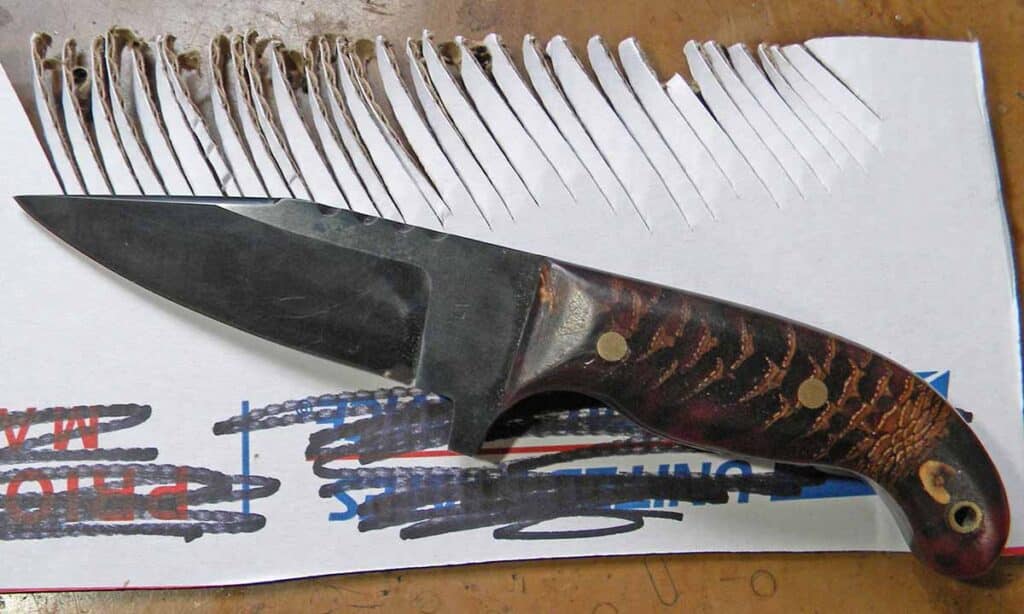
For the first edge test, the knife aggressively sliced into graphing paper even though the paper was slightly limp from the humidity. I applied smooth downward pressure and it cut cleanly. This is a well-balanced little blade.

Full-length push cuts went swiftly through the cardboard. The handle aided in blade control while keeping cuts as even as possible.

Single-walled cardboard supplied the next challenge. Full-length push cuts went quickly. It was hard to keep my fingers out of the cutting zone if I went too fast. The handle aided in control of the blade while keeping cuts as even as possible (in the cardboard, not my finger). I could hear a small crunch sound as the edge parted the material.

Carver Medium-Duty Cutting

Next up: 8-ounce leather. The Carver zipped through it swiftly. The blade’s edge geometry is spot on for working leather. I used a push cut while skiving the material.

The Carver cuts leather
The Carver zipped through 8-ounce leather very quickly. The blade’s edge geometry is spot on for working leather. The author used a push cut while skiving the material.

I like to be ahead of the game during camping weather, so a good supply of fire sticks is always a must. The Carver produced nice, feathered curlicues in some pine. The handle shape made it easy to control the depth of the feathering. All cuts came out smooth with just enough curl.

Carver Heavy-Duty Cutting

The Carver might be on the small side but it can handle such large jobs as splitting wood. Using a dead-blow hammer, I repeatedly pounded the blade through seasoned hackberry. A nice pile of kindling was the result. The handle was comfortable throughout and the blade was just big enough to beat on the tip to split the wood completely. There was no damage to the blued finish or the edge. Nicely done, Vincent.

It was time for my favorite cutting medium, natural rope—in this case, half-inch sisal on a cutting board. The Carver crunched its way to 192 cuts before the edge started to slide. The handle created no hot spots. The gimping was a tad sharp for my thumb but great for ferro-rod use. This is one cutting little knife!

The Iron Sapper Forge Carver splits wood
The knife is small but can handle such larger jobs as splitting wood. Using a dead-blow hammer, the author repeatedly pounded the blade through seasoned hackberry for a nice kindling pile.

It was back to the graphing paper for the final slice test. The blade still cut very well and lost only a bit of its aggressiveness.

To push things over the edge, I conducted a brass rod test to make sure the temper was done correctly. I could see the edge flex and return to true. Verdict: the heat treatment was spot on.

CHANGES
To mee, the edges could be softened a bit more, especially on the spine gimping. However, the Carver is a very well-made EDC sheath knife that performs at a higher level. It’s a sweet little blade.

Carver Specs
Maker: Vincent Silva of Iron Sapper Forge
Blade length: 3.5”
Blade material: 1095 carbon steel
Blade grind: Flat
Heat treatment: Differential
Handle: Pinecone resin by @sappercsmwife (Instagram)
Weight: 6.5 ozs.
Overall length: 75/8”
Sheath: Kydex or leather pouch
Maker’s list price: $250

Read More Knife Reviews:

Sharps Bros. Meanstreak Review: Keen, Mean Cutting Machine

A somewhat new player, Sharps Bros. makes the cut with the Meanstreak.

Relatively new to the knife arena, Sharps Bros. made its original mark in the gun world. The company team used their machining know-how to produce some well-built fixed blades and folders. The Meanstreak 3-inch Button Lock Folder is one of the latter.

The author said the machining of the Meanstreak’s titanium frame is “superb.”

It’s a button lock—to unlock the blade, simply depress the logo button on the bolster. The blade opens manually via a flipper. The machine work on the titanium frame is superb. Opening and closing the knife is smooth. Question is, does the blade cut?

Meanstreak Specs

Company: Sharps Bros.
Knife type: Flipper folder
Blade length: 3”
Blade steel: CPM S35VN stainless
Blade grind: Hollow
Blade finish: Non-glare
Pivot: Brass and ceramic bearing system
Lock: Button lock
Handle: Titanium and stainless
Pocket clip: Titanium, deep carry
Hardware: Torx
Weight: 5 ozs.
Closed length: 4.25”
MSRP: $200

Pros

  • Exceptional Blade Performance
  • Smooth Button Lock Mechanism
  • Superb Machining Quality

Cons

  • Potential Hot Spots

Light-Duty Cutting

I used the Meanstreak straight from the box to slice 20-pound bond paper. The knife did so smoothly and aggressively. I could hear every slice. The handle shape aided in positive control. (I had already nicked the meat of my thumb on the blade tip. Ouch.)

The edge withstood 30 antler whacks and then cut the paper smoothly to culminate testing. Spot-on heat treatment!

Single-walled cardboard was next on the test menu and the Meanstreak made short work of slicing it up. The relatively small blade cut straight with no hangups. From there it was time to slice leather scraps. I cut sideways into the 8-ounce leather and the CPM S35VN blade zipped through the medium as fast as I could move my fingers out of the way. The folder made some very nice crunching noises.

I wanted to hear more crunching, so I started skiving the leather. It was easy to control the Meanstreak, so I didn’t cut all the way through the material. This is a sharp little knife!

Heavy-Duty Cutting

Next up: whittling a fire stick. To get it to curl I used dry wood and shallow cuts. With my thumb on the spine notches, the curls started coming. Controlling depth was easy, though the inside of the frame was a little too sharp on my hand for the grip I was using. The Meanstreak made nice curlicues.

The Meanstreak made nice curlicues. However, the inside of the frame was a tad too sharp on the author’s hand for the the grip he used.

On to my favorite test medium: sisal rope. The Meanstreak produced 225 crunching cuts and was ready for more, but my arm was done. It was very forceful cutting. I wore a thin glove to protect my hand against hot spots as I used more pressure with the cuts. A fine emery board would take care of the unwanted sharp areas.

To check the edge for brittleness, I subjected it to several whacks on my trusty whitetail deer horn. After 30 hard whacks there was no edge damage. Heat treatment is spot on—excellent job! To prove it, I sliced up the other half of the 20-pound bond paper from the initial test. I could not tell the difference in blade performance between the first and last paper slices.

Final Cut


As for changes, soften the inside edges of the handle frame. (Editor’s note: The pivot could use better action as well as the blade is a bit sluggish when opened via the flipper.)

For a factory knife especially, fit and finish is impressive.

The Meanstreak is one sharp knife. Since there was no dulling of the blade it seemed like I didn’t cut anything with it at all. Plus, it’s made in the USA!

Read More Knife Reviews:

First Look: Bear & Son’s White Smooth Bone Professional Fillet Knife

Bear & Son Cutlery’s new White Smooth Bone Professional Fillet Knife delivers precision, durability and American craftsmanship for serious anglers.

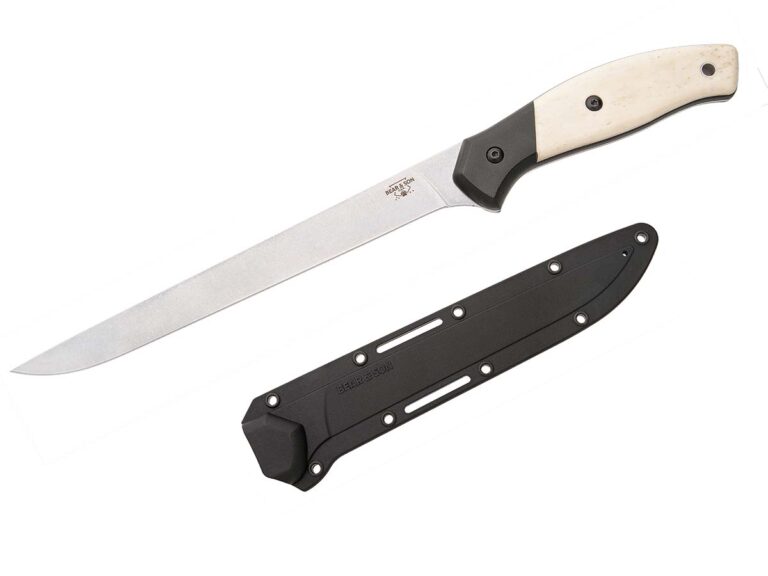
Summer fishing season just got a serious upgrade. Bear & Son Cutlery has introduced the new 11 7/8-inch White Smooth Bone Professional Fillet Knife, a purpose-built tool for anglers who demand precision from dock to dinner table.

Crafted in Alabama by a company known for keeping every step of production in-house, the WSB66 combines classic styling with modern steel performance. Bear & Son Cutlery’s fully self-contained factory handles everything—from blanking dies and heat treating to grinding, assembly, and hand-finishing—ensuring consistent quality and genuine American craftsmanship in every knife.

At the core of the Professional Fillet Knife is a 7-inch Sandvik 14C28N stainless steel blade, engineered for razor-sharp cuts, long-lasting edge retention and resistance to corrosion, even in saltwater environments. Whether trimming trout in the mountains or breaking down snapper on the coast, the blade delivers clean, efficient slices with ease.

Weighing just 4.9 ounces, the knife offers balance and control that make quick work of everything from panfish to redfish. Its White Smooth Bone handle provides a secure, comfortable grip while adding a touch of traditional character. A protective plastic blade guard ensures safe transport and storage, whether stowed in a tackle box or kitchen drawer.

True to Bear & Son’s mission of building affordable, American-made knives, the Professional Fillet Knife is designed for anglers of all levels—weekend fishermen, seasoned guides and anyone who values a dependable blade at camp or on the water.

White Smooth Bone Professional Fillet Knife Specs
Blade Material: Sandvik 14C28N Stainless Steel
Handle Material: White Smooth Bone
Overall Length: 11 7/8″
Blade Length: 7″
Features: Protective Plastic Blade Guard
Weight: 4.9 oz.
Origin: Jacksonville, Alabama
MSRP: $140

More Knife Reviews:

Advertisement

Must Read Articles

Read this before you make a knife

Knifemaking 101 – Read This Before You Make a Knife

  by Wayne Goddard My experience has taught me that there's nothing like digging in and getting started. I've often said the hardest part of the...
how to forge damascus steel

How to Forge Damascus

Advertisement
Advertisement