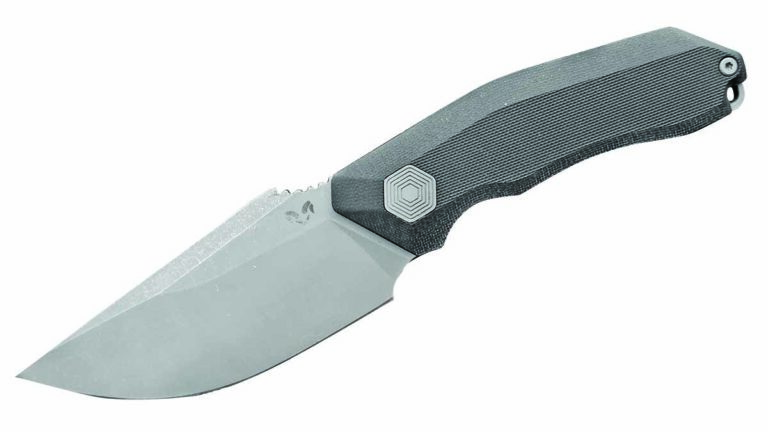
The Basilisk is a lightweight fixed blade that cuts well above its weight class.
I’m really liking the wider blade of the Basilisk* by Damned Designs. The full flat grind combined with the blade’s ample width makes for almost perfect edge geometry—a thin edge for slicing with enough meat behind it for added strength. The thinner blade stops any binding while slicing thicker material like cardboard.
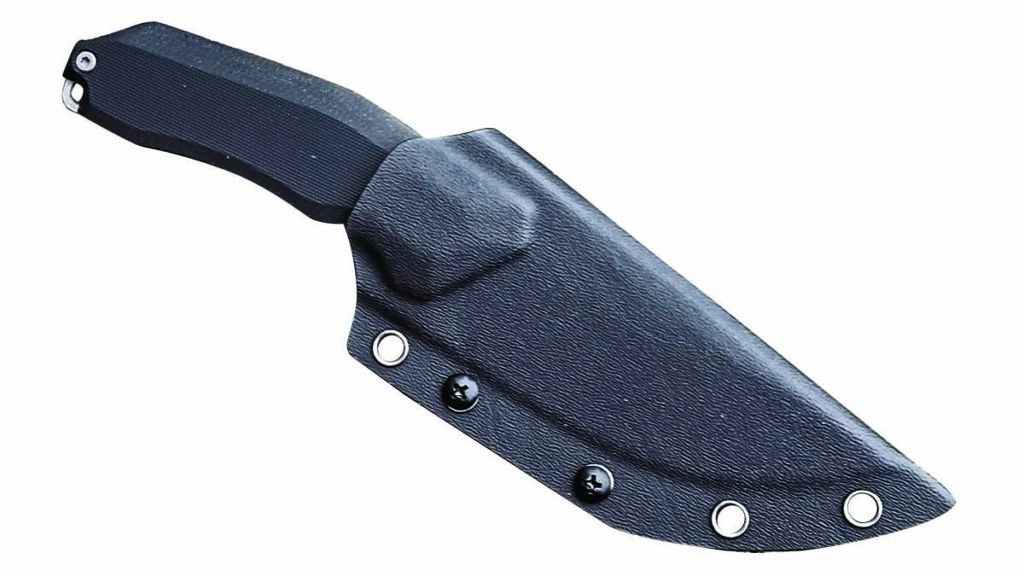
The fold-over Kydex sheath is first class.
The G-10 slabs have enough texture for a good grip. The Basilisk is a solid EDC knife. It uses Sandvik 14C28N stainless for blade material, a great using steel.
But how well does it cut?
Basilisk Sharpness Test
A baseline edge check using 20-pound bond copy paper went fast. The blade was very sharp from the factory. I’m glad I have calluses on my fingers as the Basilisk nicked them twice because I was slow getting them out of the way.
Light Cutting Duty
Single-walled cardboard was the second test medium. The blade sliced very smoothly and was aggressive its entire length. The cut strips laid straight due to the flat grind, so no binding on this one. I slowed the slicing down to save my fingers and all went well.
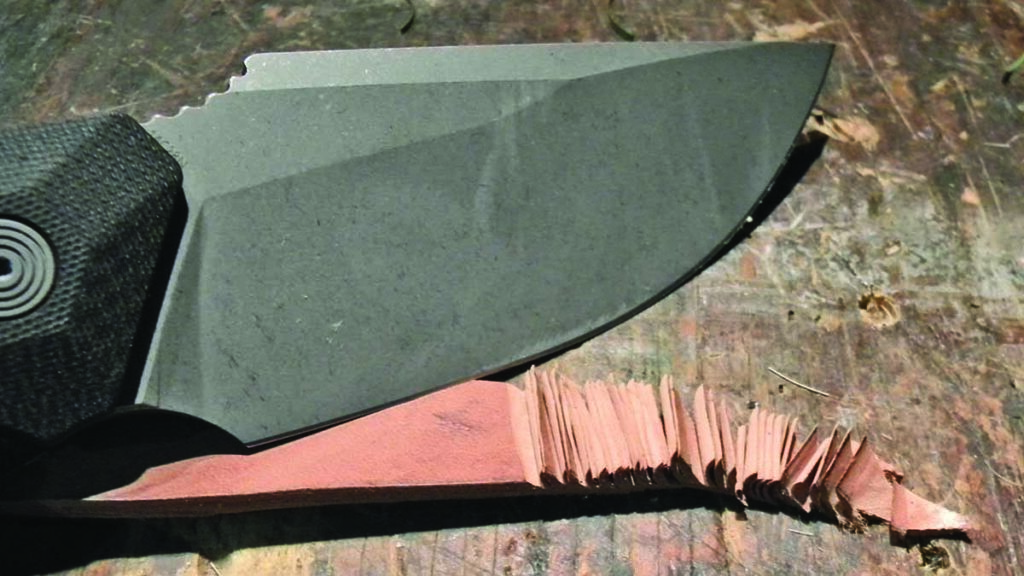
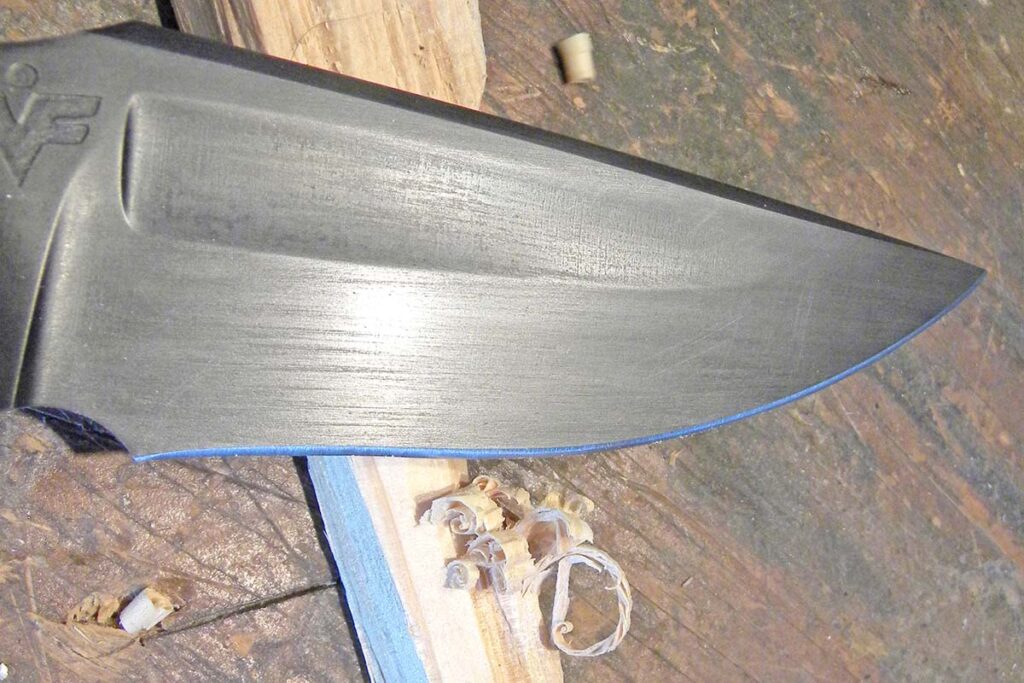
The thin edge and flat grind produced excellent curlicues for a firestick.
Eight-ounce leather was next. The Basilisk was very aggressive cutting animal skin. I could hear it slice its way through. The handle shape made it easy to control each cut’s width while also being comfortable. I also did some skiving. The Basilisk skived very quickly and evenly. Man, this knife is sharp!
Heavy Duty Cutting
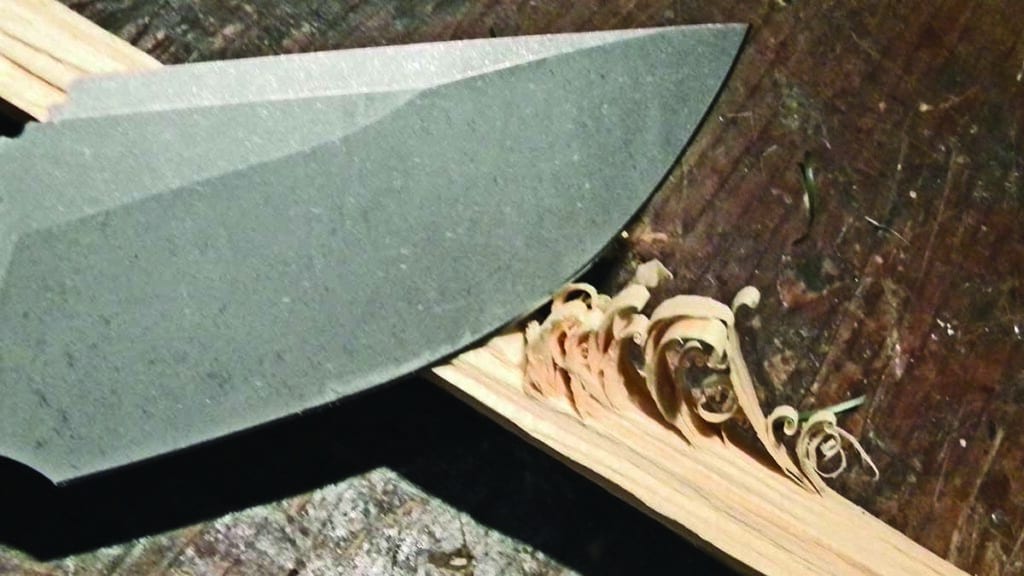
Time for making some firesticks by whittling curlicues. The thin flat grind produced excellent wood curls. The thickness of the curlicues was eminently controllable. However, when I went in for deep cuts the edges of the G-10 handle were a bit hard on my hand.
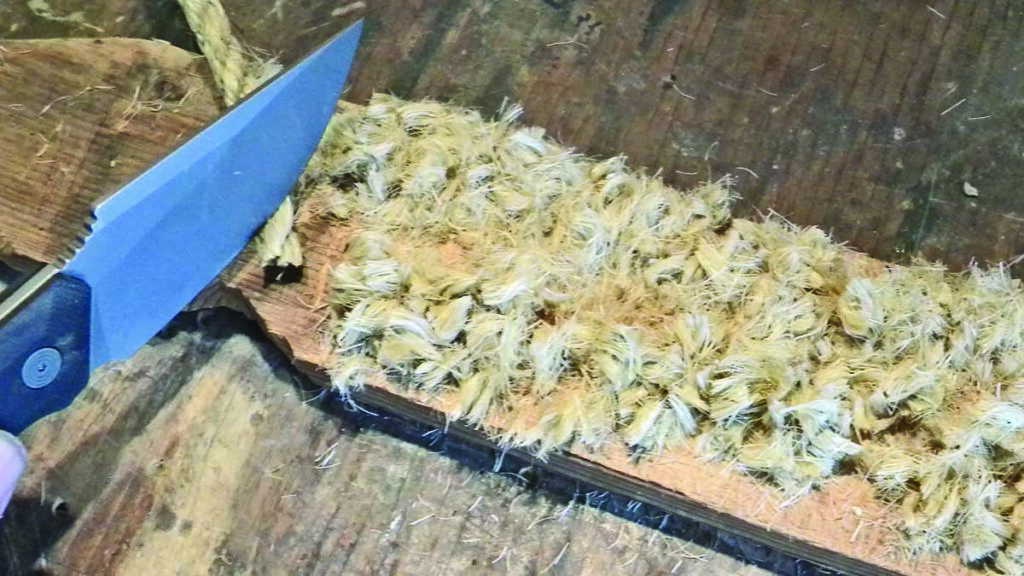
A total of 225 crunching cuts made mincemeat of the half-inch sisal rope.
Next up: half-inch sisal rope. The Basilisk made 100 crunching cuts before I had to don a glove to cover a hot spot. The knife dished out another 125 crunching cuts before I stopped. The edge showed no signs of slowing down. Total: 225 crunching cuts.
Toughness Tests
I batonned the Basilisk through some aged hackberry, a tough wood when dried. I whacked the rear, middle and tip of the blade spine for four complete splits. It worked excellent, with no damage to the edge or knife overall other than some wood smears on the stonewashed finish.
The thin edge and flat grind produced excellent curlicues for a firestick.
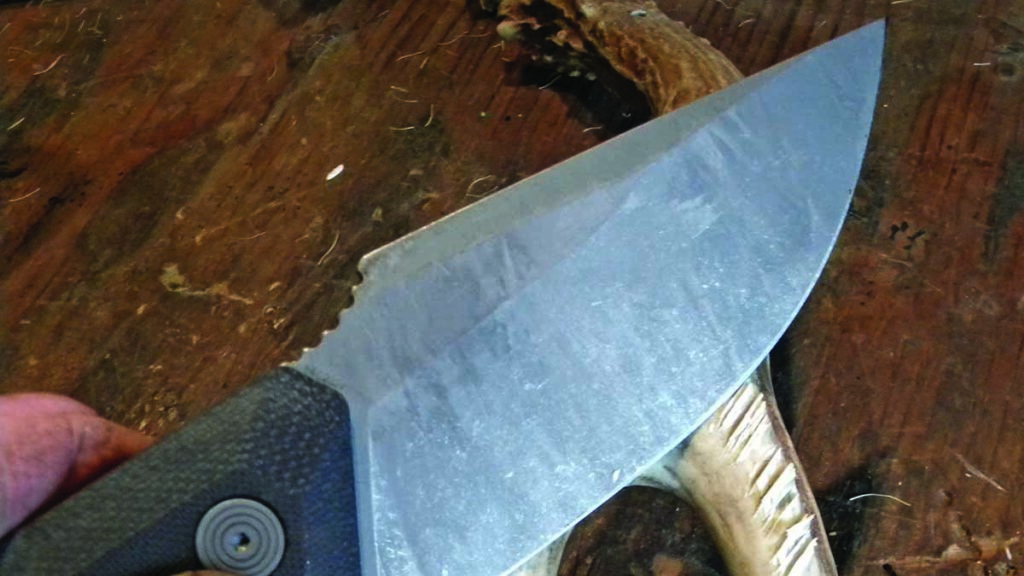
To really push the edge/heat treatment, I grabbed an old whitetail deer antler. After 30 hard whacks on it I checked the edge for chipping. There was none to be found. Heat treat is on the money for sure. Excellent job.
Edge Retention
Time to check the final edge with the 20-pound bond paper. The Basilisk still sliced smoothly even though the paper was getting damp from it raining all day. There were a few tears in the paper from the dampness.
Suggest Changes To The Basilisk
I would soften the handle edges a bit more.
After 30 hard whacks on the deer antler, the author checked the edge for any chipping. There was none to be found. The heat treat is on the money.
Final Cut
The Basilisk is a very nice knife, excellent for EDC or camp. It’s definitely a top pick on my list.
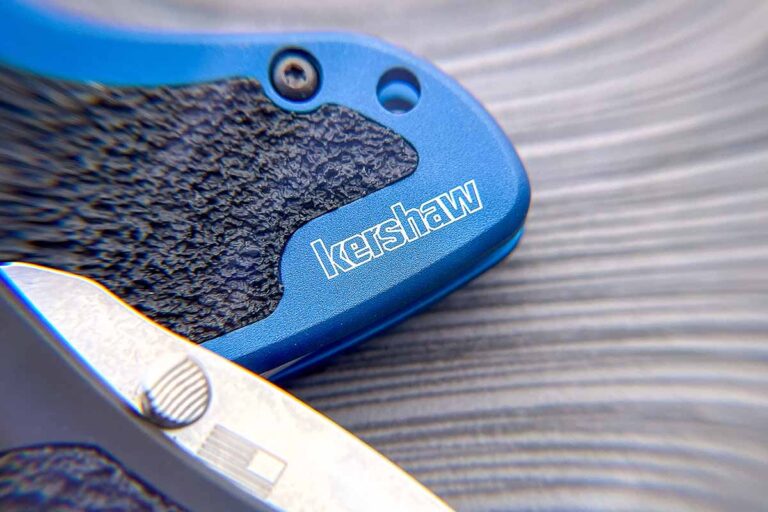
A mainstay in the company’s catalog, the Ken Onion-designed, USA-Made Kershaw Blur remains a clear EDC choice.
Kershaw’s Blur has been in the company’s line for several years and it continues to be a good seller for the company. You get it all with the Blur—a handsome look, useful blade shape, and made-in-the-USA toughness.
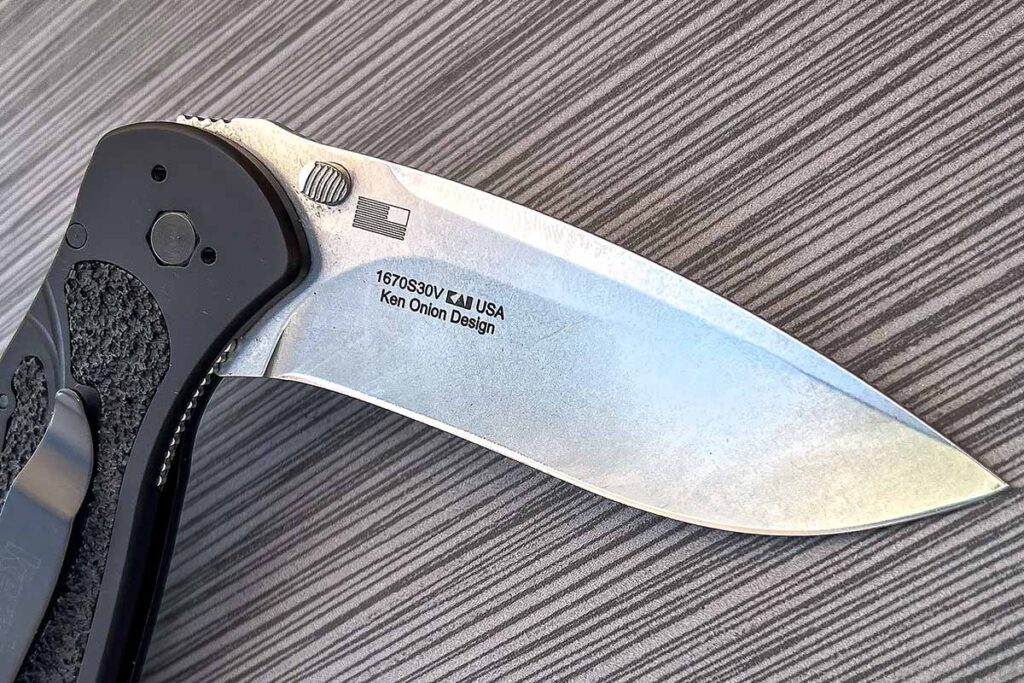
Devised by custom knifemaker Ken Onion, the Blur exhibits the hallmarks of Onion’s design with its recurve drop point blade and optimized handle shape promoting user comfort, as well as safety. Plus, you get a choice of several variations with the Blur. Each differs by blade steel and handle color, adding some style and flair to your daily carry arsenal.
Kershaw Blur Blade
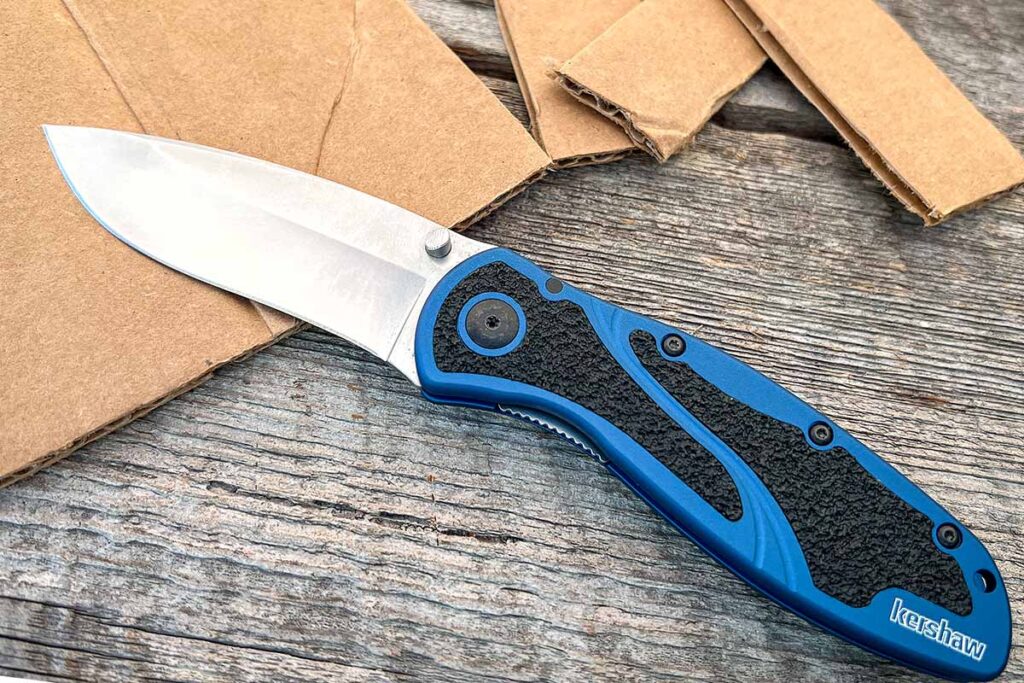
The Blur’s blade measures 3.4-inches long and is made of Sandvik 14C28N stainless steel. For those seeking a higher-performance steel, Kershaw offers an upgraded S30V version. Though the base-model steel is no slouch, as 14C28N holds an edge well, yet resharpens fairly easily. The Blur’s blade has plenty of bite right out of the box, thanks to its hollow grind.
The Blur’s blade has plenty of bite right out of the box, thanks to its hollow grind. Photos Marty Stanfield
For deployment, the Blur uses ambidextrous thumb studs. These are custom-designed studs, with a unique slanted portion. This rake allows you to bump with your thumb and then back off immediately, so they won’t be in the way of opening.
Speed Safe System
Deployment speed doesn’t disappoint, thanks to Kershaw’s Speed Safe assisted opening technology. The Speed Safe system was developed by Ken Onion and serves as a way to quickly and effectively open a folding knife blade quickly with minimal user effort. Essentially, a torsion bar propels the blade open after the user initiates blade movement by pushing out on the thumb stud.
Kershaw Blur Handle
For those who appreciate a solid and comfortable grip (who doesn’t?) the Blur incorporates some interesting design elements.
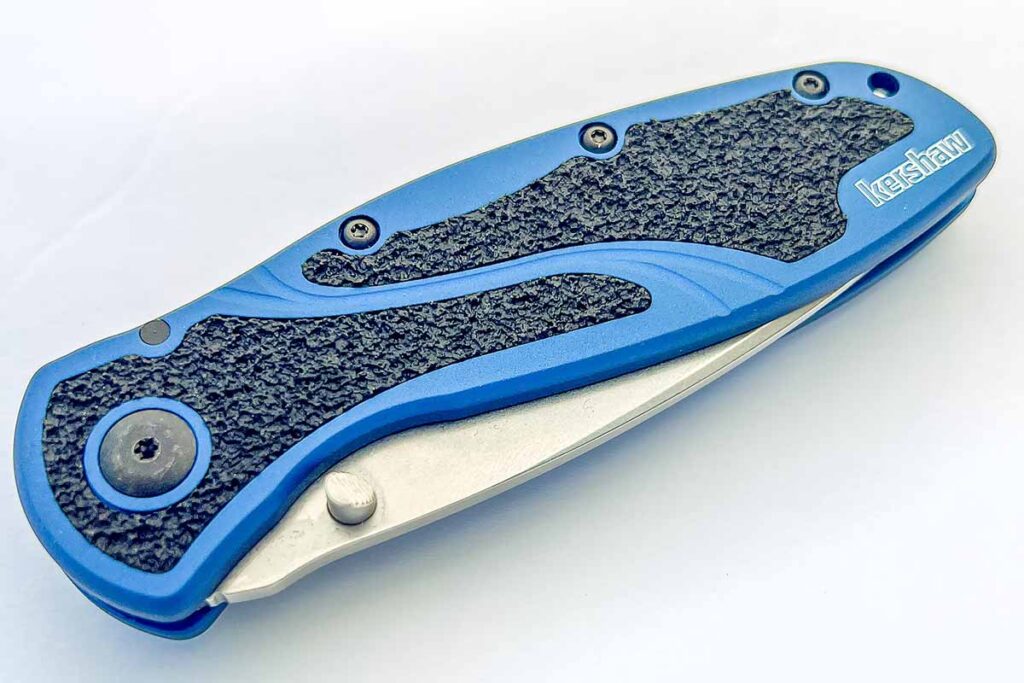
Starting with the construction, Kershaw has opted for aluminum alloy, making the handle both lightweight and strong. The shape is also well thought out, offering an intriguing and aesthetically pleasing shape, that doesn’t compromise on comfort. It’s a good example of Onion’s profound understanding of knife ergonomics.
A fluid shape, the Blur looks nice and fits the palm well. Photos Marty Stanfield
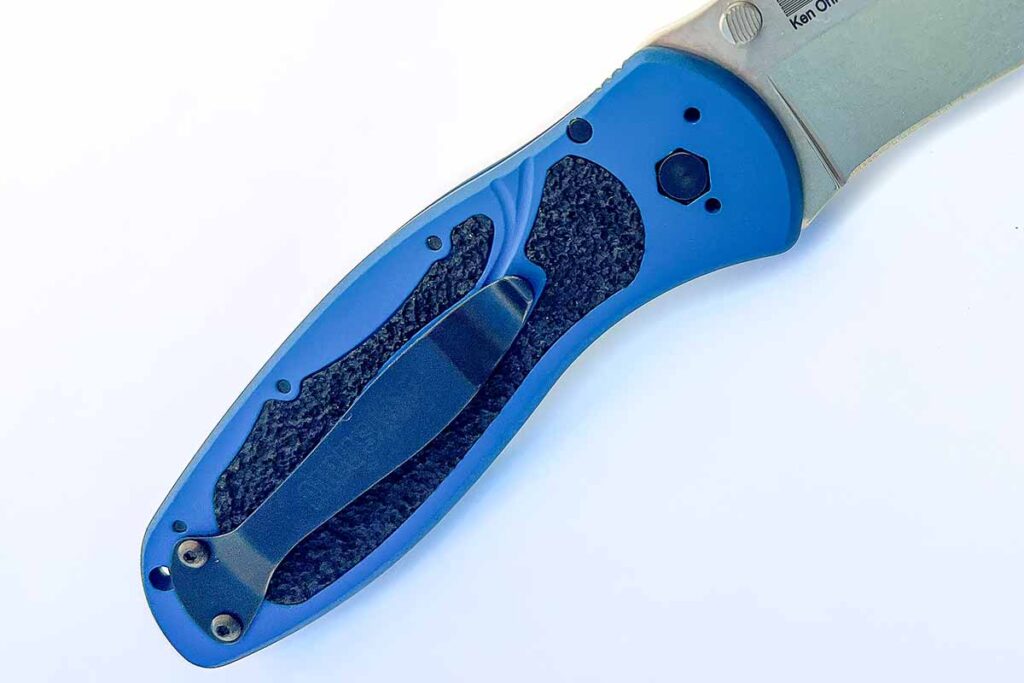
Furthering the usability, the Kershaw chamfers all the edges, ensuring there are no hotspots on the knife and textured rubber inlay inserts are a practical bonus, increasing grip traction tenfold with either wet or dry hands. Kershaw calls this material Trac Tech and it’s very similar to the self-adhesive grip tape you might find indoors in wet locations such as a swimming pool deck.
Interestingly, Trac Tech also helps with holding the knife to the pocket, making it a bit difficult to slide in and out. Depending on who you are and your particular activities, this can be a good thing or an annoyance. It is insurance from the knife falling out of your pocket, but it does slow retrieval time.
I like the use of Trac Tech on the blur simply because it gives the handle a more tactile feel to it.
Looking for more grip, Trac Tech inserts gives the Blur more bite. Photos Marty Stanfield
The general open build of the handle makes cleaning easy, especially when using compressed air or rinsing out under tap water. There is a pocket clip that helps to carry the Blur in the pocket and Kershaw gives you the option of either tip-up or tip-down carry but for right-hand carry only. Sorry lefties!
Final Cut
The Blur is a stylish EDC folding knife that doesn’t back down when there is tough work ahead. The recurve blade cuts very well, and its ample belly makes it an efficient slicer.
The hollow grind really thins the blade out nicely without making it too slender, and therefore it will cut through tougher materials with greater ease. It really excels at cardboard. I like this material for testing as it is a good standard because of its thickness and slight abrasiveness. Both aspects test the edge’s geometry.
Kershaw offers several colors and blade options, helping the Blur fit most folks style. Photos Marty Stanfield
The liner lock of the Blur is dialed in nicely, it hits the tang on the lower third of the width of the blade and allows for some wear as the lock breaks in. Yet, the lockup is very secure. The exposed portion of the lock bar that you contact to release the lock has traction notches on it so you can get a good grip on it. I thought was a nice extra touch on Kershaw’s part.
Overall, the only nit to pick is I wish the clip was designed to carry the Blur deeper in the pocket. Other than this, no real issues to speak of with the knife
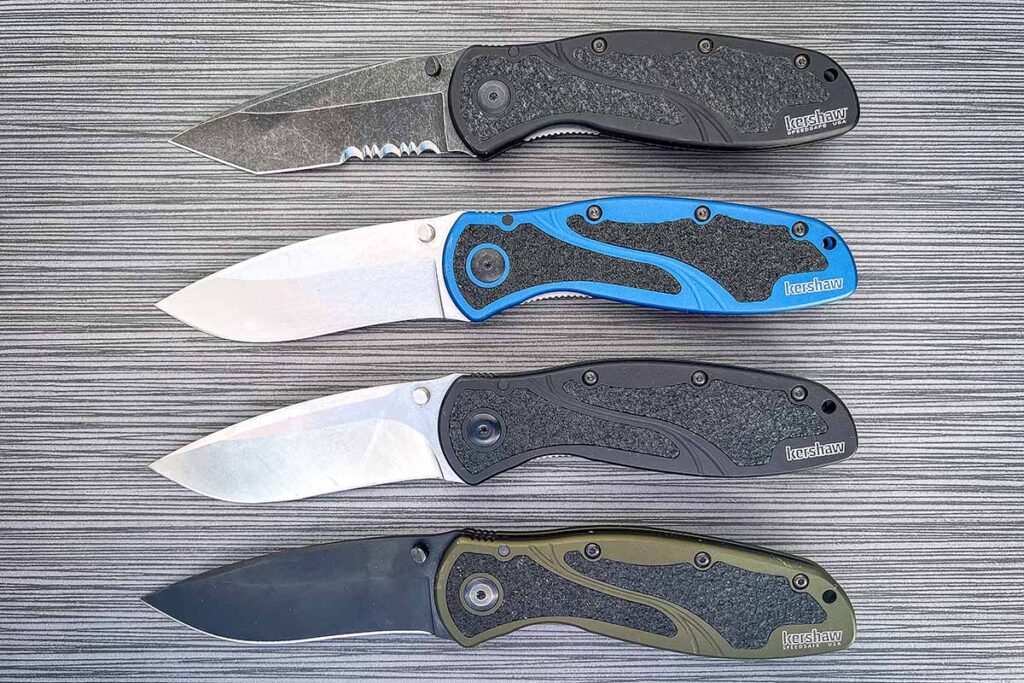
When it comes time to purchase a Blue, this might be the hardest decision because of the variety of models. There are a ton of colorways for the handle—black, navy blue, and olive green. Additionally, Kershaw offers several blade options, including plain edge and partly serrated as well as stonewashed, blackwash and Cerakote black finishes. If that weren’t enough, you also have a choice of a tanto blade as well, if that’s more your speed. Heck, there’s even an option with a carbide glass breaker at the end of the handle.
Still a classic after all these years, the Kershaw remains a solid EDC option. Photos Marty Stanfield
The Blur’s MSRP starts at $135 and goes up from there to as much as $185 depending on blade finishes. Overall, the knife presents an overall package—Onion design, high function, nice styling and plenty of options choices. What this adds up to, is an EDC option that should be welcome in anyone’s collection.
The EDC fixed blade proves itself more than just a pretty face.
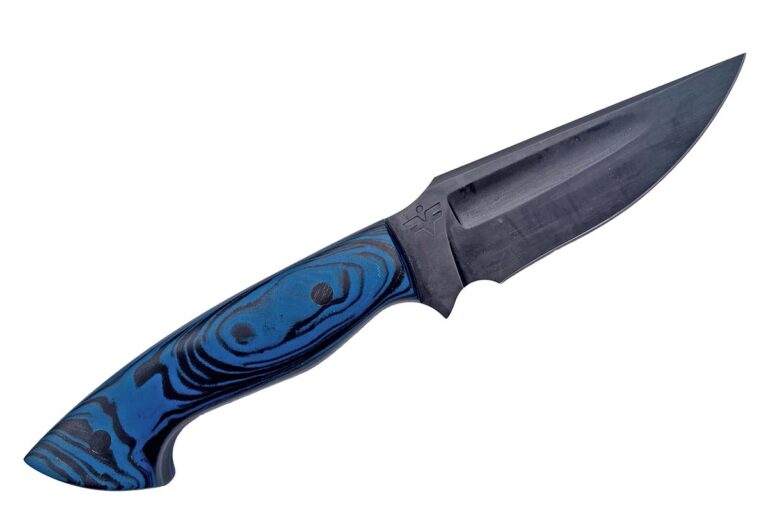
After finding First Degree Forge’s website, I reached out to Joshua Brown about testing one of his knives for “Spec Sheet.” He agreed and sent me his EDC Fighter. The shape really caught my eye, along with the blue-and-black handle. The grinds are symmetrical from side to side. I checked the handle for any epoxy gaps and found none, though I did find a few areas that might cause a hot spot or two while cutting.
Light Cutting Tests
I went straight to the 20-pound bond copy paper for the initial sharpness check. The EDC Fighter zipped through the material quickly and repeatedly. I had to really concentrate on moving my fingers quickly so I didn’t leave any DNA on the paper or the knife. Joshua’s blade is very sharp indeed.
I had an extra box to pull a slicing piece from. The cardboard parted quickly. I could feel some friction as I finished the cuts. It was the medium dragging on the thick blade spine, giving the cardboard a slight curl. However, there was no slowdown in cutting.
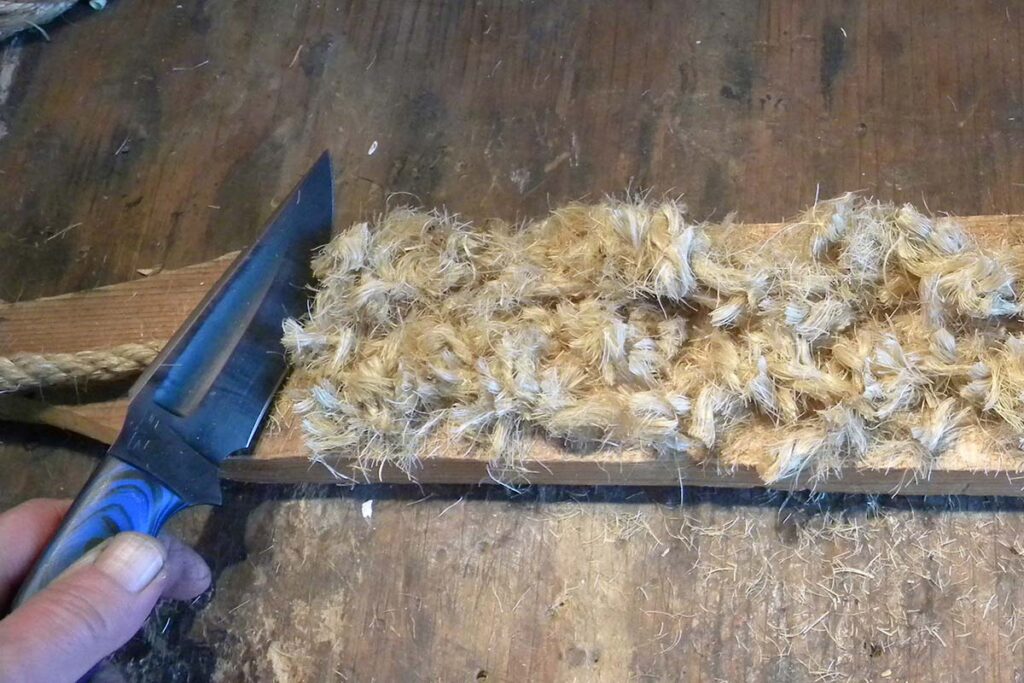
The EDC Fighter crunched its way through 190 cuts in the sisal rope.
A piece of 8-ounce leather was next. The EDC Fighter sliced it smoothly and aggressively. I could hear every crunching slice, a sound that brings a smile to my face. The handle was comfortable but felt a tad thick for my hand.
I rolled right into some skiving with the same leather. The edge crunched into the material cleanly. Overall, the EDC Fighter was quite controllable at keeping the spacing between slices even. The flat-ground blade indexed perfectly off my finger.
Heavy Cutting Tests
Whittling time! The edge produced some thick curly-cues and wanted to bite deep into the wood (there was some possible wood grain deflection). The handle made for a secure cutting grip but the steel near the choil was sharp on my skin. A little sandpaper would remove the unwanted sharpness.
Next on the menu was some baton work on a knotted pine 2×4. The large handle was comfortable and stopped any shock from transferring to my hand. The blade drove smoothly through the wood with little damage—only a little smear on the finish.
The edge produced some thick curly-cues and wanted to bite deep into the wood. The handle made for a secure cutting grip but the steel area by the choil was unnecessarily sharp on the author’s skin. A little sandpaper would remove the unwanted edge.
The sharpness test on sisal rope awaited. The EDC Fighter crunched its way through 190 cuts. I found that the thumb rest also had a sharp edge to it—again, an easy fix with sandpaper. The handle was comfy and the palm swells worked great.
The final paper slice was barely different from the first. What little problem there was mostly was caused by the paper picking up some dampness in the air. The edge remained very sharp.
Last of all was my regular semi-destructive test—whacking the edge into a whitetail deer antler. I gave the knife 30 good antler chops and didn’t hurt the edge at all. Heat-treatment grade: great!
Botton Line
The EDC Fighter is a very nice knife, comfortable to hold and an outstanding performer.
Changes
Soften the previously mentioned non-blade sharp edges where fingers or thumb meet steel.
Autumn is here and, unlike the weather, knifemakers show no signs of cooling down. If anything, factory and custom makers are as hot as ever with a ton of new knives hitting the market. We picked out 12 great-looking recent drops certain to carve a place into your heart.
Jess Hoffman Donegal
Knife pattern: Skinner Blade length: 4” Blade steel: AEB-L stainless Blade grind: Full flat Handle material: Camel bone Overall length: 8.25” Sheath: Leather Maker’s price for a similar knife and sheath: $230 Maker’s remarks: “My Donegal is a cross between a Nessmuk and a Canadian belt knife. It’s available in three different overall sizes: 8.25, 6.75 and 5.75 inches.” Maker: Jess Hoffman, jhoffmanknives.com (Jocelyn Frasier image)
Kyle Royer Damascene Hunter
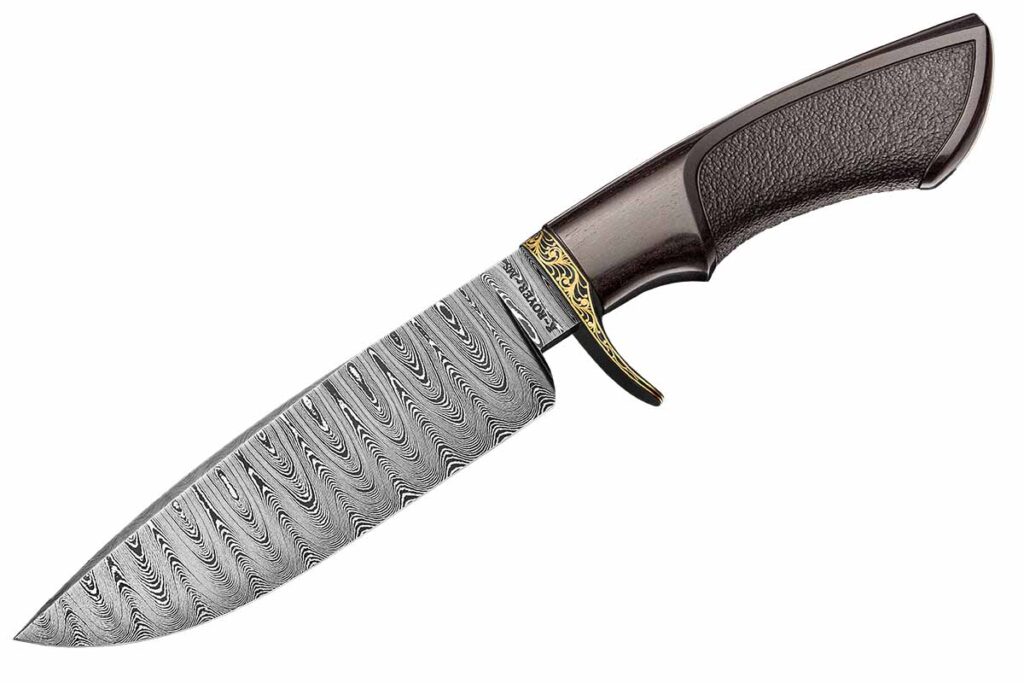
Knife type: Fixed blade Blade length: 5” Blade material: Ladder-pattern damascus of 1084 carbon and 15N20 nickel-alloy steels Blade grind: Flat w/convex edge Handle: Sculpted blackwood w/texturing Bolster: Damascene-covered guard w/24k gold and gun bluing Overall length: 9.25” Maker’s price for a similar knife: $9,500 Maker’s remarks: “This piece is particularly special as it’s the first gold overlay I’ve done using hundreds of tiny 24k-gold wires. Additionally, it has a beautifully textured blackwood handle.” Maker: Kyle Royer, kyleroyerknives.com (Jocelyn Frasier image)
Bear & Son Cutlery Farmhand
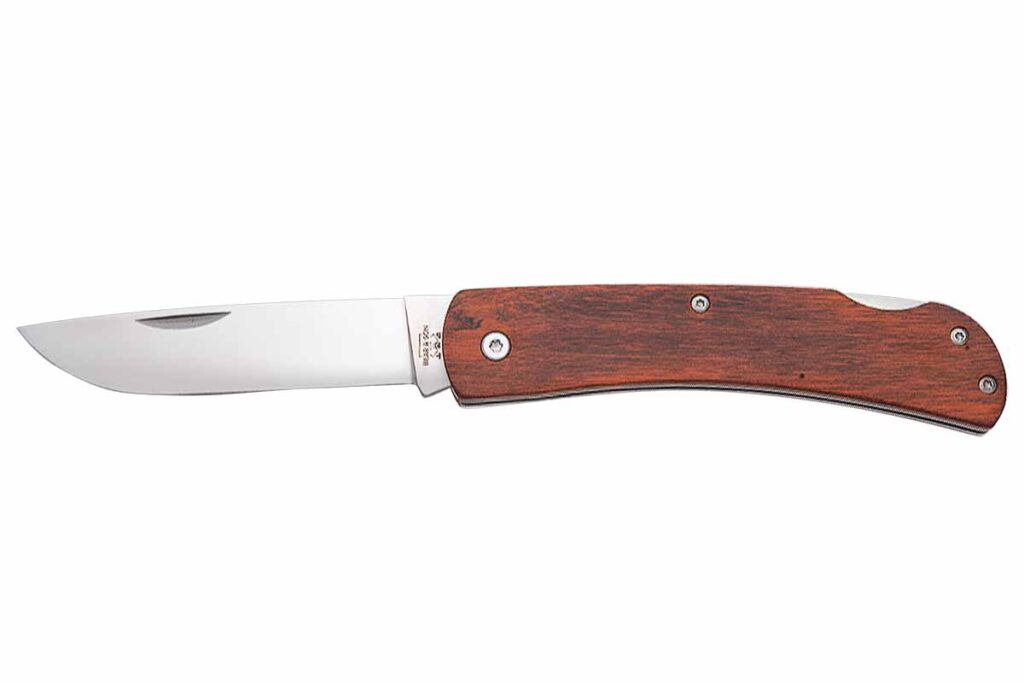
Blade length: 3 5/8” Blade steel: 440 stainless Blade pattern: Drop point Blade opener: Nail nick Handle material: Aluminum, bone and rosewood (shown) options Pocket clip: Yes Lock: Lockback Weight: 1.1 ozs. Closed length: 2.75” Knife to know: Handle color options include black, blue, orange, purple, red and white smooth bone, and brown rosewood Country of origin: USA MSRP: $37.49 to $51.99 Company: Bear & Son Cutlery, www.bearandsoncutlery.com
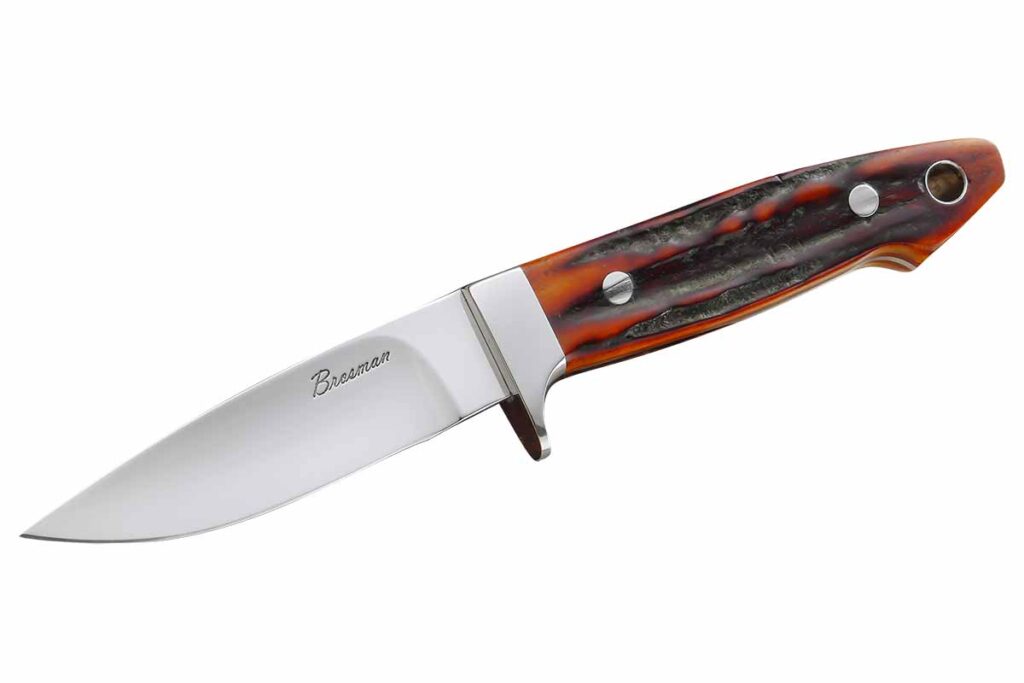
Craig Brosman Hunter
Blade length: 2.75” Blade steel: RWL 34 stainless Blade grind: Hollow Blade pattern: Drop point Blade finish: Mirror polished Handle material: European red stag and Westinghouse Micarta® liners; w/hole for lanyard Construction: Tapered tang Bolster/guard: 416 stainless Overall length: 6 9/16” Sheath: Leather pouch w/clip by Aaron Sybrant Maker’s price for a similar knife & sheath: $550 Maker: Craig Brosman, (SharpByCoop image)
Billy Pearce Hunter
Blade length: 5.1” Blade material: 1075 carbon steel Blade grind: “V” Blade thickness @ricasso: .177” Blade @widest: 1.18” Blade pattern: Clip point Handle: Bocote wood Spacer: G-10 Guard & pin: 416 stainless steel Overall length: 9.64” Knife to know: Billy Pearce is an apprentice smith in the American Bladesmith Society Maker’s price for a similar knife: Contact maker for info Maker: Billy Pearce, (Rod Hoare image)
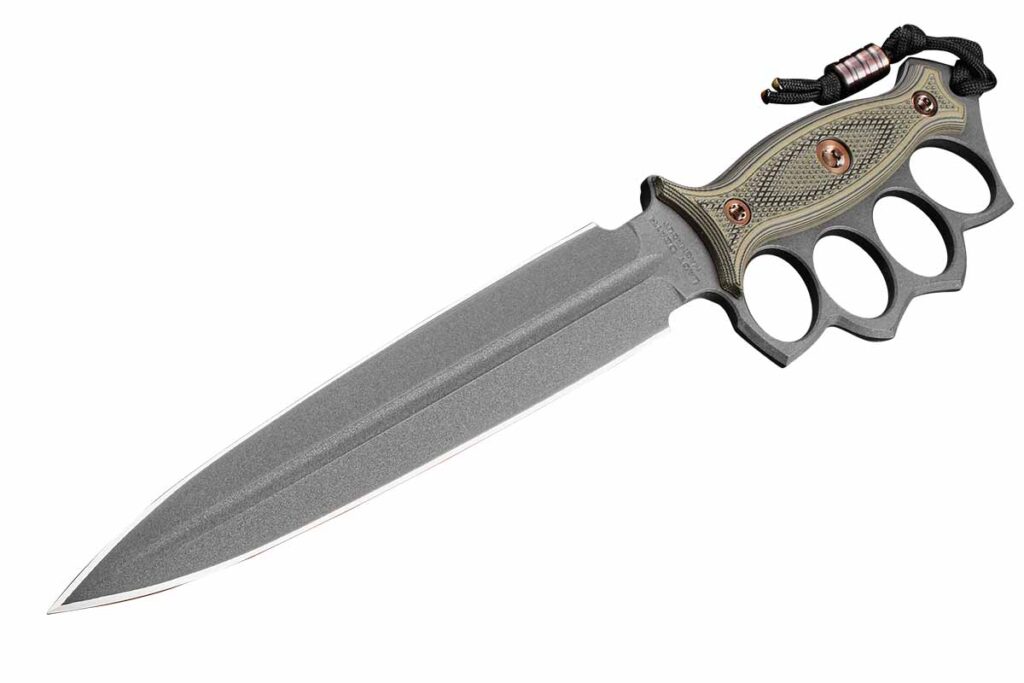
RMJ Tactical Lady Death
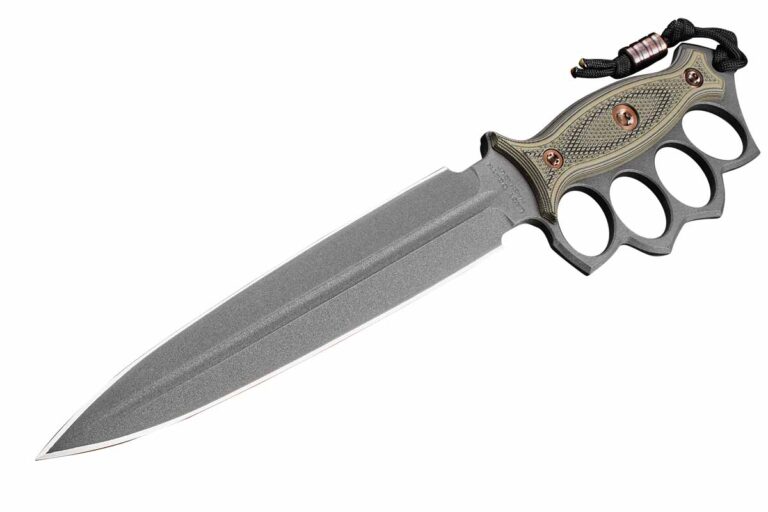
Knife pattern: Classic trench knife Blade length: 9 5/8” Blade material: CPM 3V carbon steel Rockwell hardness: 60-61 HRC Blade @thickest: 3/16” Blade finish: Cobalt Cerakote® Handle: Checkered Dirty Olive G-10 Handle hardware: Grade 5 titanium anodized bronze Weight: 18.3 ozs. Overall length: 15” Sheath: Brown leather w/green canvas inlay; ambidextrous and wears on a belt or attached to PALS webbing Knife to know: Double-edged blade w/long fuller; knuckle-duster-style handle; pommel pronounced for use as a hammer Country of origin: USA MSRP: $975 Company: RMJ Tactical, www.rmjtactical.com
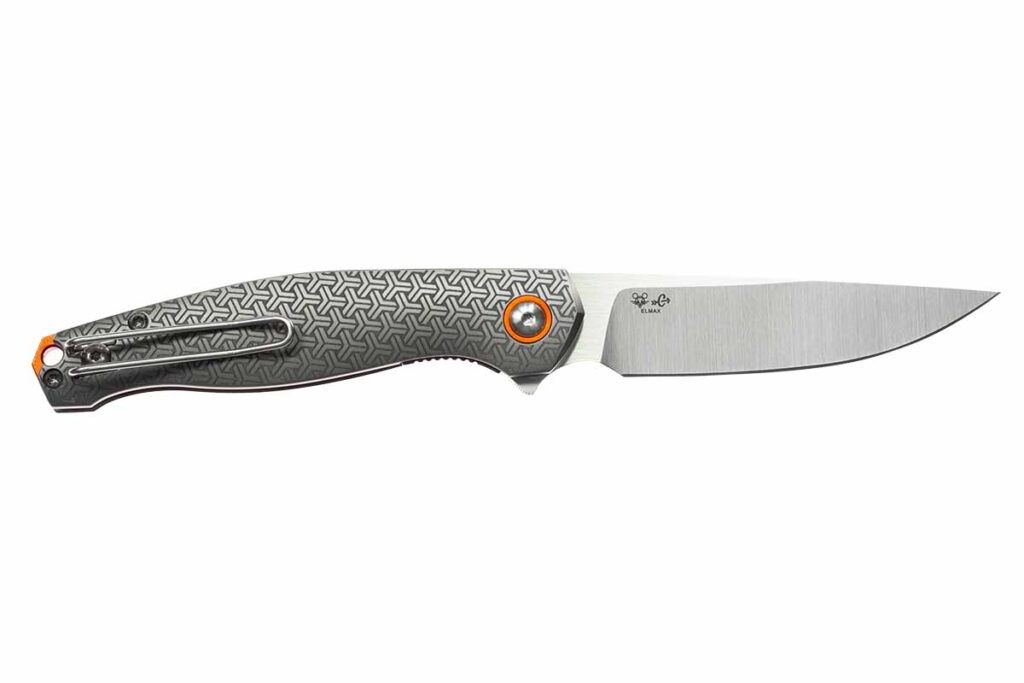
GiantMouse Carryology Sonoma V2 Auxikko
Knife type: EDC folder Blade length: 3.425” Blade steel: Elmax stainless Rockwell hardness: 60 HRC Blade @thickest: .138” Blade finish: Satin Lock: Linerlock Pivot hardware: Ball bearings Handle material: Titanium laser engraved w/the Carryology Auxikko pattern Backspacer: Aluminum anodized orange w/built-in hole for a lanyard Pocket clip: Wire, deep carry, reversible Weight: 3.8 ozs. Closed length: 4.5” Knife to know: Limited edition of 400 numbered pieces Country of origin: Made by Reate in China MSRP: $295 Company: GiantMouse, giantmouse.com
Gary Martindale Loveless Chute Knife Repro
Blade length: 4.25” Blade steel: CPM 154 stainless Blade grind: Hollow Handle: Amber stag Bolster/crossguard: 416 stainless Overall length: 9” Sheath: Basketweave-leather belt pouch w/snap Maker’s price for a similar knife: Contact maker for info Maker: Gary Martindale, (SharpByCoop image)
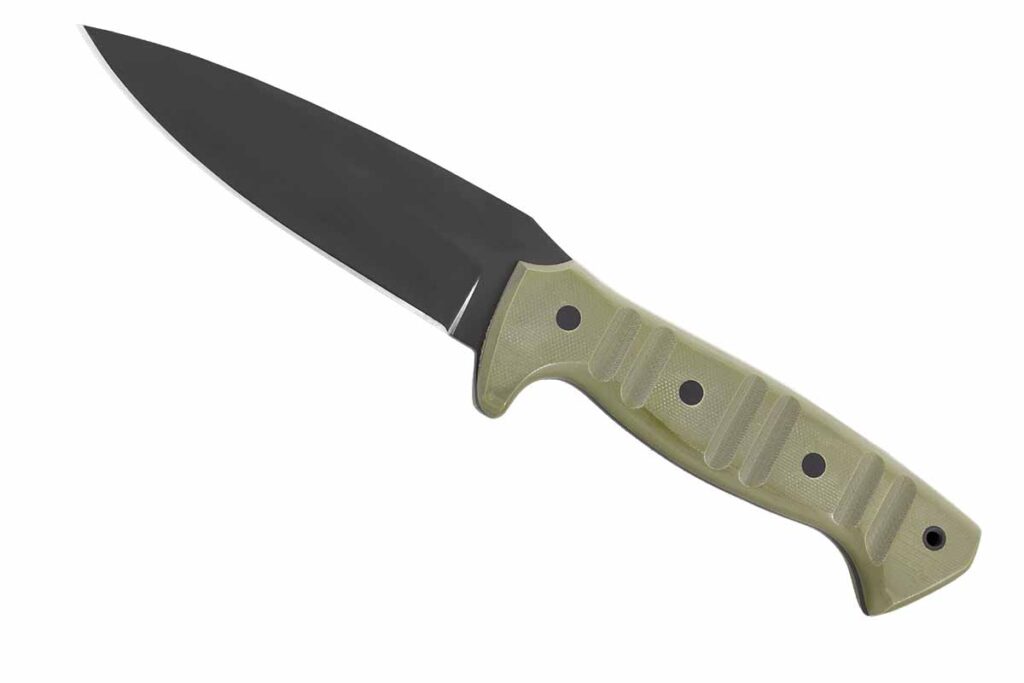
Grimdog Blades Australia Draugr Mk III
Knife type: Military utility Blade length: 4.9” Blade material: Thyssenkrupp 80CrV2 carbon steel Blade grind: Flat sabre Blade thickness @ricasso: .138” Blade finish: Cerakote® H190 Armour Black Handle material: Olive green G-10 Overall length: 10.47” Maker’s price for a similar knife: Contact maker for info Knife to know: Christian Holm is a member of the Australian Knifemakers Guild Maker: Grimdog Blades Australia, (Rod Hoare image)
Liam Walle Bird & Trout
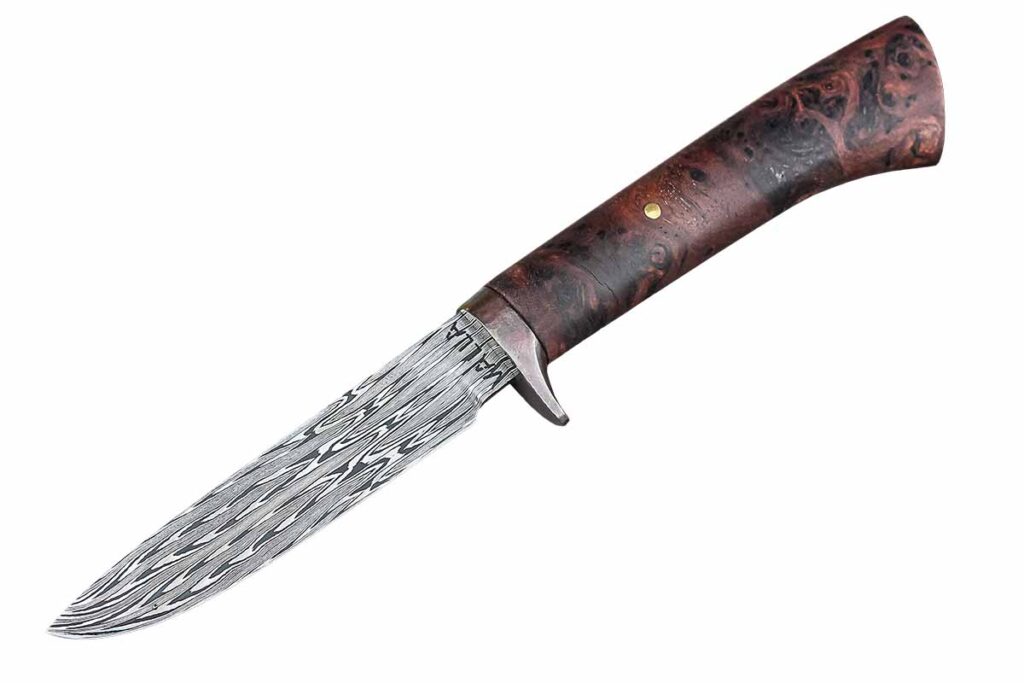
Knife type: Fixed blade Blade length: 3.6” Blade materials: Crushed W’s damascus of 1084 carbon and 15N20 nickel-alloy steels Blade grind: Flat Handle: Pōhutakawa wood w/domed brass pin Guard/bolster: Antiqued bronze Overall length: 7.6” Maker’s price for a similar knife: $750 at press-time exchange rate Maker: Liam Walle, liamvallaknives.com (Jocelyn Frasier image)
Cold Steel Full Metal Atlas
Knife type: EDC folder Blade length: 3.5” Blade steel: CPM S35VN stainless Blade grind: High saber Blade pattern: Drop point Blade opener: Thumb stud Lock: Atlas® Lock Handle: Textured titanium Weight: 3.8 ozs. Closed length: 5 7/8” Knife to know: Knife comes in all-black (shown) or standard stonewashed finishes; handle includes a single finger groove w/integral guard Country of origin: Taiwan MSRP: $229.99 Company: Cold Steel, www.coldsteel.com
Halfbreed Blades MIK-03P Gen-2 K340
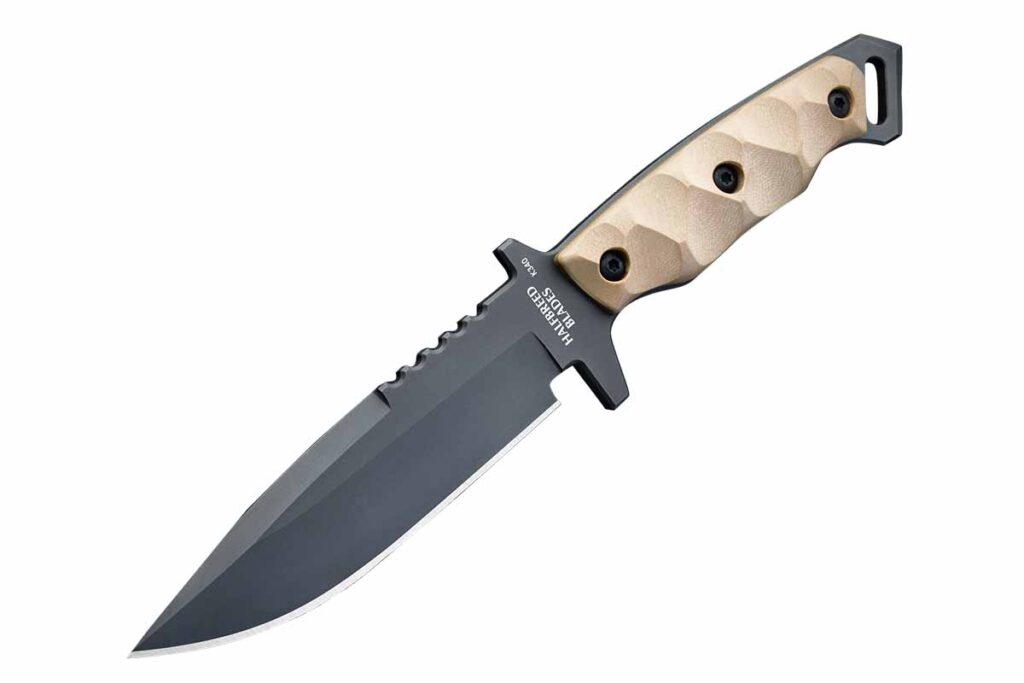
Knife type: Fixed blade Blade length: 5.31” Blade steel: K340 ISODUR Rockwell hardness: 59-60 HRC Blade @thickest: .25” Blade pattern: Modified drop point Blade finish: PVD coated Construction: One-piece full tang Handle: G-10 Weight: 11.14 ozs. Overall length: 10.43” Sheath: Injection-molded plastic w/belt & PALS/MOLLE mounting Knife to know: MIK stands for Medium Infantry Knife MSRP: $212 at press-time exchange rate Company: Halfbreed Blades, halfbreedblades.com.au
Part big knife/part small machete, 4 fixed blades do both well.
All-terrain has been used to describe the cross between a small machete and a large knife. It’s a tool that doubles as a machete for brush clearing, but, unlike a machete, can do fine cutting and, unlike even a large hunting knife, can build a shelter. It’s less than a kukri, bolo, parang or machete but more than “just” a big knife.
My team and I compared four such crossover hard-use knives, each with blades roughly 10 inches long. All use 1095, 1095 Cro-Van or 1075 carbon blade steels—in other words, alloys that are survival oriented and field-sharpening friendly. All have some standard knife features such as integral guards and bowie-type blades, and some standard machete traits like serviceable blade bellies and large handles. Some have simple, subdued features while others are more aggressive and exaggerated. All are compromises between a big hunting knife and a small machete.
To test the knives as objectively as possible, we did some common BladeSports International (BSI) trials, which have their origins with some of the American Bladesmith Society tests for journeyman and master smith ratings. Among other abilities, the knives of BSI contestants must cut through a 1-inch free-hanging rope and chop clean through a 2-by-4 board.
All test materials (hemp rope, 2-by-4s, 4-by-4 posts, paper tubes and water-filled plastic bottles) were consistent from knife to knife, and we made all feathersticks and tent pegs from the same branches. Yes, we treated backwoods knives like competition choppers to objectively find their real strengths and weaknesses.
The knives were tested right out of the box, with the factory edge and with only a 600-grit stone sharpening before all the stages were repeated to get the average results. All tests were done with bare hands—if there were hot spots during hard work or precise use, we wanted to find them. Four knife enthusiasts with different hand sizes did some of the evaluations.
ESEE Junglas
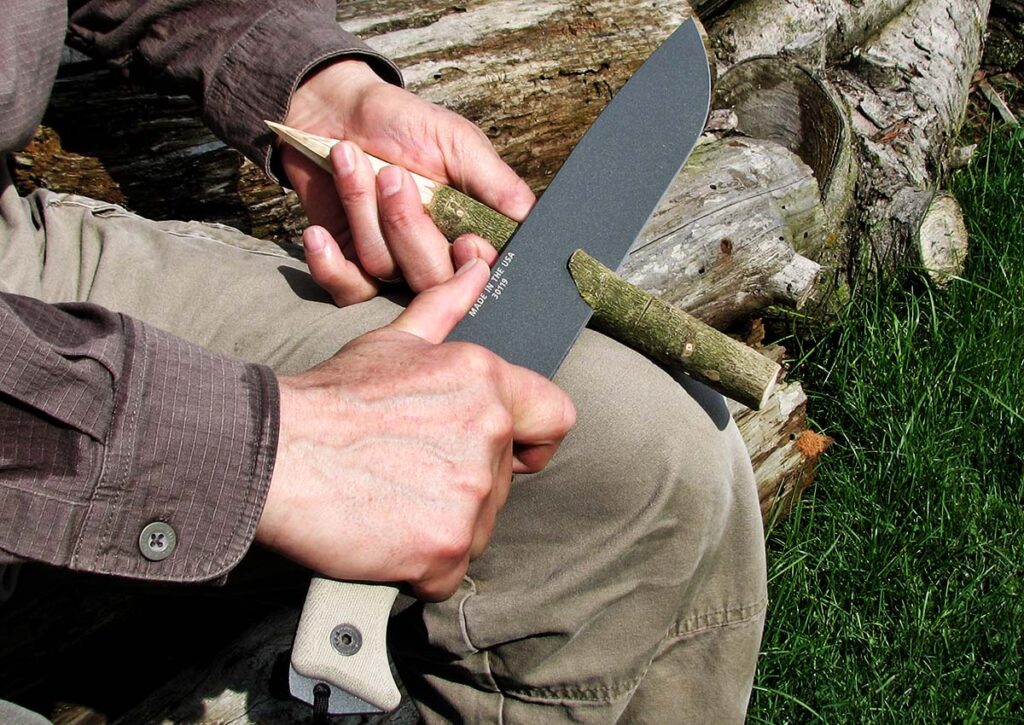
The author initially wondered if a choil would be needed for precise cutting, but got along surprisingly well without one making notched tent pegs and feathersticks with the ESEE Junglas.
Junglas Specs Designer: Jeff Randall Blade Length: 10.4″ Blade Steel: 1095 Cutting Edge Length: 9.8″ Maximum Blade Width: 2.0″ Blade @ Thickest: 0.188″ Blade Pattern: Drop Point Blade Grind: Full Flat Blade Finish: Powder Coat Handle Length: 6.1″ Handle Material: Micarta Pommel: hammer Lanyard Hole: one Weight: 23.0 ozs. Overall Length: 16.5″ Sheath Material: Kydex, MOLLE Country of Origin: USA MSRP: $309
Like most ESEE knives, the Junglas (pronounced “HOON-glas”) is based on the lessons learned from jungle operations, in this instance after ESEE co-owner Jeff Randall spent time with the Colombian Jungla Special Operations Forces. Thus the name of the Junglas, designed to have the strength and rigidity of a fixed blade and the cutting efficiency of a machete.
The 1095 of the Junglas is the go-to steel for many military, survival, hunting, camping, tactical and bushcraft blades. Compared to all carbon, tool, high speed and stainless steels, 1095 is on the low end for edge retention but in the middle for toughness. What makes it a favorite choice for survival/bushcraft knives is its toughness and very high overall rating for ease of field sharpening with small, simple hand tools. As a carbon steel it has a very low rating for corrosion resistance, which is why nearly all 1095 blades, like with the Junglas, have a protective coating.
During our tests, we found the Junglas to have excellent balance. The Micarta® scales have the right amount of texture, and their shape allowed full control and orientation of the blade and point. We initially wondered if a choil would be needed for precise cutting, but got along surprisingly well making notched tent pegs and feathersticks.
The Junglas has a Cordura®-backed sheath with snap retaining strap and full pommel cover. The sheath has an adjustable blade tension, which doubles as a knife lock. Like all ESEE knives, the Junglas is no-frills simple and totally functional. It performed extremely well in every test and in the subjective cutting impressions review. It really is a knife, ax and machete all in one.
TOPS Armageddon
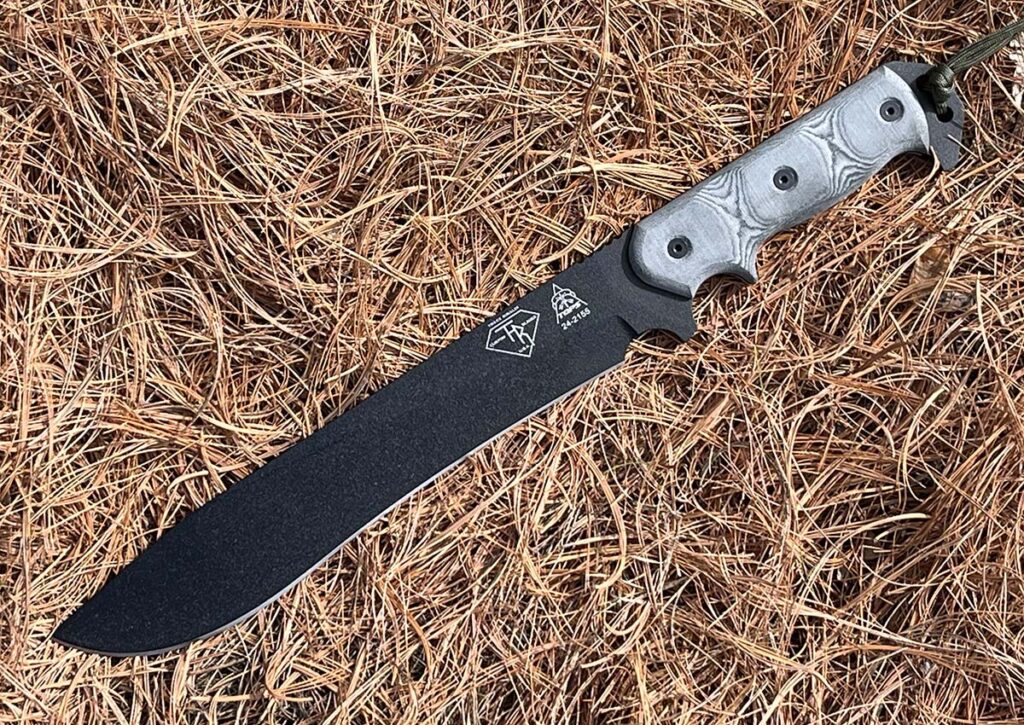
The drop-point blade of the TOPS Armageddon has a slight bolo recurve, which signals what the big knife was really good at during testing. The back-to-back choil and finger cutouts provide options in cutting techniques. Don’t be put off by the relatively short distance from the finger cutout to the bird’s-beak pommel. Choke back for chopping and choke up for precision work.
Armageddon Specs Designer: Trace Rinaldi Blade Length: 10.6″ Blade Steel: 1095 Cutting Edge Length: 10.0″ Maximum Blade Width: 1.9″ Blade @ Thickest: 0.25″ Blade Pattern: Drop Point, Recurve Blade Grind: Partial Flat Blade Finish: Powder Coat Handle Length: 5.9″ Handle Material: Micarta Pommel: Hammer Lanyard Hole: Two Weight: 24.0 ozs. Overall Length: 16.6″ Sheath Material: Ball. Nylon, MOLLE Country of Origin: USA MSRP: $350
All four review knives chopped, cut, batonned and carved nearly the same. Blade steel and edge geometry are very similar. The big differences are in the handles and the most distinctive grip belongs to the TOPS Armageddon. Consider Forged in Fire’s Doug Marcaida and his emphasis on the handle. You must be able to “feel” where the point and edge are, and the handle must not have hot spots. That said, the Armageddon grip gives some good handling options.
If you choke all the way back for chopping on this bushcraft knife, and your hand is large or larger, your little finger will be up against the bird’s-beak pommel, a definite hot spot. The obvious solution is to put your forefinger in the finger cutout. This makes the grip extremely secure when chopping, and there is plenty of room for the other three fingers. That is how we held the Armageddon during the 2-by-4 chop and 1-inch rope cut, when the big TOPS knife exhibited plenty of power.
In fine cutting, we used the choil cutout and spine gimping for precise blade control. With this grip, the finger cutout fit between the middle and ring fingers. If this grip is not completely comfortable, three minutes of radiusing and rounding with a Dremel® tool will customize the choil and finger cutouts and bird’s-beak pommel to your hand.
Blade steel is 1095. The Micarta scales are a clear solution for heavy use, offering the right amount of texture for bare hands under wet conditions. The exposed full tang can easily be hammered, and we found the twin lanyard holes helpful.
We selected or excluded knives for this roundup partially based on the sheaths. The Armageddon comes with a ballistic nylon model over a rigid plastic insert. It has two fabric-fastener handle straps and can be belt worn. The twin accessory pouches can hold a sharpening stone, fire kits, mini med kits, multi-tool and/or flashlight.
The tests showed just how effective the big TOPS knife can be. At a quarter-inch thick, it has the stoutest blade of the test bunch, which helped chop and baton. The flat grind kept the thick blade competitive during slicing tests. The choil/finger-cutout handle offers cutting technique options not found on any of the other test knives.
KA-BAR/Becker Knife & Tool BK9 Combat Bowie
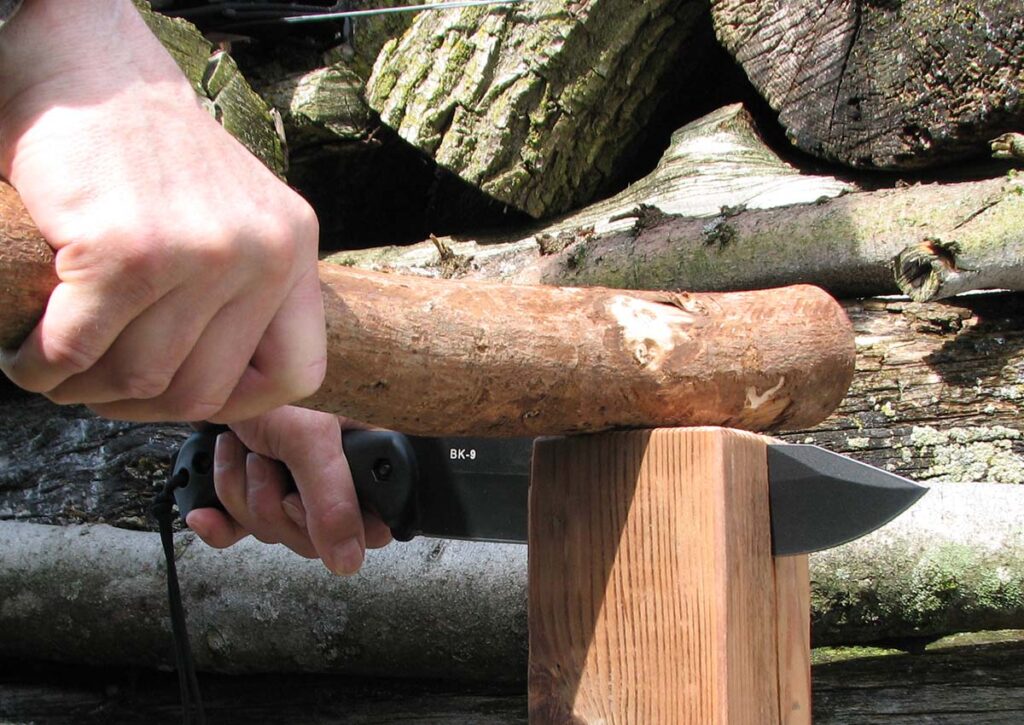
The lightest knife of the test group, the KA-BAR/Becker BK9 Combat Bowie easily split the 4-by-4 posts with no handle shock or grip slip.
The KA-BAR/Becker Knife & Tool BK9 Combat Bowie is a large, low-profile bushcraft knife. During the tests, it did everything we expected a big bowie to do. It chopped, hacked and batonned with gusto, and cut, sliced and slashed quite well, especially considering it is by far the lightest and nearly the shortest of the review knives.
Used by KA-BAR on assorted of the company’s knives, 1095 Cro-Van is essentially 1095 with the addition of several elements. Arguably, 1095 Cro-Van is an incremental improvement in edge retention and toughness over 1095. While the chemistry is there, we didn’t notice any big differences in testing.
The knife has smooth, rounded nylon scales. We decided to use from-the-factory models in the testing, even if factory parts were available to improve performance. Indeed, high-texture Micarta scales are available from KA-BAR. Somewhat surprisingly, the smooth scales with palm swell proved perfectly acceptable during testing, even the hard chopping. Since one of the tests involved cutting water-filled plastic bottles, our hands got wet. However, there was no noticeable hand slipping and the handle was comfortable in hard use.
The BK9 comes with a ballistic nylon sheath over a rigid plastic insert, and one snap retention strap. If you order Micarta replacement scales from KA-BAR, consider getting the Becker Remora skeleton knife, which fits in the BK9’s sheath pouch.
The lighter, shorter Becker excelled at smaller carving and whittling jobs. In close work, it did the precise cutting easily. We like the gimped thumb rise and used it for precision work. Overall, this is a very versatile bush blade. The big Becker punched way above its weight class in every test.
Condor Tool & Knife Plan A Bowie
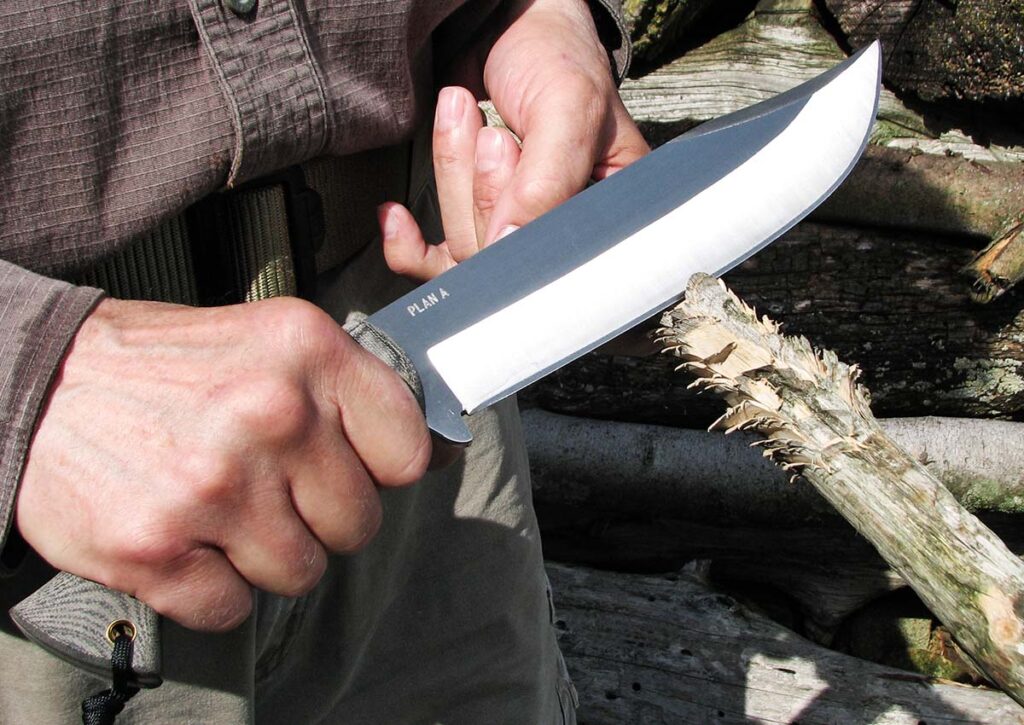
Making a featherstick tests blade sharpness, edge geometry and edge retention. It also gauges whether the knife enables the user to choke up enough for precise work. The Condor Plan A passed muster on all fronts.
Plan A Bowie Specs Designer: Julio Diez Blade Length: 9.0″ Blade Steel: 1075 Cutting Edge Length: 8.8″ Maximum Blade Width: 2.0″ Blade @ Thickest: 0.188″ Blade Pattern: Clip Point Blade Grind: Partial Flat Blade Finish: Polished Handle Length: 6.5″ Handle Material: Micarta® Pommel: Covered tang Lanyard Hole: One Weight: 18.0 ozs. Overall Length: 14.5″ Sheath Material: Kydex® Country of Origin: El Salvador MSRP: $168
The Plan A Bowie from Condor Tool & Knife is very much a big bushcraft knife, complete with an upswept, false edge, clip-point blade. It has the shortest blade of the test knives and the shortest overall length. However, the blade’s partial flat grind and longest handle of the review models kept the weight up a bit. As a result, it held its own in heavy chopping, the difficult slicing and precise carving.
The 1075 blade steel is very similar to 1095. Each alloy has slight advantages. The 1095 is harder and known for better edge retention, while 1075 is known for enhanced toughness, making it ideal for chopping.
The knife sports sculpted palm-swell scales and a pronounced kukri-type pommel swell. We found the handle comfortable and secure during testing and the subjective evaluations. The kukri swell is sharp cornered but we didn’t find it to be a hot spot.
The Condor is the only review knife with the scales covering the full tang, and an exposed tang to hammer with is sometimes helpful in the field. There is a hole for a lanyard. The full sheath has a molded retention feature and a thick leather belt loop.
The knife handled like the big bowie that it is. It performed as confidently during chopping as during slicing. It took the hanging rope, water bottles and 2-by-4 in stride. There is something special about a big, aggressive bowie and the Plan A has that something.
Cross-Over Success
Each knife was able to cross over into virtually all areas of bushcraft. Perhaps a bit more chopping to make a tent peg than carving in some cases, but the end result was still a usable tent peg. Each passed such standards as slicing through the hanging 1-inch rope and chopping through a 2-by-4. Each is a little different from the other, a little better in some areas than others. Overall, however, they are more alike in performance than different in appearance.
Check Out More Outdoor Knives:
NESSMUK KNIFE: OPTIONS IN THE ALL-AMERICAN OUTDOOR KNIFE
BEST TOMAHAWKS: OUR TOP HAWKS FOR BACKWOODS TO BATTLEFIELDS
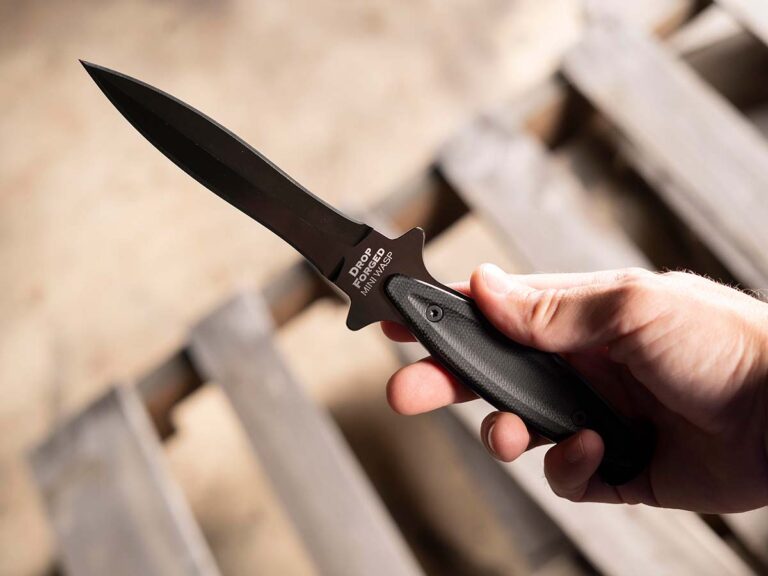
Discover the Cold Steel Mini Wasp Stinger. Get full cutting power in a compact, discreet EDC fixed blade forged from premium 52100 steel for ultimate reliability.
When you think of Cold Steel, you’re probably thinking about the gear trusted by professionals and enthusiasts who rely on their tools daily. They’re seriously recognized as a leader in the outdoor knife and tool industry, always pushing boundaries with performance and craftsmanship. But let’s talk about an EDC essential that packs a serious punch while keeping a low profile: the Drop Forged Mini Wasp Stinger.
Compact Carry, Full Power
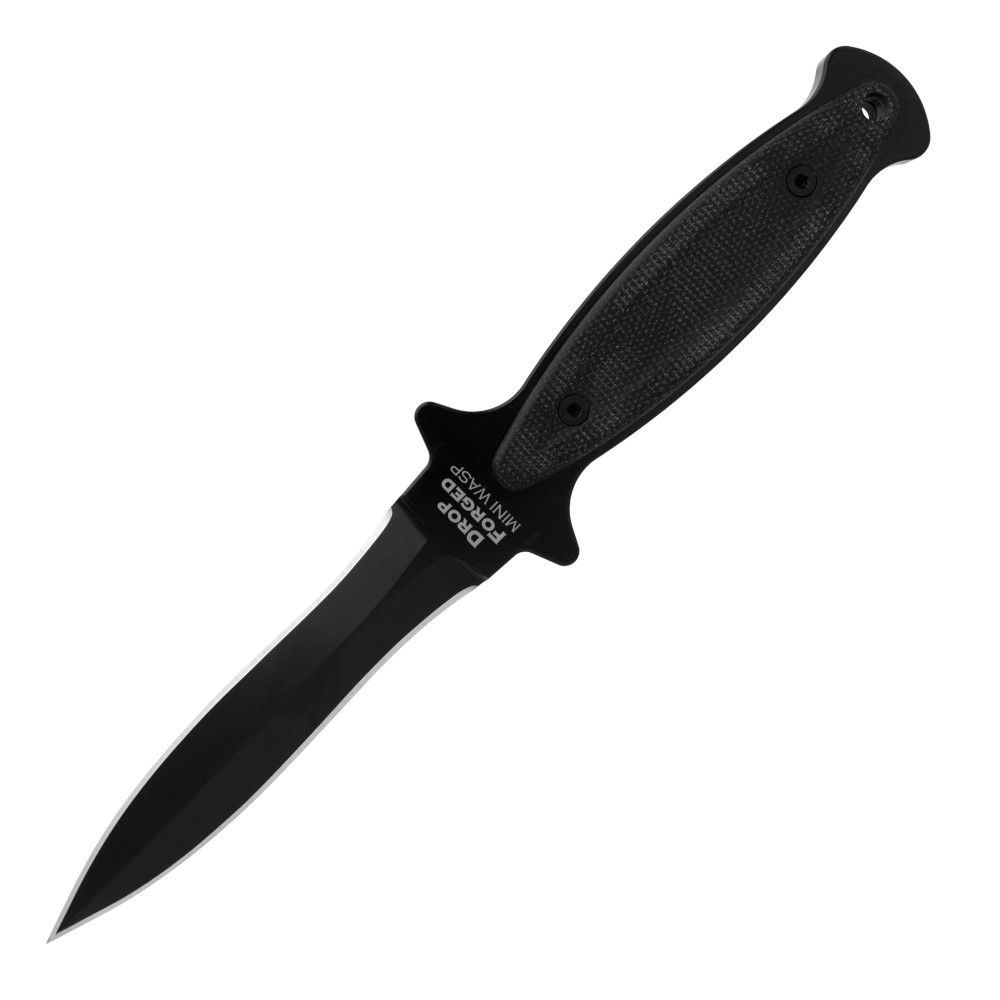
This isn’t your average pocket knife; it’s a masterful blend of compact design and unrelenting strength. The whole idea here is to give you full-sized precision and cutting power in a discreet package that “flies under the radar.” Seriously, weighing in at a mere 7.6 oz. and with a sleek 10.25-inch overall length, this fixed blade dagger is portable enough to ride unnoticed until you need it.
So, what makes it so tough?
It’s drop-forged from premium 52100 high carbon steel. This material ensures the 4-inch dagger-style blade delivers both exceptional durability and razor-sharp performance. Plus, with a robust 6mm thickness, this thing is engineered to tackle even the toughest tasks without breaking a sweat.
Precision and Confidence in Your Hand
Beyond the blade, the design is all about control. The handle features Micarta handle scales that ensure a secure, comfortable grip and, most importantly, a slip-resistant one in any conditions. That’s a huge boost of confidence for all tasks.
To keep you ready for action, the Mini Wasp Stinger comes complete with a Secure-Ex® Sheath for safe, easy storage and quick access.
This tactical dagger is truly engineered for those who demand both precision and reliability. If you’re looking for an ideal companion for discreet carry without sacrificing an ounce of power, the Mini Wasp Stinger might just be the EDC that belongs in your collection.
These replaceable-blade utility knives cut to the quick of convenient EDC.
I have to say, I have never been a fan of utility-style knives for everyday carry. Certainly, there is a place for them, and they are suitable for a multitude of jobs a regular knife might not do as well. Handyman detail comes to mind, where an always sharp blade and thin edge are appreciated. However, traditional everyday carry knives tend to excel in EDC duty, except, perhaps, in one facet—convenience.
From air travel to avoiding the sharpening stone, EDC utility blades have an undeniable edge on their fixed and folding counterparts. Additionally, knifemakers have further improved the utility of these pocketable cutters, offering different blade styles tailored to different circumstances, allowing the right tool for the job.
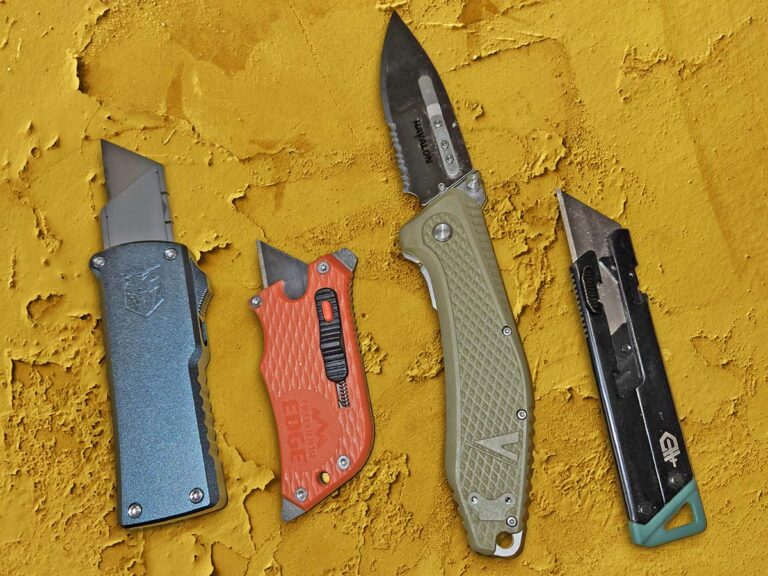
I grabbed four replaceable-blade knives and took each of them to work with me to see the pros and cons of each. A large part of my focus was on convenience, as you can buy different blades for all of them, save one. Let’s roll on to what I found out about these tools while putting them to work.
CobraTech OTF Utility
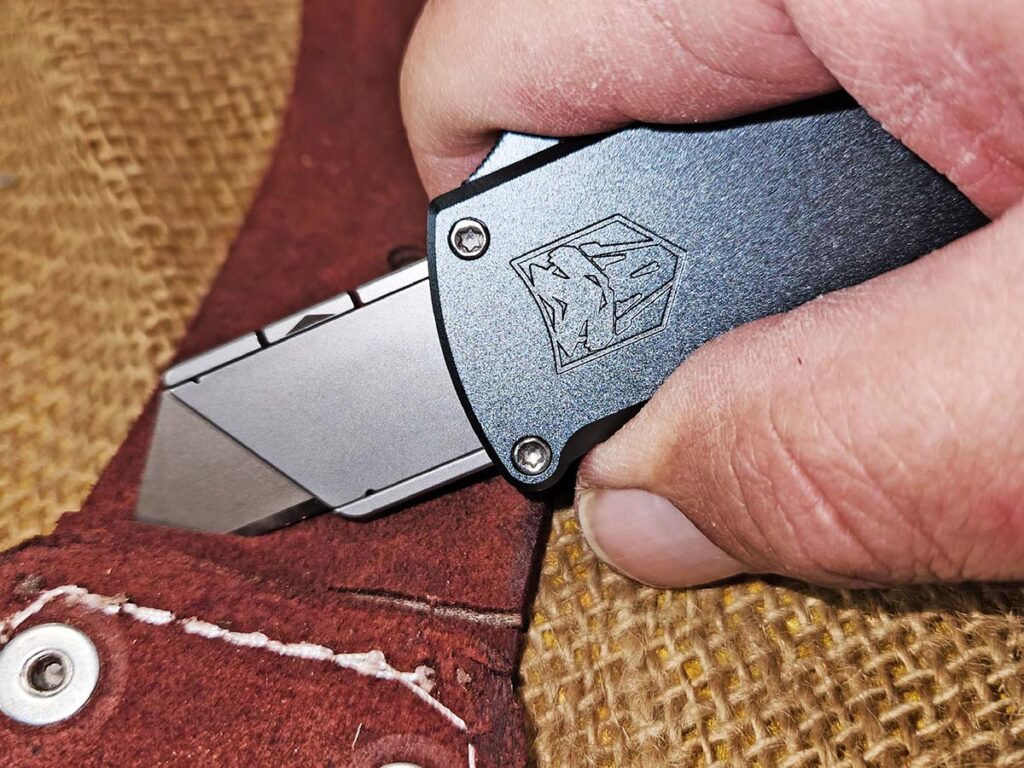
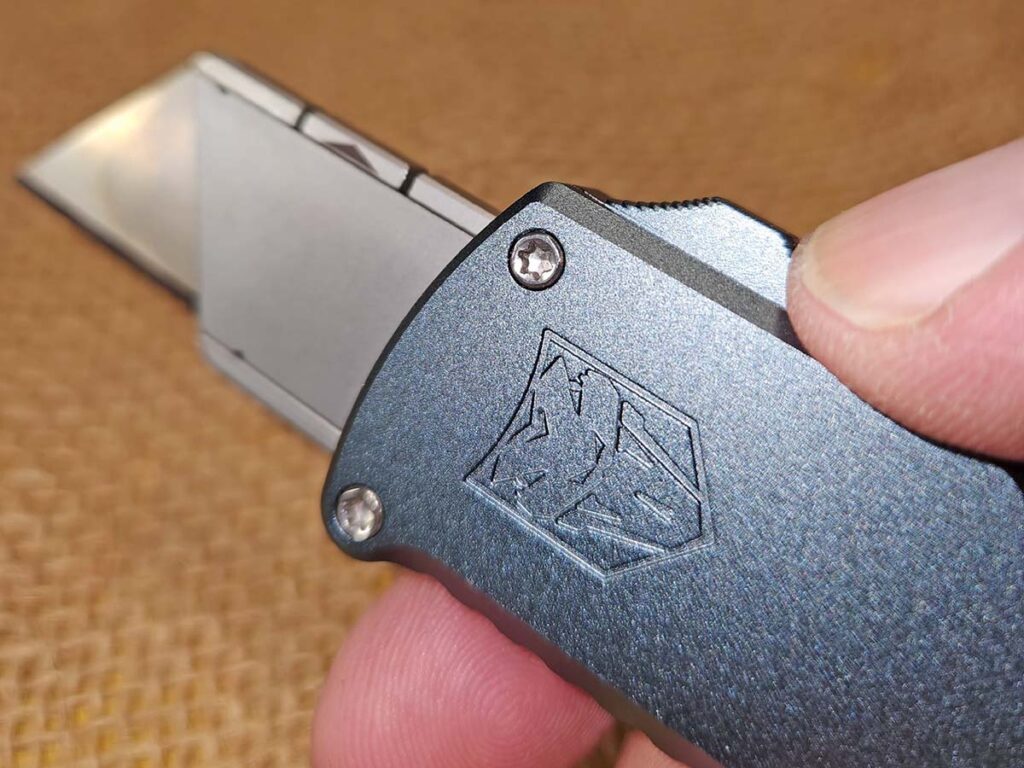
The fact the blade holder on the CobraTec extends further out from the handle gives you the opportunity to get a better look at the edge for fine cutting. When it is important you follow a precise line for an accurate cut, you want to see the blade.
I thought I would start off with the coolest concept for a replaceable-blade utility knife. For folks who need a fidget toy, CobraTec’s OTF Utility fits the bill. Someone there had their thinking cap on with the design. It takes a standard utility blade—with toolless replacement—but this genre offers several styles—hooked, serrated and razor. If you need some added durability, titanium-coated and ceramic blades are options. Note, pay attention to the blades you use; the quality can vary widely.
CobraTec’s OTF works just like any other OTF automatic, perhaps making it among the coolest utility knives.
The body of the knife is built out of 6061 aluminum that is anodized blue or green. For the blade bracket—what holds the blade—CobraTec uses steel. There was only a small amount of play in the bracket when deployed, an important feature. You want as little wiggle as possible to facilitate an easy and accurate cut. The OTF Utility is a double-action auto, shooting the blade in and out crisply through a switch on the side. The company provides two carry options: a sturdy pocket clip and a small nylon belt pouch. Personally, I would chuck the pouch. The pocket clip makes it much more convenient. It is a solid tool and cool as well. The OTF Utility has an MSRP of $90.
Outdoor Edge Slidewinder
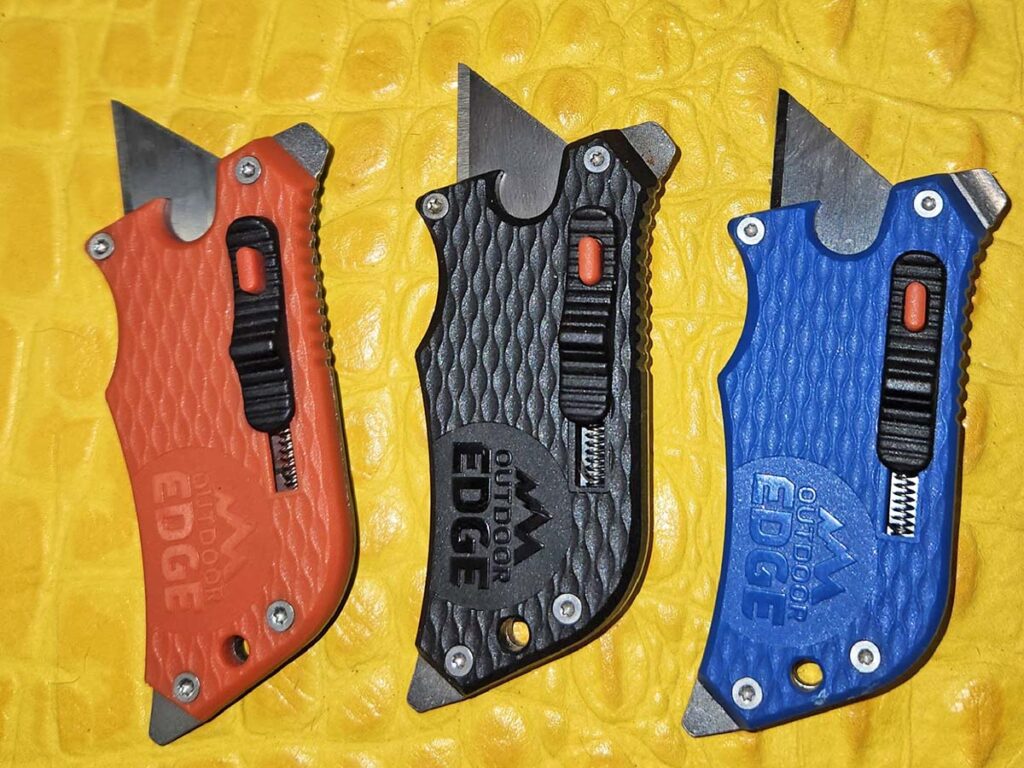
The one drawback to the light-duty SlideWinder is it doesn’t offer much blade when fully deployed. On the flipside, it does give users a splash of color with three different options: orange, black and blue.
Outdoor Edge has a neat little tool in the Slidewinder. I first stumbled upon this when I was looking for something TSA-compliant to take with me to trade shows. The blade is easily removable, and the frame by itself should pass through TSA. At least it has for me in the past. I have taken it on a few airplane trips without a hassle. Keep in mind, in the end, it depends on what TSA agent you get when you go through security. When I get to my destination, I simply buy another blade.
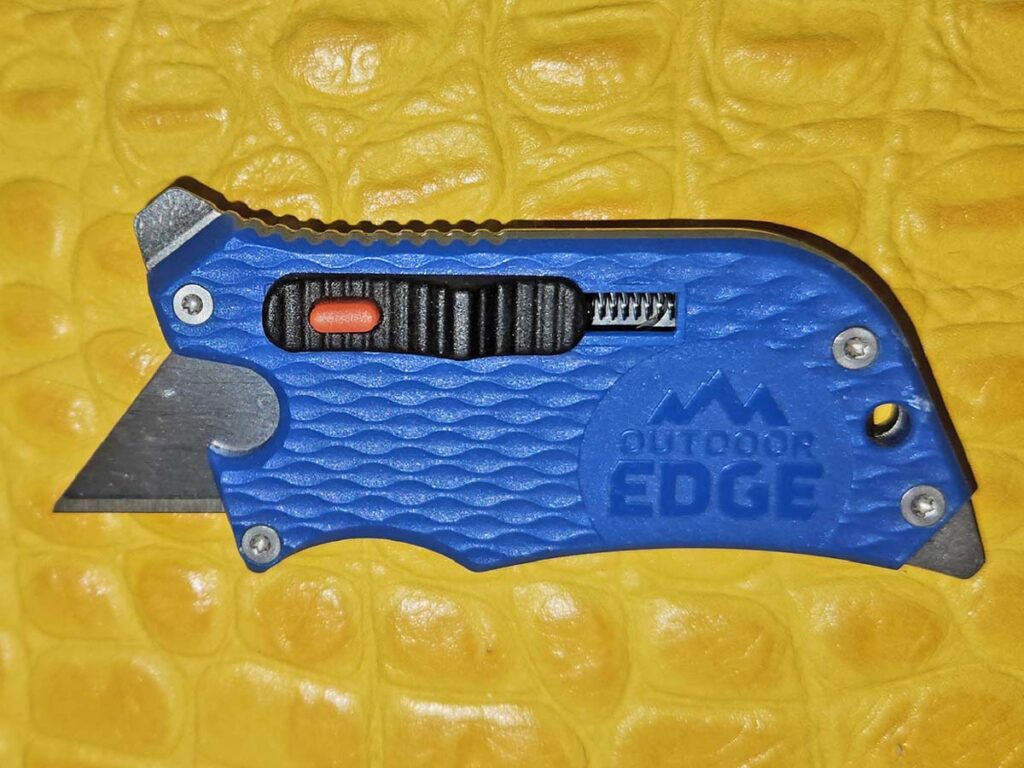
The Slidewinder is multitalented, boasting a bottle opener, a standard screwdriver and a flat Philips screwdriver to go along with its blade. The credit-card-sized tool takes regular utility blades and holds them securely in place. Blade replacement is a snap, as simple as pressing a button on the slide. To deploy the blade, you move the slide forward.
The Outdoor Edge SlideWinder has utility beyond cutting. At the 9-o’clock position, over the blade, is a bottle opener, at 1 o’clock is a flat-head screwdriver and at 7 a flat Phillips-head screwdriver.
Outdoor Edge uses one steel scale and one G10 scale, available in orange, blue and black. For easy carry, the knife has a low-profile pocket clip. I would have to say the SlideWinder makes for a great little tool and is convenient for travel, as I mentioned. On the other hand, its size makes it more of a light everyday carry and not suited to heavy jobs. Outdoor Edge puts an MSRP of $11 on the SlideWinder.
Havalon REDI
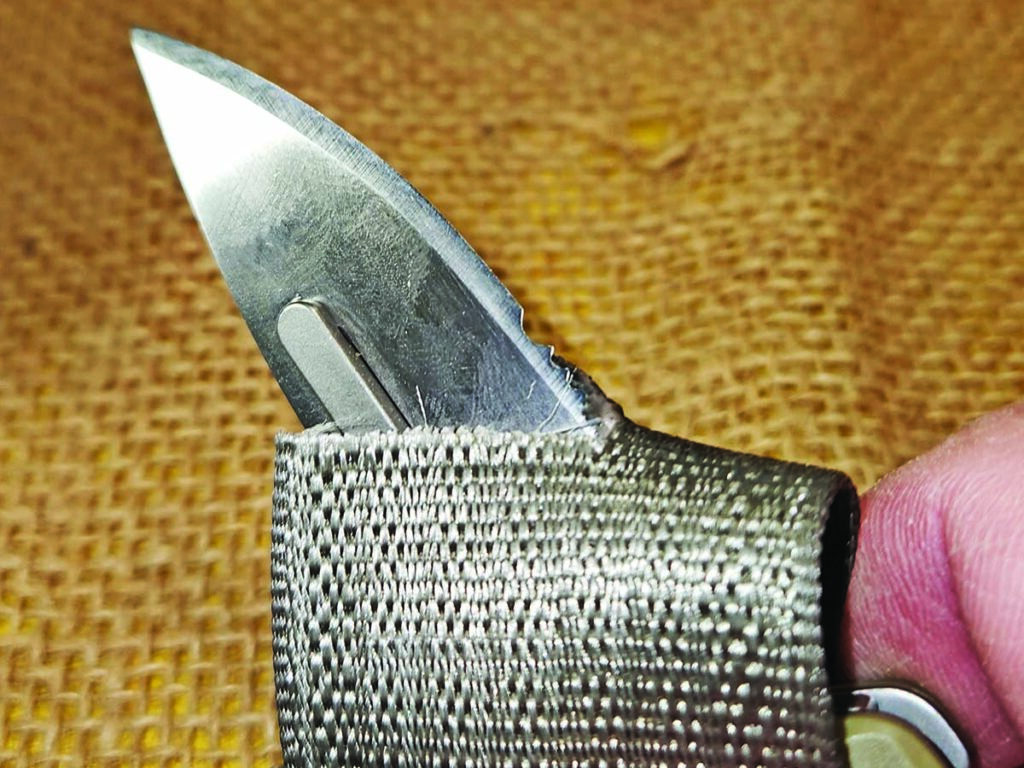
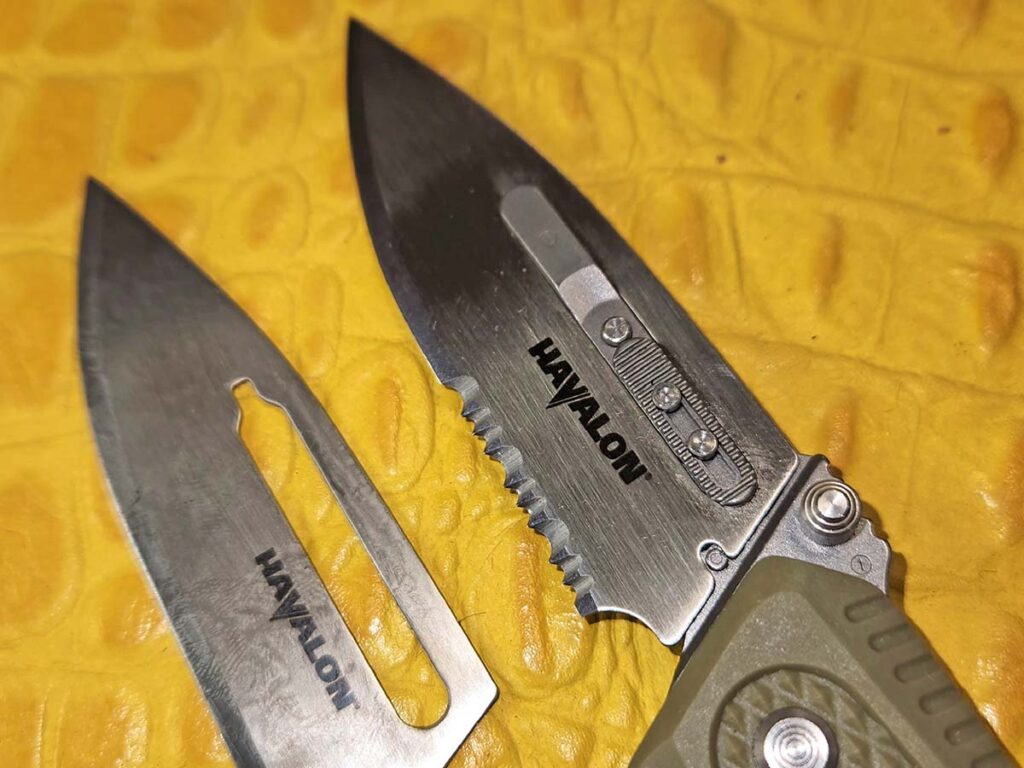
The Havalon REDI cut through this seat belt material like nobody’s business. What makes it better fit for these tougher jobs is a longer cutting edge than that found on utility blades.
Havalon’s REDI is an assisted-opening everyday carry knife. The company uses a proprietary blade made from AUS-8 stainless steel in a drop-point pattern. The knife comes with two blades with different edges—razor and half serrated. A nice touch, the company includes a small plastic case to carry the extra blade. Changing the blades is easy, with a retention release button and a forward slide freeing the cutting portion of the knife. Havalon provides a tool with the knife to depress the retention button, but it isn’t necessary. A thumbnail should suffice.
There is some play in the blade, but the retention system holds it in place. The blade itself is held in place with a liner lock and has a solid deployment via thumb studs. To aid your grip, Havalon uses polymer scales that are textured and come in three color choices: orange, black, and green. The REDI has an ambidextrous tip-up carry pocket clip. I find tip-up works well with an assisted opener.
Conveniently, the Havalon REDI comes with two blades. The razor edge blade (left) and mounted on the knife is the combo serrated/razor blade (right). Unlike the other knives, the blades are proprietary and longer then a standard utility blade.
It’s a good knife and a solid carry option with a replaceable blade. My one point of contention with knives is the proprietary blades. You must keep extras on you. I know people would say it’s a similar story with other utility knives. The obvious difference is that I can source regular utility blades nearly anywhere. Overall, the REDI is a good carry and very versatile, just keep the blade issue in mind. With an MSRP of $55, the REDI is at the more expensive end of this class of knife.
Gerber EAB Slim
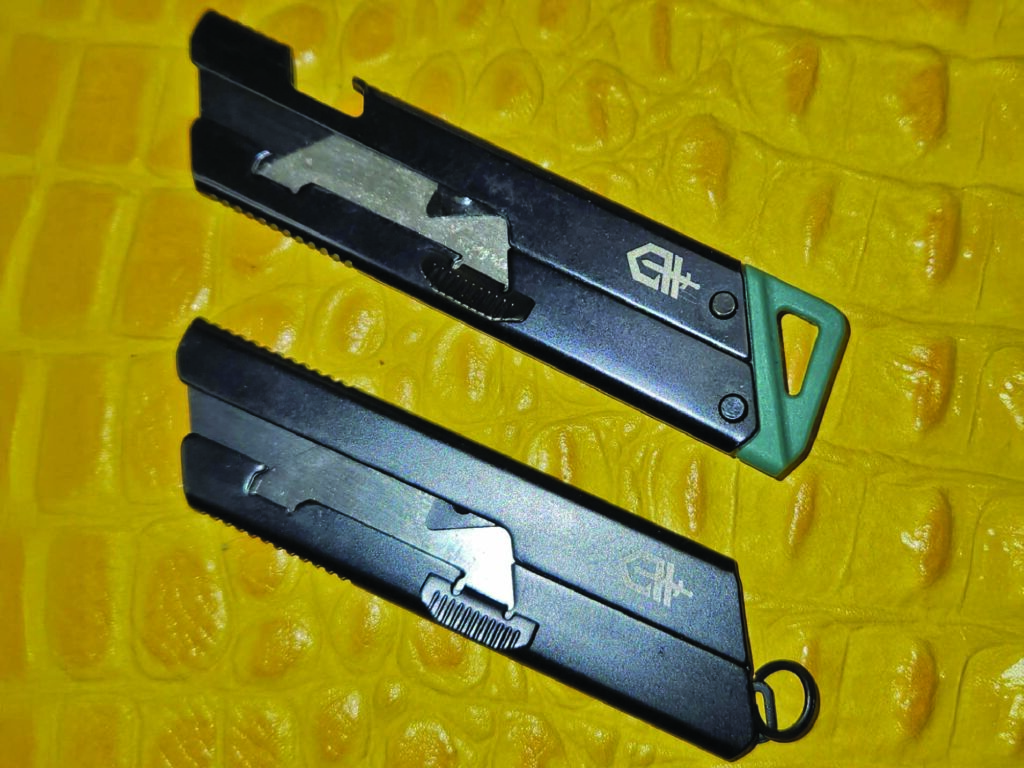
The Gerber EAB Slim (top) offers more grip than the original EAB (bottom) thanks to a buit-in keyring. It might not seem like much at first glance, but it offers more leverage than on the trim package.
The EAB Slim is exactly that—slim. Compared to earlier models I tested, like Gerber’s Prybrid and the original EAB, this model is trimmer. Yet, the extra length gives the utility knife a better grip, even compared to some of the options in this article. The EAB uses a standard utility blade and deploys from a slide lock. It is not the smoothest system, but it works and is dependable. If you want to retract the blade, just reverse the motion. Gerber added a bottle opener and a lanyard hole for some bells and whistles. I suppose you could put it on your key chain, but I would find it a bit bulky because of its 4.4-inch length.
Gerber has added some subtle gimping at the front of the handle. The texture is helpful and keeps you from struggling with the thin knife’s profile. It’s a good tool I would carry for light jobs—opening packages or even as an extra, inexpensive blade to stash in a backup kit. When I worked retail, this would be a perfect edge for all my regular chores, without adding bulk to my pockets. At $16, the Slim is light on the pocketbook.
Convenient Utility Carry
These utility knives aren’t full-fledged knives, but they do everything we need over an ordinary day. Working in maintenance, these knives cover most of my cutting duties and are easy to carry to boot. Due to their compact size, they aren’t my first pick for heavy-duty jobs. However, if you aren’t in maintenance or construction, these would be a great way to carry an edge for quick jobs.





![Best Big Bushcraft Knives: Huge Backwoods Hackers [Tested]](https://blademag.com/wp-content/uploads/Bush-2-768x544.jpg "Best Big Bushcraft Knives: Huge Backwoods Hackers [Tested]")