
Buyer's Guides

You’re looking for a new knife in a certain style – we’ve got recommendations on the best blades for every price point.

Feather Damascus: Blades Forged Light And Airy

The variations on damascus steel themes are endless. The possibilities are tempered only by the maker’s time at the forge and his or her desire to create.

Among these many variations, one pattern has recently captured the spotlight. These days, feather damascus is trending and custom makers are producing knives that turn heads, captivating buyers with the intricate layering that produces hard steel intertwined with the look of the light and wispy. Feather damascus offers a medium of both performance and artistic expression that influences every aspect of the maker’s creativity.

Ethan Kolar of Plummer, Idaho, describes his interest in feather damascus as “chaotic flow.” He explains, “The pattern’s center seam, where the jagged W’s converge, creates a flow in the blade which really adds to the overall confluence of the knife as well as creating a controlled chaos as the pattern explodes from the center filling out the blade.”

Kolar enjoys the hint of “jaggedness” and the center line that ties the blade together, and in the making of his feather damascus, his focus lies in test etching every restack from the forge. He sees the pattern in many different forms with the observation that “a pattern is not right or wrong but more of what the maker envisions and creates and what is right to him for his knife.”

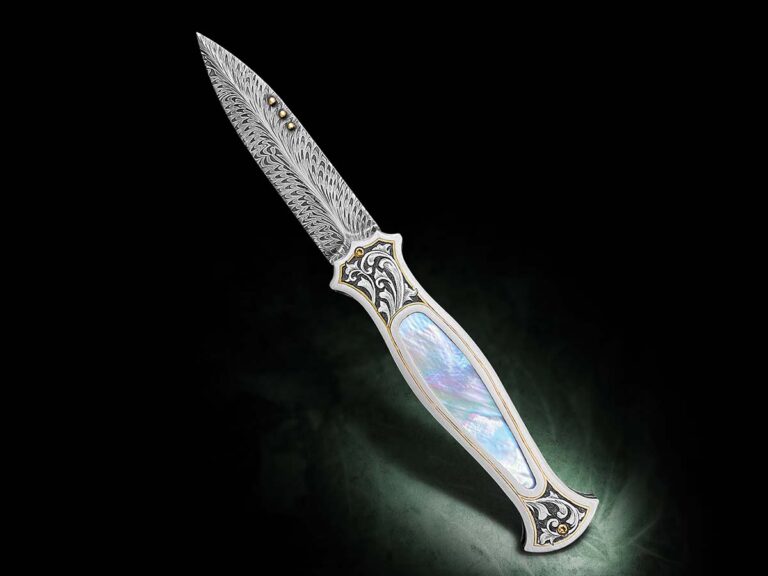
The folding dagger Ethan composed includes a 3-inch feather damascus blade of 1084 and 15N20 steels with an engraved gold inlay and scroll worked 416 stainless steel window frame fitted with exhibition-grade white-lip mother of pearl. Liners are 15N20 file-worked and nitre blued, while the backbar of 416 stainless is engraved and sports delicate file work. Its overall length is 7 inches.

“Most of the inspiration I have while making damascus comes from envisioning my final product,” Ethan remarked, “what engraving will go with it, the handle embellishment, and a lot to do with the overall color of the knife, deciding whether the pattern will be brighter or darker.”

Steel On Fire
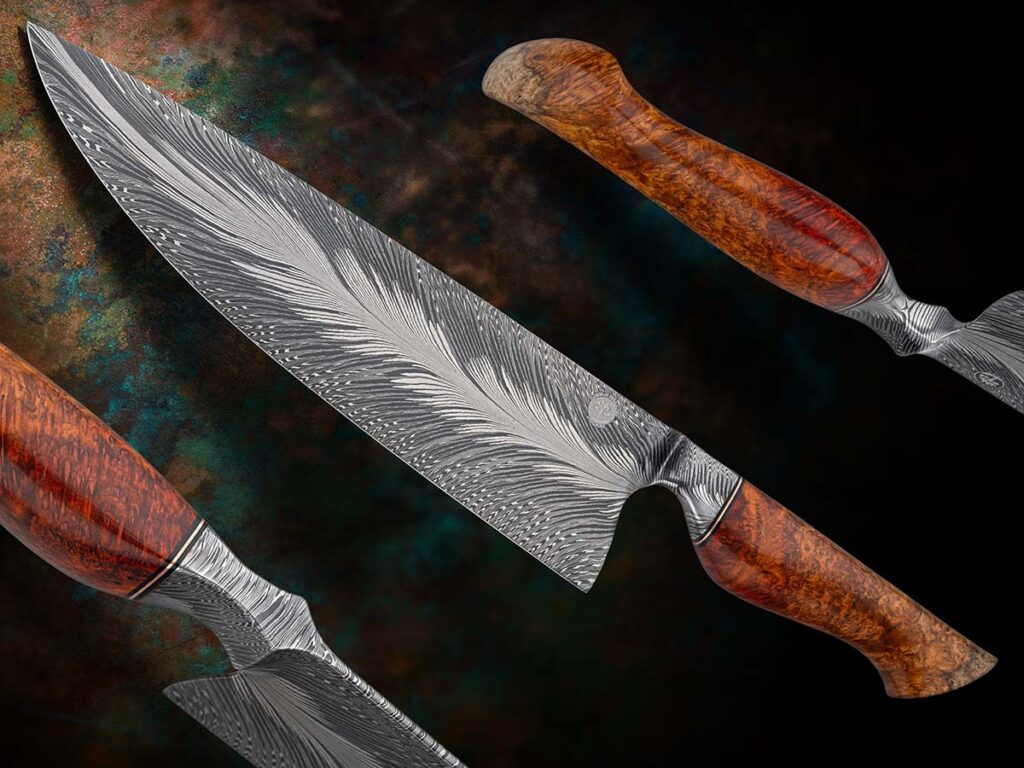
Winning Best Damascus at the 2025 BLADE Show West, Trevor Morgan’s “Torrent of Fire” chef’s knife includes a 9.25-inch blade of 1084 and 15N20 in a mix of W’s and straight layers with a fat core of 15N20. The knife’s overall length is 14.2 inches, and the handle is dark red tiger’s blood amboyna burl with a splash of sapwood for contrast. (Jocelyn Frasier image)

Another contemporary artisan exploring the feather damascus pattern is ABS journeyman smith Trevor Morgan. Having attended the Bill Moran School of Bladesmithing in Texarkana, Texas, in 2020, his goal with each feather damascus blade is to make the pattern “pop.” To achieve that look, his hand follows an artistic eye.

“Contrast, for sure, really makes any pattern cool,” said Trevor, “especially feather or mosaic damascus, larger pieces of dark and bright steel, gradients and that kind of thing. Also, out-of-the-ordinary stuff like feather [damascus] can be really cool to look at. Symmetry is always great with a feather pattern because it’s pretty easy to notice when something is out of whack with a feather due to the defined center. Complexity is also great. If it’s hard to figure out, all the better.”

According to Morgan, a resident of Apple Valley, California, the feather pattern can be challenging due to the hot-cut process, which puts enormous stress on the billet in somewhat weird ways and causes every forge weld to want to split open. The problem, however, can be mitigated by mig welding all the way around the seams. But this is his least favorite method of achieving the integrity of the billet because it requires grinding away the welds, wasting material and consuming time.

Trevor’s inspiration for feather damascus pieces comes from the world around him. “It’s places and people,” he commented, “from nature and the endeavor to make something organic and as lifelike as possible in steel. I regularly get swept up in the general zeitgeist surrounding the making of complex patterns. I see something on social media or somewhere, and I think, ‘Man, that’s really awesome! I’d love to try to make something like that.’ Then comes the real creative part, where I just get an idea of something that might look really cool and put it together.”

Morgan’s method is readily revealed in his featured piece, named “Torrent of Fire.” The knife includes a 9.25-inch blade of 1084 and 15N20 in a mix of W’s and straight layers with a fat core of 15N20. The knife’s overall length is 14.2 inches, and the handle is dark red tiger’s blood amboyna burl with a splash of sapwood for contrast.

Organic Appeal
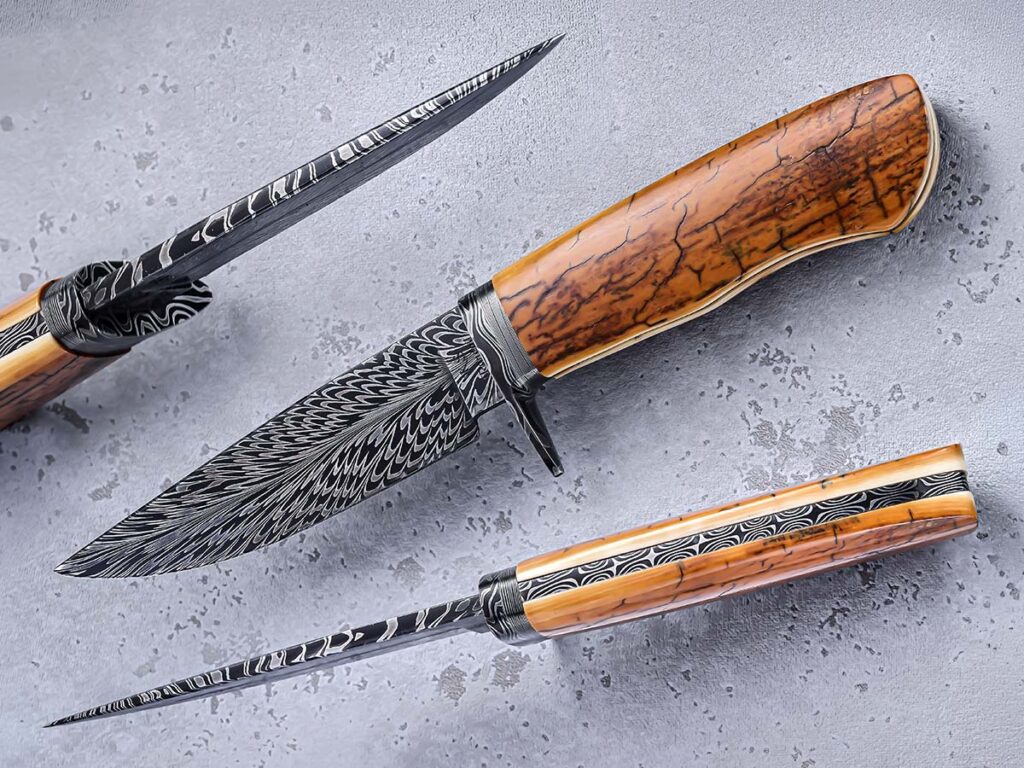
Splitting the billet down the center to maintain symmetry is among the trickiest aspects of feather damascus to Steve Randall. He nails it on his frame-handle hunter, with the axis of the pattern fountaining from the mastodon scales in a balanced and spectacular fashion. (SharpByCoop image)

Feather damascus has been a staple steel for ABS master smith Steve Randall for some time. He seeks a continual flow of the steel from the handle to the tip, and oriented so that the handle appears to actually hold a feather. “I was attracted to the feather pattern because of it’s a very cool, organic look,” he advised. “Like a snowflake, there are no two exactly the same. I’ve been forging feather damascus for at least seven years, and I’ve made several bowies and hunters.”

Randall, of Estancia, New Mexico, presents his feather damascus piece with frame-handle construction, showcasing mastodon scales with an overall length of 9½ inches and a blade of 4¾ inches. “Feather damascus is a more challenging pattern,” he said. “My tricks are patience and concentration. There are many welds involved in the pattern, which can contribute to cold shuts, which can destroy hours of hard work. The trickiest part is splitting the billet right down the middle and maintaining symmetry.”

While he describes the feather damascus forging process as complicated and labor-intensive, Steve sees the payoff in the harmony of the pattern and its related materials in the finished knife. “I always try to complement it with the best handle materials I have available,” he reasoned. “I prefer stag or ivory. If using wood, I avoid busy patterns and colors. I draw inspiration from many other makers. There are so many accomplished makers who produce a variety of feather patterns. It is one of my favorite patterns to forge because it can really accent the flow of the blade and give it a great overall look.”

Movement And Flow
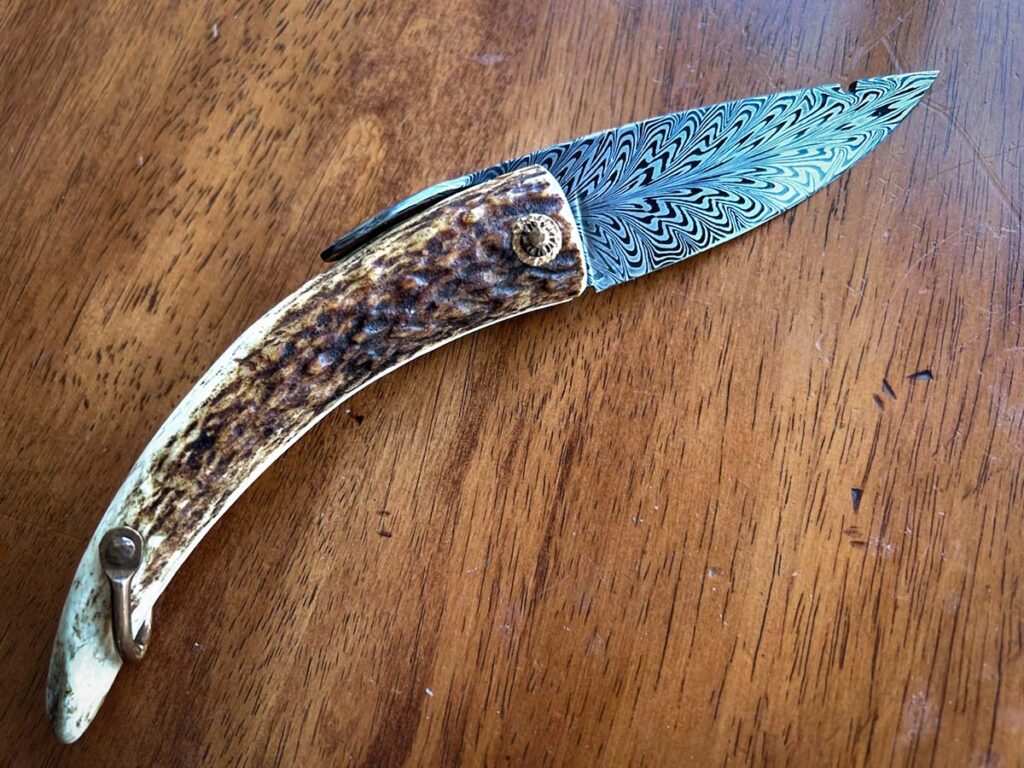
While David Lisch doesn't feel he's hit the limits of his Mountain Man folder, the style of knife is striking with its feather damascus blade set in stag-tip handle. Copper hardware and pivot give the knife its antediluvian look, while the flowing pattern of the blade anchors it in modern forge techniques. (David Lisch image)
While David Lisch doesn’t feel he’s hit the limits of his Mountain Man folder, the style of knife is striking with its feather damascus blade set in stag-tip handle. Copper hardware and pivot give the knife its antediluvian look, while the flowing pattern of the blade anchors it in modern forge techniques. (David Lisch image)

It took a single demonstration by the great master smith Harvey Dean to convince David Lisch, who earned his ABS journeyman stamp in 2009 and his master stamp six years later, to try the feather pattern. “I was always attracted to feather damascus,” he remembered, “but around 2008 I had the chance to see Harvey Dean demonstrate it at an event at Josh Smith’s, and I went right home and made the tools needed and gave it a go. I’ve been making feather damascus since his demo, and my hat is off to Harvey.”

For David, the making of feather damascus is challenging, but he says book matching the blocks really helps with the constant flow of the pattern. Sometimes, he says, makers will intentionally disrupt the flow by spinning one block one way and one the other to enhance the look. If it is done intentionally, he advises, there is no wrong way to stack the blocks. Forging all begins with the initial stack, and David starts with a 12- to 15-pound billet, acknowledging that the pattern can be wasteful in material. He tries not to go too far or stop too short in the forging process and offers that sometimes less is actually more.

“I love feather damascus because it looks different from maker to maker,” added Lisch. “I like a feather with movement and flow, not too bold and not way too fine, something that is easy to look at. For me, the more the pattern follows the forging, the more I like it. The center should lift up into the bolster or ricasso, showing that the blade was forged rather than running off the blade under the ricasso, showing it was just ground into a shape that disrupts the flow.”


Lisch gained a measure of popularity with his Mountain Man 2 folder, and the pictured knife is an example of what he describes as a “deep dive” into the style while using stag tips. “I set out trying to create my own version of one of the oldest knife designs in America,” he remarked, “and I believe I did just OK. But I’m not finished. So far, I’ve made several versions of the folder and have taken it even further with help from my friend and mentor [master smith] Mike Vagnino.”

Lisch had brought together his feather damascus touch and innovative design composition by introducing a clocking adjustable pivot that he has incorporated into a slipjoint, linerlock, lockback and flipper, all in the Mountain Man style with bronze, copper, stag and, of course, feather damascus. He has yet to reach the outer limits of his Mountain Man creativity and says that more will come in due time.

Check Out More Cool Customs:

Best Japanese Kitchen Knives Worth A Look [2022]

Whether traditional or just made in the Land of the Rising Sun, Japanese kitchen knives are a sharp addition to any chef’s arsenal.

The Japanese kitchen knife is prized for being one of the most durable culinary tools. Many Japanese knives have a different construction than Western- or German-style knives, which are the norm in most American kitchens.

History Of Japanese Kitchen Knives

The Japanese kitchen knife was born out of Japan’s long sword-making history. When samurai were banned from carrying swords after the Meiji Restoration in the mid-19th century, metalsmiths turned their attention and talents to making knives for home use.

Today, the city of Seki, in central Japan, is the epicenter of Japanese cutlery and features museums, shows, and festivals dedicated to all things knives.

How Are Japanese Kitchen Knives Different From Western Knives

Japanese knives are different from Western varieties in numerous different ways. The most prominent is in the grind of the edge.

Nearly all Western-style knives have a double bevel, that is both sides of the knife are ground to a point meeting at the edge. Conversely, Japanese knives are traditionally single-bevel blades or only ground on one side.

The single-bevel blade in Japan is steeped in culture and history. No one knows how exactly it originated, but the tradition is maintained to this day. The blade is sharpened on only one side, also known as a chisel grind, and is designed specifically for precise slicing.

A Western double-bevel knife will be ground to equal angles on both sides of the blade, meeting in the middle. A single-bevel blade is only ground down on one side, which allows for a sharper edge.

In Japanese the parts of the blade are:

  • Shinogi: The flat cutting surface of the blade that runs to the edge
  • Urasuki: The concave surface on the opposite side of the blade from the edge
  • Uraoshi: The thin flat rim that surrounds the urasuki–essentially on the blade and the spine

This unique design endows Japanese blades with an unusual characteristic–knives specific to right- and left-handed people (most tend to be ground on the right for righties). Though, ambidextrous models exist. These models are similar to western-style knives in their grind but still use Japanese forging techniques and steels.

Great, the Japanese made dominant-hand-specific knives, so what? Well, there are some benefits to this unique design. The most predominant being a finer edge. Logically this means a sharper knife adept at making long thin cuts.

Most folks will recognize the advantage of these assets if they’ve eaten any sashimi, a form of culinary art practically defined by long thin cuts. That and good fish.

Shape also defines Japanese kitchen knives, particularly the blade, which is round at the tip. Additionally, the handle is typically different. Almost across the board, Western knives will have a bolster between the heel of the blade and the handle. Japanese knives are sans this feature.

There are more, but some of the more common types of single-bevel Japanese kitchen knives are:

  • Gyuto: A Japanese Chef’s Knife
  • Santoku: Shorter and wider than the Gyuto, the Santoku is made for slicing, cutting, and chopping
  • Sujihiki: Long and narrow, this is made for slicing fish and meats in long, single motions
  • Kiritsuke: Hybrid of the Sujihiki and Gyuto. This knife is difficult to use and shows off the skill of the chef when used well

Best Japanese Kitchen Knives

Miyabi Chef’s Knife

Miyabi Chef’s Knife, 8-Inch

Miyabi makes wonderful knives, and their chef’s knife is no exception. Eight inches long, and with an SG2 micro-carbide steel core, the blade is ground to an incredibly sharp 9.5-12 degrees. The damascus pattern is made from 101 layers and it has been Cryodur ice-hardened to a 63 HRC. 

The handle is composed of Karelian Birchwood, the only wood ever used in the construction of a Fabrege egg, and has a mosaic pin accent and red spacers. This model is handmade in Seki, Japan.

MSRP: $349.95

Kai PRO 8-Inch Wasabi Chef’s Knife

Kai PRO 8-Inch Wasabi Chef’s Knife

The Pro 8-inch Wasabi Chef’s Knife from Kai is an excellent budget option. The cost-saving is due to the fact it’s a relatively plain Jane, missing the bells and whistles–such as damascus blade–that runs up the price. And also it definitely has Western influences in its design. Yet it’s a well-made workhorse from a well-respected manufacturer (Kai makes excellent scissors, by the way).

The Wasabi’s extra-wide, stainless-steel blade is where it wins points, creating plenty of clearance to chop, dice or whathaveyou at lightning speed. Additionally, its curved belly facilitates an effortless rocking motion, also picking up the pace. Interestingly, the traditional Japanese-style handle is fairly futuristic in its material–bamboo and polypropylene. While not a dead nuts traditional Japanese kitchen knife, Kai’s entry is nonetheless a top cutter from the Land of the Rising Sun.

MSRP: $43.50

Shun Premier Paring 4-Inch

Shun Premier Paring 4-Inch

A paring knife is one of the most important types of kitchen knives, and Shun knocks this one out of the park. The 69-layer damascus blade is wrapped around a VG-MAX core and has a hammered Tsuchime finish. The finish is ideal for the style of knife, helping the food release while you’re cutting.

The handle is walnut-finished, contoured Pakkawood. Also, it enhances the overall use of the Premier, with a slight bulge filling the hand and offering more control. About the only negative is the knife is on the spendy side. But for perhaps the second-most used knife in the kitchen, it’s well worth the investment.

MSRP: $169

Morado Kiritsuke Kuro-uchi

Morado Kiritsuke Kuro-uchi

There is an elegant strength in this special tool. The Morado Kiritsuke Kuro-uchi is a versatile monster that will control whatever you’re chopping or slicing. 

Hand-forged from a core of Hitachi’s Super Blue Steel wrapped in stainless, the blade has been heat-treated to a 63 HRC. The kuro-uchi (black) patina on the upper half of the knife helps protect the material, and the hammer dents give it a traditional look and keep food from sticking. As a bonus, the finish makes it look wickedly beautiful.

The steel is extra tough thanks to .4% vanadium in the alloy, and its high-carbon content makes it easy to sharpen. The Japanese Wa handle is ovular and remains comfortable even in the face of large workloads. Furthermore, the smooth rosewood has a dark stain to bring out its rich hue.

MSRP: $275

Mutsumi Hinoura Shirogami Kurouchi

Mutsumi Hinoura Shirogami Kurouchi

We round out our list with a splash of color and another high-quality damascus blade. The Mutsumi Hinoura Shirogami Kurouchi looks tremendous and cuts even better. 

The knife features a Shirogami #2 steel core wrapped in stainless and treated to a 63-64 HRC. A Gyuto style knife, which literally translates to “cow sword,” reveals its intent–to cut large slabs of meat. Today, it’s a great all-rounder chef’s knife that can handle almost any kitchen task and is a joy to use. 

The handle is what catches the eye and is made from European maple burl, dyed green and blue. It takes two years for the wood to dry out to the point it can be stabilized and dyed. It’s cut into the traditional octagonal shape for superior grip and ease of use. 

This is the priciest knife on our list, but we feel that it lives up to the lofty dollar amount.

MSRP: $570

Read More

Seven Excellent Drop Point Knives

The Drop Point Blade Is One Of The Most Utilitarian Blade Styles. From Outdoor Knives To EDC Folders, The Drop Point Is The Way To Go.

The drop-point blade is perhaps the most useful shape for outdoor knives. It’s an excellent cutting tool and the point makes it good at puncturing too. Whether it’s cleaning a kill or just opening up a gift box, the drop point is an excellent all-rounder that any knife lover should have.

Ka-Bar/Becker Knife & Tool BK16 Short Becker

Ka-Bar/Becker Knife & Tool BK16 Short Becker
The wide drop-point blade of the KA-BAR/Becker BK16 has the ideal edge geometry to handle precise tasks like whittling.

It is a midsize knife that is easy to carry, handle and use. The 4-inch blade of flat-ground 1095 Cro-Van steel can hold a respectable edge and sharpens quickly in the field. The black textured epoxy coating is non-glare and corrosion-resistant.

The Zytel handle is a typical Becker design—highly ergonomic with a palm swell that fills the hand nicely.  The handle edges are rounded to eliminate hot spots. Part of the tang is exposed for the lanyard hole. There’s also traction notches on the spine to choke up for added control. When you hold the BK16, notice how solid it feels. Even though one of the smaller knives in the line, it still feels capable of handling most cutting or camp tasks.

The sheath is a ballistic nylon with a rigid plastic liner. An accessory pouch holds a small lockblade folder or sharpener. The knife secures in the sheath via two button-snap nylon straps. The BK16 holds snugly inside the sheath with no rattling. Made in China, the sheath is of very good quality.

The BK16 is a workhorse. The drop-point shape is utility friendly and covers a broad range of general camp chores, from food prep to field dressing. The flat grind ensures optimum slicing.

The handle shape is classic Becker. A forward finger recess forms the lower guard and a palm swell mid-handle seats the hand comfortably. All edges are rounded for maximum comfort during prolonged use. The BK16 comes with two sets of scales: black Zytel and coyote tan. I opted for the tan. I love the contrast with the black blade.

I successfully batonned the knife through wood. The knife shrugged the task off and repeatedly came back for more. Whittling was easy. The ergonomic grip is comfortable and you’re able to use the exact pressure needed. The BK16 handles food prep with confidence.

If you need a compact fixed blade capable of tackling large tasks, the BK16 is it. Made in the USA, it has an MSRP of $132. 

Fallkniven F1 Pro

Fallkniven F1 Pro
The Fallkniven F1 Pro’s blade geometry makes baton work almost effortless.  

The Fallkniven F1 Pro features an extra-heavy-duty build and ELMAX high-performance stainless blade steel, which offers enhanced edge holding and toughness. With a 4-inch, convex-ground blade and 8.5-inch overall length, it is a formidable knife, weighing in at 6.1 ounces. 

The blade stock thickness is .19 inches, fairly thick for a knife this size. The full tang extends through the Thermorun rubber handle and is exposed on the butt for excellent torsional rigidity.

The handle sides feature a heavy checkering pattern for an excellent grip with wet or dry hands. The Thermorun material has a sort of a grip-you-back quality, similar to Kraton. The oblong handle shape rests in your grip comfortably so that you feel in control of the knife.

The sheath is well made of heavy-duty Zytel with a nylon webbing belt loop and button-snap retention strap. At first, the nylon webbing may seem a bit cheap but in reality it’s very smart. 

Why? The webbing allows the sheath to move freely at your side in case it gets snagged by branches, or to self-adjust when you are seated in a chair or a vehicle. Most rigid sheaths do not allow for this. Not to mention, the nylon webbing material is weather and moisture-resistant. 

The knife locks into the sheath via the guard as it engages a spring-loaded tab in the sheath’s side. This alone is enough to hold the knife inside, but securing the handle with the snap strap guarantees the knife stays put until you release it. The sheath’s bottom is open to allow moisture to escape and resist blade corrosion.

The F1 Pro and the BK16 are the heaviest-duty ones of the test bunch. The F1 Pro easily completed baton work. The thick blade stock and flat grind split wood like a wedge. For whittling, the convex edge has a ton of bite. It shaved off thick chunks of wood as I carved multiple stakes to a point. It made fast work of the task but, at the same time, was controllable and made precise cuts when needed. 

In some respects it worked as hard as a larger knife. In the kitchen, don’t dismiss the F1 Pro due to the thick blade. It slices vegetables with precision, proof this beast of a knife can handle delicate tasks as well.

There were no problems with the Thermorun handle. My hands got a bit sweaty during outdoor use and the handle never felt like it was going to slip in my hand. The checkered texturing is the right amount and not overly aggressive to your skin.

With an MSRP of $407.95, the F1 Pro ELMAX is one of the most expensive knives you will find in this class, but the chosen materials and highest quality of build offset the cost. You get what you pay for and this is a high-quality tool.

White River Knife & Tool Hunter

White River Knife & Tool Hunter
The blade of the White River Hunter is flat ground for optimal cutting performance, and the steel offers toughness and high edge-retention qualities. 

The White River Knife & Tool Hunter is a simple design, with a 3.5-inch drop-point blade paired with an ergonomic handle.  Blade steel is CPM S35VN high-performance stainless, and the handle comes in several material options. The 8.25-inch overall length is well-suited for field dressing and possible bushcraft use, too. 

The blade is flat ground for optimal cutting performance and the steel offers toughness and high edge-retention qualities. A polished finish makes the blade a snap to clean and also seals micropores, thus helping prevent rust. It’s kind of unusual to see a mirror polish on such a blade due to it being a labor-intensive finish; most such blades have either machine satin, stonewash, or even bead-blasted finishes.

A large finger recess helps index your grip, and a significant palm swell rests the knife in your hand comfortably. The butt has a bird’s beak pommel to prevent your hand from sliding backward.

As for handle material choices, they include three Micarta® flavors: natural burlap, black burlap, and black/OD green. Micarta is an excellent choice for an outdoor knife, as it is dimensionally stable and impervious to the elements and absorption of fluids. It also has a tactile feel that aids in grip retention in all conditions. 

We selected the natural burlap for the test, as it has a very organic appearance, almost a wood tone. The feel is akin to that of canvas Micarta. The sheath is formfitting Kydex, with a molded Kydex belt loop that accommodates belts up to 2 inches wide.

The cutting performance is superb. The knife is efficient and simple to maneuver. The flat-ground blade sails through meat and vegetables. Being a smaller fixed blade means it can be used for more delicate or intricate cutting.

I like the burlap Micarta. It’s very durable, looks great, and has a great in-hand feel. Burlap micarta isn’t common in production knives, so this is a bit rare—for now.

The shorter-length blade handles kitchen utility tasks well. Who knows—this knife might wind up in your kitchen pulling permanent duty when it’s not out with you in the woods. The White River Hunter retails for $180 for any of the handle material options. This is a really good price for a USA-made fixed blade with premium blade and handle materials. If you like refined fixed-blade hunters, the White River Hunter is for you.

Chris Reeve Knives Backpacker

Chris Reeve Backpacker
The Chris Reeve Backpacker handles like a dream. The knife is balanced perfectly and feels like an extension of your hand. It’s very predictable in use and is a slicer by nature. (Dexter Ewing image)

The newest fixed blade from Chris Reeve Knives, the Backpacker is for outdoorsmen and backpack hunters who want a fairly lightweight sheath knife that is quite usable with a smart design and high-end materials. 

It features a 4-inch drop-point blade hollow ground from CPM Magnacut, the latest of the high-performance stainless super steels. Magnacut reportedly has the best edge retention of any high-end blade steel. The Backpacker will go the distance with edge holding. A stonewash finish gives the blade a slight industrial look. Stonewash finishes do a good job of hiding scratches that occur during use.

The handle has a hollowed-out full tang, which helps keep weight to a minimum (3.8 ounces) and improves balance. The scales are canvas Micarta in black or natural. The Micarta is sculpted to provide placement of the hand and fingers, enhancing user comfort and blade control. 

Canvas Micarta has a grippy nature and seems to get better when your hands are wet, unlike other materials that may feel less tactile when wet. Two pairs of hex-head bolts secure the scales which are removable, resulting in a skeletonized fixed blade to further reduce weight and bulk. 

The integral guard formed by the blade’s height is a smart design I really like. It allows you to choke up on the handle for precise control, as well as keeping your hand in place.

The Backpacker comes with a Kydex sheath which locks around the lower portion of the exposed tang that forms the guard. It does not encompass the handle scales as most fixed-blade Kydex sheaths do. This is done on purpose so if you do decide to remove the scales and use the Backpacker skeletonized, the sheath will still work and lock on the knife for safe carry. 

A flat-head screw at the end allows you to fine-tune how tight the sheath locks onto the blade. Not many sheaths have this feature. The rivet spacing allows use of a large Tek-Lok belt fastener (the knife does not come with a provision for belt attachment, so it’s up to the buyer to supply such).

The Backpacker handles like a dream! The hollow grind slices easily. I used the knife to cut meats and vegetables. The cutting performance is predictable, efficient, and precise. It’s like driving a nice European sports car. 

Handle comfort is first class; I love the way the Micarta feels in-hand. It’s light as a feather for a fixed blade of its size, and no doubt the minimal weight does a lot to improve handling. When you choke-up on the handle with your thumb placed on the blade spine, you can feel how the ergonomics work to lock your grip on.

The Backpacker is a high-end, USA-made hunting/camping fixed blade. MSRP: $300. A CRK knife for $300 is a great price, actually, and you get a lot in return, including high-end materials and the company’s design and manufacturing/engineering expertise.

Buck 112 Ranger

Buck 112 Ranger
Buck 112 Ranger

Buck makes great knives, and this folder certainly is one of their best. The Ranger is a variation on the famous 110 Folding Hunter with a drop point instead of the original’s clip point.

The knife is beautiful with an ebony handle and ethically-sourced Crelicam ivory. While the handle is stunning, the star of the show is still the blade. Made from 420 HC stainless with a satin finish, the 3-inch blade is everything you would want in an EDC. With a thick belly and thick tip, the blade slices and punctures confidently.

The heat treat imbues the blade with excellent corrosion resistance and durability. It’s hardened to an HRC 58 so the knife can handle the wear and tear of everyday use with ease. This is a classy knife at a great price.

MSRP: $63.99

Benchmade Bugout

Benchmade BK-2
Benchmade BK-2

When it comes to drop point EDC knives the Benchmade Bugout is one of the most iconic. It was designed for outdoor use which makes it overpowered as an EDC for so many reasons.

There are many versions of the Bugout, and all are excellent, but for this piece we chose the BK-2 for its affordability in relation to other knives in the line.

The BK-2 is a fully blacked out version of the Bugout with a CF-Elite handled married to the CPM-S30V blade. The steel comes in a black Cerakote finish and is treated to a 58-60 HRC. The knife shines in large part thanks to its weight. At just 1.8 ounces, the BK-2 is so light and nimble in the air that it can feel like cutting with air.

It’s the Bugout. It’s great. It’s one of the highest-quality drop point knives on the market.

MSRP: $190

Kizer Drop Bear

Kizer Drop Bear

This knife was released over the summer and it is excellent. We have already written an in-depth review of the Drop Bear, and it’s worthy of a second mention.

The 154CM steel blade is meted to an aluminum handle. At 3.8 ounces it’s a substantial little knife that can handle the day-to-day tasks asked of it and can even be used as a kitchen knife in a pinch. 

The knife’s clutch lock, Kizer’s newly-adopted Axis-style lock, is fun to use and keeps the blade secure at all times. This is an excellent new addition to the world of drop point pocketknives.

MSRP: $158

Editor’s Note: Mike Abelson provided content for this piece.

Read More

Knife Review: CRKT Bamboozled

No Need For Confusion, CRKT’s Bamboozled Shows Itself A Competent Light-Duty EDC Option.

There are so many assisted-opening knives for sale today that to compare them all is a fool’s errand. However, when you come across a good one you know it pretty quickly. The new CRKT Bamboozled stands out from the pack thanks to its classy, sleek lines, quality construction for a casual EDC, and its incredibly fair price.

New for 2023, the Bamboozled comes in under $100 and feels worth a lot more. Designed by Ken Onion Jr, son of BLADE Cutlery Hall of Famer Ken Onion, his first knife for the company looks straightforward because it is. It’s simply an excellent light-duty EDC.

The proof? After a few weeks of using the Bamboozled, I realized I hadn’t picked up any of my other knives. It pushed some truly excellent blades into the bullpen, and I don’t see that changing for a long time. 

The CRKT Bamboozled: The Ergonomics

The first thing you notice about the knife is how nice it feels in your hand. That’s thanks to the G10 handle and stainless-steel bolster. It looks and feels clean right out of the box and even after a few months of use, it remains pleasurable to employ.

Aside from a tidy look, the ergonomics are there in the Bamboozled’s handle. The straight handle avoids any hot spots you might encounter, and fits a medium-sized hand relatively well. The G10 scale is well-textured, yet not overly aggressive. At once, this offers solid control over the knife on light tasks—even when wet—while avoiding the cheese-grater texturing found on some heavy-duty options.

As with many other CRKT models, the Bamboozled succeeds thanks to a good skeleton. The handle is great, and it’s made even better by the steel liner lock that secures the knife upon deployment. It’s easy to close one-handed although the ridges on the lock itself can dig a bit if you open and close several times in quick succession. I’ve tried for months to find a way to loosen the lock with hard use and it hasn’t budged an inch. 

You can open the knife easily one-handed thanks to the assisted-opening flipper. The flipper tab is well-placed, though it does take a touch of force to get it going. But be careful. Once the assist mechanism kicks in the blade fires out at high speed.

A Blade For Everyday 

The blade is made from D2 steel which holds an excellent edge (more on that later) and is known for its wear resistance. In short, it is a fairly common, yet solid choice for blades likely called into numerous roles.

In total, the Bamboozled is 7.81 inches long and has a blade of 3.34 inches in length. For the user, this means having a blade long enough to make somewhat sizable cuts and a handle long enough to keep a relaxed and secure hold while cutting. The handle’s sharp lines and small profile also work to keep you feeling relaxed while cutting as you can position your hand in a way that works for you instead of being forced into a certain grip by a more contoured and bulky handle. 

This is the knife that will serve you well around the house. I wouldn’t use this for something like prying open rusty or locked boxes, though. The blade is just .11 inches at its thickest point and tapers at the tip. It can flex with your fingers.Thanks to being under four ounces, and just 4.45 inches when folded, the knife is a great casual carry option that will easily fit into a pants or a jacket pocket.

Bamboozled Vs Paper 

CRKT Bamboozled cutting paper
The bamboozled cut through the paper blind with ease.

After losing some blinds to our lovable but rambunctious dog I needed to replace a busted one. I was able to get an inexpensive paper blind at a home improvement store, a great light-work test for the Bamboozled.

Nicely the Bamboozled made it through the thicker paper of the blinds–folded over a dozen times–without any frayed or torn edges. However, it took nearly a minute of intense sawing action to chew through using the entire length of the blade. So while I would call it a success I definitely would say the knife had its work cut out for it in this task. 

Bamboozled Vs Leather 

CRKT Bamboozled cutting leather
The 1/8-inch leather belt was no match for the folder.

Wishing to see how the Bamboozled fared against a more robust material, I pitted the blade against leather. An old belt proved the perfect foe.

Interestingly, the Bamboozled made easier work of the ⅛ inch leather than the blinds. A moderate sawing motion with the belly of the knife cut the belt into tidy strips with clean edges. Given I’d already put the blade to use on other tasks and the edge was no longer pristine, I was surprised with the results.

Bamboozled Vs Nylon Rope 

CRKT Bamboozled cutting rope
The nylon rope provided the stiffest test for the Bamboozled.

 A piece of ⅜-inch nylon rope was the most formidable challenger for the knife. It did cut through but it was a process. Push cuts were only good for getting the main length of the knife to bite in, but the ensuing pull cut made quick work of the rope. 

However, it was hard to get a pull cut to bite and one time it took two pushes to get the knife to chew into the rope. Additionally, the cuts weren’t as clean as the paper or the leather belt. A win for the Bamboozled, but we’ll call it a split decision rather than a unanimous victory.

Not Bamboozled By Everyday Chores

My wife and I welcomed our first child a month ago, providing ample opportunity to put the Bamboozled through everyday paces. Boxes, wrappers and packaging of every sort from stacks of diapers to new furniture needed opening–which meant the Bamboozled had a legion of practical work ahead, which let me see what the knife could do.

Its straight-back blade comes to a point that is excellent at piercing, which was a plus as it easily punctured the material. The knife also was great at cutting straight down cardboard of every thickness in clean, even lines.

Beyond the cardboard, the Bamboozled easily cut through tape without taking on much of a residue and it was able to cleanly cut through foam without peeling off bits. The foam, both thick and thin, was no match for the puncturing blade. 

Judging The CRKT Bamboozled

The D2 blade provides a strong edge that resists wear.

Overall, I really like this knife. It’s easy to use and comes at a great price. The edge is no joke and really does hold up against everyday usage quite well. 

This is a great piece for the small speed bumps that come up in day-to-day life in suburbia or the city. Have to downsize a mountain of cardboard boxes at the office after a bunch of new product is delivered? The Bamboozled will get the job done quickly. Just don’t ask too much from this knife. The Bamboozled is well made but it’s not a heavy-use utility knife. I wouldn’t want to baton wood with it, use it for prying, or use it as my main knife in the backwoods.  

What it does well it does exceptionally well; if you keep the knife in its wheelhouse it should serve you well for years. The $75 price point makes this an affordable, accessible knife that’s great for both knife lovers and someone looking to get their first blade. 

CRKT Bamboozled Knife Specs

Blade Length: 3.34 inches

Blade Edge: Plain

Blade Steel: D2

Blade Finish: Satin

Blade Thickness: .11 inches

Overall Length: 7.81 inches

Closed Length: 4.45 inches

Weight: 3.7 ounces

Handle: G10 with Stainless Steel Bolster

MSRP: $75

Read More

Cool Custom: Corey Ryenolds’ Copper-Mai Sawback Bowie

Inspired by Rambo’s knife, Corey Reynolds’ sawback bowie channels the genre in a copper-mai chevron pattern.

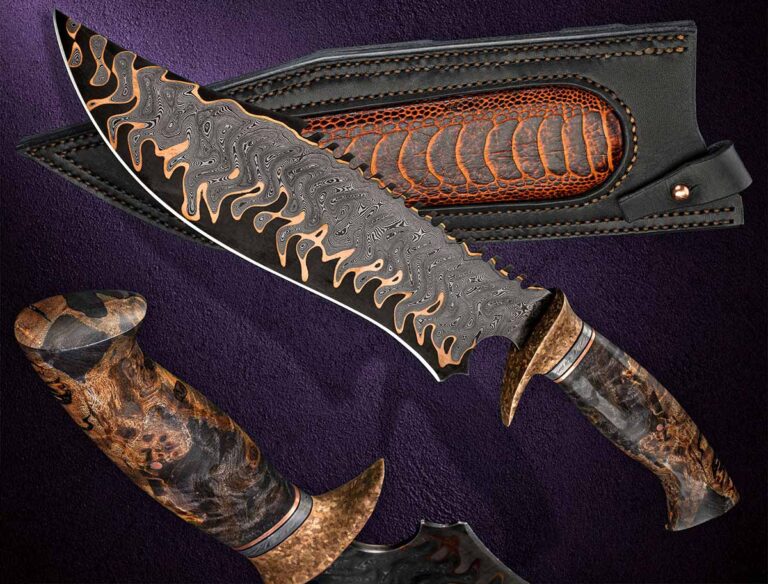
Like many boys his age, Corey Reynolds grew up watching Rambo movies. Now 43, he’s been making knives about three years and decided he wanted to make a knife with a Rambo look—and what better way to do that than with a sawback bowie?

For blade material he used copper-mai steel in a chevron pattern from Baker Forge and Tool, and for the piece de resistance configured the sawback so the copper would be exposed at the base of each tooth.

Though the way he did the teeth is mostly for looks, he said each tooth has a fairly good edge. The handle is spalted maple from Steelhead Forged Scales with spacers of copper, raindrop-clad feather damascus forged by Adam DeVille, and G-10. The guard is of a striking multi-etched material called gem bronze from Mike’s Metalworking.

Sawback Bowie Specs
Maker: Corey Reynolds
Blade Length: 9”
Blade Material: Copper-mai in a chevron pattern
Handle Material: Spalted maple w/copper, raindrop-clad feather damascus and G-10 spacers
Guard: Gem bronze
Overall Length: 15”
Sheath: By the maker of leather w/ostrich leg inlay from Ray’s Ostrich Leathers
Maker’s Price For A Similar Knife: $1,400

Check Out More Cool Custom Knives:

Best Crossbar Lock Knives: Blades & Actions That Holdfast (2024)

The crossbar lock continues to dominate.

One of today’s most popular blade-locking mechanisms for folding knives is the crossbar lock. It’s the most advanced blade lock there is—for now.

The crossbar lock consists of a spring-loaded, hardened-steel bar in the handle that makes constant contact with the tang and springs forward into place once the blade is opened. It wedges itself between the tang and the liner, preventing the blade from rotating shut until it is released manually. The lockbar is ambidextrous. The lock is all smooth action, tight lockup and ease of release. It is safe because it does not require your fingers to be in the path of the closing blade the way a linerlock or framelock does, thereby almost eliminating accidental cuts.

Crossbar Lock Origins

The crossbar lock first appeared in 1999 with Benchmade’s 710 Axis Lock folder, which has since been discontinued. The knife and lock mechanism were designed by knifemakers Bill McHenry and Jason Williams. “Bill McHenry was the primary driver of the mechanism,” says Vance Colver, Benchmade director of product line management. 

Crossbar Lock Inventors
Custom knifemakers Bill McHenry (left) and Jason Williams, designers of the Axis Lock. (Lisa McHenry image)

McHenry was a man of many interests. At one time he was a goldsmith, a watch enthusiast who rebuilt and repaired watches, and he loved restoring vintage Indian motorcycles. “The love for the mechanical gave him a unique perspective to knife lock solutions and led to the Axis Lock,” Colver added.

On June 10, 2003, the patent for the Axis Lock was issued to McHenry and Williams, patent no. US 6,574,689. In addition to the aforementioned features, Colver said the Axis Lock has smooth blade rotation; is reliable with minimal moving parts—just the lockbar moves, and it does so only slightly; and strength, with the Axis Lock outperforming the linerlock in closed failure force.

After the Axis Lock debuted, new Benchmade models with the lock appeared, including the Griptilian designed by BLADE Magazine Cutlery Hall-Of-Fame® member Mel Pardue, the Warren Osborne 940 Axis Lock and the Presidio Axis Lock automatic. The Axis Lock patent expired in 2016, allowing other knife companies to introduce their version and thus broadly open the “new” crossbar lock category.  Today you will see variants across several prominent brands, including the Axis Lock itself.

Top Picks Crossbar Lock Knives

Benchmade Axis Lock

Benchmade crossbar lock
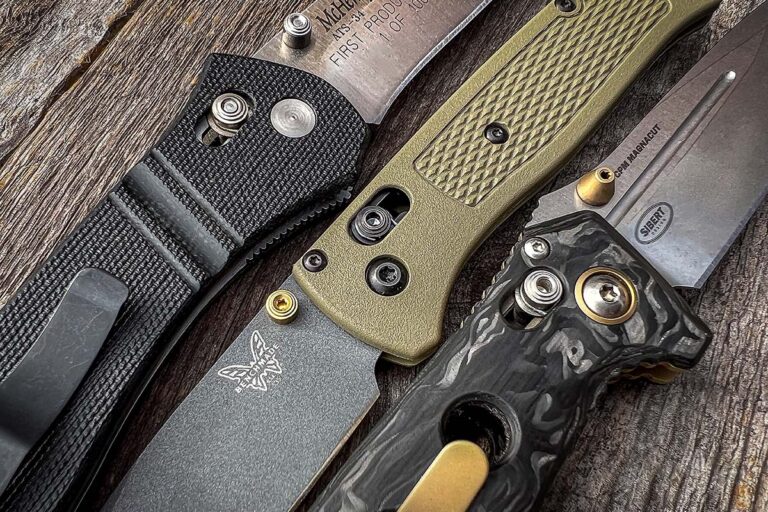
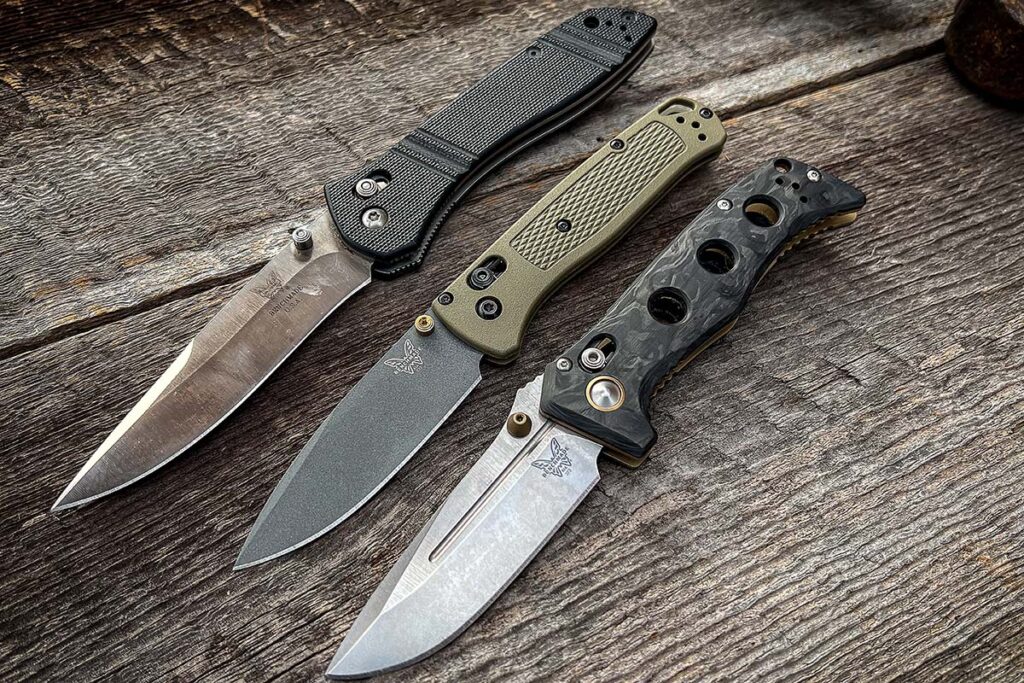
The lock that started it all, the Axis Lock, the original Benchmade McHenry/Williams 710 Axis Lock and Benchmade’s Model 535 Bugout and Mini Adamas. The latter two knives are in production while the 710 has been discontinued.

Benchmade’s Bugout is classic EDC because of its slender form factor, extremely lightweight, and use of premium blade steel. The full-size Model 535 Bugout has a drop point blade of flat ground CPM S30V stainless steel. The 3.2-inch blade is long enough for most cutting tasks but short enough to be compact and carry well. Handle material for the base model is molded Grivory for light weight and strength. Carbon fiber/CPM S90V stainless and machined aluminum/M390 stainless are respective handle/blade material combos available in the high-end models. The manufacturer’s suggested retail price (MSRP) for the Bugout starts at $180 and increases depending on handle and blade material options.

The Benchmade Mini Adamas 273-03 Axis Lock is a scaled-down version of the full-size Adamas tactical folder. Designed by knifemaker Shane Sibert, the Mini Adamas has a 3.25-inch drop point blade and closed length of about 4.35 inches. The blade features a milled-in fuller and CPM MagnaCut stainless steel. The regular production versions have CPM CRUWEAR tool steel blades.

The handle is angular and boxy in very good ways. A slight swelling in the middle helps fill your palm. The special edition has marble carbon fiber scales. The standard Mini Adamas offers a choice of black or OD (olive drab) green G-10 handles. The knife’s Axis Lock works beautifully, with a rock-solid lockup and ultra-smooth blade rotation. MSRP: $375. Country of origin for the featured Benchmades: USA.

Microtech Ram Lok

Microtech crossbar lock
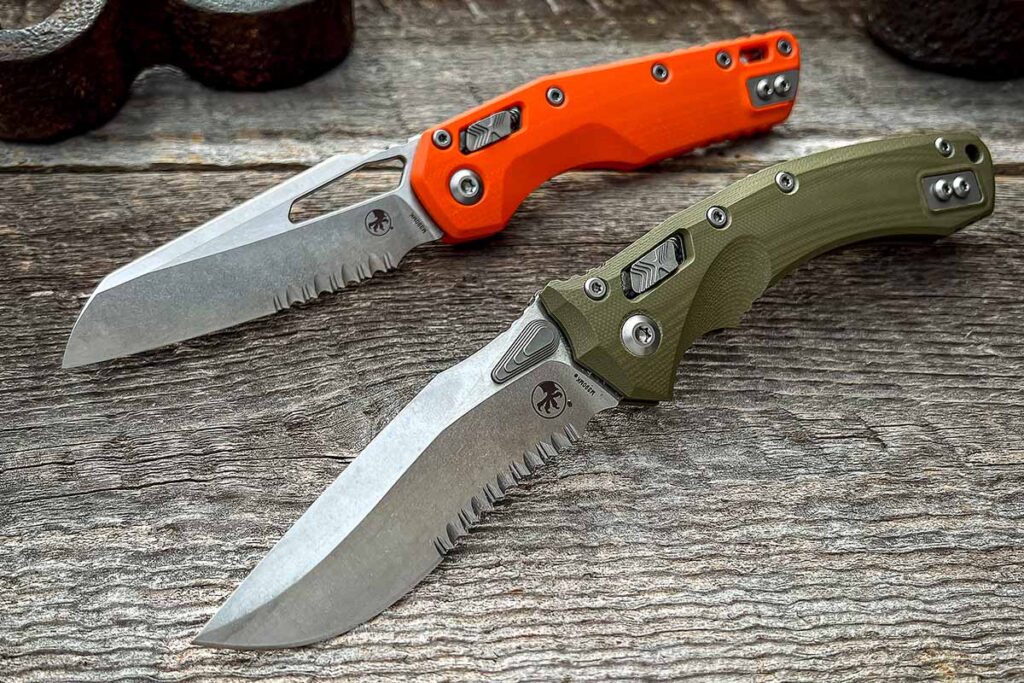
Microtech’s RAM LOK takes the crossbar lock to the next level with a rectangular-shaped lockbar that places more mass on the blade tang as opposed to the standard round profile lockbar of other crossbar locks. The RAM LOK is available on several select Microtech models, including the MSI (top) and Amphibian (bottom) folders.

Microtech christened its crossbar lock Ram Lok, and it’s a variation on the theme. Most if not all other crossbar locks employ a round-profile locking bar. The Ram Lok has a rectangular shape, providing more surface space and bulk to the lock, thereby providing more inherent strength. The center post that passes through the rectangular lock has a coil spring that provides the lock’s resistance and is the key to the lockup’s integrity. The Ram Lok follows the contours of the tang and, once the blade rotates fully open, springs forward into place, wedging into the tang, thus preventing the blade from rotating closed. The release buttons are multi-faceted, stepped “X” designs on either side of the handle.

The MSI (Microtech Standard Issue) and Amphibian Ram Lok are but two Microtech manual folders with the Ram Lok. Winner of Best American Made Knife at BLADE Show West 2023 (January BLADE®, page 16), the MSI features a 3.8-inch sheepsfoot blade of Bohler M390MK high-performance stainless. M390MK is manufactured exclusively for Microtech and is similar to M390 though enhanced a bit for added edge holding.

The straight-line cutting edge permits easy sharpening as well as high utility, excelling at pull cuts especially. MSRP: $365.  A black-polymer-molded-handle version lowers the price considerably to $177. It’s the most affordable U.S.-made Microtech folder available.

The Amphibian is the resurrection of an older Microtech tactical design. It sports a recurve clip-point blade in 4 inches of M390MK and a highly ergonomic handle. The signature stepped teardrop-shaped thumb stud is ambidextrous and allows for easy one-hand opening. The handle is available in G-10 or aluminum, with G-10 colors of black, FDE (flat dark earth) or OD green. The aluminum handle is available in black only, though that may change by the time you read this. MSRP: $300. Country of origin for the featured Microtechs; USA.

Hogue ABLE Lock

Hogue crossbar lock
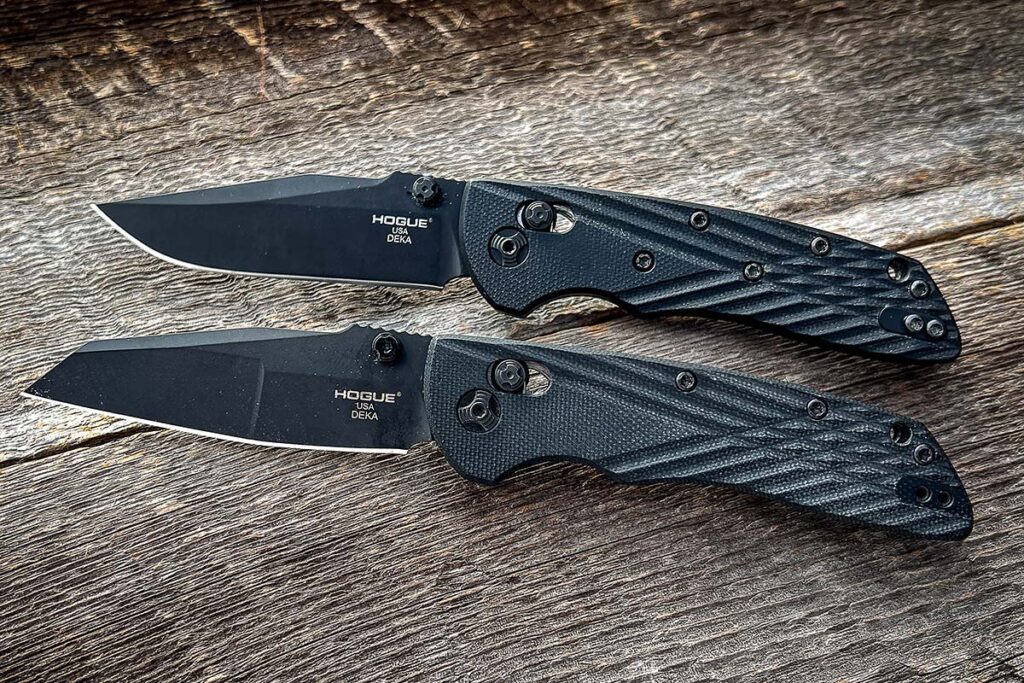
The Hogue Knives Deka has the company’s ABLE Lock. ABLE is an acronym for Advanced Bar Lock Enhanced. The Deka is an EDC friendly folder that comes in clip-point (top) and wharncliffe (bottom) blade shapes and is designed by custom knifemaker Allen Elishewitz.

Hogue Knives calls its crossbar lock the ABLE (Ambidextrous Bar Lock Enhanced) Lock. The Deka is one of the company’s folders that sports the ABLE. Designed by knifemaker Allen Elishewitz, the Deka is stylish, well-configured and slender, great for EDC and makes an awesome work knife. The 3.9-inch blade comes in standard clip point or modified wharncliffe patterns. At press time, Hogue was switching the blade steel to CPM MagnaCut from CPM 20CV.

The handle is offered in standard black and multicolored Gmascus in red, camo, green and blue. The Gmascus replicates a damascus look but in a lightweight phenolic-based resin. As each color alternates with black, the resulting visual is eye catching. The ambidextrous pocket clip carries the knife tip up. MSRP: $194.95. A version with a lightweight, lower-cost polymer handle in a choice of black, blue and FDE and a MagnaCut blade has an MSRP of $159.95. Country of origin: USA.

Gerber Pivot Lock

Gerber Pivot Lock
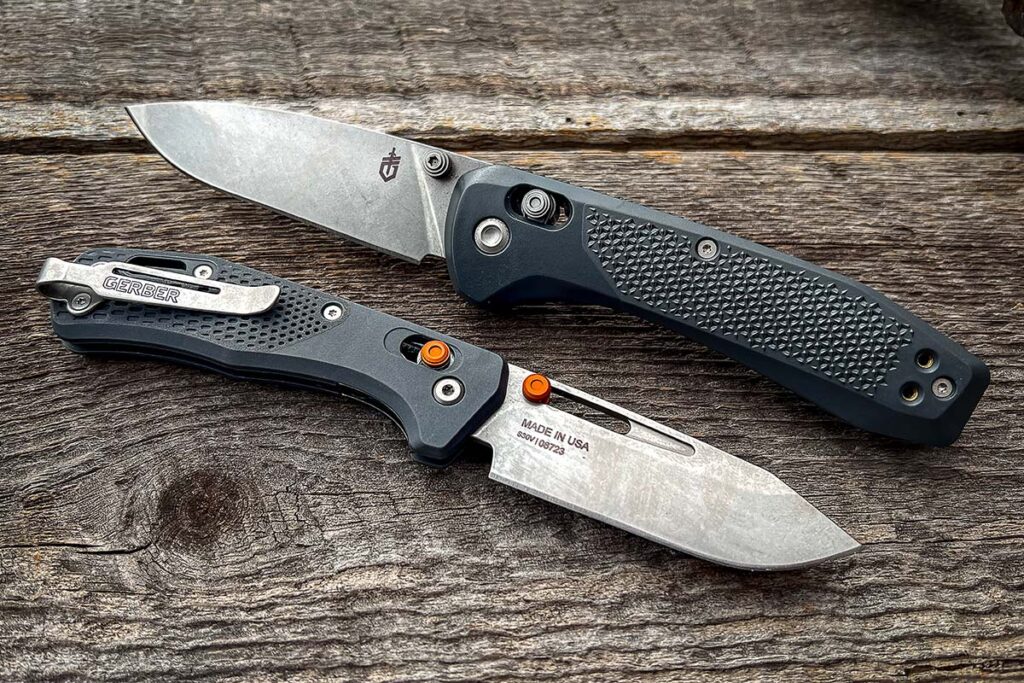
Gerber’s Sedulo (top) and Assert (bottom) offer the company’s version of the crossbar lock called the Pivot Lock. The Pivot Lock secures solidly and the blade action is ultra-smooth. Dual steel liners reinforce the lock’s strength.

In recent years Gerber has shifted production to the USA, a good lead-in to its new folders with crossbar locks. Among them are the Sedulo and Assert, each of which uses Gerber’s Pivot Lock. The Sedulo’s 3.4-inch drop point blade is fully flat ground CPM S30V stainless. Dual thumb studs provide ambidextrous opening. A stonewashed finish helps seal micro pores in the steel as well as hides most scratches easily.

The handle is gray FRN (fiberglass-reinforced nylon)—black is also available—with chamfering throughout for a secure, comfortable grip. The Pivot Lock locks up very tight and the blade action is ultra-smooth. Dual steel liners reinforce lock strength. Closed length: 4.7 inches. MSRP: $124.99.

Though not as brawny as the Sedulo, the Assert carries easier and more comfortably. The modified clip point blade is 2.9 inches of CPM S30V. Closed length: 4 inches. The oblong blade slot provides attachment points for the adjustable thumb stud, which you can move/position anywhere along the slot. The stud can be removed altogether and the slot used to open the blade instead.

I love how the two standoffs at the handle butt, the lock release buttons and the thumb studs are orange, contrasting nicely with the gray and adding an exciting pop of color. An ambidextrous fold-over clip carries the knife deep in the pocket. The Pivot Lock ensures smooth blade action and rock-solid lockup.

The flat-ground blade slices evenly and cleanly. Out of the box the edge was very sharp and ready to work. It carries well, cuts well and is great looking. MSRP: $174.99. It’s available in three colors: all black with black blade and hardware, gray handle with orange hardware, and green handle with blue hardware. Country of origin for the featured Gerbers: USA.

Kershaw Duralock

Kershaw crossbar lock
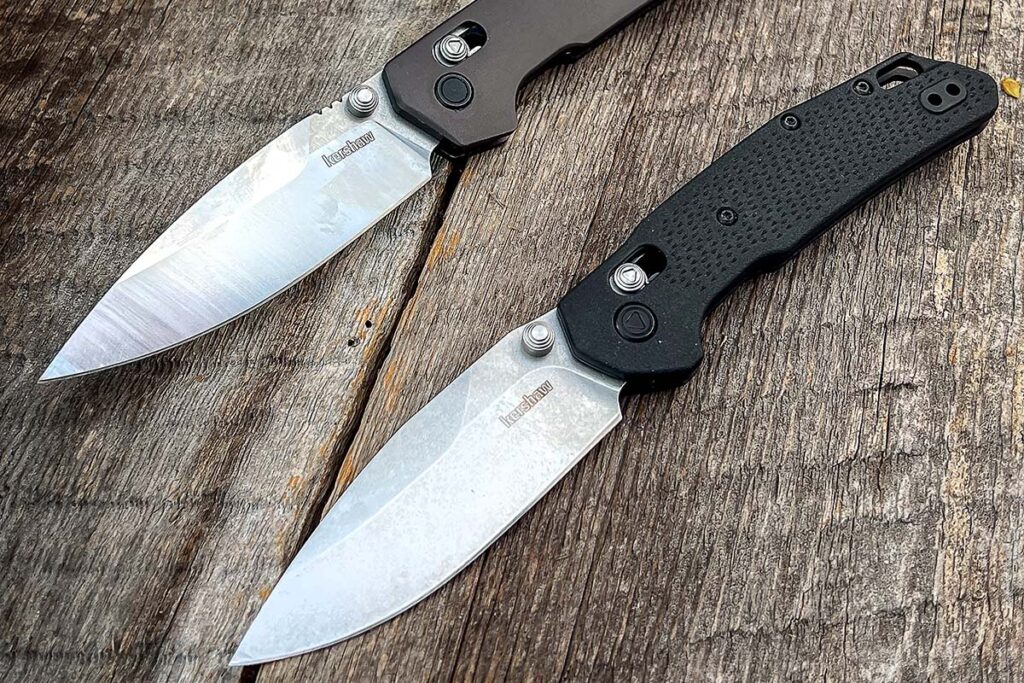
The Iridium (top) and Heist (bottom) are two of Kershaw’s newest folders featuring the company’s version of the crossbar lock—the Duralock. It provides a strong, solid lock-up.

Kershaw’s crossbar lock is the Duralock and is offered on a few new models in the company lineup. One is the Iridium, a slender folder designed to carry easily. Packing a 3.4-inch spear point blade of D2 tool steel, the Iridium is made for hard use. The handle is gray-anodized aluminum for light weight and high tensile strength. Mounted on the handle’s reverse side, the clip carries the Iridium deep and tip up. A copper-colored handle spacer adds just the right amount of contrast. The Duralock engages crispy with zero blade play. The Iridium is also available in an all-black-coated handle and blade. MSRP for the standard Iridium is $99.99 and the Iridium Black is $104.99.  

The Heist is another new Kershaw design with the Duralock. Featuring a 3.2-inch clip point blade of D2 tool steel, the Heist has an ergonomic handle with a slim profile for effortless carry. The 3-D grip texturing helps keep your hand in place during extended use. Molded FRN scales conserve on weight. The clip is a fold-over deep-carry style affixed to the handle butt. The Heist is a straightforward working knife for military and law enforcement. The pivot works on a bronze washer. The Duralock locks up strong and solid. The MSRP of $84.99 is very reasonable for a working folder with above average blade steel. Country of origin for both knives: China.

Tactile Knife Co. Tight Lock

Tactile Tight Lock
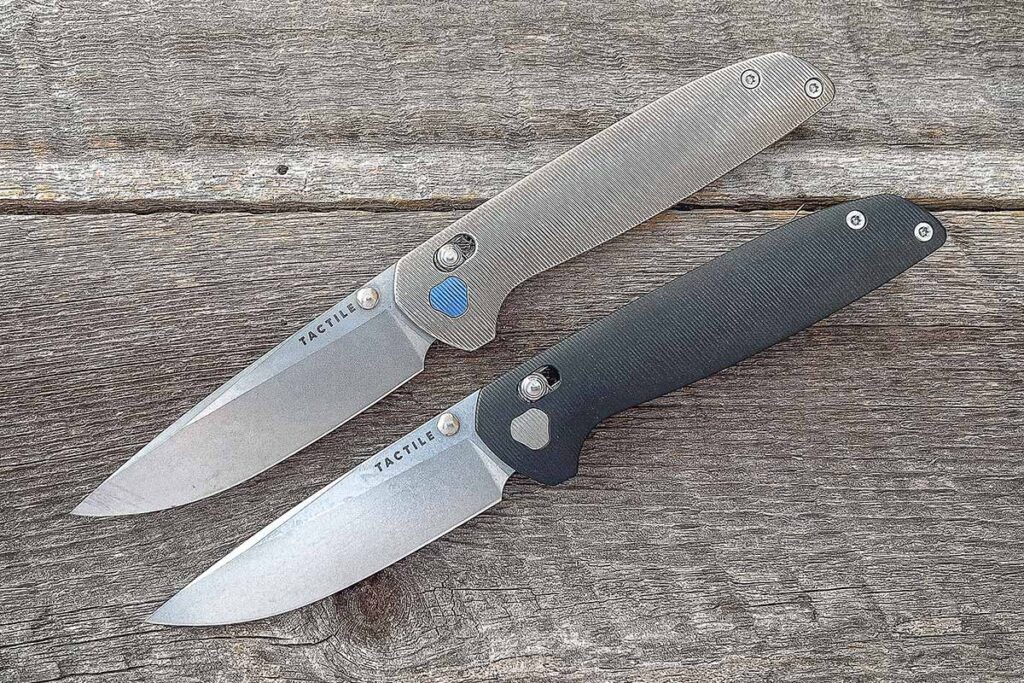
The Maverick by Tactile Knife Co. pairs the company’s crossbar lock with a knife design by custom maker Richard Rogers. Richard designed the Maverick’s crossbar lock, too. The folder won Best EDC at BLADE Show Texas 2023.

Tactile Knife Co. is a relatively new U.S. knife manufacturer and the Maverick, a collaboration with custom knifemaker Richard Rogers and winner of Best EDC at BLADE Show Texas 2023, features the company’s version of the crossbar lock. The Maverick is a slender folder on the larger side, with a 3.5-inch blade and 4.7-inch closed length. It may be on the longer side but it has a slim profile that carries very well in jeans or a suit. The MagnaCut blade has a flat front with a bit of a swedge. Dual thumb studs promote easy opening with either hand.

The titanium handle’s 3D texture has many ridges to enhance traction. The crossbar lock provides a smooth opening and is very secure. The handle shape is simple but works very well, with an integral single guard to keep your hand in place. 

The clip is an interesting design. Two standoffs attach to the butt end to carry the knife tip up, with the clip affixed atop the standoffs. It’s more involved than a standard or even a milled titanium clip. It looks upscale and different in a very good way. It shows the attention to detail throughout the Maverick, which includes an anodized, triangular-shaped titanium pivot bolt. The folder is also available in black Richlite Micarta®, providing a slightly lower price point ($249 MSRP) and lighter weight. MSRP for the titanium version: $349.

Check Out More Knife Buyer’s Guides:

Recurve Knives: Top Options In These Curvy Carvers

The sexy shape of three U.S.-made recurve blades addresses both performance and aesthetics.

As blade patterns go, the recurve is right up there in the “flair department.”

Just as the curves of a Ferrari add irresistible styling to the classic sports car’s appearance*, so does the curvature of a blade’s edge add to that of the look of the knife. It also changes the geometry of a blade—sometimes radically—in some ways better and other ways not so much. That’s the beauty of blade design and why there are so many different styles from which to choose.

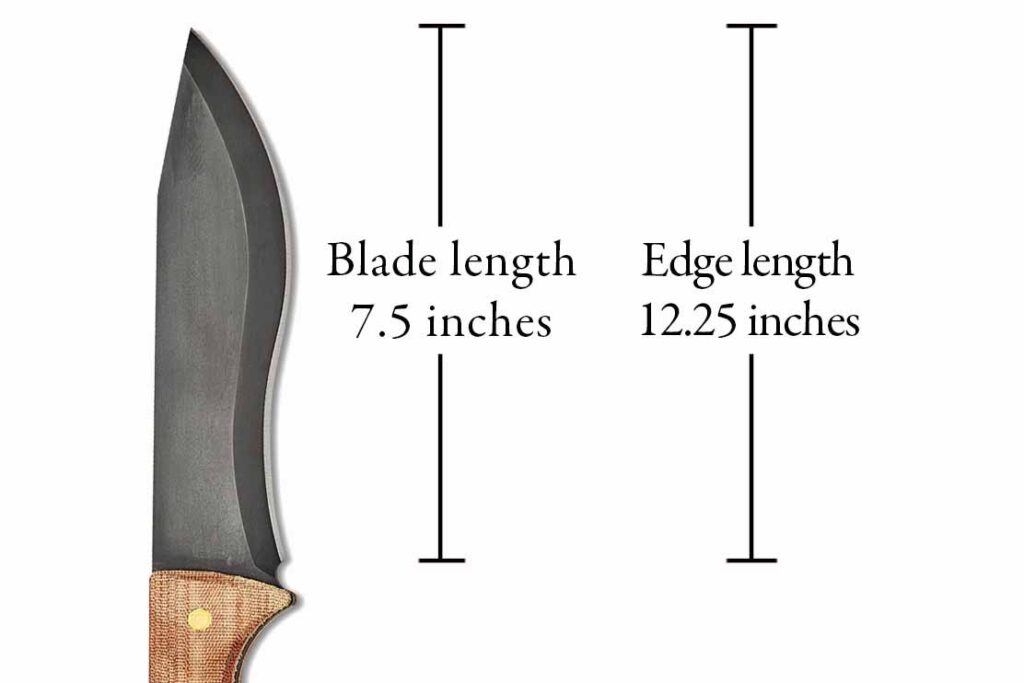
How much length does a recurve add to the edge of a blade? This chart compares the length of the ’Squatch blade to the length of the actual sharpened edge. The curved top edge blade of a straight blade might add 2-to-3 inches to the edge. The Sasquatch’s recurved edge stretches the increase to 4.75 inches.

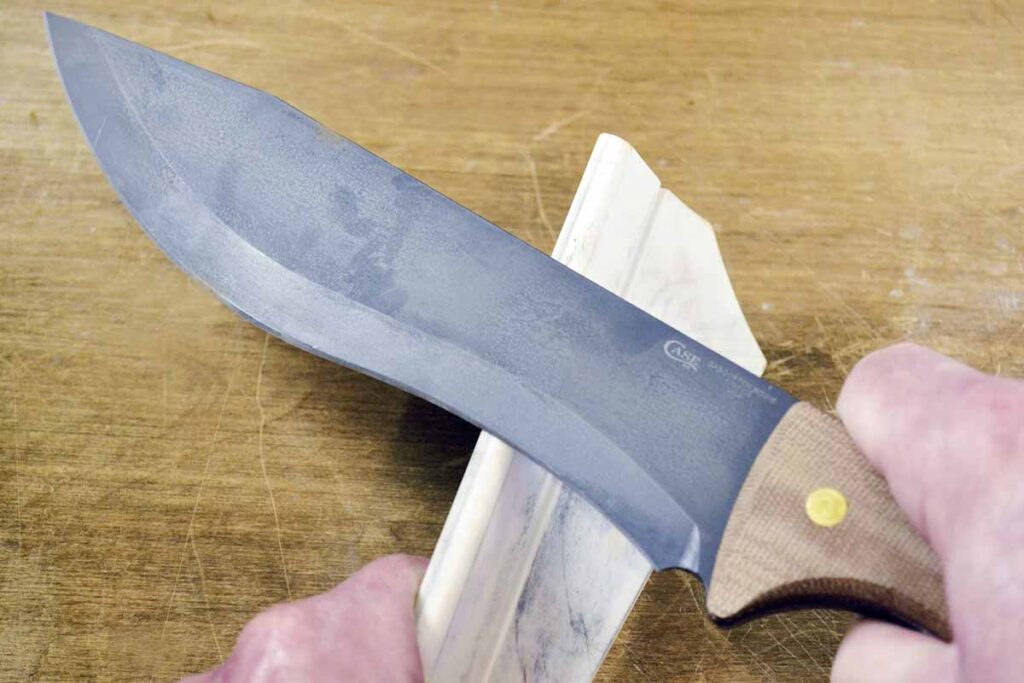
The waisted recurve design shifts the weight of the blade toward the tip, which while excellent for chopping also reduces the blade’s effective chopping length. The recessed area on the lower part of the recurved blade adds the benefit of being able to trap or gather in its subject when performing chores like debarking and taking slivers from wood, but it also makes sharpening more difficult with flat-surfaced media such as whetstones.

Sharpening A Recurve

Like any blade design, there are trade-offs. To get an idea of how radically the recurve lengthens the edge of a blade, see the accompanying chart of the Case Sasquatch bowie. The height of the sharpened portion of the blade is 7.5 inches, but when the length of the curvature is factored in the number swells to 12.25 inches!

Recurve blades require a rounded or ovate sharpening medium to properly hone the curvaceous edge. Hand-held sharpeners similar to those used by chefs or the common V-sharpeners work well on curved edges, as do stones with curved edges such as the Spyderco Golden Stone ceramic.

When sharpening these blades the concave lower curve does not conform to a flat plane, so an ovate or rounded surface grit is required for sharpening. Fortunately, there are plenty of these to choose from, such as handheld sharpeners similar to those used by chefs or the common V-sharpeners that use alternating rods set at opposing angles in a base. The Spyderco Golden Stone and/or Webfoot works as well. Now, on to the recurves!

Bear Forest Knives Custom Recurve

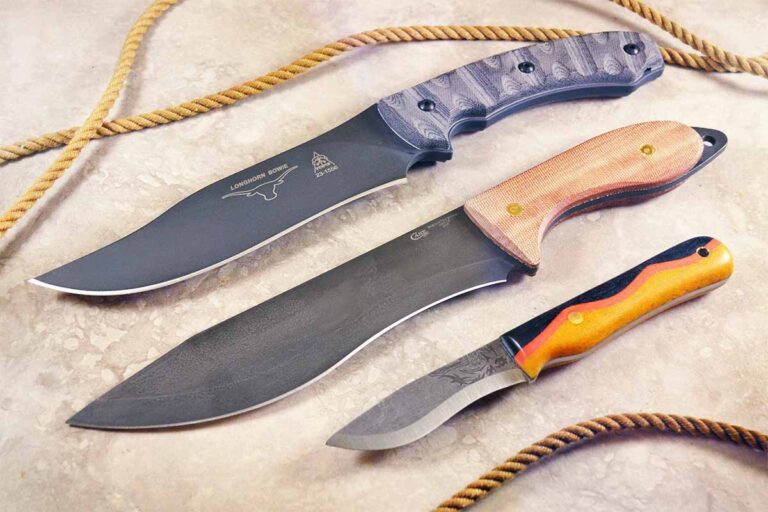
The Bear Forest Knives Custom Recurve is a small fixed blade built like a tank, owing much to the 3/16-inch thickness of its acid-dipped 52100 carbon steel blade. At 7.75 inches overall, the knife is geared toward light-to-medium camp chores and could conceivably be used as an EDC. The full-tang handle boasts colorful scales of a wavy sandwich of black, orange and natural cross-cut canvas Micarta®. Weight is a hefty-for-its-size 5 ounces. Bear Forest provides a black Kydex sheath with a nifty black coated 2.25-inch spring steel belt clip.

Bear Forest Knives Custom Recurve Specs
Blade length: 3.25”
Blade material: 52100 carbon steel
Handle material: Crosscut canvas Micarta®
Gripping feature: Tri-color Micarta handle material
Sheath: Black Kydex w/belt clip
Weight: 5 ozs.
Overall length: 7.75”
Country of origin: USA
MSRP: $249

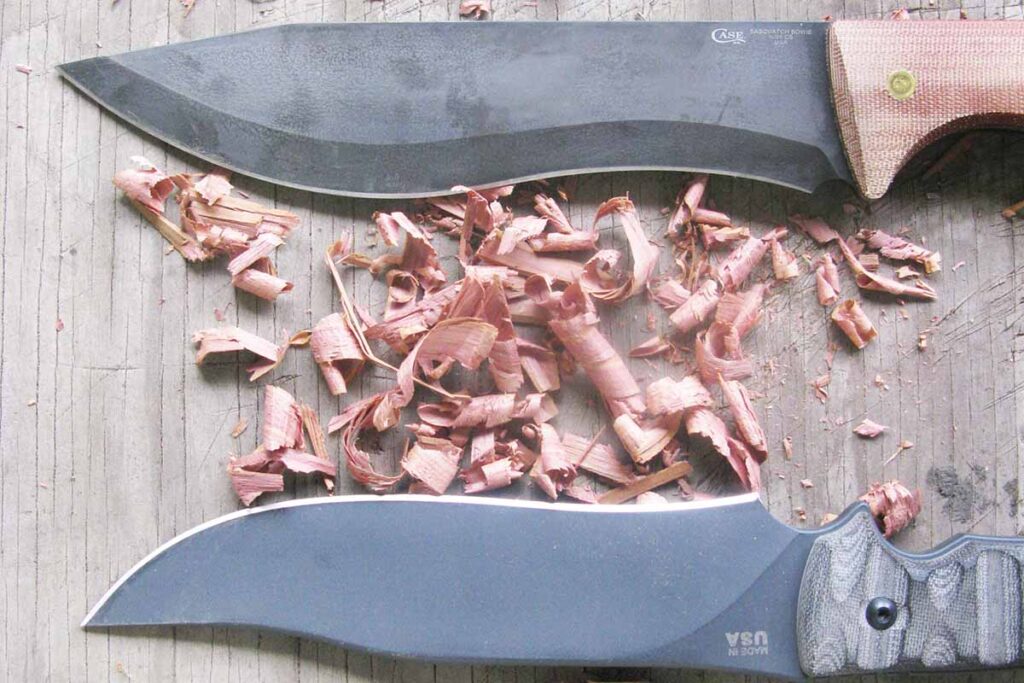
Recurves shine when performing shaving tasks. Both the TOPS (left) and Case (right) did a nice job rendering cedar curls for fire starter.

Case Laramy Miller Sasquatch Bowie

The Case Laramy Miller Sasquatch Bowie is a study in understated good taste. The large 13-inch Jim Bowie namesake flows from stem to stern, from the break in its flat-ground 1095 carbon steel blade to its rounded combo lanyard hole and pommel. The matte-black Caswell finish gives the bowie a rustic look. The bag-style handle is topped with natural canvas Micarta scales affixed with 5/16-inch brass pins. Case provides a double-stitched natural leather belt sheath that matches the knife in clean styling.

Case Laramy Miller Sasquatch Bowie Specs
Blade length: 7.75”
Blade material: 1095 carbon steel
Handle material: Natural canvas Micarta®
Cutter keys: Clip-point blade, Caswell finish
Sheath: Natural leather belt model
Weight: 14.5 ozs.
Overall length: 13”
Country of origin: USA
MSRP: $219.99

TOPS Longhorn Bowie

The TOPS Longhorn Bowie is a thoroughly modern recurve with such classic touches as its upswept clip-point blade—always welcome on a bowie. The flat-ground 1095 blade is coated in dark sniper gray Cerakote®, matching the gray/black layered linen Micarta scales nicely. The black nylon MOLLE-compatible sheath carries on a belt or a pack and other gear. It includes a front pouch for stowing a sharpener or fire-starting accessories.

TOPS Longhorn Bowie/Sniper Gray Specs
Blade length: 6.75”
Blade material: 1095 carbon steel
Handle material: Canvas Micarta®
Cutter keys: Trailing-point blade, sniper gray Cerakote® finish
Sheath: Black nylon, MOLLE compatible w/pouch
Weight: 18.1 ozs.
Overall length: 13”
Country of origin: USA
MSRP: $305

Testing The Recurve Knives

The TOPS Longhorn and Case Sasquatch bowies begged to be reviewed together because they are exactly the same length and share the same 1095 blade steel, yet are two very different knives. The TOPS blade has a more casual recurve while the Case is full tilt. The handles couldn’t be more different as well, with the Case opting for a clean, traditional bag-style grip while TOPS chose a modern tactical design a full inch longer than its counterpart, resulting in a slightly shorter blade. Let the fun begin!

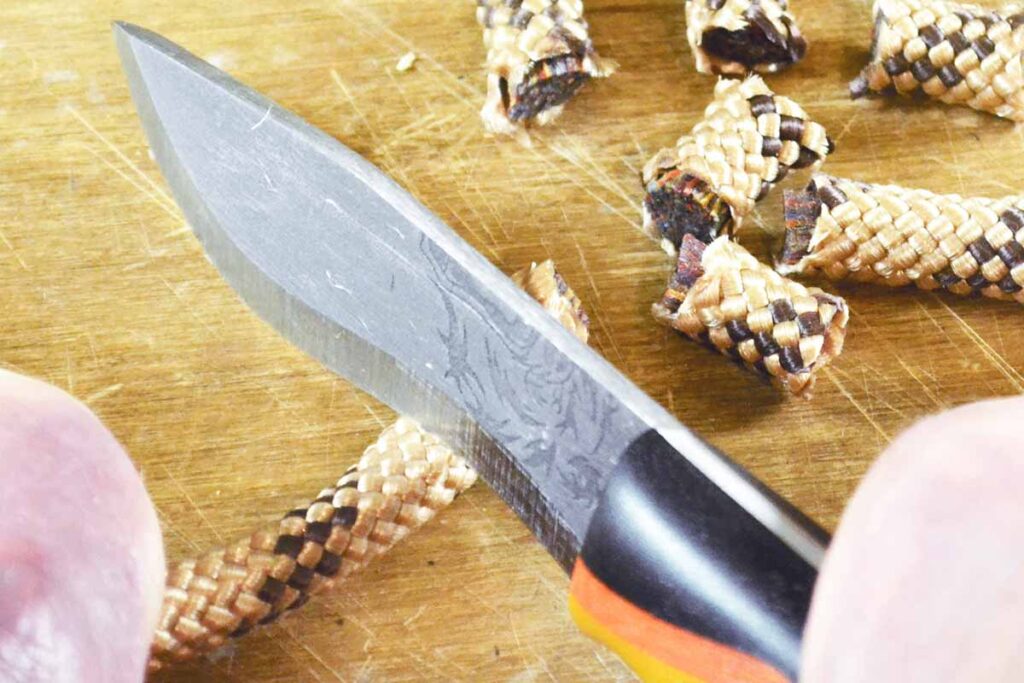
The Bear Forest Custom Recurve is small compared to the two larger test knives, though the same blade geometry applies. Note how the upper curve of the edge ensnares the rappelling rope as it slices through it.

I started with some basic chopping on a 5-inch diameter oak log. The Sasquatch brought the hammer down with its weighted fore-end but the Longhorn had the advantage of more working area on the blade for chopping. Both manufacturers chose 1095 and have loads of experience at maximizing the steel’s benefits. I found both knives excelled in the pure blade bite and performed well chopping. The Sasquatch weighted front end is an advantage for sheer power but the Longhorn is 3.6 ounces heavier, so it closes the gap significantly.

I did some shaving doing push cuts on 1×3 cedar planks. As expected, the concave edge of the Case excelled at trapping the wood through the straight cuts. Advantage Sasquatch. However, the TOPS has a grip a full 1-inch longer than the ’Squatch and is textured as well, offering superb purchase. Advantage TOPS. Bottom line, both recurve bowies performed very well. The choice is yours.

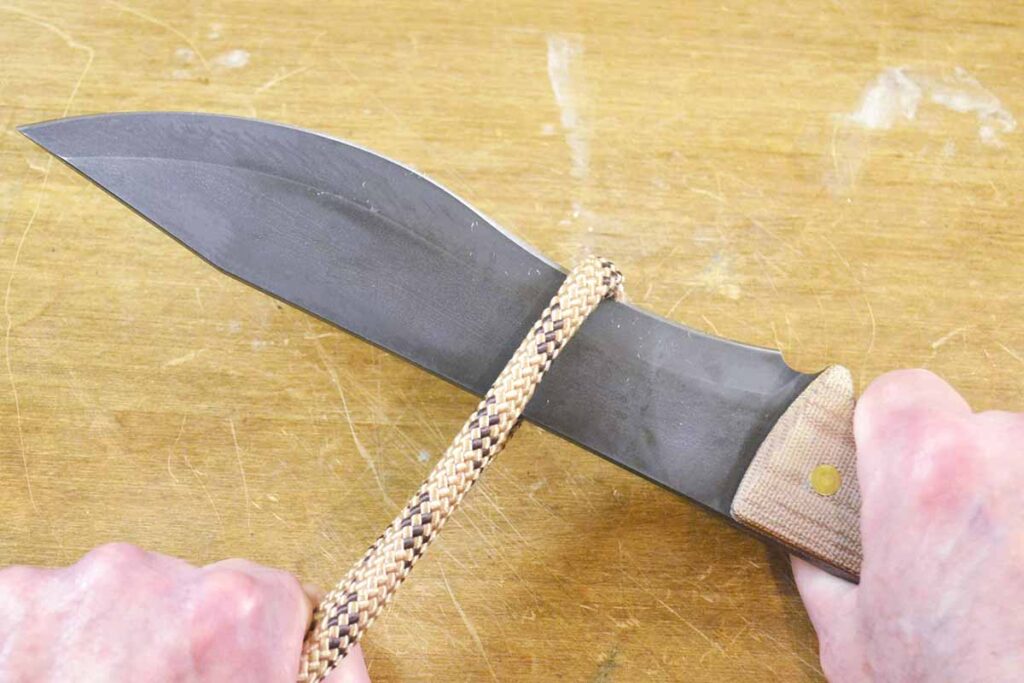
It's a trap! The lower concave area of the Case blade traps the rappelling rope during a pull-through. The deeper the concave curve, the better it performs this function.
It’s a trap! The lower concave area of the Case blade traps the rappelling rope during a pull-through. The deeper the concave curve, the better it performs this function.

The sheaths for both are well done. The Case belt model is natural leather designed in a simple, tasteful manner. The TOPS is unabashedly rock ’em, sock ’em tactical all the way.

The Bear Forest Custom Recurve punches up in its size class thanks to thick 3/16-inch blade steel and a healthy handle length, a trait often missing on smaller fixed blades. I tested the blade for its ability to capture 3/8-inch rappelling rope in its concave maw. Thanks to its overbuilt steel, the blade never wavered while producing slice after slice. It also took off nice, healthy curls of cedar just like the big boys. The curves of the cross-cut canvas Micarta scales made for excellent purchase and are attractive to boot. I also did some bark skinning on seasoned oak, took slices off other kinds of rope, and batonned fatwood pine fire starter.

Bear Forest provides a nifty Kydex sheath. It has a 1.5-inch spring clip on the back that not only mounts on the belt for vertical and cross-draw carry/deployment, but doubles as a pocket clip on either side, something seen more and more from the fixed-blade EDC crowd lately. All in all, I was impressed with the whole package.

Final Cut

The recurve isn’t just for whacking stuff. It requires a little more finesse and is typical of blades that don’t walk the straight and narrow. However, the benefits of recurves will reward you dearly when kept in their lane. All three of the test candidates performed admirably and are well worth your consideration.

*Editor’s note: Long-time custom knife purveyor J. W. Denton, who was a champion racecar driver in his younger days, was fond of comparing the knives of Steve Johnson, BLADE Magazine Cutlery Hall-of-Fame member Bob Loveless and others to curvaceous sports cars. J. W.’s comparison, however, was largely between the handle butts of the knives and the rear ends of the cars. However, both comparisons are accurate.

  1. Bear Forest Knives Custom Recurve
    Blade length: 3.25”
    Blade material: 52100 carbon steel
    Handle material: Crosscut canvas Micarta®
    Gripping feature: Tri-color Micarta handle material
    Sheath: Black Kydex w/belt clip
    Weight: 5 ozs.
    Overall length: 7.75”
    Country of origin: USA
    MSRP: $249

Check Out More Outdoor Knives:

Advertisement

Must Read Articles

Read this before you make a knife

Knifemaking 101 – Read This Before You Make a Knife

  by Wayne Goddard My experience has taught me that there's nothing like digging in and getting started. I've often said the hardest part of the...
how to forge damascus steel

How to Forge Damascus

Advertisement
Advertisement