
Buyer's Guides

You’re looking for a new knife in a certain style – we’ve got recommendations on the best blades for every price point.

Knife Steel Trends: What To Look Forward To In 2025

Knife industry pros give their takes on what the hot knife steels will be in the year ahead.

Every cutlery buyer faces a dizzying array of steel choices when it comes to buying that next knife, an array that represents the proverbial “double-edged sword.” While it’s nice to have choices, it can also be hard to keep up with so many options. Fortunately, industry professionals are available to help sort out which stainless and carbon varieties are either catching fire or cooling off.

Hot Steels for 2025

  • CPM Magnacut: Folders and fixed blades
  • CPM S30V: Hunting knives, tactical folders, custom knives
  • CPM S35VN: Tactical folders, custom knives, factory outdoor knives
  • CPM 154: Hunting knives, EDC knives, custom knives
  • CPM 20CV: EDC knives, custom knives, knives requiring heightened wear and corrosion resistance
  • CPM S90V: Knives requiring heightened wear and corrosion resistance
  • CPM Cruwear: Bushcraft knives and tactical fixed blades
  • CPM 3V: Bushcraft knives, survival knives, hard-use knives, tactical fixed blades
  • CPM 4V: Competition cutters, hard-use knives
  • M390: EDC knives, custom knives
  • 1095: Factory outdoor knives

*The steels are listed in no particular order by the knife patterns/types for which they are favored most by users and makers, according to the story’s sources.

MagnaCut Reigns Supreme

Last year when BLADE took the temperature of steel suppliers, the clear-cut champion of blade materials was Crucible Industries’ CPM MagnaCut stainless. The creation of steel guru Larrin Thomas, MagnaCut remains on top and will stay there for the foreseeable future. Bob Shabala, president of Niagara Specialty Metals, praised the high-performance blade material last year and still does today.

CRKT MagnaCut blade knife
CPM MagnaCut stainless ruled among knife steels in 2024 and will continue to hold sway in 2025. A representative example is the new CRKT Q, a folder in titanium and carbon fiber designed by Richard Rogers. Country of origin: Italy. MSRP: $225.

“We have sold about 320 tons of CPM MagnaCut since its introduction in 2020. It is our biggest selling cutlery grade right now and I don’t expect that to change anytime soon,” Bob said, adding the qualifier, “This is from Niagara Specialty Metals’ limited perspective. I’m sure other mills are working on new grades which I’m not privy to.”

One reason MagnaCut is so popular is it embraces all cutlery genres with ease.

“CPM MagnaCut remains in high demand across various knife patterns,” Bob observed. “Some customers currently using MagnaCut for fixed blades are expanding into folding knives and have expressed plans to continue using the steel for their new designs, reflecting its versatility and ongoing popularity.”

Larrin Thomas
MagnaCut maestro Larrin Thomas

Scott Devanna, vice president of technology and a metallurgist for SB Specialty Metals, tends to concur.

“I’m not sure there will be a new ‘super steel’ introduced in 2025. The introduction of new steels seems to have a three-to-four-year cycle, and with the recent intro of CPM MagnaCut such new introductions may be a few years off. We sell a lot of MagnaCut,” he stated. “I’ve learned over the years that new is very often the primary driver when new grades are introduced. This is what happened with CPM S30V, CPM 20CV and its European equivalent M390, and a few other grades.”

It should be noted that MagnaCut technically is going into its fifth year of existence. As you can see, it takes a while for a steel to work its way into the manufacturing pipeline and be given a thumbs up or thumbs down by the end user.

Specialty Grade Steels

Meanwhile, other specialty grade steels aren’t being ignored. In fact, many knife consumers prefer other steels that suit their needs better, both of the stainless and carbon varieties.

David Fleming Cowboy Knife
CPM 154 stainless will continue to be a steel of choice for custom hunting knives, here on the Cowboy Knife by David Fleming in a handle of sheep horn from a Rocky Mountain bighorn. Overall length: 7 inches.

“CPM S30V, one of the original cutlery-grade steels, continues to be one of our best-selling products,” Shabala noted. “Despite its age*, S30V maintains a strong position in the market, demonstrating its enduring reliability and widespread appeal among knifemakers.

Devanna agrees.

“CPM S30V is still a favorite for hunting knives, as well as CPM 154,” he noted. “For everyday carry folders, M390, CPM 20CV and CPM 154 are still used quite a bit as well.”

Scott said CPM S30V and S35VN remain strong for tactical folders.

Bob Shabala
Bob Shabala, Niagara Specialty Metals

Custom knifemakers aren’t as easily swayed by trends and tend to go with steels they are comfortable using, are time-proven to them personally, or geared to their particular customer base. While many are on the MagnaCut train, they tend to be more diverse in their choices.

“Other steels popular among custom knifemakers are M390, CPM 20CV, CPM 154, and to a lesser extent CPM S30V and CPM S35VN,” Devanna stated. “I have heard that CTS-XHP will be re-introduced, and this grade developed quite a following when it was readily available—especially for kitchen knives and high-end folders.”

Added Shabala, “CPM 154 is always popular with the custom makers.”

Carbon Steel

THE CARBON EQUATION
The outdoor crowd—bushcrafters, survivalists and open-air tactical users—has to be pleased with the attention they’ve been getting from the industry. These users’ requirements are different and they prefer a subset of steels all their own.

TOPS Shadow Hunter
While major outdoor knife manufacturers like TOPS and ESEE still sell the bulk of their knives in 1095, they have been gradually offering their customers more steel diversity, including stainless versions such as S35VN. The TOPS Shadow Hunter has a 4.5-inch blade of 1095 carbon steel in a tungsten Cerakote®. Country of origin: USA. MSRP: $250.

“CPM 3V and 4V are favored for hard-use knives due to the steels’ toughness, while CPM S90V and 20CV are popular among users who prioritize wear and corrosion resistance,” Shabala observed. “CPM 3V and CPM 4V are carbon steels that continue to sell well in specific areas. 3V is in high demand for bushcraft knives and 4V is being used by the current national champion in BladeSports International cutting competitions, Ben Propst. His wife Sue Ann is now using it and in 2024 they both won cutting events in Kokomo and the Smoky Mountain Knife Works fall festival.”

“I think CPM 3V and CPM Cruwear—mostly for bushcraft/survival knives as well as tactical fixed blades—are gaining popularity in the market,” Devanna opined. “CPM 3V has proven itself over the years and continues to be a popular grade. CTS PD#1 was in this category but availability of this grade is a problem.”

While major outdoor knife manufacturers like TOPS and ESEE still sell the bulk of their knives in 1095 carbon steel, they have been slowly offering their customers more diversity in their lines, including such stainless versions as S35VN.

Overall Take

As Shabala and Devanna noted, MagnaCut will be the top dog among steels in 2025, but it’s certainly not the only hound in the kennel.

Scorpion 6 Knives
Shane Magnussen uses the CPM S90V supplied by New Jersey Steel Baron on his model BBV2 folder. Closed length: 4.54 inches. (SharpByCoop image)

The cutlery industry is so diverse in the competition among manufacturers, custom makers, genres of knives and budget categories, there’s room for many different stainless and carbon steels. While what’s in the works remains unknown to most, you can bet there are teams of metallurgists working on the next great knife steel as these words are written.

As a knife enthusiast and cutlery buyer your choices are bountiful in all categories—from EDC to outdoor, fixed blade to folder—and affordable to expensive. Some users buy one knife to last for years while others rotate their carry or require cutting fare for specific purposes.

The good news is your knife and steel options have never been better!

*Editor’s note: The first-ever steel both designed and made specifically for knife blades, CPM S30V has been used for knives since 2001.
More On Knife Steel:

KSW Custom Knives Bushcrafter Review: Upcycled Edge

The author baptizes the Bushcrafter BLADE® style.

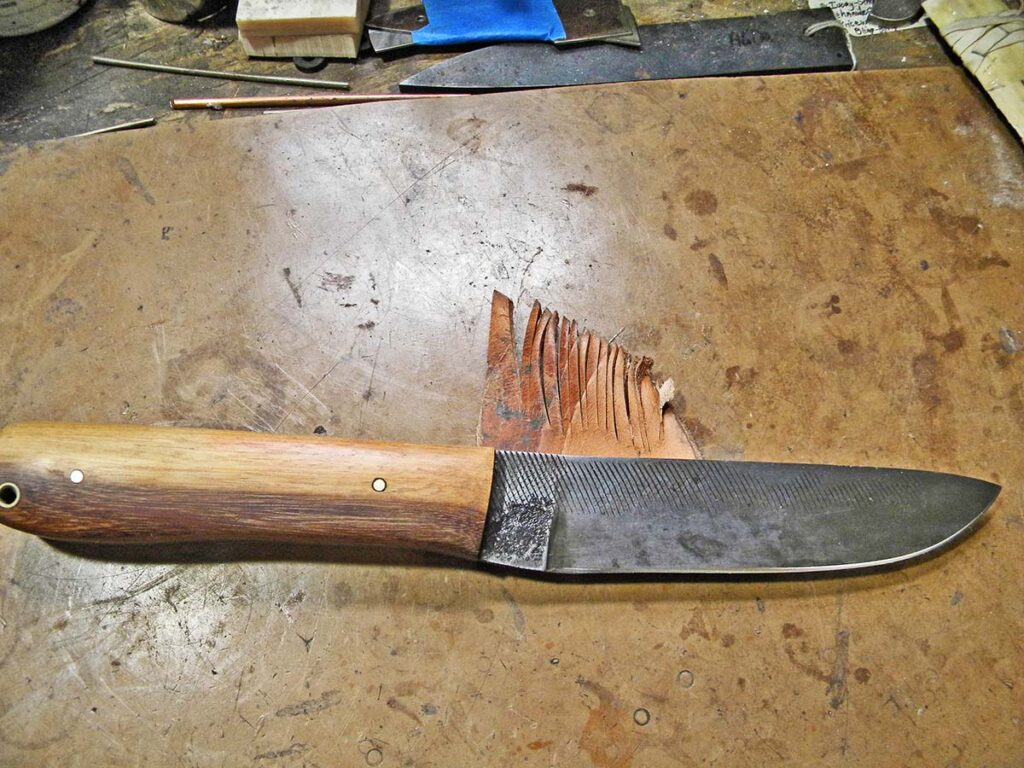
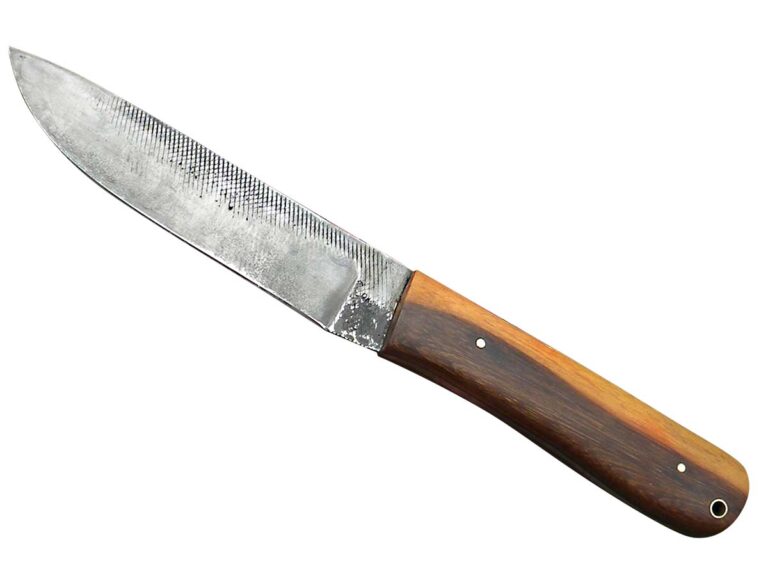
The Bushcrafter by Kris Waddington of KSW Custom Knives is a great example of what bladesmiths can do with recycled carbon steel. Got a worn-out file? No problem. They can convert it into another useful tool—a knife.

With a hot-enough fire, a smith can manipulate the steel into a wide variety of shapes and sizes. High carbon steels are made into cutting instruments, mild steels into ornamental fittings. It’s a great skill to possess and practice. Kris has the skill.

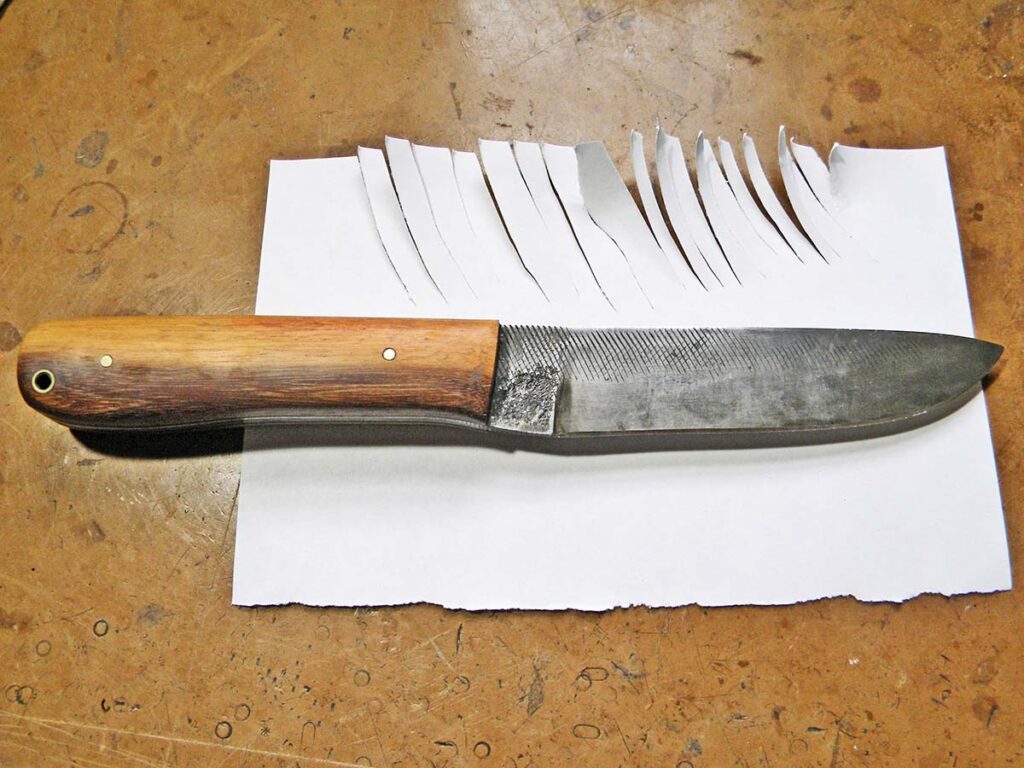
At the end of testing, the author returned to slicing the copy paper to check for edge snags or chips. The Bushcrafter sliced for the win. There was no edge damage. Heat treatment: spot on.

Enough talk about the cool stuff he can make. Let’s get into how well he performed the conversion.

Light-Duty Cutting

I always slice 20-pound bond copy paper at the start to see how fine the knife’s edge is. The Bushcrafter did not disappoint. The upcycled Nicholson file slid through the paper with ease. It made clean, crisp slices again and again. The knife is very sharp indeed.

The Bushcrafter cruised through the 8-ounce leather very quickly with straight cuts.

From there it was on to severing single-walled cardboard. The Bushcrafter sliced through the medium quickly and aggressively. I could hear every slice. It was easy to control the spacing of the cuts with the larger handle.

Cutting 8-ounce leather to represent the skin of a harvested big game animal was next. The Bushcrafter crunched through it very quickly with straight cuts. Skiving the material was even louder as the knife aggressively sliced it into thin layers. The leather was no challenge whatsoever.

Heavy-Duty Cutting

Cutting sisal rope always tells if the edge will hold up. The Bushcrafter crunched through 200 cuts very quickly and wanted more. There was a small hot spot where the handle meets the blade. A quick hit with 220-grit sandpaper removed the spot. The blade held an edge while slicing and cutting. It was time for a tougher medium.

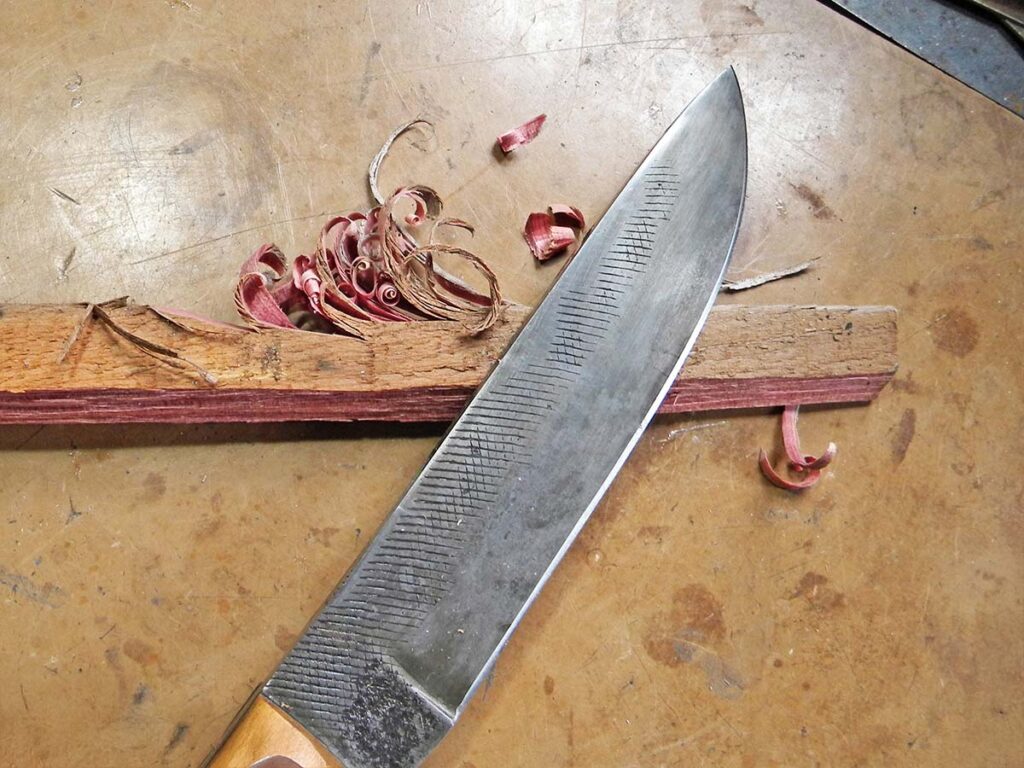
The Bushcrafter turned out some excellent red-cedar curlicues ready for the fire.

For bushcrafting, I chopped a slab of red cedar. The blade buried deeper than expected and cracked the slab. It was comfortable using the knife.

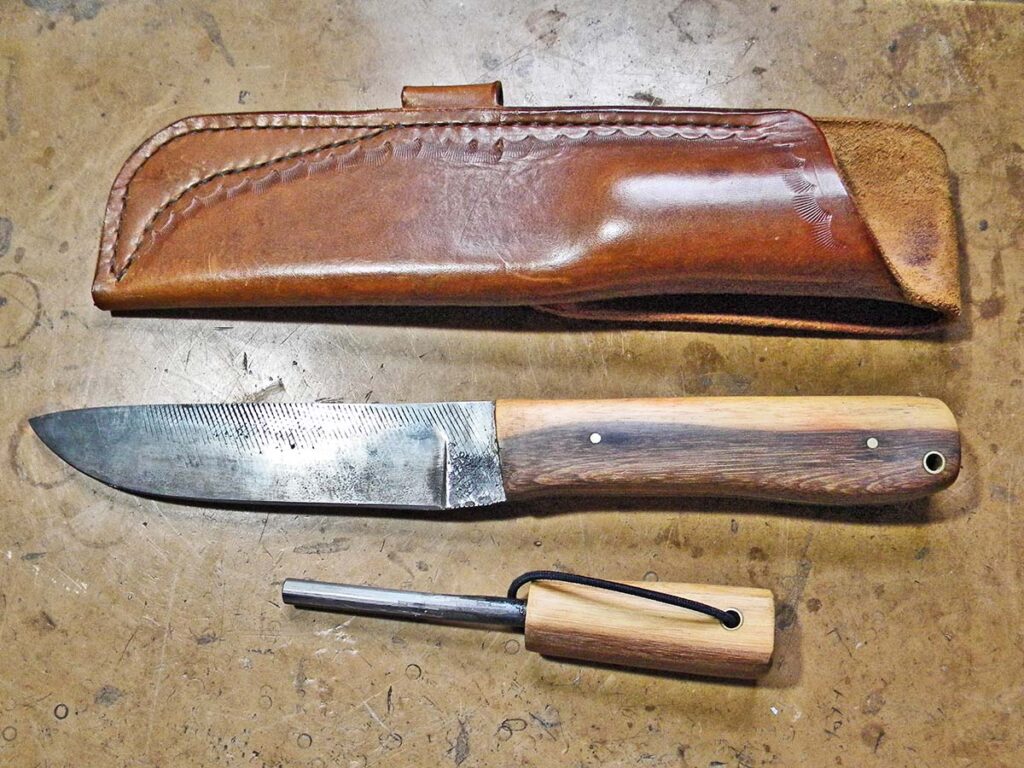
I worked the cedar to make a fire stick. The Bushcrafter turned out some excellent curlicues ready for the fire. Batonning was next in line. The knife averaged 3 1/2 baton hits to split the slab into small kindling. That was some short slab work! To raise the bar, Kris added a ferrocerium rod with a matching handle. The result is a complete outdoor package.

A leather sheath and a ferrocerium rod with a matching handle complete the outdoor package.

I returned to slicing the copy paper to test for edge snags or chips. The Bushcrafter sliced for the win. There was no edge damage. Heat treatment is spot on. Great
job, Kris.

Final Cut

I would prefer more of a finger notch and maybe some thumb notches for added control. The Bushcrafter lives up to its name. Made to perform in the woods, it is the total package for your backpack outing.

Bushcrafter Specs
Maker: Kris Waddington
Blade length: 5.25”
Blade steel: A forged Nicholson file
Blade grind: Flat
Scales: Ironwood w/black liner
Hardware: Brass
Overall length: 11”
Extras: Ferrocerium rod w/ironwood handle
Sheath: Leather by @wesleys_american_made_leather
Maker’s price: $325.98 at press-time exchange rate

More Knife Reviews:

Damascus: What Are The Hot Patterns And Steels In 2026

Jesse Harber and Coy Baker forecast the hottest damascus steel for ’26.

There’s something about predicting the future that has intrigued humanity for ages. If you could just somehow know which stocks would turn a profit, which crypto would “go to the moon,” or which numbers were coming in the PowerBall, you like to imagine that you could really take advantage. Thus far the ability to accurately predict the future has been a challenge, which begs the question—what damascus steels and patterns will be hot for 2026?

Jesse Harber of Vegas Forge doesn’t hesitate to jump right in.

“Our Reptilian pattern stayed hot in 2025,” he observes, “and it should continue to do well.” Vegas most often uses a combination of AEB-L, 440C and 302 stainless steels for contrast in its stainless billets. It prefers the combination of O1 tool, 1075 carbon and nickel-alloy steels for its carbon varieties.

Jake McCoy used Baker’s Zeus stainless damascus for the blade of his folder.

Twenty-twenty-five was a fun year for Vegas Forge. It was able to continue making the steel it loves, the steel most knife enthusiasts all love to use—and it still managed to find time to innovate.

Makers have been using EDM cutouts in canisters to make unique figures and shapes for some time now. Over the past few years, a few have experimented with 3D-printed shapes inside canisters for truly limitless possibilities. Vegas has taken a different approach of using smaller cutouts within canisters that are then layered into “regular” damascus. There are obviously other critical details of the process not mentioned here, but the end result is small shapes or logos within the layers of the steel, not just as a shape like the other canister types you usually see.

Hammering Away At Baker Forge & Tool

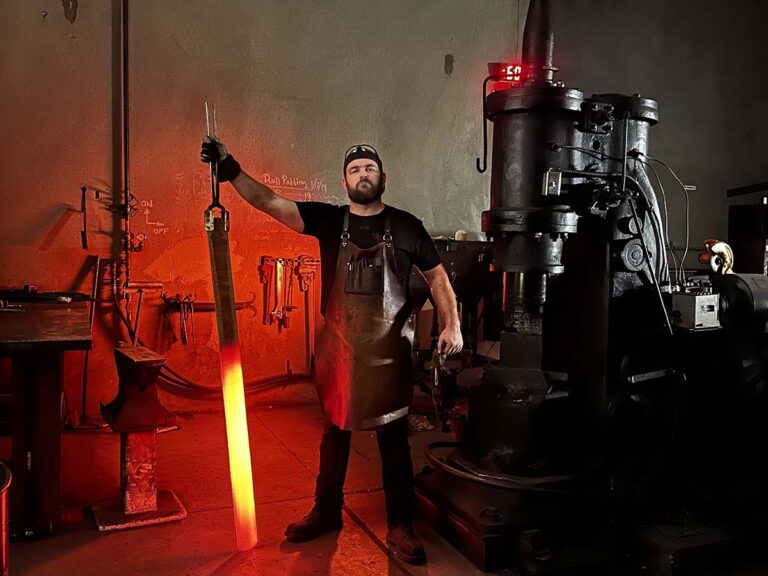
Coy Baker said Baker Forge & Tool is “really moving and shaking” for 2026, partly because of a new Chambersburg steam hammer converted to air. With a die surface of 6-by-14 inches and a 750-pound ram, the whole shop shakes when the hammer pounds on a giant billet. The hammer originally was used to make jib cranes for the Charlotte Railroad and runs on a 50-horsepower compressor with multiple 750-gallon air tanks. Coy stated he hasn’t pushed the hammer to its max, but said he thinks it can handle billets up to 35 pounds.

Baker’s Tsunami copper-mai steel is the material for the blade of a piece by Hans Molenkamp of Crimson Knife Co. (crimsonknives.com).

Why in the world would Baker Forge need such a giant hammer? Because the company, too, has been innovating and expanding into the production of stainless damascus. After two years of research and development and fine-tuning Baker’s processes for production, the prodigious pounder is finally up to speed. Baker prefers a combination of AEB-L and 154CM for its stainless damascus.

“The steel is really hard even when it’s hot,” Coy said. “Even with our 350-pound hammer it was like pounding on a rock.” The giant Chambersburg, on the other hand, moves a giant stainless billet with ease.

For those of you who don’t know, forging stainless damascus is quite a challenge, beyond the capability of many backyard smiths. Stainless steels contain high chromium, sometimes 12-to-15 percent, and chromium oxide doesn’t forge weld. Any oxygen at all in the forging environment and the welds simply will not stick. There are multiple ways to get around that, including inert gas purges and welding inside canisters. Add that to the fact that the stainless doesn’t like to move under the hammer and has only about a 100-degree-temperature window when you can safely work it, and you get a very difficult process.

Baker Forge & Tool’s Will Spears forges a billet of stainless damascus on the Chambersburg high-frame power hammer at Baker. Built in 1946, the power hammer has a 750-pound ram and weighs just shy of 11 tons. “It took us 14 months to install,” Coy Baker laughed. “The foundation for it is over 12 feet deep.”

Baker isn’t just producing stainless damascus in run-of-the-mill patterns, it is innovating. It has developed patterns it will use in its stainless steel exclusively, particularly one called Zeus.

Copper damascus has long been Baker’s hottest commodity, and it’s still producing it at high volume and quantity. The company is pushing the limits there as well and has developed a method to weld and manipulate copper on the end grain. While the technique is under wraps, the results will be broadcast far and wide: copper damascus in formerly unobtainable mosaic patterns. When clad over a monosteel or carbon damascus core, the patterns stretch the imagination of what’s possible.

Steel Industry Challenges

Both Baker and Harber mentioned challenges and areas for growth in the steel industry. Baker was the first to put BLADE® on the story about Buderus apparently closing its primary mill for 10xx series steels. Coupled with the recent closing of Crucible on the stainless side (see our article on Crucible Industries closing), both Baker and Harber have been exploring new steel options in case their mainstays become unavailable. Vegas in particular is moving toward more cores of Nitro-V and Elmax and moving away from MagnaCut and XHP.

Vegas Forge team member Franklin draws out a 40-pound canister of stainless Raindrop-pattern damascus on the company’s 5B Nazel hammer.

The hot new kid on the block is ProCut, the brainchild of a partnership between Larrin Thomas and Pop’s Knife Supply. Both Vegas and Baker are looking forward to pushing the limits of ProCut. As a high-alloy steel, when combined with Apex Ultra, the maker achieves high performance out of what looks like “ordinary” 1084/15N20 damascus. If you think of the difference in performance between 1084 and 52100 carbon steels, you’re on the right track. Baker Forge is currently in the lead on the ProCut “arms race” but Vegas Forge has steel in hand and is ready to go.

What fun new things can we expect in the world of damascus in 2026? Vegas Forge is entertaining a few recent orders that sound interesting. There’s a maker in Alaska using Vegas material to make high-end custom ice skates, and another customer using the company’s material to make stainless damascus computer keyboards. Who’d a thunk it? For those who enjoy a good picture show, Vegas has another top-secret project in the works. Think aliens with amazing damascus weapons and tools and you’re on the right track.

Take two leaders in the field like Baker and Vegas, factor in the demand for their top steels and add lots of innovation, and you get the makings of a really great year to come in the world of damascus.

More On Damascus:

Beating The Bush: Top Bushcrafting Knives

Four Blades, One Purpose: Bushcraft Mastery

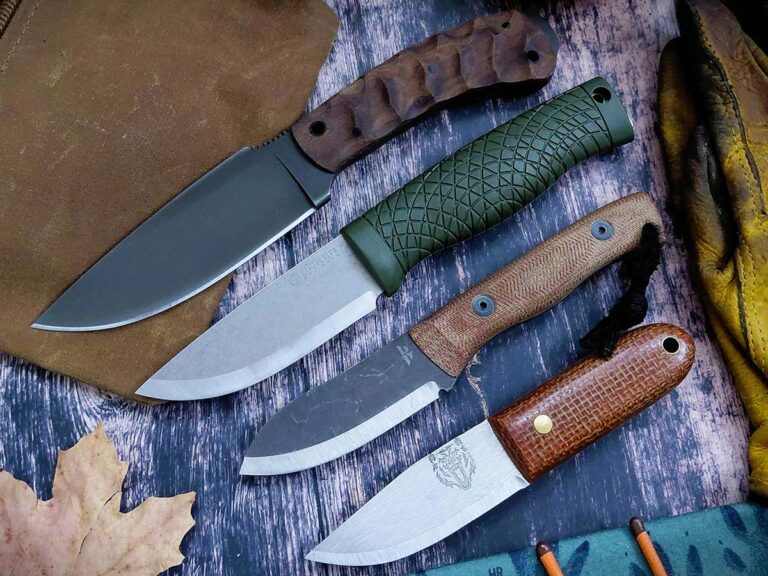
A bushcraft knife is more than a cutting tool—it’s a partner in the woods. Unlike kitchen cutlery or tactical blades, bushcraft knives balance durability with precision. They carve, split and shape wood, strike sparks and handle camp chores with ease. Key traits of a good bushcraft knife include a full tang for strength, a comfortable handle for extended use and a grind suited to carving and slicing. Blade steel must retain an edge while resisting chipping and the sheath should securely hold the knife in rugged conditions. In short, bushcraft knives are built for living outdoors, not just surviving it.

Survival Knives vs. Bushcraft Knives

Survival knives feature a robust design for emergencies, allowing users to chop, pry and withstand heavy abuse. They may feature serrations, hollow handles or multi-purpose functions aimed at crisis situations. Bushcraft knives, by contrast, emphasize control and precision. They carve wood, prepare food and perform camp tasks with efficiency. Where survival knives lean on brute strength, bushcraft knives rely on finesse. The distinction lies in intent: survival knives help you endure unexpected hardship, while bushcraft knives help you thrive in the wilderness through daily, deliberate use.

Böker Bronco Mini

In the utility realm, the Böker Bronco Mini sliced all types of materials with Scandi precision.

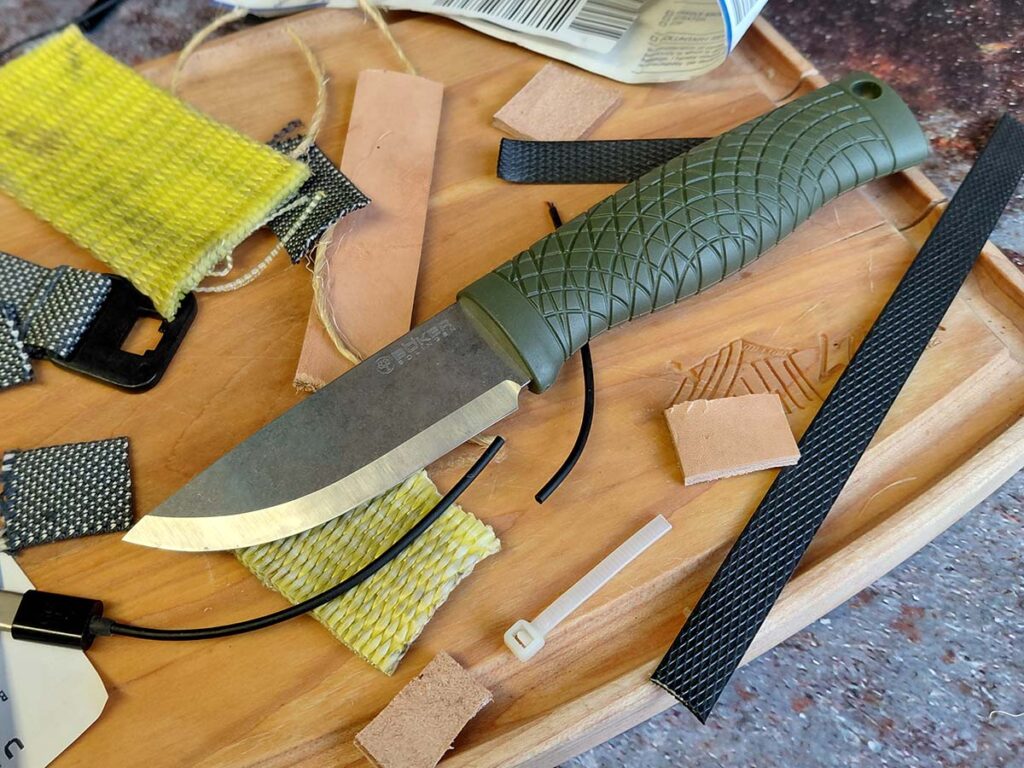
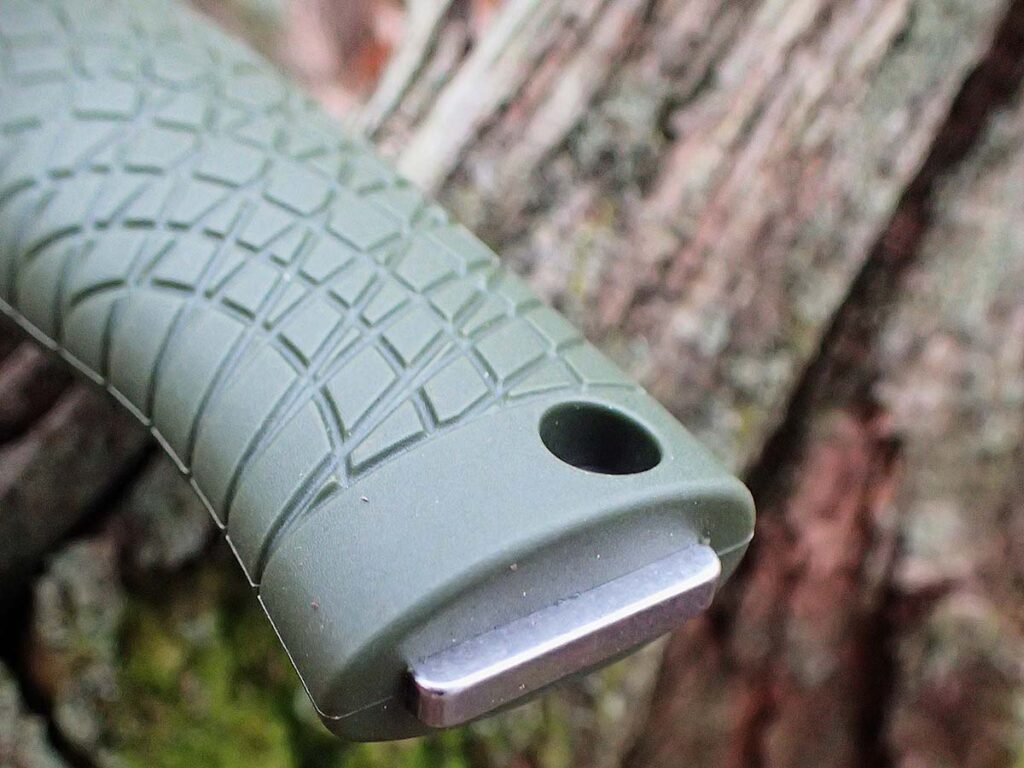
The Böker Bronco Mini Fixed Blade measures 8.23 inches overall with a 3.375-inch CPM 3V blade in a drop point profile. Finished in satin and stonewash, the blade combines toughness with clean cutting ability. A Scandi grind makes it ideal for carving wood and bushcraft tasks, giving precise control in camp chores. To ensure stability, the tang is continuous and extends slightly beyond the handle end, allowing it to withstand strong impacts, such as striking a log. Additionally, a brief segment at the back of the blade features sharp 90-degree edges on both sides. The exposed tang can be used to generate sparks with an optional fire starter. The green TPE handle is textured for grip and measures 4.625 inches, providing comfort and security during extended use. At 4.8 ounces, it balances portability with durability.

A Kydex sheath provides ambidextrous carry and locks the knife securely with a solid click. Compact yet rugged, Böker built the Bronco Mini to baton kindling, process game, and thrive as a daily outdoor companion.

Unbroken Bronco

The exposed pommel/ferro rod striker is an outstanding feature of the Böker Bronco Mini for added utility.

Although the Böker Bronco Mini did all the bushcraft chores as well as any, it really shone in a utility role. I created a solid, realistic gauntlet of slicing tasks for the Böker Bronco Mini. I started with cutting heavy-duty scrap leather on a cutting board, holding it in one hand while slicing with the other. Next, I did the same with high-strength tow strapping. This task was difficult and would dull most new blade edges. This then set the stage for the lighter jobs. Old phone cord and zip ties fell victim to the Scandi blade, as did the jute twine. I cut up a lot of strong plastic package strapping, as we were close to the box-breaking-down season. Still, no issues.

With the amount of traveling I do, my life is full of luggage tags and boarding passes. If the edge wouldn’t slice these, I’d know the more robust materials dimmed it down. The Böker Bronco Mini passed the utility test like a champ. These were very realistic everyday chores that extend past the duration of this review.

Knives By Nuge Cub‑Muk

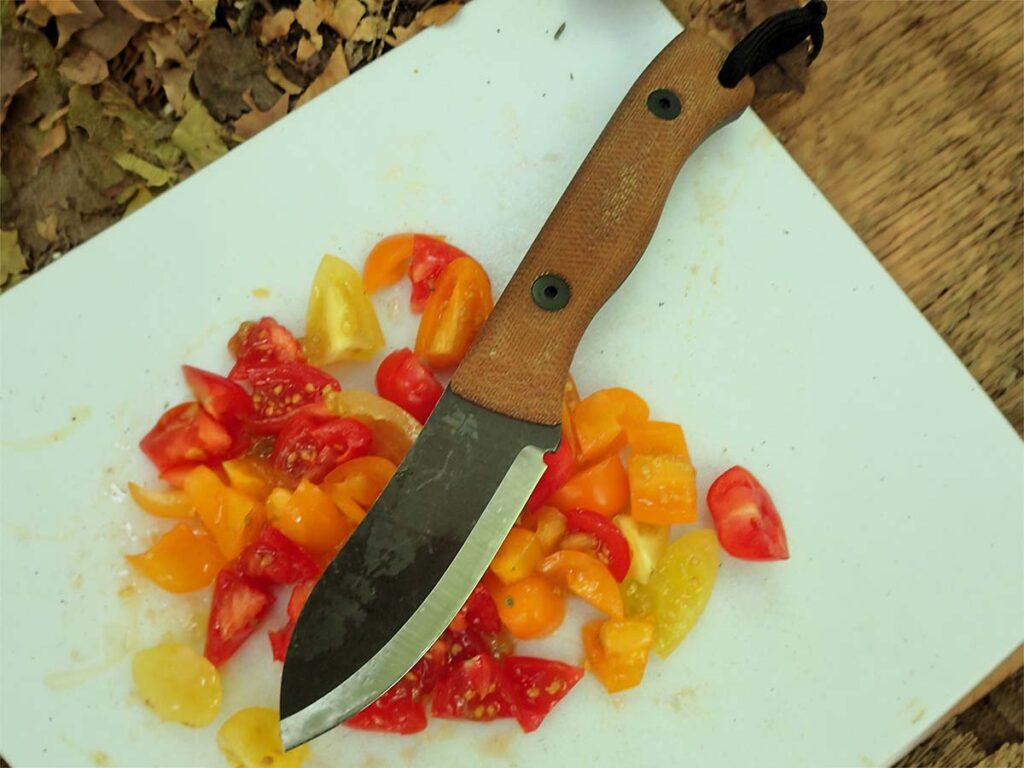
The Cub-Muk is a newish installment of the Knives By Nuge Cub series. The author used it as his companion blade in the Adirondacks with Nuge.

Inspired by the classic Nessmuk pattern, the Cub-Muk offers a compact yet full-featured design. Measuring 7 inches overall and featuring a 2.75-inch blade, with AEB-L stainless steel and a blackened, tumbled finish for durability. The Scandi grind, also available in Saber, excels at carving wood and shaping camp tools. Canvas Micarta scales provide a secure, weather-resistant grip, while the leather sheath adds traditional appeal and reliable retention. With its stout blade and full-sized handle, the Cub-Muk delivers agility and precision, making it a favorite for fine bushcraft work where control and efficiency matter most.

Floatplane-Camp Test

In the Adirondacks (upper right), the author prepared food for the camp using the KBK Cub-Muk. Proving the Scandi blade can slice tomatoes and process food.
In the Adirondacks, the author prepared food for the camp using the KBK Cub-Muk. Proving the Scandi blade can slice tomatoes and process food.

During my time in camp, the Knives By Nuge Cub‑Muk proved itself as a true workhorse. I carried it five days straight in the Adirondacks, relying on it for every small task that came up. Food prep, cordage cutting, and campcrafts were routine. The AEB‑L steel held a keen edge, and the hump‑backed spine added utility, scraping fish clean and even scooping meals when needed. Safely, of course.

Projects around camp highlighted the Nessmuk’s strengths. I carved pot hangers, stakes, and tool handles from both green and seasoned wood. Instead of chasing perfect points for stakes, I favored wedge ends that drove easily into the soil. Light taps with a stick set stop cuts for notches, giving me clean results without heavy batoning. The Scandi grind excelled at feather sticks, producing fine curls that caught quickly. Paired with a ferro rod, the squared spine showered sparks, igniting tinder in seconds.

The Cub‑Muk blends Nessmuk’s classic lines with modern materials, creating a compact knife that sees constant use. Its sharp edge, comfortable handle, and versatile design made it indispensable. From carving camp gear to starting fires, it delivered precision and reliability, proving that small knives often carry the biggest load in the woods.

Winkler Woodsman

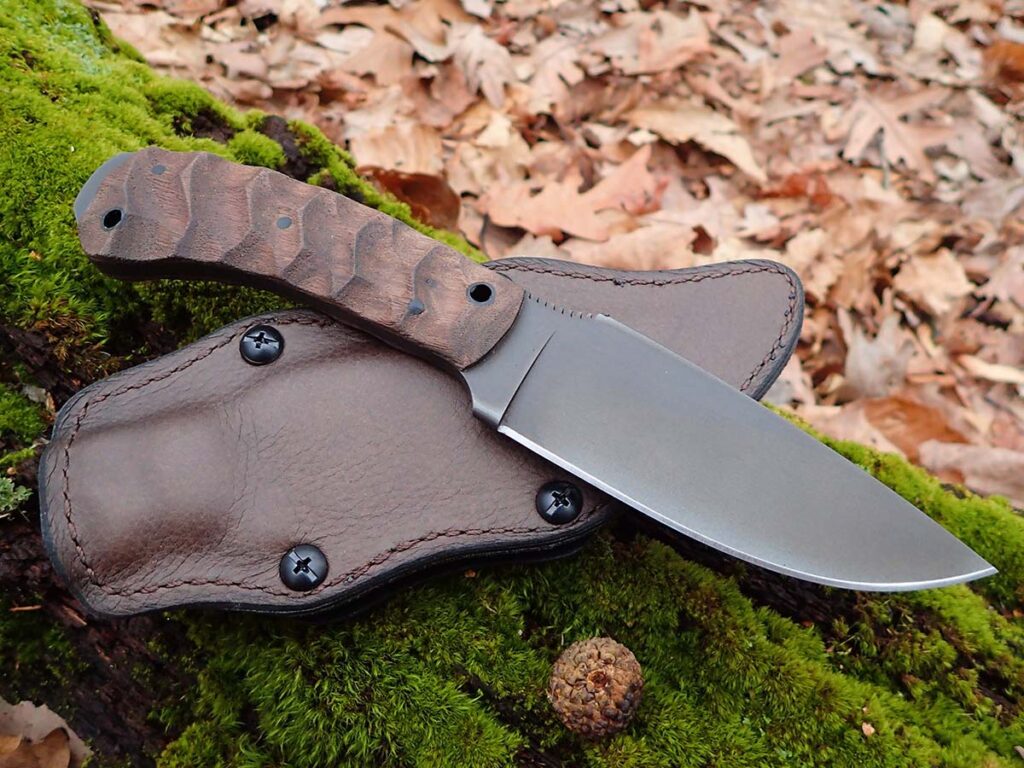
The Winkler Woodsman has an 8.75-inch overall length with a 4.25-inch blade forged from 80CrV2 steel and finished in Caswell black oxide.

The Winkler Woodsman measures 8.75 inches overall with a 4.25-inch blade forged from 80CrV2 steel and finished in Caswell black oxide for corrosion resistance. Its flat grind and drop-point profile provide versatility for carving, slicing and light chopping. The sculpted maple or canvas laminate handle offers a secure grip, while the skeletonized tang reduces weight without sacrificing strength.

A lined Boltaron sheath with a leather overlay and a spring-steel belt clip ensures reliable carry. Built for balance and control, the Woodsman blends rugged durability with refined handling, making it a standout choice for serious bushcraft tasks.

Table To Woods

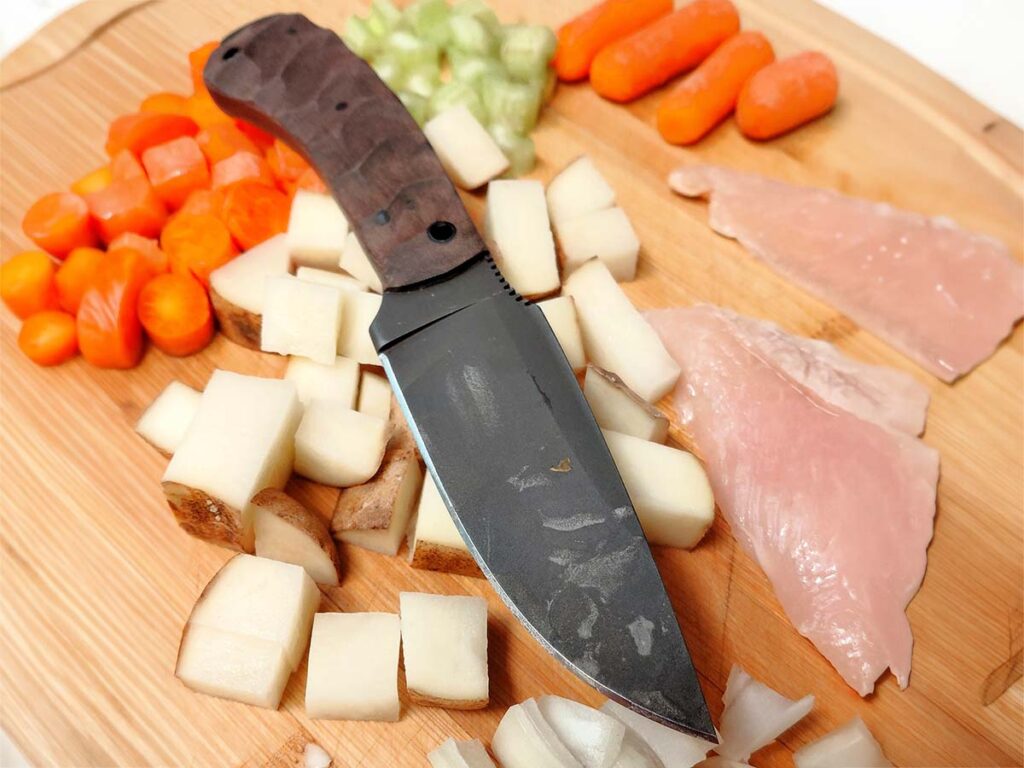
A bushcraft stew wizard, the Winkler Woodsman performed well on a rustic chicken stew.

It was a cold-weather stew week when I got the Winkler Woodsman, so I put it to work right away in the kitchen. Carrots are always a more challenging task for a bushcraft knife. Typically, bushcraft knives’ thickness and Scandi grind messily wedge and split root veggies. Luckily, the Winkler Woodsman has a high saber grind, which some would call flat. It easily cut the stubborn carrots using a longer stroke. Celery and onions were just as simple with the longish bush blade, thanks to its sharpness out of the box and its grind. I used a chef’s grip (pinch grip) with comfort. The potatoes were russet, which aren’t too hard and cook rather quickly. Still, they can be difficult like carrots. No worries with the Winkler Woodsman, however.

Lastly, there was a delicate chicken breast, which I butterflied and boiled for easier, faster cooking. The blade shape was perfect for this task. I don’t think any other blade for this review could have done the same stellar job for a winter chicken stew as the Winkler Woodsman.

Bear Forest Simple 2

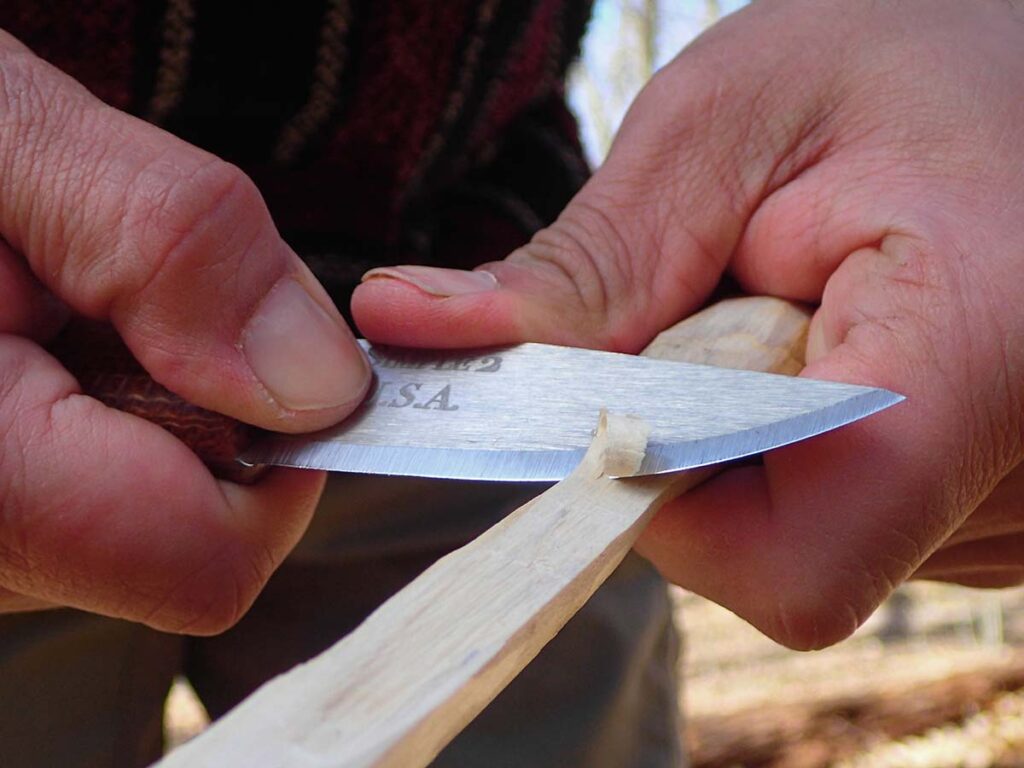
The author uses the Bear Forest Knives Simple 2 in a chest-lever grip for making camp tools.

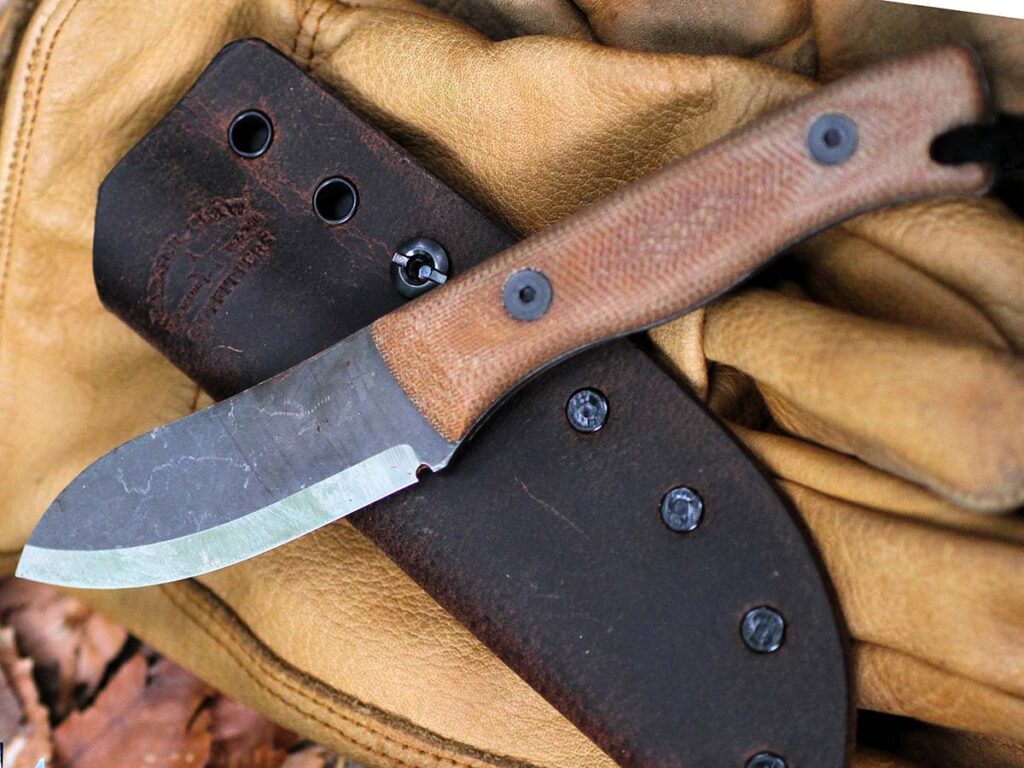
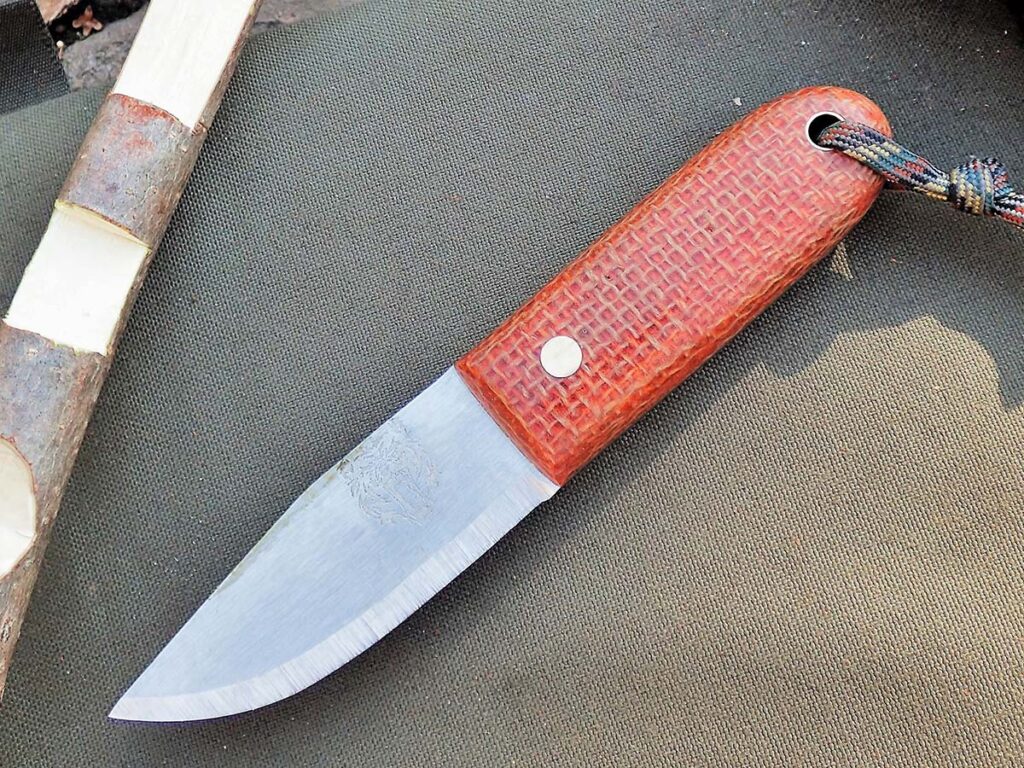
Sized down from the original Simple series (4-inch blade), the Bear Forest Simple 2 measures about 6 inches overall. It features a 3.5-inch AEB-L stainless steel blade. Its zero Scandi grind bites cleanly into wood, excelling at carving and slicing tasks. Butterscotch and Mocha paper Micarta with red burlap “bearcarta” scales give the handle a warm, secure feel.

The ambidextrous JRE leather sheath (black) allows for belt or neck carry. Lightweight yet tough, the Simple 2 blends corrosion resistance with practical design. It’s streamlined for everyday bushcraft chores, offering a reliable companion for carving, camp setup and field use without excess bulk.

Simply Qualified

The author made a try stick with the Bear Forest knife, quickly and efficiently.

I gave each knife a project suited to its strengths. For the Bear Forest Knives Simple 2, I chose the classic try stick—a green branch about arm’s length and thumb to broomstick thick. It’s a perfect way to practice knife control and notch work. Over several months, I used the Simple 2 for fire prep, food tasks, and camp projects, including tarp stakes and a bowsaw, but the try stick demonstrated its precision. I carved 11 practical notches, from root strippers and V-notches to square reductions, latch notches, and lashing crosscuts. In the middle, I shaped double flats and pierced a square hole with the pointed tip, cradling the handle in my palm for control. I added a saddle notch, a round reduction, a pot hook and a rounded end for digging sticks or stakes.

The thin edge bit deeply, shaving clean curls for tinder. The belly of the blade handled reductions, while the sharp spine proved useful for peeling bark. The oval handle stayed comfortable, with a rounded butt that anchored the grip. Compact yet capable, the Simple 2 excelled at fine carving and practical camp work, proving itself a reliable bushcraft companion.

Bushcraft Breakdown

You can’t go wrong with any of the bushcraft blades here. They have their strengths without many drawbacks!

More Reviews:

Best Japanese Pocketknives: 5 Excellent Examples

There Is A Robust Market Of Japanese Pocketknife Makers. These Blades Stand Out As Some Of The Best.

Japanese knifemakers are among some of the best on the planet. With traditions dating back to the days of the samurai, makers in Japan have long known what it takes to make high-quality blades.

As the tastes of blade lovers have changed throughout the years, so too have the pieces made in Japan. Today, with pocketknives being one of the dominant styles, makers are creating EDC knives that wow. 

What Sets Japanese Pocketknives Apart From Western Blades?

There is a traditional style of Japanese pocketknife that many modern models are still based on. The higonokami was first developed in the city of Miki in Hyogo prefecture in 1896. These knives operate as friction folders with no lock that open by the friction of the swivel or by using the thumb lever, known as the chikiri.

The blades of the knives set themselves apart from many Western-style knives due to their flat grind without a secondary bevel. 

The name higonokami was trademarked by a guild in Miki so now only one maker, Nagao KameKoma, can officially use the name when marketing their knives. But many makers throughout the country still make knives in the style but simply call them “higo” knives or “made in the higonokami style.”

Best Five Japanese Pocketknives

As you’ll see, not all Japanese pocketknives are higonokami. But many high-quality blades are as they blend traditional design with modern construction.

KATSU Damascus Steel Higonokami Japanese Razor Knife

KATSU Damascus Steel Higonokami Japanese Razor Knife

First up is this knife from Katsu. A contemporary take on the higonokami, the Razor Knife is a beautiful piece that shows why the higonokami style endures and the skill of the makers at Katsu. 

The three-inch damascus reverse tanto blade is married to a damascus bolster and snakewood handle. The chikiri is damascus as well. Fully closed, the knife is 7.5 inches long and weighs just under four ounces. It’s a lovely piece to look at and use.

MSRP: $73.99

Moki Kronos Lockback

Moki Kronos Lockback

This folder from Moki looks like it wouldn’t be out of place in the catalog of many American companies and is an excellent representation of how the Japanese pocketknife market has evolved over the years.

The Kronos has a handle made of amber stag horn and a polished satin VG-10 blade. The drop point features a flat grind and is 2.75 inches in length. The knife opens with a nail nick and comes with an included leather-lined sheath. The Kronos has an august, regal look to it.

Moki has been making knives for over a century in Seki, the epicenter of Japanese knifemaking. The Kronos blends the old with the new in an elegant yet rugged construction.

MSRP: $189.95

Mcusta Tsuchi Large Pocket Knife

Mcusta Tsuchi Large Pocket Knife

A stunning, modern knife, Mcusta’s large pocket knife is an eye-catcher. The hammered-patterned steel gives the handle a wonderful textured feel and the damascus stainless blade looks as good as it cuts.

Made with a VG-10 core, the drop point blade is laser cut so there are no mistakes in construction. Each Mcusta knife is assembled and finished by hand which means you’re getting what you pay for with this blade in the best possible way.

The pivot pin washer system allows the blade to move like a hot knife through butter, which this knife could cut through with ease even when ice cold. When it comes to factory Japanese pocketknives on the, please forgive the pun, cutting edge of style and tech, this piece from Mcusta is high on that list.

MSRP: $176.40

Albatross EDC Mini

Albatross EDC Mini

Sometimes you want a small knife that packs a big punch. Look no further than the mini from Albatross. This 2-inch damascus blade is composed of 71 layers of steel around a VG10 core and hardened to a 58-60 HRC. The ergonomic ebony handle sits well in the hand and allows for easy, flowing movement with the blade.

Great for camping and the home, the Mini has a lanyard for easy carry and arrives in a lovely box, making it great to give as a gift. Yes, it’s a small blade, but when you’re camping you’ll probably be cutting mainly in tight quarters, making this knife the perfect choice for the job.

Oh, and it’s under $50, and you can never go wrong with a good knife at that price.

MSRP: $45.50

Nagao-Kanekoma MN-20B Original Higonokami

Nagao-Kanekoma MN-20B Original Higonokami

Our list concludes with an official higonokami from Nagao-Kanekoma. This small knife is incredibly strong. The Aogami damascus is hardened to a 60-61 HRC which gives the blade a rugged, durable edge that can handle far tougher use than you might expect from a knife weighing just under 2.5 ounces. The blade is connected to a sleek black-coated brass handle. 

This feels like a time machine to some of the first Japanese pocketknives. You can see the craftsmanship in every inch of the knife and can feel the maker’s skill when you hold it. It’s smack in the middle of our list in terms of price so you won’t have to break the bank to have a piece of living history.

MSRP: $134

Read More

Micarta: A Do-Everything Handle Material

Micarta Is One Of Many Materials Used For Blade Handles. Used For More Than A Century, Micarta Continues To Be Incredibly Popular.

Micarta is not a new material, in fact, it has been used for over 100 years. Unlike naturally-occurring materials, Micarta offers properties other materials don’t. We’re going take a look at what Micarta is and what makes it probably the best material available for making knife handles today. 

What Is Micarta?

Micarta is the name of a commercially-owned product, and isn’t just a generic material. Micarta is a durable type of composite made of a base material suspended in epoxy resin. Norplex Inc. owns the trademark on the term.

The material is compressed under heat and is classified as a thermoset product. The main name associated with the invention of Micarta is George Westinghouse. During his life, Westinghouse never stopped creating new things, and the first developments of what we know now as Micarta occurred somewhere between 1900 and 1910. 

Because of the way that Micarta is made, it has extensive applications for insulation in electrical systems. It is unknown when this material became a popular knife handle option, but it is safe to say it’s never been more popular than today. Like many materials of the era, such as Bakelite and Celluloid, Micarta found its way into craft use.

How Is Micarta Made?

It’s hard to pin down Micarta. In the old days, fabric and paper were used as the base material, but today we have a wide variety of other types that exist, including carbon fiber and glass. Knife handles are actually a fairly narrow category of end-use for Micarta.

The process by which Micarta is made is relatively simple. Materials are soaked in whatever type of thermoset is going to be used, and, once impregnated by the resin, it is subjected to intense heat and pressure which causes a sheet to be formed. Decades ago, Micarta was also made in large blocks. 

These large blocks are a favorite for revolver grips and other large, three-dimensional forms. There are people that shop garage sales and estate auctions looking for fixtures or items made using these older types of Micarta. The most prized is a type of paper Micarta that is about the closest thing to elephant ivory in terms of texture and color that grip makers can get.

Who Uses Micarta?

Mini knife makers that work with the material end up ordering large quantities to their specifications. Smaller companies tend to work with what is available through existing supply chains, which is a large reason why you end up seeing very similar colors across the board. 

It is possible to get Micarta in custom colors and textures, though you may have to spend thousands to get it. If you find that you are looking to put a nice handle on a knife, it is a good idea to call around and see if any companies have scrap that they are willing to sell.

Micarta Vs. G-10

True Micarta is not the same thing as G-10 or other types of thermoset laminates. Many people tend to use the terms interchangeably, but in a strict manner of speaking, true Micarta will be made using paper, burlap, canvas, or linen set in resin. G-10 is different in that uses glass cloth, a type of material made from carbon fiber filaments. 

Micarta is usually heavier than G-10 and carbon fiber laminates, but, in terms of knife handles, the difference is negligible and is not too far apart from the weight of standard hardwoods. Bakelite, while common on a tremendous number of products and weapons, isn’t the same type of material as Micarta even though it occupied many of the same roles. 

Comparing Micarta To Other Handle Materials

As Micarta has become more popular, more companies have offered it as an option, but sometimes incorrectly. A true Micarta material is not quite as durable as G-10, but it is going to hold up better than wood or leather. G-10 is an essentially absorption-proof material. Most handle materials out there, Micarta included, will absorb a degree of water, sweat, or blood. 

Though it is unlikely to permanently stay in the material, it is recommended you keep Micarta clean. Usually, hot soap and water does the trick, and, while you can get oil on it, expect it to stain a bit. This has to do with the fact that the materials in Micarta are either paper or fabric, and many of these materials are exposed, though fully impregnated by resin.

Wood handles are subject to small problems, and if installed incorrectly, they can split or crack quite easily. Wooden handles are not especially great for heavy outdoor tasks, such as chopping or batoning. Wood also has the problem of absorbing ambient moisture. In especially humid environments, handles can swell and crack on the pins. Micarta has no grain in the way that wood does, although it is typically applied to knives along its length.

When comparing Micarta to carbon fiber it comes down to durability and weight savings. Carbon fiber is not an especially durable material, though it is very lightweight. As far as knife handles go, carbon fiber is excellent for inlays and panels, though it is not as good of a material for making full scales. When compared directly to Micarta or G-10, carbon fiber is harder to shape and is more difficult to apply a working textured finish. 

Best Knives With Micarta Handles

Linen and canvas Micarta is my hands-down favorite material for knife handles. The reason I find these types of Micarta the best is that they provide the greatest degree of function in the hardest environments. I like G-10, but I have found it too slippery across the board when covered in blood and fat out hunting and it becomes ice cold to the touch very quickly. While it is a very durable material, it feels much more like plastic than Micarta and, for lack of a better way of saying it, never develops the character like wood, leather, or Micarta. 

Linen or canvas Micarta offers the texture I want on a grip across the board, and I have put several products through an insane amount of daily use without any negative effects. Each of these knives I list here I have used for months or years, and I can strongly recommend them. 

Winkler Utility Knife

winkler utility knife

The utility knife was the first Winkler I ever owned, and it is still a constant companion. I have used this knife extensively for everything from opening paint cans and cutting heavy-duty straps to prying apart pallets and even building out countertops and interior demolition. 

I have logged hundreds of hours with this knife in hand and it has been extremely comfortable the entire time. The green Micarta handle has held up extremely well, though it now has some gouges from use. It is not on the cheap side, retailing at $450, but it has been worth every penny. 

Case/Winkler No.6

case winkler #6

A collaborative project between Case Knives and Winkler, the recurve utility No.6 is a heavy-duty knife built for some of the hardest projects. I have taken this knife with me out to the field and have also lent it out as a skinning knife for deer hunting. 

Due to its deep, recurve belly it is exceptional for chopping tasks and is just as good in the kitchen as it is blasting through small limbs. While no longer available on the Case website, my version has a tan canvas Micarta grip and it has held up exceptionally well. While it’s not contoured exactly to my hand as I have experienced with knives direct from Winkler, it feels good in its own right and will provide a lifetime of use. The MSRP is $430. 

White River Knife And Tool FC7

White River FC7

An extremely attractive, large knife, the FC7 is my go-to hunting knife for deer. While it may seem like a large knife, my experience in the field has taught me that it is probably the best big-game knife money can buy today. It is gorgeous to look at and the orange liners on the green Micarta definitely add to it. I see no reason why I will not continue to get years and years of use out of this product. The MSRP on the FC7 is $330.

White River Knife And Tool Exodus 4

White River Exodus 4

The Exodus 4 is the knife that I use in the kitchen every day for almost all tasks. It is probably the most washed knife on this list. It has been constantly exposed to soap, oil, and all other manner of kitchen materials. It makes an excellent carrot peeler using the square edge of the spine. 

My version has black Micarta panels, and they have held up extremely well to the constant washing and use. This knife and its grip have arguably been exposed to more caustic materials across-the-board than any of the other products, it was even put through the dishwasher several times by accident. The Exodus 4 is easy to hold even while in the direst of kitchen nightmares. The MSRP is $175.

ESEE Camp Lore RB3

ESEE Camp Lore RB3

The knife itself had some shortcomings. The steel is sharp but requires maintenance, and it is not very resistant to blood. My original version of this knife has been discontinued, Esee has a dimensionally identical, but cosmetically different, version for sale now. The MSRP on that knife is $190. 

I don’t remember what the Camp Lore version cost many years ago, but it has held up to my abuse. The grip panels are Micarta, and they have seen more than their fair share of punishment. The blade shape was less than ideal for working on four or five deer in a night, and I quickly learned my lesson and moved to a bigger knife. I will say that in the years that I used this knife, it was a good friend for the field, and I look forward to passing it on to my kids when they are older.

Read More

CRKT Facet Rivet And Viral Add Premium Options To The Line

Adding a premium option to the Ken Onion designed line, CRKT unveils the Facet Rivet and Facet Viral.

If you’re into knives (you most likely are, as you’re reading this), you’re familiar with the name Ken Onion. The famed knifemaker has turned out his fair share of must-have blades over the years, with many collectors and aficionados bating breath for his next drop. Well, it’s here and it’s awful dang familiar.

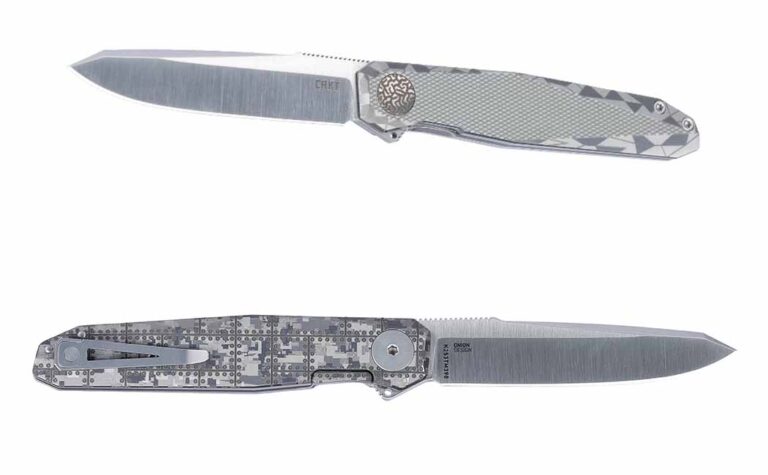
Shake hands with the Facet Rivet and Facet Viral. Yes, they’re the same Facet knives fans have known and loved since its release a year ago, but dolled up plenty nice to make them legitimate premium options in the line. In fact, the duo of top-shelf-edition CRKTs both have some alluring attributes likely to get customers to pony up the relatively steep asking price of $275. Not the least of which is the player behind the scenes making the Rivet and Facet a reality—Lion Steel.

CRKT Facet Blade Material

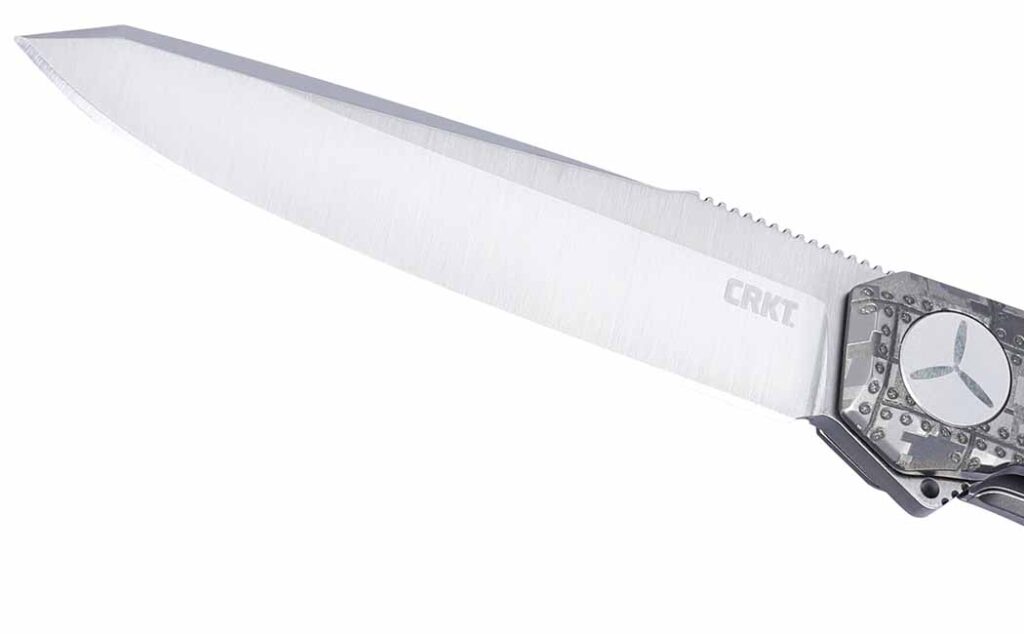
The Maniago, Italy concern is the manufacturer of the knives, which brings not only one of the more respected manufacturers in the game but also a host of top-shelf materials. Where this shows itself in the M390 steel used for the Facets’ modified drop-point blade. Commonly used by Lion Steel and other manufacturers in the region, the super steel (Austrian in origin) is noted for its impressive edge retention compared to tool steel, as well as its superior corrosion resistance.

CRKT Facet Blade

Impressive choice, particularly given the Facet certainly has the lines of a more gentlemanly EDC knife but should prove capable against more demanding tasks. Adding to its expected robust use is generous jimping on the knives’ spines, giving a solid purchase on them when more vigorously used.

Facet Handle Material

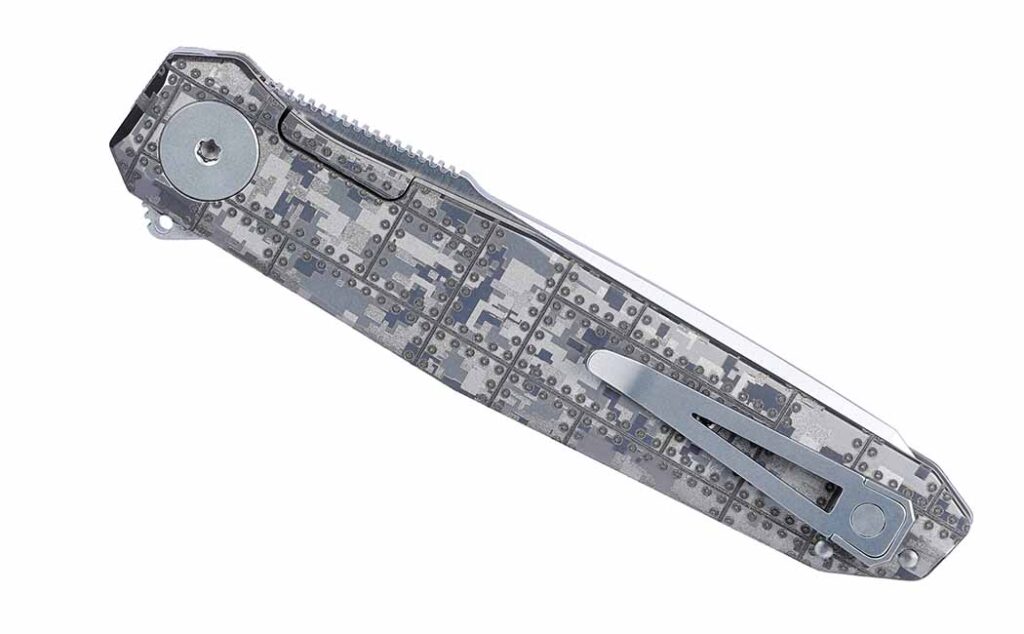
The handle scales on both the Rivet and Viral are titanium, but not some muted finish common to the material. Each is ornately decorated—the Rivet with a World War II-themed plate and rivet motif, common to the era’s military equipment. The Viral is more futuristic—CRKT says “apocalyptic”—stylings meant to conjure up an end-of-days zombie flick feel.

Away from the aesthetics, the titanium makes the knives fairly light affairs, each tipping the scale at around 3 ounces. For reference, the original Facet weighed 3.9 ounces, so this is creeping up on 1 full ounce of weight savings. The handle has a gradual tapper as well, fitting it well to most hands and allowing for a strong grip on the knife.

Action & Lock

The Facet remains a liner lock in its premium guises, and the flipper maintains its smooth and quick deployment thanks to its IKBS bearings. The flipper itself is somewhat understated, but nonetheless very functional, enhanced with a fair bit of aggressive jumping.

CRKT Facet Rivet Folded

Final Cut

The CRKT Facet Rivet and Facet Viral are both currently available, but interested parties must act quickly. CRKT is limiting each to 500 units for the launch. And 50 lucky customers will receive a heavy-duty commemorative coin, which CRKT is placing in random boxes.

Facet Rivet & Viral Specs
Blade Length: 3.50″ (88.87 mm)
Overall Length: 7.75” (196.85 mm)
Edge: Plain
Steel: Bohler M390
Finish: Satin
Thickness: .12” (3.12mm)
Grind: Flat
Weight: 3.0 oz. (85.05 g)
Handle: Titanium
HRC: 59-61
Style: Folding Knife w/ Liner Lock
Retail Price: $275

Check Out More Knife Reviews:

Advertisement

Must Read Articles

Read this before you make a knife

Knifemaking 101 – Read This Before You Make a Knife

  by Wayne Goddard My experience has taught me that there's nothing like digging in and getting started. I've often said the hardest part of the...
how to forge damascus steel

How to Forge Damascus

Advertisement
Advertisement