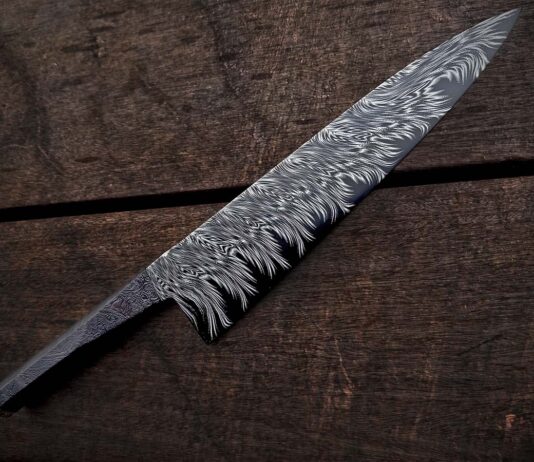
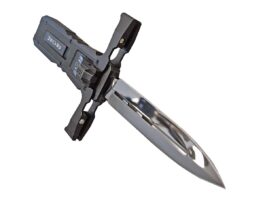
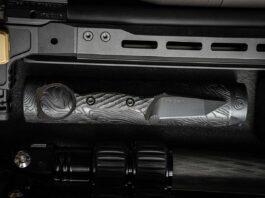
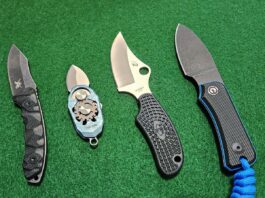
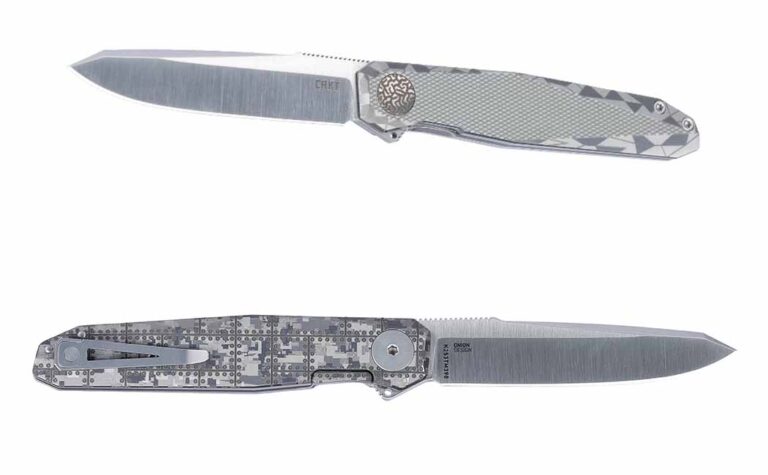
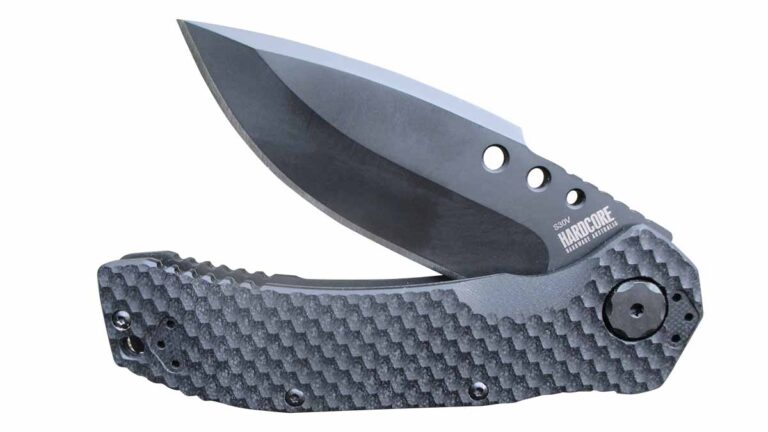
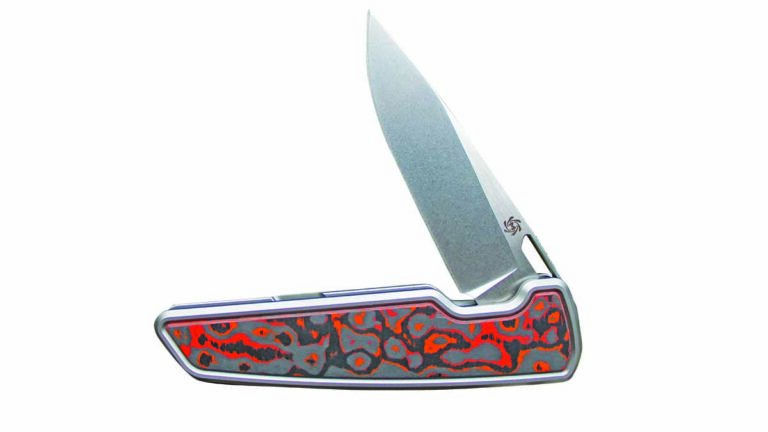
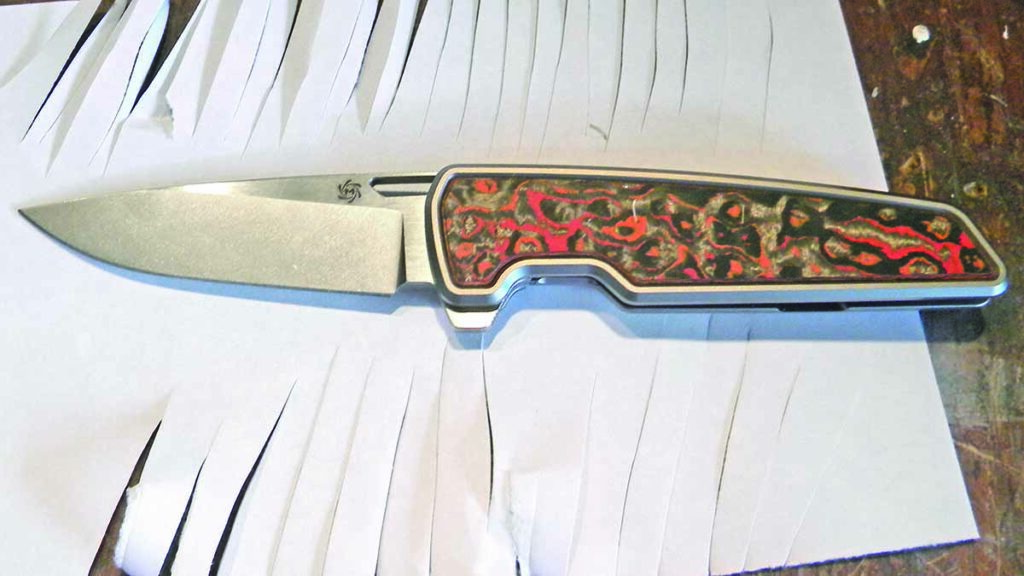
Adding a premium option to the Ken Onion designed line, CRKT unveils the Facet Rivet and Facet Viral.
If you’re into knives (you most likely are, as you’re reading this), you’re familiar with the name Ken Onion. The famed knifemaker has turned out his fair share of must-have blades over the years, with many collectors and aficionados bating breath for his next drop. Well, it’s here and it’s awful dang familiar.
Shake hands with the Facet Rivet and Facet Viral. Yes, they’re the same Facet knives fans have known and loved since its release a year ago, but dolled up plenty nice to make them legitimate premium options in the line. In fact, the duo of top-shelf-edition CRKTs both have some alluring attributes likely to get customers to pony up the relatively steep asking price of $275. Not the least of which is the player behind the scenes making the Rivet and Facet a reality—Lion Steel.
CRKT Facet Blade Material
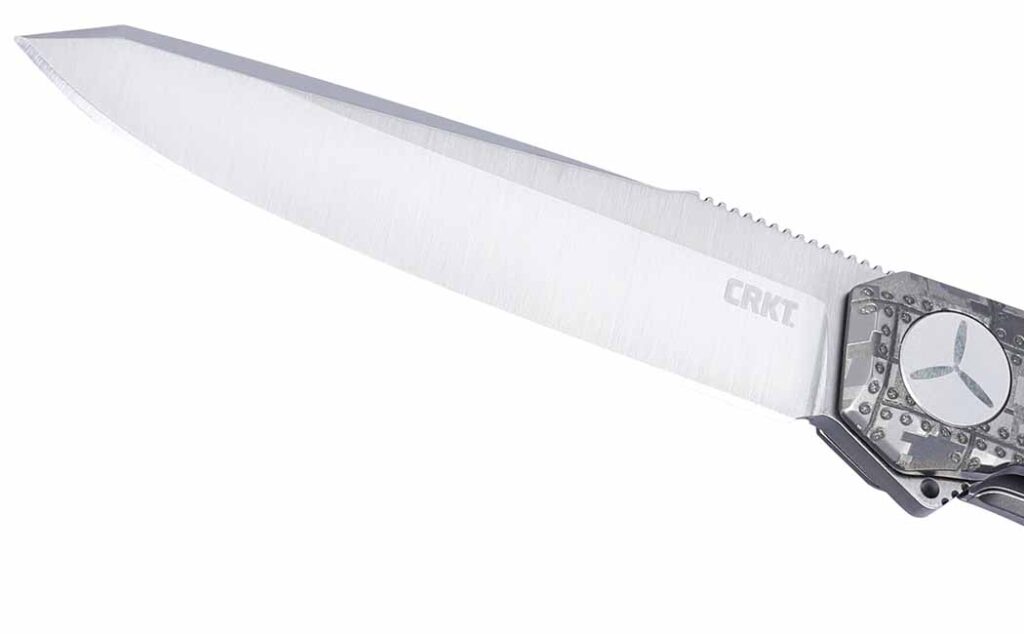
The Maniago, Italy concern is the manufacturer of the knives, which brings not only one of the more respected manufacturers in the game but also a host of top-shelf materials. Where this shows itself in the M390 steel used for the Facets’ modified drop-point blade. Commonly used by Lion Steel and other manufacturers in the region, the super steel (Austrian in origin) is noted for its impressive edge retention compared to tool steel, as well as its superior corrosion resistance.
Impressive choice, particularly given the Facet certainly has the lines of a more gentlemanly EDC knife but should prove capable against more demanding tasks. Adding to its expected robust use is generous jimping on the knives’ spines, giving a solid purchase on them when more vigorously used.
Facet Handle Material
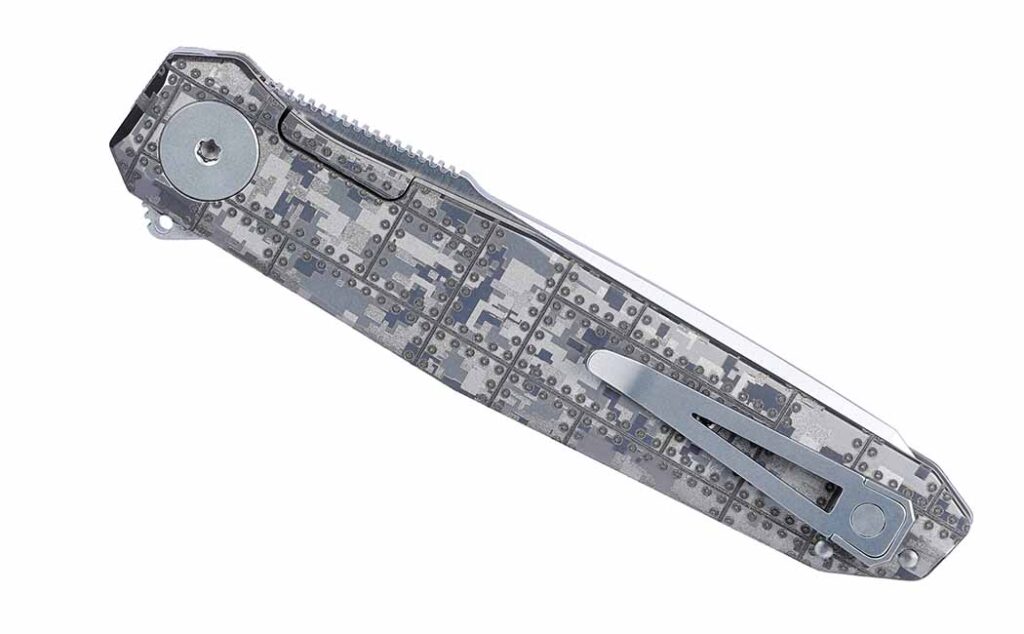
The handle scales on both the Rivet and Viral are titanium, but not some muted finish common to the material. Each is ornately decorated—the Rivet with a World War II-themed plate and rivet motif, common to the era’s military equipment. The Viral is more futuristic—CRKT says “apocalyptic”—stylings meant to conjure up an end-of-days zombie flick feel.
Away from the aesthetics, the titanium makes the knives fairly light affairs, each tipping the scale at around 3 ounces. For reference, the original Facet weighed 3.9 ounces, so this is creeping up on 1 full ounce of weight savings. The handle has a gradual tapper as well, fitting it well to most hands and allowing for a strong grip on the knife.
Action & Lock
The Facet remains a liner lock in its premium guises, and the flipper maintains its smooth and quick deployment thanks to its IKBS bearings. The flipper itself is somewhat understated, but nonetheless very functional, enhanced with a fair bit of aggressive jumping.
Final Cut
The CRKT Facet Rivet and Facet Viral are both currently available, but interested parties must act quickly. CRKT is limiting each to 500 units for the launch. And 50 lucky customers will receive a heavy-duty commemorative coin, which CRKT is placing in random boxes.
Emergencies happen anytime, anywhere. This means, having the best rescue tools & knives at hand is imperative.
When it comes to edged, prying, breaching and other tools for emergencies, there is no one-size-fits-all remedy as no two situations are ever alike. Because of this, many such tools are made to perform a broad range of tasks.
I have taken a fair number of classes and am certified in a wide variety of emergency skills. What I have learned across the board is there is no one right answer, and the tools you have on hand you had better know how to use. (Having these tools on hand or in your vehicle is really what we are looking at here; they must be readily accessible to be of use.)
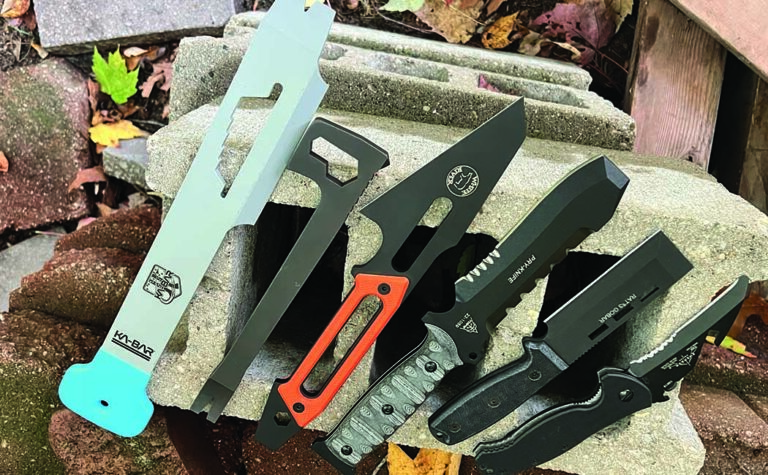
Let’s take a look at some of the best options when it comes to rescue tools and knives. These instruments can handle situations from cutting a downing person out of a tangled line to prying an accident victim out of a car. And, most importantly, are sized to be at hand at all times.
What Makes A Good Rescue Tool
Given there is no way to prepare for every eventuality, it’s impossible to have one tool to address all emergencies. That said, the supreme value of a rescue tool is its versatility. In general, it should be capable of handling some of the most common tasks faced in most rescue situations, such as:
Cutting
Prying
Breaking Glass
Mechanical Manipulation
Yes, other situations require other tools. And certainly, there are options out there that are larded with all sorts of doodads to address these. However, these systems can prove overly complex and not as robust as more Spartan designs. Simple, reliable and flexible are the keys.
Buy Quality
It’s easy to blow off preparing for the worst. After all, the worst doesn’t happen all that often. However, when it does do you want to trust your life to a dime-store rescue tool?
Planning means spending money on the best possible equipment. In short, the best rescue tools are made of quality steel, built with robust materials, smartly designed and sized to be part of your kit. When your loved one is strapped into a wrecked car you need to get them out or other such disaster, you’ll be glad you spent the money.
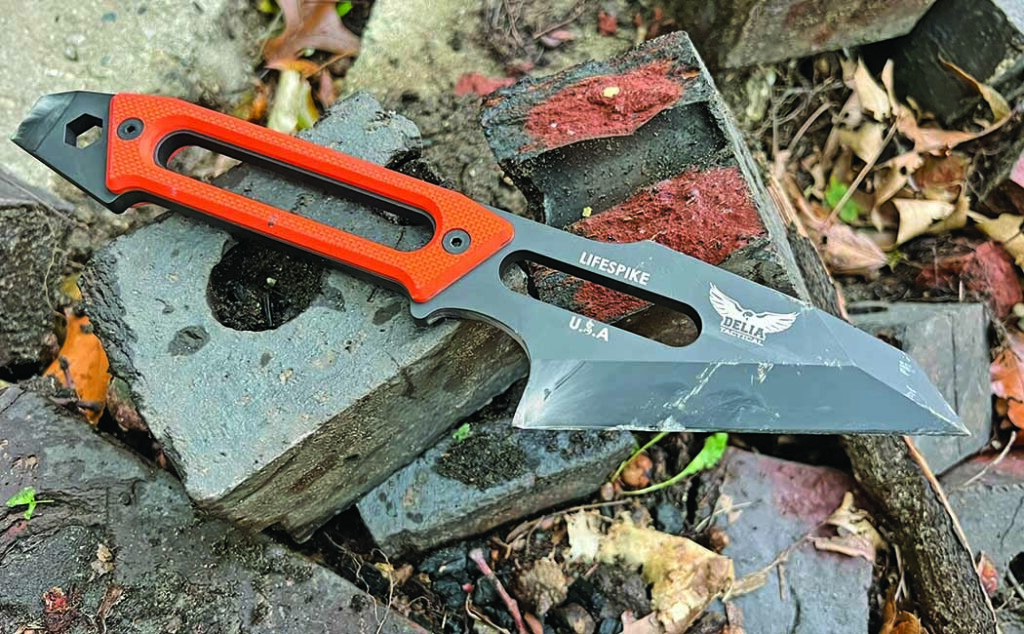
White River Knife & Tool Lifespike
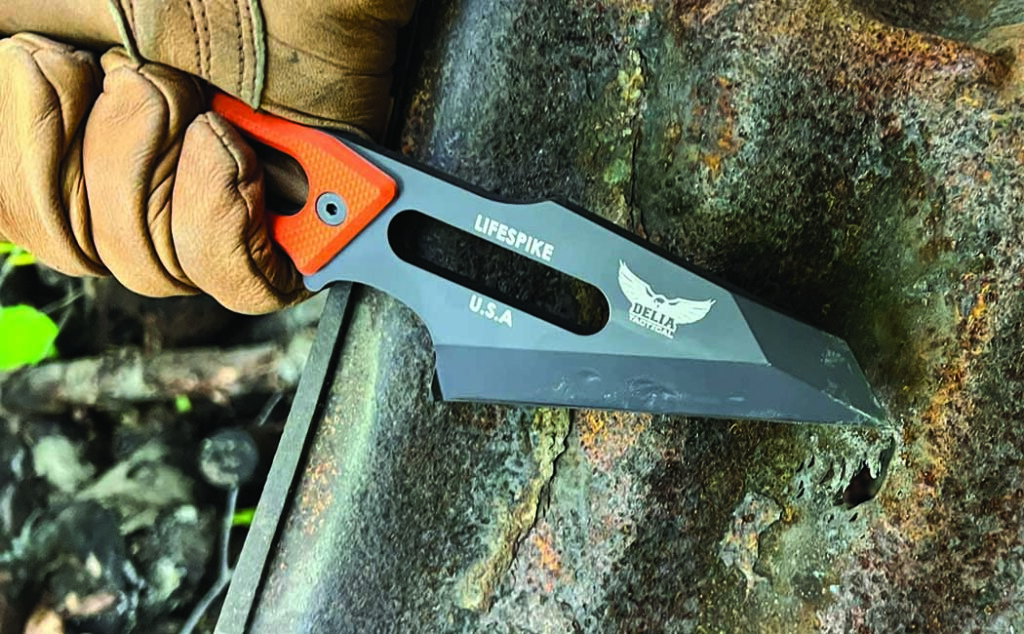
If swung like a hatchet, the White River Lifespike can slash sheet metal into shreds.
The Lifespike by White River Knife & Tool is arguably the most versatile of the review tools. Designed for first responders, it is an exceedingly tough implement that is very well thought out. However, it is not a do-all-be-all in that it lacks in a couple of important areas. I will cover those areas first to not detract from the utter beast of a tool it is.
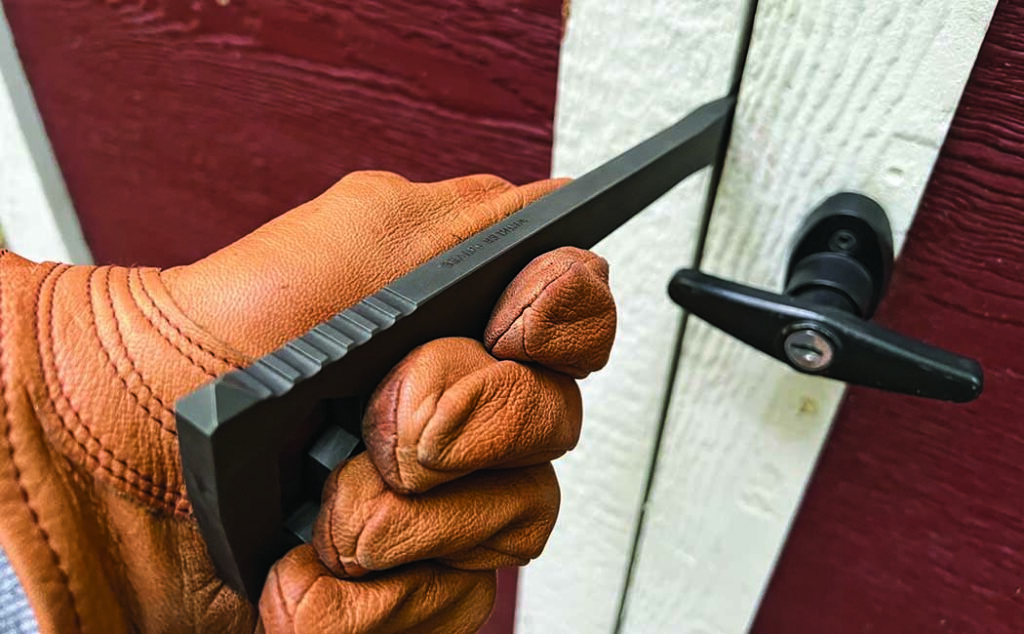
The Lifespike really needs a seatbelt cutter integrated into the pommel/pry tip area—just a small one but one that doesn’t necessarily present the sharp tip to the chest. Moreover, the pry end is opposite the sharp tip, and if you try to pry with it you’re going to put leverage on the blade and edge. Hence, a vigorous rescue could lead to the rescuer becoming a rescuee. The location of the wrench socket is also not ideal; the height of the handle scales can impede its utility if trying to turn a bolt.
The White River Lifespike can punch through some very serious metal without taking edge damage.
That said, the Lifespike can punch through just about anything. Not only can it penetrate sheet metal with eye-opening ease, if swung like a hatchet it can slash the metal into shreds. It simply blasted through most of the test media and the edge held up extremely well. As far as durability and ease of deployment, you really can’t ask for much more. Breaking glass is possible, but the Lifespike is hard to control in that it doesn’t have a dedicated conical point to use in the role. Overall, I think it’s nearly perfect for dealing with automobile accidents. I’d be confident in using it to force open a door, but by the nature of its design there is the possibility of harming yourself if you aren’t 100 percent aware of where the blade is pointing.
White River Knife & Tool Lifespike Specs Knife Type: Self-contained rescue multi-tool Blade Length: 4.65” Blade Material: 80CrV2 carbon steel Blade Grined/Edge: Chisel/plain Handle Material: G-10 Special Features: 1/2” channel gas line wrench, 9/16” wrench, pry bar pommel Weight: 13.4 ozs. Overall Length: 11.5” Sheath: Kydex Country of Origin: USA MSRP: $300
Winkler Knives AF-ERT (Air Force Emergency Response Tool)
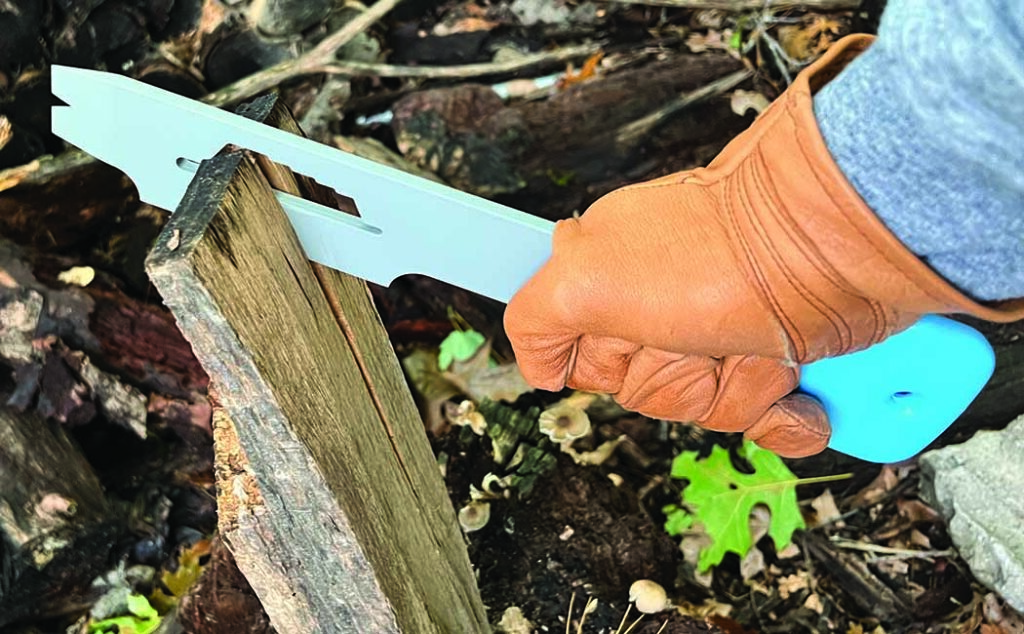
The Winkler AF-ERT is excellent for medium prying work and can be pounded into a gap quite easily.
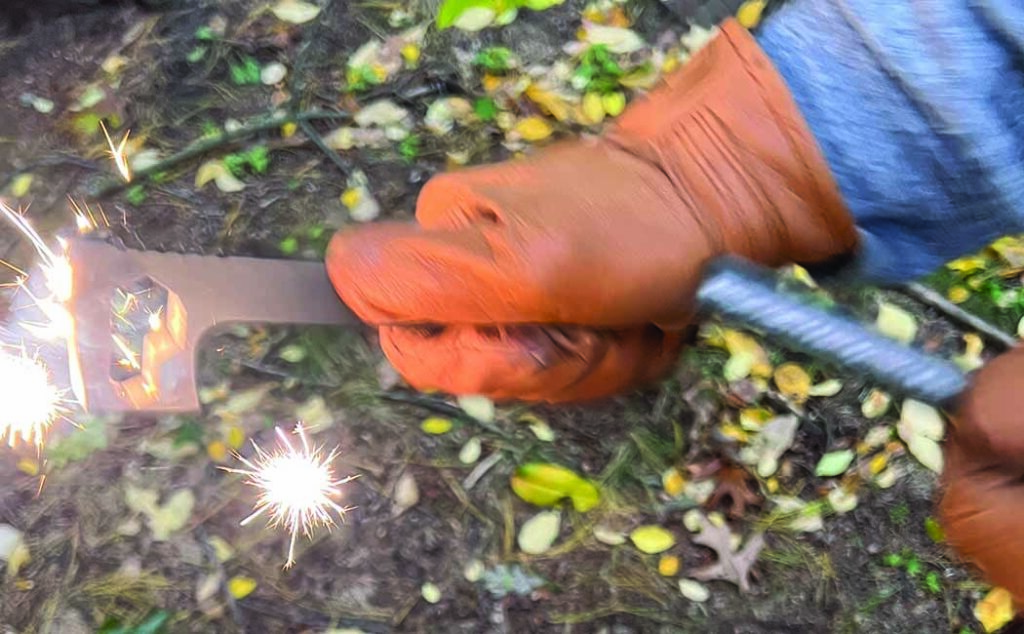
Constructed of the same material as the company‘s knives and axes and bearing the same rugged finish, the Winkler Knives AF-ERT (Air Force Emergency Response Tool) is extremely tough and surprisingly compact. It is so small and slender it can easily ride in the MOLLE loops on your gear. The AF-ERT provides a surprising degree of function and exceptional strength. The head functions not just as a two-size wrench but also as a hammer and a glass breaker. The interior edges of the head cutout are sharp and can even be used to pull a ferro rod through to generate sparks.
The wrench sizes are very functional and work with a wide number of common scope mounts and automotive nuts and bolts. The head, while narrow, is functional as a small hammer. Of all the tools tested, the glass breaker was the most utilitarian and safest to use. It keeps the hand at a healthy distance from the glass and reduces the chance of getting cut. You can also rest the glass breaker on the surface and strike the face of the hammer with another object if you don’t think you can get enough leverage to swing the tool itself. Though it works quite well, the AF-ERT is quite lightweight and doesn’t possess a great deal of momentum when swung.
Using the wrench of the Winkler Knives AF-ERT as a striker is not only safe but extremely effective.
Prying with the tool is easy; the tip of the prybar is quite narrow and can get into some tight spaces. It is simple to tap it in because the head is flat and not sharp in any way. While not the largest tool, it probably has the most across-the-board daily uses and would not be out of place in a camping bag or glove box.
Winkler Knives AF-ERT Specs Tool Type: Self-contained rescue multi-tool Tool Material: 80CrV2 carbon steel Head Width: 21/8” Tool Thickness: 3/8” Tool Finish: No-glare black oxide Handle Width: ¾” Special Features: Compact tool that can be tucked into MOLLE loops; features glass breaker, 3/4” and 1/2” wrench sockets, hammer head, nail-split pry bar Weight: 12 ozs. Overall Length: 9” Country of Origin: USA MSRP: $85
KA-BAR USSF (United States Space Force) Bridge Breacher Tool
Because of its mass and length, the KA-BAR Bridge Breacher easily outclasses the other review tools for prying material apart. You can get much more leverage with it than the other test tools.
The KA-BAR USSF (United States Space Force) Bridge Breacher Tool is a substantial, heavy piece of steel that can get most emergency jobs done. It has a stepped wrench cutout located toward the tool’s business end. You can operate it from the handle end if you are prying, turning a nut or splitting material. Because of its mass and length, it easily outclasses the other tools when it comes to prying stuff apart.
The Bridge Breacher has a relatively blunt-edged, chisel-like blade on one side for chopping. In a pinch it can even be used to split wood. It bends and crushes metal and does not cut through it the same way as the Lifespike. I am not a huge fan of the squared edges in the grip area. I would like to see them more rounded for comfort, and also something other than the rubberized grip material. If you need to hammer the Breacher in to open something, the grip material shreds away quickly. Nonetheless, it is an excellent choice for the heaviest tasks and for material breakdown.
KA-BAR USSF Bridge Breacher Tool Specs Tool Type: Self-contained rescue multi-tool Cutting Edge: 2” Edge/Tool Material: 1095 Cro-Van carbon steel Blade Grind: Chisel Handle Material: Blue Plastisol Special Featues: Nail-split pry bar tip, slotted wrench cutout, chisel edge Weight: 1 lb., 9.6 ozs. Overall Length: 13” Country of Origin: USA MSRP: $85
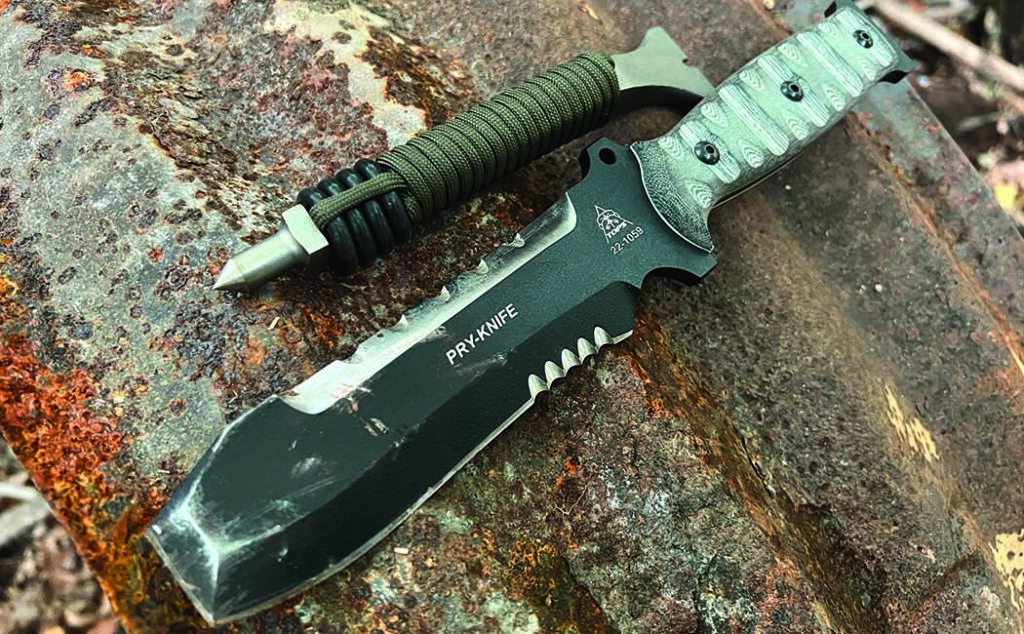
The Pry Knife and Pry Probe Punch (PPP) Tool Combo by TOPS Knives is a beefy, substantial dual package.
The Pry Knife and Pry Probe Punch (PPP) Tool Combo by TOPS Knives is a beefy, substantial dual package. It is truly a hybrid of a prybar and a knife, with some strengths and weaknesses of both. The knife has sharp edges and a very comfortable handle. It handles a wide variety of cutting chores. It can be used to split a dizzying amount of material, and is robust enough to chop wood and even through metal. The secondary edge has a steep angle and segmented serrations for cutting through such tough material as rope. When it comes to prying, the blade can be used with substantial force. Thanks to its chisel grind, it can be used to gain leverage from a variety of angles. The finish is quite durable, though it comes off the high points quickly.
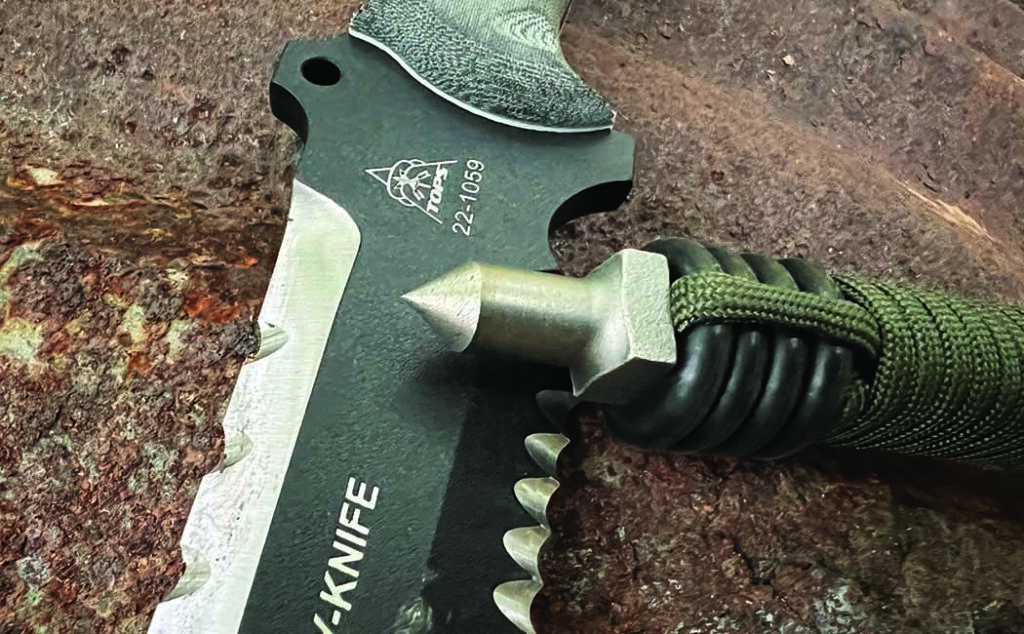
The PPP is a relatively compact, ergonomically designed device that features an angled prybar with a conical spike glass breaker. The tool is wrapped in paracord with rubber gaskets toward the end. It is quite effective at prying. However, I don’t like the location of the glass breaker. If you are prying quite hard and slip, you may end up skewering yourself on it. It is extremely sharp and, while very functional, is more of a liability than need be.
The aggressive glass-breaker punch of the TOPS PPP is utilitarian but not ideally located.
A weakness of this set is the sheath. It is a piggyback set up but features fabric-fastener and buckle closures. While it is easy to remove the tools, the sheath does not hold them very securely. Moreover, while I did not throw the sheath in the mud for this test, fabric fasteners do not work when clogged with debris.
TOPS Knives Pry Knife/PPP Combo Specs Tool Type: Combination knife/pry tool package w/piggyback nail-split pry bar/glass breaker Blade Length: 4.5” (pry knife) Edge: Serrated (pry knife) Blade/Tool Materials: 5160 carbon steel (pry knife)/5140 carbon steel (PPP [pry probe punch]) Handle Materials: Black linen Micarta® (pry knife) and rubber and paracord (PPP) Special Features: Piggyback sheath carries both tools; pry knife is 1/4” thick and can be used to cut and chop; PPP features a heavy-duty glass breaker and nail-split pry bar Sheath: Black nylon Weight: 16 ozs. Overall Length: 10.75” (pry knife) and 71/4” (PPP) Country of Origin: USA MSRP: $275
Ontario RAT-3 Gobar
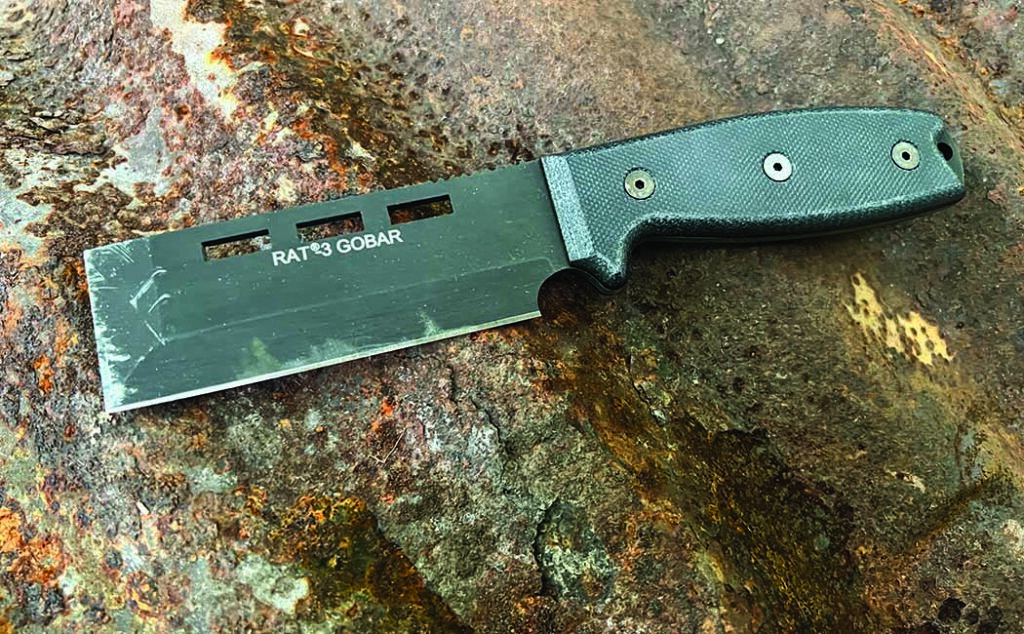
The Ontario RAT-3 Gobar is shaped like a 90-degree cleaver and can handle most knife tasks.
The Ontario RAT-3 Gobar is shaped like a 90-degree cleaver and functions for most knife tasks. The square-edge blade tip cannot be used for stabbing in the traditional sense and functions more along the lines of a fixed-blade box cutter. It has the ability to pry, though the blade material is relatively thin for any serious work. It can get under seat belts and cut them but is not ideal for the purpose.
It works in a pinch as a rescue tool and can be used to lever or jimmy windows and doors. It is not a tool I would baton with a mallet for fear of snapping off the blade. The cutout at the ricasso is too small to fit a finger into despite giving the appearance it should accept one. The corner of the edge recurves slightly backward, and if you get your finger in there like I did, you may get a nasty cut. A bonus is the tool is quite thin. It takes up little space and at only a few ounces is lightweight. The sheath is an afterthought. I would like to have seen this one come with a dedicated polymer model given that the one supplied is too long and features only a snap button to retain the blade.
Ontario Knife CO. RAT-3 Gobar Specs Knife Type: Fixed blade/pry tool Blade Material: Carbon steel Blade Grind: Chisel Handle Material: Black Micarta® Special Features: Lightweight fixed blade can chop and do light prying Weight: 5.8 ozs. Overall Length: 7.8” Sheath: Black nylon Country of Origin: USA MSRP: $91.95
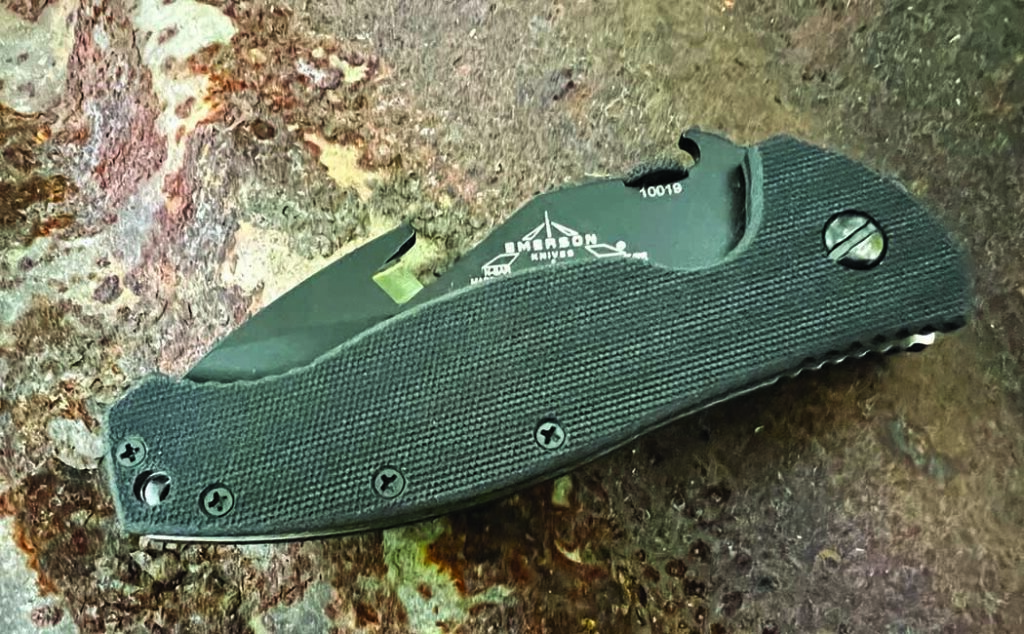
Emerson N-SAR (Navy Search and Rescue)
The N-SAR remains functional as a belt cutter with the blade closed.
The Emerson N-SAR (Navy Search and Rescue) is small and easy to store, and is also exceptionally durable and sharp in all the right places. This is a tool for cutting a person free safely. The blunt tip is not designed to stab. The blade is not impossible to cut with, it is simply unlikely you would stab through a person’s clothing when trying to free them. It zips through any type of common restraint. The main edge serrations can cut thicker material.
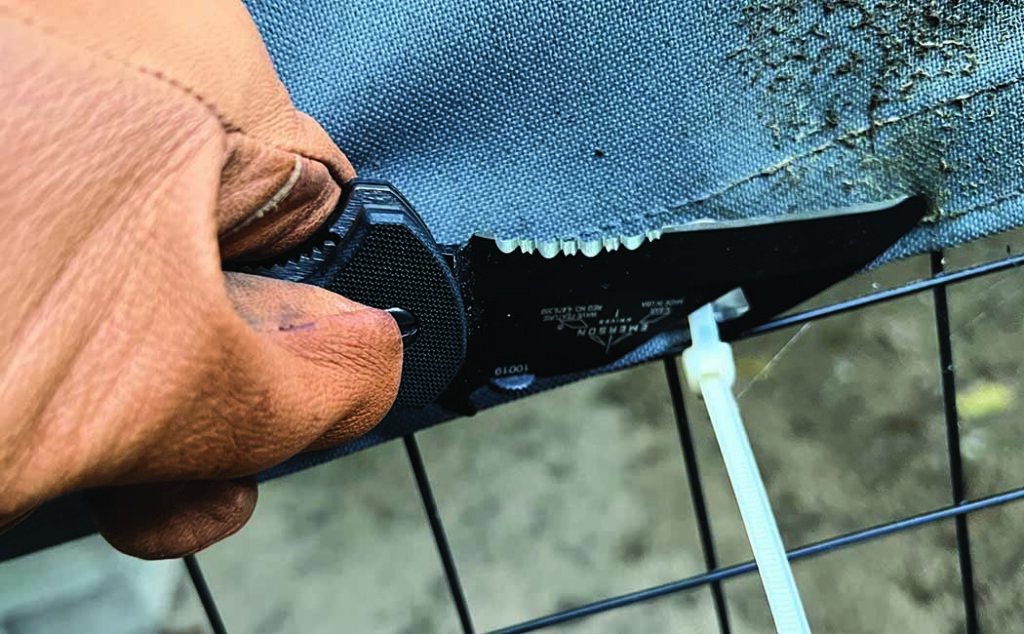
The blade opens one-handed or with the Emerson Wave feature when pulling it from a pocket. Care must be taken with the latter, as the dedicated belt cutter on the spine of the blade can become caught on a pocket accidentally and slice your clothing. I know this from experience. Though somewhat pricey for a knife that isn’t good for normal cutting chores, it is invaluable for extracting individuals from standard seat belts, child seats or any manner of physical restraints. The belt cutter can cut cable ties as well. I have begun leaving an N-SAR in an easy-to-reach place in my vehicle for cutting seat belts and straps in emergencies.
The Emerson N-SAR can easily and safely cut cable ties. Moreover, it wouldn’t damage your wrist if you should find someone needing rescue from a seat belt or other kind of strap.
Emerson Knives, Inc. N-SAR Specs Knife Type: Folding rescue Blade Length: 3.5” Blade Grind: Chisel Edge: Plain and serrated combo Blade Material: 154CM stainless Handle Material: Black G-10/glass laminate Pocket Clip: Yes Lock: Linerlock Special Stuff: Safety blade tip (blunted), Wave opening feature, integrated belt cutter Weight: 4.1 ozs. Closed Length: 4.7” Country of Origin: USA MSRP: $299.99
Read More On Survival And Rescue Tools And Knives:
Carrying A Concealed Yet Capable And Easy-To-Access Knife, These Neck Knife Options Won’t Leave You Dangling.
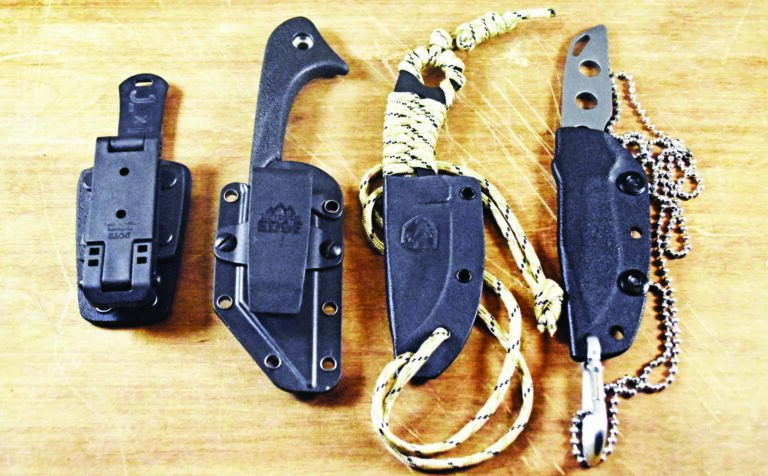
Neck knives are often overlooked as a form of everyday carry, which is surprising since they offer so many advantages. Neckers, as they’re slang-fully called, excel at concealment* as they are easily covered by a shirt or jacket, and, because they’re uncommon EDCs, offer an element of surprise.
While neck knives frequently may be thought of as tools of self-defense, they also offer utility aplenty. In addition, with a fixed-blade neck knife—like all fixers—you simply snatch it from its sheath and you’re ready to go.
Condor Tool & Knife Carlitos Neck Knife
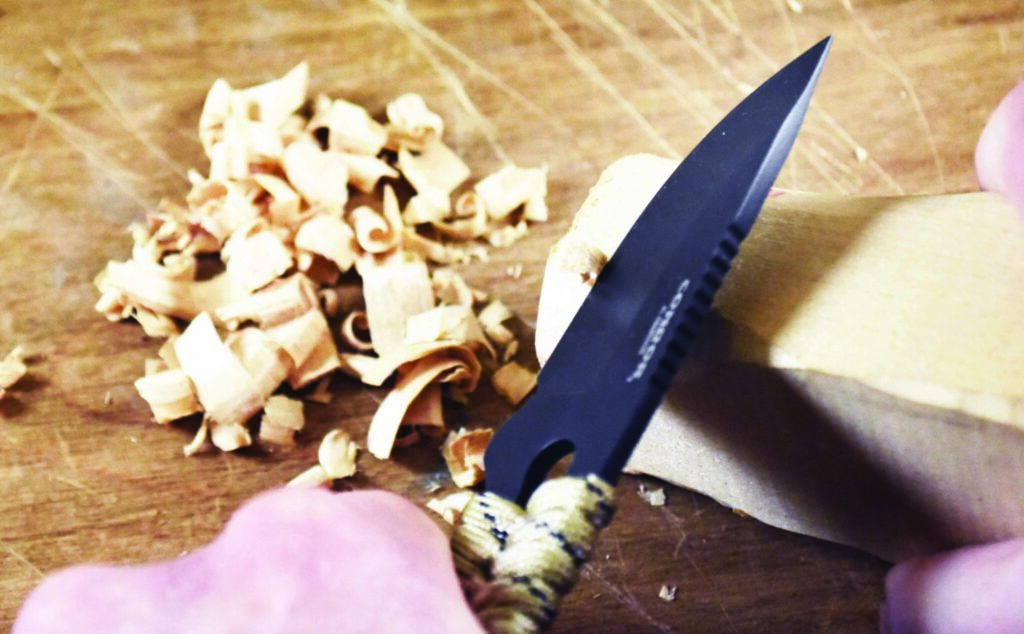
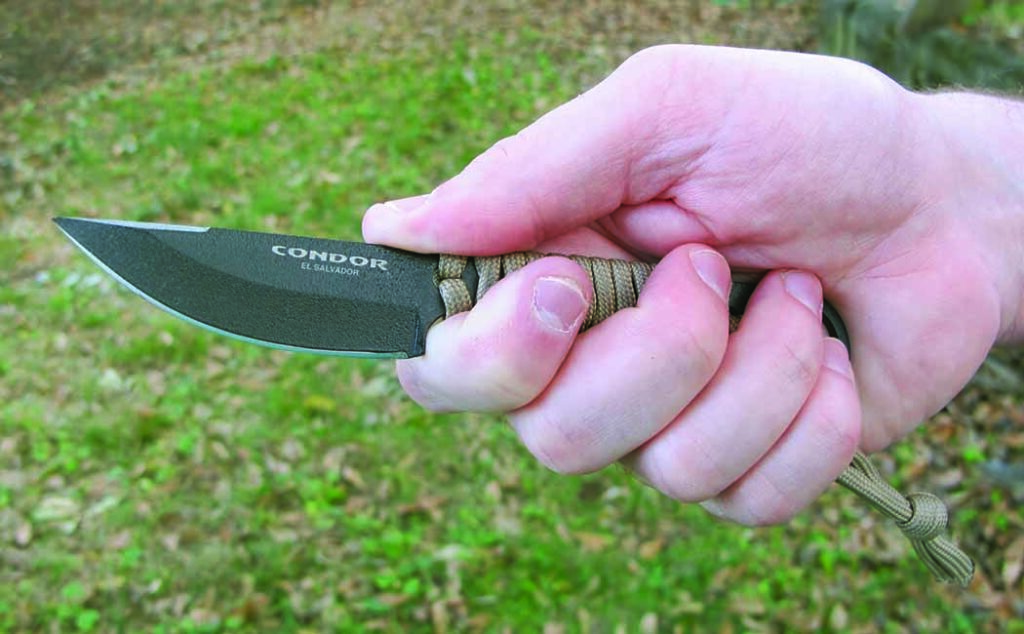
The Condor Tool & Knife Carlitos is pure necker and smacks a bit more of a field knife than a tactical. It shaves wood for fire starter very well and, in fact, could serve as a skinner. In addition, the paracord could come in handy in an emergency.
Condor Tool & Knife’s Carlitos Neck Knife is small and lightweight, its weight primarily reduced by its skeletonized design, with only a paracord wrap to add load to its black carbon steel mass.
The blade is gimped on the lower spine for added grip. The handle is cord-wrapped with a braided lanyard at the base, handy for releasing the knife from the sheath. The grommets at the sheath’s base can take paracord or ball chain for neckwear.
MSRP: $43
Outdoor Edge LeHawk
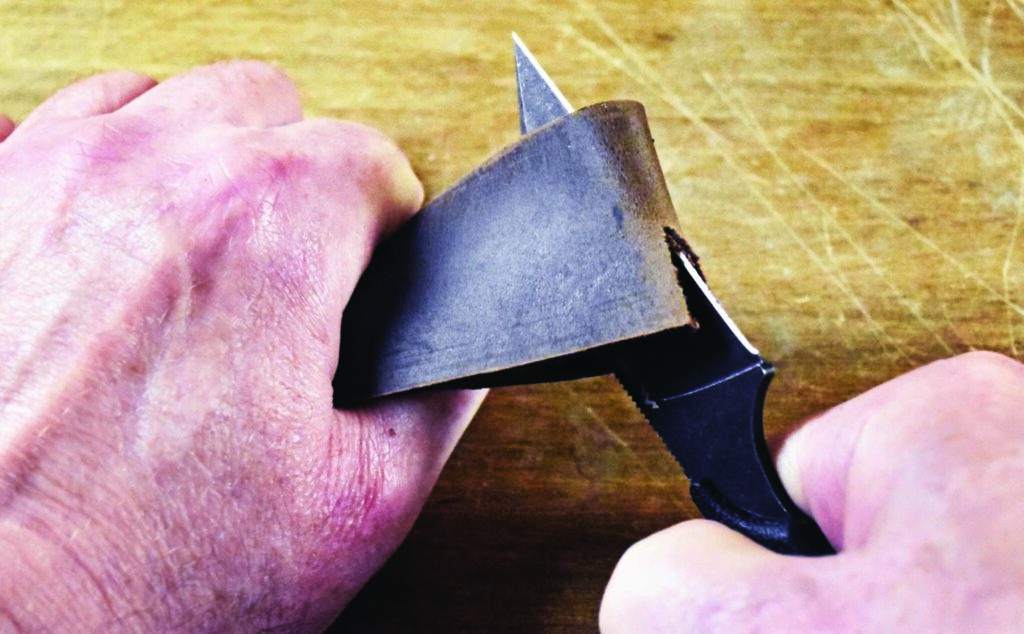
The Outdoor Edge LeHawk is the largest of the test neckers and its 2.9-inch reverse tanto blade came to work. The blade was long enough to sever beefy harness leather with an upward pull-through in a single stroke.
The Outdoor Edge LeHawk, designed by knifemaker Jerry Hossom, is the largest of the test knives. The blade has a swedge grind and fine gimping along the spine.
The 3.3-inch handle is grippy with a kicked-up bird’s-beak butt to prevent slippage. The sheath wears around a neck via a length of provided cord or carries on a belt.
MSRP: $35
TOPS Knives Sneaky Pete Mini
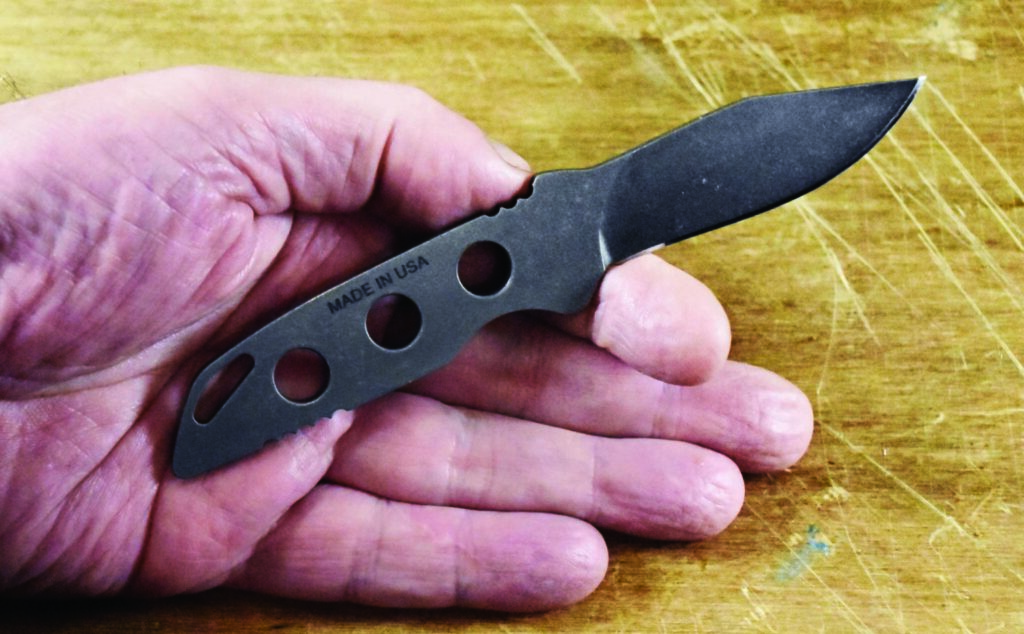
You can see how much hand you have to work with on a mid-size neck knife. The TOPS Sneaky Pete Mini is six inches overall with a 3.5-inch handle. A knife this size won’t fill the palm but there’s enough to get some chores done.
The TOPS Knives Sneaky Pete Mini resembles a scaled-down tactical knife. In fact, it is a miniaturized version of the company’s larger Sneaky Pete introduced in 2018.
The blade’s recurved edge flows into a 3.5-inch skeletonized handle. The entire knife is carbon steel. Delivered with a sheath and ball chain necklace, the Mini also has a carabiner clip for dangler carry. The skeletonized construction makes for a very slim package.
MSRP: $115
WE Knives OSS Dagger
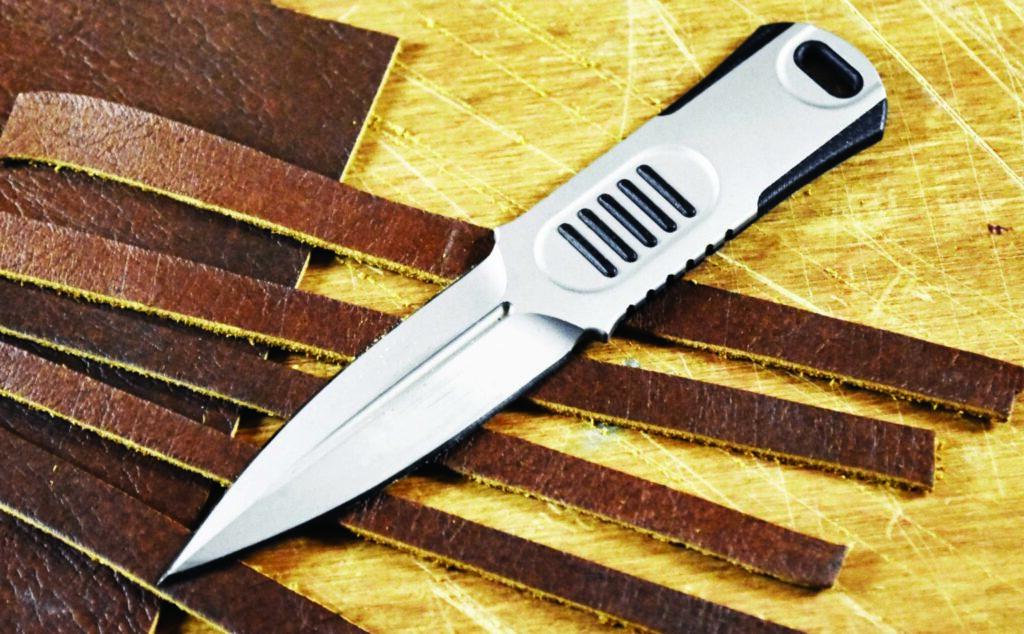
The little WE Knives OSS Dagger, 4.25 inches overall with a two-inch blade, is more of a hideaway knife than a utility hog, but it was not without its merits. The sharp blade of upscale CPM 20CV stainless steel took off nice, clean slices of leather scrap.
The WE Knives OSS Dagger is derived from the famed Fairbairn-Sykes/OSS daggers of World War II, though did you know there were variants this small? They were made for concealment for clandestine operations and called lapel, sleeve and thumb daggers, and it is from these that the WE version is derived. (And, of course, “WE” does not stand for the W.E. of William Ewart Fairbairn.)
The double-ground blade has one edge sharpened and a tapered fuller. The back side of the blade is flat. Essentially an integral design of stainless steel, the handle has inlays for improved grip. The knife is delivered with a black sheath and ball-chain necklace.
MSRP: $105
Boker Plus Rescue Kiridashi
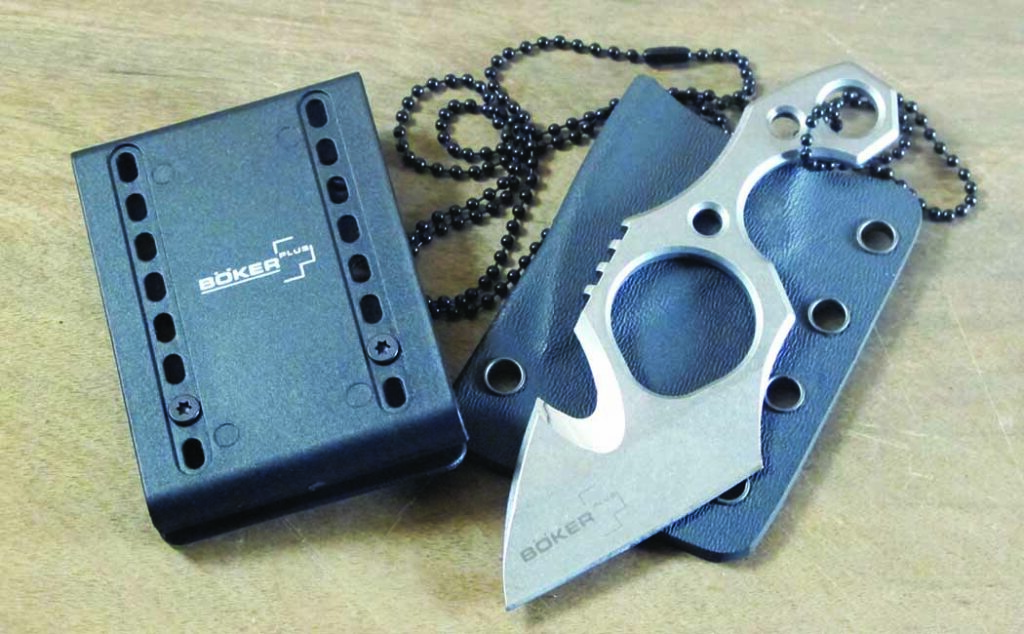
The Boker Plus Rescue Kiridashi is the total package. In addition to the neck knife and black Kydex sheath, Boker includes a ball chain necklace and optional bolt-on Kydex belt loop.
The Boker Plus Rescue Kiridashi gets the “rescue” label by offering a large gut-hook-style web cutter. (For more on the latest rescue knives, see page 44). The blade has the flat edge of a kiridashi but is hollow ground on both sides to enhance slicing capabilities. The handle—the blade and handle length overlap—has a large index finger hole for a sure grip. A black Kydex sheath, black ball chain and bolt-on Kydex belt loop are included.
With its large wharncliffe blade, the knife proved to be a beast. I tested it on leather and 3/8-inch synthetic rappelling rope and it whipped through both with ease. The ring in the short handle enhances grip, making the index finger your main purchase point. Watch out for that gut hook webbing cutter, however, as it’s awfully close to the thumb rest. I tried the hook on seat belt webbing as well. In my experience, though gut-hook-style webbing cutters don’t perform as well as serrated blades, the Rescue Kiridashi will do the job in the heat of the moment.
MSRP: $45
Bradford Knives’ G-Necker
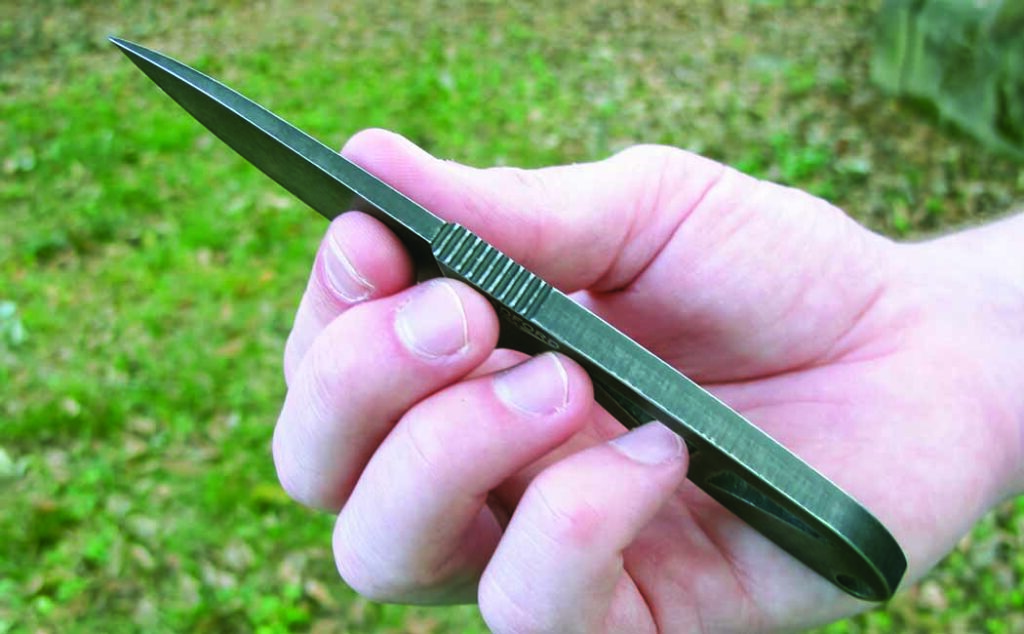
The G-Necker’s thick quarter-inch-plus steel is unusual on a neck knife but Bradford puts it to good use. Note how the blade tapers while the handle retains the full thickness for a comfortable grip.
Bradford Knives’ G-Necker eschews radical curves for more classic lines that give it the look of a standard small fixed blade. It departs from the norm, however, by flexing its muscle with top-shelf Elmax stainless steel in a graceful, flat ground drop point blade. The handle, thick enough to forgo a cord wrap or scales, has two triangulate holes to lighten the load. We tested the blackwash version—other finishes are available. Bradford provides a black Kydex sheath and ball chain necklace.
The quarter-inch-plus-thick handle is unusual among neck knives. However, if you think it might be a bit clumsy, that’s not the case. Bradford has struck a balance by keeping the steel’s thickness on the handle but tapering it on the blade for better slicing.
The Elmax steel cut like a house afire, taking off super crisp cuts on harness leather and whipping through 3/8-inch rope with ease. The handle rests in the palm nicely and the notched gimping on the thumb rest enhances grip. Handles with no scales or padding don’t bode well for long term use as those that have them, but if you’re using the Bradford G-Necker for quick chores, you’ll have no worries.
MSRP: $99
Condor Tool & Knife Kickback
The Condor Tool & Knife Kickback provides a hint of tactical with its swedge-ground spine, while the blade offers a deep belly for outdoor chores such as skinning.
Condor Tool & Knife designed the Kickback for both urban and field duty. The straight-back blade has a swedge grind for enhanced penetration, giving it a tactical feel, while its deep belly makes it at home in the field. The steel has a black traction coat stem to stern and there’s a large finger hole in the base. A nicely done tan paracord wrap with a knotted pull completes the handle. Condor provides a black Kydex sheath with ball chain for neck carry.
The blade did an excellent job of slicing through harness leather, which bodes well for the knife’s potential use as a skinner. I also found the swedge ground point adept at penetrating and boring into leather. Due to its light weight and short blade, the Kickback wasn’t quite as good at cutting 3/8-inch rope as at least one other of the test knives, but it gets the job done. The cord-wrapped handle is very comfortable. I found the ring at the base a bit tight for my pinkie finger but it works well for hanging the knife on a lanyard.
MSRP: $35
TOPS Knives Mini Tanimboca Puukko
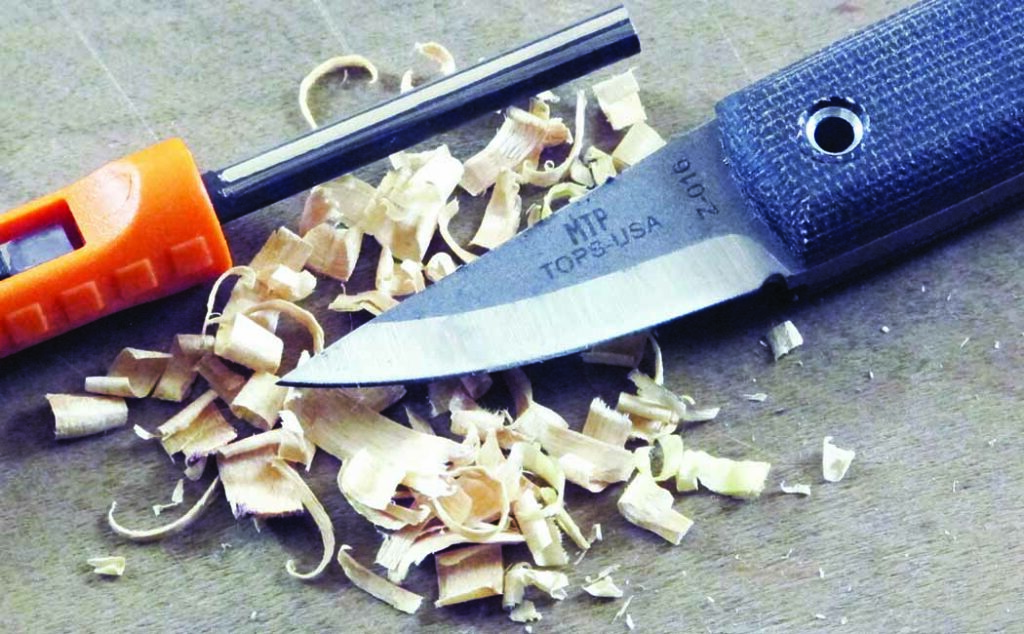
The TOPS Mini Tanimboca Puukko is an excellent little necker for fire prep. It cut fine wood slivers and curlicues for tinder, and the blade spine threw righteous sparks off a ferro rod.
The Mini Tanimboca Puukko by TOPS Knives makes no bones about its mission: It’s basically a small bushcraft knife. It is a full-tang design with a flat-back Scandi-ground blade. The little necker’s handle features comfortably plump black linen Micarta® scales with a large tube lanyard hole in the butt. At 1.28 ounces it’s the lightest of the test group and deviates from the rest in its uncommon top-loading brown leather neck sheath, which wears on a belt, too. The knife is also the smallest of the review neckers and, indeed, the most distinctive.
As noted, the Mini Tanimboca is a field knife. While it will cut leather strips and can saw its way through 3/8-inch rope, it really excels at fire prep. I tested it for taking fine shavings from a boxwood block and stick of pine, and it dug in with gusto and precision. I then tested the blade spine on a small ferro rod and it threw sparks like a champ. The blade tip bores holes in leather with accuracy. The tiny knife makes an excellent companion to its larger sibling, the TOPS Tanimboca Puukko.
MSRP: $110
Securing Your Lanyard
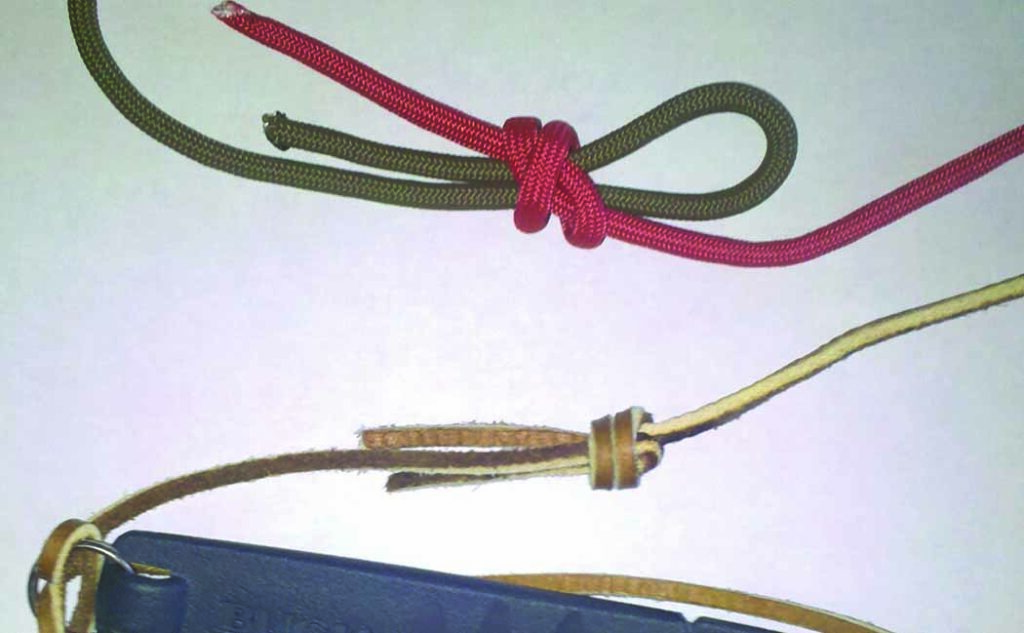
Two friction knots for neck knife “necklaces”: one tied loosely with two different colors of cord for clarity, and below it the same knot tightened up more neatly on a leather lanyard. (Bob Seymour image)
An area of concern with neck knives is the mode of carry around your neck; in other words, if the necklace does not give way if it catches on somethings, it can wring your neck—or worse.
Ball chains are designed to break easily in such instances and thus are considered safe. They’re also cheap and easy to replace. A nylon, leather or other cord, on the other hand, won’t snap in two easily. The solution? A friction or other knot that will release from around your neck with sufficient tension.
“Almost any knot around a loop will do the trick, though some knots may work better than others,” noted BLADE® reader Bob Seymour. In the accompanying image are two friction knots: one tied loosely with two different colors of cord for clarity, and below it the same knot tightened up more neatly on a leather lanyard. Note that the loop prevents the knobby end of the cord from catching during release.
Experiment with different materials and knots and test them to see if they will release with sufficient tension. The key is to arrive at a knot that does not release too easily and one that won’t release at all. If in doubt, trash the cord and use a ball chain.
*Be sure to check the laws concerning concealed knife carry in your area.
These EDC Fixed Blade Knife Options All Have Their Positives As Everyday Companions.
Fixed blades are common in the woods though far less so on the streets—politics has largely seen to that. Folders are in the pockets of many these days and are somehow considered “less dangerous” than fixed blades.
I cannot for the life of me understand this as there is little if any practical difference in terms of capability, with the exception of fixed blades in theory allowing for a longer blade.
There is this idea that a fixed blade is more lethal. Sure, a longer blade allows for greater reach and penetration, but it’s also harder to use in close confines—and substantially more difficult to deploy.
EDC Fixed Blade Knife Pros And Cons
The argument against the carry of larger fixed blades is certainly political, not practical. It could be considered in the same vein as the political arguments surrounding guns, most of which are dedicated to regulating what amounts to cosmetic features. If it looks scary, the thinking goes, you can convince people it is more dangerous.
The interesting part is that the small EDC fixed blade knife options in this article are, for the most part, around the same size as box cutters. The thing is, when we see EDC, we often think about how the item is meant to be on your person, at the ready for utility jobs and even self-protection if need be. The latter is more the case with guns, where there are no power settings, only a fully lethal one.
In my stories on guns, I have often talked about how accessory-laden modern self-defense arms can be, but at the end of the day you’re not going to open your FedEx deliveries with a gun. Self-defense is a major purpose of firearms, whereas your EDC knife should be a jack-of-all-trades and capable of handling all your daily cutting tasks.
In the process of preparing this article, I had the pleasure of moving into a new house. As such I got to put the test blades through their paces, cutting everything from tape and cardboard to zip ties—and even dinner when I couldn’t find my silverware. In place of my carving knife I used the White River M1 Caper to serve chicken dinner.
The point is, these are supposed to be knives that benefit from fixed-blade construction, able to handle tasks that might damage a folder.
Best EDC Fixed Blade Knife Options
Fixed EDC Fixed Blade Knife Specs Comparision
Model
Overall Length
Blade Length
Blade Thickness
Weight
Blade Material
Handle Material
MSRP
Boker Pocket Knife
6.93 inches
3.39 inches
0.15 inches
3.74 ounces
440C
G10
$105
White River Knife & Tool’s Model 1 Caper
7 inches
3 inches
.130 inch
3.2 ounces
CPM S35VN or CPM Magnacut
Micarta
$120
Citadel Vannak V
5.75 inches
2.38 inches
.72 inch
2.9 ounces
DNH7
Palisander Wood
$175
Gerber Dibs
5.96 inches
2.5 inches
.12 inch
2.22 ounces
440A
440A
$36
Kizlyar Supreme Hammy
6 inches
2.13 inches
.13 inch
3.6 ounces
AUS-8, Niolox, Sleipner, K340, PGK
walnut, G10 or carbon
$117
Boker BFF
6.92 inches
2.76 inches
.10 inch
2.29 ounces
ABE-L
Walnut
$259
Spartan Blades Field Grade Enyo
6.25 inches
2.69 inches
.19 inch
2.816 ounces
AUS-8A
AUS-8A
$88
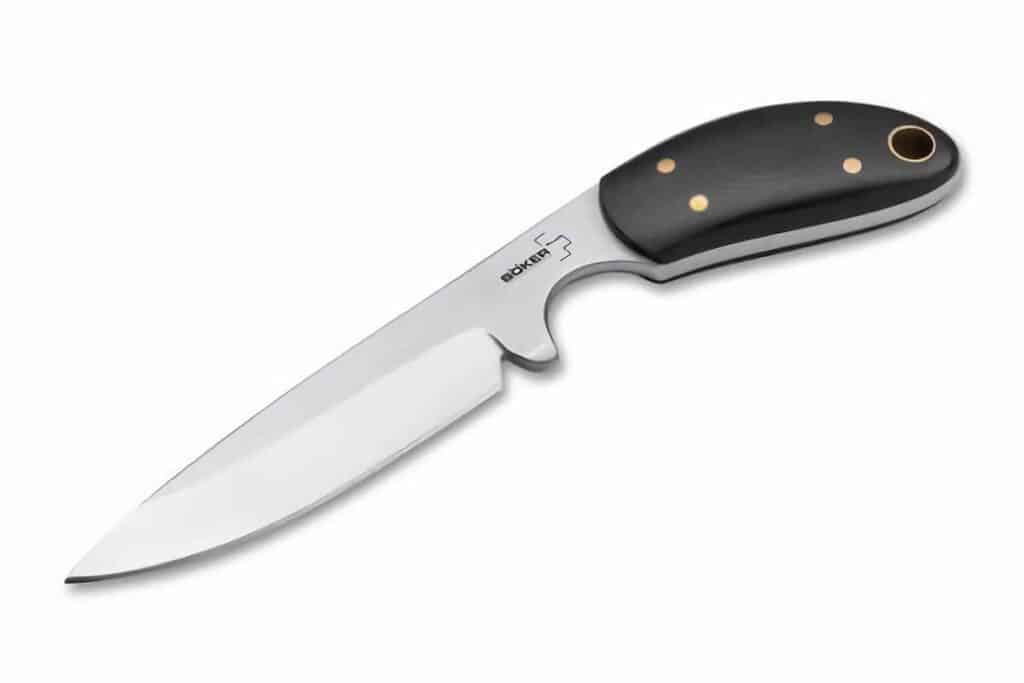
Boker Pocket Knife
Boker has quite the little devil with the Pocket Knife. The name, of course, implies that it is to be carried in the pocket, and it comes with a sheath that works very well in this role. It’s the longest blade in the group but has the smallest handle.
The handle size is deceptive; it is very minimalist in the pocket and the sheath sits low, thus making the knife appear to have a much smaller blade. It carries well and is lightweight—two things I like. However, in use, it becomes a bit more of a challenge.
I do get that the Pocket Knife, designed by veteran knifemaker and police officer Mickey Yurco, has a self-defense vibe. The EDC fixed blade knife’s long, narrow tip is an obvious thruster, though the overall texture of the full piece is very slick. The handle shape forces the hand into a slightly uncomfortable angle. Sheathing the knife is also difficult if clipped deep in a pocket.
As a regular-use knife, I have seen better. That said, in a self-defense role, this would be the best of the bunch. If the blade is in your hand in the reverse grip, it feels solid and firm. The tang cutout between the choil and the handle is perfect for pinky finger placement in the reverse grip, and the knife is an effective stabber and slasher in tight spaces.
This is an excellent blade to pair with grappling techniques and for dealing with heavy clothing. All said, I like what Boker did here. It is a knife that goes in your pocket, but I don’t think it is well suited for the role of a traditional pocketknife.
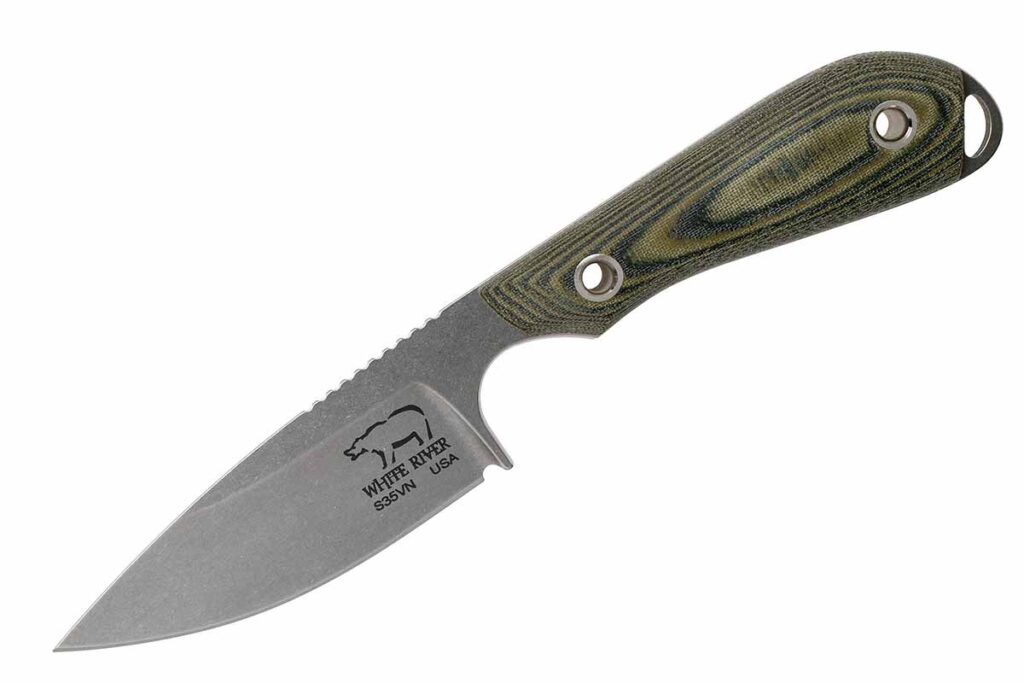
White River Knife & Tool’s Model 1 Caper was the best performer of the reviewed EDC fixed blade knife bunch. I have come to expect great knives from White River, not just ergonomically but also in terms of the quality of steel the company uses. The blades are heat treated very well, are not brittle, and stay extremely sharp even in heavy use.
The first thing I noticed about this knife is the grip, which is not only minimal but very comfortable. I can tell White River spends a great deal of time on the small things, such as the tang cutout having a very nice rounded interior edge that feels great on the finger and never digs into it. The grip material and shape feel terrific in the hand. The only downside is the Micarta® handle gets dirty fast and can stain.
The sheath is very well constructed and allows for positive sheathing with an audible click when the knife is seated. The sheath is meant for belt carry and is not a clip style like the others in the test, and fits most standard belts. The sheath surprised me a bit; it was the easiest to use of the bunch.
As far as utility for a carry knife, this one is probably the most versatile of the group. It is extremely sharp and has an aggressive, fine tip. It is so sharp it can pass through just about any normal material easily. I used it to cut heavy packaging straps and minutes later to prepare dinner. This is the definition of an all-purpose knife.
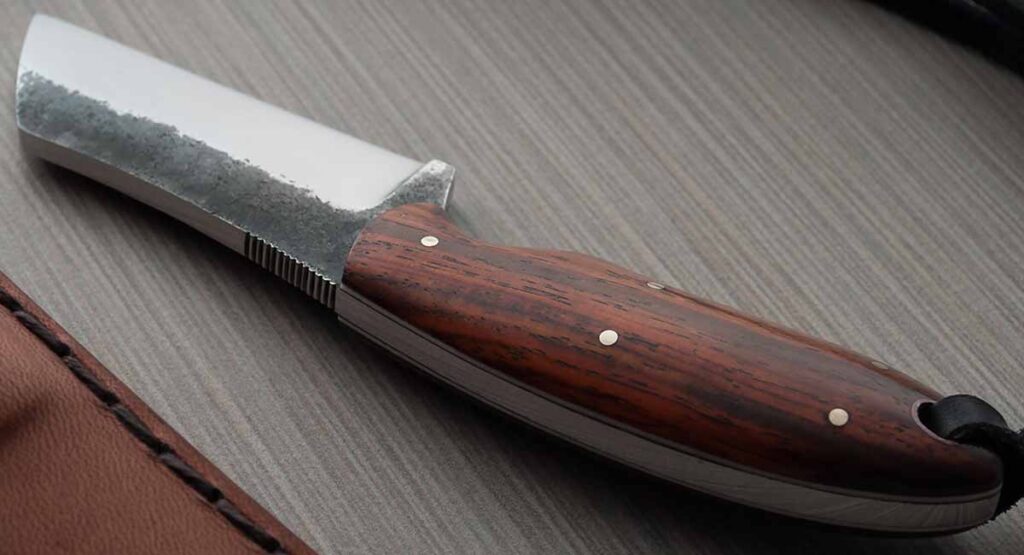
Made in Cambodia by Citadel, the Vannak V is an excellent EDC fixed blade knife. Overall, I really like this little guy. It doesn’t claim to be anything other than a daily use, small-task cutter. It’s great for opening mail and packages, light food prep, and small craft work. It is very pleasant to use and has an exceptional appearance.
Despite it being a great performer, I don’t have a tremendous amount to say about the Vannak V. It is devoid of gimmicks and is just a very tiny knife that does no more than its size allows. I like the wood grip and that the knife is made by hand by people who obviously care about what they’re doing.
The fit and finish are great. I have no complaints about grip texture or the depth of the tang cutout as the knife can’t really be used in the reverse grip—it’s just too small. The sheath is leather, minimalist, and completely functional.
Vannak V Specs Overall Length: 5.75 inches Blade Length: 2.38 inches Blade Thickness: .72 inch Weight: 2.9 ounces Blade Material: DNH7 Handle Material: Palisander Wood MSRP: $175
Gerber Dibs
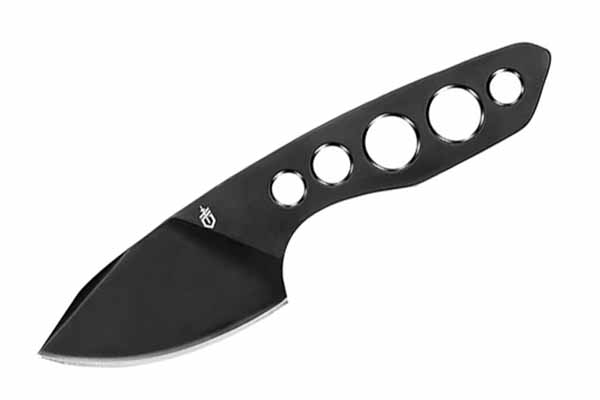
The Gerber Dibs is a one-piece, skeletonized-handle knife common among small examples of the genre. The 440A stainless steel blade is 2.5 inches and has a modified clip point. A flat grind gives the edge plenty of bite for tough cutting chores.
The ergonomic handle has a large finger recess that doubles as an integral guard. When you grab the handle, it expands a bit to fill your grip. In addition to reducing overall weight, the skeletonized holes accommodate a paracord wrap to further augment purchase.
An all-encompassing black PVD coating provides a low-profile appearance and enhanced corrosion resistance. Overall length is just shy of 6 inches, making the Dibs a great compact knife for general use or food prep.
Out of the box the edge was excellent, ready to work and featuring plenty of bite. It dispatched cardboard with minimal fuss. The edge quality along with the dropped blade design help promote overall knife security, using either a choke grip for precise maneuvers or resting a thumb on the blade spine to add more control or pressure for the cut.
With skeletonized fixed blades, it is important to have a more complex handle design with varying features to help you retain your grip in the absence of scales. Despite having no scales, the Dibs is quite comfortable to grip. Skeletonized fixed blades are not meant for long periods of continuous use and are for convenience of carry instead. Bottom line, the knife is a pleasure to use.
The sheath is sewn-and-riveted leather dyed yellow. At first it appears too big—which it probably is—for such a small knife, but sheathed the Dibs is advertised as totable inside the pocket as well, which explains the large design.
If you have cargo pants with larger front pockets, it carries very well there. A button-snap strap secures the knife and a large loop accommodates most belt sizes. The sheath’s edges are rough and not finished too well. Then again, Gerber targets affordability and as much bang for the buck as possible with the Dibs, so corners apparently were cut.
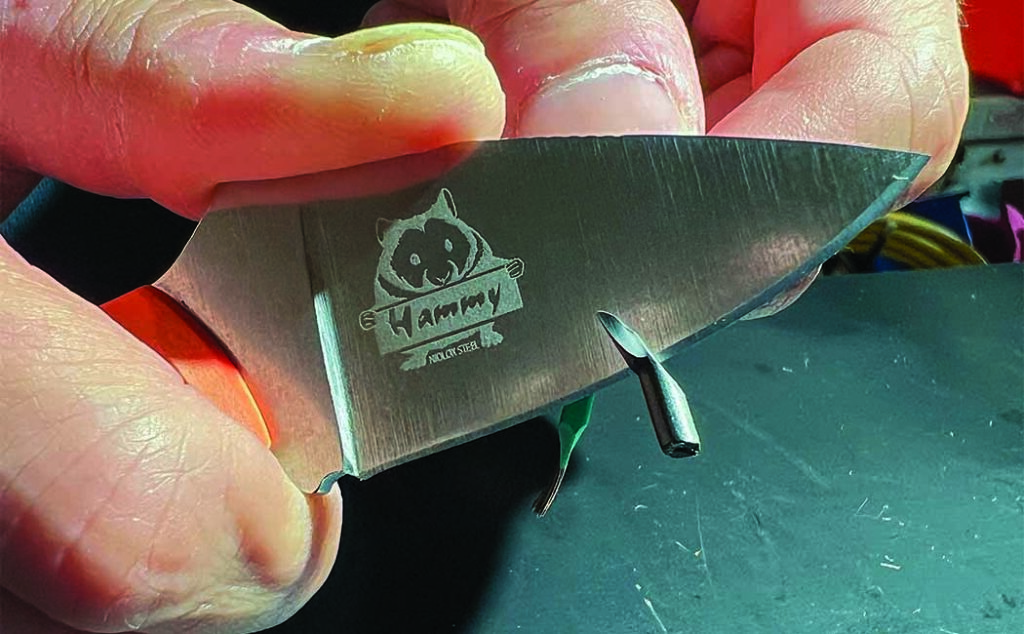
The Kizlyar Supreme Hammy is an incredibly ergonomic knife. The leaf-shaped blade is 2.1 inches long and sports a full flat grind for slicing power. Blade steel is Niolox stainless. The highly ergonomic handle is loaded with curves that feel molded for your hand. Orange G-10 scales provide a pop of color and a solid grip. The handle is expertly chamfered and contoured in the right places, further enhancing user comfort.
At first glance the Hammy appears cute—but don’t let looks fool you, as it’s designed and built for work. It’s a fixed blade the size of a small open folder. The blade is .11 inches thick at its thickest point and sports a distal taper to the tip. Jimping on the blade spine and thumb rest offer non-slip purchase for your thumb or index finger.
When you grip the handle and your thumb rests naturally on the blade spine, you feel how comfortable the Hammy is. You can also sense the knife is highly controllable, instilling user confidence. The jimping could be a little better. It could be more defined/aggressive to offer a better bite into your thumb.
The leather sheath has a button-snap retention strap. There are also two smaller belt loops attached to the main belt loop. These are provided to carry the Hammy horizontally, as it is set up for traditional vertical carry like most straight knives.
While the sheath itself is well made and includes a whimsical artwork stamping of a hamster (the same illustration appears as an etching on the blade’s right-hand side), it doesn’t have the snuggest fit around the knife. Even with the retention strap buttoned it is possible to still wiggle the Hammy out. This is not so critical if you carry the Hammy vertically, but it is a concern if you carry it horizontally. A properly fitted sheath at this price point is a must.
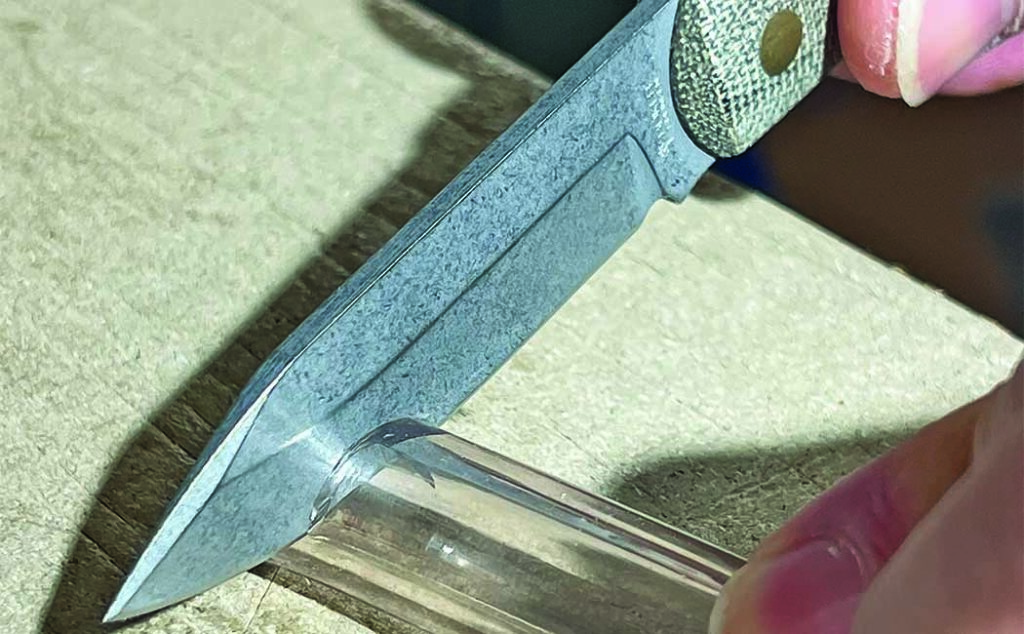
The Boker BFF fixed blade designed by Lucas Burnley is ultra-compact for discreet, comfortable carry. Its design cues are taken from the barlow pocketknife, a general go-to cutting tool for centuries. The 2.7-inch blade is AEB-L stainless steel in a clip-point shape that is very utility friendly. The blade has an acid-wash finish to hide scratches.
At 6 inches overall, the compact fixed blade almost disappears on your side. The handle comes in a choice of walnut or a more practical green canvas Micarta®. The Micarta is contoured nicely, making the handle rest in your hand snugly. The brass rivets and thong tube provide a nice visual contrast. The knife’s beauty lies in its simplicity of design and execution. It proves that no bells and whistles are needed for a cutter to be highly functional.
The sheath is a nicely made leather pouch style with a slight symmetrical taper toward the bottom. The iconic Boker tree logo is stamped into the leather. A sturdy steel pocket clip enables the BFF sheath to attach to or be removed from your belt quickly—no muss, no fuss.
With such a lightweight knife, a big belt loop would be overkill. The knife fits the sheath like a glove, with no rattling or wiggling. The sheath compresses down on the handle to hold it securely inside. When the knife is sheathed, the handle sticks up about an inch, plenty for you to grab onto. It also has a hole for a lanyard.
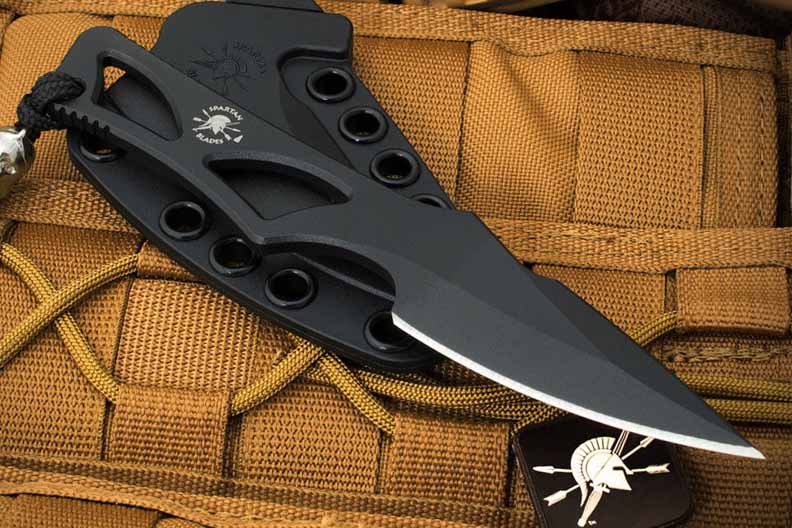
The Field Grade Enyo is a staple of the Spartan Blades line. It boasts an easily concealed blade designed for either utility or backup personal protection. It shares the same dimensions as its higher-priced sibling in CPM S45VN stainless steel, the Enyo, with the exception that the blade steel is AUS-8 stainless.
The modified clip point blade is 2.68 inches and the knife is 6.25 inches overall. The skeletonized one-piece design simplifies the knife and makes it easy to carry. The handle accommodates two different hand holds, which aids in increasing the knife’s versatility.
Several areas of jimping assist in getting a good non-slip grip. A black epoxy coating throughout provides a low-profile appearance. A paracord lanyard includes a polished Spartan helmet bead, which is pretty neat.
In action the Field Grade Enyo is all business. Don’t mistake it for a small, cute knife. It has attitude and packs a punch! The blade tip is reinforced a bit due to the false edge and penetrates fairly well. Thanks to the way the blade profile tapers, the tip cuts easily. The flat grind and superb edge quality out of the box enable the knife to handle business immediately.
The handle’s various curves seat your hand snug and solidly. The two-thumb rest provides the option of choking up further on the blade for a more reliable grip and improved control. It’s amazing such a small, compact fixed blade can feel so trustworthy in the hand.
When you tackle larger cutting chores, you can choke up on the handle to stabilize the knife and feel in charge at all times. The lack of handle scales means the knife is the bare minimum in bulk.
Those who say they do not like skeletonized knives might want to reconsider with the Field Grade Enyo. You’ll find yourself using it more and more. AUS-8 is well known in the industry for being a good, mid-grade steel, balancing edge holding and economy. It certainly doesn’t disappoint here. It is an excellent choice of steel for a knife of its price point.
The sheath is form-fitting molded plastic riveted for strength. One of the best things about the sheath is how well it locks the knife inside. There is a ramped, notched thumb button on the opening end that when pushed up releases a lock so the knife can exit the sheath. When sheathing the knife you will hear a tiny click indicating the lock has engaged. No amount of tugging on the handle or violent shaking of the sheath upside down can cause the knife to fall out.
This is very well done and a feature not commonly seen, not only on knives of this price class but more expensive ones, too. Included is a belt loop for IWB (inside waistband) carry, as well as a length of paracord for neck carry. The two carry choices promote both discreteness and ease of access.
The Hardcore Hardware MILF-02 Is A Heavy-Duty Folder That’s Designed For Any Challenge Users Can Throw At It.
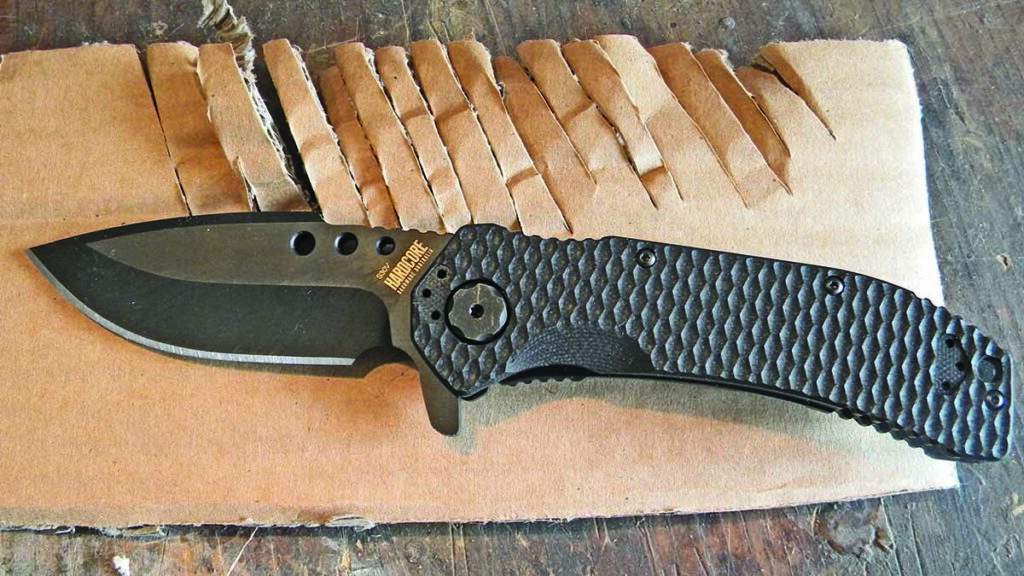
The MILF-02 folder from Hardcore Hardware is made for hardcore users. It’s big and beefy all the way around, has a dimple-textured handle and frame for an excellent non-slip grip, and a classic drop-point-blade shape.
The hollow grind extends halfway up the blade. Blade steel is CPM S30V stainless with a PVD (Physical Vapor Deposition) coating. It offers a classic black color on a framelock design with a flipper tab on the blade. It’s built heavy duty but it still has to cut.
Testing The MILF-02
The first inch of the cuts of the double-walled cardboard went well until the author had to use more pressure to push the cardboard over the thickness of the blade where the hollow grind stops. Once he got used to that, it was easy to overcome the twisting.
Right off the bat, the MILF sliced 20-pound-bond copy paper smoothly. The knife’s weight made the push cuts very easy. There were no snags or hang ups and it was simple to control the width of the slices.
Next: double-walled cardboard. The first inch of the cuts went well, then I had to use more pressure to push the cardboard over the thickness of the blade where the hollow grind stops. Once I got used to hitting this spot, it was easy to overcome the twisting. There were no edge hang ups at all.
I grabbed some 8-ounce leather for some skiving. The MILF was aggressive on every cut and emitted a crunching sound each time. Control was excellent in making fine slices and the handle filled my hand.
Cutting The Hard Stuff
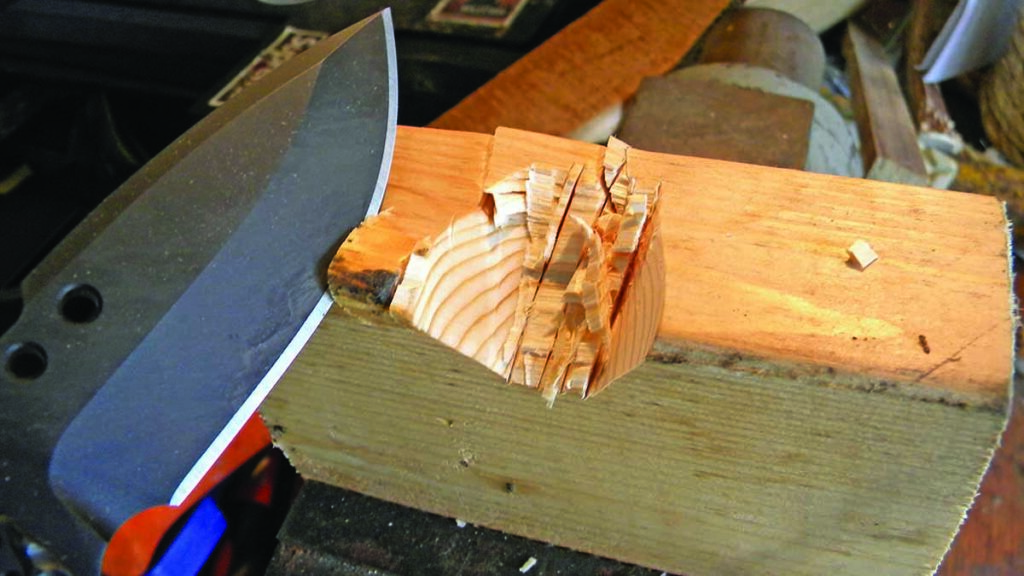
The author gave the 2×4 chunk 20 hard chops and the MILF bit deep on every whack. The edges of each chop were smooth.
It was time for some whittling. The folder seemed to want to bite deep into the wood. I started off with a fine curly-cue and by the end of the cut the edge was well into the wood. The MILF didn’t hesitate at all on the deeper cuts; it just kept curling the wood. It is a heavy cutter for sure.
I put a 2×4 chunk in my vise and gave the wood 20 hard chops. The MILF bit deep on every whack. The edges of each chop were smooth. Lockup was still at 100 percent. The knife is a great chopper with the bigger handle and all, but the inside edges of the handle need softening. They’re a tad on the sharp side
I took the same 2×4 and used the folder to split it into smaller pieces. All it took was a light tap from a dead blow hammer and the wood split with a pop. The thicker blade worked great for this phase of the testing. Lockup was still at 100 percent.
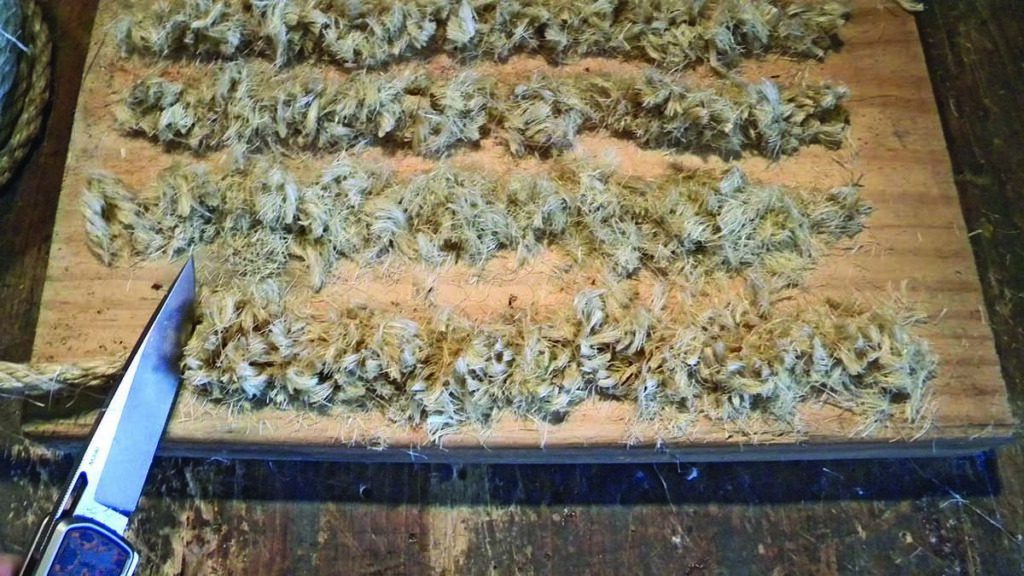
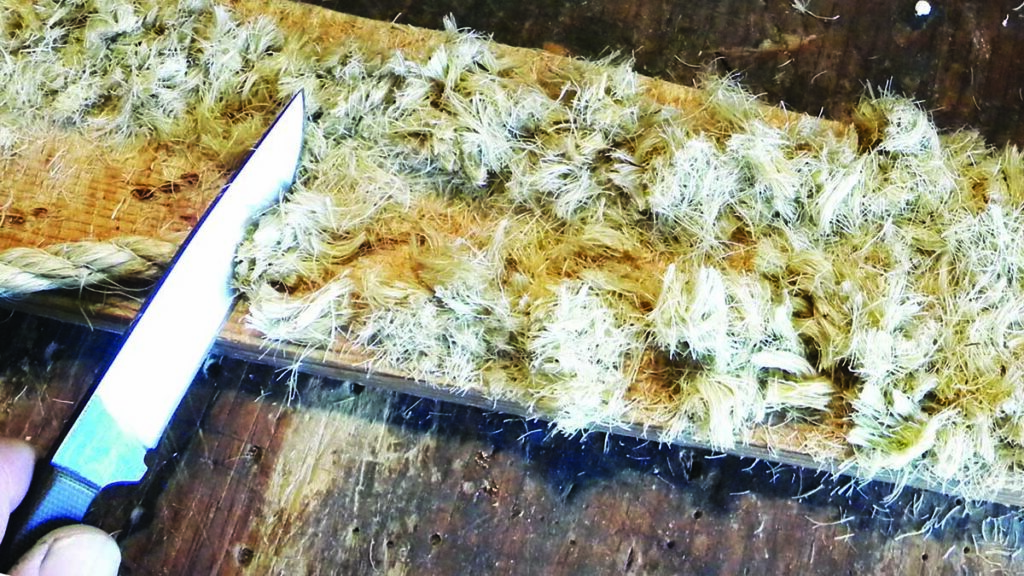
Half-inch sisal rope was next on the slicing block. The MILF crunched through 200 clean cuts very quickly, showing no signs of slowing down. I stopped cutting to save on rope. Edge holding was excellent and the heat treatment was great.
To take the testing further, I grabbed a deer antler for some more whacking. I gave the antler 20 hard wallops and the blade edge suffered no rolling or chipping. I did manage to remove a very thin wire edge on the blade. However, the main edge was still very sharp.
I returned to the paper slice to recheck the edge. I noticed a few hang ups and found more of the wire edge still intact. Two strops on some leather and the edge was back to original sharpness. Excellent job on the heat treat!
Final Thoughts
I would soften the inside edges of the handle for a smoother grip. Beyond that, the MILF is a heavy-duty using folder that holds a great edge. It’s too big for my tastes but a cutter it is.
The M-1 Folding Pocketknife From MECHFORCE Takes A Licking And Keeps On Cutting No Matter What’s In Front Of It.
Most people don’t like carrying a thick knife. They already have enough stuff without a bulky folder blocking access to the other goodies in their pockets.
I really like the blade thinness of the M-1 folder by MECHFORCE. Add a deep-set pocket clip and the M-1 is low profile when attached to the lip of your pocket. Meanwhile, the handle feels great.
The blade is a classic drop-point shape and cuts like … well, let’s see!
M-1 Folder Takes On Paper And More
The M-1 sliced the 20-pound bond copy paper smoothly and quickly.
Twenty-pound bond copy paper is the first way to test the factory edge. The M-1 sliced the stationery smoothly and quickly. I put a few nicks in my fingernail by moving too slow. I could hear every slice in the paper. Very sharp!
On to double-walled cardboard. The blade bound a tad at the bottom of the cut and during withdrawal. The thicker slice is where I noticed the binding. Thinner slices were not a challenge. It sliced the cardboard fast overall.
I used some plastic board for the next medium. The M-1 sailed through every slice. It was easy to control the width of the cut. I like the shape of this handle a lot. It really gives me control with my sidewinder cutting style.
The M-1 bit into 8-ounce leather and did so with gusto. I could hear the aggressive sounds of the edge biting through the material—this is very addictive to do as you crunch away. The knife would excel at skinning game.
I did some skiving to check the control of the depth of the cut. There were no issues whatsoever on the leather—super thin cuttings every time. The flat grind really helped in cut-depth control.
Pushing The M-1 Folder
The M-1 Folder wore the author’s wrist out after 250 crunching cuts of half-inch sisal rope.
Next up: half-inch sisal rope—time to use more pressure on the M-1. The knife wore my wrist out after 250 crunching cuts. It still had more bite but I was done for the day on rope cutting. The knife gave me no hot spots and I found zero sharp areas on the handle. It was very comfortable with pressure cutting. Excellent work, MECHFORCE!
To give the edge a heavy workout, I grabbed an old whitetail antler and gave it 30 whacks. I expected to see a few small chips in the edge but none showed. The edge was still sharp with no snags, sure signs of tough steel and excellent heat treatment.
I switched back to slicing 20-pound bond paper to see if the edge was still field ready. It sliced cleanly throughout to the end of the testing.
The M-1 comes with a maintenance kit that includes how-to instructions, two sets of replacement adhesive strips, take-down wrench and a bandage. It’s well thought out.
Final Thoughts
Not much to say here—maybe add some skateboard tape inserts for a no-slip grip. The M-1 is a high-performance knife that takes a licking and keeps on cutting. It makes a great pocket addition.
M-1 Folder Knife Specs
Knife style: Flipper folder Blade length: 3.5 inches Blade steel: M390 stainless Blade thickness at thickest: ⅛ inches Blade grind: Full flat Blade finish: Matte Blade pattern: Drop point Handle frame: 6Al4V titanium Handle inserts: Mars Valley carbon fiber Pocket clip: Deep set Lock: Framelock Weight: 5 ounces Closed length: 4-11/16 inches Knife to know: Features hidden-screw design Country of origin: Partially made in the USA MSRP: $385
The Informant By Greg Wesley Is Another Quality Fixed-Blade EDC. But Just How Good Is This Small Custom Knife?
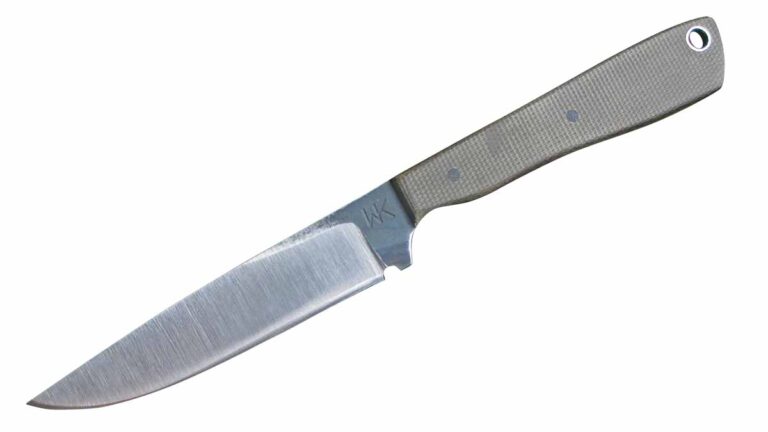
The trend for smaller EDC knives is still going strong. Set up with a leather sheath for belt or pocket carry, the Informant from Wesley Custom Knives fits the bill perfectly. Greg Wesley grinds them all by hand. This one is lean and mean.
Testing The Wesley Informant
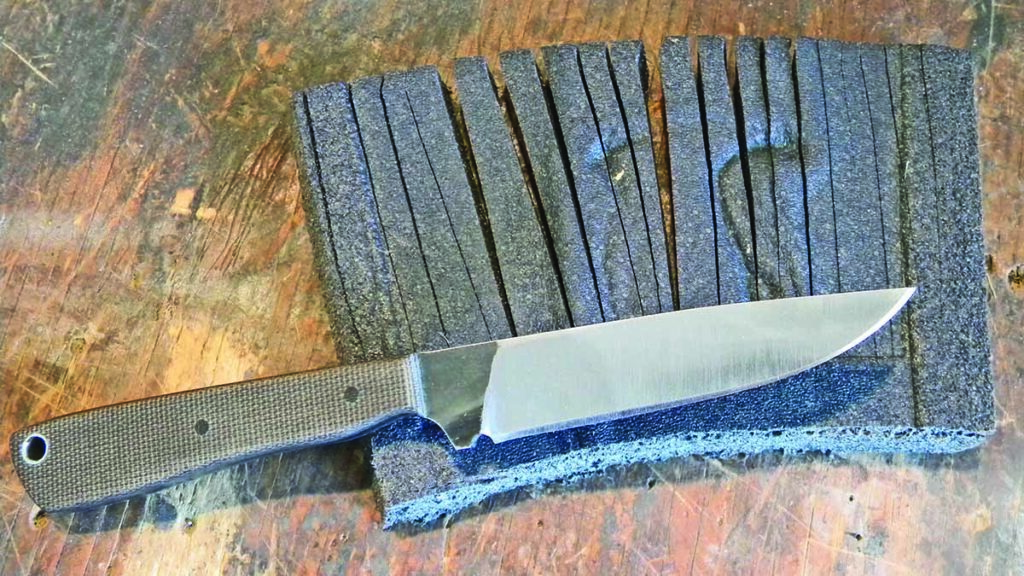
It was easy to control the width of cuts in the foam, all of which were straight without bending the medium.
I started with a piece of dense foam I use for making my Kydex sheaths. Manipulated with push and pull cuts, the knife started biting, slicing cleanly and quickly. It was easy to control the width of cuts, all of which were straight without bending the foam. Very nice.
One of my favorite tests,the 20-pound bond copy paper slice, provided little resistance. It puts a smile on my face when I hear every cut. I used a pull motion to shred the paper. The Informant came razor sharp. The balance of the blade made for a very quick test.
The knife had no challenges cutting through double-walled cardboard. I got carried away and pushed the blade too far into the cardboard, hitting the choil area and messing up the cut. The Informant is just fun to use. Cuts were mostly straight unless I took too big of a bite and the cardboard pinched the blade and slowed it down.
Plastic board was easy for the knife. It cut the plastic very quickly and I barely felt any resistance. Once I had the rhythm slicing, it was finished. This is a sharp little knife. Cuts were very controllable.
Pushing the Wesley Informant
The Informant crunched its way to 188 cuts on the sisal rope before the edge started to slide a bit.
I grabbed some 8-ounce leather for skiving (thin, tapered slices). With a louder crunching sound, the Informant bit quickly. The thinness of the knife made controlling the skiving simple—I just had to move my fingers faster to keep from losing DNA. The edge remained just as sharp as when I started.
I had to whittle to get a better feel of the little fixed blade. The cuts in the wood were extremely smooth. The Informant peeled large curly-cues one after another. The blade spine was somewhat sharp on my thumb but not too bad. The handle was a great fit to my hand—no hot spots at all. Nice job, Greg.
The Informant crunched its way to 188 cuts of sisal rope before the edge started to slide a bit. Impressive! The handle was still comfortable with the extra power added for the high number of cuts. The knife’s light weight didn’t impact its cutting ability.
The last test is a little destructive at times: the antler chop. I gave a whitetail antler 20 hard chops with the Informant. I rolled a thin wire edge in a few places but the blade was still very sharp, so the heat treatment is good.
Final Thoughts
I would soften the blade spine a tad more and maybe round the scales a bit, though that’s being picky. The Informant is a small, high-performing utility tool that can handle most any knife chore. It’s a great EDC choice.