Buyer's Guides

You’re looking for a new knife in a certain style – we’ve got recommendations on the best blades for every price point.

Flip Out: Four Balisongs To Trick Out Your Collection

Known By Many Names, The Balisong Is A Flipper’s Favorite Knife. These Four New Balis Are On The Cutting Edge Of The Style.

The balisong presents knife manufacturers with an excellent opportunity to express their design creativity and material preferences in a style that promotes pure enjoyment among flipping enthusiasts.

Long popular amid the knife-buying public, the balisong—aka bali, butterfly knife or simply butterfly—is a favorite of those who appreciate its mechanics, good looks and the sheer fun of flipping. With safety in mind, the manufacturers whose stock in trade includes the balisong provide new and innovative models on a regular basis. 

Along with these, training versions are often available, while seminars, videos, instructional courses, and online conversations are always at hand for those learning to use the balisong for the first time, as well as seasoned veterans who want to broaden their horizons.

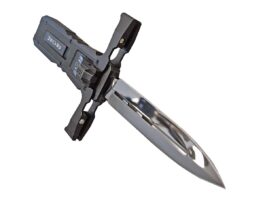
Squid Industries Krake Raken Bowie V2.5

Lucas Cao, president of Squid Industries, is excited with the performance of the company’s Krake Raken Bowie V2.5. 

“It’s wonderful that everything about it is highly optimized for the best flipping experience possible,” he said. “Some notable special features are the machined handle texture and its unique balance profile. The mechanism is a combination of stainless-steel bushings and phosphorus bronze washers. What makes the bushings special is we manufacture them in-house on our own Citizen Cincom L12 Type 7 Swiss lathe with extreme precision. Our expert assemblers use the bushings to then create the glassy smooth swing that the Krake Raken is known for.”

The Krake Raken is available in both live and training versions, allowing users to become familiar with its operations without the worry of an injury, according to Cao. And reliability is a watchword from the factory floor to the buyer’s hand.

“All of our balisongs go through rigorous testing across a long period of time and with many different users,” Lucas explained. “Balisong flipping is highly subjective, so we make sure that the feedback we gather is from both beginners and experts inside and outside of the organization. While Squid Industries has several top-tier flippers in our own ranks, we also work with top flippers around the world to hear their thoughts on our latest developments.”

An accomplished flipper in his own right, the Squid boss sees customers in the balisong universe always on the lookout for excellent ergonomics, grip, balance and durability. The ideals are addressed at Squid with continuing revisions and upgrades to its balisong line that are generated through robust customer feedback. 

Finding Squid in the marketplace is easy, and its commitment to the education and popularization of the balisong is evident in its sponsorship of the West Coast Flipping Championship, a 32-person-event live competition held each year at BLADE Show West. In addition, YouTube is well stocked with flipping and maintenance tutorial videos.

Knife Specs

Blade Length: 4.5 inches

Blade Steel: AEB-L stainless

Blade Closure: Latchless design

Handle Material: 7075 T651 aluminum

Weight: 4.33 ounces

Closed Length: 5.625”

Country of Origin: USA

MSRP: $284.99

Premium Alpha Beast Kukri

The Premium Alpha Beast Kukri is the latest from Bladerunner Systems and is another example of the continuing outreach the company provides relating to balisongs. 

“Spreading the word has been part of our primary focus,” commented Bladerunner’s Edward Anthonis. “We have been active in the community, hosted online tournaments, provided video content, and partnered with retailers to spread the word about balisongs and what a fulfilling and amazing hobby and sport it is and has become.”

With the Premium Alpha Beast Kukri, Bladerunner puts its best foot forward. 

“What makes any knife transcend being just a knife will always be the attention to detail given from a maker or designer that truly understands what makes a purpose-driven knife the best in actual application,” Anthonis remarked. “Our balisongs are built not only to be great knives but also to be great for balisong manipulation.”

The bushings of the Premium Alpha Beast Kukri are something special, and Edward says they are an integral component of most Bladerunner folding knives. 

“We use bushings in most of our knives, and we find the action of a balisong on bushings works best for the intended application,” he stated. “Having the critical dimensions of a balisong in place combined with a well-tuned bushing system makes for the best flipping experience.”

For Anthonis and company, testing is always a part of a quality manufacturing process, particularly since he and co-owner Lawrence Ho are flippers themselves. 

“Since we both flip and have our feet firmly planted in the balisong community,” Edward related, “we can test the products and also get them into the hands of other flippers to solicit their feedback.”

KnifeSpecs

Blade Length: 4.5 inches

Blade Steel: 154CM stainless

Blade Closure: Latch

Handle Material: Titanium

Pocket Clip: Yes

Closed Length: 5.375 inches

Weight: 5.3 ounces

Country of Origin: USA

MSRP: $439.99

Kershaw Moonsault 5050

“Our butterfly knives utilize four KVT-ball bearing systems,” explained Dominic Aiello of Kershaw/Kai-USA. “On each side of the two pivots is a ring of ‘caged’ ball bearings that enable the blade and handles to move quickly and smoothly.”

So it is with the Kershaw Moonsault 5050. Customer appreciation and response to knife offerings help move the company forward, and with its latest balisong the reviews have been quite positive.

“When we develop our butterfly knives, our goal is simple,” Aiello related. “We want to offer a high-quality USA-made product that is affordable and fun for everyday knife users and flippers. With that said, smooth flipping, comfortable handles, and good weight balance are keys with butterfly knives.”

For beginners interested in learning more about the fun of flipping, Kershaw offers the Lucha trainer. It closely replicates the size, weight and design of the original Kershaw Lucha bali.

Knife Specs

Blade Length: 4.6 inches

Blade Steel: 14C28N stainless steel

Blade Closure: Latch

Handle Material: Stainless steel

Weight: 6.1 ounces

Closed Length: 5.65 inches

Country of Origin: USA

MSRP: $249.99

Benchmade 85 Billet Ti Balisong

The Benchmade 85 Billet Ti Balisong is the product of modern technologies, processes and materials applied to a very traditional knife, says Vance Collver, company director of product line management. The knife’s best attributes include smooth, consistent action, and those who experience it are the best judges of that slick performance.

“If a balisong has any drag or ‘sticky’ spots in the rotation, it can affect timing during flipping,” Collver reasoned. “Durable materials—think about how often these knives get dropped when flippers are learning or trying out new or complex tricks—and style since it must look good too, are important factors. A balisong must be ‘cool,’ solid and function flawlessly.”

Benchmade folks take pleasure in walking customers through basic, fundamental flipping techniques at shows and various customer interactions, and several balisong enthusiasts and experienced flippers on staff at Benchmade put the company’s new product offerings through their paces.

“This knife is not available in a trainer version and is intended for experienced flippers or collectors only,” Collver advised. “Balisongs are part of our DNA at Benchmade. Our company was founded in the pursuit of the balisong, and to this day our logo remains a butterfly harkening back to our origin.”

Knife Specs

Blade Length: 4.4”

Blade Steel: CPM S30V stainless

Blade Closure: Latch

Handle Material: Titanium

Weight: 5.28 ozs.

Closed Length: 5.6”

Country of Origin: USA

MSRP: $750

Read More

Versa Rescue Knife: How Good Is This Folding Multitool?

Is The Versa Rescue Knife As Good As Advertised Or Does It Come Up Short Even With All The Extra Features?

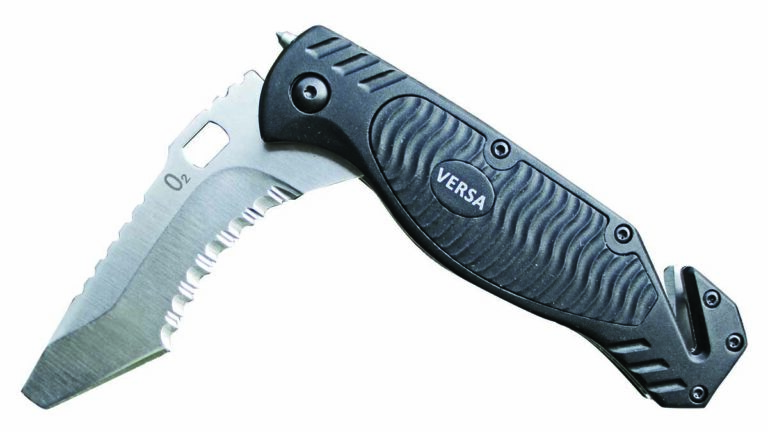
When he worked for the Central Intelligence Agency, Jason Hanson came across tool needs the average knife did not fulfill. Enter the Versa rescue knife.

Besides the blade having two distinct edges—one short and flat, the other recurved and serrated—the tip is flattened for a screwdriver. When you close the knife, a glass breaker sticks out the front of the handle. 

On the butt is a mini pry bar and a webbing/line cutter. Yes sir, there are lots of things going on with this rescue tool. However, I’m mostly concerned with testing the Versa’s cutting capabilities, so here goes.

Testing The Versa Rescue Knife

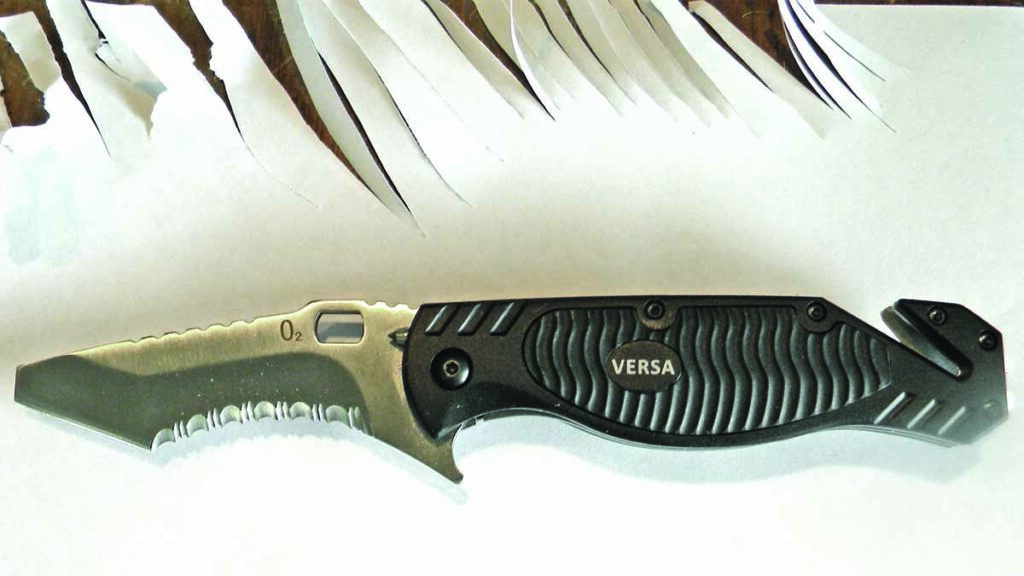
VERSA RESCUE KNIFE sharpness test
Via a push cut, the flat edge zipped through the paper smooth and clean, though it was somewhat challenging to use the flat front edge of the blade to start the cut.

Slicing 20-pound bond copy paper was first on the list. Via a push cut, the flat edge zipped through the paper smooth and clean. It was somewhat challenging to use the flat front edge of the blade to start the cut.

Onto the serrated edge, the paper tore sometimes depending on whether I started with the tips of the serrations or the bottoms during push cuts. The serrations did better used in a slight forward motion, giving cleaner cuts.

From there, the knife easily dispatched double-walled cardboard. With only a slight twisting of the blade, the serrated portion cut aggressively through the medium. Likewise, the flat edge sliced effortlessly and was very controllable, providing nice, even cuts.

The flat edge cut smooth through six-ounce leather, producing a bit of a crunching sound. It was very easy to control the cuts. The aggressiveness of the serrations really went to work on the leather, emitting loud crunching noises as it bit deep—and without need of a sawing motion at that.

To test the webbing/cord cutter, I used 550 cord. With one end of the cord locked in a vise, I held the loose end and pulled the cutter through the material. The cutter worked great with no resistance, severing the ends of the cord clean.

Carrying The Versa

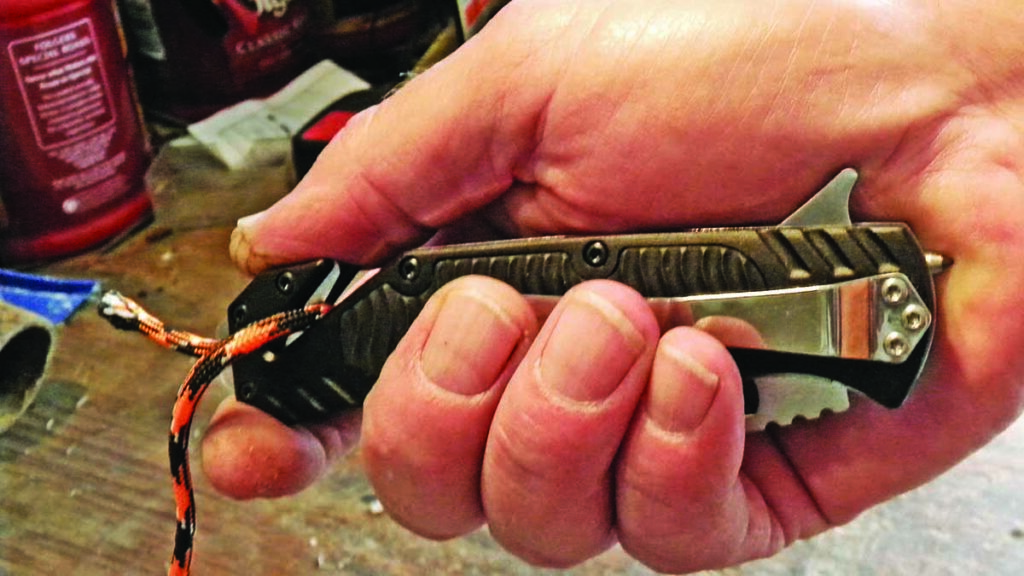
VERSA RESCUE KNIFE glass breaker
Even though the glass breaker works, the author didn’t like it poking him in the hand each time he grabbed the knife.

I carried the Versa for a week to see how it rode in my pocket. It’s a bit on the heavy side for my taste. The pocket clip held the knife secure with no side-to-side movement while I climbed a tree. 

Even though the glass breaker works—I’ve used the type before—I didn’t like it poking me in the hand each time I grabbed the closed knife. Clipped in your pocket, it will also poke your hip when you’re wearing shorts and sit down. The concept behind the glass breaker is sound and useful, but it suffers from the same poking problem as on all the similarly equipped knives I’ve tested. 

On the other hand, the pry bar rode great without sticking me in the leg. The handle design is very comfortable and the rubber inserts are perfect for a non-slip grip—a great using design.   

Versa Rescue Knife: Final Thoughts

I would reduce the Versa’s weight for pocket carry and design a glass breaker that doesn’t poke the user. (Editor’s note: Also, the flipper/blade action is sluggish and needs work to make the knife open easier and smoother). 

I would carry the Versa in a pouch or stashed in my vehicle. It works/functions great.

Versa Rescue Knife Specs

Blade length: 3.25 inches
Blade steel: AUS 8A stainless
Blade grind: Hollow
Blade edge: 2/3 recurve and serrated, 1/3 flat and plain
Blade openers: Flipper and blade hole
Liners: Stainless steel
Handle: Coated stainless w/rubber inserts
Pocket clip: Stainless steel
Lock: Linerlock
Weight: 6.5 ounces
Closed length: 4-15/16 inches
Extras: Glass breaker, web/line cutter, pry bar
MSRP: $69

Read More

The Provoke EDC Adds Style To The Enduring Line.

Originally A Karambit, The New Provoke EDC From CRKT Takes The Kinematic Technology Into The Realm Of More Casual Knives.

Do you love Joe Caswell’s innovative Kinematic deployment system but don’t need a knife as aggressive as the CRKT Provoke? Say hello to the newest knife in the line: the Provoke EDC. 

The knife takes all the best parts of the original Provoke but with one more casual, but massive difference: a drop point blade–the first in the line to veer from the karambit design. 

Provoke EDC Blade

The drop point is just 2.56 inches long, but it really makes its money thanks to its thickness. It’s .27 inches thick, 22-percent thicker than the blade on the original Provoke and more than twice the girth of any of CRKT’s seven most-popular pocketknives.

This makes for a knife adept at heavy work, be it batoning wood or slicing through rope or even prying open anything short of a manhole cover. 

At 3.6 ounces and 4.66 inches when closed, it’s light and easy to carry. The flush-mounted clip keeps it invisible in your pocket and quick to pop out. When deployed, the knife is 7.25 inches and is easy to control thanks to the handle. The handle is molded, similar to the original Provoke, so hot spots are non-existent as it sits flush in the hand when cutting. 

Kinematic Action

The one-of-a-kind kinematic action is unlike any other deployment system on the market today. When released it’s fast-moving, smooth, and keeps that thick blade securely in place. It’s nearly impossible to flex the blade when deployed, a sign of a strong lock.

The action is powered by two pivoting arms connected to both the handle and the back of the blade. When released the arms swing forward, sending the blade out and locking it in place.

It is a dynamic system and is an excellent fidget, however, it may be a bit cumbersome for those with smaller hands. Since the handle was originally designed for a karambit, which is traditionally deployed in a reverse grip, it could be tricky to securely hold when trying to deploy the knife one-handed. To some, this might not prove as intuitive as a flipper or folder. 

Other Provoke EDC Features

Beyond the blade, the most noticeable feature of the knife is its brilliant blue handle. The anodized aluminum visually pops and perfectly complements the satin-finished blade. And, since it’s aluminum, it is lightweight and can hold up to pretty much anything you can throw at it.

Overall, the Provoke EDC is a fresh take on everyday carry and is going to appeal to knife lovers looking for something that stands out. 

Provoke EDC Knife Specs

Blade Length: 2.56 inches

Blade Steel: D2

Blade Finish: Satin

Blade Thickness: .27 inches

Overall Length: 7.25 inches

Closed Length: 4.66 inches

Weight: 3.6 ounces

Handle Material: Aluminum

MSRP: $175

Read More

Knife Review: CRKT Bamboozled

No Need For Confusion, CRKT’s Bamboozled Shows Itself A Competent Light-Duty EDC Option.

There are so many assisted-opening knives for sale today that to compare them all is a fool’s errand. However, when you come across a good one you know it pretty quickly. The new CRKT Bamboozled stands out from the pack thanks to its classy, sleek lines, quality construction for a casual EDC, and its incredibly fair price.

New for 2023, the Bamboozled comes in under $100 and feels worth a lot more. Designed by Ken Onion Jr, son of BLADE Cutlery Hall of Famer Ken Onion, his first knife for the company looks straightforward because it is. It’s simply an excellent light-duty EDC.

The proof? After a few weeks of using the Bamboozled, I realized I hadn’t picked up any of my other knives. It pushed some truly excellent blades into the bullpen, and I don’t see that changing for a long time. 

The CRKT Bamboozled: The Ergonomics

The first thing you notice about the knife is how nice it feels in your hand. That’s thanks to the G10 handle and stainless-steel bolster. It looks and feels clean right out of the box and even after a few months of use, it remains pleasurable to employ.

Aside from a tidy look, the ergonomics are there in the Bamboozled’s handle. The straight handle avoids any hot spots you might encounter, and fits a medium-sized hand relatively well. The G10 scale is well-textured, yet not overly aggressive. At once, this offers solid control over the knife on light tasks—even when wet—while avoiding the cheese-grater texturing found on some heavy-duty options.

As with many other CRKT models, the Bamboozled succeeds thanks to a good skeleton. The handle is great, and it’s made even better by the steel liner lock that secures the knife upon deployment. It’s easy to close one-handed although the ridges on the lock itself can dig a bit if you open and close several times in quick succession. I’ve tried for months to find a way to loosen the lock with hard use and it hasn’t budged an inch. 

You can open the knife easily one-handed thanks to the assisted-opening flipper. The flipper tab is well-placed, though it does take a touch of force to get it going. But be careful. Once the assist mechanism kicks in the blade fires out at high speed.

A Blade For Everyday 

The blade is made from D2 steel which holds an excellent edge (more on that later) and is known for its wear resistance. In short, it is a fairly common, yet solid choice for blades likely called into numerous roles.

In total, the Bamboozled is 7.81 inches long and has a blade of 3.34 inches in length. For the user, this means having a blade long enough to make somewhat sizable cuts and a handle long enough to keep a relaxed and secure hold while cutting. The handle’s sharp lines and small profile also work to keep you feeling relaxed while cutting as you can position your hand in a way that works for you instead of being forced into a certain grip by a more contoured and bulky handle. 

This is the knife that will serve you well around the house. I wouldn’t use this for something like prying open rusty or locked boxes, though. The blade is just .11 inches at its thickest point and tapers at the tip. It can flex with your fingers.Thanks to being under four ounces, and just 4.45 inches when folded, the knife is a great casual carry option that will easily fit into a pants or a jacket pocket.

Bamboozled Vs Paper 

CRKT Bamboozled cutting paper
The bamboozled cut through the paper blind with ease.

After losing some blinds to our lovable but rambunctious dog I needed to replace a busted one. I was able to get an inexpensive paper blind at a home improvement store, a great light-work test for the Bamboozled.

Nicely the Bamboozled made it through the thicker paper of the blinds–folded over a dozen times–without any frayed or torn edges. However, it took nearly a minute of intense sawing action to chew through using the entire length of the blade. So while I would call it a success I definitely would say the knife had its work cut out for it in this task. 

Bamboozled Vs Leather 

CRKT Bamboozled cutting leather
The 1/8-inch leather belt was no match for the folder.

Wishing to see how the Bamboozled fared against a more robust material, I pitted the blade against leather. An old belt proved the perfect foe.

Interestingly, the Bamboozled made easier work of the ⅛ inch leather than the blinds. A moderate sawing motion with the belly of the knife cut the belt into tidy strips with clean edges. Given I’d already put the blade to use on other tasks and the edge was no longer pristine, I was surprised with the results.

Bamboozled Vs Nylon Rope 

CRKT Bamboozled cutting rope
The nylon rope provided the stiffest test for the Bamboozled.

 A piece of ⅜-inch nylon rope was the most formidable challenger for the knife. It did cut through but it was a process. Push cuts were only good for getting the main length of the knife to bite in, but the ensuing pull cut made quick work of the rope. 

However, it was hard to get a pull cut to bite and one time it took two pushes to get the knife to chew into the rope. Additionally, the cuts weren’t as clean as the paper or the leather belt. A win for the Bamboozled, but we’ll call it a split decision rather than a unanimous victory.

Not Bamboozled By Everyday Chores

My wife and I welcomed our first child a month ago, providing ample opportunity to put the Bamboozled through everyday paces. Boxes, wrappers and packaging of every sort from stacks of diapers to new furniture needed opening–which meant the Bamboozled had a legion of practical work ahead, which let me see what the knife could do.

Its straight-back blade comes to a point that is excellent at piercing, which was a plus as it easily punctured the material. The knife also was great at cutting straight down cardboard of every thickness in clean, even lines.

Beyond the cardboard, the Bamboozled easily cut through tape without taking on much of a residue and it was able to cleanly cut through foam without peeling off bits. The foam, both thick and thin, was no match for the puncturing blade. 

Judging The CRKT Bamboozled

The D2 blade provides a strong edge that resists wear.

Overall, I really like this knife. It’s easy to use and comes at a great price. The edge is no joke and really does hold up against everyday usage quite well. 

This is a great piece for the small speed bumps that come up in day-to-day life in suburbia or the city. Have to downsize a mountain of cardboard boxes at the office after a bunch of new product is delivered? The Bamboozled will get the job done quickly. Just don’t ask too much from this knife. The Bamboozled is well made but it’s not a heavy-use utility knife. I wouldn’t want to baton wood with it, use it for prying, or use it as my main knife in the backwoods.  

What it does well it does exceptionally well; if you keep the knife in its wheelhouse it should serve you well for years. The $75 price point makes this an affordable, accessible knife that’s great for both knife lovers and someone looking to get their first blade. 

CRKT Bamboozled Knife Specs

Blade Length: 3.34 inches

Blade Edge: Plain

Blade Steel: D2

Blade Finish: Satin

Blade Thickness: .11 inches

Overall Length: 7.81 inches

Closed Length: 4.45 inches

Weight: 3.7 ounces

Handle: G10 with Stainless Steel Bolster

MSRP: $75

Read More

Fast And Furious: Our Top Picks for the Best OTF Knives On The Market

Despite A Rocky History Of Legality, OTF Knives Have Endured And Are Some Of The Most Popular Pocketknives On The Market Today

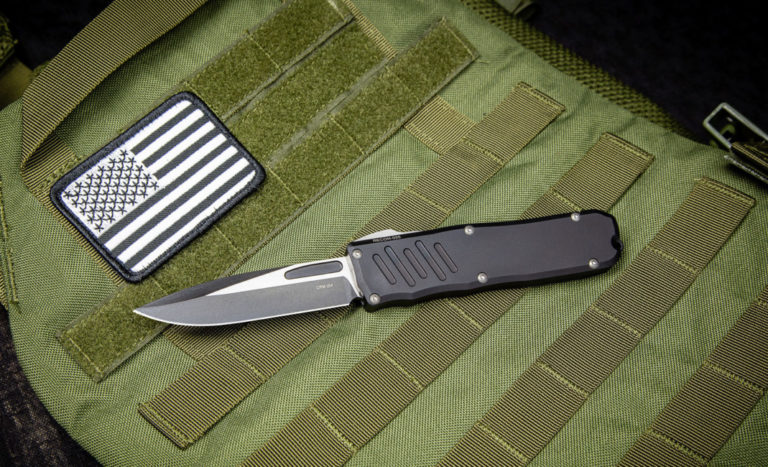
As its name suggests, an Out The Front (OTF) knife is a fairly straightforward affair.  In short, it has an enclosed handle with a blade that deploys from the front–the bolster, hilt or what have you. In general, these fast-from-the-gate options are small, most with an average blade length of 3-3.75 inches, though there are certainly larger examples. 

The knife is distinct from its “Out-The-Side” cousin, at least as a switchblade–one of its most common forms–in the variety of the way the blade is brought into action. Furthermore, the OTF knife needn’t any push-button, assisted-open system to flash cold, hard steel in the wink of an eye. 

Overall, OTF knives are a fascinating, if not slightly intimidating, corner of the knife world. In this guide, we’ll look at some of the history, usage and types of OTF knives. Then we’ll show you some of the best options on the market today. Get ready to flick into action.

Legality Of The OTF Knife 

In the past, these knives were favored by paratroopers and sailors. However, thanks to a media campaign in the 1950s that showed automatic knives as the tool of choice for criminals and underworld types, including popular movies like “Rebel Without A Cause”, automatic knives were banned nationwide. The Federal Switchblade Act passed into law on August 12, 1958 and effectively banned auto knives across the country. 

Going into 2023, the panic over OTF knives and other switchblades has somewhat subsided. Most states now allow ownership and carry of OTF, and other types of, automatic knives. However, 11 states still have a blanket ban. Furthermore, there are some issues when it comes to what many places call ‘stabbing instruments’ and other vague terms. Where this becomes an issue is some states that allow automatic knives have laws against double-edged blades. Given many OTF knife options fall into both categories, certain models have a narrow window of legal ownership.

As always, if OTF knives or switchblades tickle your fancy, please check your local laws before picking one up. Better safe than sorry.

Types Of OTF Knives

As mentioned above, there are four types of OTF knives. Each has positives and negatives, and the prices will vary wildly. It’s important to know the differences so you purchase the option that best suits your needs.

Manual OTF Knife

The most basic and least expensive OTF knives are the manuals. They are exactly that, knives that deploy and retract through manual operation. The most common way of doing this is via a slider on the handle. The upside is that you are in total control of the speed of your blade. However, it may not have the wow factor of other knives on the list. But hey, you’ll be safe while using it. 

Single-Action OTF Knife

These knives feature a powered deployment, usually with a button of some type, but require you to manually retract the blade to reset it. And it isn’t retracting like you might think. You pull a handle at the bottom to both retract the blade and recharge the spring so it’s ready to deploy again. 

Double-Action OTF Knife

When you think of an OTF knife you probably think of double-action OTFs–better known as fully automatic. The blade deploys and retracts with the touch of a button or flip of a switch. Prominent companies like Microtech and Cobra-Tec make dozens of different double-action OTF knives.

Gravity Knives

The four-leaf clovers of OTF knives are definitely gravity knives. Few companies still make them. The blades deploy and retract with the help of gravity.

The Reate EXO is one of the most popular gravity knives on the market today and a great example of the style. Just take into account your local knife laws as some places have specific laws banning the ownership or carry of gravity knives.

What To Look For In A Quality OTF Knife

You can find decent, but basic, OTF knives in the $30 range, but expect to pay ten times that for a model that extends and retracts on its own with the push of a button. Though, the sky is really the limit when it comes to the features on these knives, as some can easily jump over $1000 depending on what’s included.

The rub, for the price, is that even the expensive options do not do well for anything other than basic and light use as they are not as strong as other types of knives.

The basic selling point of OTFs–aside from inherent coolness–is convenience. Read that as they can be entirely used with one hand. It’s best to think of the OTF knife as a refined gentleman’s blade: a cutting tool that you could rely on for daily life and its inconveniences. 

OTF Blade Quality

The main issue surrounding blade quality on OTF knives is how light the blades have to be to function. Because the blade is entirely surrounded by the handle, the blade itself cannot be wider or longer than that existing space. As a result, most OTF knife blades are short and light. 

These blades are rarely what we would call a full-profiled knife and many are under 3 inches despite a full-sized handle. These blades are not especially strong and are essentially for cutting only, though there is utility in thrusting or stabbing depending on the strength of the locking mechanism. 

The small tang area is where the mechanisms are anchored, and this space is usually quite insignificant in surface area. It is entirely possible and even easy to break OTF knives if used improperly. 

Practicality Of OTF Knives

If you are in the market for an OTF knife, realize that there are better designs for most daily work that are substantially stronger and can handle a much wider variety of tasks, not to mention are cheaper. OTF knives do have their niche, much like karambits, balisongs, and friction folders, but each of these designs has hard limits on what they can accomplish as opposed to a fixed blade or a suitably strong folder. 

Best OTF Knives

SCHRADE VIPER OTF

Coming in at a relatively low cost (comparatively) is the Schrade Viper. The knife lacks some of the features of higher-end OTF knives, but at 1/10 the price of some of the others on this list, it is a good starting point should you want to familiarize yourself with the OTF style in general. 

The knife is a bit more manual than others in that it is assisted opening but needs to be manually closed. The overall structure of the knife is not cheap. The handle is made of aluminum and includes an integrated glass breaker in the pommel. It also features a manual safety system for opening and closing the blade to ensure it only opens when you want it to.

MSRP: $75

SMITH & WESSON M&P OTF

The M&P OTF retails in the same range as the Schrade Viper and is largely a product that appeals to an entry-level crowd. Many OTF knives on this list retail for more than some of S&W’s guns–a telling sign this market is for the discerning individual. with the M&P OTF, you get a large degree of utility without some of the additional features and glamor of higher-end models. 

Like the Schrade, this knife has an integrated glass breaker in the pommel and is similarly assisted opening/manual closing. If you already own an M&P pistol, you’ll notice that the handle contouring matches the slide machining cosmetically, including a safety lever that resembles the one on the pistol. MSRP: $70

HOGUE KNIVES COUNTERSTRIKE 

Hogue’s new Counterstrike is a flagship design that is sure to impress, not only with its modest price point for a fully-automatic knife but also the materials it is made from. 

What sets the Counterstrike apart is not just that sweet-spot price, but the high-end materials it’s made from and its excellent strength. Among these is the MagnaCut blade, which itself is a prime selling point. This steel is among the best in the industry and gives the Counterstrike excellent edge retention and adds rigidity to the already thin OTF blade profile.  Additionally, the knife has a glass-breaker pommel, aluminum, and carbon fiber handle, and is made in the USA. 

MSRP: $400

KERSHAW JENS ANSO KAPSULE MANUAL OTF 

The Kershaw Capsule is a small manual OTF excellent for concealment. At just 3.25 inches while closed and with a 1.9-inch blade, this small knife is a great self-defense tool because of its size and unassuming appearance.

However, it’s much more than that. The spear point blade works like a box cutter. The tip is great for puncturing the and edge can handle the type of slicing work you’d expect from a commercial box cutter. It’s convenient and compact enough that it can even fit on a keychain.

MSRP: $35

MICROTECH ULTRATECH D/E 

Microtech is one of the companies that popularized the modern OTF knife. In fact, most knife enthusiasts would go so far as to say that Microtech is completely responsible for this trend and has set the bar for all OTF knives going forward. The Ultratech is a solid example why the company calls the tune.A dependable OTF,  the knife displays an excellent balance in terms of material, strength, and utility. It is a fully-automatic design that opens and retracts with the same switch. If you want an incredibly reliable OTF knife for your daily use, the Ultratech is arguably the knife on this list with the most pocket hours across the board and is from an established OTF brand. Like others on this list, it features a glass breaker pommel and is made in the USA. 

MSRP: $310

HERETIC KNIVES ROC

Now here is something you don’t see every day. The Heretic Knives ROC is visually stunning, it is just so rare to see a curved blade on an OTF knife. The company no longer has the ROC listed on its site as of this writing, but it is available and in stock online. The ROC accomplishes its one-of-a-kind appearance by using a curved handle to match the blade, which overall seems like a no-brainer.

But it just isn’t seen these days, despite the advantages in self-defense or martial arts. While it resembles a karambit, this knife lacks a finger ring on the pommel. The ROC is a fully-automatic design that retracts and deploys on its own. If you are in the market for an eye-catching OTF design that is USA-made, you’d better get them before they are gone.

MSRP: $750

PIRANHA RATED-R 

The Piranha Rated-R is one of the most discreet and well-designed knives on this list. The others we’ve looked at have release buttons/switches on the side of the grip in line with the spine of the blade, whereas the Rated-R has it conveniently mounted where the thumb rests near the end of the handle. 

It is a fully-automatic knife and requires no movement of the hand to deploy and retract the blade thanks to the switch location. Unlike most of the others here, it lacks a glass breaker pommel, further adding to its discreet appearance. The knife is on the higher end of cost for OTF blades. But like any semi-custom product, it appeals to a certain customer that has specific needs for a strong, durable, and unassuming knife. The Rated-R is made in the USA. 

MSRP: $490

BENCHMADE AUTOCRAT

This list wouldn’t be complete without a knife from Benchmade. The company has been producing visually attractive and highly functional blades for the most demanding end users: hunters, cops, rescue crews, anglers, and bushcrafters, among many more. The Autocrat is the most sought-after Benchmade OTF model and it has an excellent reputation for strength and sharpness.

The knife is in the same cost range as most high-end OTF knives at $500, making it an investment for most people but a steal for those who desire American-made quality. The knife is fully automatic and is available in two colors. It does not include a glass breaker pommel, making it easier to use in the hand and a bit more classy in overall appearance. 

MSRP: $500

Read More

Civivi Cogent Review: How Versatile Is This Flipper?

The Cogent Flipper Folder From Civivi Is Ready To Cut Through Pretty Much Anything

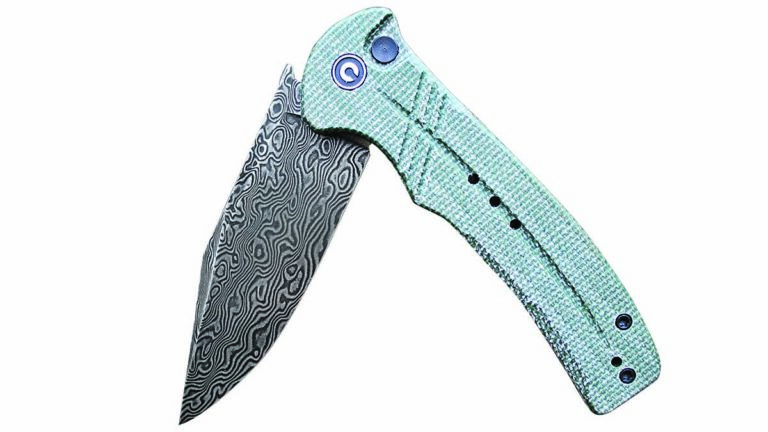
The Cogent button-lock folder from Civivi is well put together. It has a great feel and a classy blackened stainless steel damascus blade. 

Civivi uses 10Cr15CoMoV and 9Cr18MoV stainless steels in the damascus mix. The blade has a full flat grind designed to slim the edge geometry down for efficient slicing.

Testing The Civivi Cogent

Civivi Cogent skiving leather
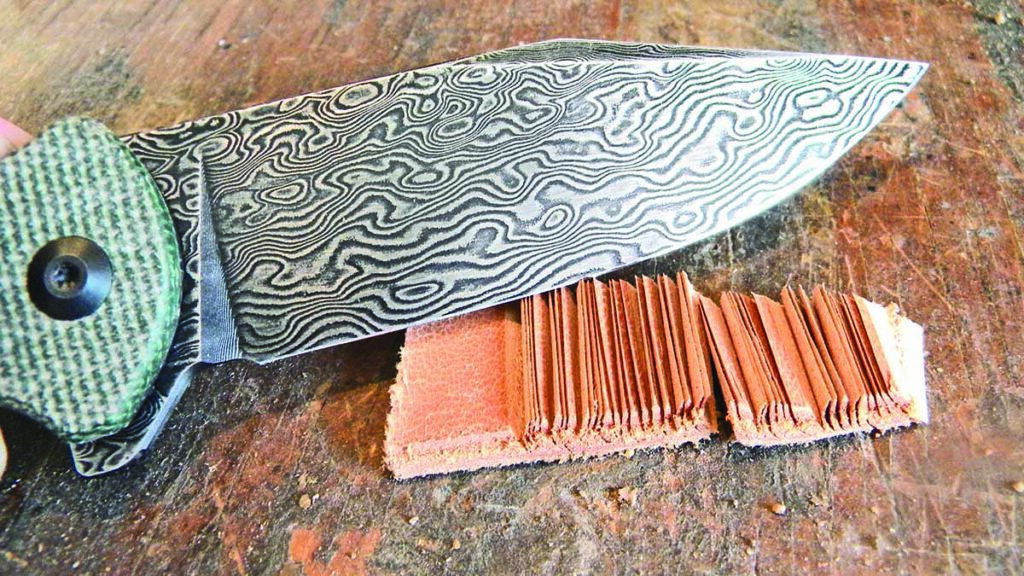
Skiving 6-ounce leather was no problem as the Cogent did the job aggressively and noisily—the author easily could hear the crunch on each skive.

First up on the test agenda: 20-pound bond copy paper. The Cogent zipped through it without hesitation. The blade was super smooth during slicing. I used a push cut for a full slice. The knife most definitely has a fine edge.

Staying with a push cut, I used the Cogent to effortlessly slice single-walled cardboard to shreds. The edge never stalled in dispatching the medium. Man, this thing is wicked sharp! There was no twisting of cuts, just straight slices. In fact, it sliced so quickly I had to really watch my fingers to avoid cutting them.

I took it up a notch by slicing plastic board. It was like there was no variation at all in the speed and control of cutting. The only difference was the absence of the zipping noise emitted by the cutting of the cardboard. It was nice, quiet slicing with no hang ups.

There was some 6-ounce leather on the bench for skiving. I decided to slice just a part of it up first. Talk about aggressive cutting! I could easily hear the crunching from every skive. The Cogent sounded like it was actually taking a bite out of the leather—which I guess it was. I did some skiving on another piece of leather with similar results. This knife is a wicked sharp cutter.

Wood & Rope

Civivi Cogent cutting rope
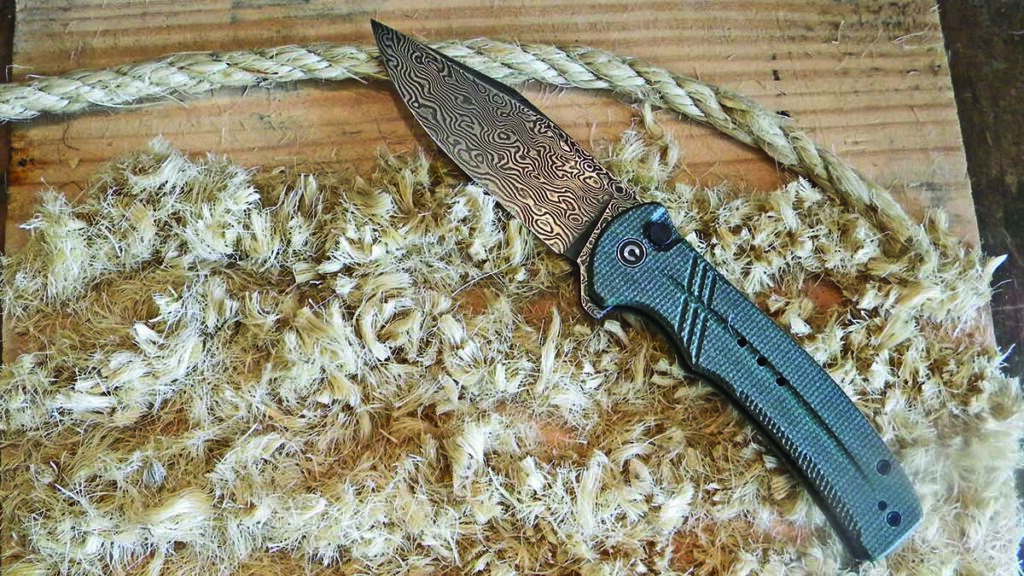
The Cogent worked its way to 214 crunching cuts on the 3/8-inch rope before the author got tired and quit.

It was time for some firestick making. Utilizing the fine edge, I whittled some curly-cues in a pine stick. I did some very fine curly-cues and some thicker ones. The Cogent was excellent controlling curly-cue thickness. The thumb notches were very comfortable during the deeper bites. The handle was quite comfy.

For some splitting action to test the lockup, I batonned the Cogent into a half-inch-thick board. It split the wood very quickly with no smears on the blade. The button lock stayed at 100 percent lockup. No wiggle here!

The last challenge was the 3/8-inch sisal rope. The Cogent worked its way to 214 crunching cuts before I got tired. The edge would still shave hair from my arm*. The blade boasts excellent heat treatment. I didn’t find one hot spot on the handle and the knife was very comfortable for heavy cutting.

Civivi Cogent: Final Thoughts

I would carry this knife every day. It holds a sharp edge longer than most. The second-best thing is the comfortable handle. It is made for using. The Cogent is an excellent folder. I’d maybe add more handle color options. I love everything else.

*Editor’s note: BLADE® does not recommend shaving arm hair to test blade cutting ability. It can result in injury or worse.

Civivi Cogent Knife Specs

Blade length: 3.47”
Blade material: Blackened stainless damascus
Blade thickness at the thickest: 1/8 of an inch at ricasso and tapers to the tip
Rockwell hardness: 58-60 HRC
Handle: Green Micarta®
Liners: Stainless steel
Opening: Flipper
Lock: Manual button lock
Knife to know: Open-handle construction for easy cleaning; handle textured; thumb notches on base of blade spine
Country of origin: China
Weight: 4 ounces
Closed length: 4.25 inches
MSRP: $115

Read More

TILI Ultralight Review: How Good Is This Small Fixed Blade?

The TILI Ultralight By Origin Handcrafted Goods Might Be Small But It Packs One Heck Of A Bite.

The TILI Ultralight by Origin Handcrafted Goods is a small fixed blade that can fit in your pocket like a pocketknife with no need to figure out how to open the blade or disengage a safety. Pull it clear of the pocket sheath and you’re ready to cut. Among the things I love about smaller fixed blades is that people don’t give you the evil stink eye when you use the knives in public.

Testing The Ultralight 

TILI Ultralight cutting paper
The TILI Ultralight handled slicing copy paper with ease.

I started with a simple paper slice using 20-pound bond copy paper. The TILI sliced very smoothly using both a draw cut and a push cut. The knife was controllable in making the width of the slices—I just had to move my fingers out of the way fast.

Next up: single-walled cardboard. The handle shape of the TILI Ultralight made for extremely controllable slices in the cardboard as well. I could hear the aggressive edge as it sliced. The edge is very fine and ideal for such a job.

Plastic board was next. There was a little more blade grab in this medium as the TILI’s blade bevel is short—around 3/8 of an inch. The full thickness of the blade engaged the plastic board quickly. It still made quick, clean cuts as fast as I could move my fingers.

The little fixed blade produced beautiful curly-cues in half-inch pine, producing nice, clean cuts. It was easy to control the depth and thickness of the curly-cues. The TILI Ultralight is great for making fire sticks and a handy little knife to put in a pack. It would be excellent at cleaning small game.

Slicing Through Challenges

TILI Ultralight cutting pine knott
The author drove the edge through a pine knot twice. He felt some micro chipping on the edge but it still cut great.

Skiving leather strips was next on the menu. The blade made a forceful crunching sound as it parted the 8-ounce leather. The small blade was controllable in making the slices thin. It favored skiving with the tip more than with the blade’s belly. This is a very sharp knife!

To push the fine edge more, I switched to 3/8-inch sisal rope. The TILI crunched to 125 cuts before my hand said “enough!” It’s hard to keep the pressure on a thin knife without your hand getting sore somewhere. The edge was still sharp and ready for more.

I switched to half-inch pine for some baton practice. The knife was easy to hold onto and it split the wood great. I even drove the edge through a knot twice. I felt some micro chipping on the edge but it still cut great. The steel might be a point too hard on the Rockwell hardness scale for heavy work. Keep the use to slicing and you won’t have any issues.

The TILI comes with a leather pouch sheath to protect the blade. I would put stainless steel pins in the holes at the end of the sheath to prevent accidental penetration as this knife is very pointy and razor sharp.

Bottom line: The TILI Ultralight is a handy knife that’s a perfect little backup blade for all-around use.

Changes I’d Make To The TILI Ultralight

I would add a couple of thumb notches on the blade and extra protection on the tip of the sheath to prevent blade penetration. (EDITOR’S NOTE: The latter is especially crucial if you carry the knife sheathed in your pocket.)

TILI Ultralight Specs

Blade Length: 2.38 inches
Blade Material: 1095 carbon steel
Blade Grind: Hollow
Heat Treat: Differentially Hardened with Hamon
Handle: Skeletonized Steel with hole for included leather lanyard
Weight: 2 ounces
Overall Length: 2.75 inches
Sheath: Black Veggie Tanned Leather
Weight with Sheath: 3 ounces
MSRP: $125

Read More

Advertisement

Must Read Articles

Read this before you make a knife

Knifemaking 101 – Read This Before You Make a Knife

  by Wayne Goddard My experience has taught me that there's nothing like digging in and getting started. I've often said the hardest part of the...
how to forge damascus steel

How to Forge Damascus

Advertisement
Advertisement