Featured Knives

Here are BLADE Magazine’s Featured Knives of the Week. Browse through these articles to find the best knives available from both custom knifemakers and factory knives.

Click here to browse through our list of Featured Knifemakers.

Knifemaking – – Knife Collecting – – Tactical Knives – – Survival Knives

Best Swiss Army Knife Tools

The Swiss Army Knife has become a utilitarian icon. Manufactured by Victorinox, and formerly Wegner, the knife got its name due to American GIs in World War 2 being unable to pronounce the proper German name of the name, the Offiziermesser, which translates to “officer’s knife.”

Traditionally clad in red, the color of the Swiss flag, the knife is a versatile multi-tool filled with different implements ranging from knives and screwdrivers to corkscrews and nail files. Below is a selection of some of the most useful tools in the Swiss Army Knife and some tools that are a bit more unique.

The Original Tools

The first Swiss Army Knife, simply called a Modell 1890, featured four tools. Those four are still a part of many SAK models today and immediately come to mind when you think of the tool.

Spear Point Blade

While a larger Swiss Army Knife may feature multiple blades, every model will feature a spear point. An icon in its own right, the SAK spear point will appear on the largest models all the way down to tiny ones meant for keychains.

Made of stainless steel, the spear point can cut thread just as well as it can cut meat. However, I wouldn’t want to butcher much with one that’s keychain size.

Reamer

The reamer is probably the least-known of the four original tools but is no less important. It is two functions. The first is to drill small holes into wood to give screws a head start. The second is to help with sewing. The hole in the middle of the tool is meant to be used to slide thread through to help give a stable anchor point while sewing materials together.

While this might not be the most necessary tool today at home, it’s incredibly important for a soldier on the march or on the battlefield.

Screwdriver.

Nowadays you can find some Swiss Army Knives with as many as four different screwdrivers inside. They all can tie their lineage to the screwdriver that made it onto the original model. Important for a soldier trying to fix a rifle in battle, important to a homeowner trying to reinstall an outlet cover in the kitchen, the screwdriver is one of the implements that sets the SAK, and other multi tools apart from other types of tools.

Can Opener.

Yet again, a great all-rounder tool with military use in mind. A can opener is a necessary tool for a soldier to have in the field to open rations. While most homes today have either a crank or an electric can opener, the original handheld version still remains in many Swiss Army Knives.

Other Necessary Tools

Swiss Tool X Plus Ratchet

Some of the larger Swiss Army Knives today have as many as 15 layers and dozens of tools inside of them. As the knives have grown larger, so has the roster of tools within them. These may not be the originals, but they sure are just as useful.

Needle Nose Pliers

Great for prying and pulling things apart, the needle-nose pliers are a standard tool in the larger SAK models. As the knives became more and more associated with outdoorsmen and tradesmen, the tools evolved to meet those demands.

Made of stainless like so many of the other tools, it’s a great pair of pliers, and the fact that they fold away into the knives makes them invaluable when you’re outdoors.

Saws

Over the years the SAK has grown to include multiple types of saws. The main two are a wood saw and a metal saw. The wood saw is a smaller version of a classic handheld saw, great for cutting small pieces of wood or through small, thin brush.

The metal saw features files on both sides, which compare to a standard, flat file. The serrated edge is analogous to a hacksaw. It will cut through metal, but it’ll take a while to do it.

Scissors

What’s better than a pair of scissors? If you’re looking to cut paper or fabric, not much. That’s why scissors are included today on the largest Swiss Army Knife (38 tools) and the smallest (seven tools). 

Like the majority of the other tools, it’s made of stainless steel. Of course, they are quite small so it’ll take a minute or two to finish cutting, but when you need scissors no other tool can match up.

Toothpick

Currently a standard tool on the smaller SAK models, the toothpick is great because no one likes having food stuck in their teeth. Unlike most of the other tools in the knives, this one is not made from metal. It’s made from hard plastic and slides out of the body of the knife. However, it is easy to clean and stow back away so while it may seem like a reusable toothpick might not be the most sanitary tool, Victorinox has engineered it in such a way that it is easy to disinfect.

The Outrageous Tools

Over the years there have been plenty of tools in the Swiss Army Knife that range from maybe being a bit overkill to being completely out of left field. Two of these are still available on some SAK models while the other tools are just relics of bygone knives.

Cigar Cutter

The cigar cutter is the most eye-catching tool from the past. Cigar smoking isn’t as popular as it was, but there were once five models of Swiss Army Knives that featured a cigar cutter. It was unique because it was not spring-loaded. It featured a lever that would slice the cigar with a blade like a guillotine.

Toilet Paper Holder Key

That’s not a joke. A limited number of Swiss Army Knives in Europe were made with this incredibly specific tool to open industrial paper towel holders in public/commercial bathrooms.

Pharmaceutical Spatula

You’re reading that right. Some knives feature a pharmaceutical spatula. This tool is meant to stir ointments and creams as well as safely move pills into bottles. It’s as specific as it gets when it comes to tools on a Swiss Army Knife. Well, there might be one tool more specific.

Hoof Cleaner

If you’re a farrier and need to clean out some horse hooves, there’s a tool for you. The small hook features no sharp edge so as to not hurt the horse as you clean out their hoof before putting on a new shoe.

Read More

Do You Have Your Hunting Knife?

There is no single profile that fits all hunters, and there isn’t a specific hunting knife that fulfills all needs. That’s a good thing for the knife industry. Some guys like a standard fixed-blade, drop-point hunter that comes in a leather belt sheath, maybe even with a slight hump near the tip of the blade where they can rest their finger and choke up on the blade. One of custom knifemaker Russ Kommer’s favorite packages is the 2-Shot. He has used it daily in the field as a hunting guide in Alaska and around the world. X3351Russ says, “I’ve always preferred a smaller semi-skinner, even for the biggest of game. You just use the hump near the end of the blade to locate your index finger. And the blade is short enough that you can work inside the animal and feel where you are at all times.” The CRKT Kommer 2-Shot Skinner Knife has a 3.15-inch full-tang 12C27 Sandvik stainless steel blade, stainless bolsters, orange G10 handle scales and stainless steel pins.

Y3351

Some ever-prepared hunters aiming for big game opt for a hatchet/skinner combination pack such as the Timberline Hatchet/Bush Guide Skinner Combo. It includes Kommer’s Alaskan Bush Pilot Hatchet and Alaskan Skinner. Expertly crafted from polished 440 stainless steel, the Alaskan Bush Pilot Hatchet boasts a 4-inch, full-tang head, while the Alaskan Skinner sports a 3.625-inch 440A stainless steel skinner blade. Each handle is precision machined Zytel for a non-slip grip and ease of use. The Alaskan Combo includes a ballistic nylon sheath with belt loop, and weighs 2.28 lbs.

Y7735

Gut hooks come in handy for skinning game animals, and a Realtree-pattern handle is a plus. The Kutmaster Team Realtree Guthook Knife dons a 420 stainless steel blade with sharp gut hook on the spine, a Realtree camo handle pattern, and a nylon belt-loop sheath. 

For many more quality options, visit ShopBlade.com, and stock up for the hunt!

Enter The Knife I Carry Feature… Win A Free Knife

1

Here’s your shot to show off your prized carry knife to the world!
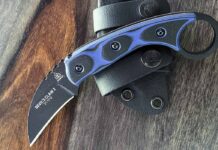
What’s better than carrying a knife? Showing the world exactly what knife you carry. Now, this little act of gratification might earn you—what else—a new knife.

Show us your carry knife—be it slip joint, fixed-blade, or whatever—for our The Knife I Carry feature in BLADE® Magazine. The monthly feature focuses on knife enthusiasts who carry knives but who do not have the wherewithal to make their own. We’re looking for the folks who comb through the knifemakers, knife companies and knife retailers to find the gem they always have at hand. You know, your everyday, average knife nut.

Here’s the best part, if you enter a picture of your knife and a short writeup and we publish it, you’ll be entered in a drawing for a free knife! Brag up your present blade and possibly add a new one to the collection, what could be better? Just follow the instructions below to potentially become part of the “World’s No. 1 Knife Publication” and be entered to win a free knife.

Don’t be shy, show us the knife you carry!

How To Submit Your Blade For The Knife I Carry Feature:

  • Compose a short write-up about the knife you carry, with a little history or an anecdote about it.
  • Include a photograph—at least 600 KB but no larger than 2 MB—of you holding your knife.
  • Send both to [email protected] and include your physical address (this is for the knife drawing and will not be published).

Selected submissions will be published in an upcoming “The Knife I Carry.” If selected for publication, we will enter your name in a drawing to win a free knife, which will take place on November 15, 2023.

The Knife I Carry Examples

Knife I Carry

“My name is John Schwanke. My daughter, Eden, got me this knife for Father’s Day 2018. There are no identifying marks as to who made it, but on the slab scale it reads, ‘Best Dad Ever.’ The damascus blade is beautiful and I cherish and carry it every day. It walks and talks, is a flipper folder and of the highest quality you can imagine.”
John and Eden Schwanke,
Danbury, Connecticut


I carry a knife Vietnam Vet

“My tour of duty in Vietnam was from April 4, 1967, to April 4, 1968. My constant companion was my Camillus ‘k-bar.’ I left the country at the end of the 1968 Tet Offensive and brought my knife home with me. It continued to serve me well for several more years. It meant so much to me and had become like a trusted friend. It was always there to do whatever job was asked of it. One day I got to thinking, what if I lose it or break it after all this time? So, I reluctantly retired my knife, scabbard and stone. It now has a front-row seat in my showcase of mementos. It has a date stamped on the buttcap: 1-1967. Money can’t buy it. I know this is supposed to be about a knife I carry now and not an old relic, but I just had to tell you about my ‘old friend.’ I did carry it many, many years. I’m 76 years old.”
Danny L. Scott,
Tiptonville, Tennessee


I carry a knife

“My EDC has a blade of .220-inch-thick Spectrumwear steel and was hand made in California. I designed the knife ground up. Originally, I wanted a chopper. However, I wanted it to also have a dagger tip profile. Matt Freeman did an amazing job and had my knife done in under two weeks. He is the first maker I worked with who would email me pictures of the knife’s progress without me asking. He jokingly said it was the hardest blade to grind out, reason being it has four edges. He laid out the knife almost like a Roman gladius. I then angled the main edge to make it longer and then shortened the top edge. After that, Matt worked out the size and handle. The knife is just over 8 inches with a handmade leather sheath. We decided an old finish would look nice, so he Parkerized it, then gun blued it to protect against rust.”
Caleb Hoskins,
a letter via e-mail


Knife I Carry Vet

“The knife I carry into the woods each fall is my beloved Case fixed blade. She’s showing her age and has been passed down for three generations. Dad inherited her from my grandfather and then when Dad passed away in 1996 she was handed to me. Though I can’t tell exactly how old she is, I know she is well over 55 because that’s my age. For all I know the knife may be close to 100. She has been well used and processed more wild game over the years than I can count. She’s a true testament to Case quality and reliability. So many wonderful memories come to mind each time I draw this knife.”
Stacey Roberts,
Bridgewater, Vermont

Read More On BLADE Magazine And Show:

Featured Knife: ARA Pro-Rescue Knife Tactical Black

  • ARA-TACTWeight: 4.23 oz.
  • Blade: 3.35″
  • Overall: 8.46″
  • Closed: 5.24″
  • Steel: Hardened D2 – HRC 56/58
  • Finishing: Black Mil-Spec coated
  • Handle: Black anodised 6082 T6 aluminium
  • Locking: Double Frame Locks (open and closed)
  • Clip: Hardened Aisi 420 stainless
  • Fasteners: Pivot and Torx screws in Aisi 303/304

The ARA TACT is the newest addition to the top-of-the-line ARA XL series of rescue SOS knives by Antonini.

The blade is upgraded from the already high-quality hardened steel to Aisi D2–a higher carbon content semi-stainless that exhibits a terrific combination of excellent edge endurance and corrosion resistance.

The black anti-reflective Mil-Spec coating also increases the corrosion resistance of the blade.

Included are all of the fine features found on the rest of the ARA XL line: The blade has a slot and twin pegs to aid opening with either hand and with gloves. Cut in a “combo” blade (partially serrated), the slight curve and rounded safety tip aid in cutting on the pull and the handle includes a curved slot for cutting through ropes.

Included are a seat-belt cutter, 10.3mm hole for attaching a carabiner or rope, glass-breaking nib, and a 1/4″ bit holder complete with a neodymium magnet.

Click here to order the ARA TACT straight from the manufacturer for $148.

Be sure to visit Antonini Knives June 6 to 8, 2014, at booth 237 at the BLADE Show in Atlanta.

Down To The Nitty Gritty: Caping Knives

Caping Knives, Or Capers, Are Necessary For The Finer Parts Of Creating Taxidermy. They’re Also Capable Carving Knives Or A Great EDC.

Caping knives, a.k.a. capers, aren’t mentioned very often in the grand scheme of all things cutlery—though don’t tell that to those who like to mount their trophy game. The caper is a huge part of skinning game in preparation for taxidermy where preserving the fine details is absolutely essential.

Tasks such as trimming around the animal’s eye sockets and mouth area are particularly critical, and the blade must be sharp and small enough to get down to the nitty gritty. That’s not to say a caper can’t handle other functions, such as fine carving and cutting cord. Heck, it can even be used as an EDC.

WEB Pocket Hunter-Caper

 The A.G. Russell Knives Pocket Caper cut nice, tight circles in the suede thanks to the sharp tip and thin blade geometry. The two cutouts at lower right were made with the Russell blade, and the one on the lower left by another blade that didn’t fare as well.
The A.G. Russell Knives Pocket Caper cut nice, tight circles in the suede thanks to the sharp tip and thin blade geometry. The two cutouts at lower right were made with the Russell blade, and the one on the lower left by another blade that didn’t fare as well.

The WEB Pocket Hunter-Caper is produced under the War Eagle Blades division of A.G. Russell Knives, hence the WEB in the name. We’ll just call it the Russell Pocket Caper for simplicity’s sake—and what a simply utilitarian knife it is! The hidden-tang fiberglass-reinforced-nylon (FRN) handle comes in black or bright orange. The blade is a straight-back style with a V-grind from edge to spine. The snap-lock FRN color-coordinated sheath has a tubed hole in the base to hold a lanyard or neck knife cord/chain.

Since one main function of a caper is precision cutting, I wanted to see which of our test knives could turn on a dime—or in this case, a nickel. Using spray adhesive, I tacked a square of suede to a smooth wood surface and drew a group of circles using the perimeter of a nickel as a guide. I then hand-cut each circle to see how precise I could be in removing it from the base. The Russell Pocket Caper, with its much thinner blade, allowed the tip to glide around the outline of the nickel with precision and cut the suede with very little effort. As you might guess, the thinner the blade, the less resistance I encountered.

Bear & Son Rosewood Caper

 Two nice features of the Bear & Son Rosewood Caper handle are 1) the choil adds excellent purchase and 2) the gimped thumb rest on the spine enables you to choke up on the blade.
Two nice features of the Bear & Son Rosewood Caper handle are 1) the choil adds excellent purchase and 2) the gimped thumb rest on the spine enables you to choke up on the blade.

The Bear & Son Rosewood Caper is a modern take on the classic trailing-point knife many of us grew up with. The upswept blade is devoted to cutting chores. The knife’s weight is very manageable and a natural leather belt sheath is included.

The Bear & Son has the second thinnest blade of the test group and placed second to the Russell in cutting out suede circles. I also tested the knives on slicing graceful curves and upward pull-through cuts and found the Bear & Son to have its own advantages.

The generously gimped thumb rest enables you to choke up on the blade, which allows more precision and force to be placed on the task at hand, and, just as importantly, with great comfort. Similarly, the index finger has a nice place to land in the reverse grip while executing pull-throughs, which makes skinning—an equally important part of caping—easier.

Puma SGB Smooth White Bone Caper

 The Puma SGB Smooth White Bone Caper slices like a house afire, cutting strips of tanned leather with ease. Drop-point blades are skinners at heart and this little gem does the job well.
The Puma SGB Smooth White Bone Caper slices like a house afire, cutting strips of tanned leather with ease. Drop-point blades are skinners at heart and this little gem does the job well.

The Puma SGB Smooth White Bone Caper is the smallest of the test subjects but makes up for anything it may lack in size with stylish good looks. The decked-out caper boasts a hollow-ground recurved blade in a drop-point pattern. Like most all of the more budget-friendly SGB models, the blade is made in Germany and the knife is assembled in Asia.

The handle is curvaceous, tapering upward from the base to a bolster that serves as a guard. A round Puma shield graces the scales and a hole in the base has a leather lanyard attached. (I removed the lanyard for photographic purposes.)

With its recurved drop point, the Puma SGB is a totally different blade design than the other test capers. Drop-point patterns are well known for their skinning ability, particularly riding under flesh without piercing organs. This is where the White Bone Caper is at home—slipping under skin and separating viscera from its meaty rewards. It wasn’t as agile cutting out tight circles of suede because where the blade is wide at the tip got in the way as I turned it. That said, it’s a superb slicer.

Utica Shoehorn Elk 1

 The Utica Shoehorn Elk I is the bull of the woods among the test capers. The blade is 4 inches long, 3.75 of that in cutting edge. Though similar in blade configuration to the Bear & Son offering below it, the Shoehorn Elk I dwarfs it in size.
The Utica Shoehorn Elk I is the bull of the woods among the test capers. The blade is 4 inches long, 3.75 of that in cutting edge. Though similar in blade configuration to the Bear & Son offering below it, the Shoehorn Elk I dwarfs it in size.

The Utica Shoehorn Elk 1 is by far the largest of the test knives. The drop-point blade has a healthy choil and a two-inch dip on the spine that serves as a thumb rest. The handle sports ample, curvaceous scales. The knife weighs over twice that of any of the other review capers. Considering the knife’s size, the price is very reasonable.

The Shoehorn Elk 1 is not billed as a caper but it has a blade configuration very similar to that of the Bear & Son test model. The Elk in the name is a dead giveaway that the knife is meant for caping and skinning large game.

I deviated from the suede leather in testing the blade and went to something tougher. I glued together three layers of tight-patterned, corrugated postal board—stout stuff—and gave the knife a go at slicing it the hard way: across the grain. It took some pressure but the blade severed 5.25-inch lengths in single strokes. I have no doubt the Shoehorn Elk 1 could take on tough hide—even alligator scute. While the tip mauled the circle in the nickel-size precision test, it would perform much better on game proportionate to its size.

Finding The Best Caper

All of the knives brought something to the table in the tests. For tight precision caping on small-to-medium game, the Russell and Bear & Son capers were virtually neck-and-neck—the former slightly more geared to precision, the latter a tad more versatile. The Puma SGB excelled more in slicing and a bit less in precision. The Utica can handle the tough hide of larger game the others can only dream of.

Bottom line, it’s really just a matter of choosing which caper fits your needs the best.

Read More

Sharp In Reverse: 5 Reverse Tanto Blades Worth Your Time

The Reverse Tanto Is One Of The Most Interesting Blade Designs. By Putting A Spin On A Classic Pattern, The Reverse Tanto Stands Out From The Pack.

In general terms, a knife profile isn’t something that seems like it should be reversed. The American tanto blade pattern, commonly seen on modern tactical and combat knives, is a modified version of the somewhat longer and more flowing traditional Japanese tanto. While there are variations, the American tanto blade features a hard angle in the belly curve up to the shallow, chisel-ground tip.

A reverse tanto profile keeps the hard angle of the tanto profile but moves it to the spine, thus “reversing” the conventional tanto style. This edge profile doesn’t usually have as harsh of an angle on the spine; on a tanto the tip usually curves up, akin to the larger katana profile. By flipping the edge over, the tip is brought into a straighter line with the hand and offers a good deal more stabbing ability.

An interesting point is that, at least in my direct experience, the reverse tanto is much better at cutting and stabbing tasks than the tanto. Profile matters a great deal in this case. The reverse tanto can be thought of as a very muted bowie in that it has a narrow tip and smooth edge, yet a good height to the spine; the tip can get into a medium easily and the rest follows with minimal effort. 

An American tanto profile’s chisel-type tip has a more severe geometry that doesn’t easily lend itself to going through materials or fine cutting work. The area on an American tanto that usually takes the most damage is the tip angle itself. Not only that but, thanks to the severe angles, it is difficult to keep sharp.

The reverse tanto offers an easily maintainable edge and fine tip while having the strength of a larger blade. This allows the profile to be ground quite thin and remain very strong. The reverse tanto folders in this article are some of the lightest I’ve ever tested, and they cut far above their weight class.

Leatherman Skeletool KBX

Leatherman Skeletool KBX

The Leatherman Skeletool KBX is the smallest knife in the test—so small it could probably ride on a key ring. It is the only serrated knife of the test bunch. Despite being so small, the KBX offers a wide degree of general utility. It is not a heavy cutter like a few in this review. It is neither comfortable enough nor large enough to commit to hard use. It is instead something of a mini multi-tool suitable for the most basic use. It has an integrated bottle opener, which is a very nice touch—and it works!

The size of the piece is the best part and also the worst. As an EDC knife, it is somewhat small. However, for the right person wanting a low-profile knife, this one fits the bill. For basic work like opening boxes, cutting string, or just popping open a cold one, it’s great.

MSRP: $39.95

Benchmade Mini Osborne

Benchmade Mini Osborne

The Benchmade Mini Osborne is a perfect EDC folder. Not only is it extremely lightweight, it’s comfortable in the hand for medium tasks. The AXIS® lock is easy to operate. Closing the knife is not a challenge, though it is something of a two-hand operation in that you must pull back on the lock and then fold the blade down. Locked open it is very strong and has no flex or movement when working.

The Benchmade is probably the best balance of weight to cutting ability in the review. Consequently, it is also relatively costly. Benchmade has an understandable reputation as a top brand and this little folder demonstrates that a knife can be light, comfortable, and very sharp. It is great for domestic and simple chores and can be used to make kindling and spark. Like the Skeletool, it is really too small to be anything other than a light-duty blade.

MSRP: $210

Krudo Vice BA

Krudo Vice BA

The Vice BA (Bad Attitude) folder from Krudo is the largest knife in the test and the heaviest. There is a substantial difference between it and the other test models in terms of cutting ability and the size of materials it can digest. The Krudo has a large disc/thumb rest atop the spine, not only for ease of opening but also as a place to apply downward pressure for cutting. This alone puts the knife in a different category altogether in that it can break down medium sticks, and can even be used to hack off medium limbs. It excels at making tinder and has a thick blade and strong lock mechanism. It is easy to strike with as well.

The knife’s size is both a benefit and a downfall. It’s the toughest in the test but also meaty enough that you are aware of it in your pocket most of the time. If you’re in the woods or on the job site, the Vice BA would be a welcome friend and easy to use constantly.

MSRP: $244

Kershaw Lithium

Kershaw Lithium
Kershaw Lithium

The Kershaw Lithium is the only assisted opener in the bunch. It has a large amount of utility for the moderate cost and is a great EDC knife that offers a keen, clean edge and a very sharp point. The knife is heavy in the blade and comfortable in the grip. 

It cuts quite well and can be worked with for extended periods of time comfortably, unlike the two smaller test knives. It has a matte finish, isn’t flashy, and offers nothing to immediately catch the prying eye of a passerby.

The tip can punch through most common materials and there’s enough mass to the blade that it can slash as well. As far as general utility, it can spark and is useful for making kindling and dealing with minor twigs and branches. It lacks true chopping power but like the others will work given the necessity.

MSRP: $51.99

Artisan Cygnus ATZ

Artisan Cygnus ATZ
Artisan Cygnus ATZ

The Artisan Cygnus ATZ arrived very, very sharp and with a most aggressive tip design. The blade is slender and light and lacks forward mass. As a result, it lends itself well for use in a stabbing motion, easily penetrating many materials. However, the grip is geometric and somewhat angular, thus making repeated stabs somewhat uncomfortable. It is a thin blade and shouldn’t be used to pry (a use most knives shouldn’t be put to in the first place).

While quite visually appealing, the ATZ takes up more space than all but the Krudo. The Artisan offers the best cutting ability of the bunch in general slicing. In the course of testing it maintained an edge very easily and the tip proved strong despite being thin. 

While not designed as an outdoor knife or for preparing kindling, it sparks nicely. If you spend most of your time in town, this one is a bit flashier than the rest but still isn’t outside the realm of daily use, and likely won’t draw much attention from snooping eyes.

MSRP: $85.99

The reverse tanto excels at domestic cutting tasks. All the test folders would make fine EDCs, my preference being the Benchmade in terms of weight to size. You really can’t go wrong with any of the review knives as long as you keep the end use to a realistic setting. Don’t try to make any of these knives your primary outdoor tool. There are better knife styles for such use, though the reverse tanto works if it’s all you have.

Editor’s note: Bob Lum is credited by many with designing the original custom American tanto, while Cold Steel popularized the blade pattern in the factory knife industry.

Read More

FIRST LOOK: SOG Knives 40th Anniversary Fat Guard Bowie

SOG marks four decades with a limited, 500-piece run honoring its original MACV-SOG combat bowie root.

To mark four decades in business, SOG Knives has released a limited-edition homage to the blade that started it all: the 40th Anniversary Fat Guard Bowie. Drawing direct design cues from the original S1 Bowie introduced in 1986, the new release pays tribute to the covert fighting knives carried by MACV-SOG personnel during the Vietnam War.

Historical Roots, Modern Production

The 40th Anniversary model centers around a 6.1-inch clip-point blade forged from AUS-8 stainless steel. SOG finished the steel with a black PVD coating for added corrosion resistance and reduced reflection.

SOG 40th Bowie 1

True to the traditional combat bowie silhouette, the handle is built from stacked leather, offering a classic aesthetic alongside a contoured grip. A substantial brass guard and matching butt cap frame the handle assembly. Production is strictly capped at 500 individually serialized units, with each knife’s specific number etched directly into the pommel.

Commemorative Display Package

Rather than shipping as a standalone tool, SOG packaged the anniversary Bowie as a complete collector’s set. The knife sits inside a handcrafted pine display case outfitted with a clear glass viewing lid and an engraved anniversary plaque.

Accompanying the fixed blade inside the presentation box is a custom SOG 40th anniversary Zippo lighter and a signed certificate of authenticity. For field carry or storage, the set includes a heavy-duty black leather belt sheath, complete with a front-mounted snap pocket containing a touch-up sharpening stone.

The 40th Anniversary Fat Guard Bowie package is available directly through SOG’s website while supplies last.

Knife Reviews:

Advertisement

Must Read Articles

Read this before you make a knife

Knifemaking 101 – Read This Before You Make a Knife

  by Wayne Goddard My experience has taught me that there's nothing like digging in and getting started. I've often said the hardest part of the...

how to forge damascus steel

How to Forge Damascus

Advertisement
Advertisement