
Paring Knife: 4 Top Kitchen Tools

The Paring knife is there when you need it most, from big tasks to small. Here are options for every type of user.

Paring knives may often get overlooked in the kitchen for their flashy big brothers—chef’s knives—but like EDCs, they’re there when you need them most and there’s one for every type of user.

What Are Some Of The Best Paring Knives:

TOPS Knives Dicer

TOPS Knives embraces the paring knife market in conjunction with its Dicer line of kitchen knives. “We noticed, in the process of wanting to design a kitchen knife, that there were some amazing U.S.-made custom kitchen knives, but there weren’t many high-quality domestically made production kitchen knives,” TOPS spokesperson Jeremiah Heffelfinger observed. “This was a void that we were more than happy to fill, especially with the plan for a full line of kitchen knives in the near future.”
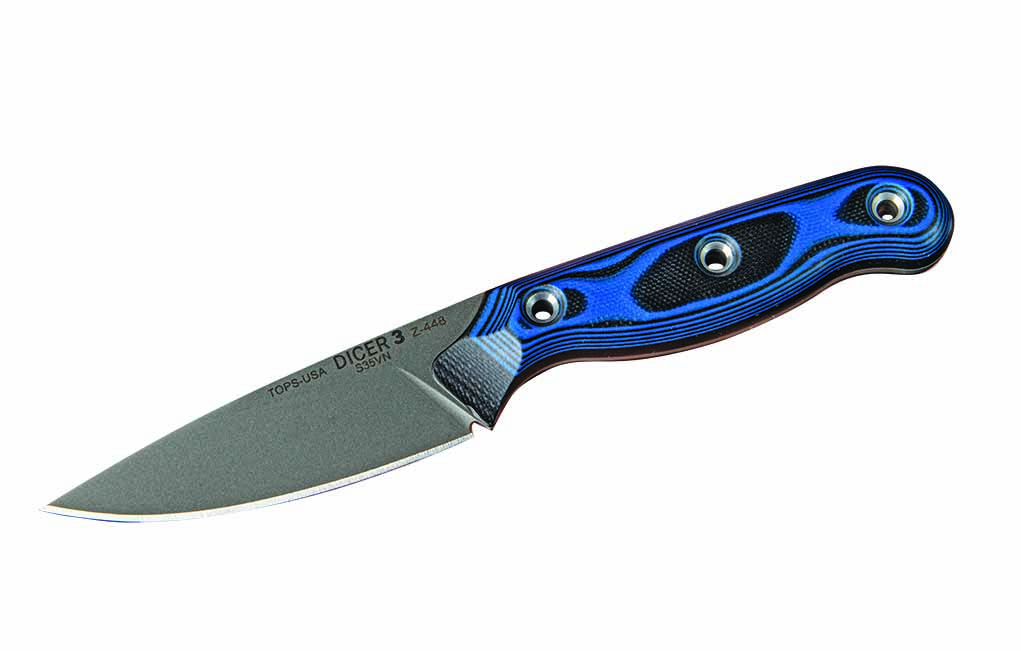
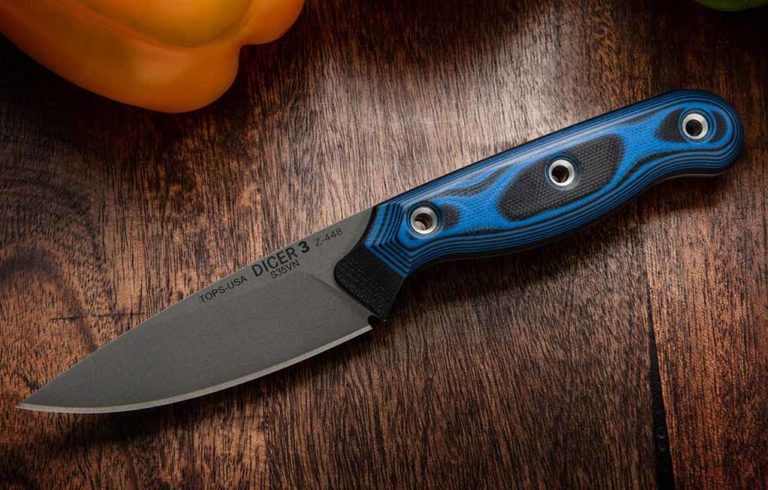
 The Dicer 3 has balance, a great blade steel—CPM S35VN stainless—ergonomics and looks.
The Dicer 3 has balance, a great blade steel—CPM S35VN stainless—ergonomics and looks.

A design contest between the staff of TOPS Knives in 2017 yielded the Dicer, an 8-inch chef’s knife. TOPS President Leo Espinoza designed a companion paring knife. The Dicer 3, released with the chef’s knife in 2019, that sports the same steel and handle material. The paring knife has become a popular offering as the company has filled out its culinary lineup, including bread and steak knives.

“The chef’s knife typically gets the majority of the attention, but for fine and detail tasks the paring knife can’t be beat,” the TOPS spokesperson advised. “It affords more control for tasks like peeling and trimming meat, fruit or vegetables.”

Heffelfinger said the Dicer 3 is a package that sports balance, a great steel, ergonomics and looks. When company officials designed the chef’s knife, they wanted it ground from CPM S35VN stainless steel, a material they carried over to the diminutive blade.

“We hadn’t seen many kitchen knives using S35VN and, having used the steel before on our Camp Creek hunting knife, we knew it would perform very well with great edge retention and durability,” he said. “Being a stainless steel, it is much less prone to corrosion and rust, making user maintenance just a little bit easier.”

The blade is flat ground to reduce friction in cuts, a .09-inch-thick steel that tapers to .032 inch near the tip, and sharpened to about 20 degrees to balance clean slices and durability when chopping, Heffelfinger added. It’s a blade described as a medium-to-heavy weight for a paring knife.

“We have a reputation for overbuilt hard-use tools that are able to hold up under extreme-use scenarios. We brought this philosophy with the full-tang design on every one of our Dicer line of knives,” he explained, “but we also wanted a classic feel and look for them, with a TOPS flair.”

He indicated knife enthusiasts have noticed that overbuilding and some have taken the blade far from the kitchen knife drawer.

“We have had a number of customers purchase the Dicer 3 to use as an EDC knife,” Heffelfinger said. “Due to the size of the blade, the S35VN stainless steel and smooth, contoured handles, they have attached a clip to the sheath and roll with it on their belt every day.”

Dicer 3 Specs
Designer: Leo Espinoza
Blade length: 3.5”
Blade steel: CPM S35VN stainless
Blade grind: Flat
Blade thickness at its thickest: .09”
Handle material: Black canvas Micarta® and Blue-black G-10
Handle thickness range: .1875 to .75”
Weight: 4.7 ozs.
Overall length: 7.88”
Sheath: Black Kydex
Country of origin: USA
MSRP: $200

Case Household Cutlery 3-Inch Clip Point

Sometimes it is best not to change the paring knife beloved by cooks through the decades, designs that have seen food crazes come and go: Jell-O salads, fondue pots, casseroles and avocado toast. Enter Case Knives’ Case Household Cutlery 3-inch clip point paring knife.
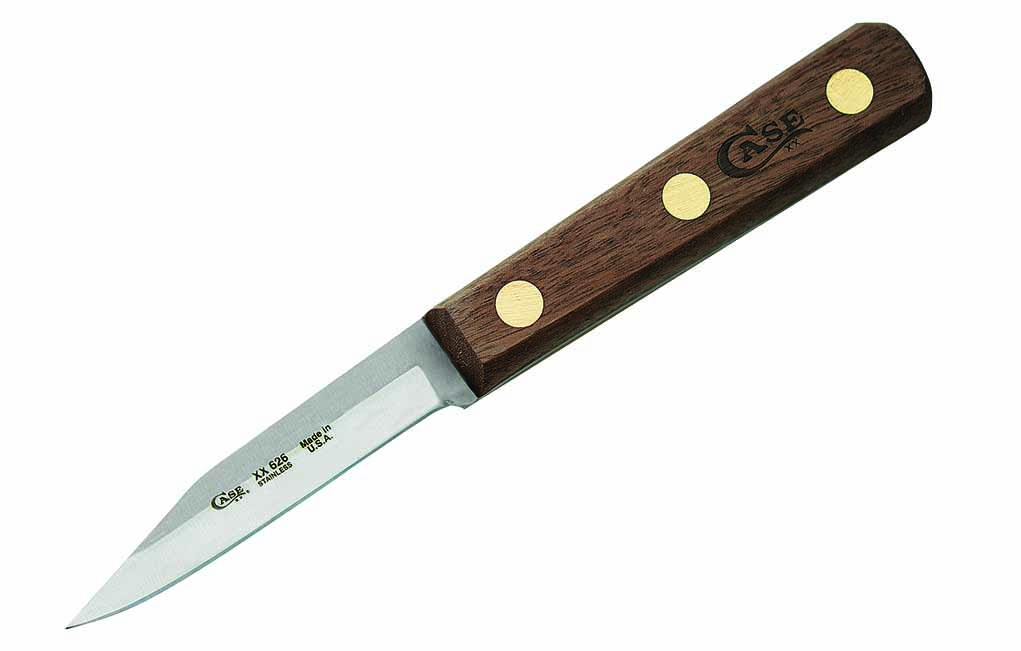
 Case has two paring knife blade styles: a spear and a clip point (shown here). “The clip-point version excels at chopping smaller food items because of its blade design and the blade edge, which mirrors the flat cutting surface when used correctly,” Case spokesperson Fred Feightner noted.
Case has two paring knife blade styles: a spear and a clip point (shown here). “The clip-point version excels at chopping smaller food items because of its blade design and the blade edge, which mirrors the flat cutting surface when used correctly,” Case spokesperson Fred Feightner noted.

“We use classic walnut wooden handles that have been used in millions of kitchens over time,” said Fred Feightner, Case senior marketing communications manager. “We purposely wanted these new kitchen knives to look, feel and perform like the Case household knives of old, and we feel our current offerings do just that very well.”

Case debuted the knife in 2012 while reintroducing its household line—in part by demand from its fans and also as a way to expand its brand and possibly place the knives with retailers who emphasized kitchen supplies.

Consumer advocates insisted on a simple handle design: a straight .5-inch-thick wooden handle, Feightner said. For the blade, the company turned to its Tru-Sharp™ surgical steel—the Case version of 420HC stainless—sabre ground and polished to a satin finish to resist the corrosion that can occur working around food.

The company has two paring knife blade styles. While the spear point slices and dices with ease, Feightner confided, “The clip-point version excels at chopping smaller food items because of its blade design and the blade edge, which mirrors the flat cutting surface when used correctly.”

It’s a knife Feightner says, despite its size, can hold up to kitchen tasks most anywhere. As he noted, “We think our paring knives are perfectly weighted so that intricate work is as easy as tougher jobs around the kitchen and at the barbecue pit.”

Household Cutlery 3-inch Clip Point Paring Knife Specs
Blade length: 3”
Blade steel: Tru-Sharp™ Stainless
Blade grind: Sabre
Handle material: Walnut
Handle thickness at its thickest: .5”
Overall length: 6.75”
Weight: 1.7 ozs.
Country of origin: USA
MSRP: $27.99

V Nives Emerald Paring Knife

Mike Vellekamp, owner and founder of V Nives, indicated his company has recently entered the world of kitchen knives, too. At his house, the 8-inch chef’s knife is most often used to prep food thrown in a wok or barbecued.
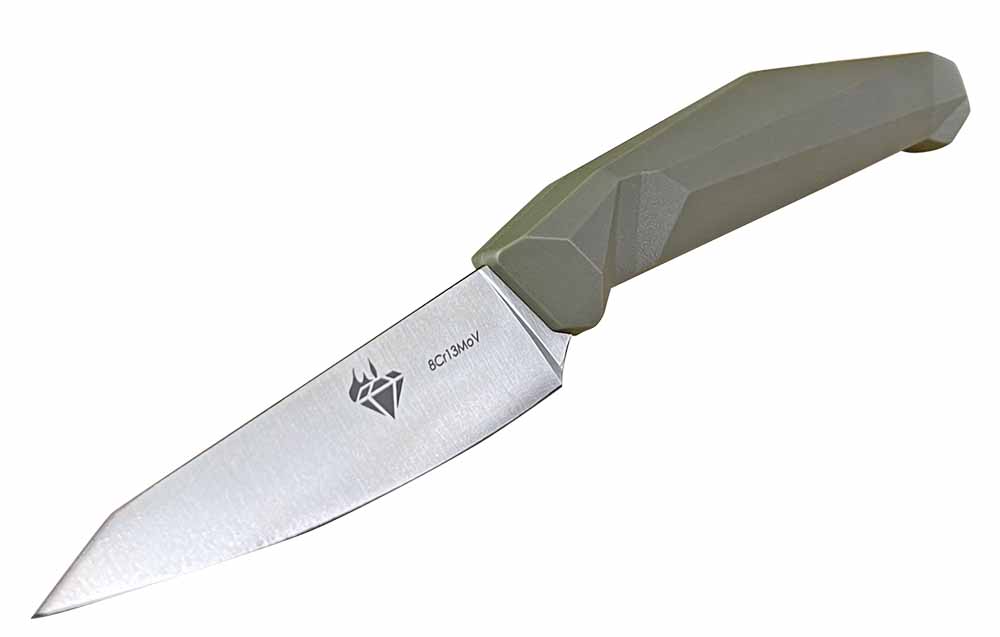
 The green handle—an exclusive color for V Nives—of the Emerald Paring Knife is injection molded around the blade tang.
The green handle—an exclusive color for V Nives—of the Emerald Paring Knife is injection molded around the blade tang.

“However, for day-to-day utility in the kitchen, the paring knife is definitely a must have,” Vellekamp said, adding the genre of blade is “optimal for intricate cutting, mincing, slicing and dicing fruits and veggies, deveining prawns/shrimp, and cutting herbs.”

And what V Nives offers won’t be the type of model found moldering in grandma’s cutlery drawer: the angular and green-hued Emerald Paring Knife. Vellekamp said it’s an example of a modern, innovative kitchen implement.

“DiaFire actually developed the knife,” Vellekamp said. “We have a close relationship with the brand, and we are the exclusive distributor for the Americas. We chose their kitchen products because of their dedication to innovation and quality.”

The Taiwan-made blade is 1/16-inch thick and flat ground from 8Cr13MoV stainless steel. “This is a great blade steel because it holds an edge very well for its intended uses, it’s highly corrosion resistant and it’s very easy to resharpen,” Vellekamp noted.

The green handle—an exclusive color for V Nives—is injection molded around the blade tang, making an ergonomic handle that runs between .417 to .645 inch thick. It’s a grip Vellekamp calls tough and light. And while he and other knife enthusiasts will tell you it’s a terrible way to treat your most important tool in the kitchen, the handle can survive a trip through the dishwasher if the, er, less knife enlightened put it there.

“These knives are a perfect example of high value at an affordable price,” Mike said, “and I believe it is a perfect complement to the modern kitchen.”

Emerald Paring Knife Specs
Blade length: 3.5”
Blade steel: 8Cr13MoV stainless
Blade grind: Flat
Blade thickness at its thickest: .059”
Handle material: Nylon and fiberglass injection molded
Handle thickness range: .417 to .647”
Weight: 4.25 ozs.
Overall length: 8.15”
Country of origin: Taiwan
MSRP: $42

Bradford Knives Blue G-Wood Paring Knife

Brad Larkin of Bradford Knives said a wise knife collector once told him that any good chef’s knife needs a paring knife sidekick. As a result, he’s happy with the Washington state-based shop’s flagship paring knife.
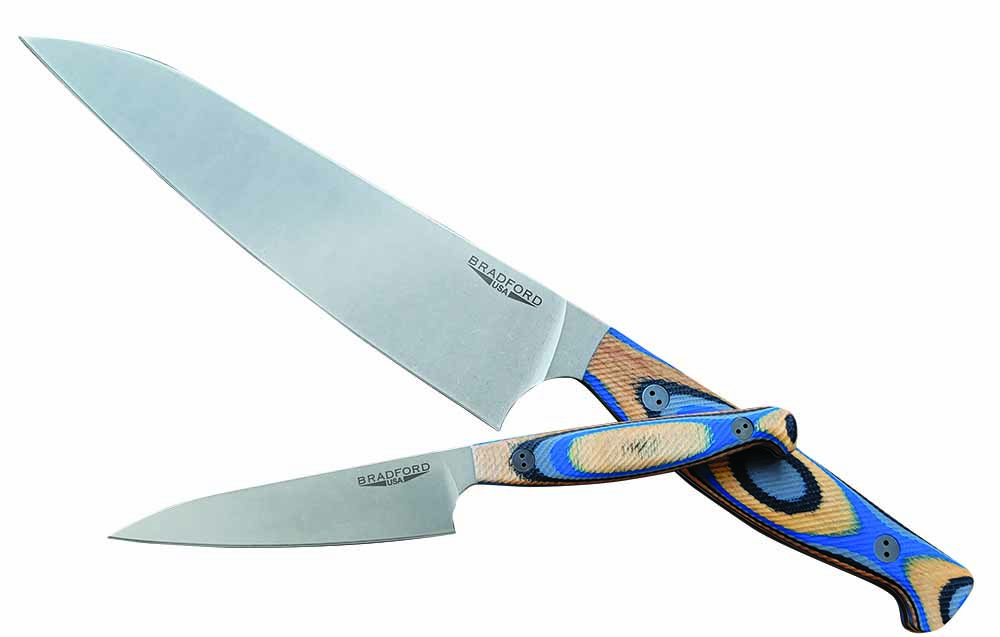
 Brad Larkin of Bradford Knives said the handle of the company’s Blue G-Wood Paring Knife is designed to be held in a surgical-like pinch grip. He indicated the result is a lightweight knife focused on fine cutting.
Brad Larkin of Bradford Knives said the handle of the company’s Blue G-Wood Paring Knife is designed to be held in a surgical-like pinch grip. He indicated the result is a lightweight knife focused on fine cutting.

“It complements our chef’s knife so well and we do find that customers seem to enjoy a ‘set’ of kitchen knives as opposed to our EDC knives, which are very carefully built around specific daily uses,” Larkin explained. “In the kitchen you need to be ready for a quickly changing, dynamic environment, and our hope is that the paring and chef’s knives can accomplish these mission-critical chores.”

Over the years, Bradford has released different versions of its paring knife. Recently, the company issued a limited run of handles made from blue G-wood, a composite of G-10 and wood veneer. Stainless blade steel choices are edge-holding, corrosion-resistant AEB-L or tough M390.

Bradford, which is known more for its tactical and EDC models, returned to its culinary roots with the paring knife. The first edged tool it made was the Gatsby, a steak knife.

The company’s paring knife features thin blade geometry—just the way Bradford Knives prefers it. The .09-inch-thick blade has a distal taper. “Our process allows for a full flat grind. It does produce a very mild hollow-grind effect,” Larkin qualified, “but it is hardly worth mentioning.”

The handle is designed to be held in a surgical-like pinch grip. Larkin said the result is a lightweight knife focused on fine cutting, such as making fruit twists for cocktails, for instance, though it could be considered a medium-weight model compared to most paring knives.

“A paring knife can be the best for overall utility, especially considering our blade size is larger than the typical paring blade and it shares design elements with our chef’s knife,” he opined. “It’s a real slicer!”

Blue G-Wood Paring Knife Specs
Blade length: 3.8”
Blade steel: Choice of M390 or AEB-L stainless
Blade grind: Full-height flat
Blade thickness at its thickest: .09”
Handle material: Blue G-wood
Handle thickness range: .2 to .55”
Weight: 1.8 ozs.
Overall length: 7.5”
Country of origin: USA
MSRP: $129
Best Kitchen Knife Sharpener: 8 Sharp Options

0

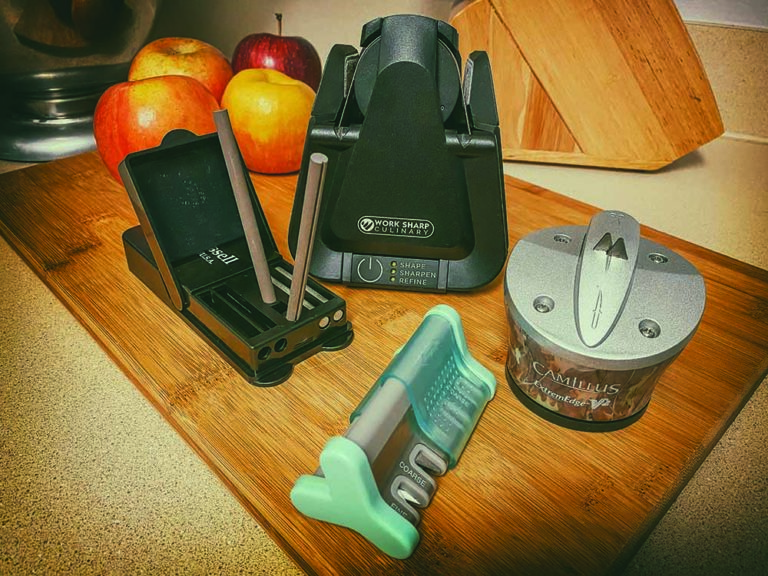
Correct sharpener selection is imperative for keen household cutlery. With that, here are four kitchen knife sharpeners that make the cut.

Dull kitchen knives not only make meal preparation more difficult, they also can slip and cut you when you least expect it. As a result, it’s imperative to keep them sharp. If you sharpen them yourself, correct sharpener selection is key.

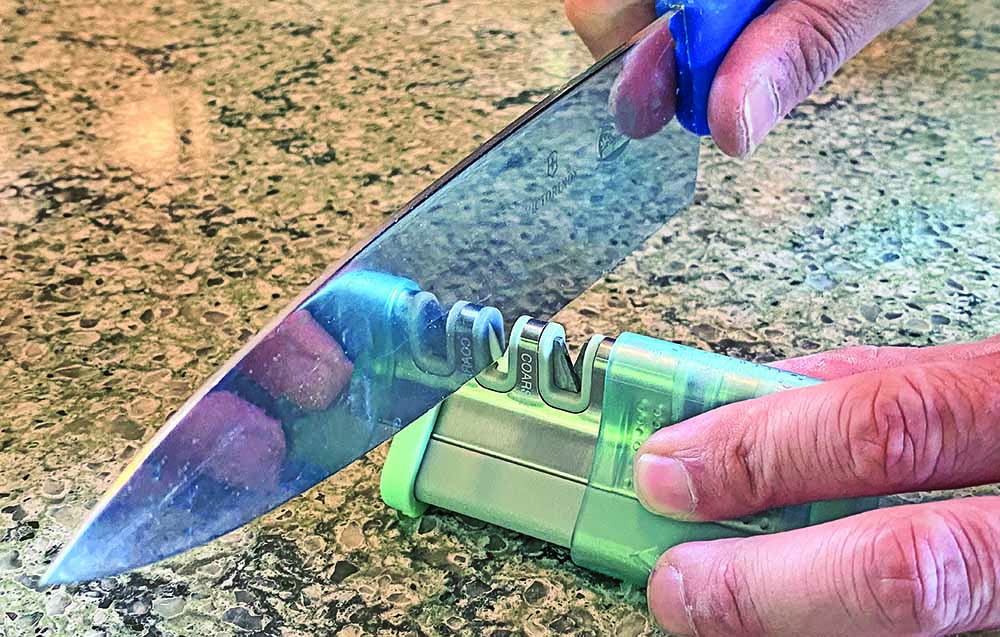
A kitchen knife sharpeners can be as simple or complicated as you want. No matter your skill level, there is a sharpener for you. For those with little-to-no sharpening experience are the cost-effective pull-through sharpeners. These are as simple as simple can get. Often they are plastic-bodied devices with one or two slots. Inside the slots are the sharpening media. The media are permanently affixed at pre-set angles The most common media for the two-slotters are carbide and a fine-grit ceramic. The carbide quickly restores damaged and worn edges, while the fine-grit ceramic polishes and hones the edge to razor sharpness. Anyone can achieve a sharp edge with a pull-through.

Smith’s Products Slide Sharp Edge Grip

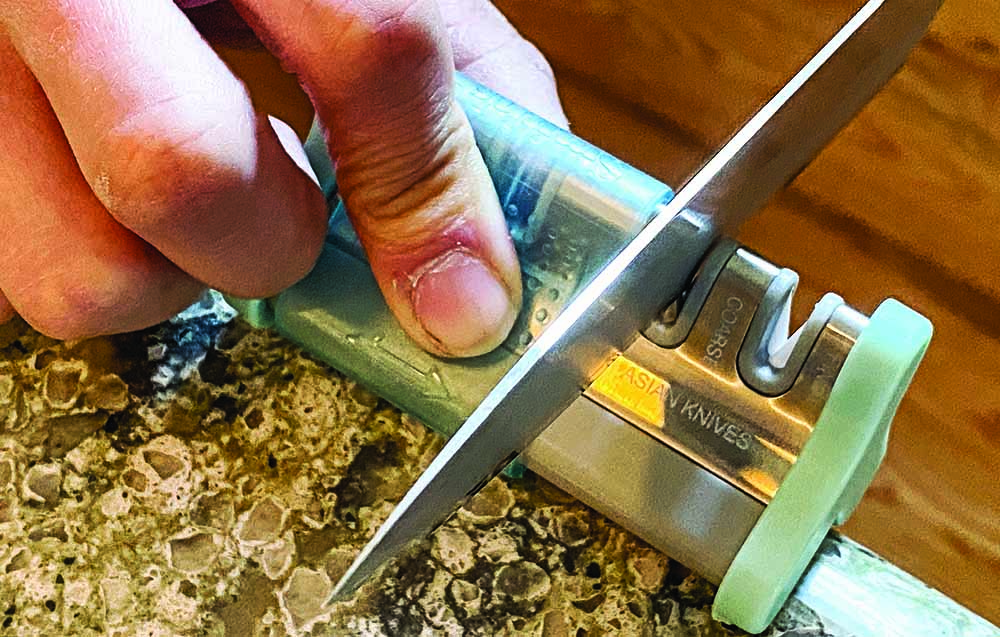
Smith’s Slide Sharp has two pairs of pull-through slots to address both standard and Asian-style kitchen knives.

One such kitchen knife sharpener is the Smith’s Products Slide Sharp Edge Grip. It has two sets of slots. One pair addresses standard kitchen knives at a pre-set 20-degree angle, and the other addresses Asian-style knives at a 15-degree angle. The standard slots have carbide for a coarse grit abrasive and ceramic for fine grit. The Asian-style slots have diamond rods for coarse grit and ceramic for fine.

The Slide Sharp’s indexed sliding grip is textured for a non-slip purchase to allow for secure sharpening. Depending on which slot set you use, the other set is covered by a sliding cover, which is how the sharpener is stabilized—by placing your hand over the sliding cover. 

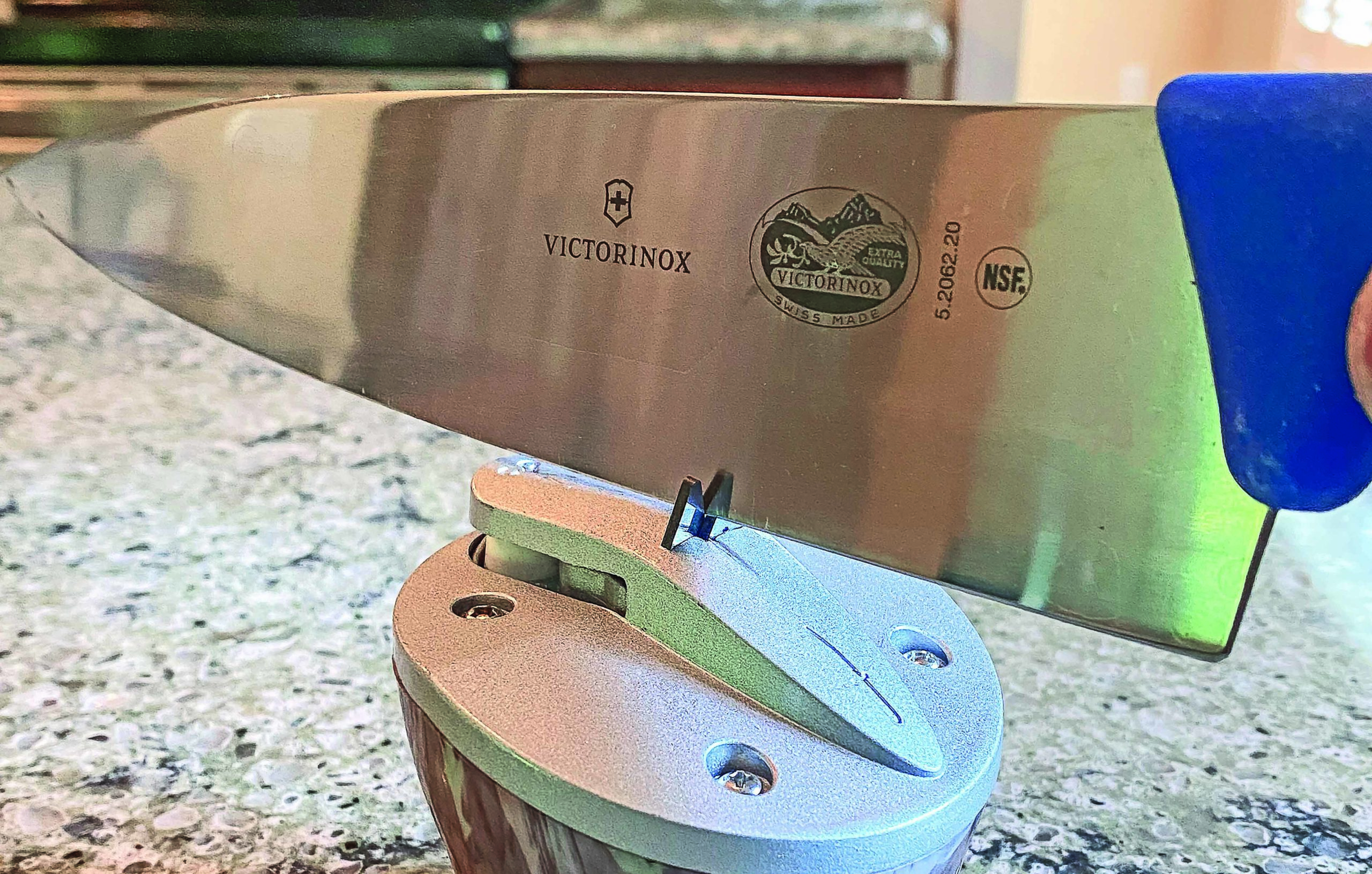
The cross-section of the sharpener resembles an upside-down “Y,” with the arched base held in place on the edge of a table or counter. This gives you another option for stable sharpener operation. Consequently, you have two ways to secure the sharpener during use. Few pull throughs provide such an option.

The Slide Sharp is effective and works as advertised. To use it on a countertop or tabletop, take one hand and stabilize it on the flat work surface. To use it on the edge of a kitchen counter, sit it on the counter edge via the “Y” legs and, while holding it with one hand, pull the blade through and down with the other. You have a better line of sight
to the sharpener this way and it’s very safe, too.

Designed with an upside down “Y” frame, the Smith’s Slide Sharp sits securely while held to the edge of a countertop. This puts the sharpening slots at an angle for better viewing while in use.

If you must use a pull-through, I highly recommend the Slide Sharp. I also recommend using the lightest pressure as possible to sharpen, as pull-throughs can remove too much metal, more so than ceramic, diamond or powered abrasive belt sharpeners. Removing too much metal can prematurely deform the cutting edge.

The Slide Sharp is a little over 1.5 inches tall and a bit under 3.5 inches long. Its compact nature enables convenient drawer storage. The manufacturer’s suggested retail price (MSRP) of $11.99 makes it incredibly affordable and provides no excuse for anyone to have dull kitchen knives. MSRP: $11.99

Camillus Extreme Edge V2 Knife & Shear Sharpener

The Camillus Extreme Edge V2 Knife & Shear Sharpener features a pull-through design with carbide media for kitchen knives and fine ceramic for shears to establish edges in quick fashion. 
The Camillus Extreme Edge V2 Knife & Shear Sharpener features a pull-through design with carbide media for kitchen knives and fine ceramic for shears to establish edges in quick fashion.

The Extreme Edge V2 Knife & Tool pull-through from Camillus is a two-for-one deal. A set of carbide abrasives addresses plain edge and kitchen knives. It also features a built-in shears sharpener.

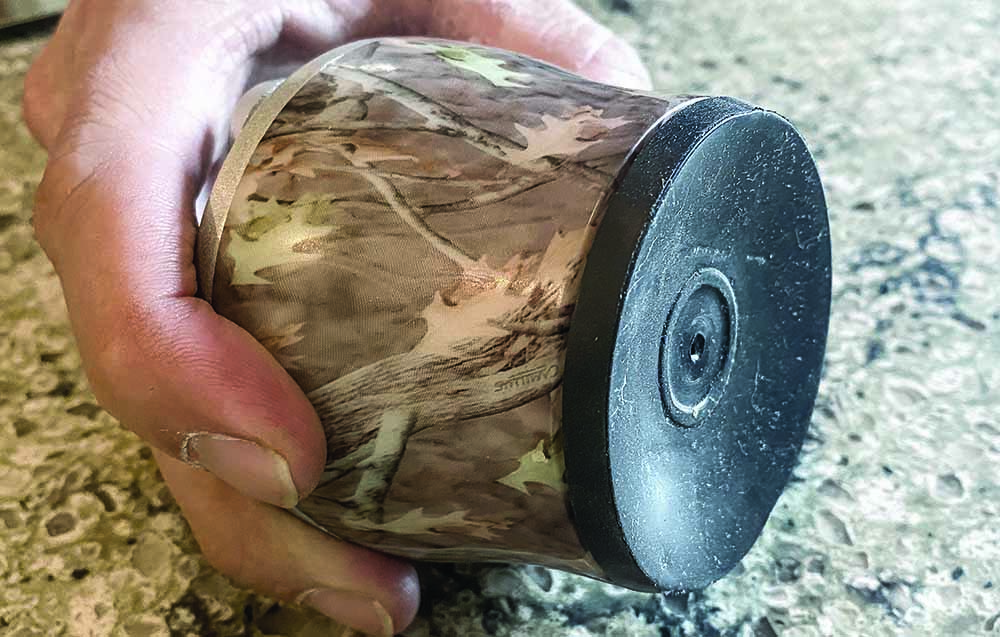
The cylindrical body is around 3 inches in diameter. The top is cast metal and houses the carbides, while the fine-grit-ceramic shears sharpener is in the unit’s rear. The plastic body has an outdoorsy camo theme appearance. For safe operation, a suction cup at the base activates by pressing down and rotating the unit to firmly grip the tabletop surface. For scenarios where the suction cup feature isn’t feasible, it acts as a standard non-skid base.

The sharpener works OK, though I didn’t feel the carbides to be as aggressive as with other pull-throughs I’ve used. The edge it produced was sharp though not surgical sharp. At least the V2 provides a functional sharp edge, which is better than having no sharpener and a dull edge.

The suction cup base of the Camillus Extreme Edge V2 is designed to stick to a slick surface for stable sharpening.

The suction cup base was a disappointment. I could not get it to cling to the slick worktop of my toolbox most of the time.  You must really press down on the sharpener and twist it to get it to stick, but it kept loosening repeatedly. However, you can still use the sharpener safely and effectively by employing the suction cup as a non-skid rubber base. Oh, and one of the carbide teeth loosened up after the first few uses, which is unacceptable. MSRP: $19.98.  

A.G. Russell Knives Field Sharpener

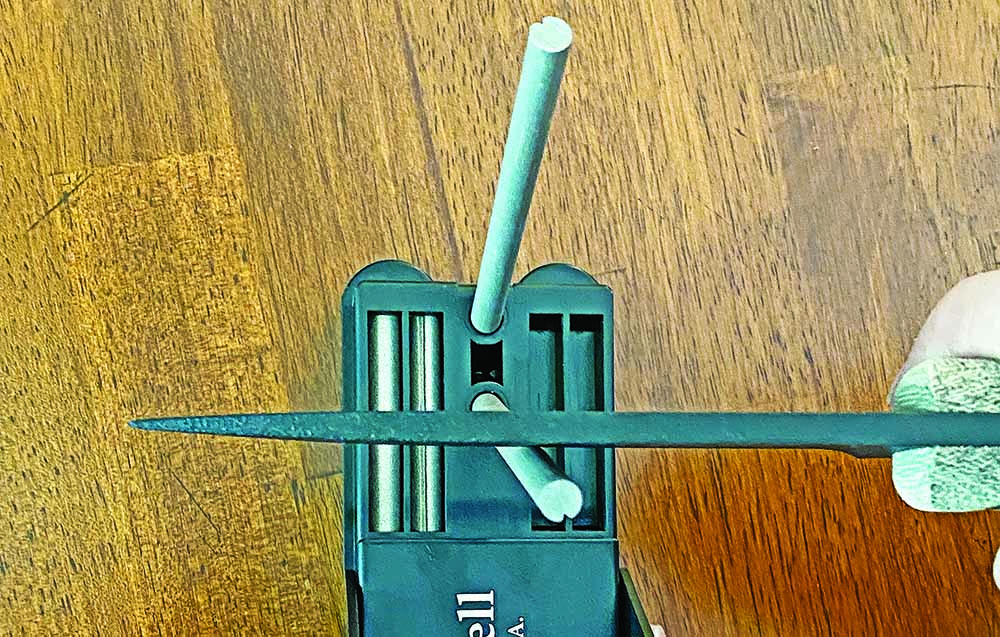
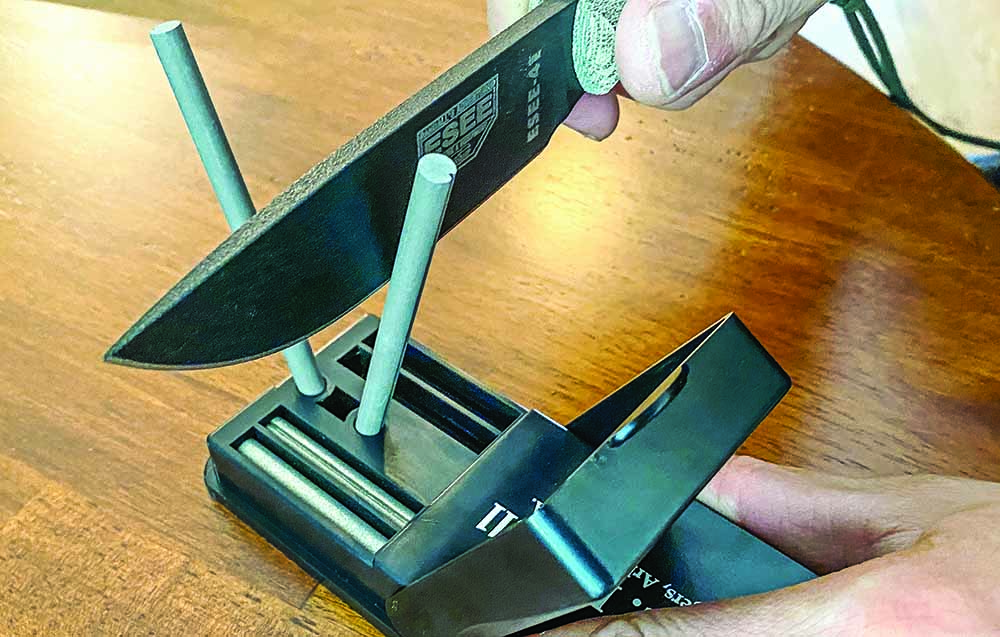
You can see the diamond-grit hones stored in slots in the base of the A.G. Russell Field Sharpener.  This is a completely functional, self-contained guided sharpening system that goes anywhere you do.

The A.G. Russell Knives Field Sharpener is probably the most versatile of the test bunch of kitchen knife sharpeners. Not only does it sharpen kitchen knives but also pocket knives, hunting knives and tactical knives. Such value and versatility is a hard combo to top no matter how you slice it. 

The Field Sharpener has a molded plastic base and hinged cover. You insert a pair of included 4-inch sharpening rods into two holes at a preset angle of 15 degrees. There’s a set of coarse diamond-grit rods to quickly repair a worn edge or rehab a damaged one. A set of medium-grit ceramic rods further sharpens and dials in edges to razor sharpness. The unit measures 5-by-2 inches and is compact enough for stowing in a toolbox, tacklebox, backpack or even a jacket pocket.

Place the sharpener on a flat work surface. Select the set of rods you wish to use and insert into the holes in the base. The flip-up cover secures the rods when they are tucked inside the base; when open, the cover forms a convenient guard to prevent the blade from coming down on your hand. Place one hand on the base to secure the sharpener. With your other hand, take the knife and move the blade down the rods, while pulling it across from tang to tip—two motions at once. Don’t use a lot of pressure; allow the weight of the blade to rest on the rods and move it down. Keep the blade positioned perpendicular to the tabletop surface; holding it straight up and down allows you to sharpen at the proper angle of 30 degrees inclusive.

The Field Sharpener’s flip-up cover secures the rods when they are tucked inside the base. When open, the cover forms a guard to prevent the blade from coming down on your hand.

The Field Sharpener is very effective. If you’ve used Crock Sticks or a Spyderco Tri-Angle Sharpmaker, you will take to this one easily. It requires the same motions. Unlike the Sharpmaker or Crock Sticks, it’s portable enough to take on outdoor adventures. It’s great for camping, especially if you use a variety of knives.

Given the longer length of many kitchen knives and the 4-inch rods, you must pull the blade across the rods with a bit of expediency to be able to capture the entire blade length in one downward pass. Just be mindful that this technique is more pronounced with longer blades. With shorter blades you won’t notice it as much. The round profile means the contact area of the rod to the blade is smaller and more effective at removing steel. It’s easy to use and highly effective. MSRP: $39.95.  

Work Sharp E5 Kitchen Knife Sharpener

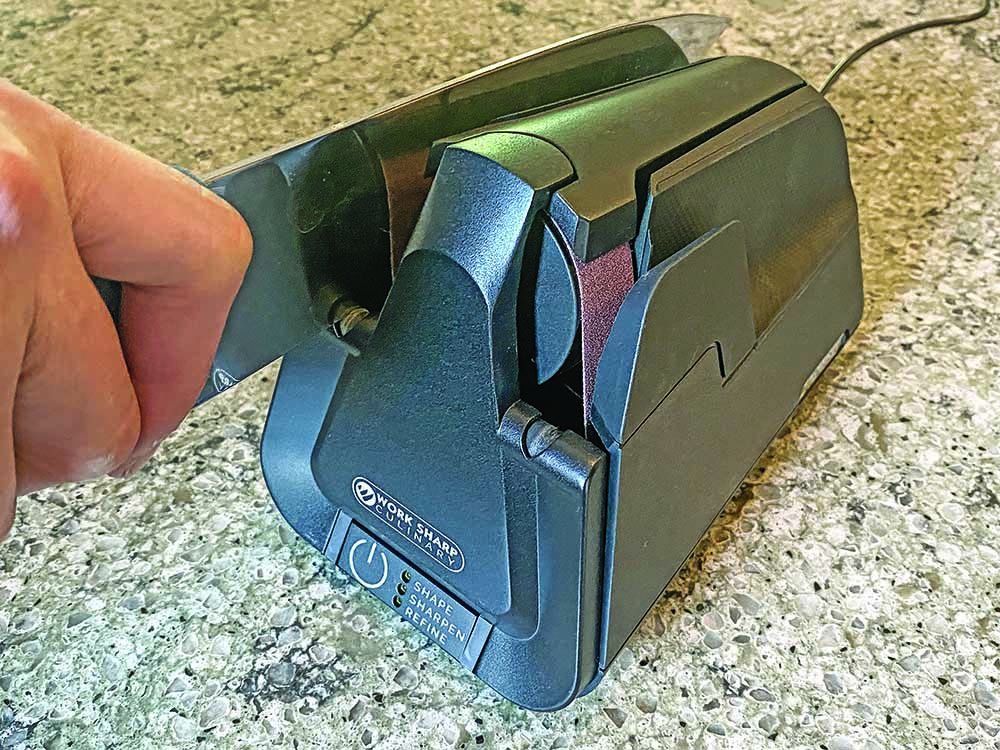
The Work Sharp Culinary E5 uses the same flexible abrasive belt technology as used on the company’s Ken Onion Edition sharpener. Three pre-programmed sharpening modes eliminate the guesswork of obtaining a professional edge.  
The Work Sharp Culinary E5 uses the same flexible abrasive belt technology as used on the company’s Ken Onion Edition sharpener. Three pre-programmed sharpening modes eliminate the guesswork of obtaining a professional edge.

The Work Sharp E5 Kitchen Knife Sharpener is a top-of-the-line powered kitchen knife sharpener, offering multiple modes, speeds, and the latest technology in providing consistent high-quality sharpening knife after knife. The E5 was designed from the ground up as a powered sharpener that can sit on a counter full time, blending in with other appliances with a minimal footprint. Like Work Sharp’s other powered knife sharpeners, the E5 uses flexible, long-wearing abrasive belts to create an ultra-durable convex edge.

Place the blade inside each slot and the abrasives do the work. Select from one of three sharpening modes via the one-touch programming feature. The Shape mode—three rapid clicks on the power button—starts at a high speed for fast cutting and repair of worn edges, then drops down to the Refine mode—one click—at low speed for the final touch up. The Sharpen mode—two rapid clicks—runs the belt at medium speed for routine edge maintenance, followed by the Refine mode for fast touch-ups.  

Select the desired mode then alternate placing the blade in each of the slots. Watch the lights on the power panel. Whichever mode you select, a light shines next to it. Ten seconds before the machine changes modes, the light will begin flashing to warn of the upcoming transition to the next mode, or, depending on the mode, stop completely. Simply draw the blade through. The machine does all the work.

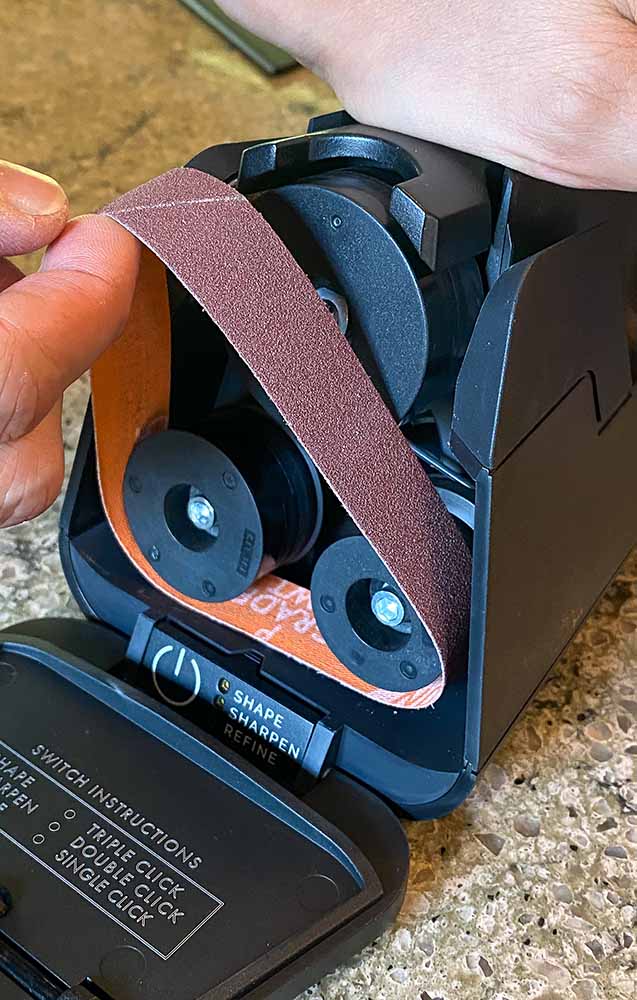
Changing belts on the Work Sharp Culinary E5 is easy. Flip down the faceplate. Press down on top of the machine with one hand to release belt tension, and, with the other hand, remove the belt. The new belt goes on in reverse order.
Changing belts on the Work Sharp Culinary E5 is easy. Flip down the faceplate. Press down on top of the machine with one hand to release belt tension, and, with the other hand, remove the belt. The new belt goes on in reverse order.

The first time you use the E5, you will be reprofiling your blades to the set 17-degree angle, which can take some time. At extra cost is an upgrade kit that includes more coarse belts, and 15- and 20-degree angle guides for enhanced versatility and quicker sharpening. MSRP: $59.95. 

The E5 works well and produces the convex edge, which is very sharp and durable. The sharpener is quiet and easy to operate, something novices appreciate. If you are serious about cooking, it is essential to have not only high-quality knives but also a high-quality sharpener. The E5 is it. MSRP: $149.95.


Other Kitchen Sharpener Options

Shenzen Knives Electric Diamond Knife Sharpener

Shenzen Knives Electric Diamond Knife Sharpener

Diamonds aren’t just a girl’s best friend. This sharpener from Shenzen Knives features an electric diamond grinding wheel with two settings designed to sharpen both steel and ceramic knives.

Its powerful motor can remove chips as large as 1mm off of ceramic knives, and it easily comes apart for cleaning. An added plus is the universal knife guide slot, which is designed to keep your knives at the perfect angle for the best possible edge on both the fine and coarse settings. Specifically for kitchen knives, this machine is not meant to sharpen scissors, hunting knives, or any other types of blades.

MSRP: $49.99

Sharp Pebble Premium 1000/6000 Whetstone

1000/6000 whetstone
Sharp Pebble Premium Whetstone Knife Sharpening Stone 2 Side Grit 1000/6000 Waterstone- Whetstone Knife Sharpener

The whetstone, and other sharpening stones, are a much more finite and meditative way to sharpen your knives. Coming in a variety of grit sizes, whetstones work by being submerged in a liquid, usually water, which enhances the stone’s ability to sharpen a blade while also allowing the chips and scrapes to wash away. Sharp Pebble offers a variety of whetstones in different grits and at different price points. (The 1000/6000 stone is a perfect stone for home sharpeners, and is the method I’ve used to sharpen my kitchen knives for the last several years. I enjoy the process of using the stone and feel it provides a quality edge whether it’s my chef knife or my paring knife.)

The majority of the stones come with an angle guide to help you get the best sharpening angle for your knife. These stones can also be used to sharpen other implements from razors to scissors to chisels.

MSRP: $40.99

Messermeister Fine Grit Honing Steel

Messermeister Fine Grit Honing Steel

Sometimes your knife needs honing rather than sharpening. That’s where honing steel, or a honing rod, comes to the rescue. Over time and normal use, the edge of your knives will bend and warp at a microscopic level. Honing steel works to massage the edge back into the proper position without removing as much material as sharpening would. (I hone my knives daily while sharpening them 2-4 times a year. By honing I’m able to maintain a sharp edge longer and maintain better control over my knives while I cook.)

Messermeister offers a variety of honing rods ranging from steel and ceramic to diamond. Their fine-grit rod is made of high-carbon tool steel and can be used to hone knives made from any material. It’s designed to never wear over its lifespan and should be able to hone your knives’ edges for decades.

For a fair price, you can’t go wrong with this rod, and your knives will thank you for it.

MSRP: $24.95 (10-inch), $29.95 (12-inch)

Worksharp Electric Kitchen Knife Sharpener

Worksharp Electric Kitchen Knife Sharpener

For a quality all-rounder, look no further than Worksharp’s newest electric sharpener. Roughly the size of a softball, the sharpener effortlessly sharpens anything you can throw at it in the kitchen including scissors and serrated knives.

Its sharpening slots feature built-in 20-degree angle guides so each edge comes out at a perfect angle. Beyond just sharpening, the device features a ceramic honing wheel as well that allows you to maintain your edge every day.

MSRP: $59.95

Editor’s Note: Mike Abelson contributed to this story

Chute Knife: Full-Spectrum Warrior

A fine example of a tool and weapon of war, the chute knife more than rose to fulfill the roles for which it was intended.

Harry Archer was a somewhat shadowy figure. At the height of the Vietnam War, he was engaged in nasty business—fighting a stealthy enemy in a steaming jungle, sometimes up close and all too personal.

Those who knew Archer acknowledged that some of his exploits were “larger than life.” They considered him an early non-movie version of author David Morrell’s fictional character of John Rambo*. Still, Archer was real, flesh and blood. And it seems altogether fitting that responding to his need for knives that “deliver” in a tight spot—survival, seconds along the fine line between life and death—he would come to know and rely on another legend.

According to John Denton, perhaps the world’s foremost authority on the knives of BLADE Magazine Cutlery Hall-Of-Fame® member Bob Loveless, Loveless and the man he came to describe as the “head of CIA operations in Vietnam” were introduced to one another by knife writer/Cutlery Hall-Of-Famer Ken Warner. It followed that Loveless made several knives for Archer’s use in the field, among them a fine sub-hilt and stag-handle example of his well-known Big Bear, along with several other  Big Bears. Loveless’s close friend and fellow maker Steve Johnson was working in Bob’s shop at the time and participated in crafting these. A fighter in a tulip wood handle is another cold beauty.

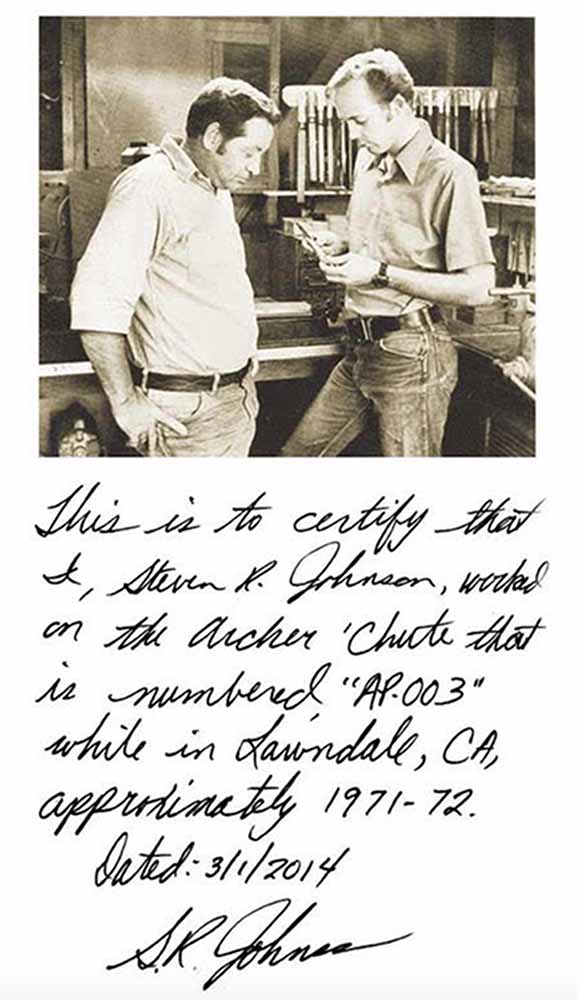
Johnson worked with Loveless from June 1971-October 1974 in the Lawndale and Riverside, California, shops. Steve had a hand in the production of the prototype chute knife in the earliest days, and 23 years later signed a photograph for John Denton attesting to his work on that piece of history. Steve’s inscription reads in part: “This is to certify that I, Steven R. Johnson, worked on the Archer ’chute that is numbered ‘AP-003’ while in Lawndale, CA, approximately 1971-72.”
Johnson worked with Loveless from June 1971-October 1974 in the Lawndale and Riverside, California, shops. Steve had a hand in the production of the prototype chute knife in the earliest days, and 23 years later signed a photograph for John Denton attesting to his work on that piece of history. Steve’s inscription reads in part: “This is to certify that I, Steven R. Johnson, worked on the Archer ’chute that is numbered ‘AP-003’ while in Lawndale, CA, approximately 1971-72.” (images courtesy of John Denton)

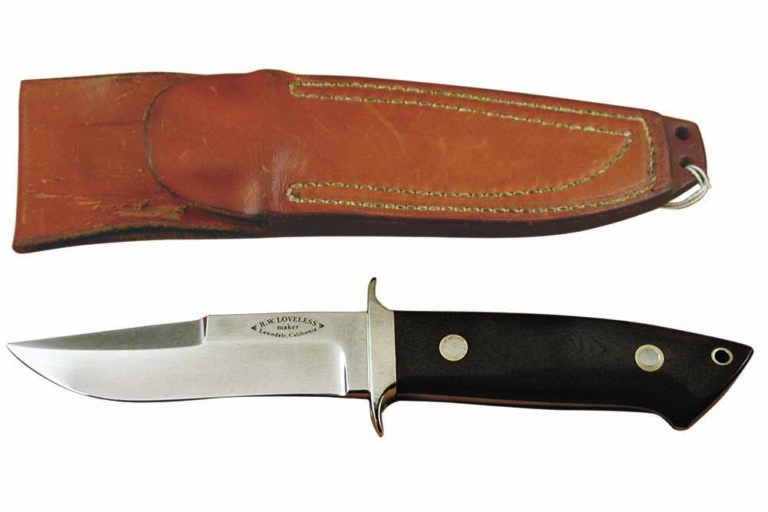
Then there is the well-known Harry Archer chute knife, a versatile fixed blade with good looks and the ability to travel light but cut paracord for a quick exit from a tangled parachute shroud, and with a stout spine for prying loose from the wreckage of a helicopter. The chute knife was made for the jungle. It was made for Harry Archer.

“It seems that Loveless had been left out of a book by Warner, and Loveless sent Ken some knives to review,” Denton recalled. “It just so happened that Archer was there with Warner. Harry saw the knives and bought them all.”

Johnson worked with Loveless from June 1971 to October 1974 in both the Lawndale and Riverside, California, shops. He had a hand in the production of the prototype chute knife in the earliest days and 23 years later signed a photograph for Denton attesting to his work on that piece of history. Steve’s inscription reads in part: “This is to certify that I, Steven R. Johnson, worked on the Archer ’chute that is numbered ‘AP-003’ while in Lawndale, CA, approximately 1971-72.”

Johnson explains that the chute knife is a fairly small, compact fighter and survival knife, short, light, double-edged and strong, but not made in stock thicker than 3/16 inch. Holes for thongs are placed in the rear of the handle and the guard for lashing the knife to a pole or limb to make an improvised spear. It rides into action atop a chest pack or secondary parachute for quick, easy access. Claims that Warner had a hand in the design are unconfirmed, but “the chute” simply looks the part of the warrior’s dependable asset.

“You’re able to cut both ways with the knife via the swipe of an arm or hand,” Johnson related. “Specifically, it’s for cutting parachute cord should it be tangled or caught in a tree. It’s a knife that a pilot, paratrooper or soldier should carry, and it would not be a burden but useful and available in every situation.”

HARRY ARCHER LORE
Stories of Archer’s combat prowess have been told and retold, but to raise awareness of the immediacy of a close-in fight, nothing is better than the harrowing tale that Denton remembers Loveless repeating. John points to a photo of a vintage Big Bear, identifies it as a knife that Archer took into combat, and says, “Harry and his men got into a hand-to-hand fight, and the tip of the blade was broken off inside the enemy. Harry took the knife back to Bob to fix, and Loveless said, ‘Where’s the tip?’ Harry replied, ‘It’s still in the rib cage of the Viet Cong soldier.’ So, Loveless fixed the blade.’”

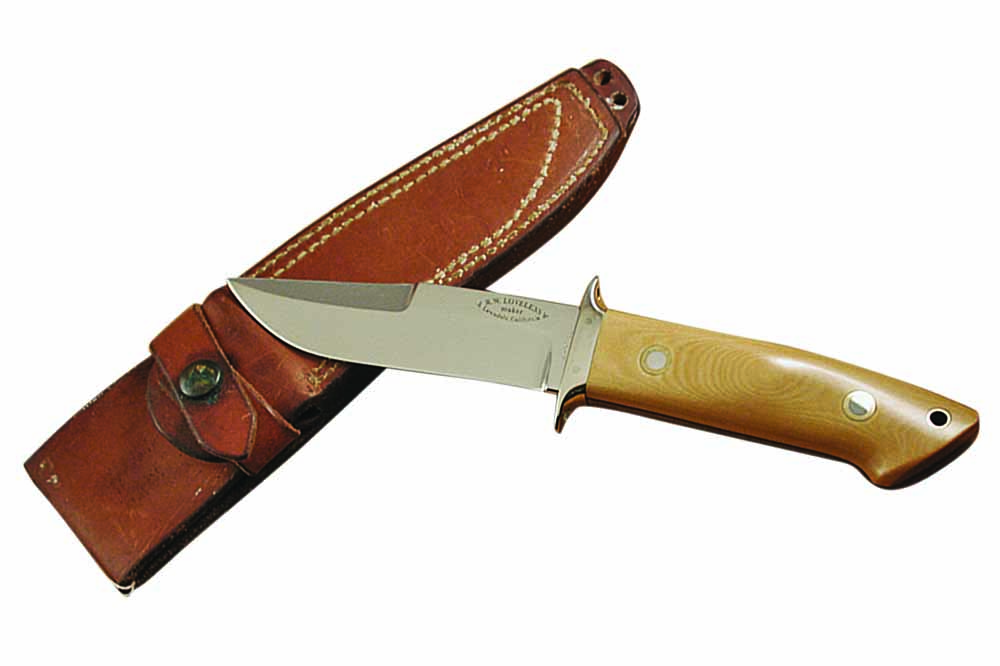
Made in Bob Loveless’s Lawndale, California, shop about 1973-74, this chute knife in ivory Micarta® is stamped BR-003. It was made for the Brass Rail, a famous gun shop in Hollywood, California, where all the celebrity types hung out to see guns and knives. Note the holes in the guard for lashing the knife to a pole to make a spear.
Made in Bob Loveless’s Lawndale, California, shop about 1973-74, this chute knife in ivory Micarta® is stamped BR-003. It was made for the Brass Rail, a famous gun shop in Hollywood, California, where all the celebrity types hung out to see guns and knives. Note the holes in the guard for lashing the knife to a pole to make a spear. (images courtesy of John Denton)

Like the Big Bear and other Loveless creations, the chute knife has its place in the lore of Harry Archer. After he collaborated to produce the prototype, Johnson continued to work with Loveless on more of the chute knives. He remembers meeting Archer in the California shops.

“Loveless really admired Archer and his adventures in the Vietnam War era, working with USAID**, the CIA and different assignments in various parts of the world,” Steve commented. “[Harry and I] discussed life in camp in Vietnam, interactions with Vietnamese soldiers and personnel with whom he was serving. That was quite interesting.”

Steve calls the chute “one great knife” and remembers conversations in Lawndale when the veteran operative praised it as light and small enough to carry so that it could always come along on a mission. Johnson also made a chute knife for Archer and continues to produce his own model today.

“We worked together on Archer’s order for a ‘Johnson’ version of a chute knife on a bench in the rear of Bob Loveless’s shop, in his garage in the back of his house in Lawndale,” Steve smiled. “Archer asked me to make my version, which we—mostly he—designed in the early 1970s. He did a drawing for me. The 154CM blade was about 4.5 inches long, the handle slim and a bit longer than normal, and it had a large thong tube, three handle screws, a stag handle, and checkering on the top and bottom of the tang just behind the guard.”

Bob Loveless (left) and John Denton (right)

For Johnson, working with Archer was a pleasure and a defining moment in his illustrious knifemaking career, which, after recovery from a serious accident, took him from Loveless’s shop to his own space in Manti, Utah, more than 40 years ago. “Harry Archer was a great guy who appreciated my work, as well as Bob’s,” Steve added, “and I made him a few knives after California. He was very easy to talk to, respected others, and he really was a man of intrigue and adventure. And Bob Loveless treated me like a son.

“I’m making a chute knife for Atlanta [Steve was interviewed prior to BLADE Show 2021] as we speak, with the blade polished so far, instead of the top grind being just the length of the clip,” Johnson concluded. “I use the pattern that Loveless gave me when I left his shop in Riverside in 1974 or 1975. This particular knife is going to have a stag handle and stainless steel fittings. I’ll make more when asked, and I still have a few on order in my books.”

Long-time maker and designer Bob Dozier was a friend of Loveless and went on to design a chute knife for Cutlery Hall-Of-Famer A.G. Russell. Though his only acquaintance with Harry Archer is through the recollections of A.G., who knew him, Bob says his version of the chute knife remains in demand for one simple reason: “It sells.”

Dozier turns out his chute knife with a 4.75-inch D2 tool steel blade and overall length of 9.75 inches. The handle is green canvas Micarta® “because Goldie [Russell] won’t let me put anything else on them. I’ve got some blades hanging right now, getting ready.”

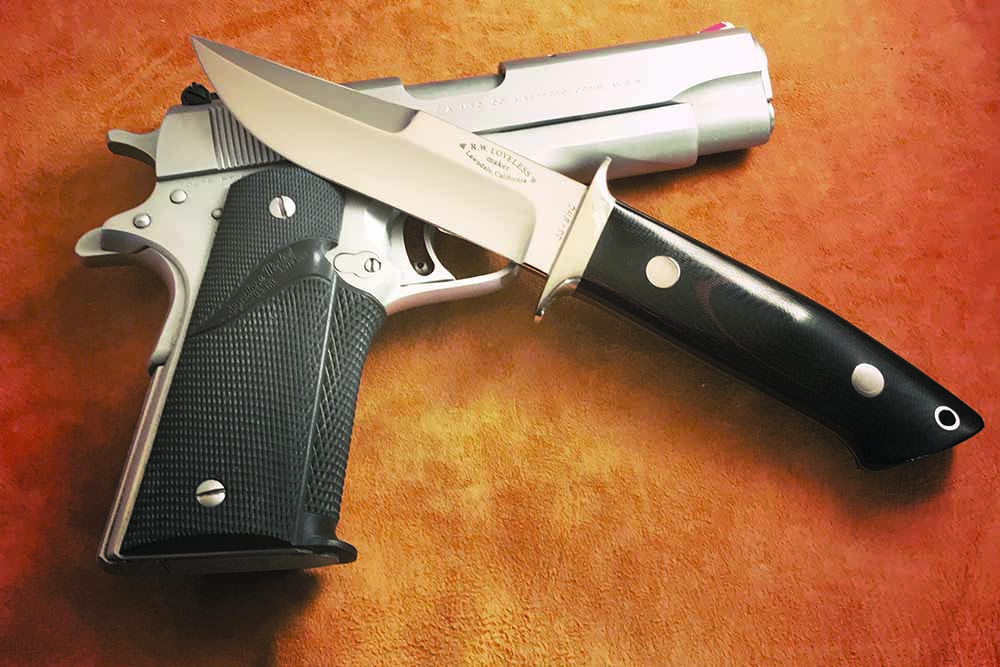
The “RR” on the guard of this Loveless chute indicates it was for the Ram Rod gun store in New Castle, Indiana. Early on Ram Rod sold knives by Loveless, Bill Moran, Ron Lake, W.W. Cronk and others. It appears here with a Smith & Wesson Model 41 modified by Loveless.

Dozier is familiar with the Loveless chute knife configuration but never had the Loveless pattern. He looked at the earlier chute knife profile and made some tweaks. “My handles are like the Loveless, but I don’t cut the butt off as square as he did. I leave more of a point on it than he did. Mine is still mostly like Bob’s, and he was one of the first to make a really good slab-handled knife. That’s one reason why most of us have copied him.” Dozier’s chute knife, designed and built for A.G. Russell Knives, has a manufacturer’s suggested retail price of $895.

SAGA of The CHUTE
The saga of the chute knife certainly has a human side. While Denton estimates that early Lawndale chute knives might fetch as much as $14,000 if found for sale today, and chute knives made in Riverside command up to $12,000 each, they are desirable on the collector market. Nonetheless, the greatest value of the chute knife lies in its lifesaving and protective capability in the hands of a dedicated professional such as Harry Archer.

Through those years of association, Loveless and Archer became friends, sharing a common bond of respect and admiration for the best in fighting and utilitarian knives.

“Loveless said that Harry would come by his shop after periods of being in the jungle for months at a time,” Denton remembered. “He used Bob’s place to unwind and try to become civilized again before heading home to Virginia. But Loveless also said, ‘Harry was like a wild animal when he came to the shop, trying to keep his head straight before he saw his family.’”

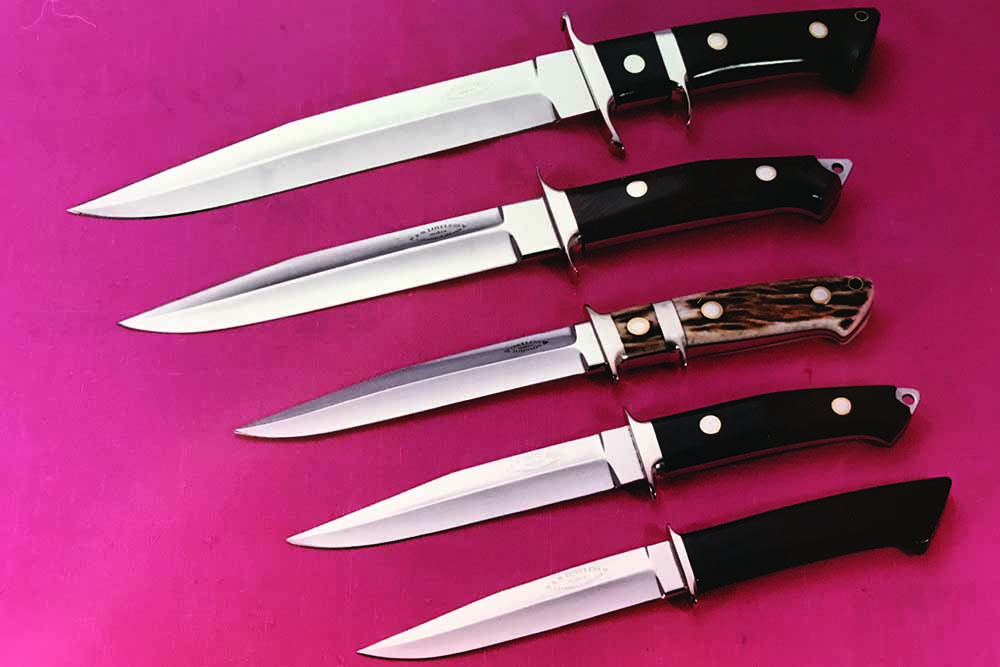
Whenever Harry Archer ordered several Big Bear fighters from Bob Loveless, Loveless said Archer told him to “send the bill to the Pentagon.” From top: the Big Bear Harry broke the tip off inside a Viet Cong soldier during the Vietnam War; tulipwood fighter with skull cracker; Loveless/Johnson sub-hilt with the initials HJA for Harry J. Archer; boot knife with skull cracker; and one Loveless called the Pig Sticker.
Whenever Harry Archer ordered several Big Bear fighters from Bob Loveless, Loveless said Archer told him to “send the bill to the Pentagon.” From top: the Big Bear Harry broke the tip off inside a Viet Cong soldier during the Vietnam War; tulipwood fighter with skull cracker; Loveless/Johnson sub-hilt with the initials HJA for Harry J. Archer; boot knife with skull cracker; and one Loveless called the Pig Sticker. (image courtesy of John Denton)

The chute knife is indeed a fine example of a tool and weapon of war rising to fulfill the roles for which it was intended. It remains a popular pattern because of its looks, quality and versatility. And for one other reason in particular: It helped men like Harry Archer survive the most desperate of situations and make it home.

*In actuality, Morrell based the Rambo character on Medal-Of-Honor recipient Audie Murphy.

**USAID is the acronym for United States Agency for International Development, with the inference here being that in this instance it functioned as a cover for the CIA.


More On Bob Loveless Knives:

  • 15 Best Bob Loveless Knives of All-Time
  • The Legacy of the Bob Loveless Dropped Hunter
  • Merritt-Loveless Knives Do Indeed Hold Merit
  • Fourth In Greatest Loveless Knife Designs Series
  • Stropping: What It Is And How It’s Accomplished

    0

    What is the purpose of stropping? Is it the same as sharpening a knife? We’ll answer those questions and more as we explore how to put the finishing touches on a blade.

    Forged Knifemaking
    This article is an excerpt from Forged: Making A Knife With Traditional Blacksmith Skills available at ShopBlade.com.

    Burr is a term used to describe the turned-over edge of a freshly sharpened blade. The burr can be seen as an ultra-thin, wire-like structure at the edge. When sharpening you are bringing one edge surface closer to the other edge surface with alternating and even strokes, left-right-right-left against an abrasive such as a sharpening stone or metal grade sandpaper or strop. By alternating sides you simultaneosly remove surface material from both of the sides forming that burr. Sharpen back-and-forth, one side and then the other, and the burr appears.

    What Sharpening Does To A Blade

    At first the two opposite sides are divided by the blade’s edge thickness and there is no burr. This is seen as that paper thin shiny line from tip to choil. As one side is brought closer to its opposite side (i.e. sharpened), one side or the other will eventually meet the other and the thin shiny line will disappear.

    At that point there isn’t enough mass to support the edge against the hard-abrasive surface, and the super-thin edge rolls/curves over in the opposite direction, forming the burr. The burr can be seen with the unaided eye and felt with your thumb. The objective at this point is to switch and sharpen the edge from the other direction with a yet finer grit abrasive. This maneuver makes an even smaller and thinner burr on the opposite edge. After you sharpen several times like this in opposite directions, with finer and finer grit paper, the burr will be reduced microscopically and be difficult to see or feel but will still be there. This final use of fine grits of abrasive is considered, and is called, a hone.

    What Stropping Does

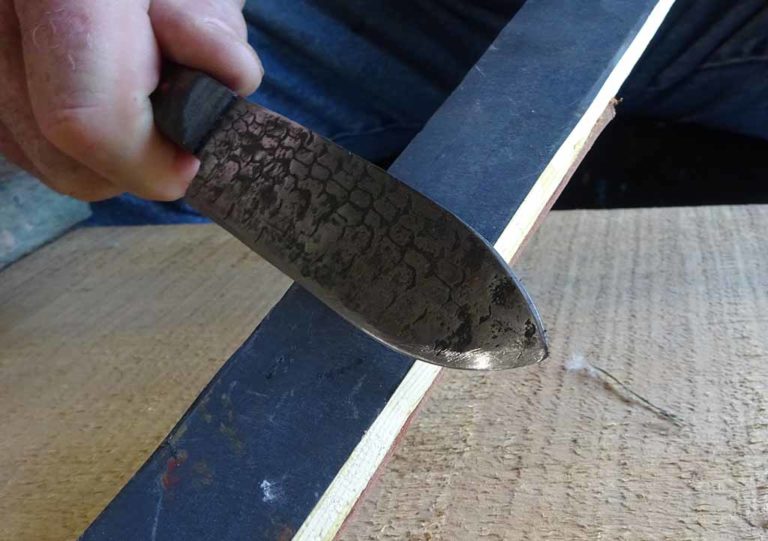
    At this point switch from a superfine hone-grit paper (1500 plus grit) to a leather strap, belt, or section of a belt, called a strop. The fine sandpaper hones, and the leather strops. Strop with the same back and forth motion, strop the blade’s edge against the leather. This action bends the now unseen burr back and forth against the leather and the burr finally breaks free. The edge thickness is now just paper thin or less. So “paper thin” doesn’t sound like the edge would bear up during use, being this thin, right on the very pinnacle of the blade’s edge—but it does.

    With removal of the burr the edge acquires maximum sharpness and can be re-honed repeatedly without subjecting the blade to recurring sharpening cycles with lower grit sandpaper. This maintains the thin-and-sharp element of your blade.

    Choosing A Strop

    Make your strop from a strip of leather belt (10-inches long) glued to a bit of yardstick or lath material. Glue a strip of 800-1500 grit wet-n-dry sandpaper to the other side for a hone.

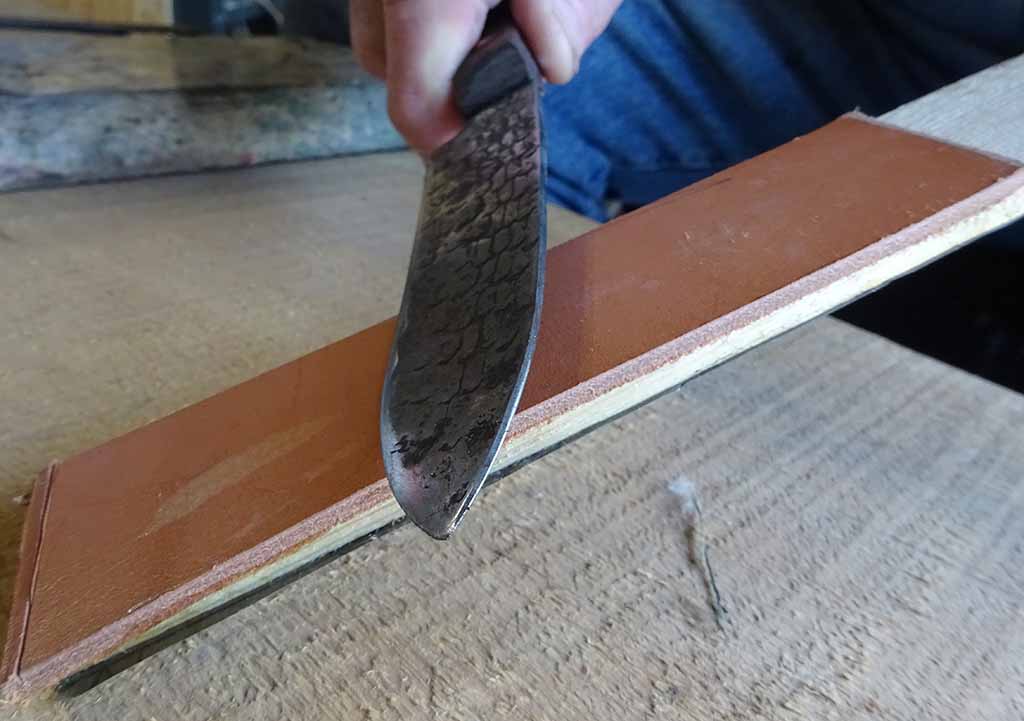
    The same exact motion is used on the leather side of the strop stick. When the smith is “into” the motion it is similar to a continuous figure-8 movement. Most of the time the leather is enough to restore the blade’s edge without using the sandpaper side of the stick.
    The same exact motion is used on the leather side of the strop stick. When the smith is “into” the motion it is similar to a continuous figure-8 movement. Most of the time the leather is enough to restore the blade’s edge without using the sandpaper side of the stick.

    How To Strop

    Stropping is a low-angle slap and slide motion. The leather actually sharpens the microstructure of the blade’s edge. It 1) bends the burr back to a sharp edge or 2) bends it back and forth till it breaks, like bending a wire coat hanger back-and-forth, revealing a new raw edge. Visualize a barber in an old-west, cowboy movie slappin’-n-slidin’ his straight razor on a big leather strop. Slap-n-slide your Frontier blade on the 800 to 1500 grit black W/D sandpaper 10 to 15 times then on the leather the same number of swipes. When your edge dulls you can often just strop with the leather, forgoing the hone altogether, in the restoration of a keen cutting edge.

    After stropping, if your knife edge isn’t near razor sharp, go back to your wet-n-dry-sharpening action with the higher numbered sandpaper grits (400, 600, 800) then strop again.

    Testing The Edge

    Feel the edge with your thumb, perpendicular to the edge. Never run your thumb or fingers vertically up or down the blade. It will cut. With time you’ll be able to tell in an instant various level of sharpness with just your thumb. With time you will feel the burr and know the angle of any blade with just a touch of your thumb.

    Another sharpness indicator is the use of an old leather belt or scrap of leather. Almost any “sharp” knife can cut a sheet of paper but stiff leather is the true challenge. First, use a knife of known sharpness. Cut a bit from the leather. Note the force needed to peel off a few pieces of leather. Use the same piece of leather on subsequent blade edges you sharpen in the future. By comparison, the quality of those blades’ sharpness can be gauged.

    This article is an excerpt from Forged: Making A Knife With Traditional Blacksmith Skills available at ShopBlade.com.

    Get More Knife Sharpening Info:

    Hunting Knife Sheath: Choosing The Right One

    1

    Expert craftsmen give insight on how to find the best hunting knife sheath for the best protection, performance and look.

    For the hunter in the field, a dependable and durable hunting knife is indispensable equipment, and it follows that the sheath that holds the knife must be equally up to the task.

    Secure carry, protection for the blade and handle, easy access, and the ability to stand up to the elements and hard use are essential. While there is a variety of sheaths available and each one contributes something to the equation, the sheathmakers themselves have come to eye-opening conclusions as to the making and deployment of the correct sheath for the hunting knife. Personal preference is still a prime mover, but the basics make the difference between cooperation and catastrophe in the field.

    “The best style for a hunting knife sheath is whatever the hunter wants,” explained veteran sheathmaker Paul Long. “Personal preference is very important. However, the knife that would best be described as a hunter would be best suited in a deep seat pouch with a loop that would carry relatively high on the belt. In most cases the deep pouch would preclude the need for a retention strap. For a double-guard hunter, a drop-loop belt sheath would probably be best with a snap strap for secure retention.”

    Depending on the style of the knife, the guard often dictates the best pouch configuration. “I favor the pouch-type sheath, and the hunting knife generally has a single guard as opposed to a double guard,” related sheathmaker Paul Lebatard, who also has found success with his custom knives through the years. “I make a lot of doubles, too. You would have to make a snap-type sheath with a keeper strap, but on hunting knives with single guards the pouch type is always best.”

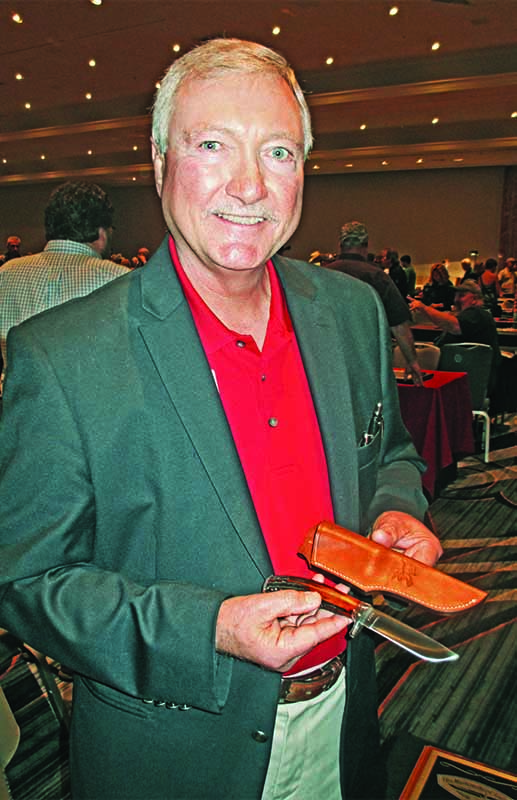
     Knifemaker Paul Lebatard shows off one of his custom hunting-knife-and-sheath packages.
    Knifemaker Paul Lebatard shows off one of his custom hunting-knife-and-sheath packages.

    A sheathmaker for over 50 years, Chris Kravitt zeroes in on the personal preference perspective. “First and foremost, it’s a matter of the configuration of the knife, and then if more than one style will work it becomes a matter of personal preference,” he observed. “My preference is to go with the pouch because it is easier to draw and resheathe the knife without worrying about straps.”

    At the same time, Kravitt acknowledges varying hunting knife construction and its influence in sheath form and function. “If a knife has a double guard, it isn’t going to work on a pouch sheath, and if you have a knife with an integral handle, possibly,” he said. “Certain things don’t lend themselves to the traditional style, like when the blade is the widest part of the knife or there is no bolster or ricasso extending beyond the edge.”

    Kenny Rowe, owner of Rowe’s Leather in Hope, Arkansas, adds another option on the hunting knife sheath. “Ninety percent of these sheaths would be the pouch type because they cover most of the knife, and with the guard you can make a welt where the knife has some resistance coming in and out,” he noted. “Some sheaths will have a lid that has a snap on it, and that is as secure as you can get with the flap snapping over the front of the sheath.”

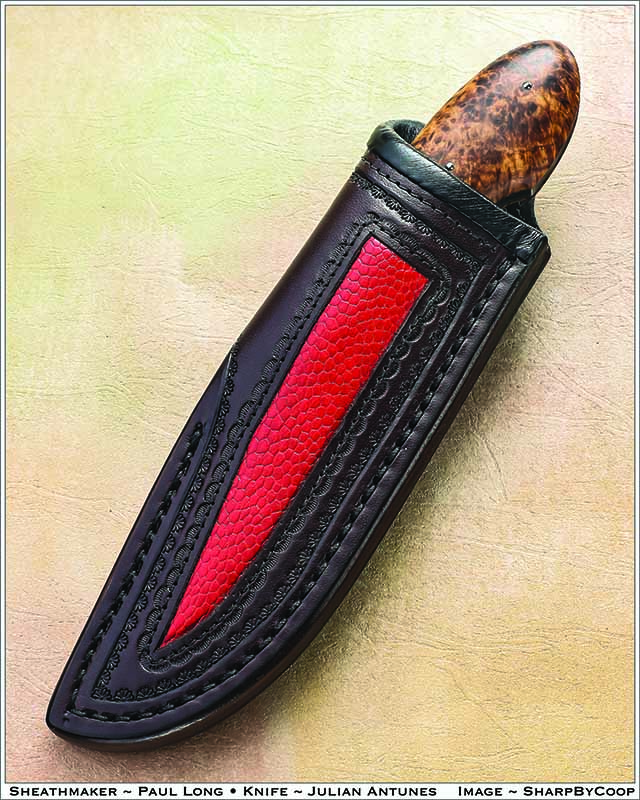
     Exotic leathers make great inlay materials, and Paul Long uses various animal skins, including snake, lizard, ostrich and others. He employs ostrich for the red inlay on the sheath of a fixed-blade utility knife by Julian Antunes.
    Exotic leathers make great inlay materials, and Paul Long uses various animal skins, including snake, lizard, ostrich and others. He employs ostrich for the red inlay on the sheath of a fixed-blade utility knife by Julian Antunes.(SharpByCoop images)

    The consensus with the pouch sheath makes sense for all the reasons that the hunter encounters in the field. For its toughness and the ability to shape and mold the sheath as desired during the construction process, cowhide reigns supreme among sheath materials. Most sheathmakers use 7-to-9-ounce* vegetable-tanned cowhide.

    Sheath Leather Types

    The use of exotics such as ostrich, stingray, alligator, crocodile or other hides is a continuing option, though for the most part they are used as accents, often in the form of inlays, rather than adding any performance-related component to the sheath.

    “Exotics are very useful in sheathmaking but primarily for aesthetics,” Long explained. “Elephant and shark are two that are tough enough to withstand very hard use and are usually built as an overlay on a vegetable-tanned base sheath. I work with various snakes, lizard, ostrich and many others.”

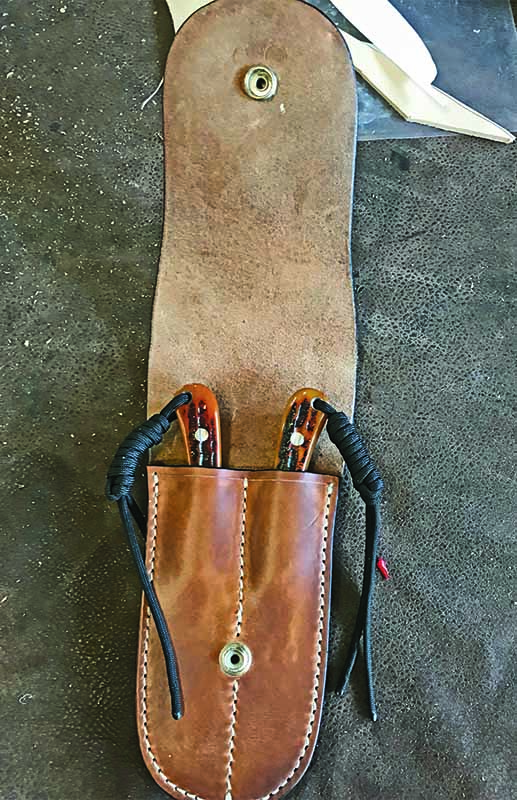
     In addition to standard sheaths, Paul Lebatard also makes doubles, many of vegetable tanned leather. “A lot of people say not to store knives in the sheaths, but as long as the sheath is made of good vegetable-tanned leather, I’ve never had a problem,” he noted.
    In addition to standard sheaths, Paul Lebatard also makes doubles, many of vegetable tanned leather. “A lot of people say not to store knives in the sheaths, but as long as the sheath is made of good vegetable-tanned leather, I’ve never had a problem,” he noted. (Paul Lebatard images)

    As Kravitt noted, “The basic sheath is going to be cowhide 99 percent of the time, but for overlays and inlays my favorite is stingray, which is near bulletproof but more expensive and harder to work with—but great stuff. Ostrich leg or shin is very nice, and Malaysian horned frog has a very nice texture to it. Snakeskin is not very durable, but it’s fine when the knife and sheath are for show since it won’t hold up with regular use.”

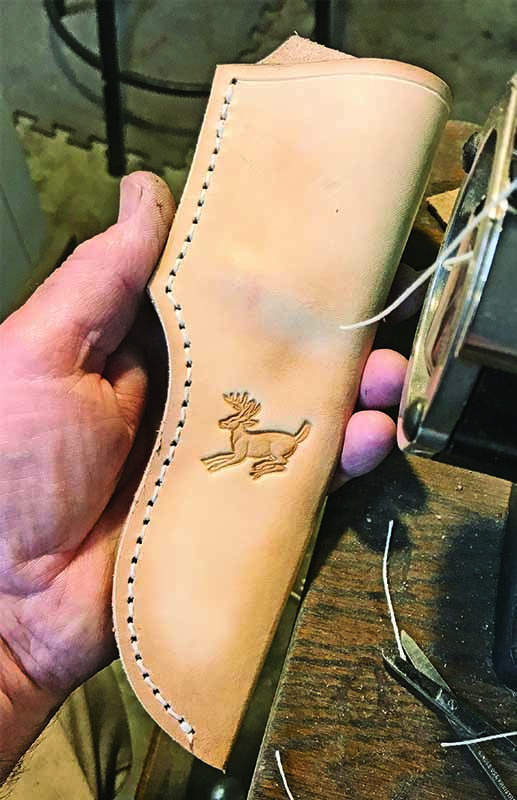
    Tooling and carving also provide style points and may be pleasing to the eye. However, neither actually contributes to the performance of the sheath in field use. “I occasionally do some tooling with stamps, but carving is a talent I don’t have,” Lebatard remarked. “Still, on almost every sheath I’ll put something in keeping with the theme of the knife, like a small deer. Someone might place an order and specify that they just want a bare, plain sheath, or they may want just their initials on it. That’s a good thing about leather. When it is wet it can be molded and stamped, and when it dries it will hold that impression.”

    Tanning Styles

    Vegetable tanning is essential when the blade meets the sheath leather for an extended period. In contrast to chrome-tanned leather, a vegetable-tanned leather is not known to corrode or stain a blade left in the sheath for any length of time. That old admonition to store the knife itself separately from the sheath will then get a longer look.

    “A lot of people say not to store knives in the sheaths, but as long as the sheath is made of good vegetable-tanned leather, I’ve never had a problem,” Lebatard noted. “I made a knife for a friend a few years ago and he didn’t want a sheath. He was going to get someone else to make the sheath for him. Several years later, he brought the knife to me and he had had it in a chrome-tanned leather sheath. It was nearly rusted through. The chrome-tanned leather is very corrosive.”

    Kravitt has had similar experiences. “I hear so many people say not to store knives in leather sheaths, but I have kept knives in sheaths for years and never had a problem,” he recalled. “My sheaths are all vegetable tanned as opposed to chrome tanned. Chrome-tanned leather may have salts and other things in it.”

    Sheath Extras

    Waterproofing is another essential element, and in the construction itself there are questions surrounding drainage holes and inserts as well.

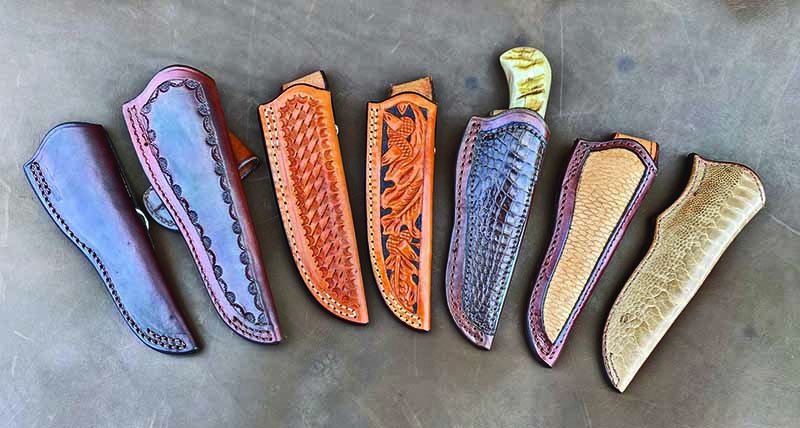
    The different decorations Kenny Rowe offers with his sheaths include, from left: smooth; border tooled; basket weave; acorn and oak leaf hand carving; exotic skin overlay (gator); exotic skin inlay (beaver tail); and exotic skin full coverage (ostrich leg).
    The different decorations Kenny Rowe offers with his sheaths include, from left: smooth; border tooled; basket weave; acorn and oak leaf hand carving; exotic skin overlay (gator); exotic skin inlay (beaver tail); and exotic skin full coverage (ostrich leg). (Kenny Rowe image)

    Most sheathmakers shy away from inserts since contact with the blade may dull the edge. After all, the welt and/or strap should suffice for a snug fit. Inserts in and of themselves may be judged to provide some measure of redundancy, but contribute little to the overall stability of the lockup or in protecting the knife itself. Long says, “Even the best inserts, being rigid, will do more harm to a blade than top grain leather.”

    At first glance it might appear that a drainage hole is a good idea to help maintain cleanliness and prevent the buildup of moisture or debris within the sheath. Not so fast!
    “I do not ordinarily put a drain hole in my sheaths,” Long asserted. “Nor do I do any waterproofing of the interior of the sheath. Rather, I depend on the normal intelligence of my client to not go swimming with their sheath, and to at least try to clean the blood and guts off the blade before reinsertion.” Rowe agrees.

    “I don’t see any sense in it,” he commented. “I can count on one hand the number of sheaths I’ve made with drain holes in them, and I’ve been making sheaths for 35 years at least. The only time I would expect someone to have their sheath in really wet conditions would be if they accidentally rolled into a deep river or their boat sank. I wouldn’t expect someone to haul off into neck deep water with their hunting gear on. For debris, it’s easy enough to take a wire with a little hook in the end and just rake the sheath out, or blow it out with air, or stand it upside down and shake it or tap it on a table.”

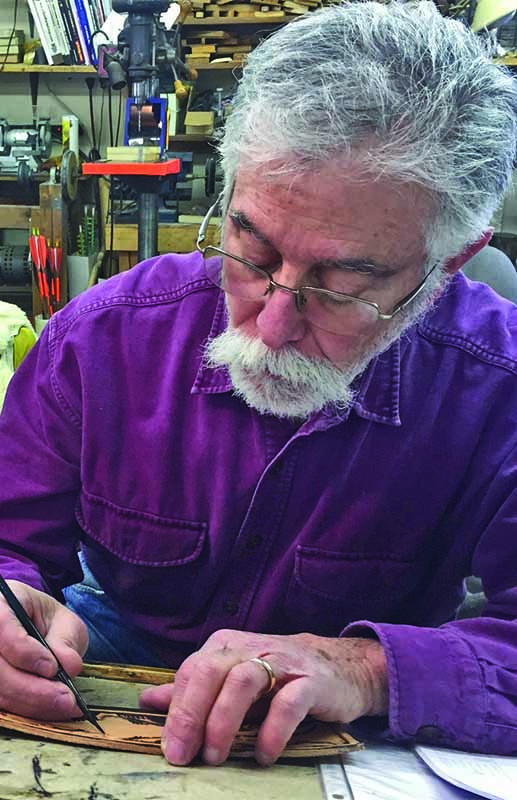
     Ultimately, Chris Kravitt—here working on a sheath in his shop—stands by the individual perspective. “First and foremost,” he begins, “it’s a matter of the configuration of the knife, and then if more than one style will work it becomes a matter of personal preference.”
    Ultimately, Chris Kravitt—here working on a sheath in his shop—stands by the individual perspective. “First and foremost,” he begins, “it’s a matter of the configuration of the knife, and then if more than one style will work it becomes a matter of personal preference.” (Chris Kravitt image)

    Kravitt, on the other hand, will utilize a drain hole and an insert from time to time. Often, the insert itself is fashioned from leather to avoid additional friction against the knife edge. The employment of the drain hole is in direct response to the future use of the gear in the field.

    “If I know the sheath will be used in harsher conditions, I think it should have a drain hole,” he remarked, “not just for draining moisture, but also removing debris—especially when the user has spent a lot of time in the woods.”

    Sheathmakers do tend to rely on the owner of the product and of the hunting knife to exercise responsibility in the field. “Explain to the client, if they are a novice, about the ‘care and feeding of a leather sheath,’” Long smiled.

     On almost every sheath, Paul Lebatard puts something in keeping with the theme of the knife, such as a small deer. “That’s a good thing about leather,” he observed. “When it is wet it can be molded and stamped, and when it dries it will hold that impression.”
    On almost every sheath, Paul Lebatard puts something in keeping with the theme of the knife, such as a small deer. “That’s a good thing about leather,” he observed. “When it is wet it can be molded and stamped, and when it dries it will hold that impression.” (Paul Lebatard image)

    Finding The Best Option

    The well-crafted sheath is the constant companion of the hunting knife, either in the field or a collector’s cabinet, and the best measure of the sheath’s contribution is its role in that partnership. For the sheath to function properly, owners must remember the fundamentals of hunting knife care. Keep both the knife and sheath clean. Wipe away moisture and other fluids. Maintain the surfaces as needed. Don’t put the knife away wet and expect the sheath to do more than expected.

    Adhering to best practices will ensure long life for both the hunting knife and its all-important sheath.

    *According to the Montana Leather Co. website (montanaleather.com), leather thickness is typically measured in ounces. For instance, an ounce of leather is equal to 1/64 inch. As a result, 7-to-9 ounce leather will be in the 1/8 inch range, give or take a few millimeters.

    Knifemaking Great Mel Pardue Passes

    0

    Legendary knifemaker and teacher Mel Pardue passed away recently, leaving an incredible legacy in his wake.

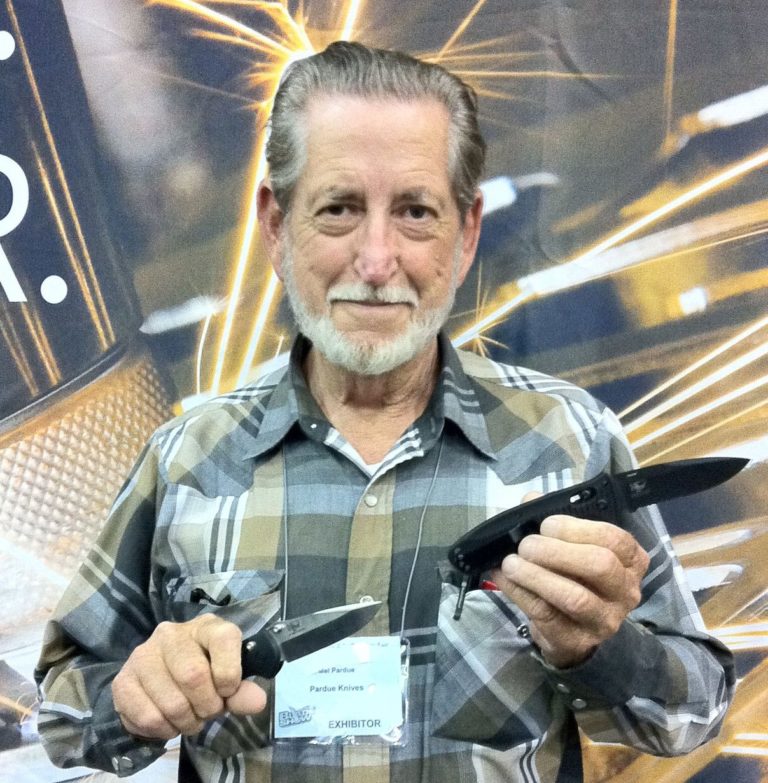
    One of the greats passed away over the weekend. Renowned custom knifemaker Mel Pardue of Repton, Ala., leaves an incredible legacy in his wake. In addition to his custom work and collaborations with top manufacturers, Pardue was a respected and honored member of the knifemaking community.

    Pardue was a BLADE Magazine Cutlery Hall of Fame® member and a voting member of the Knifemakers’ Guild for almost four decades, 14 of those years as a member of the board of directors, the final 10 as vice president. Furthermore, Pardue received the Ron Little Award in 1992 and is a past winner of the Guild’s Red Watson Friendship Award. In 2016, Mel was presented with the BLADE Show’s Aldo and Edda Lorenzi Award for his outstanding work in teaching and mentoring his fellow makers in the art of building knives.

    An inventive and consummate professional, Pardue made his first knife in 1952 and regularly created new designs since 1956. While he produced custom knives throughout his career, he is perhaps most widely known for his work in 24 years collaborating with Benchmade, which produced a number of his designs. Among the most popular and recognizable from this partnership was the Griptilian, an EDC folder that became a prolific part of the Oregon company’s catalog. The manual folding knife with the AXIS® lock eventually became available in nearly every conceivable size and color.

    Aside from the creative aspects of Pardue’s career, he was also a dedicated teacher of the art and craft of knifemaking. He was the first person without membership in the American Bladesmith Society to teach at the William F. Moran School of Bladesmithing, where he conducted classes on how to make folders. He taught the same subject at the Batson Bladesmithing Symposium and held seminars and classes in his shop for over 40 years. The drive to pass down his wealth of knowledge was also evident in his family legacy, as his son Joe Pardue and grandson Robert Carter are also well-known knifemakers.

    Best Hunting Knife: Four Fab Factory Fixed Blades

    1

    Planning for a backwoods excursion? Here are four of the best hunting knife options, the fixed blade variety, presently rolling off factory lines.

    As the fall outdoor season approaches, it’s important to assess your gear and decide if you need to purchase new equipment—hunting knives included. It’s time to maintain what you have or buy brand new models that will assist in camp chores and/or dressing game.

    Fixed-blade hunters play an important role on the hunt as they do a lot more than just field dress. They also help prepare meals, prep firewood for cooking, and any other cutting chores that crop up. 

    Ontario Knife Co ADK Keene Valley Hunter

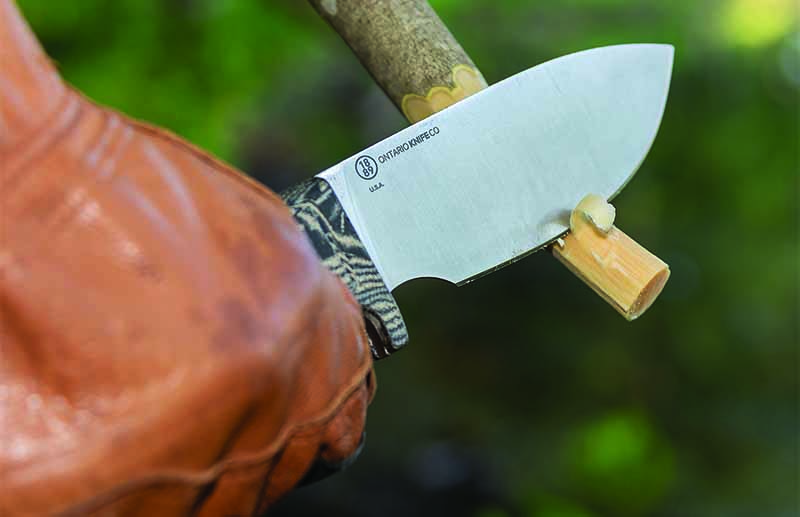
    An example of one of the latest such edged tools is the ADK Keene Valley Hunter from Ontario Knife Co. The wide drop-point blade of 420HC stainless steel adapts to cutting or camp tasks easily. It offers plenty of belly to do the aforementioned chores and field dressing, too. Full-tang construction provide plenty of strength and balance. Interesting multicolor Micarta® scales supply a great grip in all weather conditions, and are highly resistant to cracking, chipping and peeling. The material’s highly stable nature and purchase qualities make it a favorite among users. The scales are tapered from the handle spine, allowing the knife to rest in your hand comfortably. The integral single guard and distinctive choil work in harmony to enable you to choke up on the handle for ever-greater cutting control and user confidence.

     The deep-bellied blade of the Ontario ADK Keene Valley Hunter slices large cutting jobs down to size. ADK is short for the Adirondack Mountains, a range in Ontario’s home state of New York.
    The best hunting knife? The deep-bellied blade of the Ontario ADK Keene Valley Hunter makes a case for it. It easily slices large cutting jobs down to size. ADK is short for the Adirondack Mountains, a range in Ontario’s home state of New York.

    While 420HC is not my blade material of choice on such a knife, it has a good combination of both edge holding and ease of sharpening. Rounding out the package is a nicely sewn and riveted leather sheath that sports button-snap retention to hold the knife. Sheaths are often an area some manufacturers cut corners on to save money and hit the targeted price point, but not the ADK Keene Valley. The sheath is very nice in quality and holds the knife quite securely.

    The handle feels a bit blocky but there are no crisp edges or anything to create hot spots. Micarta is one of my favorite handle materials due to its strength, light weight and color selection. It also has a nice grip-you-back quality. At 11.2 ounces the knife has a noticeable heft. The blade at its thickest is around .2 inch, which also contributes to the heavier weight but also plenty of thickness to withstand tough, unforgiving use. The flat grind thins it out nicely yet remains thick enough for strength. With its wide blade and generous belly, the knife slices really well—one of the traits to look for in a hunter.  

    Kizlyar Supreme Caspian

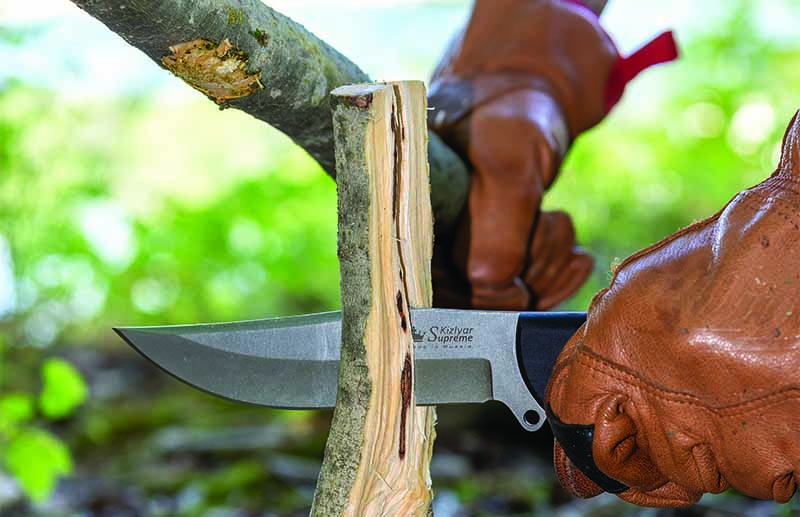
    Ten inches overall, the Kizlyar Supreme Caspian features a hollow-ground blade of D2 tool steel and a handle of hornbeam wood. The classic clip-point-bowie blade never gets old and has a defined tip along with a prominent swedge. The bowie shape does equally well in the tactical and outdoor genres, a great overall pattern for both a tool and weapon. The hollow grind thins out the edge and gives the blade an extremely good bite. D2 has respectable edge-holding ability and is widely used in the production knife industry as an upgrade to lower-grade steels. It is well known for toughness and high impact resistance, which makes it an ideal inexpensive steel for outdoor knives.

     The 5.4-inch clip-point blade of the Kizlyar Supreme Caspian provides plenty of sharpened real estate to process camp tasks. Overall length: 10 inches.
    The 5.4-inch clip-point blade of the Kizlyar Supreme Caspian provides plenty of sharpened real estate to process camp tasks and makes it a top hunting knife. Overall length: 10 inches.

    The ergonomic handle features multiple finger recesses, and the butt turns down to form a pinky catch to prevent your hand from sliding rearward. The tang helps form an integral single guard, resulting in a comfortable, smart, secure handle design. Largely flat, the scales are secured via two hex-head screws. The handle edges are contoured for comfort.

    The leather sheath is a riveted, sewn fold-over design. As a nice visual touch, contrasting thread is used for the stitching. The belt loop is a dangler type, allowing the hunting knife to ride a bit lower when affixed to the belt, as well as promoting greater freedom of movement to accommodate you in a seated position. Not every fixed blade has this sheath design and it is a plus in my book. To top things off, the sheath is stamped with the Kizlyar Supreme logo and website address.

    The knife performs very well. It has the power to slice through various media with ease. It’s somewhat large for a hunter but does multiple cutting jobs, including camp chores and some food processing. The hornbeam scales are not stabilized so extra care might be required, such as but not limited to drying off the handle immediately after you wash the knife.

    Spyderco Bow River

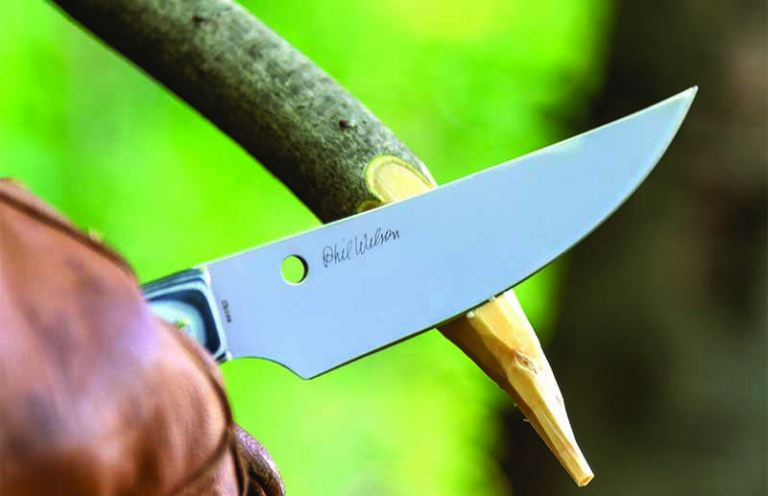
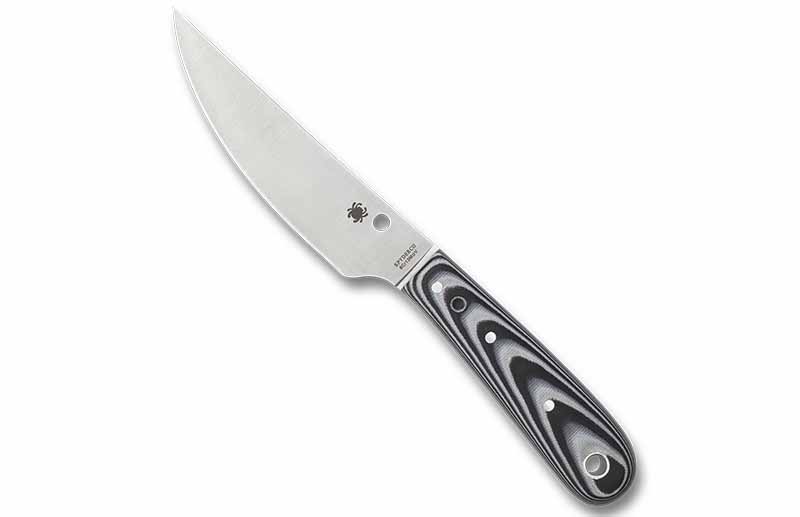
    The FB46G Bow River is one of Spyderco‘s latest fixed blades. The design by custom knifemaker Phil Wilson is based on his experience as an avid hunter and fisherman. Spyderco has produced several of Wilson’s fixed-blade designs but those were always higher-end knives in terms of materials and price—until now.

     The Spyderco Bow River is tailored for fine precision work such as field dressing and food prep in camp. It would make a great kitchen knife as well. (Spyderco image)
    The Spyderco Bow River is tailored for fine precision work such as field dressing and food prep in camp. It would make a great kitchen knife as well. (Spyderco image)

    The Bow River is designed for the budget-minded outdoor enthusiast who demands performance and superior design in an edged field companion. Starting with the blade, 8Cr13MoV stainless steel is used for a good balance of edge holding and ease of resharpening in the field. The 4.36-inch blade is big enough to tackle most hunting chores but small enough to easily manipulate, as well as carry comfortably in a belt sheath.  Wilson selected a trailing point blade design due to its generous sweeping belly that tackles slicing chores with ease. The full flat grind and distal taper enable the blade to sail through media easily.

    The handle is rounded, contoured black-and-gray G-10. The alternating colored layers form a wood-grain-type pattern that is very eye-catching. The hunting knife rests in your hand comfortably and has no hot spots or crisp edges. The way the end of the handle is rounded off tucks into your palm snugly. Some with larger hands might find the handle a bit lacking but for me it’s just right. The surface finish is slick and devoid of texturing, though with the way the handle is shaped you can always get a secure hold no matter what. There is a large hole in the butt for a lanyard. The leather sheath is a sewn and riveted fold-over design with belt loop. It’s simple and executed very well, just like the Bow River. The knife fits inside the sheath well.

    As for performance, it is definitely one efficient cutting tool. It is a well-designed fixed blade regardless of price. It is tailored for fine precision work such as field dressing and camp food prep. It would make a great kitchen knife as well.

    Case Winkler Kyle Lamb Hunter

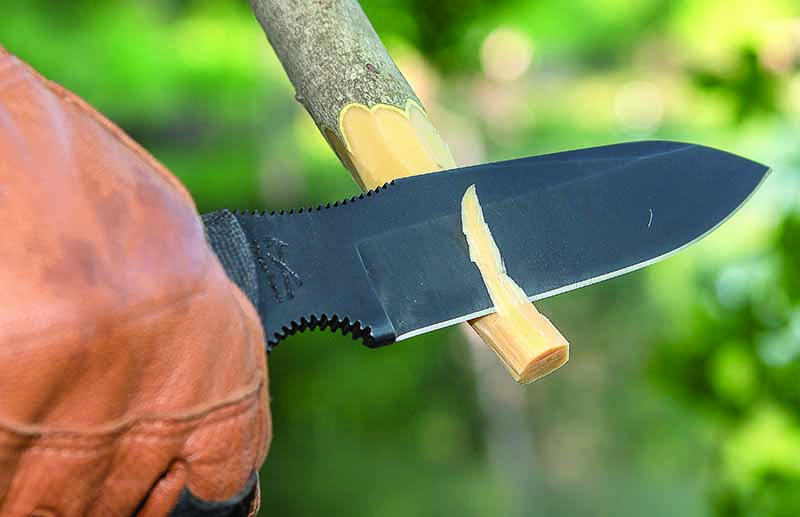
    The Case Winkler Kyle Lamb Hunter salutes the design expertise of Daniel Winkler and military service of retired U.S. Army Sergeant Kyle Lamb. The 5-inch spear-point blade’s saber grind leaves enough material for strength—the full .195-inch thickness runs to the tip—but removes enough to thin the blade out for effective cutting. The choil and pronounced thumb rest help exert extra control when choking up on the blade.  The 80CrV2 carbon steel is extremely tough and sharpens easily.

     The Case Winkler Kyle Lamb Hunter serves well in outdoor or tactical settings. The 80CrV2 carbon steel blade provides the horsepower to tackle a variety of cuts. Overall length: 9.5 inches.
    The Case Winkler Kyle Lamb Hunter serves well in outdoor or tactical settings. The 80CrV2 carbon steel blade provides the horsepower to tackle a variety of cuts. Overall length: 9.5 inches.

    The black canvas Micarta® handle offers a great grip in most all weather conditions. It is rounded for comfort and has no hot spots. Two thong-tube pins secure the slabs, and there’s an extra-large oblong hole in the butt for a lanyard.

    The hunting knife is a substantial tool. It has a good heft that conveys a solid feel and instills user confidence. It is equally at home as a tactical or outdoor knife because it has the features of both: great user blade shape, ergonomic handle and superior-grade materials. The blade is scary sharp out of the box. It dispatches large cutting jobs easily and quickly. Because the handle accommodates most hands very well, you can easily bear down and power through media. And when finesse is needed, you can choke up on the choil and thumb rest. The spear-point blade adapts to a wide range of tasks.

    One word of note: some might find the gimping on the thumb rest and choil a bit harsh. It does bite into flesh just a bit but that can be a good thing, especially when your hands are wet, covered in animal blood or freezing. The gimping also works well if you wear gloves. They do a great job of biting into the glove material to keep the knife positioned in your grip.

    The Kydex sheath is top-notch. Instead of a typical fold-over design it is a riveted one that incorporates a phenolic spacer material. The interior is lined with a felt-type material to reduce clatter. The exterior sports a laser cutout of Lamb’s Viking Tactics logo, a very nice touch. On the reverse side is a heavy-duty metal clip that affixes the hunting knife to belts up to 2 inches wide. The knife fits firmly inside the sheath with absolutely no play and no fear of falling out whatsoever.  


    More Hunting And Bushcraft Knife Info:

    Advertisement

    Must Read Articles

    Read this before you make a knife

    Knifemaking 101 – Read This Before You Make a Knife

      by Wayne Goddard My experience has taught me that there's nothing like digging in and getting started. I've often said the hardest part of the...
    how to forge damascus steel

    How to Forge Damascus

    Advertisement
    Advertisement