Blade Magazine‘s Editor-in-Chief reflects on why receiving the Posner Award proves so meaningful.
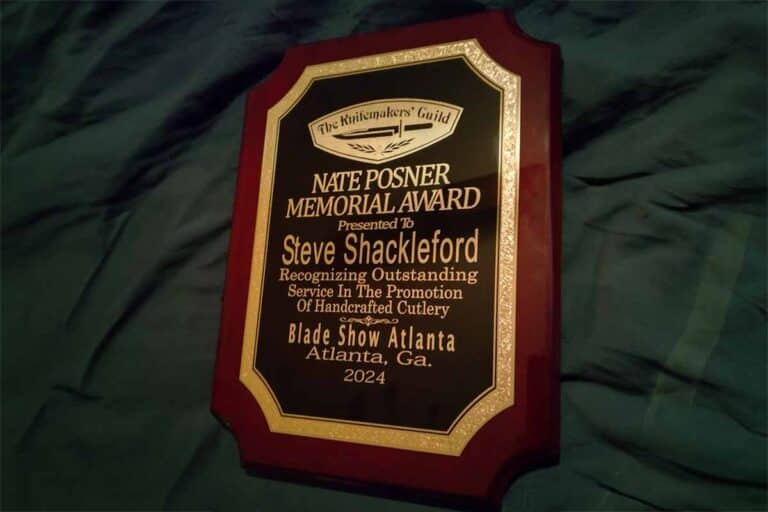
I was talking to knifemaker Edmund Davidson at his table during the BLADE Show when he and Gary Langley handed me a white cardboard box and told me to open it. When I did so, I found it contained a most beautiful plaque. It was the Nate Posner Award, and on it in big letters was my name as the latest recipient.
I must admit, I was equal parts astonished and delighted. Presented by The Knifemakers’ Guild, the Posner Award is one I’ve always wanted. The list of those who have won it is long and among others includes Mrs. Betty Dowell, Admiral Steel’s Terry Summers, photographer David Darom, KNIFE editor Mark Zalesky, knifemaker Bill Herndon, French knife writer Francis Anglade, BLADE Magazine Cutlery Hall-of-Fame® member Dan and Mrs. Pam Delavan, and Cutlery Hall-of-Famers Bruce Voyles and Edda and Aldo Lorenzi.
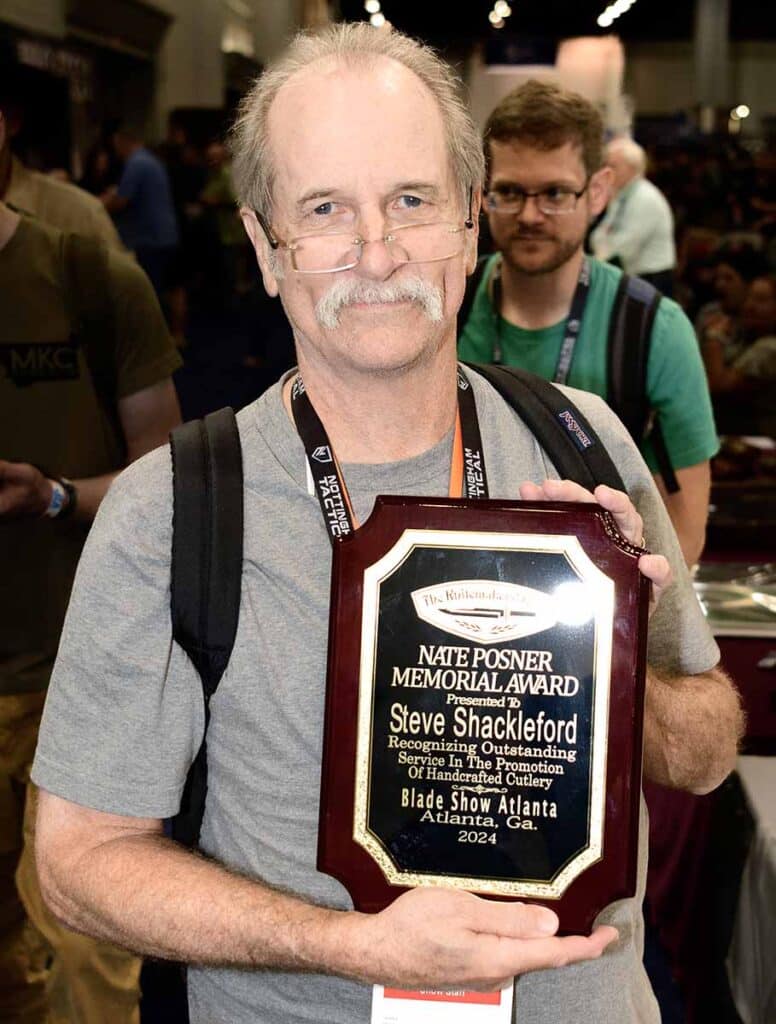
Steve Shackleford proudly mugs with his Nate Posner Memorial Award at the 2024 BLADE Show in Atlanta. Photo: Gary Langley
As the words on the plaque read, the award recognizes “outstanding service in the promotion of handcrafted cutlery.” And those words pretty much say it all in terms of why I’ve always wanted the Posner, because promoting handcrafted cutlery has been a monumental part of what I’ve been doing for BLADE® for almost four decades now.
Who exactly was Nate Posner and why did the Guild name an award after him? If you reference the December 1981 American Blade, the original name of BLADE, you will find a most informative story by Cutlery Hall-of-Famer Bernard Levine about the San Francisco Gun Exchange and its proprietor, Nate Posner.
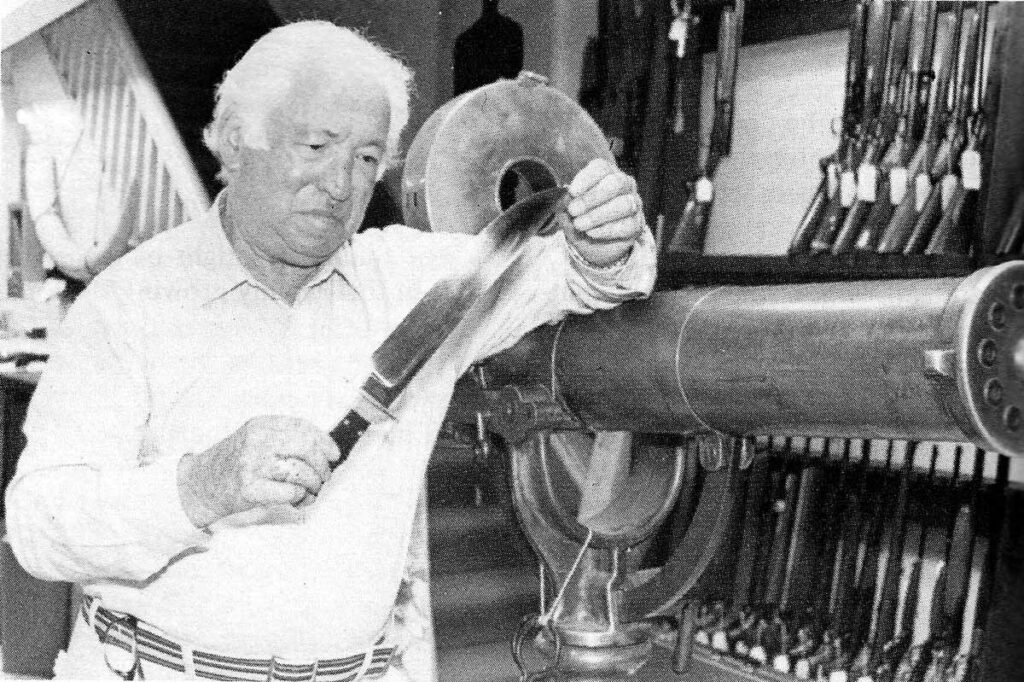
Mr. Posner started his business in 1948. Through the years he built it into what he called the “Firearms Center of the West.” It had most everything firearm-related, including inexpensive rifles and shotguns, collector’s cartridges, reloading equipment, rare and unusual guns, a whole wall of de-activated submachine guns, posters, cartridge boards and more. He even had an authentic Gatling gun in the back of the store.
As all-encompassing as his array of firearms and equipment was, it was his displays of knives, both factory and custom, that pertain here. At one time he had over 350 custom knives on display, with at least that many others in stock. (In subsequent years those numbers no doubt grew even more.) At first, in 1975 or ’76, he ordered knives from dozens of makers, most either active or past Guild members. Eventually he culled his list to about 25 or 30 makers, including one of his favorites, D. E. Henry, whom Posner reportedly called “the Van Gogh of knifemakers.” Others included Tommy Lee, Jess Horn, Herman Schneider, Corbet Sigman, the-then-team of Scott Sawby and Steve Mullin, and Cutlery Hall-of-Famers Frank Centofante, Jimmy Lile, Bob Loveless, George Herron, Bo Randall and more.
Nate Posner in his San Francisco Gun Exchange circa 1980 leaning on his authentic Gatling gun and admiring a D. E. Henry bowie.
Along with Dan Delavan at Plaza Cutlery, Bob Gaddis and Dave Harvey of Nordic Knives, and Cutlery Hall-of-Famer A.G. Russell, Posner was among the first custom knife purveyors. His approach was a most honest and forthright one. He was known for telling his customers that to get the best price, instead of buying custom knives from middlemen such as him, they should buy directly from the maker. Of course, if the customers wanted the custom knife in question immediately, they often had to buy it from Nate to avoid spending what might be months or even years on a maker’s waiting list.
However, it was being up front that put Nate in good stead not only with his knife customers but the Guild, too—for both buying/selling the makers’ knives and treating what often were the makers’ customers/prospective customers in a professional manner. Add the high store profile he gave custom knives and knifemakers to knife buyers and gun buyers alike, and Nate became one of the most important custom knife promoters of his or any time—and thus the Guild award in his name.
To be mentioned in the same breath as those who have won the award before me and, of course, Nate Posner himself, is a privilege and an honor. To any and all who were involved in my selection, I cannot thank you enough.
And thanks to Nate Posner for setting a standard for all in the knife community to emulate.
Honor 250 years of Marine Corps history! Discover the legendary KA-BAR/MK2 fighting knife and new anniversary blades from makers like Medford and Defiant 7.
The day before Veterans Day, November 10 is the 250th anniversary of some of the most storied combat fighters in world history—the United States Marines.
The Marines have a special aura that almost transcends their many exploits. And when it comes to American military exploits, the Battle of Iwo Jima is in the top two or three all time. The raising of the flag on Mount Suribachi is America personified, and the United States Marine Corps War Memorial across the Potomac River from Washington, D.C., celebrating the event is about the most awesome monument anywhere.
As for those in the knifemaking community, Marine veterans are well-represented and include two BLADE Magazine Cutlery Hall-of-Fame® members, Don Fogg and Joe Keeslar. Other Marine vets who make knives are Tim Britton; Matt Chase; Allen Elishewitz; Doug Esposito; Les George; Brad Jennings; Tim Kell; Jonathan McNees; Greg Medford; Jeff Moore; ABS Master Smith James Rodebaugh; Kevin Stack; and Connor Toor. There are no doubt many more, both present and past.
Then there’s the iconic Marine knife, variously known as the Mark 2/MK2, USMC fighting/utility, the Model 1219 or simply the generic kabar. Associated by many with having been made by KA-BAR Knives, the knife also was made by a number of other companies during World War II, including Camillus, Case, Colonial, Ontario, Pal, Queen, Robeson, etc., and is made by several of the foregoing that remain active today, as well as others. The 200th KA-BAR commemorative of the knife graced the cover of the November-December 1975 issue of The American Blade 50 years go in what may be the best BLADE® cover ever.
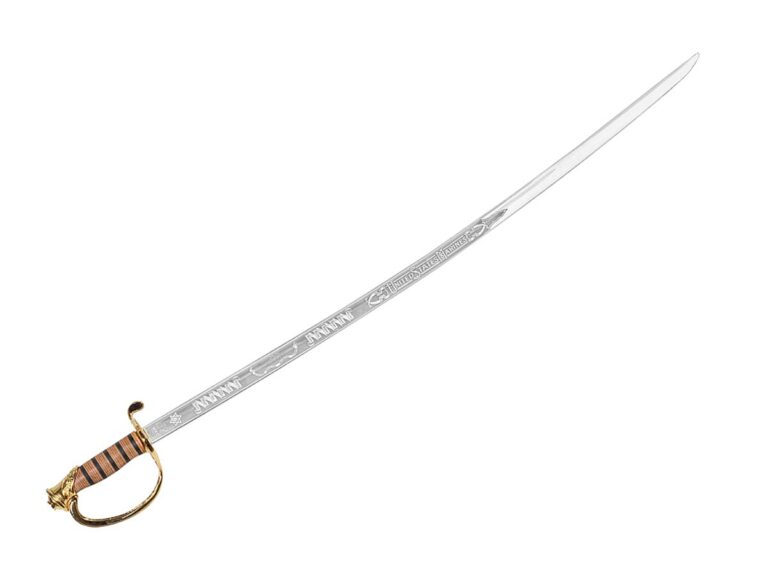
As for blades observing the 2025 anniversary, the 250th USMC Trench Knife by Medford Knife & Tool is available now. KA-BAR is making a dress sword in a limited edition of 250 pieces that at press time was slated to be out in early October. At Defiant 7, Allen Elishewitz and Les George are “reworking” the USMC MK2 in what will be called the M320. Among other features, it will include a 3V carbon steel blade and a stacked handle construction not unlike the original MK2 grip but in a polymer material and a more ergonomic shape. Ontario was reportedly working on a new kabar-inspired piece at press time, too.
Look for these and other anniversary-focused knives in future issues of BLADE. Choose one or more of them if you want a blade inspired by our incomparable Marines.
To America-loving Marines everywhere, Semper Fi! And to all U.S. military vets, Happy Veterans Day!
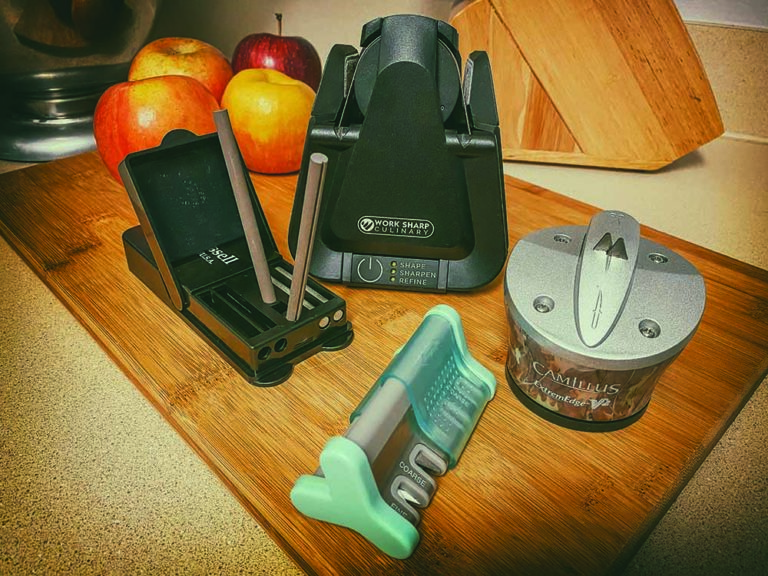
Correct sharpener selection is imperative for keen household cutlery. With that, here are four kitchen knife sharpeners that make the cut.
Dull kitchen knives not only make meal preparation more difficult, they also can slip and cut you when you least expect it. As a result, it’s imperative to keep them sharp. If you sharpen them yourself, correct sharpener selection is key.
A kitchen knife sharpeners can be as simple or complicated as you want. No matter your skill level, there is a sharpener for you. For those with little-to-no sharpening experience are the cost-effective pull-through sharpeners. These are as simple as simple can get. Often they are plastic-bodied devices with one or two slots. Inside the slots are the sharpening media. The media are permanently affixed at pre-set angles The most common media for the two-slotters are carbide and a fine-grit ceramic. The carbide quickly restores damaged and worn edges, while the fine-grit ceramic polishes and hones the edge to razor sharpness. Anyone can achieve a sharp edge with a pull-through.
Smith’s Products Slide Sharp Edge Grip
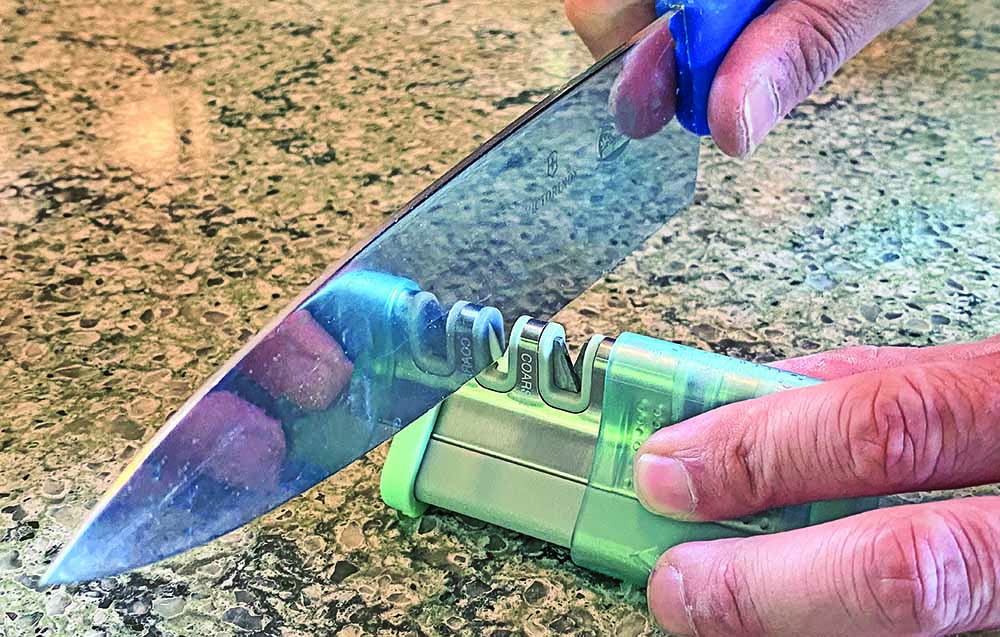
Smith’s Slide Sharp has two pairs of pull-through slots to address both standard and Asian-style kitchen knives.
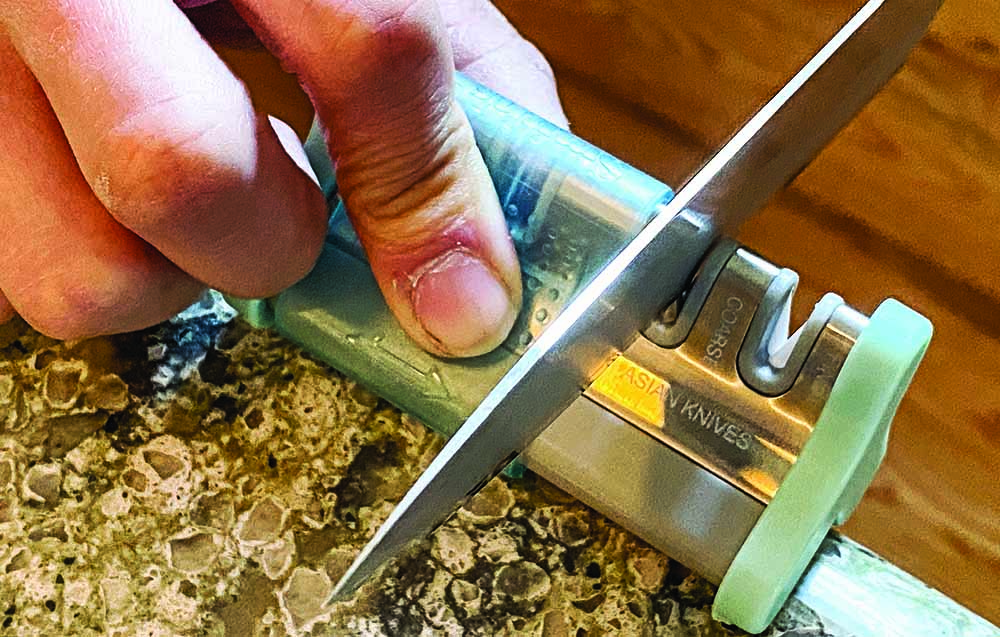
One such kitchen knife sharpener is the Smith’s Products Slide Sharp Edge Grip. It has two sets of slots. One pair addresses standard kitchen knives at a pre-set 20-degree angle, and the other addresses Asian-style knives at a 15-degree angle. The standard slots have carbide for a coarse grit abrasive and ceramic for fine grit. The Asian-style slots have diamond rods for coarse grit and ceramic for fine.
The Slide Sharp’s indexed sliding grip is textured for a non-slip purchase to allow for secure sharpening. Depending on which slot set you use, the other set is covered by a sliding cover, which is how the sharpener is stabilized—by placing your hand over the sliding cover.
The cross-section of the sharpener resembles an upside-down “Y,” with the arched base held in place on the edge of a table or counter. This gives you another option for stable sharpener operation. Consequently, you have two ways to secure the sharpener during use. Few pull throughs provide such an option.
The Slide Sharp is effective and works as advertised. To use it on a countertop or tabletop, take one hand and stabilize it on the flat work surface. To use it on the edge of a kitchen counter, sit it on the counter edge via the “Y” legs and, while holding it with one hand, pull the blade through and down with the other. You have a better line of sight
to the sharpener this way and it’s very safe, too.
Designed with an upside down “Y” frame, the Smith’s Slide Sharp sits securely while held to the edge of a countertop. This puts the sharpening slots at an angle for better viewing while in use.
If you must use a pull-through, I highly recommend the Slide Sharp. I also recommend using the lightest pressure as possible to sharpen, as pull-throughs can remove too much metal, more so than ceramic, diamond or powered abrasive belt sharpeners. Removing too much metal can prematurely deform the cutting edge.
The Slide Sharp is a little over 1.5 inches tall and a bit under 3.5 inches long. Its compact nature enables convenient drawer storage. The manufacturer’s suggested retail price (MSRP) of $11.99 makes it incredibly affordable and provides no excuse for anyone to have dull kitchen knives. MSRP: $11.99
Camillus Extreme Edge V2 Knife & Shear Sharpener
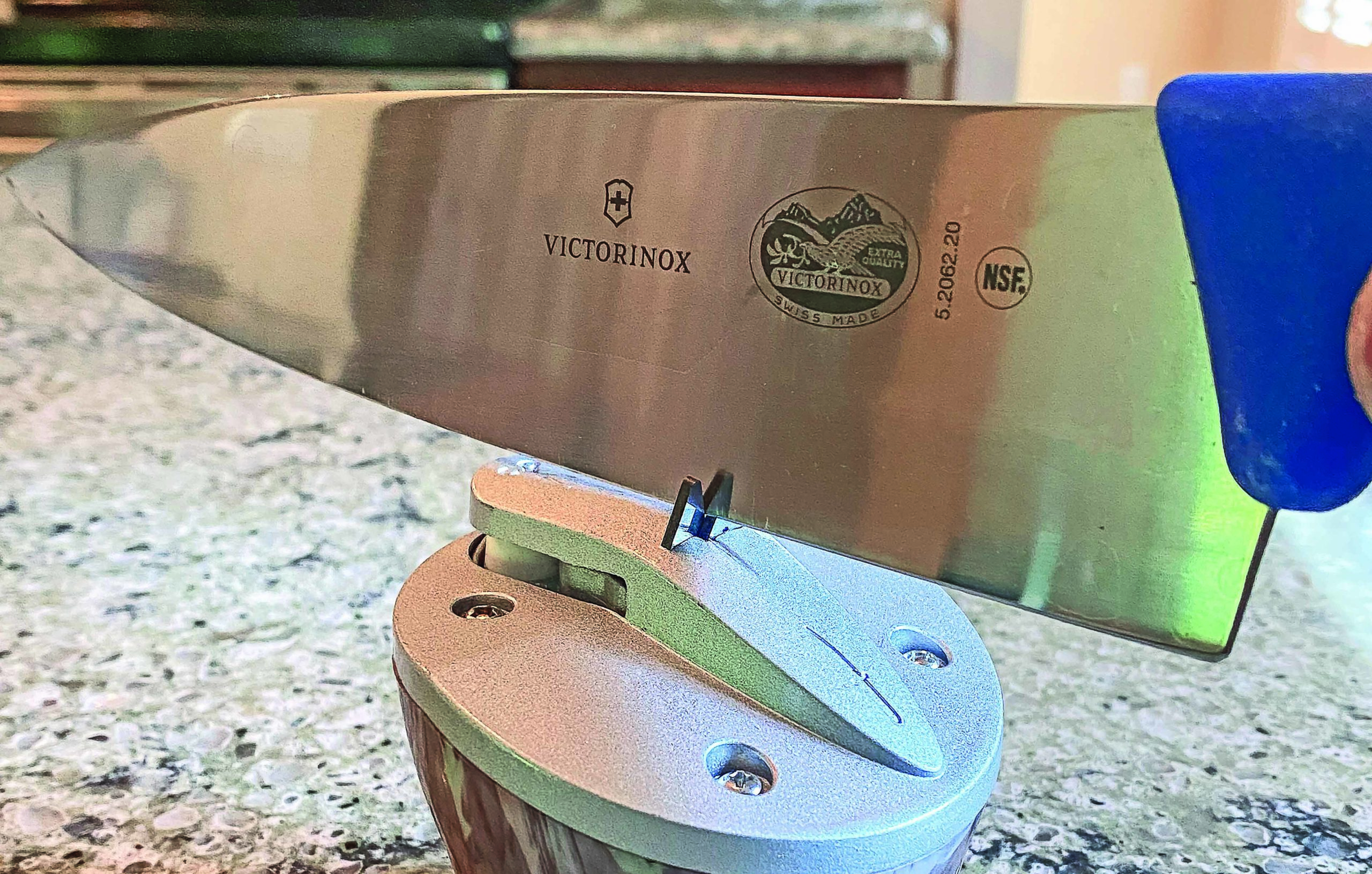
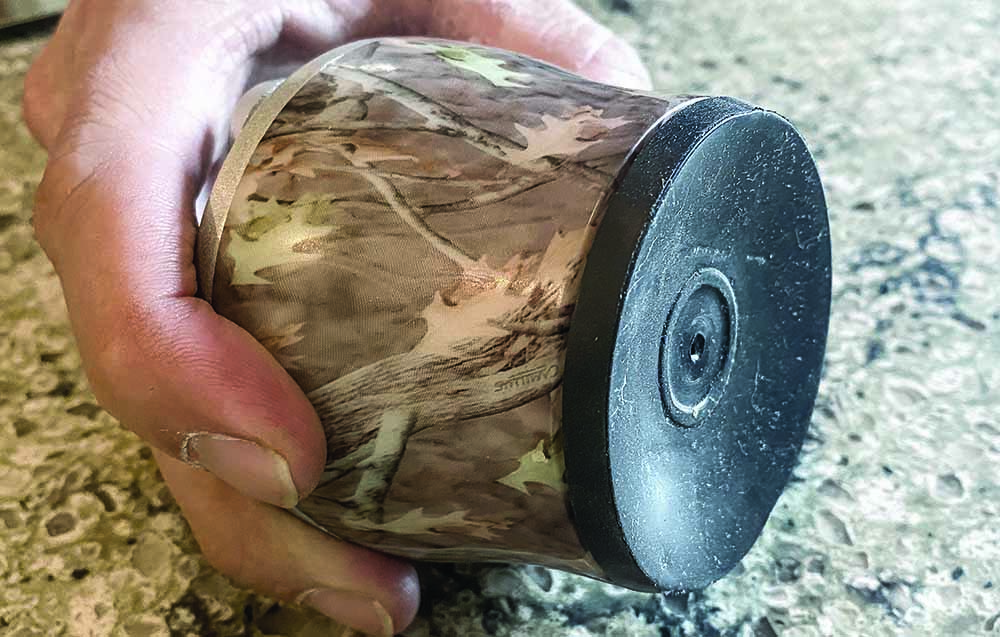
The Camillus Extreme Edge V2 Knife & Shear Sharpener features a pull-through design with carbide media for kitchen knives and fine ceramic for shears to establish edges in quick fashion.
The Extreme Edge V2 Knife & Tool pull-through from Camillus is a two-for-one deal. A set of carbide abrasives addresses plain edge and kitchen knives. It also features a built-in shears sharpener.
The cylindrical body is around 3 inches in diameter. The top is cast metal and houses the carbides, while the fine-grit-ceramic shears sharpener is in the unit’s rear. The plastic body has an outdoorsy camo theme appearance. For safe operation, a suction cup at the base activates by pressing down and rotating the unit to firmly grip the tabletop surface. For scenarios where the suction cup feature isn’t feasible, it acts as a standard non-skid base.
The sharpener works OK, though I didn’t feel the carbides to be as aggressive as with other pull-throughs I’ve used. The edge it produced was sharp though not surgical sharp. At least the V2 provides a functional sharp edge, which is better than having no sharpener and a dull edge.
The suction cup base of the Camillus Extreme Edge V2 is designed to stick to a slick surface for stable sharpening.
The suction cup base was a disappointment. I could not get it to cling to the slick worktop of my toolbox most of the time. You must really press down on the sharpener and twist it to get it to stick, but it kept loosening repeatedly. However, you can still use the sharpener safely and effectively by employing the suction cup as a non-skid rubber base. Oh, and one of the carbide teeth loosened up after the first few uses, which is unacceptable. MSRP: $19.98.
A.G. Russell Knives Field Sharpener
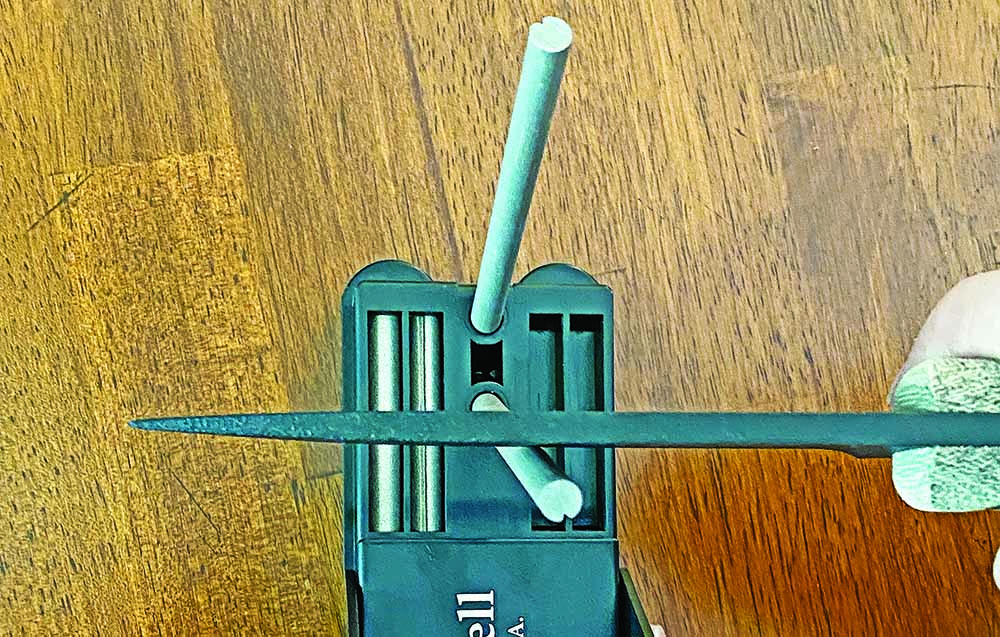
You can see the diamond-grit hones stored in slots in the base of the A.G. Russell Field Sharpener. This is a completely functional, self-contained guided sharpening system that goes anywhere you do.
The A.G. Russell Knives Field Sharpener is probably the most versatile of the test bunch of kitchen knife sharpeners. Not only does it sharpen kitchen knives but also pocket knives, hunting knives and tactical knives. Such value and versatility is a hard combo to top no matter how you slice it.
The Field Sharpener has a molded plastic base and hinged cover. You insert a pair of included 4-inch sharpening rods into two holes at a preset angle of 15 degrees. There’s a set of coarse diamond-grit rods to quickly repair a worn edge or rehab a damaged one. A set of medium-grit ceramic rods further sharpens and dials in edges to razor sharpness. The unit measures 5-by-2 inches and is compact enough for stowing in a toolbox, tacklebox, backpack or even a jacket pocket.
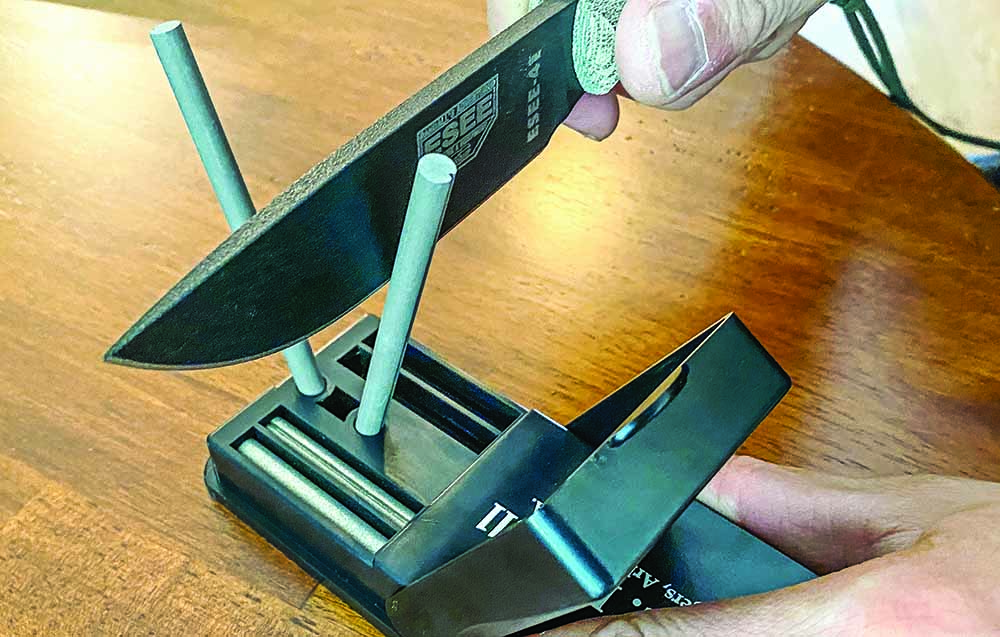
Place the sharpener on a flat work surface. Select the set of rods you wish to use and insert into the holes in the base. The flip-up cover secures the rods when they are tucked inside the base; when open, the cover forms a convenient guard to prevent the blade from coming down on your hand. Place one hand on the base to secure the sharpener. With your other hand, take the knife and move the blade down the rods, while pulling it across from tang to tip—two motions at once. Don’t use a lot of pressure; allow the weight of the blade to rest on the rods and move it down. Keep the blade positioned perpendicular to the tabletop surface; holding it straight up and down allows you to sharpen at the proper angle of 30 degrees inclusive.
The Field Sharpener’s flip-up cover secures the rods when they are tucked inside the base. When open, the cover forms a guard to prevent the blade from coming down on your hand.
The Field Sharpener is very effective. If you’ve used Crock Sticks or a Spyderco Tri-Angle Sharpmaker, you will take to this one easily. It requires the same motions. Unlike the Sharpmaker or Crock Sticks, it’s portable enough to take on outdoor adventures. It’s great for camping, especially if you use a variety of knives.
Given the longer length of many kitchen knives and the 4-inch rods, you must pull the blade across the rods with a bit of expediency to be able to capture the entire blade length in one downward pass. Just be mindful that this technique is more pronounced with longer blades. With shorter blades you won’t notice it as much. The round profile means the contact area of the rod to the blade is smaller and more effective at removing steel. It’s easy to use and highly effective. MSRP: $39.95.
Work Sharp E5 Kitchen Knife Sharpener
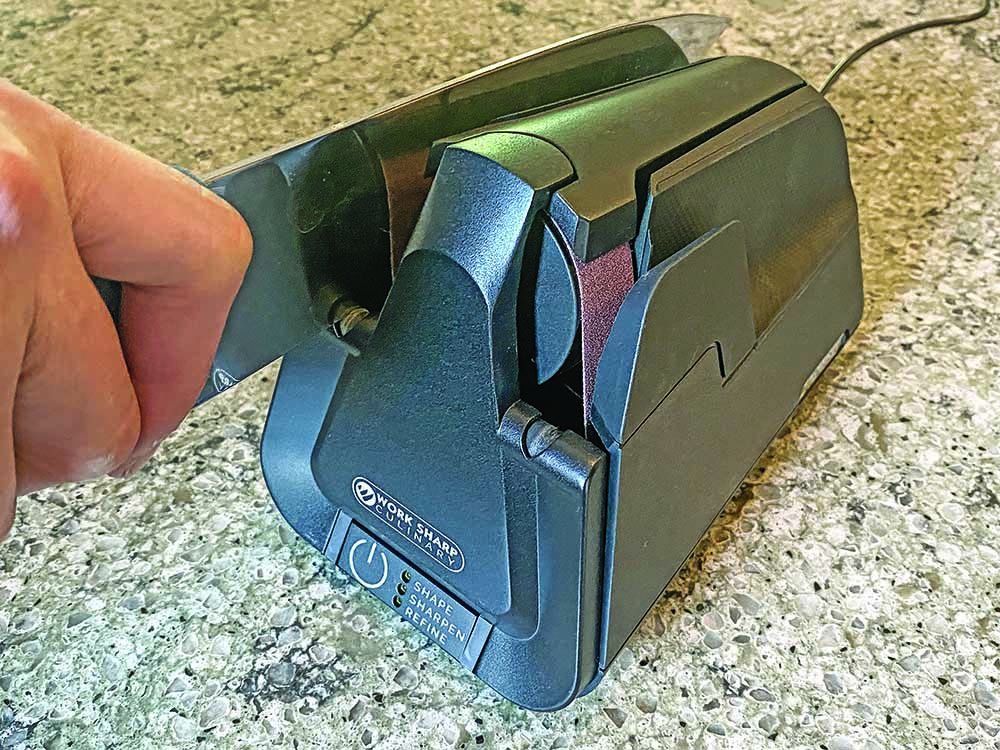
The Work Sharp Culinary E5 uses the same flexible abrasive belt technology as used on the company’s Ken Onion Edition sharpener. Three pre-programmed sharpening modes eliminate the guesswork of obtaining a professional edge.
The Work Sharp E5 Kitchen Knife Sharpener is a top-of-the-line powered kitchen knife sharpener, offering multiple modes, speeds, and the latest technology in providing consistent high-quality sharpening knife after knife. The E5 was designed from the ground up as a powered sharpener that can sit on a counter full time, blending in with other appliances with a minimal footprint. Like Work Sharp’s other powered knife sharpeners, the E5 uses flexible, long-wearing abrasive belts to create an ultra-durable convex edge.
Place the blade inside each slot and the abrasives do the work. Select from one of three sharpening modes via the one-touch programming feature. The Shape mode—three rapid clicks on the power button—starts at a high speed for fast cutting and repair of worn edges, then drops down to the Refine mode—one click—at low speed for the final touch up. The Sharpen mode—two rapid clicks—runs the belt at medium speed for routine edge maintenance, followed by the Refine mode for fast touch-ups.
Select the desired mode then alternate placing the blade in each of the slots. Watch the lights on the power panel. Whichever mode you select, a light shines next to it. Ten seconds before the machine changes modes, the light will begin flashing to warn of the upcoming transition to the next mode, or, depending on the mode, stop completely. Simply draw the blade through. The machine does all the work.
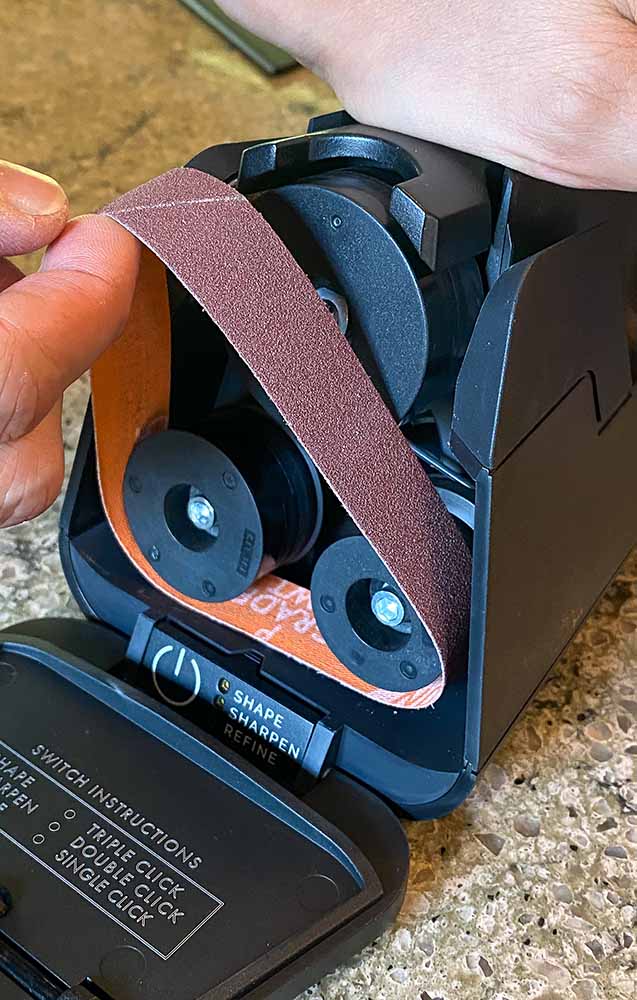
Changing belts on the Work Sharp Culinary E5 is easy. Flip down the faceplate. Press down on top of the machine with one hand to release belt tension, and, with the other hand, remove the belt. The new belt goes on in reverse order.
The first time you use the E5, you will be reprofiling your blades to the set 17-degree angle, which can take some time. At extra cost is an upgrade kit that includes more coarse belts, and 15- and 20-degree angle guides for enhanced versatility and quicker sharpening. MSRP: $59.95.
The E5 works well and produces the convex edge, which is very sharp and durable. The sharpener is quiet and easy to operate, something novices appreciate. If you are serious about cooking, it is essential to have not only high-quality knives but also a high-quality sharpener. The E5 is it. MSRP: $149.95.
Other Kitchen Sharpener Options
Shenzen Knives Electric Diamond Knife Sharpener
Shenzen Knives Electric Diamond Knife Sharpener
Diamonds aren’t just a girl’s best friend. This sharpener from Shenzen Knives features an electric diamond grinding wheel with two settings designed to sharpen both steel and ceramic knives.
Its powerful motor can remove chips as large as 1mm off of ceramic knives, and it easily comes apart for cleaning. An added plus is the universal knife guide slot, which is designed to keep your knives at the perfect angle for the best possible edge on both the fine and coarse settings. Specifically for kitchen knives, this machine is not meant to sharpen scissors, hunting knives, or any other types of blades.
MSRP: $49.99
Sharp Pebble Premium 1000/6000 Whetstone
Sharp Pebble Premium Whetstone Knife Sharpening Stone 2 Side Grit 1000/6000 Waterstone- Whetstone Knife Sharpener
The whetstone, and other sharpening stones, are a much more finite and meditative way to sharpen your knives. Coming in a variety of grit sizes, whetstones work by being submerged in a liquid, usually water, which enhances the stone’s ability to sharpen a blade while also allowing the chips and scrapes to wash away. Sharp Pebble offers a variety of whetstones in different grits and at different price points. (The 1000/6000 stone is a perfect stone for home sharpeners, and is the method I’ve used to sharpen my kitchen knives for the last several years. I enjoy the process of using the stone and feel it provides a quality edge whether it’s my chef knife or my paring knife.)
The majority of the stones come with an angle guide to help you get the best sharpening angle for your knife. These stones can also be used to sharpen other implements from razors to scissors to chisels.
MSRP: $40.99
Messermeister Fine Grit Honing Steel
Messermeister Fine Grit Honing Steel
Sometimes your knife needs honing rather than sharpening. That’s where honing steel, or a honing rod, comes to the rescue. Over time and normal use, the edge of your knives will bend and warp at a microscopic level. Honing steel works to massage the edge back into the proper position without removing as much material as sharpening would. (I hone my knives daily while sharpening them 2-4 times a year. By honing I’m able to maintain a sharp edge longer and maintain better control over my knives while I cook.)
Messermeister offers a variety of honing rods ranging from steel and ceramic to diamond. Their fine-grit rod is made of high-carbon tool steel and can be used to hone knives made from any material. It’s designed to never wear over its lifespan and should be able to hone your knives’ edges for decades.
For a fair price, you can’t go wrong with this rod, and your knives will thank you for it.
MSRP: $24.95 (10-inch), $29.95 (12-inch)
Worksharp Electric Kitchen Knife Sharpener
Worksharp Electric Kitchen Knife Sharpener
For a quality all-rounder, look no further than Worksharp’s newest electric sharpener. Roughly the size of a softball, the sharpener effortlessly sharpens anything you can throw at it in the kitchen including scissors and serrated knives.
Its sharpening slots feature built-in 20-degree angle guides so each edge comes out at a perfect angle. Beyond just sharpening, the device features a ceramic honing wheel as well that allows you to maintain your edge every day.
MSRP: $59.95
Editor’s Note:Mike Abelson contributed to this story
A budget option, the D’souza Cerberus punches above its price point.
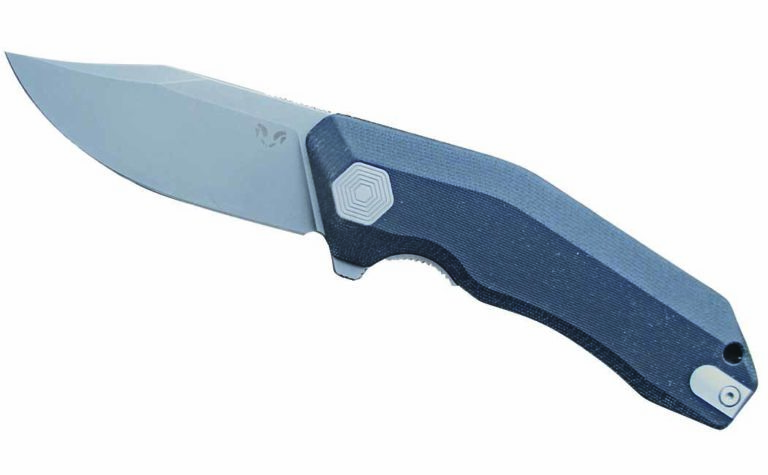
Adrian D’souza’s Damned Designs folders are very sturdy and exhibit smooth action. D2 tool steel for the blade and a G-10 handle highlight his Cerberus model. Adrian paid a lot of attention to the handle to make it feel very comfortable during use.
As for how well it performs, well, let’s see.
D’souza’s Damned Deigns Cerberus Initial Test
The Cerberus cruised through the initial test of slicing 20-pound bond paper. It was very aggressive slicing and I had to move my fingers out of the way quickly to keep from nipping them. I used the weight of the knife only for the pull stroke. Cutting the paper was kind of addictive—I just kept rotating it looking for a clean edge to slice.
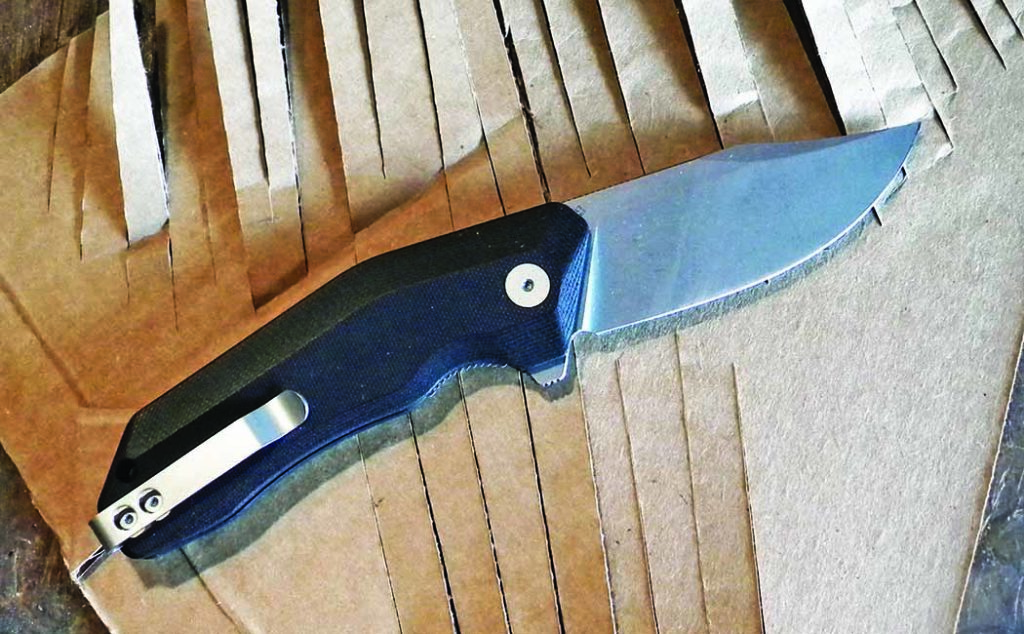
The Cerberus was very aggressive slicing cardboard.
Moving on to a piece of single-walled cardboard, the Cerberus didn’t slow down a bit—zip, zip, zip on every slice. Again, the hardest part was moving my fingers out of the way fast enough for the next cut. The Cerberus was very aggressive slicing cardboard. The handle was extremely comfy and caused nary a hotspot.
Cerberus Heavy Use Tests
Splitting Wood
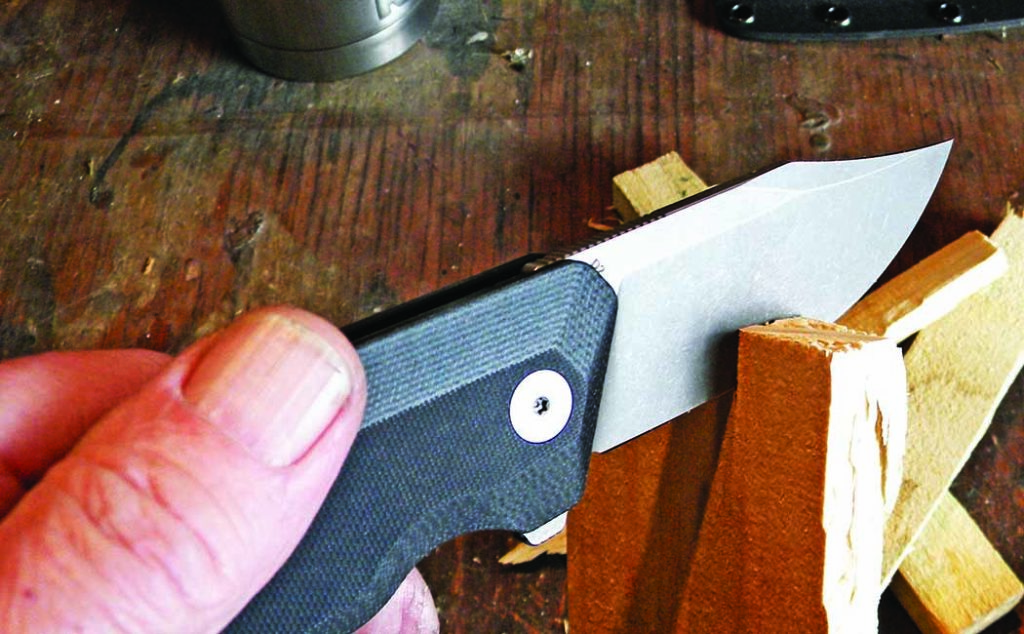
I had some leftover fencing slats that work great for kindling. The Cerberus penetrated half to three-quarters of an inch on every chop. With a quick twist of my wrist, the half-inch wood split. The lock stayed 100 percent engaged throughout chopping. The softened handle edges kept my hand comfortable during the hacking as well.
Batoning
To add more pressure to the lock, the author batonned the blade into the kindling eight times. It split the half-inch wood very fast, with the author using only a light tap from the dead-blow hammer. No loosening of the lockup occurred.
To add more pressure to the lock, I batonned the blade eight more times. It split the half-inch wood very fast, using only a light tap from the dead-blow hammer. No loosening of the lockup occurred. Grade: very stout design in the lock department with excellent workmanship.
Whittling Firesticks
I whittled firesticks from some of the split pieces. The Cerberus provided excellent control on the depth of cut. It powered through thicker pieces as well as thin, making some great curly-cues. There were still no hotspots and the edge was hair-popping sharp.
Skiving And Slicing Leather
When the author started cutting the full thickness of the leather, the crunching sound became quite audible. The handle shape aided in controlling skiving and slicing depth.
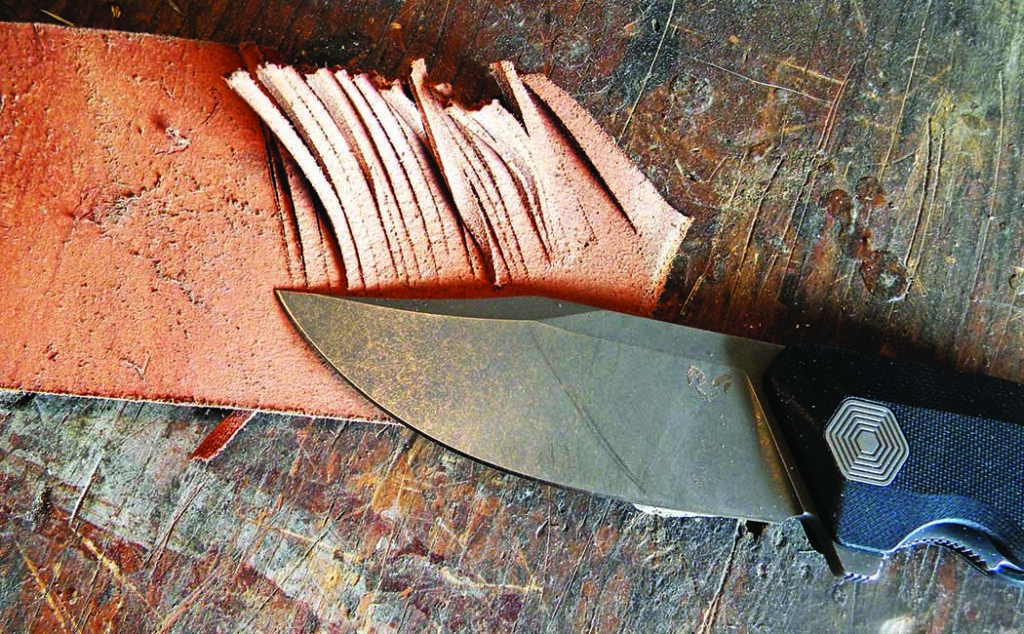
Moving on to some 8-ounce leather for slicing and skiving, I skived a corner very quickly. I could hear the crunching cuts. It worked quite well, yielding very thin slices of leather. When I started cutting the material full thickness, the crunching sound became quite audible. The handle shape aided in controlling skiving and slicing depth. This puppy is really comfortable to use.
Sisal Rope
I looked for half-inch sisal rope for the final test medium and realized I had only a foot length of it left. Well, it was better than nothing! The challenge was to make short but full rope cuts. Any dullness on the edge would be very easy to detect, as a dull edge would just slide out and over the sisal. After 20 crunching cuts, I had two nicks in my thumbnail. It was time to don Kevlar® gloves. In record Spec Sheet time the Cerberus crunched out 141 cuts in the rope, and I still had my fingertips to boot—an excellent outcome! The blade was not even close to slowing down. (I apologize for the shortage of rope. I have more on order.)
Overall Evaluation Of The Cerberus
The action is smooth and the blade locks up nice and tight.
The Cerberus is an excellent folder. The D2 blade has outstanding heat treatment, the handle is very comfortable and lockup is 100 percent secure. I would use it as my EDC.
Potential Changes
I really couldn’t find anything to change. I would recommend that Damned Designs continues to not get too sharp on the handle edges and keep them soft like they are.
Damned Designs warrants its knives to be free of defects. No knife abuse is allowed! For more information contact Adrian D’souza at www.damneddesigns.com, [email protected], and Instagram @damneddesigns.
Cerberus Specs Company: Damned Designs Knife Type: Flipper folder Blade Length: 3.5 inch Blade Material: D2 tool steel Blade Thickness At The Thickest: 1/8 inch Blade Finish: Stonewashed Handle: G-10 Pocket Clip: Blade tip up Lock: Linerlock Liners: Titanium Weight: 6 ounces Closed Length: 4.5 inch MSRP: $49
We give you the tips to avoid mistakes when buying a custom knives.
Of course, every rule or principle has its exceptions and counter-principles. You do get what you pay for, but only when you have an honest and informed assessment. Is that micarta real Westinghouse Micarta? Is the fit and finish and reputation of the maker in line with the price? Did the maker grind the knife themselves, or is this a production knife?
You’ll have to do some homework if you want to get “good deals.” One of the oldest tricks in the book is for the seller to exaggerate demand and conceal supply. “This is the last one, and they’ve been buying them fast all day!” may be true or may be a dishonest sales pitch.
The warning is “buyer beware” more often than “seller beware” after all. Many a “bad deal” comes not from mutual disagreement, but from one side taking advantage or being dishonest.
Economic generalities aside, let’s look specifically at the knife market.
Lesson 1: Don’t Buy The Hype
Some people want the latest and greatest thing. They get great enjoyment out of buying what is the ultimate “grail” knife of a given season, often hyped up on social media, on online forums, by word of mouth, in magazines and at events. For these buyers, the thrill is in the hunt and in the showing of the trophy.
If you want to be that kind of buyer, buy what you want and enjoy the heck out of it! Keep in mind that demand will be lower for last year’s hot thing, and so will the resale price. I won’t go so far as to say don’t buy the hot knife. Many of us spend money on experiences (what do you gain long term from a concert or a trip to the movies?) or on depreciating possessions like cars or boats. In some ways, if you enjoy it, it doesn’t matter if you lose some money on a knife or it’s not a good “investment.”
Many of us “regular” folks have to be a little more careful with our funds. If you chase what’s hot, you’ll end up buying at times of peak demand, which means you’ll pay a higher price. By the time you get tired of that knife or want to sell, everyone else just might be tired of it as well, as the knife world will have moved on to the next hot thing. If you’re one of the folks for whom a sour ending ruins the whole experience, don’t buy hot. If you have an eye toward appreciation of values and want to “make money” on your knife collecting hobby, don’t buy hot.
For some people, the thrill is in finding the next hot one, before it gets hot. Wouldn’t we all have loved to have purchased a bunch of Microsoft stock in 1993? If we were better at predicting the future, we’d make better knife picks for our collection, just like we’d make better choices in our stock portfolio. Still, if you “hit” one once in a while—buy the maker’s work right before he hits the big time and make lots of money—it can be quite a thrill and keep you buying knives on a regular basis.
Another point of caution when it comes to hype has to do with the “flash in the pan” types who grow smoking hot quickly, beyond their market position or ability to produce. It has happened in the knife world before and will happen again. Someone may be better at marketing than knifemaking, or better at Instagram videos than filling knife orders. If the hype of a particular maker turns you off or looks suspicious, trust your gut and hold off on purchasing. Sometimes makers flame out as spectacularly as they rose to fame.
Lesson 2: Don’t Overspend At The Beginning
“Walk before you run” is good advice. Knife collecting is about finding joy in knives, and at the beginning, small mistakes hurt less. If you start with $500 and buy five quality production knives at $100 each, you may enjoy them a long time. If you start with the same $500 and buy a custom at a show from an overhyped maker who quickly fades away, you may sour to collecting altogether. When you gamble more, the losses cost more.
The opposite is somewhat true as well, however. If you spend your $500 on 50 $10 gas station knives, you’ll have a great big pile of crappy knives when you’re done. The trick is finding a good balance between price and quality. Finding that balance takes time to learn.
As you learn more about the market segment you’re interested in, don’t be afraid to invest more as you grow. You may reach a point where you don’t want the Chinese ones, but rather the American ones. Or maybe you don’t want production, you want midtech. Or maybe you won’t want the midtech one with the maker’s name on it, you may want the custom one made by the maker himself.
Hopefully, your budget will grow to accommodate your growing expertise and preferences.
Lesson 3: It’s Not Just The Knife You’re Buying
When you invest in Amazon stock, you are making a rich man richer. You’re buying a piece of paper or an electronic data point that says you “own” a tiny piece of the company, and you expect a mathematically increasing return for your investment.
When you buy a knife, odds are good your money won’t go to that knifemaker’s yacht payment or summer home fund. When you buy a knife from an individual knifemaker, you’re more likely sending his kids to daycare or piano lessons, paying for his electricity and buying his wife new shoes. If you buy at a knife show, you probably bought the maker’s dinner. When you invest in a knife, you support a specific person, not “the man behind the curtain.”
Even if you find joy by investing in a person by buying their product, you still owe it to yourself to invest wisely. Of course, you should buy a knife you like, that you find useful or that may make you a decent return on your money. At the same time, you should be looking for people to help, individual makers whose lives you will improve by your relationship and the purchases you make over time. You may be making friends, not just money, which can add another degree of magnitude to your enjoyment of knife collecting.
Lesson 4: Buy What You Know
The more you know, the fewer expensive mistakes you’re likely to make and the more deals you’re likely to find. The less you know, the more likely it is that you’ll get a bad deal, purchase a knife you’ll be dissatisfied with or a knife you later regret. The more you know, the better. This seems to be a universal principle of life and economics, and it applies to knives as well.
First off, buy knives from brands or people you know have a good market position. Many times, a well-known brand is successful for good reasons. A classic brand like Case or Spyderco may be a great place to start, or a well-known Knifemakers’ Guild member or somebody from the “Slipjoint Cartel.” When you have the chance to know the maker or seller personally, that knowledge makes your purchases more likely to bring you joy or a good return on your investment.
Second, buy knives from reputable dealers or purveyors. While you may get a “great deal” from a pawn shop or somebody’s cousin who is a knife collector, there is some measure of protection in buying from well-known retailers such as Blade HQ, AG Russell, Arizona Custom Knives and others. Until you become familiar enough with the market to know exactly what you’re looking at, it’s wise to stick with the major dealers.
As another example, consider buying from the folks who advertise in the knife magazines, such as BLADE. If their business is legitimate enough to afford the expense of advertising in print, they’re more likely to be honest and stick around.
Third, buy the knives you’re familiar with. You may get joy out of buying a knife the first time you’ve ever seen or heard of it. On the other hand, you’re even likelier to enjoy a knife that you know in your heart is a great one, because you’ve studied it, chased it, pursued it, and finally purchased after careful consideration. Sometimes the journey is as fun as the destination, and the pursuit of the grail is worth as much as the grail itself.
You may get in a rut and feel like you’re buying the same knife over and over. That’s no good either. Balance your knowledge with both width and depth. You may dive deep into one model, one maker or one brand, or you may spread your collection broadly by buying one knife from as many different people and places as possible. Either way, you’ll get familiar with the knives that you like, and you’ll end up going as deep or as broad in your collection as you like.
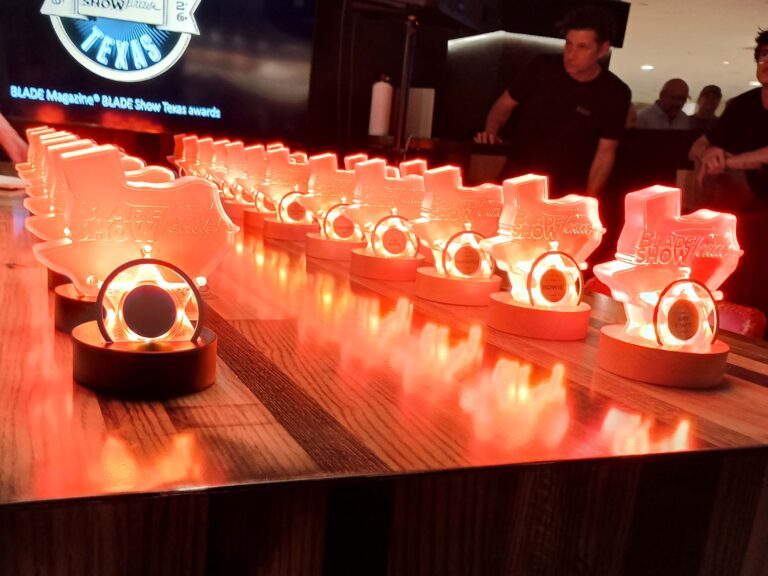
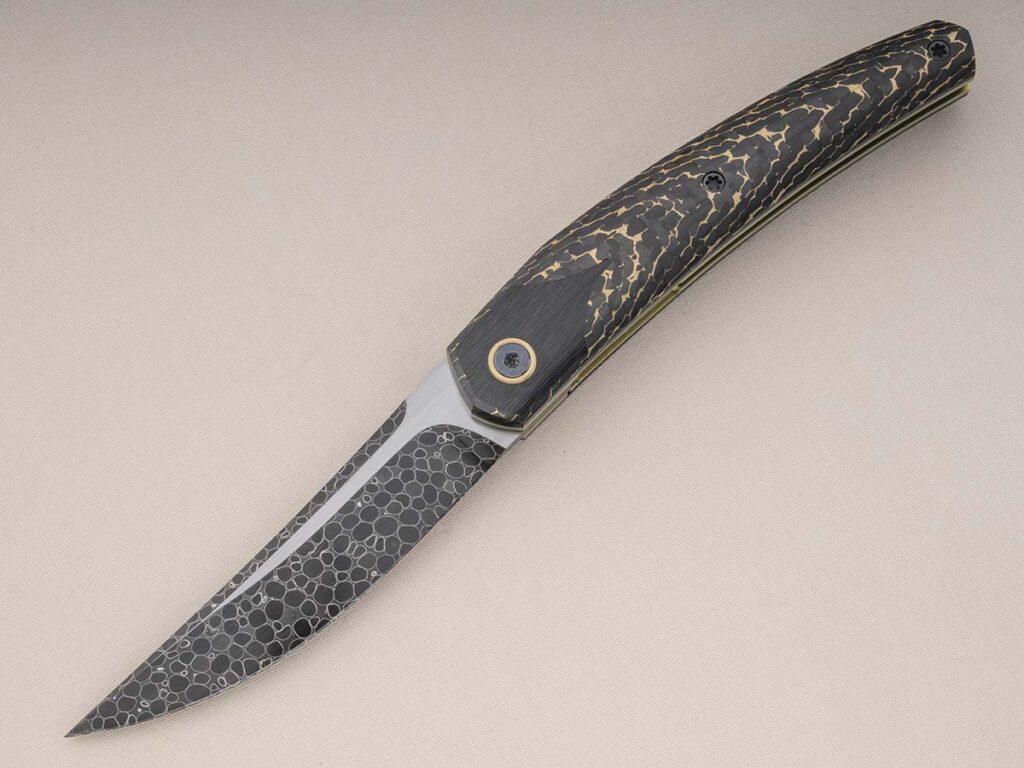
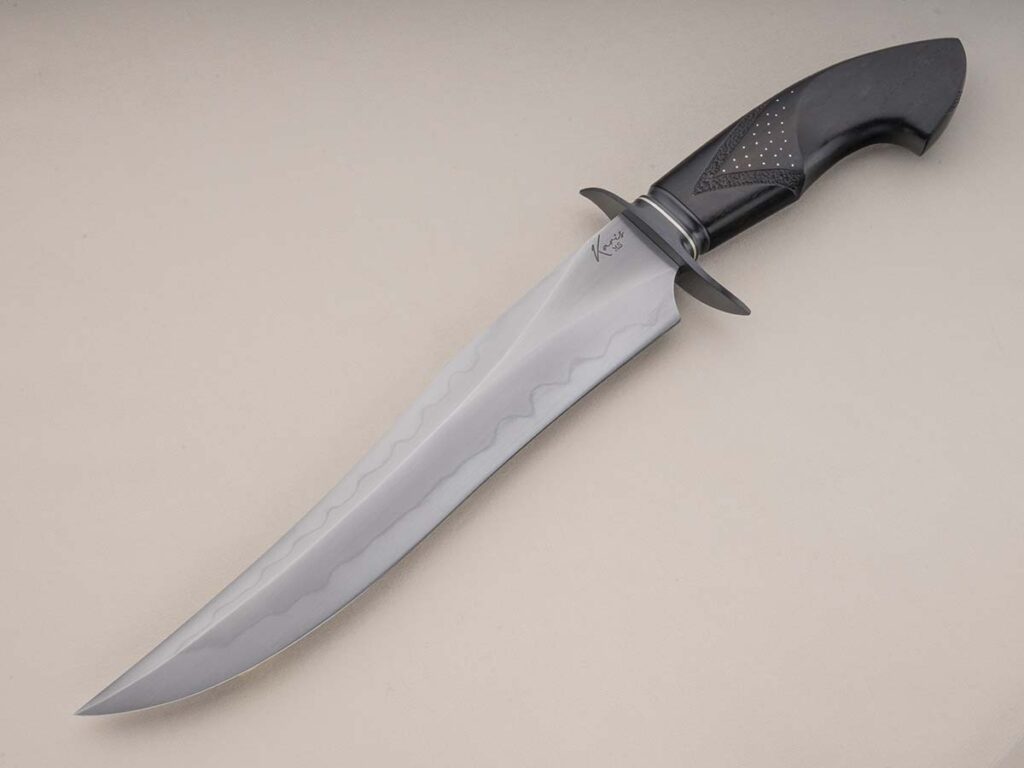
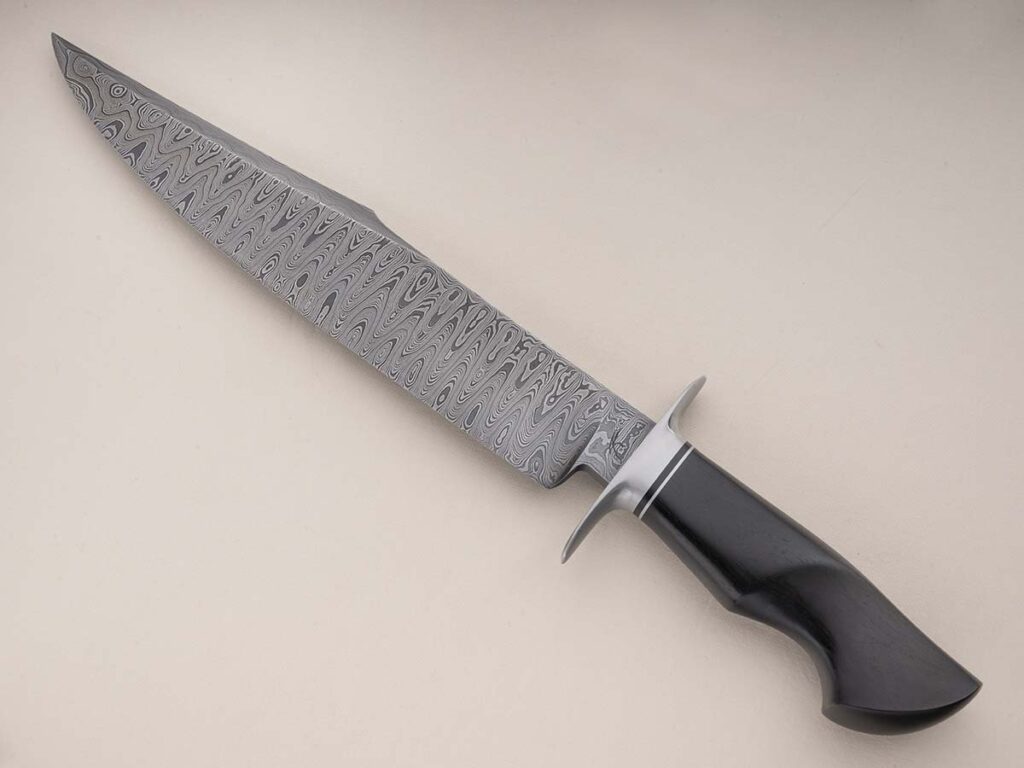
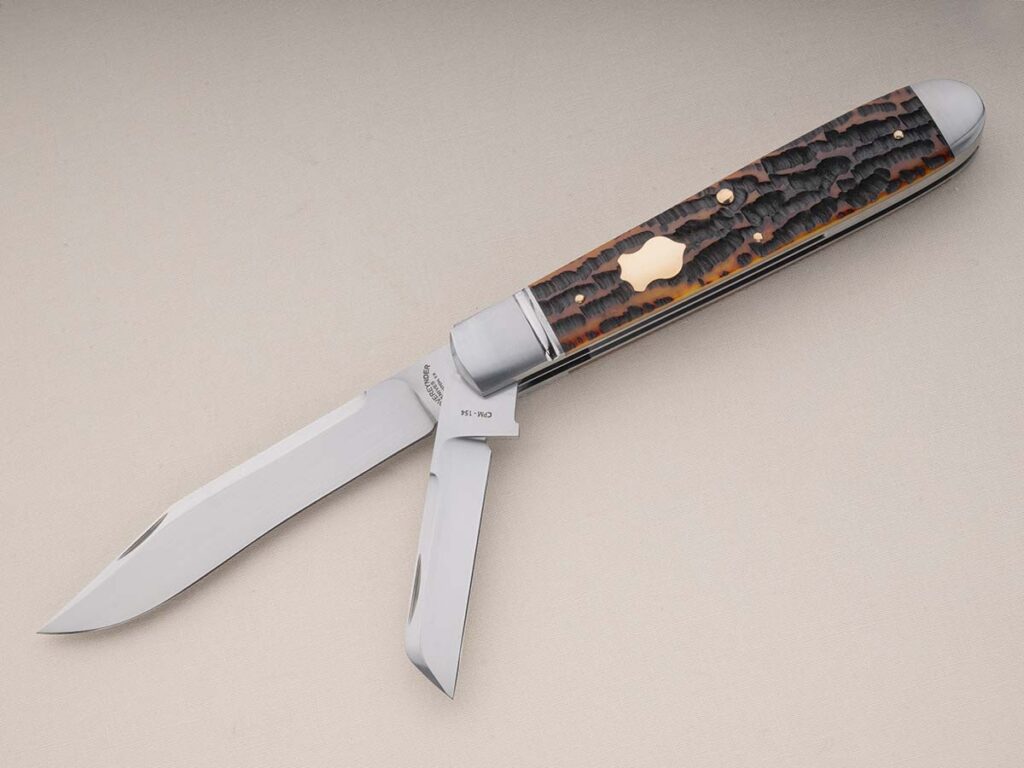
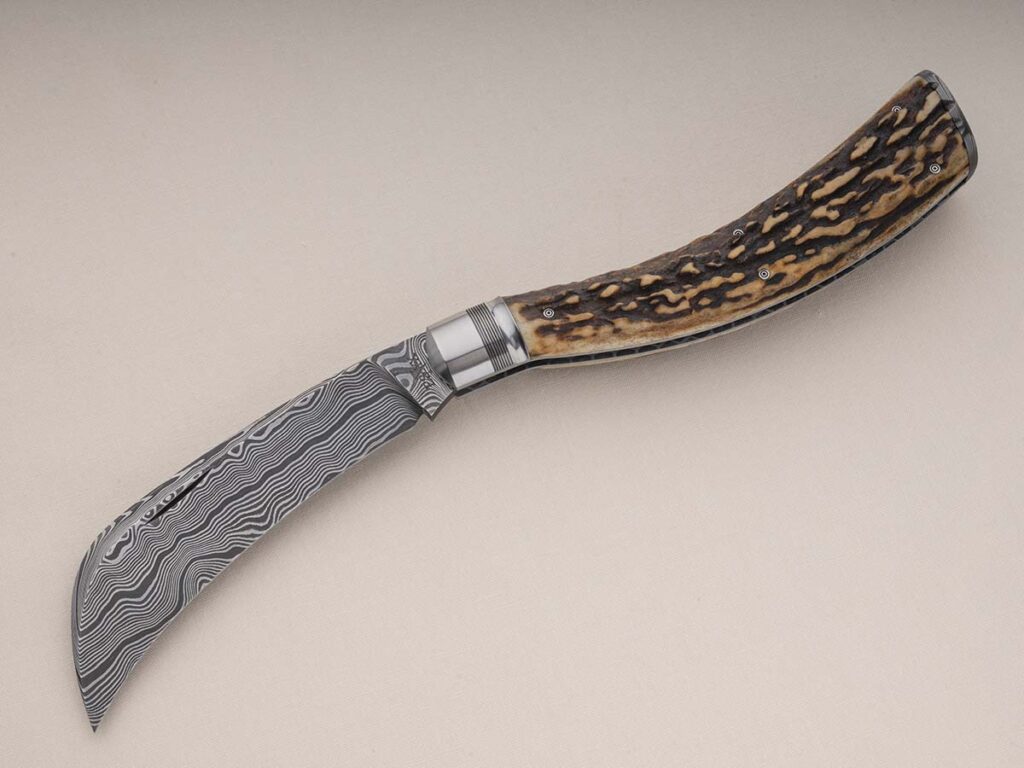
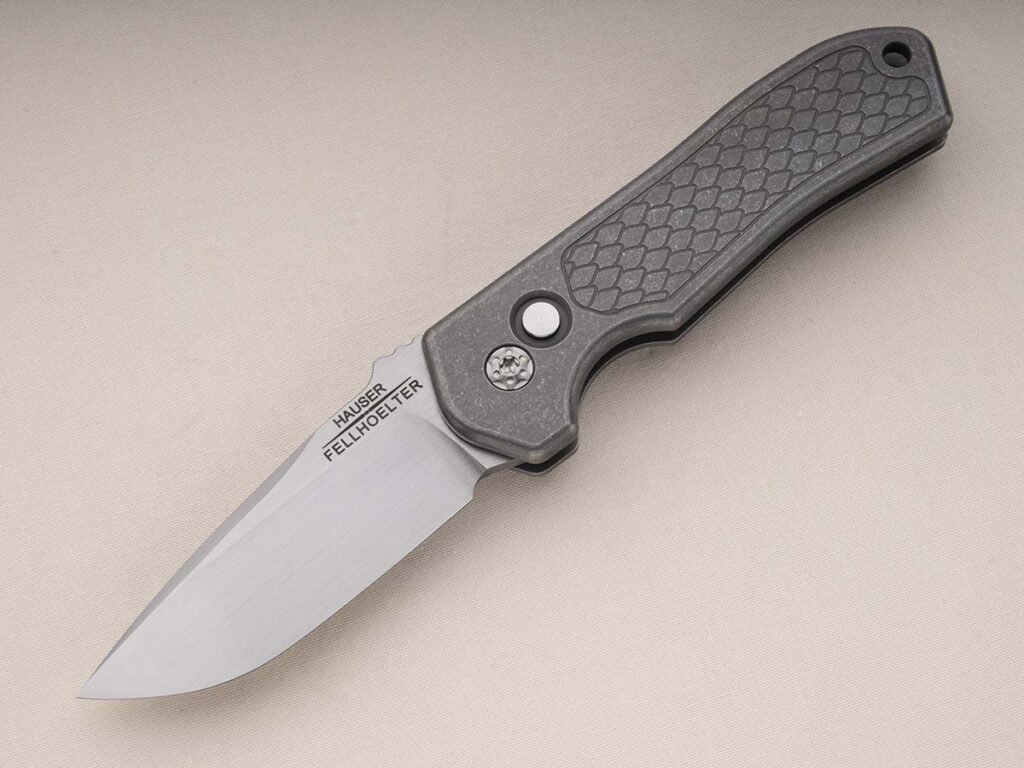
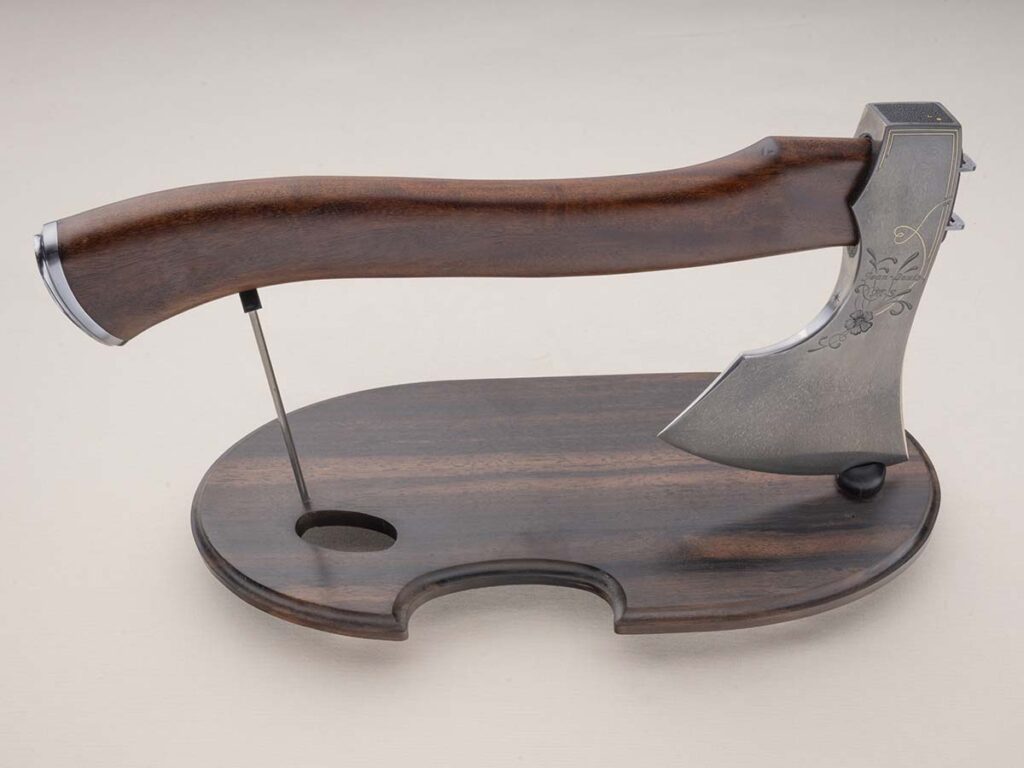
See who took home the hardware from the BLADE Show Texas Custom Knife competition.
With deep roots in fine custom knifemaking, BLADE Show Texas consistently attracts the top names in the industry, making its Custom Knife Awards a true showdown of elite craftsmanship. The 2025 competition, held March 20-21 at the Fort Worth Convention Center, was no exception.
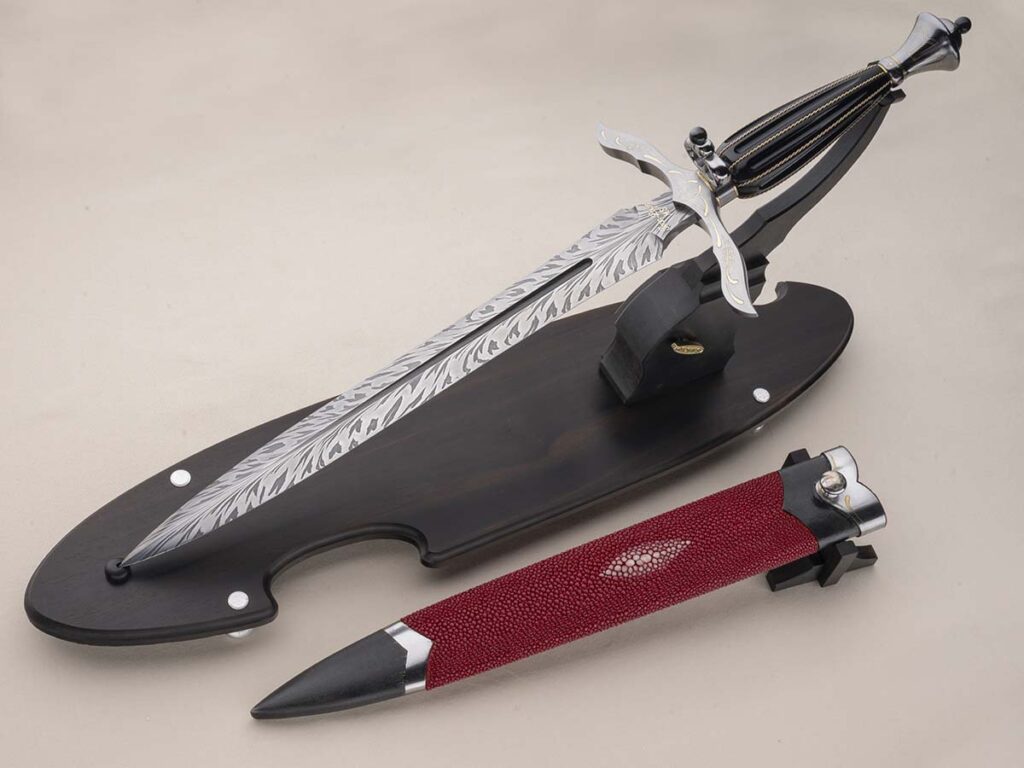
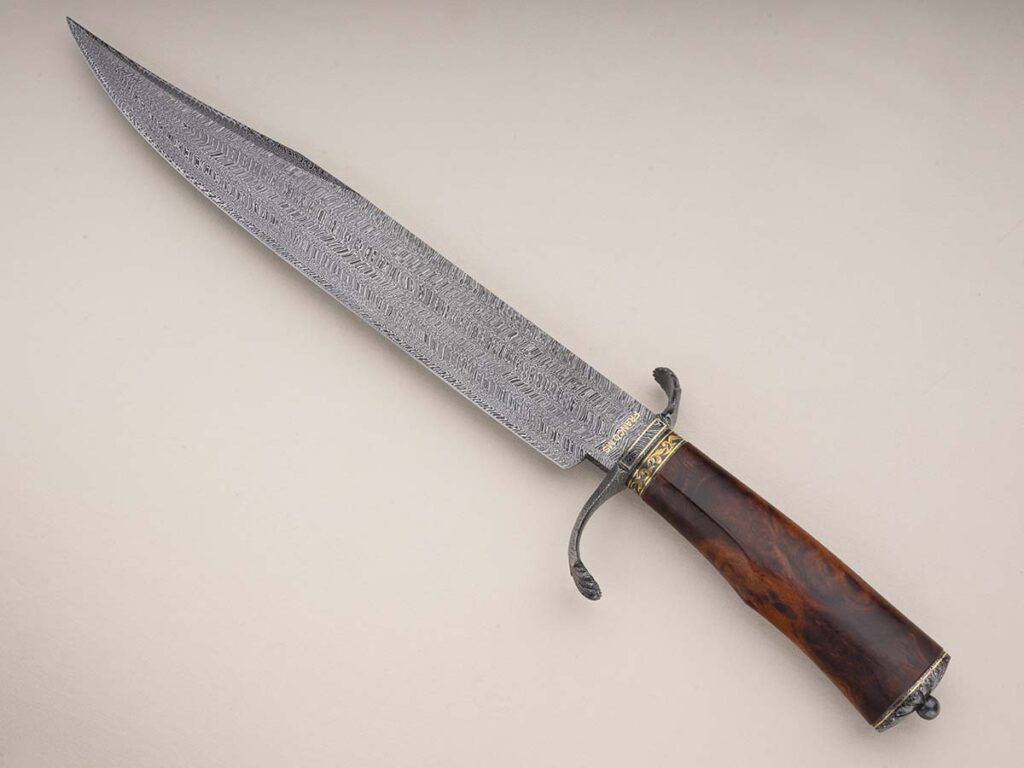
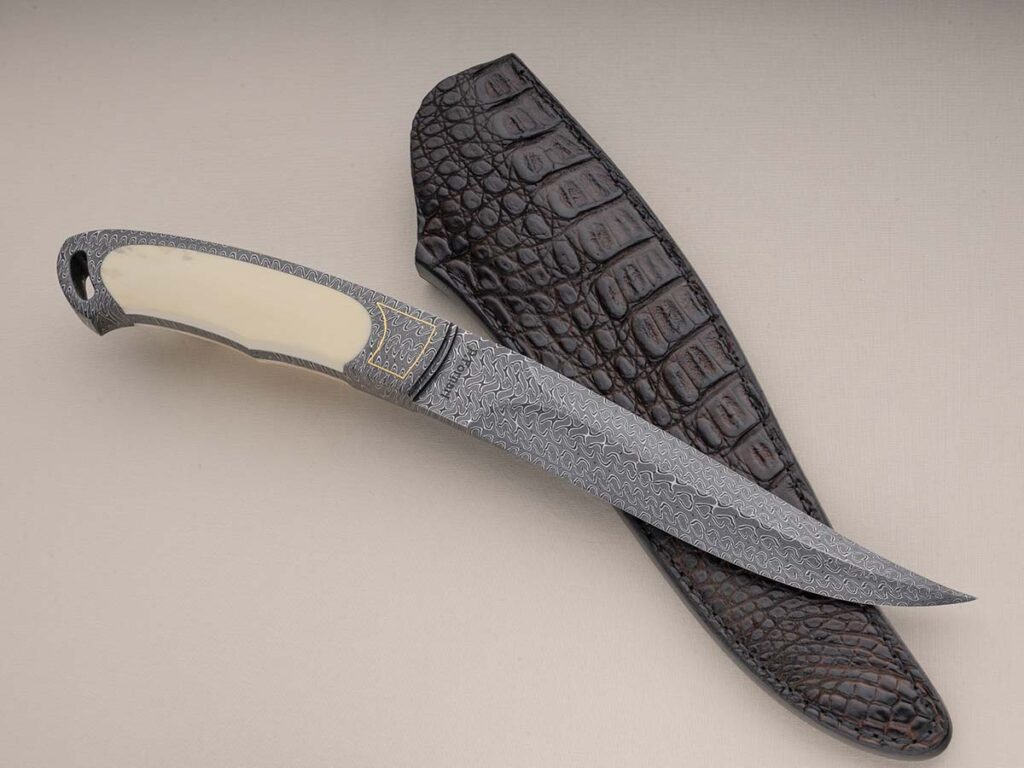
The judging hall overflowed with exceptional entries in 13 categories, pushing the three-judge panel to their limits. After intense deliberation, the judges selected the finest blades of the year—including Best of Show and Best Art Knife, awarded to Jean-Louis Regel for his stunning dagger.
Honing Rods. Honing Steel. Sharpening Steel. Here are our top picks.
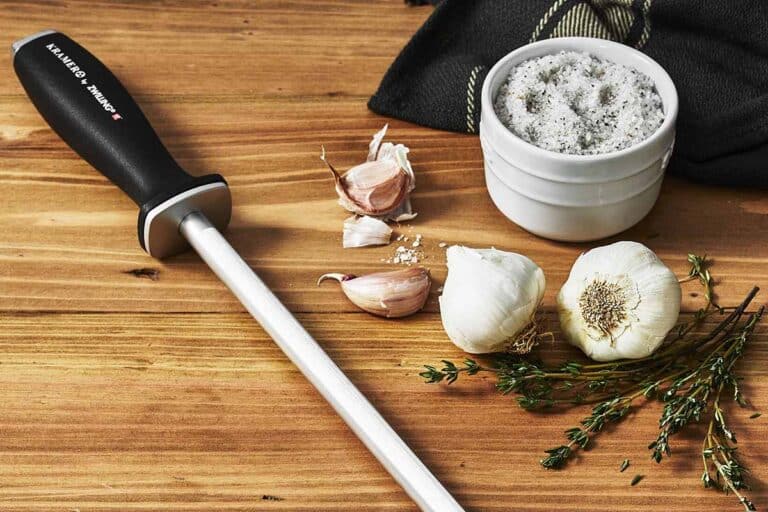
Whether it’s in your knife block or you saw Gordon Ramsay using it on TV, you’ve probably seen a honing rod. While it’s a ubiquitous piece of kit in the kitchen, it’s a bit of an enigma. Many think that this long steel rod is meant to sharpen your knives, but that’s not the case. Beyond that, contemporary rods are made from materials other than stainless steel like ceramic and diamond-coated steel.
It isn’t known when honing steels were first invented, but there are records from the Company of Cutlers in Hallamshire making honing steels in Sheffield, UK as far back as the early 1600’s.
With such a long history of use by knife owners, it’s important to know what a honing rod is, how to use it, and how to find the right one for you.
What Is A Honing Rod?
While many people call it a sharpening rod, a honing rod or steel hones your blade rather than sharpens it. With regular use, your knives will start to lose their edge. Standard wear and tear such as cutting through fibrous meats or knicking the cutting board will eventually bend your knife’s edge at the microscopic level.
By using your honing rod, you fix those small deformations to keep your knife’s edge like new. It’s important to note that you’re not removing material like you do when sharpening on a stone. A honing rod won’t help you if a knife has a totally blunt edge.
The best way to think about it is that your honing steel should be used a few times a week, or even daily, while a proper sharpening of your knives should be done once or twice a year.
Honing Rod Vs. Kitchen Sharpener
Traditional honing steel will help keep your knives sharper longer. Newer honing rods made from ceramic and diamond-coated steel do remove a minimal amount of steel when honing, usually tiny bits hanging onto your blade by a thread. No matter what material rod you use, it is healthier for your knives to use them regularly to maintain the edge for as long as possible.
Popular YouTuber Ethan Chlebowski goes in-depth on honing and how to hone to keep your knives fit for daily use.
Best Honing Rods
Whether they’re made from steel, ceramic, or even coated in diamond, honing rods come in all sizes, materials, and even shapes. These stand out from the rest.
Best Honing Rods Comparison
Rod
Weight (Ounces)
Rod Material
Handle Material
Country of Origin
MSRP
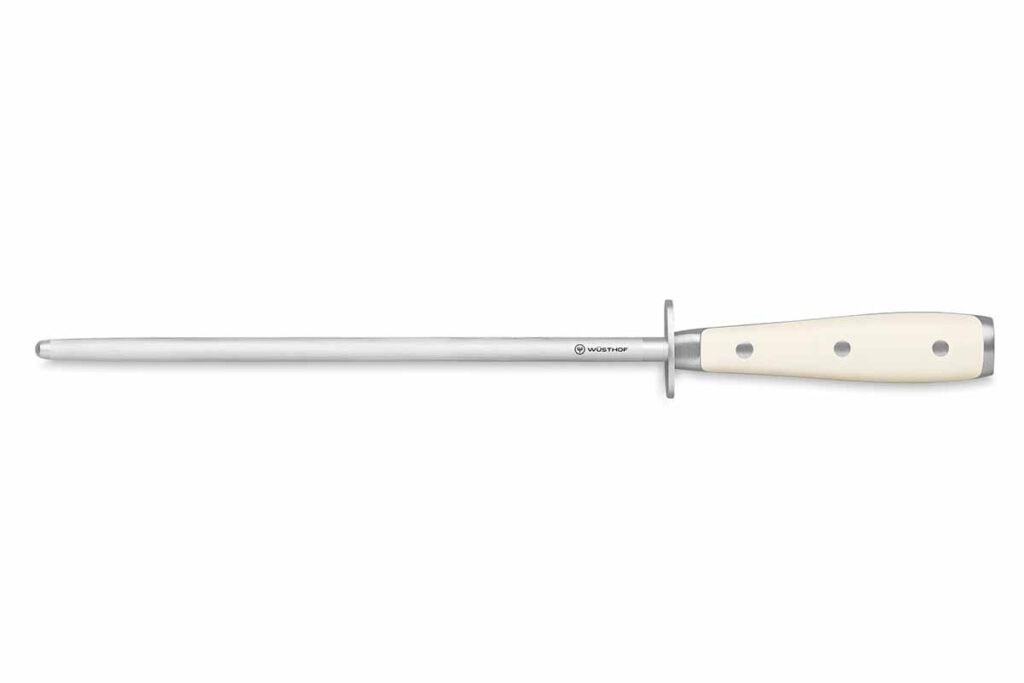
Wusthof 9-Inch Classic Ikon Honing Steel
11.6
Stainless Steel
Polyoxymethylene
Germany
$200
Zwilling 12-Inch Professional Oval Sharpening Steel
14.4
Stainless Steel
Polyoxymethylene
Germany
$60
JB Prince Mac Black Ceramic Honing Rod With Grooves 10.5-Inch
13.4
Ceramic, Steel Core
Polypropylene
Taiwan
$64
Opinel 10-Inch Diamond Steel Sharpening Rod
24
Diamond-Coated Stainless Steel
Wood
China
$60
Green Elephant Ceramic Sharpening Rod
7.2
White Ceramic
Polypropylene
Taiwan
$30
Friedr Dick 10-Inch Honing/Polishing Rod
4.9
Stainless Steel
Plastic
Germany
$83
Kuma Kitchen Knife Sharpener
8.6
Stainless Steel
Polyoxymethylene
Japan
$48
Friedr Dick Multicut Steel
15
Stainless Steel
Plastic
Germany
$150
Wusthof 9-Inch Classic Ikon Honing Steel
Wusthof 9-Inch Honing Steel
A classic honing steel by any measure, the Wusthof 9-inch steel is a great honing rod to have in your kitchen. Made of stainless steel, this is everything you want from a honing rod. It’s light and tough and made by a company with more than two centuries of history making knives.
A strong, robust honing rod is what every knife owner should be looking for, and this one checks the boxes.
Classic Ikon Honing Steel Specs Weight: 11.6 ounces Rod Material: Stainless Steel Handle Material: Polyoxymethylene Country of Origin: Germany MSRP: $200
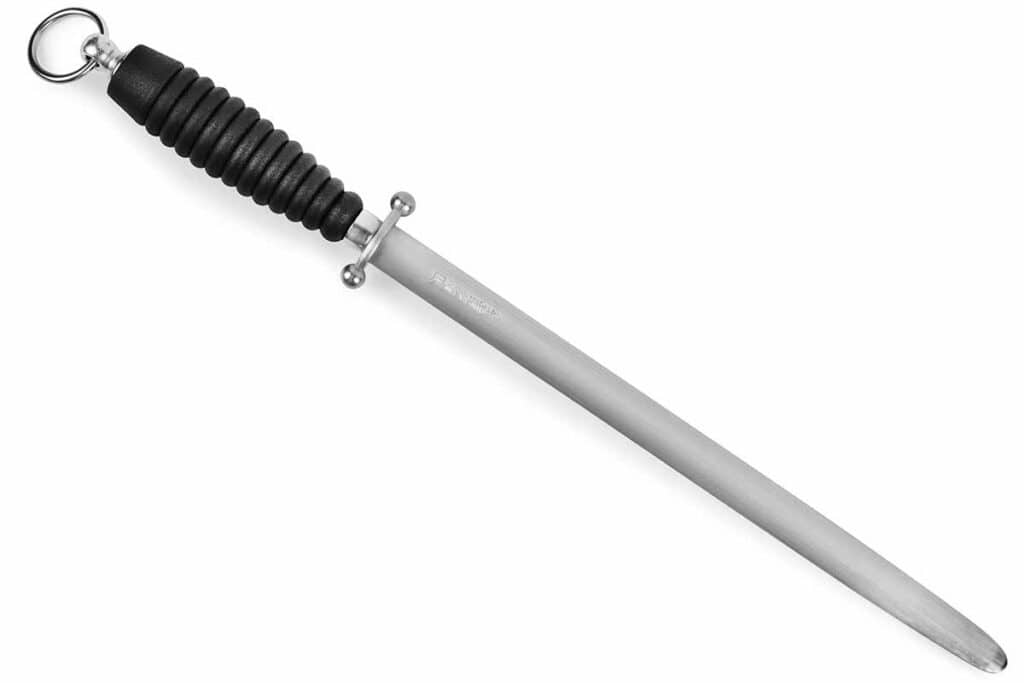
Zwilling 12-Inch Professional Oval Sharpening Steel
Zwilling 12-Inch Professional Oval Sharpening Steel
Sometimes you just need something a little bigger and heartier. This steel from Zwilling is up to the task. Its oval shape and longer length make it great for bigger knives. The chrome-plated steel is hard enough to hone most types of steel with ease and is easy to clean.
The loop at the end lets you hang it up easily too. Weighing in at just under a pound, don’t let that fool you. This is a heavyweight rod that will withstand years of use in your kitchen.
Professional Oval Sharpening Steel Specs Weight: 14.4 ounces Rod Material: Stainless Steel Handle Material: Polyoxymethylene Country of Origin: Germany MSRP: $60
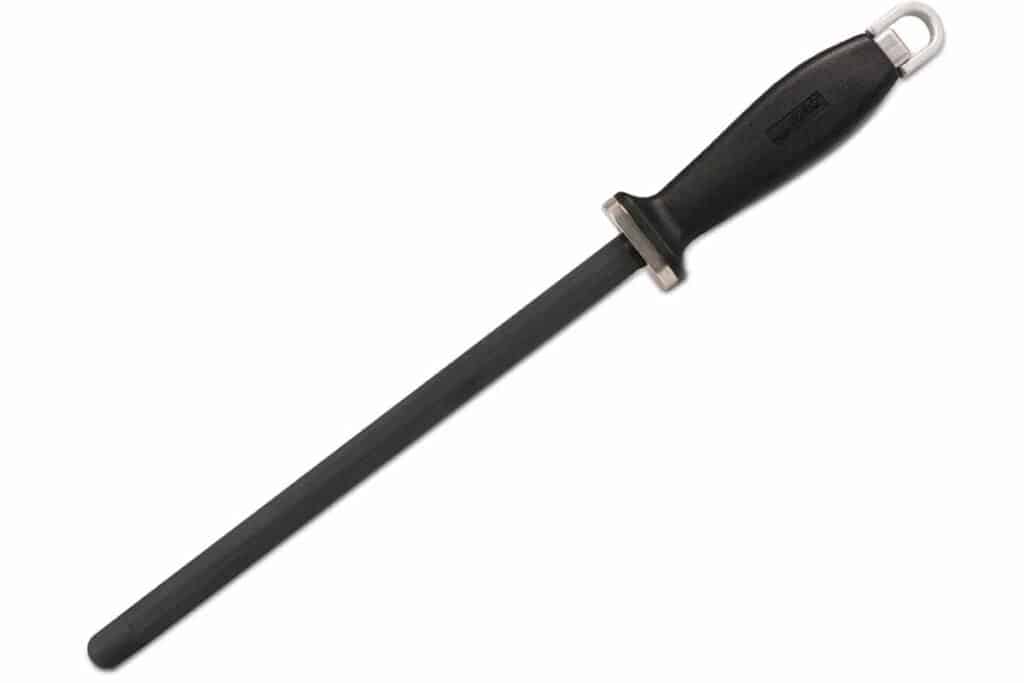
JB Prince Mac Black Ceramic Honing Rod With Grooves 10.5-Inch
With a fine 1200 grit, this ceramic rod from JB Prince is incredibly hard and durable. Its black ceramic coating is harder than both white ceramic and steel, and it’s also resistant to breaking so it can handle whatever you throw at it. Since it’s ceramic, it has the benefit of being completely rust-resistant, unlike traditional steel rods.
Most knife blocks that come with a honing rod will have a steel varietal, but looking beyond the block can lead you to quality rods like this one that can last a lifetime.
Mac Black Ceramic Honing Rod With Grooves 10.5-Inch Specs Weight: 13.4 ounces Rod Material: Ceramic, steel core Handle Material: Polypropylene Country of Origin: Taiwan MSRP: $64
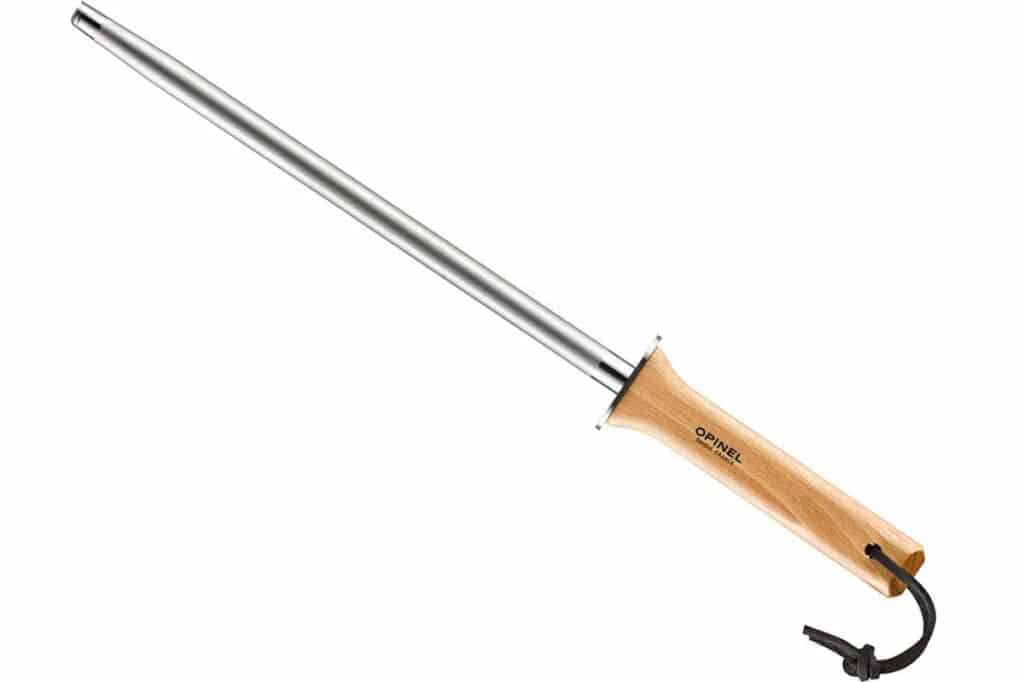
Opinel 10-Inch Diamond Steel Sharpening Rod
Opinel 10-Inch Diamond Steel Sharpening Rod
When it comes to rods that also sharpen, you can’t go better than diamond steel. This Opinel rod has a coating embedded with diamonds that sharpens as it hones. It’s good for both kitchen and pocket knives so you sharpen your EDC with it as well.
With a beechwood handle, and weighing 21 ounces, this rod feels good in the hand and will leave a pristine edge on your knives. Worth the price in every way for the discerning knife owner.
10-Inch Diamond Steel Sharpening Rod Specs Weight: 24 ounces Rod Material: Diamond-coated stainless steel Handle Material: Wood Country of Origin: China MSRP: $60
Green Elephant Ceramic Sharpening Rod
Yes, there are many ceramic rods on the market today, but you’d have a hard time finding one as robust and durable as this one from Green Elephant. With a grit of 1500, the rod is fine enough to lightly sharpen along with honing and realigning your blade. It’s also suitable for Japanese knives which may come with only one cutting edge instead of a Western, or German, style double-edged knife.
The silicone seal between the rod and the handle is designed to absorb vibrations and the whole construction is built to withstand being dropped without cracking. Lightweight and fairly-priced, this 11-inch rod is worth a look.
Ceramic Sharpening Rod Specs Weight: 7.2 ounces Rod Material: White ceramic Handle Material: Polypropylene Country of Origin: Taiwan MSRP: $30
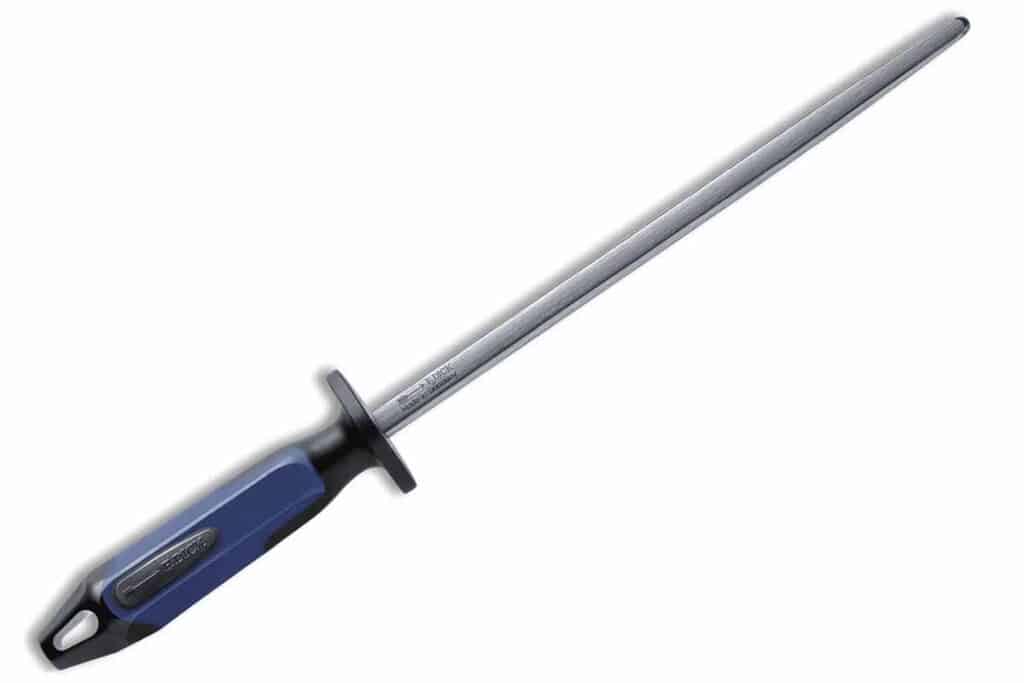
Friedr Dick 10-Inch Honing/Polishing Rod
It is almost impossible to chip this rod thanks to being coated in diamond dust. From German maker Friedr Dick, this 10-inch rod is diamond-coated steel is designed for the heavy knife user in mind.
An oval shape allows more of the blade to contact the rod with each pass which means each knife takes less passes to hone. The ergonomic, dual-density polymer grip keeps everything safe and secure when passing the blade down the rod.
The catch-22 is the diamond itself. Yes, it will return your knife’s edge quicker, but use the rod too often and it’ll scrape off material far faster than other types of rods.
10-Inch Honing/Polishing Rod Specs Weight: 4.9 Rod Material: Stainless Steel Handle Material: Plastic Country of Origin: Germany MSRP: $83
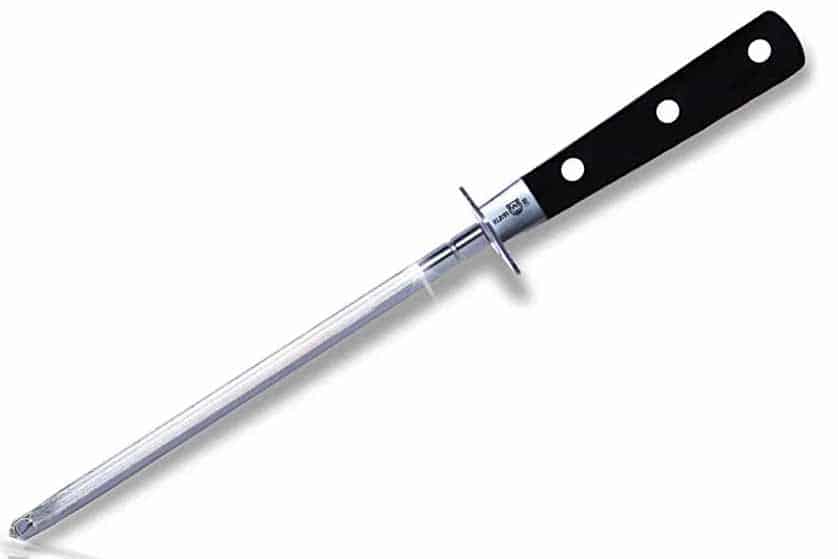
Kuma Kitchen Knife Sharpener
Some rods are designed for only one type or knife or are too short to properly hone long chef’s or slicing knives. This honing steel from Kuma is the consummate all-arounder. The steel reliably restores your knife’s edge thanks to its carbon steel construction. The triple-riveted ergonomic handle is slip resistant so even honing wet knives (although you shouldn’t do that on a honing rod) can be done safely.
Unlike most of the other rods on this list, this steel will need more hands-on maintenance due to its carbon steel construction otherwise it will rust.
Kitchen Knife Sharpener Specs Item Weight: 8.6 ounces Rod Material: Carbon Steel Handle Material: Polyoxymethylene Country of Origin: Japan MSRP: $48
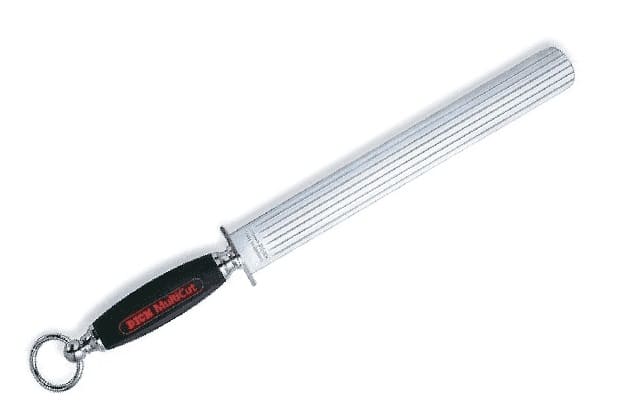
Friedr Dick Multicut Steel
Another entry on this list from the German maker, this honing steel looks unlike anything else out there today. At first glance it’s easy to think this is a misplaced paddle, but in reality it’s a multi-dimensional honing steel.
The flat 11-inch blade has six parallel grooves running through it. Slide your knife down the main body of the steel and it’ll hone like any other rod. However, slide down one of the grooves and you can more precisely remove burrs and imperfections from the blade.
This is far and away the priciest honing steel on the list so you’ll need to determine if it’s worth the investment or if you would be better served using one of the other rods to hone your knives.
Multicut Steel Specs Weight: 15 ounces Rod Material: Stainless Steel Handle Material: Plastic Country of Origin: Germany MSRP: $150
Editor’s Note: This article was written by Mike Ableson.