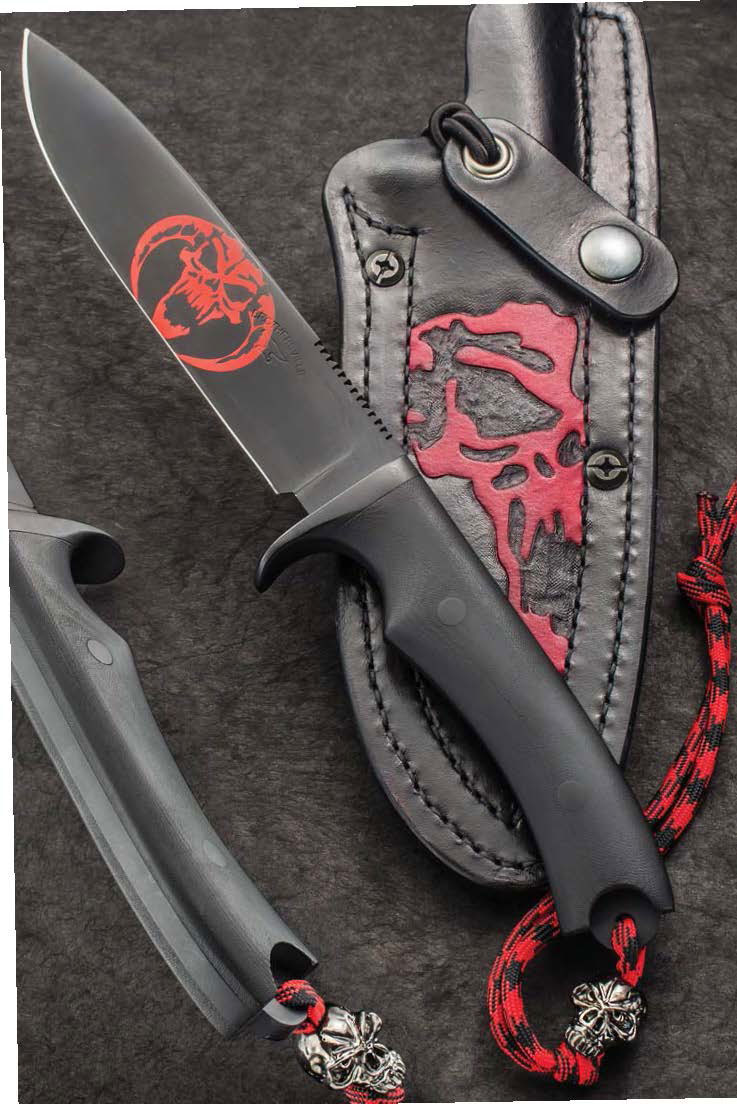
Peter Pruyn reproduced John Horrigan’s Bob Horrigan Fighter as a present for his son Jack who is considering going into the military after he graduates high school. The knife is named in honor of John’s brother, Bob Horrigan, 1st Special Forces Group, who was killed in action in Iraq in 2005. (SharpByCoop image)
With his son Jack expressing an interest in joining the military once he graduates high school, Peter Pruyn figured a reproduction of the Bob Horrigan Fighter by one of his mentors, ABS master smith John Horrigan, would be just the ticket as a gift form his military son in waiting.
“ABS master smith Red St. Cyr, another one of my mentors, said when you feel you’re good enough to make a knife in the style of one or more of your mentors, do it,” said Pruyn (Pruyn rhymes with pine).
Horrigan, a U.S. Army Ranger veteran, law enforcement officer and firefighter, is one of Peter’s mentors, ergo Pruyn’s version of the Bob Horrigan Fighter. Peter’s version has a few differences—among them a 5.5-inch blade, 154CM stainless steel, flat grind, embellished red skulls and a Cerakote® finish by Jesse Ruiz of Legendary Coatings instead of John’s 6.5-inch blade, 440C stainless steel, hollow grind and sand-blast finish.
Peter’s daughter Sophia fashioned the lanyard and attached the Emerson skull bead.
For more information contact Brothersville Custom Knives, c/o Peter Pruyn, Dept. BL3, 110 Reel Ln., Grants Pass, OR 97527 631-793-9052 [email protected], Facebook/Instagram: Peter Pruyn.
SPECS
KNIFE: Reproduction of John Horrigan’s Bob Horrigan Fighter
MAKER: Peter Pruyn
BLADE LENGTH: 5.5”
BLADE STEEL: 154CM stainless
BLADE GRIND: Flat
BLADE COAT: Emerson skull embellishment w/Cerakote® finish by Jesse Ruiz of Legendary Coatings
HANDLE: Micarta SHEATH: Kydex under leather w/red skull embellishment, felt inside Kydex, snaps, MOLLE compatible, multiple carry options, by Will Elmore
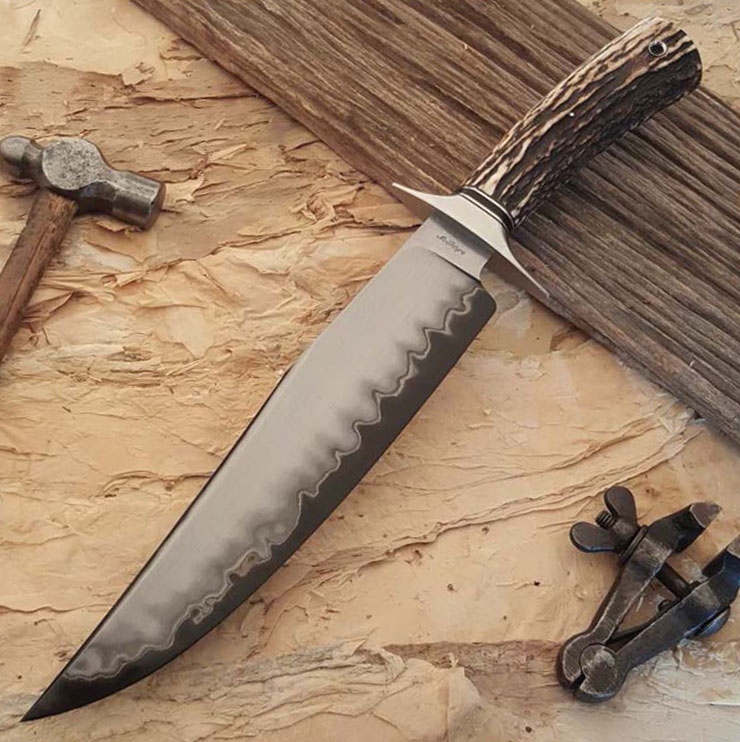
The author stated that Australian ABS master smith Shawn McIntyre “has created his following by offering exceptional quality at a value price.” McIntyre’s “San Mai Bowie” features a 10-inch blade in a san-mai construction, a sambar stag handle and a leather sheath. The author’s price: $1,575. (Shawn McIntyre image)
Editor’s note: This article is from the knifemaker’s point of view, but it could also be used by collectors to better understand price.
Make the Equation
Most manufactured products, whether factory or custom made, have similarities. For those of you unfamiliar with cost accounting, one of the similarities is basically what the costs for building a particular item are.
In the case of custom knives, such costs include those for the machines, belts, drill bits, saw blades, propane, tongs, hammers, etc.—in other words, anything in the shop used to produce the knife.
Other items not necessarily taken into account are those such as the cost of electricity, machine wear and tear, etc. Obviously, materials are easy to account for.
Then there is the amount of money you want—want being the operative word—to make selling your knives, followed by the amount of profit you want to make. The resulting equation is:
Shop time + material costs + maker’s pay (labor) + net profit = the actual cost (or price) of the knife
(Editor’s note: for collectors, the wiggle room on negotiation could be found in the net profit part of that equation.)
When the Price is Too High
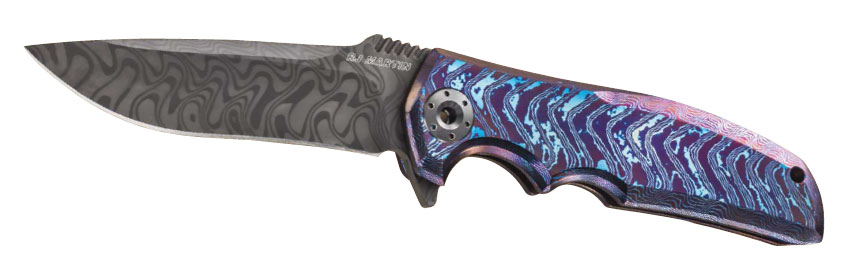
Of RJ Martin the author noted, he “has secured his position as one of the best and most sought after tactical folder makers in the world, due in part to the value pricing he has utilized over the last 30 years.” Martin’s Illudium boasts a 4-inch blade of Chad Nichols Boomerang stainless damascus and a handle of Nichols’ Moku-Ti. The tip-up clip is zirconium. Approximate closed length: 5 inches. The author’s price: $6,000. (Sharp By Coop image)
Again, you’re a knifemaker. Are your knives too expensive? The short answer is “probably.” Over the past 32 years of asking knifemakers the question, the two most prevalent answers I get are:
1) My knives are priced on the advice of another knifemaker;
2) My knives are priced based on what others are asking for similar knives.
While makers who incorporate such pricing strategies can justify them, both approaches incorporate what I call lazy pricing. While you may not realize it, other knifemakers are your competitors.
While they may mean well, their advice for your knives is misplaced. First and foremost they are knifemakers, not knife buyers. What they know are their knives, their market and their clients. This may or may not have any impact on your knives, or, more importantly, the selling of your knives.
In some cases other makers may understand that you are a competitor and suggest you raise your prices, giving their knives more perceived value.
While attending the 1989 Knifemakers’ Guild Show, I was standing at the table of a very well-known knifemaker and checking out his knives. A new maker approached the veteran maker and asked him to critique his knives. The veteran maker asked him how long he had been making knives and for his price for one of them.
The new maker replied, “I have been making knives for two years and this knife is $250.”
The veteran maker said, “You are doing good work. I would raise the price of this knife to $325!”
As you can imagine the new maker thanked the veteran maker, smiled and returned to his table.
In the next few minutes a potential buyer was questioning the veteran maker about the $375 price tag on a particular knife. The veteran maker was quick to point down the aisle, saying, “See that maker right there? He has only been making knives for two years and is asking $325 for one of his knives. Quite frankly, my price is a bargain.”
Whose interest did the veteran maker have in mind while recommending pricing to a fellow maker who sought his advice? To date I have never had a maker using this strategy tell me the veteran maker suggested that the maker lower his or her prices. I found this to be a real eye opener, and it changed the way I looked at custom knife pricing.
When the Price is Too Low
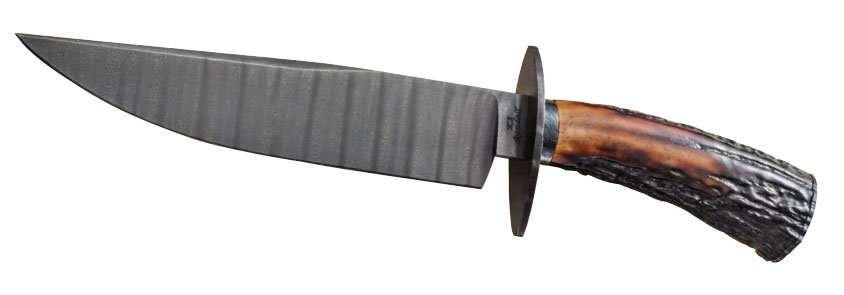
ABS master smith Steve Randall outfits his straight knife in a 7.5-inch blade of ladder-pattern damascus and an amber stag handle. The author’s list price: $1,650. “Steve’s work continues to impress,” the author observed. “Since the inception of his making custom knives, he has always incorporated value pricing into them.” (Sharp By Coop image)
If you are a knifemaker, remember that, early on, people are paying for you to learn your knifemaking skills—a sort of scholarship program, if you will. The object of the exercise is to get as many of your knives into the hands of buyers as possible. You can do this by utilizing value pricing. Your market position will indicate to you what the price should be.
As your knifemaking skills and following develop, your pricing, because of your rising position in the market, will continue to increase. At this point your pricing will be determined not by a friend or another maker’s similar work, but through your understanding of your position in the market and how you got there.
Ask the Author More About Pricing at BLADE Show 2018
Conducted the day before and the Friday and Saturday of the BLADE Show June 1-3 at the Cobb Galleria Centre in Atlanta, BLADE University is the most comprehensive array of classes on the subject of knives and knifemaking of any knife show.
From 9:45 to 10:45 a.m. on Saturday, June 2, Robertson will conduct the class “Knife Collecting for Beginners” and discuss what you need to know before you start buying custom knives.
For more information on these classes and others in BLADE U., visit bladeshow.com.
Each Tuesday in April, KA-BAR will release a video documenting a piece of its storied 120-year history. What, you thought it started with the USMC knife in the ’40s? You’d be wrong.
The KA-BAR website will host the videos, but you can also catch the installments on YouTube. Here is the first episode.
Beyond the marketing value of such a series, these episodes should serve as a history lesson for knife collectors. Often, the provenance of a knife, or a line of knives, is tied to its value or collectibility. And there are few companies with the kind of history that KA-BAR brings to the table.
The author is the owner of a store that sells knives, often to first responders. Restrictions on the importation of the folding knives those customers often use hurts not only her business, but also the ability of first responders to do their important work. (Image via LethbridgeTacticalSupply.com)
Editor’s note: Sarah Jorgensen is the owner of Lethbridge Tactical Supply, a knife retailer in Lethbridge, Alberta, Canada. Read BLADE‘s previous articles about prohibitions on the import of folding knives into Canada here.
More Questions Than Answers
Sarah Jorgensen
A recent decision by the International Trade Tribunal (ITT) has only added more questions than answers when it comes to the tools Canadians can and cannot use for self-defense, emergencies and everyday tasks. After a seizure by the Canadian Border Services Agency (CBSA), the ITT announced in January 2018 that it is restricting the import of knives that “have a blade that opens by centrifugal force,” and that “includes knives that require some preliminary or simultaneous minimal manipulation of either a flipper or other non-edged parts of the blade.”
So what are our rights? What are we allowed to use to protect ourselves? Will we get in trouble if we hurt someone with a particular kind of knife while acting in self-defense? And most importantly, are we risking our safety by asking these questions in an emergency instead of acting?
Section 84(1) of the Criminal Code of Canada states that a prohibited knife “has a blade that opens automatically by gravity or centrifugal force or by hand pressure applied to a button, spring or other device in or attached to the handle of the knife.”
Wait a minute. How did we go from a device on the handle, to a device on the blade? The Criminal Code has not changed, but the CBSA’s interpretation has. This means that Federal, Provincial and local law enforcement agencies do not consider flippers on the blade of a knife as prohibited, but the CBSA does.
It Doesn’t Add Up
As a retailer, I can still purchase and sell these knives with no restrictions. However, if I can’t import them, how can I sell them? There are very, very few knives made in Canada, certainly not enough to keep up with the demand of our customers. Some knife manufacturers are now refusing to ship any folding knives at all into Canada because they are not sure which knives the CBSA is going to consider prohibited and seize.
So, why would the CBSA and International Trade Tribunal come to this decision? Are they keeping Canadians safer? Has there been an increase in attacks with knives that have assisted openings? The answer to both of those questions is no. I can still import fixed-blade knives, machetes, axes and batons. Are those items any more or less dangerous than an assisted-opening knife?
And who uses these assisted-opening knives that are so dangerous that the CBSA must override the Criminal Code to protect Canadians? Well, the majority of my customers are first responders (including CBSA agents) and they use these knives. They use them to gain access to vehicles and cut seat belts from people involved in car accidents. They use them as a last line of defense. They use them while on camping trips with their families. Most commonly, they use them to open packages and boxes. I sell these knives to knife enthusiasts and collectors, avid outdoorspeople and, yes, I sell them to people looking for a way to protect themselves in an emergency.
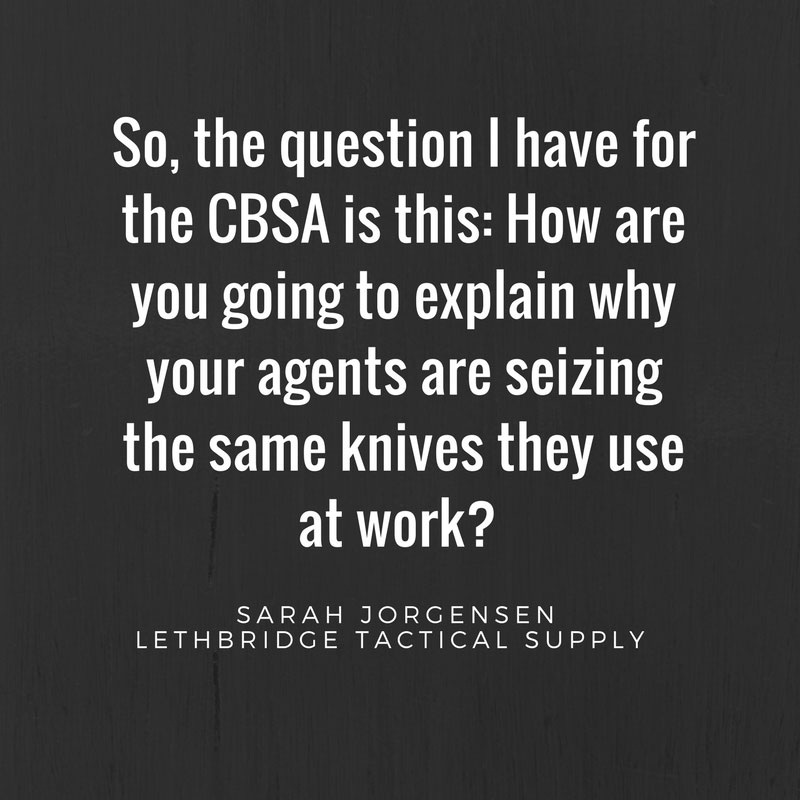
So, the question I have for the CBSA is this: How are you going to explain why your agents are seizing the same knives they use at work?
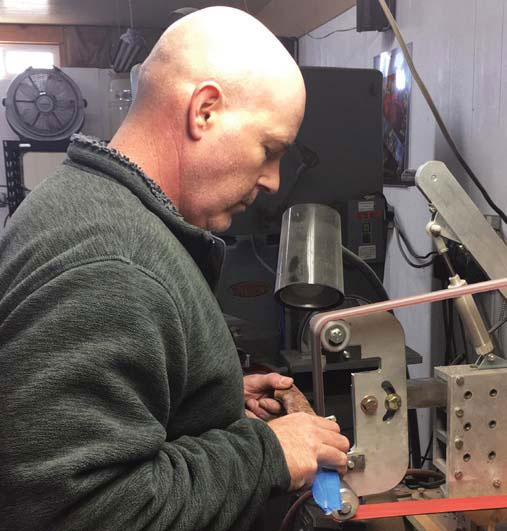
In CPM-154 stainless, John Bartlow said he found a steel that allowed for a flawless finish. At the grinder here in his shop, Bartlow uses the steel on his utility fixed blade equipped with his trademark line cutter in the ricasso. (SharpByCoop knife image)A veteran of 30 years in the Knifemakers’ Guild, John Bartlow started out using 440C stainless steel for his knives, moved to ATS-34 and today has graduated to CPM-154. Raphael Durand uses the latter steel on his stag lockback. (SharpByCoop image)
Based in Sheridan, Wyoming, by way of Tennessee, 30-year Knifemakers’ Guild member John Bartlow uses CPM-154 for his bird and trout and hunting knives. When Bartlow first started making knives, he was also a hunting outfitter.
As a result, he gutted and skinned a lot of animals on a weekly basis. Having many of his guides use his knives, he got a lot of feedback over the years about design and function.
“I started out with 440C stainless steel a million years ago,” Bartlow remembered. “I quit that nearly 20 years ago and jumped to ATS-34 stainless and used it for years and years.”
He said that about a decade ago he started to become frustrated with the quality of the ATS he was getting. There weren’t major structural problems like chipping or breaking, but there were very subtle issues Bartlow observed under 10-to-12-power magnification.
“My customers never noticed it but it bugged me,” he continued. “I was trying to get some finishes in that stuff —and I was buying through normal channels from several suppliers—but when I would go to finish it, once in a while I’d get this little area that looked like it had pits in it, or it kind of had a little ‘road rash’ that I could not get rid of.”
He approached other makers about it at the time and they said they’d seen the same thing. That motivated him to jump ship to CPM-154, he said, which is very much a sister steel to ATS-34 and 154CM.
“They are closely related on the family tree of steel,” he said. In CPM-154, he found a material that allowed for a flawless finish. With the powder metallurgy process and the accompanying uniform distribution of carbides, it eliminated the “road rash” issue.
Here grinding a blade in his shop, David Sharp said CPM-154 exhibits excellent edge retention, sharpenability and corrosion resistance.
“A large percentage of my knives have a very fine finish, polished or over-1200-grit hand satin,” the maker based in Hesperia, California, remarked. “CPM-154 is very fine, so when it’s finished to a high level you don’t see the steel’s grain.”
He added that CPM-154 is not quite as abrasion resistant as other of the relatively newer steels, so obtaining a fine finish is a bit quicker. He said that though steels are an oft-discussed topic online, he very seldom has customers request a steel type or brand, which could be seen as a testament that his choice of CPM-154 is a good one.
“I have not noticed a downside,” Sharp continued. “The upside is the finish and that it is, in my opinion, a balanced steel. For the majority of users it exhibits excellent edge retention, sharpenability and corrosion resistance.”
It’s one for the record books, but it’s nothing to celebrate.
The murder totals in London for February and March tallied at 37. That’s two more than New York City’s 35 for the same time period. This marks the “first time in modern history” that London surpassed New York City for murders, according to the The Times.
Despite that, stabbings accounted for 31 of London’s murders, and knife crime in general is the driving factor for the increase. This would seem to indicate the ineffectiveness of London’s knife restrictions overall, as indicated by this tacit admission from MP Sarah Jones.
“We need a proper strategy that looks at all of the issues.
“Knife crime and violent crime acts like an epidemic, so you need to go in at the source to cut it off and then you need to inoculate the future young people against it.
“Going in at source means major intervention work with youth workers, inoculating means going into schools, changing the social norms, educating kids, teaching them what it is to be a man, teaching them how they don’t need to carry knives.”
This quote, also from the BBC, from the former superintendent of London’s Metropolitan Police, Leroy Logan, echoed those sentiments.
“Police can’t just arrest or stop and search their way out of this problem; it has to be done in partnership with the communities.”
This is in line what many in the knife community have argued for years. Knives aren’t why someone commits a violent act. There are other factors at play that influence behavior, and those should be identified and addressed.
Granted, banning certain items, such as knives (or firearms, a parallel discussion in the United States), may well prevent someone from committing a violent act with that item, but left unaddressed are the would-be aggressors’ motivations and circumstances. Until and unless that happens, the sliding scale of destructive tools will simply move on to the next item. Case in point: UK acid attacks are on the rise. That follows extensive prohibitions on firearms and knives.
Even The Guardiancalled into question the term “knife crime” as being misleading or overly simplified.
“Knife crime” is a construct. It does not simply mean, as one might reasonably expect, crimes committed with knives. It denotes a certain type of crime committed by a certain type of criminal in a certain kind of context.
Those “certain types” often single out particular groups of people, which makes “knife crime” as a concept even more insidious. From The Guardian again (emphasis is mine):
In 2007, then prime minister Tony Blair told an audience in Cardiff: “The black community – the vast majority of whom in these communities are decent, law-abiding people horrified at what is happening – need to be mobilised in denunciation of this gang culture that is killing innocent young black kids. But we won’t stop this by pretending it isn’t young black kids doing it.”
When politicians frame the issue in this way, the results can disproportionately impact communities of color via increased law enforcement scrutiny. It’s as if white majority populations are somehow exempt from the factors that lead to “knife crime.” Or, worse, that there is something inherent about people of color that predispose them to violent acts.
When white kids are killed, people opine about the state of youth today, the demise of the town in which they died, or the world in general. When black kids are killed, usually the assumption is that their race had something to do with it.
It comes full circle when comments come in following a murder involving a knife and a person of color.
And yet a few days after his death, a Conservative councillor in Dover, Bob Frost, posted a news story about Djodjo’s murder on Twitter with the message “#BlackKnivesMatter. The carnage continues into 2017. Any protest from the ‘community’? Thought not.”
This phenomenon is well-known to the knife community at large. For example, New York’s restrictions on “gravity knives,” enforced with enthusiasm in New York City, levy an oversized impact on minority groups.
That this toxic stew of tunnel vision, racial bias and misleading terminology should finally express itself in a historic first for murders in London shouldn’t come as a surprise. It should come as a warning. If the root of “knife crime” isn’t dug out, London may, unfortunately, find itself positioned at the floor of a rising trend, not the ceiling.
Kirpan: When Knife Restrictions Collide with Religious Freedom
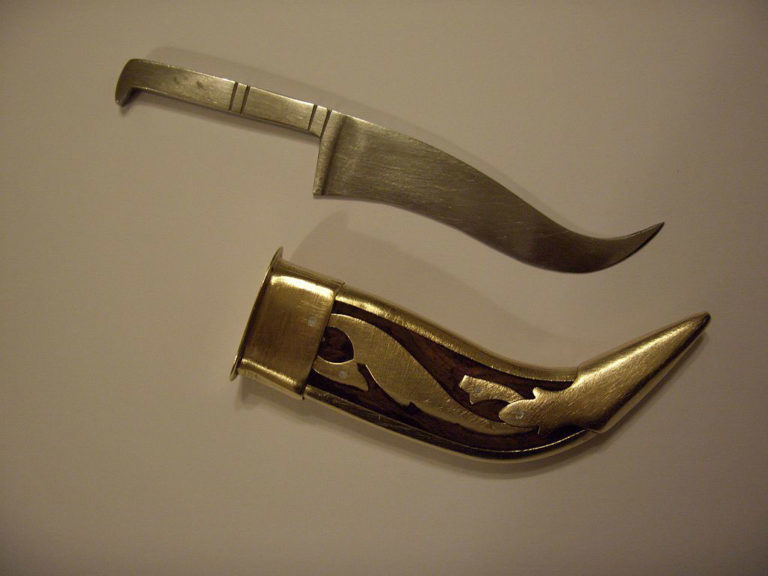
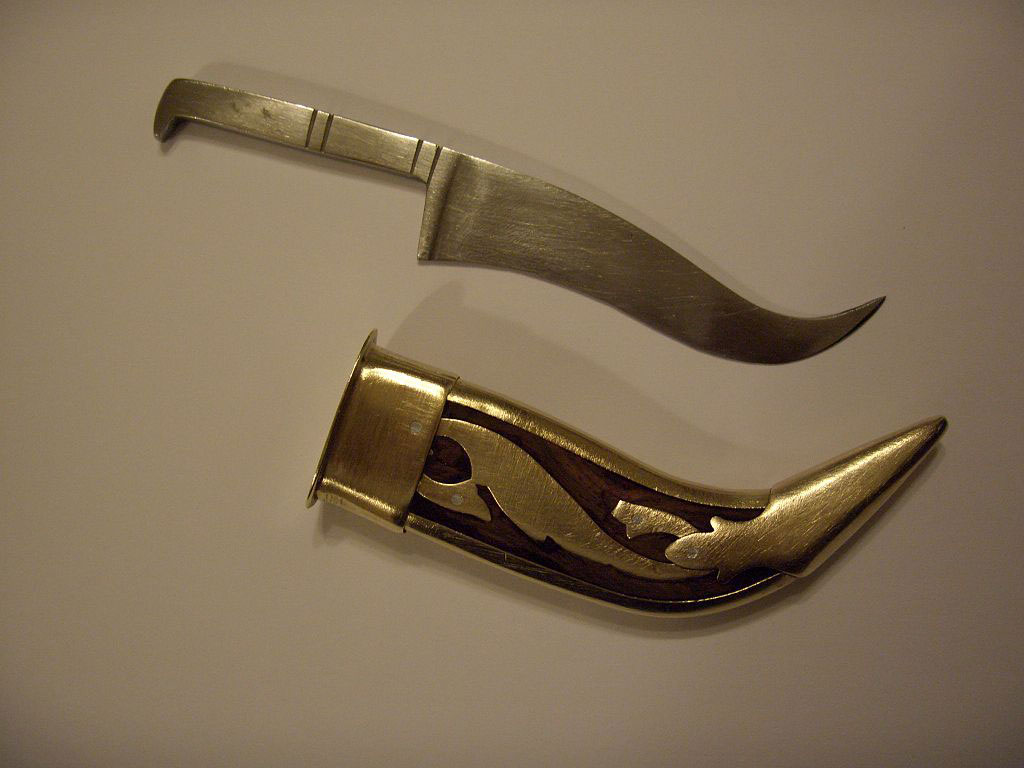
A kirpan and sheath. (By Harisingh at the English language Wikipedia, CC BY-SA 3.0, https://commons.wikimedia.org/w/index.php?curid=4525719)
As part of the Five Ks, the kirpan is a dagger that is central to the Sikh faith. Sikhs carry the dagger on their person, and that can conflict with knife restrictions. Simply put, Sikhs can find themselves forced to choose between adhering to their faith and breaking the law.
New Zealand, which restricts the public carry of daggers such as the kirpan, is one such place where this scenario plays out frequently. It’s home to 19,000 Sikhs, which is why that status could change in the future.
National Party MP Kanwaljit Singh Bakshi wants the law changed to make it legal for Sikhs to carry ceremonial daggers.
It’s one of five articles of Sikh faith, that baptised Sikhs must carry the small, curved knives known as kirpan.
Bakshi said Kiwi Sikhs were “criminalised” by not being granted an exemption under the Crimes Act to practice their faith and wear the kirpan.
So what’s the hold up? It comes down to the challenge of separating “good” daggers from “bad” daggers.
“It requires an exception to the law carrying what could be classed as a weapon and it has implications for going onto aircraft, that sort of thing, you just have to really careful.”
That “careful” approach may be small comfort for the 19,000 Sikhs living in New Zealand, as indicated by similar attempts around the world to balance public safety and religious expression. Denmark, for example, ruled kirpans as illegal items in 2006. In Sweden, a kirpan must be dull in order to be carried in public. In the United Kingdom, where public knife possession could result in years in prison, kirpans are generally accepted as being lawful, although it may take a trip to court to prove it.
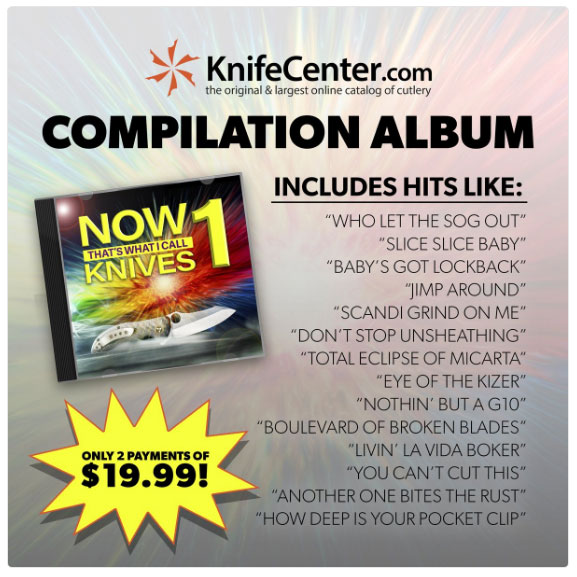
Knife Companies Play April Fool’s Day Pranks
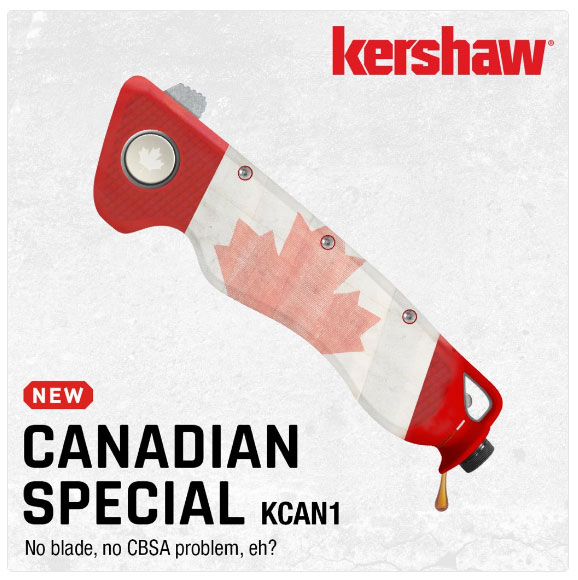
Not one to miss out on a holiday built around jokes (the knife puns write themselves!), the knife community sharpened its wits for April Fool’s Day. Here are two great examples.
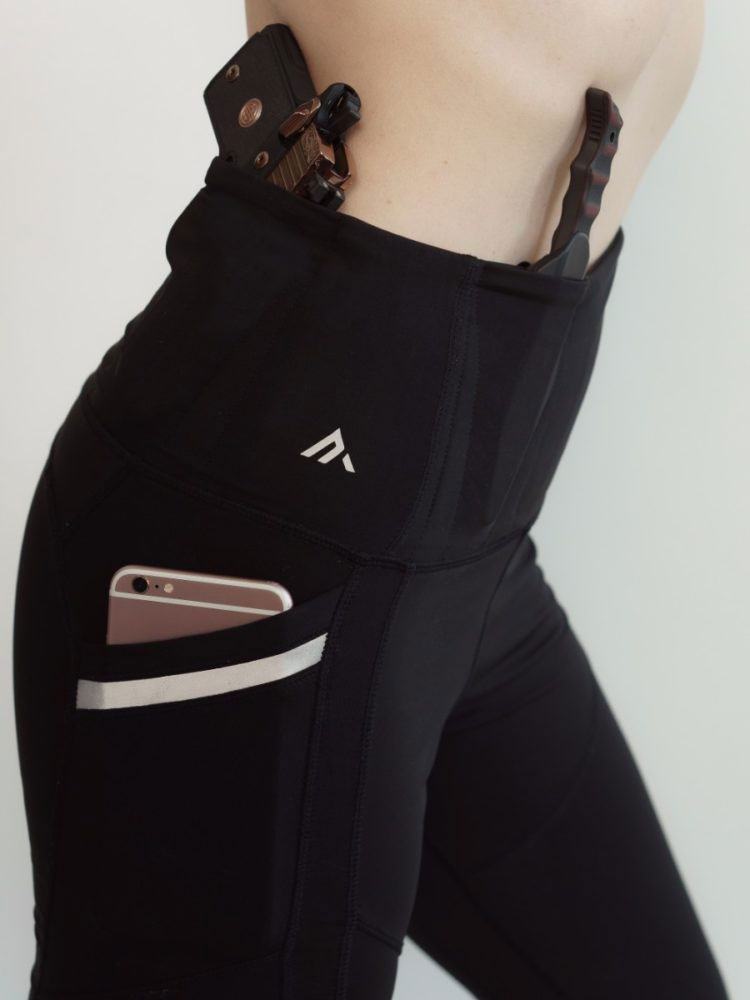
If you ever thought to yourself, “What this yoga session needs is a knife strapped against my pelvis,” you’re in luck. Alexo Athletica recently debuted yoga pants with room for a sheathed knife, as well as any other items to round out your tactical-inspired athleisure ensemble.
With nine pockets, these versatile high-rise quality leggings were designed to hold all your essentials that make you carry with confidence.
With yoga pants becoming ubiquitous outside of exercise rooms, it only makes sense that a company would design products for the concealed carry crowd. The Signature Pant, pictured above, was sold out at press time.