Sarge Knives TK Retro has throwback looks, but modern performance.
The TK Retro from Sarge Knives reminds me of my first fixed blade.
The blade was pitted and the leather handle was cracking. Still, the knife field dressed many squirrel, rabbit and game birds throughout my childhood. It was an excellent camper’s or outdoorsman’s knife.
As for the TK Retro, like my first fixed blade, the stacked-leather handle still gives my hand a warm feel. It has a 440C stainless steel blade to make its good looks last even longer. However, how does it cut?
TK Retro Sharpness Test
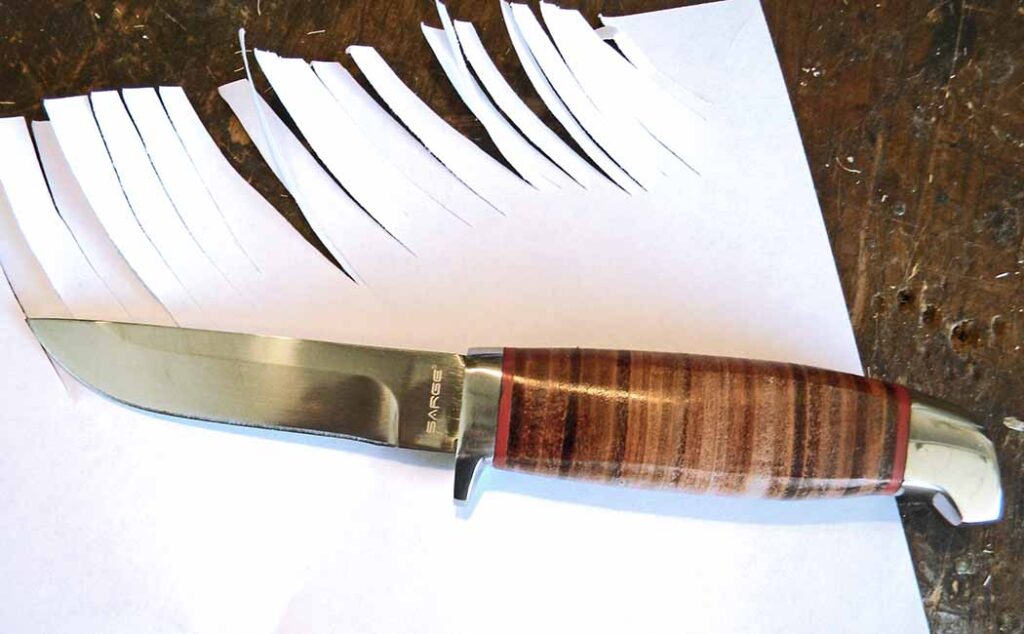
Using the knife’s weight, the author employed push cuts in the stationery. There were no “bad starts,” just smooth slicing.
The first test medium was 20-pound bond copy paper. The TK Retro started slicing and made nice, clean cuts in the stationery. Using the knife’s weight, I employed push cuts. There were no “bad starts,” just smooth slicing.
TK Retro Light-Duty Cuting
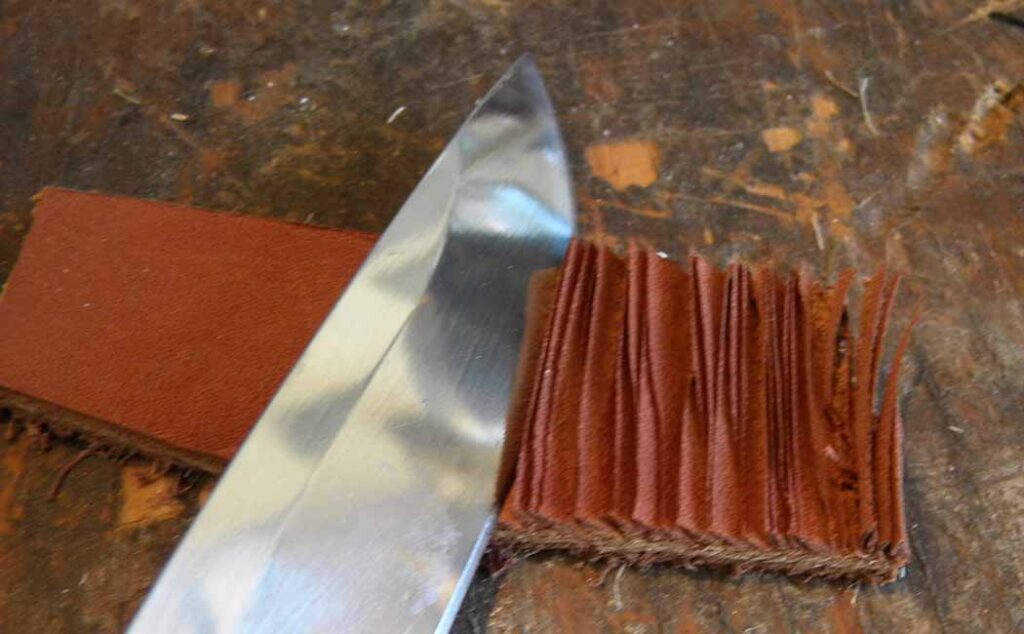
The blade audibly crunched the leather with each skive and made it easy to control the width of slices.
The TK Retro bit deep and smooth [into drywall], with minimal bending of the cut pieces. I could feel the cardboard’s layers with each cut. Edge performance was nice and aggressive. The handle provides a very secure grip.
Leather skiving followed. The blade audibly crunched the leather with each cut and made it easy to control the width of slices.
Heavy-Duty Cutting With Sarge’s Fixed Blade
Firesticks
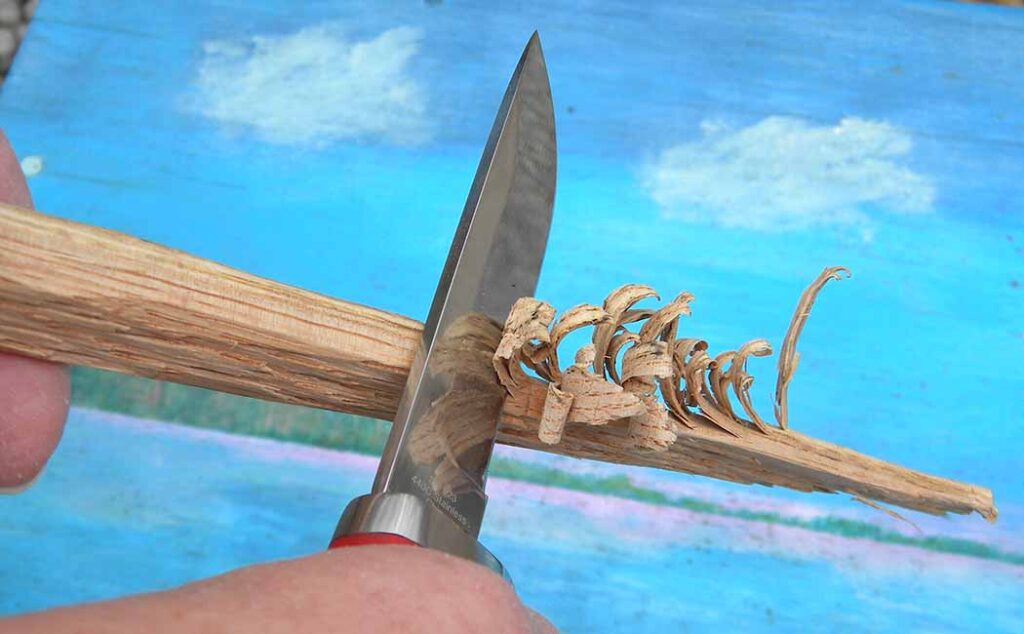
Melissa did a great job whittling a fuzz stick with the TK Retro over her painted bench.
While camping, I was splitting firewood for the weekend. My wife, Melissa, wanted to start the fire so I showed her how to make fire sticks. She took to whittling very quickly and did four of the sticks to aid in her fire starting. She used the TK Retro to make some very nice curlicues. Before I knew it she had a beautiful fire going—excellent job on her part! I was surprised to see her whittling over her bench that she had painted. She seemed to feel very confident using the little fixed blade.
Splitting Wood
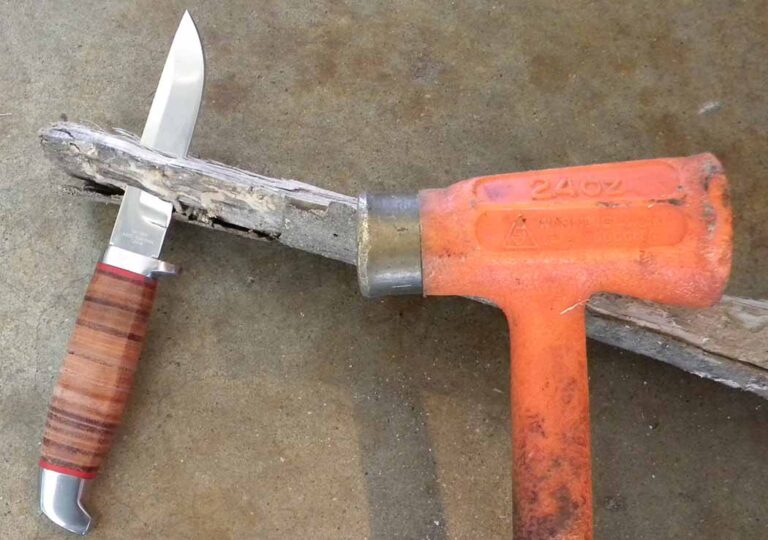
I had some dry hackberry wood to split for kindling. A dead blow hammer and the TK Retro made short work of the task. I didn’t see or feel any edge/knife damage while batonning the edge through the wood. The guard acted like a guide for my hold hand, keeping the wood away from my knuckles. The leather handle absorbed the vibrations perfectly.
Vs Rope
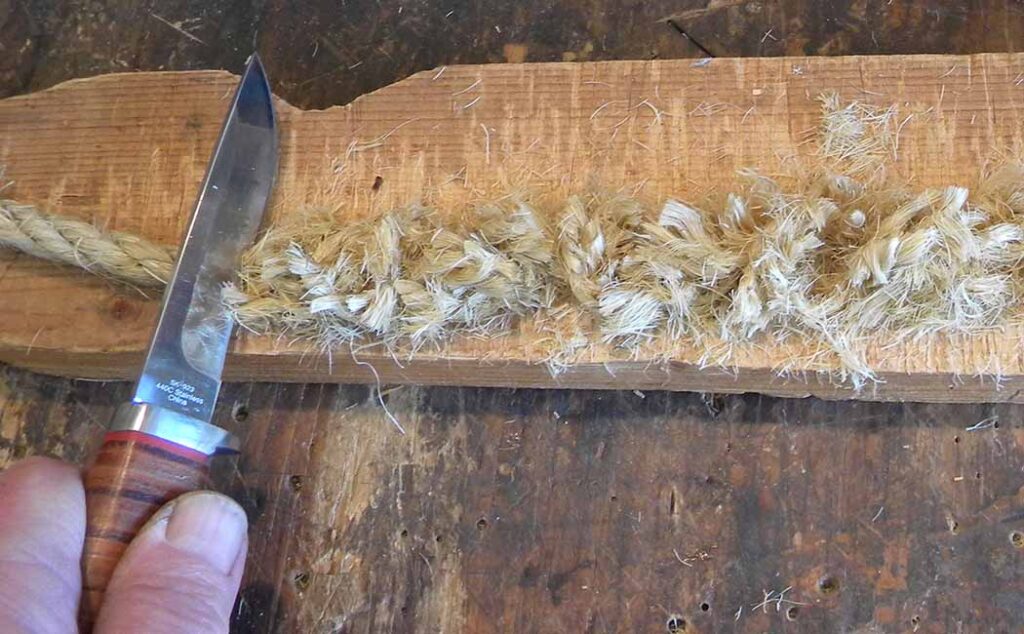
The fixed blade made 82 crunching cuts in the half-inch sisal rope before the edge started to slide.
On the half-inch sisal rope, the TK Retro crunched its way to 82 clean cuts before the edge started to slide. I did find that the guard had a sharp edge that needed softening a bit. It would create a hot spot on your hand after a while. It was an easy fix with some sandpaper.
Chopping Antlers
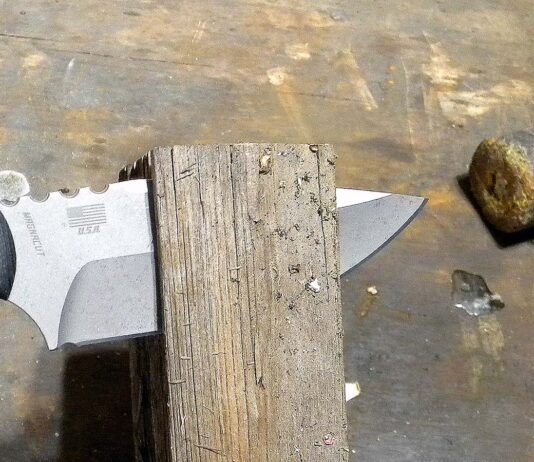
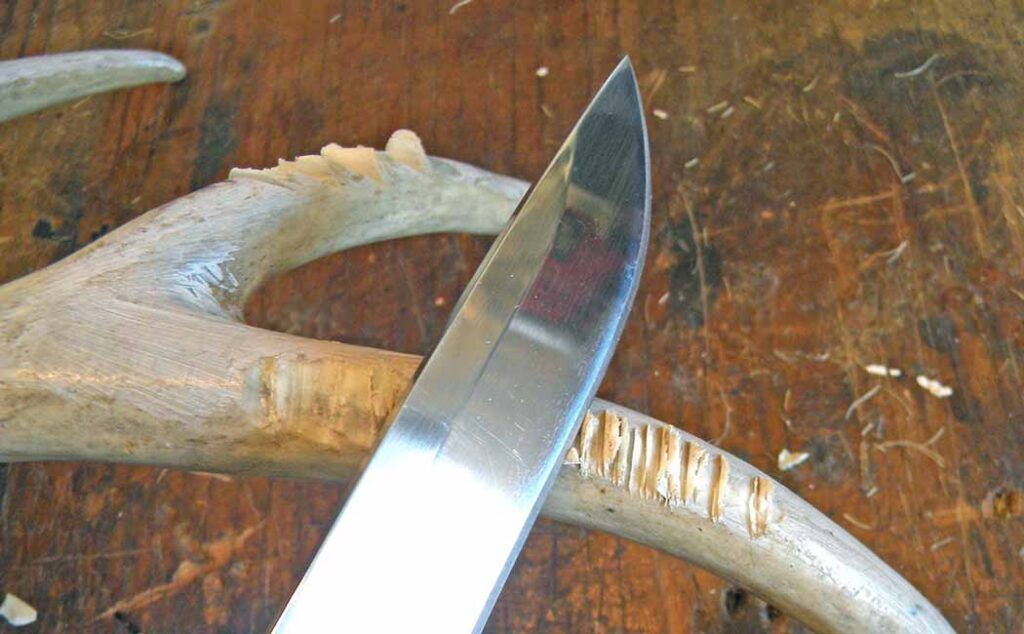
After 20 hard whacks on the antler the edge showed nary a chip, a sign of outstanding heat treating.
The last test for the edge consisted of a series of chops into a whitetail deer antler. After 20 hard whacks, I expected to see some minor edge chipping but there was none. The edge was as sharp as when I started. Sarge Knives nailed the heat treating.
Changes
The guard and buttcap need to be softened a tad. They will bite you after a period of hard use.
Final Cut
The TK Retro is a very nice medium-use knife great for game or camping.
Inspired By His Time Fly Fishing In The Pacific Northwest, Joe Mangiafico’s Trout Knives Are Durable, Eye-Catching Tools.
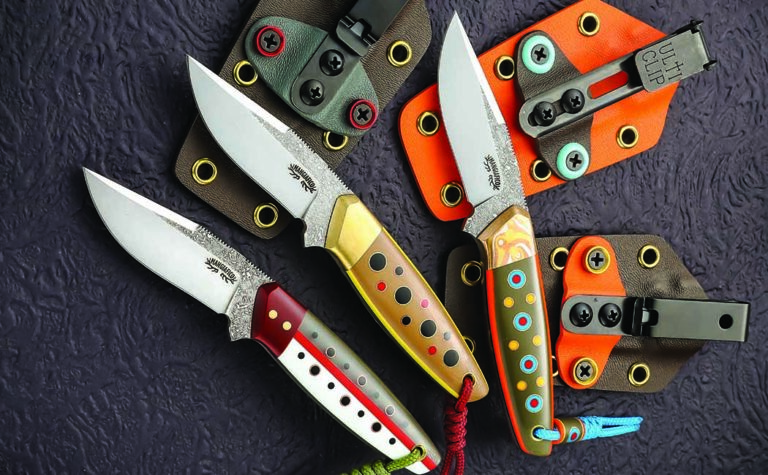
Joe Mangiafico’s trout knives not only are built to use but are cool and colorful to boot.
The 28-year-old Massachusetts maker acid etched the flat areas of the blades for a damascus look, yet it’s the handles and sheaths that really stand out.
The grips are structural mosaics of G-10, brass, and copper. For instance, the blue haloed red center pins of the model with the green handle are inlaid plugs, and the brass pins are press fit and epoxied all the way through. He designed the Kydex sheaths with centered pocket clips to attach to your pocket or waders while fishing. The red-banded model is inspired by the redband trout Joe fly fishes for in the Deschutes River Valley of central Oregon.
Who Is Joe Mangiafico
Mangiafico began making knives while still a college student several years ago. Joe makes his knives in his shop in Cotuit, on the southern coast of Cape Cod. While the majority of his work is custom knives, he does have a factory collaboration with the German company Boker Knives. His Brook fixed blade is made from VG-10 steel and, like his trout knives, showcases his deft ability to craft an eye-popping handle. It retails for $156.95 and can be found on Boker’s website.
Trout Knife Specs Model names: Brook Trout, Brown Trout and Rainbow Trout Knife type: Trout knife Blade lengths: 3 inches Blade steel: Nitro V stainless Blade grinds: Flat Handle materials: G-10, copper and brass Bolster materials: Brass, Micarta® and mokume gané Overall lengths: 6.5 inches Sheaths: Kydex Maker’s price for similar knives: $375 each
Brandon Hyner’s First Knife Is One Of His Most Current Knives As His New Work Takes Inspiration From His First Blade
Sometimes things take their own sweet time before coming to fruition. Such is the case with Brandon Hyner’s damascus gentleman’s hunter.
Hyner is an accomplished maker. He is a champion of History Channel’s Forged in Fire and has built a business of knifemaking and blacksmithing in his shop in Groton, on the Connecticut coast of Long Island Sound. He has built a following of just over 9,000 followers on Instagram where he showcases his work and produces behind the scenes videos in his shop of him doing everything from welding to forging by hand.
The damascus gentleman’s hunter is the second of a design Brandon made when he first started blacksmithing and knifemaking. With the help of a Texas bladesmith, he forged a damascus billet for the first knife, and “was forever grateful” for the opportunity. Four years later Brandon decided to finish the knife and was very pleased with how it turned out. As he noted, “I decided to keep the blade as is, as it was a big milestone knife for me.”
It has a six-inch blade with a desert ironwood handle. The brass spacer and carbon fiber bolster complete the look.
He posted the knife online and someone asked to buy it. However, rather than sell it, Brandon made a similar knife instead. “The second knife came out much better than the first one,” he noted, “but I’m extremely happy with them both.”
It’s a matched pair he can always point to as proof of his maturation as a maker and a beginning of possibly greater things to come. It was a four-year odyssey well worth the wait.
Damascus Gentleman’s Hunter Knife Specs
Knife name: Damascus gentleman’s hunter
Blade length: 6 inches
Blade material: Low-layer twist damascus
Handle: Desert ironwood w/brass spacer
Bolster: Carbon fiber
Overall length: 10 inches
For more information contact Brandon Hyner, Dept. BL4, 852 Bank St., New London, CT 06320 631-742-7227 [email protected].
Denis Tyrell’s Ice Blue Bowie Showcases The Journeyman Smith’s Skills At Forging A Blade And Stylizing A Knife
Denis Tyrell’s Ice Blue Bowie is one cool sub-hilt fixed blade—so cool, in fact, that it recently won The Bowie Knife Challenge shown on 18 different YouTube channels.
The 14-inch bowie features a near-full-flat-ground blade of Tyrell’s Snowflake mosaic damascus, a stabilized wood handle and hot-blued fittings of a twisted damascus. The bowie is in a takedown construction with the pommel nut securing the handle and guard to the knife.
Tyrell, who helped organize the challenge along with a friend, won the first challenge this past June too, which consisted of competing gyutos shown across 10 different YouTube channels. Each winner was determined by a vote of viewers watching the makers.
You can search “Tyrell Knifeworks” on YouTube to watch the past challenges and see the knifemakers in action. You can watch Tyrell make the Ice Blue Bowie in all its glory below.
Tyrell Knifeworks
Tyrell is a journeyman smith who moved to California in 2001 from his native Canada. He specializes in custom damascus knives. From his shop in Livermore, a moderate-sized city on the Eastern edge of San Francisco Bay, Tyrell runs a series of forging courses.
His courses range from introductory classes in how to forge or how to make your first damascus pattern all the way up to more intense fare. He teaches specific classes on mosaic and feather damascus as well as, one of his most popular courses, a course teaching folks how to make copper-layered damascus.
For more information, go to YouTube, enter “Tyrell Knifeworks”, and look for the challenge of your choice.You can watch Denis make the Ice Blue Bowie in the video below.
Ice Blue Bowie Knife Specs Knife: Ice Blue Bowie Bladelength: 8 inches Blade material: Snowflake damascus Handle: Stabilized wood Fittings: Twisted damascus Steels: 1095 and 15N20 (both the blade and fittings) Overall length: 14 inches Maker’s list price for a similar piece: $2,000
The Informant By Greg Wesley Is Another Quality Fixed-Blade EDC. But Just How Good Is This Small Custom Knife?
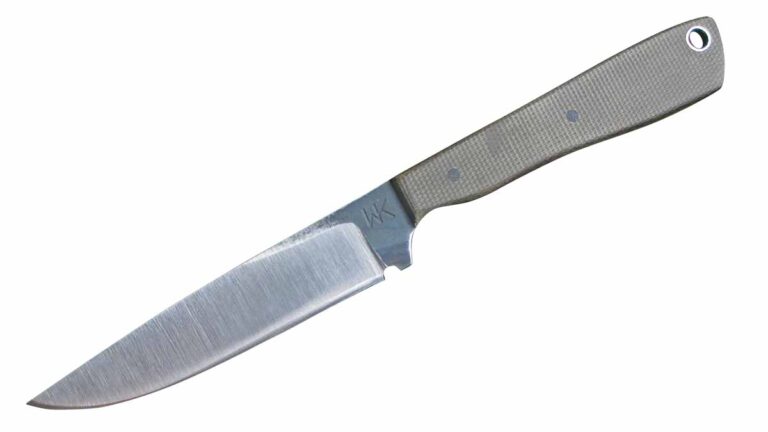
The trend for smaller EDC knives is still going strong. Set up with a leather sheath for belt or pocket carry, the Informant from Wesley Custom Knives fits the bill perfectly. Greg Wesley grinds them all by hand. This one is lean and mean.
Testing The Wesley Informant
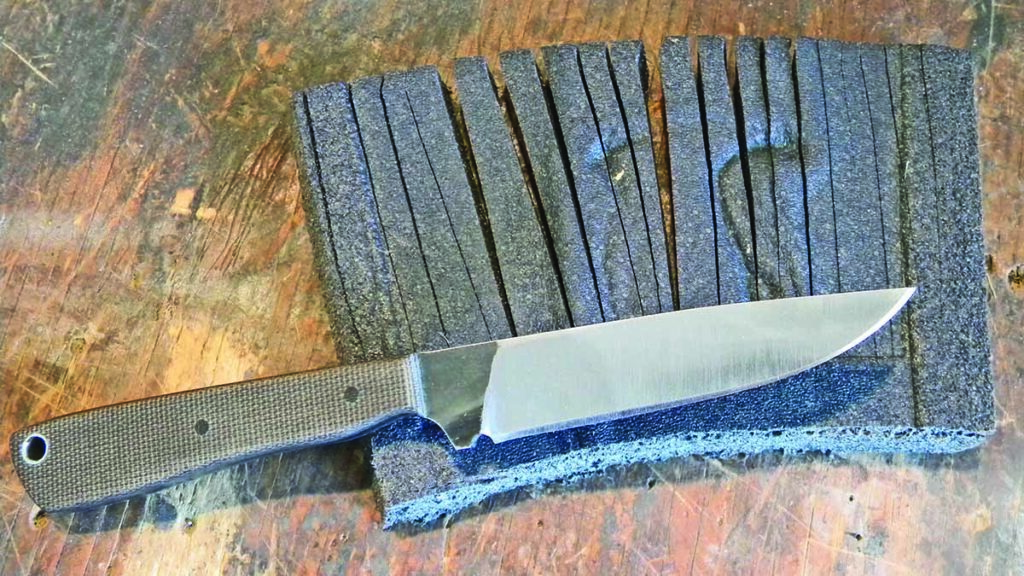
It was easy to control the width of cuts in the foam, all of which were straight without bending the medium.
I started with a piece of dense foam I use for making my Kydex sheaths. Manipulated with push and pull cuts, the knife started biting, slicing cleanly and quickly. It was easy to control the width of cuts, all of which were straight without bending the foam. Very nice.
One of my favorite tests,the 20-pound bond copy paper slice, provided little resistance. It puts a smile on my face when I hear every cut. I used a pull motion to shred the paper. The Informant came razor sharp. The balance of the blade made for a very quick test.
The knife had no challenges cutting through double-walled cardboard. I got carried away and pushed the blade too far into the cardboard, hitting the choil area and messing up the cut. The Informant is just fun to use. Cuts were mostly straight unless I took too big of a bite and the cardboard pinched the blade and slowed it down.
Plastic board was easy for the knife. It cut the plastic very quickly and I barely felt any resistance. Once I had the rhythm slicing, it was finished. This is a sharp little knife. Cuts were very controllable.
Pushing the Wesley Informant
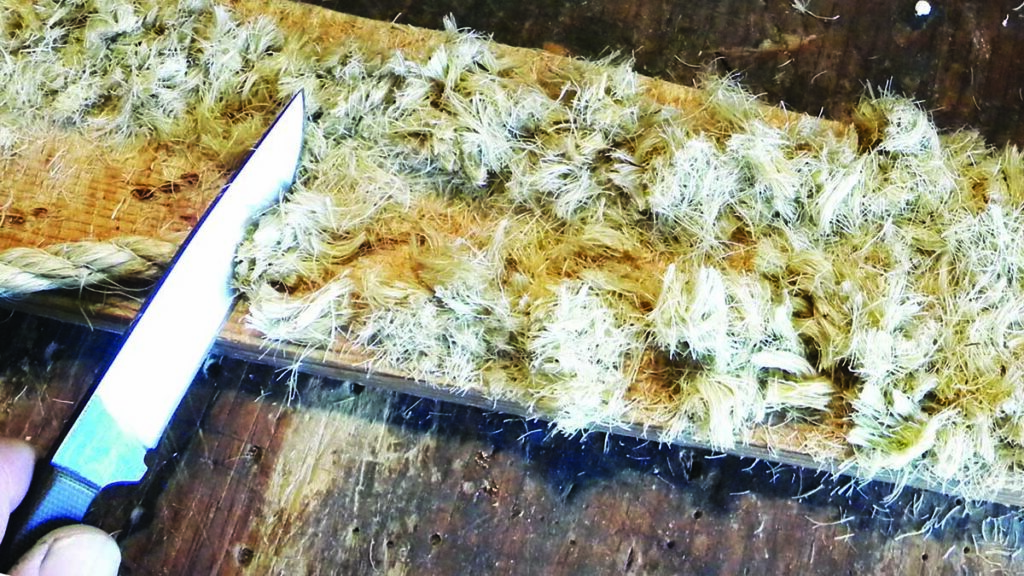
The Informant crunched its way to 188 cuts on the sisal rope before the edge started to slide a bit.
I grabbed some 8-ounce leather for skiving (thin, tapered slices). With a louder crunching sound, the Informant bit quickly. The thinness of the knife made controlling the skiving simple—I just had to move my fingers faster to keep from losing DNA. The edge remained just as sharp as when I started.
I had to whittle to get a better feel of the little fixed blade. The cuts in the wood were extremely smooth. The Informant peeled large curly-cues one after another. The blade spine was somewhat sharp on my thumb but not too bad. The handle was a great fit to my hand—no hot spots at all. Nice job, Greg.
The Informant crunched its way to 188 cuts of sisal rope before the edge started to slide a bit. Impressive! The handle was still comfortable with the extra power added for the high number of cuts. The knife’s light weight didn’t impact its cutting ability.
The last test is a little destructive at times: the antler chop. I gave a whitetail antler 20 hard chops with the Informant. I rolled a thin wire edge in a few places but the blade was still very sharp, so the heat treatment is good.
Final Thoughts
I would soften the blade spine a tad more and maybe round the scales a bit, though that’s being picky. The Informant is a small, high-performing utility tool that can handle most any knife chore. It’s a great EDC choice.
The Cutlass Is A Short Sword Used For Centuries. Today, It Is Mostly A Ceremonial Blade, But One That Continues To Inspire
A sword can be more than just a weapon of war, the cutlass is an excellent example. For centuries, the cutlass was used by fighting forces throughout Europe as a short, one-handed stabbing and slashing weapon.
For many, the cutlass is best known as the sword of the pirates in the Atlantic Ocean during the 17th and 18th centuries. In a lesser-known role, it also was regularly used in agriculture throughout the Caribbean like the machete is today. In English-speaking Caribbean countries, the word “cutlass” is used to mean a machete.
In the modern era, the cutlass has left behind its fighting phase and is almost used exclusively as a ceremonial sword by several navies. However, its popularity endures among collectors and history buffs alike, thanks to its extensive use during the pirate era and the Age of The Sail.
What Is A Cutlass?
A cutlass drill on the HMS Wolverine , 1882 (Public Domain)
The cutlass is a one-handed, single-edged sword used for close-quarters fighting that was the evolution of naval sabers into a more compact, nimble short sword. While the edge does come to a fine point, the cutlass was designed for slashing and swinging at your enemies when fighting hand-to-hand.
This is why the sword was a popular seafaring weapon. With a slightly-curved blade, usually between 28-32 inches, the cutlass is adept in the close confines of a ship. The straight handle and clipped guards of most cutlasses protected your hand when in battle. Additionally, the cutlass was robust enough to tackle general maritime tasks like slicing through heavy rope or thick fabric like canvas or even wood. And its size made it the perfect weapon for the type of in-your-face fighting that would happen on the high seas.
On land, the cutlass wasn’t as dashing, mostly used to chop sugarcane and clear tracts of land in the rainforest in the New World. Though, the same qualities that made it a great fighting implement made it adept on the farm. The short, swooping blade allowed a great deal of force to transfer from the arm to the material with every swing.
Who Uses The Cutlass Today?
Today, the cutlass is used almost exclusively as a ceremonial sword. While it was at its most popular centuries ago, the cutlass was still a standard issue sword until around World War 2 before it became wholly ceremonial.
The British transitioned the sword to ceremonial duty in 1936, and the United States followed suit in 1949. Both countries incorporate the sword into military ceremonies today. The Brits issue cutlasses to naval chief petty officers. The United States also offers chief petty officers the ability to wear a cutlass with their formal dress for ceremonies and the like.
Can I Buy A Cutlass?
Absolutely. There are many companies making cutlasses today. While they may not be as pristine as the ones issued by the military, there are numerous companies making these types of blades.
Factory Cutlass Options
Cutlasses are still made today, but, in general, they aren’t built to the same combat standard as in centuries past. The vast majority of these swords are showpieces meant to be hung on the wall and start conversations. However, if you are a true lover of the Age of Sail, these swords more than fit the bill.
Windlass English Cutlass
This 30.5-inch sword from Windlass is an elegant modern Cutlass, and, for a fee, can be sharpened into a real, proper sword. As is, the high-carbon steel blade is hand forged and mated to a solid brass guard. You’ll really feel like Blackbeard with it in your hand.
The sword comes with a leather scabbard adorned with a brass tip and throat to up the visual appeal of the piece. All told, this is a high-quality replica of the cutlass that will get people talking at your next party and look great in your office or hanging on the wall.
MSRP: $190
Condor Naval Cutlass
The Naval Cutlass from Condor Tool & Knife is a more modern take on the classic blade. The first thing you notice about it is the black epoxy powder finish to the blade. We’re pretty sure pirates of the 18th century didn’t have powder-coating technology, but would have loved to have had the extra corrosion resistance on the high seas.
The blade checks in at 24 inches in length and is made from 1075 steel ground to a razor’s edge. Yes, this sword comes sharpened right out of the box for no extra fees. The smooth hardwood handle is triple riveted, and a powder-coated guard keeps your hand protected when holding the sword. A black welted leather scabbard fits snugly around the blade and keeps everything protected even if dropped.
While it certainly doesn’t look like a sword from the movies, it’s designed to be a true, proper modern cutlass.
MSRP: $148.49
Kult Of Athena Pirate Sword
Complete with a skull and crossbones etched into the scabbard’s throat, the Pirate Sword from Kult of Athena looks like it could have been taken from the set of any swashbuckling movie set.
The 22-inch blade is made from stainless steel and comes, according to KoA, moderately sharp out of the box. That means it might need a more refined sharpening at home if you’re looking for a razor’s edge. However, the blade itself is .16 inches thick, thin enough to slice well but thick enough to hold up to some wear if used for more robust cutting tasks. But be aware, the sword is classed as “decorative”, or for display only, so keep that in mind before playing out your high seas fantasies.
The cast metal handle is surrounded by a bronze-plated cup guard which features a pirate ship design. The black leather scabbard has a cast tip and throat to complete the look.
MSRP: $49
Kingston Arms Atrim Cutlass
The Kingston Arms Atrim Cutlass shows that not all collectible blades need to be centuries old. Made in the style of a naval cutlass, the Atrim utilizes modern materials and methods to make a truly remarkable sword.
The 9260 spring field falchion-style blade is hand forged and comes in a satin finish. At 25.75 inches it’s a bit smaller than some other cutlasses, letting it move more fluidly in your hand and taking up a smaller display space. The full-tang construction terminated with a stainless steel guard and pommel around a brown leather handle that provides a strong grip.
This is the most expensive sword of all the cutlasses showcased in this piece, and it’s worth every penny for the discerning, high-end collector.
MSRP: $432.95
Cold Steel 1917 Cutlass Sword
When it comes to collector pieces outside of auctions, Cold Steel’s 1917 Cutlass Sword is a prime example of what’s being made today. While it is designed for display and collection, the 1055 steel blade does come with a serviceable edge out of the box.
In terms of size, it’s exactly what you’d expect a cutlass to be. At just under 30 inches long and 37.6 ounces, it’s a nimble sword that will feel good to hold and wield when showing off all of its intricacies. The wood handle and blued steel hand guard complete the look, and the included leather scabbard keeps the sword looking classy even when put away.
MSRP: $289.99
APOC Survival Cutlass
This option is rated for proper use rather than display. That’s abundantly clear considering it comes with a MOLLE-compatible Kydex scabbard. That doesn’t come with swords meant to be hung on the wall.
The APOC is a tactical sword that has a 21.5-inch black oxide blade made from 9260 spring steel. The black G-10 handles complete the monochromatic look and provide excellent grip in myriad conditions.
At just under 2 pounds, this is a lightweight cutlass meant to be used as a survival tool out on the trail or in more intense outdoor situations. The blade is meant to slice, of course, and the edge comes to a fine point, making this a puncturing tool as well. Versatility is the name of the game in survival equipment, and, while a machete or shorter knife might be a better option, the APOC cutlass is built for the outdoors and to handle the elements.
MSRP: $169.95
Custom Cutlass Options
There are numerous people making custom cutlasses and other swords. Whether it is for the private use and display of an individual or to be used as props in movies, at renaissance fairs, or in other forms of entertainment, there are makers and smiths crafting modern versions of the centuries-old blade.
Even the popular YouTube Series Man At Arms: Reforged did an episode about the cutlass and showed multiple ways to craft them.
Tony Swatton
Swatton runs Sword & Stone in Burbank, CA and makes arms and armor for film and television. He, and his shop, were the star of the original Man at Arms series nearly a decade ago. He’s self-educated and has been making armor since he was 17.
The first movie his work appeared in was Hook in 1991, and since then his weapons have been seen on screen in more than 300 movies including massively popular films such as Pirates of the Caribbean, Batman, and Thor. He also designed the cutlass used in Assassin’s Creed 4.
David Lisch
Lisch makes custom knives and swords exclusively from damascus steel. His 26 years of experience in the field are seen in the intricacy of his mosaic patterns and one-of-a-kind blade designs. He’s made landscapes and sunrise designs on his blades.
An example of David Lisch’s damascus work.
His knives have won awards and he teaches classes in blacksmithing and knifemaking with his wife Andrea at their school in Yelm, Washington, about an hour south of Seattle.
Collecting Cutlasses
The cutlass is collected by all sorts: sword lovers, pirate aficionados and history buffs. Specialty dealers help these collectors find the pieces they are looking for, and it helps keep the cutlass alive and in public consciousness.
Additionally, cutlasses have made it to auction houses around the world, sometimes fetching as much as $10,000 before the hammer falls at auction houses like Morphy’s, Sotheby’s, and Rock Island.
In late 2022, the 1860 naval cutlass belonging to John H. Ferrell, a Congressional Medal of Honor recipient, went to auction at Morphy’s and sold for $14,760. The sale showed how, even today, the popularity of the cutlass continues to endure in a big way.
Ernest Emerson Is One Of The Leading Designer Of Tactical Knives, And We Get To See His Shop And How He Works
Ernest Emerson is entering his 44th year of knifemaking and his manufacturing company, Emerson Knives, Inc., is celebrating its 25th anniversary. Many knife nuts who have been around awhile remember Ernest when he was purely a custom knifemaker who was making exquisite folders exclusively. Then things changed.
When the first Gulf War came along, Emerson—who has an extensive background in martial arts—had already been working on tactical knife designs and, being the patriot he is, was ideally positioned to do his part in the war effort. Along with a handful of other talented custom makers, it wasn’t long before Ernest was instrumental in helping kick off the modern tactical knife movement that is still a huge part of the cutlery market today.
He never looked back and 25 years ago took his designs to the masses, switching his focus to becoming a cutlery manufacturer of tactical knives, primarily of the folding kind. He continues to make a limited number of custom knives and also uses his skills designing new knives for his factory line. We asked Ernie to give us the lowdown on the tools and equipment he relies on most to do his custom work and prototypes for Emerson knives.
Ernest Emerson’s Tools And Machines
Emerson employs a number of light, low-cost bench-top drill presses. He leaves them set up for various drilling and reaming operations, which saves him a lot of time as he moves down the row drilling liners and handles.
He opened by praising his vintage mill.
“The old Bridgeport has been fixed and rebuilt more than once but it is solid old-school quality and can still easily hold +/- .001-inch tolerances,” he observes. “I use it for all of my milling, tool, jig and fixture building, as well as all operations on bolsters and handles that require precise tolerances and hole depths such as bolsters, counterbores and handle countersinks.”
For grinding, he calls out one grinder maker in particular as his favorite.
“I use a variety of grinders but my go-to machines are those by Travis Wuertz. They are solid, sturdy, virtually silent, and extremely well thought out—and engineered by Travis,” Ernest says. “Their real value to me is that I can build a wide variety of specialized fixtures and tools that allow me to do very precise grinding operations on both blades and handles.”
Emerson uses a number of low-cost bench-top drill presses.
“At $125-$150 each I can afford to own several of them and leave them set up for various drilling and reaming operations,” he notes. “This saves me a lot of time as I can just move down the row as I drill liners and handles. The light drill presses work perfectly for me because all the holes I drill, tap or ream are small diameters and don’t need heavy drill presses to perform the operations. Plus, I get a better, lighter feel when I’m drilling delicate and expensive materials like pearl without damaging them.”
Keeping Things In Order
Hammered-6 in Moku-Ti bolsters with distressed solid copper scales and a hammered blade. Emerson’s list price: $10,000.
Ernest is a firm believer in being organized.
“Although my work area may look a little cluttered or messy [he was preparing for a show when the accompanying photos were taken], I am extremely organized and orderly,” he emphasizes. “Having come up through an apprenticeship program to become a tool-and-die maker, I had it drummed into me the importance of cleanliness and organization in producing precise results.”
He also relies on the smaller things that make up the whole of knifemaking.
“Although machines seem to play the biggest role in most shops, in my endeavors it is the jigs and fixtures that are my most valuable tools,” he states. “Coming up through the apprenticeship program early in my career and eventually earning the title of tool-and-die maker, it was hammered into me that the best machinists are the ones that can conceptualize and invent the most efficient and precise tools, jigs and fixtures to help them do their job. There is a lot of truth in that statement. I also have a full machine shop and woodworking shop with all the jointers, planers, sanders, table saws, routers, lathes and woodworking tools that I use.”