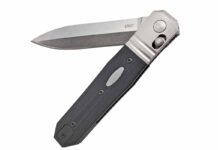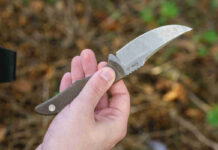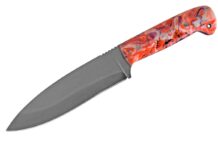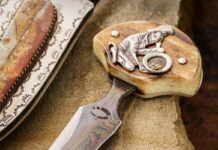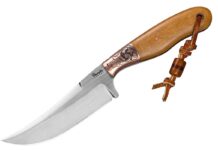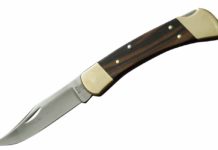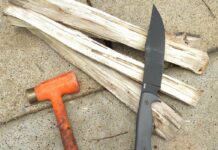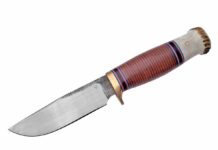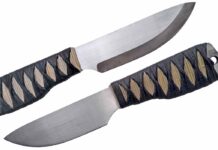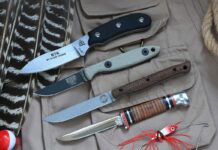
Awards Were Given Out In Nine Different Custom Knife Categories Including Best In Show At BLADE Show West In Salt Lake City.
Dozens of makers entered knives in competition across eight different custom knife categories. The skill on display was tremendous, and numerous knives wowed the judges. However, these were the blades that stood out from the crowd and took home the awards. All images are SharpByCoop Images.
Sarge Knives TK Retro has throwback looks, but modern performance.
The TK Retro from Sarge Knives reminds me of my first fixed blade.
The blade was pitted and the leather handle was cracking. Still, the knife field dressed many squirrel, rabbit and game birds throughout my childhood. It was an excellent camper’s or outdoorsman’s knife.
As for the TK Retro, like my first fixed blade, the stacked-leather handle still gives my hand a warm feel. It has a 440C stainless steel blade to make its good looks last even longer. However, how does it cut?
TK Retro Sharpness Test
Using the knife’s weight, the author employed push cuts in the stationery. There were no “bad starts,” just smooth slicing.
The first test medium was 20-pound bond copy paper. The TK Retro started slicing and made nice, clean cuts in the stationery. Using the knife’s weight, I employed push cuts. There were no “bad starts,” just smooth slicing.
TK Retro Light-Duty Cuting
The blade audibly crunched the leather with each skive and made it easy to control the width of slices.
The TK Retro bit deep and smooth [into drywall], with minimal bending of the cut pieces. I could feel the cardboard’s layers with each cut. Edge performance was nice and aggressive. The handle provides a very secure grip.
Leather skiving followed. The blade audibly crunched the leather with each cut and made it easy to control the width of slices.
Heavy-Duty Cutting With Sarge’s Fixed Blade
Firesticks
Melissa did a great job whittling a fuzz stick with the TK Retro over her painted bench.
While camping, I was splitting firewood for the weekend. My wife, Melissa, wanted to start the fire so I showed her how to make fire sticks. She took to whittling very quickly and did four of the sticks to aid in her fire starting. She used the TK Retro to make some very nice curlicues. Before I knew it she had a beautiful fire going—excellent job on her part! I was surprised to see her whittling over her bench that she had painted. She seemed to feel very confident using the little fixed blade.
Splitting Wood
I had some dry hackberry wood to split for kindling. A dead blow hammer and the TK Retro made short work of the task. I didn’t see or feel any edge/knife damage while batonning the edge through the wood. The guard acted like a guide for my hold hand, keeping the wood away from my knuckles. The leather handle absorbed the vibrations perfectly.
Vs Rope
The fixed blade made 82 crunching cuts in the half-inch sisal rope before the edge started to slide.
On the half-inch sisal rope, the TK Retro crunched its way to 82 clean cuts before the edge started to slide. I did find that the guard had a sharp edge that needed softening a bit. It would create a hot spot on your hand after a while. It was an easy fix with some sandpaper.
Chopping Antlers
After 20 hard whacks on the antler the edge showed nary a chip, a sign of outstanding heat treating.
The last test for the edge consisted of a series of chops into a whitetail deer antler. After 20 hard whacks, I expected to see some minor edge chipping but there was none. The edge was as sharp as when I started. Sarge Knives nailed the heat treating.
Changes
The guard and buttcap need to be softened a tad. They will bite you after a period of hard use.
Final Cut
The TK Retro is a very nice medium-use knife great for game or camping.
Top knife observers decipher the best custom huntering knives ever made.
It’s an ongoing discussion, or maybe a debate, slightly contentious but always cordial. When the question is pondered regarding who made the best custom hunting knives ever, a few names quickly come to mind.
Of course, there is no right or wrong answer. It’s a matter of interpretation, fit and finish, design, form and function, and the feel of the knife in the hand when it’s time to get down to the business of skinning and dressing game. Each respected and well-traveled knifemaker and observer consulted below can tell the stories that back up his top few. But in the end there is no doubt. Each of these revered custom makers and/or bladesmiths has got game. It’s proven in their work.
Bruce Voyles’ Take
BLADE Magazine Cutlery Hall-of-Fame® member and knife auctioneer Bruce Voyles accompanied his fellow Cutlery Hall of Famer, the legendary George Herron, on a few hunting trips and experienced his work in the field.
Among the top hunting knives BLADE Magazine Cutlery Hall-of-Fame® member George Herron made are the Model 6 (top) and the Model 3 skinner, aka Little Dude (bottom). The Model 6 sports a 4-inch blade and 9-inch overall length. Blade and overall lengths for the Little Dude: 2.75 and 6.75 inches. Respective blade steel, handle material and construction on each knife are ATS-34 stainless, curly maple and tapered tang. (Jay Mealing knife image)
“George was a fantastic hunter,” Bruce remembered. “When a group of us would go with him, we might kill three deer in a four-day morning and afternoon hunt, but he could get eight if he wanted to.”
Bruce tells the story of an Outdoor Writers Association hunt Herron organized after an invitation from a South Carolina country gentleman that George had helped change a tire. It seems the man owned a large tract of land, and in return for Herron’s kindness he was allowed to hunt deer on the property.
“When we got to that plantation, every guide there was carrying a George Herron knife,” Bruce commented. “The thing about George’s knives is that when you held one and used it, you were using a knife made by a man who had been there. He made tremendous skinning knives, and the balance and feel in the hand are unsurpassed. The balance, shape of the handle, and minor nuances of the tilt of the blade, its thinness, and the tapered tang set Herron knives apart.”
According to BLADE Magazine Cutlery Hall-of-Fame® member Bruce Voyles, the knives of Cutlery Hall-of-Famer Bill Moran feel like an extension of your hand. Mr. Moran’s engraved gentleman’s hunter in damascus and with one of his iconic moon logo sheaths is representative of Bruce’s sentiment. (Eric Eggly/PointSeven image)
According to Voyles, the knives of Herron, Jerry Fisk and Cutlery Hall-of-Famer Bill Moran feel like an extension of the hand. Herron also made knives that were affordable for a hunter to purchase. Since he put many knives in the hunters’ hands because of a reasonable price point, the praise of his work in the shop spread far and wide. Today, there are several quality custom knifemakers contending for recognition, and they include Ralph Smith, Larry Page and Wayne Hendrix to name just a trio, Bruce says.
“Wayne was one of the guys who trained in George’s shop, and while we were hunting he had his own shop set up on the grounds making knives to sell directly to hunters,” he noted. “He was a guide in South Carolina and approaches making hunting knives the same way George did. He’s the closest to George’s knives now.”
Jim Sornberger’s Take
Cutlery Hall-of-Fame knifemaker Jim Sornberger remembers the days years ago when names such as Harry Morseth and Cutlery Hall-of-Famers Bo Randall and Rudy Ruana were synonymous with excellence in hunting knife craftsmanship. He also mentions the fine work of Corbet Sigman and other contemporaries of the 1960s and ’70s.
“The first new model A.G. Russell made when he acquired Morseth Knives from Harry Morseth was the Model 1, also known as the Ozark Hunter,” Tom Krein noted. “It is a drop-point camp and hunting knife with a 3.5-inch blade, hidden tang, nice guard, and thin-shaped Micarta® handle that make the knife extremely light.” This version sports a stacked leather and fiber spacer handle with a stag butt. (Nordic Knives image)
“It goes back to when I was a kid and my uncle had a gun store in Redding, California,” Jim said. “Those names were famous, and I met Harry Morseth in the ’50s. His Cascade Skinner was my favorite hunting knife for many years with a great handle shape in leather or stag for a good grip and a guard, which is really important in a good hunting knife because you’ve got to hang onto an animal or fish if you’re working and you can’t afford to have the knife slip in your hand. The blades were laminated Brusletto steel from Norway, and the knives came with a safety sheath. Mine was copper-lined leather in the shape of the knife, and later models had a fiber material liner inside.”
Sornberger also mentions Cutlery Hall-of-Famer Gil Hibben, Ruffin Johnson and Clay Gault as makers of outstanding hunting knives. However, trying to identify custom makers that are in that rarefied air with the masters these days requires some reflection. “It’s tough because a lot of guys follow trends nowadays and they find it’s cheaper and faster to make a knife without a guard,” he opined. “Randy Lee has been around a long time and still makes a lot of good using knives. Dave Pitt in Redding, California, does as well, and that’s hunting country. Randy has a stubby little hunter with a 3.25-inch blade and nice guard, and that’s plenty of knife for most hunting applications.”
Tom Krein’s Take
Veteran knifemaker Tom Krein is upfront with his thoughts on the best maker of hunting knives.
“I actually worked for Bob Dozier and A.G. Russell from the mid-1990s to 2001, and honestly this is a tough one. We all use hunting knives differently in the field and for different things, but I would put Bob Dozier forward. He grew up hunting in the bayous and providing for his family, [and] he has a lot of experience making knives. He is an exceptional craftsman, and in the 1980s I feel one of the pioneers in the style of distilling everything down to make hunting knives easier to make and get them in everybody’s hands.”
Award-winning bladesmith Jerry Fisk’s Sendero hunter served as Tom Krein’s inspiration to make knives. (Eric Eggly/PointSeven image)
Krein likes the reasonable price point of a Dozier hunting knife and the attributes that characterize the maker’s outstanding work: a full tang, thinly ground blade, Micarta® handle, and often a Kydex sheath system for safety. “Dozier’s knives check all my boxes,” he related. “The Dozier Personal with a 2-inch blade works great on game, and an investment of $300 will get you a fine Dozier knife.”
Tom also has seen the Morseth line continue with A.G Russell and has tremendous respect for the maker’s legacy. “The first new model A.G. made when he acquired Morseth Knives from Harry was the Model 1, also known as the Ozark Hunter,” Krein noted. “It is a drop-point camp and hunting knife with a 3.5-inch blade, hidden tang, nice guard, and thin-shaped Micarta® handle that make the knife extremely light.”
Tom tips his hat to custom knifemaker Brian Goode, whose hunters and skinners are gaining notice, while he also acknowledges the great work of Jerry Fisk, whose Sendero served as Krein’s own inspiration to begin making knives. And then there’s the geometry and thinness of the blade in ABS master smith James Rodebaugh’s hunting knives that Krein calls “beautiful work.”
James Rodebaugh’s Take
Speaking of Rodebaugh, his thoughts on the best maker of hunting knives include George Herron, whose work he describes as “superb,” and two more greats, D. E. Henry and Cutlery Hall-of-Famer Jimmy Lile. “The first knife I ever owned was a Lile hunter, and he made one heck of a hunting knife,” James remarked. “That knife was my primary hunter before I even started making knives, and it did all I ever asked of it.”
ABS master smith James Rodebaugh is high on the work of Missouri-based maker Jason Coy and ABS master smiths Jason Knight and Adam DesRosiers. Adam’s clip-point hunter in damascus and stag is a stunner. (SharpByCoop image)
According to Rodebaugh, edge geometry is critical in a hunting knife, along with the design and profile of the handle and proper Rockwell hardness. Each of these characteristics is essential, and the Lile knife was “about as perfect as I’ve ever held, and I’ve dressed well north of 300 animals, not counting small game.”
Rodebaugh’s own knives are reflections of his hunting experience. He has been lauded for the field performance of his Raised Swedge Hunter, which some refer to as a harpoon point, that was actually inspired by a Marble’s hunter design. He has been making the Outfitter hunting knife for about 15 years, forging the blades in batches of five with O1 tool steel hardened to a Rockwell of 60-61 HRC, and a Micarta handle with a palm swell for added comfort.
James has been impressed recently with the work of Missouri-based maker Jason Coy and ABS master smiths Adam DesRosiers and Jason Knight. “Jason saw my raised swedge years ago and asked to use it, and I said ‘absolutely!’ Nobody has probably designed a ‘new’ blade in the last 1,000 years or so. Adam has worked with it as well, and now everybody in the country produces that design feature.”
Of Course, Bob Loveless
The names of custom makers past and present conjure images of their outstanding hunting knives. But no story on the topic would be complete without mention of Cutlery Hall-of-Famer Bob Loveless. While some have said Loveless was a fine maker, some have also said his fit and finish were reasonably good—not great. Nonetheless, the thing about Loveless was his eye for design.
According to BLADE Magazine Cutlery Hall-of-Fame® member Jim Sornberger, Randy Lee has been around a long time and still makes a lot of good using knives. An example is his drop point with an amber-spacer look reminiscent of the My Knife by BLADE Magazine Cutlery Hall-of-Fame® member D’ Holder, a pretty fair maker of hunting knives in his own right. (SharpByCoop image)
“Loveless went to design school,” Voyles explained. “He made a knife with eye appeal. It was different, and a lot of people don’t understand why, but it was the natural French curve. It was the design. People say Loveless made the perfect hunting knife because of the drop point, and to me it doesn’t work as good as one of George Herron’s knives.”
Sornberger knew Loveless well. “Bob was a good friend and signed for me to get into the Guild,” Jim began. “I think Bob found a universal handle shape that he used on all his knives, and it was a combination of a good kitchen knife and all with a guard except for a couple of models he made later on. All fit well in the hand. Bob got a lot of publicity. He could sell snow to Eskimos.”
Krein sees the Loveless drop point as iconic. “But there is a difference with the variance in game animals from squirrels to rabbits to deer, elk and moose. So best at what? I personally think the Loveless drop point is a fine design, but I wouldn’t take it into the woods,” he observed. “It’s just bigger than I like, and I like hidden tangs for hunting knives.”
Rodebaugh reminds that Loveless is a giant among custom knifemakers, and his hunters are noteworthy to say the least. “I met Bob many years ago and didn’t live far from him in California,” James recalled. “He made a good knife, and the drop point had a lot of impact on the industry, but contemporary with Bob were guys like Herron that produced excellent knives. Loveless made a solid working knife and took that to great heights through pretty good marketing, along with his popularizing of ATS-34 stainless blade steel.”
All hunters have a favorite knife, a trusted companion in the field that is handy, dependable, and built for the jobs encountered. While discussing the topic of just who might be the best custom maker of hunting knives is a never-ending exercise, suffice it to say that hunters are fortunate to find such steadfast companion tools when they are needed most.
Check Out More Outdoor Knives:
NESSMUK KNIFE: OPTIONS IN THE ALL-AMERICAN OUTDOOR KNIFE
BEST TOMAHAWKS: OUR TOP HAWKS FOR BACKWOODS TO BATTLEFIELDS
Marine Corps hero feted with Nawrocki knife at The Battleship Ball.
An unforgettable setting for a memorable event celebrating an American hero—all complemented by a beautiful knife by Brian “Rocco” Nawrocki—completed a tribute to USMC Sergeant Scott Bunker during last year’s 250th anniversary of the United States Marine Corps.
Assigned to Lima Company in 2005 during the Iraq War, Sergeant Bunker took multiple machine-gun rounds at point-blank range in house-to-house fighting, resulting in the loss of an eye, half a lung, several ribs and soft-tissue damage to his left arm. He was the guest of honor at The Battleship Ball 2025 on November 1, held on the deck of the vintage World War II Battleship USS North Carolina in Wilmington, North Carolina.
Event organizer/USMC veteran Dean Smith (left) congratulates Sgt. Scott Bunker after delivery of the Nawrocki tribute knife (in display case on the dais) during The Battleship Ball.
The handsome fixed blade Rocco made for Sergeant Bunker includes steel from the North Carolina for the blade and guard. The wood handle is teak from the battlewagon’s deck, along with purple heart ribbon spacers.
When Hunting, One Knife Is Good But More Knives Are Better. These Knife Sets Can Help Make The Hunt Easier No Matter The Size Of The Game.
Each year hunting season rolls around there are experienced hunters and first-time hunters anxious to make their way into the field. Whether a bow hunter or a firearms hunter, one thing remains consistent between the two: They both need something to clean game and prepare it to be able to get it out of the field and home.
No one would argue that you don’t need a knife, but sure enough each hunter would back his choice of blade in a discussion led by the question “What do you use?”
This year, as usual, I found some likely candidates to add to the discussion of whose knife is better, though this time, instead of a single knife to tackle the project, let’s consider knife sets. They can’t get your game for you but we can put them through their paces to see if they can help make the most out of what you do get.
Gerber Moment
Here you get a good look at the size difference between the large Utility knife and small Finesse knife in the Gerber Moment. Sometimes a good picture is worth a thousand measurements. Blade and overall lengths: 3.625/3 and 8.625/7 inches. Blade and handle materials: 5Cr15MoV stainless and rubber overmold, glass-filled nylon
The Gerber Moment is a two-knife set. Of the test entries, this one is for the budget-minded hunters looking to spend the short dollar. It is made in China and the fit and finish is darn respectable considering each knife runs about $17.
The two knives were not hair-popping sharp out of the package, though it didn’t take long to up their edge games. Both the large utility knife and the small finesse model come with contoured rubber grips.
The scales do not totally cover the full-tang handle design. A small perimeter of the tang is left exposed around the scales. At the rear of each tang are small oblong-shaped notches to serve as lanyard holes. They’re small holes at that, as you won’t get much more than paracord through them. As mentioned, the edges of the tang are proud of the scale but not so much as to cause any hot spots.
Both knives are drop-point designs, with the large knife being hollow ground and sporting a gut hook. The small Finesse is a full-flat-ground drop point. Texturing on the rubber grips helps provide a good, solid purchase. Of the two, as you would expect, the small detailing knife is pretty agile, though it isn’t like the large one is clumsy. To tote them both Gerber provides a dual-carry nylon belt sheath with plastic liner inserts.
Overall, the knives are quite well made. The design cleans up easy. After you do some work to bump up edge performance, you’ve got some users.
I have never been much for gut hooks. I remember when the Wyoming Knife was new and loads of hunters were sold for life on gut-hook knives. Even though I don’t use them, I can see how some hunters could like them. The gut hook on the Moment is pretty large.
I would have to give the set a thumbs up. It would be good for a hunter on a budget or one looking to try out different styles until finding one that suits him best.
MSRP: $34
Outdoor Edge Razor Guide Pak
Some of the extra blades you get in the Outdoor Edge Guide Pak Razorbone include a selection of drop point, gut hook and boning/fillet patterns. All are neatly store in the waxed canvas roll. Blade steel: 420J2 stainless.
The Outdoor Edge Razor Guide Pak comes with two knives—the RazorBone and the RazorCape—along with a small bone saw. The knives take replaceable razor-blade-style inserts. Both are folders and come with multiple replacement blades.
Outdoor Edge provides a boning/fillet-style blade along with a drop point and gutting blade for the RazorBone. For the RazorCape knife, you get two cape-blade inserts. Both have glass nylon and TPR rubber inlay handles.
A lockback system secures the blades in the open position. The handles don’t have a lot of cross-sectional contouring and the texturing on the rubber inserts provides some traction to your grip. There’s a thumb groove with jimping on the spine of the blade holder.
What worked well for me was the difference in thicknesses between the blade holder and the blade gave me a great lip to secure my handhold while executing a pinch grip. As I used the RazorBone in a butcher grip, the thin tip of the insert snaked through joints and kept me close to the bone so that I didn’t leave any of the good stuff behind.
The RazorCape knife works well but has a large choil. I find such choils a waste of potential edge length. As if that isn’t bad enough on a hunting knife, they basically become a fur catcher. Both folders come with a pocket clip, though for me they are not pocket-carry-style knives. All the inserts come scalpel-sharp, so show them respect while handling them.
Lastly, the Flip n’ Zip saw works well but the anodized aluminum handle doesn’t do a lot for me. It makes a nice, thin package. A lockback system securely holds the blade in place. It’s just that the aluminum handle, even with CNC grooves, is thin and pretty slippery in my hands once things get wet.
Also, the handle is so thin it makes it a bit difficult for my fat mitts to hold onto it. I would hate to try it with gloves on while the handle is covered in blood. The extra blades, all 420J2 stainless steel, are stored in a wax canvas roll.
MSRP: $99
Knives Of Alaska Bobcat Combo
Knives of Alaska includes a top-notch leather sheath with the Bobcat Combo. The sheath has the hallmarks of solid craftsmanship. (The author indicated he put the nick there.)
The set from Knives of Alaska (KOA) comes with the Alpha Wolf knife and the Bobcat Hatchet—hence, the Bobcat Combo. I’ve used the Alpha Wolf before. It’s a full-tang design made of D2 tool steel and a layered polymer handle. The handle contouring includes four finger grooves, with the index groove on the ricasso. It is a straightforward, fully flat-ground drop-point design.
The Alpha Wolf comes shaving sharp out of the box and has a general curve to the cutting edge. I have to say as a game knife it handles well and you can exert a great deal of control over the cutting edge with little effort.
The design fits well in my meaty hand and the cuts get made where I need them without struggling. At the rear of the edge is a micro choil and, as usual, when the material being cut gets hung up there, it frustrates my workflow. I would say the only thing I would prefer is a bit of texturing to up the grip game.
As you can imagine, the Bobcat hatchet does things like splitting the sternum, cutting the pelvic bone and, if you want, it will bust out some of the tougher joints. It doesn’t have the heft of a full-size hatchet but as my buddy is fond of saying: if you put enough force behind anything you can make it fly. To me, it would be certainly neater than a chainsaw (don’t ask, it’s a drunken Canadian hunter thing). A gut hook is on the back.
A top-notch-made leather sheath carries the combo. I never reviewed a knife from KOA on which the leather wasn’t well executed. It’s a good combo and the Bobcat hatchet is such a neat tool I couldn’t resist using it in the kitchen as a small hand chopper. I know, somewhat sacrilegious, but it’s my kitchen. It’s a great set and as much of a trophy as the game you kill.
MSRP: $209.99
There’s a wide range of knives here from budget to bang and represents only a small sampling of the tools available to hunters these days. If you’re going for the big game, don’t ruin the moment by struggling with a poorly crafted tool. Take the time to round out your kit with a good field-dressing knife set.
The author gets to test one of his favorite classic knife styles.
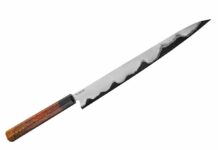
I have always been a fan of clip-point utility hunters such as those by Michael Presnell, especially the feel of the handle. The leather washers provide a non-slip grip, and in colder climates such a handle has a warm feel to it. Combine that with a very sharp blade and you are ready for most chores in the outdoors. How sharp is it? We shall see.
Utility Hunter Light-Duty Tasks
As always, I start with a paper slice using 20-pound bond stationery. The paper cut produces a fast assessment of sharpness. The knife sliced very fast and smooth—it even managed to get a piece of my skin in the process. It was a very sharp starting point.
Next: heavier double-walled cardboard. The clip point blade made short work of the medium. I used smooth, aggressive push cuts with the flat-ground blade. It sliced as fast as I could get my fingers out of the way.
It was on to some old, dried-out 8-ounce leather. The blade made very loud crunching noises as it cut the material. The positive grip of the handle made control very easy. The knife was extremely aggressive cutting leather. I selected a narrower piece of leather to do some skiving. The blade sliced and diced the material as fast as I could move it. It’s gratifying to hear the crunching noises, a sign of outstanding sharpness.
Utility Hunter Medium-Duty Cutting
I whittled some firesticks out of pine. The utility/hunter gave some nice fine curlicues. Control was positive and I was able to vary the depth of the cut quickly. It really excelled at the fine curlicues. I also noticed that the edge along the guard face was sharp. A quick touch up with 400-grit sandpaper knocked the edge right off.
Half-inch sisal rope was next. With a loud crunching sound the utility/hunter started cutting. After 200 noisy crunch cuts my wrist was slowing down, so it was time to stop. The edge was still sharp but I was done. The handle was very comfortable on the pressure cuts, with no hot spots on my hand.
To add an extra test medium, I grabbed an old serpentine belt for a dozen cuts. It didn’t phase the edge at all. I could hear it cutting through the belt’s cores. Still, there was no damage to the edge. Very well done, Michael.
Heavy Cutting
The last test was to assess the heat treat by whacking the edge into a white tail deer antler. After 30 whacks the edge was still in perfect shape. To prove it, I returned to the 20-pound bond paper. The knife sliced just like it did at the beginning of the test. Great heat treatment, Michael.
The knife was up for a batonning into a hackberry log. I used a dead-blow hammer to pound the blade’s spine. I split a few pieces and checked for damage. The edge was still in perfect shape and the handle and guard remained tight. The leather handle absorbed all the shock of batonning through the hackberry.
Final Cut
This is a high-performance knife that is very comfortable to use. It is a great companion for the field.I softened the edge on the front of the guard. It was a tad sharp for my sidewinder grip.
Presnell Utility Hunter Specs Maker: Michael Presnell Blade length: 4.25” Blade material: Forged 52100 carbon steel Blade grind: Flat Blade pattern: Clip point Blade @ thickest: 5/32” Handle: G-10 spacers, stacked leather washers, stag buttcap Guard: Brass Weight: 6 ozs. Overall length: 85/8” Sheath: 6-oz. leather pouch belt model Weight w/sheath: 8.5 ozs. Maker’s price for a similar knife: $330
Bradford Guardian 3.2 in MagnaCut is a rope-eating animal.
EDC fixed blades are very popular, small enough to avoid unwanted attention yet able to do most jobs. They often range from 2-to-4-inch blade lengths and 3-to-4-inch handles. Usually carried in a cross draw or pocket sheath, in a pinch they can be used for self-protection (if you have training).
In general, it is a very useful tool that is always on you. I carry one constantly. The Guardian 3.2 in CPM MagnaCut stainless blade steel from Bradford USA definitely fits the bill. As to how well it works, let’s see if it holds up to everyday carry uses.
Guardian Light-Duty Cutting
I started with a 20-pound bond paper slice to check the fresh edge. The Guardian 3.2 was scary sharp. I nicked my fingernail three times by being slow. The blade made smooth, forceful slices with very little pressure. I did all push cuts with nary a snag or rolling of the paper.
Very aggressive slicing into the 8-ounce leather resulted in nice crunching noises.
Single-walled cardboard was next on the menu. The results weren’t much different from the bond paper, though there was a slight drag when the thicker part of the blade encountered the cardboard. That didn’t stop the Guardian 3.2 from doing its job. It sliced the cardboard as fast as I could move my fingers out of the way.
Guardian Medium-Duty Cutting
It was time to skive 8-ounce leather. Very aggressive slicing into the leather resulted in nice crunching noises. The handle provided positive control of blade depth and angle during the skiving. I even did some end-grain slicing to keep the crunching going. This is a very sharp knife indeed.
The pouch sheath of 6-to-7-ounce leather holds the knife securely. (BLADE® staff image)
Springtime means camping so I needed to whittle lots of fire sticks. Using leftover pine, I whittled a bunch of excellent curlicues. The Guardian cut very smoothly. The thumb notches on the spine aided in control of cutting depth. Deep cuts or fine cuts, it can do both.
I used the Guardian to baton cut and it split the pine nicely, providing a nice pile of kindling. The handle felt comfortable. There was just one small point by the lanyard hole that was sharp when I rotated my grip. The knife does excellent wood work.
Guardian Heavy-Duty Cutting
As expected, after 30 hard whacks, the MagnaCut blade had a couple of very small nicks along the edge. It would be no big deal to work out the nicks with a very fine diamond hone.
Using leftover pine, the author whittled a bunch of excellent curlicues. The Guardian cut quite smoothly.
To show that the small nicks are not that big of a deal, I went back to the 20-pound bond paper slice. There was only one snag when I tried to start a cut on the edge nick. Otherwise, the edge sailed through the paper without tearing. I was impressed the edge didn’t have more issues.
Final Cut
The thumb notches on the spine aided in control of cutting depth. (BLADE® staff image)
Some softening at the back of the handle is in order. This knife is designed for slicing every day. The Guardian 3.2 is an impressive fixed-blade EDC.
Guardian 3.2 Specs Company: Bradford USA Blade length: 3 1/8” Blade steel: CPM MagnaCut stainless Rockwell hardness: 63-64 HRC Blade finish: Stonewashed black Blade grind: Saber Blade pattern: Drop point Scales: Jade-green G-10 Construction: Full tang Weight: 4.5 ozs. Overall length: 7 1/8” Sheath: Pouch type in 6-to-7-oz. leather Country of origin: USA MSRP: $229