
The Joy of Cooking Knife Review

Ethan Becker and Dan Eastland collaborate on a sharp tool for the kitchen.

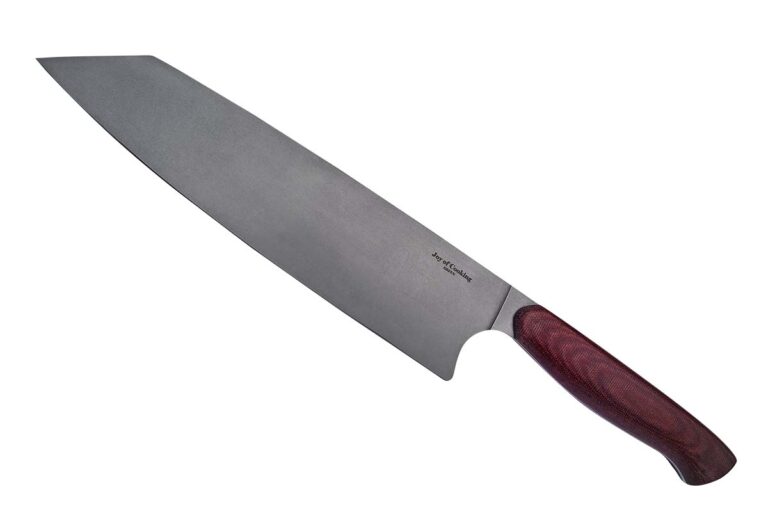
Long-time knife designer Ethan Becker and Dan Eastland of Dogwood Custom Knives have collaborated on a chef’s knife that combines each of the principals’ vision of exactly what such a knife should be.

Introduced at BLADE Show 2024, the Joy of Cooking 8-inch K-tip chef’s knife is a mix of Japanese and Western styles and premium stainless steel and synthetic handle materials.

It also has the iconic Joy of Cooking logo on the blade, Joy of Cooking the internationally renowned cookbook originally written by Becker’s mother, Irma Rombauer, and edited in some subsequent editions by Ethan. He handed those duties off and today the book is co-edited most ably by his son, John, and Megan Scott.
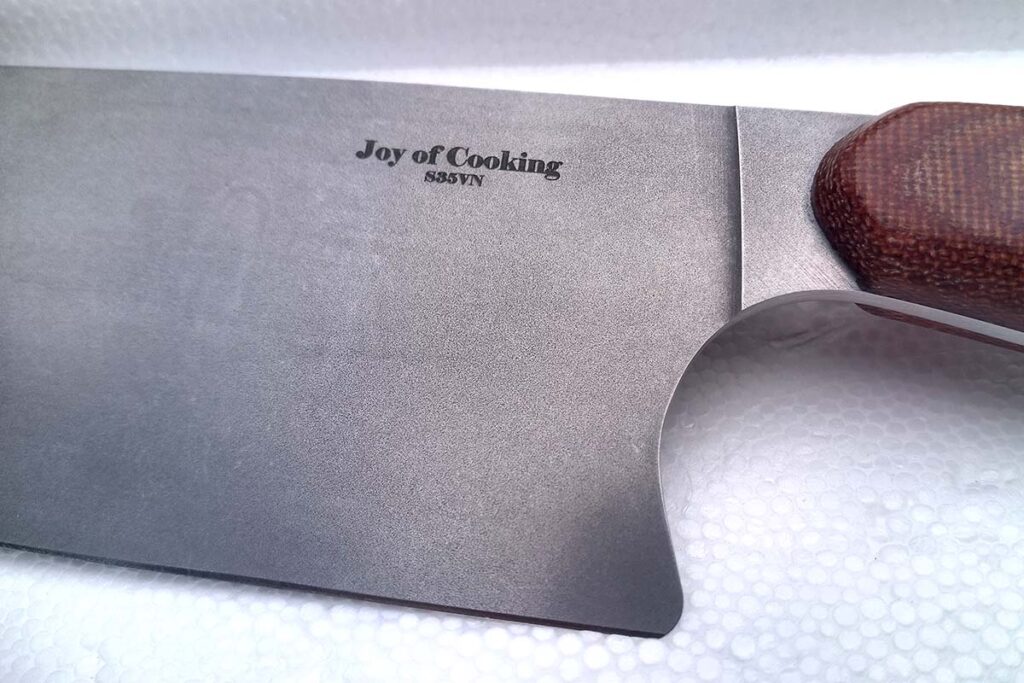
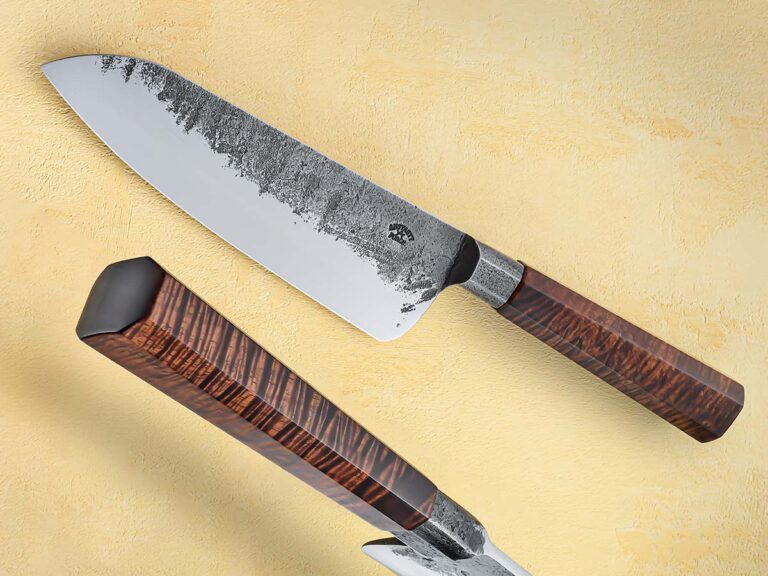
Joy of cooking logo on blade
The heel of the blade curves toward the rear and sits flat on the surface for controlled cutting.

With extensive experience as both a knifemaker and a cook, Eastland brings the kind of know-how to the project that gives it edged gravitas.

“Dan is pretty much the perfect person to do this because he’s been in a commercial kitchen and knows his way around that,” Ethan said.

Dan also spent a number of years as an apprentice maker to Georgia Knife Makers Guild member Andy Roy of Fiddleback Forge in North Georgia, and now builds knives at Dogwood Custom Knives in Greenville, South Carolina.
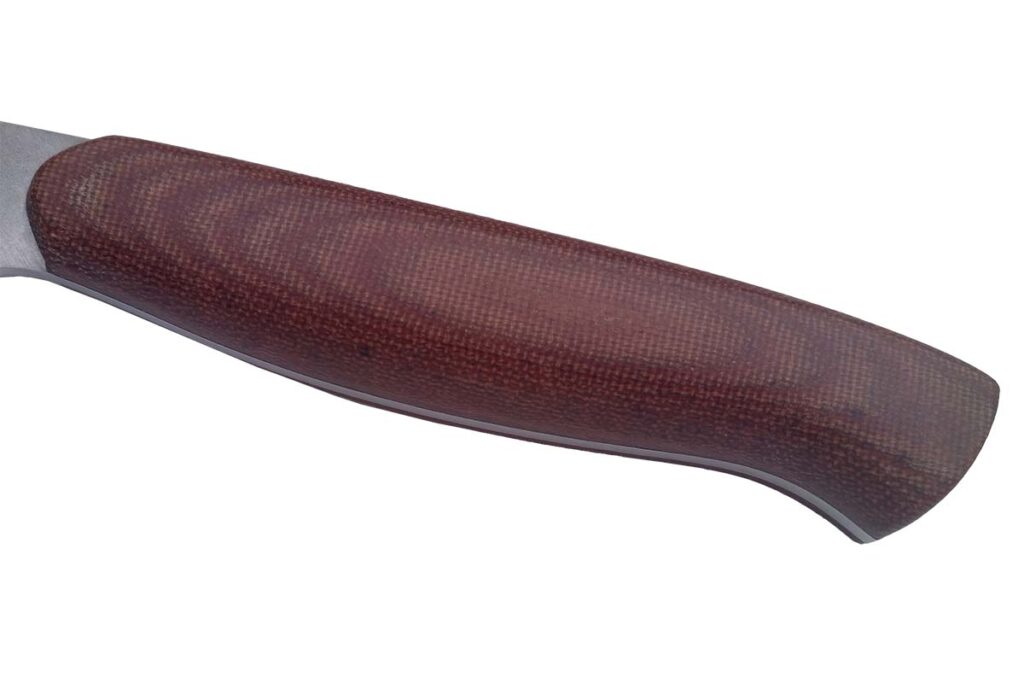
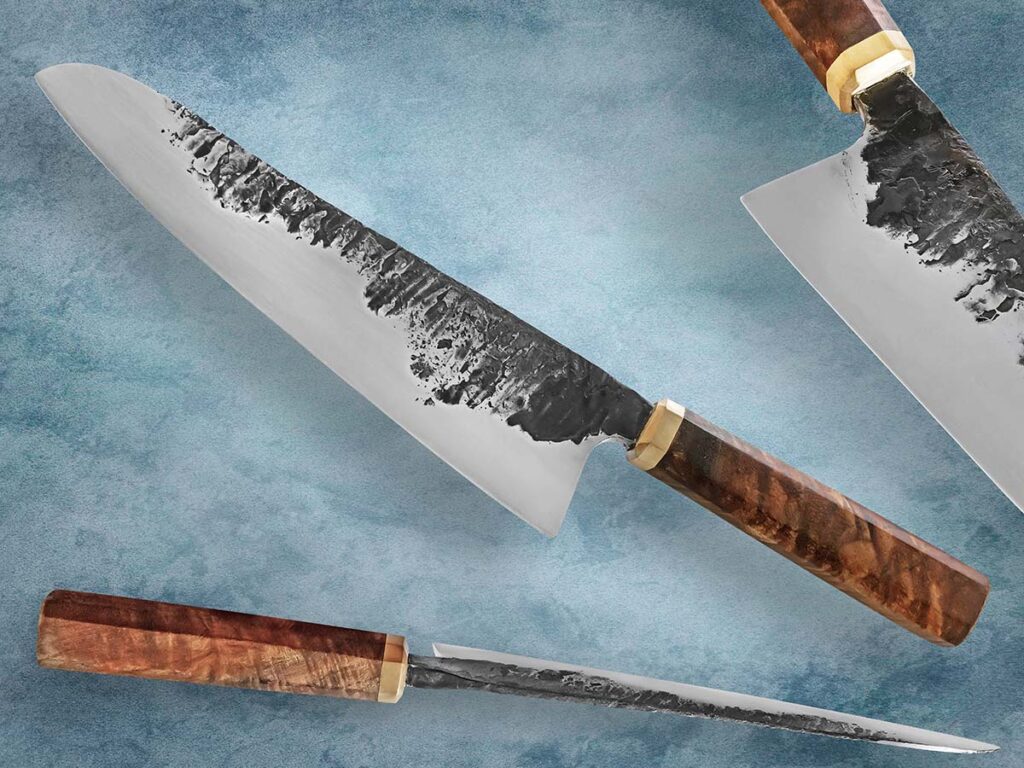
Joy of cooking knife handle
Handle materials come in a choice of natural (shown here; note the texture and grain) and black Micarta® and blue, red or black G-10.

As for the Joy of Cooking knife and its features, Dan approaches it all from the maker/cook perspective.

“The blade has a Japanese influence. I always liked Japanese blade geometry and balance, but I didn’t like their handles. Ethan and I both like a little palm swell,” he noted, “so we wanted more of a Western-style handle.”

In Joy of Cooking, Ethan writes about a grip for home cooks that’s comfortable, Dan said, so the handle has rounded corners to eliminate hot spots and an overall design that helps promote a pinch grip. The blade is weighted toward the front for balance and has the K tip for precise tip work.
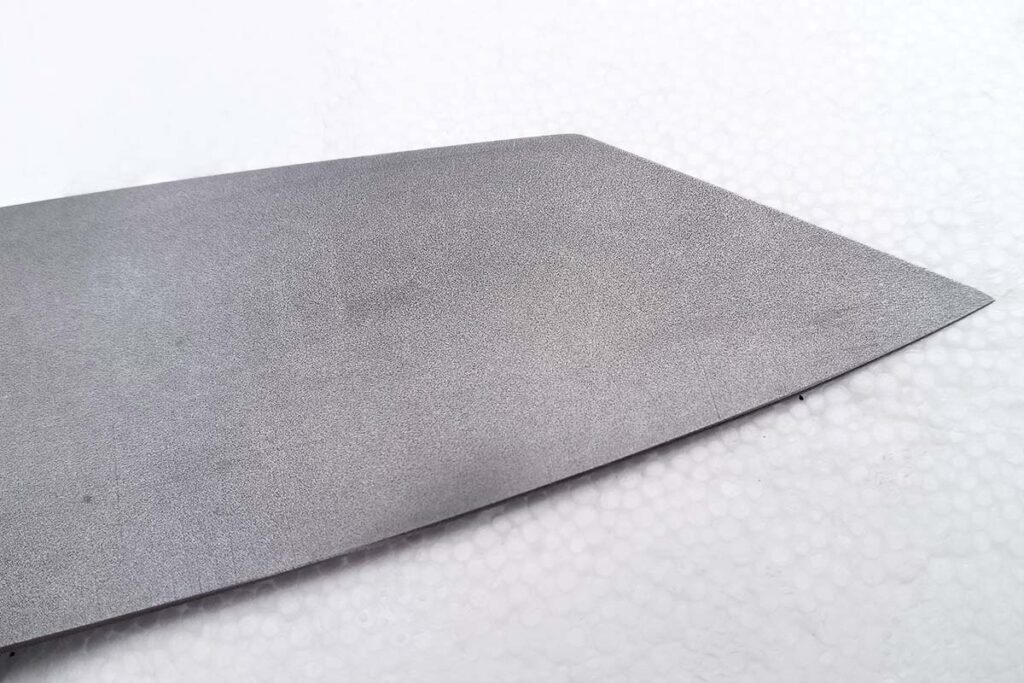
Tip of the joy of cooking knife
The K tip gives the knife a piercing feature lacking in such Japanese designs as the santoku.

Ethan said he’s a big fan of the santoku style and has designed santokus and used them in the kitchen almost exclusively for 20 years.

“The one problem with the santoku is it really doesn’t have a good piercer,” he noted. “You can get by without a piercer if you keep the knife really sharp but guess what—most people don’t keep their knives sharp enough. But for such jobs as taking off the top of a tomato, for instance, the K tip works pretty good.”

Dan lauded the utility of the K tip for other tasks as well, adding, “My grandmother opened all the packaging with the tip of a kitchen knife. No matter what knife you gave her, she sliced the top of the package open with the tip and went to work.” The K tip is tailor made for such chores, as well as others.
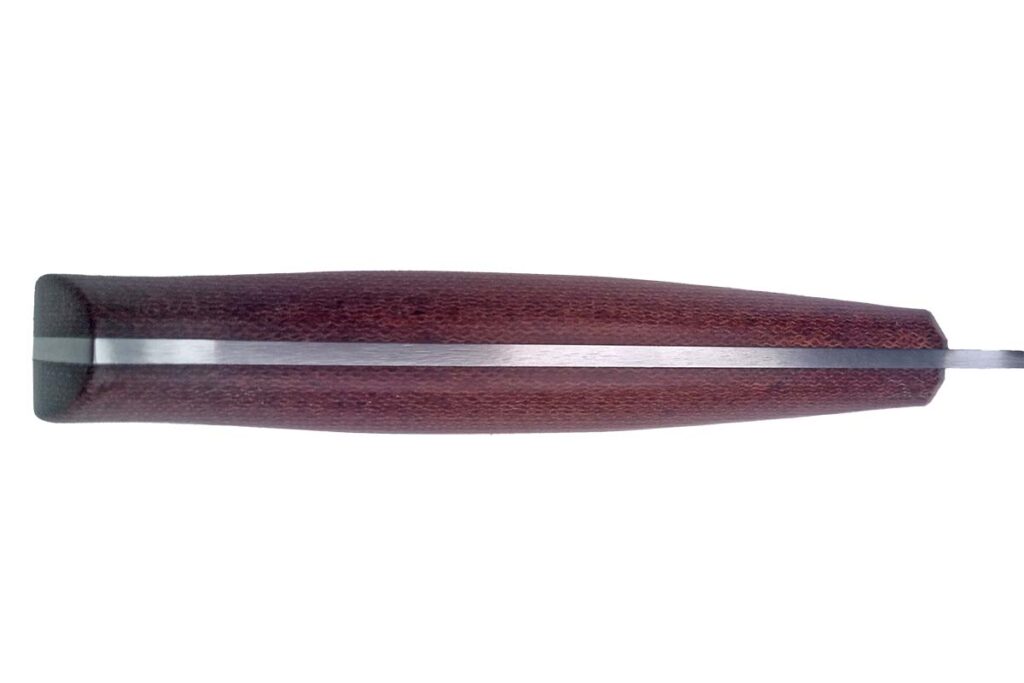
Joy of cooking knife handle palm swell
The collaborators prefer a Western-style handle and gave the Joy of Cooking Knife grip a palm swell as a result.

The edge has a nice curvature for rock chopping and push cutting meats and vegetables. The heel of the blade also curves toward the rear and sits flat on the surface for controlled cutting.

“The neat thing is when the blade comes down [at the heel during a rocking cut or chop], it stops,” Ethan explained. “It’s also good for a push cut,” Dan added, “so it’s good for both a rock chop and push cut. And having that heel down a little bit it will bottom out, so you cut all the way through something and don’t wind up with little partially cut bits at the end.”

Joy Of Cooking Knife Details

The 8-inch blade is CPM S35VN stainless steel. The Rockwell hardness is 60 HRC and the blade is 3/32-inch thick at the thickest. Along with the contoured handle the knife weighs in at a scant 5.5 ounces.
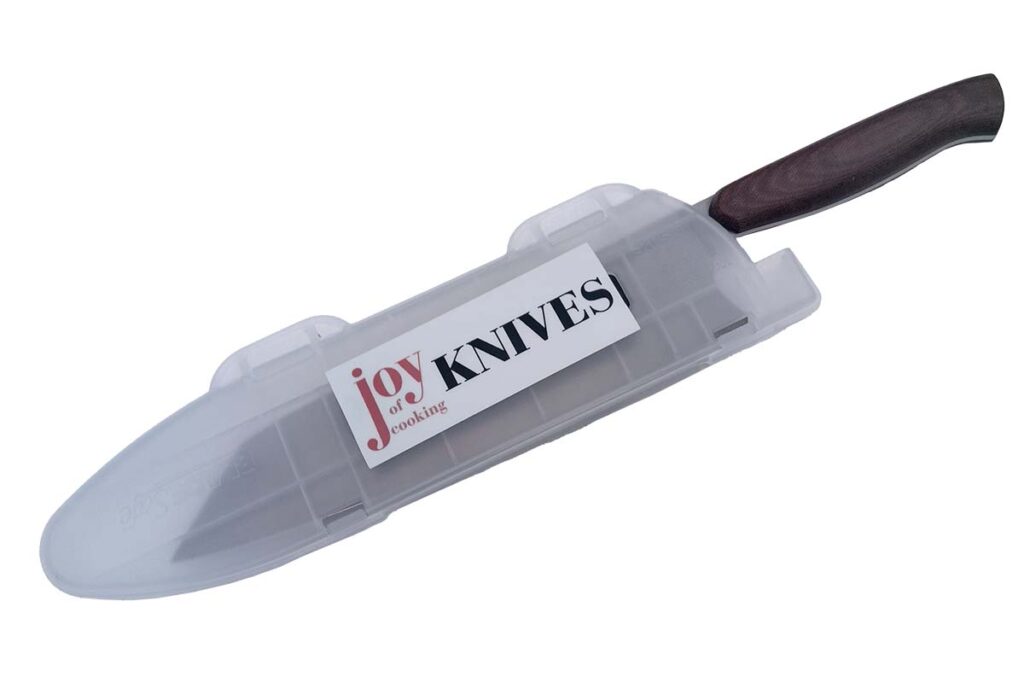
Joy of cooking knife sheath
A hard plastic cover with plastic snaps contains and protects the knife.

“I’m of the opinion the Greeks told us everything we need to know about a double-inclined plane—the longer the plane and the lower the angle, the more efficient it is,” Dan said. “A knife blade is a double-inclined plane, and I wanted to make this knife as light as possible.”

He returned to his grandmother’s experience.

“And again, my grandmother used to complain that Henckels and Wusthof, she loved the knives, but they weighed almost as much as she did. By using the S35VN we’ve been able to thin it out and get a mechanically better cutting blade, but also a lighter blade.”

Ethan agreed that most kitchen knives are too heavy.
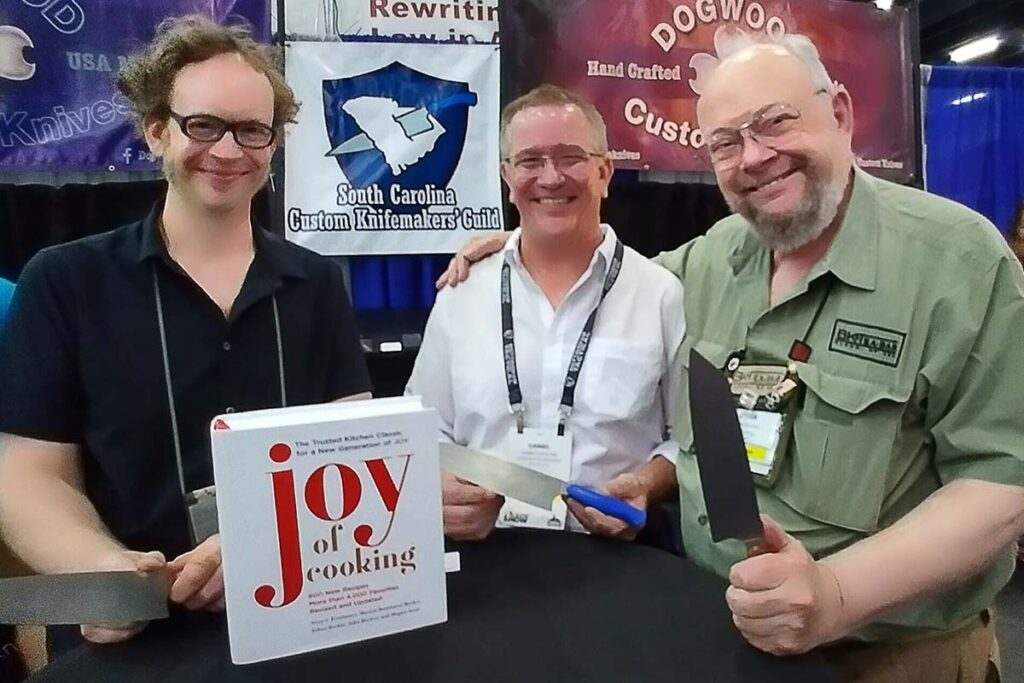
From left at BLADE Show 2024: John Becker, co-editor of Joy of Cooking, Dan Eastland of Dogwood Custom Knives and long-time knife designer Ethan Becker.

“The wrist gets tired easy and to be able to not have very much weight that you’re working with, hey, what’s wrong with that?” he observed. “Most traditional kitchen blades were thick because they were forged before they were ground … The cutlers in Europe were very, very concerned that the housewives would use the blades for things they weren’t supposed to, so they used soft steel so it wouldn’t nick and if they opened bottles with it it wouldn’t hurt it. The result was blades that didn’t hold an edge worth a damn and were not terribly efficient.”

Dan said the S35VN has good corrosion resistance and the edge retention is phenomenal.

“We tested the knife extensively in an industrial kitchen to ensure edge retention and durability, and I like S35VN because it’s a good balance of durability and edge retention. And we can get that 60 Rockwell so it can take a nice, keen edge and we don’t have to worry about it chipping out.”

As noted, Dan and Ethan wanted a Western-style handle with a palm swell and offer it in a choice of G-10 and Micarta®. The Micarta is available in black and natural versions, both with texture and grain for purchase. The G-10 comes in red, black and blue.

“Those colors will always be the same over time as we introduce other knives in the lineup, so you can buy a knife that will match whichever color knife you previously bought,” Dan said. The intent is for there to be a complete set of Joy of Cooking knives, though nothing was set in stone in that regard at press time.

Pros

  • Collaborative Expertise
  • Versatile Blade Design
  • Premium Blade Material

Cons

  • Higher Price Point
  • Plastic Snap Cover

Joy Of Cooking 8” Chef’s Knife Specs
Designers: Ethan Becker and Dan Eastland
Company: Dogwood Custom Knives
Blade Length: 8”
Blade Steel: CPM S35VN stainless
Rockwell Hardness: 60 HRC
Blade @Thickest: 3/32”
Handle: Black and natural Micarta® and blue, red and black G-10 options
Overall Length: 13”
Carry: Plastic snap cover
Knife to Know: K tip blade; lightweight design; hidden handle pins
Country of Origin: USA
MSRP: $200

More Kitchen Knives:

Brisket Knife: These Carving Blades Are Bad To The Bone

0

Prepare massive meat feast with one of these barbecue beasties at hand.

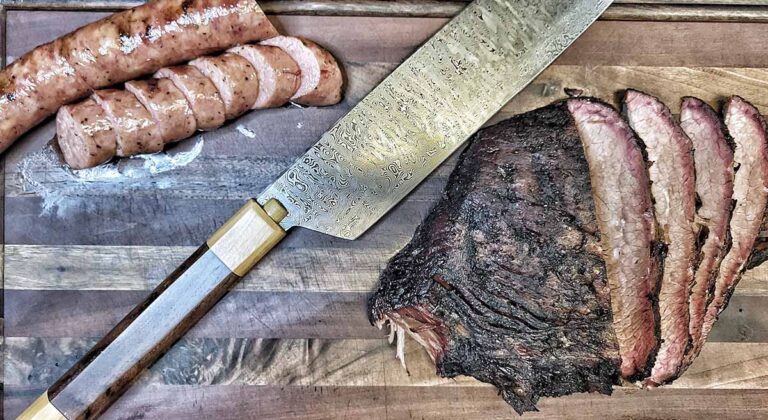
The barbecue/brisket knife is an indispensable tool for those who prepare brisket and other large-scale meat dishes. Makers go the extra mile to provide the toughness and tensile strength needed, along with a tip that stays sturdy to separate meat and prepare it for serving. Individual recipes include the good looks and visual appeal that make owning and using the best in such knives a pleasure.

Ben Anderson: Brisket Slicers For The Barbie

Ben Anderson forged the 12.6-inch blade of his Mosaic Brisket Slicer
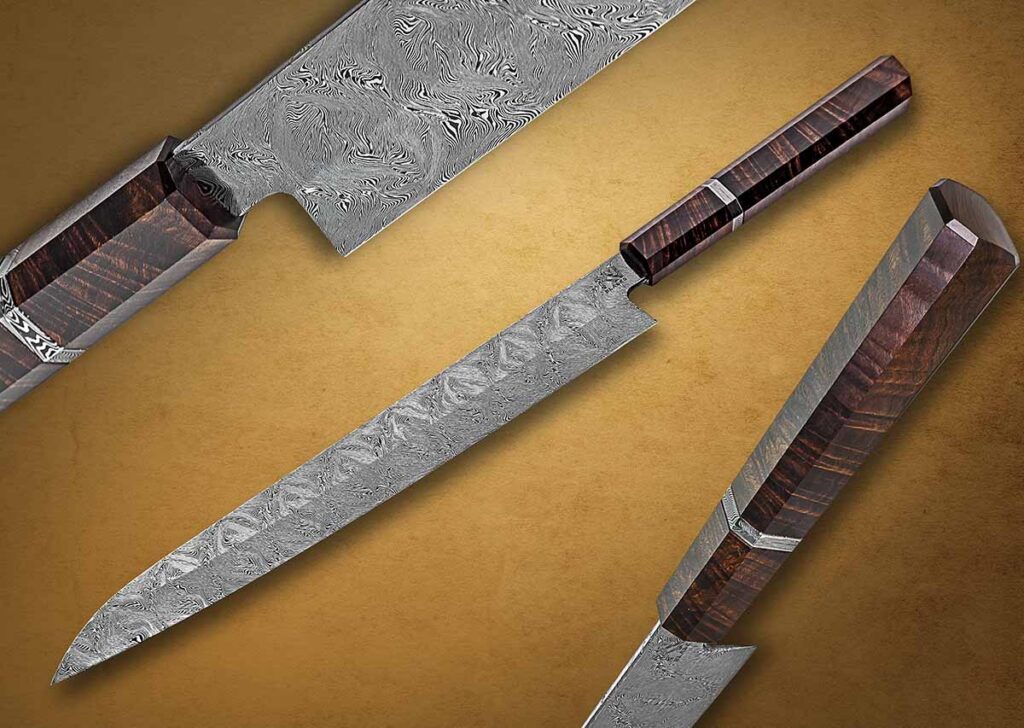
Ben Anderson forged the 12.6-inch blade of his Mosaic Brisket Slicer from 1084 carbon and 15N20 nickel-alloy steels. Done in the Japanese wa (octagonal) style, the handle is ringed gidgee with a damascus spacer. Overall length: 19.7 inches. (Rod Hoare image)

Ben Anderson of Gold Coast, Queensland, Australia, features his artisan’s perspective in two beauties that allow form and function to seamlessly blend. He calls both brisket slicers, and in each case he has styled the big carbon steel blade for use with large pieces of meat. One features a blade of 52100 high carbon steel, handle of ironwood and ebony with textured and filed brass spacer, overall length of 27.5 inches, blade of 19.7 inches, and leather sheath. The second is a stunning piece with a 12.6-inch blade of mosaic damascus in 1084 carbon and 15N20 nickel-alloy steels, and a handle of ringed gidgee with a damascus spacer. Overall length: 19.7 inches.

“The blade shape just seems to be a favorite of the brisket guys [in Australia],” Ben commented. “I think people like it because it’s just an aggressive-looking shape that’s a bit reminiscent of a katana. Most of my time as a maker I’ve offered full customization for my clients, so this really pushed me to try all different shapes, sizes and color combinations.”

A custom knifemaker for about six years now, Anderson uses precision specifications in crafting his brisket knives to perform. “On my standard kitchen knives I’ve always aimed for a ricasso height of around 18 millimeters [.7 inch], which made my handles around 20 millimeters [.79 inch] tall at the front and tapered out to around 5 millimeters [.196 inch] bigger at the back. On the bigger brisket knives I aimed for a ricasso height of around 23 millimeters [.9 inch], which made the handles around 25 millimeters [.98 inch] tall at the front and again tapered to around 5 to 7 millimeters [.196 to .275 inch] bigger at the back. I like to scale the handles up with the blades,” he noted, “so it all looks in proportion. It also helps with the balance a bit.”

Ben Anderson’s brisket slicer is one in a 19.7-inch blade of 52100 carbon steel
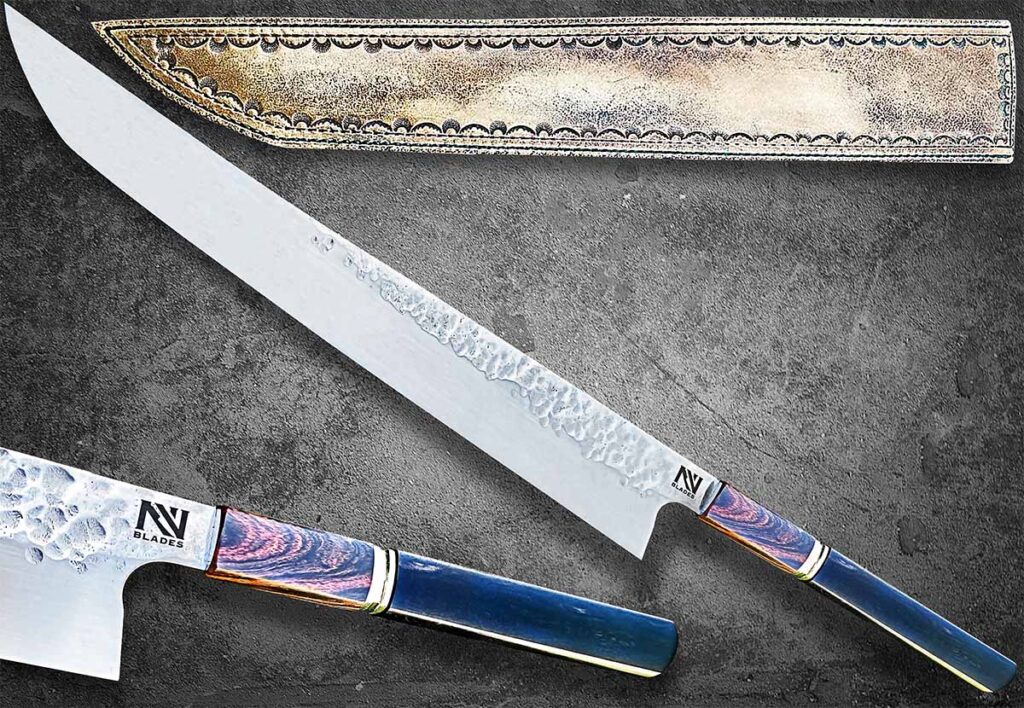
Yet another example of Ben Anderson’s brisket slicer is one in a 19.7-inch blade of 52100 carbon steel, and an ironwood and ebony handle with a textured, filed brass spacer. Overall length: 27.5 inches. (Rod Hoare image)

Anderson’s brisket knives have found their way into competitions with a customer who uses them to prep and slice. Ben’s maintenance and upkeep includes Renaissance Wax for long-term storage after a good cleaning. For everyday servicing a bees wax or mineral oil wipe down for the handle works best.

Of course, since Ben is Australian, his take on the barbecue event itself is enlightening. “A barbecue here is often as simple as a 24-pack of sausages and a loaf or two of bread and some basically burnt-to-a-crisp onion,” he laughed. “As for myself, I’m usually pretty happy with a simple steak and sausages.”

Peter Pruyn: San-Mai Slicer

Peter Pruyn’s brisket slicer
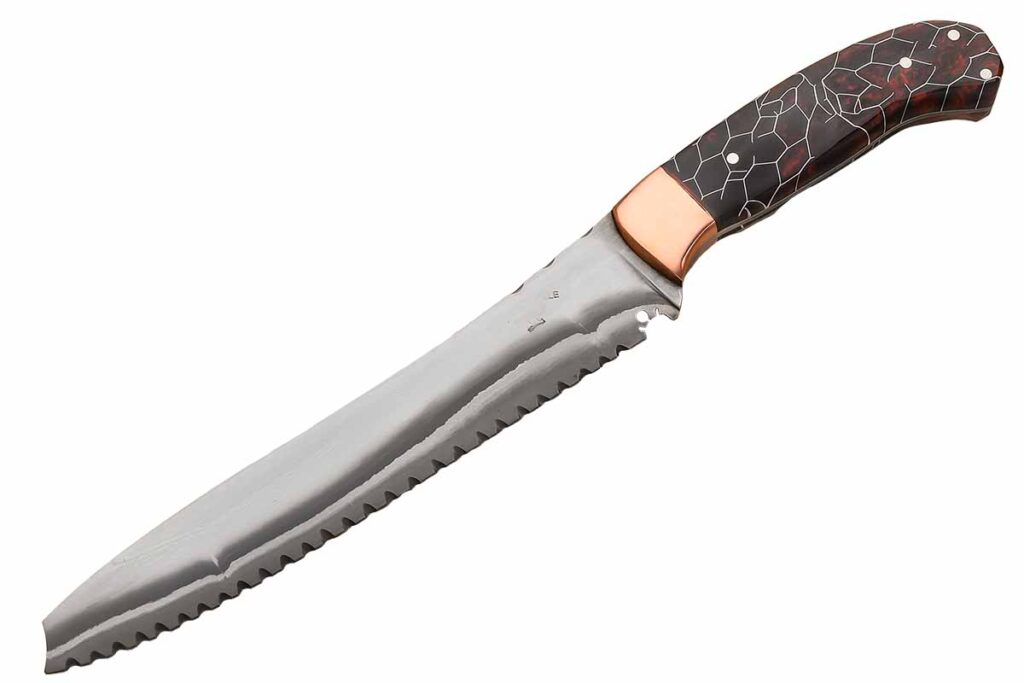
Peter Pruyn’s brisket slicer is designed for slicing large pieces of beef. It has a long, thin, Granton-style blade with a tad of distal taper and vertical scallops its entire length. The Granton blade is ideal for cutting large pieces of meat, and the handle supports slicing with a pulling motion. His price for a similar knife: $1,000. (SharpByCoop image)

Peter Pruyn of Grant’s Pass, Oregon, recently produced a brisket slicer that is pleasing to work with and also admire next to the cutting board. His 13-inch blade in a stainless/high-carbon san-mai construction of respective 416 and 52100 steels is complemented by a handle of his favorite handle material from Voodoo Resins, and a copper spacer. Overall length: 18 inches. A zippered, padded pouch is included.

The pouch, Pete says, is more practical in a kitchen setting and protects the knife. If the knife is included in a set, his preference for protection is a leather knife roll.

“This particular knife is designed for slicing large pieces of beef,” Pruyn related. “I made it for a customer who uses it for commercial-size briskets. When I needed to design a knife for that purpose, I called a friend, Rob Baptie, who barbecues and cooks briskets and other meats professionally. He described a very long, thin blade with a little distal taper and vertical scallops the entire length of the blade. Often referred to as a Granton-style blade, it has a handle that supports slicing with a pulling motion.”

Peter forged the blade to about 1/8-inch thick. “The 52100 has always been an excellent steel for butcher and chef’s knives due to its abrasion resistance, and it takes an excellent edge and retains it very well. The stainless protects the core steel and makes it easier to maintain,” he observed. “I also etched the blade, which makes the 52100 more rust resistant, like a forced patina.”

The Voodoo Resins handle material is easy to work with and extremely durable. “It doesn’t change with time, temperature or humidity,” Peter said. “Its creator, Matt Peterson, made a custom color for this knife, which was part of a 14-piece set. For the bolsters I chose copper more for its aesthetic appeal with the other materials than anything else. When you make a custom knife for something like this you have to think about how it looks and not just a comfortable handle and a practical, durable design. It’s part of the whole package.”

Matt Williams: Barbecue Balance

Brisket knife cutting meat
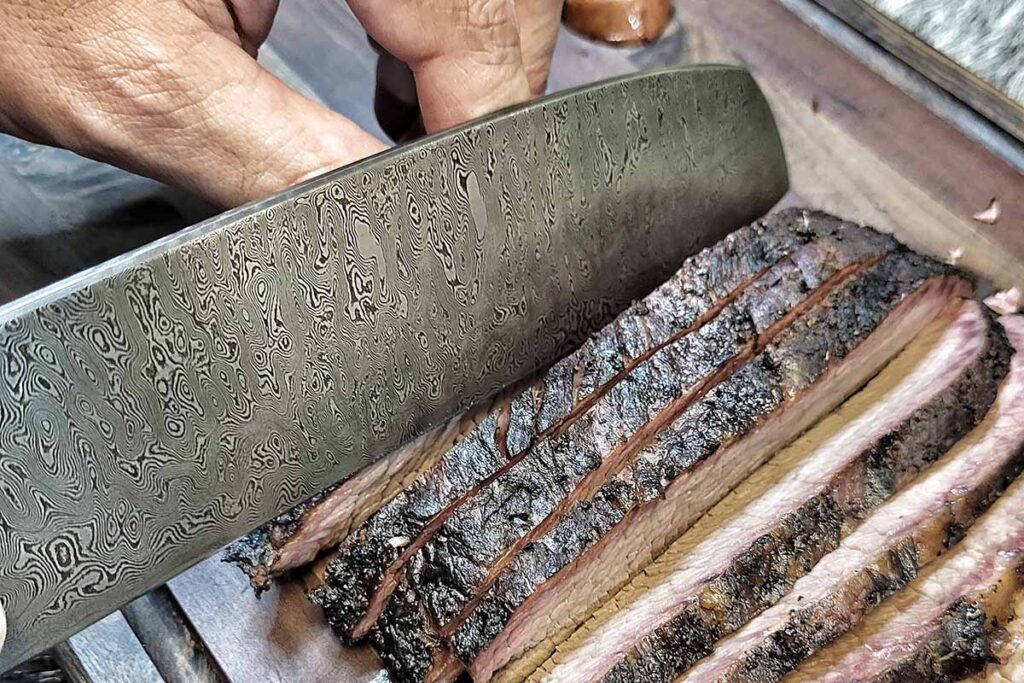
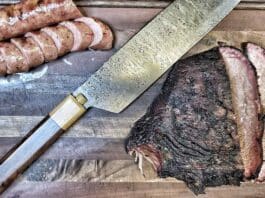
The BBQ Chef’s Knife by Matt Williams is a meat-slicing machine. He outfits it in a 9-inch blade of 400-layer damascus forged from 1084 carbon and 15N20 nickel-alloy steels, and a handle of spalted pecan and cedar elm with a white oak dowel. Overall length: 15 inches. His price for a similar knife: $750. (SharpByCoop knife image)

A heavy chef’s knife with a santoku influence was the goal for Matt Williams of Bastrop, Texas, with his beauty of 400-layer random-pattern damascus in 1084 carbon and 15N20 nickel-alloy steels. The blade is 9 inches long and the handle is spalted pecan, cedar elm and a white oak dowel in a combination that evokes the maker’s woodworking skills. His knives are influenced by feedback from customers who have told him what they really want in a solid performing knife. His price for his BBQ Chef’s Knife starts at $750.

“The blade’s distal taper is .169 to .05 inch,” Matt noted, “and this distal allows for some more delicate work to be done at the end of the blade. Sometimes you need to slice up some peppers or dice up something tasty. The handle is long to balance the heavy blade out. It’s thin because I like wa [octagonal] handles, and this is my interpretation done on a wood lathe. I turn the whole handle and the dowel. I harvest, mill and stabilize most of my wood. They are all local hardwoods. I know these woods well and their capacities.”

When designing his BBQ Chef’s Knife, Matt relies more heavily on balance than weight. His perspective counts on a solid feel in a pinch grip. “Prepping 200 fruit and veggie trays in eight hours will test your wrist,” he smiled. “I learned not to fight a forward-leaning blade. I worked in food prep when I was younger and I have always been drawn to this shape for its overall utility.

“I want the knife to slice well through meat and to be able to break a joint,” he concluded. “Afterwards, it will also look pretty next to a pile of barbecue!”

Editor’s note: Due to fluid market conditions, all prices listed are subject to change. Please check with the applicable maker for the latest in pricing.

Read More

Delight Valley Veggie Slicer Review: Roughing Up Roughage

Specially formulated to knock vegetables down to size, the Veggie Slicer has an edge in the kitchen.

Never judge a book by its cover. That holds true for knives, too.

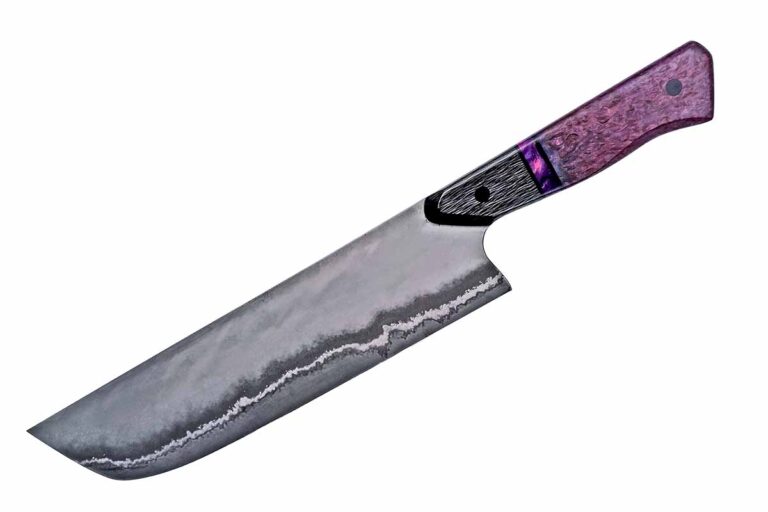
When I opened the box containing the Veggie Slicer from Delight Valley Blades, I noticed it did not have a tip like most knives. Well, at least I wouldn’t stab myself. The knife has a full flat grind to sharp, with a very fine edge. It’s made for slicing and dicing, though you know I will do more with it than that.

Veggie Slicer In The Kitchen

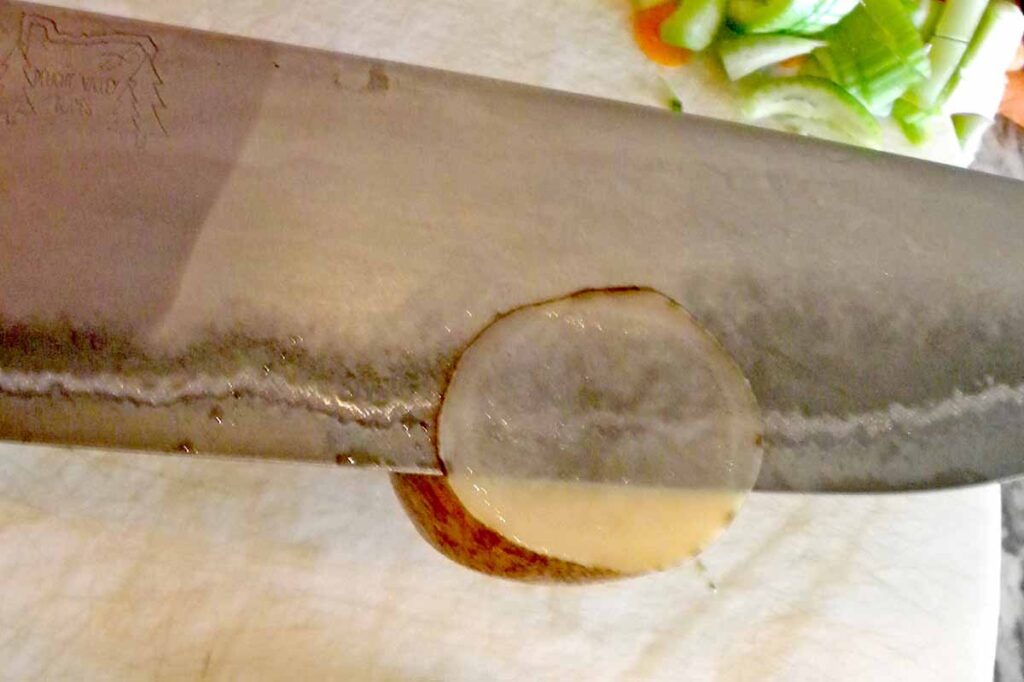
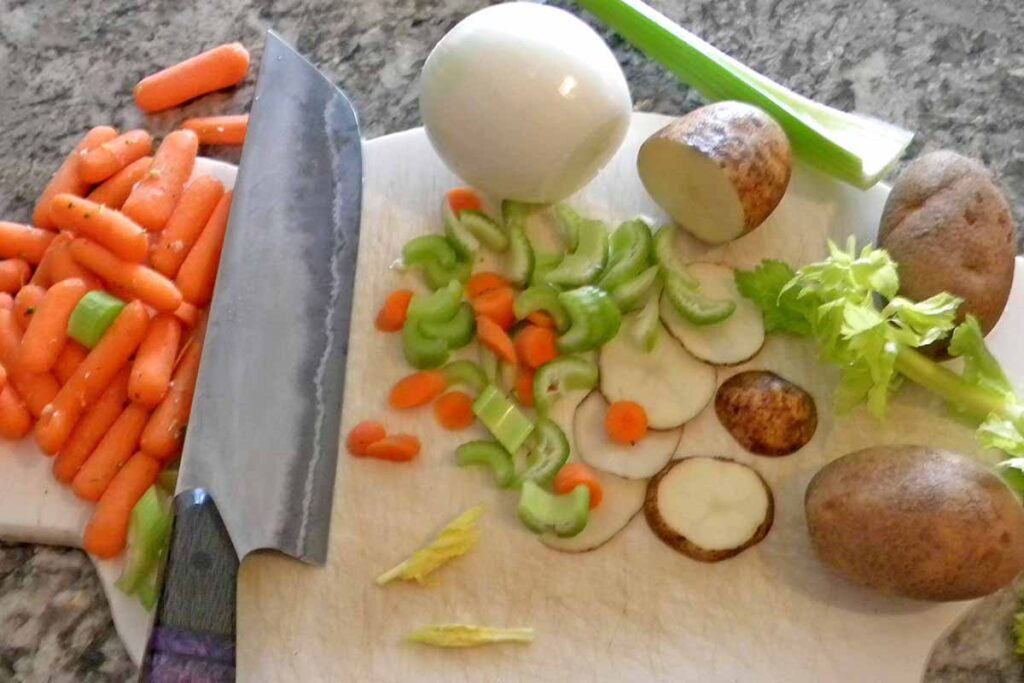
Since hunting season was starting, I made a big pot of vegetable beef soup before heading to the woods. I used the Veggie Slicer to slice and dice the veggies. It powered through the carrots very quickly and diced up the celery cleanly. I did my thinnest slice of onion ever. I could easily see the layers of the san-mai through the wafer-thin onion. I chopped the rest of the onion in a flash. On to the potatoes!

Veggie Slicer through a potato
The author sliced the potato so thin with the Veggie Slicer you can see the layers of san-mai through it.

I was expecting more resistance from the spuds. Light pressure was all it took. The knife being so sharp, I had to take care to keep all finger parts away from the edge. The Veggie Slicer will peel the skin from your finger before you can say Veg-O-Matic—and I had a few close calls.

Veggie Slicer Light Cutting Duty

With everything in the pot cooking, I headed out to the garage to slice up the non-edibles. I grabbed a sheet of 20-pound bond copy paper for slicing. I managed to suffer only one nail nick in making the paper fall apart. The knife is nasty sharp for sure. The slices were smooth and I used only the weight of the blade on the pull cuts.

I jumped up to double-walled cardboard to try and slow the edge down. That didn’t work, either. The Veggie Slicer ate through the cardboard as fast as I could get my fingers out of the way. I used both push and pull cuts to see if there was a difference. There was none.

Delight Valley Veggie Slicer vs pine
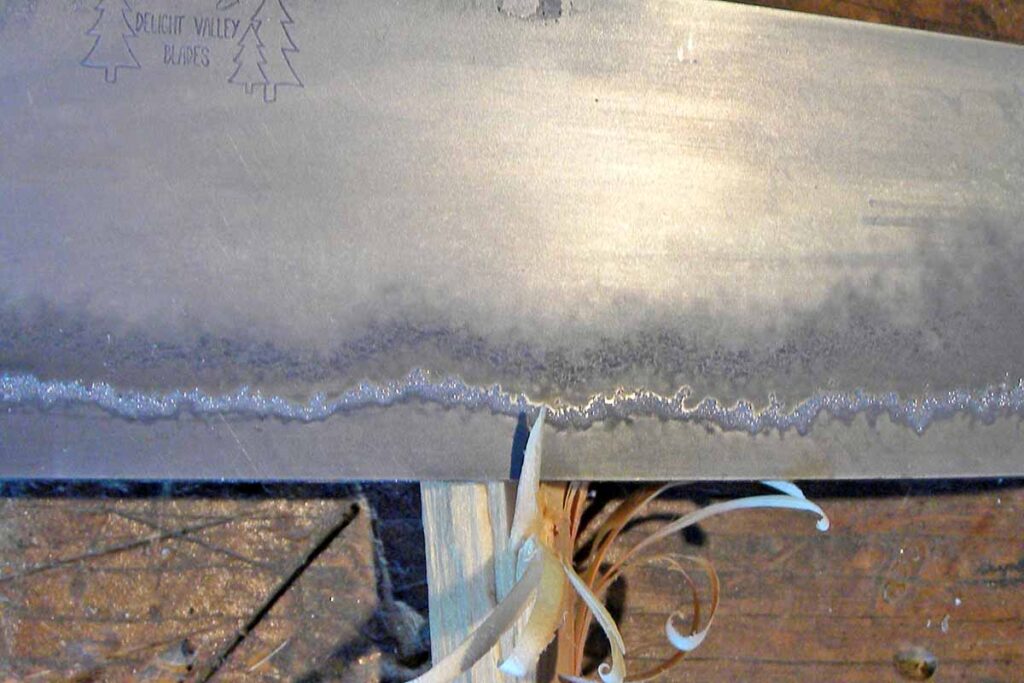
Thin pine curlicues were the order of the day for the Veggie Slicer.

Heavy-Duty Cutting

It was on to whittling pine. The Veggie Slicer made very thin curlicues. I couldn’t choke up on the blade as the spine was cut at a 90-degree angle—too sharp for the insides of my fingers. As a result, control was a tad more difficult. The blade still cut deep and shallow without a challenge. It zipped into the pine quickly, still scary sharp.

It was time for some half-inch sisal rope. After the first 100 crunching cuts I let my guard down enough to take a nick out of my rope-holding finger. Thanks to all my callouses no blood was shed, but it was close. The second 100 went off without any dulling of the edge (or my finger).

I had to go one step further to see if the fine edge would hold up. I grabbed a whitetail deer antler and gave it 30 chops. The result: no edge damage whatsoever, a sign of perfect heat treatment.

Final Cut

The Veggie Slicer can slice, dice and a lot more if needed. It has one long-lasting edge.

Soup prep with Veggie Slicer by Delight Valley Blades.
The kitchen knife sliced and diced the veggies, powered through the carrots very quickly and diced up the celery cleanly. It’s soup!

I would soften the blade spine and choil and ricasso area so a wider selection of hand grips can be used.

Delight Valley Blades Veggie Slicer Specs
Blade length: 7.5”
Blade steels: 26C3 carbon core and 416 stainless cladding in a san-mai construction
Blade grind: Full flat
Blade width: 1.78”
Handle: Masur birch and carbon fiber
Pins and liners: G-10
Weight: 10.5 ozs.
Overall length: 12.25”
Maker’s price: $600

Read More Knife Reviews:

Wa Handle: Japanese Ergonomics Are Revolutionizing Custom Kitchen Knives

User-friendly custom takes on the classic Japanese knife handle abound.

The Japanese influence in kitchen knives is more or less a given. Those who work in food preparation, an art form unto itself, appreciate the style and utilitarian feel that the Japanese culture exerts on their vocation.

The kitchen knife has seen a wave of custom makers taking that context a step further. The knife is an extension of the hand and that extension starts with the handle. So, here again the ergonomics of Japanese influence emerge. The wa handle brings comfort and confidence to the kitchen user while also providing a sense of form, function and artistic expression for the custom maker.

The wa handle of Aidan Garrity’s santoku has largely parallel sides to the width of the ricasso with a small ‘beak’ at the bottom for hand retention and aesthetics. Blade steel: mosaic damascus. Vintage butterscotch Micarta® scales boast flat-shield cross-sections and G-10 spacers. Overall length: 14 inches. His list price for a similar knife: $2,300. Its sister piece is a Garrity nakiri that was featured on the March 2024 BLADE® cover. (SharpByCoop image)

According to maker Jacob Anstaett, the name itself is rooted in the Japanese language.

“Wa comes from the Japanese language and broadly translates as ‘harmony’ or ‘balance,’” he explained. “In knifemaking, it refers to the traditional Japanese handle style, which emphasizes simplicity, lightness and an ergonomic connection between the handle and the blade.”

Anstaett further defines the wa handle as “lightweight with forward-balanced design. Typically, it is either octagonal, oval or D-shaped in cross-section. The handle is crafted as a separate piece that fits onto a hidden tang rather than a full tang. The construction is what gives the blade its distinct balance, where the cutting edge feels alive in your hand instead of weighed down.”

A resident of Plano, Texas and a custom knifemaker for eight years, Jacob says his wa handle is an interpretation of the Japanese style.

Alex Töpfer described his wa-handled piece as “a general-purpose kitchen knife based on various santoku. The blade is 80CrV2 as it’s a good general steel I can forge and heat treat. The handle is Tasmanian blackwood to add some fanciness, and the same is true for the bronze bolster. It’s functional art you can appreciate as you use it to cook.” His price for a similar knife: $325. (Rod Hoare image)

“It’s best described as a variation of the traditional wa,” he explained. “I keep the core geometry usually as an octagon cross-section, but I adapt the dimensions slightly for comfort. Western chefs often prefer a little more thickness and resilience, so I adjust proportions while preserving the forward balance that makes wa handles so effective.”

Jacob devoted extensive time to the study of traditional Japanese wa handles and then embarked on his road to interpretation.

“Over time I developed my own hybrid approach,” he commented. “My reasoning was simple: I wanted to honor tradition while building something that stands up to modern kitchens. For instance, I blend traditional shapes with stabilized woods or composites, ensuring they can handle daily use in a busy Western kitchen without losing the essence of the Japanese design.”

What Makes A Wa Handle?

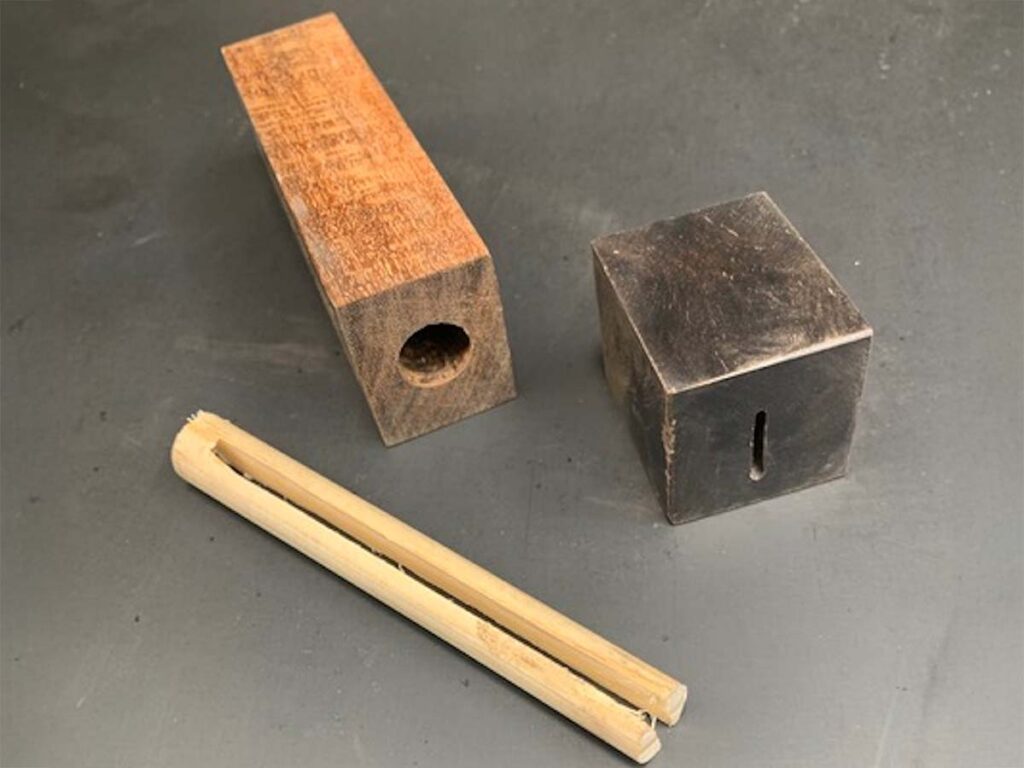
Elaborating on the spirit and style of the wa, Aidan Garrity of Iron Lion Blades in Madison, Connecticut remarked, “There are two schools of thought for what exactly categorizes as a wa handle. One is that the handle’s construction involves a hole the width of the knife’s tang being drilled into the handle, and the tang being enclosed in a slotted dowel to tightly fit into that round cavity. The other is that it is simply the style of the handle, usually slimline and often having angular geometries. For questions like these, I always answer with the understanding that it is just the style of the handle, but I personally consider the true wa handle to be one utilizing the dowel bedding construction.”

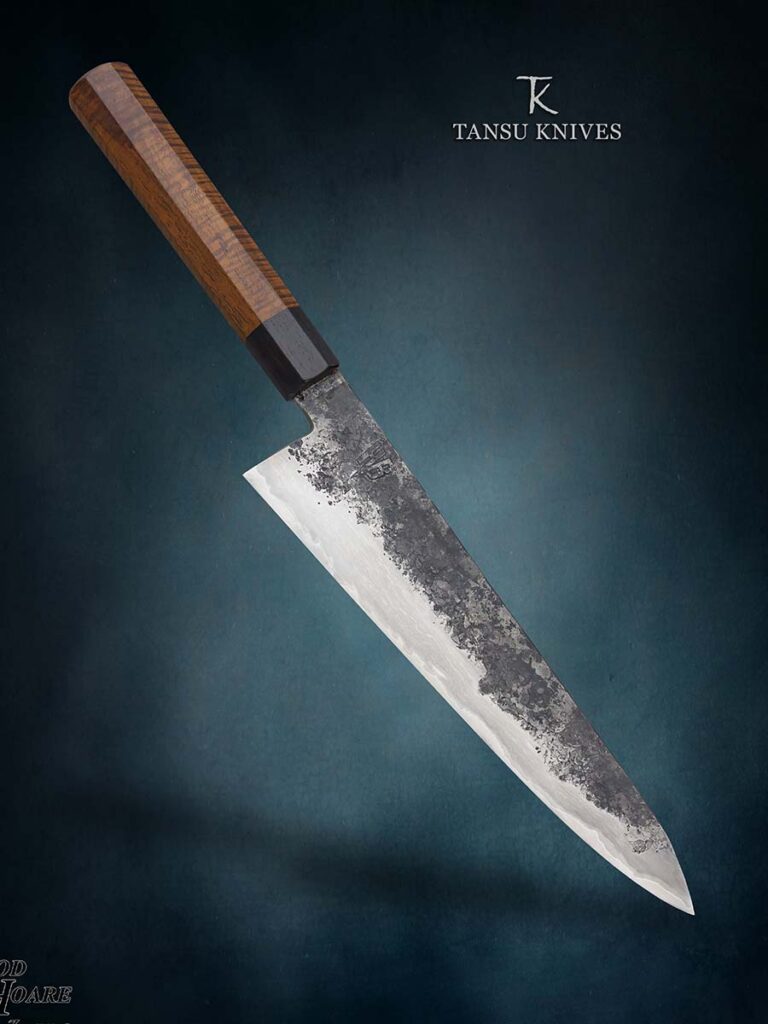
The wa handle of Mert Tansu’s gyuto has a half-inch-wide, 4-inch dowel (above) with a tang slot cut into it. “It is a traditional-shaped wa except for the internal structure,” Mert wrote. “While most Japanese blades are mounted to the handle with burning the tangs in, this is not possible with a hard timber-like ringed gidgee, and I glued mine in.”

Australian custom knifemaker Mert Tansu follows the wa tradition with his own interpretation. His perspective includes a geometric aspect that broadens the possibilities with the style.

“Wa handles come in a few different geometries,” he related, “from round to oval, to semi-octagonal to full octagonal and D-shape. Compared to their Western counterparts they are not sculpted and flat. Most of the traditional wa handles will have a horn ferrule and magnolia wood body.”

The wa handle of Mert Tansu’s gyuto has a half-inch-wide, 4-inch dowel (above) with a tang slot cut into it. “It is a traditional-shaped wa except for the internal structure,” Mert wrote. “While most Japanese blades are mounted to the handle with burning the tangs in, this is not possible with a hard timber-like ringed gidgee, and I glued mine in.”

Mert’s featured knife is a gyuto from his Hunter Valley Blades series of traditional Japanese chef’s knives with forged finishes and usually san-mai construction. He employed a dowel-bedding construction for the wa handle (page 16). He characterizes his chef’s knives as affordable and less time consuming to make than other custom types.

Specific features of the wa handle style translate into precision and control in the kitchen. He says that the flats allow the user to index the knife with ease. Despite the “stop sign” shape, the octagonal handle is quite comfortable and fashioned with precision on his disc grinder. Optimal length is a subjective question, but Mert likes paring knives with wa handles no longer than 4.7 inches, while handles of 5.3 to 5.5 inches work best in larger chef’s knives with overall lengths of 9.5 inches. For long slicing knives of overall lengths of 10.5 inches, he indicated he prefers a handle between 5.7 and 5.9 inches.

Wa Handle Interpretations

A custom knifemaker for seven years at his home near Melbourne, Australia, Alex Töpfer appreciates the employment of the hidden tang in his knife construction, and he says the wa-inspired handle works in both the active and aesthetic aspects of kitchen use.

“Obviously, I’m inspired by various styles of wa handles, specifically octagonal ones,” he commented, “and also the use of brass bolsters and guards in the Western context. The flats here are more to provide context with the organic, curved aspects of the wood grain and forged texture.

“I do think it’s important to have a flat [handle] surface that aligns with the blade, but the upper parts are more for looks. There is also the question of what an individual user likes. Personally, I prefer to use oval hidden-tang handles, but I do the occasional faceted one for practice and a change. I’ve only had problems when the tang is not long enough. So, I tend to go 2.75 to 3.15 inches of tang. That will support the handle during use. I have had issues with burl where the grain didn’t provide any strength, but a longer tang on that knife would have avoided the problem. Also, fancier materials might be easier to sell even if they’re not ideal. I like recycled ironbark but it doesn’t have that bling factor.”

The traditional handle of Dew Hara’s suigetsu has stabilized burl scales and a copper bolster. The 7-inch blade is tamahagane steel with a hamaguri grind. Overall length: 12.4 inches. (SharpByCoop image)

Garrity demonstrates his skill with the wa in his mosaic damascus santoku blade that combines 1095 and 52100 carbon and 15N20 nickel-alloy steels. He used the Ferry Flip method* and then placed the multi-bar construction to be framed by a monosteel edge and spine bars. Aidan’s santoku has a sister blade, a nakiri featured on the cover of the March 2024 BLADE® (page 13). He made the nakiri with the same bar of mosaic damascus as his santoku.

“This handle is of my own design. It has largely parallel sides to the width of the ricasso with a small ‘beak’ at the bottom for hand retention, as well as aesthetics. It wasn’t based on any particular style,” he noted, “but it does categorize as a shield-shaped wa handle. The flats lend themselves to helping the user maintain proper edge alignment while cutting, as an overly round grip doesn’t offer much [user feedback]. In addition, the flats are somewhat easier to bring to a high finish.”

In constructing a wa handle, Aidan leans heavily on the length of the blade.

“Typically, 4½ to 5½ inches is seen as a natural range to balance average length and weighted blades,” he remarked. “Thicker and wider blades like nakiri and bunka will often be more forward weighted compared to the more generalist shapes like santoku. The handle is often too slim with poor retention for any large chopping blades or fighters. It’s best to stick to kitchen knives for this type of handle design.”

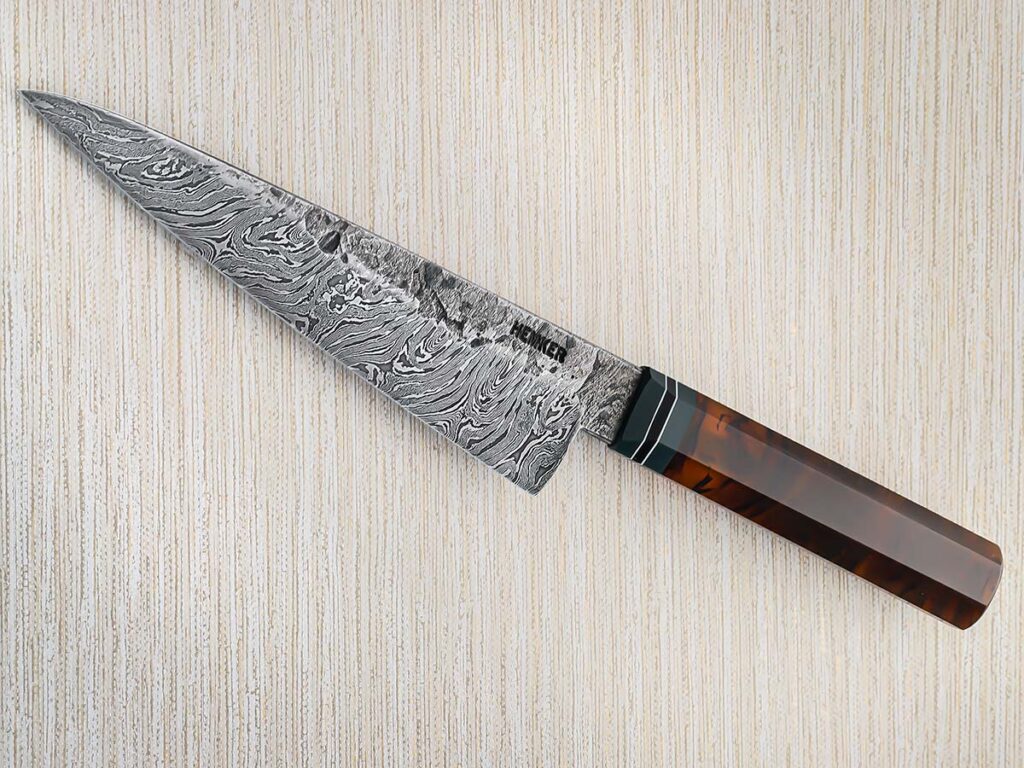
Eric Hemker uses synthetic tortoise shell for the wa handle of his chef’s knife. The flat-ground 7.785-inch blade is a damascus of 1084 carbon and 15N20 nickel-alloy steels. The spacers are green, black and white G-10. Overall length: 14 inches. (SharpByCoop image)

The where, why and how of the wa are revealed in various interpretations, put to work with enthusiasm in the kitchen, and exhibit style and beauty whether in the midst of meal preparation or displayed for all to see. Their aesthetic is timeless, but so is their capacity to make the work of the chef an adventure in creativity.

*Editor’s Note: Named in honor of its creator, award-winning bladesmith Tom Ferry, the Ferry Flip is a variation on the canned steel technique. It basically consists of cutting slices at a 35-degree angle off the end of a damascus billet. The resulting tiles are rotated and forge welded together to form a new billet. As a result, instead of the pattern showing on the end of the new billet, the pattern repeats itself along the new billet’s face.

More Kitchen Knives:

BLADE Show West Custom Knife Awards

Awards Were Given Out In Nine Different Custom Knife Categories Including Best In Show At BLADE Show West In Salt Lake City.

Dozens of makers entered knives in competition across eight different custom knife categories. The skill on display was tremendous, and numerous knives wowed the judges. However, these were the blades that stood out from the crowd and took home the awards. All images are SharpByCoop Images.

Best In Show/Best Kitchen Knife: Trevor Morgan

Best Hunting Knife: Shayne Carter

Best Damascus Custom: Shane Taylor

Best Custom Slip Joint: Evan S. Nicolaides

Best Custom Tactical: Michael Jarvis

Best Custom Locking Folder: Tim Robertson

Best Custom Bowie: Shayne Carter

Best Custom Chopper: Mardi Meshejian

Read More

Advertisement

Must Read Articles

Read this before you make a knife

Knifemaking 101 – Read This Before You Make a Knife

  by Wayne Goddard My experience has taught me that there's nothing like digging in and getting started. I've often said the hardest part of the...
how to forge damascus steel

How to Forge Damascus

Advertisement
Advertisement