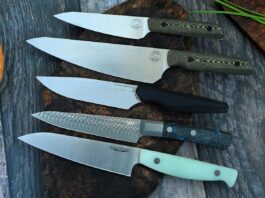
A Woodworker By Trade, Matt Williams Crafts Knives Meant For Rugged Use, Including His BBQ Chef’s Knife.
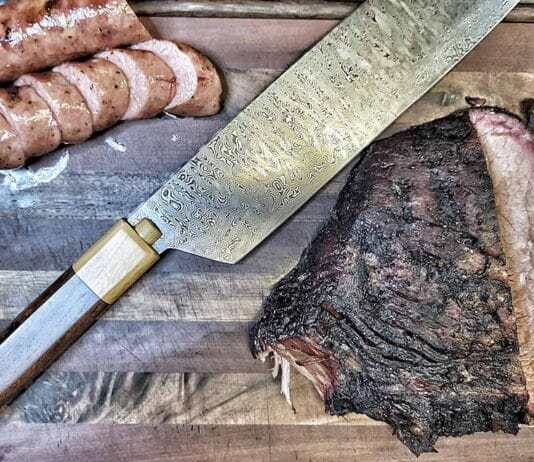
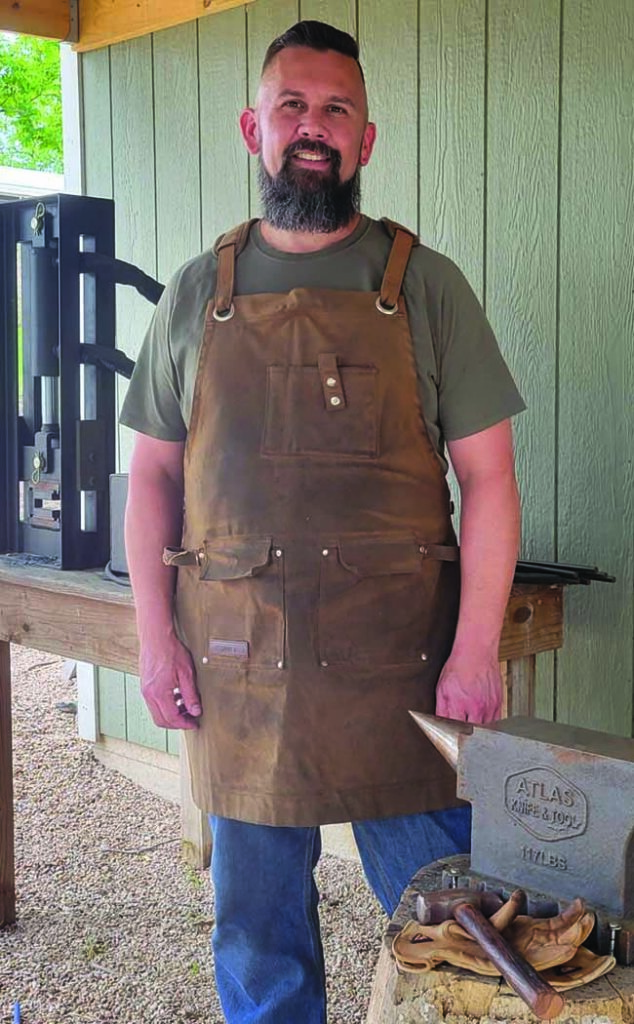
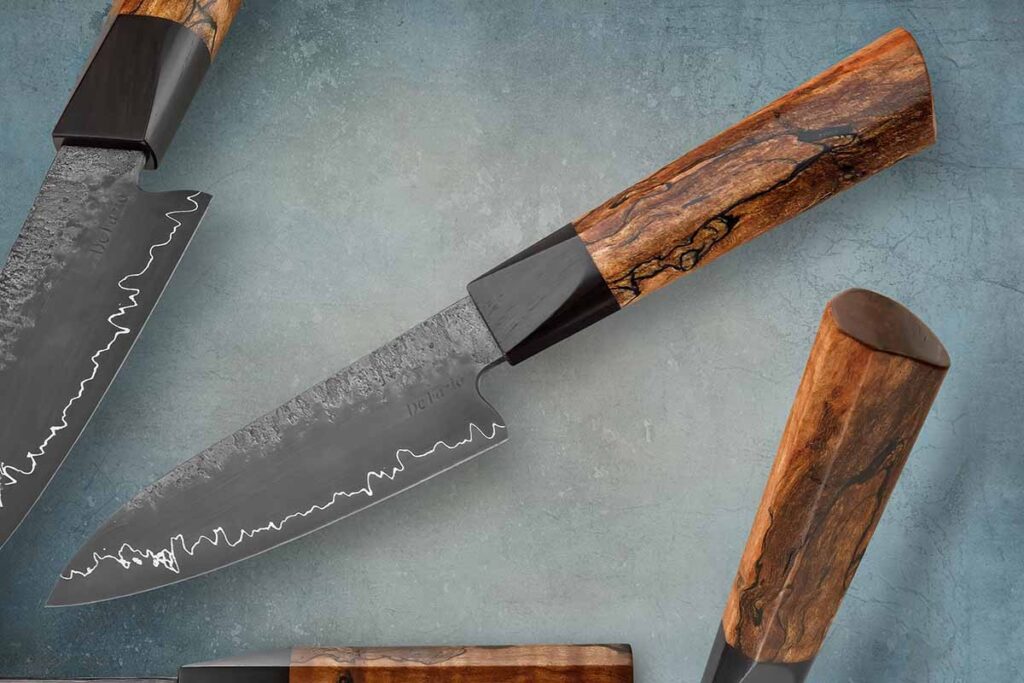
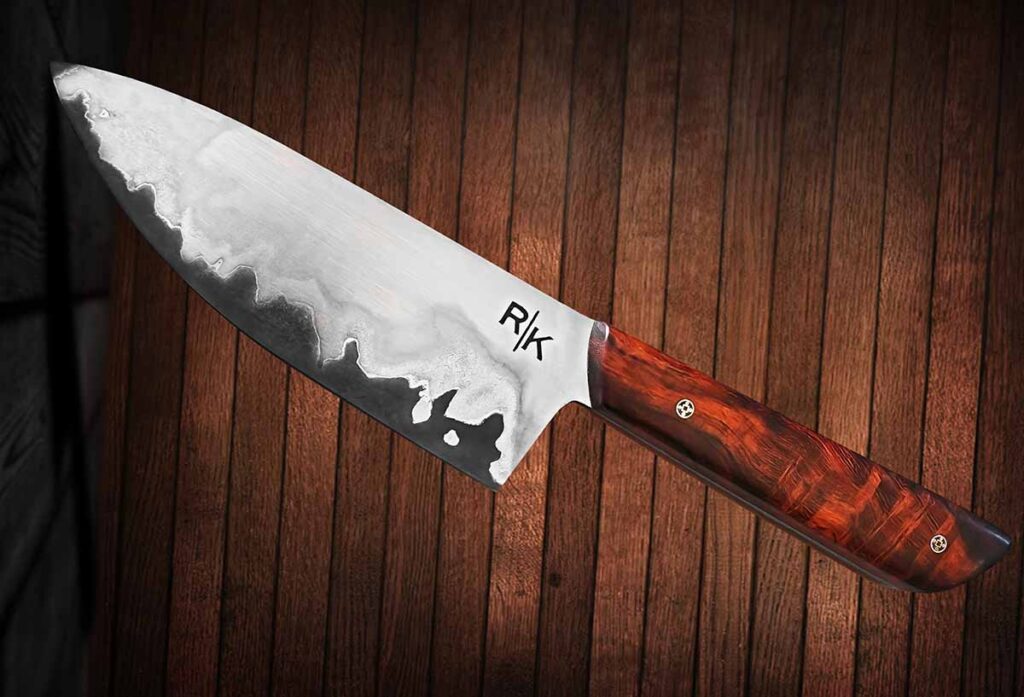
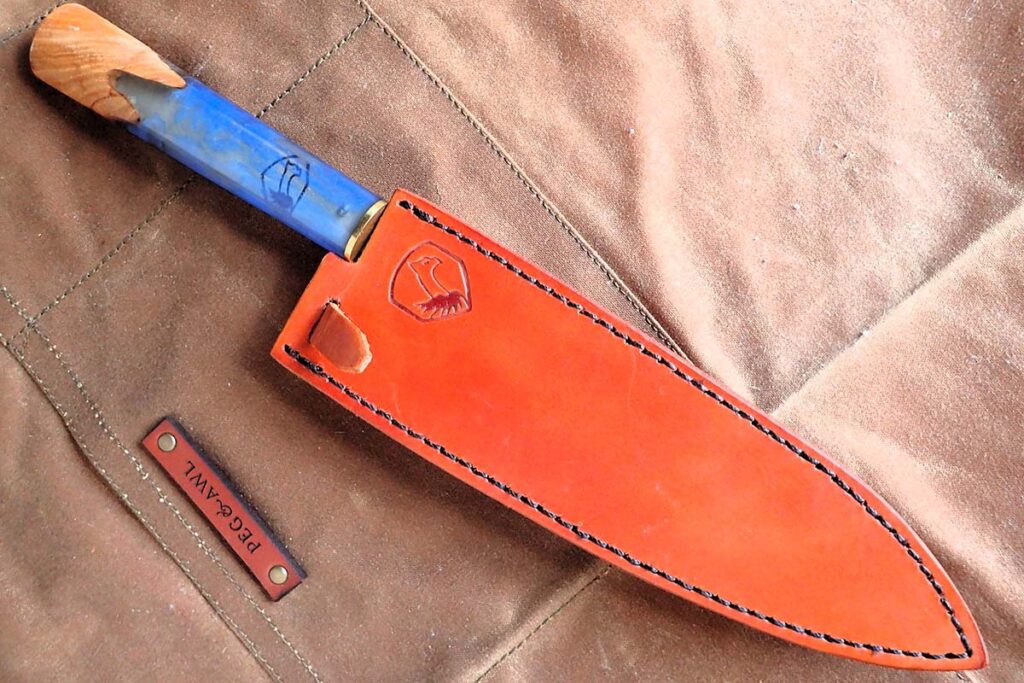
A woodworker by profession that includes making cutting boards, Matt Williams got into knifemaking too and is glad he did because of the feedback he gets from customers. His BBQ Chef’s Knife is a case in point.
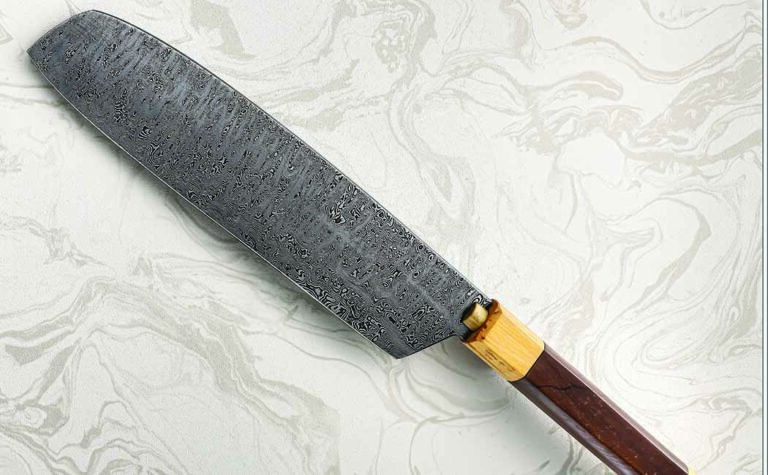
His clients told him his chef’s knives were too thin, especially the local Texas barbecue chefs who need thick, tough blades for separating ribs and joints in competitive barbecue events. As a result, he built the BBQ Chef’s Knife on a santoku cutting base with a thicker blade and a “really aggressive feel” built to take abuse.
Matt lives on an old pecan orchard by the Colorado River and stabilizes and spalts the pecan for his turned-wood handles. The handle for his BBQ model is done in a wa style split down the middle with round dowels of white oak left proud to contrast with the darker pecan. He also forged the steel and made pretty much everything but the coffee for the blade etch.
The combination of his new-style chef’s knives and cutting boards is just the ticket for the highly competitive local Texas barbecue chefs. Along with his custom knife work, Williams also makes one-of-a-kind cutting boards as well that he sells through his website.
BBQ Chef’s Knife Specs Blade Length: 9 inches Blade Material: 400-layer damascus of 15N20 nickel alloy and 1084 carbon steels Hande Material: Spalted pecan, cedar elm and white oak Handle Style: Wa Overall Length: 15 inches Knife To Know: The blade tapers from .169 of an inch at the thickest point to .05 of an inch at the thinnest point Maker’s Price For A Similar Piece: $750
Four custom makers push the boundaries of the tried-and-true cleaver.
An inclination toward the kitchen and a desire to design and deliver cutlery used on a regular basis has spurred a number of custom knifemakers to try their skill with the cleaver. It’s a staple in most kitchens and its uses are as varied as the food prepared there.
Robert Wayman of Middleburgh, New York, sees his cleavers as complementing years of food preparation. “I’ve done a lot of my own food processing, and I spent several years in commercial kitchens when I was younger,” he commented. “So, I’ve always had an affinity for culinary knives and especially cleavers. The cleaver is such an iconic blade. I love to make everything from heavy-duty butcher cleavers to medium-duty kitchen cleavers, Chinese cleavers and lighter-duty veggie cleavers for the kitchen.”
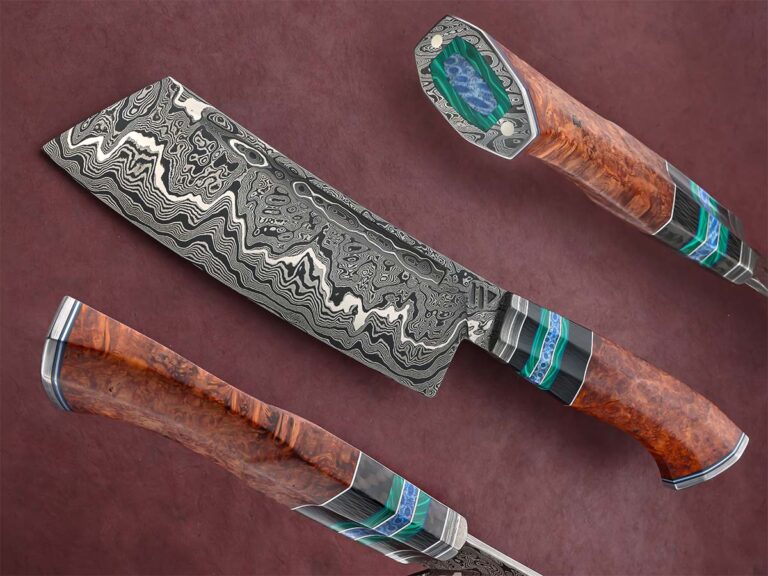
Robert’s featured cleaver is 14 inches in overall length with an 8-inch blade of pattern damascus go-mai five-layer steel. The core is a 100-layer random pattern damascus made of 1084 and 15N20 high-carbon steel and a layer of nickel and matching damascus cladding. The handle includes a damascus collar, stainless steel and G-10 spacers, crosscut carbon fiber, green malachite and blue coral accents, stabilized amboyna burl and a damascus butt cap with stainless mounting pins inset with blue coral framed with green malachite.
“I packed a lot into that one,” Wayman smiled. “As a maker, I’m all about sole authorship. I make all of my own high-carbon damascus steel in-house, and a cleaver provides a great opportunity to showcase that steel. One of my favorite things to forge is a large cleaver with an integral bolster.”
Wayman sees large blades, such as those associated with cleavers, as inherently challenging, while making a task-specific blade, such as a cleaver, adds another layer of complexity. Although they are labor-intensive and involve a lot of time in the shop, performance remains the key.
“Overall weight needs to be taken into consideration, as well as how that weight is distributed for the style cleaver you are making,” Robert advised. “Ergonomics is an important consideration for any knife or tool, but especially for kitchen cutlery. Whether it’s in a professional or home kitchen, you’re making a handle that a chef or cook could use for hours of food prep on any given day. So, it must be comfortable.”
Edgy Ebony
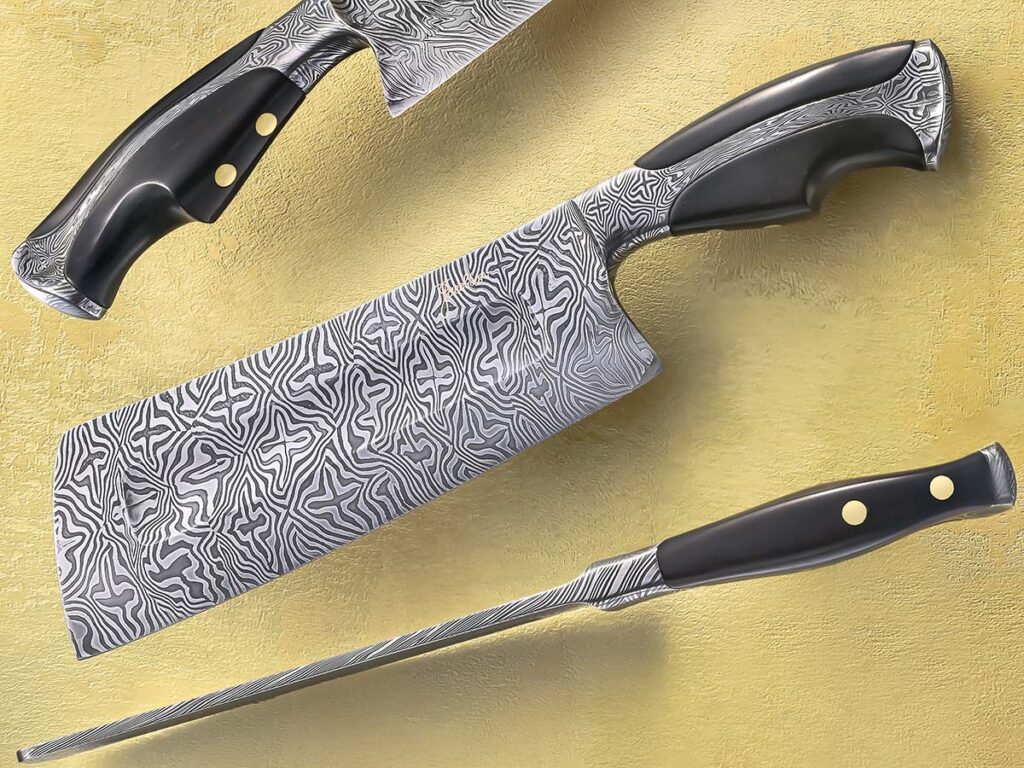
Having served time in professional food service, practical utility is never far from David Jacobson’s mind. However, he isn’t afraid of adding some flourish to his creations, such as the gold-inlay signature near the spine of his mosaic damascus bladed and ebony scaled cleaver. (SharpByCoop image)
David Jacobson’s integral 13-inch cleaver with ebony handle scales sports an 8¼-inch mosaic damascus blade of 1085 and 15N20 steels and a gold inlay signature—his first such accent. He used brass bolt pins to finish the ebony scale attachment.
“I love cooking and making cool chef’s knives and kitchen tools,” Jacobson related from his Felton, California, shop. “Edge geometry for chopping and balance are challenges, and fullers are nice when slicing vegetables for food release. Cleavers are not only for the kitchen. They are great for large fish processing at the dock, chopping through bone and restaurant back-alley butchering. The wide blade shows off the many designs in the damascus steel, and I chose a traditional profile for this particular cleaver. I’ve always liked a black handle with big brass pins—old school.”
Cutting Mustard
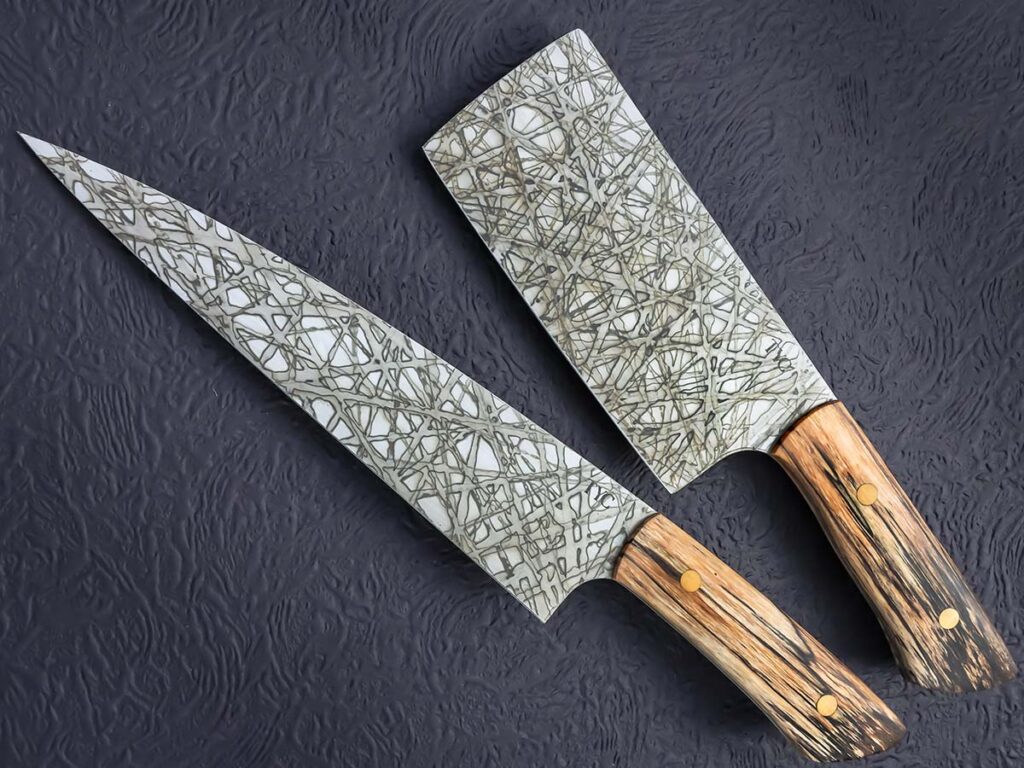
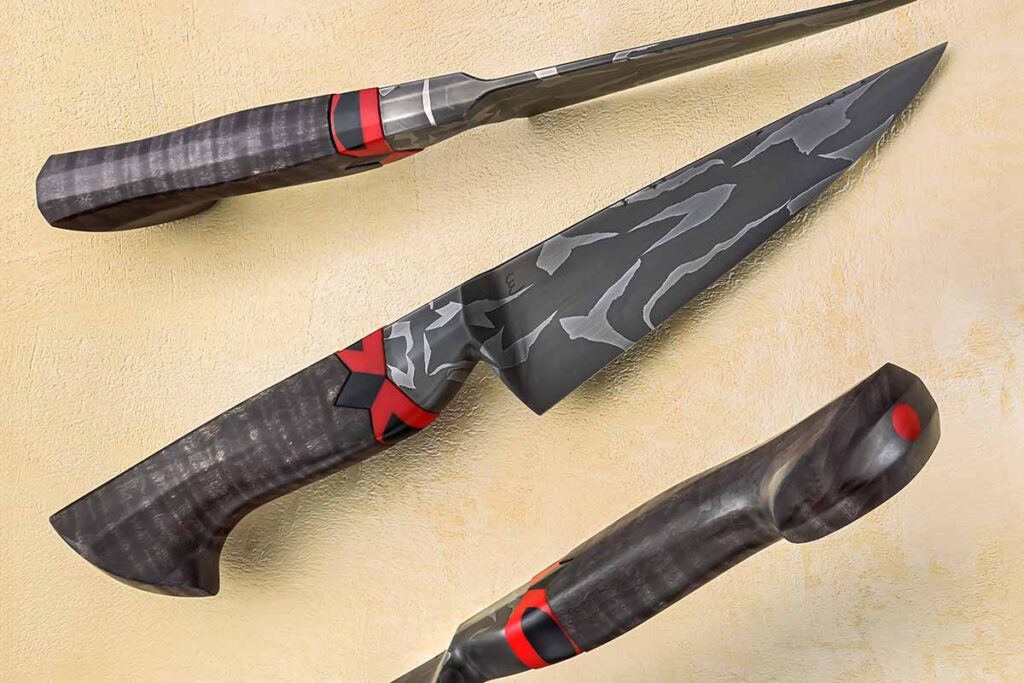
Given the amount of steel and the need to pay attention to minutia is what Bill Tyc figures steers most makers away from cleavers. Tyc achieves an intricate pattern on his cleaver-chef’s knife set through a simple mustard patina, but applied with a straight edge for a pattern he calls “Lines of Insanity.” (SharpByCoop image)
The pairing in Bill Tyc’s featured ensemble is stunning in its presentation. “The cleaver as well as the chef’s knife are made of 52100 high carbon steel from the NJ Steel Baron,” he remarked. “The handles are stabilized spalted tamarind from Wood Dynamics fastened with brass Corby bolts. The pattern on the steel is a mustard patina done with a ruler edge, hence the name “Lines of Insanity” pattern. The cleaver is 11½ inches overall with a 6¼-inch blade. It’s 3 inches tall and ¾ inches at the heel. I felt the spalted lines of the tamarind wood would look perfect with the mustard patina.”
Tyc, who resides in Waterbury, Connecticut, remembers making kitchen knives that did something no other creations had generated. He got immediate feedback from users.
“In fact, the first ‘kitchen’ knife I sold was a cleaver at the Mystic Knife Show in Connecticut,” Bill remembered. “A gentleman circled the floor three times, every time touching a cleaver I had on the table. Last pass, he picks it up and just says, ‘I’ll take it.’ My wife and I look at each other with a thumbs up, and off he goes. Well, the following year, the gentleman comes into the show, right up to my table, and says, ‘Last year I bought a cleaver from you.’ The wife and I again look at each other because we most certainly remembered. He says, ‘I have so much fun using that cleaver every day!’ I reached across the table, shook his hand and said, ‘I’ve been waiting 20 years to hear that! I could pack up and go home, I feel so good.’”
According to Tyc, many custom knifemakers shy away from cleavers because they require a lot of work. At just about any knife show, only a relative few are seen for sale. But he adds cleavers’ utility far exceeds their supposed kitchen niche, pointing out they are handy for camping, survival exercise, yard work and bushcraft as well.
“The most important things are balance and weight,” Bill observed. “A knife used as often as a kitchen knife or cleaver has to feel good in the hand, not just initially, but long term. You may find yourself using your kitchen knives for many hours through the week. You want it to be comfortable, not a labor.”
Veggies Beware
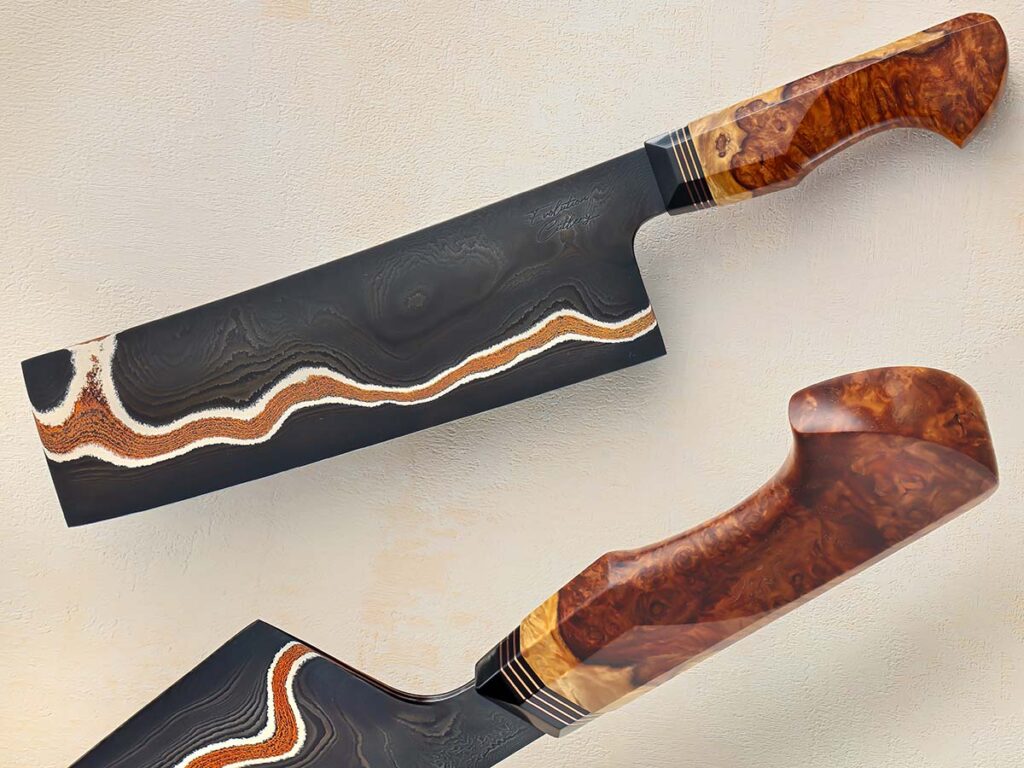
One of the unique advantages of the cleaver, Dan Tomplins points out, is the large canvas it allows for the steel. In the case of his nakiri—vegetable cleaver—its 81/2-inch copper mai blade can’t help but catch the eye, particularly with the steel’s blacked-out finish enhancing the patina’d copper. Note too, the hybrid octagonal/western-style handle made from amboyna burl. (SharpByCoop image)
In 2016, Dan Tompkins began making knives, and three years later, he started Evolution Cutlery in Highland, New York. His kitchen knife work began simply because he wanted to make cutlery used on a daily basis, and his cleaver immediately attracts attention.
“The big square profile is a great canvas to show forging skills, especially if using mosaic damascus. It allows a lot of room to see the details in the patterning,” said Dan. The subject steel is Baker Forge copper mai with a blacked-out finish and layers of patina’d copper in the nakiri, or veggie cleaver, design. The handle is Tompkins’ hybrid octagonal/western style made from amboyna burl, heirloom fit to a copper and G-10 bolster. The cleaver blade measures 8½ inches, and the overall length is 13 inches.
“One challenge in making cleavers is getting the edge geometry perfect for the intended purpose,” explained Dan. “There are many different types of cleavers, so the proper geometry is an important consideration. Heavy-duty blades require a heavy convex edge, while veggie cleavers are best with a laser-thin edge. When it comes to kitchen knife ergonomics, not only do you have to have a good feel in the handle’s shape and contour, but you also have to have proper balance to make the knife comfortable to use all day. While cleavers will almost always be slightly blade heavy in balance, they should still be balanced not far in front of the handle … Balance can make a light knife feel heavy or a heavy knife feel light. In my opinion, even a heavy knife with proper balance is far more comfortable to use than a light knife with improper balance.”
Tompkins sees the cleaver in action in varied settings, not just the kitchen. Camp chores like chopping wood or preparing food outdoors can be handled easily with a cleaver made for such adventures, and he makes the cleaver to fit the anticipated tasks.
Versatility is readily apparent in these custom cleavers, and their functionality is in lockstep with good looks driven by their makers’ creativity.
Few Knives Have Been As Heavily Influenced By Japanese Methods As The Chef’s Knife. These Four Quality Blades Show Off The Modern Meeting The Historic.
The Japanese influence on custom knives is everpresent in the marketplace, and, aside from the tanto, nowhere is its flair and focus felt more than with chef’s knives.
These tools of the culinary trade are functional as much as they are eye-catching, especially in examples of some of the top makers in the genre today.
Honyaki Byuto Hybrid By Dmitriy Popov
Dmitriy Popov aligned the tip with the spine on his wide-bevel Honyaki Gyuto Hybrid for enhanced control during jobs requiring precise use of the tip. (SharpByCoop knife image)
Dmitriy Popov has conjured up a masterpiece he calls the wide-bevel Honyaki Gyuto Hybrid, a new take on a recognized Japanese style.
“It isn’t a traditional gyuto, as it has an upswept tip and the height of a nakiri,” he commented. “Having the tip aligned with the spine of the knife gives the user a feeling of control for precise tasks requiring use of the tip. Having the extra height in the heel allows me to create a knife that is super thin behind the edge while also having a significant amount of mass above it.”
Popov’s creation includes a near 9.5-inch blade of differentially heat treated W2 tool steel and a handle combination of desert ironwood and osage orange complemented by a carbon fiber liner. His prices for similar knives range from $900 to $2,500 based on size and materials.
“The hamon and ashi* I am able to get out of the W2 is mesmerizing,” Dimitriy added, “and I spend a large part of my life going deep down the hamon rabbit hole. Honyakis are part art and part science, and the failure rate is a lot higher than I would like it to be. I really like the minimalist wa handle style [see page 14], and rounding off the bottom facet does not alter the traditional design much, while making the handle more comfortable in the hand.”
Having made knives since 2011, Dmitriy looks back at the beginning in everyday carry, tactical and camp models. After three years, he gravitated toward chef’s knives, and since 2016 they have been his sole focus.
“Everyone cooks, and at some point most cooks or chefs will come to appreciate the benefits of a good quality knife,” he observed of a chef’s knife field that has become quite crowded. “There are way more prospective customers than there are makers, so to succeed as a maker all you need is a very small slither of the pie and a drive to evolve your craft each day.”
Santoku-Style Knife By Eric Hemker
The long, nearly flat cutting edge of the damascus santoku by Eric Hemker enables it to slice, dice, and mince vegetables much easier than a blade with a sweeping belly. (SharpByCoop knife image)
While Eric Hemker admits he is still learning some subtleties of making chef’s knives, he has found that the santoku style is excellent for use in final food preparation.
His custom-ordered version sports an 8-inch blade of random-pattern damascus forged from 1084 carbon and 15N20 nickel-alloy steels. The overall length is 14 inches, and the handle is exotic blue-dyed curly mango. His price for a similar knife is $960.
“The lack of a pointed tip on the blade means it is not well suited for delicate carving work such as breaking down bony proteins,” Eric explained. “However, its long and nearly flat cutting edge allows it to slice, dice and mince vegetables and proteins much easier than a knife with a sweeping belly on the cutting edge.”
Translating literally from the Japanese, santoku means “three virtues, or three uses,” and so the slicing, dicing, and mincing description is spot on.
“This blade is 144-layer random-pattern damascus, and it features a full flat grind with a convex edge. The flat grind is my usual go-to grind for most general-purpose cutting needs that are common in the kitchen or in hunting-type knives. I also add a slight convex grind that leads into the cutting edge to aid in food release.”
Eric chose a modified wa handle configuration and attributes the decision to keeping step with traditional Japanese appeal.
“The top of the handle has the traditional wa-style octagonal facets,” he said. “But I wanted to spruce this handle up a little to challenge myself, so the bottom is curved to give it a shield-shaped cross-section. The handle has a 304 stainless steel bolster and an heirloom-fit black G-10 spacer. One of the only things the customer specified was a colorful handle, so this piece of wood was a perfect fit.”
For Eric, the entire package comes together nicely, blending the good looks and function that are inherent in Japanese-inspired chef’s knives.
“All these materials will hold up well in kitchens,” he remarked. “G-10 is a synthetic material that also holds up very well in any harsh environment, and since the wood is stabilized it should also hold up well in water and getting dirty in general. Since the handle is wood, it would still need to be oiled occasionally, and it should go without saying that a custom piece like this with a carbon steel blade and a wood handle should never go in the dishwasher.”
Eric began making knives six years ago and still considers himself at the beginning of a promising journey.
“Kitchen knives have been some of my favorite knives to make from the beginning because everyone uses one,” he noted, “so they are some of the easiest pieces to sell and get feedback on.”
Meanwhile, he welcomes the expanding number of makers and buyers in the chef’s knife arena.
“I don’t believe the custom chef’s knife market is overly saturated by any means,” he commented. “I think the demand really drives the market for these custom pieces, and I believe there will almost always be customers at every price point. In the last decade or so, there really has been a resurgence of demand for well-crafted handmade goods in almost every category of consumer goods, and I don’t believe that trend is going to be dying out anytime soon. This may be especially true for culinary knives when food is such a big part of many people’s lives.”
Straight-Edge Kiritsuke By Dre Laborde
The straight-edge damascus kiritsuke by Dre Laborde is specifically made to slice fish and some softer meats. The handle is curly maple from Realeyezwoodz. The sheath is stabilized maple and a joint project between Dre and Realeyezwoods. (SharpByCoop knife image)
The straight-edge kiritsuke from Dre Laborde is specifically made to slice fish and some softer meats, he says, and doesn’t necessarily lend itself to chopping vegetables.
“I’m no expert on Japanese knives as a whole,” he noted, “but from what I can find the kiritsuke seems to be a cross between the longer yanagiba and the stockier gyuto. The steel is X-pattern-ladder damascus that I purchased from MVH Damast based in the Netherlands. These steels have given me nothing but positive results and I can’t recommend them enough.”
The blade is 9.5 inches and the overall length is 14.5 inches. The handle is curly maple from
Realeyezwoodz, and the price of a similar knife would probably exceed the featured piece.
“It sold for $760,” explained Dre, “but it was a semi-experimental project for me, so a future project of this scale would cost more. The design, like all my knives, was drawn on paper to scale first and then made with the freedom to change the design as I see fit.”
The choice of handle material and design contributed to the overall appeal of the knife and its performance in the kitchen.
“The wood is stabilized, which means it was put under vacuum in a resin and hardened,” said Laborde. “This makes it resistant to water and to staining. The handle design is a slight variation on the common shape I do, made slightly longer to fit the length of the knife.”
Dre has been making knives for about three years and in that time hasn’t seen the chef’s knife market becoming overcrowded, though he has heard such comments. “Those willing to pay for a custom chef’s knife often have many and recognize the price tag that comes with them,” he added.
Haetori Honesuki By Tony Cetani
The Haetori Honesuki by Tony Cetani is an all-around kitchen utility knife design based on the santoku and honesuki, the latter a Japanese boning knife. Whereas a traditional honesuki’s main task is for deboning poultry, Tony made the Haetori Honesuki to handle multiple kitchen jobs.
When Tony Cetani built his Haetori Honesuki with a 5.5-inch blade of Chevron copper-mai steel and an 80CrV2 core from Baker Forge and Tool, he added a handle of spalted box elder to complete the package and priced it at $1,000.
“Haetori means ‘jumping spider’ in Japanese,” he related, “and following my love for spiders this knife is named for the Haetori Gumo, a very common spider in Japan. It’s an all-around kitchen utility knife, and I based the design on the santoku and honesuki. Whereas a traditional honesuki’s main task is for deboning poultry, I made this to handle multiple tasks around the kitchen.”
Tony has been making knives since 2017 and tried chef’s knives for the first time three years later.
“Once I got a few kitchen knives under my belt, I fell in love,” he smiled. “I wanted to put kitchen cutlery on the market that was different and not your traditional kitchen-style knives.”
He succeeded with this effort and chose a slightly innovative handle style.
“This is a newer style that I designed specifically for this knife,” he said. “Adding a clip at the butt of the tang gives the palm a comfortable spot to rest when working the knife. I chose natural spalted box elder because it went well with the copper in the steel, and you can’t ever go wrong with box elder!”
As for today’s chef’s knife market, Tony sees strong demand and the capacity to supply it.
“There are a lot of makers out there putting out phenomenal chef’s knives. I think every maker has their style, and the style is what grabs the attention of a potential customer.”
*Ashi are various notches or details in hamons. To produce ashi, the maker applies thin strips of clay from the spine of the blade to the edge during the clay tempering process, which contributes to interesting variations in the resulting hamons.
No matter how you slice it, three top tomato knives turn the trick.
Nothing beats homegrown tomatoes and tomato sandwiches, or just simply enjoying them as they are, sliced up with all their juicy goodness. Who doesn’t love a ripe and ready tomato?
Cutting tomatoes requires a very sharp knife. Besides writing for this fine publication, I also have another side hustle of running a sharpening service. I get asked all the time, “How do I know when it is time to have my kitchen knives sharpened?” I always answer with the tomato test. If your knife cannot slice a tomato cleanly without squashing it, then it is time for a sharpening.
Tomatoes have a firm exterior and a squishy/liquid interior. A sharp knife is mandatory to break through the firm exterior. If your knife is dull, it won’t bite right into the exterior but instead will squash it, thus squeezing out the juice and ruining a good slice of succulent tomato.
Sure, any sharp kitchen knife will slice tomatoes and do a fine job of it. But there are specially designed tomato knives that take the work out of perfect slicing. If you do a lot of meal prep involving tomatoes, then you might want to procure one of the following tomato-slicing knives for the occasion.
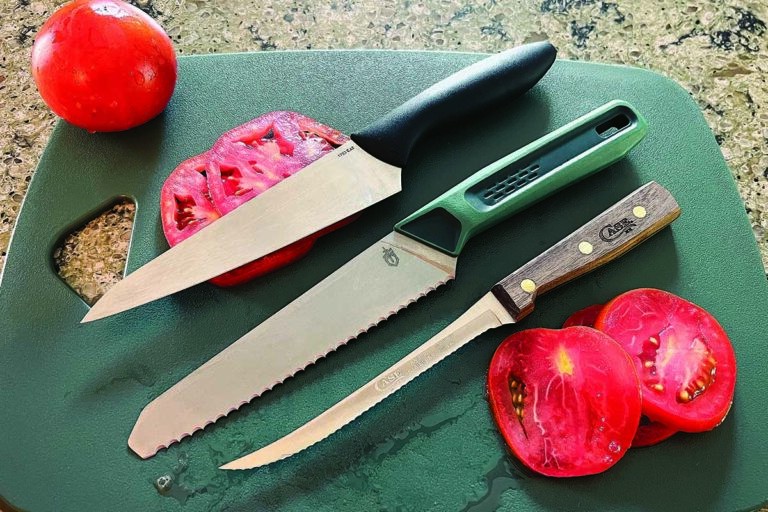
Case Tomato Slicer
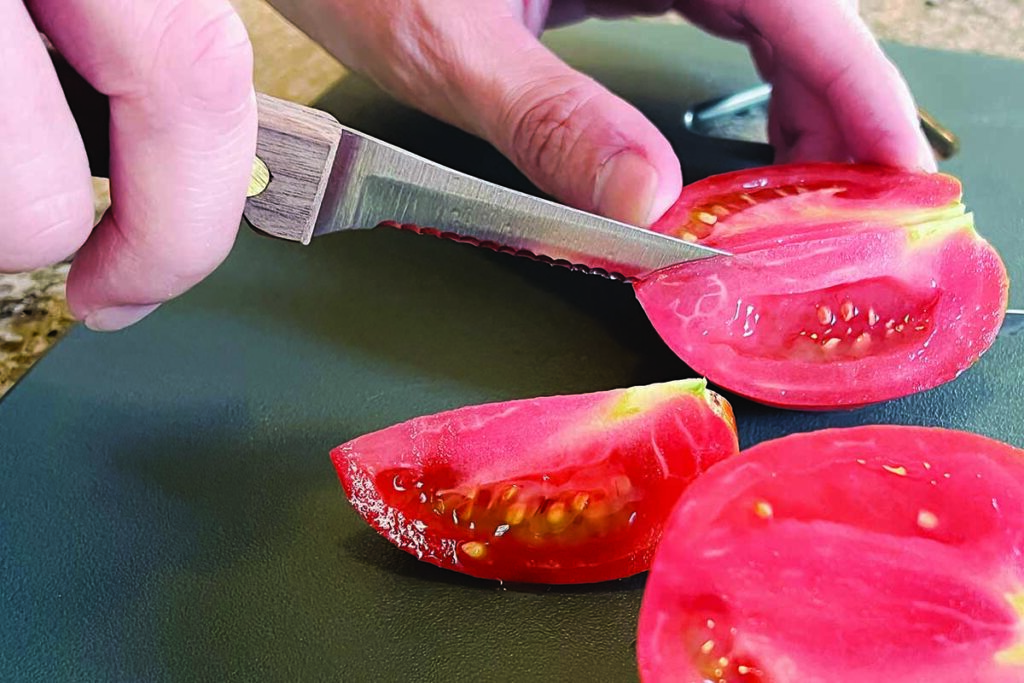
The Case works effortlessly due to the thinness of the blade coupled with the serrations.
Case Tomato Slicer Blade Length: 5.5″ Overall Length: 9.25″ Blade Material: Tru-Sharp Stainless Handle Material: Walnut Country of Origin: USA MSRP: $39
Pros
Hightly effective for tomatoes
Durable and attractive Construction
Effortless cutting
Cons
Limited to specific tasks
The 5½-inch Tomato Slicer from Case is a highly effective tomato knife. It is specifically designed to make quick work of processing tomatoes without damaging them. The 5½-inch blade is slender and has a trailing-point shape. It is hollow ground, fully serrated and Tru-Sharp stainless steel (420 HC stainless). The handle is walnut and features triple-rivet construction for strength and durability. It is a nice-looking knife and part of a larger household cutlery family Case offers with the same blade and handle materials.
Performance wise the knife excels. The serrations cut smoothly but have an aggressive bite that help break cleanly through the tomato’s firm skin. The hollow grind and slender blade aid in sailing through the fruit without collapsing it. The knife is quite effortless in action. Due to the slender, almost minimalist blade width I would limit use of the knife to tomatoes and other similar fruits like grapes and kiwi. It is sort of a specific-use knife and not one you generally grab when you need to cut something in the kitchen. It is more like a hybrid knife. It has a serrated edge but cuts clean and smooth similar to a plain edge knife. MSRP: $38.99. Country of origin: USA.
Amazon
$34
Knife Center
$47
Lemans
$35
Kershaw Utility Knife
The thin blade stock gives the Kershaw Utility Knife great bite and slices very easily. The contoured handle adds a high degree of comfort and control.
Kershaw Utility Knife Specs Blade Length: 6″ Overall Length: 10.6″ Blade Material: DIN 1.4116 Handle Material: Polypropylene Country of Origin: China MSRP: $21
Pros
Versatile for light-to-medium tasks
Comfortable and Secure Grip
Affordable
Cons
Not made for tough tasks
Very basic design
The Kershaw 6-inch Utility Knife is designed to be a “do-it-all” knife in the kitchen for light-to-medium-duty food prep tasks, and can handle meats, fruits and vegetables with no problem. One look at this knife and the word “basic” comes to mind. It is just a no-frills kitchen knife and I say that not in a negative light but rather a positive one. Sometimes simple is the way to go; it is the most direct way.
The 6-inch blade is DIN 1.4116 stainless steel in a nice brushed-satin finish. The handle has an expanded front section that not only acts as a finger stop but also is shaped in a way that promotes using the pinch grip for more precise control for detail cutting. The handle profile is rounded so it sits in your grip nicely and comfortably with no hot spots to speak of. The material is molded polypropylene and sports a slight texturing to aid in grip retention. As an added bonus, the knife comes with a molded plastic slip sheath to protect the blade when not in use. Because of this, the knife can be stored in a backpack for a camping trip, a drawer of your RV or a kitchen drawer, all without worry of edge damage or accidental cuts.
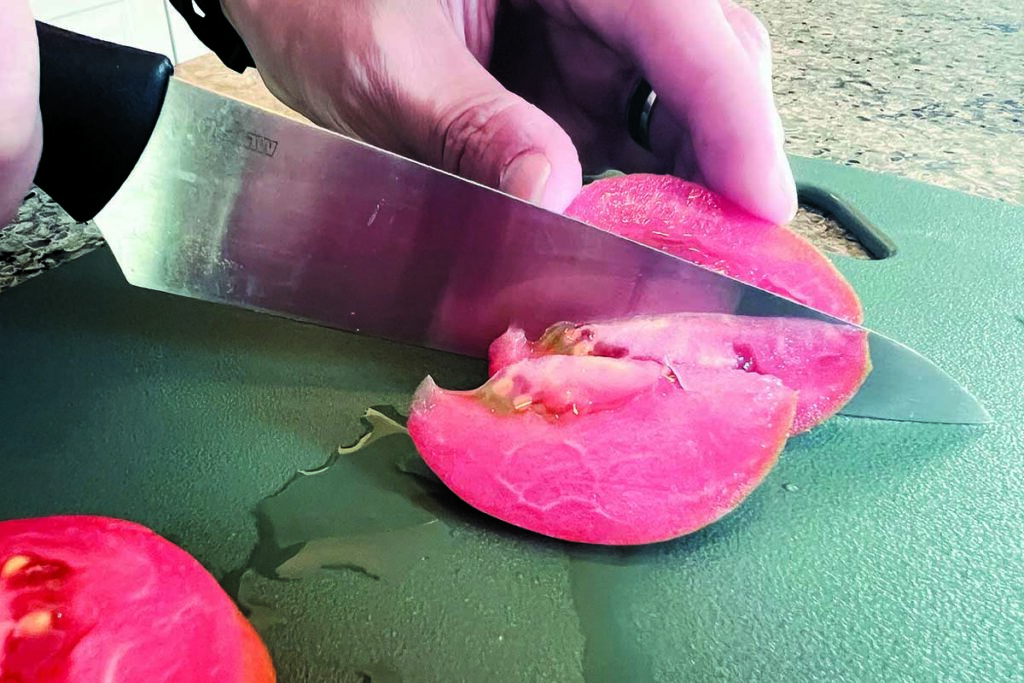
Due to the very thin blade stock (.057 inch at the thickest), the Kershaw slices tomatoes with surgical precision. The edge bites into the skin and glides right through with very little resistance. The blade is somewhat flexible but not as much as, say, a fillet knife. You are still able to flex the blade a bit, so I would not tackle any tough cutting with it and certainly not torque the handle. The blade shape is adaptable to all sorts of food prep tasks, from meats to vegetables to fruits.
The size is perfect to accompany a larger chef’s knife, for those tasks for which an 8-inch chef’s knife is too big and a paring knife is too small. The major selling points are the basic design, thin blade stock, rounded handle and price. MSRP: $20.99. Country of origin: China.
Amazon
$21
Knife Center
$21
Kershaw
$21
Gerber ComplEATUtility Knife
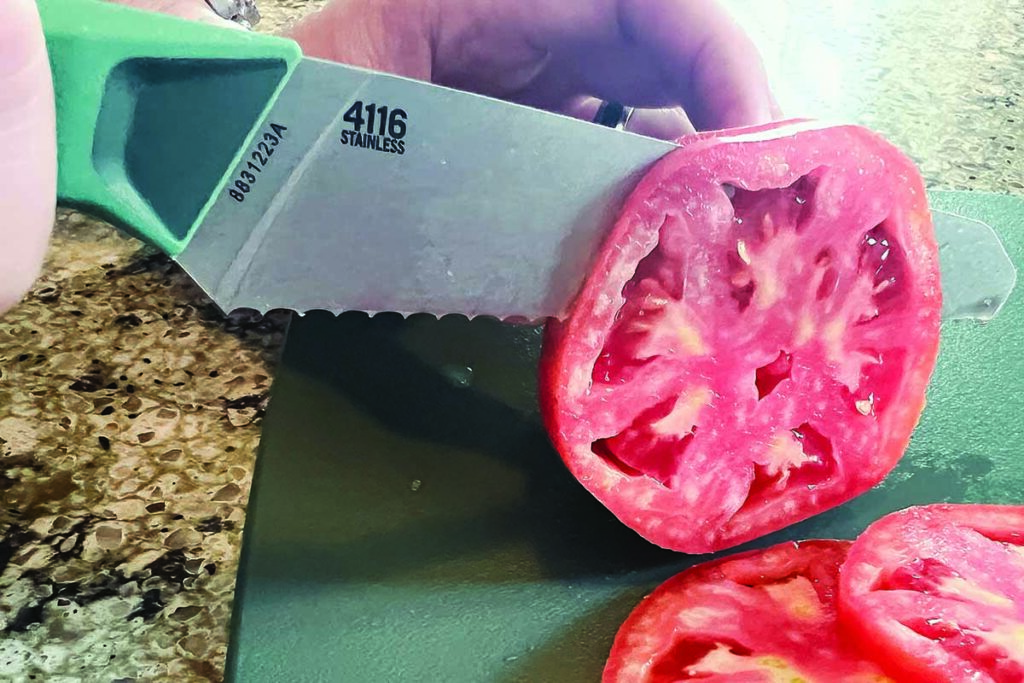
The Gerber ComplEAT Utility Knife has more aggressive serrations than the Case Tomato Slicer, slices tomatoes well and doubles as a bread knife.
Gerber ComplEAT Specs Blade Length: 6″ Overall Length: 10″ Blade Material: 4116 German stainless stee Handle Material: Glass-filled polypropylene Country of Origin: China MSRP: $35
Pros
Multi-use versatility
Serrated blade stays sharp
Ergonomics are great
Cons
Constructed of basic materials
The serrated Gerber ComplEAT 6-inch Utility Knife will handle meats, produce and bread. It’s the perfect complement to the other two models—chef’s and paring knives—in the company’s ComplEAT series.
The 6-inch blade is German 4116 stainless steel for affordability and stain resistance. Commonly used in pocketknives, the sheepsfoot blade is utility friendly. The full flat grind thins the serrations down well without being fragile and gives the edge its bite. A stonewash finish seals the micro pores in the steel to prevent rust from forming easily.
The handle is dual molded, with a hard plastic outer frame and inlays of a softer, grippier rubber-like material. The inlays are inset some to provide an innovative finger groove of sorts that allows you to obtain good handle traction, as your fingers and thumb can rest inside it, helping you to control the knife at all times. Additionally, there is a forward pinch grip/recessed area on both sides of the handle for exact control. The handle perimeter features multifaceted chamfers that not only reduce hot spots but also make the handle feel slimmer by removing bulk. An oblong hole accepts a lanyard or simply serves to hang the knife on a peg, nail or hook when not in use.
The handle color is interesting. Gerber calls it Baltic Haze and is a matte light green with dark green rubber inlays. It is more appealing than standard black and fits in well with the outdoor theme. A matching plastic slip sheath protects the blade and is safe to carry in a backpack.
The ComplEAT handles tomatoes similarly to the Case Tomato Slicer. The serrations allow the blade to immediately bite into the tomato skin and help the edge to remain sharp over time. Unlike the Case, the ComplEAT can be used for other foods, too—cucumbers, onions, chicken, pork, beef and even as a bread knife, including bagels, baguettes and such. It is a true multi-use performer. If you need one knife to tackle a variety of food for camping, it might be the one as the evenly spaced serrations cut smoothly. If you prefer infrequent sharpening, the serrations are for you. Why? The serrations’ scallops are sharp and are protected by the teeth.
Larger than a paring knife, smaller than a chef’s knife, the petty knife is right-sized for heavy-duty precision work.
Sometimes food preparation calls for something especially suited for close, even intricate, work. The petty knife was made for such employment.
While it may be a bit smaller in stature than other knives chefs regularly use, the petty knife makes short work of otherwise laborious functions.
Its name is derived from the French petit or small, but it’s big on getting the job done.
“Ask a dozen makers what the petty knife is and you’ll get a dozen different answers,” offered custom maker Ian Ronald of Elderslie, New South Wales, Australia. “But for me, I would define a petty knife as a culinary knife that is shorter than a chef’s knife but with a broader blade than a paring knife. I find a petty knife to be incredibly handy for household food preparation tasks, with a blade that is big enough to cut most food items but not so large as a full-sized chef’s knife, making it a little more versatile for ‘in hand’ food prep tasks such as cutting avocados and similar things. I have a few in my kitchen and they are the most commonly used knives in the knife block by far.”
The full-flat-ground blade of 18-year-old Aidan De Fazio’s petty knife is also slightly convex to preserve edge longevity and provide better food release. (Rod Hoare knife image)
Representative of Ronald’s petty knife work is a piece the price of which varies depending on materials chosen. With a 4.92-inch blade of Takefu Special stainless clad in san-mai fashion over V-Toku2 carbon steel, a desert ironwood handle and 9.25-inch overall length, the petty remains with the maker—and he uses it frequently.
“I designed this knife with quite clean lines and simple shapes, as it was intended to be a workhorse from the beginning,” Ian commented. “I used some premium materials but I didn’t add any embellishments or unnecessary details. I follow that aesthetic with most of the knives I make, preferring to let the form follow the function for the most part. This particular knife has a relatively deep blade with a reasonably high tip profile, which allows it to be used for [rocking/chopping] and push cuts despite its unassuming size.”
The steel combination on Ronald’s knife includes a carbon core with stainless cladding from the Takefu steel company of Japan. According to Ian, it is quite corrosion resistant and maintains a bright appearance, as the carbon steel core etches dark and develops character and patina with use. The blade grind is nearly flat with a slight convex slant near the edge, which is intended to create a fine cutting edge while maintaining toughness.
Precision Worker Petties
Sixty-year-old Australian Zohar Oshinsky has been making knives since he was 12 but became more serious about his work just a few years ago, becoming a full-time maker in the past five years. His petty knife features a 5.12-inch blade of M390 stainless damascus steel from Sanwa Special Steel of Japan, handle scales of stabilized red mallee burl timber—a hardwood from the York peninsula of South Australia—and an overall length of 10.04 inches.
Ian Ronald said a petty knife has a blade big enough to cut most food items but not so large as a full-sized chef’s knife, making it a little more versatile for avocados and similar things. Overall length of his Kitchen Petty: 9.25 inches. (Rod Hoare knife image)
“This petty knife is a smaller Japanese utility knife,” Zohar said, “generally used for precision knife work and fine slicing. My knives are often made to order, so the material is to the customer’s liking. The san-mai is an excellent steel for kitchen knives in this construction with a very high rust resistance and excellent edge retention. The damascus cladding is made from 67 layers of 410 and high nickel stainless.”
Oshinsky says his blade grind is shallow, convex, very thin and incredibly sharp. The blade’s soft cladding protects the core from shock and provides a small amount of flexibility.
Semi-Dark Theme Petty Knives
Aidan De Fazio is all of 18. He began his knifemaking journey at 11 and his progress has been steady. His petty knife includes a 4.5-inch, full-flat-ground blade of san-mai in 1084 clad carbon steel with nickel. The handle is stabilized spalted maple and ebony. The blade is slightly convex ground to preserve edge longevity and provide better food release. Overall length: 9 inches.
Charlie Ellis and BLADE Magazine Cutlery Hall-Of-Fame® member Steve Schwarzer collaborated on the Penrose Petite Chef. The 6-inch blade is Penrose tiling billet of 15N20 nickel-alloy steel in a pattern based on never-repeating Penrose tiling. Overall length: 11.75 inches. (SharpByCoop image)
“The petty knife is a small general-purpose knife,” Aidan explained. “It’s used for peeling, shaping, and slicing fruits and vegetables, chopping herbs, and making garnishes. I design everything by eye and chose this design because everything flowed nicely, and it just looked right. I was going for a semi-dark-themed knife, so to complement the dark san-mai I chose a piece of ebony with some heavily spalted maple for the handle.
“As this is a carbon steel knife, it will change color with use,” Aidan continued. “It’s a patina and it’s a good thing. It develops on carbon steel when exposed to air for extended periods of time or to acids for short periods of time. It is a type of oxidation that helps ward off the rust that eats away at steel and destroys your knife.” De Fazio recommends regular care for his petty knife, washing lightly with soap and water, avoiding abrasives that could scratch the patina, and then wiping dry for storage.
Light, Thin, Comfy Kitchen Tools
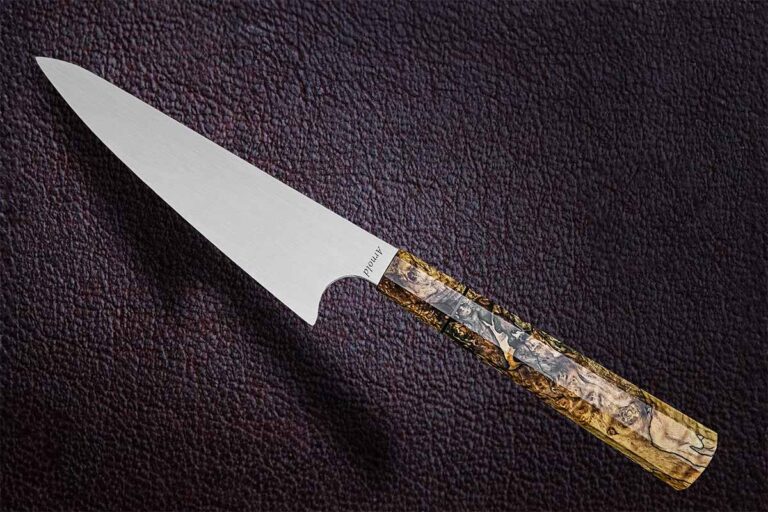
When Ross Arnold makes a petty knife—or any other style knife for kitchen use—he is leveraging experience to produce the most utilitarian design he can. “To me, a petty knife is an all-around food preparation knife for use when a larger knife is not necessary or possible,” he said. “In my earlier years, I worked in kitchens every night. I had a good idea of what worked and what was comfortable for me. This design was focused on being light, thin and comfortable. This resulted in a knife that weighs only 3.8 ounces, and the rounded choil and spine make it a pleasure to use all day every day.”
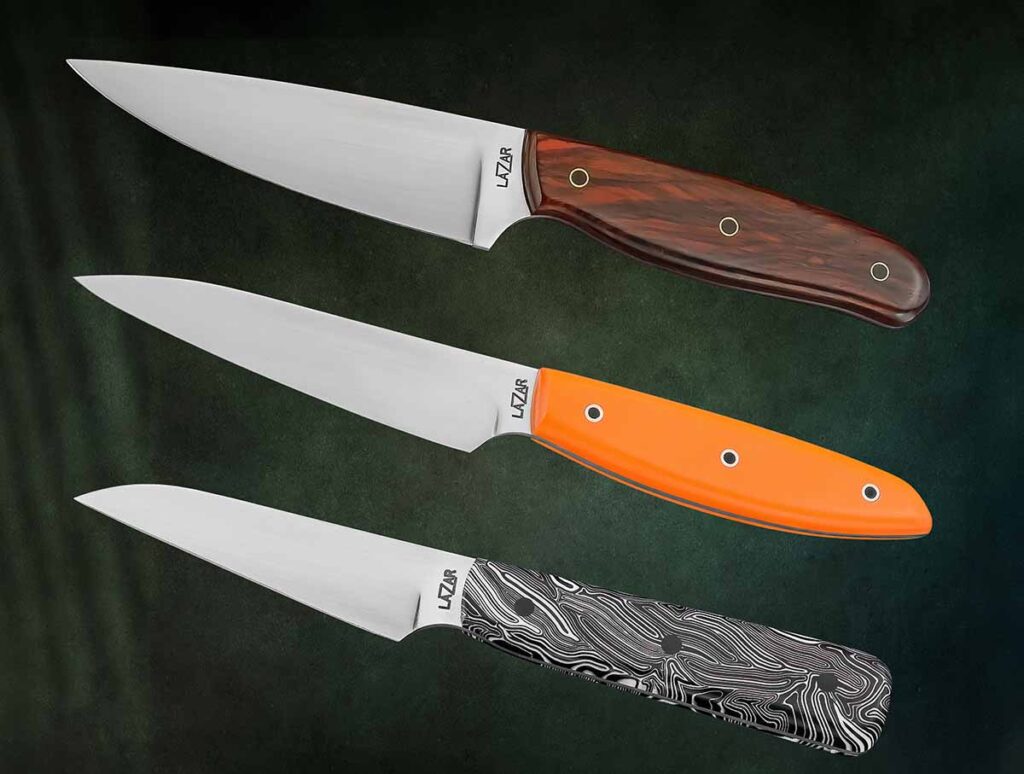
Andrew Lazarevic offers his petty knives in a selection of handle materials affixed with brass and carbon fiber pins. The blades are flat ground of AEB-L stainless steel. Overall lengths: approximately 9 inches each. (Rod Hoare image)
A resident of Glenalta, Australia, Arnold learned a great deal from custom maker Peter Bald early in his career. Ross finished his petty knife with a 5.91-inch blade of RWL-34 stainless steel and a handle of spalted sassafras wood. Overall length: 11.02 inches. His price for a similar knife: $390.
“I went with a traditional Japanese hexagonal handle purely for aesthetics,” he related. “As I use this knife primarily with a pinch grip, the handle shape does not have a massive impact on usability. That being said, it is still very comfortable to hold normally. I ground the blade with a plunge-less distal taper design. I came up with the grind design myself, but I’m sure it’s probably been done before. In my opinion, it is a solid performing grind as it gives the knife a light and flexible blade that isn’t super thick toward the tip.”
The petty knife is up to the challenge when a more intricate or tight kitchen job is at hand. The latest custom examples are affordable, provide good looks and perform with style. Dig in.
Editor’s note: All prices are in U.S. dollars and are according to the press time rate of exchange. Due to fluid market conditions, all are subject to change. Please check with the applicable maker for the latest in pricing.
The New Titanium Devour From Gerber Gear Is Far More Than Just An Eating Utensil. This Multi-Tool Really Is Unlike Any Other On The Market.
Not every multi-tool needs to feature a knife or have a set of pliers built into it. The new Devour, made from Titanium, from Gerber Gear flips the idea of a multi-tool on its head.
At first glance, it looks like nothing more than a rugged eating utensil, great for eating by the campfire. And it is that, but it is so much more. This multi-tool has nine functions and weighs just an ounce. The star of the show is the tool that mounts to the back of the fork.
The tool that snaps onto the back of the eating utensil
This tool features a package opener, a can opener, a pry bar, both a phillips and a flathead screwdriver, and a flat cut/scrape edge. When connected to the back of spork it keeps it propped up and off the table, which is great for keeping your utensil clean and free from dirt and debris when eating outside.
Since everything is made from corrosion-resistant T4A titanium, the tool won’t rust and will remain strong under pretty much any circumstance. The Devour can save you so much time packing, and space in your pack, you’ll wonder why you didn’t get it sooner.
And the cherry on top of it all: it’s an inexpensive piece of kit that will more than pay for itself quickly.
The Japanese take on Western chef’s knives are mighty mealmakers. Here are some top-notch options.
A gyuto is a versatile, multi-purpose kitchen knife perfect for professional chefs and home cooks. It typically features a thinner, lighter blade than traditional chef’s knives, sharpened at a steeper angle for extremely precise and clean cuts. It often has a flatter profile toward the heel and a more gradual curve near the tip, making it versatile for various cutting techniques. The handle is often lighter and more agile, reflecting the Japanese emphasis on nimble and efficient movements in the kitchen.
Fox Knives Gyuto 2C 504 0L
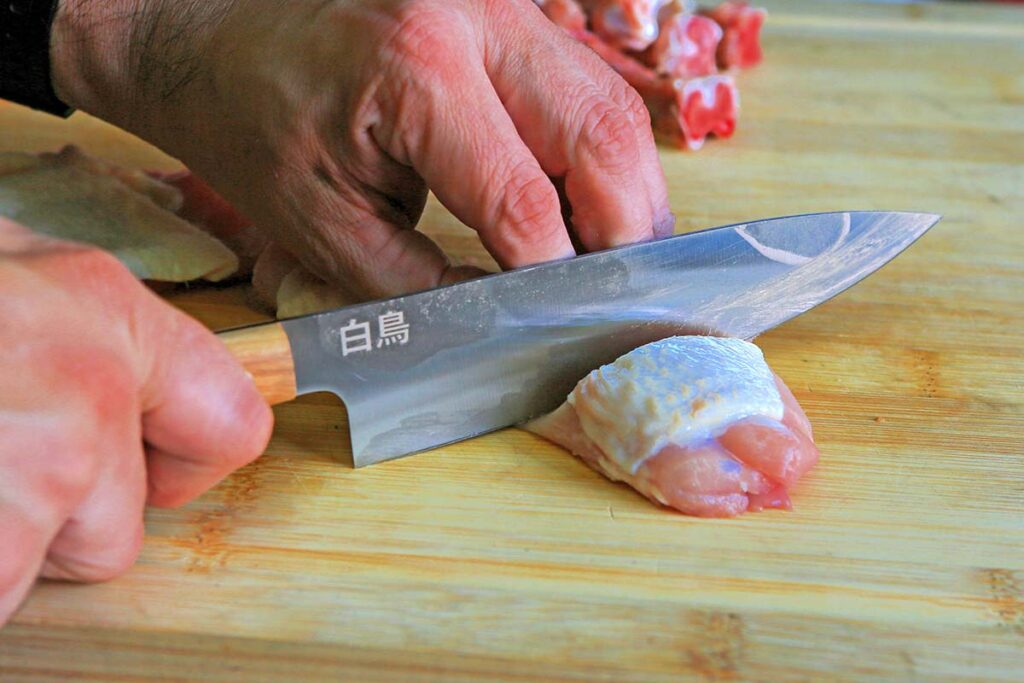
The Fox gyuto effortlessly prepared chicken thighs for delicious teriyaki chicken and yakitori, trimming excess fat and skin.
FOX Knives Gyuto 2C 504 OL Blade Length: 6.69” Blade Steel: 4119 nitro-B stainless Blade Grind: Flat Blade @Thickest: .08” Blade Finish: Satin Handle Material: Olive wood Overall Length: 11.81” Country of Origin: Italy MSRP: $75.70
Pros
Durable 4119 Nitro-B Stainless Steel Blade
Exceptional Balance and Lightweight Design
Comfortable Olivewood Handle
Cons
Limited Grip for Large Hands
The Fox Knives Gyuto 2C 504 0L is a representative example of the genre. Crafted with precision and passion, it features a razor-sharp blade that is durable and holds an edge. The elegant handle offers a comfortable grip and a smidge of rustic charm.
At just 5.11 ounces, this featherweight beauty is a breeze to manipulate and perfectly balanced for effortless slicing, dicing and chopping. The 4119 nitro-B stainless steel blade’s Rockwell hardness of 55-57 HRC guarantees superior resilience, while the satin finish adds a touch of sophistication. Equipped with sturdy stainless-steel rivets, this gyuto is a culinary companion you can trust, not just a kitchen tool.
When in Japan, I love ordering yakitori—skewered, grilled chicken with a savory, slightly sweet flavor and smoky aroma. Making the dish was a team effort using specific knives for deboning and slicing the chicken into proper portions for the skewers. The key is to use a slow rocking/chopping motion to make clean, decisive slices rather than sawing through the meat, resulting in “chainsaw chicken.”
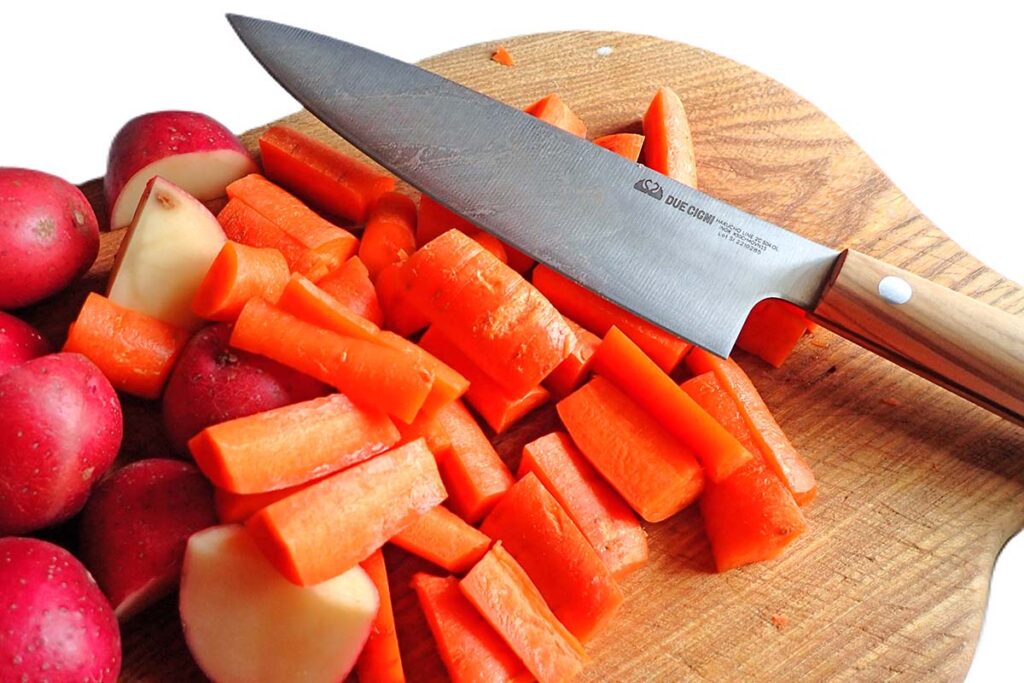
The Fox sliced potatoes, onions, garlic and carrots for pot roast. The thin edge and super comfortable handle were unmatched.
Since the gyuto is the Japanese version of the archetypal Western chef’s knife, I made a Western dish—beef pot roast—and did the vegetable prep with the Fox. Slicing vegetables, potatoes, carrots and onions was a breeze with this slicing machine. I keep it simple, using rock chops, cross chops and pull cuts 90 percent of the time. Push cuts with the heel of the blade work well for hard veggies. Meanwhile, the olivewood handle remained comfy with no hot spots and grippy even when wet or covered with chicken fat. Leave it to the Italians to utilize this stunningly underused wood. Regarding plating, the Fox sliced the most elegant roast beef that ever graced a dish.
Fox Knives
$78
BladeHQ
$35
Condor Tool & Knife Shefu Kitchen Gyuto
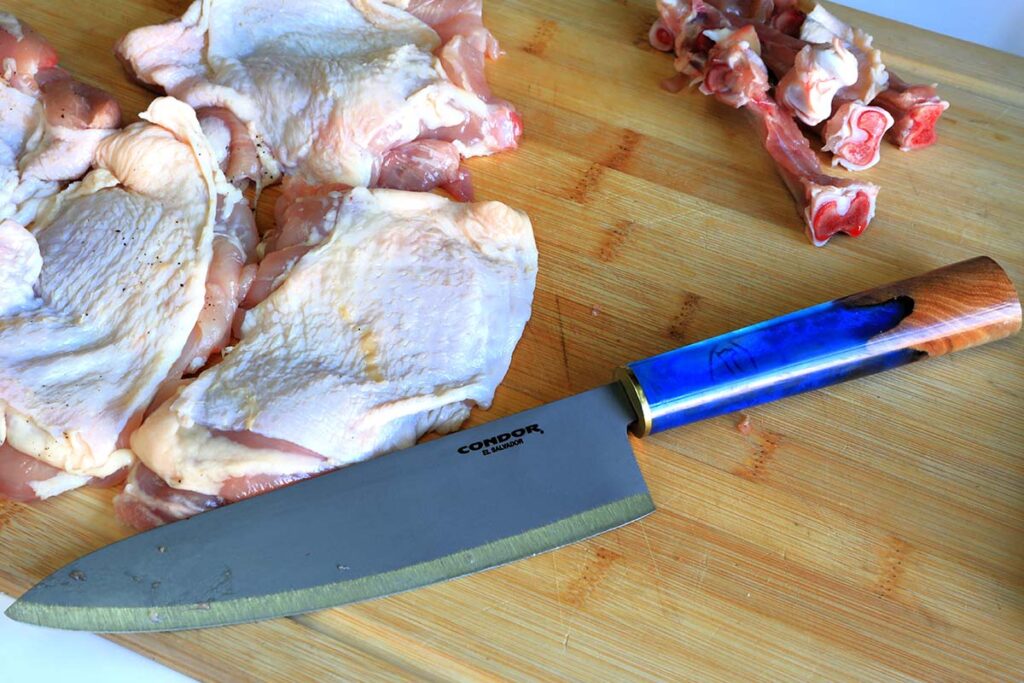
The Condor Shefu deboned multiple chicken thighs using a roll-cutting method for yakitori skewers and teriyaki chicken.
Shefu Kitchen Gyuto Specs Blade Length: 7.83” Blade Steel: 440C stainless Blade Grind: Full flat w/second bevel Blade @Thickest: .12” Blade Finish: Blasted satin Handle Material: Epoxy resin and hickory Overall Length: 12.92” Sheath: Welted leather Country of Origin: El Salvador MSRP: $154.98
Pros
Versatile Outdoor and Culinary Tool
Comfortable and Ergonomic Handle
Full Flat Grind with Second Bevel
Cons
Bit hefty
The Shefu Kitchen Gyuto from Condor Tool & Knife is a multi-use knife designed for bushcraft enthusiasts who want to prepare delicious meals while enjoying the great outdoors. Crafted with precision in mind, the Shefu is perfect for slicing vegetables and expertly preparing meat and fish. It is a versatile tool ready to tackle any culinary challenge.
The Condor gyuto is hardy and beautiful. The full flat grind with a second bevel ensures optimal slicing performance, while the handle provides a comfortable, secure grip. The knife strikes the perfect balance between heft and maneuverability. The leather sheath provides safe storage and easy transport.
I pushed the Shefu into service sectioning beef roast and deboning and trimming six chicken thighs. The knife tackled the tasks with ease. Slicing 3.5-pound roast required a sharp yet hefty slicer like a cleaver. The Shefu fit the bill and delivered. Bottom round roast is tough as woodpecker lips, and a thin, flexible blade need not apply here. At 9.88 ounces, the Condor’s robust blade strikes the perfect balance between heft and finesse.
The Condor has the only sheath of the test bunch, of a beautifully handcrafted welted leather for safe storage and easy transport.
The handle has a colorful, comfortable oval shape that nestles in the hand. Hot spots and fatigue are nearly impossible with this grip. The full tang offers strength and security while keeping balance and weight at the forefront. The Shefu is an essential for any cooking enthusiast, whether at home or in the wild.
Condor
$155
SMKW
$132
Spyderco Itamae Gyuto
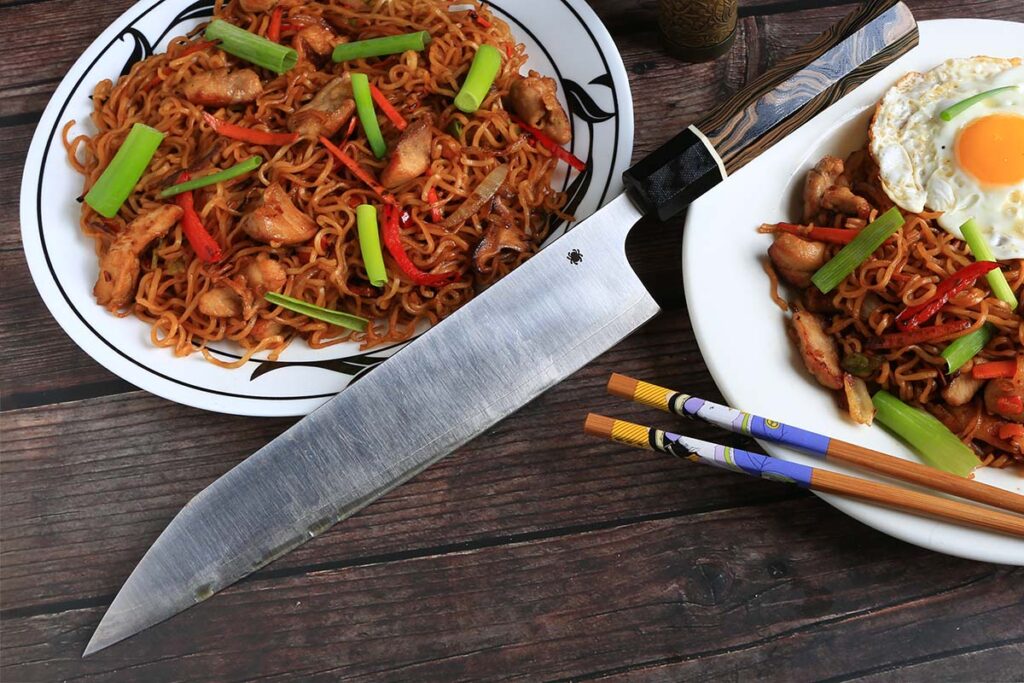
The author prepared the chicken yakisoba using the Spyderco. The knife sliced and diced carrots, onions, peppers, shiitake mushrooms, chicken and green onions for garnish.
Itamae Gyuto Specs Designer: Murray Carter Blade Length: 10.06” Blade Steel: Super Blue/SUS410 Blade Grind: Full flat Blade @Thickest: .094” Blade Finish: Satin Handle Material: Burl G-10 in the octagonal wa style Overall Length: 15.35” Country of Origin: Japan MSRP: $334
Pros
Exceptional Blade Construction
High-Quality, Ergonomic Handle
Beautiful Design and Craftsmanship
Cons
Higher Price Point
The Itamae Gyuto is part of the Spyderco Murray Carter Collection Itamae Series. The elite cutlery series is designed for highly skilled sushi chefs and showcases uncompromising craftsmanship and premium materials.
The Itamae Gyuto features a blade expertly crafted from laminated steel—an Aogami Super Blue core clad between layers of high-quality stainless. The three-layer construction ensures exceptional durability and sharpness, with Carter’s signature “Carter Elbow*” adding strength to the blade’s tip.
Paired with a traditional wa-style octagonal handle of stunning burl G-10 and highlighted with a black G-10 ferrule, the Itamae Gyuto embodies the spirit of Carter’s coveted custom kitchen knives. Tipping the scales at 7.4 ounces, it sets an impressive standard in high-performance household cutlery.
The Itamae Gyuto is a sushi knife and I’m a fan. Part of my time in Japan was seeking out various types of sushi. The second most rewarding part was watching the chefs work precisely as if it were the most critical game of Operation ever played—they are pros!
I used the test model to prepare carrots, onions, shiitake mushrooms, peppers, green onions and chicken for the famed yakisoba dish: fried street food noodles choked full of veggies, savory sauce and protein. Simple ingredients still require various knife techniques.
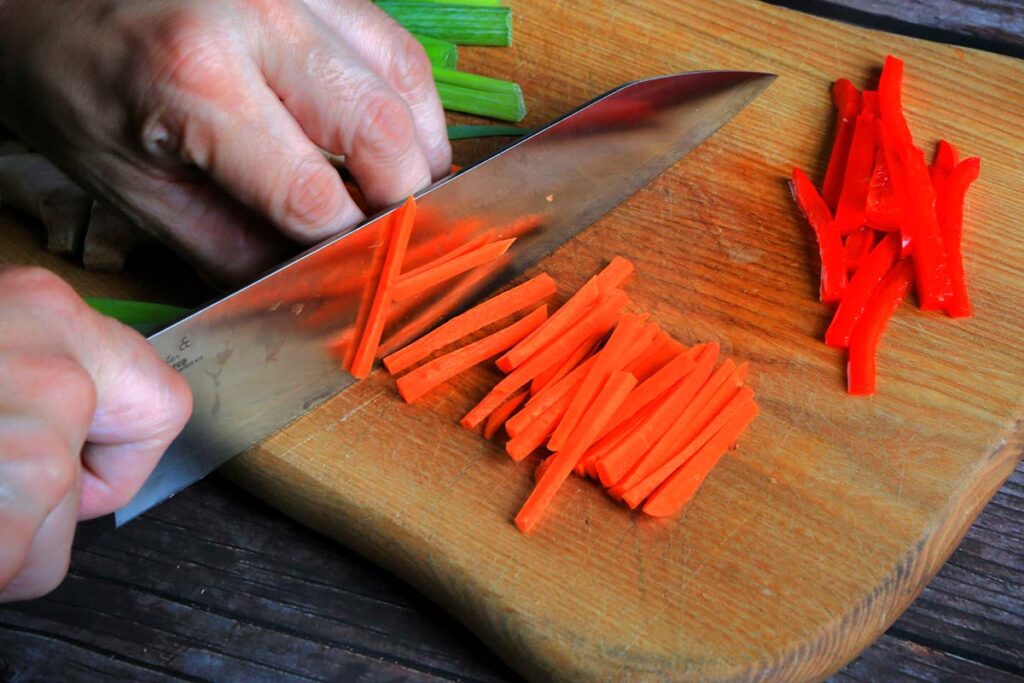
I used push-cuts on the tough carrots to square them to a safe position to stabilize them and make thin slices. From there, I stacked the slices for some rock-chopping to julienne a pile of carrots—in this instance, to make matchstick-sized carrot sticks. The secret to stir-fry cooking is preparation and cutting relatively equal-sized pieces of food to ensure equal cooking time.
To create julienne slices, the author employed the rock-chopping method with the Spyderco, again utilizing a chef’s pinch-grip and a claw grip with the offhand to support the food.
I used rock chopping and pull cuts—two techniques in which the Itamae excels—to slice the red peppers. To pull cut them, I placed the knife tip down on the board and sliced backward. By this time, the laminated steel had formed a nice patina from avocado, peppers, onions and chicken on the bevel, giving it a nice used look. Crafted in Japan, the Itamae Gyuto is an ultimate favorite among professional chefs and passionate cooking enthusiasts.
*Editor’s note: Through the Carter Elbow, Murray Carter combines the best features of a traditional Japanese wabocho kitchen knife with his Wharncliffe Brute neck knife. The design feature allows more steel to reinforce the forward tip of the blade compared to standard gyuto or French-style chef’s knife profiles.