

Knife Collecting

Knife collecting is an extremely rewarding experience for knife enthusiasts. There truly is a knife for everyone. Many increase or hold their value throughout the years, making collecting knives something to pass on to the next generation of knife collectors.

Knife Handles: As Wood As It Gets

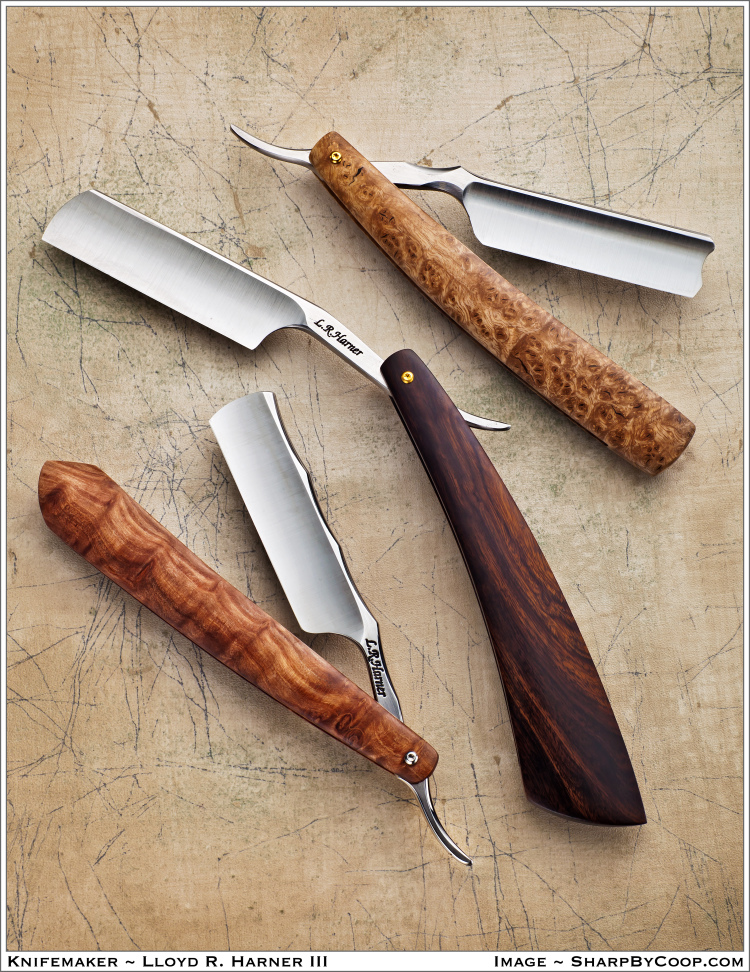
ThereIn the burl category, redwood (left) and black ash (right) are among the more popular woods. Lloyd Harner uses each for the handles of his razors, as well as the most popular of all woods, ironwood (center). The hollow-ground blades are 52100 carbon steel. (SharpByCoop.com photo)

There’s no time like the present to be a stickler for wood knife handles

Curiosity about the wood of choice among makers, users and collectors in terms of utility, user friendliness and good looks gives rise to the obvious question, “Which natural wood handle material is most popular, especially for custom knives?” American Bladesmith Society journeyman smith Peter Bromley and I were discussing the subject over coffee.

    “There are so many types of woods and so many variations within each type that the possibilities are nearly endless,” Bromley said. “You also have to find a piece of wood with a busy grain structure, so when you cut a handle-size piece, then the pattern carries over into the smaller portion.”

    Problem is, sometimes what looks good on a large piece of wood gets lost when you scale it down to handle size.

    “It’s why makers tend to like burl,” Bromley reasoned.  “It’s always busy no matter how small the handle is.”

    Shannon McFall of Knife & Gun Finishing Supplies, Chris Hartman of Masecraft Supply, and Chuck Bybee and his daughter Jessica Bybee Walker of Alpha Knife Supply each responded with two words: desert ironwood.

    “When it’s the highest quality, the most beautiful patterns are ironwood,” McFall said. “It’s still in relatively low supply, but we haven’t had a problem with replacement yet.” The shortage problems result from government regulations regarding the material. “It has become a lot harder to get the nicely figured desert ironwood,” as a result, Walker noted. “If we can’t get it, we switch to walnut. Turkish walnut is extremely dense with high contrast and performs similar to ironwood.” Bybee said he favors the look of highly figured curly koa. For high-end stuff, koa’s deep curls are rich in chatoyance, he opined. Chatoyance is the luster a material—in this case, wood—exhibits when you move it back and forth under a source of light, Bybee explained

    Hartman said ironwood is a favorite in terms of utility, looks and the best combination of both features. However, he questions whether there is a low supply of the material. “Have you ever been to a knife show that didn’t have tables full of ironwood?” he asked. With quality comes price and all those interviewed indicated ironwood is the most expensive of the woods. On the other hand, Walker said maple is probably the least expensive.


WHERE THE BURLS ARE

“Amboyna burl machines well and is a nice wood,” Walker began. She added redwood burl is always very popular—though not with production knife companies because it is more difficult to machine—along with box elder. Hartman agreed. “Amboyna burl has nice, tight patterns and it wears well, plus there seems to be a good, consistent selection available,” he said. “It looks good, feels good and sells well.” McFall cited the popularity of California buckeye, box elder, maple and amboyna burls, all of which are softer woods that must be stabilized to make them suitable for handle use.

    “Maple burl probably was the first wood stabilized successfully, it’s the most readily available and the cheapest, but we don’t sell a lot anymore and it’s not in the top five,” said Mike Ludeman of Wood Stabilizing Specialists International (WSSI). “Box elder burl is the most versatile wood and we double-dye it. Black ash burl and California buckeye burl are popular, and with buckeye each piece has to be graded individually because it can look nice, but have a huge void on the inside, so each piece has to be graded individually and priced accordingly.”

    McFall, whose Knife & Gun Finishing Supplies also provides a stabilization service, echoed Ludeman about the box elder and California burls. “They have the best patterns and finest colors,” she said. “Box elder takes a dye the best in single/double dyed, and you can get the effects of a lot of natural wood with more control over the colors.”

    Along with advances in the stabilization process comes more options. “Something normally bland with a figure can now be dyed to a natural look, rather than staining it as in the past,” McFall noted. “You have more control over the colors.”


“BETTER” OR “JUST NEW”?

Ludeman said stabilization methods are “highly regarded secrets” in a field that is growing.

    “Stabilized is not a word I like to use because it’s thrown around loosely anymore,” he noted. “I achieve 100 percent penetration of an acrylic impregnated wood.” Hartman embellished the point. “I have seen a lot of new ‘stabilizers’ advertised out there, which doesn’t make them ‘better,’ just new,” he offered. “As far as I know, the important part is proper selection and preparation of the wood, and fully understanding the entire stabilization process.” Bybee warned that amidst the growth in companies and individuals offering stabilization services, you should research the subject and exercise caution.

    Factory knives with stabilized wood handles are rare. “Generally, a factory uses stabilized wood, typically U.S. maple or box elder, for a special/limited edition” because of the cost factor, Ludeman said. “It’s not something they make tens of thousands of.” Hartman concurred. “Who can supply 500 pieces of high-quality stabilized woods on a consistent basis for two years?” he asked. “You can do limited-edition runs but it’s very hard to supply quality consistently over long periods of time in that quantity.” Bybee agreed, adding, “Factories have moved almost exclusively to man-made materials, with G-10 and Micarta® dominating now, because they can count on availability and consistency.” 


FUTURE WOODS

What woods will be popular in the future? “It varies because a lot of popular woods are harder to get so they don’t actually show up more,” Walker said. “Turkish walnut has a really rich color, nice dark browns with lighter streaks running through it, and I think it shows promise in gaining popularity.”

    “I would love to see somebody come up with something new made from bamboo,” Hartman stated. “This could be the perfect material, it’s sustainable, has a lot of good qualities, but just not enough character or pattern to become a hot-selling knife material.” He also identified the need for a  “passionate supplier” of exotic woods.

    “There are a lot of ‘suppliers’ of woods, myself included, but no ‘master wood supplier’ that does only exotic woods, stabilizes and does nothing else,” he mused, “a ‘wood crazy’ company that lives and breathes wood dust for knife folks.”

    The complexities involved in natural and stabilized woods make the possibilities, as Bromley noted, “nearly endless.” There is an attraction that cannot be denied. “Wood is naturally, beautifully created,” Hartman said, “and it’s a silly man who thinks he can improve on that kind of art.”—by Stephen Garger


Wood: It’s Not a Wash!


The No. 1 maintenance tip Jessica Bybee Walker offers is to not wash the knife in a dishwasher.

    “A lot of knifemakers use vulcanized fiber liners, which are very susceptible to moisture and can shrink and pull back or swell up in the dishwasher and crack,” she warned. Chuck Bybee recommended putting mineral oil on your hand and rolling the handle around in it. “I also put Renaissance Wax on all my ironwood knives as one of my yearly rituals,” he said.

    “Wood is a natural product so I don’t use a petroleum-based blend. I use a thin coat of olive oil on wood handles. Besides,” Peter Bromley smiled, “I like the smell.”

    Stabilized woods do not require the same amount of care as untreated woods, but that does not translate as “no” care. “Basically, stabilized wood is an enhanced wood—not the cure-all for swelling, shrinking, etc.,” Ludeman noted. “The real purpose stabilization serves is to expand the availability of woods that are otherwise too soft for knife handles.” In other words, stabilized or not, use common sense and do not leave your knife sitting on the dashboard in 90-degree heat.—by Stephen Garger


Woods: Most, Good and Least


MOST POPULAR: Desert Ironwood

MOST EXPENSIVE: Desert Ironwood

GOOD IRONWOOD SUBSTITUTE: Turkish walnut

MOST PLENTIFUL: Maple

LEAST EXPENSIVE: Maple

MOST POPULAR BURLS: Amboyna, redwood, box elder, California buckeye, maple and black ash


For more on the latest knives, knife legislation, knifemaking instruction, knife trends, knifemakers, what knives to buy and where and much more, subscribe to BLADE® Magazine, the World’s No. 1 Knife Publication. Click on http://www.shopblade.com/blade-magazine-one-year-subscription-us/?r+ssfb071212 for more information.
 

KA-BAR Announces Its First Ek Knife

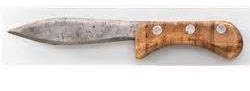
The World War II vintage Ek Model 4 had a wider blade and a wooden handle.

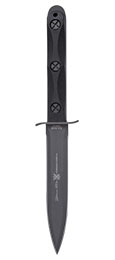
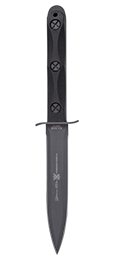
KA-BAR has announced its long-awaited reintroduction of the Ek Commando Knife line with its update of the Ek Model 4.

The Model 4 sports a 6.625-inch double-edged blade of 1095 Cro-Van carbon steel, an “S” double guard, a textured glass-filled nylon handle and traditional X-head fasteners. It features a Celcon® sheath with a retaining strap, a self-locking function and multiple tie-down points. MSRP: $125.40.

With its modern materials, double guard and much-more-streamlined shape, the new Model 4 is a far cry from the World War II-vintage version, which had a wider blade and a wooden handle with an integral single guard and a bulbous pommel. The new Model 4’s handle shape with X-head fasteners is in keeping with later versions of Ek knives.

EK BACKGROUND

The new KA-BAR Ed Model 4 is streamlined and made of modern materials.

John Ek created Ek Knives in 1941. He contributed to the World War II effort by overseeing the production of knives for most all American service branches from his Hamden, Connecticut, shop. He employed disabled Americans to help build six knife models during the war.

He called the knives “Ek Commando Knives” for their intended purpose of close-quarter combat. He began registering each knife’s serial number to its original owner in 1943. The Ek Commando Knife became a hallmark of the U.S. Marine Raiders and other American special operation units during the war. At the peak of wartime production, he employed three shifts working seven days a week making knives, and is reported to have sold over 100,000 models by war’s end.

U.S. troops have carried Ek Commando Knives in every major American conflict since World War II.

Ek moved his shop to Miami, Florida, in 1949, and continued to make knives for private sale to military men, with thousands of his knives seeing service in Korea and Vietnam. He died in October 1972 and his son, Gary, took over the business. Robert A. Buerlein obtained the rights to Ek Knives in 1981 and resumed production in 1982. Blackjack Knives bought Ek in 1993 and sold it to Century International Arms in 1997. KA-BAR acquired the Ek knife brand last year.

For more on the new Model 4, visit Ekknives.com.


The latest issue of BLADE is on newsstands now!Recommended:

Stay abreast of the latest developments on this and many more knife rights issues with a subscription to BLADE.

Collector Alert: Prices Set to Rise for Folding Knives in Canada

0
Canada import rule prohibited knives
Buy low while you still can, Canadian knife collectors.

New CBSA Rule to Drive Prices Up

If you live in Canada, expect the price of most folding knives to go up, especially in secondary markets. Collectors may want to start stock up while prices are still at par.

The culprit is a new rule by the Canada Border Services Agency (CBSA), in effect now, that prohibits the import of assisted openers and any manual folder that opens with centrifugal force. (Automatics were already restricted, but the rule covers them, too.) This only applies to imports, not knives already legal to own in Canada. Both businesses and individuals are impacted.

As BLADE reported here and here, it’s that centrifugal force qualifier that will especially limit Canadian knife enthusiasts’ choices. An inspecting CBSA official may open a blade halfway, give a flick of the wrist and determine the knife is prohibited.

If a knife can open with one hand, it’s not going to make it into Canada.

Existing Stock Will Dry Up

This wide leeway effectively ends the flow of fresh folders imported into Canada. That includes popular brands from the United States.

Imported folders already in Canada will remain on shelves and are not banned from purchase or possession. However, retailers won’t be able to reorder them.

More Investment Options than Ever Before

If anyone will benefit from this new CBSA rule, it’s enthusiasts with assisted openers and manual folders already in their collections. Mundane assisted openers and folders not originally thought of as collectibles are now investment pieces.

Collectors have more, safer bets in categories never considered before. That $50 flipper doesn’t look so insignificant anymore.

How High Could Prices Go?

It’s hard to say, but prices will only go in one direction in 2018. Beyond that is less certain. Rising prices reflect a market adjustment. Expect that prices will find a ceiling, then drop to a new normal. The trick will be to catch prices in secondary markets on the upswing before the fall happens.

Caution

Canada bans imported folding knives assisted opening
The CBSA, a federal agency in Canada, cannot make laws. However, it can issue rules based on interpretations of existing law.

The rise in prices may press some Canadian collectors to try their luck with the CBSA and order folders/assisteds from outside the country. However, authorities are already working to stay one step ahead.

“The way the Canadian government figured out all the tricks on how to get knives into Canada was reading blade forums and watching YouTube where all these people were bragging and giving instructions on how to get knives into Canada,” Neil Ostroff, owner of True North Knives, told BLADE in an e-mail. Ostroff is originally from Canada, but now resides in the U.S.

The Bottom Line: Buy Low Now, Sell High Later

If you’re a knife collector in Canada, it’s time to start buying new assisted openers and folders while you still can. Hold on to them and wait to see where prices go in secondary markets.


* For those also interested in U.S. knife laws, don’t miss this book by attorney Evan Nappen.


ABS Youth Hammer-In at SMKW June 28-30

The American Bladesmith Society (ABS) Youth Hammer-In will be held Friday through Sunday, June 28-30, at Smoky Mountain Knife Works in Sevierville, Tennessee.

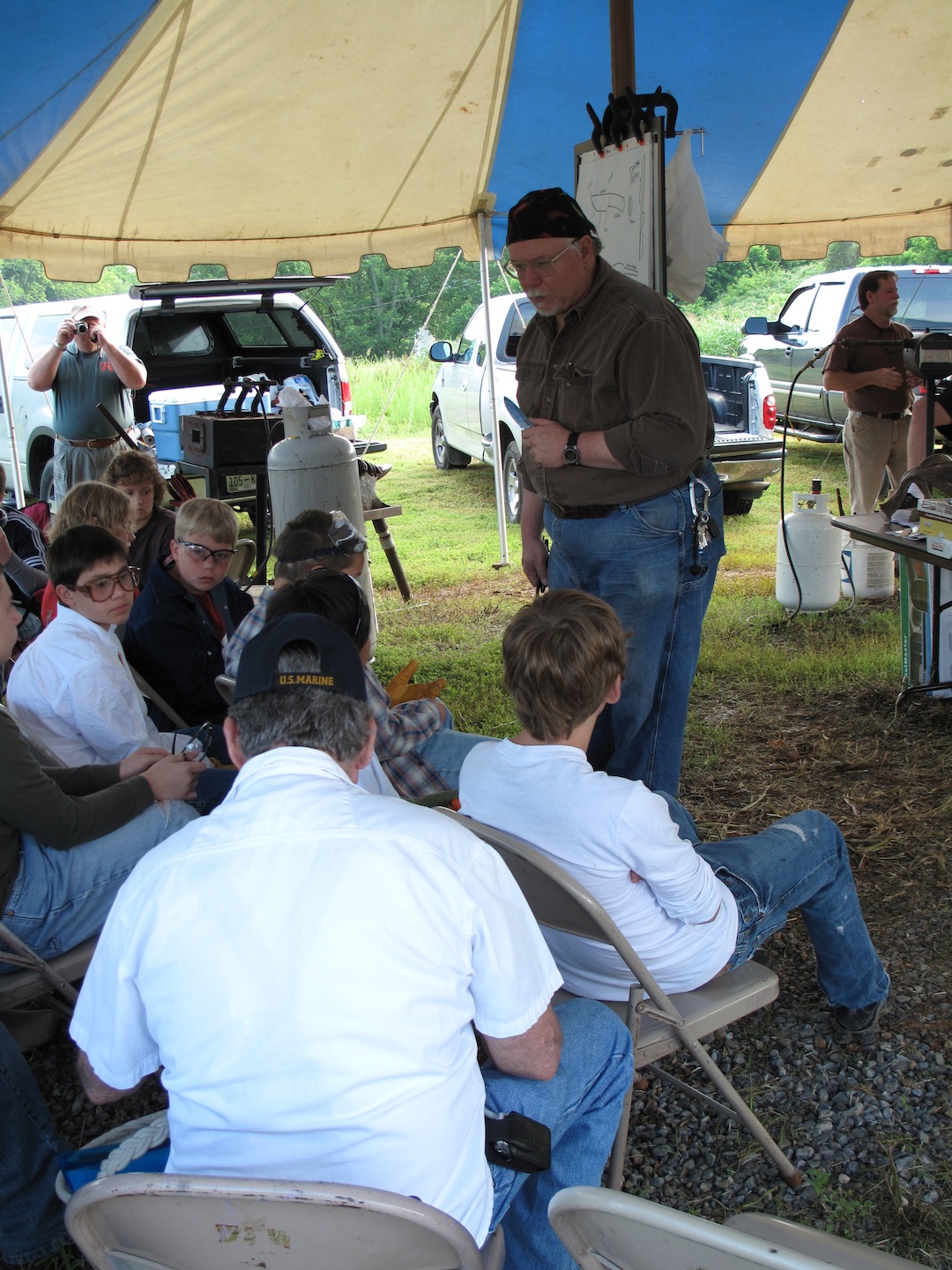
Youths from all over the country will descend on Sevierville to learn how to forge a knife under the expert direction of ABS master, journeyman and apprentice smiths. Safety is always the No. 1 concern when forging, and that concern is magnified when children are involved. The ABS has an exemplary record in this regard, and its bladesmiths/teachers are among the finest in the world. Leather shoes or work boots (no tennis shoes), cotton shirts and long cotton pants, work apron and leather work gloves will be the uniform of the day. Safety glasses will be provided. Feel free to bring your favorite hammer and tongs.

Classes will include safety talks, forging demos, hand finishing techniques, a chalk talk on handles and guards, individual instruction on the anvil and more. Lunch and dinner will be provided.

The hammer-in is open to participants ages 9 to 18 who are accompanied by a parent or guardian. Registration fee is $65.

While there, the kids and their parents/guardians can tour Smoky Mountain Knife Works (SMKW), one of if not the world’s largest retail knife stores. The latest in knives, sharpeners, knife accessories, displays, knife maintenance kits, tomahawks, swords and everything that has to do with cut are on display and for sale.

SMKW is also home to the National Knife Museum, which houses an incredible array of antique pocketknives, custom knives, swords and much more. Tour the facility’s historical displays to learn all about the history of man’s oldest tool in a modern, air-conditioned environment.

For more information on the ABS Youth Hammer-In, contact BLADE Magazine Cutlery Hall-Of-Fame© (www.blademag.com) member Houston Price 865-397-0053 choustonprice.att.net or visit www.americanbladesmith.com.

For the latest in knives and knife news, stay tuned to www.blademag.com.

ABS journeyman smith Wes Byrd instructs young students on the art of the forged blade at a past ABS youth hammer-in.
ABS journeyman smith Wes Byrd instructs youngsters at a past ABS Youth Hammer-In.

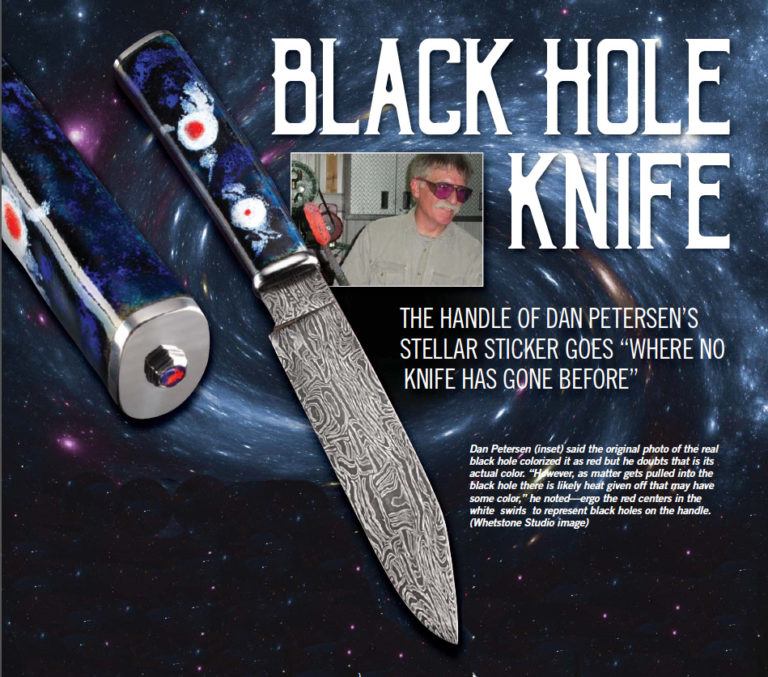
When Astronomy Meets Knifemaking: The Custom “Black Hole” Knife

0

Specs

  • KNIFE NAME: Vitreous Enamel Handle Hunter
  • KNIFE TYPE: Fixed blade
  • BLADE LENGTH: 6″
  • BLADE MATERIAL: Mosaic damascus of W2 tool and 15N20 nickel-alloy steels in a checkerboard pattern accordion cut, flattened and forged to shape
  • BLADE PATTERN: Clip point
  • BLADE GRIND: Flat
  • HANDLE: Copper pipe covered inside and out w/vitreous glass enamel
  • FITTINGS: 303 stainless steel
  • MAKER’S LIST PRICE FOR A SIMILAR KNIFE: $4,200

The Story

ABS master smith Dan L. Petersen is a professor at Washburn University. When astronomers found the first real black hole last spring and shared photos of it, it intrigued him so much so that he made a knife inspired by the wonder of it all. In fact, one of Petersen’s knives won the Custom Knife Collectors Association‘s (CKCA) annual Fisk Cutlery Challenge, earning the prof a cool $20,000.

“One of the [black hole] photos looked similar to the circular white and red patterns in the handle,” Dan explained. “I tried to get a bluish-black-of-the-universe effect, then the white swirls showing matter spinning around the red center black holes.”

Black hole photo
The black hole image that inspired Petersen. (Event Horizon Telescope Collaboration image)

To taper the copper-pipe handle, Petersen spun it on a lathe using metal-spinning techniques. He added vitreous glass enamel to the outside and inside of the handle. He heated the handle to 1,500-degrees F and rotated it until it melted and fused to the metal. He repeated the glass procedure with a layer of dark blue glass and then black glass for the universe effect.

Oh, and as for the $20,000, it helped Dan buy a lathe for metal spinning.

* Want to see more incredible custom knives? BLADE Show is the place to go.


A Knife for Every Room: Curating the Ultimate Home Collection

Is the assortment of knives in your house as appropriate as it should be?

At one time I thought I wasn’t a knife collector. I am a knife enthusiast, knife user, knifemaker, knife writer, maybe even a reluctant knife expert, but not a knife collector.

Back when I thought that way, I looked around and noticed I had a dozen knives within arm’s reach, plus the tools in the kitchen, plus the customs of my own and a few from others, plus all the factory knives. Turns out I had nearly 100 knives, which means I’m definitely a knife collector, or at least an accumulator.

In my usual ADHD stream-of-consciousness fashion, my next thought was, “I wonder if I have a knife in every room of the house?” followed immediately by thoughts of which kind of knife would go in each room. Come along on my imaginative journey as we explore the idea of a knife for every room.

Kitchen

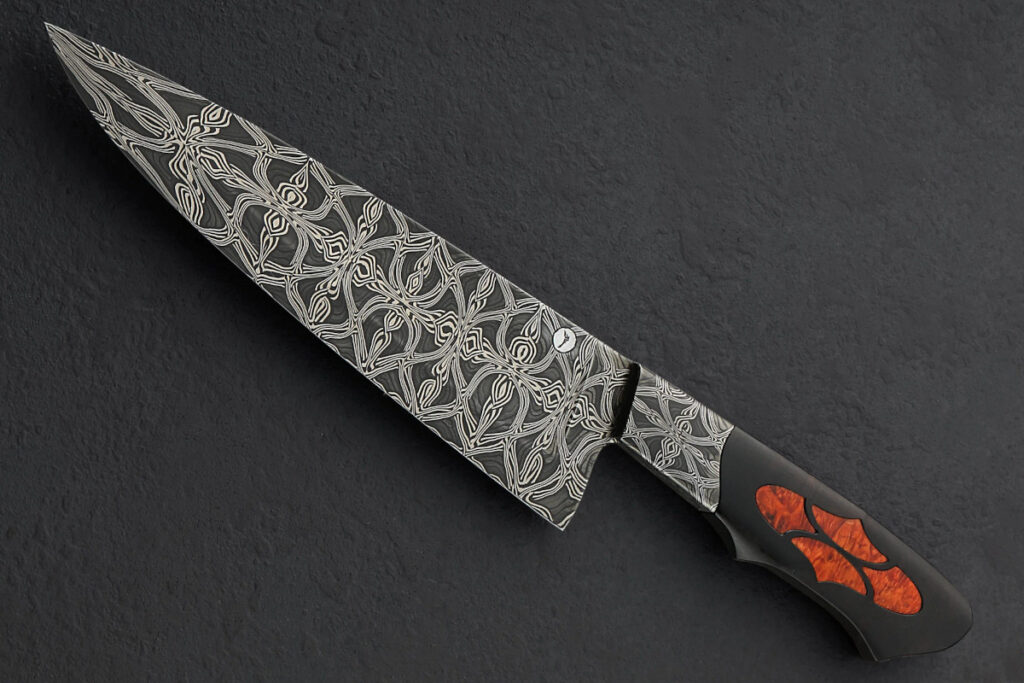
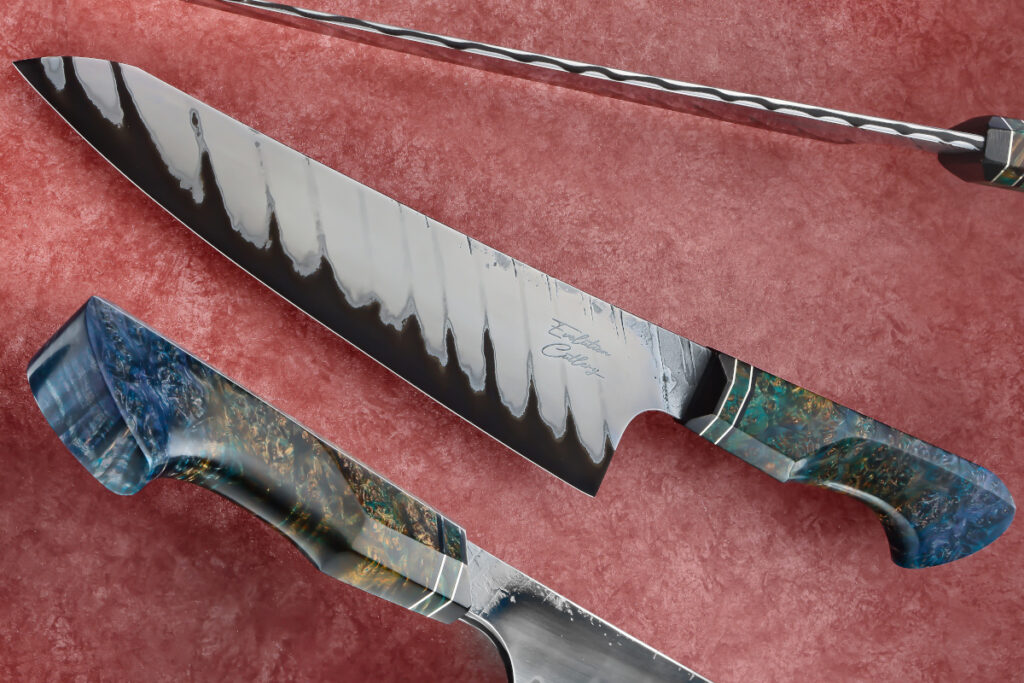
Knives in the kitchen are a given but including one by bladesmith Salem Straub is not. In the author’s perfect household cutlery world, one would be. An example: Salem’s Guimard chef’s knife in mosaic damascus. (EatingTools.com image)

The kitchen is intuitive. Most people have knives there, whether the knives are economy store cheapies, a mishmash random drawerful accumulated over years, a matching production set, or even dedicated custom household cutlery. On my imaginary journey, I can afford the good stuff, like a damascus chef’s knife from bladesmith Salem Straub. But that’s too easy. Why not a whole knife-fork-and-spoon-damascus set, like one from Nate “Tuna” Grant?

Garage

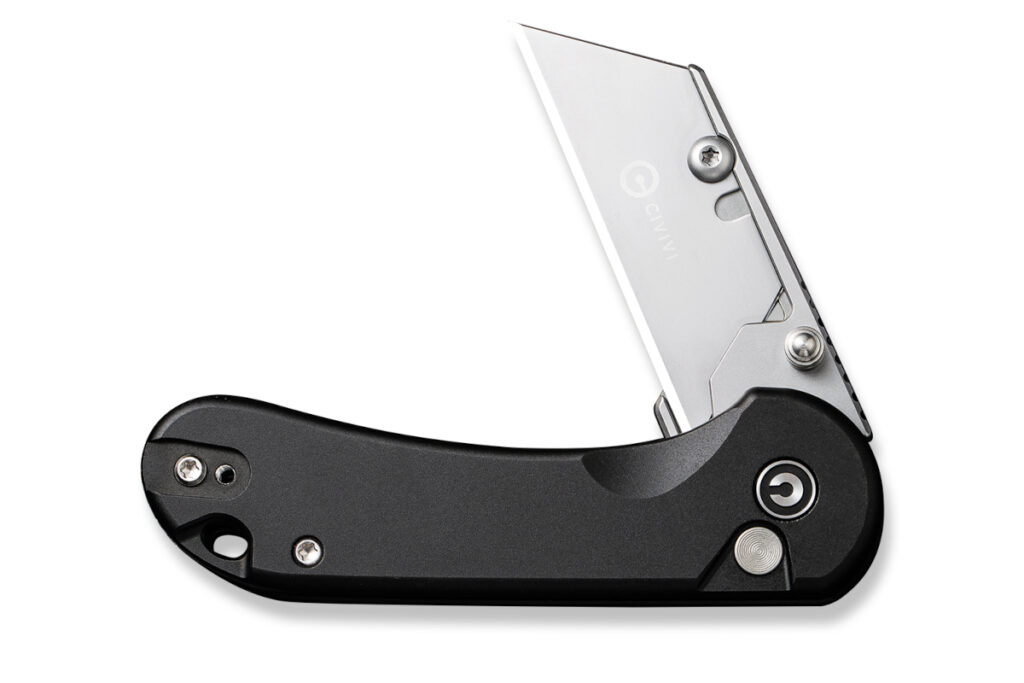
For the garage, the author suggests a factory utility knife of the replaceable-blade variety such as the Civivi Elementum.

The garage isn’t too tough either. My first thought was a utility knife of the replaceable-blade variety. In the past few years there’s been innovation in the custom knife world when it comes to replaceable blade knives, but for utilitarian and “I can use this and not be sad if I scratch it,” I think I’ll go with the Civivi Elementum that uses standard box cutter blades.

Living Room

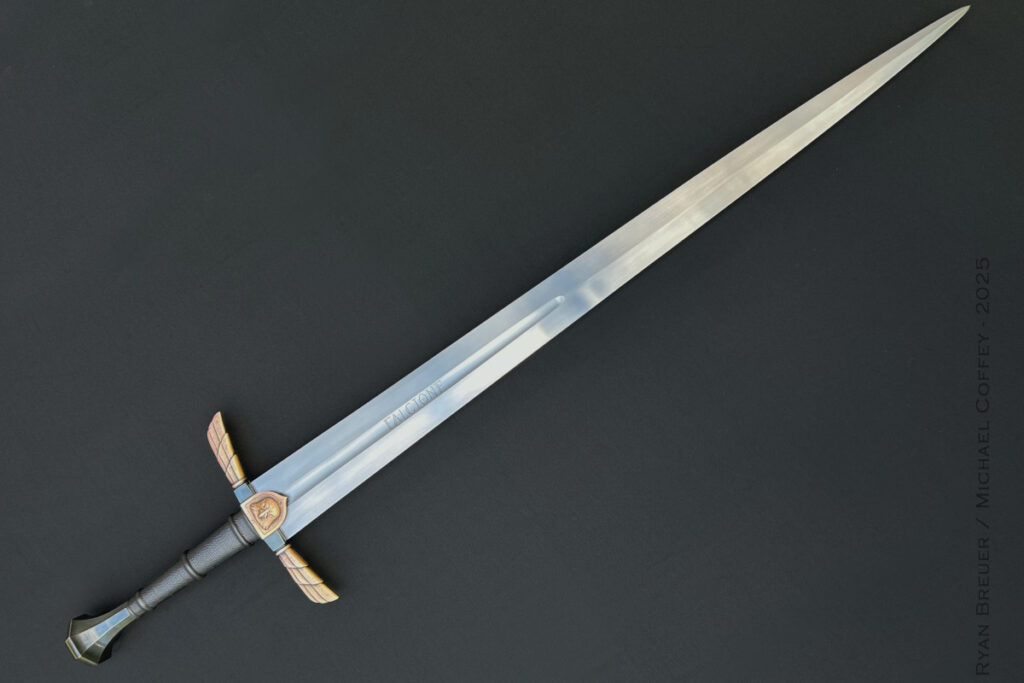
If the living room has a fireplace mantle, it’s a great place to display a custom sword. If you’re feeling medieval, the author recommends something like a hand-and-a-half piece by Ryan Breuer. (Ryan Breuer image)

The living room has the fireplace mantle, which is a great place to display a custom sword. If I were feeling medieval, I’d choose something like a hand-and-a-half piece from Ryan Breuer. Conversely, if I were feeling loud and Japanese, I might choose a fine bright katana like one from David Goldberg with an epic hamon.

Study

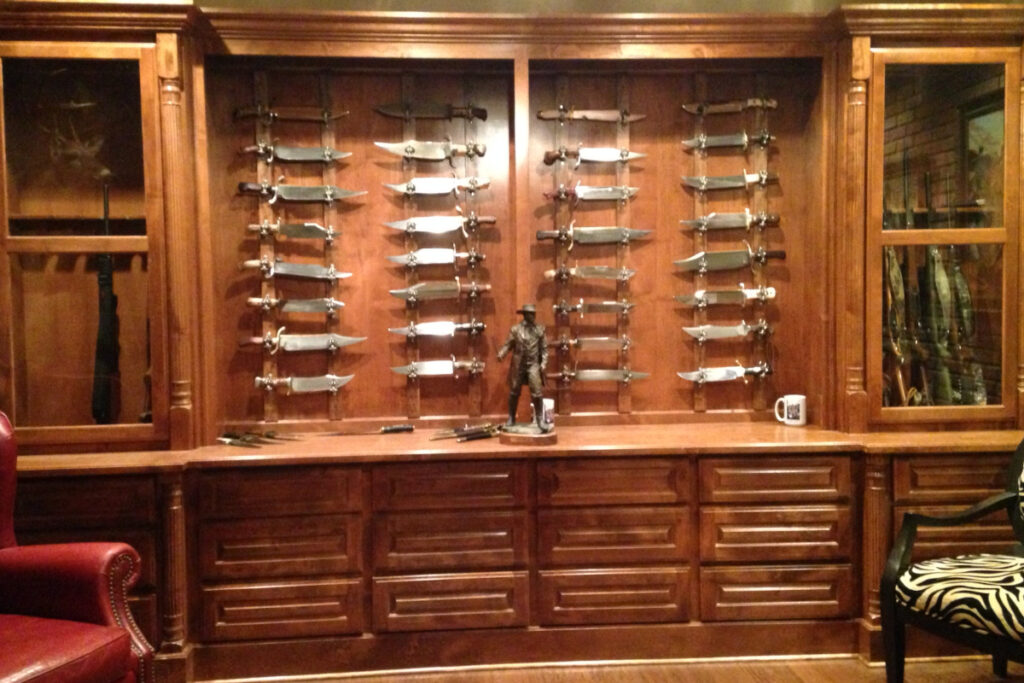
Along with studies, game rooms are also great for storing knife collections. Avid bowie collector Chris Nolen keeps his collectibles in a game room display designed by his son-in-law, replete with a statue of Jim Bowie and slide-out drawers that hold around 10 bowies each. (Chris Nolen image)

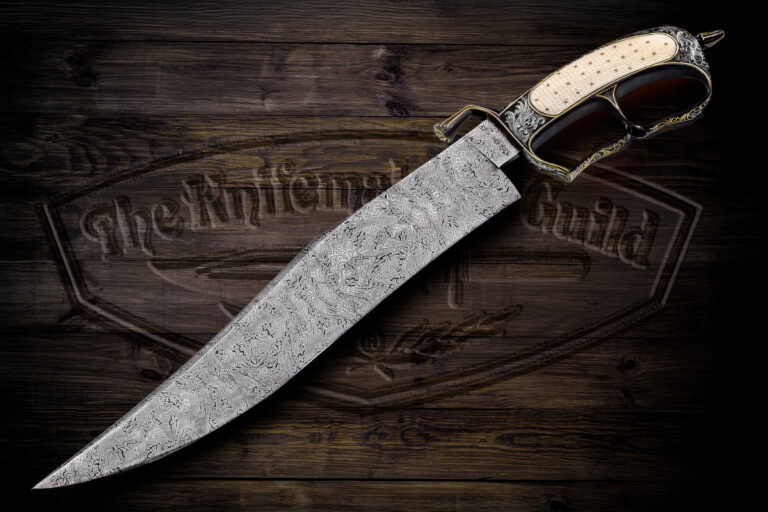
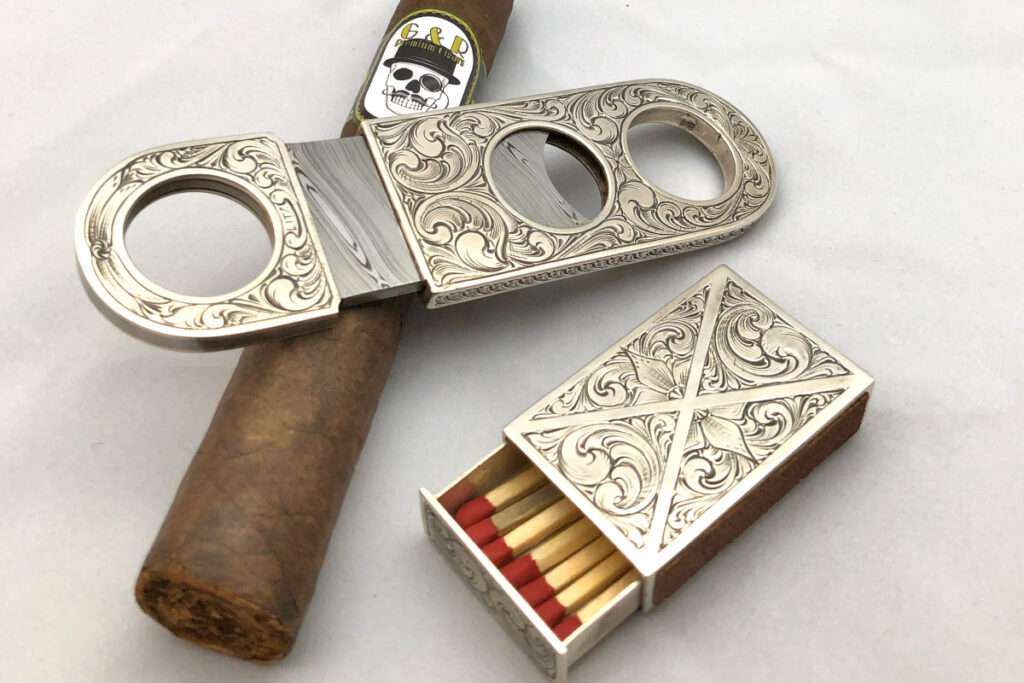
The gentleman’s study is dark, filled with books and memorabilia—the perfect place to store and display the “real” knife collection. Personally, I’d like a collection of custom bowies. I’d include pieces like a fully forged integral mosaic model from ABS master smith Mike Quesenberry, or an exquisite collaboration like The Knifemakers’ Guild award-winning piece by Nick Orr and Bailey Bradshaw. Or maybe I’d go rustic like ABS master smith Lin Rhea’s Preacher Bowie named after a mountain man. I’d round out the room with an engraved silver cigar-cutter-and-match-box set by Travis Payne engraved by Matt Litz for when the guys and I want to relax with a puff.

 An engraved silver cigar-cutter-and-match-box set by Travis Payne engraved by Matt Litz for relaxing with a puff among friends would round out the author’s dream study. (Matt Litz image)
An engraved silver cigar-cutter-and-match-box set by Travis Payne engraved by Matt Litz for relaxing with a puff among friends would round out the author’s dream study. (Matt Litz image)

These days most tend not to receive letters, only junk mail and bills, and most of the junk mail goes straight to the trash unopened. But if I had a home office and I received good mail, I’d have to open it with a custom letter opener like one in a set from Deon Nel. He made a matching set of 16, so I bet he could spare one.

Outdoors

 The backyard isn’t exactly part of the house, but that doesn’t exempt it from being a part of the author’s imaginary knife journey. If you have a standard grill, consider something like a san-mai brisket slicer from Dan Tompkins. (SharpByCoop image)
The backyard isn’t exactly part of the house, but that doesn’t exempt it from being a part of the author’s imaginary knife journey. If you have a standard grill, consider something like a san-mai brisket slicer from Dan Tompkins. (SharpByCoop image)

The backyard isn’t exactly part of the house, but that doesn’t exempt it from being a part of my imaginary knife journey. For those with a standard grill, you might consider something like a san-mai brisket slicer from Dan Tompkins. Or if you’ve got a fire pit, don’t forget Will Stelter’s damascus and mammoth ivory marshmallow fork. Or if you live in the woods, you might want a forged axe like a laminated wrought iron one from Nick Bachtel.

Bedroom

The author’s dream bedroom pillow dagger would be like Buttercup’s in The Princess Bride. If he were Buttercup’s beau, Dread Pirate Roberts, the author stated he might give his lady something like a poignard by Jamie Bishop. (SharpByCoop image)

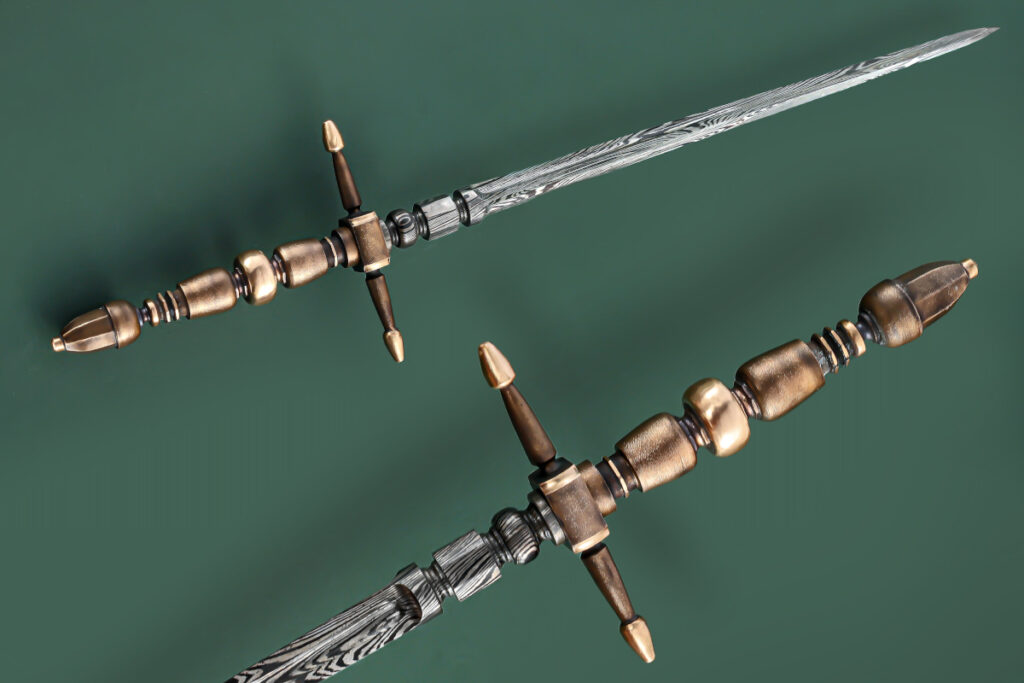
Bedroom knives are a bit of a stretch. Personally, I have my hunting knives in my bedroom closet. If I were rich and fancy, though, I’d have to have a pillow dagger—you know, the dagger you keep under your pillow just in case. I’m reminded of the scene in The Princess Bride when Buttercup pulls out a fine stiletto in the bedroom, and the great Dread Pirate Roberts line that goes with it: “There is a shortage of perfect breasts in this world. It would be a pity to damage yours.” If I were Dread Pirate Roberts, I might give my lady friend something like a poignard by Jamie Bishop, or even something dainty and feminine like a fine small piece from ABS master smith Veronique Laurent. For under my personal pillow, I’d go with something extravagant like an art dagger from the Sobral Brothers.

Bathroom

Bathrooms are for hygiene and sometimes that takes a knife. To clean your fingernails or pull a splinter in style, the author recommends something like the fine Dourado collaboration between ABS master smith Dionatam Franco and Evan Nicolaides. (Mitchel Cohen image)

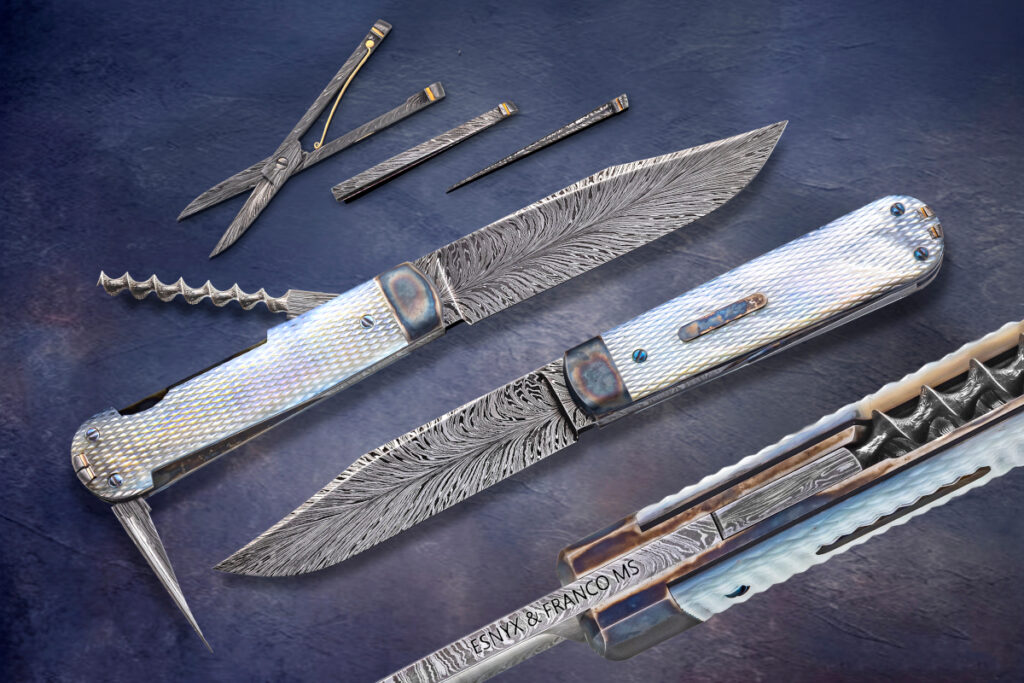
Bathrooms are for hygiene and sometimes that takes a knife. If you want to clean your fingernails or pull a splinter in style, I recommend something like a fine collaboration between ABS master smith Dionatam Franco and Evan Nicolaides. The pearl scales will shimmer in the vanity lights, and there are enough tools included to take care of many different tasks. Or if you want to play “Mack the Knife” in a dark alley then come home and comb your hair, Rick Lala can hook you up with his two-tool blade/comb folder.

How Close Are You?

You may not have a knife for every room, but I suspect that many BLADE® readers come very close. Here’s to improving the quality of your knife collection—even the bedroom knives!

Read More:

8 Knife Shows to Attend – November 2019

0

Here are eight knife shows to attend throughout the United States in November 2019.

There’s nothing quite like meeting the makers behind the knives that collectors love. Even if you don’t buy a new favorite blade (though it’s hard to resist!), you’ll learn a lot about knifemaking, gain a new appreciation for the craft and handle knives worth tens of thousands of dollars without spending tens of thousands of dollars. 

What’s better than that?

NOV. 1-3 PORTLAND, OR

The 2nd Annual BLADE Show West, Oregon Convention Center. The latest in custom and factory knives, awards for same, demos, seminars and more. For more information visit bladeshowwest.com.

NOV. 1-3 PIGEON FORGE, TN

Voyles Knife Show, Smoky Mountain Convention Center, 865-908-3015 https://www.mypigeonforge.com/event/voyles-knife-show.

NOV. 2 SAN DIEGO, CA

The Art Knife Invitational, Sheraton Hotel San Diego Bayside Tower. Contact [email protected], ArtKnifeInvitational.com.

NOV. 2-3 MT. VERNON, IL

The 37th Annual Mt. Vernon Knife Show, Roland Lewis Community Building. Contact Nancy Hancock, Dept. BL4, 12193 Turner Dr., Mt. Vernon, IL 62864 618-242-4514 jcckc1982@ yahoo.com.

NOV. 3 MARLBORO, MA

Marlboro, Massachusetts Knife Show, Holiday Inn. Contact Lynn Cain 978-249-6070 [email protected].

NOV. 8-10 INDIANAPOLIS, IN

Indy 1500 Gun & Knife Show, Indiana State Fairgrounds. Contact World Class Gun Shows, PO Box 14194, Oklahoma City, OK 73113 405-340-1333 indy1500.com.

NOV. 9-10 TULSA, OK

Wanenmacher’s Tulsa Arms Show, Tulsa Fairgrounds. Contact [email protected], 918-492-0401 or tulsaarmsshow.com.

NOV. 22-23 JERSEY CITY, NJ

New York Custom Knife Show, The Westin Jersey City Newport, Newport Ballroom. For more information visit fiftyfiftyproductions.net.

Advertisement

Must Read Articles

Read this before you make a knife

Knifemaking 101 – Read This Before You Make a Knife

  by Wayne Goddard My experience has taught me that there's nothing like digging in and getting started. I've often said the hardest part of the...
how to forge damascus steel

How to Forge Damascus

Advertisement
Advertisement