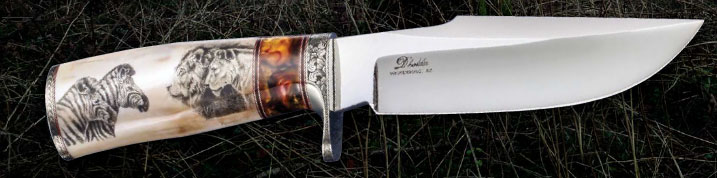
Knife collecting is an extremely rewarding experience for knife enthusiasts. There truly is a knife for everyone. Many increase or hold their value throughout the years, making collecting knives something to pass on to the next generation of knife collectors.
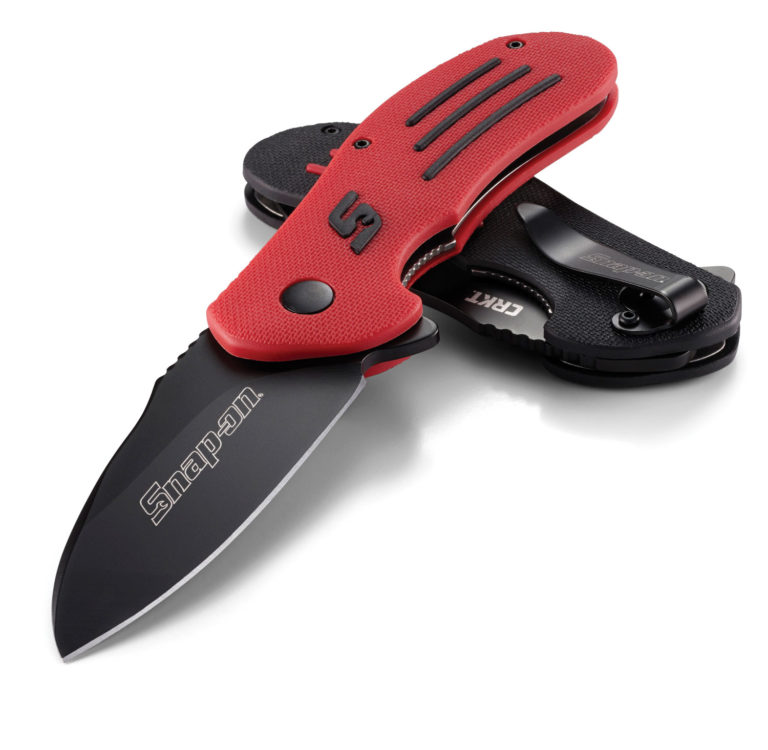
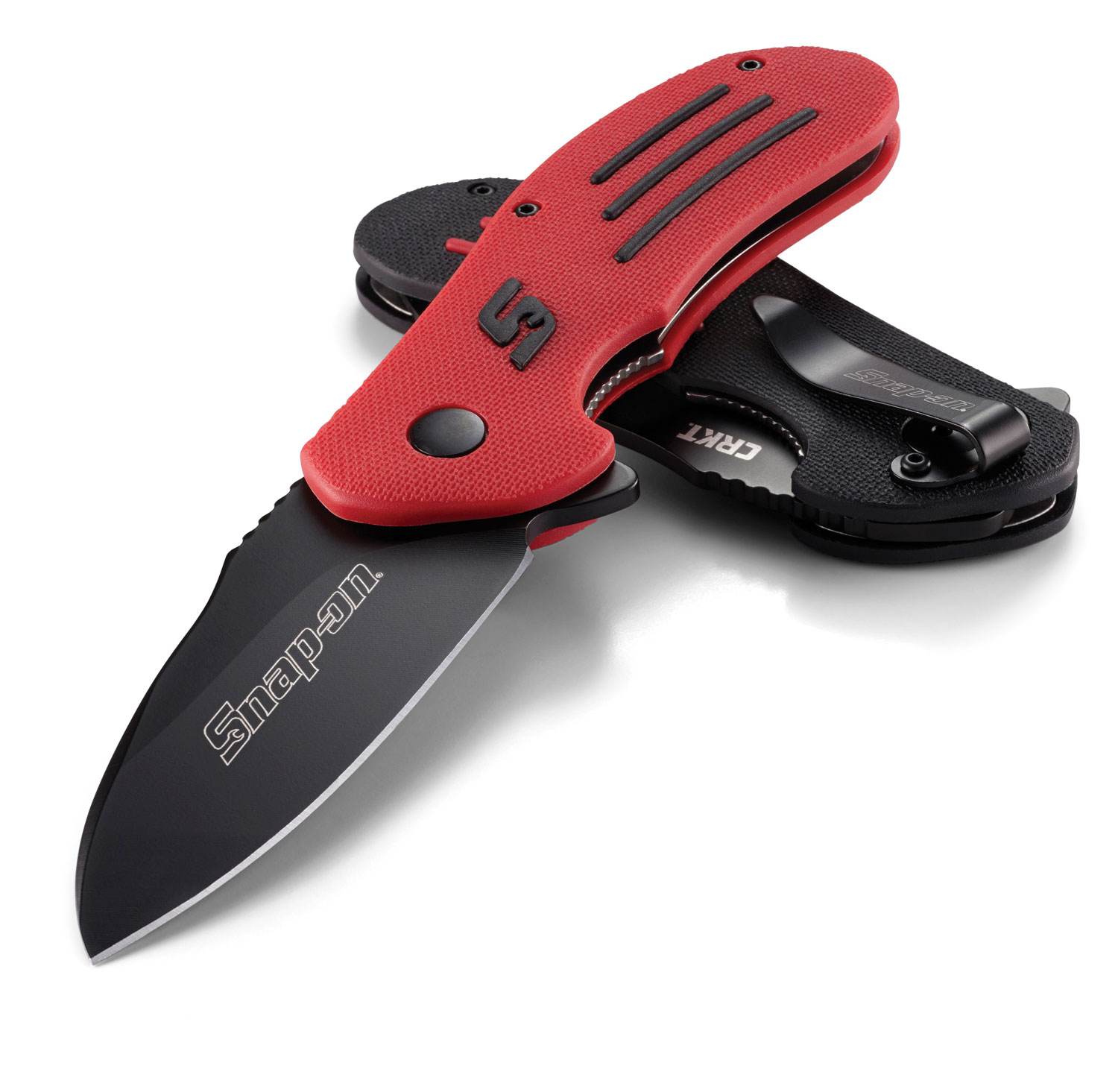
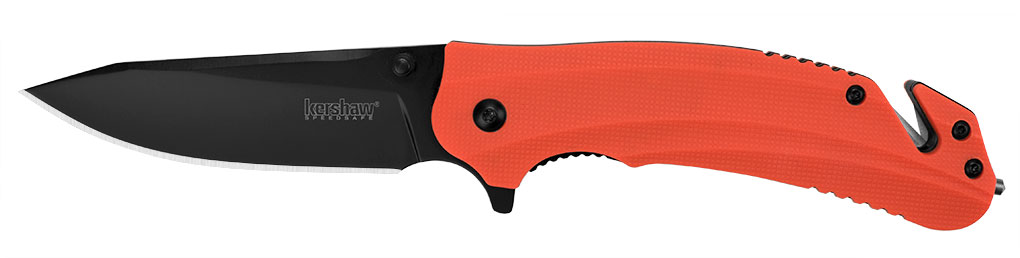
As rugged as the mechanics who use it, this overbuilt pocket knife features a modified drop point blade that’s built from stainless steel. It’s tough enough to cut hose but still precise enough to strip wiring. Meanwhile a black corrosion resistant coating keeps the blade intact no matter what you put it through in the shop.
Blade Steel: 1.4116
Blade hardness: 55-57 HRC
Blade Thickness: 0.120” (3.0 mm)
Blade Finish: EDP
Blade Length: 2.75” (69.85 mm)
Closed: 4.125” (104.76 mm)
Open: 6.875” (174.63 mm)
Weight: 6.2 oz. (175 g)
Handle: Glass-Reinforced Polypropylene with TPR Insert
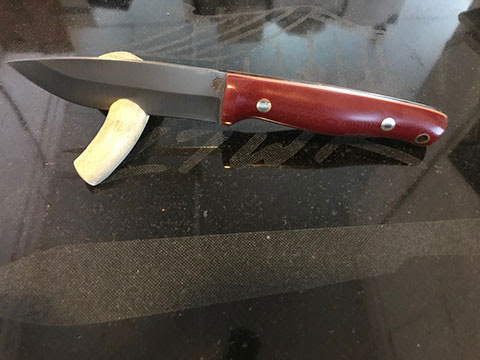
For a minimalist with an appetite for big adventure. Jesper Voxnaes’ Scandinavian backyard is filled with fjords, punctuated by mountains, and sliced by surging rivers. So when he sets out to design an outdoor knife, it’s crafted to perform. Everywhere.
Editor’s note: In addition to a good blade, one of the best survival tools you can carry is a .22 pistol. Check out our sister site GunDigest.com for the Top list of best .22 pistol options.
Keep Up on New Knives with a BLADE Magazine Subscription
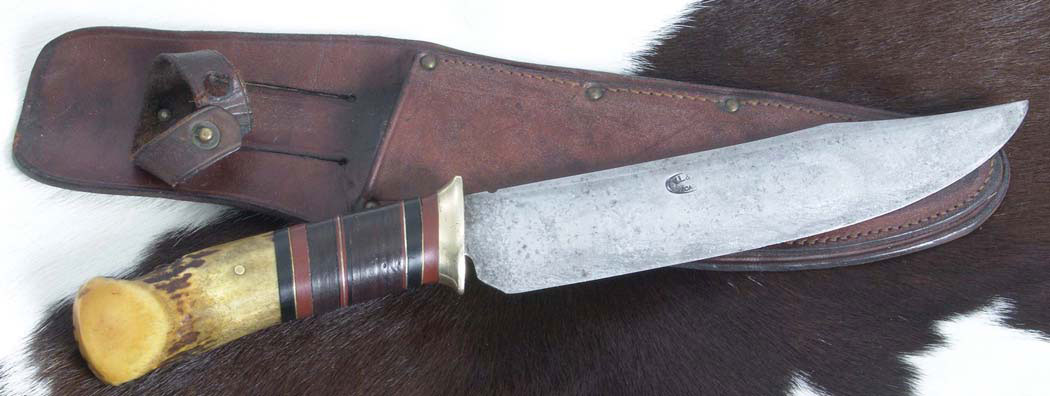
According to Dr. Jim Lucie, Scagel made sheaths for most of his knives and axes, though there were exceptions, such as when he supplied knives to some retailers. His sheaths ranged from simple but functional to ornately embossed. (Mike Carter image)
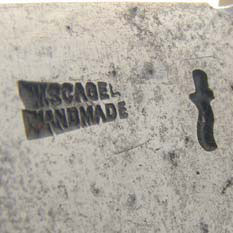
Scagel stamped many of his blades “W. SCAGEL” over “HANDMADE” and with the image of a kris knife. (Mike Carter image)
Scagel’s influence resonates across the decades as knives and knifemakers have taken their cue from his mastery of the curve and the spacer, his interpretation of the lines, fit and finish of a knife that stands the test of time, setting a standard for others to follow. Born in 1873, Scagel lived to the age of 90, and during his lifetime proved himself a master metalworker. His wrought iron adorned the windows of banks and other buildings in the city of Grand Rapids, and he participated in bridge building as well. His first knives were made in lumber camps in the Great Lakes area of the USA and Canada, with the earliest examples dating to around 1910.
Th rough the years Scagel made his imprint as a custom knifemaker, selling his wares through Abercrombie & Fitch during the 1920s, raising the profile of the custom knife with his recognizable style of stag and spacer handles. His friends at Brunswick Corp. kept him supplied with scrap pieces of Bakelite (the first manmade plastic and first true synthetic), wood, ivory and fiber from the manufacture of pool tables and bowling balls for use as spacers. He made bowies, hunters, fighters, folders and hatchets that have become coveted collectibles fetching high prices at auctions and private sales. His kitchen knives were second to none, and his paired carving sets were expensive masterpieces.
Meanwhile, those who appreciated a tough working knife that had a distinctive look gravitated toward custom knifemaking. Among them was legendary Cutlery Hall-Of-Famer Bo Randall, who became a protégé of Scagel. In turn, Randall influenced the likes of Cutlery Hall-Of-Famer Bob Loveless and so many others—and the legacy continues to grow.
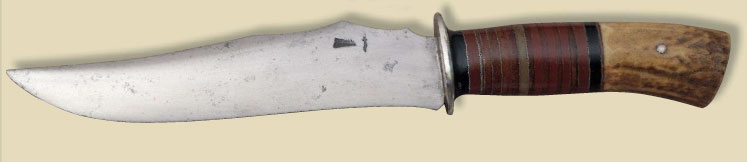
William Wales Scagel’s personal hunting knife features a silver-mounted guard and a silver cap at the end of the stag. His signature is on the obverse side of the blade. (image from the 1996 Pictorial Calendar of William W. Scagel Knives; knife from the Dr. James Lucie Collection)
Scagel, the Man
Dr. Jim Lucie, Scagel’s longtime friend and personal physician, remembers a matter-of-fact kind of guy.
“He was sometimes quite opinionated,” recalled Dr. Lucie, who achieved status as an ABS journeyman smith in his own right. “He shunned publicity and did not like the public eye, and he was critical of some types of people. He was an atheist by choice and didn’t mind stirring the pot about something. If he liked you, and I spent many delightful hours with him, he would go to hell and back for you. If he didn’t, you only got one chance to take advantage of him.”
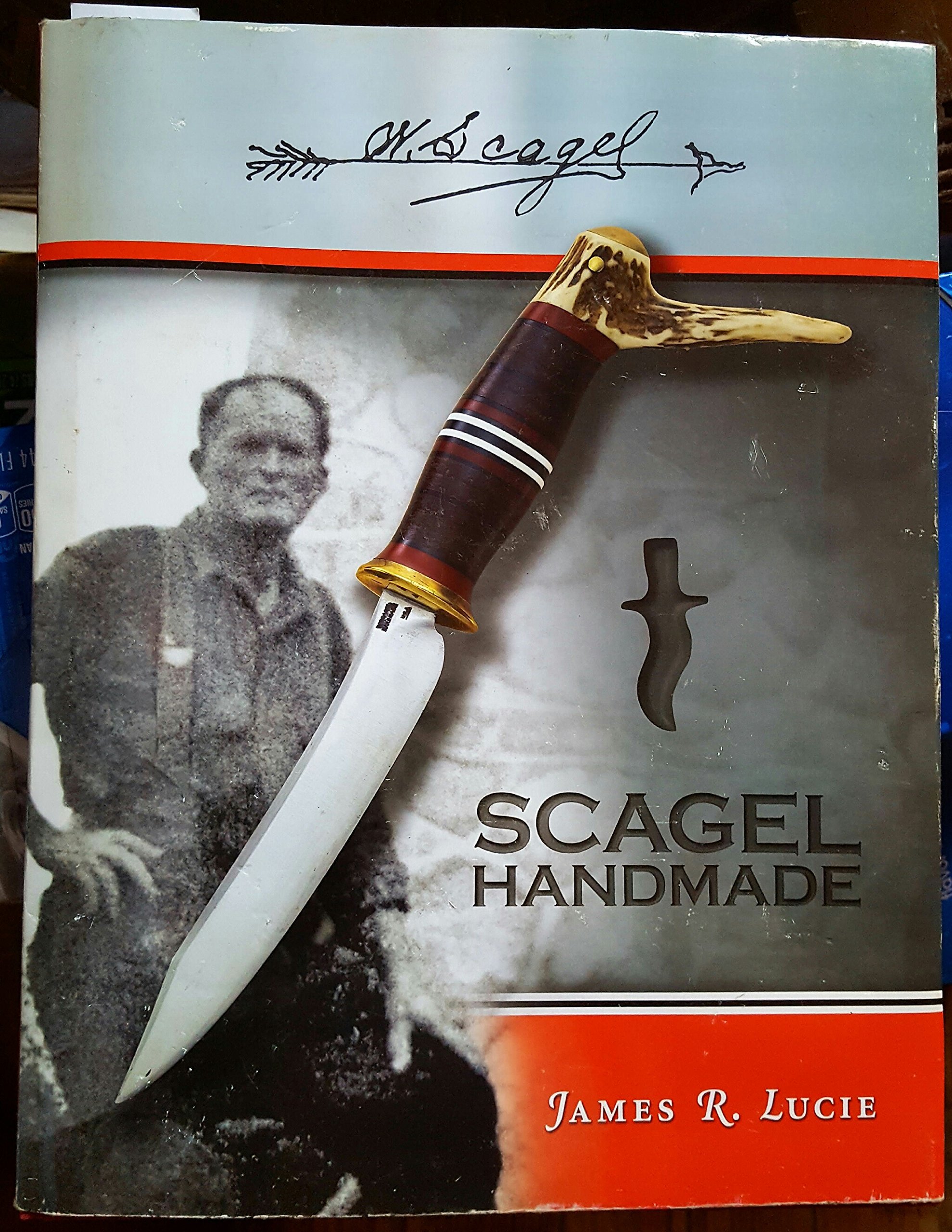
Published in 2010, Scagel Handmade by James R. Lucie is the quintessential book on Scagel. Famous for being reclusive, Scagel had few pictures taken of himself. The fuzzy one on the cover of Lucie’s book is one of the only known pictures of the famous knifemaker.As Lora Schwarzer noted, alternating brass and leather spacers with deer antler at the other end comprised Scagel’s signature stacked handle. (Mike Carter image)
The author of the quintessential book on the subject, Scagel Handmade, published in 2010, Dr. Lucie calls Scagel a “genius with metal work. He was a pioneer. He got Bo Randall started, and the first knives Bo made were around 1937-38, I believe. Scagel’s knives have been copied more than anybody else, more than even the Bob Loveless drop point.”
Scagel’s work has often been imitated, sometimes with dubious results. At other times, however, the style has been replicated with precision. ABS journeyman smith Lora Schwarzer worked in a hospital with Dr. Lucie, who introduced her to Scagel knives.
“Dr. Lucie helped me get started, and I wanted to do Scagel-style knives,” Lora remarked. “They are pretty and easy to hold. They feel good in your hand, and none of them are the same, basically. He might have done a few sets that match, but that was not the norm. The spacers are different and the antlers are different, and they are pretty with their curves and colors.”
Schwarzer started forging in 1996 and has made many Scagel repros since then. Her current work includes a couple with 1084 tool steel blades, brass guards, and leather, fiber, brass, copper and bronze spacers. Her favorite Scagel knife is an unmarked piece.
“If someone brought him a piece of steel,” she explained, “and asked him to make a knife for them, he would do it but not mark it because he didn’t know what kind of steel it was or where it came from. I got this one from Dr. Lucie, who got it from the person Bill originally made it for. Its handle is alternating brass and leather spacers with deer antler at the other end. That was his signature stacked handle.”
One of the great stories Lora likes to tell about Scagel involves a lady who regularly visited the local grocery store. In those days it was common to wrap purchases in brown paper and tie them with string. The lady struggled to break the string, so Scagel made her a miniature knife, which Lora has seen and is pictured in Dr. Lucie’s book, to cut the strings.
“Another thing I know is that Bill Scagel had a kind heart,” she added. “During the polio epidemic in the 1950s, he built braces for people without charging them.”
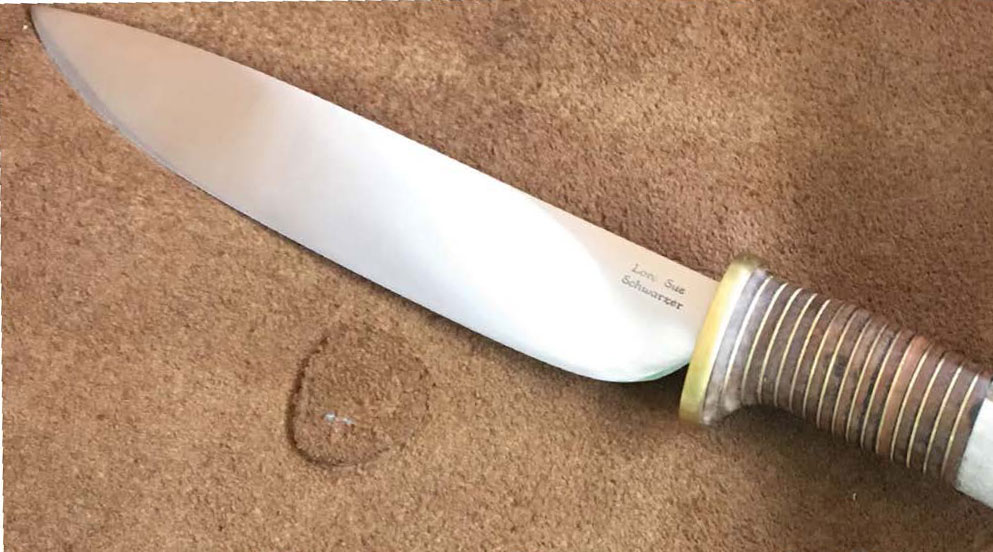
ABS journeyman smith Lora Schwarzer’s Scagel repro is a work in progress and includes a blade of 1084 carbon steel, brass guard, and brass and leather spacers. She stated she needs to “drill and put in the pin and final finish the handle.” Overall length: 12 inches. (Schwarzer image)
Scagel Knives
Gordon White of Cuthbert, Georgia, has been collecting Scagel knives for about 30 years. Gordon sees the historic significance of Scagel’s body of work as a big reason for his lasting interest.
“Well, the knives are just so unusual and different,” he said, “and he is the father of handmade knives and the first person in the 20th century to start making a custom handmade knife. He forged everything he made, and the unique fact that he made his own machinery and equipment and did everything by hand tells me that there has really been nothing like Scagel before or since.”
According to White, one of Scagel’s most innovative tools was used to place the spacers on the knife handle and then press them together, followed by the stag or brass butt that was then pinned in place. Scagel hatchets in mint condition are difficult to find because they were meant for use, and those who bought them put them to work steadily.
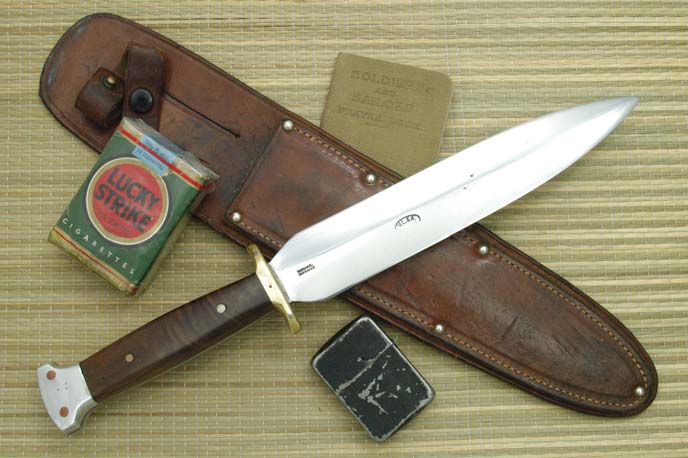
Louis Chow owns three World War II Scagel daggers. Two are forged carbon steel with full-tang handles slabbed in wood. The construction of the guards is unusual with a wrap-around opening to fit onto the tang. “It’s just another aspect of Scagel’s work,” Chow said, “something different.” (Louis Chow image)
Unlike other custom makers who can point to a mentor or individual who helped launch their careers, collector Louis Chow says Scagel stands alone.
“He was unique, you could say, because in my opinion I don’t think Scagel was too much influenced by anyone else in the beginning. Still, there were great knives being made before Scagel. For some reason, he was somewhat of a hermit and didn’t research what other guys were starting to do. Of course, those famous makers had the power tools necessary to make precision knives. Scagel used whatever he had on hand, a small generator and grinder. He didn’t have anything to go by as a sample, no publications to refer to. So, he basically did what he thought a hunter or bowie knife would look like.”
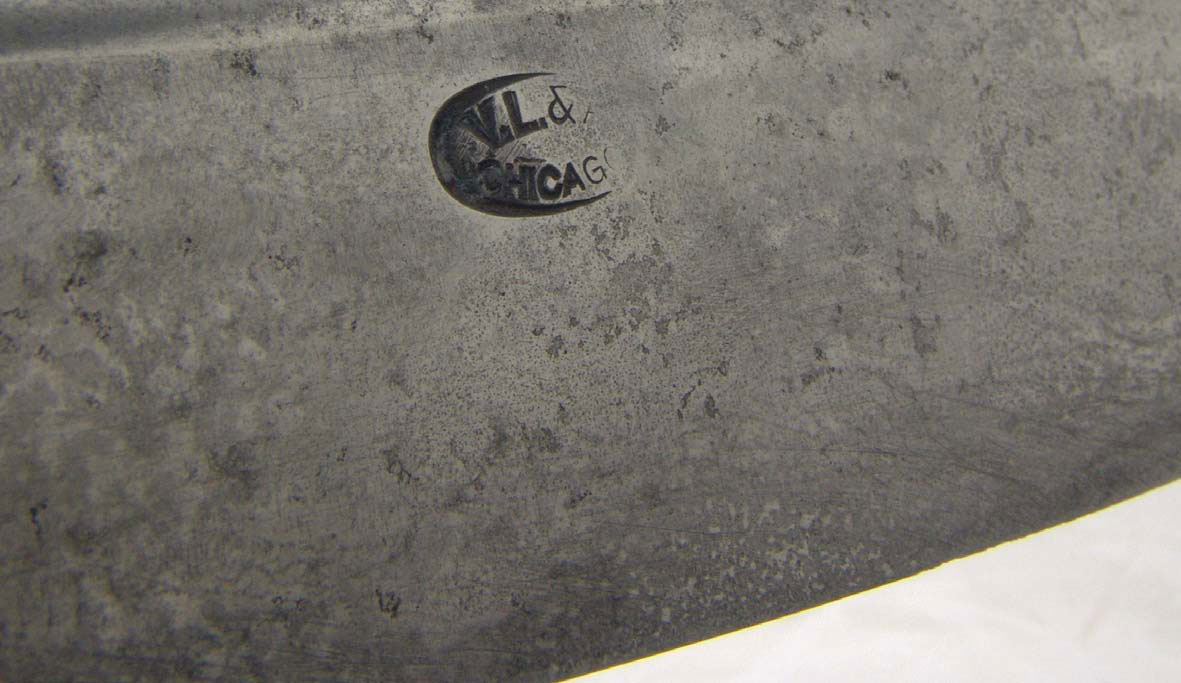
In addition to making knives beginning circa 1920 for retail giant Abercrombie & Fitch of New York, Scagel also made knives for retailers Von Lengerke & Detmold of New York and Von Lengerke & Antoine of Chicago. The blade stamp above is on a knife he made for the latter. (Mike Carter image)
Chow is primarily a Loveless collector, and he acknowledges that the reasons for collecting a particular custom maker are varied. He agrees with White that the history of Scagel is a big factor.
“If I look back at how Loveless got started, as far back as you can go, Scagel is the granddaddy of the industry and influenced everyone else,” Chow explained. “For me, he is the source of what influenced Loveless. My preference is Scagel’s simple daggers that he made during World War II, his contribution to the war effort and the foundation of the current custom knife industry.”
Chow owns three Scagel daggers from the World War II era and a small pocket hatchet that was popularized in the 1950s. The daggers are forged carbon steel with full tang handles slabbed in wood. The construction of the guards is unusual with a wrap-around opening to fit onto the tang.
“Two of the three daggers are made like that,” Chow said. “It’s just another aspect of Scagel’s work, something different.”
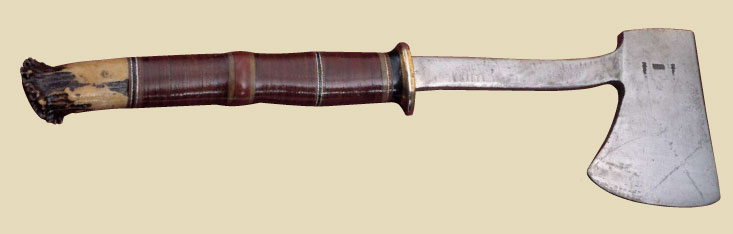
As Dr. Lucie notes in his book, Scagel’s axes are interesting and considered rare. There are two varieties: 1) general camp axes medium to large in size and quite hefty and 2) the hiking or military backpack axe, which is smaller and more petite. The one above is an example of the former. (image from the 1996 Pictorial Calendar of William W. Scagel Knives; axe from the Dr. James Lucie Collection)
Values of Scagel Knives
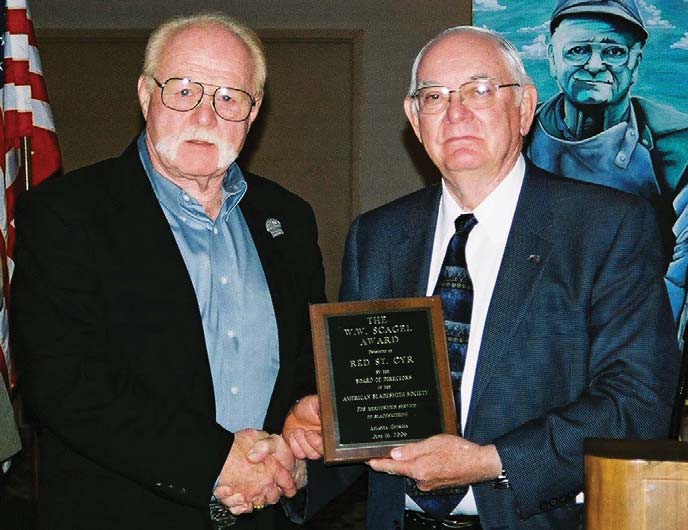
The American Bladesmith Society presents the annual William Wales Scagel Award to an ABS smith for longtime service in promotion of the forged blade. ABS master smith Red St. Cyr (left) received the award from BLADE Magazine Cutlery Hall-Of-Fame member B.R. Hughes (right) in 2006. The portrait in the background is of Cutlery Hall-Of-Famer Bill Moran.
Scagel knives remain popular among collectors, and White considers the prices paid at the 2011 auction of Dr. Lucie’s collection as evidence of the demand.
“That auction is a good meter to go by,” he remarked. “The hunters were averaging from $12,000 to the mid-$20,000 range depending on appearance, and condition has a lot to do with it. Some of them look better than others, and a high-quality sheath with good looks adds to the value. Dr. Lucie had some fighters in his collection, and they probably averaged $28,000 apiece. One fighter brought $41,400.”
Schwarzer sees continuing appeal in Scagel knives simply because there is nothing else quite like them.
“They are different, and I have been at shows and seen people really get excited about them,” she commented. “Some people like them and some don’t, maybe like pizza with thick crust or thin. It is a matter of personal preference, but Scagel knives certainly have staying power.”
Staying power, pioneer power, legendary power: They are each part of the Scagel legacy, one that is like no other in the history of custom knives.
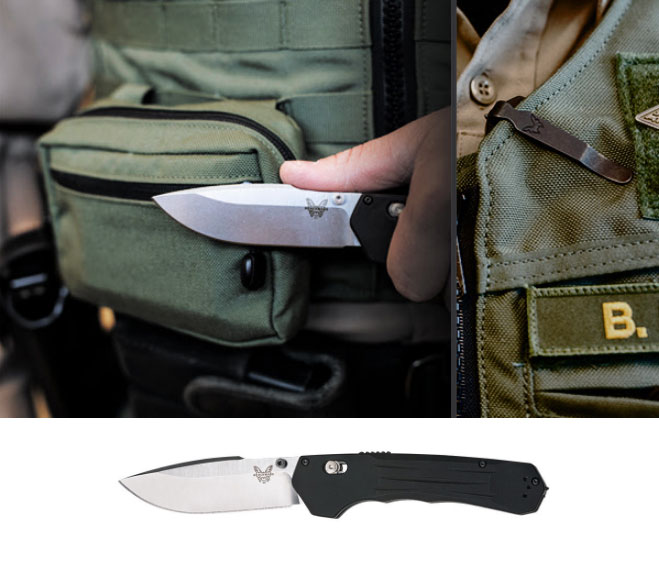
SHEATH: Tri-Composite System Kydex w/3” nylon webbing, Box X stitching, stainless hex fasteners and liners; locks blade in; MOLLE system sheath also available
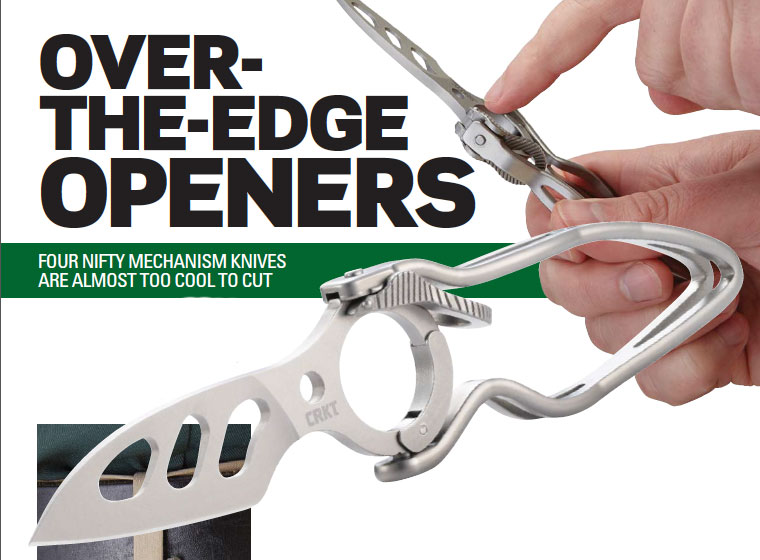
Here are four folding knives that employ unusual opening mechanisms.
“Cool Factor”
Some knives have a “cool factor” that makes your eyes pop out. Whether sporting creative designs, spine-tingling handles and blade shapes or—in this case—ingenious mechanisms, such knives always have that special something which sets them apart.
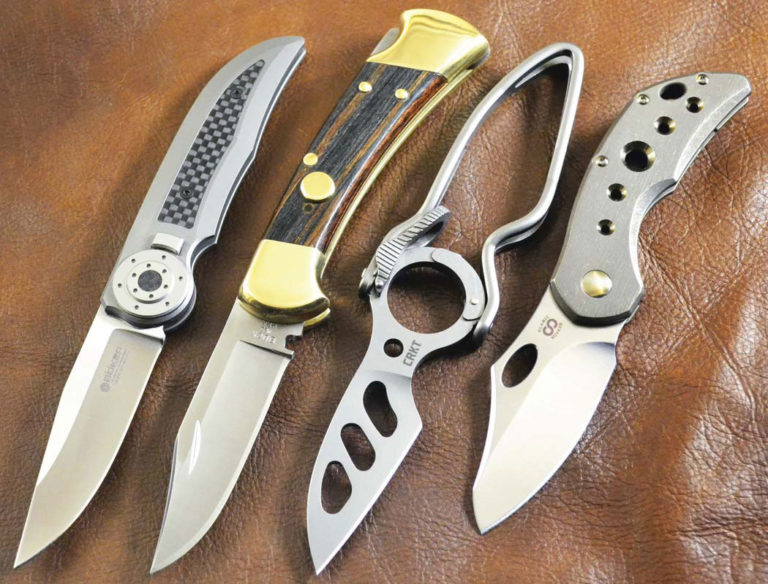
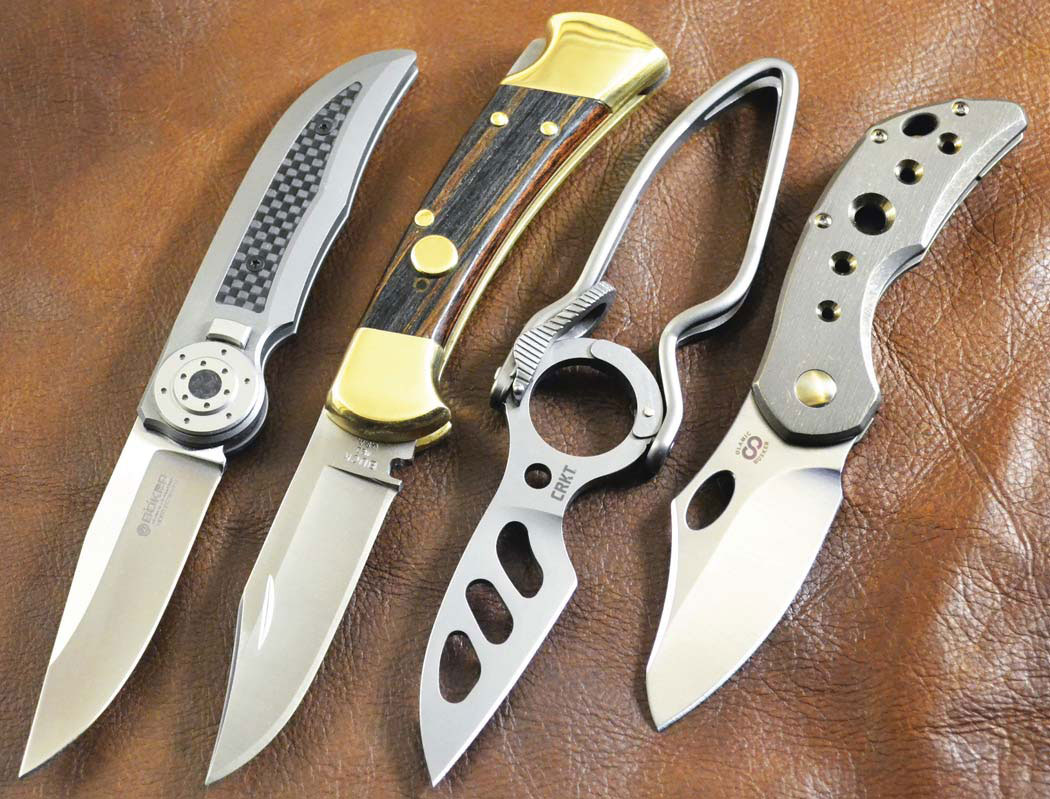
Cool can be anything from a notable mechanism to a standout design. From left: Boker Tucan, AIK Buck 112 Ranger Double-Action Auto, CRKT Daktyl and Olamic Busker Semper.
Boker Tucan
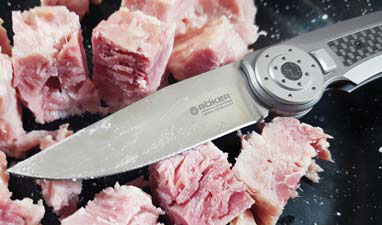
The Boker Tucan is a stately looking folder, but its 3-inch blade of Bohler N690 stainless steel is all business.
Boker’s sleek Tucan would be cool on its design alone, but designer Wilfried Gorski’s innovative blade-release mechanism puts the folder over the edge. A slide release just below the oversized pivot pops the blade out of the frame so it can be opened manually, and the release also serves to deploy the blade. Simply thumb it down and the blade is ready to fold into the frame.
Everything about the Tucan is upscale, from its stealthy 3-inch Bohler N690 stainless steel clip-point blade to its beautifully sculpted 3.875-inch titanium frame with carbon-fiber inlays.
There is no pocket clip but no matter—the Tucan is meant for loose pocket carry. At a weight of 2.82 ounces that is not a problem.
MSRP: $339.
CRKT Daktyl
(CRKT image)
The CRKT Daktyl is a revised version of the Tom Hitchcock “Hole In One” design.
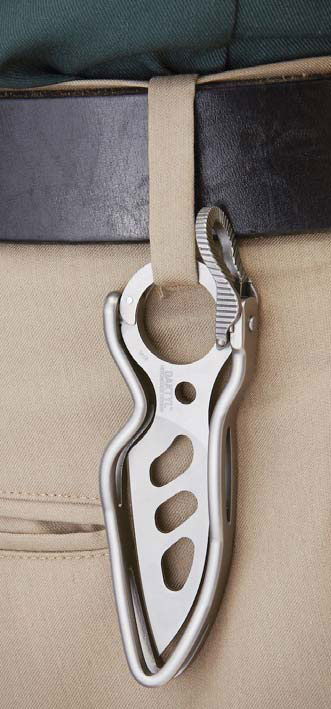
Every bit as enigmatic as the original, if not more, the Daktyl has a 3.05-inch 420J2 stainless steel blade that rotates out of a 4.42-inch wire-frame handle.
The fun begins trying to figure out how to release the blade via Hitchcock’s Slide Lock mechanism, which requires sliding and tipping back the thumb lever.
Once you get the hang of it the Daktyl is pure fun and will amaze your friends. The modified wharncliffe blade has cutouts for lightening and a round carabiner at the base allows you to clip it to a belt loop, keychain or pack and—get this—pop a beer cap.
The Daktyl has a pleasant beadblast finish overall and weighs in at 2.4 ounces.
MSRP: $59.99.
Buck 112 Ranger DA Auto (Adams International Knifeworks conversion)
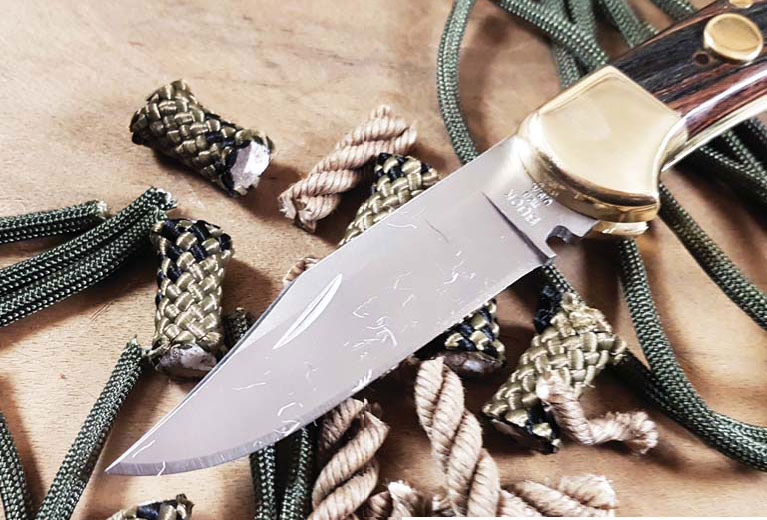
Adams International Knifeworks Buck Ranger 112 DA Auto has all the traits of the original. The 3-inch 420HC stainless steel blade whipped and sliced through paracord, 3/8-inch rappelling rope and tough waxed lasso rope with ease.
Unlike the new Buck 110 Auto, the AIK version of the smaller 112 Ranger differs in that it is a double action—opens both manually and automatically—and uses a leaf spring on the spine as opposed to a coil. The blade is employed via a flush brass button on the front, which matches the bolsters nicely.
Blade deployment is via the standard lockback on the rear base.
Everything else is Buck 112 Ranger, from the Dymondwood lockback grip to the 3-inch 420HC stainless steel clip-point blade and black leather belt sheath.
MSRP: $160.
Olamic Cutlery Busker Semper
Olamic Cutlery is known for making fashionable knives and the Busker Semper model, designed in-house, exudes coolness on every level. The folder sports curvaceous lines from stem to stern, including its ability to open 10 different ways (see above video), including a top-mounted flipper.
It is a small knife—6 inches open—featuring a 2.375-inch Bohler M390 modified wharncliffe blade and a 6Al4V titanium framelock handle. Other features include a machined pocket clip, caged bearing pivot system, stainless steel lockbar insert with an over-travel stop, ceramic detent ball, and ceramic pocket clip retention ball. In a nutshell, this is the good stuff!
The test model was delivered with a deep-brushed surface texture and gold anodized accents.
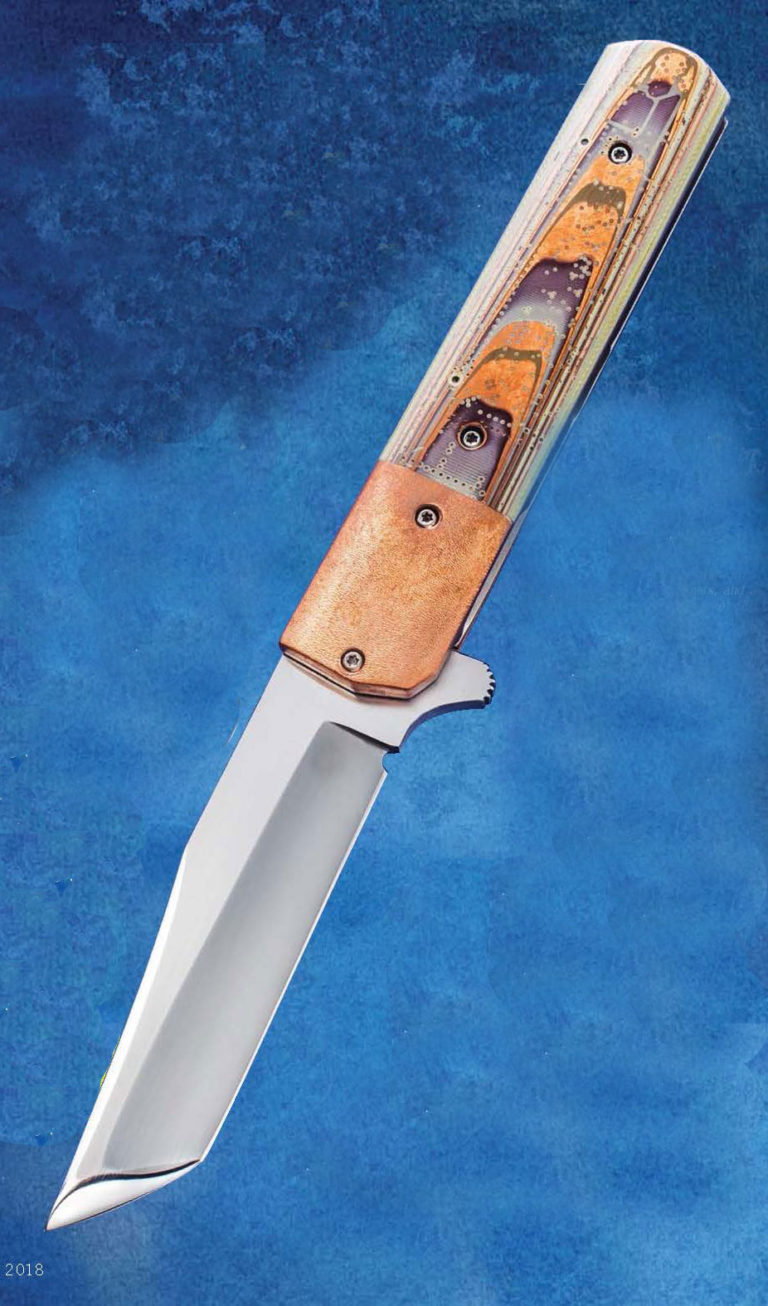
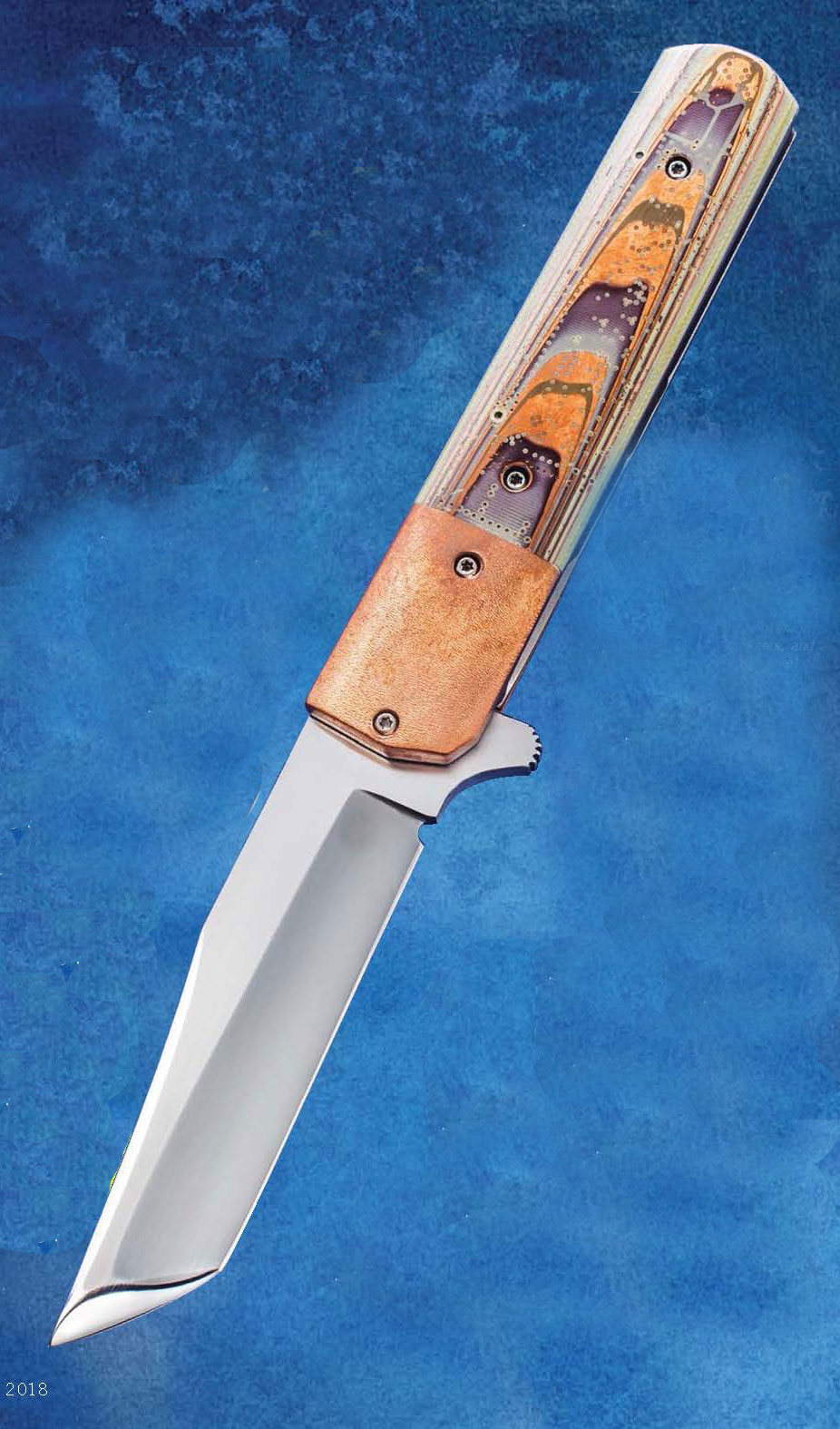
The Yakuza Flipper by Chuck Gedraitis includes a hand-rubbed blade finish, titanium frame and liners, and a Timascus™ pocket clip. Yakuza is a nickname for “transnational organized crime syndicates”—i.e., the mafia—in Japan. Click for larger view. (SharpByCoop knife image)
Chuck Gedraitis Flipper Meshes Modern Materials with Traditional Style
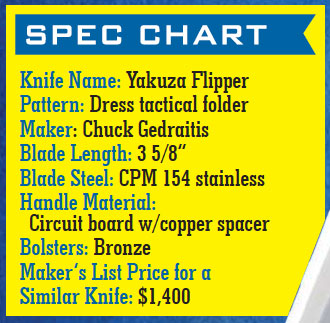
The Yakuza Flipper by Charles “Chuck” Gedraitis meshes classic styling with an unusual modern handle material in a folder that reflects both the traditional and the modern. The traditional is the Japanese-style instead of an American-style tanto blade.
“The American style would have more of a straight cutting tip,” Gedraitis noted. “This one has a little curve to it.”
The modern is the circuit board scales. Gedraitis highlights the copper of the circuit board with the bronze bolsters and a copper spacer, the latter two both in an orange-peel finish. He exposed the pattern of the circuit board by grinding into it, thus revealing the copper in the different layers of the scale material.
For more information contact Chuck Gedraitis, Dept. BL4, 444 Shrewsbury St., Holden, MA 01520 508-963-1861 [email protected], gedraitisknives.com, Facebook/Instagram: @gedraitisknives gedraitisknives.
Meet the Maker at BLADE Show
Balisongs are a Chuck Gedraitis specialty and he will show you how he designs and makes them in his special class “How To Make a Balisong” at 2 p.m. June 2 at BLADE University in the Cobb Galleria Centre in Atlanta.
Held in conjunction with the 37th Annual BLADE Show June 1-3, also at the Cobb Galleria, BLADE U. is the most comprehensive array of classes on knives and knifemaking of any knife show. Click here for more information.
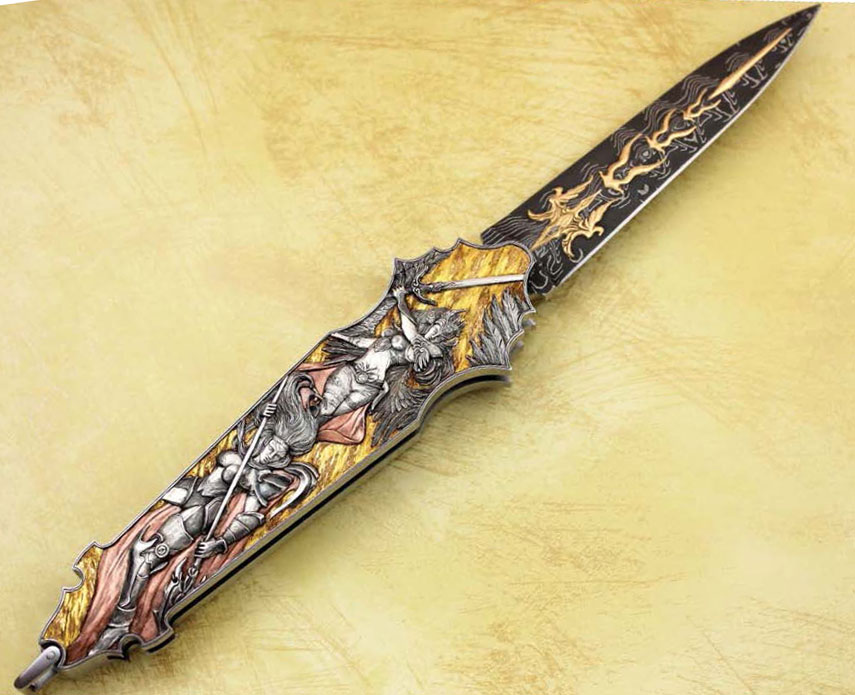
Instead of turning to cotton cloths for wiping down his knives, Carlos Lopez uses microfiber cloths. This beauty made and engraved with a fantasy warrior theme by Bulgaria’s Alex Gev has a special place in the Lopez collection, and is one of Carlos’s favorites.
Custom Knives Require a Special Kind of Tender Loving Maintenance
Most everyone knows what’s needed to care for a utility knife, including maintaining a working edge and wiping it down after use. However, keeping your custom knife as stunning as the day you first laid eyes on it is another matter. BLADE® polled four veteran knife collectors for their input on the subject. After years of collecting, they have more than a few ideas on how to keep knives presentation ready.
It may not be apparent when buying just one knife, but tallied up and considered together, knife collections can add up to a serious investment.
“It’s imperative that you preserve it as a group,” said U.S. Army veteran and long-time knife collector Louis Chow of San Francisco. “And even more so for the people that prefer a certain maker, you can say Loveless collectors or Moran collectors or what not, because it becomes a collection that is actually known to others.”
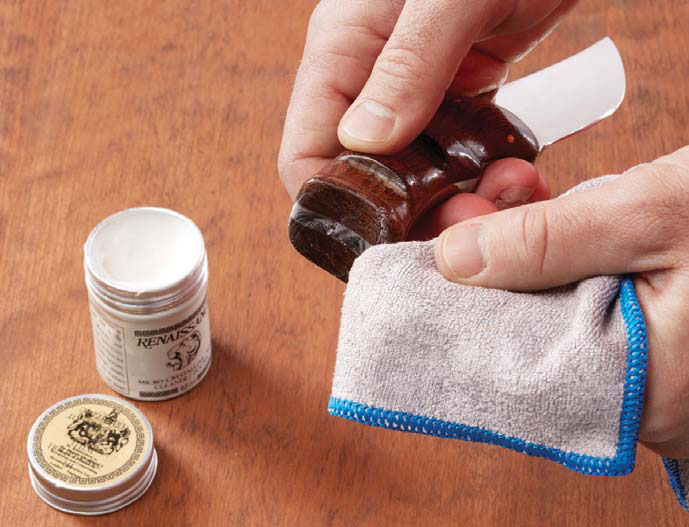
One knife care product Louis Chow has reached for over the past three decades to keep everything pristine is Renaissance Wax. Chow began using the wax after knifemaker Clay Gault recommended it to him. Gault was known for his natural handle materials. The knife is by Don Lozier. (Kris Kandler image)
For the diverse kinds of knives in his collection, some with stainless steel blades and others with leather grips, Chow has reached for one product over the past three decades to keep things pristine: Renaissance Wax. Chow began using it after maker Clay Gault recommended it. Gault was known for his natural handle materials.
“If it’s good enough for the British Museum, I think it’s good enough for me,” Louis said of Renaissance Wax.
Researchers at the British Museum learned that natural waxes went acidic over time, which was not good for the museum’s relics. In the late 1950s, Dr. A.E.A. Werner reportedly developed Renaissance Wax in the museum’s research laboratory.
With Renaissance Wax, Chow doesn’t have to distinguish between blade and handle. It works equally well protecting carbon blades, stacked leather handles and the sheaths that encompass them.
When knives sit in padded, acid-free cases, the wax doesn’t soak into the fabric of the cases as oils do. After returning from knife shows and to remove the traces of soda, coffee and fingerprints, Chow wipes down his blades with cotton buffing cloths from auto centers or specialty shops. He uses the cotton buffing cloths instead of microfleece because the latter tends to leave fibers everywhere.
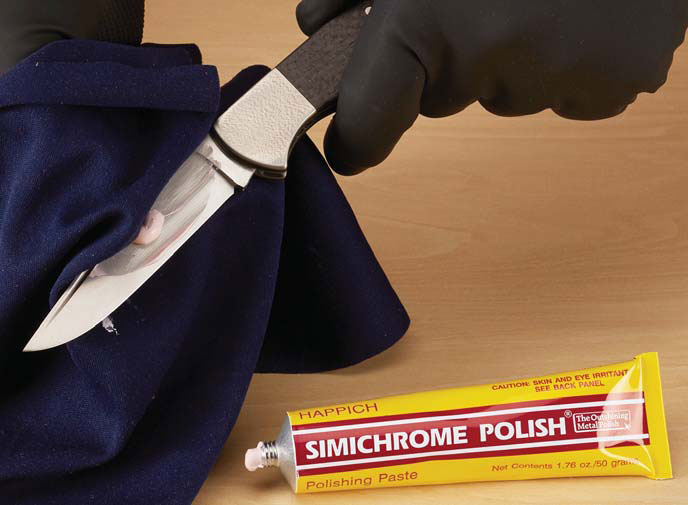
Louis Chow uses a polish paste on his carbon steel knives if he notices rust forming. He’s careful to use a mild polish without a lot of grit, such as Simichrome or 3M. Other polishes have a fine grit that, with a mirror polish blade, might change the condition of the finish. (Kris Kandler image)
Chow also uses a polish paste on his carbon steel knives if he notices rust beginning to form. He’s careful to use a mild polish without a lot of grit, such as Simichrome or 3M. Other polishes have a fine grit that, “if you have a mirror polish blade, that might change the condition of the finish.”
See the Light
Folder pivots by top makers don’t need a lot of lubrication because they are often made with tight tolerances. “Bob Terzuola once humorously mentioned to me how often people ‘over oil’ their knives, telling me how he would sometimes get knives back for a refurb that were literally dripping oil,” Chris Schluter recalled. If lint collects in a folder’s hard-to-reach crevices, a blast of compressed air does the trick. The folder is by Tom Ferry and the lube is by Quick Release. (Kris Kandler image)
Paul Kessler not only preserves the finely fitted and oft en engraved knives he collects, but he displays them as well. Of maintaining knives, he said, “It’s like taking care of your eyeglasses.”
The mortgage advisor’s maintenance routine begins when a new knife joins his collection. He cleans the fresh blade with WD-40. Kessler uses WD-40 only to clean blades. It tends to migrate, he says.
To lubricate folder pivots he uses Tuf-Oil or Breakfree.
“It’s a recommendation that I received from knifemaker Tom Overeynder, and they both work extremely well,” Paul noted. “They’re Teflon-bearing oils that won’t coagulate.”
Moisture and light are Kessler’s biggest concern when storing his knives. Just as sunlight changes the cabinetry of a kitchen, it can affect knives, he said.
“What happens with mammoth ivory, sunlight fades the color,” he observed. “When exposed to light, cocobolo gets darker. Elephant ivory, on the other hand, darkens and ‘patinas,’ and actually looks nicer.”
The first line of defense against light is museum glass that deflects the harmful rays. Kessler’s cases are lined with a Ph-neutral cloth and he turns to industrial magnets that hold the knives in place with 100 pounds of force.
He has used cigar boxes and antique picture frames to display his knives. They are French fitted, dustproof and airtight.
He stores fixed blades out of their sheaths and automatic knives with their springs not under pressure.
“I’ll use mineral oil with the 0000-steel wool on something that’s been exposed to the sun to bring the color back a little bit,” he said.
Every three months, Kessler moves his knives’ actions and oils the pivots with Tuf-Coat lubricant. He does not use Renaissance Wax. He finds that it leaves a film, giving the knife less of a luster.
Instead, he turns to RustFree, a product sold by A.G. Russell Knives. Kessler works a little on a cloth, wipes the knives and stores the cloth in a bag.
No Knife Wash Blues
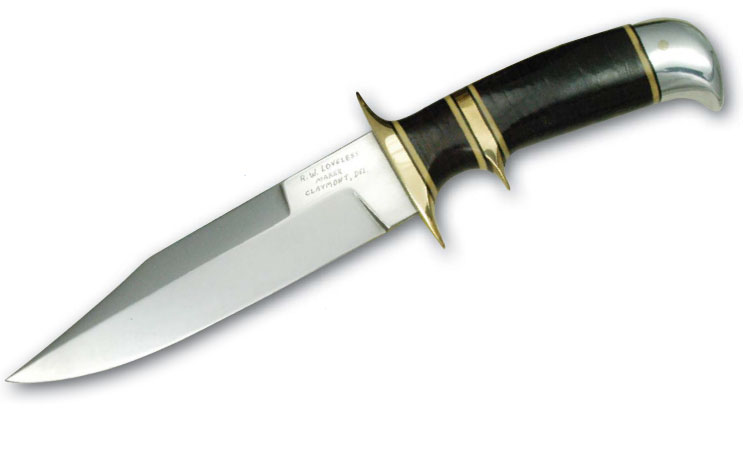
After returning from knife shows and in order to remove the traces of soda, coffee and fingerprints from his knives—such as this vintage Delaware Maid sub-hilt fighter by Bob Loveless—U.S. Army Major veteran Louis Chow wipes down the blades with cotton buffing cloths that he picks up at auto centers or specialty shops. He uses the cotton buffing cloths instead of microfleece because the latter tends to leave fibers everywhere. (Louis Chow image)
Carlos Lopez is a residential builder in Florida. Being a purveyor of high-end custom knives and running the website knifetreasures.com is his “fun job.” He compares the care of a high-end custom knife to that of a car.
“It’s like you drive a car, it gets dirty, you wash it. You gotta maintain it,” he said.
Showtime is maintenance time for Lopez, who will wipe down and open and close each blade. He uses light oil and Renaissance Wax. The cleaning continues throughout the show.
“At a show, anytime anybody picks up a knife, after they see it, you wipe it clean,” Lopez said. “Fingerprints and oils from the fingers can eventually damage and rust a blade or handle.”
However, instead of turning to a cotton cloth, Lopez uses microfiber. When a microfiber cloth gets dirty, he throws it away. The key, he says, is to keep the cloth clean so it doesn’t pick up a piece of dirt that will scratch the blade. He gets multipacks of the microfiber cloths because he has to throw away the many that get dirty.
Living in Florida, Lopez keeps his house air-conditioned. This maintains his home—and the knives within—in a low-humidity environment.
If one of his knives develops rust, Lopez usually sends it to the knife’s maker for a fix up. If the original maker is deceased, he sends the knife to a maker who does similar work. When it comes to specialty materials such as ivory, Lopez recommends two treatments. Applying Renaissance Wax—letting it dry and then buffing it off —or baby oil helps seal the material.
“If you go to dry-weather places with ivory pieces they can crack within a day,” he advised, “so yeah, you need to maintain them and seal them.”
Don’t Over Oil!
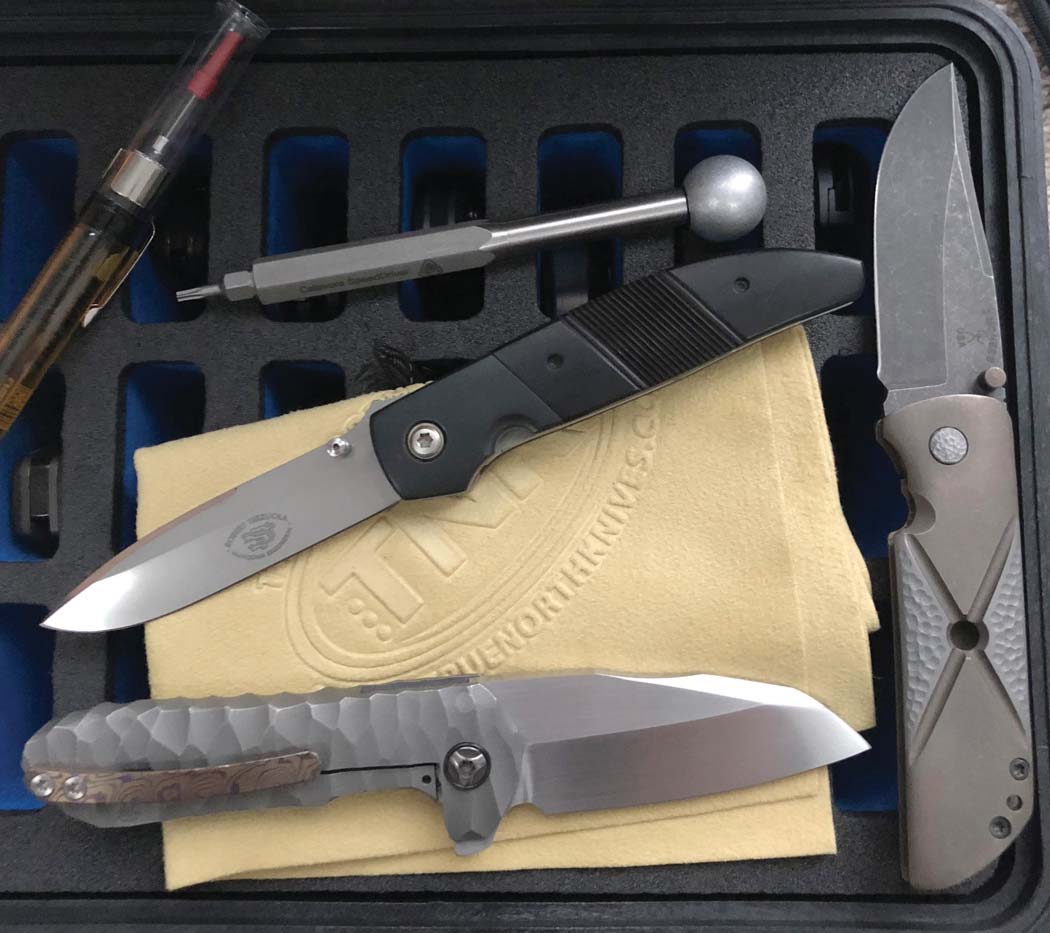
A peak inside the knife case of Chris Schluter (inset) reveals, clockwise from top left: a tube applicator of Breakfree pivot lube, a Torx driver from Prometheus Design Werx, the Tanjun by Jonathan Mcnees, Peter Rassenti’s Pebble and a Model 7 by Bob Terzuola, the latter two resting on a True North Knives chamois. (Chris Schluter image)
Unlike bone handles or carbon steel blades, maintenance for tactical knives is a bit easier—or so says Chris Schluter, a stay-at-home dad in Chicago who formerly worked at the German-American Chamber of Commerce.
“I love the utilitarian designs which a maker can dress up or down as desires,” he observed.
“Part of the beauty of tactical folders is that, normally at least, not a lot of care is needed,” Schluter said. “This can depend on materials, of course. However, many materials commonly used on tactical folders are by design robust and maintenance free. G-10, titanium, carbon fiber, zirconium, etc., really don’t need care. That leaves one with the blade to care for. Even then, it’s usually a high-performance”—and thus low-maintenance—“stainless steel.”
When it comes to the care of tactical folders’ pivots, they don’t need a lot of lubrication, Schluter noted, because they are often made with tight tolerances.
“Bob Terzuola once humorously mentioned to me how often people ‘over oil’ their knives, telling me how he would sometimes get knives back for a refurb that were literally dripping oil,” Schluter recalled. If lint collects in a folder’s hard-to-reach crevices, a blast of compressed air does the trick.
“Pivots which become loose over time should be tightened with the proper screwdriver or Torx wrench and a drop of Loctite® added,” Schluter said.
He stores most of his 300 custom folders in a large gun safe in padded pouches, and dozens adorn the walls of his office in display cases. As for care, he tries to wipe down each knife with a high-quality oil like Tuf-Glide a few times a year, or after he handles one.
“Unfortunately—or fortunately, depending on how you look at it—I just have too many knives now to do this all at once,” he writes. “These days I do this in batches or when I happen to be handling a piece.”
The key for him is to avoid the ever-creeping rust. For the knives in his safe, he throws in a few moisture-absorbing desiccant packs and moisture removers.
“As with any treasured belongings, protecting them is a priority,” he stressed. “I would hate to open my safe and find a bunch of rusty knives.”
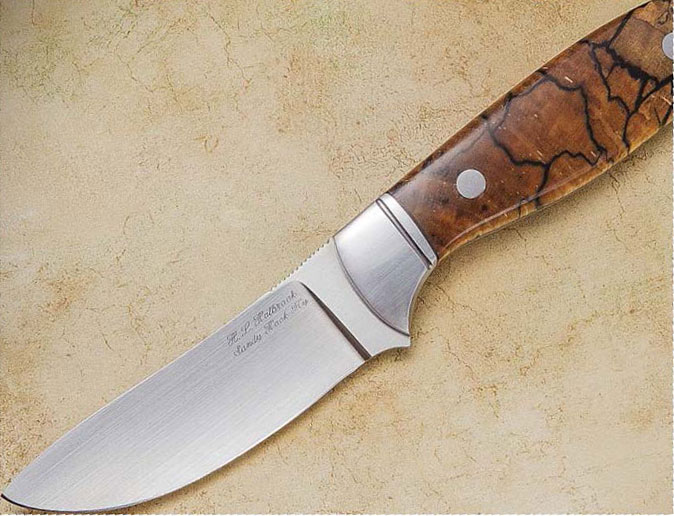
The gentle rise of the tip area of the blade is the classic sign of a skinner—or in this instance, the Semi Skinner #2 by H.L. Holbrook. The 3.5-inch blade is CPM 154 stainless and the handle is stabilized maple. Overall length: 8 inches. Contact H.L. Holbrook, Dept. BL3, POB 483, Sandy Hook, KY 41171 606-794-1497. (Chuck Ward image)
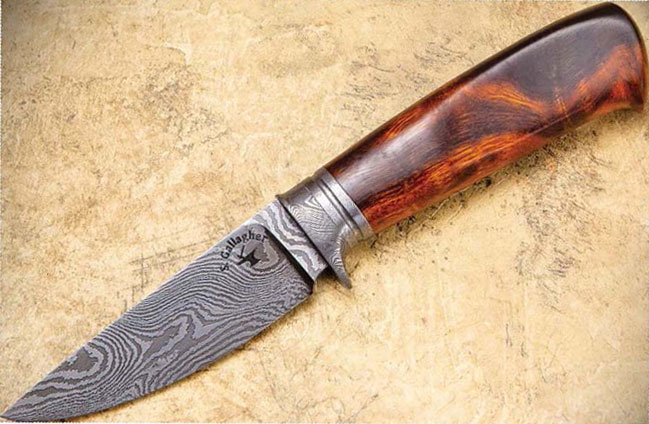
Scott Gallagher employs a 3-inch damascus blade, a damascus single guard and a handle of Arizona ironwood for his hunter. Overall length: 6.5 inches. Contact Scott Gallagher, Dept. BL3, 335 Winsten Manor Rd., Santa Rosa Beach, FL 32459 850-865-8264. (Chuck Ward image)
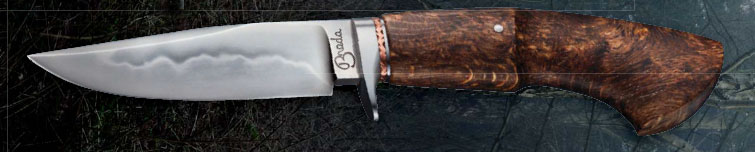
A 4-inch clip-point blade of W2 tool steel with hamon and a spalted sycamore handle and fileworked copper spacer distinguish Ben Breda’s hunter. Overall length: 9 inches. Contact Ben Breda, Dept. BL3, 56 Blueberry Hill Rd., Hope, ME 04847 [email protected]. (Caleb Royer image)
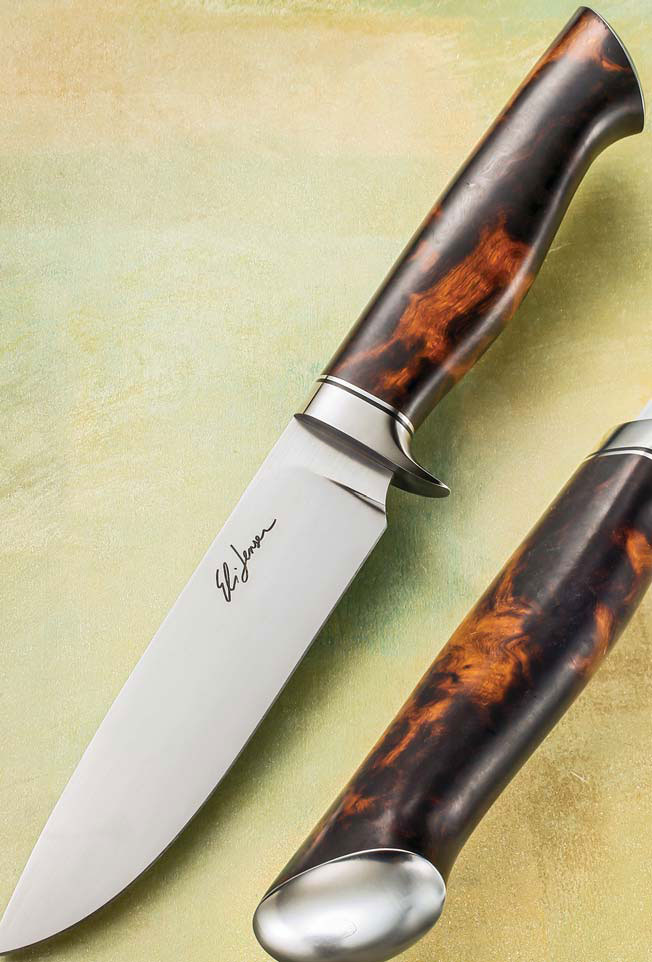
A gorgeous Arizona ironwood handle with a domed/curved 416 stainless steel butt plate and G-10 spacer, and a 5.75-inch blade of 1084 carbon steel help complete Eli Jensen’s Forester MKII hunting knife. Overall length: 10.75 inches. Contact Eli Jensen, Dept. BL3, 2840 W. Dreamscape Way, Chino Valley, AZ 86323 928-606-0373 [email protected], Facebook/Instagram: Eli Jensen. (Sharp-ByCoop image)
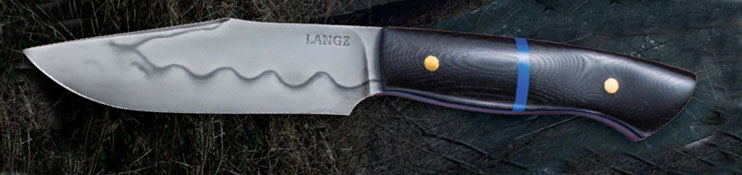
Kenneth Lange received an order for this hunter by a family friend whose husband is celebrating 10 years on the police force—thus the thin blue line on the black G-10 handle. The 4.5-inch blade is 1095 carbon steel. Overall length: 9 inches. Contact Kenneth Lange, Dept. BL3, 1200 County Road 5711, LaCoste, TX 78039 210-218-9415 [email protected], Facebook/Instagram: kjl_handmadegoods KJLhandmadegoods. (SharpByCoop image)