The history of knives and other edged instruments is tied to the history of people in general. As humankind’s oldest tool, unraveling knife history can lead to even more surprising and enriching information to better understand the world.
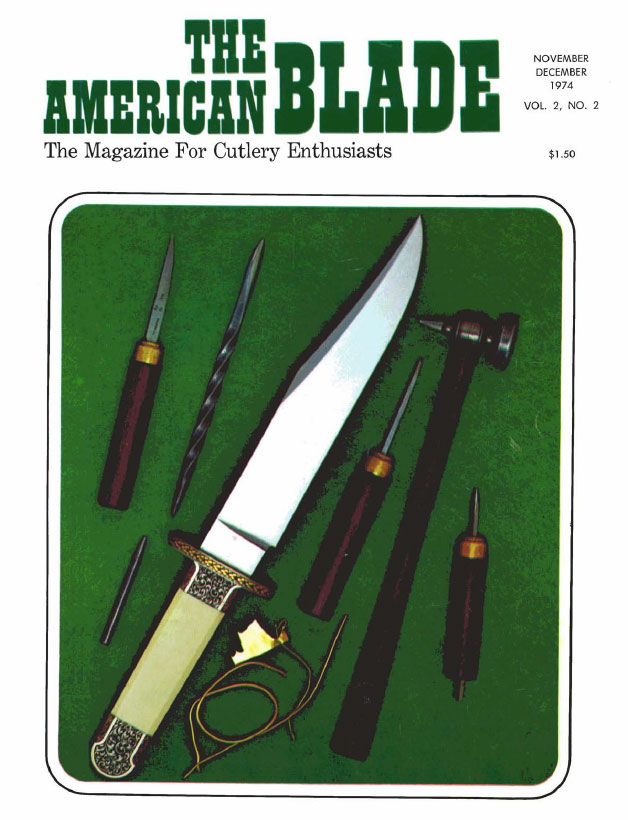
Known as The American Blade at the time, the magazine was traded by then-publisher Jack Marvich to Wally Beinfeld for a racehorse—or at least that’s what Beinfeld reportedly told one of his successors, former BLADE publisher and editor and BLADE Magazine Cutlery Hall-Of-Fame® member Bruce Voyles.
The cover of the November-December 1974 issue of The American Blade.
Beinfeld ran what was probably the country’s premier antique arms show and, in part to help promote it, published a gun magazine called the Arms Gazette. The Gazette had a large editorial, graphics and production staff that was more than big enough to produce a second magazine. Hence, Beinfeld decided to add a knife publication—The American Blade—to his, ahem, stable.
However, there was one problem. Marvich and Beinfeld could not make a deal, even if, apparently, the racehorse was at least part of the payment.
“They were sitting there talking about it one day and the more they talked, the worse it got,” Voyles recalled Beinfeld’s version of what happened.
Beinfeld and Marvich were making no headway at all. Finally, Beinfeld stood to call the whole thing off and leave when in walked Marvich’s wife.
“Marvich looked at her and said, ‘Honey, the deal’s not going to go through, we just can’t come to terms.’ And she looked at him and said, ‘What about my racehorse?’ And in Wally’s words, ‘So I sat back down.’ From what I understand,” Bruce recalled, “I don’t know if the racehorse was just part of the deal or what, but I believe it was the entire deal. That was the way it was told to me.”
And, thus, Beinfeld bought The American Blade. Bruce said he can’t recall the horse’s name, which is understandable considering how long ago it was. Meanwhile, Mr. Beinfeld passed away a few years back, and we don’t know the whereabouts of Mr. and Mrs. Marvich.
As for the horse, here’s hoping he was put out to stud and lived happily ever after. (Insert your impression of a horse whinnying here.)
Sometime in the early 1990s, a journalist—to the chagrin of the handful of other knifemakers also still working in Sheffield, England—described Stan Shaw as “The Last Little Mester,” and the title stuck until Stan’s passing in February. Stan made many fancy pocketknives but “Little Mester” was never simply a title that denoted mastership of a craft skill.
Historically, workers in the Sheffield cutlery industry were notoriously independent. As the industry moved from craft-based to industrialization, nearly all cutlers were on piece-work and would rent space in the workshop—a yard of bench or a “trough” for grinding. Work came from other workers, and each worker did a very specific task on the knife before it was passed to the next worker. The process was efficient because of the hyper-specialization of all of the workers in the chain. There was a complicated, ever-changing network of subcontracting, renting, supplying and rivalries, but no one learned all the processes to make a knife—there was no concept of sole-authorship.
In her thesis, Sally-Ann Taylor* states that the “differing opinions regarding the status of the little mester reflected the actual diversity in his possible position and role. Some felt that the title implied that his enterprise should involve him in a certain number of commercial risks and liabilities. Sometimes he was an actual workman himself, obtaining orders from larger factors, merchant or manufacturers, and then employing a few men to help him … sometimes even these workers would employ others beneath them, but usually only members of their own family—particularly women and children.” Hence, little mesters were small-scale flexible employers, recruiting workers to supplement their own labor as required.
In 1844, a commentator on the cutlery trades stated that “there are several modes of conducting the manufacture, but the factory system is not one of them … there is no large building, under a central authority, in which a piece of steel goes in one door and comes out at another converted into knives, scissors and razors. Nearly all the items of cutlery made at Sheffield travel about the town several times before they are finished.”**
HE KNEW at 14
Stan didn’t come from a cutlery background. He was born in 1926 in a small village outside Sheffield, and, after seeing a market stall of knives, decided at 14 that that was what he wanted to do. By chance, he walked into the prestigious company, Ibberson, and spoke to the owner, Billy Ibberson.
Pointing to a showcase displaying the firm’s best pocketknives, Stan said he’d like to learn how to make such knives. As Stan recalled, “Billy then fetched up one of the cutlers, Ted Osbourne—a little bloke about 5 feet or so tall—and asked, ‘Will you have him?” He said, ‘Yes.’ And I started on the Monday at an apprentice’s wage of 10 shillings a week.”
When Stan joined the firm, the old patterns of working had long gone; “little mesters” and “factors” had morphed into the more familiar patterns of factory working, with all the workers employed by the company and paid a wage. He was one of the last apprentices to be taken on and his curiosity about the entire process of making folding pocketknives was insatiable. As he moved through Ibberson and other companies over the years, he actively approached other workers to learn their processes as well as his own. It was this breadth of training that made him unique and was vital to him in later life.
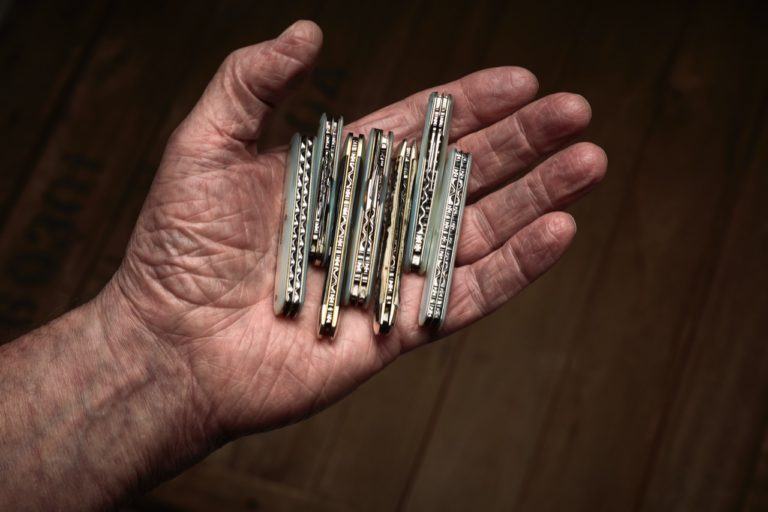
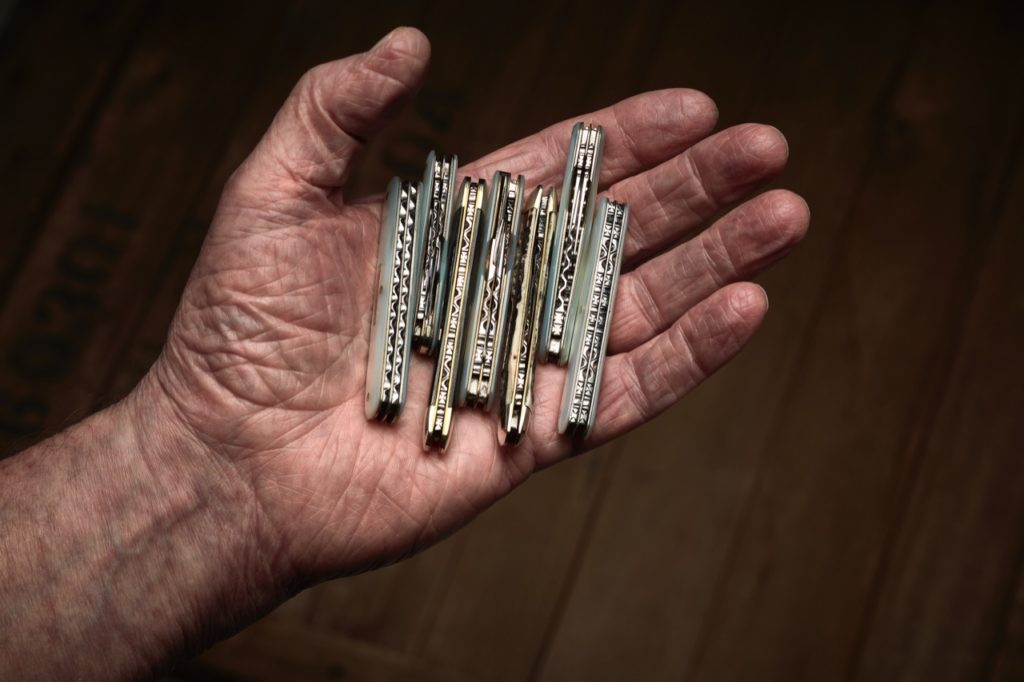
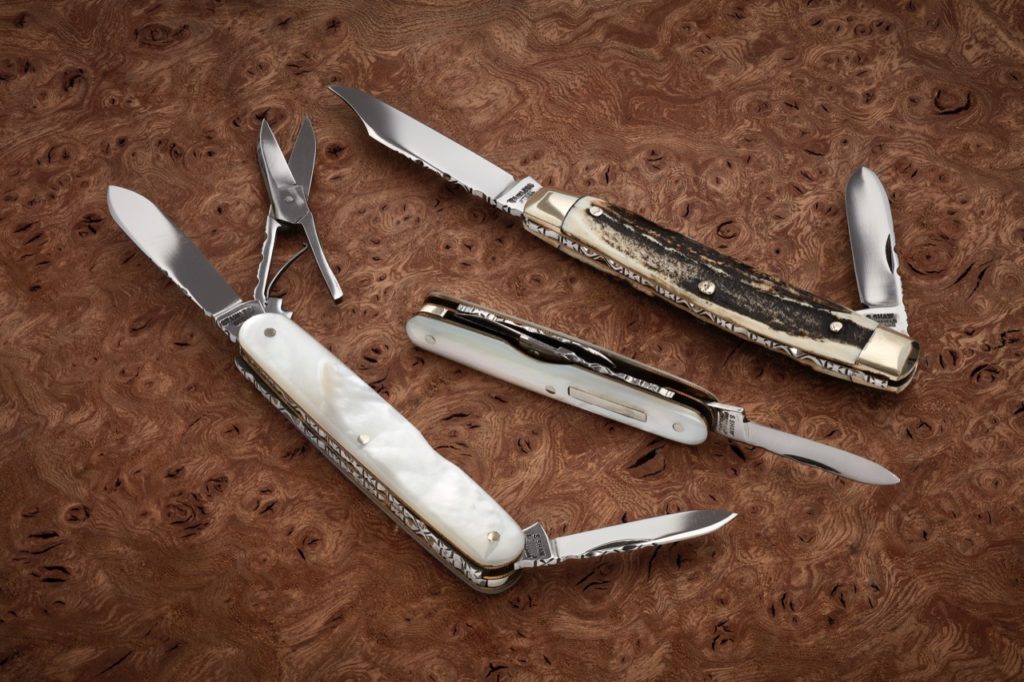
A sampling of Stan Shaw’s pocketknives with richly fileworked blade spines and backsprings. Look close and you can see the Maltese crosses for which Stan was so well known. (image by Carl Whitham, Sheffield)
THEIR PATHS CROSS
By the beginning of the 1980s, the contraction of the Sheffield cutlery industry was such that there were no more companies left to employ him, so he set-up his own workshop in Garden Street. It was there, 10 years later, that our paths crossed.
I had made a set of three folding knives for a college project and hadn’t been able to find anyone still making traditional Sheffield slip joints to ask for advice. A couple of years later, I heard Stan being interviewed on the radio and realized that I still desperately wanted to learn to make knives. I packed up my workshop in London and moved to Sheffield to persuade him, in person, to take me on as his apprentice. He welcomed me into his workshop but said that he was nearly 70 and too old for an apprentice. Instead, he offered me his bucket of old, handforged blades and springs, told me to select a handful and “go and figure it out yourself because it’s not that hard.” He would always be there to help if I got stuck.
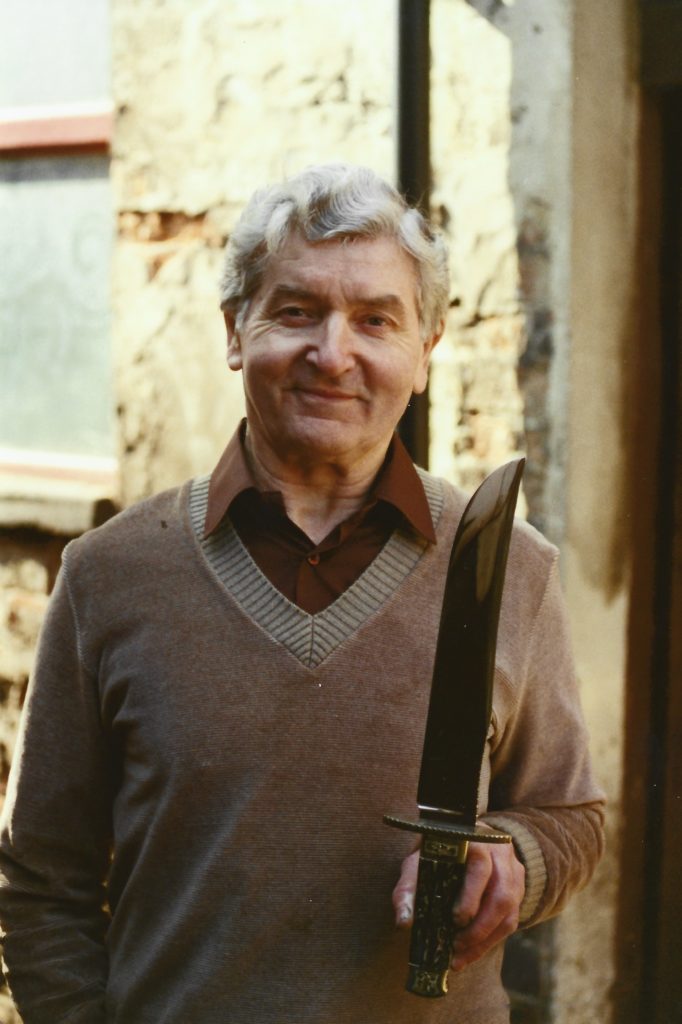
Stan Shaw as he appeared in the early 1990s. (Geoffrey Tweedale image)
A few years ago, when I was gently teasing him about still having a 10-year waiting list for his knives, he said, “I should have taken you on then, lass, you’d just about be useful to me now!” So, for all the times our paths crossed, for all the gentle encouragement and for completely changing my life’s path when I was 23 years old, thank you, Stan.
Stan was not a “little mester.” He was a master and was proud that he could make his knives from start to finish, a concept that would be completely alien to Sheffield knifemakers a hundred years ago.
Stan Shaw, whose career of making classic pocketknives spanned almost 80 years, passed in late February at the age of 94.
He started work for W.G. Ibberson in Sheffield, the old knifemaking capital of England, in 1941. Apprenticed to Fred and Ted Osborne, men Stan described as the two best cutlers in Sheffield, he eventually succeeded them in 1954 as the company’s top maker of pocketknives. Though the Sheffield knife industry was in rapid decline, he continued making knives, renting an old workshop in 1983 and becoming an independent cutler.
As Stan moved through Ibberson and other companies over the years, he actively approached other workers to learn their processes as well as his own. It was this breadth of training that made him unique and was vital to him in later life. (image by Carl Whitham, Sheffield)
As an independent he did it all in the making of his pocketknives, and he did it all quite well. As he said in “Stan Shaw: Little Mester of Sheffield” in the May 1994 BLADE: “I have to do everything now because there are no forgers, grinders, scissor-makers and so on left. My earlier experience with Ibberson’s has proved invaluable in that respect. All my knives are hafted, ground and assembled by me. It’s harder work but the satisfaction is greater. Scissors, files, punches, shields, shackles, handles, scales, bolsters—the list is endless—but each part is made by me on these wheels and dollies with only hacksaws, files and a few other traditional tools, such as my parser. The only job I don’t do is the occasional engraving I have done on the bolsters.”
His knives are testaments to the classic exhibition pieces, many with a host of blades and other tools and implements. In 2003 he became an honorary freeman of the Company Cutlers and in 2017 was awarded the British Empire Medal. As late as 2019, into his 90s, he continued to clock in bright and early in the mornings to make pocketknives at Kelham Island Museum. In the interim he served as a mentor to many makers, including award-winner Grace Horne, among others.—by BLADE® staff
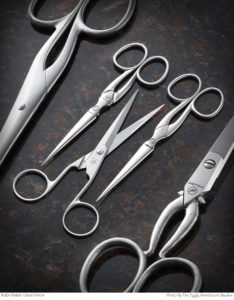
In addition to pocketknives, the author is also well known for her award-winning custom scissors made in the original knifemaking center of the United Kingdom—Sheffield, England. (Eric Eggly/PointSeven image)
The Author, Grace Horne
Editor’s note: An award-winning knifemaker from Sheffield, England, the author currently makes traditional folders. For more information contact her at Dept. BL9, The Old Public Convenience, 469 Fulwood Rd., Sheffield, United Kingdom, S10 30A [email protected], gracehorn.co.uk. Also: Steven and Kylie Cocker, Instagram @steven_cocker_sheffield; Michael May www.michaelmayknives.com; and/or Michael and Ashley Harrison plus apprentice at A Wrights & Sons www.penknives-and-scissors.co.uk.
*Tradition and Change: The Sheffield Cutlery Trades 1870-1914; Sally-Ann Taylor
**The Penny Magazine Supplement, April 1844, p.168; Thomas Allen
Jerry Hossom makes a Navy-themed set for Capt. Ryan Heilman of the USS Nevada
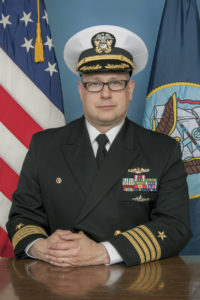
Jerry Hossom had that twinkle in his eye again and this time it was by his table at BLADE Show in Atlanta, where he was all fired up about the latest set he had made for Capt. Ryan Heilman, USN, of the USS Nevada (SSBN-733).
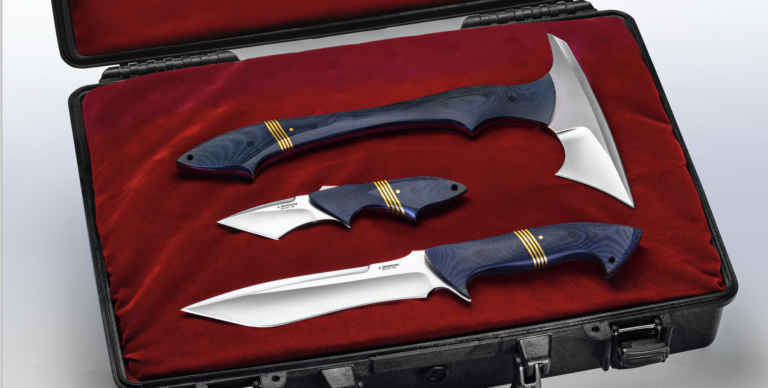
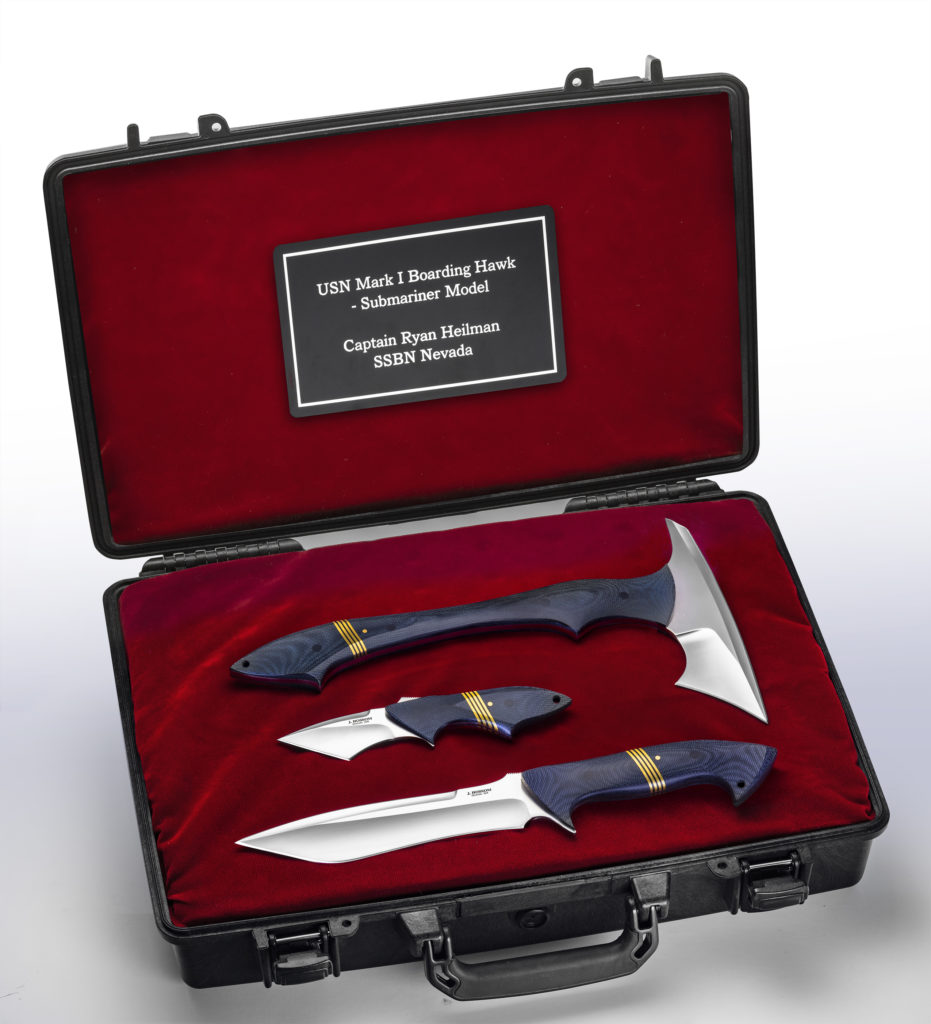
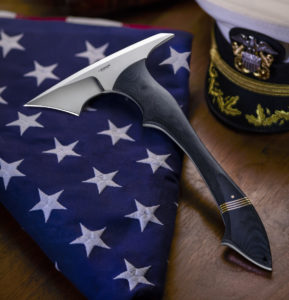
Sporting Navy blue Micarta handles, the set consists of Jerry’s USN Mark I Boarding Hawk-Submariner Model, a Retribution fighter and one of his small Dog Tag knives. However, as with many edged sets, it was a project that wound up a bit larger than when it first started.
In addition to the Submariner Boarding Hawk, the Retribution fighter and smaller Dog Tag knife complete the set and are contained in a red-velvet-lined briefcase. A sign with the set’s and owner’s names appears on the underside of the briefcase lid.
“Ryan’s wife Karen wanted something for him and I made the Boarding Hawk. I dyed the handle blue and I wanted it to look like the sleeve of a captain’s uniform. Captain Heilman has four gold stripes on his uniform sleeve and this would normally be a star, but I can’t do stars,” he laughed, pointing to the brass pin above the four brass stripes on the handle. “And so I made this and sent it to him.”
The USN Mark I Boarding Hawk-Submariner Model by Jerry Hossom is part of a three-piece set Jerry made for Capt. Ryan Heilman of the USS Nevada SSBN-733), a ballistic missile submarine in the United States Navy.
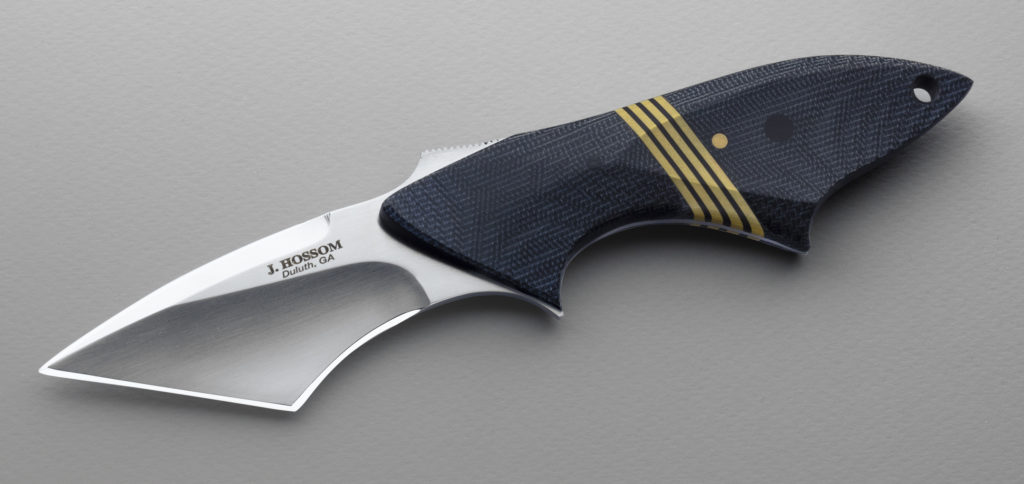
Soon after that Karen texted Jerry with an additional request. “She said what Ryan really wanted was one of my Retribution fighters, and so I did that,” Jerry smiled. “And then Karen said maybe you can complete the set with one of your little Dog Tag knives.” Pointing to the Dog Tag knife, Jerry said, “So this was the last one I did last week just before the show.”
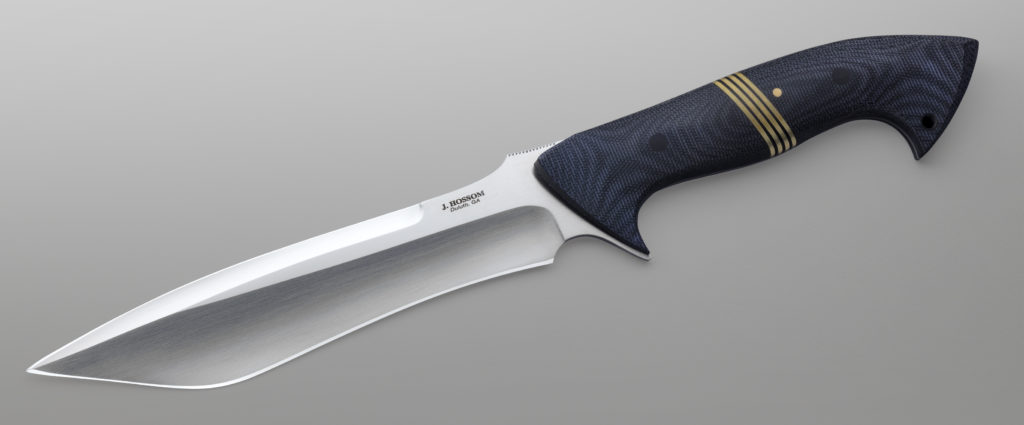
One of Hossom’s most recognizable knife models is his Retribution fighter. According to Capt. Heilman’s wife Karen it was the Hossom knife the Captain really wanted. Blade steel: Carpenter PSF-27 stainless. Handle: Navy blue Micarta® with bronze captain stripes and pin. Overall length: 13 inches.
Of course, Jerry outfitted both the Retribution and Dog Tag models with the same Navy blue Micarta handles and the brass stripes and pins to match the Submariner Boarding Hawk. In-between the stripes are thin layers of Navy blue G-10 that match the balance of the handles’ Navy blue Micarta. The handles of both the Submariner Boarding Hawk and Dog Tag knife have Jerry’s trademark palm cutouts that extend across the bronze pin and just north of the bronze stripes. The Retribution fighter, meanwhile, features a cradle handle style with the bird’s beak pommel on one end and the single guard on the other combining to form the cradle. The captain’s sleeve effect on all three is equal parts unmistakable and tastefully understated.
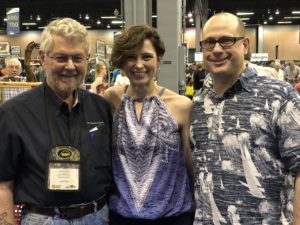
Hossom’s Dog Tag knife rounds out the three-piece set. As with the other three pieces, note the handle configured to resemble a captain’s sleeve with the four bronze stripes and pin. All the materials are the same for it as the Submariner Boarding Hawk and Retribution, including the blue G-10 in-between the stripes. Hossom would have made a regulation Navy star instead of the pin but, as he laughed, “I can’t do stars.”From left, Jerry Hossom and Karen and Ryan Heilman enjoy themselves at BLADE Show In between Jerry and Karen in the background knifemaker Grace Horne interacts with a customer at her table.
Blade steel for all three pieces is Carpenter PSF 27 stainless, one of Jerry’s favorites. Respective lengths for the Submariner Boarding Hawk, Retribution and Dog Tag are 14, 13 and 7 inches. All are contained in a red-velvet-lined briefcase with a sign inside the lid that reads “USN Mark I Boarding Hawk-Submariner Model” over “Captain Ryan Heilman SSBN Nevada.”
For more information contact Jerry Hossom, Dept. BL10, 3585 Schilling Ridge, Duluth, GA 30096 770-449-7809 [email protected], hossom.com.
The USS Nevada
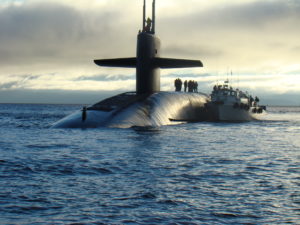
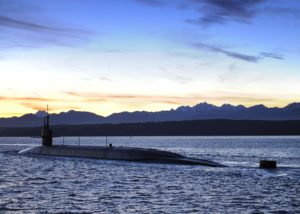
The USS Nevada (SSBN-733) is a United States Navy Ohio-class ballistic missile submarine that has been in commission since 1986. Its homeport is Bangor, Washington, and its motto is Silent Sentry. This nuclear-powered craft is 560 feet long, has a speed greater than 25 knots (29 mph) and a test depth greater than 800 feet. It boasts a complement of 15 officers and 140 enlisted men, and its armament consists of 24 Trident II D-5 ballistic missiles, MK-48 torpedoes and four 21-inch torpedo tubes.
A United States Navy Ohio-class ballistic missile submarine, the USS Nevada has been in commission since 1986. (U.S. Navy image)
The 560-foot-long nuclear-powered USS Nevada calls Bangor, Washington, homeport.
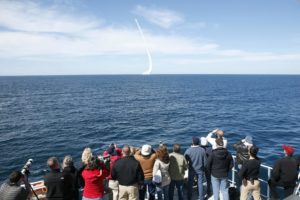
A crowd watches the contrail of a successful test launch of one of the Nevada’s Trident II D-5 ballistic missiles. (US Navy photo # 160722-N-OO32-040 by Mass Communication Specialist 2nd Class Cory Asato, courtesy of news.navy.mil.)
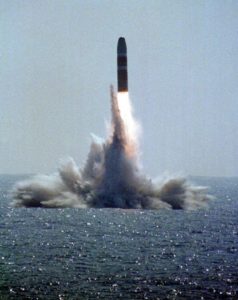
A Trident II missile breaks the surface after launch from the Nevada. (USN photo # DF-SC-87-12797, by TGS Technology, Inc., from the DOD Still Media Collection, courtesy of dodmedia.osd.mil.)
Capt. Ryan J. Heilman, USN
Capt. Ryan J. Heilman,
Capt. Ryan J. Heilman is commanding officer of the Blue Crew and captain of the USS Nevada (SSBN-73). He enlisted in the Navy as a machinist mate, nuclear option, and was selected for the Nuclear Enlisted Commissioning Program in 1991 and was commissioned from Officer Candidate School in Pensacola, Florida, in 1994.
Heilman was assigned to the PCU Wyoming (SSBN 742) in 1996, where he served as Navigation Division Officer and in several other positions. In 2002 he reported as Navigator/Operations Officer to the USS Nevada. He reported to Trident Training Facility, Bangor, Washington, in 2005 as the Engineering Training Department Director. In March 2008 he became Executive Officer of the USS Nebraska (SSBN 739). In 2011, after graduating from the U.S. Naval War College with a Master of Arts degree in National Security Studies, he was assigned as a Military Professor in the Joint Military Operations Department at the U.S. Naval War College in Newport, Rhode Island. In 2013, he reported to Submarine Squadron Seventeen in Bangor, Washington, as Deputy Commander for Readiness.
Capt. Heilman is a graduate of the U.S. Army’s Command and General Staff College, the Navy’s Naval War College and is a qualified Joint Service Officer. His awards include the Meritorious Service Medal, the Joint Commendation Medal, the Navy Commendation Medal (four awards) and the Navy Achievement Medal (two awards).
The origins of damascus steel date to as early as 1500 BC.
The allure of damascus steel lies not only in its beauty and utility, but also in the mystique of its origins. Though its development began in ancient times, the word damascus has grown to encompass more than one method of steelmaking, and the earliest method is believed to date back to 1500 BC.
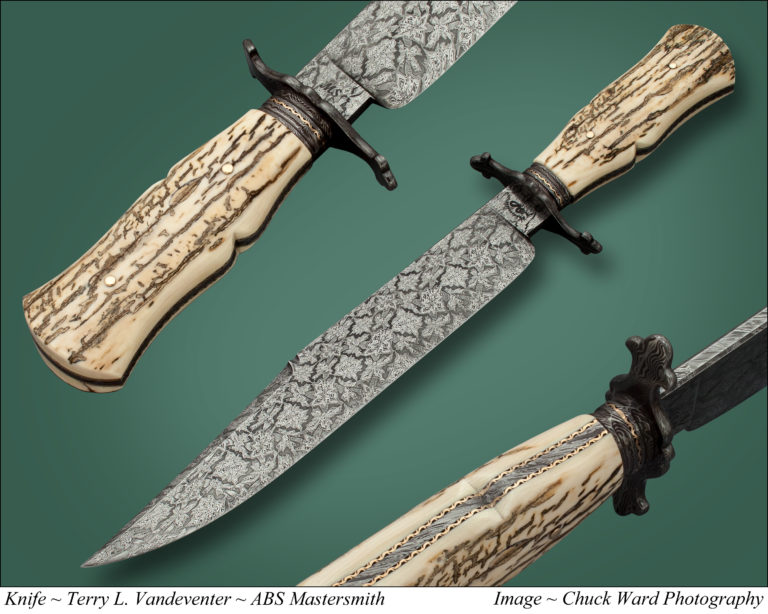
“Damascus steel today can mean at least three things,” explained blacksmith and steel authority Rick Furrer. “First, there’s pattern-welded steel where a bloom of steely irons is welded into a solid mass which then has a pattern. This is the oldest of damascus-steel-making technologies and one which most blacksmiths reproduce with layers of modern steel welded together.
“Second is crucible steel, where the material is fully melted in a container and then the resulting ingot is forged into a bar, which may or may not have a surface pattern. Third is overlaid or inlaid wire, gold, silver, copper or such into a base metal surface such as steel or silver to make a surface pattern. Some call this damascening or damascene.”
Those who have studied the origins of damascus tend to agree that pattern welding did happen first and that it occurred in the Far East, the Indian subcontinent, the Middle East, Indonesia and Europe. Crucible steel production is also referred to as wootz, and its beginning, for some, is easier to pinpoint.
“Some call crucible steel, or wootz, the original damascus, but pattern welding predates it by more than 1,000 years. Pattern welding was in Europe by 1100 BC in Greece and easily by 600 BC in Central Europe. It was very widely spread by 400 BC,” observed Furrer, who in 2011 participated in the filming of a Public Broadcasting System NOVA segment on the famed Viking swords from circa 800-1000 AD with the Ulfberht inscription. The extremely low slag content of the Viking blade steel may indicate a new development in steel processing in Europe, or that the Vikings were forging blades from imported crucible steel.
“The earliest examples of blades made from wootz steel date from around the first century BC,” related ABS master smith Kevin Cashen, “and the oldest examples of the material seem to come from India. While the Indians seem to have been the first to produce crucible steel, they were soon followed by other cultures in the Middle East such as the large production centers in what would now be Turkmenistan and Uzbekistan. Pattern welding is a trickier process to pinpoint, date or credit to a given culture as it is very old, and just about any people working iron would have produced welded blades on some level.”
Technological Advancements Of Demascus
As technology evolved, production methods improved and fueled the availability of high-quality blade steel. Performance and purpose have contributed to the growth of the industry and the changes in the scale of production through the centuries.
“All of these steel processes were driven by warfare and weapons technology,” noted ABS master smith Steve Schwarzer. “As soon as someone discovered a new method, everybody who wanted to survive jumped on that new method. The moment the local smith developed a method to heat steel to a totally liquid state and control the carbon, the need for wootz and pattern-welded blades fell to the wayside except for the very few who viewed it as art. When the Bessemer converter came into use [in the 1850s] and steel was produced in tonnage at any carbon level desired, there was no need to use the labor-intensive process of making one small piece of material at a time.”
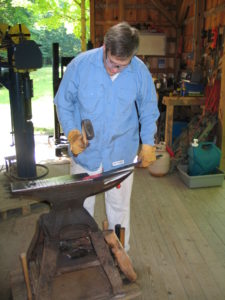
The basic tools used by early makers of pattern-welded damascus were quite similar to those used by the modern bladesmith—hammers, anvils and forges. Dan Farr hammers hot steel in his shop. (Dan Farr image)
Nonetheless, the craftsmanship and performance of forged damascus is timeless. Modern damascus makers take advantage of improved technology and know-how. The ancient producers worked with basic tools and equipment during a process of both production and discovery. The early makers of pattern-welded damascus combined bloomery steel with varying properties, says Cashen, but the basic tools were quite similar to those used by the modern bladesmith—hammers, anvils and forges.
“One difference is possibly the absence of the fluxes we use today,” Kevin added. “The simple bloomery products of that time period, when worked in a charcoal fire, would weld much more easily and not require the oxygen barriers that we have become so accustomed to today.”
The early crucible process would have involved sealing some amounts of premade iron along with certain organic/carbon-bearing materials and fluxes into a clay crucible that would have been placed in a charcoal-fired furnace, which would usually have been fired by a bellows or natural air drafts.
“The clearest difference in either method now compared to then is the fuel we have at our convenience today,” Cashen commented. “Gas-fired forges and furnaces make the tasks much more convenient than the arduous, dirty labors at ancient charcoal fires.”
Staying True To The Steel’s Roots
Maybe it is true that the more things change the more they stay the same, particularly as it relates to damascus steel. Surviving examples of either pattern-welded or crucible damascus are impressive in their quality. Modern bladesmiths produce damascus and mosaic damascus/canned steel that simply defies description, the beauty of the patterns speaking for themselves.
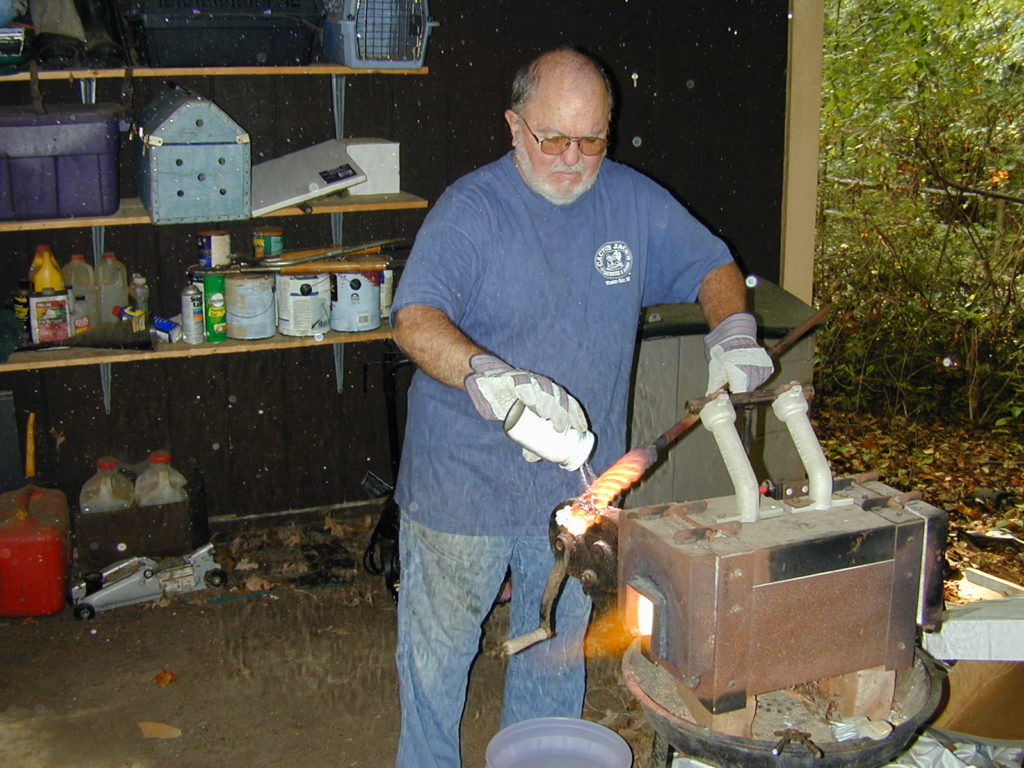
One of the differences between the way damascus is made today as opposed to centuries ago is the use of flux—applied here to a twisted billet by Tim Britton. (Britton image)
Damascus also originally occupied a transitional period in human history. As the Bronze Age waned in Europe, basic iron blades began to appear and pattern welding followed. In the East, iron blades of piled construction were made and pattern welding may have taken place concurrently with it, both being phased out as the crucible process came along. Most experts agree that Europeans were introduced to crucible damascus/wootz during the Crusades.
“With the wootz made by high-temperature smelting in a crucible and forming a cake, bulat or ingot, this ingot was then formed in a very slow, methodical process to produce a beautiful pattern of iron-carbide ferrite and cementite banding,” Schwarzer commented. “This was called watered or damascus steel. It is thought Europeans encountered this material for the first time during the Crusades near Damascus, Syria. Then, this cast material was traded all over the world.”
ABS master smith Al Pendray is well known for his work in wootz steel. Along with John D. Verhoeven, he is listed by the U.S. Patent Office as one of the inventors of “a method of making a steel article having an external surface appearance and an internal microstructure resembling that present on an antique ‘Damascus’ steel sword or blade.” Pendray contends that the earliest crucible damascus was made in Persia and quickly got the attention of Westerners who came in contact with it. “Wootz is ultra-high carbon and will take a real clean edge,” he remarked. “With all the nonmetallic stuff and impurities floating to the top in the process, it’s also a super clean steel.”
But Why Call It Damascus?
As intriguing as the steel itself, the name damascus has a mysterious origin. While the obvious link is to the ancient capital of Syria, the answer to the source of the steel’s moniker is open to speculation.
“One such story maintains that only wootz can be called damascus steel because it was wootz that the Crusaders first encountered in the Middle East, with the town of Damascus being the trading hub for its distribution, thus lending it the name,” Cashen offered. “This theory ignores the fact that there were also damask cloths [with intricate patterns formed by weaving], and that the treatments on many materials involving carving, inlay or otherwise were worked with an intricate flowing or water-like pattern called damascene. It is also worthwhile to note that an old Arab term for water is damas, a coincidence that’s hard to ignore when you consider the number of cultures that refer to patterned steel as ‘watered’ or having ‘watering.’”
Speculating about the origin of the name is intriguing, but Cashen says it is what it is. “In any case, the number of centuries that any steel with a pattern in it has been called ‘damascus’ sort of renders all of these speculative picky semantics irrelevant,” he noted. “Languages evolve, and the word means what it does today. When this is taken into consideration, any steel possessing an induced pattern could be safely referred to as damascus, with pattern welding or crucible steel being the more specific types of patterned steel.”
According to Master Bladesmith Steve Schwarzer, modern steels are far superior to even the best of the ancient materials because of quality control and repeatability.
Finest Blades Ever
As with many highly prized skills, individual bladesmithing and the production of high-quality damascus steel in small quantities has been eclipsed by mass production, given the availability of modern equipment and technology. However, the steel still owes its lineage to the blacksmiths of ancient times. Additionally, today’s bladesmiths keep the tradition and the skill alive like no mass production process can.
“Modern steels are far superior to even the best of these ancient materials because of quality control and repeatability,” Schwarzer mused. “What modern steels don’t have are beauty and the visual fingerprint of the steel artist’s hand. The damascus blades being made in modern times are far superior to the ancient blades because the modern smith is using these very sophisticated steels and modern scientific techniques to produce the finest blades ever made.”
*This article originally appeared in BLADE Magazine Winter 2013
The bond of brotherhood, sacrifice, and selflessness forged by fighting men in combat is, perhaps, the strongest emotion human beings can experience. So it is with Travis Williams.
Having just turned 18, Travis enlisted in the United States Marine Corps In December 2001. He reported for duty the following August and spent the next four years in the service. While he trained, his original reserve unit had already deployed to Iraq, and he was among a few who were reassigned to Lima Company, 3rd Battalion, 25th Marines, another reserve unit, headquartered in Columbus, Ohio.
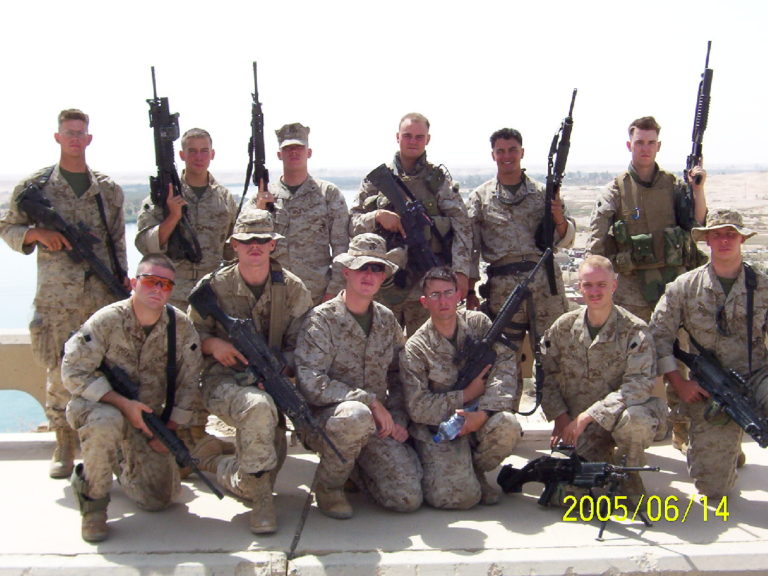
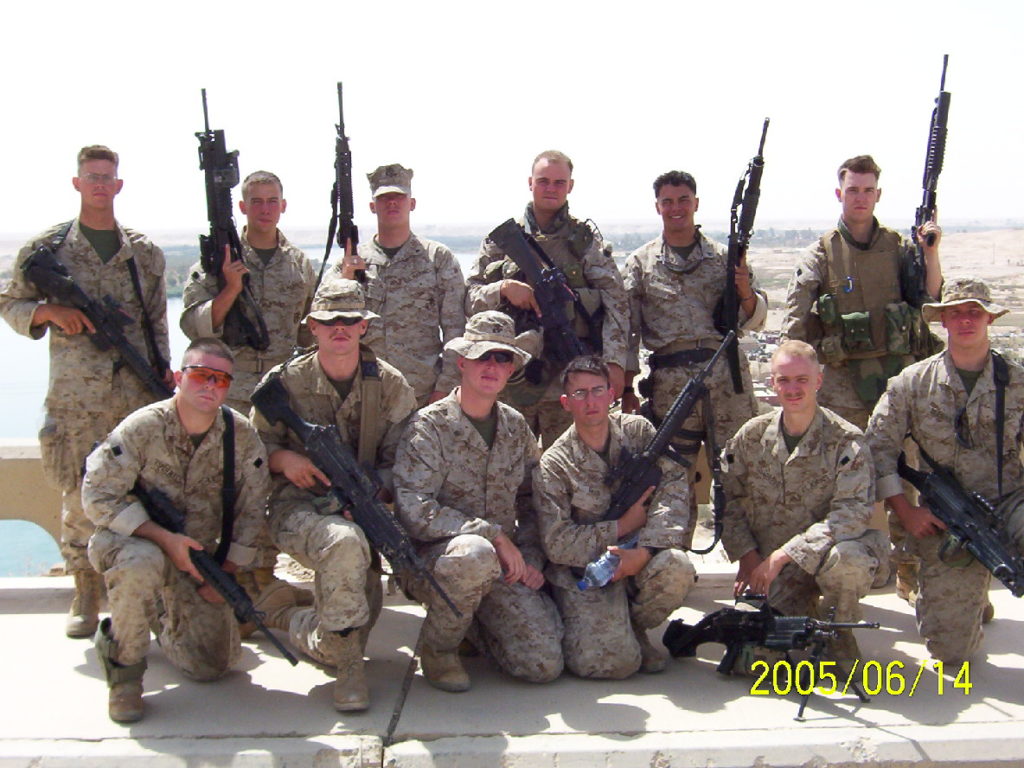
Travis Williams (second from right, back row) stands proud with his squad mere weeks before the deadly IED strike. (photo courtesy of Travis Williams)
During its deployment to Iraq, Lima Company endured days of patrols in harm’s way, intense firefights, and the ever-present danger of IEDs (Improvised Explosive Devices). With a strength of about 180 Marines, Lima Company lost 24 killed in action, and one in eight of its Marines received the Purple Heart for wounds received or death as a result of enemy action. By late 2005, Lima Company was the hardest hit unit of its size in the Marine Corps. Lima’s battalion lost 48 men killed in Iraq.
1 of 4
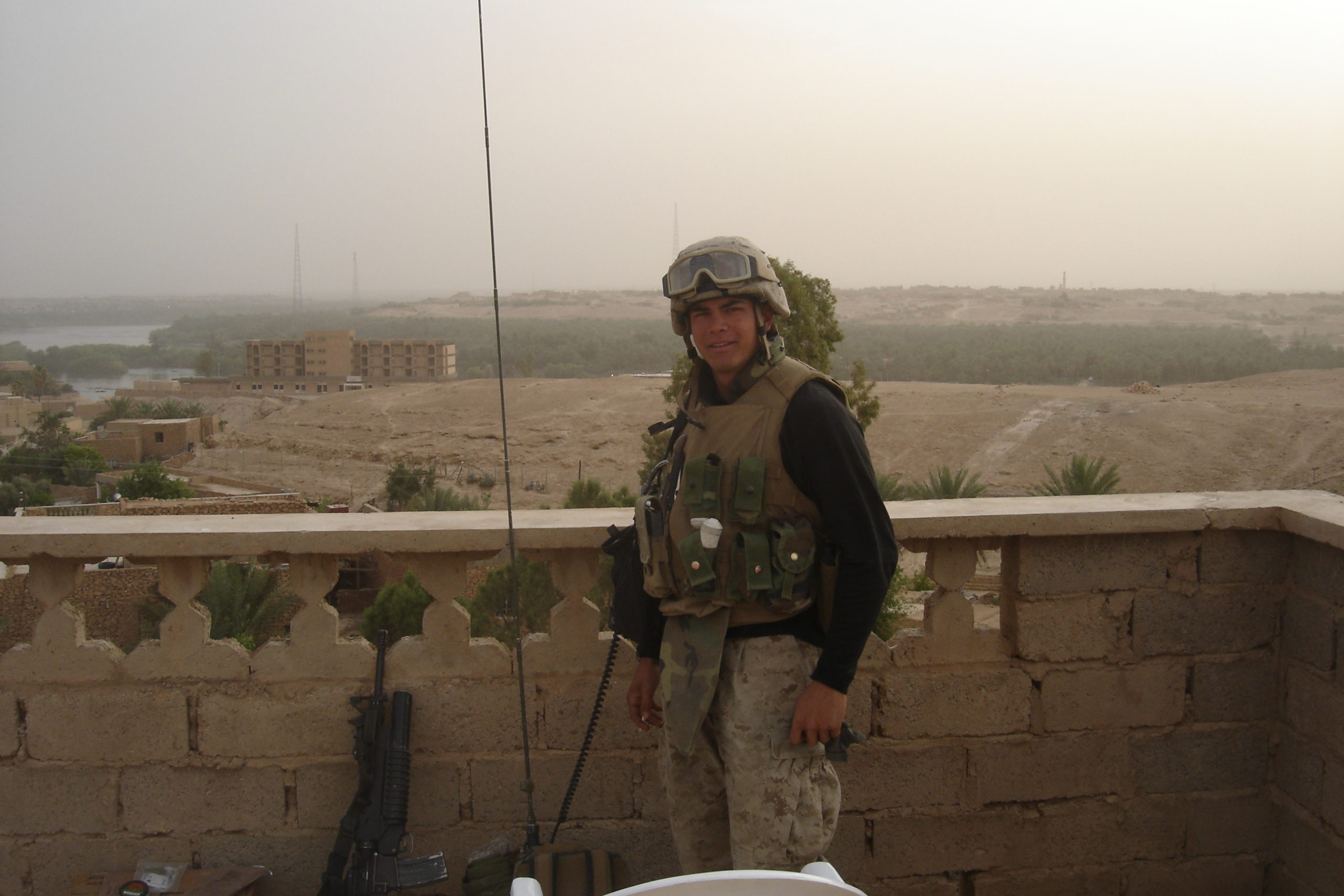
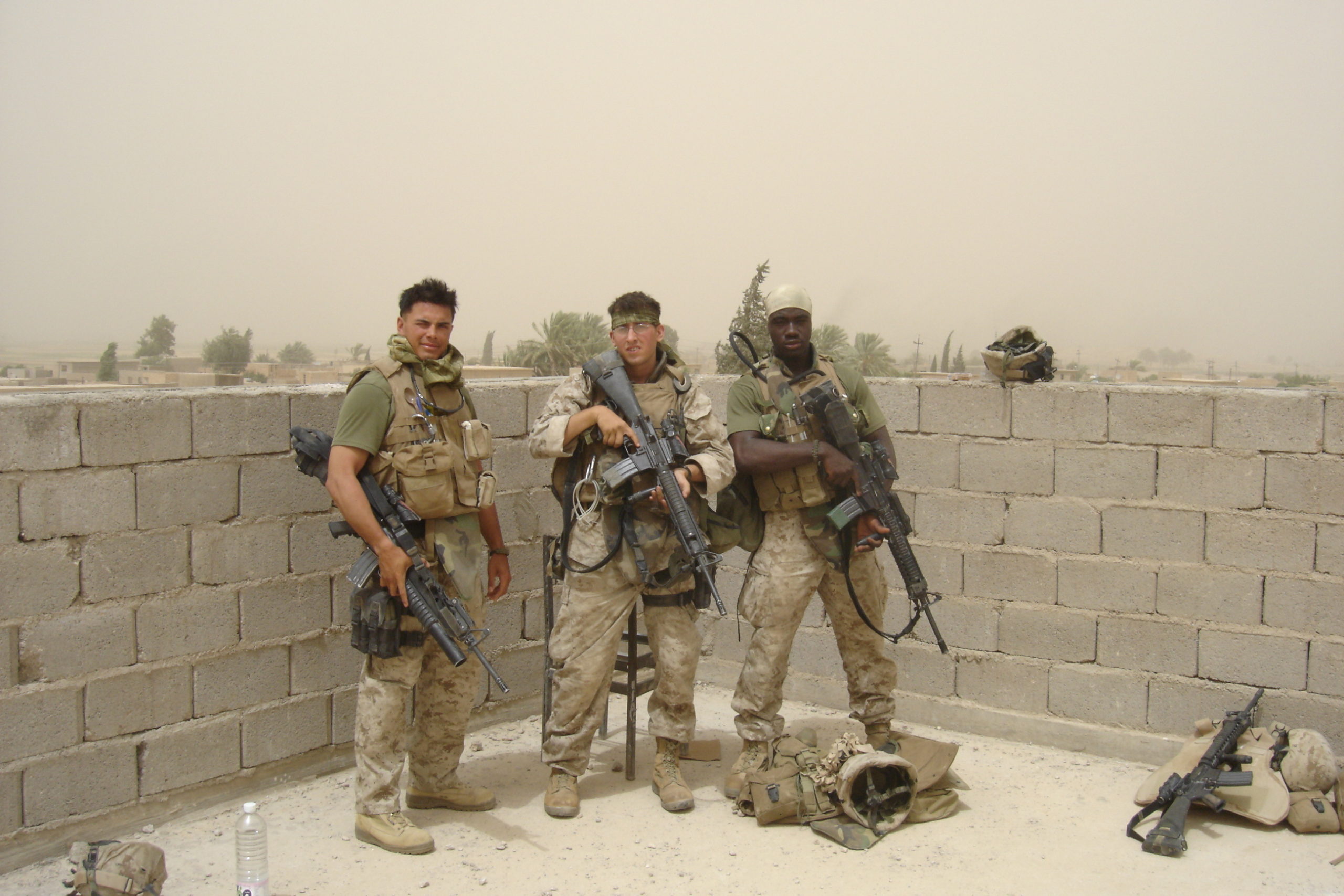
From this vantage point, Travis had a bird’s-eye view of the surrounding Iraqi countryside. (photo courtesy of Travis Williams)
From left: Travis, Lance Corporal Aaron H. Reed and an unidentified trooper are armed and ready. (photo courtesy of Travis Williams)
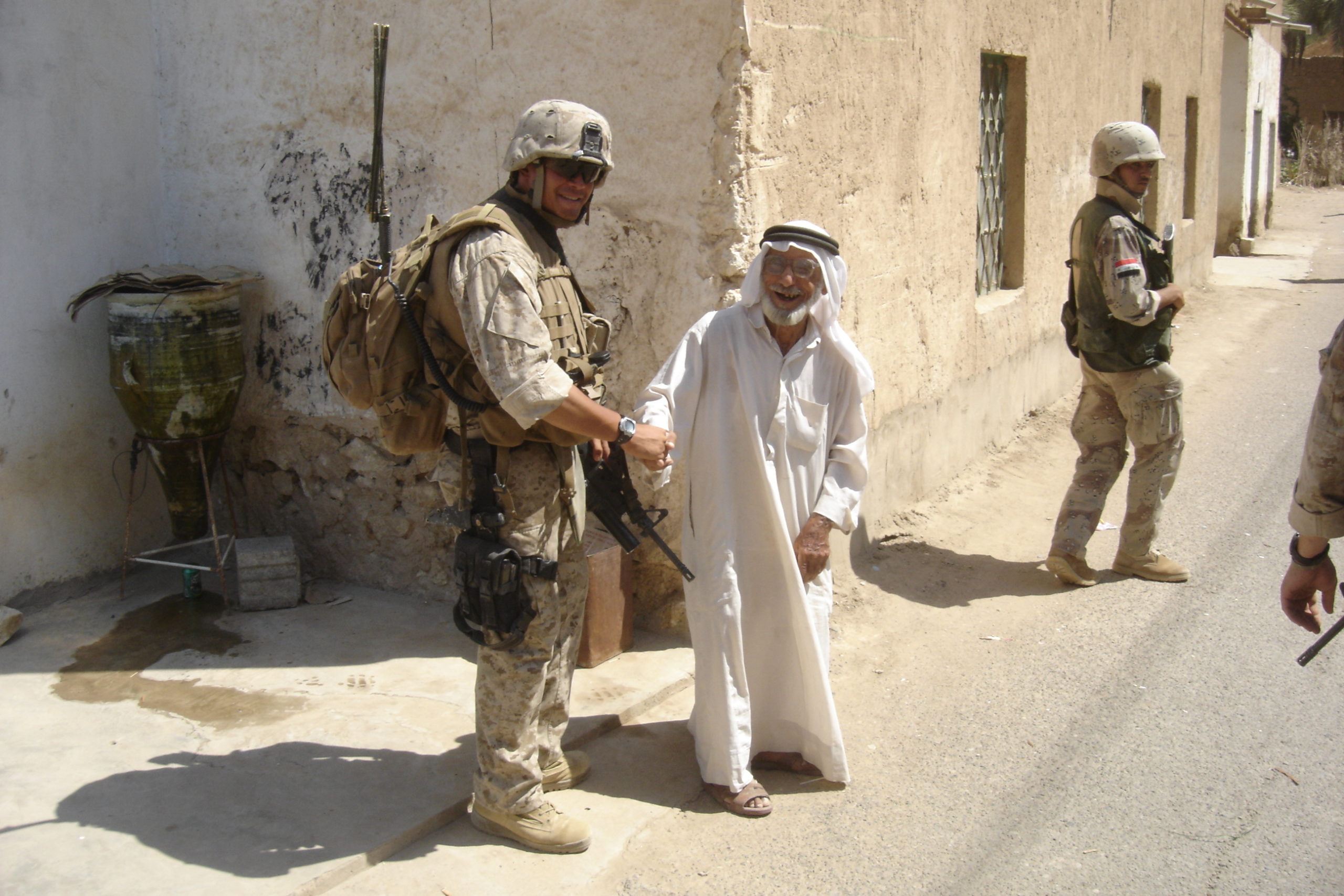
Travis appears to win over the heart and mind of at least one elderly Iraqi gentleman. (photo courtesy of Travis Williams)
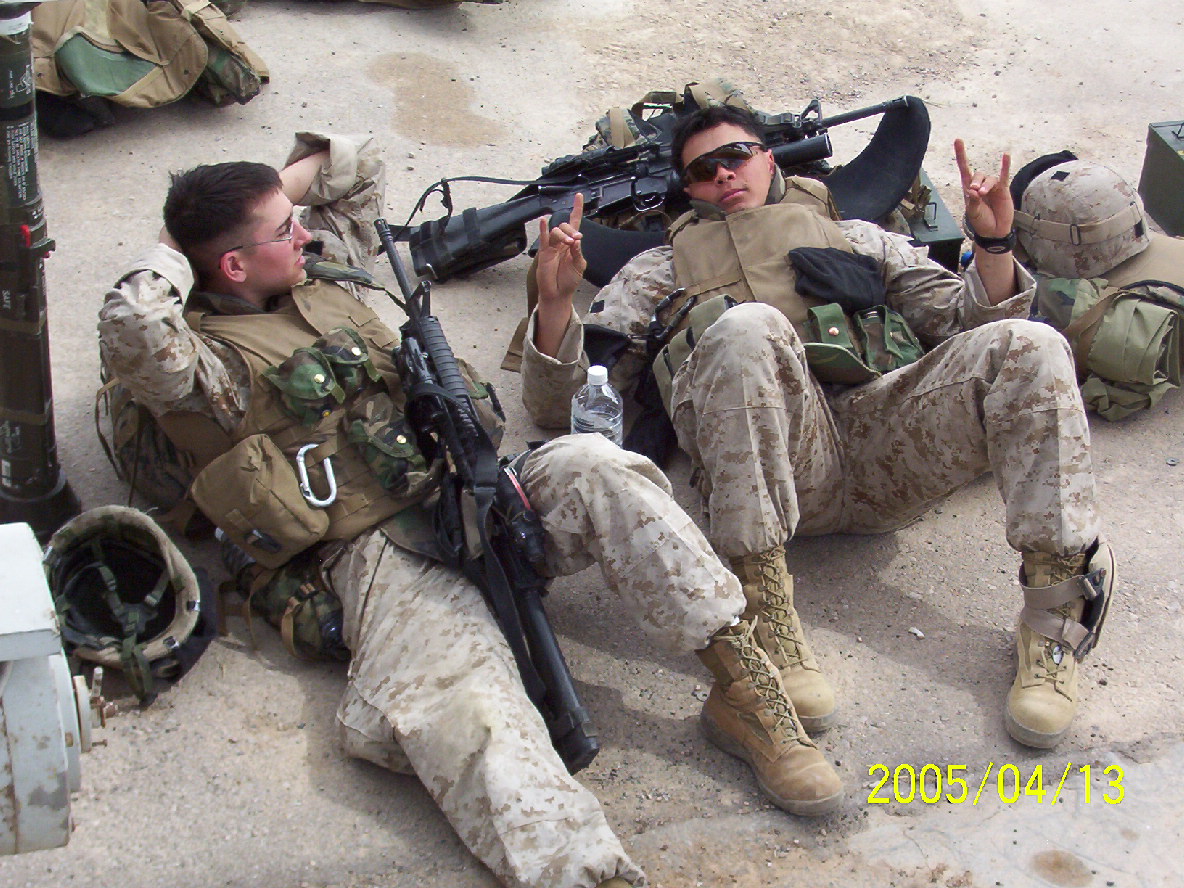
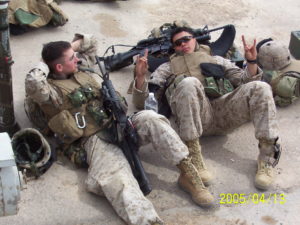
Travis and his best friend, Lance Corporal Aaron H. Reed, take five. Reed was among those killed by the IED. His awards include the Purple Heart and Combat Action Ribbon. He was 21. (photo courtesy of Travis Williams)
AUG. 3, 2005
Considering the tedium and tension that encompassed his time in Iraq, a single day stands out in Travis’ memory. On Aug. 3, 2005, during a patrol near the town of Barwanah, 11 Marines from his squad were killed in a massive IED explosion.
“We were going to start at 0600,” Williams recalled. “We loaded our amtracs, big transport vehicles, and about five minutes before we stepped off, a call came down from higher. For some reason the platoon commander and I got pulled out of our vehicle with 1st Squad and put in a vehicle ahead of theirs with Iraqi forces in it. We headed for town and weren’t going to take any roads in. It was about a month before we were to leave the country, and we had seen a lot of firefights and IEDs.”
After the patrol received word that the road was, in fact, clear, the catastrophic explosion erupted. “We hopped on the road, and right as we made the turn for town I was sitting down in the vehicle,” Travis continued. “Somebody has to stand up to provide security, and I saw the explosion in the glasses of the guy standing up in our vehicle.”
Williams still does not know why he and the platoon commander were ordered out of the vehicle that was hit. He was not injured. Fifteen men occupied the stricken amtrac, and he had known those Marines that were killed for more than a year. Among them was his best friend, Lance Corporal Aaron Reed of Chillicothe, Ohio.
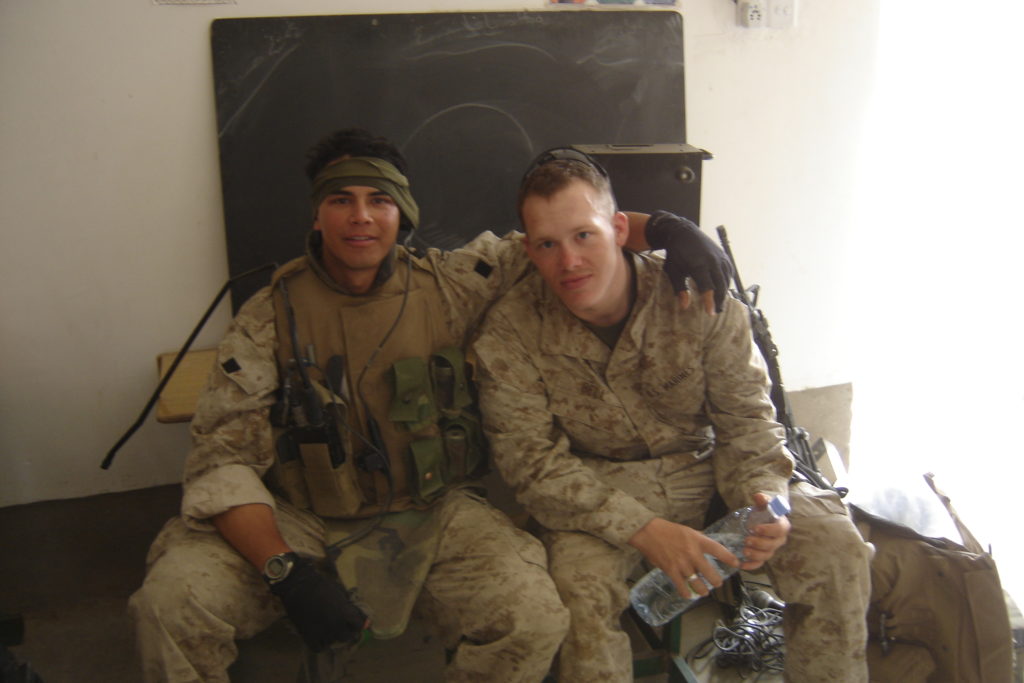
Travis and Lance Corporal Timothy M. Bell Jr., 1983-2005, enjoy some downtime. Bell, 22, was killed by the IED. His awards include the Purple Heart, Navy and Marine Corps Achievement Medal with Combat “V” for valor, and the Combat Action Ribbon. (photo courtesy of Travis Williams)
When Lance Corporal Travis Williams returned home to Missoula, Montana, in August 2006, he brought with him the memories and the scars of his wartime experience. He worked as a private investigator for about five years, and then an opportunity that he could not pass up presented itself. Always fascinated and intrigued by knives, he met custom knifemaker James Behring, Jr.
“James moved to Missoula from Michigan in 2011, and he married my friend’s sister,” Travis said. “I would hang out at the shop and watch what he was doing, and finally he told me that he was looking to hire somebody. I jumped in from there, cutting out blades from bar stock, soldering guards and finishing handles and stuff like that—until I was able to make a knife.”
GOLD STAR FAMILIES
This past February, the Wall Street Journal featured Travis in an article observing the 10th anniversary of the war in Iraq. “They wanted to know how I was doing,” he commented, “and there was a video with it and a guy followed me around the shop while we were making knives.”
A fellow Marine veteran saw the article and contacted Travis, telling him that a benefit was being organized for Gold Star Families in Ohio. These are the families of those who have lost a loved one in battle. “He asked me to make a knife for a silent auction, and the proceeds would go to support the work of an artist that was painting life-size portraits of the guys that were killed from the company,” said Williams. “It was on short notice because the event was going to be in three weeks. I cleared it with James and then contacted Roger ‘Mudbone’ Jones of Waverly, Ohio, to make sure he could make the sheath if I got the knife to him in time.”
Mudbone is an accomplished knife and sheathmaker in his own right. A friend of the Behring family who considers James Behring “like my own son,” Mudbone agreed to make the sheath. His relationship with Travis has grown as well, and he simply considers the former Marine a second son. In fact, it is Mudbone who brought this compelling story to the attention of BLADE®.
“Travis called and said he wanted to tell me about the knife and get some pointers on it and the sheath,” Mudbone remembered. “It knocked me out when he said this was for his friends, and particularly his best friend who had been killed. It turns out Aaron Reed was from my hometown, Chillicothe, Ohio. I had never met the boy, but I knew of his mother, who had been a teacher in a local school.”
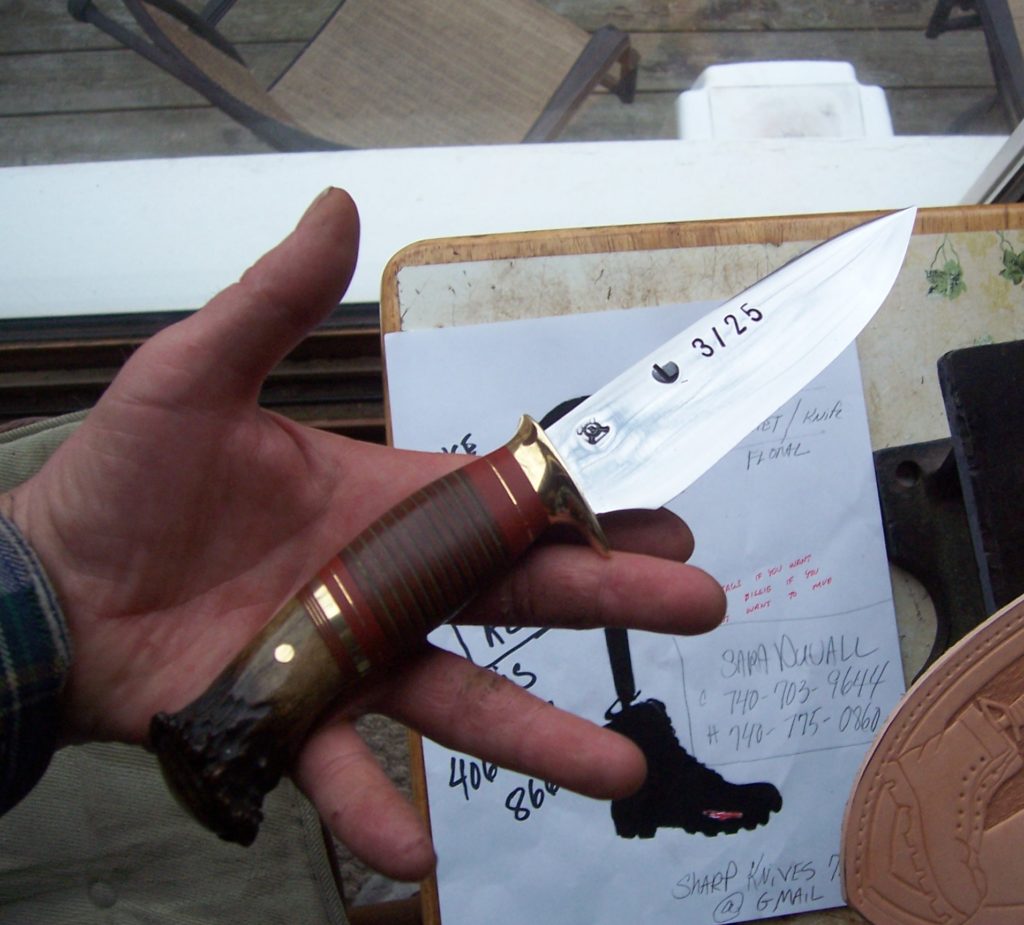
Travis set to work under the watchful eye and guidance of Behring. The finished knife includes a 6-inch drop point blade of O-1 tool steel, a thick brass guard, and a stacked-leather-washer handle with a butt of whitetail crown stag. Inserted between the leather washers is a piece of the nametape, typically worked across the top of the uniform pocket, of each of the 11 Marines killed on Aug. 3, 2005. The letter “L” for Lima Company and “3/25” for 3rd Battalion and 25th Marine Regiment are hot stamped into the blade.
Made by Travis under the watchful eye of Jim Behring, the knife has a 6-inch blade of O1 tool steel, brass guard, and a stacked-leather-washer handle with a butt of whitetail crown stag. Between the leather washers is a piece of the nametape, typically worked across the top of the uniform pocket, of each of the 11 Marines killed on Aug. 3, 2005. The letter “L” for Lima Company and “3/25” for 3rd Battalion and 25th Marine Regiment are hot stamped into the blade. (photo courtesy of Mudbone Jones)
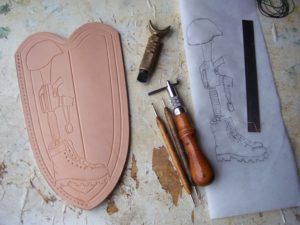
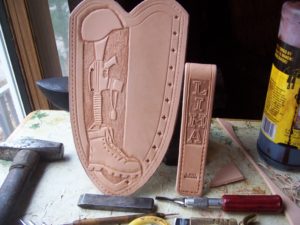
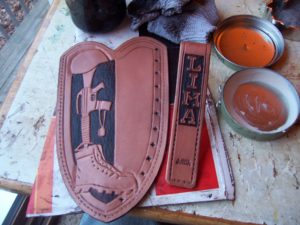
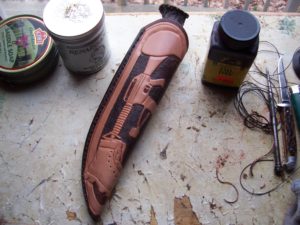
When the knife was complete, Mudbone set to work. With only a week to complete the task, he crafted a leather sheath with the iconic image of the rifle turned down into a boot and topped by a helmet. A dog tag hangs from the weapon. The word “LIMA” is also prominent.
“On the back of the sheath there are 11 four-pointed North Stars,” added Mudbone. “Craftsmen of earlier times stamped these on guns and knives so the owner could always find his way home. They finished the knife on a Saturday. I got it on Tuesday and dropped everything else to get the sheath done. Sometime around 3:30 or 4:30 a.m. the next Saturday, I pulled the last stitch and put the last wax on it.”
Above: Working from the drawing, Roger “Mudbone” Jones employed a Marine theme of helmet, weapon, dog tags and boots to make the knife’s leather sheath, including the Lima Company name. On the back of the sheath are 11 four-pointed North Stars,” added Mudbone. “Craftsmen of earlier times stamped these on guns and knives so the owner could always find his way home.” (photos courtesy of Mudbone Jones)
SOLD for $7,000
The knife sold for $7,000, but not during the silent auction. “Doc” Wentworth, a Navy corpsman who had been assigned to Lima Company, was determined to keep the Lima Knife with the portraits so beautifully painted by artist Anita Miller. The memorial event at the Ohio Statehouse in Columbus was moving and inspirational, and Wentworth succeeded through social media in raising small donations that bought the knife and will allow the memorial to remain together in its permanent home in the statehouse. An accompanying book, The Lima Company Memorial: A Remembrance of Spirit and Choice, has also been produced.
UNBREAKABLE TIE
Learning the art of knifemaking and continuing to work with James Behring has proven therapeutic for Travis, and he is pleased with his opportunity at Behring Made Knives. While continuing to work in the shop, he attends events that help other veterans adjust to life after active duty. At some point in the future, he may begin making more knives and even taking orders. For now, he is content to continue learning.
“I like where I am with James’ company,” Williams said. “I do everything from heat treating to finishing blades and handles, and have recently gotten into making Kydex. On some of our CNC knives I’m doing the blasting, coating and sharpening of the blades. James is sitting there watching me, and someday I would like to get to the point where I am making knives on my own.”
Today, Travis finds contentment with his work and sees the future with optimism. There will, however, always be that unbreakable tie to his fellow Marines. Meanwhile, with a little help from his friends, he has created a lasting tribute to his fallen comrades.
Travis and his best friend, Lance Corporal Aaron H. Reed, take five. Reed was among those killed by the IED. His awards include the Purple Heart and Combat Action Ribbon. He was 21. (photo courtesy of Travis Williams)
For more information contact Roger “Mudbone” Jones, Dept. BL12, 320 Prussia Rd., Waverly, OH 45690 740-739-4562 [email protected], or Travis Williams, c/o James Behring, Dept. BL12, POB 17317, Missoula, MT 59808 406-926-1193 (shop) [email protected], www.behringmade.com.
It was over seven long decades ago on Sept. 2, 1945, that the Japanese signed the agreement formalizing their surrender, for all intents and purposes officially marking the end of the Second World War. The ceremony aboard the deck of the USS Missouri in Tokyo Bay took all of 23 minutes to close the book on a conflict that extinguished more lives and destroyed more goods and property than any before or since.
While the world has changed much since then, one of the most iconic symbols that existed long before and throughout World War II—and continues to resonate today—is the Japanese sword.
TRADITIONAL vs. WWII SWORDS
Traditional Japanese swords have been made for almost 1500 years, with the fully modern Japanese sword appearing during the Kamakura period from 1185 to 1334. Japanese swords were the symbol and badge of the Samurai class right up to the beginning of the Meiji period (1868-1926) when Japan began to modernize. At the beginning of the Meiji period, the demand for swords fell drastically, and, by the early 1900s, very few swordsmiths were still working—and even fewer were making swords as a full time profession. There was not much of a demand for swords at this time, and what demand existed was satisfied by the existing stock of swords made right before the beginning of the Meiji Restoration.
In addition, a new type of sword had been designed for the Japanese army. These were called Murata To or Murata swords. They were forged from foundry steel and had a simple hamon (aka temper line) made by quenching in oil rather than water. Generally, these were light and thin compared to traditional swords and were mounted in European-style mountings.
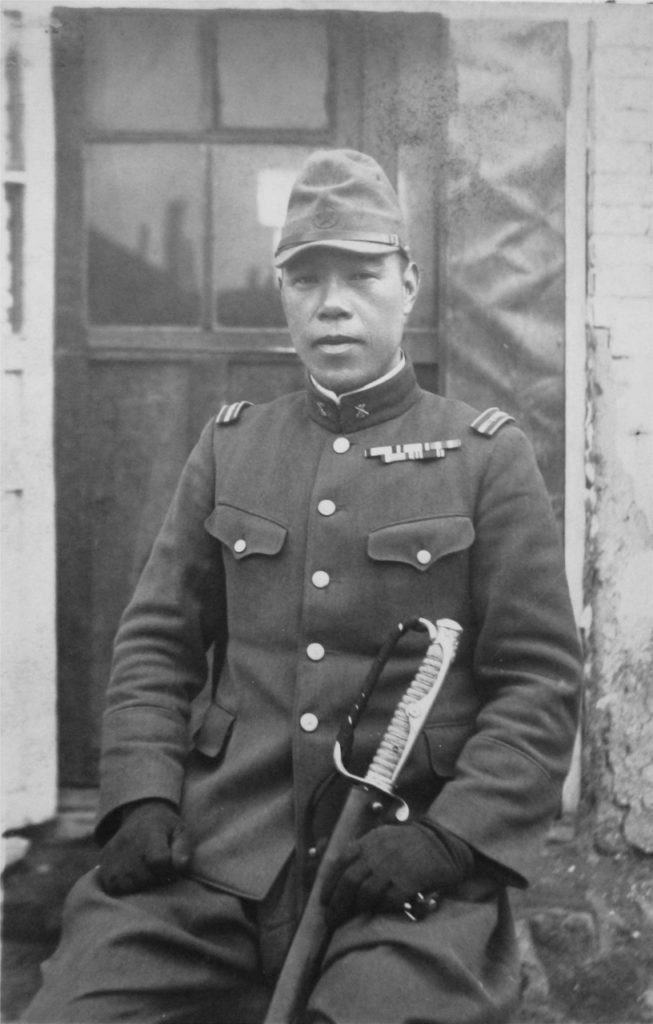
A Japanese first lieutenant in a 1930-31 uniform holds an 1886-style kyu-gunto sword mounting. Note the large “D” ring over the hilt. (Richard Fuller image)
However, by the 1930s Japanese military forces were rapidly expanding, and the leaders of the Japanese military organizations decided that all officers in the army and navy should carry a traditional Japanese sword to constantly remind them of their cultural heritage. This led to the development of a new style of sword mounting (koshirae), and also efforts to train new swordsmiths and ensure the new swords were made to traditional specifications and quality.
It was decided that all officers should carry a sword, and that meant that about 20 percent of army personnel and about half of navy personnel were eligible to carry swords. From the information provided by Yasukuni Shrine, this meant that around 2 million Japanese military personnel were eligible to wear swords. Some estimates from historical data suggest that about 2 million swords were produced in Japan from the 11th to the 19th century. This meant that the military wanted to produce almost as many swords in the 20th century as had been made in the previous 800 to 900 years.
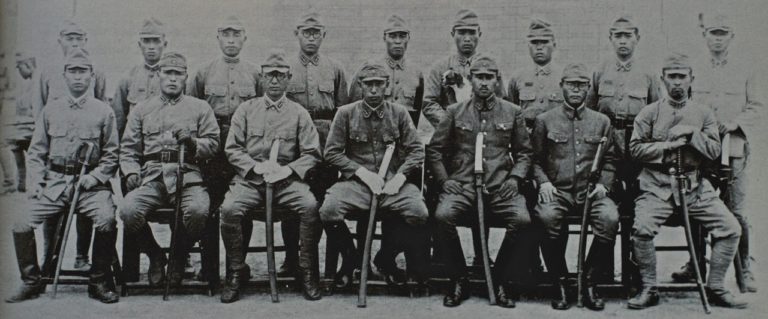
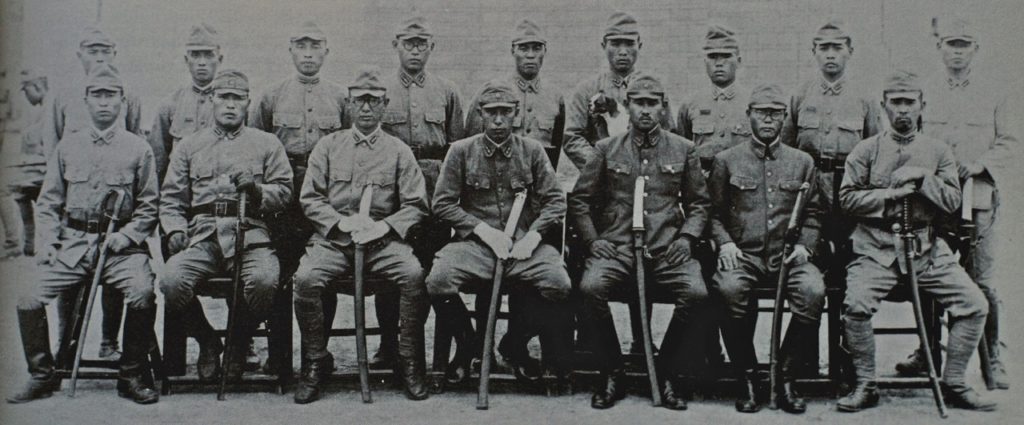
This photograph was taken in China in 1941. The Japanese soldiers in the front row all have swords in an array of different types and styles. (Richard Fuller image)
This was a very large number of swords to make, and there were not enough smiths or material available to make so many swords. It has been estimated that the town of Seki probably produced about 70 percent of the wartime swords, and the rest of the production took place all over Japan. With this scale of production, it was impossible that all swords could be made to strict historical standards. There simply were not enough smiths or enough of the traditional Japanese steel called tama hagane to do so.
JAPANESE SWORD STEELS
As a result, several types of swords were made during the period. The best ones were made from tama hagane and were fully traditional in terms of hamon and shape. Since there was a shortage of tama hagane and time, many swords were also made from puddled steel, a type of steel made in Europe during the late 1800s and early 1900s. Japan imported this type of steel for railroad rails. When the railroad tracks were replaced, the puddled steel was salvaged for use in swords. Apparently, there was a large supply of puddled steel, and it became the favorite substitute for tama hagane. The quality of the puddled steel was very good. In fact, the Eiffel Tower was also constructed from this type of steel.
The resulting swords have a visible jihada (surface pattern) and hamon, and were very hard to distinguish from tama hagane swords. Japanese military authorities were concerned about this, and, by 1940, a regulation was passed requiring that any Japanese sword not made from tama hagane must have a stamp on the tang indicating as much. Hence, from 1940 all swords had to be signed, and if they were not made from tama hagane there would be a stamp on the tang above the signature solely to indicate as much.
This is the tang and signature on a sword made in 1943 by Hiromitsu of Chikuzen in Kyushu. Note the star stamp above the signature and near the top of the tang. The stamp indicates the sword was made from a type of steel other than tama hagane. Various military contractors or forges used several different stamps. (Aram Compeau image)
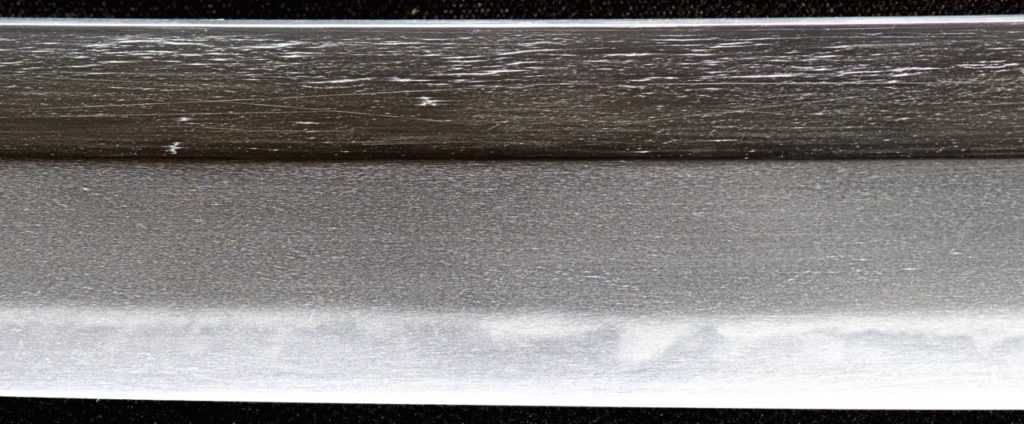
The swords made from puddled steel appear to be identical to tama hagane swords, but a high-quality polish can reveal differences in the surface and jihada. In addition, the hamon on puddled steel swords have characteristic differences from hamon on tama hagane swords, and it requires experience to recognize the differences.
This style of Japanese army sword and mounting was introduced about 1944. The mounting diverges from that of its predecessor in that the hilt wrapping is different, often there are two pins or a screw and a pin to secure the sword in the hilt, and the scabbard (not shown) is lacquered a matte shade of khaki or brown. (Aram Compeau image)
Other swords were made from foundry steel and have no jihada and often no hamon, either. Many are found in mounts or koshirae that are different from the standard World War II koshirae, and serial numbers may be stamped on the blade, or they appear to be modeled after European-style blades and mounts. The Japanese cavalry used many of these swords early in the 20th century, as did the police and civilian workers. The swords also were worn in parades or for formal occasions. In general, these other types of blades are easy to distinguish from traditional swords.
A sword by Masatsugu features a visible surface pattern or jihada on the blade. The thin white lines form the jihada, and the lines form short and somewhat discontinuous tracks on the surface. The blade probably is made from 19th-century puddled steel. (Aram Compeau image)
MOST IMPORTANT MAKERS OF MODERN JAPANESE SWORDS
The most important makers of modern Japanese swords were found in Seki, in the Nippon To Denshujo, and at Yasukuni Shrine. Yasukuni Shrine and the Nippon To Denshujo were in Tokyo, and there were other organizations located all around Japan. Yasukuni Shrine’s forging group was established in 1933 with the support of military officials, and all the smiths took names beginning with Yasu, such as Yasunori, Yasuoki, Yasutoku, Yasumitsu, etc. All of these swords are collectible and sought after today.
The Yasukuni smiths were among the most important makers of Japanese swords in the World War II era. Among them was Takeshita Yasukuni, maker of this sword in Hokaido in 1943. It is large, heavy and long (27 inches long) for the period and has a complex hamon. This smith’s swords appear in civilian or non-military mountings as well as military ones. The large size and style of some of his swords resemble work from the 15th century. (Aram Compeau image)
The Yasukuni smiths were expected to make everything by hand in a completely traditional manner and with no power tools. Ideally, one smith working with two assistants or hammer men (sakite) was expected to produce between 10 and 15 swords a month. Yasukuni swords were unique in one other interesting respect: the smiths were asked to model their work after specific blades made by Mitsutada of Bizen Province from around the mid-1200s. Thus, most of their work followed a consistent pattern, and Yasukuni swords are usually recognizable today by their shape, hamon and general style.
Next time, in the conclusion: Such great Japanese swordsmiths as Kurihara Akihide, Yoshihara Kuniie, Kasama Shigetsugu and others, the role of Seki city, the Manchurian Railway Co., war-era koshirae, Japanese army and navy swords, Japanese swords as war souvenirs and more.
GLOSSARY of JAPANESE SWORD TERMS
Hamon—temper line Jihada—blade surface pattern Koshirae—sword mounting
Puddled steel—steel from railroad rails used to make Japanese sword blades Sakite—swordsmith’s assistants or hammer men Tama hagane—traditional steel for Japanese sword blades
Herb Drury was my wife’s uncle, a World War II veteran and a friend. He passed away in 2007. I miss him and the discussions we used to have. I guess I was one of only a couple of people he talked to about his time in World War II. He served in the Pacific Theater on Attu Island in Alaska and in the Philippines. The thing I noticed was he always went to Attu. For some reason the place haunted him and was still fresh in his memory after 60 years.
Uncle Herb was a tall, thin man with mild mannerisms. As he told me about the battle of Attu, it was hard to picture him there. It was even harder to visualize this kind and gentle man hurting anyone.
He was trained for desert fighting in Africa. As part of the U.S. 7th Infantry Division, he was sent to Attu Island. They had no winter gear. The Army thought the heavy gear would slow the men down. Even though it was May, the arctic weather was below freezing. He told me of men burning the wooden stocks of their rifles trying to stay warm. He said it was a pretty easy landing and they thought maybe the Japanese had left. It wasn’t long before they discovered the Japanese were still there.
He talked about the banzai attack. He could not comprehend that the Japanese were so willing to die. He said that after the attack, “We walked around and looked at the damage. The men in the hospital tent had been killed in their beds.” He told me the Japanese soldiers, before allowing themselves to be taken prisoner, would gather in a circle and hold grenades to their chest to commit suicide. He said he came upon a wounded Japanese soldier. “I just emptied my gun into him,” he recalled. It was hard to picture this soft-spoken, gentle man doing this.
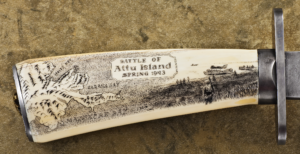
Andy Sharpe’s Uncle Herb and his fellow soldiers enjoy a lighter moment on Attu. Sharpe and ABS journeyman smith A.C. “Chuck” Richards collaborated on the Project Attu Knife in their and their fellow comrades’ honor. The scrimmed Attu Island scene is by Richard “Hutch” Hutchings. (SharpByCoop knife photo)
After he passed away I thought of him often, and when I thought of him I thought of Attu. I wanted to do something in his memory. As a knifemaker it only made sense that I make a knife. It had to be special. Then it came to me: Use artifacts from Attu. And so the research began.
I searched the Internet for weeks trying to find all I could about Attu Island. I discovered that the only people on the island were 22 members of the U.S. Coast Guard. I did find an article about the Coast Guard’s Attu Station that listed the phone numbers for the commander. I called the number and I talked with Commander Robert Coyle for about an hour. He told me he had just what I needed—an exploded artillery shell and assorted shell casings that had been found on the Coast Guard station. Problem was, no items could be removed from the island. The island is a National Historic Landmark and game preserve with a no-stone-turned policy and is under the control of the Alaska Fish and Game Department. I would need the department’s permission to remove the artifacts. He also gave me the name and contact information of other informed sources.
After three months of paperwork and waiting, I received permission to remove the artifacts from the island, with the stipulation that only one knife would be made and all the remaining materials be returned to Attu. I could receive items found only on the inside of the boundaries of the Coast Guard station. Commander Coyle boxed up the items and shipped them to me.
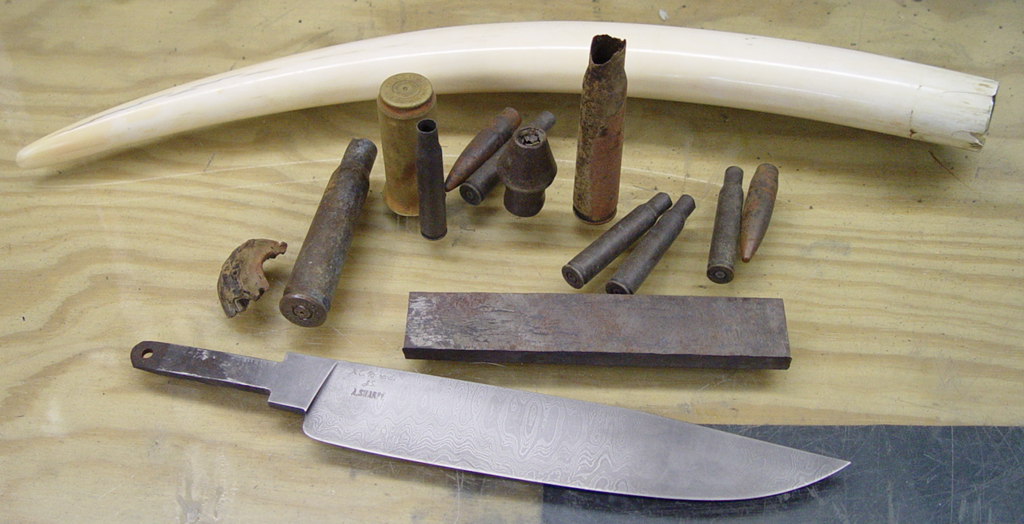
When the box arrived I was in awe. This was not just a bunch of scrap metal; this was a box of history. These are possibly the only documented artifacts from Attu Island in private hands:
PROJECT ATTU
I really began to start doubting my skills as a knifemaker. I was on the Knife Network Website and posted my story. ABS journeyman smith Chuck Richards expressed a great desire to be part of the project.
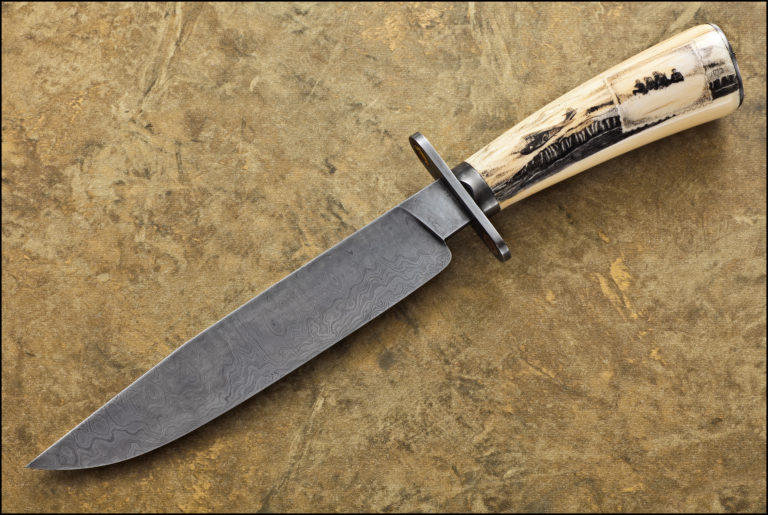
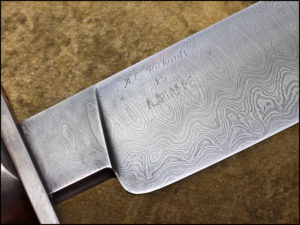
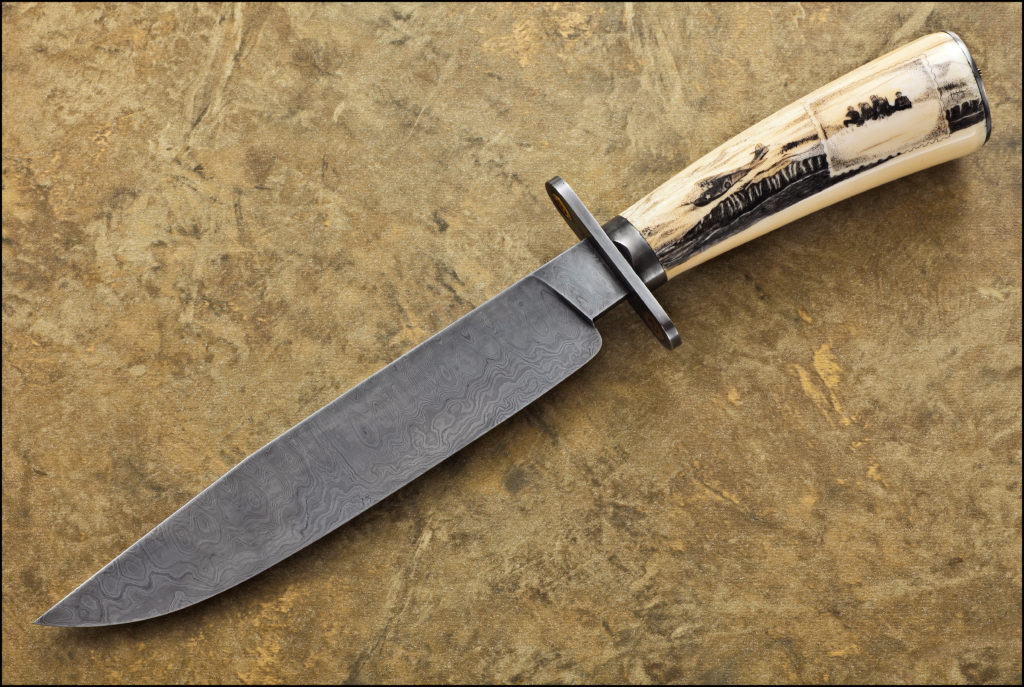
Chuck and I decided to collaborate on a simple knife design. He did his magic—a 9-inch bowie-style fighter of 575-layer ladder-pattern damascus. He forged the steel from an exploded artillery shell, a piece of spring from an abandoned truck on Attu and some 15n20 for contrast. The steel had a lot of waste due to micro cracks in the shell and corrosion from 60-plus years of exposure to the Alaskan weather.
An ABS journeyman smith, Chuck Richards forged the blade from World War II artifacts from Attu, including an exploded artillery shell, a piece of spring from an abandoned truck and some 15n20 for contrast. The steel had a lot of waste due to micro cracks in the shell and corrosion from 60-plus years of exposure to the Alaskan weather. (SharpByCoop knife photo)
We discussed the project and the weird feeling we would get while working with these materials. To make a knife is one thing—to make one from materials that cannot be replaced and if we messed it up it could not be redone is another. I think Chuck’s stress level maxed out. I cannot say enough about the artistry he brought to the project.
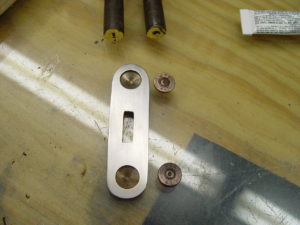
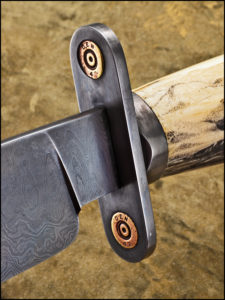
Now the knife was in my hands. How could I do justice to the beautiful blade? “Keep it simple” kept running through my brain. I decided on a basic flat guard made from a piece of the artillery shell. I had several M1 shell casings marked “42” for 1942—the military dates its ammunition—from Attu Island. I cut the base off the shells and set them in the front of the guard.
Above: Keeping it simple, Sharpe made the basic flat guard from a piece of an Attu artillery shell. He cut the base off two M1 shells the military had marked “42” for 1942 and set them in the front of the guard. (SharpByCoop.com knife photo)
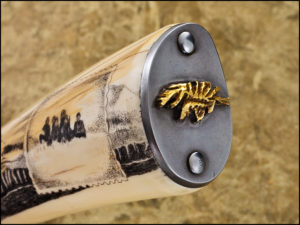
The handle was easy. I had an ancient ivory walrus tusk I bought in Alaska in the mid-1970s. I never knew why I had kept it all these years but now I did. This is where it belonged. I made the ferrule and buttcap from pieces of artillery shell and cut the tusk to fill the void. I kept the tusk’s natural shape as much as possible.
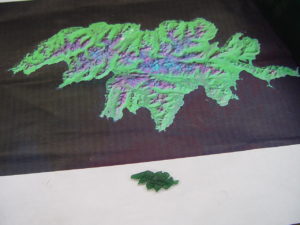
I took the M1 shells I had cut the base from and melted down the brass. I did a sand cast of Attu Island from the brass and used it as the centerpiece for the buttcap. A light etching for character and I was done.
Attu Island
The Buttcap (SharpByCoop.com knife photo)
Above: Sharpe did a sand cast of Attu Island from the brass melted down from the M1 shells and used it as the centerpiece for the buttcap.
Jim Cooper of SharpByCoop.com volunteered to do a photo shoot of the knife. His work really brought out the knife’s details:
Sharpe used an ancient walrus ivory tusk he already had on hand. Richard (Hutch) Hutchings volunteered to scrimshaw the handle.
Allen Hutton donated his time and wood skills to make the display stand. He used the wood shipped from Alaska and California to build the structures to sustain the men fighting on Attu. (There are no trees on Attu Island.) His work is simply amazing.
They decided to raffle the knife off with 100 percent of the proceeds going to the World War II Memorial Fund. We donated the funds not from those of us who worked on the project but on behalf of Herbert Reginald Drury—Uncle Herb—and all the men who fought and those who died on this all but forgotten Island.
The final outcome.
More on the Battle of Attu
The westernmost and largest island in the Near Island group of the Aleutian Islands of Alaska, Attu was the site of the only World War II land battle fought on an incorporated U.S. territory.
Japanese forces occupied Attu, home to a few native Aleuts, in June 1942. On May 11, 1943, a U.S. invasion force that included scouts recruited from Alaska nicknamed Castner’s Cutthroats set out to recapture the island. Frigid weather seriously hampered the invasion, with many GIs suffering frostbite. Rather than contest the landing, the Japanese dug in on the island’s high ground. Heavy fighting resulted in 3,929 U.S. casualties, including 580 killed.
On May 29, the last of the Japanese forces attacked without warning in one of the largest banzai charges of the Pacific campaign, penetrating the rear echelon of the American lines. After brutal hand-to-hand combat, the Japanese force was basically eliminated. Enemy dead numbered 2,351, though hundreds more were thought to have been buried during bombardments. Only 28 of the Japanese survived.