Knife History

The history of knives and other edged instruments is tied to the history of people in general. As humankind’s oldest tool, unraveling knife history can lead to even more surprising and enriching information to better understand the world.

9-11 Knives: Custom Memorials To The Tragic Day

The atrocity that shocked the world continues to transform it, and knives, too. Here is a look at some of the memorials 9-11 spawned from that fateful day.

It began as an ordinary Tuesday. It ended with the world changed forever.

The atrocity of the terrorist attacks at 8:45 a.m. EDT on Sept. 11, 2001, will never be forgotten. Now, 20 years after planes crashed into the World Trade Center in New York, the Pentagon in Washington, D.C., and a field in Shanksville, Pennsylvania, retrospect brings not only memories of sadness and profound loss, but also an acknowledgment of the heroism of 9-11 and the humanity that emerged.

A measure of that humanity took the form of custom knives made from the twisted and scarred steel of the World Trade Center (WTC) buildings—forged once in the conflagration of that terrible day and then again in tribute to lives lost, and for the benefit of those who miss them and live on.
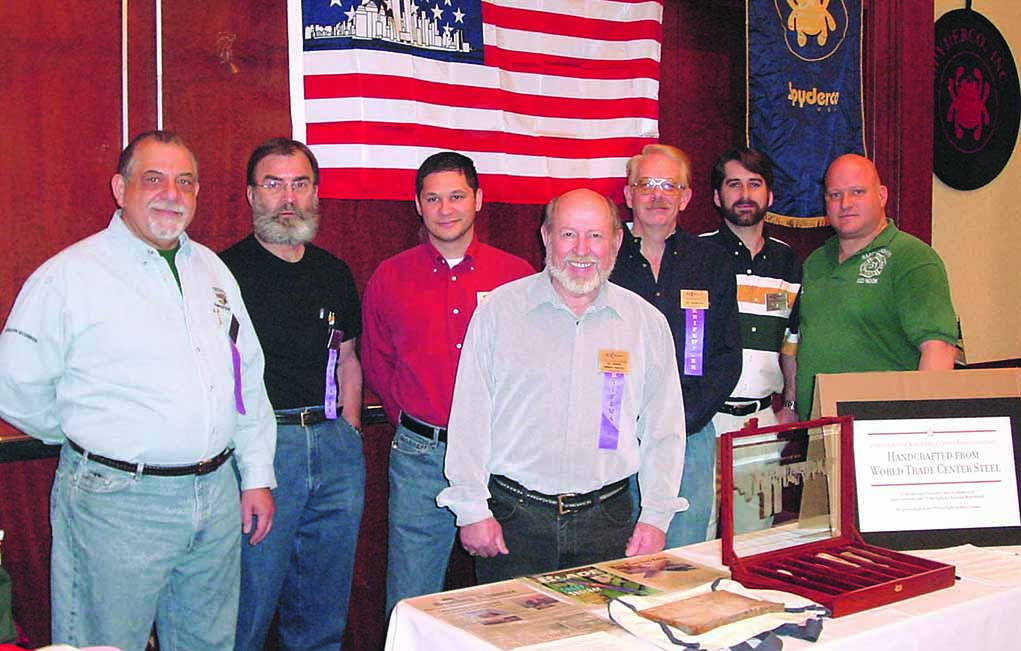
 Keith Kaiser (right) was in Ladder Company 131 of the New York City Fire Department that reported to the World Trade Center on 9/11. In 2003 he enlisted several leading makers to produce knives with blades made from WTC steel. Those makers, with the exception of Mel Pardue, from left are: Bob Terzuola, Bob Dozier, Allen Elishewitz, Gil Hibben, and Pat and Wes Crawford.
Keith Kaiser (right) was in Ladder Company 131 of the New York City Fire Department that reported to the World Trade Center on 9/11. In 2003 he enlisted several leading makers to produce knives with blades made from WTC steel. Those makers, with the exception of Mel Pardue, from left are: Bob Terzuola, Bob Dozier, Allen Elishewitz, Gil Hibben, and Pat and Wes Crawford. (Eric Eggly/PointSeven image)

Ladder Company 131 (L131) and Engine Company 279 (E279) of the New York City Fire Department (FDNY) were housed in the Red Hook section of Brooklyn on 9-11. Keith Kaiser was a member of L131. Moved later to enlist the support of several custom makers to produce knives with blades made from WTC steel, Keith remembers the horrific day vividly.

“Because of the proximity to lower Manhattan, both companies started to gear up,” he recalled. “As we were approaching the tunnel into lower Manhattan, we saw the second plane hit the south tower. The engine company went into the buildings first, and the ladder company soon followed. L131 was in the lobby of the hotel on the ground floor of the south tower when it fell. We breached a wall and got out a group of civilians before we realized what was going on. The engine company was never found.”

Five members of E279 were killed, and the FDNY lost 343 firefighters in all. Since then, according to Kaiser, nearly as many have died from 9-11-related cancer and other illnesses. His older brother, Wayne Kaiser, an electrician who worked to restore communications in the wake of the terrorist attack, recently died of illness due to extended exposure to toxic dust and debris.

Keith was seriously injured on 9-11. “Oddly enough, my getting injured probably saved my life because I was not able to dig in the pile subsequently,” he said. “I was looking for something to occupy my mind and time, and one of the men lost from my company, Christian Regenhard, was a knife collector. I thought I would try to get my hands on some steel and get knives made out of it for charity and to keep me involved.”

Early efforts to get the project started were difficult, but Kaiser persisted. Eventually, he contacted several of the biggest names in custom knives and secured their commitment to contribute to a benefit for the New York Firefighters Burn Center Foundation. Bob Terzuola, Bob Dozier, Jerry Fisk, Pat and Wes Crawford, Allen Elishewitz, and BLADE Magazine Cutlery Hall-Of-Fame® members Gil Hibben and Mel Pardue made one knife each with blades incorporating steel from the fallen twin towers (page 90, August 2003 BLADE®).
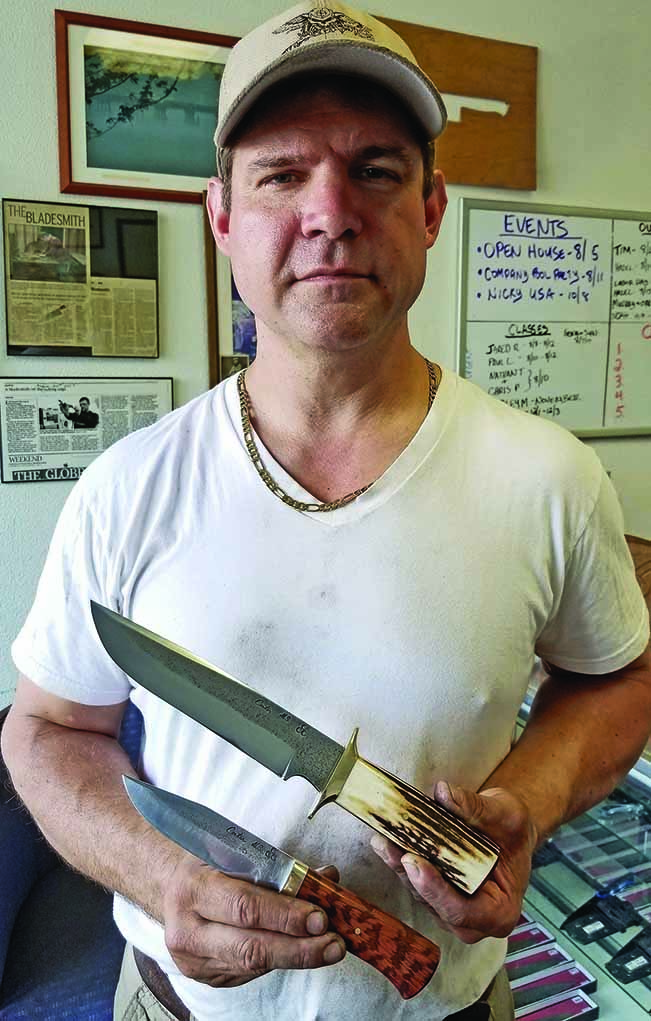
 Murray Carter holds the last two knives he made of WTC steel as part of a special fundraising project that included FDNY343 (fdny343.org) and Building Homes For Heroes
Murray Carter holds the last two knives he made of WTC steel as part of a special fundraising project that included FDNY343 (fdny343.org) and Building Homes For Heroes (buildinghomesforheroes.org). (Murray Carter image)

“It was planned with the help of Christian’s father, who was a New York City police detective,” Terzuola said. “Seven knifemakers, including myself, volunteered their time and materials. Keith presented the idea to us and offered to supply a piece of steel from the wreckage of the fallen towers to each knifemaker, from which they could make a knife of their choosing.”

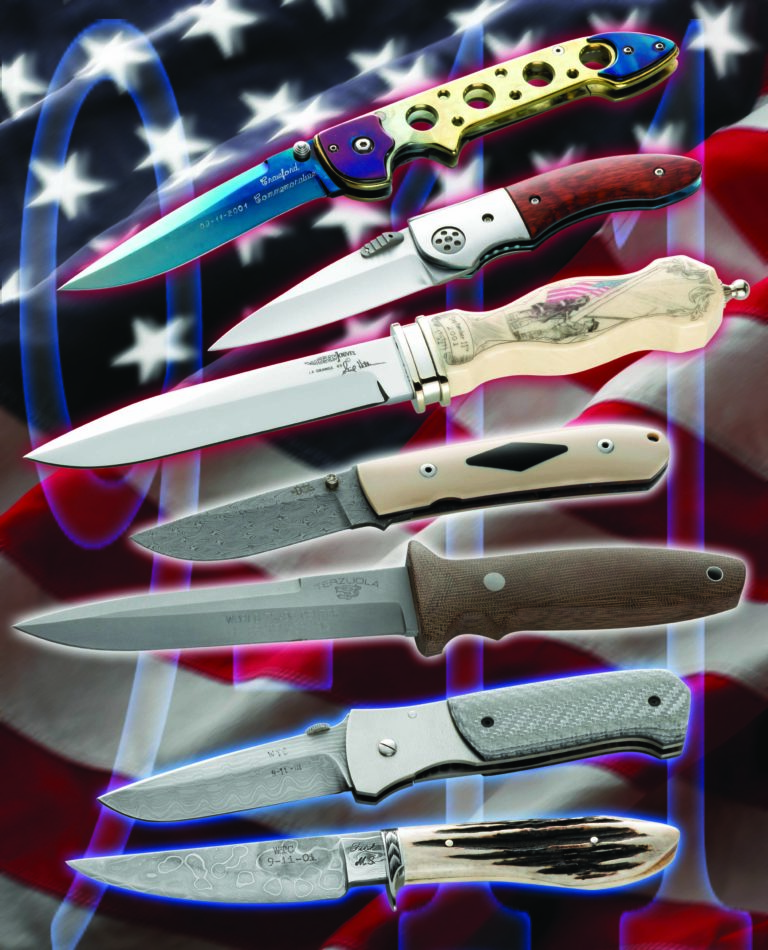
The knives included signature works: a Dozier damascus folder; an Elishewitz folder; a CQB from Terzuola; a Hibben dagger with scrimshaw handle; a skeletonized folder from the Crawfords; a damascus folder from Pardue; and a damascus stag Sendero hunter from Fisk.

The task brought the added challenge of making the Trade Center steel usable for knife blades. “It was low carbon structural steel,” Dozier related, “and I asked Daryl Meier to make damascus for me. At the first show after 9-11, Keith brought some steel to me and wanted me to make a knife with it. I wouldn’t take it. A friend of mine who was a state police investigator here in Arkansas said to leave it alone because it was evidence. Then about a month later, a big cardboard box came in the mail and there was the steel. I cut it into pieces and Daryl made some ladder-pattern damascus.”

Once the knives were gathered, they became tangible remembrances. “They were placed in a beautiful cocobolo box with a beveled glass top that was etched with the World Trade Center,” Terzuola commented. “The idea then was to put them up for auction for the benefit of the burn center. Keith sent them around to various museums prior to the auction, and after several years they almost became permanent exhibits in some places.”

Keith reached out again to Terzuola, who helped arrange an auction, and the set sold in June 2020 with the proceeds benefiting the hospital. “Keith sent me the knives, and I cleaned them up and got hold of Rock Island Auction in Illinois, one of the top auction houses for knives and firearms,” Bob states. “They did a beautiful two-page spread in their catalog and after the auction sent a check directly to the burn center.”

Murry Carter Knives 9-11 Custom

Like so many others, the atrocity of 9-11 touched custom knifemaker Murray Carter significantly. He was asked to partner with FDNY343, an organization of retired New York firefighters dedicated to keeping the memory of those lost on 9-11 alive, and Building Homes for Heroes, a charitable enterprise that provides homes for those injured while serving their country and in the 9-11 attacks.
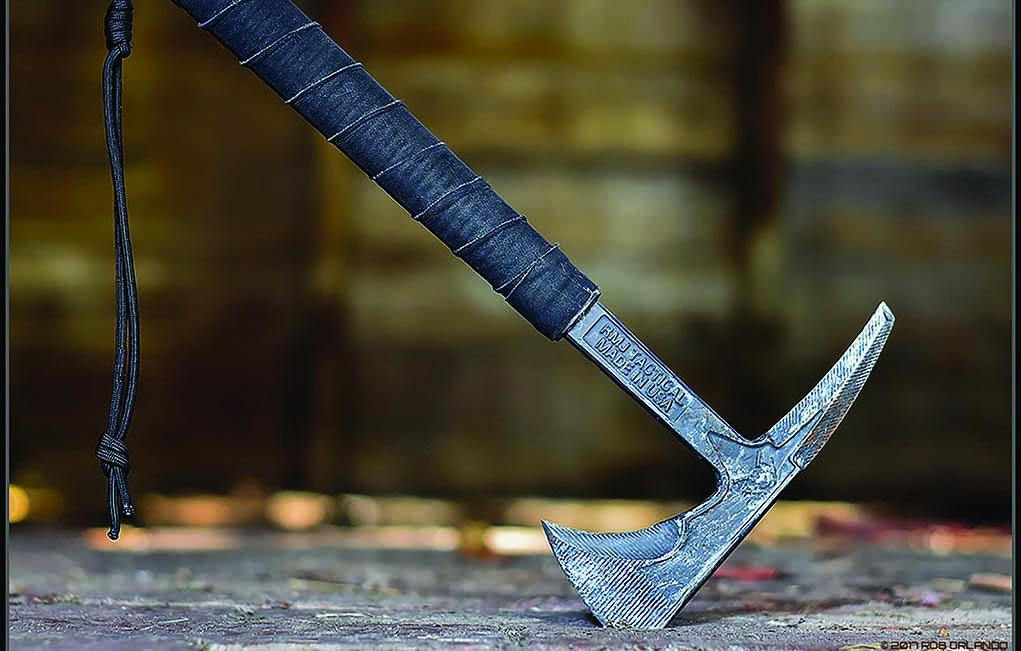
Ryan Johnson was just starting up his RMJ Tactical when 9-11 shook the world. The U.S. military was looking for something that would punch through body armor and the RMJ Eagle Talon hawk, featured on the cover of the March 2002 BLADE®, filled the bill. RMJ Tactical took off and is one of today’s leading hawk makers with such models as the Shrike.

Carter has produced several kitchen and outdoor knives, each incorporating a laminate of Trade Center steel with a 1084 carbon steel core. The motivation to produce the knives was strong, and Murray notes that the components of fire, water and stone were present both in the 9-11 incidents and the making of the knives. He reasons that fire enabled the forge, water quenched the blades and stone honed them into tools. Conversely, fire brought the towers down, water hampered rescue efforts, and lives were lost in the crush of stone.

“So, the same elements are here in the knives, and they bless people daily,” Murray explained. “When iron is red hot, that’s how we get steel, and some of the victims were burned, the elements fused in a chemical trade. The depth of the fusion was dependent on time and it was brief. So, I didn’t want to do much grinding in order to leave these elements in the surface of the steel.”

One of Carter’s kitchen knives was auctioned for $10,500 and the proceeds were given directly to Homes for Heroes. He calls the effort, concluded in the spring and autumn of 2017, an honor and one of the most humbling tasks of his long knifemaking career.

RMJ Tactical 9-11 Spike Hawk

Ryan Johnson was just starting up his Chattanooga, Tennessee-based RMJ Tactical when 9-11 shook the world. He had always been interested in tomahawks, and was making pipe and spike hawks before that desperate day. Then, things changed quickly.

“I had made a spike hawk and a gentleman saw one of them on my website,” Ryan remembered. “He was with Air Force security forces and said, ‘We’ve got some guys securing air strips, and we’re looking for something that will punch through body armor.’ He said my French-and-Indian-War-style hawk looked perfect for the job.”
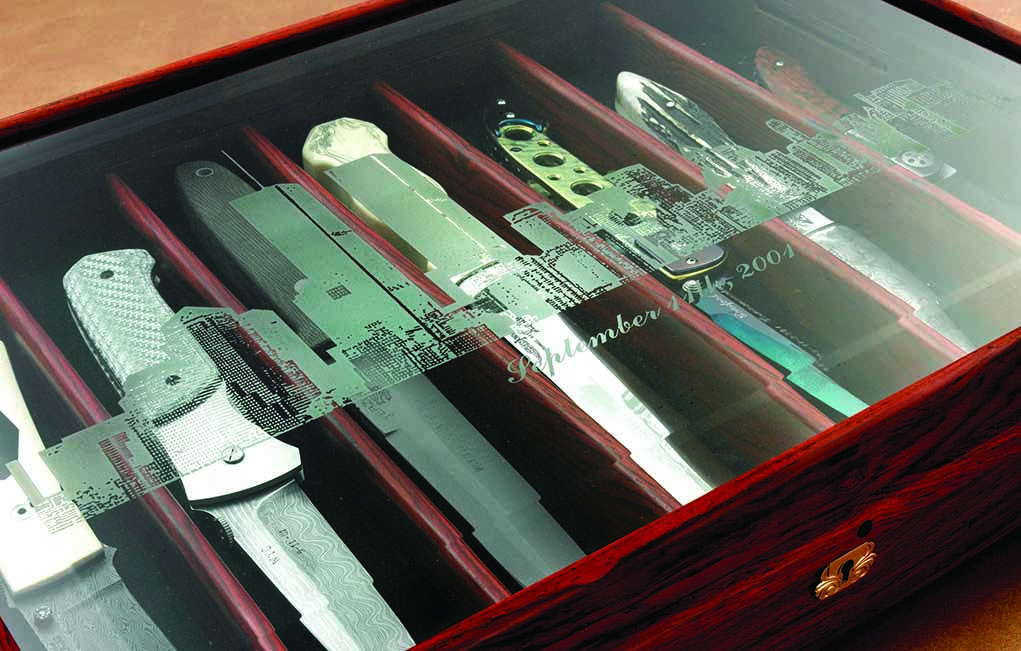
The seven knives from Keith Kaiser’s 9/11 memorial project were placed in a beautiful cocobolo box with a beveled glass top etched with the World Trade Center.
The seven knives from Keith Kaiser’s 9/11 memorial project were placed in a beautiful cocobolo box with a beveled glass top etched with the World Trade Center. (Eric Eggly/PointSeven images)

The first shipment of five spike hawks had just gone out before 9-11. “The same guy called me up and he was already in the Gulf,” Ryan said. “He said to get busy making these things because they would be big.”

Like lightning, the demand for hawks soared—not only with the catalyst of 9-11, but also with the wars in Iraq and Afghanistan that followed. “I received a call from a gentleman working as an attaché to Donald Rumsfeld [Secretary of Defense] and made him a hawk. He sent me a picture back of him in his office at the Pentagon with a letter that said when the planes hit the towers, all the brass in the Pentagon were out in the hallway in front of his office passing that hawk around. A few moments later, a plane hit the Pentagon. Just before that happened, an admiral had walked by and said, ‘This war will be fought by hawks at the ends of the hands of soldiers.’”

A short time later, a story on Ryan’s hawks appeared in the Chattanooga newspaper and was picked up by the Associated Press, ultimately appearing in countless media outlets. “The article was on making hawks for the military,” Johnson recalled, “and before long Green Beret units were getting in touch with me and asking why they weren’t getting hawks. When you look back at the early days of the wars, Task Force Dagger included the first 300 special forces and others into Afghanistan. We had hawks going in with them.”

Orders kept coming, and civilian deliveries were postponed to fill the demand from the military as RMJ Tactical got started. Twenty-five Eagle Talon hawks went to Marines in the town of Najaf, Iraq, just before the battle for control of the city of Fallujah.

“I got a phone call concerning those 25 hawks,” commented Ryan, “and it was from the wife of a Marine officer. She said there was a plane leaving that night with room aboard for the shipment if we could get it ready. I called my friend Richard Carmack and knew his kids might have the time to help wrap the handles if I could provide the pizza and a movie. Now, Richard makes sure things run right here, his son Jonathan is our production manager and I’m still working in design.”

Conclusion

The atrocity of 9-11 and the lengthy conflicts that emanated from it continue to echo through the lives of every American. Remembrance is tinged with vigilance and the pledge to never forget the sacrifices of those lost.
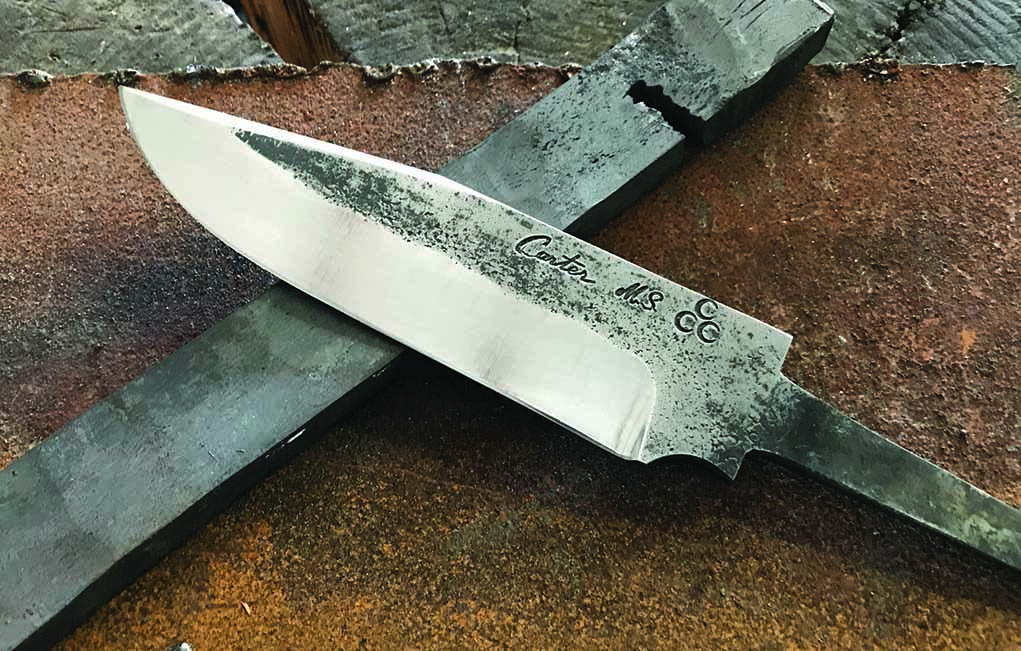
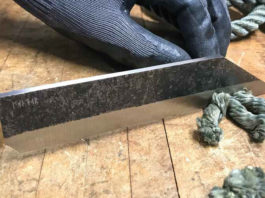
 Here are the beginning (bottom level), middle (mid-level bar of steel) and end products (top level) Murray Carter used to forge weld World Trade Center iron into a usable blade with a 1084 core. The blade is water-quenched for maximum sharpness and edge retention, and the blade surface still retains the soul-infused character of the WTC steel.
Here are the beginning (bottom level), middle (mid-level bar of steel) and end products (top level) Murray Carter used to forge weld World Trade Center iron into a usable blade with a 1084 core. The blade is water-quenched for maximum sharpness and edge retention, and the blade surface still retains the soul-infused character of the WTC steel. (Murray Carter image)

Though nothing is for sure at this time, there may yet be other knives produced with the venerated World Trade Center steel. Terzuola still has a small amount of the steel but probably not enough for another knife blade. He is considering a knife with Trade Center steel bolsters and G.L. Hansen Micarta® that includes a thin blue line in its composition. Proceeds from the sale of such a knife would go to benefit a law enforcement officers relief fund.
50 Years Ago In BLADE: Buster Warenski

BLADE Magazine Cutlery Hall-of-Fame® member Buster Warenski was the subject of an extensive six-page profile a half century ago in the January/February 1976 issue of The American Blade. He was larger than life then and would get even larger in the years to come.

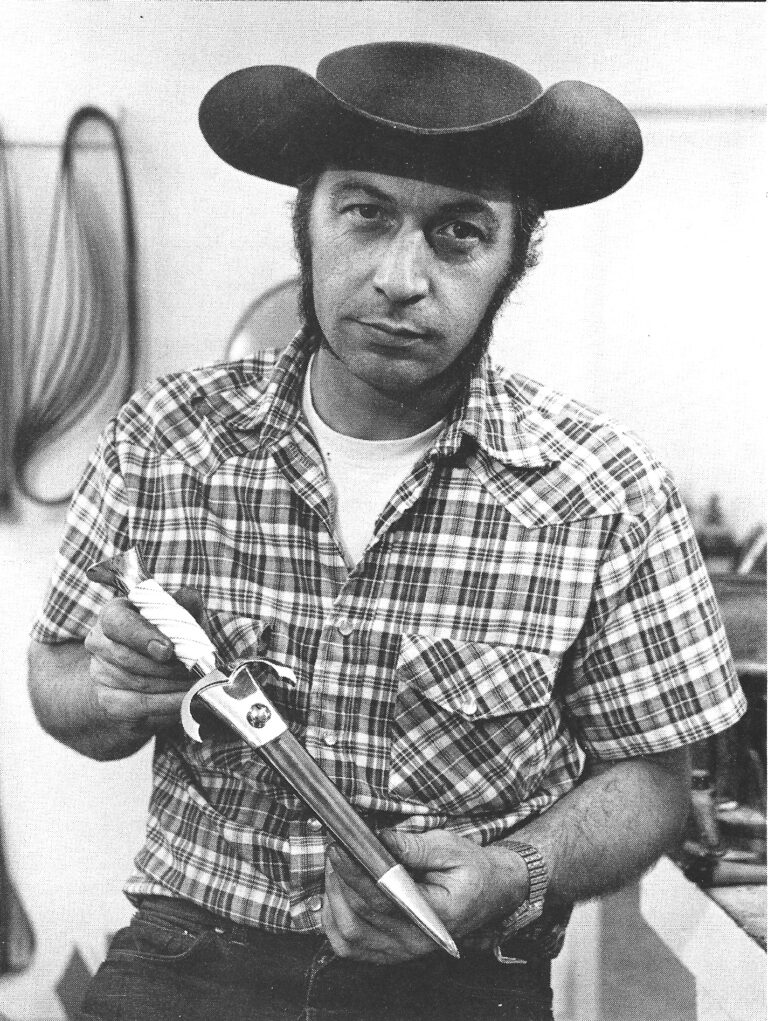
Unmistakable in the low-crowned Stetson and mutton-chop sideburns he wore back then, Buster was interviewed in his new Richfield, Utah, knife shop by then editor L.V. Baker. Richard Barney, co-author with Cutlery Hall-of-Famer Bob Loveless of the landmark How To Make Knives book, was along to take photos. The lead image of Buster holding one of his latest knives at the time is about as iconic as it gets.

Done about half a decade before Buster would go on to make his reproduction of the King Tut Dagger, the story and spread reflect how consequential Buster was to the handmade knife movement of the 1970s. It covers from his early influences, including Harvey Draper and Cutlery Hall-of-Famers Gil Hibben and Bo Randall, the first two knives Warenski ever sold, some invaluable magazine publicity from Cutlery Hall-of-Famer B. R. Hughes, Buster’s first Guild Show in 1973 and his position on the Guild Board of Directors at the time of the interview.

One of Buster’s best quotes: “I think the industry is going to get bigger and better, just as our customers and collectors are going to become better educated about the knives they buy and are going to demand a better product.”

Buster was right, of course—and would be among the vanguard of makers to supply the knives for which he predicted there would one day be such great demand.

More Knife History:

Samurai Chef’s Knives

Few Knives Have Been As Heavily Influenced By Japanese Methods As The Chef’s Knife. These Four Quality Blades Show Off The Modern Meeting The Historic.

The Japanese influence on custom knives is everpresent in the marketplace, and, aside from the tanto, nowhere is its flair and focus felt more than with chef’s knives. 

These tools of the culinary trade are functional as much as they are eye-catching, especially in examples of some of the top makers in the genre today.

Honyaki Byuto Hybrid By Dmitriy Popov

Popov Gyuto hybrid
Dmitriy Popov aligned the tip with the spine on his wide-bevel Honyaki Gyuto Hybrid for enhanced control during jobs requiring precise use of the tip. (SharpByCoop knife image)

Dmitriy Popov has conjured up a masterpiece he calls the wide-bevel Honyaki Gyuto Hybrid, a new take on a recognized Japanese style. 

“It isn’t a traditional gyuto, as it has an upswept tip and the height of a nakiri,” he commented. “Having the tip aligned with the spine of the knife gives the user a feeling of control for precise tasks requiring use of the tip. Having the extra height in the heel allows me to create a knife that is super thin behind the edge while also having a significant amount of mass above it.”

Popov’s creation includes a near 9.5-inch blade of differentially heat treated W2 tool steel and a handle combination of desert ironwood and osage orange complemented by a carbon fiber liner. His prices for similar knives range from $900 to $2,500 based on size and materials.

“The hamon and ashi* I am able to get out of the W2 is mesmerizing,” Dimitriy added, “and I spend a large part of my life going deep down the hamon rabbit hole. Honyakis are part art and part science, and the failure rate is a lot higher than I would like it to be. I really like the minimalist wa handle style [see page 14], and rounding off the bottom facet does not alter the traditional design much, while making the handle more comfortable in the hand.”

Having made knives since 2011, Dmitriy looks back at the beginning in everyday carry, tactical and camp models. After three years, he gravitated toward chef’s knives, and since 2016 they have been his sole focus.

“Everyone cooks, and at some point most cooks or chefs will come to appreciate the benefits of a good quality knife,” he observed of a chef’s knife field that has become quite crowded. “There are way more prospective customers than there are makers, so to succeed as a maker all you need is a very small slither of the pie and a drive to evolve your craft each day.”

Santoku-Style Knife By Eric Hemker

Hemker santoku
The long, nearly flat cutting edge of the damascus santoku by Eric Hemker enables it to slice, dice, and mince vegetables much easier than a blade with a sweeping belly. (SharpByCoop knife image)

While Eric Hemker admits he is still learning some subtleties of making chef’s knives, he has found that the santoku style is excellent for use in final food preparation. 

His custom-ordered version sports an 8-inch blade of random-pattern damascus forged from 1084 carbon and 15N20 nickel-alloy steels. The overall length is 14 inches, and the handle is exotic blue-dyed curly mango. His price for a similar knife is $960.

“The lack of a pointed tip on the blade means it is not well suited for delicate carving work such as breaking down bony proteins,” Eric explained. “However, its long and nearly flat cutting edge allows it to slice, dice and mince vegetables and proteins much easier than a knife with a sweeping belly on the cutting edge.”

Translating literally from the Japanese, santoku means “three virtues, or three uses,” and so the slicing, dicing, and mincing description is spot on. 

“This blade is 144-layer random-pattern damascus, and it features a full flat grind with a convex edge. The flat grind is my usual go-to grind for most general-purpose cutting needs that are common in the kitchen or in hunting-type knives. I also add a slight convex grind that leads into the cutting edge to aid in food release.”

Eric chose a modified wa handle configuration and attributes the decision to keeping step with traditional Japanese appeal. 

“The top of the handle has the traditional wa-style octagonal facets,” he said. “But I wanted to spruce this handle up a little to challenge myself, so the bottom is curved to give it a shield-shaped cross-section. The handle has a 304 stainless steel bolster and an heirloom-fit black G-10 spacer. One of the only things the customer specified was a colorful handle, so this piece of wood was a perfect fit.”

For Eric, the entire package comes together nicely, blending the good looks and function that are inherent in Japanese-inspired chef’s knives. 

“All these materials will hold up well in kitchens,” he remarked. “G-10 is a synthetic material that also holds up very well in any harsh environment, and since the wood is stabilized it should also hold up well in water and getting dirty in general. Since the handle is wood, it would still need to be oiled occasionally, and it should go without saying that a custom piece like this with a carbon steel blade and a wood handle should never go in the dishwasher.”

Eric began making knives six years ago and still considers himself at the beginning of a promising journey. 

“Kitchen knives have been some of my favorite knives to make from the beginning because everyone uses one,” he noted, “so they are some of the easiest pieces to sell and get feedback on.”

Meanwhile, he welcomes the expanding number of makers and buyers in the chef’s knife arena. 

“I don’t believe the custom chef’s knife market is overly saturated by any means,” he commented. “I think the demand really drives the market for these custom pieces, and I believe there will almost always be customers at every price point. In the last decade or so, there really has been a resurgence of demand for well-crafted handmade goods in almost every category of consumer goods, and I don’t believe that trend is going to be dying out anytime soon. This may be especially true for culinary knives when food is such a big part of many people’s lives.”

Straight-Edge Kiritsuke By Dre Laborde

kiritsuke by Laborde
The straight-edge damascus kiritsuke by Dre Laborde is specifically made to slice fish and some softer meats. The handle is curly maple from Realeyezwoodz. The sheath is stabilized maple and a joint project between Dre and Realeyezwoods. (SharpByCoop knife image)

The straight-edge kiritsuke from Dre Laborde is specifically made to slice fish and some softer meats, he says, and doesn’t necessarily lend itself to chopping vegetables. 

“I’m no expert on Japanese knives as a whole,” he noted, “but from what I can find the kiritsuke seems to be a cross between the longer yanagiba and the stockier gyuto. The steel is X-pattern-ladder damascus that I purchased from MVH Damast based in the Netherlands. These steels have given me nothing but positive results and I can’t recommend them enough.”

The blade is 9.5 inches and the overall length is 14.5 inches. The handle is curly maple from

Realeyezwoodz, and the price of a similar knife would probably exceed the featured piece. 

“It sold for $760,” explained Dre, “but it was a semi-experimental project for me, so a future project of this scale would cost more. The design, like all my knives, was drawn on paper to scale first and then made with the freedom to change the design as I see fit.”

The choice of handle material and design contributed to the overall appeal of the knife and its performance in the kitchen. 

“The wood is stabilized, which means it was put under vacuum in a resin and hardened,” said Laborde. “This makes it resistant to water and to staining. The handle design is a slight variation on the common shape I do, made slightly longer to fit the length of the knife.”

Dre has been making knives for about three years and in that time hasn’t seen the chef’s knife market becoming overcrowded, though he has heard such comments. “Those willing to pay for a custom chef’s knife often have many and recognize the price tag that comes with them,” he added.

Haetori Honesuki By Tony Cetani

Haetori Honesuki by Tony Cetani
The Haetori Honesuki by Tony Cetani is an all-around kitchen utility knife design based on the santoku and honesuki, the latter a Japanese boning knife. Whereas a traditional honesuki’s main task is for deboning poultry, Tony made the Haetori Honesuki to handle multiple kitchen jobs.

When Tony Cetani built his Haetori Honesuki with a 5.5-inch blade of Chevron copper-mai steel and an 80CrV2 core from Baker Forge and Tool, he added a handle of spalted box elder to complete the package and priced it at $1,000.

“Haetori means ‘jumping spider’ in Japanese,” he related, “and following my love for spiders this knife is named for the Haetori Gumo, a very common spider in Japan. It’s an all-around kitchen utility knife, and I based the design on the santoku and honesuki. Whereas a traditional honesuki’s main task is for deboning poultry, I made this to handle multiple tasks around the kitchen.”

Tony has been making knives since 2017 and tried chef’s knives for the first time three years later. 

“Once I got a few kitchen knives under my belt, I fell in love,” he smiled. “I wanted to put kitchen cutlery on the market that was different and not your traditional kitchen-style knives.”

He succeeded with this effort and chose a slightly innovative handle style. 

“This is a newer style that I designed specifically for this knife,” he said. “Adding a clip at the butt of the tang gives the palm a comfortable spot to rest when working the knife. I chose natural spalted box elder because it went well with the copper in the steel, and you can’t ever go wrong with box elder!”

As for today’s chef’s knife market, Tony sees strong demand and the capacity to supply it. 

“There are a lot of makers out there putting out phenomenal chef’s knives. I think every maker has their style, and the style is what grabs the attention of a potential customer.”

*Ashi are various notches or details in hamons. To produce ashi, the maker applies thin strips of clay from the spine of the blade to the edge during the clay tempering process, which contributes to interesting variations in the resulting hamons.

Read More

Custom Gallery: Customs That Demonstrate Martial Mastery

From historic clashes to modern conflict, these fierce custom blades prove there is still a profound amount of art in the tools of war.

Since the dawn of man, the edge of the blade has been used to hash out disputes between everything from clans and tribes all the way to nations. While not the main battle implement in today’s conflict, the martial nature of the knife remains. This particular collection of fierce customs demonstrates there is a heap of art in war.


Caleb Ledford Long Sword

Caleb Ledford Long Sword

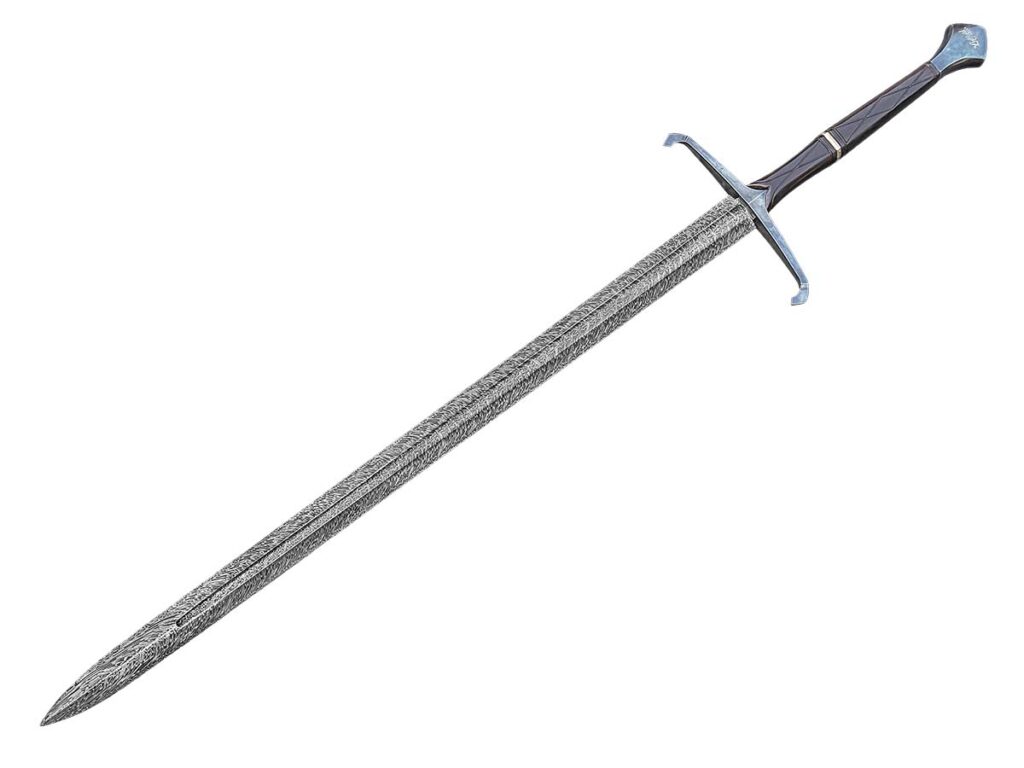
An electric 1084/15N20/mild steel Turkish-twist damascus defines the 31-inch blade of Caleb Ledford’s long sword. Lightening the sizable slicer’s load is a tapered fuller running on its midline. The handle is a pitch-black ebony, and the guard and pommel are cold-blued mild steel.


Jacco Van de Bruinhorst San Francisco Bowie

Jacco Van de Bruinhorst San Francisco Bowie

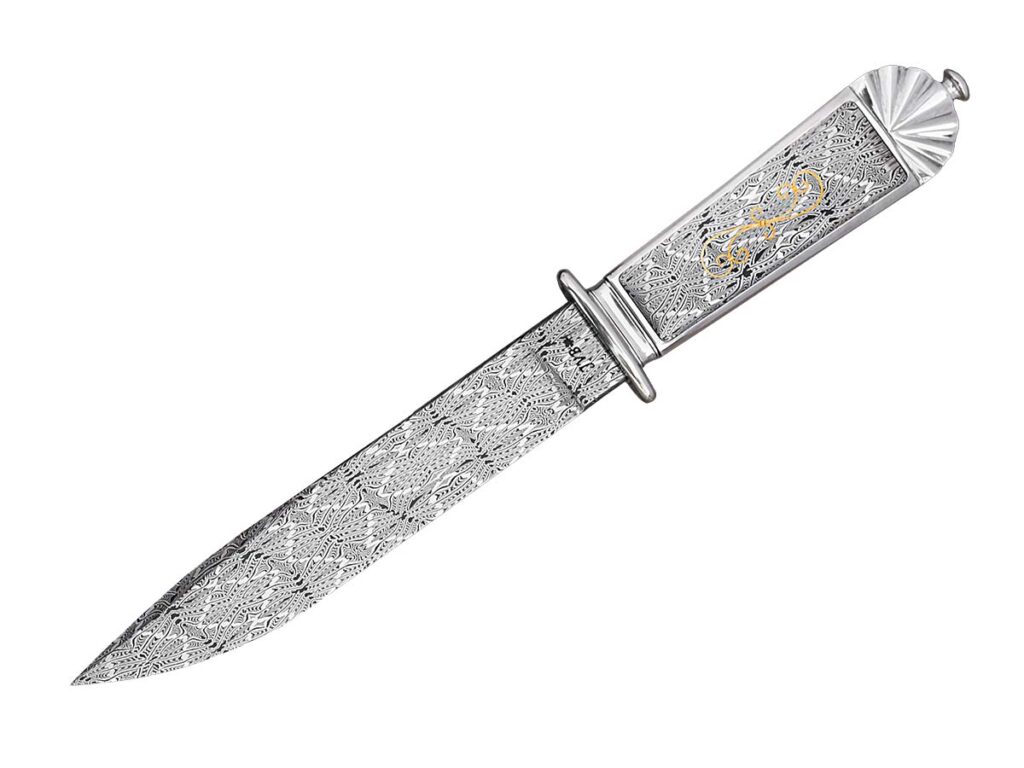
With matching blade and inserts, Jacco Van de Bruinhorst’s take on the San Francisco bowie is an elegant Barbary Coast brawler. The Canadian maker used ProCut/1084 to create what he calls a “snakeskin pattern.” If you study closely, the inserts harken back to the gold rush days with 24k gold inlay.


Jim Poling Dirk

Jim Poling Dirk

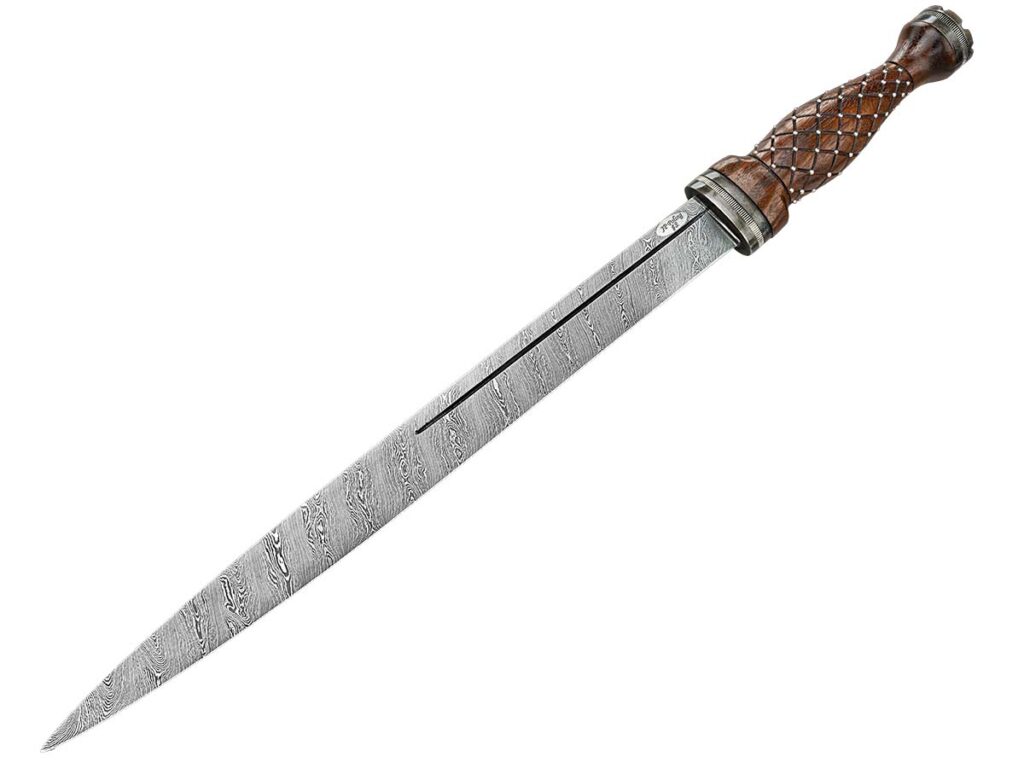
Commissioned by a descendant of King James IV of Scotland, journeyman smith Jim Poling’s walnut-handled dirk appears freshly plucked from the highlands. The dagger boasts a 13-inch 1084/15N20 twist damascus blade, antiqued mild steel fittings and coin-edged nickel spacers.


Andrew Blomfield Pesh Kabz

Andrew Blomfield Pesh Kabz

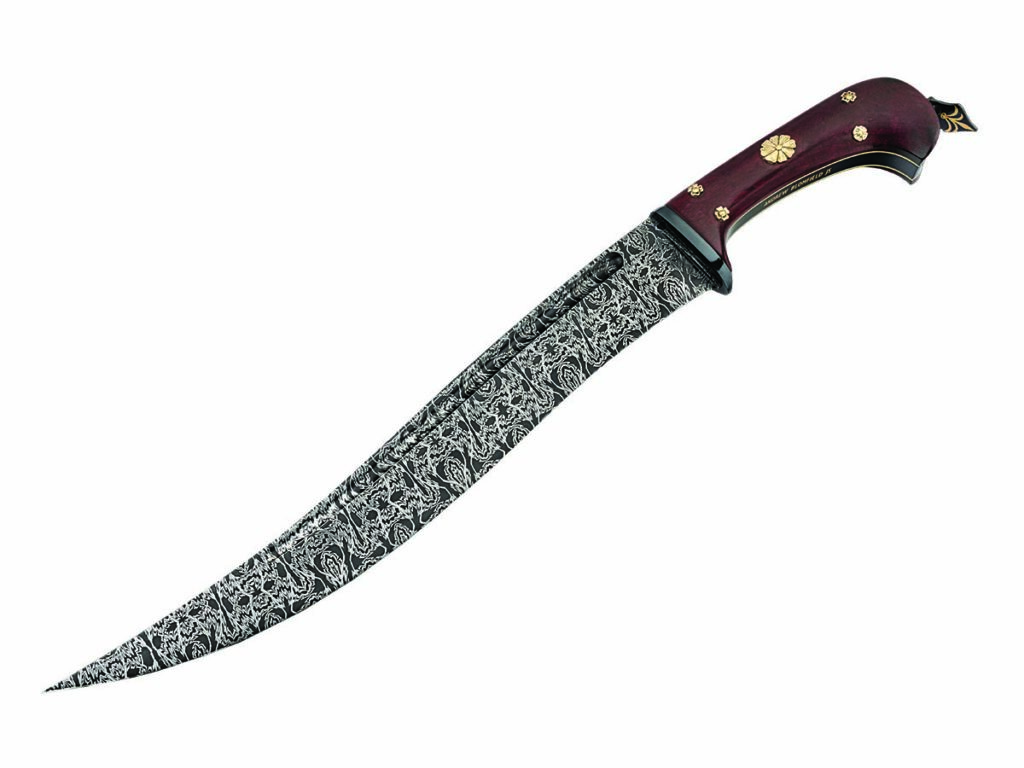
Master smith Andrew Blomfield has taken more than one stab at the pesh kabz in his career, and lands the blow with this 11.5-inch bladed example. The eye-catching mosaic blade is contrasted by the very conservative tones of the purple gidgee handle and blackened steel bolster. A traditional flourish, brass blossoms are on the handle’s pins.


Michael Deibert Wakizashi

Michael Deibert Wakizashi

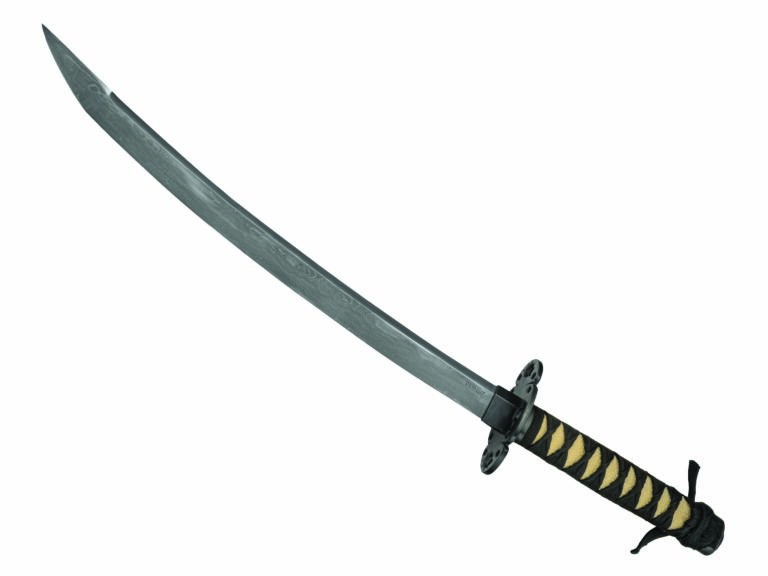
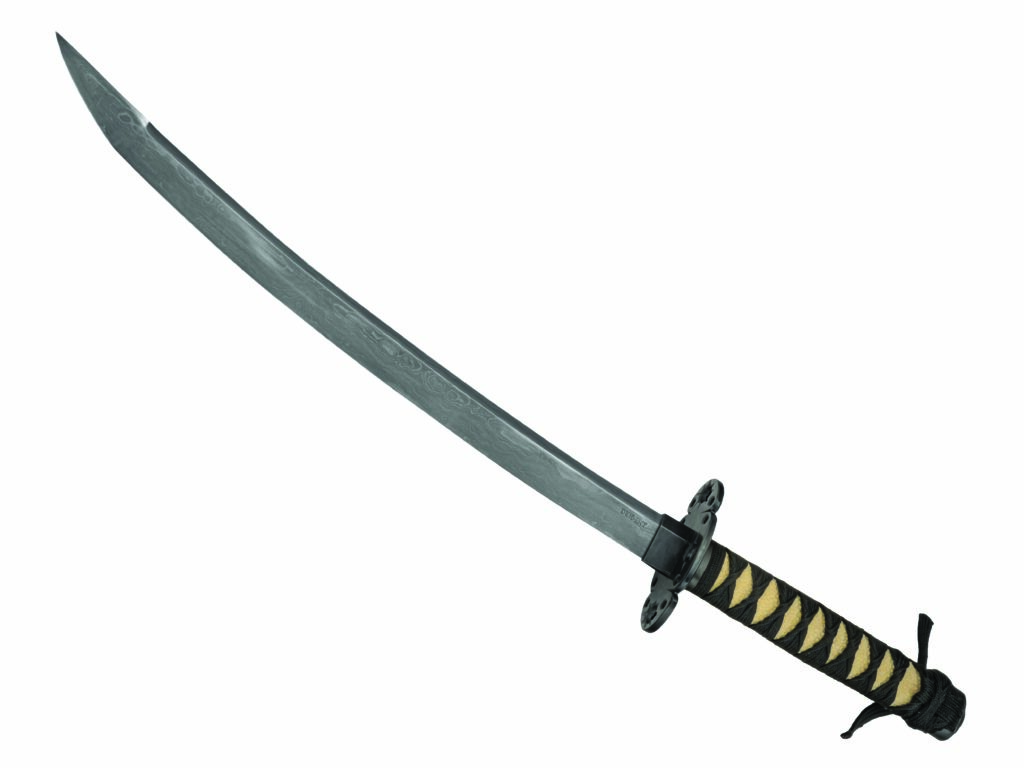
Alabama-based journeyman smith Michael Deibert brings traditional Japanese styling to life with this striking Wakizashi. The 18-inch blade features 1,100 layers of 1080/15N20 steel, paired with a wrought iron bolster. A classic stingray and an Ito-wrap handle complete the 28-inch overall build.


Nate “Tuna” Grant Pocket Fixed Blade

Nate "Tuna" Grant Pocket Fixed Blade
Nate “Tuna” Grant Pocket Fixed Blade

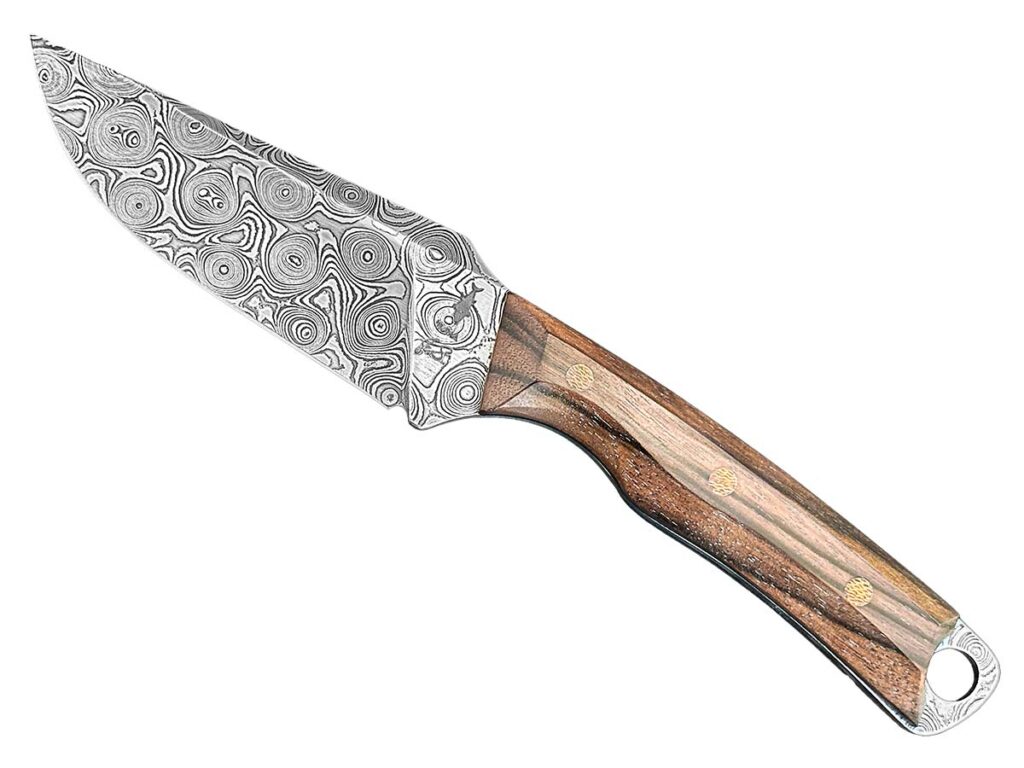
Journeyman smith Nate “Tuna” Grant delivers a compact powerhouse with the Defender. This 7.375-inch overall fixed blade features a 4-inch flat-ground blade forged from 1084/15N20 steel in a striking diamond drop pattern. The build is finished with rich Mun ebony scales.


Emmett Eitreim Dagger

Emmett Eitreim Dagger

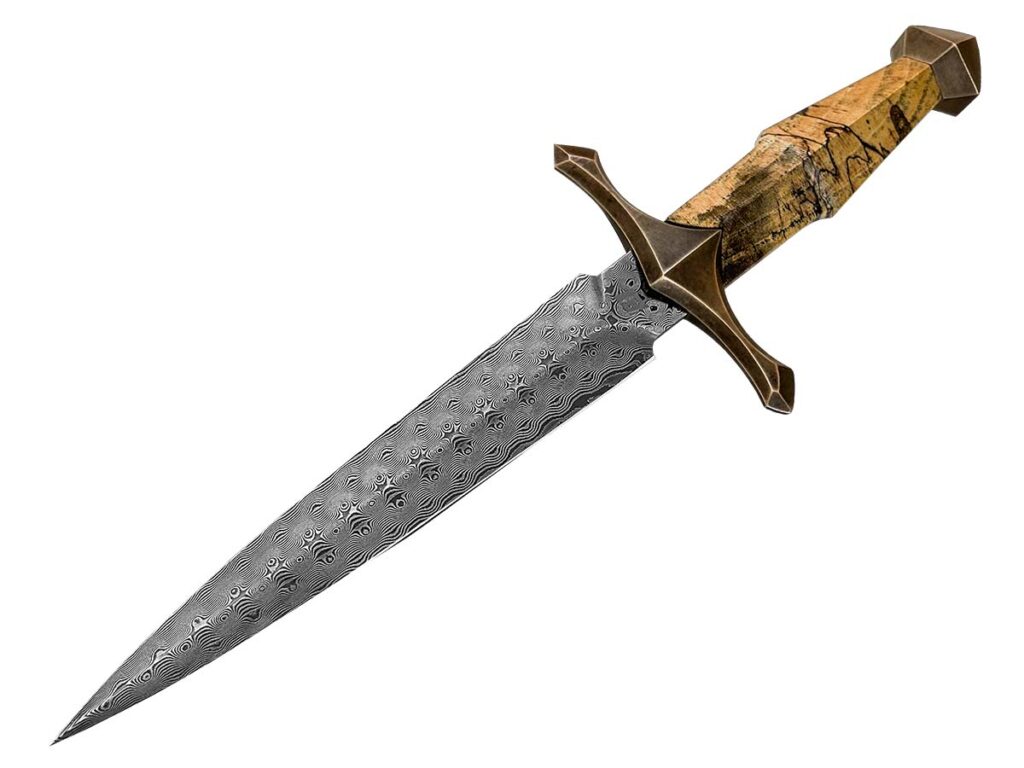
Emmett Eitreim presents a refined 12-inch overall dagger featuring a 7-inch flat-ground blade. The steel is a striking rose pattern forged from 15N20/1084, complemented by a 954 aluminum bronze guard and pommel. A stabilized spalted maple handle completes this elegant, high-contrast build.


Check Out More Cool Customs:

Carrigan Knife: Is It A James Black Original?

0

In the author’s view, the Carrigan has tells that prove James Black made it.

The work of James Black is iconic. Once you’ve seen one of his knives, you’re not likely to forget it. While a casual observer sees a steel blade that’s well formed and a coffin-shaped handle with black walnut and silver trim nicely complementing each other, informed observers see much more.  

Consider yourself more than just a casual observer. You study the knife in every detail. A steady stream of questions begins to cross your mind. You may contemplate the time period, the location and the tools by which the knife came to be.

Why did the knifemaker do this? What were his thoughts when doing that? What factors prompted the design? What subtleties of design did Mr. Black discern and were there any he learned along the way?

I am not a casual observer when it comes to the work of James Black. In fact, I am among “the birds that have flocked together” to study his work. Our group has been studying and gathering data to serve as a baseline for future revelations that may occur pertaining to historic knives. The database can be used to aid in authenticating existing as well as newly discovered knives thought to have been made by Black.

While our group includes collectors, engineers, historians and archaeologists, it also includes knifemakers. The perspective of each adds invaluable insight to the discussion. And oh, what a discussion it is!

What Is The Carrigan Knife?

For several years I was fortunate to have been the resident knifemaker for the Historic Arkansas Museum in Little Rock, Arkansas. It is a rich environment to learn and observe examples of historic knives, among which are some examples of Black’s work. Noteworthy among those is the Carrigan Knife.

Its historic provenance is solid, pointing directly to Black as being the maker. Since Black did not mark his work by stamping his name on it, the reliable historic provenance of the Carrigan Knife is of even more importance—in fact, it’s pivotal to the attribution of any other possible Black knives. Once determined to be authentic, the other knives in the museum’s collection, or elsewhere, can be attributed to Black as well.  

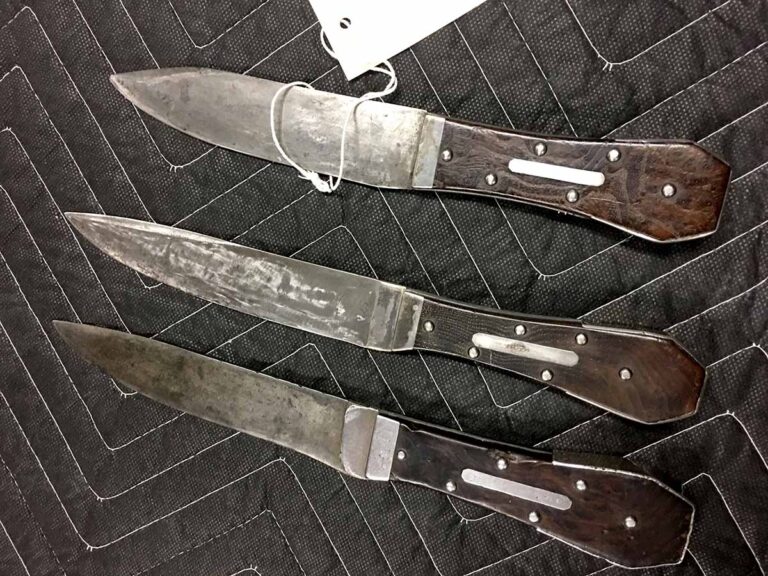
Consider Image 1 (top of page). The knife in the middle is the Carrigan, known to have been made by Black. It has provenance. What about the ones on either side? Do they have rock-solid provenance? No.

In the eyes of the museum curatorial staff as well as in the context of this discussion, an object’s provenance is important. However, some of the knives attributed to Black, while not having direct provenance, have circumstantial provenance.  Does this lessen their value in the historical narrative? No. If determined to be authentic, they are just as important. Even a newly discovered knife with no provenance at all may indeed be authenticated to have been made by Black.

Being able to determine the authenticity of a possible Black-made knife, apart from provenance, would require an examination of the knife. The examiner would need to have intimate knowledge of details and factors unique to Black’s body of work.

Lin Rhea forging
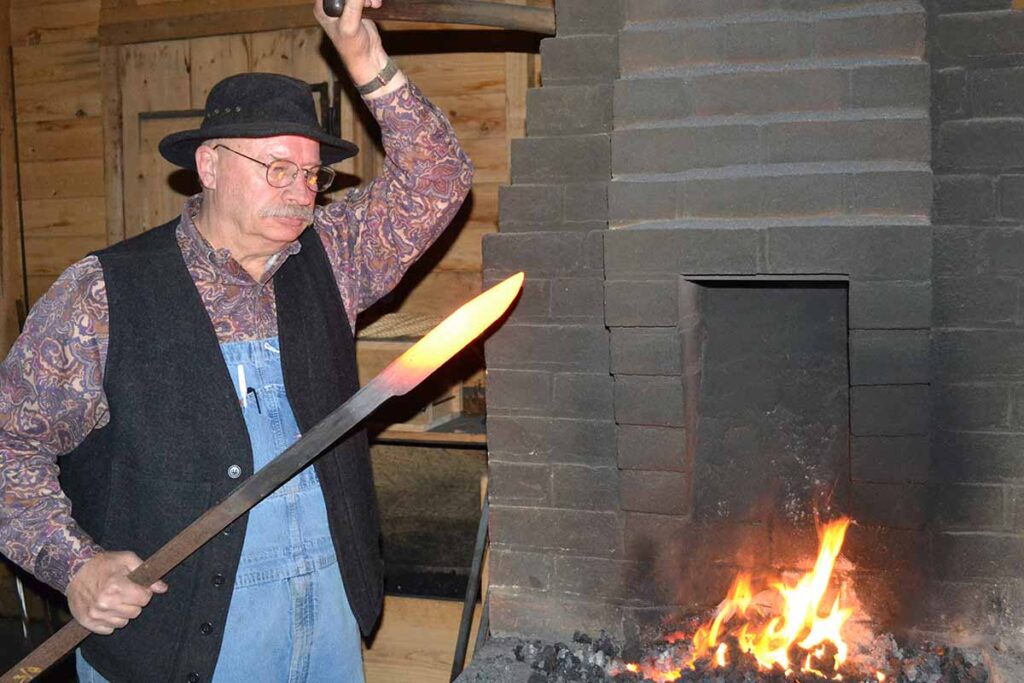
For several years the author was the resident knifemaker for the Historic Arkansas Museum in Little Rock, Arkansas, home to a number of authentic 1830s and other vintage bowies. (B. R. Hughes image)

In Image 1 you can’t help seeing the obvious relationship between the three knives. While they are not identical, they are so similar that it would be logical to assume they were made by the same hands. While those things are compelling to the belief that Black made all three, much more must be considered to authenticate a knife as his work. Some of those considerations follow.

Any maker’s work, whether currently or in the 1830s, will exhibit common features that, in some way, set the work apart as different from others. Some features may be noticeably subtle and some radically bold. Bold features can be imitated to a degree by others. The subtle features often go unnoticed and are much more difficult to imitate. Black’s body of work exhibits several features that tie the individual knives together circumstantially. Some features are subtle, some bold.

In Image 1 you can easily observe the bold features common to each individual knife, such as the dark handle scales, the silver trim, the coffin-shaped handles, etc. However, to authenticate them as being made by the same maker requires familiarity with that maker’s known body of work and an opportunity to document the features.

The features may be construction techniques or tool marks that are the same from knife to knife. Documenting the common features involves quite a lot. It implies that multiple knives are closely examined for these common features. In some cases, the common features can only be seen through modern technology such as X-rays or other forms of testing.

It is not known how many knives Black made but there’s enough in existence to create a problem of logistics. The knives that are thought to be authentic Black knives are scattered over several states. Getting them together has been tough but we’ve had some success thanks to the knives’ respective owners. The trust and support they’ve shown to the research group is very gratifying.

As you probably have noticed I’ve been very careful with my words since it’s not my place to share too much out of respect to the owners. Some details that are important in matters of authentication shouldn’t be divulged. Lack of these invisible details wouldn’t prevent a modern maker from faithfully reproducing a knife of the style. Remember, imitation is flattery but counterfeiting is illegal. Counterfeiting has been done and there are cases where collectors have been duped. Makers should always mark their work. 

Tells Of An Original James Black Knife

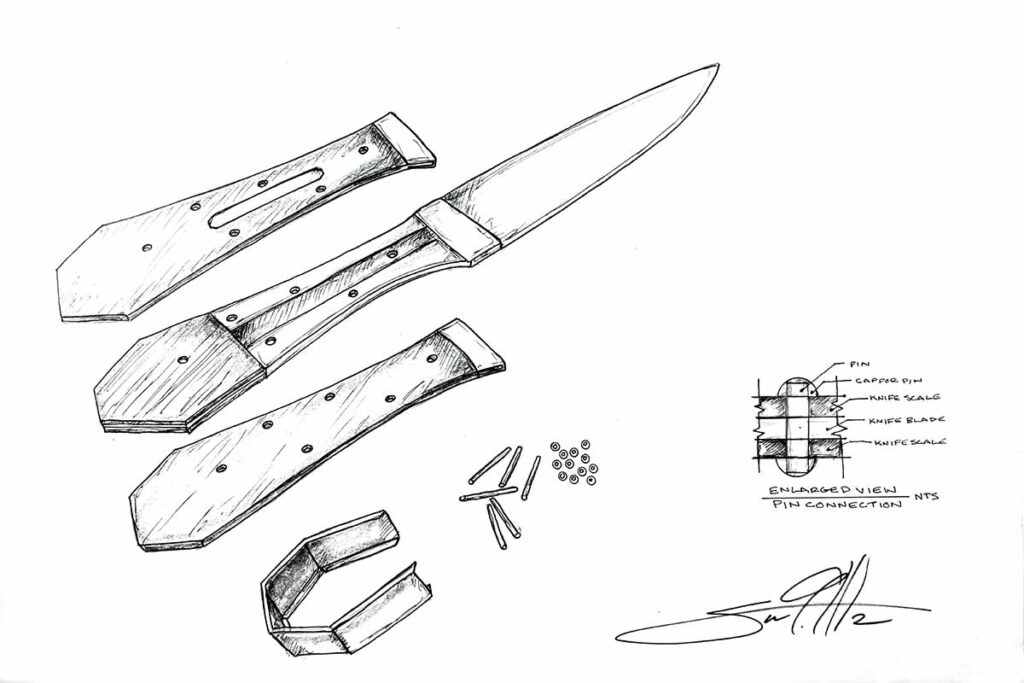
All this said, there are things “invisible” that we can discern by observation. In Image 2 (below), an illustration by Steve Hotz, notice that the construction assembly of the Carrigan Knife is comprised of three basic layers: the blade and two handle scales.

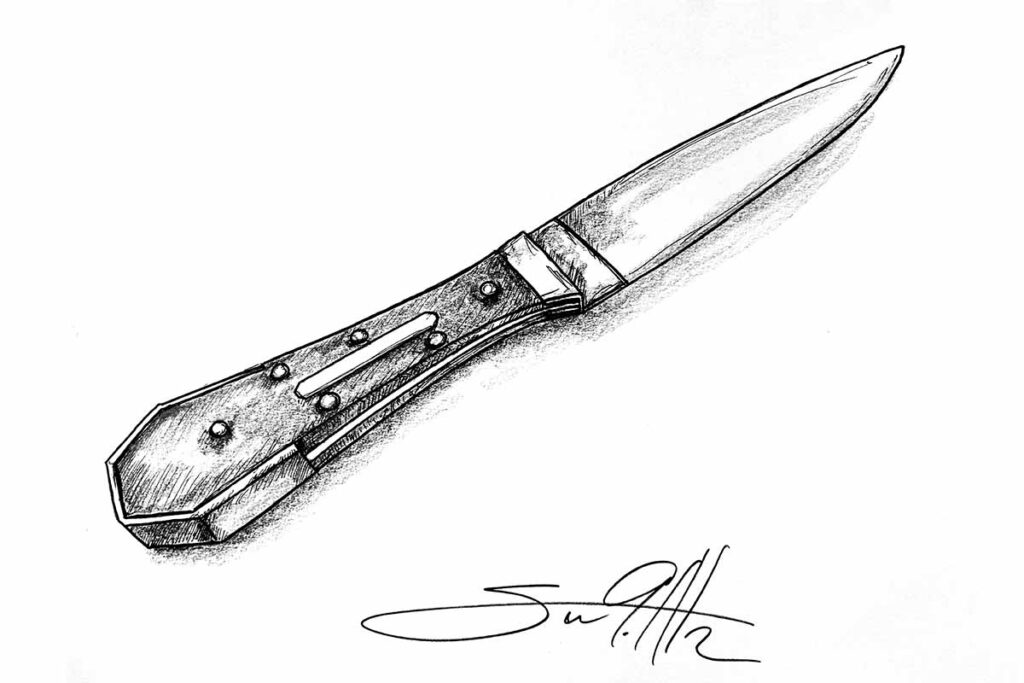
While there are three basic layers, each layer can have other parts that contribute to the overall knife. For example, the blade’s tang has additional pieces of silver: one on the ricasso and one each wrapped around the top and bottom of the spine. These serve as a soft bed for the scales to sit on. While thin, these wraps of silver can be filed flat for a good fit of the right- and left-hand scales. They extend back to where the maker chooses to put the silver pommel wrap. The blade tang is also bored for the pin holes to attach the scales. Moreover, the scales have front caps that are flush fit so the scale will lay flat, as well as escutcheon plates apparently individually mounted to the scale independent of the layer’s assembly. When the three basic layers are completed and prepared sufficiently, the scales, which are drilled to fit the tang, can be assembled to the blade and the capped pins installed as well as the pommel wrap.

The construction assembly of the Carrigan Knife
IMAGE 2: The construction assembly of the Carrigan Knife is comprised of three basic layers: the blade and two handle scales. Each layer can have other parts that contribute to the overall knife. For example, the blade’s tang has additional pieces of silver: one on the ricasso and one each wrapped around the top and bottom of the spine. (Steve Hotz illustration)

What I’ve described is the general assembly of Black’s Carrigan Knife.* The entire blade’s steel tang is covered by a protective layer of silver along with the wood scales. Considering the lack of modern epoxies and rust-resistant steels, I consider Black’s logic and resourcefulness very impressive. He strategically placed the silver on each of the three layers so that, when assembled, they meet and provide protection for the knife’s steel full tang, as well as an aesthetically pleasing appearance.  

Historically, a blacksmith shop may have had a post drill and some early machinery available. I can reasonably assume that Black had some of this equipment too, but I have no way of being sure. Where we today would likely grind a part, Black may have filed it. To save filing he probably forged very close to finish before filing. We today may skip the forging stage entirely if required and still be able to reproduce a close facsimile of his knife. For every step of his process, we bladesmiths and/or knifemakers can transpose a modern technique or tool.  

Picture of assembled Carrigan Knife
When the three basic layers are completed and prepared sufficiently, the scales, which are drilled to fit the tang, can be assembled to the blade and the capped pins installed, as well as the pommel wrap. The result is the completed Carrigan Knife. (Steve Hotz illustration)

Black’s process was an interactive, emergent one. The second step emerged from the first. The third step emerged and interacted with the first two steps, and so on. In other words, it was not precision technology as we commonly see today where the parts can interchange from one knife to the next. Emergent technology enabled a craftsman to create complex designs with a reasonable expectation of consistency, albeit not precision.

Again, study the three knives in Image 1. Although they are not identical, you can see the family resemblance. It was a structured process that was organized to lead to a predictable result. On top of that, Black was taking only three materials—steel, wood and silver—and creating a process that makes sense. Considering the relative lack of resources and technology, I think he did well to even create a knife. But he did much more.  

When thinking of Black’s work, think not only of his knife design but his process design. It’s his process design that made his knife design repeatable. Modern knifemakers can learn from him in that regard.

Three Questions To Consider

In closing, following are three questions to ponder. The first two are for all of you and the third is for the bladesmiths and/or knifemakers among you.

  1. If given a limited number of resources, would you be able to make a knife?  
  2. If given these limitations, would you be able to design a knifemaking process? 
  3. In your knifemaking endeavors, how much of your process is an imitation of others and how much is yours?

*Author’s note: I have not gone into detail on each of the individual parts and how Black performed these steps for two reasons: 1) I can only observe the appearance of the knife and speculate on his exact techniques, and
2) It would only serve the purpose of counterfeiters.

Editor’s note: While BLADE® recognizes the author’s superior knowledge concerning the provenance of the Carrigan and other knives attributed to James Black by the author and others, BLADE continues to stipulate that for BLADE to recognize that a knife was made by a specific maker, the knife must bear the specific maker’s name or mark. The presence of such a mark does not necessarily prove the knife was indeed made by the person or company marked, but the absence of a mark is enough to preclude BLADE from attributing the knife’s make to any person, company, etc. Since, as far as we know, Black did not mark his knives, BLADE does not attribute the make of any specific knife to him. That doesn’t mean BLADE is right or wrong, it’s simply our policy concerning the matter. To be both fair and accurate to all, it is a policy we apply not just to Black but to all knives and all knifemakers.

More Knife History:

50 Years Ago In BLADE: Your Friendly Airport Knife Shop

1

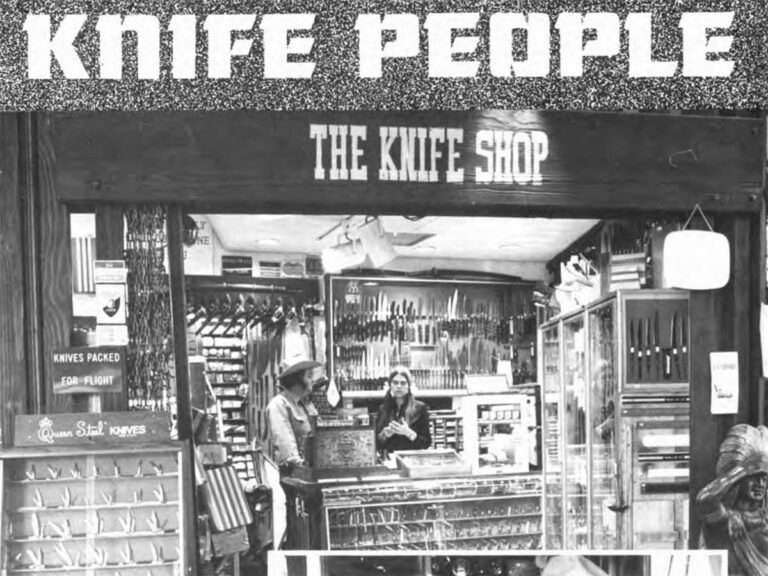
Not only could you carry knives on flights, you could buy them in airports.

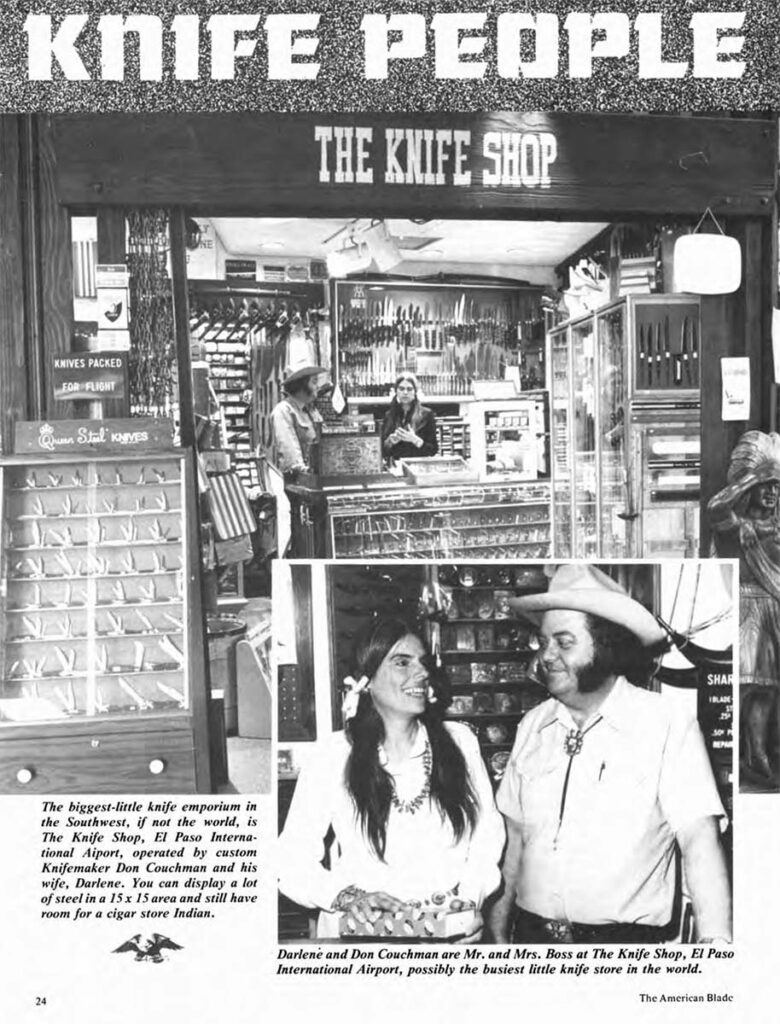
 Operated by Darlene and Don Couchman half a century ago, The Knife Shop sold factory and custom knives, sharpeners, knifemaking supplies and more—all in a 15-by-15-foot store in the El Paso International Airport.
Operated by Darlene and Don Couchman half a century ago, The Knife Shop sold factory and custom knives, sharpeners, knifemaking supplies and more—all in a 15-by-15-foot store in the El Paso International Airport.

A knife shop in an airport is not exactly something you would expect to see today, but such was not always the case in 1976. It was then that Darlene and Don Couchman operated The Knife Shop in the El Paso International Airport.

Airline passengers on their way to parts unknown could stop and avail themselves of knives of almost “every major brand of commercial household and sporting cutlery,” antique knives, straight razors, sharpeners, cutting boards and various knife displays, along with a full line of custom knives that included Don’s custom models.

Of course, as writer/then The American Blade editor L.V. Baker noted in his story “Knife People,” how Don found time to both make knives and help tend the store was “problematical.” Moreover, the Couchmans provided a special packaging and delivery service through the air carrier so passengers could take their newly bought knives on their flights.

“The biggest-little knife emporium in the Southwest, if not the world,” The Knife Shop had a 15-by-15-foot sales area that somehow also found room for a cigar store Indian. What’s more, the Couchmans sold parts to make knives, including finished blades, brass for guards and buttcaps and more, all in neatly arranged drawers so you could find it all easily.
Now boarding!

More Knife History:

4 Best Dirks: Modern Versions Of The Historic Knife

The Dirk Has A Long, Exciting History And Has Been Used For Everything From Farming To War All Around The World.

The general definition of a dirk is that of a one-handed thrusting knife. Depending on region and style, it may be single-edged or double-edged. It also may or may not have a defined cross guard and pommel. 

Dirk as a term is loosely associated with several Scottish and English regions. It is most commonly credited to the former, though no one really knows for sure, and it also has a long history of use across medieval Europe. It was a very important object to people in the Highlands of Scotland at an individual level and had significant ceremonial and practical uses.

Weapons Before The Dirk

As is common in the era of gunpowder in Europe, many types of knives and daggers owed their roots to the bollocks dagger and other stabbing weapons that originated hundreds of years prior when soldiers wore heavy armor. Contrary to popular belief, most swords are not like how you see in the movies. These stabbing and thrusting weapons seldom had what we’d expect as edges, rather they were made to parry and bludgeon. Maces, picks, and hammers were very common in this time, prized for their ability to bash and smash, where swords, while deadly, were not always the first choice. 

These long, thin daggers were sometimes the choice when things got up close and personal, though even then the textile layers of armor were hard to penetrate. All that changed with gunpowder weapons causing a wide decline in armor use, and the dirk as we know it today was the product of that evolution. The dirk became something quite different than other edged weapons of the time and developed in its own way, largely apart from other European designs. 

The Scottish were some of the first to begin independent development of swords and daggers alongside guns in the post-armor age along with strategies to fight against firearm-equipped soldiers. The heavily tribal Scottish Highlands were not especially invested in standardized firearm technology. 

Guns did figure heavily into the culture, but the Scottish never developed a well-oiled machine akin to what the British developed when it came to battles. The Scottish had two primary tools for the battlefield, the broadsword and the targe (buckler), itself a small shield held in the weak hand. The combination of buckler and broadsword allowed the Highlander to easily kill British soldiers, usually armed with nothing more than a musket and bayonet. 

They specialized in fast ambushes, often called a ‘Highland Charge’ where they wore virtually no protection of any kind and ran headlong at their enemy. If the enemy didn’t flee on sight, they would only have one shot at most before they had to fight hand-to-hand. 

How The Dirk Developed

windlass dirk
The dirk traces its lineage to the Scottish Highlands.

The dirks developed in the post-armor era became focused on all-purpose use, not just stabbing or bludgeoning. As a result, sharp, light-bladed swords and short-sword like knives and daggers became the norm. 

Slashing through clothing wasn’t difficult and the Highlanders found themselves at a distinct advantage using these tactics. That is, until the Battle of Culloden in 1746. 

Here the entirety of the Highlander army was soundly defeated by the British in a battle that lasted an hour. The British faced them on an open field and modified their tactics to anticipate the Highland Charge, resulting in a complete defeat of the Scottish Jacobite movement that had made an invasion into England a year earlier.

Dirks were common even after Culloden. The carrying of knives wasn’t necessarily seen as carrying arms in most cases, and dirks were something of a common, everyday tool for most people. They would be not only used for self-defense but also for regular tasks like eating, splitting kindling, and standard daily chores.

Dirks vs Daggers

Is the dirk a dagger? The short answer is yes and no, and that is because there is a great degree of ambiguity in the definition. A dirk is classically a large, single-bladed knife with a blade anywhere from 12 inches all the way up to 20 inches.

Naval dirks were commonly used for ship-to-ship fighting as they were short enough to be used in tight confines yet large enough to still be effective. Daggers at this time would have been primarily understood to be stabbing weapons, whereas the dirk was large enough and stout enough to be used in a primary slashing role. 

Daggers are, by type, geared mostly for stabbing. Rarely do companies refer to any large, single-edged knives as ‘daggers’, but the dirk is often classified right alongside them by name in many laws.

The American dirk which evolved in the early 1700s, was almost always single-edged and was primarily used as a support knife alongside the tomahawk and rifle. It could be said that a significant and wide-ranging number of knife styles, including the Bowie, evolved directly from the Scottish dirk on the American frontier.

Daggers as stabbing knives were somewhat uncommon in America because they lacked general utility in the field at a time when larger camp knives and multi-purpose tools saved weight. 

Is It Legal To Own A Dirk?

Unfortunately, Dirks have a wide legal definition across the board that often describes them as daggers or stabbing weapons. In many municipalities, this type of weapon is not legal to carry. There is a blurred line in this definition, as many places considered double-edge, stabbing weapons as the verboten item. As many historical dirks are single-edged, there could be room in these laws that skirts one definition or another.

4 Best Dirks Available Today

COLD STEEL SCOTTISH DIRK- $119.99

cold steel dirk

Cold Steel is well known for making some very durable and interesting products. They pay great attention to detail and their Scottish Dirk is no different. While it is not the most costly, it is a step above the rest, and it is affordable and backed by Cold Steel’s legendary standard of excellence. The Cold Steel Scottish Dirk is a working tool that does everything the historical versions did and then some. If you’re looking for a hard-use dirk, look no further.

Knife Specs

Overall Length: 18.38 inches

Blade Length: 13 inches

Weight: 1 pound

Blade Steel: 1055 Carbon

Handle Material: Rosewood

WINDLASS BONNIE SCOTTISH DIRK- $149.00

windlass scottish dirk

If you’re looking for a prettier dirk than the rest, Windlass makes some excellent historical replicas that reflect various periods of Scottish history. The Bonnie Scottish Dirk is reminiscent of the late stage of refinement on these weapons. It is ornate yet functional and is sure to be a conversation starter. While other companies tend to take some liberties, this is a very accurate replica of what may have been on the belts of Highland Warriors at the Battle of Culloden.

Knife Specs

Overall Length: 17.5 inches

Blade Length: 11.75 inches

Weight: 18 ounces

Blade Steel: 1055 Carbon Steel

Handle Material: Wood

WINDLASS EARLY SCOTTISH DIRK- $139.95

early dirk

This product is a replica of some early dirks as they would have looked descending from the bullock dagger. A functional reproduction, this early replica features a more basic feature set as would’ve been seen a few hundred years prior to the Battle of Culloden. Although it has unrefined features, it is still not out of place for costuming or period reenacting.

Knife Specs

Overall Length: 21.25 inches

Blade Length: 15 inches

Weight: 16.2 ounces

Blade Steel: 1055 Carbon Steel

Handle Material: Hardwood

CAS IBERIA (LEGACY ARMS) SCOTTISH DIRK- $159.00

CAS Iberia dirk

This dirk has some classic lines, but is all about function. It will not look odd at a cultural event, although it is made with a slight skew to the modern. The handle design is reminiscent not of the bullock dagger, but the earlier Rondel form characteristic of the late medieval era prior to the renaissance. While it is the most expensive so far on the list, it is right in the same price range as most common dirks. If you prefer this look over the more classic Scottish design, this is the one for you.

Knife Specs

Overall Length: 18.25 inches

Blade Length: 12 inches

Weight: 1 pound, 8.5 ounces

Blade Steel: 5160

Handle Material: Synthetic Material

Read More

Advertisement

Must Read Articles

Read this before you make a knife

Knifemaking 101 – Read This Before You Make a Knife

  by Wayne Goddard My experience has taught me that there's nothing like digging in and getting started. I've often said the hardest part of the...
how to forge damascus steel

How to Forge Damascus

Advertisement
Advertisement