Knife History

The history of knives and other edged instruments is tied to the history of people in general. As humankind’s oldest tool, unraveling knife history can lead to even more surprising and enriching information to better understand the world.

U.S. Military Daggers: Blades That Have Taken Point

Daggers have struck home the U.S. military’s point from the trenches of Europe to the jungles of Vietnam.

Through the years, the military dagger has been considered an essential piece of equipment for the soldier on the ground and the pilot in the air. As a second line of defense, the dagger must be accessible and capable of quick deployment, not to mention efficient at its job.
As U.S. military personnel have gone into action, their choice of daggers provides a window into their operational history and a view of their actual aptitude when seconds count. Design and dexterity are hallmarks of dagger use in the heat of a life-and-death situation, and these storied weapons of war have gained their place in the annals of close combat.

“A good friend of mine was a chopper pilot in Vietnam,” recalled BLADE® Magazine field editor Kim Breed. “The pilots carried the Gerber MK II upside down on their flight vests. When he was shot down, he and his crew chief went through their ammo; then they drew their daggers while they waited for pickup. They locked onto the enemy, rammed them through the side [with their daggers] and hung on. Then they took [the enemy’s] AK-47s away from them and got back into the fight. They defended themselves while Cobra gunships laid down suppressing fire and a rescue bird, a Huey, came and got them.”

Kim’s comrades might well have been killed in the melee had they not had their Gerber Mk II daggers when needed. Designed by Clarence “Bud” Holzmann, the knife gained legendary status during the Vietnam War, and though it was not standard issue, the Gerber Mk II was popular with U.S. troops—from airmen to special forces and everything in between. The wasp-waisted blade of the original remains a symbol of the close combat sometimes experienced in Southeast Asia, while its intimidation factor led to a redesign for the consumer market.
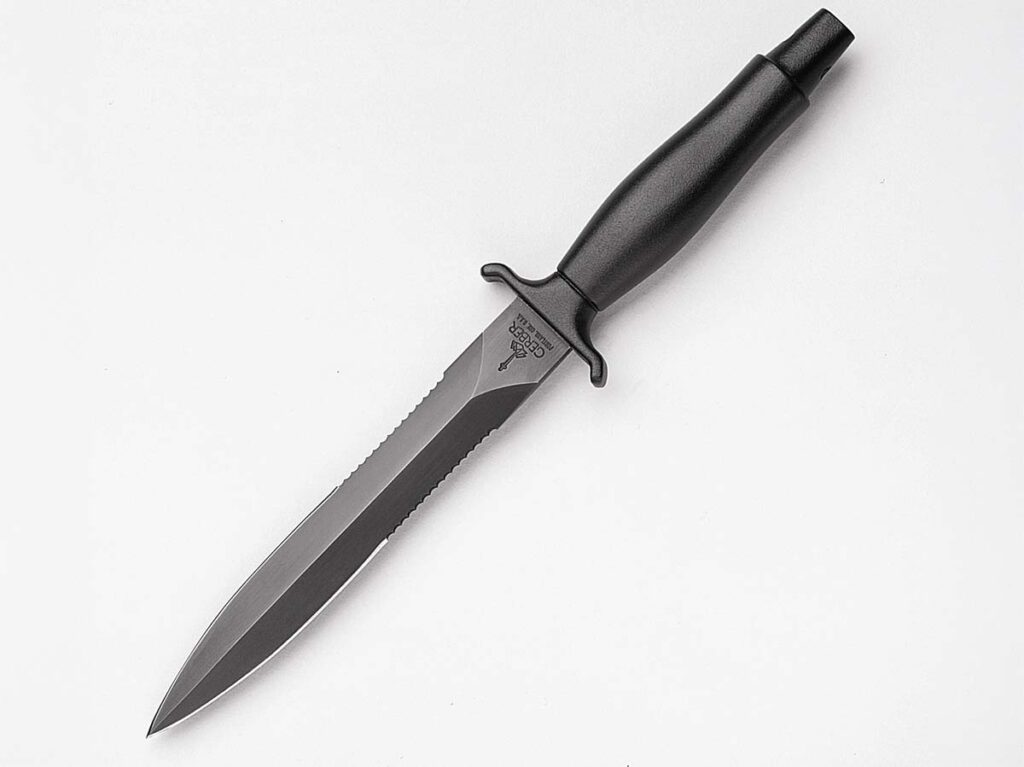
Later variants of the MK II included saw teeth, a feature added by Al Mar, who worked at Gerber at the time. This allowed the company to market it as a survival knife, not a fighting knife. Sporting goods stores and PXs were more likely to sell the latter. (Les George image)

“It was designed the same as the [original] Mk II except it had serrations on both sides. The serrations might be considered a weak point,” Breed explained. “They had cast aluminum handles and a little thinner blade with that wasp waist. When you actually penetrated something, [the waist] helped along with a bit of extra weight up front.”

While the original Mk II may have been a stronger choice back in the day, the serrated Mk II is also a sought-after collectible. A knifemaker, Kim relates some owners have asked him to grind the serrations completely off this Gerber dagger. He declined to do so.
One more story Kim recounts is of a friend who found himself in hand-to-hand combat during a recon deployment in Vietnam. A Viet Cong patrol was walking past, and the last man in their line spotted the Americans in their cover. “Rather than alerting the whole enemy patrol, my friend took the last man down and used his knife,” said Breed.

Regarding the Mk II, knifemaker Les George added, “Al Mar was a designer at Gerber at the time and he added ‘saw teeth’ to the blade to make it a survival knife. The PX was happy to sell it as such since they didn’t want to sell a ‘fighting knife.’”
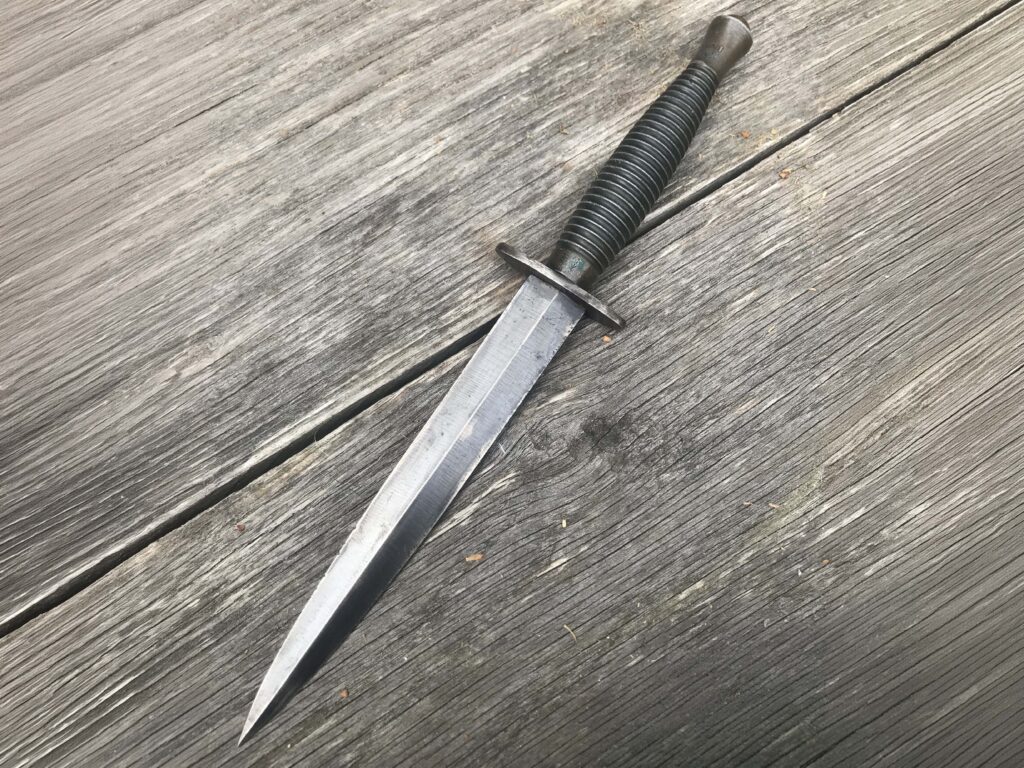
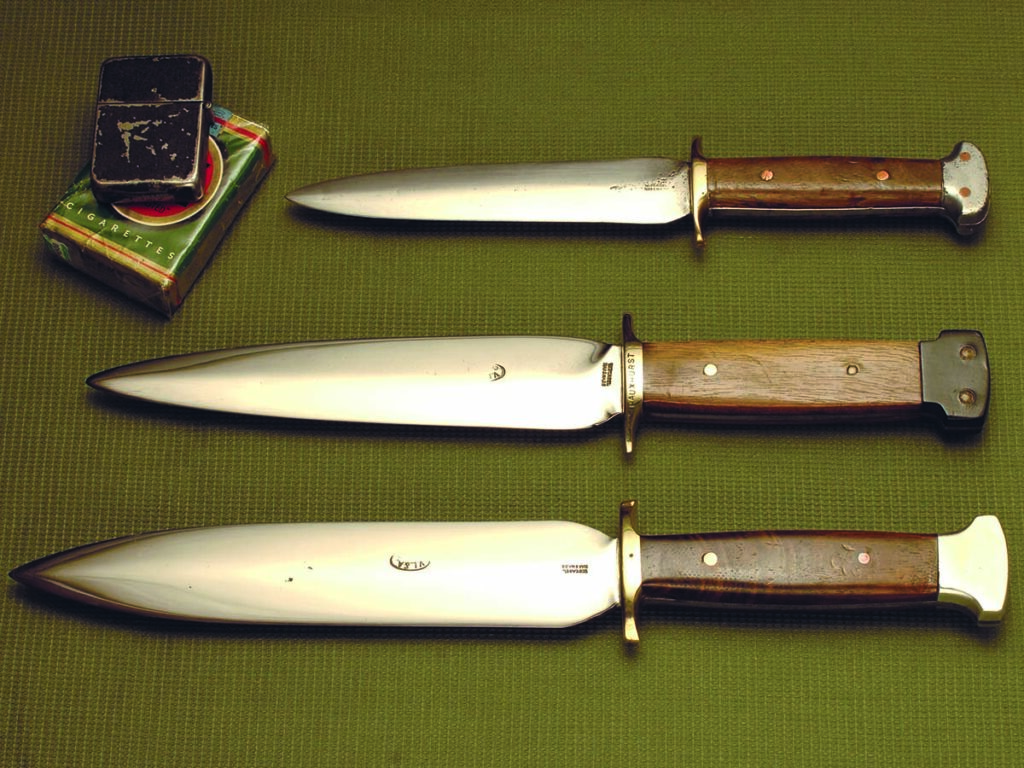
A great many modern military daggers trace their roots back to the legendary English Fairbairn-Sykes dagger. The one pictured is a third-pattern variant with a ring grip. (Les George image)

Industry veteran Bill Harsey also tells a story of combat survival with the Gerber Mk II in Vietnam. “I heard from a Medal of Honor recipient over dinner that his team was overrun by enemy combatants. In close-quarter combat, he drew his knife and stuck it in an enemy soldier. The knife stuck. Even with both hands he couldn’t withdraw it. I have no idea why the knife stuck and he didn’t offer any thoughts. But just to be careful, we have never made a wasp-waisted blade.”

Fairbairn-Sykes And Beyond

The Randall Knives Model 2 Fighting Stiletto bears the name of one of the most famous knifemakers in history and was developed as a robust alternative to the legendary Fairbairn-Sykes dagger. Randall has gone to war with several memorable designs, and according to Breed, the Model 2 is one of the best remembered.

“The blade is a little wider than the well-known Fairbairn-Sykes dagger,” said Kim. “The Randall was more handle-heavy, with only about a 5-inch blade, as I remember. It feels good in the hand. The guard is not sharp on the fingers, which was a challenge with some of the others. Any Randall daggers are collectible, just like Randalls in general. They didn’t make many of them. The Model 2, to me, is a cross between the Fairbairn-Sykes and the V-42 with a leather stack handle.”
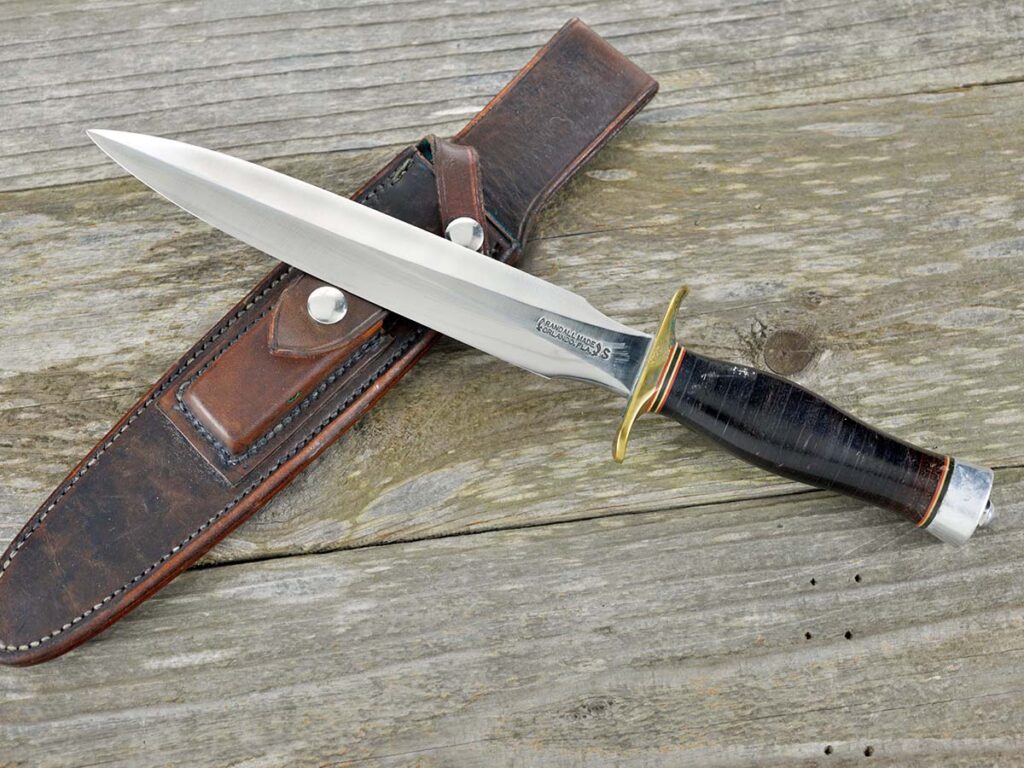
The Randall Knives Model 2 bears the name of one of the most famous knifemakers in history—Bo Randall—and was developed as a robust alternative to the legendary Fairbairn-Sykes dagger. (Les George image)

The Marine Raider Stiletto remains a classic weapon of the World War II era, and it is said to have been the first Marine knife in the Corps’ history designed by a Marine, designed by Lieutenant Colonel Clifford H. Shuey. The story goes that this dagger was developed because the elite Raiders specifically requested a knife for close fighting.

Les offered some observations concerning the Marine Raider stiletto’s proper mission. “When the Marines were issued the Raider Stiletto in World War II, they had been specifically told not to pry with them or throw them,” he said. “So, obviously, they threw them at the first tree they could find and broke the tips off many of those knives.

“I think the Marine Raider Stiletto has the best handle design of all the many knives derived from the Fairbairn-Sykes daggers,” George continued. “It’s not just round. It has features and a shape allowing the blade to be indexed by feel. But the blade is very thin, the tip was fragile and the metal that they cast the handles out of reacts with air. They are all disintegrating. Eventually, we will lose them all.”
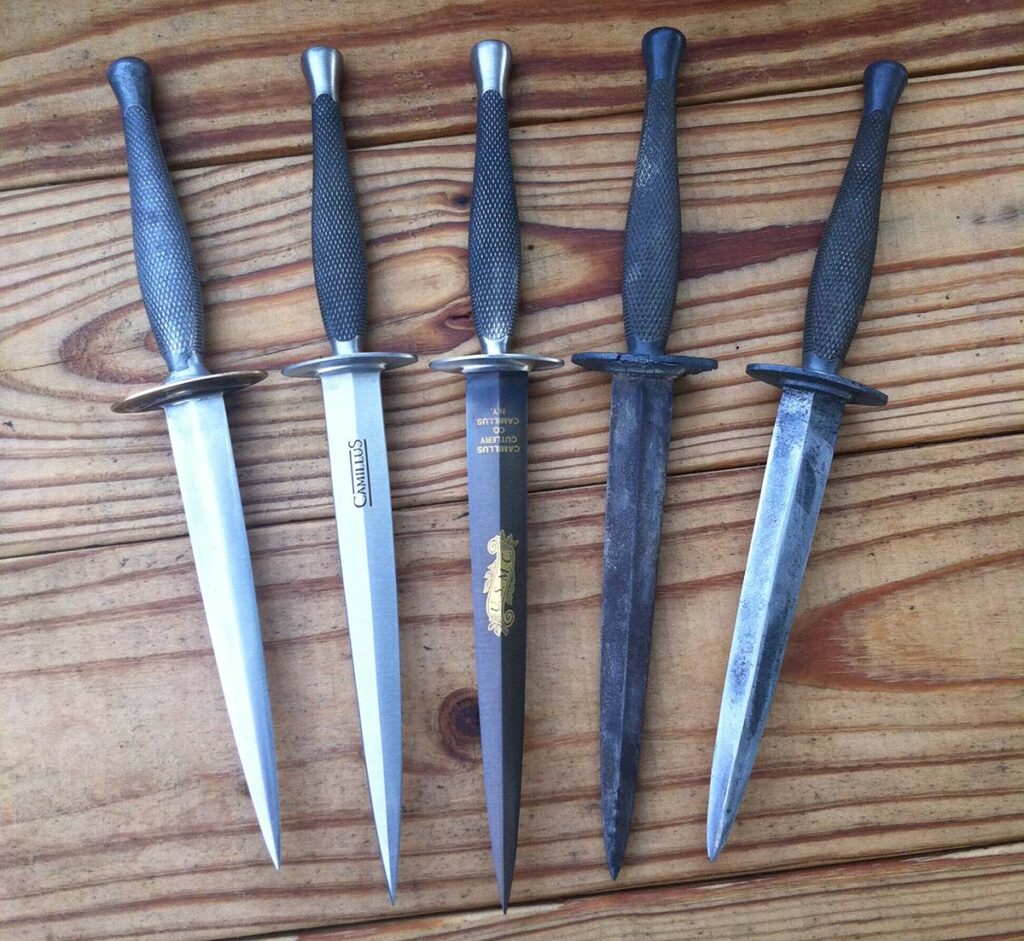
Knifemaker and military dagger aficionado Les George is a fan of the Marine Raider stiletto, seen by his collection of the dagger—new and old. (Les George image)

The handle of the Camillus-made Marine Raider Stiletto was fashioned with a die-cast zinc alloy, while the 7- to 7 ½-inch blade was made of blued or bright steel. The overall feel of the stiletto was hilt-heavy for optimal balance.

“The Marine Raider Stiletto has probably the smallest group of collectors since it primarily appeals to Marines,” commented George. “The rest can be categorized in different ways and have broader appeal. These knives and their more modern counterparts may not find their way to the battlefield as a matter of course, but the history they represent is invaluable.”

Knuckled Under

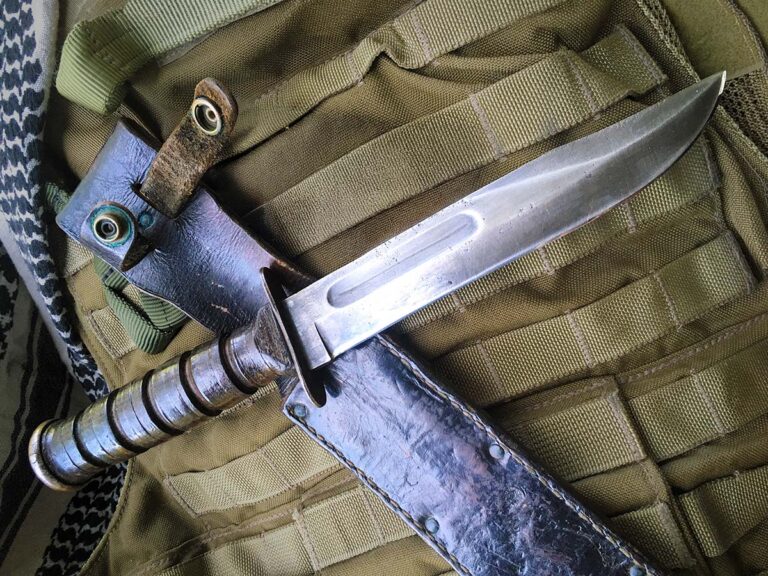
Les includes the iconic M1918 trench knife among those favored few military daggers carried in wartime by American soldiers. Its design was based on the French M1916 Avenger, and the military held field trials after initial 1917 and early 1918 variants were found inadequate. The M1918 was first made by Landers, Frary & Clark, a housewares and hardware company, production was later increased with Oneida, Henry Disston & Sons and the French manufacturer Au Lion.
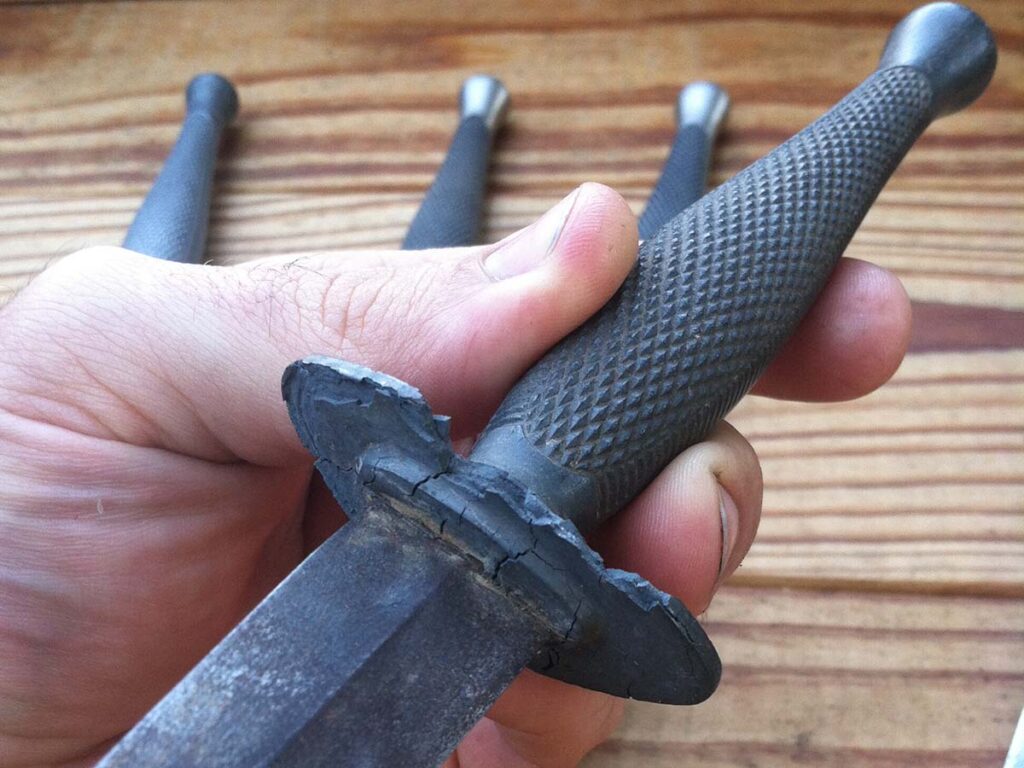
George considers the knife's handle the best designed of all the Fairbairn-Sykes derivatives. Unfortunately, this is also the dagger’s weak point as the metal used for the handle reacts with the air and disintegrates. (Les George image)
George considers the knife’s handle the best designed of all the Fairbairn-Sykes derivatives. Unfortunately, this is also the dagger’s weak point as the metal used for the handle reacts with the air and disintegrates. (Les George image)

“The LF&C M1918 trench knife did not see action in World War I,” George explains. “It was made for that war, but it ended before the knives made it to Europe. A lot of them were melted down to reuse the handle material. When the Japanese attacked Pearl Harbor, they were the only knives in the system available to be issued to Marines … The M1918 saw use in World War II, Korea and Vietnam. I’m not aware of any combat use of the knife since then, but it is possible.”

The M1918 is distinctive with its integrated cast brass handle and brass knuckle grip designed for close combat, along with small spikes on the finger bows and a skull crusher pommel. The medium carbon steel blade has been criticized at times for being brittle, but nevertheless the knife is recognized as formidable in a hand-to-hand brawl.

“The M1918 was designed to be an effective tool for close fighting,” observed Breed. “With a positive grip and the brass knuckle guard, you didn’t have to stab, or you could hit your opponent with the skull crusher. There were dozens of confirmed kills with this dagger. It was not recommended to dig with them because they were prone to breakage or ‘bendage.’ You could drive that big brass handle into the dirt, but that half shaft that came down from the blade was short on steel and weakened the knife around the tang.”
The eye appeal of the M1918 makes the dagger collectible. “It’s pretty popular and one of the iconic knives of its type,” Kim concluded.
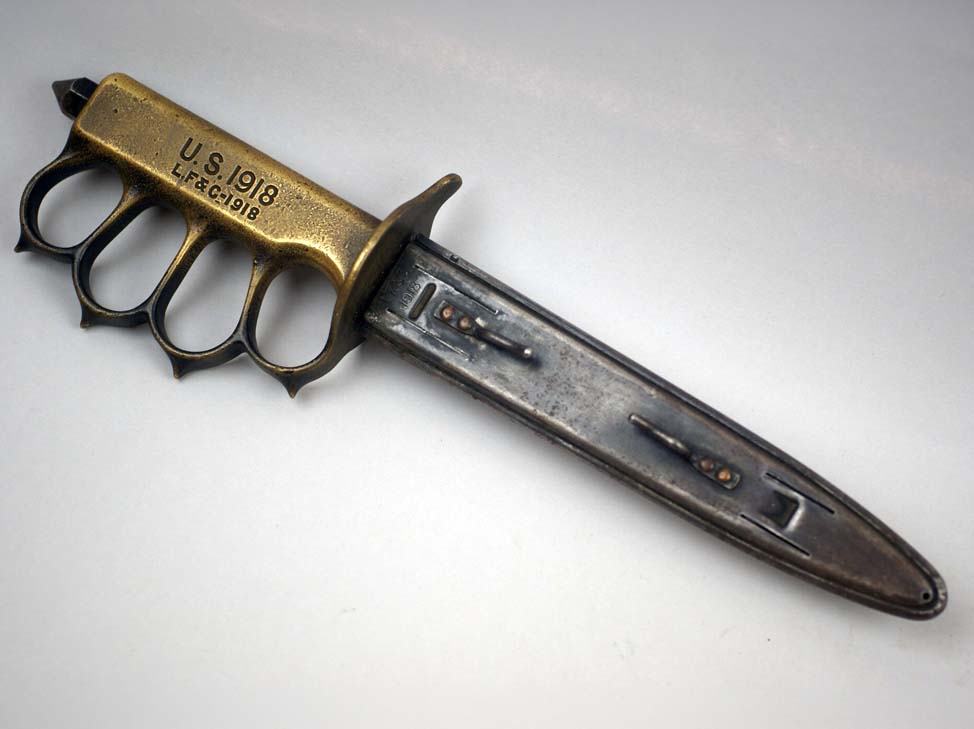
Many think of the M1918 as the quintessential World War I trench knife, though the variant didn't see action in that conflict, adopted too late. Based on the French M1916 Avenger, it was meant to replace the 1917 and early 1918 variants, which were found inadequate. (Les George image)
Many think of the M1918 as the quintessential World War I trench knife, though the variant didn’t see action in that conflict, adopted too late. Based on the French M1916 Avenger, it was meant to replace the 1917 and early 1918 variants, which were found inadequate. (Les George image)

Representative of the fighting men who carried them into harm’s way, these U.S. military daggers of the 20th century continue to fascinate with their double-edge blade, balanced feel and handle characteristics. Their place in history is secure, while collectors and knife industry veterans are doing their best to preserve and retell the stories that surround them.

More On Military Knives:

Bob Loveless: The Icon’s Indelible Mark On The Knife Industry

Loveless’ impact is still felt today.

A week after BLADE Magazine Cutlery Hall-Of-Fame® member Bob Loveless died at age 81 on Sept. 2, 2010, Los Angeles Times reporter Valerie J. Nelson wrote a lengthy story on the man who sold his first knife to the Abercrombie & Fitch sporting outfitter for $14 more than 55 years earlier.

Nelson wrote that Loveless “made some of the world’s most coveted sporting cutlery by refining knife design to high art.” These succinct words convey a glimpse of the influence this giant in the cutlery industry wielded during his lifetime. In this 50th anniversary year for BLADE®, his legacy stands tall among those who have dedicated their lives in building the knife industry to what it is today.

Bob Loveless
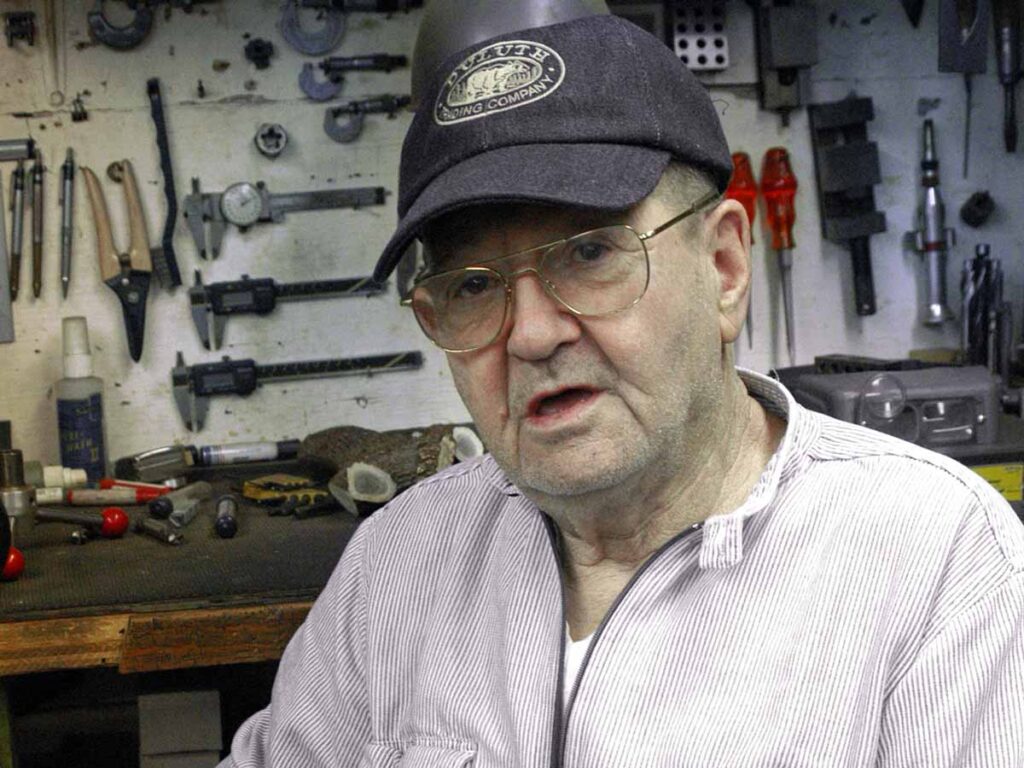
Bob Loveless in his shop in October 2006. (image courtesy of Aaron Merritt, grandson of Jim Merritt)

Truth is, there’s scarcely an aspect, nook or cranny of the knife business that Robert Waldorf Loveless did not touch during his lifetime. He was forthright, sometimes gruff and always prone to speak his mind. During an interview for BLADE, he once asked this writer what the tapping noise was that he heard in the background. When I responded that it was the keys clicking as I was taking notes while we talked, he bluntly asked, “Can’t you remember anything? Why can’t you just listen?”

Loveless’ Defining Designs

No matter. Loveless was articulate, extremely intelligent and deep down passionate about art in knives. Cutlery Hall-Of-Famer Bruce Voyles knew Loveless and respected him for what he was.

“The thing about Loveless is he made a knife with eye appeal,” Bruce observed. “It was different, and a lot of people don’t understand why, but it was [his use of the] natural French curve. It was the design appeal.”

True enough, Loveless was a master of design. He had actually studied briefly at the Institute of Design in Chicago in the 1950s, and was a student of the Bauhaus Movement, a cultural and artistic design wave that peaked in the mid-1930s, something of a North Star, a muse if you will. Its dictum: Form Follows Function.

Loveless sub-hilt
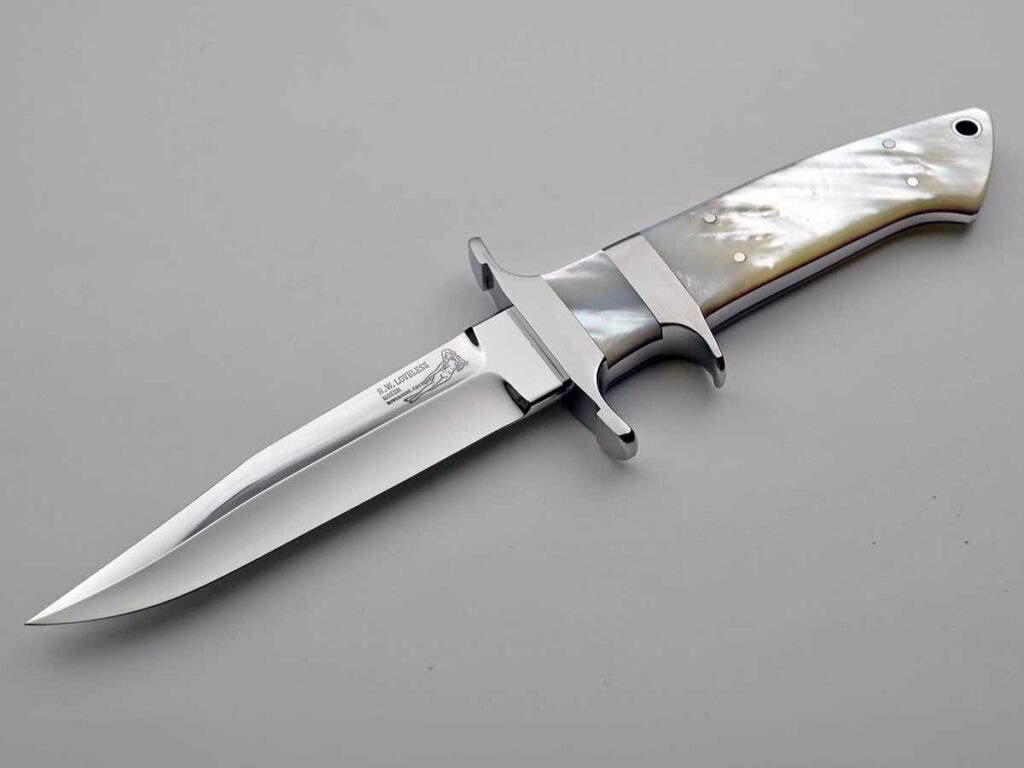
Another of Loveless’s favorite designs is the sub-hilt, radiant in one of Bob’s Baby Bear fighters with mother-of-pearl scales, Naked Lady logo and Riverside, California, stamp. (Exquisiteknives.com image)

Longtime Loveless authority John Denton told reporter Nelson, “He is pretty much the Picasso of the knife world and the father of 20th century knifemaking. His design is what made him famous.”

Dave Ellis, proprietor of Exquisiteknives.com, agrees.

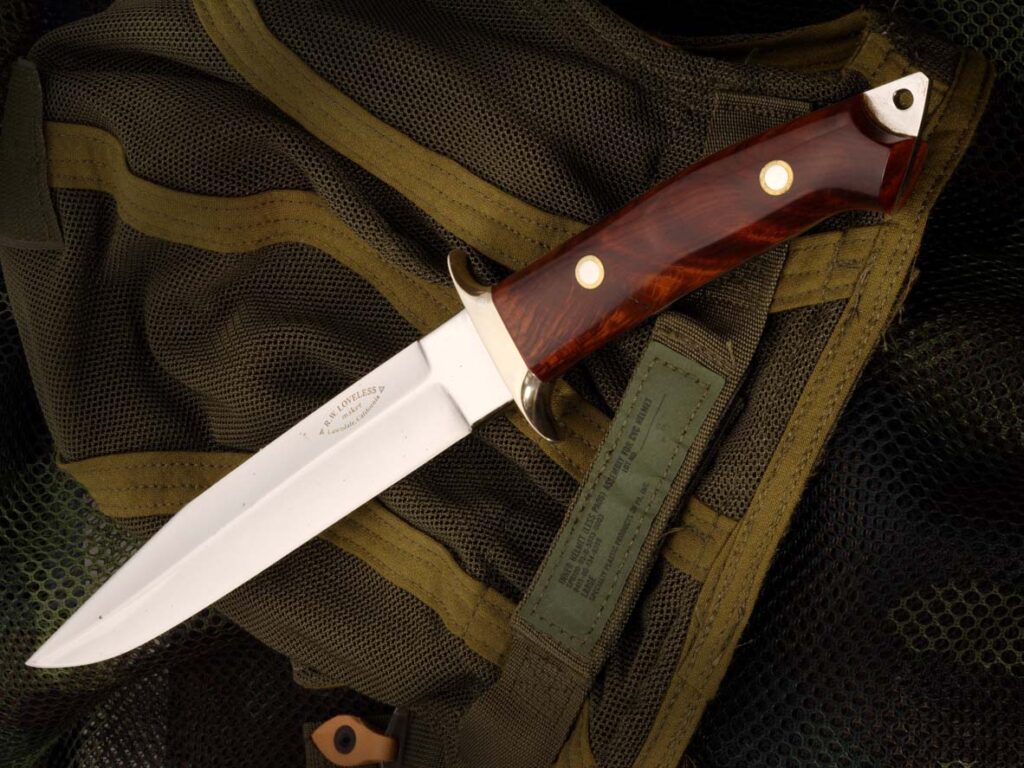
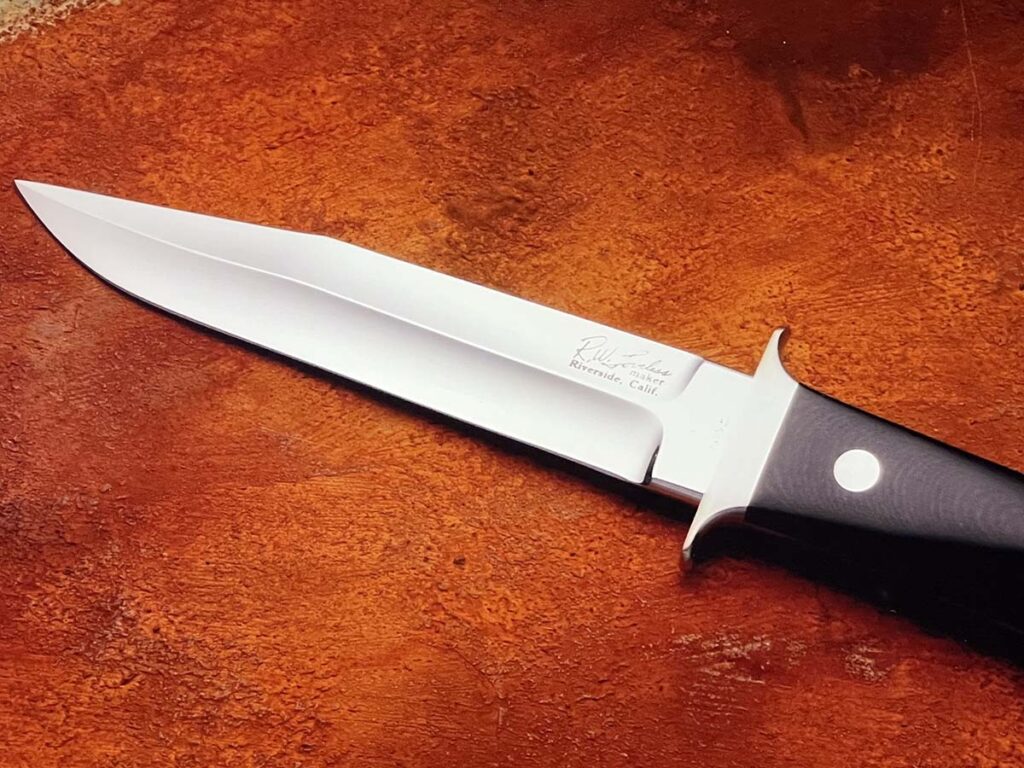
“Going back to the 1950s, Loveless has been instrumental in perfecting some of the more common traits found in contemporary knives,” he related. “The dropped hunter is probably Bob’s most emulated design, although the Archer chute, sub-hilt fighter and more show that Bob did not rest on his laurels. When a smaller, carry-sized fighter was called for, Loveless came up with the New York Special.”

Denton recalled the Loveless willingness to revive and reintroduce design and construction concepts that caught hold in modern times and energized new frontiers of imagination and artistry.

“He was not the first to use the tapered tang,” John explained, “but he found out about it from an old knife made in the 1850s that was given to him by Billy DuPont of the DuPont family. Loveless brought it back into the modern world with the tapered tang taking the weight out of the knife. Bob said, ‘It has to look so good you want to pick it up and feel so good you don’t want to put it down.’”

Bob Loveless, John Denton and Jim Merritt
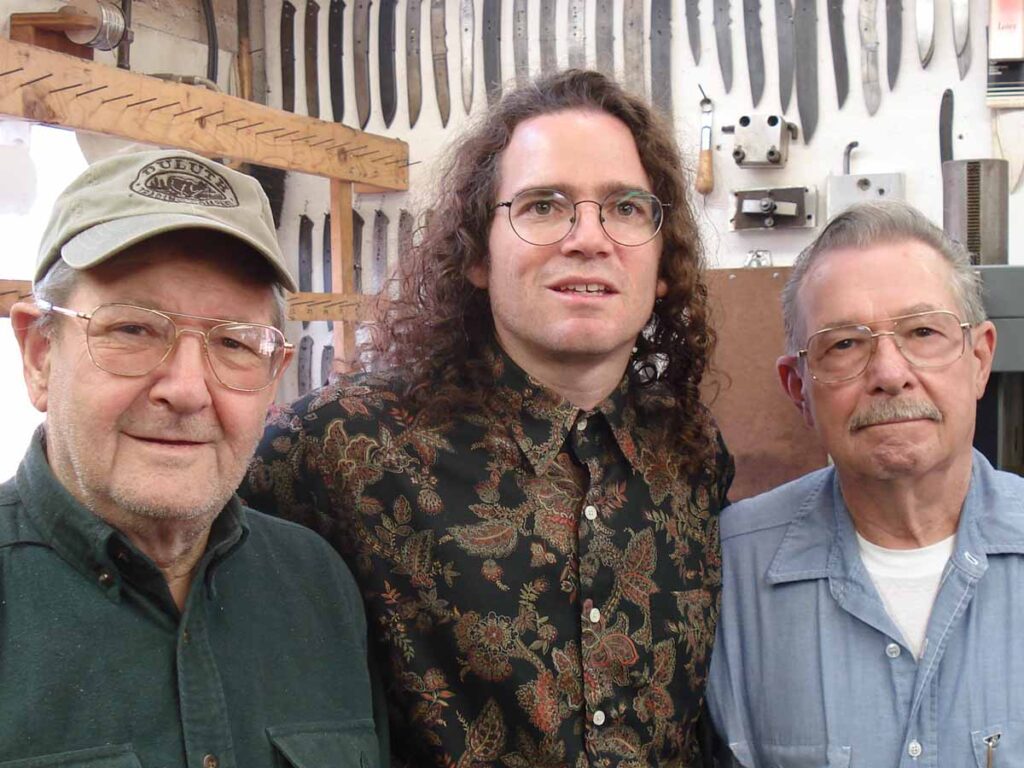
From left, Bob Loveless, John Denton and Jim Merritt in the Loveless shop in Riverside, California.

According to Denton, Loveless also brought the brass wrap handle, hidden pin, two-tone pins and half tang into play.

Design achievement crowns Bob’s career, but there was so much more to him—so much that attempting to compile a summary of his contributions would require more space than this publication might allot in another half-century.

Voyles commented, “I always liked him because he could sum up a complex subject in a sentence. He and I visited one time and I would throw out topic after topic, and he would snap back a quick response. When you left him you knew you left somebody that was phenomenally intelligent on a variety of topics, but that doesn’t mean he had social graces.”

One of Bruce’s favorite Loveless memories was Bob’s rationale during the controversy that raged within the Knifemakers’ Guild as to what truly defined a handmade knife. Loveless liked Jack Daniel’s, so Voyles and Cutlery Hall-Of-Famer Dan Delavan bought a 1.75-liter bottle of Gentleman Jack whiskey (Single Barrel wasn’t available at the time) and presented it to Loveless at his home in Riverside, California.

Loveles prototype
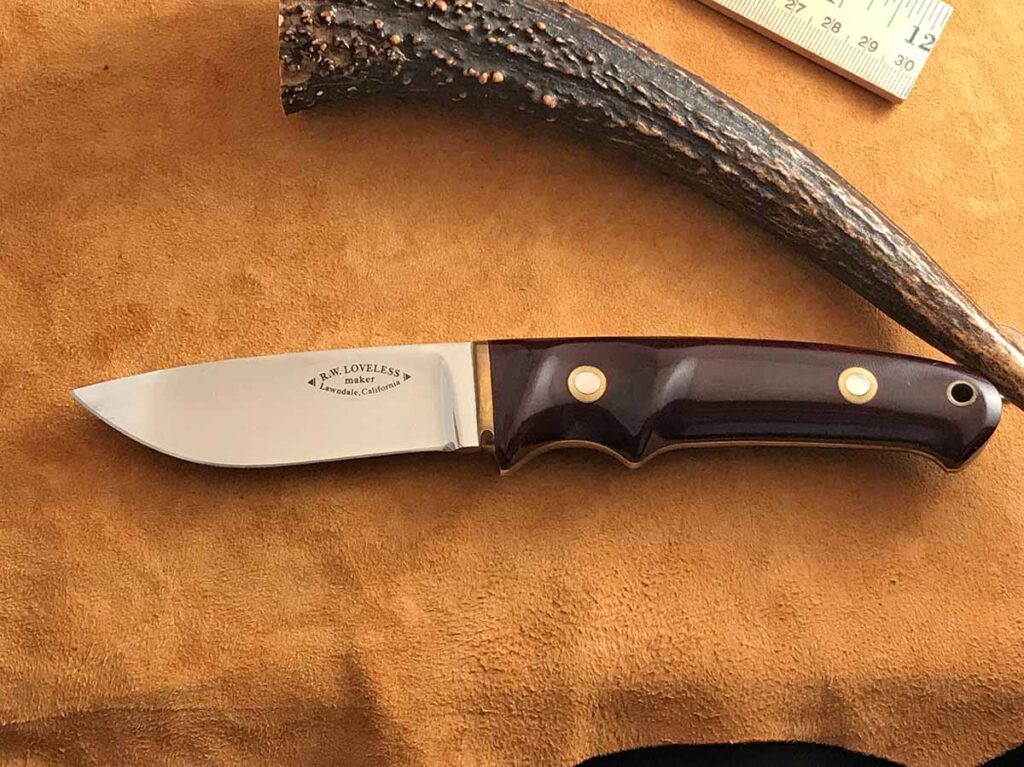
In an arrangement between Loveless and Schrade’s Uncle Henry Baer facilitated by A.G. Russell, Loveless sent this actual prototype to Schrade to copy and make the Schrade Loveless collaboration in the early 1970s. It has no guard, an “improved handle,” and a more pronounced belly than most of the Loveless dropped hunters of later years. The handle is burgundy Micarta®. As John Denton observed, the knife “has a magical feel from the ol’ man.” (Denton image)

“I said to him, ‘I hope you will accept this gift in the spirit in which it is intended,’” Bruce smiled. “He laughed and put the bottle on his shelf. Then we sat down and asked him what he believed to be the definition of a handmade knife. We videotaped his answer. He said, ‘I wish I had a machine that I could dump handle material, steel and pins into, and then a knife would come out the other end, boxed and ready to send to somebody. So, make your knives any way you want to. The marketplace will sort you out soon enough.’”

Simple, straightforward and wise.

Bob’s Impact On The Industry

Loveless played a pivotal role in the genesis of knifemakers’ organizations. He was a founding member of the Knifemakers’ Guild and a pioneer with the California Knifemaker’s Association. He was a staunch supporter of knife shows, bringing people to the events just with his mere presence. According to Ellis, Bob regularly attended the Guild Show, BLADE Show, Solvang Show, California Custom Knife Show and Phil Lobred’s Art Knife Invitational

Loveless also brought along younger knifemakers, working with them and offering advice. A few include Jim Merritt, D.F. Kressler, Yoshihito Aida, Cutlery Hall-Of-Famer D’ Holder and Steve Johnson. Bob’s style and artistic interpretation live on in part with the work of these incredible craftsmen.

Loveless-Johnson daggers
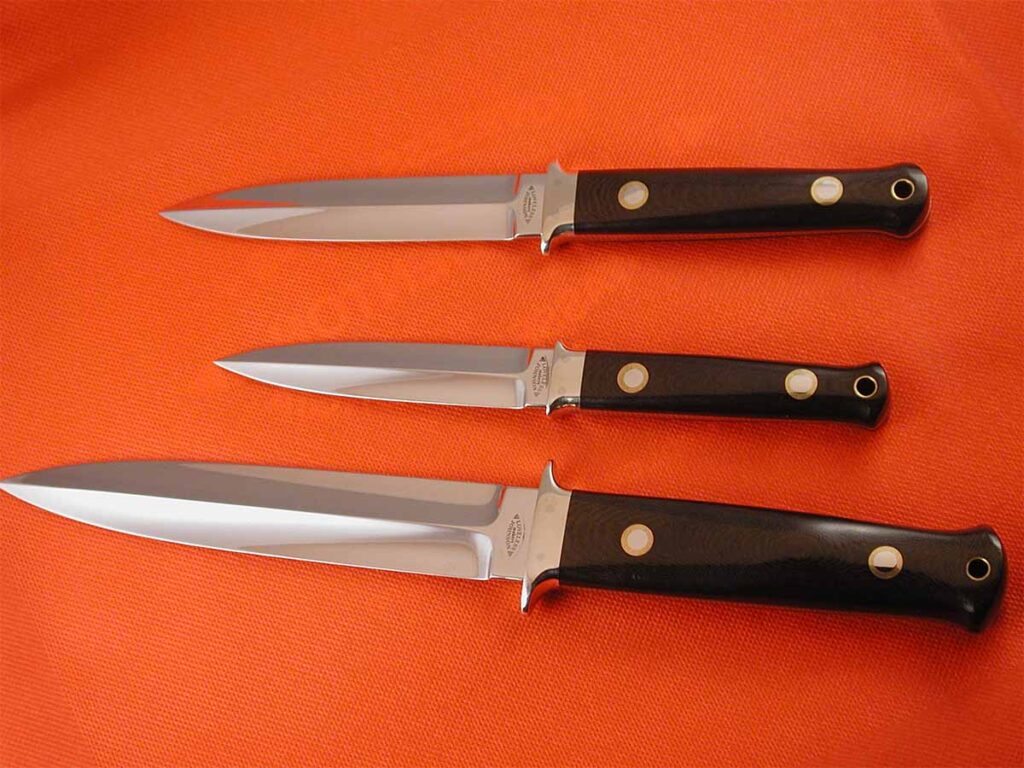
Steve Johnson worked in the Loveless shop in the early ’70s and remembers Bob fondly. “He was a true friend to those who were genuine and sincere with him,” Steve noted. Of this rare set of Loveless-Johnson daggers John Denton wrote simply, “Three really great knives.” (Denton image)

“Many a maker is in debt to Bob Loveless for the support, counsel, corrections and guidance that he gave,” Johnson said. “He was a true friend to those who were genuine and sincere with him, and the relationship that they had with him. Bob, as we know, was outspoken and quick to correct what he felt was not right or smart, which led to some loving him and others not, a bit like Ed Henry—love or hate—but both were so very good to me personally!”

Materials Maven

Loveless was an innovator in the aspect of materials as well, including 154CM stainless steel and the introduction of ATS-34 from Japan, while also popularizing Micarta® as a handle material.

Ellis commented, “Loveless pioneered the use of many of the common steels used today, especially 154CM. The shop was able to purchase such quantities that Bob could pretty much order what he wanted. The favorite handle material of the Loveless shop was green Micarta.”

Johnson remembered, “There was a stack of 154CM steel lying in the driveway at 4319 W 187th Street [the address of the Loveless shop] the day I first walked in. Bob mentioned that he was excited to get some blades done and heat treated right off. Green canvas Micarta was set in stone as the best handle material in Bob’s view. It’s still right up there on top and is used by many a maker. It’s because of Bob’s legacy that this happens.”

Global Influence

A lasting dimension of the Loveless legacy was his bridge to Japan, as well as his overtures in the European markets.

“Bob was deified to the extent that every Japanese knifemaker included his designs among their offerings,” Ellis explained. “Bob was an icon in Japan, and to this day many of the top makers in Asia have Loveless designs in their repertoires.”
Five Loveless fixed blades
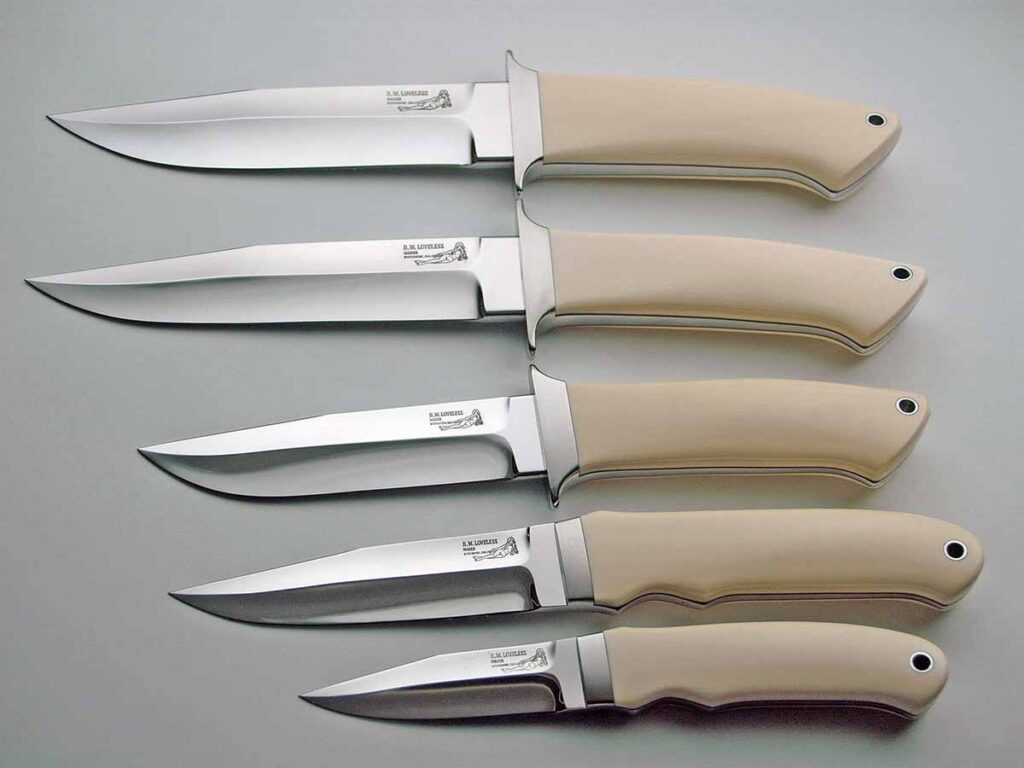
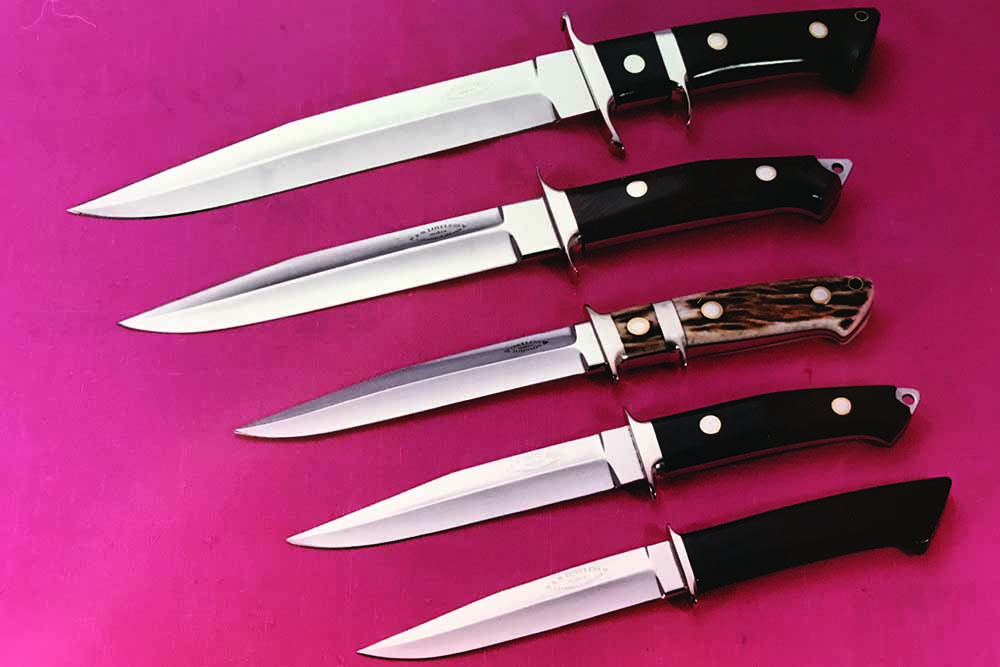
Five Loveless fixed blades sport the no bolt/no pin look in ivory handles. (Exquisiteknives.com image)

Voyles commented, “Bob went over there and showed the Japanese how to make good knives. I went to Japan in 1981 or ’82, and in every factory I went to there was a picture of Bob Loveless and the factory owner. The thing was that Bob’s wife, Yoshiko, was Japanese, so he didn’t have a problem with the language barrier, and he went to Japan to show them how to make knives that appeal to Americans.”

Loveless used his connections to make things happen, and Voyles credits him with the evolution of the folding knife among Japanese manufacturers, as well as a surge in the Japanese collector market.

“Bob didn’t make folders and the Japanese wanted folders,” Bruce recalled. “He had worked on a design with Jess Horn, and Bob put Jess and Japanese collectors in touch with each other. Horn also had a series of folders that he patterned after the old Remington Bullets. When Japanese collectors discovered that, their market for vintage Remingtons went straight through the roof. Loveless sowed the seeds in the 1990s for the collectibility of vintage knives in Japan.”

Collecting Loveless

Today, a Loveless knife is a collectible phenomenon in its own right. Name the year, name the mark on the blade, name the style and the materials, it will sell for astonishing dollars. Denton has noted some models made in the 1970s that sold for $400 then and have reached the rarefied air of $100,000 or more in recent years. The power of Loveless pricing simply takes your breath away.

Bruce is quick to add that Loveless was professionally unselfish. “If you wanted to make a style of his knife in your factory, that was OK,” Bruce noted. “Just ask him.”

Early Model Loveless
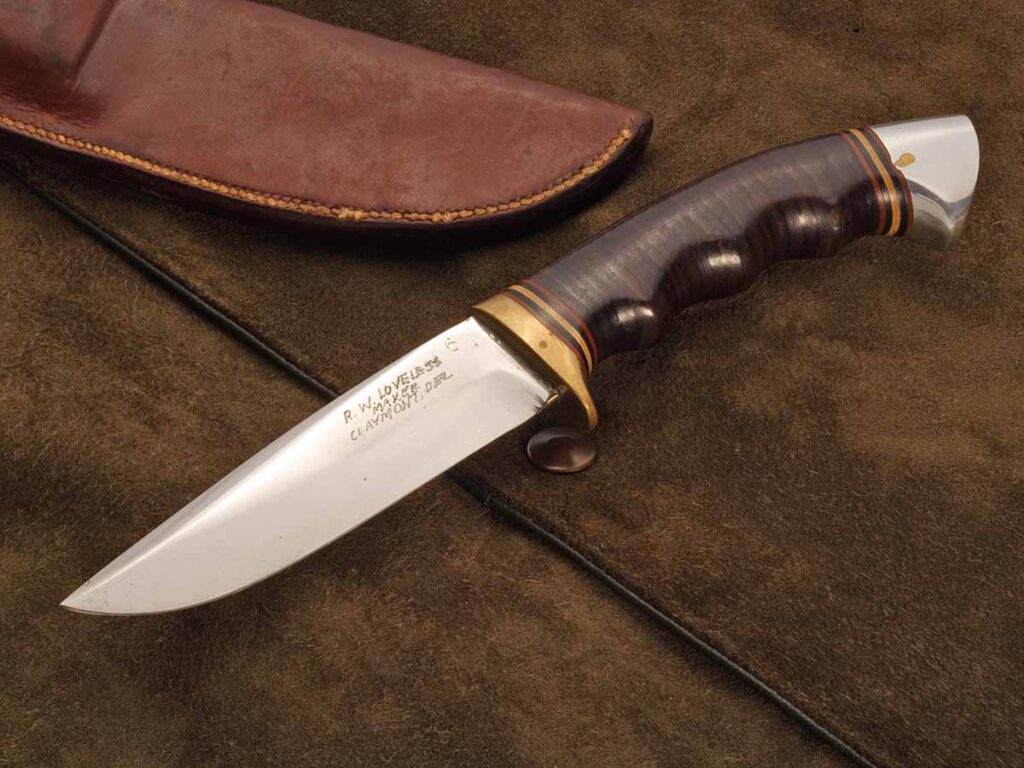
Circa 1955, Loveless sold his first knife to Abercrombie & Fitch for $14 (adjusted for inflation, almost $160 in today’s money). Loveless made this early model for A&F in his shop in Claymont, Delaware.

The pervasive Loveless influence stretched far and wide, from the custom knife shop to the factory.

“His designs for and collaborations with Schrade, Gerber, Lone Wolf and others, and the factory knife market in general, were significant,” Ellis recalled. “Early on the astute factories were taken by Loveless designs and made limited editions in dropped hunters and others. These days factory collaborations are quite common, and you can thank Bob Loveless if you want to give credit where it is due.”

When Sports Illustrated called Loveless for an interview in 1980 and the magazine published his words in the same edition that featured tennis superstar Bjorn Borg on the cover, the impact on the entire knife universe was transcendent. When asked why so many people considered his knives “better” than those of others, he mused, “A knife is an extension of your experience. And I’ve had more experiences than most people. There’s more character running in my veins.”

For those who knew Bob, just the knowing was an unforgettable experience. His contributions to his present and to the futures of others in the knife industry remains incalculable. And so, the longevity of a man does not reside in his years on Earth, but in the perpetual remembrance of his ideas, his workmanship and his innovative perspective on the world.

Therefore, it can be said that when Loveless left us he did not go gentle into that good night. He did not fade away. He didn’t drop the mic. He handed it to those with the foresight and the intestinal fortitude for the days to come. Now, what do we say and do? Loveless might grouse. He might gripe. But he just might also manage a grin.

Read More On BLADE Magazine And Show:

Growing Up Loveless: Reflections On The Master From His Daughter

Robin Askew reflects on being the daughter of Bob Loveless.

It was intimate and distant. It was warm and aloof. It was youth, adulthood, hope and memory—all at the same time.

Robin Askew is 70 years old now. She lives a quiet life in Sacramento, California, and her recollections of growing up as the daughter of a legend offer insights into years of experiences that few could imagine. Her father, BLADE Magazine Cutlery Hall-of-Fame® member Bob Loveless, was and remains one of the titans of the custom knife industry. He has been gone more than 15 years, but his imprint on the past, present and future of custom knives is unmistakable and not about to wane.

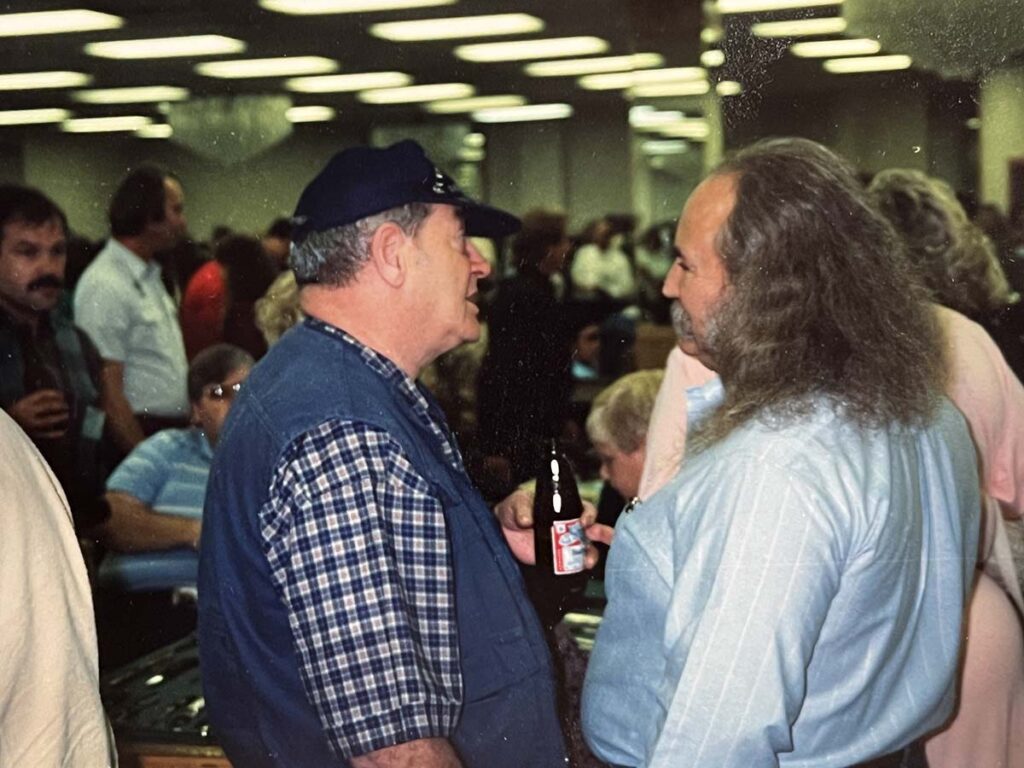
Bob Loveless (center) talks with David Crosby (right) of Crosby, Stills and Nash at the 1989 California Custom Knife Show. The two were good friends, with Loveless an inveterate harmonica player who at times would play with CSN at a local bar or night club. At left is a young, mustachioed Steve D’Lack, coordinator today of the New York and Nashville Custom Knife Shows. (John Denton image)

Likewise, those who knew him remember his unforgettable, often larger-than-life persona. Creative genius, irascibility, generosity and unique perspective came together in Loveless, the man who shaped custom knives and literally changed the landscape in tangible ways, including steel and its components, and in intangible ways such as the sweep of the blade, its flow and form, and the aesthetic qualities that characterized his legacy.

Robin experienced the evolution, both in the life of Loveless and in the industry that he forever altered. From her earliest memories, her father was a busy man building a future one knife at a time, crafting a legend—whether he knew it or not—one innovation after another from a basement in Delaware to his shops in California. In the midst of it all, growing up Loveless was a complex, frustrating, fallible, forgiving and ultimately joyous journey.

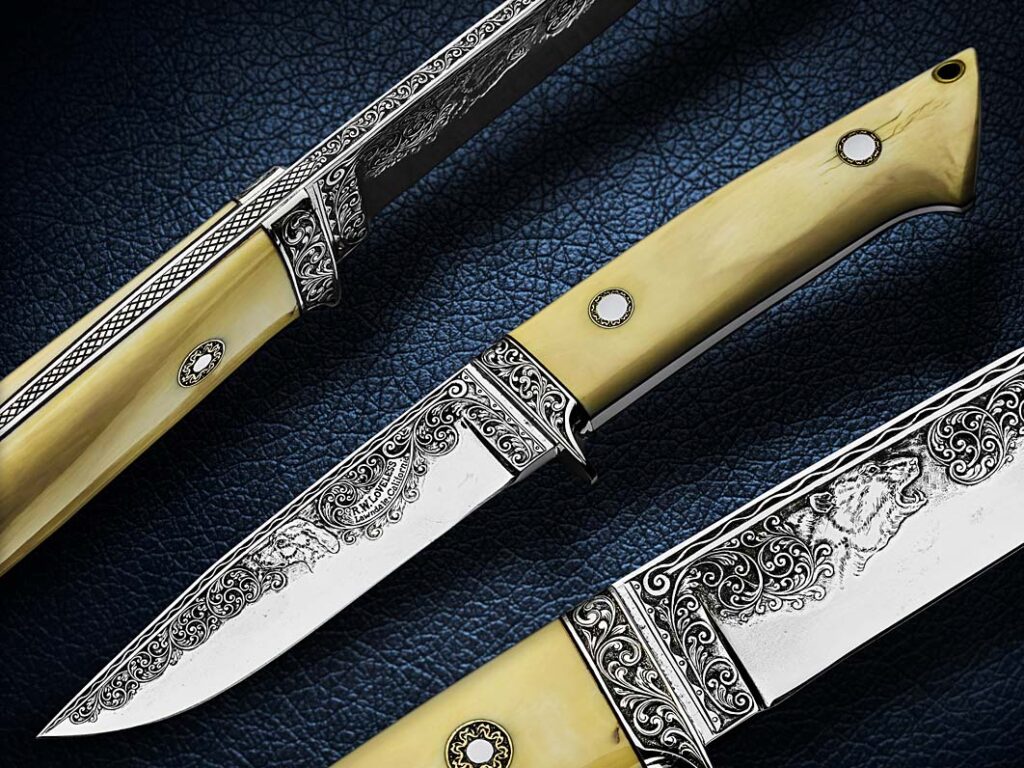
David Crosby owned this ivory-handled Loveless utility knife fully engraved by H.H. Frank. According to John Denton, it sold for $22,000 a few years ago. (Cory Martin image)

“Some people were actually frightened of him,” Robin smiled. “They might have been put off. But his bark was so much worse than his bite. Over the years, my father was so amazed by the fact that others regarded him with such a high standard. He didn’t embrace that at all. One time he said to me, ‘They still think I’m the greatest.’ That was something that he had never imagined and never really came to terms with.”

Bob Loveless made contributions to the knife industry on multiple levels. He was instrumental in the formation of The Knifemakers’ Guild and in establishing the custom knife market in concert with other great men like the incomparable Cutlery Hall-of-Famer A.G. Russell. Loveless reached across the globe and developed relationships in Japan that eventually brought ATS-34 stainless steel, a staple in blade construction, to other markets. He was a metallurgist who concocted his own steel composition and made Micarta® a handle material of choice. The curve and the sweep of the drop-point hunter and other Loveless creations touch the senses and influence generations of admirers even now.

Robin Askew is alive and living well today at 70.

For Robin, more than half a century of a legend in the making is remembered in light and shadow, the image of her father at work tirelessly building and brainstorming and striving to make his way, and in turn taking care of those close to him. It was, at times, both turbulent and tender, but always something new.

“Daddy was super, super busy,” Robin recalled. “I never made a knife, just swept the shop floor. He would do things in batches and stages, and one of the most fascinating things I remember was when he would cut the leather and make the sheaths on a big stitching machine. He did everything with the knives, from drawing out the patterns to grinding the blades down and shaping them and putting the Micarta, stag or ivory handles on them. After he ground batches of blades, he would test them, pointing them down and dropping them onto the concrete floor of the shop. If the tip cracked, the whole batch of blades would be thrown away—but that never happened.”

Through the years, there were times when the family fractured, quite probably due at least in part to the stress and strain of a one-man enterprise that was on the rise, moving through uncharted territory and challenges. While something incredible was eventually gained, there was a cost to be counted. But such is true in life, true for everyone and in every relationship.

Lawndale & Riverside

For much of her young life in Lawndale, California, Robin lived in a small house with her mother and sister while her father lived in a studio apartment just down the road and worked in his basic shop.

“At the time I grew up with my dad, Allison and I were the oldest, and then Mary came along nine years later,” Robin commented. “Dad was getting to be known while the shop was in Lawndale, and when I was a senior in high school in 1973, the shop in Riverside, California, was not quite ready.

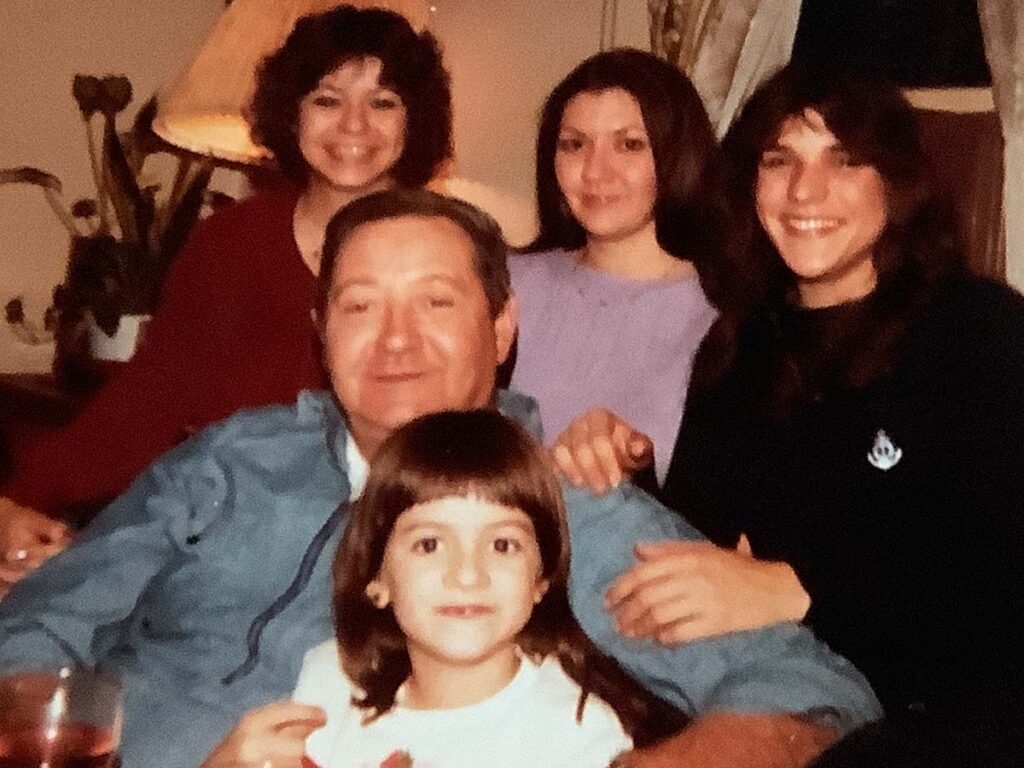
Taken on Christmas 1982, Loveless’s three daughters appear together, in back from left, Robin, Alison and Mary. Bob has his arm around Alison’s daughter Anna, the first Loveless grandchild.

“Still, he was getting telephone calls all the time. We would answer them in the house when he was working, and finally he put a phone in the shop because we had been taking all the calls,” she laughed. “He hired me to be his little secretary, and I would send out the catalogs and address them and seal them and take messages. It was a little weekend job, nice and fun.”

The relocation to Riverside occurred about 1974, and Robin remembers the dramatic change from Lawndale in terms of shop sophistication. “I had moved away,” she said, “and when I came to the shop in Riverside, it was so much more advanced than the little Lawndale shop with so many machines and things to look at. I was fascinated by everything he did, and it was fun to sit in his office.”

Along For The Ride

“Some people were actually frightened of him,” Robin said of her father. “They might have been put off. But his bark was so much worse than his bite.”

By that time, though, the Loveless mystique was already established. Bob was well on his way to custom knife stardom. And those around him? Well, they were along for the ride.

“People had started to come over and meet my dad,” Robin smiled. “There were so many people, different people, ordering knives. He would hang up the phone and say, ‘OK, John Wayne just ordered a knife.’”

Bob Loveless became a friend to the prominent, the eclectic and a diverse spectrum of admirers. Although they may have shared little else, they were each drawn, like moths to a flame, to the world and work of a master. Loveless met David Crosby, Stephen Stills and Graham Nash, stars of the pop music scene with their fame growing exponentially in the late 1960s. Crosby was a frequent visitor.

“When Dad first met them, the three were playing the circuit,” Robin remarked. “They were performing in bars and night clubs, and Dad would sit in with them on stage and play his harmonica. He loved to play the harmonica and had a lot of fun with them. Crosby would come to where Dad lived in the studio apartment about a quarter mile down the street from the house in Lawndale and just hang out. One time, he came to the door and said, ‘Is your dad here?’ and I yelled, ‘Dad, David Crosby is at the front door!’ They would just talk and enjoy themselves and do their thing.

“One time Crosby came into the kitchen and said, ‘Robin, can you make me a cup of coffee? You’re the only one who knows how I like it.’ This is 1973. These guys are really hot. And I’m a senior in high school!”

Vietnam

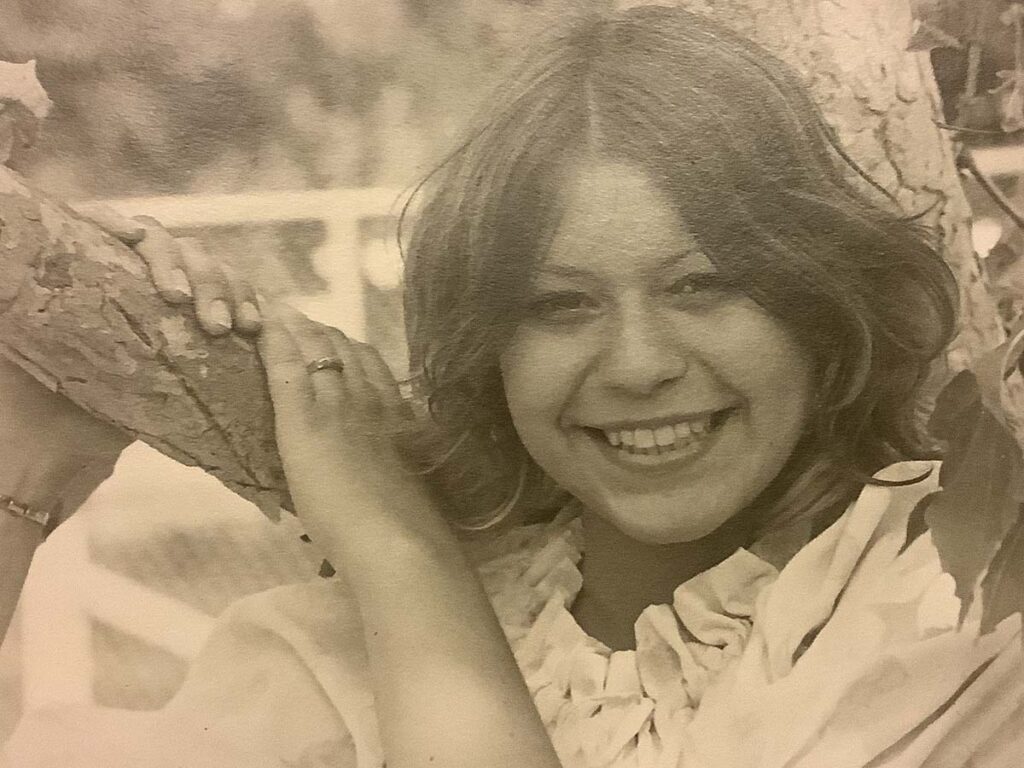
Robin visited her dad after he set up shop in Riverside, California, where this shot was taken in the backyard. She was 18.

During the 1960s and ’70s, Bob made many knives for military personnel, but Robin says he was sensitive to the situation when it came to his children. “My war was Vietnam,” she reflected, “and Dad made a lot of combat knives for Marines and Special Operations people who went overseas. I never knew that until I was an adult, and I don’t think Dad wanted us to know that. The war was so horrific in my eyes, but I supported everyone who ever went there. Some of them were my schoolmates.

“Dad was not a part of the California culture of that time,” she continued, “because he was always making knives. He had a lot of them on back order, and he would tell me the wait time was five years or six years, and later it got up to 10 years. He didn’t ever really have time to leave the shop, and he never discussed political things unless I called and asked his opinion about something. I do know that he made fighting knives—and these were like ‘killer knives.’ They were unbelievable. Then, his mother and stepfather were murdered in Ohio in 1985. They were stabbed to death in a robbery while he was in Japan.

According to John Denton, Loveless made this fighter in tulip wood with skull-cracker in Lawndale, California, for CIA operative Harry Archer. (Hiro Soga image)

“The decision was made not to tell him about it until he came home. He had already had a heart attack. So, after he was given the terrible news, I believe he felt bad about making knives because sometimes knives took people’s lives. Afterward, he no longer made combat knives.”

The life and times of Bob Loveless were surreal, energized and unequalled in excitement. “I remember once when a gentleman from Japan visited us in California,” Robin added. “My dad was instrumental in helping the Japanese Guild get started, and they would send makers over to work with him. I had no idea who this gentleman was, and you’ve got to remember that the Lawndale shop was just a tiny square box, not fancy but where he had put everything he had into it. This Japanese gentleman bowed to me. I was 16 at the time—and honored that he would bow to me. I didn’t really understand, but Dad said, ‘That’s what they do. They respect us, and they copy us because they respect our work.’”
Bob’s Beehive

Bob also cultivated a relationship with his one-time landlord, Dr. Dixon. He rented a house from Dixon and subsequently bought it. He made knives that Dixon collected, even naming a fighter style after his friend, this one with the Loveless signature logo. (John Denton image)

The Loveless shop, in Lawndale and then Riverside, was a beehive of activity. First, Bob was a solo act, and then great partnerships and friendships emerged. “In the morning, I would go to school, and he was busy all day,” Robin said. “Steve Johnson came in and was his partner. Steve was like an older brother to me. He was a very good boy, very shy and dedicated to learning the craft from my dad. He is maybe five years older than I am, and he grew into a wonderful man.

“Steve had a Camaro, and he would let me drive it,” she continued. “It had a manual shift, not an automatic. I went for the test to get my driver’s license in that car, and it didn’t go too well. The instructor said, ‘Are you all right? You turned too much!’ When we got back to the DMV, I told Steve I had flunked. But he still let me drive his car back home.”

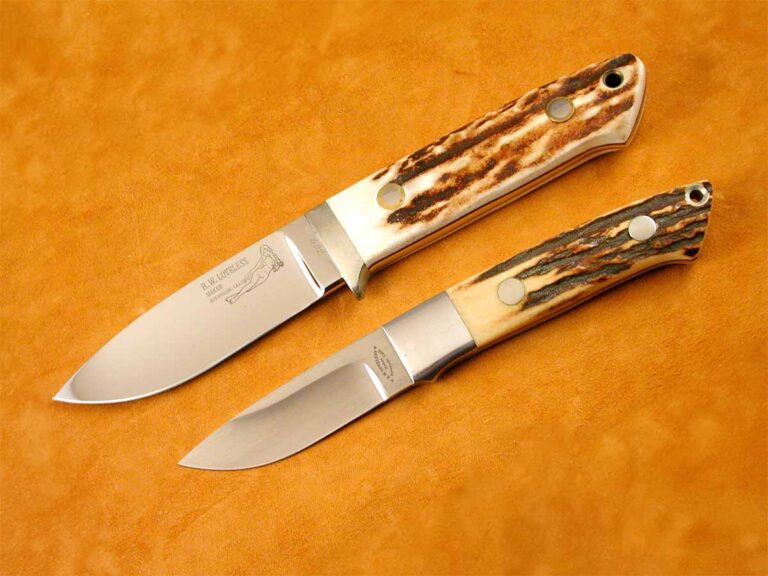
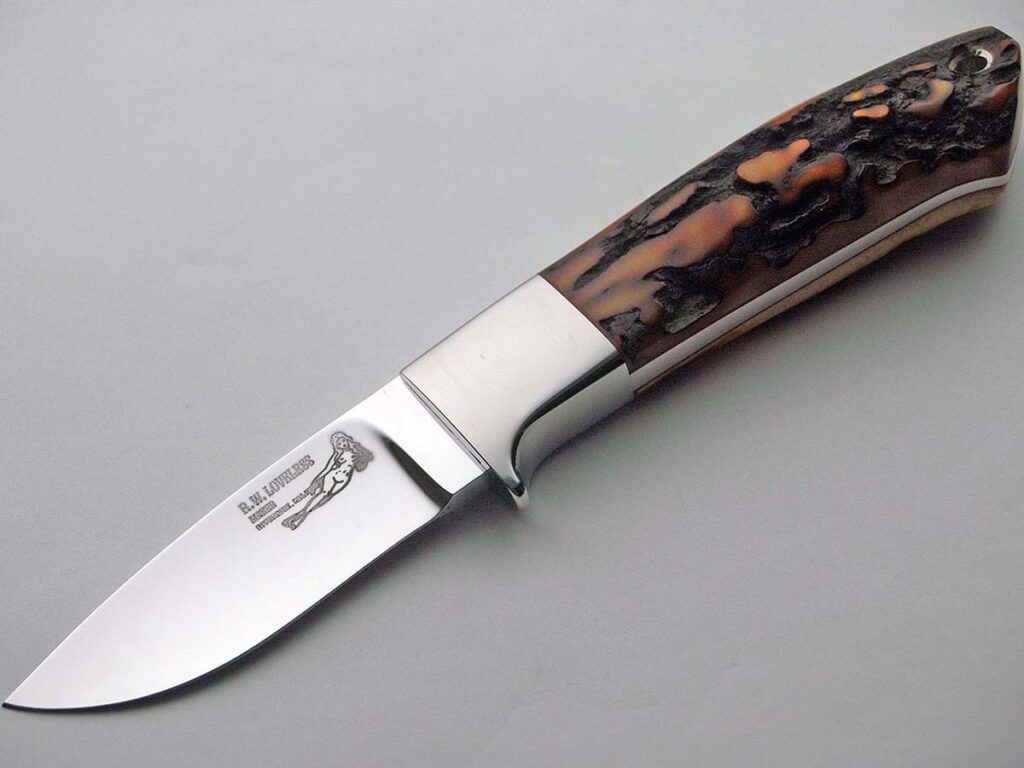
The most famous Loveless knife of all, the drop-point hunter or, as he called it, the dropped hunter.(Dave Ellis/Exquisiteknives.com image)

Bob also cultivated a relationship with his one-time landlord, Dr. Dixon. He rented a house from Dixon and subsequently bought it. He made knives that Dixon collected, even naming a fighter style after his friend. Bob’s buddy Ray Randall was a frequent visitor as well. Robin recalled, “Ray was a sales representative, and he would bring us girls all kinds of shampoos and cream rinses for our hair when he came out to visit Dad.”

Read More On Bob Loveless:

Antique Switchblades: World War II And Beyond

Harking back to American military glory and post-war prosperity, antique switchblades from the 1940s and 1950 have enduring appeal.

From its first patent in 1884, the switchblade was an important addition to most early U.S. cutlery companies.

According to Mark Erickson, author of Antique American Switchblades, between 35-to-40 companies made and/or sold switchblades, including almost all of whose names long-time collectors recognize: Aerial, Camillus, Case, Challenge, Colonial, George Schrade, KA-BAR, L.L. Bean, Novel Shapleigh Hardware, Queen, Remington, Schrade Cutlery Co., Utica, Wade and Butcher, and Shapleigh Hardware, to list a few.

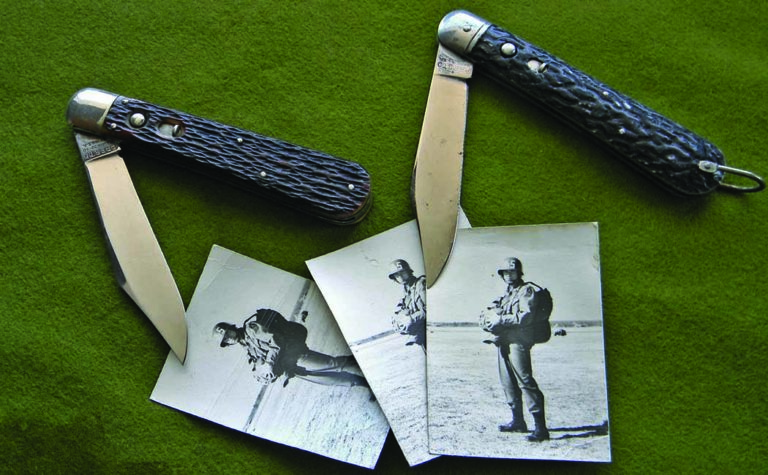
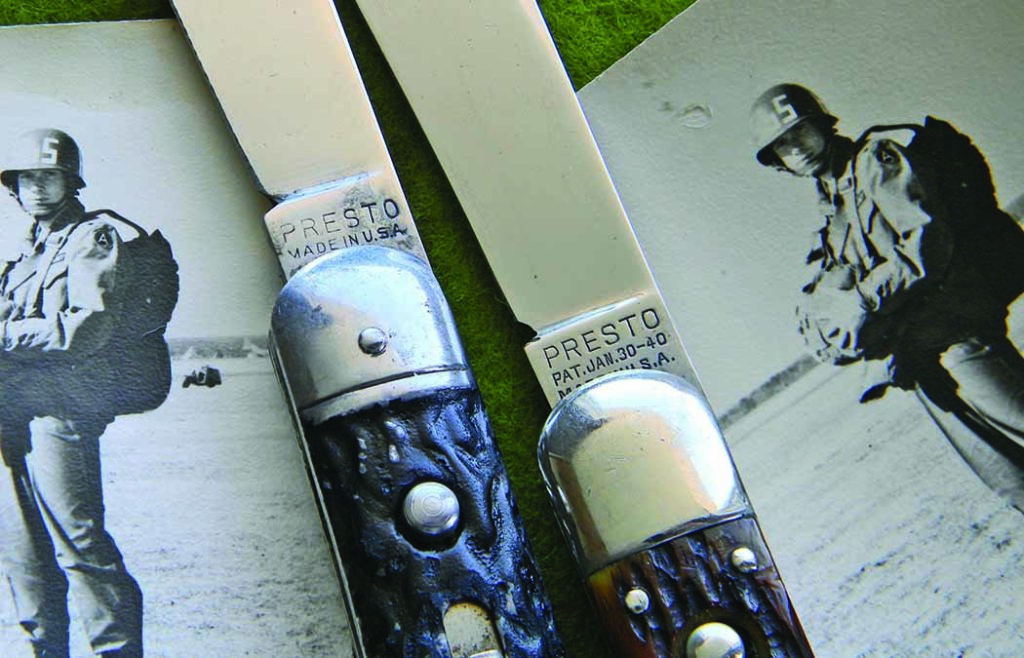
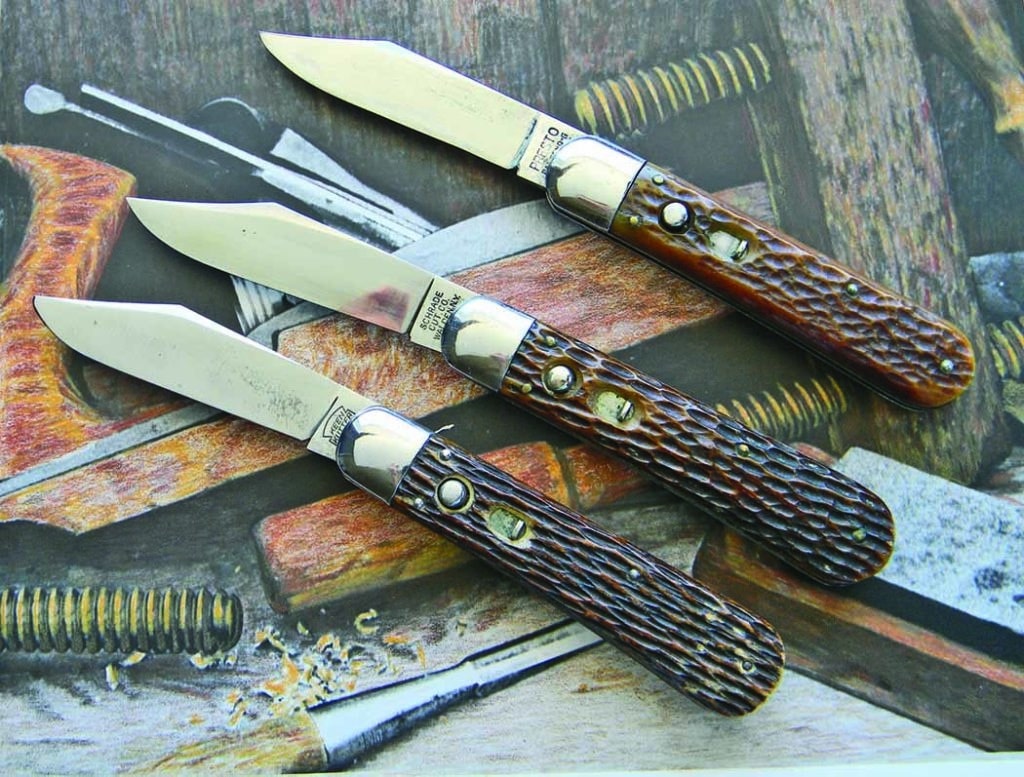
 These two switchblades with the Presto stamping by George Schrade Knife Co., are among those that played an important part in the success of American paratroopers during World War II. On the facing page, the one at left has “jigged iron” scales and the one at right has jigged bone.
These two switchblades with the Presto stamping by George Schrade Knife Co., are among those that played an important part in the success of American paratroopers during World War II.
Because of the collectibility of the named companies and the significant variety of styles, sizes and handle materials associated with them, switchblades have become a serious endeavor for many collectors of antique knives.
Invention Of The Switchblade

As a serious cutlery collector, my downfall has been fingernails that bend backward with even the smoothest opening blades. The switchblade innovators had fingernails in mind when they produced a knife that could be opened without using a nail. In fact, some of the best switchblades are found in women’s old sewing baskets.

In fact, early switchblade ads tout the folder’s ability to be used by people with weak fingernails. “These knives will be a wonder for those who have difficulty opening a traditional knife” stated one such ad.

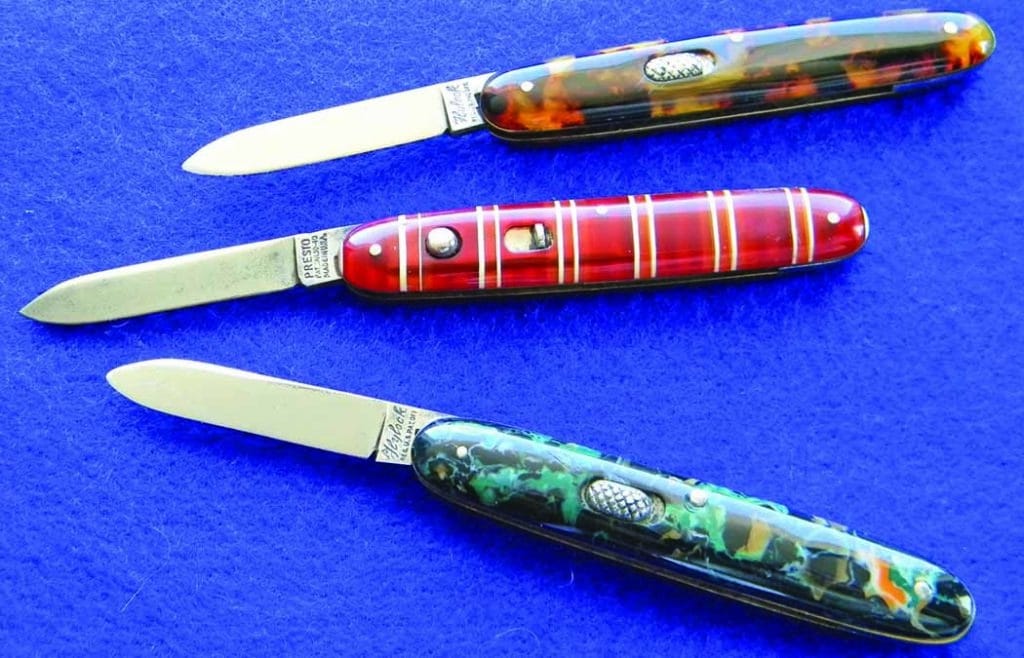
Celluloid was a very popular handle material on antique switchblades. Celluloid types, from top: a George Schrade in imitation tortoise, another George Schrade model in candy stripe, and one from Flylock Knife Co., in blue, pink and black swirl.

For many other occupations, the switchblade and its ability to be opened with one hand has proven immensely important. Mechanics, fishermen, ranchers, soldiers, veterinarians and even Boy Scouts were frequent users of the pocketknives. With a wiggling fish in one hand, it is easy to see how a switchblade could be a valuable asset to most fishermen when cutting a line.

Moreover, most switchblades have a lock/safety that keeps the blade from opening accidentally and the open blade from closing on the hand. An early Flylock Knife Co. ad touted, “The ideal knife for all outdoors and sports use. One hand only required to open or close, leaving the other hand free to grip a rod or gun.”

World War II Switchblades

World War II brought with it the necessity of supporting soldiers who parachuted behind enemy lines. Switchblades procured for the U.S. military were designed to cut the parachute suspension lines that became entangled during landing. The knives were carried in what has been described as “neck pockets’ in jump uniforms.

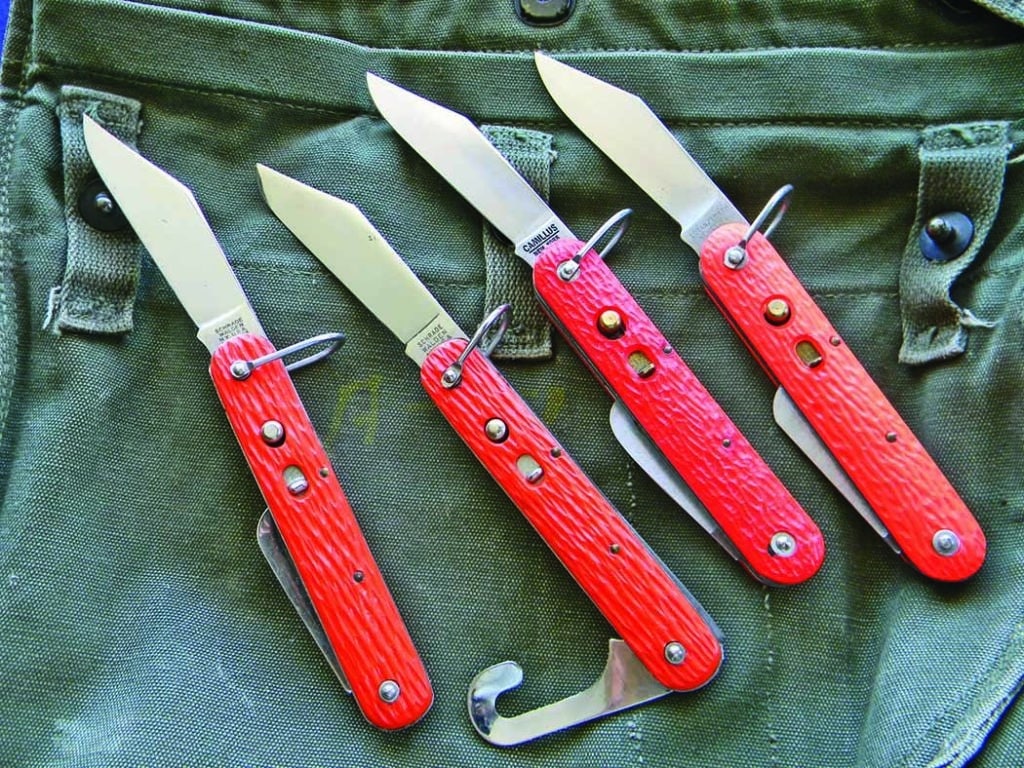
Military switchblades designated “MC1” included models in orange handles for heightened visibility. They were made by Schrade until 1960, when Camillus took over the contract. The knives have a master blade opened by a push button and a manual shroud cutter.

There are continuing discussions about the knives specifically made for and used by the U.S. military during the war. The discussions center around whether switchblades issued to troops all had jigged bone handles or jigged metal sides. Another discussion is whether all switchblades used by paratroopers had a bail—known in the military as a “lanyard staple”—or whether knives without bails also were used.

Units that used the knives included paratroopers in the 82nd Airborne and 101st Airborne Divisions, which included the 505th, 507th and 508th parachute infantry regiments. The 505th Infantry Regiment website shows switchblades made by Schrade Cutlery Co. stamped “Presto” with jigged bone handles and metal handles made to look like jigged bone painted black. Knives both with and without bails are included in the photographs. Switchblades made for World War II paratroopers also include those stamped Schrade-Walden and Schrade Cut. Co.

The book, 4 Stars of Valor: The History of the 505th Parachute Infantry, describes the equipment carried by paratroopers. In addition to main and reserve chutes, full uniform and helmet, the paratroopers carried over 70 pounds of equipment, including an M-1 carbine with ammo, Mae West life jacket, switchblade, water-filled canteen, trench knife, fragmentation and smoke grenades, mess kits, three days of K rations, escape map and compass, gas masks, toiletry items, 30 feet of rope, blanket, half a shelter and first-aid kit.

Post-War Military Switchblades

After World War II, several companies made switchblades for military personnel. According to one website, the first such knife was produced for the armed forces by Schrade Cutlery Co., designated as MC-1, an airman’s paratrooper knife, in 1957. Sometimes the knives are referred to as aircrew survival knives.

Three jigged bone switchblades, from top: Schrade Cutlery Co., George Schrade Knife Co. and one of the rarest of antique models, one stamped “Keen Kutter,” a trademark of Shapleigh Hardware. Schrade made the knife.

The first contract was awarded to Schrade Cutlery followed by a second contract to Camillus, and a third to Logan-Smyth. The orange-handle switchblades had two blades: one a master spear pattern opened by depressing the button, and a second blade shaped like a hook to cut parachute suspension lines. In my estimation, the hooked blade is not sharp enough to easily cut parachute lines and must be resharpened.

Civilian Switchblades

The early 1950s brought a renewed interest in cheap, colorful switchblades, with thousands of knives made by Imperial in its Jack-O-Matic Texas toothpick model, and Colonial, which used the Shur-Sharp stamp on its colorful models. The fishtail jackknives and the Texas toothpick styles were by far the favorite examples produced by the two companies.

The George Schrade Knife Co. continued to produce popular switchblades with celluloid handles stamped Presto. The knives were made with a single blade, double blades (the latter with a push button for each blade) and even a letter opener with a push button in one end.

Celluloid Handles On Antique Switchblades: Why?

The handle material for most of the inexpensive switchblades was celluloid. Thin sheets of the versatile plastic-like substance were molded around the knife’s metal sides. The most popular celluloid style was candy stripe. The knives also can be found in a wide variety of swirled celluloid handles in a myriad of different color combos, some with such recognizable celluloids as cracked ice and imitation tortoise.

Because the knives were inexpensively priced, they were extremely popular with boys in the 1950s. Because of the knives’ widespread use, some advertisers saw an opportunity to emboss various ads on them, giving them away as a novel company promotion gimmick.

Allure Of Antique Switchblades

Because of their connection with the heroic actions of airborne troops during World War II, antique switchblades have continued to be a popular cutlery collecting niche. Moreover, since almost three dozen companies, each producing a vast array of sizes and handle materials, made the knives, the collecting field is wide open.

Even in the 1950s cheap construction, made more evident by the continuous opening and closing of the blades, the knives remain popular collectibles. No doubt one reason for the popularity is that antique switchblades remind many of the Golden Age of the 1950s and ’60s when kids played outside all day, shot their BB guns, and hit the corner gas station for a cold soda and a candy bar.

Ah, those were the days!

More On Switchblades:

Military Knives: Historic Star-Spangled Steel

Few knives have served America more than those of the U.S. military.

Editor’s Note: This is the first of a two-part series on the most influential knives to serve the U.S. Military and explores some of the early influences on military knife design.

As what many call the greatest country in the history of countries approaches its 250th birthday, now’s a good time to salute some of the top knives that played pivotal military roles in the forging of the world beacon that is the United States of America.

It is, of course, impossible to recognize in one magazine story every single knife that played a crucial role in the many battles of the wars fought by the USA. However, with the help of some of the knife industry’s leading military authorities—including several of whom have seen the elephant in service to our nation—BLADE® will endeavor to touch on some of the more consequential knives of U.S. military history.

Before embarking on such a quest, the first task is to identify a basic group of the most indispensable knife types over two-and-a-half centuries of American land warfare. At the risk of omitting one or more, five stand out: bayonet, all-purpose utility fixed blade and/or bowie, dagger, machete/chopper and utility folder.

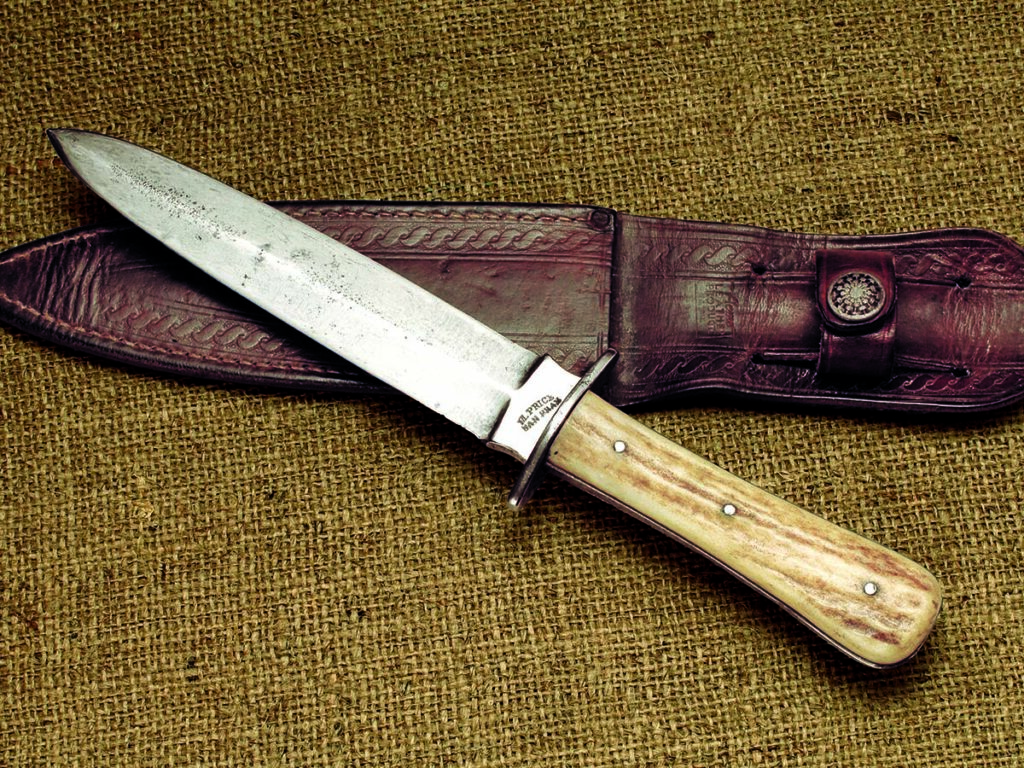
Michael Price recognized that to create a viable knife for self-defense and combat, form must follow function. His solution was to use the full-tang construction method, here on one of his classic mid-19th-century daggers. (Image courtesy of Louis Chow)

“These encapsulate everything that an infantryman used during the 250-year history of our country,” noted Louis Chow, a 24-year U.S. Army veteran who retired with the rank of major and is one of the leading collectors of the knives of BLADE Magazine Cutlery Hall-of-Fame® member Bob Loveless. “The bayonet, of course, from the get-go, from the Revolution to today.”

Louis indicated the all-purpose utility fixed blade/bowie could include privately purchased knives such as the Randall Model 1 and, of course, double-guard bowie types like the USMC fighting utility knife, aka the Ka-Bar. He pointed to the mid-19th-century designs of Michael Price as highly influential on daggers through to today, and machetes such as those made by Collins used in the Spanish-American War and before to Vietnam as vital to U.S. war efforts. Though pocketknives were indeed carried by American patriots during the Revolutionary War, the utility folders to which Louis referred are more of the modern Leatherman/Gerber multi-tool type, not to mention the Buck 110, Al Mar SERE, CRKT M-16 and others. As Louis noted, almost every soldier, male or female, in the modern military carries a multi-tool folder.

Many knife enthusiasts know that bayonets are rarely, if ever, used in combat today, nor have they been for well over a century. “It’s hard to actually find someone who used one in combat,” Louis said. Probably the most legendary American bayonet charge was the eminently successful one by Union forces led by Col. Joshua Chamberlain against Confederate troops down a hill called Little Round Top, a major turning point in the Battle of Gettysburg and, of course, the entire Civil War. Ironically, as Louis noted, “the most famous bayonet charge of all was the last one.”

While bayonets have rarely been used in American combat for many decades, that does not mean they do not remain significant teaching tools in today’s U.S. military. “When I was a company commander in 1990, we trained with the bayonet,” Louis recalled. “There are established bayonet courses on every installation, such as Fort Hood in Texas and Fort Benning in Georgia, and we would go there and train with the bayonet.” The rifles and bayonets have changed over the years but the bayonet training techniques remain the same.
Throughout U.S. and nearly all other nations’ histories, governments have been responsible for the issuance of combat knives in the form of bayonets for their infantry fighting forces. During World War II, the USA issued all-purpose fighters and utility knives to many soldiers, sailors and airmen. However, as Louis noted, privately purchased edged tools and weapons have always been the mainstay of our servicemen. During the earliest American conflicts, including the Revolutionary through the Civil Wars, kitchen, utility, farrier-forged and European-imported cutlery were the sidearms of the multitude of militiamen and patriotic volunteers.

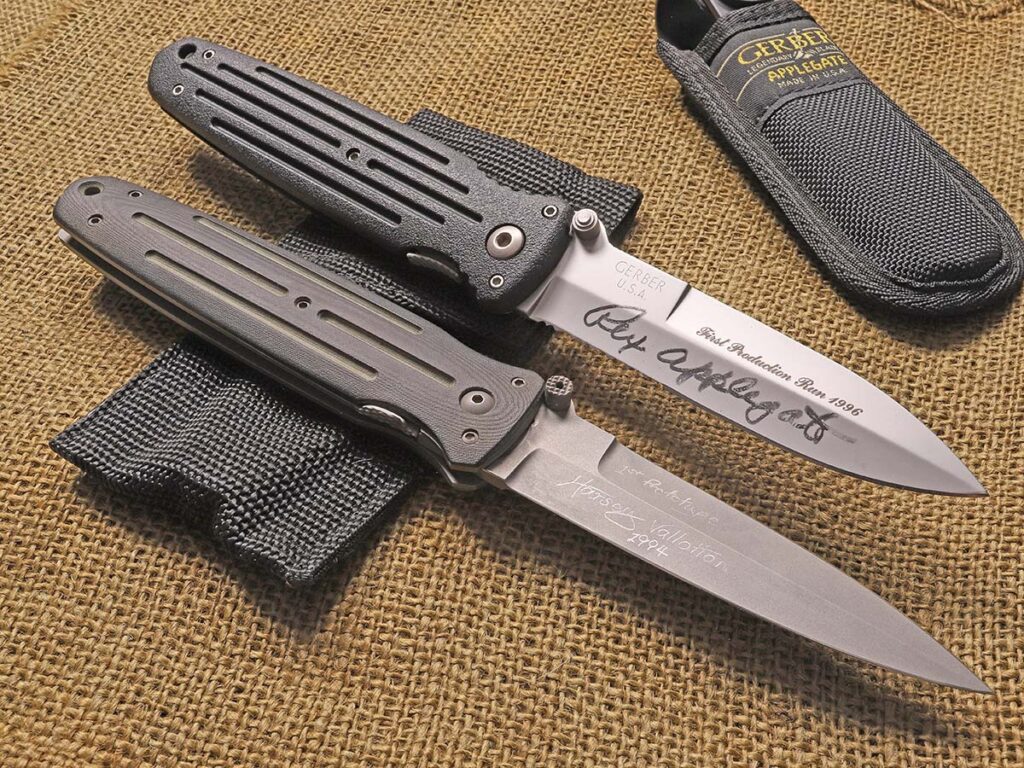
The original Applegate-Fairbairn Folder was a collaboration between Col. Rex Applegate and knifemakers Bill Harsey and Butch Vallotton. Harsey stated that a Gerber official said the Army ordered 50,000 of the knife at one time for the troops. At bottom is the original prototype and at top is a first-production Gerber version autographed by Applegate. (From the collection of Michael Janich)

The knife carried and made famous by Cutlery Hall-of-Famer James Bowie in the 1820s and 1830s was copied in various forms by makers worldwide and served as inspiration to any number of fixed blades carried in the U.S. military. Another large fixed blade that met with success in military circles was the Rifleman’s Knife made by the Ames Mfg. Co. circa 1860. Ames also made the Dahlgren Bowie Bayonet around the same time. Collins & Co. made a variety of bowies/machetes, the most famous probably being the No. 18, also incorrectly called the V-44 by many (according to D.E. Henry in his book Collins Machetes and Bowies 1845-1865, V-44 was the real name of a 1944 Case Survival Knife, not the No. 18).

Generational Blades

Circa the mid-19th century, Michael Price was considered one of the premier cutlers in the western United States. He was best known for exquisite presentation knives that incorporated marine ivory and a variety of beautiful shells. However, as Louis wrote, to create a viable knife for self-defense and combat, Price recognized that form must follow function. His solution was to use the full-tang construction method. And for a century and a half, some of the most notable American cutlers adopted the full-tang method that significantly improved a knife’s dependability and durability.

Early in 20th-century Michigan, Cutlery Hall-of-Famer William Scagel began forging axes and knives of various sizes and styles. He made most of his utility, hunting and bowie knives via the hidden-tang method. Though some of his combat knives were also hidden tang, many others employed the full-tang method.

“It was purported that the Scagel hidden-tang fighters with stacked leather washers were made for the European theater, while the full-tang fighters with wood-slab handles were made for the Pacific theater,” Louis wrote. “It was believed that stacked leather washers would be too susceptible to the humidity, high temperatures and salty air” of the applicable Pacific region. As a testament to Scagel’s outstanding craftsmanship and exceptional design, many of his fighters survived the war in good condition.

William Scagel’s hidden-tang fighters with stacked leather washers reportedly were made for the European theater during World War II, while the full-tang wood-slab fighters were made for the Pacific. The stacked leather washers were thought to be too susceptible to the humidity, high temperatures and salty air of the applicable Pacific region. (Image courtesy of Louis Chow)

In 1937, Cutlery Hall-of-Famer W.D. “Bo” Randall observed an older man scraping the bottom of a boat with a knife that appeared undamaged by the abuse. Intrigued by the improvised tool, Bo purchased it from the owner and contacted its maker, who just so happened to be Scagel. Randall eventually became Scagel’s student and soon opened his own shop, making Scagel-style knives.

“At the onset of World War II, Randall designed and produced some of the most recognizable combat knives ever made,” Louis stated. “Nonetheless, all were made with the hidden-tang method. It was not until the early 1960s that Randall introduced the full-tang Model 14-Attack and the Model 15-Airman combat knives.”
Continuing the generational theme, Cutlery Hall-of-Famer Bob Loveless read a magazine article about Randall knives in 1953. He corresponded with Bo and made his interpretations of Randall knives before experimenting with and then making his own full-tang models.

From the mid-1960s through the early ’70s, Loveless accepted many orders from service members awaiting assignment to Vietnam. He also received bulk orders from units stationed there. One bulk order in early March 1967 from a unit commander in the 1st Cavalry Division was for 37 fighting knives.

“The unit commander and his troopers were stationed in Saigon and were supporting Operation Junction City, one of the largest airmobile operations in the war,” Louis wrote. “As a patriot and former veteran himself, Loveless would temporarily halt all other orders and place top priority on knives destined for combat. As for those 37 fighters, he worked day and night and completed the order in less than a month. For the next four decades, the Loveless full-tang designs were copied and reinterpreted by countless knifemakers and knife companies in the United States and abroad.”

In addition to the foregoing cutlery legends, the full-tang method was also preferred by many other U.S. World War II knifemakers. Among them: Alfred Bimson, John Ek, Taylor Huff, A.R. Kephart, Kennedy Arms, Bob Riggs, Ernest Warther and Cutlery Hall-of-Famer M.H. Cole. Cole also authored the comprehensive U.S. Military Knives, Bayonets & Machetes series of books and has been dubbed the “Sage of Military Knives” by Cutlery Hall-of-Famer Bruce Voyles. Continuing Cole’s legacy is knifemaker/author Michael Silvey through his reproductions of Cole’s designs and his lavishly illustrated books on the knives of the United States military in World War II and Vietnam, and other works.

More On Military Knives:

How Many Damascus Knives Did Bill Moran Make?

We talk with those who know Bill Moran best to determine how many damascus blades the godfather of the craft forged.

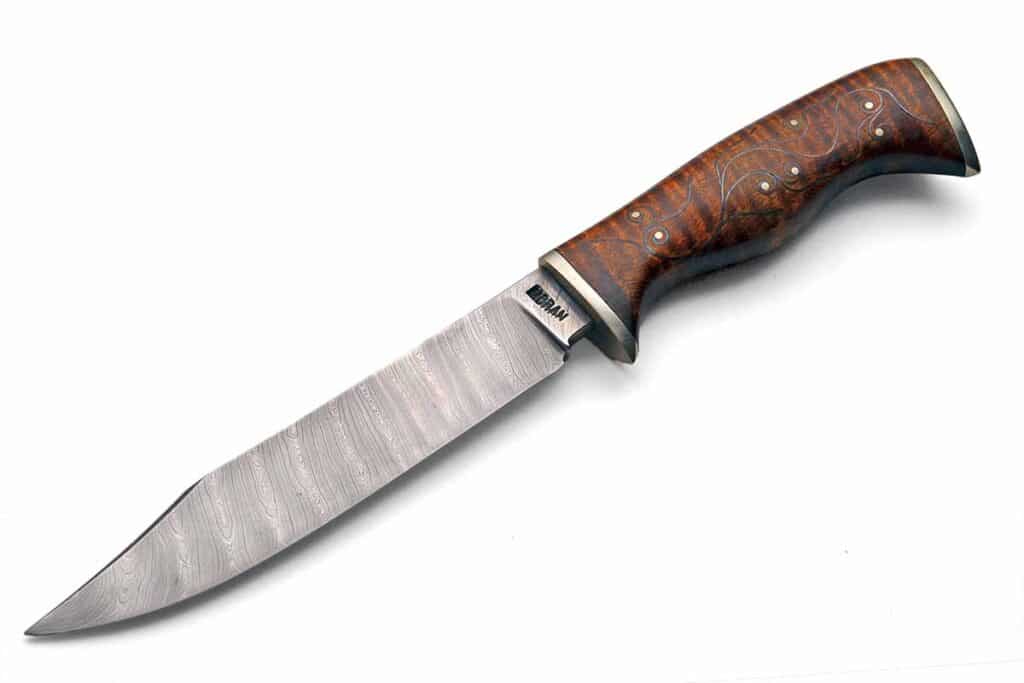
BLADE Magazine Cutlery Hall-of-Fame® member Bill Moran is and will forever be remembered as the father of modern damascus steel. He and a few early devotees popularized damascus during an era when the art of bladesmithing was an endangered species in the realm of the artisan.

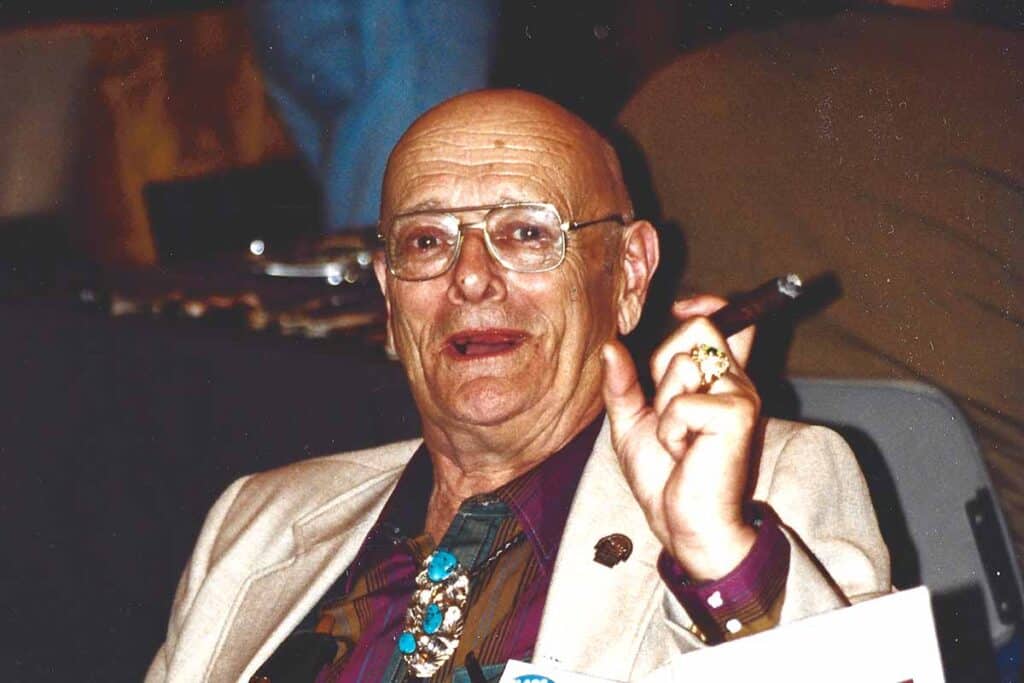
Though Moran was partial to smoking a pipe, he liked an occasional stogie as well. (Pete Cohan knife image)

It was Moran who shocked the custom knife world in 1973 when he brought eight knives to The Knifemakers’ Guild Show in Kansas City, Missouri. Those historic eight sported blades of Moran’s damascus steel and they created a sensation. Cutlery Hall-of-Famer, longtime journalist and friend of Moran’s, and a respected member of the knife community, B. R. Hughes remembered how the event electrified those who attended.

This is the first damascus knife Moran ever made. He forged “No. 1” circa 1972. It was misplaced for 30 years until Nancy Hendrickson found it in Moran’s house. (Pete Cohan knife image)

“When my wife [Carolyn] and I drove up to the Muehlebach Hotel in Kansas City, a friend of mine came out and said, ‘You gotta get in there and see the damascus knives Moran has on his table.’ Those knives were the talk of the show. Bill also had mimeographed sheets that explained what damascus steel was and how it was made. He gave those sheets away to anyone who desired one.”

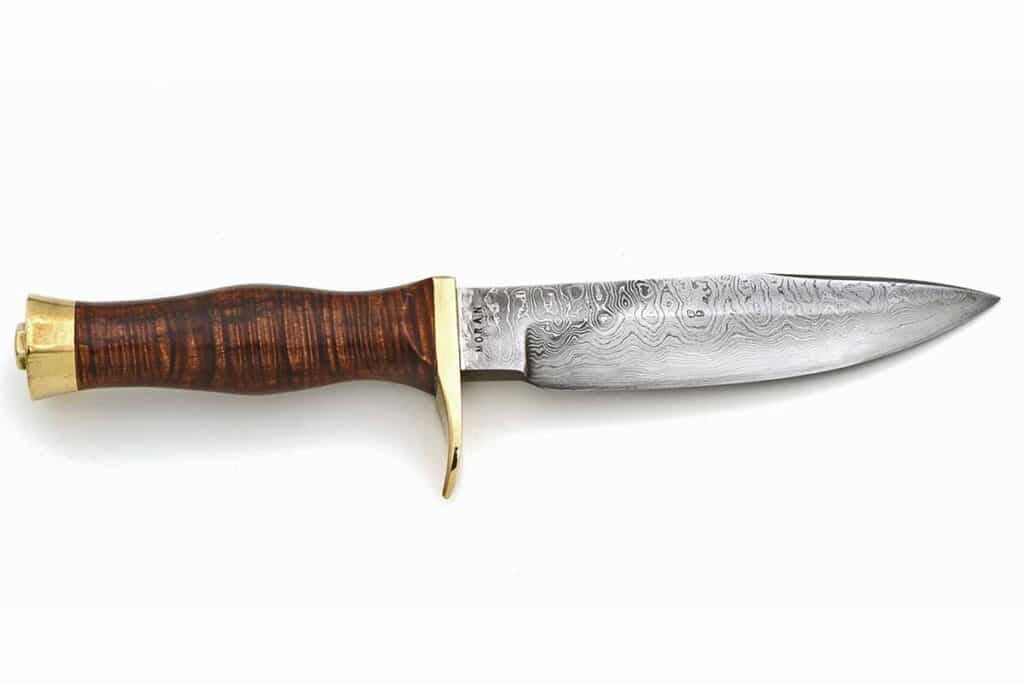
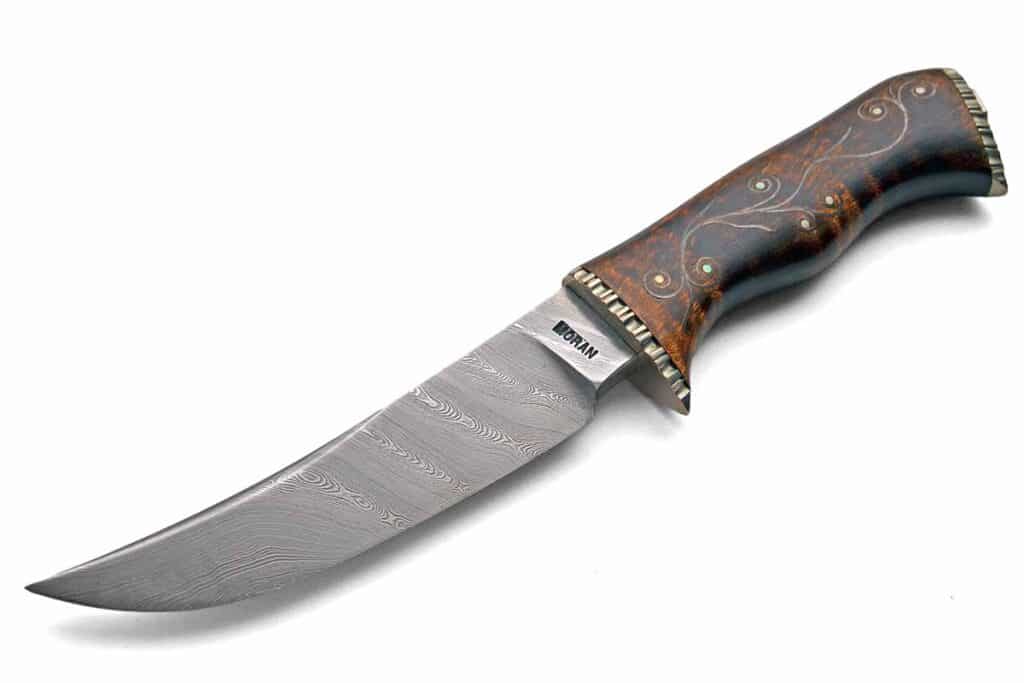
Moran made basic damascus knives. “They weren’t elaborate and this, that and the other thing, but most of them were for use,” B. R. Hughes noted. (Exquisiteknives.com image)

Three years later, Hughes joined Moran and bladesmiths Bill Bagwell and Don Hastings as the quartet that founded the American Bladesmith Society (ABS). When the ABS was founded in 1976, bladesmithing was on life support, and probably fewer than a dozen smiths were forging knives. Today, the Society includes more than 2,000 members and the future of the craft has been secured. Meanwhile, Moran deserves the credit as the catalyst for modern bladesmithing.

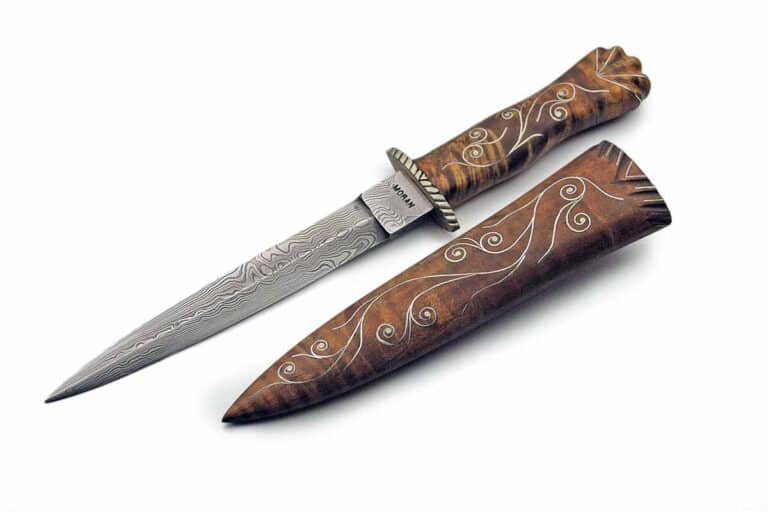
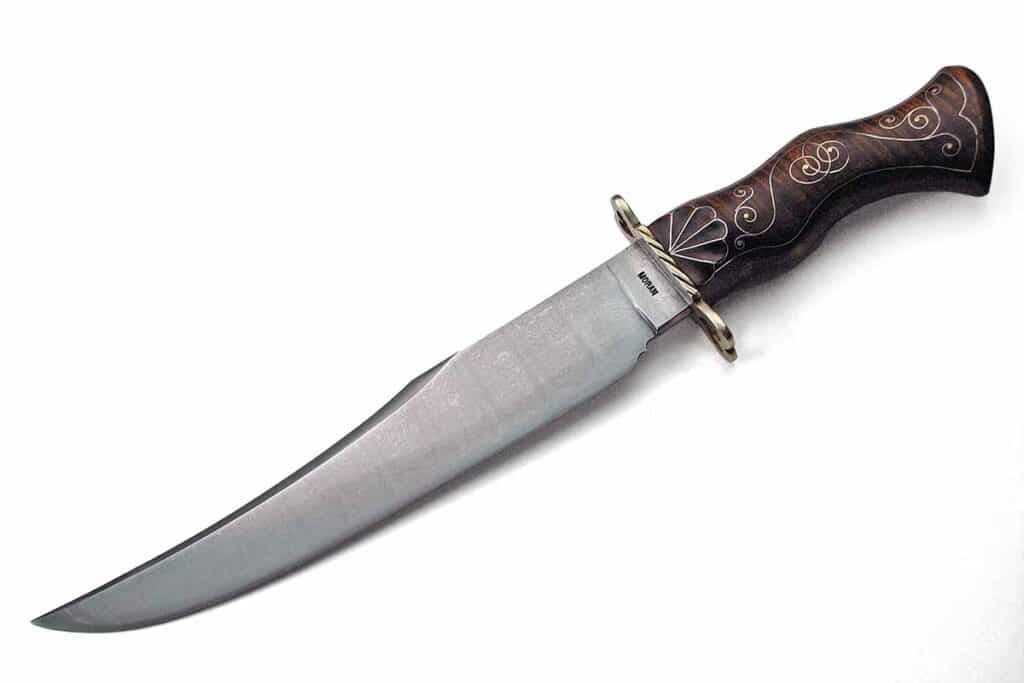
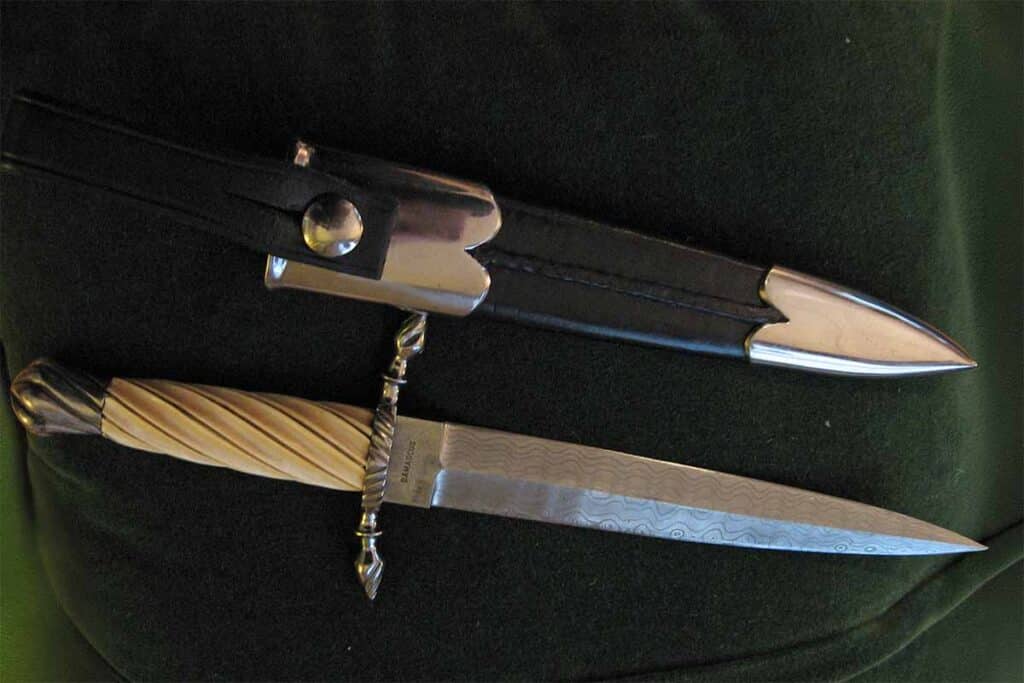
B. R. Hughes said Moran made some art daggers that “were a bit elaborate for the day.” An example is this large quillon dagger. (Exquisiteknives.com image)

How Many Damascus Knives Did Moran Make?

While there is no question that Moran and other dedicated disciples of the forged blade brought damascus and the ring of the hammer back to life in the early-to-mid-1970s, there is some conjecture as to just how many such knives the great Moran forged and completed himself. The thought of how many Moran damascus knives were made and exist today is tantalizing, and, of course, what’s a great legend without a bit of mystery and conjecture? Exploring Moran’s body of work and the damascus element within provides some insight into the man, the legend who padded about on the creaky floor of his Maryland shop, sometimes chewing tobacco, but rarely alone when his doors were open as crowds came to see the wizard work.

Back in the day, a Moran damascus knife was a challenge to own, considering the time Moran spent in his shop with the material actually able to work without the distraction of visitors, the many hours of labor required to produce a damascus billet, and the higher price for such a piece that naturally followed. (Exquisiteknives.com image)

Collectors such as Cutlery Hall-of-Famer Butch and Rita Winter bought the first of Moran’s damascus knives during that historic Guild Show more than a half-century ago, and, as Hughes relates, “Moran made basic damascus knives. Most of his were what folks would call ‘using’ knives. They weren’t elaborate and this, that, and the other thing, but most of them were for use. He did make some art daggers that I thought were a bit elaborate for the day.”

Dave Harvey, Nordic Knives

Hughes remembers that Moran himself was rather vague on the number of damascus knives he actually made. However, probably the best estimate is that fewer than 100 Moran damascus knives were made during a career that spanned more than 50 years.

“He liked the random pattern and the ladder pattern,” B. R. remembered, “and he could do some pretty good patterns, but it took a lot of time. He was very happy just making ladder pattern and stuff like that, and he continued making non-damascus knives and about 40 folders. When he was in his shop, there were always five or six locals in there talking to him and watching him work.” Agreed Cutlery Hall-of-Famer and ABS master smith Jay Hendrickson, a close friend of Moran for 30 years, “Bill had so many visitors to his shop on a daily basis that it is a wonder he ever got anything accomplished.”

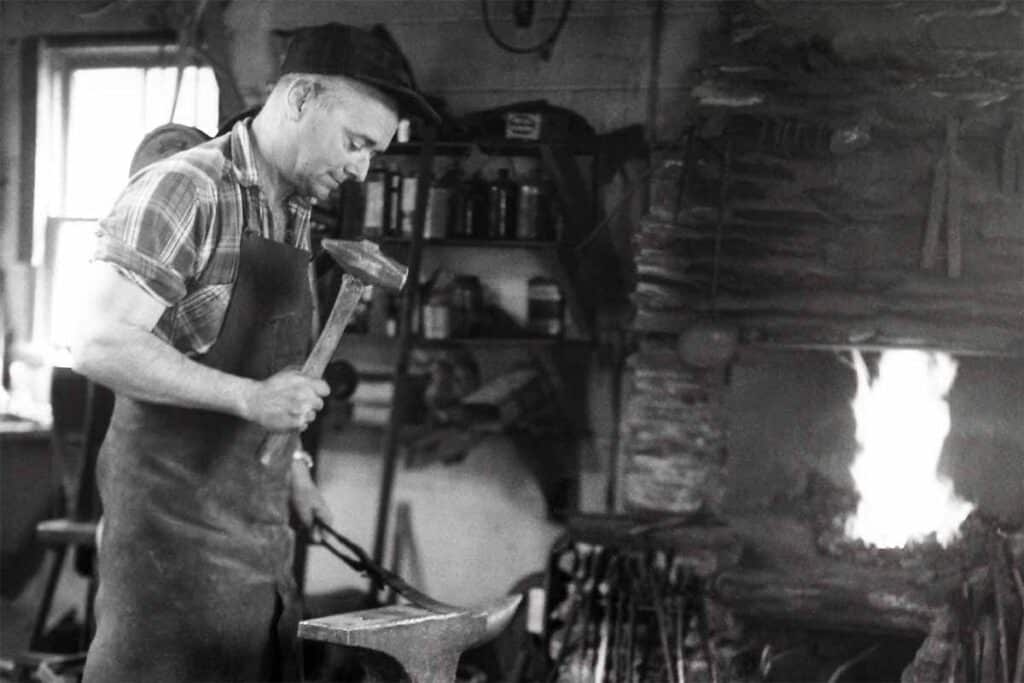
According to Jay Hendrickson, Moran made all of his damascus in a coal fire. “All of Bill’s experiments were with coal, as gas forges were not popular at the time,” Jay explained. “In today’s world, gas forges are almost always used for damascus making because of adjustable temperature and the cleanliness of propane gas.” (vintage photo of Moran in his shop circa the 1960s)

Hendrickson served as the executor of Moran’s estate and founded the Moran Foundation to preserve the great bladesmith’s legacy, serving as its president for 10 years. Jay observed that Moran made a workingman’s knife with quality that was spot-on, though there may have been an occasional flaw in the solder on his early pieces. Nonetheless, Jay says, Bill’s knives always cut.

As for Moran’s damascus knife productivity, Hendrickson offered, “This is strictly a judgment call on my part, but I would say Bill made less than 100 damascus knives. I counted 36 in our Forever A Legend book. I only know a few people that own Bill’s damascus knives, but I think they are sold and traded often between collectors. You also see Bill’s damascus knives occasionally sold at auctions.”

Butch and Rita Winter bought this damascus quillon dagger from Bill Moran at the 1973 Knifemakers’ Guild Show where Moran introduced modern damascus knives. It was one of eight damascus knives Moran brought to the show. The tang is marked DAMASCUS in all uppercase letters. (image courtesy of Rita Winter)

Jay verifies the original sale of a Moran damascus quillon dagger and sheath to Butch and Rita Winter and adds a bit more information. “Rita Winter recently sold Bill’s first damascus dagger to Mr. Doug Hook, a Tennessee collector,” he commented. “Two years ago, I repaired one of the twisted wires on the handle for Mr. Hook. Because of that contact I was able to confirm the original purchase as Doug has written verification of the original sales transaction and the invoice.”

So where are the majority of Moran’s damascus treasures today? Longtime purveyor Dave Harvey of nordicknives.com is straightforward—“in collections around the world. Values vary and depend largely on the particular knife. But they are generally worth at least double that of [one of Moran’s straight carbon steel blades], sometimes even more.”

Dave Ellis said the first of the Moran damascus knives are quite valuable and guessed they would start at least at $10,000 and go up from there. Dave holds an early 1970s Moran damascus hunter at BLADE Show 2023.

Back in the day, a Moran damascus knife was a challenge to own, considering the time Moran spent in his shop with the material actually able to work without the distraction of visitors, the many hours of labor required to produce a damascus billet, and the higher price for such a piece that naturally followed. Dave Ellis of Exquisiteknives.com reasoned, “I could not say how many damascus knives Moran made in his lifetime, but certainly not a large number. Many of Moran’s damascus pieces reside in private collections, as well as the Moran Museum. I personally have owned and still own some and have sold a number of the finer pieces to overseas clients.

“I believe he made four or five patterns. Damascus steel was and still is a laborious process. Bill’s prices for his damascus knives were quite high for the time, so he made and sold mostly carbon steel pieces. Damascus was reserved for higher-end clientele and foreign dignitaries. A good number of the damascus knives were fighters and bowies. Damascus hunters were also made, many with Bill’s twist pattern steel, maidenhair. I do not know of any mosaic steel knives that Moran made. The first of the Moran damascus knives are quite valuable, and I would guess that they would start at least at $10,000 and go up from there.”

Along with Bill Bagwell and Don Hastings, Bill Moran (left) and B. R. Hughes (right) founded the American Bladesmith Society in 1976. Hughes is the only surviving founding member. (Buddy Thomason image)

HOW HE MADE THEM
Hendrickson is familiar with Moran’s most common damascus patterns, the maidenhair twist, ladder pattern and others. “He knew how to fuse metal, as he learned that technique working on equipment on the family farm,” Jay remarked. “On the farm he made knives from whatever he could get his hands on, old springs, files, and rasps, for example. He could also buy steel from a local hardware store in town. Bill also knew the difference between plain iron and high carbon steel. His first damascus experience began by using one piece of steel and one piece of iron. He welded the two together, drew it out and folded it many times.”

The process yielded insight for Moran, and he learned from experience. At times during the process of hammering and folding, he realized that the steel was absorbing heat quicker than the iron because it was on the outside of the billet. Therefore, he moved to one piece of iron with steel in the center, and then a second piece of iron, using O1 tool steel and a carbon mix of 33 percent. According to Jay, this combination gave the billet the right hardness without the need for tempering. Moran’s test of the finished knife was to carve wood for two hours with no loss to the cutting edge, and he was satisfied with the results using this mixture.

Moran’s test of the finished damascus knife was to carve wood for two hours with no loss to the cutting edge. An example is this clip-point model, again in a ladder pattern. (Exquisiteknives.com image)

“Bill made all of his damascus in a coal fire,” Hendrickson recalled. “A hot coal fire can melt steel as temperatures can reach over 2,700 degrees Fahrenheit, which is the melting point of steel. That is why Bill added iron to the outside of the billet, as iron is less apt to burn as quickly as steel. All of Bill’s experiments were with coal, as gas forges were not popular at the time. In today’s world, gas forges are almost always used for damascus making because of adjustable temperature and the cleanliness of propane gas. Therefore, the burning of steel to a great deal has been eliminated with the use of gas forges.”

Hendrickson attributes the relative scarcity of Moran damascus knives to the maker’s affinity for producing using knives, constraints on time and other factors. “Bill was truly a supporter of the art knife,” he noted, “and along with others they created that industry. Collectors were willing to pay big time for exceptionally well-made knives, and Bill, like other top-notch makers, profited as this industry took hold. However, Bill’s true passion was in using knives, such as camp knives, hunters and small utility knives, of which he made many. The vast majority of his knives came from customers wanting working knives.

A good number of Moran’s damascus knives were fighters and bowies, according to Dave Ellis. This classic ST-24 in ladder-pattern damascus and curly maple handle with fancy wire inlay is a favorite of Moran collectors. (Exquisiteknives.com image)

“Bill liked to experiment with damascus. For example, he would slip in an added piece of iron after many folds to gain toughness in the end product. Another example was where he completed a damascus billet to the desired number of welds. He then cut it in two and added a piece of high carbon steel to form the middle and welded the two damascus pieces on both sides of the high carbon steel. Once that was completed, Bill forged the billet into a knife. One might call the finished product a damascus san-mai. Bill liked the various patterns that were being developed beyond the more basic patterns that he originally developed. To Bill, mosaic knives were art knives, not to be used but just admired. He didn’t like the process of welding pieces together to make a knife. Remember, he was more into using knives where the grain within the steel followed the entire edge of the blade.”

Through the years, Moran became a legend, leaving a legacy of learning, teaching, giving information freely, and welcoming many to his shop. He paid tribute in steel to the wonder of damascus, the art knife and the using knife. Today’s body of bladesmiths still looks to him as the guiding light that led them to the glow of the forge and the spark of the hammer on hot steel. Those who own or admire the few damascus knives that Moran completed continue to do so for their beauty, their imagination, their rarity, and simply because they bear the touch of the master’s hand.

More On Knifemaking:

Chute Knife: Full-Spectrum Warrior

A fine example of a tool and weapon of war, the chute knife more than rose to fulfill the roles for which it was intended.

Harry Archer was a somewhat shadowy figure. At the height of the Vietnam War, he was engaged in nasty business—fighting a stealthy enemy in a steaming jungle, sometimes up close and all too personal.

Those who knew Archer acknowledged that some of his exploits were “larger than life.” They considered him an early non-movie version of author David Morrell’s fictional character of John Rambo*. Still, Archer was real, flesh and blood. And it seems altogether fitting that responding to his need for knives that “deliver” in a tight spot—survival, seconds along the fine line between life and death—he would come to know and rely on another legend.

According to John Denton, perhaps the world’s foremost authority on the knives of BLADE Magazine Cutlery Hall-Of-Fame® member Bob Loveless, Loveless and the man he came to describe as the “head of CIA operations in Vietnam” were introduced to one another by knife writer/Cutlery Hall-Of-Famer Ken Warner. It followed that Loveless made several knives for Archer’s use in the field, among them a fine sub-hilt and stag-handle example of his well-known Big Bear, along with several other  Big Bears. Loveless’s close friend and fellow maker Steve Johnson was working in Bob’s shop at the time and participated in crafting these. A fighter in a tulip wood handle is another cold beauty.

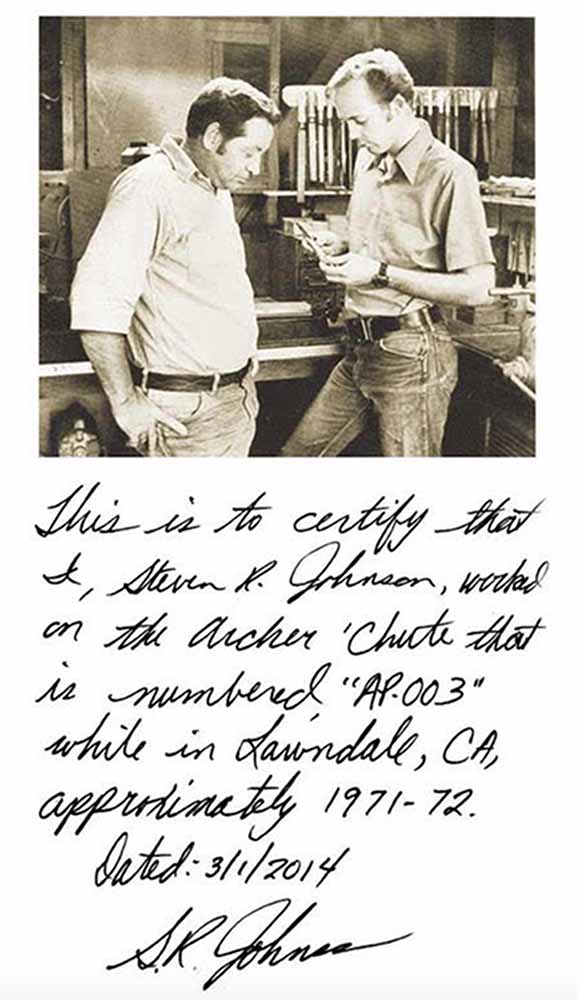
Johnson worked with Loveless from June 1971-October 1974 in the Lawndale and Riverside, California, shops. Steve had a hand in the production of the prototype chute knife in the earliest days, and 23 years later signed a photograph for John Denton attesting to his work on that piece of history. Steve’s inscription reads in part: “This is to certify that I, Steven R. Johnson, worked on the Archer ’chute that is numbered ‘AP-003’ while in Lawndale, CA, approximately 1971-72.”
Johnson worked with Loveless from June 1971-October 1974 in the Lawndale and Riverside, California, shops. Steve had a hand in the production of the prototype chute knife in the earliest days, and 23 years later signed a photograph for John Denton attesting to his work on that piece of history. Steve’s inscription reads in part: “This is to certify that I, Steven R. Johnson, worked on the Archer ’chute that is numbered ‘AP-003’ while in Lawndale, CA, approximately 1971-72.” (images courtesy of John Denton)

Then there is the well-known Harry Archer chute knife, a versatile fixed blade with good looks and the ability to travel light but cut paracord for a quick exit from a tangled parachute shroud, and with a stout spine for prying loose from the wreckage of a helicopter. The chute knife was made for the jungle. It was made for Harry Archer.

“It seems that Loveless had been left out of a book by Warner, and Loveless sent Ken some knives to review,” Denton recalled. “It just so happened that Archer was there with Warner. Harry saw the knives and bought them all.”

Johnson worked with Loveless from June 1971 to October 1974 in both the Lawndale and Riverside, California, shops. He had a hand in the production of the prototype chute knife in the earliest days and 23 years later signed a photograph for Denton attesting to his work on that piece of history. Steve’s inscription reads in part: “This is to certify that I, Steven R. Johnson, worked on the Archer ’chute that is numbered ‘AP-003’ while in Lawndale, CA, approximately 1971-72.”

Johnson explains that the chute knife is a fairly small, compact fighter and survival knife, short, light, double-edged and strong, but not made in stock thicker than 3/16 inch. Holes for thongs are placed in the rear of the handle and the guard for lashing the knife to a pole or limb to make an improvised spear. It rides into action atop a chest pack or secondary parachute for quick, easy access. Claims that Warner had a hand in the design are unconfirmed, but “the chute” simply looks the part of the warrior’s dependable asset.

“You’re able to cut both ways with the knife via the swipe of an arm or hand,” Johnson related. “Specifically, it’s for cutting parachute cord should it be tangled or caught in a tree. It’s a knife that a pilot, paratrooper or soldier should carry, and it would not be a burden but useful and available in every situation.”

HARRY ARCHER LORE
Stories of Archer’s combat prowess have been told and retold, but to raise awareness of the immediacy of a close-in fight, nothing is better than the harrowing tale that Denton remembers Loveless repeating. John points to a photo of a vintage Big Bear, identifies it as a knife that Archer took into combat, and says, “Harry and his men got into a hand-to-hand fight, and the tip of the blade was broken off inside the enemy. Harry took the knife back to Bob to fix, and Loveless said, ‘Where’s the tip?’ Harry replied, ‘It’s still in the rib cage of the Viet Cong soldier.’ So, Loveless fixed the blade.’”

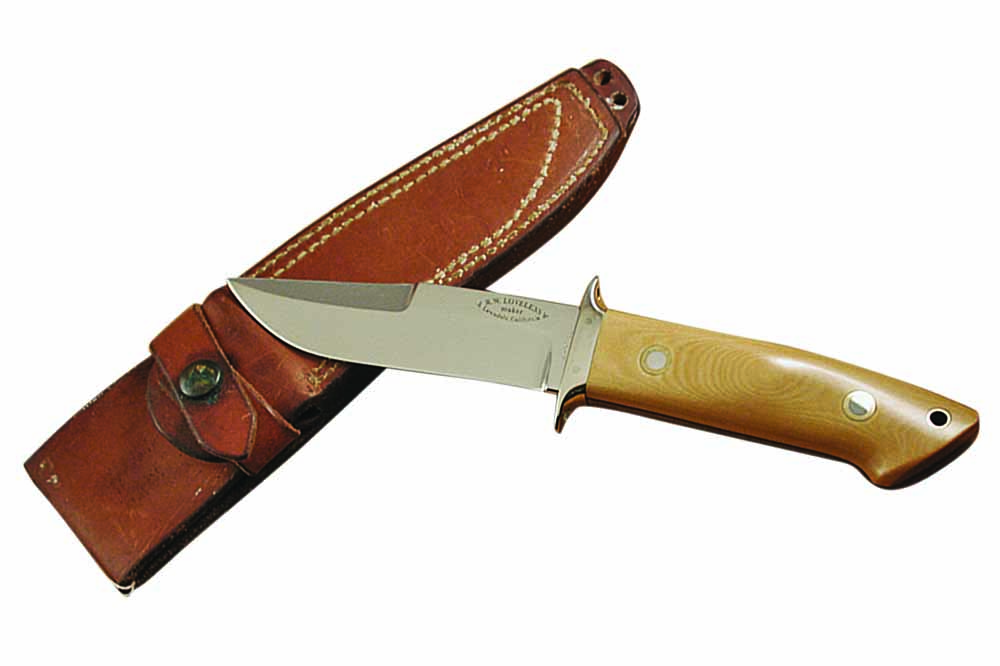
Made in Bob Loveless’s Lawndale, California, shop about 1973-74, this chute knife in ivory Micarta® is stamped BR-003. It was made for the Brass Rail, a famous gun shop in Hollywood, California, where all the celebrity types hung out to see guns and knives. Note the holes in the guard for lashing the knife to a pole to make a spear.
Made in Bob Loveless’s Lawndale, California, shop about 1973-74, this chute knife in ivory Micarta® is stamped BR-003. It was made for the Brass Rail, a famous gun shop in Hollywood, California, where all the celebrity types hung out to see guns and knives. Note the holes in the guard for lashing the knife to a pole to make a spear. (images courtesy of John Denton)

Like the Big Bear and other Loveless creations, the chute knife has its place in the lore of Harry Archer. After he collaborated to produce the prototype, Johnson continued to work with Loveless on more of the chute knives. He remembers meeting Archer in the California shops.

“Loveless really admired Archer and his adventures in the Vietnam War era, working with USAID**, the CIA and different assignments in various parts of the world,” Steve commented. “[Harry and I] discussed life in camp in Vietnam, interactions with Vietnamese soldiers and personnel with whom he was serving. That was quite interesting.”

Steve calls the chute “one great knife” and remembers conversations in Lawndale when the veteran operative praised it as light and small enough to carry so that it could always come along on a mission. Johnson also made a chute knife for Archer and continues to produce his own model today.

“We worked together on Archer’s order for a ‘Johnson’ version of a chute knife on a bench in the rear of Bob Loveless’s shop, in his garage in the back of his house in Lawndale,” Steve smiled. “Archer asked me to make my version, which we—mostly he—designed in the early 1970s. He did a drawing for me. The 154CM blade was about 4.5 inches long, the handle slim and a bit longer than normal, and it had a large thong tube, three handle screws, a stag handle, and checkering on the top and bottom of the tang just behind the guard.”

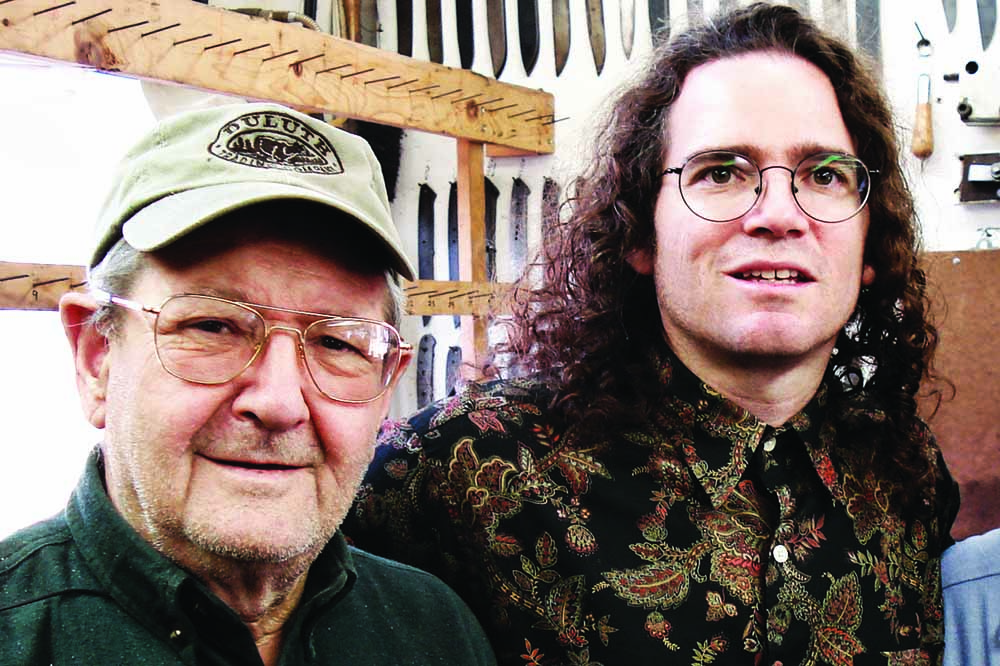
Bob Loveless (left) and John Denton (right)

For Johnson, working with Archer was a pleasure and a defining moment in his illustrious knifemaking career, which, after recovery from a serious accident, took him from Loveless’s shop to his own space in Manti, Utah, more than 40 years ago. “Harry Archer was a great guy who appreciated my work, as well as Bob’s,” Steve added, “and I made him a few knives after California. He was very easy to talk to, respected others, and he really was a man of intrigue and adventure. And Bob Loveless treated me like a son.

“I’m making a chute knife for Atlanta [Steve was interviewed prior to BLADE Show 2021] as we speak, with the blade polished so far, instead of the top grind being just the length of the clip,” Johnson concluded. “I use the pattern that Loveless gave me when I left his shop in Riverside in 1974 or 1975. This particular knife is going to have a stag handle and stainless steel fittings. I’ll make more when asked, and I still have a few on order in my books.”

Long-time maker and designer Bob Dozier was a friend of Loveless and went on to design a chute knife for Cutlery Hall-Of-Famer A.G. Russell. Though his only acquaintance with Harry Archer is through the recollections of A.G., who knew him, Bob says his version of the chute knife remains in demand for one simple reason: “It sells.”

Dozier turns out his chute knife with a 4.75-inch D2 tool steel blade and overall length of 9.75 inches. The handle is green canvas Micarta® “because Goldie [Russell] won’t let me put anything else on them. I’ve got some blades hanging right now, getting ready.”

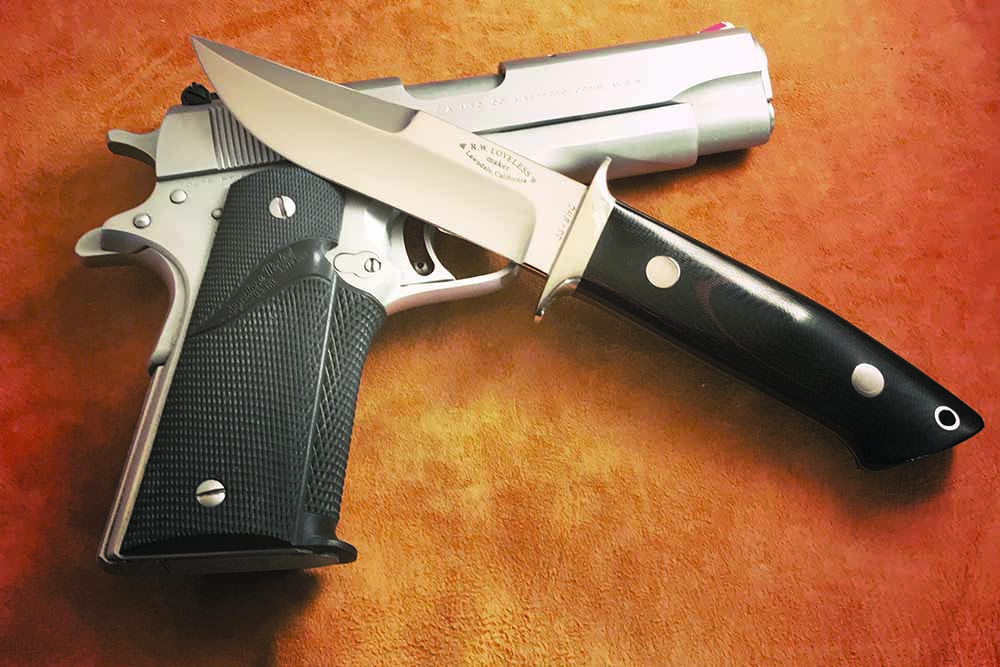
The “RR” on the guard of this Loveless chute indicates it was for the Ram Rod gun store in New Castle, Indiana. Early on Ram Rod sold knives by Loveless, Bill Moran, Ron Lake, W.W. Cronk and others. It appears here with a Smith & Wesson Model 41 modified by Loveless.

Dozier is familiar with the Loveless chute knife configuration but never had the Loveless pattern. He looked at the earlier chute knife profile and made some tweaks. “My handles are like the Loveless, but I don’t cut the butt off as square as he did. I leave more of a point on it than he did. Mine is still mostly like Bob’s, and he was one of the first to make a really good slab-handled knife. That’s one reason why most of us have copied him.” Dozier’s chute knife, designed and built for A.G. Russell Knives, has a manufacturer’s suggested retail price of $895.

SAGA of The CHUTE
The saga of the chute knife certainly has a human side. While Denton estimates that early Lawndale chute knives might fetch as much as $14,000 if found for sale today, and chute knives made in Riverside command up to $12,000 each, they are desirable on the collector market. Nonetheless, the greatest value of the chute knife lies in its lifesaving and protective capability in the hands of a dedicated professional such as Harry Archer.

Through those years of association, Loveless and Archer became friends, sharing a common bond of respect and admiration for the best in fighting and utilitarian knives.

“Loveless said that Harry would come by his shop after periods of being in the jungle for months at a time,” Denton remembered. “He used Bob’s place to unwind and try to become civilized again before heading home to Virginia. But Loveless also said, ‘Harry was like a wild animal when he came to the shop, trying to keep his head straight before he saw his family.’”

Whenever Harry Archer ordered several Big Bear fighters from Bob Loveless, Loveless said Archer told him to “send the bill to the Pentagon.” From top: the Big Bear Harry broke the tip off inside a Viet Cong soldier during the Vietnam War; tulipwood fighter with skull cracker; Loveless/Johnson sub-hilt with the initials HJA for Harry J. Archer; boot knife with skull cracker; and one Loveless called the Pig Sticker.
Whenever Harry Archer ordered several Big Bear fighters from Bob Loveless, Loveless said Archer told him to “send the bill to the Pentagon.” From top: the Big Bear Harry broke the tip off inside a Viet Cong soldier during the Vietnam War; tulipwood fighter with skull cracker; Loveless/Johnson sub-hilt with the initials HJA for Harry J. Archer; boot knife with skull cracker; and one Loveless called the Pig Sticker. (image courtesy of John Denton)

The chute knife is indeed a fine example of a tool and weapon of war rising to fulfill the roles for which it was intended. It remains a popular pattern because of its looks, quality and versatility. And for one other reason in particular: It helped men like Harry Archer survive the most desperate of situations and make it home.

*In actuality, Morrell based the Rambo character on Medal-Of-Honor recipient Audie Murphy.

**USAID is the acronym for United States Agency for International Development, with the inference here being that in this instance it functioned as a cover for the CIA.


More On Bob Loveless Knives:

  • 15 Best Bob Loveless Knives of All-Time
  • The Legacy of the Bob Loveless Dropped Hunter
  • Merritt-Loveless Knives Do Indeed Hold Merit
  • Fourth In Greatest Loveless Knife Designs Series
  • Advertisement

    Must Read Articles

    Read this before you make a knife

    Knifemaking 101 – Read This Before You Make a Knife

      by Wayne Goddard My experience has taught me that there's nothing like digging in and getting started. I've often said the hardest part of the...
    how to forge damascus steel

    How to Forge Damascus

    Advertisement
    Advertisement